EP4281657B1 - Automatic cleaning system for sludge cleaning - built into two-stroke cross-head engines - Google Patents
Automatic cleaning system for sludge cleaning - built into two-stroke cross-head engines Download PDFInfo
- Publication number
- EP4281657B1 EP4281657B1 EP22700954.5A EP22700954A EP4281657B1 EP 4281657 B1 EP4281657 B1 EP 4281657B1 EP 22700954 A EP22700954 A EP 22700954A EP 4281657 B1 EP4281657 B1 EP 4281657B1
- Authority
- EP
- European Patent Office
- Prior art keywords
- auger
- engine
- hollow
- sludge
- scavenge air
- Prior art date
- Legal status (The legal status is an assumption and is not a legal conclusion. Google has not performed a legal analysis and makes no representation as to the accuracy of the status listed.)
- Active
Links
Images



Classifications
-
- F—MECHANICAL ENGINEERING; LIGHTING; HEATING; WEAPONS; BLASTING
- F02—COMBUSTION ENGINES; HOT-GAS OR COMBUSTION-PRODUCT ENGINE PLANTS
- F02B—INTERNAL-COMBUSTION PISTON ENGINES; COMBUSTION ENGINES IN GENERAL
- F02B77/00—Component parts, details or accessories, not otherwise provided for
- F02B77/04—Cleaning of, preventing corrosion or erosion in, or preventing unwanted deposits in, combustion engines
-
- F—MECHANICAL ENGINEERING; LIGHTING; HEATING; WEAPONS; BLASTING
- F02—COMBUSTION ENGINES; HOT-GAS OR COMBUSTION-PRODUCT ENGINE PLANTS
- F02B—INTERNAL-COMBUSTION PISTON ENGINES; COMBUSTION ENGINES IN GENERAL
- F02B25/00—Engines characterised by using fresh charge for scavenging cylinders
- F02B25/02—Engines characterised by using fresh charge for scavenging cylinders using unidirectional scavenging
- F02B25/04—Engines having ports both in cylinder head and in cylinder wall near bottom of piston stroke
-
- F—MECHANICAL ENGINEERING; LIGHTING; HEATING; WEAPONS; BLASTING
- F02—COMBUSTION ENGINES; HOT-GAS OR COMBUSTION-PRODUCT ENGINE PLANTS
- F02B—INTERNAL-COMBUSTION PISTON ENGINES; COMBUSTION ENGINES IN GENERAL
- F02B75/00—Other engines
- F02B75/02—Engines characterised by their cycles, e.g. six-stroke
- F02B2075/022—Engines characterised by their cycles, e.g. six-stroke having less than six strokes per cycle
- F02B2075/025—Engines characterised by their cycles, e.g. six-stroke having less than six strokes per cycle two
Definitions
- a further object is to obtain savings in relation to consumption of cleaning chemicals and diesel oil consumed in connection with manual cleaning of the indicated areas in the engine.
- a still further object is to obtain a saving in the consumption of cylinder lubrication oil.
- the present invention will result in trouble-free operation of these two-stroke engines and will mean a drastic saving in man-hours for manual cleaning.
- the invention could lead to one significant savings in relation to consumption of cleaning chemicals and diesel oil consumed in connection with manual cleaning of the indicated areas in the engine.
- the present invention will assist engine operators to save consumption of significant amount of cylinder lubrication oil.
- the invention can be used both as a retrofit on existing engines and installations, as well as for installation in or on new engines and installations.
- the invention can be used both for pressure-set and pressure-less (open) systems.
- the auger may be centreless such that sludge and oil further flows in an auger center.
- the auger may be positioned such that it can scrape a sludge out of the engine towards an outlet opening.
- the bottom of the hollow may incline towards the bottom of the auger, thus that both sludge and oil will slide or flow down towards the bottom of the auger.
- the auger when the auger is positioned in an engine hollow being the scavenge air receiver the auger may be held in position by a longitudinal guiding plate.
- a driving unit may be mounted at the end of the auger.
- the auger may be positioned in the integrated pipes that drains from the engine.
- the rotating flexible helical auger is further characterized by being flexible so that it can follow and function in any channels and/or tubes and any soft bends.
- the auger's primary function is to prevent the deposition of solids (sludge) within the hollow in which the auger is positioned. This is achieved at a relatively slow rate rotation that produces a scraping effect against the inner wall of a channel, tube or duct.
- the primary media transport passes by flow through the hollow diameter of the spiral auger, as well as along the outer diameter of the auger.
- the flow occurs by gravity due to the inclination of the inner wall or as due to pressure difference between the inlet and outlet of the auger.
- inner wall' is referred the surface of the profile cross section in which the auger is positioned, and which may be a channel, a duct of a tube.
- the auger can thus be placed in pipes and/or ducts that are closed and possibly combined with fully / partially open stretches.
- the auger can also be positioned in closed pipes and ducts.
- This effect of the present invention is opposite to the effect obtained with a system disclosed in the above-mentioned GB 468813 A which has the purpose of transporting/forcing the solid down below a water surface and through stagnant water in a constantly pipe in order to effectively extinguish embers and fire in the ash/slag before being transported for storage.
- the effect of the present invention is continuously to keep a tube or pipe inner wall clean of undesired sludge.
- the present invention further differs from the prior art technique by being built into e.g. a two-stroke engine, preferably of the crosshead type.
- the rotational speed of the spiral auger may be adjusted so that a relatively clean inner wall/channel/pipe is maintained by preventing precipitation and construction of solid and/or sluggish liquid material.
- the speed of rotation of the auger may be adjusted to slow speed to avoid unnecessary friction between auger and inner wall. This avoids unnecessary wear as well as temperature rise on the rotating auger.
- the rotating movement of the spiral auger can be a constant or varying rotational speed.
- the invention can is also be performed with intermittent (start / stop) rotating motion.
- the invention is further characterized by having a drive unit mounted at the end of the auger.
- the scraping / cleaning movement of the spiral auger can take place with the direction of movement away from the drive unit - as well as direction of movement towards the drive unit.
- the drive unit produces a rotary movement of the spiral auger.
- the rotary movement of the drive unit can be performed using electric motor / actuator, hydraulic motor / actuator, pneumatic motor / actuator, mechanical actuator or manually operated.
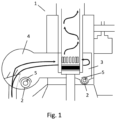
- FIG 1 shows an embodiment seen in the cross-section of an engine 1 where augers 2 (or snails or spiral screws) are mounted both in the engine flushing air belts 3 (referred to as” Scavenge air space” or “piston underside space”), and in the engine flushing air tank 4 (also referred to as "scavenge air receiver”).
- the augers 2 are held in position by longitudinal guiding plates 5.
- the auger 2 can extend straight or slightly curvingly.
- the bottom of the engine flushing air belts 3 are made with an appropriate inclination towards the bottom of the auger 2, thus that both sludge and oil will slide/flow down towards the bottom of the auger 2.
- Fig. 7 shows an embodiment auger 2 positioned relative to a surface 24.
- the auger 2 is positioned at the bottom of a bend surface 24 having declining sides towards the auger 2.
- the arrows indicate direction of movement of sludge and oils towards the bottom of the auger 2.
Landscapes
- Engineering & Computer Science (AREA)
- Chemical & Material Sciences (AREA)
- Combustion & Propulsion (AREA)
- Mechanical Engineering (AREA)
- General Engineering & Computer Science (AREA)
- Lubrication Details And Ventilation Of Internal Combustion Engines (AREA)
- Screw Conveyors (AREA)
- Incineration Of Waste (AREA)
Description
- The invention concerns an engine with an automatic cleaning system with rotating flexible spiral auger fixed mounted within a hollow of the engine such that fluids and solids within the hollow are transported along the outer diameter of the auger.
- More specific the invention relates to an automatic cleaning system with a rotating flexible spiral auger that can be used in or on two-stroke crosshead engines. and is particularly suitable for incorporation into the engine flushing air belts. (also referred to as" Scavenge air space" or "piston underside space").
- It is known from two-stroke crosshead engines that "sludge" accumulates layer on layer in engine flushing air belts. This phenomenon occurs because of the composition of the medium. The media consists of lubricating oil from the lubrication of the cylinder, mixed with solid particles in the form of unburned particles (sludge). These solid or sluggish liquid constituents tend to precipitate/precipitate and accumulate on surfaces with little or no inclination, relatively quickly, layer on layer, building up a relatively large amount of solid sludge under the operation of the engine. This built-up material has almost consistency as hard trampled soil. The phenomenon occurs because the flowing part of the media (oil) flows away, without being able to keep the solid/sluggish liquid components in sufficient motion.
- Examples are known where an unacceptable amount of solid sludge is built up, after only 3 weeks of operation since the last cleaning.
- Presently the problem is mainly solved by manually cleaning the areas by small shovels, creators, spatulas and other known tools for cleaning/excavating. However, this leads to relatively high consumption of working hours. In addition, it is necessary to stop the engine for several hours to perform this manual work.
- In known examples a consumption of over 1200 working hours on manual cleaning of purge air belts, purge air tank and associated drainage pipes annually. In addition, the work is a nuisance for those involved, as it often takes place in awkward positions and often involves the use of toxic and potentially harmful chemicals and / or diesel oil.
- There is also growing concern about the long-term effects of the sludge-harmful constituents on those involved employees. It is often seen that the crew cannot avoid skin contact with the sludge during the cumbersome manual excavation / cleaning. It also often appears very high temperature inside these relatively narrow spaces. This mixed with the air content of different potentially harmful fumes / mist, make it desirable to completely avoid human manual excavation and cleaning.
- For the above areas and associated pipes, cleanliness is important for engine operation. Too big an accumulation of sludge could lead to significant operational and safety concerns with engine operation.
- Various rotating pipes and drain cleaners are known. These are characterized by a wire being pushed like a cleaning tape in through an opening in a tube, or pipe. They are usually handheld and requires access to an opening in the tube and are typically used when a tube is completely or partially clogged to punch a hole in a possible in the clogging plug. The devices are not intended for fixed/permanent mounting and continuous prevention operation.
- A prior publication,
GB 468813 A - The publication describes an invention and technique intended for transporting ash and slag down through a pipe that is constantly filled / flooded by stagnant water, a technique mainly used in various combustion boilers, and is characterized by the transporting / forcing of the solid down below the surface and through stagnant water in a constantly pipe. The purpose of this technique is to effectively extinguish embers and fire in the ash / slag before being transported for storage.
- Moreover, a rotating flexible spiral or helical auger is known from flex augers which e.g. used for transport of feed and granules in e.g. agriculture. In these applications, the auger is characterized by a relatively fast rotation and the primary function of the auger is transport (auger run) of dry feed or granules through a pipe or duct.
- From
WO 2018/233789 A1 an automatic cleaning system for an engine as described in the introductory paragraph. The cleaning system comprises a rotating flexible spiral auger fixed mounted within a hollow of the engine. When rotating the spiral auger fluids and solids within the hollow are transported along the outer diameter of the auger. - The object of the invention is to automatically prevent unacceptable accumulation of solid / sluggish liquid sludge during continued operation of the engine, using adapted rotation of flexible centerless helical auger.
- A further object is to obtain a trouble-free operation of two-stroke engines and a saving in man-hours for manual cleaning.
- A further object is to obtain savings in relation to consumption of cleaning chemicals and diesel oil consumed in connection with manual cleaning of the indicated areas in the engine.
- A still further object is to obtain a saving in the consumption of cylinder lubrication oil.
- The problems are solved with the engine described by way of introduction and as defined in the preamble of
claim 1 and which is peculiar in - that the auger is positioned in an engine hollow being the scavenge air space or piston underside space or
- that the auger is positioned in an engine hollow being the scavenge air receiver or
- Hereby the engine is introduced which comprises an automatic cleaning system with rotating flexible spiral auger fixed mounted within a hollow of the engine such that fluids within the hollow are transported along the outer diameter of the auger.
- The present invention will result in trouble-free operation of these two-stroke engines and will mean a drastic saving in man-hours for manual cleaning. In addition, the invention could lead to one significant savings in relation to consumption of cleaning chemicals and diesel oil consumed in connection with manual cleaning of the indicated areas in the engine. Furthermore, the present invention will assist engine operators to save consumption of significant amount of cylinder lubrication oil.
- The automatic cleaning system with a rotating flexible spiral auger is particularly suitable for incorporation into the engine flushing air belts. (also referred to as" Scavenge air space" or "piston underside space").
- The invention is also suitable for installation in the engine flushing air tank "scavenge air receiver". In addition, the system is suitable for installation in the piping systems that divert from the above areas.
- The invention can be used both as a retrofit on existing engines and installations, as well as for installation in or on new engines and installations. The invention can be used both for pressure-set and pressure-less (open) systems.
- The auger may be centreless such that sludge and oil further flows in an auger center.
- The auger may be sufficiently flexible to allow it to extend straight or slightly curvingly, thus adapting to the hollow.
- The auger may be positioned such that it can scrape a sludge out of the engine towards an outlet opening.
- When the auger is positioned in an engine hollow being the scavenge air space or piston underside space the bottom of the hollow may incline towards the bottom of the auger, thus that both sludge and oil will slide or flow down towards the bottom of the auger.
- Moreover, when the auger is positioned in an engine hollow being the scavenge air receiver the auger may be held in position by a longitudinal guiding plate.
- An auger may be positioned in the scavenge air space or piston underside space and/or in the scavenge air receiver.
- A driving unit may be mounted at the end of the auger.
- The auger may be positioned in the integrated pipes that drains from the engine.
- The rotating flexible helical auger is further characterized by being flexible so that it can follow and function in any channels and/or tubes and any soft bends.
- With the automatic cleaning system with rotating flexible spiral auger, the auger's primary function is to prevent the deposition of solids (sludge) within the hollow in which the auger is positioned. This is achieved at a relatively slow rate rotation that produces a scraping effect against the inner wall of a channel, tube or duct.
- The primary media transport passes by flow through the hollow diameter of the spiral auger, as well as along the outer diameter of the auger.
- The flow occurs by gravity due to the inclination of the inner wall or as due to pressure difference between the inlet and outlet of the auger. There are also systems where flow occurs as a result of a combination of gravity and pressure difference.
- By "inner wall' is referred the surface of the profile cross section in which the auger is positioned, and which may be a channel, a duct of a tube. The auger can thus be placed in pipes and/or ducts that are closed and possibly combined with fully / partially open stretches. The auger can also be positioned in closed pipes and ducts.
- This effect of the present invention is opposite to the effect obtained with a system disclosed in the above-mentioned
GB 468813 A - The effect of the present invention is continuously to keep a tube or pipe inner wall clean of undesired sludge.
- For e.g. large two-stroke engines this is extremely important since the clogging can cause sudden leaks of oil, fuel or cooling water, and of safety reasons it is important that such a leak be diverted immediately through clean and empty ducts and drainage tubes or pipes, that therefore needs continuously to be kept clean and empty - ready to drain abnormal leakage via.
- The present invention further differs from the prior art technique by being built into e.g. a two-stroke engine, preferably of the crosshead type.
- The rotational speed of the spiral auger may be adjusted so that a relatively clean inner wall/channel/pipe is maintained by preventing precipitation and construction of solid and/or sluggish liquid material. The speed of rotation of the auger may be adjusted to slow speed to avoid unnecessary friction between auger and inner wall. This avoids unnecessary wear as well as temperature rise on the rotating auger.
- The rotating movement of the spiral auger can be a constant or varying rotational speed. The invention can is also be performed with intermittent (start / stop) rotating motion.
- The invention is further characterized by having a drive unit mounted at the end of the auger. The scraping / cleaning movement of the spiral auger can take place with the direction of movement away from the drive unit - as well as direction of movement towards the drive unit. The drive unit produces a rotary movement of the spiral auger. The rotary movement of the drive unit can be performed using electric motor / actuator, hydraulic motor / actuator, pneumatic motor / actuator, mechanical actuator or manually operated.
-
- Fig. 1
-
Figure 1 shows an embodiment seen in the cross-section of anengine 1 where augers 2 (or snails or spiral screws) are mounted both in the engine flushing air belts 3 (referred to as" Scavenge air space" or "piston underside space"), and in the engineflushing air tank 4. Theaugers 2 are covered bylongitudinal guiding plates 5. - Fig. 2
- Illustration seen from the side of the
engine 1 with anauger 2 positioned in the engineflushing air tank 4 and a section of the auger extending into a pipe orchannel 9 with anopening 6. - Fig. 3
- Illustration seen from the side of the engine with an
auger 2 positioned in the engine flushingair belts 3 and a section of the auger extending into a pipe orchannel 9 with anopening 6. - Fig 4
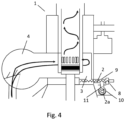
- Illustration of an embodiment where the
augers 2 are mounted in the engine flushingair belts 3, as well as in theintegrated pipes 10 that drains from theengine 1. - Fig 5
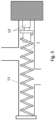
- Illustration of an
auger 2 positioned within anauger tube 13. - Fig 6
- Illustration of an
auger 2 and parts of adriving unit 8. - Fig. 7
- Illustration of an
auger 2 positioned relative to asurface 24 with declining sides towards theauger 2. - Fig. 8
- Illustration of an
auger 2 positioned relative to asurface 24 with one vertical side. - Fig. 9
- Illustration of an
auger 2 positioned relative to asurface 24 where theauger 2 is positioned in arecess 25 of thesurface 24 according to one embodiment. - Fig.10
- Illustration of an
auger 2 positioned relative to asurface 24 where theauger 2 is positioned in arecess 25 of thesurface 24 according to another embodiment relative tofig. 9 . - Fig. 11
- Illustration of an
auger 2 positioned relative to acircular surface 24 and with alongitudinal guiding plate 5. - The detailed description and specific examples, while indicating embodiments of the invention, are given by way of illustration only.
-
Figure 1 shows an embodiment seen in the cross-section of anengine 1 where augers 2 (or snails or spiral screws) are mounted both in the engine flushing air belts 3 (referred to as" Scavenge air space" or "piston underside space"), and in the engine flushing air tank 4 (also referred to as "scavenge air receiver"). In the illustrated embodiment, theaugers 2 are held in position bylongitudinal guiding plates 5. Theauger 2 can extend straight or slightly curvingly. The bottom of the engine flushingair belts 3 are made with an appropriate inclination towards the bottom of theauger 2, thus that both sludge and oil will slide/flow down towards the bottom of theauger 2. Theauger 2 thus can scrape the sluggish liquid sludge out of theengine 1, towards theoutlet opening 6 of the auger 2 (seefig 3 ). The oil will be able to flow along the outer diameter of theauger 2, as well as in the hollow of theauger 2 center 7 (seefig. 4 ). -
Fig 2 and Fig 3 illustrates embodiments seen from the side of theengine 1. The spiral augers 2 in the embodiment extends along all theengine 1 cylinders. The cleaning system can be divided into sections if desirable. The figures show drivingunits 8 mounted at the end of theaugers 2 and theoutlet opening 6 positioned in relation to a form of pipe orchannel 9 that theauger 2 extend into towards itsoutlet 6. Theoutlet 6 may be connected via pressure tight pipes to a tank, for collection of oil and sludge. - In the form shown, the longitudinal direction of the screws is mainly parallel to that of the
engine 1 longitudinal direction. -
Figure 4 illustrates an embodiment where theaugers 2 are mounted in the engine flushingair belts 3, as well as in theintegrated pipes 10 that drains from theengine 1. In this embodiment a valve 11 (e.g. a ball valve) is positioned at the inlet to theintegrated tube 10. Theintegrated tube 10 is common for all the cylinders ofengines 1, and it may be an advantage to be able to seal off the outlet from the individual cylinders using avalve 11. In the illustration thecrossmounted augers 2 scrapes sludge and oil from the engine flushingair belts 3, towards the drivingunit 8. The mixture of sludge and oil will then flow/slide into theintegrated tube 10. Theauger 2a scrapes the sluggish liquid sludge away from theengine 1 in theengine 1 longitudinal direction. The oil could flow along the outer diameter of the auger (2), as well as in thehollow center 7. - In the illustrated embodiment the longitudinal direction of the
auger 2 is mainly perpendicular to the engine's 1 longitudinal direction, while theauger 2a built into theintegrated tubes 10, mainly in the longitudinal direction of theengine 1. - The automatic cleaning system can thus be built in at any practical angle, in relation to the longitudinal direction of the
engine 1, as well as any practical angle to the horizontal plane of theengine 1. However, it is an advantage to be inclined towards theoutlet 6 of theauger - The
outlet 6 of theauger engine 1 may be designed as a circular pipe, a machined or cast channel, or any other pressure tight duct or passage, allowing the free rotation and movement of theauger 2. -
Figures 5 and6 show an embodiment of thedrive unit 8 intended for pressurized systems (cleaning from the engine flushingair belts 3 and flushing air tank 4). The illustratedauger 2 is blunt (as may be the case for all the disclosed embodiments) and the embodiment relates to a traditional axel sealing 12 seals against the pressure present in the auger tube 13 (the flushing air pressure). The axle 14 (or shaft) transmits the slow rotating motion of agear motor 16 to spiral theauger 2. Thehousing 15 acts both as the fundament and as the end flange of theauger tube 13. The bearinghousing 17 absorbs the axial and radial forces of the shaft via e.g. a ball bearing. - The
gear motor 16 produces the rotation of theaxle 14 andauger 2. The rotating power of thegear motor 16 is transmitted through a spring split mounted through theholes auger 2 and gear motor 16 from being overloaded. The slidingbearing 19 functions partly to absorb the radial forces of theaxle 14 and to compress the traditional axle sealing 12. The compressing effect is achieved by tightening thebolts 20 so that the slidingbearing 19 is pulled in the direction of thehousing 15 achieving a close effect between therotating axle 14 and thestationary housing 15. Thespiral auger 2 may be fastened to theaxle 14 by means of a screw 21 (e.g. a pinole screw) in a recess in theaxle 14. Theguard 22 is mounted on thehousing 15 to protect against access to therotating axle 14. Theinductive sensor 23 monitors the desired axle rotation. -
Fig. 7 shows anembodiment auger 2 positioned relative to asurface 24. Theauger 2 is positioned at the bottom of abend surface 24 having declining sides towards theauger 2. The arrows indicate direction of movement of sludge and oils towards the bottom of theauger 2. -
Fig. 8 shows theauger 2 andsurface 24 in another embodiment differing from the embodiment offig. 7 in that one side of thesurface 24 is vertical. The arrows indicate direction of movement of sludge and oils towards the bottom of theauger 2. -
Fig. 9 shows theauger 2 andsurface 24 in a third embodiment differing from the embodiment offig. 7 in that theauger 2 is positioned in arecess 25 of thesurface 24 having a depth so that theauger 2 reach above therecess 25. The arrows indicate direction of movement of sludge and oils towards the bottom of theauger 2. -
Fig. 10 shows theauger 2 andsurface 24 in a fourth embodiment differing from the embodiment offig. 9 by therecess 25 having a depth at least as large as the diameter, or height, of theauger 2, this thus being essentially fully confined within therecess 25. The arrows indicate direction of movement of sludge and oils towards the bottom of theauger 2. -
Fig. 11 shows theauger 2 andsurface 24 in a fourth embodiment where thesurface 24 is circular, or at least curving. The arrows indicate direction of movement of sludge and oils towards the bottom of theauger 2. - The
auger 2 as illustrated infig. 11 , but which could be implemented in any of the embodiments, are held in position bylongitudinal guide plates 5. These guide plates are positioned and designed to ensure that sludge and oil can slide / flow down to the bottom of theauger 2. And at the same time keep the auger in the desired position relative to surface 24 and/orrecess 25. -
- 1 - Engine
- 2, 2a - Auger or snail
- 3 - Engine flushing air belts (" Scavenge air space" or "piston underside space")
- 4 - Engine flushing air tank (also referred to as "scavenge air receiver")
- 5 - Longitudinal guiding plates
- 6 - Outlet opening of the auger
- 7 - Auger center
- 8 - Driving units
- 9 - pipe or channel
- 10 - Integrated tube
- 11 - Valve
- 12 - Axel sealing
- 13 - Auger tube
- 14 - Axle or shaft
- 15 - Housing
- 16 - Gear motor
- 17 - Bearing housing
- 18a, 18b - Holes
- 19 - sliding bearing
- 20 - Bolts
- 21 - Screw
- 22 - Guard
- 23 - Inductive sensor
- 24 - Surface
- 25 - Recess
Claims (10)
- Engine (1) with an automatic cleaning system with rotating flexible spiral auger (2) fixed mounted within a hollow (3, 4) of the engine (1) such that fluids and solids within the hollow are transported along the outer diameter of the auger (2), characterized in- that the auger (2) is positioned in an engine hollow (3) being the scavenge air space or piston underside space or- that the auger (2) is positioned in an engine hollow being the scavenge air receiver orthat an auger (2) is positioned in both the scavenge air space or piston underside space and in the scavenge air receiver.
- Engine (1) according to claim 1, wherein the auger (2) is centreless such that sludge and oil further flows in an auger center (7).
- Engine (1) according to claim 1 or 2, wherein the auger (2) is sufficiently flexible allowing it to extend straight or slightly curvingly.
- Engine (1) according to claim 1, 2 or 3, wherein the auger (2) is positioned such that it can scrape a sludge out of the engine (1) towards an outlet opening (6).
- Engine (1) according to any one of the previous claims, wherein the bottom of the hollow (3) inclines towards the bottom of the auger (2), thus that both sludge and oil will slide or flow down towards the bottom of the auger (2).
- Engine (1) according to any one of the previous claims, wherein the auger (2) is held in position by a longitudinal guiding plate (5).
- Engine (1) according to any one of the previous claims, wherein a driving unit (8) mounted at the end of the auger (2).
- Engine (1) according to any of the previous claims, wherein the auger (2) is positioned in the integrated pipes (10) that drains from the engine (1).
- Engine (1) according to any of the previous claims, wherein the engine is a two-stroke crosshead engine.
- An automatic cleaning system with rotating flexible spiral auger (2) and for use in an engine according to claim 1, wherein the auger (2) is fixed mounted within a hollow (3, 4) of the engine (1) such that fluids and solids within the hollow are transported along the outer diameter of the auger (2) and characterized in- that the auger (2) is positioned in an engine hollow (3) being the scavenge air space or piston underside space or- that the auger (2) is positioned in an engine hollow being the scavenge air receiver orthat an auger (2) is positioned in both the scavenge air space or piston underside space and in the scavenge air receiver.
Applications Claiming Priority (2)
| Application Number | Priority Date | Filing Date | Title |
|---|---|---|---|
| DKPA202100057 | 2021-01-19 | ||
| PCT/EP2022/050960 WO2022157134A1 (en) | 2021-01-19 | 2022-01-18 | Automatic cleaning system for sludge cleaning - built into two-stroke cross-head engines |
Publications (3)
| Publication Number | Publication Date |
|---|---|
| EP4281657A1 EP4281657A1 (en) | 2023-11-29 |
| EP4281657B1 true EP4281657B1 (en) | 2025-07-02 |
| EP4281657C0 EP4281657C0 (en) | 2025-07-02 |
Family
ID=80050960
Family Applications (1)
| Application Number | Title | Priority Date | Filing Date |
|---|---|---|---|
| EP22700954.5A Active EP4281657B1 (en) | 2021-01-19 | 2022-01-18 | Automatic cleaning system for sludge cleaning - built into two-stroke cross-head engines |
Country Status (6)
| Country | Link |
|---|---|
| EP (1) | EP4281657B1 (en) |
| JP (1) | JP2024504579A (en) |
| KR (1) | KR20230130108A (en) |
| CN (1) | CN116997708A (en) |
| ES (1) | ES3046408T3 (en) |
| WO (1) | WO2022157134A1 (en) |
Family Cites Families (5)
| Publication number | Priority date | Publication date | Assignee | Title |
|---|---|---|---|---|
| GB468813A (en) | 1936-07-14 | 1937-07-13 | George Schwabach | Conveyor devices for ashes, cinders and the like |
| DE102005035509A1 (en) * | 2005-07-26 | 2007-02-01 | Marco Wiedel | Tool for removing deposits in pipes has a coupling piece for a detachable fastening on a spiral and a rod linked to it extending in an axial direction with metal bristles radiating from it |
| CN204412719U (en) * | 2014-12-31 | 2015-06-24 | 青岛东方循环能源有限公司 | A kind of cracking gas conveyance conduit cleaning plant |
| WO2017167334A1 (en) * | 2016-03-28 | 2017-10-05 | Fange Innova | An apparatus for outputting a solid material, such as entrained in a fluid |
| DK180242B1 (en) * | 2017-06-20 | 2020-09-08 | Thorhansa Aps | Automatic cleaning drain system for use on two-stroke engines |
-
2022
- 2022-01-18 CN CN202280021701.6A patent/CN116997708A/en active Pending
- 2022-01-18 EP EP22700954.5A patent/EP4281657B1/en active Active
- 2022-01-18 JP JP2023540899A patent/JP2024504579A/en active Pending
- 2022-01-18 WO PCT/EP2022/050960 patent/WO2022157134A1/en not_active Ceased
- 2022-01-18 ES ES22700954T patent/ES3046408T3/en active Active
- 2022-01-18 KR KR1020237027740A patent/KR20230130108A/en active Pending
Also Published As
| Publication number | Publication date |
|---|---|
| ES3046408T3 (en) | 2025-12-02 |
| CN116997708A (en) | 2023-11-03 |
| EP4281657C0 (en) | 2025-07-02 |
| WO2022157134A1 (en) | 2022-07-28 |
| JP2024504579A (en) | 2024-02-01 |
| KR20230130108A (en) | 2023-09-11 |
| EP4281657A1 (en) | 2023-11-29 |
Similar Documents
| Publication | Publication Date | Title |
|---|---|---|
| US4289317A (en) | Pump shaft closure | |
| JP7227167B2 (en) | Self-cleaning drainage piping system for a crosshead two-stroke engine with a low speed centerless flexible helical auger fixedly attached to the piping system | |
| US6128799A (en) | Conduit interior smoothing device | |
| CN118009026A (en) | Speed reducer for disc feeder | |
| EP4281657B1 (en) | Automatic cleaning system for sludge cleaning - built into two-stroke cross-head engines | |
| EP0039114A1 (en) | A sealed bearing | |
| CN105697388B (en) | Deepwater hydraulic drives water pump | |
| CN115365239B (en) | Pipe cleaning device | |
| US6416263B1 (en) | Piping structure, existing pipe cutting method and fluid supply suspension-free method | |
| JP5869127B2 (en) | Underwater bearing sliding part deterioration detection system | |
| CN208221168U (en) | A kind of vertical pump thrust bearing | |
| CN220663839U (en) | Rotary valve with quick-dismantling floating head and lubricant isolation function | |
| CN224202218U (en) | A clog prevention device for emergency discharge pipes and a kiln | |
| CN207024793U (en) | A kind of carbon pressurizing formula pass filter | |
| CN222526874U (en) | Screw conveyer main shaft seal assembly | |
| CN2616716Y (en) | Improved roots pump | |
| CN223464886U (en) | A bushing structure at the feed end of a grinding mill | |
| CN218914070U (en) | Flange plate | |
| CN209493348U (en) | A kind of waste emulsified mixture hyperfiltration treatment pipeline | |
| KR200365847Y1 (en) | Non Metallic Bush Bearing and Water Lubrication system for screw Pump Low Bearing | |
| CN116946631A (en) | Rotary valve with quick-dismantling floating head and lubricant isolation function | |
| CN207015980U (en) | Cleaner is rotated outside a kind of modified | |
| RU82792U1 (en) | BITUMEN GEAR PUMP | |
| KR20040074045A (en) | Non Metallic Bush Bearing and Water Lubrication system for screw Pump Low Bearing | |
| CN119460739A (en) | A high temperature resistant gas pressure automatic compensation transfer valve and its use method |
Legal Events
| Date | Code | Title | Description |
|---|---|---|---|
| STAA | Information on the status of an ep patent application or granted ep patent |
Free format text: STATUS: UNKNOWN |
|
| STAA | Information on the status of an ep patent application or granted ep patent |
Free format text: STATUS: THE INTERNATIONAL PUBLICATION HAS BEEN MADE |
|
| PUAI | Public reference made under article 153(3) epc to a published international application that has entered the european phase |
Free format text: ORIGINAL CODE: 0009012 |
|
| STAA | Information on the status of an ep patent application or granted ep patent |
Free format text: STATUS: REQUEST FOR EXAMINATION WAS MADE |
|
| 17P | Request for examination filed |
Effective date: 20230821 |
|
| AK | Designated contracting states |
Kind code of ref document: A1 Designated state(s): AL AT BE BG CH CY CZ DE DK EE ES FI FR GB GR HR HU IE IS IT LI LT LU LV MC MK MT NL NO PL PT RO RS SE SI SK SM TR |
|
| DAV | Request for validation of the european patent (deleted) | ||
| DAX | Request for extension of the european patent (deleted) | ||
| GRAP | Despatch of communication of intention to grant a patent |
Free format text: ORIGINAL CODE: EPIDOSNIGR1 |
|
| STAA | Information on the status of an ep patent application or granted ep patent |
Free format text: STATUS: GRANT OF PATENT IS INTENDED |
|
| GRAJ | Information related to disapproval of communication of intention to grant by the applicant or resumption of examination proceedings by the epo deleted |
Free format text: ORIGINAL CODE: EPIDOSDIGR1 |
|
| STAA | Information on the status of an ep patent application or granted ep patent |
Free format text: STATUS: REQUEST FOR EXAMINATION WAS MADE |
|
| INTG | Intention to grant announced |
Effective date: 20250102 |
|
| GRAP | Despatch of communication of intention to grant a patent |
Free format text: ORIGINAL CODE: EPIDOSNIGR1 |
|
| STAA | Information on the status of an ep patent application or granted ep patent |
Free format text: STATUS: GRANT OF PATENT IS INTENDED |
|
| INTC | Intention to grant announced (deleted) | ||
| INTG | Intention to grant announced |
Effective date: 20250131 |
|
| GRAS | Grant fee paid |
Free format text: ORIGINAL CODE: EPIDOSNIGR3 |
|
| GRAA | (expected) grant |
Free format text: ORIGINAL CODE: 0009210 |
|
| STAA | Information on the status of an ep patent application or granted ep patent |
Free format text: STATUS: THE PATENT HAS BEEN GRANTED |
|
| RAP1 | Party data changed (applicant data changed or rights of an application transferred) |
Owner name: SMART-MARINE APS |
|
| AK | Designated contracting states |
Kind code of ref document: B1 Designated state(s): AL AT BE BG CH CY CZ DE DK EE ES FI FR GB GR HR HU IE IS IT LI LT LU LV MC MK MT NL NO PL PT RO RS SE SI SK SM TR |
|
| REG | Reference to a national code |
Ref country code: GB Ref legal event code: FG4D |
|
| REG | Reference to a national code |
Ref country code: CH Ref legal event code: EP |
|
| REG | Reference to a national code |
Ref country code: DE Ref legal event code: R096 Ref document number: 602022016850 Country of ref document: DE |
|
| REG | Reference to a national code |
Ref country code: IE Ref legal event code: FG4D |
|
| U01 | Request for unitary effect filed |
Effective date: 20250721 |
|
| U07 | Unitary effect registered |
Designated state(s): AT BE BG DE DK EE FI FR IT LT LU LV MT NL PT RO SE SI Effective date: 20250728 |
|
| REG | Reference to a national code |
Ref country code: ES Ref legal event code: FG2A Ref document number: 3046408 Country of ref document: ES Kind code of ref document: T3 Effective date: 20251202 |
|
| PG25 | Lapsed in a contracting state [announced via postgrant information from national office to epo] |
Ref country code: IS Free format text: LAPSE BECAUSE OF FAILURE TO SUBMIT A TRANSLATION OF THE DESCRIPTION OR TO PAY THE FEE WITHIN THE PRESCRIBED TIME-LIMIT Effective date: 20251102 |
|
| PG25 | Lapsed in a contracting state [announced via postgrant information from national office to epo] |
Ref country code: NO Free format text: LAPSE BECAUSE OF FAILURE TO SUBMIT A TRANSLATION OF THE DESCRIPTION OR TO PAY THE FEE WITHIN THE PRESCRIBED TIME-LIMIT Effective date: 20251002 |
|
| PG25 | Lapsed in a contracting state [announced via postgrant information from national office to epo] |
Ref country code: HR Free format text: LAPSE BECAUSE OF FAILURE TO SUBMIT A TRANSLATION OF THE DESCRIPTION OR TO PAY THE FEE WITHIN THE PRESCRIBED TIME-LIMIT Effective date: 20250702 |
|
| PG25 | Lapsed in a contracting state [announced via postgrant information from national office to epo] |
Ref country code: GR Free format text: LAPSE BECAUSE OF FAILURE TO SUBMIT A TRANSLATION OF THE DESCRIPTION OR TO PAY THE FEE WITHIN THE PRESCRIBED TIME-LIMIT Effective date: 20251003 |
|
| PG25 | Lapsed in a contracting state [announced via postgrant information from national office to epo] |
Ref country code: CZ Free format text: LAPSE BECAUSE OF FAILURE TO SUBMIT A TRANSLATION OF THE DESCRIPTION OR TO PAY THE FEE WITHIN THE PRESCRIBED TIME-LIMIT Effective date: 20250702 |
|
| PG25 | Lapsed in a contracting state [announced via postgrant information from national office to epo] |
Ref country code: PL Free format text: LAPSE BECAUSE OF FAILURE TO SUBMIT A TRANSLATION OF THE DESCRIPTION OR TO PAY THE FEE WITHIN THE PRESCRIBED TIME-LIMIT Effective date: 20250702 |
|
| PG25 | Lapsed in a contracting state [announced via postgrant information from national office to epo] |
Ref country code: RS Free format text: LAPSE BECAUSE OF FAILURE TO SUBMIT A TRANSLATION OF THE DESCRIPTION OR TO PAY THE FEE WITHIN THE PRESCRIBED TIME-LIMIT Effective date: 20251002 |
|
| REG | Reference to a national code |
Ref country code: CH Ref legal event code: U11 Free format text: ST27 STATUS EVENT CODE: U-0-0-U10-U11 (AS PROVIDED BY THE NATIONAL OFFICE) Effective date: 20260201 |
|
| U20 | Renewal fee for the european patent with unitary effect paid |
Year of fee payment: 5 Effective date: 20260127 |
|
| PG25 | Lapsed in a contracting state [announced via postgrant information from national office to epo] |
Ref country code: SM Free format text: LAPSE BECAUSE OF FAILURE TO SUBMIT A TRANSLATION OF THE DESCRIPTION OR TO PAY THE FEE WITHIN THE PRESCRIBED TIME-LIMIT Effective date: 20250702 |
|
| PGFP | Annual fee paid to national office [announced via postgrant information from national office to epo] |
Ref country code: GB Payment date: 20260127 Year of fee payment: 5 |
|
| PGFP | Annual fee paid to national office [announced via postgrant information from national office to epo] |
Ref country code: ES Payment date: 20260202 Year of fee payment: 5 |
|
| PGFP | Annual fee paid to national office [announced via postgrant information from national office to epo] |
Ref country code: CH Payment date: 20260201 Year of fee payment: 5 |
|
| PG25 | Lapsed in a contracting state [announced via postgrant information from national office to epo] |
Ref country code: SK Free format text: LAPSE BECAUSE OF FAILURE TO SUBMIT A TRANSLATION OF THE DESCRIPTION OR TO PAY THE FEE WITHIN THE PRESCRIBED TIME-LIMIT Effective date: 20250702 |