EP4281320B1 - Bloc optique à glace définie par bi-injection contrôlée, pour un véhicule - Google Patents
Bloc optique à glace définie par bi-injection contrôlée, pour un véhicule Download PDFInfo
- Publication number
- EP4281320B1 EP4281320B1 EP21851969.2A EP21851969A EP4281320B1 EP 4281320 B1 EP4281320 B1 EP 4281320B1 EP 21851969 A EP21851969 A EP 21851969A EP 4281320 B1 EP4281320 B1 EP 4281320B1
- Authority
- EP
- European Patent Office
- Prior art keywords
- peripheral part
- vehicle
- optical unit
- equipment
- injection
- Prior art date
- Legal status (The legal status is an assumption and is not a legal conclusion. Google has not performed a legal analysis and makes no representation as to the accuracy of the status listed.)
- Active
Links
Images

Classifications
-
- B—PERFORMING OPERATIONS; TRANSPORTING
- B60—VEHICLES IN GENERAL
- B60Q—ARRANGEMENT OF SIGNALLING OR LIGHTING DEVICES, THE MOUNTING OR SUPPORTING THEREOF OR CIRCUITS THEREFOR, FOR VEHICLES IN GENERAL
- B60Q1/00—Arrangement of optical signalling or lighting devices, the mounting or supporting thereof or circuits therefor
- B60Q1/0029—Spatial arrangement
- B60Q1/0035—Spatial arrangement relative to the vehicle
-
- B—PERFORMING OPERATIONS; TRANSPORTING
- B60—VEHICLES IN GENERAL
- B60Q—ARRANGEMENT OF SIGNALLING OR LIGHTING DEVICES, THE MOUNTING OR SUPPORTING THEREOF OR CIRCUITS THEREFOR, FOR VEHICLES IN GENERAL
- B60Q1/00—Arrangement of optical signalling or lighting devices, the mounting or supporting thereof or circuits therefor
- B60Q1/02—Arrangement of optical signalling or lighting devices, the mounting or supporting thereof or circuits therefor the devices being primarily intended to illuminate the way ahead or to illuminate other areas of way or environments
- B60Q1/04—Arrangement of optical signalling or lighting devices, the mounting or supporting thereof or circuits therefor the devices being primarily intended to illuminate the way ahead or to illuminate other areas of way or environments the devices being headlights
- B60Q1/0408—Arrangement of optical signalling or lighting devices, the mounting or supporting thereof or circuits therefor the devices being primarily intended to illuminate the way ahead or to illuminate other areas of way or environments the devices being headlights built into the vehicle body, e.g. details concerning the mounting of the headlamps on the vehicle body
-
- B—PERFORMING OPERATIONS; TRANSPORTING
- B60—VEHICLES IN GENERAL
- B60Q—ARRANGEMENT OF SIGNALLING OR LIGHTING DEVICES, THE MOUNTING OR SUPPORTING THEREOF OR CIRCUITS THEREFOR, FOR VEHICLES IN GENERAL
- B60Q1/00—Arrangement of optical signalling or lighting devices, the mounting or supporting thereof or circuits therefor
- B60Q1/02—Arrangement of optical signalling or lighting devices, the mounting or supporting thereof or circuits therefor the devices being primarily intended to illuminate the way ahead or to illuminate other areas of way or environments
- B60Q1/04—Arrangement of optical signalling or lighting devices, the mounting or supporting thereof or circuits therefor the devices being primarily intended to illuminate the way ahead or to illuminate other areas of way or environments the devices being headlights
- B60Q1/0408—Arrangement of optical signalling or lighting devices, the mounting or supporting thereof or circuits therefor the devices being primarily intended to illuminate the way ahead or to illuminate other areas of way or environments the devices being headlights built into the vehicle body, e.g. details concerning the mounting of the headlamps on the vehicle body
- B60Q1/0466—Arrangement of optical signalling or lighting devices, the mounting or supporting thereof or circuits therefor the devices being primarily intended to illuminate the way ahead or to illuminate other areas of way or environments the devices being headlights built into the vehicle body, e.g. details concerning the mounting of the headlamps on the vehicle body with arrangement for sealing the headlamp with respect to the vehicle body, or for concealling gaps between the headlamp and the vehicle body
-
- B—PERFORMING OPERATIONS; TRANSPORTING
- B60—VEHICLES IN GENERAL
- B60R—VEHICLES, VEHICLE FITTINGS, OR VEHICLE PARTS, NOT OTHERWISE PROVIDED FOR
- B60R19/00—Wheel guards; Radiator guards, e.g. grilles; Obstruction removers; Fittings damping bouncing force in collisions
- B60R19/02—Bumpers, i.e. impact receiving or absorbing members for protecting vehicles or fending off blows from other vehicles or objects
- B60R19/48—Bumpers, i.e. impact receiving or absorbing members for protecting vehicles or fending off blows from other vehicles or objects combined with, or convertible into, other devices or objects, e.g. bumpers combined with road brushes, bumpers convertible into beds
- B60R19/50—Bumpers, i.e. impact receiving or absorbing members for protecting vehicles or fending off blows from other vehicles or objects combined with, or convertible into, other devices or objects, e.g. bumpers combined with road brushes, bumpers convertible into beds with lights or registration plates
-
- B—PERFORMING OPERATIONS; TRANSPORTING
- B60—VEHICLES IN GENERAL
- B60R—VEHICLES, VEHICLE FITTINGS, OR VEHICLE PARTS, NOT OTHERWISE PROVIDED FOR
- B60R19/00—Wheel guards; Radiator guards, e.g. grilles; Obstruction removers; Fittings damping bouncing force in collisions
- B60R19/02—Bumpers, i.e. impact receiving or absorbing members for protecting vehicles or fending off blows from other vehicles or objects
- B60R19/48—Bumpers, i.e. impact receiving or absorbing members for protecting vehicles or fending off blows from other vehicles or objects combined with, or convertible into, other devices or objects, e.g. bumpers combined with road brushes, bumpers convertible into beds
- B60R19/50—Bumpers, i.e. impact receiving or absorbing members for protecting vehicles or fending off blows from other vehicles or objects combined with, or convertible into, other devices or objects, e.g. bumpers combined with road brushes, bumpers convertible into beds with lights or registration plates
- B60R2019/505—Bumpers, i.e. impact receiving or absorbing members for protecting vehicles or fending off blows from other vehicles or objects combined with, or convertible into, other devices or objects, e.g. bumpers combined with road brushes, bumpers convertible into beds with lights or registration plates with lights
Definitions
- the present invention claims priority of the application French 2100531 filed on 01/20/2021 the content of which (text, drawings and claims) is hereby incorporated by reference.
- the invention relates to optical units which are intended to equip vehicles.
- Some vehicles generally of the automobile type, comprise at least one optical unit comprising a housing comprising a wall delimiting a front opening masked by a glass.
- this glass comprises a first peripheral part comprising first and second parts produced by bi-injection. More precisely, the first part is produced by injection of a first material (for example having a transparent crystal color), and the second part is produced by injection of a second material (for example having an opaque black color), covers the rear face of this first part and extends beyond the latter (for example downwards). This second part is intended to mask technical parts of the optical unit for an observer placed in front of the latter.
- the front face portion of the first part of the first peripheral part of the glass is placed opposite a second peripheral part of a piece of equipment of the vehicle, such as for example a bumper.
- This equipment may be subject to expansion in the presence of temperature variations, and moreover may be temporarily moved towards the rear of the vehicle when the latter suffers a small frontal impact, it is planned to initially leave a minimum distance between the front face portion of the first part of the first peripheral part of the window and its second peripheral part so that these expansions and/or this movement towards the rear do not cause the equipment to collide with the window which could damage or even break the latter.
- the invention therefore aims in particular to remedy the drawback described above when the first and second alternatives cannot be implemented.
- an optical unit intended to equip a vehicle and comprising a glass comprising a first peripheral part having a front face portion intended to be placed opposite a second peripheral part of a vehicle equipment and comprising a first part, produced by injection of a first material, and a second part, produced by injection of a second material, covering a rear face. of this first part and extending beyond the latter.
- This optical block is characterized by the fact that in the presence of the second peripheral part comprising N protuberances intended to be directed towards the front face portion, with N ⁇ 1, the first part comprises N holes intended to be placed opposite respectively the N protuberances, so that this entire front face portion is normally spaced at least a predefined distance from the second peripheral part.
- the front face portion is everywhere located at a minimum distance from the second peripheral part which is at least equal to the predefined distance, in the absence of expansion and movement towards the rear of the equipment.
- the invention also proposes a vehicle, possibly of the automobile type, and comprising equipment comprising a second peripheral part comprising N protuberances, with N ⁇ 1, and at least one optical unit of the type presented above and installed near this second peripheral part.
- the equipment may be a bumper, possibly installed in a front part of the vehicle.
- the invention aims in particular to propose an optical unit BO intended to equip a vehicle and comprising a glass G defined by a controlled bi-injection adapted to PC equipment with PR protuberances.
- the optical unit BO is intended to be part of a vehicle of the automobile type.
- the invention is not limited to this type of vehicle. It in fact concerns any vehicle (land, sea (or river), or air) that must comprise at least one optical unit at its periphery.
- the optical unit BO is a vehicle front headlight (or projector). But it could also be a front or rear light.
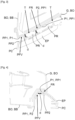
- an exemplary embodiment of an optical unit BO according to the invention (here a front headlight), installed next to a PC equipment of a vehicle.
- the PC equipment is a front bumper, but it could be any equipment installed in the immediate vicinity of a part of a window of an optical unit and capable of expanding in the presence of temperature variations and/or capable of being temporarily moved towards the rear of the vehicle when the latter suffers a small frontal impact.
- an optical block BO notably comprises a housing BB, housing elements participating in at least one photometric function, possibly consisting of at least two sub-parts, and delimiting a front opening masked by a glass G through which the photons participating in each photometric function exit.
- the BB case delimits a front opening hidden by the glass G.
- the ice G comprises a first peripheral part PP1 comprising first P1 and second P2 parts and having a front face portion PFV which is intended to be placed opposite a second peripheral part PP2 of the PC equipment (located in the immediate vicinity).
- front face means a face of an object which is oriented towards the front of the vehicle
- rear face means a face of an object which is oriented towards the rear of the vehicle (and therefore opposite the front face of this object).
- the first part P1 of the first peripheral part PP1 is produced by injection of a first material.
- the second part P2 is made by injection of a second material, covers the rear face FR of the first part P1 and extends beyond the latter (P1).
- the first peripheral part PP1 of the window G is located in a lower right part of an optical unit BO installed on the left in the front part of a vehicle.
- the first peripheral part PP1 of the window G could, for example, be located in an upper part (right or left) or lateral (right or left) of an optical unit installed on the left or right in the front or rear part of a vehicle.
- the second peripheral part PP2 of the equipment PC comprises N protuberances PR which are intended to be directed towards the front face portion PFV of the first peripheral part PP1 of the glass G, with N ⁇ 1.
- the PR protrusions are clipping means allowing the clipping of an EP trim onto the PC equipment (here a bumper). But these PR protrusions could provide another function within the PC equipment.
- the first part P1 (of the first peripheral part PP1 of the glass G) comprises N holes T which are intended to be placed opposite respectively the N protuberances PR.
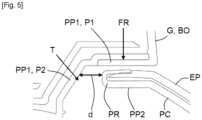
- the entire front face portion PFV is normally spaced at least a predefined distance d from the second peripheral part PP2, as illustrated in the figure 3 .
- the word "normally” here means in the absence of expansion and backward movement of the PC equipment.
- the front face portion PFV of the first peripheral part PP1 is everywhere located at a minimum distance from the rear face of the second peripheral part PP2 which is at least equal to the predefined distance d, in the absence of expansion and movement towards the rear of the PC equipment.
- a protuberance see figures 3 And 5
- each hole T may have a shape which is similar to a section of the corresponding PR protuberance, as partially appears in the figures 2 And 3 . But this is not mandatory, because what is important is that each hole T allows a possible "passage" of a rear end of the corresponding PR protuberance. In particular, a hole T can be significantly wider than the width of the corresponding PR protuberance and/or significantly higher than the height of this PR protuberance.
- each hole T is through and corresponds to a local absence of first material revealing the second material of the second part P2, as illustrated non-limitingly in the figures 2 , 3 And 5 .
- at least one hole T may not be through, and in this case it constitutes an area of the first part P1 which is simply thinner than where there is no hole T, and which does not reveal the second material of the second part P2 located behind it (T).
- a hole T is through or not, it is preferably defined during the first injection of the first material, carried out before the second injection of the second material on the rear face FR of the first part P1.
- a mold having a matrix common to the two successive injections and a first punch defining in particular the holes T in the first part P1 of the first peripheral part PP1 of the glass G during the first injection. Then, the mold can be opened, the matrix rotated so that it is placed opposite a second punch (different from the first), then the second injection of the second material is carried out on the rear face FR of the first part P1 and beyond the latter (P1).
- the delimitations of the junctions between the first and second materials are made by technical choice.
- first and second materials may, for example, be polycarbonate (or PC) or polymethyl methacrylate. (or PMMA), but in different colors.
- the first material may, for example, have a transparent crystal color
- the second material may, for example, have an opaque black color.
- other colors may be used, in particular for the first material, depending on the needs and/or depending on the photometric function(s) provided by the optical unit.
- the first material is transparent red or orange (or amber), for example.
Landscapes
- Engineering & Computer Science (AREA)
- Mechanical Engineering (AREA)
- Non-Portable Lighting Devices Or Systems Thereof (AREA)
- Injection Moulding Of Plastics Or The Like (AREA)
- Moulds For Moulding Plastics Or The Like (AREA)
- Window Of Vehicle (AREA)
Description
- La présente invention revendique la priorité de la demande
française 2100531 déposée le 20.01.2021 - Certains véhicules, généralement de type automobile, comprennent au moins un bloc optique comprenant un boîtier comportant une paroi délimitant une ouverture avant masquée par une glace. Parfois, cette glace comporte une première partie périphérique comprenant des première et seconde parties réalisées par bi-injection. Plus précisément, la première partie est réalisée par injection d'une première matière (par exemple ayant une couleur cristal transparente), et la seconde partie est réalisée par injection d'une seconde matière (par exemple ayant une couleur noir opaque), recouvre la face arrière de cette première partie et s'étend au-delà de cette dernière (par exemple vers le bas). Cette seconde partie est destinée à masquer des parties techniques du bloc optique pour un observateur placé devant ce dernier.
- Il est connu de
DE 10 2009 011898 un agencement pour garniture de pare-chocs dans un véhicule à moteur. Il est connu deJP 2001 189820 FR 2 813 828 - Généralement, la portion de face avant de la première partie de la première partie périphérique de la glace est placée en regard d'une seconde partie périphérique d'un équipement du véhicule, comme par exemple un pare-chocs. Cet équipement pouvant faire l'objet de dilatations en présence de variations de température, et de surcroît pouvant être déplacé temporairement vers l'arrière du véhicule lorsque ce dernier subit un petit choc frontal, on prévoit de laisser initialement une distance minimale entre la portion de face avant de la première partie de la première partie périphérique de la glace et sa seconde partie périphérique afin que ces dilatations et/ou ce déplacement vers l'arrière ne provoque pas un entrechoquement de l'équipement contre la glace qui pourrait endommager, voire casser, cette dernière.
- Cependant, il arrive que dans certains véhicules on soit obligé d'installer un équipement ayant une seconde partie périphérique comprenant N protubérances dirigées vers la portion de face avant de la première partie de la première partie périphérique de la glace (avec N ≥ 1). C'est par exemple le cas lorsque l'équipement est un pare-chocs, sur la seconde partie périphérique de laquelle est clippée une pièce (comme par exemple un enjoliveur) grâce aux protubérances qui sont des moyens de clippage. Dans cette situation, la distance entre la portion de face avant de la première partie de la première partie périphérique de la glace et la seconde partie périphérique devient strictement inférieure à la distance minimale et donc on est contraint soit de décaler le bloc optique vers l'arrière, soit d'avancer l'équipement vers l'avant. La première alternative s'avère impossible à mettre en œuvre en l'absence de place disponible derrière et/ou autour du bloc optique. La seconde alternative impose une augmentation du porte-à-faux et de la longueur du véhicule, ce qui est rarement souhaité, notamment pour une question de style et/ou de comportement dynamique.
- L'invention a donc notamment pour but de remédier à l'inconvénient décrit ci-avant lorsque les première et seconde alternatives ne peuvent pas être mises en œuvre.
- Elle propose notamment à cet effet un bloc optique destiné à équiper un véhicule et comprenant une glace comportant une première partie périphérique ayant une portion de face avant destinée à être placée en regard d'une seconde partie périphérique d'un équipement du véhicule et comprenant une première partie, réalisée par injection d'une première matière, et une seconde partie, réalisée par injection d'une seconde matière, recouvrant une face arrière de cette première partie et s'étendant au-delà de cette dernière.
- Ce bloc optique se caractérise par le fait qu'en présence de la seconde partie périphérique comprenant N protubérances destinées à être dirigées vers la portion de face avant, avec N ≥ 1, la première partie comprend N trous destinés à être placés en regard respectivement des N protubérances, de sorte que toute cette portion de face avant soit normalement espacée d'au moins une distance prédéfinie de la seconde partie périphérique.
- Grâce à ces trous définis dans la première partie et situés en regard respectivement des protubérances de la seconde partie périphérique, la portion de face avant se retrouve partout située à une distance minimale de la seconde partie périphérique qui est au moins égale à la distance prédéfinie, en l'absence de dilatation et de déplacement vers l'arrière de l'équipement.
- Le bloc optique selon l'invention peut comporter d'autres caractéristiques qui peuvent être prises séparément ou en combinaison, et notamment :
- chaque trou peut présenter une forme qui est similaire à une section de la protubérance correspondante ;
- chaque trou peut être traversant et peut correspondre à une absence locale de première matière ;
- la première matière peut avoir une couleur cristal transparente, et la seconde matière peut avoir une couleur noire opaque ;
- la première partie périphérique peut être située dans une partie inférieure du bloc optique ;
- il peut constituer un phare avant (ou projecteur).
- L'invention propose également un véhicule, éventuellement de type automobile, et comprenant un équipement comportant une seconde partie périphérique comprenant N protubérances, avec N ≥ 1, et au moins un bloc optique du type de celui présenté ci-avant et installé à proximité de cette seconde partie périphérique.
- Par exemple, l'équipement peut être un pare-chocs, éventuellement installé dans une partie avant du véhicule.
- D'autres caractéristiques et avantages de l'invention apparaîtront à l'examen de la description détaillée ci-après, et des dessins annexés (obtenus en CAO/DAO (« Conception Assistée par Ordinateur/Dessin Assisté par Ordinateur »)), sur lesquels :
- [
Fig. 1 ] illustre schématiquement, dans une vue en perspective du côté avant, un exemple de réalisation d'un bloc optique selon l'invention, installé à côté d'un pare-chocs d'un véhicule, - [
Fig. 2 ] illustre schématiquement, dans une vue de face du côté avant, une partie inférieure de la glace du bloc optique de lafigure 1 , - [
Fig. 3 ] illustre schématiquement, dans une vue en coupe dans un plan horizontal au niveau des première et seconde parties périphériques, des parties associées du bloc optique et du pare-chocs de lafigure 1 , - [
Fig. 4 ] illustre schématiquement, dans une première vue en coupe dans un plan longitudinal et vertical situé dans une zone dépourvue de trou et de protubérance, des parties associées du bloc optique et du pare-chocs de lafigure 1 , et - [
Fig. 5 ] illustre schématiquement, dans une seconde vue en coupe dans un autre plan longitudinal et vertical situé dans une zone comportant un trou et une protubérance, des parties associées du bloc optique et du pare-chocs de lafigure 1 . - L'invention a notamment pour but de proposer un bloc optique BO destiné à équiper un véhicule et comprenant une glace G définie par une bi-injection contrôlée adaptée à un équipement PC à protubérances PR.
- Dans ce qui suit, on considère, à titre d'exemple non limitatif, que le bloc optique BO est destiné à faire partie d'un véhicule de type automobile. Mais l'invention n'est pas limitée à ce type de véhicule. Elle concerne en effet tout véhicule (terrestre, maritime (ou fluvial), ou aérien) devant comprendre au moins un bloc optique à sa périphérie.
- Par ailleurs, on considère dans ce qui suit, à titre d'exemple non limitatif, que le bloc optique BO est un phare avant (ou projecteur) de véhicule. Mais il pourrait aussi s'agir d'un feu avant ou arrière.
- On a schématiquement illustré sur la
figure 1 un exemple de réalisation d'un bloc optique BO selon l'invention (ici un phare avant), installé à côté d'un équipement PC d'un véhicule. Dans cet exemple l'équipement PC est un pare-chocs avant, mais il pourrait s'agir de n'importe quel équipement installé à proximité immédiate d'une partie d'une glace d'un bloc optique et pouvant faire l'objet de dilatations en présence de variations de température et/ou pouvant être déplacé temporairement vers l'arrière du véhicule lorsque ce dernier subit un petit choc frontal. - Comme illustré, un bloc optique BO, selon l'invention, comprend notamment un boîtier BB, logeant des éléments participant à au moins une fonction photométrique, éventuellement constitué d'au moins deux sous-parties, et délimitant une ouverture avant masquée par une glace G par laquelle sortent les photons participant à chaque fonction photométrique.
- Le boîtier BB délimite une ouverture avant masquée par la glace G.
- Comme illustré sur les
figures 1 à 5, la glace G comporte une première partie périphérique PP1 comprenant des première P1 et seconde P2 parties et ayant une portion de face avant PFV qui est destinée à être placée en regard d'une seconde partie périphérique PP2 de l'équipement PC (située à proximité immédiate). - Dans ce qui suit et ce qui précède on entend par « face avant » une face d'un objet qui est orientée vers l'avant du véhicule, et par « face arrière » une face d'un objet qui est orientée vers l'arrière du véhicule (et donc opposée à la face avant de cet objet).
- La première partie P1 de la première partie périphérique PP1 est réalisée par injection d'une première matière.
- Comme cela apparaît mieux sur les
figures 3 à 5 , la seconde partie P2 est réalisée par injection d'une seconde matière, recouvre la face arrière FR de la première partie P1 et s'étend au-delà de cette dernière (P1). - On notera que dans l'exemple illustré non limitativement sur les
figures 1 à 5 , la première partie périphérique PP1 de la glace G est située dans une partie inférieure droite d'un bloc optique BO installé à gauche dans la partie avant d'un véhicule. Mais la première partie périphérique PP1 de la glace G pourrait, par exemple, être située dans une partie supérieure (droite ou gauche) ou latérale (droite ou gauche) d'un bloc optique installé à gauche ou à droite dans la partie avant ou arrière d'un véhicule. - Comme cela apparaît mieux sur les
figures 2 et3 , la seconde partie périphérique PP2 de l'équipement PC comprend N protubérances PR qui sont destinées à être dirigées vers la portion de face avant PFV de la première partie périphérique PP1 de la glace G, avec N ≥ 1. - On notera que dans l'exemple illustré non limitativement (et au moins partiellement) sur les
figures 1 et3 à5 , les protubérances PR sont des moyens de clippage permettant le clippage d'un enjoliveur EP sur l'équipement PC (ici un pare-chocs). Mais ces protubérances PR pourraient assurer une autre fonction au sein de l'équipement PC. - En raison de la présence de ces N protubérances PR, la première partie P1 (de la première partie périphérique PP1 de la glace G) comprend N trous T qui sont destinés à être placés en regard respectivement des N protubérances PR. Ainsi, toute la portion de face avant PFV est normalement espacée d'au moins une distance prédéfinie d de la seconde partie périphérique PP2, comme illustré sur la
figure 3 . Le mot « normalement » signifie ici en l'absence de dilatation et de déplacement vers l'arrière de l'équipement PC. - On comprendra en effet que grâce aux trous T définis dans la première partie P1 de la première partie périphérique PP1 et situés en regard respectivement des protubérances PR de la seconde partie périphérique PP2, la portion de face avant PFV de la première partie périphérique PP1 se retrouve partout située à une distance minimale de la face arrière de la seconde partie périphérique PP2 qui est au moins égale à la distance prédéfinie d, en l'absence de dilatation et de déplacement vers l'arrière de l'équipement PC. Au niveau d'une protubérance (voir
figures 3 et5 ), on a au moins la distance prédéfinie d entre l'extrémité arrière de cette protubérance PR et la portion de seconde partie P2 située en regard du fait de la présence d'un trou T correspondant. Au niveau d'une zone de la seconde partie périphérique PP2 dépourvue de protubérance PR (voirfigures 3 et 4 ), on a au moins la distance prédéfinie d entre l'extrémité arrière de la seconde partie périphérique PP2 et la portion de première partie P1 située en regard. Par conséquent, en cas de dilatation de l'équipement PC et/ou de petit déplacement vers l'arrière de l'équipement PC suite à un petit choc (ici frontal), le risque d'entrechoquement de l'équipement PC contre la glace G est très réduit, et donc le risque d'endommagement, voire de bris, de cette glace G est très réduit. - On notera que chaque trou T peut présenter une forme qui est similaire à une section de la protubérance PR correspondante, comme cela apparaît partiellement sur les
figures 2 et3 . Mais cela n'est pas obligatoire, car ce qui est important c'est que chaque trou T permette un possible « passage » d'une extrémité arrière de la protubérance PR correspondante. Notamment, un trou T peut être sensiblement plus large que la largeur de la protubérance PR correspondante et/ou sensiblement plus haut que la hauteur de cette protubérance PR. - On notera également que de préférence chaque trou T est traversant et correspond à une absence locale de première matière laissant apparaître la seconde matière de la seconde partie P2, comme illustré non limitativement sur les
figures 2 ,3 et5 . Mais cela n'est pas obligatoire. En effet, au moins un trou T peut ne pas être traversant, et dans ce cas il constitue une zone de la première partie P1 qui est simplement plus mince que là où il n'y a pas de trou T, et qui ne laisse pas apparaître la seconde matière de la seconde partie P2 située derrière lui (T). - Qu'un trou T soit traversant ou non traversant, il est préférentiellement défini lors de la première injection de la première matière, réalisée avant la seconde injection de la seconde matière sur la face arrière FR de la première partie P1. A cet effet, on peut, par exemple, utiliser un moule ayant une matrice commune aux deux injections successives et un premier poinçon définissant notamment les trous T dans la première partie P1 de la première partie périphérique PP1 de la glace G pendant la première injection. Puis, on peut ouvrir le moule, faire tourner la matrice pour qu'elle se retrouve placée en face d'un second poinçon (différent du premier), puis effectuer la seconde injection de la seconde matière sur la face arrière FR de la première partie P1 et au-delà de cette dernière (P1). Les délimitations des jonctions entre les première et seconde matières se font par choix technique.
- On notera également que les première et seconde matières peuvent, par exemple, être du polycarbonate (ou PC) ou un poly-méthacrylate de méthyle (ou PMMA), mais de couleurs différentes.
- On notera également que la première matière peut, par exemple, avoir une couleur cristal transparente, et la seconde matière peut, par exemple, avoir une couleur noire opaque. Mais d'autres couleurs peuvent être utilisées, notamment pour la première matière, selon les besoins et/ou selon la (les) fonction(s) photométrique(s) assurée(s) par le bloc optique. Ainsi, on pourrait envisager que la première matière soit rouge ou orange (ou ambre) transparente, par exemple.
Claims (9)
- Bloc optique (BO) destiné à équiper un véhicule et comprenant une glace (G) comportant une première partie périphérique (PP1) ayant une portion de face avant (PFV) destinée à être placée en regard d'une seconde partie périphérique (PP2) d'un équipement (PC) dudit véhicule et comprenant une première partie (P1), et une seconde partie (P2), recouvrant une face arrière (FR) de cette première partie (P1) et s'étendant au-delà de cette dernière (P1), caractérisé en ce que ladite première partie (P1) est réalisée par injection d'une première matière et la seconde partie (P2) est réalisée par injection d'une seconde matière, et en ce qu'en présence de la seconde partie
périphérique (PP2) comprenant N protubérances (PR) destinées à être dirigées vers ladite portion de face avant (PFV), avec N ≥ 1, ladite première partie (P1) comprend N trous (T) destinés à être placés en regard respectivement desdites N protubérances (PR), de sorte que toute ladite portion de face avant (PFV) soit normalement espacée d'au moins une distance prédéfinie de ladite seconde partie périphérique (PP2) ; chaque trou (T) étant traversant et correspondant à une absence locale de première matière. - Bloc optique selon la revendication 1, caractérisé en ce que chaque trou (T) présente une forme similaire à une section de la protubérance (PR) correspondante.
- Bloc optique selon l'une des revendications 1 à 2, caractérisé en ce que ladite première matière a une couleur cristal transparente, et ladite seconde matière a une couleur noire opaque.
- Bloc optique selon l'une des revendications 1 à 3, caractérisé en ce que ladite première partie périphérique (PP1) est située dans une partie inférieure dudit bloc optique (BO).
- Bloc optique selon l'une des revendications 1 à 4, caractérisé en ce qu'il constitue un phare avant.
- Véhicule comprenant un équipement (PC) comportant une seconde partie périphérique (PP2) comprenant N protubérances (PR), avec N ≥ 1, caractérisé en ce qu'il comprend en outre au moins un bloc optique (BO) selon l'une des revendications précédentes, installé à proximité de ladite seconde partie périphérique (PP2).
- Véhicule selon la revendication 6, caractérisé en ce que ledit équipement (PC) est un pare-chocs.
- Véhicule selon la revendication 7, caractérisé en ce que ledit pare-chocs (PC) est installé dans une partie avant.
- Véhicule selon l'une des revendications 6 à 8, caractérisé en ce qu'il est de type automobile.
Applications Claiming Priority (2)
| Application Number | Priority Date | Filing Date | Title |
|---|---|---|---|
| FR2100531A FR3119010B1 (fr) | 2021-01-20 | 2021-01-20 | Bloc optique à glace définie par bi-injection contrôlée, pour un véhicule |
| PCT/FR2021/052356 WO2022157435A1 (fr) | 2021-01-20 | 2021-12-16 | Bloc optique à glace définie par bi-injection contrôlée, pour un véhicule |
Publications (2)
| Publication Number | Publication Date |
|---|---|
| EP4281320A1 EP4281320A1 (fr) | 2023-11-29 |
| EP4281320B1 true EP4281320B1 (fr) | 2025-01-29 |
Family
ID=74860233
Family Applications (1)
| Application Number | Title | Priority Date | Filing Date |
|---|---|---|---|
| EP21851969.2A Active EP4281320B1 (fr) | 2021-01-20 | 2021-12-16 | Bloc optique à glace définie par bi-injection contrôlée, pour un véhicule |
Country Status (4)
| Country | Link |
|---|---|
| EP (1) | EP4281320B1 (fr) |
| CN (1) | CN116710321A (fr) |
| FR (1) | FR3119010B1 (fr) |
| WO (1) | WO2022157435A1 (fr) |
Family Cites Families (10)
| Publication number | Priority date | Publication date | Assignee | Title |
|---|---|---|---|---|
| FR2100531A1 (fr) | 1970-03-02 | 1972-03-24 | Bismuth David | |
| JP2001189820A (ja) | 1999-12-28 | 2001-07-10 | Riso Kagaku Corp | 宛名印刷装置、宛名印刷システム、及び宛名印刷プログラムを記録した記録媒体 |
| FR2813828B1 (fr) * | 2000-09-13 | 2002-12-20 | Peguform France | Vehicule automobile comprenant un dispositif d'eclairage ou de signalisation ayant un positionnement ameliore |
| FR2857645B1 (fr) * | 2003-07-15 | 2005-09-16 | Renault Sa | Bloc projecteur pour vehicule automobile, et vehicule correspondant. |
| FR2918950B1 (fr) * | 2007-07-16 | 2009-10-16 | Peugeot Citroen Automobiles Sa | Face avant de vehicule automobile comportant au moins une glace de bloc optique et un pare-chocs |
| DE102009011898A1 (de) * | 2009-03-05 | 2009-10-22 | Daimler Ag | Anordnung einer Stoßfängerverkleidung an einem Kraftwagen |
| JP2011189820A (ja) * | 2010-03-15 | 2011-09-29 | Suzuki Motor Corp | ヘッドランプのバンパガイド部構造 |
| US9676320B2 (en) * | 2013-07-19 | 2017-06-13 | North America Lighting Inc. | Vehicle lamp |
| FR3060711A1 (fr) * | 2016-12-20 | 2018-06-22 | Valeo Vision | Glace de projecteur automobile avec electrodes thermoplastiques surmoulees |
| FR3079282B1 (fr) * | 2018-03-20 | 2020-10-09 | Psa Automobiles Sa | Agencement pour vehicule automobile comprenant un element de carrosserie et un dispositif d’eclairage et/ou de signalisation implante dans ledit element de carrosserie |
-
2021
- 2021-01-20 FR FR2100531A patent/FR3119010B1/fr active Active
- 2021-12-16 CN CN202180091360.5A patent/CN116710321A/zh active Pending
- 2021-12-16 EP EP21851969.2A patent/EP4281320B1/fr active Active
- 2021-12-16 WO PCT/FR2021/052356 patent/WO2022157435A1/fr not_active Ceased
Also Published As
| Publication number | Publication date |
|---|---|
| EP4281320A1 (fr) | 2023-11-29 |
| FR3119010B1 (fr) | 2023-03-17 |
| FR3119010A1 (fr) | 2022-07-22 |
| CN116710321A (zh) | 2023-09-05 |
| WO2022157435A1 (fr) | 2022-07-28 |
Similar Documents
| Publication | Publication Date | Title |
|---|---|---|
| EP3453947B1 (fr) | Bloc optique de véhicule à guide(s) de lumière à protubérance de limitation de passage de photons parasites | |
| EP3625501B1 (fr) | Feu de signalisation pour vehicule automobile | |
| FR3118129A1 (fr) | Module lumineux d’un véhicule comprenant une matrice de pixels | |
| EP3524472B1 (fr) | Dispositif d'éclairage à face de carte à circuits imprimés associée à deux fonctions photométriques voisines | |
| EP4281320B1 (fr) | Bloc optique à glace définie par bi-injection contrôlée, pour un véhicule | |
| EP3269595B1 (fr) | Dispositif de réparation à paroi de masquage, pour un bloc optique usagé de véhicule | |
| EP3290779B1 (fr) | Dispositif d'eclairage et/ou de signalisation lumineuse pour vehicule, comprenant un guide de lumiere a extremite elargie | |
| EP3883816B1 (fr) | Bloc optique de véhicule à catadioptres flottant par rapport à un masque | |
| WO2023099827A1 (fr) | Dispositif d'éclairage à guides de lumière voisins non parasités par leurs photons | |
| EP3453953B1 (fr) | Bloc optique à trous périphériques d'évacuation d'éléments salissants extérieurs | |
| FR3141504A1 (fr) | Bloc optique à fonctions d’éclairage et de signalisation séparées par une partie de pare-chocs, pour un véhicule | |
| EP3453949B1 (fr) | Bloc optique de véhicule à écran translucide suspendu à un masque | |
| FR3122914A1 (fr) | Bloc optique à protubérances à double fonction, pour un véhicule | |
| FR3146192A1 (fr) | Bloc optique à cavité empêchant le passage de photons | |
| EP3507139B1 (fr) | Dispositif de réparation à fixation invisible, pour un bloc optique usagé de véhicule | |
| EP2093483B1 (fr) | Bloc optique de véhicule automobile à effet de del et à occulteur(s) de lumière | |
| WO2024089329A1 (fr) | Bloc optique à guides de lumière liés | |
| FR3070927A1 (fr) | Vehicule a bloc optique installe dans un logement ayant des moyens anti-basculement. | |
| FR3149954A1 (fr) | Bloc optique de véhicule, à pièce de guidage de lumière à installation simplifiée | |
| FR3149364A1 (fr) | Bloc optique à réflecteur rigidifié et non déformable, pour un véhicule | |
| WO2025181438A1 (fr) | Dispositif d'éclairage à écran(s) de diffusion plat(s) et longiligne(s) | |
| FR3149953A1 (fr) | Bloc optique de véhicule, à guide de lumière à installation simplifiée | |
| FR3155764A1 (fr) | Bloc optique central participant à la carrosserie, pour un véhicule terrestre | |
| WO2024184593A1 (fr) | Bloc optique pour vehicule automobile | |
| WO2024047299A1 (fr) | Panneau de garnissage à pièce d'ornement supérieure à tenue renforcée, pour une porte de véhicule |
Legal Events
| Date | Code | Title | Description |
|---|---|---|---|
| STAA | Information on the status of an ep patent application or granted ep patent |
Free format text: STATUS: UNKNOWN |
|
| STAA | Information on the status of an ep patent application or granted ep patent |
Free format text: STATUS: THE INTERNATIONAL PUBLICATION HAS BEEN MADE |
|
| PUAI | Public reference made under article 153(3) epc to a published international application that has entered the european phase |
Free format text: ORIGINAL CODE: 0009012 |
|
| STAA | Information on the status of an ep patent application or granted ep patent |
Free format text: STATUS: REQUEST FOR EXAMINATION WAS MADE |
|
| 17P | Request for examination filed |
Effective date: 20230719 |
|
| AK | Designated contracting states |
Kind code of ref document: A1 Designated state(s): AL AT BE BG CH CY CZ DE DK EE ES FI FR GB GR HR HU IE IS IT LI LT LU LV MC MK MT NL NO PL PT RO RS SE SI SK SM TR |
|
| RAP3 | Party data changed (applicant data changed or rights of an application transferred) |
Owner name: STELLANTIS AUTO SAS |
|
| DAV | Request for validation of the european patent (deleted) | ||
| DAX | Request for extension of the european patent (deleted) | ||
| GRAP | Despatch of communication of intention to grant a patent |
Free format text: ORIGINAL CODE: EPIDOSNIGR1 |
|
| STAA | Information on the status of an ep patent application or granted ep patent |
Free format text: STATUS: GRANT OF PATENT IS INTENDED |
|
| INTG | Intention to grant announced |
Effective date: 20240926 |
|
| GRAS | Grant fee paid |
Free format text: ORIGINAL CODE: EPIDOSNIGR3 |
|
| GRAA | (expected) grant |
Free format text: ORIGINAL CODE: 0009210 |
|
| STAA | Information on the status of an ep patent application or granted ep patent |
Free format text: STATUS: THE PATENT HAS BEEN GRANTED |
|
| AK | Designated contracting states |
Kind code of ref document: B1 Designated state(s): AL AT BE BG CH CY CZ DE DK EE ES FI FR GB GR HR HU IE IS IT LI LT LU LV MC MK MT NL NO PL PT RO RS SE SI SK SM TR |
|
| REG | Reference to a national code |
Ref country code: GB Ref legal event code: FG4D Free format text: NOT ENGLISH |
|
| REG | Reference to a national code |
Ref country code: CH Ref legal event code: EP |
|
| REG | Reference to a national code |
Ref country code: DE Ref legal event code: R096 Ref document number: 602021025647 Country of ref document: DE |
|
| REG | Reference to a national code |
Ref country code: IE Ref legal event code: FG4D Free format text: LANGUAGE OF EP DOCUMENT: FRENCH |
|
| REG | Reference to a national code |
Ref country code: DE Ref legal event code: R084 Ref document number: 602021025647 Country of ref document: DE |
|
| REG | Reference to a national code |
Ref country code: NL Ref legal event code: MP Effective date: 20250129 |
|
| PG25 | Lapsed in a contracting state [announced via postgrant information from national office to epo] |
Ref country code: NL Free format text: LAPSE BECAUSE OF FAILURE TO SUBMIT A TRANSLATION OF THE DESCRIPTION OR TO PAY THE FEE WITHIN THE PRESCRIBED TIME-LIMIT Effective date: 20250129 |
|
| PG25 | Lapsed in a contracting state [announced via postgrant information from national office to epo] |
Ref country code: RS Free format text: LAPSE BECAUSE OF FAILURE TO SUBMIT A TRANSLATION OF THE DESCRIPTION OR TO PAY THE FEE WITHIN THE PRESCRIBED TIME-LIMIT Effective date: 20250429 |
|
| PG25 | Lapsed in a contracting state [announced via postgrant information from national office to epo] |
Ref country code: FI Free format text: LAPSE BECAUSE OF FAILURE TO SUBMIT A TRANSLATION OF THE DESCRIPTION OR TO PAY THE FEE WITHIN THE PRESCRIBED TIME-LIMIT Effective date: 20250129 |
|
| PG25 | Lapsed in a contracting state [announced via postgrant information from national office to epo] |
Ref country code: PL Free format text: LAPSE BECAUSE OF FAILURE TO SUBMIT A TRANSLATION OF THE DESCRIPTION OR TO PAY THE FEE WITHIN THE PRESCRIBED TIME-LIMIT Effective date: 20250129 |
|
| PG25 | Lapsed in a contracting state [announced via postgrant information from national office to epo] |
Ref country code: ES Free format text: LAPSE BECAUSE OF FAILURE TO SUBMIT A TRANSLATION OF THE DESCRIPTION OR TO PAY THE FEE WITHIN THE PRESCRIBED TIME-LIMIT Effective date: 20250129 |
|
| REG | Reference to a national code |
Ref country code: LT Ref legal event code: MG9D |
|
| PG25 | Lapsed in a contracting state [announced via postgrant information from national office to epo] |
Ref country code: IS Free format text: LAPSE BECAUSE OF FAILURE TO SUBMIT A TRANSLATION OF THE DESCRIPTION OR TO PAY THE FEE WITHIN THE PRESCRIBED TIME-LIMIT Effective date: 20250529 Ref country code: NO Free format text: LAPSE BECAUSE OF FAILURE TO SUBMIT A TRANSLATION OF THE DESCRIPTION OR TO PAY THE FEE WITHIN THE PRESCRIBED TIME-LIMIT Effective date: 20250429 |
|
| REG | Reference to a national code |
Ref country code: AT Ref legal event code: MK05 Ref document number: 1763149 Country of ref document: AT Kind code of ref document: T Effective date: 20250129 |
|
| PG25 | Lapsed in a contracting state [announced via postgrant information from national office to epo] |
Ref country code: HR Free format text: LAPSE BECAUSE OF FAILURE TO SUBMIT A TRANSLATION OF THE DESCRIPTION OR TO PAY THE FEE WITHIN THE PRESCRIBED TIME-LIMIT Effective date: 20250129 |
|
| PG25 | Lapsed in a contracting state [announced via postgrant information from national office to epo] |
Ref country code: PT Free format text: LAPSE BECAUSE OF FAILURE TO SUBMIT A TRANSLATION OF THE DESCRIPTION OR TO PAY THE FEE WITHIN THE PRESCRIBED TIME-LIMIT Effective date: 20250529 Ref country code: LV Free format text: LAPSE BECAUSE OF FAILURE TO SUBMIT A TRANSLATION OF THE DESCRIPTION OR TO PAY THE FEE WITHIN THE PRESCRIBED TIME-LIMIT Effective date: 20250129 |
|
| PG25 | Lapsed in a contracting state [announced via postgrant information from national office to epo] |
Ref country code: BG Free format text: LAPSE BECAUSE OF FAILURE TO SUBMIT A TRANSLATION OF THE DESCRIPTION OR TO PAY THE FEE WITHIN THE PRESCRIBED TIME-LIMIT Effective date: 20250129 Ref country code: GR Free format text: LAPSE BECAUSE OF FAILURE TO SUBMIT A TRANSLATION OF THE DESCRIPTION OR TO PAY THE FEE WITHIN THE PRESCRIBED TIME-LIMIT Effective date: 20250430 |
|
| PG25 | Lapsed in a contracting state [announced via postgrant information from national office to epo] |
Ref country code: AT Free format text: LAPSE BECAUSE OF FAILURE TO SUBMIT A TRANSLATION OF THE DESCRIPTION OR TO PAY THE FEE WITHIN THE PRESCRIBED TIME-LIMIT Effective date: 20250129 |
|
| PG25 | Lapsed in a contracting state [announced via postgrant information from national office to epo] |
Ref country code: SE Free format text: LAPSE BECAUSE OF FAILURE TO SUBMIT A TRANSLATION OF THE DESCRIPTION OR TO PAY THE FEE WITHIN THE PRESCRIBED TIME-LIMIT Effective date: 20250129 |
|
| PG25 | Lapsed in a contracting state [announced via postgrant information from national office to epo] |
Ref country code: SM Free format text: LAPSE BECAUSE OF FAILURE TO SUBMIT A TRANSLATION OF THE DESCRIPTION OR TO PAY THE FEE WITHIN THE PRESCRIBED TIME-LIMIT Effective date: 20250129 |
|
| PG25 | Lapsed in a contracting state [announced via postgrant information from national office to epo] |
Ref country code: DK Free format text: LAPSE BECAUSE OF FAILURE TO SUBMIT A TRANSLATION OF THE DESCRIPTION OR TO PAY THE FEE WITHIN THE PRESCRIBED TIME-LIMIT Effective date: 20250129 |
|
| PG25 | Lapsed in a contracting state [announced via postgrant information from national office to epo] |
Ref country code: IT Free format text: LAPSE BECAUSE OF FAILURE TO SUBMIT A TRANSLATION OF THE DESCRIPTION OR TO PAY THE FEE WITHIN THE PRESCRIBED TIME-LIMIT Effective date: 20250129 |
|
| PG25 | Lapsed in a contracting state [announced via postgrant information from national office to epo] |
Ref country code: CZ Free format text: LAPSE BECAUSE OF FAILURE TO SUBMIT A TRANSLATION OF THE DESCRIPTION OR TO PAY THE FEE WITHIN THE PRESCRIBED TIME-LIMIT Effective date: 20250129 Ref country code: EE Free format text: LAPSE BECAUSE OF FAILURE TO SUBMIT A TRANSLATION OF THE DESCRIPTION OR TO PAY THE FEE WITHIN THE PRESCRIBED TIME-LIMIT Effective date: 20250129 |
|
| PG25 | Lapsed in a contracting state [announced via postgrant information from national office to epo] |
Ref country code: RO Free format text: LAPSE BECAUSE OF FAILURE TO SUBMIT A TRANSLATION OF THE DESCRIPTION OR TO PAY THE FEE WITHIN THE PRESCRIBED TIME-LIMIT Effective date: 20250129 |
|
| PG25 | Lapsed in a contracting state [announced via postgrant information from national office to epo] |
Ref country code: SK Free format text: LAPSE BECAUSE OF FAILURE TO SUBMIT A TRANSLATION OF THE DESCRIPTION OR TO PAY THE FEE WITHIN THE PRESCRIBED TIME-LIMIT Effective date: 20250129 |
|
| REG | Reference to a national code |
Ref country code: DE Ref legal event code: R097 Ref document number: 602021025647 Country of ref document: DE |
|
| PLBE | No opposition filed within time limit |
Free format text: ORIGINAL CODE: 0009261 |
|
| STAA | Information on the status of an ep patent application or granted ep patent |
Free format text: STATUS: NO OPPOSITION FILED WITHIN TIME LIMIT |
|
| 26N | No opposition filed |
Effective date: 20251030 |
|
| PGFP | Annual fee paid to national office [announced via postgrant information from national office to epo] |
Ref country code: DE Payment date: 20251126 Year of fee payment: 5 |
|
| PGFP | Annual fee paid to national office [announced via postgrant information from national office to epo] |
Ref country code: FR Payment date: 20251120 Year of fee payment: 5 |