EP4279858A2 - Multispektrale künstliche zielvorrichtung und verfahren zur herstellung davon - Google Patents
Multispektrale künstliche zielvorrichtung und verfahren zur herstellung davon Download PDFInfo
- Publication number
- EP4279858A2 EP4279858A2 EP23202377.0A EP23202377A EP4279858A2 EP 4279858 A2 EP4279858 A2 EP 4279858A2 EP 23202377 A EP23202377 A EP 23202377A EP 4279858 A2 EP4279858 A2 EP 4279858A2
- Authority
- EP
- European Patent Office
- Prior art keywords
- thermal
- layer
- substrate
- signal layer
- radar
- Prior art date
- Legal status (The legal status is an assumption and is not a legal conclusion. Google has not performed a legal analysis and makes no representation as to the accuracy of the status listed.)
- Granted
Links
Images



Classifications
-
- F—MECHANICAL ENGINEERING; LIGHTING; HEATING; WEAPONS; BLASTING
- F41—WEAPONS
- F41J—TARGETS; TARGET RANGES; BULLET CATCHERS
- F41J2/00—Reflecting targets, e.g. radar-reflector targets; Active targets transmitting electromagnetic or acoustic waves
- F41J2/02—Active targets transmitting infrared radiation
-
- F—MECHANICAL ENGINEERING; LIGHTING; HEATING; WEAPONS; BLASTING
- F41—WEAPONS
- F41H—ARMOUR; ARMOURED TURRETS; ARMOURED OR ARMED VEHICLES; MEANS OF ATTACK OR DEFENCE, e.g. CAMOUFLAGE, IN GENERAL
- F41H3/00—Camouflage, i.e. means or methods for concealment or disguise
- F41H3/02—Flexible, e.g. fabric covers, e.g. screens, nets characterised by their material or structure
-
- F—MECHANICAL ENGINEERING; LIGHTING; HEATING; WEAPONS; BLASTING
- F42—AMMUNITION; BLASTING
- F42B—EXPLOSIVE CHARGES, e.g. FOR BLASTING, FIREWORKS, AMMUNITION
- F42B5/00—Cartridge ammunition, e.g. separately-loaded propellant charges
- F42B5/02—Cartridges, i.e. cases with charge and missile
- F42B5/145—Cartridges, i.e. cases with charge and missile for dispensing gases, vapours, powders, particles or chemically-reactive substances
- F42B5/15—Cartridges, i.e. cases with charge and missile for dispensing gases, vapours, powders, particles or chemically-reactive substances for creating a screening or decoy effect, e.g. using radar chaff or infrared material
-
- H—ELECTRICITY
- H01—ELECTRIC ELEMENTS
- H01Q—ANTENNAS, i.e. RADIO AERIALS
- H01Q1/00—Details of, or arrangements associated with, antennas
- H01Q1/36—Structural form of radiating elements, e.g. cone, spiral, umbrella; Particular materials used therewith
- H01Q1/38—Structural form of radiating elements, e.g. cone, spiral, umbrella; Particular materials used therewith formed by a conductive layer on an insulating support
Definitions
- the present disclosure relates to artificial target devices emitting infrared radiation.
- Artificial target devices of various sorts are used in military operations and training as well as in hunting and shooting practice to mimic a particular target.
- artificial targets may simply take the form of a dummy shaped and painted to resemble the target.
- Simple examples of such dummies include a plastic duck or a cardboard cut into the shape of an off-road vehicle. Dummies are also used to distract the enemy in combat by placing artificial targets in the field to steer offensive actions away from the actual troops.
- Such artificial targets can be quite sophisticated in that they are constructed as actively transmitting devices for drawing attention to them. With modern combat increasingly involving machine-assisted vision, so too do artificial targets.
- Dummies have been developed to transmit infra-red signals to mimic the thermal signature of a military asset, such as a tank, so as to be detected by a heat-seeking missile, for example.
- Several different techniques have been developed for this purpose, including blowing hot air into an inflatable dummy.
- a novel multi-spectral artificial target device for producing a deceptive thermal and radar signature of an object.
- the device features a multi-layer structure with a substrate and a functional thermal signal layer, which is provided directly or indirectly on the substrate.
- the thermal signal layer includes electrically conductive material such arranged to form an array of independently controlled thermal elements for outputting a thermal signal, which is observable in the infra-red spectrum, upon exposure to a control voltage.
- the multi-layer structure further includes a functional radar signal layer, which is provided directly or indirectly onto the substrate.
- the radar signal layer outputs a radar response signal, which is observable in the radio frequency spectrum, upon exposure to an external radar stimulus or excitation.
- a method of producing a multi-spectral artificial target device for producing a deceptive thermal and radar signature of an object involves the following activity:
- the additional functional radar signal layer renders the artificial target device multi-spectral in the sense that it is able to produce not only the thermal signature of the portrayed target but also the radar signal as well. Accordingly, the device may be used to deceive advanced equipment scanning the surrounding in infra-red and radio frequency spectrums.
- a frame which is constructed to resemble the 3D shape of the portrayed object, may be clad with the multi-layer structure to add the thermal and radar traces of the object to a realistic shape.
- the functional layers are constructed as separate physical layers, which provides the additional effect of gaining a degree of freedom to fine-tune the radar appearance properties and the thermal signature independently from one another.
- a single artificial target device may include sections that provides weaker radar responses and sections that provide stronger radar responses to mimic objects with similar properties.
- artificial target device includes, but is not limited to, decoy devices for imitating objects, particularly military assets, and dummies for targeting practice.
- array includes, but is not limited to, an ordered series or arrangement.
- FIGURE 1 illustrates a schematic representation of a cross-section of an exemplary multi-layer structure 100 employed in an artificial target device according to one embodiment.
- the multi-layer structure 100 features a substrate 110 on which several layers are provided to produce a multi-spectral signature of a target.
- the substrate 110 may be made of a pliable material which can be bent around a frame to resemble the three-dimensional shape of the portrayed object.
- the substrate 110 may include a base material that is coated with another material or it may have a uniform structure.
- the substrate 110 is made of a polymer material.
- the substrate 110 includes a polymer coating.
- the substrate 110 consists substantially of or has a coating made of polyethylene terephthalate (PET), Polyethylene naphthalate (PEN), polyethylene (PE), polypropylene (PP), Polyimide (PI). If a polymer-based substrate 110 is used, a suitable material thickness may be in the range of 10 to 500 ⁇ m, particularly 50 to 250 ⁇ m, especially 125 ⁇ m. Alternatively, the substrate 110 may include a fibrous base, such as Kevlar or glass-fiber or carbon-fiber base, with or without a polymer coating.
- PET polyethylene terephthalate
- PEN Polyethylene naphthalate
- PE polyethylene
- PP polypropylene
- PI Polyimide
- a suitable material thickness may be in the range of 10 to 500 ⁇ m, particularly 50 to 250 ⁇ m, especially 125 ⁇ m.
- the substrate 110 may include a fibrous base, such as Kevlar or glass-fiber or carbon-fiber base, with or without a polymer coating.
- a suitable basis weight may be 50 to 500 g/m 2 , particularly 80 to 350 g/m 2 , particularly 100 to 200 g/m 2 , such as 150 g/m 2 .
- Other examples include board, paper, or fabric.
- the substrate 110 may be made from a basic printed circuit board (PCB) or printed wiring board (PWB) material, such as laminated layers of fiber, such as fiberglass, cloth or paper, with thermoset resin.
- PCB printed circuit board
- PWB printed wiring board
- the multi-layer structure is constructed from a relatively rigid material, it may form part of the frame. Conversely, the frame may perform some of the functions of the device, such as a supplement the radar response.
- the substrate 110 is layered with a functional radar signal layer 150.
- a "functional radar signal layer” refers to a physical layer that has the capability of producing a radar response signal, when exposed to an incident radar wave.
- several functional layers may be provided with several physical layers or a single physical layer.
- the radar signal layer 150 is provided for by a separate physical layer.
- the radar signal layer 150 is made of a metallic material that has enough thickness to produce a radar response.
- the radar signal layer 150 has a suitable thickness in the range of 1 to 100 ⁇ m, particularly 5 to 50 ⁇ m, more particularly 10 to 20 ⁇ m, especially 15 ⁇ m.
- the radar signal layer 150 is set to provide for sufficient penetration depth (skin depth) for incident radar waves. For example, if the radar signal layer 150 is constructed from copper, or an alloy consisting predominantly of copper, a practical penetration depth would be about 3 ⁇ m for radar waves emitted at 300 MHz.
- the radar signal layer 150 has radar reflectance which is different to that of the thermal signal layer 120 or substrate 110 or both the thermal signal layer 120 and the substrate 110.
- the radar signal layer 150 has preferably radar reflectance which is greater than, that of the thermal signal layer 120 or substrate 110 or both the thermal signal layer 120 and the substrate 110.
- the radar reflectance refers to the effectiveness of a layer in reflecting radiant energy. It is the fraction of incident electromagnetic power that is reflected at an interface. The reflectance is dependent on the wavelength of the incident radiation.
- the separate radar signal layer 150 is patterned such to match the shape and pattern of the thermal elements 200 on the thermal signal layer 120. Accordingly, the radar signal layer comprises small gaps in the layer similarly to the small gaps between the thermal elements 200 shown in FIGURE 6 . If the gap is made relatively small, for example 1 mm, the gaps will not be observed by a radar. The gaps prevent heat transfer between adjacent thermal elements, but the gaps even out the heat distribution within the thermal element 200.
- the deceptiveness of the multi-layer structure 100 may be further increased by providing a visual deception layer 160 as the outermost layer.
- the visual deception layer 160 includes a simple coa t of paint or it may comprise a projection screen for displaying a projected image of the portrayed object. The color and pattern of the paint is selected to imitate the portrayed object and may be applied with a brush, spray gun, printing, or laminating, for example.
- the visual deception layer 160 may additionally include letters and/or numbers to deceive character recognition software on a hostile craft. An examples of such an application is a license plate when portraying a vehicle. If a projection screen is provided, the material of the visual deception layer 160 is selected to provide enough gain for the image production. Suitable painting methods and projector screens are known per se.
- the visual deception layer 160 is optional especially if the outermost layer in the multi-layer structure 100, which ever layer it may be, has an appearance which is close enough to the portrayed object.
- FIGURE 1 further shows a functional thermal signal layer 120 constructed as a separate physical layer on the substrate 110.
- a "functional thermal signal layer” refers to a physical layer that has the capability of outputting a thermal signal, which is observable in the infra-red spectrum.
- several functional layers may be provided with several physical layers or a single physical layer.
- the thermal signal layer 120 is provided for by a separate physical layer.
- the thermal signal layer 120 is provided on a side of the substrate 110 which is opposite to the radar signal layer 150.
- the thermal signal layer 120 may be constructed by a number of different configurations that are shown in FIGURES 2 to 8 . Regardless of the configuration the thermal signal layer 120 may particularly be constructed of a relatively thin layer of conductive material deposited onto the substrate 110. Suitable materials for the thermal signal layer 120 include carbon, metals, based on particles fibers, sheetlets or bulk metal. The material thickness may be in the range of from tens of nanometers to hundreds of micrometers depending on material used; thicker for materials having lower conductivity such as ink based metal layers or carbon based materials. To produce distinguishable temperature gradients in respect to the ambient, the attainable resistance for the layer or parts thereof is in the range of 5 to 15 ohm, whereby relatively low voltages may be used. The resistance of the layer is affected by the thickness, area, and material of the layer.
- thermal signal layer 120 is deposited onto the substrate 110.
- the deposition may be made on an atomic level through atomic layer deposition (ALD) or on a coarser lever, e.g. printing an ink containing material particles or by laminating the foil.
- Further alternatives include sputtering, chemical vapor deposition (CVD), pulsed laser deposition (PLD), and several other techniques aimed at producing very thin membranes. Relatively thick layers may be produced by painting with brush or spray application, for example.
- the thermal signal layer 120 is printed onto the substrate 110. Suitable printing methods include offset, flexo, gravure, screen printing, rotary screen printing, ink-jet-printing, dispensing.
- the thermal signal layer 120 may be provided onto the substrate 110 by using various coating methods, such as slot-die coating, blade-coating, reverse offset coating, extrusion and lamination.
- the material of the thermal signal layer 120 is patterned to provide for an array of independently controlled thermal elements 200.
- the thermal elements 200 are used as thermal pixels or parts that, when controlled individually to emit a particular infrared signal, collectively make up the pursued thermal signature.
- the patterning may be achieved by subtracting parts of the deposited layer of conductive material or by adding the desired pattern during deposition. Suitable methods for subtractive patterning include wetetching, dry-etching, kiss- and die cutting, laser processing.
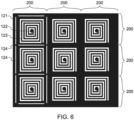
- FIGURE 6 shows an exemplary array of nine thermal elements 200 arranged in a matrix-like pattern of three-by-three.
- Each thermal element 200 includes a first electrode 121 and a second electrode 122 with an electrically resistive element 123 there between.
- the elements 121, 122, 123 are all made of the same material that forms the thermal signal layer 120.
- the electrically resistive element 123 is constructed by patterning the material of the thermal signal layer 120 into a "labyrinth" or angled or curved spiral shape that extends between two strips of the same material, namely the first and a second electrode 121, 122.
- the thermal elements 200 share the first electrode 121 which frames the elements.
- the second electrode 122 is individual for each thermal element 200 at the center of the thereof.
- the thermal elements 200 further include strips of electrically non-conductive sections 124 between thermal elements 200 to minimize heat transfer between thermal elements 200.
- the non-conductive sections 124 may simply be voids in the electrically conductive material that forms the thermal signal layer 120, whereby the substrate or a coating thereof may be exposed at the non-conductive sections 124.
- FIGURE 7 shows an alternative embodiment of the construction of FIGURE 6 .
- the thermal signal layer 120 of FIGURE 7 comprises separate electrically resistive elements 123 between sections of the electrically conductive material, i.e. connecting the first and a second electrode 121, 122.
- the electrically resistive elements 123 may take the form of a piece of material that has conductivity smaller than that of the surrounding electrode 121, 122. According to a particular embodiment the electric conductivity of the electrically resistive element 123 is smaller than 1,43 ⁇ 10 -7 S/m.
- the electrically resistive elements 123 may be printed or otherwise overlaid onto the electrode(s) 121, 122.
- the resistance over the electrically resistive elements 123 is greater than that across the first and/or second electrode 121, 122.
- the difference in resistance may be a decade or more, such as hundred times or more.
- the electrically resistive elements 123 are surrounded by non-conductive sections 124 to isolate the first and a second electrode 121, 122 from each other.
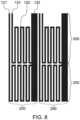
- FIGURE 8 shows a variant of the embodiment of FIGURE 6 .
- FIGURE 8 is an illustration featuring a two-by-two configuration of a larger array of thermal elements 200.
- the electrically resistive element 123 may be shaped to meander between the electrodes 121, 122.
- the adjacent thermal elements 200 in a given column share the second electrode 122, whereas each thermal element 200 has an individual first electrode 121.
- thermal elements 200 may be patterned in several different ways.
- the thermal elements 200 may also be constructed in a host of different configurations, as illustrated by FIGURES 2 to 5 .
- the thermal signal layer 120 is deposited onto the substrate 110.
- FIGURE 2 shows the first electrode 121 occupying the periphery of the substrate 110, the second electrode 122 in the middle, and the windings of the electrically resistive element 123 between the first and second electrode 121, 122.
- the thermal signal layer 120 is powered by a driving layer 130 on the opposite side of the substrate 110.
- the driving layer 130 has an electrically conductive lead 131 for providing voltage to the thermal signal layer 120.
- the lead 131 is connected to a voltage source (not illustrated) through a control circuit (not illustrated).
- the lead 131 is connected to the thermal signal layer 120 though an electric connection, which may be provided in several different ways.
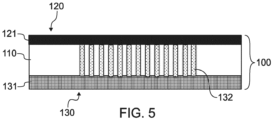
- a conductor 132 devised into the substrate 110.
- the conductor 132 may be constructed by first providing a hole through the substrate 110 and then introducing electrically conductive material into the hole to connect the lead 131 and the electrode 122.
- the electrically conductive material may be a lead that is soldered or otherwise bonded between the lead 131 and the electrode 122 or it may be a crimp or pin. If the lead 131 printed onto the surface of the substrate 110, the same printing technique may be used to fill the channel extending through the substrate to fill the channel.
- the electrically resistive element 123 connects the electrodes 121, 122 along the substrate 110.
- the thermal signal layer 120 is powered similarly to the embodiment of FIGURE 2 .
- the electrically resistive element 123 may be printed or coated or painted.
- the electrically resistive element 123 may have electrical resistivity higher than that of the electrical connectors.
- the electrically resistive element 123 may be produced in various shapes and thicknesses, wherein the cross-section determines the resistivity level.
- the electrically resistive element 123 may be made of temperature self-regulating material, wherein the material changes as a function of temperature, thus making the element a self-regulating heater element.
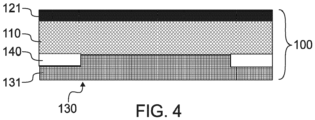
- FIGURE 4 shows an alternative to powering the thermal signal layer 120, wherein the substrate 110 is made of or doped with conductive material.
- the lead 131 is electrically connected to the thermal signal layer 120 on areas which are not isolated.
- electric isolators 140 are provided between the lead 131 and the substrate 110. Accordingly, the electric isolators 140 are provided in a pattern which forms the pattern of the array of thermal elements, whereby the pattern of the thermal elements may be formed without patterning the thermal signal layer 120 because only some sections of the thermal signal layer will be provided with a control voltage.
- the thermal signal layer 120 may include a solitary electrode 121.
- the electric isolators 140 may be provided by provision of an air gap between the lead 131 and the substrate 110 or printed layer of dielectric material or a laminated membrane, for example.
- FIGURE 5 shows yet an alternative to powering the thermal signal layer 120, wherein the electrically non-conductive substrate 110 is provided with channels that extend through the substrate and which have been filled with or provided with conductive material.
- Such channels may be produced by punching, drilling, laser, or etching, such as dry etching, for example.
- the pattern of the thermal elements may be formed without patterning the thermal signal layer 120 because only some sections of the thermal signal layer will be provided with a control voltage.
- metallic or other conductive particles may be pressed locally inside the otherwise non-conductive substrate 110 to establish conductive passages through the substrate.
- the functional thermal signal layer 120 and the functional radar signal layer 150 as physically separate layers on opposing sides of the substrate 110.
- the functional thermal signal layer 120 and the functional radar signal layer 150 are provided in a single physical layer of a metallic film.
- the thermal and radar response be provided with a single layer, it is advantageous to maximize the coverage of the multi-layer structure 100 with the material making up the layer to maximize the radar response.
- the coverage of the layer is 50 per cent or more, particularly 75 or more, preferably in the range of 90 to 100 per cent.
- the single layer embodiment may be constructed, for example, according to any one of the examples shown in FIGURES 2 to 8 provided that the material making up the thermal signal layer 120 is thick and conductive enough to produce the required radar response.
- the multi-layer structure comprises a separate physical radar signal layer or several physical radar signal layers, wherein the artificial target device includes one or several sections that provide(s) (a) weaker radar response(s) and one or several section(s) that provide(s) (a) stronger radar responses to mimic objects with comparable properties. Examples of such objects include bunkers, antiaircraft pits, etc.
- the manufacturing of the multi-layer structure 100 may be achieved by employing techniques used for printed electronics to achieve relatively large areas for the functional thermal signal layer 120 and radar signal layer 150.
- a substrate 110 is unrolled from a roll of raw material and printed with conductive ink on one side of the substrate 110 to produce the thermal signal layer 120.
- the conductive ink may be carbon ink or silver ink, or more specifically particulate or nano-particulate metal or carbon ink or with ink containing carbon or metal fibers or flakelets.
- the printing enables a relatively accurate and sharp pattern of the thermal elements 200.
- the thermal signal layer 120 is printed as a blank layer of material which is then patterned through subtraction, such as mechanical or chemical subtraction.
- the patterning may also produce the electrically resistive element 123 or they may be added in a separate step by printing, such as offset, flexo, gravure, screen printing, rotary screen printing, ink-jet-printing, or by dispensing.
- the driving layer 130 is produced by printing, or by patterning of metal foil using laser, cutting or wet- or dry-etching or laminated in a form of pre-patterned foil.
- the radar signal layer 150 is added onto the substrate 110 or pre-produced physical thermal signal layer 120. If the radar signal layer 150 is layered onto the pre-produced physical thermal signal layer 120, an intermediate step of providing an electric isolator film there between is conceivable.
- a metallic film is provided.
- a layer of adhesive such in the form of a sprayed, rolled, or transplantable film, is applied onto the metallic film, onto the substrate 110, or onto the thermal signal layer 120, in which case the layer of adhesive forms the isolating intermediate electric isolator film.
- the metallic film is then laminated onto the substrate 110 or onto the thermal signal layer 120 through the layer of adhesive.
- the metallic film may be evaporated, coated, printed, or mechanically affixed, such as stapled, onto the the substrate or onto the thermal signal layer.
- the multi-layer structure 100 may be provided with a visual deception layer 160.
- the visual deception layer 160 may be applied to the thermal signal layer 120 or radar signal layer 150 by painting, laminating, applying a textured wrap or foil, or any detailed mask observable with the human eye.
- the multi-layer structure 100 With the multi-layer structure 100 ready, it is attached to a frame which is constructed to resemble the 3D shape of the portrayed object.
- the multi-layer structure 100 is preferably made from pliable materials that can withstand deformation enough to facilitate bending so as to conform to the shape of the frame. It is particularly useful to be able to wrap the frame with a sheet-like multi-layer structure 100.
- the artificial target device is provided with an electric power source and control processor with the required data transfer interfaces, such as wired or wireless remote connection data interface, to control the temperature of the thermal elements 200 according to a set of computer readable instructions accessed by the control processor.
- the processor may be connected to a power output stage.
- a human-machine interface may also be included to control device.
- an infra-red image of the object is acquiring for processing.
- the infra-red image is converted into a digital image which comprises pixels.
- the pixels are then converted into machine readable control instructions for controlling the thermal signal layer 120 to reproduce or mimic the thermal signature of the object.
- Said control instructions are stored to a local memory comprised by the artificial target device or to a memory that is external to and retrieved by the artificial target device through a wired or wireless interface.
- a processor comprised by the device reads said control instructions and controls the artificial target device to provide a different voltage, current, or duty cycle to at least two individual thermal elements 200 in the array to form the desired thermal signature.
- a multi-spectral artificial target device for producing a deceptive thermal and radar signature of an object comprising a multi-layer structure (100) which comprises a substrate (110) and a functional thermal signal layer (120), which is provided directly or indirectly on the substrate (110) and which comprises electrically conductive material arranged to form an array of independently controlled thermal elements (200), wherein each thermal element (200) is configured to output a thermal signal, which is observable in the infra-red spectrum, upon exposure to a control voltage, wherein a functional radar signal layer (150) which is provided directly or indirectly onto the substrate (110), which radar signal layer (150) is configured to output a radar response signal, which is observable in the radio frequency spectrum, upon exposure to an external radar stimulus or excitation.
- Clause 2 The device according to clause 1, wherein the substrate (110) is made of pliable material capable of being shaped onto or around a frame.
- Clause 3 The device according to clause 1 or 2, wherein the thermal signal layer (120) is patterned to include electrically resistive elements (123) or comprises additional electrically resistive elements (123) between sections of the electrically conductive material to provide for the array of thermal elements (200).
- each thermal element (200) comprises a first electrode (121) and a second electrode (122), wherein the first electrode and the second electrode (122) are connected by the electrically resistive element (123).
- thermo signal layer (120) comprises electrically non-conductive sections (124) between thermal elements (200).
- the structure (100) comprises a driving layer (130), which is provided directly or indirectly on a side of the substrate (110) opposing the thermal signal layer (120), which driving layer (130) comprises an electrically conductive lead (131), and wherein the structure (100) comprises a conductor (132), which extends through the substrate (110) and provides an electrical connection between the lead (131) and the thermal signal layer (120).
- Clause 7 The device according to clause 6, wherein the conductor (132) comprises a plurality of electrically conductive channels extending through the substrate (110) such patterned to provide for the array of thermal elements (200) or electrically conductive material embedded into the substrate material.
- Clause 8 The device according to any one of the preceding clauses, wherein the radar signal layer (150) comprises a metallic film that has a radar reflectance different to, particularly greater than, that of the thermal signal layer (120) or substrate (110) or both.
- Clause 9 The device according to any one of the preceding clauses 3 to 8, wherein the radar signal layer (150) is patterned to match the pattern of thermal elements (200) on the thermal signal layer (120).
- Clause 10 The device according to any one of the preceding clauses, wherein the structure (100) comprises a visual deception layer (160) provided onto the radar signal layer (150).
- Clause 11 The device according to any one of the preceding clauses, wherein the artificial target device comprises one or more such structures (100), a frame for supporting said one or more structures (100), and control circuitry which is configured to individually control the temperature of the plurality of thermal elements (200) in the structure(s) (100).
- a method of producing a multi-spectral artificial target device for producing a deceptive thermal and radar signature of an object comprising (a) providing a multi-layer structure (100), which comprises (a1) providing a substrate (110) and (a2) providing a thermal signal layer (120) by (a2.1) depositing electrically conductive material onto the substrate (110) to form an array of independently controlled thermal elements (200) (a3) providing a radar signal layer (150), which comprises (a3.1) providing a metallic film (a3.2) attaching the metallic film onto the substrate (110) or onto the thermal signal layer (120).
- Clause 13 The method according to clause 12, in which deposition step (2.1) the method of depositing is printing.
- Clause 14 The method according to clause 12 or 13, wherein the attachment (a3.2) of the metallic film comprises (a3.2.1) providing an adhesive film onto the substrate (110), the thermal signal layer (120), or onto the metallic film, and (a3.2.2) laminating the metallic film onto the substrate (110) or onto the thermal signal layer (120) through the adhesive film.
- Clause 15 The method according to any one of the preceding clauses 12 to 14, wherein the provision (a2) of the thermal signal layer (120) comprises (a2.2) patterning the electrodes (121, 122) - and optionally the electrically resistive element (123) - onto the thermal signal layer (120) through subtraction, particularly mechanical or chemical subtraction.
- Clause 16 The method according to any one of the preceding clauses 12 to 15, wherein the provision (a) of the multi-layer structure comprises (a4) providing a visual deception layer (160) onto the radar signal layer (150).
- Clause 17 The method according to any one of the preceding clauses 12 to 16, wherein the method comprises (b) providing a frame, and (c) attaching the multi-layer structure (100) onto the frame.
- Clause 18 The method according to clause 17, wherein the attachment step (c) comprises bending the multi-layer structure (100) at least partially around the frame.
Landscapes
- Engineering & Computer Science (AREA)
- General Engineering & Computer Science (AREA)
- Radar, Positioning & Navigation (AREA)
- Remote Sensing (AREA)
- Physics & Mathematics (AREA)
- Electromagnetism (AREA)
- Laminated Bodies (AREA)
- Aiming, Guidance, Guns With A Light Source, Armor, Camouflage, And Targets (AREA)
- Radar Systems Or Details Thereof (AREA)
Applications Claiming Priority (2)
| Application Number | Priority Date | Filing Date | Title |
|---|---|---|---|
| US16/911,418 US11604049B2 (en) | 2020-06-25 | 2020-06-25 | Multi-spectral artificial target device and a method for producing the same as well as a method of generating a thermal and radar signature of an object with an artificial target device |
| EP21181406.6A EP3929526B1 (de) | 2020-06-25 | 2021-06-24 | Multispektrale künstliche zielorrichtung und verfahren zu deren herstellung |
Related Parent Applications (1)
| Application Number | Title | Priority Date | Filing Date |
|---|---|---|---|
| EP21181406.6A Division EP3929526B1 (de) | 2020-06-25 | 2021-06-24 | Multispektrale künstliche zielorrichtung und verfahren zu deren herstellung |
Publications (4)
| Publication Number | Publication Date |
|---|---|
| EP4279858A2 true EP4279858A2 (de) | 2023-11-22 |
| EP4279858A3 EP4279858A3 (de) | 2024-02-14 |
| EP4279858C0 EP4279858C0 (de) | 2025-03-26 |
| EP4279858B1 EP4279858B1 (de) | 2025-03-26 |
Family
ID=76958694
Family Applications (2)
| Application Number | Title | Priority Date | Filing Date |
|---|---|---|---|
| EP23202377.0A Active EP4279858B1 (de) | 2020-06-25 | 2021-06-24 | Multispektrale künstliche zielvorrichtung und verfahren zur herstellung davon |
| EP21181406.6A Active EP3929526B1 (de) | 2020-06-25 | 2021-06-24 | Multispektrale künstliche zielorrichtung und verfahren zu deren herstellung |
Family Applications After (1)
| Application Number | Title | Priority Date | Filing Date |
|---|---|---|---|
| EP21181406.6A Active EP3929526B1 (de) | 2020-06-25 | 2021-06-24 | Multispektrale künstliche zielorrichtung und verfahren zu deren herstellung |
Country Status (3)
| Country | Link |
|---|---|
| US (2) | US11604049B2 (de) |
| EP (2) | EP4279858B1 (de) |
| PL (2) | PL4279858T3 (de) |
Families Citing this family (2)
| Publication number | Priority date | Publication date | Assignee | Title |
|---|---|---|---|---|
| US11604049B2 (en) * | 2020-06-25 | 2023-03-14 | Dobbelgänger Oy | Multi-spectral artificial target device and a method for producing the same as well as a method of generating a thermal and radar signature of an object with an artificial target device |
| WO2025158100A1 (en) * | 2024-09-06 | 2025-07-31 | Dobbelgänger Oy | Military decoy laminate |
Citations (3)
| Publication number | Priority date | Publication date | Assignee | Title |
|---|---|---|---|---|
| US4524386A (en) | 1982-04-12 | 1985-06-18 | The United States Of America As Represented By The Secretary Of The Army | Thermal target display system |
| US20070013137A1 (en) | 2003-05-09 | 2007-01-18 | Saab Ab | Target device |
| US20080296842A1 (en) | 2005-10-06 | 2008-12-04 | Novak Harvey M | Multi-spectral targets for gunnery training |
Family Cites Families (14)
| Publication number | Priority date | Publication date | Assignee | Title |
|---|---|---|---|---|
| US3300781A (en) * | 1965-05-27 | 1967-01-24 | Nat Res Corp | Radar countermeasure article |
| US4546983A (en) * | 1981-09-18 | 1985-10-15 | Tvi Energy Corporation | Multi-spectral target |
| US4659602A (en) * | 1985-11-12 | 1987-04-21 | Jorgen Birch | Broad spectrum camouflage mat |
| DE3643692A1 (de) * | 1986-12-20 | 1992-03-12 | Dornier Gmbh | Tarnvorrichtung |
| US5077101A (en) * | 1989-09-01 | 1991-12-31 | The United States Of America As Represented By The Secretary Of The Army | Three color infrared camouflage system |
| GB8920614D0 (en) * | 1989-09-12 | 1989-10-25 | Secr Defence | Testing device for thermal imagers |
| FR2716962B1 (fr) * | 1994-03-07 | 1996-05-24 | Bachmann Camouflage Sa | Leurre de simulation notamment d'un engin de combat. |
| FR3005285A1 (fr) * | 1995-11-10 | 2014-11-07 | Thomson Csf | Revetement permettant une reduction de la signature visible, infrarouge et radar d' une cible, optimise pour garantir la tenue mecanique du revetement |
| FR3005286A1 (fr) * | 1995-11-10 | 2014-11-07 | Thomson Csf | Revetement permettant une reduction de la signature visible, infrarouge et radar d une cible, optimise pour l absorption de plusieurs bandes de frequences radar |
| EP1872439B1 (de) * | 2005-04-21 | 2016-09-07 | Bell Helicopter Textron Inc. | Verfahren und vorrichtung zur reduzierung der infrarot- und radarsignatur eines fahrzeugs |
| US8340358B2 (en) * | 2008-04-24 | 2012-12-25 | Military Wraps Research And Development, Inc. | Visual camouflage with thermal and radar suppression and methods of making the same |
| GB2463284B (en) | 2008-09-08 | 2011-11-23 | Qinetiq Ltd | Thermal emissive apparatus |
| SE536136C2 (sv) * | 2011-06-07 | 2013-05-28 | Bae Systems Haegglunds Ab | Anordning och metod för signaturanpassning |
| US11604049B2 (en) * | 2020-06-25 | 2023-03-14 | Dobbelgänger Oy | Multi-spectral artificial target device and a method for producing the same as well as a method of generating a thermal and radar signature of an object with an artificial target device |
-
2020
- 2020-06-25 US US16/911,418 patent/US11604049B2/en active Active
-
2021
- 2021-06-24 PL PL23202377.0T patent/PL4279858T3/pl unknown
- 2021-06-24 EP EP23202377.0A patent/EP4279858B1/de active Active
- 2021-06-24 EP EP21181406.6A patent/EP3929526B1/de active Active
- 2021-06-24 PL PL21181406.6T patent/PL3929526T3/pl unknown
-
2023
- 2023-02-09 US US18/107,531 patent/US12018920B2/en active Active
Patent Citations (3)
| Publication number | Priority date | Publication date | Assignee | Title |
|---|---|---|---|---|
| US4524386A (en) | 1982-04-12 | 1985-06-18 | The United States Of America As Represented By The Secretary Of The Army | Thermal target display system |
| US20070013137A1 (en) | 2003-05-09 | 2007-01-18 | Saab Ab | Target device |
| US20080296842A1 (en) | 2005-10-06 | 2008-12-04 | Novak Harvey M | Multi-spectral targets for gunnery training |
Also Published As
| Publication number | Publication date |
|---|---|
| EP4279858C0 (de) | 2025-03-26 |
| EP4279858A3 (de) | 2024-02-14 |
| EP3929526B1 (de) | 2023-10-11 |
| PL4279858T3 (pl) | 2025-06-16 |
| EP4279858B1 (de) | 2025-03-26 |
| EP3929526A1 (de) | 2021-12-29 |
| US20210404774A1 (en) | 2021-12-30 |
| EP3929526C0 (de) | 2023-10-11 |
| US12018920B2 (en) | 2024-06-25 |
| US20230384064A1 (en) | 2023-11-30 |
| US11604049B2 (en) | 2023-03-14 |
| PL3929526T3 (pl) | 2024-02-26 |
Similar Documents
| Publication | Publication Date | Title |
|---|---|---|
| US12018920B2 (en) | Multi-spectral artificial target device and a method for producing the same as well as a method of generating a thermal and radar signature of an object with an artificial target device | |
| US4546983A (en) | Multi-spectral target | |
| US4659089A (en) | Multi-spectral target | |
| EP2331901B1 (de) | Wärmeemittierende vorrichtung | |
| US5065032A (en) | Thermal integrated target | |
| CN105390806B (zh) | 用于汽车雷达传感器的柔性人工阻抗表面天线 | |
| DE69708916T2 (de) | Auf der hinterelektrode laminierte elektrolumineszenzanordnung | |
| US20180269569A1 (en) | Method for producing a radome and corresponding radome | |
| EP2469991A2 (de) | Etikett mit einem elektronischen Funktionselement | |
| US20090176029A1 (en) | Printer and Method for Manufacturing Electronic Circuits and Displays | |
| EP2326154B1 (de) | Verfahren zur Herstellung einer dreidimensional geformten Zufuhrstruktur | |
| US20080296842A1 (en) | Multi-spectral targets for gunnery training | |
| US5672937A (en) | Light-transmitting electroconductive plastic film electrodes and method of manufacture | |
| US9341444B2 (en) | Thermal electric images | |
| US8614548B2 (en) | Electroluminescent display and method for production | |
| WO2004022343A2 (en) | Printer and method for manufacturing electronic circuits and displays | |
| US9900981B2 (en) | Flexible circuit with partial ground path | |
| KR20250012044A (ko) | 위장 외부 코팅 | |
| JP2571223B2 (ja) | 表示シ−トおよびその製造方法 | |
| WO2025158100A1 (en) | Military decoy laminate | |
| IL300319A (en) | Camouflage external coating | |
| IL300318A (en) | Modular camouflage system and uses thereof |
Legal Events
| Date | Code | Title | Description |
|---|---|---|---|
| PUAI | Public reference made under article 153(3) epc to a published international application that has entered the european phase |
Free format text: ORIGINAL CODE: 0009012 |
|
| STAA | Information on the status of an ep patent application or granted ep patent |
Free format text: STATUS: THE APPLICATION HAS BEEN PUBLISHED |
|
| AC | Divisional application: reference to earlier application |
Ref document number: 3929526 Country of ref document: EP Kind code of ref document: P |
|
| AK | Designated contracting states |
Kind code of ref document: A2 Designated state(s): AL AT BE BG CH CY CZ DE DK EE ES FI FR GB GR HR HU IE IS IT LI LT LU LV MC MK MT NL NO PL PT RO RS SE SI SK SM TR |
|
| REG | Reference to a national code |
Ref country code: DE Ref legal event code: R079 Free format text: PREVIOUS MAIN CLASS: F42B0005150000 Ipc: F41J0002020000 Ref country code: DE Ref legal event code: R079 Ref document number: 602021028345 Country of ref document: DE Free format text: PREVIOUS MAIN CLASS: F42B0005150000 Ipc: F41J0002020000 |
|
| PUAL | Search report despatched |
Free format text: ORIGINAL CODE: 0009013 |
|
| AK | Designated contracting states |
Kind code of ref document: A3 Designated state(s): AL AT BE BG CH CY CZ DE DK EE ES FI FR GB GR HR HU IE IS IT LI LT LU LV MC MK MT NL NO PL PT RO RS SE SI SK SM TR |
|
| RIC1 | Information provided on ipc code assigned before grant |
Ipc: F42B 5/15 20060101ALI20240110BHEP Ipc: F41J 2/02 20060101AFI20240110BHEP |
|
| STAA | Information on the status of an ep patent application or granted ep patent |
Free format text: STATUS: REQUEST FOR EXAMINATION WAS MADE |
|
| 17P | Request for examination filed |
Effective date: 20240814 |
|
| RBV | Designated contracting states (corrected) |
Designated state(s): AL AT BE BG CH CY CZ DE DK EE ES FI FR GB GR HR HU IE IS IT LI LT LU LV MC MK MT NL NO PL PT RO RS SE SI SK SM TR |
|
| GRAP | Despatch of communication of intention to grant a patent |
Free format text: ORIGINAL CODE: EPIDOSNIGR1 |
|
| STAA | Information on the status of an ep patent application or granted ep patent |
Free format text: STATUS: GRANT OF PATENT IS INTENDED |
|
| GRAS | Grant fee paid |
Free format text: ORIGINAL CODE: EPIDOSNIGR3 |
|
| INTG | Intention to grant announced |
Effective date: 20250120 |
|
| GRAA | (expected) grant |
Free format text: ORIGINAL CODE: 0009210 |
|
| STAA | Information on the status of an ep patent application or granted ep patent |
Free format text: STATUS: THE PATENT HAS BEEN GRANTED |
|
| AC | Divisional application: reference to earlier application |
Ref document number: 3929526 Country of ref document: EP Kind code of ref document: P |
|
| AK | Designated contracting states |
Kind code of ref document: B1 Designated state(s): AL AT BE BG CH CY CZ DE DK EE ES FI FR GB GR HR HU IE IS IT LI LT LU LV MC MK MT NL NO PL PT RO RS SE SI SK SM TR |
|
| REG | Reference to a national code |
Ref country code: GB Ref legal event code: FG4D |
|
| REG | Reference to a national code |
Ref country code: CH Ref legal event code: EP |
|
| REG | Reference to a national code |
Ref country code: DE Ref legal event code: R096 Ref document number: 602021028345 Country of ref document: DE |
|
| REG | Reference to a national code |
Ref country code: IE Ref legal event code: FG4D |
|
| U01 | Request for unitary effect filed |
Effective date: 20250402 |
|
| U07 | Unitary effect registered |
Designated state(s): AT BE BG DE DK EE FI FR IT LT LU LV MT NL PT RO SE SI Effective date: 20250409 |
|
| PG25 | Lapsed in a contracting state [announced via postgrant information from national office to epo] |
Ref country code: RS Free format text: LAPSE BECAUSE OF FAILURE TO SUBMIT A TRANSLATION OF THE DESCRIPTION OR TO PAY THE FEE WITHIN THE PRESCRIBED TIME-LIMIT Effective date: 20250626 |
|
| PGFP | Annual fee paid to national office [announced via postgrant information from national office to epo] |
Ref country code: PL Payment date: 20250613 Year of fee payment: 5 |
|
| PGFP | Annual fee paid to national office [announced via postgrant information from national office to epo] |
Ref country code: GB Payment date: 20250618 Year of fee payment: 5 |
|
| PGFP | Annual fee paid to national office [announced via postgrant information from national office to epo] |
Ref country code: NO Payment date: 20250624 Year of fee payment: 5 |
|
| PG25 | Lapsed in a contracting state [announced via postgrant information from national office to epo] |
Ref country code: HR Free format text: LAPSE BECAUSE OF FAILURE TO SUBMIT A TRANSLATION OF THE DESCRIPTION OR TO PAY THE FEE WITHIN THE PRESCRIBED TIME-LIMIT Effective date: 20250326 |
|
| PG25 | Lapsed in a contracting state [announced via postgrant information from national office to epo] |
Ref country code: GR Free format text: LAPSE BECAUSE OF FAILURE TO SUBMIT A TRANSLATION OF THE DESCRIPTION OR TO PAY THE FEE WITHIN THE PRESCRIBED TIME-LIMIT Effective date: 20250627 |
|
| U20 | Renewal fee for the european patent with unitary effect paid |
Year of fee payment: 5 Effective date: 20250625 |
|
| PG25 | Lapsed in a contracting state [announced via postgrant information from national office to epo] |
Ref country code: SM Free format text: LAPSE BECAUSE OF FAILURE TO SUBMIT A TRANSLATION OF THE DESCRIPTION OR TO PAY THE FEE WITHIN THE PRESCRIBED TIME-LIMIT Effective date: 20250326 |
|
| PG25 | Lapsed in a contracting state [announced via postgrant information from national office to epo] |
Ref country code: ES Free format text: LAPSE BECAUSE OF FAILURE TO SUBMIT A TRANSLATION OF THE DESCRIPTION OR TO PAY THE FEE WITHIN THE PRESCRIBED TIME-LIMIT Effective date: 20250326 |
|
| PG25 | Lapsed in a contracting state [announced via postgrant information from national office to epo] |
Ref country code: SK Free format text: LAPSE BECAUSE OF FAILURE TO SUBMIT A TRANSLATION OF THE DESCRIPTION OR TO PAY THE FEE WITHIN THE PRESCRIBED TIME-LIMIT Effective date: 20250326 |
|
| PG25 | Lapsed in a contracting state [announced via postgrant information from national office to epo] |
Ref country code: IS Free format text: LAPSE BECAUSE OF FAILURE TO SUBMIT A TRANSLATION OF THE DESCRIPTION OR TO PAY THE FEE WITHIN THE PRESCRIBED TIME-LIMIT Effective date: 20250726 |
|
| PG25 | Lapsed in a contracting state [announced via postgrant information from national office to epo] |
Ref country code: CZ Free format text: LAPSE BECAUSE OF FAILURE TO SUBMIT A TRANSLATION OF THE DESCRIPTION OR TO PAY THE FEE WITHIN THE PRESCRIBED TIME-LIMIT Effective date: 20250326 |
|
| REG | Reference to a national code |
Ref country code: CH Ref legal event code: H13 Free format text: ST27 STATUS EVENT CODE: U-0-0-H10-H13 (AS PROVIDED BY THE NATIONAL OFFICE) Effective date: 20260127 |
|
| PG25 | Lapsed in a contracting state [announced via postgrant information from national office to epo] |
Ref country code: MC Free format text: LAPSE BECAUSE OF FAILURE TO SUBMIT A TRANSLATION OF THE DESCRIPTION OR TO PAY THE FEE WITHIN THE PRESCRIBED TIME-LIMIT Effective date: 20250326 |
|
| PLBE | No opposition filed within time limit |
Free format text: ORIGINAL CODE: 0009261 |
|
| STAA | Information on the status of an ep patent application or granted ep patent |
Free format text: STATUS: NO OPPOSITION FILED WITHIN TIME LIMIT |
|
| REG | Reference to a national code |
Ref country code: CH Ref legal event code: L10 Free format text: ST27 STATUS EVENT CODE: U-0-0-L10-L00 (AS PROVIDED BY THE NATIONAL OFFICE) Effective date: 20260211 |
|
| 26N | No opposition filed |
Effective date: 20260105 |
|
| PG25 | Lapsed in a contracting state [announced via postgrant information from national office to epo] |
Ref country code: IE Free format text: LAPSE BECAUSE OF NON-PAYMENT OF DUE FEES Effective date: 20250624 |