EP4279429A1 - Information processing device - Google Patents
Information processing device Download PDFInfo
- Publication number
- EP4279429A1 EP4279429A1 EP21919378.6A EP21919378A EP4279429A1 EP 4279429 A1 EP4279429 A1 EP 4279429A1 EP 21919378 A EP21919378 A EP 21919378A EP 4279429 A1 EP4279429 A1 EP 4279429A1
- Authority
- EP
- European Patent Office
- Prior art keywords
- delivery
- travel trajectory
- destination
- person
- destinations
- Prior art date
- Legal status (The legal status is an assumption and is not a legal conclusion. Google has not performed a legal analysis and makes no representation as to the accuracy of the status listed.)
- Pending
Links
Images




Classifications
-
- G—PHYSICS
- G06—COMPUTING OR CALCULATING; COUNTING
- G06Q—INFORMATION AND COMMUNICATION TECHNOLOGY [ICT] SPECIALLY ADAPTED FOR ADMINISTRATIVE, COMMERCIAL, FINANCIAL, MANAGERIAL OR SUPERVISORY PURPOSES; SYSTEMS OR METHODS SPECIALLY ADAPTED FOR ADMINISTRATIVE, COMMERCIAL, FINANCIAL, MANAGERIAL OR SUPERVISORY PURPOSES, NOT OTHERWISE PROVIDED FOR
- G06Q10/00—Administration; Management
- G06Q10/04—Forecasting or optimisation specially adapted for administrative or management purposes, e.g. linear programming or "cutting stock problem"
- G06Q10/047—Optimisation of routes or paths, e.g. travelling salesman problem
-
- G—PHYSICS
- G06—COMPUTING OR CALCULATING; COUNTING
- G06Q—INFORMATION AND COMMUNICATION TECHNOLOGY [ICT] SPECIALLY ADAPTED FOR ADMINISTRATIVE, COMMERCIAL, FINANCIAL, MANAGERIAL OR SUPERVISORY PURPOSES; SYSTEMS OR METHODS SPECIALLY ADAPTED FOR ADMINISTRATIVE, COMMERCIAL, FINANCIAL, MANAGERIAL OR SUPERVISORY PURPOSES, NOT OTHERWISE PROVIDED FOR
- G06Q10/00—Administration; Management
- G06Q10/08—Logistics, e.g. warehousing, loading or distribution; Inventory or stock management
- G06Q10/083—Shipping
- G06Q10/08355—Routing methods
-
- G—PHYSICS
- G06—COMPUTING OR CALCULATING; COUNTING
- G06Q—INFORMATION AND COMMUNICATION TECHNOLOGY [ICT] SPECIALLY ADAPTED FOR ADMINISTRATIVE, COMMERCIAL, FINANCIAL, MANAGERIAL OR SUPERVISORY PURPOSES; SYSTEMS OR METHODS SPECIALLY ADAPTED FOR ADMINISTRATIVE, COMMERCIAL, FINANCIAL, MANAGERIAL OR SUPERVISORY PURPOSES, NOT OTHERWISE PROVIDED FOR
- G06Q10/00—Administration; Management
- G06Q10/06—Resources, workflows, human or project management; Enterprise or organisation planning; Enterprise or organisation modelling
- G06Q10/063—Operations research, analysis or management
- G06Q10/0631—Resource planning, allocation, distributing or scheduling for enterprises or organisations
- G06Q10/06315—Needs-based resource requirements planning or analysis
Definitions
- the present invention relates to an information processing device.
- Patent Document 1 discloses a collection and delivery route setting method for setting a collection and delivery route that is adapted also to time-specified deliveries.
- Patent Document 1 JP 2005-280972A
- a delivery vehicle Depending on a delivery destination, a delivery vehicle cannot be stopped in front of the delivery destination and it is necessary to stop the delivery vehicle at a position distant from the delivery destination. In such cases, the delivery efficiency varies depending on where the delivery vehicle is stopped.
- the conventional method merely sets the delivery destinations themselves as transit points and creates a route capable of efficiently traveling through these transit points, thus it does not create a route in which the stop position of the delivery vehicle is taken into account.
- An example of a problem to be solved by the present invention is to create a route in which a stop position of a delivery vehicle is taken into account.
- the invention configured to determine a transit point of a route for delivering a package to one or more delivery destinations, the information processing device including a travel trajectory acquisition section configured to acquire, for each of the one or more delivery destinations, a travel trajectory of a delivery person and a travel trajectory of a delivery vehicle in one or more deliveries made to the delivery destination by one or more delivery persons, and a transit point determination section configured to determine, for each of the one or more delivery destinations, a transit point for the delivery destination based on a travel trajectory of a delivery person and a travel trajectory of a delivery vehicle in each of one or more deliveries made to the delivery destination.
- the invention is an information processing method executed by a computer for creating a transit point of a route for delivering a package to one or more delivery destinations, the method including a travel trajectory acquiring step of acquiring, for each of one or more delivery destinations, a travel trajectory of a delivery person and a travel trajectory of a delivery vehicle in one or more deliveries made to the delivery destination, and a transit point determining step of determining, for each of the one or more delivery destinations, a transit point for the delivery destination based on a travel trajectory of a delivery person and a travel trajectory of a delivery vehicle in each of one or more deliveries made to the delivery destination.
- the invention according to yet another aspect is an information processing program that causes a computer to execute the information processing method described above.
- the invention according to yet another aspect is a computer-readable storage medium having stored therein the information processing program described above.
- An information processing device configured to determine a transit point of a route for delivering a package to one or more delivery destinations, the information processing device including a travel trajectory acquisition section configured to acquire, for each of the one or more delivery destinations, a travel trajectory of a delivery person and a travel trajectory of a delivery vehicle in one or more deliveries made to the delivery destination by one or more delivery persons, and a transit point determination section configured to determine, for each of the one or more delivery destinations, a transit point for the delivery destination based on a travel trajectory of a delivery person and a travel trajectory of a delivery vehicle in each of one or more deliveries made to the delivery destination.
- the transit point of the route is determined based on the travel trajectory of the delivery person and the travel trajectory of the delivery vehicle so it is possible to determine the transit point which is based on the stop position of the delivery vehicle.
- the information processing device may further include a stop position derivation section configured to derive, for each of the one or more delivery destinations, a stop position of a delivery vehicle in each of one or more deliveries based on a difference between a travel trajectory of a delivery person and a travel trajectory of a delivery vehicle in the each of the one or more deliveries made to the delivery destination, and a travel time derivation section configured to derive, for each of the one or more delivery destinations, walking time of a delivery person in each of one or more deliveries based on a difference between a travel trajectory of a delivery person and a travel trajectory of a delivery vehicle in the each of the one or more deliveries made to the delivery destination.
- a stop position derivation section configured to derive, for each of the one or more delivery destinations, a stop position of a delivery vehicle in each of one or more deliveries based on a difference between a travel trajectory of a delivery person and a travel trajectory of a delivery vehicle in the each of the one or more deliveries made to the delivery destination.
- the transit point determination section may be configured to determine, for each of the one or more delivery destinations, a stop position for a delivery in which the walking time is shortest among one or more deliveries made to the delivery destination, as a transit point for the delivery destination. In this way, it is possible to create a route such that time that the delivery person travels on foot becomes shortest.
- the information processing device may further include a weather information acquisition section configured to acquire weather when delivering to the one or more delivery destinations, and the travel trajectory acquisition section may be configured to acquire, for each of the one or more delivery destinations, a travel trajectory of a delivery person and a travel trajectory of a delivery vehicle in one or more deliveries made to the delivery destination in the weather acquired by the weather information acquisition section. In this way, it is possible to create a route in conformity with the weather of that day.
- the information processing device may further include a day-of-week information acquisition section configured to acquire a day of week when delivering to the one or more delivery destinations, and the travel trajectory acquisition section may be configured to acquire, for each of the one or more delivery destinations, a travel trajectory of a delivery person and a travel trajectory of a delivery vehicle in one or more deliveries made to the delivery destination on the day of week acquired by the day-of-week information acquisition section. In this way, it is possible to create an efficient route in which changes in road conditions depending on the day of the week are taken into account.
- the information processing device may further include a time-of-day information acquisition section configured to acquire time of day when delivering to the one or more delivery destinations, and the travel trajectory acquisition section may be configured to acquire, for each of the one or more delivery destinations, a travel trajectory of a delivery person and a travel trajectory of a delivery vehicle in one or more deliveries made to the delivery destination during the time of day acquired by the time-of-day information acquisition section. In this way, it is possible to create an efficient route in which changes in road conditions depending on the time of day are taken into account.
- the information processing method is an information processing method executed by a computer for creating a transit point of a route for delivering a package to one or more delivery destinations, the method including a travel trajectory acquiring step of acquiring, for each of one or more delivery destinations, a travel trajectory of a delivery person and a travel trajectory of a delivery vehicle in one or more deliveries made to the delivery destination, and a transit point determining step of determining, for each of the one or more delivery destinations, a transit point for the delivery destination based on a travel trajectory of a delivery person and a travel trajectory of a delivery vehicle in each of one or more deliveries made to the delivery destination.
- the transit point of the route is determined based on the travel trajectory of the delivery person and the travel trajectory of the delivery vehicle so it is possible to determine the transit point which is based on the stop position of the delivery vehicle.
- an information processing program causes a computer to execute the above-described information processing method.
- a computer it is possible to create by using a computer a route in which the stop position of the delivery vehicle is taken into account.
- one embodiment of the present invention provides a computer-readable storage medium having stored therein the above-described information processing program.
- the above-described information processing program can be distributed independently not only it can be incorporated it into a device, thus version updating or the like can be easily performed.
- FIG. 1 is a diagram showing an information processing device 100 according to one exemplary embodiment of the present invention.
- the information processing device 100 is constituted of a computer and includes a delivery destination information acquisition section 110, a travel trajectory acquisition section 120, a transit point determination section 130 and a route creation section 140.
- the delivery destination information acquisition section 110 acquires delivery destination information.
- the delivery destination information is information about a delivery destination to be traveled through and includes information that identifies a customer in the delivery destination (e.g., customer name or customer ID) and information such as address and location of the delivery destination.
- the delivery destination information acquisition section 110 may acquire the delivery destination information by receiving it from an external device, or may acquire the delivery destination information by receiving an input from a user, or the information processing device 100 may include a storage device having stored therein the delivery destination information and the delivery destination information acquisition section 110 may acquire the delivery destination information from this storage device.
- the travel trajectory acquisition section 120 acquires a travel trajectory of a delivery person and a travel trajectory of a delivery vehicle in one or more deliveries made to the delivery destination by one or more delivery persons.
- the travel trajectory acquisition section 120 acquires the travel trajectories of the delivery person and the delivery vehicle in the delivery made to each of the delivery destinations in the past.
- the travel trajectory of a delivery person is a trajectory traveled by the delivery person during the delivery and is information indicating a position of the delivery person at each time point during the delivery.
- the travel trajectory of a delivery vehicle is a trajectory traveled by the delivery vehicle during the delivery and is information indicating a position of the delivery vehicle at each time point during the delivery.
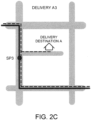
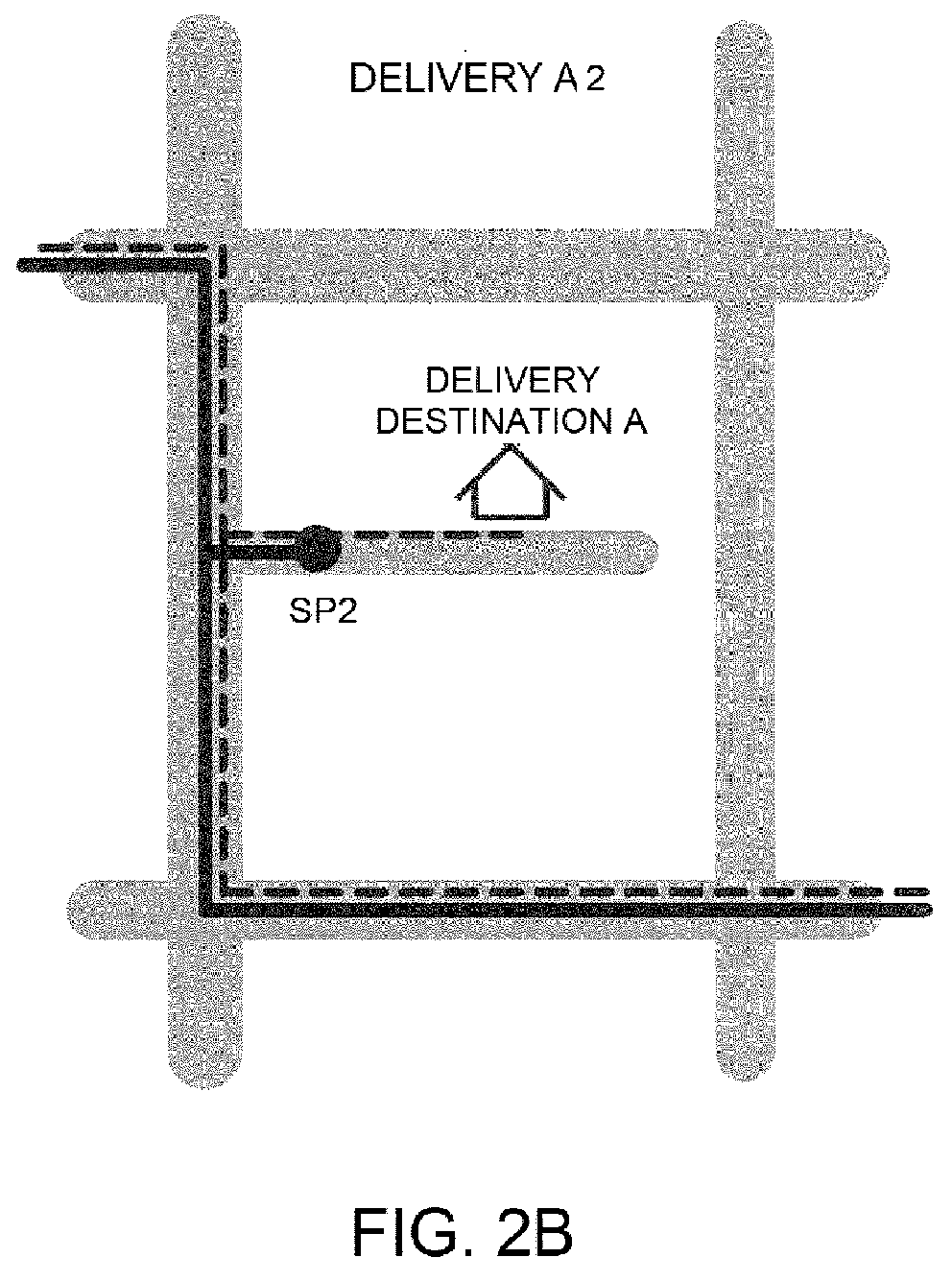
- FIG. 2A to FIG. 2C are diagrams for explaining a travel trajectory of a delivery person and a travel trajectory of a delivery vehicle.
- FIG. 2A shows the travel trajectory of the delivery person (dashed line) and the travel trajectory of the delivery vehicle (solid line) in a delivery A1 made to a delivery destination A.
- the stop position of the delivery vehicle may differ for each delivery. Further, for the delivery destination to which deliveries have been made by two or more delivery persons in the past, the stop position may differ for each delivery person.
- FIG. 2B and FIG. 2C show the travel trajectory of the delivery person (dashed line) and the travel trajectory of the delivery vehicle (solid line) in deliveries A2, A3 made to the destination A.
- the travel trajectory of the delivery person is collected, for example, from a terminal with a GPS such as a smartphone carried by the delivery person and is stored in a storage device.
- the travel trajectory of the delivery vehicle is collected from a terminal with a GPS such as a navigation system installed in the delivery vehicle and is stored in the storage device.
- the travel trajectories of the delivery person and the delivery vehicle may be accumulated by adding information such as the weather, the day of the week and the time of day when the delivery is made.
- the travel trajectory acquisition section 120 acquires the travel trajectory of the delivery person and the travel trajectory of the delivery vehicle from the storage device.
- the storage device may be provided at the information processing device 100, or it may be provided at a device separate from the information processing device 100.
- the transit point determination section 130 determines, for each delivery destination, a transit point for this delivery destination based on the travel trajectory of the delivery person and the travel trajectory of the delivery vehicle in each of one or more deliveries made to this delivery destination. For example, as described in detail below, the transit point determination section 130 derives, for each delivery destination, an optimal stop position among the stop positions of the delivery vehicle in the deliveries made to this delivery destination in the past, and determines this optimum stop position as the transit point for this delivery destination. With respect to the delivery destination for which the travel trajectory of the delivery person and the travel trajectory of the delivery vehicle could not be acquired, the transit point determination section 130 determines e.g., the delivery destination itself as the transit point.
- the route creation section 140 creates a route for traveling through the transit points determined by the transit point determination section 130.
- a route creating method used by the route creation section 140 may be any method as long as it can create an efficient route for traveling through a plurality of transit points.
- the transit point of the route is determined based on the travel trajectory of the delivery person and the travel trajectory of the delivery vehicle so it is possible to determine the transit point that is based on the stop position of the delivery vehicle.
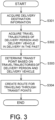
- FIG. 3 is a diagram showing one example of a processing operation in an information processing device 100 according to one exemplary embodiment of the present invention.
- the delivery destination information acquisition section 110 acquires delivery destination information (step S301).
- the travel trajectory acquisition section 120 acquires, for each delivery destination included in the delivery destination information, the travel trajectories of the delivery person and the delivery vehicle in the delivery made to this delivery destination in the past (step S302).
- the transit point determination section 130 determines, for each delivery destination, the transit point for making delivery to this delivery destination based on the acquired travel trajectories of the delivery person and the delivery vehicle (step S303).
- the route creation section 140 creates a route for traveling through the determined transit points (step S304).
- Various methods are conceivable as a method of determining the transit point based on the travel trajectory of the delivery person and the travel trajectory of the delivery vehicle. For example, it is possible to reduce the burden on the delivery person and increase the delivery efficiency by shortening the time the delivery person travels on foot. Thus, for example, it may be preferable to determine the transit point which is the stop position of the delivery vehicle such that the walking time of the delivery person becomes shortest.
- the information processing device 100 may include a stop position derivation section 150 that is configured to derive, for each delivery destination, the stop position of the delivery vehicle in each of one or more deliveries based on a difference between the travel trajectory of the delivery person and the travel trajectory of the delivery vehicle in the each of the one or more deliveries made to the delivery destination.
- the information processing device 100 may include a travel time derivation section 160 that is configured to derive, for each delivery destination, the walking time of the delivery person in each of one or more deliveries based on a difference between the travel trajectory of the delivery person and the travel trajectory of the delivery vehicle in the each of the one or more deliveries made to the delivery destination.
- the walking time of the delivery person may be a time period during which a difference between the travel trajectory of the delivery person and the travel trajectory of the delivery vehicle is occurring, or may be a time period taken to travel from the stop position of the delivery vehicle to the delivery destination.
- the transit point determination section 130 may determine, for each delivery destination, the stop position for a delivery in which the walking time is the shortest among one or more deliveries made to this delivery destination, as the transit point for this delivery destination. In this way, it is possible to create a route in which the time the delivery person travels on foot is the shortest.
- the stop position derivation section 150 derives, as the stop positions of the delivery vehicle for the deliveries A1 to A3, positions SP1 to SP3 where a difference starts to occur between the travel trajectory of the delivery person DP (dashed line) and the travel trajectory of the delivery vehicle DC (solid line).
- the travel time derivation section 160 derives, as the walking time of the delivery person, the time during which a difference is occurring between the travel trajectory of the delivery person DP (dashed line) and the travel trajectory of the delivery vehicle DC (solid line).
- the travel time derivation section 160 derives, as the walking time of the delivery person in the delivery A1, travel time WT1 of the delivery person from when the delivery person travels from the stop position SP1 to the delivery destination A and returns to the stop position SP1, and the travel time derivation section 160 derives, as the walking time of the delivery person in the delivery A2, travel time WT2 of the delivery person from when the delivery person travels from the stop position SP2 to the delivery destination A and returns to the stop position SP2, and the travel time derivation section 160 derives, as the walking time of the delivery person in the delivery A3, travel time WT3 of the delivery person from when the delivery person travels from the stop position SP3 to the delivery destination A and returns to the stop position SP3.
- the transit point determination section 130 determines, as the transit point for the delivery destination A, the position SP2 which is the stop position of the delivery vehicle in the delivery A2 in which the walking time is the shortest among the deliveries A1 to A3.
- the route creation section 140 creates a route having the position SP2 as the transit point for the delivery destination A, as shown in FIG. 4 .
- the delivery person may change the stop position depending on the weather. For example, when the weather is rainy, it may be preferable to stop the delivery vehicle as close as possible to the delivery destination to prevent a package from getting wet even if the efficiency is decreased.
- the information processing device 100 may further include a weather information acquisition section 171 configured to acquire information about weather at the time of delivery to the delivery destination, and the travel trajectory acquisition section 120 may acquire, for each delivery destination, the travel trajectory of the delivery person and the travel trajectory of the delivery vehicle in one or more deliveries made to this delivery destination in the weather indicated in the information acquired by the weather information acquisition section 171. In this way, it is possible to create a route in conformity with the weather of that day.
- Road conditions such as traffic congestion may vary depending on the day of the week, and the stop position of the delivery vehicle for the efficient delivery may vary depending on the day of the week.
- the information processing device 100 may further include a day-of-week information acquisition section 172 configured to acquire information about the day of the week on which a package is delivered to the delivery destination, and the travel trajectory acquisition section 120 may acquire, for each delivery destination, the travel trajectory of the delivery person and the travel trajectory of the delivery vehicle in one or more deliveries made to the delivery destination on the day of the week indicated in the information acquired by the day-of-week information acquisition section 172.
- the travel trajectory acquisition section 120 may acquire, for each delivery destination, the travel trajectory of the delivery person and the travel trajectory of the delivery vehicle in one or more deliveries made to the delivery destination on the day of the week indicated in the information acquired by the day-of-week information acquisition section 172.
- Road conditions such as traffic congestion may vary depending on time of day, and the stop position of the delivery vehicle for the efficient delivery may vary depending on time of day.
- the information processing device 100 may further include a time-of-day information acquisition section 173 configured to acquire information about time of day in which delivery is made to the delivery destination, and the travel trajectory acquisition section 120 may acquire, for each delivery destination, the travel trajectory of the delivery person and the travel trajectory of the delivery vehicle in one or more deliveries made to the delivery destination in the time of day acquired by the time-of-day information acquisition section 173. In this way, it is possible to create an efficient route in which changes in road conditions depending on the time of day are taken into account.
- the information processing device 100 may include a walking route creation section 180 configured to create, for each delivery destination, a walking route from the transit point for the delivery destination to the delivery destination. In this way, it is possible to indicate the walking route to the delivery person so the delivery efficiency can be improved even more. For example, in the example shown in FIG. 4 described above, it is possible to indicate the walking route on which the delivery person travels on foot (dashed line) in addition to the route through which the delivery vehicle travels (solid line), as shown in FIG. 5 .
- the transit point determination section 130 may determine the transit point based on the travel trajectory of the delivery vehicle and the stop position of the delivery vehicle in the delivery made in the past.
- road links and road nodes on which the delivery vehicle had traveled, and the time when it passed through respective road nodes are stored as the travel trajectory of the delivery vehicle in the delivery made to each delivery destination in the past.
- a corresponding road which is a road corresponding to the delivery destination (for example, a road adjacent to the delivery destination and accessible to the delivery destination, e.g., the road on which SP2 exists in the example shown in FIG. 2B )
- a dead-end road extending from a T-shaped junction as shown in FIG. 2A to FIG.
- the transit point determination section 130 identifies two road links connected to the road link corresponding to said corresponding road (in the example shown in FIG. 2A to FIG. 2C , the road link corresponding to the road on which SP1 exists and the road link corresponding to the road on which SP3 exists), and, for each of the two road links that are identified, identifies the road nodes, among the road nodes at both ends of each road link, that are not connected to the road link corresponding to the corresponding road. As a result, two road nodes are identified.
- the transit point determination section 130 calculates the travel time of the delivery vehicle that it takes to travel between the identified two road nodes based on the travel trajectory of the delivery vehicle, and determines, as the transit point for this delivery destination, the stop position of the delivery vehicle in the delivery in which the calculated travel time is the shortest among the deliveries made in the past.
- the transit point determination section 130 calculates, for each delivery made to the delivery destination in the past, the travel time of the delivery vehicle that it takes to travel between the road nodes located on the both ends of the road link corresponding to the corresponding road based on the travel trajectory of the delivery vehicle, and determines, as the transit point for this delivery destination, the stop position of the delivery vehicle in the delivery in which the calculated travel time is the shortest among the deliveries made in the past.
- the stop position where the travel time is the shortest is presumed to be the efficient stop position.
- the efficient route can be created by using that stop position as the transit point.
Landscapes
- Business, Economics & Management (AREA)
- Human Resources & Organizations (AREA)
- Engineering & Computer Science (AREA)
- Economics (AREA)
- Strategic Management (AREA)
- Entrepreneurship & Innovation (AREA)
- Marketing (AREA)
- Development Economics (AREA)
- Operations Research (AREA)
- Quality & Reliability (AREA)
- Tourism & Hospitality (AREA)
- Physics & Mathematics (AREA)
- General Business, Economics & Management (AREA)
- General Physics & Mathematics (AREA)
- Theoretical Computer Science (AREA)
- Game Theory and Decision Science (AREA)
- Educational Administration (AREA)
- Traffic Control Systems (AREA)
- Navigation (AREA)
Abstract

Description
- The present invention relates to an information processing device.
- Various methods have been proposed to create a route for traveling through to a plurality of delivery destinations. For example, Patent Document 1 discloses a collection and delivery route setting method for setting a collection and delivery route that is adapted also to time-specified deliveries.
- Patent Document 1:
JP 2005-280972A - Depending on a delivery destination, a delivery vehicle cannot be stopped in front of the delivery destination and it is necessary to stop the delivery vehicle at a position distant from the delivery destination. In such cases, the delivery efficiency varies depending on where the delivery vehicle is stopped. The conventional method, however, merely sets the delivery destinations themselves as transit points and creates a route capable of efficiently traveling through these transit points, thus it does not create a route in which the stop position of the delivery vehicle is taken into account.
- An example of a problem to be solved by the present invention is to create a route in which a stop position of a delivery vehicle is taken into account.
- In order to solve the above problems, the invention according to one aspect is an information processing device configured to determine a transit point of a route for delivering a package to one or more delivery destinations, the information processing device including a travel trajectory acquisition section configured to acquire, for each of the one or more delivery destinations, a travel trajectory of a delivery person and a travel trajectory of a delivery vehicle in one or more deliveries made to the delivery destination by one or more delivery persons, and a transit point determination section configured to determine, for each of the one or more delivery destinations, a transit point for the delivery destination based on a travel trajectory of a delivery person and a travel trajectory of a delivery vehicle in each of one or more deliveries made to the delivery destination.
- The invention according to another aspect is an information processing method executed by a computer for creating a transit point of a route for delivering a package to one or more delivery destinations, the method including a travel trajectory acquiring step of acquiring, for each of one or more delivery destinations, a travel trajectory of a delivery person and a travel trajectory of a delivery vehicle in one or more deliveries made to the delivery destination, and a transit point determining step of determining, for each of the one or more delivery destinations, a transit point for the delivery destination based on a travel trajectory of a delivery person and a travel trajectory of a delivery vehicle in each of one or more deliveries made to the delivery destination.
- The invention according to yet another aspect is an information processing program that causes a computer to execute the information processing method described above.
- The invention according to yet another aspect is a computer-readable storage medium having stored therein the information processing program described above.
-
-
FIG. 1 is a diagram showing aninformation processing device 100 according to one exemplary embodiment of the present invention; -
FIG. 2A to FIG. 2C are diagrams for explaining a travel trajectory of a delivery person and a travel trajectory of a delivery vehicle; -
FIG. 3 is a diagram showing one example of a processing operation in aninformation processing device 100 according to one exemplary embodiment of the present invention; -
FIG. 4 is a diagram for explaining a route created by aroute creation section 140; and -
FIG. 5 is a diagram for explaining a route created by theroute creation section 140. - An information processing device according to one embodiment of the present invention is an information processing device configured to determine a transit point of a route for delivering a package to one or more delivery destinations, the information processing device including a travel trajectory acquisition section configured to acquire, for each of the one or more delivery destinations, a travel trajectory of a delivery person and a travel trajectory of a delivery vehicle in one or more deliveries made to the delivery destination by one or more delivery persons, and a transit point determination section configured to determine, for each of the one or more delivery destinations, a transit point for the delivery destination based on a travel trajectory of a delivery person and a travel trajectory of a delivery vehicle in each of one or more deliveries made to the delivery destination. Thus, in this embodiment, the transit point of the route is determined based on the travel trajectory of the delivery person and the travel trajectory of the delivery vehicle so it is possible to determine the transit point which is based on the stop position of the delivery vehicle. As a result, in this embodiment, it is possible to create a route in which the stop position of the delivery vehicle is taken into account.
- The information processing device may further include a stop position derivation section configured to derive, for each of the one or more delivery destinations, a stop position of a delivery vehicle in each of one or more deliveries based on a difference between a travel trajectory of a delivery person and a travel trajectory of a delivery vehicle in the each of the one or more deliveries made to the delivery destination, and a travel time derivation section configured to derive, for each of the one or more delivery destinations, walking time of a delivery person in each of one or more deliveries based on a difference between a travel trajectory of a delivery person and a travel trajectory of a delivery vehicle in the each of the one or more deliveries made to the delivery destination. The transit point determination section may be configured to determine, for each of the one or more delivery destinations, a stop position for a delivery in which the walking time is shortest among one or more deliveries made to the delivery destination, as a transit point for the delivery destination. In this way, it is possible to create a route such that time that the delivery person travels on foot becomes shortest.
- The information processing device may further include a weather information acquisition section configured to acquire weather when delivering to the one or more delivery destinations, and the travel trajectory acquisition section may be configured to acquire, for each of the one or more delivery destinations, a travel trajectory of a delivery person and a travel trajectory of a delivery vehicle in one or more deliveries made to the delivery destination in the weather acquired by the weather information acquisition section. In this way, it is possible to create a route in conformity with the weather of that day.
- The information processing device may further include a day-of-week information acquisition section configured to acquire a day of week when delivering to the one or more delivery destinations, and the travel trajectory acquisition section may be configured to acquire, for each of the one or more delivery destinations, a travel trajectory of a delivery person and a travel trajectory of a delivery vehicle in one or more deliveries made to the delivery destination on the day of week acquired by the day-of-week information acquisition section. In this way, it is possible to create an efficient route in which changes in road conditions depending on the day of the week are taken into account.
- The information processing device may further include a time-of-day information acquisition section configured to acquire time of day when delivering to the one or more delivery destinations, and the travel trajectory acquisition section may be configured to acquire, for each of the one or more delivery destinations, a travel trajectory of a delivery person and a travel trajectory of a delivery vehicle in one or more deliveries made to the delivery destination during the time of day acquired by the time-of-day information acquisition section. In this way, it is possible to create an efficient route in which changes in road conditions depending on the time of day are taken into account.
- Further, the information processing method according to one embodiment of the present invention is an information processing method executed by a computer for creating a transit point of a route for delivering a package to one or more delivery destinations, the method including a travel trajectory acquiring step of acquiring, for each of one or more delivery destinations, a travel trajectory of a delivery person and a travel trajectory of a delivery vehicle in one or more deliveries made to the delivery destination, and a transit point determining step of determining, for each of the one or more delivery destinations, a transit point for the delivery destination based on a travel trajectory of a delivery person and a travel trajectory of a delivery vehicle in each of one or more deliveries made to the delivery destination. Thus, in this embodiment, the transit point of the route is determined based on the travel trajectory of the delivery person and the travel trajectory of the delivery vehicle so it is possible to determine the transit point which is based on the stop position of the delivery vehicle. As a result, in this embodiment, it is possible to create a route in which the stop position of the delivery vehicle is taken into account.
- Further, an information processing program according to one embodiment of the present invention causes a computer to execute the above-described information processing method. Thus, in this embodiment, it is possible to create by using a computer a route in which the stop position of the delivery vehicle is taken into account.
- Further, one embodiment of the present invention provides a computer-readable storage medium having stored therein the above-described information processing program. Thus, in this embodiment, the above-described information processing program can be distributed independently not only it can be incorporated it into a device, thus version updating or the like can be easily performed.
-
FIG. 1 is a diagram showing aninformation processing device 100 according to one exemplary embodiment of the present invention. Theinformation processing device 100 is constituted of a computer and includes a delivery destinationinformation acquisition section 110, a traveltrajectory acquisition section 120, a transitpoint determination section 130 and aroute creation section 140. - The delivery destination
information acquisition section 110 acquires delivery destination information. The delivery destination information is information about a delivery destination to be traveled through and includes information that identifies a customer in the delivery destination (e.g., customer name or customer ID) and information such as address and location of the delivery destination. For example, the delivery destinationinformation acquisition section 110 may acquire the delivery destination information by receiving it from an external device, or may acquire the delivery destination information by receiving an input from a user, or theinformation processing device 100 may include a storage device having stored therein the delivery destination information and the delivery destinationinformation acquisition section 110 may acquire the delivery destination information from this storage device. - For each of the delivery destinations included in the delivery destination information acquired by the delivery destination
information acquisition section 110, the traveltrajectory acquisition section 120 acquires a travel trajectory of a delivery person and a travel trajectory of a delivery vehicle in one or more deliveries made to the delivery destination by one or more delivery persons. In other words, the traveltrajectory acquisition section 120 acquires the travel trajectories of the delivery person and the delivery vehicle in the delivery made to each of the delivery destinations in the past. The travel trajectory of a delivery person is a trajectory traveled by the delivery person during the delivery and is information indicating a position of the delivery person at each time point during the delivery. The travel trajectory of a delivery vehicle is a trajectory traveled by the delivery vehicle during the delivery and is information indicating a position of the delivery vehicle at each time point during the delivery. - When the delivery person leaves the delivery vehicle and travels on foot, a difference occurs between the travel trajectory of the delivery person and the travel trajectory of the delivery vehicle. Thus, a stop position of the delivery vehicle can be acquired based on the travel trajectory of the delivery person and the travel trajectory of the delivery vehicle.
FIG. 2A to FIG. 2C are diagrams for explaining a travel trajectory of a delivery person and a travel trajectory of a delivery vehicle.FIG. 2A shows the travel trajectory of the delivery person (dashed line) and the travel trajectory of the delivery vehicle (solid line) in a delivery A1 made to a delivery destination A. In the delivery A1, when the delivery person stops the delivery vehicle at a position SP1 and the delivery person travels on foot between this stop position and the delivery destination A, a difference occurs between the travel trajectory of the delivery person (dashed line) and the travel trajectory of the delivery vehicle (solid line) between the position SP1 and the delivery destination A. - For the delivery destination to which deliveries have been made two times or more in the past, the stop position of the delivery vehicle may differ for each delivery. Further, for the delivery destination to which deliveries have been made by two or more delivery persons in the past, the stop position may differ for each delivery person. For example,
FIG. 2B andFIG. 2C show the travel trajectory of the delivery person (dashed line) and the travel trajectory of the delivery vehicle (solid line) in deliveries A2, A3 made to the destination A. In the delivery A2 (A3), in the case where the delivery person stopped the delivery vehicle at a position SP2 (SP3) different from the position SP1, a difference occurs between the travel trajectory of the delivery person DP (dashed line) and the travel trajectory of the delivery vehicle DC (solid line) in a section (between the position SP2 (SP3) and the delivery destination A) different from the delivery A1. - The travel trajectory of the delivery person is collected, for example, from a terminal with a GPS such as a smartphone carried by the delivery person and is stored in a storage device. In addition, the travel trajectory of the delivery vehicle is collected from a terminal with a GPS such as a navigation system installed in the delivery vehicle and is stored in the storage device. The travel trajectories of the delivery person and the delivery vehicle may be accumulated by adding information such as the weather, the day of the week and the time of day when the delivery is made. The travel
trajectory acquisition section 120 acquires the travel trajectory of the delivery person and the travel trajectory of the delivery vehicle from the storage device. The storage device may be provided at theinformation processing device 100, or it may be provided at a device separate from theinformation processing device 100. - The transit
point determination section 130 determines, for each delivery destination, a transit point for this delivery destination based on the travel trajectory of the delivery person and the travel trajectory of the delivery vehicle in each of one or more deliveries made to this delivery destination. For example, as described in detail below, the transitpoint determination section 130 derives, for each delivery destination, an optimal stop position among the stop positions of the delivery vehicle in the deliveries made to this delivery destination in the past, and determines this optimum stop position as the transit point for this delivery destination. With respect to the delivery destination for which the travel trajectory of the delivery person and the travel trajectory of the delivery vehicle could not be acquired, the transitpoint determination section 130 determines e.g., the delivery destination itself as the transit point. - The
route creation section 140 creates a route for traveling through the transit points determined by the transitpoint determination section 130. A route creating method used by theroute creation section 140 may be any method as long as it can create an efficient route for traveling through a plurality of transit points. - Thus, in this exemplary embodiment, the transit point of the route is determined based on the travel trajectory of the delivery person and the travel trajectory of the delivery vehicle so it is possible to determine the transit point that is based on the stop position of the delivery vehicle. As a result, in this embodiment, it is possible to create a route in which the stop position of the delivery vehicle is taken into account.
-
FIG. 3 is a diagram showing one example of a processing operation in aninformation processing device 100 according to one exemplary embodiment of the present invention. The delivery destinationinformation acquisition section 110 acquires delivery destination information (step S301). The traveltrajectory acquisition section 120 acquires, for each delivery destination included in the delivery destination information, the travel trajectories of the delivery person and the delivery vehicle in the delivery made to this delivery destination in the past (step S302). The transitpoint determination section 130 determines, for each delivery destination, the transit point for making delivery to this delivery destination based on the acquired travel trajectories of the delivery person and the delivery vehicle (step S303). Theroute creation section 140 creates a route for traveling through the determined transit points (step S304). - Various methods are conceivable as a method of determining the transit point based on the travel trajectory of the delivery person and the travel trajectory of the delivery vehicle. For example, it is possible to reduce the burden on the delivery person and increase the delivery efficiency by shortening the time the delivery person travels on foot. Thus, for example, it may be preferable to determine the transit point which is the stop position of the delivery vehicle such that the walking time of the delivery person becomes shortest.
- Thus, the
information processing device 100 may include a stopposition derivation section 150 that is configured to derive, for each delivery destination, the stop position of the delivery vehicle in each of one or more deliveries based on a difference between the travel trajectory of the delivery person and the travel trajectory of the delivery vehicle in the each of the one or more deliveries made to the delivery destination. In addition, theinformation processing device 100 may include a traveltime derivation section 160 that is configured to derive, for each delivery destination, the walking time of the delivery person in each of one or more deliveries based on a difference between the travel trajectory of the delivery person and the travel trajectory of the delivery vehicle in the each of the one or more deliveries made to the delivery destination. In this way, it is possible to obtain the walking time of the delivery person in one or more deliveries made to each delivery destination in the past. The walking time of the delivery person may be a time period during which a difference between the travel trajectory of the delivery person and the travel trajectory of the delivery vehicle is occurring, or may be a time period taken to travel from the stop position of the delivery vehicle to the delivery destination. - The transit
point determination section 130 may determine, for each delivery destination, the stop position for a delivery in which the walking time is the shortest among one or more deliveries made to this delivery destination, as the transit point for this delivery destination. In this way, it is possible to create a route in which the time the delivery person travels on foot is the shortest. - For example, in the example shown in
FIG. 2Ato FIG. 2C , for the respective deliveries A1 to A3, the stopposition derivation section 150 derives, as the stop positions of the delivery vehicle for the deliveries A1 to A3, positions SP1 to SP3 where a difference starts to occur between the travel trajectory of the delivery person DP (dashed line) and the travel trajectory of the delivery vehicle DC (solid line). - Further, in the example shown in
FIG. 2Ato FIG. 2C , the traveltime derivation section 160 derives, as the walking time of the delivery person, the time during which a difference is occurring between the travel trajectory of the delivery person DP (dashed line) and the travel trajectory of the delivery vehicle DC (solid line). That is, the traveltime derivation section 160 derives, as the walking time of the delivery person in the delivery A1, travel time WT1 of the delivery person from when the delivery person travels from the stop position SP1 to the delivery destination A and returns to the stop position SP1, and the traveltime derivation section 160 derives, as the walking time of the delivery person in the delivery A2, travel time WT2 of the delivery person from when the delivery person travels from the stop position SP2 to the delivery destination A and returns to the stop position SP2, and the traveltime derivation section 160 derives, as the walking time of the delivery person in the delivery A3, travel time WT3 of the delivery person from when the delivery person travels from the stop position SP3 to the delivery destination A and returns to the stop position SP3. - Then, in the example shown in
FIG. 2Ato FIG. 2C , when the travel time WT2 is the shortest among the travel times WT1 to WT3, the transitpoint determination section 130 determines, as the transit point for the delivery destination A, the position SP2 which is the stop position of the delivery vehicle in the delivery A2 in which the walking time is the shortest among the deliveries A1 to A3. As a result, in the example shown inFIG. 2Ato FIG. 2C , theroute creation section 140 creates a route having the position SP2 as the transit point for the delivery destination A, as shown inFIG. 4 . - The delivery person may change the stop position depending on the weather. For example, when the weather is rainy, it may be preferable to stop the delivery vehicle as close as possible to the delivery destination to prevent a package from getting wet even if the efficiency is decreased.
- Thus, the
information processing device 100 may further include a weatherinformation acquisition section 171 configured to acquire information about weather at the time of delivery to the delivery destination, and the traveltrajectory acquisition section 120 may acquire, for each delivery destination, the travel trajectory of the delivery person and the travel trajectory of the delivery vehicle in one or more deliveries made to this delivery destination in the weather indicated in the information acquired by the weatherinformation acquisition section 171. In this way, it is possible to create a route in conformity with the weather of that day. - Road conditions such as traffic congestion may vary depending on the day of the week, and the stop position of the delivery vehicle for the efficient delivery may vary depending on the day of the week.
- Accordingly, the
information processing device 100 may further include a day-of-weekinformation acquisition section 172 configured to acquire information about the day of the week on which a package is delivered to the delivery destination, and the traveltrajectory acquisition section 120 may acquire, for each delivery destination, the travel trajectory of the delivery person and the travel trajectory of the delivery vehicle in one or more deliveries made to the delivery destination on the day of the week indicated in the information acquired by the day-of-weekinformation acquisition section 172. In this way, it is possible to create an efficient route in which changes in the road conditions depending on the day of the week are taken into account. - Road conditions such as traffic congestion may vary depending on time of day, and the stop position of the delivery vehicle for the efficient delivery may vary depending on time of day.
- Thus, the
information processing device 100 may further include a time-of-dayinformation acquisition section 173 configured to acquire information about time of day in which delivery is made to the delivery destination, and the traveltrajectory acquisition section 120 may acquire, for each delivery destination, the travel trajectory of the delivery person and the travel trajectory of the delivery vehicle in one or more deliveries made to the delivery destination in the time of day acquired by the time-of-dayinformation acquisition section 173. In this way, it is possible to create an efficient route in which changes in road conditions depending on the time of day are taken into account. - The
information processing device 100 may include a walkingroute creation section 180 configured to create, for each delivery destination, a walking route from the transit point for the delivery destination to the delivery destination. In this way, it is possible to indicate the walking route to the delivery person so the delivery efficiency can be improved even more. For example, in the example shown inFIG. 4 described above, it is possible to indicate the walking route on which the delivery person travels on foot (dashed line) in addition to the route through which the delivery vehicle travels (solid line), as shown inFIG. 5 . - As an example of determining the transit point for the delivery destination for which the travel trajectory of the delivery person and the travel trajectory of the delivery vehicle cannot be acquired, the example that determines the delivery destination itself as the transit point was shown. However, with respect to the delivery destination for which the travel trajectory of the delivery person and the travel trajectory of the delivery vehicle cannot be acquired but the travel trajectory of the delivery vehicle and the stop position of the delivery vehicle in the delivery made in the past can be acquired, the transit
point determination section 130 may determine the transit point based on the travel trajectory of the delivery vehicle and the stop position of the delivery vehicle in the delivery made in the past. - Specifically, in a storage device, road links and road nodes on which the delivery vehicle had traveled, and the time when it passed through respective road nodes, are stored as the travel trajectory of the delivery vehicle in the delivery made to each delivery destination in the past. Then, when making a new delivery, in the case where a corresponding road, which is a road corresponding to the delivery destination (for example, a road adjacent to the delivery destination and accessible to the delivery destination, e.g., the road on which SP2 exists in the example shown in
FIG. 2B ), is a dead-end road extending from a T-shaped junction as shown inFIG. 2A to FIG. 2C , the transitpoint determination section 130 identifies two road links connected to the road link corresponding to said corresponding road (in the example shown inFIG. 2A to FIG. 2C , the road link corresponding to the road on which SP1 exists and the road link corresponding to the road on which SP3 exists), and, for each of the two road links that are identified, identifies the road nodes, among the road nodes at both ends of each road link, that are not connected to the road link corresponding to the corresponding road. As a result, two road nodes are identified. Thereafter, for each delivery made to this delivery destination in the past, the transitpoint determination section 130 calculates the travel time of the delivery vehicle that it takes to travel between the identified two road nodes based on the travel trajectory of the delivery vehicle, and determines, as the transit point for this delivery destination, the stop position of the delivery vehicle in the delivery in which the calculated travel time is the shortest among the deliveries made in the past. - In the case where other road links are connected to both ends of the road link corresponding to the corresponding road (i.e., when the corresponding road is not a dead-end road), the transit
point determination section 130 calculates, for each delivery made to the delivery destination in the past, the travel time of the delivery vehicle that it takes to travel between the road nodes located on the both ends of the road link corresponding to the corresponding road based on the travel trajectory of the delivery vehicle, and determines, as the transit point for this delivery destination, the stop position of the delivery vehicle in the delivery in which the calculated travel time is the shortest among the deliveries made in the past. - The stop position where the travel time is the shortest is presumed to be the efficient stop position. Thus, the efficient route can be created by using that stop position as the transit point.
- The present invention has been described herein by way of preferred embodiments of the present invention. Although the present invention has been described with reference to specific embodiments, various modifications and changes to these embodiments are possible without departing from the spirit and scope of the present invention as set forth in the claims.
-
- 100
- information processing device
- 110
- delivery destination information acquisition section
- 120
- travel trajectory acquisition section
- 130
- transit point determination section
- 140
- route creation section
- 150
- stop position derivation section
- 160
- travel time derivation section
- 171
- weather information acquisition section
- 172
- day-of-week information acquisition section
- 173
- time-of-day information acquisition section
- 180
- walking route creation section
Claims (8)
- An information processing device configured to determine a transit point of a route for delivering a package to one or more delivery destinations, the information processing device comprising:a travel trajectory acquisition section configured to acquire, for each of the one or more delivery destinations, a travel trajectory of a delivery person and a travel trajectory of a delivery vehicle in one or more deliveries made to the delivery destination by one or more delivery persons; anda transit point determination section configured to determine, for each of the one or more delivery destinations, a transit point for the delivery destination based on a travel trajectory of a delivery person and a travel trajectory of a delivery vehicle in each of one or more deliveries made to the delivery destination.
- The information processing device according to claim 1, further comprising:a stop position derivation section configured to derive, for each of the one or more delivery destinations, a stop position of a delivery vehicle in each of one or more deliveries based on a difference between a travel trajectory of a delivery person and a travel trajectory of a delivery vehicle in the each of the one or more deliveries made to the delivery destination; anda travel time derivation section configured to derive, for each of the one or more delivery destinations, walking time of a delivery person in each of one or more deliveries based on a difference between a travel trajectory of a delivery person and a travel trajectory of a delivery vehicle in the each of the one or more deliveries made to the delivery destination, whereinthe transit point determination section is configured to determine, for each of the one or more delivery destinations, a stop position in a delivery in which the walking time is shortest among one or more deliveries made to the delivery destination, as a transit point for the delivery destination.
- The information processing device according to claim 1 or 2, further comprisinga weather information acquisition section configured to acquire weather when delivering to the one or more delivery destinations, whereinthe travel trajectory acquisition section is configured to acquire, for each of the one or more delivery destinations, a travel trajectory of a delivery person and a travel trajectory of a delivery vehicle in one or more deliveries made to the delivery destination in the weather acquired by the weather information acquisition section.
- The information processing device according to any one of claims 1 to 3, further comprisinga day-of-week information acquisition section configured to acquire a day of week when delivering to the one or more delivery destinations, whereinthe travel trajectory acquisition section is configured to acquire, for each of the one or more delivery destinations, a travel trajectory of a delivery person and a travel trajectory of a delivery vehicle in one or more deliveries made to the delivery destination on the day of week acquired by the day-of-week information acquisition section.
- The information processing device according to any one of claims 1 to 4, further comprisinga time-of-day information acquisition section configured to acquire time of day when delivering to the one or more delivery destinations, whereinthe travel trajectory acquisition section is configured to acquire, for each of the one or more delivery destinations, a travel trajectory of a delivery person and a travel trajectory of a delivery vehicle in one or more deliveries made to the delivery destination during the time of day acquired by the time-of-day information acquisition section.
- An information processing method executed by a computer for creating a transit point of a route for delivering a package to one or more delivery destinations, the method comprising:a travel trajectory acquiring step of acquiring, for each of one or more delivery destinations, a travel trajectory of a delivery person and a travel trajectory of a delivery vehicle in one or more deliveries made to the delivery destination; anda transit point determining step of determining, for each of the one or more delivery destinations, a transit point for the delivery destination based on a travel trajectory of a delivery person and a travel trajectory of a delivery vehicle in each of one or more deliveries made to the delivery destination.
- An information processing program that causes a computer to execute the information processing method according to claim 6.
- A computer-readable storage medium having stored therein the information processing program according to claim 7.
Applications Claiming Priority (1)
| Application Number | Priority Date | Filing Date | Title |
|---|---|---|---|
| PCT/JP2021/001267 WO2022153485A1 (en) | 2021-01-15 | 2021-01-15 | Information processing device |
Publications (2)
| Publication Number | Publication Date |
|---|---|
| EP4279429A1 true EP4279429A1 (en) | 2023-11-22 |
| EP4279429A4 EP4279429A4 (en) | 2024-10-09 |
Family
ID=82448101
Family Applications (1)
| Application Number | Title | Priority Date | Filing Date |
|---|---|---|---|
| EP21919378.6A Pending EP4279429A4 (en) | 2021-01-15 | 2021-01-15 | INFORMATION PROCESSING DEVICE |
Country Status (4)
| Country | Link |
|---|---|
| US (1) | US20240086789A1 (en) |
| EP (1) | EP4279429A4 (en) |
| JP (4) | JPWO2022153485A1 (en) |
| WO (1) | WO2022153485A1 (en) |
Family Cites Families (11)
| Publication number | Priority date | Publication date | Assignee | Title |
|---|---|---|---|---|
| JP4322156B2 (en) | 2004-03-31 | 2009-08-26 | 富士通株式会社 | Collection / delivery route setting method and collection / delivery route setting program |
| JP2010078571A (en) * | 2008-09-29 | 2010-04-08 | Miyagi Seikatsu Kyodo Kumiai | Map creation device for delivery, map creation method for delivery, and map creation program for delivery |
| JP2018026086A (en) * | 2016-08-08 | 2018-02-15 | メッシュ コリア カンパニー リミテッドMesh Korea Co., Ltd. | Device and method for generating delivery plan by learning delivery route |
| JP2019149116A (en) * | 2018-02-28 | 2019-09-05 | アスクル株式会社 | Delivery plan generation system, delivery plan generation method and delivery plan generation program |
| JP7077162B2 (en) * | 2018-06-29 | 2022-05-30 | 株式会社日立製作所 | Delivery planning device, delivery planning system and delivery planning method |
| CN109708646B (en) * | 2019-03-04 | 2022-10-14 | 深圳市丰巢科技有限公司 | Express cabinet searching method, device, equipment and storage medium |
| US12062008B2 (en) * | 2019-04-16 | 2024-08-13 | United States Postal Service | Methods and systems for item delivery along delivery routes |
| US11544951B2 (en) * | 2019-07-31 | 2023-01-03 | Robotic Research Opco, Llc | Autonomous delivery vehicle |
| JP6779396B1 (en) * | 2020-01-30 | 2020-11-04 | アスクル株式会社 | Delivery support methods, delivery support devices, and programs |
| US11183062B2 (en) * | 2020-03-16 | 2021-11-23 | Here Global B.V. | Method and system for providing parking recommendations |
| US20220044198A1 (en) * | 2020-08-10 | 2022-02-10 | Here Global B.V. | Method and apparatus for dynamic load selection and parking calculation for last mile delivery |
-
2021
- 2021-01-15 WO PCT/JP2021/001267 patent/WO2022153485A1/en not_active Ceased
- 2021-01-15 US US18/261,035 patent/US20240086789A1/en active Pending
- 2021-01-15 JP JP2022574990A patent/JPWO2022153485A1/ja not_active Ceased
- 2021-01-15 EP EP21919378.6A patent/EP4279429A4/en active Pending
-
2024
- 2024-01-16 JP JP2024004602A patent/JP2024028495A/en not_active Ceased
- 2024-10-10 JP JP2024177751A patent/JP2024177561A/en active Pending
-
2026
- 2026-04-17 JP JP2026068297A patent/JP2026120747A/en active Pending
Also Published As
| Publication number | Publication date |
|---|---|
| JP2026120747A (en) | 2026-07-22 |
| JPWO2022153485A1 (en) | 2022-07-21 |
| JP2024177561A (en) | 2024-12-19 |
| JP2024028495A (en) | 2024-03-04 |
| EP4279429A4 (en) | 2024-10-09 |
| US20240086789A1 (en) | 2024-03-14 |
| WO2022153485A1 (en) | 2022-07-21 |
Similar Documents
| Publication | Publication Date | Title |
|---|---|---|
| US8682583B2 (en) | Route search system | |
| CN111947678B (en) | Automatic driving navigation method and system for structured road | |
| EP2385348B1 (en) | Road link string conversion method, road information providing device and road information providing system | |
| US8548736B2 (en) | Historical data based navigational routing | |
| CN102639960A (en) | In-vehicle information processing device and driving support device | |
| EP2980533B1 (en) | Departure/destination location extraction apparatus and departure/destination location extraction method | |
| CN110140026A (en) | Vehicle-mounted device, map update system | |
| CN101936739A (en) | Navigation device, route search server and route search system | |
| US7634355B2 (en) | Navigation apparatus, navigation method, and navigation program | |
| CN101305263A (en) | Method and system for updating map data of a navigation system | |
| CN112525211A (en) | Emergency vehicle navigation system and navigation method based on big data | |
| US20160357802A1 (en) | Method for updating a database | |
| JP2014052377A (en) | Communication type navigation system of searching for route by sensing change in traffic amount | |
| US20190180615A1 (en) | System and method for reducing delays in road traffic | |
| JP2006047246A (en) | Route searching method for navigation system | |
| US20240086789A1 (en) | Information processing device | |
| JP2015046186A (en) | Traffic information processing device, traffic information processing system, program, and traffic information processing method | |
| US20190228600A1 (en) | Fuel efficiency estimation system, fuel efficiency estimation method, and computer readable medium | |
| JP2019096085A (en) | Information processing device | |
| KR101888807B1 (en) | Ancillary equipment of navigator | |
| Wang et al. | Real-time route guidance for large-scale express ring-roads | |
| US8457886B2 (en) | Method for operating a navigation system | |
| US7672775B2 (en) | Systems, methods, and data structures for correcting traffic information | |
| US20110004370A1 (en) | Stop history data accumulation system, accumulation method, and accumulation program | |
| JP7708066B2 (en) | Information processing device, vehicle, and program |
Legal Events
| Date | Code | Title | Description |
|---|---|---|---|
| STAA | Information on the status of an ep patent application or granted ep patent |
Free format text: STATUS: THE INTERNATIONAL PUBLICATION HAS BEEN MADE |
|
| PUAI | Public reference made under article 153(3) epc to a published international application that has entered the european phase |
Free format text: ORIGINAL CODE: 0009012 |
|
| STAA | Information on the status of an ep patent application or granted ep patent |
Free format text: STATUS: REQUEST FOR EXAMINATION WAS MADE |
|
| 17P | Request for examination filed |
Effective date: 20230628 |
|
| AK | Designated contracting states |
Kind code of ref document: A1 Designated state(s): AL AT BE BG CH CY CZ DE DK EE ES FI FR GB GR HR HU IE IS IT LI LT LU LV MC MK MT NL NO PL PT RO RS SE SI SK SM TR |
|
| DAV | Request for validation of the european patent (deleted) | ||
| DAX | Request for extension of the european patent (deleted) | ||
| REG | Reference to a national code |
Ref country code: DE Ref legal event code: R079 Free format text: PREVIOUS MAIN CLASS: B65G0061000000 Ipc: G06Q0010080000 |
|
| A4 | Supplementary search report drawn up and despatched |
Effective date: 20240906 |
|
| RIC1 | Information provided on ipc code assigned before grant |
Ipc: B65G 61/00 20060101ALI20240902BHEP Ipc: G06Q 10/08 20230101AFI20240902BHEP |