EP4275505B1 - Ligne de suspension avec mesure de longueur de tige de fumage - Google Patents
Ligne de suspension avec mesure de longueur de tige de fumage Download PDFInfo
- Publication number
- EP4275505B1 EP4275505B1 EP22172758.9A EP22172758A EP4275505B1 EP 4275505 B1 EP4275505 B1 EP 4275505B1 EP 22172758 A EP22172758 A EP 22172758A EP 4275505 B1 EP4275505 B1 EP 4275505B1
- Authority
- EP
- European Patent Office
- Prior art keywords
- rod
- elements
- length
- hanging line
- sausage
- Prior art date
- Legal status (The legal status is an assumption and is not a legal conclusion. Google has not performed a legal analysis and makes no representation as to the accuracy of the status listed.)
- Active
Links
Images
Classifications
-
- A—HUMAN NECESSITIES
- A22—BUTCHERING; MEAT TREATMENT; PROCESSING POULTRY OR FISH
- A22C—PROCESSING MEAT, POULTRY, OR FISH
- A22C15/00—Apparatus for hanging-up meat or sausages
- A22C15/001—Specially adapted for hanging or conveying several sausages or strips of meat
-
- A—HUMAN NECESSITIES
- A22—BUTCHERING; MEAT TREATMENT; PROCESSING POULTRY OR FISH
- A22C—PROCESSING MEAT, POULTRY, OR FISH
- A22C15/00—Apparatus for hanging-up meat or sausages
- A22C15/001—Specially adapted for hanging or conveying several sausages or strips of meat
- A22C15/002—Loops, hooks, cords for suspending single sausages; apparatus for making or conveying loops for sausages
-
- A—HUMAN NECESSITIES
- A22—BUTCHERING; MEAT TREATMENT; PROCESSING POULTRY OR FISH
- A22C—PROCESSING MEAT, POULTRY, OR FISH
- A22C15/00—Apparatus for hanging-up meat or sausages
- A22C15/007—Racks for storing or smoking suspended meat or sausages
Definitions
- the present invention relates to a system for producing sausage-shaped products each of which contain a flowable filling material in a tubular or bag-shaped packaging casing and a suspension element.
- the inventive system includes a clipping machine and a hanging line capable of measuring the length of the smoking rods.
- a filling material is fed by a filling machine through a filling tube of the clipping machine into a tubular casing material.
- the clipping machine closes the back end of the sausage-shaped product via a closing means, like closure clips, which are attached by respective closing tools.
- a suspension element like a suspension loop, may also be attached to said back end of said sausage-shaped product, enabling the sausage-shaped product to be hung up e.g. on a smoking rod or the like.
- the sausage-shaped product just produced is separated from the remaining casing material by a knife or the like of a cutting device of the clipping machine and is transferred out of the clipping machine to a hanging line.
- the smoking rod For loading (storing) the sausage-shaped product on a smoking rod, the smoking rod usually is provided in a loading position within the hanging line. Then, when the produced sausage-shaped product is removed from the clipping machine, the suspension loop is engaged by a transfer device and is threaded onto the smoking rod. When the smoking rod is filled with a desired number of sausage-shaped products, the filled smoking rod is moved out of the loading position and an empty smoking rod is placed to be filled next. Then the filled smoking is transferred out of the hanging line by an outfeed device to be supplied to the next treatment step or to a storage device such as a storage frame or a smoking carriage or the like.
- a storage device such as a storage frame or a smoking carriage or the like.
- EP 2 384 638 B1 describes a system for producing sausage-shaped products, which comprises a robot device for inserting and removing, i.e. handling or transferring, of filled smoking rods from a hanging line to a storage frame.
- a robot device for inserting and removing, i.e. handling or transferring, of filled smoking rods from a hanging line to a storage frame.
- Said machines may vary in size, in rate of production or in size of products.
- they also may vary in the kind of used rod-like elements, on which the sausage-like products are to be loaded and in the kind of storage frames, to which the rod-like elements are to be transferred.
- the aforesaid object is achieved by a method for handling longitudinal rod-like elements as defined in independent claim 1, and by a system for producing sausage-shaped products as defined in independent claim 10.
- the aforesaid object with respect to the system for controlling a robotic device is achieved by the features of claim 10.
- Advantageous configurations and further developments of the invention with regard to the method are described in dependent claims 2 to 9, and with regard to the system in dependent claims 11 to 15.
- a method for handling longitudinal rod-like elements, in particular smoking rods, for storing sausage-shaped products, in particular sausages, in a system for producing and handling the sausage-shaped products, wherein the method comprises the steps of: providing a plurality of the rod-like elements, each rod-like element having a length defined between a first end and a second end; providing a clipping machine configured to produce the sausage-shaped products; providing a hanging line configured to load the produced sausage-shaped products on the rod-like elements and comprising a measuring position for receiving the rod-like elements and for measuring the length of the rod-like elements, and a loading position for receiving the rod-like elements and for loading the produced sausage-shaped products on the rod-like elements, wherein the measuring position is defined by a first support element configured to receive the first end of one of the rod-like elements and a second support element configured to receive the second end of the one of the rod-like elements, and wherein the loading position is defined by a third support element configured to receive the first end of the one of
- a control unit controlling the clipping machine and the hanging line may indicate to a user that a rod-like element is discarded, so that the user may remove the unsuitable rod-like element.
- the hanging line further comprises a magazine for holding available the plurality of the rod-like elements, wherein the measuring position of the hanging line is located within the magazine, and wherein the step of discarding comprises removing the one of the rod-like elements from the measuring position directly into a reject bin.
- the discarded rod-like elements do not need to travel to the loading position and the whole way through and out of the hanging line, which saves time and helps avoiding any interruption of the production operation.
- the measuring position and the loading position are one and the same, so that the step of measuring is performed with the one of the rod-like elements placed in the loading position. This is in particular advantageous, since the step of measuring is performed immediately before the step of loading, so that an additional transfer operation from a measuring position to a loading position can be omitted.
- the hanging line further comprises an outfeed device, wherein the method further comprises the step of moving the one of the rod-like elements by the outfeed device from the loading position to an output position.
- This outfeed device advantageously provides the above mentioned normal way of outputting the rod-like element. In this way, a filled rod-like element can be easily taken away from a robot, for example, in order to transfer it to the next treatment step or to a storage device.
- the step of discarding comprises removing the one of the rod-like elements from the output position, either manually by a user or automatically by a robot.
- the step of discarding further comprises stopping the operation of the clipping machine until a next one of the rod-like elements has been placed in the loading position of the hanging line and its length has been determined to be within the tolerance range.
- the step of discarding further comprises deferring the step of feeding the next one of the rod-like elements to the loading position of the hanging line until a user manually removes the discarded rod-like element and confirms the removal to the system.
- the system indicates to the user that a discarded rod-like element must be removed and separates out from the production process, wherein the user acknowledges removal to the system so that the system can resume operation.
- the system further comprises a handling robot configured to grip and move the one of the rod-like elements, wherein the handling robot grips the rod-like element, which is loaded with the predetermined number of the produced sausage-shaped products, and places the rod-like element in a storage frame, if the length is within the tolerance range; wherein the step of discarding further comprises removing the discarded rod-like element from the output position and placing the same in a reject bin by the handling robot.
- the storage frame comprises two support bars having a distance smaller than the desired length, and wherein if the length is within the tolerance range, the handling robot places the one of the rod-like elements on the support bars and perpendicular to the same such that both ends overlap the support bars by the same amount. Since a tolerance range around the desired length is admissible, it is advantageous to take into account the varying length of the rod-like elements when placing them on the support bars of the storage frame, so that the risk of sliding off from the support bars is minimized, even if the storage frame is subject to vibrations or shocks.
- a system for producing sausage-shaped products, like sausages, containing a flowable filling material in a tubular or bag-shaped packaging casing and a suspension element such as a suspension loop, and for loading the produced sausage-shaped products on rod-like elements, such as smoking rods, each rod-like element having a length defined between a first end and a second end.
- the system comprises: a clipping machine configured to produce the sausage-shaped products; a hanging line configured to load the produced sausage-shaped products on the rod-like elements; and a control unit controlling the operation of the clipping machine and the hanging line.
- the hanging line comprises: a first support element configured to receive the first end of one of the rod-like elements and a second support element configured to receive the second end of the one of the rod-like elements, the first and second support elements defining a measuring position; and a third support element configured to receive the first end of the one of the rod-like elements and a fourth support element configured to receive the second end of the one of the rod-like elements, the third and fourth support elements defining a loading position for loading the produced sausage-shaped products on the rod-like elements; a sensor device arranged at the measuring position and configured to measure the length of the one of the rod-like elements placed in the measuring position; wherein the control unit is configured to compare the length with a desired length and to determine whether the length is within a tolerance range of the desired length, and wherein the control unit further causes the hanging line to load a predetermined number of sausage-shaped products on the one of the rod-like elements if the length is within the tolerance range, and causes discarding the one of the rod-like elements if the length is not within
- the hanging line further comprises a magazine for holding available a plurality of the rod-like elements, wherein the first and second support elements defining the measuring position are located within the magazine, and wherein the magazine is configured to successively feed single rod-like elements first to the measuring position and then to the loading position or to a reject bin.
- the magazine may have two output paths which can be switched automatically, so that the removal of unsuitable rod-like elements into a reject bin may be performed automatically, and no intervention of a user is required.
- the reject bin may be located beneath one of these output paths, so that the discarded rod-like can fall into the reject bin.
- the first and third support elements are one and the same and the second and fourth support elements are one and the same, so that the measuring position is identical with the loading position and the sensor device is arranged at the loading position; and wherein the hanging line further comprises an outfeed device configured to move the one of the rod-like elements from the loading position to an output position.
- an outfeed device configured to move the one of the rod-like elements from the loading position to an output position.
- the system further comprises a storage frame having two support bars with a distance smaller than the desired length for carrying a plurality of the rod-like elements; and a handling robot configured to grip the one of the rod-like elements and to place it on the support bars of the storage frame or in a reject bin); wherein the handling robot is further configured to receive the measured length of the one of the rod-like elements from the control unit and to adjust the placing position of the one of the rod-like elements on the support bars such that both ends overlap the support bars by the same amount.
- the sensor device comprises a pushing device arranged at the third support element and having a ram configured to push against the first end in a longitudinal direction of the one of the rod-like elements, so that the second end becomes aligned with the fourth support element acting as a stop; wherein the pushing device comprises a sensor configured to detect a position of the ram and to generate an output signal depending on the position of the ram; and wherein the control unit is configured to receive the output signal of the sensor and to determine the length of the one of the rod-like elements based on the signal when the second end is aligned with the fourth support element.
- the pushing device comprises a pneumatic cylinder fixedly attached with respect to the third support element and a piston having a magnetic element and coupled to the ram, and wherein the sensor is a magnetic sensor, in particular a Hall-Sensor, attached to the pneumatic cylinder and configured to detect an axial position of the piston.
- the sensor is a magnetic sensor, in particular a Hall-Sensor, attached to the pneumatic cylinder and configured to detect an axial position of the piston.
- the inventive method thereby provides all advantages explained in conjunction with the inventive system for producing sausage-shaped products.
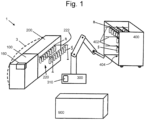
- An embodiment of a system for producing and handling sausage-like products according to Fig. 1 comprises as main components a schematically shown production line 3 for producing sausage-like products S, like sausages, and storing them on rod-like elements R, like smoking rods, including a control unit 160 for controlling the production line 3, a handling robot 300 having a control unit 310 for controlling the movement of robot 300, and a storage frame 400, into which the sausages S hung up at the smoking rods R are to be moved.
- the robot 300 is not obligatory for the invention, and that the rod-like elements can also be manually moved by a user.
- a reject bin 900 may be provided into which a user or robot 300 may place rod-like elements which are discarded, as described later.
- Production line 3 comprises a clipping machine 100 for producing the sausage-like products S and an automatic hanging line 200 for loading (storing) the produced sausage-like products S on the smoking rods (rod-like elements) R.
- Hanging line 200 preferably includes or is combined with an outfeed device 220 having horizontal rails 222 for supporting the rod-like elements R which carry sausage-like products S and leave hanging line 200.
- Control unit 160 of production line 3 and control unit 310 of robot 300 may communicate with each other via common techniques like wireless connections or wired connections, in order to coordinate the operations.
- storage frame 400 When operating the system, storage frame 400 is positioned in an operating range of handling robot 300. Inside storage frame 400, tray rails or shelf rails e.g. in the form of horizontally aligned support bars 402, 404 are arranged for positioning smoking rods R thereon.
- Handling robot 300 preferably is a so called joined-arm robot. Construction and operation of such robot 300 in such system is described in detail in EP 2 384 638 B1 .
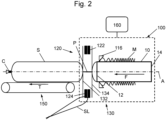
- a clipping machine 100 for producing sausage-shaped products S is schematically shown in Fig. 2 , and comprises as main components a filling tube 10 having a longitudinally extending center axis A and with a discharge opening for a filling material at its left end 12 and a feeding opening for the filling material fed to the filling tube 10 by a feeding pump at its right end 14, a casing brake assembly 16 arranged coaxially with filling tube 10 in the region of the left end 12 of filling tube 10.
- Filling tube 10 is made of a suitable material, like stainless steel.
- a supply of tubular packaging casing material M made of a thin sheet material is stored on the filling tube 10.
- Clipping machine 100 further comprises a clipping device 120 for closing a filled tubular packaging casing M by applying closure means, like closure clips C, to a plait-like portion P, and gathering means 130 for gathering the filled tubular packaging casing M and for forming said plait-like portion P thereto, and which are all arranged downstream filling tube 10.
- Right end 14 of horizontally arranged filling tube 10 is coupled to a filler arrangement (not shown) including a pump for feeding filling material through filling tube 10 in a feeding direction F into tabular packaging casing M closed on its front end facing in the feeding direction F, by a closure clip C.
- a filler arrangement (not shown) including a pump for feeding filling material through filling tube 10 in a feeding direction F into tabular packaging casing M closed on its front end facing in the feeding direction F, by a closure clip C.
- clipping device 120 is arranged and coaxially aligned to filling tube 10.
- Clipping device 120 comprises a first and a second clipping tool 122, 124 formed by a punch 122 and a die 124. It has to be noted that punch 122 and die 124 may apply and close a single closure clip C for closing the just filled tubular packaging casing M, or may apply and close two closure clips C at the same time, a first closure clip C for closing the just filled tubular packaging casing M for forming a sausage-shaped product S, and a second closure clip C for closing the front end of the tubular packaging casing M subsequently to be filled.
- Gathering means 130 includes a first displacer unit 132 and a second displacer unit 134, wherein first displacer unit 132 is positioned downstream second displacer unit 134.
- First and second clipping tools 122, 124 of clipping device 120 may be positioned between first and second displacer units 132, 134, at least for applying and closing one or two closure clips C to plait-like portion P.
- a suspension element like a suspension loop SL
- suspension loop L is provided in the movement path of die 124 such that suspension loop L is engaged by a closure clip C halt in die 124 to be applied to plait-like portion P and attached thereto together with closure clip C.
- Clipping machine 100 further comprises a conveying device 150 for conveying sausage-shaped product S towards hanging line 200.
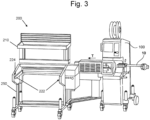
- Fig. 3 shows a schematic perspective overview of a production line 3 according to the invention.
- clipping machine 100 is combined with hanging line 200.
- Hanging line 200 receives the sausage-shaped products S from clipping machine 100 and rod-like elements R from a magazine 210, for example, which is attached to a frame 250 of hanging line 200.
- Hanging line 200 preferably comprises an outfeed device 220 which comprises two horizontally arranged rails 222 for supporting the rod-like elements R leaving a loading position of hanging line 200 to an output position 224 located at the outermost ends of rails 222 (i.e. the front ends in Fig. 3 ).
- the loading position (not depicted since the loading device 260 is not shown) resides on the opposite, i.e. inner ends of rails 222.
- each rail 222 of outfeed device 220 comprises a circulating chain 223 configured to engage and move one of the ends E1, E2 of rod-like element R towards the output position.
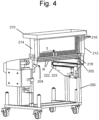
- magazine 210 may comprise an upstream wall 212 and a downstream wall 214 (with respect to the transfer direction T), which are arranged parallel to each other and approximately vertically above rails 222. The distance between walls 212, 214 corresponds to the desired length of a rod-like element R plus a margin. In the surfaces of walls 212, 214 facing each other, vertical slots 216 are arranged parallel to each other. Slots 216 extend from the upper end of walls 212, 214 and commonly end in a funnel-shaped recess (not shown).
- Magazine 210 further comprises releasing means (not shown) for blocking the rod-like elements R positioned in slots 216, and for selectively releasing a single rod-like element R from one of slots 216 at the lower ends of slots 216.
- releasing means for blocking the rod-like elements R positioned in slots 216, and for selectively releasing a single rod-like element R from one of slots 216 at the lower ends of slots 216.
- a single slot 218 is arranged into which single rod-like element R is moved after being selectively released from slots 216.
- Slots 218 provide a standby position in which a single, empty rod-like element R is kept ready for being fed into the loading position after a filled rod-like element R has been removed out of the loading position.
- second blocking and releasing elements 434 in the form of release pins are arranged for securing a single rod-like element R in the standby position, and for releasing rod-like element R for further feeding towards the loading position.
- magazine 210 and outfeed device 220 are known and described in EP 3 241 447 A1 in detail, so that a more detailed description is omitted here.
- magazine 210 comprises a first support element 202 configured to receive the first end E1 of a rod-like element R and a second support element 204 configured to receive the second end E2 of the rod-like element R.
- the first and second support elements 202, 204 define a measuring position.
- Support elements 202, 204 are each arranged directly below slots 218, so that a rod-like element leaving slots 218 is fed onto support elements 202, 204 into a measuring position.
- Fig. 4 only the location of support element 202 of wall 212 is indicated, while support element 204 is located in the opposite wall 214.
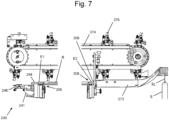
- Support elements 202, 204 may be configured as explained in connection with Fig. 7 below.
- a sensor device as shown in Fig.
- the output slots each may include a slot switch (not shown) and divide in first and second output paths for outputting the rod-like element R.
- slot switches per-se are well-known.
- the first output path leads to support elements 202, 204 of the loading position of hanging line 200, while the second output path leads out of magazine 210 and hanging line 200 so that the rod-like element R can be discarded and received in a reject bin 900 located beneath magazine 210, for example.
- a method of operating the first embodiment is described.
- one of the rod-like elements R is fed by magazine 210 from slots 218 to the measuring position formed by support elements 202, 204.
- the length L of that rod-like element R is measured by sensor device 240.
- sensor device 240 generates an electric signal which is used by control unit 160 to determine the length L.
- control unit 160 determines whether the length L is within a predetermined tolerance range of a desired length Ld.
- the processing advances to a fifth step, in which the rod-like element R is transferred via the first output path of magazine 210 to the loading position defined by third and fourth support elements 206, 208 of hanging line 200 and a predetermined number of the produced sausage-shaped products S is loaded on the rod-like element R (as described later herein and shown in Figs. 6 and 7 ), whereupon the filled rod-like element R is removed from the loading position and transferred to the output position by outfeed device 220.
- the processing then returns to the first step.
- the processing advances to a sixth step, in which the rod-like element R is discarded and transferred via the second output path out of hanging line 200 and, for example, into the reject bin 900.
- the processing then returns to the first step.
- magazine 210 does not include the measuring position with first and second support elements 202, 204, the sensor device 240 and the slot switches and first and second output paths as described above. Instead, magazine 210 includes only one output path leading to the loading position of hanging line 200.
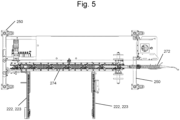
- Fig. 5 is a top view showing the main components of hanging line 200
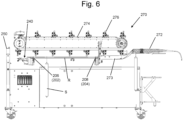
- Fig. 6 is a side view of the hanging line 200 of Fig. 5.
- Figs. 5 and 6 particularly show the loading device 270 which is supported by frame 250 of hanging line 200 and located at the inner ends of rails 222 of the outfeed device 220 and above a rod-like element R placed in the loading position.
- Loading device 270 per se is well-known and can have different configurations.
- Loading device 270 as shown, comprises a transfer device 272 and a circulating loading chain 274 carrying engagement elements 276.
- loading device 270 comprises third and fourth support elements 206, 208 defining a loading position and being configured to support first and second ends E1, E2 of rod-like element R.
- third and fourth support elements 206, 208 also serve as, i.e. are identical to or one and the same with, first and second support elements 202, 204.
- the loading position defined by third and fourth support elements 206, 208 is also used as the measuring position for measuring the length L of the rod-like element R.
- sensor device 240 is attached to third support element 206.
- Transfer device 272 is configured to catch suspension loop SL of the sausage-like product S leaving clipping machine 100, and to deliver suspension loop SL via a slip 273 to rod-like element R resting with its second end E2 on fourth support element 208. While sliding on slip 271, suspension loop SL is engaged by engagement elements 276 circulating with chain 274, and thus, moved over the left end of slip 273 onto rod-like element R. Fourth support element 208 is attached to the left end of slip 273, as is best shown in Fig. 7 , and retains second end E2 of rod-like element R in lateral directions aligned with slip 273.
- second end E2 of rod-like element R should abut to the end surface of slip 273, which end surface is a stop 209 of fourth support element 208, so as to avoid any gap between rod-like element R and slip 273 for ensuring smooth transition of suspension loop SL.
- This alignment of rod-like element R with stop 209 of support element 208 advantageously can be performed by a pushing element 242 of sensor element 240 described below.
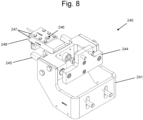
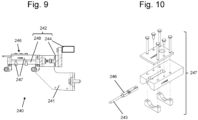
- Sensor element 240 comprises a frame 241 to be fixedly attached with respect to third support element 206, and a pushing device 242 carried by frame 241.
- Pushing device 242 comprises a ram 244 guided in the axial direction of axis A of rod-like element R by a linear feed 245 having posts guided in longitudinal holes of frame 241 (see Fig. 8 ).
- ram 244 is shown without a contact element, while in Fig. 9 , a contact element, preferable made of plastic or hard rubber or the like, is attached to the front face of ram 244 which is intended to engage first end E1 of rod-like element R.
- ram 244 is coupled via a piston rod with a piston (not shown) of a pneumatic cylinder 248, so that ram 244 can be moved in the direction of axis A of rod-like element R.
- Pneumatic cylinder 248 is attached to frame 241.
- a clamping device 247 is attached to pneumatic cylinder 248 such that it encloses and clamps a sensor 246 to a location in the vicinity of pneumatic cylinder 248 which is mad of non-magnetic material, so that sensor 246 can detect a magnetic field generated by a magnetic element included in the piston or the piston rod of pushing device 242.
- sensor 246 is a Hall-Sensor or a magneto-resistive sensor or the like, and depending on the position of the magnetic element contained in the piston or in the piston rod of pushing element 242, sensor 246 generates a varying electrical signal.
- Control unit 160 can then receive this electrical signal from sensor 246 a cable 243 and determine the position of the piston based on the electrical signal.
- the position of ram 244 can be determined, and since the fixed distance between third and fourth support elements 206, 208 is known, control unit 160 can calculate the actual distance between the end face of the contact element of ram 244 and the surface of stop 209 of fourth support element 208.
- This distance corresponds to the length L of rod-like element R placed in the loading (or measuring) position when ram 244 pushes against first end E1 of rod-like element R and second end E2 of the same abuts on (i.e. is aligned with) stop 209.
- length L of rod-like element R can be determined.
- sensor element 240 is capable of performing two functions simultaneously, namely aligning second end E2 of rod-like element R with stop 209 and slip 273, respectively, as well as measuring the length L of rod-like element R.
- the invention is not restricted to a magnetic sensor. Instead, also other position sensors can be used, such as optical sensors. Moreover, the invention is not restricted to pushing device 242 having pneumatic cylinder 248, but can also be implemented with a ram 244 driven electrically such as by a solenoid or the like. Sensor device 240 described above can be used in the above described first embodiment, when attached to first support element 202. In this case, second support element 204 also has a stop similar to stop 209 of fourth support element 208.
- a method of operating the second embodiment is described.
- one of the rod-like elements R is fed by magazine 210 to the measuring position, which in this case corresponds to the loading position defined by third and fourth support elements 206, 208.
- the length L of that rod-like element R is measured by sensor device 240, while aligning rod-like element to stop 209 of fourth support element 208 at slip 273.
- sensor device 240 generates an electric signal which is used by control unit 160 to determine the length L.
- control unit 160 determines whether the length L is within a predetermined tolerance range of a desired length Ld.
- the processing advances to a fifth step, in which a predetermined number of the produced sausage-shaped products S is loaded on the rod-like element R by loading device 270, whereupon the filled rod-like element R is removed from the loading position and transferred to the output position by outfeed device 220.
- the processing then returns to the first step.
- the processing advances to a sixth step, in which the rod-like element R is discarded and transferred to the output position by outfeed device 220, whereupon the discarded rod-like element R must be removed either by a user or by robot 300.
- the processing then returns to the first step.
- the system can stop the clipping machine and/or the hanging line until the user confirms removal of the discarded rod-like element R. This avoids that sausage-like products S are produced which cannot be moved further along the production process.
- the system comprises the handling robot 300
- the discarded rod-like element R can be removed from the output position of outfeed device 220 by robot 300, and can be placed in the reject bin 900, for example. Thus, the production process can be smoothly continued.
- control unit 160 of production line 3 determines the length of rod-like element R, this length can be used by handling robot 300 to optimize the placing position of rod-like element R on storage frame 400.
- control device 160 can transmit the value of length L of rod-like element R currently presented in the output position of outfeed device 220 to control unit 310 of handling robot 300.
- the longitudinal position of rod-like element R in the output position is well defined due to the alignment of rod-like element R in the loading position, if it is assumed that during the outfeed operation of outfeed device the axial position is not considerably changed. It is also possible, to provide a further alignment device (not shown) at the output position to ensure a well defined axial position of rod-like element R.
- handling robot 300 is able to grip rod-like element R at the output position in a well known distance from both ends E1, E2 of rod-like element R, so that the handling robot 300 is further able to place rod-like element R perpendicular to and on support bars 402, 404 of storage frame 400 such that both ends E1, E2 overlap support bars 402, 404 by the same amount.
- handling robot 300 can place rod-like element R centred on support bars 402, 404. This improves stability of the position of rod-like element R in storage frame 400 and reduces the risk of slipping off from the support bars 402, 404 when storage frame 400 is subject to vibrations or shock.
- Sensor device 240 attached to one of the support elements of the loading position can also be added to hanging lines 200 already in operation, so that all the advantages described above can be added to older systems when control unit 160 of production line 3 and, if applicable, control unit 310 of handling robot 300 are reprogrammed accordingly so as to perform the methods of the invention.
Landscapes
- Life Sciences & Earth Sciences (AREA)
- Engineering & Computer Science (AREA)
- Wood Science & Technology (AREA)
- Zoology (AREA)
- Food Science & Technology (AREA)
- Specific Conveyance Elements (AREA)
Claims (15)
- Procédé de manipulation d'éléments longitudinaux en forme de tige (R), en particulier des tiges de fumage,
pour le stockage de produits en forme de saucisse (S), en particulier des saucisses, dans un système (1) afin de produire et de manipuler les produits en forme de saucisse (S), le procédé comprenant les étapes de :fourniture d'une pluralité d'éléments en forme de tige (R), chaque élément en forme de tige (R) présentant une longueur (L) définie entre une première extrémité (E1) et une seconde extrémité (E2) ;fourniture d'une machine d'agrafage (100) conçue pour produire les produits en forme de saucisse (S) ;fourniture d'une ligne de suspension (200) conçue pour charger les produits en forme de saucisse (S) produits sur les éléments en forme de tige (R) et comprenant une position de mesure pour la réception des éléments en forme de tige (R) et la mesure de la longueur (L) des éléments en forme de tige (R) et une position de chargement pour la réception des éléments en forme de tige (R) et le chargement des produits en forme de saucisse (S) produits sur les éléments en forme de tige (R), la position de mesure étant définie par un premier élément support (202) conçu pour recevoir la première extrémité (E1) de l'un des éléments en forme de tige (R) et par un deuxième élément support (204) conçu pour recevoir la seconde extrémité (E2) dudit un des éléments en forme de tige (R) et la position de chargement étant définie par un troisième élément support (206) conçu pour recevoir la première extrémité (E1) dudit un des éléments en forme de tige (R) et par un quatrième élément support (208) conçu pour recevoir la seconde extrémité (E2) dudit un des éléments en forme de tige (R) ;acheminement de l'un des éléments en forme de tige (R) vers la position de mesure de la ligne de suspension (200) ;mesure de la longueur (L) dudit un des éléments en forme de tige (R) par un dispositif capteur (240) ;détermination, par une unité de commande (160), du fait que la longueur (L) se situe ou non dans une plage de tolérance d'une longueur souhaitée (Ld) ;fourniture dudit un des éléments en forme de tige (R) dans la position de chargement de la ligne de suspension (200) et chargement d'un nombre prédéterminé des produits en forme de saucisse (S) produits sur ledit un des éléments en forme de tige (R), si la longueur (L) se situe dans la plage de tolérance ;rejet dudit un des éléments en forme de tige (R) de la ligne de suspension (200), si la longueur (L) ne se situe pas dans la plage de tolérance. - Procédé selon la revendication 1, la ligne de suspension (200) comprenant en outre un magasin (210) destiné à maintenir disponible la pluralité des éléments en forme de tige (R), la position de mesure de la ligne de suspension (200) étant située à l'intérieur du magasin (210) et l'étape de rejet comprenant le retrait dudit un des éléments en forme de tige (R) à partir de la position de mesure directement dans un bac à rebuts (900).
- Procédé selon la revendication 1, dans lequel, dans la ligne de suspension (200), la position de mesure et la position de chargement sont identiques, de telle sorte que l'étape de mesure est effectuée avec ledit un des éléments en forme de tige (R) placé dans la position de chargement.
- Procédé selon la revendication 3, la ligne de suspension comprenant en outre un dispositif de sortie (220) et le procédé comprenant en outre l'étape de déplacement dudit un des éléments en forme de tige (R) par le dispositif de sortie (220) à partir de la position de chargement vers une position de sortie.
- Procédé selon la revendication 4, l'étape de rejet comprenant le retrait dudit un des éléments en forme de tige (R) à partir de la position de sortie.
- Procédé selon l'une des revendications précédentes, l'étape de rejet comprenant en outre l'arrêt du fonctionnement de la machine d'agrafage (100) jusqu'à ce qu'un élément suivant parmi les éléments en forme de tige (R) ait été placé dans la position de chargement de la ligne de suspension (200) et que sa longueur (L) ait été déterminée comme étant située dans la plage de tolérance.
- Procédé selon la revendication 6, l'étape de rejet comprenant en outre le report de l'étape d'acheminement de l'élément suivant parmi les éléments en forme de tige (R) vers la position de chargement de la ligne de suspension (200) jusqu'à ce qu'un utilisateur retire manuellement l'élément en forme de tige (R) rejeté et confirme le retrait au système (1).
- Procédé selon l'une des revendications 1 à 6, le système comprenant en outre un robot de manipulation (300) conçu pour saisir et déplacer ledit un des éléments en forme de tige (R),le robot de manipulation (300) saisissant l'élément en forme de tige (R), qui est chargé avec le nombre prédéterminé des produits en forme de saucisse (S) produits et plaçant l'élément en forme de tige (R) dans un cadre de stockage (400), si la longueur (L) se situe dans la plage de tolérance ;l'étape de rejet comprenant en outre le retrait de l'élément en forme de tige (R) rejeté et son placement dans un bac à rebuts (900) par le robot de manipulation (300).
- Procédé selon la revendication 8, le cadre de stockage comprenant deux barres support (402, 404) présentant une distance (D) inférieure à la longueur souhaitée (Ld) et le robot de manipulation (300) plaçant ledit un des éléments en forme de tige (R) sur les barres support (402, 404) et perpendiculairement à celles-ci de telle sorte que les deux extrémités (E1, E2) chevauchent les barres support (402, 404) de la même quantité, si la longueur (L) se situe dans la plage de tolérance.
- Système (1) destiné à produire des produits en forme de saucisse (S), tels que des saucisses, contenant un matériau de remplissage fluide dans une enveloppe d'emballage (M) tubulaire ou en forme de sac et un élément de suspension (SL) tel qu'une boucle de suspension et à charger les produits en forme de saucisse (S) produits sur des éléments en forme de tige (R), tels que des tiges de fumage, chaque élément en forme de tige (R) présentant une longueur (L) définie entre une première extrémité (E1) et une seconde extrémité (E2) ; le système (1) comprenant :une machine d'agrafage (100) conçue pour produire les produits en forme de saucisse (S) ;une ligne de suspension (200) conçue pour charger les produits en forme de saucisse (S) produits sur les éléments en forme de tige (R) ; etune unité de commande (160) commandant le fonctionnement de la machine d'agrafage (100) et de la ligne de suspension (200) ;la ligne de suspension (200) comprenant :un premier élément support (202) conçu pour recevoir la première extrémité (E1) de l'un des éléments en forme de tige (R) et un deuxième élément support (204) conçu pour recevoir la seconde extrémité (E2) dudit un des éléments en forme de tige (R), les premier et deuxième éléments support (202, 204) définissant une position de mesure ; etun troisième élément support (206) conçu pour recevoir la première extrémité (E1) dudit un des éléments en forme de tige (R) et un quatrième élément support (208) conçu pour recevoir la seconde extrémité (E2) dudit un des éléments en forme de tige (R), les troisième et quatrième éléments support (206, 208) définissant une position de chargement pour le chargement des produits en forme de saucisse (S) produits sur les éléments en forme de tige (R) ;un dispositif capteur (240) agencé au niveau de la position de mesure et conçu pour mesurer la longueur (L) dudit un des éléments en forme de tige (R) placé dans la position de mesure ;l'unité de commande (160) étant conçue pour comparer la longueur (L) avec une longueur souhaitée (Ld) et pour déterminer si la longueur se situe ou non dans une plage de tolérance de la longueur souhaitée (Ld) et l'unité de commande (160) amenant en outre la ligne de suspension (200) à charger un nombre prédéterminé de produits en forme de saucisse (S) sur ledit un des éléments en forme de tige (R) si la longueur (L) se situe dans la plage de tolérance et provoquant le rejet dudit un des éléments en forme de tige (R) si la longueur (L) ne se situe pas dans la plage de tolérance.
- Système (1) selon la revendication 10, la ligne de suspension (200) comprenant en outre un magasin (210) destiné à maintenir disponible une pluralité des éléments en forme de tige (R), les premier et deuxième éléments support (202, 204) définissant la position de mesure étant situés à l'intérieur du magasin (210) et le magasin (210) étant conçu pour acheminer successivement des éléments en forme de tige (R) uniques d'abord vers la position de mesure puis vers la position de chargement ou vers un bac à rebuts (900).
- Système (1) selon la revendication 10, les premier et troisième éléments support (202, 206) étant identiques et les deuxième et quatrième éléments support (204, 208) étant identiques, de telle sorte que la position de mesure est identique à la position de chargement et le dispositif capteur (240) étant agencé au niveau de la position de chargement ; et la ligne de suspension comprenant en outre un dispositif de sortie (220) conçu pour déplacer ledit un des éléments en forme de tige (R) à partir de la position de chargement vers une position de sortie.
- Système (1) selon l'une des revendications 10 à 12, comprenant en outreun cadre de stockage (400) présentant deux barres support (402, 404) à une distance (D) inférieure à la longueur souhaitée (Ld), destinées à transporter une pluralité des éléments en forme de tige (R) ; etun robot de manipulation (300) conçu pour saisir ledit un des éléments en forme de tige (R) et pour le placer sur les barres support (402, 404) du cadre de stockage (400) ou dans un bac à rebuts (900) ;le robot de manipulation (300) étant en outre conçu pour recevoir la longueur mesurée (L) dudit un des éléments en forme de tige (R) à partir de l'unité de commande (160) et pour ajuster la position de placement dudit un des éléments en forme de tige (R) sur les barres support (402, 404) de telle sorte que les deux extrémités (E1, E2) chevauchent les barres support (402, 404) de la même quantité.
- Système (1) selon l'une des revendications 10 à 13,le dispositif capteur (240) comprenant un dispositif de poussée (242) agencé au niveau du troisième élément support (206) et présentant un coulisseau (244) conçu pour pousser contre la première extrémité (E1) dans une direction longitudinale dudit un des éléments en forme de tige (R), de telle sorte que la seconde extrémité (E2) s'aligne avec le quatrième élément support (208) présentant une butée (209) ;le dispositif de poussée (242) comprenant un capteur (246) conçu pour détecter une position du coulisseau (244) et pour générer un signal de sortie en fonction de la position du coulisseau (244) ; etl'unité de commande (160) étant conçue pour recevoir le signal de sortie du capteur (246) et pour déterminer la longueur (L) dudit un des éléments en forme de tige (R) sur la base du signal lorsque la seconde extrémité (E2) est alignée avec le quatrième élément support (208).
- Système (1) selon la revendication 14, le dispositif de poussée (242) comprenant un vérin pneumatique (248) fixé de manière fixe par rapport au troisième élément support (206) et un piston présentant un élément magnétique et accouplé au coulisseau (244) et le capteur (246) étant un capteur magnétique, en particulier un capteur à effet Hall, fixé au vérin pneumatique (248) et conçu pour détecter une position axiale du piston.
Priority Applications (2)
| Application Number | Priority Date | Filing Date | Title |
|---|---|---|---|
| EP22172758.9A EP4275505B1 (fr) | 2022-05-11 | 2022-05-11 | Ligne de suspension avec mesure de longueur de tige de fumage |
| US18/195,672 US12161129B2 (en) | 2022-05-11 | 2023-05-10 | Hanging line with smoking rod length measurement |
Applications Claiming Priority (1)
| Application Number | Priority Date | Filing Date | Title |
|---|---|---|---|
| EP22172758.9A EP4275505B1 (fr) | 2022-05-11 | 2022-05-11 | Ligne de suspension avec mesure de longueur de tige de fumage |
Publications (2)
| Publication Number | Publication Date |
|---|---|
| EP4275505A1 EP4275505A1 (fr) | 2023-11-15 |
| EP4275505B1 true EP4275505B1 (fr) | 2025-01-29 |
Family
ID=81603610
Family Applications (1)
| Application Number | Title | Priority Date | Filing Date |
|---|---|---|---|
| EP22172758.9A Active EP4275505B1 (fr) | 2022-05-11 | 2022-05-11 | Ligne de suspension avec mesure de longueur de tige de fumage |
Country Status (2)
| Country | Link |
|---|---|
| US (1) | US12161129B2 (fr) |
| EP (1) | EP4275505B1 (fr) |
Families Citing this family (1)
| Publication number | Priority date | Publication date | Assignee | Title |
|---|---|---|---|---|
| CN120839479B (zh) * | 2025-09-23 | 2025-11-28 | 浙江科腾精工机械股份有限公司 | 一种组合螺栓自动组装及加工装置 |
Citations (5)
| Publication number | Priority date | Publication date | Assignee | Title |
|---|---|---|---|---|
| DE3930876C1 (fr) | 1989-09-15 | 1990-07-26 | Guenter 6080 Gross-Gerau De Kollross | |
| DE202006019883U1 (de) | 2006-09-06 | 2007-05-03 | Poly-Clip System Gmbh & Co. Kg | Fertigungslinie zur Herstellung wurstförmiger Produkte |
| EP1891858A1 (fr) | 2006-08-22 | 2008-02-27 | Tipper Tie Alpina AG | Dispositif de passage sur un dispositif de transmission pour unités d'emballage suspendues |
| WO2011134096A1 (fr) | 2010-04-30 | 2011-11-03 | Tipper Tie Alpina Gmbh | Dispositif d'amenée de barres sur un système de suspension pour emballages en forme de saucissons |
| EP2384638A1 (fr) | 2010-05-04 | 2011-11-09 | Poly-clip System GmbH & Co. KG | Dispositif robotique pour insérer ou supprimer des éléments de type tige |
Family Cites Families (3)
| Publication number | Priority date | Publication date | Assignee | Title |
|---|---|---|---|---|
| US6104959A (en) * | 1997-07-31 | 2000-08-15 | Microwave Medical Corp. | Method and apparatus for treating subcutaneous histological features |
| EP3241447B1 (fr) | 2016-05-04 | 2025-07-30 | Poly-clip System GmbH & Co. KG | Ligne d'accrochage direct |
| EP3732982B1 (fr) * | 2019-04-29 | 2023-09-27 | Poly-clip System GmbH & Co. KG | Dispositif de suppression pour éléments en forme de tige |
-
2022
- 2022-05-11 EP EP22172758.9A patent/EP4275505B1/fr active Active
-
2023
- 2023-05-10 US US18/195,672 patent/US12161129B2/en active Active
Patent Citations (5)
| Publication number | Priority date | Publication date | Assignee | Title |
|---|---|---|---|---|
| DE3930876C1 (fr) | 1989-09-15 | 1990-07-26 | Guenter 6080 Gross-Gerau De Kollross | |
| EP1891858A1 (fr) | 2006-08-22 | 2008-02-27 | Tipper Tie Alpina AG | Dispositif de passage sur un dispositif de transmission pour unités d'emballage suspendues |
| DE202006019883U1 (de) | 2006-09-06 | 2007-05-03 | Poly-Clip System Gmbh & Co. Kg | Fertigungslinie zur Herstellung wurstförmiger Produkte |
| WO2011134096A1 (fr) | 2010-04-30 | 2011-11-03 | Tipper Tie Alpina Gmbh | Dispositif d'amenée de barres sur un système de suspension pour emballages en forme de saucissons |
| EP2384638A1 (fr) | 2010-05-04 | 2011-11-09 | Poly-clip System GmbH & Co. KG | Dispositif robotique pour insérer ou supprimer des éléments de type tige |
Non-Patent Citations (19)
| Title |
|---|
| D1 - RECHNUNG 5903.012.501 DÖLLING (04.02.2022) |
| D10 - Video Messevorführung SwiStickXXL (18.10.2012) |
| D10A - STANDBILDER AUS VIDEODOKUMENT D10 (18.10.2012) |
| D11 - AUFTRAGSBESTÄTIGUNG 21368306 VISCOFAN (06.06.2019) |
| D12 - CHECKLISTE MASCHINENMONTAGE 5900.008.349 VISCOFAN (30.09.2019) |
| D13 - BETRIEBSANLEITUNG SWISTICK S/M/L (10.07.2019) |
| D14 - AUFTRAGSBESTÄTIGUNG 21320977 SUTTERO (02.11.2016) |
| D15 - CHECKLISTE MASCHINENMONTAGE 5900002097 SUTTERO (31.03.2017) |
| D16 - AUFTRAGSBESTÄTIGUNG 21333983 BRANDENBURG (13.07.2017) |
| D17 - ERSATZTEILKATALOG SWISTICK SML (16.09.2019) |
| D2 - Auftragsbestätigung 21401129 Dölling (19.05.2021) |
| D3 - CHECKLISTE MASCHINENMONTAGE 5903.012.501 DÖLLING (03.02.2022) |
| D4 - BETRIEBSANLEITUNG SWISTICK XXL 5903012501 (14.12.2021) |
| D5 - ERSATZTEILKATALOG SWISTICK XXL 5903012501 (15.12.2021) |
| D6A - STANDBILDER AUS VIDEODOKUMENT D6 (10.05.2021) |
| D7 - TRANSPORTSCHEIN 859.502 STOCKMEYER (23.05.2018) |
| D8 - RECHNUNG 859.506 MULTIVAC (30.11.2016) |
| D9 - RECHNUNG 859.507 MULTIVAC (30.11.2016) |
| VISCOFAN FOOD PROCESSING AND PACKAGING SOLUTIONS : "Tipper Tie Swistick XXL. VISCOFAN GLOBUS AUSTRALIA.", 9 May 2021 (2021-05-09), XP093334709, Retrieved from the Internet <URL:https://www.youtube.com/watch?v=86jMx0i3K90> |
Also Published As
| Publication number | Publication date |
|---|---|
| US12161129B2 (en) | 2024-12-10 |
| EP4275505A1 (fr) | 2023-11-15 |
| US20230363400A1 (en) | 2023-11-16 |
Similar Documents
| Publication | Publication Date | Title |
|---|---|---|
| EP2384638B1 (fr) | Dispositif robotique et procédé pour insérer ou supprimer des éléments de type tige | |
| JP4914320B2 (ja) | 棒状体の分離方法及び分離装置 | |
| EP2363027B2 (fr) | Système et procédé pour autoriser la vérification de qualité des produits en forme de saucisses | |
| US12161129B2 (en) | Hanging line with smoking rod length measurement | |
| US8366522B2 (en) | System and method for weighing products | |
| US20090047885A1 (en) | Smoking rail feed means and method of accurately feeding the same | |
| JP2000500977A (ja) | 棒状物品のためのコンベヤシステム | |
| JPH07196257A (ja) | 巻取管供給装置 | |
| EP2384640B1 (fr) | Dispositif et méthode de séparation | |
| EP2792903B1 (fr) | Distributeur automatique de poids d'équilibrage | |
| US11793206B2 (en) | Removal device for rod-like elements | |
| JP2005112365A (ja) | 可動式ホルダー及びこれを用いた自動袋詰め装置 | |
| EP3858143B1 (fr) | Dispositif de transfert comportant un tampon pour éléments en forme de tige et procédé pour commander le dispositif de transfert | |
| EP4272567B1 (fr) | Système de production de produits en forme de saucisses | |
| IT202000013987A1 (it) | Macchina per il confezionamento di gruppi di prodotti tissue e metodo di controllo di conformità di strati di gruppi di prodotti tissue | |
| CN223575456U (zh) | 嵌件上料机构 | |
| EP4272566B1 (fr) | Ensemble tube de remplissage d'une machine d'agrafage, système et procédé de fabrication de produits en forme de saucisse | |
| CN119498557A (zh) | 用于处理棒状制品的装置和用于首次填充这种装置的方法 |
Legal Events
| Date | Code | Title | Description |
|---|---|---|---|
| PUAI | Public reference made under article 153(3) epc to a published international application that has entered the european phase |
Free format text: ORIGINAL CODE: 0009012 |
|
| STAA | Information on the status of an ep patent application or granted ep patent |
Free format text: STATUS: THE APPLICATION HAS BEEN PUBLISHED |
|
| AK | Designated contracting states |
Kind code of ref document: A1 Designated state(s): AL AT BE BG CH CY CZ DE DK EE ES FI FR GB GR HR HU IE IS IT LI LT LU LV MC MK MT NL NO PL PT RO RS SE SI SK SM TR |
|
| STAA | Information on the status of an ep patent application or granted ep patent |
Free format text: STATUS: REQUEST FOR EXAMINATION WAS MADE |
|
| 17P | Request for examination filed |
Effective date: 20240515 |
|
| RBV | Designated contracting states (corrected) |
Designated state(s): AL AT BE BG CH CY CZ DE DK EE ES FI FR GB GR HR HU IE IS IT LI LT LU LV MC MK MT NL NO PL PT RO RS SE SI SK SM TR |
|
| GRAP | Despatch of communication of intention to grant a patent |
Free format text: ORIGINAL CODE: EPIDOSNIGR1 |
|
| STAA | Information on the status of an ep patent application or granted ep patent |
Free format text: STATUS: GRANT OF PATENT IS INTENDED |
|
| RIC1 | Information provided on ipc code assigned before grant |
Ipc: A22C 15/00 20060101AFI20240801BHEP |
|
| INTG | Intention to grant announced |
Effective date: 20240826 |
|
| GRAS | Grant fee paid |
Free format text: ORIGINAL CODE: EPIDOSNIGR3 |
|
| GRAA | (expected) grant |
Free format text: ORIGINAL CODE: 0009210 |
|
| STAA | Information on the status of an ep patent application or granted ep patent |
Free format text: STATUS: THE PATENT HAS BEEN GRANTED |
|
| AK | Designated contracting states |
Kind code of ref document: B1 Designated state(s): AL AT BE BG CH CY CZ DE DK EE ES FI FR GB GR HR HU IE IS IT LI LT LU LV MC MK MT NL NO PL PT RO RS SE SI SK SM TR |
|
| REG | Reference to a national code |
Ref country code: GB Ref legal event code: FG4D |
|
| REG | Reference to a national code |
Ref country code: CH Ref legal event code: EP |
|
| P01 | Opt-out of the competence of the unified patent court (upc) registered |
Free format text: CASE NUMBER: APP_2548/2025 Effective date: 20250115 |
|
| REG | Reference to a national code |
Ref country code: DE Ref legal event code: R096 Ref document number: 602022009956 Country of ref document: DE |
|
| REG | Reference to a national code |
Ref country code: IE Ref legal event code: FG4D |
|
| REG | Reference to a national code |
Ref country code: NL Ref legal event code: MP Effective date: 20250129 |
|
| PG25 | Lapsed in a contracting state [announced via postgrant information from national office to epo] |
Ref country code: NL Free format text: LAPSE BECAUSE OF FAILURE TO SUBMIT A TRANSLATION OF THE DESCRIPTION OR TO PAY THE FEE WITHIN THE PRESCRIBED TIME-LIMIT Effective date: 20250129 |
|
| PG25 | Lapsed in a contracting state [announced via postgrant information from national office to epo] |
Ref country code: RS Free format text: LAPSE BECAUSE OF FAILURE TO SUBMIT A TRANSLATION OF THE DESCRIPTION OR TO PAY THE FEE WITHIN THE PRESCRIBED TIME-LIMIT Effective date: 20250429 |
|
| PG25 | Lapsed in a contracting state [announced via postgrant information from national office to epo] |
Ref country code: FI Free format text: LAPSE BECAUSE OF FAILURE TO SUBMIT A TRANSLATION OF THE DESCRIPTION OR TO PAY THE FEE WITHIN THE PRESCRIBED TIME-LIMIT Effective date: 20250129 |
|
| PG25 | Lapsed in a contracting state [announced via postgrant information from national office to epo] |
Ref country code: PL Free format text: LAPSE BECAUSE OF FAILURE TO SUBMIT A TRANSLATION OF THE DESCRIPTION OR TO PAY THE FEE WITHIN THE PRESCRIBED TIME-LIMIT Effective date: 20250129 |
|
| PGFP | Annual fee paid to national office [announced via postgrant information from national office to epo] |
Ref country code: DE Payment date: 20250606 Year of fee payment: 4 |
|
| PG25 | Lapsed in a contracting state [announced via postgrant information from national office to epo] |
Ref country code: ES Free format text: LAPSE BECAUSE OF FAILURE TO SUBMIT A TRANSLATION OF THE DESCRIPTION OR TO PAY THE FEE WITHIN THE PRESCRIBED TIME-LIMIT Effective date: 20250129 |
|
| REG | Reference to a national code |
Ref country code: LT Ref legal event code: MG9D |
|
| PG25 | Lapsed in a contracting state [announced via postgrant information from national office to epo] |
Ref country code: NO Free format text: LAPSE BECAUSE OF FAILURE TO SUBMIT A TRANSLATION OF THE DESCRIPTION OR TO PAY THE FEE WITHIN THE PRESCRIBED TIME-LIMIT Effective date: 20250429 Ref country code: IS Free format text: LAPSE BECAUSE OF FAILURE TO SUBMIT A TRANSLATION OF THE DESCRIPTION OR TO PAY THE FEE WITHIN THE PRESCRIBED TIME-LIMIT Effective date: 20250529 |
|
| REG | Reference to a national code |
Ref country code: AT Ref legal event code: MK05 Ref document number: 1762512 Country of ref document: AT Kind code of ref document: T Effective date: 20250129 |
|
| PG25 | Lapsed in a contracting state [announced via postgrant information from national office to epo] |
Ref country code: HR Free format text: LAPSE BECAUSE OF FAILURE TO SUBMIT A TRANSLATION OF THE DESCRIPTION OR TO PAY THE FEE WITHIN THE PRESCRIBED TIME-LIMIT Effective date: 20250129 |
|
| PG25 | Lapsed in a contracting state [announced via postgrant information from national office to epo] |
Ref country code: PT Free format text: LAPSE BECAUSE OF FAILURE TO SUBMIT A TRANSLATION OF THE DESCRIPTION OR TO PAY THE FEE WITHIN THE PRESCRIBED TIME-LIMIT Effective date: 20250529 Ref country code: LV Free format text: LAPSE BECAUSE OF FAILURE TO SUBMIT A TRANSLATION OF THE DESCRIPTION OR TO PAY THE FEE WITHIN THE PRESCRIBED TIME-LIMIT Effective date: 20250129 |
|
| PG25 | Lapsed in a contracting state [announced via postgrant information from national office to epo] |
Ref country code: BG Free format text: LAPSE BECAUSE OF FAILURE TO SUBMIT A TRANSLATION OF THE DESCRIPTION OR TO PAY THE FEE WITHIN THE PRESCRIBED TIME-LIMIT Effective date: 20250129 Ref country code: GR Free format text: LAPSE BECAUSE OF FAILURE TO SUBMIT A TRANSLATION OF THE DESCRIPTION OR TO PAY THE FEE WITHIN THE PRESCRIBED TIME-LIMIT Effective date: 20250430 |
|
| PG25 | Lapsed in a contracting state [announced via postgrant information from national office to epo] |
Ref country code: AT Free format text: LAPSE BECAUSE OF FAILURE TO SUBMIT A TRANSLATION OF THE DESCRIPTION OR TO PAY THE FEE WITHIN THE PRESCRIBED TIME-LIMIT Effective date: 20250129 |
|
| PG25 | Lapsed in a contracting state [announced via postgrant information from national office to epo] |
Ref country code: SE Free format text: LAPSE BECAUSE OF FAILURE TO SUBMIT A TRANSLATION OF THE DESCRIPTION OR TO PAY THE FEE WITHIN THE PRESCRIBED TIME-LIMIT Effective date: 20250129 |
|
| PG25 | Lapsed in a contracting state [announced via postgrant information from national office to epo] |
Ref country code: SM Free format text: LAPSE BECAUSE OF FAILURE TO SUBMIT A TRANSLATION OF THE DESCRIPTION OR TO PAY THE FEE WITHIN THE PRESCRIBED TIME-LIMIT Effective date: 20250129 |
|
| PG25 | Lapsed in a contracting state [announced via postgrant information from national office to epo] |
Ref country code: DK Free format text: LAPSE BECAUSE OF FAILURE TO SUBMIT A TRANSLATION OF THE DESCRIPTION OR TO PAY THE FEE WITHIN THE PRESCRIBED TIME-LIMIT Effective date: 20250129 |
|
| PG25 | Lapsed in a contracting state [announced via postgrant information from national office to epo] |
Ref country code: IT Free format text: LAPSE BECAUSE OF FAILURE TO SUBMIT A TRANSLATION OF THE DESCRIPTION OR TO PAY THE FEE WITHIN THE PRESCRIBED TIME-LIMIT Effective date: 20250129 |
|
| PG25 | Lapsed in a contracting state [announced via postgrant information from national office to epo] |
Ref country code: EE Free format text: LAPSE BECAUSE OF FAILURE TO SUBMIT A TRANSLATION OF THE DESCRIPTION OR TO PAY THE FEE WITHIN THE PRESCRIBED TIME-LIMIT Effective date: 20250129 Ref country code: CZ Free format text: LAPSE BECAUSE OF FAILURE TO SUBMIT A TRANSLATION OF THE DESCRIPTION OR TO PAY THE FEE WITHIN THE PRESCRIBED TIME-LIMIT Effective date: 20250129 |
|
| PG25 | Lapsed in a contracting state [announced via postgrant information from national office to epo] |
Ref country code: RO Free format text: LAPSE BECAUSE OF FAILURE TO SUBMIT A TRANSLATION OF THE DESCRIPTION OR TO PAY THE FEE WITHIN THE PRESCRIBED TIME-LIMIT Effective date: 20250129 |
|
| PG25 | Lapsed in a contracting state [announced via postgrant information from national office to epo] |
Ref country code: SK Free format text: LAPSE BECAUSE OF FAILURE TO SUBMIT A TRANSLATION OF THE DESCRIPTION OR TO PAY THE FEE WITHIN THE PRESCRIBED TIME-LIMIT Effective date: 20250129 |
|
| REG | Reference to a national code |
Ref country code: DE Ref legal event code: R026 Ref document number: 602022009956 Country of ref document: DE |
|
| PLBI | Opposition filed |
Free format text: ORIGINAL CODE: 0009260 |
|
| PLAX | Notice of opposition and request to file observation + time limit sent |
Free format text: ORIGINAL CODE: EPIDOSNOBS2 |
|
| 26 | Opposition filed |
Opponent name: TIPPER TIE TECHNOPACK GMBH Effective date: 20251028 |