EP4269536A2 - Flammhemmende grobspanplatte - Google Patents
Flammhemmende grobspanplatte Download PDFInfo
- Publication number
- EP4269536A2 EP4269536A2 EP23191734.5A EP23191734A EP4269536A2 EP 4269536 A2 EP4269536 A2 EP 4269536A2 EP 23191734 A EP23191734 A EP 23191734A EP 4269536 A2 EP4269536 A2 EP 4269536A2
- Authority
- EP
- European Patent Office
- Prior art keywords
- retardant
- flame
- water
- furnish
- soluble
- Prior art date
- Legal status (The legal status is an assumption and is not a legal conclusion. Google has not performed a legal analysis and makes no representation as to the accuracy of the status listed.)
- Granted
Links
Images

Classifications
-
- C—CHEMISTRY; METALLURGY
- C09—DYES; PAINTS; POLISHES; NATURAL RESINS; ADHESIVES; COMPOSITIONS NOT OTHERWISE PROVIDED FOR; APPLICATIONS OF MATERIALS NOT OTHERWISE PROVIDED FOR
- C09K—MATERIALS FOR MISCELLANEOUS APPLICATIONS, NOT PROVIDED FOR ELSEWHERE
- C09K21/00—Fireproofing materials
- C09K21/06—Organic materials
- C09K21/10—Organic materials containing nitrogen
-
- B—PERFORMING OPERATIONS; TRANSPORTING
- B27—WORKING OR PRESERVING WOOD OR SIMILAR MATERIAL; NAILING OR STAPLING MACHINES IN GENERAL
- B27K—PROCESSES, APPARATUS OR SELECTION OF SUBSTANCES FOR IMPREGNATING, STAINING, DYEING, BLEACHING OF WOOD OR SIMILAR MATERIALS, OR TREATING OF WOOD OR SIMILAR MATERIALS WITH PERMEANT LIQUIDS, NOT OTHERWISE PROVIDED FOR; CHEMICAL OR PHYSICAL TREATMENT OF CORK, CANE, REED, STRAW OR SIMILAR MATERIALS
- B27K3/00—Impregnating wood, e.g. impregnation pretreatment, for example puncturing; Wood impregnation aids not directly involved in the impregnation process
- B27K3/02—Processes; Apparatus
- B27K3/0278—Processes; Apparatus involving an additional treatment during or after impregnation
-
- B—PERFORMING OPERATIONS; TRANSPORTING
- B27—WORKING OR PRESERVING WOOD OR SIMILAR MATERIAL; NAILING OR STAPLING MACHINES IN GENERAL
- B27K—PROCESSES, APPARATUS OR SELECTION OF SUBSTANCES FOR IMPREGNATING, STAINING, DYEING, BLEACHING OF WOOD OR SIMILAR MATERIALS, OR TREATING OF WOOD OR SIMILAR MATERIALS WITH PERMEANT LIQUIDS, NOT OTHERWISE PROVIDED FOR; CHEMICAL OR PHYSICAL TREATMENT OF CORK, CANE, REED, STRAW OR SIMILAR MATERIALS
- B27K3/00—Impregnating wood, e.g. impregnation pretreatment, for example puncturing; Wood impregnation aids not directly involved in the impregnation process
- B27K3/02—Processes; Apparatus
- B27K3/08—Impregnating by pressure, e.g. vacuum impregnation
-
- B—PERFORMING OPERATIONS; TRANSPORTING
- B27—WORKING OR PRESERVING WOOD OR SIMILAR MATERIAL; NAILING OR STAPLING MACHINES IN GENERAL
- B27K—PROCESSES, APPARATUS OR SELECTION OF SUBSTANCES FOR IMPREGNATING, STAINING, DYEING, BLEACHING OF WOOD OR SIMILAR MATERIALS, OR TREATING OF WOOD OR SIMILAR MATERIALS WITH PERMEANT LIQUIDS, NOT OTHERWISE PROVIDED FOR; CHEMICAL OR PHYSICAL TREATMENT OF CORK, CANE, REED, STRAW OR SIMILAR MATERIALS
- B27K3/00—Impregnating wood, e.g. impregnation pretreatment, for example puncturing; Wood impregnation aids not directly involved in the impregnation process
- B27K3/16—Inorganic impregnating agents
- B27K3/163—Compounds of boron
-
- B—PERFORMING OPERATIONS; TRANSPORTING
- B27—WORKING OR PRESERVING WOOD OR SIMILAR MATERIAL; NAILING OR STAPLING MACHINES IN GENERAL
- B27K—PROCESSES, APPARATUS OR SELECTION OF SUBSTANCES FOR IMPREGNATING, STAINING, DYEING, BLEACHING OF WOOD OR SIMILAR MATERIALS, OR TREATING OF WOOD OR SIMILAR MATERIALS WITH PERMEANT LIQUIDS, NOT OTHERWISE PROVIDED FOR; CHEMICAL OR PHYSICAL TREATMENT OF CORK, CANE, REED, STRAW OR SIMILAR MATERIALS
- B27K3/00—Impregnating wood, e.g. impregnation pretreatment, for example puncturing; Wood impregnation aids not directly involved in the impregnation process
- B27K3/16—Inorganic impregnating agents
- B27K3/166—Compounds of phosphorus
-
- B—PERFORMING OPERATIONS; TRANSPORTING
- B27—WORKING OR PRESERVING WOOD OR SIMILAR MATERIAL; NAILING OR STAPLING MACHINES IN GENERAL
- B27K—PROCESSES, APPARATUS OR SELECTION OF SUBSTANCES FOR IMPREGNATING, STAINING, DYEING, BLEACHING OF WOOD OR SIMILAR MATERIALS, OR TREATING OF WOOD OR SIMILAR MATERIALS WITH PERMEANT LIQUIDS, NOT OTHERWISE PROVIDED FOR; CHEMICAL OR PHYSICAL TREATMENT OF CORK, CANE, REED, STRAW OR SIMILAR MATERIALS
- B27K3/00—Impregnating wood, e.g. impregnation pretreatment, for example puncturing; Wood impregnation aids not directly involved in the impregnation process
- B27K3/16—Inorganic impregnating agents
- B27K3/32—Mixtures of different inorganic impregnating agents
-
- B—PERFORMING OPERATIONS; TRANSPORTING
- B27—WORKING OR PRESERVING WOOD OR SIMILAR MATERIAL; NAILING OR STAPLING MACHINES IN GENERAL
- B27K—PROCESSES, APPARATUS OR SELECTION OF SUBSTANCES FOR IMPREGNATING, STAINING, DYEING, BLEACHING OF WOOD OR SIMILAR MATERIALS, OR TREATING OF WOOD OR SIMILAR MATERIALS WITH PERMEANT LIQUIDS, NOT OTHERWISE PROVIDED FOR; CHEMICAL OR PHYSICAL TREATMENT OF CORK, CANE, REED, STRAW OR SIMILAR MATERIALS
- B27K3/00—Impregnating wood, e.g. impregnation pretreatment, for example puncturing; Wood impregnation aids not directly involved in the impregnation process
- B27K3/52—Impregnating agents containing mixtures of inorganic and organic compounds
-
- B—PERFORMING OPERATIONS; TRANSPORTING
- B27—WORKING OR PRESERVING WOOD OR SIMILAR MATERIAL; NAILING OR STAPLING MACHINES IN GENERAL
- B27N—MANUFACTURE BY DRY PROCESSES OF ARTICLES, WITH OR WITHOUT ORGANIC BINDING AGENTS, MADE FROM PARTICLES OR FIBRES CONSISTING OF WOOD OR OTHER LIGNOCELLULOSIC OR LIKE ORGANIC MATERIAL
- B27N1/00—Pretreatment of moulding material
-
- B—PERFORMING OPERATIONS; TRANSPORTING
- B27—WORKING OR PRESERVING WOOD OR SIMILAR MATERIAL; NAILING OR STAPLING MACHINES IN GENERAL
- B27N—MANUFACTURE BY DRY PROCESSES OF ARTICLES, WITH OR WITHOUT ORGANIC BINDING AGENTS, MADE FROM PARTICLES OR FIBRES CONSISTING OF WOOD OR OTHER LIGNOCELLULOSIC OR LIKE ORGANIC MATERIAL
- B27N9/00—Arrangements for fireproofing
-
- C—CHEMISTRY; METALLURGY
- C09—DYES; PAINTS; POLISHES; NATURAL RESINS; ADHESIVES; COMPOSITIONS NOT OTHERWISE PROVIDED FOR; APPLICATIONS OF MATERIALS NOT OTHERWISE PROVIDED FOR
- C09D—COATING COMPOSITIONS, e.g. PAINTS, VARNISHES OR LACQUERS; FILLING PASTES; CHEMICAL PAINT OR INK REMOVERS; INKS; CORRECTING FLUIDS; WOODSTAINS; PASTES OR SOLIDS FOR COLOURING OR PRINTING; USE OF MATERIALS THEREFOR
- C09D15/00—Woodstains
-
- C—CHEMISTRY; METALLURGY
- C09—DYES; PAINTS; POLISHES; NATURAL RESINS; ADHESIVES; COMPOSITIONS NOT OTHERWISE PROVIDED FOR; APPLICATIONS OF MATERIALS NOT OTHERWISE PROVIDED FOR
- C09D—COATING COMPOSITIONS, e.g. PAINTS, VARNISHES OR LACQUERS; FILLING PASTES; CHEMICAL PAINT OR INK REMOVERS; INKS; CORRECTING FLUIDS; WOODSTAINS; PASTES OR SOLIDS FOR COLOURING OR PRINTING; USE OF MATERIALS THEREFOR
- C09D5/00—Coating compositions, e.g. paints, varnishes or lacquers, characterised by their physical nature or the effects produced; Filling pastes
- C09D5/18—Fireproof paints including high temperature resistant paints
-
- C—CHEMISTRY; METALLURGY
- C09—DYES; PAINTS; POLISHES; NATURAL RESINS; ADHESIVES; COMPOSITIONS NOT OTHERWISE PROVIDED FOR; APPLICATIONS OF MATERIALS NOT OTHERWISE PROVIDED FOR
- C09K—MATERIALS FOR MISCELLANEOUS APPLICATIONS, NOT PROVIDED FOR ELSEWHERE
- C09K21/00—Fireproofing materials
- C09K21/06—Organic materials
- C09K21/12—Organic materials containing phosphorus
-
- B—PERFORMING OPERATIONS; TRANSPORTING
- B27—WORKING OR PRESERVING WOOD OR SIMILAR MATERIAL; NAILING OR STAPLING MACHINES IN GENERAL
- B27K—PROCESSES, APPARATUS OR SELECTION OF SUBSTANCES FOR IMPREGNATING, STAINING, DYEING, BLEACHING OF WOOD OR SIMILAR MATERIALS, OR TREATING OF WOOD OR SIMILAR MATERIALS WITH PERMEANT LIQUIDS, NOT OTHERWISE PROVIDED FOR; CHEMICAL OR PHYSICAL TREATMENT OF CORK, CANE, REED, STRAW OR SIMILAR MATERIALS
- B27K2200/00—Wooden materials to be treated
- B27K2200/10—Articles made of particles or fibres consisting of wood or other lignocellulosic material
-
- B—PERFORMING OPERATIONS; TRANSPORTING
- B27—WORKING OR PRESERVING WOOD OR SIMILAR MATERIAL; NAILING OR STAPLING MACHINES IN GENERAL
- B27K—PROCESSES, APPARATUS OR SELECTION OF SUBSTANCES FOR IMPREGNATING, STAINING, DYEING, BLEACHING OF WOOD OR SIMILAR MATERIALS, OR TREATING OF WOOD OR SIMILAR MATERIALS WITH PERMEANT LIQUIDS, NOT OTHERWISE PROVIDED FOR; CHEMICAL OR PHYSICAL TREATMENT OF CORK, CANE, REED, STRAW OR SIMILAR MATERIALS
- B27K2240/00—Purpose of the treatment
- B27K2240/30—Fireproofing
Definitions
- OSB Oriented strand board
- OSB is an engineered wood that has been popular in many industries due to its low cost and good mechanical properties.
- OSB exhibits excellent strength and durability properties, making it highly desirable for load-bearing applications.
- OSB can be manufactured by a similar method to particle board, such as, by adding adhesives and waxto wood strands or flakes, and then compressing the mixture in specific orientations, making the OSB easy to produce.
- OSB is valued for its low cost and good mechanical properties
- OSB is inherently flammable, limiting the applications for which it may be used.
- untreated OSB exhibits a Flame Spread Rating of around 150, placing untreated OSB into Class III for flammability.
- OSB is generally unable to be used in applications that specify low flammability materials, such as wall, floor, and roof sheathing.
- the terms “about,” “approximately,” or “generally,” when used to modify a value, indicate that the value can be raised or lowered by 5% and remain within the disclosed embodiment.
- flame and fire e.g. as used in regards to flame-retardant and fire-retardant
- flame-retardant and fire-retardant can be used interchangeably.
- flame-retardant and “flame-resistant” can be used interchangeably, and refer to a material that has flame-retardant and -resistant properties, or that has been treated to have flame-retardant and -resistant properties.
- flame-retardant powder may also be termed “micronized flame-retardant”.
- psi 1 pound per square inch
- mbar millibar
- 50 psi corresponds to 3447.379 mbar, for example.
- the present inventors surprisingly found a highly effective two-part flame-retardant for oriented strand boards that does not negatively affect the mechanical properties of the oriented strand board, and that does not necessitate any additional drying after incorporation of the two-part flame-retardant.
- a two-part flame-retardant for oriented strand board comprising a water-soluble flame-retardant having a solubility in water of at least about 400 g/L; and a flame-retardant powder.
- the water-soluble flame-retardant has a solubility in water (or an aqueous solution) of at least about 400 grams per liter (g/L), or at least about 450 g/L, or at least about 500 g/L, or at least about 550 g/L or at least about 600 g/L, or at least about 650 g/L, or at least about 700 g/L, or at least about 750 g/L, or at least about 800 g/L, or any ranges or values there between.
- the water-soluble flame-retardant is in the form of a solution, preferably an aqueous solution or a concentrated aqueous solution.
- the solvent for the water-soluble flame-retardant may be an aqueous solvent, preferably the solvent is water.
- a second solvent which may be an organic solvent, an anionic solvent, a nonionic solvent, or other solvent used in the art, may be used in addition to the aqueous solvent.
- the second solvent may be used in an amount of about 10 wt.% or less, such as about 5 wt.% or less, based upon the total weight of the solvents.
- no organic solvents are used. This minimizes the volatile organic content of the solvent and flame-retardant composition.
- only the aqueous solvent is used.
- the water-soluble flame-retardant may be comprised in the two-part flame-retardant of the invention in an amount of at least about 40 wt.%, at least about 45 wt.%, at least about 50 wt.%, at least about 55 wt.%, at least about 60 wt.%, at least about 65 wt.%, at least about 70 wt.%, at least about 75 wt.%, or at least about 80 wt.%.
- the water-soluble flame-retardant may be comprised in the two-part flame-retardant of the invention in an amount of about 40 wt.% to about 98 wt.%, or from about 42 wt.% to about 95 wt.%. It should be understood that the above referenced percentages refer to an amount of the water-soluble flame-retardant in their solid form that have been dissolved in the solution.
- the water-soluble flame-retardant comprised in the two-part flame-retardant of the invention may be at least one of
- the water-soluble flame-retardant is selected from the group comprising
- the water-soluble flame-retardant is selected from the group consisting of a borate,
- the borate alkanolamine is preferably a borate alkanolamine adduct, preferably a 2-aminoethanol and boric acid adduct, more preferably a 2:1 wt.% adduct of 2-aminoethanol and boric acid.
- the amine phosphoric acid salt may be an inorganic phosphate salt formed from ammonia, ammonium compounds, or amides and phosphoric acid.
- the amine phosphoric acid salt is formed from amines that include primary, secondary or tertiary amines, diamines, triamines, polyamines, polyethylene amines or combinations thereof.
- Polyamines generally refer to polymers having in the chain aminic repeating units R-NH-R or R-NR-R.
- Polyethylene amines also called polyalkylenpolyamines or ethyleneamines
- Ethyleneamines are defined here as polymeric forms of ethylene diamine with three or more nitrogen atoms and including piperazine and its analogues. A thorough review of ethylene diamine and ethyleneamines can be found in the Encyclopedia of Chemical Technology, Vol 8, pgs.74-108 . Ethyleneamines encompass a wide range of multifunctional, multireactive compounds. The molecular structure can be linear, branched, cyclic, or combinations of these.
- Examples of commercial ethyleneamines are diethylenetriamine (DETA), piperazine (PIP), triethylenetetramine (TETA), tetraethylenepentamine (TEPA), pentaethylenehexamine (PEHA), aminoethylpiperazine (AEP), and aminoethylethanolamine (AEEA).
- DETA diethylenetriamine
- PIP piperazine
- TETA triethylenetetramine
- TEPA tetraethylenepentamine
- PEHA pentaethylenehexamine
- AEP aminoethylpiperazine
- AEEA aminoethylethanolamine
- Other compounds which may be applicable are 1,2-propylenediamine, 1,3-diaminopropane, iminobispropylamine, N-(2-aminoethyl)-1,3-propylenediamine, N,N'bis-(3-aminopropyl)-ethylenediamine, dimethylaminopropylamine, and triethylenediamine
- Suitable polyamines or polyethylene amines include but are not limited to ethlyenediamine, diethylenetriamine (DETA), triethylenetetraamine (TETA), tetraethylenepentamine (TEPA), pentaethylenehexamine (PEHA), hexaethyleneheptaamine, (HEHA), and the like.
- Ethylene amines of this kind are referred to herein as "higher ethylene polyamines" or polyethylene amines. These higher polyethylene amines may exist as a blend or mixture of one or more polyamines.
- the water-soluble flame-retardant comprises a dicyandiamide formaldehyde phosphoric acid salt.
- the water-soluble flame-retardant is selected from the group comprising of a polyethylene amine phosphoric acid salt, a boric acid and aminoethanol adduct, and combinations thereof.
- the water-soluble flame-retardant comprises a polyethylene amine phosphoric acid salt, a boric acid and aminoethanol adduct or combinations thereof.
- the water-soluble flame-retardant comprises a polyethylene amine phosphoric acid salt.
- the water-soluble flame-retardant is selected from the group comprising of a boric acid and aminoethanol adduct, a polyethylene amine phosphoric acid salt, and combinations thereof.
- the water-soluble flame-retardant is a polyethylene amine phosphoric acid salt.
- the boric acid and aminoethanol adduct is a 2:1 wt.% adduct of 2-aminoethanol and boric acid.
- the polyethylene amine phosphoric acid salt is a reaction product of tetraethylenepentamine (TEPA), pentaethylenehexamine (PEHA), hexaethyleneheptamine (HEHA), and higher molecular weight polyethylene amine product such as Polyamine B, or mixtures thereof, with phosphoric acid.
- TEPA tetraethylenepentamine
- PEHA pentaethylenehexamine
- HEHA hexaethyleneheptamine
- higher molecular weight polyethylene amine product such as Polyamine B, or mixtures thereof, with phosphoric acid.
- Polyethylene amine products are known to the skilled in the art, and are commercially available such as Polyamine B (a product by Akzo Nobel, CAS 68131-73-7 ).
- the present inventors have surprisingly found that the above water-soluble flame-retardants are especially suitable for forming concentrated aqueous solutions, and surprisingly, exhibit little to no thermal degradation of the OSB, contrary to the shortcomings described above in regards to lower molecular weight ammonium phosphates used in two-part flame-retardants of the prior art.
- the flame-retardant powder may have a size on the micrometer scale, e.g. a powder that has been mechanically altered to have particles with a median size (d50) of from about 1 ⁇ m to about 1000 ⁇ m, such as from about 2 ⁇ m to about 850 ⁇ m, such as from about 3 ⁇ m to about 100 ⁇ m, such as from about 20 ⁇ m to about 80 ⁇ m or any values or ranges there between as are known in the art.
- d50 median size
- micronized powder may also refer to smaller particle sizes, and thus, may include a portion of the particles having a size of less than 1 ⁇ m. Particularly, the present disclosure has found that such a fine particle size allows for an even, uniform coating of the strands or flakes. Furthermore, the remaining solvent from the water-soluble two-part flame-retardant may allow the fine particles to adhere to the furnish, thus preventing the powder from settling to the bottom of the blender or dusting out of the blender.
- the solubility of the flame-retardant powder in water or aqueous solutions is generally lower than that of the water-soluble flame-retardant comprised in the two part flame-retardant of the invention.
- the flame-retardant powder has a solubility in water (or an aqueous solution) of less than about 400 grams per liter (g/L), or less than about 300 g/L, or less than about 250 g/L, or less than about 200 g/L, or less than about 150 g/L, or less than about 100 g/L.
- the flame-retardant powder may be at least one of
- the flame-retardant powder may be selected from the group comprising
- the flame-retardant powder may be selected from the group consisting of
- the flame-retardant powder comprises at least one of an ammonium polyphosphate (APP), or an guanylura phosphate.
- APP ammonium polyphosphate
- the flame-retardant powder comprises ammonium polyphosphate (APP).
- APP ammonium polyphosphate
- Borates suitable as flame-retardant powder are known to the skilled artisan, for example sodium borate (borax), zinc borates, ammonium fluoroborate [13826-83-0], or barium metaborate.
- Ammonium polyphosphates are known to the skilled in the art, see e.g., ammonium polyphosphate phase 2 ( CAS: 68333-79-9 ).
- the flame-retardant powder comprises at least one of
- the flame-retardant powder is selected from the group comprising
- the flame-retardant powder is selected from the group consisting of
- the flame-retardant powder comprises
- the flame-retardant powder is selected from the group consisting of
- the flame-retardant powder is selected from the group consisting of
- the flame-retardant powder is ammonium polyphosphate (APP).
- said ammonium polyphosphate is ammonium polyphosphate phase 2 ( CAS: 68333-79-9 ).
- the flame-retardant powder may also include an anti-caking additive in conjunction with the flame-retardant powder compound.
- the anti-caking additive is a silica, such as a fumed silica, however, other anti-caking additives may be used as are known in the art.
- the present disclosure has found that the flame-retardant powder can be mixed with the furnish that has been wetted with the water-soluble flame-retardant to yield an OSB with excellent flame-retardant properties without suffering from the above noted deficiencies in regards to powder flame-retardants.
- the flame-retardant powder may be a "dry powder", meaning a powder comprising about 10 wt.% or less of liquid prior to mixing with the water-soluble flame-retardant.
- the flame-retardant powder may be mixed with the water-soluble flame-retardant as a dispersion of particles within the aqueous solution comprising the water-soluble flame-retardant.
- the water-soluble flame-retardant and the flame-retardant powder according to the present invention work together synergistically to provide excellent flame-retardant properties to the OSB without requiring a large proportion of the OSB by weight to be occupied by flame-retardants.
- the two parts of the two-part flame-retardant may be applied together or separately.
- the two parts of the two-part flame-retardant of the invention may be in the form of a kit comprising the water-soluble flame-retardant and the flame-retardant powder separately, wherein the water-soluble flame-retardant may be in the form of a solid, or in the form of a solution, preferably in the form of an aqueous solution, or concentrated aqueous solution, while the flame-retardant powder may be in the form of a solid, or in the form of an aqueous dispersion.
- the two-part flame-retardant composition of the invention may be in the form of a dispersion, wherein the flame-retardant powder is dispersed in the solution of the water-soluble flame-retardant.
- the water-soluble retardant and the flame-retardant powder forming the two-part flame-retardant of the invention are provided separately, wherein the water-soluble retardant is in the form of an aqueous solution comprising at least about 40 wt.% of the said dissolved therein; and wherein the flame-retardant powder is in the form of a solid and has a median particle size (d50) of from about 1 ⁇ m to about 1000 ⁇ m.
- the water-soluble retardant and the flame-retardant powder forming the two-part flame-retardant of the invention are provided in the form of an aqueous dispersion, comprising at least about 40 wt.% of the said dissolved therein; and comprising the flame-retardant powder in the form of a solid having a median particle size (d50) of from about 1 ⁇ m to about 1000 ⁇ m dispersed therein.
- the present disclosure has unexpectedly found that, by using the two-part flame-retardant of the invention, a lower amount by weight of the OSB may be efficiently used, and additionally or alternatively, the combination of the water-soluble flame-retardant and flame-retardant powder lessen, or eliminate, the negative impact on the mechanical properties generally exhibited by fire-retardant treated OSB.
- the OSB still exhibits excellent fire-retardant properties even when a relatively low amount of flame-retardants are used, and, additionally or alternatively, negative effects on the mechanical properties of the OSB are lessened or eliminated when the blend of flame-retardants of the invention are utilized.
- the present disclosure is further directed to a flame-retardant oriented strand board that comprises of at least one inner layer and at least one outer layer.
- This oriented strand board comprises the two-part flame-retardant of the invention comprising a water-soluble flame-retardant having a solubility in water of at least about 400 g/L as defined above; and a flame-retardant powder as defined above.
- the at least one inner layer will typically comprise the water-soluble flame-retardant, while the at least one outer layer will typically comprise at least one of the water-soluble flame-retardant and the flame-retardant powder.
- the at least one outer layer comprises a greater total amount of two-part flame-retardant than the at least one inner layer.
- the oriented strand board comprises about 20 wt.% or less of the two-part flame-retardant.
- an oriented strand board may be formed so as to have low flame spread while maintaining its mechanical properties due to a unique two-part flame-retardant composition of the invention.
- the present disclosure has unexpectedly found that the oriented strand board may contain less than about 30% by weight, or even less than about 20% by weight, two-part flame-retardant, thus minimizing the effect on the mechanical properties of the OSB, while imparting excellent flame retardance properties.
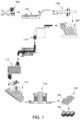
- Fig. 1 generally refers to a method of producing an oriented strand board 100.
- logs 102 may be placed onto a belt 104 that will transfer the logs 102 for further processing.
- the logs 102 may be debarked 106, and put through a stranding machine 108, that separates the logs 102 into wood strands and flakes e.g. the wood furnish 110, which are then dried.
- the furnish 110 is blended with additives 112, such as adhesive(s) and wax(es), such that the furnish 110 can be pressed into the shape of an OSB.
- additives 112 such as adhesive(s) and wax(es)
- the furnish may be spread into a layer 111, pressed 113, and cut 115 to the desired size, forming an OSB 100.
- Fig. 1 which illustrates a general process for forming an oriented strand board 100
- the water-soluble flame-retardant may be applied to the dried furnish 110 in the form of an aqueous solution. Due to the high aqueous solubility of the particular flame-retardant of the invention, it may be comprised in high concentrations in the aqueous solvent, unlike the aqueous solutions discussed in the prior art.
- the water-soluble flame-retardant of the invention may be applied to the furnish with a very low amount of solvent, so that about 15 wt.% of the furnish or less of the solvent is introduced to the furnish when the aqueous solution is applied, such as about 12 wt.% of the furnish or less, such as about 10 wt.% of the furnish or less, such as about 8 wt.% of the furnish or less, such as about 7 wt.% of the furnish or less, or such as about 1 wt.% of the furnish or greater, such as about 3 wt.% of the furnish or greater solvent introduced to the furnish when the aqueous solution is applied, or any values or ranges there between.
- the furnish 110 does not need to undergo a further drying step, as only a small volume of solvent is applied with the water-soluble flame-retardant.
- a flame-retardant powder may be used in an amount of from about 20 wt.% or less of the furnish, such as from about 18 wt.% or less, such as from about 15 wt.% or less, such as from about 12 wt.% or less, such as from about 10 wt.% or less, such as from about 8 wt.% or less, such as from about 6 wt.% or less, or such as about 1 wt.% or greater, such as from about 3 wt.% or greater, by weight of the furnish, or any values or ranges there between, and exhibit excellent flame-retardant properties while still yielding an OSB with good mechanical properties.
- the flame-retardant oriented strand board of the invention comprises a total amount of both the water-soluble flame-retardant and the flame-retardant powder ffrom about 2 to about 30 wt.%, such as from about 3 to about 25 wt.%, such as from 4 to 20 wt.%, such as from 5 to 18 wt.%, such as from 6 to 17 wt.%, such as from 7 to 16 wt.%, such as from 8 to 15.5 wt.%, or any values or ranges there between.
- the flame-retardant oriented strand board of the invention comprises about 20 wt.% or less of the two-part flame-retardant of the invention.
- the flame-retardant oriented strand board of the invention comprise from about 2% to about 20 wt.%, such as from about 2.5% to about 18%, such as from about 3% to about 16%, such as from about 3.5% to about 15%, such as from about 4% to about 12%, such as from about 4.5% to about 9 wt.%, or any values or ranges there between of the two-part flame-retardant of the invention.
- additives as known in the OSB art may be incorporated into the furnish.
- any additive as known in the art may be used, such as adhesives, waxes, insect repellants, moisture resistant compounds, fungicides, biocides, and color dyes.
- one or more adhesives are incorporated into the furnish 110.
- the adhesives, and other additives may be incorporated into the furnish either before, after, or along with, the two-part flame-retardant.
- the adhesive may be a formaldehyde adhesive, an isocyanate adhesive, a melamine or melamine urea adhesive, or combinations thereof.
- the adhesive may be a polymeric methylene diisocyanate (PMDI), a urea formaldehyde, a melamine-ureaformaldehyde, a phenol formaldehyde, or combinations thereof.
- one or more layer(s) of the OSB may include an adhesive that is different from another layer.
- an inner layer may contain a PMDI adhesive, where an outer layer contains a different adhesive.
- it is also contemplated that only a single adhesive is used regardless of the number of layers.
- waxes are incorporated along with one or more parts of the two-part flame-retardant.
- a waxaccording to the present disclosure may be a waxemulsion used to control water absorbency and swelling, such as paraffin wax emulsions.
- paraffin wax emulsions such as paraffin wax emulsions.
- other waxes and wax emulsions may be used as known in the art.
- An OSB may generally have at least one inner layer and at least one outer layer.
- the inner layer or layers may also be referred to as the core layer, and the outer layer or layers may be referred to as the surface layer.
- the OSB may have at least about one inner layer, such as at least about two inner layers, such as about three inner layers, such as about five inner layers or less, such as about four layers inner or less, or any range or value there between.
- the OSB may have at least about one outer layer, such as at least about two outer layers, such as about three outer layers, such as about five outer layers or less, such as about four outer layers or less, or any range or value there between.
- the inner and outer layers may also be in reference to an inner zone and an outer zone of a continuous OSB.
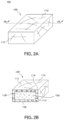
- an OSB is generally shown in Fig. 2A
- a cross section of Fig. 2A is shown in Fig. 2B
- an oriented strand board 100 may be formed from furnish 110 that has been placed in one or more layers to form a mat, and then pressed together to form the OSB. Therefore, the furnish 110 is oriented in one or more directions in the final product. As described above, the furnish 110 may be oriented in a variety of directions as are known in the art.
- the OSB may have one or more inner layers 112 and one or more outer layers 114. As described above, it should be understood that while Fig.
- both the inner layer 112 and outer layer 114 may contain one or more layers and be inclusively referred to as the inner layer or core layer, and the outer layer may contain one or more layers and inclusively be referred to as the outer layer or surface layer.
- both or either of the inner layer and outer layer of Fig. 2B may contain one or more layers.
- the inner layer or core layer 112 may contain one or more water-soluble flame-retardants 116.
- the one or more water-soluble flame-retardants 116 may be generally evenly dispersed throughout the one or more inner layers 112.
- the one or more water-soluble flame-retardants 116 may be dispersed in clumps, more localized to the exterior of the layer, or formed as a gradient increasing in concentration towards the exterior of the layer, depending upon the desired end product and use.
- the one or more water-soluble flame-retardants may be dispersed in a substantially continuous and homogenous manner.
- the inner layer 112 may contain little to no flame-retardant powder 118.
- the flame-retardant powder is only contained in the outer layer or layers 114.
- the inner layer may contain both the water-soluble flame-retardant 116 and the flame-retardant powder 118 depending on the desired end product.
- the present disclosure has unexpectedly found that the combination of the water-soluble flame-retardant and flame-retardant powder work synergistically to provide an OSB with excellent flame-retardance while maintaining excellent mechanical properties in the OSB, the present disclosure has also found that the water-soluble flame-retardant may provide excellent protection to the core layer even without the flame-retardant powder, when used in conjunction with a surface layer according to the present disclosure.
- the mechanical properties of the OSB according to the present disclosure may be further improved, such as by using only a water-soluble flame-retardant in the core layer, in some embodiments, to improve the strength of the core, while maintaining excellent flame-retardant properties by using a surface layer formed according to the present disclosure to synergistically yield excellent mechanical properties.
- the OSB may have more than one inner layer 112 and 113 and/or more than one outer layer 114 and 15.
- the OSB may also include orientations where there is only one inner layer and two or more outer layers, or only one outer layer and two or more inner layers.
- the inner layers 113 may contain a higher concentration of the water-soluble flame-retardant 116 than inner layer 112.
- both inner layers 112 and 113 may have generally the same amount and distribution of the water-soluble flame-retardant.
- the inner layers may have a gradient, with the amount by weight of water-soluble flame-retardant 116 used in the OSB increasing in concentration towards the exterior of the OSB.
- the outer layer may include both the water-soluble flame-retardant 116 and the flame-retardant powder 118.
- the surface layer which may directly contact a flame, contains both parts of the two-part flame-retardant.
- the outer layer 114 may contain only a small amount by weight of the flame-retardant powder, and a similar amount of the water-soluble flame-retardant as compared to outer layer 115 which has a higher amount by weight of the flame-retardant powder 118.
- the gradient that began in the inner layers may be continued by the flame-retardant powder 118 in the outer layer(s) 114/115.
- the amount of the water-soluble flame-retardant 116 may be the same or similar in all inner layers 112/113, and the water-soluble flame-retardant 116 and flame-retardant powder 118 may be included in the same or similar amounts in all outer layers 114/115.
- the inner layer or core layer may contain the water-soluble flame-retardant in an amount from about 1 to about 10 wt.% of the inner layer(s), such as from about 2 to about 9 wt.%, such as from about 3 to about 8 wt.%, or any ranges or values there between, of the inner layer(s).
- the inner layer or core layer may contain the water-soluble flame-retardant in an amount from about 1 to about 10 wt.% of the inner layer(s), such as from about 2 to about 9 wt.%, such as from about 3 to about 8 wt.%, or any ranges or values there between, of the inner layer(s).
- both layers individually may have the same or differing amounts of the water-soluble flame-retardant within the above recited ranges and may also have an average across all inner layers within the above recited ranges.
- the outer layer may contain both the water-soluble flame-retardant and the flame-retardant powder in an amount of from about 1 to about 40 wt.% of the outer layer(s), such as from about 2 to about 35 wt.%, such as from about such as from about 3 to about 30 wt.%, such as about 4 to about 25 wt.%, such as from about 5 to about 20 wt.%, such as from about 6 to about 18 wt.%, such as from about 7 to about 17 wt.%, or any ranges of values there between, of the outer layer(s).
- both layers individually may have the same or differing amounts of total flame-retardant compounds within the above recited ranges and may also have an average across all outer layers within the above recited ranges.
- the outer layer may contain the water-soluble flame-retardant in an amount of from about 1 to about 20 wt.% of the outer layer(s), such as from about 2 to about 18 wt.%, such as from about 3 to about 15 wt.%, or any ranges or values there between, of the outer layer(s). Additionally, as discussed, it should be understood that if more than one outer layer is used, both layers individually may have the same or differing amounts of total flame-retardant within the above recited ranges and may also have an average across all outer layers within the above recited ranges.
- the outer layer may contain the flame-retardant powder in an amount of from about 1 to about 20 wt.% of the outer layer(s), such as from about 2 to about 18 wt.%, such as from about 3 to about 15 wt.%, such as from about 4 to about 12 wt.%, such as from about 5 to about 10 wt.%, or any ranges or values there between, of the outer layer(s).
- both layers individually may have the same or differing amounts of total two-part flame-retardant within the above recited ranges and may also have an average across all outer layers within the above recited ranges.
- the oriented strand board may have a total amount of the water-soluble flame-retardant and the flame-retardant powder of from about 1 to about 30 wt.% of the OSB, such as from about 2 to about 27.5 wt.%, such as from about 3 to about 25 wt.%, such as from about 4 to about 22.5 wt.%, such as from about 5 to about 20 wt.%, such as from about 6 to about 18 wt.%, or any values or ranges there between, of the oriented strand board.
- OSB according to the present disclosure may exhibit a flame spread in centimeters (cm) * minutes of about 210 cm*minutes or less, such as about 200 cm*minutes or less, such as about 190 cm*minutes or less, such as about 180 cm*minutes or less, such as about 170 cm*minutes or less, such as about 160 cm*minutes or less, such as about 150 cm*minutes or less, such as about 140 cm*minutes or less, such as about 130 cm*minutes or less, such as about 125 cm*minutes or less, such as about 115 cm*minutes or less, such as about 105 cm*minutes or less, such as about 95 cm*minutes or less, such as about 90 cm*minutes or less, or
- an OSB according to the present disclosure may exhibit an internal bond strength of about 50 psi or greater, such as about 60 psi or greater, such as about 70 psi or greater, such as about 80 psi or greater, such as about 90 psi or greater, such as about 95 psi or greater, such as about 225 psi or less, such as about 200 psi or less, such as about 175 psi or less, such as about 150 psi or less, such as about 125 psi or less, or any ranges or values there between.
- the oriented strand board has an internal bond strength of about 50 psi or greater.
- an OSB according to the present disclosure may have a modulus of elasticity of about 350,000 psi or greater, such as about 400,000 psi or greater, such as about 450,000 psi or greater, such as about 500,000 psi or greater, such as about 550,000 psi or greater, such as about 600,000 psi or greater, such as about 650,000 psi or greater, such about 750,000 psi or less, such as about 725,000 psi or less, such as about 700,000 psi or less, such as about 675,000 psi or less, or any values or ranges there between.
- an OSB according to the present disclosure may have a modulus of rupture of about 1,750 psi or greater, such as about 2,000 psi or greater, such as about 2,250 psi or greater, such as about 2,500 or greater, such as about 4,250 psi or less, such as about 4,000 psi or less, or any ranges or values there between.
- the two-part flame-retardant for oriented strand board comprises a water-soluble flame-retardant and a flame-retardant powder, wherein the water water-soluble flame-retardant comprised in the two-part flame-retardant of the invention may be at least one of
- the two-part flame-retardant for oriented strand board comprises a water-soluble flame-retardant and a flame-retardant powder, wherein the water water-soluble flame-retardant is selected from the group comprising
- the two-part flame-retardant for oriented strand board comprises a water-soluble flame-retardant and a flame-retardant powder, wherein the water water-soluble flame-retardant is selected from the group comprising
- the two-part flame-retardant for oriented strand board comprises a water-soluble flame-retardant and a flame-retardant powder
- the water water-soluble flame-retardant is selected from the group comprising of a boric acid and aminoethanol adduct, a polyethylene amine phosphoric acid salt, and combinations thereof
- the flame-retardant powder is selected from the group comprising an ammonium polyphosphate (APP), an guanylura phosphate or combinations thereof.
- the two-part flame-retardant for oriented strand board comprises a water-soluble flame-retardant and a flame-retardant powder
- the water water-soluble flame-retardant is selected from the group comprising of a boric acid and aminoethanol adduct, a polyethylene amine phosphoric acid salt, and combinations thereof
- the flame-retardant powder is selected from the group comprising an ammonium polyphosphate (APP), an guanylura phosphate or combinations thereof
- APP ammonium polyphosphate
- the water-soluble flame-retardant has a solubility in water of at least about 400 g/L.
- the two-part flame-retardant for oriented strand board comprises a water-soluble flame-retardant and a flame-retardant powder, wherein the water water-soluble flame-retardant a polyethylene amine phosphoric acid salt, and wherein the flame-retardant powder is an ammonium polyphosphate (APP).
- APP ammonium polyphosphate
- the two-part flame-retardant for oriented strand board comprises a water-soluble flame-retardant and a flame-retardant powder, wherein the water water-soluble flame-retardant a polyethylene amine phosphoric acid salt, and wherein the flame-retardant powder is an ammonium polyphosphate (APP) and wherein the water-soluble flame-retardant has a solubility in water of at least about 400 g/L.
- APP ammonium polyphosphate
- the method comprises:
- the method may further comprise a second furnish, wherein the first furnish forms at least one outer layer and the second furnish forms at least one inner layer.
- the second furnish may comprise a water-soluble flame-retardant of the invention.
- An oriented strand board according to the present disclosure may be generally formed as described above with reference to Fig. 1 .
- the blending step a two-part flame-retardant according to the present disclosure is incorporated into the blender.
- One or more blending steps may occur.
- One or more batches of furnish may be placed into a blender after debarking and stranding.
- a batch of core furnish may be processed separately from a batch of surface furnish.
- the core layers and surface layers may be processed in a single batch.
- a batch of core layer furnish is placed into the blender.
- the core layer furnish may then be sprayed or otherwise coated in an aqueous solution containing the water-soluble flame-retardant.
- the aqueous solution may be a concentrated solution, and/or may contain the water-soluble flame-retardant in an amount greater than 40 wt.% of the aqueous solution, or any of the other amounts described above.
- the slightly dampened furnish may be mixed with any desired adhesives, waxes, and additional additives, and then removed from the blender to be arranged for hot-pressing after combination with the surface layer.
- the core layer batch may remain in the blender for further surface layer processing, however, a second batch will be described herein for convenience.
- the core layer furnish may also be processed as will be described for the surface layers, such that the core layer contains both the water-soluble flame-retardant and the flame-retardant powder.
- a second batch of surface furnish which may be the same or different than the core layer furnish, may be placed into the blender.
- the surface layer furnish may be sprayed or otherwise coated in an aqueous solution containing the water-soluble flame-retardant.
- the slightly dampened surface furnish is then mixed with the flame-retardant powder.
- the furnish may be mixed with any desired adhesives, waxes, and additional additives, and then removed from the blender to be arranged for hot-pressing after combination with the core layer.
- additives have been described as being introduced into the blender after the introduction and blending of the two-part flame-retardant, it should be understood that the additives may be included at the same time as one or more of the flame-retardants, prior to the introduction of one or more of the flame-retardants, and/or after the introduction of the two-part flame-retardant, as may generally be known in the art.
- both the surface layer furnish and the core layer furnish may be formed into separate mat(s). Accordingly, in some embodiments, at least one of the first furnish and the second furnish is formed into a mat and pressed.
- the surface layer furnish mat may be located on at least one exterior facing side of the core furnish mat, such as at least two exterior sides, such as at least three exterior sides, such as at least four exterior sides, such as at least five exterior sides, or where the surface furnish mat(s) completely surround the mat(s) of core furnish.
- a mat formed of the second furnish may be disposed between at least two mats formed of the first furnish.
- the mat may be a roughly cubical or rectangular three-dimensional shape with six sides.
- the mat may be formed into any size or shape as is generally known in the art.
- only a single type of layer may be used (e.g., when the core strands are also treated with the flame-retardant powder).
- one or more layers may be used and may form all or a portion of the width and height of the OSB.
- the furnish may be arranged such that the furnish with the lowest amount by weight total two-part flame-retardant is located at the centermost part of the mat (in one of, or both, the height and width direction). The furnish with the highest amount by weight total two-part flame-retardant is located on one or more of the outermost sides of the OSB.
- the second furnish is a portion of the first furnish that is separated from the first furnish after the applying of the aqueous solution but prior to the applying of the flame-retardant powder.
- the treated furnish may be compressed under pressure and temperature as is known in the art to form the oriented strand boards.
- kits comprising a two-part flame-retardant of the invention, wherein said water-soluble retardant is in the form of an aqueous solution comprising at least about 40 wt.% of the said dissolved therein; and wherein the flame-retardant powder is in the form of a solid and has a median particle size (d50) of from about 1 ⁇ m to about 1000 ⁇ m.
- d50 median particle size
- Schlyter test a modified Schlyter test was conducted to evaluate fire performance.
- the Schlyter test is described by " Fire Test Methods used in Research at the Forest Products Lab", Forest Products Lab Report 1443 (1959), US Department of Agriculture Forest Service .
- the modification of the methods was that two 30.5 cm x 30.5 cm panels are used instead of the 30.5 cm x 78.75 cm wood panels.
- the panels are aligned approximately 5 cm apart in a parallel fashion near the bottom of the apparatus immediately adjacent to the gas burner.
- the gas pressure was regulated to approximately 20 psi, providing a heat from the burner of about 1228 btu/hour.
- the remaining empty spaces in the Schlyter frame were filled with non-combustible cement board to minimize heat loss and maintain the vertical air flow.
- IFH Integrated Flame Height
- Extended Duration Surface Burning Characteristics of Building Materials was tested according to ASTM E2768 (30 minute Tunnel Test) (2019). This test uses the apparatus and procedure of Test Method ASTM E84 with the total test period extended to 30 minutes.
- the OSB samples were tested by placing the OSB samples in a rectangular tunnel that is 45 cm in width by 30.5 cm in height and 762 cm long, with two gas burners at one end that direct a flame onto the surface of the material under controlled airflow. Distance of the flame travel and the rate at which the flame front advances during the 30-minute exposure determine the calculated flame spread index (FSI).
- FSI flame spread index
- the internal bond strength of the OSB was measured according to ASTM D1037.
- the top and bottom surface layer of the OSB are bonded to two metal blocks with a hot melt adhesive. Then the two blocks are pulled by a testing machine to find the maximum load that can break the specimen.
- Internal bond strength maximum load/area of specimen.
- the internal bond strength can be regarded as "cohesion of the panel in the direction perpendicular to the plane of the panel.”
- the borate ester used as the water-soluble flame-retardant throughout the examples is a 2:1 wt.% adduct of boric acid and 2-aminoethanol.
- the polyethylene amine phosphate used as the flame-retardant powder in all Examples was prepared by blending together 3,287 grams of water and 1,686 grams of a mixture of tetraethylenepentamine (TEPA), pentaethylenehexamine (PEHA), hexaethyleneheptamine (HEHA), and higher molecular weight polyethylene amine products, one example of which may be available as Polyamine B, (for example as sold by Akzo Nobel, CAS 68131-73-7 ) in a 10 liter mixing vessel. 2,597 grams of 75% phosphoric acid was slowly added while cooling the vessel and mixing, over the course of two hours. The resulting liquid, which had a viscosity of ⁇ 70 mPa*s, had approximately 48 wt.% flame-retardant and a pH of6.2.
- TEPA tetraethylenepentamine
- PEHA pentaethylenehexamine
- HEHA hexaethyleneheptamine
- higher molecular weight polyethylene amine products one
- step 1 the dry strands (moisture content 2-5%) are sprayed with a concentrated aqueous solution of a flame-retardant.
- the amount of FR solution sprayed onto the strands is between 4 and 15%, such that the amount of water introduced onto the dry stands does not exceed about 7% by weight.
- the furnish moisture content By minimizing the furnish moisture content to below ⁇ 9%, it is possible to hot-press the formed strand mat without re-drying.
- moisture content exceeds about 9%, stream pressure can build in the panel during hot pressing and the resin will not bind sufficiently to the wood, resulting in voids and delamination in the panel.
- a majority of the flame-retardant solution is absorbed into the interior of strands, leaving a lightly dampened surface. Strands from this step are suitable for use as a core layer.
- step 2 the moistened strands from step 1 are blended with a flame-retardant powder.
- the strands are uniformly dusted and the residual dampness on the strands from Step 1 ensures that the powder adheres to the strands.
- a liquid adhesive resin, and optional 1-2% emulsion wax release agent are sprayed onto the strands and uniformly blended.
- the treated strands are formed into a mat so as to create a gradient, whereby strands treated with water-soluble flame-retardant (equipped with a lower level of fire-retardant) form the core layer, while strands treated with water -soluble flame-retardant and flame-retardant powder (higher overall fire-retardant concentration) form the outer layers.
- the mat is conveyed to a press whereby said wood particles are compressed with sufficient pressure and temperature to cure the bonding resin to form a composite wood product.
- Southern pine furnish with a moisture content of 4% was screened to remove fines and placed into a drum blender. Flame-retardants were incorporated into the core layer, the surface layer, or both, as shown in Table 2 below.
- the furnish was then blended with 3 wt.% of a PMDI (polymeric methylene diisocyanate) resin and 1.5% of a wax emulsion.
- Forming boxes were used to form mats having three layers, one core layer between two surface layers. The mats were pressed at a platen temperature of 204°C with a pressing cycle of 360 seconds and press closure rate of 20 seconds. After pressing, the panels were cooled for two days.
- a core layer formed according to the method of Example 1 was treated with an aqueous water-soluble flame-retardant of polyethylene amine phosphate (L1) or borate ester (L2), in an amount equal to 4.8% of active dry solids, except that a press temperature of 213° C and press time of 160 seconds was used.
- L1 polyethylene amine phosphate
- L2 borate ester
- a surface layer was treated with an identical amount of the water-soluble flame-retardant (4.8% active solids) plus an additional 5.4% of a powder flame-retardant compound of a 1:1 blend of boric Acid and Borax, or a 1:1 blend of boric acid and disodium octaborate tetrahydrate (Na 2 B 8 O 13 .4H 2 O, DOT), or guanylurea phosphate (GUP) - see Table 3.
- the total flame-retardant loading in the surface layers was maintained at 10.2 wt.%, while the overall total percentage of flame-retardant across all layers was 7.5 wt.%.
- PMDI polymeric methylene diisocyanate
- the core layer was treated with a water-soluble flame-retardant compound of polyethylene amine phosphate (L1) or borate ester (L2), in an amount equal to 4.8% of active dry solids.
- L1 polyethylene amine phosphate
- L2 borate ester
- the surface layer was treated with varying amounts of flame-retardant compounds according to Table 4.
- the core layer was treated with a water-soluble flame-retardant compound of polyethylene amine phosphate (L1) then borate ester (L2), followed by one of guanylurea phosphate (P3) or ammonium phosphate (P4), in varying amounts as shown in Table 5.
- Southern Yellow Pine strands were dried to a moisture content of 4%. Strands for the core and surface layers were treated separately in a large rotary blender. The order of chemical addition was as follows: the water-soluble flame-retardant was sprayed first, followed by addition of powder flame-retardant, then PMDI resin (4%) and finally wax emulsion (1%).
- a total of 33 kg of strands was used for each panel, which represented the combined total of strands forming the respective core and surface layers.
- the strands were layered in a forming box measuring 256.5 cm x 104.1 cm, which was located on top of a metal caul plate. After the strand mat was formed, the forming box was removed, a metal screen was placed on top of the mat, and the assembly was placed in a large hydraulic press. The mat was pressed to the target thickness using an initial pressure of 750 psi (51.7 bar), a temperature of 210° C and a total press cycle time of 4-5 minutes. The use of metal shims aided in controlling panel height (thickness).
- OSB panels were trimmed to their final dimensions and conditioned, in preparation for tunnel testing. All panels were tested on the smooth side, i.e. the side that was in contact with the metal caul plate. Table 6a and 6b show the results of the ASTM E2768 tunnel test.
- Amount of FR in wt.% refers to the weight fraction of treated strands used in the core or surface layers. For example, if FR 50wt.% for the core, and FR 25wt.% for the surface layer, in this case where there are two surface layers each having 25% of the treated strands, the total surface layer has 50 wt.% FR. All percentages are percentages by weight of the OSB.
- the invention further relates to the following items:
Landscapes
- Life Sciences & Earth Sciences (AREA)
- Engineering & Computer Science (AREA)
- Chemical & Material Sciences (AREA)
- Wood Science & Technology (AREA)
- Forests & Forestry (AREA)
- Materials Engineering (AREA)
- Organic Chemistry (AREA)
- Inorganic Chemistry (AREA)
- Manufacturing & Machinery (AREA)
- Compositions Of Macromolecular Compounds (AREA)
- Fireproofing Substances (AREA)
- Application Of Or Painting With Fluid Materials (AREA)
- Reinforced Plastic Materials (AREA)
- Chemical And Physical Treatments For Wood And The Like (AREA)
- Paper (AREA)
- Dry Formation Of Fiberboard And The Like (AREA)
Applications Claiming Priority (5)
| Application Number | Priority Date | Filing Date | Title |
|---|---|---|---|
| US201962861056P | 2019-06-13 | 2019-06-13 | |
| US201962927273P | 2019-10-29 | 2019-10-29 | |
| EP20160201 | 2020-02-28 | ||
| PCT/IB2020/055566 WO2020250205A1 (en) | 2019-06-13 | 2020-06-15 | Fire-retardant oriented strand board (osb) |
| EP20743260.0A EP3983187B1 (de) | 2019-06-13 | 2020-06-15 | Flammhemmende grobspanplatte |
Related Parent Applications (1)
| Application Number | Title | Priority Date | Filing Date |
|---|---|---|---|
| EP20743260.0A Division EP3983187B1 (de) | 2019-06-13 | 2020-06-15 | Flammhemmende grobspanplatte |
Publications (4)
| Publication Number | Publication Date |
|---|---|
| EP4269536A2 true EP4269536A2 (de) | 2023-11-01 |
| EP4269536A3 EP4269536A3 (de) | 2023-12-27 |
| EP4269536B1 EP4269536B1 (de) | 2025-11-26 |
| EP4269536C0 EP4269536C0 (de) | 2025-11-26 |
Family
ID=71728784
Family Applications (2)
| Application Number | Title | Priority Date | Filing Date |
|---|---|---|---|
| EP20743260.0A Active EP3983187B1 (de) | 2019-06-13 | 2020-06-15 | Flammhemmende grobspanplatte |
| EP23191734.5A Active EP4269536B1 (de) | 2019-06-13 | 2020-06-15 | Flammhemmende grobspanplatte |
Family Applications Before (1)
| Application Number | Title | Priority Date | Filing Date |
|---|---|---|---|
| EP20743260.0A Active EP3983187B1 (de) | 2019-06-13 | 2020-06-15 | Flammhemmende grobspanplatte |
Country Status (9)
| Country | Link |
|---|---|
| US (3) | US12054661B2 (de) |
| EP (2) | EP3983187B1 (de) |
| CN (1) | CN114340860B (de) |
| AU (2) | AU2020203984B2 (de) |
| BR (1) | BR112021025215A2 (de) |
| CA (1) | CA3143134C (de) |
| CL (1) | CL2021003321A1 (de) |
| MX (1) | MX2021015422A (de) |
| WO (1) | WO2020250205A1 (de) |
Families Citing this family (6)
| Publication number | Priority date | Publication date | Assignee | Title |
|---|---|---|---|---|
| CA3131489A1 (en) * | 2019-02-27 | 2020-09-03 | Louisiana-Pacific Corporation | Fire-resistant manufactured-wood based siding |
| US12054661B2 (en) * | 2019-06-13 | 2024-08-06 | Arxada, LLC | Fire-retardant oriented strand board (OSB) |
| JP7108066B1 (ja) | 2021-02-09 | 2022-07-27 | 大建工業株式会社 | 不燃木材 |
| US20230256648A1 (en) * | 2022-02-13 | 2023-08-17 | Louisiana-Pacific Corporation | Method of manufacturing a fire-retardant treated wood composite panel |
| US20240001587A1 (en) * | 2022-07-04 | 2024-01-04 | Louisiana-Pacific Corporation | Manufactured wood panels with elevated levels of zinc borate additives for improved surface properties |
| CN118682863A (zh) * | 2024-07-08 | 2024-09-24 | 南京林业大学 | 抑烟阻燃剂及抑烟定向刨花板、制备方法和应用 |
Family Cites Families (47)
| Publication number | Priority date | Publication date | Assignee | Title |
|---|---|---|---|---|
| US2881088A (en) | 1956-03-22 | 1959-04-07 | Alim Corp | Fire retardant composition and method of coating therewith |
| US2968590A (en) | 1956-06-19 | 1961-01-17 | Sergent Lab Ets | Synergistic boric acid fungicidal compositions |
| US3378381A (en) | 1963-10-09 | 1968-04-16 | United States Borax Chem | Emulsion for preservation and fireproofing of wood |
| US3874990A (en) * | 1973-06-13 | 1975-04-01 | Collins Pine Company | Flame-retardant particle-board and process for making same |
| US4008214A (en) | 1975-12-08 | 1977-02-15 | Kaiser Aluminum & Chemical Corporation | Synergistic flame-retarding compositions for cellulosic boards |
| CA1096104A (en) | 1978-12-18 | 1981-02-24 | Hans A. Corver | Flame retardant particleboard |
| US4461721A (en) * | 1982-04-12 | 1984-07-24 | Basf Aktiengesellschaft | Wood preservative |
| WO1991000327A1 (en) * | 1989-06-28 | 1991-01-10 | Oberley William J | Fire retardants and products produced therewith |
| CA2020118A1 (en) | 1990-06-28 | 1991-12-29 | William J. Oberley | Fire retardants and products produced therewith |
| DE19614799A1 (de) * | 1996-04-15 | 1997-10-16 | Ostermann & Scheiwe Gmbh & Co | Verfahren zum Schutz von aus Lamellen aufgebautem Leimbinder- und Brettschichtholz vor Fäulnis |
| US6495655B2 (en) * | 1996-09-30 | 2002-12-17 | David H. Blount | Production of amino-aldehyde-phosphate resins and copolymers |
| US6423251B1 (en) * | 1996-09-30 | 2002-07-23 | David H. Blount | Urea and borates for fire and termite control |
| NO303725B1 (no) | 1996-12-04 | 1998-08-24 | Fireguard Scandinavia As | Brannhemmende blanding og framgangsmöte for impregnering av brennbart materiale |
| US5968669A (en) * | 1998-06-23 | 1999-10-19 | J. M. Huber Corporation | Fire retardant intumescent coating for lignocellulosic materials |
| US6306317B1 (en) * | 1998-08-13 | 2001-10-23 | S-T-N Holdings, Inc. | Phosphate free fire retardant composition |
| GB9822797D0 (en) | 1998-10-19 | 1998-12-16 | United States Borax Inc | Pourable aqueous boron-containing compositions and their preparation |
| US6818317B2 (en) * | 2001-05-02 | 2004-11-16 | Potlach Corporation | Termite resistant and fungal resistant oriented strand board and methods for manufacturing |
| KR20040082379A (ko) | 2001-12-07 | 2004-09-24 | 로버트 발렌타인 카소우스키 | 방염성을 위한 에틸렌아민, 포름알데히드, 및 아민과인산의 반응 생성물 |
| CA2479946A1 (en) * | 2002-04-10 | 2003-10-16 | Ciba Specialty Chemicals Holding Inc. | Flame retardant coatings |
| AU2003239918A1 (en) * | 2003-03-05 | 2004-09-28 | Maya Meltzer Kasowski | Reaction product of a phosphorous acid with ethyleneamines for flame resistance |
| US20060257578A1 (en) | 2003-04-09 | 2006-11-16 | Jun Zhang | Micronized wood preservative formulations comprising boron compounds |
| TW200538602A (en) | 2004-03-24 | 2005-12-01 | United States Borax Inc | Method for inhibiting the crystallization of boric acid |
| US7163579B2 (en) | 2004-04-14 | 2007-01-16 | H.B. Fuller Licensing & Financing Inc. | Method of making water resistant corrugated boards |
| US20060086283A1 (en) * | 2004-10-21 | 2006-04-27 | Premier Wood Treating, L.L.C. | Water repellent cellulose preservative |
| US7404902B2 (en) | 2005-10-28 | 2008-07-29 | Haviland Consumer Products, Inc. | Method for treating water |
| US20070120101A1 (en) * | 2005-11-30 | 2007-05-31 | Thompson Patrick M Jr | Wood treatment composition and process |
| US20080171231A1 (en) * | 2006-09-22 | 2008-07-17 | Lopez Richard A | Processes and Manufacturing Methods to Produce an Aqueous Thermosetting Fire-Rated Fire-Retardant Polymeric Adhesive Composition for Manufacturing Interior or Exterior Fire-Rated Cellulosic Products |
| CN100586676C (zh) * | 2007-09-28 | 2010-02-03 | 东北林业大学 | 一种阻燃胶合板的制备方法 |
| US10717929B2 (en) * | 2009-08-11 | 2020-07-21 | Ionic Flame Retardant Inc. | Ionic liquid flame retardants |
| PL2663686T3 (pl) * | 2011-01-13 | 2020-09-07 | Blmh Technologies Inc. | Sposób formowania ognioodpornego materiału celulozowego i związane z nim urządzenie |
| BE1019890A3 (nl) | 2011-03-28 | 2013-02-05 | Ecochem International Nv | Brandwerend "oriented strand board" plaatmateriaal. |
| US9644103B2 (en) | 2013-07-03 | 2017-05-09 | Stella-Jones Inc. | Single step creosote/borate wood treatment |
| CN106062136A (zh) | 2013-10-17 | 2016-10-26 | Ab午夜控股公司 | 耐火材料和用于获得耐火材料的方法 |
| US10500756B2 (en) | 2014-06-04 | 2019-12-10 | Koppers Performance Chemicals Inc. | Methods of conferring fire retardancy to wood and fire-retardant wood products |
| US9669564B2 (en) * | 2014-06-04 | 2017-06-06 | Koppers Performance Chemicals Inc. | Methods of conferring fire retardancy to wood and fire-retardant wood products |
| WO2016022032A2 (en) | 2014-08-07 | 2016-02-11 | Chemenz Limited | Wood modification to enhance fire retardancy |
| BE1022331B1 (nl) * | 2014-09-12 | 2016-03-16 | Unilin, Bvba | Brandwerende plaat en werkwijze voor het vervaardigen van een brandwerende plaat |
| WO2016123295A2 (en) | 2015-01-28 | 2016-08-04 | The Texas A&M University System | Waterborne complex, coating procedure and use as a flame retardant |
| WO2017220410A1 (en) * | 2016-06-22 | 2017-12-28 | Pki Supply A/S | Flame retardant compositions for imparting flame retardancy to a wood fiber-based material selected from plywood, chipboard, hdf, ldf, and mdf building panels or osb building panels |
| WO2018122406A1 (en) | 2016-12-30 | 2018-07-05 | Ecochem International Nv | Fire retarding composition for use in wood composite panels |
| BE1024861B1 (nl) | 2016-12-30 | 2018-07-30 | Ecochem International, Naamloze Vennootschap | Brandvertragende samenstelling voor gebruik in houten samengestelde panelen |
| KR20180114603A (ko) | 2017-04-11 | 2018-10-19 | 송현엘앤씨 주식회사 | 수용성 방염 스프레이 조성물 |
| CN107379141A (zh) | 2017-08-02 | 2017-11-24 | 天津北新木业有限公司 | 一种改性的阻燃定向刨花板及其制备方法 |
| CN108247808A (zh) | 2017-12-29 | 2018-07-06 | 江西绿洲环保新材料股份有限公司 | 环保抑烟阻燃中密度板及其制备方法 |
| US20210139784A1 (en) | 2018-05-28 | 2021-05-13 | Robert Valentine Kasowski | FR Compositions with Additives for Drip |
| CN109732737B (zh) * | 2018-12-29 | 2021-11-02 | 湖北宝源木业有限公司 | 设置阻燃剂喷洒结构的定向刨花板生产系统及定向刨花板生产方法 |
| US12054661B2 (en) * | 2019-06-13 | 2024-08-06 | Arxada, LLC | Fire-retardant oriented strand board (OSB) |
-
2020
- 2020-06-15 US US17/618,371 patent/US12054661B2/en active Active
- 2020-06-15 BR BR112021025215A patent/BR112021025215A2/pt unknown
- 2020-06-15 AU AU2020203984A patent/AU2020203984B2/en active Active
- 2020-06-15 CA CA3143134A patent/CA3143134C/en active Active
- 2020-06-15 WO PCT/IB2020/055566 patent/WO2020250205A1/en not_active Ceased
- 2020-06-15 EP EP20743260.0A patent/EP3983187B1/de active Active
- 2020-06-15 US US16/901,581 patent/US11414602B2/en active Active
- 2020-06-15 EP EP23191734.5A patent/EP4269536B1/de active Active
- 2020-06-15 MX MX2021015422A patent/MX2021015422A/es unknown
- 2020-06-15 CN CN202080057463.5A patent/CN114340860B/zh active Active
-
2021
- 2021-11-23 AU AU2021273546A patent/AU2021273546B2/en active Active
- 2021-12-13 CL CL2021003321A patent/CL2021003321A1/es unknown
-
2022
- 2022-07-07 US US17/859,455 patent/US12286579B2/en active Active
Non-Patent Citations (2)
| Title |
|---|
| CAS, no. 68131-73-7 |
| ENCYCLOPEDIA OF CHEMICAL TECHNOLOGY, vol. 8, pages 74 - 108 |
Also Published As
| Publication number | Publication date |
|---|---|
| BR112021025215A2 (pt) | 2022-03-03 |
| US20200392412A1 (en) | 2020-12-17 |
| US20220340816A1 (en) | 2022-10-27 |
| EP4269536B1 (de) | 2025-11-26 |
| NZ783946A (en) | 2023-12-22 |
| MX2021015422A (es) | 2022-02-21 |
| EP3983187B1 (de) | 2023-08-23 |
| WO2020250205A1 (en) | 2020-12-17 |
| AU2021273546B2 (en) | 2023-08-31 |
| US12286579B2 (en) | 2025-04-29 |
| EP3983187A1 (de) | 2022-04-20 |
| EP4269536A3 (de) | 2023-12-27 |
| CN114340860B (zh) | 2024-05-14 |
| US20220204781A1 (en) | 2022-06-30 |
| CL2021003321A1 (es) | 2022-09-30 |
| EP4269536C0 (de) | 2025-11-26 |
| CA3143134A1 (en) | 2020-12-17 |
| CA3143134C (en) | 2023-02-21 |
| AU2020203984B2 (en) | 2021-11-11 |
| CN114340860A (zh) | 2022-04-12 |
| US11414602B2 (en) | 2022-08-16 |
| EP3983187C0 (de) | 2023-08-23 |
| AU2021273546A1 (en) | 2021-12-16 |
| US12054661B2 (en) | 2024-08-06 |
| AU2020203984A1 (en) | 2021-01-14 |
Similar Documents
| Publication | Publication Date | Title |
|---|---|---|
| EP3983187B1 (de) | Flammhemmende grobspanplatte | |
| US3874990A (en) | Flame-retardant particle-board and process for making same | |
| US6652633B2 (en) | Fire retardant | |
| CA2363818C (en) | Adhesive binder and synergist composition and process of making lignocellulosic articles | |
| US20060231968A1 (en) | Protein-modified isocyanate-functional adhesive binder for cellulosic composite materials | |
| US12325790B2 (en) | Binder compositions and uses thereof | |
| DE4226044A1 (de) | Verbesserte Intumeszenzträger und deren Verwendung | |
| EP3775051B1 (de) | Holzplatten | |
| EP3288732A1 (de) | Verbesserung der feuerhemmenden eigenschaften von holz | |
| FI74903B (fi) | Svaorantaendbara straengsprutande traeformkroppar, i synnerhet spaonskivor, och foerfarande foer deras framstaellning och deras anvaendning. | |
| WO2011075365A1 (en) | Amino-formaldehyde resins, applications thereof and articles made therefrom | |
| US20250034439A1 (en) | Wood boards | |
| DE19600877A1 (de) | Flammschutzmittel und deren Verwendung |
Legal Events
| Date | Code | Title | Description |
|---|---|---|---|
| PUAI | Public reference made under article 153(3) epc to a published international application that has entered the european phase |
Free format text: ORIGINAL CODE: 0009012 |
|
| STAA | Information on the status of an ep patent application or granted ep patent |
Free format text: STATUS: THE APPLICATION HAS BEEN PUBLISHED |
|
| AC | Divisional application: reference to earlier application |
Ref document number: 3983187 Country of ref document: EP Kind code of ref document: P |
|
| AK | Designated contracting states |
Kind code of ref document: A2 Designated state(s): AL AT BE BG CH CY CZ DE DK EE ES FI FR GB GR HR HU IE IS IT LI LT LU LV MC MK MT NL NO PL PT RO RS SE SI SK SM TR |
|
| REG | Reference to a national code |
Ref country code: DE Free format text: PREVIOUS MAIN CLASS: C09K0021140000 Ref country code: DE Ref legal event code: R079 Ref document number: 602020063051 Country of ref document: DE Free format text: PREVIOUS MAIN CLASS: C09K0021140000 Ipc: B27N0003020000 |
|
| PUAL | Search report despatched |
Free format text: ORIGINAL CODE: 0009013 |
|
| AK | Designated contracting states |
Kind code of ref document: A3 Designated state(s): AL AT BE BG CH CY CZ DE DK EE ES FI FR GB GR HR HU IE IS IT LI LT LU LV MC MK MT NL NO PL PT RO RS SE SI SK SM TR |
|
| RIC1 | Information provided on ipc code assigned before grant |
Ipc: C09K 21/12 20060101ALI20231122BHEP Ipc: C09K 21/10 20060101ALI20231122BHEP Ipc: B27N 9/00 20060101ALI20231122BHEP Ipc: B27N 1/00 20060101ALI20231122BHEP Ipc: B27K 3/32 20060101ALI20231122BHEP Ipc: B27K 3/16 20060101ALI20231122BHEP Ipc: B27K 3/02 20060101ALI20231122BHEP Ipc: C09K 21/14 20060101ALI20231122BHEP Ipc: B27K 3/00 20060101ALI20231122BHEP Ipc: C09K 5/14 20060101ALI20231122BHEP Ipc: B27N 3/02 20060101AFI20231122BHEP |
|
| STAA | Information on the status of an ep patent application or granted ep patent |
Free format text: STATUS: REQUEST FOR EXAMINATION WAS MADE |
|
| 17P | Request for examination filed |
Effective date: 20240620 |
|
| RBV | Designated contracting states (corrected) |
Designated state(s): AL AT BE BG CH CY CZ DE DK EE ES FI FR GB GR HR HU IE IS IT LI LT LU LV MC MK MT NL NO PL PT RO RS SE SI SK SM TR |
|
| STAA | Information on the status of an ep patent application or granted ep patent |
Free format text: STATUS: EXAMINATION IS IN PROGRESS |
|
| 17Q | First examination report despatched |
Effective date: 20240903 |
|
| GRAP | Despatch of communication of intention to grant a patent |
Free format text: ORIGINAL CODE: EPIDOSNIGR1 |
|
| STAA | Information on the status of an ep patent application or granted ep patent |
Free format text: STATUS: GRANT OF PATENT IS INTENDED |
|
| INTG | Intention to grant announced |
Effective date: 20250620 |
|
| GRAS | Grant fee paid |
Free format text: ORIGINAL CODE: EPIDOSNIGR3 |
|
| GRAA | (expected) grant |
Free format text: ORIGINAL CODE: 0009210 |
|
| STAA | Information on the status of an ep patent application or granted ep patent |
Free format text: STATUS: THE PATENT HAS BEEN GRANTED |
|
| AC | Divisional application: reference to earlier application |
Ref document number: 3983187 Country of ref document: EP Kind code of ref document: P |
|
| AK | Designated contracting states |
Kind code of ref document: B1 Designated state(s): AL AT BE BG CH CY CZ DE DK EE ES FI FR GB GR HR HU IE IS IT LI LT LU LV MC MK MT NL NO PL PT RO RS SE SI SK SM TR |
|
| REG | Reference to a national code |
Ref country code: CH Ref legal event code: F10 Free format text: ST27 STATUS EVENT CODE: U-0-0-F10-F00 (AS PROVIDED BY THE NATIONAL OFFICE) Effective date: 20251126 Ref country code: GB Ref legal event code: FG4D |
|
| REG | Reference to a national code |
Ref country code: DE Ref legal event code: R096 Ref document number: 602020063051 Country of ref document: DE |
|
| REG | Reference to a national code |
Ref country code: IE Ref legal event code: FG4D |
|
| U01 | Request for unitary effect filed |
Effective date: 20251217 |
|
| U07 | Unitary effect registered |
Designated state(s): AT BE BG DE DK EE FI FR IT LT LU LV MT NL PT RO SE SI Effective date: 20251223 |