EP4269458B1 - High oxygen permeability silicone hydrogel composition, contact lens made from high oxygen permeability silicone hydrogel composition and manufacturing method thereof - Google Patents
High oxygen permeability silicone hydrogel composition, contact lens made from high oxygen permeability silicone hydrogel composition and manufacturing method thereof Download PDFInfo
- Publication number
- EP4269458B1 EP4269458B1 EP23166668.6A EP23166668A EP4269458B1 EP 4269458 B1 EP4269458 B1 EP 4269458B1 EP 23166668 A EP23166668 A EP 23166668A EP 4269458 B1 EP4269458 B1 EP 4269458B1
- Authority
- EP
- European Patent Office
- Prior art keywords
- oxygen permeability
- high oxygen
- silicone hydrogel
- hydrogel composition
- contact lens
- Prior art date
- Legal status (The legal status is an assumption and is not a legal conclusion. Google has not performed a legal analysis and makes no representation as to the accuracy of the status listed.)
- Active
Links
Images
Classifications
-
- C—CHEMISTRY; METALLURGY
- C08—ORGANIC MACROMOLECULAR COMPOUNDS; THEIR PREPARATION OR CHEMICAL WORKING-UP; COMPOSITIONS BASED THEREON
- C08L—COMPOSITIONS OF MACROMOLECULAR COMPOUNDS
- C08L83/00—Compositions of macromolecular compounds obtained by reactions forming in the main chain of the macromolecule a linkage containing silicon with or without sulfur, nitrogen, oxygen or carbon only; Compositions of derivatives of such polymers
- C08L83/10—Block- or graft-copolymers containing polysiloxane sequences
- C08L83/12—Block- or graft-copolymers containing polysiloxane sequences containing polyether sequences
-
- C—CHEMISTRY; METALLURGY
- C08—ORGANIC MACROMOLECULAR COMPOUNDS; THEIR PREPARATION OR CHEMICAL WORKING-UP; COMPOSITIONS BASED THEREON
- C08F—MACROMOLECULAR COMPOUNDS OBTAINED BY REACTIONS ONLY INVOLVING CARBON-TO-CARBON UNSATURATED BONDS
- C08F283/00—Macromolecular compounds obtained by polymerising monomers on to polymers provided for in subclass C08G
- C08F283/12—Macromolecular compounds obtained by polymerising monomers on to polymers provided for in subclass C08G on to polysiloxanes
- C08F283/124—Macromolecular compounds obtained by polymerising monomers on to polymers provided for in subclass C08G on to polysiloxanes on to polysiloxanes having carbon-to-carbon double bonds
-
- C—CHEMISTRY; METALLURGY
- C08—ORGANIC MACROMOLECULAR COMPOUNDS; THEIR PREPARATION OR CHEMICAL WORKING-UP; COMPOSITIONS BASED THEREON
- C08F—MACROMOLECULAR COMPOUNDS OBTAINED BY REACTIONS ONLY INVOLVING CARBON-TO-CARBON UNSATURATED BONDS
- C08F290/00—Macromolecular compounds obtained by polymerising monomers on to polymers modified by introduction of aliphatic unsaturated end or side groups
- C08F290/02—Macromolecular compounds obtained by polymerising monomers on to polymers modified by introduction of aliphatic unsaturated end or side groups on to polymers modified by introduction of unsaturated end groups
- C08F290/06—Polymers provided for in subclass C08G
- C08F290/068—Polysiloxanes
-
- C—CHEMISTRY; METALLURGY
- C08—ORGANIC MACROMOLECULAR COMPOUNDS; THEIR PREPARATION OR CHEMICAL WORKING-UP; COMPOSITIONS BASED THEREON
- C08L—COMPOSITIONS OF MACROMOLECULAR COMPOUNDS
- C08L51/00—Compositions of graft polymers in which the grafted component is obtained by reactions only involving carbon-to-carbon unsaturated bonds; Compositions of derivatives of such polymers
- C08L51/08—Compositions of graft polymers in which the grafted component is obtained by reactions only involving carbon-to-carbon unsaturated bonds; Compositions of derivatives of such polymers grafted on to macromolecular compounds obtained otherwise than by reactions only involving unsaturated carbon-to-carbon bonds
- C08L51/085—Compositions of graft polymers in which the grafted component is obtained by reactions only involving carbon-to-carbon unsaturated bonds; Compositions of derivatives of such polymers grafted on to macromolecular compounds obtained otherwise than by reactions only involving unsaturated carbon-to-carbon bonds on to polysiloxanes
-
- G—PHYSICS
- G02—OPTICS
- G02B—OPTICAL ELEMENTS, SYSTEMS OR APPARATUS
- G02B1/00—Optical elements characterised by the material of which they are made; Optical coatings for optical elements
- G02B1/04—Optical elements characterised by the material of which they are made; Optical coatings for optical elements made of organic materials, e.g. plastics
- G02B1/041—Lenses
- G02B1/043—Contact lenses
-
- C—CHEMISTRY; METALLURGY
- C08—ORGANIC MACROMOLECULAR COMPOUNDS; THEIR PREPARATION OR CHEMICAL WORKING-UP; COMPOSITIONS BASED THEREON
- C08G—MACROMOLECULAR COMPOUNDS OBTAINED OTHERWISE THAN BY REACTIONS ONLY INVOLVING UNSATURATED CARBON-TO-CARBON BONDS
- C08G77/00—Macromolecular compounds obtained by reactions forming a linkage containing silicon with or without sulfur, nitrogen, oxygen or carbon in the main chain of the macromolecule
- C08G77/42—Block-or graft-polymers containing polysiloxane sequences
- C08G77/46—Block-or graft-polymers containing polysiloxane sequences containing polyether sequences
Definitions
- the present invention relates to a high oxygen permeability silicone hydrogel composition and a contact lens made from the high oxygen permeability silicone hydrogel composition. More particularly, the present invention relates to a high oxygen permeability silicone hydrogel composition made by free radical polymerization, a contact lens made using the high oxygen permeability silicone hydrogel composition as an ingredient and a manufacturing method of the contact lens.
- Silicone hydrogel is an organic polymer material.
- contact lens research and development direction of the silicone hydrogel is to provide contact lens oxygen transmission without relying on water molecules.
- the silicon molecule in the silicone hydrogel has extremely high hydrophobic properties.
- the silicon molecule also causes the surface of the silicone hydrogel contact lens to exhibit hydrophobic properties, which makes the oxygen permeability of the contact lens ineffective and causes eye discomfort. Therefore, how to synthesize a hydrophilic monomer with high oxygen permeability and improved compatibility, as well as a silicone hydrogel composition suitable for making contact lens, has always been the focus of research and development of various contact lens manufacturers.
- CN 112 898 506 A discloses a silicone hydrogel composition comprising acrylate-terminated polysiloxanes, hydrophilic monomers, crosslinking agents and an initiator.
- technology of the present invention is to provide a novel high oxygen permeability silicone hydrogel composition, and a contact lens using the high oxygen permeability silicone hydrogel composition.
- the contact lens can have high oxygen permeability by adjusting the ratio of the silicon molecule and the hydrophilic monomer in the composition, which improves the applicability of the contact lens.
- a high oxygen permeability silicone hydrogel composition comprises: a first silicone polymer, in an amount from 5% to 20% by weight of the composition, having a structural formula (I) below: wherein m is an integer between 1 and 20 and n is an integer between 40 and 80; a second silicone polymer, in an amount from 30% to 60% by weight of the composition, having a structural formula (II) below: wherein o is an integer between 1 and 10 and p is an integer between 5 and 15; at least one hydrophilic monomer, in an amount from 20% to 50% by weight of the composition; a crosslinking agent, in an amount from 0.1% to 2% by weight of the composition; an initiator, in an amount from 0.5% to 2% by weight of the composition; and a solvent, in an amount from 5% to 20% by weight of the composition.
- a first silicone polymer in an amount from 5% to 20% by weight of the composition, having a structural formula (I) below: wherein m is an integer between 1 and 20 and n is an integer between 40 and 80
- the hydrophilic monomer is selected from the group consisting of 2-hydroxyethyl methacrylate, glycerol methacrylate, acrylic acid, methacrylic acid, N,N-dimethylacrylamide, N-vinylpyrrolidone, N-vinyl-N-methyl acetamide, 2-methacryloyloxyethyl phosphorylcholine and mixtures or derivatives thereof.
- the crosslinking agent is selected from the group consisting of ethylene glycol di(meth)acrylate, triethylene glycol di(meth)acrylate, tri(ethylene glycol) divinyl ether, tetramethylene glycol di(meth)acrylate and triallyl isocyanurate.
- the solvent is selected from the group consisting of n-butanol, t-butanol, n-pentyl alcohol, t-amyl alcohol, n-hexanol, n-octanol, n-nonanol and n-decanol.
- the initiator may be a photoinitiator and selected from the group consisting of Darocur 1173, Irgacure 184, Irgacure TPO, Irgacure 1700, Irgacure 1800, Irgacure 1850 and Irgacure 819.
- the initiator may be a thermal initiator and selected from the group consisting of 2,2'-azobis(2-methylpropionitrile) and 1,1'-azobis(cyanocyclohexane).
- a contact lens is also disclosed.
- the contact lens is made from the high oxygen permeability silicone hydrogel composition mentioned above.
- a manufacturing method of contact lens comprises steps of a) evenly mixing the high oxygen permeability silicone hydrogel composition according to claim 6 and pouring the composition in a mold; b) continuously heating the high oxygen permeability silicone hydrogel composition to cure according to following stages to form a semifinished product: a first stage: heated at 40 ⁇ 2°C for 30 minutes; a second stage: heated at 60 ⁇ 2°C for 30 minutes; and a third stage: heated at 80 ⁇ 2°C for 30 minutes; and c) washing the semifinished product by an aqueous alcohol solution to extract non-cured portion from the semifinished product and then form a contact lens.
- Another manufacturing method of contact lens comprises steps of: a) evenly mixing the high oxygen permeability silicone hydrogel composition according to claim 6 and pouring the composition in a transparent mold; b) irradiating the transparent mold with UV light for 15 to 30 minutes under 25 ⁇ 2°C to cure the high oxygen permeability silicone hydrogel composition to form a semifinished product; and c) washing the semifinished product by an aqueous alcohol solution to extract non-cured portion from the semifinished product and then form a contact lens.
- the aqueous alcohol solution is aqueous ethanol solution or aqueous isopropyl alcohol solution.
- the present invention can not only provide the contact lens with high oxygen permeability, but also expand the design scope of the silicone hydrogel contact lens.
- a high oxygen permeability silicone hydrogel composition comprises: a first silicone polymer, a second silicone polymer, at least one hydrophilic monomer, a crosslinking agent, an initiator and a solvent.
- the first silicone polymer is in an amount from 5% ⁇ 20% by weight of the high oxygen permeability silicone hydrogel composition and has a structural formula (I) below. where m is an integer between 1 and 20 and n is an integer between 40 and 80. The average molecular weight of the first silicone polymer molecule is between 5000 and 10000.
- the second silicone polymer is in an amount from 30% ⁇ 60% by weight of the high oxygen permeability silicone hydrogel composition and has the structural formula (II) below: where o is an integer between 1 and 10 and p is an integer between 5 and 15. The average molecular weight of the second silicone polymer molecule is between 1000 and 5000.
- the hydrophilic monomer refers to a molecule with a polar group, such as a monohydroxy (OH-), which has a large affinity for water and can attract water molecules or dissolve in water.
- the hydrophilic monomer is selected from the group consisting of 2-hydroxyethyl methacrylate (HEMA), glycerol methacrylate (GMA), acrylic acid (AA), methacrylic acid (MAA), N,N-dimethylacrylamide (DMA), N-vinylpyrrolidone (NVP), N-vinyl-N-methyl acetamide (VMA), 2-methacryloyloxyethyl phosphorylcholine (MPC) and mixtures or derivatives thereof.
- HEMA 2-hydroxyethyl methacrylate
- GMA glycerol methacrylate
- AA acrylic acid
- MAA methacrylic acid
- DMA N,N-dimethylacrylamide
- NDP N-vinylpyrrolidone
- VMA 2-meth
- the crosslinking agent performs crosslinking between the first silicone polymer, the second silicone polymer and the hydrophilic monomer, so that the product becomes an insoluble crosslinked polymer.
- the crosslinking agent is selected from the group consisting of ethylene glycol di(meth)acrylate (EGDMA), triethylene glycol di(meth)acrylate (TEGDMA), tri(ethylene glycol) divinyl ether (TEGDVE), tetramethylene glycol di(meth)acrylate (TMGDMA) and triallyl isocyanurate (TIC).
- the content of the crosslinking agent is in an amount from 0.1% to 2% by weight of the high oxygen permeability silicone hydrogel composition.
- the initiator is a compound used to induce the curing (crosslinking) reaction between the first silicone polymer, the second silicone polymer, the hydrophilic monomer and the crosslinking agent.
- the curing reaction can be a thermal curing reaction or a photo-curing reaction. Therefore, the initiator may be a thermal initiator or a photoinitiator.
- the photoinitiator is selected from the group consisting of Darocur 1173, Irgacure 184, Irgacure TPO, Irgacure 1700, Irgacure 1800, Irgacure 1850 and Irgacure 819. These are all products of BASF, Germany.
- the thermal initiator is selected from the group consisting of 2,2'-azobis(2-methylpropionitrile) (AIBN) and 1,1'-azobis(cyanocyclohexane) (ACHN). Whether it is the thermal initiator or the photoinitiator, its content is in an amount from 0.5% to 2% by weight of the high oxygen permeability silicone hydrogel composition.
- the solvent is selected from the group consisting of n-butanol, t-butanol, n-pentyl alcohol, t-amyl alcohol, n-hexanol, n-octanol, n-nonanol and n-decanol.
- the content of the solvent is in an amount from 5% ⁇ 20% by weight of the high oxygen permeability silicone hydrogel composition.
- the present invention also discloses several methods for making contact lenses.
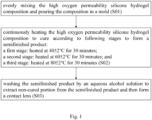
- Fig. 1 It is a flow chart of a manufacturing method of contact lens using thermal initiator.
- the manufacturing method of contact lens has following steps.
- a first step is evenly mixing the high oxygen permeability silicone hydrogel composition (the aforementioned) and pouring the composition in a mold (S01). Since it is used for thermal curing reaction, the mold is not limited to using a steel mold or a plastic mold, nor does it limit the mold itself to be transparent or non-transparent, as long as the mold can effectively conduct heat to the ingredients of the internal high oxygen permeability silicone hydrogel composition.
- a second step is continuously heating the high oxygen permeability silicone hydrogel composition to cure according to following stages to form a semifinished product: a first stage: heated at 40 ⁇ 2°C for 30 minutes; a second stage: heated at 60 ⁇ 2°C for 30 minutes; and a third stage: heated at 80 ⁇ 2°C for 30 minutes (S02).
- This step is to heat the high oxygen permeability silicone hydrogel composition through the mold in stages, allowing the thermal initiator to complete the thermal curing reaction.
- the semifinished product obtained in this step is the prototype of the contact lens, which contains some of the high oxygen permeability silicone hydrogel composition that have not completed the curing reaction. Extraction is required to ensure the usability of the formed contact lens.
- a third step is washing the semifinished product by an aqueous alcohol solution to extract non-cured portion from the semifinished product and then form a contact lens (S03).
- the aqueous alcohol solution may be an aqueous ethanol solution or an aqueous isopropyl alcohol solution.
- the aqueous alcohol solution can flow through the semifinished product, so the uncured first silicone polymer, second silicone polymer, hydrophilic monomer, crosslinking agent, initiator and solvent can be extracted.
- the extracted semifinished product is the contact lens that can be used.
- the manufacturing method of contact lens may further include several packaging steps, for example, putting the contact lens into a packaging container containing a buffer solution (physiological saline), sealing the packaging container, sterilizing the packaging container (by moist heat sterilization), etc.
- packaging steps can refer to the ISO standard process, which will not be repeated here.
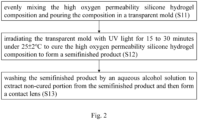
- FIG. 2 It is a flow chart of a manufacturing method of contact lens using photoinitiator.
- the manufacturing method of contact lens has following steps.
- a first step is evenly mixing the high oxygen permeability silicone hydrogel composition (the aforementioned) and pouring the composition in a transparent mold (S11). Since the light curing reaction needs to receive ultraviolet light from the outside, therefore, the material of the mold must be light-transmitting, so a transparent plastic mold should be used.
- the material of transparent plastic mold can be polypropylene, polyethylene, nylon, polyoxymethylene, polyethylene terephthalate, cycloolefin copolymer, polystyrene, polyvinyl chloride, styrene, etc.
- a second step is irradiating the transparent mold with UV light for 15 to 30 minutes under 25 ⁇ 2°C to cure the high oxygen permeability silicone hydrogel composition to form a semifinished product (S12).
- This step is carried out at room temperature under normal atmospheric pressure.
- the UV irradiation time can be adjusted according to the amount of the photoinitiator and the characteristics of the mold itself, until the semifinished product reaches the acceptable standard.
- the characteristics of the semifinished product are the same as those described above and will not be repeated here.
- a third step is washing the semifinished product by an aqueous alcohol solution to extract non-cured portion from the semifinished product and then form a contact lens (S13).
- the aqueous alcohol solution may be an aqueous ethanol solution or an aqueous isopropyl alcohol solution.
- the aqueous alcohol solution can flow through the semifinished product, extracting the uncured high oxygen permeability silicone hydrogel composition to form the contact lens.
- the above packaging steps can also be further performed.
- the contact lens in order to increase the functionality, can also add other ingredients besides the aforementioned high oxygen permeability silicone hydrogel composition.
- Commonly added ingredients are UV absorbing monomer (used with thermal initiator) to reduce external UV rays entering the eye; reactive dyes, used to change the apparent color of the contact lens; and humectants, used to increase the lubricity between the contact lens and the cornea.
- the contact lens in addition to the aforementioned high oxygen permeability silicone hydrogel composition, can use a third silicone polymer to adjust the physical properties of the contact lens, such as water content and tensile modulus.
- the mixing ratio of the total amount of the aforementioned added ingredients and the high oxygen permeability silicone hydrogel composition, in terms of parts by weight, can be below 0.25:1.
- the following embodiments illustrate the determination of the upper limit of a specific ingredient, and the properties of the contact lens made according to the aforementioned method under different ingredient ratios of the high oxygen permeability silicone hydrogel composition.
- a first embodiment group is used to describe the compatibility between the silicone polymer and the hydrophilic monomer, and the influence of the content of the hydrophilic monomer on the transmittance of the contact lens.
- Table 1 shows the results of compatibility analysis, each of which is observed by mixing the silicone polymers and the hydrophilic monomer (this test is carried out with HEMA monomer), and the above manufacturing method of contact lens is not applied to make a complete contact lens.
- the first silicone polymer and the second silicone polymer are mixed with the hydrophilic monomer in proportion, and the transparent degree of the solution is confirmed relative to the control group. After the compatibility is confirmed, it is convenient to carry out formula adjustment and physical property tests of the contact lens.
- Compatibility test results show that the compatibility between the first silicone polymer and the second silicone polymer is transparent and clear, indicating that the first silicone polymer and the second silicone polymer provided by the present invention have good compatibility properties.
- embodiment A2-A4 When adding different proportions of HEMA monomers, it is shown by embodiment A2-A4.
- HEMA content accounts for 20 ⁇ 40% of the total, it still maintains compatibility with the silicone polymers.
- the HEMA content reaches 50%, the solution is turbid, indicating that the silicone polymers and HEMA are in a heterogeneous state.
- the upper limit of the hydrophilic monomer can be set according to the test results, so as to adjust the content of the hydrophilic monomer.
- Table 1 embodiment silicone polymer / hydrophilic monomer ratio test results A1 (control group) first silicone polymer 50% + second silicone polymer 50% transparent clear A2 first silicone polymer 40% + second silicone polymer 40% + HEMA 20% transparent clear A3 first silicone polymer 35% + second silicone polymer 35% + HEMA 30% transparent clear A4 first silicone polymer 30% + second silicone polymer 30% + HEMA 40% transparent clear A5 first silicone polymer 25% + second silicone polymer 25% + HEMA 50% turbid
- a second embodiment group is used to describe the properties of the contact lens prepared by the method described above using the photoinitiator at different ingredient ratios of the high oxygen permeability silicone hydrogel composition.
- the ingredients of the high oxygen permeability silicone hydrogel composition used in embodiment B1 ⁇ B5 are the first silicone polymer, the second silicone polymer, HEMA (hydrophilic monomer), EGDMA (crosslinking agent), Irgacure 819 (initiator) and n-hexanol (solvent), with different weight percentages, respectively.
- HEMA hydrophilic monomer
- EGDMA crosslinking agent
- Irgacure 819 initiator
- n-hexanol solvent
- a third embodiment group is used to describe the properties of the contact lens prepared by the method described above using the photoinitiator with various hydrophilic monomers at different ingredient ratios of the high oxygen permeability silicone hydrogel composition.
- more than one kind of hydrophilic monomer can be used at a time. Therefore, different from the previous embodiment group, in addition to HEMA, DMA and NVP are added as the hydrophilic monomer to use in embodiment C1 ⁇ C5. The weight percentage of each ingredient is listed in Table 3.
- the water content of the contact lens varies from 33.5% to 43.6%
- the tensile modulus varies from 0.6 to 1.2 MPa
- the oxygen permeability varies from 87 to 115 barrer.
- a fourth embodiment group is used to describe the properties of the contact lens prepared by the method described above using the photoinitiator with various hydrophilic monomers and an additional third silicone polymer at different ingredient ratios of the high oxygen permeability silicone hydrogel composition.
- the high oxygen permeability silicone hydrogel composition can also be used with an additional silicone polymer to make contact lens.
- embodiments D1 ⁇ D5 additionally use a third silicone polymer.
- the third silicone polymer can not only be used to adjust the physical properties of the contact lens, but also has better design flexibility for formulation regulation due to its compatibility with the main silicone polymers.
- the third silicone polymer is (3-methacryloxy-2-hydroxypropoxy)propylbis(trimethylsiloxy) methylsilane (SiGMA).
- the third silicone polymer may also be 3-vinyl carbamatepropyl tris(trimethylsiloxy)silane (TRISVC) or monofunctional polydimethylsiloxane (mPDMS) with an average molecular weight of less than 2000 and polymers composed of combinations thereof.
- TISVC 3-vinyl carbamatepropyl tris(trimethylsiloxy)silane
- mPDMS monofunctional polydimethylsiloxane
- the third silicone polymer can be 5% to 20% by weight of the high oxygen permeability silicone hydrogel composition. The weight percentage of each ingredient is listed in Table 4.
- the water content of the contact lens varies from 35.5% to 43.1%
- the tensile modulus varies from 0.6 to 1.1 MPa
- the oxygen permeability varies from 84 to 110 barrer.
Landscapes
- Chemical & Material Sciences (AREA)
- Health & Medical Sciences (AREA)
- Chemical Kinetics & Catalysis (AREA)
- Medicinal Chemistry (AREA)
- Polymers & Plastics (AREA)
- Organic Chemistry (AREA)
- Physics & Mathematics (AREA)
- General Physics & Mathematics (AREA)
- Optics & Photonics (AREA)
- Eyeglasses (AREA)
- Macromonomer-Based Addition Polymer (AREA)
- Compositions Of Macromolecular Compounds (AREA)
Applications Claiming Priority (1)
| Application Number | Priority Date | Filing Date | Title |
|---|---|---|---|
| TW111116293A TWI807804B (zh) | 2022-04-28 | 2022-04-28 | 高透氧矽水膠組成物、使用高透氧矽水膠組成物製作的隱形眼鏡及其製作方法 |
Publications (3)
| Publication Number | Publication Date |
|---|---|
| EP4269458A1 EP4269458A1 (en) | 2023-11-01 |
| EP4269458C0 EP4269458C0 (en) | 2024-09-11 |
| EP4269458B1 true EP4269458B1 (en) | 2024-09-11 |
Family
ID=86226288
Family Applications (1)
| Application Number | Title | Priority Date | Filing Date |
|---|---|---|---|
| EP23166668.6A Active EP4269458B1 (en) | 2022-04-28 | 2023-04-05 | High oxygen permeability silicone hydrogel composition, contact lens made from high oxygen permeability silicone hydrogel composition and manufacturing method thereof |
Country Status (3)
| Country | Link |
|---|---|
| EP (1) | EP4269458B1 (enExample) |
| JP (1) | JP7446025B2 (enExample) |
| TW (1) | TWI807804B (enExample) |
Families Citing this family (2)
| Publication number | Priority date | Publication date | Assignee | Title |
|---|---|---|---|---|
| CN118638279B (zh) * | 2024-08-14 | 2024-12-03 | 吉林爱惠瞳医用科技有限公司 | 一种高透氧硅水凝胶材料及其制备方法和应用 |
| CN119638919B (zh) * | 2024-12-13 | 2025-11-28 | 江苏丽雯光学有限公司 | 一种高透氧硅水凝胶隐形眼镜及其制备方法 |
Family Cites Families (6)
| Publication number | Priority date | Publication date | Assignee | Title |
|---|---|---|---|---|
| JP3572144B2 (ja) * | 1996-05-31 | 2004-09-29 | 名糖産業株式会社 | デキストランエステル共重合体 |
| TWI477560B (zh) * | 2013-02-07 | 2015-03-21 | Benq Materials Corp | 隱形眼鏡材料、隱形眼鏡的製造方法與由此方法所製造出之隱形眼鏡 |
| JP5452756B1 (ja) * | 2013-07-02 | 2014-03-26 | Hoya株式会社 | 親水性表面を有するシリコーン含有共重合体成形品を作製する方法及び親水性表面を有するシリコーンハイドロゲルコンタクトレンズ |
| JP2018193492A (ja) * | 2017-05-18 | 2018-12-06 | 信越化学工業株式会社 | 重合性基含有オルガノポリシロキサンの製造方法 |
| US20210017383A1 (en) * | 2019-07-19 | 2021-01-21 | Mcmaster University | Silicone co-polymers and methods of use thereof to modify silicone elastomers |
| CN112898506B (zh) * | 2020-12-31 | 2023-03-24 | 江苏海伦隐形眼镜有限公司 | 一种高透氧性硅水凝胶及角膜接触镜 |
-
2022
- 2022-04-28 TW TW111116293A patent/TWI807804B/zh active
-
2023
- 2023-04-05 EP EP23166668.6A patent/EP4269458B1/en active Active
- 2023-04-24 JP JP2023070837A patent/JP7446025B2/ja active Active
Also Published As
| Publication number | Publication date |
|---|---|
| TWI807804B (zh) | 2023-07-01 |
| TW202342646A (zh) | 2023-11-01 |
| EP4269458C0 (en) | 2024-09-11 |
| JP7446025B2 (ja) | 2024-03-08 |
| EP4269458A1 (en) | 2023-11-01 |
| JP2023164345A (ja) | 2023-11-10 |
Similar Documents
| Publication | Publication Date | Title |
|---|---|---|
| KR102117217B1 (ko) | 이온성 실리콘 하이드로겔 | |
| EP2038310B1 (en) | Actinically crosslinkable copolymers for manufacturing contact lenses | |
| AU2016200052B2 (en) | Silicone hydrogels having a structure formed via controlled reaction kinetics | |
| JP5452756B1 (ja) | 親水性表面を有するシリコーン含有共重合体成形品を作製する方法及び親水性表面を有するシリコーンハイドロゲルコンタクトレンズ | |
| AU2010295773B2 (en) | Prepolymers suitable for making ultra-violet absorbing contact lenses | |
| TWI531826B (zh) | 尺寸穩定之聚矽氧水凝膠隱形眼鏡及其製造方法 | |
| TWI606094B (zh) | 含有所需水含量及透氧性之聚矽氧水凝膠 | |
| TWI497151B (zh) | 含膦水凝膠隱形眼鏡 | |
| RU2629932C2 (ru) | Силикон-гидрогели, сформированные из реакционных смесей, не содержащих разбавителей | |
| EP4269458B1 (en) | High oxygen permeability silicone hydrogel composition, contact lens made from high oxygen permeability silicone hydrogel composition and manufacturing method thereof | |
| TWI626253B (zh) | 水溶性矽高聚物、矽水膠組成物、矽水膠鏡片及其製造方法 | |
| HK1200859A1 (en) | Silicone polymers comprising sulfonic acid groups | |
| JPWO2001071415A1 (ja) | 眼用レンズ材料 | |
| US20110313077A1 (en) | Polymer material, opthalmic lens and contact lens | |
| CN112437889A (zh) | 具有不均匀形态的有机硅水凝胶接触镜片 | |
| AU2015241171B2 (en) | Silicone acrylamide copolymer | |
| CA2936900A1 (en) | Polymers comprising sulfonic acid groups | |
| US12378415B2 (en) | High oxygen permeability silicone hydrogel composition, contact lens made from high oxygen permeability silicone hydrogel composition and manufacturing method thereof | |
| KR102715262B1 (ko) | 우수한 물성을 가지는 실리콘 하이드로겔 렌즈 | |
| JP7375551B2 (ja) | 医療デバイス | |
| AU2012358906B2 (en) | Silicone hydrogels formed from zero diluent reactive mixtures | |
| HK40015600A (en) | Silicone hydrogels having a structure formed via controlled reaction kinetics | |
| HK1203536B (en) | Silicone hydrogels formed from zero diluent reactive mixtures |
Legal Events
| Date | Code | Title | Description |
|---|---|---|---|
| PUAI | Public reference made under article 153(3) epc to a published international application that has entered the european phase |
Free format text: ORIGINAL CODE: 0009012 |
|
| STAA | Information on the status of an ep patent application or granted ep patent |
Free format text: STATUS: THE APPLICATION HAS BEEN PUBLISHED |
|
| AK | Designated contracting states |
Kind code of ref document: A1 Designated state(s): AL AT BE BG CH CY CZ DE DK EE ES FI FR GB GR HR HU IE IS IT LI LT LU LV MC ME MK MT NL NO PL PT RO RS SE SI SK SM TR |
|
| STAA | Information on the status of an ep patent application or granted ep patent |
Free format text: STATUS: REQUEST FOR EXAMINATION WAS MADE |
|
| 17P | Request for examination filed |
Effective date: 20231115 |
|
| RBV | Designated contracting states (corrected) |
Designated state(s): AL AT BE BG CH CY CZ DE DK EE ES FI FR GB GR HR HU IE IS IT LI LT LU LV MC ME MK MT NL NO PL PT RO RS SE SI SK SM TR |
|
| GRAP | Despatch of communication of intention to grant a patent |
Free format text: ORIGINAL CODE: EPIDOSNIGR1 |
|
| STAA | Information on the status of an ep patent application or granted ep patent |
Free format text: STATUS: GRANT OF PATENT IS INTENDED |
|
| RIC1 | Information provided on ipc code assigned before grant |
Ipc: G02B 1/04 20060101ALI20240328BHEP Ipc: C08L 83/12 20060101ALI20240328BHEP Ipc: C08F 283/12 20060101AFI20240328BHEP |
|
| INTG | Intention to grant announced |
Effective date: 20240424 |
|
| GRAS | Grant fee paid |
Free format text: ORIGINAL CODE: EPIDOSNIGR3 |
|
| GRAA | (expected) grant |
Free format text: ORIGINAL CODE: 0009210 |
|
| STAA | Information on the status of an ep patent application or granted ep patent |
Free format text: STATUS: THE PATENT HAS BEEN GRANTED |
|
| AK | Designated contracting states |
Kind code of ref document: B1 Designated state(s): AL AT BE BG CH CY CZ DE DK EE ES FI FR GB GR HR HU IE IS IT LI LT LU LV MC ME MK MT NL NO PL PT RO RS SE SI SK SM TR |
|
| REG | Reference to a national code |
Ref country code: GB Ref legal event code: FG4D |
|
| REG | Reference to a national code |
Ref country code: CH Ref legal event code: EP |
|
| REG | Reference to a national code |
Ref country code: DE Ref legal event code: R096 Ref document number: 602023000532 Country of ref document: DE |
|
| REG | Reference to a national code |
Ref country code: IE Ref legal event code: FG4D |
|
| U01 | Request for unitary effect filed |
Effective date: 20241011 |
|
| U07 | Unitary effect registered |
Designated state(s): AT BE BG DE DK EE FI FR IT LT LU LV MT NL PT RO SE SI Effective date: 20241029 |
|
| PG25 | Lapsed in a contracting state [announced via postgrant information from national office to epo] |
Ref country code: NO Free format text: LAPSE BECAUSE OF FAILURE TO SUBMIT A TRANSLATION OF THE DESCRIPTION OR TO PAY THE FEE WITHIN THE PRESCRIBED TIME-LIMIT Effective date: 20241211 |
|
| PG25 | Lapsed in a contracting state [announced via postgrant information from national office to epo] |
Ref country code: GR Free format text: LAPSE BECAUSE OF FAILURE TO SUBMIT A TRANSLATION OF THE DESCRIPTION OR TO PAY THE FEE WITHIN THE PRESCRIBED TIME-LIMIT Effective date: 20241212 |
|
| PG25 | Lapsed in a contracting state [announced via postgrant information from national office to epo] |
Ref country code: HR Free format text: LAPSE BECAUSE OF FAILURE TO SUBMIT A TRANSLATION OF THE DESCRIPTION OR TO PAY THE FEE WITHIN THE PRESCRIBED TIME-LIMIT Effective date: 20240911 |
|
| PG25 | Lapsed in a contracting state [announced via postgrant information from national office to epo] |
Ref country code: ES Free format text: LAPSE BECAUSE OF FAILURE TO SUBMIT A TRANSLATION OF THE DESCRIPTION OR TO PAY THE FEE WITHIN THE PRESCRIBED TIME-LIMIT Effective date: 20240911 Ref country code: RS Free format text: LAPSE BECAUSE OF FAILURE TO SUBMIT A TRANSLATION OF THE DESCRIPTION OR TO PAY THE FEE WITHIN THE PRESCRIBED TIME-LIMIT Effective date: 20241211 |
|
| PG25 | Lapsed in a contracting state [announced via postgrant information from national office to epo] |
Ref country code: RS Free format text: LAPSE BECAUSE OF FAILURE TO SUBMIT A TRANSLATION OF THE DESCRIPTION OR TO PAY THE FEE WITHIN THE PRESCRIBED TIME-LIMIT Effective date: 20241211 Ref country code: NO Free format text: LAPSE BECAUSE OF FAILURE TO SUBMIT A TRANSLATION OF THE DESCRIPTION OR TO PAY THE FEE WITHIN THE PRESCRIBED TIME-LIMIT Effective date: 20241211 Ref country code: HR Free format text: LAPSE BECAUSE OF FAILURE TO SUBMIT A TRANSLATION OF THE DESCRIPTION OR TO PAY THE FEE WITHIN THE PRESCRIBED TIME-LIMIT Effective date: 20240911 Ref country code: GR Free format text: LAPSE BECAUSE OF FAILURE TO SUBMIT A TRANSLATION OF THE DESCRIPTION OR TO PAY THE FEE WITHIN THE PRESCRIBED TIME-LIMIT Effective date: 20241212 Ref country code: ES Free format text: LAPSE BECAUSE OF FAILURE TO SUBMIT A TRANSLATION OF THE DESCRIPTION OR TO PAY THE FEE WITHIN THE PRESCRIBED TIME-LIMIT Effective date: 20240911 |
|
| U20 | Renewal fee for the european patent with unitary effect paid |
Year of fee payment: 3 Effective date: 20250211 |
|
| PG25 | Lapsed in a contracting state [announced via postgrant information from national office to epo] |
Ref country code: IS Free format text: LAPSE BECAUSE OF FAILURE TO SUBMIT A TRANSLATION OF THE DESCRIPTION OR TO PAY THE FEE WITHIN THE PRESCRIBED TIME-LIMIT Effective date: 20250111 |
|
| PG25 | Lapsed in a contracting state [announced via postgrant information from national office to epo] |
Ref country code: SM Free format text: LAPSE BECAUSE OF FAILURE TO SUBMIT A TRANSLATION OF THE DESCRIPTION OR TO PAY THE FEE WITHIN THE PRESCRIBED TIME-LIMIT Effective date: 20240911 |
|
| PG25 | Lapsed in a contracting state [announced via postgrant information from national office to epo] |
Ref country code: CZ Free format text: LAPSE BECAUSE OF FAILURE TO SUBMIT A TRANSLATION OF THE DESCRIPTION OR TO PAY THE FEE WITHIN THE PRESCRIBED TIME-LIMIT Effective date: 20240911 Ref country code: PL Free format text: LAPSE BECAUSE OF FAILURE TO SUBMIT A TRANSLATION OF THE DESCRIPTION OR TO PAY THE FEE WITHIN THE PRESCRIBED TIME-LIMIT Effective date: 20240911 |
|
| PG25 | Lapsed in a contracting state [announced via postgrant information from national office to epo] |
Ref country code: SK Free format text: LAPSE BECAUSE OF FAILURE TO SUBMIT A TRANSLATION OF THE DESCRIPTION OR TO PAY THE FEE WITHIN THE PRESCRIBED TIME-LIMIT Effective date: 20240911 |
|
| PLBE | No opposition filed within time limit |
Free format text: ORIGINAL CODE: 0009261 |
|
| STAA | Information on the status of an ep patent application or granted ep patent |
Free format text: STATUS: NO OPPOSITION FILED WITHIN TIME LIMIT |
|
| 26N | No opposition filed |
Effective date: 20250612 |