EP4269269A1 - Can for effervescent beverage and manufacturing method therefor - Google Patents
Can for effervescent beverage and manufacturing method therefor Download PDFInfo
- Publication number
- EP4269269A1 EP4269269A1 EP21915280.8A EP21915280A EP4269269A1 EP 4269269 A1 EP4269269 A1 EP 4269269A1 EP 21915280 A EP21915280 A EP 21915280A EP 4269269 A1 EP4269269 A1 EP 4269269A1
- Authority
- EP
- European Patent Office
- Prior art keywords
- beverage
- wax
- effervescent
- recesses
- paint
- Prior art date
- Legal status (The legal status is an assumption and is not a legal conclusion. Google has not performed a legal analysis and makes no representation as to the accuracy of the status listed.)
- Granted
Links
Images

Classifications
-
- A—HUMAN NECESSITIES
- A23—FOODS OR FOODSTUFFS; TREATMENT THEREOF, NOT COVERED BY OTHER CLASSES
- A23L—FOODS, FOODSTUFFS OR NON-ALCOHOLIC BEVERAGES, NOT OTHERWISE PROVIDED FOR; PREPARATION OR TREATMENT THEREOF
- A23L2/00—Non-alcoholic beverages; Dry compositions or concentrates therefor; Preparation or treatment thereof
- A23L2/38—Other non-alcoholic beverages
-
- B—PERFORMING OPERATIONS; TRANSPORTING
- B65—CONVEYING; PACKING; STORING; HANDLING THIN OR FILAMENTARY MATERIAL
- B65D—CONTAINERS FOR STORAGE OR TRANSPORT OF ARTICLES OR MATERIALS, e.g. BAGS, BARRELS, BOTTLES, BOXES, CANS, CARTONS, CRATES, DRUMS, JARS, TANKS, HOPPERS, FORWARDING CONTAINERS; ACCESSORIES, CLOSURES, OR FITTINGS THEREFOR; PACKAGING ELEMENTS; PACKAGES
- B65D85/00—Containers, packaging elements or packages, specially adapted for particular articles or materials
- B65D85/70—Containers, packaging elements or packages, specially adapted for particular articles or materials for materials not otherwise provided for
- B65D85/72—Containers, packaging elements or packages, specially adapted for particular articles or materials for materials not otherwise provided for for edible or potable liquids, semiliquids, or plastic or pasty materials
- B65D85/73—Containers, packaging elements or packages, specially adapted for particular articles or materials for materials not otherwise provided for for edible or potable liquids, semiliquids, or plastic or pasty materials with means specially adapted for effervescing the liquids, e.g. for forming bubbles or beer head
-
- A—HUMAN NECESSITIES
- A23—FOODS OR FOODSTUFFS; TREATMENT THEREOF, NOT COVERED BY OTHER CLASSES
- A23L—FOODS, FOODSTUFFS OR NON-ALCOHOLIC BEVERAGES, NOT OTHERWISE PROVIDED FOR; PREPARATION OR TREATMENT THEREOF
- A23L2/00—Non-alcoholic beverages; Dry compositions or concentrates therefor; Preparation or treatment thereof
-
- A—HUMAN NECESSITIES
- A23—FOODS OR FOODSTUFFS; TREATMENT THEREOF, NOT COVERED BY OTHER CLASSES
- A23L—FOODS, FOODSTUFFS OR NON-ALCOHOLIC BEVERAGES, NOT OTHERWISE PROVIDED FOR; PREPARATION OR TREATMENT THEREOF
- A23L2/00—Non-alcoholic beverages; Dry compositions or concentrates therefor; Preparation or treatment thereof
- A23L2/40—Effervescence-generating compositions
-
- A—HUMAN NECESSITIES
- A23—FOODS OR FOODSTUFFS; TREATMENT THEREOF, NOT COVERED BY OTHER CLASSES
- A23L—FOODS, FOODSTUFFS OR NON-ALCOHOLIC BEVERAGES, NOT OTHERWISE PROVIDED FOR; PREPARATION OR TREATMENT THEREOF
- A23L2/00—Non-alcoholic beverages; Dry compositions or concentrates therefor; Preparation or treatment thereof
- A23L2/52—Adding ingredients
- A23L2/54—Mixing with gases
-
- A—HUMAN NECESSITIES
- A23—FOODS OR FOODSTUFFS; TREATMENT THEREOF, NOT COVERED BY OTHER CLASSES
- A23L—FOODS, FOODSTUFFS OR NON-ALCOHOLIC BEVERAGES, NOT OTHERWISE PROVIDED FOR; PREPARATION OR TREATMENT THEREOF
- A23L2/00—Non-alcoholic beverages; Dry compositions or concentrates therefor; Preparation or treatment thereof
- A23L2/52—Adding ingredients
- A23L2/56—Flavouring or bittering agents
-
- B—PERFORMING OPERATIONS; TRANSPORTING
- B65—CONVEYING; PACKING; STORING; HANDLING THIN OR FILAMENTARY MATERIAL
- B65D—CONTAINERS FOR STORAGE OR TRANSPORT OF ARTICLES OR MATERIALS, e.g. BAGS, BARRELS, BOTTLES, BOXES, CANS, CARTONS, CRATES, DRUMS, JARS, TANKS, HOPPERS, FORWARDING CONTAINERS; ACCESSORIES, CLOSURES, OR FITTINGS THEREFOR; PACKAGING ELEMENTS; PACKAGES
- B65D17/00—Rigid or semi-rigid containers specially constructed to be opened by cutting or piercing, or by tearing of frangible members or portions
- B65D17/02—Rigid or semi-rigid containers specially constructed to be opened by cutting or piercing, or by tearing of frangible members or portions of curved cross-section, e.g. cans of circular or elliptical cross-section
-
- B—PERFORMING OPERATIONS; TRANSPORTING
- B65—CONVEYING; PACKING; STORING; HANDLING THIN OR FILAMENTARY MATERIAL
- B65D—CONTAINERS FOR STORAGE OR TRANSPORT OF ARTICLES OR MATERIALS, e.g. BAGS, BARRELS, BOTTLES, BOXES, CANS, CARTONS, CRATES, DRUMS, JARS, TANKS, HOPPERS, FORWARDING CONTAINERS; ACCESSORIES, CLOSURES, OR FITTINGS THEREFOR; PACKAGING ELEMENTS; PACKAGES
- B65D25/00—Details of other kinds or types of rigid or semi-rigid containers
- B65D25/14—Linings or internal coatings
-
- B—PERFORMING OPERATIONS; TRANSPORTING
- B65—CONVEYING; PACKING; STORING; HANDLING THIN OR FILAMENTARY MATERIAL
- B65D—CONTAINERS FOR STORAGE OR TRANSPORT OF ARTICLES OR MATERIALS, e.g. BAGS, BARRELS, BOTTLES, BOXES, CANS, CARTONS, CRATES, DRUMS, JARS, TANKS, HOPPERS, FORWARDING CONTAINERS; ACCESSORIES, CLOSURES, OR FITTINGS THEREFOR; PACKAGING ELEMENTS; PACKAGES
- B65D7/00—Containers having bodies formed by interconnecting or uniting two or more rigid, or substantially rigid, components made wholly or mainly of metal
-
- B—PERFORMING OPERATIONS; TRANSPORTING
- B65—CONVEYING; PACKING; STORING; HANDLING THIN OR FILAMENTARY MATERIAL
- B65D—CONTAINERS FOR STORAGE OR TRANSPORT OF ARTICLES OR MATERIALS, e.g. BAGS, BARRELS, BOTTLES, BOXES, CANS, CARTONS, CRATES, DRUMS, JARS, TANKS, HOPPERS, FORWARDING CONTAINERS; ACCESSORIES, CLOSURES, OR FITTINGS THEREFOR; PACKAGING ELEMENTS; PACKAGES
- B65D7/00—Containers having bodies formed by interconnecting or uniting two or more rigid, or substantially rigid, components made wholly or mainly of metal
- B65D7/42—Details of metal walls
Definitions
- the present invention relates to an effervescent beverage can and a method for manufacturing the same.
- Effervescent beverages such as beer are sometimes provided in a sealed container.
- One important characteristic of effervescent beverages is their effervescence.
- Various considerations have been made to ensure that an appropriate amount of foam is obtained when the beverage is consumed.
- Patent Literature 1 Japanese Patent No. 4758693 discloses a technique aimed at providing a can for effervescent beverages that has no adverse effect on fillability and can significantly improve effervescence upon opening.
- the inner surface of the can is coated with an organic resin coating layer; an organic resin coating material that contains a predetermined amount of large-diameter particles occupies 20% to 60% of the inner surface area of the can, while an organic resin coating material that contains a predetermined amount of small-diameter particles occupies the remaining of the inner surface area; and concave portions or convex portions formed by at least a part of the large-diameter particles that have detached or remained and concave portions formed by the small-diameter particles that have detached are present in the organic resin coating layer.
- Patent Literature 1 Japanese Patent No. 4758693
- an object of the present invention is to provide an effervescent beverage can capable of further improving the effervescence and a method for producing the same.
- the present inventors have found that the above object can be achieved by forming a predetermined structure on the inner surface of the can, and have completed the present invention. Specifically, the present invention is achieved by the following means.
- the present invention provides an effervescent beverage can capable of further improving the effervescence and a method for producing the same.
- An effervescent beverage can has a top surface, a body, and a bottom surface.
- the body and the bottom surface are integrated or joined to form a bottomed cylindrical shape, and the upper opening is closed by the top surface so as to be openable.
- the inner surface of the body is provided with a plurality of first recesses.
- the term “recess” refers to a structure with a depth of 1 ⁇ m or more.
- the first recess has a substantially circular shape when viewed from the front.
- the first recess is a recess with a diameter of 5 ⁇ m or more and 20 ⁇ m or less.
- the number of first recesses is 200 to 2000, preferably 300 to 1500, and more preferably 400 to 1200, per 1 mm 2 .
- the average depth of the plurality of first recesses is, for example, 1 to 5 ⁇ m, preferably 2 to 4 ⁇ m.
- the number and average depth of the first recesses can be obtained using, for example, a laser microscope.
- the first recess is preferably a crater-like structure.
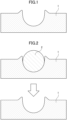
- Fig. 1 is a cross-sectional view schematically illustrating a crater-like structure.
- the crater-like structure refers to a structure in which the edge portion of the recess is reversely raised.
- the inner surface of the body is further provided with a plurality of second recesses.
- the second recess has a diameter of 0.5 ⁇ m or more and less than 5 ⁇ m.
- the number of the plurality of second recesses is 5000 to 20000, preferably 7000 to 15000, per 1 mm 2 .
- the average depth of the plurality of second recesses is, for example, 1 to 5 ⁇ m, preferably 2 to 4 ⁇ m.
- the number and average depth of the second recesses can be obtained by the same method as for the first recesses.
- the second recess preferably has a crater-like structure as with the first recess.
- the effervescent beverage can according to the present embodiment is made of metal.
- the inner surface of the body is provided with a resin layer obtained by applying and drying paint on a metal layer, and the first recesses and the second recesses are formed in the resin layer.
- the thickness of the resin layer is, for example, 1 to 10 ⁇ m, preferably 3 to 8 ⁇ m.
- the "resin layer” means a layer after drying the applied paint, and is distinguished from the layer of the paint before drying.
- the can lid of the effervescent beverage can is a full open end.
- a full open end is a lid of the type in which a region accounting for 30% or more of the area of the ceiling surface of the can lid is opened.
- the region to be opened is preferably 50% or more of the ceiling surface of the can lid, more preferably 90% or more thereof, and further preferably the entire ceiling surface of the can lid.
- a preferred embodiment is, for example, a type of lid in which a circular ceiling surface of the can lid is scored (notched) over the entire circumference, and the entire lid ceiling surface is detached from the can body to be opened.
- the configuration may be such that the lid is not completely detached and a part of the lid remains on the can body.
- the full open end makes it possible to visually grasp the effervescence from the can body, which leads to evoking the image of beer poured into a mug.
- a larger amount of liquid flows into the mouth at the same angle compared to a regular can lid, it is possible to enjoy the foam and liquid at the same time.
- the capacity of the effervescent beverage can (the amount filled with the beverage) is, for example, 135 to 1000 ml, preferably 320 to 500 ml.
- the caliber of the effervescent beverage can is, for example, 200 to 211 caliber, preferably 202 to 206 caliber.
- the manufacturing method according to the present embodiment includes applying a paint containing resin and wax to an inner surface of the body (or a region to become the inner surface of the body); and subsequently heat-treating the applied paint to form a resin layer on the inner surface and remove the wax (hereinafter also referred to as the baking step).
- the wax is removed to form recesses in the resin layer.
- wax is typically used for the purpose of preventing scratches on the coated film in the can manufacturing process, but in the present specification, wax refers to a component that is in the form of solid particles at room temperature.
- one method for forming a can body with a resin layer on the inner surface thereof is to first form a can body with a bottomed cylindrical shape using extrusion molding, and then applying the paint according to the present invention by spray coating and baking it to form the resin layer (the resulting can is called a two-piece can).
- a method for obtaining a can body with a bottomed cylindrical shape can be used, such as preparing a metal plate with a region to become the inner surface, applying paint to the region to become the inner surface, forming a resin layer by baking, then forming the metal plate with a resin layer into a cylindrical shape, and crimping the bottom of the can which becomes the bottom surface (the resulting can is called a three-piece can).
- a paint containing resin and wax is prepared.
- a water-based paint can be used.
- epoxy resin for example, epoxy resin, acrylic resin, polyester resin, urethane resin, and the like are used.
- the wax in the paint has an average particle diameter of 1 ⁇ m or more.
- the "average particle diameter” referred to here means the particle diameter (D50) at which the volume-based cumulative frequency is 50%. This value is measured using a dynamic light scattering particle size distribution measurement device ("Microtrac S3500” manufactured by Nikkiso Co., Ltd.) for a water dispersion containing about 20 mass% of wax, which is diluted 500 times with water.
- the average particle diameter of the wax is preferably 1 to 15 ⁇ m, more preferably 2 to 10 ⁇ m, and further preferably 3 to 8 ⁇ m.
- the content of the wax in the paint is, for example, 7 to 40 parts by mass, preferably 10 to 40 parts by mass, and more preferably 12 to 30 parts by mass, per 100 parts by mass of non-volatile components (excluding the wax) in the paint.
- the non-volatile component (excluding the wax) as used herein refers to a component other than the wax among the components remaining on the adherend to form a resin layer after the paint is applied and baked.
- a plurality of waxes having different average particle diameters may be used in combination. By combining a plurality of waxes having different average particle diameters in this way, it becomes easier to control the size and the number of recesses.
- wax for example, one having a softening point of 90 to 160°C, preferably 110 to 140°C, is used.
- Carnauba wax, polyethylene wax, and the like can be used as the wax.
- the form of the wax, powder, paste, or water or solvent dispersion form can be appropriately used, but from the viewpoint of dispersion stability in the paint, it is preferable to use water or solvent dispersion form.
- the method for applying the paint in the present embodiment is preferably spray coating such as air spray, airless spray, or electrostatic spray, roll coater coating, dip coating, electrodeposition coating, and the like, and more preferably spray coating.
- the conditions in the baking step can be appropriately selected so that the paint can be dried and the resin layer can be formed, but are preferably 150 to 280°C for about 10 seconds to 30 minutes. Further, in order to melt the wax during this baking so as to cause detachment from the coated film, a temperature of 180 to 280°C for about 1 to 30 minutes is more preferable.
- the thickness of the resin layer after baking is, for example, 1 to 10 ⁇ m, preferably 3 to 8 ⁇ m.
- Fig. 2 is a cross-sectional view schematically illustrating a method for forming a crater-like structure.
- the water and solvent are first volatilized to form the resin layer 1.
- the wax 2 is temporarily placed so as to be embedded in the resin layer 1.
- the upper portion of the wax 2 is exposed on the surface of the resin layer 1.
- the wax 2 melts and separates from the resin layer 1. This forms recesses having a crater-like structure in the resin layer 1.
- beverage cans are manufactured, the cans are filled with the drinkable liquid, and sealed, similar to methods commonly used in the industry.
- the filling with the drinkable liquid is preferably carried out at a low temperature (such as 1 to 20°C).
- a paint containing a specific amount of wax having a specific average particle diameter is used to form recesses of a specific size in the inner surface of the body with a specific density.
- the drinking liquid filled into the effervescent beverage can according to the present embodiment is not particularly limited as long as it is an effervescent liquid.
- the drinking liquid to be filled is a beer-like effervescent beverage.
- the "beer-like effervescent beverage” refers to an effervescent beverage that has a flavor, taste, and texture equivalent or similar to beer, regardless of its alcohol content, use of malt and hops, and fermentation, and has a high thirst-quenching effect and drinkability (the ability to continue drinking without getting bored).
- the beer-like effervescent beverage may be an alcoholic beverage, or a so-called non-alcoholic beverage or low-alcoholic beverage having an alcohol content of less than 1% by volume.
- it may be a malt-based beverage, a non-malt-based beverage, a fermented beverage produced through a fermentation process, or a non-fermented beverage produced without undergoing a fermentation process.
- beer-like effervescent beverages include beers, low-malt beers made from malt, effervescent alcoholic beverages containing no malt, low-alcohol effervescent beverages, and non-alcoholic beers.
- liqueurs obtained by mixing a beverage produced from malt through a fermentation process with an alcohol-containing distillate may also be used.
- the drinking liquid to be filled is beer.
- the effervescent beverage can according to the present embodiment is filled with beer, foam is generated from the inner surface of the can at the same time as the cap is opened, and the foam and beer can be drunk together.
- the effervescent beverage has a gas pressure of 2 to 4 gas volumes.
- An aluminum container (350 ml capacity) having a bottom surface and a body was prepared.
- a water-based epoxy-acrylic paint containing 1 part by mass of carnauba wax having an average particle diameter of 0.3 ⁇ m per 100 parts by mass of non-volatile components (excluding the wax) in the paint was also prepared.
- the prepared paint was applied to the entire inner surface of the body of the container by spray coating, followed by heating at 200°C for 2 minutes to obtain a beverage can of the control group.
- the thickness of the body resin layer was 5 ⁇ m on average.
- a wax having an average particle diameter of 6 ⁇ m was used in an amount of 7.5 parts by mass based on 100 parts by mass of non-volatile components (excluding the wax) in the paint. Otherwise, a beverage can according to Example 1 was obtained in the same manner as in the control group.
- first wax a wax having an average particle diameter of 6 ⁇ m
- second wax a wax having an average particle diameter of 4 ⁇ m
- the amount of the first wax was 7.5 parts by mass based on 100 parts by mass of non-volatile components (excluding the wax) in the paint.
- the amount of the second wax was 7.5 parts by mass based on 100 parts by mass of non-volatile components (excluding the wax) in the paint.
- the gas release amount was significantly greater in experimental group 1 and experimental group 2 than in the control group. In addition, experimental group 2 was even greater than experimental group 1.
- the gas release amount represents the amount of gas released (magnitude of effervescence), that is, the greater this value, the higher the effervescence (greater effervescence).
- Each prepared beverage can was filled with beer and closed on the top surface with a can lid in a fully open manner. After filling, the beverage can was allowed to stand at 4°C for 24 hours. Next, the coverage was evaluated by setting the criterion for the covering time (the time taken for the bubbles to rise from the beverage can upon opening the beverage can, covering the top end portion of the beverage can with the bubbles) as 10 seconds. Ten cans were tested for each beverage can, and the number of cans with a covering time of 10 seconds or less was counted. Table 2 presents the results. [Table 2] Control Group Experimental Group 1 Experimental Group 2 Number for which covering time was within 10 seconds (cans) 0 3 10
- a white interferometer-equipped laser microscope VK-X3000 manufactured by Keyence Corporation
- VK-X3000 manufactured by Keyence Corporation
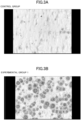
- Figs. 3A to 3C illustrate the images obtained for the control group, experimental group 1, and experimental group 2, respectively.
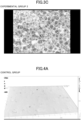
- Figs. 4A to 4C illustrate images acquired by 3D-processing the images obtained for the control group, experimental group 1, and experimental group 2, respectively.
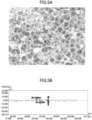
- Fig. 5A is a diagram illustrating the measurement positions of the surface profile. That is, the surface profile was measured along the line segment illustrated in Fig. 5A.
- Fig. 5B is a graph illustrating the measurement results of the surface profile. The horizontal axis of Fig. 5B represents the position, and the vertical axis represents the height (depth) from the baseline.
- the number of recesses with a diameter of 5 ⁇ m or more (first recesses) and recesses with a diameter of 1 ⁇ m or more and less than 5 ⁇ m (second recesses) was counted using a white interferometer-equipped laser microscope VK-X3000 (manufactured by Keyence Corporation), and the number per 1 mm 2 was obtained.
- the number of recesses having a depth of 1 ⁇ m or more from the baseline was counted.
- Table 3 presents the results. Note that the structure counted as the first recess had a diameter of 8.8 ⁇ m at most. [Table 3] Control Group Experimental Group 1 Experimental Group 2 First Recess (counts/mm 2 ) 0 256 768 Second Recess (counts/mm 2 ) 0 6000 9552
- experimental groups 1 and 2 where 200 to 2000 of the first recesses were provided per 1 mm 2 , had a high gas release amount and coverage as well as high effervescence compared to the control group where the first recesses could not be confirmed.
- Experimental group 2 where the number of second recesses per 1 mm 2 was 7000 to 15000, exhibited even higher effervescence.
Landscapes
- Engineering & Computer Science (AREA)
- Mechanical Engineering (AREA)
- Food Science & Technology (AREA)
- Nutrition Science (AREA)
- Life Sciences & Earth Sciences (AREA)
- Chemical & Material Sciences (AREA)
- Health & Medical Sciences (AREA)
- Polymers & Plastics (AREA)
- Details Of Rigid Or Semi-Rigid Containers (AREA)
- Non-Alcoholic Beverages (AREA)
- Rigid Containers With Two Or More Constituent Elements (AREA)
- Paints Or Removers (AREA)
- Table Devices Or Equipment (AREA)
- Wrappers (AREA)
Abstract
Description
- The present invention relates to an effervescent beverage can and a method for manufacturing the same.
- Effervescent beverages such as beer are sometimes provided in a sealed container. One important characteristic of effervescent beverages is their effervescence. Various considerations have been made to ensure that an appropriate amount of foam is obtained when the beverage is consumed.
- To enhance effervescence, some containers have been designed with modifications. For instance, Patent Literature 1 (
Japanese Patent No. 4758693 Patent Literature 1, the following three points are described: the inner surface of the can is coated with an organic resin coating layer; an organic resin coating material that contains a predetermined amount of large-diameter particles occupies 20% to 60% of the inner surface area of the can, while an organic resin coating material that contains a predetermined amount of small-diameter particles occupies the remaining of the inner surface area; and concave portions or convex portions formed by at least a part of the large-diameter particles that have detached or remained and concave portions formed by the small-diameter particles that have detached are present in the organic resin coating layer. - Patent Literature 1:
Japanese Patent No. 4758693 - The present inventors would like to further improve effervescence. Accordingly, an object of the present invention is to provide an effervescent beverage can capable of further improving the effervescence and a method for producing the same.
- The present inventors have found that the above object can be achieved by forming a predetermined structure on the inner surface of the can, and have completed the present invention. Specifically, the present invention is achieved by the following means.
- [1] An effervescent beverage can comprising: a top surface; a bottom surface; and a body, wherein an inner surface of the body is provided with a plurality of first recesses with a diameter of 5 µm or more and 20 µm or less, and the number of the plurality of first recesses is 200 to 2000 per 1 mm2.
- [2] The effervescent beverage can according to [1], wherein the inner surface of the body is provided with a plurality of second recesses with a diameter of 0.5 µm or more and less than 5 µm, and the number of the plurality of second recesses is 5000 to 20000 per 1 mm2.
- [3] The effervescent beverage can according to [1] or [2], wherein the inner surface of the body is provided with a resin layer, and the first recesses are formed in the resin layer.
- [4] The effervescent beverage can according to any one of [1] to [3], wherein the top surface is formed by a can lid configured to be opened in a fully open manner.
- [5] A method for manufacturing an effervescent beverage can including a top surface, a bottom surface, and a body, the method comprising: applying a paint containing resin and wax to an inner surface of the body or a region to become the inner surface of the body; and heat-treating the applied paint to form a resin layer and remove the wax, wherein an average particle diameter of the wax in the paint is 1 µm or more, and the amount of the wax contained in the paint is 7 to 40 parts by mass per 100 parts by mass of non-volatile components (excluding the wax).
- [6] The manufacturing method according to [5], wherein the wax includes polyethylene wax.
- [7] The manufacturing method according to [5] or [6], wherein the paint contains at least one resin selected from the group consisting of epoxy resins, acrylic resins, polyester resins, and urethane resins.
- [8] An effervescent beverage comprising: the beverage can according to any one of [1] to [4]; and an effervescent drinkable liquid filled in the beverage can.
- The present invention provides an effervescent beverage can capable of further improving the effervescence and a method for producing the same.
-
-
Fig. 1 is a cross-sectional view schematically illustrating a crater-like structure. -
Fig. 2 is a cross-sectional view schematically illustrating a method for forming a crater-like structure. -
Fig. 3A is a photomicrograph illustrating the inner surface of the body of the control group. -
Fig. 3B is a photomicrograph illustrating the inner surface of the body ofexperimental group 1. -
Fig. 3C is a photomicrograph illustrating the inner surface of the body ofexperimental group 2. -
Fig. 4A is a diagram illustrating a 3D image of the internal surface of the body of the control group. -
Fig. 4B is a diagram illustrating a 3D image of the inner surface of the body ofexperimental group 1. -
Fig. 4C is a diagram illustrating a 3D image of the inner surface of the body ofexperimental group 2. -
Fig. 5A is a diagram illustrating the measurement positions of the surface profile ofexperimental group 2. -
Fig. 5B is a graph illustrating the measurement results of the surface profile ofexperimental group 2. - Hereinafter, embodiments of the present invention are described in detail.
- An effervescent beverage can according to the present embodiment has a top surface, a body, and a bottom surface. The body and the bottom surface are integrated or joined to form a bottomed cylindrical shape, and the upper opening is closed by the top surface so as to be openable.
- The inner surface of the body is provided with a plurality of first recesses.
- Note that in the present specification, the term "recess" refers to a structure with a depth of 1 µm or more.
- The first recess has a substantially circular shape when viewed from the front. The first recess is a recess with a diameter of 5 µm or more and 20 µm or less.
- The number of first recesses is 200 to 2000, preferably 300 to 1500, and more preferably 400 to 1200, per 1 mm2.
- The average depth of the plurality of first recesses is, for example, 1 to 5 µm, preferably 2 to 4 µm.
- Note that the number and average depth of the first recesses can be obtained using, for example, a laser microscope.
- The first recess is preferably a crater-like structure.
Fig. 1 is a cross-sectional view schematically illustrating a crater-like structure. As shown inFig. 1 , the crater-like structure refers to a structure in which the edge portion of the recess is reversely raised. - Preferably, in the present embodiment, the inner surface of the body is further provided with a plurality of second recesses. The second recess has a diameter of 0.5 µm or more and less than 5 µm.
- The number of the plurality of second recesses is 5000 to 20000, preferably 7000 to 15000, per 1 mm2.
- The average depth of the plurality of second recesses is, for example, 1 to 5 µm, preferably 2 to 4 µm.
- The number and average depth of the second recesses can be obtained by the same method as for the first recesses.
- The second recess preferably has a crater-like structure as with the first recess.
- Preferably, the effervescent beverage can according to the present embodiment is made of metal. In addition, preferably, the inner surface of the body is provided with a resin layer obtained by applying and drying paint on a metal layer, and the first recesses and the second recesses are formed in the resin layer.
- The thickness of the resin layer is, for example, 1 to 10 µm, preferably 3 to 8 µm.
- It should be noted that in the present invention, the "resin layer" means a layer after drying the applied paint, and is distinguished from the layer of the paint before drying.
- Preferably, the can lid of the effervescent beverage can according to the present embodiment is a full open end. A full open end is a lid of the type in which a region accounting for 30% or more of the area of the ceiling surface of the can lid is opened. The region to be opened is preferably 50% or more of the ceiling surface of the can lid, more preferably 90% or more thereof, and further preferably the entire ceiling surface of the can lid.
- A preferred embodiment is, for example, a type of lid in which a circular ceiling surface of the can lid is scored (notched) over the entire circumference, and the entire lid ceiling surface is detached from the can body to be opened. On the other hand, the configuration may be such that the lid is not completely detached and a part of the lid remains on the can body. Compared to a regular can lid, the full open end makes it possible to visually grasp the effervescence from the can body, which leads to evoking the image of beer poured into a mug. In addition, since a larger amount of liquid flows into the mouth at the same angle compared to a regular can lid, it is possible to enjoy the foam and liquid at the same time.
- The capacity of the effervescent beverage can (the amount filled with the beverage) is, for example, 135 to 1000 ml, preferably 320 to 500 ml.
- In addition, when the lid is circular, the caliber of the effervescent beverage can is, for example, 200 to 211 caliber, preferably 202 to 206 caliber.
- Next, an example of a method for manufacturing the above-described effervescent beverage can is be described.
- The manufacturing method according to the present embodiment includes applying a paint containing resin and wax to an inner surface of the body (or a region to become the inner surface of the body); and subsequently heat-treating the applied paint to form a resin layer on the inner surface and remove the wax (hereinafter also referred to as the baking step).
- According to this method, the wax is removed to form recesses in the resin layer.
- Note that wax is typically used for the purpose of preventing scratches on the coated film in the can manufacturing process, but in the present specification, wax refers to a component that is in the form of solid particles at room temperature.
- For example, one method for forming a can body with a resin layer on the inner surface thereof is to first form a can body with a bottomed cylindrical shape using extrusion molding, and then applying the paint according to the present invention by spray coating and baking it to form the resin layer (the resulting can is called a two-piece can). Alternatively, a method for obtaining a can body with a bottomed cylindrical shape can be used, such as preparing a metal plate with a region to become the inner surface, applying paint to the region to become the inner surface, forming a resin layer by baking, then forming the metal plate with a resin layer into a cylindrical shape, and crimping the bottom of the can which becomes the bottom surface (the resulting can is called a three-piece can).
- The coating and baking steps of the paint are described in detail below.
- First, a paint containing resin and wax is prepared.
- As the paint, for example, a water-based paint can be used.
- As the resin contained in the paint, for example, epoxy resin, acrylic resin, polyester resin, urethane resin, and the like are used.
- The wax in the paint has an average particle diameter of 1 µm or more. The "average particle diameter" referred to here means the particle diameter (D50) at which the volume-based cumulative frequency is 50%. This value is measured using a dynamic light scattering particle size distribution measurement device ("Microtrac S3500" manufactured by Nikkiso Co., Ltd.) for a water dispersion containing about 20 mass% of wax, which is diluted 500 times with water.
- The average particle diameter of the wax is preferably 1 to 15 µm, more preferably 2 to 10 µm, and further preferably 3 to 8 µm.
- The content of the wax in the paint is, for example, 7 to 40 parts by mass, preferably 10 to 40 parts by mass, and more preferably 12 to 30 parts by mass, per 100 parts by mass of non-volatile components (excluding the wax) in the paint. Note that the non-volatile component (excluding the wax) as used herein refers to a component other than the wax among the components remaining on the adherend to form a resin layer after the paint is applied and baked.
- In addition, a plurality of waxes having different average particle diameters may be used in combination. By combining a plurality of waxes having different average particle diameters in this way, it becomes easier to control the size and the number of recesses.
- As the wax, for example, one having a softening point of 90 to 160°C, preferably 110 to 140°C, is used.
- Carnauba wax, polyethylene wax, and the like can be used as the wax.
- As the form of the wax, powder, paste, or water or solvent dispersion form can be appropriately used, but from the viewpoint of dispersion stability in the paint, it is preferable to use water or solvent dispersion form.
- The method for applying the paint in the present embodiment is preferably spray coating such as air spray, airless spray, or electrostatic spray, roll coater coating, dip coating, electrodeposition coating, and the like, and more preferably spray coating.
- In order to dry the paint and form a uniform resin layer, it is preferable to carry out the baking treatment immediately after application.
- The conditions in the baking step can be appropriately selected so that the paint can be dried and the resin layer can be formed, but are preferably 150 to 280°C for about 10 seconds to 30 minutes. Further, in order to melt the wax during this baking so as to cause detachment from the coated film, a temperature of 180 to 280°C for about 1 to 30 minutes is more preferable. The thickness of the resin layer after baking is, for example, 1 to 10 µm, preferably 3 to 8 µm.
-
Fig. 2 is a cross-sectional view schematically illustrating a method for forming a crater-like structure. As shown inFig. 2 , when the paint is applied and dried, the water and solvent are first volatilized to form theresin layer 1. Here, thewax 2 is temporarily placed so as to be embedded in theresin layer 1. Also, the upper portion of thewax 2 is exposed on the surface of theresin layer 1. Subsequently, during baking, thewax 2 melts and separates from theresin layer 1. This forms recesses having a crater-like structure in theresin layer 1. - Thereafter, beverage cans are manufactured, the cans are filled with the drinkable liquid, and sealed, similar to methods commonly used in the industry.
- The filling with the drinkable liquid is preferably carried out at a low temperature (such as 1 to 20°C).
- According to the method described above, a paint containing a specific amount of wax having a specific average particle diameter is used to form recesses of a specific size in the inner surface of the body with a specific density. Thus, by using an effervescent beverage can with such a special structure formed in a body at a specific density, it is possible to achieve extremely high effervescence.
- Note that the drinking liquid filled into the effervescent beverage can according to the present embodiment is not particularly limited as long as it is an effervescent liquid.
- Preferably, the drinking liquid to be filled is a beer-like effervescent beverage. The "beer-like effervescent beverage" refers to an effervescent beverage that has a flavor, taste, and texture equivalent or similar to beer, regardless of its alcohol content, use of malt and hops, and fermentation, and has a high thirst-quenching effect and drinkability (the ability to continue drinking without getting bored). The beer-like effervescent beverage may be an alcoholic beverage, or a so-called non-alcoholic beverage or low-alcoholic beverage having an alcohol content of less than 1% by volume. Moreover, it may be a malt-based beverage, a non-malt-based beverage, a fermented beverage produced through a fermentation process, or a non-fermented beverage produced without undergoing a fermentation process.
- Specific examples of beer-like effervescent beverages include beers, low-malt beers made from malt, effervescent alcoholic beverages containing no malt, low-alcohol effervescent beverages, and non-alcoholic beers. In addition, liqueurs obtained by mixing a beverage produced from malt through a fermentation process with an alcohol-containing distillate may also be used.
- More preferably, the drinking liquid to be filled is beer. When the effervescent beverage can according to the present embodiment is filled with beer, foam is generated from the inner surface of the can at the same time as the cap is opened, and the foam and beer can be drunk together.
- However, even when filled with beverages other than beer, the aroma components are volatilized and dispersed due to effervescence, allowing for a strong sensation of the flavor of the contents.
- Preferably, the effervescent beverage has a gas pressure of 2 to 4 gas volumes.
- In order to describe the present invention in more detail, examples carried out by the present inventors are described below.
- An aluminum container (350 ml capacity) having a bottom surface and a body was prepared. A water-based epoxy-acrylic paint containing 1 part by mass of carnauba wax having an average particle diameter of 0.3 µm per 100 parts by mass of non-volatile components (excluding the wax) in the paint was also prepared. The prepared paint was applied to the entire inner surface of the body of the container by spray coating, followed by heating at 200°C for 2 minutes to obtain a beverage can of the control group. The thickness of the body resin layer was 5 µm on average.
- As the wax, a wax having an average particle diameter of 6 µm was used in an amount of 7.5 parts by mass based on 100 parts by mass of non-volatile components (excluding the wax) in the paint. Otherwise, a beverage can according to Example 1 was obtained in the same manner as in the control group.
- As waxes, a wax having an average particle diameter of 6 µm (first wax) and a wax having an average particle diameter of 4 µm (second wax) were used. The amount of the first wax was 7.5 parts by mass based on 100 parts by mass of non-volatile components (excluding the wax) in the paint. The amount of the second wax was 7.5 parts by mass based on 100 parts by mass of non-volatile components (excluding the wax) in the paint.
- Other points were the same as those of the control group, and a beverage can according to
experimental group 2 was obtained. - In each of the prepared beverage cans, 350 ml of beer was poured in quietly, and the mass was measured. After that, it was left to stand for 5 minutes, and the mass was measured again. The difference in mass before and after allowing to stand for 5 minutes was calculated as the "gas release amount". The measurement was carried out on 5 cans for each beverage can. Table 1 below presents the upper limit value and lower limit value of the gas release amount measurement value for each beverage can.
[Table 1] Control Group Experimental Group 1 Experimental Group 2Gas Release Amount (g) 0.01 to 0.02 0.21 to 0.26 0.29 to 0.34 - As presented in Table 1, the gas release amount was significantly greater in
experimental group 1 andexperimental group 2 than in the control group. In addition,experimental group 2 was even greater thanexperimental group 1. The gas release amount represents the amount of gas released (magnitude of effervescence), that is, the greater this value, the higher the effervescence (greater effervescence). - Each prepared beverage can was filled with beer and closed on the top surface with a can lid in a fully open manner. After filling, the beverage can was allowed to stand at 4°C for 24 hours. Next, the coverage was evaluated by setting the criterion for the covering time (the time taken for the bubbles to rise from the beverage can upon opening the beverage can, covering the top end portion of the beverage can with the bubbles) as 10 seconds. Ten cans were tested for each beverage can, and the number of cans with a covering time of 10 seconds or less was counted. Table 2 presents the results.
[Table 2] Control Group Experimental Group 1 Experimental Group 2Number for which covering time was within 10 seconds (cans) 0 3 10 - As presented in Table 2, the coverage was also greater in
experimental group 2,experimental group 1, and the control group, in that order. Based on the evaluation results for coverage, it was found that bothexperimental groups experimental group 2 being particularly superior. - The surface condition of the inner surface of the body of each beverage can obtained was observed. Specifically, a white interferometer-equipped laser microscope VK-X3000 (manufactured by Keyence Corporation) was used to obtain an image of the inner surface of the body.
Figs. 3A to 3C illustrate the images obtained for the control group,experimental group 1, andexperimental group 2, respectively. In addition,Figs. 4A to 4C illustrate images acquired by 3D-processing the images obtained for the control group,experimental group 1, andexperimental group 2, respectively. - In addition,
experimental group 2 was subjected to surface profile measurement.Fig. 5A is a diagram illustrating the measurement positions of the surface profile. That is, the surface profile was measured along the line segment illustrated inFig. 5A. Fig. 5B is a graph illustrating the measurement results of the surface profile. The horizontal axis ofFig. 5B represents the position, and the vertical axis represents the height (depth) from the baseline. - Furthermore, based on the obtained image, the number of recesses with a diameter of 5 µm or more (first recesses) and recesses with a diameter of 1 µm or more and less than 5 µm (second recesses) was counted using a white interferometer-equipped laser microscope VK-X3000 (manufactured by Keyence Corporation), and the number per 1 mm2 was obtained.
- In counting the number of recesses, the number of recesses having a depth of 1 µm or more from the baseline was counted.
- Table 3 presents the results. Note that the structure counted as the first recess had a diameter of 8.8 µm at most.
[Table 3] Control Group Experimental Group 1 Experimental Group 2First Recess (counts/mm2) 0 256 768 Second Recess (counts/mm2) 0 6000 9552 - It was confirmed that
experimental groups Experimental group 2, where the number of second recesses per 1 mm2 was 7000 to 15000, exhibited even higher effervescence. -
- 1
- resin layer
- 2
- wax
Claims (11)
- An effervescent beverage can comprising:a top surface;a bottom surface; anda body, whereinan inner surface of the body is provided with a plurality of first recesses with a diameter of 5 µm or more and 20 µm or less, and the number of the plurality of first recesses is 200 to 2000 per 1 mm2.
- The effervescent beverage can according to claim 1, whereinthe inner surface of the body is provided with a plurality of second recesses with a diameter of 0.5 µm or more and less than 5 µm, andthe number of the plurality of second recesses is 5000 to 20000 per 1 mm2.
- The effervescent beverage can according to claim 1 or 2, whereinthe inner surface of the body is provided with a resin layer, andthe first recesses are formed in the resin layer.
- The effervescent beverage can according to any one of claims 1 to 3, wherein the top surface is formed by a can lid configured to be opened in a fully open manner.
- A method for manufacturing an effervescent beverage can including a top surface, a bottom surface, and a body, the method comprising:applying a paint containing resin and wax to an inner surface of the body or a region to become the inner surface of the body; andheat-treating the applied paint to form a resin layer and remove the wax, whereinan average particle diameter of the wax in the paint is 1 µm or more, andthe amount of the wax contained in the paint is 7 to 40 parts by mass per 100 parts by mass of non-volatile components (excluding the wax).
- The manufacturing method according to claim 5, wherein the wax includes polyethylene wax.
- The manufacturing method according to claim 5 or 6, wherein the paint contains at least one resin selected from the group consisting of epoxy resins, acrylic resins, polyester resins, and urethane resins.
- An effervescent beverage comprising:the beverage can according to any one of claims 1 to 4; andan effervescent drinkable liquid filled in the beverage can.
- An effervescent beverage comprising:a beverage can whose top surface is formed by a can lid configured to be opened in a fully open manner; and a drinkable liquid filled in the beverage can, whereinupon opening, the drinkable liquid is caused to effervesce so as to hide a top end portion of the beverage can.
- The effervescent beverage according to claim 9, which is a beer-taste beverage.
- A beverage can used for the effervescent beverage according to claim 9 or 10.
Applications Claiming Priority (3)
| Application Number | Priority Date | Filing Date | Title |
|---|---|---|---|
| JP2020219053 | 2020-12-28 | ||
| JP2021186547A JP7161596B2 (en) | 2020-12-28 | 2021-11-16 | Effervescent beverage can and manufacturing method thereof |
| PCT/JP2021/048574 WO2022145421A1 (en) | 2020-12-28 | 2021-12-27 | Can for effervescent beverage and manufacturing method therefor |
Publications (4)
| Publication Number | Publication Date |
|---|---|
| EP4269269A1 true EP4269269A1 (en) | 2023-11-01 |
| EP4269269A4 EP4269269A4 (en) | 2024-02-21 |
| EP4269269B1 EP4269269B1 (en) | 2024-10-02 |
| EP4269269C0 EP4269269C0 (en) | 2024-10-02 |
Family
ID=82260768
Family Applications (1)
| Application Number | Title | Priority Date | Filing Date |
|---|---|---|---|
| EP21915280.8A Active EP4269269B1 (en) | 2020-12-28 | 2021-12-27 | Can for effervescent beverage |
Country Status (8)
| Country | Link |
|---|---|
| US (1) | US20230391540A1 (en) |
| EP (1) | EP4269269B1 (en) |
| JP (4) | JP7216860B2 (en) |
| KR (2) | KR20240144461A (en) |
| AU (1) | AU2021414652B2 (en) |
| CA (1) | CA3206825C (en) |
| PL (1) | PL4269269T3 (en) |
| WO (1) | WO2022145421A1 (en) |
Families Citing this family (2)
| Publication number | Priority date | Publication date | Assignee | Title |
|---|---|---|---|---|
| JP7458172B2 (en) * | 2019-11-22 | 2024-03-29 | アサヒビール株式会社 | Can for carbonated beverages and method for manufacturing same |
| JP7161596B2 (en) * | 2020-12-28 | 2022-10-26 | アサヒビール株式会社 | Effervescent beverage can and manufacturing method thereof |
Family Cites Families (26)
| Publication number | Priority date | Publication date | Assignee | Title |
|---|---|---|---|---|
| US3904069A (en) * | 1972-01-31 | 1975-09-09 | American Can Co | Container |
| US6305210B1 (en) * | 1985-03-15 | 2001-10-23 | Weirton Steel Corporation | One-piece can bodies for pressure pack beverage cans |
| GB2224238B (en) * | 1988-10-19 | 1992-06-17 | Toyo Kohan Co Ltd | Improvements in polyester resin film laminated steel sheet |
| JPH0411372U (en) * | 1990-05-17 | 1992-01-30 | ||
| JPH0597149A (en) * | 1991-08-01 | 1993-04-20 | Mitsubishi Materials Corp | Foaming liquid container |
| JP4449132B2 (en) * | 1999-12-27 | 2010-04-14 | Jfeスチール株式会社 | Method for producing sparkling beverage cans |
| US6811843B2 (en) * | 2001-04-05 | 2004-11-02 | Appleton Papers Inc. | Insulated beverage or food container |
| PL200573B1 (en) * | 2002-01-10 | 2009-01-30 | Ball Corp | Metallic beverage can end with improved chuck wall and countersink |
| JP2004075087A (en) | 2002-08-12 | 2004-03-11 | Satoshi Takei | Can for carbonated beverage such as beer |
| JP4604578B2 (en) * | 2003-07-08 | 2011-01-05 | Jfeスチール株式会社 | Resin film-coated metal plate and resin film-coated metal can |
| JP4830363B2 (en) * | 2005-06-22 | 2011-12-07 | Jfeスチール株式会社 | Resin film-coated metal plate and resin film-coated metal can |
| JP4758693B2 (en) * | 2005-06-28 | 2011-08-31 | 大和製罐株式会社 | Can for sparkling beverage and method for producing the same |
| JP4710433B2 (en) | 2005-06-29 | 2011-06-29 | Jfeスチール株式会社 | LAMINATED METAL CAN, METHOD FOR PRODUCING THE SAME, AND METHOD FOR PRODUCING LAMINATED METAL PLATE |
| JP4899745B2 (en) * | 2006-09-22 | 2012-03-21 | Jfeスチール株式会社 | Resin film coated metal can |
| JP5104396B2 (en) * | 2008-02-26 | 2012-12-19 | Jfeスチール株式会社 | 3-piece metal can for beer and sparkling liquor and method for producing beer and sparkling can |
| KR101854476B1 (en) * | 2009-07-17 | 2018-06-14 | 발스파 소싱 인코포레이티드 | Coating composition and articles coated therewith |
| US20120100266A1 (en) * | 2010-10-20 | 2012-04-26 | Pepsico., Inc. | Control of bubble size in a carbonated liquid |
| JP5881301B2 (en) * | 2011-03-18 | 2016-03-09 | サントリー食品インターナショナル株式会社 | Bottled milk coffee drink |
| US20140178616A1 (en) * | 2012-12-20 | 2014-06-26 | Ppg Industries Ohio, Inc. | Polyurethane dispersions for coating containers |
| WO2015002958A1 (en) * | 2013-07-02 | 2015-01-08 | Valspar Sourcing, Inc. | Coating compositions for packaging articles such as food and beverage containers |
| US20150144522A1 (en) * | 2013-11-25 | 2015-05-28 | LiquiGlide Inc. | Nucleation and destabilization of liquids on liquid-impregnated surfaces |
| CN105813955A (en) | 2013-12-13 | 2016-07-27 | 米迪斯有限公司 | Beverage container with recessed top and method of using same |
| US10392515B2 (en) * | 2017-08-25 | 2019-08-27 | Ppg Industries Ohio, Inc. | Metal cans coated with shellac-containing coatings |
| EP3450352A1 (en) * | 2017-09-01 | 2019-03-06 | PPG Industries Ohio, Inc. | Use of a coating composition |
| US20200224053A1 (en) * | 2017-09-19 | 2020-07-16 | Swimc Llc | Coating compositions including a resole phenolic resin, articles, and methods of coating |
| JP7388140B2 (en) * | 2018-11-13 | 2023-11-29 | 東洋製罐グループホールディングス株式会社 | Coating composition and coated metal substrate having a coating film made of the coating composition |
-
2021
- 2021-12-27 KR KR1020247031340A patent/KR20240144461A/en active Pending
- 2021-12-27 AU AU2021414652A patent/AU2021414652B2/en active Active
- 2021-12-27 KR KR1020237024662A patent/KR102709657B1/en active Active
- 2021-12-27 WO PCT/JP2021/048574 patent/WO2022145421A1/en not_active Ceased
- 2021-12-27 PL PL21915280.8T patent/PL4269269T3/en unknown
- 2021-12-27 US US18/259,573 patent/US20230391540A1/en active Pending
- 2021-12-27 EP EP21915280.8A patent/EP4269269B1/en active Active
- 2021-12-27 CA CA3206825A patent/CA3206825C/en active Active
-
2022
- 2022-07-07 JP JP2022109927A patent/JP7216860B2/en active Active
- 2022-07-07 JP JP2022109925A patent/JP7377922B2/en active Active
- 2022-07-07 JP JP2022109926A patent/JP7465913B2/en active Active
-
2023
- 2023-01-20 JP JP2023007530A patent/JP2023037026A/en active Pending
Also Published As
| Publication number | Publication date |
|---|---|
| JP2022163010A (en) | 2022-10-25 |
| JP7216860B2 (en) | 2023-02-01 |
| KR20230119235A (en) | 2023-08-16 |
| KR20240144461A (en) | 2024-10-02 |
| EP4269269B1 (en) | 2024-10-02 |
| WO2022145421A1 (en) | 2022-07-07 |
| CA3206825A1 (en) | 2022-07-07 |
| NZ802342A (en) | 2024-07-05 |
| AU2021414652B2 (en) | 2023-11-16 |
| TW202233488A (en) | 2022-09-01 |
| KR102709657B1 (en) | 2024-09-26 |
| US20230391540A1 (en) | 2023-12-07 |
| CA3206825C (en) | 2023-10-17 |
| JP2023037026A (en) | 2023-03-14 |
| EP4269269A4 (en) | 2024-02-21 |
| JP2022132682A (en) | 2022-09-09 |
| AU2021414652A1 (en) | 2023-08-17 |
| JP7377922B2 (en) | 2023-11-10 |
| JP7465913B2 (en) | 2024-04-11 |
| EP4269269C0 (en) | 2024-10-02 |
| JP2022153430A (en) | 2022-10-12 |
| PL4269269T3 (en) | 2024-11-18 |
Similar Documents
| Publication | Publication Date | Title |
|---|---|---|
| JP7673155B2 (en) | Can for carbonated beverages and method for manufacturing same | |
| EP4269269B1 (en) | Can for effervescent beverage | |
| CN116670038B (en) | Can for sparkling beverage and method for producing same | |
| JP2025183962A (en) | Sparkling drink cans and canned sparkling drinks | |
| JP7161596B2 (en) | Effervescent beverage can and manufacturing method thereof | |
| WO2022211080A1 (en) | Packaged carbonated drink, and method for foaming carbonated drink | |
| WO2026086020A1 (en) | Beverage can body and manufacturing method therefor, and beverage can and manufacturing method therefor | |
| JP2024002607A (en) | Canned and packaged sparkling beverages | |
| JP4449132B2 (en) | Method for producing sparkling beverage cans | |
| TWI924752B (en) | Can for foaming beverage and foaming beverage | |
| KR102935562B1 (en) | Beverage can body and manufacturing method thereof, beverage can and manufacturing method thereof | |
| HK40089986B (en) | Can for effervescent beverage and manufacturing method therefor | |
| HK40089986A (en) | Can for effervescent beverage and manufacturing method therefor | |
| JP5104396B2 (en) | 3-piece metal can for beer and sparkling liquor and method for producing beer and sparkling can | |
| RU2336173C2 (en) | Sheet material for blanking, metal container made of such sheet material, and method of sheet material production | |
| CN112165887A (en) | Container with foaming effect | |
| WO2025035055A1 (en) | Packaging and beverage elements for nucleation and foam generation | |
| JP2008056358A (en) | Bottle can made of metal | |
| WO2026035295A1 (en) | Nitrogen flushing of aluminum packaging to preserve nucleating effect in a nucleating can after filling and pasteurization | |
| JP2008094467A (en) | Metal cap with excellent grip | |
| JP2010042850A (en) | Sparkling drink container |
Legal Events
| Date | Code | Title | Description |
|---|---|---|---|
| STAA | Information on the status of an ep patent application or granted ep patent |
Free format text: STATUS: THE INTERNATIONAL PUBLICATION HAS BEEN MADE |
|
| PUAI | Public reference made under article 153(3) epc to a published international application that has entered the european phase |
Free format text: ORIGINAL CODE: 0009012 |
|
| STAA | Information on the status of an ep patent application or granted ep patent |
Free format text: STATUS: REQUEST FOR EXAMINATION WAS MADE |
|
| 17P | Request for examination filed |
Effective date: 20230719 |
|
| AK | Designated contracting states |
Kind code of ref document: A1 Designated state(s): AL AT BE BG CH CY CZ DE DK EE ES FI FR GB GR HR HU IE IS IT LI LT LU LV MC MK MT NL NO PL PT RO RS SE SI SK SM TR |
|
| A4 | Supplementary search report drawn up and despatched |
Effective date: 20240122 |
|
| RIC1 | Information provided on ipc code assigned before grant |
Ipc: B65D 85/73 20060101ALI20240116BHEP Ipc: B65D 6/00 20060101ALI20240116BHEP Ipc: A23L 2/00 20060101ALI20240116BHEP Ipc: B65D 25/14 20060101ALI20240116BHEP Ipc: B65D 8/04 20060101AFI20240116BHEP |
|
| DAV | Request for validation of the european patent (deleted) | ||
| DAX | Request for extension of the european patent (deleted) | ||
| GRAP | Despatch of communication of intention to grant a patent |
Free format text: ORIGINAL CODE: EPIDOSNIGR1 |
|
| STAA | Information on the status of an ep patent application or granted ep patent |
Free format text: STATUS: GRANT OF PATENT IS INTENDED |
|
| INTG | Intention to grant announced |
Effective date: 20240603 |
|
| GRAS | Grant fee paid |
Free format text: ORIGINAL CODE: EPIDOSNIGR3 |
|
| GRAA | (expected) grant |
Free format text: ORIGINAL CODE: 0009210 |
|
| STAA | Information on the status of an ep patent application or granted ep patent |
Free format text: STATUS: THE PATENT HAS BEEN GRANTED |
|
| AK | Designated contracting states |
Kind code of ref document: B1 Designated state(s): AL AT BE BG CH CY CZ DE DK EE ES FI FR GB GR HR HU IE IS IT LI LT LU LV MC MK MT NL NO PL PT RO RS SE SI SK SM TR |
|
| REG | Reference to a national code |
Ref country code: GB Ref legal event code: FG4D |
|
| REG | Reference to a national code |
Ref country code: CH Ref legal event code: EP |
|
| REG | Reference to a national code |
Ref country code: IE Ref legal event code: FG4D |
|
| REG | Reference to a national code |
Ref country code: DE Ref legal event code: R096 Ref document number: 602021019736 Country of ref document: DE |
|
| U01 | Request for unitary effect filed |
Effective date: 20241002 |
|
| U07 | Unitary effect registered |
Designated state(s): AT BE BG DE DK EE FI FR IT LT LU LV MT NL PT RO SE SI Effective date: 20241017 |
|
| U20 | Renewal fee for the european patent with unitary effect paid |
Year of fee payment: 4 Effective date: 20241227 |
|
| PG25 | Lapsed in a contracting state [announced via postgrant information from national office to epo] |
Ref country code: HR Free format text: LAPSE BECAUSE OF FAILURE TO SUBMIT A TRANSLATION OF THE DESCRIPTION OR TO PAY THE FEE WITHIN THE PRESCRIBED TIME-LIMIT Effective date: 20241002 Ref country code: IS Free format text: LAPSE BECAUSE OF FAILURE TO SUBMIT A TRANSLATION OF THE DESCRIPTION OR TO PAY THE FEE WITHIN THE PRESCRIBED TIME-LIMIT Effective date: 20250202 |
|
| PG25 | Lapsed in a contracting state [announced via postgrant information from national office to epo] |
Ref country code: ES Free format text: LAPSE BECAUSE OF FAILURE TO SUBMIT A TRANSLATION OF THE DESCRIPTION OR TO PAY THE FEE WITHIN THE PRESCRIBED TIME-LIMIT Effective date: 20241002 |
|
| PG25 | Lapsed in a contracting state [announced via postgrant information from national office to epo] |
Ref country code: NO Free format text: LAPSE BECAUSE OF FAILURE TO SUBMIT A TRANSLATION OF THE DESCRIPTION OR TO PAY THE FEE WITHIN THE PRESCRIBED TIME-LIMIT Effective date: 20250102 |
|
| PG25 | Lapsed in a contracting state [announced via postgrant information from national office to epo] |
Ref country code: GR Free format text: LAPSE BECAUSE OF FAILURE TO SUBMIT A TRANSLATION OF THE DESCRIPTION OR TO PAY THE FEE WITHIN THE PRESCRIBED TIME-LIMIT Effective date: 20250103 |
|
| PG25 | Lapsed in a contracting state [announced via postgrant information from national office to epo] |
Ref country code: RS Free format text: LAPSE BECAUSE OF FAILURE TO SUBMIT A TRANSLATION OF THE DESCRIPTION OR TO PAY THE FEE WITHIN THE PRESCRIBED TIME-LIMIT Effective date: 20250102 |
|
| PG25 | Lapsed in a contracting state [announced via postgrant information from national office to epo] |
Ref country code: SM Free format text: LAPSE BECAUSE OF FAILURE TO SUBMIT A TRANSLATION OF THE DESCRIPTION OR TO PAY THE FEE WITHIN THE PRESCRIBED TIME-LIMIT Effective date: 20241002 |
|
| PG25 | Lapsed in a contracting state [announced via postgrant information from national office to epo] |
Ref country code: MC Free format text: LAPSE BECAUSE OF FAILURE TO SUBMIT A TRANSLATION OF THE DESCRIPTION OR TO PAY THE FEE WITHIN THE PRESCRIBED TIME-LIMIT Effective date: 20241002 |
|
| PG25 | Lapsed in a contracting state [announced via postgrant information from national office to epo] |
Ref country code: SK Free format text: LAPSE BECAUSE OF FAILURE TO SUBMIT A TRANSLATION OF THE DESCRIPTION OR TO PAY THE FEE WITHIN THE PRESCRIBED TIME-LIMIT Effective date: 20241002 |
|
| REG | Reference to a national code |
Ref country code: CH Ref legal event code: PL |
|
| PLBE | No opposition filed within time limit |
Free format text: ORIGINAL CODE: 0009261 |
|
| STAA | Information on the status of an ep patent application or granted ep patent |
Free format text: STATUS: NO OPPOSITION FILED WITHIN TIME LIMIT |
|
| 26N | No opposition filed |
Effective date: 20250703 |
|
| PG25 | Lapsed in a contracting state [announced via postgrant information from national office to epo] |
Ref country code: CH Free format text: LAPSE BECAUSE OF NON-PAYMENT OF DUE FEES Effective date: 20241231 |
|
| PG25 | Lapsed in a contracting state [announced via postgrant information from national office to epo] |
Ref country code: IE Free format text: LAPSE BECAUSE OF NON-PAYMENT OF DUE FEES Effective date: 20241227 |
|
| U20 | Renewal fee for the european patent with unitary effect paid |
Year of fee payment: 5 Effective date: 20251110 |
|
| PGFP | Annual fee paid to national office [announced via postgrant information from national office to epo] |
Ref country code: GB Payment date: 20251114 Year of fee payment: 5 |
|
| PGFP | Annual fee paid to national office [announced via postgrant information from national office to epo] |
Ref country code: CZ Payment date: 20251219 Year of fee payment: 5 |
|
| PGFP | Annual fee paid to national office [announced via postgrant information from national office to epo] |
Ref country code: PL Payment date: 20251028 Year of fee payment: 5 |