EP4268917A1 - Vorrichtung zur entfernung von lösungsmitteln und verfahren zur herstellung von mikrokügelchen damit - Google Patents
Vorrichtung zur entfernung von lösungsmitteln und verfahren zur herstellung von mikrokügelchen damit Download PDFInfo
- Publication number
- EP4268917A1 EP4268917A1 EP21911309.9A EP21911309A EP4268917A1 EP 4268917 A1 EP4268917 A1 EP 4268917A1 EP 21911309 A EP21911309 A EP 21911309A EP 4268917 A1 EP4268917 A1 EP 4268917A1
- Authority
- EP
- European Patent Office
- Prior art keywords
- tank body
- emulsion
- raw material
- fluid supply
- supply part
- Prior art date
- Legal status (The legal status is an assumption and is not a legal conclusion. Google has not performed a legal analysis and makes no representation as to the accuracy of the status listed.)
- Granted
Links
Images


Classifications
-
- B—PERFORMING OPERATIONS; TRANSPORTING
- B01—PHYSICAL OR CHEMICAL PROCESSES OR APPARATUS IN GENERAL
- B01D—SEPARATION
- B01D1/00—Evaporating
- B01D1/14—Evaporating with heated gases or vapours or liquids in contact with the liquid
-
- C—CHEMISTRY; METALLURGY
- C08—ORGANIC MACROMOLECULAR COMPOUNDS; THEIR PREPARATION OR CHEMICAL WORKING-UP; COMPOSITIONS BASED THEREON
- C08G—MACROMOLECULAR COMPOUNDS OBTAINED OTHERWISE THAN BY REACTIONS ONLY INVOLVING UNSATURATED CARBON-TO-CARBON BONDS
- C08G63/00—Macromolecular compounds obtained by reactions forming a carboxylic ester link in the main chain of the macromolecule
- C08G63/88—Post-polymerisation treatment
- C08G63/90—Purification; Drying
-
- A—HUMAN NECESSITIES
- A61—MEDICAL OR VETERINARY SCIENCE; HYGIENE
- A61K—PREPARATIONS FOR MEDICAL, DENTAL OR TOILETRY PURPOSES
- A61K9/00—Medicinal preparations characterised by special physical form
- A61K9/14—Particulate form, e.g. powders, Processes for size reducing of pure drugs or the resulting products, Pure drug nanoparticles
- A61K9/16—Agglomerates; Granulates; Microbeadlets ; Microspheres; Pellets; Solid products obtained by spray drying, spray freeze drying, spray congealing,(multiple) emulsion solvent evaporation or extraction
- A61K9/1682—Processes
- A61K9/1694—Processes resulting in granules or microspheres of the matrix type containing more than 5% of excipient
-
- A—HUMAN NECESSITIES
- A61—MEDICAL OR VETERINARY SCIENCE; HYGIENE
- A61K—PREPARATIONS FOR MEDICAL, DENTAL OR TOILETRY PURPOSES
- A61K9/00—Medicinal preparations characterised by special physical form
- A61K9/14—Particulate form, e.g. powders, Processes for size reducing of pure drugs or the resulting products, Pure drug nanoparticles
- A61K9/16—Agglomerates; Granulates; Microbeadlets ; Microspheres; Pellets; Solid products obtained by spray drying, spray freeze drying, spray congealing,(multiple) emulsion solvent evaporation or extraction
- A61K9/1605—Excipients; Inactive ingredients
- A61K9/1629—Organic macromolecular compounds
- A61K9/1641—Organic macromolecular compounds obtained otherwise than by reactions only involving carbon-to-carbon unsaturated bonds, e.g. polyethylene glycol, poloxamers
- A61K9/1647—Polyesters, e.g. poly(lactide-co-glycolide)
-
- A—HUMAN NECESSITIES
- A61—MEDICAL OR VETERINARY SCIENCE; HYGIENE
- A61K—PREPARATIONS FOR MEDICAL, DENTAL OR TOILETRY PURPOSES
- A61K9/00—Medicinal preparations characterised by special physical form
- A61K9/14—Particulate form, e.g. powders, Processes for size reducing of pure drugs or the resulting products, Pure drug nanoparticles
- A61K9/16—Agglomerates; Granulates; Microbeadlets ; Microspheres; Pellets; Solid products obtained by spray drying, spray freeze drying, spray congealing,(multiple) emulsion solvent evaporation or extraction
- A61K9/1682—Processes
-
- B—PERFORMING OPERATIONS; TRANSPORTING
- B01—PHYSICAL OR CHEMICAL PROCESSES OR APPARATUS IN GENERAL
- B01D—SEPARATION
- B01D1/00—Evaporating
-
- B—PERFORMING OPERATIONS; TRANSPORTING
- B01—PHYSICAL OR CHEMICAL PROCESSES OR APPARATUS IN GENERAL
- B01D—SEPARATION
- B01D1/00—Evaporating
- B01D1/0011—Heating features
-
- B—PERFORMING OPERATIONS; TRANSPORTING
- B01—PHYSICAL OR CHEMICAL PROCESSES OR APPARATUS IN GENERAL
- B01D—SEPARATION
- B01D1/00—Evaporating
- B01D1/30—Accessories for evaporators ; Constructional details thereof
-
- B—PERFORMING OPERATIONS; TRANSPORTING
- B01—PHYSICAL OR CHEMICAL PROCESSES OR APPARATUS IN GENERAL
- B01D—SEPARATION
- B01D11/00—Solvent extraction
- B01D11/04—Solvent extraction of solutions which are liquid
-
- B—PERFORMING OPERATIONS; TRANSPORTING
- B01—PHYSICAL OR CHEMICAL PROCESSES OR APPARATUS IN GENERAL
- B01D—SEPARATION
- B01D11/00—Solvent extraction
- B01D11/04—Solvent extraction of solutions which are liquid
- B01D11/0446—Juxtaposition of mixers-settlers
- B01D11/0469—Juxtaposition of mixers-settlers with gas agitation
-
- B—PERFORMING OPERATIONS; TRANSPORTING
- B01—PHYSICAL OR CHEMICAL PROCESSES OR APPARATUS IN GENERAL
- B01D—SEPARATION
- B01D11/00—Solvent extraction
- B01D11/04—Solvent extraction of solutions which are liquid
- B01D11/0492—Applications, solvents used
-
- B—PERFORMING OPERATIONS; TRANSPORTING
- B01—PHYSICAL OR CHEMICAL PROCESSES OR APPARATUS IN GENERAL
- B01D—SEPARATION
- B01D11/00—Solvent extraction
- B01D11/04—Solvent extraction of solutions which are liquid
- B01D11/0496—Solvent extraction of solutions which are liquid by extraction in microfluidic devices
-
- B—PERFORMING OPERATIONS; TRANSPORTING
- B01—PHYSICAL OR CHEMICAL PROCESSES OR APPARATUS IN GENERAL
- B01D—SEPARATION
- B01D17/00—Separation of liquids, not provided for elsewhere, e.g. by thermal diffusion
- B01D17/02—Separation of non-miscible liquids
- B01D17/04—Breaking emulsions
-
- B—PERFORMING OPERATIONS; TRANSPORTING
- B01—PHYSICAL OR CHEMICAL PROCESSES OR APPARATUS IN GENERAL
- B01D—SEPARATION
- B01D3/00—Distillation or related exchange processes in which liquids are contacted with gaseous media, e.g. stripping
- B01D3/34—Distillation or related exchange processes in which liquids are contacted with gaseous media, e.g. stripping with one or more auxiliary substances
- B01D3/343—Distillation or related exchange processes in which liquids are contacted with gaseous media, e.g. stripping with one or more auxiliary substances the substance being a gas
- B01D3/346—Distillation or related exchange processes in which liquids are contacted with gaseous media, e.g. stripping with one or more auxiliary substances the substance being a gas the gas being used for removing vapours, e.g. transport gas
-
- B—PERFORMING OPERATIONS; TRANSPORTING
- B01—PHYSICAL OR CHEMICAL PROCESSES OR APPARATUS IN GENERAL
- B01D—SEPARATION
- B01D35/00—Filtering devices having features not specifically covered by groups B01D24/00 - B01D33/00, or for applications not specifically covered by groups B01D24/00 - B01D33/00; Auxiliary devices for filtration; Filter housing constructions
- B01D35/02—Filters adapted for location in special places, e.g. pipe-lines, pumps, stop-cocks
-
- B—PERFORMING OPERATIONS; TRANSPORTING
- B01—PHYSICAL OR CHEMICAL PROCESSES OR APPARATUS IN GENERAL
- B01D—SEPARATION
- B01D35/00—Filtering devices having features not specifically covered by groups B01D24/00 - B01D33/00, or for applications not specifically covered by groups B01D24/00 - B01D33/00; Auxiliary devices for filtration; Filter housing constructions
- B01D35/02—Filters adapted for location in special places, e.g. pipe-lines, pumps, stop-cocks
- B01D35/027—Filters adapted for location in special places, e.g. pipe-lines, pumps, stop-cocks rigidly mounted in or on tanks or reservoirs
-
- B—PERFORMING OPERATIONS; TRANSPORTING
- B01—PHYSICAL OR CHEMICAL PROCESSES OR APPARATUS IN GENERAL
- B01J—CHEMICAL OR PHYSICAL PROCESSES, e.g. CATALYSIS OR COLLOID CHEMISTRY; THEIR RELEVANT APPARATUS
- B01J2/00—Processes or devices for granulating materials, e.g. fertilisers in general; Rendering particulate materials free flowing in general, e.g. making them hydrophobic
- B01J2/02—Processes or devices for granulating materials, e.g. fertilisers in general; Rendering particulate materials free flowing in general, e.g. making them hydrophobic by dividing the liquid material into drops, e.g. by spraying, and solidifying the drops
- B01J2/06—Processes or devices for granulating materials, e.g. fertilisers in general; Rendering particulate materials free flowing in general, e.g. making them hydrophobic by dividing the liquid material into drops, e.g. by spraying, and solidifying the drops in a liquid medium
-
- C—CHEMISTRY; METALLURGY
- C08—ORGANIC MACROMOLECULAR COMPOUNDS; THEIR PREPARATION OR CHEMICAL WORKING-UP; COMPOSITIONS BASED THEREON
- C08F—MACROMOLECULAR COMPOUNDS OBTAINED BY REACTIONS ONLY INVOLVING CARBON-TO-CARBON UNSATURATED BONDS
- C08F6/00—Post-polymerisation treatments
- C08F6/14—Treatment of polymer emulsions
-
- C—CHEMISTRY; METALLURGY
- C08—ORGANIC MACROMOLECULAR COMPOUNDS; THEIR PREPARATION OR CHEMICAL WORKING-UP; COMPOSITIONS BASED THEREON
- C08G—MACROMOLECULAR COMPOUNDS OBTAINED OTHERWISE THAN BY REACTIONS ONLY INVOLVING UNSATURATED CARBON-TO-CARBON BONDS
- C08G65/00—Macromolecular compounds obtained by reactions forming an ether link in the main chain of the macromolecule
- C08G65/02—Macromolecular compounds obtained by reactions forming an ether link in the main chain of the macromolecule from cyclic ethers by opening of the heterocyclic ring
- C08G65/30—Post-polymerisation treatment, e.g. recovery, purification, drying
Definitions
- the present invention relates to a solvent removing apparatus and a method of producing a microsphere by using the solvent removing apparatus, and more particularly, to a solvent removing apparatus for extracting and removing a solvent of an emulsion used for producing a microsphere, and a method of producing a microsphere by using the solvent removing apparatus.
- PDDS Polymeric Drug-Delivery System
- PLA polylactic acid
- PGA polyglycolic
- the biodegradable polymer may be prepared in the form of microspheres by various known techniques.
- the most frequently used method is dissolving the biodegradable polymer or the material to be encapsulated with the biodegradable polymer (pharmaceutical or other active agent) in a solvent by using a known method, and dispersing or emulsifying the dissolved polymer in an aqueous solution containing a surfactant. Subsequently, the solvent is removed from the microsphere and dried to obtain a microsphere product.
- a toxic solvent such as dichloromethane or chloroform
- dichloromethane or chloroform is mainly used to dissolve the biodegradable polymer and the active agent, and sufficient time and effort need be devoted to the removal of the solvent so that these solvents do not remain in the microsphere product that is the final product, thereby increasing the time to obtain the microsphere product, and acting as a hindrance to mass production. Accordingly, efforts have been made to mass-produce high-quality microspheres at low cost.
- Patent Document 1 Korean Patent Application Publication No. 10 2019-0084276
- the present invention has been made in an effort to solve the problems in the related art, and provides a solvent removing apparatus which efficiently extracts and removing a solvent from a dispersed phase of an emulsion used for producing a microsphere and has a simple configuration.
- the present invention has also been made in an effort to solve the problems in the related art, and provides a method of producing a microsphere by using the solvent removing apparatus.
- an apparatus for removing a solven includes a tank body configured to accommodate an emulsion including a first raw material of a continuous phase and a second raw material of a dispersed phase, a fluid supply part configured to supply a fluid into the tank body and form a flow in the emulsion, and an exhaust part configured to discharge gas inside the tank body to the outside of the tank body.
- the fluid supply part includes a first fluid supply part and a second fluid supply part. The first fluid supply part and the second fluid supply part are disposed while being spaced apart from each other inside the tank body, so that a rotational flow is formed in the emulsion by the fluid supplied through the first fluid supply part and the second fluid supply part.
- the fluid supply part may supply gas bubbles to the emulsion accommodated inside the tank body.
- the first fluid supply part and the second fluid supply part may supply the fluids in different directions.
- the tank body may have a bottom portion formed on a plane formed by a first direction and a second direction perpendicular to the first direction, and a lateral wall portion extended in a third direction perpendicular to the first direction and the second direction.
- the first fluid supply part and the second fluid supply part may be spaced apart from each other in the first direction, be spaced apart from each other in the second direction, and be spaced apart from each other in the third direction.
- the exhaust part may suck in the gas inside the tank body and depressurizes the inside of the tank body.
- the apparatus may further include a liquid supply part configured to supply a liquid into the tank body.
- the liquid may include a main ingredient of the continuous phase.
- the apparatus may further include a liquid discharge part configured to discharge a part of the continuous phase of the emulsion inside the tank body to the outside of the tank body.
- an apparatus for removing a solven includes a tank body configured to accommodate an emulsion including a first raw material of a continuous phase and a second raw material of a dispersed phase, a fluid supply part configured to supply a fluid into the tank body and form a flow in the emulsion, an exhaust part configured to discharge gas inside the tank body to the outside of the tank body, and a liquid discharge part configured to discharge a part of the continuous phase of the emulsion inside the tank body to the outside of the tank body.
- the liquid discharge part has a pipe portion extended into the tank body and an expanded pipe portion connected to a distal end of the pipe portion.
- the expanded pipe portion is located at a first height from a bottom portion of the tank body, and is in contact with a water level surface of the emulsion to maintain an appropriate volume of the emulsion inside the tank body.
- a filter may be formed in the expanded pipe portion, so that only the continuous phase of the emulsion passes through the filter and the dispersed phase of the emulsion or microspheres solidified from the dispersed phase do not pass through the filter.
- the first raw material may include purified water and surfactant
- the second raw material includes an organic solvent, a biodegradable polymer, and a drug.
- the apparatus may further include a heating part configured to heat the emulsion inside the tank body.
- a method of producing a microsphere by using a solvent removing apparatus including a tank body, a fluid supply part for supplying a fluid into the tank body, and an exhaust part for discharging gas inside the tank body to the outside of the tank body, includes preparing a first raw material, and preparing a second raw material including a biodegradable polymer, a drug, and a solvent, forming an emulsion including the first raw material of a continuous phase and the second raw material of a dispersed phase by using the first raw material and the second raw material, and extracting and removing the solvent from the dispersed phase of the emulsion by using the solvent removing apparatus to form a microsphere.
- the fluid supply part may form a rotational flow in the emulsion by supplying gas bubbles to the emulsion accommodated in the tank body.
- the solvent removing apparatus may further include a liquid supply part for supplying a liquid into the tank body, and a liquid discharge part for discharging a part of the continuous phase of the emulsion inside the tank body to the outside of the tank body.
- the liquid may be supplied into the tank body, the liquid may include a main ingredient of the continuous phase, and a water level surface of the emulsion may be maintained with a predetermined appropriate water level surface by discharging a part of the continuous phase of the emulsion inside the tank body to the outside of the tank body.
- the first raw material may include purified water and a surfactant.
- the solvent of the second raw material may be an organic solvent.
- the solvent removing apparatus includes a fluid supply part which supplies a fluid into the tank body to form a flow in the emulsion, and an exhaust part which discharges the gas inside the tank body to the outside of the tank, thereby easily extracting and evaporating the solvent even without an impeller or stirrer structure coupled to a shaft rotated by using a motor. Accordingly, the solvent removing apparatus has a simpler configuration that that of the structure in the related art, and may have an advantageous operation effect in sealing and the like for washing and sterilizing the inside of the tank body.
- the solvent removing apparatus further includes the liquid supply part which supplies the liquid into the tank body and the liquid discharge part which discharges some of the continuous phase of the emulsion inside the tank body to the outside of the tank body, so that the solvent may be efficiently and continuously extracted and evaporated.
- FIG. 1 is a schematic diagram illustrating a solvent removing apparatus according to an exemplary embodiment of the present invention.
- the solvent removing apparatus may include a tank body 100, a liquid supply part 200, a liquid discharging part 300, a fluid supplying part 400, an exhaust part 500, and a heating part 600.
- the tank body 100 may accommodate an emulsion including a first raw material of a continuous phase and a second raw material of a dispersed phase.
- the tank body 100 may include a wall body 110 forming a space for accommodating the emulsion EM therein.
- the tank body 100 may include a bottom portion formed on a plane formed by a first direction D1 and a second direction D2 perpendicular to the first direction D1, and include a lateral wall portion extending in a third direction D3 perpendicular to the first direction D1 and the second direction D2.
- the first raw material may include purified water and surfactant.
- the first raw material may be an aqueous solution in which polyvinyl alcohol (PVA) is dissolved as a surfactant in pure water.
- PVA polyvinyl alcohol
- the type of the surfactant is not particularly limited, and any biodegradable polymer solution may be used as long as the biodegradable polymer solution can help the forming of a dispersed phase of stable droplets in an aqueous solution phase that is a continuous phase.
- the surfactant may be preferably selected from the group consisting of methylcellulose, polyvinylpyrrolidone, carboxymethylcellulose, lecithin, gelatin, polyvinyl alcohol, polyoxyethylene sorbitan fatty acid ester, polyoxyethylene castor oil derivatives, and mixtures thereof.
- the second raw material is an oil-phase solution, and may include an organic solvent, a biodegradable polymer dissolved therein, and a drug.
- the organic solvent is a solvent used to dissolve the biodegradable polymer, and may have water-immiscible properties.
- the type of organic solvent dissolving the biodegradable polymer is not particularly limited, but may be preferably selected from the group consisting of dichloromethane, chloroform, ethyl acetate, acetone, acetonitrile, dimethyl sulfoxide, dimethylformamide, methyl ethyl ketone, acetic acid, methyl alcohol, ethyl alcohol, propyl alcohol, benzyl alcohol, and a mixed solvent thereof.
- the type of the biodegradable polymer is not particularly limited, but polyester may be preferably used, and in particular, the biodegradable polymer may be selected from the group consisting of polylactide, polyglycolide, poly(lactide-co-glycolide), poly(lactide-co-glycolide) glucose, polycaprolactone, and mixtures thereof.
- the drug may be selected from antipsychotic drugs, such as dementia treatment drug, Parkinson's disease treatment, anticancer drugs, antianxiety drugs, antidepressants, tranquilizers, and psychotropic drugs; cardiovascular treatment agents, such as hyperlipidemia agents, antihypertensive agents, hypotensive agents, antithrombotic agents, vasodilators, and arrhythmias; gastrointestinal treatment agents, such as epilepsy treatment agent and anti-ulcer agent; hormonal drugs, such as rheumatoid treatment agent; antispasmodics; tuberculosis treatment agent; muscle relaxants agent; osteoporosis treatment agent; erectile dysfunction treatment agent; styptic; and sex hormones; diabetes treatment agent; antibiotic; antifungal agents; antiviral agents; antipyretic analgesic and antiinflammatory agent; autonomic drug; corticosteroids; diuretics; antidiuretics; painkiller; anesthetic; antihistamines;
- antipsychotic drugs such as dementia treatment drug, Parkinson
- the drug may be selected from the group consisting of donepezil, memantine, rivastigmine, entecavir, lamivudine, rotigotine, ropinirole, bupivacaine, ropivacaine, meloxicam, buprenorphine, fentanyl, nimodipine, granisetron, triamcinolone, cytarabine, carmustine, tamsoleucine, polmacoxib, testosterone, estradiol, risperidone, paliperidone, olanzapine, aripiprazole, goserelin, leuprolide, tryptorelin, buserellin, naparelin, deslorrelin, octreotide, pasireotide, lanreotide, vapretide, exenatide, liraglutide, lixisenatide
- the emulsion EM may be formed by various known methods by using the first raw material and the second raw material. For example, a method of mixing and stirring the first raw material and the second raw material, a microfluid method of forming microsphere droplets through a flow of a micro flow path, and the like may be used.
- the dispersed phase of the emulsion EM includes the oil-phase solution and the continuous phase includes the aqueous-phase solution, but the present invention is not limited thereto.
- the case where the dispersed phase of the emulsion includes an aqueous-phase solution and the continuous phase includes an oil-phase solution is also possible, and in this case, the drug contained in the microspheres may include a hydrophilic therapeutic agent.
- the liquid supply part 200 may supply a liquid into the tank body 100.
- the liquid supply part 200 may supply the liquid into the tank body 100 through a liquid supply pipe 210 passing through the wall body 110 of the tank body 100.
- the liquid may include a material that is the same as or similar to the continuous phase of the emulsion EM.
- the liquid may include purified water.
- the liquid supply pipe 210 may be extended toward the space in which the emulsion EM is accommodated from an upper portion of the tank body 100. A portion in which the liquid supply pipe 210 passes through the wall body 110 of the tank body 100 is formed in an upper portion of the tank body 100, so that there is little risk of the emulsion EM leaking to the portion through which the wall body 110 is penetrated.
- the liquid discharge part 300 may discharge a part of the continuous phase of the emulsion EM inside the tank body 100 to the outside of the tank body 100.
- the organic solvent existing in the dispersed phase may be sufficiently extracted and evaporated in the continuous phase by removing a part of the continuous phase including the organic solvent extracted from the dispersed phase of the emulsion EM and supplying a new aqueous solution (supplied by the liquid supply part 200) that is capable of replacing the removed continuous phase.
- the solvent removing apparatus may further include a discharged liquid storage part 310 and a liquid discharge pipe 320.
- the liquid discharge pipe 320 may include a pipe portion 322, an expanded pipe portion 324, and a filter 340 formed in the expanded pipe portion 324.
- the discharge liquid storage part 310 is connected to the liquid discharge part 300 and store a part of the discharged continuous phase.
- One end of the pipe portion 322 may be connected to the liquid discharge part 300, and the other end may be connected to the expanded pipe portion 324.
- the pipe portion 322 may be extended toward the space in which the emulsion EM is accommodated from the upper portion of the tank body 100, so that the expanded pipe portion 324 may be formed at a first height h1 from the bottom portion of the tank body 100.
- the emulsion EM is discharged to the outside of the tank body 100 through the filter 340 formed at a distal end of the expanded pipe portion 324, so that when the first height h1 is appropriately adjusted, it is possible to maintain a water level of the emulsion EM at an appropriate position. That is, the expanded pipe portion 324 is positioned at the first height h1 from the bottom portion of the tank body 100 and is in contact with a water level surface of the emulsion EM, thereby maintaining an appropriate volume of the emulsion EM inside the tank body 100.
- the filter 340 is formed in the expanded pipe portion 324, so that only the continuous phase of the emulsion may be allowed to pass through the filter and the dispersed phase of the emulsion or the microspheres solidified from the dispersed phase may not be allowed to pass through the filter.
- the filter 340 may have pores that have a size of 2/3 or less of the average size of the dispersed phase of the emulsion EM, and for example, the pore size of the filter 340 is about 10 ⁇ m (micrometer) level.
- various known filters such as a micro filter and a micro membrane, may be used.
- a number of bubbles may be generated on the water level surface of the emulsion EM.
- the emulsion EM includes a surfactant as a constituent component, the degree of foaming may be increased.
- the bubbles generated on the water level surface of the emulsion (EM) make it difficult to check the current water level surface of the emulsion (EM), and in particular, when a sensor device, such as an optical sensor, is used to check the water level surface of the emulsion EM, the accuracy of the measurement is inevitably reduced.
- the fluid supply part 400 may supply a fluid to the emulsion EM accommodated inside the tank body 100. Through the supply of the fluid, the flow is formed in the emulsion EM to accelerate the extraction and the evaporation of the solvent in the continuous phase from the dispersed phase of the emulsion EM.
- the fluid is gas, and may be supplied to the emulsion EM in the form of gas bubbles.
- the fluid supply part 400 may supply the fluid stored in the supplied fluid storage part 410 to the emulsion EM through a fluid supply means formed inside the tank body 100. Gas may be stored in the supplied fluid storage part 410, and nitrogen or air may be stored.
- the fluid supply means includes a first fluid supply part Ain1 and a second fluid supply part Ain2, and the first fluid supply part Ain1 and the second fluid supply part Ain2 may be connected to the fluid supply part 400 through a first fluid supply pipe 420a and a second fluid supply pipe 420b, respectively.
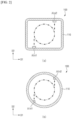
- the first fluid supply part Ain1 and the second fluid supply part Ain2 are disposed while being spaced apart from each other inside the tank body, so that a rotational flow may be formed in the emulsion EM by the fluid supplied through the first fluid supply part Ain1 and the second fluid supply part Ain2 (see (a) and (b) of FIG. 2 ).
- the fluid that is, the gas bubbles, supplied to the emulsion EM through the fluid supply part 400 serves to stir the emulsion EM.
- the dispersed phases within the emulsion EM are prevented from sinking or sticking to each other to accelerate the extraction and the evaporation of the solvent.
- the gas bubbles within the emulsion EM are in contact with each other to maximize the extraction of the solvent from the dispersed phase. For example, an effect similar to the effect of purging nitrogen in addition to the emulsion stirred using a general stirrer may be realized through the present exemplary embodiment.
- the organic solvent of the continuous phase may be extracted from the biodegradable polymer solution in the form of droplets, which is a dispersed phase.
- a part of the organic solvent extracted in the continuous phase may be evaporated from a surface.
- the dispersed phase in the form of droplets may be solidified to form a microsphere.
- the extraction and the evaporation may be accelerated by making the emulsion flow or heating the emulsion. For example, by forming a fluid flow in the emulsion, the solvent of the second raw material may be extracted and the extracted solvent may be removed by evaporating the extracted solvent.
- the exhaust part 500 may serve to suck in the gas inside the tank body 100, and depressurize the inside of the tank body 100. Through this, the boiling point of the organic solvent is reduced, so that the organic solvent extracted in the continuous phase may be vaporized event at a low temperature. Further, the organic solvent gas extracted and evaporated from the dispersed phase of the emulsion EM may be discharged to the outside of the tank body 100 through the exhaust part 500. Through this, the partial pressure of the organic solvent within the tank body 100 is lowered, so that continuous extraction and evaporation of the solvent may be achieved.
- the exhaust part 500 may suck in the gas inside the tank body 100 through the exhaust pipe 510 penetrating and inserted into the upper portion of the tank body 100.
- the heating part 600 may heat the emulsion EM inside the tank body 100.
- the heating part 600 may have various known configurations that are capable of heating the inside of the tank body 100.
- the heating part 600 vaporize and remove the solvent by heating the emulsion EM to a boiling point, for example, 40 degrees, of the organic solvent or higher.
- the solvent removing apparatus may further include a control unit controlling each configuration within the solvent removing apparatus to control the degrees of the supply of the fluid, the supply and the discharge of the liquid, and the exhaust to required degrees.
- the solvent removing apparatus includes a fluid supply part which supplies a fluid into the tank body to form a flow in the emulsion, and an exhaust part which discharges the gas inside the tank body to the outside of the tank, thereby easily extracting and evaporating the solvent even without an impeller or stirrer structure coupled to a shaft rotated by using a motor. Accordingly, the solvent removing apparatus has a simpler configuration that that of the structure in the related art, and may have an advantageous operation effect in sealing and the like for washing and sterilizing the inside of the tank body.
- the solvent removing apparatus further includes the liquid supply part which supplies the liquid into the tank body and the liquid discharge part which discharges a part of the continuous phase of the emulsion inside the tank body to the outside of the tank body, so that the solvent may be efficiently and continuously extracted and evaporated.
- the method of recovering the microspheres from the continuous phase including the microspheres and cleaning the microspheres are not particularly limited, and the microspheres may be recovered by using a method, such as filtration and centrifugation, and then cleaning using water and the like may be additionally performed.
- the obtained microspheres are dried by using a general drying method to finally obtain the dried microsphere powder.
- the method of drying the microspheres is not limited, and may be performed by using a freezing drying method, a vacuum drying method, or a reduced pressure drying method.
- a final desired monodisperse biodegradable polymer-based microsphere powder is prepared, and then, a final product may be obtained by suspending the obtained microsphere powder in a suspension and filling an appropriate container, for example, a disposable syringe, with the suspended microsphere powder.
- FIG. 2 is planar cross-sectional views of the solvent removing apparatuses according to exemplary embodiments of the present invention.
- the solvent removing apparatus may include the tank body 100, the liquid supply part 200, the liquid discharging part 300, the fluid supplying part 400, the exhaust part 500, and the heating part 600.
- the tank body 100 may accommodate an emulsion including a first raw material of a continuous phase and a second raw material of a dispersed phase.
- the tank body 100 may include a wall body 110 forming a space for accommodating the emulsion EM therein.
- the tank body 100 may include a bottom portion formed on a plane formed by a first direction D1 and a second direction D2 perpendicular to the first direction D1, and include a lateral wall portion extending in a third direction D3 perpendicular to the first direction D1 and the second direction D2.
- the fluid supply part 400 may supply the fluid stored in the supplied fluid storage part 410 to the emulsion EM through a fluid supply means formed inside the tank body 100.
- the fluid supply means may include a first fluid supply part Ain1 and a second fluid supply part Ain2.
- the first fluid supply part Ain1 and the second fluid supply part Ain2 may be formed to supply a fluid in different directions. That is, the first fluid supply part Ain1 may supply the fluid in the second direction D2, and the second fluid supply part Ain2 may supply the fluid in an opposite direction of the second direction D2.
- the first fluid supply part Ain1 and the second fluid supply part Ain2 may be spaced apart from each other in the first direction D1, may be spaced apart from each other in the second direction D2, and may be spaced apart from each other in the third direction D3.
- the emulsion EM may form a three-dimensional rotational flow in the emulsion EM, and an optimal effect may be obtained with a small number of fluid supply parts (the gas supply pipes to which gas droplets are supplied).
- the fluid supply means includes two fluid supply parts, but the present invention is not limited thereto. Only one gas supply pipe of the fluid supply part through which the gas bubbles are supplied may be installed, and a plurality of three or more gas supply pipes may also be formed at various locations.
- FIG. 3 is a flowchart illustrating a microsphere producing method using the solvent removing apparatus according to an exemplary embodiment of the present invention.
- the solvent removing apparatus includes a tank body, a fluid supply part for supplying a fluid into the tank body, and an exhaust part for discharging gas inside the tank body to the outside of the tank.
- the microsphere producing method includes: preparing a first raw material and preparing a second raw material including a biodegradable polymer, a drug, and a solvent (S100); forming an emulsion including the first raw material of a continuous phase and the second raw material of a dispersed phase by using the first raw material and the second raw material (S200); and extracting and removing the solvent from the dispersed phase of the emulsion by using the solvent removing apparatus to form a microsphere (S300).
- the first raw material and the second raw material may be prepared.
- the first raw material may include purified water and surfactant.
- the second raw material is an oil-phase solution, and may include an organic solvent, a biodegradable polymer dissolved therein, and a drug.
- the emulsion may be formed by using the first raw material and the second raw material by various known methods. For example, a method of mixing and stirring the first raw material and the second raw material, a microfluid method of forming microsphere droplets through a flow of a micro flow path, and the like may be used.
- the emulsion includes the first raw material of the continuous phase and the second raw material of the dispersed phase.
- a flow may be formed in the emulsion by supplying a fluid to the emulsion accommodated inside the tank body.
- the fluid is gas and may be supplied to the emulsion in the form of gas bubbles.
- the solvent removing apparatus may further include the liquid supply part which supplies the liquid into the tank body and the liquid discharge part which discharges a part of the continuous phase of the emulsion inside the tank body to the outside of the tank body.
- the solvent existing in the dispersed phase may be sufficiently extracted and evaporated in the continuous phase by removing a part of the continuous phase including the organic solvent extracted from the dispersed phase of the emulsion and supplying a new aqueous solution (supplied by the liquid supply part) that is capable of replacing the removed continuous phase.
- the solvent removing apparatus may further include a heating part which heats the emulsion inside the tank body. By heating the emulsion at the temperature of the boiling point of the solvent or higher, the solvent may be vaporized and removed.
- the dispersed phase in the form of droplets may be solidified to form a microsphere.
- the microsphere producing method may further include cleaning and drying, or drying the formed microsphere and obtaining dried microsphere powder (S400).
- the solidified microsphere may be recovered by using a method, such as filtration and centrifugation, and then cleaning using water may be performed. After the filtering and cleaning operations, finally dried microsphere powder may be obtained by drying the obtained microspheres by using a general drying method.
- the method of drying the microspheres is not limited, and may be performed by using a freezing drying method, a vacuum drying method, or a reduced pressure drying method.
- the final desired monodisperse biodegradable polymer-based microsphere powder is prepared, and then, the obtained microsphere powder is suspended in a suspension and filled in an appropriate container, for example, a disposable syringe, to obtain a final product.
- the solvent removing apparatus includes a fluid supply part which supplies a fluid into the tank body to form a flow in the emulsion, and an exhaust part which discharges the gas inside the tank body to the outside of the tank, thereby easily extracting and evaporating the solvent even without an impeller or stirrer structure coupled to a shaft rotated by using a motor. Accordingly, the solvent removing apparatus has a simpler configuration that that of the structure in the related art, and may have an advantageous operation effect in sealing and the like for washing and sterilizing the inside of the tank body.
- the solvent removing apparatus further includes the liquid supply part which supplies the liquid into the tank body and the liquid discharge part which discharges a part of the continuous phase of the emulsion inside the tank body to the outside of the tank body, so that the solvent may be efficiently and continuously extracted and evaporated.
- the dispersed phase of the emulsion includes the oil-phase solution and the continuous phase includes the aqueous-phase solution
- the present invention is not limited thereto.
- the case where the dispersed phase of the emulsion includes an aqueous-phase solution and the continuous phase includes an oil-phase solution is also possible, and in this case, the drug contained in the microspheres may include a hydrophilic therapeutic agent.
Landscapes
- Chemical & Material Sciences (AREA)
- Chemical Kinetics & Catalysis (AREA)
- Health & Medical Sciences (AREA)
- Engineering & Computer Science (AREA)
- Bioinformatics & Cheminformatics (AREA)
- Medicinal Chemistry (AREA)
- Life Sciences & Earth Sciences (AREA)
- Veterinary Medicine (AREA)
- Pharmacology & Pharmacy (AREA)
- Epidemiology (AREA)
- Animal Behavior & Ethology (AREA)
- General Health & Medical Sciences (AREA)
- Public Health (AREA)
- Organic Chemistry (AREA)
- Polymers & Plastics (AREA)
- Dispersion Chemistry (AREA)
- Thermal Sciences (AREA)
- Physics & Mathematics (AREA)
- Colloid Chemistry (AREA)
- Medicinal Preparation (AREA)
- Vaporization, Distillation, Condensation, Sublimation, And Cold Traps (AREA)
- Glanulating (AREA)
- Manufacturing Of Micro-Capsules (AREA)
Priority Applications (1)
| Application Number | Priority Date | Filing Date | Title |
|---|---|---|---|
| EP26162208.8A EP4737487A2 (de) | 2020-12-24 | 2021-12-03 | Vorrichtung zur entfernung von lösungsmitteln |
Applications Claiming Priority (2)
| Application Number | Priority Date | Filing Date | Title |
|---|---|---|---|
| KR1020200182709A KR102283250B1 (ko) | 2020-12-24 | 2020-12-24 | 용매 제거 장치 및 이를 이용한 미소구체 제조 방법 |
| PCT/KR2021/018252 WO2022139242A1 (ko) | 2020-12-24 | 2021-12-03 | 용매 제거 장치 및 이를 이용한 미소구체 제조 방법 |
Related Child Applications (2)
| Application Number | Title | Priority Date | Filing Date |
|---|---|---|---|
| EP26162208.8A Division EP4737487A2 (de) | 2020-12-24 | 2021-12-03 | Vorrichtung zur entfernung von lösungsmitteln |
| EP26162208.8A Division-Into EP4737487A2 (de) | 2020-12-24 | 2021-12-03 | Vorrichtung zur entfernung von lösungsmitteln |
Publications (3)
| Publication Number | Publication Date |
|---|---|
| EP4268917A1 true EP4268917A1 (de) | 2023-11-01 |
| EP4268917A4 EP4268917A4 (de) | 2024-01-31 |
| EP4268917B1 EP4268917B1 (de) | 2026-04-15 |
Family
ID=77127593
Family Applications (2)
| Application Number | Title | Priority Date | Filing Date |
|---|---|---|---|
| EP21911309.9A Active EP4268917B1 (de) | 2020-12-24 | 2021-12-03 | Vorrichtung zur entfernung von lösungsmitteln und verfahren zur herstellung von mikrokügelchen damit |
| EP26162208.8A Pending EP4737487A2 (de) | 2020-12-24 | 2021-12-03 | Vorrichtung zur entfernung von lösungsmitteln |
Family Applications After (1)
| Application Number | Title | Priority Date | Filing Date |
|---|---|---|---|
| EP26162208.8A Pending EP4737487A2 (de) | 2020-12-24 | 2021-12-03 | Vorrichtung zur entfernung von lösungsmitteln |
Country Status (6)
| Country | Link |
|---|---|
| US (1) | US12083225B2 (de) |
| EP (2) | EP4268917B1 (de) |
| JP (1) | JP7681346B2 (de) |
| KR (1) | KR102283250B1 (de) |
| CN (2) | CN119565213A (de) |
| WO (1) | WO2022139242A1 (de) |
Families Citing this family (5)
| Publication number | Priority date | Publication date | Assignee | Title |
|---|---|---|---|---|
| KR102259589B1 (ko) * | 2020-11-30 | 2021-06-02 | (주)인벤티지랩 | 미소구체 제조 시스템 및 미소구체 제조 방법 |
| KR102283250B1 (ko) * | 2020-12-24 | 2021-07-29 | (주)인벤티지랩 | 용매 제거 장치 및 이를 이용한 미소구체 제조 방법 |
| EP4201511B1 (de) * | 2021-12-22 | 2025-02-12 | Inventage Lab Inc. | Lösungsmittelentfernungsvorrichtung und verfahren zur herstellung von mikrokugeln damit |
| KR102403990B1 (ko) | 2021-12-22 | 2022-05-31 | (주)인벤티지랩 | 용매 제거 장치 및 이를 이용한 미소구체 제조 방법 |
| KR102686942B1 (ko) * | 2022-01-26 | 2024-07-24 | (주)인벤티지랩 | 용매 제거 장치 및 이를 이용한 미소구체 제조 방법 |
Family Cites Families (19)
| Publication number | Priority date | Publication date | Assignee | Title |
|---|---|---|---|---|
| US5143585A (en) * | 1988-09-20 | 1992-09-01 | Konica Corporation | Method of removing organic solvents |
| DE8914167U1 (de) * | 1989-12-07 | 1990-02-15 | Hopf, Karl-Heinz, 8580 Bayreuth | Phasentrennanlage zur thermischen Trennung einer Emulsion, insbesondere einer Wasser/Ölemulsion |
| US5922253A (en) * | 1995-05-18 | 1999-07-13 | Alkermes Controlled Therapeutics, Inc. | Production scale method of forming microparticles |
| CA2389613A1 (en) * | 1999-11-19 | 2001-05-25 | Zycos Inc. | Continuous-flow method for preparing microparticles |
| AU2003262048A1 (en) | 2002-09-11 | 2004-04-30 | Tanabe Seiyaku Co., Ltd. | Process for the production of microspheres and unit therefor |
| KR20050109384A (ko) | 2004-05-15 | 2005-11-21 | 임교빈 | 초임계 유체를 이용한 5-플루오로우라실의 서방성 방출을위한 고분자 미립자 제조장치 및 제조방법 |
| BE1016381A3 (fr) | 2004-12-15 | 2006-10-03 | Broqueville Axel De | Dispositif et procede a lit fluidifie rotatif dans une succesion de chambres cylindriques. |
| BE1016766A5 (fr) | 2005-09-15 | 2007-06-05 | Broqueville Axel De | Dispositif d'injection de fluide en couches successives dans un lit fluidifie rotatif et procedes utilisant ce dispositif. |
| BE1016382A3 (fr) * | 2004-12-15 | 2006-10-03 | Broqueville Axel De | Dispositif d'injection de fluides a l'interieur d'un lit fluidifie rotatif. |
| WO2008123973A1 (en) * | 2007-04-03 | 2008-10-16 | Siemens Water Technologies Corp. | Systems and methods for liquid separation |
| US8771520B2 (en) * | 2008-05-31 | 2014-07-08 | Vws Westgarth Limited | Fluid treatment apparatus |
| WO2011127456A2 (en) * | 2010-04-09 | 2011-10-13 | Pacira Pharmaceuticals, Inc. | Method for formulating large diameter synthetic membrane vesicles |
| CN101816913B (zh) * | 2010-05-20 | 2015-10-21 | 吴传斌 | 一种微球制造方法及制造设备 |
| US9439864B2 (en) * | 2014-07-07 | 2016-09-13 | Antriabio, Inc. | Solvent extraction from biodegradable microparticles |
| CA2937235C (en) * | 2016-07-27 | 2018-06-19 | Imperial Oil Resources Limited | Bituminous feed processing |
| CN110198821A (zh) | 2016-11-11 | 2019-09-03 | 生活实验公司 | 使可膨胀性聚合物微球膨胀的方法 |
| EP3375525B1 (de) * | 2017-03-16 | 2024-01-03 | Grant Prideco, Inc. | Mehrstufige kompakte flotationseinheit |
| KR102010573B1 (ko) | 2019-03-28 | 2019-08-13 | 김대현 | 오수 배출 촉진 구조를 포함하는 공기압을 이용한 오수 배출장치 |
| KR102283250B1 (ko) | 2020-12-24 | 2021-07-29 | (주)인벤티지랩 | 용매 제거 장치 및 이를 이용한 미소구체 제조 방법 |
-
2020
- 2020-12-24 KR KR1020200182709A patent/KR102283250B1/ko active Active
-
2021
- 2021-12-03 EP EP21911309.9A patent/EP4268917B1/de active Active
- 2021-12-03 CN CN202411756768.1A patent/CN119565213A/zh active Pending
- 2021-12-03 CN CN202180084166.4A patent/CN116669826B/zh active Active
- 2021-12-03 WO PCT/KR2021/018252 patent/WO2022139242A1/ko not_active Ceased
- 2021-12-03 US US18/038,589 patent/US12083225B2/en active Active
- 2021-12-03 JP JP2023535702A patent/JP7681346B2/ja active Active
- 2021-12-03 EP EP26162208.8A patent/EP4737487A2/de active Pending
Also Published As
| Publication number | Publication date |
|---|---|
| WO2022139242A1 (ko) | 2022-06-30 |
| JP2023553987A (ja) | 2023-12-26 |
| EP4268917A4 (de) | 2024-01-31 |
| US20230346707A1 (en) | 2023-11-02 |
| EP4737487A2 (de) | 2026-05-06 |
| KR102283250B1 (ko) | 2021-07-29 |
| CN119565213A (zh) | 2025-03-07 |
| CN116669826A (zh) | 2023-08-29 |
| US12083225B2 (en) | 2024-09-10 |
| JP7681346B2 (ja) | 2025-05-22 |
| CN116669826B (zh) | 2024-12-24 |
| EP4268917B1 (de) | 2026-04-15 |
Similar Documents
| Publication | Publication Date | Title |
|---|---|---|
| US12083225B2 (en) | Solvent removing apparatus and method of producing microsphere using the same | |
| JP7468909B2 (ja) | 安全性および貯蔵安定性が向上した生分解性微粒球の製造方法 | |
| US12521348B2 (en) | Microsphere producing system and microsphere producing method | |
| US11944949B2 (en) | Solvent removing apparatus and method of manufacturing microsphere using the same | |
| KR101418888B1 (ko) | 다공성 중공형 미립구 및 이의 제조 방법 | |
| CN103893129B (zh) | 帕潘立酮缓释微球及其注射剂和该缓释微球的制备方法 | |
| EP4201511B1 (de) | Lösungsmittelentfernungsvorrichtung und verfahren zur herstellung von mikrokugeln damit | |
| EP4483980A1 (de) | Lösungsmittelentfernungsvorrichtung und verfahren zur herstellung von mikrokugeln damit | |
| WO2006016981A2 (en) | Production of porous materials by supercritical fluid processing |
Legal Events
| Date | Code | Title | Description |
|---|---|---|---|
| STAA | Information on the status of an ep patent application or granted ep patent |
Free format text: STATUS: THE INTERNATIONAL PUBLICATION HAS BEEN MADE |
|
| PUAI | Public reference made under article 153(3) epc to a published international application that has entered the european phase |
Free format text: ORIGINAL CODE: 0009012 |
|
| STAA | Information on the status of an ep patent application or granted ep patent |
Free format text: STATUS: REQUEST FOR EXAMINATION WAS MADE |
|
| 17P | Request for examination filed |
Effective date: 20230525 |
|
| AK | Designated contracting states |
Kind code of ref document: A1 Designated state(s): AL AT BE BG CH CY CZ DE DK EE ES FI FR GB GR HR HU IE IS IT LI LT LU LV MC MK MT NL NO PL PT RO RS SE SI SK SM TR |
|
| A4 | Supplementary search report drawn up and despatched |
Effective date: 20240105 |
|
| RIC1 | Information provided on ipc code assigned before grant |
Ipc: C08F 6/10 20060101ALI20231222BHEP Ipc: C08F 6/00 20060101ALI20231222BHEP Ipc: B01D 17/02 20060101ALI20231222BHEP Ipc: B01D 3/34 20060101ALI20231222BHEP Ipc: B01D 1/14 20060101ALI20231222BHEP Ipc: A61K 9/16 20060101ALI20231222BHEP Ipc: B01D 35/02 20060101ALI20231222BHEP Ipc: B01D 1/30 20060101ALI20231222BHEP Ipc: B01D 11/04 20060101AFI20231222BHEP |
|
| DAV | Request for validation of the european patent (deleted) | ||
| DAX | Request for extension of the european patent (deleted) | ||
| STAA | Information on the status of an ep patent application or granted ep patent |
Free format text: STATUS: EXAMINATION IS IN PROGRESS |
|
| 17Q | First examination report despatched |
Effective date: 20240918 |
|
| GRAP | Despatch of communication of intention to grant a patent |
Free format text: ORIGINAL CODE: EPIDOSNIGR1 |
|
| STAA | Information on the status of an ep patent application or granted ep patent |
Free format text: STATUS: GRANT OF PATENT IS INTENDED |
|
| INTG | Intention to grant announced |
Effective date: 20251112 |
|
| GRAS | Grant fee paid |
Free format text: ORIGINAL CODE: EPIDOSNIGR3 |
|
| GRAA | (expected) grant |
Free format text: ORIGINAL CODE: 0009210 |
|
| STAA | Information on the status of an ep patent application or granted ep patent |
Free format text: STATUS: THE PATENT HAS BEEN GRANTED |
|
| AK | Designated contracting states |
Kind code of ref document: B1 Designated state(s): AL AT BE BG CH CY CZ DE DK EE ES FI FR GB GR HR HU IE IS IT LI LT LU LV MC MK MT NL NO PL PT RO RS SE SI SK SM TR |
|
| REG | Reference to a national code |
Ref country code: CH Ref legal event code: F10 Free format text: ST27 STATUS EVENT CODE: U-0-0-F10-F00 (AS PROVIDED BY THE NATIONAL OFFICE) Effective date: 20260415 |
|
| P01 | Opt-out of the competence of the unified patent court (upc) registered |
Free format text: CASE NUMBER: UPC_APP_0011487_4268917/2026 Effective date: 20260331 |
|
| REG | Reference to a national code |
Ref country code: DE Ref legal event code: R096 Ref document number: 602021052343 Country of ref document: DE |