EP4268656A1 - Kinnschutzabstandseinstellmittel für helm - Google Patents
Kinnschutzabstandseinstellmittel für helm Download PDFInfo
- Publication number
- EP4268656A1 EP4268656A1 EP21921450.9A EP21921450A EP4268656A1 EP 4268656 A1 EP4268656 A1 EP 4268656A1 EP 21921450 A EP21921450 A EP 21921450A EP 4268656 A1 EP4268656 A1 EP 4268656A1
- Authority
- EP
- European Patent Office
- Prior art keywords
- chin guard
- helmet
- adjustment member
- chin
- adjustment means
- Prior art date
- Legal status (The legal status is an assumption and is not a legal conclusion. Google has not performed a legal analysis and makes no representation as to the accuracy of the status listed.)
- Withdrawn
Links
- 230000008859 change Effects 0.000 claims description 5
- 230000007423 decrease Effects 0.000 claims description 5
- 230000004044 response Effects 0.000 claims description 5
- 238000003780 insertion Methods 0.000 description 11
- 230000037431 insertion Effects 0.000 description 11
- 230000008595 infiltration Effects 0.000 description 4
- 238000001764 infiltration Methods 0.000 description 4
- 230000001012 protector Effects 0.000 description 4
- 230000001105 regulatory effect Effects 0.000 description 3
- 239000006096 absorbing agent Substances 0.000 description 2
- 238000012986 modification Methods 0.000 description 2
- 230000004048 modification Effects 0.000 description 2
- 230000000149 penetrating effect Effects 0.000 description 2
- 239000000428 dust Substances 0.000 description 1
- 230000000694 effects Effects 0.000 description 1
- 239000004794 expanded polystyrene Substances 0.000 description 1
- 239000006260 foam Substances 0.000 description 1
- 238000000034 method Methods 0.000 description 1
- 230000008569 process Effects 0.000 description 1
- 239000011359 shock absorbing material Substances 0.000 description 1
- 229920003002 synthetic resin Polymers 0.000 description 1
- 239000000057 synthetic resin Substances 0.000 description 1
Images



Classifications
-
- A—HUMAN NECESSITIES
- A42—HEADWEAR
- A42B—HATS; HEAD COVERINGS
- A42B3/00—Helmets; Helmet covers ; Other protective head coverings
- A42B3/32—Collapsible helmets; Helmets made of separable parts ; Helmets with movable parts, e.g. adjustable
- A42B3/326—Helmets with movable or separable chin or jaw guard
-
- A—HUMAN NECESSITIES
- A42—HEADWEAR
- A42B—HATS; HEAD COVERINGS
- A42B3/00—Helmets; Helmet covers ; Other protective head coverings
- A42B3/04—Parts, details or accessories of helmets
- A42B3/18—Face protection devices
- A42B3/20—Face guards, e.g. for ice hockey
- A42B3/205—Chin protectors
-
- A—HUMAN NECESSITIES
- A42—HEADWEAR
- A42B—HATS; HEAD COVERINGS
- A42B3/00—Helmets; Helmet covers ; Other protective head coverings
- A42B3/04—Parts, details or accessories of helmets
- A42B3/06—Impact-absorbing shells, e.g. of crash helmets
-
- A—HUMAN NECESSITIES
- A42—HEADWEAR
- A42B—HATS; HEAD COVERINGS
- A42B3/00—Helmets; Helmet covers ; Other protective head coverings
- A42B3/04—Parts, details or accessories of helmets
- A42B3/08—Chin straps or similar retention devices
Definitions
- the present disclosure relates to a chin guard gap adjustment means for a helmet.
- the helmet has a front open portion to ensure the wearer's frontal field of view. Additionally, the helmet may include a shield that can selectively open and close the open portion to keep out wind, dust, etc. while driving.
- the helmet according to the prior art includes a chin guard (a chin protector) to protect the wearer's chin as disclosed by the patent literature of the related literatures as described below.
- the chin guard (the chin protector) may be disposed at the rear of an outer shell after pivoting. In this case, an empty space is formed between the chin guard (the chin protector) and the outer shell. Accordingly, when air is introduced into the empty space between the chin guard (the chin protector) and the outer shell while driving, noise is generated and drag increases.
- Patent Literature 1 KR10-2020-0120051 A
- the present disclosure is designed to solve the above-described problem, and therefore an aspect of the present disclosure is directed to a chin guard gap adjustment means for a helmet, including an adjustment member to adjust a space between a chin guard and a helmet body, in order to reduce noise and drag by regulating the infiltration of air into the space between the chin guard and the helmet body while driving.
- a chin guard gap adjustment means for a helmet is mounted in the helmet including a helmet body, and a chin guard which is rotatably coupled to the helmet body and is rotatable from a front side of a wearer's chin to a rear side or an upper side of the helmet body, and is coupled to the chin guard to adjust a space between the chin guard and the helmet body.
- the chin guard gap adjustment means for the helmet includes an adjustment member rotatably coupled to the chin guard, and the adjustment member adjusts an angle between the adjustment member and the chin guard in response to a change of the space between the chin guard and the helmet body.
- the chin guard gap adjustment means for the helmet further includes an elastic member to provide an elastic force to the adjustment member.
- the chin guard gap adjustment means for the helmet includes a fastening member coupled to the chin guard, an adjustment member rotatably coupled to the fastening member, and an elastic member to provide the adjustment member with an elastic force in a direction in which an angle between the adjustment member and the fastening member increases.
- the fastening member has a recessed portion in a thicknesswise direction, and when the adjustment member is disposed parallel to the fastening member, the adjustment member is inserted into the recessed portion.
- the adjustment member rotates around a rotation axis in the recessed portion.
- an exposed surface of the adjustment member contacts an inner wall of the recessed portion upon the rotation of the adjustment member in a direction in which an angle between the adjustment member and the fastening member increases.
- the recessed portion has an open portion or an auxiliary recessed portion
- the adjustment member includes a body which is inserted into the open portion or the auxiliary recessed portion, and an extended portion which is extended from the body, and comes into contact with a bottom surface of the recessed portion.
- the helmet body has a fastening pin which protrudes to be coupled to the chin guard when the chin guard is disposed in front of the wearer's chin
- the helmet body has a sloping portion which slopes such that it protrudes as it goes toward the fastening pin from above, and the adjustment member rotates in a direction in which the angle between the adjustment member and the fastening member decreases in contact with the sloping portion.
- the adjustment member configured to adjust the space between the chin guard and the helmet body, it is possible to reduce noise and drag by regulating the infiltration of air into the space between the chin guard and the helmet body while driving.
- the adjustment member rotates in contact with the sloping portion of the helmet body, it is possible to prevent interferences between the adjustment member and the fastening pin coupled to the chin guard.
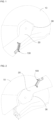
- FIGS. 1 and 2 are perspective views of a helmet including a chin guard gap adjustment means for a helmet according to an embodiment of the present disclosure.
- a helmet body 10 plays a role in protecting a wearer's head.
- the helmet body 10 may be made of a shock absorbing material.
- the helmet body 10 may include an outer shell of hard synthetic resin and having high strength, and an absorber disposed in the outer shell, made of an expanded polystyrene (EPS) foam and having proper strength and elasticity.
- EPS expanded polystyrene
- a pad may be present inside the absorber to improve a snug fit.
- a chin guard 20 plays a role in protecting the wearer's chin, and may be extended in an arc shape as a whole so that it is disposed in front of the wearer's chin.
- the chin guard 20 is, at two ends, rotatably coupled to two sides (for example, a ratchet 30) of the helmet body 10, and thus is rotatable from a first predetermined position to a second predetermined position.
- the first predetermined position may refer to a position (Full Face Mode) when the chin guard 20 is disposed in front of the wearer's chin (see FIG.
- the second predetermined position may refer to a position (Open Face Mode) when the chin guard 20 is disposed at the rear of the helmet body 10 (see FIG. 2 ).
- the second predetermined position does not necessarily refer to the position when the chin guard 20 is disposed at the rear of the helmet body 10, and may refer to a position when the chin guard 20 is disposed above the helmet body 10 (for example, above a shield).
- the chin guard gap adjustment means 100 for the helmet according to this embodiment is disposed between the helmet body 10 and the chin guard 20, and hereinafter, the chin guard gap adjustment means 100 for the helmet will be described in detail.
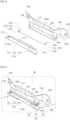
- FIG. 3 is an exploded perspective view of the chin guard gap adjustment means for the helmet according to an embodiment of the present disclosure
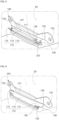
- FIGS. 4 to 6 are perspective views of the chin guard gap adjustment means for the helmet according to an embodiment of the present disclosure.
- the chin guard gap adjustment means 100 for the helmet is mounted in the helmet including the helmet body 10, and the chin guard 20 that is rotatably coupled to the helmet body 10 and is rotatable from the front side of the wearer's chin to the rear side or the upper side of the helmet body 10, and the chin guard gap adjustment means 100 is coupled to the chin guard 20 to adjust a space between the chin guard 20 and the helmet body 10.
- the chin guard gap adjustment means 100 for the helmet may be coupled to the chin guard 20 to adjust the space between the chin guard 20 and the helmet body 10.
- the chin guard gap adjustment means 100 for the helmet may include an adjustment member 110.
- the adjustment member 110 may be formed in a flat plate shape and rotatably coupled to the inner side of the chin guard 20. In this instance, when the space between the chin guard 20 and the helmet body 10 changes, the adjustment member 110 may adjust the angle between the adjustment member 110 and the chin guard 20. For example, when the space between the chin guard 20 and the helmet body 10 becomes wider by the rotation of the chin guard 20, the adjustment member 110 increases the angle between the adjustment member 110 and the chin guard 20 (see FIG. 4 ).
- the adjustment member 110 may adjust the widened space between the chin guard 20 and the helmet body 10 by rotation toward being perpendicular to the chin guard 20.
- the adjustment member 110 reduces the angle between the adjustment member 110 and the chin guard 20 (see FIG. 6 ). That is, the adjustment member 110 may respond to the narrowed space between the chin guard 20 and the helmet body 10 by rotation toward being parallel to the chin guard 20.
- the chin guard gap adjustment means 100 for the helmet may include an elastic member 120 (see FIGS. 3 to 6 ).
- the elastic member 120 provides the adjustment member 110 with an elastic force in a direction in which the angle between the adjustment member 110 and the chin guard 20 increases.
- the adjustment member 110 may rotate with respect to the chin guard 20 in response to the change of the space between the chin guard 20 and the helmet body 10 by the rotation of the chin guard 20.
- the adjustment member 110 may adjust the space between the chin guard 20 and the helmet body 10 in response to the change of the space between the chin guard 20 and the helmet body 10.
- the other side of the chin guard 20 is not necessarily kept in contact with the outer surface of the helmet body 10, and may be spaced apart from the outer surface of the helmet body 10.
- the adjustment member 110 may adjust (for example, close) the space, to prevent the infiltration of air, in order to reduce noise and drag.
- the chin guard gap adjustment means 100 for the helmet may further include a fastening member 130 (see FIGS. 3 to 6 ).
- the fastening member 130 may be coupled to the inner side of the chin guard 20, and the adjustment member 110 may be rotatably coupled to the fastening member 130.
- the fastening member 130 may be coupled to the inner side of the chin guard 20 by inserting screws (not shown) into fastening holes 133 at two ends.
- the fastening member 130 may have a recessed portion 135 in the thicknesswise direction, and when the adjustment member 110 is disposed parallel to the fastening member 130 (when the angle between the adjustment member 110 and the fastening member 130 is minimum, see FIG 6 ), the adjustment member 110 may be inserted into the recessed portion 135 of the fastening member 130. As described above, when the adjustment member 110 is inserted into the recessed portion 135 of the fastening member 130, the adjustment member 110 may not protrude toward the helmet body 10.
- the adjustment member 110 may rotate around a rotation axis in the recessed portion 135.
- the recessed portion 135 may have an insertion hole 139 in two sidewalls, and the adjustment member 110 may have an insertion protrusion 119 at two ends, and when the insertion protrusions 119 of the adjustment member 110 are inserted into the insertion holes 139 of the recessed portion 135, the adjustment member 110 may rotate with respect to the insertion protrusion 119. That is, the insertion protrusions 119 may be the rotation axis of the adjustment member 110.
- the adjustment member 110 since the rotation axis of the adjustment member 110 is disposed in the recessed portion 135, when the adjustment member 110 rotates in a direction in which the angle between the adjustment member 110 and the fastening member 130 increases, as a result, an exposed surface 110a of the adjustment member 110 contacts an inner wall 135a of the recessed portion 135 (see FIGS. 3 and 4 ). That is, the adjustment member 110 may rotate in a direction in which the angle between the adjustment member 110 and the fastening member 130 increases, and stop rotating when the exposed surface 110a of the adjustment member 110 contacts the inner wall 135a of the recessed portion 135. In the end, the adjustment member 110 may not rotate any more after rotating up to the predetermined angle (for example, perpendicular to the fastening member 130) between the adjustment member 110 and the fastening member 130.
- the predetermined angle for example, perpendicular to the fastening member 130
- the recessed portion 135 of the fastening member 130 may have an open portion 137 penetrating therethrough in the thicknesswise direction.
- the adjustment member 110 may include a body 113 that is inserted into the open portion 137 of the recessed portion 135, and an extended portion 115 extended from two ends of the body 113 and having a smaller thickness than the body 113.
- the extended portion 115 comes into contact with a bottom surface (an area without the open portion 137) of the recessed portion 135.
- the body 113 of the adjustment member 110 is inserted into the open portion 137 of the recessed portion 135, it is possible to design the fastening member 130 with the minimum thickness while preventing the adjustment member 110 from protruding toward the helmet body 10.
- the recessed portion 135 of the fastening member 130 may not have the open portion 137 penetrating therethrough, and as shown in FIG. 11 , the recessed portion 135 may have an auxiliary recessed portion 137a that does not penetrate therethrough and is recessed in the thicknesswise direction, and the body 113 of the adjustment member 110 may be inserted into the auxiliary recessed portion 137a.
- the adjustment member 110 when the adjustment member 110 rotates in a direction in which the angle between the adjustment member 110 and the fastening member 130 decreases, as a result, the extended portion 115 of the adjustment member 110 comes into contact with the bottom surface of the recessed portion 135 (see FIG. 6 ). That is, the adjustment member 110 may rotate in the direction in which the angle between the adjustment member 110 and the fastening member 130 decreases, and stop rotating when the extended portion 115 of the adjustment member 110 comes into contact with the bottom surface of the recessed portion 135. In the end, the adjustment member 110 may not rotate any more after rotating up to the predetermined angle (for example, parallel to the fastening member 130) between the adjustment member 110 and the fastening member 130.
- the predetermined angle for example, parallel to the fastening member 130
- the elastic member 120 is not limited to a particular type, but may be, for example, a torsion spring. As shown in FIGS. 3 and 4 , a coil portion 121 of the elastic member 120 may be disposed around the insertion protrusion 119, a first connection portion 123 of the elastic member 120 may be attached to a fixing protrusion 138 (formed adjacent to the insertion hole 139) of the fastening member 130, and a second connection portion 125 of the elastic member 120 may be inserted into a fastening groove 117 that is recessed along the lengthwise direction on one surface (a surface facing the chin guard 20) of the adjustment member 110.
- a coil portion 121 of the elastic member 120 may be disposed around the insertion protrusion 119
- a first connection portion 123 of the elastic member 120 may be attached to a fixing protrusion 138 (formed adjacent to the insertion hole 139) of the fastening member 130
- a second connection portion 125 of the elastic member 120 may be inserted into a fastening
- the elastic member 120 may provide the elastic force to the adjustment member 110. More specifically, the elastic member 120 may have two coil portions 121 that may be each disposed around each of the insertion protrusions 119 at two ends of the adjustment member 110, and the two coil portions 121 may be connected to each other by the second connection portion 125 inserted into the fastening groove 117 of the adjustment member 110.
- the second connection portion 125 of the elastic member 120 may be provided with the elastic force from the two coil portions 121 on two sides, and by the contact with the adjustment member 110 all along the lengthwise direction of the adjustment member 110, the elastic force of the elastic member 120 may be stably transmitted to the adjustment member 110.
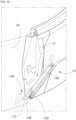
- the helmet body 10 may have a fastening pin 15 that protrudes to be coupled to the chin guard 20 when the chin guard 20 is in the first predetermined position (the position (Full Face Mode) when the chin guard 20 is disposed in front of the wearer's chin).
- the helmet body 10 may have a sloping portion 17 to prevent interferences between the adjustment member 110 and the fastening pin 15.
- the sloping portion 17 may be formed at the rear of the fastening pin 15 of the helmet body 10, and slope such that it protrudes as it goes toward the fastening pin 15 (downward) from the above.
- the sloping portion 17 at the rear of the fastening pin 15 may be formed at higher position than the fastening pin 15, taking into account the angle of the adjustment member 110.
- the adjustment member 110 rotates in the direction in which the angle between the adjustment member 110 and the fastening member (130, the chin guard 20) decreases in contact with the sloping portion 17 that protrudes as it goes toward the fastening pin 15 (downward). That is, the adjustment member 110 may rotate so that it is disposed parallel to the fastening member 130 by the sloping portion 17 and may be inserted into the recessed portion 135 of the fastening member 130 (see FIG. 9 ). Accordingly, the adjustment member 110 may not protrude toward the helmet body 10, and as a result, it is possible to prevent interferences between the adjustment member 110 and the fastening pin 15 (see FIGS. 9 and 10 ).
- the present disclosure provides the chin guard gap adjustment means for the helmet, including the adjustment member to adjust the space between the chin guard and the helmet body in order to reduce noise and drag by regulating the infiltration of air into the space between the chin guard and the helmet body while driving.
Landscapes
- Helmets And Other Head Coverings (AREA)
Applications Claiming Priority (2)
| Application Number | Priority Date | Filing Date | Title |
|---|---|---|---|
| KR1020210008254A KR102428292B1 (ko) | 2021-01-20 | 2021-01-20 | 헬멧용 친가드 간격 조절수단 |
| PCT/KR2021/017161 WO2022158691A1 (ko) | 2021-01-20 | 2021-11-22 | 헬멧용 친가드 간격 조절수단 |
Publications (2)
| Publication Number | Publication Date |
|---|---|
| EP4268656A1 true EP4268656A1 (de) | 2023-11-01 |
| EP4268656A4 EP4268656A4 (de) | 2024-06-05 |
Family
ID=82549523
Family Applications (1)
| Application Number | Title | Priority Date | Filing Date |
|---|---|---|---|
| EP21921450.9A Withdrawn EP4268656A4 (de) | 2021-01-20 | 2021-11-22 | Kinnschutzabstandseinstellmittel für helm |
Country Status (4)
| Country | Link |
|---|---|
| US (1) | US20240065364A1 (de) |
| EP (1) | EP4268656A4 (de) |
| KR (1) | KR102428292B1 (de) |
| WO (1) | WO2022158691A1 (de) |
Families Citing this family (2)
| Publication number | Priority date | Publication date | Assignee | Title |
|---|---|---|---|---|
| FR3117743B1 (fr) * | 2020-12-23 | 2022-11-25 | Technowill | Casque de sûreté à barbe articulée |
| KR102522403B1 (ko) * | 2021-09-29 | 2023-04-24 | (주)에이치제이씨 | 헬멧용 회동체 고정수단 |
Family Cites Families (6)
| Publication number | Priority date | Publication date | Assignee | Title |
|---|---|---|---|---|
| DE3607483C2 (de) * | 1986-03-07 | 1995-07-27 | Piech Corina | Schutzhelm |
| FR2886521B1 (fr) * | 2005-06-03 | 2007-09-07 | Cbm Distrib Entpr Unipersonnel | Casque de protection a visiere mobile |
| ITFI20110045U1 (it) * | 2011-08-10 | 2013-02-11 | Antonio Ceccotti | Casco modulare di protezione |
| FR3023681B1 (fr) * | 2014-07-21 | 2016-08-19 | Shark | Casque de protection a mentonniere mobile avec mecanisme de relevage automatique de l’ecran |
| DE102018004871B3 (de) * | 2018-06-19 | 2019-10-31 | Michael Wagner | Mehrteiliger Schutzhelm |
| KR102641350B1 (ko) | 2019-04-11 | 2024-02-27 | 주식회사 기도스포츠 | 턱 보호대 위치결정 조립체 및 이를 구비하는 헬멧 |
-
2021
- 2021-01-20 KR KR1020210008254A patent/KR102428292B1/ko active Active
- 2021-11-22 EP EP21921450.9A patent/EP4268656A4/de not_active Withdrawn
- 2021-11-22 US US18/261,795 patent/US20240065364A1/en active Pending
- 2021-11-22 WO PCT/KR2021/017161 patent/WO2022158691A1/ko not_active Ceased
Also Published As
| Publication number | Publication date |
|---|---|
| KR20220105491A (ko) | 2022-07-27 |
| US20240065364A1 (en) | 2024-02-29 |
| KR102428292B1 (ko) | 2022-08-03 |
| EP4268656A4 (de) | 2024-06-05 |
| WO2022158691A1 (ko) | 2022-07-28 |
Similar Documents
| Publication | Publication Date | Title |
|---|---|---|
| EP4268656A1 (de) | Kinnschutzabstandseinstellmittel für helm | |
| US10729202B2 (en) | Headband arrangement and welding helmet equipped with the same | |
| US7486165B2 (en) | Magnetic latch mechanism | |
| US5950244A (en) | Protective device for impact management | |
| EP3479715B1 (de) | Kopfbandanordnung für einen schweissschutzhelm | |
| EP3419454B1 (de) | Schutzhelm mit mehreren pseudo-sphärischen energiemanagementauskleidungen | |
| US6148534A (en) | Tape rule with an elaborate buffer | |
| EP4268657A1 (de) | Kinnschutzschwenkmechanismus | |
| EP4321048B1 (de) | Schildrotationssteuerungsmittel | |
| US20120117718A1 (en) | Helmet | |
| KR101053160B1 (ko) | 핀 락 장치 및 이를 포함하는 헬멧 | |
| EP2536304B1 (de) | Schutzhelm | |
| EP4302625A1 (de) | Drehvorrichtung für helm | |
| US20240365910A1 (en) | Rotating body fixing means for helmet | |
| EP4520214A1 (de) | Rotationsmechanismus für helm | |
| CN102045969B (zh) | 电子装置 | |
| EP4501160A1 (de) | Verriegelungsvorrichtung für kinnschutz | |
| US20250194730A1 (en) | Chin guard pivoting mechanism | |
| US4304009A (en) | Energy absorbing safety helmet | |
| EP4483740A1 (de) | Helm | |
| CN216015532U (zh) | 电池保护组件及其保护盖 | |
| CN215710890U (zh) | 电梯轿厢安全盒 | |
| CA3274183C (en) | Article of headgear, mounting clips, and accessories | |
| US20230232930A1 (en) | Customizable snap cover for open face helmets | |
| JPH0143371Y2 (de) |
Legal Events
| Date | Code | Title | Description |
|---|---|---|---|
| STAA | Information on the status of an ep patent application or granted ep patent |
Free format text: STATUS: THE INTERNATIONAL PUBLICATION HAS BEEN MADE |
|
| PUAI | Public reference made under article 153(3) epc to a published international application that has entered the european phase |
Free format text: ORIGINAL CODE: 0009012 |
|
| STAA | Information on the status of an ep patent application or granted ep patent |
Free format text: STATUS: REQUEST FOR EXAMINATION WAS MADE |
|
| 17P | Request for examination filed |
Effective date: 20230725 |
|
| AK | Designated contracting states |
Kind code of ref document: A1 Designated state(s): AL AT BE BG CH CY CZ DE DK EE ES FI FR GB GR HR HU IE IS IT LI LT LU LV MC MK MT NL NO PL PT RO RS SE SI SK SM TR |
|
| DAV | Request for validation of the european patent (deleted) | ||
| DAX | Request for extension of the european patent (deleted) | ||
| REG | Reference to a national code |
Ref country code: DE Ref legal event code: R079 Free format text: PREVIOUS MAIN CLASS: A42B0003200000 Ipc: A42B0003320000 |
|
| A4 | Supplementary search report drawn up and despatched |
Effective date: 20240508 |
|
| RIC1 | Information provided on ipc code assigned before grant |
Ipc: A42B 3/32 20060101AFI20240502BHEP |
|
| STAA | Information on the status of an ep patent application or granted ep patent |
Free format text: STATUS: THE APPLICATION HAS BEEN WITHDRAWN |
|
| 18W | Application withdrawn |
Effective date: 20250115 |