EP4267486B1 - Pack for smoking articles with a hinged lid provided with an overwrap - Google Patents
Pack for smoking articles with a hinged lid provided with an overwrap Download PDFInfo
- Publication number
- EP4267486B1 EP4267486B1 EP21834901.7A EP21834901A EP4267486B1 EP 4267486 B1 EP4267486 B1 EP 4267486B1 EP 21834901 A EP21834901 A EP 21834901A EP 4267486 B1 EP4267486 B1 EP 4267486B1
- Authority
- EP
- European Patent Office
- Prior art keywords
- lid
- overwrap
- pack
- tear
- smoking articles
- Prior art date
- Legal status (The legal status is an assumption and is not a legal conclusion. Google has not performed a legal analysis and makes no representation as to the accuracy of the status listed.)
- Active
Links
Images




Classifications
-
- B—PERFORMING OPERATIONS; TRANSPORTING
- B65—CONVEYING; PACKING; STORING; HANDLING THIN OR FILAMENTARY MATERIAL
- B65D—CONTAINERS FOR STORAGE OR TRANSPORT OF ARTICLES OR MATERIALS, e.g. BAGS, BARRELS, BOTTLES, BOXES, CANS, CARTONS, CRATES, DRUMS, JARS, TANKS, HOPPERS, FORWARDING CONTAINERS; ACCESSORIES, CLOSURES, OR FITTINGS THEREFOR; PACKAGING ELEMENTS; PACKAGES
- B65D85/00—Containers, packaging elements or packages, specially adapted for particular articles or materials
- B65D85/07—Containers, packaging elements or packages, specially adapted for particular articles or materials for compressible or flexible articles
- B65D85/08—Containers, packaging elements or packages, specially adapted for particular articles or materials for compressible or flexible articles rod-shaped or tubular
- B65D85/10—Containers, packaging elements or packages, specially adapted for particular articles or materials for compressible or flexible articles rod-shaped or tubular for cigarettes
- B65D85/1036—Containers formed by erecting a rigid or semi-rigid blank
- B65D85/1045—Containers formed by erecting a rigid or semi-rigid blank having a cap-like lid hinged to an edge
-
- B—PERFORMING OPERATIONS; TRANSPORTING
- B65—CONVEYING; PACKING; STORING; HANDLING THIN OR FILAMENTARY MATERIAL
- B65D—CONTAINERS FOR STORAGE OR TRANSPORT OF ARTICLES OR MATERIALS, e.g. BAGS, BARRELS, BOTTLES, BOXES, CANS, CARTONS, CRATES, DRUMS, JARS, TANKS, HOPPERS, FORWARDING CONTAINERS; ACCESSORIES, CLOSURES, OR FITTINGS THEREFOR; PACKAGING ELEMENTS; PACKAGES
- B65D75/00—Packages comprising articles or materials partially or wholly enclosed in strips, sheets, blanks, tubes or webs of flexible sheet material, e.g. in folded wrappers
- B65D75/52—Details
- B65D75/58—Opening or contents-removing devices added or incorporated during package manufacture
- B65D75/66—Inserted or applied tearing-strings or like flexible elements
- B65D75/68—Inserted or applied tearing-strings or like flexible elements extending through wrapper closure or between wrapper layers
-
- B—PERFORMING OPERATIONS; TRANSPORTING
- B65—CONVEYING; PACKING; STORING; HANDLING THIN OR FILAMENTARY MATERIAL
- B65D—CONTAINERS FOR STORAGE OR TRANSPORT OF ARTICLES OR MATERIALS, e.g. BAGS, BARRELS, BOTTLES, BOXES, CANS, CARTONS, CRATES, DRUMS, JARS, TANKS, HOPPERS, FORWARDING CONTAINERS; ACCESSORIES, CLOSURES, OR FITTINGS THEREFOR; PACKAGING ELEMENTS; PACKAGES
- B65D77/00—Packages formed by enclosing articles or materials in preformed containers, e.g. boxes, cartons, sacks or bags
- B65D77/003—Articles enclosed in rigid or semi-rigid containers, the whole being wrapped
Definitions
- This invention relates to a pack of smoking articles provided with an overwrap.
- This invention finds advantageous application in the production of a rigid cigarette packet containing a group of cigarettes, to which the following discussion will make explicit reference without, as a result, losing any generality thereby.
- the cigarette packets with hinged lids are currently the most popular cigarette packets on the market as they are easy to produce, easy and practical to use, and protect well the cigarettes contained therein.
- a cigarette packet with a hinged lid comprises a soft wrapping consisting of a group of cigarettes wrapped in a sheet of metallic paper and a rigid outer container housing the wrapping and it is provided with a hinged lid.
- a cigarette packet with a hinged lid is generally provided with a sealed overwrap (or one impermeable to air) that has the function of protecting the tobacco from the outside environment (especially for preserving the correct degree of humidity in the tobacco).
- the sealed overwrap surrounds and encloses the outer container, it consists of a wrapping sheet of transparent, plastic material (typically cellophane or polypropylene), and it is provided with a tear-open band, which is grasped and pulled by the user to divide (cut) in two the overwrap and, thus, enables the simple and quick removal, at least partially, of the overwrap.
- the overwrap is made of (transparent) plastic material while the rest of the cigarette packet is produced of paper; as a result, when the cigarette packet is finished, the plastic overwrap must be separated from the rest of the cigarette packet in order to differentiate their disposal.
- the user when first opening the cigarette packet, removes just an upper portion of the overwrap (directly connected to the tear-open band) leaving a lower portion of the overwrap (not connected to the tear-open band) around the cigarette packet; as a result, when the cigarette packet is finished, the user often forgets to separate the lower portion of the overwrap from the rest of the cigarette packet and throws both into the " paper " container, thus incorrectly recycling the wrapping materials.
- Patent application GB2386234A1 and patent US4947994A describe other examples of a packet provided with an overwrap equipped with a tear-open band, which is grasped and pulled by the user to divide (cut) in two the overwrap and, thus, enables the simple and quick removal, at least partially, of the overwrap.
- the purpose of this invention is to provide a cigarette packet with a hinged lid provided with an overwrap; this packet of cigarettes enables the correct recycling of wrapping materials and, at the same time, is easy and economical to produce.
- a cigarette packet with a hinged lid provided with an overwrap is provided.
- reference number 1 indicates, as a whole, a rigid cigarette packet with a hinged lid.
- the cigarette packet 1 comprises an outer container 2 consisting of rigid cardboard or card and cup-shaped, and a soft wrapping 3 (partially illustrated in Figure 12 ) housed within the outer container 2 and it encloses a group of cigarettes.
- the outer container 2 has an open upper end and is provided with a lid 4, which is cup-shaped and is hinged to the outer container 2 along a hinge 5 (illustrated in Figure 2 ) in order to rotate, in relation to the outer container 2, between an open position (not illustrated) and a closed position (illustrated in Figures 1 and 2 ) of the open upper end.
- a lid 4 which is cup-shaped and is hinged to the outer container 2 along a hinge 5 (illustrated in Figure 2 ) in order to rotate, in relation to the outer container 2, between an open position (not illustrated) and a closed position (illustrated in Figures 1 and 2 ) of the open upper end.
- the outer container 2 has a basically parallelepipedal, rectangular shape oriented according to a vertical, main extension direction, it is cup-shaped, and has an open upper end, a lower wall 6 opposite the open upper end, a front wall 7 and a rear wall 8 (wherein the hinge 5 is arranged) parallel and opposite each other, and two side walls 9 that are parallel and opposite each other. Between the front 7, rear 8, and side 9 walls of the outer container 2 four longitudinal corners are defined, while between the walls 7, 8, and 9 and the lower wall 6 of the outer container 2, four transverse corners are defined.
- the lid 4 has a basically parallelepipedal, rectangular shape, it is cup-shaped, and has an open lower end (facing the open upper end of the outer container 2 when the lid 4 is in the closed position), an upper wall 10 (which is parallel and opposite the lower wall 6 of the outer container 2 when the lid 4 is in the closed position), a front wall 11 (which is parallel to and aligned with the front wall 7 of the outer container 2 when the lid 4 is in the closed position), a rear wall 12 (which is parallel to and aligned with the rear wall 8 of the outer container 2 when the lid 4 is in the closed position and is hinged to the rear wall 8 of the outer container 2 along the hinge 5), and two side walls 13 parallel and opposite each other (which are parallel to and aligned with, in particular coplanar and adjacent, to the side walls 9 of the outer container 2 when the lid 4 is in the closed position 4).
- the longitudinal corners and the transverse corners of the lid 4 are parallel to and aligned with the corresponding longitudinal and transverse corners of the outer container 2 when the lid 4 is in the closed position.
- the cigarette packet 1 comprises an overwrap 14 surrounding and enclosing the outer container 2 and the lid 4 (the lid 4 is an integral part of the outer container 2) consists of a wrapping sheet 15 (illustrated in Figure 7 ) of transparent plastic material (typically cellophane or polypropylene) folded around the outer container 2 and the lid 4, and it is provided with a tear-open band 16 that is grasped and pulled by the user in order to divide (cut) the overwrap 14 into two portions 17 and 18 and, thus, to enable a simple and quick removal of the overwrap 14.
- a wrapping sheet 15 illustrated in Figure 7
- transparent plastic material typically cellophane or polypropylene
- the tear-open band 16 divides (cuts) the overwrap 14 into a lower portion 17 (which is totally disconnected from the tear-open band 16, i.e., it has no point of connection with the tear-open band 16), and an upper portion 18 (which is connected to the tear-open band 16, i.e., is integral to the tear-open band 16).
- the tear-open band 16 has a starting end 19 that is completely separated and raised by the overwrap 14 and is formed through a suitable cut shaped by the wrapping sheet 15 when the wrapping sheet 15 is separated by a continuous band of plastic wrapping material (as clearly illustrated in Figures 7 and 8 ).
- the wrapping sheet 15 is folded around the outer container 2 and the lid 4 and is, thus, stabilised using a heat seal, i.e., by joining via a heat seal overlapping portions of the wrapping sheet 15.
- the wrapping sheet 15 has two opposite flaps 20 and 21 (illustrated separately in Figure 7 ) that are overlapped with each other and heat-sealed to form a longitudinal seal 22 contributing to stabilising the overwrap 14;
- the overwrap 14 comprises two additional transverse seals 23 (just one of which is illustrated in Figures 5 and 6 ) that are arranged at opposite ends of the overwrap 14, extend perpendicularly to the longitudinal seal 22, and contribute to stabilising the overwrap 14.
- the lid 4 has a front edge 24, delimiting the front wall 11 at the bottom, and two side edges 25, each delimiting a side wall 13 at the bottom and connecting one end of the front edge 24 to one end of the hinge 5.
- the front edge 24 of the lid 4 (when the lid 4 is closed) rests on a front edge of the outer container 2 and, similarly, the side edges 25 of the lid 4 (when the lid 4 is closed) rest on corresponding side edges of the outer container 2.
- the tear-open band 16 is arranged between the upper wall 10 of the lid 4 and the front edge 24 of the lid 4; in this way, the upper portion 18 of the overwrap 14 is smaller than the lid 4 and the lower portion 17 of the overwrap 14 also extends over part of the lid 4 (i.e., partially covers the lid 4).
- the tear-open band 16 is arranged higher than the front edge 24 of the lid 4 so as not to have any part overlapping the front edge 24 of the lid 4.
- the tear-open band 16 is arranged at a distance D other than zero from the front edge 24 of the lid 4; preferably, the distance D is equal to at least 2 mm and generally greater than 4 mm (generally ranging between 4 mm and 8 mm).
- the tear-open band 16 is arranged closer to the upper wall 10 of the lid 4 than to the front edge 24 of the lid 4.
- the tear-open band 16 is arranged so that it straddles the hinge 5. According to an alternative embodiment not illustrated, the tear-open band 16 is arranged between the hinge 5 and the front edge 24 of the lid 4; according to an additional embodiment not illustrated, the tear-open band 16 is arranged between the upper wall 10 of the lid 4 and the front edge 24 of the lid 4.
- the lower portion 17 of the overwrap 14 has at least one pre-weakened line 26, which helps tear it, originates near an upper edge of the lower portion 17, and extends towards the lower wall 6; according to possible embodiments, the pre-weakened line 26 can start exactly at the upper edge of the lower portion 17 (i.e. next to the tear-open band 16), the pre-weakened line 26 can start beyond the upper edge of the lower portion 17 (i.e., also involving a small piece of the tear-open band 16), or the pre-weakened line 26 can start at a small distance from the upper edge of the lower portion 17 (i.e., at a small distance from the tear-open band 16).
- the pre-weakened line 26 is parallel to the longitudinal corners of the outer container 2 (defined between the front wall 7 and the rear wall 8 and the two side walls 9) ; alternatively, the pre-weakened line 26 could be slightly tilted in relation to the longitudinal corners of the outer container 2 and could also have a zig-zag progression.
- the pre-weakened line 26 consists of at least one through cut that completely goes through the wrapping sheet 15; i.e., the pre-weakened line 26 may consist of a single, continuous through cut or it may consist of a series (row) of through cuts that are equally spaced apart (i.e., arranged at a certain distance from each other).
- the pre-weakened line 26 is arranged near the longitudinal seal 22 (consisting of the joining of the two flaps 20 and 21 of the wrapping sheet 5) so that the pre-weakened line 26 is completely surrounded by joined portions wherein the two flaps 20 and 21 are sealed together; in this way, the pre-weakened line 26 does not put the inner overwrap 14 in communication with the outside environment, thus ensuring the seal of the overwrap 14, which remains, in any case, totally sealed from the outside environment.
- the longitudinal seal 22 has, on the inside, a neutral area 27, which is free from any seal between the two flaps 20, 21, it contains - on the inside - the pre-weakened line 26, and is completely surrounded by joined portions in which the two flaps 20, 21 are sealed together.
- the function of the neutral area 27 is, above all, to avoid making a seal above the pre-weakened line 26 to prevent the seal from " closing " the pre-weakened line 26 (i.e., restoring, at least partially, the continuity of the wrapping material straddling the pre-weakened line 26) thus eliminating its functionality.
- An additional (secondary) function of the neutral area 27 is to increase the local weakening of the lower portion 17 of the overwrap 14 so as to facilitate the breakage of the lower portion 17 of the overwrap 14.
- the neutral area 27 has a longitudinal extension, i.e., parallel to the longitudinal corners of the outer container 2 (defined between the front wall 7 and the rear wall 8 and the two side walls 9), that is greater than a transverse extension, i.e., the neutral area 27 is " longer " that it is “ wide “ .
- the neutral area 27 has a longitudinal extension, i.e., parallel to the longitudinal corners of the outer container 2 (defined between the front wall 7 and the rear wall 8 and the two side walls 9), that is greater than a longitudinal extension of the pre-weakened line 26; i.e., the neutral area 27 is larger than the pre-weakened line to increase the localised weakening of the lower portion 17 of the overwrap 14.
- the pre-weakened line 26 only involves one of the two flaps 20 and 21 of the wrapping sheet 15; i.e., the pre-weakened line 26 is only formed on the inner flap 20 of the wrapping sheet 15 (as illustrated in Figure 8 ) i.e., or it is only formed in the outer flap 21 of the wrapping sheet 15 (as illustrated in Figure 7 ). It is also possible that only the flap 20 of the wrapping sheet 15 has several pre-weakened lines 26 separated and parallel between them, or only the flap 21 of the wrapping sheet 15 has several pre-weakened lines separated and parallel to each other.
- a pre-weakened line 26 is also formed near the upper portion 18 of the overwrap 14 with the same identical construction methods of the pre-weakened line 26 formed near the lower portion 17 of the overwrap 14.
- the pre-weakened line 26 also formed in the upper portion 18 of the overwrap 14 must be arranged above the tear-open band 16 (i.e., it must not affect, unless marginally, the tear-open band 16) to avoid weakening the tear-open band 16 and, thus, causing any undesired breaking to it when the tear-open band 16 is pulled.
- the cigarette packet 1 has a sliding opening and comprises the outer container 2 that has the open end no longer arranged above (as in the embodiment illustrated in Figures 1-4 ), but arranged at the side; in addition, the cigarette packet 1 comprises an inner container 28 containing the wrapping 3 and it is housed so that it can slide in the outer container 2 to slide between a closed position (illustrated in Figure 11 ), wherein the inner container 28 is completely arranged in the outer container 2, and an open position (illustrated in Figure 12 ), wherein the inner container 28 is partially extracted from the outer container 2.
- the tear-open band 16 is arranged at (approximately) halfway so that the two portions 17 and 18 of the overwrap 14 have (approximately) the same size; according to other embodiments, the tear-open band 16 could be arranged higher (so that the lower portion 17 of the overwrap 14 is bigger than the upper portion 18 of the overwrap 14) or even lower (so that the lower portion 17 of the overwrap 14 is smaller than the upper portion 18 of the overwrap 14) compared to what is illustrated in Figures 11 , 13, and 14 .
- the overwrap 14 is provided with the pre-weakened line 26 (produced, as described above, i.e., arranged in the neutral area 27 of the longitudinal seal 22) to also facilitate the removal of the lower portion 17 of the overwrap 14 after having eliminated the upper portion 18 of the overwrap 14.
- indications could be printed on the overwrap 14 (i.e., on the wrapping sheet 15) that explain (show) how to proceed with the fast removal of the lower portion 17 of the overwrap 14.
- the cigarette packet 1 described above has numerous advantages.
- the cigarette packet 1 described above encourages the correct recycling of the wrapping materials, since, in order to be able to open the lid 4, it is necessary to remove not only the upper portion 18 of the overwrap 14, but also the lower portion 17 of the overwrap 1 (in fact, even just the lower portion 17 of the overwrap 14 prevents the opening of the lid 4); thus, the user is forced to remove and immediately dispose of the whole plastic overwrap 14 in the appropriate containers, without leaving the lower portion 17 of the overwrap 14 around the outer container 2 until finishing the cigarette packet 1.
- the removal of the lower portion 17 of the overwrap 14 is simple and quick thanks to the presence of the pre-weakened line 26, which makes it possible to easily break the lower portion 17 of the overwrap 14 (including when the overwrap 14 has been stretched via heat shrinking) by simply pulling the overwrap 14 with a finger at the pre-weakened line 26.
- the pre-weakened line 26 it is important to observe that, thanks to the particular positioning of the pre-weakened line 26 within the longitudinal seal 22 of the wrapping sheet 15, the presence of the pre-weakened line 26 does not affect the seal of the overwrap 14, which remains, in any case, totally sealed from the outside environment.
- the cigarette packet 1 described above is very simple to produce compared to a similar, known cigarette packet in that it is enough: to change the positioning of the tear-open band 16 in relation to the wrapping sheet 15; to insert in the cutting unit (already present) an additional blade for making the pre-weakened line 26; and to slightly change the shape of the welder to produce the neutral area 27 within the longitudinal seal 22.
- the embodiment illustrated in the attached figures refers to the production of a cigarette packet, but this invention can be applied, without significant changes, to the production of any other type of pack of smoking articles (for example, a pack of cigars, a pack of electronic cigarettes of the liquid vaping type, a new-generation cigarette packet without tobacco combustion).
- any other type of pack of smoking articles for example, a pack of cigars, a pack of electronic cigarettes of the liquid vaping type, a new-generation cigarette packet without tobacco combustion.
Landscapes
- Engineering & Computer Science (AREA)
- Mechanical Engineering (AREA)
- Packaging Of Annular Or Rod-Shaped Articles, Wearing Apparel, Cassettes, Or The Like (AREA)
- Packages (AREA)
- Cartons (AREA)
Description
- This invention relates to a pack of smoking articles provided with an overwrap.
- This invention finds advantageous application in the production of a rigid cigarette packet containing a group of cigarettes, to which the following discussion will make explicit reference without, as a result, losing any generality thereby.
- The cigarette packets with hinged lids are currently the most popular cigarette packets on the market as they are easy to produce, easy and practical to use, and protect well the cigarettes contained therein.
- A cigarette packet with a hinged lid comprises a soft wrapping consisting of a group of cigarettes wrapped in a sheet of metallic paper and a rigid outer container housing the wrapping and it is provided with a hinged lid.
- A cigarette packet with a hinged lid is generally provided with a sealed overwrap (or one impermeable to air) that has the function of protecting the tobacco from the outside environment (especially for preserving the correct degree of humidity in the tobacco). The sealed overwrap surrounds and encloses the outer container, it consists of a wrapping sheet of transparent, plastic material (typically cellophane or polypropylene), and it is provided with a tear-open band, which is grasped and pulled by the user to divide (cut) in two the overwrap and, thus, enables the simple and quick removal, at least partially, of the overwrap.
- The overwrap is made of (transparent) plastic material while the rest of the cigarette packet is produced of paper; as a result, when the cigarette packet is finished, the plastic overwrap must be separated from the rest of the cigarette packet in order to differentiate their disposal. In any case, very often, the user, when first opening the cigarette packet, removes just an upper portion of the overwrap (directly connected to the tear-open band) leaving a lower portion of the overwrap (not connected to the tear-open band) around the cigarette packet; as a result, when the cigarette packet is finished, the user often forgets to separate the lower portion of the overwrap from the rest of the cigarette packet and throws both into the "paper" container, thus incorrectly recycling the wrapping materials.
- An additional obstacle to the complete removal of the overwrap (and thus, to the correct disposal of the overwrap) upon first opening the cigarette packet is due to the fact that, while it is very easy to remove the upper portion of the overwrap (directly connected to the tear-open band), it is, in contrast, more difficult and complicated to remove also the lower portion of the overwrap (not connected to the tear-open band), especially when the overwrap has been well stretched around the outer container using a heat shrinking treatment (which confers the overwrap with a particularly pleasant look).
- To facilitate the complete removal of the overwrap, it was proposed, for example as described in the patent application
EP0601583A1 , to tilt the tear band in relation to the wrapping sheet so that the tear band is arranged along a diagonal of the cigarette packet; in any case, this solution entails significant changes to the tear band application unit and, thus, very high equipment costs. - To enable the complete removal of the overwrap, it was proposed, as for example described in the patent application
EP1839845A1 , to produce, in the lower portion of the overwrap, weakening notches that trigger the breakage of the lower portion of the overwrap after the removal (pulling the tear-open band) of the upper portion of the overwrap; in any case, these weakening notches compromise the integrity of the plastic material that constitutes the overwrap, causing the loss of the seal compared to the outside and, thus, eliminating, at least in part, the protection function of the overwrap's external agents. - To enable the complete removal of the overwrap, it was proposed, as for example described in the patent application
WO2014132171A1 , to apply to the overwrap a laceration element consisting of a glued label; in any case, this solution is particularly costly both due to the need for adding a new material to the cigarette packet (the label), and for the need to add a new assembly that applies the label to the packing machine. - To facilitate the complete removal of the overwrap, it was proposed, as, for example, described in the patent application
WO2015145304A1 , to apply additional, secondary tear-open bands that extend transversally, starting from the main tear-open band, to the overwrap; in any case, this solution entails significant changes to the tear band application unit and, thus, very high equipment costs. Patent applicationGB2386234A1 US4947994A describe other examples of a packet provided with an overwrap equipped with a tear-open band, which is grasped and pulled by the user to divide (cut) in two the overwrap and, thus, enables the simple and quick removal, at least partially, of the overwrap. - The purpose of this invention is to provide a cigarette packet with a hinged lid provided with an overwrap; this packet of cigarettes enables the correct recycling of wrapping materials and, at the same time, is easy and economical to produce.
- In accordance with this invention, a cigarette packet with a hinged lid provided with an overwrap, according to what is claimed in the attached claims, is provided.
- The claims describe embodiments of this invention forming an integral part of this description.
- This invention will now be described with reference to the attached drawings that illustrate some non-limiting embodiments thereof, in which:
-
Figures 1 and 2 are two perspective views, front and back respectively, of a rigid cigarette packet with a hinged lid provided with a transparent overwrap; -
Figures 3 and 4 are two perspective views, front and back respectively, of the cigarette packet inFigures 1 and 2 , after the removal of the transparent overwrap and still in a closed configuration; -
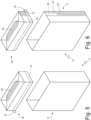
Figures 5 and 6 are two exploded perspective views, front and pack respectively, of the transparent overwrap of the cigarette packet inFigures 1 and 2 ; -
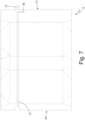
Figure 7 is a plan view of a wrapping sheet used to produce the transparent overwrap of the cigarette packet inFigures 1 and 2 ; -
Figure 8 is a plan view of a variant of the wrapping sheet inFigure 7 ; -
Figures 9 and 10 are two side views of the cigarette packet inFigures 1 and 2 before and after, respectively, the removal of an upper portion of the transparent overwrap; -
Figure 11 is a front perspective view of a rigid cigarette packet with a sliding opening provided with a transparent overwrap; -
Figure 12 is a front perspective view, in an open configuration, of the cigarette packet inFigure 11 , after the removal of the transparent overwrap and in an open configuration; and -
Figures 13 and 14 are two side views of the cigarette packet inFigures 11 and12 before and after, respectively, the removal of an upper portion of the transparent overwrap. - In
Figures 1 and 2 ,reference number 1 indicates, as a whole, a rigid cigarette packet with a hinged lid. Thecigarette packet 1 comprises anouter container 2 consisting of rigid cardboard or card and cup-shaped, and a soft wrapping 3 (partially illustrated inFigure 12 ) housed within theouter container 2 and it encloses a group of cigarettes. - In the description that follows of the
cigarette packet 1, terms such as "low" and "high" and "lower" and "upper" will be used, to designate the positions of portions of the cigarette packet, assuming that the packet is arranged so that the main extension direction, i.e., the longitudinal direction, coincides with the vertical one; however, the lower and upper walls are respectively arranged "low down" and "high up" and the transverse direction is orthogonal to the longitudinal direction. - The
outer container 2 has an open upper end and is provided with alid 4, which is cup-shaped and is hinged to theouter container 2 along a hinge 5 (illustrated inFigure 2 ) in order to rotate, in relation to theouter container 2, between an open position (not illustrated) and a closed position (illustrated inFigures 1 and 2 ) of the open upper end. - According to what is better illustrated in
Figures 3 and 4 , theouter container 2 has a basically parallelepipedal, rectangular shape oriented according to a vertical, main extension direction, it is cup-shaped, and has an open upper end, alower wall 6 opposite the open upper end, a front wall 7 and a rear wall 8 (wherein thehinge 5 is arranged) parallel and opposite each other, and twoside walls 9 that are parallel and opposite each other. Between the front 7, rear 8, andside 9 walls of theouter container 2 four longitudinal corners are defined, while between thewalls 7, 8, and 9 and thelower wall 6 of theouter container 2, four transverse corners are defined. - The
lid 4 has a basically parallelepipedal, rectangular shape, it is cup-shaped, and has an open lower end (facing the open upper end of theouter container 2 when thelid 4 is in the closed position), an upper wall 10 (which is parallel and opposite thelower wall 6 of theouter container 2 when thelid 4 is in the closed position), a front wall 11 (which is parallel to and aligned with the front wall 7 of theouter container 2 when thelid 4 is in the closed position), a rear wall 12 (which is parallel to and aligned with the rear wall 8 of theouter container 2 when thelid 4 is in the closed position and is hinged to the rear wall 8 of theouter container 2 along the hinge 5), and twoside walls 13 parallel and opposite each other (which are parallel to and aligned with, in particular coplanar and adjacent, to theside walls 9 of theouter container 2 when thelid 4 is in the closed position 4). Between thefront 11, rear 12, andside 13 walls of thelid 4 four longitudinal corners are defined, while between thewalls lower wall 10 of thelid 4, four transverse corners are defined. The longitudinal corners and the transverse corners of thelid 4 are parallel to and aligned with the corresponding longitudinal and transverse corners of theouter container 2 when thelid 4 is in the closed position. - According to what is illustrated in
Figures 1 and 2 , thecigarette packet 1 comprises anoverwrap 14 surrounding and enclosing theouter container 2 and the lid 4 (thelid 4 is an integral part of the outer container 2) consists of a wrapping sheet 15 (illustrated inFigure 7 ) of transparent plastic material (typically cellophane or polypropylene) folded around theouter container 2 and thelid 4, and it is provided with a tear-open band 16 that is grasped and pulled by the user in order to divide (cut) theoverwrap 14 into twoportions overwrap 14. In particular, and according to what is illustrated inFigures 5 and 6 , the tear-open band 16 divides (cuts) theoverwrap 14 into a lower portion 17 (which is totally disconnected from the tear-open band 16, i.e., it has no point of connection with the tear-open band 16), and an upper portion 18 (which is connected to the tear-open band 16, i.e., is integral to the tear-open band 16). - To enable the grip, the tear-
open band 16 has a startingend 19 that is completely separated and raised by theoverwrap 14 and is formed through a suitable cut shaped by thewrapping sheet 15 when thewrapping sheet 15 is separated by a continuous band of plastic wrapping material (as clearly illustrated inFigures 7 and8 ). - The
wrapping sheet 15 is folded around theouter container 2 and thelid 4 and is, thus, stabilised using a heat seal, i.e., by joining via a heat seal overlapping portions of thewrapping sheet 15. According to what is illustrated inFigures 5 and 6 , thewrapping sheet 15 has twoopposite flaps 20 and 21 (illustrated separately inFigure 7 ) that are overlapped with each other and heat-sealed to form alongitudinal seal 22 contributing to stabilising theoverwrap 14; in addition, theoverwrap 14 comprises two additional transverse seals 23 (just one of which is illustrated inFigures 5 and 6 ) that are arranged at opposite ends of theoverwrap 14, extend perpendicularly to thelongitudinal seal 22, and contribute to stabilising theoverwrap 14. - According to what is illustrated in
Figures 1-4 , thelid 4 has afront edge 24, delimiting thefront wall 11 at the bottom, and twoside edges 25, each delimiting aside wall 13 at the bottom and connecting one end of thefront edge 24 to one end of thehinge 5. Thefront edge 24 of the lid 4 (when thelid 4 is closed) rests on a front edge of theouter container 2 and, similarly, theside edges 25 of the lid 4 (when thelid 4 is closed) rest on corresponding side edges of theouter container 2. - According to what is illustrated in
Figures 1 and 2 , the tear-open band 16 is arranged between theupper wall 10 of thelid 4 and thefront edge 24 of thelid 4; in this way, theupper portion 18 of theoverwrap 14 is smaller than thelid 4 and thelower portion 17 of theoverwrap 14 also extends over part of the lid 4 (i.e., partially covers the lid 4). In this way, once the onlyupper portion 18 of theoverwrap 14 is removed, by pulling the tear-open band 16, it still is not possible to open thelid 4 since thelid 4 is blocked by thelower portion 17 of theoverwrap 14; as a result, when first opening thecigarette packet 1, the user is forced to remove not only theupper portion 18 of theoverwrap 14 but also thelower portion 17 of theoverwrap 14 and, thus, they are pushed to correctly recycle both theportions - According to a preferred embodiment illustrated in
Figures 1 and 2 , the tear-open band 16 is arranged higher than thefront edge 24 of thelid 4 so as not to have any part overlapping thefront edge 24 of thelid 4. In particular, the tear-open band 16 is arranged at a distance D other than zero from thefront edge 24 of thelid 4; preferably, the distance D is equal to at least 2 mm and generally greater than 4 mm (generally ranging between 4 mm and 8 mm). According to a possible embodiment, the tear-open band 16 is arranged closer to theupper wall 10 of thelid 4 than to thefront edge 24 of thelid 4. - According to a possible embodiment illustrated in
Figures 1 and 2 , the tear-open band 16 is arranged so that it straddles thehinge 5. According to an alternative embodiment not illustrated, the tear-open band 16 is arranged between thehinge 5 and thefront edge 24 of thelid 4; according to an additional embodiment not illustrated, the tear-open band 16 is arranged between theupper wall 10 of thelid 4 and thefront edge 24 of thelid 4. - According to what is illustrated in
Figures 5-6 and9-10 , thelower portion 17 of theoverwrap 14 has at least onepre-weakened line 26, which helps tear it, originates near an upper edge of thelower portion 17, and extends towards thelower wall 6; according to possible embodiments, thepre-weakened line 26 can start exactly at the upper edge of the lower portion 17 (i.e. next to the tear-open band 16), thepre-weakened line 26 can start beyond the upper edge of the lower portion 17 (i.e., also involving a small piece of the tear-open band 16), or thepre-weakened line 26 can start at a small distance from the upper edge of the lower portion 17 (i.e., at a small distance from the tear-open band 16). According to a preferred yet not binding embodiment, thepre-weakened line 26 is parallel to the longitudinal corners of the outer container 2 (defined between the front wall 7 and the rear wall 8 and the two side walls 9) ; alternatively, thepre-weakened line 26 could be slightly tilted in relation to the longitudinal corners of theouter container 2 and could also have a zig-zag progression. - According to a preferred embodiment, the
pre-weakened line 26 consists of at least one through cut that completely goes through thewrapping sheet 15; i.e., thepre-weakened line 26 may consist of a single, continuous through cut or it may consist of a series (row) of through cuts that are equally spaced apart (i.e., arranged at a certain distance from each other). - According to a preferred embodiment, the
pre-weakened line 26 is arranged near the longitudinal seal 22 (consisting of the joining of the twoflaps pre-weakened line 26 is completely surrounded by joined portions wherein the twoflaps pre-weakened line 26 does not put theinner overwrap 14 in communication with the outside environment, thus ensuring the seal of theoverwrap 14, which remains, in any case, totally sealed from the outside environment. - According to a preferred embodiment, the
longitudinal seal 22 has, on the inside, aneutral area 27, which is free from any seal between the twoflaps pre-weakened line 26, and is completely surrounded by joined portions in which the twoflaps neutral area 27 is, above all, to avoid making a seal above thepre-weakened line 26 to prevent the seal from "closing" the pre-weakened line 26 (i.e., restoring, at least partially, the continuity of the wrapping material straddling the pre-weakened line 26) thus eliminating its functionality. An additional (secondary) function of theneutral area 27 is to increase the local weakening of thelower portion 17 of theoverwrap 14 so as to facilitate the breakage of thelower portion 17 of theoverwrap 14. - According to one possible embodiment, the
neutral area 27 has a longitudinal extension, i.e., parallel to the longitudinal corners of the outer container 2 (defined between the front wall 7 and the rear wall 8 and the two side walls 9), that is greater than a transverse extension, i.e., theneutral area 27 is "longer" that it is "wide". According to one possible embodiment, theneutral area 27 has a longitudinal extension, i.e., parallel to the longitudinal corners of the outer container 2 (defined between the front wall 7 and the rear wall 8 and the two side walls 9), that is greater than a longitudinal extension of thepre-weakened line 26; i.e., theneutral area 27 is larger than the pre-weakened line to increase the localised weakening of thelower portion 17 of theoverwrap 14. Generally, thepre-weakened line 26 only involves one of the twoflaps wrapping sheet 15; i.e., thepre-weakened line 26 is only formed on theinner flap 20 of the wrapping sheet 15 (as illustrated inFigure 8 ) i.e., or it is only formed in theouter flap 21 of the wrapping sheet 15 (as illustrated inFigure 7 ). It is also possible that only theflap 20 of thewrapping sheet 15 has severalpre-weakened lines 26 separated and parallel between them, or only theflap 21 of thewrapping sheet 15 has several pre-weakened lines separated and parallel to each other. Normally, forming two differentpre-weakened lines 26 on both theflaps wrapping sheet 15 is avoided so as to avoid any possible overlap (even only accidental due to the effect of the construction tolerances) of the two differentpre-weakened lines 26 on both theflaps wrapping sheet 15 from putting the inside of theoverwrap 14 in communication with the outside environment. - According to a possible embodiment not illustrated, a
pre-weakened line 26 is also formed near theupper portion 18 of theoverwrap 14 with the same identical construction methods of thepre-weakened line 26 formed near thelower portion 17 of theoverwrap 14. Obviously, thepre-weakened line 26 also formed in theupper portion 18 of theoverwrap 14 must be arranged above the tear-open band 16 (i.e., it must not affect, unless marginally, the tear-open band 16) to avoid weakening the tear-open band 16 and, thus, causing any undesired breaking to it when the tear-open band 16 is pulled. - According to an alternative embodiment illustrated in
Figures 11 and12 , thecigarette packet 1 has a sliding opening and comprises theouter container 2 that has the open end no longer arranged above (as in the embodiment illustrated inFigures 1-4 ), but arranged at the side; in addition, thecigarette packet 1 comprises aninner container 28 containing thewrapping 3 and it is housed so that it can slide in theouter container 2 to slide between a closed position (illustrated inFigure 11 ), wherein theinner container 28 is completely arranged in theouter container 2, and an open position (illustrated inFigure 12 ), wherein theinner container 28 is partially extracted from theouter container 2. - In the example of the
cigarette packet 1 illustrated inFigures 11 and12 , it is clear that it is, in any case, necessary to completely eliminate theoverwrap 14 to be able to access the cigarettes, i.e., it is necessary to eliminate both thelower portion 17 of theoverwrap 14, and theupper portion 18 of theoverwrap 14 in order to be able to access the cigarettes, irrespective of the position of the tear-open band 16. - In the embodiment illustrated in
Figures 11 ,13, and 14 , the tear-open band 16 is arranged at (approximately) halfway so that the twoportions overwrap 14 have (approximately) the same size; according to other embodiments, the tear-open band 16 could be arranged higher (so that thelower portion 17 of theoverwrap 14 is bigger than theupper portion 18 of the overwrap 14) or even lower (so that thelower portion 17 of theoverwrap 14 is smaller than theupper portion 18 of the overwrap 14) compared to what is illustrated inFigures 11 ,13, and 14 . - Obviously, in the embodiment illustrated in
Figures 11 ,13, and 14 , theoverwrap 14 is provided with the pre-weakened line 26 (produced, as described above, i.e., arranged in theneutral area 27 of the longitudinal seal 22) to also facilitate the removal of thelower portion 17 of theoverwrap 14 after having eliminated theupper portion 18 of theoverwrap 14. - According to one possible embodiment, indications (symbols and/or text) could be printed on the overwrap 14 (i.e., on the wrapping sheet 15) that explain (show) how to proceed with the fast removal of the
lower portion 17 of theoverwrap 14. - The embodiments described herein may be combined between them without departing from the scope of protection of this invention.
- The
cigarette packet 1 described above has numerous advantages. - In the first place, the
cigarette packet 1 described above encourages the correct recycling of the wrapping materials, since, in order to be able to open thelid 4, it is necessary to remove not only theupper portion 18 of theoverwrap 14, but also thelower portion 17 of the overwrap 1 (in fact, even just thelower portion 17 of theoverwrap 14 prevents the opening of the lid 4); thus, the user is forced to remove and immediately dispose of the wholeplastic overwrap 14 in the appropriate containers, without leaving thelower portion 17 of theoverwrap 14 around theouter container 2 until finishing thecigarette packet 1. - In addition, in the
cigarette packet 1 described above, the removal of thelower portion 17 of theoverwrap 14 is simple and quick thanks to the presence of thepre-weakened line 26, which makes it possible to easily break thelower portion 17 of the overwrap 14 (including when theoverwrap 14 has been stretched via heat shrinking) by simply pulling theoverwrap 14 with a finger at thepre-weakened line 26. To this end, it is important to observe that, thanks to the particular positioning of thepre-weakened line 26 within thelongitudinal seal 22 of thewrapping sheet 15, the presence of thepre-weakened line 26 does not affect the seal of theoverwrap 14, which remains, in any case, totally sealed from the outside environment. - Finally, the
cigarette packet 1 described above is very simple to produce compared to a similar, known cigarette packet in that it is enough: to change the positioning of the tear-open band 16 in relation to thewrapping sheet 15; to insert in the cutting unit (already present) an additional blade for making thepre-weakened line 26; and to slightly change the shape of the welder to produce theneutral area 27 within thelongitudinal seal 22. - The embodiment illustrated in the attached figures refers to the production of a cigarette packet, but this invention can be applied, without significant changes, to the production of any other type of pack of smoking articles (for example, a pack of cigars, a pack of electronic cigarettes of the liquid vaping type, a new-generation cigarette packet without tobacco combustion).
-
- 1
- cigarette packet
- 2
- outer container
- 3
- wrapping
- 4
- lid
- 5
- hinge
- 6
- lower wall
- 7
- front wall
- 8
- rear wall
- 9
- side walls
- 10
- upper wall
- 11
- front wall
- 12
- rear wall
- 13
- side walls
- 14
- overwrap
- 15
- wrapping sheet
- 16
- tear-open band
- 17
- lower portion
- 18
- upper portion
- 19
- start end
- 20
- inner flap
- 21
- outer flap
- 22
- longitudinal seal
- 23
- transverse seal
- 24
- front edge
- 25
- side edges
- 26
- pre-weakened line
- 27
- neutral area
- 28
- inner container
- D
- distance
Claims (15)
- A pack (1) for smoking articles comprising:an outer container (2) having a lower wall (6), a front wall (7), a rear wall (8) and two side walls (9);a lid (4), which is hinged to the outer container (2) along a hinge (5) and has an upper wall (10), a front wall (11), a rear wall (12) and two side walls (13);an overwrap (14), which surrounds and wraps the outer container (2) and the lid (4); anda tear-open band (16), which is coupled to the overwrap (14) and is designed to be pulled in order to divide the overwrap (14) into a lower portion (17), which is not connected to the tear-open band (16), and an upper portion (18), which is integral to the tear-open band (16);wherein the lid (4) has a front edge (24), which delimits the front wall (11) at the bottom;the pack (1) for smoking articles is characterized in that the tear-open band (16) is arranged between the upper wall (10) of the lid (4) and the front edge (24) of the lid (4) so that the upper portion (18) of the overwrap (14) is smaller than the lid (4) and the lower portion (17) of the overwrap (14) partially covers the lid (4).
- The pack (1) for smoking articles according to claim 1, wherein the tear-open band (16) is arranged higher than the front edge (24) of the lid (4) so as not to have any part overlapping the front edge (24) of the lid (4).
- The pack (1) for smoking articles according to claim 1 or 2, wherein the tear-open band (16) is arranged at a distance (D) other than zero - and preferably equal to at least 2 mm - from the front edge (24) of the lid (4).
- The pack (1) for smoking articles according to claim 1, 2 or 3, wherein the tear-open band (16) is arranged closer to the upper wall (10) of the lid (4) than to the front edge (24) of the lid (4).
- The pack (1) for smoking articles according to one of the claims from 1 to 4, wherein the lid (4) has two side edges (25), each delimiting a side wall (13) at the bottom and connecting an end of the front edge (24) to an end of the hinge (5); and wherein the tear-open band (16) is arranged between the hinge (5) and the front edge (24) of the lid (4) .
- The pack (1) for smoking articles according to one of the claims from 1 to 4, wherein the lid (4) has two side edges (25), each delimiting a side wall (13) at the bottom and connecting an end of the front edge (24) to an end of the hinge (5); and wherein the tear-open band (16) is arranged astride the hinge (5).
- The pack (1) for smoking articles according to one of the claims from 1 to 4, wherein the lid (4) has two side edges (25), each delimiting a side wall (13) at the bottom and connecting an end of the front edge (24) to an end of the hinge (5); and wherein the tear-open band (16) is arranged between the hinge (5) and the upper wall (10) of the lid (4) .
- The pack (1) for smoking articles according to one of the claims from 1 to 7, wherein the lower portion (17) of the overwrap (14) has at least one pre-weakened line (26), which helps tear it, originates close to an upper edge of the lower portion (17) and extends towards the lower wall (6).
- The pack (1) for smoking articles according to claim 7, wherein the pre-weakened line (26) is parallel to longitudinal corners of the outer container (2) defined between the front wall (7) and the rear wall (8) and the two front walls (9).
- The pack (1) for smoking articles according to claim 7 or 8, wherein the overwrap (14) consists of a wrapping sheet (15), which was folded around the outer container (2) and the lid (4) and was stabilized by means of at least one heat seal; and wherein the pre-weakened line (26) consists of at least one through cut completely going through the wrapping sheet (15).
- The pack (1) for smoking articles according to claim 10, wherein:the wrapping sheet (15) has two opposite flaps (20, 21),which overlap and are heat-sealed to one another so as to form a longitudinal seal (22); andthe pre-weakened line (26) is arranged in the area of the longitudinal seal (22).
- The pack (1) for smoking articles according to claim 11, wherein the pre-weakened line (26) affects only one of the two flaps (20, 21) of the wrapping sheet (15).
- The pack (1) for smoking articles according to claim 11 or 12, wherein the longitudinal seal (22) has, on the inside, a neutral area (27), which is free from any seal between the two flaps (20, 21), contains - on the inside - the pre-weakened line (26) and is completely surrounded by joined portions in which the two flaps (20, 21) are sealed to one another.
- The pack (1) for smoking articles according to claim 13, wherein the neutral area (27) has a longitudinal extension, namely an extension parallel to longitudinal corners of the outer container (2) defined between the front wall (7) and the rear wall (8) and the two front walls (9), which is greater than a transverse extension.
- The pack (1) for smoking articles according to claim 13 or 14, wherein the neutral area (27) has a longitudinal extension, namely an extension parallel to longitudinal corners of the outer container (2) defined between the front wall (7) and the rear wall (8) and the two front walls (9), which is greater than a longitudinal extension of the pre-weakened line (26).
Applications Claiming Priority (2)
| Application Number | Priority Date | Filing Date | Title |
|---|---|---|---|
| IT102020000032222A IT202000032222A1 (en) | 2020-12-23 | 2020-12-23 | PACKAGE OF SMOKING ITEMS WITH HINGED LID AND PROVIDED WITH AN OVERPACK. |
| PCT/IB2021/061487 WO2022136996A1 (en) | 2020-12-23 | 2021-12-09 | Pack for smoking articles with a hinged lid provided with an overwrap |
Publications (2)
| Publication Number | Publication Date |
|---|---|
| EP4267486A1 EP4267486A1 (en) | 2023-11-01 |
| EP4267486B1 true EP4267486B1 (en) | 2024-05-15 |
Family
ID=74858687
Family Applications (1)
| Application Number | Title | Priority Date | Filing Date |
|---|---|---|---|
| EP21834901.7A Active EP4267486B1 (en) | 2020-12-23 | 2021-12-09 | Pack for smoking articles with a hinged lid provided with an overwrap |
Country Status (5)
| Country | Link |
|---|---|
| EP (1) | EP4267486B1 (en) |
| JP (1) | JP7630626B2 (en) |
| CN (1) | CN116685536A (en) |
| IT (1) | IT202000032222A1 (en) |
| WO (1) | WO2022136996A1 (en) |
Family Cites Families (16)
| Publication number | Priority date | Publication date | Assignee | Title |
|---|---|---|---|---|
| US4717017A (en) * | 1987-03-23 | 1988-01-05 | Philip Morris Incorporated | Package with means for releasing aromatic substance on opening |
| EP0343857A3 (en) * | 1988-05-25 | 1990-10-24 | Philip Morris Products Inc. | Container wrapper, and methods and apparatus for making it |
| US4947994A (en) * | 1988-05-25 | 1990-08-14 | Scepter Manufacturing Company Limited | Container wrapper, and methods and apparatus for making same |
| DE4241462A1 (en) | 1992-12-09 | 1994-06-16 | Tabac Fab Reunies Sa | Packaging with tear tape arranged in a screw line and method and device for producing such packaging |
| GB2386234B (en) * | 2001-10-03 | 2005-07-27 | Willett Int Ltd | Coding of substrates |
| CN1613729A (en) * | 2003-11-05 | 2005-05-11 | 林贵生 | Ham Sausage with peeler on casing |
| EP1666376A1 (en) * | 2004-12-03 | 2006-06-07 | Philip Morris Products S.A. | Easy opening of film wrapper |
| JP2006306442A (en) | 2005-04-28 | 2006-11-09 | Toppan Printing Co Ltd | Easy-to-open and easy-to-release glass bottle |
| ITBO20060214A1 (en) | 2006-03-29 | 2006-06-28 | Gd Spa | METHOD FOR THE PRODUCTION OF OVERHEAD MATERIAL AND PACKAGE EQUIPPED WITH MATERIALS SO PRODUCED. |
| ITBO20130086A1 (en) | 2013-02-28 | 2014-08-29 | Gd Spa | PACKAGING OF SMOKE ARTICLES, IN PARTICULAR OF CIGARETTES, AND METHOD FOR ITS PRODUCTION. |
| JP6564391B2 (en) | 2014-03-25 | 2019-08-21 | ジー.デー ソチエタ ペル アツィオニG.D Societa Per Azioni | Packaging material sheet, packaging box for smoking products and method for producing packaging material sheet |
| US20160176601A1 (en) * | 2014-12-19 | 2016-06-23 | The Quaker Oats Company | Easy-open flexible package |
| CN204624179U (en) * | 2015-03-30 | 2015-09-09 | 刘兴丹 | Horizontal edge sealing without tear strip packaging bag |
| SG11201707969TA (en) * | 2015-07-03 | 2017-10-30 | Philip Morris Products Sa | Flat seal container |
| US20200108992A1 (en) | 2017-06-20 | 2020-04-09 | Jt International Sa | Wrapped Container |
| JP2019164274A (en) | 2018-03-20 | 2019-09-26 | 株式会社フジシール | Heat-shrinkable cylindrical label and container with cylindrical label |
-
2020
- 2020-12-23 IT IT102020000032222A patent/IT202000032222A1/en unknown
-
2021
- 2021-12-09 CN CN202180087190.3A patent/CN116685536A/en active Pending
- 2021-12-09 EP EP21834901.7A patent/EP4267486B1/en active Active
- 2021-12-09 JP JP2023538751A patent/JP7630626B2/en active Active
- 2021-12-09 WO PCT/IB2021/061487 patent/WO2022136996A1/en not_active Ceased
Also Published As
| Publication number | Publication date |
|---|---|
| JP7630626B2 (en) | 2025-02-17 |
| JP2024502767A (en) | 2024-01-23 |
| EP4267486A1 (en) | 2023-11-01 |
| IT202000032222A1 (en) | 2022-06-23 |
| CN116685536A (en) | 2023-09-01 |
| WO2022136996A1 (en) | 2022-06-30 |
Similar Documents
| Publication | Publication Date | Title |
|---|---|---|
| KR101676797B1 (en) | Packet of cigarettes, and method of producing a packet of cigarettes | |
| US6000539A (en) | Cigarette pack | |
| EP2455302B1 (en) | Cigarette package | |
| CN101023006B (en) | Rigid hinge-lid packaging for tobacco products | |
| EP3914536B1 (en) | Pack for smoking articles | |
| JP2009046196A (en) | Packaging container of tobacco product including inner packaging container with covering lid | |
| EP3455147B1 (en) | A container with inner stiffener for smoking articles, method | |
| KR20240119068A (en) | Smoking supplies pack with hinged lid and sealed wrapper | |
| EP4267487B1 (en) | Pack for smoking articles provided with a weakened overwrap | |
| KR102105327B1 (en) | Courage, method | |
| EP3322650B1 (en) | Soft cigarette package with a sealing stamp provided with a tear-open portion | |
| EP4267486A1 (en) | Pack for smoking articles with a hinged lid provided with an overwrap | |
| WO2009040379A1 (en) | Smoking article pack blank and packs formed therefrom | |
| GB2031385A (en) | Cigarette Packets | |
| EP2487116B1 (en) | Packaging container | |
| US12528640B2 (en) | Rigid pack for smoking articles provided with a hinged lid | |
| EP3914535B1 (en) | A rigid pack for smoking articles and a blank for producing said rigid pack for smoking articles | |
| EP3037365A1 (en) | Container having a tab and corresponding sheet material and tab | |
| WO2024105493A1 (en) | Rigid pack for smoking articles with a tilting opening | |
| HK1166968B (en) | Cigarette package | |
| HK1108416A1 (en) | Hinge lid package for bar-like smoking article and blank therefor | |
| HK1108416B (en) | Hinge lid package for bar-like smoking article and blank therefor |
Legal Events
| Date | Code | Title | Description |
|---|---|---|---|
| STAA | Information on the status of an ep patent application or granted ep patent |
Free format text: STATUS: UNKNOWN |
|
| STAA | Information on the status of an ep patent application or granted ep patent |
Free format text: STATUS: THE INTERNATIONAL PUBLICATION HAS BEEN MADE |
|
| PUAI | Public reference made under article 153(3) epc to a published international application that has entered the european phase |
Free format text: ORIGINAL CODE: 0009012 |
|
| STAA | Information on the status of an ep patent application or granted ep patent |
Free format text: STATUS: REQUEST FOR EXAMINATION WAS MADE |
|
| 17P | Request for examination filed |
Effective date: 20230626 |
|
| AK | Designated contracting states |
Kind code of ref document: A1 Designated state(s): AL AT BE BG CH CY CZ DE DK EE ES FI FR GB GR HR HU IE IS IT LI LT LU LV MC MK MT NL NO PL PT RO RS SE SI SK SM TR |
|
| GRAP | Despatch of communication of intention to grant a patent |
Free format text: ORIGINAL CODE: EPIDOSNIGR1 |
|
| STAA | Information on the status of an ep patent application or granted ep patent |
Free format text: STATUS: GRANT OF PATENT IS INTENDED |
|
| DAV | Request for validation of the european patent (deleted) | ||
| DAX | Request for extension of the european patent (deleted) | ||
| INTG | Intention to grant announced |
Effective date: 20231206 |
|
| GRAS | Grant fee paid |
Free format text: ORIGINAL CODE: EPIDOSNIGR3 |
|
| GRAA | (expected) grant |
Free format text: ORIGINAL CODE: 0009210 |
|
| STAA | Information on the status of an ep patent application or granted ep patent |
Free format text: STATUS: THE PATENT HAS BEEN GRANTED |
|
| P01 | Opt-out of the competence of the unified patent court (upc) registered |
Effective date: 20240403 |
|
| AK | Designated contracting states |
Kind code of ref document: B1 Designated state(s): AL AT BE BG CH CY CZ DE DK EE ES FI FR GB GR HR HU IE IS IT LI LT LU LV MC MK MT NL NO PL PT RO RS SE SI SK SM TR |
|
| REG | Reference to a national code |
Ref country code: CH Ref legal event code: EP |
|
| REG | Reference to a national code |
Ref country code: IE Ref legal event code: FG4D |
|
| REG | Reference to a national code |
Ref country code: DE Ref legal event code: R096 Ref document number: 602021013416 Country of ref document: DE |
|
| REG | Reference to a national code |
Ref country code: NL Ref legal event code: FP |
|
| REG | Reference to a national code |
Ref country code: LT Ref legal event code: MG9D |
|
| PG25 | Lapsed in a contracting state [announced via postgrant information from national office to epo] |
Ref country code: IS Free format text: LAPSE BECAUSE OF FAILURE TO SUBMIT A TRANSLATION OF THE DESCRIPTION OR TO PAY THE FEE WITHIN THE PRESCRIBED TIME-LIMIT Effective date: 20240915 |
|
| PG25 | Lapsed in a contracting state [announced via postgrant information from national office to epo] |
Ref country code: BG Free format text: LAPSE BECAUSE OF FAILURE TO SUBMIT A TRANSLATION OF THE DESCRIPTION OR TO PAY THE FEE WITHIN THE PRESCRIBED TIME-LIMIT Effective date: 20240515 |
|
| PG25 | Lapsed in a contracting state [announced via postgrant information from national office to epo] |
Ref country code: HR Free format text: LAPSE BECAUSE OF FAILURE TO SUBMIT A TRANSLATION OF THE DESCRIPTION OR TO PAY THE FEE WITHIN THE PRESCRIBED TIME-LIMIT Effective date: 20240515 Ref country code: FI Free format text: LAPSE BECAUSE OF FAILURE TO SUBMIT A TRANSLATION OF THE DESCRIPTION OR TO PAY THE FEE WITHIN THE PRESCRIBED TIME-LIMIT Effective date: 20240515 |
|
| PG25 | Lapsed in a contracting state [announced via postgrant information from national office to epo] |
Ref country code: GR Free format text: LAPSE BECAUSE OF FAILURE TO SUBMIT A TRANSLATION OF THE DESCRIPTION OR TO PAY THE FEE WITHIN THE PRESCRIBED TIME-LIMIT Effective date: 20240816 |
|
| PG25 | Lapsed in a contracting state [announced via postgrant information from national office to epo] |
Ref country code: PT Free format text: LAPSE BECAUSE OF FAILURE TO SUBMIT A TRANSLATION OF THE DESCRIPTION OR TO PAY THE FEE WITHIN THE PRESCRIBED TIME-LIMIT Effective date: 20240916 |
|
| REG | Reference to a national code |
Ref country code: AT Ref legal event code: MK05 Ref document number: 1686780 Country of ref document: AT Kind code of ref document: T Effective date: 20240515 |
|
| PG25 | Lapsed in a contracting state [announced via postgrant information from national office to epo] |
Ref country code: ES Free format text: LAPSE BECAUSE OF FAILURE TO SUBMIT A TRANSLATION OF THE DESCRIPTION OR TO PAY THE FEE WITHIN THE PRESCRIBED TIME-LIMIT Effective date: 20240515 |
|
| PG25 | Lapsed in a contracting state [announced via postgrant information from national office to epo] |
Ref country code: AT Free format text: LAPSE BECAUSE OF FAILURE TO SUBMIT A TRANSLATION OF THE DESCRIPTION OR TO PAY THE FEE WITHIN THE PRESCRIBED TIME-LIMIT Effective date: 20240515 |
|
| PG25 | Lapsed in a contracting state [announced via postgrant information from national office to epo] |
Ref country code: PL Free format text: LAPSE BECAUSE OF FAILURE TO SUBMIT A TRANSLATION OF THE DESCRIPTION OR TO PAY THE FEE WITHIN THE PRESCRIBED TIME-LIMIT Effective date: 20240515 |
|
| PG25 | Lapsed in a contracting state [announced via postgrant information from national office to epo] |
Ref country code: LV Free format text: LAPSE BECAUSE OF FAILURE TO SUBMIT A TRANSLATION OF THE DESCRIPTION OR TO PAY THE FEE WITHIN THE PRESCRIBED TIME-LIMIT Effective date: 20240515 |
|
| PG25 | Lapsed in a contracting state [announced via postgrant information from national office to epo] |
Ref country code: PT Free format text: LAPSE BECAUSE OF FAILURE TO SUBMIT A TRANSLATION OF THE DESCRIPTION OR TO PAY THE FEE WITHIN THE PRESCRIBED TIME-LIMIT Effective date: 20240916 Ref country code: PL Free format text: LAPSE BECAUSE OF FAILURE TO SUBMIT A TRANSLATION OF THE DESCRIPTION OR TO PAY THE FEE WITHIN THE PRESCRIBED TIME-LIMIT Effective date: 20240515 Ref country code: NO Free format text: LAPSE BECAUSE OF FAILURE TO SUBMIT A TRANSLATION OF THE DESCRIPTION OR TO PAY THE FEE WITHIN THE PRESCRIBED TIME-LIMIT Effective date: 20240815 Ref country code: LV Free format text: LAPSE BECAUSE OF FAILURE TO SUBMIT A TRANSLATION OF THE DESCRIPTION OR TO PAY THE FEE WITHIN THE PRESCRIBED TIME-LIMIT Effective date: 20240515 Ref country code: IS Free format text: LAPSE BECAUSE OF FAILURE TO SUBMIT A TRANSLATION OF THE DESCRIPTION OR TO PAY THE FEE WITHIN THE PRESCRIBED TIME-LIMIT Effective date: 20240915 Ref country code: HR Free format text: LAPSE BECAUSE OF FAILURE TO SUBMIT A TRANSLATION OF THE DESCRIPTION OR TO PAY THE FEE WITHIN THE PRESCRIBED TIME-LIMIT Effective date: 20240515 Ref country code: GR Free format text: LAPSE BECAUSE OF FAILURE TO SUBMIT A TRANSLATION OF THE DESCRIPTION OR TO PAY THE FEE WITHIN THE PRESCRIBED TIME-LIMIT Effective date: 20240816 Ref country code: FI Free format text: LAPSE BECAUSE OF FAILURE TO SUBMIT A TRANSLATION OF THE DESCRIPTION OR TO PAY THE FEE WITHIN THE PRESCRIBED TIME-LIMIT Effective date: 20240515 Ref country code: ES Free format text: LAPSE BECAUSE OF FAILURE TO SUBMIT A TRANSLATION OF THE DESCRIPTION OR TO PAY THE FEE WITHIN THE PRESCRIBED TIME-LIMIT Effective date: 20240515 Ref country code: BG Free format text: LAPSE BECAUSE OF FAILURE TO SUBMIT A TRANSLATION OF THE DESCRIPTION OR TO PAY THE FEE WITHIN THE PRESCRIBED TIME-LIMIT Effective date: 20240515 Ref country code: AT Free format text: LAPSE BECAUSE OF FAILURE TO SUBMIT A TRANSLATION OF THE DESCRIPTION OR TO PAY THE FEE WITHIN THE PRESCRIBED TIME-LIMIT Effective date: 20240515 Ref country code: RS Free format text: LAPSE BECAUSE OF FAILURE TO SUBMIT A TRANSLATION OF THE DESCRIPTION OR TO PAY THE FEE WITHIN THE PRESCRIBED TIME-LIMIT Effective date: 20240815 |
|
| PG25 | Lapsed in a contracting state [announced via postgrant information from national office to epo] |
Ref country code: DK Free format text: LAPSE BECAUSE OF FAILURE TO SUBMIT A TRANSLATION OF THE DESCRIPTION OR TO PAY THE FEE WITHIN THE PRESCRIBED TIME-LIMIT Effective date: 20240515 |
|
| PG25 | Lapsed in a contracting state [announced via postgrant information from national office to epo] |
Ref country code: EE Free format text: LAPSE BECAUSE OF FAILURE TO SUBMIT A TRANSLATION OF THE DESCRIPTION OR TO PAY THE FEE WITHIN THE PRESCRIBED TIME-LIMIT Effective date: 20240515 |
|
| PG25 | Lapsed in a contracting state [announced via postgrant information from national office to epo] |
Ref country code: CZ Free format text: LAPSE BECAUSE OF FAILURE TO SUBMIT A TRANSLATION OF THE DESCRIPTION OR TO PAY THE FEE WITHIN THE PRESCRIBED TIME-LIMIT Effective date: 20240515 |
|
| PG25 | Lapsed in a contracting state [announced via postgrant information from national office to epo] |
Ref country code: SK Free format text: LAPSE BECAUSE OF FAILURE TO SUBMIT A TRANSLATION OF THE DESCRIPTION OR TO PAY THE FEE WITHIN THE PRESCRIBED TIME-LIMIT Effective date: 20240515 Ref country code: RO Free format text: LAPSE BECAUSE OF FAILURE TO SUBMIT A TRANSLATION OF THE DESCRIPTION OR TO PAY THE FEE WITHIN THE PRESCRIBED TIME-LIMIT Effective date: 20240515 |
|
| PG25 | Lapsed in a contracting state [announced via postgrant information from national office to epo] |
Ref country code: SM Free format text: LAPSE BECAUSE OF FAILURE TO SUBMIT A TRANSLATION OF THE DESCRIPTION OR TO PAY THE FEE WITHIN THE PRESCRIBED TIME-LIMIT Effective date: 20240515 |
|
| PG25 | Lapsed in a contracting state [announced via postgrant information from national office to epo] |
Ref country code: SM Free format text: LAPSE BECAUSE OF FAILURE TO SUBMIT A TRANSLATION OF THE DESCRIPTION OR TO PAY THE FEE WITHIN THE PRESCRIBED TIME-LIMIT Effective date: 20240515 Ref country code: SK Free format text: LAPSE BECAUSE OF FAILURE TO SUBMIT A TRANSLATION OF THE DESCRIPTION OR TO PAY THE FEE WITHIN THE PRESCRIBED TIME-LIMIT Effective date: 20240515 Ref country code: RO Free format text: LAPSE BECAUSE OF FAILURE TO SUBMIT A TRANSLATION OF THE DESCRIPTION OR TO PAY THE FEE WITHIN THE PRESCRIBED TIME-LIMIT Effective date: 20240515 Ref country code: EE Free format text: LAPSE BECAUSE OF FAILURE TO SUBMIT A TRANSLATION OF THE DESCRIPTION OR TO PAY THE FEE WITHIN THE PRESCRIBED TIME-LIMIT Effective date: 20240515 Ref country code: DK Free format text: LAPSE BECAUSE OF FAILURE TO SUBMIT A TRANSLATION OF THE DESCRIPTION OR TO PAY THE FEE WITHIN THE PRESCRIBED TIME-LIMIT Effective date: 20240515 Ref country code: CZ Free format text: LAPSE BECAUSE OF FAILURE TO SUBMIT A TRANSLATION OF THE DESCRIPTION OR TO PAY THE FEE WITHIN THE PRESCRIBED TIME-LIMIT Effective date: 20240515 |
|
| PG25 | Lapsed in a contracting state [announced via postgrant information from national office to epo] |
Ref country code: IT Free format text: LAPSE BECAUSE OF FAILURE TO SUBMIT A TRANSLATION OF THE DESCRIPTION OR TO PAY THE FEE WITHIN THE PRESCRIBED TIME-LIMIT Effective date: 20240515 |
|
| REG | Reference to a national code |
Ref country code: DE Ref legal event code: R026 Ref document number: 602021013416 Country of ref document: DE |
|
| PLBI | Opposition filed |
Free format text: ORIGINAL CODE: 0009260 |
|
| PLAX | Notice of opposition and request to file observation + time limit sent |
Free format text: ORIGINAL CODE: EPIDOSNOBS2 |
|
| 26 | Opposition filed |
Opponent name: FOCKE & CO. (GMBH & CO. KG) Effective date: 20250214 |
|
| PG25 | Lapsed in a contracting state [announced via postgrant information from national office to epo] |
Ref country code: SI Free format text: LAPSE BECAUSE OF FAILURE TO SUBMIT A TRANSLATION OF THE DESCRIPTION OR TO PAY THE FEE WITHIN THE PRESCRIBED TIME-LIMIT Effective date: 20240515 |
|
| PG25 | Lapsed in a contracting state [announced via postgrant information from national office to epo] |
Ref country code: MC Free format text: LAPSE BECAUSE OF FAILURE TO SUBMIT A TRANSLATION OF THE DESCRIPTION OR TO PAY THE FEE WITHIN THE PRESCRIBED TIME-LIMIT Effective date: 20240515 |
|
| PLBB | Reply of patent proprietor to notice(s) of opposition received |
Free format text: ORIGINAL CODE: EPIDOSNOBS3 |
|
| REG | Reference to a national code |
Ref country code: CH Ref legal event code: PL |
|
| PG25 | Lapsed in a contracting state [announced via postgrant information from national office to epo] |
Ref country code: LU Free format text: LAPSE BECAUSE OF NON-PAYMENT OF DUE FEES Effective date: 20241209 |
|
| PG25 | Lapsed in a contracting state [announced via postgrant information from national office to epo] |
Ref country code: SE Free format text: LAPSE BECAUSE OF FAILURE TO SUBMIT A TRANSLATION OF THE DESCRIPTION OR TO PAY THE FEE WITHIN THE PRESCRIBED TIME-LIMIT Effective date: 20240515 |
|
| REG | Reference to a national code |
Ref country code: BE Ref legal event code: MM Effective date: 20241231 |
|
| PG25 | Lapsed in a contracting state [announced via postgrant information from national office to epo] |
Ref country code: BE Free format text: LAPSE BECAUSE OF NON-PAYMENT OF DUE FEES Effective date: 20241231 |
|
| PG25 | Lapsed in a contracting state [announced via postgrant information from national office to epo] |
Ref country code: FR Free format text: LAPSE BECAUSE OF NON-PAYMENT OF DUE FEES Effective date: 20241231 |
|
| PG25 | Lapsed in a contracting state [announced via postgrant information from national office to epo] |
Ref country code: CH Free format text: LAPSE BECAUSE OF NON-PAYMENT OF DUE FEES Effective date: 20241231 |
|
| PG25 | Lapsed in a contracting state [announced via postgrant information from national office to epo] |
Ref country code: IE Free format text: LAPSE BECAUSE OF NON-PAYMENT OF DUE FEES Effective date: 20241209 |
|
| PGFP | Annual fee paid to national office [announced via postgrant information from national office to epo] |
Ref country code: NL Payment date: 20251226 Year of fee payment: 5 |
|
| PGFP | Annual fee paid to national office [announced via postgrant information from national office to epo] |
Ref country code: DE Payment date: 20251229 Year of fee payment: 5 |