EP4263192B1 - Verfahren zum zuführen eines halbzeugs zur montage einer reifenkomponente und seine zuführstation - Google Patents
Verfahren zum zuführen eines halbzeugs zur montage einer reifenkomponente und seine zuführstation Download PDFInfo
- Publication number
- EP4263192B1 EP4263192B1 EP21839265.2A EP21839265A EP4263192B1 EP 4263192 B1 EP4263192 B1 EP 4263192B1 EP 21839265 A EP21839265 A EP 21839265A EP 4263192 B1 EP4263192 B1 EP 4263192B1
- Authority
- EP
- European Patent Office
- Prior art keywords
- service
- reel
- station
- dispensing
- semi
- Prior art date
- Legal status (The legal status is an assumption and is not a legal conclusion. Google has not performed a legal analysis and makes no representation as to the accuracy of the status listed.)
- Active
Links
Images




Classifications
-
- B—PERFORMING OPERATIONS; TRANSPORTING
- B29—WORKING OF PLASTICS; WORKING OF SUBSTANCES IN A PLASTIC STATE IN GENERAL
- B29D—PRODUCING PARTICULAR ARTICLES FROM PLASTICS OR FROM SUBSTANCES IN A PLASTIC STATE
- B29D30/00—Producing pneumatic or solid tyres or parts thereof
- B29D30/0016—Handling tyres or parts thereof, e.g. supplying, storing, conveying
-
- B—PERFORMING OPERATIONS; TRANSPORTING
- B29—WORKING OF PLASTICS; WORKING OF SUBSTANCES IN A PLASTIC STATE IN GENERAL
- B29D—PRODUCING PARTICULAR ARTICLES FROM PLASTICS OR FROM SUBSTANCES IN A PLASTIC STATE
- B29D30/00—Producing pneumatic or solid tyres or parts thereof
- B29D30/06—Pneumatic tyres or parts thereof (e.g. produced by casting, moulding, compression moulding, injection moulding, centrifugal casting)
- B29D30/08—Building tyres
- B29D30/20—Building tyres by the flat-tyre method, i.e. building on cylindrical drums
- B29D30/24—Drums
- B29D30/242—Drums for manufacturing substantially cylindrical tyre components without cores or beads, e.g. treads or belts
-
- B—PERFORMING OPERATIONS; TRANSPORTING
- B29—WORKING OF PLASTICS; WORKING OF SUBSTANCES IN A PLASTIC STATE IN GENERAL
- B29D—PRODUCING PARTICULAR ARTICLES FROM PLASTICS OR FROM SUBSTANCES IN A PLASTIC STATE
- B29D30/00—Producing pneumatic or solid tyres or parts thereof
- B29D30/0016—Handling tyres or parts thereof, e.g. supplying, storing, conveying
- B29D2030/0038—Handling tyre parts or semi-finished parts, excluding beads, e.g., storing, transporting, transferring
-
- B—PERFORMING OPERATIONS; TRANSPORTING
- B29—WORKING OF PLASTICS; WORKING OF SUBSTANCES IN A PLASTIC STATE IN GENERAL
- B29D—PRODUCING PARTICULAR ARTICLES FROM PLASTICS OR FROM SUBSTANCES IN A PLASTIC STATE
- B29D30/00—Producing pneumatic or solid tyres or parts thereof
- B29D30/06—Pneumatic tyres or parts thereof (e.g. produced by casting, moulding, compression moulding, injection moulding, centrifugal casting)
- B29D30/08—Building tyres
- B29D30/20—Building tyres by the flat-tyre method, i.e. building on cylindrical drums
- B29D2030/202—Building tyres by the flat-tyre method, i.e. building on cylindrical drums the building drums being movable, i.e. not permanently connected to a fixed frame
-
- B—PERFORMING OPERATIONS; TRANSPORTING
- B29—WORKING OF PLASTICS; WORKING OF SUBSTANCES IN A PLASTIC STATE IN GENERAL
- B29D—PRODUCING PARTICULAR ARTICLES FROM PLASTICS OR FROM SUBSTANCES IN A PLASTIC STATE
- B29D30/00—Producing pneumatic or solid tyres or parts thereof
- B29D30/06—Pneumatic tyres or parts thereof (e.g. produced by casting, moulding, compression moulding, injection moulding, centrifugal casting)
- B29D30/08—Building tyres
- B29D30/20—Building tyres by the flat-tyre method, i.e. building on cylindrical drums
- B29D2030/204—Building tyres by the flat-tyre method, i.e. building on cylindrical drums the fixtures supporting the cylindrical drums, e.g. turrets, being displaceable, e.g. movable along a path, rail or the like
Definitions
- the present invention relates to a method for feeding a semi-finished product for building a component of a tyre and a relative feeding station.
- the present invention also relates to a method and a plant for building tyres for vehicle wheels.
- a tyre for vehicle wheels generally comprises a carcass structure comprising at least one carcass ply having respectively opposite end flaps engaged with respective anchoring annular structures, integrated in the zones normally identified with the name "beads”, having an inner diameter substantially corresponding to a so-called “fitting diameter" of the tyre on a respective mounting rim.
- the carcass structure is associated with a belt structure which can comprise one or more belt layers, situated in radial superimposition with respect to each other and with respect to the carcass ply, having metallic or textile reinforcement cords with cross orientation and/or substantially parallel to the circumferential extension direction of the tyre (layer at zero degrees).
- a tread band is applied, made of elastomeric material like other constituent components of the tyre.
- Respective sidewalls made of elastomeric material are also applied in axially external position on the lateral surfaces of the carcass structure, each extended from one of the lateral edges of the tread band up to the respective anchoring annular structure at the beads.
- a moulding and vulcanisation treatment is generally carried out that is aimed to determine the structural stabilisation of the tyre through crosslinking of the elastomeric compositions as well as imparting on the same, if requested, a desired tread design and possible distinctive graphic marks at the sidewalls of the tyre.
- elastomeric material it is intended a composition comprising at least one elastomeric polymer and at least one reinforcement filler.
- such composition also comprises additives such as, for example, a crosslinking agent and/or a plasticiser. Due to the presence of the crosslinking agent, through heating such material can be crosslinked, so as to form the final manufactured product.
- semi-finished product it is intended a tape-like element made of elastomeric material possibly comprising other elements such as cords, reinforcements, sealing material, etc., previously made and preferably having width equal to the width of the component to be attained and possibly previously cut into length segments equal to the circumference of the component to be attained.
- the semi-finished product is adapted to be wound in turns on a dispensing reel.
- service tape it is intended an elongated tape-like element adapted to be wound in turns and made with material and structure such to divide and possibly sustain turns of semi-finished product.
- the service tape can be simple, i.e. made as a substantially two-dimensional layer (except for the thickness of the layer itself), or it can be structured, i.e. made as a three-dimensional structure having a substantially two-dimensional layer associated with lateral support shoulders which, when the service tape is wound in turns, are abutted against the underlying turn and define a containment volume of a turn of semi-finished product.
- axial middle line plane of the reel it is intended a plane perpendicular to the cylindrical support and equidistant from the axially outer portions of the reel, in particular from the lateral containment flanges, if present.
- the term “dispensing reel” it is intended a reel adapted to receive a semi-finished product and at least one service tape wound such that a turn of service tape is radially interposed between two consecutive turns of semi-finished product, with possible interposition of further service tapes if necessary.
- full dispensing reel it is intended the service reel comprising at least one length of semi-finished product and the service tape wound around the winding axis thereof such that, in a radial sequence, a turn of service tape is radially interposed between two consecutive turns of semi-finished product, with possible interposition of further service tapes if necessary.
- empty dispensing reel it is intended the service reel from which, in a preceding feeding procedure, the entire length of the semi-finished product has been dispensed and possibly comprising the service tape rewound following a preceding feeding procedure.
- dispenser reel being replaced is intended applicable both to the full dispensing reel and to the empty dispensing reel.
- feeding procedure it is intended a sequence of actions following which the semi-finished product is made available to an apparatus for dispensing a semi-finished product.
- loading/unloading procedure it is intended a sequence of actions following which an empty dispensing reel is substituted with a full dispensing reel.
- service reel it is intended a reel adapted to receive a service tape wound in turns.
- carcass structure it is intended a set having at least one carcass ply and a pair of anchoring annular structures.
- a self-sealing layer liner, under-liner, anti-abrasive inserts, reinforcements, complex (the set of liner, under-liner and anti-abrasive inserts), at least one portion of the sidewalls (or the sidewalls themselves).
- carcass portion it is intended a subset of the carcass structure having at least one carcass ply and preferably corresponding to the carcass structure lacking the pair of anchoring annular structures.
- the term “crown structure” it is intended a set having at least one belt structure comprising at least one belt layer and one tread band.
- provision can be for one or more of the following: under-belt inserts, reinforcements, at least one portion of the sidewalls (or the sidewalls themselves) if not already provided for in the carcass structure.
- tyre being processed it is intended a set of one or more parts of the green tyre built on a forming support or drum.
- control unit it is intended a logic set of one or more control units.
- WO2014/011033 describes an apparatus which can operate alternatively in winding mode, as winding apparatus on reels for storing a material used for building tyres, or in unwinding mode, as apparatus for unwinding a material used for building tyres from storage reels.
- the apparatus comprises a first station and a second station, each adapted to receive a storage reel and a service material reel.
- the unwinding apparatus has an unwinding section in which the service material and the building material are unwound from the storage reel and separated.
- the service material separated from the building material is wound on the reel of the service material.
- the first station is translatable alternatively between a first management section and the unwinding section.
- the second station is translatable alternatively between the unwinding section and a second management section.
- the unwinding section is situated between the first management section and the second management section.
- a "full" reel of the service material and an "empty” storage reel are unloaded from the respective section. Subsequently, an "empty" reel of the service material and a “full” storage reel are subsequently loaded onto the respective station.
- the document WO2013/011396 describes a building plant in which a forming drum is loaded onto a shuttle movable on a guide along a deposition line.
- the shuttle is moved on the guide in the two travel senses in order to be carried to one or more stations for dispensing semi-finished products arranged side-by-side along the guide.
- At each of the dispensing stations at least one semi-finished product is deposited on a surface radially external to the forming drum in order to form at least one component of a tyre.
- JP2006110904 describes a device for unwinding and rewinding the service material with which an element for building a tyre is wound, in particular an element of a belt, for example a tread element.
- a first step provides for the unwinding and the separation of the building element and of the service material initially wound on a first reel.
- the service material is wound on a second reel and subsequently rewound on the first reel.
- the Applicant has observed that the apparatus described in the document WO2014/011033 provides for an access on two opposite sides corresponding respectively to the first and to the second management section.
- This arrangement of the accesses increases the overall dimensions thereof, since it requires further manoeuvring space, and obliges the operator to alternate himself/herself between two opposite zones, together with the reels that he/she is managing during loading and unloading, limiting the ergonomics of the entire plant.
- the possible use of the feeding apparatus provided for in the document WO2014/011033 at one of the stations for dispensing semi-finished products arranged side-by-side along the deposition line as described in the document WO2013/011396 would require reserving for the feeding apparatus a space with width equal to at least three times the width of the dispensing station itself and hence would require increasing the distance with respect to the adjacent dispensing stations.
- An increase of the length of the deposition line would follow, i.e. of the travel of the shuttle that carries the forming drum, and hence an increase of the cycle time.
- the Applicant has finally found that the configuration of the feeding station as a rotating carousel, subdivided into two operating units, allows limiting the overall dimensions and generally improving the ergonomics of the plant in use by providing for only one access for carrying out the loading/unloading operations.
- the present invention relates to a method for feeding a semi-finished product for building a component of a tyre.
- each operating unit comprises a dispensing reel and a service reel rotatable around respective mounting axes.
- provision is made for carrying out, at least partially simultaneously, a feeding procedure in the operating unit located in the work station and a loading/unloading procedure in the operating unit located in the loading/unloading station.
- provision is made for rotating said carousel around said axis so as to reverse the position of said two operating units.
- the present invention relates to a method for building tyres for vehicle wheels.
- each drum of said plurality of drums between at least several building stations of said plurality of building stations.
- At least one processing comprises feeding a semi-finished product according to the first aspect of the invention and depositing a semi-finished product on a surface radially external to the drum at at least one forming station of said plurality of building stations.
- the present invention relates to a feeding station for building a component of a tyre.
- a carousel is provided, rotating around an axis arranged centrally between a work station and a loading/unloading station of the feeding station.
- each operating unit comprises a dispensing reel and a service reel rotatable around respective mounting axes.
- a control unit is provided that is programmed for:
- the present invention relates to a plant for building tyres for vehicle wheels.
- each drum of said plurality of drums is movable between at least several building stations of said plurality of building stations.
- said plurality of building stations comprises at least one forming station configured for forming a component of the tyre.
- said at least one forming station comprises a feeding station according to the third aspect of the invention and a dispensing apparatus with which said station for feeding a semi-finished product is operatively associated.
- said dispensing apparatus is configured for receiving a semi-finished product from the feeding station and for depositing said semi-finished product on a surface radially external to a drum of said plurality of drums in order to form said component of the tyre.
- the Applicant deems that providing for a carousel rotating divided into two operating units limits the overall dimensions and improves the ergonomics of the entire plant, stably defining the position of the loading/unloading station, also simplifying the activity of the operators.
- the present invention can comprise one or more of the following characteristics.
- said feeding procedure comprises unwinding from the full dispensing reel a semi-finished product and a service tape, said semi-finished product and said service tape being wound on the dispensing reel such that a turn of service tape is radially interposed between two consecutive turns of semi-finished product.
- said feeding procedure comprises separating the semi-finished product being unwound from the service tape being unwound.
- said feeding procedure comprises directing the semi-finished product separated from the service tape along a feeding path until the semi-finished product wound on said dispensing reel is exhausted.
- said feeding procedure comprises accumulating the service tape separated from the semi-finished product by winding it on the service reel until the semi-finished product wound on said dispensing reel is exhausted.
- said loading/unloading procedure comprises unloading, from the operating unit located in the loading/unloading station, a service tape separated from the semi-finished product in a preceding feeding procedure carried out when the operating unit was situated in the work station.
- said loading/unloading procedure comprises unloading from the operating unit located in the loading/unloading station an empty dispensing reel, following a preceding feeding procedure carried out when the operating unit is situated in the work station.
- said loading/unloading procedure comprises loading, in the operating unit located in the loading/unloading station, a full dispensing reel around which a semi-finished product is wound with interposition of a service tape so that a turn of service tape is radially interposed between two consecutive turns of semi-finished product.
- the Applicant deems that by using same sector of the operating unit both for the loading/unloading operations of the dispensing reel and for the feeding of the semi-finished product, it is possible to increase the compactness of the carousel and the reliability of the positioning.
- said axis is vertical.
- the work and loading/unloading stations define a fixed area with respect to an absolute reference system, preferably with respect to a dispensing apparatus.
- the Applicant deems that the rewinding of the accumulated service tape allows simplifying the operations in particular of loading/unloading and of providing a variety of structural and/or geometric arrangements including selecting those more compact for effectively resolving problems of overall dimensions, simplicity of use by operators and inertia reduction in the movement of the feeding station.
- the rewinding on said empty dispensing reel of the accumulated service tape is carried out at least partially in the work station.
- the rewinding on said empty dispensing reel of the accumulated service tape is carried out at least partially during the rotation of the carousel around the axis to reverse the position of the operating units.
- the rewinding on said empty dispensing reel of the accumulated service tape is carried out at least partially when the operating unit reaches the loading/unloading station.
- the Applicant deems that the carousel and the relative rotary movement allow an effective synergy with the rewinding of the accumulated service tape, allowing a multiplicity of possibilities such to increase the flexibility of the plant.
- said loading/unloading procedure comprises unloading, from the operating unit, said empty dispensing reel around which the service tape separated from the semi-finished product was rewound in a preceding feeding procedure, carried out when the operating unit was situated in the work station.
- the Applicant deems that the rewinding of the service tape on the dispensing reel improves the ergonomics of the feeding station and simplifies the manual operations in particular in the case of large-size reels.
- said service reel is stably associated with said carousel.
- the Applicant deems that by maintaining the service reel stably associated with the carousel, the manual operations can be simplified in particular in the case of large-size reels since the service reel does not require replacement.
- the latter aspect also affects the design selections since - not having to replace the service reel - it is possible to select its position only for the purpose of compacting the carousel and rendering it adaptable to a plant with side-by-side building stations.
- Preferably unwinding said semi-finished product and said service tape from said dispensing reel comprises imposing a said dispensing reel a dispensing rotation around its own mounting axis.
- Preferably rewinding on said dispensing reel said accumulated service tape comprises imposing a said dispensing reel a rewinding rotation contrary to the dispensing rotation.
- the Applicant deems that the rotation of the dispensing reel allows an effective control on the unwinding of the semi-finished product and of the service tape and on the rewinding of the service tape.
- Preferably accumulating said service tape comprises imposing a winding rotation on said service reel, around a mounting axis thereof.
- Preferably rewinding said accumulated service tape on said dispensing reel comprises imposing, on said service reel, an unwinding rotation contrary to the winding rotation.
- the Applicant deems that the rotation of the service reel allows an effective control on the winding and on the rewinding of the service tape.
- the unwinding rotation of the service reel contrasts with the rewinding rotation of the dispensing reel.
- the winding rotation of the service reel contrasts with the dispensing rotation of the dispensing reel.
- the Applicant deems that stopping the rewinding of the service tape based on the monitoring of the length of accumulated service tape allows effectively managing the feeding station also in the event in which the dispensing reels different from each other, for example for the length of semi-finished product and/or of service tape.
- a dispensing motorisation operatively associated with the dispensing reel and a service motorisation operatively associated with the service reel.
- said control unit is programmed for actuating said dispensing motorisation while said service motorisation operates as control brake during the rewinding rotation at the dispensing reel and the unwinding rotation of the service reel.
- control unit is programmed for actuating said service motorisation while said dispensing motorisation operates as control brake during the dispensing rotation of the dispensing reel and the winding rotation of the service reel.
- said rewinding rotation of the dispensing reel and said unwinding rotation of the service reel are generated from a dispensing motorisation operatively associated with the dispensing reel while a service motorisation operatively associated with the service reel operates as control brake.
- said dispensing rotation of the dispensing reel and said winding rotation of the service reel are generated by a service motorisation operatively associated with the service reel while a dispensing motorisation operatively associated with the dispensing reel operates as control brake.
- the Applicant deems that the double motorisation and the relative management of the pairs allows a high control of the tensions in particular of the service tape.
- Preferably accumulating said service tape comprises directing said service tape along a drawing-in path which partially surrounds said dispensing reel.
- each operating unit is configured so as to define a separation point between the semi-finished product and the service tape.
- said drawing-in path partially surrounds said dispensing reel.
- the Applicant deems that the arrangement of the reels and of the path followed by the service tape allows an improved distribution and use of the spaces with reduction of the overall dimensions and of the inertia following the rotation of the carousel.
- said drawing-in path circumferentially surrounds at least one portion of said dispensing reel.
- said plurality of deflections is arranged such that said drawing-in path circumferentially surrounds at least one portion of said dispensing reel.
- said drawing-in path surrounds said dispensing reel on the lower part and laterally.
- said plurality of deflections is arranged such that said drawing-in path surrounds said dispensing reel on the lower part and laterally.
- said plurality of deflections is arranged such that said drawing-in path surrounds said dispensing reel from circumferentially opposite side with respect to a loading/unloading sector of the dispensing reel.
- the Applicant deems that using nearly all the space around the dispensing reel, except for the sector used for replacing the dispensing reel, allows optimising the spaces.
- a driving segment is provided for, having a first free end and a second end stably associated with the service reel.
- said first free end is adapted to be connected to a first free end of the service tape in order to guide it along said drawing-in path.
- Preferably accumulating the service tape separated from the semi-finished product comprises connecting a first free end of the service tape to a first free end of a driving segment having a second end stably associated with the service reel.
- Preferably accumulating the service tape separated from the semi-finished product comprises winding, on the service reel, said driving segment and, then, said service tape.
- Preferably said first end of the service tape is guided along said drawing-in path by said driving segment.
- a driving segment simplifies the manual operations and increases the safety of the operator.
- the connection between the service tape and the driving segment is reliable and intuitive, being arranged at the ends of two tapes.
- the presence of a driving segment frees the structural/geometric arrangement of the carousel from having to make the service reel accessible, which can thus be arranged in the optimal position for an improved compactness and for limiting the rotation inertia.
- Preferably accumulating said service tape comprises directing said service tape along a drawing-in path at least partially contrary to a feeding path of the semi-finished product.
- Preferably said plurality of deflections is arranged such that said drawing-in path is at least partially contrary to a feeding path of the semi-finished product.
- the Applicant deems that by reversing the path of the service tape with respect to the path of the semi-finished product, it is possible to use the same sector of the operating unit both for the loading/unloading operations of the dispensing reel and for feeding the semi-finished product.
- the dispensing reel can be replaced from the same side of the carousel which, in the work station, faces the dispensing apparatus.
- said plurality of deflections comprises at least one transmission dancer associated with a tension sensor for monitoring and controlling the tension of the service tape separated from the semi-finished product.
- the transmission dancer is movable between an active position in which it operates as deflection and a passive position in which it allows the loading/unloading of the dispensing reel.
- provision is made for building a carcass structure in a first step building line and building a crown structure in a second step building line.
- said forming station is configured for forming a component of a carcass portion, still more preferably a self-sealing layer.
- Preferably said dispensing reel and said service reel have, in use, a respective maximum overall diameter.
- the respective mounting axes are arranged such that the overall dimensions of the operating unit perpendicular to the axis is less than the sum of the maximum overall diameters of said service reel and of said dispensing reel.
- the Applicant deems that such arrangement generates a use configuration that is compact and easy to move.
- the respective mounting axes of the dispensing reel and of the service reel are aligned along the axis or slightly offset perpendicular to the axis.
- said dispensing reel and said service reel have, in use, a respective maximum overall radius.
- a distance between the two mounting axes according to a direction perpendicular to the axis is less than each maximum overall radius.
- Preferably said dispensing reel and said service reel have, in use, a respective maximum overall radius.
- the respective mounting axes of the dispensing reel and of the service reel are arranged such that the projection of the distance between the two mounting axes on a plane containing the mounting axis of the service reel and perpendicular to the axis is smaller than each maximum overall radius.
- Preferably said service reel and said dispensing reel have, in use, a respective maximum overall radius.
- At least said maximum overall radius of the service reel corresponds to a maximum radius of the service tape wound on the service reel.
- the distance between respective mounting axes of the service reel and of the dispensing reel is smaller than the sum of the respective maximum overall radii.
- the segment corresponding to the distance between the respective mounting axes of the service reel and of the dispensing reel is tilted with respect to the axis by an angle comprised between 0° and 30°.
- the respective mounting axes of said dispensing reel and of said service reel are arranged consecutively along a direction defined by said axis.
- said axis is vertical.
- the mounting axis of the service reel is arranged above the mounting axis of the dispensing reel.
- the Applicant deems that a vertical arrangement of the reels renders the carousel compact and hence easily adaptable to a plant with side-by-side stations.
- said dispensing reel is removable from said carousel.
- said loading/unloading station has a track configured for allowing the rotation-translation of the dispensing reel being replaced perpendicular to the winding axis thereof.
- At least the track is arranged at the level of an upper surface of the floor outside the feeding station.
- the base can be at least partially lowered with respect to an upper surface of a floor outside the feeding station.
- the carousel comprises a base and a support framework.
- the track comprises a fixed portion associated with a base and a movable portion associated with each operating unit and made in the base.
- each operating unit has a loading/unloading sector through which the dispensing reel is replaced when the operating unit is situated in the loading/unloading station.
- said loading/unloading sector corresponds, when the operating unit is arranged in the work station, to the sector through which the semi-finished product is fed and which is traversed by a feeding path of the semi-finished product.
- said forming station is a building station of a first step building line.
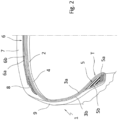
- reference number 1 indicates tyre in accordance with one possible embodiment.
- the tyre 1 comprises a carcass structure comprising a self-sealing layer 2 and one or more carcass plies, for example at least one first carcass ply 3a and a second carcass ply 3b.
- a layer of impermeable elastomeric material or so-called liner 4 is applied inside the carcass ply/plies.
- Two anchoring annular structures 5, each comprising a so-called bead core 5a carrying an elastomeric filler 5b in radially outer position, are engaged with respective end flaps of the carcass ply/plies.
- the anchoring annular structures 5 are integrated in proximity to zones normally identified with the name beads "T", at which the engagement between the tyre 1 and a respective mounting rim takes place.
- a belt structure 6 comprising multiple belt layers (for example at least one first belt layer 6a and a second belt layer 6b) is circumferentially applied around the carcass ply/plies, and a tread band 7 is circumferentially superimposed on the belt structure 6, overall forming a crown structure.
- So-called “under-belt inserts” 8 can be situated, each between the carcass ply/plies and one of the axially opposite terminal edges of the belt structure 6.
- Two sidewalls 9, each extended from the corresponding bead "T" to a corresponding lateral edge of the tread band 7, are applied in laterally opposite positions on the carcass ply/plies.
- non-illustrated elements can also be possibly provided for, for example belt layer at 0 degrees, under-liner, anti-abrasive inserts, reinforcements, etc.
- reference number 10 overall indicates a feeding station configured for feeding a semi-finished product for forming a tyre component.
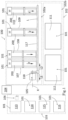
- the feeding station 10 preferably has application in a plant 100 for building tyres for vehicle wheels, for example illustrated in figure 1 .
- the plant 100 comprises a plurality of building stations 101 in which each building station is configured for carrying out a processing on a tyre being processed.
- a forming station of the plurality of building stations 101 is a station in which a component of the tyre is formed.
- the feeding station 10 preferably has application in a forming station comprising a dispensing apparatus 200 configured for depositing a semi-finished product "S" on a surface radially external to a drum in order to a component of the tyre.
- the feeding station 10 is preferably delimited by a safety perimeter 11 attained for example by panels that are at least partially openable and/or lines of optical demarcation that are at least partially deactivatable.
- the feeding station 10 has a work station 10a and a loading/unloading station 10b ( figure 11 ). Both stations define an area that is fixed with respect to an absolute reference system, in particular to the dispensing apparatus 200 associated with the feeding station 10 and illustrated by way of example in figure 11 .
- a first access 11a e.g. a first port of the safety perimeter 11, allows the access to the work station 10a and a second access 11b, e.g. a second port of the safety perimeter 11, allows the access to the loading/unloading station 10b.
- the work station 10a is adapted to be placed in communication with the dispensing apparatus 200 associated with the feeding station 10 in order to allow feeding the semi-finished product "S".
- the safety perimeter 11 has at least one passage 11c, e.g. an opening of the safety perimeter 11, in order to allow feeding the semi-finished product "S" from the feeding station 10 to the dispensing apparatus 200.
- the loading/unloading station 10b has at least one track 12 ( figure 11 ) that terminates at the second access 11b whose function will be described in the following present description.
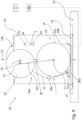
- the feeding station 10 comprises a base 13 ( figures 5-11 ), on which a carousel 14 is mounted that is rotating around an axis 15 ( figures 9-11 ) arranged centrally between the work station 10a and the loading/unloading station 10b.
- M a primary motorisation ( figure 10 ) has been indicated, which is configured for rotating the carousel 14 around the axis 15.
- the axis 15 is vertical.
- the base 13 can be at least partially lowered with respect to an upper surface "Y" of a floor outside the feeding station 10 ( figures 5, 6 , 11 ). At least the track 12, if present, is arranged preferably at the level of the upper surface "Y" of the floor outside the feeding station 10.
- the carousel 14 comprises a base 16 perpendicular to the axis 15 and mounted on the base 13 with interposition of bearings 17 or analogous means in order to allow the rotation of the base 16 and hence of the carousel 14 on the base 13.
- the carousel 14 is divided into two operating units 14a and 14b.
- the loading/unloading station 10b has the track 12, the latter comprises a fixed portion 12a associated with the base 13 and a movable portion 12b associated with each operating unit 14a, 14b and made in the base 16 ( figure 11 ).
- the carousel 14 comprises a support framework 18 mounted on the base 16 and extended perpendicular therefrom along the direction of the axis 15, at the axis itself.
- the support framework 18 is for example made by two panels 18a which delimit at least one service space 18b ( figures 10-11 ) comprising the axis 15.
- the two operating units 14a and 14b are arranged on diametrically opposite sides with respect to the axis 15 such that, when an operating unit is arranged in the work station 10a, the other operating unit is arranged in the loading/unloading station 10b.
- the arrangement of the two operating units 14a and 14b is such that, following a 180° rotation of the carousel 14 around the axis 15, the positions of the two operating units 14a and 14b are reversed.
- the support framework 18 is preferably shared between the two operating units 14a and 14b.
- an operating unit 14a comprises one of the two panels 18a and the other operating unit 14b comprises the other panel 18a.
- the two operating units 14a, 14b are substantially identical so that, when not otherwise specified, the following description will refer to any one between the two operating units 14a, 14b.
- the operating unit comprises a dispensing reel 19 and a service reel 20 rotatable around respective mounting axes C1, C2 that are parallel to each other.
- the dispensing reel 19 and the service reel 20 are rotatable on the support framework 18 and in particular on the respective panel 18a.
- the dispensing reel 19 and the service reel 20 comprise a respective cylindrical support 19a, 20a defining a winding axis of the reel itself, arranged coaxial with the respective mounting axis C1, C2.
- the cylindrical support 19a, 20a is provided with respective two lateral containment flanges 19b, 20b ( figures 12-18 ).
- the dispensing reel 19 is adapted to receive a semi-finished product "S" and a service tape "N" wound around the winding axis thereof such that, in a radial sequence, a turn of service tape “N” is radially interposed between two consecutive turns of semi-finished product "S".
- Figures 12, 13 and 17 schematically show a "full” service reel 19, i.e. comprising a length of semi-finished product "S”, in which a final turn of the set comprising the service tape "N" (dashed line) and the semi-finished product "S” (solid line) has been illustrated in detail.
- a further service tape "P” can be provided, e.g. a film, wound such that, in radial sequence, the following are repeated: a turn of service tape "N" (dashed line), a turn of semi-finished product “S” (solid line) and a turn of the further service tape "P" (thin solid line).
- the semi-finished product "S" wound on a "full" dispensing reel 19 has a first free end S1 ( figure 12 ) from which the unwinding initiates and a second free end S2 ( figures 14 and 18 ) which is moved away from the dispensing reel 19 when the entire length of the semi-finished product "S" has been dispensed.
- the service tape "N” and, if present, the further service tape “P” have a respective first free end N1, P1.
- the service tape “N” has a second end N2 integral with the dispensing reel 19, e.g. with the cylindrical support 19a ( figures 14 and 18 ).
- the length of service tape “N” wound on the dispensing reel 19 is preferably greater than the length of semi-finished product "S”.
- the further service tape “P” has a second free end (not illustrated) which is moved away from the dispensing reel 19 at the end of the dispensing of the semi-finished product "S".
- the service reel 20 is adapted to receive the service tape "N” wound in turns around the winding axis thereof starting from the free end N1 ( figure 12 ) which is made integral with the service reel 20 ( figure 13 ).
- the service reel 20 remains stably associated with the carousel 14.
- the service reel 20 is not replaced in the normal operation of the feeding station 10 so that its winding axis stably coincides with the mounting axis C2.
- the dispensing reel 19 is removable from the carousel 14 so that it does not remain stably associated with the carousel 14.
- a "full” dispensing reel 19 is mounted on the carousel 14 with winding axis coinciding with the mounting axis C1.
- an "empty" dispensing reel 19, i.e. from which the entire length of the semi-finished product "S" has been dispensed, is moved away from the carousel 14 in order to be replaced with a "full” dispensing reel 19.
- the second access 11b allows the access to the loading/unloading station 10b in order to remove an "empty" dispensing reel 19 and replace it with a "full” dispensing reel 19.
- the dispensing reel 19 is moved perpendicular to the winding axis C1 thereof, i.e. according to a radial direction with respect to the dispensing reel itself.
- the dispensing reel 19 being replaced rotates-translates on the lateral containment flanges 19b along the track 12.
- the operating unit comprises a thrust member 12a, e.g.
- a cylinder ( figure 9 ) positionable and actuatable so as to push an "empty" dispensing reel 19 towards the second access 11b.
- the loading/unloading of the dispensing reel 19 occurs at a loading/unloading sector CS ( figure 11 ) of the operating unit which, when the operating unit is situated in the loading/unloading station 10b, is directed on the side opposite the dispensing apparatus 200 and which, when the operating unit is situated in the work station 10a, is directed towards the dispensing apparatus 200.
- the loading/unloading sector CS of the operating unit corresponds, when the operating unit is arranged in the work station 10a, to the sector through which the semi-finished product "S" is fed and which is traversed by a feeding path "A" of the semi-finished product "S” separated from the service tape "N" directed to the dispensing apparatus 200.
- the dispensing reel 19 and the service reel 20 have a respective maximum overall radius R1, R2 ( figures 14 , 17 , 18 ) which corresponds to the largest from among the radius of the respective lateral containment flanges 19b, 20b and the outer or maximum radius when the reel is "full".
- the maximum overall radius corresponds to the radius of the lateral containment flanges if they are present and if, in the course of the operation of the feeding station 10, the content of the reel is not enlarged beyond the flanges themselves.
- Respective maximum overall diameters correspond to the double of each maximum overall radius R1, R2.
- FIG 17 Illustrated in figure 17 is the maximum overall radius R1 of the dispensing reel 19 which, in this case, corresponds to the radius of the lateral containment flanges 19b.
- the maximum overall radius R2 of the service reel 20 is illustrated in figure 14 with reference to the radius of the lateral containment flanges 20b and in figure 18 with reference to the maximum radius of the "full" service reel 20 i.e. with reference to the maximum radius of the service tape "N" wound on the service reel which is greater than the radius of the lateral containment flanges 20b.
- the respective mounting axes C1, C2 of the dispensing reel 19 and of the service reel 20 are arranged in the operating unit consecutively along a direction defined by the axis 15 so that, if the axis 15 is vertical, the service reel 20 and the dispensing reel 19 are arranged consecutively along a vertical direction.
- the service reel 20 is arranged above the dispensing reel 19.
- the mounting axis C2 of the service reel 20 is arranged above the mounting axis C1 of the dispensing reel 19.
- the respective mounting axes C1, C2 of the dispensing reel 19 and of the service reel 20 are arranged such that the overall dimensions of the respective operating unit, perpendicular to the axis 15, is less than the sum of the respective maximum overall diameters.
- the dispensing reel 19 and the service reel 20 are arranged in the operating unit with the respective mounting axes C1, C2 aligned along the axis 15 or slightly offset perpendicular to the axis 15, as is for example illustrated in the enclosed figures.
- the distance D1 ( figure 9 ) between the two mounting axes C1, C2 measured according to a direction perpendicular to the axis 15 is less than each maximum overall radius R1, R2.
- the respective mounting axes C1, C2 of the dispensing reel 19 and of the service reel 20 are arranged in the operating unit such that the projection of the distance D2 between the respective mounting axes C1, C2 on a plane containing the mounting axis C2 of the service reel 20 and perpendicular to the axis 15 is smaller than each maximum overall radius R1, R2.
- the segment corresponding to the distance D2 between the respective mounting axes C1, C2 of the dispensing reel 19 and of the service reel 20 is tilted with respect to the axis 15 by an angle ⁇ ( figure 9 ) comprised between 0° and 30°, more preferably between 5° and 15°, e.g. 7°.
- the distance D2 between the respective mounting axes C1, C2 of the dispensing reel 19 and of the service reel 20 is smaller than the sum of the respective maximum overall radii R1, R2, in particular when at least the maximum overall radius R2 of the service reel 20 is given by the maximum radius of the service tape "N" wound on the service reel 20, as illustrated in figure 18 , so that the service tape "N" wound on the service reel “full” penetrates the lateral containment flanges 19b of the dispensing reel 19 or, more generally, penetrates the space initially occupied by the "full" dispensing reel 19.
- Reference number 21 indicates a dispensing motorisation operatively associated with the dispensing reel 19, preferably comprising a brushless motor
- 22 indicates a service motorisation operatively associated with the service reel 20, preferably comprising a brushless motor.
- the dispensing motorisation 21 and the service motorisation 22 are configured for rotating respectively the dispensing reel 19 and the service reel 20 around the mounting axis C1, C2 thereof.
- the position of the dispensing motorisation 21 is preferably adjustable along the direction of the mounting axis C1 in the two senses X1 and X2 ( figure 10 ) in order to allow the substitution of the dispensing reel 19.
- the service motorisation 22 is preferably arranged in the service space 18b.
- the semi-finished product "S", the service tape "N” and possibly the further service tape “P” follow respective paths in the operating unit.
- each operating unit is configured such to define a separation point "Z" between the semi-finished product “S", the service tape “N” and possibly the further service tape “P”, if present.
- the semi-finished product “S” separated from the service tape “N” is directed to the dispensing apparatus 200 along the feeding path "A" until the semi-finished product itself is exhausted and the service tape "N” separated from the semi-finished product “S” follows a drawing-in path "I” arranged between the separation point "Z” and the service reel 20.
- the separation point "Z" is defined by a primary transmission roller 23 with which a tensioner element 24 is possibly associated, e.g. a dancer, maintained in position tangent to the primary transmission roller 23.
- the primary transmission roller 23 and the tensioner element 24 are preferably projectingly mounted on the support framework 18, in particular on the respective panel 18a.
- each operating unit comprises a collection roller 25 mounted rotating on the carousel 14, preferably projectingly on the support framework 18, in particular on the respective panel 18a.
- the further service tape "P” is directed towards the collection roller 25.
- the drawing-in path "I" of the service tape “N” is defined by deflections, e.g. attained by means of one or more secondary transmission rollers 26a (in the illustrated example, two secondary transmission rollers 26a are provided for) and possibly a transmission dancer 26b.
- the transmission dancer 26b is configured for carrying out further functions in addition to that of transmission.
- the transmission dancer 26b is associated with a tension sensor 26c ( figure 9 ) for monitoring and controlling the tension of the service tape "N".
- the transmission dancer 26b can also be movable between an active position ( figures 12-15 ) in which it operates as transmission and a passive position ( figures 16-17 ) in which it allows the loading/unloading of the dispensing reel 19.
- the drawing-in path "I" and hence the deflections circumferentially surround at least one portion of the dispensing reel 19.
- the drawing-in path "I" at least partially surrounds the dispensing reel 19, e.g. below and laterally with respect thereto.
- the deflections are arranged partially around the dispensing reel 19, preferably below and laterally with respect thereto.
- the deflections surround the dispensing reel 19 on circumferentially opposite side with respect to the loading/unloading sector CS.
- the drawing-in path "I” is at least partially contrary to the feeding path "A" of the semi-finished product "S".
- at least one of the deflections for example the transmission dancer 26b, defines a point of reversal of the drawing-in path "I” with respect to the feeding path "A” ( figure 13 ).
- the operating unit comprises a driving segment 27 (in fine hatching in figures 12-13 , 15-17 ) in order to guide the first end N1 of the service tape "N" along the drawing-in path "I".
- the driving segment 27 has a first free end 27a and a second end 27b stably associated with the service reel 20.
- the first end 27a is adapted to be connected to the first free end N1 of the service tape "N” in order to guide it along the drawing-in path "I".
- the driving segment 27, at least in a static condition of the respective operating unit, is arranged around the deflections and hence at least partially defines the drawing-in path "I".
- the plant 100 ( figure 1 ) will be described which, as described above, comprises a plurality of building stations 101.
- the plant 100 as is for example illustrated in figure 1 , comprises a first step building line 102 configured for building carcass structures, a second step building line 103 configured for building crown structures and an assembly station 104 at which a crown structure is coupled to the carcass structure in order to form a tyre 1 which is finally transferred to a moulding and vulcanisation unit (not illustrated).
- the plant 100 also comprises a plurality of drums, in which each drum is movable between at least several of the building stations 101 and constitutes a forming support for a tyre being processed.
- the plurality of drums comprises forming drums 105 associated with the first step building line 102 and movable between the building stations 101 of the first step building line 102, supporting a carcass structure being processed.
- the plurality of drums comprises auxiliary drums 106 associated with the second step building line 103 and movable between the building stations 101 of the second step building line 103, supporting a crown structure being processed.
- the plurality of building stations 101 comprises at least one forming station configured for forming the respective component of the tyre by means of deposition of the semi-finished product "S" on a surface radially external to a drum of the plurality of drums.
- Such forming station comprises the dispensing apparatus 200.
- the first step building line 102 is configured for building, on each forming drum 105, a carcass structure comprising at least one carcass ply (preferably the first carcass ply 3a and the second carcass ply 3b) and the anchoring annular structures 5.
- the first step building line 102 is configured for building, on each forming drum 105, a carcass structure comprising the self-sealing layer 2, the first carcass ply 3a, the second carcass ply 3b, the liner 4 and the anchoring annular structures 5.
- the first step building line 102 can be configured for building carcass structures also comprising other components, e.g. complex (comprising liners, under-liners and anti-abrasive inserts), under-liners, anti-abrasive inserts, under-belt inserts, reinforcements, at least one portion of the sidewalls 9 or the sidewalls 9 themselves.
- each component among those listed above is formed in a respective forming station of the first step building line 102.
- the first step building line 102 comprises six building stations 101 respectively:
- the plant 100 illustrated in figure 1 is therefore set for building the carcass structure of the tyre 1 illustrated in figure 2 .
- At least one forming station of the first step building line 102 is configured for depositing a respective semi-finished product "S" on a surface radially external to a forming drum 105 in order to form the respective component of the tyre.
- the feeding station 10 is associable with any one of these forming stations of the first step building line 102, preferably with the forming station 107 configured for forming the self-sealing layer 2.
- the second step building line 103 is configured for building, on each auxiliary drum 106, a crown structure or outer sleeve comprising the belt structure 6, the tread band 7 and possibly further components such as under-belt inserts 8, reinforcements, at least one portion of the sidewalls 9 or the sidewalls 9 themselves, if not already provided for in the building of the carcass structure.
- the second step building line 103 comprises four building stations 101, respectively:
- At least one forming station of the second step building line 103 can be configured for depositing a respective semi-finished product "S" on a surface radially external to an auxiliary drum 106 in order to form the respective component of the tyre.
- the feeding station 10 is associable with any one of these forming stations of the second step building line 103.
- the first step building line 102 comprises a primary building line 102a and a completion building line 102b.
- the primary building line 102a is configured for building a carcass portion comprising at least one carcass ply (preferably the first carcass ply 3a and the second carcass ply 3b).
- the primary building line 102a comprises at least the forming station 109, preferably also the forming station 110.
- the primary building line 102a is configured for building a carcass portion further comprising one or more from among self-sealing layer, complex, liner, under-liner, anti-abrasive inserts, under-belt inserts, reinforcements, sidewalls or a portion thereof and comprises the corresponding forming stations.
- the primary building line 102a comprises four building stations 101, respectively:
- At least one forming station of the primary building line 102a is configured for depositing a respective semi-finished product "S" on a surface radially external to a forming drum 105 in order to form the respective component of the tyre.
- the feeding station 10 is associable with any one of these forming stations of the primary building line 102a, preferably with the forming station 107 configured for forming the self-sealing layer 2.
- the completion building line 102b is configured for completing the building of the carcass structure, for example by applying the anchoring annular structures 5 to the carcass portion and forming the beads "T".
- the completion building line 102b comprises two building stations 101 respectively:
- a shuttle 118 is movable along the deposition line "L", moved by a suitable motor in both travel senses L1, L2.
- the shuttle 118 is mounted on the guide 117 defining the deposition line and is movable therealong in both travel senses L1, L2.
- the shuttle 118 is capable of supporting one forming drum 105 at a time and rotating it around a rotation axis "X" coinciding with the longitudinal symmetry axis of the drum itself and with the rotation axis of the tyre 1 being processed.
- the forming drum 105 is projectingly carried by the shuttle 118, which comprises a grip element capable of retaining or releasing a terminal end of a central shaft of the forming drum 105.
- the building stations 101 of the primary building line 102a are arranged along the deposition line "L" and preferably, according to that illustrated in figure 1 , on only one side of the same.
- the building stations 101 of the primary building line 102a can be arranged along the deposition line "L" according to an order different from that of building.
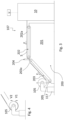
- Figures 3 and 4 illustrate a possible embodiment of a forming station configured for forming the respective component of the tyre by means of deposition of a semi-finished product "S" on a surface radially external to a drum of the plurality of drums.
- the forming station 107 configured for forming the self-sealing layer 2, but the described characteristics are applicable to any forming station of the plant 100, with reference to the respective component and to a forming drum 105 in the case of a forming station of the first step building line 102 or to an auxiliary drum 106 in the case of a forming station of the second step building line 103.
- the forming station 107 comprises the dispensing apparatus 200 with which the feeding station 10 is operatively associated.
- the dispensing apparatus 200 is configured for depositing the semi-finished product "S" on a surface radially external to a forming drum 105 in order to form the self-sealing layer 2 of the tyre.
- the dispensing apparatus 200 comprises a frame 201 on which a first conveyor belt 202 is positioned which has a horizontal first upper transport surface 202a. Such upper transport surface 202a is advanced along a feeding direction "F".
- a second conveyor belt 203 Downstream of the conveyor belt 202, with respect to the abovementioned feeding direction "F", a second conveyor belt 203 is consecutively arranged which has a second upper transport surface 203a tilted downward starting from the first conveyor belt 202. Such second upper transport surface 203a is advanced along the feeding direction "F".
- the first upper transport surface 202a and the second upper transport surface 203a define an overall transport surface for a semi-finished product "S" coming from the feeding station 10 and which is extended starting from a rear portion of the dispensing apparatus 200 and terminates at the guide 117 in the case of the first step building line 102.
- the feeding direction "F" is perpendicular to the abovementioned guide 117.
- the semi-finished product "S” is unwound from the dispensing reel 19 and separated from the service tape "N".
- the service tape “N” is wound on the service reel 20 and the further service tape “P” if present, is wound on the collection roller 25.
- the semi-finished product “S” forms a festoon and then is guided and directed from bottom to top up to the upper transport surface 202a.
- a cutting device 204 is preferably positioned for cutting to size the semi-finished product "S" fed onto the transport surface.
- the cutting device 204 schematically illustrated in figure 3 is placed between the first and the second conveyor belt 202, 203.
- a terminal end 205 of the second conveyor belt 203 is positioned close to the guide 117 such that the shuttle 118 and the forming drum 105 carried thereby can be arranged above a terminal end of the overall transport surface.
- the shuttle 118 being moved along the guide 117, is capable of carrying the forming drum 105 above each of the overall transport surfaces of each dispensing station 107, 108, 109, 110 and to stop it in that position.
- the terminal end 205 of the second conveyor belt 203 is arranged above the forming drum 105, for example for the deposition of the self-sealing layer.
- the shuttle 118 also comprises movement devices, not illustrated, adapted to vertically move in two senses V1, V2, along a direction orthogonal to a longitudinal extension of the guide 117, the grip element and the forming drum 105 constrained thereto or alternatively the second conveyor belt 203 and hence its terminal end 205.
- the forming drum 105 is therefore movable between a first approach position of a radially external surface thereof to the overall transport surface and a second position moved away from the overall transport surface or alternatively the second conveyor belt 203 is movable between a first approach position of the terminal end 205 thereof to the radially outer surface of the forming drum 105 and a second position moved away from aforesaid radially outer surface of the forming drum 105.
- the feeding direction "F" of the semi-finished product "S” is perpendicular to a plane containing the rotation axis "X" in the winding point on the forming drum 105.
- a loading and unloading station is situated where, due to suitable non-illustrated devices, each forming drum 105 can be loaded on the shuttle 118 or unloaded from the same.
- a method is implemented for feeding a semi-finished product for building a component of a tyre, and overall in the plant 100, a method is implemented for building tyres for vehicle wheels.
- U indicates a control unit of the feeding station 10 and/or of the plant 100 programmed for carrying out at least several actions of the aforesaid methods.
- control unit "U” is operatively connected at least to the dispensing motorisation 21 and to the service motorisation 22 in order to carry out the feeding procedure and the loading/unloading procedure.
- the operating unit indicated with reference number 14a is arranged in the work station 10a and comprises a "full” dispensing reel 19 while the operating unit indicated with the reference number 14b is arranged in the loading/unloading station 10b with the respective dispensing reel 19 being replaced (in figure 11 , an "empty" dispensing reel 19 is illustrated which is unloaded from the operating unit 14b and in figure 17 a "full” dispensing reel 19 is generically illustrated that is loaded in the respective operating unit).
- the feeding procedure in the operating unit 14a arranged in the work station 10a provides for:
- the unwinding of the semi-finished product "S" and of the service tape “N” from the dispensing reel 19 provides for imposing, on the dispensing reel 19, a dispensing rotation ⁇ 1 around the mounting axis C1 thereof.
- the accumulation of the service tape "N" on the service reel 20 provides for imposing, on the service reel 20, a winding rotation K1 around the mounting axis C2 thereof ( figures 12-14 and 18 ).
- the dispensing rotation ⁇ 1 and the winding rotation K1 are generated by the service motorisation 22 which, by rotating the service reel 20, drives the dispensing reel 19.
- the dispensing rotation ⁇ 1 and the winding rotation K1 are generated by the service motorisation 22 while the dispensing motorisation 21 operates as control brake.
- the accumulation of the service tape "N" on the service reel 20, i.e. during the winding rotation K1 is preferably provided for monitoring the length of service tape “N” accumulated on the service reel 20 and, at the end of the winding rotation K1, recording an overall length of service tape “N” accumulated.
- the monitoring of the length of service tape “N” is preferably carried out by means of encoder of the service motorisation 22 and/or of the dispensing motorisation 21.
- the control unit "U” is operatively connected to the dispensing motorisation 21 and to the service motorisation 22 and is programmed for actuating them according to that described above.
- the loading/unloading procedure in the operating unit 14b arranged in the loading/unloading station 10b provides for
- the loading/unloading procedure provides for unloading, from the operating unit 14b, the dispensing reel 19 around which the service tape "N” was rewound that was separated from the semi-finished product in a preceding feeding procedure ( figure 16 ).
- the rewinding occurs at least partially while the carousel 14 rotates in order to reverse the positions of the operating units and/or at least partially in the loading/unloading station 10b and/or at least partially in the work station 10a.
- the rewinding on the dispensing reel 19 of the accumulated service tape "N" provides for imposing, on the dispensing reel 19, a rewinding rotation ⁇ 2 contrary to the dispensing rotation ⁇ 1 and imposing, on the service reel, an unwinding rotation K2 contrary to the winding rotation K1 ( figure 15 ).
- the rewinding rotation ⁇ 2 and the unwinding rotation K2 are generated by the dispensing motorisation 21 which, by rotating the dispensing reel 19, drives the service reel 20. Still more preferably the rewinding rotation ⁇ 2 and the unwinding rotation K2 are generated by the dispensing motorisation 21 while the service motorisation 22 operates as control brake.
- the rewinding rotation ⁇ 2 and the unwinding rotation K2 are generated by the dispensing motorisation 21 while the service motorisation 22 operates as control brake.
- the monitoring of the length is preferably carried out by means of encoder of the service motorisation 22 and/or of the dispensing motorisation 21.
- the control unit "U” is operatively connected to the dispensing motorisation 21 and to the service motorisation 22 and is programmed for actuating them according to that described above.
- the unwinding rotation K2 of the service reel 20 is contrary to the rewinding rotation ⁇ 2 of the dispensing reel 19.
- the winding rotation K1 of the service reel 20 is contrary to the dispensing rotation ⁇ 1 of the dispensing reel 19.
- the carousel 14 rotates 180° around the axis 15 in order to repeat the feeding procedure in the operating unit 14b which comes to be situated in the work station 10a and the loading/unloading procedure in the operating unit 14a which comes to be situated in the loading/unloading station 10b.
- the control unit "U”, programmed for such purpose, is operatively connected to the first motorisation “M” in order to impose a rotation on the carousel 14 around the axis 15, preferably a 180° rotation.
- Figures 12-18 illustrate in any one operating unit the feeding procedure ( figures 12-14 and 18 ), the rewinding of the service tape "N" ( figure 15 ) and the loading/unloading procedure ( figure 16 and 17 ).
- Figures 12-18 referring to a same operating unit, this is a sequence of actions in which the rotation of the carousel is inserted before/during/after the rewinding of the service tape "N" illustrated in figure 15 .
- FIGs 12-18 referring to two different operating units, in the example described starting from the condition of figure 11 , figures 12-14 (possibly 12, 13 and 18) illustrate the feeding procedure carried out in the operating unit 14a arranged in the work station 10a at least partially simultaneously with the loading/unloading procedure carried out in the operating unit 14b arranged in the loading/unloading station 10b and illustrated in figures 16 and 17 .
- the rewinding of the service tape "N" illustrated in figure 15 can be referred to the operating unit 14a, at the end of the feeding procedure, or to the operating unit 14b before the loading/unloading procedure.
Landscapes
- Engineering & Computer Science (AREA)
- Mechanical Engineering (AREA)
- Manufacturing & Machinery (AREA)
- Tyre Moulding (AREA)
- Automatic Assembly (AREA)
- Automobile Manufacture Line, Endless Track Vehicle, Trailer (AREA)
Claims (15)
- Verfahren zum Zuführen eines halbfertigen Produkts (S) zur Herstellung einer Komponente eines Reifens (1), umfassend:- Anordnen eines Karussells (14), das sich um eine Achse (15) dreht, die mittig zwischen einer Bearbeitungsstation (10a) und einer Lade-/Entladestation (10b) angeordnet ist, wobei das Karussell (14) in zwei Betriebseinheiten (14a, 14b) unterteilt ist, sodass, während eine Betriebseinheit in der Bearbeitungsstation (10a) angeordnet ist, die andere Betriebseinheit in der Lade-/Entladestation (10b) angeordnet ist, wobei jede Betriebseinheit (14a, 14b) eine Ausgabespule (19) und eine Versorgungsspule (20) umfasst, die um jeweilige Montageachsen (C1, C2) drehbar sind,- Durchführen, mindestens teilweise gleichzeitig, eines Zuführvorgangs in der Betriebseinheit (14a), die sich in der Bearbeitungsstation (10a) befindet, und eines Lade-/Entladevorgangs in der Betriebseinheit (14b), die sich in der Lade-/Entladestation (10b) befindet,- am Ende jedes Zuführ- und Lade-/Entladevorgangs, Drehen des Karussells (14) um die Achse (15), um die Position der zwei Betriebseinheiten (14a, 14b) umzukehren, und, am Ende der Drehung, Wiederholen des Zuführvorgangs in der Betriebseinheit (14b), die sich in der Bearbeitungsstation (10a) befindet, und des Lade-/Entladevorgangs in der Betriebseinheit (14a), die sich in der Lade-/Entladestation (10b) befindet.
- Verfahren nach Anspruch 1, wobei der Zuführvorgang umfasst:- Abwickeln von der vollen Ausgabespule (19) eines halbfertigen Produkts (S) und eines Versorgungsbandes (N), wobei das halbfertige Produkt (S) und das Versorgungsband (N) so auf die Ausgabespule (19) gewickelt werden, dass eine Windung des Versorgungsbandes (N) radial zwischen zwei aufeinanderfolgenden Windungen des halbfertigen Produkts (S) eingefügt ist,- Trennen des halbfertigen Produkts (S), das abgewickelt wird, von dem Versorgungsband (N), das abgewickelt wird,- Leiten des von dem Versorgungsband (N) getrennten halbfertigen Produkts (S) entlang eines Zuführwegs (A), bis das auf die Ausgabespule (19) gewickelte halbfertige Produkt (S) verbraucht ist,- Ansammeln des von dem halbfertigen Produkt (S) getrennten Versorgungsbandes (N), indem es auf die Versorgungsspule (20) gewickelt wird, bis das auf die Ausgabespule (19) gewickelte halbfertige Produkt (S) verbraucht ist.
- Verfahren nach Anspruch 1 oder 2, wobei der Lade-/Entladevorgang umfasst:- Entladen aus der Betriebseinheit (14a, 14b), die sich in der Lade-/Entladestation (10b) befindet, eines Versorgungsbandes (N), das in einem vorhergehenden Zuführvorgang von dem halbfertigen Produkt (S) getrennt wurde, der durchgeführt wurde, als die Betriebseinheit in der Bearbeitungsstation (10a) war,- Entladen aus der Betriebseinheit (14a, 14b), die sich in der Lade-/Entladestation (10b) befindet, einer leeren Ausgabespule (19) nach einem vorhergehenden Zuführvorgang, der durchgeführt wurde, als die Betriebseinheit in der Bearbeitungsstation (10a) war,- Laden in die Betriebseinheit, die sich in der Lade-/Entladestation (14a, 14b) befindet, einer vollen Ausgabespule (19), auf die ein halbfertiges Produkt (S) unter Einfügung eines Versorgungsbandes (N) gewickelt ist, wobei eine Windung des Versorgungsbandes radial zwischen zwei aufeinanderfolgenden Windungen des halbfertigen Produkts (S) eingefügt ist.
- Verfahren nach Anspruch 3, umfassend Leiten des halbfertigen Produkts (S), das von dem Versorgungsband (N) getrennt ist, entlang des Zuführwegs (A) durch einen Sektor der Betriebseinheit, der, wenn die Betriebseinheit in der Lade-/Entladestation (10b) angeordnet ist, einem Lade-/Entladesektor (CS) der Ausgabespule (19), die ersetzt wird, entspricht.
- Verfahren nach Anspruch 3 oder 4, umfassend, am Ende des Zuführvorgangs, Aufwickeln des angesammelten Versorgungsbandes (N) auf die leere Ausgabespule (19).
- Verfahren nach Anspruch 5, wobei der Lade-/Entladevorgang Entladen, aus der Betriebseinheit, der leeren Ausgabespule (19) umfasst, um die das von dem halbfertigen Produkt (S) getrennte Versorgungsband (N) in einem vorhergehenden Zuführvorgang aufgewickelt wurde, der durchgeführt wurde, als die Betriebseinheit in der Bearbeitungsstation (10a) war.
- Verfahren nach Anspruch 5, wobei das Abwickeln des halbfertigen Produkts (S) und des Versorgungsbandes (N) von der Ausgabespule (19) das Anlegen einer Ausgabedrehung (Ω1) an die Ausgabespule (19) um ihre eigene Montageachse (C1) umfasst, und wobei das Aufwickeln des angesammelten Versorgungsbandes (N) auf die Ausgabespule (19) das Anlegen einer Aufwickeldrehung (Ω2) an die Ausgabespule (19) gegensätzlich zu der Ausgabedrehung (Ω1) umfasst.
- Verfahren nach Anspruch 5, wobei das Ansammeln des Versorgungsbandes (N) das Anlegen einer Wickeldrehung (K1) um eine Montageachse (C2) davon an die Versorgungsspule (20) umfasst und wobei Aufwickeln des angesammelten Versorgungsbandes (N) auf die Ausgabespule (19) das Anlegen einer Abwickeldrehung (K2) an die Versorgungsspule (20) gegensätzlich zu der Wickeldrehung (K1) umfasst.
- Verfahren nach Anspruch 8, umfassend Überwachen der Länge des Versorgungsbandes (N), das auf der Versorgungsspule (20) während der Wickeldrehung (K1) angesammelt wird, Aufzeichnen einer Gesamtlänge des Versorgungsbandes (N), das am Ende der Wickeldrehung (K1) angesammelt wird, Überwachen der Länge des Versorgungsbandes (N), das auf die Ausgabespule (19) während der Aufwickeldrehung (Ω2) aufgewickelt wird, Beenden der Aufwickeldrehung (Ω2), wenn auf der Ausgabespule (19) die Gesamtlänge des Versorgungsbandes erreicht ist.
- Verfahren zur Herstellung von Reifen (1) für ein Fahrzeugrad, umfassend:- Anordnen einer Vielzahl von Aufbaustationen (101) und einer Vielzahl von Trommeln,- Bewegen jeder Trommel der Vielzahl von Trommeln zwischen mindestens einigen Aufbaustationen der Vielzahl von Aufbaustationen (101),- Durchführen, in jeder Aufbaustation (101), einer Verarbeitung an einem Reifen, der verarbeitet wird, der einer Trommel der Vielzahl von Trommeln zugeordnet ist, bis der Reifen (1) fertiggestellt ist, wobei die mindestens eine Verarbeitung Zuführen eines halbfertigen Produkts (S) nach dem Verfahren nach einem oder mehreren der vorstehenden Ansprüche und Ablegen des halbfertigen Produkts (S) auf einer Oberfläche radial außerhalb der Trommel an mindestens einer Formstation der Vielzahl von Aufbaustationen (101) umfasst.
- Zuführstation (10) zur Herstellung einer Komponente eines Reifens, umfassend: ein Karussell (14), das sich um eine Achse (15) dreht, die mittig zwischen einer Bearbeitungsstation (10a) und einer Lade-/Entladestation (10b) der Zuführstation (10) angeordnet ist, wobei das Karussell (14) in zwei Betriebseinheiten (14a, 14b) unterteilt ist, sodass, während eine Betriebseinheit in der Bearbeitungsstation (10a) angeordnet ist, die andere Betriebseinheit in der Lade-/Entladestation (10b) angeordnet ist, wobei jede Betriebseinheit (14a, 14b) eine Ausgabespule (19) und eine Versorgungsspule (20) umfasst, die um jeweilige Montageachsen (C1, C2) drehbar sind,
und wobei die Zuführstation (10) eine Steuereinheit (U) umfasst, die programmiert ist zum:- Durchführen eines Zuführvorgangs in der Betriebseinheit (14a), die sich in der Bearbeitungsstation (10a) befindet, und eines Lade-/Entladevorgangs in der Betriebseinheit (14b), die sich in der Lade-/Entladestation (10b) befindet,- am Ende des Zuführvorgangs und des Lade-/Entladevorgangs, Drehen des Karussells (14) um die Achse (15), um die Positionen der zwei Betriebseinheiten (14a, 14b) umzukehren, und am Ende der Drehung, Wiederholen des Zuführvorgangs in der Betriebseinheit (14b), die sich in der Bearbeitungsstation (10a) befindet, und des Lade-/Entladevorgangs in der Betriebseinheit (14a), die sich in der Lade-/Entladestation (10b) befindet. - Zuführstation nach Anspruch 11, wobei die Ausgabespule (19) und die Versorgungsspule (20) in Verwendung einen jeweiligen maximalen Gesamtdurchmesser aufweisen und die jeweiligen Montageachsen (C1, C2) so angeordnet sind, dass die Gesamtabmessungen der Betriebseinheit (14a, 14b) senkrecht zur Achse (15) kleiner sind als die Summe der maximalen Gesamtdurchmesser der Versorgungsspule (20) und der Ausgabespule (19).
- Zuführstation nach Anspruch 11 oder 12, wobei die jeweiligen Montageachsen (C1, C2) der Ausgabespule (19) und der Versorgungsspule (20) entlang der Achse (15) oder leicht versetzt senkrecht zur Achse (15) ausgerichtet sind.
- Zuführstation nach einem oder mehreren der Ansprüche 11 bis 13, wobei die Versorgungsspule (20) dem Karussell (14) fest zugeordnet ist.
- Anlage zur Herstellung von Reifen für Fahrzeugräder, umfassend:eine Vielzahl von Aufbaustationen (101) und eine Vielzahl von Trommeln, wobei jede Trommel der Vielzahl von Trommeln zwischen mindestens einigen Aufbaustationen der Vielzahl von Aufbaustationen (101) beweglich ist,wobei die Vielzahl von Aufbaustationen (101) mindestens eine Formstation umfasst, die dazu konfiguriert ist, eine Komponente des Reifens zu formen, wobei die mindestens eine Formstation eine Zuführstation (10) nach einem oder mehreren der Ansprüche 11 bis 14 und eine Ausgabeeinrichtung (200) umfasst, der die Zuführstation (10) betriebsfähig zugeordnet ist, wobei die Ausgabeeinrichtung (200) dazu konfiguriert ist, ein halbfertiges Produkt (S) von der Zuführstation (10) aufzunehmen und das halbfertige Produkt (S) auf einer Oberfläche radial außerhalb einer Trommel der Vielzahl von Trommeln zum Formen der Komponente des Reifens abzulegen.
Applications Claiming Priority (2)
| Application Number | Priority Date | Filing Date | Title |
|---|---|---|---|
| IT202000031262 | 2020-12-17 | ||
| PCT/IB2021/061749 WO2022130227A1 (en) | 2020-12-17 | 2021-12-15 | Method of feeding a semi-finished product for the assembly of a tyre component and its feeding station |
Publications (3)
| Publication Number | Publication Date |
|---|---|
| EP4263192A1 EP4263192A1 (de) | 2023-10-25 |
| EP4263192B1 true EP4263192B1 (de) | 2024-11-20 |
| EP4263192C0 EP4263192C0 (de) | 2024-11-20 |
Family
ID=74875052
Family Applications (1)
| Application Number | Title | Priority Date | Filing Date |
|---|---|---|---|
| EP21839265.2A Active EP4263192B1 (de) | 2020-12-17 | 2021-12-15 | Verfahren zum zuführen eines halbzeugs zur montage einer reifenkomponente und seine zuführstation |
Country Status (4)
| Country | Link |
|---|---|
| EP (1) | EP4263192B1 (de) |
| CN (1) | CN116867638B (de) |
| MX (1) | MX2023006641A (de) |
| WO (1) | WO2022130227A1 (de) |
Family Cites Families (9)
| Publication number | Priority date | Publication date | Assignee | Title |
|---|---|---|---|---|
| IT1254431B (it) * | 1992-02-11 | 1995-09-25 | Pirelli | Impianto per il confezionamento di carcasse di pneumatici per ruote di veicoli |
| EP2539139B9 (de) * | 2010-02-22 | 2016-08-03 | Pirelli Tyre S.p.A. | Verfahren und vorrichtung zur abwicklung eines verlängerten elements mit zwei geweben zur herstellung von reifen für fahrzeugräder |
| CN103476576B (zh) * | 2011-04-28 | 2016-11-09 | 倍耐力轮胎股份公司 | 用于构造用于车辆车轮的轮胎的处理和设备 |
| ITMI20111320A1 (it) * | 2011-07-15 | 2013-01-16 | Pirelli | Metodo, processo e apparato per confezionare pneumatici per ruote di veicoli |
| EP2978595B1 (de) * | 2013-03-27 | 2017-05-03 | Pirelli Tyre S.p.A. | Verfahren und vorrichtung zur herstellung von reifen für fahrzeugräder |
| WO2016005852A1 (en) * | 2014-07-10 | 2016-01-14 | Pirelli Tyre S.P.A. | Apparatus and process for building tyres for vehicle wheels |
| KR101658819B1 (ko) * | 2014-11-13 | 2016-10-04 | 한국타이어 주식회사 | 타이어 성형드럼과 성형드럼 조립 분해장치 |
| US20170368776A1 (en) * | 2014-12-29 | 2017-12-28 | Pirelli Tyre S.P.A. | Process and apparatus for looping anchoring annular structures in a process for building tyres for vehicle wheels |
| EP3727824B1 (de) * | 2017-12-21 | 2023-05-10 | Pirelli Tyre S.p.A. | Vorrichtung zum aufbringen von halbzeugen in reifen für fahrzeugräder |
-
2021
- 2021-12-15 CN CN202180082990.6A patent/CN116867638B/zh active Active
- 2021-12-15 WO PCT/IB2021/061749 patent/WO2022130227A1/en not_active Ceased
- 2021-12-15 EP EP21839265.2A patent/EP4263192B1/de active Active
- 2021-12-15 MX MX2023006641A patent/MX2023006641A/es unknown
Also Published As
| Publication number | Publication date |
|---|---|
| CN116867638A (zh) | 2023-10-10 |
| WO2022130227A1 (en) | 2022-06-23 |
| EP4263192A1 (de) | 2023-10-25 |
| EP4263192C0 (de) | 2024-11-20 |
| MX2023006641A (es) | 2023-06-19 |
| CN116867638B (zh) | 2024-07-16 |
Similar Documents
| Publication | Publication Date | Title |
|---|---|---|
| US10245797B2 (en) | Method, process and apparatus for manufacturing tyres for vehicle wheels | |
| US6746557B2 (en) | Bead loading method and apparatus | |
| RU2654978C2 (ru) | Способ управления подачей удлиненного элемента на станцию для сборки шин | |
| EP2978595B1 (de) | Verfahren und vorrichtung zur herstellung von reifen für fahrzeugräder | |
| US20180009186A1 (en) | Process for manufacturing tyres for vehicle wheels | |
| JPS6359525A (ja) | タイヤの製造方法、製造装置および組立てシステム | |
| US4108707A (en) | Closed torus tire | |
| EP2739463B1 (de) | System und verfahren zum auf-und/oder abwickeln von zufuhrrollen | |
| EP4263192B1 (de) | Verfahren zum zuführen eines halbzeugs zur montage einer reifenkomponente und seine zuführstation | |
| EP3166777B1 (de) | Vorrichtung und verfahren zur herstellung von reifen für fahrzeugräder | |
| EP4366941B1 (de) | Verfahren und vorrichtung zum zuführen von teilen eines kontinuierlichen länglichen elements zu einer formtrommel | |
| JPH06505928A (ja) | タイヤビードコア組立体の製造方法及び装置 | |
| US20110297298A1 (en) | Process for manufacturing tyres for vehicle wheels | |
| CN101346224B (zh) | 制造轮胎胎圈的方法以及用于该方法的装置 | |
| EP3498464B1 (de) | Verfahren und vorrichtung zur herstellung eines mehrkomponentenreifens | |
| WO2021094402A1 (en) | Device for uniformly aligning of supporting tape, method for uniformly aligning of single-layered or multi-layered supporting tape and use of the device | |
| KR101034604B1 (ko) | 차륜용 타이어 제조 방법 및 장치 | |
| KR20260011219A (ko) | 성형 드럼체로의 타이어 재료의 공급 시스템 및 타이어의 제조 방법 | |
| RU2344933C1 (ru) | Способ и установка для изготовления шин для колес транспортных средств | |
| CN120530016A (zh) | 用来构建用于自行车的生轮胎的设备和方法 | |
| CN120435379A (zh) | 用于构建自行车用生轮胎的方法和设备 |
Legal Events
| Date | Code | Title | Description |
|---|---|---|---|
| STAA | Information on the status of an ep patent application or granted ep patent |
Free format text: STATUS: UNKNOWN |
|
| STAA | Information on the status of an ep patent application or granted ep patent |
Free format text: STATUS: THE INTERNATIONAL PUBLICATION HAS BEEN MADE |
|
| PUAI | Public reference made under article 153(3) epc to a published international application that has entered the european phase |
Free format text: ORIGINAL CODE: 0009012 |
|
| STAA | Information on the status of an ep patent application or granted ep patent |
Free format text: STATUS: REQUEST FOR EXAMINATION WAS MADE |
|
| 17P | Request for examination filed |
Effective date: 20230515 |
|
| AK | Designated contracting states |
Kind code of ref document: A1 Designated state(s): AL AT BE BG CH CY CZ DE DK EE ES FI FR GB GR HR HU IE IS IT LI LT LU LV MC MK MT NL NO PL PT RO RS SE SI SK SM TR |
|
| DAV | Request for validation of the european patent (deleted) | ||
| DAX | Request for extension of the european patent (deleted) | ||
| GRAP | Despatch of communication of intention to grant a patent |
Free format text: ORIGINAL CODE: EPIDOSNIGR1 |
|
| STAA | Information on the status of an ep patent application or granted ep patent |
Free format text: STATUS: GRANT OF PATENT IS INTENDED |
|
| INTG | Intention to grant announced |
Effective date: 20240729 |
|
| GRAS | Grant fee paid |
Free format text: ORIGINAL CODE: EPIDOSNIGR3 |
|
| GRAA | (expected) grant |
Free format text: ORIGINAL CODE: 0009210 |
|
| STAA | Information on the status of an ep patent application or granted ep patent |
Free format text: STATUS: THE PATENT HAS BEEN GRANTED |
|
| AK | Designated contracting states |
Kind code of ref document: B1 Designated state(s): AL AT BE BG CH CY CZ DE DK EE ES FI FR GB GR HR HU IE IS IT LI LT LU LV MC MK MT NL NO PL PT RO RS SE SI SK SM TR |
|
| REG | Reference to a national code |
Ref country code: GB Ref legal event code: FG4D |
|
| REG | Reference to a national code |
Ref country code: CH Ref legal event code: EP |
|
| REG | Reference to a national code |
Ref country code: DE Ref legal event code: R096 Ref document number: 602021022214 Country of ref document: DE |
|
| REG | Reference to a national code |
Ref country code: IE Ref legal event code: FG4D |
|
| U01 | Request for unitary effect filed |
Effective date: 20241125 |
|
| U07 | Unitary effect registered |
Designated state(s): AT BE BG DE DK EE FI FR IT LT LU LV MT NL PT RO SE SI Effective date: 20241209 |
|
| U20 | Renewal fee for the european patent with unitary effect paid |
Year of fee payment: 4 Effective date: 20241227 |
|
| PG25 | Lapsed in a contracting state [announced via postgrant information from national office to epo] |
Ref country code: IS Free format text: LAPSE BECAUSE OF FAILURE TO SUBMIT A TRANSLATION OF THE DESCRIPTION OR TO PAY THE FEE WITHIN THE PRESCRIBED TIME-LIMIT Effective date: 20250320 Ref country code: HR Free format text: LAPSE BECAUSE OF FAILURE TO SUBMIT A TRANSLATION OF THE DESCRIPTION OR TO PAY THE FEE WITHIN THE PRESCRIBED TIME-LIMIT Effective date: 20241120 |
|
| PG25 | Lapsed in a contracting state [announced via postgrant information from national office to epo] |
Ref country code: ES Free format text: LAPSE BECAUSE OF FAILURE TO SUBMIT A TRANSLATION OF THE DESCRIPTION OR TO PAY THE FEE WITHIN THE PRESCRIBED TIME-LIMIT Effective date: 20241120 |
|
| PG25 | Lapsed in a contracting state [announced via postgrant information from national office to epo] |
Ref country code: NO Free format text: LAPSE BECAUSE OF FAILURE TO SUBMIT A TRANSLATION OF THE DESCRIPTION OR TO PAY THE FEE WITHIN THE PRESCRIBED TIME-LIMIT Effective date: 20250220 |
|
| PG25 | Lapsed in a contracting state [announced via postgrant information from national office to epo] |
Ref country code: GR Free format text: LAPSE BECAUSE OF FAILURE TO SUBMIT A TRANSLATION OF THE DESCRIPTION OR TO PAY THE FEE WITHIN THE PRESCRIBED TIME-LIMIT Effective date: 20250221 |
|
| PG25 | Lapsed in a contracting state [announced via postgrant information from national office to epo] |
Ref country code: PL Free format text: LAPSE BECAUSE OF FAILURE TO SUBMIT A TRANSLATION OF THE DESCRIPTION OR TO PAY THE FEE WITHIN THE PRESCRIBED TIME-LIMIT Effective date: 20241120 |
|
| PG25 | Lapsed in a contracting state [announced via postgrant information from national office to epo] |
Ref country code: RS Free format text: LAPSE BECAUSE OF FAILURE TO SUBMIT A TRANSLATION OF THE DESCRIPTION OR TO PAY THE FEE WITHIN THE PRESCRIBED TIME-LIMIT Effective date: 20250220 |
|
| PG25 | Lapsed in a contracting state [announced via postgrant information from national office to epo] |
Ref country code: SM Free format text: LAPSE BECAUSE OF FAILURE TO SUBMIT A TRANSLATION OF THE DESCRIPTION OR TO PAY THE FEE WITHIN THE PRESCRIBED TIME-LIMIT Effective date: 20241120 |
|
| PG25 | Lapsed in a contracting state [announced via postgrant information from national office to epo] |
Ref country code: SK Free format text: LAPSE BECAUSE OF FAILURE TO SUBMIT A TRANSLATION OF THE DESCRIPTION OR TO PAY THE FEE WITHIN THE PRESCRIBED TIME-LIMIT Effective date: 20241120 |
|
| PG25 | Lapsed in a contracting state [announced via postgrant information from national office to epo] |
Ref country code: CZ Free format text: LAPSE BECAUSE OF FAILURE TO SUBMIT A TRANSLATION OF THE DESCRIPTION OR TO PAY THE FEE WITHIN THE PRESCRIBED TIME-LIMIT Effective date: 20241120 |
|
| REG | Reference to a national code |
Ref country code: CH Ref legal event code: PL |
|
| PG25 | Lapsed in a contracting state [announced via postgrant information from national office to epo] |
Ref country code: MC Free format text: LAPSE BECAUSE OF FAILURE TO SUBMIT A TRANSLATION OF THE DESCRIPTION OR TO PAY THE FEE WITHIN THE PRESCRIBED TIME-LIMIT Effective date: 20241120 |
|
| PLBE | No opposition filed within time limit |
Free format text: ORIGINAL CODE: 0009261 |
|
| STAA | Information on the status of an ep patent application or granted ep patent |
Free format text: STATUS: NO OPPOSITION FILED WITHIN TIME LIMIT |
|
| PG25 | Lapsed in a contracting state [announced via postgrant information from national office to epo] |
Ref country code: CH Free format text: LAPSE BECAUSE OF NON-PAYMENT OF DUE FEES Effective date: 20241231 |
|
| 26N | No opposition filed |
Effective date: 20250821 |
|
| PG25 | Lapsed in a contracting state [announced via postgrant information from national office to epo] |
Ref country code: IE Free format text: LAPSE BECAUSE OF NON-PAYMENT OF DUE FEES Effective date: 20241215 |
|
| PGFP | Annual fee paid to national office [announced via postgrant information from national office to epo] |
Ref country code: GB Payment date: 20251229 Year of fee payment: 5 |
|
| U20 | Renewal fee for the european patent with unitary effect paid |
Year of fee payment: 5 Effective date: 20251229 |