EP4261007B1 - Streckstange zur herstellung von behältern - Google Patents
Streckstange zur herstellung von behältern Download PDFInfo
- Publication number
- EP4261007B1 EP4261007B1 EP23162251.5A EP23162251A EP4261007B1 EP 4261007 B1 EP4261007 B1 EP 4261007B1 EP 23162251 A EP23162251 A EP 23162251A EP 4261007 B1 EP4261007 B1 EP 4261007B1
- Authority
- EP
- European Patent Office
- Prior art keywords
- preform
- stretching rod
- rod
- skirt
- blowing
- Prior art date
- Legal status (The legal status is an assumption and is not a legal conclusion. Google has not performed a legal analysis and makes no representation as to the accuracy of the status listed.)
- Active
Links
Images





Classifications
-
- B—PERFORMING OPERATIONS; TRANSPORTING
- B29—WORKING OF PLASTICS; WORKING OF SUBSTANCES IN A PLASTIC STATE IN GENERAL
- B29C—SHAPING OR JOINING OF PLASTICS; SHAPING OF MATERIAL IN A PLASTIC STATE, NOT OTHERWISE PROVIDED FOR; AFTER-TREATMENT OF THE SHAPED PRODUCTS, e.g. REPAIRING
- B29C49/00—Blow-moulding, i.e. blowing a preform or parison to a desired shape within a mould; Apparatus therefor
- B29C49/08—Biaxial stretching during blow-moulding
- B29C49/10—Biaxial stretching during blow-moulding using mechanical means for prestretching
- B29C49/12—Stretching rods
-
- B—PERFORMING OPERATIONS; TRANSPORTING
- B29—WORKING OF PLASTICS; WORKING OF SUBSTANCES IN A PLASTIC STATE IN GENERAL
- B29C—SHAPING OR JOINING OF PLASTICS; SHAPING OF MATERIAL IN A PLASTIC STATE, NOT OTHERWISE PROVIDED FOR; AFTER-TREATMENT OF THE SHAPED PRODUCTS, e.g. REPAIRING
- B29C49/00—Blow-moulding, i.e. blowing a preform or parison to a desired shape within a mould; Apparatus therefor
- B29C49/08—Biaxial stretching during blow-moulding
- B29C49/10—Biaxial stretching during blow-moulding using mechanical means for prestretching
- B29C49/12—Stretching rods
- B29C49/121—Stretching rod configuration, e.g. geometry; Stretching rod material
- B29C49/1215—Geometry of the stretching rod, e.g. specific stretching rod end shape
-
- B—PERFORMING OPERATIONS; TRANSPORTING
- B29—WORKING OF PLASTICS; WORKING OF SUBSTANCES IN A PLASTIC STATE IN GENERAL
- B29C—SHAPING OR JOINING OF PLASTICS; SHAPING OF MATERIAL IN A PLASTIC STATE, NOT OTHERWISE PROVIDED FOR; AFTER-TREATMENT OF THE SHAPED PRODUCTS, e.g. REPAIRING
- B29C49/00—Blow-moulding, i.e. blowing a preform or parison to a desired shape within a mould; Apparatus therefor
- B29C49/02—Combined blow-moulding and manufacture of the preform or the parison
- B29C49/06—Injection blow-moulding
-
- B—PERFORMING OPERATIONS; TRANSPORTING
- B29—WORKING OF PLASTICS; WORKING OF SUBSTANCES IN A PLASTIC STATE IN GENERAL
- B29K—INDEXING SCHEME ASSOCIATED WITH SUBCLASSES B29B, B29C OR B29D, RELATING TO MOULDING MATERIALS OR TO MATERIALS FOR MOULDS, REINFORCEMENTS, FILLERS OR PREFORMED PARTS, e.g. INSERTS
- B29K2067/00—Use of polyesters or derivatives thereof, as moulding material
- B29K2067/003—PET, i.e. poylethylene terephthalate
-
- B—PERFORMING OPERATIONS; TRANSPORTING
- B29—WORKING OF PLASTICS; WORKING OF SUBSTANCES IN A PLASTIC STATE IN GENERAL
- B29L—INDEXING SCHEME ASSOCIATED WITH SUBCLASS B29C, RELATING TO PARTICULAR ARTICLES
- B29L2031/00—Other particular articles
- B29L2031/712—Containers; Packaging elements or accessories, Packages
-
- B—PERFORMING OPERATIONS; TRANSPORTING
- B29—WORKING OF PLASTICS; WORKING OF SUBSTANCES IN A PLASTIC STATE IN GENERAL
- B29L—INDEXING SCHEME ASSOCIATED WITH SUBCLASS B29C, RELATING TO PARTICULAR ARTICLES
- B29L2031/00—Other particular articles
- B29L2031/712—Containers; Packaging elements or accessories, Packages
- B29L2031/7158—Bottles
Definitions
- the present invention relates to the field of manufacturing containers by blow molding or stretch blow molding from preforms made of thermoplastic material, such as for example polyethylene terephthalate, hereinafter "PET". Its subject more particularly is a drawing rod intended to be implemented in a stretch blow molding technique for forming containers. It also relates to a method for manufacturing containers using the drawing rod according to the invention.
- PET polyethylene terephthalate
- a forming device which comprises a mold having a cavity shaped to the imprint of the container to be obtained.
- the preheated preform is received in the cavity.
- its walls are subjected to a so-called "biaxial” stretching to fit the imprint of the mold.
- the preform is stretched axially by means of a stretching rod to cause the axial expansion of the preform.
- a pressurized fluid is injected into the preform so as to cause the radial expansion of the wall.
- the drawing rod In order for the final container to have a perfectly moulded bottom, it is preferable for the drawing rod to be adapted to ensure a satisfactory thickness of the container wall. Poor material distribution is a recurring defect found in containers produced by a moulding and stretch/blow moulding process. It is not necessarily a matter of ensuring that the thickness of the container wall is constant, as in some cases it may be desirable to thicken certain areas, in particular those intended to undergo significant stresses (in particular near the bottom). Rather, it is a matter of ensuring that the material thickness corresponds to the specifications of the container, as defined according to its shape and use.
- EP1063076 describes a drawing rod for a molding unit for manufacturing a container from a preform, said drawing rod extending longitudinally, parallel to a main axis, comprising a cylindrical or tubular body; a distal end in the extension of said body; a flat located at the distal end of the drawing rod and; an end piece projecting from said flat; an annular skirt in the extension of said body, at said distal end, said skirt having a height less than the height of said end piece.
- the diameter of the skirt is very largely greater than the diameter of the body of the drawing rod such that the large diameter skirt presses the corner portion, said corner portion being the part of the preform connecting the body of the preform to the bottom of said preform.
- the invention aims to solve this problem and proposes, for this purpose, a drawing rod which ensures drawing of the preform along its axis, avoiding undesirable contacts between the outside of the rod and the inside of the body of the preform, while improving the centering of said rod and thus reducing heat transfers between the rod and the preform.
- the drawing rod according to the invention is characterized in that it comprises an annular skirt in the extension of said body, at said distal end, said skirt having a height less than the height of said tip, said tip having a diameter less than the diameter of the body of the rod and the diameter of the free end of the skirt being less than or equal to 14 mm.
- said skirt has a diameter smaller than or equal to the diameter of the body of the drawing rod.
- edges of the annular skirt and/or the end of the tip are rounded.
- the outer body and the annular skirt comprise a single piece.
- the tip is conical in shape.
- the flat extends orthogonally to the main axis Y.
- the annular skirt may have a crenellated shape.
- the annular skirt may have a crenellated shape with rounded, convex crest edges and concave trough edges.
- the invention is designed to be implemented in a container manufacturing installation 2.
- a container manufacturing installation usually comprises a molding machine 14 as shown in figure 1 , comprising at least molding units 15, each molding unit 15 comprising at least blowing means integrating a stretching rod 1, said mold 11 comprising at least two half-molds 110 which each comprise an internal molding face and which are respectively mounted on supports movable around an axis Y, between at least one open position and a closed position of the molding unit 15, in which said internal faces of said at least two joint half-molds 110 together delimit a molding cavity 12 of the container 2.
- blow molds 11 are distributed circularly, in the form of a carousel 140, as visible in figure 1 , and topped by respective blowing installations.
- the body of the blowing installation extends substantially vertically above the mold and substantially coaxially with the molding cavity 12 of the blowing mold 11.
- FIG 2 schematically represents a perspective view of one of the molding units 15 of the machine 14 according to the exemplary embodiment of the figure 1 , illustrating in particular, outside the unit 15 in the open position, an exploded view of a mold 11 made in three parts, namely two half-molds 110 and a mold base 111.
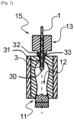
- FIG 3 showing a first embodiment of a rod 1 according to the invention, in partial longitudinal section view, which is implemented with a preform 3 made of PET or recycled PET, intended to be stretched and blown in one of the blowing molds 11 of an installation briefly described above, so as to form a container 2, such as a bottle.
- the stretching rod 1 is in the high position and being inserted into the preform 3.
- the rod 1 is designed to be mounted in the body of the blowing installation also mentioned above.
- Said stretching rod 1 extends longitudinally, parallel to the main axis Y.
- the stretching rod 1 according to the invention is a solid stretching rod. It has a first end called proximal (not shown) capable of being secured to a displacement device internal to the manufacturing installation.
- the preform 3 comprises, in a conventional manner, an elongated, tubular body with an axis Y, limited by a wall 31 secured in the upper part to a threaded neck 32 and in the lower part to a substantially hemispherical bottom 30. Between the neck 32 and the body of the preform, a radial collar 33 projects towards the outside of the preform 3.
- the preform 3 illustrated in figure 3 has rotational symmetry around its Y axis.
- the Y axis of the rod 1 is substantially coincident with the axis of revolution of the preform 3.
- the axis of the rod 1 or that of the preform 3 will therefore be referred to indifferently as Y.
- any direction parallel to the axis of revolution of the rod will be called “vertical” and any direction perpendicular to the axis of revolution of the rod will be called “transverse”.
- the drawing rod 1 comprises a cylindrical or tubular body 4.
- the body 4 of the drawing rod 1 may have a shoulder, i.e. have two longitudinal sections having two different diameters. This is particularly advantageous for blowing small diameter preforms.
- the stretching rod 1 In the extension of the body 4, at the level of the distal end 5, the stretching rod 1 comprises a flat 6. An end piece 7 projects from this flat 6.
- the stretching rod 1 further comprises an annular skirt 8 in the extension of its body 4.
- FIG. 3 represents the step of inserting the stretching rod 1 into the blowing cavity 12.
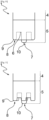
- FIG 4 schematically represents another step of a blowing cycle, in which the stretching rod 1 is in the low position and therefore placed at the bottom 30 of the preform 3 during the blowing step. During this step, the preform 3 becomes a container 2.
- the diameter of the annular skirt 8 is equal to the diameter of the body 4 of the drawing rod 1.
- the centering is further improved. Indeed, during drawing, the material flows into the hollow of the skirt 8, thus tending to block it, thus avoiding any slippage and therefore allowing good centering.
- the body 4 and the annular skirt 8 are obtained in one piece. In other words, they form a single piece.
- the body 4 and the annular skirt 8 are two separate parts.
- the structural modifications of the stretching rod 1 have the advantage of allowing the rod 1 to be perfectly centered in the preform 3 towards the bottom of the preform, over its entire lower surface, while limiting the diffusion of heat between said rod 1 and the bottom 30 of the preform 3, and thus improving the stretching-blowing step.
- the projecting tip 7 may be of any shape.
- said tip 7 may be of conical shape, rounded conical shape, ovoid shape, hemispherical shape, etc.
- the latter is always inscribed in a cylinder whose diameter is less than the diameter of the body 4 of the drawing rod 1.
- THE flat 6 is perpendicular to the body 4 of the drawing rod 1. This allows better distribution and better control of the blowing stage.
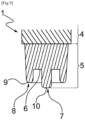
- FIG 6 represents a view along a longitudinal median section of an exemplary embodiment of the distal end of the drawing rod, showing in particular an annular skirt 8 having rounded edges 9 and a cylindrical tip 7.
- the edges 9 of the annular skirt 8 are rounded. This is particularly advantageous because it makes it possible to avoid any risk of tearing if said edges 9 were to touch the wall of the preform 3, for example during the drawing phase.
- the annular skirt 8 has the same diameter as the diameter of the body 4 of the drawing rod 1.
- the skirt 8 may have a smaller or larger diameter than the body 4 of the drawing rod 1 according to other embodiments.
- the diameter of the free end of the skirt 8 is always less than or equal to 14 mm so that said skirt 8 only bears on the bottom of the preform and never bears on the corner portion of the preform, said corner portion being the part of the preform connecting the body of the preform to the bottom of said preform.
- the annular skirt 8 has a height 80 less than the height 70 of the end piece 7 so that said end piece 7 projects from the annular skirt 8.
- the distal end of the drawing rod 1 is formed by the end piece 7 and the annular skirt 8 is an extension of the outer body 4 relative to the flat 6. This therefore makes it possible to guarantee perfect centering of the rod 1 while limiting the diffusion of heat between said rod 1 and the preform 3 which then forms the container 2 at the end of the blowing step.
- the height 80 of the annular skirt 8 is less than the height 70 of the end piece 7 by a value between 0.5 and 4 millimeters (mm), even more preferably by a value of 1 mm.
- the height 80 of the annular skirt 8 varies across its circumference.
- the annular skirt 8 may have serrated or scalloped edges 9, and thus have valleys and ridges, as seen in the figure 11 .
- the height 80 remains lower than the height 70 of the tip 7. Any combination of edge shape 9 and diameter of the annular skirt 8 is possible.
- annular skirt 8 has the advantage of considerably improving the stretch blow molding step.
- annular skirt 8 of the drawing rod 1 has straight and beveled edges 9. This embodiment is illustrated in figure 7 .
- the annular skirt 8 has a crenellated shape with rounded and convex crest edges 9 and concave hollow edges.
- the annular skirt 8 has a converging diameter from the body 4 of the rod 1 towards the projecting tip 7. In other words, its diameter decreases towards the free end portion and the annular skirt 8 therefore has a narrowed shape.
- the annular skirt 8 has a section which decreases from the flat 6, to its distal free end.
- the diameter of the annular skirt 8 is greater than the diameter of the body 4 of the drawing rod 1.
- the annular skirt 8 then has a flared shape.
- flared shape will be understood to mean a shape whose section increases.
- a free end portion of annular skirt 8 of flared shape means that the end portion of said skirt has a section which increases from the flat 6, up to its free end.
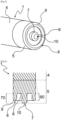
- FIG 10 schematically represents a side view of an embodiment of the distal end of the stretching rod, showing in particular a skirt 8 with an annular edge inscribed in the same plane, as well as the tip 7 and the flat 6 in dotted lines.
- FIGS. 11 to 12 show variants of the annular skirt 8, having hollows and crests.
- FIG 11 shows a skirt 8 with straight crenellated edges 9, with crests and hollows, with a skirt height 80 always less than the height 70 of the tip 7.
- FIG. 12 shows a skirt 8 having rounded crenellated edges 9.
- the invention also relates to a method of manufacturing a container 2 by stretch blow molding using the stretching rod described above.
- FIG. 1 represents a top view which schematically represents an exemplary embodiment of a rotary type molding machine 14 and which illustrates the molding units 15 (without the blowing and stretching means) distributed circumferentially on the carousel 140 and which, depending on their relative position with respect to the inlet or outlet of the machine 14, are in the open position or in the closed position.
- the manufacture of a container 2 is carried out by blowing a hot preform 3 into a mold 11 of a molding unit 15 of the installation by means of at least one pressurized fluid, generally air.
- the manufacture of the containers 2 is carried out by stretch-blow molding.
- the blowing means advantageously integrate at least one stretching rod 1.
- FIG 2 schematically represents a partial perspective view of one of the molding units 15 of the machine according to the exemplary embodiment of the figure 1 , illustrating in particular, outside the unit in the open position, an exploded view of a mold 11 made in three parts, namely two half-molds 110 and a mold base 111.
- the mold holder 112, the nozzle 13 and the drawing rod 1 can also be seen there.
- the drawing rod 1 is driven axially, along the Y axis, in displacement by associated drive means (not shown).
- the drawing rod 1 is therefore mounted to slide axially to be introduced inside the preform 3 through the opening delimited radially by its neck 32, an annular space being left free between the neck 32 and the rod 1 to allow the passage of the blowing fluid.
- the stretching rod 1 is mounted axially movable between at least a first high position and a second low position.
- the rod 1 In the first position, the rod 1 extends out of the mold 11 and, in the second position, called the low position, the rod 1 is moved downwards to axially stretch the preform 3 inside the mold 11, during blowing.
- a first step, as visible on the figure 3 therefore concerns the introduction of a preform 3 into a blowing mold 11.
- the preform 3 has been previously heated to a temperature higher than the glass transition temperature of the material (which is approximately 80°C in the case of PET).
- the stretching rod 1 is inserted inside the preform 3, until it reaches the low position, that is to say it is positioned on the bottom of the preform 3.
- the low position of the stretching rod 1 corresponds to a position where the tip 7 touches the bottom of the preform 3.
- the low position of the stretching rod 1 corresponds to a position where the tip 7 is slightly set back from the bottom of the preform 3.
- the blowing step or stretching blowing, during which a fluid (for example air) is injected into the preform 3, first at an average pressure called pre-blowing, between 5 bars and 15 bars, while moving the stretching rod 1 from its high position to its low deployed position.
- a fluid for example air
- the blowing step ends with a momentary increase in pressure to a high pressure, higher than the pre-blowing pressure, to firmly press the material against the cavity 12 of the blowing mold 11 and thus imprint the imprint of the container 2 on it, as shown in the figure. figure 4 .
- the blowing pressure is greater than or equal to 15 bars, and e.g. approximately 35 to 40 bars.
- the stretching rod is held in the extended position to prevent any untimely sliding of the material on the bottom of the mold until the pressure in the container has reached the blowing pressure.
- the implementation of a drawing rod 1 according to the invention allows better control of the blowing step. It is possible, by this improved control, to increase the blowing rates, while limiting the diffusion of heat from the internal to the external.
- the material distribution is therefore perfectly homogeneous, which offers additional weight reduction potential, while limiting the risk of over-stretching in the petaloid shapes of the bottom, within the limit of the generally recommended bi-orientation rates. Furthermore, reducing the heating of the preform makes it possible to limit the risks of sagging.
Landscapes
- Engineering & Computer Science (AREA)
- Manufacturing & Machinery (AREA)
- Mechanical Engineering (AREA)
- Physics & Mathematics (AREA)
- Geometry (AREA)
- Blow-Moulding Or Thermoforming Of Plastics Or The Like (AREA)
Claims (9)
- Streckstange (1) für eine Formeinheit (15) zur Herstellung eines Behälters (2) aus einem Vorformling (3), wobei sich die Streckstange (1) in Längsrichtung parallel zu einer Hauptachse Y erstreckt, umfassend:- einen zylinder- oder röhrenförmigen Körper (4);- ein distales Ende (5) in der Verlängerung des Körpers (4);- eine Abflachung (6), die sich am distalen Ende (5) der Streckstange (1) befindet, und- eine Spitze (7), die von der Abflachung (6) vorsteht;wobei die Stange (1) dadurch gekennzeichnet ist, dass sie in der Verlängerung des Körpers (4) am distalen Ende (5) eine ringförmige Schürze (8) umfasst, wobei die Schürze (8) eine Höhe (80) aufweist, die kleiner als die Höhe (70) der Spitze (7) ist, wobei die Spitze (7) einen Durchmesser aufweist, der kleiner als der Durchmesser des Körpers (4) der Streckstange (1) ist, und wobei der Durchmesser des freien Endes der Schürze (8) 14 mm oder weniger beträgt.
- Streckstange (1) nach Anspruch 1, dadurch gekennzeichnet, dass die Schürze (8) einen Durchmesser aufweist, der kleiner als oder so groß wie der Durchmesser des Körpers (4) der Streckstange (1) ist.
- Streckstange (1) nach einem der Ansprüche 1 oder 2, dadurch gekennzeichnet, dass die Kanten (9) der Schürze (8) und/oder des Endes (10) der Spitze (7) abgerundet sind.
- Streckstange (1) nach einem der Ansprüche 1 bis 3, dadurch gekennzeichnet, dass der äußere Körper (4) der Schürze (8) einstückig ist.
- Streckstange (1) nach einem der Ansprüche 1 bis 4, dadurch gekennzeichnet, dass die Spitze (7) konusförmig ist.
- Streckstange (1) nach einem der Ansprüche 1 bis 5, dadurch gekennzeichnet, dass sich die Abflachung (6) senkrecht zu Hauptachse Y erstreckt.
- Streckstange (1) nach einem der Ansprüche 1 bis 6, dadurch gekennzeichnet, dass die ringförmige Schürze (8) eine gezackte Form aufweist.
- Streckstange (1) nach Anspruch 7, dadurch gekennzeichnet, dass die ringförmige Schürze (8) eine gezackte Form mit abgerundeten und konvexen Scheitelkanten 9 und konkaven Trogkanten 9 aufweist.
- Verfahren zur Herstellung eines Behälters (2) durch Streckblasformen unter Verwendung der Streckstange (1) nach Anspruch 1 bis 8, umfassend zumindest die folgenden Schritte:- Anordnen eines zuvor erhitzten Vorformlings (3) in einer Blasform (11), die in der geschlossenen Position einen Formhohlraum (12) aufweist, der den Abdruck des zu blasenden Behälters (2) bildet;- Schließen der Blasform (11);- Blasen des Vorformlings (3) in der Blasform (11) anhand einer Blasdüse (13) und im Wesentlichen gleichzeitig
einen Schritt des Streckens des Vorformlings (3) durch Einführen der Streckstange (1) in das Innere des Vorformlings (3), wobei sie sich gegen den Boden (30) des Vorformlings (3) abstützt, um das axiale Strecken des Vorformlings (3) zu ermöglichen;- Aufwärtsbewegen der Streckstange (1);- Entnehmen des geblasenen Behälters (2) durch Öffnen der Blasform (11).
Applications Claiming Priority (1)
| Application Number | Priority Date | Filing Date | Title |
|---|---|---|---|
| FR2203422A FR3134535B1 (fr) | 2022-04-13 | 2022-04-13 | Tige d’étirage pour la formation de récipients |
Publications (2)
| Publication Number | Publication Date |
|---|---|
| EP4261007A1 EP4261007A1 (de) | 2023-10-18 |
| EP4261007B1 true EP4261007B1 (de) | 2024-11-13 |
Family
ID=82319773
Family Applications (1)
| Application Number | Title | Priority Date | Filing Date |
|---|---|---|---|
| EP23162251.5A Active EP4261007B1 (de) | 2022-04-13 | 2023-03-16 | Streckstange zur herstellung von behältern |
Country Status (5)
| Country | Link |
|---|---|
| US (1) | US20240227275A1 (de) |
| EP (1) | EP4261007B1 (de) |
| CN (1) | CN116901404A (de) |
| FR (1) | FR3134535B1 (de) |
| MX (1) | MX2023004186A (de) |
Family Cites Families (7)
| Publication number | Priority date | Publication date | Assignee | Title |
|---|---|---|---|---|
| US4889752A (en) * | 1987-05-29 | 1989-12-26 | Devtech, Inc. | One piece self-standing blow molded plastic containers |
| US5213752A (en) * | 1990-08-14 | 1993-05-25 | Nissei Asb Machine Co., Ltd. | Process of stretch-blow molding |
| AU1803600A (en) * | 1998-12-28 | 2000-07-31 | A. K. Technical Laboratory, Inc. | Wide-mouthed container bottom molding method using stretch blow molding |
| DE102007061659A1 (de) * | 2007-12-18 | 2009-06-25 | Krones Ag | Reckstange, Vorrichtung und Verfahren zur Herstellung von Hohlkörpern |
| US8741206B2 (en) * | 2009-12-17 | 2014-06-03 | Eastman Chemical Company | Method and apparatus for stretch blow molding a container |
| DE102012111348A1 (de) | 2012-11-23 | 2014-05-28 | Krones Ag | Streckblasverfahren sowie Streckblasmaschine |
| FR3022824A1 (fr) | 2014-11-13 | 2016-01-01 | Sidel Participations | Tige d'etirage pour dispositif de moulage par etirage soufflage de recipients, notamment de bouteilles en matiere plastique |
-
2022
- 2022-04-13 FR FR2203422A patent/FR3134535B1/fr active Active
-
2023
- 2023-03-16 EP EP23162251.5A patent/EP4261007B1/de active Active
- 2023-04-10 US US18/132,538 patent/US20240227275A1/en active Pending
- 2023-04-11 MX MX2023004186A patent/MX2023004186A/es unknown
- 2023-04-12 CN CN202310392228.9A patent/CN116901404A/zh active Pending
Also Published As
| Publication number | Publication date |
|---|---|
| MX2023004186A (es) | 2023-10-16 |
| EP4261007A1 (de) | 2023-10-18 |
| CN116901404A (zh) | 2023-10-20 |
| FR3134535B1 (fr) | 2024-11-08 |
| US20240227275A1 (en) | 2024-07-11 |
| FR3134535A1 (fr) | 2023-10-20 |
Similar Documents
| Publication | Publication Date | Title |
|---|---|---|
| EP2125533B1 (de) | Kunststoffflasche mit champagnerboden und herstellungsverfahren dafür | |
| EP2049405B1 (de) | Mittels blasformen oder streckblasformen einer thermoplastischen hohlgefäss-vorform mit derartigem boden hergestellter boden eines hohlgefässes | |
| CA2194544C (fr) | Dispositif d'etancheite entre une ebauche de recipient en matiere plastique et une tuyere de soufflage, et machine de soufflage de recipients pourvue d'un tel dispositif | |
| EP2396246B1 (de) | Behälter, dessen boden mit einer flexiblen doppelsitz-wölbung versehen ist | |
| FR2591142A1 (fr) | Procede et dispositif pour fabriquer un corps creux, pourvu d'une base en forme d'anneau par moulage avec soufflage | |
| FR2508004A1 (fr) | Bouteilles en matiere plastique resistant a la pression et procede de moulage de telles bouteilles | |
| FR2961181A1 (fr) | Recipient comprenant un fond voute a assise carree | |
| EP1765685A1 (de) | Leichtgewichtige flexible kunststoffrohre und herstellungsverfahren dafür | |
| EP0000801B1 (de) | Verfahren zur Herstellung orientierter Hohlkörper | |
| EP4261007A1 (de) | Streckstange zur herstellung von behältern | |
| EP4261006B1 (de) | Zieh- und kühlstab zur herstellung von behältern | |
| CH636298A5 (fr) | Ebauche tubulaire pour le moulage d'une bouteille en resine synthetique orientee biaxialement. | |
| WO2017103361A1 (fr) | Préforme à fond concave a épaisseur évolutive | |
| EP0019256B1 (de) | Muffenrohr aus Kugelgraphitguss | |
| FR2742124A1 (fr) | Preforme pour la fabrication de recipients en matiere thermoplastique avec cloison interieure | |
| EP4371731B1 (de) | Vorformling für kunststoffbehälter | |
| EP4642612A1 (de) | Verfahren zum kühlen eines im streckblasverfahren hergestellten behälters | |
| FR3022824A1 (fr) | Tige d'etirage pour dispositif de moulage par etirage soufflage de recipients, notamment de bouteilles en matiere plastique | |
| EP3678836B1 (de) | Form für einen behälter, bestehend aus einem formboden mit einer zentralen vertiefung und einer streckstange mit einem halbkugelförmigen ende, und entsprechender herstellungsprozess. | |
| CH609942A5 (en) | Cap made of injected synthetic material | |
| FR2764230A1 (fr) | Procede de fabrication d'un tube souple et tube obtenu selon ce procede | |
| FR2877259A1 (fr) | Dispositif de fabrication par moulage d'une enveloppe a soufflets comprenant un noyau devissable et des moyens de retenue de l'enveloppe, et procede correspondant | |
| FR3144603A1 (fr) | Récipient à fond pétaloïde amélioré et fond de moule pour la fabrication d’un tel récipient | |
| FR3144602A1 (fr) | Récipient à fond pétaloïde amélioré et fond de moule pour la fabrication d’un tel récipient | |
| BE600591A (de) |
Legal Events
| Date | Code | Title | Description |
|---|---|---|---|
| PUAI | Public reference made under article 153(3) epc to a published international application that has entered the european phase |
Free format text: ORIGINAL CODE: 0009012 |
|
| STAA | Information on the status of an ep patent application or granted ep patent |
Free format text: STATUS: THE APPLICATION HAS BEEN PUBLISHED |
|
| AK | Designated contracting states |
Kind code of ref document: A1 Designated state(s): AL AT BE BG CH CY CZ DE DK EE ES FI FR GB GR HR HU IE IS IT LI LT LU LV MC ME MK MT NL NO PL PT RO RS SE SI SK SM TR |
|
| STAA | Information on the status of an ep patent application or granted ep patent |
Free format text: STATUS: REQUEST FOR EXAMINATION WAS MADE |
|
| 17P | Request for examination filed |
Effective date: 20240418 |
|
| RBV | Designated contracting states (corrected) |
Designated state(s): AL AT BE BG CH CY CZ DE DK EE ES FI FR GB GR HR HU IE IS IT LI LT LU LV MC ME MK MT NL NO PL PT RO RS SE SI SK SM TR |
|
| GRAP | Despatch of communication of intention to grant a patent |
Free format text: ORIGINAL CODE: EPIDOSNIGR1 |
|
| STAA | Information on the status of an ep patent application or granted ep patent |
Free format text: STATUS: GRANT OF PATENT IS INTENDED |
|
| RIC1 | Information provided on ipc code assigned before grant |
Ipc: B29L 31/00 20060101ALN20240717BHEP Ipc: B29K 67/00 20060101ALN20240717BHEP Ipc: B29C 49/06 20060101ALN20240717BHEP Ipc: B29C 49/66 20060101ALI20240717BHEP Ipc: B29C 49/12 20060101AFI20240717BHEP |
|
| INTG | Intention to grant announced |
Effective date: 20240801 |
|
| GRAS | Grant fee paid |
Free format text: ORIGINAL CODE: EPIDOSNIGR3 |
|
| GRAA | (expected) grant |
Free format text: ORIGINAL CODE: 0009210 |
|
| STAA | Information on the status of an ep patent application or granted ep patent |
Free format text: STATUS: THE PATENT HAS BEEN GRANTED |
|
| AK | Designated contracting states |
Kind code of ref document: B1 Designated state(s): AL AT BE BG CH CY CZ DE DK EE ES FI FR GB GR HR HU IE IS IT LI LT LU LV MC ME MK MT NL NO PL PT RO RS SE SI SK SM TR |
|
| REG | Reference to a national code |
Ref country code: GB Ref legal event code: FG4D Free format text: NOT ENGLISH |
|
| REG | Reference to a national code |
Ref country code: CH Ref legal event code: EP |
|
| REG | Reference to a national code |
Ref country code: DE Ref legal event code: R096 Ref document number: 602023000982 Country of ref document: DE |
|
| P01 | Opt-out of the competence of the unified patent court (upc) registered |
Free format text: CASE NUMBER: APP_58890/2024 Effective date: 20241029 |
|
| REG | Reference to a national code |
Ref country code: IE Ref legal event code: FG4D Free format text: LANGUAGE OF EP DOCUMENT: FRENCH |
|
| REG | Reference to a national code |
Ref country code: LT Ref legal event code: MG9D |
|
| REG | Reference to a national code |
Ref country code: NL Ref legal event code: MP Effective date: 20241113 |
|
| PG25 | Lapsed in a contracting state [announced via postgrant information from national office to epo] |
Ref country code: HR Free format text: LAPSE BECAUSE OF FAILURE TO SUBMIT A TRANSLATION OF THE DESCRIPTION OR TO PAY THE FEE WITHIN THE PRESCRIBED TIME-LIMIT Effective date: 20241113 Ref country code: IS Free format text: LAPSE BECAUSE OF FAILURE TO SUBMIT A TRANSLATION OF THE DESCRIPTION OR TO PAY THE FEE WITHIN THE PRESCRIBED TIME-LIMIT Effective date: 20250313 Ref country code: PT Free format text: LAPSE BECAUSE OF FAILURE TO SUBMIT A TRANSLATION OF THE DESCRIPTION OR TO PAY THE FEE WITHIN THE PRESCRIBED TIME-LIMIT Effective date: 20250313 |
|
| PG25 | Lapsed in a contracting state [announced via postgrant information from national office to epo] |
Ref country code: FI Free format text: LAPSE BECAUSE OF FAILURE TO SUBMIT A TRANSLATION OF THE DESCRIPTION OR TO PAY THE FEE WITHIN THE PRESCRIBED TIME-LIMIT Effective date: 20241113 Ref country code: NL Free format text: LAPSE BECAUSE OF FAILURE TO SUBMIT A TRANSLATION OF THE DESCRIPTION OR TO PAY THE FEE WITHIN THE PRESCRIBED TIME-LIMIT Effective date: 20241113 |
|
| REG | Reference to a national code |
Ref country code: AT Ref legal event code: MK05 Ref document number: 1741363 Country of ref document: AT Kind code of ref document: T Effective date: 20241113 |
|
| PG25 | Lapsed in a contracting state [announced via postgrant information from national office to epo] |
Ref country code: BG Free format text: LAPSE BECAUSE OF FAILURE TO SUBMIT A TRANSLATION OF THE DESCRIPTION OR TO PAY THE FEE WITHIN THE PRESCRIBED TIME-LIMIT Effective date: 20241113 |
|
| PG25 | Lapsed in a contracting state [announced via postgrant information from national office to epo] |
Ref country code: ES Free format text: LAPSE BECAUSE OF FAILURE TO SUBMIT A TRANSLATION OF THE DESCRIPTION OR TO PAY THE FEE WITHIN THE PRESCRIBED TIME-LIMIT Effective date: 20241113 |
|
| PG25 | Lapsed in a contracting state [announced via postgrant information from national office to epo] |
Ref country code: NO Free format text: LAPSE BECAUSE OF FAILURE TO SUBMIT A TRANSLATION OF THE DESCRIPTION OR TO PAY THE FEE WITHIN THE PRESCRIBED TIME-LIMIT Effective date: 20250213 |
|
| PG25 | Lapsed in a contracting state [announced via postgrant information from national office to epo] |
Ref country code: GR Free format text: LAPSE BECAUSE OF FAILURE TO SUBMIT A TRANSLATION OF THE DESCRIPTION OR TO PAY THE FEE WITHIN THE PRESCRIBED TIME-LIMIT Effective date: 20250214 Ref country code: LV Free format text: LAPSE BECAUSE OF FAILURE TO SUBMIT A TRANSLATION OF THE DESCRIPTION OR TO PAY THE FEE WITHIN THE PRESCRIBED TIME-LIMIT Effective date: 20241113 Ref country code: AT Free format text: LAPSE BECAUSE OF FAILURE TO SUBMIT A TRANSLATION OF THE DESCRIPTION OR TO PAY THE FEE WITHIN THE PRESCRIBED TIME-LIMIT Effective date: 20241113 |
|
| PG25 | Lapsed in a contracting state [announced via postgrant information from national office to epo] |
Ref country code: PL Free format text: LAPSE BECAUSE OF FAILURE TO SUBMIT A TRANSLATION OF THE DESCRIPTION OR TO PAY THE FEE WITHIN THE PRESCRIBED TIME-LIMIT Effective date: 20241113 |
|
| PG25 | Lapsed in a contracting state [announced via postgrant information from national office to epo] |
Ref country code: RS Free format text: LAPSE BECAUSE OF FAILURE TO SUBMIT A TRANSLATION OF THE DESCRIPTION OR TO PAY THE FEE WITHIN THE PRESCRIBED TIME-LIMIT Effective date: 20250213 |
|
| PG25 | Lapsed in a contracting state [announced via postgrant information from national office to epo] |
Ref country code: SM Free format text: LAPSE BECAUSE OF FAILURE TO SUBMIT A TRANSLATION OF THE DESCRIPTION OR TO PAY THE FEE WITHIN THE PRESCRIBED TIME-LIMIT Effective date: 20241113 |
|
| PG25 | Lapsed in a contracting state [announced via postgrant information from national office to epo] |
Ref country code: DK Free format text: LAPSE BECAUSE OF FAILURE TO SUBMIT A TRANSLATION OF THE DESCRIPTION OR TO PAY THE FEE WITHIN THE PRESCRIBED TIME-LIMIT Effective date: 20241113 |
|
| PG25 | Lapsed in a contracting state [announced via postgrant information from national office to epo] |
Ref country code: EE Free format text: LAPSE BECAUSE OF FAILURE TO SUBMIT A TRANSLATION OF THE DESCRIPTION OR TO PAY THE FEE WITHIN THE PRESCRIBED TIME-LIMIT Effective date: 20241113 |
|
| PG25 | Lapsed in a contracting state [announced via postgrant information from national office to epo] |
Ref country code: RO Free format text: LAPSE BECAUSE OF FAILURE TO SUBMIT A TRANSLATION OF THE DESCRIPTION OR TO PAY THE FEE WITHIN THE PRESCRIBED TIME-LIMIT Effective date: 20241113 |
|
| PG25 | Lapsed in a contracting state [announced via postgrant information from national office to epo] |
Ref country code: SK Free format text: LAPSE BECAUSE OF FAILURE TO SUBMIT A TRANSLATION OF THE DESCRIPTION OR TO PAY THE FEE WITHIN THE PRESCRIBED TIME-LIMIT Effective date: 20241113 |
|
| PG25 | Lapsed in a contracting state [announced via postgrant information from national office to epo] |
Ref country code: CZ Free format text: LAPSE BECAUSE OF FAILURE TO SUBMIT A TRANSLATION OF THE DESCRIPTION OR TO PAY THE FEE WITHIN THE PRESCRIBED TIME-LIMIT Effective date: 20241113 |
|
| REG | Reference to a national code |
Ref country code: DE Ref legal event code: R097 Ref document number: 602023000982 Country of ref document: DE |
|
| PG25 | Lapsed in a contracting state [announced via postgrant information from national office to epo] |
Ref country code: SE Free format text: LAPSE BECAUSE OF FAILURE TO SUBMIT A TRANSLATION OF THE DESCRIPTION OR TO PAY THE FEE WITHIN THE PRESCRIBED TIME-LIMIT Effective date: 20241113 |
|
| PLBE | No opposition filed within time limit |
Free format text: ORIGINAL CODE: 0009261 |
|
| STAA | Information on the status of an ep patent application or granted ep patent |
Free format text: STATUS: NO OPPOSITION FILED WITHIN TIME LIMIT |
|
| PG25 | Lapsed in a contracting state [announced via postgrant information from national office to epo] |
Ref country code: MC Free format text: LAPSE BECAUSE OF FAILURE TO SUBMIT A TRANSLATION OF THE DESCRIPTION OR TO PAY THE FEE WITHIN THE PRESCRIBED TIME-LIMIT Effective date: 20241113 |
|
| 26N | No opposition filed |
Effective date: 20250814 |
|
| PG25 | Lapsed in a contracting state [announced via postgrant information from national office to epo] |
Ref country code: LU Free format text: LAPSE BECAUSE OF NON-PAYMENT OF DUE FEES Effective date: 20250316 |
|
| REG | Reference to a national code |
Ref country code: BE Ref legal event code: MM Effective date: 20250331 |
|
| PG25 | Lapsed in a contracting state [announced via postgrant information from national office to epo] |
Ref country code: BE Free format text: LAPSE BECAUSE OF NON-PAYMENT OF DUE FEES Effective date: 20250331 |
|
| PG25 | Lapsed in a contracting state [announced via postgrant information from national office to epo] |
Ref country code: IE Free format text: LAPSE BECAUSE OF NON-PAYMENT OF DUE FEES Effective date: 20250316 |
|
| PGFP | Annual fee paid to national office [announced via postgrant information from national office to epo] |
Ref country code: DE Payment date: 20260219 Year of fee payment: 4 |
|
| PGFP | Annual fee paid to national office [announced via postgrant information from national office to epo] |
Ref country code: FR Payment date: 20260219 Year of fee payment: 4 |
|
| PG25 | Lapsed in a contracting state [announced via postgrant information from national office to epo] |
Ref country code: CY Free format text: LAPSE BECAUSE OF FAILURE TO SUBMIT A TRANSLATION OF THE DESCRIPTION OR TO PAY THE FEE WITHIN THE PRESCRIBED TIME-LIMIT Effective date: 20241113 |
|
| PG25 | Lapsed in a contracting state [announced via postgrant information from national office to epo] |
Ref country code: LT Free format text: LAPSE BECAUSE OF FAILURE TO SUBMIT A TRANSLATION OF THE DESCRIPTION OR TO PAY THE FEE WITHIN THE PRESCRIBED TIME-LIMIT Effective date: 20241113 |
|
| PG25 | Lapsed in a contracting state [announced via postgrant information from national office to epo] |
Ref country code: TR Free format text: LAPSE BECAUSE OF FAILURE TO SUBMIT A TRANSLATION OF THE DESCRIPTION OR TO PAY THE FEE WITHIN THE PRESCRIBED TIME-LIMIT Effective date: 20241113 |
|
| PGFP | Annual fee paid to national office [announced via postgrant information from national office to epo] |
Ref country code: IT Payment date: 20260331 Year of fee payment: 4 |