EP4259757B1 - Schwefelwasserstoff- und mercaptanenabsorbierende zusammensetzungen - Google Patents
Schwefelwasserstoff- und mercaptanenabsorbierende zusammensetzungen Download PDFInfo
- Publication number
- EP4259757B1 EP4259757B1 EP21820638.1A EP21820638A EP4259757B1 EP 4259757 B1 EP4259757 B1 EP 4259757B1 EP 21820638 A EP21820638 A EP 21820638A EP 4259757 B1 EP4259757 B1 EP 4259757B1
- Authority
- EP
- European Patent Office
- Prior art keywords
- carbon atoms
- alkanolamine
- composition
- scavenging
- oxazolidine compound
- Prior art date
- Legal status (The legal status is an assumption and is not a legal conclusion. Google has not performed a legal analysis and makes no representation as to the accuracy of the status listed.)
- Active
Links
Images

Classifications
-
- C—CHEMISTRY; METALLURGY
- C10—PETROLEUM, GAS OR COKE INDUSTRIES; TECHNICAL GASES CONTAINING CARBON MONOXIDE; FUELS; LUBRICANTS; PEAT
- C10G—CRACKING HYDROCARBON OILS; PRODUCTION OF LIQUID HYDROCARBON MIXTURES, e.g. BY DESTRUCTIVE HYDROGENATION, OLIGOMERISATION, POLYMERISATION; RECOVERY OF HYDROCARBON OILS FROM OIL-SHALE, OIL-SAND, OR GASES; REFINING MIXTURES MAINLY CONSISTING OF HYDROCARBONS; REFORMING OF NAPHTHA; MINERAL WAXES
- C10G29/00—Refining of hydrocarbon oils, in the absence of hydrogen, with other chemicals
- C10G29/20—Organic compounds not containing metal atoms
-
- C—CHEMISTRY; METALLURGY
- C10—PETROLEUM, GAS OR COKE INDUSTRIES; TECHNICAL GASES CONTAINING CARBON MONOXIDE; FUELS; LUBRICANTS; PEAT
- C10L—FUELS NOT OTHERWISE PROVIDED FOR; NATURAL GAS; SYNTHETIC NATURAL GAS OBTAINED BY PROCESSES NOT COVERED BY SUBCLASSES C10G OR C10K; LIQUIFIED PETROLEUM GAS; USE OF ADDITIVES TO FUELS OR FIRES; FIRE-LIGHTERS
- C10L1/00—Liquid carbonaceous fuels
- C10L1/10—Liquid carbonaceous fuels containing additives
- C10L1/14—Organic compounds
- C10L1/22—Organic compounds containing nitrogen
-
- C—CHEMISTRY; METALLURGY
- C10—PETROLEUM, GAS OR COKE INDUSTRIES; TECHNICAL GASES CONTAINING CARBON MONOXIDE; FUELS; LUBRICANTS; PEAT
- C10L—FUELS NOT OTHERWISE PROVIDED FOR; NATURAL GAS; SYNTHETIC NATURAL GAS OBTAINED BY PROCESSES NOT COVERED BY SUBCLASSES C10G OR C10K; LIQUIFIED PETROLEUM GAS; USE OF ADDITIVES TO FUELS OR FIRES; FIRE-LIGHTERS
- C10L1/00—Liquid carbonaceous fuels
- C10L1/10—Liquid carbonaceous fuels containing additives
- C10L1/14—Organic compounds
- C10L1/22—Organic compounds containing nitrogen
- C10L1/222—Organic compounds containing nitrogen containing at least one carbon-to-nitrogen single bond
- C10L1/2222—(cyclo)aliphatic amines; polyamines (no macromolecular substituent 30C); quaternair ammonium compounds; carbamates
- C10L1/2225—(cyclo)aliphatic amines; polyamines (no macromolecular substituent 30C); quaternair ammonium compounds; carbamates hydroxy containing
-
- C—CHEMISTRY; METALLURGY
- C10—PETROLEUM, GAS OR COKE INDUSTRIES; TECHNICAL GASES CONTAINING CARBON MONOXIDE; FUELS; LUBRICANTS; PEAT
- C10L—FUELS NOT OTHERWISE PROVIDED FOR; NATURAL GAS; SYNTHETIC NATURAL GAS OBTAINED BY PROCESSES NOT COVERED BY SUBCLASSES C10G OR C10K; LIQUIFIED PETROLEUM GAS; USE OF ADDITIVES TO FUELS OR FIRES; FIRE-LIGHTERS
- C10L1/00—Liquid carbonaceous fuels
- C10L1/10—Liquid carbonaceous fuels containing additives
- C10L1/14—Organic compounds
- C10L1/22—Organic compounds containing nitrogen
- C10L1/232—Organic compounds containing nitrogen containing nitrogen in a heterocyclic ring
- C10L1/233—Organic compounds containing nitrogen containing nitrogen in a heterocyclic ring containing nitrogen and oxygen in the ring, e.g. oxazoles
-
- C—CHEMISTRY; METALLURGY
- C10—PETROLEUM, GAS OR COKE INDUSTRIES; TECHNICAL GASES CONTAINING CARBON MONOXIDE; FUELS; LUBRICANTS; PEAT
- C10L—FUELS NOT OTHERWISE PROVIDED FOR; NATURAL GAS; SYNTHETIC NATURAL GAS OBTAINED BY PROCESSES NOT COVERED BY SUBCLASSES C10G OR C10K; LIQUIFIED PETROLEUM GAS; USE OF ADDITIVES TO FUELS OR FIRES; FIRE-LIGHTERS
- C10L3/00—Gaseous fuels; Natural gas; Synthetic natural gas obtained by processes not covered by subclass C10G, C10K; Liquefied petroleum gas
- C10L3/06—Natural gas; Synthetic natural gas obtained by processes not covered by C10G, C10K3/02 or C10K3/04
- C10L3/10—Working-up natural gas or synthetic natural gas
- C10L3/101—Removal of contaminants
- C10L3/102—Removal of contaminants of acid contaminants
- C10L3/103—Sulfur containing contaminants
-
- C—CHEMISTRY; METALLURGY
- C10—PETROLEUM, GAS OR COKE INDUSTRIES; TECHNICAL GASES CONTAINING CARBON MONOXIDE; FUELS; LUBRICANTS; PEAT
- C10G—CRACKING HYDROCARBON OILS; PRODUCTION OF LIQUID HYDROCARBON MIXTURES, e.g. BY DESTRUCTIVE HYDROGENATION, OLIGOMERISATION, POLYMERISATION; RECOVERY OF HYDROCARBON OILS FROM OIL-SHALE, OIL-SAND, OR GASES; REFINING MIXTURES MAINLY CONSISTING OF HYDROCARBONS; REFORMING OF NAPHTHA; MINERAL WAXES
- C10G2300/00—Aspects relating to hydrocarbon processing covered by groups C10G1/00 - C10G99/00
- C10G2300/20—Characteristics of the feedstock or the products
- C10G2300/201—Impurities
- C10G2300/202—Heteroatoms content, i.e. S, N, O, P
-
- C—CHEMISTRY; METALLURGY
- C10—PETROLEUM, GAS OR COKE INDUSTRIES; TECHNICAL GASES CONTAINING CARBON MONOXIDE; FUELS; LUBRICANTS; PEAT
- C10G—CRACKING HYDROCARBON OILS; PRODUCTION OF LIQUID HYDROCARBON MIXTURES, e.g. BY DESTRUCTIVE HYDROGENATION, OLIGOMERISATION, POLYMERISATION; RECOVERY OF HYDROCARBON OILS FROM OIL-SHALE, OIL-SAND, OR GASES; REFINING MIXTURES MAINLY CONSISTING OF HYDROCARBONS; REFORMING OF NAPHTHA; MINERAL WAXES
- C10G2300/00—Aspects relating to hydrocarbon processing covered by groups C10G1/00 - C10G99/00
- C10G2300/20—Characteristics of the feedstock or the products
- C10G2300/201—Impurities
- C10G2300/207—Acid gases, e.g. H2S, COS, SO2, HCN
-
- C—CHEMISTRY; METALLURGY
- C10—PETROLEUM, GAS OR COKE INDUSTRIES; TECHNICAL GASES CONTAINING CARBON MONOXIDE; FUELS; LUBRICANTS; PEAT
- C10L—FUELS NOT OTHERWISE PROVIDED FOR; NATURAL GAS; SYNTHETIC NATURAL GAS OBTAINED BY PROCESSES NOT COVERED BY SUBCLASSES C10G OR C10K; LIQUIFIED PETROLEUM GAS; USE OF ADDITIVES TO FUELS OR FIRES; FIRE-LIGHTERS
- C10L2290/00—Fuel preparation or upgrading, processes or apparatus therefore, comprising specific process steps or apparatus units
- C10L2290/54—Specific separation steps for separating fractions, components or impurities during preparation or upgrading of a fuel
-
- C—CHEMISTRY; METALLURGY
- C10—PETROLEUM, GAS OR COKE INDUSTRIES; TECHNICAL GASES CONTAINING CARBON MONOXIDE; FUELS; LUBRICANTS; PEAT
- C10L—FUELS NOT OTHERWISE PROVIDED FOR; NATURAL GAS; SYNTHETIC NATURAL GAS OBTAINED BY PROCESSES NOT COVERED BY SUBCLASSES C10G OR C10K; LIQUIFIED PETROLEUM GAS; USE OF ADDITIVES TO FUELS OR FIRES; FIRE-LIGHTERS
- C10L2290/00—Fuel preparation or upgrading, processes or apparatus therefore, comprising specific process steps or apparatus units
- C10L2290/54—Specific separation steps for separating fractions, components or impurities during preparation or upgrading of a fuel
- C10L2290/541—Absorption of impurities during preparation or upgrading of a fuel
-
- C—CHEMISTRY; METALLURGY
- C10—PETROLEUM, GAS OR COKE INDUSTRIES; TECHNICAL GASES CONTAINING CARBON MONOXIDE; FUELS; LUBRICANTS; PEAT
- C10L—FUELS NOT OTHERWISE PROVIDED FOR; NATURAL GAS; SYNTHETIC NATURAL GAS OBTAINED BY PROCESSES NOT COVERED BY SUBCLASSES C10G OR C10K; LIQUIFIED PETROLEUM GAS; USE OF ADDITIVES TO FUELS OR FIRES; FIRE-LIGHTERS
- C10L2290/00—Fuel preparation or upgrading, processes or apparatus therefore, comprising specific process steps or apparatus units
- C10L2290/54—Specific separation steps for separating fractions, components or impurities during preparation or upgrading of a fuel
- C10L2290/545—Washing, scrubbing, stripping, scavenging for separating fractions, components or impurities during preparation or upgrading of a fuel
Definitions
- the present invention pertains to a novel hydrogen sulphide and mercaptans scavenging composition comprising an oxazolidine compound and an alkanolamine.
- the present invention also pertains to the use of an alkanolamine to improve the efficiency of an oxazolidine compound for scavenging hydrogen sulphide and/or mercaptans in hydrocarbon streams, and in particular for increasing the duration of this scavenging and accelerating the scavenging.
- the present invention also relates to a method for scavenging hydrogen sulphide and/or mercaptans comprising contacting a hydrocarbon stream such as crude oil, fuel or natural gas with the scavenging composition of the invention.
- Hydrogen sulphide is a colourless and fairly toxic, flammable and corrosive gas which also has a characteristic odour at a very low concentration. Hydrogen sulphide dissolves in hydrocarbon and water streams and is also found in the vapour phase above these streams and in natural gas. The hydrogen sulphide emissions can therefore be a nuisance to workers operating in the production, transport, storage, and processing of crude oil and in the storage of fuel. Hydrogen sulphide may also react with hydrocarbon components present in fuel. It would therefore be desirable for the workers' comfort and safety to reduce or even eliminate the hydrogen sulphide emissions during the manipulation of said products.
- MBO 3,3'-methylenebis(5-methyloxazolidine
- Formulations of MBO with promoters also named boosters, have been developed to enhance the efficiency of MBO.
- WO 2017/102693 describes a composition comprising MBO and one or more additive selected among urea, urea derivatives, amino acids, guanidine, guanidine derivatives or 1,2-diols, said composition being used in the removal of sulphur compounds from process streams.
- compositions for scavenging hydrogen sulfide and mercaptans comprise MBO and monoethanolamine(MEA) in a weight ratio of MBO/MEA in the range of 0.2 to 0.4.
- the present invention relates to a composition for scavenging hydrogen sulphide and mercaptans in hydrocarbon streams, said composition comprising at least one oxazolidine compound and at least one alkanolamine of formula (I), wherein the weight ratio oxazolidine compound/alkanolamine is higher than 1, wherein: wherein
- the weight ratio oxazolidine compound/alkanolamine ranges from more than 1 to 20, preferably from 1.2 to 15, more preferably from 1.5 to 10, even more preferably from 2 to 5.
- the oxazolidine compound is selected from bisoxazolidines of formula (II): Wherein
- the molecular weight of the alkanolamine ranges from 50 to 300 g/mol, preferably from 55 to 250 g/mol, more preferably from 60 to 200 g/mol.
- the alkanolamine is selected from methyldiethanolamine, monoisopropanolamine, polyethanolamine, monoethanolamine, diethanolamine, methylmonoethanolamine, dimethylethanolamine, diethylethanolamine, ethylmonoethanolamine, ethyldiethanolamine, triisopropanolamine, and mixtures thereof, preferably, from methyldiethanolamine, monoisopropanolamine, polyethanolamine, monoethanolamine, diethanolamine, and mixtures thereof, more preferably from methyldiethanolamine, monoisopropanolamine, polyethanolamine, monoethanolamine, and mixtures thereof.
- the scavenging composition further comprises at least one solvent, preferably in an amount ranging from 1 to 80%wt, preferably from 5 to 80%wt, more preferably from 10 to 70%wt, based on the total weight of the composition.
- the scavenging composition according to the invention comprises:
- the scavenging composition according to the invention comprises:
- the present invention also relates to the use of an alkanolamine of formula (I), for improving the efficiency of an oxazolidine compound for scavenging hydrogen sulphide and/or mercaptans in hydrocarbon streams, wherein: wherein
- the alkanolamine of formula (I) used according to the invention is as defined in the present invention and/or the oxazolidine compound used according to the invention is as defined in the present invention.
- the weight ratio oxazolidine compound/alkanolamine is higher than 1, preferably the weight ratio oxazolidine compound/alkanolamine ranges from more than 1 to 20, preferably from 1.2 to 15, more preferably from 1.5 to 10, even more preferably from 2 to 5.
- the present invention also relates to a hydrocarbon-containing composition comprising hydrocarbons and a scavenging composition according to the invention, wherein the hydrocarbons are preferably selected from crude oil, fuel oil, fuel, Light Petroleum Gas, natural gas, bitumen and petroleum residues.
- the present invention relates to a method for scavenging hydrogen sulphide and/or mercaptans in a hydrocarbon stream, comprising contacting the hydrocarbon stream with the scavenging composition according to the invention.
- the scavenging composition of the present invention enables to reduce the treat rate, i.e. reduce the amount of MBO necessary to scavenge a given amount of hydrogen sulphide from the sulphur containing hydrocarbon stream.
- the scavenging composition of the present invention also enables to improve the scavenging properties.
- the improvement can be seen when the remaining amount of sulphur compounds in the hydrocarbon stream is reduced and/or when the speed of the scavenging of sulphur compounds is increased thanks to the introduction of the scavenging composition according to the invention into the hydrocarbon stream.
- the scavenging composition of the present invention allows a faster scavenging, i.e. the amount of sulphur compounds is decreased more rapidly than with prior art scavenging compositions.
- the present invention concerns a composition comprising at least one oxazolidine compound and at least one alkanolamine, wherein the weight ratio oxazolidine/alkanolamine is higher than 1.
- This composition is also named in the present invention "scavenging composition”.
- oxazolidine compound refers to a compound comprising at least one oxazolidine cycle, said cycle being optionally substituted.
- the oxazolidine compound is selected from bisoxazolidines, i.e. compounds comprising two oxazolidine cycles.
- the oxazolidine compound replies to formula (II): wherein
- the oxazolidine compound is 3,3'-methylenebis(5-methyloxazolidine) (MBO).
- acyclic alkyl refers to an alkyl group which does not form part of a cycle.
- acyclic alkenyl refers to an alkenyl group which does not form part of a cycle.
- cyclic alkyl refers to a saturated cycloalkyl group, wherein the cycle can be optionally substituted by one or more linear or branched alkyl or alkenyl groups.
- the cycle comprises 5 or 6 carbon atoms and the substituent(s) if any comprise(s) from 1 to 6 carbon atoms, preferably from 1 to 3 carbon atoms.
- cyclic alkenyl refers to an unsaturated cycloalkyl group, wherein the cycle comprising at least one unsaturation can be optionally substituted by one or more linear or branched alkyl or alkenyl groups.
- the cycle comprises 5 or 6 carbon atoms and the substituent(s) if any comprise(s) from 1 to 6 carbon atoms, preferably from 1 to 3 carbon atoms.
- R 2 and R 3 are identical.
- R 4 is preferably identical to R 1 .
- the molecular weight of the alkanolamine is less than or equal to 300 g/mol, preferably less than or equal to 250 g/mol, more preferably less than or equal to 200 g/mol. According to an embodiment, the molecular weight of the alkanolamine ranges from 50 to 300 g/mol, preferably from 55 to 250 g/mol, more preferably from 60 to 200 g/mol.
- the alkanolamine is selected from methyldiethanolamine, monoisopropanolamine, polyethanolamine, monoethanolamine, diethanolamine, methylmonoethanolamine, dimethylethanolamine, diethylethanolamine, ethylmonoethanolamine, ethyldiethanolamine, triisopropanolamine, and mixtures thereof.
- the alkanolamine is selected from methyldiethanolamine, monoisopropanolamine, polyethanolamine, monoethanolamine, diethanolamine, and mixtures thereof, more preferably from methyldiethanolamine, monoisopropanolamine, polyethanolamine, monoethanolamine and mixtures thereof.
- alkanolamines of formula (I) are commercially available.
- the oxazolidine compound and the alkanolamine are present in respective amounts such that the weight ratio oxazolidine/alkanolamine is higher than 1.
- the weight ratio oxazolidine/alkanolamine ranges from more than 1 to 20, preferably from 1.2 to 15, more preferably from 1.5 to 10, even more preferably from 2 to 5.
- the alkanolamine represents from 0.5 to less than 50%wt, preferably from 1 to 45%wt, even more preferably from 1.5 to 40%wt, more preferably from 2 to 30%wt, of the total weight of the composition, and/or the oxazolidine compound represents from 10 to 99%wt, preferably from 30 to 98%wt, even more preferably from 40 to 95%wt of the total weight of the composition.
- the composition further comprises at least one solvent.
- the solvent is selected from poly alkyl ethers, aliphatic or aromatic solvents, such as N-methylpyrrolidone, butyl carbitol, xylene, toluene, and benzene. It has been observed that the scavenging efficiency of the compositions of the invention is not dependent on the solvent. However, depending on the final use of the scavenging composition, a solvent having a dual solubility, i.e. a water solubility and a solubility in hydrocarbons, can be preferred. Butyl carbitol is a suitable solvent since it has this dual solubility.
- co-solvent Depending on the solubility of the copolymer and the scavenger, a co-solvent can be used.
- co-solvent mention may be made of alcohols.
- the solvent represents from 1 to 85%wt of the composition, preferably from 5 to 80%wt, more preferably from 10 to 70%wt, even more preferably from 20 to 60%wt of the composition.
- the composition comprises, preferably consists of:
- the composition comprises, preferably consists of:
- the composition comprises, preferably consists of:
- the composition comprises, preferably consists of:
- the composition comprises, preferably consists of:
- the scavenging composition of the invention is substantially free of aldehyde compounds and/or substantially free of acetal compounds and/or substantially free of hemiacetal compounds.
- the scavenging composition of the invention is free of aldehyde compounds and/or free of acetal compounds or free of hemiacetal compounds.
- the residual amount of aldehyde can be measured by gas chromatography for example on the oxazolidine compound being part of the scavenging composition of the invention.
- the expression “substantially free” means an amount of less than 0.02%wt based on the total weight of the composition.
- aldehyde compound means a compound comprising at least one aldehyde function.
- aldehyde compound means a compound comprising at least one aldehyde function.
- acetal compound means a compound comprising at least one acetal function.
- hemiacetal compound means a compound comprising at least one hemiacetal function.
- the present invention also concerns the use of an alkanolamine in order to improve the efficiency of an oxazolidine compound for scavenging hydrogen sulphide (H 2 S) and/or mercaptans in hydrocarbon streams.
- H 2 S hydrogen sulphide
- the alkanolamine has one or more of the features defined above in relation to the composition of the invention.
- the oxazolidine compound has one or more of the features defined above in relation to the composition of the invention.
- alkanolamine used in the invention is also named the “synergistic additive", since when used in combination with an oxazolidine compound, it can boost the effect of the oxazolidine compound for scavenging H2S and/or mercaptans in hydrocarbon streams.
- hydrocarbon stream is meant either a single-phase hydrocarbon stream or a multiphase system comprising oil/water or oil/water/gas or gas/water.
- the weight ratio oxazolidine compound(s) to synergistic additive(s) ranges from 1 to 50, preferably from 1 to 25, more preferably from 1,5 to 10, even more preferably from 2 to 5.
- Hydrocarbon streams contain H 2 S and/or mercaptans, in an amount for example ranging from 1 to 10 000 ppm.
- Mercaptans that can be removed from hydrocarbon streams within the framework of the present invention may be C 1 -C 6 mercaptans, such as C 1 -C 4 mercaptans.
- the present invention also concerns the use of the composition defined above as a H 2 S and/or mercaptans scavenger in hydrocarbon streams, said hydrocarbon streams being preferably selected from crude oil, fuel, natural gas, Light Petroleum Gas, bitumen and petroleum residue.
- the composition of the invention is contacted with hydrocarbon streams such as crude oil, fuel, natural gas, bitumen or petroleum residue in order to reduce the amount of hydrogen sulphide (H 2 S) and mercaptans.
- Hydrocarbon streams may be selected from crude oils and fuels which typically comprise more than 70%wt of paraffins, preferably more than 90%wt of paraffins and even more preferably more than 95%wt of paraffins, based on the total weight of the crude oils and fuels.
- hydrocarbon streams may be selected from crude oils and fuels which typically comprise less than 30%wt of aromatics, preferably less than 10%wt of aromatics and even more preferably less than 5%wt of aromatics, based on the total weight of the crude oils and fuels.
- Hydrocarbon streams contain H 2 S and/or mercaptans, in an amount for example ranging from 1 to 10 000 ppm.
- Mercaptans that can be removed from hydrocarbon streams within the framework of the present invention may be C 1 -C 6 mercaptans, such as C 1 -C 4 mercaptans.
- the weight ratio H 2 S:scavenging composition ranges from 1:5 to 1:0:01, preferably from 1:2 to 1:0.05, preferably from 1:1 to 1:0.1, more preferably from 1:0.9 to 1:0.2, even more preferably from 1:0.7 to 1:0.3 and advantageously from 1:0.8 to 1:0.4.
- This ratio can be measured by ASTM D 5705 standard.
- H 2 S represents the amount of hydrogen sulphide in the hydrocarbon streams, before contacting with the scavenging composition of the invention.
- the invention thus also relates to a method to scavenge H2S and/or mercaptans in a hydrocarbon stream, the method comprising a step of contacting the hydrocarbon stream with the scavenging composition defined in the present invention.
- the present invention also concerns hydrocarbon-containing composition comprising hydrocarbons and the scavenging composition of the invention.
- the hydrocarbon-containing composition considered in the present invention may be either single-phase hydrocarbon streams or multiphase systems comprising oil/water or oil/water/gas or gas/water.
- Hydrocarbons may be selected from crude oil, fuel oil, fuel, Light Petroleum Gas, natural gas, bitumen and petroleum residue. Hydrocarbons may be selected from crude oils and fuels which typically comprise more than 70%wt of paraffins, preferably more than 90%wt of paraffins and even more preferably more than 95%wt of paraffins, based on the total weight of the crude oils and fuels. Hence, hydrocarbons may be selected from crude oils and fuels which typically comprise less than 30%wt of aromatics, preferably less than 10%wt of aromatics and even more preferably less than 5%wt of aromatics, based on the total weight of the crude oils and fuels.
- Hydrocarbon streams contain H 2 S and/or mercaptans, in an amount for example ranging from 1 to 10 000 ppm.
- Mercaptans that can be removed from hydrocarbon streams within the framework of the present invention may be C 1 -C 6 mercaptans, such as C 1 -C 4 mercaptans.
- the scavenging composition of the invention may represent from 0.0005 to 5 % by weight of the total weight of the hydrocarbon-containing composition.
- the weight ratio H 2 S:scavenging composition ranges from 1:2 to 1:0.05, preferably from 1:1 to 1:0.1, more preferably from 1:0.9 to 1:0.2, even more preferably from 1:0.7 to 1:0.3 and advantageously from 1:0.8 to 1:0.4.
- H 2 S represents the amount of hydrogen sulphide of the hydrocarbon streams, before contacting with the scavenging composition of the invention.
- Scavenging compositions are prepared by mixing the ingredients at ambient temperature.
- Table 1 summarizes the scavenging compositions that were tested.
- Table 1 Scavenging compositions scavenging composition MBO (wt%) Synergistic additive BC (wt%) alkanolamine Amount (%wt) C1 70 - 0 30 C2 0 MDEA 30 70 C3 0 MIPA 30 70 C4 0 PEA 30 70 C5 0 - 0 100 C6 0 MDEA 10 90 C7 0 MDEA 20 80 C8 100 - 0 0 C9 0 MIPA 10 90 C10 0 MIPA 20 80 I1 70 MDEA 30 0 I2 70 MIPA 30 0 I3 70 PEA 30 0 I4 70 MDEA 10 20 I5 70 MDEA 20 10 I6 70 MEA 30 0 I7 70 MIPA 20 10 I8 70 MIPA 10 20
- Each composition had been introduced into a hydrocarbon stream in order to test the performances of each composition.
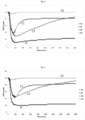
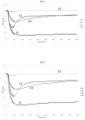
- the H 2 S amount in ppm in function of the time had been measured and is shown in Fig. 1 to Fig. 6 .
- Fig. 1 , Fig. 3 and Fig. 5 represent the results in hydrocarbon stream HC1 and Fig. 2 , Fig. 4 and Fig. 6 represent the results in hydrocarbon stream HC2.
- the alkanolamine MDEA alone had a very limited effect on the scavenging of H 2 S
- the combination I1 according to the invention comprising MBO and MDEA had a much-improved scavenging performances showing the synergistic effect of the claimed combination.
- the scavenging effect is faster and is higher with the combination I1 according to the invention than with compositions C1, C2 and C5 outside of the invention.
- H 2 S scavenging effect is maintained over time, since the amount of H 2 S is lower than 20 ppm or even lower than 15 ppm after 1800 seconds for the scavenging compositions I2 and I3 according to the invention, while H 2 S is continuously added during the test.
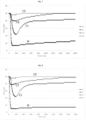
- Fig. 7 and Fig. 8 further show that scavenging compositions also comprising a solvent still have very satisfying properties.
- the results of these figures also demonstrate that increasing the weight ratio oxazolidine compound/alkanolamine allows to increase the scavenging efficiency and in particular the speed of scavenging.
- the alkanolamine defined in the invention allows to boost the efficiency of the oxazolidine compound.
- the scavenging compositions of the invention I1, I2, I3, I4 and I5 comprising the combination of the alkanolamine and of the oxazolidine compound allow to significantly reduce the H 2 S amount in the hydrocarbon stream, since the amount of H 2 S with the combination is much lower than the amount of H2S with the alkanolamine alone (scavenging compositions C2, C3, C4, C6, C7) or than the amount of H 2 S with the oxazolidine compound alone (scavenging composition C1).
- the composition of the invention also allows to increase the speed of scavenging and to increase the amount of H 2 S that can be scavenged for a given amount of scavenger.
- H 2 S scavengers were evaluated for scavenging performance in gas phase measurement performance tests.
- a mixture of brine and an isoparaffinic hydrocarbon product in a weight ratio 50/50 was prepared.
- the isoparaffinic hydrocarbon product comprises 25%wt of a C11-C13 isoparaffinic cut and 75%wt of a C12-C16 isoparaffinic cut.
- the mixture was heated to the test temperature (25°C) before being saturated by sparging with H 2 S gas in nitrogen (50 ppm) until equilibrium was achieved in the gas phase.
- H 2 S The flow of H 2 S was stopped, the stirrer started (stirring rate of 300 rpm) and the H 2 S scavenger added to the aqueous phase in a concentration of 125 ppmv.
- concentration of H 2 S in the gas phase was logged every 10 s for up to 2 hours (or until 1 ppm is measured) and the time required to reduce the gaseous H2S concentration to 10 ppmv was determined.
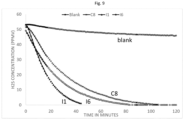
- H2S scavengers tested in this example are compositions C8, I1 and I6 detailed in table 1.
- Fig. 9 shows the concentration of H2S in ppmv in the gas phase in function of the time in minutes.
- the Blank measurement corresponds to the same test, but without addition of the H 2 S scavenger.
- the time needed to reach a H 2 S concentration of 10 ppm is of about 50 minutes for the composition C8 comprising only MBO and if of about 40 minutes for the composition I6 and of about 25 minutes for the composition I1.
- the scavenging compositions of the invention comprising an oxazolidine compound and an alkanolamine compound provide a faster scavenging effect when compared to a composition comprising only an oxazolidine compound.
- EXEMPLE 4 Measurement of H 2 S scavenging ability of the scavenging compositions
- H 2 S scavenging ability had been evaluated according to ASTM D5705 standard.
- ASTM D-5705 can be used for measurement of Hydrogen sulfide in a vapor phase above the residual fuel oils (hydrocarbon streams).
- Performance evaluation of various scavenging compositions were evaluated using a modified ASTM D-5705 test method as detailed below: In a typical experiment, 1 liter tin metal bottles with inner and outer caps were used to prepare and hold the test media. The hydrocarbon media named "HC2" detailed above has been used for the tests of this example.
- H 2 S saturated hydrocarbon solvent typically between 2000 and 7000 ppm by weight of H 2 S
- a defined amount of H 2 S saturated hydrocarbon solvent typically between 2000 and 7000 ppm by weight of H 2 S
- the metal bottle was then kept on a reciprocating shaking machine for 5 min to allow proper mixing of the H 2 S gas.
- the tin metal bottle was then kept in a water bath at 60°C for two hours. After two hours, the tin metal bottle was taken out and cooled down to room temperature under running tap water and kept aside.
- H 2 S detecting tube Dräger tube, with typical detection limit ranging from 100 to 70 000 ppm by weight
- the sealed ends of the H 2 S detecting tube were opened with an appropriate opener, one end of the tube being attached to Dräger pump.
- the silicon septa mounted at the opening of the tin metal bottles was removed and very quickly the rubber cork with H 2 S detector tube was inserted inside the opening of the tin metal bottle.
- the H 2 S gas in the vapor phase of the tin metal bottle was then pulled through the H 2 S measuring tube using Dräger pump attached at the other end of the tube.
- the detector tube was removed after complete decompression of the pump.
- H 2 S concentration was read from the tubes calibration scale (typically color change from colorless to brown). This reading was noted as a reference Blank reading of H 2 S amount.
- H 2 S containing dearomatized hydrocarbon solvent was injected into other tin metal bottles, which are pre-filled with 500 mL of the dearomatized hydrocarbon, and H 2 S scavengers at different ratios of scavenger against H 2 S, based on the Blank reading.
- Typical H 2 S:scavenger ratios employed were 1:1, 1:0.8, 1:0.6, 1:0.4, 1:0.2 and 1:0.1. All the metal bottles were kept in a water bath for two hours at 60°C. Similar protocol was employed to measure the H 2 S in the vapor phase of all the bottles as used to make the Blank reading.
- % scavenging The difference between the Blank H 2 S concentration and H 2 S concentration observed with different concentrations of the scavenging products and formulations are noted as % scavenging. A higher % Scavenging with lower concentration of the scavenging product is considered as better H 2 S scavenger for the set of experiment.
- the protocol of measurement was repeated three times with each scavenging composition and the indicated percentage was calculated based on the average of the measurements.
- the scavenging compositions tested are those detailed in table 1 above.
- Table 2 shows the percentage of H 2 S reduction based on the measured H 2 S amount in vapour phase after treatment with the H 2 S scavenging compositions.
- Table 2 Scavenging efficiency (% of H 2 S reduction) of the scavenging compositions Ref % Scavenging Efficiency v/s Scavenger Dosages [modified ASTM D5705] 1 : 1 1 : 0.8 1 : 0.6 1 : 0.4 1: 0.2 1 : 0.1 I1 100 100 100 100 80 60 20 I2 100 100 100 100 100 100 100 100 100 100 100 100 100 I4 100 100 100 100 92 70 50 I5 100 100 100 100 90 60 40 I7 100 100 100 100 100 100 100 100 100 80 I8 100 100 100 100 95 60 C1 100 100 90 60 40 10 C2 100 100 100 90 60 10 0 C3 100 100 100 100 100 80 30 C6 70 90 0 0 0 0 C7 100 90 60 20 0 0 C9 100 100 95 60 20 0 C10 100 100 100 95 60 20 0 C10
- composition I2 comprising MIPA as alkanolamine
- 100% of the H 2 S present in the hydrocarbon is scavenged even when the weight ratio H 2 S:scavenging composition is of 1:0.1.
- composition C3 comprising MIPA without the oxazolidine compound
- the weight ratio H 2 S:scavenging composition is of 1:0.1, only 30%wt of H 2 S are scavenged.
Landscapes
- Chemical & Material Sciences (AREA)
- Oil, Petroleum & Natural Gas (AREA)
- Engineering & Computer Science (AREA)
- Chemical Kinetics & Catalysis (AREA)
- General Chemical & Material Sciences (AREA)
- Organic Chemistry (AREA)
- Production Of Liquid Hydrocarbon Mixture For Refining Petroleum (AREA)
Claims (15)
- Zusammensetzung zum Fangen von Schwefelwasserstoff und Mercaptanen in Kohlenwasserstoffströmen, die Zusammensetzung umfassend mindestens eine Oxazolidinverbindung und mindestens ein Alkanolamin von Formel (I), wobei das Gewichtsverhältnis Oxazolidinverbindung/Alkanolamin größer ist als 1, wobei:
 - n eine ganze Zahl in einem Bereich von 1 bis 6 ist,- R1 eine zweiwertige lineare oder verzweigte, cyclische oder acyclische Alkyl- oder Alkenylgruppe ist, die 1 bis 12 Kohlenstoffatome aufweist,- R2 und R3, gleich oder verschieden, ausgewählt sind aus einem Wasserstoffatom, einer linearen oder verzweigten, zyklischen oder azyklischen Alkyl- oder Alkenylgruppe, die 1 bis 12 Kohlenstoffatome aufweist, oder -(R4-O)m-H, wobei jedes m unabhängig eine ganze Zahl in einem Bereich von 1 bis 6 ist und R4 eine zweiwertige lineare oder verzweigte, azyklische oder zyklische Alkyl- oder Alkenylgruppe ist, die 1 bis 12 Kohlenstoffatome aufweist.
 - Zusammensetzung nach Anspruch 1, wobei das Gewichtsverhältnis Oxazolidinverbindung/Alkanamin in einem Bereich von mehr als 1 bis 20, vorzugsweise von 1,2 bis 15, bevorzugter von 1,5 bis 10 und noch bevorzugter von 2 bis 5 ist.
- Zusammensetzung nach einem der Ansprüche 1 oder 2, wobei die Oxazolidinverbindung ausgewählt ist aus Bisoxazolidinen von Formel (II):
 - r eine ganze Zahl von 1 bis 6, vorzugsweise von 1 bis 2 ist,- Q1 und Q2, gleich oder verschieden, ausgewählt sind aus einem Wasserstoffatom und einer linearen, verzweigten oder einer zyklischen Alkyl- oder Alkenylgruppe, die 1 bis 6 Kohlenstoffatome, vorzugsweise 1 bis 2 Kohlenstoffatome, aufweist, und
 - Zusammensetzung nach einem der Ansprüche 1 bis 3, wobei in Formel (I):- n in einem Bereich von 1 bis 2 ist,- R1 eine zweiwertige lineare oder verzweigte Alkylgruppe ist, die 2 bis 6 Kohlenstoffatome, vorzugsweise 2 bis 4 Kohlenstoffatome aufweist,- R2 und R3, gleich oder verschieden, ausgewählt sind aus einem Wasserstoffatom, einer linearen oder verzweigten Alkylgruppe, die 2 bis 6 Kohlenstoffatome, vorzugsweise 2 bis 4 Kohlenstoffatome aufweist, oder aus -(R4-O)m-H, wobei jedes m unabhängig eine ganze Zahl in einem Bereich von 1 bis 2 ist, und R4 eine zweiwertige lineare oder verzweigte Alkylgruppe ist, die 2 bis 6 Kohlenstoffatome, vorzugsweise 2 bis 4 Kohlenstoffatome, aufweist.
- Zusammensetzung nach einem der Ansprüche 1 bis 4, wobei das Molekulargewicht des Alkanolamins in einem Bereich von 50 bis 300 g/Mol, vorzugsweise von 55 bis 250 g/Mol, bevorzugter von 60 bis 200 g/Mol ist.
- Zusammensetzung nach einem der Ansprüche 1 bis 5, wobei in Formel (I):- n gleich 2 ist, und- mindestens eines von R2 und R3 -(R4-O)m-H ist, wobei m 1 oder 2 ist, vorzugsweise sowohl R2 als auch R3 -(R4-O)m-H sind, wobei m vorzugsweise 1 ist.
- Zusammensetzung nach einem der Ansprüche 1 bis 5, wobei das Alkanolamin ausgewählt ist aus Methyldiethanolamin, Monoisopropanolamin, Polyethanolamin, Monoethanolamin, Diethanolamin, Methylmonoethanolamin, Dimethylethanolamin, Diethylethanolamin, Ethylmonoethanolamin, Ethyldiethanolamin, Triisopropanolamin und Gemischen davon, vorzugsweise aus Methyldiethanolamin, Monoisopropanolamin, Polyethanolamin, Monoethanolamin, Diethanolamin und Gemischen davon, bevorzugter aus Methyldiethanolamin, Monoisopropanolamin, Polyethanolamin, Monoethanolamin und Gemischen davon.
- Zusammensetzung nach einem der Ansprüche 1 bis 7, ferner umfassend mindestens ein Lösungsmittel, vorzugsweise in einer Menge in einem Bereich von 1 bis 80 Gewichts-%, vorzugsweise von 5 bis 80 Gewichts-%, bevorzugter von 10 bis 70 Gewichts-%, bezogen auf das Gesamtgewicht der Zusammensetzung.
- Zusammensetzung nach einem der Ansprüche 1 bis 8, umfassend:- 10 bis 99 Gewichts-%, vorzugsweise 30 bis 98 Gewichts-%, bevorzugter 40 bis 95 Gewichts-% Oxazolidinverbindung(en),- von 0,5 bis weniger als 50 Gewichts-%, vorzugsweise 1 bis 45 Gewichts-%, bevorzugter 1,5 bis 40 Gewichts-%, noch bevorzugter 2 bis 30 Gewichts-% des Alkanolamins von Formel (I), und- optional 5 bis 80 Gewichts-%, vorzugsweise 10 bis 70 Gewichts-%, bevorzugter 20 bis 60 Gewichts-% Lösungsmittel,bezogen auf das Gesamtgewicht der Zusammensetzung.
- Zusammensetzung nach einem der Ansprüche 1 bis 9, umfassend:- 10 bis 99 Gewichts-%, vorzugsweise 30 bis 98 Gewichts-%, bevorzugter 40 bis 95 Gewichts-% Oxazolidinverbindung(en),- von 0,5 bis weniger als 50 Gewichts-%, vorzugsweise 1 bis 45 Gewichts-%, bevorzugter 1,5 bis 40 Gewichts-%, noch bevorzugter 2 bis 30 Gewichts-% des Alkanolamins von Formel (I), und- optional 5 bis 80 Gewichts-%, vorzugsweise 10 bis 70 Gewichts-%, bevorzugter 20 bis 60 Gewichts-% Lösungsmittel,bezogen auf das Gesamtgewicht der Zusammensetzung.wobei das Gewichtsverhältnis von Oxazolidinverbindung zu Alkanolamin von Formel (I) in einem Bereich von 1,5 bis 10, vorzugsweise von 2 bis 5, ist.
- Verwendung eines Alkanolamins von Formel (I) zur Verbesserung der Wirksamkeit einer Oxazolidinverbindung zum Verbessern der Wirksamkeit einer Oxazolidinverbindung beim Fangen von Schwefelwasserstoff und/oder Mercaptanen in Kohlenwasserstoffströmen, wobei:
 - n eine ganze Zahl in einem Bereich von 1 bis 6 ist,- R1 eine zweiwertige lineare oder verzweigte, cyclische oder acyclische Alkyl- oder Alkenylgruppe ist, die 1 bis 12 Kohlenstoffatome aufweist,- R2 und R3, gleich oder verschieden, ausgewählt sind aus einem Wasserstoffatom, einer linearen oder verzweigten, zyklischen oder azyklischen Alkyl-oder Alkenylgruppe, die 1 bis 12 Kohlenstoffatome aufweist, oder -(R4-O)m-H, wobei jedes m unabhängig eine ganze Zahl in einem Bereich von 1 bis 6 ist und R4 eine zweiwertige lineare oder verzweigte, azyklische oder zyklische Alkyl- oder Alkenylgruppe ist, die 1 bis 12 Kohlenstoffatome aufweist,wobei das Gewichtsverhältnis Oxazolidinverbindung/Alkanamin größer ist als 1.
 - Verwendung nach Anspruch 11, wobei das Alkanolamin von Formel (I) wie definiert in einem der Ansprüche 4 bis 7 ist und/oder die Oxazolidinverbindung wie definiert in Anspruch 3 ist.
- Verwendung nach Anspruch 11 oder 12, wobei das Gewichtsverhältnis Oxazolidinverbindung/Alkanamin in einem Bereich von mehr als 1 bis 20, vorzugsweise von 1,2 bis 15, bevorzugter von 1,5 bis 10 und noch bevorzugter von 2 bis 5 ist.
- Kohlenwasserstoffhaltige Zusammensetzung, umfassend Kohlenwasserstoffe und eine Zusammensetzung nach einem der Ansprüche 1 bis 10, wobei die Kohlenwasserstoffe vorzugsweise ausgewählt sind aus Rohöl, Heizöl, Kraftstoff, leichtem Erdölgas, Erdgas, Bitumen und Erdölresten.
- Verfahren zum Fangen von Schwefelwasserstoff und/oder Mercaptanen in einem Kohlenwasserstoffstrom, umfassend ein Inkontaktbringen des Kohlenwasserstoffstroms mit der Zusammensetzung nach einem der Ansprüche 1 bis 10.
Applications Claiming Priority (2)
| Application Number | Priority Date | Filing Date | Title |
|---|---|---|---|
| EP20306550 | 2020-12-11 | ||
| PCT/EP2021/084893 WO2022122865A1 (en) | 2020-12-11 | 2021-12-09 | Hydrogen sulphide and mercaptans scavenging compositions |
Publications (2)
| Publication Number | Publication Date |
|---|---|
| EP4259757A1 EP4259757A1 (de) | 2023-10-18 |
| EP4259757B1 true EP4259757B1 (de) | 2025-02-05 |
Family
ID=74130007
Family Applications (1)
| Application Number | Title | Priority Date | Filing Date |
|---|---|---|---|
| EP21820638.1A Active EP4259757B1 (de) | 2020-12-11 | 2021-12-09 | Schwefelwasserstoff- und mercaptanenabsorbierende zusammensetzungen |
Country Status (7)
| Country | Link |
|---|---|
| US (1) | US20240043762A1 (de) |
| EP (1) | EP4259757B1 (de) |
| CA (1) | CA3204338A1 (de) |
| DK (1) | DK4259757T3 (de) |
| ES (1) | ES3023607T3 (de) |
| PL (1) | PL4259757T3 (de) |
| WO (1) | WO2022122865A1 (de) |
Families Citing this family (1)
| Publication number | Priority date | Publication date | Assignee | Title |
|---|---|---|---|---|
| US11802246B2 (en) * | 2021-03-11 | 2023-10-31 | Baker Hughes Oilfield Operations Llc | Synergistic effects among mercaptan scavengers |
Family Cites Families (4)
| Publication number | Priority date | Publication date | Assignee | Title |
|---|---|---|---|---|
| DK0882112T3 (da) | 1996-07-12 | 2003-01-13 | Baker Hughes Inc | Bisoxazolidin-holdig hydrogensulfid-indfanger |
| DE102015121689A1 (de) | 2015-12-14 | 2017-06-14 | Schülke & Mayr GmbH | Verwendung von Zusammensetzungen mit einem Gehalt an 3,3'-Methylenbis(5-methyloxazolidin) bei der Entfernung von Schwefelverbindungen aus Prozessströmen |
| EP3578622B1 (de) * | 2016-07-01 | 2020-10-07 | Clariant International Ltd | Zusammensetzungen mit synergierten acetalen und verfahren zur spülung von sulfiden und mercaptanen |
| US20190194551A1 (en) * | 2017-12-22 | 2019-06-27 | Clariant International, Ltd. | Synergized acetals composition and method for scavenging sulfides and mercaptans |
-
2021
- 2021-12-09 ES ES21820638T patent/ES3023607T3/es active Active
- 2021-12-09 WO PCT/EP2021/084893 patent/WO2022122865A1/en not_active Ceased
- 2021-12-09 US US18/256,088 patent/US20240043762A1/en active Pending
- 2021-12-09 PL PL21820638.1T patent/PL4259757T3/pl unknown
- 2021-12-09 EP EP21820638.1A patent/EP4259757B1/de active Active
- 2021-12-09 CA CA3204338A patent/CA3204338A1/en active Pending
- 2021-12-09 DK DK21820638.1T patent/DK4259757T3/da active
Also Published As
| Publication number | Publication date |
|---|---|
| WO2022122865A1 (en) | 2022-06-16 |
| EP4259757A1 (de) | 2023-10-18 |
| CA3204338A1 (en) | 2022-06-16 |
| US20240043762A1 (en) | 2024-02-08 |
| PL4259757T3 (pl) | 2025-05-26 |
| DK4259757T3 (da) | 2025-04-28 |
| ES3023607T3 (en) | 2025-06-02 |
Similar Documents
| Publication | Publication Date | Title |
|---|---|---|
| AU719046B2 (en) | Bisoxazolidine hydrogen sulfide scavenger | |
| US5688478A (en) | Method for scavenging sulfides | |
| US5462721A (en) | Hydrogen sulfide scavenging process | |
| EP2935524B1 (de) | Funktionalisierte wasserstoffsulfidfänger | |
| EP3891259B1 (de) | Schwefelwasserstoff- und mercaptanenabsorbierende zusammensetzungen | |
| CA2269476A1 (en) | Method and composition for removing sulfides from fluid streams | |
| JP2013531728A (ja) | 炭化水素から硫化水素を除去するためのアルファ−アミノエーテルの使用 | |
| JP2018531146A (ja) | 硫化水素の選択的除去のための吸収剤及び方法 | |
| JP2018531146A6 (ja) | 硫化水素の選択的除去のための吸収剤及び方法 | |
| US20240043762A1 (en) | Hydrogen sulphide and mercaptans scavenging compositions | |
| EP4402228B1 (de) | Schwefelwasserstoff- und mercaptanfänger | |
| EP3891262B1 (de) | Schwefelwasserstoff- und mercaptanenabsorbierende zusammensetzungen | |
| EP3891260B1 (de) | Schwefelwasserstoff- und mercaptanenabsorbierende zusammensetzungen | |
| US9273254B2 (en) | Amino acetals and ketals as hydrogen sulfide and mercaptan scavengers | |
| EP3891258B1 (de) | Schwefelwasserstoff- und mercaptanenabsorbierende zusammensetzungen | |
| US20230167374A1 (en) | Hydrogen sulphide and mercaptans scavenging compositions | |
| US20120269707A1 (en) | Use of 2-(3-aminopropoxy)ethan-1-ol as an absorbent to remove acidic gases | |
| WO2024209069A1 (en) | Hydrogen sulphide and mercaptan scavenging additive concentrate comprising an oxazolidine compound and a quaternary ammonium salt | |
| WO2024209067A1 (en) | Hydrogen sulphide and mercaptan scavenging additive concentrate comprising an oxazolidine compound and cocodimethyl amine oxide |
Legal Events
| Date | Code | Title | Description |
|---|---|---|---|
| STAA | Information on the status of an ep patent application or granted ep patent |
Free format text: STATUS: UNKNOWN |
|
| STAA | Information on the status of an ep patent application or granted ep patent |
Free format text: STATUS: THE INTERNATIONAL PUBLICATION HAS BEEN MADE |
|
| PUAI | Public reference made under article 153(3) epc to a published international application that has entered the european phase |
Free format text: ORIGINAL CODE: 0009012 |
|
| STAA | Information on the status of an ep patent application or granted ep patent |
Free format text: STATUS: REQUEST FOR EXAMINATION WAS MADE |
|
| 17P | Request for examination filed |
Effective date: 20230619 |
|
| AK | Designated contracting states |
Kind code of ref document: A1 Designated state(s): AL AT BE BG CH CY CZ DE DK EE ES FI FR GB GR HR HU IE IS IT LI LT LU LV MC MK MT NL NO PL PT RO RS SE SI SK SM TR |
|
| DAV | Request for validation of the european patent (deleted) | ||
| DAX | Request for extension of the european patent (deleted) | ||
| STAA | Information on the status of an ep patent application or granted ep patent |
Free format text: STATUS: EXAMINATION IS IN PROGRESS |
|
| 17Q | First examination report despatched |
Effective date: 20240326 |
|
| GRAP | Despatch of communication of intention to grant a patent |
Free format text: ORIGINAL CODE: EPIDOSNIGR1 |
|
| STAA | Information on the status of an ep patent application or granted ep patent |
Free format text: STATUS: GRANT OF PATENT IS INTENDED |
|
| INTG | Intention to grant announced |
Effective date: 20240722 |
|
| GRAS | Grant fee paid |
Free format text: ORIGINAL CODE: EPIDOSNIGR3 |
|
| GRAA | (expected) grant |
Free format text: ORIGINAL CODE: 0009210 |
|
| STAA | Information on the status of an ep patent application or granted ep patent |
Free format text: STATUS: THE PATENT HAS BEEN GRANTED |
|
| AK | Designated contracting states |
Kind code of ref document: B1 Designated state(s): AL AT BE BG CH CY CZ DE DK EE ES FI FR GB GR HR HU IE IS IT LI LT LU LV MC MK MT NL NO PL PT RO RS SE SI SK SM TR |
|
| REG | Reference to a national code |
Ref country code: GB Ref legal event code: FG4D |
|
| REG | Reference to a national code |
Ref country code: CH Ref legal event code: EP |
|
| REG | Reference to a national code |
Ref country code: DE Ref legal event code: R096 Ref document number: 602021025777 Country of ref document: DE |
|
| REG | Reference to a national code |
Ref country code: IE Ref legal event code: FG4D |
|
| REG | Reference to a national code |
Ref country code: DK Ref legal event code: T3 Effective date: 20250423 |
|
| REG | Reference to a national code |
Ref country code: NL Ref legal event code: FP |
|
| REG | Reference to a national code |
Ref country code: ES Ref legal event code: FG2A Ref document number: 3023607 Country of ref document: ES Kind code of ref document: T3 Effective date: 20250602 |
|
| PG25 | Lapsed in a contracting state [announced via postgrant information from national office to epo] |
Ref country code: RS Free format text: LAPSE BECAUSE OF FAILURE TO SUBMIT A TRANSLATION OF THE DESCRIPTION OR TO PAY THE FEE WITHIN THE PRESCRIBED TIME-LIMIT Effective date: 20250505 |
|
| PG25 | Lapsed in a contracting state [announced via postgrant information from national office to epo] |
Ref country code: FI Free format text: LAPSE BECAUSE OF FAILURE TO SUBMIT A TRANSLATION OF THE DESCRIPTION OR TO PAY THE FEE WITHIN THE PRESCRIBED TIME-LIMIT Effective date: 20250205 |
|
| REG | Reference to a national code |
Ref country code: LT Ref legal event code: MG9D |
|
| PG25 | Lapsed in a contracting state [announced via postgrant information from national office to epo] |
Ref country code: IS Free format text: LAPSE BECAUSE OF FAILURE TO SUBMIT A TRANSLATION OF THE DESCRIPTION OR TO PAY THE FEE WITHIN THE PRESCRIBED TIME-LIMIT Effective date: 20250605 |
|
| PG25 | Lapsed in a contracting state [announced via postgrant information from national office to epo] |
Ref country code: HR Free format text: LAPSE BECAUSE OF FAILURE TO SUBMIT A TRANSLATION OF THE DESCRIPTION OR TO PAY THE FEE WITHIN THE PRESCRIBED TIME-LIMIT Effective date: 20250205 |
|
| PG25 | Lapsed in a contracting state [announced via postgrant information from national office to epo] |
Ref country code: LV Free format text: LAPSE BECAUSE OF FAILURE TO SUBMIT A TRANSLATION OF THE DESCRIPTION OR TO PAY THE FEE WITHIN THE PRESCRIBED TIME-LIMIT Effective date: 20250205 Ref country code: PT Free format text: LAPSE BECAUSE OF FAILURE TO SUBMIT A TRANSLATION OF THE DESCRIPTION OR TO PAY THE FEE WITHIN THE PRESCRIBED TIME-LIMIT Effective date: 20250605 |
|
| PG25 | Lapsed in a contracting state [announced via postgrant information from national office to epo] |
Ref country code: BG Free format text: LAPSE BECAUSE OF FAILURE TO SUBMIT A TRANSLATION OF THE DESCRIPTION OR TO PAY THE FEE WITHIN THE PRESCRIBED TIME-LIMIT Effective date: 20250205 Ref country code: GR Free format text: LAPSE BECAUSE OF FAILURE TO SUBMIT A TRANSLATION OF THE DESCRIPTION OR TO PAY THE FEE WITHIN THE PRESCRIBED TIME-LIMIT Effective date: 20250506 |
|
| REG | Reference to a national code |
Ref country code: AT Ref legal event code: MK05 Ref document number: 1764893 Country of ref document: AT Kind code of ref document: T Effective date: 20250205 |
|
| PG25 | Lapsed in a contracting state [announced via postgrant information from national office to epo] |
Ref country code: SE Free format text: LAPSE BECAUSE OF FAILURE TO SUBMIT A TRANSLATION OF THE DESCRIPTION OR TO PAY THE FEE WITHIN THE PRESCRIBED TIME-LIMIT Effective date: 20250205 |
|
| PG25 | Lapsed in a contracting state [announced via postgrant information from national office to epo] |
Ref country code: SM Free format text: LAPSE BECAUSE OF FAILURE TO SUBMIT A TRANSLATION OF THE DESCRIPTION OR TO PAY THE FEE WITHIN THE PRESCRIBED TIME-LIMIT Effective date: 20250205 |
|
| PG25 | Lapsed in a contracting state [announced via postgrant information from national office to epo] |
Ref country code: AT Free format text: LAPSE BECAUSE OF FAILURE TO SUBMIT A TRANSLATION OF THE DESCRIPTION OR TO PAY THE FEE WITHIN THE PRESCRIBED TIME-LIMIT Effective date: 20250205 |
|
| PG25 | Lapsed in a contracting state [announced via postgrant information from national office to epo] |
Ref country code: EE Free format text: LAPSE BECAUSE OF FAILURE TO SUBMIT A TRANSLATION OF THE DESCRIPTION OR TO PAY THE FEE WITHIN THE PRESCRIBED TIME-LIMIT Effective date: 20250205 Ref country code: CZ Free format text: LAPSE BECAUSE OF FAILURE TO SUBMIT A TRANSLATION OF THE DESCRIPTION OR TO PAY THE FEE WITHIN THE PRESCRIBED TIME-LIMIT Effective date: 20250205 |
|
| PG25 | Lapsed in a contracting state [announced via postgrant information from national office to epo] |
Ref country code: RO Free format text: LAPSE BECAUSE OF FAILURE TO SUBMIT A TRANSLATION OF THE DESCRIPTION OR TO PAY THE FEE WITHIN THE PRESCRIBED TIME-LIMIT Effective date: 20250205 |
|
| PG25 | Lapsed in a contracting state [announced via postgrant information from national office to epo] |
Ref country code: SK Free format text: LAPSE BECAUSE OF FAILURE TO SUBMIT A TRANSLATION OF THE DESCRIPTION OR TO PAY THE FEE WITHIN THE PRESCRIBED TIME-LIMIT Effective date: 20250205 |
|
| REG | Reference to a national code |
Ref country code: DE Ref legal event code: R097 Ref document number: 602021025777 Country of ref document: DE |
|
| PLBE | No opposition filed within time limit |
Free format text: ORIGINAL CODE: 0009261 |
|
| STAA | Information on the status of an ep patent application or granted ep patent |
Free format text: STATUS: NO OPPOSITION FILED WITHIN TIME LIMIT |
|
| PGFP | Annual fee paid to national office [announced via postgrant information from national office to epo] |
Ref country code: DE Payment date: 20251211 Year of fee payment: 5 |
|
| PGFP | Annual fee paid to national office [announced via postgrant information from national office to epo] |
Ref country code: GB Payment date: 20251219 Year of fee payment: 5 |
|
| 26N | No opposition filed |
Effective date: 20251106 |
|
| PGFP | Annual fee paid to national office [announced via postgrant information from national office to epo] |
Ref country code: IT Payment date: 20251223 Year of fee payment: 5 Ref country code: DK Payment date: 20251224 Year of fee payment: 5 |
|
| PGFP | Annual fee paid to national office [announced via postgrant information from national office to epo] |
Ref country code: FR Payment date: 20251229 Year of fee payment: 5 Ref country code: NL Payment date: 20251219 Year of fee payment: 5 |
|
| PGFP | Annual fee paid to national office [announced via postgrant information from national office to epo] |
Ref country code: BE Payment date: 20251219 Year of fee payment: 5 |
|
| PGFP | Annual fee paid to national office [announced via postgrant information from national office to epo] |
Ref country code: PL Payment date: 20251128 Year of fee payment: 5 |
|
| PGFP | Annual fee paid to national office [announced via postgrant information from national office to epo] |
Ref country code: NO Payment date: 20251230 Year of fee payment: 5 |