EP4259452B1 - Insert a l'aerodynamique optimisee pour une roue de vehicule - Google Patents
Insert a l'aerodynamique optimisee pour une roue de vehicule Download PDFInfo
- Publication number
- EP4259452B1 EP4259452B1 EP21810682.1A EP21810682A EP4259452B1 EP 4259452 B1 EP4259452 B1 EP 4259452B1 EP 21810682 A EP21810682 A EP 21810682A EP 4259452 B1 EP4259452 B1 EP 4259452B1
- Authority
- EP
- European Patent Office
- Prior art keywords
- wheel
- support
- blade
- insert
- frame
- Prior art date
- Legal status (The legal status is an assumption and is not a legal conclusion. Google has not performed a legal analysis and makes no representation as to the accuracy of the status listed.)
- Active
Links
Images

Classifications
-
- B—PERFORMING OPERATIONS; TRANSPORTING
- B60—VEHICLES IN GENERAL
- B60B—VEHICLE WHEELS; CASTORS; AXLES FOR WHEELS OR CASTORS; INCREASING WHEEL ADHESION
- B60B7/00—Wheel cover discs, rings, or the like, for ornamenting, protecting, venting, or obscuring, wholly or in part, the wheel body, rim, hub, or tyre sidewall, e.g. wheel cover discs, wheel cover discs with cooling fins
- B60B7/0026—Wheel cover discs, rings, or the like, for ornamenting, protecting, venting, or obscuring, wholly or in part, the wheel body, rim, hub, or tyre sidewall, e.g. wheel cover discs, wheel cover discs with cooling fins characterised by the surface
- B60B7/0066—Wheel cover discs, rings, or the like, for ornamenting, protecting, venting, or obscuring, wholly or in part, the wheel body, rim, hub, or tyre sidewall, e.g. wheel cover discs, wheel cover discs with cooling fins characterised by the surface the dominant aspect being the surface structure
- B60B7/0086—Wheel cover discs, rings, or the like, for ornamenting, protecting, venting, or obscuring, wholly or in part, the wheel body, rim, hub, or tyre sidewall, e.g. wheel cover discs, wheel cover discs with cooling fins characterised by the surface the dominant aspect being the surface structure having cooling fins
-
- B—PERFORMING OPERATIONS; TRANSPORTING
- B60—VEHICLES IN GENERAL
- B60B—VEHICLE WHEELS; CASTORS; AXLES FOR WHEELS OR CASTORS; INCREASING WHEEL ADHESION
- B60B19/00—Wheels not otherwise provided for or having characteristics specified in one of the subgroups of this group
- B60B19/10—Wheels not otherwise provided for or having characteristics specified in one of the subgroups of this group with cooling fins
-
- B—PERFORMING OPERATIONS; TRANSPORTING
- B60—VEHICLES IN GENERAL
- B60B—VEHICLE WHEELS; CASTORS; AXLES FOR WHEELS OR CASTORS; INCREASING WHEEL ADHESION
- B60B2900/00—Purpose of invention
- B60B2900/10—Reduction of
- B60B2900/121—Resisting forces
- B60B2900/1216—Resisting forces due to air-drag
-
- B—PERFORMING OPERATIONS; TRANSPORTING
- B60—VEHICLES IN GENERAL
- B60B—VEHICLE WHEELS; CASTORS; AXLES FOR WHEELS OR CASTORS; INCREASING WHEEL ADHESION
- B60B2900/00—Purpose of invention
- B60B2900/50—Improvement of
- B60B2900/513—Cooling, e.g. of brakes
-
- B—PERFORMING OPERATIONS; TRANSPORTING
- B60—VEHICLES IN GENERAL
- B60B—VEHICLE WHEELS; CASTORS; AXLES FOR WHEELS OR CASTORS; INCREASING WHEEL ADHESION
- B60B3/00—Disc wheels, i.e. wheels with load-supporting disc body
- B60B3/10—Disc wheels, i.e. wheels with load-supporting disc body apertured to simulate spoked wheels
-
- B—PERFORMING OPERATIONS; TRANSPORTING
- B60—VEHICLES IN GENERAL
- B60B—VEHICLE WHEELS; CASTORS; AXLES FOR WHEELS OR CASTORS; INCREASING WHEEL ADHESION
- B60B7/00—Wheel cover discs, rings, or the like, for ornamenting, protecting, venting, or obscuring, wholly or in part, the wheel body, rim, hub, or tyre sidewall, e.g. wheel cover discs, wheel cover discs with cooling fins
- B60B7/04—Wheel cover discs, rings, or the like, for ornamenting, protecting, venting, or obscuring, wholly or in part, the wheel body, rim, hub, or tyre sidewall, e.g. wheel cover discs, wheel cover discs with cooling fins built-up of several main parts
-
- Y—GENERAL TAGGING OF NEW TECHNOLOGICAL DEVELOPMENTS; GENERAL TAGGING OF CROSS-SECTIONAL TECHNOLOGIES SPANNING OVER SEVERAL SECTIONS OF THE IPC; TECHNICAL SUBJECTS COVERED BY FORMER USPC CROSS-REFERENCE ART COLLECTIONS [XRACs] AND DIGESTS
- Y02—TECHNOLOGIES OR APPLICATIONS FOR MITIGATION OR ADAPTATION AGAINST CLIMATE CHANGE
- Y02T—CLIMATE CHANGE MITIGATION TECHNOLOGIES RELATED TO TRANSPORTATION
- Y02T10/00—Road transport of goods or passengers
- Y02T10/80—Technologies aiming to reduce greenhouse gasses emissions common to all road transportation technologies
- Y02T10/88—Optimized components or subsystems, e.g. lighting, actively controlled glasses
Definitions
- the present invention relates to an insert with optimized aerodynamics for a wheel of a motor vehicle.
- the present invention relates more particularly to such an insert which comprises a frame intended to be secured in an opening in the web of the wheel and at least one blade linked to the frame, the blade being pivotally mounted on the frame by means of a metal support to shape memory configured to modify the orientation of said blade from a predetermined critical temperature, said blade and said support being positioned on the frame such that it extends and has a pivot which is oriented in a radial direction of the wheel web when the device is secured in said opening.
- hubcaps which fulfill a styling function and offer aerodynamic characteristics which do not (or almost do not) degrade the aerodynamics of their vehicle.
- this type of hubcap generally has air passages of small surface area which therefore only allow circulation of a small quantity of air towards the braking means coupled to the associated wheel rim, which therefore has a negative impact on their cooling.
- the wheel has a cylindrical rim and a web with radial openings formed by spokes arranged radially between the central hub and the peripheral edge of the rim.
- the hubcap also has radial openings, formed by blades having in particular a section with a specific aerodynamic profile, like an “airplane wing”, which are arranged radially between the central part of the hubcap and its peripheral edge.
- This arrangement thus allows the hubcap blades to deflect the lateral air flow indirectly and to channel it through the radial openings of the wheel web.
- actuators comprising a shape memory alloy and which operates according to the temperature range of the wheel rim as it moves forward.
- the movement of the sectors between the open position and the closed position is determined by the ambient temperature of the braking system.
- the shape memory actuators cause the sectors to pivot around the hub and the edge of the rim to open the openings of the wheel, thus allowing the air flow to penetrate towards the interior. of the wheel and therefore cool the braking system.
- this type of device makes it possible to improve the aerodynamics of the vehicle by closing the wheel openings, it does not allow simultaneous ventilation of the braking system.
- the invention aims to overcome at least one of the disadvantages of the aforementioned state of the art.
- the invention aims to provide a hubcap or a hubcap with turbine insert type inserts, for a motor vehicle wheel, which makes it possible to optimize the aerodynamics of the vehicle while optimizing the thermal of the brakes, and this in a simple and easy to implement manner.
- the device according to the invention makes it possible to remedy this drawback.
- an insert for a wheel of a motor vehicle comprising a frame intended to be secured in an opening in the web of the wheel and at least one blade linked to the frame, the blade being pivotally mounted on the frame by means of a metal support with shape memory configured to modify the orientation of said blade from a predetermined critical temperature, said blade and said support being positioned on the frame such that it extends and to have a pivot which is oriented in a radial direction of the web of the wheel when the device is secured in said opening, the two ends of the support being secured to the frame, extending on either side of the blade and a part central of the support being integral in rotation with the blade.
- the support comprises a first part previously deformed and adapted to return to its original shape once said critical temperature has been reached and a second part configured to form a return spring opposing the returning the first part to its initial shape once the critical temperature has been reached, the second part of the support forming a torsion bar.
- the return force of the return spring must be calibrated so as not to prevent the first part of the support from returning to its original shape, but must just accompany it in these different changes of shape to have a cushioned movement of the rotation of the blade.
- the support when the insert is rotating following the forward movement of the vehicle, the support is configured so that, when the temperature is lower than the critical temperature, it orients the blade so as to generate a flow of The air is directed from the outside of the wheel towards the inside of the wheel and for a temperature greater than or equal to the critical temperature, orient the blade so as to generate a reverse air flow.
- the critical temperature is between 50°C and 70°C, said critical temperature preferably being 60°C.
- the present invention also relates to a vehicle wheel which comprises several openings, each opening comprising an insert according to the invention, said insert comprising at least one of the preceding characteristics.
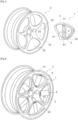
- THE figures 1 and 2 represent perspective views of an insert 1 according to the invention, before mounting on a wheel 2 and of a set of inserts 1 after mounting on this same wheel 2.
- the insert 1 comprises a frame 3 supporting a blade 4 via a support 5 which is formed by a metal element with shape memory.
- the support 5 is adapted to allow the blade 4 to pivot on the frame 3, in such a way that the inclination of the blade 4 can change automatically depending on the temperature, as more particularly explained in the remainder of the detailed description.
- the wheel 2 comprises a web 21 in which openings 22 are formed, with the parts of the web 21 which are positioned between the openings 22 and which form branches 23.
- the wheel 2 has five branches 23 and five openings 22, with an insert 1 which is positioned in each of the five openings 22.
- each insert 1 The blade 4 and the support 5 of each insert 1 are oriented in the frame 3 such that when the inserts 1 are positioned in the openings 22, the pivoting of the blade 4 is oriented in a radial direction of the web 21 of the wheel 2, the blade 4 itself being oriented to extend along its longest length in a radial direction of the web 21 of the wheel 2.
- Two ends 51 of the support 5 are integral with the frame 3, extending on either side of the blade 4 taken in its longest length, with a central part 52 of the support 5 which is integral in rotation with a central part 41 of blade 4.
- Retaining clips make it possible to secure the blade 4 to the support 5, but these clips are adapted to let the support 5 pivot freely without modifying the rotation of the blade 4 outside the central part 52 of the support 5.
- FIG. 3 On the Figure 3 is shown a perspective view of the frame 3 and the support 5 of the insert 1 where the shape of the support 5 is more particularly visible.
- the two ends 51 of the support 5 are rigidly secured to two studs secured to the frame 3.
- the central part 52 of the support 5 has a cross shape to rotate the blade during its rotation.
- the support 5 comprises a first part 53 which extends from the central part 52 of the support 5 towards a first 31 of the two studs of the frame 3 and a second part 54 which extends from the central part 52 of the support 5 towards a second 32 of the two studs of frame 3.
- the first stud 31 of the frame 3 is intended to be positioned as close as possible to the peripheral edge of the wheel while the second stud 32 of the frame 3 is intended to be positioned as close as possible to the center of the wheel.
- the support 5 comprises a metal structure with shape memory which has the particularity that, when a part of the support 5 is deformed at low temperature, this part returns to its initial state after having been exposed to a predetermined critical temperature which is here included between 50°C and 70°C, advantageously this critical temperature here being 60°C.
- the first part 53 of the support 5 has been previously deformed and reacts when the temperature limit is reached, returning to its shape before deformation.
- the second part 54 of the support 5 has not been previously deformed and therefore does not react when the limit temperature is reached.
- the first part 53 of the support 5 When the temperature drops below the critical temperature, the first part 53 of the support 5 returns to its deformed state aided in this by the second part 54 which acts as a torsion spring, thus helping to return to the initial position of the part central 52 of support 5.
- the change in temperature is essentially due to the temperature of the braking system which is positioned in the wheel.
- the temperature created by the braking system heats the outer peripheral edge of the wheel more than its center, causing the first part 53 of the support 5 to be preferably positioned as close as possible to the peripheral edge of the wheel to react more quickly to its increase in temperature. .
- the central part 52 of the support 5 can rotate by 30° depending on the temperature of the braking system.
- the blade 4 creates a suction of the air present outside the vehicle towards the inside of the wheel 2 through the openings 22.
- this first position reduces the aerodynamic drag of the vehicle, but creates less cooling of the vehicle's braking system.
- the blade 4 forms an air extractor, the air being pulsed from the inside of the wheel 2 towards the outside and the air circulating along the bodywork and extending along the wheel 2 not being able to fit into the openings 22.
- this second position increases the aerodynamic drag of the vehicle, but contributes to the cooling of the vehicle's braking system.
- these have an aerodynamic profile with an outer face 42 which is generally curved and convex, and an inner face 43, opposite the outer face 42, which is advantageously flat, convex or concave.
- Such a profile is known as “CLARK Y” and is found in particular in the profile of aircraft wings.
- Such inserts 1 allow an aerodynamic gain of 3 dm2 or approximately 1.5 g of CO2 per kilometer and a reduction in the temperature of the braking device fluid of around -10°C.
- This invention also has the advantage of being simple in design, compact and easy to implement.
- This invention can also be applied to a hubcap which would cover the entire web of the wheel and which would comprise a series of blades pivotally mounted with such supports in openings which would correspond to openings formed in the web of the wheel.
Landscapes
- Engineering & Computer Science (AREA)
- Mechanical Engineering (AREA)
- Body Structure For Vehicles (AREA)
- Arrangement Or Mounting Of Propulsion Units For Vehicles (AREA)
- Braking Arrangements (AREA)
- Structures Of Non-Positive Displacement Pumps (AREA)
Description
- La présente invention revendique la priorité de la demande
française N°2012989 déposée le 10.12.2020 - La présente invention concerne un insert à l'aérodynamique optimisée pour une roue d'un véhicule automobile.
- La présente invention concerne plus particulièrement un tel insert qui comprend un cadre destiné à être solidarisé dans une ouverture du voile de la roue et au moins une pale liée au cadre, la pale étant montée pivotante sur le cadre au moyen d'un support métallique à mémoire de forme configuré pour modifier l'orientation de ladite pale à partir d'une température critique prédéterminée, ladite pale et ledit support étant positionnés sur le cadre de telle sort à s'étend et à avoir un pivotement qui est orienté suivant une direction radiale du voile de la roue lorsque le dispositif est solidarisé dans ladite ouverture.
- Il existe des enjoliveurs, dits « aérodynamiques », qui remplissent une fonction de style et offrent des caractéristiques aérodynamiques qui ne dégradent pas (ou quasiment pas) l'aérodynamisme de leur véhicule.
- Cependant, ce type d'enjoliveur présente généralement des passages d'air de petite surface qui permettent par conséquent seulement une circulation d'une petite quantité d'air vers les moyens de freinage couplés à la jante de roue associée, ce qui de ce fait a une incidence négative sur le refroidissement de ces derniers.
- Afin d'améliorer la situation, il a été proposé d'équiper les roues d'enjoliveurs aérodynamiques plus perfectionnés.
- Tel est notamment le cas dans le document brevet
FR-A1-3011769 - La roue présente une jante cylindrique et un voile avec des ajourages radiaux formés par des rayons disposés radialement entre le moyeu central et le bord périphérique de la jante.
- L'enjoliveur présente également des ajourages radiaux, formés par des pales présentant en particulier une section à profil spécifique aérodynamique, en « aile d'avion », qui sont disposées radialement entre la partie centrale de l'enjoliveur et son bord périphérique.
- Cette disposition permet ainsi aux pales d'enjoliveur de dévier le flux d'air latéral de manière indirecte et de le canaliser au travers des ajourages radiaux du voile de la roue.
- Toutefois, bien que les caractéristiques aérodynamiques de ces enjoliveurs perfectionnés dits également « à effet turbine », soient optimales et permettent notamment une réduction de la traînée aérodynamique et un gain de CO2, les ajourages radiaux du voile ne présentent pas une surface optimale et limite par conséquent le flux d'air apte à refroidir les freins du véhicule.
- Pour remédier à cet inconvénient, il est également possible d'utiliser des dispositifs de fermeture des ajourages du voile d'une jante d'une roue classique.
- Tel est le cas du document de brevet publié
DE-A1-102016004129 qui divulgue un dispositif de recouvrement d'ajourage de roue formé par des secteurs en éventails. - Ces secteurs sont au nombre de trois par ajourage et pivotent autour de la partie centrale de la roue pour fermer ou ouvrir l'ajourage correspondant.
- Leur déplacement est en fait effectué par des actionneurs comprenant un alliage en mémoire de forme et qui fonctionne en fonction de la plage de température de la jante de la roue lors du déplacement vers l'avant de celle-ci.
- Dans le cas présent, le déplacement des secteurs entre la position ouverte et la position fermée est déterminé par la température ambiante au système de freinage.
- Ainsi, lorsque les secteurs de chaque ajourage sont fermés, le système de freinage est beaucoup moins ventilé ce qui conduit à une augmentation de la température de la région de la jante où se trouve les freins.
- Puis, lorsque cette température atteint un certain seuil, les actionneurs à mémoire de forme entrainent le pivotement des secteurs autour du moyeu et du bord de la jante pour ouvrir les ajourages de la roue permettant ainsi au flux d'air de pénétrer vers l'intérieur de la roue et par conséquent de refroidir le système de freinage. Bien que ce type de dispositif permette d'améliorer l'aérodynamisme du véhicule par la fermeture des ajourages de la roue, il ne permet pas une ventilation simultanée du système de freinage.
- De plus, sa mise en place nécessite une fixation sur la face interne de la roue, à l'arrière des rayons du voile, ce qui ne facilite pas un démontage facile et rapide en cas de dysfonctionnement ou de changement de roue. Un autre exemple d'insert pour roue avec pale pivotante est connu par
WO 2019/166715 A1 . - L'invention a pour objectif de pallier au moins un des inconvénients de l'état de la technique susmentionné.
- Plus particulièrement, l'invention a pour objectif de fournir un enjoliveur ou un enjoliveur à pièces rapportées de type insert turbine, pour roue de véhicule automobile, qui permette d'optimiser l'aérodynamisme du véhicule tout en optimisant la thermique des freins, et ceci de manière simple et facile à mettre en oeuvre.
- Le dispositif selon l'invention permet de remédier à cet inconvénient.
- Il comporte en effet, selon l'invention, un insert pour une roue d'un véhicule automobile, comprenant un cadre destiné à être solidarisé dans une ouverture du voile de la roue et au moins une pale liée au cadre, la pale étant montée pivotante sur le cadre au moyen d'un support métallique à mémoire de forme configuré pour modifier l'orientation de ladite pale à partir d'une température critique prédéterminée, ladite pale et ledit support étant positionnés sur le cadre de telle sort à s'étend et à avoir un pivotement qui est orienté suivant une direction radiale du voile de la roue lorsque le dispositif est solidarisé dans ladite ouverture, les deux extrémités du support étant solidaires du cadre, s'étendant de part et d'autre de la pale et une partie centrale du support étant solidaire en rotation de la pale.
- Selon une première caractéristique de l'invention, le support comporte une première partie préalablement déformée et adaptée pour reprendre sa forme d'origine une fois ladite température critique d'atteinte et une seconde partie configurée pour former un ressort de rappel s'opposant à la remise à sa forme initiale de la première partie une fois la température critique d'atteinte, la seconde partie du support formant une barre de torsion.
- Bien entendu la force de rappel du ressort de rappel doit être calibrée pour ne pas empêcher la première partie du support de revenir dans sa forme d'origine, mais doit juste l'accompagner dans ces différents changements de formes pour avoir un mouvement amorti de la rotation de la pale.
- Selon une seconde caractéristique de l'invention, lorsque l'insert est en rotation suivant la marche avant du véhicule, le support est configuré pour que, lorsque la température est inférieure à la température critique, orienter la pale de manière à générer un flux d'air dirigé de l'extérieure de la roue vers l'intérieur de la roue et pour une température supérieure ou égale à la température critique, orienter la pale de manière générer un flux d'air inverse.
- Selon une troisième caractéristique de l'invention, la température critique est comprise entre 50°C et 70 °C, ladite température crtiique étant préférentiellement de 60 °C.
- La présente invention concerne aussi une roue de véhicule qui comporte plusieurs ouvertures, chaque ouverture comportant un insert selon l'invention, ledit insert comportant au moins une des caractéristiques précédentes.
- La présente invention concerne enfin un véhicule automobile comprenant plusieurs roues, chacune roue comportant plusieurs ouvertures, chaque ouverture comportant un insert selon l'invention, ledit insert comportant au moins une des caractéristiques précédentes.
- Les dessins annexés illustrent l'invention :
- [
Fig.1 ] représente une vue en perspective d'un insert selon l'invention, avant montage sur une roue. - [
Fig.2 ] représente une vue en perspective d'un ensemble d'inserts après montage sur cette même roue. - [
Fig.3 ] représente une vue en perspective d'un cadre et d'un support de l'insert selon l'invention. - [
Fig.4a ] représente une vue partielle, en perspective, de la roue comportant un insert selon l'invention, dans une première orientation d'une pale de l'insert. - [
Fig.4b ] représente une vue partielle en perspective de la roue qui comporte un insert selon l'invention, dans une seconde orientation de ladite pale. - Les
figures 1 et 2 représentent des vues en perspective d'un insert 1 selon l'invention, avant montage sur une roue 2 et d'un ensemble d'inserts 1 après montage sur cette même roue 2. - L'insert 1 comporte un cadre 3 soutenant une pale 4 par l'intermédiaire d'un supports 5 qui est formé par un élément métallique à mémoire de forme.
- Le support 5 est adapté pour permettre à la pale 4 de pivoter sur le cadre 3, de telle manière que l'inclinaison de la pale 4 puisse changer automatiquement en fonction de la température, comme plus particulièrement expliqué dans la suite de la description détaillée.
- La roue 2 comporte un voile 21 dans lequel sont formées des ouvertures 22, avec les parties du voile 21 qui sont positionnées entre les ouvertures 22 et qui forment des branches 23.
- Dans l'exemple de mode de réalisation tel que représenté, la roue 2 comporte cinq branches 23 et cinq ouvertures 22, avec un insert 1 qui est positionné dans chacune des cinq ouvertures 22.
- La pale 4 et le support 5 de chaque insert 1 sont orientés dans le cadre 3 de telle sort que lorsque les inserts 1 sont positionnés dans les ouvertures 22, le pivotement de la pale 4 est orientée suivant une direction radiale du voile 21 de la roue 2, la pale 4 étant elle-même orientée pour s'étendre selon sa plus longue longueur suivant une direction radiale du voile 21 de la roue 2.
- Deux extrémités 51 du support 5 sont solidaires du cadre 3, s'étendant de part et d'autre de la pale 4 prise dans sa plus longue longueur, avec une partie centrale 52 du support 5 qui est solidaire en rotation d'une partie centrale 41 de la pale 4.
- Des clips de maintien permettent de solidariser la pale 4 sur le support 5, mais ces clips sont adaptés pour laisser le support 5 pivoter librement sans modifier la rotation de la pale 4 en dehors de la partie centrale 52 du support 5.
- Sur la
figure 3 est représentée une vue en perspective du cadre 3 et du support 5 de l'insert 1 où est plus particulièrement visible la forme du support 5. - Les deux extrémités 51 du support 5 sont rigidement solidarisées sur deux plots solidaires du cadre 3.
- La partie centrale 52 du support 5 présente une forme en croix pour entrainer en rotation la pale lors de sa rotation.
- Le support 5 comporte une première partie 53 qui s'étend de la partie centrale 52 du support 5 vers un premier 31 des deux plots du cadre 3 et une seconde partie 54 qui s'étend de la partie centrale 52 du support 5 vers un second 32 des deux plots du cadre 3.
- Le premier plot 31 du cadre 3 est destiné à être positionné au plus proche du bord périphérique de la roue alors que le second plot 32 du cadre 3 est destiné à être positionné au plus proche du centre de la roue.
- Le support 5 comporte une structure métallique à mémoire de forme qui présente la particularité que, lorsqu'une partie du support 5 est déformée à basse température, cette partie revient dans son état initial après avoir été exposée à une température critique prédéterminée qui est ici comprise entre 50°C et 70°C, avantageusement cette température critique étant ici de 60°C.
- La première partie 53 du support 5 a été préalablement déformée et réagit lorsque la température limite est atteinte, retrouvant sa forme d'avant déformation.
- La seconde partie 54 du support 5 n'a pas été préalablement déformée et ne réagit donc pas lorsque la température limite est atteinte.
- Sous l'action de la première partie 53 du support 5, une fois la température critique d'atteinte et de dépassée, la partie centrale 52 du support 5 va pivoter sur elle-même entrainant en rotation la seconde partie 54 du support 5.
- Lorsque la température baisse en dessous de la température critique, la première partie 53 du support 5 revient dans son état déformé aidé en cela par la seconde partie 54 qui agit comme un ressort de torsion, aidant ainsi au retour à la position initiale de la partie centrale 52 du support 5.
- Dans le cas d'un tel insert 1, la modification de la température est essentiellement dû à la température du système de freinage qui est positionné dans la roue.
- La température crée par le système de freinage chauffe davantage le bord périphérique extérieur de la roue que son centre, faisant que la première partie 53 du support 5 est préférentiellement positionnée au plus proche du bord périphérique de la roue pour réagir plus vite son augmentation de température.
- Sous l'action de la première partie 53 et de la seconde partie 54, la partie centrale 52 du support 5 peut avoir une rotation de 30° en fonction de la température du système de freinage.
- Sur les
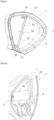
figures 4a et4b est représenté un des inserts 1 avec deux orientations différentes de la partie centrale du support 5 et de la pale 4 correspondante. - La
figure 4a correspond au support 5 pour des températures inférieures à la température critique où le support 5 conserve sa déformation initiale. - Dans cette première position la pale 4 crée une aspiration de l'air présente à l'extérieur du véhicule vers l'intérieur de la roue 2 au travers des ouvertures 22.
- D'un point de vu efficacité aérodynamique, cette première position diminue la trainée aérodynamique du véhicule, mais crée un moindre refroidissement du système de freinage du véhicule.
- La
figure 4b correspond au support 5 pour des températures supérieures à la température critique où le support 5 se déforme sous l'action de la chaleur pour retrouver sa forme sans sa déformation initiale. - Dans cette deuxième position la pale 4 forme un extracteur d'air, l'air étant pulsé de l'intérieur de la roue 2 vers l'extérieur et l'air circulant le long de la carrosserie et se prolongeant le long de la roue 2 ne pouvant rentrer dans les ouvertures 22.
- D'un point de vu efficacité aérodynamique, cette deuxième position augmente la trainée aérodynamique du véhicule, mais participe au refroidissement du système de freinage du véhicule.
- Pour une meilleure efficacité des pales 4, celles-ci ont un profil aérodynamique avec une face extérieure 42 généralement bombée et convexe, et une face intérieure 43, opposée à la face extérieure 42, qui est avantageusement plane, convexe ou concave.
- Un tel profil est connu sous le nom de « CLARK Y » et se retrouve en particulier dans le profil des ailes d'avion.
- De telles inserts 1 permettent un gain aérodynamique de 3 dm2 soit d'environ 1,5 g de CO2 au kilomètre et une diminution de la température du liquide du dispositif de freinage de l'ordre de -10°C.
- Cette invention présente en outre l'avantage d'être de conception simple, de faible encombrement et aisée à mettre en oeuvre.
- Cette invention peut aussi être appliquée sur un enjoliveur qui recouvrerait l'ensemble du voile de la roue et qui comporterait une série de pales montées pivotantes avec des tels supports dans des ouvertures qui seraient en correspondance avec des ouvertures formées dans le voile de la roue.
Claims (7)
- Insert (1) pour une roue (2) d'un véhicule automobile, comprenant un cadre (3) destiné à être solidarisé dans une ouverture (22) du voile (21) de la roue (2) et au moins une pale (4) liée au cadre (3), la pale (4) étant montée pivotante sur le cadre (3) au moyen d'un support (5) métallique à mémoire de forme configuré pour modifier l'orientation de ladite pale (4) à partir d'une température critique prédéterminée, ladite pale (4) et ledit support (5) étant positionnés sur le cadre (3) de telle sort à s'étend et à avoir un pivotement qui est orienté suivant une direction radiale du voile (21) de la roue (2) lorsque le dispositif est solidarisé dans ladite ouverture (22), caractérisé en ce que les deux extrémités (51) du support (5) sont solidaires du cadre (3), s'étendant de part et d'autre de la pale (4) et en ce qu'une partie centrale (52) du support (5) est solidaire en rotation de la pale (4).
- Insert (1) selon la revendication 1, caractérisé en ce que le support (5) comporte une première partie (53) préalablement déformée et adaptée pour reprendre sa forme d'origine une fois ladite température critique est atteinte et une seconde partie (54) configurée pour former un ressort de rappel s'opposant à la remise à sa forme initiale de la première partie (53) une fois la température critique est atteinte.
- Insert (1) selon la revendication 2, caractérisé en ce que la seconde partie (54) du support (5) forme une barre de torsion.
- Insert (1) selon l'une quelconque des revendications précédentes, caractérisé en ce que, lorsque l'insert (1) est en rotation suivant la marche avant du véhicule, le support (5) est configuré pour que, lorsque la température est inférieure à la température critique, orienter la pale (4) de manière à générer un flux d'air dirigé de l'extérieure de la roue (2) vers l'intérieur de la roue (2) et pour une température supérieure ou égale à la température critique, orienter la pale (4) de manière générer un flux d'air inverse.
- Insert (1) selon l'une quelconque des revendications précédentes, caractérisé en ce que la température critique est comprise entre 50°C et 70°C, ladite température critique étant préférentiellement de 60°C.
- Roue (2) de véhicule comportant plusieurs ouvertures (22), chaque ouverture comportant un insert (1) selon l'une quelconque des revendications précédentes.
- Véhicule automobile comprenant plusieurs roues (2), chacune desdites roues (2) étant selon la revendication précédente.
Applications Claiming Priority (2)
| Application Number | Priority Date | Filing Date | Title |
|---|---|---|---|
| FR2012989A FR3117406B1 (fr) | 2020-12-10 | 2020-12-10 | Insert a l’aerodynamique optimisee pour une roue de vehicule |
| PCT/FR2021/051925 WO2022123129A1 (fr) | 2020-12-10 | 2021-11-03 | Insert a l'aerodynamique optimisee pour une roue de vehicule |
Publications (2)
| Publication Number | Publication Date |
|---|---|
| EP4259452A1 EP4259452A1 (fr) | 2023-10-18 |
| EP4259452B1 true EP4259452B1 (fr) | 2024-08-07 |
Family
ID=74347395
Family Applications (1)
| Application Number | Title | Priority Date | Filing Date |
|---|---|---|---|
| EP21810682.1A Active EP4259452B1 (fr) | 2020-12-10 | 2021-11-03 | Insert a l'aerodynamique optimisee pour une roue de vehicule |
Country Status (3)
| Country | Link |
|---|---|
| EP (1) | EP4259452B1 (fr) |
| FR (1) | FR3117406B1 (fr) |
| WO (1) | WO2022123129A1 (fr) |
Families Citing this family (6)
| Publication number | Priority date | Publication date | Assignee | Title |
|---|---|---|---|---|
| US12502909B2 (en) | 2020-01-06 | 2025-12-23 | Chet Baigh | Vehicle wheel blade assembly |
| US20210206199A1 (en) * | 2020-01-06 | 2021-07-08 | Chet Baigh | Airfoil Wings and/or Fan-Like Blades Affixed to Automobile Wheels for the Extraction of Wheel Well Air Pressure and Brake Cooling |
| FR3139502B1 (fr) | 2022-09-08 | 2024-07-26 | Psa Automobiles Sa | Actionneur de pale, pour un insert de roue de véhicule |
| FR3141096B1 (fr) | 2022-10-20 | 2024-09-06 | Psa Automobiles Sa | Actuateur aérodynamique actif en alliage à mémoire de forme pour roue de véhicule automobile |
| WO2025158222A1 (fr) * | 2024-01-26 | 2025-07-31 | Stellantis Europe S.P.A. | Jante de roue pourvue d'une pluralité d'éléments aérodynamiques ayant une structure de support respective réalisée en un matériau à mémoire de forme |
| WO2025169033A1 (fr) * | 2024-02-09 | 2025-08-14 | Stellantis Europe S.P.A. | Jante de roue munie d'un dispositif extracteur de chaleur comportant une pluralité d'éléments aérodynamiques actionnés par un élément actionneur unique constitué de matériau à mémoire de forme |
Citations (1)
| Publication number | Priority date | Publication date | Assignee | Title |
|---|---|---|---|---|
| FR3057805A1 (fr) * | 2016-10-26 | 2018-04-27 | Peugeot Citroen Automobiles Sa | Enjoliveur de roue d'un vehicule, notamment automobile |
Family Cites Families (9)
| Publication number | Priority date | Publication date | Assignee | Title |
|---|---|---|---|---|
| DE1761854A1 (de) | 1968-07-15 | 1971-09-02 | Feldmuehle Ag | Vorrichtung zum Herstellen von Flaechengebilden |
| JPS61244601A (ja) * | 1985-04-22 | 1986-10-30 | Kazuhiko Ida | 自動車用ホイ−ル |
| DE102011010509A1 (de) * | 2011-02-07 | 2012-08-09 | Audi Ag | Fahrzeugrad |
| FR3011769B1 (fr) | 2013-10-10 | 2017-01-13 | Peugeot Citroen Automobiles Sa | Enjoliveur aerodynamique perfectionne pour roue de vehicule |
| DE102016004129A1 (de) | 2016-04-05 | 2016-09-29 | Daimler Ag | Abdeckeinrichtung für eine Felge eines Kraftwagens |
| FR3057806B1 (fr) * | 2016-10-26 | 2018-11-30 | Peugeot Citroen Automobiles Sa | Enjoliveur de roue d'un vehicule, notamment automobile |
| FR3078286A1 (fr) * | 2018-02-28 | 2019-08-30 | Psa Automobiles Sa | Enjoliveur de roue actif |
| FR3078921B1 (fr) * | 2018-03-13 | 2024-08-30 | Psa Automobiles Sa | Pale aerodynamique pour habillage de roue de vehicule |
| CN110254127A (zh) * | 2019-07-05 | 2019-09-20 | 上汽通用汽车有限公司 | 一种车轮、控制方法、电子设备及汽车 |
-
2020
- 2020-12-10 FR FR2012989A patent/FR3117406B1/fr active Active
-
2021
- 2021-11-03 WO PCT/FR2021/051925 patent/WO2022123129A1/fr not_active Ceased
- 2021-11-03 EP EP21810682.1A patent/EP4259452B1/fr active Active
Patent Citations (1)
| Publication number | Priority date | Publication date | Assignee | Title |
|---|---|---|---|---|
| FR3057805A1 (fr) * | 2016-10-26 | 2018-04-27 | Peugeot Citroen Automobiles Sa | Enjoliveur de roue d'un vehicule, notamment automobile |
Also Published As
| Publication number | Publication date |
|---|---|
| EP4259452A1 (fr) | 2023-10-18 |
| FR3117406A1 (fr) | 2022-06-17 |
| FR3117406B1 (fr) | 2022-10-28 |
| WO2022123129A1 (fr) | 2022-06-16 |
Similar Documents
| Publication | Publication Date | Title |
|---|---|---|
| EP4259452A1 (fr) | Insert a l'aerodynamique optimisee pour une roue de vehicule | |
| EP3758952B1 (fr) | Enjoliveur de roue actif | |
| EP2622226B1 (fr) | Hélice pour ventilateur dont l'angle de calage varie | |
| CA3009020C (fr) | Bouclier de bord d'attaque | |
| EP3055140B1 (fr) | Enjoliveur aérodynamique perfectionne pour roue de véhicule | |
| EP3153328B1 (fr) | Insert turbine pour roue de vehicule | |
| FR2919017A1 (fr) | Turbine a vapeur et aube mobile | |
| WO2016071595A1 (fr) | Enjoliveur de roue de véhicule a ajourage a géométrie variable | |
| FR3057805B1 (fr) | Enjoliveur de roue d'un vehicule, notamment automobile | |
| WO2017055727A1 (fr) | Aube comprenant un bouclier de bord d'attaque et procede de fabrication de l'aube | |
| FR3057806A1 (fr) | Enjoliveur de roue d'un vehicule, notamment automobile | |
| FR3057807B1 (fr) | Enjoliveur de roue d'un vehicule, notamment automobile | |
| EP1503040B1 (fr) | Plate-forme inter-aubes allégée, pour un disque de support d'aubes de turboréacteur | |
| FR3037003A1 (fr) | Enjoliveur et roue a piece thermofusible | |
| EP3344485B1 (fr) | Dispositif d'obturation d'entrée d'air de face avant de véhicule automobile et module de face avant pour véhicule automobile | |
| EP4240604B1 (fr) | Module de refroidissement pour véhicule automobile électrique ou hybride | |
| EP3924193B1 (fr) | Enjoliveur presentant un profil aerodynamique permettant un bon refroidissement du dispositif de freinage | |
| EP3380339A1 (fr) | Enjoliveur aérodynamique de roue, à pales à courbure, orientation et position transversale choisies | |
| FR3078921A1 (fr) | Pale aerodynamique pour habillage de roue de vehicule | |
| EP3679230A1 (fr) | Ensemble avant de véhicule | |
| FR3139502A1 (fr) | Actionneur de pale, pour un insert de roue de véhicule | |
| FR3052102A1 (fr) | Element de roue d’un vehicule | |
| FR3144237A1 (fr) | Protecteur de disque de frein | |
| EP4605662A1 (fr) | Protecteur de disque de frein | |
| WO2013174729A1 (fr) | Ventilateur pour automobile a pales optimisees |
Legal Events
| Date | Code | Title | Description |
|---|---|---|---|
| STAA | Information on the status of an ep patent application or granted ep patent |
Free format text: STATUS: UNKNOWN |
|
| STAA | Information on the status of an ep patent application or granted ep patent |
Free format text: STATUS: THE INTERNATIONAL PUBLICATION HAS BEEN MADE |
|
| PUAI | Public reference made under article 153(3) epc to a published international application that has entered the european phase |
Free format text: ORIGINAL CODE: 0009012 |
|
| STAA | Information on the status of an ep patent application or granted ep patent |
Free format text: STATUS: REQUEST FOR EXAMINATION WAS MADE |
|
| 17P | Request for examination filed |
Effective date: 20230615 |
|
| AK | Designated contracting states |
Kind code of ref document: A1 Designated state(s): AL AT BE BG CH CY CZ DE DK EE ES FI FR GB GR HR HU IE IS IT LI LT LU LV MC MK MT NL NO PL PT RO RS SE SI SK SM TR |
|
| RAP3 | Party data changed (applicant data changed or rights of an application transferred) |
Owner name: STELLANTIS AUTO SAS |
|
| DAV | Request for validation of the european patent (deleted) | ||
| DAX | Request for extension of the european patent (deleted) | ||
| GRAP | Despatch of communication of intention to grant a patent |
Free format text: ORIGINAL CODE: EPIDOSNIGR1 |
|
| STAA | Information on the status of an ep patent application or granted ep patent |
Free format text: STATUS: GRANT OF PATENT IS INTENDED |
|
| INTG | Intention to grant announced |
Effective date: 20240411 |
|
| GRAS | Grant fee paid |
Free format text: ORIGINAL CODE: EPIDOSNIGR3 |
|
| GRAA | (expected) grant |
Free format text: ORIGINAL CODE: 0009210 |
|
| STAA | Information on the status of an ep patent application or granted ep patent |
Free format text: STATUS: THE PATENT HAS BEEN GRANTED |
|
| AK | Designated contracting states |
Kind code of ref document: B1 Designated state(s): AL AT BE BG CH CY CZ DE DK EE ES FI FR GB GR HR HU IE IS IT LI LT LU LV MC MK MT NL NO PL PT RO RS SE SI SK SM TR |
|
| REG | Reference to a national code |
Ref country code: GB Ref legal event code: FG4D Free format text: NOT ENGLISH |
|
| REG | Reference to a national code |
Ref country code: CH Ref legal event code: EP |
|
| REG | Reference to a national code |
Ref country code: DE Ref legal event code: R096 Ref document number: 602021017000 Country of ref document: DE |
|
| REG | Reference to a national code |
Ref country code: IE Ref legal event code: FG4D Free format text: LANGUAGE OF EP DOCUMENT: FRENCH |
|
| REG | Reference to a national code |
Ref country code: DE Ref legal event code: R084 Ref document number: 602021017000 Country of ref document: DE |
|
| REG | Reference to a national code |
Ref country code: LT Ref legal event code: MG9D |
|
| REG | Reference to a national code |
Ref country code: NL Ref legal event code: MP Effective date: 20240807 |
|
| PG25 | Lapsed in a contracting state [announced via postgrant information from national office to epo] |
Ref country code: NO Free format text: LAPSE BECAUSE OF FAILURE TO SUBMIT A TRANSLATION OF THE DESCRIPTION OR TO PAY THE FEE WITHIN THE PRESCRIBED TIME-LIMIT Effective date: 20241107 |
|
| REG | Reference to a national code |
Ref country code: AT Ref legal event code: MK05 Ref document number: 1710546 Country of ref document: AT Kind code of ref document: T Effective date: 20240807 |
|
| PG25 | Lapsed in a contracting state [announced via postgrant information from national office to epo] |
Ref country code: NL Free format text: LAPSE BECAUSE OF FAILURE TO SUBMIT A TRANSLATION OF THE DESCRIPTION OR TO PAY THE FEE WITHIN THE PRESCRIBED TIME-LIMIT Effective date: 20240807 Ref country code: FI Free format text: LAPSE BECAUSE OF FAILURE TO SUBMIT A TRANSLATION OF THE DESCRIPTION OR TO PAY THE FEE WITHIN THE PRESCRIBED TIME-LIMIT Effective date: 20240807 Ref country code: PL Free format text: LAPSE BECAUSE OF FAILURE TO SUBMIT A TRANSLATION OF THE DESCRIPTION OR TO PAY THE FEE WITHIN THE PRESCRIBED TIME-LIMIT Effective date: 20240807 Ref country code: PT Free format text: LAPSE BECAUSE OF FAILURE TO SUBMIT A TRANSLATION OF THE DESCRIPTION OR TO PAY THE FEE WITHIN THE PRESCRIBED TIME-LIMIT Effective date: 20241209 Ref country code: GR Free format text: LAPSE BECAUSE OF FAILURE TO SUBMIT A TRANSLATION OF THE DESCRIPTION OR TO PAY THE FEE WITHIN THE PRESCRIBED TIME-LIMIT Effective date: 20241108 |
|
| PG25 | Lapsed in a contracting state [announced via postgrant information from national office to epo] |
Ref country code: BG Free format text: LAPSE BECAUSE OF FAILURE TO SUBMIT A TRANSLATION OF THE DESCRIPTION OR TO PAY THE FEE WITHIN THE PRESCRIBED TIME-LIMIT Effective date: 20240807 |
|
| PG25 | Lapsed in a contracting state [announced via postgrant information from national office to epo] |
Ref country code: LV Free format text: LAPSE BECAUSE OF FAILURE TO SUBMIT A TRANSLATION OF THE DESCRIPTION OR TO PAY THE FEE WITHIN THE PRESCRIBED TIME-LIMIT Effective date: 20240807 |
|
| PG25 | Lapsed in a contracting state [announced via postgrant information from national office to epo] |
Ref country code: AT Free format text: LAPSE BECAUSE OF FAILURE TO SUBMIT A TRANSLATION OF THE DESCRIPTION OR TO PAY THE FEE WITHIN THE PRESCRIBED TIME-LIMIT Effective date: 20240807 Ref country code: IS Free format text: LAPSE BECAUSE OF FAILURE TO SUBMIT A TRANSLATION OF THE DESCRIPTION OR TO PAY THE FEE WITHIN THE PRESCRIBED TIME-LIMIT Effective date: 20241207 |
|
| PG25 | Lapsed in a contracting state [announced via postgrant information from national office to epo] |
Ref country code: HR Free format text: LAPSE BECAUSE OF FAILURE TO SUBMIT A TRANSLATION OF THE DESCRIPTION OR TO PAY THE FEE WITHIN THE PRESCRIBED TIME-LIMIT Effective date: 20240807 |
|
| PG25 | Lapsed in a contracting state [announced via postgrant information from national office to epo] |
Ref country code: RS Free format text: LAPSE BECAUSE OF FAILURE TO SUBMIT A TRANSLATION OF THE DESCRIPTION OR TO PAY THE FEE WITHIN THE PRESCRIBED TIME-LIMIT Effective date: 20241107 Ref country code: ES Free format text: LAPSE BECAUSE OF FAILURE TO SUBMIT A TRANSLATION OF THE DESCRIPTION OR TO PAY THE FEE WITHIN THE PRESCRIBED TIME-LIMIT Effective date: 20240807 |
|
| PG25 | Lapsed in a contracting state [announced via postgrant information from national office to epo] |
Ref country code: RS Free format text: LAPSE BECAUSE OF FAILURE TO SUBMIT A TRANSLATION OF THE DESCRIPTION OR TO PAY THE FEE WITHIN THE PRESCRIBED TIME-LIMIT Effective date: 20241107 Ref country code: PT Free format text: LAPSE BECAUSE OF FAILURE TO SUBMIT A TRANSLATION OF THE DESCRIPTION OR TO PAY THE FEE WITHIN THE PRESCRIBED TIME-LIMIT Effective date: 20241209 Ref country code: PL Free format text: LAPSE BECAUSE OF FAILURE TO SUBMIT A TRANSLATION OF THE DESCRIPTION OR TO PAY THE FEE WITHIN THE PRESCRIBED TIME-LIMIT Effective date: 20240807 Ref country code: NO Free format text: LAPSE BECAUSE OF FAILURE TO SUBMIT A TRANSLATION OF THE DESCRIPTION OR TO PAY THE FEE WITHIN THE PRESCRIBED TIME-LIMIT Effective date: 20241107 Ref country code: NL Free format text: LAPSE BECAUSE OF FAILURE TO SUBMIT A TRANSLATION OF THE DESCRIPTION OR TO PAY THE FEE WITHIN THE PRESCRIBED TIME-LIMIT Effective date: 20240807 Ref country code: LV Free format text: LAPSE BECAUSE OF FAILURE TO SUBMIT A TRANSLATION OF THE DESCRIPTION OR TO PAY THE FEE WITHIN THE PRESCRIBED TIME-LIMIT Effective date: 20240807 Ref country code: IS Free format text: LAPSE BECAUSE OF FAILURE TO SUBMIT A TRANSLATION OF THE DESCRIPTION OR TO PAY THE FEE WITHIN THE PRESCRIBED TIME-LIMIT Effective date: 20241207 Ref country code: HR Free format text: LAPSE BECAUSE OF FAILURE TO SUBMIT A TRANSLATION OF THE DESCRIPTION OR TO PAY THE FEE WITHIN THE PRESCRIBED TIME-LIMIT Effective date: 20240807 Ref country code: GR Free format text: LAPSE BECAUSE OF FAILURE TO SUBMIT A TRANSLATION OF THE DESCRIPTION OR TO PAY THE FEE WITHIN THE PRESCRIBED TIME-LIMIT Effective date: 20241108 Ref country code: FI Free format text: LAPSE BECAUSE OF FAILURE TO SUBMIT A TRANSLATION OF THE DESCRIPTION OR TO PAY THE FEE WITHIN THE PRESCRIBED TIME-LIMIT Effective date: 20240807 Ref country code: ES Free format text: LAPSE BECAUSE OF FAILURE TO SUBMIT A TRANSLATION OF THE DESCRIPTION OR TO PAY THE FEE WITHIN THE PRESCRIBED TIME-LIMIT Effective date: 20240807 Ref country code: BG Free format text: LAPSE BECAUSE OF FAILURE TO SUBMIT A TRANSLATION OF THE DESCRIPTION OR TO PAY THE FEE WITHIN THE PRESCRIBED TIME-LIMIT Effective date: 20240807 Ref country code: AT Free format text: LAPSE BECAUSE OF FAILURE TO SUBMIT A TRANSLATION OF THE DESCRIPTION OR TO PAY THE FEE WITHIN THE PRESCRIBED TIME-LIMIT Effective date: 20240807 |
|
| PG25 | Lapsed in a contracting state [announced via postgrant information from national office to epo] |
Ref country code: DK Free format text: LAPSE BECAUSE OF FAILURE TO SUBMIT A TRANSLATION OF THE DESCRIPTION OR TO PAY THE FEE WITHIN THE PRESCRIBED TIME-LIMIT Effective date: 20240807 Ref country code: SM Free format text: LAPSE BECAUSE OF FAILURE TO SUBMIT A TRANSLATION OF THE DESCRIPTION OR TO PAY THE FEE WITHIN THE PRESCRIBED TIME-LIMIT Effective date: 20240807 |
|
| PG25 | Lapsed in a contracting state [announced via postgrant information from national office to epo] |
Ref country code: EE Free format text: LAPSE BECAUSE OF FAILURE TO SUBMIT A TRANSLATION OF THE DESCRIPTION OR TO PAY THE FEE WITHIN THE PRESCRIBED TIME-LIMIT Effective date: 20240807 |
|
| PG25 | Lapsed in a contracting state [announced via postgrant information from national office to epo] |
Ref country code: CZ Free format text: LAPSE BECAUSE OF FAILURE TO SUBMIT A TRANSLATION OF THE DESCRIPTION OR TO PAY THE FEE WITHIN THE PRESCRIBED TIME-LIMIT Effective date: 20240807 |
|
| PG25 | Lapsed in a contracting state [announced via postgrant information from national office to epo] |
Ref country code: SK Free format text: LAPSE BECAUSE OF FAILURE TO SUBMIT A TRANSLATION OF THE DESCRIPTION OR TO PAY THE FEE WITHIN THE PRESCRIBED TIME-LIMIT Effective date: 20240807 |
|
| REG | Reference to a national code |
Ref country code: DE Ref legal event code: R097 Ref document number: 602021017000 Country of ref document: DE |
|
| PLBE | No opposition filed within time limit |
Free format text: ORIGINAL CODE: 0009261 |
|
| STAA | Information on the status of an ep patent application or granted ep patent |
Free format text: STATUS: NO OPPOSITION FILED WITHIN TIME LIMIT |
|
| REG | Reference to a national code |
Ref country code: CH Ref legal event code: PL |
|
| PG25 | Lapsed in a contracting state [announced via postgrant information from national office to epo] |
Ref country code: MC Free format text: LAPSE BECAUSE OF FAILURE TO SUBMIT A TRANSLATION OF THE DESCRIPTION OR TO PAY THE FEE WITHIN THE PRESCRIBED TIME-LIMIT Effective date: 20240807 |
|
| PG25 | Lapsed in a contracting state [announced via postgrant information from national office to epo] |
Ref country code: LU Free format text: LAPSE BECAUSE OF NON-PAYMENT OF DUE FEES Effective date: 20241103 |
|
| REG | Reference to a national code |
Ref country code: CH Ref legal event code: PL |
|
| 26N | No opposition filed |
Effective date: 20250508 |
|
| PG25 | Lapsed in a contracting state [announced via postgrant information from national office to epo] |
Ref country code: CH Free format text: LAPSE BECAUSE OF NON-PAYMENT OF DUE FEES Effective date: 20241130 |
|
| REG | Reference to a national code |
Ref country code: BE Ref legal event code: MM Effective date: 20241130 |
|
| PG25 | Lapsed in a contracting state [announced via postgrant information from national office to epo] |
Ref country code: SE Free format text: LAPSE BECAUSE OF FAILURE TO SUBMIT A TRANSLATION OF THE DESCRIPTION OR TO PAY THE FEE WITHIN THE PRESCRIBED TIME-LIMIT Effective date: 20240807 |
|
| PG25 | Lapsed in a contracting state [announced via postgrant information from national office to epo] |
Ref country code: BE Free format text: LAPSE BECAUSE OF NON-PAYMENT OF DUE FEES Effective date: 20241130 |
|
| PG25 | Lapsed in a contracting state [announced via postgrant information from national office to epo] |
Ref country code: IE Free format text: LAPSE BECAUSE OF NON-PAYMENT OF DUE FEES Effective date: 20241103 |
|
| PG25 | Lapsed in a contracting state [announced via postgrant information from national office to epo] |
Ref country code: RO Free format text: LAPSE BECAUSE OF FAILURE TO SUBMIT A TRANSLATION OF THE DESCRIPTION OR TO PAY THE FEE WITHIN THE PRESCRIBED TIME-LIMIT Effective date: 20240807 |
|
| PGFP | Annual fee paid to national office [announced via postgrant information from national office to epo] |
Ref country code: DE Payment date: 20251022 Year of fee payment: 5 |
|
| PGFP | Annual fee paid to national office [announced via postgrant information from national office to epo] |
Ref country code: FR Payment date: 20251022 Year of fee payment: 5 |
|
| PG25 | Lapsed in a contracting state [announced via postgrant information from national office to epo] |
Ref country code: IT Free format text: LAPSE BECAUSE OF FAILURE TO SUBMIT A TRANSLATION OF THE DESCRIPTION OR TO PAY THE FEE WITHIN THE PRESCRIBED TIME-LIMIT Effective date: 20240807 |
|
| PG25 | Lapsed in a contracting state [announced via postgrant information from national office to epo] |
Ref country code: HU Free format text: LAPSE BECAUSE OF FAILURE TO SUBMIT A TRANSLATION OF THE DESCRIPTION OR TO PAY THE FEE WITHIN THE PRESCRIBED TIME-LIMIT; INVALID AB INITIO Effective date: 20211103 |
|
| PG25 | Lapsed in a contracting state [announced via postgrant information from national office to epo] |
Ref country code: CY Free format text: LAPSE BECAUSE OF FAILURE TO SUBMIT A TRANSLATION OF THE DESCRIPTION OR TO PAY THE FEE WITHIN THE PRESCRIBED TIME-LIMIT; INVALID AB INITIO Effective date: 20211103 |