EP4258987B1 - Intraorales respirometer - Google Patents
Intraorales respirometer Download PDFInfo
- Publication number
- EP4258987B1 EP4258987B1 EP21827667.3A EP21827667A EP4258987B1 EP 4258987 B1 EP4258987 B1 EP 4258987B1 EP 21827667 A EP21827667 A EP 21827667A EP 4258987 B1 EP4258987 B1 EP 4258987B1
- Authority
- EP
- European Patent Office
- Prior art keywords
- pressure sensor
- electronic circuit
- respiratory rate
- patient
- dental prosthesis
- Prior art date
- Legal status (The legal status is an assumption and is not a legal conclusion. Google has not performed a legal analysis and makes no representation as to the accuracy of the status listed.)
- Active
Links
Images
Classifications
-
- A—HUMAN NECESSITIES
- A61—MEDICAL OR VETERINARY SCIENCE; HYGIENE
- A61B—DIAGNOSIS; SURGERY; IDENTIFICATION
- A61B5/00—Measuring for diagnostic purposes; Identification of persons
- A61B5/08—Measuring devices for evaluating the respiratory organs
- A61B5/0816—Measuring devices for examining respiratory frequency
-
- A—HUMAN NECESSITIES
- A61—MEDICAL OR VETERINARY SCIENCE; HYGIENE
- A61B—DIAGNOSIS; SURGERY; IDENTIFICATION
- A61B5/00—Measuring for diagnostic purposes; Identification of persons
- A61B5/0002—Remote monitoring of patients using telemetry, e.g. transmission of vital signals via a communication network
- A61B5/0015—Remote monitoring of patients using telemetry, e.g. transmission of vital signals via a communication network characterised by features of the telemetry system
-
- A—HUMAN NECESSITIES
- A61—MEDICAL OR VETERINARY SCIENCE; HYGIENE
- A61B—DIAGNOSIS; SURGERY; IDENTIFICATION
- A61B5/00—Measuring for diagnostic purposes; Identification of persons
- A61B5/68—Arrangements of detecting, measuring or recording means, e.g. sensors, in relation to patient
- A61B5/6801—Arrangements of detecting, measuring or recording means, e.g. sensors, in relation to patient specially adapted to be attached to or worn on the body surface
- A61B5/6813—Specially adapted to be attached to a specific body part
- A61B5/6814—Head
- A61B5/682—Mouth, e.g., oral cavity; tongue; Lips; Teeth
-
- A—HUMAN NECESSITIES
- A61—MEDICAL OR VETERINARY SCIENCE; HYGIENE
- A61B—DIAGNOSIS; SURGERY; IDENTIFICATION
- A61B2562/00—Details of sensors; Constructional details of sensor housings or probes; Accessories for sensors
- A61B2562/02—Details of sensors specially adapted for in-vivo measurements
- A61B2562/0247—Pressure sensors
-
- A—HUMAN NECESSITIES
- A61—MEDICAL OR VETERINARY SCIENCE; HYGIENE
- A61B—DIAGNOSIS; SURGERY; IDENTIFICATION
- A61B2562/00—Details of sensors; Constructional details of sensor housings or probes; Accessories for sensors
- A61B2562/02—Details of sensors specially adapted for in-vivo measurements
- A61B2562/0271—Thermal or temperature sensors
Definitions
- the present invention refers to an intra oral respirometer and more in particular to a wearable ventilatory monitoring system.
- Ventilatory parameters are thus fundamental to monitor, to determine the overall health status of an individual. Ventilatory parameters include the respiratory rate (RR), which is one of the four vital signs, and breath-by-breath amplitude, or tidal volume, but also other derived parameters such as the minute-by-minute respiratory rate.
- RR respiratory rate
- breath-by-breath amplitude or tidal volume
- a wearable and non-invasive monitoring system for ventilatory parameters is thus imperative, to continuously track potentially dangerous variations in vital signs.
- the object of the present invention is to provide an intra oral respirometer and more in particular a wearable ventilatory monitoring system which is able to overcome the drawback if the prior art.
- the system consists of a sensing unit which measures the oral cavity pressure and is placed between the inner sides of the upper jaw such that the top surface of the pressure sensor (sensing unit) faces the upper hard palate and there is an air gap between the upper palate and the pressure sensor and a reader and data transmission unit comprising a Bluetooth LE module.
- a sensing unit which measures the oral cavity pressure and is placed between the inner sides of the upper jaw such that the top surface of the pressure sensor (sensing unit) faces the upper hard palate and there is an air gap between the upper palate and the pressure sensor and a reader and data transmission unit comprising a Bluetooth LE module.
- Said objects are furthermore achieved by a method for measuring the respiratory rate of a patient by means of a wearable ventilatory monitoring system according to claim 11.
- This solution proposes an innovative Bluetooth-enabled, oral wearable ventilatory monitoring system.
- the proposed solution is very portable and discreet, suitable for continuous monitoring of both respiratory rate, breath-by-breath amplitude and other derived parameters, even outside the clinical context, and during various daily-life activities, including sleeping.
- the Intra-Oral Respirometer directly measures the pressure variations during the breathing cycle, with no need for complex algorithms to recover the breathing pattern, for example, from movements of the thoracic area.
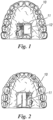
- a wearable ventilatory monitoring system in accordance with the present invention, comprises a flexible dental prosthesis 10 on whose palate is secured an electronic circuit 11.
- the electronic circuit 11 comprises a Low Energy (BLE) 20 circuit and a pressure sensor 21, with a battery 12.
- BLE Low Energy
- the BLE 20 comprises a chip, passive components, and an on-board crystal oscillator.
- a 32 GPIO General Purpose Input Output
- an 8 ADC Analog-to-Digital Converter
- the BLE technology is a Bluetooth that works at the same frequency, 2.4 GHz, of the common Bluetooth, being at the same time cheaper to use and implement and consuming less power.
- the module ensures a UART (Universal Asynchronous Receiver/Transmitter) serial connection over BLE, acting as the peripheral.
- a computer or a mobile phone acts as the central device of control receiving all the data and elaborating a showing it.
- the pressure sensor 21 is preferably a miniature piezo-resistive pressure that it is able to measure also the temperature, and therefore provides a high-resolution pressure and temperature reading.
- the pressure sensor 21 is fabricated to be resistant to water, as it is protected by a gel and stainless antimagnetic steel cap, allowing a direct exposure to saliva without harming the subject nor affecting the readings.
- the module is 6.4 mm x 6.2 mm, with a thickness of 2.88 mm, thus greatly meeting the spatial requirements for this project, without excessively hindering the physiological movements of the tongue within the oral cavity.
- the sensor provides a 24-bit pressure and temperature value, through an ultra-low power ⁇ ADC.
- the pressure sensor 21 measures the temperature too. Besides being used to compensate the pressure value, the temperature reading can be quite useful to study the correlation between the two signals.
- the inhaled air is normally cooler than the exhaled air. This characteristic can be fundamental to perform sensor fusion and enhance the information gained from the device.
- the Regulator Circuit is used to ensure the sensor receives a voltage of 3.3 V all the time.
- the LiPo (Lithium ion Polymer) battery used to power the board provides 3.7 V
- the LiPo battery 12 is expected to last for a total of 13 hours during full use of the device.
- the final product required a custom-made board to minimize the overall footprint of the device.
- SMD Surface Mount Device
- components were arranged on the board to minimize the overall footprint.
- the board was assembled using a hot air reflow soldering station. After soldering, excess solder and solder bridges were removed. Both the board and the solder paste used were lead free, to minimize the hazard for the subjects.
- the electronic circuit 11 is hermetically insulated from the oral cavity environment, it is entirely embedded in a plastic sheet, attached to a subject-specific dental prosthesis 10 using dental tape, to guarantee perfect adherence and avoid casual detachments.
- the electronic circuit 11 was positioned toward the posterior end of the plastic dental prosthesis 10.
- the site of measure is at the end of the hard palate, allowing the device to perform readings both during oral and nasal breathing.
- the dental prosthesis 10 was obtained from the impression of the subject's upper palate and front teeth line.
- a Vinyl Polysiloxane Impression Putty was used to obtain an impression of the subject's upper palate and front teeth line.
- the subject was instructed to bite down on the tray, placed on the upper palate, for three minutes.
- the tray was removed and allowed to set for 15 minutes at room temperature.
- a urethane resin was mixed thoroughly and poured in the dental mold, coated with a mold release spray. After two hours the mold was removed and refined with a file and added clay.
- the dental prosthesis 10 was produced with a vacuum forming machine using a single sheet of plastic biocompatible. Hot air was used to properly seal any gaps or defects and the retainer was removed from the cast. After cutting the remaining edges, and filing excess parts, the retainer was sanitized with alcohol.
- the system can also host a variety of other sensors, and in particular a sensor to monitor O2 and CO2 concentration. These would allow, together with the flow measurement, estimated by assuming a linear relationship with the pressure values, to determine oxygen consumption and carbon dioxide production on a breath-by-breath basis. Oxygen consumption can be computed as the difference between the oxygen volume that enters lung during inhalation and the oxygen volume that exits during exhalation.
- a humidity sensor could be included in the device. Adding such sensors would allow to perform sensor fusion using different types of measures, thus enhancing and improving the information gained from the device.
- the system require a software for the working of the BLE 20 and a software to provide the subjects with a user-friendly visualization tool.
- the reading phase starts right after calibration ends.
- the average pressure computed is subtracted to each pressure reading to only account for pressure variations caused by inspiration and expiration, eliminating the atmospheric pressure value.
- the atmospheric pressure at sea level is around 1013.25 mbar or cmH2O, thus it would mask a pressure oscillation of around 1/2 mbar during the breathing cycle.
- Both pressure and temperature data are stored as JSON, JavaScript Object Notation, a light open standard data-interchange format, easy to write and read for humans, and especially easy to parse for machines.
- a Web App was developed using Web Bluetooth, HTML and JavaScript. Given the tools used to develop the application, it can be used both on a computer screen and on a mobile phone. The only requirement being the installation of Chrome. This way the live monitoring can be performed both at home and outside, allowing the user to utilize the proposed device throughout all daily activities.
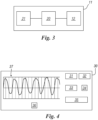
- the interface 30 comprises a button 31 for connect the interface to the device and a button 32 for disconnecting it.
- the age must be inserted in the box 33 and push the button 34.
- the interface will show in the box 35 the temperature, and in the box 36 the respiratory rate and in addition will show the live plot 37 of the respiratory signal.
- the Web Application can directly connect to the board over BLE, using the Web Bluetooth technology.
- the BLE chip acts as the GATT (Generic Attribute Profile) server, as it provides the services.
- the laptop acts the client, that connects to the GATT server.
- the HTML code includes a JavaScript file, that contains the Bluetooth characteristics, of the BLE chip. When clicking on the "Connect” button, the "reading” function is called. The function first connects the Web App, the client, to the device, or GATT server. Once connection is established, the JSON received is parsed.
- the respiratory signal resembles a sinusoid, with peaks corresponding to the end of inspiration (minimum) and the end of expiration (maximum), when measuring pressure.
- a FIR, Finite Impulse Response, filter was designed to eliminate noise and obtain a sinusoid. This type of filter guarantees a finite impulse response and no phase distortion, differently from the IIR filter.
- a low-pass filter of order 11 was used to remove the high frequency noise affecting the signal, with a cut-off frequency of 0.25 Hz.
- the filter was strong enough to attenuate noise. At 1 Hz the signal is attenuated of around 10 dB, meaning that a slight decrease in signal amplitude is expected. However, this did not affect our first aim of monitoring respiratory rate.
- the strategy adopted was the implementation of an algorithm to count the number of maxima (expiration) and minima (inspiration) in 10 seconds of signal.
- the respiratory rate was approximated as the average of these counts multiplied by 6, to obtain the number of breaths in a minute. Both maxima and minima were considered to provide a more accurate count.
- the temperature value was acquired to study the correlation with the pressure signal. In addition, it represents an accurate indicator of the general health status of the subject. Fever is, indeed, the first indicator of an infection or other disease. Since the sensor is placed in close contact with the subject's oral mucosa, the temperature value is normal between 35.5 °C and 37.5 °C.
- the developed device was also capable of monitoring ventilatory parameters both while sitting and while exercising, proving its capability for use outside the clinical context. Particularly, the ability of performing measurements during a physical effort, even without the use of an external machine, and without being affected by motion artefacts, constitutes a great advantage.
Landscapes
- Health & Medical Sciences (AREA)
- Life Sciences & Earth Sciences (AREA)
- Engineering & Computer Science (AREA)
- Medical Informatics (AREA)
- Surgery (AREA)
- Biophysics (AREA)
- Pathology (AREA)
- Veterinary Medicine (AREA)
- Biomedical Technology (AREA)
- Heart & Thoracic Surgery (AREA)
- Public Health (AREA)
- Molecular Biology (AREA)
- Physics & Mathematics (AREA)
- Animal Behavior & Ethology (AREA)
- General Health & Medical Sciences (AREA)
- Pulmonology (AREA)
- Physiology (AREA)
- Computer Networks & Wireless Communication (AREA)
- Dentistry (AREA)
- Oral & Maxillofacial Surgery (AREA)
- Measurement Of The Respiration, Hearing Ability, Form, And Blood Characteristics Of Living Organisms (AREA)
- Investigating Or Analysing Biological Materials (AREA)
Claims (11)
- Ein tragbares Beatmungsüberwachungssystem, welches Folgendes umfasst:eine Elektronikschaltung (11);wobei die genannte Elektronikschaltung (11) jeweils Folgendes umfassteine Bluetooth Niedrigenergieschaltung (20),einen Drucksensor (21) undeine Batterie (12);wobei die genannte Elektronikschaltung (11) an einer flexiblen Kunststoff-Zahnprothese (10) in Richtung des hinteren Endes der genannten Kunststoff-Zahnprothese (10) befestigt ist;die genannte Elektronikschaltung (11) vollkommen in einer Kunststofffolie eingeschlossen ist;der genannte Drucksensor (21) konfiguriert ist, um die Druckänderung während des Atmungsablaufs zu messen;der genannte Drucksensor (21) durch ein Gel und eine rostfreie antimagnetische Kappe aus Stahl geschützt wird.
- Das System gemäß Anspruch 1, dadurch gekennzeichnet, dass der genannte Drucksensor (21) als piezoresistiver Typ ausgeführt ist.
- Das System gemäß Anspruch 1, dadurch gekennzeichnet, dass die genannte Elektronikschaltung (11) einen Temperatursensor umfasst.
- Das System gemäß einem der vorausgegangenen Ansprüche, dadurch gekennzeichnet, dass die genannte Bluetooth-Niedrigenergieschaltung (20) in der Lage ist, mit einem Computer oder einem Mobilphon zu kommunizieren, welche als zentrale Steuervorrichtung fungieren und sämtliche durch den genannten Drucksensor (21) gemessenen Daten empfangen.
- Das System gemäß Anspruch 4, dadurch gekennzeichnet, dass der genannte Computer oder das Mobilphon die Atemfrequenz eines Patienten anhand der von dem genannten Drucksensor (21) empfangenen Messung berechnen.
- Das System gemäß Anspruch 5, dadurch gekennzeichnet, dass der genannte Computer oder das Mobilphon die Atemfrequenz eines Patienten durch Abziehen der Werte der von dem genannten Drucksensor (21) empfangenen Messung, welche jeweils höher als eine vorbestimmte Schwelle sind, berechnen.
- Das System gemäß Anspruch 1, dadurch gekennzeichnet, dass die genannte flexible Zahnprothese (10) aus biokompatiblem Kunststoff besteht.
- Das System gemäß Anspruch 1, dadurch gekennzeichnet, dass die genannte Batterie (12) aufladbar ist.
- Das System gemäß Anspruch 1, dadurch gekennzeichnet, dass die genannte Elektronikschaltung (11) hermetisch von dem Umfeld der Mundhöhle isoliert ist.
- Das System gemäß Anspruch 1, dadurch gekennzeichnet, dass die genannte Elektronikschaltung (11) an der genannten flexiblen Zahnprothese (10) mit Hilfe von Zahnklebeband befestigt ist.
- Ein Verfahren für die Messung der Atemfrequenz eines Patienten, welches den Schritt der Messung der Atemfrequenz eines Patienten mit Hilfe eines tragbaren Beatmungsüberwachungssystems gemäß Anspruch 1 umfasst.
Applications Claiming Priority (2)
| Application Number | Priority Date | Filing Date | Title |
|---|---|---|---|
| US202063125112P | 2020-12-14 | 2020-12-14 | |
| PCT/IB2021/061625 WO2022130164A1 (en) | 2020-12-14 | 2021-12-13 | Intra oral respirometer |
Publications (3)
| Publication Number | Publication Date |
|---|---|
| EP4258987A1 EP4258987A1 (de) | 2023-10-18 |
| EP4258987C0 EP4258987C0 (de) | 2025-01-29 |
| EP4258987B1 true EP4258987B1 (de) | 2025-01-29 |
Family
ID=78958017
Family Applications (1)
| Application Number | Title | Priority Date | Filing Date |
|---|---|---|---|
| EP21827667.3A Active EP4258987B1 (de) | 2020-12-14 | 2021-12-13 | Intraorales respirometer |
Country Status (3)
| Country | Link |
|---|---|
| US (1) | US20240023824A1 (de) |
| EP (1) | EP4258987B1 (de) |
| WO (1) | WO2022130164A1 (de) |
Family Cites Families (3)
| Publication number | Priority date | Publication date | Assignee | Title |
|---|---|---|---|---|
| WO2017218947A1 (en) * | 2016-06-17 | 2017-12-21 | Align Technology, Inc. | Intraoral appliances with sensing |
| US20190175104A1 (en) * | 2017-12-10 | 2019-06-13 | Bela Malik | In-situ salivary component collection, concentration, isolation, analytics, and communication system |
| CA3026695C (en) * | 2018-12-05 | 2021-09-07 | Imd Research Inc. | Single arch device for gradual mandibular advancement |
-
2021
- 2021-12-13 US US18/265,649 patent/US20240023824A1/en active Pending
- 2021-12-13 EP EP21827667.3A patent/EP4258987B1/de active Active
- 2021-12-13 WO PCT/IB2021/061625 patent/WO2022130164A1/en not_active Ceased
Also Published As
| Publication number | Publication date |
|---|---|
| EP4258987C0 (de) | 2025-01-29 |
| US20240023824A1 (en) | 2024-01-25 |
| EP4258987A1 (de) | 2023-10-18 |
| WO2022130164A1 (en) | 2022-06-23 |
Similar Documents
| Publication | Publication Date | Title |
|---|---|---|
| AL‐Khalidi et al. | Respiration rate monitoring methods: A review | |
| EP3528697B1 (de) | Tragbares spirometer | |
| CN103596492B (zh) | 耳戴式生命体征监视器 | |
| US20230380699A1 (en) | Advanced Respiratory Monitor and System | |
| JP5944899B2 (ja) | 呼吸の量、運動、および変化を測定することによる呼吸変動モニタリングのための装置 | |
| KR20190071808A (ko) | 호흡 조기 경고 점수 계산 시스템 및 방법 | |
| JP5889197B2 (ja) | 身体動きモニタリングデバイス | |
| JP2019500084A (ja) | 生理的パラメータを監視するための装置および方法 | |
| JP2023517062A (ja) | 呼吸療法装置の意図的なリーク特性曲線を検出するシステムおよび方法 | |
| Adiono et al. | Respinos: A portable device for remote vital signs monitoring of COVID-19 patients | |
| US20140100470A1 (en) | Digital inspirometer system | |
| CN116327171A (zh) | 一种基于脉搏波提取呼吸波信号的方法 | |
| CN214965439U (zh) | 贴片式睡眠呼吸监测结构及睡眠呼吸监测系统 | |
| US20230190195A1 (en) | Intraoral monitoring device, system, and method | |
| EP4258987B1 (de) | Intraorales respirometer | |
| CN212394917U (zh) | 呼吸检测及反馈控制系统 | |
| CN213665262U (zh) | 呼吸检测及反馈控制系统的呼吸采集装置 | |
| AU2024278561A1 (en) | Advanced respiratory monitor and system | |
| JPH07265272A (ja) | 看護監視装置 | |
| CN111803030A (zh) | 睡眠呼吸结果显示系统及方法 | |
| CN213665261U (zh) | 呼吸检测及反馈控制系统的压力采集装置 | |
| CN106659429A (zh) | 睡眠品质检测装置 | |
| CN106361341A (zh) | 一种呼吸检测方法及系统 | |
| US20260108172A1 (en) | Advanced Respiratory Monitor and System | |
| TWI911135B (zh) | 口腔肌功能訓練系統及方法 |
Legal Events
| Date | Code | Title | Description |
|---|---|---|---|
| STAA | Information on the status of an ep patent application or granted ep patent |
Free format text: STATUS: UNKNOWN |
|
| STAA | Information on the status of an ep patent application or granted ep patent |
Free format text: STATUS: THE INTERNATIONAL PUBLICATION HAS BEEN MADE |
|
| PUAI | Public reference made under article 153(3) epc to a published international application that has entered the european phase |
Free format text: ORIGINAL CODE: 0009012 |
|
| STAA | Information on the status of an ep patent application or granted ep patent |
Free format text: STATUS: REQUEST FOR EXAMINATION WAS MADE |
|
| 17P | Request for examination filed |
Effective date: 20230525 |
|
| AK | Designated contracting states |
Kind code of ref document: A1 Designated state(s): AL AT BE BG CH CY CZ DE DK EE ES FI FR GB GR HR HU IE IS IT LI LT LU LV MC MK MT NL NO PL PT RO RS SE SI SK SM TR |
|
| DAV | Request for validation of the european patent (deleted) | ||
| DAX | Request for extension of the european patent (deleted) | ||
| STAA | Information on the status of an ep patent application or granted ep patent |
Free format text: STATUS: EXAMINATION IS IN PROGRESS |
|
| 17Q | First examination report despatched |
Effective date: 20240503 |
|
| GRAP | Despatch of communication of intention to grant a patent |
Free format text: ORIGINAL CODE: EPIDOSNIGR1 |
|
| STAA | Information on the status of an ep patent application or granted ep patent |
Free format text: STATUS: GRANT OF PATENT IS INTENDED |
|
| INTG | Intention to grant announced |
Effective date: 20241108 |
|
| GRAS | Grant fee paid |
Free format text: ORIGINAL CODE: EPIDOSNIGR3 |
|
| GRAA | (expected) grant |
Free format text: ORIGINAL CODE: 0009210 |
|
| STAA | Information on the status of an ep patent application or granted ep patent |
Free format text: STATUS: THE PATENT HAS BEEN GRANTED |
|
| AK | Designated contracting states |
Kind code of ref document: B1 Designated state(s): AL AT BE BG CH CY CZ DE DK EE ES FI FR GB GR HR HU IE IS IT LI LT LU LV MC MK MT NL NO PL PT RO RS SE SI SK SM TR |
|
| REG | Reference to a national code |
Ref country code: GB Ref legal event code: FG4D |
|
| REG | Reference to a national code |
Ref country code: CH Ref legal event code: EP |
|
| REG | Reference to a national code |
Ref country code: DE Ref legal event code: R096 Ref document number: 602021025579 Country of ref document: DE |
|
| REG | Reference to a national code |
Ref country code: IE Ref legal event code: FG4D |
|
| U01 | Request for unitary effect filed |
Effective date: 20250221 |
|
| U07 | Unitary effect registered |
Designated state(s): AT BE BG DE DK EE FI FR IT LT LU LV MT NL PT RO SE SI Effective date: 20250303 |
|
| PG25 | Lapsed in a contracting state [announced via postgrant information from national office to epo] |
Ref country code: RS Free format text: LAPSE BECAUSE OF FAILURE TO SUBMIT A TRANSLATION OF THE DESCRIPTION OR TO PAY THE FEE WITHIN THE PRESCRIBED TIME-LIMIT Effective date: 20250429 |
|
| PG25 | Lapsed in a contracting state [announced via postgrant information from national office to epo] |
Ref country code: PL Free format text: LAPSE BECAUSE OF FAILURE TO SUBMIT A TRANSLATION OF THE DESCRIPTION OR TO PAY THE FEE WITHIN THE PRESCRIBED TIME-LIMIT Effective date: 20250129 |
|
| PG25 | Lapsed in a contracting state [announced via postgrant information from national office to epo] |
Ref country code: ES Free format text: LAPSE BECAUSE OF FAILURE TO SUBMIT A TRANSLATION OF THE DESCRIPTION OR TO PAY THE FEE WITHIN THE PRESCRIBED TIME-LIMIT Effective date: 20250129 |
|
| PG25 | Lapsed in a contracting state [announced via postgrant information from national office to epo] |
Ref country code: IS Free format text: LAPSE BECAUSE OF FAILURE TO SUBMIT A TRANSLATION OF THE DESCRIPTION OR TO PAY THE FEE WITHIN THE PRESCRIBED TIME-LIMIT Effective date: 20250529 Ref country code: NO Free format text: LAPSE BECAUSE OF FAILURE TO SUBMIT A TRANSLATION OF THE DESCRIPTION OR TO PAY THE FEE WITHIN THE PRESCRIBED TIME-LIMIT Effective date: 20250429 |
|
| PG25 | Lapsed in a contracting state [announced via postgrant information from national office to epo] |
Ref country code: HR Free format text: LAPSE BECAUSE OF FAILURE TO SUBMIT A TRANSLATION OF THE DESCRIPTION OR TO PAY THE FEE WITHIN THE PRESCRIBED TIME-LIMIT Effective date: 20250129 |
|
| PG25 | Lapsed in a contracting state [announced via postgrant information from national office to epo] |
Ref country code: GR Free format text: LAPSE BECAUSE OF FAILURE TO SUBMIT A TRANSLATION OF THE DESCRIPTION OR TO PAY THE FEE WITHIN THE PRESCRIBED TIME-LIMIT Effective date: 20250430 |
|
| PG25 | Lapsed in a contracting state [announced via postgrant information from national office to epo] |
Ref country code: SM Free format text: LAPSE BECAUSE OF FAILURE TO SUBMIT A TRANSLATION OF THE DESCRIPTION OR TO PAY THE FEE WITHIN THE PRESCRIBED TIME-LIMIT Effective date: 20250129 |
|
| PG25 | Lapsed in a contracting state [announced via postgrant information from national office to epo] |
Ref country code: CZ Free format text: LAPSE BECAUSE OF FAILURE TO SUBMIT A TRANSLATION OF THE DESCRIPTION OR TO PAY THE FEE WITHIN THE PRESCRIBED TIME-LIMIT Effective date: 20250129 |
|
| PG25 | Lapsed in a contracting state [announced via postgrant information from national office to epo] |
Ref country code: SK Free format text: LAPSE BECAUSE OF FAILURE TO SUBMIT A TRANSLATION OF THE DESCRIPTION OR TO PAY THE FEE WITHIN THE PRESCRIBED TIME-LIMIT Effective date: 20250129 |
|
| PLBE | No opposition filed within time limit |
Free format text: ORIGINAL CODE: 0009261 |
|
| STAA | Information on the status of an ep patent application or granted ep patent |
Free format text: STATUS: NO OPPOSITION FILED WITHIN TIME LIMIT |
|
| 26N | No opposition filed |
Effective date: 20251030 |
|
| PGFP | Annual fee paid to national office [announced via postgrant information from national office to epo] |
Ref country code: GB Payment date: 20251223 Year of fee payment: 5 |
|
| U20 | Renewal fee for the european patent with unitary effect paid |
Year of fee payment: 5 Effective date: 20251209 |