EP4258439B1 - Automatic removal system for tape and resin of battery module - Google Patents
Automatic removal system for tape and resin of battery module Download PDFInfo
- Publication number
- EP4258439B1 EP4258439B1 EP22865041.2A EP22865041A EP4258439B1 EP 4258439 B1 EP4258439 B1 EP 4258439B1 EP 22865041 A EP22865041 A EP 22865041A EP 4258439 B1 EP4258439 B1 EP 4258439B1
- Authority
- EP
- European Patent Office
- Prior art keywords
- tape
- battery module
- resin
- removal
- removal device
- Prior art date
- Legal status (The legal status is an assumption and is not a legal conclusion. Google has not performed a legal analysis and makes no representation as to the accuracy of the status listed.)
- Active
Links
Images



Classifications
-
- B—PERFORMING OPERATIONS; TRANSPORTING
- B65—CONVEYING; PACKING; STORING; HANDLING THIN OR FILAMENTARY MATERIAL
- B65G—TRANSPORT OR STORAGE DEVICES, e.g. CONVEYORS FOR LOADING OR TIPPING, SHOP CONVEYOR SYSTEMS OR PNEUMATIC TUBE CONVEYORS
- B65G47/00—Article or material-handling devices associated with conveyors; Methods employing such devices
- B65G47/74—Feeding, transfer, or discharging devices of particular kinds or types
- B65G47/90—Devices for picking-up and depositing articles or materials
-
- B—PERFORMING OPERATIONS; TRANSPORTING
- B25—HAND TOOLS; PORTABLE POWER-DRIVEN TOOLS; MANIPULATORS
- B25J—MANIPULATORS; CHAMBERS PROVIDED WITH MANIPULATION DEVICES
- B25J11/00—Manipulators not otherwise provided for
- B25J11/005—Manipulators for mechanical processing tasks
-
- B—PERFORMING OPERATIONS; TRANSPORTING
- B08—CLEANING
- B08B—CLEANING IN GENERAL; PREVENTION OF FOULING IN GENERAL
- B08B1/00—Cleaning by methods involving the use of tools
- B08B1/10—Cleaning by methods involving the use of tools characterised by the type of cleaning tool
- B08B1/12—Brushes
-
- B—PERFORMING OPERATIONS; TRANSPORTING
- B08—CLEANING
- B08B—CLEANING IN GENERAL; PREVENTION OF FOULING IN GENERAL
- B08B1/00—Cleaning by methods involving the use of tools
- B08B1/10—Cleaning by methods involving the use of tools characterised by the type of cleaning tool
- B08B1/16—Rigid blades, e.g. scrapers; Flexible blades, e.g. wipers
- B08B1/165—Scrapers
-
- B—PERFORMING OPERATIONS; TRANSPORTING
- B08—CLEANING
- B08B—CLEANING IN GENERAL; PREVENTION OF FOULING IN GENERAL
- B08B1/00—Cleaning by methods involving the use of tools
- B08B1/50—Cleaning by methods involving the use of tools involving cleaning of the cleaning members
-
- B—PERFORMING OPERATIONS; TRANSPORTING
- B08—CLEANING
- B08B—CLEANING IN GENERAL; PREVENTION OF FOULING IN GENERAL
- B08B5/00—Cleaning by methods involving the use of air flow or gas flow
- B08B5/02—Cleaning by the force of jets, e.g. blowing-out cavities
-
- B—PERFORMING OPERATIONS; TRANSPORTING
- B25—HAND TOOLS; PORTABLE POWER-DRIVEN TOOLS; MANIPULATORS
- B25J—MANIPULATORS; CHAMBERS PROVIDED WITH MANIPULATION DEVICES
- B25J11/00—Manipulators not otherwise provided for
-
- B—PERFORMING OPERATIONS; TRANSPORTING
- B25—HAND TOOLS; PORTABLE POWER-DRIVEN TOOLS; MANIPULATORS
- B25J—MANIPULATORS; CHAMBERS PROVIDED WITH MANIPULATION DEVICES
- B25J15/00—Gripping heads and other end effectors
- B25J15/0019—End effectors other than grippers
-
- B—PERFORMING OPERATIONS; TRANSPORTING
- B25—HAND TOOLS; PORTABLE POWER-DRIVEN TOOLS; MANIPULATORS
- B25J—MANIPULATORS; CHAMBERS PROVIDED WITH MANIPULATION DEVICES
- B25J9/00—Program-controlled manipulators
- B25J9/06—Program-controlled manipulators characterised by multi-articulated arms
-
- B—PERFORMING OPERATIONS; TRANSPORTING
- B29—WORKING OF PLASTICS; WORKING OF SUBSTANCES IN A PLASTIC STATE IN GENERAL
- B29C—SHAPING OR JOINING OF PLASTICS; SHAPING OF MATERIAL IN A PLASTIC STATE, NOT OTHERWISE PROVIDED FOR; AFTER-TREATMENT OF THE SHAPED PRODUCTS, e.g. REPAIRING
- B29C37/00—Component parts, details, accessories or auxiliary operations, not covered by group B29C33/00 or B29C35/00
- B29C37/02—Deburring or deflashing
-
- B—PERFORMING OPERATIONS; TRANSPORTING
- B29—WORKING OF PLASTICS; WORKING OF SUBSTANCES IN A PLASTIC STATE IN GENERAL
- B29C—SHAPING OR JOINING OF PLASTICS; SHAPING OF MATERIAL IN A PLASTIC STATE, NOT OTHERWISE PROVIDED FOR; AFTER-TREATMENT OF THE SHAPED PRODUCTS, e.g. REPAIRING
- B29C71/00—After-treatment of articles without altering their shape; Apparatus therefor
-
- B—PERFORMING OPERATIONS; TRANSPORTING
- B65—CONVEYING; PACKING; STORING; HANDLING THIN OR FILAMENTARY MATERIAL
- B65H—HANDLING THIN OR FILAMENTARY MATERIAL, e.g. SHEETS, WEBS, CABLES
- B65H41/00—Machines for separating superposed webs
-
- H—ELECTRICITY
- H01—ELECTRIC ELEMENTS
- H01M—PROCESSES OR MEANS, e.g. BATTERIES, FOR THE DIRECT CONVERSION OF CHEMICAL ENERGY INTO ELECTRICAL ENERGY
- H01M10/00—Secondary cells; Manufacture thereof
- H01M10/04—Construction or manufacture in general
- H01M10/0404—Machines for assembling batteries
-
- H—ELECTRICITY
- H01—ELECTRIC ELEMENTS
- H01M—PROCESSES OR MEANS, e.g. BATTERIES, FOR THE DIRECT CONVERSION OF CHEMICAL ENERGY INTO ELECTRICAL ENERGY
- H01M10/00—Secondary cells; Manufacture thereof
- H01M10/54—Reclaiming serviceable parts of waste accumulators
-
- B—PERFORMING OPERATIONS; TRANSPORTING
- B29—WORKING OF PLASTICS; WORKING OF SUBSTANCES IN A PLASTIC STATE IN GENERAL
- B29C—SHAPING OR JOINING OF PLASTICS; SHAPING OF MATERIAL IN A PLASTIC STATE, NOT OTHERWISE PROVIDED FOR; AFTER-TREATMENT OF THE SHAPED PRODUCTS, e.g. REPAIRING
- B29C71/00—After-treatment of articles without altering their shape; Apparatus therefor
- B29C71/0009—After-treatment of articles without altering their shape; Apparatus therefor using liquids, e.g. solvents, swelling agents
- B29C2071/0027—Removing undesirable residual components, e.g. solvents, unreacted monomers
-
- B—PERFORMING OPERATIONS; TRANSPORTING
- B65—CONVEYING; PACKING; STORING; HANDLING THIN OR FILAMENTARY MATERIAL
- B65H—HANDLING THIN OR FILAMENTARY MATERIAL, e.g. SHEETS, WEBS, CABLES
- B65H2701/00—Handled material; Storage means
- B65H2701/30—Handled filamentary material
- B65H2701/37—Tapes
- B65H2701/377—Adhesive tape
-
- H—ELECTRICITY
- H01—ELECTRIC ELEMENTS
- H01M—PROCESSES OR MEANS, e.g. BATTERIES, FOR THE DIRECT CONVERSION OF CHEMICAL ENERGY INTO ELECTRICAL ENERGY
- H01M10/00—Secondary cells; Manufacture thereof
- H01M10/60—Heating or cooling; Temperature control
- H01M10/65—Means for temperature control structurally associated with the cells
- H01M10/655—Solid structures for heat exchange or heat conduction
-
- H—ELECTRICITY
- H01—ELECTRIC ELEMENTS
- H01M—PROCESSES OR MEANS, e.g. BATTERIES, FOR THE DIRECT CONVERSION OF CHEMICAL ENERGY INTO ELECTRICAL ENERGY
- H01M50/00—Constructional details or processes of manufacture of the non-active parts of electrochemical cells other than fuel cells, e.g. hybrid cells
- H01M50/20—Mountings; Secondary casings or frames; Racks, modules or packs; Suspension devices; Shock absorbers; Transport or carrying devices; Holders
- H01M50/204—Racks, modules or packs for multiple batteries or multiple cells
-
- H—ELECTRICITY
- H01—ELECTRIC ELEMENTS
- H01M—PROCESSES OR MEANS, e.g. BATTERIES, FOR THE DIRECT CONVERSION OF CHEMICAL ENERGY INTO ELECTRICAL ENERGY
- H01M50/00—Constructional details or processes of manufacture of the non-active parts of electrochemical cells other than fuel cells, e.g. hybrid cells
- H01M50/20—Mountings; Secondary casings or frames; Racks, modules or packs; Suspension devices; Shock absorbers; Transport or carrying devices; Holders
- H01M50/262—Mountings; Secondary casings or frames; Racks, modules or packs; Suspension devices; Shock absorbers; Transport or carrying devices; Holders with fastening means, e.g. locks
- H01M50/264—Mountings; Secondary casings or frames; Racks, modules or packs; Suspension devices; Shock absorbers; Transport or carrying devices; Holders with fastening means, e.g. locks for cells or batteries, e.g. straps, tie rods or peripheral frames
Definitions
- the present invention relates to an automatic removal system for automatically removing a tape and a resin of a battery module.
- a battery module is formed by stacking a plurality of battery cells, and an exterior thereof is covered by a casing.
- a liquid resin as a heat dissipation member may be injected into a space inside a pack to compactly fill the pack.
- a plurality of check holes are formed in a line on an outside of the casing, and a tape, which is an attachment member for covering the check holes, is attached to the casing. Openings are perforated in the tape at positions corresponding to the check holes.
- the inventor has developed an automatic removal system for automatically removing a tape and a resin of a battery module, which automatically removes the tape and the resin using a multi-axis automatic robot.
- KR 10-2021-0056824 A JP 2000-269168 A , JP 2020-173981 A , KR 102 208 159 B1 , CN 112 170 385 A and US 2014/017352 A .
- the present invention has been devised to solve the above problems, and the present invention is directed to providing an automatic removal system for automatically removing a tape and a resin of a battery module, having a new structure capable of automatically, quickly, and reliably removing the tape and the resin exposed to the outside of the battery module, increasing production yield, and reducing costs by reducing man-hours.
- this object is accomplished by an automatic removal system for automatically removing a tape and a resin exposed to an outside of a battery module comprising the features of patent claim 1.
- a tape and a resin of a battery module can be automatically removed using an automatic multi-axis robot, so that an operation is fast and accurate, and an operation speed can be significantly increased.
- An automatic multi-axis robot of the present invention can freely pivot, bend, and move in parallel, and thus, by attaching a device for removing a tape and a resin of a battery module, the tape and resin of the battery module can be removed in various ways, so that adaptability according to the work environment is excellent and compatibility is also excellent.
- the automatic removal system of the present invention is unmanned equipment, and thus can reduce man-hours and labor costs according to the reduced man-hours, and can be economical and cost-saving.
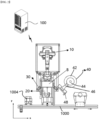
- FIG. 1 is a configuration diagram of an automatic removal system 1 for removing a tape and a resin of a battery module B according to the present invention.
- a tape T is presented as an example of an attachment member
- a resin R is presented as an example of a heat dissipation member, and other members that achieve the same function are also applicable. These terms do not limit the scope of the present invention.
- the automatic removal system 1 of the present invention includes a controller 100 serving as a main control unit (MCU) of the entire system, an automatic multi-axis robot 10, a transfer shuttle 20, an aligner 30, a transfer module 40, a removal assembly 50, a blowing module 60, and a cleaning device 70. These members are connected to the controller 100 in a wired or wireless manner and driven by a signal of the controller 100.
- MCU main control unit
- the battery module B moved by the transfer module 40 moves along the transfer shuttle 20 to be fixed in place in the aligner 30, and the tape T and the resin R are removed by driving the removal assembly 50 coupled to the automatic multi-axis robot 10.
- the removal assembly 50 is cleaned by the cleaning device 70, the tape T is collected in a collector (not shown in FIG. 1 ), the battery module B, after being cleaned, moves for another operation, and the automatic multi-axis robot 10 returns to its original position and then waits for the supply of a next battery module B.
- a large amount of tapes T and resins R of the battery module B may be removed quickly and reliably by repeating the above automatic removal operation cycle.
- FIG. 2 illustrates an example in which the automatic removal system 1 of the present invention according to FIG. 1 is implemented. Illustration and description of a motor, a pneumatic actuator, a cylinder, a cable, and the like, which are members naturally provided in a conventional automatic process system, will be omitted in the following description except in special cases so that the present invention is clearly understood.
- the battery module B in which processes of stacking battery cells, injecting the resin R, and attaching the tape T are completed moves from an unloader 1004 to a conveyor 1000 and moves along an x-axis direction.
- the conveyor 1000 is disposed long along the x-axis direction, and the automatic multi-axis robot 10, the transfer shuttle 20, and the aligner 30 are generally arranged along a y-axis direction that is perpendicular to the x-axis direction.
- the unloader 1004 and the conveyor 1000, and the movement of the battery module B according to the unloader 1004 and the conveyor 1000 are illustrated based on the present process system, and may be modified in various ways, such as supplying the battery module B directly to a front side of the transfer shuttle 20.
- the transfer module 40 is installed adjacent to the conveyor 1000 and the transfer shuttle 20.
- the transfer module 40 includes a fixed stand 42 positioned at a lower portion thereof, a pivot body 44 which is installed on the fixed stand 42 and horizontally rotatable and in which an MCU is embedded, and an extension arm 46 which extends long from one side of the pivot body 44 and is vertically and horizontally rotatable.
- a battery gripper 48 which is heavy and has a tong shape, is installed at a front-side end of the extension arm 46.
- Grippers of the battery gripper 48 are pivotable between a grip position at which the grippers rotate so that front ends thereof are close to each other and firmly grip the battery module B, and a non-grip position at which the grippers rotate so that the front ends thereof are spaced apart from each other and are separated from the battery module B.
- the extension arm 46 pivots downward by a predetermined angle to face both side surfaces of the battery module B, the battery gripper 48 moves inward toward the side surfaces of the battery module B and presses the side surfaces, and this position is the grip position.
- the extension arm 46 rotates upward, and the pivot body 44 revolves toward the transfer shuttle 20, and then, the extension arm 46 rotates downward to place the battery module B on the transfer shuttle 20.
- the battery gripper 48 may be switched to the non-grip position.
- transfer module 40 has been described above, and a device of any structure may be appropriately employed as along as it performs a function capable of moving the battery module B from the conveyor 1000 to the aligner 30.
- An application target of the transfer module 40 is not limited, for example, the transfer module 40 is also applicable to the battery module B transferred by being loaded on a rotary turntable instead of the conveyor 1000.
- the automatic multi-axis robot 10 is spaced apart from a platform 200, on which other members are installed, to secure a sufficient working space.
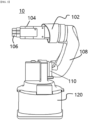
- the automatic multi-axis robot 10 of the present invention has a multi-joint structure including a body 120, a first robot arm 108 connected to the body 120 through a boss 110 and extending upward, and a second robot arm 102 extending horizontally from an end of the first robot arm 108.
- a pivotable drive arm 104 is coupled to a front end of the second robot arm 102, and a coupling portion 106 coupled to the removal assembly 50 is formed at a front end of the drive arm 104.
- An MCU is embedded in the body 120 and communicates with the controller 100.
- the first robot arm 108 freely rotates in a three-dimensional space to set default vertical and horizontal positions, and the second robot arm 102 performs rotational and bending movements.
- the drive arm 104 is connected to a spindle of the second robot arm 102, and bends and pivots independently.
- the structure of the automatic multi-axis robot 10 may be appropriately changed according to a work environment.
- the coupling portion 106 may be manufactured as a finger type or the arm may be used as an independent arm that performs other functions, and the automatic multi-axis robot 10 of a compact structure may be integrated into the platform 200.
- the coupling portion 106 of the automatic multi-axis robot 10 is coupled to the removal assembly 50, and the latter freely moves, pivots, and performs rotation and joint movements due to the driving of the former.
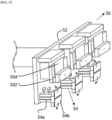
- the removal assembly 50 of the present invention includes a base 52 having a flat plate shape, and first removal devices 54 including rods 54a arranged side by side along one side of a lower surface of the base 52 and each extending downward vertically and grippers 54b each formed integrally with a front end of the rod 54a and having a tong shape.
- a front surface of the base 52 is coupled to the coupling portion 106 of the drive arm 104 of the automatic multi-axis robot 10.
- the grippers 54b are pivotable between a grip position at which grippers thereof rotate so that front ends thereof are close to each other and firmly grip the tape T, and a non-grip position at which the grippers rotate so that the front ends thereof are spaced from each other and are separated from the tape T.
- the gripper 54b may be modified in various ways, for example, the gripper 54b may take the form of a pad having a flat plate shape and a mesh structure or embossing to which the tape T can be attached.
- a plurality of support brackets 502 are installed side by side in a side opposite to one side, in which the first removal devices 54 are arranged, and a second removal device 504 serving as a knife for removing the resin R is mounted to an inlet portion of each of the support brackets 502.
- the size and number of the first and second removal devices 54 and 504 may be variously changed according to the size of the battery module B, and the alignment positions and number of check holes, for example, when the tapes T are arranged only in a line in the battery module B, only one of the first and second removal devices 54 and 504 is installed.
- the removal assembly 50 of the present invention be of an exchangeable type detachable to the automatic multi-axis robot 10 so that the removal assembly 50 is conveniently changed and maintained.
- the tape T and the resin R may be completely removed by the first removal operation, and in this case, which is not part of the claimed invention, the second removal step, with the device 504, may be omitted.
- FIG. 5 illustrates a perspective view of a second embodiment of the second removal device.
- a plurality of blocks 510 are installed in one side of a lower surface of the base 52 in a direction perpendicular to the lower surface, and a scraper 512 is mounted on a lower surface of each of the blocks 510.
- the scraper 512 is configured to come into contact with most of an upper surface of a casing of the battery module B in left and right directions so that the removal assembly 50 moves along a longitudinal side of the casing, i.e., a length direction, so that the removal assembly 50 may clean all the material protruding above the upper surface of the casing while moving in parallel on the casing.
- An operation, which is not part of the claimed invention, of simultaneously removing the tape T and the resin R by applying the same force while being simultaneously in close contact with the tape T and the resin R may be sequentially performed with respect to a plurality of columns of the tapes T attached along a width direction of the casing, whereby operation time can be further reduced as compared to the method of the present invention.
- the block 510 and scraper 512 of this embodiment may be modified in various ways. According to the present invention, the block 510 and scraper 512 of the second removal device of the second embodiment may be replaced with the second removal device 504 of the first embodiment in the removal assembly 50 of the first embodiment.
- the transfer shuttle 20 of the present invention includes a pair of transfer rails 22 which extend long and are adjacent to each other. That is, the transfer shuttle 20 has a belt structure similar to the conveyor.
- the width of the transfer rail 22 is manufactured to sufficiently support the length of the battery module B.
- the transfer module 40 places the battery module B on the transfer rail 22 so that the battery module B is exactly perpendicular to a moving direction of the transfer rail 22. The placed battery module B is moved forward along the transfer rail 22 and supplied to the aligner 30.
- the aligner 30 of the present invention includes a stopper 32 positioned on a front side thereof and a pair of cylinder actuators 34 as pressing means each installed on an outer side of each of the transfer rails 22.
- the stopper 32 is installed at a predetermined position above the platform 200 to protrude long in a width direction and prevents the battery module B from moving forward further.
- Each of the cylinder actuator 34 includes a pressing rod 36 that enters an inside of the transfer rail 22 or retracts from the transfer rail 22 by the driving of a piston inside the body.
- the pressing rods 36 may enter or retract in an inclined direction with respect to the transfer rail 22 to press both corners of a side surface or a rear surface of the battery module B from behind the battery module B.
- the left and right cylinder actuators 34 may be connected to each other by a bridge 38 to operate simultaneously in real time.
- the stopper 32 in the front side and two pressing rods 36, which enter the transfer rail 22, should firmly hold both front and rear side surfaces of the battery module B, respectively, to stably fix the position of the battery module B, so that the battery module B does not shake or move finely during the removal operation. Accordingly, a distance between the stopper 32 and the pressing rod 36 is determined according to the width of the battery module B.
- the blowing module 60 of the present invention includes a plurality of spray nozzles 62 arranged to spray high-pressure air. An opening of the spray nozzle 62 is directed upward, and compressed air discharged from the spray nozzle 62 flows upward from below at a front surface of the battery module B, so that a portion of the tape T is separated from the casing and directed upward. This operation helps the gripper 54b of the removal assembly 50 to grip the tape T.
- the cleaning device 70 of the present invention includes a cleaner 72, and for example, the cleaner 72 is made of a flexible material having a brush or brush structure formed on an outer surface thereof and manufactured in, for example, a roller shape so that resin attached to the knife or scraper that is the second removal device is removed.
- the removal assembly 50 may come into contact with the cleaner 72 while reciprocating to remove the resin, or the cleaner 72 may rotate in a state in which the removal assembly 50 is fixed.
- the cleaning device 70 may be modified in various ways as long as it achieves the same purpose, for example, the cleaning device 70 may be replaced with a nozzle that blows out high-pressure air.
- a collector 80 is installed in a front side of the cleaning device 70 along a height direction of the platform 200.
- the tape T gripped by the first removal device 54 falls and is collected in the collector 80.
- the collector 80 may have a box shape and may be mounted on the platform 200 to be replaceable.
- the tapes T are attached in three rows along the width direction, and accordingly, three first removal devices 54 and three second removal devices 504 are mounted.
- the removal assembly 50 may rotate clockwise or counterclockwise or move forward or backward along the y-axis direction, according to the drive arm 104.
- the removal assembly 50 is placed adjacent to a front upper surface of the battery module B such that the base 52 is substantially perpendicular to the upper surface of the battery module, and the grippers 54b are placed adjacent to the tape T to face the tape T, and then, the removal assembly 50 rotates to position the tape T in a space between the grippers 54b.
- the gripper 54b is switched to the grip position to close the space, the tape T is gripped, and when the removal assembly 50 is rotated in the counterclockwise direction, the gripped tape T is picked and lifted from an outer surface of the casing.
- the removal assembly 50 moves in parallel in a direction A', as the tape T is gradually separated, the tape T and the resin R attached thereto are removed together.
- the operation of gripping the tape T is more easily performed by the blowing of the spray nozzle 62. This operation state is illustrated in FIG. 7A .
- the automatic multi-axis robot 10 is driven to rotate the removal assembly 50 in a vertical direction, so that the second removal device 504 is now positioned to be brought into contact with the upper surface of the casing in a length direction of the battery module B, and then the automatic multi-axis robot 10 is driven to linearly move the removal assembly 50 along the length direction.
- This operation state is illustrated in FIG. 7B . Through this process, the resin R remaining in the casing is removed.
- the automatic multi-axis robot 10 is driven to rotate the removal assembly 50 in the vertical direction, and then, the automatic multi-axis robot 10 is driven to move the removal assembly 50 again along the direction B' to bring the removal assembly 50 into contact with the cleaner 72 and remove the resin R attached to the second removal device 504.
- a modification is also possible in which, in a state in which the tape T is removed, the removal assembly 50 rotates slowly in the clockwise direction in contrast to the previous case and is positioned so that a front end of the knife, which is the second removal device 504, comes into contact with the upper surface of the casing, and then, moves in parallel in the direction B' to remove the remaining resin R.
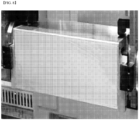
- FIG. 8 illustrates an actual example in which the upper surface of the casing is completely cleaned using the automatic multi-axis robot 10 and the removal assembly 50 of the present invention.
- the tape T and the resin R can be reliably and quickly removed by various methods based on free pivoting and moving motions of the automatic multi-axis robot 10.
- the automatic multi-axis robot 10 returns to its initial position.
- the pressing rod 36 of the cylinder actuator 34 moves away from a region of the transfer rail 22 by retracting therefrom, the fixed state of the battery module B is released, and the battery module B is moved linearly along the opposite direction by the rotation of the transfer rail 22 and is transferred to a place at which the transfer module 40 is placed.
- the transfer module 40 operates in an order opposite to that described with reference to FIG. 2 to place the battery module B on the conveyor 1000 again, and the battery module B is transferred to a subsequent operation process along the conveyor 1000.
- the battery module B from which the tape T and the resin R are removed is directly moved from the aligner 30 to an adjacent work bench using an automatic arm (not shown).
Landscapes
- Engineering & Computer Science (AREA)
- Mechanical Engineering (AREA)
- Robotics (AREA)
- Chemical Kinetics & Catalysis (AREA)
- Electrochemistry (AREA)
- General Chemical & Material Sciences (AREA)
- Chemical & Material Sciences (AREA)
- Manufacturing & Machinery (AREA)
- Physics & Mathematics (AREA)
- Thermal Sciences (AREA)
- Automatic Assembly (AREA)
- Battery Mounting, Suspending (AREA)
- Secondary Cells (AREA)
Description
- The present invention relates to an automatic removal system for automatically removing a tape and a resin of a battery module.
- This application claims the benefit of priority based on
Korean Patent Application No. 10-2021-0117211, filed on September 02, 2021 - A battery module is formed by stacking a plurality of battery cells, and an exterior thereof is covered by a casing. In order to prevent the temperature inside the casing from rising in a manufacturing process of the battery module, fix the cells in place, and protect the cells, a liquid resin as a heat dissipation member may be injected into a space inside a pack to compactly fill the pack. In order to check whether the resin is fully hardened in a state of being completely filled inside the pack, a plurality of check holes are formed in a line on an outside of the casing, and a tape, which is an attachment member for covering the check holes, is attached to the casing. Openings are perforated in the tape at positions corresponding to the check holes. When the resin is filled in the pack to completely occupy the space and hardened, a protruding portion is formed through the check hole and the opening of the tape.
- When the tape attached to the casing of the battery module is removed (primary removal) in a test process, a portion of the resin protruding through the opening of the tape is removed together with the tape, but a portion of the resin protruding outward through the check hole still remains and thus is removed (secondary removal) with a knife, which is a removal device. Then, an outer surface of the casing is cleaned to be flat, so that an exterior of the casing is smoothly finished.
- However, in the present process, each of two operators performs tape removal, resin removal, and visual inspection. As described above, there are problems in that two operators are required, each operator has a different removal process speed, and efforts are required to remove the tape and the resin.
- In order to solve the above problems, the inventor has developed an automatic removal system for automatically removing a tape and a resin of a battery module, which automatically removes the tape and the resin using a multi-axis automatic robot.
- Further prior art is disclosed in
KR 10-2021-0056824 A JP 2000-269168 A JP 2020-173981 A KR 102 208 159 B1 CN 112 170 385 A andUS 2014/017352 A . - The present invention has been devised to solve the above problems, and the present invention is directed to providing an automatic removal system for automatically removing a tape and a resin of a battery module, having a new structure capable of automatically, quickly, and reliably removing the tape and the resin exposed to the outside of the battery module, increasing production yield, and reducing costs by reducing man-hours.
- According to an aspect of the present invention, this object is accomplished by an automatic removal system for automatically removing a tape and a resin exposed to an outside of a battery module comprising the features of
patent claim 1. - Dependent claims are directed on features of preferred embodiments of the invention.
- According to the present invention, a tape and a resin of a battery module can be automatically removed using an automatic multi-axis robot, so that an operation is fast and accurate, and an operation speed can be significantly increased.
- An automatic multi-axis robot of the present invention can freely pivot, bend, and move in parallel, and thus, by attaching a device for removing a tape and a resin of a battery module, the tape and resin of the battery module can be removed in various ways, so that adaptability according to the work environment is excellent and compatibility is also excellent.
- The automatic removal system of the present invention is unmanned equipment, and thus can reduce man-hours and labor costs according to the reduced man-hours, and can be economical and cost-saving.
-
-
FIG. 1 is a configuration diagram of an automatic removal system for automatically removing a tape and a resin of a battery module according to the present invention. -
FIG. 2 is a view illustrating an example in which the automatic removal system of the present invention according toFIG. 1 is implemented. -
FIG. 3 is a perspective view of an automatic multi-axis robot of the present invention. -
FIG. 4 is a perspective view of a removal assembly of the present invention. -
FIG. 5 is a perspective view of a removal assembly according to another embodiment of the present invention. -
FIG. 6 is a perspective view illustrating a transfer shuttle, an aligner, a blowing module, and a cleaning device of the present invention. -
FIG. 7 is a view for describing an overview of a tape and resin removal operation process using the automatic multi-axis robot of the present invention. -
FIG. 8 is a view illustrating an actual example in which an upper surface of a casing is completely cleaned using the automatic multi-axis robot and the removal assembly of the present invention. - Hereinafter, the present invention will be described in detail.
-
FIG. 1 is a configuration diagram of anautomatic removal system 1 for removing a tape and a resin of a battery module B according to the present invention. A tape T is presented as an example of an attachment member, a resin R is presented as an example of a heat dissipation member, and other members that achieve the same function are also applicable. These terms do not limit the scope of the present invention. - The
automatic removal system 1 of the present invention includes acontroller 100 serving as a main control unit (MCU) of the entire system, an automaticmulti-axis robot 10, atransfer shuttle 20, analigner 30, atransfer module 40, aremoval assembly 50, a blowingmodule 60, and acleaning device 70. These members are connected to thecontroller 100 in a wired or wireless manner and driven by a signal of thecontroller 100. - The battery module B moved by the
transfer module 40 moves along thetransfer shuttle 20 to be fixed in place in thealigner 30, and the tape T and the resin R are removed by driving theremoval assembly 50 coupled to the automaticmulti-axis robot 10. Theremoval assembly 50 is cleaned by thecleaning device 70, the tape T is collected in a collector (not shown inFIG. 1 ), the battery module B, after being cleaned, moves for another operation, and the automaticmulti-axis robot 10 returns to its original position and then waits for the supply of a next battery module B. - According to the present invention, a large amount of tapes T and resins R of the battery module B may be removed quickly and reliably by repeating the above automatic removal operation cycle.
-
FIG. 2 illustrates an example in which theautomatic removal system 1 of the present invention according toFIG. 1 is implemented. Illustration and description of a motor, a pneumatic actuator, a cylinder, a cable, and the like, which are members naturally provided in a conventional automatic process system, will be omitted in the following description except in special cases so that the present invention is clearly understood. - The battery module B in which processes of stacking battery cells, injecting the resin R, and attaching the tape T are completed moves from an
unloader 1004 to aconveyor 1000 and moves along an x-axis direction. Theconveyor 1000 is disposed long along the x-axis direction, and the automaticmulti-axis robot 10, thetransfer shuttle 20, and thealigner 30 are generally arranged along a y-axis direction that is perpendicular to the x-axis direction. Theunloader 1004 and theconveyor 1000, and the movement of the battery module B according to theunloader 1004 and theconveyor 1000 are illustrated based on the present process system, and may be modified in various ways, such as supplying the battery module B directly to a front side of thetransfer shuttle 20. - The
transfer module 40 is installed adjacent to theconveyor 1000 and thetransfer shuttle 20. Thetransfer module 40 includes afixed stand 42 positioned at a lower portion thereof, a pivot body 44 which is installed on the fixedstand 42 and horizontally rotatable and in which an MCU is embedded, and anextension arm 46 which extends long from one side of the pivot body 44 and is vertically and horizontally rotatable. Abattery gripper 48, which is heavy and has a tong shape, is installed at a front-side end of theextension arm 46. Grippers of thebattery gripper 48 are pivotable between a grip position at which the grippers rotate so that front ends thereof are close to each other and firmly grip the battery module B, and a non-grip position at which the grippers rotate so that the front ends thereof are spaced apart from each other and are separated from the battery module B. - When a battery position detection sensor (not shown in
FIG. 2 ) detects that the battery module B has arrived at a predetermined position of theconveyor 1000, theextension arm 46 pivots downward by a predetermined angle to face both side surfaces of the battery module B, thebattery gripper 48 moves inward toward the side surfaces of the battery module B and presses the side surfaces, and this position is the grip position. In this state, theextension arm 46 rotates upward, and the pivot body 44 revolves toward thetransfer shuttle 20, and then, theextension arm 46 rotates downward to place the battery module B on thetransfer shuttle 20. When the transfer process of the battery module B is completed in this manner, thebattery gripper 48 may be switched to the non-grip position. - An example of the
transfer module 40 has been described above, and a device of any structure may be appropriately employed as along as it performs a function capable of moving the battery module B from theconveyor 1000 to thealigner 30. An application target of thetransfer module 40 is not limited, for example, thetransfer module 40 is also applicable to the battery module B transferred by being loaded on a rotary turntable instead of theconveyor 1000. - Next, before describing the structure of the
transfer shuttle 20 and thealigner 30, the automaticmulti-axis robot 10 and theremoval assembly 50 of the present invention will be described first. - In the
automatic removal system 1, the automaticmulti-axis robot 10 is spaced apart from aplatform 200, on which other members are installed, to secure a sufficient working space. - As shown in
FIG. 3 , the automaticmulti-axis robot 10 of the present invention has a multi-joint structure including abody 120, afirst robot arm 108 connected to thebody 120 through aboss 110 and extending upward, and a second robot arm 102 extending horizontally from an end of thefirst robot arm 108. Apivotable drive arm 104 is coupled to a front end of the second robot arm 102, and acoupling portion 106 coupled to theremoval assembly 50 is formed at a front end of thedrive arm 104. An MCU is embedded in thebody 120 and communicates with thecontroller 100. Thefirst robot arm 108 freely rotates in a three-dimensional space to set default vertical and horizontal positions, and the second robot arm 102 performs rotational and bending movements. Thedrive arm 104 is connected to a spindle of the second robot arm 102, and bends and pivots independently. - An example of the
automatic multi-axis robot 10 has been described above, and the structure of theautomatic multi-axis robot 10 may be appropriately changed according to a work environment. For example, thecoupling portion 106 may be manufactured as a finger type or the arm may be used as an independent arm that performs other functions, and theautomatic multi-axis robot 10 of a compact structure may be integrated into theplatform 200. - The
coupling portion 106 of theautomatic multi-axis robot 10 is coupled to theremoval assembly 50, and the latter freely moves, pivots, and performs rotation and joint movements due to the driving of the former. - As shown in
FIG. 4 , theremoval assembly 50 of the present invention includes a base 52 having a flat plate shape, andfirst removal devices 54 includingrods 54a arranged side by side along one side of a lower surface of thebase 52 and each extending downward vertically andgrippers 54b each formed integrally with a front end of therod 54a and having a tong shape. A front surface of thebase 52 is coupled to thecoupling portion 106 of thedrive arm 104 of theautomatic multi-axis robot 10. - Similar to the
battery gripper 48, thegrippers 54b are pivotable between a grip position at which grippers thereof rotate so that front ends thereof are close to each other and firmly grip the tape T, and a non-grip position at which the grippers rotate so that the front ends thereof are spaced from each other and are separated from the tape T. - The
gripper 54b may be modified in various ways, for example, thegripper 54b may take the form of a pad having a flat plate shape and a mesh structure or embossing to which the tape T can be attached. - A plurality of
support brackets 502 are installed side by side in a side opposite to one side, in which thefirst removal devices 54 are arranged, and asecond removal device 504 serving as a knife for removing the resin R is mounted to an inlet portion of each of thesupport brackets 502. - An example of the structure and operation of the
removal assembly 50 has been described above, and it is obvious that the following modifications are possible. - First, the size and number of the first and
second removal devices second removal devices removal assembly 50 of the present invention be of an exchangeable type detachable to theautomatic multi-axis robot 10 so that theremoval assembly 50 is conveniently changed and maintained. - Second, in many practical cases, the tape T and the resin R may be completely removed by the first removal operation, and in this case, which is not part of the claimed invention, the second removal step, with the
device 504, may be omitted. -
FIG. 5 illustrates a perspective view of a second embodiment of the second removal device. - A plurality of
blocks 510 are installed in one side of a lower surface of the base 52 in a direction perpendicular to the lower surface, and ascraper 512 is mounted on a lower surface of each of theblocks 510. Thescraper 512 is configured to come into contact with most of an upper surface of a casing of the battery module B in left and right directions so that theremoval assembly 50 moves along a longitudinal side of the casing, i.e., a length direction, so that theremoval assembly 50 may clean all the material protruding above the upper surface of the casing while moving in parallel on the casing. - An operation, which is not part of the claimed invention, of simultaneously removing the tape T and the resin R by applying the same force while being simultaneously in close contact with the tape T and the resin R may be sequentially performed with respect to a plurality of columns of the tapes T attached along a width direction of the casing, whereby operation time can be further reduced as compared to the method of the present invention.
- The
block 510 andscraper 512 of this embodiment may be modified in various ways. According to the present invention, theblock 510 andscraper 512 of the second removal device of the second embodiment may be replaced with thesecond removal device 504 of the first embodiment in theremoval assembly 50 of the first embodiment. - Next, the
transfer shuttle 20, thealigner 30, the blowingmodule 60, and thecleaning device 70 of the present invention will be described with reference to a perspective view ofFIG. 6 . - The
transfer shuttle 20 of the present invention includes a pair of transfer rails 22 which extend long and are adjacent to each other. That is, thetransfer shuttle 20 has a belt structure similar to the conveyor. The width of thetransfer rail 22 is manufactured to sufficiently support the length of the battery module B. Thetransfer module 40 places the battery module B on thetransfer rail 22 so that the battery module B is exactly perpendicular to a moving direction of thetransfer rail 22. The placed battery module B is moved forward along thetransfer rail 22 and supplied to thealigner 30. - The
aligner 30 of the present invention includes astopper 32 positioned on a front side thereof and a pair ofcylinder actuators 34 as pressing means each installed on an outer side of each of the transfer rails 22. - The
stopper 32 is installed at a predetermined position above theplatform 200 to protrude long in a width direction and prevents the battery module B from moving forward further. - Each of the
cylinder actuator 34 includes apressing rod 36 that enters an inside of thetransfer rail 22 or retracts from thetransfer rail 22 by the driving of a piston inside the body. Thepressing rods 36 may enter or retract in an inclined direction with respect to thetransfer rail 22 to press both corners of a side surface or a rear surface of the battery module B from behind the battery module B. The left andright cylinder actuators 34 may be connected to each other by abridge 38 to operate simultaneously in real time. - In the present invention, the
stopper 32 in the front side and twopressing rods 36, which enter thetransfer rail 22, should firmly hold both front and rear side surfaces of the battery module B, respectively, to stably fix the position of the battery module B, so that the battery module B does not shake or move finely during the removal operation. Accordingly, a distance between thestopper 32 and thepressing rod 36 is determined according to the width of the battery module B. - The blowing
module 60 of the present invention includes a plurality ofspray nozzles 62 arranged to spray high-pressure air. An opening of thespray nozzle 62 is directed upward, and compressed air discharged from thespray nozzle 62 flows upward from below at a front surface of the battery module B, so that a portion of the tape T is separated from the casing and directed upward. This operation helps thegripper 54b of theremoval assembly 50 to grip the tape T. - The
cleaning device 70 of the present invention includes a cleaner 72, and for example, the cleaner 72 is made of a flexible material having a brush or brush structure formed on an outer surface thereof and manufactured in, for example, a roller shape so that resin attached to the knife or scraper that is the second removal device is removed. Theremoval assembly 50 may come into contact with the cleaner 72 while reciprocating to remove the resin, or the cleaner 72 may rotate in a state in which theremoval assembly 50 is fixed. In addition, thecleaning device 70 may be modified in various ways as long as it achieves the same purpose, for example, thecleaning device 70 may be replaced with a nozzle that blows out high-pressure air. - A
collector 80 is installed in a front side of thecleaning device 70 along a height direction of theplatform 200. The tape T gripped by thefirst removal device 54 falls and is collected in thecollector 80. Thecollector 80 may have a box shape and may be mounted on theplatform 200 to be replaceable. - Next, a removal operation will be described with mainly reference to the
automatic multi-axis robot 10 and theremoval assembly 50 in theautomatic removal system 1 of the present invention described above with reference toFIGS. 6 and7 . - On the upper surface of the casing of the base module B, the tapes T are attached in three rows along the width direction, and accordingly, three
first removal devices 54 and threesecond removal devices 504 are mounted. When the MCU of theautomatic multi-axis robot 10 is driven by a signal of thecontroller 100, theremoval assembly 50 may rotate clockwise or counterclockwise or move forward or backward along the y-axis direction, according to thedrive arm 104. - The
removal assembly 50 is placed adjacent to a front upper surface of the battery module B such that thebase 52 is substantially perpendicular to the upper surface of the battery module, and thegrippers 54b are placed adjacent to the tape T to face the tape T, and then, theremoval assembly 50 rotates to position the tape T in a space between thegrippers 54b. When thegripper 54b is switched to the grip position to close the space, the tape T is gripped, and when theremoval assembly 50 is rotated in the counterclockwise direction, the gripped tape T is picked and lifted from an outer surface of the casing. When theremoval assembly 50 moves in parallel in a direction A', as the tape T is gradually separated, the tape T and the resin R attached thereto are removed together. The operation of gripping the tape T is more easily performed by the blowing of thespray nozzle 62. This operation state is illustrated inFIG. 7A . - In this state, when the
removal assembly 50 moves to thecollector 80 along a direction B' and then opens thegripper 54b to a non-grip state, the tape T is automatically dropped by gravity and collected in the box. - In addition, in order to completely remove the resin R remaining on the upper surface of the casing, the
automatic multi-axis robot 10 is driven to rotate theremoval assembly 50 in a vertical direction, so that thesecond removal device 504 is now positioned to be brought into contact with the upper surface of the casing in a length direction of the battery module B, and then theautomatic multi-axis robot 10 is driven to linearly move theremoval assembly 50 along the length direction. This operation state is illustrated inFIG. 7B . Through this process, the resin R remaining in the casing is removed. - Thereafter, the
automatic multi-axis robot 10 is driven to rotate theremoval assembly 50 in the vertical direction, and then, theautomatic multi-axis robot 10 is driven to move theremoval assembly 50 again along the direction B' to bring theremoval assembly 50 into contact with the cleaner 72 and remove the resin R attached to thesecond removal device 504. - Alternatively, unlike
FIG. 7B , a modification is also possible in which, in a state in which the tape T is removed, theremoval assembly 50 rotates slowly in the clockwise direction in contrast to the previous case and is positioned so that a front end of the knife, which is thesecond removal device 504, comes into contact with the upper surface of the casing, and then, moves in parallel in the direction B' to remove the remaining resin R. -
FIG. 8 illustrates an actual example in which the upper surface of the casing is completely cleaned using theautomatic multi-axis robot 10 and theremoval assembly 50 of the present invention. - According to the present invention, as described above, the tape T and the resin R can be reliably and quickly removed by various methods based on free pivoting and moving motions of the
automatic multi-axis robot 10. - When both the tape T and the resin R of the battery module B are removed by the above process, the
automatic multi-axis robot 10 returns to its initial position. As thepressing rod 36 of thecylinder actuator 34 moves away from a region of thetransfer rail 22 by retracting therefrom, the fixed state of the battery module B is released, and the battery module B is moved linearly along the opposite direction by the rotation of thetransfer rail 22 and is transferred to a place at which thetransfer module 40 is placed. Thetransfer module 40 operates in an order opposite to that described with reference toFIG. 2 to place the battery module B on theconveyor 1000 again, and the battery module B is transferred to a subsequent operation process along theconveyor 1000. - An example of the finishing process has been described above, and various modifications are possible, for example, the battery module B from which the tape T and the resin R are removed is directly moved from the
aligner 30 to an adjacent work bench using an automatic arm (not shown). - The above description is only an example of the present invention, and it will be understood by those of skilled in the art that various changes in form and details may be made without departing from the scope of the appended claims.
-
- 1: automatic removal system for automatically removing tape and resin
- 10: automatic multi-axis robot
- 20: transfer shuttle
- 30: aligner
- 40: transfer module
- 50: removal assembly
- 60: blowing module
- 70: cleaning device
- B: battery module
- T: tape
- R: resin
Claims (11)
- An automatic removal system (1) for automatically removing a tape (T) and a resin (R) exposed to an outside of a battery module (B), the system (1) comprising:a removal assembly (50) including a removal device (54, 504) for removing the tape (T) and the resin (R); andan automatic multi-axis robot (10) coupled to the removal assembly (50) and configured to drive the removal assembly (50) to remove the tape (T) and the resin (R) of the battery module (B),wherein the removal assembly (50) includes a first removal device (54) for removing the tape (T) and the resin (R) attached to the tape (T),wherein the removal assembly (50) further includes a second removal device (504) for removing the resin (R) remaining on the battery module (B) left by the first removal device (54),characterized in thatthe first removal device (54) includes rods (54a) arranged side by side along one side of a base (52) of the removal assembly (50) and each of the rods (54a) extending downward, and a gripper (54b) integrally formed at a front end of each of the rods (54a), andthe second removal device (504) includes a support bracket (502) or block (510) formed on a second side of the removal device opposite to a first side in which the first removal device (54) is arranged, and a knife or scraper (512) installed on the support bracket (502) or block (510) to remove the resin (R).
- The system (1) of claim 1, further comprising a transfer module (40) and a transfer shuttle (20),
wherein the transfer module (40) is configured to grip the battery module (B) and to move it to the transfer shuttle (20). - The system (1) of claim 2, wherein the transfer shuttle (20) includes a pair of transfer rails (22) that are adjacent to each other, and
wherein the system further comprises an aligner (30) positioned in a front side of the transfer rail (22), such that in use, the battery module (B) moved by the transfer module (40) to the transfer shuttle (20), is loaded on the pair of transfer rails (22) and is moved to the aligner (30). - The system (1) of claim 3, wherein the aligner (30) includes a stopper (32), and a pair of pressers (34) respectively installed on outer sides of the pair of transfer rails (22),wherein each of the pressers (34) includes a pressing rod (36) configured to enter an inside of a respective transfer rail (22) or to retract from the respective transfer rail (22),such that in use, the pressing rod (36) presses a side surface or a rear surface of the battery module (B) when the pressing rod (36) enters the inside of the respective transfer rail (22), andthe stopper (32) blocks a forward movement of the battery module (B), so that the battery module (B) is fixed in place.
- The system of claim 1, further comprising spray nozzles (62) arranged to spray high-pressure air, such that in use, compressed air discharged from the spray nozzles (62) causes a portion of the tape (T) to be separated from a casing of the battery module (B) and directed in a predetermined direction, so that the first removal device (54) of the removal assembly (50) grips the tape (T).
- The system (1) of claim 1, further comprising a cleaner (72) configured to contact the second removal device (504) and remove the remaining resin (R) adhered to the second removal device (504).
- The system (1) of claim 1, further comprising a collector (80) configured to collect the tape (T) attached to the first removal device (54).
- The system (1) of claim 1, wherein the first removal device (54) includes blocks (510) arranged along one side of a base (52) of the removal assembly (50) to face a lower surface, and a scraper (512) mounted on a lower surface of the blocks (510) and configured to remove the tape (T) and the resin (R).
- The system (1) of claim 1, wherein the automatic multi-axis robot (10) has a multi-joint structure including a body (120), a first robot arm (108) connected to the body (120), and a second robot arm (102) connected to the first robot arm (108), wherein a pivotable drive arm (104) and a coupling portion (106) for being coupled to a base (52) of the removal assembly (50) are sequentially formed at a front end of the second robot arm (102).
- A method of automatically removing tape (T) and resin (R) exposed to the outside of a battery module (B) using the automatic removal system (1) of claim 1, the method comprising:- removing the tape (T) and the resin (R) attached to the tape (T) by moving the first removal device (54) along a first direction of the tape (T) attached to the battery module (B); and- further removing the remaining resin (R) by moving the second removal device (504) in a second direction.
- The method of claim 10, wherein said second direction is a direction perpendicular to the first direction.
Applications Claiming Priority (2)
| Application Number | Priority Date | Filing Date | Title |
|---|---|---|---|
| KR1020210117211A KR20230034069A (en) | 2021-09-02 | 2021-09-02 | Automatic cutting-off system for tape and resin of battery pack |
| PCT/KR2022/013035 WO2023033539A1 (en) | 2021-09-02 | 2022-08-31 | Automatic removal system for tape and resin of battery module |
Publications (3)
| Publication Number | Publication Date |
|---|---|
| EP4258439A1 EP4258439A1 (en) | 2023-10-11 |
| EP4258439A4 EP4258439A4 (en) | 2024-08-07 |
| EP4258439B1 true EP4258439B1 (en) | 2025-05-07 |
Family
ID=85411359
Family Applications (1)
| Application Number | Title | Priority Date | Filing Date |
|---|---|---|---|
| EP22865041.2A Active EP4258439B1 (en) | 2021-09-02 | 2022-08-31 | Automatic removal system for tape and resin of battery module |
Country Status (8)
| Country | Link |
|---|---|
| US (1) | US20240067465A1 (en) |
| EP (1) | EP4258439B1 (en) |
| JP (1) | JP7652509B2 (en) |
| KR (1) | KR20230034069A (en) |
| CN (1) | CN116761703A (en) |
| ES (1) | ES3030318T3 (en) |
| HU (1) | HUE071777T2 (en) |
| WO (1) | WO2023033539A1 (en) |
Families Citing this family (6)
| Publication number | Priority date | Publication date | Assignee | Title |
|---|---|---|---|---|
| CN116398767A (en) * | 2023-04-11 | 2023-07-07 | 北京方正数码有限公司 | A large interactive smart screen for distance education |
| CN116603782A (en) * | 2023-06-13 | 2023-08-18 | 中创新航材料科技(四川)有限公司 | Device and method for removing tab adhesive tape |
| CN116476079B (en) * | 2023-06-20 | 2023-09-22 | 北京凌禾科技有限公司 | Treatment equipment and treatment method for residual adhesive layer on surface of battery |
| KR102713902B1 (en) * | 2023-08-02 | 2024-10-07 | 주식회사 토트 | A method for determining a task-based battery processing process, a computing device on which such a method is implemented, and a system comprising the computing device |
| KR102905577B1 (en) * | 2024-09-06 | 2025-12-30 | (주)하나기술 | Pouch removing unit and method thereof |
| KR102821511B1 (en) * | 2024-10-08 | 2025-06-17 | (주)하나기술 | Release film removing unit and release film removing method usinh the same |
Family Cites Families (25)
| Publication number | Priority date | Publication date | Assignee | Title |
|---|---|---|---|---|
| JPH0556856U (en) * | 1992-01-14 | 1993-07-27 | ハマダ印刷機械株式会社 | Separator for the tab surface side separator |
| JP2000269168A (en) | 1999-03-19 | 2000-09-29 | Nec Corp | Tape releasing method |
| JP2004001976A (en) * | 2002-06-03 | 2004-01-08 | Ricoh Co Ltd | Peeling tool, peeling method and peeling device |
| EP2428336A1 (en) * | 2010-09-10 | 2012-03-14 | Kabushiki Kaisha Yaskawa Denki | Hand and robot |
| JP4955823B1 (en) * | 2011-04-05 | 2012-06-20 | 日本省力機械株式会社 | Work picking and finishing device |
| JP6087388B2 (en) * | 2015-05-20 | 2017-03-01 | 日本ビソー株式会社 | Cleaning squeegee device |
| CN206271819U (en) * | 2016-11-03 | 2017-06-20 | 东莞市骏智机电科技有限公司 | A film tearing machine |
| CN106784964B (en) * | 2016-11-28 | 2019-08-20 | 惠州金源精密自动化设备有限公司 | battery cleaning system |
| CN108044849B (en) * | 2017-12-18 | 2023-10-31 | 上海银杉工业品销售有限公司 | Tear-off tape-tipped elastic chuck device for optical lenses |
| CN108263698A (en) * | 2018-03-30 | 2018-07-10 | 青岛元启智能机器人科技有限公司 | A kind of automatic film tearing device |
| KR102293007B1 (en) * | 2018-10-05 | 2021-08-24 | 주식회사 엘지에너지솔루션 | Apparatus for attaching tape to battery cell |
| CN209526168U (en) * | 2018-12-30 | 2019-10-22 | 苏州德星云智能装备有限公司 | A kind of lithium battery mould group battery core surface preparation equipment |
| JP2020173981A (en) | 2019-04-11 | 2020-10-22 | 株式会社豊田自動織機 | Method of manufacturing power storage module |
| KR102752435B1 (en) | 2019-11-11 | 2025-01-08 | 주식회사 엘지에너지솔루션 | Battery module, battery pack and vehicle comprising the battery module |
| EP3882221B1 (en) | 2020-03-18 | 2025-04-16 | Corning Incorporated | Vacuum chuck having elongate grooves and method of cold-forming curved glass articles using same |
| KR102248922B1 (en) * | 2020-04-24 | 2021-05-06 | 주식회사 엘지화학 | Resin Composition |
| CN111806820A (en) * | 2020-08-12 | 2020-10-23 | 深圳市新嘉智诚自动化有限公司 | Film tearing method and film tearing mechanism and film tearing equipment applying the method |
| CN112170385B (en) * | 2020-08-31 | 2022-03-22 | 江苏大学 | Laser cleaning device and method for sealing and glue removing of composite material hot-pressing tool |
| KR102208159B1 (en) * | 2020-10-27 | 2021-01-28 | 정치효 | Auto cleaning apparatus of battery case |
| US20240120697A1 (en) * | 2020-12-07 | 2024-04-11 | Polygon T.R Ltd. | Systems and methods for automatic electrical wiring |
| CN216988981U (en) * | 2021-12-22 | 2022-07-19 | 苏州德龙激光股份有限公司 | Laser film removing equipment for lithium battery cell insulation protective film |
| CN114308899A (en) * | 2021-12-22 | 2022-04-12 | 苏州德龙激光股份有限公司 | Laser film removing equipment and method for lithium battery cell insulation protective film |
| CN115872014A (en) * | 2022-11-30 | 2023-03-31 | 深圳市世宗自动化设备有限公司 | Flexible sheet material film tearing mechanism and flexible sheet material assembling equipment |
| CN218896646U (en) * | 2022-12-26 | 2023-04-21 | 苏州巨能图像检测技术有限公司 | Automatic tear tape simple and easy mechanism |
| CN117508826A (en) * | 2023-10-26 | 2024-02-06 | 海目星激光科技集团股份有限公司 | tearing mechanism |
-
2021
- 2021-09-02 KR KR1020210117211A patent/KR20230034069A/en active Pending
-
2022
- 2022-08-31 EP EP22865041.2A patent/EP4258439B1/en active Active
- 2022-08-31 JP JP2023539366A patent/JP7652509B2/en active Active
- 2022-08-31 HU HUE22865041A patent/HUE071777T2/en unknown
- 2022-08-31 US US18/270,150 patent/US20240067465A1/en active Pending
- 2022-08-31 WO PCT/KR2022/013035 patent/WO2023033539A1/en not_active Ceased
- 2022-08-31 CN CN202280008789.8A patent/CN116761703A/en active Pending
- 2022-08-31 ES ES22865041T patent/ES3030318T3/en active Active
Also Published As
| Publication number | Publication date |
|---|---|
| ES3030318T3 (en) | 2025-06-27 |
| JP2024504019A (en) | 2024-01-30 |
| EP4258439A4 (en) | 2024-08-07 |
| EP4258439A1 (en) | 2023-10-11 |
| JP7652509B2 (en) | 2025-03-27 |
| HUE071777T2 (en) | 2025-09-28 |
| KR20230034069A (en) | 2023-03-09 |
| WO2023033539A1 (en) | 2023-03-09 |
| CN116761703A (en) | 2023-09-15 |
| US20240067465A1 (en) | 2024-02-29 |
Similar Documents
| Publication | Publication Date | Title |
|---|---|---|
| EP4258439B1 (en) | Automatic removal system for tape and resin of battery module | |
| CA1216144A (en) | System for automatically inserting u-tubes of heat exchanger or the like | |
| JP6867365B2 (en) | A robot system equipped with a reel holding device and a reel holding device arranged in a component mounting machine. | |
| CN108495126B (en) | Full-automatic duplex position AA equipment | |
| KR101244239B1 (en) | Auto stud insert equipment | |
| CN107473575A (en) | The loading and unloading system of 3D hot-bending machines | |
| CN105290786A (en) | A kind of automatic assembly equipment of motor | |
| KR102530303B1 (en) | Processing system for cnc lathe using 5-axis robot arm | |
| CN207362051U (en) | The loading and unloading system of 3D hot-bending machines | |
| CN117775630A (en) | VR lens automatic feeding equipment | |
| CN103906425B (en) | Electronic component mounting apparatus and electronic component mounting method | |
| CN115709207B (en) | Feeding mechanism and fully automatic brush cleaning equipment | |
| CN211516352U (en) | Full-automatic wicking machine with automatic pin bending function | |
| CN110625744B (en) | A track plate casing automatic installation device | |
| CN216830198U (en) | Integrated polishing machine | |
| KR100318674B1 (en) | Release part inserter | |
| CN115672815B (en) | Unloading rotary module and fully automatic brush cleaning equipment | |
| CN115744226B (en) | Automatic feeding module and fully automatic brush plate cleaning equipment | |
| CN115739748B (en) | A fully automatic brush plate cleaning method | |
| CN115744227B (en) | Empty box storage box and fully automatic brush cleaning equipment | |
| CN115872147B (en) | Unloading robot module and unloading method thereof, and fully automatic brush plate cleaning equipment | |
| CN114102386A (en) | Integrated polishing machine | |
| CN109693106A (en) | A kind of toner cartridge automatic production line | |
| CN220536168U (en) | Film tearing device | |
| CN223162176U (en) | Grabbing device |
Legal Events
| Date | Code | Title | Description |
|---|---|---|---|
| STAA | Information on the status of an ep patent application or granted ep patent |
Free format text: STATUS: THE INTERNATIONAL PUBLICATION HAS BEEN MADE |
|
| PUAI | Public reference made under article 153(3) epc to a published international application that has entered the european phase |
Free format text: ORIGINAL CODE: 0009012 |
|
| STAA | Information on the status of an ep patent application or granted ep patent |
Free format text: STATUS: REQUEST FOR EXAMINATION WAS MADE |
|
| 17P | Request for examination filed |
Effective date: 20230629 |
|
| AK | Designated contracting states |
Kind code of ref document: A1 Designated state(s): AL AT BE BG CH CY CZ DE DK EE ES FI FR GB GR HR HU IE IS IT LI LT LU LV MC MK MT NL NO PL PT RO RS SE SI SK SM TR |
|
| A4 | Supplementary search report drawn up and despatched |
Effective date: 20240705 |
|
| RIC1 | Information provided on ipc code assigned before grant |
Ipc: B08B 1/50 20240101ALI20240702BHEP Ipc: H01M 10/653 20140101ALI20240702BHEP Ipc: B08B 1/16 20240101ALI20240702BHEP Ipc: B65H 41/00 20060101ALI20240702BHEP Ipc: B25J 11/00 20060101ALI20240702BHEP Ipc: B25J 9/06 20060101ALI20240702BHEP Ipc: B29C 71/00 20060101ALI20240702BHEP Ipc: B29C 37/02 20060101ALI20240702BHEP Ipc: H01M 50/204 20210101AFI20240702BHEP |
|
| DAV | Request for validation of the european patent (deleted) | ||
| DAX | Request for extension of the european patent (deleted) | ||
| GRAP | Despatch of communication of intention to grant a patent |
Free format text: ORIGINAL CODE: EPIDOSNIGR1 |
|
| STAA | Information on the status of an ep patent application or granted ep patent |
Free format text: STATUS: GRANT OF PATENT IS INTENDED |
|
| INTG | Intention to grant announced |
Effective date: 20250221 |
|
| GRAS | Grant fee paid |
Free format text: ORIGINAL CODE: EPIDOSNIGR3 |
|
| GRAA | (expected) grant |
Free format text: ORIGINAL CODE: 0009210 |
|
| STAA | Information on the status of an ep patent application or granted ep patent |
Free format text: STATUS: THE PATENT HAS BEEN GRANTED |
|
| P01 | Opt-out of the competence of the unified patent court (upc) registered |
Free format text: CASE NUMBER: APP_13994/2025 Effective date: 20250321 |
|
| AK | Designated contracting states |
Kind code of ref document: B1 Designated state(s): AL AT BE BG CH CY CZ DE DK EE ES FI FR GB GR HR HU IE IS IT LI LT LU LV MC MK MT NL NO PL PT RO RS SE SI SK SM TR |
|
| REG | Reference to a national code |
Ref country code: GB Ref legal event code: FG4D |
|
| REG | Reference to a national code |
Ref country code: CH Ref legal event code: EP |
|
| REG | Reference to a national code |
Ref country code: DE Ref legal event code: R096 Ref document number: 602022014476 Country of ref document: DE |
|
| REG | Reference to a national code |
Ref country code: IE Ref legal event code: FG4D |
|
| REG | Reference to a national code |
Ref country code: ES Ref legal event code: FG2A Ref document number: 3030318 Country of ref document: ES Kind code of ref document: T3 Effective date: 20250627 |
|
| REG | Reference to a national code |
Ref country code: NL Ref legal event code: MP Effective date: 20250507 |
|
| PGFP | Annual fee paid to national office [announced via postgrant information from national office to epo] |
Ref country code: HU Payment date: 20250827 Year of fee payment: 4 |
|
| REG | Reference to a national code |
Ref country code: HU Ref legal event code: AG4A Ref document number: E071777 Country of ref document: HU |
|
| PG25 | Lapsed in a contracting state [announced via postgrant information from national office to epo] |
Ref country code: PT Free format text: LAPSE BECAUSE OF FAILURE TO SUBMIT A TRANSLATION OF THE DESCRIPTION OR TO PAY THE FEE WITHIN THE PRESCRIBED TIME-LIMIT Effective date: 20250908 Ref country code: FI Free format text: LAPSE BECAUSE OF FAILURE TO SUBMIT A TRANSLATION OF THE DESCRIPTION OR TO PAY THE FEE WITHIN THE PRESCRIBED TIME-LIMIT Effective date: 20250507 |
|
| PGFP | Annual fee paid to national office [announced via postgrant information from national office to epo] |
Ref country code: ES Payment date: 20250911 Year of fee payment: 4 |
|
| PGFP | Annual fee paid to national office [announced via postgrant information from national office to epo] |
Ref country code: DE Payment date: 20250721 Year of fee payment: 4 |
|
| REG | Reference to a national code |
Ref country code: LT Ref legal event code: MG9D |
|
| PG25 | Lapsed in a contracting state [announced via postgrant information from national office to epo] |
Ref country code: GR Free format text: LAPSE BECAUSE OF FAILURE TO SUBMIT A TRANSLATION OF THE DESCRIPTION OR TO PAY THE FEE WITHIN THE PRESCRIBED TIME-LIMIT Effective date: 20250808 Ref country code: NO Free format text: LAPSE BECAUSE OF FAILURE TO SUBMIT A TRANSLATION OF THE DESCRIPTION OR TO PAY THE FEE WITHIN THE PRESCRIBED TIME-LIMIT Effective date: 20250807 |
|
| PG25 | Lapsed in a contracting state [announced via postgrant information from national office to epo] |
Ref country code: NL Free format text: LAPSE BECAUSE OF FAILURE TO SUBMIT A TRANSLATION OF THE DESCRIPTION OR TO PAY THE FEE WITHIN THE PRESCRIBED TIME-LIMIT Effective date: 20250507 Ref country code: PL Free format text: LAPSE BECAUSE OF FAILURE TO SUBMIT A TRANSLATION OF THE DESCRIPTION OR TO PAY THE FEE WITHIN THE PRESCRIBED TIME-LIMIT Effective date: 20250507 |
|
| REG | Reference to a national code |
Ref country code: AT Ref legal event code: MK05 Ref document number: 1793533 Country of ref document: AT Kind code of ref document: T Effective date: 20250507 |
|
| PG25 | Lapsed in a contracting state [announced via postgrant information from national office to epo] |
Ref country code: BG Free format text: LAPSE BECAUSE OF FAILURE TO SUBMIT A TRANSLATION OF THE DESCRIPTION OR TO PAY THE FEE WITHIN THE PRESCRIBED TIME-LIMIT Effective date: 20250507 |
|
| PGFP | Annual fee paid to national office [announced via postgrant information from national office to epo] |
Ref country code: BE Payment date: 20250722 Year of fee payment: 4 |
|
| PG25 | Lapsed in a contracting state [announced via postgrant information from national office to epo] |
Ref country code: HR Free format text: LAPSE BECAUSE OF FAILURE TO SUBMIT A TRANSLATION OF THE DESCRIPTION OR TO PAY THE FEE WITHIN THE PRESCRIBED TIME-LIMIT Effective date: 20250507 |
|
| PG25 | Lapsed in a contracting state [announced via postgrant information from national office to epo] |
Ref country code: AT Free format text: LAPSE BECAUSE OF FAILURE TO SUBMIT A TRANSLATION OF THE DESCRIPTION OR TO PAY THE FEE WITHIN THE PRESCRIBED TIME-LIMIT Effective date: 20250507 |
|
| PGFP | Annual fee paid to national office [announced via postgrant information from national office to epo] |
Ref country code: FR Payment date: 20250725 Year of fee payment: 4 |
|
| PG25 | Lapsed in a contracting state [announced via postgrant information from national office to epo] |
Ref country code: RS Free format text: LAPSE BECAUSE OF FAILURE TO SUBMIT A TRANSLATION OF THE DESCRIPTION OR TO PAY THE FEE WITHIN THE PRESCRIBED TIME-LIMIT Effective date: 20250807 |
|
| PG25 | Lapsed in a contracting state [announced via postgrant information from national office to epo] |
Ref country code: IS Free format text: LAPSE BECAUSE OF FAILURE TO SUBMIT A TRANSLATION OF THE DESCRIPTION OR TO PAY THE FEE WITHIN THE PRESCRIBED TIME-LIMIT Effective date: 20250907 |
|
| PG25 | Lapsed in a contracting state [announced via postgrant information from national office to epo] |
Ref country code: LV Free format text: LAPSE BECAUSE OF FAILURE TO SUBMIT A TRANSLATION OF THE DESCRIPTION OR TO PAY THE FEE WITHIN THE PRESCRIBED TIME-LIMIT Effective date: 20250507 |
|
| PG25 | Lapsed in a contracting state [announced via postgrant information from national office to epo] |
Ref country code: SM Free format text: LAPSE BECAUSE OF FAILURE TO SUBMIT A TRANSLATION OF THE DESCRIPTION OR TO PAY THE FEE WITHIN THE PRESCRIBED TIME-LIMIT Effective date: 20250507 Ref country code: DK Free format text: LAPSE BECAUSE OF FAILURE TO SUBMIT A TRANSLATION OF THE DESCRIPTION OR TO PAY THE FEE WITHIN THE PRESCRIBED TIME-LIMIT Effective date: 20250507 |
|
| PG25 | Lapsed in a contracting state [announced via postgrant information from national office to epo] |
Ref country code: CZ Free format text: LAPSE BECAUSE OF FAILURE TO SUBMIT A TRANSLATION OF THE DESCRIPTION OR TO PAY THE FEE WITHIN THE PRESCRIBED TIME-LIMIT Effective date: 20250507 |
|
| PG25 | Lapsed in a contracting state [announced via postgrant information from national office to epo] |
Ref country code: EE Free format text: LAPSE BECAUSE OF FAILURE TO SUBMIT A TRANSLATION OF THE DESCRIPTION OR TO PAY THE FEE WITHIN THE PRESCRIBED TIME-LIMIT Effective date: 20250507 |
|
| PG25 | Lapsed in a contracting state [announced via postgrant information from national office to epo] |
Ref country code: SK Free format text: LAPSE BECAUSE OF FAILURE TO SUBMIT A TRANSLATION OF THE DESCRIPTION OR TO PAY THE FEE WITHIN THE PRESCRIBED TIME-LIMIT Effective date: 20250507 |
|
| PG25 | Lapsed in a contracting state [announced via postgrant information from national office to epo] |
Ref country code: IT Free format text: LAPSE BECAUSE OF FAILURE TO SUBMIT A TRANSLATION OF THE DESCRIPTION OR TO PAY THE FEE WITHIN THE PRESCRIBED TIME-LIMIT Effective date: 20250507 |
|
| REG | Reference to a national code |
Ref country code: DE Ref legal event code: R097 Ref document number: 602022014476 Country of ref document: DE |
|
| PG25 | Lapsed in a contracting state [announced via postgrant information from national office to epo] |
Ref country code: RO Free format text: LAPSE BECAUSE OF FAILURE TO SUBMIT A TRANSLATION OF THE DESCRIPTION OR TO PAY THE FEE WITHIN THE PRESCRIBED TIME-LIMIT Effective date: 20250507 |
|
| PLBE | No opposition filed within time limit |
Free format text: ORIGINAL CODE: 0009261 |
|
| STAA | Information on the status of an ep patent application or granted ep patent |
Free format text: STATUS: NO OPPOSITION FILED WITHIN TIME LIMIT |
|
| REG | Reference to a national code |
Ref country code: CH Ref legal event code: L10 Free format text: ST27 STATUS EVENT CODE: U-0-0-L10-L00 (AS PROVIDED BY THE NATIONAL OFFICE) Effective date: 20260318 |
|
| REG | Reference to a national code |
Ref country code: CH Ref legal event code: H13 Free format text: ST27 STATUS EVENT CODE: U-0-0-H10-H13 (AS PROVIDED BY THE NATIONAL OFFICE) Effective date: 20260324 |
|
| PG25 | Lapsed in a contracting state [announced via postgrant information from national office to epo] |
Ref country code: MC Free format text: LAPSE BECAUSE OF FAILURE TO SUBMIT A TRANSLATION OF THE DESCRIPTION OR TO PAY THE FEE WITHIN THE PRESCRIBED TIME-LIMIT Effective date: 20250507 |
|
| 26N | No opposition filed |
Effective date: 20260210 |
|
| PG25 | Lapsed in a contracting state [announced via postgrant information from national office to epo] |
Ref country code: LU Free format text: LAPSE BECAUSE OF NON-PAYMENT OF DUE FEES Effective date: 20250831 |
|
| PG25 | Lapsed in a contracting state [announced via postgrant information from national office to epo] |
Ref country code: CH Free format text: LAPSE BECAUSE OF NON-PAYMENT OF DUE FEES Effective date: 20250831 |