EP4257962A1 - Verfahren zur identifizierung von gasspezies eines photoaktiven gassensors unter verwendung von variabler lichtstrahlung - Google Patents
Verfahren zur identifizierung von gasspezies eines photoaktiven gassensors unter verwendung von variabler lichtstrahlung Download PDFInfo
- Publication number
- EP4257962A1 EP4257962A1 EP21900960.2A EP21900960A EP4257962A1 EP 4257962 A1 EP4257962 A1 EP 4257962A1 EP 21900960 A EP21900960 A EP 21900960A EP 4257962 A1 EP4257962 A1 EP 4257962A1
- Authority
- EP
- European Patent Office
- Prior art keywords
- gas
- gas species
- sensor
- photoactive
- light irradiation
- Prior art date
- Legal status (The legal status is an assumption and is not a legal conclusion. Google has not performed a legal analysis and makes no representation as to the accuracy of the status listed.)
- Pending
Links
- 238000000034 method Methods 0.000 title claims abstract description 41
- 230000005855 radiation Effects 0.000 title 1
- 230000001678 irradiating effect Effects 0.000 claims abstract description 18
- 239000011540 sensing material Substances 0.000 claims description 35
- 238000001228 spectrum Methods 0.000 claims description 20
- 238000006243 chemical reaction Methods 0.000 claims description 17
- 238000004458 analytical method Methods 0.000 claims description 12
- 238000013528 artificial neural network Methods 0.000 claims description 12
- 230000004044 response Effects 0.000 claims description 8
- 238000000513 principal component analysis Methods 0.000 claims description 6
- 238000012706 support-vector machine Methods 0.000 claims description 6
- 230000001052 transient effect Effects 0.000 claims description 6
- 230000003213 activating effect Effects 0.000 claims description 4
- 239000000126 substance Substances 0.000 abstract description 17
- 239000007789 gas Substances 0.000 description 205
- LFQSCWFLJHTTHZ-UHFFFAOYSA-N Ethanol Chemical compound CCO LFQSCWFLJHTTHZ-UHFFFAOYSA-N 0.000 description 16
- RWSOTUBLDIXVET-UHFFFAOYSA-N Dihydrogen sulfide Chemical compound S RWSOTUBLDIXVET-UHFFFAOYSA-N 0.000 description 8
- 229910000037 hydrogen sulfide Inorganic materials 0.000 description 8
- 230000006870 function Effects 0.000 description 6
- 238000012806 monitoring device Methods 0.000 description 6
- 230000008569 process Effects 0.000 description 6
- 230000007423 decrease Effects 0.000 description 5
- 230000035945 sensitivity Effects 0.000 description 5
- 238000003915 air pollution Methods 0.000 description 4
- 238000003491 array Methods 0.000 description 4
- 239000004065 semiconductor Substances 0.000 description 4
- 230000008859 change Effects 0.000 description 3
- 238000010801 machine learning Methods 0.000 description 3
- 239000000463 material Substances 0.000 description 3
- 238000012545 processing Methods 0.000 description 3
- OKTJSMMVPCPJKN-UHFFFAOYSA-N Carbon Chemical compound [C] OKTJSMMVPCPJKN-UHFFFAOYSA-N 0.000 description 2
- 238000010835 comparative analysis Methods 0.000 description 2
- 238000002474 experimental method Methods 0.000 description 2
- 239000011159 matrix material Substances 0.000 description 2
- 238000012544 monitoring process Methods 0.000 description 2
- 238000003909 pattern recognition Methods 0.000 description 2
- 230000004913 activation Effects 0.000 description 1
- 229910052799 carbon Inorganic materials 0.000 description 1
- 239000002041 carbon nanotube Substances 0.000 description 1
- 229910021393 carbon nanotube Inorganic materials 0.000 description 1
- 229920001940 conductive polymer Polymers 0.000 description 1
- 238000010276 construction Methods 0.000 description 1
- 230000000694 effects Effects 0.000 description 1
- 238000005401 electroluminescence Methods 0.000 description 1
- 238000005516 engineering process Methods 0.000 description 1
- 238000004817 gas chromatography Methods 0.000 description 1
- 229910021389 graphene Inorganic materials 0.000 description 1
- 238000010438 heat treatment Methods 0.000 description 1
- 238000004519 manufacturing process Methods 0.000 description 1
- 239000012528 membrane Substances 0.000 description 1
- 229910044991 metal oxide Inorganic materials 0.000 description 1
- 150000004706 metal oxides Chemical class 0.000 description 1
- 230000003287 optical effect Effects 0.000 description 1
- 229920002959 polymer blend Polymers 0.000 description 1
- 230000009467 reduction Effects 0.000 description 1
- 238000012827 research and development Methods 0.000 description 1
- 229910052710 silicon Inorganic materials 0.000 description 1
- 239000010703 silicon Substances 0.000 description 1
- -1 that is Substances 0.000 description 1
- 239000002341 toxic gas Substances 0.000 description 1
- 230000001131 transforming effect Effects 0.000 description 1
Images


Classifications
-
- G—PHYSICS
- G01—MEASURING; TESTING
- G01N—INVESTIGATING OR ANALYSING MATERIALS BY DETERMINING THEIR CHEMICAL OR PHYSICAL PROPERTIES
- G01N21/00—Investigating or analysing materials by the use of optical means, i.e. using sub-millimetre waves, infrared, visible or ultraviolet light
- G01N21/75—Systems in which material is subjected to a chemical reaction, the progress or the result of the reaction being investigated
- G01N21/77—Systems in which material is subjected to a chemical reaction, the progress or the result of the reaction being investigated by observing the effect on a chemical indicator
-
- G—PHYSICS
- G01—MEASURING; TESTING
- G01N—INVESTIGATING OR ANALYSING MATERIALS BY DETERMINING THEIR CHEMICAL OR PHYSICAL PROPERTIES
- G01N27/00—Investigating or analysing materials by the use of electric, electrochemical, or magnetic means
- G01N27/02—Investigating or analysing materials by the use of electric, electrochemical, or magnetic means by investigating impedance
- G01N27/04—Investigating or analysing materials by the use of electric, electrochemical, or magnetic means by investigating impedance by investigating resistance
- G01N27/12—Investigating or analysing materials by the use of electric, electrochemical, or magnetic means by investigating impedance by investigating resistance of a solid body in dependence upon absorption of a fluid; of a solid body in dependence upon reaction with a fluid, for detecting components in the fluid
-
- G—PHYSICS
- G01—MEASURING; TESTING
- G01N—INVESTIGATING OR ANALYSING MATERIALS BY DETERMINING THEIR CHEMICAL OR PHYSICAL PROPERTIES
- G01N27/00—Investigating or analysing materials by the use of electric, electrochemical, or magnetic means
- G01N27/02—Investigating or analysing materials by the use of electric, electrochemical, or magnetic means by investigating impedance
- G01N27/04—Investigating or analysing materials by the use of electric, electrochemical, or magnetic means by investigating impedance by investigating resistance
- G01N27/12—Investigating or analysing materials by the use of electric, electrochemical, or magnetic means by investigating impedance by investigating resistance of a solid body in dependence upon absorption of a fluid; of a solid body in dependence upon reaction with a fluid, for detecting components in the fluid
- G01N27/129—Diode type sensors, e.g. gas sensitive Schottky diodes
-
- G—PHYSICS
- G01—MEASURING; TESTING
- G01N—INVESTIGATING OR ANALYSING MATERIALS BY DETERMINING THEIR CHEMICAL OR PHYSICAL PROPERTIES
- G01N27/00—Investigating or analysing materials by the use of electric, electrochemical, or magnetic means
- G01N27/02—Investigating or analysing materials by the use of electric, electrochemical, or magnetic means by investigating impedance
- G01N27/04—Investigating or analysing materials by the use of electric, electrochemical, or magnetic means by investigating impedance by investigating resistance
- G01N27/12—Investigating or analysing materials by the use of electric, electrochemical, or magnetic means by investigating impedance by investigating resistance of a solid body in dependence upon absorption of a fluid; of a solid body in dependence upon reaction with a fluid, for detecting components in the fluid
- G01N27/122—Circuits particularly adapted therefor, e.g. linearising circuits
-
- G—PHYSICS
- G01—MEASURING; TESTING
- G01N—INVESTIGATING OR ANALYSING MATERIALS BY DETERMINING THEIR CHEMICAL OR PHYSICAL PROPERTIES
- G01N33/00—Investigating or analysing materials by specific methods not covered by groups G01N1/00 - G01N31/00
- G01N33/0004—Gaseous mixtures, e.g. polluted air
- G01N33/0009—General constructional details of gas analysers, e.g. portable test equipment
- G01N33/0027—General constructional details of gas analysers, e.g. portable test equipment concerning the detector
-
- G—PHYSICS
- G01—MEASURING; TESTING
- G01N—INVESTIGATING OR ANALYSING MATERIALS BY DETERMINING THEIR CHEMICAL OR PHYSICAL PROPERTIES
- G01N33/00—Investigating or analysing materials by specific methods not covered by groups G01N1/00 - G01N31/00
- G01N33/0004—Gaseous mixtures, e.g. polluted air
- G01N33/0009—General constructional details of gas analysers, e.g. portable test equipment
- G01N33/0027—General constructional details of gas analysers, e.g. portable test equipment concerning the detector
- G01N33/0036—General constructional details of gas analysers, e.g. portable test equipment concerning the detector specially adapted to detect a particular component
Definitions
- the present invention relates to a gas species identification method of a photoactive gas sensor using variable light irradiation, and more particularly, to a method capable of identifying various gas species with at least one photoactive gas sensor by changing a method of irradiating light to the photoactive gas sensor.
- gas sensors such as a gas chromatography-based gas sensor, an optical gas sensor, an electrochemical gas sensor, and a chemical resistance-type gas sensor depending on a principle, a device configuration, or the like, that identifies gas species.
- the chemical resistance-type gas sensor is significantly fit for several conditions for the mobile devices, such as the low power, the miniaturization, the high sensitivity, the low cost, and the productivity as described above.
- the chemical resistance-type gas sensor uses a metal oxide semiconductor, silicon, a conductive polymer, graphene, a carbon nanotube, or the like, as a sensing material, and senses a target gas to be sensed using characteristics that electrical resistance of the sensing material changes when being exposed to the target gas.
- the chemical resistance-type gas sensor is provided with a device that continuously supplies energy to the sensing material, for example, heats the sensing material to a high temperature or irradiates light to the sensing material.
- Korean Patent Laid-Open Publication No. 2018-0064112 (entitled “Semiconductor Device and Sensing Device” and published on 14 June, 2018 ) discloses an embodiment of a chemical resistance-type gas sensor including a semiconductor provided with a sensing material of which resistance is changed by light emitted from a light emitting part.
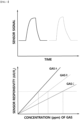
- FIG. 1 illustrates a selectivity difficult problem of a chemical resistance-type gas sensor as an example.
- a sensor signal is generated due to a change in resistance of a sensing material of the gas sensor.
- a responsivity of the sensor signal is related not only to a gas species but also to a gas concentration, and as illustrated in a lower view of FIG. 1 , when the gas species changes, a relationship between the gas concentration and the responsivity also changes.
- the sensor signal as illustrated in the upper view of FIG. 1 output as a result of injecting gas A may be confirmed and the responsivity may be obtained from the sensor signal, and the gas concentration may be obtained using a graph of gas A as illustrated in the lower view of FIG. 1 .
- the responsivity may be obtained from the sensor signal, it may not be known whether to apply the responsivity to a graph of gas A graph or a graph of gas B, such it is impossible to determine the gas concentration.
- a method most widely utilized in the related art in order to solve this selectivity problem is to simultaneously measure two or more species of gases using various types of sensor arrays with slightly different responsivities for each gas and identify the gas species from each other through signal processing.
- Korean Patent No. 1852074 (entitled “Electronic Nose System and Method for Gas Classification” and registered on 19 April, 2018 ) relates to a system using various types of sensor arrays that show different reactions depending on a gas species as such, and disclosure a technology of collecting sensor signal data using various types of polymer mixture sensors having interdigitated electrodes, micro-heating elements, and machine membranes included in the sensor arrays and reconstructing distortion data through a learning-based matrix operation to identify gas species.
- An object of the present invention is to provide a gas species identification method of a photoactive gas sensor using variable light irradiation capable of smoothly identifying a gas species without a selectivity difficult problem even with only a single chemical resistance-type gas sensor by irradiating light while periodically changing an amount of light at the time of irradiating the light to the photoactive gas sensor.
- a gas species identification method of a photoactive gas sensor including a sensing material of which a chemical reaction with a target gas is activated by light irradiation and electrical resistance is thus changed, an analysis unit acquiring and analyzing a response sensor signal generated by the sensing material, and a light irradiation unit irradiating light includes: a variable light irradiating step of irradiating light to the sensing material with a waveform of a predetermined light irradiation signal so that an amount of irradiated light varies over time by the light irradiation unit; a gas sensing step of activating a chemical reaction of the sensing material with the target gas by variable light irradiation to generate the response sensor signal; and a gas species identifying step of identifying a gas species of the target gas on the basis of a pre-stored waveform sample database for a waveform of the sensor signal according to the gas species by the analysis unit.
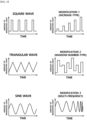
- the light in the variable light irradiating step, may be irradiated with at least one waveform selected among a square wave, a triangular wave, a sine wave, an increase-type square wave, a random number-type square wave, and a multi-frequency sine wave.
- variable light may be irradiated to a pre-selected sample gas with a waveform of a pre-selected light irradiation signal to collect waveform samples of a sensor signal for the sample gas, thereby configuring a waveform sample database, and the gas species of the target gas may be identified on the basis of the waveform sample database of the sensor signal according to the gas species.
- the sensor signal measured as the function according to time may be converted into a frequency spectrum through Fourier transform, and the gas species of the target gas may be identified using the frequency spectrum.
- the gas species of the target gas may be identified using at least one method selected among principal component analysis (PCA), a support vector machine (SVM), an artificial neural network (ANN), and a deep neural network (DNN).
- PCA principal component analysis
- SVM support vector machine
- ANN artificial neural network
- DNN deep neural network
- the present invention in irradiating light to a chemical resistance-type gas sensor that uses a photoactive manner of activating a gas reaction by irradiating the light, unlike driving a light source in a constant amount of irradiated light that is generally conducted, it is possible to smoothly identify a gas species without a selectivity difficult problem with only a single chemical resistance-type gas sensor through variable light irradiation which irradiates light while periodically changing an amount of light.
- the present invention is possible to smoothly identify a plurality of gas species in spite of using only a single chemical resistance-type gas sensor fit for several conditions for a mobile device, such as low power, miniaturization, high sensitivity, a low cost, and productivity, and thus, the present invention is very suitable for being applied to a mobile air monitoring device capable of measuring air pollution at various places.
- an existing sensor device may be utilized by changing only a light irradiation method without specially changing a configuration of the existing sensor device, and usability and compatibility are very excellent.
- a photoactive gas sensor of chemical resistance-type gas sensors is used.
- the photoactive gas sensor is a sensor sensing a target gas using a change in a sensor signal due to a change in resistance in accordance with activation of a chemical reaction with the target gas by light irradiation.
- the photoactive gas sensor basically includes a sensing material, an analysis unit, and a light irradiation unit.
- the sensing material refers to a material of which a chemical reaction with the target gas is activated by light irradiation and electrical resistance is thus changed, and is a well-known material widely used in the photoactive gas sensor, and thus, is not particularly limited in the present specification.
- the analysis unit serves to acquire and analyze a response sensor signal generated by the sensing material.
- a chemical reaction occurs between the sensing material and the target gas.
- such a chemical reaction is further activated by light irradiation.
- the sensor signal is electrical resistance of the sensing material, and as the sensing material chemically changes as such, the electrical resistance, that is, the sensor signal also changes. That is, it may be known whether or not the target gas has been sensed according to whether or the sensor signal has changed, and a concentration or the like of the target gas may also be known using how much the sensor signal has changed.
- the light irradiation unit may be any device as long as it may irradiate light, but since the light irradiation unit should be able to appropriately irradiate light of a desired wavelength, a light emitting diode (LED), a lamp, an electroluminescence element, or the like, having a specific emission wavelength between 250 and 450 nm is generally used as the light irradiation unit.
- a light emitting diode LED
- a lamp an electroluminescence element, or the like, having a specific emission wavelength between 250 and 450 nm is generally used as the light irradiation unit.
- the sensing material and the analysis unit should be necessarily configured as an integrated device, but the light irradiation unit may be formed integrally with an assembly of the sensing material and the analysis unit (internal light source manner) or is not necessarily formed integrally with the assembly of the sensing material and the analysis unit and may be formed as a separate device from the assembly of the sensing material and the analysis unit (external light source manner).
- Such a photoactive gas sensor is very suitable for being utilized in a mobile air monitoring device because it is significantly fit for several conditions for a mobile device, such as low power, miniaturization, high sensitivity, a low cost, and productivity, but responds to all of various species of gases as described above, and thus, there is a limitation that there is a selectivity difficult problem that it is not possible to identify which gas has been sensed with only a single sensor signal.
- the photoactive sensor is driven using variable light irradiation which irradiates light while periodically changing an amount of light, unlike driving a light source in a constant amount of irradiated light that is generally conducted.
- a chemical reaction of the sensing material with the target gas is activated by the light irradiation, and accordingly, electrical resistance is changed, such that a sensor signal is generated.
- a chemical reaction rate on a surface of the sensing material is different depending on a gas species, and thus, a transient aspect of the sensor signal appears differently for each gas species as an amount of irradiated light is varied.
- the present invention may identify a gas species even with only a single sensor signal using this principle.
- the gas species identification method of a photoactive gas sensor according to the present invention may include a variable light irradiating step, a gas sensing step, and a gas species identifying step. Each step will be described in detail below.
- the light irradiation unit irradiates light to the sensing material with a waveform of a predetermined light irradiation signal so that an amount of irradiated light varies over time.
- the photoactive gas sensor according to the related art has used a manner of maintaining a constant amount of irradiated light, but in the present invention, an amount of irradiated light variously varies with time.
- FIG. 2 illustrates several examples of various variable light irradiation forms according to the present invention, and illustrates a square wave, a triangular wave, a sine wave, an increase-type square wave, a random number-type square wave, and a multi-frequency sine wave.
- a waveform having any form may be used as a waveform of a light irradiation signal as long as it is a waveform that enables a transient aspect of a sensor signal according to a gas species to be recognized better, and the present invention is not limited to FIG. 2 .
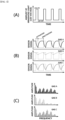
- FIG. 3 illustrates signal processing processes of a gas sensor by a variable light irradiation method according to the present invention
- FIG. 3A illustrates an example in a case where the light irradiation signal has a square waveform.
- the sensor signal may be obtained as an electrical resistance value of the sensing material, and when an amount of irradiated light increases, the sensor signal decreases due to generation of a photocurrent and when the amount of irradiated light decreases, the sensor signal increases due to a decrease in the photocurrent. In this case, a degree and a speed of the sensor signal increase/decrease in a specific gas atmosphere are changed.
- 3B illustrates an example in which all of waveforms of gas A, gas B, and gas C appear differently even through variable light irradiation according to the light irradiation signal as illustrated in FIG. 3A is performed. That is, since the chemical reaction rate on the surface of the sensing material is different depending on the gas species, the transient aspect of the sensor signal appears differently for each gas species as the amount of irradiated light is varied, and as described above, in the present invention, the gas species of the target gas is identified using this principle.
- the analysis unit identifies the gas species of the target gas on the basis of a pre-stored waveform sample database for a waveform of the sensor signal according to the gas species.
- a waveform sample of a sensor signal for a pre-selected sample gas may be obtained by irradiating variable light to the pre-selected sample gas with a waveform of a pre-selected light irradiation signal using the principle that the transient aspect of the sensor signal appears differently for each gas species as described above, and it may be identified which gas a newly sensed unconfirmed target gas is by comparing a waveform of a sensor signal of the unconfirmed target gas with the wavelength sample described above.
- FIG. 3 For example, in a laboratory where all conditions are known and all environments may be controlled, when variable light irradiation is made according to a light irradiation signal having a square waveform as illustrated in FIG. 3A , waveforms of different sensor signals appear for each of gas A, gas B, and gas C, as illustrated in FIG. 3B .
- a form of the light irradiation signal is a "square wave” and which waveforms of sensor signals of "gas A”, "gas B", and “gas C" appear, and waveform samples of these sensor signals may be collected for various desired gases to configure a waveform sample database.
- a gas species of the target gas may be identified on the basis of this database.
- FIG. 3C illustrates that sensor signals measured as a function according to time of each of gas A, gas B, and gas C illustrated in FIG. 3B are converted into frequency spectra through Fourier transform.
- FIGS. 4A to 4C are views of experimental examples illustrating division of ethanol and hydrogen sulfide by the variable light irradiation method according to the present invention.
- This is a process of configuring a waveform sample database of sensor signals.
- a light irradiation signal having an increase-type square waveform was applied to a photoactive gas sensor disposed in an atmosphere of ethanol (8 ppm) and hydrogen sulfide (4 ppm) at a period of 10 seconds as illustrated in FIG. 4A .
- sensor signals appeared in response to the light irradiation signal of FIG. 4A , and sensor signal graphs for each of ethanol and hydrogen sulfide were obtained as illustrated in FIG. 4B .
- FIG. 4A is a process of configuring a waveform sample database of sensor signals.
- FIG. 4C is graphs obtained by transforming the sensor signals having a form of a function according to time illustrated in FIG. 4B into frequency spectra through Fourier transform. It may be intuitively seen from FIGS. 4B and 4C that forms of the sensor signals and the frequency spectra in each of ethanol and hydrogen sulfide are very different from each other. Only examples of ethanol and hydrogen sulfide have been illustrated in FIG. 4 , but sensor signal samples may be made for various gas species as desired in such a manner to configure a database.
- an unconfirmed target gas that is, a gas species of the unconfirmed target gas
- various machine learning techniques such as principal component analysis (PCA), a support vector machine (SVM), an artificial neural network (ANN), and a deep neural network (DNN) may be used.
- PCA principal component analysis
- SVM support vector machine
- ANN artificial neural network
- DNN deep neural network
- FIG. 5A An upper view of FIG. 5A illustrates a pattern learning process using such database construction and machine learning technique, and in the upper view of FIG. 5A , a deep neural network is used as an example.
- frequency spectra of sensor signals for each of various gases such as gas A, gas B, and gas C may be collected to configure a database, after a pattern is learned using a deep neural network, a gas species of the unconfirmed target gas may be now identified.
- a lower view of FIG. 5A illustrates a process of predicting and identifying a gas species in real time by comparing and analyzing the unconfirmed target gas in a state in which the database is constructed and the pattern is learned as described above.
- a frequency spectrum of the sensor signal is input to a system in a state in which it is not known which gas the target gas is, it may be identified which gas the unconfirmed target gas is through machine learning pattern recognition.
- a frequency spectrum of "gas A” was used as a frequency spectrum of a "target gas” in an unconfirmed state as it is in the upper view of FIG. 5A for easy understanding, and it is illustrated in the lower view of FIG. 5A that it is identified that the frequency spectrum of the "target gas” in the unconfirmed state is the frequency spectrum of "gas A" through pattern recognition.
- FIG. 5B illustrates an example in which identification of three species of gases, that is, ethanol, hydrogen sulfide, and air, is performed using the database constructed through the process of FIGS. 4A to 4C .
- FIG. 5B illustrates a confusion matrix between a predicted gas species predicted through real-time prediction and an actual gas species actually used as an unconfirmed target gas.
- the gas species identification method according to the present invention is used, such that even though only a single chemical resistance-type (photoactive) gas sensor is used, decision accuracy of ethanol is 96%, decision accuracy of hydrogen sulfide is 93%, decision accuracy of air is 85%, and thus, average decision accuracy is 91%, which is very excellent.
- the gas species identification method of a photoactive gas sensor using variable light irradiation according to the present invention may identify the gas species smoothly without a selectivity difficult problem only with only one photoactive gas sensor.
- a gas species identification function may be excellently implemented even though the sensor device includes only a single gas sensor, by applying the gas species identification method of a photoactive gas sensor using variable light irradiation according to the present invention.
- the senor device does not need to be necessarily limited to including only a single gas sensor. That is, the sensor device may also include a plurality of gas sensors, and in this case, it may be expected that more various gas species may be more accurately identified by collecting and further analyzing gas species identification results of each of the plurality of gas sensors.
- present invention is not limited to the embodiments described above, and may be applied to various fields.
- present invention may be variously modified by those skilled in the art to which the present invention pertains without departing from the gist of the present invention claimed in the claims.
- the present invention it is possible to smoothly identify a gas species without a selectivity difficult problem with only a single chemical resistance-type gas sensor through variable light irradiation that irradiates light while periodically changing an amount of light. Therefore, the present invention is advantageous in miniaturization and cost reduction of a device, and is particularly suitable for being applied to a mobile air monitoring device.
Landscapes
- Chemical & Material Sciences (AREA)
- Health & Medical Sciences (AREA)
- Life Sciences & Earth Sciences (AREA)
- Engineering & Computer Science (AREA)
- Physics & Mathematics (AREA)
- General Physics & Mathematics (AREA)
- Pathology (AREA)
- Analytical Chemistry (AREA)
- Biochemistry (AREA)
- General Health & Medical Sciences (AREA)
- Immunology (AREA)
- Chemical Kinetics & Catalysis (AREA)
- Electrochemistry (AREA)
- Combustion & Propulsion (AREA)
- Food Science & Technology (AREA)
- Medicinal Chemistry (AREA)
- Microelectronics & Electronic Packaging (AREA)
- Power Engineering (AREA)
- Plasma & Fusion (AREA)
- Investigating Or Analysing Materials By Optical Means (AREA)
- Investigating Or Analyzing Materials By The Use Of Fluid Adsorption Or Reactions (AREA)
Applications Claiming Priority (2)
| Application Number | Priority Date | Filing Date | Title |
|---|---|---|---|
| KR1020200168210A KR102456291B1 (ko) | 2020-12-04 | 2020-12-04 | 가변광조사를 이용한 광활성 가스센서의 가스종 식별방법 |
| PCT/KR2021/017852 WO2022119272A1 (ko) | 2020-12-04 | 2021-11-30 | 가변광조사를 이용한 광활성 가스센서의 가스종 식별방법 |
Publications (2)
| Publication Number | Publication Date |
|---|---|
| EP4257962A1 true EP4257962A1 (de) | 2023-10-11 |
| EP4257962A4 EP4257962A4 (de) | 2024-10-30 |
Family
ID=81854233
Family Applications (1)
| Application Number | Title | Priority Date | Filing Date |
|---|---|---|---|
| EP21900960.2A Pending EP4257962A4 (de) | 2020-12-04 | 2021-11-30 | Verfahren zur identifizierung von gasspezies eines photoaktiven gassensors unter verwendung von variabler lichtstrahlung |
Country Status (4)
| Country | Link |
|---|---|
| US (1) | US20240035981A1 (de) |
| EP (1) | EP4257962A4 (de) |
| KR (1) | KR102456291B1 (de) |
| WO (1) | WO2022119272A1 (de) |
Family Cites Families (10)
| Publication number | Priority date | Publication date | Assignee | Title |
|---|---|---|---|---|
| KR100463677B1 (ko) * | 2002-04-03 | 2004-12-29 | 노봉수 | 전자코를 이용하여 방사선 조사된 식용육의 휘발성화합물을 감지하는 방법 |
| KR100747767B1 (ko) * | 2005-05-31 | 2007-08-08 | 한국생산기술연구원 | 유해가스 동시 측정용 시분할 다중 측정 시스템 |
| JP4820306B2 (ja) * | 2007-01-26 | 2011-11-24 | 矢崎総業株式会社 | ガス識別装置 |
| DE102009055320B4 (de) * | 2009-12-24 | 2011-09-01 | Humedics Gmbh | Messvorrichtung und Verfahren zur Untersuchung eines Probegases mittels Infrarot-Absorptionsspektroskopie |
| US9753000B2 (en) * | 2011-06-08 | 2017-09-05 | Alpha Mos S.A. | Sensitivity and selectivity of chemoresistor type gas sensors |
| JP6731710B2 (ja) * | 2015-08-31 | 2020-07-29 | 新コスモス電機株式会社 | ガス分析システム、及び、ガス分析方法 |
| EP3163295B1 (de) * | 2015-11-02 | 2020-09-30 | Alpha M.O.S. | System und verfahren zur charakterisierung einer gasprobe |
| KR101852074B1 (ko) | 2016-11-29 | 2018-04-25 | 단국대학교 산학협력단 | 가스 분류를 위한 전자코 시스템 및 방법 |
| KR20180064112A (ko) | 2016-12-05 | 2018-06-14 | 엘지이노텍 주식회사 | 반도체 소자 및 감지 장치 |
| TWI877005B (zh) * | 2019-04-05 | 2025-03-11 | 美商H2Scan公司 | 測量流體環境中氣體濃度的方法 |
-
2020
- 2020-12-04 KR KR1020200168210A patent/KR102456291B1/ko active Active
-
2021
- 2021-11-30 WO PCT/KR2021/017852 patent/WO2022119272A1/ko not_active Ceased
- 2021-11-30 US US18/265,379 patent/US20240035981A1/en active Pending
- 2021-11-30 EP EP21900960.2A patent/EP4257962A4/de active Pending
Also Published As
| Publication number | Publication date |
|---|---|
| US20240035981A1 (en) | 2024-02-01 |
| EP4257962A4 (de) | 2024-10-30 |
| WO2022119272A1 (ko) | 2022-06-09 |
| KR102456291B1 (ko) | 2022-10-20 |
| KR20220078926A (ko) | 2022-06-13 |
Similar Documents
| Publication | Publication Date | Title |
|---|---|---|
| Yuan et al. | Detection and identification of volatile organic compounds based on temperature-modulated ZnO sensors | |
| Wu et al. | Elucidating Electrocatalytic Oxygen Reduction Kinetics via Intermediates by Time‐Dependent Electrochemiluminescence | |
| Vergara et al. | Quantitative gas mixture analysis using temperature-modulated micro-hotplate gas sensors: Selection and validation of the optimal modulating frequencies | |
| Luo et al. | Pulse-driven MEMS gas sensor combined with machine learning for selective gas identification | |
| Kim et al. | Ultralow-power single-sensor-based E-nose system powered by duty cycling and deep learning for real-time gas identification | |
| Li et al. | Discriminating gas molecules at room temperature by UV light modulation (ULM) of nonselective metal oxide sensors | |
| Mu et al. | Inkjet-printed MOS-based MEMS sensor array combined with one-dimensional convolutional neural network algorithm for identifying indoor harmful gases | |
| Zhang et al. | Several ML algorithms and their feature vector design for gas discrimination and concentration measurement with an ultrasonically catalyzed MOX sensor | |
| Dattoli et al. | Tin oxide nanowire sensor with integrated temperature and gate control for multi-gas recognition | |
| Jo et al. | Fast-response and low-power self-heating gas sensor using metal/metal oxide/metal (MMOM) structured nanowires | |
| Zhuang et al. | A deep learning approach for gas sensor data regression: Incorporating surface state model and GRU-based model | |
| KR101306985B1 (ko) | 가스감지 센서 및 그의 형성방법 | |
| Kalinowski et al. | Efficiency of linear and non-linear classifiers for gas identification from electrocatalytic gas sensor | |
| Meng et al. | Recognition algorithm for detection of precursor chemicals by semiconductor gas sensor array under dynamic measurement | |
| Li et al. | Prompt electronic discrimination of gas molecules by self-heating temperature modulation | |
| Zhang et al. | Strategy to expedite gas sensor calibration based on cyclic temperature operation and data augmentation | |
| EP4257962A1 (de) | Verfahren zur identifizierung von gasspezies eines photoaktiven gassensors unter verwendung von variabler lichtstrahlung | |
| CN112986332A (zh) | 一种基于动态温度调制的VOCs检测方法及系统 | |
| WO2021061046A1 (en) | An ai sensing device for a broad spectrum of gas and vapor detection | |
| Sadredini et al. | Intensity modulation of UV light in gas sensor array to discriminate several analytes at room temperature | |
| Globus et al. | Sub-terahertz resonance spectroscopy of biological macromolecules and cells | |
| Naeimi Pour et al. | Gas sensor array assisted with UV illumination for discriminating several analytes at room temperature | |
| Vergara et al. | Gas sensor drift mitigation using classifier ensembles | |
| Luo et al. | Identification of H2 and NH3 gases using calorimetric signals and transient response through machine learning | |
| CN111624158A (zh) | 一种在线激光脉冲超快动力学检测设备及其应用方法 |
Legal Events
| Date | Code | Title | Description |
|---|---|---|---|
| STAA | Information on the status of an ep patent application or granted ep patent |
Free format text: STATUS: THE INTERNATIONAL PUBLICATION HAS BEEN MADE |
|
| PUAI | Public reference made under article 153(3) epc to a published international application that has entered the european phase |
Free format text: ORIGINAL CODE: 0009012 |
|
| STAA | Information on the status of an ep patent application or granted ep patent |
Free format text: STATUS: REQUEST FOR EXAMINATION WAS MADE |
|
| 17P | Request for examination filed |
Effective date: 20230630 |
|
| AK | Designated contracting states |
Kind code of ref document: A1 Designated state(s): AL AT BE BG CH CY CZ DE DK EE ES FI FR GB GR HR HU IE IS IT LI LT LU LV MC MK MT NL NO PL PT RO RS SE SI SK SM TR |
|
| DAV | Request for validation of the european patent (deleted) | ||
| DAX | Request for extension of the european patent (deleted) | ||
| A4 | Supplementary search report drawn up and despatched |
Effective date: 20240927 |
|
| RIC1 | Information provided on ipc code assigned before grant |
Ipc: G01N 33/00 20060101ALI20240923BHEP Ipc: G01N 27/12 20060101AFI20240923BHEP |