EP4257230A2 - Method for quantifying amine compound constituting separator active layer prior to preparation of separator active layer, method for quantifying polyamide or unreacted amine compound in separator active layer, and method for setting preparation conditions of separator active layer or establishment standards for preparation conditions of separator active layer - Google Patents
Method for quantifying amine compound constituting separator active layer prior to preparation of separator active layer, method for quantifying polyamide or unreacted amine compound in separator active layer, and method for setting preparation conditions of separator active layer or establishment standards for preparation conditions of separator active layer Download PDFInfo
- Publication number
- EP4257230A2 EP4257230A2 EP23188853.8A EP23188853A EP4257230A2 EP 4257230 A2 EP4257230 A2 EP 4257230A2 EP 23188853 A EP23188853 A EP 23188853A EP 4257230 A2 EP4257230 A2 EP 4257230A2
- Authority
- EP
- European Patent Office
- Prior art keywords
- active layer
- amine compound
- composition including
- support
- membrane active
- Prior art date
- Legal status (The legal status is an assumption and is not a legal conclusion. Google has not performed a legal analysis and makes no representation as to the accuracy of the status listed.)
- Pending
Links
Images


Classifications
-
- B—PERFORMING OPERATIONS; TRANSPORTING
- B01—PHYSICAL OR CHEMICAL PROCESSES OR APPARATUS IN GENERAL
- B01D—SEPARATION
- B01D65/00—Accessories or auxiliary operations, in general, for separation processes or apparatus using semi-permeable membranes
- B01D65/10—Testing of membranes or membrane apparatus; Detecting or repairing leaks
-
- B—PERFORMING OPERATIONS; TRANSPORTING
- B01—PHYSICAL OR CHEMICAL PROCESSES OR APPARATUS IN GENERAL
- B01D—SEPARATION
- B01D69/00—Semi-permeable membranes for separation processes or apparatus characterised by their form, structure or properties; Manufacturing processes specially adapted therefor
- B01D69/10—Supported membranes; Membrane supports
- B01D69/106—Membranes in the pores of a support, e.g. polymerized in the pores or voids
-
- B—PERFORMING OPERATIONS; TRANSPORTING
- B01—PHYSICAL OR CHEMICAL PROCESSES OR APPARATUS IN GENERAL
- B01D—SEPARATION
- B01D69/00—Semi-permeable membranes for separation processes or apparatus characterised by their form, structure or properties; Manufacturing processes specially adapted therefor
- B01D69/10—Supported membranes; Membrane supports
- B01D69/107—Organic support material
-
- B—PERFORMING OPERATIONS; TRANSPORTING
- B01—PHYSICAL OR CHEMICAL PROCESSES OR APPARATUS IN GENERAL
- B01D—SEPARATION
- B01D69/00—Semi-permeable membranes for separation processes or apparatus characterised by their form, structure or properties; Manufacturing processes specially adapted therefor
- B01D69/10—Supported membranes; Membrane supports
- B01D69/107—Organic support material
- B01D69/1071—Woven, non-woven or net mesh
-
- B—PERFORMING OPERATIONS; TRANSPORTING
- B01—PHYSICAL OR CHEMICAL PROCESSES OR APPARATUS IN GENERAL
- B01D—SEPARATION
- B01D69/00—Semi-permeable membranes for separation processes or apparatus characterised by their form, structure or properties; Manufacturing processes specially adapted therefor
- B01D69/12—Composite membranes; Ultra-thin membranes
- B01D69/125—In situ manufacturing by polymerisation, polycondensation, cross-linking or chemical reaction
- B01D69/1251—In situ manufacturing by polymerisation, polycondensation, cross-linking or chemical reaction by interfacial polymerisation
-
- B—PERFORMING OPERATIONS; TRANSPORTING
- B01—PHYSICAL OR CHEMICAL PROCESSES OR APPARATUS IN GENERAL
- B01D—SEPARATION
- B01D71/00—Semi-permeable membranes for separation processes or apparatus characterised by the material; Manufacturing processes specially adapted therefor
- B01D71/06—Organic material
- B01D71/56—Polyamides, e.g. polyester-amides
-
- G—PHYSICS
- G01—MEASURING; TESTING
- G01N—INVESTIGATING OR ANALYSING MATERIALS BY DETERMINING THEIR CHEMICAL OR PHYSICAL PROPERTIES
- G01N1/00—Sampling; Preparing specimens for investigation
- G01N1/28—Preparing specimens for investigation including physical details of (bio-)chemical methods covered elsewhere, e.g. G01N33/50, C12Q
- G01N1/2813—Producing thin layers of samples on a substrate, e.g. smearing, spinning-on
-
- G—PHYSICS
- G01—MEASURING; TESTING
- G01N—INVESTIGATING OR ANALYSING MATERIALS BY DETERMINING THEIR CHEMICAL OR PHYSICAL PROPERTIES
- G01N23/00—Investigating or analysing materials by the use of wave or particle radiation, e.g. X-rays or neutrons, not covered by groups G01N3/00 – G01N17/00, G01N21/00 or G01N22/00
- G01N23/20—Investigating or analysing materials by the use of wave or particle radiation, e.g. X-rays or neutrons, not covered by groups G01N3/00 – G01N17/00, G01N21/00 or G01N22/00 by using diffraction of the radiation by the materials, e.g. for investigating crystal structure; by using scattering of the radiation by the materials, e.g. for investigating non-crystalline materials; by using reflection of the radiation by the materials
- G01N23/20091—Measuring the energy-dispersion spectrum [EDS] of diffracted radiation
-
- B—PERFORMING OPERATIONS; TRANSPORTING
- B01—PHYSICAL OR CHEMICAL PROCESSES OR APPARATUS IN GENERAL
- B01D—SEPARATION
- B01D2323/00—Details relating to membrane preparation
- B01D2323/50—Control of the membrane preparation process
-
- B—PERFORMING OPERATIONS; TRANSPORTING
- B01—PHYSICAL OR CHEMICAL PROCESSES OR APPARATUS IN GENERAL
- B01D—SEPARATION
- B01D2325/00—Details relating to properties of membranes
- B01D2325/04—Characteristic thickness
-
- B—PERFORMING OPERATIONS; TRANSPORTING
- B01—PHYSICAL OR CHEMICAL PROCESSES OR APPARATUS IN GENERAL
- B01D—SEPARATION
- B01D61/00—Processes of separation using semi-permeable membranes, e.g. dialysis, osmosis or ultrafiltration; Apparatus, accessories or auxiliary operations specially adapted therefor
- B01D61/02—Reverse osmosis; Hyperfiltration ; Nanofiltration
- B01D61/025—Reverse osmosis; Hyperfiltration
-
- G—PHYSICS
- G01—MEASURING; TESTING
- G01N—INVESTIGATING OR ANALYSING MATERIALS BY DETERMINING THEIR CHEMICAL OR PHYSICAL PROPERTIES
- G01N2223/00—Investigating materials by wave or particle radiation
- G01N2223/60—Specific applications or type of materials
- G01N2223/633—Specific applications or type of materials thickness, density, surface weight (unit area)
Definitions
- the present specification relates to a method for quantifying an amine compound forming a membrane active layer before preparing the membrane active layer, a method for quantifying polyamide or an unreacted amine compound in a membrane active layer, and method for determining setting criteria for a manufacturing condition of a membrane active layer or a method for setting a manufacturing condition.
- a polyamide layer is used as an active layer of a membrane.
- a reverse osmosis (RO) layer an active layer determining performance of a reverse osmosis membrane, is formed through an interfacial polymerization reaction between two types of monomers consecutively coated on an ultrafiltration (UF) layer, a support layer.
- the reverse osmosis layer is formed differently depending on how much the first coated monomer is present on the ultrafiltration layer surface, a reaction area of the interfacial polymerization, and this determines performance of a reverse osmosis membrane.
- the amount of a monomer participating in reverse osmosis layer formation is estimated by measuring a difference in the total weight of a sample before and after coating the monomer, however, this cannot be a measurement method to predict reverse osmosis layer formation since the amount of the monomer present on an ultrafiltration layer surface, a reaction area of the interfacial polymerization, may not be identified.
- an analysis method to find out a monomer content and dispersion information on a surface of a support, a reaction area for forming an active layer of a membrane.
- the present disclosure is directed to providing a method for quantifying an amine compound forming a membrane active layer before preparing the membrane active layer, a method for quantifying polyamide or an unreacted amine compound in a membrane active layer, and a method for determining setting criteria for a manufacturing condition of a membrane active layer or a method for setting a manufacturing condition.
- One embodiment of the present disclosure provides a method for quantifying an amine compound forming a membrane active layer before forming the membrane active layer, the method including coating a composition including an amine compound on a support; and analyzing distribution of the amine compound by depth from the coated surface on the support using an energy dispersive spectrometer (EDS) method.
- EDS energy dispersive spectrometer
- Another embodiment of the present disclosure provides a method for quantifying polyamide or an unreacted amine compound in a membrane active layer, the method including coating a composition including an amine compound on a support;
- Another embodiment of the present disclosure provides a method for determining setting criteria for a manufacturing condition of a membrane active layer, the method including a) coating a composition including an amine compound on a support using the method of the embodiment described above and then quantifying distribution of the amine compound by depth;
- Another embodiment of the present disclosure provides a method for determining setting criteria for a manufacturing condition of a membrane active layer, the method including f) preparing a membrane active layer using the method of the embodiment described above and then quantifying distribution of polyamide or an unreacted amine compound in the membrane active layer by depth;
- Another embodiment of the present disclosure provides a method for setting a manufacturing condition of a membrane active layer, the method including j) coating a composition including an amine compound on a support;
- Another embodiment of the present disclosure provides a method for setting a manufacturing condition of a membrane active layer, the method including m) coating a composition including an amine compound on a support and then preparing a membrane active layer by interfacial polymerizing polyamide through coating a composition including an acyl halide compound on the surface of the support on which the composition including an amine compound is coated;
- the EDS method of the above-described embodiments uses a plurality of line scans.
- an analysis condition capable of specifying and detecting nitrogen, a constituent element of an amine compound for forming an active layer of a membrane is established through an EDS component analysis method, and information on the amine compound dispersion can be obtained through trancing the nitrogen element.
- limitation of difficulty in obtaining a line profile of a lightweight element due to a low S/N (ratio of second signal with respect to nitrogen element) can be improved through a plurality of line scan methods obtaining an average value of a plurality of line profiles, that is, a multi-line method.
- information on dispersion may also be obtained as well as information on the amount of the amine compound in the support.
- a measurement method capable of finding out the amount of an amine compound that can form an active layer of a membrane by actually participating in a reaction on a support surface through an EDS component analysis using a plurality of line scans is developed.
- the amount of the polyamide or distribution of the unreacted amine compound by depth can be quantified.
- a description of one member being placed "on" another member includes not only a case of the one member adjoining the another member but a case of still another member being present between the two members.
- a membrane includes an active layer including polyamide unless mentioned otherwise, and may be a water treatment or gas membrane. According to one embodiment, a membrane of the present specification is a reverse osmosis membrane.
- a first embodiment of the present disclosure relates to a method for quantifying an amine compound forming a membrane active layer before forming the membrane active layer, the method including coating a composition including an amine compound on a support; and analyzing distribution of the amine compound by depth from the coated surface on the support using an energy dispersive spectrometer (EDS) method.
- EDS energy dispersive spectrometer
- An EDS method refers to a method of, by irradiating a high energy electron beam on a specimen to have the beam reacting with the specimen, analyzing components of the specimen using a specific X-ray among various signals having structure and chemical composition information of the specimen.
- the EDS method includes preparing a cross-section using microtoming for a specimen subject to analysis and coating a conductive material for providing conductivity.
- the conductive material is not particularly limited, but may use Pt coating.
- technologies known in the art may be used within the scope for conducting the EDS method.
- an acceleration voltage may be set at 5 Kv, and a current may be set within a range of 68 pA to 77 pA.
- the nitrogen element that may quantify the amount of the amine compound may be analyzed.
- the EDS method may analyze distribution of the amine compound by depth from the coated surface on the support rather than the total amount of the amine compound present on the support. Therefore, of the amine compound, only the amount participating in the actual polymerization and forming an active layer of a membrane may be analyzed.
- the EDS method may preferably use a plurality of line scans.
- a clearer nitrogen element profile may be obtained by using an average value of a plurality of line scans rather than using several points or one line and thereby reducing a peak noise in the EDN line scan.
- each line of the plurality of line scans may have 400 points or more, more preferably 450 points or more and even more preferably 500 points or more. As the number of points included in each line increases, accuracy that identifies distribution of the amine compound by depth increases, and in the above-mentioned range, scan results useful for setting a manufacturing condition of a membrane active layer may be obtained.
- the EDS method may scan 5 times or more, preferably 7 times or more, and even more preferably 10 times or more using 10 lines or more, preferably 15 lines or more and even more preferably 20 lines or more.
- accuracy that identifies distribution of the amine compound by depth increases as the number of lines increases, and in the above-mentioned range, scan results useful for setting a manufacturing condition of a membrane active layer may be obtained.
- the depth of the scan may be set as a region of interest by those skilled in the art.
- a second embodiment of the present disclosure provides a method for quantifying polyamide or an unreacted amine compound in a membrane active layer, the method including coating a composition including an amine compound on a support; preparing a membrane active layer by interfacial polymerizing polyamide through coating a composition including an acyl halide compound on the surface of the support on which the composition including an amine compound is coated; and analyzing distribution of the polyamide or the unreacted amine compound by depth from the surface on the support on which the polyamide is interfacial polymerized using an energy dispersive spectrometer (EDS) method.
- EDS energy dispersive spectrometer
- the second embodiment relates to a method for quantifying polyamide or an unreacted amine compound in a membrane active layer after forming the membrane active layer.
- a process condition after the coating of the composition including an amine compound on the amount of the polyamide or the unreacted amine compound may be identified.
- effects of a condition for the coating of the composition including an amine compound on the amount of the polyamide or the unreacted amine compound may also be identified.
- the condition of the EDS method is the same as the descriptions provided above relating to the first embodiment.
- a third embodiment of the present disclosure provides a method for determining setting criteria for a manufacturing condition of a membrane active layer, the method including a) coating a composition including an amine compound on a support using the method of the first embodiment described above and then quantifying distribution of the amine compound by depth; b) preparing a membrane active layer by interfacial polymerizing polyamide through coating a composition including an acyl halide compound on the surface of the support on which the composition including an amine compound is coated; c) deriving a first evaluation result by evaluating performance of the prepared membrane active layer; d) deriving a second or higher evaluation result by repeating a) to d) one or more times except that at least a part of the condition in the coating of a composition including an amine compound on a support in a) is adjusted to be different from the above-described a); and e) determining distribution of the amine compound by depth from the coated surface on the support in order to prepare a membrane active layer with better performance by comparing the first evaluation result
- this may be setting criteria for a manufacturing condition of the membrane active layer.
- performance of a finally prepared membrane active layer obtained by changing a manufacturing condition of the membrane active layer may be predicted, and therefore, a manufacturing condition of the membrane active layer may be readily set.
- different conditions between a) and d) may include any of a material, a structure or a manufacturing process condition of each layer, and for example, may include at least one of a type of the support, a moisture content of the support, a solid content of the composition including an amine compound, a coating amount of the composition including an amine compound, a method for coating the composition including an amine compound, and presence of additives in the support or the composition including an amine compound.
- a fourth embodiment of the present disclosure provides a method for determining setting criteria for a manufacturing condition of a membrane active layer, the method including f) preparing a membrane active layer using the method of the embodiment described above and then quantifying distribution of polyamide or an unreacted amine compound in the membrane active layer by depth; g) deriving a first evaluation result by evaluating performance of the membrane active layer prepared in f); h) deriving a second or higher evaluation result by repeating f) to h) one or more times after adjusting at least a part of the condition in the preparing of a membrane active layer in f) to be different from the above-described f); and i) determining distribution of the polyamide or the unreacted amine compound in the membrane active layer by depth from the surface on the support on which the polyamide is interfacial polymerized in order to prepare a membrane active layer with better performance by comparing the first evaluation result and the second or higher evaluation result.
- a manufacturing condition of the membrane active layer may be readily set by determining distribution of the polyamide or the unreacted amine compound in the membrane active layer by depth from the surface on the support on which the polyamide is interfacial polymerized as setting criteria for a manufacturing condition of the membrane active layer in order to prepare a membrane active layer with better performance.
- different conditions between f) and h) may include any of a material, a structure or a manufacturing process condition of each layer, and for example, may include at least one of a type of the support; a moisture content of the support; a solid content of the composition including an amine compound; a coating amount of the composition including an amine compound; a method for coating the composition including an amine compound; a solid content of the composition including an acyl halide compound; a coating amount of the composition including an acyl halide compound; a method for coating the composition including an acyl halide compound; the interfacial polymerization condition; the condition of treatment after the interfacial polymerization; and presence of additives in the support, the composition including an amine compound or the composition including an acyl halide compound.
- condition of treatment after the interfacial polymerization includes a drying condition, a post-treatment condition for the active layer after the interfacial polymerization, a washing condition, or a condition for forming an additional layer on the active layer after the interfacial polymerization.
- a fifth embodiment of the present disclosure provides a method for setting a manufacturing condition of a membrane active layer, the method including j) coating a composition including an amine compound on a support; k) analyzing distribution of the amine compound by depth from the coated surface on the support using an energy dispersive spectrometer (EDS) method; and l) determining a manufacturing condition of the membrane active layer as the condition of j) when the value analyzed in k) is in the range of setting criteria of the membrane active layer determined in advance, or, when the value analyzed in k) is outside the range of the criteria determined in advance, conducting j) to l) again after changing at least a part of the condition of j).
- EDS energy dispersive spectrometer
- the fifth embodiment may be used when determining distribution of the amine compound by depth from the coated surface on the support as setting criteria for a manufacturing condition of a membrane active layer.
- the manufacturing condition that may be determined according to the fifth embodiment is not particularly limited as long as it is a composition, a structure or a process condition of the material used up to the coating of a composition including an amine compound on a support, and for example, may include conditions illustrated as different conditions between a) and d) in the third embodiment described above.
- the condition for the EDS method is the same as the descriptions provided above relating to the first embodiment.
- a sixth embodiment of the present disclosure provides a method for setting a manufacturing condition of a membrane active layer, the method including m) coating a composition including an amine compound on a support and then preparing a membrane active layer by interfacial polymerizing polyamide through coating a composition including an acyl halide compound on the surface of the support on which the composition including an amine compound is coated; n) analyzing distribution of the polyamide or the unreacted amine compound by depth from the surface on the support on which the polyamide is interfacial polymerized using an energy dispersive spectrometer (EDS) method; and o) determining a manufacturing condition of the membrane active layer as the condition of m) when the value analyzed in n) is in the range of setting criteria of the membrane active layer determined in advance, or, when the value analyzed in n) is outside the range of the criteria determined in advance, conducting m) to o) again after changing at least a part of the condition of m).
- EDS energy dispersive spectrometer
- the sixth embodiment may be used when determining distribution of the polyamide or the unreacted amine compound in the membrane active layer by depth from the surface on the support on which the polyamide is interfacial polymerized as setting criteria for a manufacturing condition of the membrane active layer.
- the manufacturing condition that may be determined according to the sixth embodiment is not particularly limited as long as it is a composition, a structure or a process condition of the material used up to the preparing of a membrane active layer, and for example, may include conditions illustrated as different conditions between f) and h) in the fourth embodiment described above.
- the condition for the EDS method is the same as the descriptions provided above relating to the first embodiment.
- the support may include a porous support and a polymer support layer.
- materials used as a support of a membrane may be used without limit as the porous support.
- examples thereof may include polyester, polypropylene, nylon, polyethylene or non-woven fabric, but are not limited thereto.
- the porous support is non-woven fabric.
- the porous support may have a thickness of 100 ⁇ m to 200 ⁇ m, however, the thickness is not limited thereto, and may be adjusted as necessary.
- the porous support may preferably have a pore size of 500 nm to 10 ⁇ m, however, the pore size is not limited thereto.
- the thickness of the porous support and the pore size of the porous support may be measured using a digital thickness gauge and a porometer, respectively.
- the polymer support layer may be prepared by coating a hydrophilic polymer solution on the porous support.
- the hydrophilic polymer solution may be prepared by dissolving a hydrophilic polymer in a solvent.
- a hydrophilic polymer polysulfone, polyethersulfone, polycarbonate, polyethylene oxide, polyimide, polyetherimide, polyetheretherketone, polypropylene, polymethylpentene, polymethyl chloride, polyvinylidene fluoride or the like may be used, however, the hydrophilic polymer is not limited thereto. Specifically, the hydrophilic polymer may be polysulfone.
- the solvent may be used without limit as long as it is capable of dissolving a hydrophilic polymer.
- examples thereof may include acetone, acetonitrile, tetrahydrofuran (THF), dimethyl sulfoxide (DMSO), dimethylformamide (DMF), hexamethylphosphoamide (HMPA) and the like, but are not limited thereto.
- the hydrophilic polymer may be included in 10% by weight to 30% by weight based on a total weight of the hydrophilic polymer solution.
- the coating method may use dipping, spray, coating or the like, but is not limited thereto.
- the polymer support layer may have a thickness of 30 ⁇ m to 60 ⁇ m.
- the thickness of the support layer may be measured using a screen observed by a scanning electron microscope (SEM).
- the active layer includes polyamide.
- the active layer may be prepared by interfacial polymerizing a composition including an amine compound and a composition including an acyl halide compound.
- the composition including an amine compound may be an aqueous solution
- the composition including an acyl halide compound may be an organic solution.
- the amine compound may be an aromatic amine compound.
- the active layer may be prepared by interfacial polymerizing an aqueous solution including a compound represented by the following Chemical Formula 1 and an organic solution including an acyl halide compound.
- n is an integer of 0 or 1
- m is an integer of 1 or 2.
- the amine compound may include the compound represented by Chemical Formula 1.
- Chemical Formula 1 m-phenylenediamine, p-phenylenediamine, 2,3-diaminotoluene, 2,4-diaminotoluene, 2,5-diaminotoluene, 2,6-diaminotoluene, 3,4-diaminotoluene, m-toluidine, p-toluidine, o-toluidine or the like may be used, however, the amine compound is not limited thereto.
- a content of the amine compound may be greater than or equal to 0.1% by weight and less than or equal to 20% by weight, preferably from 0.5% by weight to 15% by weight, and more preferably from 1% by weight to 10% by weight based on a total weight of the aqueous solution including an amine compound.
- a more uniform polyamide active layer may be prepared when the amine compound content is in the above-mentioned range.
- the aqueous solution including an amine compound may further include a surfactant.
- the polyamide When interfacial polymerizing the polyamide active layer, the polyamide is quickly prepared at an interface of the aqueous solution layer including an amine compound and the organic solution layer including an acyl halide compound, and herein, the surfactant makes the layer thin and uniform so that the amine compound present in the aqueous solution layer including an amine compound readily migrates to the organic solution layer including an acyl halide compound to prepare a uniform polyamide active layer.
- the surfactant may be selected from among nonionic, cationic, anionic and amphoteric surfactants.
- the surfactant may be selected from among sodium lauryl sulphate (SLS), alkyl ether sulphates, alkyl sulphates alkyl sulphates, olefin sulfonates, alkyl ether carboxylates, sulfosuccinates, aromatic sulfonates, octylphenol ethoxylates, ethoxylated nonylphenols, alkyl poly(ethylene oxide), copolymers of poly(ethylene oxide) and poly(propylene oxide), alkyl polyglucosides such as octyl glucoside or decyl maltoside, aliphatic acid alcohols and alkyl betaines such as cetyl alcohol or oleyl alcohol, cocamide MEA, cocamide DEA, alkyl hydroxyethyldimethylammonium chloride, cetyltrimethylammonium bromide or chloride, hexadecy
- the sodium lauryl sulphate (SLS) is highly soluble in water due to its high hydrophile-lipophile balance (HLB), and by having a high critical micelle concentration (CMC), preparation of the polyamide active layer is not inhibited even when added in excess.
- HLB hydrophile-lipophile balance
- CMC critical micelle concentration
- the surfactant may be added in 0.005% by weight to 0.5% by weight based on a total weight of the aqueous solution including an amine compound.
- a solvent of the aqueous solution including an amine compound may be water, and in the aqueous solution including an amine compound, the remainder excluding the amine compound and the surfactant may be water.
- the aqueous solution including an amine compound may be prepared to a layer of the aqueous solution including an amine compound on the support.
- a method for preparing the aqueous solution layer including an amine compound on the support layer is not particularly limited, and methods capable of preparing the aqueous solution layer including an amine compound on the support layer may be used without limit. Specifically, spraying, coating, dipping, dropping or the like may be used.
- the aqueous solution layer including an amine compound may further conduct removing an aqueous solution including an excess amine compound as necessary.
- the aqueous solution layer including an amine compound prepared on the support layer may be non-uniformly distributed when there are too much of the aqueous solution including an amine compound present on the support layer, and when the aqueous solution including an amine compound is non-uniformly distributed, a non-uniform polyamide active layer may be prepared by subsequent interfacial polymerization.
- the aqueous solution including an excess amine compound is preferably removed after preparing the aqueous solution layer including an amine compound on the support layer.
- a method of removing the aqueous solution including an excess amine compound is not particularly limited, however, methods using a sponge, an air knife, nitrogen gas blowing, natural drying, a compression roll or the like may be used.
- the acyl halide compound is not particularly limited as long as it is capable of being used in polyamide polymerization, but may be an aromatic compound having 2 or 3 carboxylic acid halides.
- trimesoyl chloride isophthaloyl chloride and terephthaloyl chloride
- trimesoyl chloride may be used as the acyl halide compound, and preferably, trimesoyl chloride may be used.
- an organic solvent included in the organic solution including an acyl halide compound preferably does not participate in an interfacial polymerization reaction, and an aliphatic hydrocarbon solvent, for example, one or more types selected from among freons, alkane having 5 to 12 carbon atoms and isoparaffin-based solvents, an alkane mixture material, may be included.
- hexane, heptane, octane, nonane, decane, undecane, dodecane, cyclohexane, IsoPar (Exxon), IsoPar G (Exxon), ISOL-C (SK Chem), ISOL-G (Exxon) or the like may be used, however, the organic solvent is not limited thereto.
- a content of the acyl halide compound may be from 0.05% by weight to 1% by weight, preferably from 0.05% by weight to 0.75% by weight, and more preferably from 0.05% by weight to 0.5% by weight based on a total weight of the organic solution including an acyl halide compound.
- a more uniform polyamide layer may be prepared when the acyl halide compound content is in the above-mentioned range.
- the organic solution including an acyl halide compound may be prepared to a layer of the organic solution including an acyl halide compound.
- a method of preparing the organic solution layer including an acyl halide compound on the aqueous solution layer including an amine compound prepared on the support is not particularly limited, and methods capable of preparing the organic solution layer on the support layer may be used without limit. Specifically, spraying, coating, dipping, dropping or the like may be used.
- the remainder excluding the acyl halide compound may be an organic solvent.
- the active layer may have a thickness of 100 nm to 500 nm.
- the active layer thickness may vary depending on the concentration of the composition for preparing an active layer including the aqueous solution including an amine compound and the organic solution including an acyl halide compound used for preparing the active layer, and the coating condition.
- the active layer thickness may be measured using a screen observed by a scanning electron microscope (SEM). Specifically, a cross section of a 0.2 cm sample is cut through a microtome, platinum (Pt) is coated thereon, and an average value is calculated by measuring thicknesses of the active layer using a scanning electron microscope (SEM).
- SEM scanning electron microscope
- the membrane active layer may be post-treated, or a protective layer may be formed thereon.
- the membrane may be a flat sheet.
- Membranes may have shapes such as flat-sheet, spiral-wound, tube-in-shell or hollow-fiber, however, in one embodiment of the present disclosure, the membrane may be a flat sheet. In another embodiment, the membrane may have a spiral-wound shape.
- a polysulfone solid was introduced to an N,N-dimethylformamide (DMF) solution, and dissolved therein for 12 hours or longer at 80°C to 85°C to obtain a uniform solution.
- a content of the polysulfone solid was 18% by weight.
- This solution was casted to a thickness of 150 ⁇ m on a non-woven fabric (porous support) made of a polyester material and having a thickness of 95 ⁇ m to 100 ⁇ m to prepare a support layer. Then, the casted non-woven fabric was placed in water to prepare a porous polysulfone support layer.
- an aqueous solution including 8% by weight of m-phenylenediamine (mPD), 0.5% by weight of sodium lauryl sulphate (SLS) as a surfactant, and 91.5% by weight of water with respect to a total weight of the aqueous solution including an amine compound was coated to prepare an aqueous solution layer including an amine compound.
- mPD m-phenylenediamine
- SLS sodium lauryl sulphate
- an organic solution including an acyl halide compound including 0.3% by weight of trimesoyl chloride (TMC) and 99.7% by weight of hexane based on a total weight of the organic solution including an acyl halide compound was coated on the aqueous solution layer to prepare an organic solution layer, and by conducting interfacial polymerization, an active layer including polyamide was prepared to a thickness of 250 nm.
- TMC trimesoyl chloride
- the element was analyzed using an EDS (Extreme Oxford) method under a condition of the number of lines of 20, the number of points per line of 500 and the number of scans of 20 times.
- EDS Extreme Oxford
- an acceleration voltage was 5 Kv
- a current was from 68 ⁇ A to 77 ⁇ A.
- a cross section was prepared using microtoming and Pt coating was conducted.
- FIG. 1 is an image of scanning using the EDS method according to the method of Example 1, and is a SEM (JSM-7200F JEOL) image (magnitude 1,500 times) of an object subject to evaluation.
- SEM JSM-7200F JEOL
- FIG. 2 shows a SEM image (magnitude 1,500 times) and an EDS analysis result showing distribution of mPD, the amine compound, on the porous polysulfone support layer.
- mPD distributed in a range of 10 ⁇ m depth from the support surface so as to participate in the interfacial polymerization reaction, and it was seen that these may form polyamide during the interfacial polymerization.
- FIG. 3 An EDS analysis result is shown in FIG. 3 .
- Example 4 After forming the active layer in the reference example, the content of the polyamide and the unreacted amine compound was measured using an EDS method. However, the moisture content measured after preparing the porous polysulfone support layer was adjusted to 30% in Example 3, and the moisture content measured after preparing the porous polysulfone support layer was adjusted to 35% in Example 4. The condition for the EDS is the same as in Example 1. The measurement result of Example 3 is shown at the top of FIG. 4 , and the measurement result of Example 4 is shown at the bottom of FIG. 4 (SEM image magnitude 1,500 times). The part expressed as RO in FIG.
- Example 5 After forming the active layer in the reference example, the content of the polyamide and the unreacted amine compound was measured using an EDS method.
- Example 5 and Example 6 the time of the drying process before conducting the EDS method was varied, and in Example 6, the time of the drying process was relatively long compared to Example 5.
- the condition for the EDS is the same as in Example 1.
- the measurement results of Examples 5 and 6 are shown at the top and the bottom of FIG. 5 , respectively (SEM image magnitude 20,000 times).
- salt rejection of the membrane in FIG. 5 a general method of measuring salt rejection of a reverse osmosis membrane was used. In other words, it is a result of calculating how much salt is removed from an aqueous NaCl solution as a value.
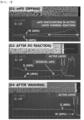
- FIG. 6 shows changes in the peak after preparing the aqueous solution layer including an amine compound (D1), after forming the active layer by interfacial polymerization (D2), and after washing (D3). Accordingly, the peak of the unreacted amine compound may be distinguished in the EDS analysis result, and by predicting membrane performance using the amount and distribution by depth of the unreacted amine compound, a manufacturing condition of the membrane may be readily set.
Landscapes
- Chemical & Material Sciences (AREA)
- Chemical Kinetics & Catalysis (AREA)
- Biochemistry (AREA)
- Immunology (AREA)
- Physics & Mathematics (AREA)
- Health & Medical Sciences (AREA)
- Life Sciences & Earth Sciences (AREA)
- Analytical Chemistry (AREA)
- Pathology (AREA)
- General Health & Medical Sciences (AREA)
- General Physics & Mathematics (AREA)
- Crystallography & Structural Chemistry (AREA)
- Dispersion Chemistry (AREA)
- Engineering & Computer Science (AREA)
- Water Supply & Treatment (AREA)
- Nanotechnology (AREA)
- Separation Using Semi-Permeable Membranes (AREA)
- Analysing Materials By The Use Of Radiation (AREA)
- Polyamides (AREA)
Abstract
Description
- This application claims priority to and the benefits of
Korean Patent Application No. 10-2018-0071459, filed with the Korean Intellectual Property Office on June 21, 2018 - The present specification relates to a method for quantifying an amine compound forming a membrane active layer before preparing the membrane active layer, a method for quantifying polyamide or an unreacted amine compound in a membrane active layer, and method for determining setting criteria for a manufacturing condition of a membrane active layer or a method for setting a manufacturing condition.
- A polyamide layer is used as an active layer of a membrane. For example, a reverse osmosis (RO) layer, an active layer determining performance of a reverse osmosis membrane, is formed through an interfacial polymerization reaction between two types of monomers consecutively coated on an ultrafiltration (UF) layer, a support layer. The reverse osmosis layer is formed differently depending on how much the first coated monomer is present on the ultrafiltration layer surface, a reaction area of the interfacial polymerization, and this determines performance of a reverse osmosis membrane.
- Currently, the amount of a monomer participating in reverse osmosis layer formation is estimated by measuring a difference in the total weight of a sample before and after coating the monomer, however, this cannot be a measurement method to predict reverse osmosis layer formation since the amount of the monomer present on an ultrafiltration layer surface, a reaction area of the interfacial polymerization, may not be identified.
- In order to resolve problems described above, an analysis method to find out a monomer content and dispersion information on a surface of a support, a reaction area for forming an active layer of a membrane.
- In view of the above, the present disclosure is directed to providing a method for quantifying an amine compound forming a membrane active layer before preparing the membrane active layer, a method for quantifying polyamide or an unreacted amine compound in a membrane active layer, and a method for determining setting criteria for a manufacturing condition of a membrane active layer or a method for setting a manufacturing condition.
- One embodiment of the present disclosure provides a method for quantifying an amine compound forming a membrane active layer before forming the membrane active layer, the method including coating a composition including an amine compound on a support; and
analyzing distribution of the amine compound by depth from the coated surface on the support using an energy dispersive spectrometer (EDS) method. - Another embodiment of the present disclosure provides a method for quantifying polyamide or an unreacted amine compound in a membrane active layer, the method including coating a composition including an amine compound on a support;
- preparing a membrane active layer by interfacial polymerizing polyamide through coating a composition including an acyl halide compound on the surface of the support on which the composition including an amine compound is coated; and
- analyzing distribution of the polyamide or the unreacted amine compound by depth from the surface on the support on which the polyamide is interfacial polymerized using an energy dispersive spectrometer (EDS) method.
- Another embodiment of the present disclosure provides a method for determining setting criteria for a manufacturing condition of a membrane active layer, the method including a) coating a composition including an amine compound on a support using the method of the embodiment described above and then quantifying distribution of the amine compound by depth;
- b) preparing a membrane active layer by interfacial polymerizing polyamide through coating a composition including an acyl halide compound on the surface of the support on which the composition including an amine compound is coated;
- c) deriving a first evaluation result by evaluating performance of the prepared membrane active layer;
- d) deriving a second or higher evaluation result by repeating a) to d) one or more times except that at least a part of the condition in the coating of a composition including an amine compound on a support in a) is adjusted to be different from the above-described a); and
- e) determining distribution of the amine compound by depth from the coated surface on the support in order to prepare a membrane active layer with better performance by comparing the first evaluation result and the second or higher evaluation result.
- Another embodiment of the present disclosure provides a method for determining setting criteria for a manufacturing condition of a membrane active layer, the method including f) preparing a membrane active layer using the method of the embodiment described above and then quantifying distribution of polyamide or an unreacted amine compound in the membrane active layer by depth;
- g) deriving a first evaluation result by evaluating performance of the membrane active layer prepared in f);
- h) deriving a second or higher evaluation result by repeating f) to h) one or more times after adjusting at least a part of the condition in the preparing of a membrane active layer in f) to be different from the above-described f); and
- i) determining distribution of the polyamide or the unreacted amine compound in the membrane active layer by depth from the surface on the support on which the polyamide is interfacial polymerized in order to prepare a membrane active layer with better performance by comparing the first evaluation result and the second or higher evaluation result.
- Another embodiment of the present disclosure provides a method for setting a manufacturing condition of a membrane active layer, the method including j) coating a composition including an amine compound on a support;
- k) analyzing distribution of the amine compound by depth from the coated surface on the support using an energy dispersive spectrometer (EDS) method; and
- l) determining a manufacturing condition of the membrane active layer as the condition of j) when the value analyzed in k) is in the range of setting criteria of the membrane active layer determined in advance, or, when the value analyzed in k) is outside the range of the criteria determined in advance, conducting j) to l) again after changing at least a part of the condition of j).
- Another embodiment of the present disclosure provides a method for setting a manufacturing condition of a membrane active layer, the method including m) coating a composition including an amine compound on a support and then preparing a membrane active layer by interfacial polymerizing polyamide through coating a composition including an acyl halide compound on the surface of the support on which the composition including an amine compound is coated;
- n) analyzing distribution of the polyamide or the unreacted amine compound by depth from the surface on the support on which the polyamide is interfacial polymerized using an energy dispersive spectrometer (EDS) method; and
- o) determining a manufacturing condition of the membrane active layer as the condition of m) when the value analyzed in n) is in the range of setting criteria of the membrane active layer determined in advance, or, when the value analyzed in n) is outside the range of the criteria determined in advance, conducting m) to o) again after changing at least a part of the condition of m).
- According to another embodiment of the present disclosure, the EDS method of the above-described embodiments uses a plurality of line scans.
- According to embodiments of the present disclosure, an analysis condition capable of specifying and detecting nitrogen, a constituent element of an amine compound for forming an active layer of a membrane, is established through an EDS component analysis method, and information on the amine compound dispersion can be obtained through trancing the nitrogen element. In addition, limitation of difficulty in obtaining a line profile of a lightweight element due to a low S/N (ratio of second signal with respect to nitrogen element) can be improved through a plurality of line scan methods obtaining an average value of a plurality of line profiles, that is, a multi-line method. Accordingly, by securing a clear distribution profile of the nitrogen atom in a depth direction from a support layer surface, information on dispersion may also be obtained as well as information on the amount of the amine compound in the support. As a result, a measurement method capable of finding out the amount of an amine compound that can form an active layer of a membrane by actually participating in a reaction on a support surface through an EDS component analysis using a plurality of line scans is developed.
- In addition, even after forming polyamide through amine compound polymerization, the amount of the polyamide or distribution of the unreacted amine compound by depth can be quantified.
- As described above, by quantifying distribution of an amine compound in a coating layer, or polyamide or an unreacted amine compound in an active layer by depth during a membrane active layer manufacturing process, performance of a final membrane can be predicted, and using the method is advantageous in setting materials or process conditions used in the membrane active layer manufacturing process.
-
-
FIG. 1 is an image of scanning using an EDS method according to a method of Example 1. -
FIG. 2 to FIG. 5 show distribution of an amine compound or polyamide measured in Examples 1 to 4. -
FIG. 6 shows distribution of an unreacted amine compound of a nitrogen-containing compound depending on a process step. - Hereinafter, the present specification will be described in more detail.
- In the present specification, a description of one member being placed "on" another member includes not only a case of the one member adjoining the another member but a case of still another member being present between the two members.
- In the present specification, a description of a certain part "including" certain constituents means capable of further including other constituents, and does not exclude other constituents unless particularly stated on the contrary.
- In the present specification, a membrane includes an active layer including polyamide unless mentioned otherwise, and may be a water treatment or gas membrane. According to one embodiment, a membrane of the present specification is a reverse osmosis membrane.
- A first embodiment of the present disclosure relates to a method for quantifying an amine compound forming a membrane active layer before forming the membrane active layer, the method including coating a composition including an amine compound on a support; and analyzing distribution of the amine compound by depth from the coated surface on the support using an energy dispersive spectrometer (EDS) method.
- An EDS method refers to a method of, by irradiating a high energy electron beam on a specimen to have the beam reacting with the specimen, analyzing components of the specimen using a specific X-ray among various signals having structure and chemical composition information of the specimen.
- The EDS method includes preparing a cross-section using microtoming for a specimen subject to analysis and coating a conductive material for providing conductivity. The conductive material is not particularly limited, but may use Pt coating. In the steps, technologies known in the art may be used within the scope for conducting the EDS method.
- In the EDS method, an acceleration voltage may be set at 5 Kv, and a current may be set within a range of 68 pA to 77 pA.
- In the embodiment, by analyzing the amount of the amine compound using the EDS method, the nitrogen element that may quantify the amount of the amine compound may be analyzed. Particularly, the EDS method may analyze distribution of the amine compound by depth from the coated surface on the support rather than the total amount of the amine compound present on the support. Therefore, of the amine compound, only the amount participating in the actual polymerization and forming an active layer of a membrane may be analyzed.
- According to one embodiment of the present disclosure, the EDS method may preferably use a plurality of line scans. When conducting the EDS method, a clearer nitrogen element profile may be obtained by using an average value of a plurality of line scans rather than using several points or one line and thereby reducing a peak noise in the EDN line scan.
- According to a preferred embodiment, each line of the plurality of line scans may have 400 points or more, more preferably 450 points or more and even more preferably 500 points or more. As the number of points included in each line increases, accuracy that identifies distribution of the amine compound by depth increases, and in the above-mentioned range, scan results useful for setting a manufacturing condition of a membrane active layer may be obtained.
- According to one preferred embodiment, the EDS method may scan 5 times or more, preferably 7 times or more, and even more preferably 10 times or more using 10 lines or more, preferably 15 lines or more and even more preferably 20 lines or more. As described above, accuracy that identifies distribution of the amine compound by depth increases as the number of lines increases, and in the above-mentioned range, scan results useful for setting a manufacturing condition of a membrane active layer may be obtained. The depth of the scan may be set as a region of interest by those skilled in the art.
- A second embodiment of the present disclosure provides a method for quantifying polyamide or an unreacted amine compound in a membrane active layer, the method including coating a composition including an amine compound on a support; preparing a membrane active layer by interfacial polymerizing polyamide through coating a composition including an acyl halide compound on the surface of the support on which the composition including an amine compound is coated; and analyzing distribution of the polyamide or the unreacted amine compound by depth from the surface on the support on which the polyamide is interfacial polymerized using an energy dispersive spectrometer (EDS) method.
- Whereas the first embodiment quantifies an amine compound forming a membrane active layer before forming the membrane active layer, the second embodiment relates to a method for quantifying polyamide or an unreacted amine compound in a membrane active layer after forming the membrane active layer. By quantifying polyamide or an unreacted amine compound in a membrane active layer as above, effects of a process condition after the coating of the composition including an amine compound on the amount of the polyamide or the unreacted amine compound may be identified. Using the second embodiment, effects of a condition for the coating of the composition including an amine compound on the amount of the polyamide or the unreacted amine compound may also be identified. The condition of the EDS method is the same as the descriptions provided above relating to the first embodiment.
- Further embodiments of the present disclosure provide a method for determining setting criteria for a manufacturing condition of a membrane active layer using the method for quantifying an amine compound or the method for quantifying polyamide or an unreacted amine compound in a membrane active layer described above.
- A third embodiment of the present disclosure provides a method for determining setting criteria for a manufacturing condition of a membrane active layer, the method including a) coating a composition including an amine compound on a support using the method of the first embodiment described above and then quantifying distribution of the amine compound by depth; b) preparing a membrane active layer by interfacial polymerizing polyamide through coating a composition including an acyl halide compound on the surface of the support on which the composition including an amine compound is coated; c) deriving a first evaluation result by evaluating performance of the prepared membrane active layer; d) deriving a second or higher evaluation result by repeating a) to d) one or more times except that at least a part of the condition in the coating of a composition including an amine compound on a support in a) is adjusted to be different from the above-described a); and e) determining distribution of the amine compound by depth from the coated surface on the support in order to prepare a membrane active layer with better performance by comparing the first evaluation result and the second or higher evaluation result.
- By determining distribution of the amine compound by depth from the coated surface on the support for preparing a membrane active layer with better performance as in the third embodiment, this may be setting criteria for a manufacturing condition of the membrane active layer. Using the setting criteria determined as above, performance of a finally prepared membrane active layer obtained by changing a manufacturing condition of the membrane active layer may be predicted, and therefore, a manufacturing condition of the membrane active layer may be readily set.
- In the third embodiment, different conditions between a) and d) may include any of a material, a structure or a manufacturing process condition of each layer, and for example, may include at least one of a type of the support, a moisture content of the support, a solid content of the composition including an amine compound, a coating amount of the composition including an amine compound, a method for coating the composition including an amine compound, and presence of additives in the support or the composition including an amine compound.
- A fourth embodiment of the present disclosure provides a method for determining setting criteria for a manufacturing condition of a membrane active layer, the method including f) preparing a membrane active layer using the method of the embodiment described above and then quantifying distribution of polyamide or an unreacted amine compound in the membrane active layer by depth; g) deriving a first evaluation result by evaluating performance of the membrane active layer prepared in f); h) deriving a second or higher evaluation result by repeating f) to h) one or more times after adjusting at least a part of the condition in the preparing of a membrane active layer in f) to be different from the above-described f); and i) determining distribution of the polyamide or the unreacted amine compound in the membrane active layer by depth from the surface on the support on which the polyamide is interfacial polymerized in order to prepare a membrane active layer with better performance by comparing the first evaluation result and the second or higher evaluation result.
- In the fourth embodiment as well, a manufacturing condition of the membrane active layer may be readily set by determining distribution of the polyamide or the unreacted amine compound in the membrane active layer by depth from the surface on the support on which the polyamide is interfacial polymerized as setting criteria for a manufacturing condition of the membrane active layer in order to prepare a membrane active layer with better performance.
- In the fourth embodiment, different conditions between f) and h) may include any of a material, a structure or a manufacturing process condition of each layer, and for example, may include at least one of a type of the support; a moisture content of the support; a solid content of the composition including an amine compound; a coating amount of the composition including an amine compound; a method for coating the composition including an amine compound; a solid content of the composition including an acyl halide compound; a coating amount of the composition including an acyl halide compound; a method for coating the composition including an acyl halide compound; the interfacial polymerization condition; the condition of treatment after the interfacial polymerization; and presence of additives in the support, the composition including an amine compound or the composition including an acyl halide compound. Herein, the condition of treatment after the interfacial polymerization includes a drying condition, a post-treatment condition for the active layer after the interfacial polymerization, a washing condition, or a condition for forming an additional layer on the active layer after the interfacial polymerization.
- Further embodiments of the present disclosure relate to a method for setting a manufacturing condition of a membrane active layer using the setting criteria for a manufacturing condition of a membrane active layer described above.
- A fifth embodiment of the present disclosure provides a method for setting a manufacturing condition of a membrane active layer, the method including j) coating a composition including an amine compound on a support; k) analyzing distribution of the amine compound by depth from the coated surface on the support using an energy dispersive spectrometer (EDS) method; and l) determining a manufacturing condition of the membrane active layer as the condition of j) when the value analyzed in k) is in the range of setting criteria of the membrane active layer determined in advance, or, when the value analyzed in k) is outside the range of the criteria determined in advance, conducting j) to l) again after changing at least a part of the condition of j).
- Like the third embodiment described above, the fifth embodiment may be used when determining distribution of the amine compound by depth from the coated surface on the support as setting criteria for a manufacturing condition of a membrane active layer.
- The manufacturing condition that may be determined according to the fifth embodiment is not particularly limited as long as it is a composition, a structure or a process condition of the material used up to the coating of a composition including an amine compound on a support, and for example, may include conditions illustrated as different conditions between a) and d) in the third embodiment described above. Herein, the condition for the EDS method is the same as the descriptions provided above relating to the first embodiment.
- A sixth embodiment of the present disclosure provides a method for setting a manufacturing condition of a membrane active layer, the method including m) coating a composition including an amine compound on a support and then preparing a membrane active layer by interfacial polymerizing polyamide through coating a composition including an acyl halide compound on the surface of the support on which the composition including an amine compound is coated; n) analyzing distribution of the polyamide or the unreacted amine compound by depth from the surface on the support on which the polyamide is interfacial polymerized using an energy dispersive spectrometer (EDS) method; and o) determining a manufacturing condition of the membrane active layer as the condition of m) when the value analyzed in n) is in the range of setting criteria of the membrane active layer determined in advance, or, when the value analyzed in n) is outside the range of the criteria determined in advance, conducting m) to o) again after changing at least a part of the condition of m).
- Like the fourth embodiment described above, the sixth embodiment may be used when determining distribution of the polyamide or the unreacted amine compound in the membrane active layer by depth from the surface on the support on which the polyamide is interfacial polymerized as setting criteria for a manufacturing condition of the membrane active layer.
- The manufacturing condition that may be determined according to the sixth embodiment is not particularly limited as long as it is a composition, a structure or a process condition of the material used up to the preparing of a membrane active layer, and for example, may include conditions illustrated as different conditions between f) and h) in the fourth embodiment described above. Herein, the condition for the EDS method is the same as the descriptions provided above relating to the first embodiment.
- In the embodiments, the support may include a porous support and a polymer support layer.
- In one embodiment of the present disclosure, materials used as a support of a membrane may be used without limit as the porous support. Examples thereof may include polyester, polypropylene, nylon, polyethylene or non-woven fabric, but are not limited thereto.
- In one embodiment of the present disclosure, the porous support is non-woven fabric.
- According to one embodiment of the present disclosure, the porous support may have a thickness of 100 µm to 200 µm, however, the thickness is not limited thereto, and may be adjusted as necessary. In addition, the porous support may preferably have a pore size of 500 nm to 10 µm, however, the pore size is not limited thereto.
- The thickness of the porous support and the pore size of the porous support may be measured using a digital thickness gauge and a porometer, respectively.
- In one embodiment of the present disclosure, the polymer support layer may be prepared by coating a hydrophilic polymer solution on the porous support.
- The hydrophilic polymer solution may be prepared by dissolving a hydrophilic polymer in a solvent. As the hydrophilic polymer, polysulfone, polyethersulfone, polycarbonate, polyethylene oxide, polyimide, polyetherimide, polyetheretherketone, polypropylene, polymethylpentene, polymethyl chloride, polyvinylidene fluoride or the like may be used, however, the hydrophilic polymer is not limited thereto. Specifically, the hydrophilic polymer may be polysulfone.
- The solvent may be used without limit as long as it is capable of dissolving a hydrophilic polymer. Examples thereof may include acetone, acetonitrile, tetrahydrofuran (THF), dimethyl sulfoxide (DMSO), dimethylformamide (DMF), hexamethylphosphoamide (HMPA) and the like, but are not limited thereto. The hydrophilic polymer may be included in 10% by weight to 30% by weight based on a total weight of the hydrophilic polymer solution.
- The coating method may use dipping, spray, coating or the like, but is not limited thereto.
- The polymer support layer may have a thickness of 30 µm to 60 µm. The thickness of the support layer may be measured using a screen observed by a scanning electron microscope (SEM).
- In embodiments of the present disclosure, the active layer includes polyamide. According to one embodiment, the active layer may be prepared by interfacial polymerizing a composition including an amine compound and a composition including an acyl halide compound. The composition including an amine compound may be an aqueous solution, and the composition including an acyl halide compound may be an organic solution.
- In one embodiment of the present disclosure, the amine compound may be an aromatic amine compound.
- In one embodiment of the present disclosure, the active layer may be prepared by interfacial polymerizing an aqueous solution including a compound represented by the following
Chemical Formula 1 and an organic solution including an acyl halide compound.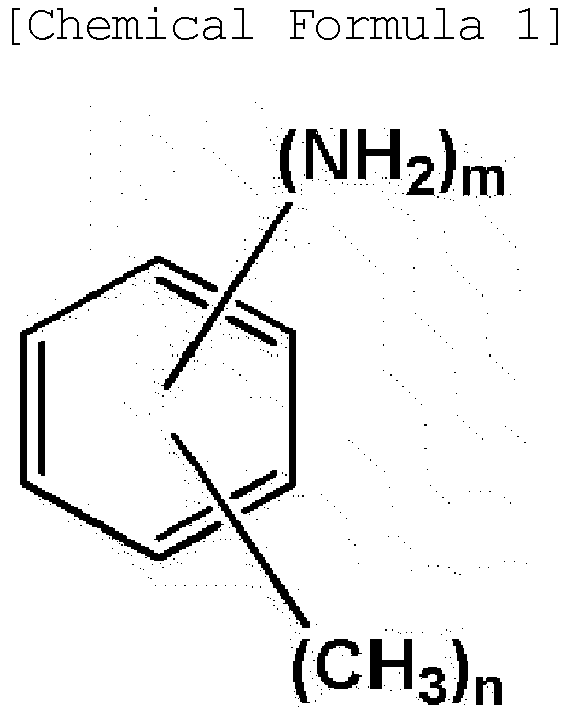
- In
Chemical Formula 1, n is an integer of 0 or 1, and m is an integer of 1 or 2. - In one embodiment of the present disclosure, the amine compound may include the compound represented by
Chemical Formula 1. For example, m-phenylenediamine, p-phenylenediamine, 2,3-diaminotoluene, 2,4-diaminotoluene, 2,5-diaminotoluene, 2,6-diaminotoluene, 3,4-diaminotoluene, m-toluidine, p-toluidine, o-toluidine or the like may be used, however, the amine compound is not limited thereto. - In one embodiment of the present disclosure, a content of the amine compound may be greater than or equal to 0.1% by weight and less than or equal to 20% by weight, preferably from 0.5% by weight to 15% by weight, and more preferably from 1% by weight to 10% by weight based on a total weight of the aqueous solution including an amine compound. A more uniform polyamide active layer may be prepared when the amine compound content is in the above-mentioned range.
- In one embodiment of the present disclosure, the aqueous solution including an amine compound may further include a surfactant.
- When interfacial polymerizing the polyamide active layer, the polyamide is quickly prepared at an interface of the aqueous solution layer including an amine compound and the organic solution layer including an acyl halide compound, and herein, the surfactant makes the layer thin and uniform so that the amine compound present in the aqueous solution layer including an amine compound readily migrates to the organic solution layer including an acyl halide compound to prepare a uniform polyamide active layer.
- In one embodiment of the present disclosure, the surfactant may be selected from among nonionic, cationic, anionic and amphoteric surfactants.
- According to one embodiment of the present disclosure, the surfactant may be selected from among sodium lauryl sulphate (SLS), alkyl ether sulphates, alkyl sulphates alkyl sulphates, olefin sulfonates, alkyl ether carboxylates, sulfosuccinates, aromatic sulfonates, octylphenol ethoxylates, ethoxylated nonylphenols, alkyl poly(ethylene oxide), copolymers of poly(ethylene oxide) and poly(propylene oxide), alkyl polyglucosides such as octyl glucoside or decyl maltoside, aliphatic acid alcohols and alkyl betaines such as cetyl alcohol or oleyl alcohol, cocamide MEA, cocamide DEA, alkyl hydroxyethyldimethylammonium chloride, cetyltrimethylammonium bromide or chloride, hexadecyltrimethylammonium bromide or chloride. Specifically, the surfactant may be SLS, octylphenol ethoxylates or ethoxylated nonylphenols.
- Particularly, when using sodium lauryl sulphate (SLS) as the surfactant, the sodium lauryl sulphate (SLS) is highly soluble in water due to its high hydrophile-lipophile balance (HLB), and by having a high critical micelle concentration (CMC), preparation of the polyamide active layer is not inhibited even when added in excess.
- In one embodiment of the present disclosure, the surfactant may be added in 0.005% by weight to 0.5% by weight based on a total weight of the aqueous solution including an amine compound.
- In one embodiment of the present disclosure, a solvent of the aqueous solution including an amine compound may be water, and in the aqueous solution including an amine compound, the remainder excluding the amine compound and the surfactant may be water.
- In one embodiment of the present disclosure, the aqueous solution including an amine compound may be prepared to a layer of the aqueous solution including an amine compound on the support.
- In one embodiment of the present disclosure, a method for preparing the aqueous solution layer including an amine compound on the support layer is not particularly limited, and methods capable of preparing the aqueous solution layer including an amine compound on the support layer may be used without limit. Specifically, spraying, coating, dipping, dropping or the like may be used.
- In one embodiment of the present disclosure, the aqueous solution layer including an amine compound may further conduct removing an aqueous solution including an excess amine compound as necessary.
- The aqueous solution layer including an amine compound prepared on the support layer may be non-uniformly distributed when there are too much of the aqueous solution including an amine compound present on the support layer, and when the aqueous solution including an amine compound is non-uniformly distributed, a non-uniform polyamide active layer may be prepared by subsequent interfacial polymerization.
- Accordingly, the aqueous solution including an excess amine compound is preferably removed after preparing the aqueous solution layer including an amine compound on the support layer. A method of removing the aqueous solution including an excess amine compound is not particularly limited, however, methods using a sponge, an air knife, nitrogen gas blowing, natural drying, a compression roll or the like may be used.
- In the organic solution including an acyl halide compound in one embodiment of the present disclosure, the acyl halide compound is not particularly limited as long as it is capable of being used in polyamide polymerization, but may be an aromatic compound having 2 or 3 carboxylic acid halides.
- For example, one type, or a mixture of two or more types selected from the group consisting of trimesoyl chloride, isophthaloyl chloride and terephthaloyl chloride may be used as the acyl halide compound, and preferably, trimesoyl chloride may be used.
- In one embodiment of the present disclosure, an organic solvent included in the organic solution including an acyl halide compound preferably does not participate in an interfacial polymerization reaction, and an aliphatic hydrocarbon solvent, for example, one or more types selected from among freons, alkane having 5 to 12 carbon atoms and isoparaffin-based solvents, an alkane mixture material, may be included.
- Specifically, hexane, heptane, octane, nonane, decane, undecane, dodecane, cyclohexane, IsoPar (Exxon), IsoPar G (Exxon), ISOL-C (SK Chem), ISOL-G (Exxon) or the like may be used, however, the organic solvent is not limited thereto.
- In one embodiment of the present disclosure, a content of the acyl halide compound may be from 0.05% by weight to 1% by weight, preferably from 0.05% by weight to 0.75% by weight, and more preferably from 0.05% by weight to 0.5% by weight based on a total weight of the organic solution including an acyl halide compound. A more uniform polyamide layer may be prepared when the acyl halide compound content is in the above-mentioned range.
- In one embodiment of the present disclosure, the organic solution including an acyl halide compound may be prepared to a layer of the organic solution including an acyl halide compound.
- In one embodiment of the present disclosure, a method of preparing the organic solution layer including an acyl halide compound on the aqueous solution layer including an amine compound prepared on the support is not particularly limited, and methods capable of preparing the organic solution layer on the support layer may be used without limit. Specifically, spraying, coating, dipping, dropping or the like may be used.
- In one embodiment of the present disclosure, in the organic solution including an acyl halide compound, the remainder excluding the acyl halide compound may be an organic solvent.
- In one embodiment of the present disclosure, the active layer may have a thickness of 100 nm to 500 nm. The active layer thickness may vary depending on the concentration of the composition for preparing an active layer including the aqueous solution including an amine compound and the organic solution including an acyl halide compound used for preparing the active layer, and the coating condition.
- The active layer thickness may be measured using a screen observed by a scanning electron microscope (SEM). Specifically, a cross section of a 0.2 cm sample is cut through a microtome, platinum (Pt) is coated thereon, and an average value is calculated by measuring thicknesses of the active layer using a scanning electron microscope (SEM).
- According to one embodiment of the present disclosure, the membrane active layer may be post-treated, or a protective layer may be formed thereon.
- In one embodiment of the present disclosure, the membrane may be a flat sheet. Membranes may have shapes such as flat-sheet, spiral-wound, tube-in-shell or hollow-fiber, however, in one embodiment of the present disclosure, the membrane may be a flat sheet. In another embodiment, the membrane may have a spiral-wound shape.
- Hereinafter, the present specification will be described in detail with reference to examples. However, the examples according to the present specification may be modified to various other forms, and the scope of the present disclosure is not to be construed as being limited to the examples described below. Examples of the present disclosure are provided in order to more fully describe the present specification to those having average knowledge in the art.
- A polysulfone solid was introduced to an N,N-dimethylformamide (DMF) solution, and dissolved therein for 12 hours or longer at 80°C to 85°C to obtain a uniform solution. In the solution, a content of the polysulfone solid was 18% by weight.
- This solution was casted to a thickness of 150 µm on a non-woven fabric (porous support) made of a polyester material and having a thickness of 95 µm to 100 µm to prepare a support layer. Then, the casted non-woven fabric was placed in water to prepare a porous polysulfone support layer.
- In order to prepare an active layer on the support layer, an aqueous solution including 8% by weight of m-phenylenediamine (mPD), 0.5% by weight of sodium lauryl sulphate (SLS) as a surfactant, and 91.5% by weight of water with respect to a total weight of the aqueous solution including an amine compound was coated to prepare an aqueous solution layer including an amine compound.
- After that, an organic solution including an acyl halide compound including 0.3% by weight of trimesoyl chloride (TMC) and 99.7% by weight of hexane based on a total weight of the organic solution including an acyl halide compound was coated on the aqueous solution layer to prepare an organic solution layer, and by conducting interfacial polymerization, an active layer including polyamide was prepared to a thickness of 250 nm.
- In the reference example, after preparing the aqueous solution layer including an amine compound and before coating the organic solution including an acyl halide compound, the element was analyzed using an EDS (Extreme Oxford) method under a condition of the number of lines of 20, the number of points per line of 500 and the number of scans of 20 times. In the EDS method, an acceleration voltage was 5 Kv, and a current was from 68 µA to 77 µA. For the EDS analysis, a cross section was prepared using microtoming and Pt coating was conducted.
-
FIG. 1 is an image of scanning using the EDS method according to the method of Example 1, and is a SEM (JSM-7200F JEOL) image (magnitude 1,500 times) of an object subject to evaluation. -
FIG. 2 shows a SEM image (magnitude 1,500 times) and an EDS analysis result showing distribution of mPD, the amine compound, on the porous polysulfone support layer. - As shown in
FIG. 2 , it was identified that, after coating the aqueous solution layer including an amine compound, mPD distributed in a range of 10 µm depth from the support surface so as to participate in the interfacial polymerization reaction, and it was seen that these may form polyamide during the interfacial polymerization. - An experiment was conducted in the same manner as in Example 1 except that a single-line scan was conducted.
- An EDS analysis result is shown in
FIG. 3 . - After forming the active layer in the reference example, the content of the polyamide and the unreacted amine compound was measured using an EDS method. However, the moisture content measured after preparing the porous polysulfone support layer was adjusted to 30% in Example 3, and the moisture content measured after preparing the porous polysulfone support layer was adjusted to 35% in Example 4. The condition for the EDS is the same as in Example 1. The measurement result of Example 3 is shown at the top of
FIG. 4 , and the measurement result of Example 4 is shown at the bottom ofFIG. 4 (SEM image magnitude 1,500 times). The part expressed as RO inFIG. 4 indicates a polyamide layer, the active layer, and it was identified that the active layer thickness and the polyamide content were different depending on the moisture content of the support after forming the porous polysulfone support layer. In this manner, performance of the membrane may be measured depending on the polyamide content measured using the EDS method. - After forming the active layer in the reference example, the content of the polyamide and the unreacted amine compound was measured using an EDS method. Herein, in Example 5 and Example 6, the time of the drying process before conducting the EDS method was varied, and in Example 6, the time of the drying process was relatively long compared to Example 5. The condition for the EDS is the same as in Example 1. The measurement results of Examples 5 and 6 are shown at the top and the bottom of
FIG. 5 , respectively (SEM image magnitude 20,000 times). - As for salt rejection of the membrane in
FIG. 5 , a general method of measuring salt rejection of a reverse osmosis membrane was used. In other words, it is a result of calculating how much salt is removed from an aqueous NaCl solution as a value. - In addition, it was identified that the unreacted amine compound was removed by washing.
FIG. 6 shows changes in the peak after preparing the aqueous solution layer including an amine compound (D1), after forming the active layer by interfacial polymerization (D2), and after washing (D3). Accordingly, the peak of the unreacted amine compound may be distinguished in the EDS analysis result, and by predicting membrane performance using the amount and distribution by depth of the unreacted amine compound, a manufacturing condition of the membrane may be readily set.
Claims (5)
- A method for quantifying polyamide or an unreacted amine compound in a membrane active layer, the method comprising:coating a composition including an amine compound on a support;preparing a membrane active layer by interfacial polymerizing polyamide through coating a composition including an acyl halide compound on the surface of the support on which the composition including an amine compound is coated; andanalyzing distribution of the polyamide or the unreacted amine compound by depth from the surface on the support on which the polyamide is interfacial polymerized using an energy dispersive spectrometer (EDS) method,wherein the EDS method uses lines of 10 lines or more, and scans 5 times or more for each line, andwherein each line of the plurality of line scans has 400 points or more.
- A method for determining setting criteria for a manufacturing condition of a membrane active layer, the method comprising:f) preparing a membrane active layer and then quantifying distribution of polyamide or an unreacted amine compound in the membrane active layer by depth according to the method of claim 1;g) deriving a first evaluation result by evaluating performance of the membrane active layer prepared in f);h) deriving a second or higher evaluation result by repeating f) to h) one or more times after adjusting at least a part of the condition in the preparing of a membrane active layer in f) to be different from the above-described f); andi) determining distribution of the polyamide or the unreacted amine compound in the membrane active layer by depth from the surface on the support on which the polyamide is interfacial polymerized in order to prepare a membrane active layer with better performance by comparing the first evaluation result and the second or higher evaluation result.
- The method for determining setting criteria for a manufacturing condition of a membrane active layer of Claim 2, wherein different conditions between f) and h) include at least one of a type of the support; a moisture content of the support; a solid content of the composition including an amine compound; a coating amount of the composition including an amine compound; a method for coating the composition including an amine compound; a solid content of the composition including an acyl halide compound; a coating amount of the composition including an acyl halide compound; a method for coating the composition including an acyl halide compound; the interfacial polymerization condition; the condition of treatment after the interfacial polymerization; and presence of additives in the support, the composition including an amine compound or the composition including an acyl halide compound.
- A method for setting a manufacturing condition of a membrane active layer, the method comprising:m) coating a composition including an amine compound on a support and then preparing a membrane active layer by interfacial polymerizing polyamide through coating a composition including an acyl halide compound on the surface of the support on which the composition including an amine compound is coated;n) analyzing distribution of the polyamide or the unreacted amine compound by depth according to the method of claim 1; ando) determining a manufacturing condition of the membrane active layer as the condition of m) when the value analyzed in n) is in the range of setting criteria of the membrane active layer determined in advance, or, when the value analyzed in n) is outside the range of the criteria determined in advance, conducting m) to o) again after changing at least a part of the condition of m) .
- The method for setting a manufacturing condition of a membrane active layer of Claim 4, wherein the condition of m) includes at least one of a type of the support; a moisture content of the support; a solid content of the composition including an amine compound; a coating amount of the composition including an amine compound; a method for coating the composition including an amine compound; a solid content of the composition including an acyl halide compound; a coating amount of the composition including an acyl halide compound; a method for coating the composition including an acyl halide compound; the interfacial polymerization condition; the condition of treatment after the interfacial polymerization; and presence of additives in the support, the composition including an amine compound or the composition including an acyl halide compound.
Applications Claiming Priority (3)
| Application Number | Priority Date | Filing Date | Title |
|---|---|---|---|
| KR1020180071459A KR102250387B1 (en) | 2018-06-21 | 2018-06-21 | Method for quantifying amine compound forming active layer of separation membrane before preparing it, method for quantifying polyamide or residue amine compound in active layer of separation membrane, and methode for determining creteria for determing conditions or conditions for preparing active layer of separation membrane |
| EP19821682.2A EP3709009B1 (en) | 2018-06-21 | 2019-04-19 | Method for quantifying amine compound constituting separator active layer prior to preparation of separator active layer, method for quantifying polyamide or unreacted amine compound in separator active layer, and method for setting preparation conditions of separator active layer or establishment standards for preparation conditions of separator active layer |
| PCT/KR2019/004758 WO2019245151A1 (en) | 2018-06-21 | 2019-04-19 | Method for quantifying amine compound constituting separator active layer prior to preparation of separator active layer, method for quantifying polyamide or unreacted amine compound in separator active layer, and method for setting preparation conditions of separator active layer or establishment standards for preparation conditions of separator active layer |
Related Parent Applications (2)
| Application Number | Title | Priority Date | Filing Date |
|---|---|---|---|
| EP19821682.2A Division EP3709009B1 (en) | 2018-06-21 | 2019-04-19 | Method for quantifying amine compound constituting separator active layer prior to preparation of separator active layer, method for quantifying polyamide or unreacted amine compound in separator active layer, and method for setting preparation conditions of separator active layer or establishment standards for preparation conditions of separator active layer |
| EP19821682.2A Division-Into EP3709009B1 (en) | 2018-06-21 | 2019-04-19 | Method for quantifying amine compound constituting separator active layer prior to preparation of separator active layer, method for quantifying polyamide or unreacted amine compound in separator active layer, and method for setting preparation conditions of separator active layer or establishment standards for preparation conditions of separator active layer |
Publications (2)
| Publication Number | Publication Date |
|---|---|
| EP4257230A2 true EP4257230A2 (en) | 2023-10-11 |
| EP4257230A3 EP4257230A3 (en) | 2023-10-25 |
Family
ID=68982881
Family Applications (2)
| Application Number | Title | Priority Date | Filing Date |
|---|---|---|---|
| EP23188853.8A Pending EP4257230A3 (en) | 2018-06-21 | 2019-04-19 | Method for quantifying amine compound constituting separator active layer prior to preparation of separator active layer, method for quantifying polyamide or unreacted amine compound in separator active layer, and method for setting preparation conditions of separator active layer or establishment standards for preparation conditions of separator active layer |
| EP19821682.2A Active EP3709009B1 (en) | 2018-06-21 | 2019-04-19 | Method for quantifying amine compound constituting separator active layer prior to preparation of separator active layer, method for quantifying polyamide or unreacted amine compound in separator active layer, and method for setting preparation conditions of separator active layer or establishment standards for preparation conditions of separator active layer |
Family Applications After (1)
| Application Number | Title | Priority Date | Filing Date |
|---|---|---|---|
| EP19821682.2A Active EP3709009B1 (en) | 2018-06-21 | 2019-04-19 | Method for quantifying amine compound constituting separator active layer prior to preparation of separator active layer, method for quantifying polyamide or unreacted amine compound in separator active layer, and method for setting preparation conditions of separator active layer or establishment standards for preparation conditions of separator active layer |
Country Status (6)
| Country | Link |
|---|---|
| US (1) | US12350628B2 (en) |
| EP (2) | EP4257230A3 (en) |
| JP (1) | JP7318852B2 (en) |
| KR (1) | KR102250387B1 (en) |
| CN (1) | CN111566473B (en) |
| WO (1) | WO2019245151A1 (en) |
Families Citing this family (1)
| Publication number | Priority date | Publication date | Assignee | Title |
|---|---|---|---|---|
| KR102788127B1 (en) * | 2020-10-30 | 2025-03-31 | 주식회사 엘지화학 | Method for analyzing diffusion depth of polyamid in reverse osmosis membrane |
Citations (1)
| Publication number | Priority date | Publication date | Assignee | Title |
|---|---|---|---|---|
| KR20180071459A (en) | 2016-12-19 | 2018-06-28 | 주식회사 제이에스테크 | Cleaning mold impeolsing for the generator |
Family Cites Families (26)
| Publication number | Priority date | Publication date | Assignee | Title |
|---|---|---|---|---|
| JPS61137041A (en) * | 1984-12-07 | 1986-06-24 | Mitsubishi Heavy Ind Ltd | Method for testing film |
| JPH10132802A (en) * | 1996-11-01 | 1998-05-22 | Kao Corp | Surface functional group detection method |
| JP2000046768A (en) | 1998-07-28 | 2000-02-18 | Jeol Ltd | X-ray analyzer |
| US7608339B2 (en) * | 2003-10-22 | 2009-10-27 | Kureha Corporation | Multilayer film |
| JP2005127938A (en) | 2003-10-27 | 2005-05-19 | National Printing Bureau | Method for obtaining cutting surface information of specimen |
| JP4177231B2 (en) | 2003-11-04 | 2008-11-05 | 日東電工株式会社 | Liquid separation membrane and method for producing the same |
| JP4611931B2 (en) | 2004-02-19 | 2011-01-12 | ハウス食品株式会社 | Method for measuring concentration distribution of detected components in a cross section of a solid target substance |
| JP4656502B2 (en) * | 2004-10-01 | 2011-03-23 | 日東電工株式会社 | Composite semipermeable membrane and method for producing the same |
| WO2008014463A2 (en) | 2006-07-27 | 2008-01-31 | Thermo Electron Scientific Instruments Llc | Automatic material labeling during spectral image data acquisition |
| RU2458761C2 (en) * | 2006-12-29 | 2012-08-20 | Хеганес Аб | Powder, method of making component, and component |
| DE102007025442B4 (en) * | 2007-05-31 | 2023-03-02 | Clariant International Ltd. | Use of a device for producing a coated catalyst and coated catalyst |
| JP2010016042A (en) | 2008-07-01 | 2010-01-21 | Panasonic Corp | Elemental analysis method, and manufacturing method of semiconductor device |
| KR20110072156A (en) | 2009-12-22 | 2011-06-29 | 주식회사 효성 | Manufacturing method of polyamide reverse osmosis membrane |
| JP5514129B2 (en) | 2010-02-15 | 2014-06-04 | 東京エレクトロン株式会社 | Film forming method, film forming apparatus, and method of using film forming apparatus |
| JP5839514B2 (en) * | 2010-02-15 | 2016-01-06 | 東京エレクトロン株式会社 | Film forming method, film forming apparatus, and method of using film forming apparatus |
| EP2605005A1 (en) * | 2011-12-14 | 2013-06-19 | FEI Company | Clustering of multi-modal data |
| JP2014064989A (en) * | 2012-09-26 | 2014-04-17 | Toray Ind Inc | Composite semipermeable membrane |
| JP5875201B2 (en) | 2012-11-21 | 2016-03-02 | エルジー・ケム・リミテッド | High flow rate water treatment separation membrane with excellent chlorine resistance |
| KR101936924B1 (en) * | 2012-12-06 | 2019-01-09 | 삼성전자주식회사 | Separation membrane, and water treatment device using said separation membrane |
| WO2014138637A1 (en) * | 2013-03-07 | 2014-09-12 | Colorado School Of Mines | Palladium-alloyed membranes and methods of making and using the same |
| JP6167610B2 (en) | 2013-03-28 | 2017-07-26 | 凸版印刷株式会社 | Thin film evaluation method |
| US20150352501A1 (en) | 2013-06-18 | 2015-12-10 | Lg Chem, Ltd. | Polyamide water-treatment separation membrane having properties of high salt rejection and high flux and manufacturing method thereof |
| KR102213238B1 (en) * | 2013-12-06 | 2021-02-05 | 동의대학교 산학협력단 | Semipermeable membranes and production methods thereof |
| JP6300658B2 (en) * | 2014-06-19 | 2018-03-28 | オリンパス株式会社 | Sample observation equipment |
| CA2963623C (en) | 2014-10-07 | 2021-12-28 | Toyobo Co., Ltd. | Polymer separation membrane having a layer of variable density |
| JP6512601B2 (en) * | 2015-05-26 | 2019-05-15 | 国立研究開発法人物質・材料研究機構 | Corrosion resistance evaluation method of oxide |
-
2018
- 2018-06-21 KR KR1020180071459A patent/KR102250387B1/en active Active
-
2019
- 2019-04-19 WO PCT/KR2019/004758 patent/WO2019245151A1/en not_active Ceased
- 2019-04-19 JP JP2020531941A patent/JP7318852B2/en active Active
- 2019-04-19 EP EP23188853.8A patent/EP4257230A3/en active Pending
- 2019-04-19 US US16/958,978 patent/US12350628B2/en active Active
- 2019-04-19 CN CN201980006512.XA patent/CN111566473B/en active Active
- 2019-04-19 EP EP19821682.2A patent/EP3709009B1/en active Active
Patent Citations (1)
| Publication number | Priority date | Publication date | Assignee | Title |
|---|---|---|---|---|
| KR20180071459A (en) | 2016-12-19 | 2018-06-28 | 주식회사 제이에스테크 | Cleaning mold impeolsing for the generator |
Also Published As
| Publication number | Publication date |
|---|---|
| EP3709009B1 (en) | 2025-10-15 |
| EP4257230A3 (en) | 2023-10-25 |
| US20200338504A1 (en) | 2020-10-29 |
| EP3709009A4 (en) | 2021-04-14 |
| WO2019245151A1 (en) | 2019-12-26 |
| KR102250387B1 (en) | 2021-05-10 |
| KR20190143669A (en) | 2019-12-31 |
| JP7318852B2 (en) | 2023-08-01 |
| KR102250387B9 (en) | 2021-11-19 |
| EP3709009A1 (en) | 2020-09-16 |
| CN111566473A (en) | 2020-08-21 |
| US12350628B2 (en) | 2025-07-08 |
| JP2021508039A (en) | 2021-02-25 |
| CN111566473B (en) | 2024-02-20 |
Similar Documents
| Publication | Publication Date | Title |
|---|---|---|
| Xiao et al. | Characterizing surface porosity of porous membranes via contact angle measurements | |
| Cheng et al. | Positively charged nanofiltration membranes: review of current fabrication methods and introduction of a novel approach | |
| Tashvigh et al. | Facile fabrication of solvent resistant thin film composite membranes by interfacial crosslinking reaction between polyethylenimine and dibromo-p-xylene on polybenzimidazole substrates | |
| Li et al. | Effects of the support on the characteristics and permselectivity of thin film composite membranes | |
| JP7747766B2 (en) | Bicontinuous highly interconnected polymeric ultrafiltration membranes and their preparation methods and applications | |
| Sabde et al. | Casting and characterization of cellulose acetate butyrate based UF membranes | |
| Misdan et al. | Formation of thin film composite nanofiltration membrane: Effect of polysulfone substrate characteristics | |
| Lee et al. | Formation of a thick aromatic polyamide membrane by interfacial polymerisation | |
| Wu et al. | Thin film composite nanofiltration membranes fabricated from polymeric amine polyethylenimine imbedded with monomeric amine piperazine for enhanced salt separations | |
| Tang et al. | Study on a novel polyester composite nanofiltration membrane by interfacial polymerization of triethanolamine (TEOA) and trimesoyl chloride (TMC): I. Preparation, characterization and nanofiltration properties test of membrane | |
| Munari et al. | Casting and performance of polyvinylidene fluoride based membranes | |
| Baroña et al. | High performance thin film composite polyamide reverse osmosis membrane prepared via m-phenylenediamine and 2, 2′-benzidinedisulfonic acid | |
| CN109862959A (en) | Preparation of filter membranes | |
| KR20140029391A (en) | Composite membranes for membrane distillation and related methods of manufacture | |
| Munari et al. | Permoporometric study on ultrafiltration membranes | |
| Chen et al. | Forming mechanism study of unique pillar-like and defect-free PVDF ultrafiltration membranes with high flux | |
| Remanan et al. | A unique microfiltration membrane derived from the poly (ethylene-co-methyl acrylate)/Poly (vinylidene fluoride)(EMA/PVDF) biphasic blends and surface modification for antifouling application | |
| Gumı et al. | Characterization of activated composite membranes by solute transport, contact angle measurement, AFM and ESR | |
| US5417832A (en) | Enhancing performance of perfluorinated ionomer membranes via dopant incorporation, method of making thereof and the membrane | |
| Karthik et al. | Probing the thickness and roughness of the functional layer in thin film composite membranes | |
| Hu et al. | Investigating the impact of the sulfonation degree in sulfonated polyphenylsulfone (sPPSU) on PES/sPPSU polymer blend membranes | |
| EP3709009B1 (en) | Method for quantifying amine compound constituting separator active layer prior to preparation of separator active layer, method for quantifying polyamide or unreacted amine compound in separator active layer, and method for setting preparation conditions of separator active layer or establishment standards for preparation conditions of separator active layer | |
| Ouchn et al. | Polymer Inclusion membranes with long term-stability in desalination via membrane distillation | |
| Bridge et al. | Rapid macrovoid characterization in membranes prepared via nonsolvent-induced phase separation: A comparison between 2D and 3D techniques | |
| KR20170023144A (en) | Asymmetric articles with a porous substrate and a polymeric coating extending into the substrate and methods of making the same |
Legal Events
| Date | Code | Title | Description |
|---|---|---|---|
| PUAI | Public reference made under article 153(3) epc to a published international application that has entered the european phase |
Free format text: ORIGINAL CODE: 0009012 |
|
| STAA | Information on the status of an ep patent application or granted ep patent |
Free format text: STATUS: THE APPLICATION HAS BEEN PUBLISHED |
|
| REG | Reference to a national code |
Ref country code: DE Ref legal event code: R079 Free format text: PREVIOUS MAIN CLASS: B01D0071560000 Ipc: G01N0023200910 |
|
| PUAL | Search report despatched |
Free format text: ORIGINAL CODE: 0009013 |
|
| AC | Divisional application: reference to earlier application |
Ref document number: 3709009 Country of ref document: EP Kind code of ref document: P |
|
| AK | Designated contracting states |
Kind code of ref document: A2 Designated state(s): AL AT BE BG CH CY CZ DE DK EE ES FI FR GB GR HR HU IE IS IT LI LT LU LV MC MK MT NL NO PL PT RO RS SE SI SK SM TR |
|
| AK | Designated contracting states |
Kind code of ref document: A3 Designated state(s): AL AT BE BG CH CY CZ DE DK EE ES FI FR GB GR HR HU IE IS IT LI LT LU LV MC MK MT NL NO PL PT RO RS SE SI SK SM TR |
|
| RIC1 | Information provided on ipc code assigned before grant |
Ipc: B01D 71/56 20060101ALI20230918BHEP Ipc: B01D 69/10 20060101ALI20230918BHEP Ipc: G01N 23/20091 20180101AFI20230918BHEP |
|
| STAA | Information on the status of an ep patent application or granted ep patent |
Free format text: STATUS: REQUEST FOR EXAMINATION WAS MADE |
|
| 17P | Request for examination filed |
Effective date: 20231110 |
|
| RBV | Designated contracting states (corrected) |
Designated state(s): AL AT BE BG CH CY CZ DE DK EE ES FI FR GB GR HR HU IE IS IT LI LT LU LV MC MK MT NL NO PL PT RO RS SE SI SK SM TR |
|
| STAA | Information on the status of an ep patent application or granted ep patent |
Free format text: STATUS: EXAMINATION IS IN PROGRESS |
|
| 17Q | First examination report despatched |
Effective date: 20250715 |
|
| RAP1 | Party data changed (applicant data changed or rights of an application transferred) |
Owner name: NANOH2O CO., LTD. |