EP4255863B1 - Portlandzement mit erhöhter lagerstabilität - Google Patents
Portlandzement mit erhöhter lagerstabilität Download PDFInfo
- Publication number
- EP4255863B1 EP4255863B1 EP21819489.2A EP21819489A EP4255863B1 EP 4255863 B1 EP4255863 B1 EP 4255863B1 EP 21819489 A EP21819489 A EP 21819489A EP 4255863 B1 EP4255863 B1 EP 4255863B1
- Authority
- EP
- European Patent Office
- Prior art keywords
- cement
- portland cement
- weight
- portland
- gypsum
- Prior art date
- Legal status (The legal status is an assumption and is not a legal conclusion. Google has not performed a legal analysis and makes no representation as to the accuracy of the status listed.)
- Active
Links
Images


Classifications
-
- C—CHEMISTRY; METALLURGY
- C04—CEMENTS; CONCRETE; ARTIFICIAL STONE; CERAMICS; REFRACTORIES
- C04B—LIME, MAGNESIA; SLAG; CEMENTS; COMPOSITIONS THEREOF, e.g. MORTARS, CONCRETE OR LIKE BUILDING MATERIALS; ARTIFICIAL STONE; CERAMICS; REFRACTORIES; TREATMENT OF NATURAL STONE
- C04B7/00—Hydraulic cements
- C04B7/36—Manufacture of hydraulic cements in general
- C04B7/48—Clinker treatment
- C04B7/52—Grinding ; After-treatment of ground cement
-
- C—CHEMISTRY; METALLURGY
- C04—CEMENTS; CONCRETE; ARTIFICIAL STONE; CERAMICS; REFRACTORIES
- C04B—LIME, MAGNESIA; SLAG; CEMENTS; COMPOSITIONS THEREOF, e.g. MORTARS, CONCRETE OR LIKE BUILDING MATERIALS; ARTIFICIAL STONE; CERAMICS; REFRACTORIES; TREATMENT OF NATURAL STONE
- C04B28/00—Compositions of mortars, concrete or artificial stone, containing inorganic binders or the reaction product of an inorganic and an organic binder, e.g. polycarboxylate cements
- C04B28/02—Compositions of mortars, concrete or artificial stone, containing inorganic binders or the reaction product of an inorganic and an organic binder, e.g. polycarboxylate cements containing hydraulic cements other than calcium sulfates
- C04B28/04—Portland cements
-
- C—CHEMISTRY; METALLURGY
- C04—CEMENTS; CONCRETE; ARTIFICIAL STONE; CERAMICS; REFRACTORIES
- C04B—LIME, MAGNESIA; SLAG; CEMENTS; COMPOSITIONS THEREOF, e.g. MORTARS, CONCRETE OR LIKE BUILDING MATERIALS; ARTIFICIAL STONE; CERAMICS; REFRACTORIES; TREATMENT OF NATURAL STONE
- C04B2103/00—Function or property of ingredients for mortars, concrete or artificial stone
- C04B2103/52—Grinding aids; Additives added during grinding
Definitions
- the field of this invention is preparation and storage of a Portland cement. More precisely, it relates to a method for optimizing the grinding and storage process of a Portland cement and reducing the effect of the temperature on its shelf life.
- the manufacturing of Portland cement is a complex process that begins with mining and then pre-grinding raw materials that include limestone and clay, to a raw meal which is then heated to a sintering temperature as high as 1 450°C in a cement kiln. In this process, the raw materials chemically react to form new compounds. The result is called clinker, which are rounded nodules typically between around 1 mm and 25 mm. Clinker is then cooled down and ground in large mills. The clinker is ground together with a source of calcium sulphate to produce a Portland cement.
- Other mineral additions and chemical additives can be added prior to, during or after the grinding to produce different types of Portland cements. For example, granulated blast furnace slag, pozzolans, gypsum are commonly added to the clinker prior to or during the step of grinding of the clinker.
- Portland cement is either stored in silos or packaged in bags before being transported to the client by road, rail, or on water.
- a Portland cement may be exposed to moisture in the air and begins to partially react, which reduces its reactivity, or could even make it unusable in practice.
- EP1409430 B1 discloses a hydraulic binder having reduced tendency to form lumps or set during storage, by reducing water intake from ambient air, comprising an organic acid selected from the group consisting of adipic acid and a mixture of adipic, glutaric and succinic acids, wherein the weight concentration of said organic acid is between 0.05 % and 5 % relative to the weight of hydraulic binder, and as a main component, a cement selected from the group consisting Portland cement, high-alumina cement, and quick setting cement.
- US 1947504 A discloses a process for manufacturing a Portland cement wherein a Portland clinker is ground in presence of an oleaginous material, preferably oleic acid. It is also disclosed that the proportion of oleaginous material to be used in the grinding step should range between 0.05% and 1%.
- hot freshly ground Portland cement is fed into a container such as a silo and stored in that container, caking may occur and block the exit trap of the container, in particular of the silo, even when the container is protected from moisture of ambient air. For this reason, hot freshly ground Portland cement is usually cooled before feeding the container. However, that intermediate step of cooling is expensive and can be complex to implement in a cement plant.
- the term "hot" refers to a temperature above 70°C.
- caking may be induced by gypsum dehydration and that adipic acid at very low dosage may prevent the occurrence of caking.
- An aim of this invention is to overcome the drawbacks of the aforementioned prior art and to supply a method for producing and storing Portland cement without any intermediate cooling step prior to feeding the Portland cement into a container, such as a silo, and that can be thus easily integrated into an industrial process and in a cost effective way relative to the methods disclosed in the prior art.
- Another aim of the invention is to supply a Portland cement obtained according to the method of the invention.
- a first aspect of the invention is a method for preparing and storing a Portland cement, wherein the method comprises:
- This problem could be reduced by reducing the temperature at which the clinker and the gypsum are co-ground, for example by cooling the Portland cement down at the exit of the mill before its storage in a container, or by reducing the temperature of the clinker that is introduced into the mill.
- these measures can be complex and costly to implement in the overall production process.
- the Applicant unexpectedly discovered that producing a Portland cement by grinding at least a Portland clinker, a source of calcium sulphate comprising gypsum in majority and a very low dosage of an organic compound permitted to significantly decrease the caking of the Portland cement and improve its shelf-life.
- the Applicant has observed that at a temperature above 70°C, gypsum tends to dehydrate, and that the slight amount of water released from the gypsum dehydration may partially hydrate the Portland cement, thereby creating caking and hampering final hydraulic properties of the Portland cement. Further, the Applicant discovered that although used at very low dosages, the organic compound allows to significantly and cost-effectively reduce the negative effects of such gypsum dehydration during the period of time when the Portland cement comprising gypsum is at a temperature above 70°C.
- the method of the invention advantageously permits to obtain a Portland cement comprising gypsum whose mechanical strength is largely preserved even when it is exposed to temperatures above 70°C, and during long term storage in standard conditions.
- the Portland cement obtained according to the method of the invention maintain its mechanical performance even when stored in a container directly after the grinding step, meaning that the Portland cement may be stored in a container directly from the cement mill output, the Portland cement having a temperature above 70°C at the entry of the container.
- This is particularly advantageous in the framework of an industrial production, as the method of the invention avoids having the Portland cement to be cooled down at the output of the cement mill before its storage in a container.
- the method of the invention preserves the mechanic performance of the Portland cement obtained even after a long storage in standard conditions and in a container whose initial internal temperature is above 70°C. This is particularly advantageous in warm countries, where it provides for the possibility of storing the Portland cement for a long time in a container, such as a silo, with no loss of quality or performance of the Portland cement.
- the grinding of a Portland clinker, a source of calcium sulphate comprising gypsum in majority and a very low dosage of organic compound allows to avoid the adverse effects mentioned above and to preserve the hydraulic properties of the Portland cement obtained thereof.
- the grinding of a Portland clinker, a calcium sulphate source comprising gypsum in majority and an organic compound allows an optimal distribution of the organic compound in the Portland cement obtained without any need of a subsequent homogenization step.
- the Applicant further observed that the organic compound did not negatively impact the operation of the mill, as no dust was observed, as well as no flushing of the mill when using the organic compound at dosages of less than 0.1%, in % expressed by weight relative to the weight of the Portland cement.
- the method of the invention may easily be carried out in a cement manufacturing plant.
- the method of the invention avoids the need to cool down the Portland cement at the exit of the mill before its storage in a container, or to reduce the temperature of the Portland clinker that is introduced into the mill.
- the Applicant further observed that the method of the invention results in a reduction of soluble Cr(VI) content in the cement. Accordingly, adding the organic molecule described below may allow to reduce the content of metal sulphate additive usually introduced in the cement to reduce soluble Cr(VI) content.
- the method of the invention is thus both cost and energy effective and in addition decreases the processing time when compared to processes involving a step of mixing a ground clinker with an anti-ageing additive.
- the method of the invention comprises a step (i) of providing a Portland cement comprising:
- a Portland cement is a material in powder form that chemically reacts with water, by converting the water-binder system with a plastic consistency into a solid matrix that has the ability to agglomerate other solid materials. This hardening process takes place spontaneously at room temperature, underwater or exposed to wet air conditions.
- the Portland cement comprises a Portland clinker and a source calcium sulphate.
- the Portland cement may contain mineral addition(s) and other additive(s) as detailed below.
- the clinker has advantageously a mean diameter, D50, comprised from 1 to 25 mm.
- the Portland cement according to the invention is a Portland cement as defined in the cement standard NF EN 197-1 of April 2012.
- a Portland cement comprises Portland clinker, calcium sulphate, and optional mineral components, such as those described in the cement standard NF EN 197-1 published in April 2012 and further defined below.
- Portland clinker is obtained by clinkering at high temperature a mixture comprising limestone and, for example, clay.
- Portland clinker has preferentially the following mineralogical composition, in % expressed by weight relative to the weight of clinker:
- C represents CaO
- A represents Al 2 O 3
- F represents Fe 2 O 3
- S represents SiO 2 .
- the Portland cement is selected from a CEM I, CEM II, CEM III, CEM IV, or CEM V as described in the cement standard NF EN 197-1 of April 2012.
- a CEM I comprises at least 95% of a Portland clinker, in % expressed by weight relative to the weight of CEM I.
- cement types described in the cement standard NF EN 197-1 of April 2012 comprise Portland clinker, calcium sulphate, and mineral addition(s) as defined below.
- the mineral addition is preferably selected from slags (for example, as defined in the European NF EN 197-1 Standard of April 2012, paragraph 5.2.2) such as granulated slags, pozzolanic materials (for example as defined in the European NF EN 197-1 Standard of April 2012, paragraph 5.2.3), fly ash (for example, as described in the European NF EN 197-1 Standard of April 2012, paragraph 5.2.4), calcined schists (for example, as described in the European NF EN 197-1 Standard of April 2012, paragraph 5.2.5), material containing calcium carbonate, for example limestone (for example, as defined in the European NF EN 197-1 Standard paragraph 5.2.6), silica fume (for example, as defined in the European NF EN 197-1 Standard of April 2012, paragraph 5.2.7), siliceous additions (for example, as defined in the "Concrete” NF P 18-509 Standard), metakaolin or mixtures thereof.
- slags for example, as defined in the European NF EN 197-1 Standard of April 2012,
- a fly ash is generally a powdery material comprised in the fumes from coal-fired thermal power stations. It is generally recovered by electrostatic or mechanical precipitation.
- the chemical composition of a fly ash mainly depends on the chemical composition of the coal burned and of the method used in the power plant from which it comes. The same is true for its mineralogical composition.
- the fly ashes used according to the invention may be of siliceous or calcic nature.
- Blast furnace slags are generally obtained by rapid cooling of the molten slag coming from the melting of iron ore in a blast furnace. Slags may be selected from granulated blast furnace slags according to the European standard NF EN 197-1 of April 2012 paragraph 5.2.2.
- Silica fumes may be a material obtained by reduction of high purity quartz by carbon in electric arc furnaces used for the production of silica and ferrosilica alloys. Silica fumes are generally formed of spherical particles comprising at least 85 % by weight of amorphous silica. Preferably, the silica fumes are selected from silica fumes according to the European standard NF EN 197-1 of April 2012 paragraph 5.2.7.
- Pozzolanic materials may be natural siliceous or silico-aluminous substances, or a combination thereof.
- pozzolanic materials may be cited natural pozzolans, which are in general materials of volcanic origin or sedimentary rocks, and natural calcinated pozzolans, which are materials of volcanic origin, clays, schists or sedimentary rocks, thermally active.
- the pozzolanic materials may be selected from pozzolanic materials according to the European standard NF EN 197-1 of April 2012 paragraph 5.2.3.
- Calcium sulphate used according to the present invention includes gypsum (calcium sulphate dihydrate, CaSO 4 .2H 2 O), hemi-hydrate (CaSO 4 .1/2H 2 O), anhydrite (anhydrous calcium sulphate, CaSO 4 ) or a mixture thereof.
- the gypsum and anhydrite exist in the natural state. Calcium sulphate produced as a by-product of certain industrial processes may also be used.
- a source of calcium sulphate comprising gypsum in majority means a source of calcium sulphate wherein gypsum predominate by weight, i.e. means a source of calcium sulphate containing at least 40% of gypsum, preferably more than 50% of gypsum, in % expressed by weight relative to the weight of the source of calcium sulphate.
- the source of calcium sulphate may further contain impurities, preferably in a content ranging from 0% to 30% in weight, compared to the total weight of the source of calcium sulphate.
- the source of calcium sulphate further comprises calcium sulphate hemihydrate, anhydrite, or mixtures thereof.
- the Portland cement comprises from 2 to 10%, preferably from 2 to 6%, preferably from 2 to 5%, of a source of calcium sulphate comprising gypsum in majority, in % expressed by weight relative to the weight of clinker.
- the organic compound is selected from adipic acid, stearic acid, 2,4,7,9-tetramethyl-5-decyne-4,7-diol, mixture of adipic, glutaric and succinic acids, salts thereof, and mixtures thereof.
- the organic compound is preferably selected from adipic acid, 2,4,7,9-tetramethyl-5-decyne-4,7-diol, mixture of adipic, glutaric and succinic acids, salts thereof, and mixtures thereof.
- 2,4,7,9-Tetramethyl-5-decyne-4,7-diol is commercially available under the name Surfynol 104.
- Mixture of adipic, glutaric and succinic acids preferably comprises at least 50% by weight, compared to the total weight of the mixture, of adipic acid, more preferably at least 60% by weight of adipic acid.
- the organic compound is preferably selected from adipic acid, mixture of adipic, glutaric and succinic acids, salts thereof, and mixtures thereof.
- the organic compound is more preferably adipic acid or a salt thereof.
- the sodium salt of adipic acid is preferred.
- the Portland cement comprises from 0.01 to less than 0.05% of organic compound, preferably from 0.02 to 0.04%, more preferably from 0.02 to 0.035%, in % expressed by weight relative to the weight of Portland cement. Accordingly, at step (i) one provides from 0.01% to less than 0.05% of organic compound, preferably from 0.02% to 0.040%, in % expressed by weight relative to the weight of the Portland cement.
- Salts of organic compounds can also be used, preferably sodium salt, calcium salt, copper salt, ammonium salt, nickel salt, or potassium salt. Sodium salt is preferred.
- the organic compound may be supported by inorganic particles.
- the inorganic particles are preferably made of an inorganic material suitable to support the organic compound, meaning that the material forming the inorganic particle is inert with regard to the organic compound.
- the inorganic material forming the inorganic particles is not likely to be attacked by the organic compound or to modify the chemical structure of the organic compound.
- the inorganic particles are not particles based on materials that are capable of forming salts (adipates) with adipic acid, such as highly basic materials.
- the particles used as support of the organic compound are particles based on silica or on alumina.
- Silica-based particles comprise at least 50% of silica, preferably at least 80% of silica, and even more preferably at least 90% of silica, in % expressed by weight relative to the weight of inorganic particles.
- the silica-based particles may contain precipitated silica, siliceous stone, or mixtures thereof.
- Precipitated silica is silica obtained by a precipitation reaction of a silicate, in particular an alkali metal silicate such as sodium silicate with an acid such as sulfuric acid.
- Siliceous stone may in particular be diatomite.
- Diatomite is a naturally occurring, soft, siliceous sedimentary rock that is usually crumbled into a fine white to off-white powder. It has a particle size ranging from less than 3 ⁇ m to more than 1 mm, typically from 10 to 200 ⁇ m.
- Diatomite typically comprises from 80 to 90% of silica, 2 to 4% of alumina and 0.5 to 2% of iron oxide, in % expressed by weight relative to the weight inorganic particles.
- the method comprises a step (ii) of grinding the components of step (i).
- the grinding can be performed by any know means and is preferably performed at a temperature of at least 70°C.
- Step (ii) is preferably carried out a temperature of at least 70°C, preferably of at least 75°C, more preferably of at least 80°C.
- the Applicant has shown that the gypsum dehydration significantly impedes the properties of the Portland cement when step (ii) is carried out at temperatures exceeding 70°C.
- the temperature of step (ii) is below the decomposition temperature of the organic compound.
- Step (ii) is preferably carried out a temperature ranging from 70°C to 150°C, and more preferably from 80°C to 120°C.
- Step (ii) is preferably carried out in a milling unit.
- milling unit refers to units comprising a mill suitable to co-grind a clinker and a source of calcium sulphate, optionally together with at least one mineral addition.
- the milling unit may further comprise a particle separator to normalize the particle size of the ground mixture.
- the mill may be any mill which can be used for grinding clinker, especially at temperature above 70°C, such as a ball mill or a roll mill
- the grinding step (ii) is carried out in a ball mill or a vertical roll mill.
- the grinding step (ii) is advantageously conducted so that the Blaine specific surface of the clinker at the end of step (ii) is comprised between 2 500 and 10 000 cm 2 /g.
- the Blaine specific surface of the clinker at the end of step (ii) is comprised between 3 000 and 6 000 cm 2 /g.
- the fineness of the ground clinker at the output of step (ii) may be expressed in terms of Blaine Specific Surface, as determined according to the determination of fineness standard NF EN 196-6 of December 2018.
- additives commonly referred to as grinding aids or grinding agent to facilitate the grinding of the clinker. Their purpose is mainly to reduce the energy required to grind the Portland cement to a given fineness.
- the grinding aid may be added to the components of step (i) or during step (ii), preferably at a dosage of from 0.01 to 0.5%, advantageously of from 0.01 to 0.3%, in % expressed by weight relative to the weight of the components of step (i).
- the grinding aid is preferably selected from polycarboxylate ethers, paraffin oil, rape seed oil, glycerin, dioxan, acetone, ethyl acetate, isopropanol, diethylene glycol, polyglycerol, diols (e.g. 1,2-propanediol, 1,2 hexane-diol, 1,2 butane-diol), acetic acid, alkanolamines (e.g. triethanolamine, diisopropanolamine, triisopropanolamine), lignosulfonates, and mixtures thereof.
- polycarboxylate ethers e.g. 1,2-propanediol, 1,2 hexane-diol, 1,2 butane-diol
- diols e.g. 1,2-propanediol, 1,2 hexane-diol, 1,2 butane-dio
- Chromium is an unavoidable trace element of the raw material used in the manufacture of Portland clinker.
- hexavalent chromium (Cr(VI)) may be formed in the oxidizing and alkaline burning condition of the cement kiln.
- Cr(VI) compounds are toxic because of their high solubility and oxidation potential and their ability to penetrate biologic tissues.
- the European Union legislation provides that cements should have levels of soluble Cr(VI), when water is added to the cement, of no more than 2 ppm (0.0002%) by weight of the dry cement.
- Cr(VI) reducers or chromium reducers
- Their purpose is mainly to reduce the amount of water-soluble hexavalent chromium to trivalent chromium form because the trivalent form tends to precipitate from solution as a stable complex, thereby limiting the amount of soluble Cr(VI).
- the chromium reducer is preferably sulphate of a metal, more preferably comprises a sulphate of iron(II), tin(II), antimony(III), or manganese(II).
- the chromium reducer preferably comprises iron (II) sulphate such as iron(II) sulphate heptahydrate or iron(II) sulphate monohydrate.
- the chromium reducer may be added to the components of step (i), during step or after (ii), preferably at a dosage of from 0.01 to 1.0%, advantageously of from 0.01 to 0.6%, in % expressed by weight relative to the weight of the Portland cement.
- the Applicant has shown the method of the invention allows a significant increase of the duration of the effectiveness of the Cr(VI) reducer. This effect may be used to reduce the amount of Cr(VI) reducer needed in the Portland cement.
- the method can comprise a step of adding to the Portland cement additional component such as a mineral addition after step (ii) or during step (ii) and before step (iii).
- the Portland cement additional component such as a mineral addition after step (ii) or during step (ii) and before step (iii).
- the method comprises a step (iii) of feeding a container with the Portland cement obtained after step (ii), wherein the Portland cement has a temperature above 70°C when entering the container.
- the Portland cement has a temperature above or equal to 75°C, preferably above or equal to 80°C, when feeding the container.
- the Portland cement may be at a temperature up to 150°C, advantageously up to 120°C when feeding the container.
- the Portland cement obtained after step (ii) is advantageously stored directly in a container at the end of step (ii), meaning that, except optional step of adding a mineral addition or additive, the method does not comprise intermediate step between step (ii) and step (iii).
- the Portland cement obtained after step (ii) is not cooled or let to be cooled before step (iii) of feeding the Portland cement in a container.
- the container is advantageously a silo.
- a second aspect of the invention relates to a Portland cement obtained according to the method as defined in the first aspect of the invention, wherein the Portland cement comprises:
- the Portland cement is as defined in the first object of the invention, in particular it advantageously comprises Portland clinker and optionally at least one mineral addition(s).
- the Portland cement comprises a chromium reducer at a dosage of from 0.01 to 1.0%, advantageously of from 0.01 to 0.6%, in % expressed by weight relative to the weight of the Portland cement.
- a third aspect of the invention also relates to the use of an organic compound selected from adipic acid, stearic acid, 2,4,7,9-tetramethyl-5-decyne-4,7-diol, mixture of adipic, glutaric and 10 succinic acids, salts thereof, and mixtures thereof during the grinding of a Portland cement comprising a Portland clinker and a source of calcium sulphate comprising gypsum in majority so as to allow to store the Portland cement obtained therefrom in a container directly after its hot grinding in a cement mill, while maintaining its mechanic properties during its subsequent storage, wherein the Portland cement is fed into the container at a temperature above 70°C, preferably at a temperature above 80°C.
- the organic compound is preferably used in a weight concentration comprised between 0.01 to 0.1%, in % expressed in weight relative to the weight of Portland cement.
- the organic compound is preferably used in a weight concentration from 0.01 to 0.05% of organic compound, preferably from 0.01 to less than 0.05%, more preferably from 0.02 to 0.04%, more preferably from 0.02 to 0.035%, in % expressed by weight relative to the weight of Portland cement.
- the Portland cement comprises a chromium reducer at a dosage of from 0.01 to 1.0%, advantageously of from 0.01 to 0.6%, in % expressed by weight relative to the weight of the Portland cement.
- the Portland cement is obtained by the method of the first object of the invention or as defined in the second object of the invention.
- CEM II/B-L cements composition according to the standard EN 197-1 of April 2012
- Surma Bangladesh
- Adipic acid was added to the components of the CEM II/B-L cement.
- the mixes were co-ground to a surface specific Blaine of 4 350 +/- 100 cm 2 /g.
- cement A A cement CEM II/B-L whose components were co-ground with 0.1% of adipic acid by weight of cement and with 0.035% of grinding aid by weight of cement is referred as "Cement A" in the following.
- the grinding step lasted 3 hours.
- cement B A cement CEM II/B-L whose components were co-ground with 0.025% of adipic acid of by weight cement and with 0.03% of grinding aid by weight cement is referred as "Cement B" in the following.
- the grinding step lasted 4 hours.
- the aging test is done by storing the ground cements at a depot located in a place where ambient temperature is above 30°C.
- a cement CEM II/B-L whose components were co-ground with 0.035% of grinding aid by weight of cement but without any adipic acid addition is referred as "Ref. A” in the following.
- the grinding step lasted 3 hours.
- a cement CEM II/B-L whose components were co-ground with 0.03% of grinding aid by weight of cement but without any adipic acid addition is referred as "Ref. B" in the following.
- the grinding step lasted 4 hours.
- Ref. A and Ref. B are used as references.
- CEM III an industrial CEM III/A 42.5 N-LH CE PM-ES-CP1 NF containing less than 1% by weight of gypsum.
- This cement is referred as "CEM III" in the following. More specifically, CEM III contains a source of calcium sulphate mainly comprising hemihydrate. The quantity of gypsum provided by the source of calcium sulphate is below 1% by weight of the CEM III.
- the CEM III cement is co-ground with 0.025% or 0.5% of adipic acid in % by weight of cement weight into a heating ball mill at 70°C.
- the CEM III cement is co-ground with 0.025% or 0.5% of adipic acid by weight of cement and with 2.5% of gypsum by weight of cement into a heating ball mill at 70°C.
- the grinding step increases the Blaine Specific Surface of CEM III cement by around +40 cm 2 /g.
- ground mixes are then placed in sealed boxes at 70°C or 80°C during 7 days. These conditions simulate a long-term storage of those mixes in containers such as silos at high temperature, especially at ambient temperature above 30°C.
- the cements are placed in sealed boxes at 70°C and 80°C (or at ambient temperature, 20°C, for reference).
- the results are corrected for the air amount, meaning that the values of compressive strength are recalculated for a zero porosity by linear extrapolation.
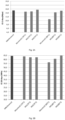
- the compressive strength at 28 days of MReference1, Mcontrol1(70°C), Mcontrol1(80°C), CM1(70°C), CM1(80°C), CM2(70°C) and CM2(80°C) are equivalent. This means that the mechanical resistance of the mortar at 28 days does not appear to be altered by a storage of the cement at 70°C or 80°C.
- CEM III cement assayed here does not contain significant amount of gypsum.
- This cement has a low sensitivity to a storage at high temperature, and the adipic acid treatment does not change its mechanical performances.
- IHB1 and IHB2 are placed in sealed boxes at 70°C and 80°C.
- Reference 2 is placed in sealed boxes at ambient temperature (20°C).
- the sealed boxes are placed at ambient temperature for 4 days.
- Mcontrol2(80°C) The compressive strength of Mcontrol2(80°C) is altered and fell by about 30% (from 15 MPa to 10.5 MPa), in comparison to MReference 2.
- IM1(80°C) and IM2(80°C) have a compressive strength above 14 Mpa, and thus greater than Mcontrol2(80°C).
- IM2(80°C) has a compressive strength (14.1 MPa) equivalent to MReference2 (15 MPa).
- MReference2 The compressive strength of MReference2, Mcontrol2(70°C), IM1(70°C) and IM2(70°C) are equivalent. The results found at 2 days are confirmed for Mcontrol2(80°C), IM1(80°C) and IM2(80°C). At 28 days, the compressive strength of Mcontrol2(80°C) is altered and fell by 12% (from 65 MPa to 57.2 MPa) whereas IM1(80°C) and IM2(80°C) present very good compressive strength (60 MPa for IM1(80°C) and 65 MPa for IM2(80°C), to be compared with a value of 65 MPa for MReference2.
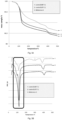
- the derivated TGA curves i.e. the DTG curves ( Figure 3B ), illustrate the residual quantity of gypsum and/or of hemihydrate, and support the fact that the higher the storage temperature, the more those two hydrated calcium sulphates are dehydrated and thus become visible in TGA/DTG.
- the DTG curves ( Figure 3B ) of control2(70°C) are similar to Reference2 meaning that when treated at a temperature 70°C the alteration of the cement is hardly discernible.
- the DTG curves ( Figure 3B ) of control2(80°C) clearly show an alteration of the cement.
- the symbol * illustrates the apparition of a hydrated phase.
- Thermogravimetric analyses are performed on Reference2, control2(80°C), IHB1(80°C) and IHB2(80°C).
- the DTG curves illustrate the residual quantity of gypsum and/or hemihydrate in the samples (in connection with the peak area).
- CEMII CEMII/B M(LL-S) 32.5R cement has been used in these studies, hereafter called "CEMII”.
- the relative composition of cements is given in the following table.
- Table 3 Raw materials Comparative CEM II Invention CEM II Clinker La Malle 70% 70% limestone 17% 17% Slag 13% 13% Gypsum 3% 3% Grinding agent (*) ADM72 0.018% 0.018% Adipic acid - 0.05% Iron(ll) sulphate heptahydrate 0.2% 0.2% (*) CHRYSO ® ADM72, sold by Chryso.
- the cements After grinding, the cements have the same grain size curves.
- Measurements of soluble Cr(VI) contents on cement are carried out initially and then monthly check of 1 to 3 months of cement age, according to the standard EN 196-10 of June 2017.
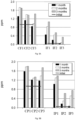
- soluble Cr(VI) content in comparative cement is initially at about 0.95 ppm, about 1.3 ppm after 1 month storage, about 1.7 ppm after 2 months storage, about 1.7 ppm after 3 months storage while the initial soluble Cr(VI) content is only at about 0.05 ppm in invention cement, about 0.45 ppm after 1 month storage, about 0.85 ppm after 2 months storage, about 1.05 ppm after 3 months storage.
- soluble Cr(VI) content in comparative cement is initially at about 0.95 ppm, about 1.15 ppm after 1 month storage, about 1.4 ppm after 2 months storage, about 1.4 ppm after 3 months storage while the initial soluble Cr(VI) content is only at about 0.05 ppm in invention cement, about 0.2 ppm after 1 month storage, about 0.45 ppm after 2 months storage, about 0.5 ppm after 3 months storage.
- soluble Cr(VI) content in comparative cement is initially at about 0.95 ppm, about 1 ppm after 2 months storage, about 1.4 ppm after 3 months storage while the initial Cr(VI) content is only at about 0.05 ppm in invention cement, about 0.05 ppm after 1 month storage, about 0.1 ppm after 2 months storage, about 0.35 ppm after 3 months storage.
- soluble Cr(VI) content in comparative cement is initially at about 0.95 ppm, about 1.6 ppm after 1 month storage, about 1.8 ppm after 2 months storage, about 1.8 ppm after 3 months storage while the initial soluble Cr(VI) content is only at about 0.05 ppm in invention cement, about 1 ppm after 1 month storage, about 1.25 ppm after 2 months storage, about 1.3 ppm after 3 months storage.
- soluble Cr(VI) content in comparative cement is initially at about 0.95 ppm, about 1.2 ppm after 1 month storage, about 1.25 ppm after 2 months storage, about 1.3 ppm after 3 months storage while the initial soluble Cr(VI) content is only at about 0.05 ppm in invention cement, about 0.2 ppm after 1 month storage, about 0.3 ppm after 2 months storage, about 0.6 ppm after 3 months storage.
- soluble Cr(VI) content in comparative cement is initially at about 0.95 ppm, about 1.15 ppm after 1 month storage, about 1.4 ppm after 2 months storage, about 1.7 ppm after 3 months storage while the initial soluble Cr(VI) content is only at about 0.05 ppm in invention cement, about 0.05 ppm after 1 month storage, about 0.5 ppm after 2 months storage, about 0.75 ppm after 3 months storage.
- adipic acid can also be used as further reducing soluble Cr (VI) contents, which in turn allows to reduce the iron sulphate dosage usually needed.
- anhydrite is also formed be dehydration of the gypsum but can not be detected by DSC as it is in a dehydrated form.
Landscapes
- Chemical & Material Sciences (AREA)
- Engineering & Computer Science (AREA)
- Ceramic Engineering (AREA)
- Materials Engineering (AREA)
- Structural Engineering (AREA)
- Organic Chemistry (AREA)
- Chemical Kinetics & Catalysis (AREA)
- Inorganic Chemistry (AREA)
- Disintegrating Or Milling (AREA)
- Soil Conditioners And Soil-Stabilizing Materials (AREA)
- Crushing And Grinding (AREA)
- Curing Cements, Concrete, And Artificial Stone (AREA)
Claims (11)
- Verfahren zur Herstellung und Lagerung eines Portlandzements, wobei das Verfahren Folgendes umfasst:(i) Bereitstellen von mindestens:- einem Portlandklinker,- einer Calciumsulfatquelle, die mehrheitlich Gips umfasst,- zwischen 0,01 und 0,1% einer organischen Verbindung, die ausgewählt wird aus Adipinsäure, Stearinsäure, 2,4,7,9-Tetramethyl-5-decyn-4,7-diol, Gemisch aus Adipin-, Glutar- und Succinsäuren, Salzen davon und Gemischen davon, in Gewichts-%, bezogen auf das Gewicht des Portlandzements,(ii) Mahlen der Bestandteile von Schritt (i) zum Erzeugen eines Portlandzements;(iii) Beschicken eines Behälters mit dem nach dem Schritt (ii) erhaltenen Portlandzement, wobei der Portlandzement beim Beschicken des Behälters eine Temperatur von über 70°C aufweist.
- Verfahren nach Anspruch 1, wobei im Schritt (i) zwischen 0,01% und weniger als 0,05% organische Verbindung, vorzugsweise zwischen 0,02% und 0,040%, in Gewichts-%, bezogen auf das Gewicht des Portlandzements, bereitgestellt wird.
- Verfahren nach einem der vorhergehenden Ansprüche, wobei die Calciumsulfatquelle ferner Halbhydrat, Anhydrit oder Gemische davon umfasst.
- Verfahren nach einem der vorhergehenden Ansprüche, wobei dem Portlandzement vor, während oder nach dem Mahlschritt (ii) mindestens ein mineralischer Zusatzstoff zugesetzt wird.
- Verfahren nach Anspruch 4, wobei der mindestens eine mineralische Zusatzstoff ausgewählt wird aus Schlacken, puzzolanischen Materialien, Flugasche, kalzinierten Schiefern, calciumcarbonathaltigem Material, Silikastaub, siliziumdioxidhaltigen Zusatzstoffen, Metakaolin oder Gemischen davon.
- Verfahren nach einem der vorhergehenden Ansprüche, wobei der Schritt (ii) bei einer Temperatur in Bereich von 70°C bis 150°C, und mehr zu bevorzugen von 80°C bis 120°C, durchgeführt wird.
- Verfahren nach einem der vorhergehenden Ansprüche, wobei der Schritt (ii) in einer Mahleinheit durchgeführt wird, die ausgewählt wird aus einer Kugelmühle oder einer Vertikalwälzmühle.
- Verfahren nach einem der vorhergehenden Ansprüche, wobei der Mahlschritt (ii) derart vorgenommen wird, dass die spezifische Blaine-Oberfläche des Portlandklinkers beim Abschluss von Schritt (ii) zwischen 2500 und 10 000 cm2/g beträgt.
- Portlandzement, der nach dem Verfahren nach einem der Ansprüche 1 bis 8 erhalten wird, umfassend:- einen Portlandklinker,- eine Calciumsulfatquelle, die mehrheitlich Gips umfasst,- zwischen 0,01 und weniger als 0,05%, vorzugsweise zwischen 0,02% und 0,04%, einer organischen Verbindung, die ausgewählt ist aus Adipinsäure, Stearinsäure, 2,4,7,9-Tetramethyl-5-decyn-4,7-diol, Gemisch aus Adipin-, Glutar- und Succinsäuren, Salzen davon und Gemischen davon, in Gewichts-%, bezogen auf das Gewicht des Portlandzements.
- Portlandzement nach Anspruch 9, der ferner mindestens einen mineralischen Zusatzstoff umfasst, der ausgewählt ist aus Hochofenschlacken, puzzolanischen Materialien, Flugasche, kalzinierten Schiefern, calciumcarbonathaltigem Material, Silikastaub, siliziumdioxidhaltigen Zusatzstoffen, Metakaolin oder Gemischen davon.
- Verwendung einer organischen Verbindung, die ausgewählt ist aus Adipinsäure, Stearinsäure, 2,4,7,9-Tetramethyl-5-decyn-4,7-diol, Gemisch aus Adipin-, Glutar- und Succinsäuren, Salzen davon und Gemischen davon, während des Mahlens eines Portlandzements, der einen Portlandklinker und eine Calciumsulfatquelle umfasst, die mehrheitlich Gips umfasst, um das Lagern des davon erhaltenen Portlandzements in einem Behälter direkt nach seinem Heißmahlen in einer Zementmühle bei gleichzeitiger Bewahrung seiner mechanischen Eigenschaften während seiner anschließenden Lagerung umfasst, wobei der Behälter bei einer Temperatur von über 70°C mit dem Portlandzement beschickt wird.
Applications Claiming Priority (2)
| Application Number | Priority Date | Filing Date | Title |
|---|---|---|---|
| EP20306488 | 2020-12-03 | ||
| PCT/EP2021/083907 WO2022117703A1 (en) | 2020-12-03 | 2021-12-02 | Portland cement with increased shelf-life |
Publications (3)
| Publication Number | Publication Date |
|---|---|
| EP4255863A1 EP4255863A1 (de) | 2023-10-11 |
| EP4255863B1 true EP4255863B1 (de) | 2025-02-12 |
| EP4255863B8 EP4255863B8 (de) | 2025-04-16 |
Family
ID=73839006
Family Applications (1)
| Application Number | Title | Priority Date | Filing Date |
|---|---|---|---|
| EP21819489.2A Active EP4255863B8 (de) | 2020-12-03 | 2021-12-02 | Portlandzement mit erhöhter lagerstabilität |
Country Status (5)
| Country | Link |
|---|---|
| EP (1) | EP4255863B8 (de) |
| CO (1) | CO2023008424A2 (de) |
| MX (1) | MX2023006074A (de) |
| PL (1) | PL4255863T3 (de) |
| WO (1) | WO2022117703A1 (de) |
Family Cites Families (2)
| Publication number | Priority date | Publication date | Assignee | Title |
|---|---|---|---|---|
| US1947504A (en) * | 1931-04-20 | 1934-02-20 | Riverside Cement Company | Cement product and method of making the same |
| FR2827857B1 (fr) | 2001-07-26 | 2005-02-04 | Rhodia Polyamide Intermediates | Liant hydraulique a vieillissement ameliore |
-
2021
- 2021-12-02 PL PL21819489.2T patent/PL4255863T3/pl unknown
- 2021-12-02 MX MX2023006074A patent/MX2023006074A/es unknown
- 2021-12-02 WO PCT/EP2021/083907 patent/WO2022117703A1/en not_active Ceased
- 2021-12-02 EP EP21819489.2A patent/EP4255863B8/de active Active
-
2023
- 2023-06-27 CO CONC2023/0008424A patent/CO2023008424A2/es unknown
Also Published As
| Publication number | Publication date |
|---|---|
| EP4255863A1 (de) | 2023-10-11 |
| WO2022117703A1 (en) | 2022-06-09 |
| MX2023006074A (es) | 2023-06-06 |
| CO2023008424A2 (es) | 2023-07-21 |
| EP4255863B8 (de) | 2025-04-16 |
| PL4255863T3 (pl) | 2025-05-26 |
Similar Documents
| Publication | Publication Date | Title |
|---|---|---|
| EP2842922B1 (de) | Flussmittel/Mineralisierungsmittel für Calciumsulfoaluminatzemente | |
| EP0640062B1 (de) | Zementzusammentsetzung | |
| EP2441738B1 (de) | Blähende zusatzmischung und herstellungsverfahren dafür | |
| EP3177578B1 (de) | Karbonisierbare calciumsilikatmassen | |
| EP2582643B1 (de) | Mahlhilfsmittel | |
| EP3109215B1 (de) | Mineralisator für calciumsulfoaluminat-ternesit-zemente | |
| KR101536118B1 (ko) | 초속경 시멘트 조성물 및 그 제조방법 | |
| CN116472256B (zh) | 块矿渣通过碳酸盐化转化成辅助胶凝材料 | |
| JP6488340B2 (ja) | 急硬材及び急硬性セメント組成物 | |
| KR20180014373A (ko) | 산업부산자원을 활용한 칼슘설포알루미네이트계 클링커 조성물, 이를 포함하는 시멘트 조성물 및 이의 제조방법 | |
| CN103261116B (zh) | 水泥混合材料、水泥组合物以及使用了水泥组合物的减少六价铬的方法 | |
| KR20230093138A (ko) | 포졸란 시멘트 조성물 및 이의 제조 방법 | |
| US6709509B2 (en) | Portland cement manufacture from slag from the production of magnesium metal | |
| JP5515329B2 (ja) | セメントクリンカー、セメント系固化材、土壌の固化処理方法及びセメントクリンカーの製造方法 | |
| CN113939488A (zh) | 用于水泥基粘结剂的动力学调节方法 | |
| EP4255863B1 (de) | Portlandzement mit erhöhter lagerstabilität | |
| EP3687950B1 (de) | Herstellung eines bindemittels mit hohem beta-belit-gehalt | |
| KR101366835B1 (ko) | 탈황더스트를 이용한 시멘트 조성물 | |
| JP2011051876A (ja) | 無水石膏含有焼成物および固化材 | |
| JP3810350B2 (ja) | セメント混和材及びセメント組成物 | |
| US20250289760A1 (en) | Cement additives for rapid strength development | |
| JP7260998B2 (ja) | 膨張組成物、セメント組成物およびセメント・コンクリート | |
| JP5072000B2 (ja) | 高アルミネートクリンカの製造方法 | |
| JP2025150337A (ja) | 粉末状セメント組成物及びその製造方法 | |
| JP2002068795A (ja) | 改質石膏及びそれを用いたセメント混和材 |
Legal Events
| Date | Code | Title | Description |
|---|---|---|---|
| STAA | Information on the status of an ep patent application or granted ep patent |
Free format text: STATUS: UNKNOWN |
|
| STAA | Information on the status of an ep patent application or granted ep patent |
Free format text: STATUS: THE INTERNATIONAL PUBLICATION HAS BEEN MADE |
|
| PUAI | Public reference made under article 153(3) epc to a published international application that has entered the european phase |
Free format text: ORIGINAL CODE: 0009012 |
|
| STAA | Information on the status of an ep patent application or granted ep patent |
Free format text: STATUS: REQUEST FOR EXAMINATION WAS MADE |
|
| 17P | Request for examination filed |
Effective date: 20230608 |
|
| AK | Designated contracting states |
Kind code of ref document: A1 Designated state(s): AL AT BE BG CH CY CZ DE DK EE ES FI FR GB GR HR HU IE IS IT LI LT LU LV MC MK MT NL NO PL PT RO RS SE SI SK SM TR |
|
| DAX | Request for extension of the european patent (deleted) | ||
| RAV | Requested validation state of the european patent: fee paid |
Extension state: MA Effective date: 20230608 |
|
| P01 | Opt-out of the competence of the unified patent court (upc) registered |
Effective date: 20240222 |
|
| GRAP | Despatch of communication of intention to grant a patent |
Free format text: ORIGINAL CODE: EPIDOSNIGR1 |
|
| STAA | Information on the status of an ep patent application or granted ep patent |
Free format text: STATUS: GRANT OF PATENT IS INTENDED |
|
| INTG | Intention to grant announced |
Effective date: 20240912 |
|
| GRAS | Grant fee paid |
Free format text: ORIGINAL CODE: EPIDOSNIGR3 |
|
| GRAA | (expected) grant |
Free format text: ORIGINAL CODE: 0009210 |
|
| STAA | Information on the status of an ep patent application or granted ep patent |
Free format text: STATUS: THE PATENT HAS BEEN GRANTED |
|
| AK | Designated contracting states |
Kind code of ref document: B1 Designated state(s): AL AT BE BG CH CY CZ DE DK EE ES FI FR GB GR HR HU IE IS IT LI LT LU LV MC MK MT NL NO PL PT RO RS SE SI SK SM TR |
|
| REG | Reference to a national code |
Ref country code: GB Ref legal event code: FG4D |
|
| REG | Reference to a national code |
Ref country code: CH Ref legal event code: EP |
|
| REG | Reference to a national code |
Ref country code: DE Ref legal event code: R096 Ref document number: 602021026099 Country of ref document: DE |
|
| GRAT | Correction requested after decision to grant or after decision to maintain patent in amended form |
Free format text: ORIGINAL CODE: EPIDOSNCDEC |
|
| REG | Reference to a national code |
Ref country code: IE Ref legal event code: FG4D |
|
| REG | Reference to a national code |
Ref country code: CH Ref legal event code: PK Free format text: BERICHTIGUNGEN Ref country code: CH Ref legal event code: PK Free format text: BERICHTIGUNG B8 |
|
| RIN2 | Information on inventor provided after grant (corrected) |
Inventor name: MARTIN, MYLENE Inventor name: DION, PASCAL |
|
| REG | Reference to a national code |
Ref country code: NL Ref legal event code: MP Effective date: 20250212 |
|
| PG25 | Lapsed in a contracting state [announced via postgrant information from national office to epo] |
Ref country code: RS Free format text: LAPSE BECAUSE OF FAILURE TO SUBMIT A TRANSLATION OF THE DESCRIPTION OR TO PAY THE FEE WITHIN THE PRESCRIBED TIME-LIMIT Effective date: 20250512 |
|
| PG25 | Lapsed in a contracting state [announced via postgrant information from national office to epo] |
Ref country code: FI Free format text: LAPSE BECAUSE OF FAILURE TO SUBMIT A TRANSLATION OF THE DESCRIPTION OR TO PAY THE FEE WITHIN THE PRESCRIBED TIME-LIMIT Effective date: 20250212 |
|
| PG25 | Lapsed in a contracting state [announced via postgrant information from national office to epo] |
Ref country code: ES Free format text: LAPSE BECAUSE OF FAILURE TO SUBMIT A TRANSLATION OF THE DESCRIPTION OR TO PAY THE FEE WITHIN THE PRESCRIBED TIME-LIMIT Effective date: 20250212 |
|
| REG | Reference to a national code |
Ref country code: LT Ref legal event code: MG9D |
|
| PG25 | Lapsed in a contracting state [announced via postgrant information from national office to epo] |
Ref country code: NO Free format text: LAPSE BECAUSE OF FAILURE TO SUBMIT A TRANSLATION OF THE DESCRIPTION OR TO PAY THE FEE WITHIN THE PRESCRIBED TIME-LIMIT Effective date: 20250512 Ref country code: IS Free format text: LAPSE BECAUSE OF FAILURE TO SUBMIT A TRANSLATION OF THE DESCRIPTION OR TO PAY THE FEE WITHIN THE PRESCRIBED TIME-LIMIT Effective date: 20250612 |
|
| PG25 | Lapsed in a contracting state [announced via postgrant information from national office to epo] |
Ref country code: NL Free format text: LAPSE BECAUSE OF FAILURE TO SUBMIT A TRANSLATION OF THE DESCRIPTION OR TO PAY THE FEE WITHIN THE PRESCRIBED TIME-LIMIT Effective date: 20250212 |
|
| PG25 | Lapsed in a contracting state [announced via postgrant information from national office to epo] |
Ref country code: HR Free format text: LAPSE BECAUSE OF FAILURE TO SUBMIT A TRANSLATION OF THE DESCRIPTION OR TO PAY THE FEE WITHIN THE PRESCRIBED TIME-LIMIT Effective date: 20250212 |
|
| PG25 | Lapsed in a contracting state [announced via postgrant information from national office to epo] |
Ref country code: LV Free format text: LAPSE BECAUSE OF FAILURE TO SUBMIT A TRANSLATION OF THE DESCRIPTION OR TO PAY THE FEE WITHIN THE PRESCRIBED TIME-LIMIT Effective date: 20250212 Ref country code: PT Free format text: LAPSE BECAUSE OF FAILURE TO SUBMIT A TRANSLATION OF THE DESCRIPTION OR TO PAY THE FEE WITHIN THE PRESCRIBED TIME-LIMIT Effective date: 20250612 |
|
| PG25 | Lapsed in a contracting state [announced via postgrant information from national office to epo] |
Ref country code: GR Free format text: LAPSE BECAUSE OF FAILURE TO SUBMIT A TRANSLATION OF THE DESCRIPTION OR TO PAY THE FEE WITHIN THE PRESCRIBED TIME-LIMIT Effective date: 20250513 Ref country code: BG Free format text: LAPSE BECAUSE OF FAILURE TO SUBMIT A TRANSLATION OF THE DESCRIPTION OR TO PAY THE FEE WITHIN THE PRESCRIBED TIME-LIMIT Effective date: 20250212 |
|
| REG | Reference to a national code |
Ref country code: AT Ref legal event code: MK05 Ref document number: 1765947 Country of ref document: AT Kind code of ref document: T Effective date: 20250212 |
|
| PG25 | Lapsed in a contracting state [announced via postgrant information from national office to epo] |
Ref country code: SE Free format text: LAPSE BECAUSE OF FAILURE TO SUBMIT A TRANSLATION OF THE DESCRIPTION OR TO PAY THE FEE WITHIN THE PRESCRIBED TIME-LIMIT Effective date: 20250212 |
|
| PG25 | Lapsed in a contracting state [announced via postgrant information from national office to epo] |
Ref country code: SM Free format text: LAPSE BECAUSE OF FAILURE TO SUBMIT A TRANSLATION OF THE DESCRIPTION OR TO PAY THE FEE WITHIN THE PRESCRIBED TIME-LIMIT Effective date: 20250212 |
|
| PG25 | Lapsed in a contracting state [announced via postgrant information from national office to epo] |
Ref country code: DK Free format text: LAPSE BECAUSE OF FAILURE TO SUBMIT A TRANSLATION OF THE DESCRIPTION OR TO PAY THE FEE WITHIN THE PRESCRIBED TIME-LIMIT Effective date: 20250212 |
|
| PG25 | Lapsed in a contracting state [announced via postgrant information from national office to epo] |
Ref country code: IT Free format text: LAPSE BECAUSE OF FAILURE TO SUBMIT A TRANSLATION OF THE DESCRIPTION OR TO PAY THE FEE WITHIN THE PRESCRIBED TIME-LIMIT Effective date: 20250212 |
|
| PG25 | Lapsed in a contracting state [announced via postgrant information from national office to epo] |
Ref country code: AT Free format text: LAPSE BECAUSE OF FAILURE TO SUBMIT A TRANSLATION OF THE DESCRIPTION OR TO PAY THE FEE WITHIN THE PRESCRIBED TIME-LIMIT Effective date: 20250212 |
|
| PG25 | Lapsed in a contracting state [announced via postgrant information from national office to epo] |
Ref country code: CZ Free format text: LAPSE BECAUSE OF FAILURE TO SUBMIT A TRANSLATION OF THE DESCRIPTION OR TO PAY THE FEE WITHIN THE PRESCRIBED TIME-LIMIT Effective date: 20250212 |
|
| PG25 | Lapsed in a contracting state [announced via postgrant information from national office to epo] |
Ref country code: SK Free format text: LAPSE BECAUSE OF FAILURE TO SUBMIT A TRANSLATION OF THE DESCRIPTION OR TO PAY THE FEE WITHIN THE PRESCRIBED TIME-LIMIT Effective date: 20250212 |
|
| REG | Reference to a national code |
Ref country code: DE Ref legal event code: R097 Ref document number: 602021026099 Country of ref document: DE |
|
| PLBE | No opposition filed within time limit |
Free format text: ORIGINAL CODE: 0009261 |
|
| STAA | Information on the status of an ep patent application or granted ep patent |
Free format text: STATUS: NO OPPOSITION FILED WITHIN TIME LIMIT |
|
| PGFP | Annual fee paid to national office [announced via postgrant information from national office to epo] |
Ref country code: FR Payment date: 20251113 Year of fee payment: 5 |
|
| 26N | No opposition filed |
Effective date: 20251113 |
|
| PGFP | Annual fee paid to national office [announced via postgrant information from national office to epo] |
Ref country code: PL Payment date: 20251120 Year of fee payment: 5 |
|
| PGFP | Annual fee paid to national office [announced via postgrant information from national office to epo] |
Ref country code: RO Payment date: 20251127 Year of fee payment: 5 |
|
| VS25 | Lapsed in a validation state [announced via postgrant information from nat. office to epo] |
Ref country code: MA Free format text: FAILURE TO ELECT DOMICILE IN THE NATIONAL COUNTRY Effective date: 20250513 |
|
| VS25 | Lapsed in a validation state [announced via postgrant information from nat. office to epo] |
Ref country code: MA Free format text: LAPSE BECAUSE OF FAILURE TO SUBMIT A TRANSLATION OF THE DESCRIPTION OR TO PAY THE FEE WITHIN THE PRESCRIBED TIME-LIMIT Effective date: 20250212 |
|
| PGFP | Annual fee paid to national office [announced via postgrant information from national office to epo] |
Ref country code: DE Payment date: 20251231 Year of fee payment: 5 |