EP4253200A1 - Vehicle and cowl top assembly thereof - Google Patents
Vehicle and cowl top assembly thereof Download PDFInfo
- Publication number
- EP4253200A1 EP4253200A1 EP23161721.8A EP23161721A EP4253200A1 EP 4253200 A1 EP4253200 A1 EP 4253200A1 EP 23161721 A EP23161721 A EP 23161721A EP 4253200 A1 EP4253200 A1 EP 4253200A1
- Authority
- EP
- European Patent Office
- Prior art keywords
- panel
- edge
- vehicle
- vertical
- cowl top
- Prior art date
- Legal status (The legal status is an assumption and is not a legal conclusion. Google has not performed a legal analysis and makes no representation as to the accuracy of the status listed.)
- Granted
Links
Images




Classifications
-
- B—PERFORMING OPERATIONS; TRANSPORTING
- B62—LAND VEHICLES FOR TRAVELLING OTHERWISE THAN ON RAILS
- B62D—MOTOR VEHICLES; TRAILERS
- B62D25/00—Superstructure or monocoque structure sub-units; Parts or details thereof not otherwise provided for
- B62D25/08—Front or rear portions
- B62D25/081—Cowls
-
- B—PERFORMING OPERATIONS; TRANSPORTING
- B62—LAND VEHICLES FOR TRAVELLING OTHERWISE THAN ON RAILS
- B62D—MOTOR VEHICLES; TRAILERS
- B62D25/00—Superstructure or monocoque structure sub-units; Parts or details thereof not otherwise provided for
- B62D25/08—Front or rear portions
- B62D25/10—Bonnets or lids, e.g. for trucks, tractors, busses, work vehicles
-
- B—PERFORMING OPERATIONS; TRANSPORTING
- B62—LAND VEHICLES FOR TRAVELLING OTHERWISE THAN ON RAILS
- B62D—MOTOR VEHICLES; TRAILERS
- B62D25/00—Superstructure or monocoque structure sub-units; Parts or details thereof not otherwise provided for
- B62D25/08—Front or rear portions
- B62D25/10—Bonnets or lids, e.g. for trucks, tractors, busses, work vehicles
- B62D25/12—Parts or details thereof
-
- B—PERFORMING OPERATIONS; TRANSPORTING
- B60—VEHICLES IN GENERAL
- B60R—VEHICLES, VEHICLE FITTINGS, OR VEHICLE PARTS, NOT OTHERWISE PROVIDED FOR
- B60R21/00—Arrangements or fittings on vehicles for protecting or preventing injuries to occupants or pedestrians in case of accidents or other traffic risks
- B60R21/34—Protecting non-occupants of a vehicle, e.g. pedestrians
- B60R2021/343—Protecting non-occupants of a vehicle, e.g. pedestrians using deformable body panel, bodywork or components
Definitions
- the disclosure relates to the technical field of vehicles, and in particular provides a vehicle and cowl top assembly thereof.
- the disclosure is intended to solve the above technical problems, that is, to solve the problems of long development cycle, high cost and even proneness to false detonation in the solution in which existing vehicles use active-ejecting bonnet technology to reduce injuries to pedestrians in collision accidents.
- the disclosure provides a cowl top assembly of a vehicle, the cowl top assembly comprising a rear panel and a front panel structure, wherein the front panel structure comprises a first top panel, a first vertical panel, and a first bottom panel, and wherein a front edge of the first top panel and a front edge of the first bottom panel are respectively connected to an upper edge and a lower edge of the first vertical panel, and a rear edge of the first top panel and a rear edge of the first bottom panel are connected to the rear panel, so that a cavity is enclosed by the rear panel and the front panel structure; and first collapsing holes are formed in the first top panel, and second collapsing holes are formed in the first vertical panel.
- the first top panel, the first vertical panel, and the first bottom panel are integrally formed.
- the first top panel is shaped to be bent upwards along a transverse being line in the middle of the first top panel, the first top panel is divided into a first section and a second section that are distributed front to rear, and the first collapsing holes are distributed in the second section.
- the first collapsing hole has a transverse dimension greater than a front-to-rear dimension thereof, and/or the second collapsing hole has a transverse dimension greater than a front-to-rear dimension thereof.
- a first reinforcing support is provided in the cavity at a longitudinal central plane, and the first reinforcing support comprises a second top panel, a second vertical panel, a second bottom panel, and two first side panels, wherein a front edge of the second top panel and a front edge of the second bottom panel are respectively connected to an upper edge and a lower edge of the second vertical panel, each of the two first side panels is connected to a side edge of each of the second top panel, the second vertical panel and the second bottom panel; and the second vertical panel abuts against the first vertical panel, the second bottom panel abuts against the first bottom panel, and a rear edge of the second top panel, a rear edge of the second bottom panel, and/or rear edges of the first side panels abut against the rear panel.
- a plurality of second reinforcing supports are also provided in the cavity, the plurality of second reinforcing supports being distributed in a width direction of the vehicle and uniformly distributed on two sides of the first reinforcing support.
- the second reinforcing support comprises a third vertical panel, a third bottom panel, and two second side panels, wherein a front edge of the third bottom panel is connected to a lower edge of the third vertical panel, and each of the two second side panels is connected to a side edge of each of the third vertical panel and the third bottom panel; and the third vertical panel abuts against the first vertical panel, and a rear edge of the third bottom panel and/or rear edges of the second side panels abut against the rear panel.
- the cowl top assembly further comprises a third reinforcing support, wherein a first end of the third reinforcing support is connected to the first bottom panel at the longitudinal central plane, and a second end of the third reinforcing support is connected to a shock absorber of the vehicle by means of a Y-shaped support; and the third reinforcing support is a cast part.
- a drip rail assembly of the vehicle is connected to the first vertical panel, and/or an air conditioner bracket, a cable harness mounting bracket, a dashboard bracket and/or an interior trim mounting bracket of the vehicle are connected to the rear panel.
- the cowl top assembly comprises a rear panel and a front panel structure, wherein the front panel structure comprises a first top panel, a first vertical panel, and a first bottom panel, and wherein a front edge of the first top panel and a front edge of the first bottom panel are respectively connected to an upper edge and a lower edge of the first vertical panel, and a rear edge of the first top panel and a rear edge of the first bottom panel are connected to the rear panel, so that a cavity is enclosed by the rear panel and the front panel structure; and first collapsing holes are formed in the first top panel, and second collapsing holes are formed in the first vertical panel.
- the front panel structure is a structure with a substantially "C"-shaped longitudinal section
- the front panel structure with the substantially “C”-shaped longitudinal section is connected to the rear panel to enclose a cavity
- the first collapsing holes are formed in the first top panel of the front panel structure
- the second collapsing holes are formed in the first vertical panel of the front panel structure.
- the first collapsing holes and the second collapsing holes cooperate with each other.
- an impact force can be quickly transferred to the cowl top assembly, so that a rearward and obliquely downward acting force is exerted on the front panel structure by the windshield with a lower edge supported at a junction between the first top panel and the first vertical panel.
- the cowl top assembly of the vehicle not only uses less material, and has a lighter weight, a shorter development cycle, and a lower cost, but also has a higher torsional resistance, and ensures a good NVH (Noise, Vibration and Harshness) performance, thus optimizing the user experience.
- NVH Noise, Vibration and Harshness
- the disclosure further provides a vehicle, comprising a cowl top assembly of a vehicle according to any of the above technical solutions.
- a vehicle of the disclosure may be an electric vehicle, a fuel vehicle, or a hybrid vehicle, etc.
- front is all based on a front-to-rear direction of the vehicle after components are mounted on the vehicle
- longitudinal is based on the front-to-rear direction of the vehicle after components are mounted on the vehicle
- transverse indicates a direction perpendicular to the longitudinal direction.
- first, second, and third are for descriptive purposes only, and may not be interpreted as indicating or implying relative importance.
- connection should be interpreted in a broad sense unless explicitly defined and limited otherwise, which, for example, may mean a fixed connection, a detachable connection or an integral connection; may mean a mechanical connection or an electrical connection; or may mean a direct connection, an indirect connection by means of an intermediate medium, or internal communication between two elements.
- connect may mean a fixed connection, a detachable connection or an integral connection; may mean a mechanical connection or an electrical connection; or may mean a direct connection, an indirect connection by means of an intermediate medium, or internal communication between two elements.
- the cowl top assembly comprises a rear panel and a front panel structure, wherein the front panel structure comprises a first top panel, a first vertical panel, and a first bottom panel, and wherein a front edge of the first top panel and a front edge of the first bottom panel are respectively connected to an upper edge and a lower edge of the first vertical panel, and a rear edge of the first top panel and a rear edge of the first bottom panel are connected to the rear panel, so that a cavity is enclosed by the rear panel and the front panel structure; and first collapsing holes are formed in the first top panel, and second collapsing holes are formed in the first vertical panel.
- the first collapsing holes and the second collapsing holes cooperate with each other.
- an impact force can be quickly transferred to the cowl top assembly, so that a rearward and obliquely downward acting force is exerted on the front panel structure by the windshield with a lower edge supported at a junction between the first top panel and the first vertical panel.
- the cowl top assembly of the vehicle not only uses less material, and has a lighter weight, a shorter development cycle, and a lower cost, but also has a higher torsional resistance, and ensures a good NVH performance.
- the first top panel, the first vertical panel, and the first bottom panel are integrally formed.
- the front panel structure formed of the first top panel, the first vertical panel and the first bottom panel has a stronger torsional resistance after being connected to the rear panel, thereby further improving the NVH performance.
- the first top panel is shaped to be bent upwards along a transverse bending line in the middle of the first top panel, the first top panel is divided into a first section and a second section that are distributed front to rear, and the first collapsing holes are distributed in the second section.
- the strength and stiffness of the first top panel are increased, further increasing the torsional resistance; on the other hand, the first section tilts downwards toward the front and the second section tilts downwards toward the rear, so that when the windshield with a lower edge supported at a junction between of the first section and the first vertical panel is impacted, there is a smaller angle between a rearward and obliquely downward acting force exerted on the front panel structure by the windshield and the second section, making it easier for the first collapsing holes distributed in the second section to collapse for deformation, thereby further reducing the acting force of the windshield on the pedestrians and reducing injuries to the pedestrians in pedestrian-vehicle collision accidents.
- the first collapsing hole has a transverse dimension greater than a front-to-rear dimension thereof, and/or the second collapsing hole has a transverse dimension greater than a front-to-rear dimension thereof.
- a first reinforcing support is provided in the cavity at a longitudinal central plane, and the first reinforcing support comprises a second top panel, a second vertical panel, a second bottom panel, and two first side panels, wherein a front edge of the second top panel and a front edge of the second bottom panel are respectively connected to an upper edge and a lower edge of the second vertical panel, and each of the two first side panels is connected to a side edge of each of the second top panel, the second vertical panel and the second bottom panel; and the second vertical panel abuts against the first vertical panel, the second bottom panel abuts against the first bottom panel, and a rear edge of the second top panel, a rear edge of the second bottom panel, and/or rear edges of the first side panels abut against the rear panel.
- the risk of torsional deformation of the cowl top assembly is greatest at the longitudinal central plane.
- the torsional strength of the cowl top assembly can be further increased, and the NVH performance can be improved.
- the second reinforcing support comprises a third vertical panel, a third bottom panel, and two second side panels, wherein a front edge of the third bottom panel is connected to a lower edge of the third vertical panel, and each of the two second side panels is connected to a side edge of each of the third vertical panel and the third bottom panel; and the third vertical panel abuts against the first vertical panel, and a rear edge of the third bottom panel and/or rear edges of the second side panels abut against the rear panel.
- the cowl top assembly further comprises a third reinforcing support, wherein a first end of the third reinforcing support is connected to the first bottom panel at the longitudinal central plane, and a second end of the third reinforcing support is connected to a shock absorber of the vehicle by means of a Y-shaped support; and the third reinforcing support is a cast part.
- the torsional strength of the cowl top assembly is further increased, and the NVH performance is improved.
- the risk of injury to the driver and passengers of the vehicle due to a huge deformation of the cowl top assembly toward the interior of the vehicle as a whole can be reduced, thereby further improving safety performance of the vehicle.
- a drip rail assembly of the vehicle is connected to the first vertical panel, and/or an air conditioner bracket, a cable harness mounting bracket, a dashboard bracket and/or an interior trim mounting bracket of the vehicle are connected to the rear panel.
- the drip rail assembly, the air conditioner bracket, the cable harness mounting bracket, the dashboard bracket, and/or the interior trim mounting bracket of the vehicle are connected to the cowl top assembly, so that a multi-point restraint is formed on the cowl top assembly without affecting the performance of the cowl top assembly to collapse to reduce injuries to the pedestrian, further increasing the torsional resistance of the cowl top assembly and improving the NVH performance.
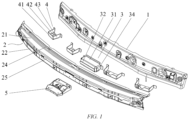
- FIG. 1 is an exploded view of a cowl top assembly of a vehicle according to an embodiment of the disclosure
- FIG. 2 is top view of the cowl top assembly of the vehicle according to an embodiment of the disclosure
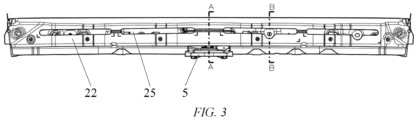
- FIG. 3 is a front view of the cowl top assembly of the vehicle according to an embodiment of the disclosure
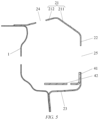
- FIG. 4 is a sectional view along line A-A in FIG. 3
- FIG. 5 is a sectional view along line B-B in FIG. 3
- FIG. 6 is an orientation diagram of a connection between the cowl top assembly of the vehicle and a Y-shaped support according to an embodiment of the disclosure
- FIG. 7 is an orientation diagram of a connection between the cowl top assembly of the vehicle and a drip rail assembly according to an embodiment of the disclosure
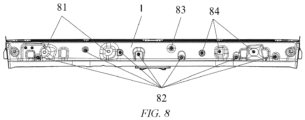
- FIG. 8 is a rear view of the cowl top assembly of the vehicle according to an embodiment of the disclosure.
- the cowl top assembly of the vehicle comprises a rear panel 1 and a front panel structure 2.
- the front panel structure 2 comprises a first top panel 21, a first vertical panel 22, and a first bottom panel 23 that are integrally formed.
- a front edge of the first top panel 21 and a front edge of the first bottom panel 23 are respectively connected to an upper edge and a lower edge of the first vertical panel 22, that is, the front panel structure is a structure with a substantially "C"-shaped longitudinal section, and a rear edge of the first top panel 21 and a rear edge of the first bottom panel 23 are connected to the rear panel 1, so that a cavity is enclosed by the rear panel 1 and the front panel structure 2.
- the first top panel 21 is shaped to be bent upwards along a transverse bending line in the middle of the first top panel, and the first top panel 21 is divided into a first section 211 and a second section 212 that are distributed front to rear.
- Four first collapsing holes 24 are formed in the second section 212, and four second collapsing holes 25 are formed in the first vertical panel 22. Both the first collapsing holes 24 and the second collapsing holes 25 are elongated holes.
- the four first collapsing holes 24 are distributed in the second section 212 in a width direction of the vehicle, and the four second collapsing holes 25 are distributed in the first vertical panel 22 in the width direction of the vehicle.
- a first reinforcing support 3 is provided in the cavity at a longitudinal central plane, and the first reinforcing support 3 comprises a second top panel 31, a second vertical panel 32, a second bottom panel 33, and two first side panels 34.
- a front edge of the second top panel 31 and a front edge of the second bottom panel 33 are respectively connected to an upper edge and a lower edge of the second vertical panel 32, and each of the two first side panels 34 is connected to a side edge of each of the second top panel 31, the second vertical panel 32 and the second bottom panel 33; and the second vertical panel 32 abuts against the first vertical panel 22, the second bottom panel 33 abuts against the first bottom panel 23, and a rear edge of the second top panel 31 and rear edges of the first side panels 34 abut against the rear panel 1.
- the four second reinforcing supports 4 are also provided in the cavity.
- the four second reinforcing supports 4 are distributed in the width direction of the vehicle and are uniformly distributed on two sides of the first reinforcing support 3.
- the second reinforcing support 4 comprises a third vertical panel 41, a third bottom panel 42, and two second side panels 43.
- a front edge of the third bottom panel 42 is connected to a lower edge of the third vertical panel 41, and each of the two second side panels 43 is connected to a side edge of each of the third vertical panel 41 and the third bottom panel 42; and the third vertical panel 41 abuts against the first vertical panel 22, and rear edges of the second side panels 43 abut against the rear panel 1. As shown in FIG.
- the cowl top assembly further comprises an aluminum-cast third reinforcing support 5.
- a first end of the third reinforcing support 5 is connected to the first bottom panel 23 at the longitudinal central plane, a second end of the third reinforcing support 5 is bolted to a Y-shaped support 6, and two branch ends of the Y-shaped support 6 are connected to two shock absorbers (not shown in the figure) of the vehicle.
- a drip rail assembly 8 of the vehicle is bolted to the first vertical panel 22 of the cowl top assembly.
- an instrument panel crossmember mounting hole 81, a cable harness mounting stud 82, an air conditioner mounting stud 83, and an interior trim mounting stud 84 are provided on a rear side of the rear panel 1.
- an instrument panel crossmember of the vehicle is bolted to the instrument panel crossmember mounting hole 81
- a cable harness bracket of the vehicle is fixed to the cable harness mounting stud 82
- an air conditioner bracket of the vehicle is fixed to the air conditioner mounting stud 83
- an interior trim mounting bracket is fixed to the interior trim mounting stud 84.
- the front panel structure 2 is configured as a structure with a substantially "C"-shaped longitudinal section
- the front panel structure 2 with the substantially “C”-shaped longitudinal section is connected to the rear panel 1 to enclose a cavity
- the first top panel 21 of the front panel structure 2 is shaped to be bent upwards along a transverse bending line in the middle of the first top panel
- the first top panel 21 is divided into a first section 211 and a second section 212 that are distributed front to rear
- a plurality of elongated first collapsing holes 24 distributed in the width direction of the vehicle are formed in the second section 212
- a plurality of elongated second collapsing holes 25 distributed in the width direction of the vehicle are formed in the first vertical panel 22 of the front panel structure 2, injuries to the pedestrians in pedestrian-vehicle collision accidents are effectively reduced.
- an impact force can be quickly transferred to the cowl top assembly, so that a rearward and obliquely downward acting force is exerted on the front panel structure 2 by the windshield with a lower edge supported at a junction between the first top panel 21 and the first vertical panel 22.
- the acting force is decomposed on the first top panel 21 and the first vertical panel 22, and then the first top panel 21 and the first vertical panel 22 are quickly and effectively collapsed for deformation at the first collapsing holes 24 and the second collapsing holes 25 respectively, thereby reducing the impact force on the pedestrian's head and effectively reducing injuries to the pedestrian.
- the cowl top assembly not only uses less material, and has a lighter weight, a short development cycle, and a lower cost, but also has a higher torsional resistance, and ensures a good NVH performance.
- the torsional strength of the cowl top assembly is further increased and the NVH performance is improved.
- the drip rail assembly 8 of the vehicle is connected to the first vertical panel 22, and the air conditioner bracket, the cable harness mounting bracket, the dashboard bracket and the interior trim mounting bracket of the vehicle are connected to the rear panel 1, so that a multi-point restraint is formed on the cowl top assembly without affecting the performance of the cowl top assembly to collapse to reduce injuries to the pedestrian, further increasing the torsional resistance of the cowl top assembly and improving the NVH performance.
- first collapsing holes 24 and four second collapsing holes 25 are provided, which is only a specific configuration and may be adjusted in a practical application so as to be adapted to different application scenarios.
- two, three, five or more first collapsing holes 24 and two, three, five or more second collapsing holes 25 are provided.
- the number of first collapsing holes 24 and the number of second collapsing holes 25 may be the same or different. It is a preferred way to configure the first collapsing holes 24 and the second collapsing holes 25 as elongated holes, which may be adjusted in a practical application so as to be adapted to different application scenarios.
- the first collapsing hole 24 may be a rectangular hole, an elliptical hole or another hole with a transverse dimension greater than a front-to-rear dimension, or a round hole, a square hole or other types of holes
- the second collapsing hole 25 may be a rectangular hole, an elliptical hole or another hole with a transverse dimension greater than a front-to-rear dimension, or a round hole, a square hole or other types of holes
- the first collapsing holes 24 and the second collapsing holes 25 may be the same or different in shape.
- first reinforcing support 3 may be configured in such a way that the rear edge of the second top panel 31, a rear edge of the second bottom panel 33 and the rear edges of the first side panels 34 all abut against the rear panel 1, or that one of the rear edge of the second top panel 31, the rear edge of the second bottom panel 33 and the rear edges of the first side panels 34 abuts against the rear panel 1.
- the second reinforcing support 4 may be configured in such a way that a rear edge of the second bottom panel 42 and a rear edge of the second side panel 43 both abut against the rear panel 1, or that only the rear edge of the second bottom panel 42 abuts against the rear panel 1.
- first top panel 21, the first vertical panel 22 and the first bottom panel 23 may also be separately formed and then connected together.
- the disclosure further provides a vehicle, comprising a cowl top assembly according to any of the above embodiments.
- vehicle may be an electric vehicle, a fuel vehicle, or a hybrid vehicle, etc.
Landscapes
- Engineering & Computer Science (AREA)
- Chemical & Material Sciences (AREA)
- Combustion & Propulsion (AREA)
- Transportation (AREA)
- Mechanical Engineering (AREA)
- Body Structure For Vehicles (AREA)
Abstract
Description
- The disclosure relates to the technical field of vehicles, and in particular provides a vehicle and cowl top assembly thereof.
- As passenger vehicles become increasingly popular in China, the probability of traffic accidents is increasing year by year. To protect the safety of pedestrians, pedestrian protection will be included in mandatory test objectives in both C-NCAP (China New Car Assessment Program) and national standards in the coming years.
- Traditional automobile factories often adopt active-ejecting bonnet technology to meet the latest pedestrian protection regulations to reduce injuries to pedestrians in collision accidents. Although the active-ejecting bonnet technology can effectively meet the regulatory requirements, it also poses risks such as high cost, long development cycle, and even false detonation.
- Thus, a new technical solution is needed in the art to solve the above problems.
- The disclosure is intended to solve the above technical problems, that is, to solve the problems of long development cycle, high cost and even proneness to false detonation in the solution in which existing vehicles use active-ejecting bonnet technology to reduce injuries to pedestrians in collision accidents.
- In a first aspect, the disclosure provides a cowl top assembly of a vehicle, the cowl top assembly comprising a rear panel and a front panel structure, wherein the front panel structure comprises a first top panel, a first vertical panel, and a first bottom panel, and wherein a front edge of the first top panel and a front edge of the first bottom panel are respectively connected to an upper edge and a lower edge of the first vertical panel, and a rear edge of the first top panel and a rear edge of the first bottom panel are connected to the rear panel, so that a cavity is enclosed by the rear panel and the front panel structure; and first collapsing holes are formed in the first top panel, and second collapsing holes are formed in the first vertical panel.
- In a preferred technical solution of the cowl top assembly described above, the first top panel, the first vertical panel, and the first bottom panel are integrally formed.
- In a preferred technical solution of the cowl top assembly described above, the first top panel is shaped to be bent upwards along a transverse being line in the middle of the first top panel, the first top panel is divided into a first section and a second section that are distributed front to rear, and the first collapsing holes are distributed in the second section.
- In a preferred technical solution of the cowl top assembly described above, the first collapsing hole has a transverse dimension greater than a front-to-rear dimension thereof, and/or the second collapsing hole has a transverse dimension greater than a front-to-rear dimension thereof.
- In a preferred technical solution of the cowl top assembly described above, a first reinforcing support is provided in the cavity at a longitudinal central plane, and the first reinforcing support comprises a second top panel, a second vertical panel, a second bottom panel, and two first side panels, wherein a front edge of the second top panel and a front edge of the second bottom panel are respectively connected to an upper edge and a lower edge of the second vertical panel, each of the two first side panels is connected to a side edge of each of the second top panel, the second vertical panel and the second bottom panel; and the second vertical panel abuts against the first vertical panel, the second bottom panel abuts against the first bottom panel, and a rear edge of the second top panel, a rear edge of the second bottom panel, and/or rear edges of the first side panels abut against the rear panel.
- In a preferred technical solution of the cowl top assembly described above, a plurality of second reinforcing supports are also provided in the cavity, the plurality of second reinforcing supports being distributed in a width direction of the vehicle and uniformly distributed on two sides of the first reinforcing support.
- In a preferred technical solution of the cowl top assembly described above, the second reinforcing support comprises a third vertical panel, a third bottom panel, and two second side panels, wherein a front edge of the third bottom panel is connected to a lower edge of the third vertical panel, and each of the two second side panels is connected to a side edge of each of the third vertical panel and the third bottom panel; and the third vertical panel abuts against the first vertical panel, and a rear edge of the third bottom panel and/or rear edges of the second side panels abut against the rear panel.
- In a preferred technical solution of the cowl top assembly described above, the cowl top assembly further comprises a third reinforcing support, wherein a first end of the third reinforcing support is connected to the first bottom panel at the longitudinal central plane, and a second end of the third reinforcing support is connected to a shock absorber of the vehicle by means of a Y-shaped support; and the third reinforcing support is a cast part.
- In a preferred technical solution of the cowl top assembly described above, a drip rail assembly of the vehicle is connected to the first vertical panel, and/or an air conditioner bracket, a cable harness mounting bracket, a dashboard bracket and/or an interior trim mounting bracket of the vehicle are connected to the rear panel.
- When using the above technical solution, the cowl top assembly comprises a rear panel and a front panel structure, wherein the front panel structure comprises a first top panel, a first vertical panel, and a first bottom panel, and wherein a front edge of the first top panel and a front edge of the first bottom panel are respectively connected to an upper edge and a lower edge of the first vertical panel, and a rear edge of the first top panel and a rear edge of the first bottom panel are connected to the rear panel, so that a cavity is enclosed by the rear panel and the front panel structure; and first collapsing holes are formed in the first top panel, and second collapsing holes are formed in the first vertical panel. That is, the front panel structure is a structure with a substantially "C"-shaped longitudinal section, and the front panel structure with the substantially "C"-shaped longitudinal section is connected to the rear panel to enclose a cavity, the first collapsing holes are formed in the first top panel of the front panel structure, and the second collapsing holes are formed in the first vertical panel of the front panel structure.
- With this arrangement, the first collapsing holes and the second collapsing holes cooperate with each other. In the process of a pedestrian-vehicle collision, when the pedestrian's head hits a front windshield of the vehicle, an impact force can be quickly transferred to the cowl top assembly, so that a rearward and obliquely downward acting force is exerted on the front panel structure by the windshield with a lower edge supported at a junction between the first top panel and the first vertical panel. The acting force is decomposed on the first top panel and the first vertical panel, and then the first top panel and the first vertical panel are quickly and effectively collapsed for deformation at the first collapsing holes and the second collapsing holes respectively, thereby reducing the impact force on the pedestrian's head and effectively reducing injuries to the pedestrian. In addition, according to the disclosure, the cowl top assembly of the vehicle not only uses less material, and has a lighter weight, a shorter development cycle, and a lower cost, but also has a higher torsional resistance, and ensures a good NVH (Noise, Vibration and Harshness) performance, thus optimizing the user experience.
- In a second aspect, the disclosure further provides a vehicle, comprising a cowl top assembly of a vehicle according to any of the above technical solutions.
- It should be noted that the vehicle has all the technical effects of the cowl top assembly of the vehicle described above, which will not be repeated here.
- Preferred embodiments of the disclosure are described below with reference to the accompanying drawings, in which:
-
FIG. 1 is an exploded view of a cowl top assembly of a vehicle according to an embodiment of the disclosure; -
FIG. 2 is top view of the cowl top assembly of the vehicle according to an embodiment of the disclosure; -
FIG. 3 is a front view of the cowl top assembly of the vehicle according to an embodiment of the disclosure; -
FIG. 4 is a sectional view along line A-A inFIG. 3 ; -
FIG. 5 is a sectional view along line B-B inFIG. 3 ; -
FIG. 6 is an orientation diagram of a connection between the cowl top assembly of the vehicle and a Y-shaped support according to an embodiment of the disclosure; -
FIG. 7 is an orientation diagram of a connection between the cowl top assembly of the vehicle and a drip rail assembly according to an embodiment of the disclosure; and -
FIG. 8 is a rear view of the cowl top assembly of the vehicle according to an embodiment of the disclosure. - 1. Rear panel; 2. Front panel structure; 21. First top panel; 211. First section; 212. Second section; 22. First vertical panel; 23. First bottom panel; 24. First collapsing hole; 25. Second collapsing hole; 3. First reinforcing support; 31. Second top panel; 32. Second vertical panel; 33. Second bottom panel; 34. First side panel; 4. Second reinforcing support; 41. Third vertical panel; 42. Third bottom panel; 43. Second side panel; 5. Third reinforcing support; 6. Y-shaped support; 7. Wiper bracket; 8. Drip rail assembly; 81. Instrument panel crossmember mounting hole; 82. Cable harness mounting stud; 83. Air conditioner mounting stud; 84. Interior trim mounting stud.
- Firstly, it should be understood by those skilled in the art that embodiments described below are only for explaining the technical principles of the disclosure and are not intended to limit the scope of protection of the disclosure. For example, a vehicle of the disclosure may be an electric vehicle, a fuel vehicle, or a hybrid vehicle, etc.
- It should be noted that, in the description of the disclosure, the terms that indicate the direction or positional relationship, such as "left", "right", "inner", and "outer", are based on the direction or positional relationship shown in the figures, which is merely for ease of description instead of indicating or implying that the device or element must have a particular orientation and be constructed and operated in a particular orientation, and therefore, should not be construed as limiting the disclosure. In addition, the terms "front", "rear", and the like are all based on a front-to-rear direction of the vehicle after components are mounted on the vehicle, the "longitudinal" is based on the front-to-rear direction of the vehicle after components are mounted on the vehicle, and the "transverse" indicates a direction perpendicular to the longitudinal direction. In addition, the terms "first", "second", and "third" are for descriptive purposes only, and may not be interpreted as indicating or implying relative importance.
- In addition, it should also be noted that, in the description of the disclosure, the terms "connect" should be interpreted in a broad sense unless explicitly defined and limited otherwise, which, for example, may mean a fixed connection, a detachable connection or an integral connection; may mean a mechanical connection or an electrical connection; or may mean a direct connection, an indirect connection by means of an intermediate medium, or internal communication between two elements. For those skilled in the art, the specific meaning of the above-mentioned terms in the disclosure can be interpreted according to the specific situation.
- Based on the problems of long development cycle, high cost and even proneness to false detonation in the solution in which existing vehicles use active-ejecting bonnet technology to reduce injuries to pedestrians in collision accidents, the disclosure provides a cowl top assembly of a vehicle. The cowl top assembly comprises a rear panel and a front panel structure, wherein the front panel structure comprises a first top panel, a first vertical panel, and a first bottom panel, and wherein a front edge of the first top panel and a front edge of the first bottom panel are respectively connected to an upper edge and a lower edge of the first vertical panel, and a rear edge of the first top panel and a rear edge of the first bottom panel are connected to the rear panel, so that a cavity is enclosed by the rear panel and the front panel structure; and first collapsing holes are formed in the first top panel, and second collapsing holes are formed in the first vertical panel.
- With this arrangement, the first collapsing holes and the second collapsing holes cooperate with each other. In the process of a pedestrian-vehicle collision, when the pedestrian's head hits a front windshield of the vehicle, an impact force can be quickly transferred to the cowl top assembly, so that a rearward and obliquely downward acting force is exerted on the front panel structure by the windshield with a lower edge supported at a junction between the first top panel and the first vertical panel. The acting force is decomposed on the first top panel and the first vertical panel, and then the first top panel and the first vertical panel are quickly and effectively collapsed for deformation at the first collapsing holes and the second collapsing holes respectively, thereby reducing the impact force on the pedestrian's head, effectively reducing injuries to the pedestrian, and solving the problems of long development cycle, high cost and even proneness to false detonation in the solution in which existing vehicles use active-ejecting bonnet technology to reduce injuries to pedestrians in collision accidents. In addition, according to the disclosure, the cowl top assembly of the vehicle not only uses less material, and has a lighter weight, a shorter development cycle, and a lower cost, but also has a higher torsional resistance, and ensures a good NVH performance.
- Preferably, the first top panel, the first vertical panel, and the first bottom panel are integrally formed. With this arrangement, not only the manufacturing and assembly processes of parts are reduced, but also the front panel structure formed of the first top panel, the first vertical panel and the first bottom panel has a stronger torsional resistance after being connected to the rear panel, thereby further improving the NVH performance.
- Preferably, the first top panel is shaped to be bent upwards along a transverse bending line in the middle of the first top panel, the first top panel is divided into a first section and a second section that are distributed front to rear, and the first collapsing holes are distributed in the second section. With this arrangement, on the one hand, the strength and stiffness of the first top panel are increased, further increasing the torsional resistance; on the other hand, the first section tilts downwards toward the front and the second section tilts downwards toward the rear, so that when the windshield with a lower edge supported at a junction between of the first section and the first vertical panel is impacted, there is a smaller angle between a rearward and obliquely downward acting force exerted on the front panel structure by the windshield and the second section, making it easier for the first collapsing holes distributed in the second section to collapse for deformation, thereby further reducing the acting force of the windshield on the pedestrians and reducing injuries to the pedestrians in pedestrian-vehicle collision accidents.
- Preferably, the first collapsing hole has a transverse dimension greater than a front-to-rear dimension thereof, and/or the second collapsing hole has a transverse dimension greater than a front-to-rear dimension thereof.
- With this arrangement, it is more conducive to collapsing of the cowl top assembly so as to reduce injuries to the pedestrian when the pedestrian hits the windshield of the vehicle.
- Preferably, a first reinforcing support is provided in the cavity at a longitudinal central plane, and the first reinforcing support comprises a second top panel, a second vertical panel, a second bottom panel, and two first side panels, wherein a front edge of the second top panel and a front edge of the second bottom panel are respectively connected to an upper edge and a lower edge of the second vertical panel, and each of the two first side panels is connected to a side edge of each of the second top panel, the second vertical panel and the second bottom panel; and the second vertical panel abuts against the first vertical panel, the second bottom panel abuts against the first bottom panel, and a rear edge of the second top panel, a rear edge of the second bottom panel, and/or rear edges of the first side panels abut against the rear panel.
- During use of the vehicle, the risk of torsional deformation of the cowl top assembly is greatest at the longitudinal central plane. With this arrangement, the torsional strength of the cowl top assembly can be further increased, and the NVH performance can be improved.
- Preferably, the second reinforcing support comprises a third vertical panel, a third bottom panel, and two second side panels, wherein a front edge of the third bottom panel is connected to a lower edge of the third vertical panel, and each of the two second side panels is connected to a side edge of each of the third vertical panel and the third bottom panel; and the third vertical panel abuts against the first vertical panel, and a rear edge of the third bottom panel and/or rear edges of the second side panels abut against the rear panel.
- With this arrangement, the overall torsional strength of the cowl top assembly is further increased.
- Preferably, the cowl top assembly further comprises a third reinforcing support, wherein a first end of the third reinforcing support is connected to the first bottom panel at the longitudinal central plane, and a second end of the third reinforcing support is connected to a shock absorber of the vehicle by means of a Y-shaped support; and the third reinforcing support is a cast part.
- With this arrangement, the torsional strength of the cowl top assembly is further increased, and the NVH performance is improved. In addition, without affecting the performance of the cowl top assembly to collapse to reduce injuries to the pedestrian, the risk of injury to the driver and passengers of the vehicle due to a huge deformation of the cowl top assembly toward the interior of the vehicle as a whole can be reduced, thereby further improving safety performance of the vehicle.
- Preferably, a drip rail assembly of the vehicle is connected to the first vertical panel, and/or an air conditioner bracket, a cable harness mounting bracket, a dashboard bracket and/or an interior trim mounting bracket of the vehicle are connected to the rear panel.
- With this arrangement, there is no need to provide separate support structures for the drip rail assembly, the air conditioner bracket, the cable harness mounting bracket, the dashboard bracket, and/or the interior trim mounting bracket of the vehicle, so that the number of parts is reduced, and the manufacturing and assembly processes are simplified, thereby further lowering the manufacturing cost of the entire vehicle. In addition, the drip rail assembly, the air conditioner bracket, the cable harness mounting bracket, the dashboard bracket and/or the interior trim mounting bracket of the vehicle are connected to the cowl top assembly, so that a multi-point restraint is formed on the cowl top assembly without affecting the performance of the cowl top assembly to collapse to reduce injuries to the pedestrian, further increasing the torsional resistance of the cowl top assembly and improving the NVH performance.
- The cowl top assembly of the vehicle according to the disclosure is described below with reference to
FIGS. 1 to 8 .FIG. 1 is an exploded view of a cowl top assembly of a vehicle according to an embodiment of the disclosure;FIG. 2 is top view of the cowl top assembly of the vehicle according to an embodiment of the disclosure;FIG. 3 is a front view of the cowl top assembly of the vehicle according to an embodiment of the disclosure;FIG. 4 is a sectional view along line A-A inFIG. 3 ;FIG. 5 is a sectional view along line B-B inFIG. 3 ;FIG. 6 is an orientation diagram of a connection between the cowl top assembly of the vehicle and a Y-shaped support according to an embodiment of the disclosure;FIG. 7 is an orientation diagram of a connection between the cowl top assembly of the vehicle and a drip rail assembly according to an embodiment of the disclosure; andFIG. 8 is a rear view of the cowl top assembly of the vehicle according to an embodiment of the disclosure. - As shown in
FIGS. 1 to 5 , the cowl top assembly of the vehicle comprises arear panel 1 and afront panel structure 2. Thefront panel structure 2 comprises a firsttop panel 21, a firstvertical panel 22, and a firstbottom panel 23 that are integrally formed. A front edge of the firsttop panel 21 and a front edge of the firstbottom panel 23 are respectively connected to an upper edge and a lower edge of the firstvertical panel 22, that is, the front panel structure is a structure with a substantially "C"-shaped longitudinal section, and a rear edge of the firsttop panel 21 and a rear edge of the firstbottom panel 23 are connected to therear panel 1, so that a cavity is enclosed by therear panel 1 and thefront panel structure 2. - The first
top panel 21 is shaped to be bent upwards along a transverse bending line in the middle of the first top panel, and the firsttop panel 21 is divided into afirst section 211 and asecond section 212 that are distributed front to rear. Four first collapsingholes 24 are formed in thesecond section 212, and four second collapsing holes 25 are formed in the firstvertical panel 22. Both the first collapsingholes 24 and the second collapsing holes 25 are elongated holes. The four first collapsingholes 24 are distributed in thesecond section 212 in a width direction of the vehicle, and the four second collapsing holes 25 are distributed in the firstvertical panel 22 in the width direction of the vehicle. - A first reinforcing
support 3 is provided in the cavity at a longitudinal central plane, and the first reinforcingsupport 3 comprises a secondtop panel 31, a secondvertical panel 32, a secondbottom panel 33, and twofirst side panels 34. A front edge of the secondtop panel 31 and a front edge of thesecond bottom panel 33 are respectively connected to an upper edge and a lower edge of the secondvertical panel 32, and each of the twofirst side panels 34 is connected to a side edge of each of the secondtop panel 31, the secondvertical panel 32 and thesecond bottom panel 33; and the secondvertical panel 32 abuts against the firstvertical panel 22, thesecond bottom panel 33 abuts against the firstbottom panel 23, and a rear edge of the secondtop panel 31 and rear edges of thefirst side panels 34 abut against therear panel 1. Four second reinforcingsupports 4 are also provided in the cavity. The four second reinforcingsupports 4 are distributed in the width direction of the vehicle and are uniformly distributed on two sides of the first reinforcingsupport 3. The second reinforcingsupport 4 comprises a thirdvertical panel 41, a thirdbottom panel 42, and twosecond side panels 43. A front edge of the thirdbottom panel 42 is connected to a lower edge of the thirdvertical panel 41, and each of the twosecond side panels 43 is connected to a side edge of each of the thirdvertical panel 41 and the thirdbottom panel 42; and the thirdvertical panel 41 abuts against the firstvertical panel 22, and rear edges of thesecond side panels 43 abut against therear panel 1. As shown inFIG. 6 , the cowl top assembly further comprises an aluminum-cast third reinforcingsupport 5. A first end of the third reinforcingsupport 5 is connected to the firstbottom panel 23 at the longitudinal central plane, a second end of the third reinforcingsupport 5 is bolted to a Y-shapedsupport 6, and two branch ends of the Y-shapedsupport 6 are connected to two shock absorbers (not shown in the figure) of the vehicle. - As shown in
FIG. 7 , adrip rail assembly 8 of the vehicle is bolted to the firstvertical panel 22 of the cowl top assembly. As shown inFIG. 8 , an instrument panelcrossmember mounting hole 81, a cableharness mounting stud 82, an airconditioner mounting stud 83, and an interiortrim mounting stud 84 are provided on a rear side of therear panel 1. In an installed state, an instrument panel crossmember of the vehicle is bolted to the instrument panelcrossmember mounting hole 81, a cable harness bracket of the vehicle is fixed to the cableharness mounting stud 82, an air conditioner bracket of the vehicle is fixed to the airconditioner mounting stud 83, and an interior trim mounting bracket is fixed to the interiortrim mounting stud 84. - Since the
front panel structure 2 is configured as a structure with a substantially "C"-shaped longitudinal section, thefront panel structure 2 with the substantially "C"-shaped longitudinal section is connected to therear panel 1 to enclose a cavity, the firsttop panel 21 of thefront panel structure 2 is shaped to be bent upwards along a transverse bending line in the middle of the first top panel, the firsttop panel 21 is divided into afirst section 211 and asecond section 212 that are distributed front to rear, a plurality of elongated first collapsingholes 24 distributed in the width direction of the vehicle are formed in thesecond section 212, and a plurality of elongated second collapsing holes 25 distributed in the width direction of the vehicle are formed in the firstvertical panel 22 of thefront panel structure 2, injuries to the pedestrians in pedestrian-vehicle collision accidents are effectively reduced. Specifically, in the process of a pedestrian-vehicle collision, when the pedestrian's head hits a front windshield of the vehicle, an impact force can be quickly transferred to the cowl top assembly, so that a rearward and obliquely downward acting force is exerted on thefront panel structure 2 by the windshield with a lower edge supported at a junction between the firsttop panel 21 and the firstvertical panel 22. The acting force is decomposed on the firsttop panel 21 and the firstvertical panel 22, and then the firsttop panel 21 and the firstvertical panel 22 are quickly and effectively collapsed for deformation at the first collapsingholes 24 and the second collapsing holes 25 respectively, thereby reducing the impact force on the pedestrian's head and effectively reducing injuries to the pedestrian. In addition, the cowl top assembly not only uses less material, and has a lighter weight, a short development cycle, and a lower cost, but also has a higher torsional resistance, and ensures a good NVH performance. - With the provision of the first reinforcing
support 3, the second reinforcingsupports 4 and the third reinforcingsupport 5, the torsional strength of the cowl top assembly is further increased and the NVH performance is improved. - The
drip rail assembly 8 of the vehicle is connected to the firstvertical panel 22, and the air conditioner bracket, the cable harness mounting bracket, the dashboard bracket and the interior trim mounting bracket of the vehicle are connected to therear panel 1, so that a multi-point restraint is formed on the cowl top assembly without affecting the performance of the cowl top assembly to collapse to reduce injuries to the pedestrian, further increasing the torsional resistance of the cowl top assembly and improving the NVH performance. In addition, there is no need to provide separate support structures for thedrip rail assembly 8, the air conditioner bracket, the cable harness mounting bracket, the dashboard bracket and/or the interior trim mounting bracket of the vehicle, so that the number of parts is reduced, the manufacturing and assembly processes are simplified, thereby further lowering the manufacturing cost of the entire vehicle. - It should be noted that four first collapsing
holes 24 and four second collapsing holes 25 are provided, which is only a specific configuration and may be adjusted in a practical application so as to be adapted to different application scenarios. For example, two, three, five or more first collapsingholes 24 and two, three, five or more second collapsing holes 25 are provided. The number of first collapsingholes 24 and the number of second collapsing holes 25 may be the same or different. It is a preferred way to configure the first collapsingholes 24 and the second collapsing holes 25 as elongated holes, which may be adjusted in a practical application so as to be adapted to different application scenarios. For example, the first collapsinghole 24 may be a rectangular hole, an elliptical hole or another hole with a transverse dimension greater than a front-to-rear dimension, or a round hole, a square hole or other types of holes; and the second collapsinghole 25 may be a rectangular hole, an elliptical hole or another hole with a transverse dimension greater than a front-to-rear dimension, or a round hole, a square hole or other types of holes; and the first collapsingholes 24 and the second collapsing holes 25 may be the same or different in shape. - In addition, the first reinforcing
support 3 may be configured in such a way that the rear edge of the secondtop panel 31, a rear edge of thesecond bottom panel 33 and the rear edges of thefirst side panels 34 all abut against therear panel 1, or that one of the rear edge of the secondtop panel 31, the rear edge of thesecond bottom panel 33 and the rear edges of thefirst side panels 34 abuts against therear panel 1. The second reinforcingsupport 4 may be configured in such a way that a rear edge of thesecond bottom panel 42 and a rear edge of thesecond side panel 43 both abut against therear panel 1, or that only the rear edge of thesecond bottom panel 42 abuts against therear panel 1. - In another feasible embodiment, the first
top panel 21, the firstvertical panel 22 and the firstbottom panel 23 may also be separately formed and then connected together. - In another aspect, the disclosure further provides a vehicle, comprising a cowl top assembly according to any of the above embodiments. It should be noted that the vehicle may be an electric vehicle, a fuel vehicle, or a hybrid vehicle, etc.
- Heretofore, the technical solutions of the disclosure have been described with reference to the preferred embodiments shown in the accompanying drawings. However, those skilled in the art can readily understand that the scope of protection of the disclosure is apparently not limited to these specific embodiments. Those skilled in the art can make equivalent changes or substitutions to the related technical features without departing from the principle of the disclosure, and all the technical solutions with such changes or substitutions shall fall within the scope of protection of the disclosure.
Claims (10)
- A cowl top assembly of a vehicle, comprising a rear panel and a front panel structure, whereinthe front panel structure comprises a first top panel, a first vertical panel, and a first bottom panel, and wherein a front edge of the first top panel and a front edge of the first bottom panel are respectively connected to an upper edge and a lower edge of the first vertical panel, and a rear edge of the first top panel and a rear edge of the first bottom panel are connected to the rear panel, so that a cavity is enclosed by the rear panel and the front panel structure, andfirst collapsing holes are formed in the first top panel, and second collapsing holes are formed in the first vertical panel.
- The cowl top assembly according to claim 1, wherein the first top panel, the first vertical panel, and the first bottom panel are integrally formed.
- The cowl top assembly according to claim 1 or 2, wherein the first top panel is shaped to be bent upwards along a transverse bending line in the middle of the first top panel, the first top panel is divided into a first section and a second section that are distributed front to rear, and the first collapsing holes are distributed in the second section.
- The cowl top assembly according to any one of claims 1 to 3, wherein the first collapsing holes and/or the second collapsing holes each have a transverse dimension greater than a front-to-rear dimension thereof.
- The cowl top assembly according to any one of claims 1 to 4, wherein a first reinforcing support is provided in the cavity at a longitudinal central plane, and the first reinforcing support comprises a second top panel, a second vertical panel, a second bottom panel, and two first side panels, and wherein a front edge of the second top panel and a front edge of the second bottom panel are respectively connected to an upper edge and a lower edge of the second vertical panel, and each of the two first side panels is connected to a side edge of each of the second top panel, the second vertical panel and the second bottom panel, and
the second vertical panel abuts against the first vertical panel, the second bottom panel abuts against the first bottom panel, and a rear edge of the second top panel, a rear edge of the second bottom panel, and/or rear edges of the first side panels abut against the rear panel. - The cowl top assembly according to claim 5, wherein a plurality of second reinforcing supports are also provided in the cavity, the plurality of second reinforcing supports being distributed in a width direction of the vehicle and uniformly distributed on two sides of the first reinforcing support.
- The cowl top assembly according to claim 6, wherein the second reinforcing support comprises a third vertical panel, a third bottom panel, and two second side panels, and wherein a front edge of the third bottom panel is connected to a lower edge of the third vertical panel, and each of the two second side panels is connected to a side edge of each of the third vertical panel and the third bottom panel, and
the third vertical panel abuts against the first vertical panel, and a rear edge of the third bottom panel and/or rear edges of the second side panels abut against the rear panel. - The cowl top assembly according to claim 6 or 7, wherein the cowl top assembly further comprises a third reinforcing support, and wherein a first end of the third reinforcing support is connected to the first bottom panel at the longitudinal central plane, and a second end of the third reinforcing support is connected to a shock absorber of the vehicle by means of a Y-shaped support; and
the third reinforcing support is a cast part. - The cowl top assembly according to any one of claims 6 to 8, wherein a drip rail assembly of the vehicle is connected to the first vertical panel, and/or
an air conditioner bracket, a cable harness mounting bracket, a dashboard bracket and/or an interior trim mounting bracket of the vehicle are connected to the rear panel. - A vehicle, comprising a cowl top assembly of a vehicle according to any one of claims 1 to 9.
Applications Claiming Priority (1)
| Application Number | Priority Date | Filing Date | Title |
|---|---|---|---|
| CN202210344119.5A CN114560015B (en) | 2022-03-31 | 2022-03-31 | Vehicle and its front upper cover assembly |
Publications (2)
| Publication Number | Publication Date |
|---|---|
| EP4253200A1 true EP4253200A1 (en) | 2023-10-04 |
| EP4253200B1 EP4253200B1 (en) | 2024-06-05 |
Family
ID=81720244
Family Applications (1)
| Application Number | Title | Priority Date | Filing Date |
|---|---|---|---|
| EP23161721.8A Active EP4253200B1 (en) | 2022-03-31 | 2023-03-14 | Vehicle and cowl top assembly thereof |
Country Status (3)
| Country | Link |
|---|---|
| US (1) | US20230312008A1 (en) |
| EP (1) | EP4253200B1 (en) |
| CN (1) | CN114560015B (en) |
Citations (4)
| Publication number | Priority date | Publication date | Assignee | Title |
|---|---|---|---|---|
| US20090066116A1 (en) * | 2007-09-10 | 2009-03-12 | Honda Motor Co., Ltd. | Vehicle front structure |
| US7546893B2 (en) * | 2002-05-13 | 2009-06-16 | Faurecia Innenraum Systeme Gmbh | Front wall module |
| US7552964B2 (en) * | 2007-03-02 | 2009-06-30 | Honda Motor Co., Ltd. | Front windshield support structure of a vehicle |
| DE102010005834A1 (en) * | 2010-01-27 | 2011-07-28 | Bayerische Motoren Werke Aktiengesellschaft, 80809 | Support arrangement for windscreen of body of passenger vehicle, has cross beam and support element, which comprises support section for indirect support of windscreen |
Family Cites Families (6)
| Publication number | Priority date | Publication date | Assignee | Title |
|---|---|---|---|---|
| DE10037051A1 (en) * | 2000-07-29 | 2002-02-28 | Acts Gmbh & Co Kg | Car with bonnet (hood) acting as safety device has bonnet pivoted at bumper height and closing mechanism in rear region of bumper |
| JP5157353B2 (en) * | 2007-01-22 | 2013-03-06 | 日産自動車株式会社 | Vehicle cowl structure |
| CN203473006U (en) * | 2013-08-01 | 2014-03-12 | 一汽海马汽车有限公司 | Automobile engine lid |
| CN209617278U (en) * | 2019-02-02 | 2019-11-12 | 广州汽车集团股份有限公司 | A kind of car front windshield windscreen beam structure and vehicle |
| CN110696928B (en) * | 2019-10-31 | 2021-02-19 | 东风汽车集团有限公司 | A front wall superstructure based on pedestrian head impact protection |
| CN217048798U (en) * | 2022-03-31 | 2022-07-26 | 蔚来汽车科技(安徽)有限公司 | Vehicle and front wall upper cover plate assembly thereof |
-
2022
- 2022-03-31 CN CN202210344119.5A patent/CN114560015B/en active Active
-
2023
- 2023-03-14 EP EP23161721.8A patent/EP4253200B1/en active Active
- 2023-03-27 US US18/190,463 patent/US20230312008A1/en not_active Abandoned
Patent Citations (4)
| Publication number | Priority date | Publication date | Assignee | Title |
|---|---|---|---|---|
| US7546893B2 (en) * | 2002-05-13 | 2009-06-16 | Faurecia Innenraum Systeme Gmbh | Front wall module |
| US7552964B2 (en) * | 2007-03-02 | 2009-06-30 | Honda Motor Co., Ltd. | Front windshield support structure of a vehicle |
| US20090066116A1 (en) * | 2007-09-10 | 2009-03-12 | Honda Motor Co., Ltd. | Vehicle front structure |
| DE102010005834A1 (en) * | 2010-01-27 | 2011-07-28 | Bayerische Motoren Werke Aktiengesellschaft, 80809 | Support arrangement for windscreen of body of passenger vehicle, has cross beam and support element, which comprises support section for indirect support of windscreen |
Also Published As
| Publication number | Publication date |
|---|---|
| CN114560015A (en) | 2022-05-31 |
| EP4253200B1 (en) | 2024-06-05 |
| US20230312008A1 (en) | 2023-10-05 |
| CN114560015B (en) | 2025-10-14 |
Similar Documents
| Publication | Publication Date | Title |
|---|---|---|
| US9725122B2 (en) | Front vehicle body structure | |
| CN107539370B (en) | Front vehicle body reinforcing structure | |
| CN115214790B (en) | Car front cabin and car | |
| US9242676B2 (en) | Front vehicle body reinforcing structure | |
| CN206384041U (en) | Dashboard cross member assembly and automobile | |
| CN107995903B (en) | Support structures and front-end modules for front-end modules of motor vehicles | |
| CN111891224B (en) | Front cabin structure and vehicle with same | |
| US10093359B2 (en) | Vehicle front frame assembly, and methods of use and manufacture thereof | |
| CN112046388B (en) | Headlight support and headlight installation location structure | |
| CN217994047U (en) | Shock attenuation tower and vehicle | |
| EP4253200A1 (en) | Vehicle and cowl top assembly thereof | |
| KR102933830B1 (en) | Bumper of vehicle | |
| CN217048798U (en) | Vehicle and front wall upper cover plate assembly thereof | |
| CN211167095U (en) | Vehicle beam assembly and frame | |
| CN218257616U (en) | Front shock tower assembly and vehicle | |
| CN205009961U (en) | Commercial car engine fixing device | |
| KR102905784B1 (en) | Cowl crossbar assembly | |
| CN103253294B (en) | steering column assembly connecting structure | |
| CN105172565A (en) | Engine fixation device for commercial vehicle | |
| CN215553570U (en) | Vehicle body connecting structure and vehicle | |
| KR102867348B1 (en) | Cowl cross structure | |
| KR101047990B1 (en) | Open-section cowl structure with improved NHH performance | |
| CN217672467U (en) | Ventilation plaque assembly and vehicle | |
| KR102959633B1 (en) | Cowl crossbar | |
| KR102879368B1 (en) | Cowl crossbar assembly |
Legal Events
| Date | Code | Title | Description |
|---|---|---|---|
| PUAI | Public reference made under article 153(3) epc to a published international application that has entered the european phase |
Free format text: ORIGINAL CODE: 0009012 |
|
| STAA | Information on the status of an ep patent application or granted ep patent |
Free format text: STATUS: EXAMINATION IS IN PROGRESS |
|
| 17P | Request for examination filed |
Effective date: 20230330 |
|
| AK | Designated contracting states |
Kind code of ref document: A1 Designated state(s): AL AT BE BG CH CY CZ DE DK EE ES FI FR GB GR HR HU IE IS IT LI LT LU LV MC ME MK MT NL NO PL PT RO RS SE SI SK SM TR |
|
| GRAP | Despatch of communication of intention to grant a patent |
Free format text: ORIGINAL CODE: EPIDOSNIGR1 |
|
| STAA | Information on the status of an ep patent application or granted ep patent |
Free format text: STATUS: GRANT OF PATENT IS INTENDED |
|
| GRAS | Grant fee paid |
Free format text: ORIGINAL CODE: EPIDOSNIGR3 |
|
| INTG | Intention to grant announced |
Effective date: 20240306 |
|
| GRAA | (expected) grant |
Free format text: ORIGINAL CODE: 0009210 |
|
| STAA | Information on the status of an ep patent application or granted ep patent |
Free format text: STATUS: THE PATENT HAS BEEN GRANTED |
|
| AK | Designated contracting states |
Kind code of ref document: B1 Designated state(s): AL AT BE BG CH CY CZ DE DK EE ES FI FR GB GR HR HU IE IS IT LI LT LU LV MC ME MK MT NL NO PL PT RO RS SE SI SK SM TR |
|
| REG | Reference to a national code |
Ref country code: CH Ref legal event code: EP |
|
| REG | Reference to a national code |
Ref country code: DE Ref legal event code: R096 Ref document number: 602023000131 Country of ref document: DE |
|
| REG | Reference to a national code |
Ref country code: IE Ref legal event code: FG4D |
|
| REG | Reference to a national code |
Ref country code: LT Ref legal event code: MG9D |
|
| PG25 | Lapsed in a contracting state [announced via postgrant information from national office to epo] |
Ref country code: BG Free format text: LAPSE BECAUSE OF FAILURE TO SUBMIT A TRANSLATION OF THE DESCRIPTION OR TO PAY THE FEE WITHIN THE PRESCRIBED TIME-LIMIT Effective date: 20240605 |
|
| REG | Reference to a national code |
Ref country code: NL Ref legal event code: MP Effective date: 20240605 |
|
| PG25 | Lapsed in a contracting state [announced via postgrant information from national office to epo] |
Ref country code: FI Free format text: LAPSE BECAUSE OF FAILURE TO SUBMIT A TRANSLATION OF THE DESCRIPTION OR TO PAY THE FEE WITHIN THE PRESCRIBED TIME-LIMIT Effective date: 20240605 Ref country code: HR Free format text: LAPSE BECAUSE OF FAILURE TO SUBMIT A TRANSLATION OF THE DESCRIPTION OR TO PAY THE FEE WITHIN THE PRESCRIBED TIME-LIMIT Effective date: 20240605 |
|
| PG25 | Lapsed in a contracting state [announced via postgrant information from national office to epo] |
Ref country code: GR Free format text: LAPSE BECAUSE OF FAILURE TO SUBMIT A TRANSLATION OF THE DESCRIPTION OR TO PAY THE FEE WITHIN THE PRESCRIBED TIME-LIMIT Effective date: 20240906 |
|
| PG25 | Lapsed in a contracting state [announced via postgrant information from national office to epo] |
Ref country code: ES Free format text: LAPSE BECAUSE OF FAILURE TO SUBMIT A TRANSLATION OF THE DESCRIPTION OR TO PAY THE FEE WITHIN THE PRESCRIBED TIME-LIMIT Effective date: 20240605 |
|
| PG25 | Lapsed in a contracting state [announced via postgrant information from national office to epo] |
Ref country code: LV Free format text: LAPSE BECAUSE OF FAILURE TO SUBMIT A TRANSLATION OF THE DESCRIPTION OR TO PAY THE FEE WITHIN THE PRESCRIBED TIME-LIMIT Effective date: 20240605 |
|
| PG25 | Lapsed in a contracting state [announced via postgrant information from national office to epo] |
Ref country code: NO Free format text: LAPSE BECAUSE OF FAILURE TO SUBMIT A TRANSLATION OF THE DESCRIPTION OR TO PAY THE FEE WITHIN THE PRESCRIBED TIME-LIMIT Effective date: 20240905 Ref country code: LV Free format text: LAPSE BECAUSE OF FAILURE TO SUBMIT A TRANSLATION OF THE DESCRIPTION OR TO PAY THE FEE WITHIN THE PRESCRIBED TIME-LIMIT Effective date: 20240605 Ref country code: HR Free format text: LAPSE BECAUSE OF FAILURE TO SUBMIT A TRANSLATION OF THE DESCRIPTION OR TO PAY THE FEE WITHIN THE PRESCRIBED TIME-LIMIT Effective date: 20240605 Ref country code: GR Free format text: LAPSE BECAUSE OF FAILURE TO SUBMIT A TRANSLATION OF THE DESCRIPTION OR TO PAY THE FEE WITHIN THE PRESCRIBED TIME-LIMIT Effective date: 20240906 Ref country code: FI Free format text: LAPSE BECAUSE OF FAILURE TO SUBMIT A TRANSLATION OF THE DESCRIPTION OR TO PAY THE FEE WITHIN THE PRESCRIBED TIME-LIMIT Effective date: 20240605 Ref country code: ES Free format text: LAPSE BECAUSE OF FAILURE TO SUBMIT A TRANSLATION OF THE DESCRIPTION OR TO PAY THE FEE WITHIN THE PRESCRIBED TIME-LIMIT Effective date: 20240605 Ref country code: BG Free format text: LAPSE BECAUSE OF FAILURE TO SUBMIT A TRANSLATION OF THE DESCRIPTION OR TO PAY THE FEE WITHIN THE PRESCRIBED TIME-LIMIT Effective date: 20240605 Ref country code: RS Free format text: LAPSE BECAUSE OF FAILURE TO SUBMIT A TRANSLATION OF THE DESCRIPTION OR TO PAY THE FEE WITHIN THE PRESCRIBED TIME-LIMIT Effective date: 20240905 |
|
| PG25 | Lapsed in a contracting state [announced via postgrant information from national office to epo] |
Ref country code: NL Free format text: LAPSE BECAUSE OF FAILURE TO SUBMIT A TRANSLATION OF THE DESCRIPTION OR TO PAY THE FEE WITHIN THE PRESCRIBED TIME-LIMIT Effective date: 20240605 |
|
| REG | Reference to a national code |
Ref country code: AT Ref legal event code: MK05 Ref document number: 1692281 Country of ref document: AT Kind code of ref document: T Effective date: 20240605 |
|
| PG25 | Lapsed in a contracting state [announced via postgrant information from national office to epo] |
Ref country code: NL Free format text: LAPSE BECAUSE OF FAILURE TO SUBMIT A TRANSLATION OF THE DESCRIPTION OR TO PAY THE FEE WITHIN THE PRESCRIBED TIME-LIMIT Effective date: 20240605 |
|
| PG25 | Lapsed in a contracting state [announced via postgrant information from national office to epo] |
Ref country code: PT Free format text: LAPSE BECAUSE OF FAILURE TO SUBMIT A TRANSLATION OF THE DESCRIPTION OR TO PAY THE FEE WITHIN THE PRESCRIBED TIME-LIMIT Effective date: 20241007 |
|
| PG25 | Lapsed in a contracting state [announced via postgrant information from national office to epo] |
Ref country code: PT Free format text: LAPSE BECAUSE OF FAILURE TO SUBMIT A TRANSLATION OF THE DESCRIPTION OR TO PAY THE FEE WITHIN THE PRESCRIBED TIME-LIMIT Effective date: 20241007 |
|
| PG25 | Lapsed in a contracting state [announced via postgrant information from national office to epo] |
Ref country code: PL Free format text: LAPSE BECAUSE OF FAILURE TO SUBMIT A TRANSLATION OF THE DESCRIPTION OR TO PAY THE FEE WITHIN THE PRESCRIBED TIME-LIMIT Effective date: 20240605 |
|
| PG25 | Lapsed in a contracting state [announced via postgrant information from national office to epo] |
Ref country code: EE Free format text: LAPSE BECAUSE OF FAILURE TO SUBMIT A TRANSLATION OF THE DESCRIPTION OR TO PAY THE FEE WITHIN THE PRESCRIBED TIME-LIMIT Effective date: 20240605 |
|
| PG25 | Lapsed in a contracting state [announced via postgrant information from national office to epo] |
Ref country code: AT Free format text: LAPSE BECAUSE OF FAILURE TO SUBMIT A TRANSLATION OF THE DESCRIPTION OR TO PAY THE FEE WITHIN THE PRESCRIBED TIME-LIMIT Effective date: 20240605 Ref country code: IS Free format text: LAPSE BECAUSE OF FAILURE TO SUBMIT A TRANSLATION OF THE DESCRIPTION OR TO PAY THE FEE WITHIN THE PRESCRIBED TIME-LIMIT Effective date: 20241005 |
|
| PG25 | Lapsed in a contracting state [announced via postgrant information from national office to epo] |
Ref country code: CZ Free format text: LAPSE BECAUSE OF FAILURE TO SUBMIT A TRANSLATION OF THE DESCRIPTION OR TO PAY THE FEE WITHIN THE PRESCRIBED TIME-LIMIT Effective date: 20240605 |
|
| PG25 | Lapsed in a contracting state [announced via postgrant information from national office to epo] |
Ref country code: RO Free format text: LAPSE BECAUSE OF FAILURE TO SUBMIT A TRANSLATION OF THE DESCRIPTION OR TO PAY THE FEE WITHIN THE PRESCRIBED TIME-LIMIT Effective date: 20240605 Ref country code: SK Free format text: LAPSE BECAUSE OF FAILURE TO SUBMIT A TRANSLATION OF THE DESCRIPTION OR TO PAY THE FEE WITHIN THE PRESCRIBED TIME-LIMIT Effective date: 20240605 |
|
| PG25 | Lapsed in a contracting state [announced via postgrant information from national office to epo] |
Ref country code: SM Free format text: LAPSE BECAUSE OF FAILURE TO SUBMIT A TRANSLATION OF THE DESCRIPTION OR TO PAY THE FEE WITHIN THE PRESCRIBED TIME-LIMIT Effective date: 20240605 |
|
| PG25 | Lapsed in a contracting state [announced via postgrant information from national office to epo] |
Ref country code: SM Free format text: LAPSE BECAUSE OF FAILURE TO SUBMIT A TRANSLATION OF THE DESCRIPTION OR TO PAY THE FEE WITHIN THE PRESCRIBED TIME-LIMIT Effective date: 20240605 Ref country code: SK Free format text: LAPSE BECAUSE OF FAILURE TO SUBMIT A TRANSLATION OF THE DESCRIPTION OR TO PAY THE FEE WITHIN THE PRESCRIBED TIME-LIMIT Effective date: 20240605 Ref country code: RO Free format text: LAPSE BECAUSE OF FAILURE TO SUBMIT A TRANSLATION OF THE DESCRIPTION OR TO PAY THE FEE WITHIN THE PRESCRIBED TIME-LIMIT Effective date: 20240605 Ref country code: PL Free format text: LAPSE BECAUSE OF FAILURE TO SUBMIT A TRANSLATION OF THE DESCRIPTION OR TO PAY THE FEE WITHIN THE PRESCRIBED TIME-LIMIT Effective date: 20240605 Ref country code: IS Free format text: LAPSE BECAUSE OF FAILURE TO SUBMIT A TRANSLATION OF THE DESCRIPTION OR TO PAY THE FEE WITHIN THE PRESCRIBED TIME-LIMIT Effective date: 20241005 Ref country code: EE Free format text: LAPSE BECAUSE OF FAILURE TO SUBMIT A TRANSLATION OF THE DESCRIPTION OR TO PAY THE FEE WITHIN THE PRESCRIBED TIME-LIMIT Effective date: 20240605 Ref country code: CZ Free format text: LAPSE BECAUSE OF FAILURE TO SUBMIT A TRANSLATION OF THE DESCRIPTION OR TO PAY THE FEE WITHIN THE PRESCRIBED TIME-LIMIT Effective date: 20240605 Ref country code: AT Free format text: LAPSE BECAUSE OF FAILURE TO SUBMIT A TRANSLATION OF THE DESCRIPTION OR TO PAY THE FEE WITHIN THE PRESCRIBED TIME-LIMIT Effective date: 20240605 |
|
| PG25 | Lapsed in a contracting state [announced via postgrant information from national office to epo] |
Ref country code: IT Free format text: LAPSE BECAUSE OF FAILURE TO SUBMIT A TRANSLATION OF THE DESCRIPTION OR TO PAY THE FEE WITHIN THE PRESCRIBED TIME-LIMIT Effective date: 20240605 |
|
| REG | Reference to a national code |
Ref country code: DE Ref legal event code: R097 Ref document number: 602023000131 Country of ref document: DE |
|
| PLBE | No opposition filed within time limit |
Free format text: ORIGINAL CODE: 0009261 |
|
| STAA | Information on the status of an ep patent application or granted ep patent |
Free format text: STATUS: NO OPPOSITION FILED WITHIN TIME LIMIT |
|
| PG25 | Lapsed in a contracting state [announced via postgrant information from national office to epo] |
Ref country code: DK Free format text: LAPSE BECAUSE OF FAILURE TO SUBMIT A TRANSLATION OF THE DESCRIPTION OR TO PAY THE FEE WITHIN THE PRESCRIBED TIME-LIMIT Effective date: 20240605 |
|
| 26N | No opposition filed |
Effective date: 20250306 |
|
| PG25 | Lapsed in a contracting state [announced via postgrant information from national office to epo] |
Ref country code: SE Free format text: LAPSE BECAUSE OF FAILURE TO SUBMIT A TRANSLATION OF THE DESCRIPTION OR TO PAY THE FEE WITHIN THE PRESCRIBED TIME-LIMIT Effective date: 20240605 |
|
| PG25 | Lapsed in a contracting state [announced via postgrant information from national office to epo] |
Ref country code: MC Free format text: LAPSE BECAUSE OF FAILURE TO SUBMIT A TRANSLATION OF THE DESCRIPTION OR TO PAY THE FEE WITHIN THE PRESCRIBED TIME-LIMIT Effective date: 20240605 |
|
| PG25 | Lapsed in a contracting state [announced via postgrant information from national office to epo] |
Ref country code: LU Free format text: LAPSE BECAUSE OF NON-PAYMENT OF DUE FEES Effective date: 20250314 |
|
| REG | Reference to a national code |
Ref country code: BE Ref legal event code: MM Effective date: 20250331 |
|
| PG25 | Lapsed in a contracting state [announced via postgrant information from national office to epo] |
Ref country code: BE Free format text: LAPSE BECAUSE OF NON-PAYMENT OF DUE FEES Effective date: 20250331 |
|
| PG25 | Lapsed in a contracting state [announced via postgrant information from national office to epo] |
Ref country code: IE Free format text: LAPSE BECAUSE OF NON-PAYMENT OF DUE FEES Effective date: 20250314 |
|
| PGFP | Annual fee paid to national office [announced via postgrant information from national office to epo] |
Ref country code: DE Payment date: 20260319 Year of fee payment: 4 |
|
| PGFP | Annual fee paid to national office [announced via postgrant information from national office to epo] |
Ref country code: FR Payment date: 20260323 Year of fee payment: 4 |