EP4251609B1 - Herbizide malonamide - Google Patents
Herbizide malonamide Download PDFInfo
- Publication number
- EP4251609B1 EP4251609B1 EP21810637.5A EP21810637A EP4251609B1 EP 4251609 B1 EP4251609 B1 EP 4251609B1 EP 21810637 A EP21810637 A EP 21810637A EP 4251609 B1 EP4251609 B1 EP 4251609B1
- Authority
- EP
- European Patent Office
- Prior art keywords
- compounds
- alkyl
- group
- hydrogen
- substituted
- Prior art date
- Legal status (The legal status is an assumption and is not a legal conclusion. Google has not performed a legal analysis and makes no representation as to the accuracy of the status listed.)
- Active
Links
Classifications
-
- C—CHEMISTRY; METALLURGY
- C07—ORGANIC CHEMISTRY
- C07D—HETEROCYCLIC COMPOUNDS
- C07D305/00—Heterocyclic compounds containing four-membered rings having one oxygen atom as the only ring hetero atoms
- C07D305/02—Heterocyclic compounds containing four-membered rings having one oxygen atom as the only ring hetero atoms not condensed with other rings
- C07D305/04—Heterocyclic compounds containing four-membered rings having one oxygen atom as the only ring hetero atoms not condensed with other rings having no double bonds between ring members or between ring members and non-ring members
- C07D305/08—Heterocyclic compounds containing four-membered rings having one oxygen atom as the only ring hetero atoms not condensed with other rings having no double bonds between ring members or between ring members and non-ring members with hetero atoms or with carbon atoms having three bonds to hetero atoms with at the most one bond to halogen, e.g. ester or nitrile radicals, directly attached to ring atoms
-
- A—HUMAN NECESSITIES
- A01—AGRICULTURE; FORESTRY; ANIMAL HUSBANDRY; HUNTING; TRAPPING; FISHING
- A01N—PRESERVATION OF BODIES OF HUMANS OR ANIMALS OR PLANTS OR PARTS THEREOF; BIOCIDES, e.g. AS DISINFECTANTS, AS PESTICIDES OR AS HERBICIDES; PEST REPELLANTS OR ATTRACTANTS; PLANT GROWTH REGULATORS
- A01N43/00—Biocides, pest repellants or attractants, or plant growth regulators containing heterocyclic compounds
- A01N43/02—Biocides, pest repellants or attractants, or plant growth regulators containing heterocyclic compounds having rings with one or more oxygen or sulfur atoms as the only ring hetero atoms
- A01N43/04—Biocides, pest repellants or attractants, or plant growth regulators containing heterocyclic compounds having rings with one or more oxygen or sulfur atoms as the only ring hetero atoms with one hetero atom
- A01N43/06—Biocides, pest repellants or attractants, or plant growth regulators containing heterocyclic compounds having rings with one or more oxygen or sulfur atoms as the only ring hetero atoms with one hetero atom five-membered rings
- A01N43/08—Biocides, pest repellants or attractants, or plant growth regulators containing heterocyclic compounds having rings with one or more oxygen or sulfur atoms as the only ring hetero atoms with one hetero atom five-membered rings with oxygen as the ring hetero atom
-
- A—HUMAN NECESSITIES
- A01—AGRICULTURE; FORESTRY; ANIMAL HUSBANDRY; HUNTING; TRAPPING; FISHING
- A01N—PRESERVATION OF BODIES OF HUMANS OR ANIMALS OR PLANTS OR PARTS THEREOF; BIOCIDES, e.g. AS DISINFECTANTS, AS PESTICIDES OR AS HERBICIDES; PEST REPELLANTS OR ATTRACTANTS; PLANT GROWTH REGULATORS
- A01N43/00—Biocides, pest repellants or attractants, or plant growth regulators containing heterocyclic compounds
- A01N43/02—Biocides, pest repellants or attractants, or plant growth regulators containing heterocyclic compounds having rings with one or more oxygen or sulfur atoms as the only ring hetero atoms
- A01N43/04—Biocides, pest repellants or attractants, or plant growth regulators containing heterocyclic compounds having rings with one or more oxygen or sulfur atoms as the only ring hetero atoms with one hetero atom
- A01N43/06—Biocides, pest repellants or attractants, or plant growth regulators containing heterocyclic compounds having rings with one or more oxygen or sulfur atoms as the only ring hetero atoms with one hetero atom five-membered rings
- A01N43/10—Biocides, pest repellants or attractants, or plant growth regulators containing heterocyclic compounds having rings with one or more oxygen or sulfur atoms as the only ring hetero atoms with one hetero atom five-membered rings with sulfur as the ring hetero atom
-
- A—HUMAN NECESSITIES
- A01—AGRICULTURE; FORESTRY; ANIMAL HUSBANDRY; HUNTING; TRAPPING; FISHING
- A01N—PRESERVATION OF BODIES OF HUMANS OR ANIMALS OR PLANTS OR PARTS THEREOF; BIOCIDES, e.g. AS DISINFECTANTS, AS PESTICIDES OR AS HERBICIDES; PEST REPELLANTS OR ATTRACTANTS; PLANT GROWTH REGULATORS
- A01N43/00—Biocides, pest repellants or attractants, or plant growth regulators containing heterocyclic compounds
- A01N43/02—Biocides, pest repellants or attractants, or plant growth regulators containing heterocyclic compounds having rings with one or more oxygen or sulfur atoms as the only ring hetero atoms
- A01N43/04—Biocides, pest repellants or attractants, or plant growth regulators containing heterocyclic compounds having rings with one or more oxygen or sulfur atoms as the only ring hetero atoms with one hetero atom
- A01N43/14—Biocides, pest repellants or attractants, or plant growth regulators containing heterocyclic compounds having rings with one or more oxygen or sulfur atoms as the only ring hetero atoms with one hetero atom six-membered rings
- A01N43/16—Biocides, pest repellants or attractants, or plant growth regulators containing heterocyclic compounds having rings with one or more oxygen or sulfur atoms as the only ring hetero atoms with one hetero atom six-membered rings with oxygen as the ring hetero atom
-
- A—HUMAN NECESSITIES
- A01—AGRICULTURE; FORESTRY; ANIMAL HUSBANDRY; HUNTING; TRAPPING; FISHING
- A01N—PRESERVATION OF BODIES OF HUMANS OR ANIMALS OR PLANTS OR PARTS THEREOF; BIOCIDES, e.g. AS DISINFECTANTS, AS PESTICIDES OR AS HERBICIDES; PEST REPELLANTS OR ATTRACTANTS; PLANT GROWTH REGULATORS
- A01N43/00—Biocides, pest repellants or attractants, or plant growth regulators containing heterocyclic compounds
- A01N43/02—Biocides, pest repellants or attractants, or plant growth regulators containing heterocyclic compounds having rings with one or more oxygen or sulfur atoms as the only ring hetero atoms
- A01N43/04—Biocides, pest repellants or attractants, or plant growth regulators containing heterocyclic compounds having rings with one or more oxygen or sulfur atoms as the only ring hetero atoms with one hetero atom
- A01N43/20—Biocides, pest repellants or attractants, or plant growth regulators containing heterocyclic compounds having rings with one or more oxygen or sulfur atoms as the only ring hetero atoms with one hetero atom three- or four-membered rings
-
- A—HUMAN NECESSITIES
- A01—AGRICULTURE; FORESTRY; ANIMAL HUSBANDRY; HUNTING; TRAPPING; FISHING
- A01N—PRESERVATION OF BODIES OF HUMANS OR ANIMALS OR PLANTS OR PARTS THEREOF; BIOCIDES, e.g. AS DISINFECTANTS, AS PESTICIDES OR AS HERBICIDES; PEST REPELLANTS OR ATTRACTANTS; PLANT GROWTH REGULATORS
- A01N43/00—Biocides, pest repellants or attractants, or plant growth regulators containing heterocyclic compounds
- A01N43/02—Biocides, pest repellants or attractants, or plant growth regulators containing heterocyclic compounds having rings with one or more oxygen or sulfur atoms as the only ring hetero atoms
- A01N43/24—Biocides, pest repellants or attractants, or plant growth regulators containing heterocyclic compounds having rings with one or more oxygen or sulfur atoms as the only ring hetero atoms with two or more hetero atoms
- A01N43/26—Biocides, pest repellants or attractants, or plant growth regulators containing heterocyclic compounds having rings with one or more oxygen or sulfur atoms as the only ring hetero atoms with two or more hetero atoms five-membered rings
- A01N43/28—Biocides, pest repellants or attractants, or plant growth regulators containing heterocyclic compounds having rings with one or more oxygen or sulfur atoms as the only ring hetero atoms with two or more hetero atoms five-membered rings with two hetero atoms in positions 1,3
-
- A—HUMAN NECESSITIES
- A01—AGRICULTURE; FORESTRY; ANIMAL HUSBANDRY; HUNTING; TRAPPING; FISHING
- A01N—PRESERVATION OF BODIES OF HUMANS OR ANIMALS OR PLANTS OR PARTS THEREOF; BIOCIDES, e.g. AS DISINFECTANTS, AS PESTICIDES OR AS HERBICIDES; PEST REPELLANTS OR ATTRACTANTS; PLANT GROWTH REGULATORS
- A01N43/00—Biocides, pest repellants or attractants, or plant growth regulators containing heterocyclic compounds
- A01N43/34—Biocides, pest repellants or attractants, or plant growth regulators containing heterocyclic compounds having rings with one nitrogen atom as the only ring hetero atom
- A01N43/36—Biocides, pest repellants or attractants, or plant growth regulators containing heterocyclic compounds having rings with one nitrogen atom as the only ring hetero atom five-membered rings
-
- A—HUMAN NECESSITIES
- A01—AGRICULTURE; FORESTRY; ANIMAL HUSBANDRY; HUNTING; TRAPPING; FISHING
- A01N—PRESERVATION OF BODIES OF HUMANS OR ANIMALS OR PLANTS OR PARTS THEREOF; BIOCIDES, e.g. AS DISINFECTANTS, AS PESTICIDES OR AS HERBICIDES; PEST REPELLANTS OR ATTRACTANTS; PLANT GROWTH REGULATORS
- A01N43/00—Biocides, pest repellants or attractants, or plant growth regulators containing heterocyclic compounds
- A01N43/713—Biocides, pest repellants or attractants, or plant growth regulators containing heterocyclic compounds having rings with four or more nitrogen atoms as the only ring hetero atoms
-
- A—HUMAN NECESSITIES
- A01—AGRICULTURE; FORESTRY; ANIMAL HUSBANDRY; HUNTING; TRAPPING; FISHING
- A01N—PRESERVATION OF BODIES OF HUMANS OR ANIMALS OR PLANTS OR PARTS THEREOF; BIOCIDES, e.g. AS DISINFECTANTS, AS PESTICIDES OR AS HERBICIDES; PEST REPELLANTS OR ATTRACTANTS; PLANT GROWTH REGULATORS
- A01N43/00—Biocides, pest repellants or attractants, or plant growth regulators containing heterocyclic compounds
- A01N43/72—Biocides, pest repellants or attractants, or plant growth regulators containing heterocyclic compounds having rings with nitrogen atoms and oxygen or sulfur atoms as ring hetero atoms
- A01N43/80—Biocides, pest repellants or attractants, or plant growth regulators containing heterocyclic compounds having rings with nitrogen atoms and oxygen or sulfur atoms as ring hetero atoms five-membered rings with one nitrogen atom and either one oxygen atom or one sulfur atom in positions 1,2
-
- A—HUMAN NECESSITIES
- A01—AGRICULTURE; FORESTRY; ANIMAL HUSBANDRY; HUNTING; TRAPPING; FISHING
- A01P—BIOCIDAL, PEST REPELLANT, PEST ATTRACTANT OR PLANT GROWTH REGULATORY ACTIVITY OF CHEMICAL COMPOUNDS OR PREPARATIONS
- A01P13/00—Herbicides; Algicides
-
- C—CHEMISTRY; METALLURGY
- C07—ORGANIC CHEMISTRY
- C07D—HETEROCYCLIC COMPOUNDS
- C07D207/00—Heterocyclic compounds containing five-membered rings not condensed with other rings, with one nitrogen atom as the only ring hetero atom
- C07D207/02—Heterocyclic compounds containing five-membered rings not condensed with other rings, with one nitrogen atom as the only ring hetero atom with only hydrogen or carbon atoms directly attached to the ring nitrogen atom
- C07D207/04—Heterocyclic compounds containing five-membered rings not condensed with other rings, with one nitrogen atom as the only ring hetero atom with only hydrogen or carbon atoms directly attached to the ring nitrogen atom having no double bonds between ring members or between ring members and non-ring members
- C07D207/08—Heterocyclic compounds containing five-membered rings not condensed with other rings, with one nitrogen atom as the only ring hetero atom with only hydrogen or carbon atoms directly attached to the ring nitrogen atom having no double bonds between ring members or between ring members and non-ring members with hydrocarbon radicals, substituted by hetero atoms, attached to ring carbon atoms
- C07D207/09—Radicals substituted by nitrogen atoms, not forming part of a nitro radical
-
- C—CHEMISTRY; METALLURGY
- C07—ORGANIC CHEMISTRY
- C07D—HETEROCYCLIC COMPOUNDS
- C07D207/00—Heterocyclic compounds containing five-membered rings not condensed with other rings, with one nitrogen atom as the only ring hetero atom
- C07D207/02—Heterocyclic compounds containing five-membered rings not condensed with other rings, with one nitrogen atom as the only ring hetero atom with only hydrogen or carbon atoms directly attached to the ring nitrogen atom
- C07D207/04—Heterocyclic compounds containing five-membered rings not condensed with other rings, with one nitrogen atom as the only ring hetero atom with only hydrogen or carbon atoms directly attached to the ring nitrogen atom having no double bonds between ring members or between ring members and non-ring members
- C07D207/10—Heterocyclic compounds containing five-membered rings not condensed with other rings, with one nitrogen atom as the only ring hetero atom with only hydrogen or carbon atoms directly attached to the ring nitrogen atom having no double bonds between ring members or between ring members and non-ring members with hetero atoms or with carbon atoms having three bonds to hetero atoms with at the most one bond to halogen, e.g. ester or nitrile radicals, directly attached to ring carbon atoms
- C07D207/16—Carbon atoms having three bonds to hetero atoms with at the most one bond to halogen, e.g. ester or nitrile radicals
-
- C—CHEMISTRY; METALLURGY
- C07—ORGANIC CHEMISTRY
- C07D—HETEROCYCLIC COMPOUNDS
- C07D261/00—Heterocyclic compounds containing 1,2-oxazole or hydrogenated 1,2-oxazole rings
- C07D261/02—Heterocyclic compounds containing 1,2-oxazole or hydrogenated 1,2-oxazole rings not condensed with other rings
- C07D261/04—Heterocyclic compounds containing 1,2-oxazole or hydrogenated 1,2-oxazole rings not condensed with other rings having one double bond between ring members or between a ring member and a non-ring member
-
- C—CHEMISTRY; METALLURGY
- C07—ORGANIC CHEMISTRY
- C07D—HETEROCYCLIC COMPOUNDS
- C07D261/00—Heterocyclic compounds containing 1,2-oxazole or hydrogenated 1,2-oxazole rings
- C07D261/02—Heterocyclic compounds containing 1,2-oxazole or hydrogenated 1,2-oxazole rings not condensed with other rings
- C07D261/06—Heterocyclic compounds containing 1,2-oxazole or hydrogenated 1,2-oxazole rings not condensed with other rings having two or more double bonds between ring members or between ring members and non-ring members
- C07D261/10—Heterocyclic compounds containing 1,2-oxazole or hydrogenated 1,2-oxazole rings not condensed with other rings having two or more double bonds between ring members or between ring members and non-ring members with hetero atoms or with carbon atoms having three bonds to hetero atoms with at the most one bond to halogen, e.g. ester or nitrile radicals, directly attached to ring carbon atoms
- C07D261/18—Carbon atoms having three bonds to hetero atoms, with at the most one bond to halogen
-
- C—CHEMISTRY; METALLURGY
- C07—ORGANIC CHEMISTRY
- C07D—HETEROCYCLIC COMPOUNDS
- C07D303/00—Compounds containing three-membered rings having one oxygen atom as the only ring hetero atom
- C07D303/02—Compounds containing oxirane rings
- C07D303/38—Compounds containing oxirane rings with hydrocarbon radicals, substituted by carbon atoms having three bonds to hetero atoms with at the most one bond to halogen, e.g. ester or nitrile radicals
- C07D303/46—Compounds containing oxirane rings with hydrocarbon radicals, substituted by carbon atoms having three bonds to hetero atoms with at the most one bond to halogen, e.g. ester or nitrile radicals by amide or nitrile radicals
-
- C—CHEMISTRY; METALLURGY
- C07—ORGANIC CHEMISTRY
- C07D—HETEROCYCLIC COMPOUNDS
- C07D305/00—Heterocyclic compounds containing four-membered rings having one oxygen atom as the only ring hetero atoms
- C07D305/02—Heterocyclic compounds containing four-membered rings having one oxygen atom as the only ring hetero atoms not condensed with other rings
- C07D305/04—Heterocyclic compounds containing four-membered rings having one oxygen atom as the only ring hetero atoms not condensed with other rings having no double bonds between ring members or between ring members and non-ring members
- C07D305/06—Heterocyclic compounds containing four-membered rings having one oxygen atom as the only ring hetero atoms not condensed with other rings having no double bonds between ring members or between ring members and non-ring members with only hydrogen atoms, hydrocarbon or substituted hydrocarbon radicals, directly attached to the ring atoms
-
- C—CHEMISTRY; METALLURGY
- C07—ORGANIC CHEMISTRY
- C07D—HETEROCYCLIC COMPOUNDS
- C07D307/00—Heterocyclic compounds containing five-membered rings having one oxygen atom as the only ring hetero atom
- C07D307/02—Heterocyclic compounds containing five-membered rings having one oxygen atom as the only ring hetero atom not condensed with other rings
- C07D307/04—Heterocyclic compounds containing five-membered rings having one oxygen atom as the only ring hetero atom not condensed with other rings having no double bonds between ring members or between ring members and non-ring members
- C07D307/10—Heterocyclic compounds containing five-membered rings having one oxygen atom as the only ring hetero atom not condensed with other rings having no double bonds between ring members or between ring members and non-ring members with substituted hydrocarbon radicals attached to ring carbon atoms
- C07D307/16—Radicals substituted by carbon atoms having three bonds to hetero atoms with at the most one bond to halogen, e.g. ester or nitrile radicals
-
- C—CHEMISTRY; METALLURGY
- C07—ORGANIC CHEMISTRY
- C07D—HETEROCYCLIC COMPOUNDS
- C07D307/00—Heterocyclic compounds containing five-membered rings having one oxygen atom as the only ring hetero atom
- C07D307/02—Heterocyclic compounds containing five-membered rings having one oxygen atom as the only ring hetero atom not condensed with other rings
- C07D307/26—Heterocyclic compounds containing five-membered rings having one oxygen atom as the only ring hetero atom not condensed with other rings having one double bond between ring members or between a ring member and a non-ring member
- C07D307/28—Heterocyclic compounds containing five-membered rings having one oxygen atom as the only ring hetero atom not condensed with other rings having one double bond between ring members or between a ring member and a non-ring member with only hydrogen atoms, hydrocarbon or substituted hydrocarbon radicals, directly attached to ring carbon atoms
-
- C—CHEMISTRY; METALLURGY
- C07—ORGANIC CHEMISTRY
- C07D—HETEROCYCLIC COMPOUNDS
- C07D309/00—Heterocyclic compounds containing six-membered rings having one oxygen atom as the only ring hetero atom, not condensed with other rings
- C07D309/16—Heterocyclic compounds containing six-membered rings having one oxygen atom as the only ring hetero atom, not condensed with other rings having one double bond between ring members or between a ring member and a non-ring member
- C07D309/28—Heterocyclic compounds containing six-membered rings having one oxygen atom as the only ring hetero atom, not condensed with other rings having one double bond between ring members or between a ring member and a non-ring member with hetero atoms or with carbon atoms having three bonds to hetero atoms with at the most one bond to halogen, e.g. ester or nitrile radicals, directly attached to ring carbon atoms
-
- C—CHEMISTRY; METALLURGY
- C07—ORGANIC CHEMISTRY
- C07D—HETEROCYCLIC COMPOUNDS
- C07D311/00—Heterocyclic compounds containing six-membered rings having one oxygen atom as the only hetero atom, condensed with other rings
-
- C—CHEMISTRY; METALLURGY
- C07—ORGANIC CHEMISTRY
- C07D—HETEROCYCLIC COMPOUNDS
- C07D317/00—Heterocyclic compounds containing five-membered rings having two oxygen atoms as the only ring hetero atoms
- C07D317/08—Heterocyclic compounds containing five-membered rings having two oxygen atoms as the only ring hetero atoms having the hetero atoms in positions 1 and 3
- C07D317/10—Heterocyclic compounds containing five-membered rings having two oxygen atoms as the only ring hetero atoms having the hetero atoms in positions 1 and 3 not condensed with other rings
- C07D317/14—Heterocyclic compounds containing five-membered rings having two oxygen atoms as the only ring hetero atoms having the hetero atoms in positions 1 and 3 not condensed with other rings with substituted hydrocarbon radicals attached to ring carbon atoms
- C07D317/30—Radicals substituted by carbon atoms having three bonds to hetero atoms with at the most one bond to halogen, e.g. ester or nitrile radicals
-
- C—CHEMISTRY; METALLURGY
- C07—ORGANIC CHEMISTRY
- C07D—HETEROCYCLIC COMPOUNDS
- C07D317/00—Heterocyclic compounds containing five-membered rings having two oxygen atoms as the only ring hetero atoms
- C07D317/08—Heterocyclic compounds containing five-membered rings having two oxygen atoms as the only ring hetero atoms having the hetero atoms in positions 1 and 3
- C07D317/10—Heterocyclic compounds containing five-membered rings having two oxygen atoms as the only ring hetero atoms having the hetero atoms in positions 1 and 3 not condensed with other rings
- C07D317/32—Heterocyclic compounds containing five-membered rings having two oxygen atoms as the only ring hetero atoms having the hetero atoms in positions 1 and 3 not condensed with other rings with hetero atoms or with carbon atoms having three bonds to hetero atoms with at the most one bond to halogen, e.g. ester or nitrile radicals, directly attached to ring carbon atoms
-
- C—CHEMISTRY; METALLURGY
- C07—ORGANIC CHEMISTRY
- C07D—HETEROCYCLIC COMPOUNDS
- C07D327/00—Heterocyclic compounds containing rings having oxygen and sulfur atoms as the only ring hetero atoms
- C07D327/02—Heterocyclic compounds containing rings having oxygen and sulfur atoms as the only ring hetero atoms one oxygen atom and one sulfur atom
- C07D327/04—Five-membered rings
-
- C—CHEMISTRY; METALLURGY
- C07—ORGANIC CHEMISTRY
- C07D—HETEROCYCLIC COMPOUNDS
- C07D333/00—Heterocyclic compounds containing five-membered rings having one sulfur atom as the only ring hetero atom
- C07D333/02—Heterocyclic compounds containing five-membered rings having one sulfur atom as the only ring hetero atom not condensed with other rings
- C07D333/04—Heterocyclic compounds containing five-membered rings having one sulfur atom as the only ring hetero atom not condensed with other rings not substituted on the ring sulphur atom
- C07D333/06—Heterocyclic compounds containing five-membered rings having one sulfur atom as the only ring hetero atom not condensed with other rings not substituted on the ring sulphur atom with only hydrogen atoms, hydrocarbon or substituted hydrocarbon radicals, directly attached to the ring carbon atoms
- C07D333/24—Radicals substituted by carbon atoms having three bonds to hetero atoms with at the most one bond to halogen, e.g. ester or nitrile radicals
-
- C—CHEMISTRY; METALLURGY
- C07—ORGANIC CHEMISTRY
- C07D—HETEROCYCLIC COMPOUNDS
- C07D401/00—Heterocyclic compounds containing two or more hetero rings, having nitrogen atoms as the only ring hetero atoms, at least one ring being a six-membered ring with only one nitrogen atom
- C07D401/02—Heterocyclic compounds containing two or more hetero rings, having nitrogen atoms as the only ring hetero atoms, at least one ring being a six-membered ring with only one nitrogen atom containing two hetero rings
- C07D401/04—Heterocyclic compounds containing two or more hetero rings, having nitrogen atoms as the only ring hetero atoms, at least one ring being a six-membered ring with only one nitrogen atom containing two hetero rings directly linked by a ring-member-to-ring-member bond
-
- C—CHEMISTRY; METALLURGY
- C07—ORGANIC CHEMISTRY
- C07D—HETEROCYCLIC COMPOUNDS
- C07D401/00—Heterocyclic compounds containing two or more hetero rings, having nitrogen atoms as the only ring hetero atoms, at least one ring being a six-membered ring with only one nitrogen atom
- C07D401/02—Heterocyclic compounds containing two or more hetero rings, having nitrogen atoms as the only ring hetero atoms, at least one ring being a six-membered ring with only one nitrogen atom containing two hetero rings
- C07D401/12—Heterocyclic compounds containing two or more hetero rings, having nitrogen atoms as the only ring hetero atoms, at least one ring being a six-membered ring with only one nitrogen atom containing two hetero rings linked by a chain containing hetero atoms as chain links
-
- C—CHEMISTRY; METALLURGY
- C07—ORGANIC CHEMISTRY
- C07D—HETEROCYCLIC COMPOUNDS
- C07D401/00—Heterocyclic compounds containing two or more hetero rings, having nitrogen atoms as the only ring hetero atoms, at least one ring being a six-membered ring with only one nitrogen atom
- C07D401/14—Heterocyclic compounds containing two or more hetero rings, having nitrogen atoms as the only ring hetero atoms, at least one ring being a six-membered ring with only one nitrogen atom containing three or more hetero rings
-
- C—CHEMISTRY; METALLURGY
- C07—ORGANIC CHEMISTRY
- C07D—HETEROCYCLIC COMPOUNDS
- C07D405/00—Heterocyclic compounds containing both one or more hetero rings having oxygen atoms as the only ring hetero atoms, and one or more rings having nitrogen as the only ring hetero atom
- C07D405/02—Heterocyclic compounds containing both one or more hetero rings having oxygen atoms as the only ring hetero atoms, and one or more rings having nitrogen as the only ring hetero atom containing two hetero rings
- C07D405/12—Heterocyclic compounds containing both one or more hetero rings having oxygen atoms as the only ring hetero atoms, and one or more rings having nitrogen as the only ring hetero atom containing two hetero rings linked by a chain containing hetero atoms as chain links
-
- C—CHEMISTRY; METALLURGY
- C07—ORGANIC CHEMISTRY
- C07D—HETEROCYCLIC COMPOUNDS
- C07D405/00—Heterocyclic compounds containing both one or more hetero rings having oxygen atoms as the only ring hetero atoms, and one or more rings having nitrogen as the only ring hetero atom
- C07D405/14—Heterocyclic compounds containing both one or more hetero rings having oxygen atoms as the only ring hetero atoms, and one or more rings having nitrogen as the only ring hetero atom containing three or more hetero rings
-
- C—CHEMISTRY; METALLURGY
- C07—ORGANIC CHEMISTRY
- C07D—HETEROCYCLIC COMPOUNDS
- C07D407/00—Heterocyclic compounds containing two or more hetero rings, at least one ring having oxygen atoms as the only ring hetero atoms, not provided for by group C07D405/00
- C07D407/02—Heterocyclic compounds containing two or more hetero rings, at least one ring having oxygen atoms as the only ring hetero atoms, not provided for by group C07D405/00 containing two hetero rings
- C07D407/12—Heterocyclic compounds containing two or more hetero rings, at least one ring having oxygen atoms as the only ring hetero atoms, not provided for by group C07D405/00 containing two hetero rings linked by a chain containing hetero atoms as chain links
-
- C—CHEMISTRY; METALLURGY
- C07—ORGANIC CHEMISTRY
- C07D—HETEROCYCLIC COMPOUNDS
- C07D413/00—Heterocyclic compounds containing two or more hetero rings, at least one ring having nitrogen and oxygen atoms as the only ring hetero atoms
- C07D413/02—Heterocyclic compounds containing two or more hetero rings, at least one ring having nitrogen and oxygen atoms as the only ring hetero atoms containing two hetero rings
- C07D413/12—Heterocyclic compounds containing two or more hetero rings, at least one ring having nitrogen and oxygen atoms as the only ring hetero atoms containing two hetero rings linked by a chain containing hetero atoms as chain links
-
- C—CHEMISTRY; METALLURGY
- C07—ORGANIC CHEMISTRY
- C07D—HETEROCYCLIC COMPOUNDS
- C07D493/00—Heterocyclic compounds containing oxygen atoms as the only ring hetero atoms in the condensed system
- C07D493/12—Heterocyclic compounds containing oxygen atoms as the only ring hetero atoms in the condensed system in which the condensed system contains three hetero rings
- C07D493/18—Bridged systems
Definitions
- the present invention relates to malonamide compounds and compositions comprising the same.
- the invention also relates to the use of the malonamide compounds or the corresponding compositions for controlling unwanted vegetation.
- the invention relates to methods of applying the malonamide compounds or the corresponding compositions.
- WO 2012/130798 , WO 2014/04882 , WO 2014/048882 , WO 2018/228985 , WO 2018/228986 , WO 2019/034602 , WO 2019/145245 , WO 2020/114932 , WO 2020/114934 and WO2020/182723 describe 3-phenylisoxazoline-5-carboxamides and their use as herbicides.
- WO 87/05898 describes the use of malonic acid derivatives for retarding plant growth.
- WO 01/12183 describes the use of malonic acid derivatives, characterized by a monocyclic saturated heterocyclic ring having up to two heteroatoms, for the treatment of cell-adhesion mediated pathologies.
- the compounds of the prior art often suffer from insufficient herbicidal activity, in particular at low application rates, and/or unsatisfactory selectivity resulting in a low compatibility with crop plants.
- malonamide compounds having a strong herbicidal activity, in particular even at low application rates, a sufficiently low toxicity for humans and animals and/or a high compatibility with crop plants.
- the malonamide compounds should also show a broad activity spectrum against a large number of different unwanted plants.
- the present invention also provides formulations comprising at least one compound of formula (I) and auxiliaries customary for formulating crop protection agents.
- the present invention also provides combinations comprising at least one compound of formula (I) (component A) and at least one further compound selected from the herbicidal compounds B (component B) and safeners C (component C).
- the present invention also provides the use of compounds of formula (I) as herbicides, i.e. for controlling undesired vegetation.
- the present invention furthermore provides a method for controlling undesired vegetation where a herbicidal effective amount of at least one compound of formula (I) is allowed to act on plants, their seeds and/or their habitat.
- the herbicidal compounds B and/or the safeners C as described herein are capable of forming geometric isomers, for example E/Z isomers, it is possible to use both, the pure isomers and mixtures thereof, according to the invention.
- the herbicidal compounds B and/or the safeners C as described herein have one or more centres of chirality and, as a consequence, are present as enantiomers or diastereomers, it is possible to use both, the pure enantiomers and diastereomers and their mixtures, according to the invention.
- a stereogenic center in compounds (I) is the C atom carrying R 10 and R 11 in X 6 , provided of course that R 10 and R 11 are different.
- Another example for a stereogenic center is the C atom carrying R 7 and R 8 , provided the ring formed by these radicals and the carbon atom to which they are bound has not rotary mirror axis.
- the herbicidal compounds B and/or the safeners C as described herein have ionizable functional groups, they can also be employed in the form of their agriculturally acceptable salts. Suitable are, in general, the salts of those cations and the acid addition salts of those acids whose cations and anions, respectively, have no adverse effect on the activity of the active compounds.
- a ionizable functional group is -CO 2 R e , wherein R e is hydrogen.
- Compounds (I) containing such -C(O)OH groups can be used in form of their salts, i.e. in form of compounds containing one or more groups -C(O)O - M + , where M + is a cation equivalent. Examples for agriculturally suitable cations are given below.
- Preferred cations are the ions of the alkali metals, preferably of lithium, sodium and potassium, of the alkaline earth metals, preferably of calcium and magnesium, and of the transition metals, preferably of manganese, copper, zinc and iron, further ammonium and substituted ammonium in which one to four hydrogen atoms are replaced by C 1 -C 4 -alkyl, hydroxy-C 1 -C 4 -alkyl, C 1 -C 4 -alkoxy-C 1 -C 4 -alkyl, hydroxy-C 1 -C 4 -alkoxy-C 1 -C 4 -alkyl, phenyl or benzyl, preferably ammonium, methylammonium, isopropylammonium, dimethylammonium, diethylammonium, diisopropylammonium, trimethylammonium, triethylammonium, tris(isopropyl)ammonium, heptylammonium,
- Anions of useful acid addition salts are primarily chloride, bromide, fluoride, iodide, hydrogensulfate, methylsulfate, sulfate, dihydrogenphosphate, hydrogenphosphate, nitrate, bicarbonate, carbonate, hexafluorosilicate, hexafluorophosphate, benzoate and also the anions of C 1 -C 4 -alkanoic acids, preferably formate, acetate, propionate and butyrate.
- the compounds (I) may be present in form of different tautomers.
- the amount in which the one or other tautomeric form is present depends on the complete molecular structure and even stronger on the surrounding conditions (presence or absence of solvent, type of solvent, pH, temperature etc.).
- Compounds of formula (I), herbicidal compounds B and/or safeners C as described herein having a carboxyl group can be employed in the form of the acid, in the form of an agriculturally suitable salt as mentioned above or else in the form of an agriculturally acceptable derivative, for example as amides, such as mono- and di-C 1 -C 6 -alkylamides or arylamides, as esters, for example as allyl esters, propargyl esters, C 1 -C 10 -alkyl esters, alkoxyalkyl esters, tefuryl ((tetrahydrofuran-2-yl)methyl) esters and also as thioesters, for example as C 1 -C 10 -alkylthio esters.
- amides such as mono- and di-C 1 -C 6 -alkylamides or arylamides
- esters for example as allyl esters, propargyl esters, C 1 -C 10 -
- C 1 -C 4 -alkoxy-C 1 -C 4 -alkyl esters are the straight-chain or branched C 1 -C 4 -alkoxy ethyl esters, for example the 2-methoxyethyl, 2-ethoxyethyl, 2-butoxyethyl (butotyl), 2-butoxypropyl or 3-butoxypropyl ester.
- An example of a straight-chain or branched C 1 -C 10 -alkylthio ester is the ethylthio ester.
- weeds undesired vegetation
- weeds are understood to include any vegetation growing in non-crop-areas or at a crop plant site or locus of seeded and otherwise de-sired crop, where the vegetation is any plant species, including their germinant seeds, emerging seedlings and established vegetation, other than the seeded or desired crop (if any).
- Weeds, in the broadest sense, are plants considered undesirable in a particular location.
- C x -C y denotes the number of possible carbon atoms in the particular case. All hydrocarbon chains can be straight-chain or branched.
- Halogen fluorine, chlorine, bromine, or iodine, especially fluorine, chlorine or bromine.
- C 1 -C 2 -Alkyl is methyl or ethyl.
- C 1 -C 3 -Alkyl is methyl, ethyl, n-propyl or iso-propyl.
- C 1 -C 6 -alkyl are, in addition to those mentioned for C 1 -C 4 -alkyl, n-pentyl, 1-methylbutyl, 2-methylbutyl, 3-methylbutyl, 2,2-dimethylpropyl, 1-ethylpropyl, n-hexyl, 1,1-dimethylpropyl, 1,2-dimethylpropyl, 1-methylpentyl, 2-methylpentyl, 3-methylpentyl, 4-methylpentyl, 1,1-dimethylbutyl, 1,2-dimethylbutyl, 1,3-dimethylbutyl, 2,2-dimethylbutyl, 2,3-dimethylbutyl, 3,3-dimethylbutyl, 1-ethylbutyl, 2-ethylbutyl, 1,1,2-trimethylpropyl, 1,2,2-trimethylpropyl, 1-ethyl-1-methylpropyl and 1-ethyl-2-methylpropyl.
- C 1 -C 8 -alkyl are, in addition to those mentioned for C 1 -C 6 -alkyl, n-heptyl, 1-methylhexyl, 2-methylhexyl, 3-methylhexyl, 4-methylhexyl, 5-methylhexyl, 1-ethylpentyl, 2-ethylpentyl, 3-ethylpentyl, n-octyl, 1-methylheptyl, 2-methylheptyl, 1-ethylhexyl, 2-ethylhexyl, 1,2-dimethylhexyl, 1-propylpentyl and 2-propylpentyl.
- C 1 -C 12 -alkyl are, apart those mentioned for C 1 -C 8 -alkyl, nonyl, decyl, 2-propylheptyl, 3-propylheptyl, undecyl, dodecyl and positional isomers thereof.
- the alkyl groups are substituted at least once or completely by a particular halogen atom, preferably fluorine, chlorine or bromine.
- the alkyl groups are partially or fully halogenated by different halogen atoms; in the case of mixed halogen substitutions, the combination of chlorine and fluorine is preferred.
- Particular preference is given to (C 1 -C 3 )-haloalkyl, more preferably (C 1 -C 2 )-haloalkyl, such as chloromethyl, bromomethyl, dichloromethyl, trichloromethyl, fluoromethyl, difluoromethyl, trifluoromethyl, chlorofluoromethyl, dichlorofluoromethyl, chlorodifluoromethyl, 1-chloroethyl, 1-bromoethyl, 1-fluoroethyl, 2-fluoroethyl, 2,2-difluoroethyl, 2,2,2-trifluoroethyl, 2-chloro-2-fluoroethyl, 2-chloro-2,2-difluoroethyl, 2,2-dichloro-2-fluor
- C 1 -C 3 -haloalkyl are, in addition to those mentioned for C 1 -C 2 -haloalkyl, 1-fluoropropyl, 2-fluoropropyl, 3-fluoropropyl, 3,3-difluoropropyl, 3,3,3-trifluoropropyl, heptafluoropropyl, 1,1,1-trifluoroprop-2-yl, 3-chloropropyl.
- small alkenyl groups such as (C 2 -C 4 )-alkenyl or C 2 -C 3 -alkenyl; on the other hand, it may also be preferred to employ larger alkenyl groups, such as (C 5 -C 8 )-alkenyl.
- Haloalkenyl alkenyl groups as mentioned above which are partially or fully substituted by fluorine, chlorine, bromine and/or iodine, for example 2-chloroprop-2-en-1-yl, 3-chloroprop-2-en-1-yl, 2,3-dichloroprop-2-en-1-yl, 3,3-dichloroprop-2-en-1-yl, 2,3,3-trichloro-2-en-1-yl, 2,3-dichlorobut-2-en-1-yl, 2-bromoprop-2-en-1-yl, 3-bromoprop-2-en-1-yl, 2,3-dibromoprop-2-en-1-yl, 3,3-dibromoprop-2-en-1-yl, 2,3,3-tribromo-2-en-1-yl or 2,3-dibromobut-2-en-1-yl.
- Examples of C 2 -C 3 -alkynyl groups are ethynyl, 1-propynyl and 2-propynyl; examples of C 2 -C 4 -alkynyl groups are, in addition to those mentioned for C 2 -C 3 -alkynyl, 1-butynyl, 2-butynyl, 3-butynyl, and 1-methyl-2-propynyl; examples of C 2 -C 6 -alkynyl groups are, in addition to those mentioned for C 2 -C 3 -alkynyl, 1-pentynyl, 2-pentynyl, 3-pentynyl, 4-pentynyl, 1-methyl-2-butynyl, 1-methyl-3-butynyl, 2-methyl-3-butynyl, 3-methyl-1-butynyl, 1,1-dimethyl-2-propynyl, 1-ethyl-2-propynyl, 1-hexynyl,
- Haloalkynyl alkynyl groups as mentioned above which are partially or fully substituted by fluorine, chlorine, bromine and/or iodine, for example 1,1-difluoroprop-2-yn-1-yl, 3-chloroprop-2-yn-1-yl, 3-bromoprop-2-yn-1-yl, 3-iodoprop-2-yn-1-yl, 4-fluorobut-2-yn-1-yl, 4-chlorobut-2-yn-1-yl, 1,1-difluorobut-2-yn-1-yl, 4-iodobut-3-yn-1-yl, 5-fluoropent-3-yn-1-yl, 5-iodopent-4-yn-1-yl, 6-fluorohex-4-yn-1-yl or 6-iodohex-5-yn-1-yl
- Examples of monocyclic saturated cycloaliphatic radicals having 3 or 4 carbon atoms are cyclopropyl and cyclobutyl.
- Examples of monocyclic saturated cycloaliphatic radicals having 3 to 5 carbon atoms are cyclopropyl, cyclobutyl and cyclopentyl.
- Examples of monocyclic saturated cycloaliphatic radicals having 3 to 6 carbon atoms are cyclopropyl, cyclobutyl, cyclopentyl and cyclohexyl.
- Examples of monocyclic saturated cycloaliphatic radicals having 3 to 8 carbon atoms are cyclopropyl, cyclobutyl, cyclopentyl, cyclohexyl, cycloheptyl or cyclooctyl.
- bicyclic radicals comprise bicyclo[1.1.1]pentyl, bicyclo[2.1.1]hexyl, bicyclo[2.2.1]heptyl, bicyclo[3.1.1]heptyl, bicyclo[2.2.2]octyl and bicyclo[3.2.1]octyl.
- Examples are 1- and 2- fluorocyclopropyl, 1,2-, 2,2- and 2,3-difluorocyclopropyl, 1,2,2-trifluorocyclopropyl, 2,2,3,3-tetrafluorocyclpropyl, 1- and 2-chlorocyclopropyl, 1,2-, 2,2- and 2,3-dichlorocyclopropyl, 1,2,2-trichlorocyclopropyl, 2,2,3,3-tetrachlorocyclpropyl, 1-,2- and 3-fluorocyclopentyl, 1,2-, 2,2-, 2,3-, 3,3-, 3,4-, 2,5-difluorocyclopentyl, 1-,2- and 3-chlorocyclopentyl, 1,2-, 2,2-, 2,3-, 3,3-, 3,4-, 2,5-dichlorocyclopentyl and the like.
- Hydroxycycloalkyl a mono- or bicyclic cycloaliphatic radical having usually from 3 to 6 carbon atoms ("C 3 -C 6 -hydroxycycloalkyl”), preferably 3 to 5 carbon atoms (“C 3 -C 5 -hydroxycycloalkyl”), wherein at least one, e.g. 1, 2, 3, 4 or 5 of the hydrogen atoms are replaced by a hydroxyl group.
- Examples are 1-hydroxycyclopropyl, 2-hydroxycyclopropyl, 1,2-dihydroxycyclopropyl, 2,3-dihydroxycyclopropyl, 1-hydroxycyclobutyl, 2-hydroxycyclobutyl, 3-hydroxycyclobutyl, 1,2-dihydroxycyclobutyl, 1,3-dihydroxycyclobutyl, 2,3-dihydroxycyclobutyl, 1-hydroxycyclopentyl, 2-hydroxycyclopentyl, 3-hydroxycyclopentyl, 1,2-dihydroxycyclopentyl, 1,3-dihydroxycyclopentyl, 2,3-dihydroxycyclopentyl and the like.
- Cycloalkyl-alkyl alkyl group, as defined above, where one hydrogen atom is replaced by a cycloalkyl group, as defined above.
- Examples are cyclopropylmethyl, cyclopropyl-1-ethyl, cyclopropyl-2-ethyl, cyclopropyl-1-propyl, cyclopropyl-2-propyl, cyclopropyl-3-propyl, cyclobutylmethyl, cyclobutyl-1-ethyl, cyclobutyl-2-ethyl, cyclobutyl-1-propyl, cyclobutyl-2-propyl, cyclobutyl-3-propyl, cyclopentylmethyl, cyclopentyl-1-ethyl, cyclopentyl-2-ethyl, cyclopentyl-1-propyl, cyclopentyl-2-propyl, cyclopentyl-3-propyl, cyclohexylmethyl, cyclohexyl-1-ethyl, cyclohexyl-2-ethyl, cyclohex
- Alkoxy and also the alkoxy moieties in composite groups such as alkoxyalkyl: an alkyl group as defined above which is attached via an oxygen atom to the remainder of the molecule, generally having 1 to 10 (C 1 -C 10 -alkoxy), preferably 1 to 6 (C 1 -C 6 -alkoxy), 1 to 4 (C 1 -C 4 -alkoxy), 1 to 3 (C 1 -C 3 -alkoxy) or 1 to 2 (C 1 -C 2 -alkoxy) carbon atoms.
- alkoxyalkyl an alkyl group as defined above which is attached via an oxygen atom to the remainder of the molecule, generally having 1 to 10 (C 1 -C 10 -alkoxy), preferably 1 to 6 (C 1 -C 6 -alkoxy), 1 to 4 (C 1 -C 4 -alkoxy), 1 to 3 (C 1 -C 3 -alkoxy) or 1 to 2 (C 1 -C 2 -alkoxy
- Examples for C 1 -C 2 -alkoxy are methoxy and ethoxy; examples for C 1 -C 3 -alkoxy are, in addition to those mentioned for C 1 -C 2 -alkoxy, n-propoxy and 1-methylethoxy (isopropoxy); examples for C 1 -C 4 -alkoxy are, in addition to those mentioned for C 1 -C 3 -alkoxy, butoxy, 1-methylpropoxy, 2-methylpropoxy or 1,1-di-methylethoxy; examples for C 1 -C 6 -alkoxy are, in addition to those mentioned for C 1 -C 4 -alkoxy, pentoxy, 1-methylbutoxy, 2-methylbutoxy, 3-methylbutoxy, 1,1-dimethylpropoxy, 1,2-dimethylpropoxy, 2,2-dimethylpropoxy, 1-ethylpropoxy, hexoxy, 1-methylpentoxy, 2-methylpentoxy, 3-methylpentoxy, 4-methylpentoxy, 1,1-dimethylbutoxy, 1,
- Haloalkoxy alkoxy as defined above, where some or all of the hydrogen atoms in these groups are replaced by halogen atoms as described above under haloalkyl, in particular by fluorine, chlorine or bromine.
- Examples are OCH 2 F, OCHF 2 , OCF 3 , OCH 2 Cl, OCHCl 2 , OCCl 3 , chlor-ofluoromethoxy, dichlorofluoromethoxy, chlorodifluoromethoxy, 2-fluoroethoxy, 2-chloroethoxy, 2-bromoethoxy, 2-iodoethoxy, 2,2-difluoroethoxy, 2,2,2-trifluoroethoxy, 2-chloro-2-fluoroethoxy, 2-chloro-2,2-difluoroethoxy, 2,2-dichloro-2-fluoroethoxy, 2,2,2-trichloroethoxy, OC 2 F 5 , 2-fluoropropoxy, 3-fluoropropoxy,
- Alkenyloxy alkenyl group, as defined above, attached via an oxygen atom to the remainder of the molecule.
- C 2 -C 6 -Alkenyloxy is a C 2 -C 6 -alkenyl group, as defined above, attached via an oxygen atom to the remainder of the molecule.
- C 3 -C 6 -Alkenyloxy is a C 3 -C 6 -alkenyl group, as defined above, attached via an oxygen atom to the remainder of the molecule.
- Haloalkenyloxy haloalkenyl group, as defined above, attached via an oxygen atom to the remainder of the molecule.
- C 2 -C 6 -Haloalkenyloxy is a C 2 -C 6 -haloalkenyl group, as defined above, attached via an oxygen atom to the remainder of the molecule.
- C 3 -C 6 -Haloalkenyloxy is a C 3 -C 6 -haloalkenyl group, as defined above, attached via an oxygen atom to the remainder of the molecule.
- Alkynyloxy alkynyl group, as defined above, attached via an oxygen atom to the remainder of the molecule.
- C 2 -C 6 -Alkynyloxy is a C 2 -C 6 -alkynyl group, as defined above, attached via an oxygen atom to the remainder of the molecule.
- C 3 -C 6 -Alkynyloxy is a C 3 -C 6 -alkynyl group, as defined above, attached via an oxygen atom to the remainder of the molecule.
- Haloalkynyloxy haloalkynyl group, as defined above, attached via an oxygen atom to the remainder of the molecule.
- C 2 -C 6 -Haloalkynyloxy is a C 2 -C 6 -haloalkynyl group, as defined above, attached via an oxygen atom to the remainder of the molecule.
- C 3 -C 6 -Haloalkynyloxy is a C 3 -C 6 -haloalkynyl group, as defined above, attached via an oxygen atom to the remainder of the molecule.
- Cycloalkoxy cycloalkyl group, as defined above, attached via an oxygen atom to the remainder of the molecule.
- C 3 -C 6 -Cycloalkoxy is a C 3 -C 6 -cycloalkyl group, as defined above, attached via an oxygen atom to the remainder of the molecule.
- Examples of C 3 -C 6 -cycloalkoxy comprise cyclopropoxy, cyclobutoxy, cyclopentoxy and cyclohexoxy.
- Alkoxy-alkyl alkyl group, as defined above, where one hydrogen atom is replaced by another alkoxy group, as defined above.
- C 1 -C 3 -alkoxy-C 1 -C 3 -alkyl refers to an alkyl group having 1 to 3 carbon atoms, as defined above, where one hydrogen atom is replaced by a C 1 -C 3 -alkoxy group, as defined above.
- Examples are methoxymethyl, ethoxymethyl, propoxymethyl, isopropoxymethyl, 1-methoxyethyl, 1-ethoxyethyl, 1-propoxyethyl, 1-isopropoxyethyl, 2-methoxyethyl, 2-ethoxyethyl, 2-propoxyethyl, 2-isopropoxyethyl, 1-methoxypropyl, 1-ethoxypropyl, 1-propoxypropyl, 1-isopropoxypropyl, 2-methoxypropyl, 2-ethoxypropyl, 2-propoxypropyl, 2-isopropoxypropyl, 3-methoxypropyl, 3-ethoxypropyl, 3-propoxypropyl, 3-isopropoxypropyl, and the like.
- Alkoxy-alkoxy alkoxy group, as defined above, where one hydrogen atom is replaced by another alkoxy group, as defined above.
- C 1 -C 3 -alkoxy-C 1 -C 3 -alkoxy refers to an alkoxy group having 1 to 3 carbon atoms, as defined above, where one hydrogen atom is replaced by a C 1 -C 3 -alkoxy group, as defined above.
- Examples are methoxymethoxy, ethoxymethoxy, propoxymethoxy, isopropoxymethoxy, 1-methoxyethoxy, 1-ethoxyethoxy, 1-propoxyethoxy, 1-isopropoxyethoxy, 2-methoxyethoxy, 2-ethoxyethoxy, 2-propoxyethoxy, 2-isopropoxyethoxy, 1-methoxypropoxy, 1-ethoxypropoxy, 1-propoxypropoxy, 1-isopropoxypropoxy, 2-methoxypropoxy, 2-ethoxypropoxy, 2-propoxypropoxy, 2-isopropoxypropoxy, 3-methoxypropoxy, 3-ethoxypropoxy, 3-propoxypropoxy, 3-isopropoxypropoxy, and the like.
- Alkylthio an alkyl group as defined above, which is attached via a sulfur atom to the remainder of the molecule, preferably having 1 to 6, more preferably 1 to 3, e.g. 1 or 2 carbon atoms.
- C 1 -C 2 -Alkylthio is methylthio or ethylthio.
- C 1 -C 3 -Alkylthio is additionally, for example, n-propylthio or 1-methylethylthio (isopropylthio).
- C 1 -C 6 -Alkylthio is additionally, for example, butylthio, 1-methylpropylthio (sec-butylthio), 2-methylpropylthio (isobutylthio), 1,1-dimethylethylthio (tert-butylthio), pentylthio, 1-methylbutylthio, 2-methylbutylthio, 3-methylbutylthio, 1,1-dimethylpropylthio, 1,2-dimethylpropylthio, 2,2-dimethylpropylthio, 1-ethylpropylthio, hexylthio, 1-methylpentylthio, 2-methylpentylthio, 3-methylpentylthio, 4-methylpentylthio, 1,1-dimethylbutylthio, 1,2-dimethylbutylthio, 1,3-dimethylbutylthio, 2,2-dimethylbutylthio, 2,3-dimethylbuty
- Alkylsulfinyl an alkyl group as defined above, which is attached via S(O) group to the remainder of the molecule, preferably having 1 to 6, more preferably 1 to 3, e.g. 1 or 2 carbon atoms.
- C 1 -C 2 -alkylsulfinyl is methylsulfinyl or ethylsulfinyl.
- C 1 -C 3 -alkylsulfinyl is additionally, for example, n-propylsulfinyl or 1-methylethylsulfinyl (isopropylsulfinyl).
- C 1 -C 6 -alkylsulfinyl is additionally, for example, butylsulfinyl, 1-methylpropylsulfinyl (sec-butylsulfinyl), 2-methylpropylsulfinyl (isobutylsulfinyl), 1,1-dimethylethylsulfinyl (tert-butylsulfinyl), pentylsulfinyl, 1-methylbutylsulfinyl, 2-methylbutylsulfinyl, 3-methylbutylsulfinyl, 1,1-dimethylpropylsulfinyl, 1,2-dimethylpropylsulfinyl, 2,2-dimethylpropylsulfinyl, 1-ethylpropylsulfinyl, hexylsulfinyl, 1-methylpentylsulfinyl, 2-methylpentylsulfin
- Alkysulfonyl an alkyl group as defined above, which is attached via S(O) 2 group to the remainder of the molecule, preferably having 1 to 6, more preferably 1 to 3, e.g. 1 or 2 carbon atoms.
- C 1 -C 2 -alkylsulfonyl is methylsulfonyl or ethylsulfonyl.
- C 1 -C 3 -alkylsulfonyl is additionally, for example, n-propylsulfonyl or 1-methylethylsulfonyl (isopropylsulfonyl).
- C 1 -C 6 -alkylsulfonyl is additionally, for example, butylsulfonyl, 1-methylpropylsulfonyl (sec-butylsulfonyl), 2-methylpropylsulfonyl (isobutylsulfonyl), 1,1-dimethylethylsulfonyl (tert-butylsulfonyl), pentylsulfonyl, 1-methylbutylsulfonyl, 2-methylbutylsulfonyl, 3-methylbutylsulfonyl, 1,1-dimethylpropylsulfonyl, 1,2-dimethylpropylsulfonyl, 2,2-dimethylpropylsulfonyl, 1-ethylpropylsulfonyl, hexylsulfonyl, 1-methylpentylsulfonyl, 2-methylpentylsulfon
- Examples for C 1 -C 6 -alkoxycarbonyl are, in addition to those listed for C 1 -C 3 -alkoxycarbonyl, n-butoxycarbonyl, sec-butoxycarbonyl, isobutoxycarbonyl, tert-butoxycarbonyl, pentoxycarbonyl and hexoxycarbonyl.
- Alkoxycarbonyl-alkyl alkyl group, as defined above, in which one hydrogen atom is replaced by an alkoxycarbonyl group, as defined above.
- C 1 -C 6 -Alkoxycarbonyl-C 1 -C 6 -alkyl is a C 1 -C 6 -alkyl group, as defined above, in which one hydrogen atom is replaced by a C 1 -C 6 -alkoxycarbonyl group, as defined above.
- Phenyl-C 1 -C 3 -alkyl is a C 1 -C 3 -alkyl group, as defined above, in which one hydrogen atom is replaced by a phenyl ring.
- Examples are benzyl, 1-phenylethyl, 2-phenylethyl, 1-phenylpropyl, 2-phenylpropyl, 3-phenylpropyl or 2-phenyl-2-propyl.
- Phenylthio is a phenyl ring attached via an S atom to the remainder of the molecule.
- Phenylsulfinyl is a phenyl ring attached via a S(O) group to the remainder of the molecule.
- Phenylsulfonyl is a phenyl ring attached via a S(O) 2 group to the remainder of the molecule.
- Bicyclic rings in terms of the present invention contain two rings which have at least one ring atom in common.
- the term comprises condensed (fused) ring systems, in which the two rings have two neighboring ring atoms in common, as well as spiro systems, in which the rings have only one ring atom in common, and bridged systems with at least three ring atoms in common.
- the bicyclic rings can be carbocyclic, containing only carbon atoms as ring members, as well as heterocyclic, containing at least one heteroatom or heteroatom group generally selected from N, O S, S(O), and S(O) 2 as ring member(s). Further details are given below.
- Polycyclic rings contain three or more rings, each of which having at least one ring atom in common with at least one of the other rings of the polycyclic system.
- the rings can be condensed, spiro-bound or bridged; mixed systems (e.g. one ring is spiro-bound to a condensed system, or a bridged system is condensed with another ring) are also possible.
- the polycyclic rings can be carbocyclic, containing only carbon atoms as ring members, as well as heterocyclic, containing at least one heteroatom or heteroatom group generally selected from N, O S, S(O), and S(O) 2 as ring member(s). Further details are given below.
- the ring Z can thus be carbocyclic (i.e. containing only carbon atoms as ring members) or heterocyclic (i.e. containing also at least one N, O and/or S atom as ring member(s)).
- An unsaturated carbocycle contains at least one C-C double bond(s).
- An unsaturated heterocycle contains at least one C-C and/or C-N and/or N-N double bond(s).
- Partially unsaturated carbocyclic rings contain less than the maximum number of C-C double bond(s) allowed by the ring size.
- Partially unsaturated heterocyclic rings contain less than the maximum number of C-C and/or C-N and/or N-N double bond(s) allowed by the ring size.
- a fully (or maximally) unsaturated carbocyclic ring (not encompassed in the definition of Z) contains as many conjugated C-C double bonds as allowed by the size(s) of the ring(s).
- Z is however phenyl.
- a fully (or maximally) unsaturated heterocycle contains as many conjugated C-C and/or C-N and/or N-N double bonds as allowed by the size(s) of the ring(s).
- Maximally unsaturated 5- or 6-membered heteromonocyclic rings are generally aromatic. Exceptions are maximally unsaturated 6-membered rings containing O, S, SO and/or SO 2 as ring members, such as pyran and thiopyran, which are not aromatic.
- Examples for 3-, 4-, 5-, 6-, 7- or 8-membered saturated monocyclic carbocyclic rings Z are cyclopropyl, cyclobutyl, cyclopentyl, cyclohexyl, cycloheptyl and cyclooctyl.
- Examples for 3-, 4-, 5-, 6-, 7- or 8-membered partly unsaturated or fully unsaturated monocyclic carbocyclic rings Z are cycloprop-1-enyl, cycloprop-2-enyl, cyclobut-1-enyl, cyclobut-2-enyl, cyclobutadienyl, cyclopent-1-enyl, cyclopent-2-enyl, cyclopent-3-enyl, cyclopenta-1,3-dienyl, cyclopenta-1,4-dienyl, cyclopenta-2,4-dienyl, cyclohex-1-enyl, cyclohex-2-enyl, cyclohex-3-enyl, cyclohexa-1,3-dienyl, cyclohexa-1,4-dienyl, cyclohexa-1,5-dienyl, cyclohexa-2,4-dienyl, cycl
- Bicyclic rings are 4- to 8-membered, preferably 5- to 8-membered.
- Examples for 5- to 8-membered bicyclic spirocyclic saturated carbocyclic rings comprise spiro[2.2]pentyl, spiro[2.3]hexyl, spiro[2.4]heptyl, spiro[3.3]heptyl and the like.
- Examples of 5- to 8-membered bicyclic condensed saturated carbocyclic rings comprise bicyclo[3.1.0]hexyl, bicyclo[3.2.0]heptyl, bicyclo[3.3.0]octyl, 1,2,3,3a,4,5,6,6a-octahydropentalenyl, bicyclo[4.2.0]octyl and the like.
- Examples of 5- to 8-membered bicyclic bridged saturated carbocyclic rings comprise bicyclo[1.1.1]pentyl, bicyclo[2.1.1]hexyl, bicyclo[2.2.1]heptyl, bicyclo[3.1.1]heptyl, bicyclo[2.2.2]octyl, bicyclo[3.2.1]octyl and the like.
- An example for a 5- to 8-membered polycyclic saturated carbocyclic is cubyl.
- An example for a 5- to 8-membered partly unsaturated bicyclic bridged carbocyclic ring is bicyclo[2.2.2]oct-2-enyl.
- # denotes the attachment point to the remainder of the molecule.
- the attachment point is not restricted to the ring on which this is shown, but can be on either of the two rings, and may be on a carbon or on a nitrogen ring atom. If the rings carry one or more substituents, these may be bound to carbon and/or to nitrogen ring atoms.
- R 7 and R 8 form, together with the carbon atom to which they are bound, a saturated or partially unsaturated three- to six-membered monocyclic heterocyclic ring W or a six- to eight-membered bicyclic heterocyclic ring W, containing, in addition to this carbon atom, q carbon atoms, u oxygen atoms, v nitrogen atoms, w sulfur atoms, and x elements selected from the group consisting of NR d and NC(O)OR d , where one carbon atom bears p oxo groups.
- Examples for saturated three- to six-membered monocyclic heterocyclic rings W are aziridin-2,2-diyl, oxiran-2,2-diyl, thiiran-2,2-diyl, 1-oxo-thiiran-2,2-diyl, 1,1-dioxothiiran-2,2-diyl, azetidin-2,2-diyl, azetidin-3,3-diyl, oxetan-2,2-diyl, oxetan-3,3,-diyl, thietan-2,2-diyl, thietan-3,3-diyl, 1-oxo-thietan-2,2-diyl, 1-oxothietan-3,3-diyl, 1,1-dioxo-thietan-2,2-diyl, 1,1-di-oxothietan-3,3-diyl, pyrrol
- Examples for partly unsaturated three- to six-membered monocyclic heterocyclic rings W are 2,3-dihydrofuran-2,2-diyl, 2,3-dihydrofuran-3,3-diyl, 2,5-dihydrofuran-2,2-diyl, 2,3-dihydrothien-2,2-diyl, 2,3-dihydrothien-3,3-diyl, 2,5-dihydrothien-2,2-diyl, 1-oxo-2,3-dihydrothien-2,2-diyl, 1-oxo-2,3-dihydrothien-3,3-diyl, 1-oxo-2,5-dihydrothien-2,2-diyl, 1,1-di-oxo-2,3-dihydrothien-2,2-diyl, 1,1-dioxo-2,3-dihydrothien-2,2-diyl, 1,1-diox
- Examples for saturated and partily unsaturated six- to eight-membered bicyclic heterocyclic ring W are the above-shown saturated and partly unsaturated bicyclic heterocyclic rings, only that in case of the here-exemplified rings W there are two attachment points to the remainder of the molecule on the same carbon ring atom.
- R 1 is hydrogen
- R 2 is selected from the group consisting of hydrogen and halogen.
- R 2 is selected from the group consisting of hydrogen, fluorine and chlorine, and specifically from H and F.
- R 2 is hydrogen
- R 3 is selected from the group consisting of hydrogen, halogen, cyano, (C 1 -C 3 )-alkyl, (C 1 -C 3 )-haloalkyl, (C 1 -C 3 )-alkoxy and (C 1 -C 3 )-haloalkoxy.
- R 3 is selected from the group consisting of halogen and (C 1 -C 3 )-haloalkoxy.
- R 3 is selected from the group consisting of halogen, cyano, methyl, ethyl, methoxy and halomethoxy, and very specifically from fluorine, chlorine, cyano and trifluoromethoxy.
- R 3 is hydrogen, halogen, cyano or (C 1 -C 3 )-haloalkoxy, more particularly halogen, very particularly chlorine or fluorine.
- R 4 is selected from the group consisting of hydrogen and halogen.
- R 4 is selected from the group consisting of hydrogen, fluorine, chlorine and bromine.
- R 4 is hydrogen, fluorine or chlorine, very particularly hydrogen.
- R 5 is selected from the group consisting of hydrogen, halogen, cyano, (C 1 -C 3 )-alkyl, (C 1 -C 3 )-haloalkyl, (C 1 -C 3 )-alkoxy and (C 1 -C 3 )-haloalkoxy.
- R 5 is selected from the group consisting of hydrogen, halogen and (C 1 -C 3 )-alkyl.
- R 5 is selected from the group consisting of hydrogen and halogen.
- R 5 is selected from the group consisting of hydrogen, halogen and methyl, especially hydrogen, chlorine and fluorine.
- R 5 is hydrogen or halogen, very particular hydrogen, chlorine or fluorine.
- R 6 is hydrogen
- R 9 is selected from the group consisting of hydrogen and (C 1 -C 3 )-alkyl.
- R 9 is hydrogen, methyl or ethyl, very particular hydrogen.
- R 1 and R 9 are hydrogen.
- R 2 and R 6 are hydrogen.
- a preferred embodiment of the invention relates to compounds of formula (I), wherein the substituents R 3 and R 5 have the following meanings:
- R 7 and R 8 form, together with the carbon atom to which they are bound, a saturated or partially unsaturated three-, four-, five- or six-membered monocyclic heterocyclic ring W or a six-, seven- or eight-membered bicyclic heterocyclic ring W, the ring containing, in addition to this carbon atom, q carbon atoms, u oxygen atoms, w sulfur atoms, v nitrogen atoms and x elements selected from the group consisting of NR d and NC(O)OR d , where the ring is substituted by n radicals R g and where one carbon atom bears p oxo groups, and where R d , R g , q, u, w, v, x and p have the meanings defined herein, especially the ones mentioned herein as preferred.
- a preferred embodiment W4 of the invention relates to the compounds of formula (I) defined in the preceding embodiments W1 to W3, wherein the variables u, v, w and x have the following meanings:
- a further preferred embodiment W6 of the invention relates to compounds of formula (I), wherein R 7 and R 8 form, together with the carbon atom to which they are bound, a saturated or partially unsaturated three-, four-, five- or six-membered monocyclic heterocyclic ring W or a six-, seven- or eight-membered bicyclic heterocyclic ring W, the ring containing, in addition to this carbon atom, q carbon atoms, u oxygen atoms, w sulfur atoms, v nitrogen atoms and x elements selected from the group consisting of NR d and NC(O)OR d , where the ring is substituted by n radicals R g , and where R d , R g , q, u, w, v, x and n have the meanings defined herein, especially the ones mentioned herein as preferred.
- q, u, w, v and x have in particular the following meanings:
- a further preferred embodiment W7 of the invention relates to compounds of formula (I), wherein R 7 and R 8 form, together with the carbon atom to which they are bound, a saturated or partially unsaturated three-, four-, five- or six-membered monocyclic heterocyclic ring W or a six- , seven- or eight-membered bicyclic heterocyclic ring W, the ring, containing, in addition to this carbon atom, q carbon atoms and u oxygen atoms, where the ring is substituted by n radicals R g , and where
- R g and n have the meanings defined herein, especially the ones mentioned herein as preferred.
- a further preferred embodiment W8 of the invention relates to compounds of formula (I), wherein R 7 and R 8 form, together with the carbon atom to which they are bound, a saturated or partially unsaturated four- to five-membered heterocyclic ring W, containing, in addition to this carbon atom, q carbon atoms and u oxygen atoms, where the ring is substituted by n radicals R g , and where
- R g and n have the meanings defined herein, especially the ones mentioned herein as preferred.
- a further preferred embodiment W9 of the invention relates to compounds of formula (I), wherein R 7 and R 8 form, together with the carbon atom to which they are bound, a saturated or partially unsaturated four- to five-membered heterocyclic ring W selected from following ring structures, which may additionally be substituted with n radicals R g , where n is 0, 1 or 2, preferably 0 or 1 and especially 0, and where each R g has one of the meanings defined herein, in particular one of the preferred meanings:
- a further preferred embodiment W10 of the invention relates to compounds of formula (I), comprising a heterocyclic ring W which contains x elements selected from the group consisting of NR d and NC(O)OR d , where each substituent R d is independently selected from hydrogen and (C 1 -C 6 )-alkyl, preferably from hydrogen and (C 1 -C 4 )-alkyl and especially from hydrogen and (C 1 -C 3 )-alkyl, e.g. selected from hydrogen, tert-butyl, isopropyl, ethyl and methyl.
- the compounds of formula (I) of the present invention may comprise a stereogenic center (*) depending on the structure of the ring W (the ring must not contain a mirror axis for the carbon atom carrying R 7 and R 8 to be a stereogenic center), as exemplified below:
- the compounds of formula (I) exist in two stereoisomeric forms (if no further stereogenic center is present; otherwise, the compounds of formula (I) exist in more than two stereoisomeric forms, of course; to be more precise in 2" stereoisomeric forms, n being the number of stereogenic centers in the molecule - provided no meso form is present). All stereoisomers as well as mxitures thereof are also part of the present invention.
- X is selected from the group consisting of a bond (X 0 ) or a divalent unit (X 6 ), wherein the orientation of (X 6 ) within the molecule is as depicted, the left arrow representating the bond to the adjacent nitrogen, the right arrow representating the bond to the adjacent group Y.
- a preferred embodiment of the invention relates to compounds of formula (I.X 0 ), wherein X is a bond (X 0 ) and wherein Y is as defined above:
- Another preferred embodiment of the invention relates to compounds of formula (I.X 6 ), wherein X is (X 6 ), and wherein the orientation of (X 6 ) within the molecule is as depicted, the left arrow representating the bond to the adjacent nitrogen, the right arrow representating the bond to the adjacent group Y, wherein Y is as defined above:
- X is selected from the group consisting of a bond (X 0 ) or one of the following divalent units of formula (X 6 ): CH(CH 3 )CH 2 O, CH 2 CH 2 O.
- the substituents R 10 - R 13 independently of each other and independently of each occurrence are hydrogen or methyl.
- a preferred embodiment Y1-2 of the invention relates to compounds according to the invention are compounds of formula (I), wherein X is a bond and Y is selected from the group consisting of (C 1 -C 6 )-alkyl and (C 2 -C 6 )-alkenyl, each substituted by one radical selected from the group consisting of CO 2 R e , CONR b R h ,and CONR e SO 2 R a , and optionally by one (C 1 -C 4 )-alkoxy substituent, where R a , R b , R e , R d and R h have the meanings defined herein, in particular the preferred meanings.
- a further preferred embodiment Y1-3 of the invention relates to compounds according to the invention are compounds of formula (I), wherein X is a bond and Y is (C 2 -C 8 )-alkynyl, and in particular (C 2 -C 4 )-alkynyl.
- moieties Y according to the embodiment Y1-3 is propargyl (-CH 2 -C ⁇ CH).
- Z are the following structures, which are substituted as herein defined, the arrow or # representing the bond to the remainder of the molecule of compound (I).
- n is 0.
- Saturated or partly unsaturated heterocyclic rings containing more than one heteroatom as ring member or containing a nitrogen atom as ring member are not according to the invention.
- Also preferred compounds according to the invention are compounds of formula (I), wherein Z is selected from the group consisting of five-membered saturated or partly unsaturated rings, which are formed from 4 carbon atoms and 1 oxygen atom, each substituted by one radical CO 2 R e and by 0 or 1 (C 1 -C 4 )-alkyl groups.
- Representative examples for the five-membered saturated or partly unsaturated rings Z which are formed from 4 carbon atoms and 1 oxygen atom, each substituted by a radical CO 2 R e and by 0 or 1 (C 1 -C 4 )-alkyl groups , are the following structures, the wave line representing the bond to the remainder of the molecule of formula (I) (i.e. to X or to NR 9 if X is a bond) and the arrow indicating the bond to any of the mentioned substituents.
- Those rings carrying a methoxy substituent or two methyl substituents are not according to the invention.
- Preferred examples for the five-membered saturated or partly unsaturated rings Z which are formed from 4 carbon atoms and 1 oxygen atom, each substituted by a radical CO 2 R e and by 0 or 1 (C 1 -C 4 )-alkyl groups are the following structures, the wave line representing the bond to the remainder of the molecule of formula (I) (i.e. to X or to NR 9 if X is a bond) and the arrow or # indicating the bond to any of the mentioned substituents, preferably to CO 2 R e :
- Also preferred compounds according to the invention are compounds of formula (I), wherein Z is selected from the group consisting of five-membered saturated or partly unsaturated rings, which are formed from 5 carbon atoms, each substituted by a radical CO 2 R e , by 0 or 1 fluorine atoms (if the ring is monocyclic) and by 0 or 1 (C 1 -C 4 )-alkyl groups.
- Representative examples for the five-membered saturated or partly unsaturated rings which are formed from 5 carbon atoms, each substituted by a radical CO 2 R e , by 0 or 1 fluorine atoms and by 0 or 1 (C 1 -C 4 )-alkyl groups, are the following structures, the wave line representing the bond to the remainder of the molecule of formula (I) (i.e. to X or to NR 9 if X is a bond) and the arrow or # indicating the bond to any of the mentioned substituents.
- Those rings carrying a CF 3 , methoxy or CN substituent or carrying 2 methyl groups are not according to the invention.
- Preferred examples for the five-membered saturated or partly unsaturated rings which are formed from 5 carbon atoms, each substituted by a radical CO 2 R e , by 0 or 1 fluorine atoms and by 0 or 1 (C 1 -C 4 )-alkyl groups, are the following structures, the wave line representing the bond to the remainder of the molecule of formula (I) (i.e. to X or to NR 9 if X is a bond) and the arrow or # indicating the bond to any of the mentioned substituents, preferably to CO 2 R e :
- Preferred examples of the moiety Z of the compound (I) according to the present invention are the following structures Z.1 to Z.24, each substituted by 0 (only if Z is heteroaromatic) or 1 radical CO 2 R e , by 0 or 1 fluorine atoms and by 0 or 1 (C 1 -C 4 )-alkyl groups, where in each case the tilde (wave line) represents the bond to X or to NR 9 if X is a bond, and #(1) and #(2) indicate the bonds to any of the mentioned substituents, i.e. to CO 2 R e (except for Z.17), F (if present) and (C 1 -C 4 )-alkyl (if present):
- Particularly preferred examples of the moiety Z of the compound (I) according to the present invention are the following structures Z.1 to Z.7, Z.9, Z.12 and Z.15 to Z.17, each substituted by 0 (only if Z is heteroaromatic) or 1 radicals CO 2 R e , by 0 or 1 fluorine atoms and by 0 or 1 (C 1 -C 4 )-alkyl groups, where in each case the tilde (wave line) represents the bond to X or to NR 9 if X is a bond, and #(1) and #(2) indicate the bonds to any of the mentioned substituents, i.e. to CO 2 R e (except for Z.17), F (if present) and (C 1 -C 4 )-alkyl (if present):
- Another preferred embodiment relates to compounds of the formula (I), where X is a bond and Y is (C 1 -C 6 )-alkyl or (C 2 -C 6 )-alkenyl, where the two last-mentioned radicals are substituted by a group CO 2 R e , CONR b R h or CONR e SO 2 R a and by 0 or 1 (C 1 -C 4 )-alkoxy groups, and where R a , R b , R e or R h have the meanings defined herein, in particular the preferred meanings.
- a more preferred embodiment relates to compounds of the formula (I), where X is a bond and Y is is (C 1 -C 6 )-alkyl substituted by a group CO 2 R e , CONR b R h or CONR e1 SO 2 R a and by 0 or 1 (C 1 -C 4 )-alkoxy groups, where R e1 is hydrogen or (C 1 -C 4 )-alkyl and R a , R b , R e or R h have the meanings defined herein, in particular the preferred meanings.
- a further preferred embodiment relates to compounds of the formula (I), where X is a bond and Y is (C 1 -C 6 )-alkyl substituted by Z, where Z is a 3-, 4-, 5- or 6-membered saturated monocyclic carbocyclic ring substituted by a group CO 2 R e and by 0 or 1 (C 1 -C 4 )-alkyl groups or is a 5- or 6-membered saturated monocyclic heterocyclic ring containing 1 oxygen atom as ring member, where the heterocyclic ring is substituted by a group CO 2 R e and by 0 or 1 (C 1 -C 4 )-alkyl groups, and where R e has one of the meanings defined herein, in particular one of the preferred meanings.
- a further preferred embodiment relates to compounds of the formula (I), where X is a bond and Y is (C 2 -C 8 )-alkynyl.
- Another preferred embodiment of the present invention relates to compounds of the formula (I), where X is X 6 , wherein R 10 to R 13 are independently hydrogen or methyl, preferably hydrogen, and Y is (C 1 -C 6 )-alkyl substituted by a group CO 2 R e and by 0 or 1 (C 1 -C 4 )-alkoxy groups, and where R e has one of the meanings defined herein, in particular one of the preferred meanings.
- a more preferred embodiment relates to compounds of the formula (I), where X is X 6 , wherein R 10 to R 13 are independently hydrogen, and Y is (C 1 -C 4 )-alkyl substituted by a group CO 2 R e , where R e has one of the meanings defined herein, in particular one of the preferred meanings.
- Another preferred embodiment relates to compounds of the formula (I), where X is a bond and Y is Z, which is a 3-, 4-, 5-, 6-, 7- or 8-membered saturated or partly unsaturated monocyclic carbocyclic ring substituted by a group CO 2 R e , by 0 or 1 fluorine atoms and by 0 or 1 (C 1 -C 4 )-alkyl groups, where R e has one of the meanings defined herein, in particular one of the preferred meanings.
- a more preferred embodiment relates to compounds of the formula (I), where X is a bond and Y is Z, which is a 4-, 5-, 6-, 7- or 8-membered saturated or partly unsaturated monocyclic carbocyclic ring substituted by a group CO 2 R e and by 0 or 1 fluorine atoms, where R e has one of the meanings defined herein, in particular one of the preferred meanings.
- Z is a 4-, 5-, 6- or 7-membered saturated or partly unsaturated monocyclic carbocyclic ring substituted by a group CO 2 R e and by 0 or 1 fluorine atoms, where R e has one of the meanings defined herein, in particular one of the preferred meanings.
- a further preferred embodiment relates to compounds of the formula (I), where X is a bond and Y is Z, which is a 5-, 6-, 7- or 8-membered saturated or partly unsaturated bicyclic carbocyclic ring substituted by a group CO 2 R e , and by 0 or 1 (C 1 -C 4 )-alkyl groups, where R e has one of the meanings defined herein, in particular one of the preferred meanings.
- a further more preferred embodiment relates to compounds of the formula (I), where X is a bond and Y is Z, which is a 6-, 7- or 8-membered saturated or partly unsaturated bicyclic carbocyclic ring substituted by a group CO 2 R e , and by 0 or 1 (C 1 -C 4 )-alkyl groups, where R e has one of the meanings defined herein, in particular one of the preferred meanings.
- Z is a 6- or 7-membered saturated bicyclic (spirocyclic or bridged) carbocyclic ring substituted by a group CO 2 R e , where R e has one of the meanings defined herein, in particular one of the preferred meanings.
- a further preferred embodiment relates to compounds of the formula (I), where X is a bond and Y is Z, which is an 8-membered saturated polycyclic carbocyclic ring substituted by a group CO 2 R e and by 0 or 1 (C 1 -C 4 )-alkyl groups, where R e has one of the meanings defined herein, in particular one of the preferred meanings.
- Z is cubyl substituted by a group CO 2 R e , where R e has one of the meanings defined herein, in particular one of the preferred meanings.
- a further preferred embodiment relates to compounds of the formula (I), where X is a bond and Y is Z, which is a 5- or 6-membered saturated or partly unsaturated monocyclic heterocyclic ring containing one oxygen atom or one sulfur atom as ring member, where the heterocyclic ring is substituted by a group CO 2 R e and by 0 or 1 (C 1 -C 4 )-alkyl groups, and where R e has one of the meanings defined herein, in particular one of the preferred meanings.
- a more preferred embodiment relates to compounds of the formula (I), where X is a bond and Y is Z, which is a 5- or 6-membered saturated or partly unsaturated monocyclic heterocyclic ring containing one oxygen atom or one sulfur atom as ring member, where the heterocyclic ring is substituted by a group CO 2 R e , and where R e has one of the meanings defined herein, in particular one of the preferred meanings.
- a further preferred embodiment relates to compounds of the formula (I), where X is a bond and Y is Z, which is a 5- or 6-membered heteroaromatic ring containing 1, 2, 3 or 4 heteroatoms selected from N, O and S as ring members, where the heteroaromatic ring is substituted by 0 or 1 (C 1 -C 4 )-alkyl groups.
- a more preferred embodiment relates to compounds of the formula (I), where X is a bond and Y is Z, which a 5-membered heteroaromatic ring containing 1, 2, 3 or 4 nitrogen atoms as ring members, where the heteroaromatic ring is substituted by 0 or 1 (C 1 -C 4 )-alkyl groups.
- R e is hydrogen, (C 1 -C 6 )-alkyl which is unsubstituted or substituted by 1, 2 or 3 fluorine or chlorine atoms or by 1 radical selected from the group consisting of (C 1 -C 2 )-alkoxy, (C 1 -C 3 )-alkylsulfonyl, (C 1 -C 3 )-alkylthio, phenylthio, phenylsulfonyl and furanyl; or is (C 2 -C 4 )-alkynyl, (C 3 -C 6 )-cycloalkyl or (C 3 -C 6 )-cycloalkyl-(C 1 -C 3 )-alkyl.
- (C 1 -C 3 )-Alkylsulfonyl, (C 1 -C 3 )-alkylthio, phenylthio and phenylsulfonyl can be substituted by 0, 1, 2, 3, 4 or 5 fluorine, chlorine and/or bromine atoms.
- R e is hydrogen, (C 1 -C 6 )-alkyl which is unsubstituted or substituted by 1, 2 or 3 fluorine or chlorine atoms or by 1 radical selected from the group consisting of (C 1 -C 2 )-alkoxy, (C 1 -C 3 )-alkylsulfonyl, (C 1 -C 3 )-alkylthio, phenylsulfonyl, phenylthio and furanyl; or is (C 2 -C 4 )-alkynyl or (C 3 -C 6 )-cycloalkyl-(C 1 -C 3 )-alkyl.
- CN H H A.1 7. CH 3 H H A.1 8. CF 3 H H A.1 9. OCH 3 H H A.1 10. OCF 3 H H A.1 11. CH 2 CH 3 H H A.1 12. H F H A.1 13. F F H A.1 14. Cl F H A.1 15. Br F H A.1 16. I F H A.1 17. CN F H A.1 18. CH 3 F H A.1 19. CF 3 F H A.1 20. OCH 3 F H A.1 21. OCF 3 F H A.1 22. CH 2 CH 3 F H A.1 23. H Cl H A.1 24. F Cl H A.1 25. Cl Cl H A.1 26. Br Cl H A.1 27. I Cl H A.1 28.
- Br H Br A.2 335 I H Br A.2 336. CN H Br A.2 337. CH 3 H Br A.2 338. CF 3 H Br A.2 339. OCH 3 H Br A.2 340. OCF 3 H Br A.2 341. CH 2 CH 3 H Br A.2 342. H F Br A.2 343. F F Br A.2 344. Cl F Br A.2 345. Br F Br A.2 346. I F Br A.2 347. CN F Br A.2 348. CH 3 F Br A.2 349. CF 3 F Br A.2 350. OCH 3 F Br A.2 351. OCF 3 F Br A.2 352. CH 2 CH 3 F Br A.2 353.
- CF 3 Cl H A.4 724 OCH 3 Cl H A.4 725. OCF 3 Cl H A.4 726. CH 2 CH 3 Cl H A.4 727. H H F A.4 728. F H F A.4 729. Cl H F A.4 730. Br H F A.4 731. I H F A.4 732. CN H F A.4 733. CH 3 H F A.4 734. CF 3 H F A.4 735. OCH 3 H F A.4 736. OCF 3 H F A.4 737. CH 2 CH 3 H F A.4 738. H F F A.4 739. F F F A.4 740. Cl F F A.4 741. Br F F A.4 742.
- the compounds of formula (I) according to the invention can be prepared by standard processes of organic chemistry, for example by the following processes:
- the compounds of formula (I) can be prepared according to methods or in analogy to methods that are described in the prior art.
- the synthesis takes advantage of starting materials that are commercially available or may be prepared according to conventional procedures starting from readily available compounds.
- Compounds of formula (I) can be prepared from carboxylic acids (III) and commercially available amines (II) using an organic base and a coupling reagent.
- compounds of formula (I) can be synthesized from the corresponding carboxylic acids (1 eq.) using a coupling reagent (1-2 eq.), for example T 3 P (propanephosphonic acid anhydride) or HATU (O-(7-azabenzotriazole- 1-yl)-N,N,N' ,N' -tetramethyluronium-hexafluorphosphate), an organic base (1-3 eq.) and the amines (II) (1-3 eq.).
- the reaction is typically carried out in an organic solvent.
- an aprotic organic solvent is used.
- tetrahydrofuran (THF), N , N -dimethylformamide (DMF) or acetonitrile (ACN) are used.
- THF tetrahydrofuran
- DMF N , N -dimethylformamide
- ACN acetonitrile
- the reaction is carried out at temperatures between 0°C and reflux.
- the reaction is carried out at room temperature.
- the organic base is triethylamine or N,N-diisopropylethylamine.
- esters (IV) are commercially available or can be prepared from the corresponding esters (IV) (wherein R P is alkyl or benzyl). If R P is alkyl, esters (IV) may be cleaved using aqueous alkali metal hydroxides. Preferably lithium hydroxide, sodium hydroxide or potassium hydroxide (1-2 eq.) are employed.
- the reaction is typically carried out in mixtures of water and an organic solvent.
- the organic solvent is THF, methanol or acetonitrile.
- the reaction is carried out at temperatures between 0°C and 100°C. Preferably the reaction is carried at room temperature.
- ester may be cleaved using palladium on charcoal (0.001-1 eq.) as catalyst and hydrogen gas at temperatures between 0°C and reflux.
- the reaction is carried out at room temperature.
- an organic solvent is employed.
- THF, methanol or ethanol are employed.
- Cyclic compounds of the formula (IV) can be prepared from cyclic carboxylic acids (VI) and commercially available amines (V) using a base and a coupling reagent.
- compounds of formula (IV) can be synthesized from the corresponding carboxylic acids (1eq.) using a coupling reagent (1-2 eq.), for example T 3 P (propanephosphonic acid anhydride) or HATU (O-(7-azabenzotriazole-1- yl)-N,N,N' ,N' -tetramethyluronium-hexafluorphosphate), an organic base (1-3 eq.) and the amines (V) (1-3 eq.).
- the reaction is typically carried out in an organic solvent.
- an aprotic organic solvent is used.
- tetrahydrofuran (THF), N,N-dimethylformamide (DMF) or acetonitrile (ACN) are used.
- THF tetrahydrofuran
- DMF N,N-dimethylformamide
- ACN acetonitrile
- the reaction is carried out at temperatures between 0°C to refluxing temperatures.
- the reaction is carried out at room temperature.
- the organic base is triethylamine or N,N-diisopropylethylamine.
- Cyclic carboxylic acids (VI) may be prepared from the corresponding diester by selective cleavage of one ester group. If Rq is an alkyl ester, selective ester cleavage may be achieved using an aqueous base.
- an alkali metal hydroxide is used. Most preferably lithium hydroxide, sodium hydroxide or potassium hydroxide are used.
- the reaction is typically carried out in mixtures of water and an organic solvent. Preferably THF, methanol or acetonitrile are employed. The reaction is carried out at temperatures between 0°C and 100°C, preferably at room temperature.
- trimethyltin hydroxide e.g. 1 eq.
- 1,2 dichlorethane at room temperature to reflux may be used (as described in Angew. Chem. Int. Ed, 2005, 44: 1378-1382 ), preferably at reflux.
- Rq is benzyl in (VII)
- the ester may be cleaved using palladium on charcoal (0.001-1eq.) as catalyst and hydrogen gas at temperatures between 0°C and reflux.
- the reaction is carried out at room temperature.
- an organic solvent is employed.
- THF, methanol or ethanol are employed.
- the cyclic diesters (VII) may be synthesized from a commercially available cyclic monoester (VIII), a base and a chloroformate (IX) (1-3 eq.) as described in Bioorganic & Medicinal Chemistry Letters, 12 (11), 1501-1505; 2002 .
- the reaction is typically carried out in an organic solvent, preferably in tetrahydrofuran. Suitable temperatures range between -78°C and 25°C. Preferably the reaction is allowed to warm up from -78°C to 25°C over a period of 16 h.
- lithium-diisopropylamide (1eq.) is used as a base.
- cyclic diester may be prepared from commercially available diethyl dibromo-malonates (Xa), a base and an alcohol or thiol of the formula (XI) (V is -CH 2 CH 2 - or -CH 2 CH 2 CH 2 -, optionally substituted with R g ; and A is independently selected from OH, SH, NR d ).
- the reaction is typically carried out in an organic solvent, preferably in tetrahydrofuran. Suitable temperatures range between 0°C and 25 °C.
- sodium hydride (2eq.) is used as a base.
- DMF N,N-dimethylformamide
- the cyclic unsaturated diester of the formula (Vllc) containing oxy-heterocycles may be prepared from the corresponding diazo-compounds (Xb) using dirhodiumtetraacetat ([Rh(OAc) 2 ] 2 ) (0.001-0.1 eq.) and alcohols of the formula (XIII) (U is -CH 2 - or -CH 2 CH 2 -, optionally substituted with R g ) followed by cyclization using cesium carbonate (2.0 eq.) in acetonitrile. Suitable temperatures range from room temperature to 60°C.
- the unsaturated diesters containing O-heterocycles of the formula (VIIe) (U is -CH 2 - or - CH 2 CH 2 -) may be prepared from the commercially available keto malonate ( CAS 609-09-6 ) (Xc) using cyclic or acyclic dienes of the formula (XV) in acetonitrile at 130 °C as described in J. Org. Chem. 1977, 42, 4095-4103 . Alternatively, heating at 130 °C for 4 h is performed by irradiating the reaction mixture with a microwave (300 W).
- the corresponding N-heterocyclic unsaturated diesters of the formula (VIIf) (U is -CH 2 - or - CH 2 CH 2 -) may be prepared analogously from the corresponding imido malonate (Xd) using cyclic or acyclic dienes of the formular (XV) in tetrahydrofuran at 100 °C as described in Tetrahedron Lett. 1981, 22, 4607 , Synth. Commun. 1972, 2, 211 and J. Med. Chem. 1973, 16, 853 or by irradiating the reaction mixture with a microwave (100°C, 4 h, 300 W).
- the diesters containing epoxides of the formula (Vllg) may be prepared from the commercially available alkenes of the formula (Xe) using sodium tungstate dihydrate ( CAS 13472-45-2 ) and hydrogen peroxide (40% aqueous solution) in ethanol as described in Tetrahedron 2010, 66, 9401-9404 .
- the corresponding aziridines of the formula (Vllh) may be prepared from the epoxide of the formula (Xf) using sodium azide and ammonium chloride in aqueous dioxane followed by reduction with triphenylphosphine in acetonitrile as described in Tetrahedron 2010, 66, 9401-9404 .
- the corresponding triazolines of the formula (Vlli) may be prepared from the commercially available alkenes of the formula (Xe) using azides of the formula (XVI) using catalytic amounts of N,N-dimethylurea in toluene at 60°C as described in Org. Lett. 2015, 17, 4568-4571 .
- the corresponding aziridines of the formula (Vllj) may be prepared from the triazoline of the formula (Vlli) as a solid or in solution upon irradiation with using wavelengths ⁇ ⁇ 220 nm as described in Org. Lett. 2015, 17, 4568-4571 .
- the compounds of formula (I) may be mixed with many representatives of other herbicidal or growth-regulating active ingredient groups and then applied concomitantly.
- Suitable components for combinations are, for example, herbicides from the classes of the acetamides, amides, aryloxyphenoxypropionates, benzamides, benzofuran, benzoic acids, benzothiadiazinones, bipyridylium, carbamates, chloroacetamides, chlorocarboxylic acids, cyclohexanediones, dinitroanilines, dinitrophenol, diphenyl ether, glycines, imidazolinones, isoxazoles, isoxazolidinones, nitriles, N-phenylphthalimides, oxadiazoles, oxazolidinediones, oxyacetamides, phenoxycarboxylic acids, phenylcarbamates, phenylpyrazoles,
- the combinations according to the present invention comprise at least one compound of formula (I) (compound A or component A) and at least one further active compound selected from herbicides B (compound B), preferably herbicides B of class b1) to b15), and safeners C (compound C).
- the combinations according to the present invention comprise at least one compound of formula (I) and at least one further active compound B (herbicide B).
- herbicides B which can be used in combination with the compounds A of formula (I) according to the present invention are:
- Safeners are chemical compounds which prevent or reduce damage on useful plants without having a major impact on the herbicidal action of the compounds of the formula (I) towards undesired vegetation. They can be applied either before sowings (e.g. on seed treatments, shoots or seedlings) or in the pre-emergence application or post-emergence application of the useful plant.
- the safeners and the compounds of formula (I) and optionally the herbicides B can be applied simultaneously or in succession.
- the combinations according to the present invention comprise at least one compound of formula (I) and at least one safener C (component C).
- Examples of safeners are e.g. (quinolin-8-oxy)acetic acids, 1-phenyl-5-haloalkyl-1H-1,2,4-triazol-3-carboxylic acids, 1-phenyl-4,5-dihydro-5-alkyl-1H-pyrazol-3,5-dicarboxylic acids, 4,5-dihydro-5,5-diaryl-3-isoxazol carboxylic acids, dichloroacetamides, alpha-oximinophenylacetonitriles, acetophenonoximes, 4,6-dihalo-2-phenylpyrimidines, N-[[4-(aminocarbonyl)phenyl]sulfonyl]-2-benzoic amides, 1,8-naphthalic anhydride, 2-halo-4-(haloalkyl)-5-thiazol carboxylic acids, phosphorthiolates and N-alkyl-O-phenylcarbamates and their agriculturally acceptable salt
- safener compounds C are benoxacor, cloquintocet, cyometrinil, cyprosulfamide, dichlormid, dicyclonon, dietholate, fenchlorazole, fenclorim, flurazole, fluxofenim, furilazole, isoxadifen, mefenpyr, mephenate, naphthalic anhydride, oxabetrinil, 4-(dichloroacetyl)-1-oxa-4-azaspiro[4.5]decane (MON4660, CAS 71526-07-3 ), 2,2,5-trimethyl-3-(dichloroacetyl)-1,3-oxa-zolidine (R-29148, CAS 52836-31-4 ), metcamifen and BPCMS ( CAS 54091-06-4 ).
- the active compounds B of groups b1) to b15) and the active compounds C are known herbicides and safeners, see, for example, The Compendium of Pesticide Common Names (http://www.alanwood.net/pesticides/); Farm Chemicals Handbook 2000 volume 86, Meister Publishing Company, 2000 ; B. Hock, C. Fedtke, R. R. Schmidt, Herbizide [Herbicides], Georg Thieme Verlag, Stuttgart 1995 ; W. H. Ahrens, Herbicide Handbook, 7th edition, Weed Science Society of America, 1994 ; and K. K. Hatzios, Herbicide Handbook, Supplement for the 7th edition, Weed Science Society of America, 1998 .
- the assignment of the active compounds to the respective mechanisms of action is based on current knowledge. If several mechanisms of action apply to one active compound, this substance was only assigned to one mechanism of action.
- the invention also relates to formulations comprising at least an auxiliary and at least one compound of formula (I) according to the invention.
- a formulation comprises a pesticidally effective amount of a compound of formula (I).
- effective amount denotes an amount of the combination or of the compound of formula (I), which is sufficient for controlling undesired vegetation, especially for controlling undesired vegetation in crops (i.e. cultivated plants) and which does not result in a substantial damage to the treated crop plants.
- Such an amount can vary in a broad range and is dependent on various factors, such as the undesired vegetation to be controlled, the treated crop plants or material, the climatic conditions and the specific compound of formula (I) used.
- the compounds of formula (I) or their salts can be converted into customary types of formulations, e. g. solutions, emulsions, suspensions, dusts, powders, pastes, granules, pressings, capsules, and mixtures thereof.
- formulation types are suspensions (e.g. SC, OD, FS), emulsifiable concentrates (e.g. EC), emulsions (e.g. EW, EO, ES, ME), capsules (e.g. CS, ZC), pastes, pastilles, wettable powders or dusts (e.g. WP, SP, WS, DP, DS), pressings (e.g.
- BR, TB, DT granules
- granules e.g. WG, SG, GR, FG, GG, MG
- insecticidal articles e.g. LN
- gel formulations for the treatment of plant propagation materials such as seeds (e.g. GF).
- the formulations are prepared in a known manner, such as described by Mollet and Grube-mann, Formulation technology, Wiley VCH, Weinheim, 2001 ; or Knowles, New developments in crop protection product formulation, Agrow Reports DS243, T&F Informa, London, 2005 .
- Suitable auxiliaries are solvents, liquid carriers, solid carriers or fillers, surfactants, dispersants, emulsifiers, wetting agents, adjuvants, solubilizers, penetration enhancers, protective colloids, adhesion agents, thickeners, humectants, repellents, attractants, feeding stimulants, compatibilizers, bactericides, anti-freezing agents, anti-foaming agents, colorants, tackifiers and binders.
- Suitable solvents and liquid carriers are water and organic solvents, such as mineral oil fractions of medium to high boiling point, e.g. kerosene, diesel oil; oils of vegetable or animal origin; aliphatic, cyclic and aromatic hydrocarbons, e. g. toluene, paraffin, tetrahydronaphthalene, alkylated naphthalenes; alcohols, e.g. ethanol, propanol, butanol, benzylalcohol, cyclohexanol; glycols; DMSO; ketones, e.g. cyclohexanone; esters, e.g.
- mineral oil fractions of medium to high boiling point e.g. kerosene, diesel oil
- oils of vegetable or animal origin oils of vegetable or animal origin
- aliphatic, cyclic and aromatic hydrocarbons e. g. toluene, paraffin, tetrahydronaphthalene, alkylated
- lactates carbonates, fatty acid esters, gamma-butyrolactone; fatty acids; phosphonates; amines; amides, e.g. N-methylpyrrolidone, fatty acid dimethylamides; and mixtures thereof.
- Suitable solid carriers or fillers are mineral earths, e.g. silicates, silica gels, talc, kaolins, limestone, lime, chalk, clays, dolomite, diatomaceous earth, bentonite, calcium sulfate, magnesium sulfate, magnesium oxide; polysaccharides, e.g. cellulose, starch; fertilizers, e.g. ammonium sulfate, ammonium phosphate, ammonium nitrate, ureas; products of vegetable origin, e.g. cereal meal, tree bark meal, wood meal, nutshell meal, and mixtures thereof.
- mineral earths e.g. silicates, silica gels, talc, kaolins, limestone, lime, chalk, clays, dolomite, diatomaceous earth, bentonite, calcium sulfate, magnesium sulfate, magnesium oxide
- polysaccharides e.g. cellulose, starch
- fertilizers
- Suitable surfactants are surface-active compounds, such as anionic, cationic, nonionic and amphoteric surfactants, block polymers, polyelectrolytes, and mixtures thereof. Such surfactants can be used as emulsifier, dispersant, solubilizer, wetter, penetration enhancer, protective colloid, or adjuvant. Examples of surfactants are listed in McCutcheon's, Vol.1: Emulsifiers & Detergents, McCutcheon's Directories, Glen Rock, USA, 2008 (International Ed. or North American Ed .).
- Suitable anionic surfactants are alkali, alkaline earth or ammonium salts of sulfonates, sulfates, phosphates, carboxylates, and mixtures thereof.
- sulfonates are alkylarylsulfonates, diphenylsulfonates, alpha-olefin sulfonates, lignine sulfonates, sulfonates of fatty acids and oils, sulfonates of ethoxylated alkylphenols, sulfonates of alkoxylated arylphenols, sulfonates of condensed naphthalenes, sulfonates of dodecyl- and tridecylbenzenes, sulfonates of naphthalenes and alkylnaphthalenes, sulfosuccinates or sulfosuccinamates.
- Examples of sulfates are sulfates of fatty acids and oils, of ethoxylated alkylphenols, of alcohols, of ethoxylated alcohols, or of fatty acid esters.
- Examples of phosphates are phosphate esters.
- Examples of carboxylates are alkyl carboxylates, and carboxylated alcohol or alkylphenol ethoxylates.
- Suitable nonionic surfactants are alkoxylates, N-substituted fatty acid amides, amine oxides, esters, sugar-based surfactants, polymeric surfactants, and mixtures thereof.
- alkoxylates are compounds such as alcohols, alkylphenols, amines, amides, arylphenols, fatty acids or fatty acid esters which have been alkoxylated with 1 to 50 equivalents.
- Ethylene oxide and/or propylene oxide may be employed for the alkoxylation, preferably ethylene oxide.
- N-substituted fatty acid amides are fatty acid glucamides or fatty acid alkanolamides.
- esters are fatty acid esters, glycerol esters or monoglycerides.
- sugar-based surfactants are sorbitans, ethoxylated sorbitans, sucrose and glucose esters or alkylpolygluco-sides.
- polymeric surfactants are home- or copolymers of vinylpyrrolidone, vinylal-cohols, or vinylacetate.
- Suitable cationic surfactants are quaternary surfactants, for example quaternary ammonium compounds with one or two hydrophobic groups, or salts of long-chain primary amines.
- Suitable amphoteric surfactants are alkylbetains and imidazolines.
- Suitable block polymers are block polymers of the A-B or A-B-A type comprising blocks of polyethylene oxide and polypropylene oxide, or of the A-B-C type comprising alkanol, polyethylene oxide and polypropylene oxide.
- Suitable polyelectrolytes are polyacids or polybases. Examples of polyacids are alkali salts of polyacrylic acid or polyacid comb polymers. Examples of polybases are polyvinylamines or polyethyleneamines.
- Suitable adjuvants are compounds, which have a neglectable or even no pesticidal activity themselves, and which improve the biological performance of the compounds of formula (I) on the target.
- examples are surfactants, mineral or vegetable oils, and other auxiliaries. Further examples are listed by Knowles, Adjuvants and additives, Agrow Reports DS256, T&F Informa UK, 2006, chapter 5 .
- Suitable thickeners are polysaccharides (e.g. xanthan gum, carboxymethylcellulose), inorganic clays (organically modified or unmodified), polycarboxylates, and silicates.
- Suitable bactericides are bronopol and isothiazolinone derivatives such as alkylisothiazolinones and benzisothiazolinones.
- Suitable anti-freezing agents are ethylene glycol, propylene glycol, urea and glycerin.
- Suitable anti-foaming agents are silicones, long chain alcohols, and salts of fatty acids.
- Suitable colorants are pigments of low water solubility and water-soluble dyes.
- examples are inorganic colorants (e.g. iron oxide, titan oxide, iron hexacyanoferrate) and organic colorants (e.g. alizarin-, azo- and phthalocyanine colorants).
- Suitable tackifiers or binders are polyvinylpyrrolidons, polyvinylacetates, polyvinyl alcohols, polyacrylates, biological or synthetic waxes, and cellulose ethers.
- the formulation types i) to xi) may optionally comprise further auxiliaries, such as 0,1-1 wt% bactericides, 5-15 wt% anti-freezing agents, 0,1-1 wt% anti-foaming agents, and 0,1-1 wt% colorants.
- auxiliaries such as 0,1-1 wt% bactericides, 5-15 wt% anti-freezing agents, 0,1-1 wt% anti-foaming agents, and 0,1-1 wt% colorants.
- the formulations and/or combinations generally comprise between 0.01 and 95%, preferably between 0.1 and 90%, and in particular between 0.5 and 75%, by weight of the compounds of formula (I).
- the compounds of formula (I) are employed in a purity of from 90% to 100%, preferably from 95% to 100% (according to NMR spectrum).
- Solutions for seed treatment (LS), suspoemulsions (SE), flowable concentrates (FS), powders for dry treatment (DS), water-dispersible powders for slurry treatment (WS), water-soluble powders (SS), emulsions (ES), emulsifiable concentrates (EC) and gels (GF) are usually employed for the purposes of treatment of plant propagation materials, particularly seeds.
- the formulations in question give, after two-to-tenfold dilution, active substance concentrations of from 0.01 to 60% by weight, preferably from 0.1 to 40% by weight, in the ready-to-use preparations. (nach unten strig)
- Methods for applying compounds of formula (I), formulations and /or combinations thereof, on to plant propagation material, especially seeds include dressing, coating, pelleting, dusting, soaking and in-furrow application methods of the propagation material.
- compounds of formula (I), formulations and /or combinations thereof, respectively are applied on to the plant propagation material by a method such that germination is not induced, e. g. by seed dressing, pelleting, coating and dusting.
- oils e.g. herbicides, insecticides, fungicides, growth regulators, safeners
- pesticides e.g. herbicides, insecticides, fungicides, growth regulators, safeners
- these agents can be admixed with the formulations according to the invention in a weight ratio of 1:100 to 100:1, preferably 1:10 to 10:1.
- the user applies the compounds of formula (I) according to the invention, the formulations and/or the combinations comprising them usually from a pre-dosage device, a knapsack sprayer, a spray tank, a spray plane, or an irrigation system.
- the formulation is made up with water, buffer, and/or further auxiliaries to the desired application concentration and the ready-to-use spray liquor or the formulation according to the invention is thus obtained.
- 20 to 2000 liters, preferably 50 to 400 liters, of the ready-to-use spray liquor are applied per hectare of agricultural useful area.
- either individual components of the formulation according to the invention or partially premixed components may be mixed by the user in a spray tank and further auxiliaries and additives may be added, if appropriate.
- individual components of the formulation according to the invention such as parts of a kit or parts of a binary or ternary mixture may be mixed by the user himself in a spray tank and further auxiliaries may be added, if appropriate.
- either individual components of the formulation according to the invention or partially premixed components e. g components comprising compounds of formula (I) and optionally active substances from the groups B and/or C
- the compounds of formula (I), are suitable as herbicides. They are suitable as such, as an appropriate formulation or in combination with at least one further compound selected from the herbicidal active compounds B (component B) and safeners C (component C).
- the compounds of formula (I), or the formulations and /or combinations comprising the compounds of formula (I), control undesired vegetation on non-crop areas very efficiently, especially at high rates of application. They act against broad-leaved weeds and grass weeds in crops such as wheat, rice, maize, soya and cotton without causing any significant damage to the crop plants. This effect is mainly observed at low rates of application.
- the compounds of formula (I), or the formulations and /or combinations comprising the compounds of formula (I) are useful for controlling at least one of the following undesired plant species: Abutilon theophrasti (ABUTH), Alopercurus myosuroides (ALOMY), Amaranthus retroflexus (AMARE), Apera spica-venti (APESV), Avena fatua (AVEFA), Echinocloa crus-galli (ECHCG), Lolium multiflorum (LOLMU), Fallopia convolvulus (POLCO), Setaria viridis (SETVI), Setaria faberi (SETFA).
- ABUTH Abutilon theophrasti
- ALOMY Alopercurus myosuroides
- AMARE Amaranthus retroflexus
- AVEFA Avena fatua
- EHCG Echinocloa crus-galli
- LLOLMU Lolium multiflorum
- the compounds of formula (I), or the formulations and/or the combinations comprising them are applied to the plants mainly by spraying the leaves.
- the application can be carried out using, for example, water as carrier by customary spraying techniques using spray liquor amounts of from about 100 to 1000 I/ha (for example from 300 to 400 I/ha).
- the compounds of formula (I), or the formulations and/or the combinations comprising them may also be applied by the low-volume or the ultra-low-volume method, or in the form of microgranules.
- the compounds of formula (I), or the formulations and/or the combinations comprising them can be applied pre-, post-emergence or pre-plant, or together with the seed of a crop plant. It is also possible to apply the compounds of formula (I), or the formulations and/or the combinations comprising them, by applying seed, pretreated with the compounds of formula (I), or the formulations and/or the combinations comprising them, of a crop plant.
- application techniques may be used in which the combinations are sprayed, with the aid of the spraying equipment, in such a way that as far as possible they do not come into contact with the leaves of the sensitive crop plants, while the active ingredients reach the leaves of undesired vegetation growing underneath, or the bare soil surface (post-directed, lay-by).
- the compounds of formula (I), or the formulations and/or the combinations comprising them can be applied by treating seed.
- the treatment of seeds comprises essentially all procedures familiar to the person skilled in the art (seed dressing, seed coating, seed dusting, seed soaking, seed film coating, seed multilayer coating, seed encrusting, seed dripping and seed pelleting) based on the compounds of formula (I), or the formulations and/or the combinations prepared therefrom.
- the combinations can be applied diluted or undiluted.
- seed comprises seed of all types, such as, for example, corns, seeds, fruits, tubers, seedlings and similar forms.
- seed describes corns and seeds.
- the seed used can be seed of the crop plants mentioned above, but also the seed of transgenic plants or plants obtained by customary breeding methods.
- the amounts of active substances applied i.e. the compounds of formula (I), component B and, if appropriate, component C without formulation auxiliaries, are, depending on the kind of effect desired, from 0.001 to 2 kg per ha, preferably from 0.005 to 2 kg per ha, more preferably from 0.05 to 0.9 kg per ha and in particular from 0.1 to 0.75 kg per ha.
- the application rate of the compounds of formula (I), component B and, if appropriate, component C is from 0.001 to 3 kg/ha, preferably from 0.005 to 2.5 kg/ha and in particular from 0.01 to 2 kg/ha of active substance (a.s.).
- the rates of application of the compounds of formula (I) according to the present invention are from 0.1 g/ha to 3000 g/ha, preferably 10 g/ha to 1000 g/ha, depending on the control target, the season, the target plants and the growth stage.
- the application rates of the compounds of formula (I) are in the range from 0.1 g/ha to 5000 g/ha and preferably in the range from 1 g/ha to 2500 g/ha or from 5 g/ha to 2000 g/ha.
- the application rate of the compounds of formula (I) is 0.1 to 1000 g/ha, preferably1 to 750 g/ha, more preferably 5 to 500 g/ha.
- the required application rates of herbicidal compounds B are generally in the range of from 0.0005 kg/ha to 2.5 kg/ha and preferably in the range of from 0.005 kg/ha to 2 kg/ha or 0.01 kg/ha to 1.5 kg/h of a.s.
- the required application rates of safeners C are generally in the range of from 0.0005 kg/ha to 2.5 kg/ha and preferably in the range of from 0.005 kg/ha to 2 kg/ha or 0.01 kg/ha to 1.5 kg/h of a.s.
- amounts of active substance of from 0.1 to 1000 g, preferably from 1 to 1000 g, more preferably from 1 to 100 g and most preferably from 5 to 100 g, per 100 kilogram of plant propagation material (preferably seeds) are generally required.
- the amounts of active substances applied i.e. the compounds of formula (I), component B and, if appropriate, component C are generally employed in amounts of from 0.001 to 10 kg per 100 kg of seed.
- the amount of active substance applied depends on the kind of application area and on the desired effect. Amounts customarily applied in the protection of materials are 0.001 g to 2 kg, preferably 0.005 g to 1 kg, of active substance per cubic meter of treated material.
- the compounds of formula (I), and the further component B and/or the component C are applied in a time frame that allows simultaneous action of the active ingredients on the plants, preferably within a time-frame of at most 14 days, in particular at most 7 days.
- the compounds of formula (I), or the formulations and /or combinations comprising them can additionally be employed in a further number of crop plants for eliminating undesired vegetation.
- suitable crops are the following: Allium cepa, Ananas comosus, Arachis hypogaea, Asparagus officinalis, Avena sativa, Beta vulgaris spec. altissima, Beta vulgaris spec. rapa, Brassica napus var. napus, Brassica napus var. napobrassica, Brassica rapa var.
- Preferred crops are Arachis hypogaea, Beta vulgaris spec. altissima, Brassica napus var. napus, Brassica oleracea, Citrus limon, Citrus sinensis, Coffea arabica ( Coffea canephora, Coffea liberica), Cynodon dactylon, Glycine max, Gossypium hirsutum, (Gossypium arboreum, Gossypium herbaceum, Gossypium vitifolium), Helianthus annuus, Hordeum vulgare, Juglans regia, Lens culinaris, Linum usitatissimum, Lycopersicon lycopersicum, Malus spec., Medicago sativa, Nicotiana tabacum (N.rustica), Olea europaea, Oryza sativa, Phaseolus lunatus, Phaseolus vulgaris, Pistacia vera, Pisum sativ
- Especially preferred crops are crops of cereals, corn, soybeans, rice, oilseed rape, cotton, potatoes, peanuts or permanent crops.
- the compounds of formula (I) according to the invention, or the formulations and /or combinations comprising them, can also be used in crops which have been modified by mutagenesis or genetic engineering in order to provide a new trait to a plant or to modify an already present trait.
- crops as used herein includes also (crop) plants which have been modified by mutagenesis or genetic engineering in order to provide a new trait to a plant or to modify an already present trait.
- Mutagenesis includes techniques of random mutagenesis using X-rays or mutagenic chemicals, but also techniques of targeted mutagenesis, in order to create mutations at a specific locus of a plant genome.
- Targeted mutagenesis techniques frequently use oligonucleotides or proteins like CRISPR/Cas, zinc-finger nucleases, TALENs or meganucleases to achieve the targeting effect.
- Genetic engineering usually uses recombinant DNA techniques to create modifications in a plant genome which under natural circumstances cannot readily be obtained by cross breeding, mutagenesis or natural recombination.
- one or more genes are integrated into the genome of a plant in order to add a trait or improve a trait. These integrated genes are also referred to as transgenes in the art, while plant comprising such transgenes are referred to as transgenic plants.
- the process of plant transformation usually produces several transformation events, which differ in the genomic locus in which a transgene has been integrated. Plants comprising a specific transgene on a specific genomic locus are usually described as comprising a specific "event", which is referred to by a specific event name. Traits which have been introduced in plants or have been modified include in particular herbicide tolerance, insect resistance, increased yield and tolerance to abiotic conditions, like drought.
- Herbicide tolerance has been created by using mutagenesis as well as using genetic engineering. Plants which have been rendered tolerant to acetolactate synthase (ALS) inhibitor herbicides by conventional methods of mutagenesis and breeding comprise plant varieties commercially available under the name Clearfield ® . However, most of the herbicide tolerance traits have been created via the use of transgenes.
- ALS acetolactate synthase
- Herbicide tolerance has been created to glyphosate, glufosinate, 2,4-D, dicamba, oxynil herbicides, like bromoxynil and ioxynil, sulfonylurea herbicides, ALS inhibitor herbicides and 4-hy-droxyphenylpyruvate dioxygenase (HPPD) inhibitors, like isoxaflutole and mesotrione.
- HPPD 4-hy-droxyphenylpyruvate dioxygenase
- Transgenes which have been used to provide herbicide tolerance traits comprise: for tolerance to glyphosate: cp4 epsps, epsps grg23ace5, mepsps, 2mepsps, gat4601, gat4621 and goxv247, for tolerance to glufosinate: pat and bar, for tolerance to 2,4-D: aad-1 and aad-12, for tolerance to dicamba: dmo, for tolerance to oxynil herbicies: bxn, for tolerance to sulfonylurea herbicides: zm-hra, csr1-2, gm-hra, S4-HrA, for tolerance to ALS inhibitor herbicides: csr1-2, for tolerance to HPPD inhibitor herbicides: hppdPF, W336 and avhppd-03.
- Transgenic corn events comprising herbicide tolerance genes are for example, but not excluding others, DAS40278, MON801, MON802, MON809, MON810, MON832, MON87411, MON87419, MON87427, MON88017, MON89034, NK603, GA21, MZHG0JG, HCEM485, VCO- ⁇ 1981-5, 676, 678, 680, 33121, 4114, 59122, 98140, Bt10, Bt176, CBH-351, DBT418, DLL25, MS3, MS6, MZIR098, T25, TC1507 and TC6275.
- Transgenic soybean events comprising herbicide tolerance genes are for example, but not excluding others, GTS 40-3-2, MON87705, MON87708, MON87712, MON87769, MON89788, A2704-12, A2704-21, A5547-127, A5547-35, DP356043, DAS44406-6, DAS68416-4, DAS-81419-2, GU262, SYHT ⁇ H2, W62, W98, FG72 and CV127.
- Transgenic cotton events comprising herbicide tolerance genes are for example, but not excluding others, 19-51a, 31707, 42317, 81910, 281-24-236, 3006-210-23, BXN10211, BXN10215, BXN10222, BXN10224, MON1445, MON1698, MON88701, MON88913, GHB119, GHB614, LLCotton25, T303-3 and T304-40.
- Transgenic canola events comprising herbicide tolerance genes are for example, but not excluding others, MON88302, HCR-1, HCN10, HCN28, HCN92, MS1, MS8, PHY14, PHY23, PHY35, PHY36, RF1, RF2 and RF3.
- Insect resistance has mainly been created by transferring bacterial genes for insecticidal proteins to plants.
- Transgenes which have most frequently been used are toxin genes of Bacillus spec. and synthetic variants thereof, like cry1A, cry1Ab, cry1Ab-Ac, cry1Ac, cry1A.105, cry1F, cry1Fa2, cry2Ab2, cry2Ae, mcry3A, ecry3.1Ab, cry3Bb1, cry34Ab1, cry35Ab1, cry9C, vip3A(a), vip3Aa20.
- genes of plant origin have been transferred to other plants.
- genes coding for protease inhibitors like CpTI and pinll.
- a further approach uses transgenes in order to produce double stranded RNA in plants to target and downregulate insect genes.
- An example for such a transgene is dvsnf7.
- Transgenic corn events comprising genes for insecticidal proteins or double stranded RNA are for example, but not excluding others, Bt10, Bt11, Bt176, MON801, MON802, MON809, MON810, MON863, MON87411, MON88017, MON89034, 33121, 4114, 5307, 59122, TC1507, TC6275, CBH-351, MIR162, DBT418 and MZIR098.
- Transgenic soybean events comprising genes for insecticidal proteins are for example, but not excluding others, MON87701, MON87751 and DAS-81419.
- Transgenic cotton events comprising genes for insecticidal proteins are for example, but not excluding others, SGK321, MON531, MON757, MON1076, MON15985, 31707, 31803, 31807, 31808, 42317, BNLA-601, Event1, COT67B, COT102, T303-3, T304-40, GFM Cry1A, GK12, MLS 9124, 281-24-236, 3006-210-23, GHB119 and SGK321.
- Increased yield has been created by increasing ear biomass using the transgene athb17, being present in corn event MON87403, or by enhancing photosynthesis using the transgene bbx32, being present in the soybean event MON87712.
- Crops comprising a modified oil content have been created by using the transgenes: gm-fad2-1, Pj.D6D, Nc.Fad3, fad2-1A and fatb1-A. Soybean events comprising at least one of these genes are: 260-05, MON87705 and MON87769.
- Tolerance to abiotic conditions, in particular to tolerance to drought, has been created by using the transgene cspB, comprised by the corn event MON87460 and by using the transgene Hahb-4, comprised by soybean event IND- ⁇ 41 ⁇ -5.
- Traits are frequently combined by combining genes in a transformation event or by combining different events during the breeding process.
- Preferred combination of traits are herbicide tolerance to different groups of herbicides, insect tolerance to different kind of insects, in particular tolerance to lepidopteran and coleopteran insects, herbicide tolerance with one or several types of insect resistance, herbicide tolerance with increased yield as well as a combination of herbicide tolerance and tolerance to abiotic conditions.
- Plants comprising singular or stacked traits as well as the genes and events providing these traits are well known in the art.
- detailed information as to the mutagenized or integrated genes and the respective events are available from websites of the organizations "International Service for the Acquisition of Agri-biotech Applications (ISAAA)” (http://www.isaaa.org/gmapprovaldatabase) and the “Center for Environmental Risk Assessment (CERA)” (http://cera-gmc.org/GMCropDatabase), as well as in patent applications, like EP3028573 and WO2017/011288 .
- ISAAA International Service for the Acquisition of Agri-biotech Applications
- CERA Center for Environmental Risk Assessment
- effects which are specific to a crop comprising a certain gene or event may result in effects which are specific to a crop comprising a certain gene or event. These effects might involve changes in growth behavior or changed resistance to biotic or abiotic stress factors. Such effects may in particular comprise enhanced yield, enhanced resistance or tolerance to insects, nematodes, fungal, bacterial, mycoplasma, viral or viroid pathogens as well as early vigor, early or delayed ripening, cold or heat tolerance as well as changed amino acid or fatty acid spectrum or content.
- plants are also covered that contain by the use of recombinant DNA techniques a modified amount of ingredients or new ingredients, specifically to improve raw material production, e.g., potatoes that produce increased amounts of amylopectin (e.g. Amflora ® potato, BASF SE, Germany).
- a modified amount of ingredients or new ingredients specifically to improve raw material production, e.g., potatoes that produce increased amounts of amylopectin (e.g. Amflora ® potato, BASF SE, Germany).
- the compounds of formula (I) according to the invention are also suitable for the defoliation and/or desiccation of plant parts of crops such as cotton, potato, oilseed rape, sunflower, soybean or field beans, in particular cotton.
- formulations and /or combinations for the desiccation and/or defoliation of crops processes for preparing these formulations and /or combinations and methods for desiccating and/or defoliating plants using the compounds of formula (I) have been found.
- the compounds of formula (I) are particularly suitable for desiccating the above-ground parts of crop plants such as potato, oilseed rape, sunflower and soybean, but also cereals. This makes possible the fully mechanical harvesting of these important crop plants.
- Also of economic interest is to facilitate harvesting, which is made possible by concentrating within a certain period of time the dehiscence, or reduction of adhesion to the tree, in citrus fruit, olives and other species and varieties of pernicious fruit, stone fruit and nuts.
- the same mechanism i.e. the promotion of the development of abscission tissue between fruit part or leaf part and shoot part of the plants is also essential for the controlled defoliation of useful plants, in particular cotton.
- Inter B was obtained as an off-white solid by saponification of ethyl 1-(3,5-fluorophenyl)-3-methyl-2-oxo-azetidine-3-carboxylate.
- the two diastereoisomers could be separated by SFC (column: (S,S)-WHELK-O1,50x6mm i.D., 3.5 ⁇ m; mobile phase A: CO2; mobile phase B: IPA (0.1% IPAm, v/v; flow rate: 3.4 mL/min, column temp.: 35 °C, ABPR: 1800 psi; gradient: time (A/B): 0.0 (95/5), 0.2 min (95/5), 1.2 min (50/50), 2.2 (50/50), 2.6 min (95/5), 3.0 (95/5).
- SFC column: CO2
- mobile phase B IPA (0.1% IPAm, v/v
- flow rate 3.4 mL/min
- column temp. 35 °C
- ABPR 1800 psi
- HATU 3-(7-aza-1H-benzotriazole-1-yl)-1,1,3,3-tetramethyluronium hexafluorophosphate, CAS [148893-10-1 ]
- HATU 3-(7-aza-1H-benzotriazole-1-yl)-1,1,3,3-tetramethyluronium hexafluorophosphate, CAS [148893-10-1 ]
- diisopropylethylamine (0.17 mL).
- water and sodium bicarbonate solution were added.
- the reaction mixture was extracted with ethyl acetate, washed with water, dried (sodium sulfate) and the solvent was evaporated under reduced pressure.
- diethyl 2-diazopropanedioate (1) (5.86 g, 31.5 mmol) and tert-butyl N-(3-bromopropyl)carbamate (5 g, 21 mmol) in toluene (50 mL) bis[Rhodium( ⁇ , ⁇ , ⁇ ', ⁇ '-tetramethyl-1,3-ben-zenedipropionic acid)] ([Rh(esp)] 2 CAS [819050-89-0 ], 100 mg, 0.13 mmol) was added and the mixture was stirred for 2.5 h at 60°C.
- diethyl ketomalonate ( 1 ) (5.0 g, 29 mmol) was added to a solution of hydroguinone (50 mg, 0.45 mmol) and freshly destilled 1,3-cyclohexadiene ( 2 ) (5.06 g, 63.2 mmol) in acetonitrile (20 mL).
- the mixture was placed in a microwave and heated to 130 °C for 4 h. After cooling to room temperature, the mixture was concentrated under reduced pressure and the residue purified by column chromatography (silica RP18, MeCN/H 2 O) to yield the title compound 3 (4.5 g, 62%) as a colourless oil.
- reaction mixture was extracted with ethyl acetate, washed with water, dried (sodium sulfate) and the solvent was evaporated under reduced pressure.
- the crude product was purified by column chromatography (silica RP18, MeCN/H 2 O) yielding ethyl 3-[(3,5-dichlorophenyl)carbamoyl]-2-oxabicyclo[2.2.2]oct-5-ene-3-carboxylate ( 7 ) (1.3 g, 20%) as a colorless oil.
- HATU 3-(7-aza-1H-benzotriazole-1-yl)-1,1,3,3-tetramethyluronium hexafluorophosphate, CAS [148893-10-1 ]
- HATU 3-(7-aza-1H-benzotriazole-1-yl)-1,1,3,3-tetramethyluronium hexafluorophosphate, CAS [148893-10-1 ]
- diisopropyl ethyl amine (0.35 mL, 2.1 mmol).
- water and sodium bicarbonate solution were added.
- the reaction mixture was extracted with ethyl acetate, washed with water, dried (sodium sulfate) and the solvent was evaporated under reduced pressure.
- High Performance Liquid Chromatography HPLC-column Kinetex XB C18 1,7 ⁇ (50 x 2,1 mm); eluent: acetonitrile / water + 0.1% trifluoroacetic acid (gradient from 5:95 to 100 : 0 in 1.5 min at 60°C, flow gradient from 0.8 to 1.0 ml/min in 1.5 min).
- the herbicidal activity of the compounds of formula (I) was demonstrated by the following greenhouse experiments:
- the culture containers used were plastic flowerpots containing loamy sand with approximately 3.0% of humus as the substrate.
- the seeds of the test plants were sown separately for each species.
- the active ingredients which had been suspended or emulsified in water, were applied directly after sowing by means of finely distributing nozzles.
- the containers were irrigated gently to promote germination and growth and subsequently covered with transparent plastic hoods until the test plants had rooted. This cover caused uniform germination of the test plants, unless this had been impaired by the active ingredients.
- the test plants were first grown to a height of 3 to 15 cm, depending on the plant habit, and only then treated with the active ingredients which had been suspended or emulsified in water. For this purpose, the test plants were either sown directly and grown in the same containers, or they were first grown separately as seedlings and transplanted into the test containers a few days prior to treatment.
- test plants were kept at 10 - 25°C or 20 - 35°C, respectively.
- the test period extended over 2 to 4 weeks. During this time, the test plants were tended, and their response to the individual treatments was evaluated.
- Evaluation was carried out using a scale from 0 to 100. 100 means no emergence of the test plants, or complete destruction of at least the aerial moieties, and 0 means no damage, or normal course of growth. A good herbicidal activity is given at values of 70 to ⁇ 90 and a very good herbicidal activity is given at values of 90 to 100.
- test plants used in the greenhouse experiments were of the following species: Bayer code Scientific name ABUTH Abutilon theophrasti ALOMY Alopercurus myosuroides AMARE Amaranthus retroflexus APESV Apera spica-venti AVEFA Avena fatua ECHCG Echinocloa crus-galli LOLMU Lolium multiflorum POLCO Fallopia convolvulus SETVI Setaria viridis SETFA Setaria faberi
Landscapes
- Chemical & Material Sciences (AREA)
- Organic Chemistry (AREA)
- Life Sciences & Earth Sciences (AREA)
- Environmental Sciences (AREA)
- Wood Science & Technology (AREA)
- Plant Pathology (AREA)
- Zoology (AREA)
- Engineering & Computer Science (AREA)
- Pest Control & Pesticides (AREA)
- General Health & Medical Sciences (AREA)
- Dentistry (AREA)
- Health & Medical Sciences (AREA)
- Agronomy & Crop Science (AREA)
- Chemical Kinetics & Catalysis (AREA)
- General Chemical & Material Sciences (AREA)
- Agricultural Chemicals And Associated Chemicals (AREA)
- Plural Heterocyclic Compounds (AREA)
Claims (15)
- Verbindungen der Formel (I)
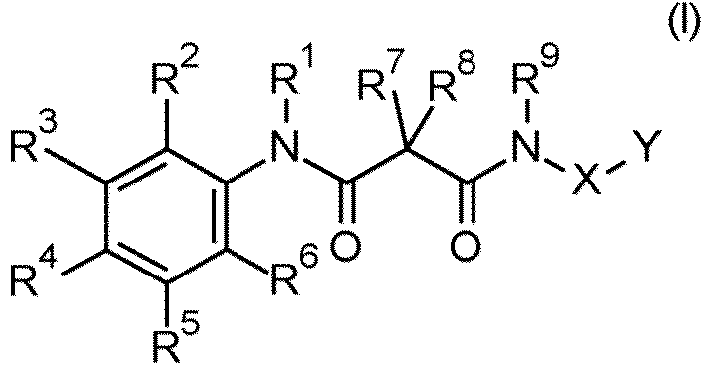 R1 steht für Wasserstoff,R2 steht für Wasserstoff oder Halogen,R3 steht für Wasserstoff, Halogen, Cyano, (C1-C3)-Alkyl, (C1-C3)-Halogenalkyl, (C1-C3)-Alkoxy oder (C1-C3)-Halogenalkoxy,R4 steht für Wasserstoff oder Halogen,R5 steht für Wasserstoff, Halogen, Cyano, (C1-C3)-Alkyl, (C1-C3)-Halogenalkyl, (C1-C3)-Alkoxy oder (C1-C3)-Halogenalkoxy,R6 steht für Wasserstoff,R7 und R8 bilden zusammen mit dem Kohlenstoffatom, an das sie gebunden sind, einen gesättigten oder teilweise ungesättigten 3-, 4-, 5- oder 6-gliedrigen monocyclischen heterocyclischen Ring W oder einen 6-, 7- oder 8-gliedrigen bicyclischen heterocyclischen Ring W, wobei der Ring neben diesem Kohlenstoffatom q Kohlenstoffatome, u Sauerstoffatome, v Stickstoffatome, w Schwefelatome und x Elemente, die aus der Gruppe bestehend aus NRd and NC(O)ORd ausgewählt sind, enthält, wobei ein Kohlenstoffatom p Oxogruppen trägt und wobei der Ring durch n Reste R9 substituiert ist,R9 steht für Wasserstoff oder C1-C4-Alkyl,X steht für eine Bindung und Y steht für Z, wobei Z für einen 3-, 4-, 5-, 6-, 7- oder 8-gliedrigen gesättigten oder teilweise ungesättigten monocyclischen carbocyclischen Ring steht, der durch eine Gruppe CO2Re, durch 0 oder 1 Fluoratome und durch 0 oder 1 (C1-C4)-Alkylgruppen substituiert ist, oderZ für einen 5-, 6-, 7- oder 8-gliedrigen gesättigten oder teilweise ungesättigten bicyclischen carbocyclischen Ring steht, der durch eine Gruppe CO2Re und durch 0 oder 1 (C1-C4)-Alkylgruppen substituiert ist, oderZ für einen 8-gliedrigen gesättigten polycyclischen carbocyclischen Ring steht, der durch eine Gruppe CO2Re und durch 0 oder 1 (C1-C4)-Alkylgruppen substituiert ist, oderZ für einen 5- oder 6-gliedrigen gesättigten oder teilweise ungesättigten monocyclischen heterocyclischen Ring mit einem Sauerstoffatom oder einem Schwefelatom als Ringglied steht, wobei der heterocyclische Ring durch eine Gruppe CO2Re und durch 0 oder 1 (C1-C4)-Alkylgruppen substituiert ist, oderZ für einen 5- oder 6-gliedrigen heteroaromatischen Ring mit 1, 2, 3 oder 4 Heteroatomen, die aus N, O und S ausgewählt sind, als Ringglieder steht, wobei der heteroaromatische Ring durch 0 oder 1 (C1-C4)-Alkylgruppen substituiert ist, oderX steht für eine Bindung und Y steht für (C1-C6)-Alkyl oder (C2-C6)-Alkenyl, wobei die beiden letztgenannten Reste durch eine Gruppe CO2Re, CONRbRh oder CONReSO2Ra und durch 0 oder 1 (C1-C4)-Alkoxygruppen substituiert sind, oderX steht für eine Bindung und Y steht für durch Z substituiertes (C1-C6)-Alkyl, wobei Z für einen 3-, 4-, 5- oder 6-gliedrigen gesättigten monocyclischen carbocyclischen Ring steht, der durch eine Gruppe CO2Re und durch 0 oder 1 (C1-C4)-Alkylgruppen substituiert ist, oder für einen 5- oder 6-gliedrigen gesättigten monocyclischen heterocyclischen Ring mit 1 Sauerstoffatom als Ringglied steht, wobei der heterocyclische Ring durch eine Gruppe CO2Re und durch 0 oder 1 (C1-C4)-Alkylgruppen substituiert ist, oderX steht für eine Bindung und Y steht für (C2-C8)-Alkinyl oderX steht für X6,
 wobei R10 bis R13 unabhängig für Wasserstoff oder Methyl, vorzugsweise Wasserstoff, stehen, und Y steht für (C1-C6)-Alkyl, das durch eine Gruppe CO2Re und durch 0 oder 1 (C1-C4)-Alkoxygruppen substituiert ist,Ra steht für C1-C6-Alkyl,Rb steht für Wasserstoff oder (C1-C6)-Alkyl,Rd steht jeweils unabhängig für Wasserstoff oder (C1-C6)-Alkyl,Re steht jeweils unabhängig für Wasserstoff, (C1-C6)-Alkyl, das unsubstituiert oder durch 1, 2 oder 3 Fluor- oder Chloratome oder durch 1 Rest, der aus der Gruppe bestehend aus (C1-C2)-Alkoxy, (C1-C3)-Alkylsulfonyl, (C1-C3)-Alkylthio, Phenylthio, Phenylsulfonyl und Furanyl ausgewählt ist, substituiert ist, oder für (C2-C4)-Alkinyl, (C3-C6) -Cycloalkyl oder (C3-C6) -Cycloalkyl- (C1-C3)-alkyl,Rg steht für (C1-C3)-Alkyl oder (C1-C3)-Halogenalkyl oder zwei Rg, die an dasselbe Kohlenstoffatom gebunden sind, bilden zusammen eine Methylengruppe (=CH2),Rh steht für Wasserstoff, (C1-C6)-Alkyl, das durch 0 oder 1 Cyanogruppen substituiert ist, oder (C2-C4)-Alkinyl,n steht für 0, 1 oder 2,p steht für 0 oder 1,q steht für 2, 3, 4, 5 oder 6,u steht für 0, 1 oder 2,v steht für 0 oder 1,w steht für 0 oder 1,x steht für 0 oder 1,mit der Maßgabe, dass die Summe von u, v, w und x 1 oder 2 beträgt,einschließlich ihrer landwirtschaftlich unbedenklichen Salze, Stereoisomere und Tautomere.
 - Verbindungen nach Anspruch 1, in denen R9 für Wasserstoff steht.
- Verbindungen nach Anspruch 1 oder 2, in denen R2 für Wasserstoff steht.
- Verbindungen nach einem der Ansprüche 1 bis 3, in denen R5 für Wasserstoff, Halogen oder (C1-C3)-Alkyl steht.
- Verbindungen nach einem der Ansprüche 1 bis 4, in denen die Substituenten die folgende Bedeutung haben:R3 steht für Halogen, Cyano oder (C1-C3)-Halogenalkoxy,R5 steht für Wasserstoff oder Halogen.
- Verbindungen nach einem der Ansprüche 1 bis 5, wobeiu für 1 oder 2 steht, v für 0 steht, w für 0 steht und x für 0 steht oderu für 0 oder 1 steht, v für 1 steht, w für 0 steht und x für 0 steht oderu für 0 oder 1 steht, v für 0 steht, w für 1 steht und x für 0 steht oderu für 0 steht, v für 0 steht, w für 0 steht und x für 1 steht.
- Verbindungen nach einem der Ansprüche 1 bis 6, in denen die Substituenten die folgende Bedeutung haben:
R7 und R8 bilden zusammen mit dem Kohlenstoffatom, an das sie gebunden sind, einen gesättigten oder teilweise ungesättigten vier- bis fünfgliedrigen monocyclischen heterocyclischen Ring W, der neben diesem Kohlenstoffatom q Kohlenstoffatome und u Sauerstoffatome enthält, und wobei der Ring durch n Reste R9 substituiert ist, wobei u für 1 oder 2 steht und q für 1, 2 oder 3 steht. - Verbindungen nach einem der Ansprüche 1 bis 7, wobei jedes Rd in den Elementen, die aus der Gruppe bestehend aus NRd und NC(O)ORd als Ringglied des durch R7 und R8 gebildete Rings ausgewählt sind, unabhängig für Wasserstoff oder (C1-C3)-Alkyl steht.
- Verbindungen nach einem der Ansprüche 1 bis 8, in denen X für eine Bindung steht.
- Verbindungen nach einem der Ansprüche 1 bis 9, wobeiX für eine Bindung steht und Y für Z steht, wobeiZ für einen 3-, 4-, 5-, 6-, 7- oder 8-gliedrigen gesättigten oder teilweise ungesättigten monocyclischen carbocyclischen Ring steht, der durch eine Gruppe CO2Re, durch 0 oder 1 Fluoratome und durch 0 oder 1 (C1-C4)-Alkylgruppen substituiert ist, oderZ für einen 5-, 6-, 7- oder 8-gliedrigen gesättigten oder teilweise ungesättigten bicyclischen carbocyclischen Ring steht, der durch eine Gruppe CO2Re und durch 0 oder 1 (C1-C4)-Alkylgruppen substituiert ist, oderZ für einen 8-gliedrigen gesättigten polycyclischen carbocyclischen Ring steht, der durch eine Gruppe CO2Re und durch 0 oder 1 (C1-C4)-Alkylgruppen substituiert ist, oderZ für einen 5- oder 6-gliedrigen gesättigten oder teilweise ungesättigten monocyclischen heterocyclischen Ring mit einem Sauerstoffatom oder einem Schwefelatom als Ringglied steht, wobei der heterocyclische Ring durch eine Gruppe CO2Re und durch 0 oder 1 (C1-C4)-Alkylgruppen substituiert ist, oderZ für einen 5- oder 6-gliedrigen heteroaromatischen Ring mit 1, 2, 3 oder 4 Heteroatomen, die aus N, O und S ausgewählt sind, als Ringglieder steht, wobei der heteroaromatische Ring durch 0 oder 1 (C1-C4)-Alkylgruppen substituiert ist.
- Verbindungen nach Anspruch 1, in denen die Substituenten die folgende Bedeutung haben:R1 steht für Wasserstoff,R2 steht für Wasserstoff,R3 steht für Halogen, Cyano oder (C1-C3)-Halogenalkoxy,R4 steht für Wasserstoff oder Halogen,R5 steht für Wasserstoff, Halogen oder (C1-C3)-Alkyl, insbesondere Wasserstoff oder Halogen,R6 steht für Wasserstoff,R7 und R8 bilden zusammen mit dem Kohlenstoffatom, an das sie gebunden sind, einen gesättigten oder teilweise ungesättigten 3-, 4-, 5- oder 6-gliedrigen monocyclischen heterocyclischen Ring W oder einen 6-, 7- oder 8-gliedrigen bicyclischen heterocyclischen Ring W, wobei der Ring neben diesem Kohlenstoffatom q Kohlenstoffatome, u Sauerstoffatome, v Stickstoffatome, w Schwefelatome und x Elemente, die aus der Gruppe bestehend aus NRd and NC(O)ORd ausgewählt sind, enthält, wobei der Ring durch n Reste R9 substituiert ist,R9 steht für Wasserstoff,X steht für eine Bindung und Y steht für Z, wobeiZ für einen 4-, 5-, 6-, 7- oder 8-gliedrigen gesättigten oder teilweise ungesättigten monocyclischen carbocyclischen Ring steht, der durch eine Gruppe CO2Re und durch 0 oder 1 Fluoratome substituiert ist, oderZ für einen 5-, 6-, 7- oder 8-gliedrigen gesättigten oder teilweise ungesättigten bicyclischen carbocyclischen Ring steht, der durch eine Gruppe CO2Re und durch 0 oder 1 (C1-C4)-Alkylgruppen substituiert ist, oderZ für einen 5- oder 6-gliedrigen gesättigten oder teilweise ungesättigten monocyclischen heterocyclischen Ring mit 1 Sauerstoffatom oder einem Schwefelatom als Ringglied steht, wobei der heterocyclische Ring durch eine Gruppe CO2Re substituiert ist, oderZ für einen 5-gliedrigen heteroaromatischen Ring mit 1, 2, 3 oder 4 Stickstoffatomen als Ringglieder steht, wobei der heteroaromatische Ring durch 0 oder 1 (C1-C4)-Alkylgruppen substituiert ist, oderX steht für eine Bindung und Y steht für (C1-C6)-Alkyl, das durch eine Gruppe CO2Re, CONRbRh oder CONRe1SO2Ra und durch 0 oder 1 (C1-C4)-Alkoxygruppen substituiert ist, oderX steht für eine Bindung und Y steht für (C2-C8)-Alkinyl oderX steht für X6, wobei R10 bis R13 unabhängig für Wasserstoff stehen, und Y steht für (C1-C4)-Alkyl, das durch eine Gruppe CO2Re substituiert ist,Ra steht für C1-C6-Alkyl,Rb steht für Wasserstoff,Rd steht jeweils unabhängig für Wasserstoff oder (C1-C6)-Alkyl,Re1 steht für Wasserstoff oder (C1-C4)-Alkyl;Re steht jeweils unabhängig für Wasserstoff, (C1-C6)-Alkyl, das unsubstituiert oder durch 1, 2 oder 3 Fluor- oder Chloratome oder durch 1 Rest, der aus der Gruppe bestehend aus (C1-C2)-Alkoxy, (C1-C3)-Alkylsulfonyl, (C1-C3)-Alkylthio, Phenylsulfonyl, Phenylthio und Furanyl ausgewählt ist, substituiert ist, oder steht für (C2-C4)-Alkinyl oder (C3-C6)-Cycloalkyl-(C1-C3)-alkyl,Rg steht für (C1-C3)-Alkyl oder zwei Rg, die an dasselbe Kohlenstoffatom gebunden sind, bilden zusammen eine Methylengruppe (=CH2),Rh steht für (C1-C6)-Alkyl, das durch 0 oder 1 Cyanogruppen substituiert ist, oder für (C2-C4)-Alkinyl,n steht für 0, 1 oder 2,q steht für 2, 3, 4, 5 oder 6,u steht für 0, 1 oder 2,v steht für 0 oder 1,w steht für 0 oder 1,x steht für 0 oder 1,mit der Maßgabe, dass die Summe von u, v, w und x 1 oder 2 beträgt.
- Zusammensetzung, umfassend mindestens eine Verbindung nach einem der Ansprüche 1 bis 11 und mindestens einen für die Formulierung von Pflanzenschutzmitteln üblichen Hilfsstoff.
- Zusammensetzung nach Anspruch 12, umfassend ein weiteres Herbizid.
- Verwendung einer Verbindung nach einem der Ansprüche 1 bis 11 oder einer Zusammensetzung nach einem der Ansprüche 12 oder 13 zur Bekämpfung von unerwünschtem Pflanzenwuchs.
- Verfahren zur Bekämpfung von unerwünschtem Pflanzenwuchs, bei dem man eine herbizid wirksame Menge mindestens einer Verbindung nach einem der Ansprüche 1 bis 11 oder einer Zusammensetzung nach Anspruch 12 oder 13 auf Pflanzen, deren Saatgut und/oder deren Lebensraum einwirken lässt.
Applications Claiming Priority (3)
| Application Number | Priority Date | Filing Date | Title |
|---|---|---|---|
| EP20209750 | 2020-11-25 | ||
| EP21194334 | 2021-09-01 | ||
| PCT/EP2021/082864 WO2022112351A1 (en) | 2020-11-25 | 2021-11-24 | Herbicidal malonamides |
Publications (2)
| Publication Number | Publication Date |
|---|---|
| EP4251609A1 EP4251609A1 (de) | 2023-10-04 |
| EP4251609B1 true EP4251609B1 (de) | 2025-04-23 |
Family
ID=78695719
Family Applications (1)
| Application Number | Title | Priority Date | Filing Date |
|---|---|---|---|
| EP21810637.5A Active EP4251609B1 (de) | 2020-11-25 | 2021-11-24 | Herbizide malonamide |
Country Status (16)
| Country | Link |
|---|---|
| US (1) | US20230406833A1 (de) |
| EP (1) | EP4251609B1 (de) |
| JP (1) | JP2024500645A (de) |
| KR (1) | KR20230112686A (de) |
| AU (1) | AU2021387794A1 (de) |
| CA (1) | CA3199513A1 (de) |
| CL (1) | CL2023001491A1 (de) |
| CO (1) | CO2023006711A2 (de) |
| CR (1) | CR20230221A (de) |
| ES (1) | ES3033864T3 (de) |
| HU (1) | HUE071871T2 (de) |
| IL (1) | IL303086A (de) |
| MX (1) | MX2023006134A (de) |
| PL (1) | PL4251609T3 (de) |
| WO (1) | WO2022112351A1 (de) |
| ZA (1) | ZA202306427B (de) |
Families Citing this family (1)
| Publication number | Priority date | Publication date | Assignee | Title |
|---|---|---|---|---|
| EP4531571A1 (de) | 2022-05-25 | 2025-04-09 | Basf Se | Herbizide malonsäuremonoamide und malonamidester |
Family Cites Families (19)
| Publication number | Priority date | Publication date | Assignee | Title |
|---|---|---|---|---|
| US3072473A (en) | 1959-10-07 | 1963-01-08 | Us Rubber Co | Plant growth regulants |
| AU613309B2 (en) | 1986-03-31 | 1991-08-01 | Rhone-Poulenc AG Company Inc | Use of malonic acid derivative compounds for retarding plant growth |
| AU6903200A (en) | 1999-08-16 | 2001-03-13 | Merck & Co., Inc. | Heterocycle amides as cell adhesion inhibitors |
| ES2338135T3 (es) | 2004-09-03 | 2010-05-04 | Syngenta Limited | Derivados de isoxazolina y su utilizacion como herbicidas. |
| AU2005291117B2 (en) | 2004-10-05 | 2011-06-09 | Syngenta Limited | Isoxazoline derivatives and their use as herbicides |
| GB0526044D0 (en) | 2005-12-21 | 2006-02-01 | Syngenta Ltd | Novel herbicides |
| GB0603891D0 (en) | 2006-02-27 | 2006-04-05 | Syngenta Ltd | Novel herbicides |
| EA024512B1 (ru) | 2011-03-31 | 2016-09-30 | Байер Интеллектуэль Проперти Гмбх | Гербицидно и фунгицидно действующие 3-фенилизоксазолин-5-карбоксамиды и 3-фенилизоксазолин-5-тиоамиды |
| US9910156B2 (en) | 2012-06-30 | 2018-03-06 | Solarreserve Technology, Llc | Using optical proxy light to aim redirected light at a target using heliostats |
| ES2607889T3 (es) | 2012-09-25 | 2017-04-04 | Bayer Cropscience Ag | 3-fenilisoxazolin-5-carboxamidas 5-oxi-sustituidas y 3-fenilisoxazolin-5-tioamidas 5-oxi-sustituidas con actividad herbicida y fungicida |
| EP3028573A1 (de) | 2014-12-05 | 2016-06-08 | Basf Se | Verwendung eines triazolfungizids auf transgenen pflanzen |
| BR112018000687B1 (pt) | 2015-07-13 | 2021-05-04 | Fmc Corporation | composto, composições herbicidas, misturas herbicidas e métodos para o controle do crescimento de vegetação indesejada |
| EA039486B1 (ru) | 2017-06-13 | 2022-02-01 | Байер Акциенгезельшафт | Гербицидно-активные 3-фенилизоксазолин-5-карбоксамиды тетрагидро- и дигидрофурановых карбоновых кислот и эфиров и их применение |
| EA202090018A1 (ru) | 2017-06-13 | 2020-05-26 | Байер Акциенгезельшафт | Гербицидно-активные 3-фенилизоксазолин-5-карбоксамиды тетрагидро- и дигидрофурановых карбоксамидов |
| WO2019034602A1 (de) | 2017-08-17 | 2019-02-21 | Bayer Aktiengesellschaft | Herbizid wirksame 3-phenyl-5-trifluormethylisoxazolin-5-carboxamide von cyclopentylcarbonsäuren und -estern |
| PL3743411T3 (pl) | 2018-01-25 | 2023-03-13 | Bayer Aktiengesellschaft | Herbicydowo czynne 3-fenyloizoksazolino-5-karboksyamidy z pochodnych kwasów cyklopentenylokarboksylowych |
| HUE061391T2 (hu) | 2018-12-07 | 2023-06-28 | Bayer Ag | Gyomirtókészítmények |
| CA3122157A1 (en) | 2018-12-07 | 2020-06-11 | Bayer Aktiengesellschaft | Herbicide compositions |
| US12185723B2 (en) | 2019-03-12 | 2025-01-07 | Bayer Aktiengesellschaft | Herbicidally active 3-phenylisoxazoline-5-carboxamides of s-containing cyclopentenylcarboxylic esters |
-
2021
- 2021-11-24 CR CR20230221A patent/CR20230221A/es unknown
- 2021-11-24 HU HUE21810637A patent/HUE071871T2/hu unknown
- 2021-11-24 US US18/037,857 patent/US20230406833A1/en active Pending
- 2021-11-24 CA CA3199513A patent/CA3199513A1/en active Pending
- 2021-11-24 WO PCT/EP2021/082864 patent/WO2022112351A1/en not_active Ceased
- 2021-11-24 AU AU2021387794A patent/AU2021387794A1/en active Pending
- 2021-11-24 PL PL21810637.5T patent/PL4251609T3/pl unknown
- 2021-11-24 ES ES21810637T patent/ES3033864T3/es active Active
- 2021-11-24 EP EP21810637.5A patent/EP4251609B1/de active Active
- 2021-11-24 KR KR1020237021256A patent/KR20230112686A/ko active Pending
- 2021-11-24 JP JP2023531574A patent/JP2024500645A/ja active Pending
- 2021-11-24 IL IL303086A patent/IL303086A/en unknown
- 2021-11-24 MX MX2023006134A patent/MX2023006134A/es unknown
-
2023
- 2023-05-24 CO CONC2023/0006711A patent/CO2023006711A2/es unknown
- 2023-05-24 CL CL2023001491A patent/CL2023001491A1/es unknown
- 2023-06-21 ZA ZA2023/06427A patent/ZA202306427B/en unknown
Also Published As
| Publication number | Publication date |
|---|---|
| HUE071871T2 (hu) | 2025-09-28 |
| WO2022112351A1 (en) | 2022-06-02 |
| PL4251609T3 (pl) | 2025-08-25 |
| IL303086A (en) | 2023-07-01 |
| KR20230112686A (ko) | 2023-07-27 |
| JP2024500645A (ja) | 2024-01-10 |
| CR20230221A (es) | 2023-07-03 |
| US20230406833A1 (en) | 2023-12-21 |
| CA3199513A1 (en) | 2022-06-02 |
| ZA202306427B (en) | 2025-10-29 |
| ES3033864T3 (en) | 2025-08-08 |
| CL2023001491A1 (es) | 2023-10-30 |
| AU2021387794A1 (en) | 2023-06-22 |
| CO2023006711A2 (es) | 2023-05-29 |
| EP4251609A1 (de) | 2023-10-04 |
| MX2023006134A (es) | 2023-06-06 |
Similar Documents
| Publication | Publication Date | Title |
|---|---|---|
| AU2022337024A1 (en) | Herbicidal malonamides containing monocyclic heteroaromatic rings | |
| UA121522C2 (uk) | Бензамідні сполуки і їх застосування як гербіцидів | |
| WO2023025854A1 (en) | Herbicidal malonamides | |
| EP4251609B1 (de) | Herbizide malonamide | |
| CN116456830B (zh) | 除草的丙二酰胺类 | |
| US20240365783A1 (en) | Herbicidal malonamides | |
| EA050384B1 (ru) | Гербицидные малонамиды | |
| AU2022339008A1 (en) | Herbicidal malonamides containing a condensed ring system | |
| CN116507610A (zh) | 除草的丙二酰胺类 | |
| EA051988B1 (ru) | Гербицидные малонамиды, содержащие конденсированную кольцевую систему | |
| EA052006B1 (ru) | Гербицидные малонамиды, содержащие моноциклические гетероароматические кольца | |
| EP4531571A1 (de) | Herbizide malonsäuremonoamide und malonamidester |
Legal Events
| Date | Code | Title | Description |
|---|---|---|---|
| STAA | Information on the status of an ep patent application or granted ep patent |
Free format text: STATUS: UNKNOWN |
|
| STAA | Information on the status of an ep patent application or granted ep patent |
Free format text: STATUS: THE INTERNATIONAL PUBLICATION HAS BEEN MADE |
|
| PUAI | Public reference made under article 153(3) epc to a published international application that has entered the european phase |
Free format text: ORIGINAL CODE: 0009012 |
|
| STAA | Information on the status of an ep patent application or granted ep patent |
Free format text: STATUS: REQUEST FOR EXAMINATION WAS MADE |
|
| 17P | Request for examination filed |
Effective date: 20230626 |
|
| AK | Designated contracting states |
Kind code of ref document: A1 Designated state(s): AL AT BE BG CH CY CZ DE DK EE ES FI FR GB GR HR HU IE IS IT LI LT LU LV MC MK MT NL NO PL PT RO RS SE SI SK SM TR |
|
| DAV | Request for validation of the european patent (deleted) | ||
| DAX | Request for extension of the european patent (deleted) | ||
| STAA | Information on the status of an ep patent application or granted ep patent |
Free format text: STATUS: EXAMINATION IS IN PROGRESS |
|
| 17Q | First examination report despatched |
Effective date: 20241008 |
|
| GRAP | Despatch of communication of intention to grant a patent |
Free format text: ORIGINAL CODE: EPIDOSNIGR1 |
|
| STAA | Information on the status of an ep patent application or granted ep patent |
Free format text: STATUS: GRANT OF PATENT IS INTENDED |
|
| INTG | Intention to grant announced |
Effective date: 20241213 |
|
| GRAS | Grant fee paid |
Free format text: ORIGINAL CODE: EPIDOSNIGR3 |
|
| GRAA | (expected) grant |
Free format text: ORIGINAL CODE: 0009210 |
|
| STAA | Information on the status of an ep patent application or granted ep patent |
Free format text: STATUS: THE PATENT HAS BEEN GRANTED |
|
| AK | Designated contracting states |
Kind code of ref document: B1 Designated state(s): AL AT BE BG CH CY CZ DE DK EE ES FI FR GB GR HR HU IE IS IT LI LT LU LV MC MK MT NL NO PL PT RO RS SE SI SK SM TR |
|
| REG | Reference to a national code |
Ref country code: GB Ref legal event code: FG4D |
|
| REG | Reference to a national code |
Ref country code: CH Ref legal event code: EP |
|
| REG | Reference to a national code |
Ref country code: DE Ref legal event code: R096 Ref document number: 602021029712 Country of ref document: DE |
|
| REG | Reference to a national code |
Ref country code: IE Ref legal event code: FG4D |
|
| REG | Reference to a national code |
Ref country code: ES Ref legal event code: FG2A Ref document number: 3033864 Country of ref document: ES Kind code of ref document: T3 Effective date: 20250808 |
|
| REG | Reference to a national code |
Ref country code: NL Ref legal event code: MP Effective date: 20250423 |
|
| PG25 | Lapsed in a contracting state [announced via postgrant information from national office to epo] |
Ref country code: NL Free format text: LAPSE BECAUSE OF FAILURE TO SUBMIT A TRANSLATION OF THE DESCRIPTION OR TO PAY THE FEE WITHIN THE PRESCRIBED TIME-LIMIT Effective date: 20250423 |
|
| REG | Reference to a national code |
Ref country code: AT Ref legal event code: MK05 Ref document number: 1787666 Country of ref document: AT Kind code of ref document: T Effective date: 20250423 |
|
| REG | Reference to a national code |
Ref country code: HU Ref legal event code: AG4A Ref document number: E071871 Country of ref document: HU |
|
| PG25 | Lapsed in a contracting state [announced via postgrant information from national office to epo] |
Ref country code: FI Free format text: LAPSE BECAUSE OF FAILURE TO SUBMIT A TRANSLATION OF THE DESCRIPTION OR TO PAY THE FEE WITHIN THE PRESCRIBED TIME-LIMIT Effective date: 20250423 Ref country code: PT Free format text: LAPSE BECAUSE OF FAILURE TO SUBMIT A TRANSLATION OF THE DESCRIPTION OR TO PAY THE FEE WITHIN THE PRESCRIBED TIME-LIMIT Effective date: 20250825 |
|
| REG | Reference to a national code |
Ref country code: LT Ref legal event code: MG9D |
|
| PG25 | Lapsed in a contracting state [announced via postgrant information from national office to epo] |
Ref country code: GR Free format text: LAPSE BECAUSE OF FAILURE TO SUBMIT A TRANSLATION OF THE DESCRIPTION OR TO PAY THE FEE WITHIN THE PRESCRIBED TIME-LIMIT Effective date: 20250724 Ref country code: NO Free format text: LAPSE BECAUSE OF FAILURE TO SUBMIT A TRANSLATION OF THE DESCRIPTION OR TO PAY THE FEE WITHIN THE PRESCRIBED TIME-LIMIT Effective date: 20250723 |
|
| PG25 | Lapsed in a contracting state [announced via postgrant information from national office to epo] |
Ref country code: BG Free format text: LAPSE BECAUSE OF FAILURE TO SUBMIT A TRANSLATION OF THE DESCRIPTION OR TO PAY THE FEE WITHIN THE PRESCRIBED TIME-LIMIT Effective date: 20250423 |
|
| PG25 | Lapsed in a contracting state [announced via postgrant information from national office to epo] |
Ref country code: HR Free format text: LAPSE BECAUSE OF FAILURE TO SUBMIT A TRANSLATION OF THE DESCRIPTION OR TO PAY THE FEE WITHIN THE PRESCRIBED TIME-LIMIT Effective date: 20250423 |
|
| PG25 | Lapsed in a contracting state [announced via postgrant information from national office to epo] |
Ref country code: AT Free format text: LAPSE BECAUSE OF FAILURE TO SUBMIT A TRANSLATION OF THE DESCRIPTION OR TO PAY THE FEE WITHIN THE PRESCRIBED TIME-LIMIT Effective date: 20250423 |
|
| PG25 | Lapsed in a contracting state [announced via postgrant information from national office to epo] |
Ref country code: RS Free format text: LAPSE BECAUSE OF FAILURE TO SUBMIT A TRANSLATION OF THE DESCRIPTION OR TO PAY THE FEE WITHIN THE PRESCRIBED TIME-LIMIT Effective date: 20250723 |
|
| PG25 | Lapsed in a contracting state [announced via postgrant information from national office to epo] |
Ref country code: IS Free format text: LAPSE BECAUSE OF FAILURE TO SUBMIT A TRANSLATION OF THE DESCRIPTION OR TO PAY THE FEE WITHIN THE PRESCRIBED TIME-LIMIT Effective date: 20250823 |
|
| PG25 | Lapsed in a contracting state [announced via postgrant information from national office to epo] |
Ref country code: LV Free format text: LAPSE BECAUSE OF FAILURE TO SUBMIT A TRANSLATION OF THE DESCRIPTION OR TO PAY THE FEE WITHIN THE PRESCRIBED TIME-LIMIT Effective date: 20250423 |
|
| PGFP | Annual fee paid to national office [announced via postgrant information from national office to epo] |
Ref country code: HU Payment date: 20251112 Year of fee payment: 5 |
|
| PGFP | Annual fee paid to national office [announced via postgrant information from national office to epo] |
Ref country code: DE Payment date: 20251126 Year of fee payment: 5 |
|
| PG25 | Lapsed in a contracting state [announced via postgrant information from national office to epo] |
Ref country code: DK Free format text: LAPSE BECAUSE OF FAILURE TO SUBMIT A TRANSLATION OF THE DESCRIPTION OR TO PAY THE FEE WITHIN THE PRESCRIBED TIME-LIMIT Effective date: 20250423 Ref country code: SM Free format text: LAPSE BECAUSE OF FAILURE TO SUBMIT A TRANSLATION OF THE DESCRIPTION OR TO PAY THE FEE WITHIN THE PRESCRIBED TIME-LIMIT Effective date: 20250423 |
|
| PGFP | Annual fee paid to national office [announced via postgrant information from national office to epo] |
Ref country code: IT Payment date: 20251121 Year of fee payment: 5 |
|
| PGFP | Annual fee paid to national office [announced via postgrant information from national office to epo] |
Ref country code: FR Payment date: 20251124 Year of fee payment: 5 |
|
| PGFP | Annual fee paid to national office [announced via postgrant information from national office to epo] |
Ref country code: TR Payment date: 20251104 Year of fee payment: 5 |
|
| PG25 | Lapsed in a contracting state [announced via postgrant information from national office to epo] |
Ref country code: CZ Free format text: LAPSE BECAUSE OF FAILURE TO SUBMIT A TRANSLATION OF THE DESCRIPTION OR TO PAY THE FEE WITHIN THE PRESCRIBED TIME-LIMIT Effective date: 20250423 |
|
| PGFP | Annual fee paid to national office [announced via postgrant information from national office to epo] |
Ref country code: PL Payment date: 20251028 Year of fee payment: 5 |
|
| PG25 | Lapsed in a contracting state [announced via postgrant information from national office to epo] |
Ref country code: EE Free format text: LAPSE BECAUSE OF FAILURE TO SUBMIT A TRANSLATION OF THE DESCRIPTION OR TO PAY THE FEE WITHIN THE PRESCRIBED TIME-LIMIT Effective date: 20250423 |
|
| REG | Reference to a national code |
Ref country code: DE Ref legal event code: R097 Ref document number: 602021029712 Country of ref document: DE |
|
| PG25 | Lapsed in a contracting state [announced via postgrant information from national office to epo] |
Ref country code: SK Free format text: LAPSE BECAUSE OF FAILURE TO SUBMIT A TRANSLATION OF THE DESCRIPTION OR TO PAY THE FEE WITHIN THE PRESCRIBED TIME-LIMIT Effective date: 20250423 |
|
| PGFP | Annual fee paid to national office [announced via postgrant information from national office to epo] |
Ref country code: RO Payment date: 20251113 Year of fee payment: 5 |
|
| PGFP | Annual fee paid to national office [announced via postgrant information from national office to epo] |
Ref country code: ES Payment date: 20251209 Year of fee payment: 5 |
|
| PLBE | No opposition filed within time limit |
Free format text: ORIGINAL CODE: 0009261 |
|
| STAA | Information on the status of an ep patent application or granted ep patent |
Free format text: STATUS: NO OPPOSITION FILED WITHIN TIME LIMIT |
|
| REG | Reference to a national code |
Ref country code: CH Ref legal event code: L10 Free format text: ST27 STATUS EVENT CODE: U-0-0-L10-L00 (AS PROVIDED BY THE NATIONAL OFFICE) Effective date: 20260304 |