EP4248747B1 - Fischfangsystem - Google Patents
Fischfangsystem Download PDFInfo
- Publication number
- EP4248747B1 EP4248747B1 EP21894387.6A EP21894387A EP4248747B1 EP 4248747 B1 EP4248747 B1 EP 4248747B1 EP 21894387 A EP21894387 A EP 21894387A EP 4248747 B1 EP4248747 B1 EP 4248747B1
- Authority
- EP
- European Patent Office
- Prior art keywords
- fish
- fixing portion
- aerial vehicle
- unmanned aerial
- fishing line
- Prior art date
- Legal status (The legal status is an assumption and is not a legal conclusion. Google has not performed a legal analysis and makes no representation as to the accuracy of the status listed.)
- Active
Links
Images







Classifications
-
- A—HUMAN NECESSITIES
- A01—AGRICULTURE; FORESTRY; ANIMAL HUSBANDRY; HUNTING; TRAPPING; FISHING
- A01K—ANIMAL HUSBANDRY; AVICULTURE; APICULTURE; PISCICULTURE; FISHING; REARING OR BREEDING ANIMALS, NOT OTHERWISE PROVIDED FOR; NEW BREEDS OF ANIMALS
- A01K79/00—Methods or means of catching fish in bulk not provided for in groups A01K69/00 - A01K77/00, e.g. fish pumps; Detection of fish; Whale fishery
-
- B—PERFORMING OPERATIONS; TRANSPORTING
- B64—AIRCRAFT; AVIATION; COSMONAUTICS
- B64U—UNMANNED AERIAL VEHICLES [UAV]; EQUIPMENT THEREFOR
- B64U20/00—Constructional aspects of UAVs
- B64U20/80—Arrangement of on-board electronics, e.g. avionics systems or wiring
- B64U20/87—Mounting of imaging devices, e.g. mounting of gimbals
-
- A—HUMAN NECESSITIES
- A01—AGRICULTURE; FORESTRY; ANIMAL HUSBANDRY; HUNTING; TRAPPING; FISHING
- A01K—ANIMAL HUSBANDRY; AVICULTURE; APICULTURE; PISCICULTURE; FISHING; REARING OR BREEDING ANIMALS, NOT OTHERWISE PROVIDED FOR; NEW BREEDS OF ANIMALS
- A01K91/00—Lines
- A01K91/02—Devices for casting lines
-
- A—HUMAN NECESSITIES
- A01—AGRICULTURE; FORESTRY; ANIMAL HUSBANDRY; HUNTING; TRAPPING; FISHING
- A01K—ANIMAL HUSBANDRY; AVICULTURE; APICULTURE; PISCICULTURE; FISHING; REARING OR BREEDING ANIMALS, NOT OTHERWISE PROVIDED FOR; NEW BREEDS OF ANIMALS
- A01K97/00—Accessories for angling
-
- B—PERFORMING OPERATIONS; TRANSPORTING
- B64—AIRCRAFT; AVIATION; COSMONAUTICS
- B64U—UNMANNED AERIAL VEHICLES [UAV]; EQUIPMENT THEREFOR
- B64U2101/00—UAVs specially adapted for particular uses or applications
- B64U2101/05—UAVs specially adapted for particular uses or applications for sports or gaming, e.g. drone racing
-
- B—PERFORMING OPERATIONS; TRANSPORTING
- B64—AIRCRAFT; AVIATION; COSMONAUTICS
- B64U—UNMANNED AERIAL VEHICLES [UAV]; EQUIPMENT THEREFOR
- B64U2201/00—UAVs characterised by their flight controls
- B64U2201/20—Remote controls
Definitions
- An embodiment of the present invention relates to a fishing system using an unmanned aerial vehicle.
- Pole cast fishing by a person is limited in the range from which bait or artificial bait attached to a fishing line or a fishing hook can be dropped. Therefore, a boat is needed to fish offshore, away from land.
- an unmanned aerial vehicle (a drone) is attracting attention as a means of transporting the bait or the artificial bait to distant areas that cannot be reached by pole cast fishing with a fishing rod. Since the unmanned aerial vehicle can be equipped with a camera, it is possible not only to carry the bait or the artificial bait but also to determine where to drop the bait or the artificial bait while capturing the shadow of fish with the camera (See, for example, Non-Patent Literature 1 and Non-Patent Literature 2). Further, US 2018/0373241 A1 discloses a fishing system according to the preamble part of claim 1.
- Non-Patent Literature 1 not only a camera function but also a sonar function is equipped to detect the shadow of fish in the sea, and the artificial bait can be dropped from the unmanned aerial vehicle to the location where the shadow of fish is detected. Further, the unmanned aerial vehicle can be equipped with a fishing function. However, when a large fish is hooked, the unmanned aerial vehicle may be pulled into the sea by the pulling force of the fish. In Non-Patent Literature 2, although a large tuna is caught using the unmanned aerial vehicle, the unmanned aerial vehicle is limited to confirming the location of a school of fish and transporting the bait. In other words, both Non-Patent Literature 1 and Non-Patent Literature 2 have the problem that the unmanned aerial vehicle is pulled into the sea when the fish is hooked.
- one object of the present invention is to provide a fishing system that prevents an unmanned aerial vehicle from being pulled into the sea when a fish is hooked.
- a fishing system according to an aspect of the present invention is provided as defined in claim 1.
- a fishing system according to another aspect of the present invention is provided as defined in claim 2.
- a fishing system after artificial bait is dropped into the sea from an unmanned aerial vehicle, it is possible to quickly determine that a fish is hooked by tracking a fish or a school of fish, and to separate a fishing line from the unmanned aerial vehicle. As a result, it is possible to prevent the unmanned aerial vehicle from being pulled into the sea when the fish is hooked.
- unmanned aerial vehicle means an unmanned aerial vehicle can fly by remote or automatic control.
- an “unmanned aerial vehicle” may be referred to as a drone.
- image means a still image and a moving image.
- fish school or "group of fish” means a group of one or more fish.
- the term “information communication terminal” means an information device that can access information via a network.
- an “information communication terminal” is, for example, a mobile phone, a smart phone, a tablet, a personal computer, or the like, the “information communication terminal” is not limited to those devices.
- a fishing system 10 according to an embodiment of the present invention is described with reference to FIGS. 1 to 8 .
- FIG. 1 is a schematic diagram illustrating the use of the fishing system 10 according to an embodiment of the present invention.
- the fishing system 10 includes an unmanned aerial vehicle 100 and a fishing line fixing portion 200, and the fishing system 10 is used by being placed on fishing tackle 700.
- the fishing line fixing portion 200 is preferably provided below the unmanned aerial vehicle 100, it is not limited to this configuration.
- a typical fishing tackle 700 may be used in the fishing system 10.
- the fishing tackle 700 as shown in FIG. 1 includes a fishing rod 710, a fishing line 720, a reel 730, and artificial bait 740.
- the artificial bait 740 is attached to one end (hereinafter, referred to as "first end") of the fishing line 720.
- the reel 730 is connected to the other end (hereinafter, referred to as "second end”.) of the fishing line 720, and the fishing line 720 is reeled onto the reel 730.
- the steps of fishing using the fishing system 10 can be broadly classified into a step of detecting a school of fish, a step of dropping artificial bait, a step of tracking a school of fish, a hooking determination step, a step of separating the fishing line from the unmanned aerial vehicle, and a step of recovering the unmanned aerial vehicle.
- the use of the fishing system 10 is not limited to these steps. In the fishing system 10, other steps may be included, and some of the steps in the above description may not be performed.
- a user 800 fixes the fishing line 720 to which the artificial bait 740 is attached to the fishing line fixing portion 200.
- the unmanned aerial vehicle 100 can fly carrying the fishing line 720 over the sea.
- the unmanned aerial vehicle 100 may be piloted by the user 800 or may be controlled by autopilot.
- the unmanned aerial vehicle 100 of the fishing system 10 can detect a school of fish after flying to a destination or while flying (the step of detecting a school of fish). Then, when the school of fish is detected, the artificial bait 740 can be dropped at the location where the school of fish is detected (the step of dropping artificial bait).
- the unmanned aerial vehicle 100 can track the school of fish by controlling the flight of the unmanned aerial vehicle 100 (the step of tracking a school of fish).
- the fishing line 720 is separated from the unmanned aerial vehicle 100 (the step of separating a fishing line from an unmanned aerial vehicle). Therefore, even when the fish 900 is large, the unmanned aerial vehicle 100 is not pulled into the sea.
- the fishing system 10 can determine whether the fish 900 is hooked on the artificial bait 740 (the hooking determination step). Then, the user 800 reels the reel 730 to catch the fish 900 and recover the unmanned vehicle 100 (the step of recovering an unmanned aerial vehicle).
- FIG. 1 shows an aspect in which the user 800 catches a fish using the fishing system 10 on land
- the fishing system 10 can be used anywhere, such as when the user 800 is on a boat.
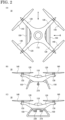
- FIG. 2 shows schematic diagrams illustrating a configuration of the fishing system 10 according to an embodiment of the present invention.
- FIG. 2(A) shows a plan view of the unmanned aerial vehicle 100 seen from the upper direction
- FIG. 2(B) shows a front view of the unmanned aerial vehicle 100 seen from the A direction which is shown in FIG. 2(A)
- FIG. 2(C) shows a side view of the unmanned aerial vehicle 100 seen from the B direction which is shown in FIG. 2(A) .
- the unmanned aerial vehicle 100 includes a main body 110, arms 120, rotors 130, blades 140, and skids 150.
- four arms 120 extend from diagonal positions of the main body 110.
- the rotor 130 and the blade 140 is provided on an end of each of the arms 120.
- the blade 140 is rotatably supported by the rotor 130.
- the skids 150 are provided below the main body 110.
- the main body 110 may support the arms 120 and may fix the fishing line fixing portion 200. Further, the main body 110 is equipped with components necessary for controlling the fishing system 10 (including controlling the unmanned aerial vehicle 100.). Also, an internal configuration of the main body 110 is described later.
- the arm 120 can support the rotor 130 and the blade 140.
- the arms 120 may be formed integrally with the main body 110.
- the rotor 130 can rotate the blade 140.
- a brushless motor can be used for the rotor 130.
- the blade 140 can generate lift by rotating. That is, the unmanned aerial vehicle 100 can fly with the lift generated by rotation of the four blades 140.
- the unmanned aerial vehicle 100 can ascend, descend, move forward, move backward, turn left, turn right, or hover by combining the number of rotations or the direction of rotation of the four blades 140.
- the skids 150 can stabilize the position of the unmanned aerial vehicle 100 when the unmanned aerial vehicle 100 takes off or lands, and can protect a lower portion of the main body 110.
- An imaging device or a group of sensors, which is described later, is often attached to the lower portion of the main body 110, and the imaging device or the group of sensors can be protected by the skids 150.
- the skids 150 may be folded below the main body 110 or may be detached from the main body 110 when the unmanned aerial vehicle 100 is not in use.
- the configuration of the unmanned aerial vehicle 100 shown in FIG. 2 is an example, and the unmanned aerial vehicle 100 is not limited to this configuration.
- the fishing line fixing portion 200 includes a first fixing portion 210 and a second fixing portion 220.
- the first fixing portion 210 and the second fixing portion 220 are provided below the main body 110 of the unmanned aerial vehicle 100. Further, the first fixing portion 210 is located closer to the front side of the unmanned aerial vehicle 100 than the second fixing portion 220. Also, configurations of the first fixing portion 210 and the second fixing portion 220 are described later along with an aspect of their use.
- FIG. 3 is a block diagram illustrating an internal configuration of the main body 110 of the unmanned aerial vehicle of the fishing system 10 according to an embodiment of the present invention.
- the main body 110 includes a power supply source 111, a group of sensors 112, an imaging device 113, and an information processing device 1000.
- the information processing device 1000 may be electrically connected to the group of sensors 112 and the imaging device 113, or may be connected via an electrical communication.
- each of the group of sensors 112, the imaging device 112, and the information processing device 1000 includes a communication unit.
- the power supply source 111 may supply power to the rotor 130. Further, the power supply source 111 can supply power to the group of sensors 112, the imaging device 113, and the information processing device 1000. For example, a lithium ion battery or the like can be used for the power supply source 111. However, the power supply source 111 is not limited to this configuration. For example, the power supply source 111 may also generate power by burning fuel, such as gasoline, by an engine.
- the group of sensors 112 can detect information necessary for various processes and various controls in the fishing system 10.
- the group of sensors 112 preferably includes a plurality of sensors.
- a positioning sensor a geomagnetic sensor, an acceleration sensor, a gyro sensor, a barometric pressure sensor, an ultrasonic sensor, a sonar sensor, or a fish finder or the like for can be used as the sensors included in the group of sensors 112.
- Some or all of these sensors may be located outside of the main body 110 of the unmanned aerial vehicle 100. Further, some or all of these sensors may be placed in the artificial bait 740.
- the positioning sensor can detect position information of the unmanned aerial vehicle 100. That is, the positioning sensor is typically a Global Positioning System (GPS), and can detect latitude, longitude, or altitude position information of the unmanned aerial vehicle 100.
- GPS Global Positioning System
- the geomagnetic sensor can detect orientation information of the unmanned aerial vehicle 100. Therefore, the direction in which the unmanned aerial vehicle 100 is facing can be identified by the geomagnetic sensor.
- the acceleration sensor can measure the amount of change in velocity of the unmanned aerial vehicle 100. Therefore, vibration information or tilt information of the unmanned aerial vehicle 100 can be detected by the acceleration sensor.
- the gyro sensor can measure a change in velocity and a change in angular velocity of the unmanned aerial vehicle 100. Therefore, the gyro sensor can detect tilt information and tilt angle information when the unmanned aerial vehicle 100 tilts.
- the barometric pressure sensor may measure a barometric pressure at which the unmanned aerial vehicle 100 is located. Therefore, altitude information of the unmanned aerial vehicle 100 can be detected by the barometric pressure sensor. Further, the barometric pressure sensor can measure the wind pressure that the unmanned aerial vehicle 100 receives from the front. Velocity information of unmanned aerial vehicle 100 can be detected based on the pressure.
- the ultrasonic sensor can receive reflected waves of ultrasonic waves emitted in the air and measure the distance to the sea. Therefore, altitude information of the unmanned aerial vehicle 100 can be detected by the ultrasonic sensor. Further, the ultrasonic sensor can measure distances to obstacles.
- the sonar sensor receives reflected waves of ultrasonic waves in the sea, and can detect information about a school of fish in the direction and depth direction of the sea.
- the fish finder can receive a reflected wave of an ultrasonic wave emitted from a transducer and detect information about a school of fish in the depth direction of the sea.
- the sensors included in the group of sensors 112 are not limited to the sensors described above.
- the group of sensors 112 may include a temperature sensor that measures air or water temperature, or a humidity sensor that measures humidity.
- the imaging device 113 can capture an image of the surroundings of the unmanned aerial vehicle 100 and obtain imaging data.
- the imaging device 113 is one or more cameras. It is preferable that the imaging device 113 can capture an image in front of or below the unmanned aerial vehicle 100. Further, it is preferable that the imaging device 113 that captures an image below the unmanned aerial vehicle 100 is provided with a polarizing filter.
- the polarizing filter provided on the imaging device 113 suppresses the reflection of light on the sea surface, making it easier to detect a school of fish in the sea.
- the imaging data obtained by the imaging device 113 can be used for various controls and various processes in the fishing system 10.
- the information processing device 1000 includes a flight control unit 1010, a connection control unit 1020, a fish school detection processing unit 1030, a fish school tracking processing unit 1040, a hooking determination processing unit 1050, a fish school detection learning unit 1060, a fish school tracking learning unit 1070, a hooking determination learning unit 1080, and a storage unit 1090.
- the information processing device 1000 is, for example, a computer, and includes a MPU (Micro Processing Unit), a CPU (Central Processing Unit), a ROM (Read Only Memory), a RAM (Random Access Memory), an HDD (Hard Disc Drive), an SSD (Solid State Drive), a DRAM (Dynamic Random Access Memory), a NAND flash memory, or a NOR flash memory.
- the various controls or the various processes in the flight control unit 1010, the connection control unit 1020, the fish school detection processing unit 1030, the fish school tracking processing unit 1040, the hooking determination processing unit 1050, the fish school detection learning unit 1060, the fish school tracking learning unit 1070, or the hooking determination learning unit 1080 can be executed by one or more computers reading a predetermined program.
- the flight control unit 1010 can control the flight of the unmanned aerial vehicle 100. That is, the flight control unit 1010 can control the unmanned aerial vehicle 100 to take off and land based on the various information from the group of sensors 112, and to maintain a stable attitude during the flight. Further, the flight control unit 1010 can control the unmanned aerial vehicle 100 based on the fish school detection information, the fish school tracking information, and hooking determination information, which are described later.
- the connection control unit 1020 can control the connection of the fishing line fixing portion 200. That is, the connection control unit 1020 can release the connection between the unmanned aerial vehicle 100 and the fishing line fixing portion 200 (the first fixing portion 210 or the second fixing portion 220), and can drop the fishing line fixing portion 200 (the first fixing portion 210 or the second fixing portion 220) from the unmanned aerial vehicle 100.
- the fish school detection processing unit 1030 executes a fish school detection process. Specifically, it is possible to identify a school of fish from the imaging data of the image below the unmanned aerial vehicle 100 captured by the imaging device 113 (hereinafter referred to as "sea imaging data") and generate fish school detection information. Further, the fish school detection processing unit 1030 can detect a school of fish in the sea based on the various information from the group of sensors 112 and generate fish school detection information. Furthermore, the fish school detection processing unit 1030 can generate fish school detection information by combining the imaging data of the imaging device 113 and the various information of the group of sensors 112. The details of the fish school detection process of the fish school detection processing unit 1030 are described later.
- the fish school tracking processing unit 1040 executes a fish school tracking process. Specifically, it is possible to identify the direction of movement of the school of fish in the sea imaging data and generate fish school tracking information. Further, the fish school tracking processing unit 1040 can generate fish school tracking information based on the various information from the group of sensors 112. Furthermore, the fish school tracking processing unit 1040 can generate fish school tracking information by combining the sea imaging data of the imaging device 113 and the various information of the group of sensors 112. The details of the fish school tracking process of the fish school tracking processing unit 1040 are described later.
- the hooking determination processing unit 1050 executes a hooking determination process of the fish 900. Specifically, it is possible to identify the positions of the fish 900 and the artificial bait 740 in the school of fish in the sea imaging data, and generate hook determination information. Further, the hooking determination processing unit 1050 can generate hooking determination information based on the various information from the group of sensors 112. Furthermore, the hooking determination processing unit 1050 can generate hooking determination information by combining the sea imaging data from the imaging device 113 and the various information from the group of sensors 112. The details of the hooking determination process of the hooking determination processing unit 1050 are described later.
- the fish school detection learning unit 1060 can generate a fish school detection model by learning through machine learning such as a neural network or deep learning. The details of the learning by the fish school detection learning unit 1060 are described later.
- the fish school tracking learning unit 1070 can generate a fish school tracking model by learning through machine learning such as a neural network or deep learning. The details of the learning by the fish school tracking learning unit 1070 are described later.
- the hooking determination learning unit 1080 can generate a hooking determination model by learning through machine learning such as a neural network or deep learning. The details of the learning by the hooking determination learning unit 1080 are described later.
- the storage unit 1090 can store the various information of the group of sensors 112, the sea imaging data of the imaging device 113, the fish school detection model, the fish school tracking model, and the hook determination model, and the like.
- one or more memories or hard disk drives (HDD) can be used for the storage unit 1090.
- a connection configuration between the unmanned aerial vehicle 100 and the fishing line fixing portion 200 in the fishing system 10 is described with reference to FIG. 4 .
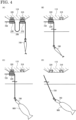
- FIG. 4 shows schematic cross-sectional views illustrating the connection configuration between the unmanned aerial vehicle 100 and the fishing line fixing portion 200 of the fishing system 10 according to an embodiment of the present invention.
- FIG. 4(A) shows a state in which the fishing system 10 detects a school of fish while flying the unmanned aerial vehicle 100 (a step of detecting a school of fish).
- the fishing line fixing portion 200 is placed below the main body 110 of the unmanned aerial vehicle 100.
- the fishing line fixing portion 200 includes the first fixing portion 210 and the second fixing portion 220.
- the first fixing portion 210 and the second fixing portion 220 are connected to a first connecting portion 310 and a second connecting portion 320 provided below the main body 110, respectively.
- the first fixing portion 210 and the second fixing portion 220 are fixed to the main body 110 via the first connecting portion 310 and the second connecting portion 320, respectively.
- Each of the first fixing portion 210 and the second fixing portion 220 has a gap or a through hole through which the fishing line 720 is inserted.
- the fishing line 720 is inserted so that the artificial bait 740 attached to the first end of the fishing line 720 is closer to the first fixing portion 210 than to the second fixing portion 220. Further, each of the first fixing portion 210 and the second fixing portion 220 fixes the fishing line 720 inserted therethrough.
- Each of the first fixing portion 210 and the second fixing portion 220 can fix the fishing line 720, for example, by narrowing the inside of the gap or the through hole, or by gripping the fishing line 720 that is inserted.
- the fishing line 720 is preferably fixed between the first fixing portion 210 and the second fixing portion 220 so as to have a certain length (or flex).
- the artificial bait 740 can be dropped from a high altitude of the unmanned aerial vehicle 100.
- a rotor around which the fishing line 720 is reeled may be provided between the first connection portion 310 and the second connection portion 320 of the main body 110.
- the fish school detection process is mainly executed by the fishing system 10.
- FIG. 4(B) shows a state in which the fishing system 10 drops the artificial bait 740 (a step of dropping artificial bait).
- the fishing system 10 detects a school of fish
- the fish school detection information is generated.
- the connection control unit 1020 receives the fish school detection information, controls the first connection portion 310, and releases of the connection of the first fixing portion 210.
- the first fixing portion 210 is dropped into the sea, and the artificial bait 740 attached to the first end of the fishing line 720 fixed to the first fixing portion 210 is also dropped.
- FIG. 4(B) shows a state in which the fishing system 10 drops the artificial bait 740 (a step of dropping artificial bait).
- the second fixing portion 220 to which the fishing line 720 is fixed is fixed to the main body 110 via the second connecting portion 320, the artificial bait 740 in the sea can be moved with the flight of the unmanned aerial vehicle 100.
- the dropped first fixing portion 210 is in a state in which the fishing line 720 is fixed. In other words, the first fixing portion 210 is attached to the fishing line 720. Therefore, when the user 800 reels the fishing line 720 onto the reel 730, the first fixing portion 210 can be recovered.
- the fishing system 10 After the step of dropping the artificial bait, the fishing system 10 mainly executes the fish school tracking process as a step of tracking a school of fish.
- FIG. 4(C) shows a state in which the fish 900 is hooked (a hooking determination step)
- FIG. 4(D) shows a state in which the fishing line 720 is separated from the unmanned aerial vehicle 100 in the fishing system 10 (a step of separation between an unmanned aerial vehicle and a fishing line).
- the connection control unit 1020 receives the hooking determination information, controls the second connection portion 320, and releases the connection of the second fixing portion 220.
- the second fixing portion 220 is dropped into the sea, the unmanned aerial vehicle 100 is separated from the fishing line 720, and the unmanned aerial vehicle 100 can be prevented from being pulled into the sea.
- the unmanned aerial vehicle 100 that dropped the second fixing portion 220 may ascend and visually inform the user 800 that the second fixing portion 220 dropped.
- the user 800 can see the unmanned aerial vehicle 100 ascend and reel the fishing line 720 onto the reel 730.
- the dropped second fixing portion 220 is in a state in which the fishing line 720 is fixed.
- the second fixing portion 220 is attached to the fishing line 720. Therefore, when the user 800 reels the fishing line 720 onto the reel 730, the second fixing portion 220 can be recovered.
- the unmanned aerial vehicle 100 flies to a predetermined position (for example, a takeoff position, etc.) by the control of the user 800 or by the autopilot, and is recovered.
- the second connection portion 320 can also disconnect the second fixing portion 220 when the second connection portion 320 is pulled with a force greater than or equal to a preset value.
- the fish 900 moves while biting the artificial bait 740, thereby, the fishing line 720 is pulled toward the sea.
- the unmanned aerial vehicle 100 is also pulled toward the sea. That is, when the fish 900 is hooked, the unmanned aerial vehicle 100 moves in the direction of the sea.
- the fishing system 10 detects the movement towards the sea of the unmanned aerial vehicle 100 by means of the group of sensors 112 and generates a control signal.
- connection control unit 1020 may receive this control signal, control the second connection portion 320, and release the connection of the second fixing portion 220. As a result, it is further possible to prevent the unmanned aerial vehicle 100 from being pulled into the sea. Also, the force setting may be determined based on the size or the payload of the unmanned aerial vehicle 100.
- FIG. 5 shows schematic cross-sectional views illustrating a connection configuration between the unmanned aerial vehicle 100 and the fishing line fixing portion 200a of the fishing system 10 according to an embodiment of the present invention.
- the fishing line fixing portion 200a includes the configuration similar to the fishing line fixing portion 200, the description of the configuration of the fishing line fixing portion 200a may be omitted.
- FIG. 5(A) shows a state in which the fishing system 10 detects a school of fish while flying the unmanned aerial vehicle 100 (a step of detecting a school of fish).
- the fishing line fixing portion 200a is placed below the main body 110 of the unmanned aerial vehicle 100.
- the fishing line fixing portion 200a includes a first fixing portion 210a and a second fixing portion 220a.
- the first fixing portion 210a and the second fixing portion 220a are fixed to the main body 110.
- Each of the first fixing portion 210a and the second fixing portion 220b has a gap through which the fishing line 720 is inserted.
- Each of the first fixing portion 210a and the second fixing portion 220a fixes the inserted fishing line 720.
- Each of the first fixing portion 210a and the second fixing portion 220a can fix the fishing line 720, for example, by narrowing the inside of the gap or a through hole, or by gripping the fishing line 720 that is inserted.
- FIG. 5(B) shows a state in which the fishing system 10 drops the artificial bait 740 (a step of dropping the artificial bait).
- the fish school determination information is generated.
- the first fixing portion 210 receives the fish school determination information and releases the fixing of the fishing line 720.
- the first fixing portion 210a is divided into two parts with the gap or the through hole as a boundary (however, even when divided into two parts, the two are still connected), and the first fixing portion 210a can release the fixing of the fishing line 720 inserted therethrough.
- the fishing line 720 and the artificial bait 740 are dropped into the sea.
- FIG. 1 shows a state in which the fishing system 10 drops the artificial bait 740 (a step of dropping the artificial bait).
- the artificial bait 740 can be moved in the sea as the unmanned aerial vehicle 100 flies. Also, the first fixing portion 210a is in a state of being fixed to the main body 110 without being dropped into the sea. Therefore, when the unmanned aerial vehicle 100 is recovered, the first fixing portion 210a can be recovered.
- FIG. 5(C) shows a state in which the fish 900 is hooked (a hooking determination step)
- FIG. 5(D) shows a state in which the fishing line 720 is separated from the unmanned aerial vehicle 100 in the fishing system 10 (a step of separation between the unmanned aerial vehicle and the fishing line).
- the second fixing portion 220a receives the hooking determination information and releases the fixing of the fishing line 720.
- the second fixing portion 220a is also divided into two parts by a gap or a through hole (however, even when divided into the two parts, the two parts are connected), and the second fixing portion 220a can release the fixing of the fishing line 720 inserted therethrough.
- the second fixing portion 220a is also fixed to the main body 110 without being dropped into the sea. Therefore, when the unmanned aerial vehicle 100 is recovered, the second fixing portion 220a can be recovered.
- the movement of the unmanned aerial vehicle 100 in the direction of the sea can also be detected by the group of sensors 112 and a control signal can be generated.
- the second fixing portion 220a may receive this control signal and release the fixing of the fishing line 720. As a result, it is further possible to prevent the unmanned aerial vehicle 100 from being pulled into the sea.
- a configuration of the fishing line fixing portion 200 of the fishing system 10 is not limited to the configuration described above, including the first modification.
- the fishing line fixing portion 200 may release the fixing of the fishing line 720 by the first fixing portion to drop the artificial bait 740, and release the fixing of the fishing line 720 by the second fixing portion to separate the unmanned aerial vehicle 100 and the fishing line 720.
- the first fixing portion and the second fixing portion may be integrated as long as the fixing of the fishing line 720 is released independently.
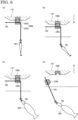
- FIG. 6 shows schematic cross-sectional views illustrating a connection configuration between the unmanned aerial vehicle 100 and the fishing line fixing portion 200b of the fishing system 10 according to an embodiment of the present invention.
- the fishing line fixing portion 200b includes the configuration similar to the fishing line fixing portion 200 or the fishing line fixing portion 200a, the description of the configuration of the fishing line fixing portion 200b may be omitted.
- FIG. 6(A) shows a state in which the fishing system 10 detects a school of fish while flying the unmanned aerial vehicle 100 (a step of detecting a school of fish).
- the fishing line fixing portion 200b is placed below the main body 110 of the unmanned aerial vehicle 100.
- the fishing line fixing portion 200b includes a first fixing portion 230b and a second fixing portion 240b.
- the first fixing portion 230b has a gap or a through hole through which the fishing line 720 is inserted. Further, the first fixing portion 230b fixes the inserted fishing line 720.
- the second fixing portion 240b is fixed to the main body 110 of the unmanned aerial vehicle 100.
- the first fixing portion 230b is formed with a convex portion, and a claw is provided at the end of the convex portion.
- the second fixing portion 240b is formed with a concave portion, and a groove is provided inside the concave portion. Therefore, when the convex portion of the first fixing portion 230b is inserted into the concave portion of the second fixing portion 240b, the claw of the convex portion engages with the groove of the concave portion, thereby connecting the first fixing portion 230b and the second fixing portion 240b.
- the groove of the concave portion and the claw of the convex portion are disengaged, and the connection between the first fixing portion 230b and the second fixing portion 240b is released. That is, the first fixing portion 230b and the second fixing portion 240b are detachably connected.
- the first fixing portion 230b can fix the fishing line 720 and suspend the artificial bait 740 attached to the first end of the fishing line 720. Further, the first fixing portion 230b is connected to the second fixing portion 240b fixed to the unmanned aerial vehicle 100. Therefore, the unmanned aerial vehicle 100 can fly while suspending the artificial bait 740 and detect a school of fish.
- the fixing of the second fixing portion 240b to the main body 110 is not limited to this configuration.
- the second fixing portion 240b may be fixed by being suspended from the main body 110.
- the first fixing portion 230a and the second fixing portion 240b are so-called male and female members, respectively, the male and female members may be reversed.
- FIG. 6(B) shows a state in which the fishing system 10 drops the artificial bait 740 (a step of dropping the artificial bait).
- the unmanned aerial vehicle 100 descends to submerge the artificial bait 740 into the sea. Since the artificial bait 740 in the sea and the artificial bait 740 over the sea reflect different light, it is possible to identify the artificial bait 740 in the sea imaging data of the imaging device 113 to determine whether the artificial bait 740 is in the sea, for example.
- FIG. 6(C) shows a state in which the fish 900 is hooked
- FIG. 6(D) shows a state in which the fishing line 720 is separated from the unmanned aerial vehicle 100 in the fishing system 10 (a step of separation between the unmanned aerial vehicle and the fishing line).
- the fish 900 is hooked on the artificial bait 740
- the fish 900 moves while biting the artificial bait 740, thereby, the fishing line 720 is pulled toward the sea.
- the unmanned aerial vehicle 100 is also pulled toward the sea along with the fishing line 720. That is, when the fish 900 is hooked, the unmanned aerial vehicle 100 moves in the direction of the sea.
- the fishing system 10 detects the movement of the unmanned aerial vehicle 100 toward the sea using the group of sensors 112, and controls the unmanned aerial vehicle 100 so that the unmanned aerial vehicle 100 ascends.
- the first fixing portion 230b and the second fixing portion 240b are pulled in opposite directions, and when pulled with a certain force, the connection between the first fixing portion 230b and the second fixing portion 240b is released.
- the force of pulling the fishing line is transmitted to the fishing line fixing portion 200b, and the force can be used to release the connection between the first fixing portion 730b and the second fixing portion 740b. Therefore, it is possible to prevent the unmanned aerial vehicle 100 from being pulled into the sea.
- the hooking determination process of the fishing system 10 is not necessarily required, the hooking determination process may be executed in this modification. By executing the hooking determination process, it is possible to speed up the response of the control for ascent of the unmanned aerial vehicle 100 and further prevent the unmanned aerial vehicle 100 from being pulled into the sea.
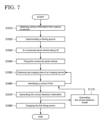
- the fish school detection process of the fishing system 10 and the generation of the fish school detection model are described with reference to FIG. 7 .
- FIG. 7 is a flowchart illustrating the fish school detection process and the generation of the fish school detection model of the fishing system 10 according to an embodiment of the present invention.
- the fish school detection process of the fishing system 10 is executed when the user 800 starts fishing.
- the fish school detection process of the fishing system 10 includes a step of obtaining various information from the group of sensors 112 (S1010), a step of determining a fishing ground (S1020), a step of the unmanned aerial vehicle taking off 100 (S1030), a step of flying the unmanned aerial vehicle 100 (S1040), a step of obtaining the sea imaging data of the imaging device 113 (S1050), a step of identifying a school of fish (S1060), a step of generating fish school detection information (S1070), and a step of dropping the first fixing portion 210 (S1080).
- the fish school detection processing unit 1030 obtains various information from the group of sensors 112 of the unmanned aerial vehicle 100 at the departure position before the unmanned aerial vehicle 100 takes off.
- the fish school detection processing unit 1030 obtains temperature information, humidity information, barometric pressure information, or position information (hereinafter, the position information obtained in the step is referred to as "departure position information") from the group of sensors 112.
- the temperature information, the humidity information, and the barometric pressure information are used in generating the fish school detection information in the step S1080.
- the departure position information is used when the unmanned aerial vehicle 100 returns in step S3050.
- the fish school detection processing unit 1030 determines a fishing ground, which is a target position of the unmanned aerial vehicle 100.
- the fishing ground may be determined by the user 800 selecting from pre-registered fishing grounds, or may be determined by applying the fish school detection model based on the temperature information, the humidity information, and the atmospheric pressure information.
- the fish school detection processing unit 1030 transmits a takeoff signal to the flight control unit 1010.
- the flight control unit 1010 rotates the blades 140 so that the unmanned aerial vehicle 100 ascends based on the takeoff signal.
- the fish school detection processing unit 1030 transmits the target position signal to the flight control unit 1010.
- the flight control unit 1010 flies the unmanned aerial vehicle 100 toward the target position based on the target position information included in the target position signal.
- the fish school detection processing unit 1030 obtains the sea imaging data captured by the imaging device 113 at or near the target position.
- the fish school detection processing unit 1030 applies the fish school detection model to the captured sea imaging data to identify a school of fish in the sea imaging data.
- the fish school detection processing unit 1030 can recognize a fish using the size, the shape, or the color (including the shadow) of an object in the sea imaging data as feature amounts, and can identify a school of fish.
- the fish school detection processing unit 1030 may recognize a moving object as a fish and identify a school of fish from the difference in the sea imaging data between frames.
- step S1050 and the step S1060 are repeated until a school of fish is identified in the step S1060.
- the unmanned aerial vehicle 100 may hover at the target position or fly near the target position.
- the step S1070 is executed.
- the fish school detection processing unit 1030 generates the fish school detection information.
- the fish school detection information is generated by associating the position information of the position where the school of fish is identified, and the imaging sea data, the temperature information, the humidity information, and the barometric pressure information, and the like obtained in the step S1010.
- the fish school detection processing unit 1030 transmits the fish school detection information to the connection control unit 1020.
- the connection control unit 1020 that receives the fish school detection information releases the fixing of the first fixing portion 210.
- the artificial bait 740 is dropped into the sea together with the first fixing portion 210.
- the fish school detection processing unit 1030 may transmit a part of the fish school detection information to the connection control unit 1020 as the first drop signal.
- the fish school detection processing unit 1030 may transmit an abnormal signal to the flight control unit 1010 in order to return the unmanned aerial vehicle 100 to the departure position.
- the fish school detection model is applied to the sea imaging data to identify a school of fish in the sea imaging data.
- the fish school detection learning unit 1060 can use the generated fish school detection information as teacher data, for example, to repeatedly execute deep learning to generate the fish school detection model having a learned neuron network (S1110).
- the unmanned aerial vehicle 100 may be operated by the user 800. Further, the user 800 may confirm the image based on the sea imaging data transmitted from the unmanned aerial vehicle 100 and identify the school of fish in the sea imaging data. In this case, the fixing of the first fixing portion 210 may be released by remote control by the user 800.
- the fish school tracking process of the fishing system 10 and the generation of the fish school tracking model are described with reference to FIGS. 8 and 9 .
- FIG. 8 is a flow chart illustrating the process of tracking the fish school and the generation of the fish school tracking model of the fishing system 10 according to an embodiment of the present invention.
- the fish school tracking process of the fishing system 10 is executed after the first fixing portion 210 is dropped.
- the fish school tracking process of the fishing system 10 includes a step of obtaining various information from the group of sensors 112 (S2010), a step of obtaining sea imaging data from the imaging device 113 (S2020), a step of identifying the direction of movement of the school of fish (S2030), a step of determining a fish school tracking pattern (S2040), and a step of generating fish school tracking information (S2050).
- the fish school tracking processing unit 1040 obtains the various information from the group of sensors 112 of the unmanned aerial vehicle 100.
- the fish school tracking processing unit 1040 obtains the position information, the water temperature information, or the fish school information from the group of sensors 112.
- the fish school tracking processing unit 1040 obtains the sea imaging data captured by the imaging device 113.
- the fish school tracking processing unit 1040 applies the fish school tracking model to the captured sea imaging data to identify the fish school or the direction of the movement of the school of fish in the sea imaging data.
- the fish school tracking processing unit 1040 can recognize a fish using the size, the shape, the color (including the shadow) of the object in the sea imaging data as feature amounts, and identify the school of fish.
- the fish school tracking processing unit 1040 can calculate the direction of the moving object from the difference in the sea image data between frames, and can identify the direction of the movement of the school of fish.
- the fish school tracking processing unit 1040 determines a fish school tracking pattern.
- the fish school tracking pattern may be determined by the user 800 selecting from pre-registered fish school tracking patterns, and the fish school tracking model is applied based on the position information, the water temperature information, the fish school information, and the sea imaging data, or the like.
- the fish school tracking model is applied, an appropriate fish school tracking pattern learned from the position information, the water temperature information, the fish school information, and the sea imaging data, or the like is determined.
- FIG. 9 shows schematic diagrams illustrating fish school tracking patterns executed in the fish school tracking process of the fishing system according to an embodiment of the present invention.
- FIG. 9(A) shows a fish school tracking pattern in which the artificial bait 740 is moved linearly along the direction of movement of the school of fish including fish 900.
- FIG. 9(B) shows a fish school tracking pattern in which the artificial bait 740 is moved in a wave shape along the direction of movement of the school of fish including the fish 900.
- FIG. 9(C) is a fish school tracking pattern in which the artificial bait 740 is moved circularly so as to surround the school of fish in the direction of the movement of the school of fish including the fish 900.
- FIG. 9(A) shows a fish school tracking pattern in which the artificial bait 740 is moved linearly along the direction of movement of the school of fish including fish 900.
- FIG. 9(B) shows a fish school tracking pattern in which the artificial bait 740 is moved in a wave shape along the direction of movement of the school of fish including the fish 900.
- FIG. 9(C) is a fish school tracking pattern in which the artificial bait 740 is moved circularly so as to surround the school of
- the steps S2020 to S2040 are repeated until the hooking determination information is generated by the hooking determination process, which is described later. At this time, the unmanned aerial vehicle 100 flies according to the fish school tracking pattern.
- the step S2050 is executed.
- the fish school tracking model is applied to the sea imaging data to identify the direction of the movement of the school of fish in the sea imaging data.
- the fish school tracking learning unit 1070 can use the generated fish school tracking information as teacher data, for example, to repeatedly execute deep learning in order to generate the fish school tracking model having a learned neuron network (S2110).
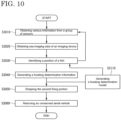
- the hooking determination process of the fishing system 10 and the generation of the hooking determination model are described with reference to FIG. 10 .
- FIG. 10 is a flowchart illustrating the hooking determination process and the generation of the hooking determination model of the fishing system 10 according to an embodiment of the present invention.
- the hooking determination process of the fishing system 10 is executed in parallel with the fish school detection process in the above description.
- the hooking determination process of the fishing system 10 includes a step of obtaining various information from the group of sensors 112 (S3010), a step of obtaining sea imaging data from the imaging device 113 (S3020), a step of identifying the position of the fish 900 (S3030), a step of generating the hooking determination information of the fish 900 (S3040), a step of dropping the second fixing portion 220 (S3050), and a step of returning the unmanned aerial vehicle 100 (S3060).
- the hooking determination processing unit 1050 obtains the various information from the group of sensors 112 of the unmanned aerial vehicle 100.
- the hooking determination processing unit 1050 obtains speed variation information, angular velocity variation information, or the like from the group of sensors 112.
- the hooking determination processing unit 1050 obtains the sea imaging data captured by the imaging device 113.
- the hooking determination processing unit 1050 applies the hooking determination model to the captured sea imaging data to identify the positions of the artificial bait 740 and the fish 900 in the captured sea data.
- the hook determination processing unit 1050 recognizes the artificial bait 740 or the fish 900 by using the size, the shape, the color (including the shadow) of the object in the sea imaging data as feature quantities, and can identify the positions of the artificial bait 740 and the fish 900.
- the steps S3010 to S3030 are repeated until the position of the artificial bait 740 and the position of the fish 900 overlap each other in the step S3030.
- the position of the artificial bait 740 and the position of the fish 900 overlap each other it may be determined whether the fish 900 is hooked, and the step S3040 may be executed.
- the hooking determination processing unit 1050 preferably determines whether the fish 900 is hooked when it is being pulled in the direction of the sea based on the speed variation information or the angular velocity variation information.
- the hooking determination processing unit 1050 generates the hooking determination information.
- the hooking determination information is generated by associating the sea imaging data when the fish 900 is hooked, the positions of the fish 900 and the artificial bait 740, and the like.
- the hooking determination processing unit 1050 transmits the hooking determination information to the connection control unit 1020.
- the connection control unit 1020 that receives the hooking determination releases the fixing of the second fixing unit 220.
- the second fixing portion 220 is dropped into the sea.
- the hooking determination processing unit 1050 may transmit a part of the hooking determination information to the connection control unit 1020 as the second drop signal.
- a control signal may be transmitted to the flight control unit 1010 so that the unmanned aerial vehicle 100 ascends or flies in the direction opposite to the pulling direction.
- the hooking determination processing unit 1050 transmits a returning signal to the flight control unit 1010.
- the flight control unit 1010 controls so that the unmanned aerial vehicle 100 flies toward the departure position based on the departure position information included in the returning signal.
- the hooking determination model is applied to the sea imaging data to identify the positions of the fish 900 and the artificial bait 740 in the sea imaging data.
- the hooking determination learning unit 1080 uses the generated hooking determination information as teacher data, for example, to repeatedly execute deep learning to generate the hooking determination model having a learned neuron network (S3110).
- the second fixing portion 220 is fixed to the unmanned aerial vehicle 100 so that the flight of the unmanned aerial vehicle 100 can be controlled to track the school of fish. Further, since not only the group of sensors 112 but also the hook determination processing unit 1050 determines whether the fish is hooked, it is possible to quickly release the second fixing portion 220 and separate the fishing line 720 from the unmanned aerial vehicle 100. As a result, it is possible to prevent the unmanned aerial vehicle 100 from being pulled into the sea when the fish is hooked.
- a fishing system 10A according to an embodiment of the present invention is described with reference to FIGS. 11 and 12 .
- the description of the configuration of the fishing system 10A may be omitted.
- FIG. 11 is a schematic diagram illustrating the use of the fishing system 10A according to an embodiment of the present invention.
- the fishing system 10A includes an unmanned aerial vehicle 100A, a fishing line fixing portion 200A, and an information communication terminal 400A.
- Each of the unmanned aerial vehicle 100A and the information communication terminal 400A is equipped with a communication unit, and the unmanned aerial vehicle 100A and the information communication terminal 400A can be communicatively connected to each other via wireless communication.
- a fishing tackle 700A used in the fishing system 10A includes a fishing rod 710A, a fishing line 720A, a reel 730A, an artificial bait 740A, and a fishing rod support 750A.
- the fishing rod support 750A can support the fishing rod 710A. Therefore, when the fishing rod 710A is placed on the fishing rod support 750A, the user 800 does not need to hold the fishing rod 710A.
- a motor and a communication unit are mounted on the reel 730A.
- the communication unit of the reel 730A can communicate with the unmanned aerial vehicle 100A via wireless communication, and can automatically reel the fishing line 720A according to an instruction from the unmanned aerial vehicle 100A. Therefore, in the fishing system 10A, the user 800 can catch the fish 900 by simply causing the unmanned aerial vehicle 100A to take off without touching the fishing rod 710 or the reel 730 at all.
- FIG. 12 is a schematic diagram illustrating a screen of the information communication terminal of the fishing system 10A according to an embodiment of the present invention.
- the user 800 can confirm the detection and tracking of the school of fish on the screen of the information communication terminal 400A.
- the screen of the information communication terminal 400A is a so-called touch panel.
- an image 410 based on the sea imaging data, an image 420 based on the sonar information, and an image 430 based on the position information are displayed.
- An icon 440A for the controller of the unmanned aerial vehicle 100 and an icon for dropping the fishing line fixing portion 200A are also displayed. Therefore, the user 800 can input an instruction by touching the icon while confirming the detection or tracking of the fish school on the screen of the information communication terminal 400A, and the user instruction signal can be transmitted to the unmanned aerial vehicle 100A. Therefore, the user 800 can intervene and make fine adjustments in the fish school detection process, the fish school tracking process, or the hooking determination process.
- the images and icons displayed on the screen of information communication terminal 400A are not limited to the configuration shown in FIG. 12 .
- the information communication terminal 400A can display images of all kinds of information related to the detection and tracking of the school fish. Further, the information communication terminal 400A can display icons for instructions on all kinds of controls or processes related to the fish school detection process, the fish school tracking process, and the hook determination process. In addition, the position of the image or the position of the icon displayed on the information communication terminal 400A may be freely changed by the user 800.
- the fish 900 can be caught using the information communication terminal 400A. Further, since the unmanned aerial vehicle 100A is provided with the fishing line fixing portion 200A, it is possible to prevent the unmanned aerial vehicle 100 from being pulled into the sea when the fish is hooked.
- An embodiment of the present invention can be appropriately combined with components and implemented as long as they do not contradict each other.
- deletion, or design changes of constituent elements, or additions, omissions, or changes to conditions of steps as appropriate based on the embodiment of the present invention are also included within the scope of the present invention as long as the gist of the present invention is provided.
Landscapes
- Life Sciences & Earth Sciences (AREA)
- Environmental Sciences (AREA)
- Engineering & Computer Science (AREA)
- Animal Husbandry (AREA)
- Biodiversity & Conservation Biology (AREA)
- Microelectronics & Electronic Packaging (AREA)
- Mechanical Engineering (AREA)
- Remote Sensing (AREA)
- Aviation & Aerospace Engineering (AREA)
- Marine Sciences & Fisheries (AREA)
- Electric Cable Installation (AREA)
- Mechanical Means For Catching Fish (AREA)
Claims (4)
- Angelsystem (10, 10A), aufweisend:ein unbemanntes Luftfahrzeug (100, 100A); undeinen Angelschnurbefestigungsabschnitt (200), der abnehmbar an einem Hauptkörper (110) des unbemannten Luftfahrzeugs (100, 100A) befestigt ist und eine Angelschnur (720) befestigt,wobei das unbemannte Luftfahrzeug (100, 100A) aufweist:eine Bildgebungsvorrichtung (113),eine Verbindungssteuereinheit (1020), die dazu konfiguriert ist, eine Befestigung zwischen dem Hauptkörper (110) und dem Angelschnurbefestigungsabschnitt (200) zu lösen, undeine Fischschwarmverfolgungsverarbeitungseinheit, die dazu konfiguriert ist, einen Fisch in Bilddaten zu identifizieren, die von der Bildgebungsvorrichtung erfasst werden, und das unbemannte Luftfahrzeug zu steuern, um den Fisch zu verfolgen,wobei der Angelschnurbefestigungsabschnitt (200) einen ersten Befestigungsabschnitt (210) und einen zweiten Befestigungsabschnitt (220) aufweist,eine Befestigung zwischen dem Hauptkörper (110) und dem ersten Befestigungsabschnitt (210) und eine Befestigung zwischen dem Hauptkörper (110) und dem zweiten Befestigungsabschnitt (220) dazu konfiguriert sind, unabhängig voneinander gelöst zu werden, unddie Verbindungssteuereinheit (1020) dazu konfiguriert ist, den künstlichen Köder (740) zusammen mit dem ersten Befestigungsabschnitt (210) ins Meer fallen zu lassen, wenn die Befestigung zwischen dem Hauptkörper (110) und dem ersten Befestigungsabschnitt (210) gelöst wird,dadurch gekennzeichnet, dassdas unbemannte Luftfahrzeug (100, 100A) ferner eine Am-Haken-Bestimmungsverarbeitungseinheit aufweist, die dazu konfiguriert ist, zu bestimmen, ob der Fisch an einem künstlichen Köder am Haken ist, der an einem ersten Ende der Angelschnur befestigt ist, unddie Verbindungssteuereinheit (1020) dazu konfiguriert ist, die Befestigung zwischen dem Hauptkörper (110) und dem zweiten Befestigungsabschnitt (220) zu lösen und den zweiten Befestigungsabschnitt (220) ins Meer fallen zu lassen, wenn der Fisch am Haken ist.
- Angelsystem (10, 10A), aufweisend:ein unbemanntes Luftfahrzeug (100, 100A); undeinen Angelschnurbefestigungsabschnitt (200a), der an einem Hauptkörper (110) des unbemannten Luftfahrzeugs (100, 100A) befestigt ist und eine Angelschnur (720) befestigt,wobei das unbemannte Luftfahrzeug aufweist:eine Bildgebungsvorrichtung (113),eine Verbindungssteuereinheit (1020), die dazu konfiguriert ist, eine Befestigung der Angelschnur (720) durch den Angelschnurbefestigungsabschnitt (200a) freizugeben, undeine Fischschwarmverfolgungsverarbeitungseinheit (1040), die dazu konfiguriert ist, einen Fisch in Bilddaten zu identifizieren, die durch die Bildgebungsvorrichtung (113) erfasst werden, und das unbemannte Luftfahrzeug (100, 100A) zu steuern,um den Fisch zu verfolgen,wobei der Angelschnurbefestigungsabschnitt (200a) einen ersten Befestigungsabschnitt (210a) und einen zweiten Befestigungsabschnitt (220a),eine Befestigung der Angelschnur (720) durch den ersten Befestigungsabschnitt (210a) und eine Befestigung der Angelschnur (720) durch den zweiten Befestigungsabschnitt (220a) dazu konfiguriert sind, unabhängig voneinander gelöst zu werden, unddie Verbindungssteuereinheit (1020) dazu konfiguriert ist, den künstlichen Köder (740) ins Meer fallen zu lassen, wenn die Befestigung der Angelschnur (720) durch den ersten Befestigungsabschnitt (210a) gelöst wird,dadurch gekennzeichnet, dassdas unbemannte Luftfahrzeug Fahrzeug (100, 100A) ferner eine Am-Haken-Bestimmungsverarbeitungseinheit (1050) aufweist, die dazu konfiguriert ist, zu bestimmen, ob der Fisch an einem künstlichen Köder (740) am Haken ist, der an einem ersten Ende der Angelschnur (720) befestigt ist, unddie Verbindungssteuereinheit (1020) dazu konfiguriert ist, die Befestigung der Angelschnur (720) durch den zweiten Befestigungsabschnitt (220a) zu lösen, wenn der Fisch am Haken ist.
- Angelsystem (10, 10A) gemäß Anspruch 1 oder Anspruch 2,
wobei die Am-Haken-Bestimmungsverarbeitungseinheit (1050) Bestimmungen auf der Grundlage von Informationen von einer Gruppe von Sensoren (112) durchführt, die an dem unbemannten Luftfahrzeug (100, 100A) vorgesehen sind. - Angelsystem (10, 10A) gemäß einem der Ansprüche 1 bis 3,
wobei die Am-Haken-Bestimmungsverarbeitungseinheit (1050) Bestimmungen durch Identifizieren einer Position des Fisches in Bilddaten durchführt, die von der Bildgebungsvorrichtung (113) erfasst werden.
Applications Claiming Priority (2)
| Application Number | Priority Date | Filing Date | Title |
|---|---|---|---|
| JP2020192728A JP6842733B1 (ja) | 2020-11-19 | 2020-11-19 | 釣りシステム |
| PCT/JP2021/038086 WO2022107513A1 (ja) | 2020-11-19 | 2021-10-14 | 釣りシステム |
Publications (4)
| Publication Number | Publication Date |
|---|---|
| EP4248747A1 EP4248747A1 (de) | 2023-09-27 |
| EP4248747A4 EP4248747A4 (de) | 2024-06-05 |
| EP4248747B1 true EP4248747B1 (de) | 2025-02-26 |
| EP4248747C0 EP4248747C0 (de) | 2025-02-26 |
Family
ID=74860714
Family Applications (1)
| Application Number | Title | Priority Date | Filing Date |
|---|---|---|---|
| EP21894387.6A Active EP4248747B1 (de) | 2020-11-19 | 2021-10-14 | Fischfangsystem |
Country Status (4)
| Country | Link |
|---|---|
| US (2) | US11834207B2 (de) |
| EP (1) | EP4248747B1 (de) |
| JP (2) | JP6842733B1 (de) |
| WO (1) | WO2022107513A1 (de) |
Families Citing this family (3)
| Publication number | Priority date | Publication date | Assignee | Title |
|---|---|---|---|---|
| JP6842733B1 (ja) * | 2020-11-19 | 2021-03-17 | 東京幻実株式会社 | 釣りシステム |
| TR2022013492A2 (tr) * | 2022-08-29 | 2022-10-21 | Univ Istanbul Gelisim | Dronla balik tespi̇t si̇stemi̇ ve algori̇tmasi |
| US20250102077A1 (en) * | 2023-09-22 | 2025-03-27 | Freeport Minerals Corporation | Unmanned aerial vehicle systems and methods for heap leach pad irrigation line placement |
Family Cites Families (29)
| Publication number | Priority date | Publication date | Assignee | Title |
|---|---|---|---|---|
| JPH0445733A (ja) * | 1990-06-11 | 1992-02-14 | Ryobi Ltd | 釣りシステム |
| US9278737B2 (en) * | 2012-10-01 | 2016-03-08 | Caleb Freeman | Remote control fishing robot |
| US9745062B2 (en) * | 2014-10-06 | 2017-08-29 | James Sommerfield Richardson | Methods and systems for providing a safety apparatus to distressed persons |
| US20160200437A1 (en) * | 2015-01-12 | 2016-07-14 | Mark Andrew Ryan | Tethered Flight Control System for Small Unmanned Aircraft |
| WO2017123768A1 (en) * | 2016-01-12 | 2017-07-20 | Planck Aerosystems, Inc. | Methods and apparatus for unmanned aircraft-based object detection |
| JP2017209026A (ja) * | 2016-05-23 | 2017-11-30 | シャープ株式会社 | ルアー |
| US9807996B1 (en) * | 2016-05-28 | 2017-11-07 | Simon Siu-Chi Yu | Bug eater |
| JP2018011567A (ja) * | 2016-07-22 | 2018-01-25 | 克己 武田 | 魚類捕獲装置としての無人航行機及びそれを用いた魚類捕獲方法 |
| CN205946963U (zh) * | 2016-08-15 | 2017-02-15 | 威海星煜无人机科技有限公司 | 一种钓鱼无人机 |
| US10019002B2 (en) * | 2016-10-13 | 2018-07-10 | Navico Holding As | Unmanned vehicle control and operation in a marine environment |
| NO343285B1 (no) * | 2016-11-02 | 2019-01-14 | Birdview As | Drone |
| CN206528632U (zh) * | 2017-03-10 | 2017-09-29 | 佛山市神风航空科技有限公司 | 一种钓鱼无人机 |
| CN110461147B (zh) * | 2017-03-25 | 2022-05-13 | 余绍炽 | 多功能光电声学离子无人机 |
| CN107333723B (zh) * | 2017-06-21 | 2023-05-16 | 宁波派丽肯无人机有限公司 | 垂钓方法 |
| CN206797724U (zh) | 2017-06-21 | 2017-12-26 | 宁波派丽肯无人机有限公司 | 一种无人机 |
| CN107187601B (zh) * | 2017-06-21 | 2023-06-20 | 宁波派丽肯无人机有限公司 | 垂钓无人机 |
| CN207536128U (zh) | 2017-06-21 | 2018-06-26 | 宁波派丽肯无人机有限公司 | 垂钓无人机 |
| CN207157532U (zh) * | 2017-06-21 | 2018-03-30 | 宁波派丽肯无人机有限公司 | 垂钓用无人机 |
| JP6452183B1 (ja) * | 2018-03-30 | 2019-01-16 | 株式会社amuse oneself | 釣り動画撮像システム |
| WO2021041629A1 (en) * | 2019-08-29 | 2021-03-04 | FLIR Belgium BVBA | Air and sea based fishing data collection and analysis systems and methods |
| US20200010193A1 (en) * | 2018-07-04 | 2020-01-09 | Dwight Darwin Alexander | Method and Apparatus for Unmanned Aerial Maritime Float Vehicle That Sense and Report Relevant Data from Physical and Operational Environment |
| JP7165020B2 (ja) * | 2018-10-05 | 2022-11-02 | 株式会社シマノ | 魚信報知装置 |
| CN109258589A (zh) * | 2018-10-30 | 2019-01-25 | 湖南冬暖科技有限公司 | 一种利用无人机捕鱼的方法及其捕鱼装置 |
| JP6842733B1 (ja) * | 2020-11-19 | 2021-03-17 | 東京幻実株式会社 | 釣りシステム |
| US12372408B2 (en) * | 2021-06-05 | 2025-07-29 | Omar F Guerra Johansson | Aerial marine drone system and method |
| US20230027071A1 (en) * | 2021-07-21 | 2023-01-26 | Blue White Robotics Ltd | Two level mission planning for autonomous platforms and payloads |
| US12116150B2 (en) * | 2021-09-05 | 2024-10-15 | Cerberus Fishing Systems Inc. | Drone fishing system for multiple fishing lines |
| US12134471B2 (en) * | 2021-12-08 | 2024-11-05 | Dish Network L.L.C. | Methods and systems for drone based assistance |
| KR20250081137A (ko) * | 2023-11-29 | 2025-06-05 | 주식회사 해양드론기술 | 드론을 이용한 어군 탐지 시스템 및 그 방법 |
-
2020
- 2020-11-19 JP JP2020192728A patent/JP6842733B1/ja active Active
-
2021
- 2021-02-05 JP JP2021017726A patent/JP2022081369A/ja active Pending
- 2021-10-14 WO PCT/JP2021/038086 patent/WO2022107513A1/ja not_active Ceased
- 2021-10-14 EP EP21894387.6A patent/EP4248747B1/de active Active
-
2023
- 2023-05-18 US US18/319,741 patent/US11834207B2/en active Active
- 2023-10-25 US US18/494,228 patent/US20240051689A1/en active Pending
Also Published As
| Publication number | Publication date |
|---|---|
| US20240051689A1 (en) | 2024-02-15 |
| US20230286680A1 (en) | 2023-09-14 |
| EP4248747A4 (de) | 2024-06-05 |
| JP6842733B1 (ja) | 2021-03-17 |
| WO2022107513A1 (ja) | 2022-05-27 |
| EP4248747A1 (de) | 2023-09-27 |
| JP2022081369A (ja) | 2022-05-31 |
| US11834207B2 (en) | 2023-12-05 |
| EP4248747C0 (de) | 2025-02-26 |
| JP2022081284A (ja) | 2022-05-31 |
Similar Documents
| Publication | Publication Date | Title |
|---|---|---|
| US11834207B2 (en) | Fishing system | |
| KR101835107B1 (ko) | 어군 탐지용 드론 | |
| JP6931856B2 (ja) | 飛行体及び飛行体の制御方法 | |
| CN107087427B (zh) | 飞行器的控制方法、装置和设备以及飞行器 | |
| US10691993B2 (en) | System and method for autonomous tracking and imaging of a target | |
| CN106719230B (zh) | 水产自动养殖无人机 | |
| CN107531322A (zh) | 空中捕获平台 | |
| CN107340777A (zh) | 一种水下无人船控制系统及方法 | |
| JP6891102B2 (ja) | 農業用マルチコプター | |
| JP7181723B2 (ja) | 海上探索システム、無人飛行体、及び無人飛行方法 | |
| WO2019128275A1 (zh) | 一种拍摄控制方法、装置及飞行器 | |
| WO2018170738A1 (zh) | 控制方法和无人机 | |
| JP2025041720A (ja) | 検査システム | |
| JP2019191428A (ja) | 制御装置、撮像装置、移動体、制御方法、及びプログラム | |
| HK40102123B (en) | Fishing system | |
| HK40102123A (en) | Fishing system | |
| JP2015127669A (ja) | 水流観測方法 | |
| WO2023173307A1 (zh) | 可移动平台及其控制方法、信息提示方法、装置、电子设备、计算机可读存储介质 | |
| CN113759951A (zh) | 一种无人机倾斜拍摄测量的方法和系统 | |
| WO2023044897A1 (zh) | 无人机的控制方法、装置、无人机及存储介质 | |
| JP7495040B1 (ja) | 水中捕捉装置 | |
| JP6452183B1 (ja) | 釣り動画撮像システム | |
| KR102698560B1 (ko) | 무인 비행 장치를 이용한 익수자 수색 및 구조 시스템 | |
| JP7495041B1 (ja) | 情報処理システム、情報処理プログラム、及び情報処理方法 | |
| KR102923671B1 (ko) | 미등록 선박 분류 기능이 탑재된 드론 및 이를 이용한 선박 분류 방법 |
Legal Events
| Date | Code | Title | Description |
|---|---|---|---|
| STAA | Information on the status of an ep patent application or granted ep patent |
Free format text: STATUS: THE INTERNATIONAL PUBLICATION HAS BEEN MADE |
|
| PUAI | Public reference made under article 153(3) epc to a published international application that has entered the european phase |
Free format text: ORIGINAL CODE: 0009012 |
|
| STAA | Information on the status of an ep patent application or granted ep patent |
Free format text: STATUS: REQUEST FOR EXAMINATION WAS MADE |
|
| 17P | Request for examination filed |
Effective date: 20230616 |
|
| AK | Designated contracting states |
Kind code of ref document: A1 Designated state(s): AL AT BE BG CH CY CZ DE DK EE ES FI FR GB GR HR HU IE IS IT LI LT LU LV MC MK MT NL NO PL PT RO RS SE SI SK SM TR |
|
| DAV | Request for validation of the european patent (deleted) | ||
| DAX | Request for extension of the european patent (deleted) | ||
| REG | Reference to a national code |
Ref country code: DE Ref legal event code: R079 Free format text: PREVIOUS MAIN CLASS: A01K0097000000 Ipc: A01K0091020000 Ref country code: DE Ref legal event code: R079 Ref document number: 602021026933 Country of ref document: DE Free format text: PREVIOUS MAIN CLASS: A01K0097000000 Ipc: A01K0091020000 |
|
| REG | Reference to a national code |
Ref country code: HK Ref legal event code: DE Ref document number: 40102123 Country of ref document: HK |
|
| A4 | Supplementary search report drawn up and despatched |
Effective date: 20240503 |
|
| RIC1 | Information provided on ipc code assigned before grant |
Ipc: A01K 97/00 20060101ALI20240427BHEP Ipc: A01K 91/02 20060101AFI20240427BHEP |
|
| GRAP | Despatch of communication of intention to grant a patent |
Free format text: ORIGINAL CODE: EPIDOSNIGR1 |
|
| STAA | Information on the status of an ep patent application or granted ep patent |
Free format text: STATUS: GRANT OF PATENT IS INTENDED |
|
| RIC1 | Information provided on ipc code assigned before grant |
Ipc: A01K 79/00 20060101ALI20240917BHEP Ipc: A01K 97/00 20060101ALI20240917BHEP Ipc: A01K 91/02 20060101AFI20240917BHEP |
|
| INTG | Intention to grant announced |
Effective date: 20240925 |
|
| RIN1 | Information on inventor provided before grant (corrected) |
Inventor name: OGANE, TOSHIO |
|
| GRAS | Grant fee paid |
Free format text: ORIGINAL CODE: EPIDOSNIGR3 |
|
| GRAA | (expected) grant |
Free format text: ORIGINAL CODE: 0009210 |
|
| STAA | Information on the status of an ep patent application or granted ep patent |
Free format text: STATUS: THE PATENT HAS BEEN GRANTED |
|
| AK | Designated contracting states |
Kind code of ref document: B1 Designated state(s): AL AT BE BG CH CY CZ DE DK EE ES FI FR GB GR HR HU IE IS IT LI LT LU LV MC MK MT NL NO PL PT RO RS SE SI SK SM TR |
|
| REG | Reference to a national code |
Ref country code: GB Ref legal event code: FG4D |
|
| REG | Reference to a national code |
Ref country code: CH Ref legal event code: EP |
|
| REG | Reference to a national code |
Ref country code: DE Ref legal event code: R096 Ref document number: 602021026933 Country of ref document: DE |
|
| REG | Reference to a national code |
Ref country code: IE Ref legal event code: FG4D |
|
| U01 | Request for unitary effect filed |
Effective date: 20250226 |
|
| U07 | Unitary effect registered |
Designated state(s): AT BE BG DE DK EE FI FR IT LT LU LV MT NL PT RO SE SI Effective date: 20250304 |
|
| RAP4 | Party data changed (patent owner data changed or rights of a patent transferred) |
Owner name: ACTUAL TOKYO INC. |
|
| U1H | Name or address of the proprietor changed after the registration of the unitary effect |
Owner name: ACTUAL TOKYO INC.; JP |
|
| PG25 | Lapsed in a contracting state [announced via postgrant information from national office to epo] |
Ref country code: RS Free format text: LAPSE BECAUSE OF FAILURE TO SUBMIT A TRANSLATION OF THE DESCRIPTION OR TO PAY THE FEE WITHIN THE PRESCRIBED TIME-LIMIT Effective date: 20250526 |
|
| PG25 | Lapsed in a contracting state [announced via postgrant information from national office to epo] |
Ref country code: PL Free format text: LAPSE BECAUSE OF FAILURE TO SUBMIT A TRANSLATION OF THE DESCRIPTION OR TO PAY THE FEE WITHIN THE PRESCRIBED TIME-LIMIT Effective date: 20250226 |
|
| PG25 | Lapsed in a contracting state [announced via postgrant information from national office to epo] |
Ref country code: ES Free format text: LAPSE BECAUSE OF FAILURE TO SUBMIT A TRANSLATION OF THE DESCRIPTION OR TO PAY THE FEE WITHIN THE PRESCRIBED TIME-LIMIT Effective date: 20250226 |
|
| PG25 | Lapsed in a contracting state [announced via postgrant information from national office to epo] |
Ref country code: IS Free format text: LAPSE BECAUSE OF FAILURE TO SUBMIT A TRANSLATION OF THE DESCRIPTION OR TO PAY THE FEE WITHIN THE PRESCRIBED TIME-LIMIT Effective date: 20250626 Ref country code: NO Free format text: LAPSE BECAUSE OF FAILURE TO SUBMIT A TRANSLATION OF THE DESCRIPTION OR TO PAY THE FEE WITHIN THE PRESCRIBED TIME-LIMIT Effective date: 20250526 |
|
| PG25 | Lapsed in a contracting state [announced via postgrant information from national office to epo] |
Ref country code: HR Free format text: LAPSE BECAUSE OF FAILURE TO SUBMIT A TRANSLATION OF THE DESCRIPTION OR TO PAY THE FEE WITHIN THE PRESCRIBED TIME-LIMIT Effective date: 20250226 |
|
| PG25 | Lapsed in a contracting state [announced via postgrant information from national office to epo] |
Ref country code: GR Free format text: LAPSE BECAUSE OF FAILURE TO SUBMIT A TRANSLATION OF THE DESCRIPTION OR TO PAY THE FEE WITHIN THE PRESCRIBED TIME-LIMIT Effective date: 20250527 |
|
| PG25 | Lapsed in a contracting state [announced via postgrant information from national office to epo] |
Ref country code: SM Free format text: LAPSE BECAUSE OF FAILURE TO SUBMIT A TRANSLATION OF THE DESCRIPTION OR TO PAY THE FEE WITHIN THE PRESCRIBED TIME-LIMIT Effective date: 20250226 |
|
| PG25 | Lapsed in a contracting state [announced via postgrant information from national office to epo] |
Ref country code: CZ Free format text: LAPSE BECAUSE OF FAILURE TO SUBMIT A TRANSLATION OF THE DESCRIPTION OR TO PAY THE FEE WITHIN THE PRESCRIBED TIME-LIMIT Effective date: 20250226 |
|
| PG25 | Lapsed in a contracting state [announced via postgrant information from national office to epo] |
Ref country code: SK Free format text: LAPSE BECAUSE OF FAILURE TO SUBMIT A TRANSLATION OF THE DESCRIPTION OR TO PAY THE FEE WITHIN THE PRESCRIBED TIME-LIMIT Effective date: 20250226 |
|
| REG | Reference to a national code |
Ref country code: CH Ref legal event code: U11 Free format text: ST27 STATUS EVENT CODE: U-0-0-U10-U11 (AS PROVIDED BY THE NATIONAL OFFICE) Effective date: 20251101 |
|
| U20 | Renewal fee for the european patent with unitary effect paid |
Year of fee payment: 5 Effective date: 20251027 |
|
| PLBE | No opposition filed within time limit |
Free format text: ORIGINAL CODE: 0009261 |
|
| STAA | Information on the status of an ep patent application or granted ep patent |
Free format text: STATUS: NO OPPOSITION FILED WITHIN TIME LIMIT |
|
| PGFP | Annual fee paid to national office [announced via postgrant information from national office to epo] |
Ref country code: GB Payment date: 20251024 Year of fee payment: 5 |
|
| PGFP | Annual fee paid to national office [announced via postgrant information from national office to epo] |
Ref country code: CH Payment date: 20251101 Year of fee payment: 5 |
|
| 26N | No opposition filed |
Effective date: 20251127 |