EP4247900B1 - Zinkpigment für wässrige korrosionsbeschichtungen - Google Patents
Zinkpigment für wässrige korrosionsbeschichtungen Download PDFInfo
- Publication number
- EP4247900B1 EP4247900B1 EP21851732.4A EP21851732A EP4247900B1 EP 4247900 B1 EP4247900 B1 EP 4247900B1 EP 21851732 A EP21851732 A EP 21851732A EP 4247900 B1 EP4247900 B1 EP 4247900B1
- Authority
- EP
- European Patent Office
- Prior art keywords
- pigment
- zinc pigment
- formula
- treated metallic
- metallic zinc
- Prior art date
- Legal status (The legal status is an assumption and is not a legal conclusion. Google has not performed a legal analysis and makes no representation as to the accuracy of the status listed.)
- Active
Links
Classifications
-
- C—CHEMISTRY; METALLURGY
- C09—DYES; PAINTS; POLISHES; NATURAL RESINS; ADHESIVES; COMPOSITIONS NOT OTHERWISE PROVIDED FOR; APPLICATIONS OF MATERIALS NOT OTHERWISE PROVIDED FOR
- C09K—MATERIALS FOR MISCELLANEOUS APPLICATIONS, NOT PROVIDED FOR ELSEWHERE
- C09K15/00—Anti-oxidant compositions; Compositions inhibiting chemical change
- C09K15/04—Anti-oxidant compositions; Compositions inhibiting chemical change containing organic compounds
- C09K15/30—Anti-oxidant compositions; Compositions inhibiting chemical change containing organic compounds containing heterocyclic ring with at least one nitrogen atom as ring member
-
- C—CHEMISTRY; METALLURGY
- C09—DYES; PAINTS; POLISHES; NATURAL RESINS; ADHESIVES; COMPOSITIONS NOT OTHERWISE PROVIDED FOR; APPLICATIONS OF MATERIALS NOT OTHERWISE PROVIDED FOR
- C09C—TREATMENT OF INORGANIC MATERIALS, OTHER THAN FIBROUS FILLERS, TO ENHANCE THEIR PIGMENTING OR FILLING PROPERTIES ; PREPARATION OF CARBON BLACK ; PREPARATION OF INORGANIC MATERIALS WHICH ARE NO SINGLE CHEMICAL COMPOUNDS AND WHICH ARE MAINLY USED AS PIGMENTS OR FILLERS
- C09C1/00—Treatment of specific inorganic materials other than fibrous fillers; Preparation of carbon black
- C09C1/62—Metallic pigments or fillers
-
- C—CHEMISTRY; METALLURGY
- C09—DYES; PAINTS; POLISHES; NATURAL RESINS; ADHESIVES; COMPOSITIONS NOT OTHERWISE PROVIDED FOR; APPLICATIONS OF MATERIALS NOT OTHERWISE PROVIDED FOR
- C09C—TREATMENT OF INORGANIC MATERIALS, OTHER THAN FIBROUS FILLERS, TO ENHANCE THEIR PIGMENTING OR FILLING PROPERTIES ; PREPARATION OF CARBON BLACK ; PREPARATION OF INORGANIC MATERIALS WHICH ARE NO SINGLE CHEMICAL COMPOUNDS AND WHICH ARE MAINLY USED AS PIGMENTS OR FILLERS
- C09C1/00—Treatment of specific inorganic materials other than fibrous fillers; Preparation of carbon black
- C09C1/62—Metallic pigments or fillers
- C09C1/627—Copper
-
- C—CHEMISTRY; METALLURGY
- C09—DYES; PAINTS; POLISHES; NATURAL RESINS; ADHESIVES; COMPOSITIONS NOT OTHERWISE PROVIDED FOR; APPLICATIONS OF MATERIALS NOT OTHERWISE PROVIDED FOR
- C09C—TREATMENT OF INORGANIC MATERIALS, OTHER THAN FIBROUS FILLERS, TO ENHANCE THEIR PIGMENTING OR FILLING PROPERTIES ; PREPARATION OF CARBON BLACK ; PREPARATION OF INORGANIC MATERIALS WHICH ARE NO SINGLE CHEMICAL COMPOUNDS AND WHICH ARE MAINLY USED AS PIGMENTS OR FILLERS
- C09C1/00—Treatment of specific inorganic materials other than fibrous fillers; Preparation of carbon black
- C09C1/62—Metallic pigments or fillers
- C09C1/64—Aluminium
- C09C1/644—Aluminium treated with organic compounds, e.g. polymers
-
- C—CHEMISTRY; METALLURGY
- C09—DYES; PAINTS; POLISHES; NATURAL RESINS; ADHESIVES; COMPOSITIONS NOT OTHERWISE PROVIDED FOR; APPLICATIONS OF MATERIALS NOT OTHERWISE PROVIDED FOR
- C09D—COATING COMPOSITIONS, e.g. PAINTS, VARNISHES OR LACQUERS; FILLING PASTES; CHEMICAL PAINT OR INK REMOVERS; INKS; CORRECTING FLUIDS; WOODSTAINS; PASTES OR SOLIDS FOR COLOURING OR PRINTING; USE OF MATERIALS THEREFOR
- C09D11/00—Inks
- C09D11/02—Printing inks
- C09D11/03—Printing inks characterised by features other than the chemical nature of the binder
- C09D11/037—Printing inks characterised by features other than the chemical nature of the binder characterised by the pigment
-
- C—CHEMISTRY; METALLURGY
- C09—DYES; PAINTS; POLISHES; NATURAL RESINS; ADHESIVES; COMPOSITIONS NOT OTHERWISE PROVIDED FOR; APPLICATIONS OF MATERIALS NOT OTHERWISE PROVIDED FOR
- C09D—COATING COMPOSITIONS, e.g. PAINTS, VARNISHES OR LACQUERS; FILLING PASTES; CHEMICAL PAINT OR INK REMOVERS; INKS; CORRECTING FLUIDS; WOODSTAINS; PASTES OR SOLIDS FOR COLOURING OR PRINTING; USE OF MATERIALS THEREFOR
- C09D5/00—Coating compositions, e.g. paints, varnishes or lacquers, characterised by their physical nature or the effects produced; Filling pastes
- C09D5/08—Anti-corrosive paints
- C09D5/10—Anti-corrosive paints containing metal dust
-
- C—CHEMISTRY; METALLURGY
- C09—DYES; PAINTS; POLISHES; NATURAL RESINS; ADHESIVES; COMPOSITIONS NOT OTHERWISE PROVIDED FOR; APPLICATIONS OF MATERIALS NOT OTHERWISE PROVIDED FOR
- C09D—COATING COMPOSITIONS, e.g. PAINTS, VARNISHES OR LACQUERS; FILLING PASTES; CHEMICAL PAINT OR INK REMOVERS; INKS; CORRECTING FLUIDS; WOODSTAINS; PASTES OR SOLIDS FOR COLOURING OR PRINTING; USE OF MATERIALS THEREFOR
- C09D5/00—Coating compositions, e.g. paints, varnishes or lacquers, characterised by their physical nature or the effects produced; Filling pastes
- C09D5/08—Anti-corrosive paints
- C09D5/10—Anti-corrosive paints containing metal dust
- C09D5/106—Anti-corrosive paints containing metal dust containing Zn
-
- C—CHEMISTRY; METALLURGY
- C09—DYES; PAINTS; POLISHES; NATURAL RESINS; ADHESIVES; COMPOSITIONS NOT OTHERWISE PROVIDED FOR; APPLICATIONS OF MATERIALS NOT OTHERWISE PROVIDED FOR
- C09D—COATING COMPOSITIONS, e.g. PAINTS, VARNISHES OR LACQUERS; FILLING PASTES; CHEMICAL PAINT OR INK REMOVERS; INKS; CORRECTING FLUIDS; WOODSTAINS; PASTES OR SOLIDS FOR COLOURING OR PRINTING; USE OF MATERIALS THEREFOR
- C09D7/00—Features of coating compositions, not provided for in group C09D5/00; Processes for incorporating ingredients in coating compositions
- C09D7/40—Additives
- C09D7/60—Additives non-macromolecular
- C09D7/61—Additives non-macromolecular inorganic
- C09D7/62—Additives non-macromolecular inorganic modified by treatment with other compounds
-
- C—CHEMISTRY; METALLURGY
- C09—DYES; PAINTS; POLISHES; NATURAL RESINS; ADHESIVES; COMPOSITIONS NOT OTHERWISE PROVIDED FOR; APPLICATIONS OF MATERIALS NOT OTHERWISE PROVIDED FOR
- C09D—COATING COMPOSITIONS, e.g. PAINTS, VARNISHES OR LACQUERS; FILLING PASTES; CHEMICAL PAINT OR INK REMOVERS; INKS; CORRECTING FLUIDS; WOODSTAINS; PASTES OR SOLIDS FOR COLOURING OR PRINTING; USE OF MATERIALS THEREFOR
- C09D7/00—Features of coating compositions, not provided for in group C09D5/00; Processes for incorporating ingredients in coating compositions
- C09D7/40—Additives
- C09D7/60—Additives non-macromolecular
- C09D7/63—Additives non-macromolecular organic
-
- C—CHEMISTRY; METALLURGY
- C09—DYES; PAINTS; POLISHES; NATURAL RESINS; ADHESIVES; COMPOSITIONS NOT OTHERWISE PROVIDED FOR; APPLICATIONS OF MATERIALS NOT OTHERWISE PROVIDED FOR
- C09D—COATING COMPOSITIONS, e.g. PAINTS, VARNISHES OR LACQUERS; FILLING PASTES; CHEMICAL PAINT OR INK REMOVERS; INKS; CORRECTING FLUIDS; WOODSTAINS; PASTES OR SOLIDS FOR COLOURING OR PRINTING; USE OF MATERIALS THEREFOR
- C09D7/00—Features of coating compositions, not provided for in group C09D5/00; Processes for incorporating ingredients in coating compositions
- C09D7/40—Additives
- C09D7/66—Additives characterised by particle size
- C09D7/69—Particle size larger than 1000 nm
-
- C—CHEMISTRY; METALLURGY
- C09—DYES; PAINTS; POLISHES; NATURAL RESINS; ADHESIVES; COMPOSITIONS NOT OTHERWISE PROVIDED FOR; APPLICATIONS OF MATERIALS NOT OTHERWISE PROVIDED FOR
- C09D—COATING COMPOSITIONS, e.g. PAINTS, VARNISHES OR LACQUERS; FILLING PASTES; CHEMICAL PAINT OR INK REMOVERS; INKS; CORRECTING FLUIDS; WOODSTAINS; PASTES OR SOLIDS FOR COLOURING OR PRINTING; USE OF MATERIALS THEREFOR
- C09D7/00—Features of coating compositions, not provided for in group C09D5/00; Processes for incorporating ingredients in coating compositions
- C09D7/40—Additives
- C09D7/70—Additives characterised by shape, e.g. fibres, flakes or microspheres
-
- C—CHEMISTRY; METALLURGY
- C09—DYES; PAINTS; POLISHES; NATURAL RESINS; ADHESIVES; COMPOSITIONS NOT OTHERWISE PROVIDED FOR; APPLICATIONS OF MATERIALS NOT OTHERWISE PROVIDED FOR
- C09K—MATERIALS FOR MISCELLANEOUS APPLICATIONS, NOT PROVIDED FOR ELSEWHERE
- C09K15/00—Anti-oxidant compositions; Compositions inhibiting chemical change
- C09K15/02—Anti-oxidant compositions; Compositions inhibiting chemical change containing inorganic compounds
-
- C—CHEMISTRY; METALLURGY
- C08—ORGANIC MACROMOLECULAR COMPOUNDS; THEIR PREPARATION OR CHEMICAL WORKING-UP; COMPOSITIONS BASED THEREON
- C08K—Use of inorganic or non-macromolecular organic substances as compounding ingredients
- C08K3/00—Use of inorganic substances as compounding ingredients
- C08K3/10—Metal compounds
Definitions
- Zinc-rich coatings are typically solvent borne coatings containing a high content of metallic zinc particles that provide both cathodic and anodic protection to a steel surface. When micronized zinc particles are dispersed in water, they corrode, leading to a degradation of quality and the release of hydrogen gas. While many coating manufacturers would like a zinc pigment that can be formulated into waterborne systems, the technology is currently limited to: 2-part (2K) systems that require more manual effort by the user and have a short ( ⁇ 24 hour) shelf life, or surface treating the zinc particles. These treatments passivate the zinc particles, stabilizing them to corrosion, an reducing their capacity for anodic protection.
- the rate of corrosion is enhanced by electrochemical processes occurring on a metal's surface.
- Zinc-rich coatings form a zinc-steel electrochemical cell with zinc and steel, becoming the anode and cathode, respectively.
- the protection mechanism has two phases. First, in the cathodic phase, the zinc sacrificially corrodes forming an impermeable and nonconductive ZnO barrier layer. With the formation of the barrier layer, the corrosion prevention mechanism switches from cathodic to anodic. If the ZnO barrier layer is damaged, the cathodic phase restarts and the defect is healed repairing the barrier.
- Zinc-rich coatings contain metallic zinc pigments and are applied to metal substrates to provide corrosion protection. Zinc-rich coatings provide both barrier (anodic) protection and cathodic protection to the substrate. Cathodic protection is an electrochemical process whereby the zinc pigments act as a sacrificial component within the coating system to protect the underlying metal substrate.
- the application of zinc-rich coatings is currently limited to solvent-borne systems because waterborne systems cause the zinc pigments to oxidize, reducing their effectiveness and generating hydrogen gas.
- Existing waterborne zinc pigment coatings have a shelf-life of a few days and are not suitable for long-term storage. Passivation of the zinc pigments can mitigate the oxidation and gassing, but it does so at the expense of the zinc pigment's activity.
- the present development addresses this issue by treating the zinc pigment with a transient treatment that deactivates after application to a substrate.
- the present development describes a treatment for zinc metal which is temporary. Once the zinc pigment is applied to a part in a coating, it becomes activated, allowing it to engage in cathodic protection. Additionally, the treatment protects the zinc when it is in aqueous condition, increasing the shelf-life and reactivity. The treated zinc pigment is protected in the waterborne system, while still showing good cathodic protection once applied to the substrate.
- the use of the treated zinc pigment provides benefits to manufacturers seeking to formulate with waterborne systems. Global regulations are mandating less usage of solvent and requiring OEMs to utilize aqueous formulations. Therefore, there is an unfulfilled market need to extend zinc-rich coatings to waterborne applications.
- the development described here provides a solution to making these waterborne zinc-rich coatings.
- the treated pigment is comprised of a surface treatment and a metal particle, whereby the surface treatment provides oxidation resistance in aqueous formulations but allows for cathodic protection upon applying the coating to a substrate.
- a development related to a treated, metallic zinc pigment for use in anticorrosion coatings is described.
- This development describes a metallic zinc pigment treated with a transient passivation layer.
- the treatment protects the metal while it is in water and is deactivated once the metallic pigment is applied to a metal substrate.
- the treated metallic pigment may be formulated into waterborne systems, resulting in reduced gas generation and an extended shelf-life of the coating.
- An ink, paint or coating containing the treated metallic pigment of the present development will activate upon curing, providing both cathodic and anodic protection to ferrous metal substrates.
- the treated, metallic pigment in waterborne coating systems allows for longer shelf-life of the formulation by preventing the metallic pigment from corroding in the system. The longer shelf life is evidenced by minimized H 2 gas generation as compared to untreated pigment.
- the treated metallic pigment When formulated into coating systems and applied to a metal substrate, the treated metallic pigment maintains good cathodic corrosion protection to the metal substrate.
- the treated, metallic pigment is comprised of a zinc pigment and at least one organic treatment chemical.
- the treated metallic pigment comprises 75-99.5% (wt/wt%) of a metal pigment and 0.25-25 % (wt/wt%) of the organic treatment chemical.
- the treated metallic pigment may also comprise 1-10% (wt/wt%) of the organic treatment chemical.
- the metal pigment comprising the treated, metallic zinc pigment may be a particulate material comprising a single or alloyed metal and a lubricant.
- the zinc pigment may further include one or more of the following elements: Mg, Cd, Al, Fe, Cr, Cu, and mixtures and alloys thereof.
- the color of the metallic zinc pigments may be any color including, silver, grey, copper, black or white. Typically, but not always, the color is determined by the shape of the pigments.
- the treated metallic anticorrosion pigments of the current development may be any shape, including for example spherical, platelet shaped, acicular, or amorphous shaped. Additionally, the metallic pigment may be a mixture of shapes.
- the metallic pigments of the current development may also have a particle size and particle size distribution that varies depending on the application.
- the median of the particle size distribution (d50) is preferably in the range of 1 ⁇ m ⁇ d50 ⁇ 100 ⁇ m, and is more preferably in the range of 5 ⁇ m ⁇ d50 ⁇ 25 ⁇ m.
- the surface of the treated metallic anticorrosion pigment may be oxidized. If the surface of the treated metallic anticorrosion pigment is oxidized, then the oxide layer may be a compound M x R y , where M is a metal and R is a counterion that describes the oxide.
- the coefficients, x and y, represent the number of metal atoms (M) and counterion (R), respectively.
- the M of the oxide product may be the same metal that comprises the treated, metallic pigment or it may be a different metal. M may also represent a mixture of metals.
- Metals for the metal atom M may include one or more metals from the following list of Zn, Al, Mg, Cu, Cd, Si, Fe, Cr and Mn.
- the counterion (R) of the oxide product may be a single counterion or may be comprised of multiple counterions.
- suitable counterions R include, but are not limited to, one or more from the following list including, O 2- , (OH) - , (OOH) - , S 2- , (CO 3 ) 2- , (HCO 3 ) 1- , (PO 4 ) 3- , and mixtures thereof.
- the treated metallic anticorrosion pigment may contain up to 50% (wt/wt) M x R y .
- the treated, metallic pigment may also contain a lubricant.
- Lubricants may be used as processing aids during the manufacture of the pigment.
- Typical lubricants used during the processing of the metallic pigment include all types of saturated and unsaturated fatty acids and mixtures thereof, including, but not limited to, stearic acid, oleic acid, linoleic acid, ricinoleic acid, palmitic acid, arachidic acid, myristic acid, lauric acid, capric acid, elaidic acid, erucic acid, linolenic acid, myristoleic acid, palmitoleic acid, and other fatty acids.
- the fatty acids used as the lubricant may be saturated or unsaturated and contain between 1-30 carbon atoms.
- the lubricant used may comprise between 0.1-10% by weight on total pigment.
- the treated, metallic zinc pigment comprises a surface treatment with an organic treatment chemical as described below.
- an organic treatment chemical as described below.
- the surface treatment prevents oxidation of the pigment until the pigment is added to an ink or paint and applied to a surface.
- the treatment deactivates, allowing the treated metallic pigment to fully participate in cathodic protection.
- the treatment may undergo a physical change in size, shape, morphology, or porosity.
- the treatment may undergo a phase change in which it transitions from solid to gas or liquid to gas.
- the treatment may allow the treated metallic anticorrosion pigment to be formulated into waterborne systems without incompatibilities.
- the organic treatment chemical selected should not impede the zinc pigment's ability to provide cathodic protection to the substrate.
- the pigment composition comprises a zinc pigment treated with a transient treatment, in which the treatment is added at 0.25-25% ( by weight ), or at 1-10% (by weight).
- the exact amount of treatment required depends on the morphology, size, and surface area of the metallic pigment substrate.
- the treatment may be homogenous or may be a mixture of different structures of which are defined by Formula 1 and/or Formula 5.
- the treatment has a vapor pressure ranging from 0-0.045 mmHg at 20-30°C.
- the treatment is a solid and has a measurable vapor pressure at or near room temperature (20-30°C). It is noted that silica, Comparative Example 12, has no vapor pressure and does not work for this product.
- the treatment may maintain volatility and may be sublimable. Without being held to theory, the treatment must maintain ability to withstand complete volatilization at a rapid rate at ambient temperatures
- the organic treatment chemical has a chemical structure according to the general Formula 1 in which C 1 and C 2 are carbon atoms that are attached by an optional linker, L; X 1 and X 2 stand for either a O, N, or S atom, are independent of each other, and are covalently attached to carbon atoms C 1 and C 2 , respectively; R 1 , R 2 , R 4 , and R 5 , are optional, independently organic groups or hydrogen atoms; and R 3 and R 6 are independently organic groups covalently attached to C 1 and C 2 , respectively.
- the carbon atoms, C 1 and C 2 may be covalently attached to each other, or they may be separated by an optional linker group, L.
- an optional linker group, L In the case where the carbon atoms, C1 and C2 are directly bonded to each other, they may be bonded by a single or a double bond.
- the optional linker group, L is between the carbon atoms, C 1 and C 2 , the optional linker group, L, may be comprised of 0-3 carbon atoms that are covalently linked by single or double bonds to each other and carbon atoms, C 1 and C 2 .
- the heteroatoms, X 1 and X 2 may be single or double bonded to the carbon atoms, C 1 and C 2 .
- the heteroatoms, X 1 and X 2 may be O, N, and S.
- X 1 and X 2 are both the same type of atom.
- X 1 and X 2 are different atoms.
- the heteroatoms, X 1 and X 2 are connected to an optional group R 1 and R 4 , respectively.
- only one of the groups R 1 and R 4 may be present and attached to X 1 and X 2 .
- both R 1 and R 4 may be present.
- R 1 and R 4 may be identical or they may be different functional groups without limiting the scope.
- the optional group R 1 and R 4 may be hydrogen atoms or an organic group.
- R1 and R4 may connect to functional groups R 3 and R 6 , respectively, to form a ring system.
- the ring system may be aromatic, but it may also not be aromatic.
- the ring may comprise R 1 X 1 C 1 R 3 , and R 4 X 2 C 2 R 6 , respectively.
- the carbon atoms, C 1 and C 2 are bonded to the optional group R 2 and R 5 , respectively.
- only one of the groups R 2 and R 5 may be present and attached to C 1 and C 2 .
- both R 2 and R 5 may be present.
- R 2 and R 5 may be identical or they may be different functional groups without limiting the scope.
- the optional group R 2 and R 5 may be hydrogen atoms or an organic group.
- R 3 and R 6 may be identical or they may be different functional groups without limiting the scope.
- R 3 and R 6 may be connected to the heteroatoms X 1 and X 2 through functional groups R 1 and R 4 , respectively, to form a ring system.
- the ring system may be aromatic, but it may also not be aromatic.
- the ring may comprise R 1 X 1 C 1 R 3 , and R 4 X 2 C 2 R 6 .
- the ring structure may be symmetrical with both R 1 X 1 C 1 R 3 , and R 4 X 2 C 2 R 6 having identical structure, or it may be asymmetrical, where R 1 X 1 C 1 R 3 , and R 4 X 2 C 2 R 6 have different structures.
- only one ring structure may be present, for example only R 1 X 1 C 1 R 3 , or only R 4 X 2 C 2 R 6 , without limiting the scope.
- Suitable ring systems include, but are not limited to, pyrrolidine, pyrroline, pyrrole, imidazolidine, pyrazoline, pyrazole, imidazole, triazole, furan, dioxolane, thiophene, oxazole, isoxazole, isothiazole, thiazole, oxathiolane, thiadizole, oxadiazole, piperidine, pyridine, piperazine, pyridazine, pyrimidine, pyrazine, triazine, pyran, dioxane, thiane, thiopyran, dithiane, purine, adenine, guanine, uracil, thymine, cytozine, xanthine, trithiane, morpholine, oxazine, thiomorpholine, thiazine, azepine, diazepine, ox
- the ring structure described may be substituted with linear or cyclic moieties.
- Substituents may include, but are not limited to an alkane, alkene, alkyne, amine, alcohol, ether, alkyl halide, ketone, aldehyde, nitrile, amide, ester and carboxylic acid.
- R 3 may be connected to R 6 to form a ring system.
- the ring system may be aromatic, but it may also not be aromatic.
- the ring may comprise C 1 C 2 LR 4 R 6 .
- Formula 1 may be a molecule such as curcumin (Formula 2), 2,2'-bipyridine (Formula 3) or 8-hydroxyquinoline (Formula 4)
- Other suitable treatments according to Formula 1 may include salicylic acid, guaiacol, thioguaiacol, maltol, thiomaltol hydroxypyridinone, benzil, acetylacetonoate, hexafluoroacetylacetone, trifluoroacetylacetone 1,2-cyclohexanedione, 1,2-cyclopentanedione, pyruvic acid, dimedone, substituted 1,3-diketones, acetonylacetone, glyoxal-bis(mesitylimine), and 2,2'-biphenol.
- the organic treatment chemical has a chemical structure according to the general Formula 5 in which X 1 , X 2 and X 3 are heteroatoms in a five-membered ring structure that are either C, O, N, or S atoms, are independent of each other, and may be connected by single or double bonds; R 1 and R 2 stand for independent organic groups that may be linked in a ring system or hydrogen atoms; R 3 , R 4 , and R 5 , are optional, independent organic groups or hydrogen atoms.
- the heteroatoms X 1 , X 2 and X 3 may be one or more selected from the group comprising C, O, N, or S.
- the heteroatoms X 1 , X 2 and X 3 are part of the 5-membered covalent ring system highlighted in Formula 5. There may be single or double bonds between any of the core atoms in the five-membered ring of Formula 5.
- the heteroatoms X 1 , X 2 and X 3 may be protonated. In this case, either one or all of R 3 , R 4 , and R 5 would be a hydrogen atom.
- the heteroatoms X 1 , X 2 and X 3 may be positively or negatively charged without limiting the scope of the development.
- the groups R 1 and R 2 may be independent organic groups or hydrogen atoms.
- R 1 and R 2 may be identical or they may be different functional groups without limiting the scope.
- the optional group R 1 and R 2 may be hydrogen atoms or an organic group.
- the group may form a ring system where R 1 and R 2 are connected to each other.
- the groups R 3 , R 4 , and R 5 are optional functional groups that may or may not be present, or they may be either a hydrogen atom or an organic group. In one embodiment, only one of the groups R 3 , R 4 , and R 5 may be present. In another embodiment, two R 3 , R 4 , and R 5 groups may be present. In another embodiment, all R 3 , R 4 , and R 5 groups may be present. R 3 , R 4 , and R 5 may be identical, or they may be different functional groups without limiting the scope.
- suitable molecules that fit the structure described in Formula 5 include, but are not limited to, Pyrrolidine, Pyrroline, Pyrrole, Pyrazolidine, Imidazolidine, Triazole, Tetrahydrothiophene, thiophene, oxazole, isoazole, isothiazole, thiazole, oxathiolane, oxadiazole, thiadiazole, pyrrolizine, Indene, Indoline, Indole, Indolizine, Indazole, Benzimidazole, azaindole, azaindazole, purine, benzothiophene, benzoisoxazole, benzoisothiazole, benzoxazole, benzotriazole, benzothiazole, benzothiadiazole, adenine, guanine, histidine, proline, and tryptophan.
- the structure described may be substituted with linear or cyclic moieties.
- Substituents may include, but are not limited to an alkane, alkene, alkyne, amine, alcohol, ether, alkyl halide, ketone, aldehyde, nitrile, amide, ester and carboxylic acid.
- the Formula 5 may be a molecule such as benzotriazole (Formula 6), Benzimidazole (Formula 7), 3,5-dimethylpyrazole (Formula 8), or 1H-benzimidazole-6-carboxylic acid (Formula 9).
- the organic treatment chemical may be composed of a single chemical or combination of more than one chemical. While not bound by theory, it is proposed that the organic treatment chemicals according to Formula 1 and Formula 5 interact with the surface of a metallic pigment via chemisorption creating a network structure that can be disrupted once the coating containing the pigment has been cured.
- the pigment composition comprises a zinc pigment treated with a transient treatment, in which the treatment is added at 0.25-25% ( by weight ), or at 1-10% (by weight).
- the exact amount of treatment required depends on the morphology, size, and surface area of the metallic pigment substrate.
- the treatment may be homogenous or may be a mixture of different structures of which may be defined by Formula 1 and/or Formula 5.
- the treatment has a vapor pressure ranging from 0-0.045 mmHg at 20-30°C.
- the treatment is a solid and has a measurable vapor pressure at or near room temperature (20-30°C). It is noted that silica, Comparative Example 12, has no vapor pressure and does not work for this product.
- the treatment may maintain volatility and may be sublimable.
- the treatment chemical has a vapor pressure of greater than 0 mmHg but less than 0.1 mmHg at 20-30°C. Without being held to theory, the treatment must maintain ability to withstand complete volatilization at a rapid rate at ambient temperatures
- the treated metallic pigment is produced by combining a metallic pigment substrate with a treatment in a solvent, followed by mixing, and optionally drying.
- the treatment and metallic pigment may be combined in the absence of a solvent.
- the treated metallic pigment is produced in a ball mill by adding the treatment to the precursor of the metallic pigment.
- the treated metallic pigment of the current development may be used in any type of water- or solvent-based liquid coating known to a skilled formulator.
- the coating binder may be organic, ceramic or a hybrid organic ceramic-based coating.
- the coating may be a 1-part formulation.
- the coating may have more than one part in its formulation.
- the metallic pigment may be used in all types of coatings without limiting the scope of the development.
- the water or solvent based liquid coating containing the treated metallic pigment may be characterized by its pigment volume concentration (PVC).
- the pigment volume concentration (PVC) is defined as the volume fraction of pigment particles with respect to the volume fraction of the total solids in a coating.
- the loading of the metallic pigment in the coating is such that its PVC is at or below the critical pigment volume concentration (CPVC).
- the CPVC is defined as the pigment volume concentration where there is just sufficient binder present in a coating to cover each pigment particle with a thin layer and the voids between particles are filled. It is defined by the following equation, where ⁇ p is the specific gravity of the treated metallic pigment, ⁇ o is the specific gravity of the oil, and OA is the oil absorption in grams oil to wet 100 grams pigment of the standard oil used for the system.
- CPVC 1 1 + OA ⁇ p 100 ⁇ ⁇ o
- the oil absorption is typically determined by measuring the amount of liquid that 1g of the treated metallic pigment can absorb before it wets, forming a stiff but spreadable paste that is shiny on the top. It is typically reported in grams oil/100 grams pigment.
- the oil may be any type of solvent typically used in solvent-or waterborne coatings, including linseed oil, castor oil, glycols, etc. without limiting the scope of the development.
- the coating system containing the treated metallic pigment may be applied to all types of metal parts up to and including metal panels, screws, fasteners, brakes, automatic chassis components, without limiting the scope of the development.
- Coating systems containing the treated metallic pigment may be applied to many different metals and alloys including, but not limited to steel, iron, cast iron, wrought iron, elinvar, fernico, ferroalloys, invar, pig iron, iron hydride, kanthal, kovar, apteisen, aluminum, and staballoy.
- the present development may be formulated into coating systems which offer additional benefits which include but are not limited to heat protection, structural reinforcement, impact resistance, abrasion resistance, friction control, and corrosion protection.
- Table 1 Description of metallic pigments used in Examples Pigment name Manufacturer Description BendaLutz Z2031 Sun Chemical Amorphous zinc powder BendaLutz Z1047 Sun Chemical 90% platelet shaped zinc paste in mineral spirits Zinkpulver EE/C (319) Sun Chemical Zinc dust Table 2: Amount and type of treatment chemical used, vapor pressure of the treatment, metallic pigment substrate, gas test results and rust grade from Machu corrosion test are disclosed.
- Example Zinc Substrate Treatment Chemical Vapor pressure of treatment (mmHg at 20-30°C) % (w/w) of Treatment on zinc Gas Test (days to failure) Rust Grade (Machu test) 1 Z2031 Benzotriazole 0.04 (20°C) 1.5 29 6 2 Z2031 Benzotriazole 0.04 (20°C) 2.0 30 6 3 Z2031 Benzotriazole 0.04 (20°C) 5.0 30 4 4 Z2031 Benzotriazole 0.04 (20°C) 10.0 17 n/a 5 Z2031 Benzimidazole 7.6 ⁇ 10 -5 (25°C) 2.0 30 5 6 Z2031 Curcumin 3.1 ⁇ 10 -12 (25°C) 4.6 30 3 7 Z2031 Benzothiazole 0.014 (25°C) 2.2 2 4 8 Z2031 Imidazole 0.0023 (20°C) 1.2 6 5 9 Z2031 2,2-bipyridine 1.3 ⁇ 10 -5 (25°C) 2.6 2 5 10 Z1047 Benzo
- a WB paint system was made by first mixing the WB Paint system base formulation.
- the paint system base formulation can be found in Table 3.
- the base formulation was made by creating a stirring vortex of water and BYK-1710, then adding the ingredients of component 1 into the vortex in the order listed. This stirred for 5-10 min. once all components were added, then component 2 was added to the vortex. Component 3 was pre-mixed together then was last to be added to the vortex to complete the formulation of the paint base system.
- the final paint was made by combining 85.44g base, 7.25g deionized water, 1.2g Nueodex Web Combi drier, and 55g of pigment.
- the ingredients were mixed with a dispermat high shear mixer (1700 rpm) in a spray cup for 15 min.
- the paint was then sprayed onto an acetone-cleaned, non-coated steel panel (ACT 10162) via spray gun.
- the target film thickness applied at room temperature was 0.3-0.5 mil.
- the panels were then cured for 1 hr. at 100°C and allowed to rest overnight.
- the back of the spray panels were sprayed with Rust-Oleum Professional High Performance Enamel 7578838 Flat Black in order to prevent front-to-back contamination of the test panels. Examples 11 and 15 were not sprayed due to their pigment's large particle size being unable to pass through the spray gun.
- Table 3 Formulation for waterborne paint system base Component Trade Name Amount (g) (w/w%) 1 Water 286 BYK-1710 4.5 DOW Acrysol RM-8W 7.5 DOW AMP-95 8 BYK Disperbyk-190 60.5 2 DSM Uradil AZ 800 2566 3 Water 98 BYK-349 6 Halox 570 Powder 9 DOW Acrysol RM-2020 NPR 7
Landscapes
- Chemical & Material Sciences (AREA)
- Organic Chemistry (AREA)
- Engineering & Computer Science (AREA)
- Materials Engineering (AREA)
- Life Sciences & Earth Sciences (AREA)
- Wood Science & Technology (AREA)
- Inorganic Chemistry (AREA)
- Chemical Kinetics & Catalysis (AREA)
- General Chemical & Material Sciences (AREA)
- Nanotechnology (AREA)
- Paints Or Removers (AREA)
Claims (15)
- Behandeltes metallisches Zinkpigment, umfassend eine Oberflächenbehandlung mit einer organischen Behandlungschemikalie, wobei das behandelte metallische Zinkpigment 75-99,5 % (Gew./Gew.-%) an einem Zinkpigment und 0,25-25 % (Gew./Gew.-%) an einer organischen Behandlungschemikalie ausgewählt aus Formel 1 und Formel 5 mit einem Dampfdruck von 0-0,045 mmHg bei 20-30 °C umfasst, wobei Formel 1 ist:
 wobei C1 und C2 Kohlenstoffatome sind, die durch einen optionalen Linker L verbunden sind; X1 und X2 O-, N- oder S-Atom sind, unabhängig voneinander sind und kovalent an die Kohlenstoffatome C1 bzw. C2 gebunden sind; R1, R2, R4 und R5 optionale unabhängige organische Gruppen oder Wasserstoffatome sind; und R2 und R6 unabhängig organische Gruppen sind, die kovalent an C2 bzw. C2 gebunden sind;und wobei Formel 5 ist:
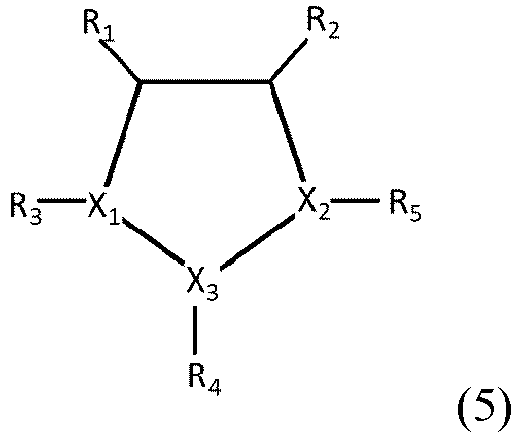 wobei X1, X2 und X3 Heteroatome in einer fünfgliedrigen Ringstruktur sind, C-, O-, N- oder S-Atome sind, unabhängig voneinander sind und durch Doppelbindungen verbunden sein können; R1 und R2 für unabhängige organische Gruppen, die in einem Ringsystem verbunden sein können, oder Wasserstoffatome stehen; R3, R4 und R5 optionale unabhängige organische Gruppen oder Wasserstoffatome sind.
 - Behandeltes metallisches Zinkpigment gemäß Anspruch 1, umfassend 90-99 % (Gew./Gew.-%) an einem Zinkpigment und 1-10 % (Gew./Gew.-%) an einer organischen Behandlungschemikalie.
- Behandeltes metallisches Zinkpigment gemäß Anspruch 1, wobei das Zinkpigment sphärisch, plättchenförmig, nadelförmig oder amorph geformt ist, und Gemische davon.
- Behandeltes metallisches Zinkpigment gemäß Anspruch 1, wobei das Zinkpigment eine mediane Partikelgrößenverteilung (d50) von 1 µm ≤ d50 ≤ 100 µm aufweist;
vorzugsweise wobei das Zinkpigment eine mediane Partikelgrößenverteilung (d50) in dem Bereich von 5 µm ≤ d50 ≤ 25 µm aufweist. - Behandeltes metallisches Zinkpigment gemäß Anspruch 1, ferner umfassend ein Schmiermittel ausgewählt aus gesättigten und ungesättigten Fettsäuren und Gemischen davon.
- Behandeltes metallisches Zinkpigment gemäß Anspruch 1, wobei die organische Behandlungschemikalie Formel 1 ist.
- Behandeltes metallisches Zinkpigment gemäß Anspruch 6, wobei Formel 1 ausgewählt ist aus der Gruppe bestehend aus Curcumin, 2,2'-Bipyridin, 8-Hydroxychinolin, Salicyclsäure, Guaiacol, Thioguaiacol, Maltol, Thiomaltolhydroxypyridinon, Benzil, Acetylacetonoat, Hexafluoracetylaceton, Trifluoracetylaceton, 1,2-Cyclohexandion, 1,2-Cyclopentandion, Pyruvinsäure, Dimedon, substituierten 1,3-Diketonen, Acetonylaceton, Glyoxalbis(mesitylimin) und 2,2'-Biphenol und Kombinationen davon;
wobei Formel 1 vorzugsweise ausgewählt ist aus der Gruppe bestehend aus Curcumin, 2,2'-Bipyridin, 8-Hydroxychinolin und Kombinationen davon. - Behandeltes metallisches Zinkpigment gemäß Anspruch 1, wobei die organische Behandlungschemikalie Formel 5 ist.
- Behandeltes metallisches Zinkpigment gemäß Anspruch 8, wobei Formel 5 ausgewählt ist aus der Gruppe bestehend aus Pyrrolidin, Pyrrolin, Pyrrol, Pyrazolidin, Imidazolidin, Triazol, Tetrahydrothiophen, Thiophen, Oxazol, Isoazol, Isothiazol, Thiazol, Oxathiolan, Oxadiazol, Thiadiazol, Pyrrolizin, Inden, Indolin, Indol, Indolizin, Indazol, Benzimidazol, Azaindol, Azaindazol, Purin, Benzothiophen, Benzoisoxazol, Benzoisothiazol, Benzoxazol, Benzotriazol, Benzothiazol, Benzothiadiazol, Adenin, Guanin, Histidin, Prolin und Tryptophan und Kombinationen davon; wobei Formel 5 vorzugsweise ausgewählt ist aus der Gruppe bestehend aus Benzimidazol, Benzotriazol und Benzothiazol.
- Metallteil, umfassend das behandelte metallische Zinkpigment gemäß Anspruch 1.
- Metallteil gemäß Anspruch 10, wobei der Metallteil Stahl, Eisen, Gusseisen, Schmiedeeisen, Elinvar, Fernico, Ferrolegierungen, Invar, Roheisen, Eisenhydrid, Kanthal, Kovar, Spiegeleisen, Aluminum oder Staballoy sein kann.
- Anstrich, umfassend das behandelte metallische Zinkpigment gemäß Anspruch 1.
- Tinte, umfassend das behandelte metallische Zinkpigment gemäß Anspruch 1.
- Beschichtungssystem, umfassend das behandelte metallische Zinkpigment gemäß Anspruch 1.
- Beschichtungssystem gemäß Anspruch 14, wobei das Beschichtungssystem auf Metalle und Legierungen aufgebracht wird;
gegebenenfalls wobei die Metalle und Legierungen Stahl, Eisen, Gusseisen, Schmiedeeisen, Elinvar, Fernico, Ferrolegierungen, Invar, Roheisen, Eisenhydrid, Kanthal, Kovar, Spiegeleisen, Aluminum und Staballoy umfassen.
Applications Claiming Priority (2)
| Application Number | Priority Date | Filing Date | Title |
|---|---|---|---|
| US202063125431P | 2020-12-15 | 2020-12-15 | |
| PCT/US2021/063421 WO2022132845A1 (en) | 2020-12-15 | 2021-12-15 | Zinc pigment for waterborne corrosion coatings |
Publications (2)
| Publication Number | Publication Date |
|---|---|
| EP4247900A1 EP4247900A1 (de) | 2023-09-27 |
| EP4247900B1 true EP4247900B1 (de) | 2024-06-26 |
Family
ID=80122835
Family Applications (1)
| Application Number | Title | Priority Date | Filing Date |
|---|---|---|---|
| EP21851732.4A Active EP4247900B1 (de) | 2020-12-15 | 2021-12-15 | Zinkpigment für wässrige korrosionsbeschichtungen |
Country Status (5)
| Country | Link |
|---|---|
| US (1) | US12606744B2 (de) |
| EP (1) | EP4247900B1 (de) |
| KR (1) | KR20230118847A (de) |
| CN (1) | CN116568764B (de) |
| WO (1) | WO2022132845A1 (de) |
Family Cites Families (12)
| Publication number | Priority date | Publication date | Assignee | Title |
|---|---|---|---|---|
| JPS59150001A (ja) * | 1983-02-16 | 1984-08-28 | Fukuda Kinzoku Hakufun Kogyo Kk | 耐変色性を有する銅または銅合金粉の製造方法 |
| US5001173A (en) * | 1987-05-11 | 1991-03-19 | Morton Coatings, Inc. | Aqueous epoxy resin compositions and metal substrates coated therewith |
| US5672410A (en) * | 1992-05-11 | 1997-09-30 | Avery Dennison Corporation | Embossed metallic leafing pigments |
| JPH11323181A (ja) * | 1998-05-14 | 1999-11-26 | Nippon Dacro Shamrock:Kk | 金属顔料、金属顔料製造方法、金属顔料製造用助剤、金属顔料含有水性塗料、及び金属顔料含有水性インキ |
| JP3581339B2 (ja) * | 2001-08-02 | 2004-10-27 | メルク株式会社 | 高耐腐食性薄片状金属顔料、その製造方法、およびそれをベースとする金属光沢干渉発色顔料 |
| EP2128203A1 (de) * | 2008-05-28 | 2009-12-02 | Eckart GmbH | Plättchenförmige kupferhaltige Metalleffektpigmente, Verfahren zu deren Herstellung und Verwendung derselben |
| US20100197836A1 (en) * | 2009-02-03 | 2010-08-05 | Craig Price | Metal Rich Coatings Compositions |
| CN101935839A (zh) * | 2010-09-01 | 2011-01-05 | 六安市晖润粉末新材料有限公司 | 一种预防铜粉氧化保护液及其制备方法和使用方法 |
| US20150118494A1 (en) * | 2012-05-09 | 2015-04-30 | Sun Chemical Corporation | Surface modified pigment particles, method of preparation & application thereof |
| KR101378096B1 (ko) * | 2012-05-09 | 2014-03-27 | (주)노루페인트 | 전처리용 방청 프라이머 도료 및 이를 이용한 도막 형성방법 |
| US20170181292A1 (en) * | 2015-12-16 | 2017-06-22 | Rohm And Haas Electronic Materials Llc | Method for forming organic coating on nickel surface |
| CN110317478B (zh) * | 2019-06-19 | 2021-07-23 | 中国科学院金属研究所 | 一种聚噻吩改性冷涂锌涂料及其制备方法 |
-
2021
- 2021-12-15 KR KR1020237019526A patent/KR20230118847A/ko active Pending
- 2021-12-15 EP EP21851732.4A patent/EP4247900B1/de active Active
- 2021-12-15 WO PCT/US2021/063421 patent/WO2022132845A1/en not_active Ceased
- 2021-12-15 CN CN202180081369.8A patent/CN116568764B/zh active Active
-
2023
- 2023-06-13 US US18/208,973 patent/US12606744B2/en active Active
Non-Patent Citations (1)
| Title |
|---|
| MÜLLER BODO ET AL: "Heterocyclic corrosion inhibitors for aluminium and zinc pigments", PIGMENT AND RESIN TECHNOLOGY, vol. 29, no. 5, 1 October 2000 (2000-10-01), UK, pages 268 - 272, XP055905555, ISSN: 0369-9420, Retrieved from the Internet <URL:http://dx.doi.org/10.1108/03699420010353519> DOI: 10.1108/03699420010353519 * |
Also Published As
| Publication number | Publication date |
|---|---|
| US12606744B2 (en) | 2026-04-21 |
| KR20230118847A (ko) | 2023-08-14 |
| EP4247900A1 (de) | 2023-09-27 |
| US20230340327A1 (en) | 2023-10-26 |
| CN116568764B (zh) | 2025-04-11 |
| WO2022132845A1 (en) | 2022-06-23 |
| CN116568764A (zh) | 2023-08-08 |
Similar Documents
| Publication | Publication Date | Title |
|---|---|---|
| KR100474009B1 (ko) | 부식방지를제공하기위한수환원성코팅조성물 | |
| EP2383370B1 (de) | Oberflächenbehandlungsmittel für feuerverzinktes stahlblech, feuerverzinktes stahlblech und herstellungsverfahren dafür | |
| US7789953B2 (en) | High temperature resistant coating compositions | |
| EP1666634B1 (de) | Verfahren zur Herstellung von einer Zusammensetzung zur korrosionbeständigen Konversionsabscheidung | |
| EP2736982B1 (de) | Mit einer aluminiumlegierung beschichtete pigmente und korrosionsbeständige beschichtungen | |
| EP2915903A1 (de) | Chromfreie Umwandlungsbeschichtung | |
| FR2816641A1 (fr) | UTILISATION DE MoO3, COMME AGENT ANTICORROSION, ET COMPOSITION DE REVETEMENT CONTENANT UN TEL AGENT | |
| Arunoday et al. | Multifunctional, environmental coatings on AA2024 by combining anodization with sol-gel process | |
| Wittmar et al. | Hybrid sol–gel coatings doped with transition metal ions for the protection of AA 2024-T3 | |
| RU2758664C1 (ru) | Системы и способы для обработки металлической подложки | |
| US5290365A (en) | Method for removing coatings from metal substrates prone to corrosion or deterioration | |
| US12606744B2 (en) | Zinc pigment for waterborne corrosion coatings | |
| CN103938196B (zh) | 一种结构钢用水性原位带锈处理液及其制备方法 | |
| CN1256302C (zh) | 烧结式金属粉末涂料及以其制备金属陶瓷防腐涂层的方法 | |
| US20040118482A1 (en) | Method for treating metal surfaces by carboxylation | |
| JP2002121485A (ja) | 錆止めを施すための水−希釈可能なコーティング組成物 | |
| EP1378546B1 (de) | In Wasser dispergierbares Zinkpulver und Farben auf Wasserbasis enthaltend Zinkpulver | |
| JPS6241627B2 (de) | ||
| US4086095A (en) | Coating composition | |
| CA3152815A1 (en) | Film forming compositions containing molybdate derived coatings | |
| KR20190121073A (ko) | 녹 제거제 및 이의 조성물 | |
| WO2021216943A1 (en) | Zinc pigment | |
| US20010032966A1 (en) | Anti-corrosion layer | |
| CN111592784B (zh) | 一种pH调节剂和包含其的防焊缝闪锈的水性钢结构防腐涂料及制备方法 | |
| CA1061689A (en) | Premix for coating composition for metal substrates |
Legal Events
| Date | Code | Title | Description |
|---|---|---|---|
| STAA | Information on the status of an ep patent application or granted ep patent |
Free format text: STATUS: UNKNOWN |
|
| STAA | Information on the status of an ep patent application or granted ep patent |
Free format text: STATUS: THE INTERNATIONAL PUBLICATION HAS BEEN MADE |
|
| PUAI | Public reference made under article 153(3) epc to a published international application that has entered the european phase |
Free format text: ORIGINAL CODE: 0009012 |
|
| STAA | Information on the status of an ep patent application or granted ep patent |
Free format text: STATUS: REQUEST FOR EXAMINATION WAS MADE |
|
| 17P | Request for examination filed |
Effective date: 20230623 |
|
| AK | Designated contracting states |
Kind code of ref document: A1 Designated state(s): AL AT BE BG CH CY CZ DE DK EE ES FI FR GB GR HR HU IE IS IT LI LT LU LV MC MK MT NL NO PL PT RO RS SE SI SK SM TR |
|
| GRAP | Despatch of communication of intention to grant a patent |
Free format text: ORIGINAL CODE: EPIDOSNIGR1 |
|
| STAA | Information on the status of an ep patent application or granted ep patent |
Free format text: STATUS: GRANT OF PATENT IS INTENDED |
|
| DAV | Request for validation of the european patent (deleted) | ||
| DAX | Request for extension of the european patent (deleted) | ||
| INTG | Intention to grant announced |
Effective date: 20240126 |
|
| GRAS | Grant fee paid |
Free format text: ORIGINAL CODE: EPIDOSNIGR3 |
|
| GRAA | (expected) grant |
Free format text: ORIGINAL CODE: 0009210 |
|
| STAA | Information on the status of an ep patent application or granted ep patent |
Free format text: STATUS: THE PATENT HAS BEEN GRANTED |
|
| AK | Designated contracting states |
Kind code of ref document: B1 Designated state(s): AL AT BE BG CH CY CZ DE DK EE ES FI FR GB GR HR HU IE IS IT LI LT LU LV MC MK MT NL NO PL PT RO RS SE SI SK SM TR |
|
| REG | Reference to a national code |
Ref country code: GB Ref legal event code: FG4D |
|
| REG | Reference to a national code |
Ref country code: CH Ref legal event code: EP |
|
| REG | Reference to a national code |
Ref country code: DE Ref legal event code: R096 Ref document number: 602021014956 Country of ref document: DE |
|
| P01 | Opt-out of the competence of the unified patent court (upc) registered |
Free format text: CASE NUMBER: APP_35004/2024 Effective date: 20240611 |
|
| PG25 | Lapsed in a contracting state [announced via postgrant information from national office to epo] |
Ref country code: BG Free format text: LAPSE BECAUSE OF FAILURE TO SUBMIT A TRANSLATION OF THE DESCRIPTION OR TO PAY THE FEE WITHIN THE PRESCRIBED TIME-LIMIT Effective date: 20240626 |
|
| PG25 | Lapsed in a contracting state [announced via postgrant information from national office to epo] |
Ref country code: HR Free format text: LAPSE BECAUSE OF FAILURE TO SUBMIT A TRANSLATION OF THE DESCRIPTION OR TO PAY THE FEE WITHIN THE PRESCRIBED TIME-LIMIT Effective date: 20240626 Ref country code: FI Free format text: LAPSE BECAUSE OF FAILURE TO SUBMIT A TRANSLATION OF THE DESCRIPTION OR TO PAY THE FEE WITHIN THE PRESCRIBED TIME-LIMIT Effective date: 20240626 |
|
| REG | Reference to a national code |
Ref country code: LT Ref legal event code: MG9D |
|
| PG25 | Lapsed in a contracting state [announced via postgrant information from national office to epo] |
Ref country code: GR Free format text: LAPSE BECAUSE OF FAILURE TO SUBMIT A TRANSLATION OF THE DESCRIPTION OR TO PAY THE FEE WITHIN THE PRESCRIBED TIME-LIMIT Effective date: 20240927 |
|
| PG25 | Lapsed in a contracting state [announced via postgrant information from national office to epo] |
Ref country code: LV Free format text: LAPSE BECAUSE OF FAILURE TO SUBMIT A TRANSLATION OF THE DESCRIPTION OR TO PAY THE FEE WITHIN THE PRESCRIBED TIME-LIMIT Effective date: 20240626 |
|
| REG | Reference to a national code |
Ref country code: NL Ref legal event code: MP Effective date: 20240626 |
|
| PG25 | Lapsed in a contracting state [announced via postgrant information from national office to epo] |
Ref country code: NO Free format text: LAPSE BECAUSE OF FAILURE TO SUBMIT A TRANSLATION OF THE DESCRIPTION OR TO PAY THE FEE WITHIN THE PRESCRIBED TIME-LIMIT Effective date: 20240926 Ref country code: LV Free format text: LAPSE BECAUSE OF FAILURE TO SUBMIT A TRANSLATION OF THE DESCRIPTION OR TO PAY THE FEE WITHIN THE PRESCRIBED TIME-LIMIT Effective date: 20240626 Ref country code: HR Free format text: LAPSE BECAUSE OF FAILURE TO SUBMIT A TRANSLATION OF THE DESCRIPTION OR TO PAY THE FEE WITHIN THE PRESCRIBED TIME-LIMIT Effective date: 20240626 Ref country code: GR Free format text: LAPSE BECAUSE OF FAILURE TO SUBMIT A TRANSLATION OF THE DESCRIPTION OR TO PAY THE FEE WITHIN THE PRESCRIBED TIME-LIMIT Effective date: 20240927 Ref country code: FI Free format text: LAPSE BECAUSE OF FAILURE TO SUBMIT A TRANSLATION OF THE DESCRIPTION OR TO PAY THE FEE WITHIN THE PRESCRIBED TIME-LIMIT Effective date: 20240626 Ref country code: BG Free format text: LAPSE BECAUSE OF FAILURE TO SUBMIT A TRANSLATION OF THE DESCRIPTION OR TO PAY THE FEE WITHIN THE PRESCRIBED TIME-LIMIT Effective date: 20240626 Ref country code: RS Free format text: LAPSE BECAUSE OF FAILURE TO SUBMIT A TRANSLATION OF THE DESCRIPTION OR TO PAY THE FEE WITHIN THE PRESCRIBED TIME-LIMIT Effective date: 20240926 |
|
| PG25 | Lapsed in a contracting state [announced via postgrant information from national office to epo] |
Ref country code: NL Free format text: LAPSE BECAUSE OF FAILURE TO SUBMIT A TRANSLATION OF THE DESCRIPTION OR TO PAY THE FEE WITHIN THE PRESCRIBED TIME-LIMIT Effective date: 20240626 |
|
| REG | Reference to a national code |
Ref country code: AT Ref legal event code: MK05 Ref document number: 1697684 Country of ref document: AT Kind code of ref document: T Effective date: 20240626 |
|
| PG25 | Lapsed in a contracting state [announced via postgrant information from national office to epo] |
Ref country code: NL Free format text: LAPSE BECAUSE OF FAILURE TO SUBMIT A TRANSLATION OF THE DESCRIPTION OR TO PAY THE FEE WITHIN THE PRESCRIBED TIME-LIMIT Effective date: 20240626 |
|
| PG25 | Lapsed in a contracting state [announced via postgrant information from national office to epo] |
Ref country code: PT Free format text: LAPSE BECAUSE OF FAILURE TO SUBMIT A TRANSLATION OF THE DESCRIPTION OR TO PAY THE FEE WITHIN THE PRESCRIBED TIME-LIMIT Effective date: 20241028 |
|
| PG25 | Lapsed in a contracting state [announced via postgrant information from national office to epo] |
Ref country code: PT Free format text: LAPSE BECAUSE OF FAILURE TO SUBMIT A TRANSLATION OF THE DESCRIPTION OR TO PAY THE FEE WITHIN THE PRESCRIBED TIME-LIMIT Effective date: 20241028 |
|
| PG25 | Lapsed in a contracting state [announced via postgrant information from national office to epo] |
Ref country code: PL Free format text: LAPSE BECAUSE OF FAILURE TO SUBMIT A TRANSLATION OF THE DESCRIPTION OR TO PAY THE FEE WITHIN THE PRESCRIBED TIME-LIMIT Effective date: 20240626 |
|
| PG25 | Lapsed in a contracting state [announced via postgrant information from national office to epo] |
Ref country code: EE Free format text: LAPSE BECAUSE OF FAILURE TO SUBMIT A TRANSLATION OF THE DESCRIPTION OR TO PAY THE FEE WITHIN THE PRESCRIBED TIME-LIMIT Effective date: 20240626 |
|
| PG25 | Lapsed in a contracting state [announced via postgrant information from national office to epo] |
Ref country code: IS Free format text: LAPSE BECAUSE OF FAILURE TO SUBMIT A TRANSLATION OF THE DESCRIPTION OR TO PAY THE FEE WITHIN THE PRESCRIBED TIME-LIMIT Effective date: 20241026 Ref country code: AT Free format text: LAPSE BECAUSE OF FAILURE TO SUBMIT A TRANSLATION OF THE DESCRIPTION OR TO PAY THE FEE WITHIN THE PRESCRIBED TIME-LIMIT Effective date: 20240626 |
|
| PG25 | Lapsed in a contracting state [announced via postgrant information from national office to epo] |
Ref country code: CZ Free format text: LAPSE BECAUSE OF FAILURE TO SUBMIT A TRANSLATION OF THE DESCRIPTION OR TO PAY THE FEE WITHIN THE PRESCRIBED TIME-LIMIT Effective date: 20240626 |
|
| PG25 | Lapsed in a contracting state [announced via postgrant information from national office to epo] |
Ref country code: RO Free format text: LAPSE BECAUSE OF FAILURE TO SUBMIT A TRANSLATION OF THE DESCRIPTION OR TO PAY THE FEE WITHIN THE PRESCRIBED TIME-LIMIT Effective date: 20240626 Ref country code: SK Free format text: LAPSE BECAUSE OF FAILURE TO SUBMIT A TRANSLATION OF THE DESCRIPTION OR TO PAY THE FEE WITHIN THE PRESCRIBED TIME-LIMIT Effective date: 20240626 |
|
| PG25 | Lapsed in a contracting state [announced via postgrant information from national office to epo] |
Ref country code: ES Free format text: LAPSE BECAUSE OF FAILURE TO SUBMIT A TRANSLATION OF THE DESCRIPTION OR TO PAY THE FEE WITHIN THE PRESCRIBED TIME-LIMIT Effective date: 20240626 Ref country code: SM Free format text: LAPSE BECAUSE OF FAILURE TO SUBMIT A TRANSLATION OF THE DESCRIPTION OR TO PAY THE FEE WITHIN THE PRESCRIBED TIME-LIMIT Effective date: 20240626 |
|
| PG25 | Lapsed in a contracting state [announced via postgrant information from national office to epo] |
Ref country code: SM Free format text: LAPSE BECAUSE OF FAILURE TO SUBMIT A TRANSLATION OF THE DESCRIPTION OR TO PAY THE FEE WITHIN THE PRESCRIBED TIME-LIMIT Effective date: 20240626 Ref country code: SK Free format text: LAPSE BECAUSE OF FAILURE TO SUBMIT A TRANSLATION OF THE DESCRIPTION OR TO PAY THE FEE WITHIN THE PRESCRIBED TIME-LIMIT Effective date: 20240626 Ref country code: RO Free format text: LAPSE BECAUSE OF FAILURE TO SUBMIT A TRANSLATION OF THE DESCRIPTION OR TO PAY THE FEE WITHIN THE PRESCRIBED TIME-LIMIT Effective date: 20240626 Ref country code: PL Free format text: LAPSE BECAUSE OF FAILURE TO SUBMIT A TRANSLATION OF THE DESCRIPTION OR TO PAY THE FEE WITHIN THE PRESCRIBED TIME-LIMIT Effective date: 20240626 Ref country code: IS Free format text: LAPSE BECAUSE OF FAILURE TO SUBMIT A TRANSLATION OF THE DESCRIPTION OR TO PAY THE FEE WITHIN THE PRESCRIBED TIME-LIMIT Effective date: 20241026 Ref country code: ES Free format text: LAPSE BECAUSE OF FAILURE TO SUBMIT A TRANSLATION OF THE DESCRIPTION OR TO PAY THE FEE WITHIN THE PRESCRIBED TIME-LIMIT Effective date: 20240626 Ref country code: EE Free format text: LAPSE BECAUSE OF FAILURE TO SUBMIT A TRANSLATION OF THE DESCRIPTION OR TO PAY THE FEE WITHIN THE PRESCRIBED TIME-LIMIT Effective date: 20240626 Ref country code: CZ Free format text: LAPSE BECAUSE OF FAILURE TO SUBMIT A TRANSLATION OF THE DESCRIPTION OR TO PAY THE FEE WITHIN THE PRESCRIBED TIME-LIMIT Effective date: 20240626 Ref country code: AT Free format text: LAPSE BECAUSE OF FAILURE TO SUBMIT A TRANSLATION OF THE DESCRIPTION OR TO PAY THE FEE WITHIN THE PRESCRIBED TIME-LIMIT Effective date: 20240626 |
|
| PG25 | Lapsed in a contracting state [announced via postgrant information from national office to epo] |
Ref country code: IT Free format text: LAPSE BECAUSE OF FAILURE TO SUBMIT A TRANSLATION OF THE DESCRIPTION OR TO PAY THE FEE WITHIN THE PRESCRIBED TIME-LIMIT Effective date: 20240626 |
|
| REG | Reference to a national code |
Ref country code: DE Ref legal event code: R097 Ref document number: 602021014956 Country of ref document: DE |
|
| PG25 | Lapsed in a contracting state [announced via postgrant information from national office to epo] |
Ref country code: DK Free format text: LAPSE BECAUSE OF FAILURE TO SUBMIT A TRANSLATION OF THE DESCRIPTION OR TO PAY THE FEE WITHIN THE PRESCRIBED TIME-LIMIT Effective date: 20240626 |
|
| PLBE | No opposition filed within time limit |
Free format text: ORIGINAL CODE: 0009261 |
|
| STAA | Information on the status of an ep patent application or granted ep patent |
Free format text: STATUS: NO OPPOSITION FILED WITHIN TIME LIMIT |
|
| 26N | No opposition filed |
Effective date: 20250327 |
|
| PG25 | Lapsed in a contracting state [announced via postgrant information from national office to epo] |
Ref country code: MC Free format text: LAPSE BECAUSE OF FAILURE TO SUBMIT A TRANSLATION OF THE DESCRIPTION OR TO PAY THE FEE WITHIN THE PRESCRIBED TIME-LIMIT Effective date: 20240626 |
|
| REG | Reference to a national code |
Ref country code: CH Ref legal event code: PL |
|
| PG25 | Lapsed in a contracting state [announced via postgrant information from national office to epo] |
Ref country code: LU Free format text: LAPSE BECAUSE OF NON-PAYMENT OF DUE FEES Effective date: 20241215 |
|
| PG25 | Lapsed in a contracting state [announced via postgrant information from national office to epo] |
Ref country code: SE Free format text: LAPSE BECAUSE OF FAILURE TO SUBMIT A TRANSLATION OF THE DESCRIPTION OR TO PAY THE FEE WITHIN THE PRESCRIBED TIME-LIMIT Effective date: 20240626 |
|
| REG | Reference to a national code |
Ref country code: BE Ref legal event code: MM Effective date: 20241231 |
|
| PG25 | Lapsed in a contracting state [announced via postgrant information from national office to epo] |
Ref country code: BE Free format text: LAPSE BECAUSE OF NON-PAYMENT OF DUE FEES Effective date: 20241231 |
|
| PG25 | Lapsed in a contracting state [announced via postgrant information from national office to epo] |
Ref country code: CH Free format text: LAPSE BECAUSE OF NON-PAYMENT OF DUE FEES Effective date: 20241231 |
|
| PG25 | Lapsed in a contracting state [announced via postgrant information from national office to epo] |
Ref country code: IE Free format text: LAPSE BECAUSE OF NON-PAYMENT OF DUE FEES Effective date: 20241215 |
|
| PGFP | Annual fee paid to national office [announced via postgrant information from national office to epo] |
Ref country code: DE Payment date: 20251126 Year of fee payment: 5 |
|
| PGFP | Annual fee paid to national office [announced via postgrant information from national office to epo] |
Ref country code: GB Payment date: 20251119 Year of fee payment: 5 |
|
| PGFP | Annual fee paid to national office [announced via postgrant information from national office to epo] |
Ref country code: FR Payment date: 20251120 Year of fee payment: 5 |
|
| PG25 | Lapsed in a contracting state [announced via postgrant information from national office to epo] |
Ref country code: CY Free format text: LAPSE BECAUSE OF FAILURE TO SUBMIT A TRANSLATION OF THE DESCRIPTION OR TO PAY THE FEE WITHIN THE PRESCRIBED TIME-LIMIT Effective date: 20240626 |