EP4246367B1 - Verbesserte kameralesevorrichtungen und verfahren zur verwendung davon - Google Patents
Verbesserte kameralesevorrichtungen und verfahren zur verwendung davon Download PDFInfo
- Publication number
- EP4246367B1 EP4246367B1 EP23158574.6A EP23158574A EP4246367B1 EP 4246367 B1 EP4246367 B1 EP 4246367B1 EP 23158574 A EP23158574 A EP 23158574A EP 4246367 B1 EP4246367 B1 EP 4246367B1
- Authority
- EP
- European Patent Office
- Prior art keywords
- illuminator
- assembly
- diffuser
- lens
- board
- Prior art date
- Legal status (The legal status is an assumption and is not a legal conclusion. Google has not performed a legal analysis and makes no representation as to the accuracy of the status listed.)
- Active
Links
Images



Classifications
-
- G—PHYSICS
- G06—COMPUTING OR CALCULATING; COUNTING
- G06K—GRAPHICAL DATA READING; PRESENTATION OF DATA; RECORD CARRIERS; HANDLING RECORD CARRIERS
- G06K7/00—Methods or arrangements for sensing record carriers, e.g. for reading patterns
- G06K7/10—Methods or arrangements for sensing record carriers, e.g. for reading patterns by electromagnetic radiation, e.g. optical sensing; by corpuscular radiation
- G06K7/10544—Methods or arrangements for sensing record carriers, e.g. for reading patterns by electromagnetic radiation, e.g. optical sensing; by corpuscular radiation by scanning of the records by radiation in the optical part of the electromagnetic spectrum
- G06K7/10712—Fixed beam scanning
- G06K7/10722—Photodetector array or CCD scanning
-
- G—PHYSICS
- G06—COMPUTING OR CALCULATING; COUNTING
- G06K—GRAPHICAL DATA READING; PRESENTATION OF DATA; RECORD CARRIERS; HANDLING RECORD CARRIERS
- G06K7/00—Methods or arrangements for sensing record carriers, e.g. for reading patterns
- G06K7/10—Methods or arrangements for sensing record carriers, e.g. for reading patterns by electromagnetic radiation, e.g. optical sensing; by corpuscular radiation
- G06K7/10544—Methods or arrangements for sensing record carriers, e.g. for reading patterns by electromagnetic radiation, e.g. optical sensing; by corpuscular radiation by scanning of the records by radiation in the optical part of the electromagnetic spectrum
- G06K7/10712—Fixed beam scanning
- G06K7/10722—Photodetector array or CCD scanning
- G06K7/10732—Light sources
-
- G—PHYSICS
- G06—COMPUTING OR CALCULATING; COUNTING
- G06K—GRAPHICAL DATA READING; PRESENTATION OF DATA; RECORD CARRIERS; HANDLING RECORD CARRIERS
- G06K7/00—Methods or arrangements for sensing record carriers, e.g. for reading patterns
- G06K7/10—Methods or arrangements for sensing record carriers, e.g. for reading patterns by electromagnetic radiation, e.g. optical sensing; by corpuscular radiation
- G06K7/10544—Methods or arrangements for sensing record carriers, e.g. for reading patterns by electromagnetic radiation, e.g. optical sensing; by corpuscular radiation by scanning of the records by radiation in the optical part of the electromagnetic spectrum
- G06K7/10712—Fixed beam scanning
- G06K7/10722—Photodetector array or CCD scanning
- G06K7/10742—Photodetector array or CCD scanning including a diffuser for diffusing the light from the light source to create substantially uniform illumination of the target record carrier
-
- G—PHYSICS
- G06—COMPUTING OR CALCULATING; COUNTING
- G06K—GRAPHICAL DATA READING; PRESENTATION OF DATA; RECORD CARRIERS; HANDLING RECORD CARRIERS
- G06K7/00—Methods or arrangements for sensing record carriers, e.g. for reading patterns
- G06K7/10—Methods or arrangements for sensing record carriers, e.g. for reading patterns by electromagnetic radiation, e.g. optical sensing; by corpuscular radiation
- G06K7/10544—Methods or arrangements for sensing record carriers, e.g. for reading patterns by electromagnetic radiation, e.g. optical sensing; by corpuscular radiation by scanning of the records by radiation in the optical part of the electromagnetic spectrum
- G06K7/10821—Methods or arrangements for sensing record carriers, e.g. for reading patterns by electromagnetic radiation, e.g. optical sensing; by corpuscular radiation by scanning of the records by radiation in the optical part of the electromagnetic spectrum further details of bar or optical code scanning devices
- G06K7/10831—Arrangement of optical elements, e.g. lenses, mirrors, prisms
Definitions
- Embodiments of the present disclosure relate to improved apparatuses for accurately performing scanning operations and methods of using the improved apparatuses.
- the light transmitter distal end may include a first portion and a second portion, where light from within the light transmitter passes through and out of the first portion to provide bright field illumination, and light from within the light transmitter passes through and out of the second portion to provide dark field illumination.
- EP 3 647 989 A1 which relates to an ID reader, typically configured for handheld operation, which integrates three types of illumination into a compact package that generates robust performance and resistance to harsh environmental conditions, such as dust and moisture. These illumination types include direct (diffuse) light, low-angle light, and polarized light.
- the ID reader includes a sealed reader module assembly having the illuminators in combination with an imager assembly (optics and image sensor) at its relative center.
- Aimer folding reflector refers to any optical component that manipulates incoming light from an aimer to redirect the incoming light.
- Non-limiting examples of an aimer folding reflector include a mirror, a reflective material, and a refractive lens.
- Aimer illuminator refers to any light producing component, or components, that produce a beam of light that is output or manipulated to a defined light pattern.
- Non-limiting examples of an aimer illuminator include one or more lasers or one or more narrow field LEDs.
- “Aimer lens” refers to one or more optical components that receive light from an aimer illuminator to produce an aimer pattern.
- Analyzer refers to a polarized optical filter.
- Back light illumination board refers to a board that includes one or more light producing components oriented towards a diffuser back light reflector and/or diffuser.
- Board refers to circuitry that connects one or more electrical components.
- Non-limiting examples of a board include a flex printed circuit board, a rigid printed circuit board, a single-sided printed circuit board, and a dual-sided printed circuit board,
- Chassis refers to a housing of an apparatus, and within which one or more electrical and/or mechanical components are positioned.
- a chassis may include any number of portions affixed to one another.
- Dark field illuminator refers to one or more light producing component(s) of a dark field illuminator assembly.
- Dark field illuminator assembly refers to a dark field illuminator and associated optical components to produce a dark field illumination that illuminates one or more field(s) of view.
- Diffuser refers to one or more optical element(s) that produce a uniform illumination from one or more source illumination(s).
- a diffuser diffuses the one or more source illumination(s) to produce a uniform illumination.
- a diffuser assembly refers to a plurality of components that interact to produce a uniform output of light.
- a diffuser assembly includes at least one illuminator as the source of an illumination, a diffuser back light reflector, and a diffuser.
- Diffuser back light reflector refers to one or more optical component(s) that direct one or more source illumination(s) into a diffuser.
- Diffuser illuminator refers to any light producing component, or components, that produce one or more illumination(s) to be manipulated by a diffuser.
- Illuminator refers to any one or more mechanical and/or electrical component(s) that generate light.
- Image sensor refers to a sensor that converts incoming light to generate a corresponding image. An image sensor captures an image from the incoming light to output the corresponding image.
- Imager board refers to circuitry that includes at least one image sensor and/or processing circuitry for processing an image.
- Lens assembly refers to one or more components that position one or more lens(es) in alignment with corresponding illuminator(s).
- Narrow field illuminator refers to one or more light producing component(s) of a narrow field illuminator assembly.
- “Narrow field illuminator assembly” refers to a narrow field illuminator and associated optical components to produce a concentrated illumination that illuminates a narrow field of view.
- Narrow field imager refers to a narrow field sensor and associated narrow field lens(es) that define a narrow field of view capturable via the narrow field sensor.
- Narrow field lens refers to one or more optical component(s) that receive source illumination(s) to produce a concentrated illumination that illuminates a narrow field.
- Narrow field of view refers to a first field of view that is narrower in at least one direction than a corresponding wide field of view. In some embodiments a narrow field of view is narrower in multiple directions than a corresponding wide field of view, in some embodiments the narrow field of view is narrower in a single direction than a corresponding wide field of view.
- Narrow field sensor refers to an image sensor that captures an image representation of a narrow field of view.
- Near-coaxial direction refers to two or more axes that are generally directed towards the same axis.
- near-coaxial directions include a first axis and a second axis that intersect at a particular point within one or more field of view(s).
- Polarized illuminator refers to one or more light producing component(s) that is directed to a polarizer.
- Polarized illuminator assembly refers to one or more components that operate in conjunction to produce a polarized illumination.
- a polarized illuminator assembly includes at least one polarizer and at least one polarized illuminator, and optionally one or more lens(es).
- Polarizer refers to an optical filter that outputs polarized light from one or more source illumination(s).
- Polyizer holder refers to one or more component(s) that position at least one polarizer.
- Processor refers to hardware, software, firmware, and/or a combination thereof, that executes software instruction(s), application(s), and/or otherwise performs one or more defined algorithm(s).
- Protective window refers to any component that allows light to pass through the component while preventing passing of object(s) from impacting components of an apparatus.
- Reflector refers to any one or more optical components that redirect light from a first direction to a second direction.
- Ring illuminator assembly refers to a plurality of illuminator assemblies arranged in a continuous manner.
- a ring illuminator assembly need not be perfectly circular, and can be circular, elliptical, square, or otherwise geometrically enclosed.
- Ring lens refers to one or more optical components of a ring illuminator assembly that form the geometric shape of the ring illuminator assembly.
- a ring lens includes a single molded lens.
- Viewing axis of the apparatus refers to an axis that is coaxial or near co-axial with one or more axes normal to one or more imager(s) of an apparatus. In some embodiments, an aimer illumination is produced at the viewing axis of the apparatus.
- Wide field imager refers to a wide field sensor and associated wide field lens(es) that define a wide field of view capturable by the wide field sensor.
- Wide field lens refers to one or more optical components that receive source illumination(s) to produce a dark field illumination.
- Wide field of view refers to a second field of view that is wider in at least one direction than a corresponding narrow field of view.
- Wide field sensor refers to an image sensor that captures an image representation of a wide field of view.
- code reader(s) are utilized to scan, decode, and/or otherwise interact with machine-readable symbologies (e.g., codes).
- machine-readable symbologies e.g., codes
- Non-limiting examples of such contexts include use of a reader for direct part marking, as well as use of a reader for paper codes (e.g., on a label).
- Each of such contexts may pose particular problems to the reader's ability to function reliably.
- direct part marking the manner in which a code is displayed may affect a reader's ability to successfully capture, detect, and/or decode the code.
- an engraved code on a highly reflective surface may cause some readers problems due to significant amounts of specular reflection.
- a particular reader that utilizes a particular illumination may be utilized in an attempt to eliminate this problem.
- a high contrast printed code on a highly reflective surface may cause that reader problems by failing to sufficiently illuminate the high contrast printed code utilizing the same illumination.
- a particular reader may produce particular illuminations that are insufficient to enable the reader to successfully perform in both contexts.
- certain contexts may require reading of printed codes in addition to direct part marking codes, further adding to the complexity of enabling successful scanning of all such codes. To address these problems, a user may be forced to utilize different readers to perform the various tasks successfully. Use of a non-cumbersome and portable reader that is capable of performing accurately in all such contexts is identified as preferable.
- Improved readers e.g., devices for scanning, detecting, and/or otherwise decoding machine-readable symbologies
- the improved readers include various illuminator assemblies that alone or in conjunction with other illuminators are configured to produce various types of illuminations, allowing capture of image representations of a plurality of fields of view illuminated by such illuminations.
- some embodiments include a diffuser assembly that generates a diffuse or otherwise uniform illumination, narrow field illuminators that generate concentrated rays of light for illuminating at a large distance, polarized illuminators that generate polarized illuminations that can be used to limit specular reflectivity, and dark field illuminators that generate illumination of a near and/or wide field of view a high angle of incidence.
- Some embodiments include a plurality of image sensors associated with varying fields of view, further expanding the capabilities of such improved readers for functioning in multiple contexts.
- Such improved readers are provided in a relatively small form factor.
- the small form factor enables a user to pick up and utilize the reader as a handheld device, and/or enables the reader to be fully mobile such that the user may carry around the user to perform various tasks.
- the small form factor is achieved utilizing a particular arrangement of the components in a manner that optimizes the available space within a chassis of the apparatus.
- the components are arranged into subassemblies that efficiently utilize available space, with the various subassemblies arranged in a "sandwiched" manner to reduce the total space ultimately taken up by all such components.
- embodiments of the present disclosure include specially configured readers that are capable of mobility and functional to handle a wide arrangement of code scanning tasks in various contexts (e.g., for various types of codes, various materials, and/or the like), including for example various direct part marking codes in addition to traditional printed codes and/or label codes, without requiring use of separate devices.
- the multiple types of illuminators and particular arrangement of such illuminators within the improved readers provide further advantages for successfully completing scanning operations (e.g., successfully detecting and decoding).
- Such improved readers improve the likelihood of successfully completing a scanning operation by providing access to any of such illuminator types.
- different types of codes, different types of object materials, environmental factors, and/or combinations thereof may affect the reader, such that light reflected back at the reader obscures, prevents, or otherwise affects the captured images in a manner that makes detecting and decoding a particular code difficult.
- the improved readers herein may attempt activation of particular illuminators that illuminate such a particular code sufficiently without negatively effecting captured representation(s), thus enabling improved accurate reading of a variety of code types in a myriad of contexts.
- the same reader may be used to perform accurately in highly reflective direct part marking contexts while similarly performing well in printed paper code reading contexts by utilizing the particular illuminators of the improved readers described herein.
- some embodiments may be specially configured to increase the likelihood of activating particular illuminator(s) that result in a successful scanning operation, for example based on historical data associated with previous scanning operations and/or particular configuration of the embodiments to attempt scanning utilizing several different types of illumination.
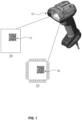
- FIG. 1 illustrates example contexts for use of an example improved reader in accordance with at least some example embodiments of the present disclosure.
- FIG. 1 depicts an example reader 102 in accordance with the present disclosure.
- the reader 102 is specially configured as described herein to accurately perform various code scanning tasks, such as by utilizing various specialized illuminator assemblies and a plurality of imagers (e.g., an image sensor associated with a wide field of view focused at a first distance, and a second image sensor associated with a narrow field of view focused at a second, further distance).
- imagers e.g., an image sensor associated with a wide field of view focused at a first distance, and a second image sensor associated with a narrow field of view focused at a second, further distance.
- the same reader 102 is usable to perform scanning of direct part marking ("DPM") codes, for example the code 106 depicted on part 104, as well as paper printed codes, for example the code 110 depicted on paper material 108 (e.g., a label).
- the reader 102 may utilize different illuminations to illuminate one or more field(s) of view capturable via the reader 102, for example to illuminate the various codes 110 and 106 in a manner that enables decoding of a captured representation of the codes.
- a user may activate the reader 102, for example by squeezing a trigger or otherwise inputting a signal that triggers the reader 102 to activate.
- the reader 102 is configured to operate based at least in part on one or more manual inputs. For example, in some embodiments, a user selects a mode of operation to cause the reader 102 to operate in accordance with the selected mode. In some such embodiments, the selected mode is utilized to determine what illuminators of the reader 102 are activated. In other embodiments, the reader 102 operates based at least in part on software instructions executed via the reader 102. For example, in some embodiments, the reader 102 is specially configured to perform based at least in part on one or more algorithm(s), data-driven determination(s), and/or the like, that increase the likelihood of successfully reading a code.
- the reader 102 may be utilized to scan the various codes 110 and 106 utilizing particular illuminations that reduce or eliminate the problems caused by other illumination types.
- the reader 102 rotates through generating various different types of illuminations (e.g., utilizing different types of illuminators) and attempts capturing and decoding of a particular code with each of such generated illumination types.
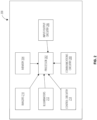
- FIG. 2 illustrates a block diagram of an example improved reader in accordance with at least some example embodiments of the present disclosure.
- the reader 102 is embodied by the apparatus 200 as depicted and described with respect to FIG. 2 .
- the apparatus 200 includes a processor 202, memory 204, input/output circuitry 206, communications circuitry 208, imagers 210, illuminators 212, and control circuitry 214.
- the apparatus 200 is configured, using one or more of the specially configured sets of circuitry embodying the processor 202, memory 204, input/output circuitry 206, communications circuitry 208, imagers 210, illuminators 212, and/or control circuitry 214 to execute the operations described herein.
- circuitry as used herein with respect to components of the apparatuses described herein should therefore be understood to include particular hardware configured to perform the functions associated with the particular circuitry as described herein.
- circuitry should be understood broadly to include hardware and, in some embodiments, software and/or firmware for configuring the hardware.
- circuitry includes processing circuitry, storage media, network interface(s), input/output device(s), and/or the like.
- other elements of the apparatus 200 provide or supplement the functionality of another particular set of circuitry.
- the processor 202 in some embodiments provides processing functionality to any of the other sets of circuitry
- the memory 204 provides storage functionality to any of the other sets of circuitry
- the communications circuitry 208 provides network interface functionality and/or communicability between the other sets of circuitry, and/or the like.
- the processor 202 (and/or co-processor or any other processing circuitry assisting or otherwise associated with the processor) is/are in communication with the memory 204, input/output circuitry 206, communications circuitry 208, imagers 210, illuminators 212, and/or control circuitry 214 via one or more bus(es), serial peripheral interface(s), and/or the like for passing information among components of the apparatus 200.
- the processor 202 is communicable with some or all of the memory 204, input/output circuitry 206, communications circuitry 208, imagers 210, illuminators 212, control circuitry 214, and/or the like, via one or more board(s) that integrate the various components.
- a first board connects one or more imagers 210 with the processor 202 and/or a sub-processor thereof that controls activation and operation of the imagers 210 (e.g., data flow of a captured image from an imager to the processor 202), and a second board (or plurality of boards) connects one or more illuminators 212 with the processor 202 and/or a sub-processor thereof that controls activation of the one or more illuminators 212.
- the memory 204 is non-transitory and includes, for example, one or more volatile and/or non-volatile memories.
- the memory 204 in some embodiments includes or embodies an electronic storage device (e.g., a computer readable storage medium).
- the memory 204 is configured to store information, data, content, applications, instructions, and/or the like, for enabling the apparatus 200 to carry out the various functionality described in accordance with example embodiments of the present disclosure.
- the memory 204 stores computer-coded instructions that, upon execution, activate the apparatus 200 to perform particular functionality for performing one or more scanning operations (e.g., scanning for code(s)).
- the memory 204 stores data associated with previously initiated and/or completed scanning operations, for example successful reads of code(s) via previous scanning operations, what illuminators were utilized to perform successful code reading operation(s), and/or the like.
- the apparatus 200 includes input/output circuitry 206 that provides output to the user and/or receives indication(s) (e.g., particular data signal or trigger) of user input.
- the input/output circuitry 206 is in communication with the processor 202 to provide such functionality.
- the input/output circuitry 206 includes a mechanical trigger that generates a signal when a user of the apparatus 200 squeezes the trigger to a certain defined point, which activates the apparatus 200.
- the input/output circuitry 206 includes a microphone and/or speaker that enables input of audio from a user (e.g., commands provided via voice) and/or output of audio (e.g., notifications, beep or tonal sounds, and/or voice messages) to the user. It should be appreciated that the input/output circuitry 206 may include any other input/output mechanism(s) that activate and/or facilitate operation of the apparatus 200 to perform the functionality described herein.
- the processor 202 and/or the input/output circuitry 206 including a separate processor is configured to control one or more function(s) of the user interface element(s) or other input/output mechanism(s) via computer program instructions (e.g., software and/or firmware, stored on a memory accessible to such circuitry, for example the memory 204.
- computer program instructions e.g., software and/or firmware, stored on a memory accessible to such circuitry, for example the memory 204.
- the communications circuitry 208 in some embodiments includes a networking interface for enabling communications via one or more wired and/or wireless communications mechanism(s).
- the communications circuitry 208 includes one or more network interface card(s), antenna(s), bus(es), network switch(es), router(s), modem(s), and/or supporting hardware, firmware, software, and/or any other device suitable for enabling such communications.
- the communications circuitry 208 includes circuitry for interacting with one or more short-range and/or long range antenna(s) responsible for performing such communications.
- the antenna(s) may facilitate communication via any of a myriad wireless communication protocol(s) and mechanism(s), including and without limitation Bluetooth, NFC, Wi-Fi, Zigbee, RF transmission, and/or any other standardized or custom wireless networking interface.
- the communications circuitry 208 includes one or more wired communication interface(s) capable of data transfer via a fixed input/output wire, and/or via a removable input/output wire. It will be appreciated that the wired communication interface(s) may operate utilizing any of a myriad of wired communication protocols and/or technologies, including and without limitation ethernet, USB 2.0, USB 3.0, USB-C, mini-USB, micro-USB, or any other standardized or custom wired networking interface.
- the imagers 210 includes any number of image sensor(s) and associated optical component(s), for example one or more lens(es), reflector(s), and/or the like, that define field(s) of view that the apparatus 200 may capture representation(s) of via the image sensor(s).
- each imager enables capture of a particular field of view defined by the image sensor and associated optical component(s).
- the imagers 210 includes at least a narrow field imager that is configured to capture an image representation of a narrow field of view, and a wide field imager that is configured to capture an image representation of a wide field of view.
- the narrow field of view and the wide field of view may be associated with differing focal ranges, for example where the narrow field of view is associated with a first focal range that is further from the apparatus 200 than a second focal range associated with the wide field of view.
- apparatuses with a plurality of imagers having different fields of view and/or focal ranges enables capture of different images to improve the operational capabilities of the apparatus 200 at handling differing contexts and code types.
- the control circuitry 214 includes hardware, software, firmware, and/or a combination thereof, that supports various functionality associated with controlling operation of the apparatus 200, for example to activate illuminators of the apparatus 200, activate imagers of the apparatus 200, and/or receive and process data received from the imagers.
- the control circuitry 214 includes hardware, software, firmware, and/or a combination thereof, that enables setting an operational mode of the apparatus 200, for example that controls an order of activation of one or more components or timing of activation of one or more of the components.
- control circuitry 214 includes hardware, software, firmware, and/or a combination thereof, that facilitates transfer of images from imagers to one or more processor(s) that process the image(s) to detect and decode code(s) depicted therein. Additionally or alternatively, in some embodiments, the control circuitry 214 includes hardware, software, firmware, and/or a combination thereof, that stores data associated with previously initiated scanning operations, for example and without limitation illuminator(s) utilized during such scanning operations, whether such scanning operations were successful, and/or computer-coded instructions for processing data associated with historical or recently-initiated scanning operations (e.g., those performed within a particular time period, since last powering off the apparatus 200, and/or the like). It will be appreciated that, in some embodiments, the control circuitry 214 includes a separate processor, specially configured field programmable gate array (FPGA), or a specially programmed application specific integrated circuit (ASIC).
- FPGA field programmable gate array
- ASIC application specific integrated circuit
- one or more of the sets of circuitries 202-214 are combinable. Alternatively or additionally, in some embodiments, one or more of the sets of circuitry 202-214 perform some or all of the functionality described associated with another component. For example, in some embodiments, one or more of the sets of circuitry 202-214 are combined into a single module embodied in hardware, software, firmware, and/or a combination thereof. Similarly, in some embodiments, one or more of the sets of circuitry, for example control circuitry 214, is combined with the processor 202, such that the processor 202 performs one or more of the operations described above with respect to such modules.
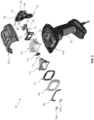
- the reader 102 is embodied as the apparatus 200.
- the reader 102 includes an apparatus chassis (e.g., a "chassis”) that stores components of the reader 102.
- the reader 102 includes chassis portion 302a embodying a top portion of a chassis, and chassis portion 302b embodying a bottom portion of the chassis.
- the chassis portion 302a and the chassis portion 302b are configured to be affixed, connected, or otherwise coupled to form a complete housing, for example by snapping together to enclose all components of the reader 102.
- the chassis portion 302a and the chassis portion 302b are mechanically secured, chemically sealed, and/or the like, to enclose all such components.
- the chassis of the reader 102 includes multiple other chassis portions.
- the chassis embodies or includes one or more portions representing external components utilized for holding, positioning, and/or operating the reader 102.
- the chassis portion 302b includes handle 342.
- the handle 342 embodies an external, elongated portion of the chassis that is designed to enable a user to place their hand around the reader 102 and orient the reader 102 towards a code to be read.
- the handle 342 is angled to enable a user to comfortably angle the reader 102 in a manner such that illuminations produced via the reader 102 reach a code to be scanned while minimizing the likelihood of direct light reflection from such illuminations impacting sensor(s) of the reader 102.
- one or more portion(s) of the chassis embody, house, or otherwise include components for activating the reader 102 (e.g., a trigger), setting an operational mode of the reader 102, and/or the like.
- the reader 102 further includes polarizer 304a and polarizer 304b.
- each of the polarizers 304a and 304b embody optical filters that permits light of particular polarization through while filtering light of other polarizations.
- the polarizers 304a and 304b output polarized light from one or more illuminations, for example produced by one or more polarized illuminator(s).
- the polarizers 304a and 304b may each be part of a polarized illuminator assembly that produces polarized light of a particular polarization.
- the reader 102 further includes a polarizer holder 306.
- the polarizer holder 306 in some embodiments comprises a structural lens, optical component, or other physical body that maintains a particular physical structure for securing the polarizers 304a and 304b in particular positions with respect to one or more corresponding optical components and/or illuminators.
- the polarizer holder 306 is constructed as a rigid body to secure the polarizers 304a and 304b at the top left and top right corners of the ring lens 308.
- the reader 102 further includes a ring lens 308.
- the ring lens 308 comprises optical components for generating particular illumination(s) from light produced by any number of illuminators of a ring illuminator assembly.
- the ring lens 308 includes edge optical components relatively centered along the top, bottom, left, and right edges of the ring lens 308 for producing one or more dark field illuminations from illuminators relatively aligned with such edge optical components.
- the ring lens 308 includes optical components in the top left and top right corners of the ring lens 308 for producing one or more illuminations to the polarizer 304a and polarizer 304b.
- corner optical components associated with polarized illuminators output condensed light to one of the polarizers 304a or 304b, which are subsequently utilized to illuminate one or more fields of view.
- the reader 102 further includes a board 310.
- the board 310 comprises a single, particular circuitry board (e.g., a PCB) that includes a plurality of activatable illuminators.
- the board 310 is structured as a ring that defines a void or hole in the center of the ring that allows for passage of light in or out of one or more components behind the ring, for example via the diffuser 312 as described herein.
- the ring shape similarly enables alignment of the illuminators of board 310 with the corresponding optical components of the ring lens 308 having the same or a similar ring shape without impeding the passage of light via the void or holes in said ring.
- such illuminators correspond to particular optical components embodying portions of the ring lens 308, and/or corresponding optical components further in front of said ring lens 308, such as the polarizers 304a and 304b.
- the board 310 includes at least one illuminator embodying a polarized illuminator in the top left corner of the board 310, and includes at least one illuminator embodying a polarized illuminator in the top right corner of the board 310.
- These illuminators are aligned with corner optical components of the ring lens 308 and polarizers 304a and 304b, forming polarized illuminator assemblies that each produce polarized illuminations.
- the board 310 includes at least one illuminator embodying a narrow field illuminator, for example at least one illuminator positioned at the bottom left corner of the board 310 and at least one illuminator positioned at the bottom right corner of the board 310.
- These illuminators are aligned with corner optical components of the ring lens 308, for example forming narrow field illuminator assemblies that each produce a narrow field illumination.
- the light produced via the narrow field illuminators of the board 310 are produced and corresponding condensed narrow field illuminations are produced through the corresponding optical components of the ring lens 308 aligned with said illuminators.
- the particular arrangement, orientation, and positions of the illuminator assemblies discussed with respect to the components 304a/b-310 may differ from that depicted in the figures herein.
- the polarized illuminator assemblies may be aligned at the bottom corners of the apparatus (e.g., polarizers aligned with particular optical components at the bottom corners of the ring lens 308, with corresponding polarized illuminators at the bottom corners of the board 310), and/or the narrow field illuminator assemblies may be aligned at the top corners of the apparatus (e.g., particular optical components at the top corners of the ring lens 308, with corresponding narrow field illuminators at the top corners of the board 310).
- one or more of the dark field illuminator assemblies may differ from one another (e.g., different strength illuminators, different optical components to produce different illuminations, and/or the like), and in other embodiments the dark field illuminator assemblies may each be the same with differing rotations from the central axis of the field of views capturable via the reader 102.
- the ring illuminator assembly includes any number or combination of illuminator assembly types.
- the ring illuminator assembly need not include one or more of the polarized illuminator assembly, the narrow field illuminator assembly, and/or the dark field illuminator assembly(s), and in some embodiments may include one or more of the remaining illuminator assembly types at such positions.
- the ring illuminator assembly only includes dark field illuminator assemblies.
- the ring illuminator assembly only include dark field illuminator assemblies and narrow field illuminator assemblies, or only includes dark field illuminator assemblies and polarized illuminator assemblies.
- the ring illuminator assembly does not include any dark field illuminator assemblies, and only includes one or more narrow field illuminator assemblies and/or one or more polarized illuminator assemblies, for example, or another illuminator assembly type.
- the reader 102 further includes diffuser 312.
- the diffuser 312 scatters incoming light to produce an illumination that is more balanced or uniform illumination (e.g., without significant pockets of increased dark or light spots).
- the diffuser 312 embodies a dome diffuser that generally embodies a dome-like structure.
- the dome-like structure scatters the light in various directions, thus diffusing the light throughout a field of view.
- the dome structure defines an outer perimeter that enables the passage of light out of the diffuser (e.g., a diffuse illumination produced via the diffuser 312 and corresponding components of a diffuser assembly and passage of light inwards towards image sensor(s) behind the diffuser 312.
- one or more components of a ring illuminator assembly are affixed to the diffuser 312 along the perimeter or corners of the outer perimeter of the diffuser 312 to ensure alignment of such components.
- the diffuser 312 is semi-transparent to enable incoming light to be diffused via the diffuser 312 into a more uniform illumination.
- the reader 102 further includes a diffuser back light reflector 318.
- the diffuser back light reflector 318 receives incoming light from one or more illuminators (e.g., diffuser illuminators) and directs such light into the diffuser 312.
- the diffuser back light reflector 318 comprises one or more optical components that that directs light from any number of illuminators to one or more points along the diffuser 312, such that the diffuser 312 receives the light and produces a diffuse illumination utilizing such incoming light.
- the diffuser back light reflector 318 embodies a single molded optical component.
- the diffuser back light reflector 318 embodies separate optical components affixed together or positioned in alignment with one another.
- the diffuser back light reflector 318 performs various securing and illumination functions.
- the diffuser back light reflector 318 is aligned with the diffuser 312 such that incoming light (e.g., from one or more illuminators of the board 320, as described herein) is reflected or otherwise directed to the back of the diffuser 312 to produce a corresponding uniform diffuse illumination.
- the diffuser back light reflector 318 couples or otherwise secures one or more components of a diffuser illuminator assembly in alignment with one or more other components.
- the diffuser back light reflector 318 tightly secures the protective window 316 and the analyzer 314 to the back of the diffuser 312.
- the diffuser back light reflector 318 is configured to receive one or more securing mechanism(s) of another component, for example one or more illumination lenses and/or of a ring illuminator assembly, to secure such components alignment with one or more other components.
- the reader 102 further includes an analyzer 314.
- the analyzer 314 is positioned towards the back end of the diffuser 312, for example in alignment with an opening of the diffuser 312 and one or more lens(es) associated with imagers of the reader 102.
- the analyzer 314 comprises a polarized optical component that filters out light of particular polarizations.
- the analyzer 314 blocks light of unwanted polarizations to eliminate or reduce the effects of unwanted light on the image sensors positioned behind the analyzer 314.
- the analyzer 314 comprises a polarizer that allows light of the reverse polarities than the polarizer(s) of the polarized illuminator assemblies of the reader 102.
- the analyzer 314 blocks opposite polarizations from a first polarization permitted by the polarizers 304a and 304b. In this regard, the analyzer 314 prevents unwanted incidence of light from reaching the image sensors therein. In some embodiments, the analyzer 314 is optionally included.
- the reader 102 further includes a protective window 316.
- the protective window 316 embodies a transparent or semi-transparent structure that physically protects one or more other components of the reader 102, for example by physically blocking an opening in the diffuser 312 and diffuser back light reflector 318 that is in alignment with one or more imagers of the reader 102.
- the protective window 316 may include a rigid or flexible structure that protects from external objects or particles entering the reader 102 and impacting the imagers.
- the protective window 316 comprises a glass panel, or reinforced/structurally improved glass panel, that is affixed to the back of the diffuser 312 or diffuser back light reflector 318 directly or via a supporting frame.
- the protective window 316 is optionally included.
- the reader 102 further includes a board 320.
- the board 320 comprises a single particular circuitry board (e.g., a PCB) that includes one or more activatable illuminators utilized in generating a diffuse illumination via the diffuser 312 and diffuser back light reflector 318.
- the board 320 includes one or more diffuser illuminator(s) aligned with the diffuser back light reflector 318.
- the board 320 defines a void space or hole that enables one or more lens(es) to be positioned near the center of the board 320.
- the board 320 may include one or more diffuser illuminator(s) on either side of the hole in the board 320, on top or bottom of the hole in the board 320, and/or the like, to provide sufficient light for directing via the diffuser back light reflector 318.
- the board 320 includes a plurality of diffuser illuminators that provide relatively uniform light at various points throughout the diffuser back light reflector 318. These diffuser illuminators of the board 310 together with the corresponding diffuser 312 and diffuser back light reflector 318 form a diffuser assembly that produces diffuse illuminations.
- the reader 102 further includes an aimer lens 322.
- the aimer lens 322 embodies one or more optical components that generate an aimer illumination from incoming light.
- the aimer lens 322 produces an aimer illumination of a particular pattern from incoming light, for example produced from an aimer illuminator.
- the aimer lens 322 produces a linear illumination pattern from incoming light, and/or collimates the incoming light for producing a particular aimer pattern.
- the aimer lens 322 is secured in a position aligned with a component that directs incoming light to the aimer lens 322, for example directly in alignment with an aimer illuminator, or in some embodiments with one or more reflectors that direct light from an aimer illuminator to the aimer lens 322.
- the reader 102 further includes lens 324.
- the lens 324 embodies a narrow field lens that is associated with a corresponding narrow field image sensor and defines a particular narrow field of view that is capturable by the narrow field image sensor.
- the lens 324 is aligned with a corresponding narrow field image sensor, such that light progresses through the lens 324 to impact the corresponding narrow field image sensor.
- the lens 324 is aligned with the image sensor 334 as described further herein, where the lens 324 and the image sensor 334 form a narrow field imager.
- the reader 102 further includes lens 326.
- the lens 326 embodies a wide field lens that is associated with a corresponding wide field image sensor and defines a particular wide field of view that is capturable by the wide field image sensor.
- the lens 326 is aligned with a corresponding wide field image sensor, such that light progresses through the lens 326 to impact the corresponding wide field image sensor.
- the lens 326 is aligned with the image sensor 336 as described further herein, where the lens 326 and the image sensor 336 form a wide field imager.
- the wide field of view is wider than the narrow field of view in at least one direction (or a plurality of directions).
- the lenses 326 and 324 are constructed differently to define the different field of views based on different focal lengths, or are positioned at different distances from the corresponding image sensors 334 and 336.
- the reader 102 further includes a plurality of reflectors, specifically reflector 330a and reflector 330b.
- each reflector comprises reflective material(s) and/or lenses that redirect incoming light in a particular direction.
- the reflectors 330a and 330b each embody a mirror angled to reflect light in a particular direction. It will be appreciated that in some embodiments, the reflector 330a and/or the reflector 330b is embodied by another optical component that similarly redirects incoming light in a particular direction.
- the one or more reflectors of the reader 102 are positioned and aligned to redirect incoming light from an aimer illuminator towards or in accordance with a viewing axis of the apparatus.
- the reflector 330a in some embodiments first folds light produced by an aimer illuminator towards a central axis of the reader 102. The redirected light is specifically directed towards the reflector 330b. The reflector 330b then redirects the light along the viewing axis of the apparatus towards the field of views capturable via the reader 102.
- the reflector 330b redirects the light along a viewing axis of the apparatus that is near-coaxial with and relatively central (e.g., within defined tolerances) between the narrow and wide fields of view capturable via the reader 102 towards a corresponding aimer lens for projection into such fields of view.
- the reflector 330a and/or reflector 330b may be embodied in a smaller component than a corresponding aimer illuminator that generates the light ultimately projected as the aimer illumination, and thereby allows for the aimer illumination to be projected at a position more central to the fields of view capturable via the reader 102 without requiring the aimer to actually be positioned at such a location, since the size of the aimer may preclude the aimer from being positioned at such a location without offsetting by an unacceptable amount the fields of view capturable by a plurality of imagers of the reader 102.
- the reflectors enable the aimer illumination to be produced in smaller reader configurations at a defined position within the fields of view without undesirably offsetting the image sensors associated with such fields of view, which would otherwise negatively impact the ability to successfully perform scanning operations utilizing the sensors due to such offset.
- the reader 102 further includes a component holder 328.
- the component holder 328 comprises a physical structure that positions one or more components of the reader 102 in particular positions to align such components with other components located behind the component holder 328.
- the component holder 328 is molded to position the lenses 324 and 326 in alignment with corresponding image sensors.
- the component holder 328 positions the reflector 330a and/or reflector 330b at defined positions to enable redirecting of light along a particular viewing axis of the apparatus.
- the component holder 328 comprises a single molded portion, or plurality of individual portions affixed or secured together, that defines a cavity to receive each component as described, and/or to secure the component within its respective cavity.
- the reader 102 further includes a board 332.
- the board 332 includes the imaging and illuminator components located furthest back from the optical and illumination components described above.
- the board 332 comprises a circuitry board (e.g., a PCB) that includes one or more activatable image sensor(s) utilized to capture image representations of one or more field(s) of view.
- the board 332 comprises one or more aimer illuminator(s) associated with generating an aimer illumination, for example via the aimer lens 322 and/or reflectors 330a and 330b.
- the reader 102 further includes aimer illuminator 338.
- the aimer illuminator 338 is communicatively coupled with the board 332, for example to enable activation of the aimer illuminator 338 via the board 332.
- the aimer illuminator 338 outputs light utilized to produce a corresponding aimer illumination, for example of a particular pattern.
- the aimer illuminator 338 is aligned with one or more reflectors that redirect the light to one or more aimer lens(es), such as the reflector 330a.
- the aimer illuminator 338 is aligned with the aimer lens 322 directly.
- the aimer illuminator 338 comprises one or more laser(s) and/or high-concentration LEDs that outputs a concentrated ray of light.
- the reader 102 further includes image sensor 336.
- the image sensor 336 is communicatively coupled with the board 332, for example to enable activation of the image sensor 336 via the board 332.
- the image sensor 336 similarly captures an image based on light incident to or otherwise impacting the image sensor 336.
- the image sensor 336 captures an image representing a second field of view, for example an image representation of a field of view defied by one or more associated optical component(s).
- the image sensor 336 is aligned with the lens 324 to define a particular field of view.
- the image sensor 334 and the image sensor 336 alone or together with lens 324 and/or lens 326, define a plurality of field of views.
- the image sensor 334 and lens 326 embody a first imager defining a first field of view
- the image sensor 336 and lens 324 embody a second imager defining a second field of view.
- the field of views may differ in at least one direction.
- the first field of view corresponds to a narrow field of view
- the second field of view corresponds to a wide field of view, where the wide field of view is wider than the narrow field of view in at least one direction.
- the field of views are defined based at least in part on the optical components associated with each image sensor. Alternatively or additionally, in some embodiments, the field of views are defined based at least in part on the configuration of the image sensors themselves, for example based at least in part on the resolution of each image sensor. In this regard, it will be appreciated that the images generated via the image sensor 334 may differ from the images generated via the image sensor 336.
- the reader 102 further includes processor 340.
- the processor 340 is communicatively coupled with the board 332, for example to enable transmission of data to the processor 340 from other components of the reader 102 and/or from the processor 340 to other components of the reader 102.
- the processor 340 is communicatively coupled with one or more illuminator(s), for example the aimer illuminator 338, one or more illuminators of the other board(s) 310 and/or 320, and/or the like.
- the processor 340 is communicatively coupled with the image sensors 334 and/or 336.
- the processor 340 executes computer-coded instructions embodying one or more software application(s).
- the software application(s) in some embodiments control one or more aspect(s) of the reader 102.
- the processor 340 executes one or more software application(s) that determine when to activate one or more image sensor(s) of the reader 102, when to activate one or more illuminator(s) of the reader 102, which illuminator(s) of the reader 102 to activate, and/or the like.
- the processor 340 upon activation the processor 340 executes software application(s) that perform(s) one or more predefined algorithm(s), machine learning model(s), and/or artificial intelligence model(s) that determine when and/or which components of the reader 102 should be activated.
- the various board(s) of the reader 102 are communicable with one another.
- the board 332 is communicatively coupled with the board 310 and/or board 320.
- signal(s) and/or data may be sent from a particular board to one or more other board(s).
- activation signal(s) is/are transmitted from the board 332 to the board 310 and/or to the board 320, such as to activate illuminator(s) thereon.
- the various board(s) of the reader 102 are separate from one another, and may be activated via the same mechanism(s) (e.g., a trigger of the reader 102, not depicted).
- one or more components of the reader 102 are connected to form assemblies of the reader 102.
- the assemblies of the reader 102 are connected to one another to fit all components within a portion of the chassis.
- the polarizer 304a, polarizer 304b, polarizer holder 306, ring lens 308, and board 310 form a ring illuminator assembly, with each component physically or chemically secured to the component behind it (e.g., with the polarizers 304a and 304b in the front most positions).
- the diffuser 312, analyzer 314, protective window 316, diffuser back light reflector 318, and board 320 form a diffuser assembly, with each component physically or chemically secured to the component behind it.
- the aimer lens 322, lens 324, lens 326, component holder 328, reflector 330a, and reflector 330b form a lens assembly, with each lens and reflector physically or chemically secured to the component holder 328.
- the board 332, image sensor 334, image sensor 336, aimer illuminator 338, and processor 340 form an imager board.
- the various assemblies, such as the ring illuminator assembly, diffuser assembly, lens assembly, and imager board are each physically or chemically affixed.
- the various depicted components of the reader 102 are affixed or otherwise connected to the chassis of the reader 102.
- one or more securing components e.g., screws, rivets, and/or the like
- the chassis includes one or more portions that extend outward to enable snapping into particular portions of one or more components of the reader 102.
- the various components of the reader 102 may be aligned and/or secured in any of a myriad of manners.
- the board 320 and the board 332 are each secured to an apparatus chassis, for example chassis portions 302a and/or 302b.
- such components secured to the chassis of the apparatus may be further secured (e.g., directly or indirectly) to each other component of the reader 102.
- various lenses e.g., associated with one or more image sensors and/or an aimer
- aimer reflector(s) e.g., associated with one or more image sensors and/or an aimer reflector(s), and/or the like in some embodiments are secured to the component holder 328, which may be secured to the board 332 as described herein.
- one or more polarizers are secured to a polarizer holder 306, which may be secured to the ring lens 308, which is subsequently secured to the board 310 to form a ring illuminator assembly.
- the analyzer 314, the protective window 316, and/or the diffuser back light reflector 318 are secured the diffuser 312, and similarly the diffuser back light reflector 318 is secured to the board 320, for example forming a diffuser illuminator assembly.
- the ring illuminator assembly is secured to the front of the diffuser illuminator assembly (e.g., along the perimeter of the opening of the diffuser 312), forming a front illuminator assembly.
- securing a single component of the front illuminator assembly, for example the board 320, within the apparatus maintains the position and relative alignment of each component of the front illuminator assembly.
- the various components of the reader 102 may be secured in place and in alignment without requiring each component to be individually secured via the chassis.
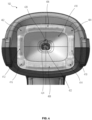
- FIG. 4 illustrates a front view of an example improved reader in accordance with at least some example embodiments of the present disclosure.
- FIG. 4 illustrates a front view of the reader 102 while fully assembled. This view depicts an opening depicting the various components that are outward-facing, such that light may be produced via such components and/or light may flow in towards such components. It will be appreciated that the depiction of the reader 102 in FIG. 4 represents an assembled version of the exploded components depicted in FIG. 3 .
- the reader 102 includes a ring illuminator assembly that comprises a plurality of illuminators surrounding an opening of the reader 102, for example where the opening is defined by a diffuser.
- the ring illuminator assembly includes a polarized illuminator 402 and a polarized illuminator 404.
- Each polarized illuminator produces a polarized illumination that illuminates one or more fields of view.
- each polarized illuminator comprises a polarizer, at least one optical lens, and at least one polarized illuminator.
- the reader 102 comprises a plurality of polarized illuminators located opposite one another over a particular axis, for example located across a z-axis (e.g., both located on top corners of the ring illuminator assembly).
- the ring illuminator assembly further includes a narrow field illuminator 414 and narrow field illuminator 416.
- Each narrow field illuminator produces a concentrated illumination, which may have higher intensity than one or more other illuminators of the reader 102.
- each narrow field illuminator comprises at least one optical lens and a narrow field illuminator (e.g., without a polarizer).
- the illuminator(s) that generate the light associated with the narrow field illuminators 414 and 416 are the same as the illuminator(s) that generate the light associated with the polarized illuminators 402 and 404.
- the reader 102 comprises a plurality of narrow field illuminators located opposite one another over a particular axis, for example located across a z-axis (e.g., both located on bottom corners of the ring illuminator assembly).
- the narrow field illuminators 414 and 416 may be positioned opposite the polarized illuminators 402 and 404, as depicted.
- the ring illuminator assembly further includes a plurality of dark field illuminators positioned at edges of the ring.
- the ring illuminator assembly includes dark field illuminator 406 positioned at a top edge of the ring formed by the ring illuminator assembly, dark field illuminator 408 positioned at a bottom edge of the ring formed by the ring illuminator assembly, dark field illuminator 410 positioned at a right edge of the ring formed by the ring illuminator assembly, and dark field illuminator 412 positioned at a left edge of the ring formed by the ring illuminator assembly.
- the dark field illuminators 406-412 are each configured to produce the same or a similar illumination, such that the dark field illuminators in combination illuminate a field of view uniformly and at a high angle of incidence for a field of view near to the reader 102.
- the reader 102 further includes a diffuser assembly 418.
- the diffuser assembly 418 is positioned behind the ring illuminator assembly, such that the opening defined by the ring of the ring illuminator assembly allows for a diffuse illumination to be produced towards one or more fields of view.
- the diffuser assembly 418 receives light from behind a diffuser and produces a uniform, scattered illumination from such light via the opening defined by the inside of the ring illuminator assembly.
- the diffuser assembly 418 includes a narrower opening at the back of the diffuser assembly 418.
- the reader 102 further includes a plurality of imagers. Each imager defines a field of view capturable by the imager. Specifically, the reader 102 includes a narrow field imager 420 defining a narrow field of view, and a wide field imager 422 defining a wide field of view. The wide field of view may be wider than the narrow field of view in one or a plurality of direction(s). As light reflects back into the opening defined by the ring illuminator assembly and through the opening defined by the back of the diffuser assembly 418, such light impacts or otherwise interacts with one of the imagers 420 or 422.
- illuminations produced by any one or more of the illuminators 402, 404, 406, 408, 410, 412, 414, 416, and/or 418 may reflect off object(s) in the fields of view of the reader 102 (e.g., objects including code(s) to be scanned) and be captured by the imagers to generate illuminated images of such fields of view.
- the narrow field imager 420 and wide field imager 422 are positioned in any orientation, for example with the narrow field imager 420 positioned above the wide field imager 422, or in other embodiments the wide field imager 422 is positioned above the narrow field imager 420.
- the reader 102 further includes an aimer 424.
- the aimer 424 produces an aimer illumination that is output via the openings by the diffuser assembly 418 and the ring illuminator assembly.
- the aimer 424 includes at least an aimer illuminator and an aimer lens that produce the aimer illumination of a particular pattern.
- the aimer 424 includes one or more reflectors that redirect the aimer illumination in a near-coaxial direction with respect to central axes of the fields of view captured by the narrow field imager 420 and/or wide field imager 422.
- the reflector and/or aimer illuminator of the aimer 424 is positioned such that the aimer illumination is produced with reduced offset from the viewing axis of the apparatus as defined by the imagers thereof.
- a reflector is positioned next to the imagers 420 and 422 at a point most between said imagers.
- Such configurations are functional in circumstances where the size of the reader 102 prevents components from being positioned directly between the imagers 420 and 422 without offsetting the fields of view captured by such imagers by an unacceptable amount.
- the aimer illuminator and/or a reflector is/are positioned between the imager 420 and 422.
- FIG. 5 illustrates an angled cutaway view of an example improved reader in accordance with at least some example embodiments of the present disclosure. Specifically, FIG. 5 illustrates a cutaway view of the assembled reader 102, depicting the various subassemblies therein. It will be appreciated that the subassemblies are depicted as each in a top portion (e.g., a header) of a handheld chassis, however in other embodiments the remaining portions of the chassis may embody a different design.
- a top portion e.g., a header
- FIG. 5 depicts a ring illuminator assembly 502.
- the ring illuminator assembly 502 includes a plurality of illuminators, including illuminators of different types as described herein.
- the ring illuminator assembly 502 includes a plurality of polarized illuminators, a plurality of narrow field illuminators, and a plurality of dark field illuminators, as described herein.
- the ring illuminator assembly 502 is positioned towards an opening of the reader 102, for example such that the illuminators of the ring illuminator assembly 502 are closest to the field of view capturable via imagers of the reader 102.
- FIG. 5 further depicts a diffuser assembly 504.
- the diffuser assembly 504 is positioned behind the ring illuminator assembly 502, where the ring illuminator assembly 502 defines an inner ring representing an opening of the diffuser assembly 504.
- the diffuser assembly 504 connects to the ring illuminator assembly 502 near the corners of the ring illuminator assembly 502.
- the ring illuminator assembly 502 slots into place to fixedly connect to the diffuser assembly 504 in proper alignment.
- the diffuser assembly 504 includes one or more components that produce a diffuse illumination.
- the diffuser assembly 504 for example produces a diffuse illumination in a forward-facing direction while similarly enabling incoming light to traverse through the reader 102 and interact with the imagers thereof.
- Such capabilities are provided with reduced additional space required by such components.
- the diffuser assembly 504 includes a defined hole in such components (as depicted with respect to the diffuser 312, diffuser back light reflector 318, and board 320) to enable light to flow through the diffuser assembly 504 and interact with imagers positioned behind the diffuser assembly 504.
- FIG. 5 further depicts a board assembly 506.
- the board assembly 506 is positioned behind the diffuser assembly 504.
- the diffuser assembly 504 connects to the board assembly 506 at one or more defined points.
- a board of the diffuser assembly 504 connects to one or more components of the board assembly 506, such as a front of a lens assembly aligned with the image sensors of the reader 102.
- light may flow through the ring illuminator assembly 502 and diffuser assembly 504 to interact with imagers of the board assembly 506, as described herein.
- the board assembly 506 includes one or more imagers, each imager comprising an image sensor together with optical components that in combination define a particular field of view.
- the board assembly 506 embodies a board together with a lens assembly that is affixed to, connected with, or otherwise oriented in alignment with the board to define such fields of view.
- the lens assembly may include optical components associated with each imager on the board that defines the particular field of view capturable by that imager.
- the lens assembly includes a holder that positions these optical components in place, such that the optical components are properly aligned with their respective image sensor on the board.
- the lens assembly includes one or more reflectors that fold light produced by an aimer illuminator of the board assembly 506 towards a viewing axis of the apparatus.
- the lens assembly is affixed to the board at defined points, for example where the board includes jut outs or particular components that snap into corresponding cavities of the lens assembly that receive the board.
- the board assembly 506 in some embodiments includes any of a number of other electrical components, for example a processor for controlling operation of the reader 102 as described herein, memory/memories, activation mechanism(s), and/or the like.
- Each of the optical components fits into the top chassis 508 of the reader 102.
- the required space to fit all components is reduced by enabling all components to be "sandwiched" together within a well-defined space, for example by layering the subassemblies comprising the plurality of illuminators.
- the board assembly 506 extends at least in part into a bottom chassis 510, for example embodying the handle of the reader 102.
- the non-optical and non-imaging components of the reader 102 may be positioned without impacting the size of the top chassis 508, enabling the complete apparatus to be designed with reduce space overall.
- Such components in the bottom chassis 510 may include the processor, trigger of the reader 102, and/or the like.
- FIG. 6A illustrates a top-down cross-sectional view of an example improved reader in accordance with at least some example embodiments of the present disclosure.
- FIG. 6A depicts a top-down, cross-sectional view of the subassemblies ring illuminator assembly 502, diffuser assembly 504, and board assembly 506 positioned in alignment with one another within a chassis.
- FIG. 6B illustrates a side cross-sectional view of an example improved reader in accordance with at least some example embodiments of the present disclosure. It will be appreciated that FIG. 6B depicts a side cross-sectional view of the same components within the reader 102.
- the ring illuminator assembly 502 is positioned at a first, front position of the reader 102.
- the ring illuminator assembly 502 is secured at one or more corner(s) to the diffuser assembly 504. Additionally or alternatively, in some embodiments, the ring illuminator assembly 502 is prevented by an overhang or portion of the chassis of the reader 102 that prevents the ring illuminator assembly 502 from sliding forward and/or out of the reader 102.
- the diffuser assembly 504 is secured to the chassis of the reader 102.
- the diffuser assembly 504 includes a back light illumination board including portion(s) that extend towards the edges of the reader 102. Such portion(s) may define portion(s) that receive securing mechanism(s) (e.g., fastener(s), nail(s), rivet(s), screw(s), and/or the like) to position the diffuser assembly 504 within the reader 102.
- the diffuser assembly 504 is directly secured to the chassis of the reader 102 while the ring illuminator assembly 502 and diffuser assembly 504 are directly secured to the diffuser assembly 504 to be positioned in alignment.
- the board assembly 506 is secured to the diffuser assembly 504.
- a board of the diffuser assembly 504 includes one or more cavities that receive a portion of the board assembly 506.
- a component holder or lens assembly of the board assembly 506 includes one or more stud(s) that enter cavities or recessed areas of the diffuser assembly 504 to secure the board assembly 506 to the diffuser assembly 504.
- the board assembly 506 is secured directly to the chassis of the reader 102, such that the board assembly 506 is positioned in alignment in the diffuser assembly 504 when secured to the chassis.
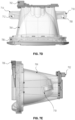
- FIG. 7A illustrates a perspective view of an illuminator assembly including a ring illuminator assembly and a diffuser assembly in accordance with at least some example embodiments of the present disclosure.
- FIG. 7B illustrates a side cross-sectional view of an illuminator assembly including a ring illuminator assembly and a diffuser assembly in accordance with at least some example embodiments of the present disclosure.
- FIG. 7C illustrates a front view of an illuminator assembly including a ring illuminator assembly and a diffuser assembly in accordance with at least some example embodiments of the present disclosure.
- FIG. 7A illustrates a perspective view of an illuminator assembly including a ring illuminator assembly and a diffuser assembly in accordance with at least some example embodiments of the present disclosure.
- FIG. 7B illustrates a side cross-sectional view of an illuminator assembly including a ring illuminator assembly and a diffuser assembly in accordance
- FIG. 7D illustrates a top-down view of an illuminator assembly including a ring illuminator assembly and a diffuser assembly in accordance with at least some example embodiments of the present disclosure.
- FIG. 7E illustrates a side view of an illuminator assembly including a ring illuminator assembly and a diffuser assembly in accordance with at least some example embodiments of the present disclosure.
- FIG. 7A-FIG. 7E (“the illuminator assembly figures") depicts such views of an example illuminator assembly 700, for example embodying a specific example of a combining the ring illuminator assembly 502 and the diffuser assembly 504.
- the illuminator assembly figures depict the board 702 aligned with the diffuser and diffuser back light reflector of the diffuser assembly 704.
- the diffuser back light reflector in some embodiments is in alignment with one or more illuminators of the board 702 to enable light to be produced through the back light illumination board.
- the board 702 includes a defined hole in the center that enables light to pass to and/or from the diffuser assembly 704.
- the board 702 is secured to the diffuser assembly 704, for example via the diffuser back light reflector, at the border of the hole defined in the board 702.
- the illuminator assembly figures depict the polarized illuminator assembly 706 aligned with the diffuser and diffuser back light reflector of the diffuser assembly 704.
- the polarized illuminator assembly 706 defines a ring that enables light to pass to and/or from the front of the diffuser assembly 704.
- the polarized illuminator assembly 706 is secured to the diffuser assembly 704, for example via the front of the diffuser back light reflector, at the border of the front hole opening defined by the ring of the polarized illuminator assembly 706.
- the diffuser assembly 704 includes a plurality of portions for securing the illuminator assembly 700 the position of the illuminator assembly 700, for example to a chassis of an apparatus (e.g., the reader 102).
- the diffuser assembly 704 includes two securing wings, specifically securing wing 710 and securing wing 714 positioned at opposite sides of the diffuser assembly 704.
- the securing wings 710 and 714 each are embodied by a portion of a diffuser back light reflector extended outward from opposite sides of the diffuser.
- the securing wings 710 and 714 are molded into the diffuser back light reflector.
- the securing wings 710 and 714 each embody separate components fixedly secured to the diffuser back light reflector at determinable positions via separate securing mechanism(s).
- the securing wings each include particular elements that enable positioning of the illuminator assembly 700 within an apparatus.
- the securing wings 710 and 714 each include a securing cavity, specifically securing cavity 708 and securing cavity 712.
- the securing cavities 708 and 712 each define a particular hole in the securing wing that receives a securing mechanism or element that positions the illuminator assembly 700 and/or prevents it from significantly moving, reorienting, rotating, or otherwise being manipulated out of alignment.
- the securing cavity 708 receives a first defined portion of a chassis of an apparatus
- the securing cavity 712 receives a second defined portion of the chassis of the apparatus, such that the illuminator assembly 700 remains in a fixed position, fixed alignment, and/or fixed orientation when the chassis portions are engaged with the securing cavities 708 and 712.
- the securing wings 710 and 714 may be out of the way of the imaging, optical, and/or illuminator components of the illuminator assembly 700.
- the securing wings 710 and 714 are of reduced size, such that the securing wings are only as large in one or more directions as necessary to ensure the structural integrity of the securing wings, and/or to position the corresponding securing cavities at one or more particular position(s) within a particular apparatus chassis.
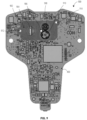
- FIG. 8 illustrates a perspective view of an example imager board in accordance with at least some example embodiments of the present disclosure.
- FIG. 8 depicts an example board 800 embodying an imager board.
- the board 800 facilitates capture of one or more images and/or processing of such image(s), for example to detect code(s) (e.g., machine readable symbologies) represented in such image(s) and/or decode such code(s) upon detecting such code(s).
- the board 800 embodies a particular implementation of the board 332 within an example apparatus, such as the reader 102.
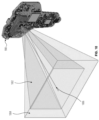
- the board 800 includes a plurality of imagers. Specifically, the board 800 includes image sensor 802 and image sensor 804.
- the image sensors are associated with differing field of views, for example defined by configuration(s) of the image sensors themselves and/or associated optical components.
- the image sensor 802 embodies a narrow field image sensor that captures image representations of a narrow field of view
- the image sensor 804 embodies a wide field image sensor that captures image representations of a wide field of view, the wide field of view wider than the narrow field of view in at least one direction.
- the image sensor 802 embodies a wide field image sensor
- the image sensor 804 embodies a narrow field image sensor.
- the image sensors 802 and image sensor 804 are embodied by the same type and/or configuration of image sensor. Alternatively or additionally, in some embodiments, the type and/or configuration of the image sensor 802 differs from the type and/or configuration of the image sensor 804.
- Each of the image sensors 802 and 804 are communicatively coupled with circuitry of the board 800, for example a circuitry board 810 embodied by a printed circuit board, that enables output and transmission of the images captured by the image sensors 802 and 804 to one or more other components of the board 800.
- the board 800 further includes a processor 808.
- the processor 808 is embodied by a microprocessor, single core processor, multi-core processor, ASIC, and/or the like, communicatively coupled with circuitry of the board 800, for example circuitry board 810 embodied by a printed circuitry board, to enable communication with one or more other component(s) of the board 800.
- the processor 808 is configured to perform software instruction(s), perform one or more particular algorithm(s), and/or the like, that enables operation of a particular apparatus (e.g., the reader 102) via the various components thereof.
- the processor 808 activates one or more illuminator(s) of an apparatus, such as the reader 102, to illuminate a field of view, and activates the image sensors 802 and/or 804 to capture one or more image representation(s) of the field of view via the image sensors image sensor 802 and/or image sensor 804, and/or facilitates transmission of captured image representations to the processor 808 and/or other components for further processing.
- an apparatus such as the reader 102
- the processor 808 activates one or more illuminator(s) of an apparatus, such as the reader 102, to illuminate a field of view, and activates the image sensors 802 and/or 804 to capture one or more image representation(s) of the field of view via the image sensors image sensor 802 and/or image sensor 804, and/or facilitates transmission of captured image representations to the processor 808 and/or other components for further processing.
- the processor 808 processes captured image representations of one or more field of view(s) to detect and/or decode one or more machine-readable symbologies embodied in code(s) captured within the image representations, and determine whether such a code was detected and/or decoded successfully (e.g., indicating successful completion of a scanning operation).
- the board 800 includes an aimer illuminator 806 that outputs a light utilized to produce an aimer illumination of a particular pattern.
- the aimer illuminator 806 is communicatively coupled with the processor 808, for example via the circuitry board 810 embodying a printed circuitry board, to enable the processor 808 to control activation of the aimer illuminator 806.
- the board 800 and/or one or more associated boards with which the board 800 is communicably coupled includes one or more additional components that control and/or facilitate functioning of the reader 102.
- the board 800 includes power management circuitry.
- the board 800 includes communication circuitry (e.g., that enables data output and/or intake).
- the board 800 includes input/output circuitry and/or interfacing circuitry (e.g., that enables receiving of input and/or output of data via one or more sensory elements, such as a visual interface, light(s), speaker(s) for audio output, and/or the like).
- input/output circuitry and/or interfacing circuitry e.g., that enables receiving of input and/or output of data via one or more sensory elements, such as a visual interface, light(s), speaker(s) for audio output, and/or the like.
- the board 800 is positioned in alignment with one or more optical component(s) (e.g., lenses, reflectors, refractive elements, and/or the like) that manipulate light generated by one or more component(s) and/or light flowing towards one or more component(s).
- FIG. 9 illustrates a front view of an assembled board including a lens assembly in accordance with at least some example embodiments of the present disclosure. Specifically, FIG. 9 depicts a lens assembly fixedly secured to the board 800, forming an assembled board 900.
- the lens assembly is fixedly secured to the board 800 in alternative orientation(s) and/or utilizing alternative mechanism(s), for example so long as the lens assembly align(s) one or more component(s) to enable operation of the corresponding components (e.g., to define one or more desired field(s) of view, output one or more particular illuminations to said field(s) of view, and/or the like).
- the assembled board 900 includes a holder 902 that secures various components in particular positions.
- the holder 902 includes defined positions for a reflector 904, reflector 906, imager lens 908, and imager lens 910.
- the position at which each component of the holder 902 is secured is intended to be in alignment with an associated component of the board 800.
- the holder 902 is secured to the board 800 to ensure that such associated components remain in alignment.
- the holder 902 includes one or more securing points, such as the securing point 912 and the securing point 914, that fixedly secures the holder 902 to the 800.
- the securing points prevent the holder 902 and components secured thereto from misaligning with the associated components of the board 800.
- one or more of the securing point(s) defines a hole that receives a defined component (e.g., a stud) of the board 800.
- one or more of the securing point(s) defines a stud that engages a defined cavity or hole in board 800. It will be appreciated that the holder 902 may be secured via any number of securing points positioned at various positions to prevent shifting, rotation, or other misalignment of the holder 902 from the underlying board 800.
- the holder 902 includes reflector 904 in alignment with the aimer illuminator 806 of the board 800.
- the aimer illuminator 806 outputs light that impacts the reflector 904.
- the reflector 904 embodies an aimer folding reflector that folds the outputted light in a particular direction, for example towards a center of the apparatus.
- the reflector 904 reflects the outputted light from the aimer illuminator 806 in a ninety degree rotation towards the image sensors of the board 800.
- the reflector 904 specifically reflects the outputted light in alignment with a second reflector, specifically reflector 906.
- the reflector 906 embodies a second aimer folding reflector that folds the reflected light in a second particular direction, for example towards a viewing axis of the apparatus.
- the aimer folding reflectors embodied by reflector 906 and 904 enable the light produced by the aimer illuminator 806 to be folded closer to the image sensors 802 and 804 of the board 800 despite the larger size of the aimer illuminator 806 preventing it from being positioned at such a position with respect to the image sensors 802 and 804.
- Such close alignment of the image sensors 802 and 804 together with the folded light reflected via the reflectors 904 and 906 enables the aimer illumination produced via such folded light to be positioned in better alignment with the fields of view captured by the image sensors 802 and/or 804.
- the holder 902 further includes imager lens 908 in alignment with image sensor 802 of the board 800.
- the imager lens 908 manipulates light that flows towards and ultimately impacts the image sensor 802.
- the imager lens 908 is configured to define a particular field of view that is capturable by the image sensor 802, for example based at least in part on the lens shape, focal length, and/or the like.
- the holder 902 similarly includes imager lens 910 in alignment with image sensor 804 of the board 800.
- the imager lens 908 manipulates light that flows towards and ultimately impacts image sensor 804.
- the imager lens 910 is configured to define a second particular field of view that is capturable by the image sensor 804, for example based at least in part on the lens shape, focal length, and/or the like.
- the imager lens 908 and the imager lens 910 may be configured differently to define different fields of view.
- the imager lens 908 defines a first field of view, which has particular dimensions in two dimensions and varying focus in a third dimension
- the imager lens 910 defines a second, wider field of view that is larger in at least one dimension (e.g., the first field of view embodying a narrow field of view, and the second field of view embodying a wide field of view).
- the narrow field of view may be associated with a focal point at a further distance than the corresponding wide field of view.
- embodiments enable improved likelihood of a captured image being sufficiently clear to enable detection and decoding of a machine-readable symbology captured therein (e.g., a captured code).
- the imager lens 908 defines the wide field of view
- the imager lens 910 defines the narrow field of view.
- the holder 902 is secured to the board, for example the board 800 as described herein, at a particular position such that the corresponding imager components (e.g., lenses and image sensors) remain in alignment with reduced extra components.
- the holder 902 may be secured to the chassis of an apparatus.
- the chassis of the apparatus may include one or more alignment features that maintain the relative alignment between the imager components (e.g., the lenses and the corresponding image sensors).
- alignment features and/or additional securing mechanisms may similarly maintain the position of the assembled board 900, and/or the holder 902 and board 800 individually, within the apparatus (e.g., the reader 102).
- FIG. 10 illustrates exemplary fields of view capturable via an improved reader in accordance with at least some example embodiments of the present disclosure.
- FIG. 10 illustrates example fields of view capturable via the assembled board 900 as described herein.
- FIG. 10 illustrates a first field of view 1002 and second field of view 1004 capturable via the assembled board 900, for example of an example reader 102.
- the image sensors of the assembled board 900 are configured to capture image representations of their respective field of view simultaneously.
- the image sensors of the assembled board 900 are configured to capture image representations of their respective field of view in an alternate manner, such that one of the image sensors is activated at a given time.
- the fields of view 1002 and 1004 are offset and co-axial or near-co-axial (e.g., within an acceptable threshold). In this regard, in some embodiments, the fields of view 1002 and 1004 overlap at least in part, such that objects at a particular distance from the associated reader (e.g., the reader 102 including the assembled board 900) are likely to be visible to both imagers.
- the field of view 1002 is offset vertically by the radius of each image sensor 802 and 804 from the field of view 1004. Each field of view may be slightly oriented towards a central viewing axis of the apparatus between the image sensors.
- the focus at various points in the fields of view 1002 and 1004 may differ.
- the narrow field imager associated with the field of view 1002 may have a further focal distance than the corresponding wide field imager associated with the field of view 1004, such that objects are in better focus for the wide field imager at a close range as opposed to in better focus for the narrow field imager at a further range.
- the fields of view 1002 and 1004 may be affected differently by illuminations produced via the apparatus, for example the reader 102 associated with the assembled board 900.
- the dual-imager capabilities of the assembled board 900 enable improved likelihood of capturing an image representation of an object that is sufficiently in focus to enable the images to be processed successfully (e.g., to detect and decode a particular code).
- FIG. 10 further illustrates an aimer illumination 1006 within such fields of view.
- the aimer illumination is output by an aimer illuminator of the assembled board 900 and folded towards image sensors associated with the fields of view 1002 and 1004, then folded in a forward-facing direction corresponding to the viewing axis of the apparatus such that the aimer illumination is co-axial or near-co-axial (e.g., within a determinable offset tolerance) of the viewing axis of the apparatus.
- the aimer illumination 1006 is produced at a position sufficiently central to each of the fields of view 1002 and 1004.
- the assembled board 900 is configured utilizing one or more imagers to capture any number of alternatively configured fields of view.
- the assembled board 900 in some embodiments includes two image sensors, each in alignment with a lens to capture a particular field of view (e.g., a first field of view embodying a wide field of view and a second field of view embodying a narrow field of view).
- the assembled board 900 includes one image sensor in alignment with a single lens to capture a particular single field of view.
- the assembled board 900 includes three or more image sensors, each in alignment with its own lens to enable capture of three different fields of view.
- an aimer may be relatively centrally aligned to the plurality of imagers in the apparatus.
- each of the flowcharts depicts an example computer-implemented process that is performable by one or more of the apparatuses, systems, devices, and/or computer program products described herein, for example utilizing one or more of the specially configured components thereof.
- the reader 102 performs the process(es) described herein utilizing one or more memory/memories and/or processor(s) as described herein.
- the process(es) described herein provide for improved operation of the improved reader(s) described herein.
- the process(es) may be utilized to improve the likelihood that an initiated scanning operation is performed successfully (e.g., by activating one or more particular component(s) that maximize the likelihood that a captured image includes a detectable and decodable representation of a code).
- the process(es) describe operations for controlling a reader, such as the reader 102, in a particular manner.
- the reader 102 is controlled utilizing one or more other process(es), for example that utilize a pre-determined or defined algorithm for activating component(s) thereof based on a selected operational mode, previously stored historical data, and/or the like.
- any of the processes described herein occur in-between one or more blocks of another process, before one or more blocks of another process, in parallel with one or more blocks of another process, and/or as a sub-process of a second process.
- any of the processes in various embodiments include some or all operational steps described and/or depicted, including one or more optional blocks in some embodiments.
- one or more of the depicted block(s) in some embodiments is/are optional in some, or all, embodiments of the disclosure.
- Optional blocks are depicted with broken (or "dashed") lines.
- one or more of the operations of each flowchart may be combinable, replaceable, and/or otherwise altered as described herein.
- FIG. 11 illustrates a flowchart depicting example operations of an example improved process for using an improved reader in accordance with at least some example embodiments of the present disclosure.
- FIG. 11 depicts example operations of an example process 1100.
- the process 1100 is embodied by computer program code stored on a non-transitory computer-readable storage medium of a computer program product configured for execution to perform the process as depicted and described.
- the process 1100 is performed by one or more specially configured computing devices, such as the reader 102 embodied by the apparatus 200 alone or in communication with one or more other component(s), device(s), system(s), and/or the like.
- process 1100 determines a first image effect represented in the first image by processing the first image.
- a processor of the reader receives the first image and processes it utilizing one or more image processing algorithm(s).
- the image processing algorithm(s) may determine a darkness level of the captured image, a light uniformity of the captured image, detect specular reflection above a particular threshold from the captured image, and/or the like.
- the reader may be specially configured to enable detection of any of a myriad of visual effects in the image that may prevent or negatively impact the ability for the image to be successfully processed (e.g., for accurate detection and/or accurate decoding of a code embodying a particular machine-readable symbology).
- process 1100 determines, based at least in part on the first image effect, a second at least one illuminators to activate, wherein the second at least one illuminators comprises a combination of the polarized illuminator, the diffuse illuminator, the narrow field illuminator, and the near field illuminator.
- the reader 102 maintains a lookup table that correlates image effects with corresponding illuminators that should be activated instead to reduce or eliminate the image effect.
- the reader 102 utilizes a machine learning model, AI, or other model that is trained to process incoming data signals (e.g., data indicating the activated illuminators for the first image, the image effect, the first image, and/or the like) and outputs corresponding data indicating the second at least one illuminator to activate.
- the reader determines a second at least one illuminators that reduce or eliminate the first image effect.
- the second at least one illuminators may include one or more additional or alternative illuminators from the at least one first illuminator, or an entirely different set of illuminator(s).
- process 1100 activates the second at least one illuminators.
- the second at least one illuminators each produce an illumination that is utilized to illuminate one or more field(s) of view capturable via the reader.
- the second at least one illuminators may differ by at least one additionally activated or deactivated illuminator from the at least one first illuminator.
- process 1100 captures, via the at least one imager, at least a second image.
- the same imager utilized to capture the first image is similarly utilized to capture the second image.
- the reader determines whether to utilize the same imager or a different imager to capture the second imager.
- the reader determines whether to utilize the same imager of a wide field imager or a narrow field imager to capture the second image.
- the reader alternates or cycles through capturing via different imagers of the at least one imager.
- images are continuously captured and processed to determine new illuminators to activate until an image is successfully processed (e.g., a code is successfully detected and decoded).
- the second image or a subsequent image is captured and processed to attempt detecting and decoding of a particular code, and further alternative illuminator combination(s) are determined for activating in circumstances where the second image or a subsequent image is not successfully decoded.
- some embodiments may provide for any number of illuminators and/or imagers.
- other embodiments of the present disclosure may include additional optical elements for manipulating the light utilized to produce a particular illumination, and/or for capturing a particular field of view.
- each imager and/or illuminator assembly may include various other components and/or differently configured components from those depicted and described herein. It should be appreciated that the advantages and teachings of the disclosure herein provide significant advantages in such multi-projector apparatuses, for example with respect to maintaining relative alignment of a plurality of fields of views and aimer, and/or illuminating the capturable field(s) of view, while maintaining a relatively small apparatus size.
- embodiments disclosed have been described with certain example configurations and/or implementation details. It should be appreciated that in other embodiments, for example, components may be embodied by other materials known in the art for creating such components and/or structural equivalents. Further, it should be appreciated that embodiments may include any number of known structural elements, or utilize known methodologies, for securing the components and/or sub-components thereof (e.g., for securing one or more LEDs, or other components, to a circuit board or other printed circuit board) without deviating from the scope and spirit of the disclosure.
- some of the operations above may be modified or further amplified. Furthermore, in some embodiments, additional optional operations may be included. Modifications, amplifications, or additions to the operations above may be performed in any order and in any combination.
- Embodiments of the subject matter and the operations described herein can be implemented in digital electronic circuitry, or in computer software, firmware, or hardware, including the structures disclosed in this specification and their structural equivalents, or in combinations of one or more of them.
- Embodiments of the subject matter described herein can be implemented as one or more computer programs, i.e., one or more modules of computer program instructions, encoded on computer storage medium for execution by, or to control the operation of, information/data processing apparatus.
- the program instructions can be encoded on an artificially-generated propagated signal, e.g., a machine-generated electrical, optical, or electromagnetic signal, which is generated to encode information/data for transmission to suitable receiver apparatus for execution by an information/data processing apparatus (e.g., a specially configured reader).
- a computer storage medium can be, or be included in, a computer-readable storage device, a computer-readable storage substrate, a random or serial access memory array or device, or a combination of one or more of them.
- a computer storage medium is not a propagated signal
- a computer storage medium can be a source or destination of computer program instructions encoded in an artificially-generated propagated signal.
- the computer storage medium can also be, or be included in, one or more separate physical components or media (e.g., multiple CDs, disks, or other storage devices).
- the operations described herein can be implemented as operations performed by an information/data processing apparatus on information/data stored on one or more computer-readable storage devices or received from other sources.
- the term "data processing apparatus” encompasses all kinds of apparatus, devices, and machines for processing data, including by way of example a programmable processor, a computer, a system on a chip, or multiple ones, or combinations, of the foregoing.
- the apparatus can include special purpose logic circuitry, e.g., an FPGA (field programmable gate array) or an ASIC (application-specific integrated circuit).
- the apparatus can also include, in addition to hardware, code that creates an execution environment for the computer program in question, e.g., code that constitutes processor firmware, a protocol stack, a repository management system, an operating system, a cross-platform runtime environment, a virtual machine, or a combination of one or more of them.
- the apparatus and execution environment can realize various different computing model infrastructures, such as web services, distributed computing and grid computing infrastructures.
- a computer program (also known as a program, software, software application, script, or code) can be written in any form of programming language, including compiled or interpreted languages, declarative or procedural languages, and it can be deployed in any form, including as a stand-alone program or as a module, component, subroutine, object, or other unit suitable for use in a computing environment.
- a computer program may, but need not, correspond to a file in a file system.
- a program can be stored in a portion of a file that holds other programs or information/data (e.g., one or more scripts stored in a markup language document), in a single file dedicated to the program in question, or in multiple coordinated files (e.g., files that store one or more modules, sub-programs, or portions of code).
- a computer program can be deployed to be executed on one computer or on multiple computers that are located at one site or distributed across multiple sites and interconnected by a communication network.
- processors suitable for the execution of a computer program include, by way of example, both general and special purpose microprocessors, and any one or more processors of any kind of digital computer.
- a processor will receive instructions and information/data from a read-only memory or a random access memory or both.
- the essential elements of a computer are a processor for performing actions in accordance with instructions and one or more memory devices for storing instructions and data.
- a computer will also include, or be operatively coupled to receive information/data from or transfer information/data to, or both, one or more mass storage devices for storing data, e.g., magnetic, magneto-optical disks, or optical disks.
- mass storage devices for storing data
- a computer need not have such devices.
- Devices suitable for storing computer program instructions and information/data include all forms of non-volatile memory, media and memory devices, including by way of example semiconductor memory devices, e.g., EPROM, EEPROM, and flash memory devices; magnetic disks, e.g., internal hard disks or removable disks; magneto-optical disks; and CD-ROM and DVD-ROM disks.
- the processor and the memory can be supplemented by, or incorporated in, special purpose logic circuitry.
- a computer having a display device, e.g., a CRT (cathode ray tube) or LCD (liquid crystal display) monitor, for displaying information/data to the user and a keyboard and a pointing device, e.g., a mouse or a trackball, by which the user can provide input to the computer.
- a display device e.g., a CRT (cathode ray tube) or LCD (liquid crystal display) monitor
- a keyboard and a pointing device e.g., a mouse or a trackball
- Other kinds of devices can be used to provide for interaction with a user as well; for example, feedback provided to the user can be any form of sensory feedback, e.g., visual feedback, auditory feedback, or tactile feedback; and input from the user can be received in any form, including acoustic, speech, or tactile input.
- a computer can interact with a user by sending documents to and receiving documents from a device that is used by the user; for example, by sending web
- Embodiments of the subject matter described herein can be implemented in a computing system that includes, in whole or in part, a back-end component, e.g., as an information/data server, or that includes a middleware component, e.g., an application server, or that includes a front-end component, e.g., a client computer having a graphical user interface or a web browser through which a user can interact with an implementation of the subject matter described herein, or any combination of one or more such back-end, middleware, or front-end components.
- the components of the system can be interconnected by any form or medium of digital information/data communication, e.g., a communication network.
- Examples of communication networks include a local area network (“LAN”) and a wide area network (“WAN”), an inter-network (e.g., the Internet), and peer-to-peer networks (e.g., ad hoc peer-to-peer networks).
- LAN local area network
- WAN wide area network
- inter-network e.g., the Internet
- peer-to-peer networks e.g., ad hoc peer-to-peer networks.
- the reader may capture and transmit data embodying an image representation of a captured field of view to a back-end computing system (e.g., one or more server(s)) for processing.
Landscapes
- Physics & Mathematics (AREA)
- Electromagnetism (AREA)
- Engineering & Computer Science (AREA)
- Health & Medical Sciences (AREA)
- General Health & Medical Sciences (AREA)
- Toxicology (AREA)
- Artificial Intelligence (AREA)
- Computer Vision & Pattern Recognition (AREA)
- General Physics & Mathematics (AREA)
- Theoretical Computer Science (AREA)
- Image Input (AREA)
Claims (15)
- Einrichtung (102), umfassend:ein Gehäuse (302a, 302b);eine Ringbeleuchteranordnung, umfassend mindestens eine aus mindestens einer polarisierten Beleuchteranordnung, mindestens einer Dunkelfeldbeleuchteranordnung und/oder mindestens einer Schmalfeldbeleuchteranordnung;eine Diffusoranordnung, die hinter der Ringbeleuchteranordnung so positioniert ist, dass die Ringbeleuchteranordnung an einem Umfang einer Öffnung der Diffusoranordnung positioniert ist, wobei die Diffusoranordnung einen Diffusor (312) und einen Diffusorgegenlichtreflektor (318) umfasst, wobei der Diffusorgegenlichtreflektor (318) dazu positioniert ist, Licht in den Diffusor (312) zu lenken;mindestens eine Gegenlichtbeleuchtungsplatine (320), wobei die mindestens eine Gegenlichtbeleuchtungsplatine (320) mindestens einen Diffusorbeleuchter umfasst, der an dem Diffusorgegenlichtreflektor (318) ausgerichtet ist;eine Linsenanordnung, die eine Zielvorrichtungslinse (322) und mindestens eine Bildgebungslinse (324, 326) umfasst;einen Zielvorrichtungsbeleuchter (338), der zu der Zielvorrichtungslinse (322) zugehörig ist; undmindestens eine Bildgebungsplatine (332), die mindestens einen Bildsensor (334, 336) umfasst, der an mindestens einer Bildgebungslinse (324, 326) ausgerichtet ist,wobei das Gehäuse (302a, 302b) die Ringbeleuchteranordnung, den Diffusorbeleuchter, die mindestens eine Gegenlichtbeleuchtungsplatine (320), die Linsenanordnung, den Zielvorrichtungsbeleuchter (338) und die mindestens eine Bildgebungsplatine (332) aufnimmt.
- Einrichtung (102) nach Anspruch 1, wobei die Einrichtung (102) eine Vielzahl von Zielvorrichtungsklappreflektoren umfasst, wobei die Vielzahl von Zielvorrichtungsklappreflektoren Folgendes umfasst:einen ersten Zielvorrichtungsklappreflektor, der in Ausrichtung mit dem Zielvorrichtungsbeleuchter positioniert ist und der eine Zielvorrichtungsbeleuchtung in Richtung einer Sichtachse der Einrichtung klappt; undeinen zweiten Zielvorrichtungsklappreflektor, der dazu positioniert ist, die Zielvorrichtungsbeleuchtung in eine beinahe koaxiale Richtung zu klappen, die zugehörig ist zu einem Schmalsichtfeld, das einem Schmalfeldsensor (334) des mindestens einen Bildsensors (334, 336) zugehörig ist, und zu einem Weitsichtfeld, das einem Weitfeldsensor (336) des mindestens einen Bildsensors (334, 336) zugehörig ist.
- Einrichtung (102) nach Anspruch 1, wobei der Diffusor (312) einen Kuppeldiffusor umfasst.
- Einrichtung (102) nach Anspruch 1, wobei die Linsenanordnung einen einteiligen Linsenhalter (328) umfasst, der die Zielvorrichtungslinse (322), eine Schmalfeldlinse (324) und eine Weitfeldlinse (326) positioniert.
- Einrichtung (102) nach Anspruch 1, wobei die Linsenanordnung eine einzelne optische Linse und mindestens einen Polarisator umfasst, wobei der mindestens eine Polarisator an dem mindestens einen polarisierten Beleuchter der mindestens einen polarisierten Beleuchteranordnung ausgerichtet ist.
- Einrichtung (102) nach Anspruch 1, wobei die Ringbeleuchteranordnung ein Paar polarisierte Beleuchteranordnungen (402, 404) und ein Paar Schmalfeldbeleuchter (414, 416) umfasst, wobei jede polarisierte Beleuchteranordnung des Paares polarisierter Beleuchteranordnungen (402, 404) auf gegenüberliegenden Positionen über eine definierte Achse positioniert ist.
- Einrichtung (102) nach Anspruch 1, die Einrichtung (102) ferner umfassend einen Polarisatorhalter (306), der mindestens einen Polarisator (304a, 304b) vor einer Ringlinse (308) der Ringbeleuchteranordnung positioniert, die mit mindestens einem polarisierten Beleuchter, der zu der mindestens einen polarisierten Beleuchteranordnung zugehörig ist, ausgerichtet ist.
- Einrichtung (102) nach Anspruch 1, wobei der mindestens eine Bildsensor (334, 336) einen Weitfeldsensor (336) und einen Schmalfeldsensor (334) umfasst, und wobei der Weitfeldsensor (336) und der Schmalfeldsensor (334) vertikal ausgerichtet sind.
- Einrichtung (102) nach Anspruch 1, wobei der mindestens eine Bildsensor (334, 336) einen Weitfeldsensor (336) und einen Schmalfeldsensor (334) umfasst, und wobei der Zielvorrichtungsbeleuchter (338) zwischen dem Weitfeldsensor (336) und dem Schmalfeldsensor (334) positioniert ist.
- Einrichtung (102) nach Anspruch 1, die Einrichtung ferner umfassend einen Analysator (314), der an einer Rückseite des Diffusors (312) positioniert ist.
- Einrichtung (102) nach Anspruch 1, wobei die Ringbeleuchteranordnung eine obere Seite, eine linke Seite, eine rechte Seite und eine untere Seite definiert, und wobei die Ringbeleuchteranordnung Folgendes umfasst:eine erste polarisierte Beleuchteranordnung, die in einer oberen linken Ecke der oberen Seite und der linken Seite positioniert ist, und eine zweite polarisierte Beleuchteranordnung, die in einer oberen rechten Ecke der oberen Seite und der rechten Seite positioniert ist;einen ersten Schmalfeldbeleuchter (416), der in einer unteren linken Ecke der unteren Seite und der linken Seite positioniert ist, und einen zweiten Schmalfeldbeleuchter (414), der in einer unteren rechten Ecke der unteren Seite und der rechten Seite positioniert ist; undeine Vielzahl von Dunkelfeldbeleuchtern (406, 412, 408, 410), wobei die Vielzahl von Dunkelfeldbeleuchtern (406, 412, 408, 410) einen Dunkelfeldbeleuchter umfasst, der entlang jeder der oberen Seite, der linken Seite, der unteren Seite und der rechten Seite positioniert ist.
- Einrichtung (102) nach Anspruch 1, wobei die Ringbeleuchteranordnung vor dem Diffusorbeleuchter (318) positioniert ist, wobei der Diffusorbeleuchter (318) vor der mindestens einen Gegenlichtbeleuchtungsplatine (320) positioniert ist, wobei die mindestens eine Gegenlichtbeleuchtungsplatine (320) vor der Linsenanordnung positioniert ist, und wobei die Linsenanordnung vor der mindestens einen Bildgebungsplatine (332) positioniert ist.
- Einrichtung (102) nach Anspruch 1, wobei die Einrichtung (102) ferner mindestens einen Prozessor (340) in Kommunikation mit dem mindestens einen Bildsensor (334, 336) umfasst.
- Computerimplementiertes Verfahren (1100), umfassend:Aktivieren, über ein Lesegerät, mindestens eines ersten Beleuchters einer Ringbeleuchteranordnung, wobei der mindestens eine erste Beleuchter mindestens eines aus einer polarisierten Beleuchteranordnung, einer diffusen Beleuchteranordnung, einer Schmalfeldbeleuchteranordnung und/oder einer Dunkelfeldbeleuchteranordnung umfasst;Erfassen, über die mindestens eine Bildgebungsvorrichtung, eines ersten Bildes;Bestimmen eines ersten Bildeffekts, der in dem ersten Bild wiedergegeben ist, durch Verarbeiten des ersten Bildes, wobei der erste Bildeffekt ein erfolgreiches Verarbeiten des ersten Bildes verhindert oder negativ beeinflusst;Bestimmen, auf Basis von mindestens teilweise dem ersten Bildeffekt, eines zweiten mindestens einen Beleuchters, der aktiviert werden soll, wobei der zweite mindestens eine Beleuchter mindestens eines aus oder eine Kombination von mindestens zwei aus der polarisierten Beleuchteranordnung, der diffusen Beleuchteranordnung, der Schmalfeldbeleuchteranordnung und der Dunkelfeldbeleuchteranordnung umfasst, wobei der zweite mindestens eine Beleuchter auf Basis einer Nachschlagetabelle bestimmt wird, die Bildeffekte in Zusammenhang bringt mit entsprechenden Beleuchtern, die aktiviert werden sollen;Aktivieren des zweiten mindestens einen Beleuchters; undErfassen, über die mindestens eine Bildgebungsvorrichtung, mindestens eines zweiten Bildes.
- Computerprogrammprodukt, umfassend mindestens ein nicht transitorisches computerlesbares Speichermedium, das einen darauf gespeicherten Computerprogrammcode aufweist, wobei der Computerprogrammcode bei Ausführung durch mindestens einen Prozessor, der zu der Einrichtung nach Anspruch 1 zugehörig ist, das Computerprogrammprodukt dazu konfiguriert, die Einrichtung zu veranlassen, die Schritte nach Anspruch 14 durchzuführen.
Applications Claiming Priority (1)
| Application Number | Priority Date | Filing Date | Title |
|---|---|---|---|
| US17/655,065 US12175323B2 (en) | 2022-03-16 | 2022-03-16 | Camera reader apparatuses and methods of using the same |
Publications (2)
| Publication Number | Publication Date |
|---|---|
| EP4246367A1 EP4246367A1 (de) | 2023-09-20 |
| EP4246367B1 true EP4246367B1 (de) | 2025-04-02 |
Family
ID=85382785
Family Applications (1)
| Application Number | Title | Priority Date | Filing Date |
|---|---|---|---|
| EP23158574.6A Active EP4246367B1 (de) | 2022-03-16 | 2023-02-24 | Verbesserte kameralesevorrichtungen und verfahren zur verwendung davon |
Country Status (3)
| Country | Link |
|---|---|
| US (1) | US12175323B2 (de) |
| EP (1) | EP4246367B1 (de) |
| CN (1) | CN116782000A (de) |
Families Citing this family (1)
| Publication number | Priority date | Publication date | Assignee | Title |
|---|---|---|---|---|
| USD1096756S1 (en) * | 2023-01-13 | 2025-10-07 | Hand Held Products, Inc. | Scanner |
Family Cites Families (10)
| Publication number | Priority date | Publication date | Assignee | Title |
|---|---|---|---|---|
| US9070031B2 (en) * | 2003-10-24 | 2015-06-30 | Cognex Technology And Investment Llc | Integrated illumination assembly for symbology reader |
| US7204420B2 (en) | 2004-08-31 | 2007-04-17 | Symbol Technologies, Inc. | Scanner and method for eliminating specular reflection |
| US9292724B1 (en) * | 2004-12-16 | 2016-03-22 | Cognex Corporation | Hand held symbology reader illumination diffuser with aimer optics |
| US8107808B2 (en) * | 2009-07-10 | 2012-01-31 | Microscan Systems, Inc. | Combination dark field and bright field illuminator |
| US9800798B2 (en) | 2015-02-13 | 2017-10-24 | Qualcomm Incorporated | Systems and methods for power optimization for imaging devices with dual cameras |
| DE102017128032A1 (de) * | 2017-11-27 | 2019-05-29 | CRETEC GmbH | Codelesevorrichtung und Verfahren zur Online-Verifikation eines Codes |
| US11301655B2 (en) | 2017-12-15 | 2022-04-12 | Cognex Corporation | Vision imaging system having a camera and dual aimer assemblies |
| US11003875B2 (en) | 2018-11-01 | 2021-05-11 | Cognex Corporation | Handheld ID-reading system with integrated illumination assembly |
| US10740581B2 (en) | 2018-12-03 | 2020-08-11 | Zebra Technologies Corporation | Dual mode reader and method of reading DPM codes therewith |
| US10984204B2 (en) * | 2019-06-28 | 2021-04-20 | Zebra Technologies Corporation | Hybrid illumination system for symbology readers and method of reading DPM codes therewith |
-
2022
- 2022-03-16 US US17/655,065 patent/US12175323B2/en active Active
-
2023
- 2023-02-24 EP EP23158574.6A patent/EP4246367B1/de active Active
- 2023-03-02 CN CN202310191041.2A patent/CN116782000A/zh active Pending
Also Published As
| Publication number | Publication date |
|---|---|
| US12175323B2 (en) | 2024-12-24 |
| US20230297794A1 (en) | 2023-09-21 |
| CN116782000A (zh) | 2023-09-19 |
| EP4246367A1 (de) | 2023-09-20 |
Similar Documents
| Publication | Publication Date | Title |
|---|---|---|
| US6034379A (en) | Code reader having replaceable optics assemblies supporting multiple illuminators | |
| US12136015B2 (en) | Alternative illuminator assembly and mobile imaging apparatus for improved direct part marking reading | |
| US7699227B2 (en) | Optical reader | |
| JPH02183879A (ja) | バーコードリーダ | |
| WO2015120615A1 (zh) | 一种全方位高速激光条码扫描装置 | |
| JPH02183386A (ja) | 記号読取装置 | |
| EP4246367B1 (de) | Verbesserte kameralesevorrichtungen und verfahren zur verwendung davon | |
| CN104380310B (zh) | 具有同轴照明的光槽扫描仪 | |
| JP2012160184A (ja) | 2次元プログラミング・コードを用いてバーコード・シンボル走査端末をプログラミングする方法、装置、及びシステム | |
| EP4296885A1 (de) | Vorrichtungen, computerimplementierte verfahren und computerprogrammprodukte zur ausseraxialen beleuchtungsprojektion und verwendung | |
| US12079685B2 (en) | Systems, methods, and apparatuses for imaging using a dual-purpose illuminator | |
| US8752767B2 (en) | Illumination system with prism for use in imaging scanner | |
| EP3729326B1 (de) | Optische anordnung für eine abtastmaschine | |
| EP4332829B1 (de) | Fast koaxial polarisierte beleuchtungsvorrichtungen und verwendungen davon | |
| TWI715855B (zh) | 光學資訊讀取裝置及光學資訊讀取裝置的製造方法 | |
| JP2002183658A (ja) | バーコード読取装置 | |
| JPH0464186A (ja) | 記号読取装置 | |
| JP2001351063A (ja) | バーコード読取装置 |
Legal Events
| Date | Code | Title | Description |
|---|---|---|---|
| PUAI | Public reference made under article 153(3) epc to a published international application that has entered the european phase |
Free format text: ORIGINAL CODE: 0009012 |
|
| STAA | Information on the status of an ep patent application or granted ep patent |
Free format text: STATUS: REQUEST FOR EXAMINATION WAS MADE |
|
| 17P | Request for examination filed |
Effective date: 20230224 |
|
| AK | Designated contracting states |
Kind code of ref document: A1 Designated state(s): AL AT BE BG CH CY CZ DE DK EE ES FI FR GB GR HR HU IE IS IT LI LT LU LV MC ME MK MT NL NO PL PT RO RS SE SI SK SM TR |
|
| GRAP | Despatch of communication of intention to grant a patent |
Free format text: ORIGINAL CODE: EPIDOSNIGR1 |
|
| STAA | Information on the status of an ep patent application or granted ep patent |
Free format text: STATUS: GRANT OF PATENT IS INTENDED |
|
| INTG | Intention to grant announced |
Effective date: 20240927 |
|
| RAP3 | Party data changed (applicant data changed or rights of an application transferred) |
Owner name: HAND HELD PRODUCTS, INC. |
|
| GRAS | Grant fee paid |
Free format text: ORIGINAL CODE: EPIDOSNIGR3 |
|
| GRAA | (expected) grant |
Free format text: ORIGINAL CODE: 0009210 |
|
| STAA | Information on the status of an ep patent application or granted ep patent |
Free format text: STATUS: THE PATENT HAS BEEN GRANTED |
|
| AK | Designated contracting states |
Kind code of ref document: B1 Designated state(s): AL AT BE BG CH CY CZ DE DK EE ES FI FR GB GR HR HU IE IS IT LI LT LU LV MC ME MK MT NL NO PL PT RO RS SE SI SK SM TR |
|
| REG | Reference to a national code |
Ref country code: GB Ref legal event code: FG4D |
|
| REG | Reference to a national code |
Ref country code: CH Ref legal event code: EP |
|
| REG | Reference to a national code |
Ref country code: DE Ref legal event code: R096 Ref document number: 602023002653 Country of ref document: DE |
|
| REG | Reference to a national code |
Ref country code: IE Ref legal event code: FG4D |
|
| REG | Reference to a national code |
Ref country code: NL Ref legal event code: MP Effective date: 20250402 |
|
| PG25 | Lapsed in a contracting state [announced via postgrant information from national office to epo] |
Ref country code: NL Free format text: LAPSE BECAUSE OF FAILURE TO SUBMIT A TRANSLATION OF THE DESCRIPTION OR TO PAY THE FEE WITHIN THE PRESCRIBED TIME-LIMIT Effective date: 20250402 |
|
| REG | Reference to a national code |
Ref country code: AT Ref legal event code: MK05 Ref document number: 1781984 Country of ref document: AT Kind code of ref document: T Effective date: 20250402 |
|
| PG25 | Lapsed in a contracting state [announced via postgrant information from national office to epo] |
Ref country code: ES Free format text: LAPSE BECAUSE OF FAILURE TO SUBMIT A TRANSLATION OF THE DESCRIPTION OR TO PAY THE FEE WITHIN THE PRESCRIBED TIME-LIMIT Effective date: 20250402 Ref country code: PT Free format text: LAPSE BECAUSE OF FAILURE TO SUBMIT A TRANSLATION OF THE DESCRIPTION OR TO PAY THE FEE WITHIN THE PRESCRIBED TIME-LIMIT Effective date: 20250804 Ref country code: FI Free format text: LAPSE BECAUSE OF FAILURE TO SUBMIT A TRANSLATION OF THE DESCRIPTION OR TO PAY THE FEE WITHIN THE PRESCRIBED TIME-LIMIT Effective date: 20250402 |
|
| REG | Reference to a national code |
Ref country code: LT Ref legal event code: MG9D |
|
| PG25 | Lapsed in a contracting state [announced via postgrant information from national office to epo] |
Ref country code: NO Free format text: LAPSE BECAUSE OF FAILURE TO SUBMIT A TRANSLATION OF THE DESCRIPTION OR TO PAY THE FEE WITHIN THE PRESCRIBED TIME-LIMIT Effective date: 20250702 Ref country code: GR Free format text: LAPSE BECAUSE OF FAILURE TO SUBMIT A TRANSLATION OF THE DESCRIPTION OR TO PAY THE FEE WITHIN THE PRESCRIBED TIME-LIMIT Effective date: 20250703 |
|
| PG25 | Lapsed in a contracting state [announced via postgrant information from national office to epo] |
Ref country code: PL Free format text: LAPSE BECAUSE OF FAILURE TO SUBMIT A TRANSLATION OF THE DESCRIPTION OR TO PAY THE FEE WITHIN THE PRESCRIBED TIME-LIMIT Effective date: 20250402 |
|
| PG25 | Lapsed in a contracting state [announced via postgrant information from national office to epo] |
Ref country code: BG Free format text: LAPSE BECAUSE OF FAILURE TO SUBMIT A TRANSLATION OF THE DESCRIPTION OR TO PAY THE FEE WITHIN THE PRESCRIBED TIME-LIMIT Effective date: 20250402 |
|
| PG25 | Lapsed in a contracting state [announced via postgrant information from national office to epo] |
Ref country code: HR Free format text: LAPSE BECAUSE OF FAILURE TO SUBMIT A TRANSLATION OF THE DESCRIPTION OR TO PAY THE FEE WITHIN THE PRESCRIBED TIME-LIMIT Effective date: 20250402 |
|
| PG25 | Lapsed in a contracting state [announced via postgrant information from national office to epo] |
Ref country code: AT Free format text: LAPSE BECAUSE OF FAILURE TO SUBMIT A TRANSLATION OF THE DESCRIPTION OR TO PAY THE FEE WITHIN THE PRESCRIBED TIME-LIMIT Effective date: 20250402 |
|
| PG25 | Lapsed in a contracting state [announced via postgrant information from national office to epo] |
Ref country code: RS Free format text: LAPSE BECAUSE OF FAILURE TO SUBMIT A TRANSLATION OF THE DESCRIPTION OR TO PAY THE FEE WITHIN THE PRESCRIBED TIME-LIMIT Effective date: 20250702 |
|
| PG25 | Lapsed in a contracting state [announced via postgrant information from national office to epo] |
Ref country code: IS Free format text: LAPSE BECAUSE OF FAILURE TO SUBMIT A TRANSLATION OF THE DESCRIPTION OR TO PAY THE FEE WITHIN THE PRESCRIBED TIME-LIMIT Effective date: 20250802 |
|
| PG25 | Lapsed in a contracting state [announced via postgrant information from national office to epo] |
Ref country code: LV Free format text: LAPSE BECAUSE OF FAILURE TO SUBMIT A TRANSLATION OF THE DESCRIPTION OR TO PAY THE FEE WITHIN THE PRESCRIBED TIME-LIMIT Effective date: 20250402 |
|
| REG | Reference to a national code |
Ref country code: DE Ref legal event code: R097 Ref document number: 602023002653 Country of ref document: DE |
|
| PG25 | Lapsed in a contracting state [announced via postgrant information from national office to epo] |
Ref country code: DK Free format text: LAPSE BECAUSE OF FAILURE TO SUBMIT A TRANSLATION OF THE DESCRIPTION OR TO PAY THE FEE WITHIN THE PRESCRIBED TIME-LIMIT Effective date: 20250402 Ref country code: SM Free format text: LAPSE BECAUSE OF FAILURE TO SUBMIT A TRANSLATION OF THE DESCRIPTION OR TO PAY THE FEE WITHIN THE PRESCRIBED TIME-LIMIT Effective date: 20250402 |
|
| PG25 | Lapsed in a contracting state [announced via postgrant information from national office to epo] |
Ref country code: CZ Free format text: LAPSE BECAUSE OF FAILURE TO SUBMIT A TRANSLATION OF THE DESCRIPTION OR TO PAY THE FEE WITHIN THE PRESCRIBED TIME-LIMIT Effective date: 20250402 |
|
| PG25 | Lapsed in a contracting state [announced via postgrant information from national office to epo] |
Ref country code: EE Free format text: LAPSE BECAUSE OF FAILURE TO SUBMIT A TRANSLATION OF THE DESCRIPTION OR TO PAY THE FEE WITHIN THE PRESCRIBED TIME-LIMIT Effective date: 20250402 |
|
| PG25 | Lapsed in a contracting state [announced via postgrant information from national office to epo] |
Ref country code: SK Free format text: LAPSE BECAUSE OF FAILURE TO SUBMIT A TRANSLATION OF THE DESCRIPTION OR TO PAY THE FEE WITHIN THE PRESCRIBED TIME-LIMIT Effective date: 20250402 |
|
| PG25 | Lapsed in a contracting state [announced via postgrant information from national office to epo] |
Ref country code: IT Free format text: LAPSE BECAUSE OF FAILURE TO SUBMIT A TRANSLATION OF THE DESCRIPTION OR TO PAY THE FEE WITHIN THE PRESCRIBED TIME-LIMIT Effective date: 20250402 |
|
| PLBE | No opposition filed within time limit |
Free format text: ORIGINAL CODE: 0009261 |
|
| STAA | Information on the status of an ep patent application or granted ep patent |
Free format text: STATUS: NO OPPOSITION FILED WITHIN TIME LIMIT |
|
| REG | Reference to a national code |
Ref country code: CH Ref legal event code: L10 Free format text: ST27 STATUS EVENT CODE: U-0-0-L10-L00 (AS PROVIDED BY THE NATIONAL OFFICE) Effective date: 20260211 |
|
| 26N | No opposition filed |
Effective date: 20260105 |
|
| PGFP | Annual fee paid to national office [announced via postgrant information from national office to epo] |
Ref country code: DE Payment date: 20260220 Year of fee payment: 4 |