EP4245964A2 - Präkeramische ionische systeme - Google Patents
Präkeramische ionische systeme Download PDFInfo
- Publication number
- EP4245964A2 EP4245964A2 EP23185089.2A EP23185089A EP4245964A2 EP 4245964 A2 EP4245964 A2 EP 4245964A2 EP 23185089 A EP23185089 A EP 23185089A EP 4245964 A2 EP4245964 A2 EP 4245964A2
- Authority
- EP
- European Patent Office
- Prior art keywords
- polymeric composition
- based polymeric
- polymer
- group
- functional
- Prior art date
- Legal status (The legal status is an assumption and is not a legal conclusion. Google has not performed a legal analysis and makes no representation as to the accuracy of the status listed.)
- Pending
Links
Images


Classifications
-
- C—CHEMISTRY; METALLURGY
- C04—CEMENTS; CONCRETE; ARTIFICIAL STONE; CERAMICS; REFRACTORIES
- C04B—LIME, MAGNESIA; SLAG; CEMENTS; COMPOSITIONS THEREOF, e.g. MORTARS, CONCRETE OR LIKE BUILDING MATERIALS; ARTIFICIAL STONE; CERAMICS; REFRACTORIES; TREATMENT OF NATURAL STONE
- C04B35/00—Shaped ceramic products characterised by their composition; Ceramics compositions; Processing powders of inorganic compounds preparatory to the manufacturing of ceramic products
- C04B35/71—Ceramic products containing macroscopic reinforcing agents
- C04B35/78—Ceramic products containing macroscopic reinforcing agents containing non-metallic materials
- C04B35/80—Fibres, filaments, whiskers, platelets, or the like
-
- C—CHEMISTRY; METALLURGY
- C04—CEMENTS; CONCRETE; ARTIFICIAL STONE; CERAMICS; REFRACTORIES
- C04B—LIME, MAGNESIA; SLAG; CEMENTS; COMPOSITIONS THEREOF, e.g. MORTARS, CONCRETE OR LIKE BUILDING MATERIALS; ARTIFICIAL STONE; CERAMICS; REFRACTORIES; TREATMENT OF NATURAL STONE
- C04B35/00—Shaped ceramic products characterised by their composition; Ceramics compositions; Processing powders of inorganic compounds preparatory to the manufacturing of ceramic products
- C04B35/515—Shaped ceramic products characterised by their composition; Ceramics compositions; Processing powders of inorganic compounds preparatory to the manufacturing of ceramic products based on non-oxide ceramics
- C04B35/56—Shaped ceramic products characterised by their composition; Ceramics compositions; Processing powders of inorganic compounds preparatory to the manufacturing of ceramic products based on non-oxide ceramics based on carbides or oxycarbides
- C04B35/565—Shaped ceramic products characterised by their composition; Ceramics compositions; Processing powders of inorganic compounds preparatory to the manufacturing of ceramic products based on non-oxide ceramics based on carbides or oxycarbides based on silicon carbide
- C04B35/571—Shaped ceramic products characterised by their composition; Ceramics compositions; Processing powders of inorganic compounds preparatory to the manufacturing of ceramic products based on non-oxide ceramics based on carbides or oxycarbides based on silicon carbide obtained from Si-containing polymer precursors or organosilicon monomers
-
- F—MECHANICAL ENGINEERING; LIGHTING; HEATING; WEAPONS; BLASTING
- F01—MACHINES OR ENGINES IN GENERAL; ENGINE PLANTS IN GENERAL; STEAM ENGINES
- F01D—NON-POSITIVE DISPLACEMENT MACHINES OR ENGINES, e.g. STEAM TURBINES
- F01D5/00—Blades; Blade-carrying members; Heating, heat-insulating, cooling or antivibration means on the blades or the members
- F01D5/12—Blades
- F01D5/28—Selecting particular materials; Particular measures relating thereto; Measures against erosion or corrosion
- F01D5/284—Selection of ceramic materials
-
- C—CHEMISTRY; METALLURGY
- C04—CEMENTS; CONCRETE; ARTIFICIAL STONE; CERAMICS; REFRACTORIES
- C04B—LIME, MAGNESIA; SLAG; CEMENTS; COMPOSITIONS THEREOF, e.g. MORTARS, CONCRETE OR LIKE BUILDING MATERIALS; ARTIFICIAL STONE; CERAMICS; REFRACTORIES; TREATMENT OF NATURAL STONE
- C04B2235/00—Aspects relating to ceramic starting mixtures or sintered ceramic products
- C04B2235/02—Composition of constituents of the starting material or of secondary phases of the final product
- C04B2235/30—Constituents and secondary phases not being of a fibrous nature
- C04B2235/32—Metal oxides, mixed metal oxides, or oxide-forming salts thereof, e.g. carbonates, nitrates, (oxy)hydroxides, chlorides
- C04B2235/3231—Refractory metal oxides, their mixed metal oxides, or oxide-forming salts thereof
- C04B2235/3232—Titanium oxides or titanates, e.g. rutile or anatase
-
- C—CHEMISTRY; METALLURGY
- C04—CEMENTS; CONCRETE; ARTIFICIAL STONE; CERAMICS; REFRACTORIES
- C04B—LIME, MAGNESIA; SLAG; CEMENTS; COMPOSITIONS THEREOF, e.g. MORTARS, CONCRETE OR LIKE BUILDING MATERIALS; ARTIFICIAL STONE; CERAMICS; REFRACTORIES; TREATMENT OF NATURAL STONE
- C04B2235/00—Aspects relating to ceramic starting mixtures or sintered ceramic products
- C04B2235/02—Composition of constituents of the starting material or of secondary phases of the final product
- C04B2235/30—Constituents and secondary phases not being of a fibrous nature
- C04B2235/48—Organic compounds becoming part of a ceramic after heat treatment, e.g. carbonising phenol resins
- C04B2235/483—Si-containing organic compounds, e.g. silicone resins, (poly)silanes, (poly)siloxanes or (poly)silazanes
-
- C—CHEMISTRY; METALLURGY
- C04—CEMENTS; CONCRETE; ARTIFICIAL STONE; CERAMICS; REFRACTORIES
- C04B—LIME, MAGNESIA; SLAG; CEMENTS; COMPOSITIONS THEREOF, e.g. MORTARS, CONCRETE OR LIKE BUILDING MATERIALS; ARTIFICIAL STONE; CERAMICS; REFRACTORIES; TREATMENT OF NATURAL STONE
- C04B2235/00—Aspects relating to ceramic starting mixtures or sintered ceramic products
- C04B2235/02—Composition of constituents of the starting material or of secondary phases of the final product
- C04B2235/50—Constituents or additives of the starting mixture chosen for their shape or used because of their shape or their physical appearance
- C04B2235/52—Constituents or additives characterised by their shapes
- C04B2235/5208—Fibers
- C04B2235/5216—Inorganic
- C04B2235/524—Non-oxidic, e.g. borides, carbides, silicides or nitrides
- C04B2235/5244—Silicon carbide
-
- C—CHEMISTRY; METALLURGY
- C04—CEMENTS; CONCRETE; ARTIFICIAL STONE; CERAMICS; REFRACTORIES
- C04B—LIME, MAGNESIA; SLAG; CEMENTS; COMPOSITIONS THEREOF, e.g. MORTARS, CONCRETE OR LIKE BUILDING MATERIALS; ARTIFICIAL STONE; CERAMICS; REFRACTORIES; TREATMENT OF NATURAL STONE
- C04B2235/00—Aspects relating to ceramic starting mixtures or sintered ceramic products
- C04B2235/70—Aspects relating to sintered or melt-casted ceramic products
- C04B2235/80—Phases present in the sintered or melt-cast ceramic products other than the main phase
-
- F—MECHANICAL ENGINEERING; LIGHTING; HEATING; WEAPONS; BLASTING
- F05—INDEXING SCHEMES RELATING TO ENGINES OR PUMPS IN VARIOUS SUBCLASSES OF CLASSES F01-F04
- F05D—INDEXING SCHEME FOR ASPECTS RELATING TO NON-POSITIVE-DISPLACEMENT MACHINES OR ENGINES, GAS-TURBINES OR JET-PROPULSION PLANTS
- F05D2300/00—Materials; Properties thereof
- F05D2300/40—Organic materials
- F05D2300/43—Synthetic polymers, e.g. plastics; Rubber
- F05D2300/437—Silicon polymers
-
- F—MECHANICAL ENGINEERING; LIGHTING; HEATING; WEAPONS; BLASTING
- F05—INDEXING SCHEMES RELATING TO ENGINES OR PUMPS IN VARIOUS SUBCLASSES OF CLASSES F01-F04
- F05D—INDEXING SCHEME FOR ASPECTS RELATING TO NON-POSITIVE-DISPLACEMENT MACHINES OR ENGINES, GAS-TURBINES OR JET-PROPULSION PLANTS
- F05D2300/00—Materials; Properties thereof
- F05D2300/60—Properties or characteristics given to material by treatment or manufacturing
- F05D2300/603—Composites; e.g. fibre-reinforced
- F05D2300/6033—Ceramic matrix composites [CMC]
Definitions
- the present disclosure is directed to the creation and use of ionic derivatives of preceramic monomers and polymers.
- Silicon carbide is a ceramic material with a variety of applications. Silicon carbide exhibits high resistance to oxidation and corrosion, has low density, high strength, and high thermal stability. These characteristics make SiC a suitable material for potentially replacing metal in turbine engine parts. Silicon carbide is also suitable for use in low friction bearings, thermal and environmental barrier coatings, high temperature ceramic composites and wear resistant components.
- silicon carbide-based ceramic material makes it difficult to process by conventional methods.
- An ionic liquid is a salt in the liquid state.
- the term has been restricted to salts whose melting point is below some arbitrary temperature, such as 100 °C (212 °F). While ordinary liquids such as water and gasoline are predominantly made of electrically neutral molecules, ionic liquids are largely made of ions and short-lived ion pairs. These substances are variously called liquid electrolytes, ionic melts, ionic fluids, fused salts, liquid salts, or ionic glasses.
- Ionic liquids have many applications, such as powerful solvents and electrically conducting fluids (electrolytes). Salts that are liquid at near-ambient temperature are important for electric battery applications, and have been used as sealants due to their very low vapor pressure.
- Poly(ionic liquid)s also named polymerized/polymeric ionic liquids (PILs) and PILS are taking an enabling role in some fields of polymer science and material chemistry.
- PILs polymerized/polymeric ionic liquids
- PILS are taking an enabling role in some fields of polymer science and material chemistry.
- Poly(ionic liquid)s or polymerized/polymeric ionic liquids (PILs) are commonly prepared via polymerization of ionic liquid monomers.
- PILs combine some characteristics of ionic liquids with the general property profile of macromolecular architectures, and have found huge potential in energy-/environment-/catalysis-oriented applications, such as polymeric ion conductors, "smart" dispersants and stabilizers, powerful absorbents for solvent purification and CO2 utilization, shaped carbon nanomaterial production, etc.
- a process of forming a Si-containing ceramic that comprises forming a Si-based polymeric composition.
- the process includes neutralizing a charge of said Si-based polymeric composition.
- the process includes adding thermal energy under a controlled atmosphere to the Si-based polymeric composition.
- the Si-based polymeric composition contains an N atom.
- the composition is selected from the group consisting of silazanes, amines, amides, and imide-substituted silanes and carbosilanes.
- neutralizing a charge includes addition of counterions.
- the method further comprises introducing an additional metal species to the Si-based polymeric composition and forming a composite structure.
- the Si-based polymeric composition is selected from the group consisting of polymeric polysilanes, polysilazanes, polysiloxanes, polycarbosiloxanes and polycarbosilanes.
- the polymeric composition can comprise at least one of a mono-functional polymer, bi-functional-polymer, multi-functional-polymer, and hyperbranched polymer, polymer brushes and dendrimer molecules.
- a turbine engine component comprising an airfoil and the airfoil comprises a Ceramic Matrix Composite (CMC) material.
- CMC Ceramic Matrix Composite
- the Ceramic Matrix Composite material is a composite having a Si-based polymeric composition.
- the component further comprises an additional metal species combined with the Si-based polymeric composition.
- the turbine engine component is a vane or a blade.
- a process for manufacturing a composite system comprising forming a Si-based polymeric composition; functionalizing the Si-based polymeric composition with an ionizable side group; and adding thermal energy to the Si-based polymeric composition and ionizable side group.
- the Si-based polymeric composition is selected from the group consisting of polymeric polysilanes, polysilazanes, polysiloxanes, polycarbosiloxanes and polycarbosilanes.
- the polymeric composition can comprise at least one of a mono-polymer, bipolymer, multi-functional-polymer, and hyperbranched polymer, polymer brushes and dendrimer molecules.
- the ionizable side group comprises hydrogel components.
- the hydrogel components comprise at least one of polyethylene glycol, polyethylenoxide, polyacrylamine, polyacrylic acid, and polymethacrylic acid.
- the method further comprises incorporating an organic functional group onto a backbone of the Si-based polymeric composition.
- the organic function group is selected from the group consisting of hydroxyl, carbonyl, aldehyde, carboxyl, ether, ester, carboxamide and amine.
- a process diagram illustrates a method to create Si-based polymeric systems.
- the process includes forming a Si-based polymeric composition 10.
- the Si-based polymeric composition is then functionalized with an ionizable side group 20.
- the Si-based polymeric composition and ionizable side group are then heated or otherwise exposed to thermal energy, to prepare the appropriate form and composition 30.
- These functionalized polymers can be heated using conventional thermal heating or microwave radiation-based heating to temperatures ranging from 100C to 1200C for times ranging from minutes to hours.
- the Si-based polymeric composition is selected from the group consisting of polymeric polysilanes, polysilazanes, polysiloxanes, polycarbosiloxanes and polycarbosilanes, and the like.
- the Si-based polymer is a polysiloxane with an imidazolium side group.
- the Si-based polymer is a polycarbosilane with a glycol-based side group.
- the polymeric composition can comprise at least one of a mono-functional-polymer, bi-functional-polymer, multi-functional-polymer, dendronized polymer, hyper-branched polymer and polymer brushes. Dendrimer molecules are also included as suitable compositions.
- the side group on the Si-based polymer is a specific chemical structure and is selected to comprise a covalent chemical bond between the side group and the polymer or dendrimer backbone, and may be considered to have replaced at least one hydrogen atom on any of the Si, C, N, O, or P atoms within the respective polymer chain or chains.
- the side group may also be described interchangeably as a chemical functional group.
- Si-based polymer compositions may be chemically modified to include one or more identical or different side group structures.
- the Si-based polymer contains heteroatoms (C, N, O, P, etc.) within the polymer backbone (i.e. Si-C-Si bonding as in a polycarbosilane or Si-O-Si bonding as in a polysiloxane).
- the heteroatom is part of the side group that is chemically bonded to the primary Si-containing polymer chains.
- the ionizable side group comprises hydrogel components.
- the hydrogel components can be monomeric or polymeric in nature and include polyethylene glycol, polyethylenoxide, polyacrylamine, polyacrylic acid, polymethacrylic acid, and the like.
- the process can include incorporating an organic functional group onto a backbone of the Si-based polymeric composition.
- the organic functional group can include any of hydroxyl, carbonyl, aldehyde, carboxyl, ether, ester, carboxamide and amine as shown in FIG. 2 . These organic functional groups can be at least partially ionized. Other ionizable functional groups not included in FIG. 2 are also contemplated.
- An alternative process of forming a Si-containing ceramic can comprise forming a Si-based polymeric composition.
- the process includes neutralizing a charge of the Si-based polymeric composition.
- Neutralizing the charge can include the addition of counterions to the Si-based polymeric composition, including use of monomeric or polymeric species containing opposite charge to that of the Si-based polymeric composition.
- the process includes adding thermal energy under a controlled atmosphere to the Si-based polymeric composition.
- the Si-based polymeric composition can contain an N atom.
- the compositions that include an N atom as part of the side group structure on the polymer backbone can include silazanes, amines, amides, and imid-substituted silanes and carbosilanes.
- the silicon compounds containing the N atom can be designed as suitable ionic species.
- the addition of appropriate counterions can provide charge neutrality. Under a predefined heating process with a controlled atmosphere, the silicon containing ionic pair can produce Si-containing ceramic. Depending on the nature of the counter ion, an additional metal species can be introduced to create a composite structure.
- An exemplary embodiment can include a polycarbosilane - as would be used to make SiC monolithic ceramics, SiC-containing coatings or SiC/SiC ceramic matrix composites or their constituents that is functionalized with groups that can be ionized, such as a hydroxyl group. Under the right conditions, this would be a negatively charged species which can be blended with a positively charged metal-containing species such as Ti+ to form a charge-pair system. Other appropriate functional groups can be used and the metal species of choice can be tailored. As one example, the preceramic polymer/metal salt species could be created at low temperature and thermally processed to produce a SiC/TiC high temperature composite system. Ionic monomers can be used as well, so that a charged pair can be formed prior to polymerization of the monomer species.
- the Si-based polymeric ionic system can be solid or non-volatile liquids. These forms of systems can be applicable as high-temperature lubricants or heat transfer fluids. In other exemplary systems the ionic systems can be utilized as electrolytes for battery or fuel cell applications.
- the Si-based polymeric ionic pairs can be used as starting materials for coatings, fibers and powders. In other examples these materials can be utilized prior to or after thermal conversion to ceramic material(s) .
- the ceramic materials that result can be formed into components for gas turbine engines, like airfoils, such as blades and vanes.
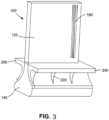
- the blade 100 may be a turbine blade or vane used in the hot section of the engine.
- the blade 100 has an airfoil portion 120 and a root portion 140.
- the airfoil portion 120 and the root portion 140 may be an integral structure formed from a plurality of plies 180 of a ceramic matrix composite material.
- the blade 100 also has a platform 200 and one or more optional buttresses 220 formed from a platform assembly structure 240.
- the platform assembly structure 240 is formed from a ceramic matrix composite material. More details of forming the blade 100 can be found in pending patent application 13/173,308 incorporated by reference herein.
- Ionic derivatives of preceramic materials can be utilized in many applications including a) high temperature structural composite materials and protective coatings, b) power electronic systems, c) high temperature coolants or heat transfer materials, d) high temperature lubricants with near zero volatility, e) water or polar solvent-dispersible resins for CMC processing.
Landscapes
- Chemical & Material Sciences (AREA)
- Engineering & Computer Science (AREA)
- Ceramic Engineering (AREA)
- Materials Engineering (AREA)
- Manufacturing & Machinery (AREA)
- Structural Engineering (AREA)
- Organic Chemistry (AREA)
- Chemical Kinetics & Catalysis (AREA)
- Mechanical Engineering (AREA)
- General Engineering & Computer Science (AREA)
- Ceramic Products (AREA)
- Turbine Rotor Nozzle Sealing (AREA)
Applications Claiming Priority (2)
| Application Number | Priority Date | Filing Date | Title |
|---|---|---|---|
| US16/173,436 US11097986B2 (en) | 2015-05-29 | 2018-10-29 | Preceramic ionic systems |
| EP19206043.2A EP3647298A1 (de) | 2018-10-29 | 2019-10-29 | Präkeramische ionische systeme |
Related Parent Applications (1)
| Application Number | Title | Priority Date | Filing Date |
|---|---|---|---|
| EP19206043.2A Division EP3647298A1 (de) | 2018-10-29 | 2019-10-29 | Präkeramische ionische systeme |
Publications (2)
| Publication Number | Publication Date |
|---|---|
| EP4245964A2 true EP4245964A2 (de) | 2023-09-20 |
| EP4245964A3 EP4245964A3 (de) | 2023-11-08 |
Family
ID=68392826
Family Applications (2)
| Application Number | Title | Priority Date | Filing Date |
|---|---|---|---|
| EP19206043.2A Withdrawn EP3647298A1 (de) | 2018-10-29 | 2019-10-29 | Präkeramische ionische systeme |
| EP23185089.2A Pending EP4245964A3 (de) | 2018-10-29 | 2019-10-29 | Präkeramische ionische systeme |
Family Applications Before (1)
| Application Number | Title | Priority Date | Filing Date |
|---|---|---|---|
| EP19206043.2A Withdrawn EP3647298A1 (de) | 2018-10-29 | 2019-10-29 | Präkeramische ionische systeme |
Country Status (1)
| Country | Link |
|---|---|
| EP (2) | EP3647298A1 (de) |
Family Cites Families (6)
| Publication number | Priority date | Publication date | Assignee | Title |
|---|---|---|---|---|
| US7056849B2 (en) * | 2004-01-16 | 2006-06-06 | General Electric Company | Nanoscale ordered composites of covalent ceramics for high-temperature structural applications via block-copolymer-assisted assembly and method of making |
| US7749425B2 (en) * | 2005-12-21 | 2010-07-06 | General Electric Company | Nanoscale ceramic composites and methods of making |
| US8710169B2 (en) * | 2012-01-18 | 2014-04-29 | United Technologies Corporation | Method of treating a preceramic material |
| US10501378B2 (en) * | 2015-02-24 | 2019-12-10 | United Technologies Corporation | Conformal composite coatings and methods |
| US20160347670A1 (en) * | 2015-05-29 | 2016-12-01 | United Technologies Corporation | Preceramic ionic systems |
| US10240065B2 (en) * | 2015-12-18 | 2019-03-26 | Hrl Laboratories, Llc | Reversible, chemically or environmentally responsive polymers, and coatings containing such polymers |
-
2019
- 2019-10-29 EP EP19206043.2A patent/EP3647298A1/de not_active Withdrawn
- 2019-10-29 EP EP23185089.2A patent/EP4245964A3/de active Pending
Also Published As
| Publication number | Publication date |
|---|---|
| EP3647298A1 (de) | 2020-05-06 |
| EP4245964A3 (de) | 2023-11-08 |
Similar Documents
| Publication | Publication Date | Title |
|---|---|---|
| EP3098210B1 (de) | Präkeramische ionische systeme | |
| Alemán et al. | Definitions of terms relating to the structure and processing of sols, gels, networks, and inorganic-organic hybrid materials (IUPAC Recommendations 2007) | |
| Kim et al. | Pyrolysis behavior of polysilazane and polysilazane-coated-boron nitride for high thermal conductive composite | |
| Wang et al. | Synthesis of ZrC–SiC powders from hybrid liquid precursors with improved oxidation resistance | |
| JP4425510B2 (ja) | 膨張黒鉛からなるアクリル樹脂含浸体 | |
| Dueramae et al. | Highly filled graphite polybenzoxazine composites for an application as bipolar plates in fuel cells | |
| US11873258B2 (en) | Preceramic ionic systems | |
| Huang et al. | Synthesis and properties of liquid polycarbosilanes with hyperbranched structures | |
| CN103787661A (zh) | 一种MoSi2-RSiC复合材料的制备方法 | |
| Yuan et al. | Poly (phenylene oxide) modified cyanate resin for self‐healing | |
| EP4245964A2 (de) | Präkeramische ionische systeme | |
| Onuchin et al. | Rheokinetics of the curing of epoxy oligomer ED-20 modified with epoxy phosphazenes | |
| CN104875395A (zh) | 一种用于选择性激光烧结的成形材料的制备方法 | |
| Zhang et al. | Curing mechanism, heat resistance, and anticorrosion properties of a furan/methyl phenyl silicone coating | |
| CA2960454A1 (en) | Fuel cell separator | |
| TW201827526A (zh) | 交聯性有機聚矽氧烷組成物、其硬化物及led裝置 | |
| Farhan et al. | Kinetic of thermal degradation of RTV silicon rubber blends reinforced with nanoparticles by TGA and DSC analysis techniques | |
| Tan et al. | Dielectric films enhanced with SiC@ PDA‐PEI for improved energy storage and insulation performance | |
| Ke et al. | Curing kinetics of hybrid networks composed of benzoxazine and multifunctional novolac epoxy | |
| Gao et al. | Synthesis of poly (methylphenylsiloxane)/phenylene‐silica hybrid material with interpenetrating networks and its performance as thermal resistant coating | |
| CN108975916B (zh) | 一种高导电性陶瓷材料的制备方法 | |
| CN115044042A (zh) | 一种基于环硅氧烷制备的苯基有机硅树脂及其制备方法 | |
| Chauveau et al. | Phosphonic acid‐containing polysulfones as anticorrosive layers | |
| Saxena et al. | Epoxy‐tert‐butyl poly (cyanoarylene ether) blends: Phase morphology, fracture toughness, and mechanical properties | |
| Hu et al. | Preparation and ablative behaviors of carbon fiber‐reinforced polydimethylsiloxane‐co‐poly (silylene acetylenearyleneacetylene) composites |
Legal Events
| Date | Code | Title | Description |
|---|---|---|---|
| PUAI | Public reference made under article 153(3) epc to a published international application that has entered the european phase |
Free format text: ORIGINAL CODE: 0009012 |
|
| STAA | Information on the status of an ep patent application or granted ep patent |
Free format text: STATUS: THE APPLICATION HAS BEEN PUBLISHED |
|
| AC | Divisional application: reference to earlier application |
Ref document number: 3647298 Country of ref document: EP Kind code of ref document: P |
|
| AK | Designated contracting states |
Kind code of ref document: A2 Designated state(s): AL AT BE BG CH CY CZ DE DK EE ES FI FR GB GR HR HU IE IS IT LI LT LU LV MC MK MT NL NO PL PT RO RS SE SI SK SM TR |
|
| REG | Reference to a national code |
Ref country code: DE Ref legal event code: R079 Free format text: PREVIOUS MAIN CLASS: F01D0005280000 Ipc: C04B0035571000 |
|
| PUAL | Search report despatched |
Free format text: ORIGINAL CODE: 0009013 |
|
| RAP3 | Party data changed (applicant data changed or rights of an application transferred) |
Owner name: RTX CORPORATION |
|
| AK | Designated contracting states |
Kind code of ref document: A3 Designated state(s): AL AT BE BG CH CY CZ DE DK EE ES FI FR GB GR HR HU IE IS IT LI LT LU LV MC MK MT NL NO PL PT RO RS SE SI SK SM TR |
|
| RIC1 | Information provided on ipc code assigned before grant |
Ipc: F01D 5/28 20060101ALI20231002BHEP Ipc: C04B 35/80 20060101ALI20231002BHEP Ipc: C04B 35/571 20060101AFI20231002BHEP |
|
| STAA | Information on the status of an ep patent application or granted ep patent |
Free format text: STATUS: REQUEST FOR EXAMINATION WAS MADE |
|
| 17P | Request for examination filed |
Effective date: 20240502 |
|
| RBV | Designated contracting states (corrected) |
Designated state(s): AL AT BE BG CH CY CZ DE DK EE ES FI FR GB GR HR HU IE IS IT LI LT LU LV MC MK MT NL NO PL PT RO RS SE SI SK SM TR |