EP4245191B1 - Anpassbare matratzenabdeckungsanordnung - Google Patents
Anpassbare matratzenabdeckungsanordnung Download PDFInfo
- Publication number
- EP4245191B1 EP4245191B1 EP22162087.5A EP22162087A EP4245191B1 EP 4245191 B1 EP4245191 B1 EP 4245191B1 EP 22162087 A EP22162087 A EP 22162087A EP 4245191 B1 EP4245191 B1 EP 4245191B1
- Authority
- EP
- European Patent Office
- Prior art keywords
- mattress
- piece
- assembly
- planar
- cover assembly
- Prior art date
- Legal status (The legal status is an assumption and is not a legal conclusion. Google has not performed a legal analysis and makes no representation as to the accuracy of the status listed.)
- Active
Links
Images

Classifications
-
- A—HUMAN NECESSITIES
- A47—FURNITURE; DOMESTIC ARTICLES OR APPLIANCES; COFFEE MILLS; SPICE MILLS; SUCTION CLEANERS IN GENERAL
- A47C—CHAIRS; SOFAS; BEDS
- A47C27/00—Spring, stuffed or fluid mattresses or cushions specially adapted for chairs, beds or sofas
- A47C27/14—Spring, stuffed or fluid mattresses or cushions specially adapted for chairs, beds or sofas with foamed material inlays
- A47C27/15—Spring, stuffed or fluid mattresses or cushions specially adapted for chairs, beds or sofas with foamed material inlays consisting of two or more layers
-
- A—HUMAN NECESSITIES
- A47—FURNITURE; DOMESTIC ARTICLES OR APPLIANCES; COFFEE MILLS; SPICE MILLS; SUCTION CLEANERS IN GENERAL
- A47C—CHAIRS; SOFAS; BEDS
- A47C31/00—Details or accessories for chairs, beds, or the like, not provided for in other groups of this subclass, e.g. upholstery fasteners, mattress protectors, stretching devices for mattress nets
- A47C31/10—Loose or removable furniture covers
- A47C31/105—Loose or removable furniture covers for mattresses
-
- A—HUMAN NECESSITIES
- A47—FURNITURE; DOMESTIC ARTICLES OR APPLIANCES; COFFEE MILLS; SPICE MILLS; SUCTION CLEANERS IN GENERAL
- A47D—FURNITURE SPECIALLY ADAPTED FOR CHILDREN
- A47D15/00—Accessories for children's furniture, e.g. safety belts or baby-bottle holders
- A47D15/001—Mattresses
Definitions
- the present invention relates to an adaptable cover assembly for covering of an acid reflux mattress, which is a mattress suitable for treatment of symptoms related due to gastroesophageal reflux or regurgitation.
- the present invention further relates to a set comprising said assembly and an adaptable mattress. Also methods for using and manufacturing of said assembly are disclosed herein.
- stomach may reflux up through the infant's oesophagus resulting in aspiration of the solution into the lungs, causing apnoea, respiratory infections and lung damage.
- gastroesophageal reflux report great discomfort and may even develop secondary pathologies such as heartburn or acid indigestion.
- a prior art (PA) mattress cover only fits a single shape of mattress, i.e., either a normal or a sloped mattress.
- PA prior art
- the user is forced to purchase each cover twice, one fitting each type of mattress, which presents an economical burden.
- the user has to look for another cover which, especially during night-time, is impractical and needlessly timewasting.
- a mattress configurable between a normal and a sloped arrangement having a three-part cover is known from WO 2021/053606 A1 .
- the present disclosure aims to provide a solution to the needs of the prior art as described above .
- a cover assembly is described which allows a user to easily switch from a planar configuration that fits over a normal i.e. horizontal mattress, to a sloped configuration that fits over an inclined mattress.
- the disclosed cover assembly has the advantage that a single product needs to be purchased to fit the different mattress types.
- the disclosed cover assembly has the advantage of being more economical, timesaving and practical compared to prior art mattress covers.
- Embodiments of the herein disclosed cover assembly have the further advantages of making the cover assembly more user friendly and intuitive to use.
- the application of the described assembly is not limited to this therapeutic treatment.
- the herein described cover assembly might also be implemented for other medical or even non-medical applications wherein the provision of an adaptable horizontal / inclined lying surface can be regarded as advantageous.
- Other applications may include, for example, increasing the lying comfort of disabled, elderly or bedridden persons who are forced to reside in the bed for extended periods of time.
- persons suffering from back or lower body problems might benefit from lying on an inclined surface with their feet raised above their head or torso.
- the herein described cover assembly can be easily implemented for such applications, requiring little to no modifications, and hence are also contemplated within the scope of the present disclosure.
- the present invention describes a cover assembly comprising:
- the sloped outer edge of the sloped edged lateral sides 14,15,24,25 of the top and/or bottom pieces 1,2 have a slope angle of at least 2.5° to at most 15.0° relative to its planar side 11,21; preferably 3.5° to 12.5°, more preferably 5.0° to 10.0°, for example 6.0° or 7.5°.
- the upper surface 11 of the cover assembly 10 when arranged in the sloped configuration has a slope of at least 5.0° to at most 30.0° relative to its bottom surface 21); preferably 7.5° to 25.0°, more preferably 10.0° to 20.0°, for example 11.0° or 15.0°.
- the upper surface 11 of the cover assembly 10 when arranged in the planar configuration has a slope of less than 5.0° relative to its bottom surface 21); preferably less than 4.0°, more preferably less than 3.0°, even more preferably less than 2.0°, even more preferably less than 1.0°, for example 0.5° or 0°.
- planar side 11 of the top piece substantially overlaps with the planar side 21 of the bottom piece, preferably has substantially the same surface area.
- fastening device 3 comprises a zipper, a series of buttons, a hook and loop fastener, a series of strips or straps, and/or a combination thereof.
- fastening device 3 comprises a two-way zipper which can be closed or opened in two opposite directions at the same time.
- one straight edged lateral side 12,22 of the top and/or bottom pieces 1,2 has a height of at least 0.5 cm to at most 5.0 cm, preferably 1.0 cm to 4.5 cm, more preferably 1.5 cm to 4.0 cm, more preferably still 2.0 cm to 3.5 cm, more preferably still 2.0 cm to 3.0 cm, for example 2.5 cm; and the opposite straight edged lateral side 13, 23 of the same top and/or bottom pieces 1,2 has a height of at least 5.5 cm to at most 10.0 cm, preferably 6.0 cm to 9.5 cm, more preferably 6.5 cm to 9.0 cm, more preferably still 7.0 cm to 8.5 cm, more preferably still 7.0 cm to 8.0 cm, for example 7.5 cm.
- planar and/or lateral sides of the top and/or bottom pieces 1,2 are comprised of a thermoplastic, preferably a polysulfone PES.
- the planar and/or lateral sides of the top and/or bottom pieces 1,2 are comprised of PES with a material density of at least 250 g/m 2 to at most 350 g/m 2 , preferably 260 g/m 2 to 340 g/m 2 , preferably 270 g/m 2 to 330 g/m 2 , preferably 280 g/m 2 to 320 g/m 2 , for example 290 g/m 2 or 300 g/m 2 .
- planar and/or lateral sides of the top and/or bottom pieces 1,2 are comprised of comprised of a mixture of a thermoplastic and Polyurethane PU, preferably PES and PU, such that said side is water resistant, preferably waterproof.
- planar and/or lateral sides of the top and/or bottom pieces 1,2 are comprised of a mixture comprising at least 80% PES to at most 20% PU, preferably 85% PES to 15% PU, more preferably 90% PES to 10% PU, for example 91% PES to 11% PU.
- a further aspect of the present invention relates to a cover and mattress set comprising:
- the cover assembly 10 can be assembled in a planar or sloped configuration so as to correspond with the level or inclined arrangement of said mattress 30; specifically, the planar configuration of said assembly on the level arrangement of said mattress, and the sloped configuration of said assembly on the inclined arrangement of said mattress.
- the upper surface of the mattress 30 when in the inclined arrangement has a slope of at least 5.0° to at most 30.0° relative to its bottom surface; preferably 7.5° to 25.0°, more preferably 10.0° to 20.0°, for example 11.0° or 15.0°.
- the upper surface of the mattress 30 when in the horizontal arrangement has a slope of less than 5.0° relative to its bottom surface 21; preferably less than 4.0°, more preferably less than 3.0°, even more preferably less than 2.0°, even more preferably less than 1.0°, for example 0.5° or 0°.
- a further aspect of the present invention relates to method for manufacturing a cover assembly 10 according to one of claims 1 to 11, the method comprising the steps of:
- a further aspect of the present invention relates to a method for arranging the herein disclosed cover assembly in a sloped configuration, optionally starting from a planar configuration, the method comprising the steps of:
- a further aspect of the present invention relates to a method for arranging the herein disclosed cover assembly in a planar configuration, optionally starting from a sloped configuration, the method comprising the steps of:
- a further aspect of the present invention relates to a use of the cover assembly for covering an inclined or inclinable mattress, preferably a mattress for raising the upper body, such as an acid reflux mattress, or a mattress for disabled, elderly or bedridden persons, and/or a mattress for raising the lower body, such as the feet or legs.
- an inclined or inclinable mattress preferably a mattress for raising the upper body, such as an acid reflux mattress, or a mattress for disabled, elderly or bedridden persons, and/or a mattress for raising the lower body, such as the feet or legs.
- the term “substantially” refers to the complete or nearly complete extent or degree of an action, characteristic, property, state, structure, item, or result.
- an object that is “substantially” enclosed would mean that the object is either completely enclosed or nearly completely enclosed.
- the exact allowable degree of deviation from absolute completeness may in some cases depend on the specific context. However, generally speaking the nearness of completion will be so as to have the same overall result as if absolute and total completion were obtained.
- the use of “substantially” is equally applicable when used in a negative connotation to refer to the complete or near complete lack of an action, characteristic, property, state, structure, item, or result.
- compositions that is "substantially free of” particles would either completely lack particles, or so nearly completely lack particles that the effect would be the same as if it completely lacked particles.
- a composition that is "substantially free of” an ingredient or element may still actually contain such item as long as there is no measurable effect thereof.
- the term “about” is used to provide flexibility to a numerical range endpoint by providing that a given value may be “a little above” or “a little below” the endpoint. Unless otherwise stated, use of the term “about” in accordance with a specific number or numerical range should also be understood to provide support for such numerical terms or range without the term “about”. For example, for the sake of convenience and brevity, a numerical range of "about 50 angstroms to about 80 angstroms” should also be understood to provide support for the range of "50 angstroms to 80 angstroms.” Furthermore, it is to be understood that in this specification support for actual numerical values is provided even when the term “about” is used therewith. For example, the recitation of "about” 30 should be construed as not only providing support for values a little above and a little below 30, but also for the actual numerical value of 30 as well.
- the present disclosure aims to provide a solution to the needs of the prior art as described above .
- a mattress cover assembly or simply cover assembly is described which allows a user to easily switch from a planar configuration that fits over a normal i.e. horizontal mattress, to a sloped configuration that fits over an inclined mattress.
- the disclosed cover assembly has the advantage that a single product needs to be purchased to fit the different mattress types.
- the disclosed cover assembly has the advantage of being more economical, timesaving and practical compared to prior art mattress covers.
- Embodiments of the herein disclosed cover assembly have the further advantages of making the cover assembly more user friendly and intuitive to use.
- cover assembly in the present disclosure is described with relation to an acid reflux mattress which is suitable for treatment of symptoms related due to gastroesophageal reflux or regurgitation.
- this application is merely exemplary in nature and is not meant to limit the scope of the present invention.
- the herein described cover assembly might also be implemented for other medical or even non-medical applications wherein the provision of an adaptable horizontal / inclined lying surface can be regarded as advantageous.
- Other applications may include, for example, increasing the lying comfort of disabled, elderly or bedridden persons who are forced to reside in the bed for extended periods of time.
- persons suffering from back or feet problem might benefit from lying on an inclined surface with their feet raised above their head or torso.
- the skilled person understands that the herein described cover assembly can be easily implemented for such applications, requiring little to no modifications, and hence are also contemplated within the scope of the present disclosure.
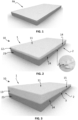
- FIG. 2 shows one possible embodiment of the cover assembly 10 comprising a top piece 1 and a bottom piece 2 which are fastened together by a fastening device 3 to form a mattress cover.
- the shown cover assembly 10 is placed over a horizontal mattress.
- the top piece 1 comprises a planar side 11 forming the top surface, and four lateral sides, specifically, two oppositely arranged lateral sides having a straight outer edge 12,13 and two oppositely arranged lateral sides having a sloped outer edge 14,15.
- the bottom piece 2 is comprised of a planar side 21 forming the bottom surface not shown and four lateral sides, specifically, two oppositely arranged lateral sides having a straight outer edge 22,23 and two oppositely arranged lateral sides having a sloped outer edge 24,25.
- the planar side 11 of the top piece 1 has the same surface area as the planar side 21 of the bottom piece so as to properly overlap when the piece are fastened together.
- the straight edged lateral sides 13,14 of the top piece have a different height, specifically, the shown straight edged lateral side 12 has a lower height than the opposite straight edged lateral side 13.
- the bottom piece 2 specifically, the shown straight edged lateral side 22 has a higher height than the opposite straight edged lateral side 23. This difference in height determines the slope angle of the sloped edged lateral sides of the top piece 14,15 and the bottom piece 24,25.
- the cover assembly 10 can be freely arranged between two different configuration depending on the positioning of the top piece 1 and the bottom piece 2 relative to each other.
- the two configurations can be easily understood by comparing FIG. 2 , which shows a planar configuration that can fit onto a horizontal mattress, with FIG. 3 , which shows a sloped configuration that can fit onto an inclined mattress.
- FIG. 2 shows a planar configuration that can fit onto a horizontal mattress
- FIG. 3 shows a sloped configuration that can fit onto an inclined mattress.
- the higher straight edged side 13 of the top piece is aligned with the shorter straight edged side 22 of the bottom piece while the shorter straight edged side 12 of the top piece is aligned with the higher straight edged side 23 of the bottom piece.
- the higher straight edged side 13 of the top piece is aligned with the higher straight edged side 23 of the bottom piece while the shorter straight edged side 13 of the top piece is aligned with the shorter straight edged side 23 of the bottom piece.
- the present disclosure describes a cover assembly, the cover comprising a top piece, a bottom piece and a fastening device configured to fasten the top piece to the bottom piece; wherein each one of the top and bottom pieces are comprised of a planar side, two oppositely arranged lateral sides having a straight outer edge and two oppositely arranged lateral sides having a sloped outer edge; wherein one straight edged lateral side has a higher height than the opposite straight edged lateral side so that it extends past it and which height difference determines the slope angle of the sloped edged lateral sides; wherein the cover assembly is configured for free arrangement between: a planar configuration, wherein the higher straight edged side of the top piece is aligned with the shorter straight edged side of the bottom piece and the shorter straight edged side of the top piece is aligned with the higher straight edged side of the bottom piece; and, a sloped configuration, wherein the higher straight edged side of the top piece is aligned with the higher straight edged side of the bottom piece and
- a further aspect of the present disclosure relates to a cover assembly for a substantially rectangular mattress comprising: a top piece, a bottom piece and a fastening device; wherein the top piece comprises a top planar side adjoined along its length by two opposite short lateral sides and adjoined along its width by two opposite long lateral sides, wherein the two short lateral sides have different heights such that one greater, short lateral side is greater than the opposite smaller, short lateral side, and wherein the long lateral sides have a sloped surface relative to the top planar side; wherein the bottom piece comprises a bottom planar side adjoined along its length by two short lateral sides and two long lateral sides, wherein the two short lateral sides have different heights such that one greater, short lateral side is shorter than the opposite smaller, short lateral side, and wherein the long lateral sides have a sloped surface relative to the bottom planar side; wherein the fastening device is configured to fasten the top piece with the bottom piece along the length of the short and/or long lateral sides;
- a further aspect of the present disclosure relates to a mattress and cover set comprising: the cover assembly as described in the present disclosure; and, a switchable mattress.
- the switchable mattress comprises two mattress components which form a mattress when one is placed on top of the other, each component comprising an inclined surface and an opposite planar surface; wherein said mattress can be freely switched between a horizontal arrangement and an inclined arrangement by rotating the components relative to each other.
- the cover assembly can be assembled in the planar configuration in accordance with the level arrangement of said mattress, and in the sloped configuration in accordance with the inclined arrangement of said mattress.
- a further aspect of the present disclosure relates to an acid reflux mattress and cover set comprising: a cover assembly as described in the present disclosure; and, an acid reflux mattress.
- the acid reflux mattress comprises: a first element comprising a top planar side adjoined along its length by two opposite short lateral sides and adjoined along its width two opposite long lateral sides, wherein the two short lateral sides have different heights such that one greater, short lateral side is greater than the opposite smaller, short lateral side, and wherein the long lateral sides have a sloped surface relative to the planar side; a second element comprising a bottom planar side adjoined its length by two short lateral sides and two long lateral sides, wherein the two short lateral sides have different heights such that one greater, short lateral side is shorter than the opposite smaller, short lateral side, and wherein the long lateral sides have a sloped surface relative to the planar side.
- the acid reflux mattress is preferably configured for free arrangement between: a planar configuration, wherein the greater, short lateral side of the first element is aligned with the smaller, short lateral side of the second element, and the smaller, short lateral side of the first element is aligned with the greater, short lateral side of the bottom piece and vice versa; and, a sloped configuration, wherein the greater, short lateral side of the first element is aligned with the greater, short lateral side of the bottom piece, and the smaller, short lateral side of the first element is aligned with the smaller, short lateral side of the bottom piece and vice versa.
- the term "user” as used throughout the present disclosure refers to an infant or an adult making use of the herein disclosed the cover assembly and/or mattress, unless otherwise specified.
- the difference between an infant and adult mattress is primarily related to the mattress / cover size and slope angle, but the technological concept underlying the disclosed mattress / cover is not limited to any specific dimension thereof or slope angle.
- a typical rectangular mattress has two planar sides which form the top and bottom of said mattress, and four lateral sides spacing apart said planar sides .
- planar or “level” refers to a surface or side having a substantially horizontal or a level surface, whereas “sloped” or “inclined” surface or side that leans away from the horizontal at an angle with reference to the horizontal reference plane.
- top and bottom with reference to the pieces of the cover assembly indicate a preferred positioning of the pieces relative to the covered mattress, e.g. the top is preferably positioned on the top of the mattress and the bottom is preferably positioned on its bottom.
- the top and bottom piece are not functionally limited to a top and bottom position, respectively, but can be used interchangeably, e.g., the top piece can be placed on the bottom and the bottom piece can be placed on the top of the mattress, unless otherwise specified.
- top and bottom with reference to a surface indicate the positioning of these surfaces relative to each other, e.g., the top surface may form the uppermost surface.
- the top surface of the cover assembly or mattress may typically form the sleeping side, i.e., the side on top of which the user lies down to sleep.
- the opposite bottom side may typically form the side that is in contact with the sleeping furniture, such as the bed frame or foundation.
- planar configuration with reference to the cover assembly refers to a configuration in which the top surface of the cover assembly or mattress is substantially parallel to its bottom surface.
- substantially parallel refers to a slope angle between said top and bottom surfaces that is equal to or at most 5.0°, preferably at most 4.0°, more preferably at most 3.0°, even more preferably at most 2.0°, even more preferably at most 1.0°, for example 0.5° or even 0°.
- the same definition extends to a mattress when it is referred to as being horizontal or having a horizontal arrangement.
- sloped configuration refers to a configuration in which the top planar side of the cover assembly is substantially angled to the bottom planar side, preferably with a difference of at least 2.0°, preferably at least 4.0°, more preferably at least 5.5°, even more preferably at least 11.0°, even more preferably at least 15.0°, for example 20.0°. It may be appreciated that the preferred slope angle can be different whether the user is an infant or an adult, specifically, an adult user may benefit from having a higher sloped angle compared to an infant user, as will be elaborated further below. The same definition extends to a mattress when it is referred to as being inclined or having an inclined arrangement.
- the term "fastening device” refers to a technical provision for reversibly connecting two different pieces of the mattress assembly. Specifically, the fastening device is intended to connect the top piece and bottom piece to each other for the entire mattress outline, such that the top and bottom pieces can be super-positioned onto each other, and such that surface of the top piece is substantially congruent with respect to the surface of the bottom piece.
- the fastening device preferably fastens the top piece with the bottom piece along the length of the short and/or along the long lateral sides.
- the fastening device is preferably operative in two opposite directions, preferably revolving around the outline of the top and bottom piece.
- the fastening device preferably fastens the top piece to the bottom piece at any point of the outline of the top piece and bottom piece.
- the fastening device preferably operates in at least two opposite directions, such that the top piece and the bottom piece can be effectively fastened ensuring an effective connection between top and bottom pieces.
- the fastening device comprises one or more zippers, a series of buttons, a hook and loop, a series of strips and/or a combination thereof.
- the provision of a zipper may be regarded as more beneficial for improving the safety of the assembly such that the pieces to not disconnect during use.
- the fastening device comprises a two-way zipper, which is a zipper that that can be closed or opened in two opposite directions at the same time.
- the provision of a two-way zipper may be regarded as particularly beneficial for making the assembly more user friendly and intuitive to use.
- the sloped outer edge of the sloped edged lateral sides of the top piece has a slope angle of at least 2.5° to at most 15.0° relative to its planar side; preferably 1.5° to 19.0°, more preferably still 2.0° to 18.0°, more preferably still 2.5° to 17.0°, more preferably still 3.0° to 16.0°, more preferably still 3.5° to 15.0°, more preferably still 4.0° to 14.0°, more preferably still 4.5° to 13.0°, more preferably still 5.0° to 12.0°, more preferably still 5.0° to 11.0°, more preferably still 5.0° to 10.0°, for example 6.0°, 7.5° or 9.0°.
- the sloped outer edge of the sloped edged lateral sides of the bottom piece has a slope angle of at least 1.0° to at most 20.0° relative to its planar side; preferably 1.5° to 19.0°, more preferably still 2.0° to 18.0°, more preferably still 2.5° to 17.0°, more preferably still 3.0° to 16.0°, more preferably still 3.5° to 15.0°, more preferably still 4.0° to 14.0°, more preferably still 4.5° to 13.0°, more preferably still 5.0° to 12.0°, more preferably still 5.0° to 11.0°, more preferably still 5.0° to 10.0°, for example 6.0°, 7.5° or 9.0°.
- the upper surface of said cover has a slope of at least 2.5° to at most 30.0° relative to its bottom surface, preferably 5.0° to 27.5°, more preferably 7.5° to 25.0°, more preferably still 10.0° to 22.5°, more preferably still 10.0° to 20.0°, for example 12.5°, 15.0° or 17.5°.
- the upper surface of said mattress has a slope of at least 2.5° to at most 30.0° relative to its bottom surface, preferably 5.0° to 27.5°, more preferably 7.5° to 25.0°, more preferably still 10.0° to 22.5°, more preferably still 10.0° to 20.0°, for example 12.5°, 15.0° or 17.5°.
- angles are suitable for a more generic embodiment of the cover assembly / mattress to minimise the occurrence of acid reflux symptoms in most types of user while still ensuring sufficient sleeping comfort. Nonetheless, the skilled person understands that realised slope may deviate from the above-listed values in real life applications, for example because of specific user wishes. For example, in case of extreme acid reflux the angle may exceed 30°. Accordingly, the list maximal values should be interpreted as a guideline rather than an absolute maximum.
- the upper surface of said cover is substantially parallel to its bottom surface.
- the upper surface has a slope of at most 5.0° relative to its bottom surface; more preferably at most 4.0°, more preferably still at most 3.0°, more preferably at most 3.0°, more preferably still at most 1.0°, preferably at most 0.5°, preferably at most 0.2°, preferably at most 0.1°.
- the upper surface of said mattress is substantially parallel to its bottom surface.
- the upper surface has a slope of at most 5.0° relative to its bottom surface; more preferably at most 4.0°, more preferably still at most 3.0°, more preferably at most 3.0°, more preferably still at most 1.0°, preferably at most 0.5°, preferably at most 0.2°, preferably at most 0.1°.
- the upper surface of said cover has a slope of at least 5.0° to at most 15.0° relative to its bottom surface, preferably 7.0° to 15.0 °, more preferably 8.0° to 14.0°, more preferably still 9.0° to 13.0°, more preferably still 10.0° to 12.°, for example 11.0°.
- the listed angles are particularly suitable for minimizing the occurrence of acid reflux in infants because the infant's body has more difficulty to tolerate higher slope angles.
- the upper surface of said cover has a slope of at least 15.0° to at most 25.0° relative to its bottom surface, preferably 16.0° to 24.0 °, more preferably 17.0° to 23.0°, more preferably still 18.0° to 22.0°, more preferably still 19.0° to 21.°, for example 20.0°.
- the listed angles are particularly suitable for minimizing the occurrence of acid reflux in adults because the adult body can tolerate higher slope angles.
- one straight edged lateral side of the top piece has a height of at least 0.5 cm to at most 5.0 cm, preferably 1.0 cm to 4.5 cm, more preferably 1.5 cm to 4.0 cm, more preferably still 2.0 cm to 3.5 cm, more preferably still 2.0 cm to 3.0 cm, for example 2.5 cm; and the opposite straight edged lateral side of the same top piece has a height of at least 5.5 cm to at most 10.0 cm, preferably 6.0 cm to 9.5 cm, more preferably 6.5 cm to 9.0 cm, more preferably still 7.0 cm to 8.5 cm, more preferably still 7.0 cm to 8.0 cm, for example 7.5 cm.
- one straight edged lateral side of the bottom piece has a height of at least 0.5 cm to at most 5.0 cm, preferably 1.0 cm to 4.5 cm, more preferably 1.5 cm to 4.0 cm, more preferably still 2.0 cm to 3.5 cm, more preferably still 2.0 cm to 3.0 cm, for example 2.5 cm; and the opposite straight edged lateral side of the same bottom piece has a height of at least 5.5 cm to at most 10.0 cm, preferably 6.0 cm to 9.5 cm, more preferably 6.5 cm to 9.0 cm, more preferably still 7.0 cm to 8.5 cm, more preferably still 7.0 cm to 8.0 cm, for example 7.5 cm.
- the top and bottom piece short sides' height is preferably at least 1.0 cm to at most 10.0 cm, more preferably at least 1.5 cm to at most 9.0 cm, even more preferably at least 2.0 cm to at most 8.0 cm, and wherein the top and bottom piece long sides' height is preferably at least 1.0 cm to at most 10.0 cm, more preferably at least 1.5 cm to at most 9.0 cm, and even more preferably at least 2.0 cm to at most 8.0 cm.
- a cover assembly is particularly suited for infant's mattresses.
- the top and bottom piece short sides' height is preferably at least 1.0 cm to at most 16.0 cm, more preferably at least 2.0 cm to at most 14.0 cm, even more preferably at least 3.0 cm to at most 12.0 cm, and wherein the top and bottom piece long sides' height is preferably at least 1.0 cm to at most 16.0 cm, more preferably at least 2.0 cm to at most 14.0 cm, and even more preferably at least 3.0 cm to at most 12.0 cm.
- a cover assembly is particularly suited for adult's mattresses.
- the top and bottom piece short sides' height is preferably at least 1.0 cm to at most 10.0 cm, more preferably at least 1.5 cm to at most 9.0 cm, even more preferably at least 2.0 cm to at most 8.0 cm.
- the top and bottom piece long sides' height is preferably at least 2.0 cm to at most 22.0 cm, more preferably at least 4.0 cm to at most 20.0 cm, and even more preferably at least 6.0 cm to at most 18.0 cm.
- the top piece and the bottom piece have the same height difference between the short side and the long side. This allows for the mattress to obtain a perfectly planar configuration.
- the height difference between the short side and the long side of the top piece differs from the height difference between the short side and the long side of the bottom piece in at most 2.0 cm, preferably at most 1.5 cm, preferably at most 1.0 cm, preferably at most 0.5 cm, for example 0.1 cm or 0 cm.
- the top and bottom piece short sides' height has a difference with the top and bottom piece long sides' height of at least 2.0 to at most 22.0 cm, preferably of at least 4.0 to at most 20.0 cm, preferably about 6.0 to at most 18.0 cm.
- the height difference between the top and bottom piece short sides' height enables the assembly cover to be flexibly deployed in both sloped and planar configurations.
- the top and bottom piece short sides' height has a difference with the top and bottom piece long sides' height of at least 2.0 to at most 10.0 cm, preferably of at least 4.0 to at most 8.0 cm, preferably about 6.0 cm.
- the difference in height between the top and bottom piece short sides' height enables the assembly cover to be flexibly deployed.
- the height of the mattress in a planar configuration is 10.0 cm.
- the top and bottom piece short sides' height has a difference with the top and bottom piece long sides' height of at least 2.0 to at most 10.0 cm, preferably of at least 4.0 to at most 8.0 cm, preferably about 16.0 cm.
- the height difference between the top and bottom piece short sides' height enables the assembly cover to be flexibly deployed in both sloped and planar configurations.
- the height of the mattress in a planar configuration is 24.0 cm.
- the top and/or bottom pieces of the assembly cover are comprised of a thermoplastic polymers, preferably a polysulfone (PES).
- Thermoplastic polymers are known for their toughness and stability at high temperatures making them a particularly suitable material for a mattress cover.
- PES has the added benefit of improving the breathability and washability of the cover pieces. This is particularly important for infant applications due to increased risk of overheating and staining of the cover.
- the materials selected is compliant to fire testing certifications in accordance with EN597/1 and EN597/2.
- the cover piece material is PES with a material density of at least 250 g/m 2 to at most 350 g/m 2 , preferably 260 g/m 2 to 340 g/m 2 , preferably 270 g/m 2 to 330 g/m 2 , preferably 280 g/m 2 to 320 g/m 2 , for example 290 g/m 2 or 300 g/m 2 .
- This also enables the top and bottom planar sides not to be flattened with a larger surface (e.g. an adult body, or an infant body), such that the user experiences a good airflow in the fabric under the user body which provides a cool feeling.
- PES has the additional advantage of being completely recyclable, which allows for providing an eco-friendly product to the consumer.
- the top and/or bottom pieces of the assembly cover are comprised of a mixture of a thermoplastic and Polyurethane (PU), preferably PES and PU, such that said side is water resistant, preferably waterproof.
- PU thermoplastic and Polyurethane
- the mixture comprises at least 80% PES to at most 20% PU in wt.%, preferably 85% PES to 15% PU, more preferably 90% PES to 10% PU, for example 91% PES to 11% PU, or 95% PES to 5% PU.
- the cover piece material is a mixture of PES and PU with a material density of at least 300 g/m 2 to at most 370 g/m 2 , preferably 310 g/m 2 to 360 g/m 2 , preferably 320 g/m 2 to 350 g/m 2 , preferably 330 g/m 2 to 340 g/m 2 , for example 335 g/m 2 or 337 g/m 2 .
- edges of the top and/or bottom pieces of the assembly cover preferably connecting the planar and lateral sides of said pieces, have a seam which is comprised of a thermoplastic polymer, preferably PES.
- the seam is PES with a density of at least 270 g/m 2 to at most 370 g/m 2 , preferably 290 g/m 2 to 350 g/m 2 , more preferably 280 g/m 2 to 360 g/m 2 , more preferably still 290 g/m 2 to 350 g/m 2 , more preferably still 300 g/m 2 to 340 g/m 2 , more preferably still 310 g/m 2 to 330 g/m 2 , for example 320 g/m 2 .
- This enables sufficient tensile strength, such that the profile of the cover can be retained more easily.
- the mattress set further comprises a mattress protector for covering the top surface of the cover assembly and/or mattress.
- the mattress protector substantially overlaps with the cover assembly's top surface, specifically, the top planar side. This enables the first protecting layer to be in perfect adherence to the assembly cover top or bottom planar sides, improving the comfort as well as minimizing the occurrence of possible deformations on the cover top and/or bottom planar sides.
- the mattress protector may further cover the lateral sides of the cover assembly and/or mattress.
- the mattress protector substantially overlaps with the assembly cover's short and/or long lateral sides. This enables the first protecting layer to be in perfect adherence to the assembly cover sides, increasing ease-of-use of the mattress protector.
- a further aspect of the present disclosure relates to a use of a cover assembly as described in the present disclosure for use as a mattress cover, preferably for use as a mattress cover for an adaptable mattress.
- a further aspect of the present disclosure relates to a method for arranging the herein disclosed cover assembly in a sloped configuration, optionally starting from a planar configuration.
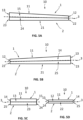
- An example of such sloped configuration is shown in FIGs. 4 A-D , which schematically illustrate the cover assembly in a sloped configuration from different viewing sides.
- FIG. 4A is a view from one of the long sides of said assembly.
- FIG. 4B is a view from one of the short sides of the cover assembly
- 4C is a view from the other long side of the cover assembly
- FIG. 4D is a view from the other short side of the cover assembly.
- the method preferably comprises the steps:
- FIGs. 5 A-D schematically illustrate the cover assembly 10 in a planar configuration from different viewing sides.
- FIG. 5A is a view from one of the long sides of said assembly and 5B is a view from the other long side of the cover assembly.
- FIG. 5C is a view from one of the short sides of the cover assembly and
- FIG. 5D is a view from the other short side of the cover assembly.
- the figures illustrate a preferred embodiment of the cover assembly 10 for the purpose of discussion, but the method is by no means limited to the illustrated embodiment.
- the method preferably comprises the steps:
- a further aspect of the present disclosure relates to a method for manufacturing a cover assembly as described in the present disclosure, the method preferably comprising the steps of:
- the herein disclosed method deviates from a standard manufacturing method in that the pieces are manufactured from asymmetrical materials, e.g., fabrics. Specifically, the pieces may be manufactured by stitching together asymmetrical materials or alternatively by manufacturing a single asymmetrical materials.
- the former embodiment is advantageous due to easier manufacturing.
- the pieces are typically produced from symmetrical materials
- FIG. 2 illustrates a perspective view of a preferred embodiment of the cover assembly 10, comprising a top piece 1, a bottom piece 2 and a fastening device 3, shown from the top planar side 11, adjoined along its length by two opposite short lateral sides 12,13 and adjoined along its width two opposite long lateral sides 14,15.
- the two short lateral sides 12, 13 have a height of 2.0 cm and 8.0 cm respectively for an infant mattress, and have a height of 4.0 cm and 20.0 cm respectively for an adult mattress.
- the long lateral sides 14,15 have a sloped surface relative to the top planar side 11, at an angle of 11.0° for an infant mattress and an angle of 20.0° for an adult mattress.
- the bottom piece 2 comprises a bottom planar side 21 adjoined along its length by two short lateral sides 22,23 and two long lateral sides 24,25.
- the two short lateral sides 22, 23 have a height of 2.0 cm and 8.0 cm respectively.
- the cover assembly comprises a fastening device 3, herein illustrated as a zipper, which fastens the top piece 1 with the bottom piece 2 along the length of the short 12,13 and/or along the long lateral sides 12,13.
- the zipper 3 is operative in two main directions, revolving around the outline of the top 1 and bottom piece 2.
- the zipper 3 fastens the top piece 1 to the bottom piece 2 at any point along the outline of the top piece 1 and bottom piece 2.
- the zipper 3 operates in at least two opposite directions, such that the top piece 1 and the bottom piece 2 can be fastened in a different configurations, as will be described below.
- FIG. 3 shows the same embodiment of the cover assembly 10 of FIG. 2 but in a different configuration. Specifically, the cover assembly 10 as shown in FIG. 2 is in a planar configuration while FIG. 3 shows it in a sloped configuration.
- the different configuration will hereafter.
- the greater, short lateral side 12 of the top piece 1 is aligned with the smaller, short lateral side 23 of the bottom piece 2, and the smaller, short lateral side 13 of the top piece 1 is aligned with the greater, short lateral side 22 of the bottom piece 21.
- Top planar side 11 is parallel to the bottom planar side 21.
- the greater, short lateral side 12 of the top piece 1 is aligned with the greater, short lateral side 22 of the bottom piece 2, and the smaller, short lateral side 13 of the top piece 1 is aligned with the smaller, short lateral side 23 of the bottom piece 2 and vice versa.
- the top planar side 11 is now at an angle that is the sum of the two angles of the two pieces to the bottom planar side 21, in this case 10.0° for an infant mattress and 25.0° for an adult mattress.
- FIGs. 4A-D schematically shows the cover assembly 10 of FIG. 2 in different side views. Specifically, FIG. 4A is a view from one of the long sides of the cover assembly. FIG. 4B is a view from the other long side of the cover assembly. FIG. 4C is a view from one of the short sides of the cover assembly. FIG. 4D is a view from the other short side of the cover assembly.
- FIGs. 5A-D schematically shows the cover assembly 10 of FIG. 3 in different side views.
- FIG. 5A is a view from one of the long sides of the cover assembly.
- FIG. 5B is a view from one of the short sides of the cover assembly.
- FIG. 5C is a view from the other long side of the cover assembly.
- FIG. 5D is a view from the other short side of the cover assembly.
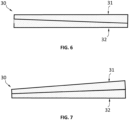
- FIG. 6 illustrates an adaptable mattress 30 in a planar configuration according to an embodiment of the invention.
- the first mattress component 31 is stacked on top of the second mattress component 32 in such as a way that the top surface is horizontal, thereby forming a horizontal mattress.
- FIG. 7 illustrates an adaptable mattress 30 in a planar configuration according to an embodiment of the invention.
- the first mattress component 31 is stacked on top of the second mattress component 32 in such as a way that the top surface is inclined, thus forming an inclined mattress.
Landscapes
- Health & Medical Sciences (AREA)
- General Health & Medical Sciences (AREA)
- Pediatric Medicine (AREA)
- Mattresses And Other Support Structures For Chairs And Beds (AREA)
Claims (15)
- Anpassbare Abdeckungsanordnung (10) für eine Matratze (30) gegen Säurereflux, wobei die Anordnung (10) umfasst:- ein oberes Teil (1), ein unteres Teil (2) und eine Befestigungsvorrichtung (3), die zum Befestigen des oberen Teils (1) an dem unteren Teil (2) ausgebildet ist;- wobei jedes des oberen und des unteren Teils (1,2) aus einer ebenen Seite (11,21), zwei gegenüberliegend angeordneten lateralen Seiten mit einer geraden Außenkante (12,13,22,23) und zwei gegenüberliegend angeordneten lateralen Seiten mit einer geneigten Außenkante (14,15,24,25) besteht;wobei eine gerade kantige laterale Seite (13,23) eine größere Höhe als die gegenüberliegende gerade kantige laterale Seite (12,22) aufweist, sodass sie über diese hinausragt, und wobei dieser Höhenunterschied die Neigung der geneigten kantigen lateralen Seiten (14,15,24,25) bestimmt;- wobei die Abdeckungsanordnung (10) für eine freie Montage in einer von mindestens zwei Ausbildungen ausgebildet ist:- einer ebenen Ausbildung, wobei die höhere gerade kantige Seite (13) des oberen Teils mit der kürzeren geraden kantigen Seite (22) des unteren Teils und umgekehrt für die anderen Seiten (12,23) ausgerichtet ist; und- einer geneigten Ausbildung, wobei die höhere gerade kantige Seite (13) des oberen Teils mit der höheren geraden kantigen Seite (23) des unteren Teils und umgekehrt für die anderen Seiten (12,22) ausgerichtet ist.
- Anordnung (10) nach dem vorhergehenden Anspruch, wobei die geneigte Außenkante der geneigten kantigen lateralen Seiten (14,15,24,25) des oberen und/oder des unteren Teils eine Neigung von mindestens 2,5° bis höchstens 15,0°, vorzugsweise 3,5° bis 12,5°, noch bevorzugter 5,0° bis 10,0°, beispielsweise 6,0° oder 7,5°, relativ zu ihrer ebenen Seite (11,21) aufweist.
- Anordnung (10) nach einem der vorhergehenden Ansprüche, wobei die obere Fläche (11) der Abdeckungsanordnung (10) in der geneigten Ausbildung eine Neigung von mindestens 5,0° bis höchstens 30,0°, vorzugsweise 7,5° bis 25,0°, noch bevorzugter 10,0° bis 20,0°, beispielsweise 11,0° oder 15,0°, relativ zu ihrer unteren Fläche (21) aufweist.
- Anordnung (10) nach einem der vorhergehenden Ansprüche, wobei die obere Fläche (11) der Abdeckungsanordnung (10) in der ebenen Ausbildung eine Neigung von weniger als 5,0°, vorzugsweise weniger als 4,0°, noch bevorzugter weniger als 3,0°, sogar noch bevorzugter weniger als 2,0°, sogar noch bevorzugter weniger als 1,0°, beispielsweise 0,5° oder 0°, relativ zu ihrer unteren Fläche (21) aufweist.
- Anordnung (10) nach einem der vorhergehenden Ansprüche, wobei die Befestigungsvorrichtung (3) einen oder mehrere Reißverschlüsse, eine Reihe von Knöpfen, Haken und Schleife Befestigung, eine Reihe von Streifen oder Bändern und/oder eine Kombination davon umfasst.
- Anordnung (10) nach einem der vorhergehenden Ansprüche, wobei die Befestigungsvorrichtung (3) einen bidirektionalen Reißverschluss umfasst, der gleichzeitig in zwei entgegengesetzte Richtungen geschlossen oder geöffnet werden kann.
- Anordnung (10) nach einem der vorhergehenden Ansprüche, wobei eine gerade kantige laterale Seite (12,22) des oberen und/oder des unteren Teils eine Höhe von mindestens 0,5 cm bis höchstens 5,0 cm, vorzugsweise 1,0 cm bis 4,5 cm, noch bevorzugter 1,5 cm bis 4,0 cm, noch bevorzugter immer noch 2,0 cm bis 3,5 cm, noch bevorzugter immer noch 2,0 cm bis 3,0 cm, beispielsweise 2,5 cm, aufweist; und die gegenüberliegende gerade kantige laterale Seite (13, 23) desselben oberen und/oder unteren Teils (1,2) eine Höhe von mindestens 5,5 cm bis höchstens 10,0 cm, vorzugsweise 6,0 cm bis 9,5 cm, noch bevorzugter 6,5 cm bis 9,0 cm, noch bevorzugter immer noch 7,0 cm bis 8,5 cm, noch bevorzugter immer noch 7,0 cm bis 8,0 cm, beispielsweise 7,5 cm, aufweist.
- Anordnung (10) nach einem der vorhergehenden Ansprüche, wobei die ebenen und/oder lateralen Seiten des oberen und/oder des unteren Teils aus einem thermoplastischen Kunststoff, vorzugsweise einem Polysulfon (PES), bestehen.
- Anordnung (10) nach Anspruch 8, wobei der thermoplastische Kunststoff PES mit einer Materialdichte von mindestens 250 g/m2 bis höchstens 350 g/m2, vorzugsweise 260 g/m2 bis 340 g/m2, vorzugsweise 270 g/m2 bis 330 g/m2, vorzugsweise 280 g/m2 bis 320 g/m2, beispielsweise 290 g/m2 oder 300 g/m2, ist.
- Anordnung (10) nach einem der vorhergehenden Ansprüche, wobei die ebenen und/oder lateralen Seiten des oberen und/oder des unteren Teils aus einer Mischung eines thermoplastischen Kunststoffs und Polyurethan (PU), vorzugsweise PES und PU, bestehen, sodass die Seite wasserabweisend, vorzugsweise wasserdicht, ist.
- Anordnung (10) nach Anspruch 10, wobei die Mischung mindestens 80 % PES bis höchstens 20 % PU, vorzugsweise 85 % PES bis 15 % PU, noch bevorzugter 90 % PES bis 10 % PU, beispielsweise 91 % PES bis 11 % PU, umfasst.
- Anpassbare Matratzen- und Abdeckungsgarnitur, umfassend:- eine anpassbare Matratze (30), die zwei Matratzenkomponenten (31, 32) umfasst, die eine Matratze bilden, wenn eine Komponente auf die andere gelegt wird, wobei jede Komponente (31, 32) eine schiefe Fläche und eine gegenüberliegende ebene Fläche umfasst; wobei die Matratze (30) durch Drehen ihrer Komponenten (31, 32) relativ zueinander frei zwischen einer horizontalen Anordnung und einer schiefen Anordnung gewechselt werden kann;- die anpassbare Abdeckungsanordnung (10) nach einem der vorhergehenden Ansprüche;wobei die Abdeckungsanordnung in einer ebenen oder geneigten Ausbildung zusammengefügt werden kann, um das Niveau oder der schiefen Anordnung der Matratze (30) zu entsprechen.
- Garnitur nach Anspruch 12, wobei die obere Fläche der Matratze (30) in der schiefen Anordnung eine Neigung von mindestens 5,0° bis höchstens 30,0°, vorzugsweise 7,5° bis 25,0°, noch bevorzugter 10,0° bis 20,0°, beispielsweise 11,0° oder 15,0°, relativ zu ihrer unteren Fläche aufweist.
- Garnitur nach einem der Ansprüche 12 oder 13, wobei die obere Fläche der Matratze (30) in der horizontalen Anordnung eine Neigung von weniger als 5,0°, vorzugsweise weniger als 4,0°, noch bevorzugter weniger als 3,0°, sogar noch bevorzugter weniger als 2,0°, sogar noch bevorzugter weniger als 1,0°, beispielsweise 0,5° oder 0°, relativ zu ihrer unteren Fläche (21) aufweist.
- Verfahren zur Herstellung einer Abdeckungsanordnung (10) nach einem der Ansprüche 1 bis 11, wobei das Verfahren die folgenden Schritte umfasst:
Herstellen eines oberen Teils (1), das eine ebene Seite (11), zwei gegenüberliegend angeordnete laterale Seiten mit einer geraden Außenkante (12,13) und zwei gegenüberliegend angeordnete laterale Seiten mit einer geneigten Außenkante (14,15) umfasst;- Herstellen eines zweiten Teils (2), das eine ebene Seite (21), zwei gegenüberliegend angeordnete laterale Seiten mit einer geraden Außenkante (22,23) und zwei gegenüberliegend angeordnete laterale Seiten mit einer geneigten Außenkante (24,25) umfasst; und- Bereitstellen einer Befestigungsvorrichtung (3), die zum Befestigen des oberen Teils (1) an dem zweiten Teil (2) entlang der Außenkanten ihrer entsprechenden lateralen Seiten ausgebildet ist.
Priority Applications (2)
| Application Number | Priority Date | Filing Date | Title |
|---|---|---|---|
| EP22162087.5A EP4245191B1 (de) | 2022-03-15 | 2022-03-15 | Anpassbare matratzenabdeckungsanordnung |
| PCT/EP2023/056346 WO2023174866A1 (en) | 2022-03-15 | 2023-03-13 | Adaptable mattress cover assembly |
Applications Claiming Priority (1)
| Application Number | Priority Date | Filing Date | Title |
|---|---|---|---|
| EP22162087.5A EP4245191B1 (de) | 2022-03-15 | 2022-03-15 | Anpassbare matratzenabdeckungsanordnung |
Publications (3)
| Publication Number | Publication Date |
|---|---|
| EP4245191A1 EP4245191A1 (de) | 2023-09-20 |
| EP4245191C0 EP4245191C0 (de) | 2024-11-13 |
| EP4245191B1 true EP4245191B1 (de) | 2024-11-13 |
Family
ID=80780558
Family Applications (1)
| Application Number | Title | Priority Date | Filing Date |
|---|---|---|---|
| EP22162087.5A Active EP4245191B1 (de) | 2022-03-15 | 2022-03-15 | Anpassbare matratzenabdeckungsanordnung |
Country Status (2)
| Country | Link |
|---|---|
| EP (1) | EP4245191B1 (de) |
| WO (1) | WO2023174866A1 (de) |
Families Citing this family (1)
| Publication number | Priority date | Publication date | Assignee | Title |
|---|---|---|---|---|
| KR200498451Y1 (ko) * | 2024-05-23 | 2024-10-18 | 주식회사 퍼스트디셈버 | 각도 조절이 가능하며 부드러운 소재의 고정용 밴드가 구비된 아기 침대 겸용 역류 방지 쿠션 |
Family Cites Families (5)
| Publication number | Priority date | Publication date | Assignee | Title |
|---|---|---|---|---|
| DE29616616U1 (de) * | 1996-09-24 | 1997-10-30 | Ruf, Roger, 59174 Kamen | Doppelmatratze |
| BE1012630A6 (nl) * | 1999-04-26 | 2001-01-09 | Recticel | Matras met schuimkern. |
| FR2869778B1 (fr) * | 2004-05-07 | 2006-07-28 | Jean Pierre Mucmacher | Matelas destine a la literie comprenant un corps secondaire destine a surelever une partie du matelas |
| US20170156508A1 (en) * | 2015-12-03 | 2017-06-08 | Polar Generation Llc | Simulated zero "g" mattress and cover |
| BE1027587B1 (nl) * | 2019-09-18 | 2021-04-20 | Qlevr Nv | Matrassamenstel geschikt voor baby’s met reflux, gebruik ervan en werkwijze voor het vervaardigen van het matrassamenstel |
-
2022
- 2022-03-15 EP EP22162087.5A patent/EP4245191B1/de active Active
-
2023
- 2023-03-13 WO PCT/EP2023/056346 patent/WO2023174866A1/en not_active Ceased
Also Published As
| Publication number | Publication date |
|---|---|
| EP4245191C0 (de) | 2024-11-13 |
| EP4245191A1 (de) | 2023-09-20 |
| WO2023174866A1 (en) | 2023-09-21 |
Similar Documents
| Publication | Publication Date | Title |
|---|---|---|
| US10064773B2 (en) | Apparatus and system for boosting, transferring, turning and positioning a patient | |
| US9924813B1 (en) | Bed sheet system | |
| US4142264A (en) | Convertible comfort or garment | |
| US6708356B1 (en) | Bedding article | |
| US6862760B2 (en) | Dual warmth level comforter | |
| JP4689551B2 (ja) | マット、このマットに連結可能な枕及び寝袋、これらを連結した寝具 | |
| WO2025124297A1 (zh) | 一种弹簧弹性垫 | |
| AU2017252576B2 (en) | Apparatus and system for boosting, transferring, turning and positioning a patient | |
| EP4245191B1 (de) | Anpassbare matratzenabdeckungsanordnung | |
| US11737590B2 (en) | Reconfigurable bedding stability system | |
| WO2017117205A1 (en) | Systems and methods for effective posture of a subject | |
| US20220039569A1 (en) | Adjustable Pillow | |
| JP2020531085A (ja) | 凹凸状スリーブ付きの多層クッション | |
| US8099809B2 (en) | Mattress | |
| US20080005837A1 (en) | Adaptable Foot Warmer / Blanket | |
| US6837880B2 (en) | Diaper sheet combination | |
| US8317271B1 (en) | Chair occupant support vest | |
| CN210471753U (zh) | 一种腰枕 | |
| JP7275084B2 (ja) | 背当て寝具 | |
| CN2766687Y (zh) | 一种防踢被袋 | |
| CN212912590U (zh) | 一种可以半分开的双人被褥被套 | |
| CN223627266U (zh) | 自定义功能的枕套组件和自定义功能枕头 | |
| CN222074933U (zh) | 一种调节式羽绒枕 | |
| CN214284314U (zh) | 一种u型护理被褥 | |
| CN213405609U (zh) | 一种高透气性抗菌的防滑床单 |
Legal Events
| Date | Code | Title | Description |
|---|---|---|---|
| PUAI | Public reference made under article 153(3) epc to a published international application that has entered the european phase |
Free format text: ORIGINAL CODE: 0009012 |
|
| STAA | Information on the status of an ep patent application or granted ep patent |
Free format text: STATUS: THE APPLICATION HAS BEEN PUBLISHED |
|
| AK | Designated contracting states |
Kind code of ref document: A1 Designated state(s): AL AT BE BG CH CY CZ DE DK EE ES FI FR GB GR HR HU IE IS IT LI LT LU LV MC MK MT NL NO PL PT RO RS SE SI SK SM TR |
|
| STAA | Information on the status of an ep patent application or granted ep patent |
Free format text: STATUS: REQUEST FOR EXAMINATION WAS MADE |
|
| 17P | Request for examination filed |
Effective date: 20240105 |
|
| RBV | Designated contracting states (corrected) |
Designated state(s): AL AT BE BG CH CY CZ DE DK EE ES FI FR GB GR HR HU IE IS IT LI LT LU LV MC MK MT NL NO PL PT RO RS SE SI SK SM TR |
|
| GRAP | Despatch of communication of intention to grant a patent |
Free format text: ORIGINAL CODE: EPIDOSNIGR1 |
|
| STAA | Information on the status of an ep patent application or granted ep patent |
Free format text: STATUS: GRANT OF PATENT IS INTENDED |
|
| RIC1 | Information provided on ipc code assigned before grant |
Ipc: A47D 15/00 20060101ALI20240521BHEP Ipc: A47C 31/10 20060101ALI20240521BHEP Ipc: A47C 27/15 20060101AFI20240521BHEP |
|
| INTG | Intention to grant announced |
Effective date: 20240607 |
|
| GRAS | Grant fee paid |
Free format text: ORIGINAL CODE: EPIDOSNIGR3 |
|
| GRAA | (expected) grant |
Free format text: ORIGINAL CODE: 0009210 |
|
| STAA | Information on the status of an ep patent application or granted ep patent |
Free format text: STATUS: THE PATENT HAS BEEN GRANTED |
|
| AK | Designated contracting states |
Kind code of ref document: B1 Designated state(s): AL AT BE BG CH CY CZ DE DK EE ES FI FR GB GR HR HU IE IS IT LI LT LU LV MC MK MT NL NO PL PT RO RS SE SI SK SM TR |
|
| RAP3 | Party data changed (applicant data changed or rights of an application transferred) |
Owner name: SWISSSLEEP |
|
| REG | Reference to a national code |
Ref country code: GB Ref legal event code: FG4D |
|
| REG | Reference to a national code |
Ref country code: CH Ref legal event code: EP |
|
| REG | Reference to a national code |
Ref country code: IE Ref legal event code: FG4D |
|
| REG | Reference to a national code |
Ref country code: DE Ref legal event code: R096 Ref document number: 602022007605 Country of ref document: DE |
|
| U01 | Request for unitary effect filed |
Effective date: 20241122 |
|
| U07 | Unitary effect registered |
Designated state(s): AT BE BG DE DK EE FI FR IT LT LU LV MT NL PT RO SE SI Effective date: 20241129 |
|
| PG25 | Lapsed in a contracting state [announced via postgrant information from national office to epo] |
Ref country code: HR Free format text: LAPSE BECAUSE OF FAILURE TO SUBMIT A TRANSLATION OF THE DESCRIPTION OR TO PAY THE FEE WITHIN THE PRESCRIBED TIME-LIMIT Effective date: 20241113 Ref country code: IS Free format text: LAPSE BECAUSE OF FAILURE TO SUBMIT A TRANSLATION OF THE DESCRIPTION OR TO PAY THE FEE WITHIN THE PRESCRIBED TIME-LIMIT Effective date: 20250313 |
|
| PG25 | Lapsed in a contracting state [announced via postgrant information from national office to epo] |
Ref country code: ES Free format text: LAPSE BECAUSE OF FAILURE TO SUBMIT A TRANSLATION OF THE DESCRIPTION OR TO PAY THE FEE WITHIN THE PRESCRIBED TIME-LIMIT Effective date: 20241113 |
|
| PG25 | Lapsed in a contracting state [announced via postgrant information from national office to epo] |
Ref country code: NO Free format text: LAPSE BECAUSE OF FAILURE TO SUBMIT A TRANSLATION OF THE DESCRIPTION OR TO PAY THE FEE WITHIN THE PRESCRIBED TIME-LIMIT Effective date: 20250213 |
|
| PG25 | Lapsed in a contracting state [announced via postgrant information from national office to epo] |
Ref country code: GR Free format text: LAPSE BECAUSE OF FAILURE TO SUBMIT A TRANSLATION OF THE DESCRIPTION OR TO PAY THE FEE WITHIN THE PRESCRIBED TIME-LIMIT Effective date: 20250214 |
|
| PG25 | Lapsed in a contracting state [announced via postgrant information from national office to epo] |
Ref country code: PL Free format text: LAPSE BECAUSE OF FAILURE TO SUBMIT A TRANSLATION OF THE DESCRIPTION OR TO PAY THE FEE WITHIN THE PRESCRIBED TIME-LIMIT Effective date: 20241113 |
|
| PG25 | Lapsed in a contracting state [announced via postgrant information from national office to epo] |
Ref country code: RS Free format text: LAPSE BECAUSE OF FAILURE TO SUBMIT A TRANSLATION OF THE DESCRIPTION OR TO PAY THE FEE WITHIN THE PRESCRIBED TIME-LIMIT Effective date: 20250213 |
|
| U20 | Renewal fee for the european patent with unitary effect paid |
Year of fee payment: 4 Effective date: 20250325 |
|
| PG25 | Lapsed in a contracting state [announced via postgrant information from national office to epo] |
Ref country code: SM Free format text: LAPSE BECAUSE OF FAILURE TO SUBMIT A TRANSLATION OF THE DESCRIPTION OR TO PAY THE FEE WITHIN THE PRESCRIBED TIME-LIMIT Effective date: 20241113 |
|
| PG25 | Lapsed in a contracting state [announced via postgrant information from national office to epo] |
Ref country code: SK Free format text: LAPSE BECAUSE OF FAILURE TO SUBMIT A TRANSLATION OF THE DESCRIPTION OR TO PAY THE FEE WITHIN THE PRESCRIBED TIME-LIMIT Effective date: 20241113 |
|
| PG25 | Lapsed in a contracting state [announced via postgrant information from national office to epo] |
Ref country code: CZ Free format text: LAPSE BECAUSE OF FAILURE TO SUBMIT A TRANSLATION OF THE DESCRIPTION OR TO PAY THE FEE WITHIN THE PRESCRIBED TIME-LIMIT Effective date: 20241113 |
|
| PLBE | No opposition filed within time limit |
Free format text: ORIGINAL CODE: 0009261 |
|
| STAA | Information on the status of an ep patent application or granted ep patent |
Free format text: STATUS: NO OPPOSITION FILED WITHIN TIME LIMIT |
|
| PG25 | Lapsed in a contracting state [announced via postgrant information from national office to epo] |
Ref country code: MC Free format text: LAPSE BECAUSE OF FAILURE TO SUBMIT A TRANSLATION OF THE DESCRIPTION OR TO PAY THE FEE WITHIN THE PRESCRIBED TIME-LIMIT Effective date: 20241113 |
|
| 26N | No opposition filed |
Effective date: 20250814 |
|
| REG | Reference to a national code |
Ref country code: CH Ref legal event code: H13 Free format text: ST27 STATUS EVENT CODE: U-0-0-H10-H13 (AS PROVIDED BY THE NATIONAL OFFICE) Effective date: 20251024 |