EP4244923B1 - Brennstoffzellenstapel mit komprimierbarer gewebestruktur - Google Patents
Brennstoffzellenstapel mit komprimierbarer gewebestruktur Download PDFInfo
- Publication number
- EP4244923B1 EP4244923B1 EP22722413.6A EP22722413A EP4244923B1 EP 4244923 B1 EP4244923 B1 EP 4244923B1 EP 22722413 A EP22722413 A EP 22722413A EP 4244923 B1 EP4244923 B1 EP 4244923B1
- Authority
- EP
- European Patent Office
- Prior art keywords
- fuel cell
- cell stack
- fabric structure
- compressible fabric
- compressible
- Prior art date
- Legal status (The legal status is an assumption and is not a legal conclusion. Google has not performed a legal analysis and makes no representation as to the accuracy of the status listed.)
- Active
Links
Images

Classifications
-
- H—ELECTRICITY
- H01—ELECTRIC ELEMENTS
- H01M—PROCESSES OR MEANS, e.g. BATTERIES, FOR THE DIRECT CONVERSION OF CHEMICAL ENERGY INTO ELECTRICAL ENERGY
- H01M8/00—Fuel cells; Manufacture thereof
- H01M8/24—Grouping of fuel cells, e.g. stacking of fuel cells
- H01M8/2465—Details of groupings of fuel cells
- H01M8/247—Arrangements for tightening a stack, for accommodation of a stack in a tank or for assembling different tanks
- H01M8/248—Means for compression of the fuel cell stacks
-
- H—ELECTRICITY
- H01—ELECTRIC ELEMENTS
- H01M—PROCESSES OR MEANS, e.g. BATTERIES, FOR THE DIRECT CONVERSION OF CHEMICAL ENERGY INTO ELECTRICAL ENERGY
- H01M8/00—Fuel cells; Manufacture thereof
- H01M8/02—Details
- H01M8/0202—Collectors; Separators, e.g. bipolar separators; Interconnectors
-
- H—ELECTRICITY
- H01—ELECTRIC ELEMENTS
- H01M—PROCESSES OR MEANS, e.g. BATTERIES, FOR THE DIRECT CONVERSION OF CHEMICAL ENERGY INTO ELECTRICAL ENERGY
- H01M8/00—Fuel cells; Manufacture thereof
- H01M8/10—Fuel cells with solid electrolytes
- H01M2008/1095—Fuel cells with polymeric electrolytes
-
- H—ELECTRICITY
- H01—ELECTRIC ELEMENTS
- H01M—PROCESSES OR MEANS, e.g. BATTERIES, FOR THE DIRECT CONVERSION OF CHEMICAL ENERGY INTO ELECTRICAL ENERGY
- H01M8/00—Fuel cells; Manufacture thereof
- H01M8/02—Details
- H01M8/0202—Collectors; Separators, e.g. bipolar separators; Interconnectors
- H01M8/023—Porous and characterised by the material
- H01M8/0232—Metals or alloys
-
- H—ELECTRICITY
- H01—ELECTRIC ELEMENTS
- H01M—PROCESSES OR MEANS, e.g. BATTERIES, FOR THE DIRECT CONVERSION OF CHEMICAL ENERGY INTO ELECTRICAL ENERGY
- H01M8/00—Fuel cells; Manufacture thereof
- H01M8/02—Details
- H01M8/0202—Collectors; Separators, e.g. bipolar separators; Interconnectors
- H01M8/023—Porous and characterised by the material
- H01M8/0239—Organic resins; Organic polymers
-
- Y—GENERAL TAGGING OF NEW TECHNOLOGICAL DEVELOPMENTS; GENERAL TAGGING OF CROSS-SECTIONAL TECHNOLOGIES SPANNING OVER SEVERAL SECTIONS OF THE IPC; TECHNICAL SUBJECTS COVERED BY FORMER USPC CROSS-REFERENCE ART COLLECTIONS [XRACs] AND DIGESTS
- Y02—TECHNOLOGIES OR APPLICATIONS FOR MITIGATION OR ADAPTATION AGAINST CLIMATE CHANGE
- Y02E—REDUCTION OF GREENHOUSE GAS [GHG] EMISSIONS, RELATED TO ENERGY GENERATION, TRANSMISSION OR DISTRIBUTION
- Y02E60/00—Enabling technologies; Technologies with a potential or indirect contribution to GHG emissions mitigation
- Y02E60/30—Hydrogen technology
- Y02E60/50—Fuel cells
Definitions
- the invention relates to a fuel cell stack with a plurality of fuel cells stacked one above the other in a stacking direction.
- Fuel cell devices are used for the chemical conversion of a fuel with oxygen to water in order to generate electrical energy.
- fuel cells contain the so-called membrane electrode assembly (MEA) as a core component, which is a composite of a proton-conducting membrane and an electrode (anode and cathode) arranged on both sides of the membrane.
- MEA membrane electrode assembly
- GDL gas diffusion layers
- the fuel in particular hydrogen H 2 or a hydrogen-containing gas mixture
- the fuel is fed to the anode, where an electrochemical oxidation of H 2 to H + takes place with the release of electrons.
- the protons H + are transported from the anode compartment to the cathode compartment via the electrolyte or the membrane, which separates the reaction compartments from one another in a gas-tight manner and electrically insulates them.
- the electrons provided at the anode are fed to the cathode via an electrical line.
- Oxygen or an oxygen-containing gas mixture is fed to the cathode so that a reduction of O 2 to O 2- takes place while absorbing the electrons.
- these oxygen anions react with the protons transported across the membrane to form water.
- the EN 10 2005 022 484 A1 shows a gas diffusion layer into which a layer of compressible fabric is integrated, which is intended to prevent the gas diffusion layer from being pressed into the gas channels of the bipolar plate.
- the DE 100 427 44 A1 discloses a gas distribution layer for a fuel cell stack, which is constructed from a compressible fabric in order to increase the cell resistance by a defined compression of the gas distribution layers.
- the DE 43 401 53 C1 discloses an electrically conductive, elastic and gas-permeable contact pad with a deformable surface structure.
- the contact pad serves to compensate for unevenness on the surface of the electrodes.
- the EN 10 2016 224 696 A1 discloses a bipolar plate for use in a fuel cell.
- a fabric is assigned to the bipolar plate and thus to the fuel cell.
- the fabric is made of several fibers made of different materials.
- the fabric is intended to provide structures for distributing the reaction gases, wherein the fabric has elastic properties so that the fabric reacts to pressure changes with a change in length.
- the EN 11 2011 103 324 T5 discloses a fuel cell with a collector material formed by a metal fiber mesh and pressurized between the electrodes and the separators. It is stated that in the prior art, a metal mesh is usually used as the collector material of solid oxide fuel cells, but it has low elasticity, and therefore the contact state changes due to thermal expansion of the MEA cell and separator through repeated use, so that the power generation efficiency decreases. To improve the electrical contact, a plate-shaped metal fiber mesh is used as the collector material.
- the EN 10 2010 203 827 A1 discloses fuel cells intended for use in a fuel cell stack, in which a fabric is used to distribute the reactants, which has at least two types of fibers, wherein a base fiber is used to produce a basic structure of the fabric and a functional fiber is used, for example, to absorb mechanical forces between the bipolar plates.
- This fabric has elastic properties, so that a change in the operating conditions also results in a change in the length of the fabric.
- the EN 10 2018 205 128 A1 discloses a method for producing a fuel cell, wherein a fluid guide element with a fabric structure is provided for distributing a fuel.
- the fabric structure comprises metallic fibers that are combined with plastic elements.
- the fuel cells or unit cells stacked on top of each other are held together on the outside by means of fixing elements, in particular by means of bands. These fixing elements are fixed to the two end fuel cells of the fuel cell stack and keep them at a defined and constant distance from each other.
- the disadvantage here is that the length of the stacked cells does not remain constant during operation. This makes it particularly difficult to implement and position connections that are required for cell voltage monitoring, for example.
- the fuel cell stack is characterized in particular in that at least one of the fuel cells has at least one compressible fabric structure to which a spring function with a spring constant is assigned, and that by means of the spring function a change in length of the fuel cell along the stack direction can be compensated by an opposite negative change in length of the compressible fabric structure.
- the spring function of the compressible fabric structure enables the length of the fuel cells to be compensated for in all operating states, so that the fuel cells always have a defined length in the stack direction, regardless of the operating state.
- a length expansion of the fuel cell in the stack direction, due to thermal expansion or due to a hydrostatic change in length, which leads to swelling of the membrane electrode arrangement, can thus be completely compensated for by compressing the compressible fabric structure.
- the thermal or hydrostatic change in length leads to an increase in pressure between the layers, so that the spring function of the compressible fabric structure is activated and it is compressed.
- the spring function of the compressible fabric structure thus prevents damage to the components of the fuel cell and the fuel cell stack due to excessive pressure.
- each of the fuel cells has at least one compressible fabric structure with an associated spring function.
- different fuel cells have compressible fabric structures that differ in their spring constant. This enables the use of different compressible fabric structures in different areas of the fuel cell stack, so that the spring constant in the middle, i.e. in the core of the fuel cell stack, can be selected differently than at the ends of the fuel cell stack. This enables individual adjustment and control of the contact force across different areas of the fuel cell stack.
- the compressible fabric structure is formed from interwoven fibers and that the spring function is formed by a random arrangement of the fibers.
- the spring function is formed by means of an ordered arrangement of the fibers.
- the compressible fabric structure is formed by wave-shaped fibers that provide the spring function.
- the fibers of the fabric structure are therefore not interwoven with one another, but are wave-shaped.
- the average amplitude of the wave-shaped fiber is higher than the average amplitude of the fibers of the woven fabric structure.
- the compressible fabric structure can also have an irregular structure, i.e. the amplitudes of the wave-shaped fiber differ along the fabric structure.
- the fabric structure is formed from interwoven fibers with an average first amplitude, and that to provide the spring function there is a wave-shaped resilient fiber which is assigned to the fibers of the fabric structure or is interwoven with it, and whose average second amplitude is greater than the average first amplitude of the fibers of the fabric structure.
- the fiber providing the spring function is formed at least partially from a plastic or from a metal.
- the contact force acting between the terminal fuel cells can be controlled individually for each fuel cell and also within the fuel cell by the compressible fabric structure having a first region to which a first spring constant is assigned and a second region to which a second spring constant that differs from the first spring constant is assigned.
- the compressible fabric structure can also have more than two regions that differ in their spring constant.
- the fuel cells each have an active region, if there is a first media guide for transporting a first reactant into and/or out of the active region, a second media guide for transporting a second reactant into and/or out of the active region and a third media guide for transporting coolant into and/or out of the active region, and that the compressible fabric structure is assigned to or arranged in at least one of the media guides.
- the media guide is preferably formed as a flow field.
- the media guides have the compressible fabric structures and if different spring constants are assigned to the compressible fabric structures of the different media guides.
- the springing in the individual media guides or media spaces can thus be designed differently and thus adjusted. This makes it possible to take into account the specific boundary conditions of the different media guides.
- the size of the media spaces transporting or containing the reactants i.e. the anode space and the cathode space, can be kept approximately constant in size in order to ensure the supply of fuel and air to the active area even in a hydrostatic state.
- the third media space containing the coolant is preferably the most compressible, i.e. has a lower spring constant than the spring constant of the other media spaces. It is therefore particularly preferred if the compressible fabric structure is assigned to at least the third media guide transporting the coolant or is arranged in it.
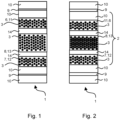
- FIG. 1 shows a fuel cell stack 1 with a plurality of fuel cells, which can be formed as unit cells.
- Each fuel cell 2 is formed from a membrane electrode arrangement 9 with an active region, to which a bipolar plate 14 is assigned on the anode side and a cathode side. Between the membrane electrode arrangement 9 and the bipolar plates 14, a cathode-side and an anode-side gas diffusion layer 10 is also arranged.
- the bipolar plate 14 is formed from two individual plates joined together, one of which provides a first media guide 6, i.e. a cathode flow field 11, and the other of which provides a second media guide 7, i.e. an anode flow field 12.
- a third media guide 8, namely a coolant flow field 13, is formed between them.
- the media guides 6, 7, 8 are each assigned or arranged in a compressible fabric structure 3, to which a spring function with a spring constant is assigned.
- the spring function enables a change in length of the fuel cell 2 along a stacking direction to be compensated by an opposite negative change in length of the compressible fabric structure 3.
- the spring function of the compressible fabric structure 3 enables a length compensation of the fuel cell 2 in all operating states, so that the fuel cells 2 in the stacking direction and thus the fuel cell stack 1 always have a defined length regardless of the operating state.
- FIG. 2 shows the fuel cell stack 1 in which the compressible fabric structures 3 are partially compressed.
- Thermal or hydrostatic expansion for example of the membrane electrode arrangement 9, leads to an increase in pressure between the terminal fuel cells 2 of the fuel cell stack 1.
- This increase in pressure is compensated by compression of the compressible fabric structure 3, so that within the fuel cell stack 1 between the two terminal fuel cells a specific contact force acts, which is constant across all operating modes of the fuel cell stack 1 and the length of the fuel cell stack also remains constant.
- the compressible fabric structures 3 can have different spring constants.
- the springing in the individual media guides 6, 7, 8 or flow fields 11, 12, 13 can thus be designed differently and thus adjusted.
- the fabric structures 3 of the first media guide 6 and the second media guide 7, i.e. the anode flow field 11 and the cathode flow field 12 have a higher spring constant than that of the third media guide 8, i.e. the coolant flow field 13. Consequently, the compressible fabric structure of the coolant flow field 13 is compressed the most, while the fabric structure 3 assigned to the anode flow field 12 and the cathode flow field 11 or arranged in it is only slightly compressible. As a result, the size of the anode spaces and the cathode spaces remains approximately constant, while the contact pressure and the fuel cell stack length are nevertheless constant.
- different fuel cells 2 within the fuel cell stack 1 can have compressible fabric structures 3 with different spring constants.
- the spring constants in the middle i.e. in the core of the fuel cell stack 1, can be selected differently than at the ends of the fuel cell stack 1.
- the compressible fabric structures 3 can also have a first region to which a first spring constant is assigned and a second region to which a second spring constant different from the first spring constant is assigned.
- the spring function of the compressible fabric structure 3 is formed by a regular arrangement of interwoven fibers 4.
- the spring function could also be provided by an irregular arrangement of interwoven fibers 4.
- FIG. 3 Another alternative of the compressible fabric structure 3 is in Figure 3 shown.
- the compressible fabric structure 3 has interwoven fibers 4 with a mean first amplitude.
- wave-shaped resilient fibers 5 with a mean second amplitude are present.
- the mean second amplitude is greater than the mean first amplitude, so that a spring function with a spring constant can be provided by the resilient fiber 5.
- Fig.4 shows a further embodiment of the compressible fabric structure 3, in which the spring function is provided by the fibers 4 themselves being formed in a wave-like manner, i.e. they are not interwoven with one another.
- the fibers 4,5 providing the spring function are at least partially made of a plastic or a metal.
Landscapes
- Life Sciences & Earth Sciences (AREA)
- Engineering & Computer Science (AREA)
- Manufacturing & Machinery (AREA)
- Sustainable Development (AREA)
- Sustainable Energy (AREA)
- Chemical & Material Sciences (AREA)
- Chemical Kinetics & Catalysis (AREA)
- Electrochemistry (AREA)
- General Chemical & Material Sciences (AREA)
- Fuel Cell (AREA)
Description
- Die Erfindung betrifft einen Brennstoffzellenstapel mit einer Mehrzahl von entlang einer Stapelrichtung übereinander gestapelten Brennstoffzellen Brennstoffzellenvorrichtungen werden für die chemische Umsetzung eines Brennstoffs mit Sauerstoff zu Wasser genutzt, um elektrische Energie zu erzeugen. Hierfür enthalten Brennstoffzellen als Kernkomponente die sogenannte Membran-Elektroden-Einheit (MEA für membrane electrode assembly), die ein Verbund aus einer protonenleitenden Membran und jeweils einer, beidseitig an der Membran angeordneten Elektrode (Anode und Kathode) ist. Zudem können Gasdiffusionslagen (GDL) beidseitig der Membran-Elektroden-Einheit an den der Membran abgewandten Seiten der Elektroden angeordnet sein. Im Betrieb der Brennstoffzellenvorrichtung mit einer Mehrzahl zu einem Brennstoffzellenstapel zusammengefasster Brennstoffzellen wird der Brennstoff, insbesondere Wasserstoff H2 oder ein wasserstoffhaltiges Gasgemisch der Anode zugeführt, wo eine elektrochemische Oxidation von H2 zu H+ unter Abgabe von Elektronen stattfindet. Über den Elektrolyten oder die Membran, welche die Reaktionsräume gasdicht voneinander trennt und elektrisch isoliert, erfolgt ein Transport der Protonen H+ aus dem Anodenraum in den Kathodenraum. Die an der Anode bereitgestellten Elektronen werden über eine elektrische Leitung der Kathode zugeleitet. Der Kathode wird Sauerstoff oder ein sauerstoffhaltiges Gasgemisch zugeführt, so dass eine Reduktion von O2 zu O2- unter Aufnahme der Elektronen stattfindet. Gleichzeitig reagieren im Kathodenraum diese Sauerstoffanionen mit den über die Membran transportierten Protonen unter Bildung von Wasser.
- Die
DE 10 2005 022 484 A1 zeigt eine Gasdiffusionsschicht, in die eine Schicht aus kompressiblen Gewebe integriert ist, welche das Eindrücken der Gasdiffusionslage in die Gaskanäle der Bipolarplatte verhindern soll. - Die
DE 100 427 44 A1 offenbart eine Gasverteilerschicht für einen Brennstoffzellenstapel, welche aus einem kompressiblen Gewebe aufgebaut ist, um durch eine definierte Kompression der Gasverteilerschichten den Zellwiderstand zu erhöhen. - Die
DE 43 401 53 C1 offenbart ein elektrisch leitendes, elastisches und gasdurchlässiges Kontaktkissen, mit einer verformbaren Oberflächenstruktur. Das Kontaktkissen dient dabei dem Ausgleich von Unebenheiten an der Oberfläche der Elektroden. - Die
DE 10 2016 224 696 A1 offenbart eine Bipolarplatte zur Verwendung in einer Brennstoffzelle. Der Bipolarplatte und damit der Brennstoffzelle ist ein Gewebe zugeordnet. Das Gewebe ist aus mehreren Fasern gebildet, die aus unterschiedlichen Materialien bestehen. Das Gewebe ist dazu vorgesehen, Strukturen zur Verteilung der Reaktionsgase bereitzustellen, wobei das Gewebe elastische Eigenschaften aufweist, sodass das Gewebe auf Druckänderung mit einer Längenänderung reagiert - Die
DE 11 2011 103 324 T5 offenbart eine Brennstoffzelle mit Kollektormaterial, das durch ein Metallfasergewebe gebildet ist und zwischen den Elektroden und den Separatoren mit Druck beaufschlagt wird. Es wird ausgeführt, dass im Stand der Technik als Kollektormaterial von Feststoffoxidbrennstoffzellen üblicherweise ein Metallgitter verwendet wird, das jedoch eine geringe Elastizität aufweist, weshalb sich der Kontaktzustand durch Veränderung aufgrund der Wärmeausdehnung der MEA-Zelle und Separator durch wiederholte Verwendung verändert, sodass sich die Stromerzeugungseffizienz verringert. Zur Verbesserung des elektrischen Kontaktes wird als Kollektormaterial ein plattenförmiges Metallfasergewebe verwendet. - Die
DE 10 2010 203 827 A1 offenbart zur Verwendung in einem Brennstoffzellenstapel vorgesehene Brennstoffzellen, bei denen zum Verteilen der Reaktanten ein Gewebe verwendet wird, das mindestens zwei Arten von Fasern aufweist, wobei eine Basisfaser zum Herstellen einer Grundstruktur des Gewebes genutzt ist und eine Funktionsfaser beispielsweise zur mechanischen Kraftaufnehmung zwischen den Bipolarplatten genutzt wird. Dieses Gewebe weist elastische Eigenschaften auf, sodass bei einer Änderung der Betriebsbedingung sich auch eine Längenänderung des Gewebes ergibt. - Die
DE 10 2018 205 128 A1 offenbart ein Verfahren zum Herstellen einer Brennstoffzelle, wobei ein Fluidleitelement mit einer Gewebestruktur zur Verteilung eines Brennstoffes vorgesehen ist. Die Gewebestruktur umfasst metallische Fasern, die mit Kunststoffelementen kombiniert werden. - Bei einer typischen Bauform des Brennstoffzellenstapels, werden die übereinander gestapelten Brennstoffzellen oder Einheitszellen außen mittels Fixierelementen, insbesondere mittels Bändern, zusammengehalten. Diese Fixierelemente sind an die beiden endständigen Brennstoffzellen des Brennstoffzellenstapels fixiert und halten diese in einem definierten und konstanten Abstand zueinander.
- Nachteilig ist hierbei, dass die Länge der gestapelten Zellen während des Betriebs nicht konstant bleibt. Dies führt insbesondere dazu, dass die Implementierung und Positionierung von Anschlüssen erschwert wird, die beispielsweise für die Zellspannungsüberwachung benötigt werden.
- Daher ist es Aufgabe der vorliegenden Erfindung, einen Brennstoffzellenstapel bereitzustellen, der eine konstante Stapellänge in allen Betriebszustände ermöglicht.
- Diese Aufgabe wird mittels der Merkmale des Anspruchs 1 gelöst. Vorteilhafte Ausgestaltungen mit zweckmäßigen Weiterbildungen der Erfindung sind in den abhängigen Ansprüchen angegeben.
- Der Brennstoffzellenstapel zeichnet sich insbesondere dadurch aus, dass mindestens eine der Brennstoffzellen mindestens eine komprimierbare Gewebestruktur aufweist, der eine Federfunktion mit einer Federkonstante zugeordnet ist, und dass mittels der Federfunktion eine Längenänderung der Brennstoffzelle entlang der Stapelrichtung durch eine dazu entgegengesetzte negative Längenänderung der komprimierbaren Gewebestruktur ausgleichbar ist.
- In anderen Worten ermöglicht die Federfunktion der komprimierbaren Gewebestruktur einen Längenausgleich der Brennstoffzellen, in allen Betriebszuständen, so dass die Brennstoffzellen in Stapelrichtung unabhängig vom Betriebszustand immer eine definierte Länge aufweist. Eine Längenausdehnung der Brennstoffzelle in Stapelrichtung, aufgrund von thermischer Ausdehnung oder aufgrund einer hydrostatischen Längenänderung, die zu einem Anschwellen der Membranelektrodenanordnung führt, kann durch das Zusammendrücken der komprimierbaren Gewebestruktur somit vollständig ausgeglichen werden. Dabei kommt es aufgrund der thermischen oder hydrostatischen Längenänderung zu einer Druckerhöhung zwischen den Schichten, so dass die Federfunktion der komprimierbaren Gewebestruktur aktiviert und diese zusammengedrückt wird. Die Federfunktion der komprimierbaren Gewebestruktur verhindert somit eine aufgrund zu hoher Drücke auftretende Beschädigung der Komponenten der Brennstoffzelle und des Brennstoffzellenstapels. Innerhalb des Brennstoffzellenstapels, zwischen den beiden endständigen Brennstoffzellen, wirkt folglich eine spezifische Anpresskraft, die über alle Betriebsarten des Brennstoffzellenstapels konstant ist. Weiterhin ermöglicht eine konstante Stapellänge und Anpresskraft über alle Betriebszustände eine einfachere Implementierung einer Zellspannungsüberwachung in den Brennstoffzellenstapel, da die Kabellänge ohne Reserveschleifen ausgeführt werden kann. Dies führt zu einer Reduzierung des benötigten Bauraums. Ein weiterer Vorteil in einer über alle Betriebszustände konstanten Brennstoffzellenstapellänge ist darin zu sehen, dass die Länge aller stromführenden Teile konstant ausgeführt werden kann, insbesondere die Länge der Stromschienen.
- In diesem Zusammenhang ist es bevorzugt, wenn jede der Brennstoffzellen mindestens eine komprimierbare Gewebestruktur mit zugeordneter Federfunktion aufweist.
- Weiterhin ist es in diesem Zusammenhang von Vorteil, wenn verschiedene Brennstoffzellen komprimierbare Gewebestrukturen aufweisen, die sich in ihrer Federkonstante unterscheiden. Dies ermöglicht die Verwendung von unterschiedlichen komprimierbaren Gewebestrukturen in unterschiedlichen Bereichen des Brennstoffzellenstapels, so dass die Federkonstante in der Mitte, also im Kern des Brennstoffzellenstapels anders gewählt werden kann, als an den Enden des Brennstoffzellenstapels. Dadurch wird eine individuelle Anpassung und Steuerung der Anpresskraft über verschiedene Bereiche des Brennstoffzellenstapels erreicht.
- Insbesondere ist es vorteilhaft, wenn die komprimierbare Gewebestruktur aus miteinander verwobenen Fasern gebildet ist, und dass die Federfunktion durch eine ungeordnete Anordnung der Fasern ausgebildet ist. In einer besonders einfachen Ausbildungsform wird die Federfunktion mittels einer geordneten Anordnung der Fasern ausgebildet. Alternativ oder zusätzlich ist es bevorzugt, wenn die komprimierbare Gewebestruktur durch wellenförmig ausgebildete Fasern gebildet ist, die die Federfunktion bereitstellen. Die Fasern der Gewebestruktur sind folglich nicht miteinander verwebt, sondern wellenförmig ausgebildet. Bevorzugt ist die mittlere Amplitude der wellenförmig ausgebildeten Faser höher als die mittlere Amplitude der Fasern der gewebten Gewebestruktur. Die komprimierbare Gewebestruktur kann dabei auch unregelmäßige Struktur aufweisen, das heißt dass sich die Amplituden der wellenförmig ausgebildeten Faser entlang der Gewebestruktur unterscheiden.
- Alternativ oder zusätzlich ist es von Vorteil, wenn die Gewebestruktur aus miteinander verwobenen Fasern mit einer mittleren ersten Amplitude gebildet ist, und dass zur Bereitstellung der Federfunktion eine wellenförmig gebildete federnde Faser vorhanden ist, die den Fasern der Gewebestruktur zugeordnet oder mit dieser verwoben ist, und deren mittlere zweite Amplitude größer als die mittlere erste Amplitude der Fasern der Gewebestruktur ist.
- Um die Federfunktion mit zugeordneter Federkonstante besonders einfach bereitstellen zu können, ist es bevorzugt, wenn die die Federfunktion bereitstellende Faser zumindest zum Teil aus einem Kunststoff oder aus einem Metall gebildet ist.
- Die zwischen den endständigen Brennstoffzellen wirkende Anpresskraft kann dabei individuell für jede Brennstoffzelle und auch innerhalb der Brennstoffzelle gesteuert werden, indem die komprimierbare Gewebestruktur einen ersten Bereich aufweist, dem eine erste Federkonstante zugeordnet ist und einen zweiten Bereich aufweist, dem eine sich von der ersten Federkonstante unterscheidende zweite Federkonstante zugeordnet ist. Die komprimierbare Gewebestruktur kann auch mehr als zwei Bereiche aufweisen, die sich in ihrer Federkonstante unterscheiden.
- Zur einfachen Implementierung der komprimierbaren Gewebestruktur ist es von Vorteil, wenn die Brennstoffzellen jeweils einen aktiven Bereich aufweisen, wenn eine erste Medienführung zum Transport eines ersten Reaktanten in den und/oder aus dem aktiven Bereich, eine zweite Medienführung zum Transport eines zweiten Reaktanten in den und/oder aus dem aktiven Bereich und eine dritte Medienführung zum Transport von Kühlmittel in den und/oder aus dem aktiven Bereich vorhanden ist, und dass mindestens einem der Medienführungen die komprimierbare Gewebestruktur zugeordnet oder in ihr angeordnet ist. Die Medienführung ist dabei bevorzugt als ein Flussfeld gebildet.
- In diesem Zusammenhang ist es insbesondere von Vorteil, wenn eine Mehrzahl der Medienführungen die komprimierbaren Gewebestrukturen aufweisen, und wenn den komprimierbaren Gewebestrukturen der unterschiedlichen Medienführungen verschiedene Federkonstanten zugeordnet sind. Somit kann die Federung in den einzelnen Medienführungen oder Medienräumen unterschiedlich gestaltet und damit eingestellt werden. Dies erlaubt es auf die spezifischen Randbedingungen der verschiedenen Medienführungen einzugehen. So kann beispielsweise die Größe der die Reaktanten transportierenden oder aufweisenden Medienräume, also der Anodenraum und der Kathodenraum, in der Größe annähernd konstant gehalten werden, um die Zuführung des Brennstoffs und der Luft in den aktiven Bereich auch in einem hydrostatischen Zustand zu gewährleisten. Dagegen ist vorzugsweise der das Kühlmittel aufweisende dritte Medienraum am stärksten komprimierbar, weist also eine niedrigere Federkonstante als die Federkonstante der übrigen Medienräume auf. Somit ist es insbesondere bevorzugt, wenn die komprimierbare Gewebestruktur zumindest der das Kühlmittel transportierenden dritten Medienführung zugeordnet oder in ihr angeordnet ist.
- Die vorstehend in der Beschreibung genannten Merkmale und Merkmalskombinationen sowie die nachfolgend in der Figurenbeschreibung genannten und/oder in den Figuren alleine gezeigten Merkmale und Merkmalskombinationen sind nicht nur in der jeweils angegebenen Kombination, sondern auch in anderen Kombinationen oder in Alleinstellung verwendbar, ohne den Rahmen der Erfindung zu verlassen. Es sind somit auch Ausführungen als von der Erfindung umfasst und offenbart anzusehen, die in den Figuren nicht explizit gezeigt oder erläutert sind, jedoch durch separierte Merkmalskombinationen aus den erläuterten Ausführungen hervorgehen und erzeugbar sind.
- Weitere Vorteile, Merkmale und Einzelheiten der Erfindung ergeben sich aus den Ansprüchen, der nachfolgenden Beschreibung bevorzugter Ausführungsformen sowie anhand der Zeichnungen. Dabei zeigen:
- Fig. 1
- eine schematische Darstellung eines unkomprimierten Brennstoffzellenstapels,
- Fig. 2
- eine schematische Darstellung eines komprimierten Brennstoffzellenstapels,
- Fig. 3
- eine schematische Darstellung einer komprimierbaren Gewebestruktur,
- Fig. 4
- eine schematische Darstellung einer weiteren komprimierbaren Gewebestruktur und
-
Figur 1 zeigt einen Brennstoffzellenstapel 1 mit einer Mehrzahl von Brennstoffzellen, die als Einheitszellen gebildet sein können. Jede Brennstoffzelle 2 ist aus einer Membranelektrodenanordnung 9 mit einem aktiven Bereich gebildet, der anodenseitig und kathodenseitig jeweils eine Bipolarplatte 14 zugeordnet ist. Zwischen der Membranelektrodenanordnung 9 und den Bipolarplatten 14 ist zudem jeweils eine kathodenseitige und eine anodenseitige Gasdiffusionslage 10 angeordnet. Die Bipolarplatte14 ist aus zwei miteinander gefügten Einzelplatten gebildet, von denen die eine eine erste Medienführung 6, also ein Kathodenflussfeld 11, und von denen die andere eine zweite Medienführung 7, also ein Anodenflussfeld 12, bereitstellt. Dazwischen ist eine dritte Medienführung 8, nämlich ein Kühlmittelflussfeld 13, ausgebildet. Den Medienführungen 6, 7, 8 ist jeweils eine komprimierbare Gewebestruktur 3 zugeordnet oder in ihr angeordnet, der eine Federfunktion mit einer Federkonstante zugeordnet ist. Die Federfunktion ermöglicht dabei, dass eine Längenänderung der Brennstoffzelle 2 entlang einer Stapelrichtung durch eine dazu entgegengesetzte negative Längenänderung der komprimierbaren Gewebestruktur 3 ausgeglichen wird. In anderen Worten ermöglicht die Federfunktion der komprimierbaren Gewebestruktur 3 einen Längenausgleich der Brennstoffzelle 2, in allen Betriebszuständen, so dass die Brennstoffzellen 2 in Stapelrichtung und damit der Brennstoffzellenstapel 1 unabhängig vom Betriebszustand immer eine definierte Länge aufweist. -
Figur 2 zeigt den Brennstoffzellenstapel 1, bei dem die komprimierbaren Gewebestrukturen 3 teilweise komprimiert sind. Durch eine thermische oder hydrostatische Ausdehnung beispielsweise der Membranelektrodenanordnung 9, kommt es zu einer Druckerhöhung zwischen den endständigen Brennstoffzellen 2 des Brennstoffzellenstapels 1. Diese Druckerhöhung wird durch eine Kompression der komprimierbaren Gewebestruktur 3 ausgeglichen, so dass innerhalb des Brennstoffzellenstapels 1 zwischen den beiden endständigen Brennstoffzellen eine spezifische Anpresskraft wirkt, die über alle Betriebsarten des Brennstoffzellenstapels 1 konstant ist und die Länge des Brennstoffzellenstapels ebenfalls konstant bleibt. -
Figur 2 verdeutlicht allerdings auch, dass die komprimierbaren Gewebestrukturen 3 unterschiedliche Federkonstanten aufweisen können. Somit kann die Federung in den einzelnen Medienführungen 6, 7, 8 oder Flussfeldern 11, 12, 13 unterschiedlich gestaltet und damit eingestellt werden kann. Vorliegend weisen die Gewebestrukturen 3 der ersten Medienführung 6 und der zweiten Medienführung 7, also des Anodenflussfelds 11 und des Kathodenflussfelds 12 eine höhere Federkonstante auf, als die der dritten Medienführung 8, also des Kühlmittelflussfelds 13. Folglich wird die komprimierbare Gewebestruktur des Kühlmittelflussfelds 13 am stärksten komprimiert, während die dem Anodenflussfeld 12 und dem Kathodenflussfeld 11 zugeordnete oder in ihr angeordnete Gewebestruktur 3 nur geringfügig komprimierbar ist. Dadurch bleibt die Größe der Anodenräume und die Kathodenräume annährend konstant, bei dennoch konstanter Anpresskraft und konstanter Brennstoffzellenstapellänge. - Weiterhin ist es auch möglich, dass verschiedene Brennstoffzellen 2 innerhalb des Brennstoffzellenstapels 1 komprimierbare Gewebestrukturen 3 mit sich unterscheidenden Federkonstanten aufweisen. Beispielsweise können die Federkonstanten in der Mitte, also im Kern des Brennstoffzellenstapels 1, anders gewählt werden, als an den Enden des Brennstoffzellenstapels 1.
- Darüber hinaus können die komprimierbaren Gewebestrukturen 3 auch einen ersten Bereich aufweisen, dem eine erste Federkonstante zugeordnet ist und einen zweiten Bereich aufweisen, dem eine sich von der ersten Federkonstante unterscheidende zweite Federkonstante zugeordnet ist.
- In den
Figuren 1 und 2 ist die Federfunktion der komprimierbaren Gewebestruktur 3 durch eine regelmäßige Anordnung von miteinander verwobenen Fasern 4 gebildet. Alternativ und nicht gezeigt, könnte die Federfunktion auch durch eine unregelmäßige Anordnung von miteinander verwobenen Fasern 4 bereit gestellt werden. - Eine weitere Alternative der komprimierbaren Gewebestruktur 3 ist in
Figur 3 gezeigt. Dabei weist die komprimierbare Gewebestruktur 3 miteinander verwobene Fasern 4 mit einer mittleren ersten Amplitude auf. Zur Bereitstellung einer Federfunktion sind wellenförmig gebildete federnde Fasern 5 mit einer mittleren zweiten Amplitude vorhanden. Die mittlere zweite Amplitude ist dabei größer als die mittlere erste Amplitude, so dass eine Federfunktion mit einer Federkonstante durch die federnde Faser 5 bereitgestellt werden kann. - In
Fig. 4 zeigt eine weitere Ausführungsform der komprimierbaren Gewebestruktur 3, bei der die Federfunktion bereitgestellt wird, indem die Fasern 4 selber wellenförmig gebildet sind, also nicht miteinander verwoben sind. - Die die Federfunktion bereitstellenden Fasern 4,5 sind dabei zumindest zum Teil aus einem Kunststoff oder aus einem Metall gebildet.
-
- 1
- Brennstoffzellenstapel
- 2
- Brennstoffzelle
- 3
- komprimierbare Gewebestruktur
- 4
- Faser
- 5
- federnde Faser
- 6
- erste Medienführung
- 7
- zweite Medienführung
- 8
- dritte Medienführung
- 9
- Membranelektrodenanordnung
- 10
- Gasdiffusionslage
- 11
- Kathodenflussfeld
- 12
- Anodenflussfeld
- 13
- Kühlmittelflussfeld
- 14
- Bipolarplatte
Claims (10)
- Brennstoffzellenstapel (1) mit einer Mehrzahl von entlang einer Stapelrichtung übereinander gestapelten Brennstoffzellen (2), wobei mindestens eine der Brennstoffzellen (2) mindestens eine komprimierbare Gewebestruktur (3) aufweist, der eine Federfunktion mit einer Federkonstante zugeordnet ist, wobei mittels der Federfunktion eine Längenänderung der Brennstoffzelle (2) entlang der Stapelrichtung durch eine dazu entgegengesetzte negative Längenänderung der komprimierbaren Gewebestruktur (3) ausgleichbar ist, dadurch gekennzeichnet, dass die Federfunktion der komprimierbaren Gewebestruktur (3) einen Längenausgleich der Brennstoffzellen (2) in allen Betriebszuständen ermöglicht, so dass die Brennstoffzellen (2) in Stapelrichtung unabhängig vom Betriebszustand eine definierte Länge aufweisen.
- Brennstoffzellenstapel (1) nach Anspruch 1, dadurch gekennzeichnet, dass jede der Brennstoffzellen (2) mindestens eine komprimierbare Gewebestruktur (3) mit zugeordneter Federfunktion aufweist.
- Brennstoffzellenstapel (1) nach Anspruch 1 oder 2, dadurch gekennzeichnet, dass die komprimierbare Gewebestruktur (1) aus miteinander verwobenen Fasern (4) gebildet ist, und dass die Federfunktion durch eine ungeordnete Anordnung der Fasern (4) ausgebildet ist.
- Brennstoffzellenstapel (1) nach Anspruch 1 oder 2, dadurch gekennzeichnet, dass die komprimierbare Gewebestruktur (3) durch wellenförmig ausgebildete Fasern (4) gebildet ist, die die Federfunktion bereitstellen.
- Brennstoffzellenstapel (1) nach Anspruch 1 oder 2, dadurch gekennzeichnet, dass die komprimierbare Gewebestruktur (3) aus miteinander verwobenen Fasern (4) mit einer mittleren ersten Amplitude gebildet ist, und dass zur Bereitstellung der Federfunktion eine wellenförmig gebildete federnde Faser (5) vorhanden ist, die den Fasern (4) der Gewebestruktur (3) zugeordnet oder mit dieser verwoben ist, und deren mittlere zweite Amplitude größer als die mittlere erste Amplitude ist.
- Brennstoffzellenstapel (1) nach einem der Ansprüche 3 bis 5, dadurch gekennzeichnet, dass die die Federfunktion bereitstellende Faser (4,5) zumindest teilweise aus einem Kunststoff oder aus einem Metall gebildet ist.
- Brennstoffzellenstapel (1) nach einem der Ansprüche 1 bis 6, dadurch gekennzeichnet, dass die komprimierbare Gewebestruktur (3) einen ersten Bereich aufweist, dem eine erste Federkonstante zugeordnet ist und einen zweiten Bereich aufweist, dem eine sich von der ersten Federkonstante unterscheidende zweite Federkonstante zugeordnet ist.
- Brennstoffzellenstapel (1) nach einem der Ansprüche 1 bis 7, dadurch gekennzeichnet, dass die Brennstoffzellen (2) jeweils einen aktiven Bereich aufweisen, dass eine erste Medienführung (6) zum Transport eines ersten Reaktanten in den und/oder aus dem aktiven Bereich, eine zweite Medienführung (7) zum Transport eines zweiten Reaktanten in den und/oder aus dem aktiven Bereich und eine dritte Medienführung (8) zum Transport von Kühlmittel in den und/oder aus dem aktiven Bereich vorhanden ist, und dass mindestens einem der Medienführungen (6, 7, 8) die komprimierbare Gewebestruktur (3) zugeordnet oder in ihr angeordnet ist.
- Brennstoffzellenstapel (1) nach Anspruch 8, dadurch gekennzeichnet, dass eine Mehrzahl der Medienführungen (6, 7, 8) die komprimierbaren Gewebestrukturen (3) aufweisen, und dass den komprimierbaren Gewebestrukturen (3) der unterschiedlichen Medienführungen (6, 7, 8) verschiedene Federkonstanten zugeordnet sind.
- Brennstoffzellenstapel (1) nach Anspruch 8 oder 9, dass die komprimierbare Gewebestruktur (3) der das Kühlmittel transportierenden dritten Medienführung (8) zugeordnet oder in ihr angeordnet ist.
Applications Claiming Priority (2)
| Application Number | Priority Date | Filing Date | Title |
|---|---|---|---|
| DE102021108981.6A DE102021108981A1 (de) | 2021-04-12 | 2021-04-12 | Brennstoffzellenstapel mit komprimierbarer Gewebestruktur |
| PCT/EP2022/059253 WO2022218813A1 (de) | 2021-04-12 | 2022-04-07 | Brennstoffzellenstapel mit komprimierbarer gewebestruktur |
Publications (2)
| Publication Number | Publication Date |
|---|---|
| EP4244923A1 EP4244923A1 (de) | 2023-09-20 |
| EP4244923B1 true EP4244923B1 (de) | 2024-07-31 |
Family
ID=81597956
Family Applications (1)
| Application Number | Title | Priority Date | Filing Date |
|---|---|---|---|
| EP22722413.6A Active EP4244923B1 (de) | 2021-04-12 | 2022-04-07 | Brennstoffzellenstapel mit komprimierbarer gewebestruktur |
Country Status (5)
| Country | Link |
|---|---|
| US (1) | US20240047727A1 (de) |
| EP (1) | EP4244923B1 (de) |
| CN (1) | CN116686122A (de) |
| DE (1) | DE102021108981A1 (de) |
| WO (1) | WO2022218813A1 (de) |
Family Cites Families (11)
| Publication number | Priority date | Publication date | Assignee | Title |
|---|---|---|---|---|
| DE4340153C1 (de) | 1993-11-25 | 1995-03-09 | Solentec Ges Fuer Solare Und E | Vorrichtung zum Kontaktieren von Elektroden von Hochtemperatur-Brennstoffzellen |
| DE10042744A1 (de) | 2000-08-31 | 2002-03-28 | Omg Ag & Co Kg | PEM-Brennstoffzellenstapel |
| US6500319B2 (en) * | 2001-04-05 | 2002-12-31 | Giner Electrochemical Systems, Llc | Proton exchange membrane (PEM) electrochemical cell having an integral, electrically-conductive, compression pad |
| US7150934B2 (en) | 2002-03-26 | 2006-12-19 | Matsushita Electric Industrial Co., Ltd. | Electrolyte film electrode union, fuel cell containing the same and process for producing them |
| KR100760132B1 (ko) | 2005-02-28 | 2007-09-18 | 산요덴키가부시키가이샤 | 복합막, 복합막을 이용한 연료 전지 |
| DE102005022484B4 (de) | 2005-05-11 | 2016-02-18 | Carl Freudenberg Kg | Gasdiffusionsschicht und Anordnung umfassend zwei Gasdiffusionsschichten |
| JP5711927B2 (ja) * | 2010-09-30 | 2015-05-07 | マグネクス株式会社 | 固体酸化物型燃料電池 |
| JP6628224B2 (ja) * | 2015-12-07 | 2020-01-08 | パナソニックIpマネジメント株式会社 | 高温動作型燃料電池 |
| DE102016224696A1 (de) * | 2016-12-12 | 2018-06-14 | Robert Bosch Gmbh | Bipolarplatte für eine Brennstoffzelle und Brennstoffzelle |
| DE102018203827A1 (de) * | 2018-03-14 | 2019-09-19 | Robert Bosch Gmbh | Gasverteilerstruktur für eine Brennstoffzelle |
| DE102018205128A1 (de) * | 2018-04-05 | 2019-10-10 | Robert Bosch Gmbh | Verfahren zum Herstellen einer Brennstoffzelle sowie Brennstoffzelle |
-
2021
- 2021-04-12 DE DE102021108981.6A patent/DE102021108981A1/de active Pending
-
2022
- 2022-04-07 CN CN202280008201.9A patent/CN116686122A/zh active Pending
- 2022-04-07 WO PCT/EP2022/059253 patent/WO2022218813A1/de not_active Ceased
- 2022-04-07 US US18/257,280 patent/US20240047727A1/en active Pending
- 2022-04-07 EP EP22722413.6A patent/EP4244923B1/de active Active
Also Published As
| Publication number | Publication date |
|---|---|
| CN116686122A (zh) | 2023-09-01 |
| WO2022218813A1 (de) | 2022-10-20 |
| US20240047727A1 (en) | 2024-02-08 |
| EP4244923A1 (de) | 2023-09-20 |
| DE102021108981A1 (de) | 2022-10-13 |
Similar Documents
| Publication | Publication Date | Title |
|---|---|---|
| EP3884535B1 (de) | Brennstoffzellenplatte, bipolarplatte und brennstoffzellenvorrichtung | |
| EP3679619B1 (de) | Membran-elektroden-anordnung, brennstoffzellenstapel sowie fahrzeug mit einem solchen brennstoffzellenstapel | |
| EP3430662A1 (de) | Bipolarplatte mit variabler breite der reaktionsgaskanäle im eintrittsbereich des aktiven bereichs, brennstoffzellenstapel und brennstoffzellensystem mit solchen bipolarplatten sowie fahrzeug | |
| WO2018108552A1 (de) | Bipolarplatte für eine brennstoffzelle und brennstoffzelle | |
| EP3736894B1 (de) | Bipolarplatte für brennstoffzellen, brennstoffzellenstapel mit solchen bipolarplatten sowie fahrzeug mit einem solchen brennstoffzellenstapel | |
| DE112008002778T5 (de) | Brennstoffzelle | |
| DE102017215748A1 (de) | Kompressionsvorrichtung für einen Brennstoffzellenstapel | |
| DE102020128623A1 (de) | Brennstoffzellenstapel mit einem Kompressionssystem für den Brennstoffzellenstapel | |
| WO2010083788A1 (de) | Wiederholeinheit für einen brennstoffzellenstapel | |
| EP3953986B1 (de) | Bipolarplatte für brennstoffzellen, brennstoffzellenstapel mit solchen bipolarplatten sowie fahrzeug mit einem solchen brennstoffzellenstapel | |
| EP4244923B1 (de) | Brennstoffzellenstapel mit komprimierbarer gewebestruktur | |
| DE102016120535A1 (de) | Brennstoffzelle, Brennstoffzellenstapel und Brennstoffzellensystem | |
| DE102018200842B4 (de) | Brennstoffzellenplatte, Bipolarplatten und Brennstoffzellenaufbau | |
| DE102018211078B3 (de) | Bipolarplatte für Brennstoffzellen mit drei Einzelplatten, sowie Brennstoffzelle und Brennstoffzellenstapel mit solchen Bipolarplatten | |
| EP4073859A1 (de) | Bausatz für einen brennstoffzellenstapel und verfahren zur herstellung eines brennstoffzellenstapels | |
| DE102019206117A1 (de) | Brennstoffzellenstapel umfassend variable Biopolarplatten | |
| WO2022089898A1 (de) | Verteilerplatte für eine elektrochemische zelle und elektrochemische zelle | |
| DE102019203321A1 (de) | Brennstoffzellenplatte, Brennstoffzellenaufbau und Brennstoffzellensystem | |
| DE102018210165A1 (de) | Spannsystem für Brennstoffzellenstapel und Brennstoffzellenstapel mit einem solchen | |
| DE102019206118A1 (de) | Bipolarplatte für Brennstoffzellen umfassend elastische elektrodenseitige Strukturelemente | |
| DE102017215486B4 (de) | Elektrischer Verbinder sowie Brennstoffzellenstapel mit einem solchen | |
| DE102019205579A1 (de) | Bipolarplatte für Brennstoffzellen, Brennstoffzellenstapel mit solchen Bipolarplatten sowie Fahrzeug mit einem solchen Brennstoffzellenstapel | |
| DE102015200804B4 (de) | Membran-Elektroden-Einheit und Verfahren zur Herstellung | |
| DE102020127464A1 (de) | Bipolarplatte mit orthogonalen Kühlmittelkanälen, Brennstoffzellenaufbau und Brennstoffzellenstapel | |
| DE102016116117A1 (de) | Vorrichtung zur Kompression einer Brennstoffzellenanordnung, Brennstoffzellenanordnung und Kraftfahrzeug |
Legal Events
| Date | Code | Title | Description |
|---|---|---|---|
| STAA | Information on the status of an ep patent application or granted ep patent |
Free format text: STATUS: UNKNOWN |
|
| STAA | Information on the status of an ep patent application or granted ep patent |
Free format text: STATUS: THE INTERNATIONAL PUBLICATION HAS BEEN MADE |
|
| PUAI | Public reference made under article 153(3) epc to a published international application that has entered the european phase |
Free format text: ORIGINAL CODE: 0009012 |
|
| STAA | Information on the status of an ep patent application or granted ep patent |
Free format text: STATUS: REQUEST FOR EXAMINATION WAS MADE |
|
| 17P | Request for examination filed |
Effective date: 20230612 |
|
| AK | Designated contracting states |
Kind code of ref document: A1 Designated state(s): AL AT BE BG CH CY CZ DE DK EE ES FI FR GB GR HR HU IE IS IT LI LT LU LV MC MK MT NL NO PL PT RO RS SE SI SK SM TR |
|
| GRAP | Despatch of communication of intention to grant a patent |
Free format text: ORIGINAL CODE: EPIDOSNIGR1 |
|
| STAA | Information on the status of an ep patent application or granted ep patent |
Free format text: STATUS: GRANT OF PATENT IS INTENDED |
|
| DAV | Request for validation of the european patent (deleted) | ||
| DAX | Request for extension of the european patent (deleted) | ||
| INTG | Intention to grant announced |
Effective date: 20240326 |
|
| GRAS | Grant fee paid |
Free format text: ORIGINAL CODE: EPIDOSNIGR3 |
|
| GRAA | (expected) grant |
Free format text: ORIGINAL CODE: 0009210 |
|
| STAA | Information on the status of an ep patent application or granted ep patent |
Free format text: STATUS: THE PATENT HAS BEEN GRANTED |
|
| AK | Designated contracting states |
Kind code of ref document: B1 Designated state(s): AL AT BE BG CH CY CZ DE DK EE ES FI FR GB GR HR HU IE IS IT LI LT LU LV MC MK MT NL NO PL PT RO RS SE SI SK SM TR |
|
| REG | Reference to a national code |
Ref country code: CH Ref legal event code: EP Ref country code: GB Ref legal event code: FG4D Free format text: NOT ENGLISH |
|
| REG | Reference to a national code |
Ref country code: DE Ref legal event code: R096 Ref document number: 502022001367 Country of ref document: DE |
|
| REG | Reference to a national code |
Ref country code: IE Ref legal event code: FG4D Free format text: LANGUAGE OF EP DOCUMENT: GERMAN |
|
| P01 | Opt-out of the competence of the unified patent court (upc) registered |
Free format text: CASE NUMBER: APP_46881/2024 Effective date: 20240813 |
|
| REG | Reference to a national code |
Ref country code: LT Ref legal event code: MG9D |
|
| REG | Reference to a national code |
Ref country code: NL Ref legal event code: MP Effective date: 20240731 |
|
| PG25 | Lapsed in a contracting state [announced via postgrant information from national office to epo] |
Ref country code: PT Free format text: LAPSE BECAUSE OF FAILURE TO SUBMIT A TRANSLATION OF THE DESCRIPTION OR TO PAY THE FEE WITHIN THE PRESCRIBED TIME-LIMIT Effective date: 20241202 |
|
| PG25 | Lapsed in a contracting state [announced via postgrant information from national office to epo] |
Ref country code: PT Free format text: LAPSE BECAUSE OF FAILURE TO SUBMIT A TRANSLATION OF THE DESCRIPTION OR TO PAY THE FEE WITHIN THE PRESCRIBED TIME-LIMIT Effective date: 20241202 |
|
| PG25 | Lapsed in a contracting state [announced via postgrant information from national office to epo] |
Ref country code: NO Free format text: LAPSE BECAUSE OF FAILURE TO SUBMIT A TRANSLATION OF THE DESCRIPTION OR TO PAY THE FEE WITHIN THE PRESCRIBED TIME-LIMIT Effective date: 20241031 |
|
| PG25 | Lapsed in a contracting state [announced via postgrant information from national office to epo] |
Ref country code: FI Free format text: LAPSE BECAUSE OF FAILURE TO SUBMIT A TRANSLATION OF THE DESCRIPTION OR TO PAY THE FEE WITHIN THE PRESCRIBED TIME-LIMIT Effective date: 20240731 Ref country code: PL Free format text: LAPSE BECAUSE OF FAILURE TO SUBMIT A TRANSLATION OF THE DESCRIPTION OR TO PAY THE FEE WITHIN THE PRESCRIBED TIME-LIMIT Effective date: 20240731 Ref country code: GR Free format text: LAPSE BECAUSE OF FAILURE TO SUBMIT A TRANSLATION OF THE DESCRIPTION OR TO PAY THE FEE WITHIN THE PRESCRIBED TIME-LIMIT Effective date: 20241101 Ref country code: NL Free format text: LAPSE BECAUSE OF FAILURE TO SUBMIT A TRANSLATION OF THE DESCRIPTION OR TO PAY THE FEE WITHIN THE PRESCRIBED TIME-LIMIT Effective date: 20240731 |
|
| PG25 | Lapsed in a contracting state [announced via postgrant information from national office to epo] |
Ref country code: BG Free format text: LAPSE BECAUSE OF FAILURE TO SUBMIT A TRANSLATION OF THE DESCRIPTION OR TO PAY THE FEE WITHIN THE PRESCRIBED TIME-LIMIT Effective date: 20240731 |
|
| PG25 | Lapsed in a contracting state [announced via postgrant information from national office to epo] |
Ref country code: LV Free format text: LAPSE BECAUSE OF FAILURE TO SUBMIT A TRANSLATION OF THE DESCRIPTION OR TO PAY THE FEE WITHIN THE PRESCRIBED TIME-LIMIT Effective date: 20240731 |
|
| PG25 | Lapsed in a contracting state [announced via postgrant information from national office to epo] |
Ref country code: IS Free format text: LAPSE BECAUSE OF FAILURE TO SUBMIT A TRANSLATION OF THE DESCRIPTION OR TO PAY THE FEE WITHIN THE PRESCRIBED TIME-LIMIT Effective date: 20241130 |
|
| PG25 | Lapsed in a contracting state [announced via postgrant information from national office to epo] |
Ref country code: HR Free format text: LAPSE BECAUSE OF FAILURE TO SUBMIT A TRANSLATION OF THE DESCRIPTION OR TO PAY THE FEE WITHIN THE PRESCRIBED TIME-LIMIT Effective date: 20240731 |
|
| PG25 | Lapsed in a contracting state [announced via postgrant information from national office to epo] |
Ref country code: RS Free format text: LAPSE BECAUSE OF FAILURE TO SUBMIT A TRANSLATION OF THE DESCRIPTION OR TO PAY THE FEE WITHIN THE PRESCRIBED TIME-LIMIT Effective date: 20241031 Ref country code: ES Free format text: LAPSE BECAUSE OF FAILURE TO SUBMIT A TRANSLATION OF THE DESCRIPTION OR TO PAY THE FEE WITHIN THE PRESCRIBED TIME-LIMIT Effective date: 20240731 |
|
| PG25 | Lapsed in a contracting state [announced via postgrant information from national office to epo] |
Ref country code: RS Free format text: LAPSE BECAUSE OF FAILURE TO SUBMIT A TRANSLATION OF THE DESCRIPTION OR TO PAY THE FEE WITHIN THE PRESCRIBED TIME-LIMIT Effective date: 20241031 Ref country code: PL Free format text: LAPSE BECAUSE OF FAILURE TO SUBMIT A TRANSLATION OF THE DESCRIPTION OR TO PAY THE FEE WITHIN THE PRESCRIBED TIME-LIMIT Effective date: 20240731 Ref country code: NO Free format text: LAPSE BECAUSE OF FAILURE TO SUBMIT A TRANSLATION OF THE DESCRIPTION OR TO PAY THE FEE WITHIN THE PRESCRIBED TIME-LIMIT Effective date: 20241031 Ref country code: NL Free format text: LAPSE BECAUSE OF FAILURE TO SUBMIT A TRANSLATION OF THE DESCRIPTION OR TO PAY THE FEE WITHIN THE PRESCRIBED TIME-LIMIT Effective date: 20240731 Ref country code: LV Free format text: LAPSE BECAUSE OF FAILURE TO SUBMIT A TRANSLATION OF THE DESCRIPTION OR TO PAY THE FEE WITHIN THE PRESCRIBED TIME-LIMIT Effective date: 20240731 Ref country code: IS Free format text: LAPSE BECAUSE OF FAILURE TO SUBMIT A TRANSLATION OF THE DESCRIPTION OR TO PAY THE FEE WITHIN THE PRESCRIBED TIME-LIMIT Effective date: 20241130 Ref country code: HR Free format text: LAPSE BECAUSE OF FAILURE TO SUBMIT A TRANSLATION OF THE DESCRIPTION OR TO PAY THE FEE WITHIN THE PRESCRIBED TIME-LIMIT Effective date: 20240731 Ref country code: GR Free format text: LAPSE BECAUSE OF FAILURE TO SUBMIT A TRANSLATION OF THE DESCRIPTION OR TO PAY THE FEE WITHIN THE PRESCRIBED TIME-LIMIT Effective date: 20241101 Ref country code: FI Free format text: LAPSE BECAUSE OF FAILURE TO SUBMIT A TRANSLATION OF THE DESCRIPTION OR TO PAY THE FEE WITHIN THE PRESCRIBED TIME-LIMIT Effective date: 20240731 Ref country code: ES Free format text: LAPSE BECAUSE OF FAILURE TO SUBMIT A TRANSLATION OF THE DESCRIPTION OR TO PAY THE FEE WITHIN THE PRESCRIBED TIME-LIMIT Effective date: 20240731 Ref country code: BG Free format text: LAPSE BECAUSE OF FAILURE TO SUBMIT A TRANSLATION OF THE DESCRIPTION OR TO PAY THE FEE WITHIN THE PRESCRIBED TIME-LIMIT Effective date: 20240731 |
|
| PG25 | Lapsed in a contracting state [announced via postgrant information from national office to epo] |
Ref country code: RO Free format text: LAPSE BECAUSE OF FAILURE TO SUBMIT A TRANSLATION OF THE DESCRIPTION OR TO PAY THE FEE WITHIN THE PRESCRIBED TIME-LIMIT Effective date: 20240731 Ref country code: SM Free format text: LAPSE BECAUSE OF FAILURE TO SUBMIT A TRANSLATION OF THE DESCRIPTION OR TO PAY THE FEE WITHIN THE PRESCRIBED TIME-LIMIT Effective date: 20240731 Ref country code: DK Free format text: LAPSE BECAUSE OF FAILURE TO SUBMIT A TRANSLATION OF THE DESCRIPTION OR TO PAY THE FEE WITHIN THE PRESCRIBED TIME-LIMIT Effective date: 20240731 |
|
| PG25 | Lapsed in a contracting state [announced via postgrant information from national office to epo] |
Ref country code: EE Free format text: LAPSE BECAUSE OF FAILURE TO SUBMIT A TRANSLATION OF THE DESCRIPTION OR TO PAY THE FEE WITHIN THE PRESCRIBED TIME-LIMIT Effective date: 20240731 |
|
| PG25 | Lapsed in a contracting state [announced via postgrant information from national office to epo] |
Ref country code: CZ Free format text: LAPSE BECAUSE OF FAILURE TO SUBMIT A TRANSLATION OF THE DESCRIPTION OR TO PAY THE FEE WITHIN THE PRESCRIBED TIME-LIMIT Effective date: 20240731 |
|
| PG25 | Lapsed in a contracting state [announced via postgrant information from national office to epo] |
Ref country code: IT Free format text: LAPSE BECAUSE OF FAILURE TO SUBMIT A TRANSLATION OF THE DESCRIPTION OR TO PAY THE FEE WITHIN THE PRESCRIBED TIME-LIMIT Effective date: 20240731 Ref country code: SK Free format text: LAPSE BECAUSE OF FAILURE TO SUBMIT A TRANSLATION OF THE DESCRIPTION OR TO PAY THE FEE WITHIN THE PRESCRIBED TIME-LIMIT Effective date: 20240731 |
|
| REG | Reference to a national code |
Ref country code: DE Ref legal event code: R097 Ref document number: 502022001367 Country of ref document: DE |
|
| PLBE | No opposition filed within time limit |
Free format text: ORIGINAL CODE: 0009261 |
|
| STAA | Information on the status of an ep patent application or granted ep patent |
Free format text: STATUS: NO OPPOSITION FILED WITHIN TIME LIMIT |
|
| 26N | No opposition filed |
Effective date: 20250501 |
|
| PGFP | Annual fee paid to national office [announced via postgrant information from national office to epo] |
Ref country code: DE Payment date: 20250430 Year of fee payment: 4 |
|
| PGFP | Annual fee paid to national office [announced via postgrant information from national office to epo] |
Ref country code: FR Payment date: 20250426 Year of fee payment: 4 |
|
| PGFP | Annual fee paid to national office [announced via postgrant information from national office to epo] |
Ref country code: AT Payment date: 20250721 Year of fee payment: 4 |
|
| PG25 | Lapsed in a contracting state [announced via postgrant information from national office to epo] |
Ref country code: SE Free format text: LAPSE BECAUSE OF FAILURE TO SUBMIT A TRANSLATION OF THE DESCRIPTION OR TO PAY THE FEE WITHIN THE PRESCRIBED TIME-LIMIT Effective date: 20240731 |
|
| REG | Reference to a national code |
Ref country code: CH Ref legal event code: H13 Free format text: ST27 STATUS EVENT CODE: U-0-0-H10-H13 (AS PROVIDED BY THE NATIONAL OFFICE) Effective date: 20251125 |
|
| PG25 | Lapsed in a contracting state [announced via postgrant information from national office to epo] |
Ref country code: LU Free format text: LAPSE BECAUSE OF NON-PAYMENT OF DUE FEES Effective date: 20250407 |
|
| PG25 | Lapsed in a contracting state [announced via postgrant information from national office to epo] |
Ref country code: MC Free format text: LAPSE BECAUSE OF FAILURE TO SUBMIT A TRANSLATION OF THE DESCRIPTION OR TO PAY THE FEE WITHIN THE PRESCRIBED TIME-LIMIT Effective date: 20240731 |
|
| REG | Reference to a national code |
Ref country code: BE Ref legal event code: MM Effective date: 20250430 |
|
| PG25 | Lapsed in a contracting state [announced via postgrant information from national office to epo] |
Ref country code: BE Free format text: LAPSE BECAUSE OF NON-PAYMENT OF DUE FEES Effective date: 20250430 |
|
| PG25 | Lapsed in a contracting state [announced via postgrant information from national office to epo] |
Ref country code: CH Free format text: LAPSE BECAUSE OF NON-PAYMENT OF DUE FEES Effective date: 20250430 |
|
| PGFP | Annual fee paid to national office [announced via postgrant information from national office to epo] |
Ref country code: GB Payment date: 20260324 Year of fee payment: 5 |
|
| PG25 | Lapsed in a contracting state [announced via postgrant information from national office to epo] |
Ref country code: IE Free format text: LAPSE BECAUSE OF NON-PAYMENT OF DUE FEES Effective date: 20250407 |