EP4244106B1 - System of modular vehicles comprising a modular braking device - Google Patents
System of modular vehicles comprising a modular braking device Download PDFInfo
- Publication number
- EP4244106B1 EP4244106B1 EP21770071.5A EP21770071A EP4244106B1 EP 4244106 B1 EP4244106 B1 EP 4244106B1 EP 21770071 A EP21770071 A EP 21770071A EP 4244106 B1 EP4244106 B1 EP 4244106B1
- Authority
- EP
- European Patent Office
- Prior art keywords
- vehicles
- modular
- braking
- vehicle
- transmission
- Prior art date
- Legal status (The legal status is an assumption and is not a legal conclusion. Google has not performed a legal analysis and makes no representation as to the accuracy of the status listed.)
- Active
Links
Images
Classifications
-
- B—PERFORMING OPERATIONS; TRANSPORTING
- B60—VEHICLES IN GENERAL
- B60T—VEHICLE BRAKE CONTROL SYSTEMS OR PARTS THEREOF; BRAKE CONTROL SYSTEMS OR PARTS THEREOF, IN GENERAL; ARRANGEMENT OF BRAKING ELEMENTS ON VEHICLES IN GENERAL; PORTABLE DEVICES FOR PREVENTING UNWANTED MOVEMENT OF VEHICLES; VEHICLE MODIFICATIONS TO FACILITATE COOLING OF BRAKES
- B60T11/00—Transmitting braking action from initiating means to ultimate brake actuator without power assistance or drive or where such assistance or drive is irrelevant
- B60T11/04—Transmitting braking action from initiating means to ultimate brake actuator without power assistance or drive or where such assistance or drive is irrelevant transmitting mechanically
-
- B—PERFORMING OPERATIONS; TRANSPORTING
- B60—VEHICLES IN GENERAL
- B60D—VEHICLE CONNECTIONS
- B60D1/00—Traction couplings; Hitches; Draw-gear; Towing devices
- B60D1/58—Auxiliary devices
- B60D1/62—Auxiliary devices involving supply lines, electric circuits or the like
- B60D1/64—Couplings or joints therefor
-
- B—PERFORMING OPERATIONS; TRANSPORTING
- B62—LAND VEHICLES FOR TRAVELLING OTHERWISE THAN ON RAILS
- B62D—MOTOR VEHICLES; TRAILERS
- B62D31/00—Superstructures for passenger vehicles
- B62D31/02—Superstructures for passenger vehicles for carrying large numbers of passengers, e.g. omnibus
- B62D31/025—Superstructures for passenger vehicles for carrying large numbers of passengers, e.g. omnibus having modular sections
-
- B—PERFORMING OPERATIONS; TRANSPORTING
- B62—LAND VEHICLES FOR TRAVELLING OTHERWISE THAN ON RAILS
- B62D—MOTOR VEHICLES; TRAILERS
- B62D47/00—Motor vehicles or trailers predominantly for carrying passengers
- B62D47/006—Vehicles which can be divided in sub-vehicles; nestable vehicles
-
- B—PERFORMING OPERATIONS; TRANSPORTING
- B60—VEHICLES IN GENERAL
- B60Y—INDEXING SCHEME RELATING TO ASPECTS CROSS-CUTTING VEHICLE TECHNOLOGY
- B60Y2200/00—Type of vehicle
- B60Y2200/40—Special vehicles
-
- B—PERFORMING OPERATIONS; TRANSPORTING
- B60—VEHICLES IN GENERAL
- B60Y—INDEXING SCHEME RELATING TO ASPECTS CROSS-CUTTING VEHICLE TECHNOLOGY
- B60Y2400/00—Special features of vehicle units
- B60Y2400/81—Braking systems
Definitions
- the present invention relates to a modular braking device adapted to be installed on a modular vehicle system of the type specified in the preamble of the first claim.
- connections which can be mechanical, pneumatic or similar.
- pneumatic and/or inertial braking systems typical of vehicles pulling trailers are not suitable for said trains of vehicles rigidly connected to each other and moreover they do not give the possibility of coupling more than one trailer in succession.
- the technical task underlying the present invention is to devise a modular braking device capable of substantially obviating at least part of the aforementioned drawbacks.
- Another important object of the invention is to provide a modular device, present on vehicles capable of being rigidly connected to each other in a modular vehicle system.
- an important object of the invention is to provide a completely mechanical device which does not involve delays in the transmission of the braking command between different vehicles.
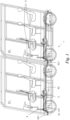
- Fig. 1 shows a schematic illustration of modular braking device installed on two modules of a modular system vehicles.
- the measurements, values, shapes and geometric references (such as perpendicularity and parallelism), when associated with words like "about” or other similar terms such as “approximately” or “substantially”, are to be considered as except for measurement errors or inaccuracies due to production and/or manufacturing errors, and, above all, except for a slight divergence from the value, measurements, shape, or geometric reference with which it is associated.
- these terms if associated with a value, preferably indicate a divergence of not more than 10% of the value.
- the modular braking device according to the invention is globally indicated with the number 1.
- the modular braking device 1 is adapted to be installed on a modular vehicle system 2.
- Said modular vehicle system 2 comprising at least two vehicles 21, 22, as shown in the exemplary embodiment of Fig.1 .
- the device 1 is suitable for being installed on a system 2 of modular vehicles comprising a plurality of vehicles, being in fact a modular device 1 present identical on each vehicle suitable for composing the system 2.
- Said vehicles 21, 22, are removably connectable to each other, and when connected they form a rigid train without relative rotations between said vehicles 21, 22. Said vehicles 21, 22 therefore form a rigid train without relative rotations in a horizontal plane, in a plane lateral and in a vertical plane.
- the structural connection between said vehicles 21, 22 can be carried out according to any system that allows the formation of a rigid train.
- the connection to form said rigid train must also be understood as a non-articulated connection between said vehicles 21 and 22 to form said system 2, as described above.
- each of said vehicles 21, 22 comprises a braking system 3 which can be activated by control means 4 accessible by a user. They can be manual, assisted, remote or automatic or more.
- the braking system 3 can for example be any braking system of the known art.
- the braking system 3 is a hydraulic system servo-assisted by a pneumatic vacuum servo.
- Said controls 4 can consist of a pedal or any other element capable of transmitting a braking command by moving at least part of the components of the controls 4.
- Said controls 4 can be actuated by a physical user or by an automatic system, for example a remote control and/or guidance system. Again, preferably, said controls 4 accessible by a user comprise at least the control of the service brake of the vehicles 21, 22.
- the device 1 according to the invention achieves important advantages.
- this solution does not need complex connection systems, such as for example inertial or electro-pneumatic systems, between one vehicle and another so that the construction and maintenance cost is much cheaper than existing solutions.
- a further advantage of the device 1 according to the present invention is that, in the event of failure of the servo assistance on one of the connected means, the modular vehicle system 2 remains safely braked and with relatively little force applied to the pedal or to the controls 4 since the force resulting on bar 42 will always be the sum of the contributions of the brake servo-assistance systems of all the connected units.
- this system is neither configured as a "brake-by-wire" nor as a braking device for trailers, since each vehicle is rigidly coupled and potentially constitutes an independent unit equipped with traction, steering, braking and own energy source.
- the resulting vehicle, called modular vehicle system 2 is configured as a single, longer vehicle, not as a combination of tractor and trailer. This aspect makes the system eligible under the ECE13 braking system standard, for one vehicle as type M1/N1 and for two or more vehicles as M2/M3/N2.
Landscapes
- Engineering & Computer Science (AREA)
- Transportation (AREA)
- Mechanical Engineering (AREA)
- Chemical & Material Sciences (AREA)
- Combustion & Propulsion (AREA)
- Regulating Braking Force (AREA)
- Transmission Of Braking Force In Braking Systems (AREA)
Description
- The present invention relates to a modular braking device adapted to be installed on a modular vehicle system of the type specified in the preamble of the first claim.
- Similar devices are described in documents:
DE 835 840 C ,WO 2016/161216 A1 ,US D 784 853 and "Next modular self driving vehicle creates comfortable space for traveling", Tommaso Gecchelin, Futuristic News, 24 July 2013 (2013-07-24), page 6 pp., XP055524 764. - Systems are currently known which are suitable for transmitting a braking command to a train of vehicles connected to each other in an articulated manner, not rigidly, therefore with the possibility of relative rotations between the vehicles of the train. Pneumatic and/or inertial braking systems in vehicles towing trailers, or combinations of said systems, are in fact known.
- They have connections which can be mechanical, pneumatic or similar.
- The known art described includes some important drawbacks.
- The pneumatic and/or inertial braking systems typical of vehicles pulling trailers, for example, are not suitable for said trains of vehicles rigidly connected to each other and moreover they do not give the possibility of coupling more than one trailer in succession.
- In particular, pneumatic systems are very complex and expensive, and are not suitable for coupled vehicles with their own and independent braking system, such as for example two independent vehicles connected to form a modular vehicle system.
- In this situation, the technical task underlying the present invention is to devise a modular braking device capable of substantially obviating at least part of the aforementioned drawbacks.
- Within the scope of said technical task, it is an important object of the invention to obtain a device of the "plug and play" type which is operative for coupling two vehicles without the need for an operator.
- Another important object of the invention is to provide a modular device, present on vehicles capable of being rigidly connected to each other in a modular vehicle system.
- Again, an important object of the invention is to provide a completely mechanical device which does not involve delays in the transmission of the braking command between different vehicles.
- In addition, an important object of the invention is to provide a highly safe device in the event of breakdowns in the servo-assisted braking systems of vehicles. Finally, an important object of the invention is to provide a device which can connect a plurality of vehicle braking systems to transmit a command.
- The technical task and the specified aims are achieved by a modular braking device adapted to be installed on a modular vehicle system as claimed in the annexed claim 1.
- Preferred technical solutions are highlighted in the dependent claims.
- The characteristics and advantages of the invention are clarified below by the detailed description of preferred embodiments of the invention, with reference to the accompanying figures, in which:
Fig. 1 shows a schematic illustration of modular braking device installed on two modules of a modular system vehicles. - In the present document, the measurements, values, shapes and geometric references (such as perpendicularity and parallelism), when associated with words like "about" or other similar terms such as "approximately" or "substantially", are to be considered as except for measurement errors or inaccuracies due to production and/or manufacturing errors, and, above all, except for a slight divergence from the value, measurements, shape, or geometric reference with which it is associated. For instance, these terms, if associated with a value, preferably indicate a divergence of not more than 10% of the value.
- Moreover, when used, terms such as "first", "second", "higher", "lower", "main" and "secondary" do not necessarily identify an order, a priority of relationship or a relative position, but can simply be used to clearly distinguish between their different components.
- Unless otherwise specified, as results in the following discussions, terms such as "treatment", "computing", "determination", "calculation", or similar, refer to the action and/or processes of a computer or similar electronic calculation device that manipulates and/or transforms data represented as physical, such as electronic quantities of registers of a computer system and/or memories in, other data similarly represented as physical quantities within computer systems, registers or other storage, transmission or information displaying devices.
- The measurements and data reported in this text are to be considered, unless otherwise indicated, as performed in the International Standard Atmosphere ICAO (ISO 2533:1975).
- With reference to the figures, the modular braking device according to the invention is globally indicated with the number 1.
- Preferably, the modular braking device 1 is adapted to be installed on a
modular vehicle system 2. - Said
modular vehicle system 2 comprising at least twovehicles Fig.1 . - As will become clear in the following, the device 1 is suitable for being installed on a
system 2 of modular vehicles comprising a plurality of vehicles, being in fact a modular device 1 present identical on each vehicle suitable for composing thesystem 2. - Said
vehicles vehicles vehicles vehicles vehicles system 2, as described above. - Preferably, each of said
vehicles braking system 3 which can be activated by control means 4 accessible by a user. They can be manual, assisted, remote or automatic or more. Thebraking system 3 can for example be any braking system of the known art. Preferably thebraking system 3 is a hydraulic system servo-assisted by a pneumatic vacuum servo. - Said controls 4 can consist of a pedal or any other element capable of transmitting a braking command by moving at least part of the components of the controls 4. Said controls 4 can be actuated by a physical user or by an automatic system, for example a remote control and/or guidance system. Again, preferably, said controls 4 accessible by a user comprise at least the control of the service brake of the
vehicles - Preferably, the device 1 according to the present invention comprises, on each of said
vehicles transmission bar 42 of the braking command. By connection means 41 in the present document it is meant a system, preferably mechanical, able to transmit the movement caused by a braking command. - In the embodiment shown in
Fig.1 said connection means 41 comprise mechanical leverages 411. - Preferably, according to the present invention, the
transmission bar 42 extends for the length of thevehicles - Again, preferably, the
bars 42 of thevehicles vehicles system 2 of modular vehicles. The connection or contact of thebars 42 therefore allows the transmission of a braking command from onevehicle 21 to theother vehicle 22, or vice versa, by means of its mechanical movement at least in a single direction, or rather by pushing at least in the direction that allows the transmission of a braking command from a leading vehicle to a trailing vehicle or vice versa, since generally eachbraking system 3 of the prior art has a return-to-position system, which returns thesystem 3 to the non-braking position and thebars 42 thereto and connected to each other. The rigid assembly formed by the connection of saidbars 42 allows the actuation of thebraking systems 3 of each vehicle of themodular vehicle system 2, through the movement of connection means 41, controls 4 and finally of the actuator of thebraking system 3. - Still, preferably according to the present invention the distal ends of said
transmission rods 42 are provided with joiningmeans 421 comprising magnetic couplings, mechanical, pneumatic and/or electronic acts to bind together the saidtransmission bars 42 and in particular of a braking command. Finally, preferably in an alternative embodiment, or in combination with what has been described, saidbraking system 3, said connecting means 41 and saidtransmission bar 42 of the braking control are servo-assisted systems. - The operation of the device 1 previously described in structural terms is as follows.
- In its simplest embodiment, shown in
Fig. 1 The service brake pedal 4 is connected to a lever 41 which pushes in parallel both the cylinder, or any other actuation system, of thebraking system 3 of the vehicle wherein it is, either, in parallel abar 42 which reaches the rear of the vehicle and up to the front end of the same. From the moment of rigid coupling of another vehicle, the rear part of thebar 42 of the leading vehicle comes into contact with the front part of thebar 42 of the tailing vehicle, which in turn pushes on the cylinder of thebrake system 3 of the rear vehicle. In this way abar 42 puts thebraking systems 3 of all the connected vehicles in series to form themodular system 2. Therefore, if the driver or equivalent remote or driverless driving system in the lead vehicle presses the brake pedal, the brake cylinder of the vehicles connected in the rear are also pressed, in a completely mechanical way. - The device 1 according to the invention achieves important advantages.
- In fact, advantageously this solution does not need complex connection systems, such as for example inertial or electro-pneumatic systems, between one vehicle and another so that the construction and maintenance cost is much cheaper than existing solutions.
- Furthermore, a modular braking device 1 fully automatically engages a further modular braking device 1 of another vehicle when the vehicles are rigidly coupled, since the
bar 42 comes into contact with that of the rear vehicle. - In addition, advantageously with respect to the systems of the known art, there are no delays in the transmission of the braking command since the
mechanical bar 42 is rigid and incompressible, unlike, for example, the braking systems of trailers based on a pneumatic circuit. - A further advantage of the device 1 according to the present invention is that, in the event of failure of the servo assistance on one of the connected means, the
modular vehicle system 2 remains safely braked and with relatively little force applied to the pedal or to the controls 4 since the force resulting onbar 42 will always be the sum of the contributions of the brake servo-assistance systems of all the connected units. Finally, at a regulatory and certification level, this system is neither configured as a "brake-by-wire" nor as a braking device for trailers, since each vehicle is rigidly coupled and potentially constitutes an independent unit equipped with traction, steering, braking and own energy source. The resulting vehicle, calledmodular vehicle system 2, is configured as a single, longer vehicle, not as a combination of tractor and trailer. This aspect makes the system eligible under the ECE13 braking system standard, for one vehicle as type M1/N1 and for two or more vehicles as M2/M3/N2. - The invention is susceptible of variants falling within the scope of the inventive concept defined by the claims.
- In this context, all the details can be replaced by equivalent elements and the materials, shapes and dimensions can be any.
Claims (5)
- System of modular vehicles comprising a modular braking device (1), said system (2) comprising at least two vehicles (21,22) being connectable to and detachable from each other, wherein said vehicles (21,22), when connected to form said system (2), form a rigid train without relative rotations between said vehicles (21, 22), in which each of said vehicles (21, 22) comprises at least one braking system (3) which can be activated by control means (4) accessible by a user, characterized in that said system comprises, on each of said vehicles (21,22), means for connecting said control means (4) to a transmission bar (42) for controlling the braking, said transmission bar (42) extending for the length of each vehicles (21, 22), and wherein said bars (42) of the vehicles (21, 22) are connected when said vehicles (21,22) are connected to form said system (2) of modular vehicles.
- The system of modular vehicles according to claim 1, wherein said connection means (41) comprise levers (411) mechanics.
- The system of modular vehicles according to any one of the preceding claims, wherein said controls (4) accessible by a user comprise at least the service brake control of the vehicles (21, 22).
- The system of modular vehicles according to any one of the preceding claims, wherein said braking system (3), said connection means (41) and said transmission bar (42) of the brake control are servo-assisted systems.
- The system of modular vehicles according to any one of the preceding claims, wherein the distal ends of said transmission bars (42) are provided with joint means (421) comprising magnetic, mechanical, pneumatic and/or electronic joints suitable for binding between them called transmission bars (42).
Applications Claiming Priority (2)
| Application Number | Priority Date | Filing Date | Title |
|---|---|---|---|
| IT202000027342 | 2020-11-16 | ||
| PCT/IB2021/057744 WO2022101699A1 (en) | 2020-11-16 | 2021-08-24 | Modular braking device |
Publications (3)
| Publication Number | Publication Date |
|---|---|
| EP4244106A1 EP4244106A1 (en) | 2023-09-20 |
| EP4244106C0 EP4244106C0 (en) | 2025-04-16 |
| EP4244106B1 true EP4244106B1 (en) | 2025-04-16 |
Family
ID=74592406
Family Applications (1)
| Application Number | Title | Priority Date | Filing Date |
|---|---|---|---|
| EP21770071.5A Active EP4244106B1 (en) | 2020-11-16 | 2021-08-24 | System of modular vehicles comprising a modular braking device |
Country Status (7)
| Country | Link |
|---|---|
| US (1) | US20240017707A1 (en) |
| EP (1) | EP4244106B1 (en) |
| JP (1) | JP7848437B2 (en) |
| KR (1) | KR20230107580A (en) |
| CN (1) | CN116457252A (en) |
| ES (1) | ES3029584T3 (en) |
| WO (1) | WO2022101699A1 (en) |
Family Cites Families (14)
| Publication number | Priority date | Publication date | Assignee | Title |
|---|---|---|---|---|
| AT160773B (en) * | 1937-07-21 | 1942-02-10 | Ringhoffer Tatra Werke Ag | Motor vehicle train. |
| DE835540C (en) * | 1950-07-30 | 1952-04-03 | Robert Berninghaus & Soehne | Guard control for presses, scissors or the like with electronically controlled activation of the working stroke |
| DE835840C (en) * | 1950-11-09 | 1952-04-03 | Ruhrstahl A G | Single wheel braking with a pedal for each single wheel and an element coupling the pedals for two-wheel braking, especially of tractors for agricultural purposes |
| DE2635878A1 (en) * | 1975-12-18 | 1978-02-16 | Peitz Josef Sen | Trailer hand-brake with remote control - has release and actuating mechanism is operated by extension cables with grips and guides |
| JPS62170817U (en) * | 1986-04-21 | 1987-10-29 | ||
| DE3700464A1 (en) * | 1987-01-09 | 1988-07-21 | Daimler Benz Ag | OMNIBUS SUITABLE FOR ILLUSTRATION |
| US6419037B1 (en) * | 2000-07-19 | 2002-07-16 | Meritor Heavy Vehicle Systems, Llc | Multi-unit articulated road train propulsion system |
| US7896140B2 (en) * | 2007-02-23 | 2011-03-01 | Gunderson, Llc | Handbrake linkage for a railroad freight car |
| USD621746S1 (en) * | 2009-09-29 | 2010-08-17 | Suzhou Eagle Electric Vehicle Manufacturing Co., Ltd. | Electric vehicle |
| JP2012105514A (en) * | 2010-11-15 | 2012-05-31 | Ntn Corp | Coupled car |
| DE102014018671A1 (en) * | 2014-12-18 | 2016-06-23 | A&A Logistik-Equipment GmbH & Co. KG | Conveyor train with coupling kinematics |
| SG11201708005YA (en) * | 2015-03-31 | 2017-10-30 | Next Future Transp Inc | Selectively combineable independent driving vehicles |
| USD784853S1 (en) * | 2015-05-15 | 2017-04-25 | Next Future Transportation Inc. | Connectable road vehicle |
| EP3670216A1 (en) * | 2018-12-21 | 2020-06-24 | Carrosserie Hess AG | Passenger trailer for an electric bus |
-
2021
- 2021-08-24 JP JP2023528961A patent/JP7848437B2/en active Active
- 2021-08-24 WO PCT/IB2021/057744 patent/WO2022101699A1/en not_active Ceased
- 2021-08-24 US US18/252,751 patent/US20240017707A1/en active Pending
- 2021-08-24 KR KR1020237016453A patent/KR20230107580A/en active Pending
- 2021-08-24 ES ES21770071T patent/ES3029584T3/en active Active
- 2021-08-24 EP EP21770071.5A patent/EP4244106B1/en active Active
- 2021-08-24 CN CN202180077009.0A patent/CN116457252A/en active Pending
Also Published As
| Publication number | Publication date |
|---|---|
| KR20230107580A (en) | 2023-07-17 |
| ES3029584T3 (en) | 2025-06-24 |
| WO2022101699A1 (en) | 2022-05-19 |
| EP4244106C0 (en) | 2025-04-16 |
| JP7848437B2 (en) | 2026-04-21 |
| US20240017707A1 (en) | 2024-01-18 |
| CN116457252A (en) | 2023-07-18 |
| JP2023552691A (en) | 2023-12-19 |
| EP4244106A1 (en) | 2023-09-20 |
Similar Documents
| Publication | Publication Date | Title |
|---|---|---|
| EP3707047B1 (en) | System for the at least semi-autonomous operation of a motor vehicle with double redundancy | |
| CN112739591B (en) | Brake system for a vehicle, vehicle and method of controlling a brake system of a vehicle | |
| EP2091807B1 (en) | Articulation control system | |
| EP3626557B1 (en) | Brake system for a vehicle | |
| EP2450248B1 (en) | Vehicle Braking System | |
| EP2913236A2 (en) | Brake module for a hydraulically braked towing vehicle which can be coupled together with a pneumatically braked trailer vehicle | |
| DE19806655A1 (en) | Electronic reversing aid for lorry with trailer | |
| DE102017002719A1 (en) | Electronically controllable braking system and method for controlling the electronically controllable braking system | |
| EP2853453B1 (en) | Braking system and method for curve support | |
| EP2942249A1 (en) | Braking system for a motor vehicle operated by a pressurised medium and motor vehicle equipped with same | |
| WO2007147526A1 (en) | Rear axle steering for a mobile crane | |
| GB2310177A (en) | Emergency steering-by-braking system for motor vehicles | |
| EP3626560B1 (en) | Brake system for a vehicle and vehicle | |
| US6622813B2 (en) | Hybrid steer-by-wire with mechanical link | |
| CN105658497A (en) | Pneumatic Braking System Redundancy in Train Formation | |
| DE3344301A1 (en) | BRAKE SYSTEM FOR A TRAILER VEHICLE | |
| EP4244106B1 (en) | System of modular vehicles comprising a modular braking device | |
| DE102012005832A1 (en) | Brake system for controlling the rearrangement of a trailer vehicle | |
| DE102019117650A1 (en) | Electropneumatic handbrake system for commercial vehicles with spring-loaded parking brakes | |
| DE102006035913A1 (en) | Combined vehicle brake system with hydraulically and electromechanically actuated wheel brakes | |
| SE1851522A1 (en) | A safety method for a modular vehicle, a control device, a vehicle, a computer program and a computer-readable medium | |
| EP3781464B1 (en) | Conveyor system having a conveyor carriage | |
| DE10225888B4 (en) | Modular chassis system | |
| DE29901871U1 (en) | Parking brake system for motor vehicles with detection of a trailer load | |
| EP4244121B1 (en) | Modular kinematic steering device |
Legal Events
| Date | Code | Title | Description |
|---|---|---|---|
| STAA | Information on the status of an ep patent application or granted ep patent |
Free format text: STATUS: UNKNOWN |
|
| STAA | Information on the status of an ep patent application or granted ep patent |
Free format text: STATUS: THE INTERNATIONAL PUBLICATION HAS BEEN MADE |
|
| PUAI | Public reference made under article 153(3) epc to a published international application that has entered the european phase |
Free format text: ORIGINAL CODE: 0009012 |
|
| STAA | Information on the status of an ep patent application or granted ep patent |
Free format text: STATUS: REQUEST FOR EXAMINATION WAS MADE |
|
| 17P | Request for examination filed |
Effective date: 20230519 |
|
| AK | Designated contracting states |
Kind code of ref document: A1 Designated state(s): AL AT BE BG CH CY CZ DE DK EE ES FI FR GB GR HR HU IE IS IT LI LT LU LV MC MK MT NL NO PL PT RO RS SE SI SK SM TR |
|
| DAV | Request for validation of the european patent (deleted) | ||
| DAX | Request for extension of the european patent (deleted) | ||
| GRAP | Despatch of communication of intention to grant a patent |
Free format text: ORIGINAL CODE: EPIDOSNIGR1 |
|
| STAA | Information on the status of an ep patent application or granted ep patent |
Free format text: STATUS: GRANT OF PATENT IS INTENDED |
|
| RIC1 | Information provided on ipc code assigned before grant |
Ipc: B62D 31/02 20060101ALI20241014BHEP Ipc: B62D 47/00 20060101ALI20241014BHEP Ipc: B60T 11/04 20060101AFI20241014BHEP |
|
| INTG | Intention to grant announced |
Effective date: 20241114 |
|
| GRAS | Grant fee paid |
Free format text: ORIGINAL CODE: EPIDOSNIGR3 |
|
| GRAA | (expected) grant |
Free format text: ORIGINAL CODE: 0009210 |
|
| STAA | Information on the status of an ep patent application or granted ep patent |
Free format text: STATUS: THE PATENT HAS BEEN GRANTED |
|
| AK | Designated contracting states |
Kind code of ref document: B1 Designated state(s): AL AT BE BG CH CY CZ DE DK EE ES FI FR GB GR HR HU IE IS IT LI LT LU LV MC MK MT NL NO PL PT RO RS SE SI SK SM TR |
|
| REG | Reference to a national code |
Ref country code: GB Ref legal event code: FG4D |
|
| REG | Reference to a national code |
Ref country code: CH Ref legal event code: EP |
|
| REG | Reference to a national code |
Ref country code: IE Ref legal event code: FG4D |
|
| REG | Reference to a national code |
Ref country code: DE Ref legal event code: R096 Ref document number: 602021029291 Country of ref document: DE |
|
| GRAT | Correction requested after decision to grant or after decision to maintain patent in amended form |
Free format text: ORIGINAL CODE: EPIDOSNCDEC |
|
| RAP4 | Party data changed (patent owner data changed or rights of a patent transferred) |
Owner name: GETPLUS S.R.L. |
|
| U01 | Request for unitary effect filed |
Effective date: 20250513 |
|
| REG | Reference to a national code |
Ref country code: ES Ref legal event code: FG2A Ref document number: 3029584 Country of ref document: ES Kind code of ref document: T3 Effective date: 20250624 |
|
| RAP4 | Party data changed (patent owner data changed or rights of a patent transferred) |
Owner name: GETPLUS S.R.L. |
|
| U07 | Unitary effect registered |
Designated state(s): AT BE BG DE DK EE FI FR IT LT LU LV MT NL PT RO SE SI Effective date: 20250522 |
|
| U20 | Renewal fee for the european patent with unitary effect paid |
Year of fee payment: 5 Effective date: 20250606 |
|
| PGFP | Annual fee paid to national office [announced via postgrant information from national office to epo] |
Ref country code: ES Payment date: 20250917 Year of fee payment: 5 |
|
| PG25 | Lapsed in a contracting state [announced via postgrant information from national office to epo] |
Ref country code: GR Free format text: LAPSE BECAUSE OF FAILURE TO SUBMIT A TRANSLATION OF THE DESCRIPTION OR TO PAY THE FEE WITHIN THE PRESCRIBED TIME-LIMIT Effective date: 20250717 |
|
| PGFP | Annual fee paid to national office [announced via postgrant information from national office to epo] |
Ref country code: NO Payment date: 20250820 Year of fee payment: 5 |
|
| PG25 | Lapsed in a contracting state [announced via postgrant information from national office to epo] |
Ref country code: PL Free format text: LAPSE BECAUSE OF FAILURE TO SUBMIT A TRANSLATION OF THE DESCRIPTION OR TO PAY THE FEE WITHIN THE PRESCRIBED TIME-LIMIT Effective date: 20250416 |
|
| PGFP | Annual fee paid to national office [announced via postgrant information from national office to epo] |
Ref country code: TR Payment date: 20250814 Year of fee payment: 5 |
|
| PGFP | Annual fee paid to national office [announced via postgrant information from national office to epo] |
Ref country code: GB Payment date: 20250818 Year of fee payment: 5 |
|
| PG25 | Lapsed in a contracting state [announced via postgrant information from national office to epo] |
Ref country code: HR Free format text: LAPSE BECAUSE OF FAILURE TO SUBMIT A TRANSLATION OF THE DESCRIPTION OR TO PAY THE FEE WITHIN THE PRESCRIBED TIME-LIMIT Effective date: 20250416 |
|
| PG25 | Lapsed in a contracting state [announced via postgrant information from national office to epo] |
Ref country code: RS Free format text: LAPSE BECAUSE OF FAILURE TO SUBMIT A TRANSLATION OF THE DESCRIPTION OR TO PAY THE FEE WITHIN THE PRESCRIBED TIME-LIMIT Effective date: 20250716 |
|
| PG25 | Lapsed in a contracting state [announced via postgrant information from national office to epo] |
Ref country code: IS Free format text: LAPSE BECAUSE OF FAILURE TO SUBMIT A TRANSLATION OF THE DESCRIPTION OR TO PAY THE FEE WITHIN THE PRESCRIBED TIME-LIMIT Effective date: 20250816 |
|
| PG25 | Lapsed in a contracting state [announced via postgrant information from national office to epo] |
Ref country code: SM Free format text: LAPSE BECAUSE OF FAILURE TO SUBMIT A TRANSLATION OF THE DESCRIPTION OR TO PAY THE FEE WITHIN THE PRESCRIBED TIME-LIMIT Effective date: 20250416 |
|
| PG25 | Lapsed in a contracting state [announced via postgrant information from national office to epo] |
Ref country code: CZ Free format text: LAPSE BECAUSE OF FAILURE TO SUBMIT A TRANSLATION OF THE DESCRIPTION OR TO PAY THE FEE WITHIN THE PRESCRIBED TIME-LIMIT Effective date: 20250416 |
|
| PG25 | Lapsed in a contracting state [announced via postgrant information from national office to epo] |
Ref country code: SK Free format text: LAPSE BECAUSE OF FAILURE TO SUBMIT A TRANSLATION OF THE DESCRIPTION OR TO PAY THE FEE WITHIN THE PRESCRIBED TIME-LIMIT Effective date: 20250416 |
|
| PLBE | No opposition filed within time limit |
Free format text: ORIGINAL CODE: 0009261 |
|
| STAA | Information on the status of an ep patent application or granted ep patent |
Free format text: STATUS: NO OPPOSITION FILED WITHIN TIME LIMIT |
|
| REG | Reference to a national code |
Ref country code: CH Ref legal event code: L10 Free format text: ST27 STATUS EVENT CODE: U-0-0-L10-L00 (AS PROVIDED BY THE NATIONAL OFFICE) Effective date: 20260225 |
|
| REG | Reference to a national code |
Ref country code: CH Ref legal event code: H13 Free format text: ST27 STATUS EVENT CODE: U-0-0-H10-H13 (AS PROVIDED BY THE NATIONAL OFFICE) Effective date: 20260324 |
|
| 26N | No opposition filed |
Effective date: 20260119 |
|
| PG25 | Lapsed in a contracting state [announced via postgrant information from national office to epo] |
Ref country code: MC Free format text: LAPSE BECAUSE OF FAILURE TO SUBMIT A TRANSLATION OF THE DESCRIPTION OR TO PAY THE FEE WITHIN THE PRESCRIBED TIME-LIMIT Effective date: 20250416 |
|
| PG25 | Lapsed in a contracting state [announced via postgrant information from national office to epo] |
Ref country code: CH Free format text: LAPSE BECAUSE OF NON-PAYMENT OF DUE FEES Effective date: 20250831 |