EP4243371A2 - Herstellung von medienpfaden in der echtzeit-kommunikation - Google Patents
Herstellung von medienpfaden in der echtzeit-kommunikation Download PDFInfo
- Publication number
- EP4243371A2 EP4243371A2 EP23182438.4A EP23182438A EP4243371A2 EP 4243371 A2 EP4243371 A2 EP 4243371A2 EP 23182438 A EP23182438 A EP 23182438A EP 4243371 A2 EP4243371 A2 EP 4243371A2
- Authority
- EP
- European Patent Office
- Prior art keywords
- media
- server
- rtc
- rtc device
- endpoint
- Prior art date
- Legal status (The legal status is an assumption and is not a legal conclusion. Google has not performed a legal analysis and makes no representation as to the accuracy of the status listed.)
- Granted
Links
Images





Classifications
-
- H—ELECTRICITY
- H04—ELECTRIC COMMUNICATION TECHNIQUE
- H04L—TRANSMISSION OF DIGITAL INFORMATION, e.g. TELEGRAPHIC COMMUNICATION
- H04L65/00—Network arrangements, protocols or services for supporting real-time applications in data packet communication
- H04L65/1066—Session management
- H04L65/1069—Session establishment or de-establishment
-
- H—ELECTRICITY
- H04—ELECTRIC COMMUNICATION TECHNIQUE
- H04L—TRANSMISSION OF DIGITAL INFORMATION, e.g. TELEGRAPHIC COMMUNICATION
- H04L65/00—Network arrangements, protocols or services for supporting real-time applications in data packet communication
- H04L65/10—Architectures or entities
- H04L65/1046—Call controllers; Call servers
-
- H—ELECTRICITY
- H04—ELECTRIC COMMUNICATION TECHNIQUE
- H04L—TRANSMISSION OF DIGITAL INFORMATION, e.g. TELEGRAPHIC COMMUNICATION
- H04L65/00—Network arrangements, protocols or services for supporting real-time applications in data packet communication
- H04L65/60—Network streaming of media packets
- H04L65/65—Network streaming protocols, e.g. real-time transport protocol [RTP] or real-time control protocol [RTCP]
-
- H—ELECTRICITY
- H04—ELECTRIC COMMUNICATION TECHNIQUE
- H04M—TELEPHONIC COMMUNICATION
- H04M7/00—Arrangements for interconnection between switching centres
- H04M7/006—Networks other than PSTN/ISDN providing telephone service, e.g. Voice over Internet Protocol (VoIP), including next generation networks with a packet-switched transport layer
- H04M7/0066—Details of access arrangements to the networks
Definitions
- This method, telecommunication device, system or software module relates generally to the field of telecommunication.
- WO 2013/108121 A2 describes a telecommunication device for real-time communication (RTC) at a border between a global transport network and a private domain of a communication network.
- the telecommunication device comprises means for creating mutual trust between the telecommunication device and a communication participant and a traverser for real-time traffic to traverse a firewall or an interface for opening a path for real-time traffic through the firewall.
- US 2004/122976 A1 describes a mobile host that includes a micro-mobility management daemon that monitors the mobile host's movement between base stations.
- US 2014/095724 A1 describes a distributed application of enterprise policies to WebRTC interactive sessions.
- DE 10 2014 108888 A1 discloses a method of providing a virtual Back-to-Back WebRTC communications agent by establishing a first interactive WebRTC connection between a first WebRTC client and a virtual WebRTC agent and by establishing a second interactive WebRTC connection between a second WebRTC client and a virtual WebRTC agent.
- the current global telephone network is built for voice communication of limited bandwidth (only 3.5 kHz).
- Broadband networks e.g. the Internet, can also be used for real-time person-to-person communication, e.g. voice communication, often called VoIP (Voice over Internet Protocol).
- VoIP Voice over Internet Protocol
- the Internet transports data between endpoints, regardless of the data content or the application and is therefore called a transport network.
- VoIP or more generally Real Time Communication (RTC)
- RTC Real Time Communication
- POTS Plain Old Telephony Service
- IETF Internet Engineering Task Force
- Session Initiation Protocol (SIP, RFC 3261) is a widely used protocol for RTC.
- RFCs Request For Comments
- WebRTC Web Real-Time Communication
- RTC protocols are used to establish media streams such as voice and video, between endpoint devices, often providing telephony-like functions and services. They often define the call setup procedure, which is how a call is initiated, done and completed.
- a data communication network is typically a packet switch network like the Internet, forwarding packets of data to destinations specified by the address of the packets.
- the packets typically also contain the source address from which it was sent.
- Data packets may be messages containing requests, responses, or data representing documents, files or media like movies and voice and are exchanged between endpoints.
- a data communication network may also include private segments, intranets, or Local Area Networks (LANs) that communicate with the global network through a Network Address Translator (NAT) or firewall, which often are combined and just called either NAT or firewall or sometimes access router.
- NAT Network Address Translator
- traffic is data packets being sent and received.
- Real-time traffic is streams of voice or other media like video. Such media streams are used by telephony-like services or calls over a network.
- a media path transports such media stream over a network, which may consist of several network segments of different types.
- Endpoints such as various devices, clients and servers have one or several network interfaces like Ethernet, WiFi or LTE radio interfaces, with which they connect to network access points.
- An address in a network may be a number (like an IPv4 or an IPv6 address) or a symbolic address, like a Fully Qualified Domain Name (FQDN), that is further resolved into a number address, e.g. by a Domain Name System (DNS) service.
- DNS Domain Name System
- Such addresses may also be further specified by port numbers, to indicate a protocol being used or simply used as an extension to the address types exemplified above (e.g. an IPv4 address with specified port 132.64.75.1 :1234), which in this context may be one form of a network address in general.
- Endpoints such as various devices, clients and servers have one or several addresses in a network, at which they can send or receive traffic.
- the address to an endpoint is dependent of network interface of the endpoint and the access point of the network.
- a server is a network device accessed by clients.
- the client can be a program on a computer or a device connected to the network.
- An application server is a server offering a service or a function to users.
- Network access points have different locations and can use different fixed access technologies such as Ethernet, ADSL modems, cable modems, fiber and various wireless and mobile technologies such as WiFi, 3G, 4G, LTE and more.
- VoIP Voice over IP
- OTT Over The Top
- VoIP Voice over LTE
- Signaling are typically messages in signaling channels between endpoints, proxies and servers over network segments.
- the signaling over a signaling channel can be interrupted, e.g. when loosing wireless coverage, changing interface of a device or changing access point of a network segment, but can thereafter be recovered to reestablish signaling connectivity.
- Firewalls and NATs typically block real-time communication, an issue that either is resolved by Session Border Controllers (SBCs) at the edge of the private network or by methods or protocols such as e.g. Session Traversal Utilities for NAT (STUN, RFC 5389), Traversal Using Relays around NAT (TURN, RFC 5766) and Interactive Connectivity Establishment (ICE, RFC 5245).
- SBCs Session Border Controllers
- STUN Session Border Controllers
- TURN Traversal Using Relays around NAT
- ICE Interactive Connectivity Establishment
- a TURN server relays traffic between two network addresses and is an example of a relay server.
- a TURN server can be discovered by an RTC endpoint and in a sealed network segment it then has to be used for RTC media traffic outside the sealed network segment.
- SBCs also implement security and interoperability functions for VoIP and RTC and are often used for connecting Internet Telephony Service Provider's (ITSP's) VoIP services to IP-PBXs, also called SIP trunking.
- ITSP's Internet Telephony Service Provider's
- IP-PBX Internet Protocol (IP) Private Branch exchange (PBX).
- IP Internet Protocol
- PBX Private Branch exchange
- Call centers are most often based on IP-PBXs or Unified Communications (UC) solutions receiving calls via an ITSP's SIP Trunk. These calls are typically initiated via toll free numbers (800 numbers in the US) from the telephony network.
- UC Unified Communications
- PBX or UC functionality can be Interactive Voice Response (IVR), Queues, Voice and Video mail.
- IVR Interactive Voice Response
- Queues Queues
- Voice and Video mail Voice and Video mail.
- IM Instant Messaging
- presence screen sharing
- group calls are other RTC functions.
- a protocol is a set of rules defining language and methods of communication.
- Session Description Protocol SDP, RFC 4566
- SDP Session Description Protocol
- RFC 4566 Real-time communication
- Such real-time communication can be offered by one endpoint to another endpoint that can answer with its willingness and media capabilities to set up media communication session between the endpoints. That is an Offer and Answer protocol (O/A protocol).
- O/A protocol Offer and Answer protocol
- the O/A protocol typically determines the media types, e.g. voice and video specifying which codec to use.
- Such O/A protocol may also suggest methods and candidates how to set up the media path between endpoints, as e.g. defined by the ICE protocol for NAT traversal.
- a media path is typically set up for the purpose of real-time communication, while the wider term communication path refers to a direct or indirect channel for transferring data that may or may not represent media.
- a media endpoint is an endpoint to which a media path over a network is coupled to allow media streams to flow, typically containing real-time traffic representing voice or video.
- An established media path between media endpoints that is set up again is said to be reestablished.
- a media endpoint has peer-to-peer media capability if it can set up a media path directly to another media endpoint with or without going through a server, e.g. a TURN server.
- a server e.g. a TURN server.
- Mutual peer-to-peer media capability means that two endpoints are compatible and can set up a direct media path between each other.
- the Session Initiation Protocol is used to find users and set up calls between SIP clients, their real-time communication devices, e.g. hardware SIP phones or software SIP phones being a software application on a computer.
- SIP is a signaling protocol using registrar and proxy servers to find users and further uses the SDP O/A protocol to establish a media channel between SIP client endpoints.
- a SIP client typically includes the SIP user agent, interfacing users to the SIP proxy.
- Web Real Time Communication is a set of recommendations and protocols under standardization for extending web browsers to allow real-time communication between them. WebRTC does not specify the signaling for finding users, but allows web browsers connected to the same web server to establish a media channel for real-time communication between them, using the SDP O/A protocol. WebRTC uses the ICE protocol, including STUN and TURN, to set up a media path between the WebRTC media endpoints.
- RTC devices including media endpoints may therefore be implemented in WebRTC browsers, which retrieve their program code (in HTML and Java Script) from web servers.
- the media streams are encrypted using the DTLS-SRTP protocol and are protected against "man in the middle” attacks.
- the protection involves exchange of fingerprints (digital signatures of the certificates used for the encryption key generation) between the parties over another channel or path than used for generating the encryption keys. This means that the media traffic cannot be decrypted by just intercepting the media path or the signaling path.
- a web browser is a program running on computers or smartphones for accessing the World Wide Web (the web), a service on the Internet or an Intranet implemented on a web server.
- a web server may transfer program code, typically Java Script, to a web browser for execution therein, which is a technology used with WebRTC.
- a HyperText Transfer Protocol (HTTP) URL (or simply "a link") identifies a web resource and specifies the acting upon executing it.
- a URL may refer to the web resource /wiki/Main_Page whose related program code is obtainable via HTTP from a server whose domain name may be example.org preceding the /wiki/Main_Page.
- Executing a HTTP URL in a WebRTC browser may initiate a call to be setup from the web server being addressed, which is a useful feature of the emerging WebRTC technology.
- Such URL may contain a telephone number and other information of the call to setup, e.g. a limitation in time for when the URL can be used for calling.
- WebRTC HTTP URLs may be long and obscure and there are services shortening links, such as Bitly, using its short domain name bit.ly after a unique string that represents a long HTTP URL that Bitly has stored, so when a URL is executed in a web browser, it goes to Bitly that redirects it to the full long web link.
- Such WebRTC click-to-call link can be generated by and stored in a WebRTC server that will be called when clicked in a browser.
- a shortened link e.g. consisting of a unique string followed by the domain name of the server, would be passed to the user that is intended to execute it in a WebRTC browser.
- Time limiting can be implemented by encrypting the last valid time or simply by only storing the link translation in the WebRTC server for as long as it is valid.
- Click-to-call links can also be used on Web sites and are then often context-sensitive, i.e. they can carry information of whom that clicked the link, which selections that may have been made, when it was clicked and from where it was clicked.
- a specific domain name extension e.g. wrtc in wrtc.company.com
- Gateways are used to convert between different network segments or protocols to allow a service to function between more users.
- RTC clients e.g. SIP or WebRTC clients
- SIP or WebRTC clients also need to maintain a connection to their server for incoming signaling, for an incoming call or for reestablishing a media path for an ongoing call.
- a media endpoint typically knows between which addresses a media path, carrying media traffic (a media stream) is setup and can thereby determine if it is dependent on a particular address change.
- Smartphones that are mobile devices, may go to sleep when not in use to save remaining battery time, but can often be woken up to e.g. receive a message or prepare for an incoming VoIP call by so called push notifications from a centralized push notification server.
- GUI Graphical User Interface
- One way of improving the GUI is to organize contacts (persons or users) in separate lists based on the call state (e.g. idle, active, in a group call, on hold, in queue n, in transfer, incoming unanswered calls etc.), where each contact (in a list, or single) have an expandable action menu listing currently available selections (e.g. Call, Hang-up, Transfer, Hold, Connect in conference, Mute/Un-mute Video, Mute/Un-mute Voice, Send message, Change presence and possibly also administrative tasks).
- Such menu can be expanded through a small symbol, e.g. the three vertical dots symbol or the menu lines symbol, commonly used by smartphones, at the line of the contact.
- Dual Tone Multi Frequency (DTMF) digits can be transferred either encoded as audio or out-of-band in data packets.
- DTMF defined symbols are 0, 1, 2, 3, 4, 5, 6, 7, 8, 9, #, *, A, B, C and D.
- RTC real-time communication
- handover of calls is implemented in an environment where the RTC device, like smartphone or laptop computer, may have several network interfaces, like Wi-Fi, LTE wireless or wired Ethernet, and may access the network from different access points at different network segments, like the Internet, intranets or telephony types of network segments, by creating a connection identity when the RTC device connects to its server, followed by monitoring and testing both the signaling channel and the media path, and when the access to the network changes, recovering connectivity of the signaling channel and establishing or reestablishing media paths when needed.
- the RTC device like smartphone or laptop computer
- a need for reestablishing media paths is determined by various changes of addresses used for the signaling channel and media path.
- a frequency of sending messages to monitor the signaling channel is adapted to whether a call is ongoing, or whether there are NAT or firewall openings that need to be kept alive, to save processor capacity and power consumption.
- gateways are formed for connecting calls between endpoints that are incompatible regarding signaling or media, or for connecting calls over network segments that are incompatible regarding signaling or media.
- a system for communication over a network comprises two or more RTC endpoints, a Real Time Communication device, RTC device, comprising a first media endpoint, a second media endpoint and a server, wherein each of the RTC device, the second media endpoint and the server storing software implementing the method in a memory and a processor coupled to the memory, where the first and second media endpoints are configured to be connected to network access points at network segments of different types.
- a system for communication over a network where the user agents coupled to the RTC devices are implemented in the server or interconnecting servers.
- interconnecting servers use the SIP protocol and the SIP user agents coupled to the RTC devices are implemented in the server instead of the in the RTC devices, which would be the case if the RTC device in itself was a SIP client.
- a method for establishing or reestablishing a media path between endpoints with one or more network interfaces of different types connected to network access points at different types of network segments, to implement handover of calls is conducted by providing a Real Time Communication device comprising a first media endpoint, a second media endpoint and a server, each of the RTC device, the second media endpoint and the server having a memory and a processor coupled to the memory, making the server reachable at addresses from access points at the network segments, where the RTC device and the second media endpoint will be used, arranging at least one network interface of the RTC device that is connected to some network access point to send and receive messages between the RTC device and the server, and configuring the RTC device and the second media endpoint to have peer-to-peer media capability by using an Offer and Answer protocol (O/A protocol) to establish and reestablish a media path between the RTC device and the second media endpoint, then, after establishing a connection between the RTC device and the server, creating a unique connection identity
- the RTC device may collect the addresses to the server from the access points at the network segments by one or more of retrieving one or more addresses to the server from a call setup procedure, retrieving one or more addresses to the server as a source address of a message from the server, receiving a message from the server conveying one or more addresses to the server, using DNS or other database look up of addresses to the server, and storing a list of predetermined addresses to the server, sending messages repeatedly, by the RTC device, to an address of the server and, if not receiving a response, then trying other collected addresses to the server until receiving a response and recovering signaling connectivity by continuing sending messages to the address from which the response was received, after recovering signaling between the RTC device and the server, presenting the connection identity, by the RTC device, to the server for recovering the specific connection, to be able to receive calls or to use the O/A protocol to establish or reestablish a media path between the RTC device and the second media endpoint, determining a need for media path reestablishment
- the method for establishing or reestablishing a media path between endpoints with one or more network interfaces of different types connected to network access points at different types of network segments includes determining a need for media path reestablishment, by the RTC device, by occurrence of an event of changed addresses or media path conditions by one or more of the RTC device detecting or being informed by a message from the server that its address used for connecting to the server has changed and the media path being dependent of that changed address, the RTC device receiving a message from the server where a destination address of the message has changed compared to an earlier message and the media path being dependent of the changed address, the RTC device detecting that its address for the media path has changed, the RTC device being informed by a message from the second media endpoint via the server that the address used for the media path by the second media endpoint has changed, and the RTC device detecting or being informed that the traffic in either direction of the media path between the RTC device and the second media endpoint has stopped or deteriorated.
- the method for establishing or reestablishing a media path between endpoints with one or more network interfaces of different types connected to network access points at different types of network segments includes adapting, by the RTC device, a frequency of sending messages repeatedly to the server depending on whether a call is ongoing, or whether there are NAT or firewall openings that need to be kept alive.
- the second endpoint is another RTC device or gateway.
- system for communication over a network includes two or more RTC endpoints.
- a client side of the system is implemented by a telecommunication device.
- a server side of the system which may be part of a Session Border Controller is implemented by a telecommunication device.
- the device for telecommunication incorporates and can send a program to a client.
- the device for telecommunication is a web server.
- a software module which, when executed on a system as specified above, performs the method recited above.
- the software module includes a program performing a function, such as sending messages (164) to endpoints, which may be shortened, compressed, limited in time or DTMF encoded, through a media path (146), receiving messages (164) from an endpoint, which may be shortened, compressed, limited in time or DTMF encoded, through a media path (146), establishing an additional alternative media path, which quality or other metric is evaluated, before using the alternative media path for the media traffic, communicating real time using the Session Initiation Protocol (SIP), communicating real time using the Web Real Time Communication (WebRTC) protocol, establishing media paths between endpoints using the Interactive Connection Establishment (ICE), establishing media paths using the Session Traversal Utilities for NAT (STUN) protocol, establishing media paths using the Traversal Using Relays around NAT (TURN) protocol, storing knowledge, from a self learning process, whether endpoints or network segments have mutual per-to-per media compatibility, generating a WebRTC HTTP URL click-to-
- wrtc in wrtc.company.com in a WebRTC HTTP URL link for invoking WebRTC functionality that otherwise may not be available, organizing contacts in lists based on the call state, in a graphical user interface for RTC clients, representing an expandable action menu for a single contact in a graphical user interface for RTC clients, by the small three vertical dot symbol or the menu lines symbol used in mobile applications, waking up smartphones or other mobile devices to receive incoming calls by push notifications, integrating Private Branch eXchanges (PBX) functionality, integrating Session Border Controller (SBC) functionality, integrating Unified Communications (UC) solution functionality, integrating WebRTC to SIP gateway functionality, integrating call center or contact center functionality, generating context sensitive click-to-call links, executing context sensitive click-to-call links, connecting call agents using WebRTC browsers as clients, and providing Instant Messaging (IM), presence, screen sharing and group call functions.
- PBX Private Branch eXchanges
- SBC Session Border Controller
- user agents coupled to the RTC devices of the system are implemented in the server, interconnecting servers or RTC server.
- the interconnecting servers use the SIP protocol between each other and SIP user agents coupled to the RTC devices are implemented in the interconnecting servers.
- the server or interconnecting server is combined with a gateway or intercepting gateway.
- the defined O/A protocol for the media endpoints when the defined O/A protocol for the media endpoints is incompatible with an endpoint or network segments, implementing in the media endpoints, by deviating from the defined O/A protocol, an O/A protocol that is compatible with the endpoints and the network segment to communicate with, to offload the gateway to enable communication, and when the defined media path capabilities for the media endpoints are incompatible with an endpoint or network segments, implementing in the media endpoints, by deviating from the defined media path capabilities, media path capabilities that are compatible with the endpoints and the network segment to communicate with, to offload the gateway to enable communication.
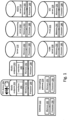
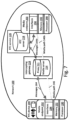
- FIG. 5 A method for establishing or reestablishing a media path between endpoints according to an embodiment is shown in Fig. 5 , where endpoints have one or more network interfaces 194 of different types and are connected to network access points 140 at different types of network segments 104, 106, 108, to implement handover of calls.
- RTC devices 200 e.g. software clients or applications on smart phones
- RTC devices 200 to maintain an ongoing call when network access points are changed, when using different network interfaces (e.g. fixed Ethernet, Wi-Fi, mobile 3G data and LTE) and via various network access service providers.
- RTC device Real Time Communication device
- O/A protocol Offer and Answer protocol
- Such media path may pass a firewall or NATs shown in Fig. 3 and a TURN server shown in Fig. 1 .
- Both endpoints can be connected to a server 210 reachable at some address 120 from access points 140 at the network segments 104, 106 and 108, where the endpoints will be used;
- the RTC device (200) is via at least one network interface (194) connected to some network access point 140 establishing a signaling channel to or through the server 210 by sending and receiving messages 164.
- the RTC device 200 may reach the server 210 via a FQDN looked up in DNS even if the numeric address of the server 210 may have changed, due to access via another network segment 104, 106, 108.
- the server 210 may be connected to several network segments with a separate address 120 on each segment.
- An RTC device 200 changing its access to another network segment 104, 106, 108, can then have received the addresses 120 of the server 210 on the various network segments 104, 106, 108 it is connected to, from the server 210 in advance of the change of access point 140 and can then reconnect via the new network segment.
- a unique connection identity is created and shared between the RTC device 200 and the server 210 to allow a non responding connection to be identified and recovered.
- the following steps can establish or reestablish the media path 146:
- the media channel is typically monitored separately and tried to be reestablished only when having been interrupted or showing bad quality.
- the RTC device 200 may detect a need for media path reestablishment by the occurrence of one of the following changed addresses or media path conditions:
- the media channel is typically monitored separately and tried to be reestablished only when having been interrupted or showing bad quality.
- the RTC device 200 is adapting a frequency of sending messages repeatedly to the server 210 depending on whether a call is ongoing, or whether there are NAT or firewall openings that need to be kept alive.
- a gateway 222 integrates the second media endpoint 203 with the server 210 for connecting calls to endpoints that are incompatible with the RTC device 200 regarding signaling or media, or for connecting calls over network segments 104, 106, 108 that are incompatible regarding signaling or media, when a protocol used by the RTC device 200 requires media encryption and encryption keys are negotiated over the media path 146 by the media endpoints 202, 203 and has protection against man in the middle attacks by checking a fingerprint only available to the server 210 through a signaling channel.
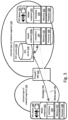
- a method for establishing or reestablishing a media path between endpoints for intercepting and decrypting Real Time Communication (RTC) media traffic between an RTC device 200 and an RTC service 228 using a communication protocol, where the media traffic is protected against man in the middle attacks using a fingerprint, for monitoring, analyzing and recording purposes, according to an embodiment is shown in Fig. 7 .
- RTC Real Time Communication
- a proxy 211 is used to get control over the signaling and a media server 214 is intercepting, decrypting and relaying the media traffic.
- the Real Time Communication device (RTC device) 200 comprises a first media endpoint 202, a second media endpoint 203, an RTC server 218 and an intercepting gateway 224, each of the RTC device 200, the second media endpoint 203, the RTC server 218 and the intercepting gateway 224 having a memory 192 and a processor 190 coupled to the memory 192.
- the intercepting gateway 224 integrates a proxy 211 for the communication protocol used by the RTC service 228 and a media server 214, each of the proxy 211 and the media server 214 having a memory 192 and a processor 190 coupled to the memory 192.
- the RTC media path is established between the RTC device 200 and the media server 214 and between the media server 214 and the second media endpoint 203, by the proxy 211 rewriting messages 164, 164b.
- the fingerprint is arranged by the proxy 211 rewriting messages 164, 164b for the interception, decryption and transferring of the RTC media traffic by the media server 214.
- the RTC device 200 is configured to use said proxy 211 for the communication protocol used by the RTC service 228.
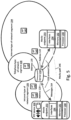
- a method for establishing or reestablishing a media path between endpoints for intercepting and decrypting Real Time Communication (RTC) media traffic between an RTC device 200 and an RTC service 228 using a TURN protocol, where the media traffic is protected against man in the middle attacks using a fingerprint, for monitoring, analyzing and recording purposes, according to another embodiment is shown in Fig. 8 .
- RTC Real Time Communication
- a TURN server 216 is relaying the media traffic.
- TURN server Media streams will flow through a TURN server if it is considered “sealed” as outlined in IETF draft-schwartz-rtcweb-return-06, or if the TURN server is auto discovered or assigned by a software application and enforced to be used.
- the intercepting gateway may also be built into an IP default gateway or a firewall/NAT between the media endpoints.
- Another location of the intercepting server may be in the device handling real-time traffic between a local or private network and a global transport network, to handle use cases where the RTC is on a private domain and external traffic is to be monitored.
- a remote user to such private domain, sending its media to said intercepting server, can also be analyzed using the proposed method.
- a client e.g. a WebRTC browser configured to do so, can establish the media through an intercepting server by modifying the ICE procedure or by other means.
- the Real Time Communication device (RTC device) 200 comprises a first media endpoint 202, a second media endpoint 203, an RTC server 218 and an intercepting gateway 224, each of the RTC device 200, the second media endpoint 203, the RTC server 218 and the intercepting gateway 224 having a memory 192 and a processor 190 coupled to the memory 192.
- the intercepting gateway 224 integrates a TURN server 216 having a memory 192 and a processor 190 coupled to the memory 192 with the intercepting gateway 224.
- the RTC media path is established between the RTC device 200 and the TURN server 216 and between the TURN server 216 and the second media endpoint 203, by configuring the RTC device 200 or the RTC service 228 to use the TURN server 216, or by one of the media endpoints 202 or 203 discovering the TURN server 216 in a sealed network segment.
- the decryption key for the RTC media traffic is conveyed to the intercepting gateway 224, by the first media endpoint 202 or by the second media endpoint 203, for decrypting the RTC media traffic passing the intercepting gateway 224.
- the intercepting server can also be built into an SBC (Session Border Controller) that typically handles media flows to traverse NAT and firewalls.
- SBC Session Border Controller
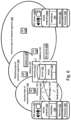
- a method for establishing or reestablishing a media path between endpoints 202, 203 with peer-to-peer media capability, connected over a network with gateways 222 between network segments of different types 104, 106, 108, to achieve a direct media path for richer media, improved media quality, lower network load or lower cost calls according to an embodiment is shown in Fig. 9 .
- VoIP services even when a call starts from a computer client or an IP phone on a LAN (an intranet type of network segment) or on the Internet, almost always include gateway functionality into a telephony type of network segment and even when the other endpoint is a compatible VoIP phone, the media traffic is restricted or costly, because it involves the telephony type of network segment.
- modern protocols e.g. WebRTC and SIP or a combination thereof, also capable of video, it would be advantageous to establish a direct media path between compatible endpoints, rather than setting up a media path over a telephony type of network segment.
- Real time communion calls today also most telephone calls, connects endpoints in a two step process with messages over a signaling channel, which may be over several network segments and interconnecting servers 210, 212, followed by media channel establishment, which also may be over several network segments and servers. Any of these connections may be used for sending and receiving at least limited amounts of data between the endpoints and it should be noticed that a media path for conventional voice telephony, still is able to transfer data content, e.g. in the form of DTMF digits.
- a direct media path between the endpoints also called a peer-to-peer media path
- a direct media path between the endpoints also called a peer-to-peer media path
- either of the endpoints can indicate to the other endpoint that it has peer-to-peer media path capability and either of the endpoints can initiate such establishment or reestablishment.
- Such direct media path may in this context include TURN servers and still be considered a direct media connection.
- Initiating establishment or reestablishment of a media path may be signaled over a signaling channel or a media path, by using a O/A protocol.
- a O/A protocol may be too long to e.g. encode into DTMF digits and to transfer over that voice channel.
- a compressed version of the O/A protocol can be used.
- one endpoint can request that the other endpoint connects to the same server that it is self connected to, through which the O/A protocol can be executed and a direct media connection between the endpoints can be established.
- This mechanism could be implemented in a WebRTC browser, that is in contact with a server (a web server) over which its signaling is transferred.
- the request could then be implemented as a transfer of a HTTP URL to the other endpoint over the signaling channel or media path, where after the full O/A protocol could be signaled via the then common server 210.
- the Real Time Communication device (RTC device) 200 comprises a first media endpoint 202, a second media endpoint 203 and interconnecting servers 212, 212b, each of the RTC device 200, the second media endpoint 203 and the interconnecting servers 212, 212b has a memory 192 and a processor 190 coupled to the memory 192.
- the RTC device 200 and the second media endpoint 203 are configured to have peer-to-peer media capability by using an Offer and Answer protocol (O/A protocol) to establish and reestablish a media path for media traffic of different types.
- O/A protocol Offer and Answer protocol
- the RTC device 200 requests establishment of a direct media path 148 for the call, using the O/A protocol, which may be compressed, through an end-to-end signaling channel 152 between the RTC device 200 and the second media endpoint 203, or
- the second media endpoint 203 requests establishment of a direct media path 148 for the call, using the O/A protocol, which may be compressed, through an end-to-end signaling channel 152 between the RTC device 200 and the second media endpoint 203, or
- the second endpoint 203 may be another RTC device 200 or gateway 222, 224.
- a further embodiment may be a system for communication over a network using the method for establishing or reestablishing a media path, further comprising two or more endpoints 202, 203, 203b.
- the user agents coupled to the RTC devices 200 are implemented in the server 210 or interconnecting servers 212, 212b.
- a further embodiment is a system where the interconnecting servers 212, 212b use the SIP protocol between each other and the SIP user agents coupled to the RTC devices 200 are implemented in the interconnecting servers 212, 212b.
- FIG. 6 Another embodiment, referring to Fig. 6 is to offload the gateway 222 to enable communication when (i) the defined O/A protocol for the media endpoints 202, 203, 203b is incompatible with an endpoint 208 or 206 or a network segments 104, 106 or 108, implementing in the media endpoints 202, 203, 203b, by deviating from the defined O/A protocol, an O/A protocol that is compatible with the endpoints and the network segment to communicate with, and when (ii) the defined media path capabilities for the media endpoints 202, 203, 203b are incompatible with an endpoint 208 or 206 or a network segments 104, 106 or 108, implementing in the media endpoints 202, 203, 203b, by deviating from the defined media path capabilities, media path capabilities that are compatible with the endpoints and the network segment to communicate with, to offload the gateway 222 to enable communication.
- system for communication over a network includes two or more RTC endpoints.
- a client side of the system is implemented by a telecommunication device.
- a server side of the system which may be part of a Session Border Controller is implemented by a telecommunication device.
- the device for telecommunication incorporates and can send a program to a client.
- the device for telecommunication is a web server.
- the client or server side of the system is implemented by a software module in a web browser or as an application for smartphones, tablets, laptop or personal computers or computer servers, or in a telecommunication device comprising a processor for executing a program.
- user agents coupled to the RTC devices of the system are implemented in the server, interconnecting servers or RTC server.
- the interconnecting servers use the SIP protocol between each other and SIP user agents coupled to the RTC devices are implemented in the interconnecting servers.
- the server or interconnecting server is combined with a gateway or intercepting gateway.
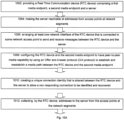
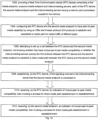
- a process for establishing or reestablishing a media path between endpoints for handover of calls according to an embodiment.
- a Real Time Communication device (RTC device) comprising a first media endpoint, a second media endpoint and a server is provided.
- the server is made reachable at addresses from access points at network segments.
- at least one network interface of the RTC device that is connected to some network access point is arranged to send and receive messages between the RTC device and the server.
- the RTC device and the second media endpoint are configured to have peer-to-peer media capability by using an Offer and Answer protocol (O/A protocol) to establish and reestablish a media path between the RTC device and the second media endpoint.
- O/A protocol Offer and Answer protocol
- a unique connection identity is created that is shared between the RTC device and the server to allow a non responding connection to be identified and recovered.
- addresses to the server from the access points at the network segments are collected by the RTC device.
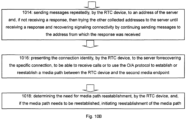
- a seventh operation 1014 shown in Fig.
- messages are sent repeatedly by the RTC device to an address of the server and, if no response is received, then other collected addresses to the server are tried until a response is received and signaling connectivity is recovered by continuing sending messages to the address from which the response was received.
- the connection identity is presented by the RTC device to the server for recovering the specific connection, to be able to receive calls or to use the O/A protocol to establish or reestablish a media path between the RTC device and the second media endpoint.
- the need for reestablishing the media path is determined by the RTC device and, if the media path needs to be reestablished, reestablishment of the media path is initiated.
- Fig. 11 is shown a process for establishing a media path for intercepting RTC traffic between endpoints according to an embodiment using a proxy.
- a Real Time Communication (RTC) device comprising a first media endpoint, a second media endpoint, an RTC server, and an intercepting gateway is provided.
- RTC Real Time Communication
- a proxy for the communication protocol used by the RTC service and a media server is integrated with the intercepting gateway.
- the RTC media path is established between the RTC device and the media server and between the media server and the second media endpoint.
- the fingerprint for the interception is arranged by the proxy rewriting the messages, for the decryption and transferring of the RTC media traffic by the media server.
- the RTC device is configured to use the proxy for the communication protocol used by the RTC service.
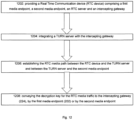
- Fig. 12 is shown a process for establishing a media path for intercepting RTC traffic between endpoints according to an embodiment using a TURN server.
- a Real Time Communication device RTC device
- a TURN server is integrated with the intercepting gateway.
- the RTC media path is established between the RTC device and the TURN server and between the TURN server and the second media endpoint.
- the decryption key for the RTC media traffic is conveyed to the intercepting gateway (224), by the first media endpoint (202) or by the second media endpoint.
- a Real Time Communication device comprising a first media endpoint, a second media endpoint and interconnecting servers is provided, each of the RTC device, the second media endpoint and the interconnecting servers having a memory and a processor coupled to the memory.
- RTC device and the second media endpoint are configured to have peer-to-peer media capability by using an Offer and Answer protocol (O/A protocol) to establish and reestablish a media path for media traffic of different types.
- O/A protocol Offer and Answer protocol
- an attempt is made to set up a call between the RTC device and the second media endpoint, not knowing whether they have mutual per-to-per media compatibility or whether the interconnecting servers convey the O/A protocol between the RTC device and the second media endpoint to establish a direct media path between the RTC device and the second media endpoint.
- the RTC device receives an indication of mutual peer-to-peer media compatibility, then invoking a process for direct media path establishment or reestablishment.
- the second media endpoint receives an indication of mutual peer-to-peer media compatibility, and then invokes a process for direct media path establishment or reestablishment.
- the embodiments can be implemented in computing hardware (computing apparatus) and/or software, such as (in a non-limiting example) any computer that can store, retrieve, process and/or output data and/or communicate with other computers.
- a program/software implementing the embodiments may be recorded on computer-readable media comprising computer-readable recording media.
- the program/software implementing the embodiments may also be transmitted over transmission communication media.
- Examples of the computer-readable recording media include a magnetic recording apparatus, an optical disk, a magneto-optical disk, and/or a semiconductor memory (for example, RAM, ROM, FLASH etc.).
- Examples of the magnetic recording apparatus include a hard disk device (HDD), a flexible disk (FD), and a magnetic tape (MT).
- optical disk examples include a DVD (Digital Versatile Disc), a DVD-RAM, a CD-ROM (Compact Disc - Read Only Memory), and a CD-R (Recordable)/RW.
- communication media includes a carrier-wave signal.
- WebRTC When WebRTC is being said, it may also mean (or apply to) other real time communication protocols or in general a way of communicating.
Landscapes
- Engineering & Computer Science (AREA)
- Multimedia (AREA)
- Computer Networks & Wireless Communication (AREA)
- Signal Processing (AREA)
- Business, Economics & Management (AREA)
- General Business, Economics & Management (AREA)
- Data Exchanges In Wide-Area Networks (AREA)
- Telephonic Communication Services (AREA)
- Mobile Radio Communication Systems (AREA)
Applications Claiming Priority (3)
| Application Number | Priority Date | Filing Date | Title |
|---|---|---|---|
| US201562157359P | 2015-05-05 | 2015-05-05 | |
| PCT/IB2016/000713 WO2016178090A2 (en) | 2015-05-05 | 2016-05-05 | Establishing media paths in real time communications |
| EP16742382.1A EP3292675B1 (de) | 2015-05-05 | 2016-05-05 | Herstellung von medienpfaden in der echtzeit-kommunikation |
Related Parent Applications (1)
| Application Number | Title | Priority Date | Filing Date |
|---|---|---|---|
| EP16742382.1A Division EP3292675B1 (de) | 2015-05-05 | 2016-05-05 | Herstellung von medienpfaden in der echtzeit-kommunikation |
Publications (4)
| Publication Number | Publication Date |
|---|---|
| EP4243371A2 true EP4243371A2 (de) | 2023-09-13 |
| EP4243371A3 EP4243371A3 (de) | 2023-09-27 |
| EP4243371B1 EP4243371B1 (de) | 2024-11-13 |
| EP4243371C0 EP4243371C0 (de) | 2024-11-13 |
Family
ID=56550248
Family Applications (3)
| Application Number | Title | Priority Date | Filing Date |
|---|---|---|---|
| EP16742382.1A Active EP3292675B1 (de) | 2015-05-05 | 2016-05-05 | Herstellung von medienpfaden in der echtzeit-kommunikation |
| EP23183043.1A Active EP4243372B1 (de) | 2015-05-05 | 2016-05-05 | Verfahren und system zum abfangen und entschlüsseln von fingerabdruckgeschütztem medienverkehr |
| EP23182438.4A Active EP4243371B1 (de) | 2015-05-05 | 2016-05-05 | Herstellung von medienpfaden in der echtzeit-kommunikation |
Family Applications Before (2)
| Application Number | Title | Priority Date | Filing Date |
|---|---|---|---|
| EP16742382.1A Active EP3292675B1 (de) | 2015-05-05 | 2016-05-05 | Herstellung von medienpfaden in der echtzeit-kommunikation |
| EP23183043.1A Active EP4243372B1 (de) | 2015-05-05 | 2016-05-05 | Verfahren und system zum abfangen und entschlüsseln von fingerabdruckgeschütztem medienverkehr |
Country Status (6)
| Country | Link |
|---|---|
| US (2) | US10298628B2 (de) |
| EP (3) | EP3292675B1 (de) |
| JP (2) | JP6899328B2 (de) |
| KR (1) | KR102475020B1 (de) |
| CN (3) | CN112600832B (de) |
| WO (1) | WO2016178090A2 (de) |
Families Citing this family (35)
| Publication number | Priority date | Publication date | Assignee | Title |
|---|---|---|---|---|
| FR3022093A1 (fr) * | 2014-06-10 | 2015-12-11 | Orange | Procede d'etablissement d'une session webrtc |
| US10819755B1 (en) * | 2016-09-16 | 2020-10-27 | Ribbon Communications Operating Company, Inc. | Communications apparatus, systems, and methods for preventing and/or minimizing session data clipping |
| US11374999B2 (en) * | 2016-09-28 | 2022-06-28 | Telefonaktiebolaget Lm Ericsson (Publ) | Methods and arrangements for binding a device application to a web service |
| US9942322B1 (en) * | 2017-04-07 | 2018-04-10 | T-Mobile Usa, Inc. | Call log update across mobile device and WebRTC client device |
| KR102327489B1 (ko) * | 2017-05-25 | 2021-11-18 | (주)마켓디자이너스 | Rtc 스위칭을 이용한 모바일 과외 플랫폼 서버 및 모바일 과외 서비스 제공 방법 |
| JP6469266B1 (ja) * | 2018-01-22 | 2019-02-13 | エヌ・ティ・ティ・アドバンステクノロジ株式会社 | 通信システム |
| US10855755B2 (en) * | 2018-05-04 | 2020-12-01 | Citrix Systems, Inc. | WebRTC API redirection with fallbacks |
| FI20185419A1 (en) | 2018-05-08 | 2019-11-09 | Telia Co Ab | communication Management |
| US10986219B2 (en) | 2018-06-19 | 2021-04-20 | At&T Intellectual Property I, L.P. | LTE fault-tolerant signaling approach |
| US10904210B2 (en) * | 2018-11-21 | 2021-01-26 | Microsoft Technology Licensing, Llc | Dynamic bookmarking of web addresses accessed via short URL |
| FI129164B (en) * | 2018-12-20 | 2021-08-13 | Telia Co Ab | Communication solution |
| KR102240904B1 (ko) * | 2019-01-24 | 2021-04-15 | 주식회사 브리지텍 | WebRTC 기반 콜센터 서비스 방법 및 그 장치 |
| CN110460878B (zh) * | 2019-07-19 | 2022-01-11 | 视联动力信息技术股份有限公司 | 一种视频通信链路的切换方法和装置 |
| KR102339553B1 (ko) * | 2019-12-19 | 2021-12-16 | ㈜오버플로우 | 화면을 확대하여 표시하며 실시간으로 중계하는 장치 및 이의 동작 방법 |
| WO2021164892A1 (en) * | 2020-02-18 | 2021-08-26 | Telefonaktiebolaget Lm Ericsson (Publ) | Technique for performing a context transfer |
| CN111541648B (zh) * | 2020-03-25 | 2022-09-20 | 杭州数梦工场科技有限公司 | 网络连接检测方法、装置、电子设备和存储介质 |
| JP6973871B2 (ja) * | 2020-05-20 | 2021-12-01 | Necプラットフォームズ株式会社 | 中継装置、通信システム、中継方法及びプログラム |
| US11350314B2 (en) * | 2020-07-13 | 2022-05-31 | Agora Lab, Inc. | System and method for classifying network data packets with provided classifier identifiers |
| CN112653661B (zh) * | 2020-09-08 | 2023-04-07 | 厦门亿联网络技术股份有限公司 | 一种VoIP网络限制下的媒体恢复方法和系统 |
| CN112218388A (zh) * | 2020-09-15 | 2021-01-12 | 贵阳朗玛信息技术股份有限公司 | 一种断网重连的方法及装置 |
| CN112217690B (zh) * | 2020-09-18 | 2022-06-14 | 苏州浪潮智能科技有限公司 | 一种计算节点之间局域网可用的并发测试方法及系统 |
| CN112202882B (zh) * | 2020-09-29 | 2022-03-25 | 联想(北京)有限公司 | 一种传输方法、客户端及传输系统 |
| US11838375B2 (en) * | 2020-11-12 | 2023-12-05 | Harman International Industries, Incorporated | Universal software communication bus |
| CN112953925B (zh) * | 2021-02-05 | 2022-08-16 | 广州启智信息科技有限公司 | 基于sip协议和rtc网络实时音视频通信系统及方法 |
| CN113132376B (zh) * | 2021-04-14 | 2022-11-22 | 腾讯科技(深圳)有限公司 | 媒体数据处理方法及装置、系统、电子设备和存储介质 |
| US12328345B1 (en) * | 2021-08-20 | 2025-06-10 | T-Mobile Innovations Llc | Call setup simplification for internet clients to establish media sessions with a serving IMS network |
| CN113726895B (zh) * | 2021-08-31 | 2023-08-25 | 广州艾美网络科技有限公司 | 文件传输方法、装置及网络ktv系统 |
| EP4170994B1 (de) * | 2021-10-19 | 2024-01-17 | Tata Consultancy Services Limited | Multi-masterhybrid-telerobotiksystem mit föderierter avatar-steuerung |
| KR102556286B1 (ko) * | 2021-11-24 | 2023-07-17 | 주식회사 디오티스 | 인터넷 환경에서의 WebRTC 기반 통화 연결 방법 및 그 장치 |
| JP7823375B2 (ja) | 2021-11-30 | 2026-03-04 | 株式会社リコー | 通信管理装置、通信システム、通信管理方法、及びプログラム |
| US11864077B2 (en) * | 2022-03-16 | 2024-01-02 | Cisco Technology, Inc. | Media stream handover using wireless connected devices |
| CN115118825B (zh) * | 2022-06-02 | 2025-03-28 | 厦门亿联网络技术股份有限公司 | 一种会话边界控制器系统 |
| US20240022616A1 (en) * | 2022-08-11 | 2024-01-18 | Intel Corporation | Webrtc signaling and data channel in fifth generation (5g) media streaming |
| KR102767591B1 (ko) * | 2022-12-13 | 2025-02-17 | (주)엠투넷 | 웹알티씨 기반 상담 서비스 시스템 |
| AU2023203480B1 (en) * | 2023-06-02 | 2024-07-04 | Canva Pty Ltd | Systems and methods for uploading content items to a server computing system |
Citations (4)
| Publication number | Priority date | Publication date | Assignee | Title |
|---|---|---|---|---|
| US20040122976A1 (en) | 2002-10-24 | 2004-06-24 | Ashutosh Dutta | Integrated mobility management |
| WO2013108121A2 (en) | 2012-01-17 | 2013-07-25 | IPalive AB | A device, software module, system or business method for global real-time telecommunication |
| US20140095724A1 (en) | 2012-09-28 | 2014-04-03 | Avaya Inc. | Distributed application of enterprise policies to web real-time communications (webrtc) interactive sessions, and related methods, systems, and computer-readable media |
| DE102014108888A1 (de) | 2013-06-30 | 2014-12-31 | Avaya Inc. | Virtuelle Back-to-Back-Web-Real-Time-Communications(WebRTC)-Agenten und verwandte Verfahren, Systeme und computerlesbare Medien |
Family Cites Families (22)
| Publication number | Priority date | Publication date | Assignee | Title |
|---|---|---|---|---|
| FR2805107B1 (fr) * | 2000-02-10 | 2002-04-05 | Bull Cp8 | Procede de gestion de transmissions de donnees multimedias via un reseau de type internet, notamment de donnees telephoniques, et carte a puce pour la mise en oeuvre du procede |
| JP4564739B2 (ja) | 2003-11-07 | 2010-10-20 | シャープ株式会社 | サーバ装置および通信システム |
| JP2007142786A (ja) * | 2005-11-18 | 2007-06-07 | Hitachi Ltd | ハンドオーバサーバ及びそれと通信可能な移動通信端末 |
| CN100454921C (zh) * | 2006-03-29 | 2009-01-21 | 华为技术有限公司 | 一种数字版权保护方法及系统 |
| JP4683655B2 (ja) | 2006-09-07 | 2011-05-18 | 株式会社三菱東京Ufj銀行 | アクセス中継装置、アクセス中継システム、及びアクセス中継方法 |
| JP2008252456A (ja) | 2007-03-30 | 2008-10-16 | Toshiba Corp | 通信装置、及び通信方法 |
| CN100566340C (zh) * | 2007-07-25 | 2009-12-02 | 中国科学院沈阳计算技术研究所有限公司 | 支持p2p媒体传输的sip软交换系统及其实现方法 |
| JP5157668B2 (ja) * | 2008-06-19 | 2013-03-06 | 富士通株式会社 | 通信装置および通信方法 |
| US8542805B2 (en) * | 2009-05-14 | 2013-09-24 | Voxeo Corporation | System and method for encrypted media service in an interactive voice response service |
| CN101834874A (zh) * | 2010-05-21 | 2010-09-15 | 四川长虹电器股份有限公司 | 一种能穿透防火墙的多媒体网络通信方法 |
| JP5247769B2 (ja) * | 2010-07-21 | 2013-07-24 | 株式会社トヨタIt開発センター | ソフトウェア無線機およびソフトウェア更新方法 |
| US8638356B2 (en) * | 2011-07-08 | 2014-01-28 | Skype | Communication system |
| CN103580986B (zh) * | 2012-07-30 | 2016-12-21 | 华为终端有限公司 | 一种实时通信方法、终端设备、实时通信服务器及系统 |
| CN103828322B (zh) * | 2012-08-13 | 2017-04-19 | 华为技术有限公司 | 媒体数据传输方法及设备 |
| US8972829B2 (en) * | 2012-10-30 | 2015-03-03 | Broadcom Corporation | Method and apparatus for umbrella coding |
| US8750250B2 (en) * | 2012-12-04 | 2014-06-10 | Bandwidth.Com, Inc. | Personalized user session information for call handoff |
| US9473581B2 (en) * | 2013-02-04 | 2016-10-18 | Oracle International Corporation | Integrated web-enabled session border controller |
| EP2770667B1 (de) * | 2013-02-22 | 2015-09-30 | Telefonica Digital España, S.L.U. | Verfahren und System für kombiniertes P2P und zentralrelais-serverbasierte Telekommunikationskonferenz, welche eine Telefonie und ein Konferenzprotokoll verwendet |
| US9112840B2 (en) * | 2013-07-17 | 2015-08-18 | Avaya Inc. | Verifying privacy of web real-time communications (WebRTC) media channels via corresponding WebRTC data channels, and related methods, systems, and computer-readable media |
| US9531678B1 (en) * | 2013-10-15 | 2016-12-27 | Progress Software Corporation | On-premises data access and firewall tunneling |
| CN103702062A (zh) * | 2013-12-27 | 2014-04-02 | Tcl集团股份有限公司 | 一种音视频通讯方法、装置及系统 |
| US9986014B2 (en) * | 2015-03-27 | 2018-05-29 | Intel Corporation | Systems and techniques for web communication |
-
2016
- 2016-05-05 EP EP16742382.1A patent/EP3292675B1/de active Active
- 2016-05-05 CN CN202011447139.2A patent/CN112600832B/zh active Active
- 2016-05-05 EP EP23183043.1A patent/EP4243372B1/de active Active
- 2016-05-05 CN CN202010566479.0A patent/CN111740990B/zh active Active
- 2016-05-05 US US15/147,810 patent/US10298628B2/en active Active
- 2016-05-05 JP JP2017549804A patent/JP6899328B2/ja active Active
- 2016-05-05 CN CN201680023929.3A patent/CN107567703B/zh active Active
- 2016-05-05 EP EP23182438.4A patent/EP4243371B1/de active Active
- 2016-05-05 KR KR1020177033730A patent/KR102475020B1/ko active Active
- 2016-05-05 WO PCT/IB2016/000713 patent/WO2016178090A2/en not_active Ceased
-
2018
- 2018-03-16 US US15/923,644 patent/US10298629B2/en active Active
-
2020
- 2020-07-15 JP JP2020121602A patent/JP7100786B2/ja active Active
Patent Citations (4)
| Publication number | Priority date | Publication date | Assignee | Title |
|---|---|---|---|---|
| US20040122976A1 (en) | 2002-10-24 | 2004-06-24 | Ashutosh Dutta | Integrated mobility management |
| WO2013108121A2 (en) | 2012-01-17 | 2013-07-25 | IPalive AB | A device, software module, system or business method for global real-time telecommunication |
| US20140095724A1 (en) | 2012-09-28 | 2014-04-03 | Avaya Inc. | Distributed application of enterprise policies to web real-time communications (webrtc) interactive sessions, and related methods, systems, and computer-readable media |
| DE102014108888A1 (de) | 2013-06-30 | 2014-12-31 | Avaya Inc. | Virtuelle Back-to-Back-Web-Real-Time-Communications(WebRTC)-Agenten und verwandte Verfahren, Systeme und computerlesbare Medien |
Also Published As
| Publication number | Publication date |
|---|---|
| EP4243372C0 (de) | 2024-09-25 |
| CN111740990A (zh) | 2020-10-02 |
| CN112600832A (zh) | 2021-04-02 |
| KR102475020B1 (ko) | 2022-12-07 |
| EP4243371B1 (de) | 2024-11-13 |
| EP4243371C0 (de) | 2024-11-13 |
| EP4243372A2 (de) | 2023-09-13 |
| CN112600832B (zh) | 2023-05-19 |
| KR20180015627A (ko) | 2018-02-13 |
| WO2016178090A2 (en) | 2016-11-10 |
| EP3292675C0 (de) | 2023-07-12 |
| JP6899328B2 (ja) | 2021-07-07 |
| EP4243372A3 (de) | 2023-09-27 |
| US10298629B2 (en) | 2019-05-21 |
| CN107567703A (zh) | 2018-01-09 |
| EP3292675B1 (de) | 2023-07-12 |
| EP3292675A2 (de) | 2018-03-14 |
| WO2016178090A3 (en) | 2017-01-05 |
| EP4243371A3 (de) | 2023-09-27 |
| JP7100786B2 (ja) | 2022-07-14 |
| JP2020174396A (ja) | 2020-10-22 |
| CN111740990B (zh) | 2023-02-28 |
| US20160330252A1 (en) | 2016-11-10 |
| EP4243372B1 (de) | 2024-09-25 |
| US10298628B2 (en) | 2019-05-21 |
| US20180205769A1 (en) | 2018-07-19 |
| CN107567703B (zh) | 2022-03-08 |
| JP2018515959A (ja) | 2018-06-14 |
Similar Documents
| Publication | Publication Date | Title |
|---|---|---|
| US10298629B2 (en) | Intercepting and decrypting media paths in real time communications | |
| US11057365B2 (en) | Method and system for creating a virtual SIP user agent by use of a webRTC enabled web browser | |
| US8204066B2 (en) | Method for predicting a port number of a NAT equipment based on results of inquiring the STUN server twice | |
| US20120113977A1 (en) | Vpn device and vpn networking method | |
| US20110110504A1 (en) | Controlling Communications | |
| US20120180117A1 (en) | Method for Realizing End-to-End Call, End-to-End Call Terminal and System | |
| US8077704B2 (en) | Web service assisted real-time session peering between enterprise VoIP networks via internet | |
| US9100729B2 (en) | Method for handling a telecommunications connection, telecommunications arrangement, switching device and network coupling device | |
| US20060092917A1 (en) | SIP Enabled Device identification | |
| US8249238B2 (en) | Dynamic key exchange for call forking scenarios | |
| KR100660123B1 (ko) | Nat 통과를 위한 브이.피.엔 서버 시스템 및 브이.피.엔클라이언트 단말기 | |
| Kamble et al. | Interoperability and Vulnerabilities in VoIP protocol (SIP, H. 323) | |
| García Hijes | Corporate Wireless IP Telephony |
Legal Events
| Date | Code | Title | Description |
|---|---|---|---|
| PUAI | Public reference made under article 153(3) epc to a published international application that has entered the european phase |
Free format text: ORIGINAL CODE: 0009012 |
|
| STAA | Information on the status of an ep patent application or granted ep patent |
Free format text: STATUS: REQUEST FOR EXAMINATION WAS MADE |
|
| REG | Reference to a national code |
Ref country code: DE Ref legal event code: R079 Free format text: PREVIOUS MAIN CLASS: H04L0065104600 Ipc: H04M0007000000 Ref document number: 602016090288 Country of ref document: DE |
|
| PUAL | Search report despatched |
Free format text: ORIGINAL CODE: 0009013 |
|
| 17P | Request for examination filed |
Effective date: 20230629 |
|
| AC | Divisional application: reference to earlier application |
Ref document number: 3292675 Country of ref document: EP Kind code of ref document: P |
|
| AK | Designated contracting states |
Kind code of ref document: A2 Designated state(s): AL AT BE BG CH CY CZ DE DK EE ES FI FR GB GR HR HU IE IS IT LI LT LU LV MC MK MT NL NO PL PT RO RS SE SI SK SM TR |
|
| AK | Designated contracting states |
Kind code of ref document: A3 Designated state(s): AL AT BE BG CH CY CZ DE DK EE ES FI FR GB GR HR HU IE IS IT LI LT LU LV MC MK MT NL NO PL PT RO RS SE SI SK SM TR |
|
| RIC1 | Information provided on ipc code assigned before grant |
Ipc: H04L 65/1046 20220101ALI20230821BHEP Ipc: H04L 65/1069 20220101ALI20230821BHEP Ipc: H04M 7/00 20060101AFI20230821BHEP |
|
| GRAP | Despatch of communication of intention to grant a patent |
Free format text: ORIGINAL CODE: EPIDOSNIGR1 |
|
| STAA | Information on the status of an ep patent application or granted ep patent |
Free format text: STATUS: GRANT OF PATENT IS INTENDED |
|
| RIC1 | Information provided on ipc code assigned before grant |
Ipc: H04L 65/1046 20220101ALI20240517BHEP Ipc: H04L 65/1069 20220101ALI20240517BHEP Ipc: H04M 7/00 20060101AFI20240517BHEP |
|
| INTG | Intention to grant announced |
Effective date: 20240604 |
|
| GRAS | Grant fee paid |
Free format text: ORIGINAL CODE: EPIDOSNIGR3 |
|
| GRAA | (expected) grant |
Free format text: ORIGINAL CODE: 0009210 |
|
| STAA | Information on the status of an ep patent application or granted ep patent |
Free format text: STATUS: THE PATENT HAS BEEN GRANTED |
|
| AC | Divisional application: reference to earlier application |
Ref document number: 3292675 Country of ref document: EP Kind code of ref document: P |
|
| AK | Designated contracting states |
Kind code of ref document: B1 Designated state(s): AL AT BE BG CH CY CZ DE DK EE ES FI FR GB GR HR HU IE IS IT LI LT LU LV MC MK MT NL NO PL PT RO RS SE SI SK SM TR |
|
| REG | Reference to a national code |
Ref country code: GB Ref legal event code: FG4D |
|
| REG | Reference to a national code |
Ref country code: CH Ref legal event code: EP |
|
| REG | Reference to a national code |
Ref country code: IE Ref legal event code: FG4D |
|
| REG | Reference to a national code |
Ref country code: DE Ref legal event code: R096 Ref document number: 602016090288 Country of ref document: DE |
|
| U01 | Request for unitary effect filed |
Effective date: 20241113 |
|
| U07 | Unitary effect registered |
Designated state(s): AT BE BG DE DK EE FI FR IT LT LU LV MT NL PT RO SE SI Effective date: 20241119 |
|
| PG25 | Lapsed in a contracting state [announced via postgrant information from national office to epo] |
Ref country code: HR Free format text: LAPSE BECAUSE OF FAILURE TO SUBMIT A TRANSLATION OF THE DESCRIPTION OR TO PAY THE FEE WITHIN THE PRESCRIBED TIME-LIMIT Effective date: 20241113 Ref country code: IS Free format text: LAPSE BECAUSE OF FAILURE TO SUBMIT A TRANSLATION OF THE DESCRIPTION OR TO PAY THE FEE WITHIN THE PRESCRIBED TIME-LIMIT Effective date: 20250313 |
|
| PG25 | Lapsed in a contracting state [announced via postgrant information from national office to epo] |
Ref country code: ES Free format text: LAPSE BECAUSE OF FAILURE TO SUBMIT A TRANSLATION OF THE DESCRIPTION OR TO PAY THE FEE WITHIN THE PRESCRIBED TIME-LIMIT Effective date: 20241113 |
|
| PG25 | Lapsed in a contracting state [announced via postgrant information from national office to epo] |
Ref country code: NO Free format text: LAPSE BECAUSE OF FAILURE TO SUBMIT A TRANSLATION OF THE DESCRIPTION OR TO PAY THE FEE WITHIN THE PRESCRIBED TIME-LIMIT Effective date: 20250213 |
|
| PG25 | Lapsed in a contracting state [announced via postgrant information from national office to epo] |
Ref country code: GR Free format text: LAPSE BECAUSE OF FAILURE TO SUBMIT A TRANSLATION OF THE DESCRIPTION OR TO PAY THE FEE WITHIN THE PRESCRIBED TIME-LIMIT Effective date: 20250214 |
|
| PG25 | Lapsed in a contracting state [announced via postgrant information from national office to epo] |
Ref country code: PL Free format text: LAPSE BECAUSE OF FAILURE TO SUBMIT A TRANSLATION OF THE DESCRIPTION OR TO PAY THE FEE WITHIN THE PRESCRIBED TIME-LIMIT Effective date: 20241113 |
|
| PG25 | Lapsed in a contracting state [announced via postgrant information from national office to epo] |
Ref country code: RS Free format text: LAPSE BECAUSE OF FAILURE TO SUBMIT A TRANSLATION OF THE DESCRIPTION OR TO PAY THE FEE WITHIN THE PRESCRIBED TIME-LIMIT Effective date: 20250213 |
|
| U20 | Renewal fee for the european patent with unitary effect paid |
Year of fee payment: 10 Effective date: 20250425 |
|
| PG25 | Lapsed in a contracting state [announced via postgrant information from national office to epo] |
Ref country code: SM Free format text: LAPSE BECAUSE OF FAILURE TO SUBMIT A TRANSLATION OF THE DESCRIPTION OR TO PAY THE FEE WITHIN THE PRESCRIBED TIME-LIMIT Effective date: 20241113 |
|
| PG25 | Lapsed in a contracting state [announced via postgrant information from national office to epo] |
Ref country code: SK Free format text: LAPSE BECAUSE OF FAILURE TO SUBMIT A TRANSLATION OF THE DESCRIPTION OR TO PAY THE FEE WITHIN THE PRESCRIBED TIME-LIMIT Effective date: 20241113 |
|
| PG25 | Lapsed in a contracting state [announced via postgrant information from national office to epo] |
Ref country code: CZ Free format text: LAPSE BECAUSE OF FAILURE TO SUBMIT A TRANSLATION OF THE DESCRIPTION OR TO PAY THE FEE WITHIN THE PRESCRIBED TIME-LIMIT Effective date: 20241113 |
|
| PLBE | No opposition filed within time limit |
Free format text: ORIGINAL CODE: 0009261 |
|
| STAA | Information on the status of an ep patent application or granted ep patent |
Free format text: STATUS: NO OPPOSITION FILED WITHIN TIME LIMIT |
|
| 26N | No opposition filed |
Effective date: 20250814 |
|
| REG | Reference to a national code |
Ref country code: CH Ref legal event code: H13 Free format text: ST27 STATUS EVENT CODE: U-0-0-H10-H13 (AS PROVIDED BY THE NATIONAL OFFICE) Effective date: 20251223 |
|
| PG25 | Lapsed in a contracting state [announced via postgrant information from national office to epo] |
Ref country code: CH Free format text: LAPSE BECAUSE OF NON-PAYMENT OF DUE FEES Effective date: 20250531 |
|
| GBPC | Gb: european patent ceased through non-payment of renewal fee |
Effective date: 20250505 |
|
| PG25 | Lapsed in a contracting state [announced via postgrant information from national office to epo] |
Ref country code: MC Free format text: LAPSE BECAUSE OF FAILURE TO SUBMIT A TRANSLATION OF THE DESCRIPTION OR TO PAY THE FEE WITHIN THE PRESCRIBED TIME-LIMIT Effective date: 20241113 |
|
| PG25 | Lapsed in a contracting state [announced via postgrant information from national office to epo] |
Ref country code: GB Free format text: LAPSE BECAUSE OF NON-PAYMENT OF DUE FEES Effective date: 20250505 |
|
| PG25 | Lapsed in a contracting state [announced via postgrant information from national office to epo] |
Ref country code: IE Free format text: LAPSE BECAUSE OF NON-PAYMENT OF DUE FEES Effective date: 20250505 |