EP4238313B1 - Verfahren, vorrichtung und system zur überwachung von verderblichen produkten - Google Patents
Verfahren, vorrichtung und system zur überwachung von verderblichen produkten Download PDFInfo
- Publication number
- EP4238313B1 EP4238313B1 EP22798307.9A EP22798307A EP4238313B1 EP 4238313 B1 EP4238313 B1 EP 4238313B1 EP 22798307 A EP22798307 A EP 22798307A EP 4238313 B1 EP4238313 B1 EP 4238313B1
- Authority
- EP
- European Patent Office
- Prior art keywords
- data
- sensing
- transmission
- devices
- communication network
- Prior art date
- Legal status (The legal status is an assumption and is not a legal conclusion. Google has not performed a legal analysis and makes no representation as to the accuracy of the status listed.)
- Active
Links
Images


Classifications
-
- H—ELECTRICITY
- H04—ELECTRIC COMMUNICATION TECHNIQUE
- H04Q—SELECTING
- H04Q9/00—Arrangements in telecontrol or telemetry systems for selectively calling a substation from a main station, in which substation desired apparatus is selected for applying a control signal thereto or for obtaining measured values therefrom
-
- G—PHYSICS
- G06—COMPUTING OR CALCULATING; COUNTING
- G06Q—INFORMATION AND COMMUNICATION TECHNOLOGY [ICT] SPECIALLY ADAPTED FOR ADMINISTRATIVE, COMMERCIAL, FINANCIAL, MANAGERIAL OR SUPERVISORY PURPOSES; SYSTEMS OR METHODS SPECIALLY ADAPTED FOR ADMINISTRATIVE, COMMERCIAL, FINANCIAL, MANAGERIAL OR SUPERVISORY PURPOSES, NOT OTHERWISE PROVIDED FOR
- G06Q10/00—Administration; Management
- G06Q10/08—Logistics, e.g. warehousing, loading or distribution; Inventory or stock management
- G06Q10/087—Inventory or stock management, e.g. order filling, procurement or balancing against orders
-
- H—ELECTRICITY
- H04—ELECTRIC COMMUNICATION TECHNIQUE
- H04L—TRANSMISSION OF DIGITAL INFORMATION, e.g. TELEGRAPHIC COMMUNICATION
- H04L67/00—Network arrangements or protocols for supporting network services or applications
- H04L67/01—Protocols
- H04L67/12—Protocols specially adapted for proprietary or special-purpose networking environments, e.g. medical networks, sensor networks, networks in vehicles or remote metering networks
-
- H—ELECTRICITY
- H04—ELECTRIC COMMUNICATION TECHNIQUE
- H04Q—SELECTING
- H04Q2209/00—Arrangements in telecontrol or telemetry systems
- H04Q2209/10—Arrangements in telecontrol or telemetry systems using a centralized architecture
-
- H—ELECTRICITY
- H04—ELECTRIC COMMUNICATION TECHNIQUE
- H04Q—SELECTING
- H04Q2209/00—Arrangements in telecontrol or telemetry systems
- H04Q2209/40—Arrangements in telecontrol or telemetry systems using a wireless architecture
- H04Q2209/43—Arrangements in telecontrol or telemetry systems using a wireless architecture using wireless personal area networks [WPAN], e.g. 802.15, 802.15.1, 802.15.4, Bluetooth® or Zigbee®
-
- H—ELECTRICITY
- H04—ELECTRIC COMMUNICATION TECHNIQUE
- H04Q—SELECTING
- H04Q2209/00—Arrangements in telecontrol or telemetry systems
- H04Q2209/40—Arrangements in telecontrol or telemetry systems using a wireless architecture
- H04Q2209/47—Arrangements in telecontrol or telemetry systems using a wireless architecture using RFID associated with sensors
-
- H—ELECTRICITY
- H04—ELECTRIC COMMUNICATION TECHNIQUE
- H04Q—SELECTING
- H04Q2209/00—Arrangements in telecontrol or telemetry systems
- H04Q2209/80—Arrangements in the sub-station, i.e. sensing device
- H04Q2209/88—Providing power supply at the sub-station
Definitions
- the invention relates to the field of monitoring products, in particular of monitoring products which are sensitive to physical and/or environmental conditions, such as pharmaceutical products. More specifically, it relates to the monitoring of the integrity (intactness / soundness) of products using tags (such as data loggers).
- the invention relates to monitoring a set of products, such as a set of products which are transported together or a set of products which are stored together. The monitoring can take place, e.g., during said transporting and during said storing, respectively.
- the invention relates to methods and systems according to the opening clauses of the claims. It can find application, e.g., in cold chain monitoring.
- a tag for monitoring the integrity of a product in a syringe.
- the tag comprises a display unit comprising a display for displaying data relating to said integrity.
- US 2018/139568 A1 discloses a communication terminal including a communication unit configured to transmit first information to a relay apparatus (gateway) that receives information transmitted from a plurality of communication terminals and transmits the received information to a server and including a determination unit configured to determine a transmission timing of second information transmitted by the communication unit after transmission of the first information on the basis of a communication state of the relay apparatus at the time of transmission of the first information.
- a relay apparatus gateway
- the determination unit controls the communication unit so as to transmit the sensor information again. In this case, the determination unit starts another measurement of a time period using the timer. In a case where the acknowledgement has not been received even after retransmission of the sensor information by a predetermined number of times, the determination unit discards the sensor information and thereafter conducts another measurement to obtain further sensor information.
- US 2017/098374 A1 describes a system for aggregation and distribution of parking data comprising parking sensors located proximate a parking area and one or more gateway devices as well as a cloud service component receiving parking sensor data indicating occupancy and turnover from the gateway devices.
- the cloud service component comprises a database for storing the parking sensor data and a software.
- US 2015/188671 A1 concerns lossless data transmission in a wireless sensor network.
- a method is described which comprises collecting data via a wireless sensor node; attaching a timestamp to the collected data; buffering the collected data and the timestamp to a memory device; transmitting the collected data and the timestamp to a base station during a predetermined time slot; and retransmitting the collected data where the sensor node fails to receive an acknowledgement message from the base station after the data transmission.
- US 2020/322703 A1 discloses a method for execution by a monitoring data analysis system which includes receiving a plurality of measurement data from a gateway device, each indicating a measurement generated by one of a plurality of multi-sensor units. A set of measurement entries are generated based on the measurement data, and the set of measurement entries is added to a measurement database. Processed measurement data can be received by a data packet generator module which then generates a plurality of data packets for transmission to the gateway device. The data packets can include timestamps and/or time window data for each raw and/or processed measurement and can indicate which sensor device collected each raw and/or processed measurement in the data packet.
- EP 2 975 587 A1 In EP 2 975 587 A1 is described that a monitoring center device receives and collects sensing data sent from sensor terminals through relay devices. Acknowledgements are not considered in said EP 2 975 587 A1 .
- WO 01/37507 A2 describes a method of carrying out a transaction involving transmission of data over a link between a mobile terminal and a gateway.
- the data is in the form of a plurality of data messages wherein each message comprises at least one data packet.
- a message has a length exceeding a threshold value (maximum transfer unit)
- the message is segmented into a sequence of data packets of suitable length. After transmission and rececption of the data packets of the sequence, they are re-assembled.
- the sensing data can be saved in a well-defined and safe location, such as in a server system connected to the internet. Accordingly, sensing data from the tag, which have been transmitted to the internet and the server system, respectively, are preserved, even in case of, e.g., of loss of the tag.
- this makes possible, in a simple fashion, to extend the monitoring (and optionally also the processing / evaluating) in such a way that one and the same product (or set of products) can be (centrally) monitored even if different systems and/or devices are used at different times, such as at an initital storage, during a subsequent transport and during a final storage.
- sensing data with further data, such as with data relating to the weather and/or to traffic (road; water; air).
- processing of the sensing data can be accomplished "in the cloud", i.e. using a server system connected to the internet.
- This way, such data processing not necessarily has to be accomplished by the tag itself, such that it can be constructed in a simpler and more cost-effective way.
- the tag's power consumption can be lower, such that the tag's energy source (e.g., battery) can be smaller dimensioned.
- a tag comprising one or more sensors and having internet connectivity for transmitting to the internet sensing data comprising data related to the physical and/or environmental conditions sensed by the one or more sensors.
- a device of a first type comprises a sensing unit (comprising one or more sensors) and a device of a second type (second device) has internet connectivity - in contrast to the first device.
- a first device can communicate with a second device - via a communication network (first communication network) which is different from the communication network providing the internet connectivity (second communication network).
- first communication network a communication network which is different from the communication network providing the internet connectivity (second communication network).
- first and second device wherein the first devices can communicate - via a first communication network, such as according to a "Bluetooth Low-Energy” standard -with second devices; and only the second devices can transmit data to the internet - via a second communication network, such as according to a "WiFi” standard or using a cellular communication network.
- the second devices each can function as a gateway to the internet for one or more of the first devices.
- the inventors still thought further, contemplating a still further improved way of monitoring products, more particularly, of monitoring a set of products.
- They contemplated devices in particular first devices), systems and methods which, in addition to the above, can be one or more of: robust versus network communication problems and some other technical problems; particularly tamper-proof; energy-saving, such as in the sense of reducing the amount of network communication required; advantageous with respect to the significance or value of the data finally received server system.
- An example of a possible advantage of a version of the invention is to make possible a secure handling of data related to sensing results.
- An example of a possible advantage of a version of the invention is to make possible a reliable handling of data related to sensing results.
- Another example of a possible advantage of a version of the invention is to enable communication, in particular transmission, of data from a first device beyond a range over which the first device itself can communicate.
- Another example of a possible advantage of a version of the invention is to enable a particularly cost-effective way of monitoring products.
- Another example of a possible advantage of a version of the invention is to make possible a particularly tamper-proof handling of data related to sensing results.
- sensing data received by a server system enable an improved evaluation, in particular enable a final decision about a product integrity at an early point in time.
- the evaluation can be improved in that sense that it can be based on a complete (gap-less) series of sensing data and/or enables to yield a final result.
- Another example of a possible advantage of a version of the invention is to externally safeguard sensing data in a new way, e.g., in a particularly resource-efficient way.
- Another example of a possible advantage of a version of the invention is to make possible a handling of data related to sensing results which reduces network traffic and/or reduces the number of transmissions which are necessary.
- Another example of a possible advantage of a version of the invention is to make possible a particularly energy-efficient handling of data related to sensing results.
- Another example of a possible advantage of a version of the invention is to handle sensing data in a particularly robust way, in particular by reducing an influence network communication problems and/or technical failures would have on the handling.
- Another example of a possible advantage of a version of the invention is to handle sensing data in such a way that externally safeguarded sensing data, in particular sensing data received by a server system, are of especially high significance or value.
- the status data can be used for bookkeeping purposes facilitating advantageous handling of the sensing data, in particular when deciding which of these data shall be transmitted at what time.
- the first device can furthermore be configured to, repeatedly, prepare and subsequently conduct a transmission via the first communication network, wherein in each of the transmissions, a first data set is transmitted via the first communication network.
- each of the first data sets can comprise
- the transmission ID data can facilitate the acknowledgement process. Disturbances in network communication often results in delay or even loss of transmissions. The transmission ID data can make possible to effectively track each transmission.
- the first ID data can simplify routing in the network communication, e.g., in order to enable targeted and/or selective transmissions, which can avoid superfluous transmissions.
- the first ID data can furthermore make the data handling more secure.
- the sensing data are stored in the first storage unit.
- the first device can furthermore be configured
- the first device can furthermore be configured
- each acknowledgement data set bears information revealing which transmission shall be acknowledged by it.
- the first device can furthermore be configured
- sensing data which have not been acknowledged i.e. which have been received, e.g., by a server system connected to the internet.
- the acknowledged ones need not be transmitted another time.
- the described first device can enable secure handling of sensing data in a resource-efficient way.
- the status data can be used in preparing the transmissions, more particularly in selecting sensing data. More specifically, the preparing of the transmission can be carried out in dependence of the status data.
- sensing data having a transmission status of "acknowledged" can be excluded when selecting sensing data to be included in the first data set from the sensing data stored in the first storage unit.
- one or more of the first data sets comprises notification data indicative of one or more notifications of the first device.
- each first device can provide further information, e.g., to the server system. For example, it can notify, e.g., the server system, of problems and/or endangering situations for the monitored product(s) of which the first device became aware.
- one or more of the first data sets comprises error data indicative of one or more errors of the first device. This way, each first device can report, e.g., to the server system, any error it detected, such that its battery is low or that the sensor is defect.
- one or more of the acknowledgement data sets comprises command data indicative of one or more commands to be executed by the first device. This way, commands can be transmitted to the first device, e.g., from the server system. For example, when for some reason, the first device shall discontinue sensing and transmitting, a corresponding command can be transmitted to the first device, so that it can, in response, discontinue sensing and transmitting.
- the first device can be configured to execute the one or more commands upon reception of an acknowledgement data set comprising command data.
- first aspect to the invention which is related to the allocation of sensing data to transmissions. It is related to a way of controlling the order of arrival of sensing data, such as of their arrival at a server system connected to the internet.
- said controlling of the order shall work also in case of technical problems, such as in case of network disturbances, such as when a second device to which the first device has transmitted a first data set cannot communicate via the second communication network for some time, or when the second device has some malfunction, such as does not function at all due to drained battery power.
- sensing data arrive e.g., at said server system, in a particular order related to their respective associated sensing times. More specifically, the inventors contemplated that it would be very valuable to accomplish that whenever sensing data arrive, e.g., at the server system, one can be sure that there are, stored in the respective first device having sent the sensing data, no further sensing data which did not yet arrive (at the server system) and which are older than the newest one of the arrived sensing data.
- the sensing data which have arrived e.g., at the server system
- there is no ambiguity regarding the integrity (up to the sensing time of the newest received sensing data) which however could be the case otherwise, such as when it would be possible that relatively old sensing data arrive later than relatively new sensing data.
- the first aspect can be accomplished in a first device, in particular as follows:
- the first device can furthermore be configured to accomplish the preparing of the transmissions in such a way that for each of the transmissions applies, at the time of preparing the respective transmission: the features (a), (b), (b1), (b2) and (b3) as above.
- Feature (a) ensures that sensing data which have been acknowledged already are not sent again. This reduces network traffic.
- Feature (b1) ensures that the series of sensing data to be included in the transmission includes the oldest not-yet acknowledged sensing data. Thus, a gap at old sensing data is avoided.
- Feature (b2) basically defines the newest sensing data which are to be included in a transmission. By feature (b3) is ensured that there is no gap between the oldest and the newest sensing data in the series to be transmitted. Thus, feature (b3) can, in brief, be understood to ensure that the transmitted series is a time-complete series, i.e.
- the first data set can be devoid further sensing data, more clearly, devoid any further sensing data stored in the first storage unit. However, all the sensing data are stored in the first storage unit, as described further above.
- all sensing data included in a transmission form a time-complete series of sensing data, starting with the oldest not-acknowledged sensing data.
- sensing data are simultaneously the first sensing data (cf. (b1)) and the last sensing data (cf. (b2)), and it will be the oldest sensing data in the first storage unit (cf. (b) and (b1)) which are not yet acknowledged (transmission status set to a value different from "acknowledged") (cf. (a)).
- the first device can be furthermore configured
- the size of each transmission is made use of as far as possible. As many sensing data (and associated time data) as possible are included in each transmission.
- a maximum size for the first data set can result, and within the maximum size for the first data set, a series of sensing data as large as possible is included (besides associated time data, transmission ID data and possibly further data).
- the first device can furthermore be configured
- a further transmission is triggered.
- This can be useful, e.g., when a second device having received the transmission (via the first communication network) is unable to communicate via the second communication network, e.g., for technical reasons, such as network problems or a defect of the second devices's second communication unit. Then, said second device cannot, for example, forward the first data set to, e.g., the server system.
- the further transmission may then, e.g., be received by a different second device - which hopefully functions correctly and can communicate via the second communication network and transmit the first data set, e.g., to the server system.
- the first device can be configured
- a possible way of implementing this is to start, for each sent sensing data (or for each conducted transmission), a timer which triggers a further transmission after having reached the preset waiting time. After the further transmission has been accomplished, the timer can be reset and started anew.
- the preset waiting time can amount to a duration of, e.g., between 2 min and 6 hours.
- trigger events triggering the preparation of a (further) transmission are two examples of trigger events triggering the preparation of a (further) transmission.
- Other possible trigger events can be, e.g., one of
- each first device comprises one or more additional sensors (for sensing physical and/or environmental conditions to which the one or more products are assumed to be exposed), i.e. can comprise two or more sensors.
- the described features apply separately to each sensor (and its respective sensing data). This can in particular mean that it is ensured separately for each sensor, that a time-complete series for sensing data from sensing steps carried out with the respective sensor is transmitted in each transmission (wherein not every transmission necessarily transmits sensing data from each of the sensors - in other words, the time-complete series can have zero members, i.e. comprise no data).
- the terminal, unambiguous statement regarding the integrity which can be made can in this regard concern a specific one of the physical and/or environmental conditions only, namely the physical and/or environmental condition sensed by the respective sensor. It is thus, in that case, not possible to make a final judgement regarding the integrity of the monitored product(s) with respect to all sensed physical and/or environmental condition. Thus, only a limited picture can be gained in this scenario.
- the allocation of sensing data to transmissions is not accomplished in the just described way separately for each sensor, but is accomplished for sensing data from two or more sensors of the first device. In particular, it can be accomplished for all sensing data, irrespective of the sensor (of the first device) by means of which the respective sensing step has been carried out.
- the one or more sensors can be but need not be all the sensors comprised in the first device.
- the selecting of sensing data for a transmission in this scenario can distinguish but does not need to distinguish sensing data with respect to the sensor by means of which they were obtained, but can treat all the sensing data equally.
- a second aspect of the invention is related to the security and, in particular, to the tamper-proofness of the sensing data handling, more particularly of the acknowledgement handling.
- each of the acknowledgement data sets can be digitally signed, comprising a digital signature.
- the first device can furthermore be configured to verify, for each received acknowledgement data set and with the aid of the digitial signature comprised in the respective received acknowledgement data set, an authenticity of the transmission ID data comprised in the respective received acknowledgement data set - and, where applicable, also an authenticity of further data comprised in the respective received acknowledgement data set.
- a hash function can be applied to data comprised therein, such as to the transmission ID data, and then, the resulting hash data (hashed data), are encrypted, such as by applying a digital key.
- the resulting (encrypted) data are the digital signature, which is included in the acknowledgement data set.
- the first device e.g., can apply an appropriate digital key for decrypting the digital signature to gain the (original) hash data and compare these to hash data the first device obtains by applying the appropriate hash function to the data comprised in the received acknowledgement data set besides the digital signature, e.g., applying the appropriate hash function to the transmission ID data. If both hash data are identical, the authenticity, e.g., of the transmission ID data comprised in the respective received acknowledgement data set, is verified. Otherwise, fraud must be assumed.
- the first device By means of the transmission ID data, the first device, e.g., can identify those sensing data (linked to the transmission ID data) whose transmission status has to be set to "acknowledged" in response to reception (in the first device) of the acknowledgement data set.
- each of the acknowledgement data sets is encrypted, in particular in addition to being digitally signed. This can further improve security and in particular tamper-proofness.
- each of the acknowledgement data sets comprises, in addition,
- the origin is the item which has generated - and typically also (initially) transmitted - the respective acknowledgement data set.
- the origin can be the server system to which the sensing data were transmitted.
- the destination is the device which is meant to (finally) receive the respective acknowledgement data set, i.e. typically the device, more particularly the first device, which has conducted the transmission which is being acknowledged by the respective acknowledgement data set.
- the destination ID data can be identical to the first ID data of a first device which is the destination (for the acknowledgement data set).
- the first device can be configured to verify, for each received acknowledgement data set and with the aid of the digitial signature comprised in the respective received acknowledgement data set, an authenticity
- the first device e.g., can verify that the acknowledgement data set indeed originates from an expected origin, such as from a specific server system.
- each of the first data sets comprises first ID data identifying the first device, and the first device (D1) is furthermore configured
- a positive result of the comparison in other words means that the acknowledgement data set was destined for (meant to be received by) the first device. I.e. the first device has conducted the transmission which is being acknowledged by the acknowledgement data set.
- the transmission ID data can be unique within the system. However, it can be sufficient that the transmission ID data is unique separately for each first device (of the system).
- the transmission ID data not necessarily need to be unique within a system with two or more first devices.
- the first ID data can in particular uniquely identify the respective first device, in particular at least within a system in which it is used. Being a unique identifier, the first ID data enable an unambiguous identification of each individial first device.
- the first ID data e.g., can be stored in the first storage unit.
- Both, the first and the second aspect of the invention, can be separately embodied, but they can also be embodied together.
- the system for monitoring a set of products comprises
- Each of the sensors is a sensor for sensing physical and/or environmental conditions to which the respective subset of products (associated with the first device comprising the respective sensor) is assumed to be exposed.
- each of the second devices comprises one or more second functional units, the second functional units comprising
- each second device can have the ability to communicate via two different communication networks.
- Each of the second devices is configured
- each second device can receive first data sets from one or more different first devices.
- Each of the second devices is furthermore configured
- the deriving of the second data sets can be a trivial process:
- Each of the second data sets can be identical to the first data set from which it has been (identically) derived.
- a second data set can differ from the first data set from which it has been derived, e.g., the second data set can comprise further data; or can comprise an altered version of data contained in the first data set.
- Each of the second devices is furthermore configured
- each second device can forward sensing data to the internet and to the server system, respectively.
- Each of the second devices is furthermore configured
- Each of the third data sets can be a precursor of an acknowledgement data set, e.g., can be identical to one of the acknowledgement data sets.
- Said transmission ID data can in particular identify one of the transmissions conducted by the first device identified by said first ID data.
- the second device which receives the second data set can be different from the second device which has transmitted the second data set (via the second communication network to the internet, e.g., to the server system) from which the transmission ID data and the first ID data are derived. It is, however, possible that these two second device are identical (i.e. one and the same), but in case of technical problems of that second device, it can be very valuable to have the opportunity to use, for the receiving of the third data sets, a different second device. This strongly increases the robustness of the system.
- the system comprises at least two second devices, wherein each of the second devices is configured
- Each of the second devices is furthermore configured
- the deriving of the acknowledgement data set can be, but needs not be a trivial process.
- Each of the second devices is furthermore configured
- the first ID data from the respective so-received third data set can be identical to the herein described destination ID data.
- the communication loop from a first device via a second device to the internet (and the server system, respectively) and back to the same first device via the same or a different second device can be closed.
- the system comprises at least two second devices. In this case, the described increased robustness can be achievable.
- each second device comprises - as one of its funtional units - a sensing unit (second sensing unit) comprising one or more sensors for sensing physical and/or environmental conditions. More particularly, each of the second devices can be associated with a respective subset of the products, and the second sensing unit can comprise one or more sensors for sensing physical and/or environmental conditions to which the respective subset of products is assumed to be exposed. Each of the second devices can be associated with and, in particular, can also be located in proximity to the respective subset of the products.
- each second device is devoid of a sensing unit comprising one or more sensors for sensing physical and/or environmental conditions.
- the method for monitoring a set of products comprises
- the method further comprises
- the first ID data from the respective so-received third data set can be identical to the herein described destination ID data.
- the method can be carried out, e.g., using a system as described herein.
- the method can comprise that for each of the transmissions applies, that, at the time of preparing the respective transmission:
- the method can comprise that each of the acknowledgement data sets is digitally signed, comprising a digital signature, the method further comprising, carried out by each of the first devices:
- the method in some embodiments, comprises
- the first one of the second devices is identical to the second one of the second devices, and in a second situation, the first one of the second devices is different from the second one of the second devices.
- the first receiving / deriving / transmitting steps are carried out by the same or by a different second device as are the second receiving / deriving / transmitting steps.
- the second device which constitutes both, the first one and the second one of the second devices, is fully functional, and its communication connections via the first and via the second communication networks are functioning, too.
- the second device which constitutes the first one of the second devices has an impeding malfunction and/or its communication connection via the first communication network and/or its communication connection via the second communication network is not working. Accordingly, a different second devices accomplishes the second receiving / deriving / transmitting steps.
- the method can further comprise, carried out by a server system which is connected to the internet and on which a server application running:
- the server application can be configured to accomplish these tasks.
- the third data set can in particular comprise, as retrieved from the respective received second data set, the transmission ID data and the first ID data.
- the physical and/or environmental conditions usually comprise one or more of
- each of the sensors can be, e.g.,
- the monitoring can in particular be accomplished during a time span, such as during a time of transport of the products from a location of departure to a destination; or during storage of the products in a storage location, e.g., from a time when the products enter the storage location to a time when the products leave the storage location.
- sensing steps are carried out periodically.
- temperature can be sensed, e.g., every 30 min.
- sensing steps are carried out aperiodically, such as in an event-based way, e.g., when an acceleration exceeds a threshold.
- the sensing time in instances can be considered a time stamp, more particularly a time stamp of the sensing, or a time stamp of the sensing data.
- the sensing time can be, e.g., the time at which the sensing of the sensing step started or ended. Or it can be, e.g., the time at which the sensing data are determined. Or it can be, e.g., the time at which the sensing data are stored in the first storage unit.
- the sensing can have any format, such as, e.g., the time in seconds, since beginning of the monitoring; or real time data such as year, month and day and time of the day.
- the one or more products and the set of products, respectively, can be, e.g., a plurality of products which are stored together or a plurality of products which are transported together.
- the storing and transporting can, e.g., take place in a temperature-controlled environment, e.g., in a cooled environment.
- each first device in proximity to its respective associated subset of the products can lead to an improved accuracy of the assessment of the physical and/or environmental conditions to which the respective subset of the products is exposed, based on the result of the sensing.
- the method can, in instances, also be considered a method for cold-chain monitoring of a set of products.
- the products can in particular be perishable products, e.g temperature-sensitive products.
- the products can be, e.g., temperature-sensitive and/or humidity-sensitive and/or shock-sensitive and/or light-sensitive.
- the products can in particular be, e.g., pharmaceuticals or samples taken from a human body or from human body waste, or samples taken from an animal body or from animal body waste.
- Each first device can be associated to one or more of the products forming the subset of the products.
- the physical and/or environmental conditions sensed by a first device can be attributed to the respective associated (or assigned) products.
- the respective subsets can be, but need not be, disjunct, i.e. they can be overlapping.
- a subset can comprise or or more of the products.
- none of the subsets is identical to the monitored set of products.
- the first devices can be considered tags.
- the first devices can be considered data loggers.
- each first device comprises a housing and, more specifically, its first functional units can each be arranged in a fix position with respect to the housing - with the optional exception that a portion of the first sensing unit can be arranged externally to the housing.
- Said portion of the first sensing unit can comprise, e.g., one or more of the sensors (external sensors) of the first sensing unit.
- each second device comprises a housing and, more specifically, its second functional units can each be arranged in a fix position with respect to the housing - with the optional exception that a portion of a second sensing unit (if comprised in the second device) can be arranged externally to the housing.
- Said portion of the second sensing unit can comprise, e.g., one or more sensors of the second sensing unit.
- the first devices and second devices are separate devices, e.g., each first device and also each second device have its own, separate housing.
- the sensing data can more particularly comprise data which are derived from the sensed physical and/or environmental conditions, e.g., which are indicative of or are representing (are representative of) the sensed physical and/or environmental conditions.
- the sensing data can comprise data which are equivalent to the results of the sensing.
- the sensing data can comprise, e.g., raw sensing data or processed sensing data.
- the first devices can be capable of processing data, such as processing raw sensing data to obtain processed sensing data.
- the transmitting of the second data sets via the second communication network to the internet can in particular comprise communicating via a TCP/IP protocol, i.e. via a protocol of the internet protocol suite (also known as the TCP/IP protocol suite).
- a protocol of the internet protocol suite also known as the TCP/IP protocol suite.
- TCP Transmission Control Protocol
- UDP User Datagram Protocol
- SCTP Stream Control Transmission Protocol
- the second devices can, accordingly, comprise means for communicating via a TCP/IP protocol; they can be configured to communicate (via a second communication network) using a TCP/IP protocol.
- the transmissions conducted by the first devices in which the first data sets are transmitted are accomplished without communicating via a TCP/IP protocol.
- the first devices and more particularly, the first communication units
- the first devices are devoid of means for communicating via a TCP/IP protocol. This can facilitate constructing the first devices in a relatively simple and cost-effective manner.
- each first device is devoid of a capability to communicate via a communication network different from the first communication network.
- the first communication network is the only communication network via which the first device is able to communicate.
- a network protocol of the first communication network is different from a network protocol of the second communication network.
- communication via the first communication network can be carried out via a protocol according to a "Bluetooth” standard, such as according to a “Bluetooth Low Energy” (BLE) standard, whereas communication via the second communication network can be carried out using a TCP/IP protocol.
- BLE Bluetooth Low Energy
- the first communication network is a"Bluetooth” communication network, more particularly a "Bluetooth Low Energy” communication network.
- Bluetooth e.g., the “ZigBee” standard, the “LoRa” (Long Range) standard, the Sigfox standard, themioty standard, the “6LoWPAN” ("IPv6 over Low power Wireless Personal Area Network) standard - which by the way is not comprised in the TCP/IP protocol suite.
- the first and second communcation networks are wireless communication networks.
- the first communication network operates in a radio frequency range.
- the second communication network operates in a radio frequency range.
- the first and the second communication networks operate in a radio frequency range.
- Network communication via a radio-frequency based communication network can make possible wireless communication at low energy consumption with sufficient data bandwidth and at sufficient range for the purpose, which in particular applies to the first communication network.
- the first communication network has a range which is smaller than a range of the second communication network.
- ranges of the communication networks here, we do not refer, e.g., to free-field ranges theoretically achievable at a theoretical maximum emission power and maximum receiver sensitivity, but to free-field ranges achievable with the concrete first and second devices, and in particular at the actual emission powers and receiver sensitivities factually provided by the first and second devices.
- the first communication network has a range smaller than 50 m, in particular smaller than 20 m, more particularly smaller 10 m.
- the second communication network has a range of at least 50 m, in particular of at least 100 m, more particularly ot at least 400 m.
- the second communication network is a cellular network, in particular a mobile phone network.
- the second communication network operates according to a Wi-Fi standard.
- the first storage unit can be, e.g., digital data storages, such as computer memory chips.
- each of the first devices comprises a first energy supply unit comprising a first energy storage, for providing electric energy; in particular for supplying the first functional units with electric energy.
- each of the second devices comprises a second energy supply unit comprising a second energy storage, for providing electric energy; in particular for supplying the one or more second functional units with electric energy.
- the first energy storage can comprise, e.g., battery.
- the second energy storage can comprise, e.g., battery.
- each of the second devices comprises a second energy supply unit comprising a rechargeable second energy storage, e.g., comprising a rechargeable battery.
- each of the first devices comprises a first energy supply unit comprising a non-rechargeable first energy storage, e.g., comprising a non-rechargeable battery. More particularly, for each of the first devices, all first energy storages of all of its first energy supply units are devoid of a rechargeable (first) energy storage.
- the first functional unit of each first device comprises a control unit, such as a microprocessor, in particular wherein the control unit operationally connected to the other first functional units for controlling these. E.g., this way, the first device can accomplish the tasks it is configured for, controlled by the control unit.
- a control unit such as a microprocessor
- the server system can be, e.g., one or more interconnected computers, usually including one or more mass storage devices.
- the second data set and in particular the sensing data comprised therein may be stored and/or processed, such as, e.g., for determining whether or not the product can be assumed to be still intact or not.
- the first devices can do with relatively little processing power, so that they can be simple and cost-effective devices.
- an unclaimed shipping unit comprising a system as herein described. And we hereby disclose an unclaimed shipping unit comprising one or more first devices as herein described.
- the shipping unit can further comprise the set of products, and more particularly each of the first devices can be positioned in proximity to the products of its associated subset.
- an unclaimed stock comprising a system as herein described. And we hereby disclose an unclaimed stock comprising one or more first devices as herein described.
- the stock can further comprise the set of products, and more particularly each of the first devices can be positioned in proximity to the products of its associated subset.
- the invention comprises systems with features of corresponding methods according to the invention, and, vice versa, also methods with features of corresponding systems according to the invention.
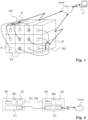
- Fig. 1 shows a schematic illustration of a system for monitoring a set of products
- Fig. 2 shows another schematic illustration of a system for monitoring a set of products, e.g., of the system of Fig. 1 , highlighting a first device D1 and a second device D2 of the system.
- Some of the products are labelled P in Fig. 1 .
- each of the items labelled P in Fig. 1 comprises one or more products, such as a subset of products, e.g., a plurality vials containing a vaccine.
- the system comprises one or more first devices D1 and one or more second devices D2.
- first devices D1 and second devices D2 twelve first devices D1 and two second devices D2 are shown.
- Each first device D1 can communicate with one or more associated ones of the second devices D2 using a first communication network, as symbolized by the dotted lines.
- the hatched first devices D1 may be able to communicate with both second devices D2 (not specifically illustrated in Fig, 1 ), e.g., because they are located within a communication range of both these second devices D2.
- first device D1 can communicate, in principle (unless, e.g., they are too far distant from one another), with any of the second devices D2, the communication is quite robust, as, e.g., in case of a malfunction of one of the second devices D2 or of the loss of the connection to the internet www of one of the second devices D2, the first device D1 still can communicate with another second device D2.
- the first and second devices D1, D2 comprise communication units C1 and C2 respectively, both enabling communicating via the first communication network, such as using a "Bluetooth Low Energy" standard.
- the communication units C2 of the second devices D2 enable communication using another communication network, providing a connection to the internet www, e.g., using a cellular communication network or a communication network according to a Wi-Fi standard.
- Each first device D1 can use one or more of the second devices D2 as a gateway to the internet www.
- the system can also comprise a server system C connected to the internet www, such that data from each first device D1 (or, rather, data derived from data from the first device D1) can be transmitted (via a second device D2) to the server system C.
- the first and second devices D1, D2 can comprise an energy supply unit B1 and B2, respectively, such as a battery.
- the energy supply unit B2 of the second devices D2 can comprise a rechargeable energy storage, such as a rechargeable battery.
- the first and second devices D1, D2 can comprise storage units M1 and M2, respectively, for digital data storage, e.g., computer memory chips, and a digital processing unit such as a microprocessor, e.g. as a control unit - which is not shown in the figures.
- a digital processing unit such as a microprocessor, e.g. as a control unit - which is not shown in the figures.
- the first devices D1 comprise a sensing unit S1 each, for sensing physical and/or environmental conditions, such as a temperature, in particular when the products P to be monitored are temperature-sensitive products.
- the second devices D2 can comprise a sensing unit S2 each, for sensing physical and/or environmental conditions, such as a temperature, in particular when the products P to be monitored are temperature-sensitive products.
- Fig. 3 is a schematic illustration of a system and of a method for monitoring a set of products, highlighting the transmissions and transmitted data.
- Fig. 3 focuses on and illustrates only a single first device D1 and two second devices D2, D2*, wherein these can be identical or can be different from one another.
- first device D1 prepares a transmission comprising a first data set D1 to be received, via the first communication network, by second device D2.
- Second device D2 thereupon derives from the first data set DS1 a second data set DS2 and transmits the second data set DS2, via the second communication network, to the internet www, more specifically to a server system C on which a server application is running.
- the server system C thereupon derives from the second data set DS2 a third data set DS3 and transmits the third data set DS3, via the second communication network, to second device D2*.
- the server system C in addition can store and analyze data comprised in the second data set DS2, in particular the sensing data.
- second device D2* Upon reception of the third data set DS3, second device D2* derives from the third data set DS3 a fourth data set referred to as acknowledement data set ACK and transmits the acknowledement data set ACK, via the first communication network, to the first device D1.
- first device D1 senses, by means of a sensor of its first sensing unit S1, a magnitude such as, e.g., a temperature.
- sensing data sd are produced and stored in the first storage unit M1 which can be provided with time data td each indicative of a sensing time t, such as a time stamp, e.g., indicating at what time the respective sensing were taken.
- time data td each indicative of a sensing time t, such as a time stamp, e.g., indicating at what time the respective sensing were taken.
- a transmission status of these is set to "ready". This indicates that these data may be selected for a transmission.
- first device D1 prepares a transmission comprising a first data set DS1.
- first data set DS1 two sensing data sd1, sd2 are comprised in the first data set, as well as the respective associated sensing times t1 and t2, respectively.
- the first data set DS1 comprises transmission ID data TID identifying the transmission, reading "TID1" in the illustration of Fig. 3 ; and first ID data identifying the first device, reading "id1" in the illustration of Fig. 3 .
- error data ED may also be comprised in the transmission as well as optional further data (not illustrated).
- the transmission is conducted. Thereupon, the transmission status of the sensing data (in Fig. 3 : sd1 and sd2) comprised in the transmission is set to "sent". This indicates that these data were comprised in at least one transmission.
- the second data set DS2 is, in the illustrated example of Fig. 3 , identical to first data set DS1, except that the optional further data are not comprised therein.
- the third data set DS3 can be considered a precursor data set of the acknowledgement data set ACK.
- the two data sets DS3, ACK can be identical, e.g., except for optional additional data which may be comprised in the third data set DS3 while not being comprised in the acknowledgement data set ACK.
- the acknowledgement data set ACK (and the third data set DS3) comprise:
- the acknowledgement data set ACK is digitally signed and thus comprises the digital signature data SIG, e.g., in a way as described further above.
- acknowledgement data set ACK can be digitally encrypted, as illustrated in Fig. 3 by the thick dashed rectangles.
- first device D1 upon reception of thereof, can verify that the acknowledgement data set ACK is indeed meant to be received by this individual first device. And this way, the transmission ID data TID need not to be globally unique, but is it sufficient that the transmission ID data TID are unique individually for each first device only.
- the first device D1 Upon reception of the acknowledgement data set ACK, the first device D1
- Fig. 4 is a schematic illustration of an example of sensing data sd and associated time data td in a first storage unit (cf. M1 in Fig. 2 ), and their assignment to a transmission, at the time of preparing the transmission.
- the sensing data below the lower thick line (sd1 and sd2) have been marked “acknowledged”
- the sensing data between the lower and the upper thick line (sd3, sd4, sd5 and sd6) have been marked "sent”
- the sensing data above the upper thick line sd7, sd8 and sd9 have been marked "ready”.
- Writing being "marked” here is a short way of referring to value of the associated transmission status.
- the "oldest" sensing data (first sensing data fsd) marked “sent”, i.e. sensing data sd3, associated with the "oldest” sensing time (first sensing time ft, i.e. t3) will be included in the transmission, as well as “subsequent" sensing data (present in the first storated unit), i.e. sensing data with a "newer” sensing time, such that, with respect to their associated sensing times, no sensing data are missing.
- a consecutive series of sensing data (and their associated sensing times) is included in the first data set to be included in the transmission. How long the series of sensing data is, i.e.
- sensing data last sensing data lsd
- newest ones i.e, being associated with the latest sensing time lt
- the transmitted series of sensing data and the first data set comprises sensing data sd3 through sd8, as illustrated by the brace.
- sensing data marked "sent” are automatically sent another time when a preset waiting time has elapsed.
- a further transmission is prepared and conducted when it is detected that there are sensing data in the first storage unit which have been marked "sent” for at least a preset waiting time.
- These data will be the oldest sensing data marked "sent” and thus will be the first sensing data fsd. This way, it can be avoided that temporary technical problems in the system, e.g.,, impeding the communication, lead to overlong delays between the sensing and the reception of corresponding sensing data at the server system C.
- Fig. 5 is a schematic illustration of an example of interrelations between data (sensing data sd; time data td; transmission status data st) in a first storage unit and different transmissions.
- the transmissions T1 to T5
- said data in the first storage unit are symbolized
- the acknowledgement data sets are symbolized, at thick horizontal lines.
- Dashed lines in Fig. 5 symbolize an association and link, respectively.
- An approximate time line runs from top to bottom.
- sensing data sd1 are taken and stored, with transmission status st1 set to "ready”.
- sensing data sd2 are taken and stored, with transmission status st2 set to "ready".
- a first transmission T1 is prepared and conducted, having transmission ID data TID1.
- Sensing data sd1 and sd2 are included in transmission T1; their transmission status is set to "sent”.
- sensing data sd3 are taken and stored, with transmission status st3 set to "ready".
- Sensing data sd1, sd2 and sd3 are included, in transmission T2, because none of them is yet marked “acknowledged”. Also the transmission status of sensing data sd3 is set to "sent”.
- no acknowledgement data set for T2 is will be received by the first device, because of some technical problem, such as a complete drain of the battery of the second device which has received transmission T2 immediately after the reception of transmission T2.
- an acknowledgement data set is received by the first device, acknowledging the reception by the server system of transmission T1, having the transmission ID data TID1.
- Transmission status st1 and also st2 is set to "acknowledged”. Transmission status st3 remains "sent”.
- a third transmission T3 is prepared and conducted, having transmission ID data TID3.
- sensing data sd4 are taken and stored, with transmission status st4 set to "ready”.
- a fourth transmission T4 is prepared and conducted, having transmission ID data T ID4.
- Sensing data sd3 and sd4 are included, in transmission T4. Transmission status st4 is set to "sent”.
- transmission T4 takes place before an acknowledgement for transmission T3 could reach the first device.
- an acknowledgement data set is received by the first device, acknowledging the reception by the server system of transmission T3, having the transmission ID data TID3.
- Transmission status st3 is set to "acknowledged”. Transmission status st4 remains set to "sent”.
- Transmission status st4 remains set to "sent". This transmission may be prepared and conducted at this point, e.g., because the transmission status st4 has been set to "sent” for too long, i.e. for more than a preset waiting time.
- an acknowledgement data set is received by the first device, acknowledging the reception by the server system of transmission T5, having the transmission ID data TID5.
- Transmission status st4 is set to "acknowledged".
Landscapes
- Engineering & Computer Science (AREA)
- Business, Economics & Management (AREA)
- Computer Networks & Wireless Communication (AREA)
- Economics (AREA)
- Computing Systems (AREA)
- General Health & Medical Sciences (AREA)
- Medical Informatics (AREA)
- Signal Processing (AREA)
- Health & Medical Sciences (AREA)
- Entrepreneurship & Innovation (AREA)
- Tourism & Hospitality (AREA)
- Finance (AREA)
- Accounting & Taxation (AREA)
- Human Resources & Organizations (AREA)
- Marketing (AREA)
- Operations Research (AREA)
- Quality & Reliability (AREA)
- Strategic Management (AREA)
- Development Economics (AREA)
- Physics & Mathematics (AREA)
- General Business, Economics & Management (AREA)
- General Physics & Mathematics (AREA)
- Theoretical Computer Science (AREA)
- Arrangements For Transmission Of Measured Signals (AREA)
- Telephonic Communication Services (AREA)
- Selective Calling Equipment (AREA)
- Detection And Prevention Of Errors In Transmission (AREA)
Claims (13)
- System zur Überwachung einer Gruppe von Produkten (P), das aufweist- eine oder mehrere erste Vorrichtungen (D1) zum Überwachen eines oder mehrerer Produkte (P), wobei jede der ersten Vorrichtungen (D1) mit einer jeweiligen Untergruppe der Gruppe von Produkten (P) assoziiert ist; und- eine oder mehrere zweite Vorrichtungen (D2);wobei jede der ersten Vorrichtungen (D1) erste Funktionseinheiten aufweist, wobei die ersten Funktionseinheiten umfassen- eine erste Sensoreinheit (S1), die einen Sensor zum Erfassen von physikalischen und/oder Umgebungsbedingungen aufweist, von den anzunehmen ist, dass diejenige Untergruppe von Produkten (P) diesen ausgesetzt ist, die mit derjenigen ersten Vorrichtung (D1) assoziiert ist, die den jeweiligen Sensor aufweist;- eine erste Speichereinheit (M1) zur Datenspeicherung; und- eine erste Kommunikationseinheit (C1) zum Kommunizieren über ein erstes Kommunikationsnetzwerk;wobei jede der ersten Vorrichtungen (D1) konfiguriert ist,- wiederholt einen Erfassungsschritt auszuführen, in welchem die genannten physikalischen und/oder Umgebungsbedingungen unter Verwendung des jeweiligen Sensors erfasst werden; und- für jeden der Erfassungsschritte, in der ersten Speichereinheit (M1) zu speichern- Erfassungsdaten (sd), die ein Resultat der jeweiligen Erfassung anzeigen;- Zeitdaten (td), die eine Erfassungszeit (t) anzeigen, die mit den jeweiligen Erfassungsdaten (sd) assoziiert ist; und- Statusdaten (st), die einen Übertragungsstatus der jeweiligen Erfassungsdaten anzeigen;wobei jede der ersten Vorrichtungen (D1) desweiteren so konfiguriert ist, dass sie wiederholt eine Übertragung über das erste Kommunikationsnetzwerk vorbereitet und anschliessend ausführt, wobei bei jeder der Übertragungen ein erster Datensatz (DS1) über das erste Kommunikationsnetzwerk übertragen wird, wobei jeder der ersten Datensätze (DS1) aufweist- Übertragungs-ID-Daten (TID), die die jeweilige Übertragung kennzeichnen;- erste ID-Daten (ID), die die erste Vorrichtung (D1) kennzeichnen;- ein oder mehrere der Erfassungsdaten (sd); und- für jede der einen oder mehreren Erfassungsdaten (sd): die jeweiligen assoziierten Zeitdaten (td);wobei jede der ersten Vorrichtungen (D1) desweiteren konfiguriert ist, für jede der Übertragungen und bei der Ausführung der jeweiligen Übertragung in der ersten Speichereinheit (M1) die mit der entsprechenden Übertragung assoziierten Übertragungs-ID-Daten (TID) zu speichern und die gespeicherten Übertragungs-ID-Daten (TID) mit jeden derjenigen Erfassungsdaten (sd) zu verknüpfen, die in dem in der entsprechechenden Übertragung übertragenen ersten Datensatz (DS1) enthalten sind;wobei jede der ersten Vorrichtungen (D1) desweiteren konfiguriert ist,- über das erste Kommunikationsnetz Bestätigungsdatensätze (ACK) zu empfangen, wobei jeder der Bestätigungsdatensätze (ACK) Übertragungs-ID-Daten (TID) aufweist, die eine der von der ersten Vorrichtung (D1) durchgeführten Übertragungen kennzeichnen;wobei jede der ersten Vorrichtungen (D1) desweiteren konfiguriert ist,- den Übertragungsstatus von Erfassungsdaten (sd) beim Speichern der entsprechenden Erfassungsdaten (sd) in der ersten Speichereinheit (M1) auf "bereit" zu setzen; und- den Übertragungsstatus von Erfassungsdaten auf "bestätigt" zu setzen beim Empfangen des Bestätigungsdatensatzes (ACK) über das erste Kommunikationsnetzwerk, der die mit den jeweiligen Erfassungsdaten (sd) verknüpften Übertragungs-ID-Daten (TID) aufweist;wobei jede der zweiten Vorrichtungen (D2) eine oder mehrere zweite Funktionseinheiten aufweist, wobei die zweiten Funktionseinheiten aufweisen- eine zweite Kommunikationseinheit (C2) zum Kommunizieren über das erste Kommunikationsnetzwerk und, zusätzlich, zum Kommunizieren über ein zweites Kommunikationsnetzwerk;wobei jede der zweiten Vorrichtungen (D2) konfiguriert ist,- über das erste Kommunikationsnetzwerk eine oder mehrere der Übertragungen zu empfangen, die von entsprechenden der ersten Vorrichtungen (D1) über das erste Kommunikationsnetzwerk ausgeführt werden;- aus jedem der so empfangenen ersten Datensätze (DS1) einen entsprechenden zweiten Datensatz (DS2) abzuleiten, der aufweist- die Übertragungs-ID-Daten;- die ersten ID-Daten (ID);- die einen oder mehreren Erfassungsdaten (sd); und- für jede der einen oder mehreren Erfassungsdaten (sd): die jeweils assoziierten Zeitdaten (td);aus dem so empfangenen ersten Datensatz (DS1);- jeden der zweiten Datensätze (DS2) über das zweite Kommunikationsnetzwerk an das Internet (www) zu übertragen;dadurch gekennzeichnet, dass jede der zweiten Vorrichtungen (D2) konfiguriert ist,- über das zweite Kommunikationsnetzwerk aus dem Internet (www) einen oder mehrere dritte Datensätze (DS3) zu empfangen, wobei jeder der dritten Datensätze (DS3) aufweist- Übertragungs-ID-Daten (TID); und- erste ID-Daten (ID), die eine der ersten Vorrichtungen (D1) kennzeichnen;abgeleitet von einem von einer der zweiten Vorrichtungen (D2) über das zweite Kommunikationsnetzwerk an das Internet (www) übertragenen zweiten Datensatz (DS2); und- aus jedem der so empfangenen dritten Datensätze (DS3) einen jeweiligen Bestätigungsdatensatz (ACK) abzuleiten, der umfasst- die Übertragungs-ID-Daten (TID); und- die ersten ID-Daten (ID);aus dem jeweiligen so empfangenen dritten Datensatz (DS3);- jeden der so abgeleiteten Bestätigungsdatensätze (ACK) über das erste Kommunikationsnetzwerk an dasjenige jeweilige der ersten Vorrichtungen (D1) zu übertragen, das durch die in den jeweiligen Bestätigungsdatensätzen (ACK) enthaltenen ersten ID-Daten (ID) gekennzeichnet ist.
- Das System nach Anspruch 1, wobei für jede der Übertragungen gilt, dass zur Zeit der Vorbereitung der jeweiligen Übertragung:- jede der einen oder mehreren Erfassungsdaten (sd), die von dem bei der jeweiligen Übertragung zu übertragenden ersten Datensatz (DS1) aufzuweisen sind, einen Übertragungsstatus aufweist, der auf einen von "acknowledged" verschiedenen Wert gesetzt ist; und- alle der in dem ersten Datensatz (DS1) enthaltenen und bei der jeweiligen Übertragung zu übertragenden Erfassungsdaten (sd) eine Serie von Erfassungsdaten (sd) bilden, wobei die Serie umfasst:- als erste Erfassungsdaten (fsd) bezeichnete Erfassungsdaten (sd), bei denen es sich um Erfassungsdaten (sd) handelt, die mit einer Erfassungszeit (t) assoziiert sind, die als erste Erfassungszeit (ft) bezeichnet wird, bei der es sich um die früheste aller Erfassungszeiten (t) handelt, die mit irgendwelchen der in der ersten Speichereinheit (M1) gespeicherten Erfassungsdaten (sd) assoziiert sind und einen Übertragungsstatus aufweisen, der auf einen anderen Wert als "bestätigt" gesetzt ist;- als letzte Erfassungsdaten (lsd) bezeichnete Erfassungsdaten (sd), bei denen es sich um Erfassungsdaten (sd) handelt, die mit einer Erfassungszeit (t) assoziiert sind, die als letzte Erfassungszeit (lt) bezeichnet wird, bei der es sich um die späteste von allen Erfassungszeiten (t) handelt, die mit irgendwelchen der Erfassungsdaten (sd) der Serie assoziiert sind; und- alle in der ersten Speichereinheit (M1) gespeicherten Erfassungsdaten (sd), die mit einer Erfassungszeit (t) assoziiert sind, die mit der ersten Erfassungszeit (ft) identisch oder später als diese ist und der mit der letzten Erfassungszeit (lt) identisch oder früher als diese ist.
- Das System nach Anspruch 2, wobei in einem Protokoll des ersten Kommunikationsnetzwerkes eine maximale Übertragungsgröße definiert ist, und wobei jede der ersten Vorrichtungen (D1) desweiteren konfiguriert ist,- für jede der Übertragungen die letzten Erfassungsdaten (lsd) so auszuwählen, dass die jeweilige Serie von Erfassungsdaten (sd) möglichst viele Erfassungsdaten umfasst, so dass eine Größe der jeweiligen Übertragung gleich oder kleiner ist als die maximale Übertragungsgrösse.
- Das System nach einem der Ansprüche 1 bis 3, wobei jede der ersten Vorrichtungen (D1) desweiteren konfiguriert ist,- den Übertragungsstatus der Erfassungsdaten (sd) auf "gesendet" zu setzen bei der Ausführung einer Übertragung über das erste Kommunikationsnetzwerk, die einen ersten Datensatz (DS1) aufweist, der die entsprechenden Erfassungsdaten (sd) aufweist.
- Das System nach Anspruch 4, wobei jede der ersten Vorrichtungen (D1) desweiteren konfiguriert ist,- eine weitere Übertragung vorzubereiten und anschliessend durchzuführen, bei Feststellung, dass in der ersten Speichereinheit (M1) Erfassungsdaten (sd) gespeichert sind, die einen Übertragungsstatus haben, der für eine Dauer, die eine voreingestellte Wartezeit überschreitet, auf "gesendet" gesetzt ist.
- Das System nach einem der Ansprüche 1 bis 5, das mindestens zwei zweite Vorrichtungen aufweist, wobei jede der zweiten Vorrichtungen konfiguriert ist- über das zweite Kommunikationsnetzwerk aus dem Internet einen oder mehrere dritte Datensätze zu empfangen, wobei jeder der dritten Datensätze aufweist- Übertragungs-ID-Daten; und- erste ID-Daten, die eine der ersten Vorrichtungen kennzeichnen;abgeleitet von einem von ihr selbst oder von einer anderen der zweiten Vorrichtungen über das zweite Kommunikationsnetzwerk an das Internet übertragenen zweiten Datensatz.
- Verfahren zur Überwachung einer Gruppe von Produkten (P), aufweisend- Bereitstellen einer oder mehrerer erster Vorrichtungen (D1), wobei jede der ersten Vorrichtungen (D1) mit einer jeweiligen Untergruppe der Produkte (P) assoziiert ist und erste Funktionseinheiten aufweist, wobei die ersten Funktionseinheiten umfassen- eine erste Sensoreinheit (S1), die einen Sensor zum Erfassen von physikalischen und/oder Umgebungsbedingungen aufweist; und- eine erste Speichereinheit (M1) zur Datenspeicherung;mittels jeder der ersten Vorrichtungen (D1):- wiederholtes Durchführen eines Erfassungsschritts, in dem die physikalischen und/oder Umgebungsbedingungen, von den anzunehmen ist, dass die Produkte der entsprechenden assoziierten Untergruppe von Produkten (P) diesen ausgesetzt sind, mit Hilfe des Sensors der jeweiligen ersten Vorrichtung (D1) erfasst werden;- für jeden der Erfassungsschritte: Speichern in der ersten Speichereinheit (M1) von- Erfassungsdaten (sd), die ein Resultat der jeweiligen Erfassung kennzeichnen;- Zeitdaten (td), die eine Erfassungszeit (t) anzeigen, die mit den jeweiligen Erfassungsdaten (sd) assoziiert ist; und- Statusdaten (st), die einen Übertragungsstatus der jeweiligen Erfassungsdaten anzeigen;- wiederholt: Vorbereitung und anschliessende Ausführung einer Übertragung über ein erstes Kommunikationsnetzwerk, wobei bei jeder der Übertragungen ein erster Datensatz (DS1) über das erste Kommunikationsnetzwerk übertragen wird, wobei jeder der ersten Datensätze (DS1) aufweist- Übertragungs-ID-Daten (TID), die die jeweilige Übertragung kennzeichnen;- erste ID-Daten (ID), die die erste Vorrichtung (D1) kennzeichnen;- ein oder mehrere der Erfassungsdaten (sd); und- für jede der einen oder mehreren Erfassungsdaten (sd): die jeweiligen assoziierten Zeitdaten (td);- für jede der Übertragungen und bei der Ausführung der jeweiligen Übertragung:- Speichern der Übertragungs-ID-Daten (TID), die mit der jeweiligen Übertragung assoziiert sind, in der ersten Speichereinheit (M1); und- Verknüpfen der gespeicherten Übertragungs-ID-Daten (TID) mit jeden derjenigen Erfassungsdaten (sd), die in dem in der entsprechechenden Übertragung übertragenen ersten Datensatz (DS1) enthalten sind;- Empfangen von Bestätigungsdatensätzen (ACK) über das erste Kommunikationsnetzwerk, wobei jeder der Bestätigungsdatensätze (ACK) Übertragungs-ID-Daten (TID) aufweist, die eine der von der ersten Vorrichtung (D1) durchgeführten Übertragungen kennzeichnen;- Setzen des Übertragungsstatus der Erfassungsdaten (sd) auf "bereit" beim Speichern der jeweiligen Erfassungsdaten (sd) in der ersten Speichereinheit (M1); und- Setzen des Übertragungsstatus der Erfassungsdaten (sd) auf "bestätigt" beim Empfangen des Bestätigungsdatensatzes (ACK) über das erste Kommunikationsnetzwerk, der die mit den jeweiligen Erfassungsdaten (sd) verknüpften Übertragungs-ID-Daten (TID) aufweist;wobei das Verfahren weiter aufweist- Bereitstellen einer oder mehrerer zweiter Vorrichtungen (D2);wobei das Verfahren desweiteren aufweist, mittels jeder der zweiten Vorrichtungen (D2):- Empfangen einer oder mehrerer der Übertragungen über das erste Kommunikationsnetzwerk, die von jeweiligen ersten Vorrichtungen (D1) über das erste Kommunikationsnetzwerk ausgeführt werden;- Ableiten eines jeweiligen zweiten Datensatzes (DS2) von jedem der so empfangenen ersten Datensätze (DS1), umfassend- die Übertragungs-ID-Daten (TID);- die ersten ID-Daten (ID);- die einen oder mehreren Erfassungsdaten (sd); und- für jede der einen oder mehreren Erfassungsdaten (sd): die jeweils assoziierten Zeitdaten (td);aus dem so empfangenen ersten Datensatz (DS1);- Übermitteln jedes der zweiten Datensätze (DS2) über ein zweites Kommunikationsnetzwerk an das Internet (www);dadurch gekennzeichnet, dass das Verfahren desweiteren aufweist, mittels jeder der zweiten Vorrichtungen (D2):- Empfangen eines oder mehrerer dritter Datensätze (DS3) über das zweite Kommunikationsnetzwerk aus dem Internet (www), wobei jeder der dritten Datensätze (DS3) aufweist- Übertragungs-ID-Daten (TID); und- erste ID-Daten (ID), die eine der ersten Vorrichtungen (D1) kennzeichnen;von einem von einer der zweiten Vorrichtungen (D2) über das zweite Kommunikationsnetzwerk an das Internet (www) übertragenen zweiten Datensatz (DS2);- Ableiten eines entsprechenden Bestätigungsdatensatzes (ACK) aus jedem der so empfangenen dritten Datensätze (DS3), der umfasst- die Übertragungs-ID-Daten (TID); und- die ersten ID-Daten (ID);aus dem jeweiligen so empfangenen dritten Datensatz (DS3); und- Übertragen jedes der so abgeleiteten Bestätigungsdatensätze (ACK) über das erste Kommunikationsnetzwerk an die entsprechende erste Vorrichtung (D1), die durch die in den jeweiligen Bestätigungsdatensätzen (ACK) enthaltenen ersten ID-Daten (ID) gekennzeichnet ist.
- Verfahren nach Anspruch 7, wobei für jede der Übertragungen gilt, dass zur Zeit der Vorbereitung der jeweiligen Übertragung:- jede der einen oder mehreren Erfassungsdaten (sd), die von dem bei der jeweiligen Übertragung zu übertragenden ersten Datensatz (DS1) aufzuweisen sind, einen Übertragungsstatus aufweist, der auf einen von "acknowledged" verschiedenen Wert gesetzt ist; und- alle der in dem ersten Datensatz (DS1) enthaltenen und bei der jeweiligen Übertragung zu übertragenden Erfassungsdaten (sd) eine Serie von Erfassungsdaten (sd) bilden, wobei die Serie umfasst:- als erste Erfassungsdaten (fsd) bezeichnete Erfassungsdaten (sd), bei denen es sich um Erfassungsdaten (sd) handelt, die mit einer Erfassungszeit (t) assoziiert sind, die als erste Erfassungszeit (ft) bezeichnet wird, bei der es sich um die früheste aller Erfassungszeiten (t) handelt, die mit irgendwelchen der in der ersten Speichereinheit (M1) gespeicherten Erfassungsdaten (sd) assoziiert sind und einen Übertragungsstatus aufweisen, der auf einen anderen Wert als "bestätigt" gesetzt ist;- als letzte Erfassungsdaten (lsd) bezeichnete Erfassungsdaten (sd), bei denen es sich um Erfassungsdaten (sd) handelt, die mit einer Erfassungszeit (t) assoziiert sind, die als letzte Erfassungszeit (lt) bezeichnet wird, bei der es sich um die späteste von allen Erfassungszeiten (t) handelt, die mit irgendwelchen der Erfassungsdaten (sd) der Serie assoziiert sind; und- alle in der ersten Speichereinheit (M1) gespeicherten Erfassungsdaten (sd), die mit einer Erfassungszeit (t) assoziiert sind, die mit der ersten Erfassungszeit (ft) identisch oder später als diese ist und der mit der letzten Erfassungszeit (lt) identisch oder früher als diese ist.
- Verfahren nach Anspruch 8, wobei in einem Protokoll des ersten Kommunikationsnetzwerkes eine maximale Übertragungsgröße definiert ist, wobei das Verfahren, durchgeführt von jeder der ersten Vorrichtungen (D1), aufweist:- Auswählen der letzten Erfassungsdaten (lsd), für jede der Übertragungen, so dass die jeweilige Serie von Erfassungsdaten (sd) möglichst viele Erfassungsdaten umfasst, so dass eine Größe der jeweiligen Übertragung gleich oder kleiner ist als die maximale Übertragungsgrösse.
- Verfahren nach einem der Ansprüche 7 bis 9, umfassend, ausgeführt durch jede der ersten Vorrichtungen (D1):- Setzen des Übertragungsstatus der Erfassungsdaten (sd) auf "gesendet" bei der Ausführung einer Übertragung über das erste Kommunikationsnetzwerk, die einen ersten Datensatz (DS1) aufweist, der die entsprechenden Erfassungsdaten (sd) aufweist; und- Vorbereiten und Ausführen einer weitere Übertragung bei Feststellung, dass in der ersten Speichereinheit (M1) Erfassungsdaten (sd) gespeichert sind, die einen Übertragungsstatus haben, der für eine Dauer, die eine voreingestellte Wartezeit überschreitet, auf "gesendet" gesetzt ist.
- Verfahren nach einem der Ansprüche 7 bis 10, wobei jeder der Bestätigungsdatensätze digital signiert ist und eine digitale Signatur (SIG) aufweist, wobei das Verfahren desweiteren umfasst, ausgeführt durch jede der ersten Vorrichtungen (D1):- für jeden empfangenen Bestätigungsdatensatz (ACK) und mit Hilfe der in dem jeweiligen empfangenen Bestätigungsdatensatz (ACK) enthaltenen digitalen Signatur (SIG): Verifizieren einer Authentizität der in dem jeweiligen empfangenen Bestätigungsdatensatz (ACK) vorhandenen Übertragungs-ID-Daten (TID).
- Verfahren nach Anspruch 11, wobei jeder der Bestätigungsdatensätze (ACK) zusätzlich- Ursprungs-ID-Daten (OID), die einen Ursprung des jeweiligen Bestätigungsdatensatzes (ACK) kennzeichnen; und- Ziel-ID-Daten (DID), die ein Ziel für den jeweiligen Bestätigungsdatensatz (ACK) kennzeichnen;aufweist, und wobei jeder der ersten Datensätze (DS1) erste ID-Daten (ID) aufweist, die die erste Vorrichtung kennzeichen, wobei das Verfahren desweiteren umfasst, ausgeführt durch jede der ersten Vorrichtungen (D1):- für jeden empfangenen Bestätigungsdatensatz (ACK) und mit Hilfe der in dem jeweiligen empfangenen Bestätigungsdatensatz (ACK) enthaltenen digitalen Signatur (SIG): Verifizieren einer Authentizität- der in dem jeweiligen empfangenen Bestätigungsdatensatz (ACK) enthaltenen Herkunfts-ID-Daten (TID); und- der in dem jeweiligen empfangenen Bestätigungsdatensatz (ACK) enthaltenen Ziel-ID-Daten (TID);- für jeden empfangenen Bestätigungsdatensatz (ACK): Vergleichen der in dem jeweiligen empfangenen Bestätigungsdatensatz (ACK) vorhandenen Ziel-ID-Daten (TID) mit den ersten ID-Daten (ID); und- Durchführung des Schritts des Setzens des Übertragungsstatus der Erfassungsdaten (sd) auf "bestätigt" nur, wenn ein Ergebnis des Vergleichens positiv ist.
- Verfahren nach einem der Ansprüche 7-12, weiter aufweisend, ausgeführt von einem Serversystem (C), das mit dem Internet (www) verbunden ist und auf dem eine Serveranwendung läuft:- Empfangen, durch das Serversystem (C), über ein zweites Kommunikationsnetzwerk, der von den zweiten Vorrichtungen (D2) an das Internet (www) übertragenen zweiten Datensätze (DS2);- Ableiten von jedem der so empfangenen zweiten Datensätze (DS2) eines entsprechenden der einen oder mehreren dritten Datensätze (DS3); und- Übertragung jedes der so abgeleiteten dritten Datensätze (DS3) über das zweite Kommunikationsnetzwerk an eine der zweiten Vorrichtungen (D2).
Priority Applications (3)
| Application Number | Priority Date | Filing Date | Title |
|---|---|---|---|
| EP24191328.4A EP4432634A3 (de) | 2021-10-04 | 2022-10-03 | Verfahren, vorrichtung und system zur überwachung von verderblichen produkten |
| EP23178494.3A EP4243376B1 (de) | 2021-10-04 | 2022-10-03 | Verfahren, vorrichtung und system zur überwachung von verderblichen produkten |
| DK23178494.3T DK4243376T3 (da) | 2021-10-04 | 2022-10-03 | Fremgangsmåde, indretning og system til overvågning af letfordærvelige produkter |
Applications Claiming Priority (2)
| Application Number | Priority Date | Filing Date | Title |
|---|---|---|---|
| CH0703432021 | 2021-10-04 | ||
| PCT/EP2022/077427 WO2023057363A1 (en) | 2021-10-04 | 2022-10-03 | Method, device and system for monitoring perishable products |
Related Child Applications (3)
| Application Number | Title | Priority Date | Filing Date |
|---|---|---|---|
| EP23178494.3A Division EP4243376B1 (de) | 2021-10-04 | 2022-10-03 | Verfahren, vorrichtung und system zur überwachung von verderblichen produkten |
| EP23178494.3A Division-Into EP4243376B1 (de) | 2021-10-04 | 2022-10-03 | Verfahren, vorrichtung und system zur überwachung von verderblichen produkten |
| EP24191328.4A Division EP4432634A3 (de) | 2021-10-04 | 2022-10-03 | Verfahren, vorrichtung und system zur überwachung von verderblichen produkten |
Publications (2)
| Publication Number | Publication Date |
|---|---|
| EP4238313A1 EP4238313A1 (de) | 2023-09-06 |
| EP4238313B1 true EP4238313B1 (de) | 2024-03-06 |
Family
ID=84047675
Family Applications (3)
| Application Number | Title | Priority Date | Filing Date |
|---|---|---|---|
| EP22798307.9A Active EP4238313B1 (de) | 2021-10-04 | 2022-10-03 | Verfahren, vorrichtung und system zur überwachung von verderblichen produkten |
| EP24191328.4A Withdrawn EP4432634A3 (de) | 2021-10-04 | 2022-10-03 | Verfahren, vorrichtung und system zur überwachung von verderblichen produkten |
| EP23178494.3A Active EP4243376B1 (de) | 2021-10-04 | 2022-10-03 | Verfahren, vorrichtung und system zur überwachung von verderblichen produkten |
Family Applications After (2)
| Application Number | Title | Priority Date | Filing Date |
|---|---|---|---|
| EP24191328.4A Withdrawn EP4432634A3 (de) | 2021-10-04 | 2022-10-03 | Verfahren, vorrichtung und system zur überwachung von verderblichen produkten |
| EP23178494.3A Active EP4243376B1 (de) | 2021-10-04 | 2022-10-03 | Verfahren, vorrichtung und system zur überwachung von verderblichen produkten |
Country Status (7)
| Country | Link |
|---|---|
| US (1) | US20250005513A1 (de) |
| EP (3) | EP4238313B1 (de) |
| JP (1) | JP2024542930A (de) |
| DK (2) | DK4243376T3 (de) |
| ES (2) | ES2994919T3 (de) |
| PL (2) | PL4243376T3 (de) |
| WO (1) | WO2023057363A1 (de) |
Families Citing this family (1)
| Publication number | Priority date | Publication date | Assignee | Title |
|---|---|---|---|---|
| US20260050883A1 (en) * | 2024-08-14 | 2026-02-19 | Insight Direct Usa, Inc. | Systems and methods for electronic device tracking and status analysis |
Family Cites Families (7)
| Publication number | Priority date | Publication date | Assignee | Title |
|---|---|---|---|---|
| FI19992470A7 (fi) * | 1999-11-17 | 2001-05-18 | Nokia Mobile Phones Ltd | Tiedonsiirto |
| JP5641381B1 (ja) * | 2013-03-14 | 2014-12-17 | 一般財団法人マイクロマシンセンター | センサ端末 |
| US9750868B2 (en) | 2013-07-03 | 2017-09-05 | Q-Tag Ag | Monitoring product integrity of a pharmaceutical product in a syringe using a miniaturized electronic sensor tag |
| US9686051B2 (en) | 2013-12-27 | 2017-06-20 | Lord Corporation | Systems, methods, and computer readable media for lossless data transmission in a wireless network |
| US10104454B2 (en) * | 2015-10-05 | 2018-10-16 | Parkifi, Inc. | Parking data aggregation and distribution |
| JP6494586B2 (ja) * | 2016-11-17 | 2019-04-03 | ミネベアミツミ株式会社 | 通信端末及び通信システム |
| US11910137B2 (en) * | 2019-04-08 | 2024-02-20 | Infisense, Inc. | Processing time-series measurement entries of a measurement database |
-
2022
- 2022-10-03 EP EP22798307.9A patent/EP4238313B1/de active Active
- 2022-10-03 PL PL23178494.3T patent/PL4243376T3/pl unknown
- 2022-10-03 ES ES23178494T patent/ES2994919T3/es active Active
- 2022-10-03 US US18/697,804 patent/US20250005513A1/en active Pending
- 2022-10-03 EP EP24191328.4A patent/EP4432634A3/de not_active Withdrawn
- 2022-10-03 DK DK23178494.3T patent/DK4243376T3/da active
- 2022-10-03 DK DK22798307.9T patent/DK4238313T3/da active
- 2022-10-03 WO PCT/EP2022/077427 patent/WO2023057363A1/en not_active Ceased
- 2022-10-03 EP EP23178494.3A patent/EP4243376B1/de active Active
- 2022-10-03 JP JP2024520585A patent/JP2024542930A/ja active Pending
- 2022-10-03 ES ES22798307T patent/ES2982833T3/es active Active
- 2022-10-03 PL PL22798307.9T patent/PL4238313T3/pl unknown
Also Published As
| Publication number | Publication date |
|---|---|
| PL4243376T3 (pl) | 2025-02-17 |
| PL4238313T3 (pl) | 2024-07-29 |
| JP2024542930A (ja) | 2024-11-19 |
| US20250005513A1 (en) | 2025-01-02 |
| ES2982833T3 (es) | 2024-10-17 |
| EP4243376B1 (de) | 2024-09-04 |
| EP4238313A1 (de) | 2023-09-06 |
| EP4432634A2 (de) | 2024-09-18 |
| ES2994919T3 (en) | 2025-02-04 |
| DK4243376T3 (da) | 2024-12-09 |
| DK4238313T3 (da) | 2024-06-03 |
| EP4243376A2 (de) | 2023-09-13 |
| WO2023057363A1 (en) | 2023-04-13 |
| EP4243376A3 (de) | 2023-11-01 |
| EP4432634A3 (de) | 2024-12-25 |
Similar Documents
| Publication | Publication Date | Title |
|---|---|---|
| Arora et al. | Exscal: Elements of an extreme scale wireless sensor network | |
| EP4054215B1 (de) | Mobiles markierungsverfolgungssystem | |
| CN107196921B (zh) | 一种基于蓝牙信标设备的巡检系统及方法 | |
| US20080211691A1 (en) | Method and apparatus reporting a vehicular sensor waveform in a wireless vehicular sensor network | |
| JP5244616B2 (ja) | 輸送用コンテナ保安のための移動無線メッシュ技術 | |
| US10952050B2 (en) | Intelligent multi-channel wireless data acquisition gateway | |
| US20150296332A1 (en) | Asset tracking system having primary and secondary tracking devices | |
| US9907039B2 (en) | Sensor information processing apparatus, sensor information processing method, and sensor information processing program | |
| US9271230B2 (en) | Cloud-enabled low power Wi-Fi sensor | |
| US7747018B2 (en) | Method and apparatus for providing a message sequence count in a security systems | |
| EP4243376B1 (de) | Verfahren, vorrichtung und system zur überwachung von verderblichen produkten | |
| WO2018013047A1 (en) | Method and device for monitoring statuses and positions of goods | |
| WO2009071748A1 (en) | A device, method and system for forwarding data from rfid devices | |
| WO2019207545A2 (en) | Internet of things (iot) based wireless tracking, monitoring and anti-tamper parcel packaging | |
| US20160155084A1 (en) | Cargo tracking device | |
| EP4244790B1 (de) | Verfahren und system zur überwachung eines satzes verderblicher produkte | |
| US11847519B2 (en) | System and method for tracking tags over bluetooth low energy | |
| JP2005117578A (ja) | 無線送信機、データ収集システム及びデータ通信方法 | |
| JP7440514B2 (ja) | 対象物の集合体の追跡 | |
| CN120851046A (zh) | 一种基于nfc和智能分拣技术的物流管理方法、设备及介质 | |
| US12483982B2 (en) | Wireless sensor transmission method and apparatus | |
| Joseph et al. | IoT based Intelligent Security System for Residential Building | |
| WO2019185590A1 (en) | Conveyor system controller, conveyor system and method of data synchronisation | |
| CN116647814A (zh) | 传输传感器数据和位置信息的系统和方法及通信模块和传感器 | |
| CN121257581A (zh) | 双芯片分离架构系统 |
Legal Events
| Date | Code | Title | Description |
|---|---|---|---|
| STAA | Information on the status of an ep patent application or granted ep patent |
Free format text: STATUS: UNKNOWN |
|
| STAA | Information on the status of an ep patent application or granted ep patent |
Free format text: STATUS: THE INTERNATIONAL PUBLICATION HAS BEEN MADE |
|
| PUAI | Public reference made under article 153(3) epc to a published international application that has entered the european phase |
Free format text: ORIGINAL CODE: 0009012 |
|
| STAA | Information on the status of an ep patent application or granted ep patent |
Free format text: STATUS: REQUEST FOR EXAMINATION WAS MADE |
|
| 17P | Request for examination filed |
Effective date: 20230602 |
|
| AK | Designated contracting states |
Kind code of ref document: A1 Designated state(s): AL AT BE BG CH CY CZ DE DK EE ES FI FR GB GR HR HU IE IS IT LI LT LU LV MC ME MK MT NL NO PL PT RO RS SE SI SK SM TR |
|
| GRAP | Despatch of communication of intention to grant a patent |
Free format text: ORIGINAL CODE: EPIDOSNIGR1 |
|
| STAA | Information on the status of an ep patent application or granted ep patent |
Free format text: STATUS: GRANT OF PATENT IS INTENDED |
|
| DAV | Request for validation of the european patent (deleted) | ||
| DAX | Request for extension of the european patent (deleted) | ||
| INTG | Intention to grant announced |
Effective date: 20230925 |
|
| GRAS | Grant fee paid |
Free format text: ORIGINAL CODE: EPIDOSNIGR3 |
|
| GRAA | (expected) grant |
Free format text: ORIGINAL CODE: 0009210 |
|
| STAA | Information on the status of an ep patent application or granted ep patent |
Free format text: STATUS: THE PATENT HAS BEEN GRANTED |
|
| AK | Designated contracting states |
Kind code of ref document: B1 Designated state(s): AL AT BE BG CH CY CZ DE DK EE ES FI FR GB GR HR HU IE IS IT LI LT LU LV MC ME MK MT NL NO PL PT RO RS SE SI SK SM TR |
|
| REG | Reference to a national code |
Ref country code: CH Ref legal event code: EP |
|
| REG | Reference to a national code |
Ref country code: IE Ref legal event code: FG4D |
|
| REG | Reference to a national code |
Ref country code: DE Ref legal event code: R096 Ref document number: 602022002281 Country of ref document: DE |
|
| REG | Reference to a national code |
Ref country code: DK Ref legal event code: T3 Effective date: 20240527 |
|
| REG | Reference to a national code |
Ref country code: SE Ref legal event code: TRGR Ref country code: LT Ref legal event code: MG9D |
|
| PG25 | Lapsed in a contracting state [announced via postgrant information from national office to epo] |
Ref country code: LT Free format text: LAPSE BECAUSE OF FAILURE TO SUBMIT A TRANSLATION OF THE DESCRIPTION OR TO PAY THE FEE WITHIN THE PRESCRIBED TIME-LIMIT Effective date: 20240306 |
|
| P01 | Opt-out of the competence of the unified patent court (upc) registered |
Free format text: CASE NUMBER: APP_33291/2024 Effective date: 20240604 |
|
| PG25 | Lapsed in a contracting state [announced via postgrant information from national office to epo] |
Ref country code: GR Free format text: LAPSE BECAUSE OF FAILURE TO SUBMIT A TRANSLATION OF THE DESCRIPTION OR TO PAY THE FEE WITHIN THE PRESCRIBED TIME-LIMIT Effective date: 20240607 |
|
| REG | Reference to a national code |
Ref country code: NL Ref legal event code: FP |
|
| PG25 | Lapsed in a contracting state [announced via postgrant information from national office to epo] |
Ref country code: HR Free format text: LAPSE BECAUSE OF FAILURE TO SUBMIT A TRANSLATION OF THE DESCRIPTION OR TO PAY THE FEE WITHIN THE PRESCRIBED TIME-LIMIT Effective date: 20240306 Ref country code: RS Free format text: LAPSE BECAUSE OF FAILURE TO SUBMIT A TRANSLATION OF THE DESCRIPTION OR TO PAY THE FEE WITHIN THE PRESCRIBED TIME-LIMIT Effective date: 20240606 |
|
| PG25 | Lapsed in a contracting state [announced via postgrant information from national office to epo] |
Ref country code: RS Free format text: LAPSE BECAUSE OF FAILURE TO SUBMIT A TRANSLATION OF THE DESCRIPTION OR TO PAY THE FEE WITHIN THE PRESCRIBED TIME-LIMIT Effective date: 20240606 Ref country code: NO Free format text: LAPSE BECAUSE OF FAILURE TO SUBMIT A TRANSLATION OF THE DESCRIPTION OR TO PAY THE FEE WITHIN THE PRESCRIBED TIME-LIMIT Effective date: 20240606 Ref country code: LT Free format text: LAPSE BECAUSE OF FAILURE TO SUBMIT A TRANSLATION OF THE DESCRIPTION OR TO PAY THE FEE WITHIN THE PRESCRIBED TIME-LIMIT Effective date: 20240306 Ref country code: HR Free format text: LAPSE BECAUSE OF FAILURE TO SUBMIT A TRANSLATION OF THE DESCRIPTION OR TO PAY THE FEE WITHIN THE PRESCRIBED TIME-LIMIT Effective date: 20240306 Ref country code: GR Free format text: LAPSE BECAUSE OF FAILURE TO SUBMIT A TRANSLATION OF THE DESCRIPTION OR TO PAY THE FEE WITHIN THE PRESCRIBED TIME-LIMIT Effective date: 20240607 Ref country code: FI Free format text: LAPSE BECAUSE OF FAILURE TO SUBMIT A TRANSLATION OF THE DESCRIPTION OR TO PAY THE FEE WITHIN THE PRESCRIBED TIME-LIMIT Effective date: 20240306 Ref country code: BG Free format text: LAPSE BECAUSE OF FAILURE TO SUBMIT A TRANSLATION OF THE DESCRIPTION OR TO PAY THE FEE WITHIN THE PRESCRIBED TIME-LIMIT Effective date: 20240306 |
|
| PG25 | Lapsed in a contracting state [announced via postgrant information from national office to epo] |
Ref country code: LV Free format text: LAPSE BECAUSE OF FAILURE TO SUBMIT A TRANSLATION OF THE DESCRIPTION OR TO PAY THE FEE WITHIN THE PRESCRIBED TIME-LIMIT Effective date: 20240306 |
|
| PG25 | Lapsed in a contracting state [announced via postgrant information from national office to epo] |
Ref country code: SM Free format text: LAPSE BECAUSE OF FAILURE TO SUBMIT A TRANSLATION OF THE DESCRIPTION OR TO PAY THE FEE WITHIN THE PRESCRIBED TIME-LIMIT Effective date: 20240306 Ref country code: PT Free format text: LAPSE BECAUSE OF FAILURE TO SUBMIT A TRANSLATION OF THE DESCRIPTION OR TO PAY THE FEE WITHIN THE PRESCRIBED TIME-LIMIT Effective date: 20240708 |
|
| REG | Reference to a national code |
Ref country code: ES Ref legal event code: FG2A Ref document number: 2982833 Country of ref document: ES Kind code of ref document: T3 Effective date: 20241017 |
|
| PG25 | Lapsed in a contracting state [announced via postgrant information from national office to epo] |
Ref country code: CZ Free format text: LAPSE BECAUSE OF FAILURE TO SUBMIT A TRANSLATION OF THE DESCRIPTION OR TO PAY THE FEE WITHIN THE PRESCRIBED TIME-LIMIT Effective date: 20240306 Ref country code: EE Free format text: LAPSE BECAUSE OF FAILURE TO SUBMIT A TRANSLATION OF THE DESCRIPTION OR TO PAY THE FEE WITHIN THE PRESCRIBED TIME-LIMIT Effective date: 20240306 |
|
| PGFP | Annual fee paid to national office [announced via postgrant information from national office to epo] |
Ref country code: PL Payment date: 20240924 Year of fee payment: 3 |
|
| PG25 | Lapsed in a contracting state [announced via postgrant information from national office to epo] |
Ref country code: SK Free format text: LAPSE BECAUSE OF FAILURE TO SUBMIT A TRANSLATION OF THE DESCRIPTION OR TO PAY THE FEE WITHIN THE PRESCRIBED TIME-LIMIT Effective date: 20240306 |
|
| PG25 | Lapsed in a contracting state [announced via postgrant information from national office to epo] |
Ref country code: SM Free format text: LAPSE BECAUSE OF FAILURE TO SUBMIT A TRANSLATION OF THE DESCRIPTION OR TO PAY THE FEE WITHIN THE PRESCRIBED TIME-LIMIT Effective date: 20240306 Ref country code: SK Free format text: LAPSE BECAUSE OF FAILURE TO SUBMIT A TRANSLATION OF THE DESCRIPTION OR TO PAY THE FEE WITHIN THE PRESCRIBED TIME-LIMIT Effective date: 20240306 Ref country code: RO Free format text: LAPSE BECAUSE OF FAILURE TO SUBMIT A TRANSLATION OF THE DESCRIPTION OR TO PAY THE FEE WITHIN THE PRESCRIBED TIME-LIMIT Effective date: 20240306 Ref country code: PT Free format text: LAPSE BECAUSE OF FAILURE TO SUBMIT A TRANSLATION OF THE DESCRIPTION OR TO PAY THE FEE WITHIN THE PRESCRIBED TIME-LIMIT Effective date: 20240708 Ref country code: EE Free format text: LAPSE BECAUSE OF FAILURE TO SUBMIT A TRANSLATION OF THE DESCRIPTION OR TO PAY THE FEE WITHIN THE PRESCRIBED TIME-LIMIT Effective date: 20240306 Ref country code: CZ Free format text: LAPSE BECAUSE OF FAILURE TO SUBMIT A TRANSLATION OF THE DESCRIPTION OR TO PAY THE FEE WITHIN THE PRESCRIBED TIME-LIMIT Effective date: 20240306 |
|
| REG | Reference to a national code |
Ref country code: AT Ref legal event code: UEP Ref document number: 1664698 Country of ref document: AT Kind code of ref document: T Effective date: 20240306 |
|
| PGFP | Annual fee paid to national office [announced via postgrant information from national office to epo] |
Ref country code: LU Payment date: 20241021 Year of fee payment: 3 |
|
| PGFP | Annual fee paid to national office [announced via postgrant information from national office to epo] |
Ref country code: TR Payment date: 20240923 Year of fee payment: 3 |
|
| REG | Reference to a national code |
Ref country code: DE Ref legal event code: R097 Ref document number: 602022002281 Country of ref document: DE |
|
| PGFP | Annual fee paid to national office [announced via postgrant information from national office to epo] |
Ref country code: DE Payment date: 20241021 Year of fee payment: 3 |
|
| PLBE | No opposition filed within time limit |
Free format text: ORIGINAL CODE: 0009261 |
|
| STAA | Information on the status of an ep patent application or granted ep patent |
Free format text: STATUS: NO OPPOSITION FILED WITHIN TIME LIMIT |
|
| PGFP | Annual fee paid to national office [announced via postgrant information from national office to epo] |
Ref country code: DK Payment date: 20241025 Year of fee payment: 3 |
|
| PGFP | Annual fee paid to national office [announced via postgrant information from national office to epo] |
Ref country code: BE Payment date: 20241021 Year of fee payment: 3 |
|
| PGFP | Annual fee paid to national office [announced via postgrant information from national office to epo] |
Ref country code: IS Payment date: 20241010 Year of fee payment: 3 Ref country code: FR Payment date: 20241030 Year of fee payment: 3 |
|
| PGFP | Annual fee paid to national office [announced via postgrant information from national office to epo] |
Ref country code: ES Payment date: 20241128 Year of fee payment: 3 |
|
| PGFP | Annual fee paid to national office [announced via postgrant information from national office to epo] |
Ref country code: SE Payment date: 20241021 Year of fee payment: 3 |
|
| 26N | No opposition filed |
Effective date: 20241209 |
|
| PG25 | Lapsed in a contracting state [announced via postgrant information from national office to epo] |
Ref country code: SI Free format text: LAPSE BECAUSE OF FAILURE TO SUBMIT A TRANSLATION OF THE DESCRIPTION OR TO PAY THE FEE WITHIN THE PRESCRIBED TIME-LIMIT Effective date: 20240306 |
|
| PG25 | Lapsed in a contracting state [announced via postgrant information from national office to epo] |
Ref country code: MC Free format text: LAPSE BECAUSE OF FAILURE TO SUBMIT A TRANSLATION OF THE DESCRIPTION OR TO PAY THE FEE WITHIN THE PRESCRIBED TIME-LIMIT Effective date: 20240306 |
|
| PG25 | Lapsed in a contracting state [announced via postgrant information from national office to epo] |
Ref country code: IE Free format text: LAPSE BECAUSE OF NON-PAYMENT OF DUE FEES Effective date: 20241003 |
|
| PGFP | Annual fee paid to national office [announced via postgrant information from national office to epo] |
Ref country code: AT Payment date: 20260113 Year of fee payment: 4 |
|
| PGFP | Annual fee paid to national office [announced via postgrant information from national office to epo] |
Ref country code: IT Payment date: 20251031 Year of fee payment: 4 |
|
| PG25 | Lapsed in a contracting state [announced via postgrant information from national office to epo] |
Ref country code: CY Free format text: LAPSE BECAUSE OF FAILURE TO SUBMIT A TRANSLATION OF THE DESCRIPTION OR TO PAY THE FEE WITHIN THE PRESCRIBED TIME-LIMIT; INVALID AB INITIO Effective date: 20221003 |
|
| PG25 | Lapsed in a contracting state [announced via postgrant information from national office to epo] |
Ref country code: HU Free format text: LAPSE BECAUSE OF FAILURE TO SUBMIT A TRANSLATION OF THE DESCRIPTION OR TO PAY THE FEE WITHIN THE PRESCRIBED TIME-LIMIT; INVALID AB INITIO Effective date: 20221003 |