EP4237031B1 - Flaschenanalysesystem - Google Patents
Flaschenanalysesystem Download PDFInfo
- Publication number
- EP4237031B1 EP4237031B1 EP21786244.0A EP21786244A EP4237031B1 EP 4237031 B1 EP4237031 B1 EP 4237031B1 EP 21786244 A EP21786244 A EP 21786244A EP 4237031 B1 EP4237031 B1 EP 4237031B1
- Authority
- EP
- European Patent Office
- Prior art keywords
- bottle
- baby bottle
- processor
- volume
- milk
- Prior art date
- Legal status (The legal status is an assumption and is not a legal conclusion. Google has not performed a legal analysis and makes no representation as to the accuracy of the status listed.)
- Active
Links
Images
Classifications
-
- G—PHYSICS
- G06—COMPUTING OR CALCULATING; COUNTING
- G06V—IMAGE OR VIDEO RECOGNITION OR UNDERSTANDING
- G06V10/00—Arrangements for image or video recognition or understanding
- G06V10/40—Extraction of image or video features
- G06V10/44—Local feature extraction by analysis of parts of the pattern, e.g. by detecting edges, contours, loops, corners, strokes or intersections; Connectivity analysis, e.g. of connected components
- G06V10/443—Local feature extraction by analysis of parts of the pattern, e.g. by detecting edges, contours, loops, corners, strokes or intersections; Connectivity analysis, e.g. of connected components by matching or filtering
-
- G—PHYSICS
- G01—MEASURING; TESTING
- G01F—MEASURING VOLUME, VOLUME FLOW, MASS FLOW OR LIQUID LEVEL; METERING BY VOLUME
- G01F23/00—Indicating or measuring liquid level or level of fluent solid material, e.g. indicating in terms of volume or indicating by means of an alarm
- G01F23/22—Indicating or measuring liquid level or level of fluent solid material, e.g. indicating in terms of volume or indicating by means of an alarm by measuring physical variables, other than linear dimensions, pressure or weight, dependent on the level to be measured, e.g. by difference of heat transfer of steam or water
- G01F23/28—Indicating or measuring liquid level or level of fluent solid material, e.g. indicating in terms of volume or indicating by means of an alarm by measuring physical variables, other than linear dimensions, pressure or weight, dependent on the level to be measured, e.g. by difference of heat transfer of steam or water by measuring the variations of parameters of electromagnetic or acoustic waves applied directly to the liquid or fluent solid material
- G01F23/284—Electromagnetic waves
- G01F23/292—Light, e.g. infrared or ultraviolet
-
- G—PHYSICS
- G01—MEASURING; TESTING
- G01F—MEASURING VOLUME, VOLUME FLOW, MASS FLOW OR LIQUID LEVEL; METERING BY VOLUME
- G01F23/00—Indicating or measuring liquid level or level of fluent solid material, e.g. indicating in terms of volume or indicating by means of an alarm
- G01F23/02—Indicating or measuring liquid level or level of fluent solid material, e.g. indicating in terms of volume or indicating by means of an alarm by gauge glasses or other apparatus involving a window or transparent tube for directly observing the level to be measured or the level of a liquid column in free communication with the main body of the liquid
-
- G—PHYSICS
- G06—COMPUTING OR CALCULATING; COUNTING
- G06T—IMAGE DATA PROCESSING OR GENERATION, IN GENERAL
- G06T7/00—Image analysis
- G06T7/60—Analysis of geometric attributes
- G06T7/62—Analysis of geometric attributes of area, perimeter, diameter or volume
-
- G—PHYSICS
- G06—COMPUTING OR CALCULATING; COUNTING
- G06V—IMAGE OR VIDEO RECOGNITION OR UNDERSTANDING
- G06V10/00—Arrangements for image or video recognition or understanding
- G06V10/20—Image preprocessing
- G06V10/25—Determination of region of interest [ROI] or a volume of interest [VOI]
-
- G—PHYSICS
- G06—COMPUTING OR CALCULATING; COUNTING
- G06V—IMAGE OR VIDEO RECOGNITION OR UNDERSTANDING
- G06V20/00—Scenes; Scene-specific elements
- G06V20/20—Scenes; Scene-specific elements in augmented reality scenes
-
- A—HUMAN NECESSITIES
- A61—MEDICAL OR VETERINARY SCIENCE; HYGIENE
- A61J—CONTAINERS SPECIALLY ADAPTED FOR MEDICAL OR PHARMACEUTICAL PURPOSES; DEVICES OR METHODS SPECIALLY ADAPTED FOR BRINGING PHARMACEUTICAL PRODUCTS INTO PARTICULAR PHYSICAL OR ADMINISTERING FORMS; DEVICES FOR ADMINISTERING FOOD OR MEDICINES ORALLY; BABY COMFORTERS; DEVICES FOR RECEIVING SPITTLE
- A61J2200/00—General characteristics or adaptations
- A61J2200/70—Device provided with specific sensor or indicating means
- A61J2200/76—Device provided with specific sensor or indicating means for fluid level
-
- A—HUMAN NECESSITIES
- A61—MEDICAL OR VETERINARY SCIENCE; HYGIENE
- A61J—CONTAINERS SPECIALLY ADAPTED FOR MEDICAL OR PHARMACEUTICAL PURPOSES; DEVICES OR METHODS SPECIALLY ADAPTED FOR BRINGING PHARMACEUTICAL PRODUCTS INTO PARTICULAR PHYSICAL OR ADMINISTERING FORMS; DEVICES FOR ADMINISTERING FOOD OR MEDICINES ORALLY; BABY COMFORTERS; DEVICES FOR RECEIVING SPITTLE
- A61J9/00—Feeding-bottles in general
-
- A—HUMAN NECESSITIES
- A61—MEDICAL OR VETERINARY SCIENCE; HYGIENE
- A61M—DEVICES FOR INTRODUCING MEDIA INTO, OR ONTO, THE BODY; DEVICES FOR TRANSDUCING BODY MEDIA OR FOR TAKING MEDIA FROM THE BODY; DEVICES FOR PRODUCING OR ENDING SLEEP OR STUPOR
- A61M1/00—Suction or pumping devices for medical purposes; Devices for carrying-off, for treatment of, or for carrying-over, body-liquids; Drainage systems
- A61M1/06—Milking pumps
-
- A—HUMAN NECESSITIES
- A61—MEDICAL OR VETERINARY SCIENCE; HYGIENE
- A61M—DEVICES FOR INTRODUCING MEDIA INTO, OR ONTO, THE BODY; DEVICES FOR TRANSDUCING BODY MEDIA OR FOR TAKING MEDIA FROM THE BODY; DEVICES FOR PRODUCING OR ENDING SLEEP OR STUPOR
- A61M1/00—Suction or pumping devices for medical purposes; Devices for carrying-off, for treatment of, or for carrying-over, body-liquids; Drainage systems
- A61M1/06—Milking pumps
- A61M1/062—Pump accessories
-
- A—HUMAN NECESSITIES
- A61—MEDICAL OR VETERINARY SCIENCE; HYGIENE
- A61M—DEVICES FOR INTRODUCING MEDIA INTO, OR ONTO, THE BODY; DEVICES FOR TRANSDUCING BODY MEDIA OR FOR TAKING MEDIA FROM THE BODY; DEVICES FOR PRODUCING OR ENDING SLEEP OR STUPOR
- A61M2205/00—General characteristics of the apparatus
- A61M2205/33—Controlling, regulating or measuring
- A61M2205/3306—Optical measuring means
-
- A—HUMAN NECESSITIES
- A61—MEDICAL OR VETERINARY SCIENCE; HYGIENE
- A61M—DEVICES FOR INTRODUCING MEDIA INTO, OR ONTO, THE BODY; DEVICES FOR TRANSDUCING BODY MEDIA OR FOR TAKING MEDIA FROM THE BODY; DEVICES FOR PRODUCING OR ENDING SLEEP OR STUPOR
- A61M2205/00—General characteristics of the apparatus
- A61M2205/33—Controlling, regulating or measuring
- A61M2205/3379—Masses, volumes, levels of fluids in reservoirs, flow rates
- A61M2205/3389—Continuous level detection
-
- A—HUMAN NECESSITIES
- A61—MEDICAL OR VETERINARY SCIENCE; HYGIENE
- A61M—DEVICES FOR INTRODUCING MEDIA INTO, OR ONTO, THE BODY; DEVICES FOR TRANSDUCING BODY MEDIA OR FOR TAKING MEDIA FROM THE BODY; DEVICES FOR PRODUCING OR ENDING SLEEP OR STUPOR
- A61M2205/00—General characteristics of the apparatus
- A61M2205/50—General characteristics of the apparatus with microprocessors or computers
- A61M2205/52—General characteristics of the apparatus with microprocessors or computers with memories providing a history of measured variating parameters of apparatus or patient
Definitions
- the invention relates to the analysis of bottles, and in particular bottles for feeding milk to an infant, or for collecting milk while using a breast pump.
- the applicant has proposed a system for automatic milk management using a sleeve which fits around a bottle, and incorporates a weighting scale to weigh the bottle before and after feeding the baby, thereby to determine the actual feeding volume.
- This system is disclosed in WO 2019/030029 .
- US 2010/097451 discloses a sensor for sensing inclusions (bubbles or foreign matter) in a syringe, based on image analysis.
- the image analysis may also detect the type of syringe.
- WO 2020/117780 discloses a system for determining a liquid level in a container based on image analysis. It relates to determining a reagent liquid level in a container used for testing patient samples.
- US 2011/093109 discloses the control of items on a production line, and uses image analysis to determine the volume of products and packages on the production line.
- a bottle analysis system comprising:
- the image data is for example an image, multiple images or a video stream.
- This system uses image analysis to identify a bottle type. In this way, the system does not need to fit to a particular bottle, but it can identify the bottle at least from its shape.
- the shape is for example obtained based on aspect ratios and other shape features, and preferably does not rely on absolute dimensions.
- the bottle type is determined by accessing a database of pre-stored bottle types.
- the bottle volume may be stored as data, as well as the volume for different liquid levels from the base of the bottle, or indeed a function relating the liquid level to the corresponding volume.
- This information is considered to comprise further shape characteristics.
- the initially identified shape characteristics are scale independent, whereas the further shape characteristics relate to the specific scale of the bottle.
- the detection of the liquid level is also scale independent, i.e. it is the relative height between the bottom and top of the bottle and hence can be obtained from the scale-independent image analysis.
- the processor may further be adapted to use the image analysis to identify if any of a predetermined set of identifying markings is present.
- predetermined markings that are known to be present on certain bottles, such as brand names, or bottle type identifiers.
- the image analysis thus looks for these identifiers as well as the general bottle shape. However, these identifiers do not need to be applied to the bottles for the purposes of the system. Instead, they are, for example, existing surface marking features which form part of the standard bottle designs to be recognized by the image analysis.
- bottle shape characteristics may instead be identified based on analysis of the 3D shape.
- the volume of liquid can be tracked.
- the processor for example uses computer vision techniques aided by pattern recognition and neural networks (which may be considered to comprise the implementation of artificial intelligence) as well as mathematical and statistical formulas and techniques.
- the invention thus provides ease of integration with existing applications and enables a hassle-free baby feed monitoring experience. It is simple to share historical data between multiple users (e.g. multiple caregivers) so that they may keep track of the milk consumed by the infant.
- the shape information does not vary with aging, such as with surface scratches, or color changes (due to wear).
- the same bottle type may also be recognized even if different different caps are used.
- the image recognition may be able to recognize the bottle type and the liquid level in a single step.
- a video stream is received as input as the image data, it is for example converted into separate images for subsequent image analysis.
- the processor is for example adapted to determine a bottle type using a neural network.
- the neural network may be trained with existing bottles, and this may include bottles of multiple manufacturers.
- the training is also based on the identifying markings.
- the processor may be adapted to use image analysis to:
- the liquid surface may be used to determine a volume, either based on a known volume to liquid level function for the particular bottle (as explained above), or by identifying alignment with liquid level markers (or both).
- the processor may be adapted to process first image data and a second image data and determine a change in liquid volume. This enables consumption to be monitored over time, or indeed allows an amount of milk expressed to be measured in the case of use of a breast pump.
- the system is for monitoring bottle feeding of an infant, so that the changes in liquid volume correspond to milk consumption volumes.
- the system may further comprise a memory for storing historic milk consumption volumes. This enables a mother or other caregiver to keep track of the feeding performance of the infant over time.
- the processor may be adapted to determine an amount of milk to be fed to an infant based on the historic milk consumption volumes, and output the determined amount. This provides guidance to the feeding mother or caregiver of the suitable amount to feed the infant.
- the processor may be adapted to output the determined amount by generating an augmented reality image of the bottle which represents the determined amount of milk. This provides an easy to follow direction for the mother or caregiver. In particular they can fill the bottle to the level as represented by the augmented reality.
- the system may comprise a camera for capturing the images or video stream.
- the system is implemented as a mobile phone or tablet and hence uses the existing camera functionality as well as the existing processing capability.
- the invention also provides a method as defined in claim 11.
- This method may be applied to a range of bottle types and sizes. It is simple for the user, in that they simply have to capture images or video of the bottle, optionally at different points in time if changes in liquid volume are to be determined.
- the method may comprise using the image analysis to identify if any of a predetermined set of identifying markings is present.
- the method may comprise:
- the method may comprise processing first image data and second image data and determining a change in liquid volume.
- the method is for example for monitoring bottle feeding of an infant, wherein the changes in liquid volume correspond to milk consumption volumes, wherein the method further comprises determining an amount of milk to be fed to an infant based on historic milk consumption volumes, and outputting the determined amount.
- the determined amount may be output by generating an augmented reality image of the bottle which represents the determined amount of milk.
- the invention also provides a computer program to implement the method defined above.
- the invention provides a bottle analysis system in which image data (one or more images or a video stream) of a bottle to be analyzed are received, and they are processed to identify a shape of the bottle and any identifying markings. A bottle type is then determined and its characteristics may be obtained from a database. Image analysis is used to determine a liquid level in the bottle and thereby determine a liquid volume in the bottle.
- a bottle such as an infant feeding bottle
- a bottle is photographed or filmed, for example before and after the feeding by the user.
- Empty bottles may also be photographed.
- the system may for example be implemented by software provided on a smartphone.
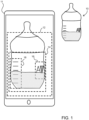
- Figure 1 shows a baby bottle 10 and also a captured image of the baby bottle on the screen of a smart phone 11.
- the bottle type and the actual volume of liquid inside it may be determined. This is used to simplify the administration and tracking of baby feeds, while avoiding the need for a separate dedicated physical device or constant manual monitoring.
- Figure 1 shows various regions of interest identified based on image processing, including the overall shape of the bottle within the area 12, the shape of the base part of the bottle in area 14, a marking such as a brand name and/or model type in area 16 and level markings in area 18.
- the type of bottle may be determined from a database of previously analyzed bottles. This step may for example be carried out with the bottle empty or with any quantity of liquid.
- the database gives further information which was nolt obtained from the image processing, in particular so that the initial image processing does not need to be scaled.
- the type of the bottle, the overall volume of the bottle, and the brand have been established from the database.
- This information may then be provided to the user, for example so that they know they are using the correct bottle type before filling with milk.
- the liquid level may also be established by recognizing the liquid boundary, or else it may be determined that the bottle is empty at this stage.
- the areas of interest may be identified in static images, or in live video, or in a set of images extracted from the video stream.
- the determination is based on object detection techniques using computer vision and pattern recognition, including pre-processing of the images.
- the object detection is performed based on training of a neural network using internally created and labelled data and image processing.
- a volume calculation involves finding the liquid boundary in the bottle followed by post processing techniques. Based on the known bottle type, a measured fraction of the bottle height corresponds to a known volume.
- the image processing may determine the 3D shape of the bottle (e.g. assuming a given wall thickness) and then mathematically derive the function of internal volume versus liquid height.
- the volume can in this way be determined by post processing techniques using image algorithms and/or mathematical formulas.
- the system may instruct the user to take multiple images from a set of viewing angles to enable a 3D shape determination to be performed.
- scaled information i.e. an absolute dimension
- the preferred approach is for the algorithm to be trained and updated with any new bottle types.
- the system always relies upon recognizing a bottle type and then deriving volume information from a database.
- the liquid volume may thus be determined by calculating the volume using mathematical techniques, based on a measurement of the ratio of the liquid height in the bottle to the actual bottle height, for example using bounding techniques and/or line detection algorithms.
- the ratio of liquid height to bottle height in insensitive to scale so once the bottle type is known, the absolute measurement of liquid level is not needed.
- a template overlay can be used to determine the volume of the bottle by matching the detected volume against a fitted template on the frame or image of the baby bottle.
- a post-processing step may be used to add the required accuracy to the detection process. If the bottle is held in a tilted fashion, the bottle type can still easily be detected but the determination of volume in the presence of a liquid inside is not as accurate.
- the user may be instructed to perform the analysis with the bottle standing on a horizontal surface such as a table.
- volume information can be presented and stored for the user and/or for further research purposes.
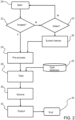
- Figure 2 shows a method of analyzing a bottle. The method starts in step 20, during which images or a video stream is received of the bottle to be analyzed.
- step 22 it is determined if the received input comprises images, and if so the method proceeds to a pre-processing step 24.
- step 23 If the input does not comprise individual images, it is determined in step 23 if a video stream has been received. If so, individual frames are extracted in step 26 before proceeding to the pre-processing step 24. If the input is also not video, no suitable input has been received, and the method returns to the start.
- the pre-processing for example involves applying grayscale, removing excess noise and extracting the position of the bottle with respect to the image including the teat and the base.
- the type of bottle is determined in step 28 using image analysis. This involves at least identifying a shape of the bottle, and also any identifying markings which are present.
- a bottle type for example has a particular shape of the base as well as a particular shape of the closing rim through which the teat projects. The bottle type is determined with reference to a bottle type database 25.
- the bottle type is also supplemented with additional information from the database, and this additional information may be considered to be further shape characteristics, and they take into account the absolute dimensions of the particular identified bottle type.
- step 30 image analysis is used to determine a liquid level in the bottle and thereby determine a liquid volume in the bottle. This involves identifying the line caused by the liquid surface against the inner wall of the bottle.
- the line is preferably flat and straight, if the bottle is stationary on a flat surface. However, a tilt angle may be detected and based on the known 3D shape from the type database, a liquid volume may still be determined.
- the volume information is output to a user in step 32 before the method ends in step 34.
- the system and method is for example implemented as a feature of bottle feed tracking app.
- the system and method may be used to aid feed monitoring and bottle detection in the absence of the user's ability to do so correctly.
- the tracking of volume over time may be used as part of the monitoring of the development of a baby. This may be used in hospital environments to automate and reduce the workload of tracking feed data.
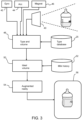
- Figure 3 shows a development of the approach of Figure 2 in which the system establishes how much milk the user should provide in the bottle based on past feeding data of the baby.
- the amount of milk is presented to the user using augmented reality.
- This enables a feed monitoring app to be made personalized for an individual baby. Users change bottles as babies grow, but the bottle recognition approach explained above is sufficiently adaptive to include all bottles and development stages. This will not only help in keeping a record of how much milk the baby has consumed and should consume but also can be used as an aid to record how much breast milk has been pumped for future use, and by when it should be fed to the baby.
- Figure 3 shows the camera 40 as used in the example above, and also shows other sensors of a typical mobile phone which may also be employed in the processing method, including gyroscopes 42, accelerometers 44 and a magnetometer 46.
- All of this sensor information is provided to the processor which performs the step 48 of determining the bottle type and volume, using the type database 25, in the same way as explained above.
- the sensors are used to determine the position of the bottle relative to the mobile phone (or other camera device), for example based on the assumption that the bottle is positioned vertically. However, if the bottle is oriented non-vertically, this can also be detected based on identifying the bottle axis. By knowing the orientation of the camera, and the bottle axis as viewed in the camera image, a nonvertical bottle orientation can also be determined.
- the magnetometer 46 is used to determine the true magnetic north of the mobile phone.
- the accelerometer 44 is then used to know the orientation of the mobile phone e.g. portrait or landscape with respect to the gravity vector. This enables a base to be established for the real world, and the virtual world (for the augmented reality) with respect to the real world.
- the gyroscope 42 is used to reduce jitter and the noise in the camera sensor and thereby make the positioning more accurate between the real world view and the virtual world.
- the additional sensor data used in the processing step 48 may be used to compensate for angles of the camera. For example, a transparent bottle and level of the volume of milk therein may result in detection of multiple volume levels due to the transparency showing the front and back milk level. Knowing the angle at which the image is taken can help to determine which level to choose during level detection.
- the sensors can be used as an additional input for the algorithm, improving correct bottle classification.
- the use of sensors may improve the capability to accurately detect the bottle type and volume, as well as to implement the image overlay in the case of an augmented reality system, as described above.
- a milk history database 52 is accessed which stores historical feeding information about the individual baby. This is used to determine a desired milk volume to be fed to the baby.
- augmented reality for example involves the capture of a video sequence of the bottle.
- the determined desired milk quantity may then be prepared as an augmented reality overlay in step 54.
- the live images of the bottle are then applied to 3D rendering software, where the bottle is superimposed with the desired quantity of milk as determined based on the historical data.
- the rendered graphic is then sent for post-processing where image algorithms for example provide a resolution adaptation to the resolution with which the image was captured, and provide suitable image processing to be augmented with the real world image or frames.
- image algorithms for example provide a resolution adaptation to the resolution with which the image was captured, and provide suitable image processing to be augmented with the real world image or frames.
- the graphic render is then provided with the real-world frame or image using a combiner.
- Calibrated data from the sensors of the mobile device are in this way used in the rendering of the augmented reality.
- the use of sensors reduces the complexity of the image processing required, by providing additional context information to the images.
- the final presented image 58 shows in real time how much milk visually should be filled in the bottle.
- the user may manually enter drinking information to the milk history database, if the automated volume monitoring was not used.
- the camera may for example be stationary on a solid base such as a table with the display facing the user and with the camera facing the milk bottle.
- a separate camera and display for example the camera of a mobile phone and a separate display which are connected through standard communication means.
- the visual feedback may include information other than the most suitable milk volume, such as an indication of the correct angle to hold the bottle while feeding the baby and so on.
- the system may be used in a hospital environment, wherein instead of a nurse sitting with young parents, the system can be used to record and gives guidance on the bottle volume and other feeding characteristics. Furthermore, a recording can be analyzed afterwards by the doctor or other medical staff.
- the system may be enhanced by adding labels to bottles.
- the system may be used to recognized individual bottles, and the system may then be enhanced to track bottles based on the dates they were filled, by providing a time stamp function.
- the system may have a milk management function.
- the system makes use of processor to perform the data processing.
- the processor can be implemented in numerous ways, with software and/or hardware, to perform the various functions required.
- the processor typically employs one or more microprocessors that may be programmed using software (e.g., microcode) to perform the required functions.
- the processor may be implemented as a combination of dedicated hardware to perform some functions and one or more programmed microprocessors and associated circuitry to perform other functions. The skilled person would be readily capable of developing a processor for carrying out any herein described method.
- circuitry examples include, but are not limited to, conventional microprocessors, application specific integrated circuits (ASICs), and field-programmable gate arrays (FPGAs).
- ASICs application specific integrated circuits
- FPGAs field-programmable gate arrays
- the processor may be associated with one or more storage media such as volatile and non-volatile computer memory such as RAM, PROM, EPROM, and EEPROM.
- the storage media may be encoded with one or more programs that, when executed on one or more processors and/or controllers, perform the required functions.
- Various storage media may be fixed within a processor or controller or may be transportable, such that the one or more programs stored thereon can be loaded into a processor.
- a single processor or other unit may fulfill the functions of several items recited in the claims.
- a computer program may be stored/distributed on a suitable medium, such as an optical storage medium or a solid-state medium supplied together with or as part of other hardware, but may also be distributed in other forms, such as via the Internet or other wired or wireless telecommunication systems. (optional)
Landscapes
- Physics & Mathematics (AREA)
- Engineering & Computer Science (AREA)
- General Physics & Mathematics (AREA)
- Theoretical Computer Science (AREA)
- Multimedia (AREA)
- Computer Vision & Pattern Recognition (AREA)
- Fluid Mechanics (AREA)
- Electromagnetism (AREA)
- Geometry (AREA)
- Health & Medical Sciences (AREA)
- Animal Behavior & Ethology (AREA)
- General Health & Medical Sciences (AREA)
- Public Health (AREA)
- Veterinary Medicine (AREA)
- Life Sciences & Earth Sciences (AREA)
- Thermal Sciences (AREA)
- Length Measuring Devices By Optical Means (AREA)
- Image Analysis (AREA)
- Measurement Of Levels Of Liquids Or Fluent Solid Materials (AREA)
Claims (15)
- Babyflaschenanalysesystem, das Folgendes umfasst:eine Eingabe zum Empfangen von Bilddaten einer zu analysierenden Babyflasche; undeinen Prozessor, wobei der Prozessor zu Folgendem eingerichtet ist:(28) Verwenden einer Bildanalyse, um zumindest Formeigenschaften der Flasche zu identifizieren, und Verwenden der identifizierten zumindest Formeigenschaften, um eine Flaschenart aus einer Datenbank (25) von vorgespeicherten unterschiedlichen Babyflaschenarten zu bestimmen;Erhalten von zusätzlichen Informationen über die Babyflasche aus der Datenbank, wobei die Datenbank die unterschiedlichen Babyflaschenarten mit den zusätzlichen Informationen in Beziehung setzt, wobei die zusätzlichen Informationen ein Volumen für unterschiedliche Flüssigkeitspegel von dem Boden der Babyflasche aus identifizieren; und(30) Verwenden einer Bildanalyse, um einen Flüssigkeitspegel in der Babyflasche zu bestimmen, und Verwenden des bestimmten Flüssigkeitspegels, um ein Flüssigkeitsvolumen in der Babyflasche basierend auf der Babyflaschenart und den zusätzlichen Informationen zu bestimmen, wobei die zusätzlichen Informationen absolute Abmessungen der identifizierten Flasche berücksichtigen, wobei der Prozessor dazu eingerichtet ist, eine maßstabsunabhängige Bildanalyse zu verwenden, die nicht auf absoluten Abmessungen beruht, um die Formeigenschaften der Flasche zu identifizieren und den Flüssigkeitspegel zu bestimmen.
- System nach Anspruch 1, wobei der Prozessor weiter dazu eingerichtet ist, die Bildanalyse zu verwenden, um zu identifizieren, ob eine beliebige aus einem vorbestimmten Satz von Identifizierungsmarkierungen vorhanden ist.
- System nach Anspruch 1 oder 2, wobei der Prozessor dazu eingerichtet ist, eine Babyflaschenart unter Verwendung eines neuronalen Netzwerks zu bestimmen.
- System nach einem der Ansprüche 1 bis 3, wobei der Prozessor dazu eingerichtet ist, eine Bildanalyse zu verwenden, um eine Flüssigkeitsoberfläche zu identifizieren.
- System nach einem der Ansprüche 1 bis 4, wobei der Prozessor dazu eingerichtet ist, erste Bilddaten und zweite Bilddaten zu verarbeiten und eine Änderung des Flüssigkeitsvolumens zu bestimmen.
- System nach Anspruch 5, zum Überwachen einer Flaschenfütterung eines Säuglings, wobei die Änderungen des Flüssigkeitsvolumens Milchkonsumvolumina entsprechen; wobei das System optional weiter einen Speicher (52) zum Speichern von historischen Milchkonsumvolumina umfasst.
- System nach Anspruch 6, wobei der Prozessor dazu eingerichtet ist, basierend auf historischen Milchkonsumvolumina eine einem Säugling zu fütternde Milchmenge zu bestimmen (50) und die bestimmte Menge auszugeben.
- System nach Anspruch 7, wobei der Prozessor dazu eingerichtet ist, die bestimmte Menge auszugeben (54), indem er ein Erweiterte-Realität-Bild der Babyflasche erzeugt, das die bestimmte Milchmenge darstellt.
- System nach einem der Ansprüche 1 bis 8, umfassend eine Kamera (40) zum Erfassen der Bilddaten als ein oder mehrere Bilder oder einen Videostream.
- System nach einem der Ansprüche 1 bis 9, wobei der Prozessor dazu eingerichtet ist, das Flüssigkeitsvolumen für die vorgespeicherte Babyflaschenart unter Verwendung einer Funktion zu bestimmen, die den Flüssigkeitspegel mit einem entsprechenden Volumen in Beziehung setzt.
- Verfahren zum Analysieren einer Babyflasche, das Folgendes umfasst:(26) Empfangen von Bilddaten der zu analysierenden Babyflasche;Verwenden einer Bildanalyse, um zumindest Formmerkmale der Flasche zu identifizieren;Zugreifen auf eine Datenbank (25) mit vorgespeicherten unterschiedlichen Babyflaschenarten und Bestimmen (28) einer Flaschenart unter Verwendung der identifizierten zumindest Formmerkmale;Erhalten zusätzlicher Informationen über die Babyflasche durch Zugreifen auf eine Datenbank, die unterschiedliche Flaschenarten mit den zusätzlichen Informationen in Beziehung setzt, wobei die zusätzlichen Informationen das Volumen für unterschiedliche Flüssigkeitspegel von dem Boden der Babyflasche aus identifizieren; und(30) Verwenden einer Bildanalyse, um einen Flüssigkeitspegel in der Flasche zu bestimmen und Bestimmen eines Flüssigkeitsvolumens in der Babyflasche unter Verwendung des bestimmten Flüssigkeitspegels basierend auf der Babyflaschenart und den zusätzlichen Informationen, wobei die zusätzlichen Informationen absolute Abmessungen der Flasche berücksichtigen, wobei die Bildanalyse, die dazu verwendet wird, die Formmerkmale der Flasche zu identifizieren und den Flüssigkeitspegel zu bestimmen, eine maßstabsunabhängige Bildanalyse ist, die nicht auf absoluten Abmessungen beruht.
- Verfahren nach Anspruch 11, umfassend:Bestimmen einer Babyflaschenart unter Verwendung eines neuronalen Netzwerks; undVerwenden einer Bildanalyse, um eine Flüssigkeitsoberfläche zu identifizieren.
- Verfahren nach Anspruch 11 oder 12 zum Überwachen einer Flaschenfütterung eines Säuglings, umfassend Verarbeiten erster Bilddaten und zweiter Bilddaten und Bestimmen einer Änderung des Flüssigkeitsvolumens, die Milchkonsumvolumina entspricht, wobei das Verfahren weiter Bestimmen einer einem Säugling zu fütternden Milchmenge basierend auf historischen Milchkonsumvolumina und Ausgeben der bestimmten Menge umfasst; wobei das Verfahren optional Ausgeben der bestimmten Menge durch Erzeugen eines Erweiterte-Realität-Bilds der Babyflasche umfasst, das die bestimmte Milchmenge darstellt.
- Verfahren nach einem der Ansprüche 11 bis 13, wobei für die vorgespeicherte Babyflaschenart eine Funktion den Flüssigkeitspegel mit dem entsprechenden Volumen in Beziehung setzt.
- Computerprogramm, das einen Computerprogrammcode umfasst, der dazu eingerichtet ist, wenn das Programm auf einem Prozessor läuft, das Verfahren nach einem der Ansprüche 11 bis 14 zu implementieren.
Applications Claiming Priority (2)
| Application Number | Priority Date | Filing Date | Title |
|---|---|---|---|
| EP20204105.9A EP3992847A1 (de) | 2020-10-27 | 2020-10-27 | Flaschenanalysesystem |
| PCT/EP2021/078425 WO2022089944A1 (en) | 2020-10-27 | 2021-10-14 | A bottle analysis system |
Publications (3)
| Publication Number | Publication Date |
|---|---|
| EP4237031A1 EP4237031A1 (de) | 2023-09-06 |
| EP4237031C0 EP4237031C0 (de) | 2024-08-21 |
| EP4237031B1 true EP4237031B1 (de) | 2024-08-21 |
Family
ID=73029921
Family Applications (2)
| Application Number | Title | Priority Date | Filing Date |
|---|---|---|---|
| EP20204105.9A Withdrawn EP3992847A1 (de) | 2020-10-27 | 2020-10-27 | Flaschenanalysesystem |
| EP21786244.0A Active EP4237031B1 (de) | 2020-10-27 | 2021-10-14 | Flaschenanalysesystem |
Family Applications Before (1)
| Application Number | Title | Priority Date | Filing Date |
|---|---|---|---|
| EP20204105.9A Withdrawn EP3992847A1 (de) | 2020-10-27 | 2020-10-27 | Flaschenanalysesystem |
Country Status (5)
| Country | Link |
|---|---|
| US (1) | US20230401814A1 (de) |
| EP (2) | EP3992847A1 (de) |
| CN (1) | CN116507374B (de) |
| CA (1) | CA3196566A1 (de) |
| WO (1) | WO2022089944A1 (de) |
Families Citing this family (3)
| Publication number | Priority date | Publication date | Assignee | Title |
|---|---|---|---|---|
| CN116337177A (zh) * | 2022-12-12 | 2023-06-27 | 无锡日联科技股份有限公司 | 容器中液位的检测方法及装置 |
| US12586389B2 (en) * | 2022-12-22 | 2026-03-24 | Adobe Inc. | Text identification in layered digital content |
| WO2025019773A1 (en) * | 2023-07-20 | 2025-01-23 | Curbsideir Llc | Computer-implemented systems and methods for tracking and managing percutaneous drainage catheters |
Citations (1)
| Publication number | Priority date | Publication date | Assignee | Title |
|---|---|---|---|---|
| US20180008787A1 (en) * | 2016-07-08 | 2018-01-11 | Bayer Healthcare Llc | System and method for identifying a fill volume of a fluid chamber |
Family Cites Families (12)
| Publication number | Priority date | Publication date | Assignee | Title |
|---|---|---|---|---|
| CN101528288A (zh) * | 2006-10-24 | 2009-09-09 | 马林克罗特公司 | 光学夹杂物传感器 |
| BRPI0800754A2 (pt) * | 2008-03-25 | 2020-09-24 | Sicpa Holding S.A. | Sistema de controle de produção integrado por meio de processamento de imagem e codificação automatizada |
| ES3056354T3 (en) * | 2012-05-14 | 2026-02-19 | Stryker Corp | System and method for estimating a quantity of a blood component in a fluid canister |
| US9576267B2 (en) * | 2012-11-26 | 2017-02-21 | Partender, LLC | System and method for taking an inventory of containers for liquid |
| EP3141268B1 (de) * | 2013-03-13 | 2020-08-05 | Medela Holding AG | System und behälter zur überwachung und analyse der milchsammlung |
| WO2017000292A1 (en) * | 2015-07-01 | 2017-01-05 | Bluesmart Technology Corporation | Smart tracking of baby feeding habits |
| CA2996525C (en) * | 2015-08-28 | 2024-02-20 | Bayer Healthcare Llc | System and method for syringe fluid fill verification and image recognition of power injector system features |
| EP3441729A1 (de) | 2017-08-09 | 2019-02-13 | Koninklijke Philips N.V. | Lastbestimmungsvorrichtung und zugehöriges herstellungsverfahren |
| WO2020051438A1 (en) * | 2018-09-06 | 2020-03-12 | Lansinoh Laboratories, Inc. | Closed loop electric breast pump |
| US11529291B2 (en) * | 2018-10-26 | 2022-12-20 | The Board Of Trustees Of The University Of Alabama | Instrumented infant feeding bottle |
| EP3870940B1 (de) * | 2018-12-03 | 2023-10-18 | Bio-Rad Laboratories, Inc. | Flüssigkeitsstandbestimmung |
| CN115004244A (zh) * | 2019-12-10 | 2022-09-02 | N·V·努特里奇亚 | 用于检测容器内的液位的方法和系统 |
-
2020
- 2020-10-27 EP EP20204105.9A patent/EP3992847A1/de not_active Withdrawn
-
2021
- 2021-10-14 EP EP21786244.0A patent/EP4237031B1/de active Active
- 2021-10-14 WO PCT/EP2021/078425 patent/WO2022089944A1/en not_active Ceased
- 2021-10-14 US US18/033,590 patent/US20230401814A1/en active Pending
- 2021-10-14 CA CA3196566A patent/CA3196566A1/en active Pending
- 2021-10-14 CN CN202180073490.6A patent/CN116507374B/zh active Active
Patent Citations (1)
| Publication number | Priority date | Publication date | Assignee | Title |
|---|---|---|---|---|
| US20180008787A1 (en) * | 2016-07-08 | 2018-01-11 | Bayer Healthcare Llc | System and method for identifying a fill volume of a fluid chamber |
Also Published As
| Publication number | Publication date |
|---|---|
| CN116507374B (zh) | 2026-03-03 |
| EP4237031A1 (de) | 2023-09-06 |
| EP4237031C0 (de) | 2024-08-21 |
| US20230401814A1 (en) | 2023-12-14 |
| CN116507374A (zh) | 2023-07-28 |
| EP3992847A1 (de) | 2022-05-04 |
| CA3196566A1 (en) | 2022-05-05 |
| WO2022089944A1 (en) | 2022-05-05 |
Similar Documents
| Publication | Publication Date | Title |
|---|---|---|
| US11017547B2 (en) | Method and system for postural analysis and measuring anatomical dimensions from a digital image using machine learning | |
| US9844616B2 (en) | System and method for managing a supply of breast milk | |
| US20230401814A1 (en) | A bottle analysis system | |
| BR112020009542A2 (pt) | sistema de gerenciamento de serviço de refeições, e, método de operação do sistema de gerenciamento de serviço de refeições. | |
| US12141980B2 (en) | Device and method for determining and displaying nutrient content and/or value of a food item | |
| US20220375191A1 (en) | Method and system for detecting liquid level inside a container | |
| EP4064985B1 (de) | Säuglingsüberwachungssystem während des fütterns | |
| US20200074667A1 (en) | Clothing Size Determination Systems and Methods of Use | |
| JP2023533644A5 (de) | ||
| KR20210047377A (ko) | 신체 이미징 | |
| KR102597692B1 (ko) | 영상을 이용한 물건 부피의 측정 장치, 방법, 및 컴퓨터 프로그램 | |
| KR102544742B1 (ko) | 딥러닝 기반 음식 이미지 부피 측정 방법 및 시스템 | |
| EP4172849B1 (de) | System und verfahren zur unterstützung während der flaschenfütterung | |
| CN120959724A (zh) | 一种基于手机拍照的身高分析方法 | |
| CN113506309A (zh) | 基于人工智能的医疗数据变量测量监测方法及系统 | |
| HK1234687B (en) | System and container for monitoring and analyzing milk collection | |
| HK1234687A (en) | System and container for monitoring and analyzing milk collection | |
| HK1218177B (en) | System and method for managing a supply of breast milk |
Legal Events
| Date | Code | Title | Description |
|---|---|---|---|
| STAA | Information on the status of an ep patent application or granted ep patent |
Free format text: STATUS: UNKNOWN |
|
| STAA | Information on the status of an ep patent application or granted ep patent |
Free format text: STATUS: THE INTERNATIONAL PUBLICATION HAS BEEN MADE |
|
| PUAI | Public reference made under article 153(3) epc to a published international application that has entered the european phase |
Free format text: ORIGINAL CODE: 0009012 |
|
| STAA | Information on the status of an ep patent application or granted ep patent |
Free format text: STATUS: REQUEST FOR EXAMINATION WAS MADE |
|
| 17P | Request for examination filed |
Effective date: 20230530 |
|
| AK | Designated contracting states |
Kind code of ref document: A1 Designated state(s): AL AT BE BG CH CY CZ DE DK EE ES FI FR GB GR HR HU IE IS IT LI LT LU LV MC MK MT NL NO PL PT RO RS SE SI SK SM TR |
|
| DAV | Request for validation of the european patent (deleted) | ||
| DAX | Request for extension of the european patent (deleted) | ||
| GRAP | Despatch of communication of intention to grant a patent |
Free format text: ORIGINAL CODE: EPIDOSNIGR1 |
|
| STAA | Information on the status of an ep patent application or granted ep patent |
Free format text: STATUS: GRANT OF PATENT IS INTENDED |
|
| INTG | Intention to grant announced |
Effective date: 20240322 |
|
| GRAS | Grant fee paid |
Free format text: ORIGINAL CODE: EPIDOSNIGR3 |
|
| GRAA | (expected) grant |
Free format text: ORIGINAL CODE: 0009210 |
|
| STAA | Information on the status of an ep patent application or granted ep patent |
Free format text: STATUS: THE PATENT HAS BEEN GRANTED |
|
| AK | Designated contracting states |
Kind code of ref document: B1 Designated state(s): AL AT BE BG CH CY CZ DE DK EE ES FI FR GB GR HR HU IE IS IT LI LT LU LV MC MK MT NL NO PL PT RO RS SE SI SK SM TR |
|
| REG | Reference to a national code |
Ref country code: GB Ref legal event code: FG4D |
|
| REG | Reference to a national code |
Ref country code: CH Ref legal event code: EP |
|
| REG | Reference to a national code |
Ref country code: IE Ref legal event code: FG4D |
|
| REG | Reference to a national code |
Ref country code: DE Ref legal event code: R096 Ref document number: 602021017639 Country of ref document: DE |
|
| U01 | Request for unitary effect filed |
Effective date: 20240821 |
|
| U07 | Unitary effect registered |
Designated state(s): AT BE BG DE DK EE FI FR IT LT LU LV MT NL PT RO SE SI Effective date: 20240902 |
|
| U20 | Renewal fee for the european patent with unitary effect paid |
Year of fee payment: 4 Effective date: 20241202 |
|
| PG25 | Lapsed in a contracting state [announced via postgrant information from national office to epo] |
Ref country code: NO Free format text: LAPSE BECAUSE OF FAILURE TO SUBMIT A TRANSLATION OF THE DESCRIPTION OR TO PAY THE FEE WITHIN THE PRESCRIBED TIME-LIMIT Effective date: 20241121 |
|
| PG25 | Lapsed in a contracting state [announced via postgrant information from national office to epo] |
Ref country code: GR Free format text: LAPSE BECAUSE OF FAILURE TO SUBMIT A TRANSLATION OF THE DESCRIPTION OR TO PAY THE FEE WITHIN THE PRESCRIBED TIME-LIMIT Effective date: 20241122 Ref country code: PL Free format text: LAPSE BECAUSE OF FAILURE TO SUBMIT A TRANSLATION OF THE DESCRIPTION OR TO PAY THE FEE WITHIN THE PRESCRIBED TIME-LIMIT Effective date: 20240821 |
|
| PG25 | Lapsed in a contracting state [announced via postgrant information from national office to epo] |
Ref country code: IS Free format text: LAPSE BECAUSE OF FAILURE TO SUBMIT A TRANSLATION OF THE DESCRIPTION OR TO PAY THE FEE WITHIN THE PRESCRIBED TIME-LIMIT Effective date: 20241221 |
|
| PG25 | Lapsed in a contracting state [announced via postgrant information from national office to epo] |
Ref country code: HR Free format text: LAPSE BECAUSE OF FAILURE TO SUBMIT A TRANSLATION OF THE DESCRIPTION OR TO PAY THE FEE WITHIN THE PRESCRIBED TIME-LIMIT Effective date: 20240821 |
|
| PG25 | Lapsed in a contracting state [announced via postgrant information from national office to epo] |
Ref country code: RS Free format text: LAPSE BECAUSE OF FAILURE TO SUBMIT A TRANSLATION OF THE DESCRIPTION OR TO PAY THE FEE WITHIN THE PRESCRIBED TIME-LIMIT Effective date: 20241121 Ref country code: ES Free format text: LAPSE BECAUSE OF FAILURE TO SUBMIT A TRANSLATION OF THE DESCRIPTION OR TO PAY THE FEE WITHIN THE PRESCRIBED TIME-LIMIT Effective date: 20240821 |
|
| PG25 | Lapsed in a contracting state [announced via postgrant information from national office to epo] |
Ref country code: RS Free format text: LAPSE BECAUSE OF FAILURE TO SUBMIT A TRANSLATION OF THE DESCRIPTION OR TO PAY THE FEE WITHIN THE PRESCRIBED TIME-LIMIT Effective date: 20241121 Ref country code: PL Free format text: LAPSE BECAUSE OF FAILURE TO SUBMIT A TRANSLATION OF THE DESCRIPTION OR TO PAY THE FEE WITHIN THE PRESCRIBED TIME-LIMIT Effective date: 20240821 Ref country code: NO Free format text: LAPSE BECAUSE OF FAILURE TO SUBMIT A TRANSLATION OF THE DESCRIPTION OR TO PAY THE FEE WITHIN THE PRESCRIBED TIME-LIMIT Effective date: 20241121 Ref country code: IS Free format text: LAPSE BECAUSE OF FAILURE TO SUBMIT A TRANSLATION OF THE DESCRIPTION OR TO PAY THE FEE WITHIN THE PRESCRIBED TIME-LIMIT Effective date: 20241221 Ref country code: HR Free format text: LAPSE BECAUSE OF FAILURE TO SUBMIT A TRANSLATION OF THE DESCRIPTION OR TO PAY THE FEE WITHIN THE PRESCRIBED TIME-LIMIT Effective date: 20240821 Ref country code: GR Free format text: LAPSE BECAUSE OF FAILURE TO SUBMIT A TRANSLATION OF THE DESCRIPTION OR TO PAY THE FEE WITHIN THE PRESCRIBED TIME-LIMIT Effective date: 20241122 Ref country code: ES Free format text: LAPSE BECAUSE OF FAILURE TO SUBMIT A TRANSLATION OF THE DESCRIPTION OR TO PAY THE FEE WITHIN THE PRESCRIBED TIME-LIMIT Effective date: 20240821 |
|
| PG25 | Lapsed in a contracting state [announced via postgrant information from national office to epo] |
Ref country code: SM Free format text: LAPSE BECAUSE OF FAILURE TO SUBMIT A TRANSLATION OF THE DESCRIPTION OR TO PAY THE FEE WITHIN THE PRESCRIBED TIME-LIMIT Effective date: 20240821 |
|
| PG25 | Lapsed in a contracting state [announced via postgrant information from national office to epo] |
Ref country code: CZ Free format text: LAPSE BECAUSE OF FAILURE TO SUBMIT A TRANSLATION OF THE DESCRIPTION OR TO PAY THE FEE WITHIN THE PRESCRIBED TIME-LIMIT Effective date: 20240821 |
|
| PG25 | Lapsed in a contracting state [announced via postgrant information from national office to epo] |
Ref country code: SK Free format text: LAPSE BECAUSE OF FAILURE TO SUBMIT A TRANSLATION OF THE DESCRIPTION OR TO PAY THE FEE WITHIN THE PRESCRIBED TIME-LIMIT Effective date: 20240821 |
|
| REG | Reference to a national code |
Ref country code: CH Ref legal event code: PL |
|
| PLBE | No opposition filed within time limit |
Free format text: ORIGINAL CODE: 0009261 |
|
| STAA | Information on the status of an ep patent application or granted ep patent |
Free format text: STATUS: NO OPPOSITION FILED WITHIN TIME LIMIT |
|
| PG25 | Lapsed in a contracting state [announced via postgrant information from national office to epo] |
Ref country code: MC Free format text: LAPSE BECAUSE OF FAILURE TO SUBMIT A TRANSLATION OF THE DESCRIPTION OR TO PAY THE FEE WITHIN THE PRESCRIBED TIME-LIMIT Effective date: 20240821 |
|
| PG25 | Lapsed in a contracting state [announced via postgrant information from national office to epo] |
Ref country code: CH Free format text: LAPSE BECAUSE OF NON-PAYMENT OF DUE FEES Effective date: 20241031 |
|
| 26N | No opposition filed |
Effective date: 20250522 |
|
| PGFP | Annual fee paid to national office [announced via postgrant information from national office to epo] |
Ref country code: TR Payment date: 20250930 Year of fee payment: 5 |
|
| PG25 | Lapsed in a contracting state [announced via postgrant information from national office to epo] |
Ref country code: IE Free format text: LAPSE BECAUSE OF NON-PAYMENT OF DUE FEES Effective date: 20241014 |
|
| U20 | Renewal fee for the european patent with unitary effect paid |
Year of fee payment: 5 Effective date: 20251031 |
|
| PG25 | Lapsed in a contracting state [announced via postgrant information from national office to epo] |
Ref country code: CY Free format text: LAPSE BECAUSE OF FAILURE TO SUBMIT A TRANSLATION OF THE DESCRIPTION OR TO PAY THE FEE WITHIN THE PRESCRIBED TIME-LIMIT; INVALID AB INITIO Effective date: 20211014 |
|
| PG25 | Lapsed in a contracting state [announced via postgrant information from national office to epo] |
Ref country code: HU Free format text: LAPSE BECAUSE OF FAILURE TO SUBMIT A TRANSLATION OF THE DESCRIPTION OR TO PAY THE FEE WITHIN THE PRESCRIBED TIME-LIMIT; INVALID AB INITIO Effective date: 20211014 |