EP4064985B1 - Säuglingsüberwachungssystem während des fütterns - Google Patents
Säuglingsüberwachungssystem während des fütterns Download PDFInfo
- Publication number
- EP4064985B1 EP4064985B1 EP20804575.7A EP20804575A EP4064985B1 EP 4064985 B1 EP4064985 B1 EP 4064985B1 EP 20804575 A EP20804575 A EP 20804575A EP 4064985 B1 EP4064985 B1 EP 4064985B1
- Authority
- EP
- European Patent Office
- Prior art keywords
- infant
- bottle
- axis
- angle
- monitoring system
- Prior art date
- Legal status (The legal status is an assumption and is not a legal conclusion. Google has not performed a legal analysis and makes no representation as to the accuracy of the status listed.)
- Active
Links
Images




Classifications
-
- A—HUMAN NECESSITIES
- A61—MEDICAL OR VETERINARY SCIENCE; HYGIENE
- A61B—DIAGNOSIS; SURGERY; IDENTIFICATION
- A61B5/00—Measuring for diagnostic purposes; Identification of persons
- A61B5/103—Measuring devices for testing the shape, pattern, colour, size or movement of the body or parts thereof, for diagnostic purposes
- A61B5/11—Measuring movement of the entire body or parts thereof, e.g. head or hand tremor or mobility of a limb
- A61B5/1113—Local tracking of patients, e.g. in a hospital or private home
-
- A—HUMAN NECESSITIES
- A61—MEDICAL OR VETERINARY SCIENCE; HYGIENE
- A61B—DIAGNOSIS; SURGERY; IDENTIFICATION
- A61B5/00—Measuring for diagnostic purposes; Identification of persons
- A61B5/68—Arrangements of detecting, measuring or recording means, e.g. sensors, in relation to patient
- A61B5/6887—Arrangements of detecting, measuring or recording means, e.g. sensors, in relation to patient mounted on external non-worn devices, e.g. non-medical devices
-
- A—HUMAN NECESSITIES
- A61—MEDICAL OR VETERINARY SCIENCE; HYGIENE
- A61B—DIAGNOSIS; SURGERY; IDENTIFICATION
- A61B5/00—Measuring for diagnostic purposes; Identification of persons
- A61B5/0002—Remote monitoring of patients using telemetry, e.g. transmission of vital signals via a communication network
- A61B5/0004—Remote monitoring of patients using telemetry, e.g. transmission of vital signals via a communication network characterised by the type of physiological signal transmitted
-
- A—HUMAN NECESSITIES
- A61—MEDICAL OR VETERINARY SCIENCE; HYGIENE
- A61B—DIAGNOSIS; SURGERY; IDENTIFICATION
- A61B5/00—Measuring for diagnostic purposes; Identification of persons
- A61B5/103—Measuring devices for testing the shape, pattern, colour, size or movement of the body or parts thereof, for diagnostic purposes
- A61B5/107—Measuring physical dimensions, e.g. size of the entire body or parts thereof
- A61B5/1071—Measuring physical dimensions, e.g. size of the entire body or parts thereof measuring angles, e.g. using goniometers
-
- A—HUMAN NECESSITIES
- A61—MEDICAL OR VETERINARY SCIENCE; HYGIENE
- A61B—DIAGNOSIS; SURGERY; IDENTIFICATION
- A61B5/00—Measuring for diagnostic purposes; Identification of persons
- A61B5/72—Signal processing specially adapted for physiological signals or for diagnostic purposes
- A61B5/7235—Details of waveform analysis
- A61B5/7246—Details of waveform analysis using correlation, e.g. template matching or determination of similarity
-
- A—HUMAN NECESSITIES
- A61—MEDICAL OR VETERINARY SCIENCE; HYGIENE
- A61J—CONTAINERS SPECIALLY ADAPTED FOR MEDICAL OR PHARMACEUTICAL PURPOSES; DEVICES OR METHODS SPECIALLY ADAPTED FOR BRINGING PHARMACEUTICAL PRODUCTS INTO PARTICULAR PHYSICAL OR ADMINISTERING FORMS; DEVICES FOR ADMINISTERING FOOD OR MEDICINES ORALLY; BABY COMFORTERS; DEVICES FOR RECEIVING SPITTLE
- A61J9/00—Feeding-bottles in general
-
- G—PHYSICS
- G16—INFORMATION AND COMMUNICATION TECHNOLOGY [ICT] SPECIALLY ADAPTED FOR SPECIFIC APPLICATION FIELDS
- G16H—HEALTHCARE INFORMATICS, i.e. INFORMATION AND COMMUNICATION TECHNOLOGY [ICT] SPECIALLY ADAPTED FOR THE HANDLING OR PROCESSING OF MEDICAL OR HEALTHCARE DATA
- G16H40/00—ICT specially adapted for the management or administration of healthcare resources or facilities; ICT specially adapted for the management or operation of medical equipment or devices
- G16H40/60—ICT specially adapted for the management or administration of healthcare resources or facilities; ICT specially adapted for the management or operation of medical equipment or devices for the operation of medical equipment or devices
- G16H40/63—ICT specially adapted for the management or administration of healthcare resources or facilities; ICT specially adapted for the management or operation of medical equipment or devices for the operation of medical equipment or devices for local operation
-
- G—PHYSICS
- G16—INFORMATION AND COMMUNICATION TECHNOLOGY [ICT] SPECIALLY ADAPTED FOR SPECIFIC APPLICATION FIELDS
- G16H—HEALTHCARE INFORMATICS, i.e. INFORMATION AND COMMUNICATION TECHNOLOGY [ICT] SPECIALLY ADAPTED FOR THE HANDLING OR PROCESSING OF MEDICAL OR HEALTHCARE DATA
- G16H40/00—ICT specially adapted for the management or administration of healthcare resources or facilities; ICT specially adapted for the management or operation of medical equipment or devices
- G16H40/60—ICT specially adapted for the management or administration of healthcare resources or facilities; ICT specially adapted for the management or operation of medical equipment or devices for the operation of medical equipment or devices
- G16H40/67—ICT specially adapted for the management or administration of healthcare resources or facilities; ICT specially adapted for the management or operation of medical equipment or devices for the operation of medical equipment or devices for remote operation
-
- A—HUMAN NECESSITIES
- A61—MEDICAL OR VETERINARY SCIENCE; HYGIENE
- A61B—DIAGNOSIS; SURGERY; IDENTIFICATION
- A61B2503/00—Evaluating a particular growth phase or type of persons or animals
- A61B2503/04—Babies, e.g. for SIDS detection
-
- A—HUMAN NECESSITIES
- A61—MEDICAL OR VETERINARY SCIENCE; HYGIENE
- A61B—DIAGNOSIS; SURGERY; IDENTIFICATION
- A61B2562/00—Details of sensors; Constructional details of sensor housings or probes; Accessories for sensors
- A61B2562/02—Details of sensors specially adapted for in-vivo measurements
- A61B2562/0219—Inertial sensors, e.g. accelerometers, gyroscopes, tilt switches
-
- A—HUMAN NECESSITIES
- A61—MEDICAL OR VETERINARY SCIENCE; HYGIENE
- A61J—CONTAINERS SPECIALLY ADAPTED FOR MEDICAL OR PHARMACEUTICAL PURPOSES; DEVICES OR METHODS SPECIALLY ADAPTED FOR BRINGING PHARMACEUTICAL PRODUCTS INTO PARTICULAR PHYSICAL OR ADMINISTERING FORMS; DEVICES FOR ADMINISTERING FOOD OR MEDICINES ORALLY; BABY COMFORTERS; DEVICES FOR RECEIVING SPITTLE
- A61J2200/00—General characteristics or adaptations
- A61J2200/70—Device provided with specific sensor or indicating means
Definitions
- This invention relates to feeding bottles and in particular relates to a system for monitoring the orientation of an infant when drinking from a bottle.
- a sleeve for the infant bottle which incorporates a load cell, for measuring the weight of the milk contained by the bottle before and after feeding, and thereby to calculate the milk volume consumed by the infant.
- the sleeve also contains an accelerometer, to give feedback to the parents in respect of the correct bottle angle, as well as for monitoring the drinking behavior of the child by looking at the bottle movements (e.g., to identify drinking bursts and pauses).
- the system also allows data to be sent to a companion app for analysis and visualization.
- the quality of bottle feeding is influenced by the position or orientation of the infant while drinking. It is for instance advised to position the infant relatively upright. This will prevent that milk flows into the inner ears, where it may cause an infection.
- the position of the infant may also influence the chance of excessive air intake, chance of reflux, and risk of choking.
- This information could be used to give feedback during a feed as to whether the position is appropriate or not, and to advise repositioning if appropriate (for example if the infant is restless). Tracking the infant orientation info over time (optionally in combination with other feeding cues) can help parents to understand what is most comfortable for their child. A camera system could be used for the orientation detection, but this is not a convenient and desired solution.
- One parameter of interest is the tilt angle of the infant about a vertical axis. This tilting may occur when the infant is leaning against the chest of the parent while drinking.
- an accelerometer coupled to the bottle in particular because of the rotational freedoms in the system.
- Another parameter of interest is the angle of the infant to the horizontal, i.e. how upright an infant is sitting during a feed. If the longitudinal axis of the bottle is perpendicular to the longitudinal body axis of the infant (i.e. approximately a straight representation of the spine), the bottle angle is then identical to the inclination angle. In practice, however, these axes will not be perfectly perpendicular to each other.
- CN 110339067 discloses a smart bottle base which monitors the position and movement of a feeding bottle to provide feeding analysis and feeding measurement.
- a monitoring system for determining infant orientation information during bottle feeding comprising:
- the output information comprises an angle of tilt of a body axis of the infant relative to the vertical and/or horizontal, and hence in the real world 3D coordinate space.
- the invention is based on the recognition that although the orientation of an infant is not directly linked to (and hence easily derivable from) the orientation of the bottle from which they are feeding, the infant orientation can be derived from the combination of orientation information and movement information relating to the bottle.
- the process of drinking from a bottle induces movements in the bottle in directions which depend on the orientation of the infant and the orientation of the infant relative to the bottle.
- the orientation information and movement information relating to the bottle can be used to derive information about the infant.
- the sensor arrangement for example comprises a three-axis motion sensor such as a three-axis accelerometer and/or a three-axis gyroscope.
- the output interface may comprise a wireless transmitter for sending the output information to a remote device for presentation to a user.
- This information is for example objective feedback on infant position and may be used to help a parent understand what is most comfortable for their child.
- the processor may be adapted to identify infant orientation information comprising an angle of tilt of a body axis of the infant about a vertical axis. This is a left-right tilt of the infant.
- the body axis is a general axial representation of the body of the infant, for example aligned with the end-to-end direction of the spine.
- the processor may be adapted to translate the sensor arrangement signals to a reference coordinate system to compensate for rotation about a bottle longitudinal axis during a feed. If two-axis accelerations are being monitored in a plane of the base of the bottle, it is not initially known how the bottle is held. In particular, the rotational position about the bottle longitudinal axis is not known. By translating to a reference coordinate system, this ambiguity is resolved.
- the processor may then be adapted to identify components of movement corresponding to longitudinal movement parallel to a body axis of the infant caused by jaw movement and thereby to determine the orientation of the body axis of the infant (relative to the known reference coordinate system). These longitudinal movements can be detected and then interpreted using the reference coordinate system.
- the processor is for example adapted to identify the components of movement by finding a minimum correlation between components of movement in orthogonal directions in a plane perpendicular to a longitudinal axis of the bottle. By finding an orientation with lowest correlation, the direction in which these components of movement are principally oriented is then found (within the reference coordinate system). This then identifies the orientation of the infant in the reference coordinate system.
- the processor is adapted to identify infant orientation information comprising an angle of tilt of a body axis of the infant about a horizontal axis. This is a forward-back tilt of the infant. This is typically close to orthogonal the body axis of the infant. However, for greater accuracy, the processor is preferably adapted to identify an offset between a longitudinal axis of the bottle and an axis perpendicular to the body axis of the infant.
- the processor may be adapted to identify the offset by using a regression model which models the way bottle movements vary during feeding in dependence on the offset angle.
- the monitoring system is for example arranged as a sleeve for mounting around a feeding bottle.
- the invention also provides a computer-implemented method for determining infant orientation information during bottle feeding, comprising:
- the output information comprises an angle of tilt of a body axis of the infant relative to the vertical and/or horizontal, and hence in the real world 3D coordinate space.
- the method may comprise:
- the invention also provides a computer program comprising computer program code means which is adapted, when said program is run on a computer, to implement the method defined above.
- the invention provides a monitoring system for monitoring an infant during bottle feeding. Based on bottle orientation information and movement information in respect of the feeding bottle during feeding, orientation information in respect of the infant is obtained (named "infant orientation information" in this document).
- FIG 1 shows a feeding bottle 10 mounted in a sleeve 12 which functions as a monitoring system.
- the sleeve 12 surrounds the feeding bottle 10.
- a monitoring unit 16 is in this example provided in the base of the sleeve 12, and comprises a sensing arrangement 18 for sensing bottle orientation and movement (of a bottle coupled to the monitoring unit), and an output interface 20.
- the monitoring unit 16 may be incorporated anywhere in or on the sleeve.
- the base part of the sleeve for example also includes a battery, and optionally means for providing visual feedback to the user via LEDs.
- the output interface 20 may comprise this LED arrangement.
- a preferred implementation instead (or additionally) has an output interface which communicates the results wirelessly to a smartphone 24 or tablet as shown.
- a processor 22 determines infant orientation relating to the infant and then provides information to the user. This information may be the infant orientation itself, or it may be advice or information which can be derived from knowledge of the infant orientation.
- the processor 22 is the processor of a mobile phone 24 which communicates wirelessly with the monitoring unit 16.
- the sleeve locally detects motion, and the remote processor analyzes the motion to derive the infant orientation.
- a parent feeding an infant may monitor on their mobile phone information relating to the feeding, in particular the infant orientation.
- the processor 22 which analyses the motion data could also be located on the sleeve and integrated with the monitoring unit 16. In this case only the infant orientation information needs to be transmitted to the mobile phone. In this case, raw motion data does not have to be transmitted to the phone, saving time and battery life.
- the sensing arrangement 18 preferably comprises a 3-axis acceleration sensor and/or a 3-axis gyroscope.
- Figure 2 shows one possible set of signals from a combination of a 3-axis acceleration sensor and a 3-axis gyroscope. An image of the bottle 10 is shown to illustrate the 3-axis orientations.
- the sensor arrangement gives three linear acceleration signals Xacc, Yacc, Zacc and three angular velocity signals Xgyro, Ygyro and Zgyro.
- the sensor arrangement is generally an inertia measurement unit and/or force or acceleration measurement unit.
- Different implementations of the system may make use of acceleration sensors only, or gyroscope sensors only, or both.
- the processor 22 is programmed generally to determine infant orientation information in respect of the infant during a feed.
- a first type of infant orientation information is the tilt angle about a vertical axis.
- Figure 3 shows a front view of an infant in an upright position (left image) and in a tilted position (right image) with a tilt of angle ⁇ to the vertical. Tilting may occur when the infant is leaning against the chest of the parent while drinking.
- the sleeve 12 is a round object which is more or less rotation-symmetric, and therefore it can freely rotate around the bottle (hence the x-axis and y-axis can freely rotate around the z-axis).
- Every feed the parent may attach the sleeve differently to the bottle.
- the bottle-sleeve combination is more or less rotation-symmetric as well.
- the parent may hold the bottle differently, and also during the feed the bottle may rotate around its longitudinal axis (z-axis). This has been regularly observed in data acquired during home studies by the applicant.
- the invention is based on the recognition that movement information may be used to enable infant orientation to be determined, including this tilt angle.
- Figure 4 shows a bottom of the bottle, and represents the x and y axis, which are in the plane perpendicular to the longitudinal axis of the bottle (e.g. the base of the bottle). As shown in Figure 4 , the x-axis and y-axis can rotate freely around the longitudinal axis of the bottle from x,y to x',y'. The bottle orientation can change between feeds, but also during feeds.
- a first part of the processing is to translate to a fixed orientation system, in which the translated y value is aligned vertically and the translated x value is aligned horizontally.
- the sensor arrangement signals are translated to a reference coordinate system to compensate for rotation about the bottle longitudinal axis during a feed.
- Figure 5 is used to explain this coordinate system translation.
- the x and y axes are counter-clockwise rotated by angle ⁇ with respect to the desired horizontal and vertical axis.
- the gravitational acceleration results in signals S x and S y in the x and y directions, respectively.
- the angle between x and the desired reference coordinate x-axis needs to be determined (angle ⁇ in Figure 5 ). This can be done making use of the gravitational acceleration g measured by the accelerometer.
- the components Sx and Sy can be obtained by low pass filtering (since the gravity vector is constant) thereby excluding movements of the infant when determining the coordinate system translation.
- the signals in the x and y direction can be rotated such that these reflect horizontal and vertical accelerations because of the mapping to the reference coordinate system.
- the rotation angle may need to be adjusted depending on the quadrants in which the x and y axis are located.
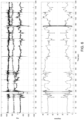
- Figure 6 shows an example of a real feed.
- the top graph shows the three accelerometer signals.
- the top plot is the x-axis
- the middle plot is the z-axis
- the bottom plot is the y-axis.
- the bottom graph shows the angle of the x and y directions with respect to the horizontal axis during the feed.
- the top plot is the x-axis angle relative to horizontal
- the bottom plot shows the y-axis angle relative to the horizontal axis.
- the bottle orientation angle can vary considerably throughout the feed as can be seen. Therefore, the angle determination and axis rotation may be performed every sample, such that a fixed reference coordinate system is obtained throughout the whole feed.
- the infant tilt angle may be derived by making use of knowledge of typical bottle motions induced during feeding. Drinking results in repetitive bottle motions.
- the sucking behavior involves a front to back movement of the tongue which results in a motion along the longitudinal axis of the bottle (z-axis). Jaw movements also induce up and down movements, typically along the longitudinal axis of the infant.
- Figure 7 shows how drinking results in these repetitive bottle motions, which are mainly visible in the longitudinal axis of the bottle and the body axis of the infant.
- the longitudinal movement of the infant is of particular relevance for determining the tilt angle as defined above.
- the body axis of the infant corresponds to the vertical axis rotated by the tilt angle to be determined.
- the way the infant tilt can be derived can be understood by considering different scenarios. If the y-axis is aligned with the longitudinal infant axis, the bottle movement would be clearly visible in that direction, while in the perpendicular direction (x-axis) there would be only limited amount of motion visible (mostly noise). Consequently, there would be no correlation between the x and y signals. If the y-axis is not aligned with the longitudinal infant axis, it would be expected that the bottle movements are to some extend visible in both the x and y directions, and they would bear some correlation.
- This principle can be used to find the tilt angle.
- components of this movement can be obtained by finding a minimum correlation between components of movement in these orthogonal x and y directions (perpendicular to the longitudinal axis of the bottle).
- the rotation angle at which the correlation coefficient becomes minimum (or zero) is obtained, and from this the infant tilt angle can be determined (relative to the now known reference coordinate system).
- Figure 8 shows a plot of correlation versus matrix rotation angle from a real feed. The correlation between the time series signals of the x and y accelerometer signals is plotted for different rotations.
- the amount of data needed to implement the correlation is related to the sucking frequency which is typically between 1-2Hz. Sufficient variation in the data is needed to detect the correlation. After a small number of infant sucks, the movement along the longitudinal axis of the infant may be captured and it will then be possible to detect the correlation. Thus a few seconds of data while the infant is drinking will be sufficient. During a long break it will of course not be possible to update the tilt angle, because there is no movement information.
- This graph shows the results of a real feed for which the tilt angle is 24 degrees.
- Figure 9 shows a scatter plot of estimated tilt versus actual imposed tilt.
- the circles correspond to measurements where the head of the infant is in the same plane as the body, i.e., there is no sideway rotation of the head. These estimations are fairly close to the real tilt angles. In case the head is rotated sideways with respect to the body, the head is in a different tilt position, which will induce an error.
- the crosses correspond to measurements where the head was rotated 45 degrees, resulting in an under estimation of the tilt angle. However, there is still a strong correlation between the imposed and estimated tilt angle.
- the estimated tilt angles match well with the imposed ones.
- Another source of noise is introduced when the head of the infant is turned sideways with respect to the body as mentioned above, because the bottle is then moving in a different plane compared to the body, which will cause an under- or overestimation of the body tilt angle.
- a second type of orientation information of interest is the upright position angle (the inclination to the horizontal) of the infant during bottle feeding.
- Figure 10 represents this inclination angle ⁇ and a corresponding bottle angle ⁇ . Estimating both the tilt angle and inclination angle for example gives a more complete picture of the position/orientation of the infant during feeding.
- the bottle angle ⁇ is identical to the inclination angle ⁇ . It is noted however that this only holds when the infant is not rotated around its body axis (i.e., not rotated sideward). A sideward rotation of the infant will induce a slight overestimation of the inclination angle (e.g., ⁇ 1.5% for a 10 degree rotation).
- Figure 12 shows an example where the bottle is placed slightly more upright (by angle ⁇ ) with respect to the infant's inclination. Describing the inclination angle as a function of the bottle angle will result in an underestimation in this case. Instead, the inclination angle ⁇ is given by the sum of ⁇ and ⁇ . The challenge is to determine ⁇ because it cannot be straightforwardly derived from the accelerometer.
- the angle ⁇ is estimated, and hence the overall inclination angle is estimated, by analyzing bottle motions during the feed induced by the sucking behavior of the infant.
- the approach is based on the recognition that the relative magnitude of linear accelerations and angular velocities in the three different directions changes when the bottle is positioned at different angles in the infant's mouth.
- features can be derived from the motion data to estimate the angle ⁇ .
- Modeling techniques like regression can be used to define the relation between the motion features and angle ⁇ .
- Figure 13 shows the results.
- the top graph of Figure 13 shows the accelerations for all three axes during the three phases.
- the top plot is the z-axis
- the middle plot is the y-axis
- the bottom plot is the x-axis.
- the bottom graph shows the calculated bottle angle.
- the bottle angle was calculated, which is shown in the bottom graph.
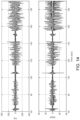
- Figures 14 to 16 show how the inclination angle is caclulated.
- Figure 14 shows processed acceleration and gyroscope signals in which gravity effects have been filtered out. Several motion components change during the different phases.
- the top graph shows the three-axis acceleration signals. They generally overlap.
- the bottom graph shows the three axis gyroscope signals, which again generally overlap.
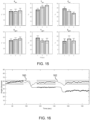
- Figure 15 shows an analysis of the data of Figure 14 in a statistical form.
- the accelerometer the top three bar charts
- gyroscope the bottom three bar charts
- the mean and standard deviation of the relative contribution of each motion component represented (as a percentage).
- the bar height represents the mean for that axis relative to the other axes
- the margin bars represent the standard deviation.
- Figure 16 shows the results for the test data.
- the line 160 shows the actual bottle angle, and the grey regions indicate the time period during which the inclination angle was set for the different phases.
- Plot 162 is the predicted inclination angle of the infant obtained via linear regression. The prediction of the infant angle clearly adapts to the changes at each phase and thus departs from the bottle angle. If the inclination angle is determined solely based on the bottle angle, a significant underestimation would result.
- the information obtained, of the tilt angle, the inclination angle, or both, may be used to derive feedback for the parent relating to the infant position.
- additional feeding cues may be collected as well such as whether the feed was restless or stable, did the infant get cramp etc., which would provide the opportunity to identify optimal conditions for successful feeding.
- any sensing arrangement positionally fixed with respect to the bottle may be used. It may be integrated into the bottle or a cap of the bottle.
- a computer program may be stored/distributed on a suitable medium, such as an optical storage medium or a solid-state medium supplied together with or as part of other hardware, but may also be distributed in other forms, such as via the Internet or other wired or wireless telecommunication systems.
- a suitable medium such as an optical storage medium or a solid-state medium supplied together with or as part of other hardware, but may also be distributed in other forms, such as via the Internet or other wired or wireless telecommunication systems.
Landscapes
- Health & Medical Sciences (AREA)
- Life Sciences & Earth Sciences (AREA)
- Engineering & Computer Science (AREA)
- Biomedical Technology (AREA)
- Public Health (AREA)
- General Health & Medical Sciences (AREA)
- Medical Informatics (AREA)
- Veterinary Medicine (AREA)
- Animal Behavior & Ethology (AREA)
- Heart & Thoracic Surgery (AREA)
- Physics & Mathematics (AREA)
- Surgery (AREA)
- Molecular Biology (AREA)
- Pathology (AREA)
- Biophysics (AREA)
- Physiology (AREA)
- Dentistry (AREA)
- Oral & Maxillofacial Surgery (AREA)
- General Business, Economics & Management (AREA)
- Business, Economics & Management (AREA)
- Epidemiology (AREA)
- Primary Health Care (AREA)
- Computer Vision & Pattern Recognition (AREA)
- Artificial Intelligence (AREA)
- Psychiatry (AREA)
- Signal Processing (AREA)
- Computer Networks & Wireless Communication (AREA)
- Length Measuring Devices With Unspecified Measuring Means (AREA)
- Control Of Conveyors (AREA)
- Medical Preparation Storing Or Oral Administration Devices (AREA)
Claims (15)
- Überwachungssystem zur Bestimmung von Orientierungsinformationen für Säuglinge während der Flaschenernährung, umfassend: eine Sensoranordnung zur Erfassung von Informationen zur Flaschenausrichtung und -Bewegung in Bezug auf die Flasche während der Fütterung und einem Prozessor (22), der dazu geeignet ist, anhand der Signale der Sensoranordnung die Orientierungsinformationen des Säuglings in Bezug auf das Kind zu identifizieren, und eine Ausgabeschnittstelle (20) zur Bereitstellung von Ausgabeinformationen in Abhängigkeit von den Orientierungsinformationen des Säuglings, dadurch gekennzeichnet die Ausgabeinformationen, die einen Neigungswinkel einer Körperachse des Säuglings in Bezug auf die vertikale und/oder horizontale umfassen.
- Überwachungssystem nach Anspruch 1, wobei die Sensoranordnung (18) einen dreiachsigen Bewegungssensor umfasst.
- Überwachungssystem nach Anspruch 2, wobei die Sensoranordnung (18) einen dreiachsigen Beschleunigungsmesser und/oder ein dreiachsiges Gyroskop umfasst.
- Überwachungssystem nach einem der Ansprüche 1 bis 3, wobei die Ausgabeschnittstelle (20) einen drahtlosen Sender zum Senden der Ausgabeinformationen an ein entferntes Gerät (24) zur Präsentation für einen Benutzer umfasst.
- Überwachungssystem nach einem der Ansprüche 1 bis 4, wobei der Prozessor (22) so ausgelegt ist, dass er Informationen zur Orientierung des Säuglings identifiziert, die einen Neigungswinkel einer Körperachse des Säuglings um eine vertikale Achse umfassen.
- Überwachungssystem nach einem der Ansprüche 1 bis 5, wobei der Prozessor (22) dazu ausgelegt ist, die Signale der Sensoranordnung in ein Referenzkoordinatensystem zu übersetzen, um die Drehung um eine Flaschenlängsachse während einer Zuführung zu kompensieren.
- Überwachungssystem nach Anspruch 6, wobei der Prozessor (22) dazu ausgelegt ist, Bewegungskomponenten zu identifizieren, die einer durch Kieferbewegung verursachten Längsbewegung parallel zu einer Körperachse des Säuglings entsprechen, und dadurch die Ausrichtung der Körperachse zu bestimmen des Säuglings.
- Überwachungssystem nach Anspruch 7, wobei der Prozessor (22) so ausgelegt ist, dass er die Bewegungskomponenten identifiziert, indem er eine minimale Korrelation zwischen Bewegungskomponenten in orthogonaler Richtung in einer Ebene senkrecht zu einer Längsachse der Flasche ermittelt.
- Überwachungssystem nach einem der Ansprüche 1 bis 8, wobei der Prozessor (22) so ausgelegt ist, dass er Informationen zur Orientierung des Säuglings identifiziert, die einen Neigungswinkel einer Körperachse des Säuglings um eine horizontale Achse umfassen.
- Überwachungssystem nach Anspruch 9, wobei der Prozessor (22) geeignet ist, einen Versatz zwischen einer Längsachse der Flasche und einer Achse senkrecht zur Körperachse des Säuglings zu identifizieren.
- Überwachungssystem nach Anspruch 10, wobei der Prozessor (22) dazu ausgelegt ist, den Versatz durch Verwendung eines Regressionsmodells zu identifizieren, das die Art und Weise modelliert, wie sich Flaschenbewegungen während der Zuführung in Abhängigkeit vom Versatzwinkel ändern.
- Überwachungssystem (12) nach einem der Ansprüche 1 bis 11, angeordnet als Hülse zum Anbringen um eine Babyflasche herum.
- Computerimplementiertes Verfahren zur Bestimmung von Orientierungsinformationen für Säuglinge während der Flaschenernährung unter Verwendung eines Systems nach einem der Ansprüche 1 bis 12, umfassend: Erfassung von Informationen zur Flaschenausrichtung und Bewegung in Bezug auf die Flasche während der Fütterung mithilfe der Sensoranordnung und anhand der Orientierungsinformationen für die Flasche und der Bewegungsinformationen Informationen zur Orientierung des Säuglings in Bezug auf das Kind; und Bereitstellung von Ausgabeinformationen, die von den Orientierungsinformationen des Säuglings abhängen und dadurch gekennzeichnet sind die Ausgabeinformationen, die einen Neigungswinkel einer Körperachse des Säuglings in Bezug auf die vertikale und/oder horizontale umfassen.
- Verfahren nach Anspruch 13, umfassend: Informationen zur Orientierung des Säuglings, die einen Neigungswinkel einer Körperachse des Säuglings um eine vertikale Achse umfassen, und/oder zur Identifizierung von Orientierungsinformationen für Säuglinge, die einen Neigungswinkel einer Körperachse des Säuglings um eine horizontale Achse umfassen.
- Computerprogramm, das Computerprogrammcodemittel umfasst, die angepasst sind, wenn das Programm auf einem Computer ausgeführt wird, ein System nach einem der Ansprüche 1 bis 12 zu steuern, um das Verfahren nach Anspruch 13 oder 14 umzusetzen.
Priority Applications (1)
| Application Number | Priority Date | Filing Date | Title |
|---|---|---|---|
| EP23214544.1A EP4325515B1 (de) | 2019-11-26 | 2020-11-17 | Säuglingsüberwachungssystem während der fütterung |
Applications Claiming Priority (2)
| Application Number | Priority Date | Filing Date | Title |
|---|---|---|---|
| EP19211379.3A EP3827748A1 (de) | 2019-11-26 | 2019-11-26 | Säuglingsüberwachungssystem während des fütterns |
| PCT/EP2020/082439 WO2021104951A1 (en) | 2019-11-26 | 2020-11-17 | Infant monitoring system during feeding |
Related Child Applications (2)
| Application Number | Title | Priority Date | Filing Date |
|---|---|---|---|
| EP23214544.1A Division-Into EP4325515B1 (de) | 2019-11-26 | 2020-11-17 | Säuglingsüberwachungssystem während der fütterung |
| EP23214544.1A Division EP4325515B1 (de) | 2019-11-26 | 2020-11-17 | Säuglingsüberwachungssystem während der fütterung |
Publications (3)
| Publication Number | Publication Date |
|---|---|
| EP4064985A1 EP4064985A1 (de) | 2022-10-05 |
| EP4064985B1 true EP4064985B1 (de) | 2024-04-10 |
| EP4064985C0 EP4064985C0 (de) | 2024-04-10 |
Family
ID=68696263
Family Applications (3)
| Application Number | Title | Priority Date | Filing Date |
|---|---|---|---|
| EP19211379.3A Withdrawn EP3827748A1 (de) | 2019-11-26 | 2019-11-26 | Säuglingsüberwachungssystem während des fütterns |
| EP23214544.1A Active EP4325515B1 (de) | 2019-11-26 | 2020-11-17 | Säuglingsüberwachungssystem während der fütterung |
| EP20804575.7A Active EP4064985B1 (de) | 2019-11-26 | 2020-11-17 | Säuglingsüberwachungssystem während des fütterns |
Family Applications Before (2)
| Application Number | Title | Priority Date | Filing Date |
|---|---|---|---|
| EP19211379.3A Withdrawn EP3827748A1 (de) | 2019-11-26 | 2019-11-26 | Säuglingsüberwachungssystem während des fütterns |
| EP23214544.1A Active EP4325515B1 (de) | 2019-11-26 | 2020-11-17 | Säuglingsüberwachungssystem während der fütterung |
Country Status (6)
| Country | Link |
|---|---|
| US (1) | US20220400978A1 (de) |
| EP (3) | EP3827748A1 (de) |
| CN (1) | CN114760916A (de) |
| CA (1) | CA3162565A1 (de) |
| MX (1) | MX2022006267A (de) |
| WO (1) | WO2021104951A1 (de) |
Families Citing this family (7)
| Publication number | Priority date | Publication date | Assignee | Title |
|---|---|---|---|---|
| KR102153578B1 (ko) * | 2018-12-20 | 2020-09-08 | 리틀원주식회사 | 스마트 보틀 및 이의 제어 방법 |
| US12465556B2 (en) | 2020-02-27 | 2025-11-11 | Innovative Therapeutix, Inc. | Infant feeding reinforcement system |
| WO2021174020A1 (en) | 2020-02-27 | 2021-09-02 | Innovative Therapeutix, Inc. | Infant feeding reinforcement system |
| USD1032292S1 (en) * | 2021-10-28 | 2024-06-25 | Elgin Chan | Straw cup |
| USD1018203S1 (en) * | 2021-11-03 | 2024-03-19 | Elgin Chan | Sippy cup |
| KR102692512B1 (ko) * | 2021-11-09 | 2024-08-06 | 리틀원주식회사 | 스마트 보틀 및 이의 제어 방법 |
| US20230399151A1 (en) * | 2022-06-13 | 2023-12-14 | Become Current PBC | Portable beverage container with sleeve |
Family Cites Families (12)
| Publication number | Priority date | Publication date | Assignee | Title |
|---|---|---|---|---|
| US9561002B2 (en) * | 2012-07-18 | 2017-02-07 | Chantal Lau | Systems for monitoring infant oral motor kinetics during nutritive and non-nutritive feeding |
| US20140372045A1 (en) * | 2013-06-17 | 2014-12-18 | Panu Matti Keski-Pukkila | Method and an apparatus for indirect measurement of fluid in a container and communication thereof |
| AU2015240940A1 (en) * | 2014-04-02 | 2016-11-10 | Kuvee, Inc. | Container for preserving liquid contents |
| WO2017000292A1 (en) * | 2015-07-01 | 2017-01-05 | Bluesmart Technology Corporation | Smart tracking of baby feeding habits |
| EP3405164A4 (de) * | 2015-09-10 | 2019-10-30 | Shoham, Afik | Vorrichtung für korrekte zuführhaltung |
| EP3448349B2 (de) * | 2016-04-26 | 2022-08-03 | Koninklijke Philips N.V. | Säuglings-ernährungssystem |
| CN106205070B (zh) * | 2016-07-26 | 2019-04-05 | 深圳市极客宝贝智能科技有限公司 | 一种能矫正喂奶姿势的奶瓶套、控制系统及控制方法 |
| WO2018053045A2 (en) * | 2016-09-13 | 2018-03-22 | May & Meadow, Inc. | Breast sense feeding monitor |
| WO2018122173A1 (en) * | 2016-12-27 | 2018-07-05 | Koninklijke Philips N.V. | Smart bottle holder |
| US10561582B2 (en) * | 2018-03-27 | 2020-02-18 | Zak Wood | Baby bottle sensor with content volume sensing and content deduction logic |
| US11373102B2 (en) * | 2018-05-04 | 2022-06-28 | The Procter & Gamble Company | Sensing and activity classification for infants |
| CN110339067B (zh) * | 2019-07-18 | 2022-03-25 | 成都贝酷科技有限公司 | 一种婴幼儿智能奶瓶底座及控制方法 |
-
2019
- 2019-11-26 EP EP19211379.3A patent/EP3827748A1/de not_active Withdrawn
-
2020
- 2020-11-17 CN CN202080081995.2A patent/CN114760916A/zh active Pending
- 2020-11-17 EP EP23214544.1A patent/EP4325515B1/de active Active
- 2020-11-17 EP EP20804575.7A patent/EP4064985B1/de active Active
- 2020-11-17 CA CA3162565A patent/CA3162565A1/en active Pending
- 2020-11-17 US US17/776,612 patent/US20220400978A1/en active Pending
- 2020-11-17 WO PCT/EP2020/082439 patent/WO2021104951A1/en not_active Ceased
- 2020-11-17 MX MX2022006267A patent/MX2022006267A/es unknown
Also Published As
| Publication number | Publication date |
|---|---|
| EP4325515A2 (de) | 2024-02-21 |
| CN114760916A (zh) | 2022-07-15 |
| EP4325515B1 (de) | 2026-03-25 |
| EP4064985C0 (de) | 2024-04-10 |
| EP4325515C0 (de) | 2026-03-25 |
| WO2021104951A1 (en) | 2021-06-03 |
| CA3162565A1 (en) | 2021-06-03 |
| EP3827748A1 (de) | 2021-06-02 |
| US20220400978A1 (en) | 2022-12-22 |
| EP4325515A3 (de) | 2024-03-20 |
| MX2022006267A (es) | 2022-06-08 |
| EP4064985A1 (de) | 2022-10-05 |
Similar Documents
| Publication | Publication Date | Title |
|---|---|---|
| EP4325515B1 (de) | Säuglingsüberwachungssystem während der fütterung | |
| Lobo et al. | Vision and inertial sensor cooperation using gravity as a vertical reference | |
| JP6533590B2 (ja) | ウェアラブル装置とその姿勢測定方法及びプログラム | |
| JP4926424B2 (ja) | 携帯機器及びその描画処理制御方法 | |
| KR102845646B1 (ko) | 관성 측정 유닛에 대한 캘리브레이션 장치 및 방법 | |
| EP3917405B1 (de) | Instrumentierte ultraschallsonden für durch maschinenlernen erzeugtes echtzeitfeedback eines sonografen | |
| US9348953B2 (en) | Swing simulation system, swing simulation apparatus, and swing simulation method | |
| CN112815834B (zh) | 一种光学定位系统 | |
| EP3235713A2 (de) | Messvorrichtung und messverfahren für pedalebenenwinkel eines fahrrads | |
| CN114727909B (zh) | 用于喂食瓶的监测系统 | |
| KR101942264B1 (ko) | 자세 교정 시스템 및 방법 | |
| JP5445270B2 (ja) | 校正データ取得方法、加速度センサー出力補正方法及び校正データ取得システム | |
| JP6739662B2 (ja) | 空間的な向きの決定 | |
| EP4237031B1 (de) | Flaschenanalysesystem | |
| CN110986880B (zh) | 方向检测方法、装置、计算机可读存储介质及移动终端 | |
| CN113040753A (zh) | 坐姿监测系统 | |
| TWM499888U (zh) | 姿勢穩定度之評估與復健系統 | |
| JP2020137801A (ja) | 人等の姿勢推定装置 | |
| US11893167B2 (en) | Information processing device, information processing method, non-transitory computer readable medium | |
| CN110637276A (zh) | 用于便携式设备的定向估计的方法 | |
| CN114034320A (zh) | 音箱的校准控制方法、装置、设备及可读存储介质 | |
| TW201015457A (en) | Robot state inspecting system | |
| WO2025165933A1 (en) | Point to search | |
| JP2020085682A (ja) | 検査装置 |
Legal Events
| Date | Code | Title | Description |
|---|---|---|---|
| STAA | Information on the status of an ep patent application or granted ep patent |
Free format text: STATUS: UNKNOWN |
|
| STAA | Information on the status of an ep patent application or granted ep patent |
Free format text: STATUS: THE INTERNATIONAL PUBLICATION HAS BEEN MADE |
|
| PUAI | Public reference made under article 153(3) epc to a published international application that has entered the european phase |
Free format text: ORIGINAL CODE: 0009012 |
|
| STAA | Information on the status of an ep patent application or granted ep patent |
Free format text: STATUS: REQUEST FOR EXAMINATION WAS MADE |
|
| 17P | Request for examination filed |
Effective date: 20220627 |
|
| AK | Designated contracting states |
Kind code of ref document: A1 Designated state(s): AL AT BE BG CH CY CZ DE DK EE ES FI FR GB GR HR HU IE IS IT LI LT LU LV MC MK MT NL NO PL PT RO RS SE SI SK SM TR |
|
| DAV | Request for validation of the european patent (deleted) | ||
| DAX | Request for extension of the european patent (deleted) | ||
| REG | Reference to a national code |
Ref country code: DE Ref legal event code: R079 Free format text: PREVIOUS MAIN CLASS: A61B0005107000 Ipc: G16H0020130000 Ref country code: DE Ref legal event code: R079 Ref document number: 602020028870 Country of ref document: DE Free format text: PREVIOUS MAIN CLASS: A61B0005107000 Ipc: G16H0020130000 |
|
| GRAP | Despatch of communication of intention to grant a patent |
Free format text: ORIGINAL CODE: EPIDOSNIGR1 |
|
| STAA | Information on the status of an ep patent application or granted ep patent |
Free format text: STATUS: GRANT OF PATENT IS INTENDED |
|
| RIC1 | Information provided on ipc code assigned before grant |
Ipc: G16H 40/67 20180101ALI20231020BHEP Ipc: G16H 40/63 20180101ALI20231020BHEP Ipc: A61B 5/107 20060101ALI20231020BHEP Ipc: A61B 5/00 20060101ALI20231020BHEP Ipc: A61J 9/00 20060101ALI20231020BHEP Ipc: G16H 20/13 20180101AFI20231020BHEP |
|
| INTG | Intention to grant announced |
Effective date: 20231128 |
|
| GRAS | Grant fee paid |
Free format text: ORIGINAL CODE: EPIDOSNIGR3 |
|
| GRAA | (expected) grant |
Free format text: ORIGINAL CODE: 0009210 |
|
| STAA | Information on the status of an ep patent application or granted ep patent |
Free format text: STATUS: THE PATENT HAS BEEN GRANTED |
|
| AK | Designated contracting states |
Kind code of ref document: B1 Designated state(s): AL AT BE BG CH CY CZ DE DK EE ES FI FR GB GR HR HU IE IS IT LI LT LU LV MC MK MT NL NO PL PT RO RS SE SI SK SM TR |
|
| REG | Reference to a national code |
Ref country code: GB Ref legal event code: FG4D |
|
| REG | Reference to a national code |
Ref country code: CH Ref legal event code: EP |
|
| REG | Reference to a national code |
Ref country code: DE Ref legal event code: R096 Ref document number: 602020028870 Country of ref document: DE |
|
| REG | Reference to a national code |
Ref country code: IE Ref legal event code: FG4D |
|
| U01 | Request for unitary effect filed |
Effective date: 20240410 |
|
| U07 | Unitary effect registered |
Designated state(s): AT BE BG DE DK EE FI FR IT LT LU LV MT NL PT SE SI Effective date: 20240417 |
|
| PG25 | Lapsed in a contracting state [announced via postgrant information from national office to epo] |
Ref country code: IS Free format text: LAPSE BECAUSE OF FAILURE TO SUBMIT A TRANSLATION OF THE DESCRIPTION OR TO PAY THE FEE WITHIN THE PRESCRIBED TIME-LIMIT Effective date: 20240810 |
|
| PG25 | Lapsed in a contracting state [announced via postgrant information from national office to epo] |
Ref country code: HR Free format text: LAPSE BECAUSE OF FAILURE TO SUBMIT A TRANSLATION OF THE DESCRIPTION OR TO PAY THE FEE WITHIN THE PRESCRIBED TIME-LIMIT Effective date: 20240410 |
|
| PG25 | Lapsed in a contracting state [announced via postgrant information from national office to epo] |
Ref country code: GR Free format text: LAPSE BECAUSE OF FAILURE TO SUBMIT A TRANSLATION OF THE DESCRIPTION OR TO PAY THE FEE WITHIN THE PRESCRIBED TIME-LIMIT Effective date: 20240711 |
|
| PG25 | Lapsed in a contracting state [announced via postgrant information from national office to epo] |
Ref country code: ES Free format text: LAPSE BECAUSE OF FAILURE TO SUBMIT A TRANSLATION OF THE DESCRIPTION OR TO PAY THE FEE WITHIN THE PRESCRIBED TIME-LIMIT Effective date: 20240410 |
|
| PG25 | Lapsed in a contracting state [announced via postgrant information from national office to epo] |
Ref country code: PL Free format text: LAPSE BECAUSE OF FAILURE TO SUBMIT A TRANSLATION OF THE DESCRIPTION OR TO PAY THE FEE WITHIN THE PRESCRIBED TIME-LIMIT Effective date: 20240410 |
|
| PG25 | Lapsed in a contracting state [announced via postgrant information from national office to epo] |
Ref country code: PL Free format text: LAPSE BECAUSE OF FAILURE TO SUBMIT A TRANSLATION OF THE DESCRIPTION OR TO PAY THE FEE WITHIN THE PRESCRIBED TIME-LIMIT Effective date: 20240410 Ref country code: NO Free format text: LAPSE BECAUSE OF FAILURE TO SUBMIT A TRANSLATION OF THE DESCRIPTION OR TO PAY THE FEE WITHIN THE PRESCRIBED TIME-LIMIT Effective date: 20240710 Ref country code: IS Free format text: LAPSE BECAUSE OF FAILURE TO SUBMIT A TRANSLATION OF THE DESCRIPTION OR TO PAY THE FEE WITHIN THE PRESCRIBED TIME-LIMIT Effective date: 20240810 Ref country code: HR Free format text: LAPSE BECAUSE OF FAILURE TO SUBMIT A TRANSLATION OF THE DESCRIPTION OR TO PAY THE FEE WITHIN THE PRESCRIBED TIME-LIMIT Effective date: 20240410 Ref country code: GR Free format text: LAPSE BECAUSE OF FAILURE TO SUBMIT A TRANSLATION OF THE DESCRIPTION OR TO PAY THE FEE WITHIN THE PRESCRIBED TIME-LIMIT Effective date: 20240711 Ref country code: ES Free format text: LAPSE BECAUSE OF FAILURE TO SUBMIT A TRANSLATION OF THE DESCRIPTION OR TO PAY THE FEE WITHIN THE PRESCRIBED TIME-LIMIT Effective date: 20240410 Ref country code: RS Free format text: LAPSE BECAUSE OF FAILURE TO SUBMIT A TRANSLATION OF THE DESCRIPTION OR TO PAY THE FEE WITHIN THE PRESCRIBED TIME-LIMIT Effective date: 20240710 |
|
| U20 | Renewal fee for the european patent with unitary effect paid |
Year of fee payment: 5 Effective date: 20241202 |
|
| REG | Reference to a national code |
Ref country code: DE Ref legal event code: R097 Ref document number: 602020028870 Country of ref document: DE |
|
| PG25 | Lapsed in a contracting state [announced via postgrant information from national office to epo] |
Ref country code: CZ Free format text: LAPSE BECAUSE OF FAILURE TO SUBMIT A TRANSLATION OF THE DESCRIPTION OR TO PAY THE FEE WITHIN THE PRESCRIBED TIME-LIMIT Effective date: 20240410 |
|
| PG25 | Lapsed in a contracting state [announced via postgrant information from national office to epo] |
Ref country code: SK Free format text: LAPSE BECAUSE OF FAILURE TO SUBMIT A TRANSLATION OF THE DESCRIPTION OR TO PAY THE FEE WITHIN THE PRESCRIBED TIME-LIMIT Effective date: 20240410 Ref country code: RO Free format text: LAPSE BECAUSE OF FAILURE TO SUBMIT A TRANSLATION OF THE DESCRIPTION OR TO PAY THE FEE WITHIN THE PRESCRIBED TIME-LIMIT Effective date: 20240410 |
|
| PG25 | Lapsed in a contracting state [announced via postgrant information from national office to epo] |
Ref country code: SM Free format text: LAPSE BECAUSE OF FAILURE TO SUBMIT A TRANSLATION OF THE DESCRIPTION OR TO PAY THE FEE WITHIN THE PRESCRIBED TIME-LIMIT Effective date: 20240410 |
|
| PG25 | Lapsed in a contracting state [announced via postgrant information from national office to epo] |
Ref country code: SM Free format text: LAPSE BECAUSE OF FAILURE TO SUBMIT A TRANSLATION OF THE DESCRIPTION OR TO PAY THE FEE WITHIN THE PRESCRIBED TIME-LIMIT Effective date: 20240410 Ref country code: SK Free format text: LAPSE BECAUSE OF FAILURE TO SUBMIT A TRANSLATION OF THE DESCRIPTION OR TO PAY THE FEE WITHIN THE PRESCRIBED TIME-LIMIT Effective date: 20240410 Ref country code: RO Free format text: LAPSE BECAUSE OF FAILURE TO SUBMIT A TRANSLATION OF THE DESCRIPTION OR TO PAY THE FEE WITHIN THE PRESCRIBED TIME-LIMIT Effective date: 20240410 Ref country code: CZ Free format text: LAPSE BECAUSE OF FAILURE TO SUBMIT A TRANSLATION OF THE DESCRIPTION OR TO PAY THE FEE WITHIN THE PRESCRIBED TIME-LIMIT Effective date: 20240410 |
|
| PLBE | No opposition filed within time limit |
Free format text: ORIGINAL CODE: 0009261 |
|
| STAA | Information on the status of an ep patent application or granted ep patent |
Free format text: STATUS: NO OPPOSITION FILED WITHIN TIME LIMIT |
|
| 26N | No opposition filed |
Effective date: 20250113 |
|
| REG | Reference to a national code |
Ref country code: CH Ref legal event code: PL |
|
| PG25 | Lapsed in a contracting state [announced via postgrant information from national office to epo] |
Ref country code: MC Free format text: LAPSE BECAUSE OF FAILURE TO SUBMIT A TRANSLATION OF THE DESCRIPTION OR TO PAY THE FEE WITHIN THE PRESCRIBED TIME-LIMIT Effective date: 20240410 |
|
| REG | Reference to a national code |
Ref country code: CH Ref legal event code: PL |
|
| GBPC | Gb: european patent ceased through non-payment of renewal fee |
Effective date: 20241117 |
|
| PG25 | Lapsed in a contracting state [announced via postgrant information from national office to epo] |
Ref country code: CH Free format text: LAPSE BECAUSE OF NON-PAYMENT OF DUE FEES Effective date: 20241130 |
|
| PG25 | Lapsed in a contracting state [announced via postgrant information from national office to epo] |
Ref country code: GB Free format text: LAPSE BECAUSE OF NON-PAYMENT OF DUE FEES Effective date: 20241117 |
|
| PG25 | Lapsed in a contracting state [announced via postgrant information from national office to epo] |
Ref country code: IE Free format text: LAPSE BECAUSE OF NON-PAYMENT OF DUE FEES Effective date: 20241117 |
|
| U20 | Renewal fee for the european patent with unitary effect paid |
Year of fee payment: 6 Effective date: 20251201 |
|
| PGFP | Annual fee paid to national office [announced via postgrant information from national office to epo] |
Ref country code: TR Payment date: 20251104 Year of fee payment: 6 |
|
| PG25 | Lapsed in a contracting state [announced via postgrant information from national office to epo] |
Ref country code: HU Free format text: LAPSE BECAUSE OF FAILURE TO SUBMIT A TRANSLATION OF THE DESCRIPTION OR TO PAY THE FEE WITHIN THE PRESCRIBED TIME-LIMIT; INVALID AB INITIO Effective date: 20201117 |
|
| PG25 | Lapsed in a contracting state [announced via postgrant information from national office to epo] |
Ref country code: CY Free format text: LAPSE BECAUSE OF FAILURE TO SUBMIT A TRANSLATION OF THE DESCRIPTION OR TO PAY THE FEE WITHIN THE PRESCRIBED TIME-LIMIT; INVALID AB INITIO Effective date: 20201117 |