EP4236486A1 - Verbindungsaufbauverfahren und -vorrichtung sowie kommunikationsvorrichtung und speichermedium - Google Patents
Verbindungsaufbauverfahren und -vorrichtung sowie kommunikationsvorrichtung und speichermedium Download PDFInfo
- Publication number
- EP4236486A1 EP4236486A1 EP20958034.9A EP20958034A EP4236486A1 EP 4236486 A1 EP4236486 A1 EP 4236486A1 EP 20958034 A EP20958034 A EP 20958034A EP 4236486 A1 EP4236486 A1 EP 4236486A1
- Authority
- EP
- European Patent Office
- Prior art keywords
- connection
- waiting
- duration
- base station
- target base
- Prior art date
- Legal status (The legal status is an assumption and is not a legal conclusion. Google has not performed a legal analysis and makes no representation as to the accuracy of the status listed.)
- Pending
Links
- 238000000034 method Methods 0.000 title claims abstract description 98
- 238000004891 communication Methods 0.000 title claims abstract description 74
- 230000004044 response Effects 0.000 claims description 58
- 230000000977 initiatory effect Effects 0.000 claims description 11
- 238000005516 engineering process Methods 0.000 description 12
- 238000010295 mobile communication Methods 0.000 description 11
- 238000012545 processing Methods 0.000 description 11
- 230000005540 biological transmission Effects 0.000 description 10
- 238000007726 management method Methods 0.000 description 10
- 230000011664 signaling Effects 0.000 description 10
- 230000001413 cellular effect Effects 0.000 description 9
- 238000010586 diagram Methods 0.000 description 9
- 230000008569 process Effects 0.000 description 7
- 230000001960 triggered effect Effects 0.000 description 7
- 230000003287 optical effect Effects 0.000 description 4
- 230000005236 sound signal Effects 0.000 description 4
- 230000006870 function Effects 0.000 description 3
- 230000007704 transition Effects 0.000 description 3
- 230000009471 action Effects 0.000 description 2
- 238000003491 array Methods 0.000 description 2
- 230000008859 change Effects 0.000 description 2
- 230000005611 electricity Effects 0.000 description 2
- 230000003993 interaction Effects 0.000 description 2
- 230000000750 progressive effect Effects 0.000 description 2
- 238000012935 Averaging Methods 0.000 description 1
- 230000001133 acceleration Effects 0.000 description 1
- 230000006978 adaptation Effects 0.000 description 1
- 230000003190 augmentative effect Effects 0.000 description 1
- 239000003795 chemical substances by application Substances 0.000 description 1
- 238000010276 construction Methods 0.000 description 1
- 238000013500 data storage Methods 0.000 description 1
- 230000007423 decrease Effects 0.000 description 1
- 238000001514 detection method Methods 0.000 description 1
- 238000003384 imaging method Methods 0.000 description 1
- 230000002452 interceptive effect Effects 0.000 description 1
- 239000004973 liquid crystal related substance Substances 0.000 description 1
- 230000007774 longterm Effects 0.000 description 1
- 238000013507 mapping Methods 0.000 description 1
- 238000012986 modification Methods 0.000 description 1
- 230000004048 modification Effects 0.000 description 1
- 238000012544 monitoring process Methods 0.000 description 1
- 230000002093 peripheral effect Effects 0.000 description 1
- 238000004801 process automation Methods 0.000 description 1
- 230000003068 static effect Effects 0.000 description 1
Images
Classifications
-
- H—ELECTRICITY
- H04—ELECTRIC COMMUNICATION TECHNIQUE
- H04W—WIRELESS COMMUNICATION NETWORKS
- H04W76/00—Connection management
- H04W76/10—Connection setup
-
- H—ELECTRICITY
- H04—ELECTRIC COMMUNICATION TECHNIQUE
- H04W—WIRELESS COMMUNICATION NETWORKS
- H04W36/00—Hand-off or reselection arrangements
- H04W36/34—Reselection control
- H04W36/36—Reselection control by user or terminal equipment
- H04W36/362—Conditional handover
-
- H—ELECTRICITY
- H04—ELECTRIC COMMUNICATION TECHNIQUE
- H04B—TRANSMISSION
- H04B7/00—Radio transmission systems, i.e. using radiation field
- H04B7/14—Relay systems
- H04B7/15—Active relay systems
- H04B7/185—Space-based or airborne stations; Stations for satellite systems
- H04B7/1851—Systems using a satellite or space-based relay
- H04B7/18513—Transmission in a satellite or space-based system
-
- H—ELECTRICITY
- H04—ELECTRIC COMMUNICATION TECHNIQUE
- H04W—WIRELESS COMMUNICATION NETWORKS
- H04W36/00—Hand-off or reselection arrangements
- H04W36/08—Reselecting an access point
- H04W36/083—Reselecting an access point wherein at least one of the access points is a moving node
-
- H—ELECTRICITY
- H04—ELECTRIC COMMUNICATION TECHNIQUE
- H04W—WIRELESS COMMUNICATION NETWORKS
- H04W36/00—Hand-off or reselection arrangements
- H04W36/24—Reselection being triggered by specific parameters
- H04W36/30—Reselection being triggered by specific parameters by measured or perceived connection quality data
-
- H—ELECTRICITY
- H04—ELECTRIC COMMUNICATION TECHNIQUE
- H04W—WIRELESS COMMUNICATION NETWORKS
- H04W36/00—Hand-off or reselection arrangements
- H04W36/34—Reselection control
- H04W36/36—Reselection control by user or terminal equipment
-
- H—ELECTRICITY
- H04—ELECTRIC COMMUNICATION TECHNIQUE
- H04W—WIRELESS COMMUNICATION NETWORKS
- H04W48/00—Access restriction; Network selection; Access point selection
- H04W48/16—Discovering, processing access restriction or access information
-
- H—ELECTRICITY
- H04—ELECTRIC COMMUNICATION TECHNIQUE
- H04W—WIRELESS COMMUNICATION NETWORKS
- H04W48/00—Access restriction; Network selection; Access point selection
- H04W48/20—Selecting an access point
-
- H—ELECTRICITY
- H04—ELECTRIC COMMUNICATION TECHNIQUE
- H04W—WIRELESS COMMUNICATION NETWORKS
- H04W28/00—Network traffic management; Network resource management
- H04W28/02—Traffic management, e.g. flow control or congestion control
- H04W28/0268—Traffic management, e.g. flow control or congestion control using specific QoS parameters for wireless networks, e.g. QoS class identifier [QCI] or guaranteed bit rate [GBR]
-
- H—ELECTRICITY
- H04—ELECTRIC COMMUNICATION TECHNIQUE
- H04W—WIRELESS COMMUNICATION NETWORKS
- H04W36/00—Hand-off or reselection arrangements
- H04W36/0005—Control or signalling for completing the hand-off
- H04W36/0083—Determination of parameters used for hand-off, e.g. generation or modification of neighbour cell lists
- H04W36/00837—Determination of triggering parameters for hand-off
-
- H—ELECTRICITY
- H04—ELECTRIC COMMUNICATION TECHNIQUE
- H04W—WIRELESS COMMUNICATION NETWORKS
- H04W36/00—Hand-off or reselection arrangements
- H04W36/24—Reselection being triggered by specific parameters
- H04W36/249—Reselection being triggered by specific parameters according to timing information
-
- H—ELECTRICITY
- H04—ELECTRIC COMMUNICATION TECHNIQUE
- H04W—WIRELESS COMMUNICATION NETWORKS
- H04W76/00—Connection management
- H04W76/10—Connection setup
- H04W76/18—Management of setup rejection or failure
-
- H—ELECTRICITY
- H04—ELECTRIC COMMUNICATION TECHNIQUE
- H04W—WIRELESS COMMUNICATION NETWORKS
- H04W76/00—Connection management
- H04W76/10—Connection setup
- H04W76/19—Connection re-establishment
-
- H—ELECTRICITY
- H04—ELECTRIC COMMUNICATION TECHNIQUE
- H04W—WIRELESS COMMUNICATION NETWORKS
- H04W76/00—Connection management
- H04W76/20—Manipulation of established connections
- H04W76/27—Transitions between radio resource control [RRC] states
-
- H—ELECTRICITY
- H04—ELECTRIC COMMUNICATION TECHNIQUE
- H04W—WIRELESS COMMUNICATION NETWORKS
- H04W84/00—Network topologies
- H04W84/02—Hierarchically pre-organised networks, e.g. paging networks, cellular networks, WLAN [Wireless Local Area Network] or WLL [Wireless Local Loop]
- H04W84/04—Large scale networks; Deep hierarchical networks
- H04W84/06—Airborne or Satellite Networks
Definitions
- the disclosure relates to the field of wireless communication technologies, but is not limited to, the field of wireless communication technologies, and in particular, to a method and an apparatus for establishing a connection, a communication device, and a storage medium.
- Non-Terrestrial Networks are introduced into fifth generation (5G) cellular mobile communication systems.
- a feeder link switch occurs as high-altitude platforms such as satellites move.
- a wireless link between a high-altitude platform such as a space-based mobile base station and a serving ground station such as a control network node (a satellite gateway, a core network, or the like) is called a feeder link.
- feeder links may be established with different control network nodes.
- embodiments of the disclosure provide a method and an apparatus for establishing a connection, a communication device, and a storage medium.
- a method for establishing a connection is provided.
- the method is applicable to a user equipment (UE).
- the method includes: determining a connection waiting duration for the UE to connect to a target base station based on a reference connection waiting duration and a connection-waiting-duration scaling factor associated with the UE; and connecting to the target base station based on the connection waiting duration after a predetermined connection moment.
- the method includes: determining the connection-waiting-duration scaling factor corresponding to a service characteristic parameter associated with the UE, based on a correspondence between service characteristic parameters and ranges of connection-waiting-duration scaling factors.
- the correspondence between service characteristic parameters and ranges of connection-waiting-duration scaling factors includes: a correspondence between ranges of service characteristic parameters and ranges of connection-waiting-duration scaling factors.
- determining the connection-waiting-duration scaling factor corresponding to the service characteristic parameter associated with the UE, based on the correspondence between service characteristic parameters and ranges of connection-waiting-duration scaling factors includes: determining the connection-waiting-duration scaling factor from a range of connection-waiting-duration scaling factors corresponding to a range of service characteristic parameters to which the service characteristic parameter associated with the UE belongs.
- determining the connection-waiting-duration scaling factor corresponding to the service characteristic parameter associated with the UE, based on the correspondence between service characteristic parameters and ranges of connection-waiting-duration scaling factors includes: selecting randomly the connection-waiting-duration scaling factor from a range of connection-waiting-duration scaling factors corresponding to the service characteristic parameter associated with the UE.
- the service characteristic parameter includes: an access identity, and/or an access category, and/or a fifth-generation quality of service identity (5QI), and/or a quality of service (QoS) characteristics parameter.
- 5QI fifth-generation quality of service identity
- QoS quality of service
- the method includes at least one of: receiving indication information that is sent by a serving base station and indicates the correspondence; or determining the correspondence based on an agreement of a communication protocol.
- determining the connection-waiting-duration scaling factor corresponding to the service characteristic parameter associated with the UE, based on the correspondence between service characteristic parameters and ranges of connection-waiting-duration scaling factors includes: in response to at least two service characteristic parameters associated with the UE, determining the connection-waiting-duration scaling factor from a range of connection-waiting-duration scaling factors having a smaller connection-waiting-duration scaling factor in at least two ranges of connection-waiting-duration scaling factors corresponding to the at least two service characteristic parameters associated with the UE.
- determining the connection waiting duration for the UE to connect to the target base station based on the reference connection waiting duration and the connection-waiting-duration scaling factor associated with the UE includes: determining a product of the reference connection waiting duration and the connection-waiting-duration scaling factor as the connection waiting duration of the UE.
- the method includes: selecting randomly the connection-waiting-duration scaling factor, in which the connection-waiting-duration scaling factor does not exceed a preset range of duration scaling factors.
- the connection-waiting-duration scaling factor in response to the reference connection waiting duration being a maximum value of the connection waiting duration, does not exceed a range from 0 to 1.
- the method includes at least one of: receiving indication information that is sent by a serving base station and indicates the target base station; receiving indication information that is sent by the serving base station and indicates the reference connection waiting duration; or receiving indication information that is sent by the serving base station and indicates the predetermined connection moment.
- connecting to the target base station based on the connection waiting duration after the predetermined connection moment includes at least one of: in response to the UE being in a connected state, connecting to the target base station after an interval of the connection waiting duration since the predetermined connection moment; or in response to the UE being in an idle state or an inactive state, and triggering a connection within a connection triggering time interval after the predetermined connection moment, connecting to the target base station after an interval of the connection waiting duration since triggering the connection.
- the method includes: in response to the UE being in the connected state, synchronizing with the target base station at the predetermined connection moment.
- connecting to the target base station after the interval of the connection waiting duration since the predetermined connection moment includes: in response to the UE being in the connected state, switching to the target base station or initiating re-establishment to the target base station after the interval of the connection waiting duration since the predetermined connection moment.
- the method includes: receiving indication information that is sent by a serving base station and indicates to perform switching or indication information that is sent by the serving base station and indicates to perform re-establishment; switching to the target base station or initiating re-establishment to the target base station includes: switching to the target base station in response to receiving the indication information that indicates to perform switching; or initiating re-establishment to the target base station in response to receiving the indication information that indicates to perform re-establishment.
- the method includes at least one of: receiving indication information that is sent by a network side and indicates the connection triggering time interval; or determining the connection triggering time interval based on an agreement of a communication protocol.
- the method includes: in response to the UE being in an idle state or an inactive state, and triggering a connection outside a connection triggering time interval after the predetermined connection moment, connecting to the target base station after triggering the connection.
- a method for establishing a connection is provided.
- the method is applicable to a base station.
- the method includes: sending, to a UE, indication information for indicating a target base station, and/or indication information for indicating a reference connection waiting duration, and/or indication information for indicating a predetermined connection moment; in which the reference connection waiting duration is used for the UE to determine in combination with a connection-waiting-duration scaling factor, a connection waiting duration for connecting to the target base station after the predetermined connection moment.
- the method includes: sending, to the UE, indication information for indicating a correspondence between service characteristic parameters and ranges of connection-waiting-duration scaling factors, in which the correspondence is used for the UE to determine the connection-waiting-duration scaling factor.
- the correspondence between service characteristic parameters and ranges of connection-waiting-duration scaling factors includes: a correspondence between ranges of service characteristic parameters and ranges of connection-waiting-duration scaling factors.
- the method includes: sending, to the UE, indication information for indicating to perform switching or indication information for indicating to re-establishment.
- the method includes: sending, to the UE, indication information for indicating a connection triggering time interval.
- an apparatus for establishing a connection is applicable to a UE.
- the apparatus includes a first determining module and a first connecting module, in which the first determining module is configured to determine a connection waiting duration for the UE to connect to a target base station based on a reference connection waiting duration and a connection-waiting-duration scaling factor associated with the UE; and the first connecting module is configured to connect to the target base station based on the connection waiting duration after a predetermined connection moment.
- the apparatus includes: a second determining module configured to determine the connection-waiting-duration scaling factor corresponding to a service characteristic parameter associated with the UE, based on a correspondence between service characteristic parameters and ranges of connection-waiting-duration scaling factors.
- the correspondence between service characteristic parameters and ranges of connection-waiting-duration scaling factors includes: a correspondence between ranges of service characteristic parameters and ranges of connection-waiting-duration scaling factors.
- the second determining module includes: a first determining submodule configured to determine the connection-waiting-duration scaling factor from a range of connection-waiting-duration scaling factors corresponding to a range of service characteristic parameters to which the service characteristic parameter associated with the UE belongs.
- the second determining module includes: a second determining submodule configured to select randomly the connection-waiting-duration scaling factor from a range of connection-waiting-duration scaling factors corresponding to the service characteristic parameter associated with the UE.
- the service characteristic parameter includes: an access identity, and/or an access category, and/or a fifth-generation quality of service identity (5QI), and/or a quality of service (QoS) characteristics parameter.
- 5QI fifth-generation quality of service identity
- QoS quality of service
- the apparatus includes: a first receiving module configured to receive indication information that is sent by a serving base station and indicates the correspondence; or a third determining module configured to determine the correspondence based on an agreement of a communication protocol.
- the second determining module includes: a third determining submodule configured to, in response to at least two service characteristic parameters associated with the UE, determine the connection-waiting-duration scaling factor from a range of connection-waiting-duration scaling factors having a smaller connection-waiting-duration scaling factor in at least two ranges of connection-waiting-duration scaling factors corresponding to the at least two service characteristic parameters associated with the UE.
- the first determining module includes: a fourth determining submodule configured to determine a product of the reference connection waiting duration and the connection-waiting-duration scaling factor as the connection waiting duration of the UE.
- the apparatus includes: a selecting module configured to select randomly the connection-waiting-duration scaling factor, in which the connection-waiting-duration scaling factor does not exceed a preset range of duration scaling factors.
- the connection-waiting-duration scaling factor in response to the reference connection waiting duration being a maximum value of the connection waiting duration, does not exceed a range from 0 to 1.
- the apparatus includes at least one of: a second receiving module configured to receive indication information that is sent by a serving base station and indicates the target base station; a third receiving module configured to receive indication information that is sent by the serving base station and indicates the reference connection waiting duration; or a fourth receiving module configured to receive indication information that is sent by the serving base station and indicates the predetermined connection moment.
- the first connecting module includes at least one of: a first connecting submodule configured to, in response to the UE being in a connected state, connect to the target base station after an interval of the connection waiting duration since the predetermined connection moment; or a second connecting submodule configured to, in response to the UE being in an idle state or an inactive state, and triggering a connection within a connection triggering time interval after the predetermined connection moment, connect to the target base station after an interval of the connection waiting duration since triggering the connection.
- the apparatus includes: a synchronizing module configured to, in response to the UE being in the connected state, synchronize with the target base station at the predetermined connection moment.
- the first connecting submodule includes: a connecting unit configured to, in response to the UE being in the connected state, switch to the target base station or initiate re-establishment to the target base station after the interval of the connection waiting duration since the predetermined connection moment.
- the apparatus includes: a fifth receiving module configured to receive indication information that is sent by a serving base station and indicates to perform switching or indication information that is sent by the serving base station and indicates to perform re-establishment;
- the connecting unit includes: a first connecting subunit configured to switch to the target base station in response to receiving the indication information that indicates to perform switching; or a second connecting subunit configured to initiate re-establishment to the target base station in response to receiving the indication information that indicates to perform re-establishment.
- the apparatus includes at least one of: a sixth receiving module configured to receive indication information that is sent by a network side and indicates the connection triggering time interval; or a fourth determining module configured to determine the connection triggering time interval based on an agreement of a communication protocol.
- the apparatus includes: a first connecting module configured to, in response to the UE being in the idle state or the inactive state, and triggering the connection outside the connection triggering time interval after the predetermined connection moment, connect to the target base station after triggering the connection.
- an apparatus for establishing a connection is provided.
- the apparatus is applicable to a base station.
- the apparatus includes a first sending module.
- the first sending module is configured to send, to a UE, indication information for indicating a target base station, and/or indication information for indicating a reference connection waiting duration, and/or indication information for indicating a predetermined connection moment; in which the reference connection waiting duration is used for the UE to determine in combination with a connection-waiting-duration scaling factor, a connection waiting duration for connecting to the target base station after the predetermined connection moment.
- the apparatus includes: a second sending module configured to send, to the UE, indication information for indicating a correspondence between service characteristic parameters and ranges of connection-waiting-duration scaling factors, in which the correspondence is used for the UE to determine the connection-waiting-duration scaling factor.
- the correspondence between service characteristic parameters and ranges of connection-waiting-duration scaling factors includes: a correspondence between ranges of service characteristic parameters and ranges of connection-waiting-duration scaling factors.
- the apparatus includes: a third sending module configured to send, to the UE, indication information for indicating to perform switching or indication information for indicating to re-establishment.
- the apparatus includes: a fourth sending module configured to send, to the UE, indication information for indicating a connection triggering time interval.
- a communication device includes a processor, a memory, and an executable program stored on the memory and capable of being executed by the processor.
- the processor is configured to execute the executable program to perform the method for establishing a connection as described in the first aspect or the second aspect.
- a communication device includes a processor, a memory, and an executable program stored on the memory and capable of being executed by the processor.
- the processor is configured to execute the executable program to perform the method for establishing a connection as described in the first aspect or the second aspect.
- the method and the apparatus for establishing a connection, the communication device, and the storage medium are provided in embodiments of the disclosure.
- the UE determines the connection waiting duration for the UE to connect to the target base station based on the reference connection waiting duration and the connection-waiting-duration scaling factor associated with the UE, and connects to the target base station based on the connection waiting duration after a predetermined connection moment. In this way, after the predetermined connection moment, the target base station is connected based on the connection waiting duration associated with each UE, the number of UEs connected to the target base station at the same time is reduced, and the network congestion is relieved.
- the terms first, second, and third may be used in embodiments of the disclosure to describe various information, the information should not be limited to these terms. These terms are only used to distinguish the same type of information from each other.
- the instruction information may also be referred to as the second information, and similarly, the second information may also be referred to as the instruction information.
- the word "if” as used herein can be interpreted as "when", “while” or "in response to determining”.
- FIG. 1 is a schematic diagram of a wireless communication system according to some embodiments. As illustrated in FIG. 1 , the wireless communication system is a communication system based on cellular mobile communication technologies. The wireless communication system may include terminals 11 and base stations 12.
- the terminal 11 may be a device that provides voice and/or data connectivity to a user.
- the terminal 11 can communicate with one or more core networks via a radio access network (RAN).
- RAN radio access network
- the terminal 11 can be an Internet of Things (IoT) terminal such as a sensor device, a mobile phone (or a cellular phone) and a computer with the IoT terminal such as a fixed, portable, pocket-sized, handheld, built-in computer or vehicle-mounted device, for example, station (STA), subscriber unit, subscriber station, mobile station, mobile, remote station, access point, remote terminal, access terminal, user terminal, user agent, user device, or user equipment (UE).
- STA station
- subscriber unit subscriber station
- mobile station mobile, remote station
- access point remote terminal
- remote terminal access terminal
- user terminal user agent
- UE user equipment
- the terminal 11 may also be an unmanned aircraft.
- the terminal 11 may also be an in-vehicle device, for example, a trip computer having a wireless communication function or a wireless communication device connected to the trip computer.
- the terminal 11 may also be a roadside device, for example, a street lamp, a signal lamp or other roadside device having the wireless communication function.
- the base station 12 may be a network side device in the wireless communication system.
- the wireless communication system may be the fourth generation mobile communication (4G) system, also known as the long term evolution (LTE) system.
- the wireless communication system may also be the fifth generation mobile communication (5G) system, also known as the new radio (NR) system or 5G NR system.
- the wireless communication system may also be a next-generation system of the 5G system.
- the access network in the 5G system can be called the new generation-radio access network (NG-RAN).
- the wireless communication system may also be the machine-type communications (MTC) system.
- MTC machine-type communications
- the base station 12 may be an evolved base station (eNB) adopted in the 4G system.
- the base station 12 may also be a base station (gNB) adopting a centralized and distributed architecture in the 5G system.
- the base station 12 adopts the centralized distributed architecture it usually includes a central unit (CU) and at least two distributed units (DUs).
- the CU is provided with a packet data convergence protocol (PDCP) layer, a radio link control (RLC) layer and a protocol stack having a media access control (MAC) layer.
- the DU is provided with a protocol stack having a physical (PHY) layer.
- the embodiments of the disclosure do not limit the specific implementation manner of the base station 12.
- a wireless connection can be established between the base station 12 and the terminal 11 through a wireless air interface.
- the wireless air interface is a wireless air interface based on the 4G standard.
- the wireless air interface is a wireless air interface based on the 5G standard, for example, the wireless air interface is a NR.
- the wireless air interface can also be a wireless air interface based on a standard of next generation mobile communication network technology based on the 5G standard.
- an end to end (E2E) link may also be established between the terminals 11, for example, a vehicle to vehicle (V2V) communication, a vehicle to infrastructure (V2I) communication and a vehicle to pedestrian (V2P) communication in a vehicle to everything (V2X) communication.
- V2V vehicle to vehicle
- V2I vehicle to infrastructure
- V2P vehicle to pedestrian
- the above wireless communication system may also include a network management device 13.
- the base stations 12 are coupled to the network management device 13 respectively.
- the network management device 13 may be a core network device in the wireless communication system.
- the network management device 13 may be a mobility management entity (MME) of an evolved packet core (EPC).
- the network management device may also be other core network devices, such as a serving gateway (SGW), a public data network gateway (PGW), a policy and charging rules function (PCRF) unit or a home subscriber server (HSS).
- SGW serving gateway
- PGW public data network gateway
- PCRF policy and charging rules function
- HSS home subscriber server
- the implementation form of the network management device 13 is not limited in the embodiments of the disclosure.
- the execution subjects involved in embodiments of the disclosure include, but are not limited to, a satellite that implements a non-terrestrial cellular mobile communication network coverage, a user equipment such as a mobile phone terminal that uses a cellular mobile communication network technology for wireless communication, and a base station.
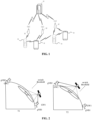
- FIG. 2 A feeder link switch of a low-earth orbit (LEO) satellite is illustrated in FIG. 2 .
- a feeder link established with gateway (GW)1 is switch to a feeder link established with GW2, in which GW1 is connected to base station 1 and GW2 is connected to base station 2. That is, During the movement of the LEO satellite, it switches from base station 1 to base station 2. If the satellite can only provide services through one feeder link at a time, when the LEO satellite moves, RRC connections of all UEs served by base station 1 through GW1 need to be disconnected. After the handover to base station 2 via GW2, each UE may be able to find a reference signal corresponding to base station 2 and access a cell belonging to base station 2.
- feeder link switch There are two types of feeder link switch: hard switch and soft switch.
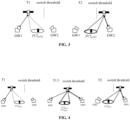
- the feeder link hard switch is illustrated in FIG. 3 .
- the LEO satellite under transparent transmissions performs the feeder link hard switch, that is, when only one feeder link connection through this satellite is available during the GW transition, a signal of a cell served by the LEO satellite is unavailable for a time period between a moment (time point) T1 when leaving the GW and a moment (time point) T2 when accessing the new GW.
- the old GW and new GW correspond to different base stations, the UE needs to access a serving cell provided by the LEO satellite again.
- the feeder link soft switch is illustrated in FIG. 4 .
- the LEO satellite under transparent transmissions performs the feeder link hard switch, that is, two feeder link connections through this satellite are available during the GW transition.
- both base station 1 and base station 2 can be available.
- the UE can switch the serving cell during the feeder link switch process.
- Solution 1 the feeder link hard switch based on precise timing control.
- a handover (HO) command needs to be sent to all UEs served by the LEO satellite before T1, so a time-triggered conditional hand over (CHO) manner can be used.
- the UE can start a handover process after T2. Therefore, a handover trigger moment should be included in the handover command.
- Solution 2 the feeder link hard switch based on conditional radio resource control (RRC) re-establishment.
- RRC radio resource control
- the network can provide auxiliary information, such as an ID of a target cell and/or re-establishment conditions.
- the auxiliary information can be separately sent to the UE through a system information block (SIB) instead of a dedicated signaling, thereby effectively reducing the signaling overhead caused by a large number of UEs.
- SIB system information block
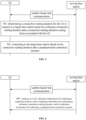
- a method for establishing a connection is provided in some embodiments.
- the method for establishing a connection is applicable to a UE of wireless communication.
- the method includes the following.
- Step 501 a connection waiting duration for the UE to connect to a target base station is determined based on a reference connection waiting duration and a connection-waiting-duration scaling factor associated with the UE.
- Step 502 UE connects to the target base station based on the connection waiting duration after a predetermined connection moment.
- the UE may be a mobile phone terminal or the like that uses a cellular mobile communication network technology to perform wireless communication.
- the UE can establish a communication connection with the serving base station through the transparent forwarding of the feeder link between the high-altitude platform such as the satellite and the satellite ground station such as the GW.
- the high-altitude platform is illustrated in Table 1.
- UAS unmanned aircraft system
- the feeder link established with GW1 may switch to the feeder link established with GW2, in which GW1 is connected to base station 1 and GW2 is connected to the base station 2. That is, during the moving process of the LEO satellite, it may switch from base station 1 to base station 2.
- the base station may be a gNB in the 5G cellular mobile communication.
- the target base station is a base station that the UE switches from the current serving base station during the movement of the LEO satellite.
- gNB1 is connected to the UE through GW 1 and the LEO satellite
- gNB 1 is the serving base station of the UE.
- the base station connected to the UE is switched from gNB1 to gNB2 and gNB2 is the target base station.
- the reference connection waiting duration can be a fixed duration.
- the reference connection waiting duration may be specified by a communication protocol or determined by a core network or base station based on the number of UEs covered by LEO satellite signals and/or the number of UEs that need to be connected to the target base station.
- connection-waiting-duration scaling factor can be used to adjust the connection waiting duration of the UE based on the reference connection waiting duration.
- the connection-waiting-duration scaling factor is associated with the UE and different UEs may have different connection-waiting-duration scaling factors.
- the connection-waiting-duration scaling factor may be associated with a UE type or may be associated with a current service characteristic of the UE or the like.
- the connection waiting duration of each UE can be obtained. Due to different connection-waiting-duration scaling factors, the connection waiting duration of each UE is also different. For example, a product of the reference connection waiting duration and the connection-waiting-duration scaling factor or a quotient of dividing the reference connection waiting duration and the connection-waiting-duration scaling factor can be determined as the connection waiting duration. When the division manner is adopted to determine the connection waiting duration, the connection-waiting-duration scaling factor is not 0.
- the connection-waiting-duration scaling factor may be a non-negative number less than or equal to 1 or a positive number greater than 1.
- the predetermined connection moment may be a moment indicated by the serving base station to start to switch to the target base station, or may be a moment when the satellite establishes a connection with the target base station, or the like. As illustrated in FIG. 2 , the predetermined connection moment may be the moment T2.
- the UE may connect to the target base station based on the predetermined connection moment and the connection waiting duration. For example, the target base station may be connected to after an interval of the connection waiting duration since the predetermined connection moment. Since the connection waiting duration of each UE is different, the moment at which each UE connects to the target base station is also different. In this way, the number of UEs connected to the target base station at the same time is reduced and the network congestion is relieved.
- the target base station is connected based on the connection waiting duration associated with each UE, the number of UEs connected to the target base station at the same time is reduced, and the network congestion is relieved.
- the method includes the following.
- connection-waiting-duration scaling factor corresponding to a service characteristic parameter associated with the UE is determined based on a correspondence between service characteristic parameters and ranges of connection-waiting-duration scaling factors.
- the service characteristic parameter may be a type parameter, a priority parameter, a rate parameter, and/or a transmission quality requirement parameter, etc. of data currently transmitted by the UE.
- the service characteristic parameter may be a priority level in QoS.
- Different service characteristic parameters are associated with different ranges of connection-waiting-duration scaling factors.
- the UE may determine the connection-waiting-duration scaling factor from the range of connection-waiting-duration scaling factors corresponding to its current service characteristic parameter.
- the UE may determine the connection-waiting-duration scaling factor based on a predetermined selection rule from the range of connection-waiting-duration scaling factors.
- the predetermined selection rule may specify that the corresponding connection-waiting-duration scaling factor is selected from the range of connection-waiting-duration scaling factors based on a signal strength of the UE.
- the UE obtains a correspondence between connection-waiting-duration scaling factors and service characteristic parameters Access Identities through system broadcast.
- the range of service characteristic parameters corresponding to this UE is [P1_1, Pu_1].
- the UE may determine the connection-waiting-duration scaling factor from the range of [P1_1, Pu_1].
- UEs with different service characteristic parameters have different ranges of connection-waiting-duration scaling factors, and the obtained connection-waiting-duration scaling factors are different, so that different connection waiting durations can be determined.
- the UEs connect to the target base station based on different connection waiting durations, reducing the number of UEs connected to the target base station at the same time and relieving the network congestion.
- the correspondence between service characteristic parameters and ranges of connection-waiting-duration scaling factors includes: a correspondence between ranges of service characteristic parameters and ranges of connection-waiting-duration scaling factors.
- the available values of the service characteristic parameter can be divided into multiple different ranges, and each range of service characteristic parameters corresponds to a range of connection-waiting-duration scaling factors.
- the ranges of connection-waiting-duration scaling factors corresponding to different ranges of service feature parameters may be the same or different.
- the UE may determine the connection-waiting-duration scaling factor based on the correspondence between ranges of service characteristic parameters and ranges of connection-waiting-duration scaling factors.
- the service characteristic parameter may be a packet delay budget (PDB). All PDBs may be divided into N ranges, where N is a positive integer greater than or equal to 1. Each PDB range corresponds to a range of connection-waiting-duration scaling factors. The UE may select the PDB range corresponding to its own PDB, and then determine the corresponding range of connection-waiting-duration scaling factors.
- PDB packet delay budget
- the UE obtains the PDB corresponding to the QoS flow according to the 5QI of the ongoing service.
- the UE may determine the connection-waiting-duration scaling factor within the range [0, P_1] of connection-waiting-duration scaling factors. If PDBminreference_n-1 ⁇ PDBmin ⁇ PDBminreference_n, the UE may determine the connection-waiting-duration scaling factor within the range (P_n-1, P_n) of connection-waiting-duration scaling factors.
- the UE may determine the connection-waiting-duration scaling factor within the range (P_n, 1] of connection-waiting-duration scaling factors.
- determining the connection-waiting-duration scaling factor corresponding to the service characteristic parameter associated with the UE, based on the correspondence between service characteristic parameters and ranges of connection-waiting-duration scaling factors includes the following.
- connection-waiting-duration scaling factor is determined from a range of connection-waiting-duration scaling factors corresponding to a range of service characteristic parameters to which the service characteristic parameter associated with the UE belongs.
- the service characteristic parameter may be a PDB and all PDBs may be divided into N ranges, where N is an integer positive number greater than or equal to 1.
- Each PDB range corresponds to a range of connection-waiting-duration scaling factors.
- the UE may select the PDB range to which its own PDB belongs, and determine the range of connection-waiting-duration scaling factors corresponding to the PDB range, and then determine the connection-waiting-duration scaling factor from the range of connection-waiting-duration scaling factors.
- determining the connection-waiting-duration scaling factor corresponding to the service characteristic parameter associated with the UE, based on the correspondence between service characteristic parameters and ranges of connection-waiting-duration scaling factors includes the following.
- connection-waiting-duration scaling factor is selected randomly from a range of connection-waiting-duration scaling factors corresponding to the service characteristic parameter associated with the UE.
- the UE may randomly select a value from the determined range of connection-waiting-duration scaling factors as its connection-waiting-duration scaling factor.
- the UE may generate a random number rand within the range of connection-waiting-duration scaling factors, and the random number may be uniformly distributed within the range of connection-waiting-duration scaling factors. Based on the randomly generated connection-waiting-duration scaling factor and by combining the reference connection waiting duration, the connection waiting duration is determined.
- connection-waiting-duration scaling factors By randomly selecting a value within the range of connection-waiting-duration scaling factors, the situation where the value is the same is reduced and the situation where the connection waiting duration is the same is reduced.
- the UEs connects to the target base station based on different connection waiting durations, reducing the number of UEs connected to the target base station at the same time and relieving the network congestion.
- the service characteristic parameter includes: an access identity, and/or an access category, and/or a fifth-generation quality of service identity (5QI), and/or a quality of service (QoS) characteristics parameter.
- 5QI fifth-generation quality of service identity
- QoS quality of service
- the 5G system should be able to use the relevant restriction parameters to limit the right of the UE to access the network.
- restriction parameters are different according to the Access Identity and Access Category.
- the Access Identity is configured on the UE, as illustrated in Table 2.
- the Access Category is defined by a combination of UE-related conditions and access attempt types, as illustrated in Table 3.
- Table 2 Access Identity number UE configuration 0 UE is not configured with any parameters from this table.
- 1 UE is configured for Multimedia Priority Service (MPS).
- 2 UE is configured for Mission Critical Service (MCS).
- MCS Mission Critical Service
- 11 Access Class 11 is configured in the UE.
- Access Class 12 is configured in the UE.
- 13 Access Class 13 is configured in the UE.
- 14 Access Class 14 is configured in the UE.
- Access Class 15 is configured in the UE.
- the QoS model is based on the QoS flow, and the QoS flow is the Protocol Data Unit (PDU).
- PDU Protocol Data Unit
- the fine-grained QoS in PDU sessions distinguishes granularity, that is, the difference between two PDU sessions is that their QoS flows are different.
- a QoS Flow Identifier QFI is used to identify a QoS flow, and QFI can be dynamically configured or equal to 5QI.
- Standardized 5QI values are used to specify commonly used services and can be mapped with 5G QoS features.
- the mapping of standardized 5QI values to 5G QoS features is illustrated in Table 4.
- Table 4 5QI Value Resource Type Default Priority Level Packet Delay Budget Packet Error Rate Default Maximum Data Burst Volume Default Averaging Window
- V2X messages Remote Driving, refer to TS 22.186 [111]
- NOTE16 refer to TS 23.287 [121]
- the method includes at least one of the following: receiving indication information that is sent by a serving base station and indicates the correspondence; or determining the correspondence based on an agreement of communication protocol.
- the correspondence between service characteristic parameters and ranges of connection-waiting-duration scaling factors may be sent by the serving base station to the UE.
- the serving base station may send the correspondence to the UE by broadcasting.
- the serving base station may carry and broadcast the indication information for indicating the correspondence in the system information.
- the UE determines the correspondence after receiving the system information.
- the correspondence between service characteristic parameters and ranges of connection-waiting-duration scaling factors may be stipulated by the communication protocol, and the UE determines the correspondence based on the communication protocol.
- the correspondence between service characteristic parameters and ranges of connection-waiting-duration scaling factors may be negotiated by the serving base station and the UE, and the UE determines the connection-waiting-duration scaling factor based on the negotiated correspondence.
- determining the connection-waiting-duration scaling factor corresponding to the service characteristic parameter associated with the UE, based on the correspondence between service characteristic parameters and ranges of connection-waiting-duration scaling factors includes the following.
- connection-waiting-duration scaling factor is determined from a range of connection-waiting-duration scaling factors having a smaller connection-waiting-duration scaling factor in at least two ranges of connection-waiting-duration scaling factors corresponding to the at least two service characteristic parameters associated with the UE.
- the UE can usually perform data transmission of multiple services at the same time and the service characteristic parameters of the multiple services are different, or the service characteristic parameters of different data in one service are different. That is, there may be multiple current service characteristic parameters of the UE, and the multiple service characteristic parameters may respectively correspond to one range of connection-waiting-duration scaling factors.
- the UE may determine from the range of connection-waiting-duration scaling factors with the smaller connection-waiting-duration scaling factor.
- the UE obtains the correspondence between ranges of service characteristic parameters and ranges of connection-waiting-duration scaling factors through system broadcast, in which the service characteristic parameter may be a PDB.
- the service characteristic parameter may be a PDB.
- PDBminreference ⁇ PDBminreference_1,..., PDUminreference_n,...,PDBminreference_N ⁇ , where 0 ⁇ PDBminreference_1 ⁇ ,..., ⁇ PDBminreference_n ⁇ ,..., ⁇ PDBminreference_N.
- the UE can obtain the corresponding PDB according to the 5QI of all the uplink and downlink QoS Flows of the ongoing service, and obtain the minimum value PDBmin among the PDBs corresponding to all the QoS Flows.
- the range of connection-waiting-duration scaling factors, corresponding to the PDBmin has a smaller connection-waiting-duration scaling factor.
- the UE may select the connection-waiting-duration scaling factor within the range of connection-waiting-duration scaling factors corresponding to the PDBmin.
- the UE may take a value in [0, P_1] as the connection waiting duration.
- the UE may take a value in (P_n-1, P_n] as the connection waiting duration.
- the UE can take a value in (P_n, 1] as the connection waiting duration.
- the UE obtains the correspondence between ranges of service characteristic parameters and ranges of connection-waiting-duration scaling factors through system broadcast, in which the service characteristic parameter may be Access Identity.
- the service characteristic parameter may be Access Identity.
- the UE can take a value in [Pl_2, Pu_2] as the connection waiting duration.
- determining the connection waiting duration for the UE to connect to the target base station based on the reference connection waiting duration and the connection-waiting-duration scaling factor associated with the UE includes the following.
- a product of the reference connection waiting duration and the connection-waiting-duration scaling factor is determined as the connection waiting duration of the UE.
- the UE may multiply the reference connection waiting duration and the connection-waiting-duration scaling factor, and determine the multiplied product as the connection waiting duration.
- connection waiting duration corresponding to the UE is: rand*T0, where T0 is the reference connection waiting duration.
- the method includes: selecting randomly the connection-waiting-duration scaling factor, in which the connection-waiting-duration scaling factor does not exceed a preset range of duration scaling factors.
- the UE may take a random number within the preset range of duration scaling factors as the connection-waiting-duration scaling factor.
- the preset range of duration scaling factors may be preset.
- the preset range of duration scaling factors and the range of connection-waiting-duration scaling factors may be the same or different.
- the connection-waiting-duration scaling factor in response to the reference connection waiting duration being a maximum value of the connection waiting duration, does not exceed a range from 0 to 1.
- the reference connection waiting duration may be the maximum value of the connection waiting duration, and for the reference connection waiting duration, the range of connection-waiting-duration scaling factors is: [0, 1].
- the method includes at least one of: receiving indication information that is sent by a serving base station and indicates the target base station; receiving indication information that is sent by the serving base station and indicates the reference connection waiting duration; or receiving indication information that is sent by the serving base station and indicates the predetermined connection moment.
- the indication information for indicating the target base station, and/or the indication information for indicating the reference connection waiting duration, and/or the indication information for indicating the predetermined connection moment may be sent by the serving base station to the UE.
- the serving base station may send the indication information for indicating the target base station, and/or the indication information for indicating the reference connection waiting duration, and/or the indication information for indicating the predetermined connection moment to the UE by broadcasting.
- the serving base station may carry the indication information for indicating the target base station, and/or the indication information for indicating the reference connection waiting duration, and/or the indication information for indicating the predetermined connection moment in the system information and broadcast the system information.
- the indication information for indicating the target base station may be a base station identifier of the target base station or the like.
- the UE determines the target base station, the predetermined connection moment Te, and/or the reference connection waiting duration T0, etc. by receiving the indication information sent by the serving base station.
- connecting to the target base station based on the connection waiting duration after the predetermined connection moment includes at least one of: in response to the UE being in a connected state, connecting to the target base station after an interval of the connection waiting duration since the predetermined connection moment; or in response to the UE being in an idle state or an inactive state, and triggering a connection within a connection triggering time interval after the predetermined connection moment, connecting to the target base station after an interval of the connection waiting duration since triggering the connection.
- the serving base station may indicate the time-based CHO mode to the UE.
- the serving base station may send the indication information, for indicating the target base station, the predetermined connection moment Te, and/or the reference connection waiting duration T0, and the like.
- the UE in the connected state determines the target base station, the predetermined connection moment Te, and/or the reference connection waiting duration T0, etc. by receiving the indication information sent by the serving base station.
- the predetermined connection moment Te may be the trigger moment of CHO.
- the UE may determine the connection waiting duration based on the reference connection waiting duration, and after the predetermined connection moment, continue to wait for the connection waiting duration and then connect to the target base station.
- the UEs in the connected state connect to the target base station based on different connection waiting durations, reducing the number of UEs connected to the target base station at the same time and relieving the network congestion.
- the UE If the UE is in the idle state or inactive state at the predetermined connection moment, it can set the connection triggering time interval, which is after the predetermined connection moment.
- the connection triggering time interval can be the more frequently duration when each UE switches from the serving base station to the target base station. If the UE in the idle or inactive state triggers the connection to the base station within the connection triggering time interval, and if it needs to send a connection establishment request message, it can connect to the target base station after the connection waiting duration since triggering the connection to the base station. That is, when it is determined that the connection establishment request message needs to be sent, the connection establishment request message can be sent after the connection waiting duration.
- the method includes at least one of the following: receiving indication information that is sent by a network side and indicates the connection triggering time interval; or determining the connection triggering time interval based on an agreement of a communication protocol.
- the base station may send the indication information for indicating the connection triggering time interval to the UE by means of broadcasting or the like.
- the base station may be the serving base station of the UE in the idle state or the inactive state when the UE is in the connected state, or may be the anchor base station of the UE in the idle state or the inactive state, or the like.
- the UE in the idle state obtains the connection triggering time interval Tx through network broadcast, where Tx may be less than or equal to the reference connection waiting duration T0.
- Tx is started. If the idle UE starts the transmission of the connection establishment request message before the Tx times out, the connection waiting duration T is started. When T times out, the UE sends the connection establishment request message to connect to the target base station.
- connection triggering time interval may also be specified by the communication protocol.
- the UE may determine the connection triggering time interval based on the communication protocol.
- connection triggering time interval may also be negotiated by the base station and the UE, and the UE determines the connection-waiting-duration scaling factor based on the negotiated connection triggering time interval.
- the UEs in the idle state or the inactive state connect to the target base station based on different connection waiting durations, reducing the number of UEs connected to the target base station at the same time and relieving the network congestion.
- the method includes: in response to the UE being in an idle state or an inactive state, and triggering a connection outside a connection triggering time interval after the predetermined connection moment, connecting to the target base station after triggering the connection.
- the connection triggering time interval may be a time period during which each UE is frequently switched from the serving base station to the target base station. After the connection triggering time interval, the number of UEs changing from the serving base station to the target base station decreases, which is less likely to cause the network congestion. Therefore, if the UE in the idle state or the inactive state triggers the connection to the base station after the connection triggering time interval, it can directly establish the connection with the target base station. In this way, the waiting duration can be reduced and the connection timeliness of the target base station can be improved.
- the method includes: in response to the UE being in the connected state, synchronizing with the target base station at the predetermined connection moment.
- the UE In the process of establishing the connection between the UE and the target base station, such as the random-access process, the UE needs to complete synchronization with the target base station.
- the UE can synchronize with the target base station at the predetermined connection moment, so that the efficiency of establishing the RRC connection during the connection waiting duration can be improved.
- the UE may start a timer to time the connection waiting duration T, it may trigger the UE to synchronize with the cell of the target base station.
- T times out, the UE initiates random access, RRC reconfiguration and other handover procedures.
- the UE may start a timer to time the connection waiting duration T, and when T times out, it may trigger the UE to synchronize with the cell of the target base station, initiate random access, RRC reconfiguration and other handover procedures.
- connecting to the target base station after the interval of the connection waiting duration since the predetermined connection moment includes: in response to the UE being in the connected state, switching to the target base station or initiating re-establishment to the target base station after the interval of the connection waiting duration since the predetermined connection moment.
- connecting to the target base station may include switching to the target base station, or initiating re-establishment to the target base station.
- the method includes: receiving indication information that is sent by a serving base station and indicates to perform switching or indication information that is sent by the serving base station and indicates to perform re-establishment; switching to the target base station or initiating re-establishment to the target base station includes: switching to the target base station in response to receiving the indication information that indicates to perform switching; or initiating re-establishment to the target base station in response to receiving the indication information that indicates to perform re-establishment.
- the serving base station may send the indication information to the UE, for indicating the UE to switch to the target cell or to perform re-establishment with the target cell.
- the serving base station may send the indication information by broadcasting.
- the serving base station uses broadcasting to indicate the UE to connect to the target base station in a switching manner.
- the UE finds the corresponding configuration in the CHO according to the identifier of the target base station of the serving base station, and subsequently triggers the switching. If the corresponding configuration in CHO is not found, re-establishment can be triggered.
- the serving base station uses broadcasting to indicate the UE to connect to the target base station by means of re-establishment
- the UE adopts the re-establishment manner the UE initiates re-establishment to the target base station according to the identifier of the target base station broadcasted by the network.
- some embodiments provide a method for establishing a connection.
- the method for establishing a connection is applicable to a base station of wireless communication.
- the method includes the following.
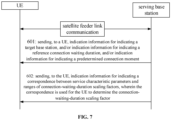
- Step 601 indication information for indicating a target base station, and/or indication information for indicating a reference connection waiting duration, and/or indication information for indicating a predetermined connection moment, is sent to a UE.
- the reference connection waiting duration is used for the UE to determine in combination with a connection-waiting-duration scaling factor, a connection waiting duration for connecting to the target base station after the predetermined connection moment.
- the UE may be a mobile phone terminal or the like that uses a cellular mobile communication network technology to perform wireless communication.
- the UE can establish a communication connection with the serving base station through the transparent forwarding of the feeder link between the high-altitude platform such as the satellite and the satellite ground station such as the GW.
- the high-altitude platform is illustrated in Table 1.
- the feeder link established with GW1 may switch to the feeder link established with GW2, in which GW1 is connected to base station 1 and GW2 is connected to the base station 2. That is, during the moving process of the LEO satellite, it may switch from base station 1 to base station 2.
- the base station may be a gNB in the 5G cellular mobile communication.
- the target base station is a base station that the UE switches from the current serving base station during the movement of the LEO satellite.
- gNB1 is connected to the UE through GW1 and the LEO satellite
- gNB 1 is the serving base station of the UE.
- the base station connected to the UE is switched from gNB1 to gNB2 and gNB2 is the target base station.
- the reference connection waiting duration can be a fixed duration.
- the reference connection waiting duration may be specified by a communication protocol or determined by a core network or base station based on the number of UEs covered by LEO satellite signals and/or the number of UEs that need to be connected to the target base station.
- connection-waiting-duration scaling factor can be used to adjust the connection waiting duration of the UE based on the reference connection waiting duration.
- the connection-waiting-duration scaling factor is associated with the UE and different UEs may have different connection-waiting-duration scaling factors.
- the connection-waiting-duration scaling factor may be associated with a UE type or may be associated with a current service characteristic of the UE or the like.
- the connection waiting duration of each UE can be obtained. Due to different connection-waiting-duration scaling factors, the connection waiting duration of each UE is also different. For example, a product of the reference connection waiting duration and the connection-waiting-duration scaling factor or a quotient of dividing the reference connection waiting duration and the connection-waiting-duration scaling factor can be determined as the connection waiting duration. When the division manner is adopted to determine the connection waiting duration, the connection-waiting-duration scaling factor is not 0.
- the connection-waiting-duration scaling factor may be a non-negative number less than or equal to 1 or a positive number greater than 1.
- the predetermined connection moment may be a moment indicated by the serving base station to start to switch to the target base station, or may be a moment when the satellite establishes a connection with the target base station, or the like. As illustrated in FIG. 2 , the predetermined connection moment may be the moment T2.
- the UE may connect to the target base station based on the predetermined connection moment and the connection waiting duration. For example, the target base station may be connected to after an interval of the connection waiting duration since the predetermined connection moment. Since the connection waiting duration of each UE is different, the moment at which each UE connects to the target base station is also different. In this way, the number of UEs connected to the target base station at the same time is reduced and the network congestion is relieved.
- the target base station is connected based on the connection waiting duration associated with each UE, the number of UEs connected to the target base station at the same time is reduced, and the network congestion is relieved.
- the indication information for indicating the target base station, and/or the indication information for indicating the reference connection waiting duration, and/or the indication information for indicating the predetermined connection moment may be sent by the serving base station to the UE.
- the serving base station may send the indication information for indicating the target base station, and/or the indication information for indicating the reference connection waiting duration, and/or the indication information for indicating the predetermined connection moment to the UE by broadcasting.
- the serving base station may carry the indication information for indicating the target base station, and/or the indication information for indicating the reference connection waiting duration, and/or the indication information for indicating the predetermined connection moment in the system information and broadcast the system information.
- the indication information for indicating the target base station may be a base station identifier of the target base station or the like.
- the UE determines the target base station, the predetermined connection moment Te, and/or the reference connection waiting duration T0, etc. by receiving the indication information sent by the serving base station.
- the method includes the following.
- Step 602 indication information for indicating a correspondence between service characteristic parameters and ranges of connection-waiting-duration scaling factors is sent to the UE, in which the correspondence is used for the UE to determine the connection-waiting-duration scaling factor.
- the correspondence between service characteristic parameters and ranges of connection-waiting-duration scaling factors may be sent by the serving base station to the UE.
- the serving base station may send the correspondence to the UE by broadcasting.
- the serving base station may carry and broadcast the indication information for indicating the correspondence in the system information.
- the UE determines the correspondence after receiving the system information.
- the UE may randomly select a value from the determined range of connection-waiting-duration scaling factors as its connection-waiting-duration scaling factor.
- the UE may generate a random number rand within the range of connection-waiting-duration scaling factors, and the random number may be uniformly distributed within the range of connection-waiting-duration scaling factors. Based on the randomly generated connection-waiting-duration scaling factor and by combining the reference connection waiting duration, the connection waiting duration is determined.
- connection-waiting-duration scaling factors By randomly selecting a value within the range of connection-waiting-duration scaling factors, the situation where the value is the same is reduced and the situation where the connection waiting duration is the same is reduced.
- the UEs connects to the target base station based on different connection waiting durations, reducing the number of UEs connected to the target base station at the same time and relieving the network congestion.
- the correspondence between service characteristic parameters and ranges of connection-waiting-duration scaling factors includes: a correspondence between ranges of service characteristic parameters and ranges of connection-waiting-duration scaling factors.
- the available values of the service characteristic parameter can be divided into multiple different ranges, and each range of service characteristic parameters corresponds to a range of connection-waiting-duration scaling factors.
- the ranges of connection-waiting-duration scaling factors corresponding to different ranges of service feature parameters may be the same or different.
- the UE may determine the connection-waiting-duration scaling factor based on the correspondence between ranges of service characteristic parameters and ranges of connection-waiting-duration scaling factors.
- the service characteristic parameter may be a packet delay budget (PDB). All PDBs may be divided into N ranges, where N is a positive integer greater than or equal to 1. Each PDB range corresponds to a range of connection-waiting-duration scaling factors. The UE may select the PDB range corresponding to its own PDB, and then determine the corresponding range of connection-waiting-duration scaling factors.
- PDB packet delay budget
- the UE obtains the PDB corresponding to the QoS flow according to the 5QI of the ongoing service.
- the UE may determine the connection-waiting-duration scaling factor within the range [0, P_1] of connection-waiting-duration scaling factors. If PDBminreference_n-1 ⁇ PDBmin ⁇ PDBminreference_n, the UE may determine the connection-waiting-duration scaling factor within the range (P_n-1, P_n) of connection-waiting-duration scaling factors.
- the UE may determine the connection-waiting-duration scaling factor within the range (P_n, 1] of connection-waiting-duration scaling factors.
- the method includes: sending indication information for indicating to perform switching or indication information for indicating to re-establishment to the UE.
- connecting to the target base station may include switching to the target base station, or initiating re-establishment to the target base station.
- the serving base station may send the indication information to the UE, for indicating the UE to switch to the target cell or to perform re-establishment with the target cell.
- the serving base station may send the indication information by broadcasting.
- the serving base station uses broadcasting to indicate the UE to connect to the target base station in a switching manner.
- the UE finds the corresponding configuration in the CHO according to the identifier of the target base station of the serving base station, and subsequently triggers the switching. If the corresponding configuration in CHO is not found, re-establishment can be triggered.
- the serving base station uses broadcasting to indicate the UE to connect to the target base station by means of re-establishment
- the UE adopts the re-establishment manner the UE initiates re-establishment to the target base station according to the identifier of the target base station broadcasted by the network.
- the method includes: sending indication information for indicating a connection triggering time interval to the UE.
- the UE If the UE is in the idle state or inactive state at the predetermined connection moment, it can set the connection triggering time interval, which is after the predetermined connection moment.
- the connection triggering time interval can be the more frequently duration when each UE switches from the serving base station to the target base station. If the UE in the idle or inactive state triggers the connection to the base station within the connection triggering time interval, and if it needs to send a connection establishment request message, it can connect to the target base station after the connection waiting duration since triggering the connection to the base station. That is, when it is determined that the connection establishment request message needs to be sent, the connection establishment request message can be sent after the connection waiting duration.
- the serving base station may send the indication information for indicating the connection triggering time interval to the UE by means of broadcasting or the like.
- the UE in the idle state obtains the connection triggering time interval Tx through network broadcast, where Tx may be less than or equal to the reference connection waiting duration T0.
- Tx is started. If the idle UE starts the transmission of the connection establishment request message before the Tx times out, the connection waiting duration T is started. When T times out, the UE sends the connection establishment request message to connect to the target base station.
- the UEs in the idle state or the inactive state connect to the target base station based on different connection waiting durations, reducing the number of UEs connected to the target base station at the same time and relieving the network congestion.
- the UE obtains the indication information of the target base station through system broadcasting, such as the target gNB identity, the predetermined connection moment Te, and the reference connection waiting duration such as the longest waiting duration T0.
- the network configures the correspondence between service characteristic parameters and connection-waiting-duration scaling factors.
- the UE selects the connection-waiting-duration scaling factor according to its own service characteristic parameter.
- the service characteristic parameter can be indicated through Access Identity, Access Category, 5QI, QoS characteristic parameter, etc.
- connection-waiting-duration scaling factors 3
- service characteristic parameters 3
- the UE 3 If the network does not broadcast the correspondence between connection-waiting-duration scaling factors and service characteristic parameters, the UE generates a random number between 0 and 1 as the connection-waiting-duration scaling factor.
- the UE scales T0 to obtain the connection waiting duration timer T, and the connection-waiting-duration scaling factor is determined by 2 and 3.
- the network may indicate the UE in the connected state to perform re-establishment or switching by broadcasting.
- the UE finds the corresponding configuration in the CHO according to the gNB identity broadcasted by the network, and subsequently triggers the switching. If the corresponding configuration in the CHO is not found, re-establishment is triggered subsequently.
- the UE When the UE adopts re-establishment, the UE initiates re-establishment to the target gNB according to the gNB identity broadcasted by the network.
- the UE can synchronize with the target cell when the moment Te arrives.
- the UE in the idle state obtains the timer duration Tx through network broadcast.
- the UE in the idle state starts Tx. If the transmission of the connection establishment request message is started before Tx times out, T is started. When T times out, the UE sends the connection establishment request message.
- Some embodiments of the disclosure further provide an apparatus for establishing a connection.
- the apparatus is applicable to a UE.
- the apparatus 1000 for establishing a connection includes a first determining module 1010 and a first connecting module 1020.
- the first determining module 1010 is configured to determine a connection waiting duration for the UE to connect to a target base station based on a reference connection waiting duration and a connection-waiting-duration scaling factor associated with the UE.
- the first connecting module 1020 is configured to connect to the target base station based on the connection waiting duration after a predetermined connection moment.
- the apparatus 1000 includes: a second determining module 1030 configured to determine the connection-waiting-duration scaling factor corresponding to a service characteristic parameter associated with the UE, based on a correspondence between service characteristic parameters and ranges of connection-waiting-duration scaling factors.
- the correspondence between service characteristic parameters and ranges of connection-waiting-duration scaling factors includes: a correspondence between ranges of service characteristic parameters and ranges of connection-waiting-duration scaling factors.
- the second determining module 1030 includes: a first determining submodule 1031 configured to determine the connection-waiting-duration scaling factor from a range of connection-waiting-duration scaling factors corresponding to a range of service characteristic parameters to which the service characteristic parameter associated with the UE belongs.
- the second determining module 1030 includes: a second determining submodule 1032 configured to select randomly the connection-waiting-duration scaling factor from a range of connection-waiting-duration scaling factors corresponding to the service characteristic parameter associated with the UE.
- the service characteristic parameter includes: an access identity, and/or an access category, and/or a fifth-generation quality of service identity (5QI), and/or a quality of service (QoS) characteristics parameter.
- 5QI fifth-generation quality of service identity
- QoS quality of service
- the apparatus 1000 includes: a first receiving module 1040 configured to receive indication information that is sent by a serving base station and indicates the correspondence; or a third determining module 1050 configured to determine the correspondence based on an agreement of a communication protocol.
- the second determining module 1030 includes: a third determining submodule 1033 configured to, in response to at least two service characteristic parameters associated with the UE, determine the connection-waiting-duration scaling factor from a range of connection-waiting-duration scaling factors having a smaller connection-waiting-duration scaling factor in at least two ranges of connection-waiting-duration scaling factors corresponding to the at least two service characteristic parameters associated with the UE.
- the first determining module 1010 includes: a fourth determining submodule 1011 configured to determine a product of the reference connection waiting duration and the connection-waiting-duration scaling factor as the connection waiting duration of the UE.
- the apparatus 1000 includes: a selecting module 1060 configured to select randomly the connection-waiting-duration scaling factor, in which the connection-waiting-duration scaling factor does not exceed a preset range of duration scaling factors.
- the connection-waiting-duration scaling factor in response to the reference connection waiting duration being a maximum value of the connection waiting duration, does not exceed a range from 0 to 1.
- the apparatus 1000 includes at least one of: a second receiving module 1070 configured to receive indication information that is sent by a serving base station and indicates the target base station; a third receiving module 1080 configured to receive indication information that is sent by the serving base station and indicates the reference connection waiting duration; or a fourth receiving module 1090 configured to receive indication information that is sent by the serving base station and indicates the predetermined connection moment.
- the first connecting module 1020 includes at least one of: a first connecting submodule 1021 configured to, in response to the UE being in a connected state, connect to the target base station after an interval of the connection waiting duration since the predetermined connection moment; or a second connecting submodule 1022 configured to, in response to the UE being in an idle state or an inactive state, and triggering a connection within a connection triggering time interval after the predetermined connection moment, connect to the target base station after an interval of the connection waiting duration since triggering the connection.
- a first connecting submodule 1021 configured to, in response to the UE being in a connected state, connect to the target base station after an interval of the connection waiting duration since the predetermined connection moment
- a second connecting submodule 1022 configured to, in response to the UE being in an idle state or an inactive state, and triggering a connection within a connection triggering time interval after the predetermined connection moment, connect to the target base station after an interval of the connection waiting duration since triggering the connection.
- the apparatus 1000 includes: a synchronizing module 1100 configured to, in response to the UE being in the connected state, synchronize with the target base station at the predetermined connection moment.
- the first connecting submodule 1021 includes: a connecting unit 10211 configured to, in response to the UE being in the connected state, switch to the target base station or initiate re-establishment to the target base station after the interval of the connection waiting duration since the predetermined connection moment.
- the apparatus 1000 includes: a fifth receiving module 1110 configured to receive indication information that is sent by a serving base station and indicates to perform switching or indication information that is sent by the serving base station and indicates to perform re-establishment;
- the connecting unit 10211 includes: a first connecting subunit 102111 configured to switch to the target base station in response to receiving the indication information that indicates to perform switching; or a second connecting subunit 102112 configured to initiate re-establishment to the target base station in response to receiving the indication information that indicates to perform re-establishment.
- the apparatus 1000 includes at least one of: a sixth receiving module 1120 configured to receive indication information that is sent by a network side and indicates the connection triggering time interval; or a fourth determining module 1130 configured to determine the connection triggering time interval based on an agreement of a communication protocol.
- the apparatus 1000 includes: a first connecting module 1140 configured to, in response to the UE being in the idle state or the inactive state, and triggering the connection outside the connection triggering time interval after the predetermined connection moment, connect to the target base station after triggering the connection.
- a first connecting module 1140 configured to, in response to the UE being in the idle state or the inactive state, and triggering the connection outside the connection triggering time interval after the predetermined connection moment, connect to the target base station after triggering the connection.
- Some embodiments of the disclosure further provide an apparatus for establishing a connection.
- the apparatus is applicable to a base station.
- the apparatus 200 for establishing a connection includes a first sending module 210.
- the first sending module 210 is configured to send, to a UE, indication information for indicating a target base station, and/or indication information for indicating a reference connection waiting duration, and/or indication information for indicating a predetermined connection moment; in which the reference connection waiting duration is used for the UE to determine in combination with a connection-waiting-duration scaling factor, a connection waiting duration for connecting to the target base station after the predetermined connection moment.
- the apparatus 200 includes: a second sending module 220 configured to send, to the UE, indication information for indicating a correspondence between service characteristic parameters and ranges of connection-waiting-duration scaling factors, in which the correspondence is used for the UE to determine the connection-waiting-duration scaling factor.
- the correspondence between service characteristic parameters and ranges of connection-waiting-duration scaling factors includes: a correspondence between ranges of service characteristic parameters and ranges of connection-waiting-duration scaling factors.
- the apparatus 200 includes: a third sending module 230 configured to send, to the UE, indication information for indicating to perform switching or indication information for indicating to re-establishment.
- the apparatus 200 includes: a fourth sending module 240 configured to send, to the UE, indication information for indicating a connection triggering time interval.
- the first determining module 1010, the first connecting module 1020, the second determining module 1030, the first receiving module 1040, the third determining module 1050, the selecting module 1060, the second receiving module 1070, the third receiving module 1080, the fourth receiving module 1090, the synchronizing module 1100, the fifth receiving module 1110, the sixth receiving module 1120, the fourth determining module 1130, the first connecting module 1140, the first sending module 210, the second sending module 220, the third sending module 230, the fourth sending module 240, and the like can be configured by one or more of: central processing units (CPUs), graphics processing unit (GPUs), baseband processors (BPs), application specific integrated circuits (ASICs), DSPs, programmable logic devices (PLDs), complex programmable logic devices (CPLDs), field programmable gate arrays (FPGAs), general purpose processors, controllers, micro controller units (MCUs), microprocessors or other electronic components to perform the foregoing methods.
- CPUs central processing units
- FIG. 10 is a block diagram of a device 3000 for establishing a connection according to some embodiments.
- the device 3000 may be a mobile phone, a computer, a digital broadcast terminal, a messaging device, a gaming console, a tablet, a medical device, exercise equipment, a personal digital assistant, and the like.
- the device 3000 may include one or more of the following components: a processing component 3002, a memory 3004, a power component 3006, a multimedia component 3008, an audio component 3010, an input/output (I/O) interface 3012, a sensor component 3014, and a communication component 3016.
- a processing component 3002 a memory 3004, a power component 3006, a multimedia component 3008, an audio component 3010, an input/output (I/O) interface 3012, a sensor component 3014, and a communication component 3016.
- the processing component 3002 typically controls overall operations of the device 3000, such as the operations associated with display, telephone calls, data communications, camera operations, and recording operations.
- the processing component 3002 may include one or more processors 3020 to execute instructions to perform all or part of the steps in the above described methods.
- the processing component 3002 may include one or more modules which facilitate the interaction between the processing component 3002 and other components.
- the processing component 3002 may include a multimedia module to facilitate the interaction between the multimedia component 3008 and the processing component 3002.
- the memory 3004 is configured to store various types of data to support the operation of the device 3000. Examples of such data include instructions for any disclosures or methods operated on the device 3000, contact data, phonebook data, messages, pictures, video, etc.
- the memory 3004 may be implemented using any type of volatile or non-volatile memory devices, or a combination thereof, such as a static random access memory (SRAM), an electrically erasable programmable read-only memory (EEPROM), an erasable programmable read-only memory (EPROM), a programmable read-only memory (PROM), a read-only memory (ROM), a magnetic memory, a flash memory, a magnetic or optical disk.
- SRAM static random access memory
- EEPROM electrically erasable programmable read-only memory
- EPROM erasable programmable read-only memory
- PROM programmable read-only memory
- ROM read-only memory
- magnetic memory a magnetic memory
- flash memory a flash memory
- magnetic or optical disk a
- the power component 3006 provides power to various components of the device 3000.
- the power component 3006 may include a power management system, one or more power sources, and any other components associated with the generation, management, and distribution of power in the device 3000.
- the multimedia component 3008 includes a screen providing an output interface between the device 3000 and the user.
- the screen may include a liquid crystal display (LCD) and a touch panel (TP). If the screen includes the touch panel, the screen may be implemented as a touch screen to receive input signals from the user.
- the touch panel includes one or more touch sensors to sense touches, swipes, and gestures on the touch panel. The touch sensors may not only sense a boundary of a touch or swipe action, but also sense a period of time and a pressure associated with the touch or swipe action.
- the multimedia component 3008 includes a front camera and/or a rear camera. The front camera and the rear camera may receive an external multimedia datum while the device 3000 is in an operation mode, such as a photographing mode or a video mode. Each of the front camera and the rear camera may be a fixed optical lens system or have focus and optical zoom capability.
- the audio component 3010 is configured to output and/or input audio signals.
- the audio component 3010 includes a microphone ("MIC") configured to receive an external audio signal when the device 3000 is in an operation mode, such as a call mode, a recording mode, and a voice recognition mode.
- the received audio signal may be further stored in the memory 3004 or transmitted via the communication component 3016.
- the audio component 3010 includes a speaker to output audio signals.
- the I/O interface 3012 provides an interface between the processing component 3002 and peripheral interface modules, such as a keyboard, a click wheel, buttons, and the like.
- the buttons may include, but are not limited to, a home button, a volume button, a starting button, and a locking button.
- the sensor component 3014 includes one or more sensors to provide status assessments of various aspects of the device 3000. For instance, the sensor component 3014 may detect an open/closed status of the device 3000, relative positioning of components, e.g., the display and the keypad, of the device 3000, a change in position of the device 3000 or a component of the device 3000, a presence or absence of user contact with the device 3000, an orientation or an acceleration/deceleration of the device 3000, and a change in temperature of the device 3000.
- the sensor component 3014 may include a proximity sensor configured to detect the presence of nearby objects without any physical contact.
- the sensor component 3014 may also include a light sensor, such as a CMOS or CCD image sensor, for use in imaging disclosures.
- the sensor component 3014 may also include an accelerometer sensor, a gyroscope sensor, a magnetic sensor, a pressure sensor, or a temperature sensor.
- the communication component 3016 is configured to facilitate communication, wired or wirelessly, between the device 3000 and other devices.
- the device 3000 can access a wireless network based on a communication standard, such as WiFi, 2G, or 3G, or a combination thereof.
- the communication component 3016 receives a broadcast signal or broadcast associated information from an external broadcast management system via a broadcast channel.
- the communication component 3016 includes a near field communication (NFC) module to facilitate short-range communications.
- the NFC module may be implemented based on a radio frequency identification (RFID) technology, an infrared data association (IrDA) technology, an ultra-wideband (UWB) technology, a Bluetooth (BT) technology, and other technologies.
- RFID radio frequency identification
- IrDA infrared data association
- UWB ultra-wideband
- BT Bluetooth
- the device 3000 may be implemented with one or more disclosure specific integrated circuits (ASICs), digital signal processors (DSPs), digital signal processing devices (DSPDs), programmable logic devices (PLDs), field programmable gate arrays (FPGAs), controllers, micro-controllers, microprocessors, or other electronic components, for performing the above described methods.
- ASICs disclosure specific integrated circuits
- DSPs digital signal processors
- DSPDs digital signal processing devices
- PLDs programmable logic devices
- FPGAs field programmable gate arrays
- controllers micro-controllers, microprocessors, or other electronic components, for performing the above described methods.
- non-transitory computer-readable storage medium including instructions, such as included in the memory 3004, executable by the processor 3020 in the device 3000, for performing the above-described methods.
- the non-transitory computer-readable storage medium may be a ROM, a RAM, a CD-ROM, a magnetic tape, a floppy disc, an optical data storage device, and the like.
Landscapes
- Engineering & Computer Science (AREA)
- Computer Networks & Wireless Communication (AREA)
- Signal Processing (AREA)
- Computer Security & Cryptography (AREA)
- Physics & Mathematics (AREA)
- Astronomy & Astrophysics (AREA)
- General Physics & Mathematics (AREA)
- Aviation & Aerospace Engineering (AREA)
- Mobile Radio Communication Systems (AREA)
Applications Claiming Priority (1)
| Application Number | Priority Date | Filing Date | Title |
|---|---|---|---|
| PCT/CN2020/122260 WO2022082451A1 (zh) | 2020-10-20 | 2020-10-20 | 连接建立方法、装置、通信设备和存储介质 |
Publications (2)
| Publication Number | Publication Date |
|---|---|
| EP4236486A1 true EP4236486A1 (de) | 2023-08-30 |
| EP4236486A4 EP4236486A4 (de) | 2024-07-24 |
Family
ID=81291325
Family Applications (1)
| Application Number | Title | Priority Date | Filing Date |
|---|---|---|---|
| EP20958034.9A Pending EP4236486A4 (de) | 2020-10-20 | 2020-10-20 | Verbindungsaufbauverfahren und -vorrichtung sowie kommunikationsvorrichtung und speichermedium |
Country Status (6)
| Country | Link |
|---|---|
| US (1) | US20230388876A1 (de) |
| EP (1) | EP4236486A4 (de) |
| JP (1) | JP7659055B2 (de) |
| KR (1) | KR20230091136A (de) |
| CN (3) | CN117676918B (de) |
| WO (1) | WO2022082451A1 (de) |
Cited By (1)
| Publication number | Priority date | Publication date | Assignee | Title |
|---|---|---|---|---|
| WO2024031072A1 (en) * | 2022-08-05 | 2024-02-08 | Qualcomm Incorporated | Timing and availability signalling for feeder link switch over in non-terrestrial networks |
Families Citing this family (5)
| Publication number | Priority date | Publication date | Assignee | Title |
|---|---|---|---|---|
| CN119096482A (zh) * | 2022-04-26 | 2024-12-06 | 诺基亚技术有限公司 | 针对ntn的基于天线增益的切换过程 |
| CN114630366B (zh) * | 2022-05-17 | 2023-05-09 | 深圳传音控股股份有限公司 | 控制方法、通信设备及存储介质 |
| CN117528672A (zh) * | 2022-07-29 | 2024-02-06 | 维沃移动通信有限公司 | 连接建立方法、终端及源网络侧设备 |
| EP4608003A4 (de) * | 2022-11-10 | 2025-10-15 | Guangdong Oppo Mobile Telecommunications Corp Ltd | Kommunikationsverfahren und vorrichtungen |
| CN119547558A (zh) * | 2023-05-11 | 2025-02-28 | 中兴通讯股份有限公司 | 用于存储和转发模式中的定时增强的系统和方法 |
Family Cites Families (14)
| Publication number | Priority date | Publication date | Assignee | Title |
|---|---|---|---|---|
| CN101111055B (zh) * | 2006-07-21 | 2010-09-29 | 华为技术有限公司 | 控制切换执行的方法、终端 |
| KR100754603B1 (ko) * | 2006-12-22 | 2007-09-05 | 삼성전자주식회사 | 통신 시스템에서 핸드오버 수행 방법 |
| US20120021747A1 (en) * | 2008-09-03 | 2012-01-26 | Brandt Achim Von | Reduction of Interruption Time in a Handover |
| JP5059062B2 (ja) * | 2009-07-08 | 2012-10-24 | シャープ株式会社 | 通信システム、移動局装置および基地局装置 |
| KR101652839B1 (ko) * | 2010-06-28 | 2016-09-01 | 삼성전자 주식회사 | 시스템 액세스 방법 및 장치 |
| US9686750B2 (en) * | 2012-01-10 | 2017-06-20 | Apple Inc. | Methods and apparatus for power consumption management during discontinuous reception |
| CN103929823B (zh) * | 2014-05-07 | 2018-05-29 | 重庆大学 | 基于业务分类的电力无线专网信道接入控制方法 |
| US10433339B2 (en) * | 2015-04-14 | 2019-10-01 | Qualcomm Incorporated | Random access for low latency wireless communications |
| US10375718B2 (en) * | 2016-08-11 | 2019-08-06 | Qualcomm Incorporated | Adaptive resource management for robust communication in new radio |
| CN106793132B (zh) * | 2016-11-21 | 2019-08-16 | 中国联合网络通信集团有限公司 | 一种基于载波聚合的资源分配方法及网络通信系统 |
| KR102280004B1 (ko) * | 2017-04-20 | 2021-07-22 | 주식회사 케이티 | 단말 기반 핸드오버 수행 방법 및 그 장치 |
| EP3462797A1 (de) * | 2017-09-28 | 2019-04-03 | Panasonic Intellectual Property Corporation of America | Benutzergerät und basisstation mit beteiligung am priorisierten direktzugriff |
| US11985565B2 (en) * | 2019-01-16 | 2024-05-14 | Lg Electronics Inc. | Method and apparatus for mobility management in wireless communication system |
| US11412549B2 (en) * | 2019-03-27 | 2022-08-09 | Mediatek Singapore Pte. Ltd. | Broadcast and group-based handover in NR-based LEO-NTN |
-
2020
- 2020-10-20 CN CN202311340346.1A patent/CN117676918B/zh active Active
- 2020-10-20 CN CN202510954577.4A patent/CN120640431A/zh active Pending
- 2020-10-20 EP EP20958034.9A patent/EP4236486A4/de active Pending
- 2020-10-20 JP JP2023524207A patent/JP7659055B2/ja active Active
- 2020-10-20 CN CN202080002885.2A patent/CN114651486B/zh active Active
- 2020-10-20 WO PCT/CN2020/122260 patent/WO2022082451A1/zh not_active Ceased
- 2020-10-20 US US18/249,437 patent/US20230388876A1/en active Pending
- 2020-10-20 KR KR1020237016935A patent/KR20230091136A/ko active Pending
Cited By (1)
| Publication number | Priority date | Publication date | Assignee | Title |
|---|---|---|---|---|
| WO2024031072A1 (en) * | 2022-08-05 | 2024-02-08 | Qualcomm Incorporated | Timing and availability signalling for feeder link switch over in non-terrestrial networks |
Also Published As
| Publication number | Publication date |
|---|---|
| KR20230091136A (ko) | 2023-06-22 |
| WO2022082451A1 (zh) | 2022-04-28 |
| US20230388876A1 (en) | 2023-11-30 |
| CN114651486A (zh) | 2022-06-21 |
| EP4236486A4 (de) | 2024-07-24 |
| JP7659055B2 (ja) | 2025-04-08 |
| CN117676918B (zh) | 2025-07-25 |
| JP2023547080A (ja) | 2023-11-09 |
| CN117676918A (zh) | 2024-03-08 |
| CN120640431A (zh) | 2025-09-12 |
| CN114651486B (zh) | 2025-08-05 |
Similar Documents
| Publication | Publication Date | Title |
|---|---|---|
| EP4236486A1 (de) | Verbindungsaufbauverfahren und -vorrichtung sowie kommunikationsvorrichtung und speichermedium | |
| EP4258744A1 (de) | Kommunikationsverfahren und -vorrichtung sowie drahtloszugangsnetzwerk, endgerät und speichermedium | |
| EP4429337A1 (de) | Informationsübertragungsverfahren und -vorrichtung, kommunikationsvorrichtung und speichermedium | |
| CN110495196B (zh) | 能力参数处理方法及装置、通信设备及存储介质 | |
| CN115119534B (zh) | 切换配置确定方法、装置和通信设备装置 | |
| US20240349148A1 (en) | Relay user equipment handover method and apparatus, and device and readable storage medium | |
| US20230007720A1 (en) | Method and apparatus for processing radio link failure, and computer storage medium | |
| US20240064606A1 (en) | Relay ue selection method and apparatus, information pro- cessing method and apparatus, and device and medium | |
| CN114902730B (zh) | 信息传输方法、装置、通信设备和存储介质 | |
| EP4221031A1 (de) | Verfahren und vorrichtung zur bestimmung der effektiven zeit, kommunikationsvorrichtung und speichermedium | |
| KR20250141247A (ko) | 랜덤 액세스의 리소스를 결정하는 방법, 장치, 통신 디바이스 및 저장 매체 | |
| WO2022032482A1 (zh) | 资源处理方法及装置、通信设备及存储介质 | |
| CN111149388B (zh) | 通信处理方法、装置及计算机存储介质 | |
| WO2022036597A1 (zh) | 信息处理方法、装置及计算机可读存储介质 | |
| US20230156703A1 (en) | DATA TRANSMISSION SCHEDULING METHOD AND DEVICE, AND STORAGE MEDIUM (as amended) | |
| US20250097984A1 (en) | Early identification method and apparatus, communication device, and storage medium | |
| WO2022021271A1 (zh) | 波束切换方法及装置、网络设备、终端及存储介质 | |
| CN115885553B (zh) | 跟踪区异常处理方法及装置、通信设备及存储介质 | |
| CN111096046B (zh) | 接入方式确定方法、装置及通信设备 | |
| US12342350B2 (en) | Data transmission methods and communication device | |
| EP4057551B1 (de) | Verfahren und vorrichtung zur konfiguration von downlink-steuerungsinformationen, kommunikationsvorrichtung und speichermedium | |
| RU2817408C1 (ru) | Способ и устройство для установления связи, устройство связи и носитель данных | |
| US20230292249A1 (en) | Method for transmitting information, communication device, and storage medium | |
| CN115443698A (zh) | 时间偏移值更新方法及装置、通信设备及存储介质 | |
| CN115088344A (zh) | 广播多播业务数据接收方法及装置 |
Legal Events
| Date | Code | Title | Description |
|---|---|---|---|
| STAA | Information on the status of an ep patent application or granted ep patent |
Free format text: STATUS: THE INTERNATIONAL PUBLICATION HAS BEEN MADE |
|
| PUAI | Public reference made under article 153(3) epc to a published international application that has entered the european phase |
Free format text: ORIGINAL CODE: 0009012 |
|
| STAA | Information on the status of an ep patent application or granted ep patent |
Free format text: STATUS: REQUEST FOR EXAMINATION WAS MADE |
|
| 17P | Request for examination filed |
Effective date: 20230519 |
|
| AK | Designated contracting states |
Kind code of ref document: A1 Designated state(s): AL AT BE BG CH CY CZ DE DK EE ES FI FR GB GR HR HU IE IS IT LI LT LU LV MC MK MT NL NO PL PT RO RS SE SI SK SM TR |
|
| DAV | Request for validation of the european patent (deleted) | ||
| DAX | Request for extension of the european patent (deleted) | ||
| A4 | Supplementary search report drawn up and despatched |
Effective date: 20240625 |
|
| RIC1 | Information provided on ipc code assigned before grant |
Ipc: H04W 76/10 20180101ALI20240619BHEP Ipc: H04W 76/19 20180101ALI20240619BHEP Ipc: H04W 76/18 20180101ALI20240619BHEP Ipc: H04W 84/06 20090101ALI20240619BHEP Ipc: H04W 48/16 20090101ALI20240619BHEP Ipc: H04W 36/24 20090101ALI20240619BHEP Ipc: H04W 36/08 20090101ALI20240619BHEP Ipc: H04W 28/02 20090101ALI20240619BHEP Ipc: H04W 36/36 20090101ALI20240619BHEP Ipc: H04W 52/14 20090101AFI20240619BHEP |