EP4235843A1 - Primärzelle enthaltend elektrolytzusammensetzung und insbesondere mikro-partikuläre nanokristalline silizium-partikel - Google Patents

Primärzelle enthaltend elektrolytzusammensetzung und insbesondere mikro-partikuläre nanokristalline silizium-partikel Download PDF

Info

Publication number
EP4235843A1
EP4235843A1 EP22158312.3A EP22158312A EP4235843A1 EP 4235843 A1 EP4235843 A1 EP 4235843A1 EP 22158312 A EP22158312 A EP 22158312A EP 4235843 A1 EP4235843 A1 EP 4235843A1
Authority
EP
European Patent Office
Prior art keywords
silicon
weight
acid
groups
primary cell
Prior art date
Legal status (The legal status is an assumption and is not a legal conclusion. Google has not performed a legal analysis and makes no representation as to the accuracy of the status listed.)
Ceased
Application number
EP22158312.3A
Other languages
English (en)
French (fr)
Inventor
Erfindernennung liegt noch nicht vor Die
Current Assignee (The listed assignees may be inaccurate. Google has not performed a legal analysis and makes no representation or warranty as to the accuracy of the list.)
Forschungszentrum Juelich GmbH
Evonik Operations GmbH
Original Assignee
Forschungszentrum Juelich GmbH
Evonik Operations GmbH
Priority date (The priority date is an assumption and is not a legal conclusion. Google has not performed a legal analysis and makes no representation as to the accuracy of the date listed.)
Filing date
Publication date
Application filed by Forschungszentrum Juelich GmbH, Evonik Operations GmbH filed Critical Forschungszentrum Juelich GmbH
Priority to EP22158312.3A priority Critical patent/EP4235843A1/de
Publication of EP4235843A1 publication Critical patent/EP4235843A1/de
Ceased legal-status Critical Current

Links

Images

Classifications

    • HELECTRICITY
    • H01ELECTRIC ELEMENTS
    • H01MPROCESSES OR MEANS, e.g. BATTERIES, FOR THE DIRECT CONVERSION OF CHEMICAL ENERGY INTO ELECTRICAL ENERGY
    • H01M4/00Electrodes
    • H01M4/02Electrodes composed of, or comprising, active material
    • H01M4/06Electrodes for primary cells
    • HELECTRICITY
    • H01ELECTRIC ELEMENTS
    • H01MPROCESSES OR MEANS, e.g. BATTERIES, FOR THE DIRECT CONVERSION OF CHEMICAL ENERGY INTO ELECTRICAL ENERGY
    • H01M12/00Hybrid cells; Manufacture thereof
    • H01M12/04Hybrid cells; Manufacture thereof composed of a half-cell of the fuel-cell type and of a half-cell of the primary-cell type
    • H01M12/06Hybrid cells; Manufacture thereof composed of a half-cell of the fuel-cell type and of a half-cell of the primary-cell type with one metallic and one gaseous electrode
    • HELECTRICITY
    • H01ELECTRIC ELEMENTS
    • H01MPROCESSES OR MEANS, e.g. BATTERIES, FOR THE DIRECT CONVERSION OF CHEMICAL ENERGY INTO ELECTRICAL ENERGY
    • H01M4/00Electrodes
    • H01M4/02Electrodes composed of, or comprising, active material
    • H01M4/24Electrodes for alkaline accumulators
    • HELECTRICITY
    • H01ELECTRIC ELEMENTS
    • H01MPROCESSES OR MEANS, e.g. BATTERIES, FOR THE DIRECT CONVERSION OF CHEMICAL ENERGY INTO ELECTRICAL ENERGY
    • H01M4/00Electrodes
    • H01M4/02Electrodes composed of, or comprising, active material
    • H01M4/36Selection of substances as active materials, active masses, active liquids
    • H01M4/38Selection of substances as active materials, active masses, active liquids of elements or alloys
    • H01M4/386Silicon or alloys based on silicon
    • HELECTRICITY
    • H01ELECTRIC ELEMENTS
    • H01MPROCESSES OR MEANS, e.g. BATTERIES, FOR THE DIRECT CONVERSION OF CHEMICAL ENERGY INTO ELECTRICAL ENERGY
    • H01M4/00Electrodes
    • H01M4/02Electrodes composed of, or comprising, active material
    • H01M4/36Selection of substances as active materials, active masses, active liquids
    • H01M4/48Selection of substances as active materials, active masses, active liquids of inorganic oxides or hydroxides
    • H01M4/50Selection of substances as active materials, active masses, active liquids of inorganic oxides or hydroxides of manganese
    • HELECTRICITY
    • H01ELECTRIC ELEMENTS
    • H01MPROCESSES OR MEANS, e.g. BATTERIES, FOR THE DIRECT CONVERSION OF CHEMICAL ENERGY INTO ELECTRICAL ENERGY
    • H01M4/00Electrodes
    • H01M4/02Electrodes composed of, or comprising, active material
    • H01M4/62Selection of inactive substances as ingredients for active masses, e.g. binders, fillers
    • H01M4/624Electric conductive fillers
    • H01M4/625Carbon or graphite
    • HELECTRICITY
    • H01ELECTRIC ELEMENTS
    • H01MPROCESSES OR MEANS, e.g. BATTERIES, FOR THE DIRECT CONVERSION OF CHEMICAL ENERGY INTO ELECTRICAL ENERGY
    • H01M4/00Electrodes
    • H01M4/86Inert electrodes with catalytic activity, e.g. for fuel cells
    • H01M4/90Selection of catalytic material
    • H01M4/9016Oxides, hydroxides or oxygenated metallic salts
    • HELECTRICITY
    • H01ELECTRIC ELEMENTS
    • H01MPROCESSES OR MEANS, e.g. BATTERIES, FOR THE DIRECT CONVERSION OF CHEMICAL ENERGY INTO ELECTRICAL ENERGY
    • H01M6/00Primary cells; Manufacture thereof
    • H01M6/14Cells with non-aqueous electrolyte

Definitions

  • the invention relates to a primary cell with metal-containing anode material, in particular for use in electrochemical primary cells with alkaline electrolytes, the metal-containing anode material comprising silicon and carbon and, as an additional metal or additional metals, at least one metal from the metals mentioned below: manganese, calcium, Zinc, aluminum, iron and/or an alloy comprising one or more of the aforementioned metals, the surface of the metal-containing anode material having at least partially oxygen-containing silicon compounds.
  • the invention also relates to an aqueous alkaline electrolyte composition
  • a hydroxycarboxylic acid carboxylate of a hydroxycarboxylic acid, ester of a hydroxycarboxylic acid, ether of a carboxylate of a hydroxycarboxylic acid, polymeric compound based on at least one hydroxycarboxylic acid or mixtures containing at least two of the aforementioned compounds.
  • the invention also includes a multi-cell battery, the use as an electrolyte in a primary cell with silicon as the anode material in the form of silicon particles, which are present as silicon particles with a particle size between 10 nm and 99000 nm, the anode material preferably comprising metals in the charged state and the silicon particles are crystalline and/or optionally amorphous.
  • silicon-air batteries According to this principle, silicon is a fuel. In general, combustibles are also referred to as fuels. In addition, conventional silicon-containing lithium-ion secondary batteries are in daily use around the world.
  • the object of the invention was to improve the performance and service life of a silicon-containing galvanic cell, in particular an alkaline galvanic cell, and to provide a sustainable raw material basis. Furthermore, the power density of such a silicon-containing galvanic cell should be improved and a high cell voltage should be achieved.
  • the task was to provide a silicon-containing galvanic cell that is preferably free of lithium, wherein free of lithium preferably means that the lithium content in the charged state is less than 1% by weight in the overall composition of the primary cell, in particular comprising the anode, the cathode and the electrolyte, the lithium content in the electrode material of the anode is preferably less than 0.1% by weight in the charged state.
  • the objects have been achieved by a primary cell with metal-containing anode material according to claim 1, which, in addition to carbon, has silicon compounds that partially contain oxygen.
  • the objects are also achieved by a primary cell comprising an electrolyte composition according to claim 2 and the multi-cell battery according to claim 17 and the use according to claim 18.
  • Preferred embodiments are presented in more detail in the dependent claims and in the description.
  • the object could be achieved in that the electrochemical primary cell as a galvanic cell can have educts and reaction products that come from recycling processes of silicon wafer production, are by-products from silicon wafer production and / or from recycling processes of silicon-containing materials can be reused.
  • the invention relates to an electrochemical primary cell with metal-containing anode material and alkaline electrolyte, the metal-containing anode material comprising silicon and carbon and at least one other metal, the at least one other metal being at least one metal from manganese, calcium, zinc, aluminum , iron and/or an alloy comprising one or more of the aforementioned further metals, the surface of the metal-containing anode material having at least partially oxygen-containing silicon compounds.
  • the anode material can comprise 75 to 99.999% by weight, in particular 75 to 98% by weight, silicon and 1 to 24.999% by weight carbon and 0.001 to 5% by weight at least one further metal, the total composition of the anode material being 100% by weight.
  • the anode material can comprise 75 to 89.999% by weight, in particular 75 to 98% by weight, silicon and 10 to 24.999% by weight carbon and 0.001 to 5% by weight at least one other metal, the overall composition of the anode material is 100% by weight.
  • an anode material which, in addition to silicon (Si) and silicon carbide (SiC), as a metal (hereinafter abbreviated: Me) includes iron (Fe), calcium (Ca), zinc (Zn), aluminum (Al), manganese (Mn ), copper (Cu), titanium (Ti), magnesium (Mg), phosphorus (P) and/or alloy comprising one or more of the aforementioned metals and optionally lithium (Li), in particular comprising an alloy silicon, manganese, calcium, zinc , aluminum and/or iron and in each case optionally lithium, the further metal preferably comprises manganese, calcium, zinc, aluminum and/or iron and in each case optionally lithium.
  • the total content of the at least one further metal is preferably from 0.001 to 7.5% by weight, in particular from 0.003 to 5% by weight, based on the overall composition.
  • the surface of the anode material has metal-oxygen-silicon structures, which are also referred to below as Me-O-Si structure, the silicon structure, here Si structure, being part of a functional silicon-containing compound can or is.
  • hydroxycarboxylic acid is selected from Enantiomers, diastereomers or mixtures of these. ⁇ -Hydroxycarboxylic acids are preferred. Lactic acid is particularly preferred, preferably D- and/or L-lactic acid and mixtures of D-/L-lactic acid.
  • the electrolyte composition preferably comprises at least one alkali metal hydroxide selected from NaOH and KOH and optionally other alkaline-soluble salts, such as alkaline earth metal hydroxides, basic metal oxides or organic bases.
  • the electrolyte composition preferably comprises an alkali hydroxide selected from KOH and NaOH.
  • Distilled water is preferably used to produce the aqueous electrolyte composition.
  • the hydroxycarboxylic acid is selected from lactic acid, in particular D-lactic acid, L-lactic acid and/or mixtures of D/L-lactic acid, ⁇ -hydroxycarboxylic acids, in particular fruit acids, in particular malic acid, citric acid, fumaric acid, gluconic acid, glycolic acid, mandelic acid , lactic acid, oxalic acid, salicylic acid, ⁇ -hydroxycaprylic acid and tartaric acid, ⁇ -hydroxycarboxylic acids, in particular ⁇ -hydroxybutyric acid and/or mevalonic acid, or gallic acid, 4-hydroxybutyric acid, polyhydroxybutyric acid, salicylic acid (2-hydroxybenzoic acid), 4-hydroxybenzoic acid (PHB) or das Carboxylate of hydroxycarboxylic acid, ester of hydroxycarboxylic acid, ether of carboxylate of hydroxycarboxylic acid based on at least one of the aforementioned hydroxy acids, and/or the polymeric compounds are
  • the electrolyte composition can additionally contain a linear or branched compound containing polyalkylene oxide groups or mixtures thereof, the compound containing at least three alkylene oxide groups in the compound, the alkylene oxide groups in the compound containing polyalkylene oxide groups being selected from Alkylene oxide groups having 2 to 6 carbon atoms per alkylene oxide group, and where at least one terminal group of the compound containing polyalkylene oxide groups is selected from hydroxy groups, alkyl groups, alkoxy groups, alkenyl groups, alkenyl oxide groups , carboxylic acid groups, carboxylic acid ester groups, in particular olefinic carboxylic acid ester groups, carboxamide groups, aromatic groups, in particular alkyl-substituted aromatic groups, and/or groups containing cyclic ethers.
  • a linear or branched compound containing polyalkylene oxide groups or mixtures thereof the compound containing at least three alkylene oxide groups in the compound, the alkylene oxide groups in the compound containing polyalkylene oxide groups
  • the electrolyte composition can be a mixture of hydroxycarboxylic acid, carboxylate of a hydroxycarboxylic acid, ester of a hydroxycarboxylic acid, ether of a carboxylate of a hydroxycarboxylic acid, polymeric compounds based on hydroxycarboxylic acids, carboxylates of hydroxycarboxylic acid, esters of hydroxycarboxylic acids and at least one linear or branched polyalkylene oxide group(s) having compound.
  • alkyl groups, alkoxy groups, alkenyl groups, alkenyl oxide groups, carboxylic acid groups, carboxamide groups, carboxylic acid ester groups, in particular olefinic carboxylic acid ester groups preference is given to fatty acids, aromatic groups, in particular alkyl-substituted aromatic Groups and/or groups containing cyclic ethers as at least one terminal group and as at least one further terminal group each independently comprise 1 to 35 carbon atoms, in particular 2 to 25 carbon atoms.
  • Alkyl, alkoxy, alkenyl, alkenyl oxide and aromatic groups optionally alkyl-substituted preferably each independently comprise 1 to 18 carbon atoms.
  • Carboxylic acid esters are preferably selected from natural fatty acids having 4 to 20 carbon atoms.
  • Preferred compounds having polyalkylene oxide groups, in particular comprising polyalkylene oxide groups can preferably have a molecular weight of 100 g/mol to 35,000 g/mol, preferably 150 to 1500 g/mol. It is further preferred if the average molecular weight is from 200 g/mol to 1500 g/mol.
  • the alkylene oxide groups in the compound containing polyalkylene oxide groups can preferably be selected from alkylene oxide groups having 2 to 4 carbon atoms per alkylene oxide group. Furthermore, it is preferred if the compounds containing polyalkylene oxide groups contain at least five alkylene oxide groups, in particular up to one hundred alkylene oxide groups, with 2 to 4 carbon atoms per alkylene oxide group in the compound.
  • Alkylene is particularly preferably divalent ethylene (-CH 2 CH 2 -), especially as an ethylene oxide group, or divalent propylene, especially in propylene oxide groups (-CH 2 (CH 3 CH)- and -(CH 2 ) 3 -).
  • the terminal groups of the compound containing polyalkylene oxide groups are preferably selected from hydroxyl groups, alkyl groups, alkoxy groups, alkylene groups, alkylene oxide groups, carboxylic acid ester groups, in particular olefinic carboxylic acid ester groups, aromatic groups and/or groups containing cyclic ethers.
  • the at least one terminal group of the compound containing polyalkylene oxide groups is a hydroxy group and at least one further terminal group is selected from hydroxy groups, alkyl groups, alkoxy groups, alkenyl groups, alkenyl oxide groups, Carboxylic acid ester groups, aromatic groups, in particular alkyl-substituted aromatic groups, and/or groups containing cyclic ethers. It is further preferred if the linear compounds have a first terminal and a further terminal group and are branched Compounds have a first, a further terminal group and at least one additional terminal group.
  • the electrolyte compositions can additionally comprise at least one compound containing polyalkylene oxide groups with at least one cyclic ether group having 5 to 8 carbon atoms and optionally as at least one terminal group a carboxylic acid ester, in particular a carboxylic acid ester of a fatty acid, and, where the at least one or more further terminal groups are selected from hydroxy groups, alkyl groups, alkoxy groups, alkenyl groups, alkenyl oxide groups, carboxylic acid ester groups, aromatic groups and/or groups containing cyclic ethers with 5 to 8 carbon atoms.
  • Particularly preferred is a compound having branched polyalkylene oxide groups with one to six polyalkylene oxide groups on the cyclic ether group and at least one alkylene oxide functionalized fatty acid ester.
  • Typical fatty acids include oleic acid, lauric acid, stearic acid, isostearic acid and/or palmitic acid.
  • Particularly preferred compounds include ethoxylated sorbitan fatty acid esters, particularly mono- to triesters. Preferably with 2 to 200 ethoxy groups, in particular with 2 to 50 ethoxy groups, and optionally with propoxy group(s) as polyalkylene oxide groups.
  • an aqueous, alkaline electrolyte composition can additionally contain branched polyalkylene oxide group-containing compounds, which include ethers of carbohydrates, in particular ethers of furanoses or pyranoses, which optionally contain carboxylic acid esters of fatty acids.
  • branched polyalkylene oxide group-containing compounds which include ethers of carbohydrates, in particular ethers of furanoses or pyranoses, which optionally contain carboxylic acid esters of fatty acids.
  • Compounds of sorbitan fatty acid esters containing polyalkylene oxide groups such as polyoxyethylene (20) sorbitan monooleate (Tween 80), are particularly preferred.
  • polysorbate 20 polyoxyethylene (20) sorbitan monolaurate) (E 432), polysorbate 21 (polyoxyethylene (4) sorbitan monolaurate), polysorbate 40 (polyoxyethylene (20 )-sorbitan monopalmitate) (E 434), polysorbate 60 (polyoxyethylene (20) sorbitan monostearate) (E 435), polysorbate 61 (polyoxyethylene (4) sorbitan monostearate), polysorbate 65 (polyoxyethylene (20) sorbitan tristearate) (E 436), polysorbate 80 (polyoxyethylene (20) sorbitan monooleate) (E 433), polysorbate 81 (polyoxyethylene (5) sorbitan monooleate), polysorbate 85 (polyoxyethylene (20) sorbitan trioleate), polysorbate 120 (polyoxyethylene (20 )-sorbitan monoisostearate).
  • Particularly preferred electrolyte compositions can include compounds containing polyalkylene oxide groups, which are selected from polyethylene glycol, Polypropylene glycol, propylene oxide and ethylene oxide containing polyalkylene oxide group containing compounds wherein the terminal groups are selected from hydroxy groups, alkoxy groups, alkyl groups, alkenyl groups, alkenyl oxide groups, alkyl functional carboxylic acid ester groups, alkylene functional carboxylic acid groups , wherein the alkoxy, alkyl and alkylene groups each independently have 1 to 24 carbon atoms.
  • compounds containing polyalkylene oxide groups can be selected from compounds containing furanoses containing polyalkylene oxide groups and/or pyranoses containing polyalkylene oxide groups, in particular compounds of furanose fatty acid esters containing polyalkylene oxide groups and/or compounds of pyranose groups containing polyalkylene oxide groups. fatty acid esters.
  • the terminal groups of the compound containing polyalkylene oxide groups are selected from hydroxyl groups, alkyl groups, alkoxy groups, alkylene groups, alkylene oxide groups, carboxylic acid ester groups, aromatic groups and/or groups containing cyclic ethers.
  • compounds of sorbitan fatty acid esters containing polyalkylene oxide groups comprising compounds of a sorbitan monostearate, sorbitan tristearate, sorbitan monolaurate, sorbitan monooleate, sorbitan trioleate and/or sorbitan monopalmitate containing polyalkylene oxide groups.
  • the compound containing polyalkylene oxide groups comprises at least one cyclic ether group having 5 to 8 carbon atoms and optionally a carboxylic acid ester, in particular a fatty acid or a fruit acid, preferably a fatty acid, as at least one terminal group. and, wherein the further terminal groups are selected from hydroxy groups, alkyl groups, alkoxy groups, alkenyl groups, alkenyl oxide groups, carboxylic acid ester groups, aromatic groups, in particular alkyl-functionalized phenyl groups, and/or groups containing cyclic ethers with 5 to 8 carbon atoms.
  • Distilled water is preferably used to produce the aqueous electrolyte composition.
  • the water for producing the electrolyte composition preferably has a conductivity at 25° C. of greater than or equal to 0.055 ⁇ S/cm, more preferably greater than or equal to 0.5 ⁇ S/cm.
  • the conductivity is significantly higher, preferably greater than or equal to 1 mS/cm at 25°C, preferably greater than or equal to 0.5 S/cm at 25°C.
  • the electrolyte composition is an aqueous, alkaline composition
  • alkali metal hydroxide in particular potassium hydroxide
  • at least one hydroxycarboxylic acid carboxylate of hydroxycarboxylic acid, ester of hydroxycarboxylic acid, ether of carboxylate of hydroxycarboxylic acid, polymeric compounds based on hydroxycarboxylic acid or mixtures containing at least two of the aforementioned Links.
  • the content of the alkali metal hydroxide is from 0.001 to 6 mol/liter, preferably from 1 to 5.5 mol/liter in the aqueous, alkaline electrolytic composition.
  • the content of hydroxycarboxylic acid, carboxylate of hydroxycarboxylic acid, ester of hydroxycarboxylic acid, ether of carboxylate of hydroxycarboxylic acid, polymeric compounds based on hydroxycarboxylic acid or mixtures containing at least two of the aforementioned compounds can depend on the selected electrode surface and other process conditions such as temperature, flow rate in the cell, pore size of the electrode surface etc. depend.
  • the electrolyte composition has a molar concentration of 1 to 6 mol/liter alkali metal hydroxide, in particular potassium hydroxide, and 10 ppm wt. up to 50,000 ppm wt. linear or branched compounds containing polyalkylene oxide groups with at least three alkylene oxide groups in the compound or mixtures of at least two of these compounds in water, the total composition of the electrolyte composition being in particular 100% by weight.
  • the compound containing polyalkylene oxide groups is preferably selected from compounds containing polyethylene oxide groups, polypropylene oxide groups, polypropylene oxide groups and polyethylene oxide groups. In an alternative, the compound containing polyalkylene oxide groups contains at least one cyclic ether.
  • the invention also relates to a chemical primary cell comprising an anode, a cathode, an electrolyte and at least one separator, the separator separating the cathode and the anode from one another, and the cathode comprises manganese dioxide and optionally carbon-containing conductivity media as material, the anode being Anode material comprises silicon, and wherein the silicon is in the form of silicon particles.
  • the silicon particles preferably have a particle size of between 10 nm and 99,000 nm.
  • the silicon particles are crystalline, in particular the silicon particles are polycrystalline.
  • the silicon particles are essentially X-ray amorphous.
  • mixtures of silicon particles, including amorphous and crystalline silicon particles can be used as anode material.
  • the subject matter of the invention is therefore an electrochemical primary cell having an anode, a cathode and at least one separator and containing an electrolyte solution according to the invention, the separator separating the cathode and the anode from one another.
  • the primary cell can be present with a hermetically sealed housing, i) the material of the cathode of the primary cell having manganese dioxide and optionally a conductivity agent containing carbon.
  • a hermetically sealed housing is generally understood to be a housing that is made from a material that is inert to alkaline electrolytes and is hermetically sealed, in particular fluid-tight (gas-tight and liquid-tight).
  • material For example, polyetheretherketones, polyaryletherketones, polyphenylene sulfide (PPS), polyoxymethylene copolymers (POM-C), polyamide, cycloolefins or other high-performance plastics or metal alloys can be used for the housing or for the separator.
  • the components of the housing can be laser welded or welded using plasma processes.
  • the cathode can be designed as a carbon-supported MnO 2 composite.
  • the separator can be designed with a shut-down function in order to prevent access of the electrolyte from the anode and/or the cathode in the event of undesired process conditions.
  • the primary cell can have a bursting plate in order to prevent the primary cell from exploding if the pressure rises undesirably and to control the targeted escape of the components from the primary cell when the pressure rises.
  • the primary cell can have an air cathode as the cathode ii).
  • the material of the cathode in this primary cell preferably comprises manganese dioxide and optionally a carbon-containing conductivity mediator, in particular the air cathode has a carbon dioxide-impermeable membrane, which is preferably arranged in the primary cell in such a way that it prevents the access of carbon dioxide from the ambient air to the cathode prevented.
  • the anode material can additionally or alternatively comprise manganese, in particular up to 398 mg/kg, preferably from 0.1 mg/kg to 199 mg/kg.
  • the manganese can be introduced from silicon carbide, e.g. the grinding wheels or other sources. It is assumed that manganese has a positive influence on the interface processes at the anode due to its various stable oxidation states.
  • the anode material can include manganese up to 398 mg/kg, preferably from 0.1 mg/kg to 199 mg/kg.
  • the subject matter of the invention is also a primary cell in which the anode comprises silicon as the anode material, in particular the silicon being present in the form of silicon particles, and the silicon particles preferably having a particle size of between 10 nm and 99000 nm.
  • the silicon particles can be selected from crystalline, in particular polycrystalline, and/or amorphous silicon particles.
  • saw residues from silicon wafer production such as wafers for the production of semiconductors, or also residues from the production of solar silicon wafers can be used.
  • Silicon from recycled photovoltaic cells whereby silicon particles are obtained through a milling process in which the silicon composite was obtained in a first step and then ground. XRD analyzes of the silicon particles using the Scherrer equation result in crystallite sizes of greater than or equal to 10 nm in the case of polycrystalline silicon. Alternatively, the silicon particles are essentially amorphous.
  • the silicon particles and/or the silicon-containing particles can preferably be present as a mixture in the form of agglomerates of silicon-containing primary particles, aggregates of silicon particles or particles or as a mixture of these, the agglomerates and/or aggregates having a size of 100 to 3000 nm.
  • the particles can have a particle size of 10 to 99,000 nm.
  • the anode preferably additionally comprises silicon and silicon carbide as anode material, with the silicon and/or silicon carbide in particular being present in the form of silicon particles.
  • the silicon is preferably present in the form of particles with a particle size of 200 nm to 20 micrometers, particularly preferably with a particle size of 400 nm to 8 micrometers.
  • the silicon carbide is preferably in the form of particles having a particle size of from 1 micron to 50 microns, preferably from 7 microns to 20 microns.
  • saw residues from silicon wafer production such as wafers for the production of semiconductors or also residues from the production of solar silicon wafers can be used, which preferably have a bimodal particle distribution with maxima, for example, at 1000 and 10000 nm. It is preferred here if a fraction of the silicon particles has a particle size distribution from d 10 to d 90 from 100 nm to 9000 nm and a second fraction has particles from d 10 to d 90 from 6000 nm to 45000 nm. Particle size can be determined by means of laser diffraction according to ISO13320 (2009), for example with a Mastersizer 2000 or by means of TEM analysis and, for example, by means of sieve analysis. XRD analyzes of the polycrystalline silicon particles using the Scherrer equation reveal crystallite sizes of greater than or equal to 12 nm. Alternatively, the silicon primary particles are essentially amorphous.
  • the subject matter of the invention is also a multi-cell battery, the battery comprising at least two to 15,000 primary cells connected to one another, preferably the two to 1,000 primary cells connected to one another being connected in series.
  • the invention also relates to the use of at least one hydroxycarboxylic acid, carboxylates of hydroxycarboxylic acid, esters of hydroxycarboxylic acid, Ethers of carboxylates of hydroxycarboxylic acid, polymeric compound based on hydroxycarboxylic acid or mixtures containing at least two of the aforementioned compounds as an additive in an electrolyte composition, in particular in an aqueous, alkaline electrolyte composition, in an electrochemical primary cell, in particular where the anode of the primary cell contains silicon in the form of Silicon particles with a particle size between 1 nm and 99000 nm is present.
  • the anode in the primary cell has silicon in the form of crystalline, such as polycrystalline, and/or amorphous silicon particles and optionally silicon carbide and optionally has polycrystalline silicon.
  • silicon particles in particular particles from a milling process, with a particle size between 1 nm and 99000 nm, which are preferably present with a particle size between 500 nm and 30000 nm.
  • the particles can be sintered or melted to form a shaped body or as an anode, with the anode, in particular the shaped body of the anode, comprising an embedded electrode.
  • An electrode is considered to be embedded if it is preferably completely surrounded by the shaped body of the anode and only protrudes from the shaped body as a contact for the electron line and in particular does not protrude from the shaped body at a position intended for contact with an electrolyte.
  • the invention also relates to the use of silicon particles from a wafer sawing process in a primary cell as a metal-containing anode material and in particular to produce an anode comprising an electrode as an electron conductor.
  • the silicon particles from the wafer sawing process synonymous with sawing residues from silicon wafer production, can be from 1 to 99.5% by weight, preferably from 20 to 90% by weight, of the anode material totaling 100% by weight.
  • the invention also relates to an anode material or an anode comprising anode material, in particular an anode material or an anode of the primary electrochemical cell, the anode material comprising silicon, and the silicon being present in the form of silicon particles and the silicon particles having a carbon content of 10 ppm by weight to 25% by weight, in particular from 10 to 20% by weight, based on the total composition of the silicon particles of 100% by weight and optionally a part of the silicon particles or all of the silicon -Particles as saw residues from a wafer sawing process or recycling process.
  • the anode is present as a three-dimensional shaped body, with an electrode preferably being embedded in the shaped body as an electron conductor, and in particular the shaped body has a density of 0.1 g/cm 3 to 2.55 g/cm 3 preferably from 0.1 g/cm 3 to 2.3 g/cm 3 . It is further preferred if the three-dimensional shaped body is formed from polycrystalline, microporous anode material, in particular it comprises an electrode as an electron conductor.
  • the three-dimensional shaped body is advantageously produced in a sintering or melting process from silicon particles and/or sawdust from silicon wafer manufacture.
  • the three-dimensional shaped body can be formed as a plate, tablet, rod, polyhedron, cylinder, sphere, lattice, egg-shaped or can form any three-dimensional structure.
  • the shaped body advantageously has at least 5 mm independently for each axis along three imaginary axes which are perpendicular to one another and which can be placed in the shaped body.
  • the electrode is a metal mesh, a mesh made of a metal alloy, a foil, a foil with recesses and/or a membrane, or the electrode is formed from at least one metal or one alloy and is dendritic shape.
  • a dentric form is a branched and/or branched form. The dentric form of the electrode can be embedded in the silicon particles or saw residues in the process for producing the anode, in particular in step 2) or 4).
  • the shaped body is preferably a plate or cylinder with a height of at least 1.5 mm, width of at least 1.5 mm and a thickness of at least 0.5 mm, particularly preferably with a height of at least 15 mm and width of at least 15 mm and a thickness of at least 0.5 mm.
  • the anode comprises a three-dimensional shaped body made of the above anode material, with an electrode preferably being embedded in the shaped body.
  • the above anode material can advantageously be used as silicon particles and/or sawdust from silicon wafer production, in particular as particles with a bimodal particle distribution, in the following method for producing an anode.
  • the anode and/or the shaped body are preferably present with an outer surface and an inner surface, with the three-dimensional shaped body comprising silicon particles and silicon carbide particles with a particle size of 1 nm to 20 micrometers, and the particles being bonded to one another at contact points to form adjacent particles, in particular comprising the Contact points silicon and/or silicon dioxide, the three-dimensional shaped body preferably having a density of 0.1 g/cm 3 to 2.3 g/cm 3 .
  • step 3 and the electrical conductivity of the anode are clearly related to the material used, which is easily accessible to a person skilled in the art using known measuring methods and can be measured easily.
  • Figure 1 shows the process of pressing and hot sintering according to step 3 (transition from the state of siliceous powder to the compacted mass).
  • Figure 1c schematic.
  • the silicon-containing particles primary particles, aggregates, agglomerates, etc.
  • step 3 according to the invention enables the density to be increased from about 0.1 g/cm 3 to up to 2.3 g/cm 3 , ie in the case of pure silicon up to the solid body density.
  • figure1c shows an example of silicon alloy powder after compaction to 90% of the theoretically possible solid density (here in the case of pure silicon about 2.15 g/cm 3 ), combined with high electrical conductivity or low electrical resistance.
  • the compacted stratification obtained in step 3 has an electrical conductivity that can be adjusted based on its density. This conductivity can thus be adapted to the current density or supply expected when using the conversion element according to the invention.
  • the electrical resistance can thus be influenced by carrying out step 3 according to the invention.
  • the electrical resistance is also determined by the length and diameter of the contact zone between the individual particle aggregates.
  • the electrical resistance also depends on the number of contact points per particle aggregate and the number of particle aggregates per room volume.
  • wire sawing which uses bricks as the starting material.
  • metal wires and a silicon carbide suspension (slurry) typically based on silicon carbide (e.g. SiC F600) and polyethylene glycol (e.g. PEG200), are used for the most part.
  • Silicon ingots are produced from solar silicon, from which thin silicon disks, the so-called wafers, are then sawn.
  • the wafers which are around 200 ⁇ m thick, are manufactured using a special wire sawing process (MWS: multi-wire slurry sawing). During this manufacturing step, around 45% of the high-purity silicon is lost as the finest sawdust (grain size ⁇ 5 ⁇ m) in the sawing suspension.
  • the invention relates to these silicon material losses, as they occur, for example, when silicon wafers are produced. Reuse is extremely interesting from an economic point of view, since very large quantities (over 70,000 t/year) of high-quality silicon material are lost in this process step. This is particularly the case when manufacturing silicon wafers in photovoltaics, and valuable silicon powder is subsequently found in the used sawing suspension.
  • This suspension also contains polyethylene glycol (PEG, PEG200) as a cooling lubricant, silicon carbide (SiC) as a cutting aid and small amounts of diamond particles and eroded iron as well as other metallic impurities from the saw wire.
  • PEG polyethylene glycol
  • SiC silicon carbide
  • the state of the art is the recovery of the coarse SiC grain (> 5 ⁇ m) from the sawing suspension by processing.
  • An example residue (dry) contains, when used for Example that comes from slurry sawing, typically without PEG around 46% by weight silicon (Si), 44% by weight silicon-carbon (SiC), 4% by weight silica (SiO 2 ), 5.5% by weight % iron (Fe), 0.4 wt% copper (Cu) and less than 500 wtppm zinc (Zn).
  • the particle size is usually between 0.5 ⁇ m -15 ⁇ m, preferably between 0.8 ⁇ m and 5 ⁇ m.
  • the actual density of the material is determined using a helium pycnometer (from Micromeretics) and is approximately 2.55 g/cm 3 .
  • the material has an average residual moisture content of 12.5% before further processing, e.g. drying, etc.
  • Such an exemplary mixture is referred to as "residue from the mechanical processing of silicon products" and represents a concrete possible starting material for the inventive method of use described below.
  • “residues from mechanical silicon processing” generally fall within the scope of the invention. They have in common that, in addition to silicon particles, silicon particles containing carbon and metals, such as silicon carbide and/or metal-containing or metallic particles, occur. Silicon in the form of particles, e.g. after mechanical processing, occurs primarily in the future increased recycling of photovoltaic panels.
  • the anode optionally with an embedded electrode, preferably has a density of 1 g/cm 3 to 2.3 g/cm 3 .
  • Pressing can be done at 1 MPa to 500 MPa.
  • the sintering, in particular plasma spark sintering, or melting can take place at 650 to 1750°C, preferably at 850°C to 1450°C.
  • silicon particles of this type can be used as an active component in a galvanic cell and that significant power densities to unexpectedly high power densities of greater than or equal to 0.4 mW/cm 2 can be achieved in a single specific electrochemical primary cell.
  • good power densities of more than 3 mW/cm 2 could be obtained for primary cells containing silicon.
  • agglomerated silicon primary particles or agglomerates of silicon are understood to mean silicon particles for short that touch one another at the surfaces and at corners.
  • agglomerates can be comminuted beforehand, for example by dispersing into aggregates and the silicon particles.
  • Aggregates are understood to mean (primary) particles which have grown together, melted together or accumulated and which can only be separated from one another under the action of mechanical force.
  • Up to 2% by weight of particles consisting of and/or comprising at least one doping component can preferably be added to the particles or the powder mixture, which are ultimately alloyed with the silicon or at the micro level with the particle during hot pressing and sintering. This has the advantage that the conversion or anode element can then have a reduced internal resistance. Furthermore, one finds an improved current density of the anode.
  • an economical cathode material which preferably comprises a physical mixture of manganese dioxide (MnO 2 ) and a conductivity promoter.
  • the optional content of the conductivity mediator in the electrodes of the primary cell can be different in the cathode and in the anode.
  • a conductivity mediator content in the material of the cathode of approximately 5 to 65% by weight, preferably 5 to 15% by weight, is customary.
  • the content of the conductivity promoter can be from 5 to 60% by weight in the material of the cathode.
  • contents in the range from 15 to 20% by weight can be preferred for a lower resistance or also as an upper limit of 30 to 60% by weight.
  • the total material of the cathode is always 100% by weight.
  • the subject matter of the invention is therefore at least one electrochemical primary cell which has an anode, a cathode, an electrolyte and at least one separator, the separator separating the cathode and the anode from one another, and the cathode comprising manganese dioxide and optionally a carbon-containing conductivity agent as material, wherein the anode comprises silicon as the anode material and wherein the silicon is present in the form of silicon particles and the silicon primary particles have a particle size of between 1 nm and 30000 nm, and the primary particles are optionally essentially amorphous.
  • the silicon particles, and in particular the silicon primary particles have a crystallinity of greater than or equal to 2%, in particular a crystallinity of greater than or equal to 12%. Silicon primary particles with a crystallinity below 12%, preferably below 2% are considered amorphous.
  • the silicon particles are preferably present in the anode as aggregates and optionally the lithium content is less than or equal to 0.1% by weight in relation to the silicon content of the anode of 100% by weight of the primary cell, the lithium content being preferred in the charged state of the primary cell is less than or equal to 0.1% by weight.
  • Silicon particles of a dry, PEG-free residue from slurry sawing is particularly suitable for the manufacture of a conversion/anode element.
  • the mass originating from the wafer sawing shows the particle size distribution in the range from 0.5 ⁇ m to 3 ⁇ m and in the range from 9 ⁇ m to 13 ⁇ m each on a maximum.
  • the two maxima can be assigned to the very fine silicon abrasion with ⁇ 3 ⁇ m and the range from 9 ⁇ m to 15 ⁇ m, for example SiC cutting grains.
  • This mass of silicon particles was prepared in a hot sintering device to form a bulk silicon powder having a density between 1 g/cm 3 and 1.5 g/cm 3 , a diameter of approximately 24 mm and a bulk height of 3 mm.
  • a mesh electrode in particular an iron mesh electrode, was also embedded in the powder of the crucible-like shape.
  • the powder bed was placed in a SPS furnace (Electric Sparksinter Furnace) and subjected to a pressure-flow heat treatment, for example between 700-1350 °C under pressure between 100 and 300 bar abs for about 0.5-2 hours to form the conversion element /silicon anode.
  • the particles with the mesh electrode were thus converted into a silicon plate with a crystalline microporous structure.
  • Si standard Standard Reference Material 640d for X-Ray Metrology, David R. Black, Donald Windover, Albert Henins, David Gil, James Filliben and James P. Cline; National Institute of Standards and Technology, Gaithersburg, MD, 20899 .
  • Crystalline Crystal is an anisotropic, homogeneous body that has a three-dimensional periodic arrangement of the building blocks and has an XRPD with well-defined resolvable reflections.
  • the invention also relates to primary cells in which the anode material comprises silicon particles comprising primary silicon particles, agglomerates of primary silicon particles, aggregates of primary silicon particles and/or mixtures thereof, with the agglomerates and/or aggregates in particular having a size of 10 nm to 100 ⁇ m (microns).
  • the silicon primary particles can have a particle size distribution from 1 nm to 15 nm, in particular from 15 nm to 300 nm or from 300 nm to 30000 nm, such as those obtained from a grinding process for recycling photovoltaic silicon.
  • the particles and/or silicon particles can be compacted into anodes, optionally with a discharge grid.
  • battery separators are used to separate a negative electrode from a positive electrode when placed in a suitable electrolyte.
  • the separator exhibits a relatively low resistance to electrolyte ion transfer during operation of the cell when normal chemical reactions are occurring, but a significantly high resistance to electrode ion transfer.
  • the separator is formed, for example, by applying an improved coating.
  • the separator is typically a flexible, fibrous, and porous substrate that is resistant to strong alkali and oxidation.
  • the separator can be a composite and can preferably be based on at least one polymer, such as polyethylene, Polypropylene, polyacrylate, PEEK (polyetheretherketone), PEAK (polyetheraryletherketone), PEEK/PEDEK (polyetheretherketone, polyetherdiphenyletherketone), lingnocellulose, cellulose and/or microcellulose.
  • the anode material in powder form comprises silicon particles and a conductivity agent, in particular the conductivity agent comprises particles containing carbon or a paste containing carbon, such as electrically conductive organic polymers.
  • a particularly preferred anode material of the anode comprises up to 10 bis
  • the conductivity mediator preferably comprises carbon-containing particles, in particular with a particle size of 20 to 100 nm, in particular 25 to 80 nm.
  • an anode material of the anode comprising 20 to 75% by weight, preferably 20 to 60% by weight, silicon particles and a conductivity agent containing carbon, in particular 25 to 80% by weight, preferably 40 to 80% by weight .-%, and optionally other additives to 100 wt .-% of the anode material.
  • the conductivity promoter preferably comprises carbon-containing particles, in particular with a particle size of 20 to 100 nm, in particular 25 to 80 nm.
  • a particularly preferred anode material of the anode comprises 45 to 55% by weight silicon particles and 55 to 45% by weight a conductivity agent containing carbon, the total composition of the anode material being 100% by weight, i.e. without electrolyte and/or dried.
  • the cathode of the primary cell comprises a) manganese dioxide as the cathode material, or b) the cathode of the primary cell is an air cathode and the cathode comprises manganese oxide, in particular manganese oxide and manganese dioxide, platinum, platinum-based, nickel-cobalt Cyanides, or silver as a catalyst in the cathode material.
  • Nickel-cobalt cyanides exemplify the class of base metal catalysts with excellent electroactivity for the oxygen reduction reaction in the neutral electrolyte.
  • the preparation of the Ni/Co-doped CN hollow nanotube composite catalysts (CN, Co/CN, Ni/CN and Ni-Co/CN) is achieved by a simple pyrolysis of the Ni/Co salt ⁇ dicyandiamide ⁇ glucose mixture.
  • a corresponding silicon-air battery was developed in mounted in a neutral medium using the prepared sample as the catalyst for the air electrode, and showed excellent discharge performance and stability.
  • the cathode preferably comprises as a material, i.e. as a cathode material or as a catalyst in the cathode material to promote the solubility of oxygen, manganese dioxide.
  • a preferred cathode material for a cathode in an air cathode primary cell preferably comprises manganese oxide, in particular manganese oxide and/or manganese dioxide, and silver as a catalyst.
  • a particularly preferred cathode material especially for a primary cell with an air cathode, has a hydrophobic cathode whose cathode material is a mixture of manganese (di)oxide, preferably an average particle size of less than or equal to 10 ⁇ m (microns), in particular electrolytic gamma manganese dioxide, a conductivity promoter and a polymeric halogenated hydrocarbon, in particular a polymeric fluorinated hydrocarbon, in particular a polytetrafluoroethylene.
  • the mixture can be pressed into plates, dried.
  • a microporous, hydrophobic film for example made of a polymeric fluorinated hydrocarbon, is preferably applied in the primary cell to the cathode side exposed to the air.
  • the cathode in a preferably hermetically sealed primary cell particularly preferably comprises cathode material with 75 to 85% by weight of manganese dioxide and 15 to 25% by weight of a conductivity agent containing carbon, the overall composition of the cathode material being 100% by weight (cathode material without electrolyte and /or dried).
  • the carbon-containing conductivity mediator preferably comprises carbon-containing particles, particularly preferably graphene-containing particles.
  • the carbon particles preferably have a particle size distribution in the range from 0.1 nm to 5 micrometers, preferably from 5 nm to 3 micrometers. It is further preferred if the carbon particles have a particle size in the range from 5 nm to 300 nm, in particular from 10 nm to 150 nm, particularly preferably from 20 to 100 nm and optionally as agglomerates with a size of 100 nm to 3 micrometers, preferably a size of 300 nm to 2 micrometers.
  • the silicon, in particular the silicon particles, preferably the amorphous silicon particles, of the anode material comprises dopants, the dopants being selected from elements of main group 13, in particular comprising boron, indium, aluminum and/or gallium, and from elements the 15th
  • Main group in particular comprising phosphorus, arsenic and/or antimony and elements of the iron group, boron, aluminum, phosphorus and/or iron being particularly preferred.
  • the elements of the 13th main group are electron acceptors of the new nomenclature.
  • Elements of main group 15 are used as electron donors.
  • the dopants mentioned, like the silicon, also contain their modifications with carbon.
  • the silicon in particular the silicon particles of the anode material, comprises dopants, the dopants being greater than or equal to 1 element of main group 15 per 10 6 silicon atoms and/or greater than or equal to 1 element of main group 13 per 10 6 silicon atoms present, in particular greater than or equal to 1 element of main group 15 per 10 4 silicon atoms and/or greater than or equal to 1 element of main group 13 per 10 4 silicon atoms, determined by means of ICP-MS analysis (inductive plasma discharge mass spectroscopy) known to those skilled in the art , which is described in detail under Wikipedia: https://de.wikipedia.org/wiki/Massenspektrometrie_mit_induktiv_kupplungem_Plasma).
  • ICP-MS analysis inductive plasma discharge mass spectroscopy
  • the analysis can also be carried out by GD-MS (GDMS/GD-MS glow discharge mass spectroscopy with secondary electron multiplier (SEM) and/or Faraday detector according to source: https://assets.thermofisher.com/TFS-Assets /CMD/brochures/BR-30066-GD-MS-ELEMENT-GD-PLUS-BR30066-EN.pdf).
  • SEM secondary electron multiplier
  • the Farady detector preferably for measuring trace concentrations in the % range.
  • the silicon in particular the microcrystalline silicon particles for the anode material, which preferably comes from a recycling process, comprises dopants or at least one other metal, with the total amount of metallic dopants being greater than or equal to 1 atom (approx. 1 wt. -ppm, depending on the atomic weight of the dopant) per 10 6 silicon atoms.
  • Metallic dopants include, in addition to the aforementioned Li, Be, B, Na, Mg, Al, K, Ca, Sc, Ti, V, Cr, Mn, Fe, Co, Ni, Cu, Zn, Ga, Rb, Sr, Y , Zr, Nb, Mo, Tc, Ru, Rh, Pd, Ag, Cd, In, Sn, Cs, Ba, La, Ce, Pr, Nd, Pm, Sm, Eu, Gd, Tb, Dy, Ho, Er , Tm, Yb, Lu, Hf, Ta, W, Re, Os, Ir, Pt, Au, Hg, Tl, Pb, Bi, Po, fr, Ac, U.
  • dopants is synonymous to at least one other metal used.
  • the silicon, in particular the amorphous silicon particles, of the anode material comprises dopants, the dopants being present in a number greater than or equal to 2*10 3 atoms per 10 6 silicon atoms.
  • the above levels of dopants in the silicon of the anode material can be inhomogeneous in the silicon be distributed, and the contents are integral over the total amount of silicon in the anode material on average.
  • a test quantity of 1 g test quantity is measured using GD-MS or ICPMS, with certain deviations being able to be determined between the two methods; an average value is preferably determined.
  • the silicon, in particular the microcrystalline silicon particles, of the anode material comprises dopants, the dopants being greater than or equal to 10 4 atoms per 10 6 silicon atoms and/or greater than or equal to 10 5 atoms per 10 6 silicon atoms.
  • the silicon in particular the amorphous silicon particles of the anode material, includes dopants, the dopants also including lithium, potassium and sodium in addition to those from the main group, and the concentration of which reaches up to 5*10 20 atoms per cm 3 .
  • the silicon particles can have an alloy of silicon with at least one doping element, preferably from main group 13 or 15, the at least one doping element having more than or equal to 10 21 atoms/cm 3 selected from at least one electron donor or electron acceptor.
  • the alloy of silicon at the atomic level with at least one element of main group 13 or 15 is present as an amorphous or crystalline phase.
  • the silicon particles particularly preferably have a boron content of 1 ppm by weight to 2.5% by weight in relation to the total content of 100% by weight of the silicon particle; a content of 10 ppm by weight to 1.8 is preferred , more preferably 1.8% by weight plus/minus 0.2% by weight.
  • the silicon layer eg silicon foil
  • the subject matter of the invention is a primary cell comprising silicon particles which has a boron content of 10 ppm by weight to 2.5% by weight.
  • a conductivity mediator and silicon particles for producing the anode and manganese dioxide for producing the cathode and optionally a binder, such as a polymeric fluorinated hydrocarbon, are mixed and optionally dried.
  • a homogeneous particle size of less than or equal to 10 micrometers and greater than 5 nm is preferably set and the mixture is pressed to form an anode (plate) or cathode (plate).
  • the primary cell has an air inlet in the area of the air cathode, which can be a gas-permeable membrane.
  • Suitable membranes are membranes made from an inert polymer, preferably from a polyfluoropolyethylene, polyfluoropolypropylene or co-polymers thereof.
  • the structure of the air cathode is usually a sandwich structure comprising a gas-permeable membrane, a metallic network for conducting electricity and at least one catalyst, in particular a porous catalyst.
  • the gas permeable membrane is preferably impermeable to carbon dioxide and permeable to oxygen and optionally nitrogen.
  • the primary particles of the silicon particles form agglomerates and/or aggregates or mixtures thereof and can preferably be arranged in a porous silicon network, in particular the agglomerates, aggregates or mixtures of these can be mechanically combined into a porous silicon -Network may be stuck.
  • the anode material can particularly preferably be a porous silicon network made of silicon primary particles, agglomerates of silicon primary particles, aggregates of silicon primary particles and/or mixtures thereof.
  • this silicon particle network can embed a mesh electrode and thus be compacted, preferably sintered.
  • the silicon particles in particular the small primary silicon particles, are essentially amorphous (X-ray amorphous), since this ensures that, for example when the particles are pressed and/or sintered to form an anode during operation in an electrolyte, a uniform chemical conversion of the silicon particles is guaranteed.
  • the dissolution in the electrolyte would be predominantly anisotropic.
  • Amorphous silicon is dissolved isotropically, so amorphous silicon or a mixture with microcrystalline silicon particles can provide higher energy density.
  • the etch rate for the (111) directions of a silicon crystal is about two orders of magnitude smaller than that of any other direction.
  • the (100) oriented faces of the silicon crystal are etched one and a half times as fast as the (110) oriented faces.
  • doped, amorphous silicon particles can be used.
  • the etch rate is reduced, since the higher the doping rate, the lower the etch rate.
  • the power density can also be adjusted via the etching rate via the doping, preferably in microcrystalline silicon particles.
  • Amorphous silicon particles are understood to be primary silicon particles, usually in the form of a powder or in a solid composition, which (primary silicon particles) are X-ray amorphous and can optionally be embedded in particulate form in an auxiliary matrix, e.g. carbon black.
  • X-ray amorphous means that the X-ray signal" according to the main peaks: 28.5° (111) 47.4°(220) 56.0° (311) 69.4° (400) maximum less than 10% of the signal amplitudes related to the fcc structure of the silicon (JCPDS card: 00-027-1402).
  • Anode material according to the invention avoids silicides.
  • Silicides are understood to be intermetallic compounds with a stoichiometric proportion of at least one second metal. Silicides feature a homogeneous chemical combination of two or more metals with lattice structures distinct from those of the constituent metals. Furthermore, the anode material does not have a classic alloy of at least two elements which together have the metal-typical feature of the crystalline structure with metal bonding, since the silicon particles are preferably essentially X-ray amorphous and/or microcrystalline.
  • the electrochemical primary cell according to the invention is not a lithium-ion battery. Furthermore, the anode material does not include a lithium intercalation compound. According to the invention, the cathode material does not include lithium metal oxide. Likewise, the primary cell does not include a lithium intercalation compound.
  • the silicon particles can have an alloy of silicon with at least one doping element, the at least one element having up to 5*10 21 atoms/cm 3 selected from at least one electron donor and/or electron acceptor.
  • the alloy of silicon with at least one element is preferably present as an amorphous phase.
  • the silicon primary particles essentially have a particle size of 5 to 500 nm, in particular 5 to 20 nm, preferably 5 to 15 nm, or in equally preferred alternatives, the silicon primary particles have particle sizes of 20 to 200 nm or from 70 to 950 nm, in particular from 100 to 500 nm.
  • the silicon particles are present in the form of agglomerates and/or aggregates from the primary particles, the agglomerates and/or aggregates having a particle size of 100 nm to 3 ⁇ m, in particular from 100 nm to 2000 nm, preferably from 150 to 1000 nm or from 400 to 1000 nm.
  • the aforementioned arrangements can also be viewed as nanowires or nanonetworks.
  • the silicon particles are essentially in the form of silicon primary particles, agglomerates and/or aggregates of silicon primary particles or mixtures of these, the silicon particles, agglomerates and/or aggregates having a size of 100 nm to 30000 nm, in particular from 100 nm to 5000 nm, preferably from 100 nm to 1500 nm, more preferably 150 to 1000 nm, 400 nm to 1000 nm or 200 nm to 2000 nm.
  • the silicon particles according to the invention preferably have a surface area of 0.001 to 300 m 2 /g, preferably 0.1 to 300 m 2 /g, preferably 0.1 to 100 m 2 /g, in particular 1-50 m 2 /g im Fall of silicon particles from a recycling process.
  • the aggregates and agglomerates have a primary particle size of about 10 nm on average plus/minus 9 nm.
  • the surface area of the silicon particles, the agglomerates and/or the aggregates is preferably from 10 to 80 m 2 /g.
  • the packing density of the silicon particles as bulk powder is preferably 10 to 50 g/l, in particular around 100 g/l when deaerated. deflated approx. 150g/l. If the silicon particles are sintered as a 3D shaped body, the packing density can be from 700 g/l to 1900 g/l. In the case of densely sintered silicon particles, the packing density can be from 1.9 to 2.3 kg/l. If the silicon particles come from a sawing process, then the packing density of the silicon particles as bulk powder is up to 1500 g/l. If the silicon particles are sintered as a 3D shaped body, the packing density can be up to 2500 g/l. In the case of densely sintered silicon particles, the packing density can be from 2.5 to 2.8 kg/l.
  • silicon is present in the form of foils with a layer thickness of more than 0.1 micrometers, it is further preferred if the silicon foil is present, for example, as a strip material based on technically available material from printing processes.
  • the strip material of the film can be cut to target formats such as A5.
  • the cathode and/or the anode preferably have a porosity that is determined by density measurement.
  • the porosity of the cathode and/or the anode is preferably between 10 and 45% by volume in relation to the total volume of the cathode of 100% by volume, preferably from 18 to 32% by volume, particularly preferably 25% by volume. % until 27% by volume.
  • the porosity is the space in the anode or in the cathode that is available for the fluid electrolyte.
  • the porosity can be expressed as a volume percentage based on the total geometric volume of the cathode or the anode.
  • the gaps formed by the porosity can be partially or completely filled with electrolyte in the application.
  • the porosity of the silicon anode (volume density of the anode material) is between 95 % [(1 -0.1/2.3)*100%] and 21% [(1-1.8/2.3)*100%].
  • relevant foreign components in the silicon such as iron (Fe)
  • FeSi iron-silicon
  • the weight ratio of manganese dioxide in the cathode material to the electrolyte can be between 1.2 and 3.1.
  • the weight ratio of the silicon particles in the anode material to the electrolyte can be between 0.6 and 1.7.
  • a particularly preferred cathode material of the cathode comprises 70 to 95 wt optionally further additives to 100% by weight of the cathode material.
  • the conductivity mediator is preferably a carbon-containing particle, a mixture of these, or a carbon-containing paste.
  • the sufficient proportion of electronic soot in the anode material is preferably in the range of 50 to 90% by weight with respect to the total composition.
  • the cathode and/or anode is preferably at a pressure of 0.01 to 10 MPa, preferably 0.5 to 5.0 MPa, in order to compress the powder material and reduce the internal resistance of the electrodes 10 ohms/cm.
  • the invention also relates to a multi-cell battery, the battery comprising at least two to 15,000, in particular 3 to 500, preferably 4 to 100, primary cells connected to one another, preferably 4 to 100 of the two to 15,000 primary cells connected to one another are in series further correspondingly connected in parallel.
  • the battery is defined according to the DIN standard 40729.
  • Small batteries preferably hearing aid batteries, are also suitable as battery types.
  • the geometry of the anode and/or cathode is then preferably dimensioned to fit within the standard cylinder size for A675, A13, A312 and/or A10.
  • Anode 2 obtained from silicon-silicon carbide powder according to the spark sintering process.
  • the table below shows the concentrations of selected metals according to GD-MS analysis from the tablet obtained in ppm by weight. feet Mn no Cu Zn pb Cr Al co Ti Approx mg B P 3247 257 15 479 221 1 7 49 0.9 24 276 157 0.9 10
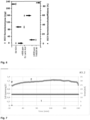
  • the AC resistance was determined for an example cell: Measurements were taken in the frequency range between 1 Hz and 100 kHz. Between 1 Hz and 1 kHz, the impedance mainly has an effective resistance of approx. 21 ohms. At higher frequencies, ie from 1 kHz to 100 kHz, an increasing phase shift is observed (ie the impedance becomes complex capacitive). Typical for capacitive behavior, the resistance decreases significantly with higher frequencies, cf. figure 8 .
  • the electrolyte of the test cell was pumped continuously via a 100 ml receiver at a flow rate of 0.1 mL/min.
  • FIGS. 2 to 6 show the cell voltage (V) of a primary cell according to Figure 1b operated with aqueous electrolytes with 5M KOH and added with the following additions to compounds according to the invention.
  • the measurements record the open cell voltage (OCV: open circuit) and the cell voltage under discharge at 1 mA/cm 2 (25° C., 50% relative humidity).
  • OCV open cell voltage
  • the following figures show the results of the measurements in which the additives in the electrolyte were varied.
  • the cell voltages hardly differ either when idling (OCV -1.27 volts) or under load (discharging ⁇ 1.15 V) depending on the electrolyte additive and the aqueous 5M-KOH electrolyte.
  • figure 5 shows the material consumption of silicon-air cells made with sintered silicon-silicon carbide powder anodes, which were discharged at 1 mA over 24 hours, as a function of the electrolyte additive.
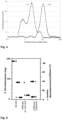
  • 4 shows the bimodal particle size distribution of the wafer saw residues used with the two main components silicon and silicon carbide.
  • the silicon particle sizes are between 400nm and 8 microns.
  • silicon carbide particles are predominantly between 7 microns and 20 microns.
  • figure 5 shows in the chart, in addition to Fig.3 that Tween 80 as an electrolyte additive additionally reduces corrosion.
  • the values of the anode mass conversion efficiency under a load of 1 mA are around 2.5% for the aqueous 5M KOH electrolyte, around 6% added with DL Lactic Acid and around 40% added with Tween 80 and the corrosion mass is reduced accordingly. 1 mA over 24 hours corresponds to 84.6 coulombs.
  • FIG. 6 shows in the diagram mass loss due to corrosion in aqueous electrolytes with different additives in OCV operation.
  • the corrosion mass for the silicon anodes was taken out after 24 hours of operation, cleaned with water, dried and then weighed (cells in OCV, no discharge).
  • the measurement of the average cell voltage according to figure 3 shows that for an anode composition according to the invention, the cell voltage values hardly differ from one another both in open circuit (OCV) and under load (1 mA) due to the electrolyte composition.
  • OCV open circuit
  • 1 mA the electrolyte composition with DL Lactic Acid results in low corrosion compared to an electrolyte composition (5 M KOH without additive) and thus improved anode mass conversion efficiency is achieved.
  • Tween 80 causes as in figure 5 shown, a further improved corrosion protection efficiency compared to a composition without additive. Corrosion mass losses determined in the OCV condition are in 6 contrasted.
  • the corrosion protection efficiency could also be improved in OCV operation by adding the additives DL Lactic Acid and Tween 80.
  • Table 1 X-ray amorphous silicon particles silicon particles primary particles [nm] Agglomerates and/or aggregates [nm] doping Si [wt%] A 5-15 150-1000 ⁇ 0.1 wtppm Intrinsic semiconductor 99.99999 (electronic grade) B 100-300 200-2000 ⁇ 10 wppm 99.999 solar grade C 100-300 400-1000 1 wt% Intrinsic p-type conductor 98.9 D 100 - 300 400 - 1000 1.8% by weight boron (5*10 19 /cm 3 ) 98.19 carbon containing particles carbon containing particles particle size [nm] Agglomerates and/or aggregates [nm] doping Vulcan-XC72R (electric black) 20 to 40 or 350 to 1500 ⁇ 100 wtppm n-donors and p-acceptors 25 to 80 350 to 1500 Graphite (painting natural graphite)
  • Electrode pastes were produced with the silicon particles and the carbon particles, which can alternatively be pressed with a binder added.
  • the silicon-air cells with silicon particles as the anode material and hydroxycarboxylic acids as the electrolyte additive were Figure 1b realized.

Landscapes

  • Chemical & Material Sciences (AREA)
  • Chemical Kinetics & Catalysis (AREA)
  • Electrochemistry (AREA)
  • General Chemical & Material Sciences (AREA)
  • Engineering & Computer Science (AREA)
  • Manufacturing & Machinery (AREA)
  • Inorganic Chemistry (AREA)
  • Materials Engineering (AREA)
  • Battery Electrode And Active Subsutance (AREA)

Abstract

Gegenstand der Erfindung ist eine elektrochemische Primärzelle mit metall-enthaltendem Anodenmaterial, insbesondere zur Verwendung in elektrochemischen Primärzellen mit alkalischem Elektrolyten, wobei das Metall-enthaltende Anodenmaterial Silizium umfasst sowie Kohlenstoff und mindestens ein weiteres Metall umfasst sowie eine wässrige, alkalische Elektrolytzusammensetzung, die vorzugsweise umfasst mindestens eine Hydroxycarbonsäure, Carboxylat einer Hydroxycarbonsäure, Ester einer Hydroxycarbonsäure, Ether eines Carboxylates einer Hydroxycarbonsäure, polymere Verbindung basierend auf mindestens einer Hydroxycarbonsäure oder Gemische enthaltend mindestens zwei der vorgenannten Verbindungen. Des Weiteren umfasst die Erfindung eine mehrzellige Batterie, die Verwendung als Elektrolyt in einer Primärzelle mit Silizium als Anodenmaterial in Form von Silizium-Partikeln, die aus einem Silizium Recyclingprozess stammen mit einer Partikelgröße zwischen 1 nm bis 90000 nm vorliegen. Wobei das Anodenmaterial im geladenen Zustand vorzugsweise kein Lithium umfasst und, wobei die Siliziumpartikel optional im Wesentlichen nanokristallin sind.

Description

  • Gegenstand der Erfindung ist eine Primärzelle mit metall-enthaltendem Anodenmaterial, insbesondere zur Verwendung in elektrochemischen Primärzellen mit alkalischem Elektrolyten, wobei das Metall-enthaltende Anodenmaterial Silizium umfasst sowie Kohlenstoff und als weiteres Metall oder weitere Metalle mindestens ein Metall der nachfolgend genannten Metalle Mangan, Kalzium, Zink, Aluminium, Eisen und/oder Legierung umfassend eines oder mehrere der vorgenannten Metalle umfasst, wobei die Oberfläche des Metall-enthaltenden Anodenmaterials zumindest teilweise Sauerstoff enthaltende Silizium-Verbindungen aufweist.
  • Die Erfindung betrifft auch eine wässrige, alkalische Elektrolytzusammensetzung, umfassend eine Hydroxycarbonsäure, Carboxylat einer Hydroxycarbonsäure, Ester einer Hydroxycarbonsäure, Ether eines Carboxylates einer Hydroxycarbonsäure, polymere Verbindung basierend auf mindestens einer Hydroxycarbonsäure oder Gemische enthaltend mindestens zwei der vorgenannten Verbindungen.
  • Des Weiteren umfasst die Erfindung eine mehrzellige Batterie, die Verwendung als Elektrolyt in einer Primärzelle mit Silizium als Anodenmaterial in Form von Silizium-Partikeln, die als Siliziumpartikel mit einer Partikelgröße zwischen 10 nm bis 99000 nm vorliegen, wobei das Anodenmaterial im geladenen Zustand vorzugsweise Metalle umfasst und die Siliziumpartikel kristallin und/oder optional amorph sind.
  • Aufgrund des zunehmenden Bedarfes an E-Mobility im Personennahverkehr durch Elektroautos, Elektrofahrräder sowie elektrisch betriebene Busse etc. als auch bei zunehmender dezentraler Stromgewinnung besteht ein enormer Bedarf an umweltverträglichen Batterien, deren Komponenten einerseits unbeschränkt verfügbar und andererseits unbeschränkt recyclebar, umweltverträglich und/oder weiter verwendbar sein sollen. Silizium ist ein auf der Erde unbegrenzt verfügbarer Rohstoff. Darüber hinaus müssen die Komponenten einer Batterie kostengünstig verfügbar sein.
  • Des Weiteren ist es bekannt, durch ständige Zufuhr eines Brennstoffes in Brennstoffzellen, die eine galvanische Zelle aufweisen, in Gegenwart eines Oxidationsmittels elektrische Energie zu erzeugen. Grundsätzlich ist dieses Prinzip auch für Silizium-Luft-Batterien denkbar. Silizium ist gemäß diesem Prinzip ein Brennstoff. Im Allgemeinen bezeichnet man Brennstoffe auch als Kraftstoffe. Zudem sind übliche Silizium enthaltende Lithium-Ionen-Sekundärbatterien täglich weltweit im Einsatz.
  • Aufgabe der Erfindung war es die Leistungsfähigkeit und Lebensdauer einer Silizium enthaltenden galvanischen Zelle, insbesondere alkalischen galvanischen Zelle, zu verbessern und eine nachhaltige Rohstoffbasis bereitzustellen. Ferner soll die Leistungsdichte einer solchen Silizium enthaltenden galvanischen Zelle verbessert und eine hohe Zellspannung erreicht werden.
  • Des Weiteren bestand die Aufgabe eine Silizium enthaltende galvanische Zelle bereitzustellen, die vorzugsweise frei von Lithium ist, wobei vorzugsweise bedeutet frei von Lithium, dass der Gehalt an Lithium im geladenen Zustand unter 1 Gew.-% in der Gesamtzusammensetzung der Primärzelle beträgt, insbesondere umfassend die Anode, die Kathode und den Elektrolyten, vorzugsweise beträgt der Gehalt an Lithium im Elektrodenmaterial der Anode im geladenen Zustand unter 0,1 Gew.-%.
  • Die Aufgaben wurden gelöst durch eine Primärzelle mit Metall-enthaltendem Anodenmaterial nach Anspruch 1 das neben Kohlenstoff teilweise Sauerstoff enthaltende Silizium-Verbindungen aufweist. Insofern werden die Aufgaben auch gelöst durch eine Primärzelle umfassen eine Elektrolytzusammensetzung nach Anspruch 2 sowie der mehrzelligen Batterie nach Anspruch 17 und der Verwendung nach Anspruch 18. In den Unteransprüchen sowie in der Beschreibung sind bevorzugte Ausführungsformen detaillierter dargestellt. Des Weiteren konnte die Aufgabe gelöst werden, indem die elektrochemische Primärzelle als galvanische Zelle Edukte und Reaktionsprodukte aufweisen kann, die aus Recyclingprozessen der Silizium-Waferherstellung stammen, Nebenprodukte aus der Silizium-Waferherstellung sind und/oder aus Recyclingprozessen von Silizium enthaltenden Materialien weiterverwendet werden können.
  • Gegenstand der Erfindung ist eine elektrochemische Primärzelle mit Metall-enthaltendem Anodenmaterial sowie alkalischem Elektrolyten, wobei das Metall-enthaltende Anodenmaterial Silizium umfasst sowie Kohlenstoff und mindestens ein weiteres Metall umfasst, wobei das mindestes eine weitere Metall mindestens ein Metall von Mangan, Kalzium, Zink, Aluminium, Eisen und/oder eine Legierung umfassend eines oder mehrere der vorgenannten weiteren Metalle umfasst, wobei die Oberfläche des Metall-enthaltenden Anodenmaterials zumindest teilweise Sauerstoff enthaltende Silizium-Verbindungen aufweist.
  • Das Anodenmaterial kann umfassen 75 bis 99,999 Gew.-%, insbesondere 75 bis 98 Gew.-%, Silizium sowie 1 bis 24,999 Gew.-% Kohlenstoff und 0,001 bis 5 Gew.-% mindestens ein weiteres Metall, wobei die Gesamtzusammensetzung des Anodenmaterials 100 Gew.-% beträgt.
  • Nach einer Alternative kann das Anodenmaterial umfassen 75 bis 89,999 Gew.-%, insbesondere 75 bis 98 Gew.-%, Silizium sowie 10 bis 24,999 Gew.-% Kohlenstoff und 0,001 bis 5 Gew.-% mindestens ein weiteres Metall, wobei die Gesamtzusammensetzung des Anodenmaterials 100 Gew.-% beträgt.
  • Besonders bevorzugt ist ein Anodenmaterial das neben Silizium (Si) und Siliziumcarbid (SiC), als Metall (im Folgenden abgekürzt: Me) umfasst Eisen (Fe), Kalzium (Ca), Zink (Zn), Aluminium (AI), Mangan (Mn), Kupfer (Cu), Titan (Ti), Magnesium (Mg), Phosphor (P) und/oder Legierung umfassend eines oder mehrere der vorgenannten Metalle und optional Lithium (Li), insbesondere umfassend eine Legierung Silizium, Mangan, Kalzium, Zink, Aluminium und/oder Eisen und jeweils optional Lithium, bevorzugt umfasst das weitere Metall Mangan, Kalzium, Zink, Aluminium und/oder Eisen und jeweils optional Lithium. Bevorzugt beträgt der Gesamtgehalt des mindestens einen weiteren Metalls 0,001 bis 7,5 Gew.-%, insbesondere von 0,003 bis 5 Gew.-% in Bezug auf die Gesamtzusammensetzung.
  • In einer besonders bevorzugten Alternative weist die Oberfläche des Anodenmaterials Metall-Sauerstoff-Silizium-Strukturen auf, die nachfolgend auch als Me-O-Si-Struktur bezeichnet werden, wobei die Silizium-Struktur, hier Si-Struktur, Bestandteil einer funktionellen Siliziumenthaltenden Verbindung sein kann oder ist.
  • Gegenstand der Erfindung ist auch eine wässrige, alkalische Elektrolytzusammensetzung, enthaltend
    • 2,0 bis 99,0 Gew.-% Wasser, und
    • 0,0001 bis 15 Gew.-% mindestens eine Hydroxycarbonsäure, Carboxylat einer Hydroxycarbonsäure, Ester einer Hydroxycarbonsäure, Ether eines Carboxylats einer Hydroxycarbonsäure, polymere Verbindungen basierend auf Hydroxycarbonsäuren, Carboxylaten von Hydroxycarbonsäure, Estern von Hydroxycarbonsäuren oder Gemisch enthaltend mindestens zwei der vorgenannten Verbindungen, und
    • einen Gehalt von 0,001 bis 40 Gew.-%, insbesondere 10 bis 40 Gew.-%, Alkalihydroxid in Bezug auf die Gesamtzusammensetzung von 100 Gew.-%.
  • Nach einer besonders bevorzugten Alternative ist Hydroxycarbonsäure ausgewählt aus Enantiomeren, Diastereomeren oder Gemischen dieser. Bevorzugt sind α-Hydroxycarbonsäuren. Besonders bevorzugt ist Milchsäure, vorzugsweise D- und/oder L-Milchsäure sowie Gemische von D-/L-Milchsäure.
  • Bevorzugt umfasst die Elektrolytzusammensetzung mindestens ein Alkalihydroxid ausgewählt aus NaOH und KOH und optional weitere alkalisch lösliche Salze, wie beispielsweise Erdalkalihydroxide, basische Metalloxide oder organische Basen. Bevorzugt umfasst die Elektrolytzusammensetzung ein Alkalihydroxid ausgewählt aus KOH und NaOH.
  • Zur Herstellung der wässrigen Elektrolytzusammensetzung wird vorzugsweise destilliertes Wasser eingesetzt.
  • Nach einer besonders bevorzugten Alternative ist die Hydroxycarbonsäure ausgewählt aus Milchsäure, insbesondere D-Milchsäure, L-Milchsäure und/oder Gemische von D/L-Milchsäure, α-Hydroxycarbonsäuren, insbesondere Fruchtsäuren, insbesondere Äpfelsäure, Citronensäure, Fumarsäure, Gluconsäure, Glycolsäure, Mandelsäure, Milchsäure, Oxalsäure, Salicylsäure, α-Hydroxycaprylsäure und Weinsäure, β-Hydroxycarbonsäuren, insbesondere β-Hydroxybuttersäure und/oder Mevalonsäure, oder Gallussäure, 4-Hydroxybutansäure, Polyhydroxybuttersäure, Salicylsäure (2-Hydroxybenzoesäure), 4-Hydroxybenzoesäure (PHB) oder das Carboxylat von Hydroxycarbonsäure, Ester von Hydroxycarbonsäure, Ether von Carboxylat von Hydroxycarbonsäure auf mindestens einer der vorgenannten Hydroxysäuren basiert, und/oder die polymeren Verbindungen auf mindestens einer der Hydroxycarbonsäuren oder einem Gemisch enthaltend mindestens zwei der vorgenannten Verbindungen basiert.
  • Nach einer weiteren Alternative kann die Elektrolytzusammensetzung zusätzlich eine lineare oder verzweigte Polyalkylenoxid-Gruppen aufweisende Verbindung oder Gemische davon enthalten, wobei die Verbindung mindestens drei Alkylenoxid-Gruppen in der Verbindung aufweist, wobei die Alkylenoxid-Gruppen in der Polyalkylenoxid-Gruppen aufweisenden Verbindung ausgewählt sind aus Alkylenoxid-Gruppen mit 2 bis 6 C-Atomen je Alkylenoxid-Gruppe, und, wobei mindestens eine terminale Gruppe der Polyalkylenoxid-Gruppen aufweisenden Verbindung ausgewählt ist aus Hydroxy-Gruppen, Alkyl-Gruppen, Alkoxy-Gruppen, Alkenyl-Gruppen, Alkenyloxid-Gruppen, Carbonsäure-Gruppen, Carbonsäureester-Gruppen, insbesondere olefinischen Carbonsäureester-Gruppen, Carbonsäureamid-Gruppen, aromatischen-Gruppen, insbesondere Alkyl-substituierten aromatischen Gruppen, und/oder Gruppen enthaltend cyclische-Ether.
  • Nach einer Ausführungsform kann die Elektrolytzusammensetzung ein Gemisch von Hydroxycarbonsäure, Carboxylat einer Hydroxycarbonsäure, Ester einer Hydroxycarbonsäure, Ether eines Carboxylats einer Hydroxycarbonsäure, polymere Verbindungen basierend auf Hydroxycarbonsäuren, Carboxylaten von Hydroxycarbonsäure, Estern von Hydroxycarbonsäuren und mindestens einer linearen oder verzweigten Polyalkylenoxid-Gruppe(n) aufweisende Verbindung aufweisen.
  • Besonders bevorzugt sind lineare oder verzweigte Polyalkylenoxid-Gruppen aufweisende Verbindung mit mindestens drei bis 200 Alkylenoxid-Gruppen in der Verbindung oder Gemische von mindestens zwei dieser Verbindungen, insbesondere mit 3 bis 100 Alkylenoxid-Gruppen, besonders bevorzugt mit drei bis 100 Alkylenoxid-Gruppen, weiter bevorzugt mit 3 bis 50 Alkylenoxid-Gruppen, vorzugsweise mit 3 bis 25 Alkylenoxid-Gruppen. Dabei ist es weiter bevorzugt, wenn die Alkylenoxid-Gruppen aus Ethylenoxid und Propylenoxid ausgewählt sind.
  • Dabei können die Alkyl-Gruppen, Alkoxy-Gruppen, Alkenyl-Gruppen, Alkenyloxid-Gruppen, Carbonsäure-Gruppen, Carbonsäureamid-Gruppen, Carbonsäureester-Gruppen, insbesondere olefinischen Carbonsäureester-Gruppen, bevorzugt sind Fettsäuren, aromatischen-Gruppen, insbesondere Alkyl-substituierten aromatischen Gruppen, und/oder Gruppen enthaltend cyclische-Ether als mindestens eine terminale Gruppe und als mindestens eine weitere terminale Gruppe jeweils unabhängig umfassen 1 bis 35 C-Atome, insbesondere 2 bis 25 C-Atome. Alkyl-, Alkoxy-, Alkenyl-, Alkenyloxid und aromatische Gruppen optional Alkyl-substituiert umfassen vorzugsweise jeweils unabhängig 1 bis 18 C-Atome. Carbonsäureester sind vorzugsweise ausgewählt aus natürlichen Fettsäuren mit 4 bis 20 C-Atomen.
  • Bevorzugte Polyaklylenoxid-Gruppen, insbesondere umfassend Polyalkylenoxid-Gruppen, aufweisende Verbindungen können vorzugsweise ein Molekulargewicht von 100 g/mol bis 35.000 g/mol, bevorzugt 150 bis 1500 g/mol aufweisen. Dabei ist es weiter bevorzugt, wenn das mittlere Molekulargewicht von 200 g/mol bis 1500 g/mol beträgt.
  • Definitionsgemäß umfassen Polyalkylenoxid-Gruppen aufweisende Verbindung:
    • -(O-Alkylen)n-OH, -(O-Alkylen)n-COOH, -(O-Alkylen)n-(C=O)NHR, -(O-Alkylen)n-(C=O)NR2, mit R = Kohlenwasserstoff oder Polyalkylenoxid,
    • -(O-Alkylen)n-O-Alkyl, -(O-Alkylen)n-O-Alkenyl,
    • -(O-Alkylen)n-O-(C=O)-Alkyl, -(O-Alkylen)n-O-(C=O)-Alkenyl,
    • -(O-Alkylen)n-O-(C=O)-Aromat-Alkyl jeweils unabhängig mit n größer gleich 2, insbesondere mit n = 5 bis 100, insbesondere n = 5 bis 50, bevorzugt n = 5 bis 25.
  • Nach einer Ausführungsform können die Alkylenoxid-Gruppen in der Polyalkylenoxid-Gruppen aufweisenden Verbindung bevorzugt ausgewählt sein aus Alkylenoxid-Gruppen mit 2 bis 4 C-Atomen je Alkylenoxid-Gruppe. Des Weiteren ist es bevorzugt, wenn die Polyalkylenoxid-Gruppen aufweisenden Verbindungen mindestens fünf Alkylenoxid-Gruppen, insbesondere bis einhundert Alkylenoxid-Gruppen, mit 2 bis 4 C-Atomen je Alkylenoxid-Gruppe in der Verbindung aufweist.
  • Alkylen ist besonders bevorzugt bivalentes Ethylen (-CH2CH2-), insbesondere als Ethylenoxid-Gruppe, oder bivalentes Propylen, insbesondere in Propylenoxid-Gruppen
    (-CH2(CH3CH)- und -(CH2)3-).
  • Bevorzugte Beispiele können symmetrische Verbindungen umfassen, aber sind nicht beschränkt auf die nachfolgend genannten Polyalkylenoxid-Gruppen aufweisenden Verbindungen: H-(O-Alkylen)n-OH, Alkyl-(O-Alkylen)n-O-Alkyl, Alkenyl-(O-Alkylen)n-O-Alkenyl, Alkyl-(C=O)-(O-Alkylen)n-O-(C=O)-Alkyl, Alkenyl-(C=O)-(O-Alkylen)n-O-(C=O)-Alkenyl, Alkyl-Aromat-(O-Alkylen)n-O-(C=O)-Aromat-Alkyl, wobei n wie vorstehend definiert ist, vorzugsweise ist n größer gleich 2, bevorzugt ist n = 5 bis 50, insbesondere n = 5 bis 25, wobei jedes Alkylen jeweils unabhängig 2 bis 6 C-Atome umfasst und Alkyl und/oder Alkenyl jeweils unabhängig 1 bis 24 C-Atome umfassen, insbesondere 1 bis 20 C-Atome.
  • Bevorzugt sind die terminalen Gruppen der Polyalkylenoxid-Gruppen aufweisenden Verbindung ausgewählt aus Hydroxy-Gruppen, Alkyl-Gruppen, Alkoxy-Gruppen, Alkylen-Gruppen, Alkylenoxid-Gruppen, Carbonsäureester-Gruppen, insbesondere olefinische Carbonsäureester-Gruppen, aromatischen-Gruppen und/oder Gruppen enthaltend cyclische-Ether.
  • Nach einer bevorzugten Ausführungsform ist, die mindestens eine terminale Gruppe der Polyalkylenoxid-Gruppen aufweisenden Verbindung eine Hydroxy-Gruppe und mindestens eine weitere terminale Gruppe ist ausgewählt aus Hydroxy-Gruppen, Alkyl-Gruppen, Alkoxy-Gruppen, Alkenyl-Gruppen, Alkenyloxid-Gruppen, Carbonsäureester-Gruppen, aromatischen-Gruppen, insbesondere Alkyl-substituierten aromatischen Gruppen, und/oder Gruppen enthaltend cyclische-Ether. Dabei ist es weiter bevorzugt, wenn die linearen Verbindungen eine erste terminale und eine weitere terminale Gruppe aufweisen und verzweigte Verbindungen eine erste, eine weitere terminale Gruppe und mindestens eine zusätzliche terminale Gruppe aufweisen.
  • Nach einer besonders bevorzugten Ausführungsform können die Elektrolytzusammensetzungen zusätzlich umfassen mindestens eine Polyalkylenoxid-Gruppen aufweisende Verbindung mit mindestens einer cyclischen Ether-Gruppe mit 5 bis 8 C-Atomen und optional als mindestens eine terminale Gruppe einen Carbonsäureester, insbesondere einen Carbonsäureester einer Fettsäure, und, wobei die mindestens eine oder mehrere weiteren terminalen Gruppen ausgewählt sind aus Hydroxy-Gruppen, Alkyl-Gruppen, Alkoxy-Gruppen, Alkenyl-Gruppen, Alkenyloxid-Gruppen, Carbonsäureester-Gruppen, aromatischen-Gruppen und/oder Gruppen enthaltend cyclische-Ether mit 5 bis 8 C-Atomen. Besonders bevorzugt ist eine verzweigte Polyalkylenoxid-Gruppen aufweisende Verbindung mit ein bis sechs Polyalkylenoxid-Gruppen an der cyclischen Ether-Gruppe, und mindestens einem Alkylenoxidfunktionalisierten Fettsäureester. Typische Fettsäuren umfassen Ölsäure, Laurinsäure, Stearinsäure, Isostearinsäure und/oder Palmitinsäure. Besonders bevorzugte Verbindungen umfassen ethoxylierte Sorbitanfettsäureester, insbesondere Mono- bis Triester. Bevorzugt mit 2 bis 200 Ethoxy-Gruppen, insbesondere mit 2 bis 50 Ethoxy-Gruppen, und optional mit Propoxy-Gruppe(n) als Polyalkylenoxid-Gruppen.
  • Nach einer weiteren bevorzugten Ausführungsform kann eine wässrige, alkalische Elektrolytzusammensetzung zusätzlich verzweigte Polyalkylenoxid-Gruppen aufweisende Verbindungen aufweisen, die umfassen Ether von Kohlenhydraten, insbesondere Ether von Furanosen oder Pyranosen, die optional Carbonsäureester von Fettsäure aufweisen. Besonders bevorzugt sind Polyalkylenoxid-Gruppen enthaltende Verbindungen von SorbitanFettsäureester, wie Polyoxyethylen(20)sorbitanmonooleat (Tween 80). Gleichfalls geeignet können eine oder mehrere der folgenden Polysorbate in der Elektrolytzusammensetzung eingesetzt werden: Polysorbat 20 (Polyoxyethylen-(20)-sorbitanmonolaurat) (E 432), Polysorbat 21 (Polyoxyethylen-(4)-sorbitanmonolaurat), Polysorbat 40 (Polyoxyethylen-(20)-sorbitanmonopalmitat) (E 434), Polysorbat 60 (Polyoxyethylen-(20)-sorbitanmonostearat) (E 435), Polysorbat 61 (Polyoxyethylen-(4)-sorbitanmonostearat), Polysorbat 65 (Polyoxyethylen-(20)-sorbitantristearat) (E 436), Polysorbat 80 (Polyoxyethylen-(20)-sorbitanmonooleat) (E 433), Polysorbat 81 (Polyoxyethylen-(5)-sorbitanmonooleat), Polysorbat 85 (Polyoxyethylen-(20)-sorbitantrioleat), Polysorbat 120 (Polyoxyethylen-(20)-sorbitanmonoisostearat).
  • Besonders bevorzugte Elektrolytzusammensetzungen können umfassen Polyalkylenoxid-Gruppen aufweisende Verbindungen, die ausgewählt sind aus Polyethylenglycol, Polypropylenglycol, Propylenoxid und Ethylenoxid aufweisenden Polyalkylenoxid-Gruppen enthaltenden Verbindungen, wobei die terminalen Gruppen ausgewählt sind aus Hydroxy-Gruppen, Alkoxy-Gruppen, Alkyl-Gruppen, Alkenyl-Gruppen, Alkenyloxid-Gruppen, Alkylfunktionellen Carbonsäureester-Gruppen, Alkylen-funktionellen Carbonsäure-Gruppen, wobei die Alkoxy, Alkyl und Alkylen-Gruppen jeweils unabhängig 1 bis 24 C-Atome aufweisen.
  • Weitere besonders bevorzugte Polyalkylenoxid-Gruppen aufweisende Verbindungen können ausgewählt sein aus Verbindungen enthaltend Polyalkylenoxid-Gruppen aufweisende Furanosen, und/oder Polyalkylenoxid-Gruppen aufweisende Pyranosen, insbesondere Polyalkylenoxid-Gruppen aufweisende Verbindungen von Furanose-Fettsäureestern und/oder Polyalkylenoxid-Gruppen aufweisende Verbindungen von Pyranose-Fettsäureestern. Insbesondere sind die terminalen Gruppen der Polyalkylenoxid-Gruppen aufweisenden Verbindung ausgewählt aus Hydroxy-Gruppen, Alkyl-Gruppen, Alkoxy-Gruppen, Alkylen-Gruppen, Alkylenoxid-Gruppen, Carbonsäureester-Gruppen, aromatischen-Gruppen und/oder Gruppen enthaltend cyclische-Ether.
  • Weiter bevorzugt sind Polyalkylenoxid-Gruppen aufweisende Verbindungen von SorbitanFettsäureester umfassend Polyalkylenoxid-Gruppen aufweisende Verbindungen eines Sorbitanmonostearats, Sorbitantristearats, Sorbitanmonolaurats, Sorbitanmonooleats, Sorbitantrioleats und/oder Sorbitanmonopalmitats.
  • Entsprechend einer weiteren Ausführungsform ist es bevorzugt, wenn die Polyalkylenoxid-Gruppen aufweisende Verbindung umfasst mindestens eine cyclische Ether-Gruppe mit 5 bis 8 C-Atomen und optional als mindestens eine terminale Gruppe einen Carbonsäureester, insbesondere einer Fettsäure oder einer Fruchtsäure, bevorzugt einer Fettsäure, und, wobei die weiteren terminalen Gruppen ausgewählt sind aus Hydroxy-Gruppen, Alkyl-Gruppen, Alkoxy-Gruppen, Alkenyl-Gruppen, Alkenyloxid-Gruppen, Carbonsäureester-Gruppen, aromatischen-Gruppen, insbesondere Alkyl-funktionalisierte Phenyl-Gruppen, und/oder Gruppen enthaltend cyclische-Ether mit 5 bis 8 C-Atomen.
  • Eine besonders bevorzugte Verbindung ist ausgewählt aus 4-(1,1,3,3-Tetramethylbutyl)phenyl-polyethylenglycolen, bevorzugt 4-(1,1,3,3-Tetramethylbutyl)phenyl-polyethylenglycol, t-Octylphenoxypolyethoxyethanol, Polyethylene glycol tert-octylphenyl ether, mit n gleich 5 bis 100, bevorzugt mit n = 9 bis 10 (Triton X-100) oder n = 7 bis 8 (Triton X-114).
  • Ebenso Gegenstand der Erfindung ist eine Elektrolytzusammensetzung umfassend 2,0 bis 99,0 Gew.-% Wasser und 0,0001 bis 15 Gew.-% mindestens einer Hydroxycarbonsäure, Carboxylat der Hydroxycarbonsäure, Ester der Hydroxycarbonsäure, Ether von Carboxylat der Hydroxycarbonsäure, polymere Verbindungen basierend auf Hydroxycarbonsäure oder Gemische enthaltend mindestens zwei der vorgenannten Verbindungen, bevorzugt sind 0,01 bis 10 Gew.-%, besonders bevorzugt von 0,1 bis 2,5 Gew.-%, und
    • einen Gehalt von 0,001 bis 40 Gew.-% Alkalihydroxid, insbesondere 10 bis 40 Gew.-%, und optional 0,0001 bis 15 Gew.-% Polyalkylenoxid-Gruppen aufweisende Verbindungen oder Gemische dieser, insbesondere 0,01 bis 2 Gew.-%,
    in Bezug auf die Gesamtzusammensetzung von 100 Gew.-%. Optional kann die Elektrolytzusammensetzung Alkalisilikat enthalten, wobei der Gehalt vorzugsweise unter 4 Mol/Liter Alkalisilikat, bevorzugt von 0,001 bis 3,5 Mol/Liter Alkalisilikat beträgt, insbesondere in der Gesamtzusammensetzung von 100 Gew.-%.
  • Zur Herstellung der wässrigen Elektrolytzusammensetzung wird vorzugsweise destilliertes Wasser eingesetzt. Das Wasser zur Herstellung der Elektrolytzusammensetzung weist vorzugsweise bei 25 °C, eine Leitfähigkeit von größer gleich 0,055 µS/cm, weiter bevorzugt von größer gleich 0,5 µS/cm auf. In der Elektrolytzusammensetzung ist die Leitfähigkeit erheblich höher und liegt vorzugsweise bei größer gleich 1 mS/cm bei 25 °C, bevorzugt bei größer gleich 0,5 S/cm bei 25 °C.
  • Nach einer besonders bevorzugten Ausführungsform ist die Elektrolytzusammensetzung eine wässrige, alkalische Zusammensetzung umfassend Alkalihydroxid, insbesondere Kaliumhydroxid, und mindestens eine Hydroxycarbonsäure, Carboxylat der Hydroxycarbonsäure, Ester der Hydroxycarbonsäure, Ether von Carboxylat der Hydroxycarbonsäure, polymere Verbindungen basierend auf Hydroxycarbonsäure oder Gemische enthaltend mindestens zwei der vorgenannten Verbindungen. Dabei ist es bevorzugt, wenn der Gehalt des Alkalihydroxids von 0,001 bis 6 Mol/Liter, vorzugsweise von 1 bis 5,5 Mol/Liter in der wässrigen, alkalischen Elektrolytzusammensetzung beträgt.
  • Der Gehalt an Hydroxycarbonsäure, Carboxylat der Hydroxycarbonsäure, Ester der Hydroxycarbonsäure, Ether von Carboxylat der Hydroxycarbonsäure, polymere Verbindungen basierend auf Hydroxycarbonsäure oder Gemische enthaltend mindestens zwei der vorgenannten Verbindungen kann von der gewählten Elektrodenoberfläche sowie weiteren Verfahrensbedingungen wie Temperatur, Durchflussmenge in der Zelle, Porengröße der Elektrodenoberfläche etc. abhängen. Daher kann der Gehalt der mindestens einen Hydroxycarbonsäure, Carboxylat der Hydroxycarbonsäure, Ester der Hydroxycarbonsäure, Ether von Carboxylat der Hydroxycarbonsäure, polymere Verbindungen basierend auf Hydroxycarbonsäure oder Gemische enthaltend mindestens zwei der vorgenannten Verbindungen oder Gemische von mindestens zwei dieser Verbindungen von 0,000001 bis 50.000 ppm-Gew., insbesondere von 0,01 bis 20.000 ppm-Gew., bevorzugt von 0,01 ppm-Gew. bis 10.000 ppm-Gew., in der Elektrolytzusammensetzung, insbesondere mit einer Gesamtzusammensetzung von 100 Gew.-% betragen.
  • Weiter ist es bevorzugt, wenn die Elektrolytzusammensetzung eine Stoffmengenkonzentration von 1 bis 6 Mol/Liter Alkalihydroxid, insbesondere Kaliumhydroxid, und 10 ppm-Gew. bis 50.000 ppm-Gew. lineare oder verzweigte Polyalkylenoxid-Gruppen aufweisende Verbindungen mit mindestens drei Alkylenoxid-Gruppen in der Verbindung oder Gemische von mindestens zwei dieser Verbindungen in Wasser aufweist, wobei insbesondere die Gesamtzusammensetzung der Elektrolytzusammensetzung 100 Gew.-% beträgt. Bevorzugt ist die Polyalkylenoxid-Gruppen enthaltende Verbindung ausgewählt aus Polyethylenoxid-Gruppen, Polypropylenoxid-Gruppen, Polypropylenoxid- und Polyethylenoxid-Gruppen enthaltenden Verbindungen. In einer Alternative weist die Polyalkylenoxid-Gruppen aufweisende Verbindung mindestens einen cyclischen Ether auf.
  • Gleichfalls Gegenstand der Erfindung ist eine chemische Primärzelle aufweisend eine Anode, eine Kathode, einen Elektrolyten sowie mindestens einen Separator, wobei der Separator die Kathode und die Anode voneinander separiert, und die Kathode umfasst als Material Mangandioxid und optional Kohlenstoff enthaltenden Leitfähigkeitsvermittler, wobei die Anode als Anodenmaterial Silizium umfasst, und wobei das Silizium in Form von Silizium-Partikeln vorliegt. Die Siliziumpartikel weisen vorzugsweise eine Partikelgröße zwischen 10 nm bis 99000 nm auf. Nach einer Alternative sind die Siliziumpartikel kristallin, insbesondere sind die Siliziumpartikel polykristallin. Nach einer weiteren Alternative sind die Siliziumpartikel im Wesentlichen röntgenamorph. Ferner können Gemische von Siliziumpartikeln umfassend amorphe und kristalline Siliziumpartikel als Anodenmaterial eingesetzt werden.
  • Somit ist Gegenstand der Erfindung eine elektrochemische Primärzelle aufweisend eine Anode, eine Kathode sowie mindestens einen Separator und enthaltend eine erfindungsgemäße Elektrolytlösung, wobei der Separator die Kathode und die Anode voneinander separiert.
  • Nach einer bevorzugten Ausführungsform kann die Primärzelle mit einem hermetisch abgeschlossenen Gehäuse vorliegen, wobei i) das Material der Kathode der Primärzelle Mangandioxid und optional einen Kohlenstoff enthaltenden Leitfähigkeitsvermittler aufweist. Als ein hermetisch abgeschlossenes Gehäuse wird in der Regel ein Gehäuse verstanden, dass aus einem gegenüber alkalischen Elektrolyten inertem Material hergestellt ist und hermetisch, insbesondere fluiddicht (gas- und flüssigkeitsdicht) abgeschlossen ist. Als Material für das Gehäuse oder auch für den Separator kommen beispielsweise Polyetheretherketone, Polyaryletherketone, Polyphenylensulfid (PPS), Polyoxymethylen-Copolymere (POM-C), Polyamid, Cycloolefine oder andere Hyperformance Kunststoffe oder auch metallische Legierungen in Frage. Die Komponenten des Gehäuses können mittels Laser verschweißt oder mittels Plasmaverfahren verschweißt sein.
  • Die Kathode kann als Kohlenstoff geträgertes MnO2 Komposit ausgeführt sein.
  • Der Separator kann mit einer Shut-down-Funktion ausgelegt sein, um einen Zutritt des Elektrolyten bei unerwünschten Verfahrensbedingungen von der Anode und/oder der Kathode zu unterbinden. Gleichfalls kann die Primärzelle eine Berstplatte aufweisen, um bei unerwünschtem Druckanstieg eine Explosion der Primärzelle zu vermeiden und den gezielten Austritt der Komponenten aus der Primärzelle bei Druckanstieg zu steuern.
  • Nach einer zweiten Alternative kann die Primärzelle als die Kathode ii) eine Luftkathode aufweisen. Das Material der Kathode in dieser Primärzelle umfasst vorzugsweise Mangandioxid und optional einen Kohlenstoff enthaltenden Leitfähigkeitsvermittler, insbesondere weist die Luftkathode eine für Kohlendioxid-undurchlässige Membran auf, die vorzugsweise in der Primärzelle so angeordnet ist, dass sie den Zutritt von Kohlendioxid aus der Umgebungsluft an die Kathode verhindert.
  • Gleichfalls bevorzugtes Metall-enthaltendes Anodenmaterial kann umfassen Silizium, bevorzugt Siliziumpartikel mit i) einem Gehalt an Eisen von größer gleich 0,02 mg/kg, bevorzugt größer gleich 0,05 mg/kg, und/oder ii) Silizium, bevorzugt Siliziumpartikel, mit Eisen-enthaltenden Partikeln, wobei die Eisen-enthaltenden Partikel mit einem Gehalt an Eisen von größer gleich 90 Gew.-% in Bezug auf die Gesamtzusammensetzung der Eisen-enthaltenden Partikel vorliegen, wobei die Eisen-enthaltenden Partikel vorzugsweise eine Edelstahllegierung umfassen. Die Eisen-enthaltenden Partikel mit einem Eisengehalt größer 90 % können aus einem Wafersägeprozess und der aufgearbeiteten Sägesuspension stammen oder aus einem Recyclingprozess z.B. von Solarsilizium. Ferner kann das Metall-enthaltende Anodenmaterial, insbesondere die Siliziumpartikel oder das Anodenmaterial Silizium bzw. die Silizium-Anode, einen Gehalt aufweisen an:- Eisen größer gleich 5 mg/kg,
    • Aluminium größer gleich 0,5 mg/kg,
    • Calcium größer gleich 5 mg/kg,
    • optional Kalium größer gleich 5 mg/kg,
    • optional Magnesium größer gleich 5 mg/kg,
    • optional Zink größer gleich 50 mg/kg
    • und optional Sauerstoff größer gleich 0,01 mg/kg,
    • und optional Titan größer gleich 0,01 mg/kg,
    • und optional Kupfer größer gleich 0,05 mg/kg, bevorzugt
    • Eisen größer gleich 500 mg/kg,
    • Aluminium größer gleich 0,5 mg/kg,
    • Calcium größer gleich 50 mg/kg,
    • Magnesium größer gleich 50 mg/kg,
    • und optional Sauerstoff größer gleich 0,01 mg/kg,
    • und optional Titan größer gleich 0,01 mg/kg,
    • und optional Kupfer größer gleich 0,05 mg/kg.
  • Des Weiteren kann das Anodenmaterial zusätzlich oder alternativ Mangan umfassen, insbesondere bis zu 398 mg/kg, bevorzugt von 0,1 mg/kg bis zu 199 mg/kg. Das Mangan kann aus Siliciumcarbid, bspw. der Schleifkörpern oder anderen Quellen eingetragen werden. Es wird angenommen, dass das Mangan aufgrund seiner diversen stabilen Oxidationsstufen die Grenzflächenprozesse an der Anode positiv beeinflusst.
  • Ferner kann das Metall-enthaltende Anodenmaterial, insbesondere die Siliziumpartikel oder das Anodenmaterial Silizium bzw. die Silizium-Anode, einen Gehalt aufweisen an:
    • Eisen größer gleich 5 mg/kg,
    • Calcium größer gleich 5 mg/kg,
    • Mangan größer gleich 0,1 mg/kg, insbesondere größer gleich 50 mg/kg optional bis 398 mg/kg
    • und optional Sauerstoff größer gleich 0,01 mg/kg.
  • Des Weiteren kann das Anodenmaterial Mangan bis zu 398 mg/kg umfassen, bevorzugt von 0,1 mg/kg bis zu 199 mg/kg.
  • Ferner ist Gegenstand der Erfindung eine Primärzelle in der die Anode als Anodenmaterial Silizium umfasst, insbesondere wobei das Silizium in Form von Silizium-Partikeln vorliegt, und bevorzugt die Siliziumpartikel eine Partikelgröße zwischen 10 nm bis 99000 nm aufweisen. Die Siliziumpartikel können ausgewählt sein aus kristallinen, insbesondere polykristallin, und/oder amorphen Siliziumpartikeln. Nach einer bevorzugten Ausführungsform können Sägereste aus der Silizium-Waferherstellung, wie Wafern zur Herstellung von Halbleiter oder auch Reste aus der Herstellung von Solarsilizium-Wafern eingesetzt werden. Silizium aus recycelten Photvoltaikzellen, wobei Siliziumpartikel durch einen Mahlprozess gewonnen werden, bei dem in einem ersten Schritt das Siliziumkomposit gewonnen und danach vermahlen wurde. Per XRD-Analysen der Siliziumpartikel unter Verwendung der Scherrer-Gleichung ergeben sich im Fall polykristallinen Siliziums Kristallitgrößen größer gleich von 10nm. Alternativ sind die Siliziumpartikel im Wesentlichen amorph.
  • Vorzugsweise können die Silizium-Partikel und/oder die siliziumhaltigen Partikel als Mischung in Form von Agglomeraten von siliziumhaltigen Primärpartikeln, Aggregaten von Siliziumpartikeln oder Partikeln sowie als Gemisch dieser vorliegen, wobei die Agglomerate und/oder Aggregate eine Größe von 100 bis 3000 nm aufweisen. Die Partikel können eine Partikelgröße von 10 bis 99000 nm aufweisen.
  • Alternativ, bevorzugt umfasst die Anode zusätzlich als Anodenmaterial Silizium und Siliziumcarbid, wobei insbesondere das Silizium und/oder Siliciumcarbid in Form von Silizium-Partikeln vorliegt. Bevorzugt liegt das Silizium in Form von Partikeln einer Partikelgröße von 200 nm bis 20 Mikrometer, besonders bevorzugt mit einer Partikelgröße von 400 nm bis 8 Mikrometer vor. Das Siliciumcarbid liegt vorzugsweise in Form von Partikeln einer Partikelgröße von 1 Mikrometer bis 50 Mikrometer vor, bevorzugt von 7 Mikrometer bis 20 Mikrometer.
  • Nach einer bevorzugten Ausführungsform können Sägereste aus der Silizium-Waferherstellung, wie Wafern zur Herstellung von Halbleiter oder auch Reste aus der Herstellung von Solarsilizium-Wafern eingesetzt werden die vorzugsweise eine bimodale Partikelverteilung aufweisen mit Maxima beispielsweise bei 1000 und 10000 nm. Dabei ist es bevorzugt, wenn eine Fraktion der Siliziumpartikel eine Partikelgrößenverteilung von d10 bis d90 von 100 nm bis 9000 nm und eine zweite Fraktion Partikel von d10 bis d90 6000 nm bis 45000 nm aufweist. Eine Partikelgrößenbestimmung kann mittels Laserbeugung nach ISO13320 (2009) erfolgen bspw. mit einem Mastersizer 2000 oder mittels TEM-Analyse sowie bspw. mittels Siebanalyse. XRD-Analysen der polykristallinen Siliziumpartikel unter Verwendung der Scherrer-Gleichung ergeben sich Kristallitgrößen größer gleich von 12 nm. Alternativ sind die Silizium-Primärpartikel im Wesentlichen amorph.
  • Ferner ist Gegenstand der Erfindung eine mehrzellige Batterie, wobei die Batterie mindestens zwei bis 15.000 miteinander verbundene Primärzellen umfasst, vorzugsweise sind davon die zwei bis 1.000 miteinander verbundenen Primärzellen in Serie geschaltet.
  • Ebenso Gegenstand der Erfindung ist die Verwendung mindestens einer Hydroxycarbonsäure, Carboxylate der Hydroxycarbonsäure, Ester der Hydroxycarbonsäure, Ether der Carboxylate der Hydroxycarbonsäure, polymere Verbindung basierend auf Hydroxycarbonsäure oder Gemische enthaltend mindestens zwei der vorgenannten Verbindungen als Additiv in einer Elektrolytzusammensetzung, insbesondere in einer wässrigen, alkalischen Elektrolytzusammensetzung, in einer elektrochemischen Primärzelle, insbesondere wobei die Anode der Primärzelle Silizium enthält das in Form von Silizium-Partikeln mit einer Partikelgröße zwischen 1 nm bis 99000 nm vorliegt. Dabei ist es bevorzugt, wenn in der Primärzelle als Anode Silizium in Form von kristallinen, wie polykristallinen, und/oder amorphen Silizium-Partikeln und optional Siliciumcarbid aufweist und optional polykristallines Silizium aufweist. Besonders bevorzugt sind Siliziumpartikel, insbesondere Partikel aus einem Mahlprozess, mit einer Partikelgröße zwischen 1 nm bis 99000 nm, die vorzugsweise mit einer Partikelgröße zwischen 500 nm und 30000 nm vorliegen. Die Partikel können zu einem Formkörper oder als Anode gesintert oder geschmolzen werden, wobei die Anode, insbesondere der Formkörper der Anode eine eingebettete Elektrode umfasst. Als eingebettet gilt eine Elektrode, die vorzugsweise vollständig vom Formkörper der Anode umhüllt ist und nur aus dem Formkörper als Kontakt zur Elektronenleitung hervortritt und insbesondere nicht an einer Position aus dem Formkörper ragt, die für den Kontakt mit einem Elektrolyten vorgesehen ist.
  • Gleichfalls Gegenstand der Erfindung ist die Verwendung von Siliziumpartikeln aus einem Wafersägeprozess in einer Primärzelle als Metall-enthaltendes Anodenmaterial und insbesondere zur Herstellung einer Anode umfassen eine Elektrode als Elektronenleiter. Die Siliziumpartikel aus dem Wafersägeprozess, synonym zu Sägeresten der Silizium-Waferherstellung, können von 1 bis 99,5 Gew.-%, bevorzugt von 20 bis 90 Gew.-%, des Anodenmaterials von insgesamt 100 Gew.-% betragen.
  • Gegenstand der Erfindung ist auch ein Anodenmaterial oder eine Anode umfassend Anodenmaterial, insbesondere ein Anodenmaterial oder eine Anode der elektrochemischen Primärzelle, wobei das Anodenmaterial Silizium umfasst, und wobei das Silizium in Form von Silizium-Partikeln vorliegt und die Silizium-Partikel einen Gehalt an Kohlenstoff von 10 Gew.-ppm bis 25 Gew.-%, insbesondere von 10 bis 20 Gew.-%, in Bezug auf die Gesamtzusammensetzung der Silizium-Partikel von 100 Gew.-% aufweisen und optional ein Teil der Silizium-Partikel oder die gesamten Silizium-Partikel als Sägereste aus einem Wafersägeprozess oder Recyclingprozess stammen.
  • Nach einer alternativen Ausführungsform liegt die Anode als dreidimensionaler Formkörper vor, wobei vorzugsweise in den Formkörper eine Elektrode als Elektronenleiter eingebettet ist, und insbesondere weist der Formkörper eine Dichte von 0,1 g/cm3 bis 2,55 g/cm3 auf, bevorzugt von 0,1 g/cm3 bis 2,3 g/cm3. Dabei ist es weiter bevorzugt, wenn der dreidimensionale Formkörper aus polykristallinem, mikroporösem Anodenmaterial gebildet ist, insbesondere umfasst er eine Elektrode als Elektronenleiter. Der dreidimensionale Formkörper wird vorteilhaft in einem Sinter- oder Schmelzverfahren aus Silizium-Partikeln und/oder Sägeresten der Silizium-Waferherstellung hergestellt.
  • Der dreidimensionale Formkörper kann ausgebildet sein als Platte, Tablette, Stab, Polyeder, Zylinder, Kugel, Gitter, eiförmig oder kann jegliche dreidimensionale Struktur ausbilden. Der Formkörper weist vorteilhaft entlang von drei senkrecht aufeinander stehenden, gedachten Achsen, die in den Formkörper gelegt sein könne, jeweils unabhängig für jede Achse mindestens 5 mm auf.
  • Des Weiteren ist es besonders bevorzugt, wenn die Elektrode ein metallisches Netz, ein Netz aus einer metallischen Legierung, eine Folie, eine Folie mit Ausnehmungen und/oder eine Membran ist, oder die Elektrode aus mindestens einem Metall oder einer Legierung gebildet ist und eine dendritische Form aufweist. Eine dentrische Form ist eine verzweigte und/oder verästelte Form. Die dentrische Form der Elektrode kann im Verfahren zur Herstellung der Anode in die Silizium-Partikel oder die Sägereste eingebettet werden, insbesondere in Schritt 2) oder 4). Bevorzugt ist der Formkörper eine Platte oder Zylinder mit einer Höhe von mindestens 1,5 mm, Breite von mindestens 1,5 mm und einer Dicke von mindestens 0,5 mm, besonders bevorzugt mit einer Höhe von mindestens 15 mm, Breite von mindestens 15 mm und einer Dicke von mindestens 0,5 mm.
  • Nach einer weiteren Ausführungsform umfasst das Anodenmaterial oder die Anode:
    1. A) 35 bis 55 Gew.-% metallisches Silizium, insbesondere 35 bis 50 Gew.-% Silizium,
      • 35 bis 55 Gew.-% Siliciumcarbid, insbesondere 40 bis 50 Gew.-% Siliciumcarbid,
      • 1 bis 7,5 Gew.-% SiO2, insbesondere 2 bis 5 Gew.-% SiO2,
      • 0,01 bis 7,5 Gew.-% Eisen, insbesondere 0,05 bis 6,5 Gew.-% Eisen,
      • optional 0,01 bis 2 Gew.-% Kupfer,
      • wobei die Gesamtzusammensetzung des Anodenmaterials 100 Gew.-% beträgt, oder
    2. B) 75 bis 99,998 Gew.-% Silizium,
      • 5 bis 24,999 Gew.-% Kohlenstoff,
      • 0,001 bis 5 Gew.-% mindestens eines weiteren Metalls, insbesondere umfassend Eisen größer gleich 5 mg/kg, Calcium größer gleich 5 mg/kg, Mangan größer gleich 0,1 mg/kg, und 0 bis 5 Gew.-% Sauerstoff, insbesondere 0,001 bis 4 Gew.-% Sauerstoff,
      • wobei die Gesamtzusammensetzung des Anodenmaterials 100 Gew.-% beträgt.
  • Des Weiteren ist es bevorzugt, wenn die Anode einen dreidimensionalen Formkörper aus dem vorstehenden Anodenmaterial umfasst, wobei vorzugsweise im Formkörper eine Elektrode eingebettet ist. Das vorstehende Anodenmaterial kann vorteilhaft als Silizium-Partikeln und/oder Sägeresten aus der Silizium-Waferherstellung, insbesondere als Partikel mit bimodaler Partikelverteilung, in dem nachstehenden Verfahren zur Herstellung einer Anode eingesetzt werden.
  • Die Anode und/oder der Formkörper liegen vorzugsweise mit äußerer Oberfläche und innerer Oberfläche vor, wobei der dreidimensionale Formkörper Siliziumpartikel und Siliciumcarbidpartikel einer Partikelgröße von 1 nm bis 20 Mikrometer umfasst, und die Partikel an Kontaktpunkten zu benachbarten Partikeln stoffschlüssig miteinander verbunden sind, insbesondere umfassen die Kontaktpunkte Silizium und/oder Siliziumdioxid, wobei der dreidimensionale Formkörper vorzugsweise eine Dichte von 0,1 g/cm3 bis 2,3 g/cm3 aufweist.
  • Ein weiterer Gegenstand der Erfindung ist ein Verfahren zum Herstellen einer Silizium-Anode, aufweisend die Schritte
    1. 1) Bereitstellen von dotierten (p-Typ und n-Typ) oder undotierten Pulver-Substraten,
    2. 2) Aufschichten des Pulver-Substrate, wobei eine Schichtung erhalten wird,
    3. 3) Verdichten der Schichtung mittels Pressen und Heißsintern auf eine Dichte, wobei dann ein Umwandlungselement bzw. eine Anode erhalten wird.
  • Die im Schritt 3 erreichte Dichte und die elektrische Leitfähigkeit der Anode hängen in eindeutiger Weise mit dem verwendeten Material zusammen, was dem Fachmann durch bekannte Messverfahren leicht zugänglich ist und einfach gemessen werden kann.
  • Den Vorgang des Pressens und Heißsinterns gemäß Schritt 3 (Übergang vom Zustand des siliziumhaltigen Pulvers zu der verdichteten Masse) zeigt Figur 1c schematisch. Die siliziumhaltigen Partikel (Primärpartikel, Aggregate, Agglomerate etc.), wobei der Begriff im Rahmen der Erfindung zum Begriff "Partikel" abgekürzt ist, werden erfindungsgemäß gepresst und heißgesintert und somit verdichtet. Wird beispielsweise Siliziumpulver erfindungsgemäß eingesetzt, ermöglicht der erfindungsgemäße Schritt 3 eine Erhöhung der Dichte von etwa 0,1 g/cm3 auf bis zu 2,3 g/cm3, also im Fall des Reinsilizium bis auf die Festkörper-Dichte. Figur1c zeigt beispielhaft Siliziumlegierungspulver nach dem Verdichten auf 90 % der theoretisch möglichen Festkörperdichte (hier im Fall Reinsilizium etwa 2,15 g/cm3), verbunden mit einer hohen elektrischen Leitfähigkeit bzw. geringem elektrischen Widerstand.
  • Die im Schritt 3 erhaltene verdichtete Schichtung weist eine elektrische Leitfähigkeit auf, die anhand ihrer Dichte einstellbar ist. Diese Leitfähigkeit kann damit an die beim Einsatz des erfindungsgemäßen Umwandlungselementes erwartete Stromdichte bzw. -angebot angepasst sein.
  • Mit der Durchführung des erfindungsgemäßen Schrittes 3 ist also der elektrische Widerstand beeinflussbar. Der elektrische Widerstand wird außerdem durch die Länge und den Durchmesser der Kontaktzone zwischen den einzelnen Partikelaggregaten bestimmt. Auch hängt der elektrische Widerstand von der Zahl der Kontaktstellen je Partikelaggregat sowie die Zahl der Partikelaggregate je Raumvolumen ab.
  • Ein wichtiger Schlüsselprozess bei der Herstellung der Siliziumscheiben für die Halbleiterindustrie und die Photovoltaik ist das Drahtsägen, welches Bricks als Ausgangsmaterial nutzt. Beim Drahtsägeverfahren wird dabei zum überwiegenden Teil mit Metalldrähten und einer Siliziumkarbid-Suspension (Slurry), typischerweise basierend auf Siliziumkarbid (z.B. SiC F600) und Polyethylenglykol (z.B. PEG200), gesägt.
  • Aus Solarsilizium werden Siliziumingots produziert, aus denen nachfolgend dünne Siliziumscheiben, die sogenannten Wafer, gesägt werden. Die Herstellung der Wafer mit Dicken von ca. 200 µm erfolgt mit einem speziellen Drahtsägeverfahren (MWS: multi-wire slurry sawing). Während dieses Fertigungsschrittes gehen ca. 45 % des hochreinen Siliziums als feinste Sägespäne (Korngröße < 5 µm) in der Sägesuspension verloren.
  • Die Erfindung bezieht sich einerseits auf diese Siliziummaterial-Verluste, wie sie beispielhaft beim Herstellen von Siliziumscheiben entstehen. Eine Wiederverwendung ist wirtschaftlich äußerst interessant, da jährlich sehr große Mengen (über 70000 t/Jahr) an hochwertigem Silizium-Material in diesem Verfahrensschritt verlorengehen. Insbesondere beim Herstellen von Siliziumscheiben in der Photovoltaik ist das der Fall und wertvolles Siliziumpulver findet sich nachfolgend in der gebrauchten Sägesuspension wieder. Diese Suspension enthält zudem Polyethylenglykol (PEG, PEG200) als Kühlschmierstoff, Siliziumkarbid (SiC) als Schneidhilfsstoff und geringe Mengen an Diamantpartikel und erodiertes Eisen sowie weitere metallische Verunreinigungen aus dem Sägedraht. Stand der Technik ist die Rückgewinnung des groben SiC-Korns (> 5 µm) aus den Sägesuspensionen durch Aufarbeitung. Damit verbleibt gegen Ende des Säge-/Recyclingprozesses ein Koppel- bzw. Nebenprodukt, in dem das gesamte hochreine Silizium mit Resten an PEG, Fe, SiC und weitere metallischen Verunreinigungen enthalten sind. Ein beispielhafter Rückstand (trocken) enthält, wenn er zum Beispiel dem Slurry-Sägen entstammt, typischerweise ohne PEG rund 46 Gew.-% Silizium (Si), 44 Gew.-% Silizium-Kohlenstoff (SiC), 4 Gew.-% Silica (SiO2), 5,5 Gew.-% Eisen (Fe), 0,4 Gew.-% Kupfer (Cu) und weniger als 500 Gew.-ppm Zink (Zn). Die Partikelgröße liegt für gewöhnlich zwischen 0,5 µm -15 µm, vorzugsweise zwischen 0,8 µm und 5 µm.
  • Die Reindichte des Materials wird mittels Helium-Pyknometer (Fa. Micromeretics) bestimmt und beträgt ca. 2,55 g/cm3. Das Material besitzt eine durchschnittliche Restfeuchte von 12,5% vor der Weiterverarbeitung z.B. Trocknung usw..
  • Eine solche beispielhafte Mischung wird als "Rückstand aus der mechanischen Bearbeitung von Siliziumprodukten" bezeichnet und stellt ein konkretes mögliches Ausgangsmaterial für das nachfolgend beschriebene erfinderische Verfahren zur Nutzung dar.
  • Über diese relevante Quelle hinaus fallen generell "Rückstände aus der mechanischen Silizium-Bearbeitungen" unter die Erfindung. Ihnen ist gemeinsam, dass neben Siliziumpartikeln, Kohlenstoff und Metalle enthaltende Siliziumpartikel, wie zum Beispiel Siliziumcarbid und/oder metallhaltige oder metallische Partikel anfallen. Vorzugsweise beim künftig vermehrten Recyceln von Photovoltaik-Panels fällt Silizium in Form von Partikeln z.B. nach einer mechanischen Verarbeitung an.
  • Folglich ist Gegenstand der Erfindung auch ein Verfahren zur Herstellung einer Anode sowie eine Anode erhältlich nach dem Verfahren umfassend Metall-enthaltendes Anodenmaterial, das umfasst Silizium sowie Kohlenstoff und mindestens ein weiteres Metall, umfassend die Schritte
    1. 1) Bereitstellen von Silizium-Partikeln und/oder Sägeresten aus der Silizium-Waferherstellung, wobei die Sägereste insbesondere als Partikel mit bimodaler Partikelverteilung vorliegen, wie vorstehend offenbart,
    2. 2) optional Vorlegen einer Elektrode,
    3. 3) Überführen der Silizium-Partikel und/oder Sägereste aus der Silizium-Waferherstellung in eine Schichtung oder in eine Sinter- und/oder Schmelzform, optional mit eingebetteter Elektrode aus Schritt 2) oder
    4. 4) optional Einbetten einer Elektrode in die Schichtung oder Sinter- und/oder Schmelzform,
    5. 5) optional Verdichten der Silizium-Partikel und/der Sägereste mittels Pressen, und
    6. 6) Sintern oder Schmelzen der Silizium-Partikel und/oder Sägereste,
    7. 7) Abkühlen der gesinterten Silizium-Partikel und/oder Sägereste oder Abkühlen der Schmelze
    8. 8) Erhalten der Anode optional mit eingebetteter Elektrode.
  • Die Anode optional mit eingebetteter Elektrode weist vorzugsweise eine Dichte von 1 g/cm3 bis 2,3 g/cm3 auf. Das Pressen kann mit 1 MPa bis 500 MPa erfolgen. Das Sintern, insbesondere Plasma-Spark-Sintern, oder Schmelzen kann bei 650 bis 1750 °C erfolgen, vorzugsweise bei 850 °C bis 1450 °C.
  • Überraschenderweise haben die Erfinder gefunden, dass solche Siliziumpartikel als aktive Komponente in einer galvanischen Zelle verwendet werden können und in einer einzelnen spezifischen elektrochemischen Primärzelle nennenswerte Leistungsdichten bis unerwartet hohe Leistungsdichten von größer gleich 0,4 mW/cm2 erzielt werden können. In den Versuchen mit Elektroruß oder elektrochemisch behandeltem bzw. hergestelltem Ruß und Leitruß konnten gute Leistungsdichten für Silizium enthaltende Primärzellen mit größer 3 mW/cm2 erhalten werden.
  • Unter agglomerierten Silizium-Primärpartikeln oder Agglomeraten von Silizium werden erfindungsgemäß Siliziumpartikel kurz Partikel verstanden, die sich an den Flächen und an Ecken berühren. Agglomerate können beim Verarbeiten zu einer Anode bspw. durch Dispergieren in Aggregate und die Siliziumpartikel vorher zerkleinert werden. Unter Aggregaten werden zusammengewachsene, aneinander geschmolzene oder zusammengelagerte (Primär-) Partikel verstanden, die nur unter mechanischer Krafteinwirkung voneinander getrennt werden können. Vorzugsweise können den Partikeln bzw. dem Pulvergemenge zusätzlich bis zu 2 Gew.-% an Partikel bestehend aus und/oder umfassend mindestens eine Dotierkomponente zugegeben werden, die beim Heißverpressen und Sintern letztlich dem Silizium bzw. auf Mikroebene dem Partikel zulegiert werden. Dies hat den Vorteil, dass das Umwandlungs- bzw. Anodenelement dann einen reduzierten inneren Widerstand aufweisen kann. Des Weiteren findet man eine verbesserte Stromdichte der Anode.
  • Des Weiteren soll ein wirtschaftliches Kathodenmaterial bereitgestellt werden, das vorzugsweise eine physikalische Mischung von Mangandioxid (MnO2) und einem Leitfähigkeitsvermittler umfasst. Der optionale Gehalt des Leitfähigkeitsvermittlers in den Elektroden der Primärzelle kann in der Kathode und in der Anode unterschiedlich hoch sein. Für Mangandioxid ist ein Gehalt an Leitfähigkeitsvermittler im Material der Kathode von circa 5 bis 65 Gew.-%, bevorzugt von 5 bis 15 Gew.-% üblich. Generell kann der Gehalt des Leitfähigkeitsvermittlers von 5 bis 60 Gew.-% im Material der Kathode betragen. Alternativ bevorzugt können Gehalte im Bereich von 15 bis 20 Gew.-% für einen geringeren Widerstand oder auch als Obergrenze von 30 bis 60 Gew.-% sein. Dabei beträgt das Material der Kathode in Summe immer 100 Gew.-%.
  • Gegenstand der Erfindung ist somit mindestens eine elektrochemische Primärzelle, welche eine Anode, eine Kathode, einen Elektrolyten sowie mindestens einen Separator aufweist, wobei der Separator die Kathode und die Anode voneinander separiert, und die Kathode umfasst als Material Mangandioxid und optional einen Kohlenstoff enthaltenden Leitfähigkeitsvermittler, wobei die Anode als Anodenmaterial Silizium umfasst und, wobei das Silizium in Form von Silizium-Partikeln vorliegt und dabei die Silizium-Primärpartikel eine Partikelgröße zwischen 1 nm bis 30000 nm aufweisen, und die Primärpartikel optional im Wesentlichen amorph sind. Dabei ist es besonders bevorzugt, wenn die Silizium-Partikel, und insbesondere die Silizium-Primärpartikel eine Kristallinität von größer gleich 2 % aufweisen, insbesondere eine Kristallinität größer gleich 12 % aufweisen. Silizium-Primärpartikel mit einer Kristallinität unter 12 %, vorzugsweise unter 2 % gelten als amorph.
  • Vorzugsweise liegen die Silizium-Partikel in der Anode als Aggregate vor und optional ist der Gehalt an Lithium kleiner gleich 0,1 Gew.-% in Bezug auf den Siliziumgehalt der Anode von 100 Gew.-% der Primärzelle, wobei der Gehalt an Lithium bevorzugt im geladenen Zustand der Primärzelle kleiner gleich 0,1 Gew.-% beträgt.
  • Siliziumpartikel eines trockenen, PEG-befreiten Rückstands aus dem Slurrysägen eignet sich besonders für die Herstellung eines Umwandlungs-/Anodenelements. Die vom Wafersägen herrührenden Masse weist die Partikelgrößenverteilung im Bereich von 0,5 µm bis 3 µm sowie im Bereich von 9 µm bis 13 µm jeweils ein Maximum auf. Die beiden Maxima lassen sich dem sehr feinen Siliziumabrieb mit < 3 µm und der Bereich mit von 9 µm bis15 µm z.B. SiC-Schneidkörnern zuordnen. Diese Masse aus Siliziumpartikel wurde zu einer Siliziumpulverschüttung mit einer Dichte zwischen 1 g/cm3 und 1,5 g/cm3, einem Durchmesser von ca. 24 mm und einer Schütthöhe von 3 mm in einer Heißsintervorrichtung zubereitet. Dabei wurde beispielhaft eine Netzelektrode, insbesondere Eisen-Netzelektrode, in das Pulver der tiegelartigen Form mit eingebettet. Das Pulverbett wurde in einem SPS-Ofen (elektrischer Sparksinter-Ofen) platziert und einer Druck-Strom-Wärmebehandlung beispielsweise zwischen 700-1350 °C unter Druck zwischen 100 und 300 bar abs für etwa 0,5-2 Stunden unterzogen, um das Umwandlungselement/Siliziumanode zu erhalten. Die Partikel mit der Netzelektrode wurden so in ein Siliziumplättchen mit kristalliner-mikroporöser Struktur umgewandelt.
  • Der Kristallinitätsgrad des Siliziummaterials oder prozessierten Siliziumanode kann mittels XRPD ermittelt werden: über die Formel % Kristallinität = (100 x A)/(A + B -C) mit A = gesamte Peakfläche der Reflexe der kristallinen Bestandteile des Diffraktogramms; B = gesamte Fläche unterhalb der Peakfläche A; C = luftstreuend-, fluoreszierend- und gerätebedingte Untergrundfläche. Peakfläche A mit Untergrund ist dabei genau unterhalb der schmalen Reflexe der Si-Phase. Die Untergrundfläche C wurde anhand der XRD-Diagramme des Si-Referenzstandards NIST 640 (Si-Standard = 100 % Kristallinität) ermittelt. Fläche B entspricht einem eingelegten Untergrundverlauf sowie dem konstanten Untergrund C. Berechnung (HighScore Plus Software). Der Si-Standard (Standard Reference Material 640d for X-Ray Metrology, David R. Black, Donald Windover, Albert Henins, David Gil, James Filliben and James P. Cline; National Institute of Standards and Technology, Gaithersburg, MD, 20899).
  • In röntgenamorphen Pulvern gibt es im XRPD keine scharfen, sondern nur wenige diffuse Interferenzen bei kleinen Beugungswinkeln. Stoffe mit einem derartigen Röntgenbeugungsdiagramm bezeichnet man als röntgenamorph. Kristallin: Kristall ist ein anisotroper, homogener Körper, der eine dreidimensional periodische Anordnung der Bausteine besitzt und ein XRPD mit klar definierten auflösbaren Reflexen besitzt.
  • Gleichfalls Gegenstand der Erfindung sind Primärzellen, in denen das Anodenmaterial Silizium-Partikel umfassend Silizium-Primärpartikel, Agglomerate aus Silizium-Primärpartikeln, Aggregate aus Silizium-Primärpartikeln und/oder Gemische davon umfasst, wobei insbesondere die Agglomerate und/oder Aggregate eine Größe von 10 nm bis 100 µm (Mikrometer) aufweisen. Bevorzugt sind Agglomerate und/oder Aggregate im Bereich von 100 nm bis 50 Mikrometer, insbesondere von 200 nm bis 10 Mikrometer, bevorzugt von 300 nm bis 1,5 Mikrometer und/oder von 400 nm bis 1 Mikrometer. Zugleich können die Silizium-Primärpartikel eine Partikelgrößenverteilung von 1 nm bis 15 nm, insbesondere von 15nm bis 300 nm oder von 300 nm bis 30000 nm aufweisen, wie sie z.B. aus einem Mahlprozess zum Recycling von Photovoltaik-Silizium gewonnen werden. Ferner könne die Partikel und/oder Siliziumpartikel zu Anoden optional mit Ableitgitter verdichtet werden.
  • Im Fall pulverförmigen Elektroden werden Batterieseparatoren zum Trennen einer negativen Elektrode von einer positiven Elektrode verwendet, wenn sie in einem geeigneten Elektrolyten angeordnet sind. Neben der Trennung der Elektroden weist der Separator während des Betriebs der Zelle, sofern die normalen chemischen Reaktionen ablaufen, einen verhältnismäßig niedrigen Widerstand gegenüber der Elektrolytionenübertragung, jedoch einen beträchtlich hohen Widerstand gegenüber der Elektrodenionenübertragung auf.
  • Der Separator wird beispielsweise gebildet durch Aufbringen eines verbesserten Coatings. Bei dem Separator handelt es sich in der Regel um ein flexibles, faseriges und poröses Substrat, das gegen starkes Alkali und gegen Oxidation beständig ist. Der Separator kann ein Composite sein und kann vorzugsweise auf mindestens einem Polymer, wie Polyethylen, Polypropylen, Polyacrylat, PEEK (Polyetheretherketon), PEAK (Polyetheraryletherketon), PEEK/PEDEK (Polyetheretherketon, Polyetherdiphenyletherketon), Lingnocellulose, Cellulose und/oder Mikrozellulose basieren.
  • Es ist bevorzugt, dass das pulverförmiges Anodenmaterial Siliziumpartikel sowie einen Leitfähigkeitsvermittler umfasst, insbesondere umfasst der Leitfähigkeitsvermittler Kohlenstoff enthaltende Partikel oder eine Kohlenstoff enthaltende Paste, wie elektrisch leitfähige organische Polymere. Ein besonders bevorzugtes Anodenmaterial der Anode umfasst zu 10 bis
  • 100,00 Gew.-%, insbesondere von 5 bis 90 Gew.-%, bevorzugt von 10 bis 95 Gew.-% Silizium-Partikel und einen Kohlenstoff enthaltenden Leitfähigkeitsvermittler, insbesondere von 5 bis 90 Gew.-%, und optional weitere Additive auf 100 Gew.-% des Anodenmaterials. Der Leitfähigkeitsvermittler umfasst vorzugsweise Kohlenstoff enthaltende Partikel, insbesondere einer Partikelgröße von 20 bis 100 nm, insbesondere 25 bis 80 nm.
  • Bevorzugt ist ebenfalls ein Anodenmaterial der Anode umfassend zu 20 bis 75 Gew.-%, vorzugsweise von 20 bis 60 Gew.-%, Siliziumpartikel und einen Kohlenstoff enthaltenden Leitfähigkeitsvermittler, insbesondere von 25 bis 80 Gew.-%, bevorzugt von 40 bis 80 Gew.-%, und optional weitere Additive auf 100 Gew.-% des Anodenmaterials. Der Leitfähigkeitsvermittler umfasst vorzugsweise Kohlenstoff enthaltende Partikel, insbesondere einer Partikelgröße von 20 bis 100 nm, insbesondere 25 bis 80 nm. Ein besonders bevorzugtes Anodenmaterial der Anode umfasst zu 45 bis 55 Gew.-% Silizium-Partikel und zu 55 bis 45 Gew.-% einen Kohlenstoff enthaltenden Leitfähigkeitsvermittler, wobei die Gesamtzusammensetzung des Anodenmaterials 100 Gew.-%, d.h. ohne Elektrolyt und/oder getrocknet, beträgt.
  • Entsprechend zwei alternativen besonders bevorzugten Ausführungsformen umfasst die Kathode der Primärzelle a) als Material Mangandioxid als Kathodenmaterial, oder b) die Kathode der Primärzelle ist eine Luftkathode und die Kathode umfasst Manganoxid, insbesondere Manganoxid und Mangandioxid, Platin, Platin-Basis, Nickel-Kobalt-Cyanide, oder Silber als Katalysator im Kathodenmaterial.
  • Nickel-Kobalt-Cyanide stehen beispielhaft für die Klasse von Nichtedelmetallkatalysatoren mit hervorragender Elektroaktivität für die Sauerstoffreduktionsreaktion im neutralen Elektrolyten. Die Zubereitung der Ni/Co-dotierten C-N-Hohl-Nanoröhren-Verbundkatalysatoren (C-N, Co/C-N, Ni/C-N und Ni-Co/C-N) erfolgt durch eine einfache Pyrolyse des Ni/Co-Salz~Dicyandiamid~Glucose~Gemenges. Eine entsprechende Silizium-Luft-Batterie wurde in einem neutralen Medium unter Verwendung der vorbereiteten Probe als Katalysator für die Luftelektrode montiert und zeigte eine hervorragende Entladungsleistung und Stabilität.
  • Die Kathode umfasst vorzugsweise als Material, d.h. als Kathodenmaterial oder als Katalysator im Kathodenmaterial zur Beschleunigung der Löslichkeit von Sauerstoff, Mangandioxid. Ein bevorzugtes Kathodenmaterial für eine Kathode in einer Primärzelle mit Luftkathode umfasst vorzugsweise Manganoxid, insbesondere Manganoxid und/oder Mangandioxid, und Silber als Katalysator. Ein besonders bevorzugtes Kathodenmaterial, insbesondere für eine Primärzelle mit Luftkathode, weist eine hydrophobe Kathode auf, deren Kathodenmaterial eine Mischung aus Mangan(di)oxid, vorzugsweise einer durchschnittlichen Partikelgröße von kleiner gleich 10 µm (Mikrometer), insbesondere elektrolytisches Gamma-Mangandioxid, einen Leitfähigkeitsvermittler und einen polymeren halogenierten Kohlenwasserstoff, insbesondere einen polymeren fluorierten Kohlenwasserstoff, umfasst, insbesondere einen Polytetrafluorethylen. Die Mischung kann in Platten gepresst, getrocknet werden. Dabei wird vorzugsweise in der Primärzelle auf die der Luft ausgesetzten Kathodenseite ein mikroporöser, hydrophober Film, beispielsweise aus einem polymeren fluorierten Kohlenwasserstoff, aufgebracht.
  • Die Kathode in einer vorzugsweise hermetisch geschlossenen Primärzelle umfasst besonders bevorzugt Kathodenmaterial mit 75 bis 85 Gew.-% Mangandioxid und mit 15 bis 25 Gew.-% einen Kohlenstoff enthaltenden Leitfähigkeitsvermittler, wobei die Gesamtzusammensetzung des Kathodenmaterials 100 Gew.-% (Kathodenmaterial ohne Elektrolyt und/oder getrocknet) beträgt.
  • Der Kohlenstoff enthaltende Leitfähigkeitsvermittler umfasst vorzugsweise Kohlenstoff enthaltende Partikel, besonders bevorzugt Graphen enthaltende Partikel. Die Kohlenstoffpartikel weisen vorzugsweise eine Partikelgrößenverteilung im Bereich von 0,1 nm bis 5 Mikrometer, bevorzugt von 5 nm bis 3 Mikrometer auf. Dabei ist es weiter bevorzugt, wenn die Kohlenstoffpartikel eine Partikelgröße im Bereich von 5 nm bis 300 nm, insbesondere von 10 nm bis 150 nm, besonders bevorzugt von 20 bis 100 nm aufweisen und optional als Agglomerate einer Größe von 100 nm bis 3 Mikrometer, vorzugsweise einer Größe von 300 nm bis 2 Mikrometer vorliegen.
  • Entsprechend einer bevorzugten Ausführungsvariante umfasst das Silizium, insbesondere die Siliziumpartikel, bevorzugt die amorphen Silizium-Partikel, des Anodenmaterials Dotierstoffe, wobei die Dotierstoffe ausgewählt sind aus Elementen der 13. Hauptgruppe, insbesondere umfassend Bor, Indium, Aluminium und/oder Gallium, und aus Elementen der 15.
  • Hauptgruppe, insbesondere umfassend Phosphor, Arsen und/oder Antimon sowie Elemente der Eisengruppe, besonders bevorzugt sind Bor, Aluminium, Phosphor und/oder Eisen. Die Elemente der 13. Hauptgruppe (neue Nomenklatur: Gruppe 13 des Periodensystems) sind Elektronen-Akzeptoren neuer Nomenklatur. Als Elektronen-Donatoren werden Elemente der 15. Hauptgruppe (neue Nomenklatur: Gruppe 15 des Periodensystems) eingesetzt. Optional beinhalten die genannten Dotierstoffe wie auch das Silizium auch ihre Modifikationen mit Kohlenstoff.
  • Nach einer Ausführungsform umfasst das Silizium, insbesondere die Siliziumpartikel des Anodenmaterials, Dotierstoffe, wobei die Dotierstoffe zu größer gleich 1 Element der 15. Hauptgruppe auf 106 Silizium-Atome und/oder größer gleich 1 Element der 13. Hauptgruppe auf 106 Silizium-Atome vorliegen, insbesondere größer gleich 1 Element der 15. Hauptgruppe auf 104 Silizium-Atome und/oder größer gleich 1 Element der 13. Hauptgruppe auf 104 Silizium-Atome, bestimmt mittels dem Fachmann bekannter ICP-MS Analyse (Inductive Plasma Discharge-Massenspektroskopie, welche unter Wikipedia ausführlich beschrieben ist: https://de.wikipedia.org/wiki/Massenspektrometrie_mit_induktiv_gekoppeltem_Plasma). Alternativ kann die Analyse auch durch GD-MS erfolgen (GDMS/GD-MS-Glimmentladungs-Massenspektroskopie mit Secondary Electron Multiplier- (SEM) und/oder Faraday-Detector gemäß Quelle:https://assets.thermofisher.com/TFS-Assets/CMD/brochures/BR-30066-GD-MS-ELEMENT-GD-PLUS-BR30066-EN.pdf). Den Farady-Detektor vorzugsweise für die Messungen von Spuren-Konzentrationen im %-Bereich.
  • Nach einer alternativen, bevorzugten Ausführungsform umfasst das Silizium, insbesondere die mikrokristallinen Silizium-Partikel für das Anodenmaterial, das vorzugsweise aus einem Recyclingprozess stammt, Dotierstoffe bzw. mindestens ein weiteres Metall, wobei in Summe metallische Dotierstoffe größer gleich 1 Atom (ca. 1 Gew.-ppm, abhängig von Atomgewicht des Dotierstoffes) auf 106 Silizium-Atome vorliegen. Metallische Dotierstoffe umfassen neben den zuvor genannten Li, Be, B, Na, Mg, Al, K, Ca, Sc, Ti, V, Cr, Mn, Fe, Co, Ni, Cu, Zn, Ga, Rb, Sr, Y, Zr, Nb, Mo, Tc, Ru, Rh, Pd, Ag, Cd, In, Sn, Cs, Ba, La, Ce, Pr, Nd, Pm, Sm, Eu, Gd, Tb, Dy, Ho, Er, Tm, Yb, Lu, Hf, Ta, W, Re, Os, Ir, Pt, Au, Hg, Tl, Pb, Bi, Po, fr, Ac, U. Die vorstehende Bezeichnung Dotierstoffe wird synonym zu mindestens ein weiteres Metall verwendet.
  • Nach weiteren bevorzugten, alternativen Ausführungsformen umfasst das Silizium, insbesondere die amorphen Silizium-Partikel, des Anodenmaterials Dotierstoffe, wobei die Dotierstoffe größer gleich 2*103 Atome auf 106 Silizium-Atome vorliegen. Die vorstehenden Gehalte an Dotierstoffen im Silizium des Anodenmaterials können inhomogen im Silizium verteilt sein, sowie die Gehalte integral über die Gesamtmenge des Siliziums im Anodenmaterial im Mittel vorliegen. Zur Bestimmung obiger Gehalte wird eine Prüfmenge von 1 g Prüfmenge mittels GD-MS oder ICPMS vermessen, wobei zwischen beiden Methoden gewisse Abweichungen bestimmt werden können, vorzugsweise wird ein Mittelwert bestimmt. Entsprechend weiteren bevorzugten, alternativen Ausführungsformen umfasst das Silizium, insbesondere die mikrokristallinen Siliziumpartikel, des Anodenmaterials Dotierstoffe, wobei die Dotierstoffe größer gleich 104 Atome auf 106 Silizium-Atome und/oder größer gleich 105 Atome auf 106 Silizium-Atome betragen.
  • Nach weiteren bevorzugten, alternativen Ausführungsformen umfasst das Silizium, insbesondere die amorphen Silizium-Partikel des Anodenmaterials Dotierstoffe, wobei die Dotierstoffe neben jenen aus der 15 Hauptgruppe auch Lithium, Kalium Natrium umfassen, und deren Konzentration bis zu 5*1020 Atome je cm3 erreicht.
  • Die Silizium-Partikel können auf atomarer Ebene eine Legierung von Silizium mit mindestens einem Dotierelement aufweisen vorzugsweise aus der 13. oder 15 Hauptgruppe, wobei das mindestens eine Dotierelement mit größer gleich 1021 Atomen/cm3 ausgewählt aus mindestens einem Elektronendonator oder Elektronenakzeptor vorliegt. Dabei liegt die Legierung von Silizium auf atomarer Ebene mit mindestens einem Element der 13. oder 15. Hauptgruppe als eine amorphe oder kristalline Phase vor. Besonders bevorzugt weisen die Siliziumpartikel einen Gehalt an Bor von 1 ppm-Gew bis 2,5 Gew.-% in Bezug auf den Gesamtgehalt von 100 Gew.-% des Siliziumpartikels auf, bevorzugt ist ein Gehalt von 10 ppm-Gew bis 1,8, besonders bevorzugt von 1,8 Gew.-% plus/minus 0,2 Gew.-%. Analog kann die Siliziumschicht (z.B. Siliziumfolie) einen Gehalt an Dotierstoffen von 100 ppm-Gew bis 4,8 Gew.-% in Bezug auf den Gesamtgehalt von 100 Gew.-% der Siliziumschicht aufweisen.
  • Gegenstand der Erfindung ist eine Primärzelle umfassend Silizium-Partikel, die einen Gehalt an Bor von 10 Gew.-ppm bis 2,5 Gew.-% aufweist.
  • Zur Herstellung einer Anode oder Kathode werden jeweils ein Leitfähigkeitsvermittler sowie Siliziumpartikel zur Herstellung der Anode und Mangandioxid zur Herstellung der Kathode und optional ein Bindemittel, wie ein polymerer fluorierter Kohlenwasserstoff, gemischt und optional getrocknet. Vorzugsweise wird eine homogene Partikelgröße von kleiner gleich 10 Mikrometer und größer als 5 nm eingestellt und die Mischung zu einer Anode(nplatte) oder Kathode(nplatte) verpresst.
  • Nach einer weiteren Alternative weist die Primärzelle im Bereich der Luftkathode einen Lufteinlass auf, der eine Gas durchlässige Membran sein kann. Geeignete Membranen sind Membranen aus einem inerten Polymer, bevorzugt aus einem Polyfluorpolyethylen, Polyfluorpolypropylen oder Co-Polymeren davon. Der Aufbau der Luftkathode ist in der Regel eine Sandwichbauweise umfassend eine gasdurchlässige Membran, ein metallisches Netz zur Stromleitung und mindestens einen Katalysator, insbesondere einen porösen Katalysator. Die gasdurchlässige Membran ist vorzugsweise für Kohlendioxid undurchlässig und für Sauerstoff und optional Stickstoff durchlässig.
  • Nach einer weiteren Ausführungsform ist es bevorzugt, wenn die Primärpartikel der Silizium-Partikel Agglomerate und/oder Aggregate oder Gemische davon bilden und vorzugsweise in einem porösen Silizium-Netzwerk angeordnet sein können, insbesondere können die Agglomerate, Aggregate oder Gemische dieser mechanisch zu einem porösen Silizium-Netzwerk verhakt sein. Insoweit kann das Anodenmaterial besonders bevorzugt ein poröses Silizium-Netzwerk aus Silizium-Primärpartikeln, Agglomeraten aus Silizium-Primärpartikeln, Aggregaten aus Silizium-Primärpartikeln und/oder Gemischen davon sein. Dieses Silizium-Partikel-Netzwerk kann in einer bevorzugten Variante eine Netzelektrode einbetten und damit verdichtet , vorzugsweise versintert sein.
  • Dabei ist es besonders bevorzugt, wenn die Silizium-Partikel, insbesondere die kleinen Silizium-Primärpartikel, im Wesentlichen amorph (röntgenamorph) sind, da auf diese Weise sichergestellt wird, dass bspw. beim Verpressen und/oder versintern der Partikel zu einer Anode beim Betrieb in einem Elektrolyten eine gleichmäßige chemische Umsetzung der Silizium-Partikel gewährleistet ist. Bei makroskopisch kristallinem Siliziumpartikel mit einer Größe über 30 Mikrometer würde die Auflösung im Elektrolyten überwiegend anisotrop erfolgen. Amorphes Silizium wird isotrop aufgelöst, so dass amorphes Silizium oder eine Mischung mit mikrokristallinem Siliziumpartikeln eine höhere Energiedichte liefern kann. Beispielsweise ist in alkalischen Ätzmitteln die Ätzrate für die (111)-Richtungen eines Siliziumkristalls ungefähr zwei Größenordnungen kleiner als die jeder anderen Richtung. Die (100)-orientierten Flächen des Siliziumkristalls werden anderthalb mal so schnell geätzt wie die (110)-orientierten Flächen. Gleichfalls können dotierte, amorphe Silizium-Partikel eingesetzt werden.
  • Ist die Dotierung von p-Typ oder enthalten die Silizium-Partikeln weitere metallische Dotierelemente größer als > 1019 je cm3, dann wird die Ätzrate herabgesetzt, da gilt, je höher die Dotierrate desto geringer die Ätzrate. Insofern ist über die Dotierung vorzugsweise in mikrokristallinen Silizium-Partikeln die Leistungsdichte auch über die Ätzrate einstellbar.
  • Dotierungen können bei der Partikelherstellung, bevorzugt bei der Herstellung amorpher Silizumpartikel, vorgenommen werden. Unter amorphen Siliziumpartikeln werden Silizium-Primärpartikel, in der Regel in Form eines Pulvers oder in einer festen Zusammensetzung verstanden, die (Silizium-Primärpartikel) röntgenamorph vorliegen und optional partikulärdispers in eine Hilfsstoffmatrix z.B. Ruß eingebettet sein können. Dabei bedeutet Röntgenamorph, dass dem Röntgensignal" entsprechend den Haupt-Peaks: 28.5° (111) 47.4°(220) 56.0° (311) 69.4° (400) maximal weniger als 10% der Signalamplituden bezogen auf die fcc Structure des Siliziums (JCPDS card: 00-027-1402) erreichen.
  • Erfindungsgemäßes Anodenmaterial vermeidet Silicide. Unter Siliciden werden intermetallische Verbindungen mit einem stöchiometrischen Anteil an mindestens einem zweiten Metall verstanden. Silicide weisen eine homogene chemische Verbindung aus zwei oder mehr Metallen mit Gitterstrukturen, die sich von denen der konstituierenden Metalle unterscheiden, auf. Des Weiteren weist das Anodenmaterial keine klassische Legierung aus mindestens zwei Elementen auf, die gemeinsam das metalltypische Merkmal des kristallinen Aufbaus mit Metallbindung aufweisen, da die Silizium-Partikel vorzugsweise im Wesentlichen röntgenamorph und/oder mikrokristallin sind.
  • Die erfindungsgemäße elektrochemische Primärzelle ist keine Lithium-Ionen Batterie. Des Weiteren umfasst das Anodenmaterial keine Lithium-Interkalationsverbindung. Erfindungsgemäß umfasst das Kathodenmaterial kein Lithium-Metalloxid. Ebenso umfasst die Primärzelle keine Lithium-Interkalationsverbindung.
  • Die Siliziumpartikel können auf atomarer Ebene eine Legierung von Silizium mit mindestens einem Dotierelement aufweisen, wobei das mindestens eine Element mit bis zu 5*1021 Atomen/cm3 ausgewählt aus mindestens einem Elektronendonator und/oder Elektronenakzeptor vorliegt. Dabei liegt die Legierung von Silizium auf atomarer Ebene mit mindestens einem Element vorzugsweise als eine amorphe Phase vor.
  • Entsprechend einer Ausführungsform weisen die Silizium-Primärpartikel im Wesentlichen eine Partikelgröße von 5 bis 500 nm auf, insbesondere von 5 bis 20 nm, vorzugsweise von 5 bis 15 nm, oder in ebenso bevorzugten Alternativen weisen die Silizium-Primärpartikel Partikelgrößen von 20 bis 200 nm oder von 70 bis 950 nm, insbesondere von 100 bis 500 nm auf.
  • Ferner ist es bevorzugt, wenn die Siliziumpartikel in Form von Agglomeraten und/oder Aggregaten aus den Primärpartikeln vorliegen, wobei die Agglomerate und/oder Aggregate eine Partikelgröße von 100 nm bis 3 µm aufweisen, insbesondere von 100 nm bis 2000 nm, bevorzugt von 150 bis 1000 nm oder von 400 bis 1000 nm. Die vorgenannten Anordnungen können auch als Nanodrähte oder Nanonetzwerk angesehen werden. In einer weiteren Alternative liegen die Siliziumpartikel im Wesentlichen in Form von Silizium-Primärpartikeln, Agglomeraten und/oder Aggregaten von Silizium-Primärpartikeln oder Gemischen dieser vor, wobei die Siliziumpartikel, Agglomerate und/oder Aggregate eine Größe von 100 nm bis 30000 nm aufweisen, insbesondere von 100 nm bis 5000 nm, vorzugsweise von 100 nm bis 1500 nm, weiter bevorzugt sind 150 bis 1000 nm, 400 nm bis 1000 nm oder 200 nm bis 2000 nm.
  • Die erfindungsgemäßen Siliziumpartikel weisen vorzugsweise eine Oberfläche von 0,001 bis 300 m2/g, vorzugsweise von 0,1 bis 300 m2/g, vorzugsweise 0,1 bis 100 m2/g auf, insbesondere von 1 - 50 m2/g im Fall von Siliziumpartikel aus einem Recyclingprozess. In einer Varinate haben die Aggregate und Agglomerate eine Primärpartikelgröße von etwa 10 nm im Mittel mit plus/minus 9 nm. Des Weiteren beträgt vorzugsweise die Oberfläche der Siliziumpartikel, der Agglomerate und/oder der Aggregate von 10 bis 80 m2/g.
  • Bevorzugt beträgt die Packungsdichte der Siliziumpartikel als Pulverschüttung 10 bis 50 g/l, insbesondere entlüftet um 100 g/l. entlüftet ca. 150g/l. Liegen die Siliziumpartikel als 3D-Formkörper gesintert vor, kann die Packungsdicht von 700 g/l bis 1900 g/l betragen. Bei dichtgesinterten Siliziumpartikeln kann die Packungsdichte von 1,9 bis 2,3 kg/l betragen. Stammen die Siliziumpartikel aus einem Sägeprozess, dann beträgt die Packungsdichte der Siliziumpartikel als Pulverschüttung bis zu 1500 g/l. Liegen die Siliziumpartikel als 3D-Formkörper gesintert vor, kann die Packungsdicht von bis zu 2500 g/l betragen. Bei dichtgesinterten Siliziumpartikeln kann die Packungsdichte von 2,5 bis 2,8 kg/l betragen.
  • Liegt Silizium in Form von Folien mit einer Schichtdicke von größer 0,1 Mikrometer vor, ist es weiter bevorzugt, wenn die Silizium-Folie beispielsweise als Bandmaterial angelehnt an technisch vorhandenes Material aus Druckprozessen vorliegt. Das Bandmaterial der Folie kann auf Zielformate, wie z.B. auf A5 zugeschnitten werden.
  • Die Kathode und/oder die Anode weisen vorzugsweise eine Porosität auf, die über Dichtemessung bestimmt wird. Vorzugsweise beträgt die Porosität der Kathode und/oder der Anode zwischen 10 und 45 Vol.-% in Bezug auf das Gesamtvolumen der Kathode von 100 Vol.-%, bevorzugt von 18 bis 32 Vol.-%, besonders bevorzugt von 25 Vol.-% bis 27 Vol.-%. Die Porosität ist der Zwischenraum in der Anode oder in der Kathode, der für den fluiden Elektrolyten verfügbar ist. Die Porosität kann als prozentualer Volumenanteil bezogen auf das geometrische Gesamtvolumen der Kathode oder der Anode ausgedrückt werden. Somit können die über die Porosität gebildeten Zwischenräume teilweise oder vollständig im Anwendungsfall mit Elektrolyt gefüllt sein.
  • Die Porosität der Silizium-Anode (Volumendichte Anodenmaterial) beträgt bei Verwendung von Reinsilizium (99,9% und mit einer spezifischen Dichte der Anode zwischen 0,1 g/cm3 und 1,8 g/cm3) zwischen 95% [(1-0,1/2,3)*100%] und 21% [(1-1,8/2,3)*100%]. Bei relevanten Fremdanteilen im Silizium wie z.B. Eisen (Fe) können die Werte davon abweichen, da die Dichte des Reinsiliziums 2,3 g/cm3 beträgt, wogegen jene von Eisen-Silizium (FeSi) jedoch bis zu 6,1 g/cm3 betragen kann, womit sich die zuvor aufgeführten Werte entsprechend ändern können.
  • Nach gleichfalls bevorzugten Alternativen kann das Gewichtsverhältnis von Mangandioxid im Kathodenmaterial zum Elektrolyten zwischen 1,2 und 3,1 betragen. Alternativ oder gleichzeitig kann das Gewichtsverhältnis der Silizium-Partikel im Anodenmaterial zum Elektrolyten zwischen 0,6 und 1,7 betragen.
  • Ein besonders bevorzugtes Kathodenmaterial der Kathode umfasst zu 70 bis 95 Gew.-% als Kathodenmaterial Mangandioxid, insbesondere Battery Grade und bevorzugt einer Partikelgröße von kleiner gleich 10 Mikrometer, und einen Kohlenstoff enthaltenden Leitfähigkeitsvermittler, insbesondere von 5 bis 30 Gew.-% Leitfähigkeitsvermittler, und optional weitere Additive auf 100 Gew.-% des Kathodenmaterials. Der Leitfähigkeitsvermittler ist vorzugsweise ein Kohlenstoff enthaltender Partikel, Mischung dieser oder eine Kohlenstoff enthaltende Paste.
  • Der Kohlenstoff enthaltende Leitfähigkeitsvermittler umfasst besonders bevorzugt
    1. i) Kohlenstoff enthaltende Partikel, die umfassen Ruß, Leit-Ruß, elektrochemisch hergestellten Ruß, Elektroruß, Aktivkohle, Graphit, Graphen und/oder eine Mischung davon, und/oder
    2. ii) eine Kohlenstoff enthaltende Paste, die elektrisch leitfähige Polymere, die Heteroatome N, O und/oder S umfassen können, wie Polyanilin oder Graphen.
  • Es wurde gefunden, dass Elektroruß als Leitfähigkeitsvermittler wirksamer ist als Graphitpulver. Der hinreichende Anteil von Elektroruß im Anodenmaterial liegt vorzugsweise im Bereich von 50 bis 90 Gew.-% in Bezug auf die Gesamtzusammensetzung. Mit einer zwei Zellen umfassenden Batterie mit je 4,5 cm2 aktiver Elektrodenfläche könnte bereits eine Leistung ausreichend für den Betrieb eines kleinen Lüfters bereitgestellt werden.
  • In einer besonderen Variante der elektrochemischen Primärzelle liegt an der Kathode und/oder Anode vorzugsweise ein Druck von 0,01 bis 10 MPa an, bevorzugt von 0,5 bis 5,0 MPa, um das Pulvermaterial zu verdichten und den Innenwiderstand der Elektroden auf weniger 10 Ohm/cm zu reduzieren.
  • Gleichfalls Gegenstand der Erfindung ist eine mehrzellige Batterie wobei die Batterie mindestens zwei bis 15.000, insbesondere 3 bis 500, bevorzugt 4 bis 100, mit einander verbundene Primärzellen umfasst, vorzugsweise sind von den zwei bis 15.000 mit einander verbundenen Primärzellen 4 bis 100 in Serie, die weiteren entsprechend parallel geschaltet. Die Batterie wird definiert nach der DIN-Norm 40729.
  • Als Batterietypen kommen auch vorzugsweise Kleinbatterien, bevorzugt Hörgerätebatterien in Frage. Die Geometrie der Anode und/oder Kathode weist dann vorzugsweise eine Dimensionierung auf, dass sie in die Standard-Zylindergröße für A675, A13, A312 und/oder A10 passt.
  • Ausführungsbeispiele:
  • Der Betrieb von Silizium enthaltenden Primärzellen mit alkalischen, wässrigen Elektrolyten hat den wesentlichen Nachteil der Korrosion des Siliziums. Einerseits kann durch die Korrosion Wasserstoff freigesetzt werden und andererseits beginnt der Elektrolyt ab etwa einer Konzentration von 4M an Silizium-Gehalt zu gelieren.
  • Der prinzipielle Aufbau der Primärzelle ist in Figur 1a dargestellt. Die Primärzelle weist eine Anode aus Silizium und eine Luftkathode auf. Zwischen Anode und Kathode ist ein Reservoir zur Aufnahme eines Elektrolyten von 0,6 ml vorgesehen. Fig. 1b stellt eine andere Zellanordnung einer Primärzelle dar und zeigt einen realen Aufbau der Versuchszelle: dabei ist
    • 20: Anode in Form einer Scheibe umfassend Siliziumpartikel als Pulver in einem Separator bzw. als gesinterte Scheibe aus Siliziumpartikeln. Alternative kann eine Silizium-Kohlenstoffpaste als Anode in Form einer Scheibe eingesetzt werden,
    • 21: Luftkathode,
    • 22: Elektrolytreservoir;
    • 23: Zu-/Ableitung Elektrolytflüssigkeit;
    • 24: Zu-/Ableitung Inertgas (Argon und/oder N2);
    • 25: Stromabnehmer Kathode,
    • 26: Stromabnehmer Anode.
  • Zur Vermeidung der Korrosion von Silizium wurden verschiedene Verbindungen auf ihre, die Korrosion von Silizium inhibierenden Eigenschaften in einem alkalischen Elektrolyten ohne und mit Entladung untersucht, deren Ergebnisse in den folgenden Figuren dargestellt sind
  • Batterieversuche A: Wässriger Elektrolyt und Inhibitoren mit Siliziumpulver aus einem Wafer-Säge-Prozess als Silizium Anoden (Mikropartikuläres Silizium):
    Wässriger Elektrolyt:
    i) 5M KOH und ii) 5M KOH + 4000 Gew.-ppm PEG 400
    Anodenzusammensetzung:
    Anode 1: Ruß-Silizium-Siliciumcarbid-Pulver in Rundzelle gemäß Figur 1b ) Leerlaufspannung: OCV=1,2 Volt, Elektrodenabstand: 2 cm, Zellspannung unter Belastung = 0,8V (Spannung eingeprägt, vgl. Figur 7 #1). Der Strom über der Zeit kann ebenfalls Figur 7 Kurve #2 entnommen werden, Über einen Zeitraum von mehr als 4 Stunden konnte der Zelle ein Strom von > 25 mA entnommen werden. Die Leistungsabgabe der Zelle über 4 Stunden berechnet sich daraus zu P=UI*IL= 0,8 V* 25 mA = 20 mW.
    Anode 2 erhalten aus Silizium-Siliziumcarbid-Pulver nach Spark-Sinter-Prozess. Nachfolgende Tabelle zeigt die Konzentrationen ausgewählter Metalle gemäß GD-MS-Analyse aus der so gewonnenen Tablette in Gew.-ppm.
    Fe Mn Ni Cu Zn Pb Cr Al Co Ti Ca Mg B P
    3247 257 15 479 221 1 7 49 0,9 24 276 157 0,9 10
  • Dem Silizium-Siliziumcarbid-Pulver wurde vor dem Spark-Sinter-Prozess noch 2 Gew.-% SiO2 als Füllstoff vor der Verdichtung zugegeben. Die folgende Figur 1d zeigt oben von links nach rechts 1. Das verwendete Silizium-Siliziumcarbid-Pulver 2. Die Anode erhaltene nach Spark-Sintern-Prozess sowie 3. REM-Aufnahme der Oberfläche der erhaltenen Tablette (2). Figur 1d unten zeigt von links nach rechts 4. Die Partikelverteilung des verwendeten Silizium-Siliziumcarbid-Pulvers (1), 5. XRD-Analyse der erhaltenen Tablette verdichtet (2.) sowie 6. schematische Illustration der REM-Aufnahme (3). Der Kohlenstoffanteil in der die Anode bildenden Tablette kann bis zu 25 Gew.-% betragen.
  • Damit wurden Zellen gemäß Figur 1b bestückt mit Elektrodenabstand von 2 cm, die LuftKathode wurde mit dem Prozessgas O2 bei einem Volumenstrom von 10nL/h überlagert.
  • Für eine Beispielzelle wurde die Wechselstromwiderstand (Impedanz) bestimmt: Dazu wurde im Frequenzbereich zwischen 1 Hz und 100 kHz gemessen. Die Impedanz besitzt zwischen 1 Hz bis 1kHz überwiegend einen Wirkwiderstand in Höhe von ca. 21 Ohm. Bei höheren Frequenzen, also ab 1 kHz bis 100kHz beobachtet man eine zunehmende Phasenverschiebung (d.h. die Impedanz wird komplex kapazitiv). Typisch für kapazitives Verhalten nimmt der Widerstand mit höheren Frequenzen deutlich ab, vgl. Figur 8.
  • Während des Betriebs wurde der Elektrolyt der Versuchszelle mit einer Durchflussgeschwindigkeit von 0,1 mL/min kontinuierlich via 100 ml-Vorlage umgepumpt.
  • Die Figuren 2 bis 6 zeigen die Zellspannung (V) einer Primärzelle gemäß Figur 1b betrieben mit wässrigen Elektrolyten mit 5M KOH sowie additiviert mit den nachfolgend genannten Zusätzen an erfindungsgemäßen Verbindungen.
  • Die Messungen erfassen die offene Zellspannung (OCV: open circuit) und die Zellspannung unter Entladung mit 1 mA/cm2 (25 °C, 50% rel. Luftfeuchtigkeit). Die nachfolgenden Figuren zeigen dazu die Ergebnisse der Messungen wobei die Additive im Elektrolyten variiert wurde.
  • Fig. 2 : Zeigt die durchschnittliche Zell-Spannung im Leerlauf (OCV) und unter Belastung mit 1 mA über 24 Stunden Zellbetrieb.
  • Die Zellspannungen unterscheiden sich sowohl im Leerlauf (OCV -1,27 Volt) als auch unter Belastung (Entladung ~ 1,15 V) kaum in Abhängigkeit vom Elektrolyt-Additiv sowie vom wässrigen 5M-KOH Elektrolyten.
  • Fig. 3 : Zeigt im Diagramm, dass sich durch 4000 ppm Elektrolytadditiv DL Lactic Acid der Werte der Anoden Massenkonversionseffizienz von rund 2,5% auf über 6% verbessert und die Korrosionsmasse sich entsprechend reduziert. 1 mA über 24h entsprechen 84,6 Coulomb.
  • Damit und mit
    • mcorr: Massenverlust durch Korrosion
    • mtot: Gesamtmassenverlust durch Korrosion + Entladung
    • mdis: Massenverlust durch Entladung
    ergibt sich die Anoden Massenkonversionseffieziens = m dis / m dis + m corr 100 %
    Figure imgb0001
    in Fig. 3.
  • Fig. 5 zeigt den Materialverbrauch von Silizium-Luft-Zellen ausgefertigt mit gesinterten Silizium-Siliziumcarbid-Pulver-Anoden, die über 24h mit 1 mA entladen wurden, in Abhängigkeit vom Elektrolytadditiv. Fig. 4 zeigt die bimodale Partikelgrößenverteilung der verwendeten Wafer-Sägereste mit den zwei Hauptkomponenten Silizium und Siliziumcarbid. Die Siliziumpartikelgrößen liegen zwischen 400nm und 8 Mikrometer. Dem gegenüber finden sich Siliziumcarbid-Partikel überwiegend zwischen 7 Mikrometer und 20 Mikrometer.
  • Fig. 5 zeigt im Diagramm, in Ergänzung zu Fig.3, dass durch Tween 80 als Elektrolytadditiv die Korrosion zusätzlich vermindert. Die Werte der Anoden Massenkonversionseffizienz unter Belastung mit 1 mA betragen für den wässrigen 5M-KOH-Elektrolyten rund 2,5%, additiviert mit DL Lactic Acid ungefähr 6% und additiviert mit Tween 80 rund 40% verbessert und die Korrosionsmasse sich entsprechend reduziert. 1 mA über 24h entsprechen 84,6 Coulomb.
  • Fig. 6 zeigt im Diagramm Massenverlust durch Korrosion in wässrigem Elektrolyten mitunterschiedlicher Additivierung im OCV-Betrieb. Die Korrosionsmasse für die Siliziumanoden wurden nach 24 Stunden Betrieb entnommen, mit Wasser gereinigt, getrocknet und dann ausgewogen (Zellen in OCV, keine Entladung). Die Massendifferenz der Silizium-Anode im wässrigen 5M-KOH-Elektrolyten beträgt rund 233 mg (Bezugsgröße), mit Additive DL Lactic Acid 95 mg (Korrosionschutzeffizienz = 1- 95mg/233mg=1-0,4 → 60%) und mit Tween 80-Additive 19 mg (Korrosionschutzeffizienz = 1-19mg/233mg=1-0,08 → 92%). Die Korrosionschutzeffizienz berechnet sich aus = ( m ( corr 5M KOH m corr inhibitor / m corr 5M KOH 100 % = Korrosionmasse f ü r 5M KOH Korrosionmasse f ü r Inhibitor / Korrosionmasse f ü r 5M KOH
    Figure imgb0002
  • Die Messung der durchschnittlichen Zellspannung gemäß Figur 3 zeigt, dass für eine erfindungsgemäße Anodenzusammensetzung durch die Elektrolytzusammensetzung die Zellspannungswerte sowohl im Leeerlauf (OCV) als auch unter Belastung (1mA) kaum voneinander unterscheiden. Interessant ist Figur 5 wobei die Elektrolytzusammensetzungen mit DL Lactic Acid eine geringe Korrosions gegenüber einer Elektrolytzusammensetzung (5 M KOH ohne Additiv) zur Folge hat und damit eine verbesserte Anoden Massenkonversionseffizienz erzielt wird. Entsprechend bewirkt Tween 80 wie in Figur 5 dargestellt, eine nochmals verbesserte Korrosionsschutzeffizienz gegenüber einer Zusammensetzung ohne Additiv. Im OCV Zustand ermittelte Korrosionsmassenverluste sind in Fig. 6 gegenübergestellt. Auch im OCV Betrieb konnte durch Zugabe der Additive DL Lactic Acid und Tween 80 die Korrosionsschutzeffizienz verbessert werden.
  • Batterieversuche B:
  • Die nachfolgenden Tabellen stellen ebenfalls verwendete Proben von amorphen Silizium-Partikeln und des dort verwendeten Leitfähigkeitsvermittlers dar. Tabelle 1: Röntgenamorphe Silizium-Partikel
    Silizium-Partikel Primärpartikel [nm] Agglomerate und/oder Aggregate [nm] Dotierung Si [Gew.-%]
    A 5-15 150-1000 < 0,1 Gew.-ppm Intrinsischer Halbleiter 99,99999 (electronic grade)
    B 100-300 200-2000 < 10 Gew-ppm 99,999 Solar-grade
    C 100-300 400-1000 1 Gew.-% Intrinsischer p-Leiter 98,9
    D 100 - 300 400 - 1000 1,8 Gew.-% Bor (5·1019/cm3) 98,19
    Tabelle 2: Leitfähigkeitsvermittler enthaltend Kohlenstoff enthaltende Partikel
    Kohlenstoff enthaltende Partikel Kohlenstoff enthaltende Partikel Partikelgröße [nm] Agglomerate und/oder Aggregate [nm] Dotierung
    Vulcan-XC72R (Elektroruß) 20 bis 40 oder 350 bis 1500 < 100 Gew.-ppm n-Donoren und p-Akzeptoren
    25 bis 80 350 bis 1500
    Graphit (Naturgraphit vermalen) ca. 20% Fettanteil 16000-63000 Flocken, flockig < 1 Gew.-%
  • Mit den Siliziumpartikeln und den Kohlenstoffpartikeln wurden Elektrodenpasten hergestellt, die alternativ mit Bindemittel versetzt gepresst werden können. Die Silizium-Luft-Zellen mit Siliziumpartikeln als Anodenmaterial und Hydroxycarbonsäuren als Elektrolytadditiv wurden gemäß Figur 1b realisiert.
  • Auch in diesen Anoden mit partikulärem Silizium konnte eine Inhibierung der Korrosion durch Zugabe von Hydroxycarbonsäure zum alkalischen Elektrolyten nachgewiesen werden.

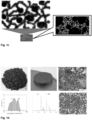
Claims (19)

  1. Elektrochemische Primärzelle mit Metall-enthaltendem Anodenmaterial sowie alkalischem Elektrolyten dadurch gekennzeichnet, dass
    das Metall-enthaltende Anodenmaterial Silizium umfasst, sowie Kohlenstoff und mindestens ein weiteres Metall umfasst, wobei das mindestes eine weitere Metall mindestens ein Metall von Mangan, Kalzium, Zink, Aluminium, Eisen und/oder eine Legierung umfassend eines oder mehrere der vorgenannten weiteren Metalle umfasst, wobei die Oberfläche des Metall-enthaltenden Anodenmaterials zumindest teilweise Sauerstoff enthaltende Silizium-Verbindungen aufweist.
  2. Primärzelle nach Anspruch 1 dadurch gekennzeichnet, dass die Primärzelle als Elektrolyten eine wässrige alkalische Elektrolytzusammensetzung umfasst, die enthält
    - 2,0 bis 99,0 Gew.-% Wasser, und
    - 0,0001 bis 15 Gew.-% mindestens eine Hydroxycarbonsäure, Carboxylat einer Hydroxycarbonsäure, Ester einer Hydroxycarbonsäure, Ether eines Carboxylats einer Hydroxycarbonsäure, polymere Verbindungen basierend auf Hydroxycarbonsäuren, Carboxylaten von Hydroxycarbonsäure, Estern von Hydroxycarbonsäuren oder Gemisch enthaltend mindestens zwei der vorgenannten Verbindungen, und
    - einen Gehalt von 0,001 bis 40 Gew.-% Alkalihydroxid
    in Bezug auf die Gesamtzusammensetzung von 100 Gew.-%.
  3. Primärzelle nach Anspruch 2, dadurch gekennzeichnet, dass die Hydroxycarbonsäure in der Elektrolytzusammensetzung ausgewählt ist aus Milchsäure, insbeondere D-Milchsäure,
    L-Milchsäure und/oder Gemische von D/L-Milchsäure, α-Hydroxycarbonsäuren, insbesondere Fruchtsäuren, insbesondere Äpfelsäure, Citronensäure, Fumarsäure, Gluconsäure, Glycolsäure, Mandelsäure, Milchsäure, Oxalsäure, Salicylsäure, α-Hydroxycaprylsäure und Weinsäure, β-Hydroxycarbonsäuren, insbesondere β-Hydroxybuttersäure und/oder Mevalonsäure, oder Gallussäure, 4-Hydroxybutansäure, Polyhydroxybuttersäure, Salicylsäure (2-Hydroxybenzoesäure), 4-Hydroxybenzoesäure (PHB) oder das Carboxylat von Hydroxycarbonsäure, Ester von Hydroxycarbonsäure, Ether von Carboxylat von Hydroxycarbonsäure auf mindestens einer der vorgenannten Hydroxysäuren basiert, und/oder die polymeren Verbindungen auf mindestens einer der Hydroxycarbonsäuren oder einem Gemisch enthaltend mindestens zwei der vorgenannten Verbindungen basiert.
  4. Primärzellenach Anspruch 2 oder 3, dadurch gekennzeichnet, dass die Elektrolytzusammensetzung umfasst mindestens eine lineare oder verzweigte Polyalkylenoxid-Gruppen aufweisende Verbindung mit mindestens drei Alkylenoxid-Gruppen in der Verbindung oder Gemische von mindestens zwei dieser Verbindungen, wobei die Alkylenoxid-Gruppen in der Polyalkylenoxid-Gruppen aufweisenden Verbindung ausgewählt sind aus Alkylenoxid-Gruppen mit 2 bis 6 C-Atomen je Alkylenoxid-Gruppe, und, wobei mindestens eine terminale Gruppe der Polyalkylenoxid-Gruppen aufweisenden Verbindung ausgewählt ist aus Hydroxy-Gruppen, Alkyl-Gruppen, Alkoxy-Gruppen, Alkenyl-Gruppen, Alkenyloxid-Gruppen, Carbonsäure-Gruppe, Carbonsäureester-Gruppen, Carbonsäureamid-Gruppen, aromatischen-Gruppen und/oder Gruppen enthaltend cyclische-Ether.
  5. Primärzelle nach Anspruch 4, dadurch gekennzeichnet, dass mindestens eine terminale Gruppe der Polyalkylenoxid-Gruppen aufweisenden Verbindung eine Hydroxy-Gruppe ist und mindestens eine weitere terminale Gruppe ausgewählt ist aus Hydroxy-Gruppen, Alkyl-Gruppen, Alkoxy-Gruppen, Alkenyl-Gruppen, Alkenyloxid-Gruppen, Carbonsäureester-Gruppen, aromatischen-Gruppen, insbesondere Alkyl-funktionalisierte Phenyl-Gruppen, besonders bevorzugt 4-(1,1,3,3-Tetramethylbutyl)-phenyl-polyethyleneglykol, bevorzugt 4-(1,1,3,3-Tetramethylbutyl)phenyl-polyethylene glycol, t-Octylphenoxypolyethoxyethanol, Polyethylene glycol tert-octylphenyl ether und/oder Gruppen enthaltend cyclische-Ether.
  6. Primärzellenach Anspruch 4 oder 5, dadurch gekennzeichnet, dass die Hydroxycarbonsäuren ausgewählt sind aus Enantiomeren, Diastereomeren oder Gemischen dieser.
  7. Primärzellenach einem der Ansprüche 2 bis 6, dadurch gekennzeichnet, dass die Elektrolytzusammensetzung Alkalihydroxid enthält, insbesondere Kaliumhydroxid.
  8. Primärzelle nach einem der Ansprüche 2 bis 7, dadurch gekennzeichnet, dass die Elektrolytzusammensetzung
    - 2,0 bis 99,0 Gew.-% Wasser,
    - 0,0001 bis 15 Gew.-% mindestens eine Hydroxycarbonsäure, Carboxylat der Hydroxycarbonsäure, Ester der Hydroxycarbonsäure, Ether von Carboxylat der Hydroxycarbonsäure, polymere Verbindungen basierend auf Hydroxycarbonsäure oder Gemische enthaltend mindestens zwei der vorgenannten Verbindungen,
    - einen Gehalt von 0,001 bis 40 Gew.-% Alkalihydroxid, und optional
    - 0,0001 bis 15 Gew.-% Polyalkylenoxid-Gruppen aufweisende Verbindungen oder Gemische dieser,
    in Bezug auf die Gesamtzusammensetzung von 100 Gew.-% enthält.
  9. Primärzelle nach einem der Ansprüche 2 bis 8, dadurch gekennzeichnet, dass die Elektrolyszusammensetzug enthält Wasser, insbesondere destilliertes Wasser, und eine Stoffmengenkonzentration von 1 bis 6 Mol/Liter Alkalihydroxid, insbesondere Kaliumhydroxid, und 10 ppm-Gew. bis 50.000 ppm-Gew. mindestens eine Hydroxycarbonsäure, Carboxylat der Hydroxycarbonsäure, Ester der Hydroxycarbonsäure, Ether von Carboxylat der Hydroxycarbonsäure, polymere Verbindungen basierend auf Hydroxycarbonsäure oder Gemische enthaltend mindestens zwei der vorgenannten Verbindungen oder Gemische von mindestens zwei dieser Verbindungen aufweist.
  10. Primärzelle nach einem der Ansprüche 1 bis 9, dadurch gekennzeichnet, dass sie eine Anode umfassend Metall-enthaltendes Anodenmaterial, eine Kathode sowie mindestens einen Separator aufweist, wobei der Separator die Kathode und die Anode voneinander separiert.
  11. Primärzelle nach Anspruch 11, dadurch gekennzeichnet, dass
    i) das Material der Kathode der Primärzelle Mangandioxid und optional einen Kohlenstoff enthaltenden Leitfähigkeitsvermittler aufweist, wobei die Primärzelle in einem hermetisch abgeschlossen Gehäuse vorliegt, oder
    ii) die Kathode der Primärzelle eine Luftkathode ist und das Material der Kathode der Primärzelle Mangandioxid und optional einen Kohlenstoff enthaltenden Leitfähigkeitsvermittler aufweist, insbesondere weist die Luftkathode eine für Kohlendioxid undurchlässige Membran auf.
  12. Primärzelle nach einem der Ansprüche 1 oder 10 bis 11, dadurch gekennzeichnet, dass das Anodenmaterial oder die Anode als Anodenmaterial Silizium umfasst, wobei das Silizium in Form von Silizium-Partikeln vorliegt und die Silizium-Partikel einen Gehalt an Kohlenstoff von 10 Gew.-ppm bis 20 Gew.-% in Bezug auf die Gesamtzusammensetzung der Silizium-Partikel von 100 Gew.-% aufweisen und optional die Siliziumpartikel aus einem Wafersägeprozess oder Recyclingprozess stammen.
  13. Primärzelle nach einem der Ansprüche 1 oder 10 bis 12, dadurch gekennzeichnet, dass das Anodenmaterial oder die Anode als Anodenmaterial Silizium und Siliziumcarbid umfasst, insbesondere, wobei Silizium und Siliciumcarbid in Form von Silizium-Partikeln vorliegen, bevorzugt liegt das Silizium in Form von Partikeln einer Partikelgröße von 400 nm bis 8 Mikrometer und/oder das Siliciumcarbid in Form von Partikeln einer Partikelgröße von 7 Mikrometer bis 20 Mikrometer vor.
  14. Primärzelle nach einem der Ansprüche 10 bis 13, dadurch gekennzeichnet, dass die Anode als Anodenmaterial Silizium umfasst, und die Anode als dreidimensionaler Formkörper vorliegt, wobei in den Formkörper eine Elektrode als Elektronenleiter eingebettet ist, und insbesondere weist der Formkörper eine Dichte von 0,1 g/cm3 bis 2,5 g/cm3 auf.
  15. Primärzelle nach Anspruch 14, dadurch gekennzeichnet, dass die Elektrode ein metallisches Netz, ein Netz aus einer metallischen Legierung, eine Folie, eine Folie mit Ausnehmungen und/oder eine Membran ist, oder die Elektrode aus mindestens einem Metall oder einer Legierung gebildet ist und eine dendritische Form aufweist. Bevorzugt ist der Formkörper eine Platte oder Zylinder mit einer Höhe von mindestens 15 mm, Breite von 15 mm und einer Dicke von mindestens 5 mm.
  16. Primärzelle nach einem der Ansprüche 1 oder 10 bis 13, dadurch gekennzeichnet, dass das Anodenmaterial oder die Anode umfasst
    A) 35 bis 55 Gew.-% metallisches Silizium,
    35 bis 55 Gew.-% Siliciumcarbid,
    1 bis 7,5 Gew.-% SiO2,
    0,01 bis 7,5 Gew.-% Eisen,
    optional 0,01 bis 2 Gew.-% Kupfer,
    wobei die Gesamtzusammensetzung des Anodenmaterials 100 Gew.-% beträgt oder
    B) 75 bis 99,998 Gew.-% Silizium,
    5 bis 24,999 Gew.-% Kohlenstoff,
    0,001 bis 5 Gew.-% mindestens eines weiteren Metalls, insbesondere umfassend Eisen größer gleich 5 mg/kg, Calcium größer gleich 5 mg/kg, Mangan größer gleich 0,1 mg/kg, und
    0 bis 5 Gew.-% Sauerstoff, insbesondere 0,001 bis 4 Gew.-% Sauerstoff,
    wobei die Gesamtzusammensetzung des Anodenmaterials 100 Gew.-% beträgt.
  17. Mehrzellige Batterie, dadurch gekennzeichnet, dass die Batterie mindestens zwei bis 15.000 mit einander verbundene Primärzellen nach einem der Ansprüche 1 bis 16 umfasst, vorzugsweise sind die zwei bis 15.000 mit einander verbundenen Primärzellen in Serie geschaltet.
  18. Verwendung von Siliziumpartikeln aus einem Wafersägeprozess in einer Primärzelle als Metall-enthaltendes Anodenmaterial, und insbesondere zur Herstellung einer Anode umfassen eine Elektrode als Elektronenleiter.
  19. Anode, insbesondere zur Verwendung in einer Primärzelle nach einem der Ansprüche 1 bis 16, umfassend
    A) 35 bis 55 Gew.-% metallisches Silizium,
    35 bis 55 Gew.-% Siliciumcarbid,
    1 bis 7,5 Gew.-% SiO2,
    0,01 bis 7,5 Gew.-% Eisen,
    optional 0,01 bis 2 Gew.-% Kupfer,
    wobei die Gesamtzusammensetzung des Anodenmaterials 100 Gew.-% beträgt oder
    B) 75 bis 99,998 Gew.-% Silizium,
    5 bis 24,999 Gew.-% Kohlenstoff,
    0,001 bis 5 Gew.-% mindestens eines weiteren Metalls, insbesondere umfassend Eisen größer gleich 5 mg/kg, Calcium größer gleich 5 mg/kg, Mangan größer gleich 0,1 mg/kg, und
    0 bis 5 Gew.-% Sauerstoff, insbesondere 0,001 bis 4 Gew.-% Sauerstoff,
    wobei die Gesamtzusammensetzung des Anodenmaterials 100 Gew.-% beträgt.
EP22158312.3A 2022-02-23 2022-02-23 Primärzelle enthaltend elektrolytzusammensetzung und insbesondere mikro-partikuläre nanokristalline silizium-partikel Ceased EP4235843A1 (de)

Priority Applications (1)

Application Number Priority Date Filing Date Title
EP22158312.3A EP4235843A1 (de) 2022-02-23 2022-02-23 Primärzelle enthaltend elektrolytzusammensetzung und insbesondere mikro-partikuläre nanokristalline silizium-partikel

Applications Claiming Priority (1)

Application Number Priority Date Filing Date Title
EP22158312.3A EP4235843A1 (de) 2022-02-23 2022-02-23 Primärzelle enthaltend elektrolytzusammensetzung und insbesondere mikro-partikuläre nanokristalline silizium-partikel

Publications (1)

Publication Number Publication Date
EP4235843A1 true EP4235843A1 (de) 2023-08-30

Family

ID=80448531

Family Applications (1)

Application Number Title Priority Date Filing Date
EP22158312.3A Ceased EP4235843A1 (de) 2022-02-23 2022-02-23 Primärzelle enthaltend elektrolytzusammensetzung und insbesondere mikro-partikuläre nanokristalline silizium-partikel

Country Status (1)

Country Link
EP (1) EP4235843A1 (de)

Citations (1)

* Cited by examiner, † Cited by third party
Publication number Priority date Publication date Assignee Title
WO2011061728A1 (en) * 2009-11-19 2011-05-26 Technion Research & Development Foundation Ltd. Silicon-air batteries

Patent Citations (1)

* Cited by examiner, † Cited by third party
Publication number Priority date Publication date Assignee Title
WO2011061728A1 (en) * 2009-11-19 2011-05-26 Technion Research & Development Foundation Ltd. Silicon-air batteries

Non-Patent Citations (8)

* Cited by examiner, † Cited by third party
Title
BANSAL RISHABH ET AL: "Silicon-air batteries: progress, applications and challenges", vol. 2, no. 6, 29 May 2020 (2020-05-29) - 29 May 2020 (2020-05-29), pages 1141, XP055964258, ISSN: 2523-3963, Retrieved from the Internet <URL:https://link.springer.com/content/pdf/10.1007/s42452-020-2925-7.pdf> DOI: 10.1007/s42452-020-2925-7 *
DAVID R. BLACKDONALD WINDOVERALBERT HENINSDAVID GILJAMES FILLIBENJAMES P. CLINE: "Standard Reference Material 640d for X-Ray Metrology", NATIONAL INSTITUTE OF STANDARDS AND TECHNOLOGY
DURMUS YASIN EMRE ET AL: "Investigation of the corrosion behavior of highly As-doped crystalline Si in alkaline Si-air batteries", ELECTROCHIMICA ACTA, vol. 265, 31 January 2018 (2018-01-31) - 31 January 2018 (2018-01-31), AMSTERDAM, NL, pages 292 - 302, XP055965765, ISSN: 0013-4686, DOI: 10.1016/j.electacta.2018.01.145 *
DURMUS YASIN EMRE ET AL: "Long run discharge, performance and efficiency of primary Silicon-air cells with alkaline electrolyte", ELECTROCHIMICA ACTA, ELSEVIER, AMSTERDAM, NL, vol. 225, 21 December 2016 (2016-12-21) - 21 December 2016 (2016-12-21), pages 215 - 224, XP029911334, ISSN: 0013-4686, DOI: 10.1016/J.ELECTACTA.2016.12.120 *
PRAKOSO BAGAS ET AL: "Recent Progress in Extending the Cycle-Life of Secondary Zn-Air Batteries", vol. 7, no. 4, 1 April 2021 (2021-04-01), pages 354 - 367, XP055965837, ISSN: 2199-692X, Retrieved from the Internet <URL:https://onlinelibrary.wiley.com/doi/full-xml/10.1002/cnma.202000672> DOI: 10.1002/cnma.202000672 *
SARWAR SAAD ET AL: "Transformation of Silicon Nanowire into Nanopyramid in Alkaline Solution and its Implication in Silicon-Air Battery : Transformation of Silicon Nanowire into Nanopyramid in Alkaline Solution", BULL. KOREAN CHEM. SOC., vol. 37, no. 7, 29 June 2016 (2016-06-29) - 29 June 2016 (2016-06-29), pages 997 - 1003, XP055964321, ISSN: 1229-5949, DOI: 10.1002/bkcs.10808 *
WANG YIFEI ET AL: "Solid-state Al-air battery with an ethanol gel electrolyte", GREEN ENERGY & ENVIRONMENT, 26 May 2021 (2021-05-26) - 26 May 2021 (2021-05-26), XP055965828, ISSN: 2468-0257, DOI: 10.1016/j.gee.2021.05.011 *
ZHONG XING ET AL: "High-Capacity Silicon-Air Battery in Alkaline Solution", CHEMSUSCHEM, vol. 5, no. 1, 9 January 2012 (2012-01-09) - 9 January 2012 (2012-01-09), DE, pages 177 - 180, XP055964441, ISSN: 1864-5631, DOI: 10.1002/cssc.201100426 *

Similar Documents

Publication Publication Date Title
Cui et al. Fluorine-doped SnO2 nanoparticles anchored on reduced graphene oxide as a high-performance lithium ion battery anode
DE3787000T2 (de) Elektrochemische Wasserstoffspeicherlegierungen mit erhöhter Ladungsspeicherung und elektrochemische Zelle mit erhöhter Ladungsspeicherung.
CN103270565B (zh) 纳米多孔/陶瓷复合金属
DE112022003502T5 (de) Dotiertes natriumeisen(iii)phosphatmaterial für die positive elektrode, verfahren zu dessen herstellung und dessen verwendung
KR101859811B1 (ko) 금속 나노입자와 금속 초박막이 코팅된 전도성 단결정 실리콘 입자, 이를 포함하는 고용량 이차전지용 음극활물질 및 그 제조방법
EP2411324A2 (de) Selbstorganisierende thermoelektrische materialien
JP2004303593A (ja) リチウム二次電池用負極材料及びその製造方法
DE112006000326T5 (de) Elektrodenmaterial mit verbesserten Ionen-Transport-Eigenschaften
DE112018000205B4 (de) Ein verfahren zur herstellung eines leistungsstarken lithiumtitanat-anodenmaterials für anwendungen von lithium-ionen-akkumulatoren
WO2015028542A1 (de) Pre-lithiierung von siliziumpartikeln
WO2018113807A1 (de) Lithium-ionen-festkörperakkumulator sowie verfahren zur herstellung desselben
DE60204441T2 (de) Hochleitendes elektron-material, elektrode für eine elektrochemische zelle, verfahren zur herstellung dieser elektrode und elektrochemische zelle
DE102016202202A1 (de) Vorrichtung und Verfahren zur Expansion von Graphit zu Graphen
DE102013206603A1 (de) Verfahren zur Herstellung von sauerstoffarmen Ventilmetallsinterkörpern mit hoher Oberfläche
DE212025000049U1 (de) Lithium-Ionen-Sekundärbatterie, Batterievorrichtung und stromverbrauchende Vorrichtung
CN114792795B (zh) 氟化物离子二次电池用负极及具备该负极的氟化物离子二次电池
DE112016006923T5 (de) Verfahren zur Herstellung eines Materials für die negative Elektrode einer Batterie, Lithium-Ionen-Batterie und Festkörperbatterie
Li et al. Structural Analysis by X‐Ray Diffraction Technique of Transition Metal Doped Zinc Oxide and Its Applications in Energy Storage Systems: A Critical Review
EP2381514A1 (de) Wasserstoffabsorbierende legierung und nickel-wasserstoff-speicherbatterie
JP5796787B2 (ja) 水素吸蔵合金及びニッケル水素蓄電池
CN102683653A (zh) 复合贮氢合金及镍氢蓄电池
Malik et al. Enhancing electrochemical performance of LaNi5 anodes using MXene as a multifunctional additive for Ni-MH batteries
EP4235843A1 (de) Primärzelle enthaltend elektrolytzusammensetzung und insbesondere mikro-partikuläre nanokristalline silizium-partikel
EP2602857A1 (de) Alkalibatterie und verfahren zur herstellung eines positivelektrodenmaterials für die alkalibatterie
EP4235836A1 (de) Elektrolytzusammensetzung und primärzelle enthaltend die elektrolytzusammensetzung und insbesondere nano-partikuläre silizium-partikel

Legal Events

Date Code Title Description
PUAI Public reference made under article 153(3) epc to a published international application that has entered the european phase

Free format text: ORIGINAL CODE: 0009012

STAA Information on the status of an ep patent application or granted ep patent

Free format text: STATUS: THE APPLICATION HAS BEEN PUBLISHED

AK Designated contracting states

Kind code of ref document: A1

Designated state(s): AL AT BE BG CH CY CZ DE DK EE ES FI FR GB GR HR HU IE IS IT LI LT LU LV MC MK MT NL NO PL PT RO RS SE SI SK SM TR

STAA Information on the status of an ep patent application or granted ep patent

Free format text: STATUS: THE APPLICATION HAS BEEN REFUSED

18R Application refused

Effective date: 20230921