EP4235841A1 - Elektrolytzusammensetzung und primärzelle enthaltend die elektrolytzusammensetzung und insbesondere nano-partikuläre silizium-partikel - Google Patents
Elektrolytzusammensetzung und primärzelle enthaltend die elektrolytzusammensetzung und insbesondere nano-partikuläre silizium-partikel Download PDFInfo
- Publication number
- EP4235841A1 EP4235841A1 EP22158299.2A EP22158299A EP4235841A1 EP 4235841 A1 EP4235841 A1 EP 4235841A1 EP 22158299 A EP22158299 A EP 22158299A EP 4235841 A1 EP4235841 A1 EP 4235841A1
- Authority
- EP
- European Patent Office
- Prior art keywords
- acid
- groups
- silicon
- weight
- electrolyte composition
- Prior art date
- Legal status (The legal status is an assumption and is not a legal conclusion. Google has not performed a legal analysis and makes no representation as to the accuracy of the status listed.)
- Ceased
Links
Images



Classifications
-
- H—ELECTRICITY
- H01—ELECTRIC ELEMENTS
- H01M—PROCESSES OR MEANS, e.g. BATTERIES, FOR THE DIRECT CONVERSION OF CHEMICAL ENERGY INTO ELECTRICAL ENERGY
- H01M12/00—Hybrid cells; Manufacture thereof
- H01M12/04—Hybrid cells; Manufacture thereof composed of a half-cell of the fuel-cell type and of a half-cell of the primary-cell type
- H01M12/06—Hybrid cells; Manufacture thereof composed of a half-cell of the fuel-cell type and of a half-cell of the primary-cell type with one metallic and one gaseous electrode
-
- H—ELECTRICITY
- H01—ELECTRIC ELEMENTS
- H01M—PROCESSES OR MEANS, e.g. BATTERIES, FOR THE DIRECT CONVERSION OF CHEMICAL ENERGY INTO ELECTRICAL ENERGY
- H01M4/00—Electrodes
- H01M4/02—Electrodes composed of, or comprising, active material
- H01M4/06—Electrodes for primary cells
-
- H—ELECTRICITY
- H01—ELECTRIC ELEMENTS
- H01M—PROCESSES OR MEANS, e.g. BATTERIES, FOR THE DIRECT CONVERSION OF CHEMICAL ENERGY INTO ELECTRICAL ENERGY
- H01M4/00—Electrodes
- H01M4/02—Electrodes composed of, or comprising, active material
- H01M4/14—Electrodes for lead-acid accumulators
-
- H—ELECTRICITY
- H01—ELECTRIC ELEMENTS
- H01M—PROCESSES OR MEANS, e.g. BATTERIES, FOR THE DIRECT CONVERSION OF CHEMICAL ENERGY INTO ELECTRICAL ENERGY
- H01M4/00—Electrodes
- H01M4/02—Electrodes composed of, or comprising, active material
- H01M4/24—Electrodes for alkaline accumulators
-
- H—ELECTRICITY
- H01—ELECTRIC ELEMENTS
- H01M—PROCESSES OR MEANS, e.g. BATTERIES, FOR THE DIRECT CONVERSION OF CHEMICAL ENERGY INTO ELECTRICAL ENERGY
- H01M4/00—Electrodes
- H01M4/02—Electrodes composed of, or comprising, active material
- H01M4/36—Selection of substances as active materials, active masses, active liquids
- H01M4/38—Selection of substances as active materials, active masses, active liquids of elements or alloys
- H01M4/386—Silicon or alloys based on silicon
-
- H—ELECTRICITY
- H01—ELECTRIC ELEMENTS
- H01M—PROCESSES OR MEANS, e.g. BATTERIES, FOR THE DIRECT CONVERSION OF CHEMICAL ENERGY INTO ELECTRICAL ENERGY
- H01M4/00—Electrodes
- H01M4/02—Electrodes composed of, or comprising, active material
- H01M4/36—Selection of substances as active materials, active masses, active liquids
- H01M4/48—Selection of substances as active materials, active masses, active liquids of inorganic oxides or hydroxides
- H01M4/50—Selection of substances as active materials, active masses, active liquids of inorganic oxides or hydroxides of manganese
-
- H—ELECTRICITY
- H01—ELECTRIC ELEMENTS
- H01M—PROCESSES OR MEANS, e.g. BATTERIES, FOR THE DIRECT CONVERSION OF CHEMICAL ENERGY INTO ELECTRICAL ENERGY
- H01M4/00—Electrodes
- H01M4/02—Electrodes composed of, or comprising, active material
- H01M4/62—Selection of inactive substances as ingredients for active masses, e.g. binders, fillers
- H01M4/624—Electric conductive fillers
- H01M4/625—Carbon or graphite
-
- H—ELECTRICITY
- H01—ELECTRIC ELEMENTS
- H01M—PROCESSES OR MEANS, e.g. BATTERIES, FOR THE DIRECT CONVERSION OF CHEMICAL ENERGY INTO ELECTRICAL ENERGY
- H01M4/00—Electrodes
- H01M4/86—Inert electrodes with catalytic activity, e.g. for fuel cells
- H01M4/90—Selection of catalytic material
- H01M4/9016—Oxides, hydroxides or oxygenated metallic salts
Definitions
- the invention relates to an aqueous, alkaline electrolyte composition which comprises a hydroxycarboxylic acid, carboxylate of a hydroxycarboxylic acid, ester of a hydroxycarboxylic acid, ether of a carboxylate of a hydroxycarboxylic acid, polymeric compound based on at least one hydroxycarboxylic acid or mixtures containing at least two of the aforementioned compounds.
- the invention includes a multi-cell battery, the use as an electrolyte in a primary cell with silicon as the anode material in the form of silicon particles, which are preferably present as silicon primary particles with a particle size between 1 nm and 3000 nm. Wherein the anode material in the charged state preferably does not comprise lithium and where the silicon primary particles are optionally crystalline and/or amorphous.
- the object of the invention was to improve the performance and service life of a galvanic cell containing silicon, in particular an alkaline galvanic cell. Furthermore, the power density of such a silicon-containing galvanic cell should be improved and a high initial voltage should be adjustable.
- the lithium content in the charged state is less than 1% by weight, preferably less than 0.1% by weight in the Total composition of the primary cell is, in particular comprising the anode, the cathode and the electrolyte, the lithium content is preferably im Electrode material of the anode in the charged state below 0.1% by weight.
- the galvanic cell should preferably have educts and reaction products that come from recycling processes in silicon wafer production, are by-products and/or can be used further in recycling processes.
- hydroxycarboxylic acid is selected from enantiomers, diastereomers or mixtures of these.
- ⁇ -Hydroxycarboxylic acids are preferred.
- Lactic acid is particularly preferred, preferably D- and/or L-lactic acid and mixtures of D-/L-lactic acid.
- the electrolyte composition preferably comprises at least one alkali metal hydroxide selected from NaOH and KOH and optionally other alkaline-soluble salts, such as alkaline earth metal hydroxides, basic metal oxides or organic bases.
- the electrolyte composition preferably comprises an alkali hydroxide selected from KOH and NaOH.
- Distilled water is preferably used to produce the aqueous electrolyte composition.
- the hydroxycarboxylic acid is selected from lactic acid, in particular D-lactic acid, L-lactic acid and/or mixtures of D/L-lactic acid, ⁇ -hydroxycarboxylic acids, in particular fruit acids, in particular malic acid, Citric acid, fumaric acid, gluconic acid, glycolic acid, mandelic acid, lactic acid, oxalic acid, salicylic acid, ⁇ -hydroxycaprylic acid and tartaric acid, ⁇ -hydroxycarboxylic acids, in particular ⁇ -hydroxybutyric acid and/or mevalonic acid, or gallic acid, 4-hydroxybutyric acid, polyhydroxybutyric acid, salicylic acid (2-hydroxybenzoic acid) , 4-Hydroxybenzoic acid (PHB) or the carboxylate of hydroxycarboxylic acid, ester of hydroxycarboxylic acid, ether of carboxylate of hydroxycarboxylic acid based on at least one of the aforementioned hydroxy acids, and / or
- the electrolyte composition can additionally contain a linear or branched compound containing polyalkylene oxide groups or mixtures thereof, the compound containing at least three alkylene oxide groups in the compound, the alkylene oxide groups in the compound containing polyalkylene oxide groups being selected from Alkylene oxide groups having 2 to 6 carbon atoms per alkylene oxide group, and where at least one terminal group of the compound containing polyalkylene oxide groups is selected from hydroxy groups, alkyl groups, alkoxy groups, alkenyl groups, alkenyl oxide groups , carboxylic acid groups, carboxylic acid ester groups, in particular olefinic carboxylic acid ester groups, carboxamide groups, aromatic groups, in particular alkyl-substituted aromatic groups, and/or groups containing cyclic ethers.
- a linear or branched compound containing polyalkylene oxide groups or mixtures thereof the compound containing at least three alkylene oxide groups in the compound, the alkylene oxide groups in the compound containing polyalkylene oxide groups
- the electrolyte composition can have a mixture of hydroxycarboxylic acid, carboxylate of a hydroxycarboxylic acid, ester of a hydroxycarboxylic acid, ether of a carboxylate of a hydroxycarboxylic acid, polymeric compounds based on hydroxycarboxylic acids, carboxylates of hydroxycarboxylic acid, esters of hydroxycarboxylic acids and at least one linear or branched compound containing polyalkylene oxide groups .
- alkyl groups, alkoxy groups, alkenyl groups, alkenyl oxide groups, carboxylic acid groups, carboxamide groups, carboxylic acid ester groups, in particular olefinic carboxylic acid ester groups preference is given to fatty acids, aromatic groups, in particular alkyl-substituted aromatic Groups and/or groups containing cyclic ethers as at least one terminal group and as at least one further terminal group each independently comprise 1 to 35 carbon atoms, in particular 2 to 25 carbon atoms.
- Alkyl, alkoxy, alkenyl, alkenyl oxide and aromatic groups optionally alkyl-substituted preferably each independently comprise 1 to 18 carbon atoms.
- Carboxylic acid esters are preferably selected from natural fatty acids having 4 to 20 carbon atoms.
- Preferred compounds having polyalkylene oxide groups, in particular comprising polyalkylene oxide groups can have a molecular weight of 200 g/mol to 35,000 g/mol, preferably 200 to 1500 g/mol. It is further preferred if the average molecular weight is from 200 g/mol to 1500 g/mol.
- the alkylene oxide groups in the compound containing polyalkylene oxide groups can preferably be selected from alkylene oxide groups having 2 to 4 carbon atoms per alkylene oxide group. Furthermore, it is preferred if the compounds containing polyalkylene oxide groups contain at least five alkylene oxide groups, in particular up to one hundred alkylene oxide groups, with 2 to 4 carbon atoms per alkylene oxide group in the compound.
- Alkylene is particularly preferably divalent ethylene (-CH 2 CH 2 -), especially as an ethylene oxide group, or divalent propylene, especially in propylene oxide groups (-CH 2 (CH 3 CH)- and -(CH 2 ) 3 -).
- the terminal groups of the compound containing polyalkylene oxide groups are preferably selected from hydroxyl groups, alkyl groups, alkoxy groups, alkylene groups, alkylene oxide groups, carboxylic acid ester groups, in particular olefinic carboxylic acid ester groups, aromatic groups and/or groups containing cyclic ethers.
- the at least one terminal group of the compound containing polyalkylene oxide groups is a hydroxy group and at least one further terminal group is selected from hydroxy groups, alkyl groups, alkoxy groups, alkenyl groups, alkenyl oxide groups, carboxylic acid esters groups, aromatic groups, in particular alkyl-substituted aromatic groups, and/or groups containing cyclic ethers. It is further preferred if the linear compounds have a first terminal and a further terminal group and branched compounds have a first, a further terminal group and at least one additional terminal group.
- the electrolyte compositions can additionally comprise at least one compound containing polyalkylene oxide groups with at least one cyclic ether group having 5 to 8 carbon atoms and optionally as at least one terminal group a carboxylic acid ester, in particular a carboxylic acid ester of a fatty acid, and, where the at least one or more further terminal groups are selected from hydroxy groups, alkyl groups, alkoxy groups, alkenyl groups, alkenyl oxide groups, carboxylic acid ester groups, aromatic groups and/or groups containing cyclic ethers with 5 to 8 carbon atoms.
- Particularly preferred is a compound having branched polyalkylene oxide groups with one to six polyalkylene oxide groups on the cyclic ether group and at least one alkylene oxide functionalized fatty acid ester.
- Typical fatty acids include oleic acid, lauric acid, stearic acid, isostearic acid and/or palmitic acid.
- Particularly preferred compounds include ethoxylated sorbitan fatty acid esters, particularly mono- to triesters. Preferably with 2 to 200 ethoxy groups, in particular with 2 to 50 ethoxy groups, and optionally with propoxy group(s) as polyalkylene oxide groups.
- an aqueous, alkaline electrolyte composition can additionally contain branched polyalkylene oxide group-containing compounds, which include ethers of carbohydrates, in particular ethers of furanoses or pyranoses, which optionally contain carboxylic acid esters of fatty acids.
- branched polyalkylene oxide group-containing compounds which include ethers of carbohydrates, in particular ethers of furanoses or pyranoses, which optionally contain carboxylic acid esters of fatty acids.
- Compounds of sorbitan fatty acid esters containing polyalkylene oxide groups such as polyoxyethylene (20) sorbitan monooleate (Tween 80), are particularly preferred.
- polysorbate 20 polyoxyethylene (20) sorbitan monolaurate) (E 432), polysorbate 21 (polyoxyethylene (4) sorbitan monolaurate), polysorbate 40 (polyoxyethylene (20 )-sorbitan monopalmitate) (E 434), polysorbate 60 (polyoxyethylene (20) sorbitan monostearate) (E 435), polysorbate 61 (polyoxyethylene (4) sorbitan monostearate), polysorbate 65 (polyoxyethylene (20) sorbitan tristearate) (E 436), polysorbate 80 (polyoxyethylene (20) sorbitan monooleate) (E 433), polysorbate 81 (polyoxyethylene (5) sorbitan monooleate), polysorbate 85 (polyoxyethylene (20) sorbitan trioleate), polysorbate 120 (polyoxyethylene (20 )-sorbitan monoisostearate).
- Particularly preferred electrolyte compositions may comprise compounds containing polyalkylene oxide groups selected from polyethylene glycol, polypropylene glycol, propylene oxide and compounds containing ethylene oxide groups containing polyalkylene oxide groups, the terminal groups being selected from hydroxy groups, alkoxy groups, alkyl groups, alkenyl groups, alkenyl oxide groups, alkyl functional carboxylic acid ester groups, alkylene functional carboxylic acid groups, wherein the alkoxy, alkyl and alkylene groups each independently have from 1 to 24 carbon atoms.
- compounds containing polyalkylene oxide groups can be selected from compounds containing furanoses containing polyalkylene oxide groups and/or pyranoses containing polyalkylene oxide groups, in particular compounds of furanose fatty acid esters containing polyalkylene oxide groups and/or compounds of pyranose groups containing polyalkylene oxide groups. fatty acid esters.
- the terminal groups of the compound containing polyalkylene oxide groups are selected from hydroxyl groups, alkyl groups, alkoxy groups, alkylene groups, alkylene oxide groups, carboxylic acid ester groups, aromatic groups and/or groups containing cyclic ethers.
- compounds of sorbitan fatty acid esters containing polyalkylene oxide groups comprising compounds of a sorbitan monostearate, sorbitan tristearate, sorbitan monolaurate, sorbitan monooleate, sorbitan trioleate and/or sorbitan monopalmitate containing polyalkylene oxide groups.
- the compound containing polyalkylene oxide groups comprises at least one cyclic ether group having 5 to 8 carbon atoms and optionally a carboxylic acid ester, in particular a fatty acid or a fruit acid, preferably a fatty acid, as at least one terminal group. and, wherein the further terminal groups are selected from hydroxy groups, alkyl groups, alkoxy groups, alkenyl groups, alkenyl oxide groups, carboxylic acid ester groups, aromatic groups, in particular alkyl-functionalized phenyl groups, and/or groups containing cyclic ethers with 5 to 8 carbon atoms.
- the invention also relates to an electrolyte composition
- an electrolyte composition comprising 2.0 to 99.0% by weight water and 0.0001 to 15% by weight of at least one hydroxycarboxylic acid, carboxylate of hydroxycarboxylic acid, ester of hydroxycarboxylic acid, ether of carboxylate of hydroxycarboxylic acid, polymeric compounds based on hydroxycarboxylic acid or mixtures containing at least two of the aforementioned compounds, preference is given to 0.01 to 10% by weight, particularly preferably 0.1 to 2.5% by weight, and a content of 0.001 to 40% by weight.
- the electrolyte composition can optionally contain alkali metal silicate, with the content preferably being less than 4 mol/liter alkali metal silicate, preferably from 0.001 to 3.5 mol/liter alkali metal silicate, in particular in the total composition of 100% by weight.
- Distilled water is preferably used to produce the aqueous electrolyte composition.
- the water for producing the electrolyte composition preferably has a conductivity at 25° C. of greater than or equal to 0.055 ⁇ S/cm, more preferably greater than or equal to 0.5 ⁇ S/cm.
- conductivity considerably higher and is preferably greater than or equal to 1 mS/cm at 25° C., preferably greater than or equal to 0.5 S/cm at 25° C.
- the electrolyte composition is an aqueous, alkaline composition
- alkali metal hydroxide in particular potassium hydroxide
- at least one hydroxycarboxylic acid carboxylate of hydroxycarboxylic acid, ester of hydroxycarboxylic acid, ether of carboxylate of hydroxycarboxylic acid, polymeric compounds based on hydroxycarboxylic acid or mixtures containing at least two of the aforementioned Links,.
- the content of the alkali metal hydroxide is from 0.001 to 6 mol/liter, preferably from 1 to 5.5 mol/liter in the aqueous, alkaline electrolytic composition.
- the content of hydroxycarboxylic acid, carboxylate of hydroxycarboxylic acid, ester of hydroxycarboxylic acid, ether of carboxylate of hydroxycarboxylic acid, polymeric compounds based on hydroxycarboxylic acid or mixtures containing at least two of the aforementioned compounds can depend on the selected electrode surface and other process conditions such as temperature, flow rate in the cell, pore size of the electrode surface etc. depend.
- the content of at least one hydroxycarboxylic acid, carboxylate of hydroxycarboxylic acid, ester of hydroxycarboxylic acid, ether of carboxylate of hydroxycarboxylic acid, polymeric compounds based on hydroxycarboxylic acid or mixtures containing at least two of the aforementioned compounds or mixtures of at least two of these compounds from 0.000001 to 50,000 ppm wt., especially from 0.01 to 20,000 ppm wt., preferably from 0.01 ppm wt. to 10,000 ppm wt., in the electrolyte composition, particularly with a total composition of 100 wt.%.
- the electrolyte composition has a molar concentration of 1 to 6 mol/liter alkali metal hydroxide, in particular potassium hydroxide, and 10 ppm wt. up to 50,000 ppm wt. linear or branched compounds containing polyalkylene oxide groups with at least three alkylene oxide groups in the compound or mixtures of at least two of these compounds in water, the total composition of the electrolyte composition being in particular 100% by weight.
- the compound containing polyalkylene oxide groups is preferably selected from compounds containing polyethylene oxide groups, polypropylene oxide groups, polypropylene oxide groups and polyethylene oxide groups. In an alternative, the compound containing polyalkylene oxide groups contains at least one cyclic ether.
- the invention also relates to a chemical primary cell comprising an anode, a cathode, an electrolyte and at least one separator, the separator separating the cathode and the anode from one another, and the cathode comprises manganese dioxide and optionally carbon-containing conductivity media as material, the anode being Anode material comprises silicon, and wherein the silicon is in the form of silicon particles.
- the silicon primary particles preferably have a particle size of between 1 nm and 3000 nm.
- the silicon particles are crystalline, in particular the silicon particles are polycrystalline.
- the silicon particles are essentially X-ray amorphous.
- mixtures of silicon particles, including amorphous and crystalline silicon particles can be used as anode material.
- the subject matter of the invention is therefore an electrochemical primary cell having an anode, a cathode and at least one separator and containing an electrolyte solution according to the invention, the separator separating the cathode and the anode from one another.
- the primary cell can be present with a hermetically sealed housing, i) the material of the cathode of the primary cell having manganese dioxide and optionally a conductivity agent containing carbon.
- a hermetically sealed housing is generally understood to be a housing that is made from a material that is inert to alkaline electrolytes and is hermetically sealed, in particular fluid-tight (gas-tight and liquid-tight).
- Polyether ether ketones, polyaryl ether ketones, polyphenylene sulfide (PPS), polyoxymethylene copolymers (POM-C), polyamide, cycloolefins or other high-performance plastics or metal alloys can be considered as materials for the housing or for the separator.
- the components of the housing can be laser welded or welded using plasma processes.
- the cathode can be embodied as carbon-supported MnO 2 .
- the separator can be designed with a shut-down function in order to prevent access of the electrolyte from the anode and/or the cathode in the event of undesired process conditions.
- the primary cell can have a bursting plate in order to prevent the primary cell from exploding if the pressure rises undesirably and to control the targeted escape of the components from the primary cell when the pressure rises.
- the primary cell can have an air cathode as the cathode ii).
- the material of the cathode in this primary cell preferably comprises manganese dioxide and optionally a carbon-containing conductivity mediator, in particular, the air cathode has a carbon dioxide-impermeable membrane, which is preferably arranged in the primary cell in such a way that it prevents the access of carbon dioxide from the ambient air to the cathode.
- the subject matter of the invention is a primary cell in which the anode comprises silicon as the anode material, in particular the silicon being present in the form of silicon particles, in particular the silicon particles being present with a particle size of 1 micrometer and 50 micrometers, and preferably as silicon Primary particles with a particle size between 1 nm and 3000 nm.
- the silicon particles can be selected from crystalline, in particular polycrystalline, and/or amorphous silicon particles.
- saw residues from silicon wafer production such as wafers for the production of semiconductors or also residues from the production of solar silicon wafers can be used, which preferably have a bimodal particle distribution, preferably with maxima around 1000 and 10000 nm each independently +/- - 100 nm, in particular one fraction of particles with a particle size distribution from d 10 to d 90 of 100 nm to 9000 nm and a second fraction of particles from d 10 to d 90 of 6000 nm to 45000 nm.
- Particle size can be determined by means of laser diffraction according to ISO13320 (2009), for example with a Mastersizer 2000 or by means of TEM analysis and, for example, by means of sieve analysis.
- XRD analyzes of the polycrystalline silicon particles using the Scherrer equation reveal crystallite sizes of greater than or equal to 12 nm.
- the silicon primary particles are essentially amorphous.
- the silicon particles can preferably be in the form of agglomerates of silicon primary particles, aggregates of silicon primary particles or mixtures of these agglomerates and aggregates, the agglomerates and/or aggregates having a size of 100 to 30,000 nm.
- the primary particles can have particles with a primary particle size of 10 to 90 nm.
- the invention also relates to a multi-cell battery, the battery comprising at least two to 15,000 primary cells connected to one another, preferably the two to 1,000 primary cells connected to one another are connected in series.
- the invention also relates to the use of at least one hydroxycarboxylic acid, carboxylates of hydroxycarboxylic acid, esters of hydroxycarboxylic acid, ethers of carboxylates of hydroxycarboxylic acid, polymeric compound based on hydroxycarboxylic acid or mixtures containing at least two of the aforementioned compounds as an additive in an electrolyte composition, in particular in one aqueous, alkaline electrolyte composition, in an electrochemical primary cell, in particular wherein the anode of the primary cell contains silicon in the form of silicon particles with a particle size between 1 nm and 50000 nm, in particular from 1 micrometer to 30 micrometers.
- the anode in the primary cell is silicon in the form of crystalline, such as polycrystalline, and/or amorphous silicon particles.
- Silicon primary particles in particular X-ray amorphous primary particles, with a particle size of between 1 nm and 3000 nm, which are preferably present as aggregates, are particularly preferred.
- the inventors have found that specific silicon particles can be used as an active component in a galvanic cell and that significant power densities to unexpectedly high power densities of greater than or equal to 0.5 mW/cm 2 can be achieved in a single specific electrochemical primary cell.
- the best power densities for silicon-containing primary cells of more than 3 mW/cm 2 could be obtained with electric soot or electrochemically treated or produced soot and conductive soot.
- agglomerated silicon primary particles or agglomerates of silicon are understood to mean silicon primary particles which essentially touch at the corners and edges and not at the surfaces. When dispersed, agglomerates can be broken down into aggregates and the primary silicon particles. Furthermore, aggregates are understood to mean primary particles that have grown together, melted together or agglomerated and that can only be separated from one another under the action of mechanical force.
- an economical cathode material which preferably comprises a physical mixture of manganese dioxide (MnO 2 ) and a conductivity promoter.
- the optional content of the conductivity mediator in the electrodes of the primary cell can be different in the cathode and in the anode.
- a conductivity mediator content in the material of the cathode of approximately 5 to 65% by weight, preferably 5 to 15% by weight, is customary.
- the content of the conductivity promoter can be from 5 to 60% by weight in the material of the cathode.
- contents in the range of 15 to 20% by weight can be preferred for a lower resistance or also as an upper limit 30 to 60% by weight.
- the total material of the cathode is always 100% by weight.
- the subject matter of the invention is therefore at least one electrochemical primary cell which has an anode, a cathode, an electrolyte and at least one separator, the separator separating the cathode and the anode from one another, and the cathode comprising manganese dioxide and optionally a carbon-containing conductivity agent as material, wherein the anode comprises silicon as the anode material and wherein the silicon is present in the form of silicon particles and the silicon primary particles have a particle size of between 1 nm and 3000 nm, and the primary particles are optionally essentially amorphous.
- the silicon particles, and in particular the silicon primary particles have a crystallinity of less than or equal to 20%, in particular 12%, in particular a crystallinity of less than or equal to 2%. Silicon primary particles with a crystallinity below 12%, preferably below 2% are considered amorphous.
- the silicon particles are preferably present in the anode as aggregates and the lithium content is optionally less than or equal to 1% by weight, in particular less than or equal to 0.1% by weight, based on the silicon content of the anode of 100% by weight. % of the primary cell, the content of lithium preferably being less than or equal to 0.1% by weight in the charged state of the primary cell.
- a powder that is X-ray amorphous is considered to be essentially amorphous.
- a powder with a crystallinity of less than 20%, preferably less than 12%, particularly preferably less than or equal to 2% is considered to be X-ray amorphous.
- the invention also relates to primary cells in which the anode material comprises silicon particles comprising primary silicon particles, agglomerates of primary silicon particles, aggregates of primary silicon particles and/or mixtures thereof, with the agglomerates and/or aggregates in particular having a size of 10 nm to 100 ⁇ m (microns). Preference is given to agglomerates and/or aggregates in the range from 100 nm to 5 micrometers, in particular from 200 nm to 2 micrometers, preferably from 300 nm to 1.5 micrometers and/or from 400 nm to 1 micrometer.
- the primary silicon particles can have a particle size distribution of from 1 nm to 1500 nm, in particular from 50 to 300 nm or from 100 nm to 300 nm.
- Battery separators in an alkaline battery cell are used to separate a negative electrode from a positive electrode when placed in a suitable electrolyte.
- the separator exhibits a relatively low resistance to electrolyte ion transfer, but a significantly high resistance to electrode ion transfer, during cell operation when the normal chemical reactions are occurring.
- the separator is formed, for example, by applying an improved coating.
- the separator is typically a flexible, fibrous, and porous substrate that is resistant to strong alkali and oxidation.
- the separator can be a composite and can preferably be based on at least one polymer such as polyethylene, polypropylene, polyacrylate, PEEK (polyetheretherketone), PEAK (polyetheraryletherketone), PEEK/PEDEK (polyetheretherketone, polyetherdiphenyletherketone), lingnocellulose, cellulose and/or microcellulose.
- the anode material comprises silicon particles and conductivity mediators, in particular the conductivity mediator comprises carbon-containing particles or a carbon-containing paste, such as electrically conductive organic polymers.
- a particularly preferred anode material of the anode comprises from 10 to 100.00% by weight, in particular from 5 to 90% by weight, preferably from 10 to 95% by weight, of silicon particles and a conductivity agent containing carbon, in particular from 5 to 90% by weight and optionally further additives to 100% by weight of the anode material.
- the conductivity mediator preferably comprises carbon-containing particles, in particular with a particle size of 20 to 100 nm, in particular 25 to 80 nm.
- an anode material of the anode containing 20 to 75% by weight, preferably 20 to 60% by weight, silicon particles and a carbon-containing material
- Conductivity promoter in particular from 25 to 80% by weight, preferably from 40 to 80% by weight, and optionally further additives to 100% by weight of the anode material.
- the conductivity promoter preferably comprises carbon-containing particles, in particular with a particle size of 20 to 100 nm, in particular 25 to 80 nm.
- a particularly preferred anode material of the anode comprises 45 to 55% by weight silicon particles and 55 to 45% by weight a conductivity agent containing carbon, the total composition of the anode material being 100% by weight, ie without electrolyte and/or dried.
- the cathode of the primary cell a) comprises manganese dioxide as cathode material, or b) the cathode of the primary cell is an air cathode and the cathode comprises manganese oxide, in particular manganese oxide and manganese dioxide, platinum, platinum-based, nickel-cobalt cyanide, or silver as a catalyst in the cathode material.
- Nickel-cobalt cyanides exemplify the class of base metal catalysts with excellent electroactivity for the oxygen reduction reaction in the neutral electrolyte.
- the preparation of the Ni/Co-doped C-N hollow nanotube composite catalysts (C-N, Co/C-N, Ni/C-N and Ni-Co/C-N) is performed by a simple pyrolysis of the Ni/Co salt ⁇ dicyandiamide ⁇ glucose ⁇ mixture.
- a corresponding silicon-air battery was assembled in a neutral medium using the prepared sample as a catalyst for the air electrode, and showed excellent discharge performance and stability.
- the cathode preferably comprises manganese dioxide as a material, ie as a cathode material or as a catalyst in the cathode material to accelerate the solubility of oxygen.
- a preferred cathode material for a cathode in an air cathode primary cell preferably comprises manganese oxide, in particular manganese oxide and/or manganese dioxide, and silver as a catalyst.
- a particularly preferred cathode material especially for a primary cell with an air cathode, has a hydrophobic cathode whose cathode material is a mixture of manganese (di)oxide, preferably an average particle size of less than or equal to 10 ⁇ m (microns), in particular electrolytic gamma manganese dioxide, a conductivity promoter and a polymeric halogenated hydrocarbon, in particular a polymeric fluorinated hydrocarbon, in particular a polytetrafluoroethylene.
- the mixture can be pressed into plates, dried.
- a microporous, hydrophobic film for example made of a polymeric fluorinated hydrocarbon, is preferably applied in the primary cell to the cathode side exposed to the air.
- a particularly preferred cathode material in particular the cathode in a hermetically sealed primary cell, comprises 75 to 85% by weight manganese dioxide and 15 to 25% by weight a conductivity agent containing carbon, the overall composition of the cathode material being 100% by weight (cathode material without electrolyte and/or dried).
- the carbon-containing conductivity mediator preferably comprises carbon-containing particles, particularly preferably graphene-containing particles.
- the carbon particles preferably have a particle size distribution in the range from 0.1 nm to 5 micrometers, preferably from 5 nm to 5 micrometers. It is further preferred if the carbon particles have a particle size in the range from 5 nm to 300 nm, in particular from 10 nm to 150 nm, particularly preferably from 20 to 100 nm and optionally as agglomerates with a size of 100 nm to 3 micrometers, preferably a size of 300 nm to 2 micrometers.
- the silicon, in particular the silicon particles, preferably the amorphous silicon particles, of the anode material comprises dopants, the dopants being selected from elements of main group 13, in particular comprising boron, indium, aluminum and/or gallium, and from elements of main group 15, in particular comprising phosphorus, arsenic and/or antimony and elements of the iron group, boron, aluminum, phosphorus and/or iron being particularly preferred.
- the elements of the 13th main group (new nomenclature: group 13 of the periodic table) are electron acceptors of the new nomenclature.
- Elements of main group 15 (new nomenclature: group 15 of the periodic table) are used as electron donors.
- the silicon in particular the silicon particles of the anode material, comprises dopants, the dopants being greater than or equal to 1 element of main group 15 per 10 6 silicon atoms and/or greater than or equal to 1 element of main group 13 per 10 6 silicon -Atoms are present, in particular greater than or equal to 1 element of main group 15 per 10 4 silicon atoms and/or greater than or equal to 1 element of main group 13 per 10 4 silicon atoms, determined by means of ICP-MS analysis known to those skilled in the art (Inductive Plasma Discharge -Mass spectroscopy, which is described in detail on Wikipedia: https://de.wikipedia.org/wiki/Massenspektrometrie_mit_induktiv_kupplungem_Plasma).
- the analysis can also be carried out by GD-MS (GDMS/GD-MS glow discharge mass spectroscopy with secondary electron multiplier (SEM) and/or Faraday detector according to source: https://assets.thermofisher.com/TFS-Assets /CMD/brochures/BR-30066-GD-MS-ELEMENT-GD-PLUS-BR30066-EN.pdf).
- SEM secondary electron multiplier
- the Farady detector preferably for measuring trace concentrations in the % range.
- the silicon, in particular the amorphous silicon particles, of the anode material comprises dopants, the dopants being greater than or equal to 10 4 atoms (approx. 100 ppm by weight, depending on the atomic weight of the dopant) of main group 15 to 10 6 silicon atoms and/or greater than or equal to 10 4 atoms of main group 13 for 10 6 silicon atoms.
- the silicon, in particular the amorphous silicon particles, of the anode material comprises dopants, the dopants being greater than or equal to 2 ⁇ 10 4 atoms of the 15th main group to 10 6 silicon atoms greater than or equal to 2 ⁇ 10 4 atoms of the 13th Main group to 10 6 silicon atoms.
- the above levels of dopants in the silicon of the anode material can be distributed inhomogeneously in the silicon, and the levels can be integral over the total amount of silicon in the anode material on average.
- a test quantity of 1 g test quantity is measured using GD-MS or ICPMS, with certain deviations being able to be determined between the two methods; an average value is preferably determined.
- the silicon, in particular the amorphous silicon particles, of the anode material comprises dopants, the dopants being greater than or equal to 10 5 atoms of main group 15 to 10 6 silicon atoms and/or greater than or equal to 10 5 atoms of group 13.
- Main group amount to 10 6 silicon atoms.
- the silicon, in particular the amorphous silicon particles, of the anode material comprises dopants, the dopants being greater than or equal to 10 5 atoms of main group 15 to 10 6 silicon atoms and/or greater than or equal to 10 5 atoms of group 13.
- Main group to 10 include 6 silicon atoms.
- the silicon particles can have an alloy of silicon with at least one element of main group 13 or 15, wherein the at least one element of main group 13 or 15 with greater than or equal to 10 21 atoms/cm 3 is selected from at least one electron donor and electron acceptor is present.
- the alloy of silicon at the atomic level with at least one element of main group 13 or 15 is present as an amorphous or crystalline phase.
- the silicon particles particularly preferably have a boron content of 10 ppm by weight to 2.5% by weight in relation to the total content of 100% by weight of the silicon particle; a content of 10 ppm by weight to 1.8 is preferred , more preferably 1.8% by weight plus/minus 0.2% by weight.
- the silicon foil can be analogous have a boron content of 10 ppm by weight to 1.8% by weight with respect to the total content of 100% by weight of the silicon foil.
- the invention relates to a primary cell comprising silicon particles which have a boron content of 10 ppm by weight to 1.8% by weight.
- a conductivity mediator and silicon particles to produce the anode and manganese dioxide to produce the cathode and optionally a binder, such as a polymeric fluorinated hydrocarbon, are mixed and optionally dried.
- a homogeneous particle size of less than or equal to 10 micrometers to 5 nm is preferably set and the mixture is pressed to form an anode (plate) or cathode (plate).
- the primary cell has an air inlet at the air cathode, which can be a gas-permeable membrane.
- a membrane made from an inert polymer is preferred, preferably from a polyfluoropolyethylene, polyfluoropolypropylene or copolymers thereof.
- the structure of the air cathode is usually a sandwich structure comprising a gas-permeable membrane, a metallic mesh for conducting electricity and at least one catalyst, in particular a porous catalyst.
- the gas permeable membrane is preferably impermeable to carbon dioxide and permeable to oxygen and optionally nitrogen.
- the primary particles of the silicon particles form agglomerates and/or aggregates or mixtures thereof and can preferably be arranged in a porous silicon network, in particular the agglomerates, aggregates or mixtures of these can be mechanically combined into a porous silicon -Network may be stuck.
- the anode material can particularly preferably be a porous silicon network made of silicon primary particles, agglomerates of silicon primary particles, aggregates of silicon primary particles and/or mixtures thereof.
- the silicon particles in particular the primary silicon particles, are essentially amorphous (X-ray amorphous), since this ensures that the silicon particles dissolve uniformly in the electrolyte.
- essentially crystalline silicon dissolution in the electrolyte would be anisotropic.
- Amorphous silicon is dissolved isotropically, so amorphous silicon can provide higher energy density.
- the etch rate for the (111) directions of a silicon crystal is about two orders of magnitude smaller than that of any other direction.
- the (100) oriented faces of the silicon crystal become one and a half times as fast as the (110)-oriented faces.
- doped, amorphous silicon particles can be used.
- the etch rate is reduced since the higher the doping rate, the lower the etch rate.
- the power density can also be adjusted via the etching rate via the doping in amorphous silicon particles.
- Amorphous primary silicon particles are primary silicon particles, usually in the form of a powder or in a solid composition, which (primary silicon particles) are X-ray amorphous and which can optionally be embedded in particulate form in an auxiliary matrix, e.g. carbon black.
- X-ray amorphous means that the X-ray signal" according to the main peaks: 28.5° (111) 47.4°(220) 56.0° (311) 69.4° (400) maximum less than 10% of the signal amplitudes related to the fcc structure of the silicon (JCPDS card: 00-027-1402).
- Anode material according to the invention does not include any silicides.
- Silicides are understood to be intermetallic compounds with a stoichiometric proportion of at least one second metal. Silicides feature a homogeneous chemical combination of two or more metals with lattice structures distinct from those of the constituent metals.
- the anode material does not have a classic alloy of at least two elements which together have the metal-typical feature of the crystalline structure with metal bonding, since the silicon particles are preferably essentially amorphous (X-ray amorphous).
- the electrochemical primary cell according to the invention is not a lithium-ion battery.
- the anode material does not include a lithium intercalation compound.
- the cathode material does not include lithium metal oxide.
- the primary cell preferably does not include any lithium salts.
- the primary cell can contain lithium in the overall composition in small amounts of less than or equal to 5% by weight, preferably less than or equal to 1% by weight, in particular from 0.001% by weight to 1% by weight in the overall composition with 100% by weight. include %.
- the overall composition here is the totality of cathode, anode and electrolyte composition.
- the silicon particles can have an alloy of silicon with at least one element of main group 13 or 15, wherein the at least one element of main group 13 or 15 with greater than or equal to 10 21 atoms/cm 3 is selected from at least one electron donor and electron acceptor is present.
- the alloy of silicon with at least one element of main group 13 or 15 is present as an amorphous phase.
- the silicon primary particles essentially have a particle size of 5 to 500 nm, in particular 5 to 20 nm, preferably 5 to 15 nm, or in equally preferred alternatives, the silicon primary particles have particle sizes of 20 to 200 nm or from 70 to 350 nm, in particular from 100 to 300 nm.
- the silicon primary particles are present in the form of agglomerates and/or aggregates of the primary particles, the agglomerates and/or aggregates having a particle size of 100 nm to 30 ⁇ m, in particular 100 nm to 2000 nm, preferably of 150 to 1000 nm or from 400 to 1000 nm.
- the above arrangements can also be viewed as nanowires or nanonetworks.
- the silicon particles are essentially in the form of agglomerates of silicon primary particles and/or aggregates of silicon primary particles or mixtures of these, the agglomerates and/or aggregates having a size of 100 to 30,000 nm, in particular 100 to 2500 nm, preferably from 100 nm to 1500 nm, more preferably 150 to 1000 nm, 400 to 1000 nm or 200 to 3000 nm.
- the primary silicon particles according to the invention preferably have a surface area of 0.001 to 500 m 2 /g, preferably 0.1 to 300 m 2 /g, preferably 0.1 to 100 m 2 /g, in particular 10-300 m 2 /g. g, preferably with a primary particle size of about 10 nm on average plus/minus 9 nm.
- the surface area of the agglomerates and/or aggregates is preferably from 10 to 80 m 2 /g.
- the packing density of the silicon particles as bulk powder is preferably 10 to 50 g/l (grams per liter), in particular around 100 g/l when deaerated. If the silicon particles are sintered as a 3D shaped body, the packing density can be from 700 g/l to 1500 g/l. In the case of densely sintered silicon particles, the packing density can be between 1.5 kg/l and 2.3 kg/l.
- silicon is present with a layer thickness of greater than 0.1 micrometer, it is further preferred if the silicon is present in the form of a foil, in particular a folded foil, optionally coated foil, for example as strip material based on technically available material from printing processes.
- the strip material of the film can be cut to target formats such as A5.
- the cathode and/or the anode preferably have a porosity that is determined by density measurement.
- Anode from 18 to 35% by volume in relation to the total volume of the cathode or anode from 100% by volume in each case, preferably from 24 to 28% by volume, particularly preferably from 25% by volume to 27% by volume .
- the porosity is the space in the anode and/or the cathode that is available for the fluid electrolyte.
- the porosity is expressed as a volume percentage of the total geometric volume of the cathode or the anode.
- the gaps formed across the porosity can be partially or fully filled with electrolyte.
- the volume density of a silicon anode with anode material silicon can be from 0.1 g/cm 3 to 2.3 g/cm 3 for pure silicon. The values may deviate from this if there are relevant foreign components in the silicon, such as iron (Fe).
- the weight ratio of manganese dioxide in the cathode material to the electrolyte can be from 2.2 to 2.9.
- the weight ratio of the silicon particles in the anode material to the electrolyte can be from 0.6 to 1.7.
- a particularly preferred cathode material of the cathode comprises 70 to 95 wt optionally further additives to 100% by weight of the cathode material.
- the conductivity mediator is preferably a carbon-containing particle, a mixture of these, or a carbon-containing paste.
- carbon black is more effective than graphite powder as a conductivity imparter.
- the sufficient proportion of electronic soot in the anode material is preferably in the range of 50 to 90% by weight with respect to the total composition.
- a two-cell battery with an active electrode area of 16 cm 2 could already provide enough power to operate a small fan.
- the cathode and/or anode is preferably at a pressure of 0.01 to 10 MPa, preferably 0.5 to 5.0 MPa, in order to compress the powder material and reduce the internal resistance of the electrodes 10 ohms/cm.
- the invention also relates to a multi-cell battery, the battery comprising at least two to 15,000, in particular 3 to 500, preferably 4 to 100, primary cells connected to one another, preferably 4 to 100 of the two to 15,000 primary cells connected to one another are in series further correspondingly connected in parallel.
- the battery is defined according to the DIN standard 40729.
- Hearing aid batteries can also be used as battery types.
- the geometry of the anode and/or cathode is then preferably dimensioned to fit within the standard cylinder size for A675, A13, A312 and/or A10.
- the basic structure of the primary cell is in Figure 1a shown.
- the primary cell has a silicon anode and an air cathode.
- a reservoir for holding an electrolyte of 0.6 ml is provided between the anode and the cathode.
- Figure 1b FIG. 12 represents another cell arrangement of a primary cell, which will be discussed later.
- Figure 1b shows a real structure of the test cell 20, an anode in the form of a disk comprising silicon particles as a powder in a separator or as a sintered disk of silicon particles.
- a silicon-carbon paste can be inserted into the anode carrier covered with a disk-shaped separator, 21: air cathode, 22: electrolyte reservoir (approx. 20 ml, approx. 6 cm 2 anode or cathode area); 23: Electrolyte fluid inlet/outlet; 24: inlet/outlet of inert gas (argon and/or N 2 ); 25: current collector cathode, 26: current collector anode.
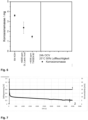
- FIG. 2 to 6 shows the cell voltage (V) of a primary cell (according to Fig. 1a ) with an aqueous electrolyte with 5M KOH and the additions of compounds according to the invention mentioned below.
- the measurement of the average cell voltage according to figure 2 shows that with lactic acid (4000 ppm wt.) versus an electrolyte solution without additive (5 M KOH) for an electrolyte composition according to the invention with lactic acid with approx V versus the electrolyte composition without additive (neat aqueous 5 M KOH, ca. 1.37-1.39 V) reduced OCV is measured.
- the cell voltage for lactic acid is higher than the cell voltage under load for PEG 400 and Tween 80.
- figure 3 shows figure 3 that for electrolyte compositions with lactic acid, a low corrosion mass compared to an electrolyte composition (5 M KOH without additive) and thus an improved anode mass conversion efficiency is achieved.
- lactic acid as in figure 4 shown an improved anti-corrosion efficiency over a composition without lactic acid.
- the anti-corrosion efficiency of Tween 80 is better than that of lactic acid, better cell voltage under load can be obtained for lactic acid. If necessary, a further improvement can be achieved with a mixture of lactic acid and Tween 80.
- figure 5 is compared to the corrosion mass determined over 120 hours in the OCV condition. In OCV operation ( 6 ) the anti-corrosion efficiency could be improved by adding lactic acid.
- figure 8 shows the impedance vector in magnitude and phase over frequency. Up to 1 kHz, the curve is almost constant and ohmic (phase angle ⁇ 0°). The impedance measurement characterizes the cell structure.
- the impedance vector according to magnitude and phase of the test cell Figure 1b depends on the electrode distance (here ⁇ 32 mm).
- a constant gas flow to the air cathode with 11 standard liters of oxygen per hour was set on the cell and the electrolyte made from aqueous 3-molar potassium hydroxide solution was added with 1% by volume of PEG-400.
- the impedance spectrum of the cell operated in this way shows an almost constant ohmic curve (phase ⁇ 10°) with a magnitude of 22 ohms up to 1 kHz.
- Electrode pastes were produced with the silicon particles and the carbon particles, which can alternatively be pressed with a binder added.
- test cells can be connected in series and that the cell voltages add up.
- the total current of such a primary battery is determined by the cell that supplies the lowest current in individual operation.
Landscapes
- Chemical & Material Sciences (AREA)
- Chemical Kinetics & Catalysis (AREA)
- Electrochemistry (AREA)
- General Chemical & Material Sciences (AREA)
- Engineering & Computer Science (AREA)
- Manufacturing & Machinery (AREA)
- Inorganic Chemistry (AREA)
- Materials Engineering (AREA)
- Battery Electrode And Active Subsutance (AREA)
Abstract
Gegenstand der Erfindung ist eine wässrige, alkalische Elektrolytzusammensetzung, die umfasst mindestens eine Hydroxycarbonsäure, Carboxylat einer Hydroxycarbonsäure, Ester einer Hydroxycarbonsäure, Ether eines Carboxylates einer Hydroxycarbonsäure, polymere Verbindung basierend auf mindestens einer Hydroxycarbonsäure oder Gemische enthaltend mindestens zwei der vorgenannten Verbindungen. Des Weiteren umfasst die Erfindung eine mehrzellige Batterie, die Verwendung als Elektrolyt in einer Primärzelle mit Silizium als Anodenmaterial in Form von Silizium-Partikeln, die bevorzugt als Silizium-Primärpartikel mit einer Partikelgröße zwischen 1 nm bis 3000 nm vorliegen. Wobei das Anodenmaterial im geladenen Zustand vorzugsweise kein Lithium umfasst und, wobei die Silizium-Primärpartikel optional im Wesentlichen amorph sind.
Description
- Gegenstand der Erfindung ist eine wässrige, alkalische Elektrolytzusammensetzung, die umfasst eine Hydroxycarbonsäure, Carboxylat einer Hydroxycarbonsäure, Ester einer Hydroxycarbonsäure, Ether eines Carboxylates einer Hydroxycarbonsäure, polymere Verbindung basierend auf mindestens einer Hydroxycarbonsäure oder Gemische enthaltend mindestens zwei der vorgenannten Verbindungen. Des Weiteren umfasst die Erfindung eine mehrzellige Batterie, die Verwendung als Elektrolyt in einer Primärzelle mit Silizium als Anodenmaterial in Form von Silizium-Partikeln, die bevorzugt als Silizium-Primärpartikel mit einer Partikelgröße zwischen 1 nm bis 3000 nm vorliegen. Wobei das Anodenmaterial im geladenen Zustand vorzugsweise kein Lithium umfasst und, wobei die Silizium-Primärpartikel optional kristallin und/oder amorph sind.
- Aufgrund des zunehmenden Bedarfes an E-Mobility im Personennahverkehr durch Elektroautos, Elektrofahrräder sowie elektrisch betriebene Busse etc. als auch bei zunehmender dezentraler Stromgewinnung besteht ein enormer Bedarf an umweltverträglichen Batterien, deren Komponenten einerseits unbeschränkt verfügbar und andererseits unbeschränkt recyclebar, umweltverträglich und/oder weiter verwendbar sein sollen. Silizium ist ein auf der Erde unbegrenzt verfügbarer Rohstoff. Darüber hinaus müssen die Komponenten einer Batterie kostengünstig verfügbar sein.
- Des Weiteren ist es bekannt, durch ständige Zufuhr eines Brennstoffes in Brennstoffzellen, die eine galvanische Zelle aufweisen, in Gegenwart eines Oxidationsmittels elektrische Energie zu erzeugen. Grundsätzlich ist dieses Prinzip auch für Silizium-Luft-Batterien denkbar. Zudem sind übliche Silizium enthaltende Lithium-Ionen-Sekundärbatterien täglich weltweit im Einsatz.
- Aufgabe der Erfindung war es die Leistungsfähigkeit und Lebensdauer einer Silizium enthaltenden galvanischen Zelle, insbesondere alkalischen galvanischen Zelle, zu verbessern. Ferner soll die Leistungsdichte einer solchen Silizium enthaltenden galvanischen Zelle verbessert werden und eine hohe Anfangsspannung einstellbar sein.
- Des Weiteren bestand die Aufgabe eine Silizium enthaltende galvanische Zelle bereitzustellen, die vorzugsweise frei von Lithium ist, wobei vorzugsweise frei von Lithium bedeutet, dass der Gehalt an Lithium im geladenen Zustand kleiner 1 Gew-% vorzugsweise unter 0,1 Gew.-% in der Gesamtzusammensetzung der Primärzelle beträgt, insbesondere umfassend die Anode, die Kathode und den Elektrolyten, vorzugsweise beträgt der Gehalt an Lithium im Elektrodenmaterial der Anode im geladenen Zustand unter 0,1 Gew.-%. Vorzugsweise soll die galvanische Zelle Edukte und Reaktionsprodukte aufweisen, die aus Recyclingprozessen der Silizium-Waferherstellung stammen, Nebenprodukte sind und/oder in Recyclingprozessen weiterverwendet werden können.
- Gelöst werden die Aufgaben mit dem Gegenstand des Anspruchs 1 sowie mit einer Primärzelle nach Anspruch 11, der mehrzelligen Batterie nach Anspruch 14 und der Verwendung nach Anspruch 15. In den Unteransprüchen sowie in der Beschreibung sind bevorzugte Ausführungsformen detaillierter dargestellt.
- Gegenstand der Erfindung ist eine wässrige, alkalische Elektrolytzusammensetzung, enthaltend
- 2,0 bis 99,0 Gew.-% Wasser, und
- 0,0001 bis 15 Gew.-% mindestens eine Hydroxycarbonsäure, Carboxylat einer Hydroxycarbonsäure, Ester einer Hydroxycarbonsäure, Ether eines Carboxylats einer Hydroxycarbonsäure, polymere Verbindungen basierend auf Hydroxycarbonsäuren, Carboxylaten von Hydroxycarbonsäure, Estern von Hydroxycarbonsäuren oder Gemisch enthaltend mindestens zwei der vorgenannten Verbindungen, und
- einen Gehalt von 0,001 bis 40 Gew.-%, insbesondere 10 bis 40 Gew.-%, Alkalihydroxid in Bezug auf die Gesamtzusammensetzung von 100 Gew.-%.
- Nach einer besonders bevorzugten Alternative ist Hydroxycarbonsäure ausgewählt aus Enantiomeren, Diastereomeren oder Gemischen dieser. Bevorzugt sind α-Hydroxycarbonsäuren. Besonders bevorzugt ist Milchsäure, vorzugsweise D- und/oder L-Milchsäure sowie Gemische von D-/L-Milchsäure.
- Bevorzugt umfasst die Elektrolytzusammensetzung mindestens ein Alkalihydroxid ausgewählt aus NaOH und KOH und optional weitere alkalisch lösliche Salze, wie beispielsweise Erdalkalihydroxide, basische Metalloxide oder organische Basen. Bevorzugt umfasst die Elektrolytzusammensetzung ein Alkalihydroxid ausgewählt aus KOH und NaOH.
- Zur Herstellung der wässrigen Elektrolytzusammensetzung wird vorzugsweise destilliertes Wasser eingesetzt.
- Nach einer besonders bevorzugten Alternative ist die Hydroxycarbonsäure ausgewählt aus Milchsäure, insbesondere D-Milchsäure, L-Milchsäure und/oder Gemische von D/L-Milchsäure, α-Hydroxycarbonsäuren, insbesondere Fruchtsäuren, insbesondere Äpfelsäure, Citronensäure, Fumarsäure, Gluconsäure, Glycolsäure, Mandelsäure, Milchsäure, Oxalsäure, Salicylsäure, α-Hydroxycaprylsäure und Weinsäure, β-Hydroxycarbonsäuren, insbesondere β-Hydroxybuttersäure und/oder Mevalonsäure, oder Gallussäure, 4-Hydroxybutansäure, Polyhydroxybuttersäure, Salicylsäure (2-Hydroxybenzoesäure), 4-Hydroxybenzoesäure (PHB) oder das Carboxylat von Hydroxycarbonsäure, Ester von Hydroxycarbonsäure, Ether von Carboxylat von Hydroxycarbonsäure auf mindestens einer der vorgenannten Hydroxysäuren basiert, und/oder die polymeren Verbindungen auf mindestens einer der Hydroxycarbonsäuren oder einem Gemisch enthaltend mindestens zwei der vorgenannten Verbindungen basiert.
- Nach einer weiteren Alternative kann die Elektrolytzusammensetzung zusätzlich eine lineare oder verzweigte Polyalkylenoxid-Gruppen aufweisende Verbindung oder Gemische davon enthalten, wobei die Verbindung mindestens drei Alkylenoxid-Gruppen in der Verbindung aufweist, wobei die Alkylenoxid-Gruppen in der Polyalkylenoxid-Gruppen aufweisenden Verbindung ausgewählt sind aus Alkylenoxid-Gruppen mit 2 bis 6 C-Atomen je Alkylenoxid-Gruppe, und, wobei mindestens eine terminale Gruppe der Polyalkylenoxid-Gruppen aufweisenden Verbindung ausgewählt ist aus Hydroxy-Gruppen, Alkyl-Gruppen, Alkoxy-Gruppen, Alkenyl-Gruppen, Alkenyloxid-Gruppen, Carbonsäure-Gruppen, Carbonsäureester-Gruppen, insbesondere olefinischen Carbonsäureester-Gruppen, Carbonsäureamid-Gruppen, aromatischen-Gruppen, insbesondere Alkyl-substituierten aromatischen Gruppen, und/oder Gruppen enthaltend cyclische-Ether.
- Nach einer Ausführungsform kann die Elektrolytzusammensetzung ein Gemisch von Hydroxycarbonsäure, Carboxylat einer Hydroxycarbonsäure, Ester einer Hydroxycarbonsäure, Ether eines Carboxylats einer Hydroxycarbonsäure, polymere Verbindungen basierend auf Hydroxycarbonsäuren, Carboxylaten von Hydroxycarbonsäure, Estern von Hydroxycarbonsäuren und mindestens einer linearen oder verzweigten Polyalkylenoxid-Gruppen aufweisende Verbindung aufweisen.
- Besonders bevorzugt sind lineare oder verzweigte Polyalkylenoxid-Gruppen aufweisende Verbindung mit mindestens drei bis 200 Alkylenoxid-Gruppen in der Verbindung oder Gemische von mindestens zwei dieser Verbindungen, insbesondere mit 3 bis 100 Alkylenoxid-Gruppen, besonders bevorzugt mit drei bis 100 Alkylenoxid-Gruppen, weiter bevorzugt mit 3 bis 50 Alkylenoxid-Gruppen, vorzugsweise mit 3 bis 25 Alkylenoxid-Gruppen. Dabei ist es weiter bevorzugt, wenn die Alkylenoxid-Gruppen aus Ethylenoxid und Propylenoxid ausgewählt sind.
- Dabei können die Alkyl-Gruppen, Alkoxy-Gruppen, Alkenyl-Gruppen, Alkenyloxid-Gruppen, Carbonsäure-Gruppen, Carbonsäureamid-Gruppen, Carbonsäureester-Gruppen, insbesondere olefinischen Carbonsäureester-Gruppen, bevorzugt sind Fettsäuren, aromatischen-Gruppen, insbesondere Alkyl-substituierten aromatischen Gruppen, und/oder Gruppen enthaltend cyclische-Ether als mindestens eine terminale Gruppe und als mindestens eine weitere terminale Gruppe jeweils unabhängig umfassen 1 bis 35 C-Atome, insbesondere 2 bis 25 C-Atome. Alkyl-, Alkoxy-, Alkenyl-, Alkenyloxid und aromatische Gruppen optional Alkyl-substituiert umfassen vorzugsweise jeweils unabhängig 1 bis 18 C-Atome. Carbonsäureester sind vorzugsweise ausgewählt aus natürlichen Fettsäuren mit 4 bis 20 C-Atomen.
- Bevorzugte Polyaklylenoxid-Gruppen, insbesondere umfassend Polyalkylenoxid-Gruppen, aufweisende Verbindungen können ein Molekulargewicht von 200 g/mol bis 35.000 g/mol, bevorzugt 200 bis 1500 g/mol aufweisen. Dabei ist es weiter bevorzugt, wenn das mittlere Molekulargewicht von 200 g/mol bis 1500 g/mol beträgt.
- Definitionsgemäß umfassen Polyalkylenoxid-Gruppen aufweisende Verbindung:
- (O-Alkylen)n-OH, -(O-Alkylen)n-COOH, -(O-Alkylen)n-(C=O)NHR, -(O-Alkylen)n-(C=O)NR2, mit R = Kohlenwasserstoff oder Polyalkylenoxid,
- (O-Alkylen)n-O-Alkyl, -(O-Alkylen)n-O-Alkenyl,
- (O-Alkylen)n-O-(C=O)-Alkyl, -(O-Alkylen)n-O-(C=O)-Alkenyl,
- (O-Alkylen)n-O-(C=O)-Aromat-Alkyl jeweils unabhängig mit n größer gleich 2, insbesondere mit n = 5 bis 100, insbesondere n = 5 bis 50, bevorzugt n = 5 bis 25.
- Nach einer Ausführungsform können die Alkylenoxid-Gruppen in der Polyalkylenoxid-Gruppen aufweisenden Verbindung bevorzugt ausgewählt sein aus Alkylenoxid-Gruppen mit 2 bis 4 C-Atomen je Alkylenoxid-Gruppe. Des Weiteren ist es bevorzugt, wenn die Polyalkylenoxid-Gruppen aufweisenden Verbindungen mindestens fünf Alkylenoxid-Gruppen, insbesondere bis einhundert Alkylenoxid-Gruppen, mit 2 bis 4 C-Atomen je Alkylenoxid-Gruppe in der Verbindung aufweist.
- Alkylen ist besonders bevorzugt bivalentes Ethylen (-CH2CH2-), insbesondere als Ethylenoxid-Gruppe, oder bivalentes Propylen, insbesondere in Propylenoxid-Gruppen (-CH2(CH3CH)- und -(CH2)3-).
- Bevorzugte Beispiele können symmetrische Verbindungen umfassen, aber sind nicht beschränkt auf die nachfolgend genannten Polyalkylenoxid-Gruppen aufweisenden Verbindungen: H-(O-Alkylen)n-OH, Alkyl-(O-Alkylen)n-O-Alkyl, Alkenyl-(O-Alkylen)n-O-Alkenyl, Alkyl-(C=O)-(O-Alkylen)n-O-(C=O)-Alkyl, Alkenyl-(C=O)-(O-Alkylen)n-O-(C=O)-Alkenyl, Alkyl-Aromat-(O-Alkylen)n-O-(C=O)-Aromat-Alkyl, wobei n wie vorstehend definiert ist, vorzugsweise ist n größer gleich 2, bevorzugt ist n = 5 bis 50, insbesondere n = 5 bis 25, wobei jedes Alkylen jeweils unabhängig 2 bis 6 C-Atome umfasst und Alkyl und/oder Alkenyl jeweils unabhängig 1 bis 24 C-Atome umfassen, insbesondere 1 bis 20 C-Atome.
- Bevorzugt sind die terminalen Gruppen der Polyalkylenoxid-Gruppen aufweisenden Verbindung ausgewählt aus Hydroxy-Gruppen, Alkyl-Gruppen, Alkoxy-Gruppen, Alkylen-Gruppen, Alkylenoxid-Gruppen, Carbonsäureester-Gruppen, insbesondere olefinische Carbonsäureester-Gruppen, aromatischen-Gruppen und/oder Gruppen enthaltend cyclische-Ether.
- Nach einer bevorzugten Ausführungsform ist die mindestens eine terminale Gruppe der Polyalkylenoxid-Gruppen aufweisenden Verbindung eine Hydroxy-Gruppe und mindestens eine weitere terminale Gruppe ist ausgewählt aus Hydroxy-Gruppen, Alkyl-Gruppen, Alkoxy-Gruppen, Alkenyl-Gruppen, Alkenyloxid-Gruppen, Carbonsäureester-Gruppen, aromatischen-Gruppen, insbesondere Alkyl-substituierten aromatischen Gruppen, und/oder Gruppen enthaltend cyclische-Ether. Dabei ist es weiter bevorzugt, wenn die linearen Verbindungen eine erste terminale und eine weitere terminale Gruppe aufweisen und verzweigte Verbindungen eine erste, eine weitere terminale Gruppe und mindestens eine zusätzliche terminale Gruppe aufweisen.
- Nach einer besonders bevorzugten Ausführungsform können die Elektrolytzusammensetzungen zusätzlich umfassen mindestens eine Polyalkylenoxid-Gruppen aufweisende Verbindung mit mindestens einer cyclischen Ether-Gruppe mit 5 bis 8 C-Atomen und optional als mindestens eine terminale Gruppe einen Carbonsäureester, insbesondere einen Carbonsäureester einer Fettsäure, und, wobei die mindestens eine oder mehrere weiteren terminalen Gruppen ausgewählt sind aus Hydroxy-Gruppen, Alkyl-Gruppen, Alkoxy-Gruppen, Alkenyl-Gruppen, Alkenyloxid-Gruppen, Carbonsäureester-Gruppen, aromatischen-Gruppen und/oder Gruppen enthaltend cyclische-Ether mit 5 bis 8 C-Atomen. Besonders bevorzugt ist eine verzweigte Polyalkylenoxid-Gruppen aufweisende Verbindung mit ein bis sechs Polyalkylenoxid-Gruppen an der cyclischen Ether-Gruppe, und mindestens einem Alkylenoxidfunktionalisierten Fettsäureester. Typische Fettsäuren umfassen Ölsäure, Laurinsäure, Stearinsäure, Isostearinsäure und/oder Palmitinsäure. Besonders bevorzugte Verbindungen umfassen ethoxylierte Sorbitanfettsäureester, insbesondere Mono- bis Triester. Bevorzugt mit 2 bis 200 Ethoxy-Gruppen, insbesondere mit 2 bis 50 Ethoxy-Gruppen, und optional mit Propoxy-Gruppe(n) als Polyalkylenoxid-Gruppen.
- Nach einer weiteren bevorzugten Ausführungsform kann eine wässrige, alkalische Elektrolytzusammensetzung zusätzlich verzweigte Polyalkylenoxid-Gruppen aufweisende Verbindungen aufweisen, die umfassen Ether von Kohlenhydraten, insbesondere Ether von Furanosen oder Pyranosen, die optional Carbonsäureester von Fettsäure aufweisen. Besonders bevorzugt sind Polyalkylenoxid-Gruppen enthaltende Verbindungen von SorbitanFettsäureester, wie Polyoxyethylen(20)sorbitanmonooleat (Tween 80). Gleichfalls geeignet können eine oder mehrere der folgenden Polysorbate in der Elektrolytzusammensetzung eingesetzt werden: Polysorbat 20 (Polyoxyethylen-(20)-sorbitanmonolaurat) (E 432), Polysorbat 21 (Polyoxyethylen-(4)-sorbitanmonolaurat), Polysorbat 40 (Polyoxyethylen-(20)-sorbitanmonopalmitat) (E 434), Polysorbat 60 (Polyoxyethylen-(20)-sorbitanmonostearat) (E 435), Polysorbat 61 (Polyoxyethylen-(4)-sorbitanmonostearat), Polysorbat 65 (Polyoxyethylen-(20)-sorbitantristearat) (E 436), Polysorbat 80 (Polyoxyethylen-(20)-sorbitanmonooleat) (E 433), Polysorbat 81 (Polyoxyethylen-(5)-sorbitanmonooleat), Polysorbat 85 (Polyoxyethylen-(20)-sorbitantrioleat), Polysorbat 120 (Polyoxyethylen-(20)-sorbitanmonoisostearat).
- Besonders bevorzugte Elektrolytzusammensetzungen können umfassen Polyalkylenoxid-Gruppen aufweisende Verbindungen, die ausgewählt sind aus Polyethylenglycol, Polypropylenglycol, Propylenoxid und Ethylenoxid aufweisenden Polyalkylenoxid-Gruppen enthaltenden Verbindungen, wobei die terminalen Gruppen ausgewählt sind aus Hydroxy-Gruppen, Alkoxy-Gruppen, Alkyl-Gruppen, Alkenyl-Gruppen, Alkenyloxid-Gruppen, Alkylfunktionellen Carbonsäureester-Gruppen, Alkylen-funktionellen Carbonsäure-Gruppen, wobei die Alkoxy, Alkyl und Alkylen-Gruppen jeweils unabhängig 1 bis 24 C-Atome aufweisen.
- Weitere besonders bevorzugte Polyalkylenoxid-Gruppen aufweisende Verbindungen können ausgewählt sein aus Verbindungen enthaltend Polyalkylenoxid-Gruppen aufweisende Furanosen, und/oder Polyalkylenoxid-Gruppen aufweisende Pyranosen, insbesondere Polyalkylenoxid-Gruppen aufweisende Verbindungen von Furanose-Fettsäureestern und/oder Polyalkylenoxid-Gruppen aufweisende Verbindungen von Pyranose-Fettsäureestern. Insbesondere sind die terminalen Gruppen der Polyalkylenoxid-Gruppen aufweisenden Verbindung ausgewählt aus Hydroxy-Gruppen, Alkyl-Gruppen, Alkoxy-Gruppen, Alkylen-Gruppen, Alkylenoxid-Gruppen, Carbonsäureester-Gruppen, aromatischen-Gruppen und/oder Gruppen enthaltend cyclische-Ether.
- Weiter bevorzugt sind Polyalkylenoxid-Gruppen aufweisende Verbindungen von SorbitanFettsäureester umfassend Polyalkylenoxid-Gruppen aufweisende Verbindungen eines Sorbitanmonostearats, Sorbitantristearats, Sorbitanmonolaurats, Sorbitanmonooleats, Sorbitantrioleats und/oder Sorbitanmonopalmitats.
- Entsprechend einer weiteren Ausführungsform ist es bevorzugt, wenn die Polyalkylenoxid-Gruppen aufweisende Verbindung umfasst mindestens eine cyclische Ether-Gruppe mit 5 bis 8 C-Atomen und optional als mindestens eine terminale Gruppe einen Carbonsäureester, insbesondere einer Fettsäure oder einer Fruchtsäure, bevorzugt einer Fettsäure, und, wobei die weiteren terminalen Gruppen ausgewählt sind aus Hydroxy-Gruppen, Alkyl-Gruppen, Alkoxy-Gruppen, Alkenyl-Gruppen, Alkenyloxid-Gruppen, Carbonsäureester-Gruppen, aromatischen-Gruppen, insbesondere Alkyl-funktionalisierte Phenyl-Gruppen, und/oder Gruppen enthaltend cyclische-Ether mit 5 bis 8 C-Atomen.
- Eine besonders bevorzugte Verbindung ist ausgewählt aus 4-(1,1,3,3-Tetramethylbutyl)phenyl-polyethylenglycolen, bevorzugt 4-(1,1,3,3-Tetramethylbutyl)phenyl-polyethylenglycol, t-Octylphenoxypolyethoxyethanol, Polyethylene glycol tert-octylphenyl ether, mit n gleich 5 bis 100, bevorzugt mit n = 9 bis 10 (Triton X-100) oder n = 7 bis 8 (Triton X-114).
- Ebenso Gegenstand der Erfindung ist eine Elektrolytzusammensetzung umfassend 2,0 bis 99,0 Gew.-% Wasser und 0,0001 bis 15 Gew.-% mindestens einer Hydroxycarbonsäure, Carboxylat der Hydroxycarbonsäure, Ester der Hydroxycarbonsäure, Ether von Carboxylat der Hydroxycarbonsäure, polymere Verbindungen basierend auf Hydroxycarbonsäure oder Gemische enthaltend mindestens zwei der vorgenannten Verbindungen, bevorzugt sind 0,01 bis 10 Gew.-%, besonders bevorzugt von 0,1 bis 2,5 Gew.-%, und - einen Gehalt von 0,001 bis 40 Gew.-% Alkalihydroxid, insbesondere 10 bis 40 Gew.-%, und optional 0,0001 bis 15 Gew.-% Polyalkylenoxid-Gruppen aufweisende Verbindungen oder Gemische dieser, insbesondere 0,01 bis 2 Gew.-%,
in Bezug auf die Gesamtzusammensetzung von 100 Gew.-%. Optional kann die Elektrolytzusammensetzung Alkalisilikat enthalten, wobei der Gehalt vorzugsweise unter 4 Mol/Liter Alkalisilikat, bevorzugt von 0,001 bis 3,5 Mol/Liter Alkalisilikat beträgt, insbesondere in der Gesamtzusammensetzung von 100 Gew.-%. - Zur Herstellung der wässrigen Elektrolytzusammensetzung wird vorzugsweise destilliertes Wasser eingesetzt. Das Wasser zur Herstellung der Elektrolytzusammensetzung weist vorzugsweise bei 25 °C, eine Leitfähigkeit von größer gleich 0,055 µS/cm, weiter bevorzugt von größer gleich 0,5 µS/cm auf. In der Elektrolytzusammensetzung ist die Leitfähigkeit erheblich höher und liegt vorzugsweise bei größer gleich 1 mS/cm bei 25 °C, bevorzugt bei größer gleich 0,5 S/cm bei 25 °C.
- Nach einer besonders bevorzugten Ausführungsform ist die Elektrolytzusammensetzung eine wässrige, alkalische Zusammensetzung umfassend Alkalihydroxid, insbesondere Kaliumhydroxid, und mindestens eine Hydroxycarbonsäure, Carboxylat der Hydroxycarbonsäure, Ester der Hydroxycarbonsäure, Ether von Carboxylat der Hydroxycarbonsäure, polymere Verbindungen basierend auf Hydroxycarbonsäure oder Gemische enthaltend mindestens zwei der vorgenannten Verbindungen,. Dabei ist es bevorzugt, wenn der Gehalt des Alkalihydroxids von 0,001 bis 6 Mol/Liter, vorzugsweise von 1 bis 5,5 Mol/Liter in der wässrigen, alkalischen Elektrolytzusammensetzung beträgt.
- Der Gehalt an Hydroxycarbonsäure, Carboxylat der Hydroxycarbonsäure, Ester der Hydroxycarbonsäure, Ether von Carboxylat der Hydroxycarbonsäure, polymere Verbindungen basierend auf Hydroxycarbonsäure oder Gemische enthaltend mindestens zwei der vorgenannten Verbindungen kann von der gewählten Elektrodenoberfläche sowie weiteren Verfahrensbedingungen wie Temperatur, Durchflussmenge in der Zelle, Porengröße der Elektrodenoberfläche etc. abhängen. Daher kann der Gehalt der mindestens einen Hydroxycarbonsäure, Carboxylat der Hydroxycarbonsäure, Ester der Hydroxycarbonsäure, Ether von Carboxylat der Hydroxycarbonsäure, polymere Verbindungen basierend auf Hydroxycarbonsäure oder Gemische enthaltend mindestens zwei der vorgenannten Verbindungen oder Gemische von mindestens zwei dieser Verbindungen von 0,000001 bis 50.000 ppm-Gew., insbesondere von 0,01 bis 20.000 ppm-Gew., bevorzugt von 0,01 ppm-Gew. bis 10.000 ppm-Gew., in der Elektrolytzusammensetzung, insbesondere mit einer Gesamtzusammensetzung von 100 Gew.-% betragen.
- Weiter ist es bevorzugt, wenn die Elektrolytzusammensetzung eine Stoffmengenkonzentration von 1 bis 6 Mol/Liter Alkalihydroxid, insbesondere Kaliumhydroxid, und 10 ppm-Gew. bis 50.000 ppm-Gew. lineare oder verzweigte Polyalkylenoxid-Gruppen aufweisende Verbindungen mit mindestens drei Alkylenoxid-Gruppen in der Verbindung oder Gemische von mindestens zwei dieser Verbindungen in Wasser aufweist, wobei insbesondere die Gesamtzusammensetzung der Elektrolytzusammensetzung 100 Gew.-% beträgt. Bevorzugt ist die Polyalkylenoxid-Gruppen enthaltende Verbindung ausgewählt aus Polyethylenoxid-Gruppen, Polypropylenoxid-Gruppen, Polypropylenoxid- und Polyethylenoxid-Gruppen enthaltenden Verbindungen. In einer Alternative weist die Polyalkylenoxid-Gruppen aufweisende Verbindung mindestens einen cyclischen Ether auf.
- Gleichfalls Gegenstand der Erfindung ist eine chemische Primärzelle aufweisend eine Anode, eine Kathode, einen Elektrolyten sowie mindestens einen Separator, wobei der Separator die Kathode und die Anode voneinander separiert, und die Kathode umfasst als Material Mangandioxid und optional Kohlenstoff enthaltenden Leitfähigkeitsvermittler, wobei die Anode als Anodenmaterial Silizium umfasst, und wobei das Silizium in Form von Silizium-Partikeln vorliegt. Die Silizium-Primärpartikel weisen vorzugsweise eine Partikelgröße zwischen 1 nm bis 3000 nm auf. Nach einer Alternative sind die Silizium-partikel kristallin, insbesondere sind die Siliziumpartikel polykristallin. Nach einer weiteren Alternative sind die Siliziumpartikel im Wesentlichen röntgenamorph. Ferner können Gemische von Siliziumpartikeln umfassend amorphe und kristalline Siliziumpartikel als Anodenmaterial eingesetzt werden.
- Somit ist Gegenstand der Erfindung eine elektrochemische Primärzelle aufweisend eine Anode, eine Kathode sowie mindestens einen Separator und enthaltend eine erfindungsgemäße Elektrolytlösung, wobei der Separator die Kathode und die Anode voneinander separiert.
- Nach einer bevorzugten Ausführungsform kann die Primärzelle mit einem hermetisch abgeschlossenen Gehäuse vorliegen, wobei i) das Material der Kathode der Primärzelle Mangandioxid und optional einen Kohlenstoff enthaltenden Leitfähigkeitsvermittler aufweist. Als ein hermetisch abgeschlossenes Gehäuse wird in der Regel ein Gehäuse verstanden, dass aus einem gegenüber alkalischen Elektrolyten inertem Material hergestellt ist und hermetisch, insbesondere fluiddicht (gas- und flüssigkeitsdicht) abgeschlossen ist. Als Material für das Gehäuse oder auch für den Separator kommen beispielsweise Polyetheretherketone, Polyaryletherketone, Polyphenylensulfid (PPS), Polyoxymethylen-Copolymere (POM-C), Polyamid, Cycloolefine oder andere Hyperformance Kunststoffe oder auch metallische Legierungen in Frage. Die Komponenten des Gehäuses können mittels Laser verschweißt oder mittels Plasmaverfahren verschweißt sein. Die Kathode kann als Kohlenstoff geträgertes MnO2 ausgeführt sein.
- Der Separator kann mit einer Shut-down-Funktion ausgelegt sein, um einen Zutritt des Elektrolyten bei unerwünschten Verfahrensbedingungen von der Anode und/oder der Kathode zu unterbinden. Gleichfalls kann die Primärzelle eine Berstplatte aufweisen, um bei unerwünschtem Druckanstieg eine Explosion der Primärzelle zu vermeiden und den gezielten Austritt der Komponenten aus der Primärzelle bei Druckanstieg zu steuern.
- Nach einer zweiten Alternative kann die Primärzelle als die Kathode ii) eine Luftkathode aufweisen. Das Material der Kathode in dieser Primärzelle umfasst vorzugsweise Mangandioxid und optional einen Kohlenstoff enthaltenden Leitfähigkeitsvermittler, insbesondere weist die Luftkathode eine für Kohlendioxid-undurchlässige Membran auf, die vorzugsweise in der Primärzelle so angeordnet ist, dass sie den Zutritt von Kohlendioxid aus der Umgebungsluft an die Kathode verhindert.
- Ferner ist Gegenstand der Erfindung eine Primärzelle in der die Anode als Anodenmaterial Silizium umfasst, insbesondere wobei das Silizium in Form von Silizium-Partikeln vorliegt, insbesondere liegen die Silizium-Partikeln mit einer Partikelgröße von 1 Mikrometer und 50 Mikrometer vor, und bevorzugt als Silizium-Primärpartikel einer Partikelgröße zwischen 1 nm bis 3000 nm. Die Siliziumpartikel können ausgewählt sein aus kristallinen, insbesondere polykristallin, und/oder amorphen Siliziumpartikeln. Nach einer bevorzugten Ausführungsform können Sägereste aus der Silizium-Waferherstellung, wie Wafern zur Herstellung von Halbleiter oder auch Reste aus der Herstellung von Solarsilizium-Wafern eingesetzt werden, die vorzugsweise eine bimodale Partikelverteilung aufweisen, vorzugsweise mit Maxima um 1000 und 10000 nm jeweils unabhängig +/- 100 nm, wobei insbesondere eine Fraktion Partikel mit Partikelgrößenverteilung von d10 bis d90 von 100 nm bis 9000 nm und eine zweite Fraktion Partikel von d10 bis d90 6000 nm bis 45000 nm aufweist. Eine Partikelgrößenbestimmung kann mittels Laserbeugung nach ISO13320 (2009) erfolgen bspw. mit einem Mastersizer 2000 oder mittels TEM-Analyse sowie bspw. mittels Siebanalyse. XRD-Analysen der polykristallinen Siliziumpartikel unter Verwendung der Scherrer-Gleichung ergeben sich Kristallitgrößen größer gleich von 12 nm. Alternativ sind die Silizium-Primärpartikel im Wesentlichen amorph.
- Vorzugsweise können die Silizium-Partikel in Form von Agglomeraten von Silizium-Primärpartikeln, Aggregaten von Silizium-Primärpartikeln oder Gemischen dieser Agglomerate und Aggregate, wobei die Agglomerate und/oder Aggregate eine Größe von 100 bis 30000 nm aufweisen. Die Primärpartikel können Partikel mit einer Primärpartikelgröße von 10 bis 90 nm aufweisen.
- Ferner ist Gegenstand der Erfindung eine mehrzellige Batterie, wobei die Batterie mindestens zwei bis 15.000 mit einander verbundene Primärzellen umfasst, vorzugsweise sind die zwei bis 1.000 miteinander verbundenen Primärzellen in Serie geschaltet.
- Ebenso Gegenstand der Erfindung ist die Verwendung mindestens einer Hydroxycarbonsäure, Carboxylate der Hydroxycarbonsäure, Ester der Hydroxycarbonsäure, Ether der Carboxylate der Hydroxycarbonsäure, polymere Verbindung basierend auf Hydroxycarbonsäure oder Gemische enthaltend mindestens zwei der vorgenannten Verbindungen als Additiv in einer Elektrolytzusammensetzung, insbesondere in einer wässrigen, alkalischen Elektrolytzusammensetzung, in einer elektrochemischen Primärzelle, insbesondere wobei die Anode der Primärzelle Silizium enthält das in Form von Silizium-Partikeln mit einer Partikelgröße zwischen 1 nm bis 50000 nm, insbesondere von 1 Mikrometer bis 30 Mikrometer, vorliegt. Dabei ist es bevorzugt, wenn in der Primärzelle als Anode Silizium in Form von kristallinen, wie polykristallinen, und/oder amorphen Silizium-Partikeln aufweist. Besonders bevorzugt sind Silizium-Primärpartikel, insbesondere röntgenamorphe Primärpartikel, mit einer Partikelgröße zwischen 1 nm bis 3000 nm, die vorzugsweise als Aggregate vorliegen.
- Überraschenderweise haben die Erfinder gefunden, dass spezifische Silizium-Partikel als aktive Komponente in einer galvanischen Zelle verwendet werden können und in einer einzelnen spezifischen elektrochemischen Primärzelle nennenswerte Leistungsdichten bis unerwartet hohe Leistungsdichten von größer gleich 0,5 mW/cm2 erzielt werden können. In allen Versuchen konnte mit Elektroruß oder elektrochemisch behandeltem bzw. hergestelltem Ruß und Leitruß die besten Leistungsdichten für Silizium enthaltende Primärzellen mit größer 3 mW/cm2 erhalten werden.
- Unter agglomerierten Silizium-Primärpartikeln oder Agglomeraten von Silizium werden erfindungsgemäß Silizium-Primärpartikel verstanden, die sich im Wesentlichen an Ecken und Kanten berühren und nicht an den Flächen. Agglomerate können beim Dispergieren in Aggregate und die Silizium-Primärpartikel zerkleinert werden. Des Weiteren werden unter Aggregaten zusammengewachsene, aneinander geschmolzene oder zusammengelagerte Primärpartikel verstanden, die nur unter mechanischer Krafteinwirkung voneinander getrennt werden können.
- Des Weiteren soll ein wirtschaftliches Kathodenmaterial bereitgestellt werden, das vorzugsweise eine physikalische Mischung von Mangandioxid (MnO2) und einem Leitfähigkeitsvermittler umfasst. Der optionale Gehalt des Leitfähigkeitsvermittlers in den Elektroden der Primärzelle kann in der Kathode und in der Anode unterschiedlich hoch sein. Für Mangandioxid ist ein Gehalt an Leitfähigkeitsvermittler im Material der Kathode von circa 5 bis 65 Gew.-%, bevorzugt 5 bis 15 Gew.-% üblich. Generell kann der Gehalt des Leitfähigkeitsvermittlers von 5 bis 60 Gew.-% im Material der Kathode betragen. Alternativ bevorzugt können Gehalte im Bereich von 15 bis 20 Gew.-% für einen geringeren Widerstand oder auch als Obergrenze 30 bis 60 Gew.-% sein. Dabei beträgt das Material der Kathode in Summe immer 100 Gew.-%.
- Gegenstand der Erfindung ist somit mindestens eine elektrochemische Primärzelle, welche eine Anode, eine Kathode, einen Elektrolyten sowie mindestens einen Separator aufweist, wobei der Separator die Kathode und die Anode voneinander separiert, und die Kathode umfasst als Material Mangandioxid und optional einen Kohlenstoff enthaltenden Leitfähigkeitsvermittler, wobei die Anode als Anodenmaterial Silizium umfasst und, wobei das Silizium in Form von Silizium-Partikeln vorliegt und dabei die Silizium-Primärpartikel eine Partikelgröße zwischen 1 nm bis 3000 nm aufweisen, und die Primärpartikel optional im Wesentlichen amorph sind. Dabei ist es besonders bevorzugt wenn die Silizium-Partikel, und insbesondere die Silizium-Primärpartikel eine Kristallinität von kleiner gleich 20 %, insbesondere 12 % aufweisen, insbesondere eine Kristallinität kleiner gleich 2 % aufweisen. Silizium-Primärpartikel mit einer Kristallinität unter 12 %, vorzugsweise unter 2 % gelten als amorph.
- Vorzugsweise liegen die Silizium-Partikel in der Anode als Aggregate vor und optional ist der Gehalt an Lithium kleiner gleich 1 Gew.-%, insbesondere kleiner gleich 0,1 Gew.-%, in Bezug auf den Siliziumgehalt der Anode von 100 Gew.-% der Primärzelle, wobei der Gehalt an Lithium bevorzugt im geladenen Zustand der Primärzelle kleiner gleich 0.1 Gew.-% beträgt.
- Als im Wesentlichen amorph gilt ein Pulver, das röntgenamorph ist. Als röntgenamorph gilt vorzugsweise ein Pulver mit einer Kristallinität kleiner 20 %, bevorzugt kleiner 12 %, besonders bevorzugt kleiner gleich 2 %. Der Kristallinitätsgrad kann nach folgender Methode mittels XRPD ermittelt werden über die Formel % Kristallinität = (100 x A)/(A + B -C) mit A = gesamte Peakfläche der Reflexe der kristallinen Bestandteile des Diffraktogramms; B = gesamte Fläche unterhalb der Peakfläche A; C = luftstreuend-, fluoreszierend- und gerätebedingte Untergrundfläche. Gesamte Peakfläche A mit Untergrund genau unterhalb der schmalen Reflexe der Si-Phase. Die Untergrundfläche C wurde anhand der XRD-Diagramme des Si-Referenzstandards NIST 640 (Si-Standard = 100 % Kristallinität) ermittelt. Fläche B entspricht einem eingelegten Untergrundverlauf sowie dem konstanten Untergrund C. Berechnung (HighScore Plus Software). Si-Standard (Standard Reference Material 640d for X-Ray Metrology, David R. Black, Donald Windover, Albert Henins, David Gil, James Filliben and James P. Cline; National Institute of Standards and Technology, Gaithersburg, MD, 20899). In röntgenamorphen Pulvern gibt es im XRPD keine scharfen, sondern nur wenige diffuse Interferenzen bei kleinen Beugungswinkeln. Stoffe mit einem derartigen Röntgenbeugungsdiagramm bezeichnet man als röntgenamorph. Kristallin: Kristall ist ein anisotroper, homogener Körper, der eine dreidimensional periodische Anordnung der Bausteine besitzt und ein XRPD mit klar definierten auflösbaren Reflexen besitzt.
- Gleichfalls Gegenstand der Erfindung sind Primärzellen, in denen das Anodenmaterial Silizium-Partikel umfassend Silizium-Primärpartikel, Agglomerate aus Silizium-Primärpartikeln, Aggregate aus Silizium-Primärpartikeln und/oder Gemische davon umfasst, wobei insbesondere die Agglomerate und/oder Aggregate eine Größe von 10 nm bis 100 µm (Mikrometer) aufweisen. Bevorzugt sind Agglomerate und/oder Aggregate im Bereich von 100 nm bis 5 Mikrometer, insbesondere von 200 nm bis 2 Mikrometer, bevorzugt von 300 nm bis 1,5 Mikrometer und/oder von 400 nm bis 1 Mikrometer. Zugleich können die Silizium-Primärpartikel eine Partikelgrößenverteilung von 1 nm bis 1500 nm, insbesondere von 50 bis 300 nm oder von 100 nm bis 300 nm aufweisen.
- Batterieseparatoren in einer Alkali-Batteriezelle werden zum Trennen einer negativen Elektrode von einer positiven Elektrode verwendet, wenn sie in einem geeigneten Elektrolyten angeordnet sind. Neben der Trennung der Elektroden weist der Separator während des Betriebs der Zelle, wenn die normalen chemischen Reaktionen ablaufen, einen verhältnismäßig niedrigen Widerstand gegenüber der Elektrolytionenübertragung, jedoch einen beträchtlich hohen Widerstand gegenüber der Elektrodenionenübertragung auf.
- Der Separator wird beispielsweise gebildet durch Aufbringen eines verbesserten Coatings. Bei dem Separator handelt es sich in der Regel um ein flexibles, faseriges und poröses Substrat, das gegen starkes Alkali und gegen Oxidation beständig ist. Der Separator kann ein Composite sein und kann vorzugsweise auf mindestens einem Polymer, wie Polyethylen, Polypropylen, Polyacrylat, PEEK (Polyetheretherketon), PEAK (Polyetheraryletherketon), PEEK/PEDEK (Polyetheretherketon, Polyetherdiphenyletherketon), Lingnocellulose, Cellulose und/oder Mikrozellulose basieren.
- Ferner ist es bevorzugt, dass das Anodenmaterial Silizium-Partikel sowie Leitfähigkeitsvermittler umfasst, insbesondere umfasst der Leitfähigkeitsvermittler Kohlenstoff enthaltende Partikel oder eine Kohlenstoff enthaltende Paste, wie elektrisch leitfähige organische Polymere. Ein besonders bevorzugtes Anodenmaterial der Anode umfasst zu 10 bis 100,00 Gew.-%, insbesondere von 5 bis 90 Gew.-%, bevorzugt von 10 bis 95 Gew.-% Silizium-Partikel und einen Kohlenstoff enthaltenden Leitfähigkeitsvermittler, insbesondere von 5 bis 90 Gew.-%, und optional weitere Additive auf 100 Gew.-% des Anodenmaterials. Der Leitfähigkeitsvermittler umfasst vorzugsweise Kohlenstoff enthaltende Partikel, insbesondere einer Partikelgröße von 20 bis 100 nm, insbesondere 25 bis 80 nm.
- Bevorzugt ist ebenfalls ein Anodenmaterial der Anode umfassend zu 20 bis 75 Gew.-%, vorzugsweise von 20 bis 60 Gew.-%, Silizium-Partikel und einen Kohlenstoff enthaltenden Leitfähigkeitsvermittler, insbesondere von 25 bis 80 Gew.-%, bevorzugt von 40 bis 80 Gew.-%, und optional weitere Additive auf 100 Gew.-% des Anodenmaterials. Der Leitfähigkeitsvermittler umfasst vorzugsweise Kohlenstoff enthaltende Partikel, insbesondere einer Partikelgröße von 20 bis 100 nm, insbesondere 25 bis 80 nm. Ein besonders bevorzugtes Anodenmaterial der Anode umfasst zu 45 bis 55 Gew.-% Silizium-Partikel und zu 55 bis 45 Gew.-% einen Kohlenstoff enthaltenden Leitfähigkeitsvermittler, wobei die Gesamtzusammensetzung des Anodenmaterials 100 Gew.-%, d.h. ohne Elektrolyt und/oder getrocknet, beträgt.
- Entsprechend zwei alternativen besonders bevorzugten Ausführungsformen umfasst die Kathode der Primärzelle a) als Material Mangandioxid als Kathodenmaterial, oder
b) die Kathode der Primärzelle ist eine Luftkathode und die Kathode umfasst Manganoxid, insbesondere Manganoxid und Mangandioxid, Platin, Platin-Basis, Nickel-Kobalt-Cyanide, oder Silber als Katalysator im Kathodenmaterial. - Nickel-Kobalt-Cyanide stehen beispielhaft für die Klasse von Nichtedelmetallkatalysatoren mit hervorragender Elektroaktivität für die Sauerstoffreduktionsreaktion im neutralen Elektrolyten. Die Zubereitung der Ni/Co-dotierten C-N-Hohl-Nanoröhren-Verbundkatalysatoren (C-N, Co/C-N, Ni/C-N und Ni-Co/C-N) erfolgt durch eine einfache Pyrolyse des Ni/Co-Salz~Dicyandiamid~Glucose~Gemenges. Eine entsprechende Silizium-Luft-Batterie wurde in einem neutralen Medium unter Verwendung der vorbereiteten Probe als Katalysator für die Luftelektrode montiert und zeigte eine hervorragende Entladungsleistung und Stabilität.
- Die Kathode umfasst vorzugsweise als Material, d.h. als Kathodenmaterial oder als Katalysator im Kathodenmaterial zur Beschleunigung der Löslichkeit von Sauerstoff, Mangandioxid. Ein bevorzugtes Kathodenmaterial für eine Kathode in einer Primärzelle mit Luftkathode umfasst vorzugsweise Manganoxid, insbesondere Manganoxid und/oder Mangandioxid, und Silber als Katalysator. Ein besonders bevorzugtes Kathodenmaterial, insbesondere für eine Primärzelle mit Luftkathode, weist eine hydrophobe Kathode auf, deren Kathodenmaterial eine Mischung aus Mangan(di)oxid, vorzugsweise einer durchschnittlichen Partikelgröße von kleiner gleich 10 µm (Mikrometer), insbesondere elektrolytisches Gamma-Mangandioxid, einen Leitfähigkeitsvermittler und einen polymeren halogenierten Kohlenwasserstoff, insbesondere einen polymeren fluorierten Kohlenwasserstoff, umfasst, insbesondere einen Polytetrafluorethylen. Die Mischung kann in Platten gepresst, getrocknet werden. Dabei wird vorzugsweise in der Primärzelle auf die der Luft ausgesetzten Kathodenseite ein mikroporöser, hydrophober Film, beispielsweise aus einem polymeren fluorierten Kohlenwasserstoff, aufgebracht.
- Ein besonders bevorzugtes Kathodenmaterial, insbesondere der Kathode in einer hermetisch geschlossenen Primärzelle, umfasst zu 75 bis 85 Gew.-% Mangandioxid und zu 15 bis 25 Gew.-% einen Kohlenstoff enthaltenden Leitfähigkeitsvermittler, wobei die Gesamtzusammensetzung des Kathodenmaterials 100 Gew.-% (Kathodenmaterial ohne Elektrolyt und/oder getrocknet) beträgt.
- Der Kohlenstoff enthaltende Leitfähigkeitsvermittler umfasst vorzugsweise Kohlenstoff enthaltende Partikel, besonders bevorzugt Graphen enthaltende Partikel. Die Kohlenstoffpartikel weisen vorzugsweise eine Partikelgrößenverteilung im Bereich von 0,1 nm bis 5 Mikrometer, bevorzugt von 5 nm bis 5 Mikrometer auf. Dabei ist es weiter bevorzugt, wenn die Kohlenstoffpartikel eine Partikelgröße im Bereich von 5 nm bis 300 nm, insbesondere von 10 nm bis 150 nm, besonders bevorzugt von 20 bis 100 nm aufweisen und optional als Agglomerate einer Größe von 100 nm bis 3 Mikrometer, vorzugsweise einer Größe von 300 nm bis 2 Mikrometer vorliegen.
- Entsprechend einer bevorzugten Ausführungsvariante umfasst das Silizium, insbesondere die Silizium-Partikel, bevorzugt die amorphen Silizium-Partikel, des Anodenmaterials Dotierstoffe, wobei die Dotierstoffe ausgewählt sind aus Elementen der 13. Hauptgruppe, insbesondere umfassend Bor, Indium, Aluminium und/oder Gallium, und aus Elementen der 15. Hauptgruppe, insbesondere umfassend Phosphor, Arsen und/oder Antimon sowie Elemente der Eisengruppe, besonders bevorzugt sind Bor, Aluminium, Phosphor und/oder Eisen. Die Elemente der 13. Hauptgruppe (neue Nomenklatur: Gruppe 13 des Periodensystems) sind Elektronen-Akzeptoren neuer Nomenklatur. Als Elektronen-Donatoren werden Elemente der 15. Hauptgruppe (neue Nomenklatur: Gruppe 15 des Periodensystems) eingesetzt.
- Nach einer Ausführungsform umfasst das Silizium, insbesondere die Silizium-Partikel des Anodenmaterials, Dotierstoffe, wobei die Dotierstoffe zu größer gleich 1 Element der 15. Hauptgruppe auf 106 Silizium-Atome und/oder größer gleich 1 Element der 13. Hauptgruppe auf 106 Silizium-Atome vorliegen, insbesondere größer gleich 1 Element der 15. Hauptgruppe auf 104 Silizium-Atome und/oder größer gleich 1 Element der 13. Hauptgruppe auf 104 Silizium-Atome, bestimmt mittels dem Fachmann bekannter ICP-MS Analyse (Inductive Plasma Discharge-Massenspektroskopie, welche unter Wikipedia ausführlich beschrieben ist: https://de.wikipedia.org/wiki/Massenspektrometrie_mit_induktiv_gekoppeltem_Plasma). Alternativ kann die Analyse auch durch GD-MS erfolgen (GDMS/GD-MS-Glimmentladungs-Massenspektroskopie mit Secondary Electron Multiplier- (SEM) und/oder Faraday-Detector gemäß Quelle:https://assets.thermofisher.com/TFS-Assets/CMD/brochures/BR-30066-GD-MS-ELEMENT-GD-PLUS-BR30066-EN.pdf). Den Farady-Detektor vorzugsweise für die Messungen von Spuren-Konzentrationen im %-Bereich.
- Nach einer alternativen, bevorzugten Ausführungsform umfasst das Silizium, insbesondere die amorphen Silizium-Partikel, des Anodenmaterials Dotierstoffe, wobei die Dotierstoffe größer gleich 104 Atome (ca. 100 Gew.-ppm, abhängig von Atomgewicht des Dotierstoffes) der 15. Hauptgruppe auf 106 Silizium-Atome und/oder größer gleich 104 Atome der 13. Hauptgruppe auf 106 Silizium-Atome vorliegen.
- Nach weiteren bevorzugten, alternativen Ausführungsformen umfasst das Silizium, insbesondere die amorphen Silizium-Partikel, des Anodenmaterials Dotierstoffe, wobei die Dotierstoffe größer gleich 2 ·104 Atome der 15. Hauptgruppe auf 106 Silizium-Atome größer gleich 2 ·104 Atome der 13. Hauptgruppe auf 106 Silizium-Atome vorliegen. Die vorstehenden Gehalte an Dotierstoffen im Silizium des Anodenmaterials können inhomogen im Silizium verteilt sein, sowie die Gehalte integral über die Gesamtmenge des Siliziums im Anodenmaterial im Mittel vorliegen. Zur Bestimmung obiger Gehalte wird eine Prüfmenge von 1 g Prüfmenge mittels GD-MS oder ICPMS vermessen, wobei zwischen beiden Methoden gewisse Abweichungen bestimmt werden können, vorzugsweise wird ein Mittelwert bestimmt. Entsprechend weiteren bevorzugten, alternativen Ausführungsformen umfasst das Silizium, insbesondere die amorphen Silizium-Partikel, des Anodenmaterials Dotierstoffe, wobei die Dotierstoffe größer gleich 105 Atome der 15. Hauptgruppe auf 106 Silizium-Atome und/oder größer gleich 105 Atome der 13. Hauptgruppe auf 106 Silizium-Atome betragen.
- Nach weiteren bevorzugten, alternativen Ausführungsformen umfasst das Silizium, insbesondere die amorphen Silizium-Partikel, des Anodenmaterials Dotierstoffe, wobei die Dotierstoffe größer gleich 105 Atome der 15. Hauptgruppe auf 106 Silizium-Atome und/oder größer gleich 105 Atome der 13. Hauptgruppe auf 106 Silizium-Atome umfassen.
- Die Silizium-Partikel können auf atomarer Ebene eine Legierung von Silizium mit mindestens einem Element der 13. oder 15 Hauptgruppe aufweisen, wobei das mindestens eine Element der 13. oder 15. Hauptgruppe mit größer gleich 1021 Atomen/cm3 ausgewählt aus mindestens einem Elektronendonator und Elektronenakzeptor vorliegt. Dabei liegt die Legierung von Silizium auf atomarer Ebene mit mindestens einem Element der 13. oder 15. Hauptgruppe als eine amorphe oder kristalline Phase vor. Besonders bevorzugt weisen die Siliziumpartikel einen Gehalt an Bor von 10 ppm-Gew bis 2,5 Gew.-% in Bezug auf den Gesamtgehalt von 100 Gew.-% des Siliziumpartikels auf, bevorzugt ist ein Gehalt von 10 ppm-Gew bis 1,8, besonders bevorzugt von 1,8 Gew.-% plus/minus 0,2 Gew.-%. Analog kann die Siliziumfolie einen Gehalt an Bor von 10 ppm-Gew bis 1,8 Gew.-% in Bezug auf den Gesamtgehalt von 100 Gew.-% der Siliziumfolie aufweisen.
- Gegenstand der Erfind ist eine Primärzelle umfassend Silizium-Partikel, die einen Gehalt an Bor von 10 Gew.-ppm bis 1,8 Gew.-% aufweisen.
- Zur Herstellung einer Anode oder Kathode werden jeweils ein Leitfähigkeitsvermittler sowie Silizium-Partikel zur Herstellung der Anode und Mangandioxid zur Herstellung der Kathode und optional ein Bindemittel, wie ein polymerer fluorierter Kohlenwasserstoff, gemischt und optional getrocknet. Vorzugsweise wird eine homogene Partikelgröße von kleiner gleich 10 Mikrometer bis 5 nm eingestellt und die Mischung zu einer Anode(nplatte) oder Kathode(nplatte) verpresst.
- Nach einer weiteren Alternative weist die Primärzelle an der Luftkathode einen Lufteinlass auf, der eine Gas durchlässige Membran sein kann. Bevorzugt ist eine Membran aus einem inerten Polymer, bevorzugt aus einem Polyfluorpolyethylen, Polyfluorpolypropylen oder CoPolymeren davon. Der Aufbau der Luftkathode ist in der Regel eine Sandwichbauweise umfassend eine Gas durchlässige Membran, ein metallisches Netz zur Stromleitung und mindestens einen Katalysator, insbesondere einen porösen Katalysator. Die Gas durchlässige Membran ist vorzugsweise für Kohlendioxid undurchlässig und für Sauerstoff und optional Stickstoff durchlässig.
- Nach einer weiteren Ausführungsform ist es bevorzugt, wenn die Primärpartikel der Silizium-Partikel Agglomerate und/oder Aggregate oder Gemische davon bilden und vorzugsweise in einem porösen Silizium-Netzwerk angeordnet sein können, insbesondere können die Agglomerate, Aggregate oder Gemische dieser mechanisch zu einem porösen Silizium-Netzwerk verhakt sein. Insoweit kann das Anodenmaterial besonders bevorzugt ein poröses Silizium-Netzwerk aus Silizium-Primärpartikeln, Agglomeraten aus Silizium-Primärpartikeln, Aggregaten aus Silizium-Primärpartikeln und/oder Gemischen davon sein.
- Dabei ist es besonders bevorzugt, wenn die Silizium-Partikel, insbesondere die Silizium-Primärpartikel, im Wesentlichen amorph (röntgenamorph) sind, da auf diese Weise sichergestellt wird, dass in dem Elektrolyten eine gleichmäßige Auflösung der Silizium-Partikel gewährleistet ist. Bei im Wesentlichen kristallinem Silizium würde die Auflösung im Elektrolyten anisotrop erfolgen. Amorphes Silizium wird isotrop aufgelöst, so dass amorphes Silizium eine höhere Energiedichte liefern kann. Beispielsweise ist in alkalischen Ätzmitteln die Ätzrate für die (111)-Richtungen eines Siliziumkristalls ungefähr zwei Größenordnungen kleiner als die jeder anderen Richtung. Die (100)-orientierten Flächen des Siliziumkristalls werden anderthalb mal so schnell geätzt wie die (110)-orientierten Flächen. Gleichfalls können dotierte, amorphe Silizium-Partikel eingesetzt werden. Ist die Dotierung von p-Typ Silizium-Partikeln größer als > 1019 je cm3, wird die Ätzrate herabgesetzt, da gilt, je höher die Dotierrate desto geringer die Ätzrate. Insofern ist über die Dotierung in amorphen Silizium-Partikeln die Leistungsdichte auch über die Ätzrate einstellbar.
- Unter amorphen Silizium-Primärpartikeln werden Silizium-Primärpartikel, in der Regel in Form eines Pulvers oder in einer festen Zusammensetzung verstanden, die (Silizium-Primärpartikel) röntgenamorph vorliegen und welche optional partikulärdispers in eine Hilfsstoffmatrix z.B. Ruß eingebettet sein können. Dabei bedeutet Röntgenamorph, dass dem Röntgensignal" entsprechend den Haupt-Peaks: 28.5° (111) 47.4°(220) 56.0° (311) 69.4° (400) maximal weniger als 10% der Signalamplituden bezogen auf die fcc Structure des Siliziums (JCPDS card: 00-027-1402) erreichen.
- Erfindungsgemäßes Anodenmaterial umfasst keine Silicide. Unter Siliciden werden intermetallische Verbindungen mit einem stöchiometrischen Anteil an mindestens einem zweiten Metall verstanden. Silicide weisen eine homogene chemische Verbindung aus zwei oder mehr Metallen mit Gitterstrukturen, die sich von denen der konstituierenden Metalle unterscheiden, auf. Des Weiteren weist das Anodenmaterial keine klassische Legierung aus mindestens zwei Elementen auf, die gemeinsam das metalltypische Merkmal des kristallinen Aufbaus mit Metallbindung aufweisen, da die Silizium-Partikel vorzugsweise im Wesentlichen amorph (röntgenamorph) sind.
- Die erfindungsgemäße elektrochemische Primärzelle ist keine Lithium-Ionen Batterie. Des Weiteren umfasst das Anodenmaterial keine Lithium-Interkalationsverbindung. Erfindungsgemäß umfasst das Kathodenmaterial kein Lithium-Metalloxid. Ebenso umfasst die Primärzelle bevorzugt keine Lithium-Salze. Alternative kann die Primärzelle in der Gesamtzusammensetzung Lithium in geringen Mengen von kleiner gleich 5 Gew.-%, bevorzugt kleiner gleich 1 Gew.-%, insbesondere von 0,001 Gew.-% bis 1 Gew.-% in der Gesamtzusammensetzung mit 100 Gew.-% umfassen. Als Gesamtzusammensetzung gilt hier die Gesamtheit aus Kathode, Anode und Elektrolytzusammensetzung.
- Die Silizium-Partikel können auf atomarer Ebene eine Legierung von Silizium mit mindestens einem Element der 13. oder 15 Hauptgruppe aufweisen, wobei das mindestens eine Element der 13. oder 15. Hauptgruppe mit größer gleich 1021 Atomen/cm3 ausgewählt aus mindestens einem Elektronendonator und Elektronenakzeptor vorliegt. Dabei liegt die Legierung von Silizium auf atomarer Ebene mit mindestens einem Element der 13. oder 15. Hauptgruppe als eine amorphe Phase vor.
- Entsprechend einer Ausführungsform weisen die Silizium-Primärpartikel im Wesentlichen eine Partikelgröße von 5 bis 500 nm auf, insbesondere von 5 bis 20 nm, vorzugsweise von 5 bis 15 nm, oder in ebenso bevorzugten Alternativen weisen die Silizium-Primärpartikel Partikelgrößen von 20 bis 200 nm oder von 70 bis 350 nm, insbesondere von 100 bis 300 nm auf.
- Ferner ist es bevorzugt, wenn die Silizium-Primärpartikel in Form von Agglomeraten und/oder Aggregaten aus den Primärpartikeln vorliegen, wobei die Agglomerate und/oder Aggregate eine Partikelgröße von 100 nm bis 30 µm aufweisen, insbesondere von 100 nm bis 2000 nm, bevorzugt von 150 bis 1000 nm oder von 400 bis 1000 nm. Die vorgenannten Anordnungen können auch als Nanodrähte oder Nanonetzwerk angesehen werden. In einer weiteren Alternative liegen die Silizium-Partikel im Wesentlichen in Form von Agglomeraten von Silizium Primärpartikeln und/oder Aggregaten von Silizium-Primärpartikeln oder Gemischen dieser vor, wobei die Agglomerate und/oder Aggregate eine Größe von 100 bis 30000 nm aufweisen, insbesondere von 100 bis 2500 nm, vorzugsweise von 100 nm bis 1500 nm, weiter bevorzugt sind 150 bis 1000 nm, 400 bis 1000 nm oder 200 bis 3000 nm.
- Die erfindungsgemäßen Silizium-Primärpartikel weisen vorzugsweise eine Oberfläche von 0,001 bis 500 m2/g, vorzugsweise von 0,1 bis 300 m2/g, vorzugsweise 0,1 bis 100 m2/g auf, insbesondere von 10 - 300 m2/g, vorzugsweise mit einer Primärpartikel-größe von etwa 10 nm im Mittel mit plus/minus 9 nm. Des Weiteren beträgt vorzugsweise die Oberfläche der Agglomerate und/oder Aggregate von 10 bis 80 m2/g.
- Bevorzugt beträgt die Packungsdichte der Siliziumpartikel als Pulverschüttung 10 bis 50 g/l (Gramm pro Liter), insbesondere entlüftet um 100 g/l. Liegen die Siliziumpartikel als 3D-Formkörper gesintert vor, kann die Packungsdicht von 700 g/l bis 1500 g/l betragen. Bei dichtgesinterten Siliziumpartikeln kann die Packungsdichte zwischen 1,5 kg/l und 2,3 kg/l betragen.
- Liegt Silizium mit einer Schichtdicke von größer 0,1 Mikrometer vor, ist es weiter bevorzugt, wenn das Silizium in Form einer Folie, insbesondere einer gefalteten Folie, optional beschichteten Folie, vorliegt, beispielsweise als Bandmaterial angelehnt an technisch vorhandenes Material aus Druckprozessen. Das Bandmaterial der Folie kann auf Zielformate, wie A5 zugeschnitten werden.
- Die Kathode und/oder die Anode weisen vorzugsweise eine Porosität auf, die über Dichtemessung bestimmt wird. Vorzugsweise beträgt die Porosität der Kathode und/oder der
- Anode von 18 bis 35 Vol.-% in Bezug auf das Gesamtvolumen der Kathode oder Anode von jeweils 100 Vol.-%, bevorzugt von 24 bis 28 Vol.-%, besonders bevorzugt von 25 Vol.-% bis 27 Vol.-%. Die Porosität ist der Zwischenraum in der Anode und/oder der Kathode, der für den fluiden Elektrolyten verfügbar ist. Die Porosität wird ausgedrückt als prozentuales Volumen des geometrischen Gesamtvolumens der Kathode oder der Anode. Somit können die über die Porosität gebildeten Zwischenräume teilweise oder vollständig mit Elektrolyt gefüllt sein.
- Die Volumendichte eine Silizium-Anode mit Anodenmaterial Silizium kann bei Reinsilizium von 0,1 g/cm3 bis 2,3 g/cm3 betragen. Bei relevanten Fremdanteilen im Silizium wie z.B. Eisen (Fe) können die Werte davon abweichen.
- Nach gleichfalls bevorzugten Alternativen kann das Gewichtsverhältnis von Mangandioxid im Kathodenmaterial zum Elektrolyten von 2,2 bis 2,9 betragen. Alternativ oder gleichzeitig kann das Gewichtsverhältnis der Silizium-Partikel im Anodenmaterial zum Elektrolyt von 0,6 bis 1,7 betragen.
- Ein besonders bevorzugtes Kathodenmaterial der Kathode umfasst zu 70 bis 95 Gew.-% als Kathodenmaterial Mangandioxid, insbesondere Battery Grade und bevorzugt eine Partikelgröße von kleiner gleich 10 Mikrometer, und einen Kohlenstoff enthaltenden Leitfähigkeitsvermittler, insbesondere von 5 bis 30 Gew.-% Leitfähigkeitsvermittler, und optional weitere Additive auf 100 Gew.-% des Kathodenmaterials. Der Leitfähigkeitsvermittler ist vorzugs-weise ein Kohlenstoff enthaltender Partikel, Mischung dieser oder eine Kohlenstoff enthaltende Paste.
- Der Kohlenstoff enthaltende Leitfähigkeitsvermittler umfasst besonders bevorzugt
- i) Kohlenstoff enthaltende Partikel, die umfassen Ruß, Leit-Ruß, elektrochemisch hergestellten bzw. behandelten Ruß, Elektroruß, Aktivkohle, Graphit, Graphen und/oder eine Mischung davon, und/oder
- ii) eine Kohlenstoff enthaltende Paste, die elektrisch leitfähige Polymere, die Heteroatome N, O und/oder S umfassen können, wie Polyanilin oder Graphen.
- Es wurde gefunden, dass Elektroruß als Leitfähigkeitsvermittler wirksamer ist als Graphitpulver. Der hinreichende Anteil von Elektroruß im Anodenmaterial liegt vorzugsweise im Bereich von 50 bis 90 Gew.-% in Bezug auf die Gesamtzusammensetzung. Mit einer zwei Zellen umfassenden Batterie mit 16 cm2 aktiver Elektrodenfläche könnte bereits eine Leistung ausreichend für den Betrieb eines kleinen Lüfters bereitgestellt werden.
- In einer besonderen Variante der elektrochemischen Primärzelle liegt an der Kathode und/oder Anode vorzugsweise ein Druck von 0,01 bis 10 MPa an, bevorzugt von 0,5 bis 5,0 MPa, um das Pulvermaterial zu verdichten und den Innenwiderstand der Elektroden auf weniger 10 Ohm/cm zu reduzieren.
- Gleichfalls Gegenstand der Erfindung ist eine mehrzellige Batterie wobei die Batterie mindestens zwei bis 15.000, insbesondere 3 bis 500, bevorzugt 4 bis 100, mit einander verbundene Primärzellen umfasst, vorzugsweise sind von den zwei bis 15.000 mit einander verbundenen Primärzellen 4 bis 100 in Serie, die weiteren entsprechend parallel geschaltet. Die Batterie wird definiert nach der DIN-Norm 40729.
- Als Batterietypen kommen beispielsweise auch Hörgerätebatterien in Frage. Die Geometrie der Anode und/oder Kathode weist dann vorzugsweise eine Dimensionierung auf, dass sie in die Standard-Zylindergröße für A675, A13, A312 und/oder A10 passt.
- Der Betrieb von Silizium enthaltenden Primärzellen mit alkalischen, wässrigen Elektrolyten hat den wesentlichen Nachteil der Korrosion des Siliziums. Einerseits wird durch die Korrosion Wasserstoff freigesetzt und andererseits beginnt der Elektrolyt ab etwa einer Konzentration von 4M an Silizium-Gehalt zu gelieren.
- Der prinzipielle Aufbau der Primärzelle ist in
Figur 1a dargestellt. Die Primärzelle weist eine Anode aus Silizium und eine Luftkathode auf. Zwischen Anode und Kathode ist ein Reservoir zur Aufnahme eines Elektrolyten von 0,6 ml vorgesehen.Figur 1b stellt eine andere Zellanordnung einer Primärzelle dar auf die später eingegangen wird. -
Figur 1b zeigt einen realen Aufbau der Versuchszelle 20, eine Anode in Form einer Scheibe umfassend Siliziumpartikel als Pulver in einem Separator bzw. als gesinterte Scheibe aus Siliziumpartikeln. Alternative kann eine Silizium-Kohlenstoffpaste in den Anodenträger abgedeckt mit einem scheibenförmigen Separator eingesetzt werden, 21: Luftkathode, 22: Elektrolytreservoir (ca. 20 ml, ca. 6 cm2 Anoden- bzw. Kathodenfläche); 23: Zu-/Ableitung Elektrolytflüssigkeit; 24: Zu-/Ableitung Inertgas (Argon und/oder N2); 25: Stromabnehmer Kathode, 26: Stromabnehmer Anode. - Zur Vermeidung der Korrosion von Silizium wurden verschiedene Verbindungen auf ihre, die Korrosion von Silizium (in der Anode oder als Anode) inhibierenden Eigenschaften in einem alkalischen Elektrolyten ohne und mit Entladung untersucht, deren Ergebnisse in den folgenden Figuren dargestellt sind.
- Batterieversuche A: Silizium-Anode, wässriger Elektrolyt mit Inhibitoren (dabei Siliziumwafer als Silizium-Anode, 200 Mikrometer stark (Dicke), B-dotiert elektronisch (1 Bor/106 Si-Atome ~ entsprechend Teilchendichte von -1017 Teilchen/cm3), wenn nicht anders angegeben:
- i) Elektrolyt a) 5M KOH (ohne Additive) und
- i) Elektrolyt b) 5M KOH + 4000 Gew.-ppm D-/L-Milchsäure (DL-Lactic Acid 90)
- ii) V1 Ruß-Silizium-Pulver 1,8 Gew.-% Bor (Silizium-Partikeln (Partikelgröße um 0,1 Mikrometer, nanokristallin)) in Rundzelle,
Figur 7 zeigt die (eingeprägte) Zellspannung Kurve 1: 0,8 V Zellspannung unter Last über die Zeit, sowie zugehörig die Kurve 2 Stromstärke in Milliampere (mA) über der Versuchs-Zeit. - iii) in einem weiteren Versuch wurde die Anode ersetzt gegen eine Anode mit gesinterten Siliziumpartikeln als Pressling/Tablette aus nanokristallinen Silizium-Partikeln einer Größe von etwa 0,1 Mikrometer. Der ), Elektrodenabstand:Anode zu Kathode betrug 2 cm, Elektrolyt: KOH 3 mol/L, 1 Gew.-% PEG 400, Rundzelle; an der Kathode: Begasung mit O2 mit Volumenfluß 11 Normliter je Stunde (nL/h). Diese Anordnung wurde vermessen im Bereich 1 Hz bis100 kHz der Wechselstromwiderstand (= Impedanz). Die Impedanz bleibt von 1 Hz bis etwa 1kHz nahezu konstant bei ~ 23 bis 20 Ohm. Bei höheren Wechselstromfrequenzen von 1 kHz bis 100kHz und zunehmender Phasenverschiebung nimmt der Widerstand deutlich ab, siehe
Figur 8 . - In den nachfolgenden Versuchen (
Figur 2 bis Figur 6 ) wurde der Elektrolyt alle 4 Stunden jeweils für 5 Minuten mit einer Durchflussgeschwindigkeit von 0,1 mL/min ausgetauscht. - In den
Figuren 2 bis 6 wird dargestellt die Zellspannung (V) einer Primärzelle (gemäßFig. 1a ) mit einem wässrigen Elektrolyten mit 5M KOH und den nachfolgend genannten Zusätzen an erfindungsgemäßen Verbindungen. - Messungen: Offene Zellspannung (OCV: open circuit; Leerlaufspannung) und Entladung mit einer Stromdichte von 50 µA/cm2 (25 °C, 50% rel. Luftfeuchtigkeit) in den Messungen der nachfolgenden Figuren. Die Zellspannung ist im Vergleich zu einem Elektrolyten mit reinem KOH mit Hydroxycarbonsäure vermindert. Die Figuren zeigen, dass die Korrosionsmasse vermindert wird und die Konversionseffizienz mit Hydroxycarbonsäure erhöht ist. Im jeweiligen Versuch wird während der Strommessung alle 4 Stunden für 5 Minuten der Elektrolyt mit einer Durchflussgeschwindigkeit von 0,1 mL/min ausgetauscht.
- Fig. 2:
- Zeigt die durchschnittliche Zellspannung in Abhängigkeit von der Elektrolytzusammensetzung zugesetzten Additiven über 120 Stunden Zellbetrieb: Davon 4 Stunden Zellspannung im Leerlauf (OCV) und daran anschließend 116 Stunden Zellspannung unter konstanter Stromentnahme.
- Fig. 3:
- Zeigt die Korrosionsmassen (linke Achse) sowie die dazugehörige Anoden Massenkonversionseffizienz in Prozent für die Zelle ohne Additive (5M KOH) sowie die Zelle mit Elektrolytzusammensetzung mit Additiven wie mit 4000 ppm DL-Michlsäure (Lactic Acid). Die Versuchszellen wurden mit 50 µA/cm2 für 116h (+4h OCV) entladen. Dabei ist mcorr: Massenverlust durch Korrosion mtot: Gesamtmassenverlust durch Korrosion + Entladung mdis: Massenverlust durch Entladung


- Fig. 4:
- Zeigt die Korrosionsmassen (linke Achse) sowie die dazugehörige Anoden Korrosionsschutzeffizienz in Prozent für die Zelle ohne Additive (5M KOH) sowie die Zelle mit Elektrolytzusammensetzung mit Additiv mit 4000 ppm DL-Milchsäure (Lactic Acid) und 4000 ppm TWEEN 80. Die Versuchszellen wurden mit 50 µA/cm2 für 116h (+4h OCV) entladen. Hinweis: es kann sich ein Fehler ergeben, da versuchsbedingt 4 Stunden OCV-Betrieb mitberücksichtigt wurden.

- Fig. 5:
- Korrosionsmasse für die Zellen gemäß
Figur 4 , die über 120h im OCV aufbewahrt wurden (keine Entladung).
- Fig. 6:
- 24h Korrosionsexperimente in einer Versuchszelle gemäß
Figur 1a unter Wegfall der Kathode (sog. Halbzellenanordnung), kein Elektrolytwechsel oder Elektrolytfluss (stehender Elektrolyt). - Fig. 7:
- Versuchszelle gemäß
Figur 1 .b: V1 Pulver-Anode mit Ruß-Silizium-Pulver dotiert mit 1,8 Gew.-% Bor Rundzelle mit Separator, Kurve 1: Zellspannung eingeprägt (Belastung) 0,8 Volt (V) konstant über die Zeit, Kurve 2: zugehöriger Zell-Strom in Milliampere (mA) über die Zeit, Silizium-Partikeln (Partikelgröße um 0,1 Mikrometer, nanokristallin). - Fig. 8:
- Versuchszelle gemäß
Figur 1b : Anode mit gesinterten Siliziumpartikel (Pressling/Tablette unter Verwendung von Si-Partikeln Größe um 0,1 Mikrometer, nanokristallin), Elektrodenabstand Anode von Kathode: 2 cm, Elektrolyt KOH 3 mol/L, 1 Gew.-% PEG 400, Rundzelle; an der Kathode: Begasung mit O2 mit Volumenfluß 11 Normliter je Stunde (nL/h), Diese Anordnung wurde hinsichtlich Impedanzvektor nach Betrag und Phase über der Frequenz vermessen. Impedanz ist der Wechselstromwiderstand. Die Impedanz der Zelle bleibt von 1 Hz bis etwa 1kHz nahezu konstant bei ~ 23 bis 20 Ohm. Aus dem Impedanzspektrum kann der Fachmann u.a. die Qualität der Kontaktierungen (Überganswiderstände) und des Zellaufbaus ableiten. - Die Messung der durchschnittlichen Zellspannung gemäß
Figur 2 zeigt, dass mit Milchsäure (4000 ppm-Gew.) gegenüber einer Elektrolytlösung ohne Additiv (5 M KOH) für eine erfindungsgemäße Elektrolytzusammensetzung mit Milchsäure mit ca. 1,33 - 1,34 V eine etwa nur um 0,03 bis 0,06 V gegenüber der Elektrolytzusammensetzung ohne Additiv (reines wässriges 5 M KOH, ca. 1,37-1,39 V) verminderte OCV gemessen wird. Die Zellspannung für Milchsäure ist gegenüber der Zellspannung unter Belastung für PEG 400 und Tween 80 höher. Demgegenüber zeigtFigur 3 , dass für Elektrolytzusammensetzungen mit Milchsäure eine geringe Korrosionsmasse gegenüber einer Elektrolytzusammensetzung (5 M KOH ohne Additiv) und damit eine verbesserte Anoden Massenkonversionseffizienz erzielt wird. Entsprechend bewirkt Milchsäure, wie inFigur 4 dargestellt, eine verbesserte Korrosionsschutzeffizienz gegenüber einer Zusammensetzung ohne Milchsäure. Zwar ist die Korrosionschutzeffizienz von Tween 80 besser als für Milchsäure, doch für Milchsäure kann eine bessere Zellspannung unter Belastung erzielt werden. Ggf. kann mit einem Gemisch von Milchsäure und Tween 80 eine weitere Verbesserung erzielt werden. InFigur 5 ist die über 120 Stunden im OCV Zustand ermittelte Korrosionsmasse gegenübergestellt. Im OCV Betrieb (Fig. 6 ) konnte durch Zugabe von Milchsäure die Korrosionsschutzeffizienz verbesserter werden. -
Figur 8 zeigt den Impedanzvektor nach Betrag und Phase über der Frequenz. Bis 1 kHz ist der Verlauf nahezu konstant und ohmisch (Phasenwinkel ~0°). Die Impedanzmessung charakterisiert den Zellaufbau. - Der Impedanzvektor nach Betrag und Phase der Versuchszelle gemäß
Figur 1b ist abhängig vom Elektrodenabstand (hier ~ 32 mm). An der Zelle wurde ein konstanter Gasfluss zur Luftkathode mit 11 Normliter Sauerstoff pro Stunde eingestellt und der Elektrolyt aus wässriger Kalilauge 3-molar additiviert mit 1 Vol.-% PEG-400. Das Impedanzspektrum der so betriebenen Zelle zeigt bis 1 kHz einen nahezu konstanten ohmschen Verlauf (Phase < 10°) mit einem Betrag von 22 Ohm. - Die nachfolgenden Tabellen stellen ebenfalls verwendete Proben von Silizium-Partikeln und des dort verwendeten Leitfähigkeitsvermittlers dar.
Tabelle 1: Röntgenamorphe Silizium-Partikel Silizium-Partikel Primärpartikel [nm] Agglomerate und/oder Aggregate [nm] Dotierung Si [Gew.-%] A 5-15 150-1000 < 0,1 Gew.-ppm Intrinsischer Halbleiter 99,99999 (electronic grade) B 100-300 200-2000 < 10 Gew-ppm Solar-grade 99,999 C 100-300 400-1000 1 Gew.-% Intrinsischer p-Leiter 98,9 D 100 - 300 400 - 1000 1,8 Gew.-% Bor (5·1019/cm3) 98,19 Tabelle 2: Leitfähigkeitsvermittler enthaltend Kohlenstoff enthaltende Partikel Kohlenstoff enthaltende Partikel Kohlenstoff enthaltende Partikel Partikelgröße [nm] Agglomerate und/oder Aggregate [nm] Dotierung Vulcan-XC72R (Elektroruß) 20 bis 40 oder 350 bis 1500 < 100 Gew.-ppm n-Donoren und p-Akzeptoren 25 bis 80 350 bis 1500 Graphit (Naturgraphit vermalen) ca. 20% Fettanteil 16000-63000 Flocken, flockig < 1 Gew.-% - Mit den Siliziumpartikeln und den Kohlenstoffpartikeln wurden Elektrodenpasten hergestellt, die alternativ mit Bindemittel versetzt gepresst werden können.
- Auch in diesen Versuchszellen mit Anoden aus partikulärem Silizium konnte eine Inhibierung der Korrosion durch Zugabe von Hydroxycarbonsäure zum alkalischen Elektrolyten nachgewiesen werden.
- Ferner konnte gezeigt werden, dass die Versuchszellen sich in Reihe schalten lassen und sich dabei die Zellspannungen addieren. Der Gesamt-Strom einer solchen Primärbatterie (mit Zellen in Serienschaltung) wird durch die Zelle bestimmt, die im Einzelbetrieb den geringsten Strom liefert.
Claims (14)
- Wässrige, alkalische Elektrolytzusammensetzung, dadurch gekennzeichnet, dass die Elektrolytzusammensetzung enthält- 2,0 bis 99,0 Gew.-% Wasser, und- 0,0001 bis 15 Gew.-% mindestens eine Hydroxycarbonsäure, Carboxylat einer Hydroxycarbonsäure, Ester einer Hydroxycarbonsäure, Ether eines Carboxylats einer Hydroxycarbonsäure, polymere Verbindungen basierend auf Hydroxycarbonsäuren, Carboxylaten von Hydroxycarbonsäure, Estern von Hydroxycarbonsäuren oder Gemisch enthaltend mindestens zwei der vorgenannten Verbindungen, und- einen Gehalt von 0,001 bis 40 Gew.-% Alkalihydroxidin Bezug auf die Gesamtzusammensetzung von 100 Gew.-%.
- Elektrolytzusammensetzung nach Anspruch 1, dadurch gekennzeichnet, dass die Hydroxycarbonsäure ausgewählt ist aus Milchsäure, insbeondere D-Milchsäure, L-Milchsäure und/oder Gemische von D/L-Milchsäure, α-Hydroxycarbonsäuren, insbesondere Fruchtsäuren, insbesondere Äpfelsäure, Citronensäure, Fumarsäure, Gluconsäure, Glycolsäure, Mandelsäure, Milchsäure, Oxalsäure, Salicylsäure, α-Hydroxycaprylsäure und Weinsäure, β-Hydroxycarbonsäuren, insbesondere β-Hydroxybuttersäure und/oder Mevalonsäure, oder Gallussäure, 4-Hydroxybutansäure, Polyhydroxybuttersäure, Salicylsäure (2-Hydroxybenzoesäure), 4-Hydroxybenzoesäure (PHB) oder das Carboxylat von Hydroxycarbonsäure, Ester von Hydroxycarbonsäure, Ether von Carboxylat von Hydroxycarbonsäure auf mindestens einer der vorgenannten Hydroxysäuren basiert, und/oder die polymeren Verbindungen auf mindestens einer der Hydroxycarbonsäuren oder einem Gemisch enthaltend mindestens zwei der vorgenannten Verbindungen basiert.
- Elektrolytzusammensetzung nach Anspruch 1 oder 2, dadurch gekennzeichnet, dass die Elektrolytzusammensetzung umfasst mindestens eine lineare oder verzweigte Polyalkylenoxid-Gruppen aufweisende Verbindung mit mindestens drei Alkylenoxid-Gruppen in der Verbindung oder Gemische von mindestens zwei dieser Verbindungen, wobei die Alkylenoxid-Gruppen in der Polyalkylenoxid-Gruppen aufweisenden Verbindung ausgewählt sind aus Alkylenoxid-Gruppen mit 2 bis 6 C-Atomen je Alkylenoxid-Gruppe, und, wobei mindestens eine terminale Gruppe der Polyalkylenoxid-Gruppen aufweisenden Verbindung ausgewählt ist aus Hydroxy-Gruppen, Alkyl-Gruppen, Alkoxy-Gruppen, Alkenyl-Gruppen, Alkenyloxid-Gruppen, Carbonsäure-Gruppe, Carbonsäureester-Gruppen, Carbonsäureamid-Gruppen, aromatischen-Gruppen und/oder Gruppen enthaltend cyclische-Ether.
- Elektrolytzusammensetzung nach Anspruch 3, dadurch gekennzeichnet, dass mindestens eine terminale Gruppe der Polyalkylenoxid-Gruppen aufweisenden Verbindung eine Hydroxy-Gruppe ist und mindestens eine weitere terminale Gruppe ausgewählt ist aus Hydroxy-Gruppen, Alkyl-Gruppen, Alkoxy-Gruppen, Alkenyl-Gruppen, Alkenyloxid-Gruppen, Carbonsäureester-Gruppen, aromatischen-Gruppen, insbesondere Alkyl-funktionalisierte Phenyl-Gruppen, besonders bevorzugt 4-(1,1,3,3-Tetramethylbutyl)-phenyl-polyethyleneglykol, bevorzugt 4-(1,1,3,3-Tetramethylbutyl)phenyl-polyethylene glycol, t-Octylphenoxypolyethoxyethanol, Polyethylene glycol tert-octylphenyl ether und/oder Gruppen enthaltend cyclische-Ether.
- Elektrolytzusammensetzung nach Anspruch 3 oder 4, dadurch gekennzeichnet, dass die Hydroxycarbonsäuren ausgewählt sind aus Enantiomeren, Diastereomeren oder Gemischen dieser.
- Elektrolytzusammensetzung nach einem der Ansprüche 1 bis 5, dadurch gekennzeichnet, dass sie Alkalihydroxid enthält, insbesondere Kaliumhydroxid.
- Elektrolytzusammensetzung nach einem der Ansprüche 1 bis 6, dadurch gekennzeichnet, dass die Elektrolytzusammensetzung- 2,0 bis 99,0 Gew.-% Wasser,- 0,0001 bis 15 Gew.-% mindestens eine Hydroxycarbonsäure, Carboxylat der Hydroxycarbonsäure, Ester der Hydroxycarbonsäure, Ether von Carboxylat der Hydroxycarbonsäure, polymere Verbindungen basierend auf Hydroxycarbonsäure oder Gemische enthaltend mindestens zwei der vorgenannten Verbindungen,- einen Gehalt von 0,001 bis 40 Gew.-% Alkalihydroxid, und optional- 0,0001 bis 15 Gew.-% Polyalkylenoxid-Gruppen aufweisende Verbindungen oder Gemische dieser,in Bezug auf die Gesamtzusammensetzung von 100 Gew.-% enthält.
- Elektrolytzusammensetzung nach einem der Ansprüche 1 bis 8, dadurch gekennzeichnet, dass sie enthält Wasser, insbesondere destilliertes Wasser, und eine Stoffmengenkonzentration von 1 bis 6 Mol/Liter Alkalihydroxid, insbesondere Kaliumhydroxid, und 10 ppm-Gew. bis 50.000 ppm-Gew. mindestens eine Hydroxycarbonsäure, Carboxylat der Hydroxycarbonsäure, Ester der Hydroxycarbonsäure, Ether von Carboxylat der Hydroxycarbonsäure, polymere Verbindungen basierend auf Hydroxycarbonsäure oder Gemische enthaltend mindestens zwei der vorgenannten Verbindungen oder Gemische von mindestens zwei dieser Verbindungen aufweist.
- Elektrochemische Primärzelle aufweisend eine Anode, eine Kathode sowie mindestens einen Separator und enthaltend eine Elektrolytlösung nach einem der Ansprüche 1 bis 8, wobei der Separator die Kathode und die Anode voneinander separiert.
- Primärzelle nach Anspruch 9, dadurch gekennzeichnet, dassi) das Material der Kathode der Primärzelle Mangandioxid und optional einen Kohlenstoff enthaltenden Leitfähigkeitsvermittler aufweist, wobei die Primärzelle in einem hermetisch abgeschlossen Gehäuse vorliegt, oderii) die Kathode der Primärzelle eine Luftkathode ist und das Material der Kathode der Primärzelle Mangandioxid und optional einen Kohlenstoff enthaltenden Leitfähigkeitsvermittler aufweist, insbesondere weist die Luftkathode eine für Kohlendioxid undurchlässige Membran auf.
- Primärzelle nach Anspruch 9 oder 10, dadurch gekennzeichnet, dass die Anode als Anodenmaterial Silizium umfasst, insbesondere wobei das Silizium in Form von Silizium-Partikeln vorliegt, und bevorzugt die Silizium-Primärpartikel eine Partikelgröße zwischen 1 nm bis 3000 nm aufweisen, und die Silizium-Primärpartikel optional im Wesentlichen amorph sind.
- Primärzelle nach einem der Ansprüche 9 bis 11, dadurch gekennzeichnet, dass die Silizium-Partikel einen Gehalt an Bor von 10 Gew.-ppm bis 1,8 Gew.-% in Bezug auf die Gesamtzusammensetzung der Silizium-Partikel von 100 Gew.-% aufweisen.
- Mehrzellige Batterie, dadurch gekennzeichnet, dass die Batterie mindestens zwei bis 15.000 mit einander verbundene Primärzellen nach einem der Ansprüche 9 bis 12 umfasst, vorzugsweise sind die zwei bis 15.000 mit einander verbundenen Primärzellen in Serie geschaltet.
- Verwendung mindestens einer Hydroxycarbonsäure, Carboxylate der Hydroxycarbonsäure, Ester der Hydroxycarbonsäure, Ether der Carboxylate der Hydroxycarbonsäure, polymere Verbindung basierend auf Hydroxycarbonsäure oder Gemische enthaltend mindestens zwei der vorgenannten Verbindungen in einer Elektrolytzusammensetzung, insbesondere in einer wässrigen, alkalischen Elektrolytzusammensetzung in einer elektrochemischen Primärzelle, insbesondere wobei die Anode der Primärzelle Silizium enthält, das in Form von Silizium-Partikeln mit einer Partikelgröße zwischen 1 nm bis 3000 nm vorliegt.
Priority Applications (1)
| Application Number | Priority Date | Filing Date | Title |
|---|---|---|---|
| EP22158299.2A EP4235841A1 (de) | 2022-02-23 | 2022-02-23 | Elektrolytzusammensetzung und primärzelle enthaltend die elektrolytzusammensetzung und insbesondere nano-partikuläre silizium-partikel |
Applications Claiming Priority (1)
| Application Number | Priority Date | Filing Date | Title |
|---|---|---|---|
| EP22158299.2A EP4235841A1 (de) | 2022-02-23 | 2022-02-23 | Elektrolytzusammensetzung und primärzelle enthaltend die elektrolytzusammensetzung und insbesondere nano-partikuläre silizium-partikel |
Publications (1)
| Publication Number | Publication Date |
|---|---|
| EP4235841A1 true EP4235841A1 (de) | 2023-08-30 |
Family
ID=80448579
Family Applications (1)
| Application Number | Title | Priority Date | Filing Date |
|---|---|---|---|
| EP22158299.2A Ceased EP4235841A1 (de) | 2022-02-23 | 2022-02-23 | Elektrolytzusammensetzung und primärzelle enthaltend die elektrolytzusammensetzung und insbesondere nano-partikuläre silizium-partikel |
Country Status (1)
| Country | Link |
|---|---|
| EP (1) | EP4235841A1 (de) |
Citations (1)
| Publication number | Priority date | Publication date | Assignee | Title |
|---|---|---|---|---|
| WO2011061728A1 (en) * | 2009-11-19 | 2011-05-26 | Technion Research & Development Foundation Ltd. | Silicon-air batteries |
-
2022
- 2022-02-23 EP EP22158299.2A patent/EP4235841A1/de not_active Ceased
Patent Citations (1)
| Publication number | Priority date | Publication date | Assignee | Title |
|---|---|---|---|---|
| WO2011061728A1 (en) * | 2009-11-19 | 2011-05-26 | Technion Research & Development Foundation Ltd. | Silicon-air batteries |
Non-Patent Citations (7)
| Title |
|---|
| BANSAL RISHABH ET AL: "Silicon-air batteries: progress, applications and challenges", vol. 2, no. 6, 29 May 2020 (2020-05-29) - 29 May 2020 (2020-05-29), pages 1141, XP055964258, ISSN: 2523-3963, Retrieved from the Internet <URL:https://link.springer.com/content/pdf/10.1007/s42452-020-2925-7.pdf> DOI: 10.1007/s42452-020-2925-7 * |
| DURMUS YASIN EMRE ET AL: "Investigation of the corrosion behavior of highly As-doped crystalline Si in alkaline Si-air batteries", ELECTROCHIMICA ACTA, vol. 265, 31 January 2018 (2018-01-31) - 31 January 2018 (2018-01-31), AMSTERDAM, NL, pages 292 - 302, XP055965765, ISSN: 0013-4686, DOI: 10.1016/j.electacta.2018.01.145 * |
| DURMUS YASIN EMRE ET AL: "Long run discharge, performance and efficiency of primary Silicon-air cells with alkaline electrolyte", ELECTROCHIMICA ACTA, ELSEVIER, AMSTERDAM, NL, vol. 225, 21 December 2016 (2016-12-21) - 21 December 2016 (2016-12-21), pages 215 - 224, XP029911334, ISSN: 0013-4686, DOI: 10.1016/J.ELECTACTA.2016.12.120 * |
| PRAKOSO BAGAS ET AL: "Recent Progress in Extending the Cycle-Life of Secondary Zn-Air Batteries", vol. 7, no. 4, 1 April 2021 (2021-04-01), pages 354 - 367, XP055965837, ISSN: 2199-692X, Retrieved from the Internet <URL:https://onlinelibrary.wiley.com/doi/full-xml/10.1002/cnma.202000672> DOI: 10.1002/cnma.202000672 * |
| SARWAR SAAD ET AL: "Transformation of Silicon Nanowire into Nanopyramid in Alkaline Solution and its Implication in Silicon-Air Battery : Transformation of Silicon Nanowire into Nanopyramid in Alkaline Solution", BULL. KOREAN CHEM. SOC., vol. 37, no. 7, 29 June 2016 (2016-06-29) - 29 June 2016 (2016-06-29), pages 997 - 1003, XP055964321, ISSN: 1229-5949, DOI: 10.1002/bkcs.10808 * |
| WANG YIFEI ET AL: "Solid-state Al-air battery with an ethanol gel electrolyte", GREEN ENERGY & ENVIRONMENT, 26 May 2021 (2021-05-26) - 26 May 2021 (2021-05-26), XP055965828, ISSN: 2468-0257, DOI: 10.1016/j.gee.2021.05.011 * |
| ZHONG XING ET AL: "High-Capacity Silicon-Air Battery in Alkaline Solution", CHEMSUSCHEM, vol. 5, no. 1, 9 January 2012 (2012-01-09) - 9 January 2012 (2012-01-09), DE, pages 177 - 180, XP055964441, ISSN: 1864-5631, DOI: 10.1002/cssc.201100426 * |
Similar Documents
| Publication | Publication Date | Title |
|---|---|---|
| Cui et al. | Fluorine-doped SnO2 nanoparticles anchored on reduced graphene oxide as a high-performance lithium ion battery anode | |
| Zhang et al. | Enhancement of electrochemical performance with Zn-Al-Bi layered hydrotalcites as anode material for Zn/Ni secondary battery | |
| Bresser et al. | Percolating networks of TiO2 nanorods and carbon for high power lithium insertion electrodes | |
| DE112006000326B4 (de) | Verfahren zum Synthetisieren eines Elektrodenmaterials und Elektrode umfassend das Material | |
| Tang et al. | Venus flytrap-like hierarchical NiCoMn–O@ NiMoO4@ C nanosheet arrays as free-standing core-shell electrode material for hybrid supercapacitor with high electrochemical performance | |
| DE112022003502T5 (de) | Dotiertes natriumeisen(iii)phosphatmaterial für die positive elektrode, verfahren zu dessen herstellung und dessen verwendung | |
| Wang et al. | Fabrication of manganese dioxide nanosheet-based thin-film electrode and its electrochemical capacitance performance | |
| DE60204441T2 (de) | Hochleitendes elektron-material, elektrode für eine elektrochemische zelle, verfahren zur herstellung dieser elektrode und elektrochemische zelle | |
| US11869714B2 (en) | Method for making a nanocomposite electrode and supercapacitor | |
| DE112012004694T5 (de) | Lithiumsekundärbatterie und Verfahren zum Herstellen derselben | |
| DE102012211647B4 (de) | Metall-Sauerstoff-Batterie | |
| DE112011105599T5 (de) | Brennstoffzellen-Katalysatorschicht und deren Verwendungen | |
| DE102021131180A1 (de) | Nickelhaltige positive aufschlämmungen für elektroden mit reduzierter oder eliminierter gelierung und positive elektroden mit hoher energiedichte für elektrochemische zellen | |
| DE102016111502A1 (de) | Elektrolyt für Metall-Luft-Batterien und Metall-Luft-Batterie | |
| US8883349B2 (en) | Alkaline secondary battery and method for manufacturing positive electrode material for alkaline secondary battery | |
| EP4235841A1 (de) | Elektrolytzusammensetzung und primärzelle enthaltend die elektrolytzusammensetzung und insbesondere nano-partikuläre silizium-partikel | |
| EP4235836A1 (de) | Elektrolytzusammensetzung und primärzelle enthaltend die elektrolytzusammensetzung und insbesondere nano-partikuläre silizium-partikel | |
| EP4235839A1 (de) | Elektrolytzusammensetzung und primärzelle enthaltend die elektrolytzusammensetzung und insbesondere nano-partikuläre silizium-partikel | |
| Shim et al. | Synthesis of manganese oxide nanostructures using bacterial soft templates | |
| EP4235838A1 (de) | Elektrolytzusammensetzung und primärzelle enthaltend die elektrolytzusammensetzung und insbesondere nano-partikuläre silizium-partikel | |
| EP4235843A1 (de) | Primärzelle enthaltend elektrolytzusammensetzung und insbesondere mikro-partikuläre nanokristalline silizium-partikel | |
| Wu et al. | Hydrothermal synthesis MoO3@ CoMoO4 hybrid as an anode material for high performance lithium rechargeable batteries | |
| KR101930753B1 (ko) | 가역성이 향상된 아연 음극 및 이를 포함한 아연공기전지 | |
| EP4235834A1 (de) | Elektrochemische primärzelle sowie mehrzellige batterie und verwendung von nano-partikulären silizium-agglomeraten | |
| KR102353610B1 (ko) | 혼성 전도층을 포함하는 교대 적층 헤테로 구조체의 제조방법 |
Legal Events
| Date | Code | Title | Description |
|---|---|---|---|
| PUAI | Public reference made under article 153(3) epc to a published international application that has entered the european phase |
Free format text: ORIGINAL CODE: 0009012 |
|
| STAA | Information on the status of an ep patent application or granted ep patent |
Free format text: STATUS: THE APPLICATION HAS BEEN PUBLISHED |
|
| AK | Designated contracting states |
Kind code of ref document: A1 Designated state(s): AL AT BE BG CH CY CZ DE DK EE ES FI FR GB GR HR HU IE IS IT LI LT LU LV MC MK MT NL NO PL PT RO RS SE SI SK SM TR |
|
| STAA | Information on the status of an ep patent application or granted ep patent |
Free format text: STATUS: THE APPLICATION HAS BEEN REFUSED |
|
| 18R | Application refused |
Effective date: 20230917 |