EP4235835A1 - Verfahren zum betrieb einer vorrichtung umfassend mindestens eine silizium enthaltende elektrische primärzelle, eine elektrochemische primärzelle, ein system umfassend die vorrichtung sowie ein computerimplementiertes verfahren - Google Patents
Verfahren zum betrieb einer vorrichtung umfassend mindestens eine silizium enthaltende elektrische primärzelle, eine elektrochemische primärzelle, ein system umfassend die vorrichtung sowie ein computerimplementiertes verfahren Download PDFInfo
- Publication number
- EP4235835A1 EP4235835A1 EP22158276.0A EP22158276A EP4235835A1 EP 4235835 A1 EP4235835 A1 EP 4235835A1 EP 22158276 A EP22158276 A EP 22158276A EP 4235835 A1 EP4235835 A1 EP 4235835A1
- Authority
- EP
- European Patent Office
- Prior art keywords
- electrolyte
- cavity
- primary cell
- temperature
- anode
- Prior art date
- Legal status (The legal status is an assumption and is not a legal conclusion. Google has not performed a legal analysis and makes no representation as to the accuracy of the status listed.)
- Ceased
Links
Images



Classifications
-
- H—ELECTRICITY
- H01—ELECTRIC ELEMENTS
- H01M—PROCESSES OR MEANS, e.g. BATTERIES, FOR THE DIRECT CONVERSION OF CHEMICAL ENERGY INTO ELECTRICAL ENERGY
- H01M50/00—Constructional details or processes of manufacture of the non-active parts of electrochemical cells other than fuel cells, e.g. hybrid cells
- H01M50/70—Arrangements for stirring or circulating the electrolyte
- H01M50/77—Arrangements for stirring or circulating the electrolyte with external circulating path
-
- H—ELECTRICITY
- H01—ELECTRIC ELEMENTS
- H01M—PROCESSES OR MEANS, e.g. BATTERIES, FOR THE DIRECT CONVERSION OF CHEMICAL ENERGY INTO ELECTRICAL ENERGY
- H01M4/00—Electrodes
- H01M4/02—Electrodes composed of, or comprising, active material
- H01M4/06—Electrodes for primary cells
-
- H—ELECTRICITY
- H01—ELECTRIC ELEMENTS
- H01M—PROCESSES OR MEANS, e.g. BATTERIES, FOR THE DIRECT CONVERSION OF CHEMICAL ENERGY INTO ELECTRICAL ENERGY
- H01M4/00—Electrodes
- H01M4/02—Electrodes composed of, or comprising, active material
- H01M4/24—Electrodes for alkaline accumulators
-
- H—ELECTRICITY
- H01—ELECTRIC ELEMENTS
- H01M—PROCESSES OR MEANS, e.g. BATTERIES, FOR THE DIRECT CONVERSION OF CHEMICAL ENERGY INTO ELECTRICAL ENERGY
- H01M4/00—Electrodes
- H01M4/02—Electrodes composed of, or comprising, active material
- H01M4/36—Selection of substances as active materials, active masses, active liquids
- H01M4/38—Selection of substances as active materials, active masses, active liquids of elements or alloys
- H01M4/386—Silicon or alloys based on silicon
-
- H—ELECTRICITY
- H01—ELECTRIC ELEMENTS
- H01M—PROCESSES OR MEANS, e.g. BATTERIES, FOR THE DIRECT CONVERSION OF CHEMICAL ENERGY INTO ELECTRICAL ENERGY
- H01M4/00—Electrodes
- H01M4/02—Electrodes composed of, or comprising, active material
- H01M4/36—Selection of substances as active materials, active masses, active liquids
- H01M4/48—Selection of substances as active materials, active masses, active liquids of inorganic oxides or hydroxides
- H01M4/50—Selection of substances as active materials, active masses, active liquids of inorganic oxides or hydroxides of manganese
-
- H—ELECTRICITY
- H01—ELECTRIC ELEMENTS
- H01M—PROCESSES OR MEANS, e.g. BATTERIES, FOR THE DIRECT CONVERSION OF CHEMICAL ENERGY INTO ELECTRICAL ENERGY
- H01M50/00—Constructional details or processes of manufacture of the non-active parts of electrochemical cells other than fuel cells, e.g. hybrid cells
- H01M50/60—Arrangements or processes for filling or topping-up with liquids; Arrangements or processes for draining liquids from casings
- H01M50/609—Arrangements or processes for filling with liquid, e.g. electrolytes
- H01M50/627—Filling ports
-
- H—ELECTRICITY
- H01—ELECTRIC ELEMENTS
- H01M—PROCESSES OR MEANS, e.g. BATTERIES, FOR THE DIRECT CONVERSION OF CHEMICAL ENERGY INTO ELECTRICAL ENERGY
- H01M50/00—Constructional details or processes of manufacture of the non-active parts of electrochemical cells other than fuel cells, e.g. hybrid cells
- H01M50/60—Arrangements or processes for filling or topping-up with liquids; Arrangements or processes for draining liquids from casings
- H01M50/673—Containers for storing liquids; Delivery conduits therefor
-
- H—ELECTRICITY
- H01—ELECTRIC ELEMENTS
- H01M—PROCESSES OR MEANS, e.g. BATTERIES, FOR THE DIRECT CONVERSION OF CHEMICAL ENERGY INTO ELECTRICAL ENERGY
- H01M6/00—Primary cells; Manufacture thereof
- H01M6/04—Cells with aqueous electrolyte
- H01M6/045—Cells with aqueous electrolyte characterised by aqueous electrolyte
-
- H—ELECTRICITY
- H01—ELECTRIC ELEMENTS
- H01M—PROCESSES OR MEANS, e.g. BATTERIES, FOR THE DIRECT CONVERSION OF CHEMICAL ENERGY INTO ELECTRICAL ENERGY
- H01M2300/00—Electrolytes
- H01M2300/0002—Aqueous electrolytes
- H01M2300/0014—Alkaline electrolytes
-
- H—ELECTRICITY
- H01—ELECTRIC ELEMENTS
- H01M—PROCESSES OR MEANS, e.g. BATTERIES, FOR THE DIRECT CONVERSION OF CHEMICAL ENERGY INTO ELECTRICAL ENERGY
- H01M50/00—Constructional details or processes of manufacture of the non-active parts of electrochemical cells other than fuel cells, e.g. hybrid cells
- H01M50/10—Primary casings; Jackets or wrappings
- H01M50/102—Primary casings; Jackets or wrappings characterised by their shape or physical structure
-
- H—ELECTRICITY
- H01—ELECTRIC ELEMENTS
- H01M—PROCESSES OR MEANS, e.g. BATTERIES, FOR THE DIRECT CONVERSION OF CHEMICAL ENERGY INTO ELECTRICAL ENERGY
- H01M6/00—Primary cells; Manufacture thereof
- H01M6/04—Cells with aqueous electrolyte
Definitions
- the invention relates to a method for operating a device comprising at least one primary electrochemical cell, a primary electrochemical cell, a system comprising the device and a computer-implemented method and a computer program product.
- a galvanic cell according to the invention is a primary electrochemical cell. Primary cells can be discharged once after they are assembled.
- the task was to provide a method for the operation of a silicon-containing galvanic cell and the silicon-containing galvanic cell synonymous with the primary cell, which is preferably free of lithium, wherein preferably free of lithium means that the lithium content in the charged state is below 1 % by weight in the overall composition of the primary cell, in particular comprising the anode, the cathode and the electrolyte, the lithium content in the electrode material of the anode in the charged state is preferably less than 0.1% by weight.
- the galvanic cell should preferably have educts and reaction products that come from recycling processes of silicon wafer production, such as silicon sawing processes, are by-products and/or can be used further in recycling processes.
- the objects are solved with the subject matter of claim 1 and with a device comprising the primary cell according to claim 8, the system comprising a device such as a system comprising a multi-cell battery according to claim 14 and the computer-implemented method according to claim 7 and the computer program product for execution of the computer-implemented method.
- Performance is defined as the power at high temperature (in watts or volts*amps) divided by the power at low temperature (in watts or volts*amps). The improvement in performance is given as a percentage.
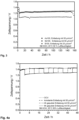
- the cell voltage can be increased from 1.2 volts to 1.4 volts under low load (see Fig. Figures 2a and 2b ).
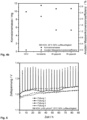
- the thermal voltage which depends on the temperature, can be sensitive to doping (see Fig. 3 ) are affected with foreign atoms and structural defects of the conductor materials.
- the higher electrolyte temperature (Temp 1 ) applies to ⁇ t 1 and the lower electrolyte temperature (Temp 2 ) to ⁇ t 2 .
- At least one temperature control unit preferably comprising one or more heat exchangers and/or conventional heating elements, microwaves or infrared sources, can be used, which are in direct contact with the electrolyte or via a medium, e.g Temperature of the electrolyte can increase and decrease defined.
- the performance can be improved by at least an additional 2%, preferably at least 15%. Particularly preferably, a performance increase of 20% in relation to the electrolyte can be achieved without these compounds.
- the invention therefore relates to a method, in particular a computer-implemented method, for operating a device comprising at least one primary electrochemical cell, the primary electrochemical cell having an anode, a cathode and a cavity for receiving an electrolyte, the cavity having at least one opening for supply and /or having removal of the electrolyte, wherein the arrangement of anode, cathode and cavity with the at least one opening for supplying and/or removing the electrolyte is designed in such a way that a current flow through the electrolyte between the anode and cathode is possible if the cavity is at least partially to completely filled with the electrolyte, and, wherein the anode comprises silicon, in particular wherein the cavity of the primary cell communicates via the at least one opening with a reservoir that can be filled with electrolyte, and, wherein the Device has a temperature control unit for adjusting the temperature of the electrolyte, in particular of the electrolyte in the reservoir, a line between the reservoir
- Equally preferred is a method which comprises the step(s) of presenting, supplying or removing the electrolyte into or out of the cavity.
- the cavity of the primary cell communicates via the at least one opening with a reservoir that can be filled with electrolyte or is filled with electrolyte.
- the electrolyte can be metered into the cavity continuously, intermittently, cyclically or according to defined feed programs and/or discharged or passed through the cavity.
- the flow rate of the electrolyte can be from 0 mL/min to 100 mL/min, in particular from 0.001 to 0.5 mL/min.
- the electrolyte is preferably passed through the cavity at a laminar flow rate.
- the cavity is a flow cell.
- the advantage of changing the electrolyte is that fresh electrolyte with a defined composition can also be fed into the cavity.
- the cavity preferably comprises side walls which form the cavity, with at least one side wall having the at least one opening of the cavity.
- the openings in the cavity correspond to the openings in the at least one sidewall forming the cavity.
- the hollow space is particularly preferably formed by a housing which is impermeable to liquids.
- the housing has the at least one opening according to the invention.
- the housing and the at least one separator of the anode and the separator of the cathode are fixed to one another, in particular to the outside, impermeable to liquids in a detachable or non-detachable manner, the electrolyte in the cavity from the housing coming into contact with the anode and the cathode through the respective separator can.
- the cavity is thus preferably formed by a housing without side walls and side walls with comprises at least one opening.
- the anode and/or the cathode can preferably be inserted into the housing or attached to at least one opening of a side wall by means of a separator, with a cavity being formed in the housing between the at least one anode and at least one cathode.
- the housing with anode and cathode is preferably hermetically sealed to the outside, except for the openings that are present.
- the invention relates to a method and a device comprising at least one electrochemical primary cell (silicon-containing galvanic cell synonymous with primary cell), which is preferably free of lithium, wherein preferably free of lithium means that the lithium content in the charged state is less than 1% by weight.
- % in the overall composition of the primary cell, in particular comprising the anode, the cathode and the electrolyte, the lithium content in the electrode material of the anode in the charged state is preferably less than 0.1% by weight.
- the galvanic cell should have educts and reaction products that come from recycling processes of the silicon wafer production, are by-products and/or come from alternative recycling processes of the silicon and can therefore be reused.
- the CO 2 reduction through the recycling of silicon residues, by-products, sawdust or the recycling of defective, used or other silicon wafers is significant.
- the silicon wafers can also be recycled after they have been used, for example as a photovoltaic cell, by grinding them, for example in ball mills, to particles with a dimension of approx. 0.001 mm, in particular approx. 0.01 to 1 mm.
- the water for producing the electrolyte composition in particular selected from protic liquid for producing the electrolyte composition, preferably has at 25° C. a conductivity of greater than or equal to 0.055 ⁇ S/cm, more preferably greater than or equal to 0.5 ⁇ S/cm, preferably greater than equal to 0.25 S/cm and preferably less than 250 ⁇ S/cm at 25°C.
- the conductivity of the water preferably deionized water (DI water) can be up to 3 ⁇ S/cm, at 60 °C up to 2 ⁇ S/cm.
- the conductivity is significantly higher and is preferably greater than or equal to 1 mS/cm at 25°C, preferably 0.5 S/cm at 25°C.
- the content of metals in the water for preparing the electrolyte composition is preferably less than or equal to 100 ⁇ g/l, preferably less than or equal to 50 ⁇ g/l (determined analytically using ICP-MS).
- the protic liquid which is not an electrolyte, can include, in particular consist of, water, at least one alkanol having 1 to 6 carbon atoms and about 100 atom ppm of polyalkenyl oxide with a terminal hydroxy or carboxylic acid group.
- the addition and/or removal of the protic liquid can be controlled by means of a pH sensor and monitoring of the pH value.
- the pH value is advantageously monitored electronically using a pH measuring sensor. In this way, an exchange or a dilution of the protic liquid can be indicated, which can be done manually or automatically.
- the method can include a) at least one discharging step and optionally b) operation at open circuit voltage, wherein a) the discharging step or steps include the step of adjusting the temperature of the electrolyte, in particular an aqueous, alkaline electrolyte, in the cavity and optionally in the reservoir a defined temperature, in particular to a temperature greater than or equal to 26° C., and optionally discharging the at least one primary cell.
- the method can include a) at least one discharging step and optionally b) operation at open circuit voltage, wherein a) the discharging step or steps include the step of adjusting the temperature of the electrolyte, in particular an aqueous, alkaline electrolyte, in the cavity and optionally in the reservoir a defined temperature, in particular to a temperature greater than or equal to 26° C. and setting a flow rate of the electrolyte to 0.001 mL/min to 100 mL/min, and optionally discharging the at least one primary cell.
- the discharging step can also take place at lower temperatures, which makes sense in order to minimize corrosion.
- the operation takes place in open-circuit voltage, preferably i) at a lower electrolyte temperature (Temp 2 ) over ⁇ t 2 , compared to the increased electrolyte temperature (Temp 1 ) over a period of time ⁇ t 1 , and preferably ii) with a protic liquid which is not an electrolyte, in the lumen or iii) with deflated lumen.
- the protic liquid can also have a lower temperature, which can also correspond to (Temp 2 ) over a period of time ⁇ t 2 .
- the difference ( ⁇ T
- from Temp 1 to Temp 2 is at least 3°C, preferably at least 10°C.
- At least one heat exchanger can preferably be arranged as a temperature control unit in the device, comprising at least one primary cell, in the system and/or outside of heat-emitting components, with the heat exchanger serving to remove the waste heat from other components of the device, such as converters and/or heat-emitting components in a vehicle comprising an accumulator, for temperature control of the electrolyte or the protic liquid, which is not an electrolyte to be used.
- the electrolyte being able to be cooled or heated by means of a heat exchanger, such as a tube-in-tube heat exchanger.
- the cooling can be provided, for example, by a heat exchanger on the inside of the body and/or chassis of a vehicle.
- the waste heat from the main battery and the converter can be used to control the temperature of the electrolyte and the protic liquid, which is not an electrolyte.
- a passivation phase of the anode can take place during operation at no-load voltage with a protic liquid, preferably water; in particular, the temperature in the cell can be kept at 60° C., for example, during the passivation phase.
- the discharging step iii) comprises discharging the at least one primary cell by connecting an electrical consumer to the cathode and anode. Consumers are electrically operated devices or accumulators or batteries for the temporary storage of electrical energy.
- the temperature of the electrolyte is preferably set to a temperature greater than or equal to 27° C. to below 95° C., in particular the temperature of the electrolyte is set to a temperature greater than or equal to 40° C. and in particular less than or equal to 100° C., preferably the temperature of the electrolyte adjusted to a temperature greater than 50 °C, particularly preferably greater than or equal to 60 °C.
- the electrolyte can flow into the cavity and optionally into the reservoir, flow out of the reservoir or flow through the reservoir according to a defined program or pattern with a previously mentioned flow rate.
- the electrolyte in the cavity can be replaced by water, such as distilled or deionized water, optionally containing additives.
- the water can optionally be held in a second reservoir and fed from it to the at least one opening.
- the primary cell each having at least one opening and optionally a conduit for the supply and removal of the water on the second reservoir.
- the at least one primary cell is preferably operated in the method according to the invention in b) no-load voltage by i) setting the electrolyte in the reservoir, in a line and/or in the cavity to a temperature of less than 26° C., in particular as Temp 2 .
- the electrolyte can also be exchanged in the cavity for a protic liquid that is not an electrolyte, preferably water, by pumping or draining the electrolyte at a defined flow rate and the protic liquid, in particular water, into the cavity, in particular over a line, is pumped in or can flow in.
- the protic liquid, in particular the water, in the cavity and optionally in a second reservoir for supplying protic liquid, in particular water, in each case optionally with at least one additive, can preferably have a temperature of less than or equal to 30° C., in particular less than or equal to 27° C., preferably less than or equal to 25 °C, in particular as Temp 2 .
- Operation with no-load voltage synonymous with open cell voltage (OCV) preferably takes place by interrupting the flow of current between the primary cell and the electrical consumer.
- OCV open cell voltage
- the cavity In operation b) at no-load voltage, the cavity should remain emptied for an electrolyte replacement period of less than or equal to 60 minutes, in particular less than or equal to 10 minutes, particularly preferably less than or equal to 1 minute.
- protic liquid is preferably present in the cavity and the cavity is only emptied for the aforementioned electrolyte change period during the process of changing the electrolyte.
- Operation at open circuit voltage can take place by interrupting the current flow of the current draw or by operating the at least one primary cell at open circuit voltage with the following steps i) removing the electrolyte from the cavity, in particular into a first reservoir, and optionally ii) supplying a protic Liquid that is not an electrolyte into the cavity, in particular from a second reservoir.
- the operation of the primary cell in open-circuit voltage comprises ii) supplying a protic liquid, which is not an electrolyte, into the cavity, in particular the protic liquid has a pH value of 5.5 to 8, in particular around pH 7 +/- - 0.5, and is preferably aqueous.
- the protic liquid can be fed into the cavity in batches, continuously, discontinuously and/or periodically.
- the invention also relates to a method for operating a device comprising at least one primary cell or a system comprising a current draw.
- the method according to the invention is particularly preferably a computer-implemented method, ie a method executed by a computer.
- Temp 1 > Temp 2 .
- the difference ( ⁇ T
- from Temp 1 to Temp 2 is preferably at least 5° C., preferably at least 10° C.
- the optimal temperature can be calculated, which is set in the process in order to optimally connect the voltage U1 and/or the current flow I1 to the electronic load to adjust.
- a lithium battery can be connected as an electronic load, which is charged by the primary cell or the system of primary cells.
- the method for determining the internal resistance is preferably carried out in a) a discharging step in which the electrolyte is present in the cavity and/or in b) operation of the primary cell at open circuit voltage if there is no protic liquid in the cavity and a current flow through the protic between the anode and cathode liquid is possible. or a resistance can be measured which differs from the resistance of the completely emptied cavity.
- the method can also include the steps 1. Parallel measurement of the voltage of primary cells or groups of primary cells or of primary cells of a system at a first time at which the primary cells are not connected to an electronic load, measurement of Uo, and performing steps 2 until 5.
- steps 1 to 5 are carried out during the discharging process of the silicon primary cell, the system comprising primary cells or a silicon primary cell string.
- the computer program product preferably includes instructions which, when the program is executed by a computer, cause the computer to use the method for determining the internal resistance of the at least one silicon primary cell or a system of greater than or equal to two primary cells, in particular up to 15,000 primary cells, particularly preferably a silicon Include primary cell string to run.
- the invention also relates to a device comprising at least one electrochemical primary cell, in particular at least one hermetically sealed primary cell and/or a hermetically sealed device, the primary cell having an anode, a cathode, in particular an air cathode that is not hermetically sealed, a cavity for Recording an electrolyte and the cavity has at least one opening for supplying and/or removing the electrolyte into the cavity, the arrangement of anode, cathode and cavity with the at least one opening for supplying and/or removing the electrolyte being such that between the anode and cathode, a current flow through the electrolyte is possible when the cavity is at least partially or completely filled with the electrolyte, and the anode comprises silicon as the anode material, the device having a temperature control unit for setting the temperature of the electrolyte to be filled in for the operation of the primary cell .
- the anode particularly preferably comprises silicon as the anode material, in particular silicon which is present in the form of silicon particles.
- the silicon particles can be amorphous, crystalline or polycrystalline. Particular preference is given to crystalline silicon particles or silicon wafers or fragments thereof or particles from these wafers, in particular which have 111 planes.
- silicon particles can include silicon primary particles with a particle size between 1 nm and 30,000 nm, which are preferably substantially amorphous.
- the aforementioned silicon particles can preferably be in the form of a sintered shaped body, in particular a sintered disc. The sintered disc is preferably porous.
- silicon particles from wafer production or wafer processing as well as the used sawing suspensions and/or the wafer rejects which are obtainable, for example, via wire sawing processes, can be used as anode material.
- the anode can thus comprise silicon as the anode material, which is selected from silicon particles, in particular from 1 nm to 10 cm.
- silicon particles in particular from 1 nm to 10 cm.
- saw residues from silicon wafer production such as wafers for the production of semiconductors or also wafers or particles from solar silicon wafers, can be used.
- the silicon primary particles are essentially amorphous.
- the silicon particles can preferably be in the form of agglomerates of silicon primary particles, aggregates of silicon primary particles or mixtures of these agglomerates and aggregates, the agglomerates and/or aggregates having a size of 100 to 30,000 nm.
- the primary particles can have particles with a primary particle size of 10 to 90 nm, in the case of sawdust up to 30,000 nm.
- the anode, in particular the anode material, in particular in the charged state of the primary cell does not include any lithium, preferably no lithium ions, in the concentration range of greater than or equal to 10,000 ppm by weight, greater than or equal to 100 ppm by weight having.
- the anode material particularly preferably has less than 10 ppm by weight of lithium atoms.
- the anode material preferably has less than 10 21 lithium atoms/cm 3 in the silicon particle on.
- the concentration of lithium, in particular lithium ions, in the electrolyte is less than or equal to 10,000 ppm by weight, in particular less than or equal to 1000 ppm by weight, preferably less than or equal to 100 ppm by weight.
- the anode material preferably has less than 10 21 lithium atoms/cm 3 in the silicon matrix. Furthermore, it is preferred if the concentration of lithium, in particular lithium ions, in the electrolyte is less than or equal to 1000 ppm by weight, in particular less than or equal to 100 ppm by weight, preferably less than or equal to 10 ppm by weight.
- the device and/or the at least one primary cell can be hermetically sealed or encapsulated from the environment.
- An inert plastic such as PP, PE or COC as well as a hybrid material comprising a plastic and inorganic particles as well as a metallic alloy can be used as the material for encapsulating or as the material of the hermetically sealed housing of the at least one primary cell or the device.
- the device has, in particular with at least one heat exchanger and/or at least one heating element as an active heat source for adjusting the temperature, in particular a temperature profile of the electrolyte. Therefore, the device preferably has one or more temperature control units, which can include active as well as passive heat sources, for adjusting the temperature.
- the setting of a specific temperature profile can be used if, for example, secondary cells such as lithium-ion batteries are to be charged from the primary cell or the system or if components dissolved in the electrolyte are to be separated and/or precipitated.
- the cavity can have at least one opening for supplying and/or removing the electrolyte, the cavity of the primary cell communicating via the at least one opening with a reservoir that can be filled with electrolyte.
- At least one opening for supplying and at least one opening for removing the electrolyte is particularly preferably provided in the cavity.
- the aforementioned openings are preferably connected to the reservoir via a line each.
- at least part of the respective line can correspond to an inner or outer tube of a tube-in-tube heat exchanger that includes an inner tube and an outer tube that encloses the inner tube, with the heat exchanger being part of the temperature control unit.
- the cavity in the primary cell has a first and a second opening, with an electrolyte being introduced into the cavity through the first opening and being removable from the second opening. It is preferred if the cavity in the primary cell can be filled with electrolyte via a line from the reservoir through the first opening and via the second Line is removable from the cavity through the second opening from the cavity into the reservoir.
- a heating element and/or a heat exchanger can be associated with at least one of the lines or the reservoir.
- a combination of at least one heat exchanger and optionally at least one heating element is particularly preferred.
- the cavity in the at least one primary cell has a first and optionally a second opening, an electrolyte being introduced into the cavity and removable through the first opening or an electrolyte being introduced into the cavity through the first opening and through the second port is removable, preferably wherein the first and second ports are each independently connected to the reservoir by a conduit.
- each primary cell can be independently connected to a respective reservoir or each primary cell in the system can be connected to a common reservoir in the system as mentioned above.
- the temperature control unit preferably comprises at least one heat exchanger and/or at least one heating means and optionally at least one temperature sensor or temperature sensor.
- the temperature control unit can include an electronic control unit, in particular a digital controller for controlling the at least one heat exchanger and/or the at least one heating means and optionally one or more temperature sensors, which are controlled in a computer-implemented method, i.e. in a method executed by a computer can.
- the heating means preferably includes an electrical resistance heater, a latent heat store, an inductive heating means such as an electrical heating wire, heatable ceramics, an electrical infrared heater and/or a microwave heater.
- the temperature sensor or sensors can include resistance meters, quartz oscillators or other temperature sensors known to those skilled in the art. Temperature sensors are particularly preferred, in particular temperature sensors with electrical signal transmission, preferably with a process connection, which is or are selected from temperature sensors comprising a bimetallic spiral, temperature sensors with resistance measurement, for example according to DIN EN 60751 or temperature sensors comprising a thermocouple (behaviour according to the Seebeck effect) and/or or quartz crystal. Heat exchangers that come into consideration are tube-in-tube heat exchangers, which can be used for changing the electrolyte and/or supplying or removing the protic liquid when the respective primary cell is operated at open-circuit voltage.
- all heat or cold sources preferably in a vehicle, can be used for temperature control by means of a heat exchanger.
- the device can comprise 1 to 200 temperature sensors, in particular the device, preferably the temperature control units, comprises 2 to 200, more preferably 3 to 300 temperature sensors.
- the at least one temperature sensor in particular a temperature sensor with electrical signal transmission, for determining the temperature of the electrolyte in the cavity can be preferred in the conduit of the first port, in the conduit of the second port and/or in the reservoir.
- the temperature control unit comprising a heat exchanger and/or heating means, can be associated with the cavity, one of the lines and/or the reservoir.
- the heating means can preferably be arranged a) in the cavity and/or in the reservoir or b) in a line and/or on the outside of a line.
- the at least one heat exchanger can be supplied with heat, for example via waste heat from at least one converter, which heat is preferably given off to the electrolyte via a second heat exchanger.
- the second heat exchanger can be associated with the cavity, a reservoir and/or a line.
- the invention also relates to a device comprising at least one converter, at least one heat exchanger, lines connecting the cavity and reservoir(s).
- a system which comprises an aforementioned device, the device comprising greater than or equal to 2 primary cells, in particular up to 15,000 primary cells, preferably up to 1,000 primary cells.
- the invention also relates to a multi-cell battery or a system comprising a multi-cell battery, the battery comprising at least two to 15,000 primary cells connected to one another, preferably two to 300 primary cells connected to one another being connected in series as a module. It is also preferred if two or more modules are connected in parallel, for example 2 to 500.
- the battery is defined according to DIN standard 40729.
- a system for data processing comprising means for executing the method is claimed, which is designed in particular for the operation of a system.
- a computer program product is claimed which has instructions which, when the program is executed by a computer, cause the latter to execute the method according to the invention and/or the method for operating a device or a method for operating a system.
- the method according to the invention is preferably a computer-implemented method.
- the subject matter is a computer-readable medium comprising instructions which, when executed by a computer, cause the latter to execute the method according to the invention and/or to execute the method for operating a device or for operating a system.
- An aqueous, alkaline electrolyte composition can be used as the aqueous electrolyte, which can comprise at least one compound containing linear or branched polyalkylene oxide groups and having at least three alkylene oxide groups in the compound or mixtures of at least two of these compounds, the alkylene oxide groups in the polyalkylene oxide - compound containing groups are selected from alkylene oxide groups having 2 to 6 carbon atoms per alkylene oxide group, preferably having 2 to 4 carbon atoms per alkylene oxide group, and, where at least one terminal group preferably contains all terminal groups of the compound containing polyalkylene oxide groups is selected from hydroxyl groups, alkyl groups, alkoxy groups, alkenyl groups, alkenyl oxide groups, carboxylic acid ester groups, in particular olefinic carboxylic acid ester groups Groups, carboxamide groups, aromatic groups, in particular alkyl-substituted aromatic groups, and/or groups containing cyclic ethers.
- the terminal groups of the compound containing polyalkylene oxide groups are preferably selected from hydroxyl groups, alkyl groups, alkoxy groups, alkylene groups, alkylene oxide groups, carboxylic acid ester groups, in particular olefinic carboxylic acid ester groups, aromatic groups and/or groups containing cyclic ethers.
- a preferred compound comprises polyalkylene oxides of rapeseed oil amide, particularly preferred is PEG-4 rapeseed oil amide.
- an aqueous, alkaline electrolyte composition can have compounds containing branched polyalkylene oxide groups, which include ethers of carbohydrates, in particular ethers of furanoses or pyranoses, which optionally have carboxylic acid esters of fatty acids.
- branched polyalkylene oxide groups which include ethers of carbohydrates, in particular ethers of furanoses or pyranoses, which optionally have carboxylic acid esters of fatty acids.
- Polyalkylene oxide group-containing compounds of sorbitan fatty acid esters such as polyoxyethylene (20) sorbitan monooleate (Tween 80).
- polysorbate 20 polyoxyethylene (20) sorbitan monolaurate) (E 432), polysorbate 21 (polyoxyethylene (4) sorbitan monolaurate), polysorbate 40 (polyoxyethylene (20 )-sorbitan monopalmitate) (E 434), polysorbate 60 (polyoxyethylene (20) sorbitan monostearate) (E 435), polysorbate 61 (polyoxyethylene (4) sorbitan monostearate), polysorbate 65 (polyoxyethylene (20) sorbitan tristearate) (E 436), polysorbate 80 (polyoxyethylene (20) sorbitan monooleate) (E 433), polysorbate 81 (polyoxyethylene (5) sorbitan monooleate), polysorbate 85 (polyoxyethylene (20) sorbitan trioleate), polysorbate 120 (polyoxyethylene (20 )-sorbitan monoisostearate).
- the invention also relates to an electrolyte composition
- an electrolyte composition comprising 2.0 to 99.0% by weight of water and 0.0001 to 15% by weight of compounds or mixtures of these containing polyalkylene oxide groups, in particular 0.01 to 10% by weight. preferably 0.01 to 5% by weight, particularly preferably 0.05 to 2% by weight and a content of 0.001 to 40% by weight of alkali metal hydroxide, in particular 10 to 40% by weight, based on the total composition of 100% by weight.
- the electrolyte composition can optionally contain alkali metal silicate, with the content preferably being less than 4 mol/liter alkali metal silicate, preferably from 0.001 to 3.5 mol/liter alkali metal silicate, in particular in the total composition of 100% by weight.
- the electrolyte composition preferably comprises at least one alkali metal hydroxide selected from NaOH and KOH and optionally further alkaline soluble salts such as, for example, alkaline earth metal hydroxides, basic metal oxides or organic bases.
- the electrolyte composition preferably comprises an alkali hydroxide selected from potassium hydroxide (KOH) and sodium hydroxide (NaOH).
- Alternative alkaline salts such as carbonates or metal oxides can suitably be used in the electrolyte composition.
- Distilled water is preferably used to produce the aqueous electrolyte composition.
- the electrolyte composition is an aqueous, alkaline composition comprising alkali metal hydroxide, in particular potassium hydroxide, and at least one compound containing linear or branched polyalkylene oxide groups at least three alkylene oxide groups in the compound or mixtures of at least two of these compounds.
- alkali metal hydroxide in particular potassium hydroxide
- the content of the alkali metal hydroxide is from 0.001 to 6 mol/liter, preferably from 1 to 5.5 mol/liter in the aqueous, alkaline electrolytic composition.
- the content of compound containing polyalkylene oxide groups can depend on the selected electrode surface and other process conditions such as temperature, flow rate in the cell, pore size of the electrode surface, etc. Therefore, the content of compound containing polyalkylene oxide groups can be from 0.000001 to 50,000 ppm by weight, in particular from 0.01 to 20,000 ppm by weight, preferably from 0.01 ppm by weight. to 10,000 ppm wt., in the electrolyte composition, particularly with a total composition of 100 wt.%.
- the content of compound containing polyalkylene oxide groups in the electrolyte composition is preferably 100 ppm by weight. to 8000 ppm by weight, particularly preferred are 200 ppm by weight. to 6000 ppm wt., preferably 400 ppm wt. up to 4000 ppm wt.
- the invention also relates to a chemical primary cell comprising an anode, a cathode, an electrolyte and at least one separator, the separator separating the cathode and the anode from one another, and the cathode comprises manganese dioxide and optionally carbon-containing conductivity media as material, the anode being Anode material comprises silicon, and wherein the silicon is in the form of silicon particles.
- the silicon primary particles preferably have a particle size of between 1 nm and 30,000 nm.
- the silicon particles are crystalline, in particular the silicon particles are polycrystalline.
- the silicon particles are essentially X-ray amorphous.
- mixtures of silicon particles, including amorphous and crystalline silicon particles can be used as anode material.
- the subject of the invention is a device comprising at least one electrochemical primary cell having a cavity with at least one opening, in particular a cavity with side walls with at least one opening, the cavity is particularly preferably a flow cell, an anode, a cathode and at least one separator and optionally containing an electrolyte solution according to the invention, wherein the at least one separator separates the cathode and the anode from one another.
- the anode preferably has a separator and the cathode has a separator.
- a primary cell can have a polymer fleece with a thickness of approx. 50 micrometers as a separator.
- the primary cell can be present with a hermetically sealed housing, i) the material of the cathode of the primary cell having manganese dioxide and optionally a conductivity agent containing carbon.
- a hermetically sealed housing of the primary cell is generally understood to mean a housing that is made of a material that is inert to alkaline electrolytes and is hermetically in particular fluid-tight (gas and liquid-tight) is completed.
- polyetheretherketone, polyaryletherketone, polyphenylene sulfide (PPS), polyoxymethylene copolymers (POM-C), polyamide, cycloolefins or other high-performance plastics or metal alloys can be used as material for the housing, the lines or the reservoir or for the separator Ask.
- the components of the hermetically sealed housing can be laser welded or welded using plasma processes. This hermetically sealed housing of the primary cell is not the housing that can form the cavity.
- the cathode can be implemented as a carbon mesh electrode and supported with MnO 2 .
- the separator can be designed with a shut-down function in order to prevent access of the electrolyte from the anode and/or the cathode in the event of undesired process conditions.
- the primary cell can have a bursting plate in order to prevent the primary cell from exploding if the pressure rises undesirably and to control the targeted escape of the components from the primary cell when the pressure rises.
- the primary cell can have an air cathode as the cathode ii).
- the material of the cathode in this primary cell preferably comprises manganese dioxide and/or sulfur and optionally a carbon-containing conductivity mediator, in particular the air cathode has a carbon dioxide-impermeable membrane, which is preferably arranged in the primary cell in such a way that it prevents the entry of carbon dioxide from the Ambient air prevented from reaching the cathode.
- an economically viable cathode material can be selected from a physical mixture of manganese dioxide (MnO 2 ) and a conductivity agent.
- the optional content of the conductivity mediator in the electrodes of the primary cell can be different in the cathode and in the anode.
- a conductivity mediator content in the material of the cathode of approximately 5 to 65% by weight, preferably 5 to 15% by weight, is customary.
- the content of the conductivity promoter can be from 5 to 70% by weight in the material of the cathode.
- contents in the range of 15 to 20% by weight can be preferred for a lower resistance or also as an upper limit 30 to 60% by weight.
- the total material of the cathode is always 100% by weight.
- the subject matter of the invention is therefore at least one electrochemical primary cell which has an anode, a cathode, an electrolyte and at least one separator, wherein the at least one separator separates the cathode and the anode from one another, and the cathode comprises manganese dioxide and optionally a carbon-containing material as the material Conductivity mediator, the anode containing silicon as the anode material.
- each anode as well as each cathode has a separator.
- the separator can be designed as a hollow body or as a flat membrane. As three-dimensional hollow body, for example, a separator can accommodate the anode material or the cathode material.
- the silicon particles are preferably present as aggregates in the anode.
- the lithium content in the silicon particles is particularly preferably less than or equal to 1% by weight in relation to the silicon content of the anode of 100% by weight of the primary cell, with the lithium content preferably being less than or equal to 0.1% by weight in the charged state of the primary cell .-% amounts.
- the anode has a granulate of silicon particles, the silicon particles of the granulate preferably having an edge length of 3.5 nm or a diameter of 3.5 nm in at least one dimension and preferably at least two of the three diameters , the center of which is in the Cartesian coordinate system at the intersection of the x, y and z axes, have a length of greater than or equal to 3.5 nm.
- the third dimension is preferably greater than or equal to 1 nm (thickness of the silicon particle).
- the particles particularly preferably have edge lengths of greater than or equal to 3.5 nm or diameters of greater than or equal to 3.5 nm and a thickness of 1 nm.
- the anode preferably comprises a granulate of silicon particles with an at least bimodal, preferably at least trimodal distribution of fractions of silicon particles, one fraction being selected from silicon particles with a diameter greater than 10 nm and less than or equal to 3 mm, Granules which have an edge length of 1 mm in at least one dimension are preferred.
- the anode preferably comprises crystalline silicon particles comprising 111 planes. The advantage of coarse silicon particles (an edge length of at least 10 micrometers in at least one dimension) is an optimal coordination of active surface and porosity, which enables the aqueous, alkaline electrolyte to penetrate.
- the anode can particularly preferably comprise silicon as the anode material, which is present in the form of granules of silicon particles selected from amorphous, crystalline or polycrystalline particles.
- bimodal or multimodal mixtures preferably also include silicon particles as agglomerates of silicon primary particles with a particle size of between 1 nm and 300,000 nm.
- the anode material can comprise silicon as granules in the form of silicon particles, with the particle sizes being in the range from 10 nm to 4 mm. E.g. as particles in a granulate with a bi- or tri-modal distribution of the particle sizes. Particle size ranges may be from 0.1 to 300 microns, or from 0.1 to 30 microns, or from 10 nm to 1000 nm, preferably from 19 nm to 300 nm. These silicon particles are preferably present as amorphous and/or polycrystalline particles. It can be particularly preferred if the anode material is a bimodal to multimodal granulate of silicon particles or in the form of a pressed or sintered tablet.
- an anode in particular each anode in each case independently of other anodes in primary cells, the method or in the system comprising primary cells, comprises silicon with a boron content of 10 ppm by weight to 1.8 ppm by weight as the anode material.
- the anode material has silicon particles with a boron content of 10 ppm by weight to 1.8% by weight in relation to the overall composition of the silicon Particles of 100% by weight, anode material in the form of silicon particles sintered together is particularly preferred.
- Separators such as battery separators in an alkaline battery cell, are used to separate a negative electrode from a positive electrode when placed in a suitable electrolyte.
- the separator exhibits a relatively low resistance to electrolyte ion transfer, but a significantly high resistance to electrode ion transfer, during cell operation when the normal chemical reactions are occurring.
- the separator is formed, for example, by applying an improved coating.
- the separator is typically a flexible, fibrous, and porous substrate that is resistant to strong alkali and oxidation.
- the separator can be a composite and can preferably be based on at least one polymer such as polyethylene, polypropylene, polyacrylate, PEEK, PEAK, lingnocellulose, cellulose and/or microcellulose.
- the anode material comprises silicon particles and conductivity mediators, in particular the conductivity mediator comprises carbon-containing particles or a carbon-containing paste, such as electrically conductive organic polymers.
- a particularly preferred anode material of the anode comprises from 10 to 100.00% by weight, in particular from 5 to 90% by weight, preferably from 10 to 95% by weight, of silicon particles and a conductivity agent containing carbon, in particular from 5 to 90% by weight and optionally further additives to 100% by weight of the anode material.
- the conductivity mediator preferably comprises carbon-containing particles, in particular with a particle size of 20 to 100 nm, in particular 25 to 80 nm.
- an anode material of the anode comprising from 20 to 75% by weight, preferably from 20 to 60% by weight, silicon particles and a conductivity agent containing carbon, in particular from 25 to 80% by weight, preferably from 40 to 80% by weight and optionally further additives to 100% by weight of the anode material.
- the conductivity promoter preferably comprises carbon-containing particles, in particular with a particle size of 20 to 100 nm, in particular 25 to 80 nm.
- a particularly preferred anode material of the anode comprises 45 to 55% by weight silicon particles and 55 to 45% by weight a carbon-containing conductivity mediator, wherein the Total composition of the anode material is 100% by weight, ie without electrolyte and/or dried.
- the silicon, in particular the silicon particles, preferably the amorphous silicon particles, of the anode material comprises dopants, the dopants being selected from elements of main group 13, in particular comprising boron, indium, aluminum and/or gallium, and from elements of main group 15, in particular comprising phosphorus, arsenic and/or antimony and elements of the iron group, boron, aluminum, phosphorus and/or iron being particularly preferred.
- the elements of the 13th main group (new nomenclature: group 13 of the periodic table) are electron acceptors of the new nomenclature.
- Elements of main group 15 (new nomenclature: group 15 of the periodic table) are used as electron donors.
- the silicon in particular the silicon particles of the anode material, comprises dopants, the dopants being greater than or equal to 1 element of main group 15 per 10 6 silicon atoms and/or greater than or equal to 1 element of main group 13 per 10 6 silicon -Atoms are present, in particular greater than or equal to 1 element of main group 15 per 10 4 silicon atoms and/or greater than or equal to 1 element of main group 13 per 10 4 silicon atoms, determined by means of ICP-MS analysis known to those skilled in the art (Inductive Plasma Discharge -Mass spectroscopy, which is described in detail on Wikipedia: https://de.wikipedia.org/wiki/Massenspektrometrie_mit_induktiv_kupplungem_Plasma).
- the analysis can also be carried out by GD-MS (GDMS/GD-MS glow discharge mass spectroscopy with secondary electron multiplier (SEM) and/or Faraday detector according to source: https://assets.thermofisher.com/TFS-Assets /CMD/brochures/BR-30066-GD-MS-ELEMENT-GD-PLUS-BR30066-EN.pdf).
- SEM secondary electron multiplier
- the Farady detector preferably for measuring trace concentrations in the % range.
- the silicon, in particular the amorphous silicon particles, of the anode material comprises dopants, the dopants being greater than or equal to 10 2 atoms (about 100 ppm by weight, depending on the atomic weight of the dopant) of main group 15 to 10 6 silicon atoms and/or greater than or equal to 10 2 atoms of main group 13 per 10 6 silicon atoms.
- the silicon, in particular the amorphous silicon particles, of the anode material comprises dopants, the dopants being greater than or equal to 2 10 3 atoms of main group 15 to 10 6 silicon atoms greater than or equal to 2 10 4 atoms of group 13. Main group to 10 6 silicon atoms.
- the above levels of dopants in the silicon of the anode material can be distributed inhomogeneously in the silicon, and the levels can be integral over the total amount of silicon in the anode material on average. To determine the above levels, a test quantity of 1 g test quantity is measured using GD-MS or ICPMS, with certain deviations can be determined between the two methods; an average value is preferably determined.
- the silicon, in particular the amorphous silicon particles, of the anode material comprises dopants, the dopants being greater than or equal to 10 2 atoms of main group 15 to 10 6 silicon atoms and/or greater than or equal to 10 2 atoms of group 13.
- Main group amount to 10 6 silicon atoms.
- the silicon, in particular the amorphous silicon particles, of the anode material comprises dopants, the dopants being greater than or equal to 10 3 atoms of main group 15 to 10 6 silicon atoms and/or greater than or equal to 10 3 atoms of group 13.
- Main group to 10 include 6 silicon atoms.
- the silicon particles can have an alloy of silicon with at least one element of main group 13 or 15, wherein the at least one element of main group 13 or 15 with greater than or equal to 10 21 atoms/cm 3 is selected from at least one electron donor and electron acceptor is present.
- the alloy of silicon at the atomic level with at least one element of main group 13 or 15 is present as an amorphous or crystalline phase.
- the silicon particles particularly preferably have a boron content of 10 ppm by weight to 2.5% by weight in relation to the total content of 100% by weight of the silicon particle; a content of 10 ppm by weight to 1.8 is preferred , more preferably 1.8% by weight plus/minus 0.2% by weight.
- the silicon can have a boron content of 10 ppm by weight to 1.8% by weight in relation to the total content of 100% by weight of the silicon.
- the invention relates to a primary cell comprising silicon particles which have a boron content of 10 ppm by weight to 1.8% by weight.
- the cathode of the primary cell comprises a) manganese dioxide as the cathode material, or b) the cathode of the primary cell is an air cathode and the cathode comprises manganese oxide, in particular manganese oxide and manganese dioxide, platinum, platinum-based, nickel-cobalt Cyanides, or silver as a catalyst in the cathode material.
- the air cathode is particularly preferred.
- Nickel-cobalt cyanides exemplify the class of base metal catalysts with excellent electroactivity for the oxygen reduction reaction in the neutral electrolyte.
- the preparation of the Ni/Co-doped CN hollow nanotube composite catalysts (CN, Co/CN, Ni/CN and Ni-Co/CN) is achieved by a simple pyrolysis of the Ni/Co salt ⁇ dicyandiamide ⁇ glucose mixture.
- a corresponding silicon-air battery was assembled in a neutral medium using the prepared sample as a catalyst for the air electrode, and showed excellent discharge performance and stability.
- the cathode preferably comprises as a material, i.e. as a cathode material or as a catalyst in the cathode material to promote the solubility of oxygen, manganese dioxide.
- a preferred cathode material for a cathode in an air cathode primary cell preferably comprises manganese oxide, in particular manganese oxide and/or manganese dioxide, and silver as a catalyst.
- a particularly preferred cathode material especially for a primary cell with an air cathode, has a hydrophobic cathode whose cathode material is a mixture of manganese (di)oxide, preferably an average particle size of less than or equal to 10 ⁇ m (microns), in particular electrolytic gamma manganese dioxide, a conductivity promoter and a polymeric halogenated hydrocarbon, in particular a polymeric fluorinated hydrocarbon, in particular a polytetrafluoroethylene.
- the mixture can be pressed into plates, dried.
- a microporous, hydrophobic film for example made of a polymeric fluorinated hydrocarbon, is preferably applied in the primary cell to the cathode side exposed to the air.
- a particularly preferred cathode material of the cathode in a hermetically sealed primary cell comprises 75 to 85% by weight of manganese dioxide and 15 to 25% by weight of a conductivity agent containing carbon, the overall composition of the cathode material being 100% by weight (cathode material without electrolyte and /or dried).
- the carbon-containing conductivity mediator preferably comprises carbon-containing particles, particularly preferably graphene-containing particles.
- the carbon particles preferably have a particle size distribution in the range from 0.1 nm to 5 micrometers, preferably from 5 nm to 5 micrometers. It is further preferred if the carbon particles have a particle size in the range from 5 nm to 300 nm, in particular from 10 nm to 150 nm, particularly preferably from 20 to 100 nm and optionally as agglomerates with a size of 100 nm to 3 micrometers, preferably a size of 300 nm to 2 micrometers.
- the cathode and/or the anode preferably have a porosity that is determined by density measurement.
- the porosity of the cathode and/or the anode is preferably from 18 to 43% by volume in relation to the total volume of the cathode of 100% by volume, preferably from 24 to 28% by volume, particularly preferably from 25% by volume. % to 27% by volume.
- the porosity is the space in the anode and/or the cathode that is available for the fluid electrolyte.
- the porosity is expressed as a volume percentage of the total geometric volume of the cathode or the anode.
- porosity POS 1 ⁇ density silicon ⁇ anode in G / cm 3 / solid body density silicon with 2.3 G / cm 3
- Preferred porosities are between 0.01 and 0.5 or between 1% and 50%.
- the weight ratio of manganese dioxide in the cathode material to the electrolyte can be from 2.2 to 2.9.
- the weight ratio of the silicon particles in the anode material to the electrolyte can be from 0.6 to 1.7.
- a particularly preferred cathode material of the cathode comprises 70 to 95 wt. % conductivity mediator, and optionally further additives to 100% by weight of the cathode material.
- the conductivity mediator is preferably a carbon-containing particle, a mixture of these, or a carbon-containing paste.
- carbon black is more effective than graphite powder as a conductivity imparter.
- the sufficient proportion of electronic soot in the anode material is preferably in the range of 50 to 90% by weight with respect to the total composition.
- a two-cell battery with an active electrode area of 16 cm 2 could already provide enough power to operate a small fan.
- the cathode and/or anode is preferably at a pressure of 0.01 to 10 MPa, preferably 0.5 to 5.0 MPa, in order to compress the powder material and reduce the internal resistance of the electrodes 10 ohms/cm.
- a cell of a silicon primary battery is based on Fig. 1a explained in more detail:
- a composite electrode 5 consisting of a suitable contact sheet made of copper or stainless steel as a reference electrode, a 4 cm by 4 cm nickel mesh, preferably gold-plated, as a contact mediator between the reference electrode and chemically inert electrode carrier and a chemically inert electrode carrier (preferably a graphite-polymer compound) is applied.
- a 4 cm by 4 cm silicone plate 6a with a height of approx. 1 mm, which is provided with a central recess 10a (hole) with a diameter of approx. 2.5 cm.
- Anode material is preferably placed in this recess 9 (silicon granulate or paste mixture of silicon powder, conductive carbon black, water, wetting agent and electrolyte) is inserted or deleted.
- a separator 7 eg blotting paper
- the cathode material 8 is now applied therein (paste mixture of manganese dioxide powder, conductive carbon black, water, catalyst, wetting agent and electrolyte).
- composite electrode 4 consisting of a chemically inert electrode carrier (preferably a graphite-polymer compound), 4 cm by 4 cm nickel mesh, preferably gold-plated, as a contact mediator between the reference electrode and the chemically inert electrode carrier and a suitable contact sheet Copper or stainless steel as reference electrode on top.
- a further insulating support plate 2 square polymer plate 4 cm by 4 cm. This so-called sandwich structure of a silicon primary cell 1 can be clamped together in a vice arrangement.
- the basic structure of a preferred variant of the primary cell is shown in Figure 1b shown.
- the primary cell has an anode 14 made of silicon and an air cathode 15 .
- the anodes can be formed from silicon wafers, silicon granulate tablets, compacted powder granulate tablets etc. Between anode 14 and cathode 15 there is a cavity 11 for receiving an electrolyte of approx. 0.6 ml.
- the effective Electrode area for a non-porous anode area is approximately 0.44 cm 2 (0.375 cm radius circle).
- FIG. 12 shows a cell arrangement of a primary cell.
- the supply and the discharge of the electrolyte with a reservoir 13 are each provided via a line 12 .
- 2 and 3 represent contact electrodes.
- the associated contact electrode 3 is designed as a hollow electrode so that air or oxygen can reach the air cathode.
- a hole is shown as an example, via which a cable for current dissipation (screw with cable eyelet) can be connected.
- the contact electrodes 2 and 3 consist of electrically conductive materials, for example graphite-polymer compounds. These are screwed or let into the battery body, which consists of insulating and corrosion-resistant material, such as PEEK or Plexiglas.
- the contact electrodes 2 and 3 press on the discharge-contact-support-spring-mesh 16 , which in turn presses on the anode 14 or cathode 15 , which in turn experiences counter-pressure from the electrolyte body 12 with the hollow rings 7 .
- the discharge contact support spring network 16 compensates for the mechanical stresses that occur on the silicon anode or the (air) cathode.
- the reservoir 13 is not shown and can be a second cavity in the form of a container with or without a pump.
- the internal resistance Ri is calculated to be less than 1 kiloohm [k ⁇ ].
- Figure 1c shows a real structure of the test cell: 20 : anode in the form of a disk comprising silicon particles as powder in a separator or as a sintered disk of silicon particles.
- a silicon-carbon paste can be used as an anode in the form of a disk
- 21 air cathode
- 22 electrolyte reservoir (20 ml, 6 cm 2 anode and cathode area)
- 23 inlet/outlet of electrolyte liquid
- 24 inlet/outlet of inert gas (argon and/or N 2 )
- 25 current collector cathode
- 26 current collector anode.
- the Figures 2a and 2b represent the cell voltage (V) of a primary cell ( Fig. 1b ) with an aqueous electrolyte with 5M KOH in water at 25 °C and 60 °C as open cell voltage (OCV: open circuit V) and as discharge voltage with 50 ⁇ A/cm 2 (25 °C, 50% relative humidity, voltage profiles for Cells under OCV and discharge over 24h, electrolyte flow continuous at flow rate of 4.5 mL/min). It can be clearly seen that a temperature increase from 25°C to 60°C leads to an increased cell voltage with a discharge of 50 ⁇ A/cm 2 . The measurements thus prove that a discharge with an increased current density is also possible.
- Figure 2a Aqueous 5M KOH with electrolyte exchange over 24 hours (of which OCV 4 hours, then discharge 20 hours) at 25 °C (50% humidity) and an electrolyte stream with a continuous flow rate of 4.5 mL/min.
- Figure 2b Aqueous 5M KOH with electrolyte exchange over 24 hours (of which OCV 4 hours, then 20 hours discharge) at 60 °C (50% humidity) and an electrolyte stream with a continuous flow rate of 4.5 mL/min.
- the advantage of changing the electrolyte is that fresh electrolyte with a defined composition can also be fed into the cavity.
- figure 5 Influence of the way of feeding the electrolyte during discharge or during a phase with open cell voltage.
- FIGS. 6a Nos. 1 to 3 , 6b Nos. 1 to 3 and 6c Nos. 1 to 3 represent the influence of compounds containing polyalkylene oxide groups in the aqueous electrolyte at room temperature (25° C.) and elevated temperature (60° C.) in a cell according to Figure 1b and electrode area of 0.44 cm 2 .
- Figures 6a No. 1 to 3 from left to right: Fig. 6a.1 : OCV and 22 microampere load diagram left (120 hours), Figure 6a.2 : Corrosion below OCV center, Figure 6a.3 : Corrosion under electrical load at 25 °C (right, discharge).
- Figure 6a.1 represents the cell voltage of approx.
- Figure 6b.1 OCV and 22 microampere load diagram left (24 hours)
- Figure 6b.2 Corrosion below OCV center
- Figure 6b.3 Corrosion under electrical load right 60°C (discharge)
- Figure 6b.1 represents the cell voltage of about 1.38 volts at open circuit voltage (OCV) and under load at 22 ⁇ A/cm 2 (microamps/cm 2 ) with a cell voltage of about 1.35 volts at 60 °C and 50% rel . humidity.
- OCV open circuit voltage
- Figure 6b.1 represents the cell voltage of about 1.38 volts at open circuit voltage (OCV) and under load at 22 ⁇ A/cm 2 (microamps/cm 2 ) with a cell voltage of about 1.35 volts at 60 °C and 50% rel . humidity.
- OCV open circuit voltage
- Tween80 CAS: 9005-65-6 , polysorbate
- the corrosion mass ( ⁇ ) in OCV operation is according to Figure 6b.2 in 5 M KOH without the addition of Tween 80 at about 49 mg and with the addition of Tween 80 at 60 °C about 14 mg.
- the OCV corrosion protection efficiency ( ⁇ ), which is achieved by adding Tween 80, is therefore around 72%.
- Under electrical load (discharge) at 22 ⁇ A/cm 2 the corrosion mass ( ⁇ ) in 5 M KOH without the addition of Tween is 80 according to Figure 6b.3 about 51 mg and with the addition of Tween 80 at 60 °C about 13 mg.
- the OCV anti-corrosion efficiency ( ⁇ ) is thus about 73% even under load, which is achieved by the addition of Tween 80. Without additive, the anti-corrosion efficiency is 0%.
Landscapes
- Chemical & Material Sciences (AREA)
- Chemical Kinetics & Catalysis (AREA)
- Electrochemistry (AREA)
- General Chemical & Material Sciences (AREA)
- Engineering & Computer Science (AREA)
- Manufacturing & Machinery (AREA)
- Inorganic Chemistry (AREA)
- Secondary Cells (AREA)
Abstract
Gegenstand der Erfindung ist ein Verfahren zum Betrieb einer Vorrichtung umfassend mindestens eine elektrochemische Primärzelle, eine elektrochemische Primärzelle, ein System umfassend die Vorrichtung sowie ein computerimplementiertes Verfahren und ein Computerprogrammprodukt.
Description
- Gegenstand der Erfindung ist ein Verfahren zum Betrieb einer Vorrichtung umfassend mindestens eine elektrochemische Primärzelle, eine elektrochemische Primärzelle, ein System umfassend die Vorrichtung sowie ein computerimplementiertes Verfahren und ein Computerprogrammprodukt.
- Aufgrund des zunehmenden Bedarfes an E-Mobility im Personennahverkehr durch Elektroautos, Elektrofahrräder sowie elektrisch betriebene Busse etc. als auch bei zunehmender dezentraler Stromgewinnung besteht ein enormer Bedarf an umweltverträglichen Batterien, deren Komponenten einerseits unbeschränkt verfügbar und andererseits unbeschränkt recyclebar, umweltverträglich und/oder weiter verwendbar sein sollen. Silizium ist ein auf der Erde unbegrenzt verfügbarer Rohstoff. Darüber hinaus müssen die Komponenten einer Batterie kostengünstig verfügbar sein.
- Des Weiteren ist es bekannt, durch ständige Zufuhr eines Brennstoffes in Brennstoffzellen, die eine galvanische Zelle aufweisen, in Gegenwart eines Oxidationsmittels elektrische Energie zu erzeugen. Grundsätzlich ist dieses Prinzip auch für Silizium-Luft-Batterien denkbar. Das ist ein grundsätzlicher Unterschied zu üblichen, Silizium enthaltende Lithium-Ionen-Sekundärbatterien, die täglich weltweit im Einsatz sind.
- Aufgabe der Erfindung war es, die Leistungsfähigkeit und Lebensdauer einer Silizium enthaltenden galvanischen Zelle, insbesondere alkalischen galvanischen Zelle, zu verbessern. Ferner soll die Leistungsdichte einer solchen Silizium enthaltenden galvanischen Zelle verbessert werden und eine hohe Anfangsspannung einstellbar sein. Eine erfindungsgemäße galvanische Zelle ist eine elektrochemische Primärzelle. Primärzellen können nach ihrem Zusammenbau einmalig entladen werden.
- Des Weiteren bestand die Aufgabe ein Verfahren für den Betreib einer Silizium enthaltenden galvanischen Zelle sowie die Silizium enthaltende galvanische Zelle synonym zu Primärzelle bereitzustellen, die vorzugsweise frei von Lithium ist, wobei vorzugsweise frei von Lithium bedeutet, dass der Gehalt an Lithium im geladenen Zustand unter 1 Gew.-% in der Gesamtzusammensetzung der Primärzelle beträgt, insbesondere umfassend die Anode, die Kathode und den Elektrolyten, vorzugsweise beträgt der Gehalt an Lithium im Elektrodenmaterial der Anode im geladenen Zustand unter 0,1 Gew.-%. Vorzugsweise soll die galvanische Zelle Edukte und Reaktionsprodukte aufweisen, die aus Recyclingprozessen der Silizium-Wafer-Herstellung, wie Silizium-Sägeprozessen, stammen, Nebenprodukte sind und/oder in Recyclingprozessen weiterverwendet werden können.
- Gelöst werden die Aufgaben mit dem Gegenstand des Anspruchs 1 sowie mit einer Vorrichtung umfassend die Primärzelle nach Anspruch 8, dem System umfassend eine Vorrichtung, wie ein System umfassend eine mehrzellige Batterie nach Anspruch 14 und dem computerimplementierten Verfahren nach Anspruch 7 als auch dem Computerprogrammprodukt zum Ausführen des computerimplementierten Verfahrens.
- Überraschend wurde gefunden, dass die Leistungsfähigkeit einer Primärzelle während einer definierten Zeitspanne bei höherer Temperatur gegenüber der Leistungsfähigkeit bei niedriger Temperatur gesteigert werden kann. Die Leistungsfähigkeit ist definiert als die Leistung bei höherer Temperatur (in Watt bzw.Volt*Ampere) dividiert durch die Leistung bei niederer Temperatur (in Watt bzw. Volt*Ampere). Die Verbesserung der Leistungsfähigkeit wird in Prozent angegeben. So ist die Zellspannung bei sonst gleichen Bedingungen bei einer Elektrolyttemperatur von 60 °C (Temp1) mit Δt1 etwa größer gleich 2 %, insbesondere größer gleich 7 %, bevorzugt 10 % bis 20% höher gegenüber der Zellspannung bei 25 °C (Temp2) mit Δt1 (Zeitraum: Δt1 = Δt2), insbesondere über einen Zeitraum (Δt1 = Δt2) von mindestens 4 Stunden, vorzugsweise größer gleich 20 Stunden, besonders bevorzugt größer gleich 24 Stunden. So kann bspw. unter geringer Last die Zellspannung von 1,2 Volt auf 1,4 Volt erhöht werden (s.
Fig. 2a und 2b ). Die von der Temperatur abhängige Thermospannung kann, im Gegensatz zur Kontaktspannung empfindlich durch Dotierung (s.Fig. 3 ) mit Fremdatomen und strukturelle Defekte der Leitermaterialien beeinflusst werden. Dabei gilt erhöhte Elektrolyttemperatur (Temp1) über Δt1 und niedrigere Elektrolyttemperatur (Temp2) über Δt2. - Zur Erhöhung der Temperatur des Elektrolyten kann mindestens eine Temperiereinheit, bevorzugt umfassend einen oder mehrere Wärmetauscher und/oder übliche Heizelemente, Mikrowellen oder auch Infrarotquellen eingesetzt werden, die in direktem Kontakt mit dem Elektrolyten stehen oder über ein Medium bspw. eine Trennwand oder einen Wärmetauscher die Temperatur des Elektrolyten definiert erhöhen und erniedrigen können.
- Bei Zugabe von Elektrolyten umfassend lineare und/oder verzweigte Polyalkylenoxid-Gruppen aufweisende Verbindungen kann die Leistungsfähigkeit um mindestens zusätzlich 2 %, vorzugsweise mindestens 15 % verbessert werden. Besonders bevorzugt kann eine Leistungssteigerung um 20 % in Bezug auf den Elektrolyten ohne diese Verbindungen erzielt werden.
- Gegenstand der Erfindung ist daher ein Verfahren, insbesondere ein computerimplementiertes Verfahren, zum Betrieb einer Vorrichtung umfassend mindestens eine elektrochemische Primärzelle, wobei die elektrochemische Primärzelle eine Anode, eine Kathode und einen Hohlraum zur Aufnahme eines Elektrolyten aufweist, wobei der Hohlraum mindestens eine Öffnung zur Zuführung und/oder Entfernung des Elektrolyten aufweist, wobei die Anordnung von Anode, Kathode und Hohlraum mit der mindestens einen Öffnung zur Zuführung und/oder Entfernung des Elektrolyten dergestalt ausgebildet ist, dass zwischen Anode und Kathode ein Stromfluss durch den Elektrolyten möglich ist, wenn der Hohlraum zumindest teilweise bis vollständig mit dem Elektrolyten befüllt ist, und, wobei die Anode Silizium umfasst, insbesondere wobei der Hohlraum der Primärzelle über die mindestens eine Öffnung mit einem Reservoir, das mit Elektrolyt befüllbar ist kommuniziert, und, wobei die Vorrichtung eine Temperiereinheit zur Einstellung der Temperatur des Elektrolyten, insbesondere des Elektrolyten im Reservoir, einer Leitung zwischen Reservoir und Hohlraum und/oder im Hohlraum, aufweist,
- indem das Verfahren zum Betrieb der mindestens einen Primärzelle umfasst
- a) einen Entladeschritt in dem Elektrolyt im Hohlraum vorliegt und optional
- b) Betrieb in Leerlaufspannung, vorzugsweise niedrigere Elektrolyttemperatur (Temp2) über Δt2, gegenüber der erhöhten Elektrolyttemperatur (Temp1) über Δt1,
- i) Einstellen der Temperatur des Elektrolyten, insbesondere des Elektrolyten im Reservoir, in einer Leitung zwischen Reservoir und Hohlraum und/oder im Hohlraum, auf eine definierte Temperatur, insbesondere auf eine Temperatur größer gleich 26 °C, vorzugsweise erhöhte Elektrolyttemperatur (Temp1) über Δt1,
- ii) optional Entladen der mindestens einen Primärzelle.
- Gleichfalls bevorzugt ist ein Verfahren, das den oder die Schritte umfasst Vorlegen, Zuführen oder Entfernen des Elektrolyten in oder aus dem Hohlraum.
- Nach einer bevorzugten Ausführungsvariante kommuniziert der Hohlraum der Primärzelle über die mindestens eine Öffnung mit einem Reservoir, das mit Elektrolyt befüllbar ist oder mit Elektrolyten befüllt ist. Nach einer besonders bevorzugten Ausführungsform kann der Elektrolyt in den Hohlraum kontinuierlich, satzweise, zyklisch oder nach definierten Einspeise-Programmen zudosiert und/oder abgeführt oder durch den Hohlraum durchgeleitet werden. Die Fließgeschwindigkeit des Elektrolyten kann von 0 mL/min bis 100 mL/min, insbesondere von 0,001 bis 0,5 mL/min betragen. Bevorzugt wird der Elektrolyt mit laminarer Fließgeschwindigkeit durch den Hohlraum geleitet.
- Dabei ist es besonders bevorzugt, wenn der Hohlraum eine Durchflusszelle ist. Der Vorteil des Elektrolytwechsels ist zudem, dass jeweils auch frischer Elektrolyt mit definierter Zusammensetzung in den Hohlraum eingespeist werden kann. Bevorzugt umfasst der Hohlraum Seitenwände, die den Hohlraum ausbilden, wobei mindestens eine Seitenwand die mindestens eine Öffnung des Hohlraumes aufweist. Die Öffnungen in dem Hohlraum entsprechend den Öffnungen in der mindestens einen Seitenwand die den Hohlraum ausbilden. Besonders bevorzugt wird der Hohlraum gebildet durch ein für Flüssigkeiten undurchlässiges Gehäuse. Das Gehäuse weist die mindestens eine erfindungsgemäße Öffnung auf. Das Gehäuse und der mindestens eine Separator der Anode und der Separator der Kathode sind, insbesondere nach außen, für Flüssigkeiten undurchlässig lösbar oder unlösbar aneinander fixiert, wobei durch den jeweiligen Separator der Elektrolyt im Hohlraum aus dem Gehäuse mit der Anoden und der Kathode in Kontakt treten kann. Der Hohlraum wird somit vorzugsweise durch ein Gehäuse gebildet, das Seitenwände ohne und Seitenwände mit mindestens einer Öffnung umfasst. Vorzugsweise können die Anode und/oder die Kathode in das Gehäuse eingefügt oder mittels eines Separators an mindestens einer Öffnung einer Seitenwand angefügt werden, wobei sich ein Hohlraum im Gehäuse zwischen der mindestens einen Anode und mindestens einen Kathode ausbildet. Das Gehäuse mit Anode und Kathode ist vorzugsweise, außer durch die vorhandenen Öffnungen, nach außen hermetisch abgeschlossen.
- Gegenstand der Erfindung ist ein Verfahren und eine Vorrichtung umfassend mindestens eine elektrochemische Primärzelle (Silizium enthaltende galvanische Zelle synonym zu Primärzelle), die vorzugsweise frei von Lithium ist, wobei vorzugsweise frei von Lithium bedeutet, dass der Gehalt an Lithium im geladenen Zustand unter 1 Gew.-% in der Gesamtzusammensetzung der Primärzelle beträgt, insbesondere umfassend die Anode, die Kathode und den Elektrolyten, vorzugsweise beträgt der Gehalt an Lithium im Elektrodenmaterial der Anode im geladenen Zustand unter 0,1 Gew.-%. Vorzugsweise soll die galvanische Zelle Edukte und Reaktionsprodukte aufweisen, die aus Recyclingprozessen der Silizium-Wafer-Herstellung stammen, Nebenprodukte sind und/oder aus alternativen Recyclingprozessen des Siliziums stammen und somit weiterverwendet werden können. Die CO2-Reduktion durch das Recycling von Silizium-Resten, Nebenprodukten, Sägeresten oder dem Recycling defekter, gebrauchter oder sonstiger Silizium-Wafer ist erheblich. Vorteilhaft können auch die Silizium-Wafer nach ihrer Nutzung z.B. als Photvoltaikzelle recycelt werden indem man sie vermahlen, bspw. in Kugelmühlen auf Partikel mit einer Dimension von ca. 0,001 mm, insbesondere ca. 0,01 bis 1 mm.
- Das Wasser zur Herstellung der Elektrolytzusammensetzung, insbesondere ausgewählt aus protischer Flüssigkeit zur Herstellung der Elektrolytzusammensetzung, weist vorzugsweise bei 25 °C, eine Leitfähigkeit von größer gleich 0,055 µS/cm, weiter bevorzugt von größer gleich 0,5 µS/cm auf, bevorzugt bei größer gleich 0,25 S/cm und vorzugsweise kleiner 250 µS/cm bei 25 °C. Bei ca. 100 °C kann die Leitfähigkeit des Wassers, vorzugsweise vollentsalztem Wasser (VE-Wasser), bis zu 3 µS/cm betragen, bei 60 °C bis zu 2 µS/cm. In der Elektrolytzusammensetzung ist die Leitfähigkeit erheblich höher und liegt vorzugsweise bei größer gleich 1 mS/cm bei 25 °C, bevorzugt bei 0,5 S/cm bei 25 °C. Der Gehalt an Metallen des Wassers zur Herstellung der Elektrolytzusammensetzung beträgt vorzugsweise kleiner gleich 100 µg/l, bevorzugt kleiner gleich 50 µg/l (analytisch bestimmt mittels ICP-MS).
- Nach einer besonders bevorzugten Ausführungsform kann die protische Flüssigkeit, die kein Elektrolyt ist, umfassen, insbesondere bestehen aus, Wasser, mindestens einem Alkanol mit 1 bis 6 C-Atomen und ca. 100 Atom-ppm Polyalkenyloxid mit einer terminalen Hydroxy oder CarbonsäureGruppe. Der pH-Wert der protischen Flüssigkeit beträgt vorzugsweise pH = 7 +/- 0,5, insbesondere pH 6,9 +/- 0,2. Das Zuführen und/oder Entfernen der protischen Flüssigkeit kann mittels eines pH-Sensors und Überwachung des pH-Wertes gesteuert werden. Der pH-Wert wird vorteilhaft elektronisch mittels eines pH-Messsensors überwacht. Auf diese Weise kann ein Austausch oder eine Verdünnung der protischen Flüssigkeit angezeigt werden, der manuell oder automatisiert erfolgen kann.
- Nach einer weiteren Ausführungsform umfasst das Verfahren zum Betrieb der mindestens einen Primärzelle a) mindestens einen Entladeschritt und optional b) einen Betrieb in Leerlaufspannung, wobei a) der Entladeschritt die Schritte umfasst
- i) optional Vorlegen von Elektrolyt in dem Reservoir, optional Einstellen der Temperatur des Elektrolyten auf eine definierte Temperatur im Reservoir und optional in der Leitung zwischen Reservoir und Hohlraum, insbesondere auf eine Temperatur größer gleich 26 °C, insbesondere als Temp1, und
- ii) Vorlegen von Elektrolyt, insbesondere eines wässrigen, alkalischen Elektrolyten, im Hohlraum, optional Einstellen der Temperatur des Elektrolyten auf eine definierte Temperatur, insbesondere auf eine Temperatur größer gleich 26 °C, insbesondere als Temp1,
- iii) optional Entladen der mindestens einen Primärzelle, und wobei
- ein Einstellen der Temperatur des Elektrolyten auf eine definierte Temperatur i) im Reservoir, in einer Leitung zwischen Reservoir und Hohlraum und/oder ii) im Hohlraum erfolgt, insbesondere auf eine Temperatur größer gleich 26 °C , insbesondere als Temp1,
- Gleichfalls kann das Verfahren umfassen a) mindestens einen Entladeschritt und optional b) einen Betrieb in Leerlaufspannung, wobei a) der Entladeschritt oder die Entladeschritte den Schritt umfassen Einstellen der Temperatur des Elektrolyten, insbesondere eines wässrigen, alkalischen Elektrolyten, im Hohlraum und optional im Reservoir auf eine definierte Temperatur, insbesondere auf eine Temperatur größer gleich 26 °C, und optional Entladen der mindestens einen Primärzelle.
- Ferner kann das Verfahren umfassen a) mindestens einen Entladeschritt und optional b) einen Betrieb in Leerlaufspannung, wobei a) der Entladeschritt oder die Entladeschritte den Schritt umfassen Einstellen der Temperatur des Elektrolyten, insbesondere eines wässrigen, alkalischen Elektrolyten, im Hohlraum und optional im Reservoir auf eine definierte Temperatur, insbesondere auf eine Temperatur größer gleich 26 °C und Einstellen einer Fließgeschwindigkeit des Elektrolyten auf 0,001 mL/min bis 100 mL/min, und optional Entladen der mindestens einen Primärzelle. Gleichfalls kann der Entladeschritt auch bei tieferen Temperaturen erfolgen, dies ist sinnvoll, um die Korrosion zu minimieren.
- Vorzugsweise erfolgt b) der Betrieb in Leerlaufspannung, vorzugsweise i) bei niedrigerer Elektrolyttemperatur (Temp2) über Δt2, gegenüber der erhöhten Elektrolyttemperatur (Temp1) über eine Zeitspanne Δt1, und vorzugsweise ii) mit protischer Flüssigkeit, die kein Elektrolyt ist, im Hohlraum oder iii) mit entleertem Hohlraum. In Alternativen kann auch die protische Flüssigkeit eine niedrigere Temperatur aufweisen, die ebenfalls (Temp2) über eine Zeitspanne Δt2 entsprechen kann.
- Dabei ist die Leistung Temp1 * Δt1 > Temp2* Δt2 mit Δt1 = Δt2 und Temp1 > Temp2. Die Differenz (ΔT = |Temp1 - Temp2| von Temp1 zu Temp2 beträgt mindestens 3°C vorzugsweise mindestens 10 °C.
- Als Temperiereinheit kann bevorzugt mindestens ein Wärmetauscher in der Vorrichtung umfassend mindestens eine Primärzelle, in dem System und/oder außerhalb an Wärme abgebenden Komponenten angeordnet sein, wobei der Wärmetauscher dazu dient, die Abwärme von anderen Komponenten der Vorrichtung, wie Umrichter und/oder wärmeabgebenden Komponenten in einem Fahrzeug umfassend einen Akkumulator, zur Temperierung des Elektrolyten oder der protischen Flüssigkeit, die kein Elektrolyt ist zu verwenden.
- Dies kann beispielsweise erfolgen, indem der Elektrolyt mittels eines Wärmetauschers, wie eines Rohr-in-Rohr-Wärmetauschers gekühlt oder geheizt werden kann. Die Kühlung kann bspw. durch einen Wärmetauscher innen an der Karosserie und/oder Chassis eines Fahrzeuges vorgesehen werden. Wird das erfindungsgemäße System oder die Primärzelle als Range-Extender-System in Kombination mit einem Akkumulator in einem Fahrzeug genutzt, kann die Abwärme der Hauptbatterie und des Umrichters für die Temperierung des Elektrolyten und der protischen Flüssigkeit, die kein Elektrolyt ist genutzt werden. So kann beispielsweise eine Passivierungsphase der Anode während des Betriebs in Leerlaufspannung mit protischer Flüssigkeit, vorzugsweise Wasser erfolgen, insbesondere kann während der Passivierungsphase die Temperatur in der Zelle z.B. auf 60 °C gehalten werden.
- Nach einer weiteren bevorzugten Alternative umfasst a) der Entladeschritt iii) Entladen der mindestens einen Primärzelle, indem ein elektrischer Verbraucher an die Kathode und Anode angeschlossen wird. Als Verbraucher gelten elektrisch betriebene Vorrichtungen oder auch Akkumulatoren oder Batterien zur Zwischenspeicherung gewonnener elektrischer Energie.
- Die Temperatur des Elektrolyten wird vorzugsweise auf eine Temperatur größer gleich 27°C bis unter 95°C eingestellt, insbesondere wird die Temperatur des Elektrolyten auf eine Temperatur größer gleich 40 °C und insbesondere auf kleiner gleich 100 °C, vorzugsweise wird die Temperatur des Elektrolyten auf eine Temperatur größer 50 °C, besonders bevorzugt auf größer gleich 60 °C eingestellt. Dabei kann der Elektrolyt nach einem definierten Programm oder Muster mit einer vorgenannten Fließgeschwindigkeit in den Hohlraum und optional in das Reservoir einfließen, aus dem Reservoir herausfließen oder das Reservoir durchfließen. Ferner kann der Elektrolyt im Hohlraum durch Wasser, wie destilliertes oder vollentsalztes Wasser optional enthaltend Additive ersetzt werden. Das Wasser kann optional in einem zweiten Reservoir vorgehalten und daraus der mindestens einen Öffnung zugeführt werden. Nach einer Ausführungsform kann die Primärzelle jeweils mindestens eine Öffnung und optional eine Leitung für die Zuführung und Entfernen des Wassers auf dem zweiten Reservoir aufweisen.
- Vorzugsweise erfolgt der Betrieb der mindestens einen Primärzelle im erfindungsgemäßen Verfahren in b) Leerlaufspannung, indem i) der Elektrolyt in dem Reservoir, in einer Leitung und/oder im Hohlraum auf eine Temperatur kleiner 26 °C, insbesondere als Temp2, eingestellt wird. Nach einer Alternative kann der Elektrolyt zusätzlich im Hohlraum gegen eine protische Flüssigkeit, die kein Elektrolyt ist, bevorzugt Wasser, getauscht werden, indem der Elektrolyt mit einer definierten Fließgeschwindigkeit abgepumpt oder abgelassen wird und die protische Flüssigkeit, insbesondere Wasser, in den Hohlraum, insbesondere über eine Leitung, eingepumpt wird oder einfließen kann. Die protische Flüssigkeit, insbesondere das Wasser, im Hohlraum und optional in einem zweiten Reservoir zur Zuführung von protischer Flüssigkeit, insbesondere Wasser, jeweils optional mit mindestens einem Additiv, kann vorzugsweise eine Temperatur kleiner gleich 30 °C, insbesondere kleiner gleich 27 °C, bevorzugt kleiner gleich 25 °C aufweisen, insbesondere jeweils als Temp2.
- Der Betrieb in Leerlaufspannung, synonym zu offener Zellspannung (OCV), erfolgt vorzugsweise, indem der Stromfluss zwischen Primärzelle und elektrischem Verbraucher unterbrochen ist.
- Im Betrieb b) in Leerlaufspannung soll der Hohlraum, für eine Elektrolytwechselzeitspanne kleiner gleich 60 Minuten, insbesondere kleiner gleich 10 Minuten, besonders bevorzugt kleiner gleich 1 Minute, entleert bleiben. Vorzugsweise liegt im Betrieb in Leerlaufspannung im Hohlraum protische Flüssigkeit vor und nur beim Vorgang des Elektrolytwechsels ist der Hohlraum für die vorgenannten Elektrolytwechselzeitspanne entleert.
- Der Betrieb in Leerlaufspannung kann erfolgen, indem der Stromfluss der Stromentnahme unterbrochen ist oder indem die mindestens eine Primärzelle in Leerlaufspannung mit den folgenden Schritten betrieben wird i) Entfernen des Elektrolyten aus dem Hohlraum, insbesondere in ein erstes Reservoir, und optional ii) Zuführen einer protischen Flüssigkeit, die kein Elektrolyt ist, in den Hohlraum, insbesondere aus einem zweiten Reservoir. Ferner ist es bevorzugt, wenn der Betrieb der Primärzelle in Leerlaufspannung umfasst ii) Zuführen einer protischen Flüssigkeit in den Hohlraum, die kein Elektrolyt ist, insbesondere weist die protische Flüssigkeit einen pH-Wert von 5,5 bis 8, insbesondere um pH 7 +/- 0,5, auf und ist bevorzugt wässrig. Dabei kann das Zuführen der protischen Flüssigkeit in den Hohlraum satzweise, kontinuierlich, diskontinuierlich und/oder periodisch erfolgen.
- Gegenstand der Erfindung ist auch ein Verfahren zum Betrieb einer Vorrichtung umfassend mindestens eine Primärzelle oder ein System umfassend eine Stromentnahme. Das erfindungsgemäße Verfahren ist besonders bevorzugt ein computerimplementiertes Verfahren, d.h. ein von einem Computer ausgeführtes Verfahren.
- Nach einer besonders bevorzugten Alternative kann das Verfahren die Ermittlung des Innenwiderstandes der mindestens einen Silizium-Primärzelle oder eines Systems von größer gleich zwei Primärzellen, insbesondere bis zu 15.000 Primärzellen, besonders bevorzugt eines Silizium-Primärzellenstrangs umfassen, wobei das Verfahren zur Ermittlung des Innenwiderstandes die Schritte umfasst, und insbesondere durchgeführt wird im Entladeschritt,
- 1. Messen einer Spannung der Primärzelle zu einer ersten Zeit, zu der die Primärzelle nicht zu einer elektronischen Last zugeschaltet ist - Messung von Uo,
- 2. Zuschalten einer elektronischen Last, welches zu einem Stromfluss I1 führt.
- 3. Messung der Spannung U1,
- 4. Berechnen des Kurzschlussstromes Ik aus diesen Größen und Berechnung des Ri aus Uo/Ik. Ik=(Uo)*IkI1/(Uo-UkI1), optional
- 5. dynamische und/oder kontinuierliche Wiederholung der Berechnung und optional Abschätzen der Restkapazität.
- Mit der Maßgabe, dass Temp1 einer höheren Temperatur als Temp2 entspricht, d.h.
- Temp1 > Temp2. Vorzugsweise beträgt die Differenz (ΔT = |Temp1 - Temp2| von Temp1 zu Temp2 mindestens 5°C, vorzugsweise mindestens 10°C.
- Weiter bevorzugt ist ein Verfahren in dem der Innenwiderstand ermittelt und/oder angepasst, der mindestens einen Silizium-Primärzelle oder eines Systems von größer gleich zwei Primärzellen, insbesondere bis zu 15.000 Primärzellen, besonders bevorzugt eines Silizium-Primärzellenstrangs wird, wobei das Verfahren die Schritte umfasst, und insbesondere durchgeführt wird im Entladeschritt,
- 1. Messen einer Spannung der Primärzelle zu einer ersten Zeit und einer Temp1 und/oder Temp2, zu der die Primärzelle nicht zu einer elektronischen Last zugeschaltet ist Messung von Uo,
- 2. Zuschalten einer elektronischen Last, welches zu einem Stromfluss I1 führt.
- 3. Messung der Spannung U1,
- 4. Berechnen des Kurzschlusstromes Ik aus diesen Größen und Berechnung des Ri aus Uo/Ik. Ik=(Uo)*IkI1/(Uo-UkI1), optional
- 5. dynamische und/oder kontinuierliche Wiederholung der Berechnung und optional Abschätzen der Restkapazität.
- Ferner kann das Verfahren zur Ermittlung und/oder Anpassung des Innenwiderstandes die Schritte umfassen,
- 1. Messen einer Spannung der Primärzelle zu einer ersten Zeit und einer Temp2 zu der die Primärzelle nicht zu einer elektronischen Last zugeschaltet ist - Messung von Uo,
- 2. Zuschalten einer elektronischen Last, welches zu einem Stromfluss I1 führt.
- 3. Messung der Spannung U1,
- 4. Berechnen des Kurzschlussstromes Ik aus diesen Größen und Berechnung des Ri aus Uo/Ik. Ik=(Uo)*IkI1/(Uo-UkI1), optional
- 5. dynamische und/oder kontinuierliche Wiederholung der Berechnung und optional Abschätzen der Restkapazität, und optional
- 6. Messen einer Spannung der Primärzelle zu einer ersten Zeit und einer Temp1 zu der die Primärzelle nicht zu einer elektronischen Last zugeschaltet ist Messung von Uo,
- 7. Zuschalten einer elektronischen Last, welches zu einem Stromfluss I1 führt, und optional
- 8. Messung der Spannung U1,
- 9. Berechnen des Kurzschlussstromes Ik aus diesen Größen und Berechnung des Ri aus Uo/Ik. Ik=(Uo)*IkI1/(Uo-UkI1), optional
- 10. dynamische und/oder kontinuierliche Wiederholung der Berechnung und optional Abschätzen der Restkapazität.
- Durch die Messung des Innenwiderstandes bei Temp2 (niedrigere Temp.) und Temp1 (höhere Temp.) kann die optimale Temperatur berechnet werden, die in dem Verfahren eingestellt wird, um die Spannung U1 und/oder den Stromfluss I1 optimal an die elektronische Last anzupassen. Als elektronische Last kann u.a. ein Lithium-Akkumulator angeschlossen werden, der von der Primärzelle oder dem System von Primärzellen aufgeladen wird.
- Das Verfahren zur Ermittlung des Innenwiderstandes wird vorzugsweise durchgeführt in a) einen Entladeschritt in dem der Elektrolyt im Hohlraum vorliegt und/oder im b) Betrieb der Primärzelle in Leerlaufspannung, wenn nicht protische Flüssigkeit im Hohlraum vorliegt und zwischen Anode und Kathode ein Stromfluss durch die protische Flüssigkeit möglich ist. oder ein Widerstand gemessen werden kann, der von dem Widerstand des vollständig entleerten Hohlraumes abweicht.
- Das Verfahren kann auch die Schritte umfassen 1. Paralleles Messen der Spannung von Primärzellen oder Gruppen von Primärzellen oder von Primärzellen eines Systems zu einer ersten Zeit, zu der die Primärzellen nicht zu einer elektronischen Last zugeschaltet sind, Messung von Uo, sowie Durchführen der Schritte 2 bis 5.
- Ferner ist es bevorzugt, wenn die Schritte 1 bis 5 während des Entladevorgangs der Silizium-Primärzelle, des Systems umfassend Primärzellen oder eines Silizium-Primärzellenstrangs durchgeführt werden.
- Vorzugsweise umfasst das Computerprogrammprodukt Befehle, die bei der Ausführung des Programms durch einen Computer diesen veranlassen, das Verfahren zur Ermittlung des Innenwiderstandes der mindestens einen Silizium-Primärzelle oder eines Systems von größer gleich zwei Primärzellen, insbesondere bis zu 15.000 Primärzellen, besonders bevorzugt einen Silizium-Primärzellenstrang umfassen, auszuführen.
- Gleichfalls Gegenstand der Erfindung ist eine Vorrichtung umfassend mindestens eine elektrochemische Primärzelle, insbesondere mindestens eine hermetisch abgeschlossene Primärzelle und/oder eine hermetisch abgeschlossene Vorrichtung, wobei die Primärzelle aufweist eine Anode, eine Kathode, insbesondere eine Luftkathode, die nicht hermetisch abgeschlossen ist, einen Hohlraum zur Aufnahme eines Elektrolyten und der Hohlraum mindestens eine Öffnung zur Zuführung und/oder Entfernung des Elektrolyten in den Hohlraum aufweist, wobei die Anordnung von Anode, Kathode und Hohlraum mit der mindestens einen Öffnung zur Zuführung und/oder Entfernung des Elektrolyten dergestalt ist, dass zwischen Anode und Kathode ein Stromfluss durch den Elektrolyten möglich ist, wenn der Hohlraum zumindest teilweise bis vollständig mit dem Elektrolyten befüllt ist, und wobei die Anode als Anodenmaterial Silizium umfasst, wobei die Vorrichtung eine Temperiereinheit zur Einstellung der Temperatur des für den Betrieb der Primärzelle einzufüllenden Elektrolyten aufweist.
- Besonders bevorzugt umfasst die Anode als Anodenmaterial Silizium, insbesondere Silizium, das in Form von Silizium-Partikeln vorliegt. Die Silizium-Partikel können amorph, kristallin oder polykristallin vorliegen. Besonders bevorzugt sind kristalline Silizium-Partikel oder Silizium-Wafer oder Bruchstücke davon oder Partikel aus diesen Wafern, insbesondere die 111-Ebenen aufweisen. Gleichfalls können Silizium-Partikel umfassen Silizium-Primärpartikel mit einer Partikelgröße zwischen 1 nm bis 30 000 nm, die vorzugsweise im Wesentlichen amorph sind. Die vorgenannten Silizium-Partikel können vorzugsweise als gesinterter Formkörper, insbesondere als gesinterte Scheibe vorliegen. Die gesinterte Scheibe ist vorzugsweise porös. Gleichfalls können Silizium-Partikel aus der Waferherstellung oder Waferbearbeitung sowie die genutzen Sägesuspensionen und/oder der Wafer-Ausschuss, die bspw. über Drahtsägeverfahren erhältlich sind, als Anodenmaterial eingesetzt werden.
- Somit kann die Anode als Anodenmaterial Silizium umfassen, das ausgewählt ist aus Silizium-Partikeln, insbesondere von 1 nm bis 10 cm. Nach einer bevorzugten Ausführungsform können Sägereste aus der Silizium-Wafer-Herstellung, wie Wafern zur Herstellung von Halbleitern oder auch Wafer oder Partikel von Solarsilizium-Wafern eingesetzt werden. Alternativ sind die Silizium-Primärpartikel im Wesentlichen amorph. Vorzugsweise können die Silizium-Partikel in Form von Agglomeraten von Silizium-Primärpartikeln, Aggregaten von Silizium-Primärpartikeln oder Gemischen dieser Agglomerate und Aggregate, wobei die Agglomerate und/oder Aggregate eine Größe von 100 bis 30 000 nm aufweisen. Die Primärpartikel können Partikel mit einer Primärpartikelgröße von 10 bis 90 nm aufweisen, im Fall der Sägereste bis 30 000 nm.
- Dabei ist es weiter besonders bevorzugt, wenn die Anode, insbesondere das Anodenmaterial, insbesondere im geladenen Zustand der Primärzelle, kein Lithium umfasst, vorzugsweise keine Lithium-Ionen, im Konzentrationsbereich von größer gleich 10 000 Gew-ppm, größer gleich 100 Gew.-ppm aufweist. Besonders bevorzugt weist das Anodenmaterial kleiner 10 Gew.-ppm LithiumAtome auf. Vorzugsweise weist das Anodenmaterial kleiner 1021 Lithium-Atome/cm3 im Silizium-Partikel auf. Des Weiteren ist es bevorzugt, wenn im Elektrolyten die Konzentration an Lithium, insbesondere Lithium-Ionen, kleiner gleich 10 000 Gew.-ppm, insbesondere kleiner gleich 1000 Gew.-ppm, bevorzugt kleiner gleich 100 Gew.-ppm beträgt.
- Vorzugsweise weist das Anodenmaterial kleiner 1021 Lithium-Atome/cm3 in der Silizium-Maxtrix auf. Des Weiteren ist es bevorzugt, wenn im Elektrolyten die Konzentration an Lithium, insbesondere Lithium-Ionen, kleiner gleich 1000 Gew.-ppm, insbesondere kleiner gleich 100 Gew.-ppm, bevorzugt kleiner gleich 10 Gew.-ppm beträgt.
- Die Vorrichtung und/oder die mindestens eine Primärzelle können hermetisch abgeschlossen oder eingekapselt von der Umgebung vorliegen. Als Material zum Einkapseln oder als Material des hermetisch abgeschlossenen Gehäuses der mindestens einen Primärzelle oder der Vorrichtung, kann ein inerter Kunststoff, wie PP, PE oder COC als auch ein Hybridmaterial umfassend einen Kunststoff und anorganische Partikel als auch eine metallische Legierung, dienen.
- Des Weiteren weist die Vorrichtung, insbesondere mit mindestens einem Wärmetauscher und/oder mindestens einem Heizelement als aktive Wärmequelle zur Einstellung der Temperatur, insbesondere eines Temperaturprofils des Elektrolyten auf. Daher weist die Vorrichtung bevorzugt eine oder mehrere Temperiereinheiten, die aktive als auch passive Wärmequellen umfassen können, zur Einstellung der Temperatur auf. Die Einstellung eines spezifischen Temperaturprofils kann zur Anwendung kommen, wenn bspw. Sekundärzellen, wie Lithium-Ionen Akkus von der Primärzelle oder dem System geladen werden sollen oder aus dem Elektrolyten gelöste Komponenten abgetrennt und/oder ausgefällt werden sollen.
- Nach einer weiteren besonders bevorzugten Ausführungsform kann der Hohlraum mindestens eine Öffnung zur Zuführung und/oder Entfernung des Elektrolyten aufweisen, wobei der Hohlraum der Primärzelle über die mindestens eine Öffnung mit einem Reservoir, das mit Elektrolyt befüllbar ist, kommuniziert. Besonders bevorzugt ist mindestens eine Öffnung zur Zuführung und mindestens eine Öffnung zur Entfernung des Elektrolyten im Hohlraum vorgesehen. Des Weiteren sind die vorgenannten Öffnungen vorzugsweise über je eine Leitung mit dem Reservoir verbunden. In einer bevorzugten Ausführungsform kann mindestens ein Teil der jeweiligen Leitung einem inneren oder äußeren Rohrs eines Rohr-in-Rohr Wärmetauschers entsprechen, der umfasst ein inneres Rohr und ein äußeres Rohr, welches das innere Rohr umschließt, wobei der Wärmetauscher ein Teil der Temperiereinheit ist.
- Ferner ist es bevorzugt, wenn der Hohlraum in der Primärzelle eine erste und eine zweite Öffnung aufweist, wobei durch die erste Öffnung ein Elektrolyt in den Hohlraum eingeführt und aus der zweiten Öffnung entfernbar ist. Bevorzugt ist es, wenn der Hohlraum in der Primärzelle über eine Leitung aus dem Reservoir durch die erste Öffnung mit Elektrolyt befüllbar ist und über die zweite Leitung aus dem Hohlraum durch die zweite Öffnung aus dem Hohlraum in das Reservoir entfernbar ist.
- Ein Heizelement und/oder ein Wärmetauscher kann an mindestens einer der Leitungen oder dem Reservoir zugeordnet sein. Eine Kombination von mindestens einem Wärmetauscher und optional mindestens einem Heizelement ist besonders bevorzugt. Dabei ist es besonders bevorzugt, wenn der Hohlraum in der mindestens einen Primärzelle eine erste und optional eine zweite Öffnung aufweist, wobei durch die erste Öffnung ein Elektrolyt in den Hohlraum eingeführt und entfernbar ist oder durch die erste Öffnung ein Elektrolyt in den Hohlraum eingeführt und durch die zweite Öffnung entfernbar ist, wobei vorzugsweise die erste und zweite Öffnung jeweils unabhängig über eine Leitung mit dem Reservoir verbunden ist. Bevorzugt kann jede Primärzelle jeweils unabhängig mit je einem Reservoir oder jede Primärzelle in dem System mit einem gemeinsamen Reservoir in dem System wie vorstehend genannt verbunden sein.
- Die Temperiereinheit umfasst vorzugsweise mindestens einen Wärmetauscher und/oder mindestens ein Heizmittel und optional mindestens einen Temperatursensor bzw. Temperaturfühler. Ferner kann die Temperiereinheit eine elektronische Steuereinheit, insbesondere eine digitale Steuerung zur Steuerung des mindestens einen Wärmetauschers und/oder des mindestens einen Heizmittels und optional eines oder mehrere Temperatursensoren, umfassen, die in einem computerimplementierten Verfahren, d.h. in einem von einem Computer ausgeführten Verfahren angesteuert werden kann. Das Heizmittel umfasst vorzugsweise eine elektrische Widerstands-Heizung, Latentwärmespeicher, induktives Heizmittel, wie elektrischen Heizdraht, heizbare Keramik, eine elektrische Infrarot-Heizung und/oder eine Mikrowellen-Heizung.
- Der oder die Temperatursensoren können umfassen Widerstandsmesser, Schwingquartz oder andere dem Fachmann bekannte Temperatursensoren. Besonders bevorzugt sind Temperatursensoren, insbesondere Temperatursensoren mit elektrischer Signalweiterleitung, bevorzugt mit Prozessanschluss, der oder die ausgewählt sind aus Temperatursensoren umfassend eine Bimetall-Spirale, Temperatursensor mit Widerstandsmessung bspw. gemäß DIN EN 60751 oder Temperatursensor umfassend Thermoelement (Verhalten gemäß Seebeck-Effekt) und/oder Schwingquarz. Wärmetauscher kommen in Betracht Rohr-in-Rohr-Wärmetauscher, die für den Elektrolytwechsel und/oder Zuführung oder Entfernung der protischen Flüssigkeit beim Betreib in Leerlaufspannung der jeweiligen Primärzelle genutzt werden können. Zur Temperierung mittels Wärmetauscher können grundsätzlich alle Wärme- oder Kältequellen vorzugsweise in einem Fahrzeug genutzt werden. Die Vorrichtung kann 1 bis 200 Temperatursensoren umfassen, insbesondere umfasst die Vorrichtung, bevorzugt die Temperiereinheiten 2 bis 200, weiter bevorzugt 3 bis 300 Temperatursensoren.
- Der mindestens eine Temperatursensor, insbesondere ein Temperatursensor mit elektrischer Signalweiterleitung, zur Bestimmung der Temperatur des Elektrolyten im Hohlraum, kann bevorzugt in der Leitung der ersten Öffnung, in der Leitung der zweiten Öffnung und/oder im Reservoir angeordnet sein.
- Die Temperiereinheit, umfassend einen Wärmetauscher und/oder Heizmittel, kann dem Hohlraum, einer der Leitungen und/oder dem Reservoir zugeordnet sein. Vorzugsweise kann das Heizmittel a) im Hohlraum und/oder im Reservoir angeordnet sein oder b) in einer Leitung und/oder außen an einer Leitung angeordnet sein. Der mindestens eine Wärmetauscher kann beispielsweise über Abwärme mindestens eines Umrichters mit Wärme gespeist werden, die vorzugsweise über einen zweiten Wärmetauscher an den Elektrolyten abgegeben wird. Der zweite Wärmetauscher kann dem Hohlraum, einem Reservoir und/oder einer Leitung zugeordnet sein. Gegenstand der Erfindung ist auch eine Vorrichtung umfassend mindestens einen Umrichter, mindestens ein Wärmetauscher, Leitungen Hohlraum und Reservoir(e) verbinden.
- Nach einer besonders bevorzugten Ausführungsform wird ein System beansprucht, das umfasst eine vorgenannte Vorrichtung, wobei die Vorrichtung größer gleich 2 Primärzellen umfasst, insbesondere bis 15.000 Primärzellen, bevorzugt bis 1.000 Primärzellen. Ferner ist Gegenstand der Erfindung eine mehrzellige Batterie oder ein System umfassend eine mehrzellige Batterie, wobei die Batterie mindestens zwei bis 15.000 mit einander verbundene Primärzellen umfasst, vorzugsweise sind zwei bis 300 miteinander verbundene Primärzellen als ein Modul in Serie geschaltet. Ferner ist es bevorzugt, wenn zwei oder mehr Module parallel geschaltet sind bspw. 2 bis 500. Die Batterie wird definiert nach der DIN-Norm 40729.
- Des Weiteren wird ein System zur Datenverarbeitung umfassend Mittel zur Ausführung des Verfahrens beansprucht, das insbesondere für den Betrieb eines Systems ausgebildet ist. Ferner wird ein Computerprogrammprodukt beansprucht, das Befehle aufweist, die bei der Ausführung des Programms durch einen Computer diesen veranlasst, das erfindungsgemäße Verfahren und/oder das Verfahren für den Betrieb einer Vorrichtung oder ein Verfahren für den Betrieb eines Systems auszuführen. Das erfindungsgemäße Verfahren ist vorzugsweise ein computerimplementiertes Verfahren.
- Zudem ist Gegenstand ein Computer-lesbares Medium, umfassend Befehle, die bei der Ausführung durch einen Computer diesen veranlassen, das erfindungsgemäße Verfahren auszuführen und/oder das Verfahren für den Betrieb einer Vorrichtung oder für den Betrieb eines Systems auszuführen.
- Als wässrigen Elektrolyten kann eine wässrige, alkalische Elektrolytzusammensetzung eingesetzt werden, die umfassen kann mindestens eine lineare oder verzweigte Polyalkylenoxid-Gruppen aufweisende Verbindung mit mindestens drei Alkylenoxid-Gruppen in der Verbindung oder Gemische von mindestens zwei dieser Verbindungen, wobei die Alkylenoxid-Gruppen in der Polyalkylenoxid-Gruppen aufweisenden Verbindung ausgewählt sind aus Alkylenoxid-Gruppen mit 2 bis 6 C-Atomen je Alkylenoxid-Gruppe, bevorzugt mit 2 bis 4 C-Atomen je Alkylenoxid-Gruppe, und, wobei mindestens eine terminale Gruppe bevorzugt alle terminalen Gruppen der Polyalkylenoxid-Gruppen aufweisenden Verbindung ausgewählt ist aus Hydroxy-Gruppen, Alkyl-Gruppen, Alkoxy-Gruppen, Alkenyl-Gruppen, Alkenyloxid-Gruppen, Carbonsäureester-Gruppen, insbesondere olefinischen Carbonsäure-ester-Gruppen, Carbonsäureamid-Gruppen, aromatischen-Gruppen, insbesondere Alkyl-substituierten aromatischen Gruppen, und/oder Gruppen enthaltend cyclische-Ether. Besonders bevorzugt sind lineare oder verzweigte Polyalkylenoxid-Gruppen aufweisende Verbindungen mit mindestens drei bis 200 Alkylenoxid-Gruppen in der Verbindung oder Gemische von mindestens zwei dieser Verbindungen, insbesondere mit 3 bis 100 Alkylenoxid-Gruppen, besonders bevorzugt mit drei bis 100 Alkylenoxid-Gruppen, weiter bevorzugt mit 3 bis 50 Alkylenoxid-Gruppen, vorzugsweise mit 3 bis 25 Alkylenoxid-Gruppen. Dabei ist es weiter bevorzugt, wenn die Alkylenoxid-Gruppen aus Ethylenoxid und Propylenoxid ausgewählt sind.
- Definitionsgemäß umfassen Polyalkylenoxid-Gruppen aufweisende Verbindungen:
-(O-Alkylen)n-OH, -(O-Alkylen)n-COOH, -(O-Alkylen)n-(C=O)NHR, -(O-Alkylen)n-(C=O)NR2, mit R = Kohlenwasserstoff oder Polyalkylenoxid, -(O-Alkylen)n-O-Alkyl, -(O-Alkylen)n-O-Alkenyl, -(O-Alkylen)n-O-(C=O)-Alkyl, -(O-Alkylen)n-O-(C=O)-Alkenyl, -(O-Alkylen)n-O-(C=O)-Aromat-Alkyl jeweils unabhängig mit n größer gleich 2, insbesondere mit n = 5 bis 100, insbesondere n = 5 bis 50, bevorzugt n = 5 bis 25. Alkylen ist besonders bevorzugt bivalentes Ethylen (-CH2CH2-), insbesondere als Ethylenoxid-Gruppe, oder bivalentes Propylen, insbesondere in Propylenoxid-Gruppen (-CH2(CH3CH)- und -(CH2)3-). - Bevorzugte Beispiele können symmetrische Verbindungen umfassen, aber sind nicht beschränkt auf die nachfolgend genannten Polyalkylenoxid-Gruppen aufweisenden Verbindungen: H-(O-Alkylen)n-OH, Alkyl-(O-Alkylen)n-O-Alkyl,
Alkenyl-(O-Alkylen)n-O-Alkenyl, Alkyl-(C=O)-(O-Alkylen)n-O-(C=O)-Alkyl, Alkenyl-(C=O)-(O-Alkylen)n-O-(C=O)-Alkenyl, Alkyl-Aromat-(O-Alkylen)n-O-(C=O)-Aromat-Alkyl, wobei n wie vorstehend definiert ist, vorzugsweise ist n größer gleich 2, bevorzugt ist n = 5 bis 50, insbesondere n = 5 bis 25, wobei jedes Alkylen jeweils unabhängig 2 bis 6 C-Atome umfasst und Alkyl und/oder Alkenyl jeweils unabhängig 1 bis 24 C-Atome umfassen, insbesondere 1 bis 20 C-Atome. - Bevorzugt sind die terminalen Gruppen der Polyalkylenoxid-Gruppen aufweisenden Verbindung ausgewählt aus Hydroxy-Gruppen, Alkyl-Gruppen, Alkoxy-Gruppen, Alkylen-Gruppen, Alkylenoxid-Gruppen, Carbonsäureester-Gruppen, insbesondere olefinische Carbonsäureester-Gruppen, aromatischen-Gruppen und/oder Gruppen enthaltend cyclische-Ether. Eine bevorzugte Verbindung umfasst Polyalkylenoxide von Rapsölamid, besonders bevorzugt ist PEG-4-Rapsölamid.
- Nach einer weiteren bevorzugten Ausführungsform kann eine wässrige, alkalische Elektrolytzusammensetzung verzweigte Polyalkylenoxid-Gruppen aufweisende Verbindungen aufweisen, die umfassen Ether von Kohlenhydraten, insbesondere Ether von Furanosen oder Pyranosen, die optional Carbonsäureester von Fettsäure aufweisen. Besonders bevorzugt sind Polyalkylenoxid-Gruppen enthaltende Verbindungen von Sorbitan-Fettsäureester, wie Polyoxyethylen(20)sorbitanmonooleat (Tween 80).
- Gleichfalls geeignet können eine oder mehrere der folgenden Polysorbate in der Elektrolytzusammensetzung eingesetzt werden: Polysorbat 20 (Polyoxyethylen-(20)-sorbitanmonolaurat) (E 432), Polysorbat 21 (Polyoxyethylen-(4)-sorbitanmonolaurat), Polysorbat 40 (Polyoxyethylen-(20)-sorbitanmonopalmitat) (E 434), Polysorbat 60 (Polyoxyethylen-(20)-sorbitanmonostearat) (E 435), Polysorbat 61 (Polyoxyethylen-(4)-sorbitanmonostearat), Polysorbat 65 (Polyoxyethylen-(20)-sorbitantristearat) (E 436), Polysorbat 80 (Polyoxyethylen-(20)-sorbitanmonooleat) (E 433), Polysorbat 81 (Polyoxyethylen-(5)-sorbitanmonooleat), Polysorbat 85 (Polyoxyethylen-(20)-sorbitantrioleat), Polysorbat 120 (Polyoxyethylen-(20)-sorbitanmonoisostearat).
- Eine besonders bevorzugte Verbindung ist ausgewählt aus 4-(1,1,3,3-Tetramethyl-butyl)phenyl-polyethylen glycolen, bevorzugt 4-(1,1,3,3-Tetramethylbutyl)phenyl-polyethylene glycol, t-Octylphenoxypolyethoxyethanol, Polyethylene glycol tert-octylphenyl ether, mit n gleich 5 bis 100, bevorzugt mit n = 9 bis 10 (Triton X-100) oder n = 7 bis 8 (Triton X-114).
- Ebenso Gegenstand der Erfindung ist eine Elektrolytzusammensetzung umfassend 2,0 bis 99,0 Gew.-% Wasser und 0,0001 bis 15 Gew.-% Polyalkylenoxid-Gruppen aufweisende Verbindungen oder Gemische dieser, insbesondere 0,01 bis 10 Gew.-%, bevorzugt 0,01 bis 5 Gew.-%, besonders bevorzugt 0,05 bis 2 Gew.-% und einen Gehalt von 0,001 bis 40 Gew.-% Alkalihydroxid, insbesondere 10 bis 40 Gew.-%, in Bezug auf die Gesamtzusammensetzung von 100 Gew.-%. Optional kann die Elektrolytzusammensetzung Alkalisilikat enthalten, wobei der Gehalt vorzugsweise unter 4 Mol/Liter Alkalisilikat, bevorzugt von 0,001 bis 3,5 Mol/Liter Alkalisilikat beträgt, insbesondere in der Gesamtzusammensetzung von 100 Gew.-%.
- Bevorzugt umfasst die Elektrolytzusammensetzung mindestens ein Alkalihydroxid ausgewählt aus NaOH und KOH und optional weitere alkalische lösliche Salze, wie beispielsweise Erdalkalihydroxide, basische Metalloxide oder organische Basen. Bevorzugt umfasst die Elektrolytzusammensetzung ein Alkalihydroxid ausgewählt aus Kaliumhydroxid (KOH) und Natriumhydroxid (NaOH). Zweckmäßig können alternative alkalische Salze, wie Carbonate oder Metalloxide in der Elektrolytzusammensetzung eingesetzt werden.
- Zur Herstellung der wässrigen Elektrolytzusammensetzung wird vorzugsweise destilliertes Wasser eingesetzt.
- Nach einer besonders bevorzugten Ausführungsform ist die Elektrolytzusammensetzung eine wässrige, alkalische Zusammensetzung umfassend Alkalihydroxid, insbesondere Kaliumhydroxid, und mindestens eine lineare oder verzweigte Polyalkylenoxid-Gruppen aufweisende Verbindung mit mindestens drei Alkylenoxid-Gruppen in der Verbindung oder Gemische von mindestens zwei dieser Verbindungen. Dabei ist es bevorzugt, wenn der Gehalt des Alkalihydroxids von 0,001 bis 6 Mol/Liter, vorzugsweise von 1 bis 5,5 Mol/Liter in der wässrigen, alkalischen Elektrolytzusammensetzung beträgt.
- Der Gehalt an Polyalkylenoxid-Gruppen aufweisenden Verbindung kann von der gewählten Elektrodenoberfläche sowie weiteren Verfahrensbedingungen wie Temperatur, Durchflussmenge in der Zelle, Porengröße der Elektrodenoberfläche etc. abhängen. Daher kann der Gehalt an Polyalkylenoxid-Gruppen aufweisende Verbindung von 0,000001 bis 50.000 ppm-Gew., insbesondere von 0,01 bis 20.000 ppm-Gew., bevorzugt von 0,01 ppm-Gew. bis 10.000 ppm-Gew., in der Elektrolytzusammensetzung, insbesondere mit einer Gesamtzusammensetzung von 100 Gew.-% betragen. Bevorzugt ist der Gehalt an Polyalkylenoxid-Gruppen aufweisende Verbindung in der Elektrolytzusammensetzung von 100 ppm-Gew. bis 8000 ppm-Gew., besonders bevorzugt sind 200 ppm.-Gew. bis 6000 ppm-Gew., vorzugsweise 400 ppm-Gew. bis 4000 ppm-Gew.
- Gleichfalls Gegenstand der Erfindung ist eine chemische Primärzelle aufweisend eine Anode, eine Kathode, einen Elektrolyten sowie mindestens einen Separator, wobei der Separator die Kathode und die Anode voneinander separiert, und die Kathode umfasst als Material Mangandioxid und optional Kohlenstoff enthaltenden Leitfähigkeitsvermittler, wobei die Anode als Anodenmaterial Silizium umfasst, und wobei das Silizium in Form von Silizium-Partikeln vorliegt. Die Silizium-Primärpartikel weisen vorzugsweise eine Partikelgröße zwischen 1 nm bis 30 000 nm auf. Nach einer Alternative sind die Silizium-partikel kristallin, insbesondere sind die Siliziumpartikel polykristallin. Nach einer weiteren Alternative sind die Siliziumpartikel im Wesentlichen röntgenamorph. Ferner können Gemische von Siliziumpartikeln umfassend amorphe und kristalline Siliziumpartikel als Anodenmaterial eingesetzt werden.
- Somit ist Gegenstand der Erfindung eine Vorrichtung umfassend mindestens eine elektrochemische Primärzelle aufweisend einen Hohlraum mit mindestens einer Öffnung, insbesondere einem Hohlraum mit Seitenwänden mit mindestens einer Öffnung, besonders bevorzugt ist der Hohlraum eine Durchflusszelle, eine Anode, eine Kathode sowie mindestens einen Separator und optional enthaltend eine erfindungsgemäße Elektrolytlösung, wobei der mindestens eine Separator die Kathode und die Anode voneinander separiert. Bevorzugt weist die Anode einen Separator und die Kathode einen Separator auf. Eine Primärzelle kann als Separator ein Polymervlies mit ca. 50 Mikrometer Dicke aufweisen.
- Nach einer bevorzugten Ausführungsform kann die Primärzelle mit einem hermetisch abgeschlossenen Gehäuse vorliegen, wobei i) das Material der Kathode der Primärzelle Mangandioxid und optional einen Kohlenstoff enthaltenden Leitfähigkeitsvermittler aufweist. Als ein hermetisch abgeschlossenes Gehäuse der Primärzelle wird in der Regel ein Gehäuse verstanden, dass aus einem gegenüber alkalischen Elektrolyten inertem Material hergestellt ist und hermetisch, insbesondere fluiddicht (gas- und flüssigkeitsdicht) abgeschlossen ist. Als Material für das Gehäuse, die Leitungen oder das Reservoir oder auch für den Separator kommen beispielsweise Polyetheretherketone, Polyaryletherketone, Polyphenylensulfid (PPS), Polyoxymethylen-Copolymere (POM-C), Polyamid, Cycloolefine oder andere High-performance Kunststoffe oder auch metallische Legierungen in Frage. Die Komponenten des hermetisch abgeschlossenen Gehäuses können mittels Laser verschweißt oder mittels Plasmaverfahren verschweißt sein. Dieses hermetisch abgeschlossene Gehäuse der Primärzelle ist nicht das Gehäuse das den Hohlraum bilden kann.
- Die Kathode kann als Kohlenstoffnetzelektrode und mit MnO2 geträgert ausgeführt sein.
- Der Separator kann mit einer Shut-down-Funktion ausgelegt sein, um einen Zutritt des Elektrolyten bei unerwünschten Verfahrensbedingungen von der Anode und/oder der Kathode zu unterbinden. Gleichfalls kann die Primärzelle eine Berstplatte aufweisen, um bei unerwünschtem Druckanstieg eine Explosion der Primärzelle zu vermeiden und den gezielten Austritt der Komponenten aus der Primärzelle bei Druckanstieg zu steuern.
- Nach einer zweiten Alternative kann die Primärzelle als die Kathode ii) eine Luftkathode aufweisen. Das Material der Kathode in dieser Primärzelle umfasst vorzugsweise Mangandioxid und/oder Schwefel und optional einen Kohlenstoff enthaltenden Leitfähigkeitsvermittler, insbesondere weist die Luftkathode eine für Kohlendioxid-undurchlässige Membran auf, die vorzugsweise in der Primärzelle so angeordnet ist, dass sie den Zutritt von Kohlendioxid aus der Umgebungsluft an die Kathode verhindert.
- Des Weiteren kann ein wirtschaftlich sinnvolles Kathodenmaterial ausgewählt sein aus einer physikalischen Mischung von Mangandioxid (MnO2) und einem Leitfähigkeitsvermittler. Der optionale Gehalt des Leitfähigkeitsvermittlers in den Elektroden der Primärzelle kann in der Kathode und in der Anode unterschiedlich hoch sein. Für Mangandioxid ist ein Gehalt an Leitfähigkeitsvermittler im Material der Kathode von circa 5 bis 65 Gew.-%, bevorzugt 5 bis 15 Gew.-% üblich. Generell kann der Gehalt des Leitfähigkeitsvermittlers von 5 bis 70 Gew.-% im Material der Kathode betragen. Alternativ bevorzugt können Gehalte im Bereich von 15 bis 20 Gew.-% für einen geringeren Widerstand oder auch als Obergrenze 30 bis 60 Gew.-% sein. Dabei beträgt das Material der Kathode in Summe immer 100 Gew.-%.
- Gegenstand der Erfindung ist somit mindestens eine elektrochemische Primärzelle, welche eine Anode, eine Kathode, einen Elektrolyten sowie mindestens einen Separator aufweist, wobei der mindestens eine Separator die Kathode und die Anode voneinander separiert, und die Kathode umfasst als Material Mangandioxid und optional einen Kohlenstoff enthaltenden Leitfähigkeitsvermittler, wobei die Anode als Anodenmaterial Silizium enthält. Nach einer bevorzugten Alternative weist sowohl jede Anode als auch jede Kathode einen Separator auf. So kann beispielsweise der Separator als Hohlkörper oder als flache Membran ausgebildet sein. Als dreidimensionaler Hohlkörper kann beispielsweise ein Separator das Anodenmaterial oder das Kathodenmaterial aufnehmen.
- Vorzugsweise liegen die Silizium-Partikel in der Anode als Aggregate vor. Besonders bevorzugt ist der Gehalt an Lithium in den Silizium-Partikeln kleiner gleich 1 Gew.-% in Bezug auf den Siliziumgehalt der Anode von 100 Gew.-% der Primärzelle, wobei der Gehalt an Lithium bevorzugt im geladenen Zustand der Primärzelle kleiner gleich 0.1 Gew.-% beträgt. Nach einer bevorzugten Alternative weist die Anode ein Granulat von Silizium-Partikeln auf, wobei die Silizium-Partikel des Granulates vorzugsweise in mindestens einer Dimension eine Kantenlänge von 3,5 nm oder einen Durchmesser von 3,5 nm aufweisen und vorzugsweise mindestens zwei der drei Durchmesser, deren Mittelpunkt im Kartesischen Koordinatensystem im Schnittpunkt der x,y und z-Achsen liegt, eine Länge von größer gleich 3,5 nm aufweisen. In einem solchen Koordinatensystem beträgt die Dritte Dimension vorzugsweise größer gleich 1 nm (Dicke des Silizium-Partikels). Besonders bevorzugt weisen die Partikel Kantenlängen von größer gleich 3,5 nm oder Durchmesser von größer gleich 3,5 nm und eine Dicke von 1 nm auf.
- Bevorzugt umfasst die Anode ein Granulat von Silizium-Partikeln mit einer mindestens bimodalen, vorzugsweise mit einer mindestens trimodalen Verteilung an Fraktionen von Silizium-Partikeln, wobei eine Fraktion ausgewählt ist aus Silizium-Partikeln mit einem Durchmesser größer als 10 nm und kleiner gleich 3 mm, bevorzugt sind Granulate, die in mindestens einer Dimension eine Kantenlänge von 1 mm aufweisen. Bevorzugt umfasst die Anode kristalline Silizium-Partikel umfassend 111-Ebenen. Vorteil grober Silizium-Partikel (in mindestens einer Dimension eine Kantenlänge von mindestens 10 Mikrometer) ist eine optimale Abstimmung von aktiver Oberfläche und Porosität, die ein Eindringen des wässrigen, alkalischen Elektrolyten ermöglicht.
- Besonders bevorzugt kann die Anode als Anodenmaterial Silizium umfassen, das in Granulat-Form von Silizium-Partikeln ausgewählt aus amorphen, kristallinen oder polykristallinen Partikeln vorliegt. Besonders Bi- oder multimodale Mischungen umfassen vorzugsweise zudem Silizium-Partikel als Agglomerate von Silizium-Primärpartikeln mit einer Partikelgröße zwischen 1 nm bis 300 000 nm.
- Grundsätzlich kann das Anodenmaterial Silizium als Granulat in Form von Silizium-Partikeln umfassen, wobei die Partikelgrößen im Bereich von 10 nm bis 4 mm vorliegen können. Bspw. als Partikel in einem Granulat mit bi- oder trimodaler Verteilung der Partikelgrößen. Die Bereiche der Partikelgrößen können von 0,1 bis 300 Mikrometer oder von 0,1 bis 30 Mikrometer oder von 10 nm bis 1000 nm, vorzugsweise von 19 nm bis 300 nm betragen. Bevorzugt liegen diese Silizium-Partikel als amorphe und/oder polykristalline Partikel vor. Dabei kann es besonders bevorzugt sein, wenn das Anodenmaterial ein bi- bis multimodales Granulat von Silizium-Partikeln oder in Form einer gepressten oder gesinterten Tablette vorliegt.
- Nach einer weiteren bevorzugten Ausführungsform umfasst eine Anode, insbesondere jede Anode jeweils unabhängig von anderen Anoden in Primärzellen, dem Verfahren oder in dem System umfassend Primärzellen, als Anodenmaterial Silizium mit einem Gehalt an Bor von 10 Gew.-ppm bis 1,8 Gew.-% in Bezug auf die Gesamtzusammensetzung des Siliziums von 100 Gew.-% aufweist, insbesondere weist das Anodenmaterial Silizium-Partikel mit einem Gehalt an Bor von 10 Gew.-ppm bis 1,8 Gew.-% in Bezug auf die Gesamtzusammensetzung der Silizium-Partikel von 100 Gew.-%, besonders bevorzugt ist Anodenmaterial in Form von aneinander gesinterten Silizium-Partikeln.
- Separatoren, wie Batterieseparatoren in einer Alkali-Batteriezelle werden zum Trennen einer negativen Elektrode von einer positiven Elektrode verwendet, wenn sie in einem geeigneten Elektrolyten angeordnet sind. Neben der Trennung der Elektroden weist der Separator während des Betriebs der Zelle, wenn die normalen chemischen Reaktionen ablaufen, einen verhältnismäßig niedrigen Widerstand gegenüber der Elektrolytionenübertragung, jedoch einen beträchtlich hohen Widerstand gegenüber der Elektrodenionenübertragung auf.
- Der Separator wird beispielsweise gebildet durch Aufbringen eines verbesserten Coatings. Bei dem Separator handelt es sich in der Regel um ein flexibles, faseriges und poröses Substrat, das gegen starkes Alkali und gegen Oxidation beständig ist. Der Separator kann ein Composite sein und kann vorzugsweise auf mindestens einem Polymer, wie Polyethylen, Polypropylen, Polyacrylat, PEEK, PEAK, Lingnocellulose, Cellulose und/oder Mikrozellulose basieren.
- Ferner ist es bevorzugt, dass das Anodenmaterial Silizium-Partikel sowie Leitfähigkeits-vermittler umfasst, insbesondere umfasst der Leitfähigkeitsvermittler Kohlenstoff enthaltende Partikel oder eine Kohlenstoff enthaltende Paste, wie elektrisch leitfähige organische Polymere. Ein besonders bevorzugtes Anodenmaterial der Anode umfasst zu 10 bis 100,00 Gew.-%, insbesondere von 5 bis 90 Gew.-%, bevorzugt von 10 bis 95 Gew.-% Silizium-Partikel und einen Kohlenstoff enthaltenden Leitfähigkeitsvermittler, insbesondere von 5 bis 90 Gew.-%, und optional weitere Additive auf 100 Gew.-% des Anodenmaterials. Der Leitfähigkeitsvermittler umfasst vorzugsweise Kohlenstoff enthaltende Partikel, insbesondere einer Partikelgröße von 20 bis 100 nm, insbesondere 25 bis 80 nm.
- Bevorzugt ist ebenfalls ein Anodenmaterial der Anode umfassend zu 20 bis 75 Gew.-%, vorzugsweise von 20 bis 60 Gew.-%, Silizium-Partikel und einen Kohlenstoff enthaltenden Leitfähigkeitsvermittler, insbesondere von 25 bis 80 Gew.-%, bevorzugt von 40 bis 80 Gew.-%, und optional weitere Additive auf 100 Gew.-% des Anodenmaterials. Der Leitfähigkeitsvermittler umfasst vorzugsweise Kohlenstoff enthaltende Partikel, insbesondere einer Partikelgröße von 20 bis 100 nm, insbesondere 25 bis 80 nm. Ein besonders bevorzugtes Anodenmaterial der Anode umfasst zu 45 bis 55 Gew.-% Silizium-Partikel und zu 55 bis 45 Gew.-% einen Kohlenstoff enthaltenden Leitfähigkeitsvermittler, wobei die Gesamtzusammensetzung des Anodenmaterials 100 Gew.-%, d.h. ohne Elektrolyt und/oder getrocknet, beträgt.
- Entsprechend einer bevorzugten Ausführungsvariante umfasst das Silizium, insbesondere die Silizium-Partikel, bevorzugt die amorphen Silizium-Partikel, des Anodenmaterials Dotierstoffe, wobei die Dotierstoffe ausgewählt sind aus Elementen der 13. Hauptgruppe, insbesondere umfassend Bor, Indium, Aluminium und/oder Gallium, und aus Elementen der 15. Hauptgruppe, insbesondere umfassend Phosphor, Arsen und/oder Antimon sowie Elemente der Eisengruppe, besonders bevorzugt sind Bor, Aluminium, Phosphor und/oder Eisen. Die Elemente der 13. Hauptgruppe (neue Nomenklatur: Gruppe 13 des Periodensystems) sind Elektronen-Akzeptoren neuer Nomenklatur. Als Elektronen-Donatoren werden Elemente der 15. Hauptgruppe (neue Nomenklatur: Gruppe 15 des Periodensystems) eingesetzt.
- Nach einer Ausführungsform umfasst das Silizium, insbesondere die Silizium-Partikel des Anodenmaterials, Dotierstoffe, wobei die Dotierstoffe zu größer gleich 1 Element der 15. Hauptgruppe auf 106 Silizium-Atome und/oder größer gleich 1 Element der 13. Hauptgruppe auf 106 Silizium-Atome vorliegen, insbesondere größer gleich 1 Element der 15. Hauptgruppe auf 104 Silizium-Atome und/oder größer gleich 1 Element der 13. Hauptgruppe auf 104 Silizium-Atome, bestimmt mittels dem Fachmann bekannter ICP-MS Analyse (Inductive Plasma Discharge-Massenspektroskopie, welche unter Wikipedia ausführlich beschrieben ist: https://de.wikipedia.org/wiki/Massenspektrometrie_mit_induktiv_gekoppeltem_Plasma). Alternativ kann die Analyse auch durch GD-MS erfolgen (GDMS/GD-MS-Glimmentladungs-Massenspektroskopie mit Secondary Electron Multiplier- (SEM) und/oder Faraday-Detector gemäß Quelle:https://assets.thermofisher.com/TFS-Assets/CMD/brochures/BR-30066-GD-MS-ELEMENT-GD-PLUS-BR30066-EN.pdf). Den Farady-Detektor vorzugsweise für die Messungen von Spuren-Konzentrationen im %-Bereich.
- Nach einer alternativen, bevorzugten Ausführungsform umfasst das Silizium, insbesondere die amorphen Silizium-Partikel, des Anodenmaterials Dotierstoffe, wobei die Dotierstoffe größer gleich 102 Atome (ca. 100 Gew.-ppm, abhängig vom Atomgewicht des Dotierstoffes) der 15. Hauptgruppe auf 106 Silizium-Atome und/oder größer gleich 102 Atome der 13. Hauptgruppe auf 106 Silizium-Atome vorliegen.
- Nach weiteren bevorzugten, alternativen Ausführungsformen umfasst das Silizium, insbesondere die amorphen Silizium-Partikel, des Anodenmaterials Dotierstoffe, wobei die Dotierstoffe größer gleich 2 103 Atome der 15. Hauptgruppe auf 106 Silizium-Atome größer gleich 2 ·104 Atome der 13. Hauptgruppe auf 106 Silizium-Atome vorliegen. Die vorstehenden Gehalte an Dotierstoffen im Silizium des Anodenmaterials können inhomogen im Silizium verteilt sein, sowie die Gehalte integral über die Gesamtmenge des Siliziums im Anodenmaterial im Mittel vorliegen. Zur Bestimmung obiger Gehalte wird eine Prüfmenge von 1 g Prüfmenge mittels GD-MS oder ICPMS vermessen, wobei zwischen beiden Methoden gewisse Abweichungen bestimmt werden können, vorzugsweise wird ein Mittelwert bestimmt. Entsprechend weiteren bevorzugten, alternativen Ausführungsformen umfasst das Silizium, insbesondere die amorphen Silizium-Partikel, des Anodenmaterials Dotierstoffe, wobei die Dotierstoffe größer gleich 102 Atome der 15. Hauptgruppe auf 106 Silizium-Atome und/oder größer gleich 102 Atome der 13. Hauptgruppe auf 106 Silizium-Atome betragen.
- Nach weiteren bevorzugten, alternativen Ausführungsformen umfasst das Silizium, insbesondere die amorphen Silizium-Partikel, des Anodenmaterials Dotierstoffe, wobei die Dotierstoffe größer gleich 103 Atome der 15. Hauptgruppe auf 106 Silizium-Atome und/oder größer gleich 103 Atome der 13. Hauptgruppe auf 106 Silizium-Atome umfassen.
- Die Silizium-Partikel können auf atomarer Ebene eine Legierung von Silizium mit mindestens einem Element der 13. oder 15 Hauptgruppe aufweisen, wobei das mindestens eine Element der 13. oder 15. Hauptgruppe mit größer gleich 1021 Atomen/cm3 ausgewählt aus mindestens einem Elektronendonator und Elektronenakzeptor vorliegt. Dabei liegt die Legierung von Silizium auf atomarer Ebene mit mindestens einem Element der 13. oder 15. Hauptgruppe als eine amorphe oder kristalline Phase vor. Besonders bevorzugt weisen die Siliziumpartikel einen Gehalt an Bor von 10 ppm-Gew bis 2,5 Gew.-% in Bezug auf den Gesamtgehalt von 100 Gew.-% des Siliziumpartikels auf, bevorzugt ist ein Gehalt von 10 ppm-Gew bis 1,8, besonders bevorzugt von 1,8 Gew.-% plus/minus 0,2 Gew.-%. Analog kann das Silizium einen Gehalt an Bor von 10 ppm-Gew bis 1,8 Gew.-% in Bezug auf den Gesamtgehalt von 100 Gew.-% des Siliziums aufweisen.
- Gegenstand der Erfindung ist eine Primärzelle umfassend Silizium-Partikel, die einen Gehalt an Bor von 10 Gew.-ppm bis 1,8 Gew.-% aufweisen.
- Entsprechend zwei alternativen besonders bevorzugten Ausführungsformen umfasst die Kathode der Primärzelle a) als Material Mangandioxid als Kathodenmaterial, oder b) die Kathode der Primärzelle ist eine Luftkathode und die Kathode umfasst Manganoxid, insbesondere Manganoxid und Mangandioxid, Platin, Platin-Basis, Nickel-Kobalt-Cyanide, oder Silber als Katalysator im Kathodenmaterial. Dabei ist die Luftkathode besonders bevorzugt.
- Nickel-Kobalt-Cyanide stehen beispielhaft für die Klasse von Nichtedelmetallkatalysatoren mit hervorragender Elektroaktivität für die Sauerstoffreduktionsreaktion im neutralen Elektrolyten. Die Zubereitung der Ni/Co-dotierten C-N-Hohl-Nanoröhren-Verbundkatalysatoren (C-N, Co/C-N, Ni/C-N und Ni-Co/C-N) erfolgt durch eine einfache Pyrolyse des Ni/Co-Salz~Dicyandiamid~Glucose~Gemenges. Eine entsprechende Silizium-Luft-Batterie wurde in einem neutralen Medium unter Verwendung der vorbereiteten Probe als Katalysator für die Luftelektrode montiert und zeigte eine hervorragende Entladungsleistung und Stabilität.
- Die Kathode umfasst vorzugsweise als Material, d.h. als Kathodenmaterial oder als Katalysator im Kathodenmaterial zur Beschleunigung der Löslichkeit von Sauerstoff, Mangandioxid. Ein bevorzugtes Kathodenmaterial für eine Kathode in einer Primärzelle mit Luftkathode umfasst vorzugsweise Manganoxid, insbesondere Manganoxid und/oder Mangandioxid, und Silber als Katalysator. Ein besonders bevorzugtes Kathodenmaterial, insbesondere für eine Primärzelle mit Luftkathode, weist eine hydrophobe Kathode auf, deren Kathodenmaterial eine Mischung aus Mangan(di)oxid, vorzugsweise einer durchschnittlichen Partikelgröße von kleiner gleich 10 µm (Mikrometer), insbesondere elektrolytisches Gamma-Mangandioxid, einen Leitfähigkeitsvermittler und einen polymeren halogenierten Kohlenwasserstoff, insbesondere einen polymeren fluorierten Kohlenwasserstoff, umfasst, insbesondere einen Polytetrafluorethylen. Die Mischung kann in Platten gepresst, getrocknet werden. Dabei wird vorzugsweise in der Primärzelle auf die der Luft ausgesetzten Kathodenseite ein mikroporöser, hydrophober Film, beispielsweise aus einem polymeren fluorierten Kohlenwasserstoff, aufgebracht.
- Ein besonders bevorzugtes Kathodenmaterial der Kathode in einer hermetisch geschlossenen Primärzelle umfasst zu 75 bis 85 Gew.-% Mangandioxid und zu 15 bis 25 Gew.-% einen Kohlenstoff enthaltenden Leitfähigkeitsvermittler, wobei die Gesamtzusammensetzung des Kathodenmaterials 100 Gew.-% (Kathodenmaterial ohne Elektrolyt und/oder getrocknet) beträgt.
- Der Kohlenstoff enthaltende Leitfähigkeitsvermittler umfasst vorzugsweise Kohlenstoff enthaltende Partikel, besonders bevorzugt Graphen enthaltende Partikel. Die Kohlenstoffpartikel weisen vorzugsweise eine Partikelgrößenverteilung im Bereich von 0,1 nm bis 5 Mikrometer, bevorzugt von 5 nm bis 5 Mikrometer auf. Dabei ist es weiter bevorzugt, wenn die Kohlenstoffpartikel eine Partikelgröße im Bereich von 5 nm bis 300 nm, insbesondere von 10 nm bis 150 nm, besonders bevorzugt von 20 bis 100 nm aufweisen und optional als Agglomerate einer Größe von 100 nm bis 3 Mikrometer, vorzugsweise einer Größe von 300 nm bis 2 Mikrometer vorliegen.
- Die Kathode und/oder die Anode weisen vorzugsweise eine Porosität auf, die bestimmt wird über Dichtemessung. Vorzugsweise beträgt die Porosität der Kathode und/oder der Anode von 18 bis 43 Vol.-% in Bezug auf das Gesamtvolumen der Kathode von 100 Vol.-%, bevorzugt von 24 bis 28 Vol.-%, besonders bevorzugt von 25 Vol.-% bis 27 Vol.-%. Die Porosität ist der Zwischenraum in der Anode und/oder der Kathode, der für den fluiden Elektrolyten verfügbar ist. Die Porosität wird ausgedrückt als prozentuales Volumen des geometrischen Gesamtvolumens der Kathode oder der Anode. Somit können die über die Porosität gebildeten Zwischenräume teilweise oder vollständig mit Elektrolyten gefüllt sein.
- Die Porosität der Anode (Volumendichte Anodenmaterial) berechnet sich aus der Dichte der Silizium-Anode dividiert durch die Feststoffdichte von Rein-Silizium von 2,3 g/cm3.

- Bevorzugt ist eine Dichte der Siliziumanode von ~ 1,5 in g/cm3 woraus sich eine Porosität POS von 1- (1,5 g/cm3 / 2,3 g/cm3) = 1-0,65 = 0,35 bzw. von 35% errechnet. Bevorzugte Porositäten liegen zwischen 0,01 und 0,5 bzw. zwischen 1% und 50%.
- Nach gleichfalls bevorzugten Alternativen kann das Gewichtsverhältnis von Mangandioxid im Kathodenmaterial zum Elektrolyten von 2,2 bis 2,9 betragen. Alternativ oder gleichzeitig kann das Gewichtsverhältnis der Silizium-Partikel im Anodenmaterial zum Elektrolyt von 0,6 bis 1,7 betragen.
- Ein besonders bevorzugtes Kathodenmaterial der Kathode umfasst zu 70 bis 95 Gew.-% als Kathodenmaterial Mangandioxid, insbesondere Battery Grade und bevorzugt einer Partikel-größe von kleiner gleich 10 Mikrometer, und einen Kohlenstoff enthaltenden Leitfähigkeits-vermittler, insbesondere von 5 bis 30 Gew.-% Leitfähigkeitsvermittler, und optional weitere Additive auf 100 Gew.-% des Kathodenmaterials. Der Leitfähigkeitsvermittler ist vorzugsweise ein Kohlenstoff enthaltender Partikel, Mischung dieser oder eine Kohlenstoff enthaltende Paste.
- Der Kohlenstoff enthaltende Leitfähigkeitsvermittler umfasst besonders bevorzugt
- i) Kohlenstoff enthaltende Partikel, die umfassen Ruß, Leit-Ruß, elektrochemisch hergestellten Ruß, Elektroruß, Aktivkohle, Graphit, Graphen und/oder eine Mischung davon, und/oder
- ii) eine Kohlenstoff enthaltende Paste, die elektrisch leitfähige Polymere, die Heteroatome N, O und/oder S umfassen können, wie Polyanilin oder Graphen.
- Es wurde gefunden, dass Elektroruß als Leitfähigkeitsvermittler wirksamer ist als Graphitpulver. Der hinreichende Anteil von Elektroruß im Anodenmaterial liegt vorzugsweise im Bereich von 50 bis 90 Gew.-% in Bezug auf die Gesamtzusammensetzung. Mit einer zwei Zellen umfassenden Batterie mit 16 cm2 aktiver Elektrodenfläche könnte bereits eine Leistung ausreichend für den Betrieb eines kleinen Lüfters bereitgestellt werden.
- In einer besonderen Variante der elektrochemischen Primärzelle liegt an der Kathode und/oder Anode vorzugsweise ein Druck von 0,01 bis 10 MPa an, bevorzugt von 0,5 bis 5,0 MPa, um das Pulvermaterial zu verdichten und den Innenwiderstand der Elektroden auf weniger 10 Ohm/cm zu reduzieren.
- Ausführungsbeispiele: Eine Zelle einer Silizium-Primärbatterie wird anhand
Fig. 1a näher erläutert: Auf eine isolierende Trägerplatte 3 (quadratische Polymerplatte 4 cm auf 4 cm) wird eine Komposit-Elektrode 5 bestehend aus einem passenden Kontaktblech aus Kupfer oder Edelstahl als Ableitelektrode, einem 4 cm mal 4 cm Nickelnetz, vorzugsweise vergoldet, als Kontaktvermittler zwischen Ableitelektrode und chemisch-inerten Elektrodenträger sowie ein chemisch-inerter Elektrodenträger (vorzugsweise ein Graphit-Polymer-Compound) aufgebracht. Darauf liegt eine 4 cm mal 4 cm Silikonplatte 6a mit ca. 1 mm Höhe die mit einer zentrischen Aussparung 10a (Loch) mit ca. 2,5 cm Durchmesser versehen ist. In diese Aussparung wird vorzugsweise Anodenmaterial 9 (Siliziumgranulat oder Pasten-Gemisch aus Siliziumpulver, Leitruß, Wasser, Benetzungsmittel und Elektrolyt) einfügt oder -gestrichen. Hierauf wird ein Separator 7 (z.B. Fließpapier) gelegt, der mit einer Fahne über die 4 cm mal 4 cm große Fläche hinausragt. Auf diesem liegt eine weitere 4 cm mal 4 cm Silikonplatte 6b mit ca. 1 mm Höhe die mit einer zentrischen Aussparung 10b (Loch) mit ca. 2,5 cm Durchmesser versehen ist. Darin wird nun das Kathodenmaterial 8 eingestrichen (Pasten-Gemisch aus Mangandioxidpulver, Leitruß, Wasser, Katalysator, Benetzungsmittel und Elektrolyt). Darauf liegt nun die eine weitere Komposit-Elektrode 4 bestehend aus chemisch-inertem Elektrodenträger (vorzugsweise ein Grafit-Polymer-Compound), 4 cm mal 4 cm Nickelnetz, vorzugsweise vergoldet, als Kontaktvermittler zwischen Ableitelektrode und chemisch-inertem Elektrodenträger und ein passendes Kontaktblech aus Kupfer oder Edelstahl als Ableitelektrode oben aufliegend. Darauf liegt eine weiter isolierende Trägerplatte 2 (quadratische Polymerplatte 4 cm auf 4 cm). Dieser sogenannte Sandwichaufbau einer Silizium-Primärzelle 1 kann in einer Schraubstock-Anordnung miteinander verspannt werden. - Der prinzipielle Aufbau einer bevorzugten Variante der Primärzelle ist in
Figur 1b dargestellt. Die Primärzelle weist eine Anode 14 aus Silizium und eine Luftkathode 15 auf. Die Anoden können gebildet sein aus Silizium-Wafer-Plättchen, Silizium-Granulat-Tablette, verdichteter Pulver-Granulat-Tablette etc. Zwischen Anode 14 und Kathode 15 ist ein Hohlraum 11 zur Aufnahme eines Elektrolyten von ca. 0,6 ml. Die effektive Elektrodenfläche für eine nicht poröse Anodenfläche beträgt ca. 0,44 cm2 (Kreis mit Radius 0,375 cm). -
Figur 1b stellt eine Zellanordnung einer Primärzelle dar. Jeweils über eine Leitung 12 ist die Zuführung als auch die Abführung des Elektrolyten mit einem Reservoir 13 vorgesehen. 2 und 3 stellen Kontaktelektroden dar. Zwischen Kontaktelektrode 2 und Anode 14 ist ein Ableit-Kontakt-Stütz-Feder-Netz 16 das für einen stabilen, flächigen elektrischen Kontakt zwischen Kontaktelektrode 2 und Anode 14 bzw. zwischen Kontaktelektrode 3 und Kathode 15 sorgt. Bei Verwendung einer Luftkathode 15 ist die zugehörige Kontaktelektrode 3 als Hohlelektrode ausgeführt, damit Luft bzw. Sauerstoff an die Luftkathode gelangen kann. An der Kontaktelektrode 2 ist beispielhaft eine Bohrung dargestellt über die ein Kabel zur Stromableitung (Schraube mit Kabelöse) angeschlossen werden kann. Werden Anode und /oder Kathode mit Pasten befeuert, dann trennt die Anode bzw. die Kathode ein Separator. Die Kontaktelektroden 2 und 3 bestehen aus elektrisch leitfähigen Materialen bspw. Graphit-Polymer-Compounds. Diese sind in den Batteriekörper der aus isolierendem und korrosionsfestem Material z.B. PEEK oder Plexiglas besteht eingeschraubt bzw. eingelassen. Die Kontaktelektroden 2 und 3 drücken auf das Ableit-Kontakt-Stütz-Feder-Netz 16, das wiederum auf die Anode 14 bzw. Kathode 15 drückt, welche wiederum vom Elektrolytkörper 12 mit den Hohlringen 7 einen Gegendruck erfahren. Das Ableit-Kontakt-StützFeder-Netz 16 kompensiert die mechanischen Spannungen, die an der Silizium-Anode bzw. der (Luft-) Kathode auftreten. Das Reservoir 13 ist nicht dargestellt und kann ein zweiter Hohlraum in Form eines Behälters mit oder ohne Pumpe sein. - Für eine Primärzelle (
Fig. 1b ) unter Belastung werden wurde ein Innenwiderstand von 8 KiloOhm [kΩ] gemessen. Dieser Wert konnte unter Verwendung folgender Zustandswerte der Primärzelle durch Berechnung bestätigt werden: (Temp2: 25°C): Uo=1,4Volt, UKL1=1,23Volt, 22 MikroAmpere [mA] Strom; Graphische Bestimmung des Ik (Kurzschlußstroms) über Uo=1,4 Volt und UI=1,2 Volt, mit 22 MikroAmpere ergibt Ik = 175 MikroAmpere und Ri= 8 KiloOhm [kΩ] für eine Elektrodenfläche von 0,44 cm2. (Abkürzung: KI: Klemme). Entsprechend unter Belastung bei höherer Temperatur (Temp1: 60°C): Uo=1,4Volt, UKL1=1,39 Volt, 22 MikroAmpere Strom berechnet sich der Innenwiderstand Ri kleiner 1 KiloOhm [kΩ]. -
Figur 1c zeigt einen realen Aufbau der Versuchszelle: 20: Anode in Form einer Scheibe umfassend Siliziumpartikel als Pulver in einem Separator bzw. als gesinterte Scheibe aus Siliziumpartikeln. Alternative kann eine Silizium-Kohlenstoffpaste als Anode in Form einer Scheibe eingesetzt werden, 21: Luftkathode, 22: Elektrolytreservoir (20 ml, 6 cm2 Anoden- und Kathodenfläche); 23: Zu-/Ableitung Elektrolytflüssigkeit; 24: Zu-/Ableitung Inertgas (Argon und/oder N2); 25: Stromabnehmer Kathode, 26: Stromabnehmer Anode. - Untersucht wurde das Verhalten der Zellspannung bei einer Änderung der Elektrolyttemperatur.
- Batterieversuche A: Wässriger alkalischer Elektrolyt, an Silizium-Wafern (p-dotiert) als Silizium Anoden in wässriger 5 molarer KOH (KOH/Wasser (dest.)).
- Die
Figuren 2a und 2b stellen dar die Zellspannung (V) einer Primärzelle (Fig. 1b ) mit einem wässrigen Elektrolyten mit 5M KOH in Wasser bei 25 °C und 60 °C als offene Zellspannung (OCV: open circuit V) und als Entladespannung mit 50 µA/cm2 (25 °C, 50% rel. Luftfeuchtigkeit, Spannungsprofile für Zellen unter OCV und Entladung über 24h, Elektrolytstrom kontinuierlich mit Durchflussrate von 4,5 mL/min). Deutlich erkennbar ist, dass eine Temperaturerhöhung von 25°C auf 60°C zu einer erhöhten Zellspannung bei einer Entladung mit 50µA/cm2 führt. Somit belegen die Messungen, dass auch eine Entladung mit erhöhter Stromdichte möglich ist.Tabelle 1: Temperaturwechsel (OVC und Entladung) Temperatur Zelle Korrosionsmasse / mg Anoden Massenkonversionseffizienz / % 25°C 4h OCV + 20h Entladung 5.27 2.15 24h OCV 4.85 0 60°C 4h OCV + 20h Entladung 48.16 0.24 24h OCV 49.61 0 -
Fig. 2a : wässrige 5M KOH mit Elektrolytwechsel über 24 Stunden (davon OCV 4 Stunden, danach 20 Stunden Entladung) bei 25 °C (50% Luftfeuchtigkeit) und einem Elektrolytstrom mit kontinuierlicher Durchflussrate von 4,5 mL/min. -
Fig. 2b : wässrige 5M KOH mit Elektrolytwechsel über 24 Stunden (davon OCV 4 Stunden, danach 20 Stunden Entladung) bei 60 °C (50% Luftfeuchtigkeit) und einem Elektrolytstrom mit kontinuierlicher Durchflussrate von 4,5 mL/min. - Die Massenkonversionseffizienz gemäß Tabelle 1 können durch Wahl bzw. Verwendung geigneter Netzmitteln oder Inhibitoren, wie Polyalkylenoxid-Gruppen aufweisende Verbindungen, verbessert werden. Die Massenkonversionseffizienz berechnet sich wie folgt:

- mcorr :
- Massenverlust durch Korrosion
- mtot:
- Gesamtmassenverlust durch Korrosion + Entladung
- mdis:
- Massenverlust durch Entladung
- Aus den gemessenen Elektrolytströmen der
Figuren 2a und 2b wird ersichtlich, dass die Spannung während der Entladung bei erhöhter Temperatur der offenen Zellspannung angeglichen werden kann. Aus anderen Untersuchungen am gleichen System wurde gefunden, dass die Massenkonversionseffizienz durch Zugabe von Inhibitoren wieder deutlich vermindert werden kann. - Der Vorteil des Elektrolytwechsels ist zudem, dass jeweils auch frischer Elektrolyt mit definierter Zusammensetzung in den Hohlraum eingespeist werden kann.
- In
Figur 3 wird der Einfluss des Dotierstoffes auf die Entladespannung bei 50 µA/cm2 (25 °C, 50% rel. Luftfeuchtigkeit) für As100 (Arsen, 100-Ebene kristalliner Si-Wafer) und Sb100 (Antimon, 100-Ebene kristalliner Si-Wafer) sowie für B100 (Bor, 100-Ebene Si-Wafer) 25 µA/cm2 (25 °C, 50% rel. Luftfeuchtigkeit) dargestellt. - In den
Figuren 4a und4b ist der Einfluss einer gepulsten Entladung dargestellt.Fig. 4b zeigt hierzu den Einfluss der gepulsten Entladung auf die Anoden Massenkonversionseffizienz (%) - Aus den
Figuren 4a und4b wird ersichtlich, dass die Anoden Massenkonversionseffizienz (%) bei konstanter Entladung höher ist als bei gepulster Entladung. Die Korrosionsmassen bei gepulster Entladung über 4 Stunden und 8 Stunden sind vergleichbar, wie auch die darüber ermittelte Massenkonversionseffizienz. Bei gepulster Entladung können nach etwa 3 Pulsen bei einer Entladung mit 4 Stunden Pulsen die linearsten Zellspannungen (rechteckige Zellspannungskurven) erhalten werden. -
Fig. 5 : Einfluss der Art der Einspeisung des Elektrolyten während der Entladung oder während der einer Phase mit offener Zellspannung. - In
Figur 5 stellen dar: - Füllung 1: Einspeisung des Elektrolyten mit einer Fließgeschwindigkeit von 0.1 mL/min, mit Zyklen zu je 4 Stunden Pumpe aus und 5 Minuten Pumpe an (0.1 mL/min) über insgesamt 90 Stunden.
- Füllung 2: Einspeisung des Elektrolyten während OCV, die Entladung ist für 5 Minuten beendet während der Einspeisung des Elektrolyten Pumpe ist 4 Stunden ausgeschaltet und für 5 Minuten mit einer Fließgeschwindigkeit von 0,1 mL/min angeschaltet über insgesamt 90 Stunden.
- Füllung 3: Einspeisung des Elektrolyten wird während die Zellspannung konstant gehalten. Die Entladespannung wurde für 5 Minuten während der Einspeisung des Elektrolyten (Pumpe 1,0 mL/min) konstant gehalten. Die Pumpe war für 4 Stunden ausgeschaltet und 5 Minuten angeschaltet über insgesamt 90 Stunden.
- Füllung 4: Kontinuierliche Einspeisung des Elektrolyten während der Entladung über 90 Stunden mit einer Fließgeschwindigkeit von 0,1 mL/min.
- Aus
Figur 5 wird ersichtlich, dass die Spannung beim Entladen gemäß dem Betrieb der Zelle nach dem Programm Füllung 2, d.h. Einspeisung während der OCV Phase oder bei kontinuierlicher Einspeisung während einer Entladung am höchsten ist. - Die
Figuren 6a Nr. 1 bis 3, 6b Nr. 1 bis 3 und 6c Nr. 1 bis 3 stellen dar, den Einfluss von Polyalkylenoxid-Gruppen aufweisenden Verbindungen im wässrigen Elektrolyten bei Raumtemperatur (25 °C) und erhöhter Temperatur (60 °C) in einer Zelle gemäßFigure 1b und Elektrodenfläche von 0,44 cm2. Dargestellt sind in denFiguren 6a Nr. 1 bis 3 von links nach rechts:Fig. 6a.1 : OCV und 22 Mikroampere Last Diagramm links (120 Stunden),Figur 6a.2 : Korrosion unter OCV Mitte,Figur 6a.3 : Korrosion unter elektrischer Last bei 25 °C (rechts, Entladung).Figur 6a.1 stellt dar die Zellspannung von ca. 1,3 Volt bei Leerlaufspannung (OCV) sowie unter Last bei 22 µA/cm2, (Mikroampere/cm2) mit einer Zellspannung von ca. 1,1 Volt bei 25 °C und 50 % rel. Feuchte. In 5M KOH in Gegenwart von 4000 ppm-Gew. Tween 80 (CAS: 9005-65-6, Polysorbat). Die Korrosionsmasse in mg (■) beträgt im OCV Betrieb gemäßFigur 6a.2 in 5 M KOH ohne Zusatz von Tween 80 bei ca. 22 mg und mit Zusatz von Tween 80 bei 25 °C etwa 7 mg. Die OCV Korrosionsschutzeffizienz in % (▲), die durch den Zusatz von Tween 80 erzielt wird, liegt somit bei ca. 70 %. Ohne Tween 80 ist das System ohne Korrosionsschutz (0%). Unter elektronischer Last (Fig. 6.a.3 ) bei 22 µA/cm2 beträgt die Korrosionsmasse (■) in 5 M KOH ohne Zusatz von Tween 80 gemäßFigur 6a.3 etwa 24,6 mg und mit Zusatz von Tween 80 bei 25 °C ca. 8 mg. Die OCV Korrosionsschutzeffizienz (▲) beträgt somit auch unter Last etwa 72%, die durch den Zusatz von Tween 80 erzielt wird. - Gleichfalls sind in den
Figuren 6b Nr. 1 bis 3 von links nach rechts dargestellt:Fig. 6b.1 : OCV und 22 Mikroampere Last Diagramm links (24 Stunden),Figur 6b.2 : Korrosion unter OCV Mitte,Figur 6b.3 : Korrosion unter elektrischer Last rechts 60°C (Entladung)Figur 6b.1 stellt dar die Zellspannung von ca. 1,38 Volt bei Leerlaufspannung (OCV) sowie unter Last bei 22 µA/cm2, (Mikroampere/cm2) mit einer Zellspannung von ca. 1,35 Volt bei 60 °C und 50 % rel. Feuchte. In 5M KOH in Gegenwart von 4000 ppm-Gew. Tween80 (CAS: 9005-65-6, Polysorbat). Die Korrosionsmasse (■) beträgt im OCV Betrieb gemäßFigur 6b.2 in 5 M KOH ohne Zusatz von Tween 80 bei ca. 49 mg und mit Zusatz von Tween 80 bei 60 °C etwa 14 mg. Die OCV Korrosionsschutzeffizienz (▲), die durch den Zusatz von Tween 80 erzielt wird, liegt somit bei ca. 72 %. Unter elektrischer Last (Entladung) bei 22 µA/cm2 beträgt die Korrosionsmasse (■) in 5 M KOH ohne Zusatz von Tween 80 gemäßFigur 6b.3 etwa 51 mg und mit Zusatz von Tween 80 bei 60 °C ca. 13 mg. Die OCV Korrosionsschutzeffizienz (▲) beträgt somit auch unter Last etwa 73%, die durch den Zusatz von Tween 80 erzielt wird. Ohne Zusatz ist die Korrosionsschutzeffizienz 0%.

Claims (21)
- Verfahren zum Betrieb einer Vorrichtung umfassend mindestens eine elektrische Primärzelle, wobei die elektrochemische Primärzelle eine Anode, eine Kathode und einen Hohlraum zur Aufnahme eines Elektrolyten aufweist, wobei der Hohlraum mindestens eine Öffnung zur Zuführung und/oder Entfernung des Elektrolyten aufweist, wobei die Anordnung von Anode, Kathode und Hohlraum mit der mindestens einen Öffnung zur Zuführung und/oder Entfernung des Elektrolyten dergestalt ausgebildet ist, dass zwischen Anode und Kathode ein Stromfluss durch den Elektrolyten möglich ist, wenn der Hohlraum zumindest teilweise bis vollständig mit dem Elektrolyten befüllt ist, und, wobei die Anode Silizium umfasst und, wobei die Vorrichtung eine Temperiereinheit zur Einstellung der Temperatur des Elektrolyten aufweist,indem das Verfahren zum Betrieb der mindestens einen Primärzelle umfassta) einen Entladeschritt in dem Elektrolyt im Hohlraum vorliegt und optionalb) Betrieb in Leerlaufspannung,wobei a) der Entladeschritt die Schritte umfassti) Einstellen der Temperatur des Elektrolyten auf eine definierte Temperatur, insbesondere auf eine Temperatur größer gleich 26 °C,iii) optional Entladen der mindestens einen Primärzelle.
- Verfahren nach Anspruch 1, dadurch gekennzeichnet, dass der Hohlraum der Primärzelle über die mindestens eine Öffnung mit einem Reservoir, das mit Elektrolyt befüllbar ist kommuniziert.
- Verfahren nach Anspruch 1 oder 2, dadurch gekennzeichnet, dass der Elektrolyt dem Hohlraum zugeführt wird und/oder im Hohlraum vorliegt.
- Verfahren nach einem der Ansprüche 1 bis 3, dadurch gekennzeichnet, dass es umfasst eine Ermittlung des Innenwiderstandes der mindestens einen Silizium-Primärzelle mit den Schritten,1. Messen einer Spannung der Primärzelle zu einer ersten Zeit, zu der die Primärzelle nicht zu einer elektronischen Last zugeschaltet ist Messung von Uo,2. Zuschalten einer elektronischen Last, welches zu einem Stromfluss I1 führt,3. Messung der Spannung U1,4. Berechnen des Kurzschlussstromes Ik aus diesen Größen und Berechnung des Ri aus Uo/Ik. Ik=(Uo)*IkI1/(Uo-UkI1), optional5. dynamische und/oder kontinuierliche Wiederholung der Berechnung und optional Abschätzen der Restkapazität.
- Verfahren nach einem der Ansprüche 1 bis 4, dadurch gekennzeichnet, dass das Verfahren zum Betrieb der mindestens einen Primärzelle umfassta) einen Entladeschritt und optional b) Betrieb in Leerlaufspannung,wobei a) der Entladeschritt die Schritte umfassti) optional Vorlegen von Elektrolyt in dem Reservoir undii) Vorlegen von Elektrolyt, insbesondere eines wässrigen, alkalischen Elektrolyten, im Hohlraum,iii) optional Entladen der mindestens einen Primärzelle, wobei- ein Einstellen der Temperatur des Elektrolyten auf eine definierte Temperatur i) im Reservoir, in einer Leitung zwischen Reservoir und Hohlraum und/oder ii) im Hohlraum erfolgt, insbesondere auf eine Temperatur größer gleich 26 °C.
- Verfahren nach einem der Ansprüche 1 bis 5, dadurch gekennzeichnet, dassa) der Entladeschritt umfasst ii) Entladen der mindestens einen Primärzelle, indem ein elektrischer Verbraucher an die Kathode und Anode angeschlossen wird.
- Verfahren nach einem der Ansprüche 1 bis 6, dadurch gekennzeichnet, dass die Temperatur des Elektrolyten auf eine Temperatur größer gleich 30 °C bis unter 95 °C eingestellt wird, insbesondere wird die Temperatur des Elektrolyten auf eine Temperatur größer gleich 40 °C und insbesondere auf kleiner gleich 100 °C, vorzugsweise wird die Temperatur des Elektrolyten auf eine Temperatur größer 50 °C, besonders bevorzugt auf größer gleich 60 °C eingestellt.
- Verfahren nach einem der Ansprüche 1 bis 7, dadurch gekennzeichnet, dass ein Betrieb der mindestens einen Primärzelle in b) Leerlaufspannung erfolgt, indem i) der Elektrolyt in dem Reservoir und/oder im Hohlraum auf eine Temperatur kleiner 26 °C eingestellt wird, insbesondere mittels der Temperiereinheit.
- Verfahren nach einem der Ansprüche 1 bis 8, dadurch gekennzeichnet, dass das Verfahren ein computerimplementiertes Verfahren (ein von einem Computer ausgeführtes Verfahren ist).
- Vorrichtung umfassend mindestens eine elektrochemische Primärzelle, wobei die Primärzelle aufweist eine Anode, eine Kathode, einen Hohlraum zur Aufnahme eines Elektrolyten und der Hohlraum mindestens eine Öffnung zur Zuführung und/oder Entfernung des Elektrolyten in den Hohlraum aufweist, wobei die Anordnung von Anode, Kathode und Hohlraum mit der mindestens einen Öffnung Zuführung und/oder Entfernung des Elektrolyten dergestalt ist, dass zwischen Anode und Kathode ein Stromfluss durch den Elektrolyten möglich ist, wenn der Hohlraum zumindest teilweise bis vollständig mit dem Elektrolyten befüllt ist, und wobei die Anode als Anodenmaterial Silizium umfasst,
dadurch gekennzeichnet, dass
die Vorrichtung eine Temperiereinheit zur Einstellung der Temperatur des für den Betrieb der Primärzelle einzufüllenden Elektrolyten aufweist. - Vorrichtung nach Anspruch 10, dadurch gekennzeichnet, dass die Anode als Anodenmaterial Silizium mit einem Gehalt an Bor von 10 Gew.-ppm bis 1,8 Gew.-% in Bezug auf die Gesamtzusammensetzung des Siliziums von 100 Gew.-% aufweist, insbesondere weist das Anodenmaterial Silizium-Partikel einen Gehalt an Bor von
10 Gew.-ppm bis 1,8 Gew.-% in Bezug auf die Gesamtzusammensetzung der Silizium-Partikel von 100 Gew.-%, besonders bevorzugt ist Anodenmaterial in Form von aneinander gesinterten Silizium-Partikeln. - Vorrichtung nach Anspruch 10 oder 11, dadurch gekennzeichnet, dass der Hohlraum mindestens eine Öffnung zur Zuführung und/oder Entfernung des Elektrolyten aufweist, und insbesondere der Hohlraum der Primärzelle über die mindestens eine Öffnung mit einem Reservoir, das mit Elektrolyt befüllbar ist, kommuniziert.
- Vorrichtung nach einem der Ansprüche 10 bis 12, dadurch gekennzeichnet, dass der Hohlraum in der Primärzelle eine erste und eine zweite Öffnung aufweist, wobei durch die erste Öffnung ein Elektrolyt in den Hohlraum eingeführt und aus der zweiten Öffnung entfernbar ist.
- Vorrichtung nach einem der Ansprüche 10 bis 13, dadurch gekennzeichnet, dass der Hohlraum in der Primärzelle eine erste und optional eine zweite Öffnung aufweist, wobei vorzugsweise die erste und zweite Öffnung jeweils unabhängig über eine Leitung mit dem Reservoir verbunden ist, bevorzugt entspricht mindestens ein Teil der jeweiligen Leitung einem inneren oder äußeren Rohrs eines Rohr-in-Rohr Wärmetauschers umfassend ein inneres Rohr und ein äußeres Rohr, welches das innere Rohr umschließt, wobei der Wärmetauscher ein Teil der Temperiereinheit ist.
- Vorrichtung nach einem der Ansprüche 10 bis 14, dadurch gekennzeichnet, dass die Temperiereinheit umfasst mindestens einen Wärmetauscher und/oder mindestens ein Heizmittel, wobei das Heizmittel umfasst eine elektrische Widerstands-Heizung, induktives Heizmittel, eine elektrische Infrarot-Heizung und/oder eine Mikrowellen-Heizung und optional eine elektronische Steuereinheit zur Steuerung des mindestens einen Wärmetauschers und/oder des mindestens einen Heizmittels und einen oder mehrere Temperatursensoren.
- Vorrichtung nach einem der Anspruche 10 bis 15, dadurch gekennzeichnet, dass die Vorrichtung, insbesondere die Temperiereinheit, mindestens einen Temperatursensor ausweist, insbesondere Temperatursensor mit elektrischer Signalweiterleitung, zur Bestimmung der Temperatur des Elektrolyten im Hohlraum, in der Leitung der ersten Öffnung, in der Leitung der zweiten Öffnung und/oder im Reservoir vorhanden ist.
- Vorrichtung nach einem der Anspruche 9 bis 15, dadurch gekennzeichnet, dass der mindestens eine oder die mehreren Temperatursensoren, insbesondere der Temperatursensor mit elektrischer Signalweiterleitung, bevorzugt mit Prozessanschluss, ausgewählt ist aus Temperatursensoren umfassend eine Bimetall-Spirale, Temperatursensor mit Widerstandsmessung oder Temperatursensor umfassend Thermoelement (Verhalten gemäß Seebeck-Effekt).
- System umfassend eine Vorrichtung nach einem der Ansprüche 10 bis 17, wobei die Vorrichtung größer gleich 2 Primärzellen umfasst, insbesondere bis 100 Primärzellen.
- System zur Datenverarbeitung umfassend Mittel zur Ausführung des Verfahrens nach einem der Ansprüche 1 bis 9, insbesondere für den Betrieb eines Systems nach Anspruch 18.
- Computerprogrammprodukt, umfassend Befehle, die bei der Ausführung des Programms durch einen Computer diesen veranlasst, das Verfahren nach einem der Ansprüche 1 bis 9 und/oder das Verfahren nach einem der Ansprüche für den Betrieb einer Vorrichtung nach einem der Ansprüche 10 bis 17 oder für den Betrieb eines Systems nach Anspruch 18 auszuführen.
- Computer lesbares Medium, umfassend Befehle, die bei der Ausführung durch einen Computer diesen veranlassen, das Verfahren nach einem der Ansprüche 1 bis 9 auszuführen und/oder das Verfahren nach einem der Ansprüche für den Betrieb einer Vorrichtung nach einem der Ansprüche 9 bis 16 oder für den Betrieb eines Systems nach Anspruch 18 auszuführen.
Priority Applications (1)
| Application Number | Priority Date | Filing Date | Title |
|---|---|---|---|
| EP22158276.0A EP4235835A1 (de) | 2022-02-23 | 2022-02-23 | Verfahren zum betrieb einer vorrichtung umfassend mindestens eine silizium enthaltende elektrische primärzelle, eine elektrochemische primärzelle, ein system umfassend die vorrichtung sowie ein computerimplementiertes verfahren |
Applications Claiming Priority (1)
| Application Number | Priority Date | Filing Date | Title |
|---|---|---|---|
| EP22158276.0A EP4235835A1 (de) | 2022-02-23 | 2022-02-23 | Verfahren zum betrieb einer vorrichtung umfassend mindestens eine silizium enthaltende elektrische primärzelle, eine elektrochemische primärzelle, ein system umfassend die vorrichtung sowie ein computerimplementiertes verfahren |
Publications (1)
| Publication Number | Publication Date |
|---|---|
| EP4235835A1 true EP4235835A1 (de) | 2023-08-30 |
Family
ID=80448578
Family Applications (1)
| Application Number | Title | Priority Date | Filing Date |
|---|---|---|---|
| EP22158276.0A Ceased EP4235835A1 (de) | 2022-02-23 | 2022-02-23 | Verfahren zum betrieb einer vorrichtung umfassend mindestens eine silizium enthaltende elektrische primärzelle, eine elektrochemische primärzelle, ein system umfassend die vorrichtung sowie ein computerimplementiertes verfahren |
Country Status (1)
| Country | Link |
|---|---|
| EP (1) | EP4235835A1 (de) |
Citations (2)
| Publication number | Priority date | Publication date | Assignee | Title |
|---|---|---|---|---|
| US5260144A (en) * | 1989-03-23 | 1993-11-09 | Alcan International Limited | Metal/air battery with seeded recirculating electrolyte |
| DE102014208047A1 (de) * | 2014-04-29 | 2015-10-29 | Mahle International Gmbh | Anode und Elektrolyt für eine Metall-Luft-Batterie |
-
2022
- 2022-02-23 EP EP22158276.0A patent/EP4235835A1/de not_active Ceased
Patent Citations (2)
| Publication number | Priority date | Publication date | Assignee | Title |
|---|---|---|---|---|
| US5260144A (en) * | 1989-03-23 | 1993-11-09 | Alcan International Limited | Metal/air battery with seeded recirculating electrolyte |
| DE102014208047A1 (de) * | 2014-04-29 | 2015-10-29 | Mahle International Gmbh | Anode und Elektrolyt für eine Metall-Luft-Batterie |
Non-Patent Citations (2)
| Title |
|---|
| DURMUS YASIN EMRE ET AL: "Analysis ondischarge behavior andperformance ofAs- andB-doped silicon anodes innon-aqueous Si-air batteries underpulsed discharge operation", JOURNAL OF APPLIED ELECTROCHEMISTRY, vol. 1, no. 50, 2 December 2019 (2019-12-02), pages 93 - 109, XP055952378, Retrieved from the Internet <URL:https://link.springer.com/content/pdf/10.1007/s10800-019-01372-5.pdf> [retrieved on 20220817] * |
| DURMUS YASIN EMRE ET AL: "Long run discharge, performance and efficiency of primary Silicon-air cells with alkaline electrolyte", ELECTROCHIMICA ACTA, ELSEVIER, AMSTERDAM, NL, vol. 225, 21 December 2016 (2016-12-21), pages 215 - 224, XP029911334, ISSN: 0013-4686, DOI: 10.1016/J.ELECTACTA.2016.12.120 * |
Similar Documents
| Publication | Publication Date | Title |
|---|---|---|
| DE102011015792B4 (de) | Lithium-Ionenzelle mit einem Array von Referenzelektroden | |
| EP1187153B1 (de) | Polarisierbare elektrode für elektrischen doppelschichtkondensator | |
| DE10125546B4 (de) | Verfahren zum reversiblen Speichern von gasförmigem Wasserstoff und Vorrichtung zur Durchführung des Verfahrens | |
| He et al. | In Situ Investigations on the Structural and Morphological Changes of Metal Phosphides as Anode Materials in Lithium‐Ion Batteries | |
| EP3319163B1 (de) | Fluorid-ion-batterie und verfahren zur herstellung einer fluorid-ion-batterie | |
| Fan et al. | The preparation and electrochemical performance of In (OH) 3-coated Zn-Al-hydrotalcite as anode material for Zn–Ni secondary cell | |
| DE60204441T2 (de) | Hochleitendes elektron-material, elektrode für eine elektrochemische zelle, verfahren zur herstellung dieser elektrode und elektrochemische zelle | |
| EP3087630A1 (de) | Batterie und verfahren zum herstellen einer solchen | |
| Wheatcroft et al. | Towards in-situ TEM for Li-ion Battery Research | |
| DE102019134104A1 (de) | Eliminierung von gasförmigen reaktanden in lithiumionenbatterien | |
| EP4235835A1 (de) | Verfahren zum betrieb einer vorrichtung umfassend mindestens eine silizium enthaltende elektrische primärzelle, eine elektrochemische primärzelle, ein system umfassend die vorrichtung sowie ein computerimplementiertes verfahren | |
| DE102022115011A1 (de) | Sulfidimprägnierte säulenartige siliciumanode für vollfestkörperakkumulatoren und verfahren zu ihrer herstellung | |
| Si et al. | Gradient nanoporous NiSe cathode for high performance supercapacitors and Ni-Zn battery: Se vacancy confinement strategy | |
| EP4235867A1 (de) | Verfahren zum betrieb einer vorrichtung umfassend mindestens eine silizium enthaltende elektrische primärzelle, eine elektrochemische primärzelle, ein system umfassend die vorrichtung sowie ein computerimplementiertes verfahren | |
| WO2019211278A1 (de) | Verfahren zur vermessung von elektrodenfilmen | |
| Yang et al. | Optimization of additive compositions for anode in Ni-MH secondary battery using the response surface method | |
| DE102020125123B4 (de) | Verfahren zur Herstellung eines Festkörperelektrolyten | |
| EP4235838A1 (de) | Elektrolytzusammensetzung und primärzelle enthaltend die elektrolytzusammensetzung und insbesondere nano-partikuläre silizium-partikel | |
| EP4235836A1 (de) | Elektrolytzusammensetzung und primärzelle enthaltend die elektrolytzusammensetzung und insbesondere nano-partikuläre silizium-partikel | |
| EP4235839A1 (de) | Elektrolytzusammensetzung und primärzelle enthaltend die elektrolytzusammensetzung und insbesondere nano-partikuläre silizium-partikel | |
| Wang et al. | Potential application of solid electrolyte P11 OH in Ni/MH batteries | |
| EP4235841A1 (de) | Elektrolytzusammensetzung und primärzelle enthaltend die elektrolytzusammensetzung und insbesondere nano-partikuläre silizium-partikel | |
| Zeraatkish et al. | Synthesis and elucidation of electrochemical characteristics of nanorods, microsized and nanosized CuO as cathode materials for Zn/CuO alkaline battery | |
| EP4235842A1 (de) | Silizium-anode umfassend beschichtete siliziumpartikel, verfahren zur herstellung und deren verwendung | |
| EP4235837A1 (de) | Elektrochemische silizium-luft knopfzelle |
Legal Events
| Date | Code | Title | Description |
|---|---|---|---|
| PUAI | Public reference made under article 153(3) epc to a published international application that has entered the european phase |
Free format text: ORIGINAL CODE: 0009012 |
|
| STAA | Information on the status of an ep patent application or granted ep patent |
Free format text: STATUS: THE APPLICATION HAS BEEN PUBLISHED |
|
| AK | Designated contracting states |
Kind code of ref document: A1 Designated state(s): AL AT BE BG CH CY CZ DE DK EE ES FI FR GB GR HR HU IE IS IT LI LT LU LV MC MK MT NL NO PL PT RO RS SE SI SK SM TR |
|
| STAA | Information on the status of an ep patent application or granted ep patent |
Free format text: STATUS: THE APPLICATION HAS BEEN REFUSED |
|
| 18R | Application refused |
Effective date: 20230917 |