EP4235464B1 - Integrated system for rule editing, simulation, version control, and business process management - Google Patents
Integrated system for rule editing, simulation, version control, and business process management Download PDFInfo
- Publication number
- EP4235464B1 EP4235464B1 EP23175350.0A EP23175350A EP4235464B1 EP 4235464 B1 EP4235464 B1 EP 4235464B1 EP 23175350 A EP23175350 A EP 23175350A EP 4235464 B1 EP4235464 B1 EP 4235464B1
- Authority
- EP
- European Patent Office
- Prior art keywords
- ruleset
- user
- rule
- state
- rules
- Prior art date
- Legal status (The legal status is an assumption and is not a legal conclusion. Google has not performed a legal analysis and makes no representation as to the accuracy of the status listed.)
- Active
Links
Images














Classifications
-
- G—PHYSICS
- G06—COMPUTING OR CALCULATING; COUNTING
- G06F—ELECTRIC DIGITAL DATA PROCESSING
- G06F8/00—Arrangements for software engineering
- G06F8/70—Software maintenance or management
- G06F8/71—Version control; Configuration management
-
- G—PHYSICS
- G06—COMPUTING OR CALCULATING; COUNTING
- G06F—ELECTRIC DIGITAL DATA PROCESSING
- G06F11/00—Error detection; Error correction; Monitoring
- G06F11/36—Prevention of errors by analysis, debugging or testing of software
- G06F11/3668—Testing of software
- G06F11/3672—Test management
- G06F11/368—Test management for test version control, e.g. updating test cases to a new software version
-
- G—PHYSICS
- G06—COMPUTING OR CALCULATING; COUNTING
- G06F—ELECTRIC DIGITAL DATA PROCESSING
- G06F17/00—Digital computing or data processing equipment or methods, specially adapted for specific functions
- G06F17/40—Data acquisition and logging
-
- G—PHYSICS
- G06—COMPUTING OR CALCULATING; COUNTING
- G06F—ELECTRIC DIGITAL DATA PROCESSING
- G06F8/00—Arrangements for software engineering
- G06F8/30—Creation or generation of source code
- G06F8/34—Graphical or visual programming
-
- G—PHYSICS
- G06—COMPUTING OR CALCULATING; COUNTING
- G06F—ELECTRIC DIGITAL DATA PROCESSING
- G06F9/00—Arrangements for program control, e.g. control units
- G06F9/06—Arrangements for program control, e.g. control units using stored programs, i.e. using an internal store of processing equipment to receive or retain programs
- G06F9/44—Arrangements for executing specific programs
- G06F9/451—Execution arrangements for user interfaces
-
- G—PHYSICS
- G06—COMPUTING OR CALCULATING; COUNTING
- G06F—ELECTRIC DIGITAL DATA PROCESSING
- G06F11/00—Error detection; Error correction; Monitoring
- G06F11/30—Monitoring
- G06F11/34—Recording or statistical evaluation of computer activity, e.g. of down time, of input/output operation ; Recording or statistical evaluation of user activity, e.g. usability assessment
- G06F11/3466—Performance evaluation by tracing or monitoring
- G06F11/3476—Data logging
-
- G—PHYSICS
- G06—COMPUTING OR CALCULATING; COUNTING
- G06F—ELECTRIC DIGITAL DATA PROCESSING
- G06F11/00—Error detection; Error correction; Monitoring
- G06F11/36—Prevention of errors by analysis, debugging or testing of software
- G06F11/3698—Environments for analysis, debugging or testing of software
-
- G—PHYSICS
- G06—COMPUTING OR CALCULATING; COUNTING
- G06F—ELECTRIC DIGITAL DATA PROCESSING
- G06F8/00—Arrangements for software engineering
- G06F8/30—Creation or generation of source code
-
- G—PHYSICS
- G06—COMPUTING OR CALCULATING; COUNTING
- G06F—ELECTRIC DIGITAL DATA PROCESSING
- G06F9/00—Arrangements for program control, e.g. control units
- G06F9/06—Arrangements for program control, e.g. control units using stored programs, i.e. using an internal store of processing equipment to receive or retain programs
- G06F9/44—Arrangements for executing specific programs
- G06F9/448—Execution paradigms, e.g. implementations of programming paradigms
- G06F9/4494—Execution paradigms, e.g. implementations of programming paradigms data driven
Definitions
- the description relates to an integrated system for editing, simulation, version control, and business process management of rules.
- a conventional ruleset source code control tool allows a team of software programmers to manage the source code of several rulesets as the rulesets are developed and updated.
- the source code control tool maintains a central repository of the rulesets.
- a software programmer may check out a ruleset, use a rule editor to edit the ruleset, and store the ruleset locally on the programmer's computer. When the ruleset is checked out, the ruleset is locked and cannot be edited by another programmer. After the programmer finishes editing the ruleset, the programmer may use a rule simulator to simulate execution of the ruleset by applying the ruleset to test data. When the programmer is satisfied with the changes to the ruleset, the programmer checks in the ruleset.
- US 2009/282042 A1 discloses: Methods and systems for managing the development of data integration projects to facilitate project development and analysis thereof. Methods operate to manage the development, controlled, release, and analysis of a data integration project by receiving a project, associating the project with two superstates, and storing the project in both a source control system and a relational database according to the values of the two superstates.
- a user-defined development life cycle component is part of a qualification and version control system that is an integral part of a configuration toolset in a process automation system.
- the user enables and defines a development life cycle to be used by defining qualification states and their attributes, including the authorized state transitions and security and requirements for each transition, such as electronic signatures. Attributes define how each control object is treated in the system. For example, a "load to controller" flag defines if the control object is loadable to a controller when it is in a particular qualification state.
- a fallback state defines a qualification state in which the control object continues its life cycle when it is modified and checked-back-into the system. Through a restricted state definition, the user implements the "four-eye principle" so that two consecutive state changes are made by two different users.
- US 2009/083711 A1 discloses: A computer-implemented method supporting collaborative product development.
- a plurality of artifacts associated with the collaborative product development is maintained under revision control in a first repository.
- Each artifact has a plurality of lifecycle states and each artifact is associated with a first finite state machine (FSM) that defines lifecycle state transitions for the artifacts.
- FSM finite state machine
- a plurality of artifact tuples associated with the collaborative product development is maintained under revision control in a second repository. At least one artifact tuple is comprised of at least one access information providing access to at least one of said plurality of artifacts in the first repository.
- Each artifact tuple has a plurality of lifecycle states and each artifact tuple is associated with a second finite state machine (FSM) that defines lifecycle state transitions for the artifact tuples.
- FSM finite state machine
- a workflow process relating to an evolution of an artifact or artifact tuple is expressed through sequencing of one or more members of the said lifecycle state transition mappings set.
- WO 2008/124319 A1 discloses: A component in a graph-based computation having data processing components connected by linking elements representing data flows is updated by receiving a rule specification, generating a transform for transforming data based on the rule specification, associating the transform with a component in the graph-based computation, and in response to determining that a new rule specification has been received or an existing rule specification has been edited, updating the transform associated with the component in the graph-based computation according to the new or edited rule specification.
- the present invention relates to a computer-implemented method according to independent claim 1, to a computer-readable medium according to independent claim 14 and to a system according to independent claim 15.
- An integrated user interface can be provided to enable a user to edit rules, manage development lifecycles and versioning of the rules, and perform simulations of applications using the rules in a unified manner.
- Two or more of the rule editor, business process management module, source code control module, and simulator can share a common user interface, such that the user can perform functions associated with two or more of the modules without having to switch among two or more different user interfaces.
- Two or more of the rule editor, business process management module, source code control module, and simulator can share memory, so as to reduce memory requirements, as compared to a conventional system that includes a suite of two or more separate modules for rule editing, business process management, source code control, and simulation.
- the overhead for the modules can be reduced, as compared to a conventional system that includes a suite of two or more separate modules for rule editing, business process management, source code control, and simulation, each module having its own overhead.
- Two or more of the rule editor, business process management module, source code control module, and simulator can share a common log data object, so that a user can review the common log data object to view information related to two or more of the modules.
- the integrated system ensures that the timestamps for events associated with the rule editor, business process management module, source code control module, and simulator are consistent.
- a conventional system that includes a suite of two or more separate modules for rule editing, business process management, source code control, and simulation may have inconsistent timestamps because the different modules may use different clocks that are not entirely synchronized. For example, in the convention system, a first event associated with a first module may occur before a second event associated with a second module, but because the clock of the first module is slower than the clock of the second module, the first event may have a timestamp later than the timestamp of the second event.
- This problem can be avoided by using the integrated system of the present invention in which the rule editor, business process management module, source code control module, and the simulator generate timestamps that are based on a common reference clock.
- the rule editor, business process management module, source code control module, and simulator share a common clock.
- the timestamps generated by the rule editor, business process management module, source code control module, and the simulator are all based on the same system clock of the computer server.
- two or more of the rule editor, business process management module, source code control module, and simulator can execute on two or more computer servers that each has its own system clock.
- the clocks can be synchronized with one another so that when two events happen on two computer servers at the same time, the timestamps for the two events will be the same.
- two or more of the rule editor, business process management module, source code control module, and simulator can execute on two or more computer servers that each has its own system clock, and the clocks are not synchronized.
- Each of the two or more computer servers compares its own system clock with a reference clock to determine the difference.
- Each computer server generates timestamps based on its own system clock, taking into account of the difference between the system clock and the reference clock, so that the timestamp will be the same as if generated based on the reference clock.
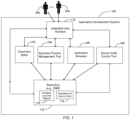
- an application development system 100 facilitates processes for developing business rules, e.g., rules that can be used by airline companies, credit card companies, and/or online market retailers to assist in determining what products or promotional offers to give to customers, and/or which customers are eligible for which rewards.
- business rules e.g., rules that can be used by airline companies, credit card companies, and/or online market retailers to assist in determining what products or promotional offers to give to customers, and/or which customers are eligible for which rewards.
- business rules e.g., rules that can be used by airline companies, credit card companies, and/or online market retailers to assist in determining what products or promotional offers to give to customers, and/or which customers are eligible for which rewards.
- credit card companies can use business rules to assist in detecting potential fraudulent credit card transactions.
- Banks can use business rules to assist in detecting potential money laundering and fraudulent monetary transactions.
- Banks can also use business rules to assist in determining credit risks, loan eligibility, and interest rates for customers.
- Insurance companies can use business rules to assist in
- a log data object can include a file, a message, a report, and/or a record.
- a log data object can include a field in a file, a message, a record, and/or a report.
- a log data object can be linked to or associated with a particular ruleset or rule container, such that the user 90 can easily access all the logged information associated with the ruleset or rule container.
- the integrated user interface 112 has user-side components and server-side components.
- the user 90 uses one or more web browsers to access the tools 102, 104, 106, and 108.
- the web browser includes widgets that exchange data with the server-side components and render interactive graphical elements that are displayed on one or more web pages shown to the user 90. Multiple users can use web browsers to access the tools 102, 104, 106, and 108 concurrently.
- the integrated user interface 112 provides an interface for each of the users 90 to enable the user 90 to interact with the tools 102, 104, 106, and 108.
- a first user 90a can use a web browser to access the document editor 102 to edit a first ruleset, and access the business process management tool 104 to submit the first ruleset for approval.
- a second user 90b can use a web browser to access the document editor 102 to review the first ruleset, access the application simulator 108 to perform a simulation of execution of an application program that incorporates the first ruleset, and access the business process management tool 104 to approve the first ruleset for release.
- a third user 90c (not shown in the figure) can use a web browser to access the source code control tool 106 to add the first ruleset to a rule container.
- a fourth user 90d can use a web browser to access the source code control tool 106 to make a new version of the ruleset and access the document editor 102 to modify the new version of the ruleset, and so forth.
- the integrated user interface 112 allows multiple users to collaborate on developing rulesets using an interface that has a consistent look-and-feel when accessing different tools (e.g., 102, 104, 106, and 108).
- the integrated user interface 112 includes an editor interface 2720, a business process management interface 2722, a source code control interface 2724, an application simulation interface 2726, and a common log interface 2728.
- the interfaces 2720, 2722, 2724, 2726, and 2728 can include interactive graphical elements shown on one or more web pages.
- the editor interface 2720 allows the user to access the document editor 102.
- the editor interface 2720 can show the rule specification to be edited, and provide tools for the use to edit the rule specification.
- a first user edits a ruleset stored in the repository 114
- the user accesses the source code control tool 106 to check out the ruleset.
- the user accesses the document editor 102 to edit the ruleset.
- the ruleset is in the "open” or “development” state
- the document editor 102 stores a copy of the ruleset in a "sandbox" that can only be access by the first user (or other authorized users).
- the sandbox allows the first user to experiment with various parameters of the ruleset without affecting a production environment or the source code in the repository 114.
- the first user When the first user finished modifying the ruleset, the first user submits or publishes the ruleset, a copy of the ruleset is stored in the repository 110, and the state of the ruleset is changed to "submitted” or “published.” At this time, other users can view, edit, simulate, approve, and/or perform other processing on the modified ruleset.
- the business process management interface 2722 allows the user to access the business process management tool 104.
- the interface 2722 can show the current state of the rule being edited in the editor interface 2720, and possible target states that the rule can transition to.
- the business process management interface 2722 can also show the current and target states of other rules related to the rule being edited in the editor interface 2720.
- the business process management interface 2722 can show the state or states of the container or containers that include the selected version of the ruleset.
- the business process management interface allows the user to transition the selected version of the ruleset from one state to another state, such as promoting the selected version of the ruleset from "Development” state to "Testing” state, or demoting the selected version of the ruleset from "Testing" state to "Development” state.
- the source code control interface 2724 allows the user to access the source code control tool 106.
- the source code control interface 2724 can show a list of the various versions of the rule being edited in the editor interface 2720.
- the source code control interface 2724 enables the user to manage various versions of the rule containers and rulesets. The user can select a particular version of a particular ruleset using this interface, and the selected version of the ruleset can be edited in the editor interface 2720.
- the source code control interface 2724 can show information regarding which user checked out the particular version of the ruleset from the repository 114, and a timestamp showing when the particular version of the ruleset was checked out from the repository 114.
- the application simulation interface 2726 allows the user to access the application simulator 108 to simulate execution of an application program that incorporates the selected version of the ruleset that is being edited in the editor interface 2720 to process input data and produce output data.
- the application simulation interface 2726 also allows the user to retrieve stored output data produced from a prior simulated execution of the application program using the selected version of the ruleset.
- the common log interface 2728 allows the user to access the common log data object 116.
- the common log interface 2728 can show logged information having timestamps within a certain period of time.
- one or more of the editor interface 2720, business process management interface 2722, source code control interface 2724, application simulation interface 2726, and common log interface 2728, or portions of them can be shown on the display screen to the user.
- the user can access the functions of two or more of the tools 102, 104, 106, and 108 in a concurrent manner.
- the integrated user interface 112 may include a combination of two or more of the interfaces 2720, 2722, 2724, 2726, and 2728, or portions of them, that are presented to the user concurrently.
- FIG. 2 shows the editor interface 2720, business process management interface 2722, source code control interface 2724, application simulation interface 2726, and common log interface 2728 as distinct components.
- two or more of the interfaces 2720, 2022, 2724, 2726, and 2828 can be combined as one module. Portions of two or more of the interfaces 2720, 2022, 2724, 2726, and 2828 can be combined as one module.
- Each of the interfaces 2720, 2022, 2724, 2726, and 2828 can have two or more sub-modules.
- the integrated user interface 112 can include a first graphical user interface that is shown at the computer display of the first user 90a and a second graphical user interface that is shown at the computer display of the second user 90b.
- Each of the first and second graphical user interfaces can include one or more of the editor interface 2720, business process management interface 2722, source code control interface 2724, application simulation interface 2726, and common log interface 2728, or portions of them.
- the integrated user interface 112 can include additional interfaces that are shown at the computer displays of the additional users.
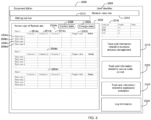
- an editor interface 2500 can include components (e.g., interactive items such as buttons, menus, links, and input boxes) for accessing the business process management tool 104, the source code control tool 106, the application simulator 108, and the common log data object 116.
- components e.g., interactive items such as buttons, menus, links, and input boxes
- the application development system 100 provides the editor interface 2500 and shows the rule specification for the particular version of the particular ruleset.
- FIG. 3 shows examples of components of the editor interface 2500.
- the editor interface 2500 can have fewer or more components than those shown in the figure.
- the editor interface 2500 can show the identifier 2508 of the user who is viewing or editing the ruleset.
- the editor interface 2500 can include a general menu bar 2510 that has general menus, such as, e.g., a menu for file management, a menu for editing tools, and a help menu.
- the editor interface 2500 can have an editing tool bar 2512 that includes various editing tools, such as, e.g., a copy tool, a paste tool, and a delete tool.
- the editor interface 2500 can show the rules (e.g., 2504a, 2504b, 2504c) of the ruleset being edited.
- Each rule can include one or more rule cases (e.g., 2506a, 2506b, 2506c, 2506d) that compute values for the rule's output 2508 depending on the rule's input, and each rule case includes one or more input relationships or criterion (e.g., 2514a, 2514b, 2514c) in which a rule case is triggered by a given input record if one or more data values of the given input record meet the one or more input relationships.
- rule cases e.g., 2506a, 2506b, 2506c, 2506d
- each rule case includes one or more input relationships or criterion (e.g., 2514a, 2514b, 2514c) in which a rule case is triggered by a given input record if one or more data values of the given input record meet the one or more input relationships.
- the editor interface 2500 can show the current state 2526 of the ruleset, and a tool 2528 to allow the user to change the state of the ruleset.
- the tool 2528 can be a menu that has a list of target states for which the ruleset can transition to.
- the tool 2528 can include one or more buttons representing the target states that the ruleset can transition to.
- the editor interface 2500 can have a section 2516 that shows the rule containers that include the ruleset.
- version x.x of container AAA, version y.y of container BBB, and version z.z of container CCC include version xyz of ruleset abc.
- the editor interface 2500 can have a section 2518 that shows tools and information related to the business process management tool 104.
- the section 2518 can include tools that can be used to edit a tagging specification that specifies the permissible transitions of the tags among the states. The tagging specification will be described in more detail in later sections of this document.
- the editor interface 2500 can have a section 2520 that shows tools and information related to the source code control tool 106.
- the section 2520 can include tools that can be used to modify the version of the rule, generate a new version of the rule, or delete an old version of the rule.
- the editor interface 2500 can include a section 2522 that shows tools and information related to the application simulator 108.
- the section 2522 can show results of simulating execution of an application program that incorporates the rule to process input records.
- the editor interface 2500 can include a section 2524 that shows tools and information related to the common log data object 116.
- the section 2522 can show log information related to the version xyz of the ruleset abc, in which the log information can be written by the tools 102, 104, 106, and/or 108.
- the business process management interface 2722 can include interactive items (e.g., buttons, menus, links, input boxes) that allow the user 90 to access one or more of the other modules, such as the document editor 102, the source code control tool 106, the application simulator 108, and the common log data object 116.
- the source code control interface 2724 can include interactive items (e.g., buttons, menus, links, input boxes) that allow the user 90 to access one or more of the other modules, such as the document editor 102, the business process management tool 104, the application simulator 108, and the common log data object 116.
- the application simulation interface 2726 can include interactive items (e.g., buttons, menus, links, input boxes) that allow the user 90 to access one or more of the other modules, such as the document editor 102, the business process management tool 104, the source code control tool 106, and the common log data object 116.
- the common log interface 2728 can include interactive items (e.g., buttons, menus, links, input boxes) that allow the user 90 to access one or more of the other modules, such as the document editor 102, the business process management tool 104, the source code control tool 106, and the application simulator 108.
- an "integrated" user interface refers to a user interface that enables the user to access (i) two or more of the document editor 102, business process management tool 104, source code control tool 106, and application simulator 108, or (ii) functions associated with two or more of the above tools 102, 104, 106, 108, in which the two or more of the above tools 102, 104, 106, 108 share one or more common log data objects 116.
- the integrated user interface can refer to a graphical user interface that is shown on one or more displays that are controlled by one or more computers.
- the integrated user interface can show information generated by modules executing on one or more computers.
- each of the document editor 102, business process management tool 104, source code control tool 106, and application simulator 108 can write information to the common log data object 116.
- the source code control tool 106 can write in the common log data object 116 information specifying that a user associated with a particular user identifier checked out a particular version of a particular ruleset from the repository 110, and a timestamp specifying the timing that the ruleset was checked out.
- the document editor 102 can write in the common log data object 116 information about the user identifier associated with the user who edited the ruleset, and a timestamp specifying the timing for when the editing was performed.
- the business process management tool 104 can write in the common log data object 116 information specifying that the user associated with the particular user identifier approved the transition of the ruleset from a first state to a second state, and a timestamp specifying the timing for the transition of states.
- the application simulator 108 can write in the common log data object 116 information specifying that the user associated with the particular user identifier executed an application program using the ruleset to produce outputs, and a timestamp specifying the timing of the execution of the application program incorporating the ruleset.
- the application simulator 108 can write in the common log data object 116 information specifying that the user associated with the particular user identifier retrieved stored outputs produced from a prior execution of the application program using the particular version of the particular ruleset, and a timestamp specifying the timing of the retrieval of the stored outputs.
- the above are just examples of the kind of information that the tools 102, 104, 106, and 108 can write to the common log data object 116.
- the tools 102, 104, 106, and 108 can also write other types of information to the common log data object 116.
- Logging information regarding, e.g., who accessed which rules, who edited which rules, who approved which rules, and when the above events occurred can help a company perform audits at a later time, e.g., to comply with legal requirements or identify potential sources of errors.
- One or more users 90 interact with the document editor 102, business process management tool 104, source code control tool 106, and the application simulator 108 through the integrated user interface 112. Regardless of whether the tools 102, 104, 106, and 108 are executed on the same or different server computers, the integrated user interface 112 provides a user-friendly interface that hides the complexities of the back-end processes.
- the document editor 102 can be linked to, or integrated with, the business process management tool 104, which manages the states of the rules using, e.g., tags described below.
- the modification can propagate to the business process management tool 104 and affect the outputs of the tool 104.
- the outputs of the business process management tool 104 are updated automatically in response to changes made by the document editor 102.
- the user has to manually request that the changes made by the document editor 102 be propagated to the business process management tool 104.
- the document editor 102 can be linked to, or integrated with, the source code control tool 106 so that, e.g., when a version of the rule is approved for release, that version of the rule is stored by the source code control tool 106, which maintains a master repository 114 of various versions of the rules.
- the document editor 102 can be linked to, or integrated with, the application simulator 108, which enables simulation of execution of application programs that incorporate the business rules.
- the modification can propagate to the application simulator 108 and affect the outputs of the simulator 108.
- modification of the rule triggers execution of the application simulator 108, and the outputs of the simulator 108 are updated automatically.
- the user has to manually request execution of the application simulator 108 after the rule has been modified by the document editor 102 in order to obtained updated output from the simulator 108.
- the business process management tool 104 can be linked to, or integrated with, the source code control tool 106, which enables the user to retrieve any version of the rule, determine the state of the rule, and modify the state of the rule using the integrated user interface 112.
- the business process management tool 104 can be linked to, or integrated with, the application simulator 108, which enables the user to use the integrated user interface 112 to modify the state of a rule after performing simulation of the execution of an application program incorporating the rule.
- the source code control tool 106 can be linked to, or integrated with, the application simulator 108, which enables the user to use the integrated user interface 112 to incorporate any version of a rule into an application program and perform a simulation of the execution of the application program incorporating the rule.
- the integrated user interface 112 allows the users 90 to access the document editor 102, the business process management tool 104, the source code control tool 106, the application simulator 108, and the common log data object 116 using interfaces that have a consistent look-and-feel, e.g., having similar overall design, color scheme, menu structure, and font characteristics.
- the integrated user interface 112 can simplify tasks for processing business rules.
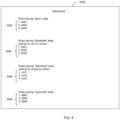
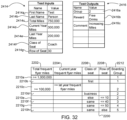
- the application development system 100 can implement a "workspace" 2540 for each user that shows the work items that need to be processed by the user.
- the workspace 2540 can show a first work queue that includes a first list of rules 2542 in "open” state, meaning that the rules are draft documents that are still being edited.
- the workspace 2540 can show a second work queue that includes a second list of rules 2544 in "submitted” state, which indicates that the rule is ready for review.
- the second list includes rules that are ready for review by the user.
- the workspace 2540 can show a third list of rules 2546 in the "submitted” state, in which the rules have been edited by the user and are ready for review by others.
- the workspace 2540 can show a fourth list of rules 2548 in "approved” state, in which the rules have been edited by the user and have been approved.
- a first user 90a edits a rule named "reward_rule_1" and a second user 90b reviews the rule.
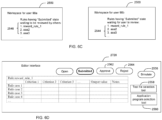
- FIG. 6A for example, when the first user 90a logs in the workspace 2550 associated with the first user 90a, the user sees the rule "reward_rule_1" in the first list of rules 2542 that are in the "open” state.
- FIG. 6A for example, when the first user 90a logs in the workspace 2550 associated with the first user 90a, the user sees the rule "reward_rule_1" in the first list of rules 2542 that are in the "open” state.
- the rule “reward_rule_1” appears in the third list of rules 2546 in the workspace 2550 of the first user 90b, indicating that the rule is waiting to be reviewed by others.
- the rule “reward_rule_1” appears in the second list of rules 2544 in the workspace 2560 of the second user 90b, who is responsible for reviewing the rules submitted by the first user 90a.
- the second user 90b logs in the workspace 2560 associated with the second user 90b and sees that the rule "reward_rule_1" appears in the second list of rules 2544 waiting to be reviewed.
- the second user 90b can double click on the rule "reward_rule_1" to invoke the document editor 102 in order to review the rule.
- the editor interface 2720 can show next to the rule a "Simulate" button 2556, a test file selection tool 2558 to allow selection of a test input file, and an application program selection tool 2560 to allow selection of an application program for simulation.
- the first user 90a sees that the rule "reward_rule_1" has been rejected and returned to the "open” state.
- the system 100 retrieves the comments related to the rule “reward_rule_1” from the common log data object 116 and displays the comments next to the rule “reward_rule_1.”
- the first user 90a sees the comment "rewards too high,” invokes the document editor 102 to revise the rule cases to reduce the amount of rewards, and invokes the application simulator 108 to simulate execution of the rule.
- the first user 90a selects the application program "application_1" and the test file "test_input_1" for simulation.
- the application simulator 108 converts the revised rule cases in the rule "reward_rule_1" to a plurality of logical expressions, compiles the plurality of logical expressions into computer-executable code, incorporates the computer-executable code into the application program "application_1,” and executes the application program "application_1” to use the revised "reward_rule_1” to process the test input records in the "test_input_1" file and generate output data.
- the application simulator 118 saves the output data.
- the first user 90a reviews the output data, confirms that the rewards have been correctly reduced, and changes the state of the rule "reward_rule_1" from "Open” to "Submitted” again.
- the second user 90b sees that the first user 90a re-submitted the rule "reward_rule_1” and invokes the application simulator 108 to check whether the rewards have been correctly reduced.
- the second user 90b selects the application program "application_1” and the test file “test_input_1” for simulation.
- the application simulator 108 determines that a previous simulation was performed in which the rule "reward_rule_1” was incorporated into the application program "application_1" and the "test_input_1” file was used for the test input.
- the application simulator 108 loads the previously generated output data and presents the output data to the second user 90b.
- the second user 90b reviews the previously generated output data and confirms that the rewards have been correctly reduced, determines that there are no other issues with the rule "reward_rule_1,” and clicks on the "Approved” button next to the rule. After the state of the rule “reward_rule_1" is changed from “submitted” to "approved,” the first user 90a sees in the workspace 2550 that the rule “reward_rule_1” appears in the fourth list of rules 2548 that have been approved.
- the integrated user interface 112 is configured such that when processing the rules, appropriate interactive elements (e.g., buttons, menus, links, input text boxes) are provided to enable the users to conveniently access the document editor 102, the business process management tool 104, the source code control tool 106, the application simulator 108, and/or the common log data object 116.
- appropriate interactive elements e.g., buttons, menus, links, input text boxes
- the application development system 100 has several improvements over a non-integrated application development system, such as system 2600 shown in FIG. 7 .
- the non-integrated application development system 2600 may be built by bundling separate tools together as an application suite in which the separate tools do not share a common set of user interfaces, and do not share a common log data object.
- the system 2600 can include a document editor 2610 that is accessed through an editor interface 2602, a business process management tool 2612 that is accessed through a business process management interface 2604, an application simulator 2614 that is accessed through an application simulation interface 2606, and a source code control tool 2616 that is accessed through a source code control interface 2608.
- Each tool 2610, 2612, 2614, and 2616 in the non-integrated application development system 2600 has its own user interface (2602, 2604, 2606, and 2608, respectively), and the look-and-feel of different interfaces of different tools in the system 2600 can be different.
- the different tools can store the files to different local file directories associated with the tools.
- the document editor 2610 if the document editor 2610 is executed on a first computer "Comp_1," the document editor 2610 can save working documents to a local file directory, such as "Comp_1 ⁇ usr ⁇ doc_editor ⁇ working file ⁇ ".
- the business process management tool 2612 if the business process management tool 2612 is executed on a second computer "Comp _2,” the business process management tool 2612 can save working documents to a local file directory, such as "Comp_2 ⁇ usr ⁇ bpm ⁇ working_file ⁇ ".
- the source code control tool 2616 can save working documents to a local file directory, such as "Comp_3 ⁇ usr ⁇ source_code_control ⁇ working_file ⁇ ".
- the application simulator 2618 can save working documents to a local file directory, such as "Comp_4 ⁇ usr ⁇ app_sim ⁇ working_file ⁇ ".
- the document editor 2610 may not know where the working files of the business process management tool 2612, the source code control tool 2616, and the application simulator 2614 are stored.
- the application simulator 2614 may not know where the working files of the document editor 2600, the business process management tool 2612, and the source code control tool 2616 are stored.
- the user needs to spend time to navigate among different working file directories in order to access the needed files.
- the user may have to spend effort setting up correct file paths in order for the different tools to know the locations of the working file directories of the other tools.
- the system 100 has an integrated user interface 112 that allows the user to conveniently access the working files of the various tools when processing the rules without the need to remember the details of the working file directories of the various tools 102, 104, 106, 108, and 116.
- the application development system 100 can have other advantages compared to the non-integrated system 2600.
- the application development system 100 has reduced memory requirements (as compared to the system 2600) because the tools 102, 104, 106, and 108 access the same data stored in memory, reducing the need to duplicate data, which may be needed in the system 2600.
- each of the document editor, business process management tool, application simulator, and source code control tool store copies of files and data locally.
- the system 100 has a common log data object 116 that can be accessed by the tools 102, 104, 106, and 108, such that information entered into the common log data object 116 by one of the tools 102, 104, 106, and 108 can be accessed by another one of the tools 102, 104, 106, and 108.
- the user can determine, e.g., who accessed, edited, approved, and/or simulated a particular version of a particular rule container or ruleset, and when those events happened. This is more convenient than the system 2600 in which each tool writes to its own log file. In system 2600, the user has to access multiple log files in order to obtain information about who accessed, edited, approved, and/or simulated a particular version of a rule container or ruleset, and when those events happened.
- the system 100 can have an advantage in which the integrated user interface 112 enables the user to access functions of two or more of the tools 102, 104, 106, 108, and 116, and the outputs of two or more of the tools 102, 104, 106, 108, and 116 can be provided to the user, e.g., shown side by side. Changes made to data processed by one of the tools 102, 104, 106, and 108 can automatically trigger the update of outputs generated by another one of the tools 102, 104, 106, and 108.
- the user can select a test input file and an application program using the application simulation interface 2726.
- the user can edit a rule using the editor interface 2720.
- the application development system 100 automatically invokes the application simulator 108 to convert the rule cases of the rule to a plurality of logical expressions, compile the plurality of logical expressions into computer-executable code, incorporate the computer-executable code into the selected application program, and executes the selected application program to use the rule to process the test input records and generate output data.
- the application simulation interface 2726 shows the output data to the user. This provides quick feedback to the user, allowing the user to try several parameter values for the rule cases to find optimal values.
- the application simulator 108 is configured to wait for an explicit instruction from the user before executing the application program.
- the document editor 102, the business process management tool 104, the source code control tool 106, and the application simulator 108 are represented as separate modules, this is merely an example.
- two or more of the tools 102, 104, 106, and 108 can be configured as one unit or module.
- the tools 102, 104, 106, and 108 can all be implemented as one integrated module.
- each of the tool 102, 104, 106, and 108 can be implemented by two or more modules.
- several modules may be used in which each module implements a portion of the functions of the tool 102, 104, 106, and/or 108.
- Each or all or some portions of the tools 102, 104, 106, and 108 may be implemented in software, hardware, or a combination of software and hardware.
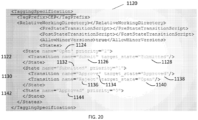
- code 1158a specifies that the staff member(s) who is/are authorized to enable the transition from “Development” to “Testing” are listed in “rolename-list1”.
- code 1158b specifies that the staff member(s) who is/are authorized to enable the transition from “Testing” to “Production” are listed in “rolename-list2”.
- Code 1158c specifies that the staff member(s) who is/are authorized to enable the transition from “Testing" to “Development” are listed in "rolename-list3".
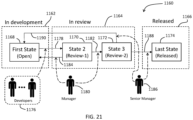
- a ruleset approval process 1160 includes a development phase 1162, a review phase 1164, and a released phase 1166.
- the ruleset is associated with a first state 1168.
- the ruleset can be associated with one of two states: a second state 1170 and a third state 1172.
- the ruleset is associated with a last state 1174.
- the first state can be an "Open” state
- the second state can be a "Review-1" state
- the third state can be a "Review-2" state
- the last state can be a "Released” state.
- a tag associated with the ruleset keeps track of the state associated with the ruleset. The tag transitions through various states, representing the ruleset going through the various stages in the approval process.
- developers 1176 can generate and modify the ruleset, and promote (or submit) the ruleset so that the tag transitions 1178 to the second state 1170.
- the ruleset is reviewed by a manager 1180, and the developers 1176 cannot modify the ruleset or change the state of the tag.
- the tag associated with the ruleset may contain information about the review history for the ruleset.
- the manager 1180 can either promote (or approve) the ruleset so that the tag transitions 1182 to the third state 1172, or demote (or reject) the ruleset so that the tag transitions 1184 back to the first state 1168.
- the developers 1176 can further modify the ruleset and then promote the ruleset for further review.
- the ruleset is reviewed by a senior manager 1186, and the developers 1176 and the manager 1180 cannot modify the ruleset or change the state of the tag.
- the senior manager 1186 can either promote (or approve) the ruleset so that the tag transitions 1188 to the last state 1174, or demote (or reject) the ruleset so that the tag transitions 1190 back to the first state 1168.
- the developers 1176 can modify the ruleset and promote the ruleset for further review.
- the state of the tag can no longer be modified. For example, when the senior manager 1186 promotes the ruleset and the tag transitions to the last state 1174, it may indicate that the ruleset is ready to be released to a customer and no further modification to the ruleset is allowed.
- a software product may undergo several releases or versions, in which each release of the software product may include a plurality of business rulesets. Different releases may be associated with different combinations of business rulesets.
- a "release tag” or “group tag” may be used to store information about a group of rulesets related to a release of the software product. Different releases of the software product may be associated with different release tags.
- the states associated with the rulesets in a group are influenced by the state associated with the group.
- a tagging specification can specify that the group can be associated with one of N states (N being a positive integer greater than or equal to 2), and each ruleset in the group can be associated with one of the N states.
- the tagging specification can further specify that, when the group release tag is promoted from the (i-1)-th state to the i-th state, the object tags (associated with the rulesets) that have states later than the i-th state are demoted to the i-th state, whereas the object tags that have states earlier than the i-th state remain unchanged.
- the tagging specification can specify that when the group release tag is promoted from the (i-1)-th state to the i-th state, the object tags (associated with the rulesets) that have states earlier than the i-th state are also promoted to the i-th state, whereas the object tags that have states later than the i-th state remain unchanged.
- the tagging specification can specify that when the group release tag is demoted from the (i+1)-th state to the i-th state, the object tags (associated with the rulesets) that have states later than the i-th state are also demoted to the i-th state, whereas the object tags that have states earlier than the i-th state remain unchanged.
- the tagging specification can specify that when the group release tag is demoted from the (i+1)-th state to the i-th state, the object tags (associated with the rulesets) that have states earlier than the i-th state are also promoted to the i-th state, whereas the object tags that have states later than the i-th state remain unchanged.
- the states that are allowed to be associated with the group release tag 1192 can be different from the states that are allowed to be associated with the object tags 1194 (associated with the rulesets).
- the tagging specification may specify that the group release tag 1192 can be associated with one of "Open,” “Review-1,” “Review-2,” or “Released” states, whereas each object tag 1194 can be associated with one of "Open,” “Submitted,” or “Approved” states.
- the tags which are data objects, can include various types of information associated with the development or approval of the ruleset.
- the tags can provide the function of the common log data objects 116 in FIG. 1 .
- the various types of information can include, e.g., what actions (e.g., promote, demote, submit, approve, or reject) were performed on the ruleset, who performed the actions, and when the actions were performed.
- the tags can also include comments or notes by the people who developed, tested, reviewed, and/or approved the rulesets. This way, at each stage of the development lifecycle or approval process of the ruleset, the person working on the ruleset can have useful information about the work that has previously been done on the ruleset, enabling the person to quickly focus on issues that need to be addressed. When something goes wrong, the user can look at the review history and attempt to identify what went wrong, where the mistake occurred, and take corrective action so as to avoid that type of problem in the future.
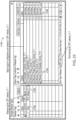
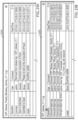
- FIGS. 23A and 23B show screenshots 1210 and 1220 of examples of activity logs associated with business tags in which the logs include information about the operations that were performed, the users who performed the operations, comments by the users, and the dates and times that the operations were performed.
- the application development system 100 includes the document editor 102, the business process management tool 104, the source code control tool 106, the application simulator 108, the repository of data 110, and the integrated user interface 112.
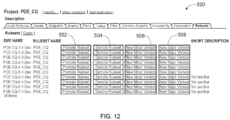
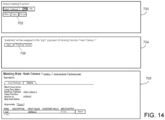
- the document editor 102 allows a user to view and edit business rules, and may provide functions including but not limited to those shown in FIGS. 12-16 , 19A , 19B , 22 , 23A, and 23B .
- the user may use the document editor 102 to modify entries in a spreadsheet having rows that correspond to the rule cases.
- the document editor 102 can be used to edit the triggering criteria for the rules.
- the document editor 102 is linked to the business process management tool 104, which manages the states of the rules.
- the document editor 102 in combination with the integrated user interface 112 enable users to promote or demote a rule during the development lifecycle of the rule, and to approve the rule for release.
- the business process management tool 104 keeps track of the states of the rule using tags described above.
- the business process management tool 104 determines which transitions of states are allowed, and communicates with the document editor 102 so that the editor 102 can control the integrated user interface to display appropriate items (e.g., "Submit,” “Approve,” “Reject,” “Promote,” and/or “Demote” buttons) in the user interface to enable the user to change the state of the rule.
- appropriate items e.g., "Submit,” “Approve,” “Reject,” “Promote,” and/or “Demote” buttons
- FIG. 24 shows an exemplary user interface provided by the document editor 102 showing several rules that a user is developing.
- the user is working on rules such as "Cash_Back_Notifications,” “Review_Non_Monetary_Actions,” “Review_Phone_Activity,” “Review_Posted_Monetary_Activity,” “Review_Web_Activity,” and “Transaction_Classification” rules.
- the user selected "Review_Posted_Monetary_Activity” rule 1242, and the document editor 102 shows information 1244 about various versions of the rule 1242.
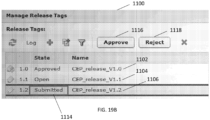
- versions 1.0 and 1.2 of the rule have been approved, versions 1.1 and 1.3 of the rule have been submitted, and version 1.4 of the rule is open.
- Version 1.0 of the rule is used in CEP (the name of the workspace) release version 1.0
- version 1.1 of the rule is used in CEP release version 1.1
- version 1.3 of the rule is used in CEP release version 1.2.
- the document editor 102 is linked to the source code control tool 106 so that when a version of the rule is approved for release, that version of the rule is stored by the source code control tool 106, which maintains a master repository of various versions of the rules. Subsequently, when a user intends to edit a particular version of the rule, the user can request permission to change the rule, and the source code control tool 106 will allow the user to check out the rule and edit the rule, and prevent others from editing the rule until the rule is checked back in.
- the source code control tool 106 also keeps a record of the user who made changes to the rule, and what changes were made to the rule.
- the document editor 102 can generate a ruleset difference report 1250 that compares different versions of a rule and provide information on the differences between the versions.
- the user compares versions 61 and 128 of the "Review_Posted_Monetary_Activity" rule, and the document editor 102 provides a list of differences 1252 between the versions.
- a feature of the business tagging approach is that the user may pick and choose among different versions of various rules to assemble a ruleset container or package for use with an application, and simulate the execution of the application using the assembled ruleset container.
- a developer of a credit card company may use the application development system 100 to develop rules for a credit card processing application.
- the application may use a "credit card approval” rule for deciding whether to approve credit card applications, a "credit card rewards” rule for deciding what rewards to give to credit card customers, and a "fraud detection” rule to evaluate the possibilities that certain credit card transactions are fraudulent.
- the developer may have developed versions 1.0, 1.1, 1.2, and 1.3 for the "credit card approval” rule, versions 1.0, 1.1, 1.2, 1.3, 1.4, 2.0, and 2.1 for the "credit card rewards” rule, and versions 1.0, 1.1, 2.0, 2.1, 3.0 and 3.1 for the "fraud detection” rule.
- the developer may decide to simulate the execution of the credit card processing application using version 1.1 of the "credit card approval” rule, version 2.1 of the “credit card rewards” rule, and version 3.0 of the "fraud detection” rule.
- the document editor 102 may provide an interface to allow the user to select particular rules, and a particular version of each of the selected rules to be packaged together in a container, and associate the container of rules with the credit card processing application.
- the document editor 102 is linked to the application simulator 108.
- the application is a graph-based computation having data processing components connected by linking elements representing data flows.
- the application simulator 108 converts the rules in the container into a transform, associates the transform with a component in the graph-based computation, executes the graph-based computation, and displays the output results of the execution.
- the user may examine the outputs of the simulation to determine whether further modifications of the rules are needed. For example, if the user determines that the application failed to detect many fraudulent transactions in the test data set, the user may use the document editor 102 to change the state of and/or edit version 3.0 of the "fraud detection” rule currently associated with the application. Suppose version 3.0 of the "fraud detection” rule is currently in the "Testing" state. The user may demote version 3.0 of the rule to the "Development” state, indicating that the rule needs further revisions. The user may select version 2.1 of the "fraud detection” rule to be included in the container of rules associated with the credit card processing application, and run the simulation again.
- the user may approve the container for release, for example, as release version 1.0.
- the user may promote the state of the rule to "Testing,” include this version of the rule in the container, and run the simulation of the application. If the user determines that version 1.1 of the "credit card approval” rule, version 2.1 of the “credit card rewards” rule, and version 3.0 of the “fraud detection” rule function properly together, the user may approve the container for release, for example, as release version 1.1.
- An advantage of the application development system 100 is that it provides an integrated user interface that allows the user to edit rules, manage development lifecycles and versioning of the rules, and perform simulations of applications using the rules in a unified manner.
- Tags and other information associated with the rules are accessible to the various tools in the system 100. For example, when the user uses the document editor 102 to select particular rules and particular versions of the rules for a container, the information about the selected rules can be provided to the application simulator 108, which loads the selected versions of the rules and generate transforms based on those rules.
- the simulation output dataset generated by the application simulator 108 can be provided to the document editor 102, which can display the rules alongside the output dataset.
- the document editor 102 may provide an interface that allows the user to select one or more values in the output dataset, and the interface may highlight the portions of the rules that were triggered to generate the selected output value(s). If the output value(s) are different from intended, the user can review the highlighted portions of the rules to determine if they need further revisions. The user can modify the rules, run the simulation again, and see if the updated output values are the same as intended, and further revise the rules as necessary.
- the application development system 100 allows a business person who may not have special expertise in computer programming to be able to edit rules, execute application programs using the rules, determine if the outputs are the same as intended, and further edit the rules as necessary.
- a financial analyst working at a credit card company may have expertise in finance but may not know how to write computer code to implement rules for processing credit card applications, rules for determines credit card rewards, and rules for detecting fraudulent credit card transactions.
- the financial analyst can revise values and formulas in a spreadsheet (which many financial analysts are familiar with), and the rules specified based on those values and formulas can be transformed into code that are inserted into an application program by the application simulator 108 for execution.
- the application development system 100 facilitates processes for developing business rules used in marketing or business campaigns, such as the processes 1260, 1350, 1360, and 1370 in FIGS. 26-29 below.
- the processes 1260, 1350, 1360, and 1370 are examples only. Different companies may have different processes and different numbers of team members who work together to develop business rules. For example, one company may use a single maker and a single checker to write and review the business rules and evaluate the risks. For example, another company may have three or more checkers to provide additional levels of review.
- the application development system 100 enables users to conveniently develop business rules for facilitating various applications.
- a financial institution e.g., a bank, credit card company, or investment firm
- a campaign that offers new products or promotions to customers or potential customers.
- the financial institution may offer a new home equity loan to qualified customers.
- the financial institution may offer new credit cards having various rewards programs.
- the offers of these campaign products may appear in advertisements shown on ATM machines, advertisements sent by e-mail or text messages, advertisements presented on web sites, or advertisements sent by postal mail. For different customers, the details of the offers may be different.
- the customer may be greeted with a welcome web page showing the various services offered by the financial institution.
- the web page may also display one or more promotional offers tailored toward the customer.
- the web page may be generated by a computer server of the financial institution.
- the computer server at the financial institution determines what promotions to offer to the customer based on, e.g., financial and other information associated with the customer.
- the computer server may determine that the customer may be interested in a home equity loan.
- a promotional offer from the first campaign product may be inserted into the web page.
- the offer may provide a new home equity loan with a low interest rate.
- the computer server may determine that the customer may be interested in a new credit card.
- a promotional offer from the second campaign product may be inserted into the web page, in which the offer may provide information about a new credit card program that offers generous cash-back rewards.
- a new home equity loan with a 3.5% interest rate may be offered to a first customer having a high credit score and a large combined savings and checking account
- a new home equity loan with a 4% interest rate may be offered to a second customer having a high credit score and a small combined savings and checking account
- a new home equity loan with a 4.5% interest rate may be offered to a third customer having a medium credit score.
- a first type of credit card with an annual fee and slightly higher rewards may be offered to a fourth customer having a high income level
- a second type of credit card with no annual fee and slightly lower rewards may be offered to a fifth customer having a medium income level
- a third type of credit card having higher reward points on dining and travel may be offered to a sixth customer who already has a travel credit card with lower reward points.
- the first and second campaign products may not give any promotional offers to customers who have very low credit scores or are a few months behind in credit card payments.
- the financial institution may have hundreds of thousands or millions of customers, so it is useful to partially automate the process of determining what promotions to offer to which customers.
- business rules similar to those described in U.S. patent 8,069,129 , U.S. patent 8,386,408 , U.S. patent 8,380,651 , U.S. patent 9,002,770 , and U.S. patent application 14/677,063 can be used to partially automate the process of evaluating the financial and other data of the customers and determining what promotional offers to provide to the customers.
- a set of business rules may be authored, such that the rules can be applied to the records of the customers containing financial data to generate outputs including information about which promotional offers are presented to which customers.
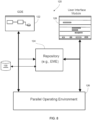
- the business rules may be incorporated into a graph-based application in the graphic development environment 102, and the parallel operating environment 106 may generate executable instructions (e.g., computer instructions) that correspond to the logic and resources defined by the graph that incorporates the business rules.
- Each campaign may run for a number of days, weeks, or months.
- the financial institution may launch a new campaigns every couple of days, weeks, or months.
- the staff members of the financial institution may modify the business rules according the new criteria set by the campaign.
- three groups of staff members may work on modifying and verifying the business rules.
- the first group of staff members which we will refer to as the "Makers," are responsible for activities such as joining data, generating data sets, performing analyses, authoring business rules, running simulations, and profiling data.
- the second group of staff members which we will refer to as the "Checkers,” are responsible for activities such as validating that the activities performed by the Makers are consistent with process requirements and corporate policies.
- the Checkers verify that the campaign or risk objectives are clearly identified and documented, validate the business rules individually and in the aggregate, run the simulations and review the logs for the simulations to confirm the results are consistent with objectives and policies, complete checkpoints, and approves the business rules.
- the third group of staff members which we will refer to as the "Managers,” are responsible for reviewing the checkers' comments and recommendations, review audit trails for the generation of the business rules by the Makers and the validation of the business rules by the Checkers, assess the adequacy of controls and validations, and approve or reject progression to the next step in the overall process.
- the business rules there may be more than one Maker, more than one Checker, and more than one Manager involved in the authoring, checking, and reviewing of the business rules. It is useful to keep track of who made what changes to the business rules at what time, and keep records (including, e.g., source codes and notes) of different versions of the business rules as the rules are modified over time. Keeping good records not only facilitates debugging and finding sources of errors, it may also help meet certain regulatory requirements.
- a flow diagram 1260 represents a high level overview of a process for the generation of business rules for a campaign.
- data necessary for defining the business rules are prepared. For example, a determination may be made as to which data sources are used and whether data sets need to be joined, merged, filtered, aggregated, or further processed.
- the campaign for each product is defined. Rules are written to define potential offers related to the business objectives of the financial institution. For example, the criteria for determining when and what promotional offers to give to which customers are defined for each product of the campaign.
- the business rules for the various products of a campaign are overlapped and combined into an integrated package.
- Step 1268 the business rules for the entire campaign that includes various products are validated and simulated. Step 1268 ensures that the business rules of different products do not conflict with one another. After the business rules for the whole campaign are simulated and validated, the campaign is ready to be launched at step 1270.
- a process 1350 is provided for implementing the step for data preparation 1262.
- the process 1350 may include several steps that are performed by, e.g., a Marketing Team Maker 1280, a Marketing Team Checker 1282, a Risk Team Maker 1284, and a Risk Team Checker 1286.
- the Marketing Team Maker 1280 builds a list of data necessary to run the campaign, and selects the marketing data fields 1290 that may be used by the business rules.
- the Risk Team Maker 1284 at step 1316 builds a list of data that is required to run risk models, and selects risk data fields 1318 that may be used business rules.
- the system selects data in the marketing data fields 1290 and the risk data fields 1318 for joining.
- the system performs filtering, aggregation, and other processing on the joined data.
- the system performs tests on individual units of data. If the data are not acceptable, the process loops back to step 1292 to select the appropriate data to join. If the data are acceptable, in step 1298 a profile of test data is generated, and the data are submitted for approval.
- a dataset that includes the prepared data 1300 and the prepared data profile 1302 are submitted for approval at step 1304.
- a business tag may be associated with the dataset that has been submitted for approval by the Marketing Team Maker 1280.
- the business tag may include information about the state of the dataset, who (e.g., Marketing Team Maker 1280) approved the dataset, and when the dataset was approved for submission.
- the Marketing Team Checker 1282 reviews the dataset submitted by the Marketing Team Maker 1280 and determines whether the dataset contains necessary and sufficient campaign data. If the dataset does not contain necessary and sufficient campaign data, the Marketing Team Checker 1282 sends the data back to the Marketing Team Maker 1280, who performs step 1292 again to select data for joining. If the dataset contains necessary and sufficient campaign data, the Marketing Team Checker 1282 approves the dataset.
- a business tag may be associated with the dataset that has been submitted for approval by the Marketing Team Checker 1282.
- the business tag may include information about the state of the dataset, who (e.g., Marketing Team Checker 1282) approved the dataset, and when the dataset was approved for review by the Risk Team Checker 1286.
- the Risk Team Maker 1284 defines thresholds (e.g., volume, entity, and maxima) associated with the product offering. For example, one threshold may specify that the total amount of rewards given to all eligible customers for any day or week may not exceed a certain amount. Another threshold may specify that the total number of customers eligible for a product may not exceed a certain value.
- the Risk Team Maker 1284 writes risk rules for exclusion based on a wide range of records. For example, a risk rule may specify that a customer having a credit score below a certain value, or having a credit card debt above a certain value, is not eligible for the promotional offer.
- the validation data may include the following.
- a rule coverage report is generated when the simulation is run. The report documents which rules fired, and how many times. This ensures that each rule has been run at least a minimum number of times to guarantee simulation coverage was sufficient. Rules that don't fire enough (or at all) indicate insufficient simulation coverage (bad validation data) or bad rule design.
- a data profile of the campaign data is generated. This provides information on statistical distribution of data for each product campaign data set. Questions such as "how many customers qualified?" or "How many customers didn't quality” or “were there invalid records” can be answered and compared against expected results. Statistical calculations are performed to generate statistical data. This data provides additional information regarding the population that was qualified for a campaign, and population that was not.
- This may include a series of simulated cost/benefit models run against a set number of assumed take-rates (e.g., 1%, 3%, 5%, 10%, and 25% ...) for calculating values to include expected campaign value (revenue lift) versus immediate cost (e.g., promotions such as statement credits) versus write-offs (with different credit risk cut-off assumptions) and overall net present value. These are compared with input model assumptions.
- the Risk Team Checker 1286 reviews the ruleset that includes the inclusion rules authored by the Marketing Team Maker 1280 and the risk rules authored by the Risk Team Maker 1284. If the Risk Team Checker 1286 determines that the risk is too high, the process loops back to step 1320 so that the Marketing Team Maker 1280 can revise the inclusion rules. At step 1346, the Risk Team Checker may write notes, such as why the simulation outcomes indicate too high a risk, and the notes are stored as part of a business tag associated with the ruleset. If the Risk Team Checker 1286 determines that the risk is acceptable, the ruleset is approved, and the process moves to the next step.
- a simulation is performed by applying the full ruleset for all campaign products to test data and generate simulation outcomes 1376.
- the simulation outcomes 1376 may include outputs from the business rules and data for validation (also referred to as artifacts) that may be generated from a processing of the outputs from the business rules.
- the validation data in the simulation outcomes 1376 (which are for the whole package of business rules across various campaign products) are similar to the validation data in the simulation outcomes 1330 (which are for the business rules of individual campaign products), with the difference being that following overlap the information is provided on an aggregate basis (including distribution of each product) as well as on a per-product basis (similar to what was generated on the per-product basis. This allows a comparison of how the values shifted from each product or to each product before and after the overlap process is executed.
- a business tag may be associated with the simulation results.
- the business tag may provide information on who performed the simulation, when the simulation was performed, what datasets were used to perform the simulation, and other notes provided by the Marketing Team Maker 1280 regarding the simulation.
- the simulation outcomes 1376 are provided to the Marketing Team Checker 1282 for review at step 1378.
- the process 1370 loops back to step 1372 so that the Marketing Team Maker 1280 can revise the overlap rules. Perhaps certain products may not overlap certain other products during certain periods, and thus the overlap rules need to be adjusted.
- the Marketing Team Checker may write notes, such as why the simulation outcomes do not meet the campaign goals, and the notes are stored as part of a business tag associated with the overall ruleset. If the simulation outcomes are appropriate and consistent with expected outcomes, the Marketing Team Checker 1282 approves the rules for review by the Risk Team Checker 1286.
- the Risk Team Checker 1286 reviews the entire ruleset that includes the overlap rules authored by the Marketing Team Maker 1280. At step 1388, if the Risk Team Checker 1286 determines that the risk is too high, the process loops back to step 1372. If the simulation outcomes are appropriate and the risk is acceptable, the Risk Team Checker 1286 approves the rules for review by the Manager 1372.
- the Manager 1372 reviews the whole ruleset that includes the overlap rules authored by the Marketing Team Maker 1280. If the Manager 1372 does not approve the overall package of rules, the process loops back to step 1372 so that the Marketing Team Maker 1280 can revise the overlap rules. At step 1394, the Manager 1372 may write notes, such as why the overall package does not meet the campaign goals or the risk is too high, and the notes are stored as part of a business tag associated with the package of rulesets. If the Manager 1372 approves the overall package of rulesets, the campaign goes live in step 1394.
- the processes 1350, 1360, and 1370 show that authoring, checking, and approving business rules for a campaign is a complicated process that involves multiple staff members of the financial institution.
- the rules may pass back and forth among the Marketing Team Maker 1280, the Marketing Team Checker 1282, the Risk Team Maker 1284, the Risk Team Checker 1286, and the Manager 1372 several times.
- each staff member needs to know the exact status of each rule, such as whether the rule has been submitted by the Marketing Team Maker 1280 or the Risk Team Maker 1284, whether the rule has been approved by the Marketing Team Checker 1282 or the Risk Team Checker 1286, and whether the rule has been approved by the Manager 1372.
- notes regarding the rules may be written and stored in business tags.
- a first version of the business rule for a first campaign product may conflict with the rules for a second campaign product, so the Marketing Team Maker 1280 may decide to store the first version of the business rule and write a second version of the business rule for the first campaign product that does not conflict with the rules for the second campaign product.
- the first version of the business rule may have certain parameter values that can be useful for later campaigns.
- each campaign product may be associated with several versions of business rules, in which the different versions of the rules may use slightly different parameter values that may be useful under different circumstances.
- One of the improvements of the application development system 100 over conventional systems is that the users can access functions provided by the document editor 102, the business process management tool 104, the source code control tool 106, and the application simulator 108 through the integrated user interface 112 without the need to switch between different user interfaces, and without the need to manually copy information from one application to the other.
- the system 2600 of FIG. 7 has a business process management tool 2612 and a source code control tool 2616 that are "bundled" together in a software suite, but the business process management tool 2612 and the source code control tool 2616 can have different user interfaces and do not share metadata.
- the user can save the source code for several versions of a business rule using the source code control tool 2616, and use the business process management tool 2612 to manage the transition of the rules among different states.
- the source code control tool 2616 keeps track of which user made what changes to a particular piece of code over time.
- the information about states that are generated by the business process management tool 2612 is not automatically carried over to the source code control tool 2616.
- the source code of the various versions of the business rules is saved, the information about the states generated by the business process management tool 2612 is not saved along with the source code by the source code control tool 2616.
- the user may have to compare the logs of the source code control tool 2616 and the business process management tool 2612 to match the notes for a particular version of a particular rule in the business process management tool 2612 with the notes of the same particular version of the particular rule in the source code control tool 2616, and try to manually deduce the required information based on the notes.
- One of the improvements of the application development system 100 over the non-integrated application development system 2600 is that the application development system 100 can provide functions that cannot be achieved, or would be very difficult to achieve, using the system 2600.
- an application may evolve over time such that a series of releases of the application are issued over time.
- Each release of the application may use a package of particular versions of particular rulesets, in which each particular version of the ruleset has a particular state, and the transition to the particular state was approved by a particular user.
- Different releases of the application may use different packages that includes different versions of the rules. Suppose after several releases of the application have been issued, it is determined that an earlier release of the application did not function properly.
- the cause of the problem it may be useful to retrieve the particular versions of the particular rulesets used by the particular release of the application that caused the problem, review the logs of the particular versions of the particular rulesets, and determine what changes were made to the rulesets prior to the occurrence of the problem, who made those changes, who approved those changes, and why those changes were made. It may be useful to review the logs of the overall package of rulesets, and determine what changes were made to the package prior to the occurrence of the problem, who made those changes, who approved those changes, and why those changes were made.
- the source code control tool 2616 does not store the metadata generated by the business process management tool 2612 along with the source code of the rules that are needed to implement the functions mentioned above.
- the non-integrated application development system 2600 while users can manually copy some information from the business process management tool 2612 to the notes section of the source code control tool 2616, because many different users may write, edit, review, and approve the rules, and different people may have different ways of writing notes, the information manually carried over from the business process management tool 2612 to the source code control tool 2616 may not be consistent across different users, making the information difficult to review.
- the metadata stored in the repository 110 have standard formats and can be access by all the tools 102, 104, 106, and 108, enabling new functions that cannot be achieved using the non-integrated application development system 2600.
- One of the improvements of the application development system 100 over the non-integrated application development system 2600 is that outputs of applying business rules to input records can be automatically updated and displayed after the business rules are edited by the document editor 102.
- a rule can be entered in a spreadsheet format, as shown in FIG. 30 .
- Trigger columns 2202, 2204, 2206, 2208 in spreadsheet 2200 correspond to available data values
- rows 2210a-h correspond to rule cases, i.e., sets of criteria that relate the available data values.
- a rule case 2210n applies to a given record (e.g., 402 in FIG. 11A ) if the data values of that record, for each trigger column in which the rule case has criteria, meets the triggering criteria.
- Each output column 2212 corresponds to a potential output variable, and the value in the corresponding cell of the applicable row 2210n determines the output, if any, for that variable.
- the cell could contain a value that is assigned to the variable or it could contain an expression that must be evaluated to generate the output value, as discussed below. There may be more than one output column, though only one is shown in FIG. 30 .
- FIG. 31 shows an example of an input test table 2414, an output test table 2416, and a results table 2410 that show the outputs for each of several test cases.
- table 2410 the outputs for each test case is displayed in a separate row 2412i with columns 2413a-d showing the test case and the outputs calculated for each case.
- the input values 2414a-2414g from the corresponding test case are shown in an input table 2414.
- the outputs 2416a-2416c for that test case are shown in an output table 2416.
- Various interface cues can be used to inform the user about the status of the test. For example, icons 2419 indicate that the output in rows 2412b and 2412d for test cases 2 and 4 have changed since the last time the rule set was tested. If there is no "default" rule to catch combinations of input values that don't match any other rule, test cases having such inputs produce a null output 2418. If an input record is rejected with a processing error, such as division by zero, an error may be indicated in the same way.
- the number of triggered rule cases may be indicated (2422).
- the user By interacting with one of the displayed outputs, for example, by clicking on it, the user can be taken to a screen that details how that output was determined.
- the system 100 can provide a user interface in which the ruleset is shown beside the test inputs and test outputs, as illustrated in FIG. 32 .
- the system 100 when the user makes a change to the ruleset in the spreadsheet 2200 using the document editor 102, the system 100 automatically invokes the application simulator 108 to convert the ruleset into a transform, associate the transform with a component in the graph-based computation, execute the graph-based computation, and use the output results of the execution to update the output test table 2416.
- the system 100 can give the user the option of turning on or off the simulator 108.
- the system 100 can also give the user to option of either automatically updating the output when a change is made to the rules, or updating the output only when the user makes such a request.
- the integrated user interface 112 ( FIG. 1 ) enables the user to access the functionalities of the document editor 102, business process management tool 104, the source code control tool 106, the application simulator 108, and the common log data object 116 can be, e.g., one or more graphical user interfaces that is/are shown on one or more displays that is/are controlled by one or more computer servers.
- the integrated user interface 112 can show information generated by modules executing on one or more computer servers.
- the integrated user interface 112 includes the editor interface 2720, the business process management interface 2722, the source code control interface 2724, the application simulation interface 2726, and the common log interface 2728 that are shown on a computer display. Two or more of the interfaces 2720, 2722, 2724, 2726, 2728 can be shown to the user at the same time. The interfaces 2720, 2722, 2724, 2726, 2728 can also be shown to the user one at a time.
- the integrated user interface 112 is configured to allow the user to conveniently use one of the tools and access another one of the tools.
- the source code control interface 2724 can show a list of rules, some of the rules each having multiple versions. The user can right click on a particular version of a particular rule, e.g., version 1.0 of "Rule ABC," and a menu will appear to enable the user to, e.g., edit the selected rule, simulate execution of the selected rule, change the state of the selected rule, or view log information related to the selected rule.
- the document editor 102 is invoked and the editor interface 2720 is shown on the display to enable the user to edit the selected rule, which in this example is version 1.0 of "Rule ABC.”
- the editor interface 2720 includes user selectable elements (e.g., buttons, menus, links) that enables the user to access the business process management tool 104, the source code control tool 106, the application simulator 108, and the common log data object 116.
- the business process management interface 2722 includes user selectable elements (e.g., buttons, menus, links) that enables the user to access the document editor 102, the source code control tool 106, the application simulator 108, and the common log data object 116.
- user selectable elements e.g., buttons, menus, links
- the application simulation interface 2726 includes user selectable elements (e.g., buttons, menus, links) that enables the user to access the document editor 102, the business process management tool 104, the source code control tool 106, and the common log data object 116.
- user selectable elements e.g., buttons, menus, links
- the user may decide to view the log information related to the rule by accessing the common log data object 116, and the common log interface 2728 is shown on the display.
- the common log interface 2728 includes user selectable elements (e.g., buttons, menus, links) that enables the user to access the document editor 102, the business process management tool 104, the source code control tool 106, and the simulator 108.
- the object generating, linking, business tagging, rule editing, rule simulation, business rule process management, and rule source code management approaches described above can be implemented using software for execution on a computer.
- the software forms procedures in one or more computer programs that execute on one or more programmed or programmable computer systems (which may be of various architectures such as distributed, client/server, or grid) each including at least one processor, at least one data storage system (including volatile and non-volatile memory and/or storage elements), at least one input device or port, and at least one output device or port.
- the software may form one or more modules of a larger program, for example, that provides other services related to the design and configuration of computation graphs.
- the nodes and elements of the graph can be implemented as data structures stored in a computer readable medium or other organized data conforming to a data model stored in a data repository.
- the user 90 checks out a ruleset by interacting with the elements related to source code control projected to the left of the computer display screen, the selected ruleset is shown on the computer display screen, the relevant state information is projected to the right of the computer display screen, and simulation outputs are projected above the computer display screen.
Landscapes
- Engineering & Computer Science (AREA)
- Theoretical Computer Science (AREA)
- General Engineering & Computer Science (AREA)
- Software Systems (AREA)
- Physics & Mathematics (AREA)
- General Physics & Mathematics (AREA)
- Computer Hardware Design (AREA)
- Quality & Reliability (AREA)
- Computer Security & Cryptography (AREA)
- Databases & Information Systems (AREA)
- Mathematical Physics (AREA)
- Data Mining & Analysis (AREA)
- Human Computer Interaction (AREA)
- Stored Programmes (AREA)
- Debugging And Monitoring (AREA)
- Exchange Systems With Centralized Control (AREA)
- Management, Administration, Business Operations System, And Electronic Commerce (AREA)
Applications Claiming Priority (4)
| Application Number | Priority Date | Filing Date | Title |
|---|---|---|---|
| US201762515845P | 2017-06-06 | 2017-06-06 | |
| US15/917,182 US10782960B2 (en) | 2017-06-06 | 2018-03-09 | User interface that integrates plural client portals in plural user interface portions through sharing of one or more log records |
| EP18738037.3A EP3635536B1 (en) | 2017-06-06 | 2018-06-06 | Integrated system for rule editing, simulation, version control, and business process management |
| PCT/US2018/036354 WO2018226895A2 (en) | 2017-06-06 | 2018-06-06 | Integrated system for rule editing, simulation, version control, and business process management |
Related Parent Applications (2)
| Application Number | Title | Priority Date | Filing Date |
|---|---|---|---|
| EP18738037.3A Division EP3635536B1 (en) | 2017-06-06 | 2018-06-06 | Integrated system for rule editing, simulation, version control, and business process management |
| EP18738037.3A Division-Into EP3635536B1 (en) | 2017-06-06 | 2018-06-06 | Integrated system for rule editing, simulation, version control, and business process management |
Publications (3)
| Publication Number | Publication Date |
|---|---|
| EP4235464A2 EP4235464A2 (en) | 2023-08-30 |
| EP4235464A3 EP4235464A3 (en) | 2023-09-20 |
| EP4235464B1 true EP4235464B1 (en) | 2025-01-15 |
Family
ID=62842199
Family Applications (2)
| Application Number | Title | Priority Date | Filing Date |
|---|---|---|---|
| EP23175350.0A Active EP4235464B1 (en) | 2017-06-06 | 2018-06-06 | Integrated system for rule editing, simulation, version control, and business process management |
| EP18738037.3A Active EP3635536B1 (en) | 2017-06-06 | 2018-06-06 | Integrated system for rule editing, simulation, version control, and business process management |
Family Applications After (1)
| Application Number | Title | Priority Date | Filing Date |
|---|---|---|---|
| EP18738037.3A Active EP3635536B1 (en) | 2017-06-06 | 2018-06-06 | Integrated system for rule editing, simulation, version control, and business process management |
Country Status (10)
| Country | Link |
|---|---|
| US (2) | US10782960B2 (enExample) |
| EP (2) | EP4235464B1 (enExample) |
| JP (1) | JP7361609B2 (enExample) |
| CN (1) | CN110892375B (enExample) |
| AU (1) | AU2018281314B2 (enExample) |
| CA (1) | CA3066238A1 (enExample) |
| DE (1) | DE112018002872T5 (enExample) |
| MX (1) | MX393474B (enExample) |
| SG (1) | SG11201910212WA (enExample) |
| WO (1) | WO2018226895A2 (enExample) |
Families Citing this family (49)
| Publication number | Priority date | Publication date | Assignee | Title |
|---|---|---|---|---|
| US10782960B2 (en) | 2017-06-06 | 2020-09-22 | Ab Initio Technology Llc | User interface that integrates plural client portals in plural user interface portions through sharing of one or more log records |
| US10740550B1 (en) | 2017-11-20 | 2020-08-11 | Amazon Technologies, Inc. | Network-accessible data management service with web-of-sheets data model |
| US10705805B1 (en) * | 2017-12-12 | 2020-07-07 | Amazon Technologies, Inc. | Application authoring using web-of-sheets data model |
| US11586603B1 (en) | 2018-05-23 | 2023-02-21 | Amazon Technologies, Inc. | Index sheets for robust spreadsheet-based applications |
| WO2020051695A1 (en) | 2018-09-11 | 2020-03-19 | Mastercard Technologies Canada ULC | Optimized execution of fraud detection rules |
| KR102256197B1 (ko) * | 2018-11-15 | 2021-05-26 | 주식회사 플링크 | 벡터 클락을 이용한 피어투피어 동기화 방법 및 이를 이용한 시스템 |
| US11522832B2 (en) * | 2018-11-29 | 2022-12-06 | Target Brands, Inc. | Secure internet gateway |
| US12223262B1 (en) * | 2019-03-27 | 2025-02-11 | Amazon Technologies, Inc. | Expressions management service for data sheet-based applications |
| CN111984248B (zh) * | 2019-05-22 | 2023-08-25 | 腾讯科技(深圳)有限公司 | 页面编辑方法和装置、存储介质及电子装置 |
| JP7328080B2 (ja) * | 2019-08-29 | 2023-08-16 | ファナック株式会社 | 産業用機械のプログラムシミュレーションシステム及び数値制御システム |
| EP3823234B1 (en) * | 2019-11-12 | 2025-09-24 | Accenture Global Solutions Limited | System and method for management of policies and user data during application access sessions |
| CN110888790B (zh) * | 2019-11-29 | 2024-02-27 | 杭州迪普科技股份有限公司 | 日志管理方法及装置、电子设备、存储介质 |
| US11902327B2 (en) * | 2020-01-06 | 2024-02-13 | Microsoft Technology Licensing, Llc | Evaluating a result of enforcement of access control policies instead of enforcing the access control policies |
| US11681934B2 (en) * | 2020-04-26 | 2023-06-20 | International Business Machines Corporation | System and method for differential testing of evolving rules |
| US11748069B2 (en) | 2020-07-07 | 2023-09-05 | UiPath, Inc. | User interface (UI) descriptors, UI object libraries, UI object repositories, and UI object browsers for robotic process automation |
| US11520573B2 (en) * | 2020-07-08 | 2022-12-06 | Vmware, Inc. | Guided application rollback and migration |
| CN111966429B (zh) * | 2020-08-21 | 2022-07-08 | 支付宝(杭州)信息技术有限公司 | 小程序处理方法及装置 |
| US11108861B1 (en) * | 2020-08-26 | 2021-08-31 | Commvault Systems, Inc. | System for managing multiple information management cells |
| US20220076263A1 (en) | 2020-09-10 | 2022-03-10 | Mastercard Technologies Canada ULC | Configurable data container for fraud detection system |
| US11422925B2 (en) * | 2020-09-22 | 2022-08-23 | Sap Se | Vendor assisted customer individualized testing |
| CN112348523B (zh) * | 2020-10-27 | 2024-08-27 | 深圳前海微众银行股份有限公司 | 规则的更新方法、终端、设备和计算机可读存储介质 |
| TWI769578B (zh) * | 2020-11-06 | 2022-07-01 | 中華電信股份有限公司 | 軟體產品組裝交付設備、系統及其方法 |
| US11561827B2 (en) | 2021-01-07 | 2023-01-24 | The Toronto-Dominion Bank | System and method for executing a dynamic routing service |
| US11928626B2 (en) * | 2021-01-07 | 2024-03-12 | The Toronto-Dominion Bank | System and method for persisting data generated in executing a process workflow |
| US11449312B2 (en) | 2021-01-07 | 2022-09-20 | The Toronto-Dominion Bank | System and method for executing a process workflow |
| US11743350B2 (en) | 2021-01-07 | 2023-08-29 | The Toronto-Dominion Bank | System and method for integrating external services into process workflow environments |
| US11625683B2 (en) | 2021-01-14 | 2023-04-11 | Rockwell Automation Technologies, Inc. | System and method of industrial automation multi-developer control code change commits |
| US11609750B2 (en) * | 2021-01-25 | 2023-03-21 | Rockwell Automation Technologies, Inc. | Industrial automation multi-developer control code synchronization |
| US11783269B1 (en) * | 2021-02-05 | 2023-10-10 | Palantir Technologies Inc. | Systems and methods for rule management |
| CN112532401B (zh) * | 2021-02-09 | 2021-05-11 | 全时云商务服务股份有限公司 | 在团队群建立业务流程的方法、系统及存储介质 |
| US11698895B2 (en) | 2021-02-24 | 2023-07-11 | Capital One Services, Llc | Access control for a databank system |
| US11775420B2 (en) | 2021-02-24 | 2023-10-03 | Capital One Services, Llc | Methods, systems, and media for accessing data from a settlement file |
| US11630761B2 (en) | 2021-02-24 | 2023-04-18 | Capital One Services, Llc | Methods, systems, and media for generating test authorization for financial transactions |
| US11656866B2 (en) | 2021-03-19 | 2023-05-23 | Rockwell Automation Technologies, Inc. | Industrial automation distributed project control with milestone rollback |
| CN113032083A (zh) * | 2021-04-21 | 2021-06-25 | 深圳市元征科技股份有限公司 | 数据显示方法、装置、电子设备及介质 |
| CN113222545B (zh) * | 2021-05-14 | 2022-06-17 | 中核核电运行管理有限公司 | 关联化核电制度体系管理系统及其管理方法 |
| US20220383283A1 (en) * | 2021-05-27 | 2022-12-01 | Mastercard International Incorporated | Systems and methods for rules management for a data processing network |
| US11435994B1 (en) * | 2021-07-01 | 2022-09-06 | People Center, Inc. | Multi-platform application integration and data synchronization |
| CN113760655B (zh) * | 2021-08-27 | 2024-07-26 | 中移(杭州)信息技术有限公司 | 门锁日志的解析方法、装置及计算机可读存储介质 |
| CN113890825B (zh) * | 2021-09-16 | 2023-08-01 | 深圳Tcl新技术有限公司 | 设备的交互升级测试方法、装置、存储介质及电子设备 |
| KR102611529B1 (ko) * | 2021-10-18 | 2023-12-06 | 한남대학교 산학협력단 | 뉴로모픽 아키텍처 기반 자율형 IoT 응용 통합개발시스템 |
| DE102022201857A1 (de) * | 2022-02-22 | 2023-08-24 | Robert Bosch Gesellschaft mit beschränkter Haftung | Verfahren zum Steuern einer Robotervorrichtung |
| US20230273774A1 (en) * | 2022-02-28 | 2023-08-31 | Palantir Technologies Inc. | Systems and methods for action logs |
| CN114912058A (zh) * | 2022-06-27 | 2022-08-16 | 中银金融科技有限公司 | 一种银行客户尽职调查系统页面渲染方法及相关设备 |
| US20240259376A1 (en) * | 2023-01-27 | 2024-08-01 | Culture Biosciences, Inc. | Methods and systems for assimilating client-facing data and client instructions for a biomanufacturing system |
| CN115859246A (zh) * | 2023-02-16 | 2023-03-28 | 天津联想协同科技有限公司 | 在线文档权限控制方法、装置、服务器及存储介质 |
| CN117171234B (zh) * | 2023-08-31 | 2026-04-03 | 招商银行股份有限公司 | 业务规则多版本生成方法、装置、电子设备及存储介质 |
| WO2025137522A1 (en) * | 2023-12-21 | 2025-06-26 | Ab Initio Technology Llc | A development environment for automatically generating code using a multi-tiered metadata model |
| CN118394176B (zh) * | 2024-06-27 | 2024-09-17 | 凌思微电子(杭州)有限公司 | 一种基于Python的时钟网络自动生成的方法和装置 |
Family Cites Families (32)
| Publication number | Priority date | Publication date | Assignee | Title |
|---|---|---|---|---|
| US7020869B2 (en) * | 2000-12-01 | 2006-03-28 | Corticon Technologies, Inc. | Business rules user interface for development of adaptable enterprise applications |
| US6817008B2 (en) * | 2002-02-22 | 2004-11-09 | Total System Services, Inc. | System and method for enterprise-wide business process management |
| US7634757B2 (en) | 2003-12-08 | 2009-12-15 | Honeywell International Inc. | Ensure a consistent control system configuration methodology through an enforceable user defined development life cycle |
| US20060143220A1 (en) * | 2003-12-31 | 2006-06-29 | Spencer Herman Jr | Software application framework using meta-data defined object definitions |
| US8667017B1 (en) * | 2005-01-21 | 2014-03-04 | Invensys Systems, Inc. | Method for portal-based collaborative process management and information access |
| US8225283B2 (en) * | 2005-01-31 | 2012-07-17 | International Business Machines Corporation | Method and apparatus for enabling collaborative product development processes |
| US20060293934A1 (en) * | 2005-04-22 | 2006-12-28 | Igor Tsyganskiy | Methods and systems for providing an integrated business application configuration environment |
| US20070185721A1 (en) * | 2005-12-30 | 2007-08-09 | Shai Agassi | Content center and method for business process applications |
| US8868353B2 (en) | 2007-02-02 | 2014-10-21 | Beckman Coulter, Inc. | System and method for testing autoverification rules |
| US8069129B2 (en) | 2007-04-10 | 2011-11-29 | Ab Initio Technology Llc | Editing and compiling business rules |
| US7984417B2 (en) * | 2007-06-29 | 2011-07-19 | Sap Portals Israel Ltd. | Meta-model information associated with an enterprise portal |
| US9201647B2 (en) * | 2007-12-18 | 2015-12-01 | Verizon Patent And Licensing Inc. | Configuration management center |
| US20090282058A1 (en) * | 2008-05-12 | 2009-11-12 | Expressor Software | Method and system for developing data integration applications with reusable functional rules that are managed according to their output variables |
| US7945589B1 (en) * | 2009-02-11 | 2011-05-17 | Bsp Software Llc | Integrated change management in a business intelligence environment |
| EP2486696B1 (en) | 2009-10-06 | 2014-04-02 | Thomson Licensing | A method and apparatus for hop-by-hop reliable multicast in wireless networks |
| US9032412B1 (en) * | 2009-12-31 | 2015-05-12 | Lenovoemc Limited | Resource allocation based on active folder activity |
| US8977693B2 (en) * | 2010-04-27 | 2015-03-10 | Mindware, Inc. | Browser based application development framework |
| JP5630190B2 (ja) | 2010-10-06 | 2014-11-26 | 富士通株式会社 | 更新管理装置、更新管理方法および更新管理プログラム |
| TW201232404A (en) * | 2010-10-22 | 2012-08-01 | Ibm | Software development |
| US9075616B2 (en) * | 2012-03-19 | 2015-07-07 | Enterpriseweb Llc | Declarative software application meta-model and system for self-modification |
| US9158556B2 (en) * | 2012-04-19 | 2015-10-13 | Sap Portals Israel Ltd | Managing web content creation in a web portal |
| TWI484409B (zh) | 2013-05-22 | 2015-05-11 | Evermore Technology Inc | 以條件觸發反應爲基礎的行動通訊裝置用應用程式之建置平台 |
| US9519477B2 (en) * | 2013-09-16 | 2016-12-13 | International Business Machines Corporation | Automatic pre-detection of potential coding issues and recommendation for resolution actions |
| JP2015162218A (ja) | 2014-02-28 | 2015-09-07 | 三菱重工業株式会社 | ソフトウェア開発装置、ソフトウェア開発方法 |
| US9323513B2 (en) * | 2014-03-03 | 2016-04-26 | Bank Of America Corporation | Build deployment automation for information technology management |
| US20150293764A1 (en) * | 2014-04-10 | 2015-10-15 | Omprakash VISVANATHAN | Method and system to compose and execute business rules |
| US20150355825A1 (en) * | 2014-06-05 | 2015-12-10 | International Business Machines Corporation | Recorded history feature in operating system windowing system |
| US9606903B2 (en) * | 2014-06-06 | 2017-03-28 | Paypal, Inc. | Unit test automation for business rules and applications |
| US10114627B2 (en) * | 2014-09-17 | 2018-10-30 | Salesforce.Com, Inc. | Direct build assistance |
| US9886244B2 (en) * | 2014-10-01 | 2018-02-06 | Oracle International Corporation | Rich tooling for rest application development |
| US10782960B2 (en) | 2017-06-06 | 2020-09-22 | Ab Initio Technology Llc | User interface that integrates plural client portals in plural user interface portions through sharing of one or more log records |
| US11431748B2 (en) * | 2017-12-20 | 2022-08-30 | Mounir Talal NSOULI | Predictive crowdsourcing-based endpoint protection system |
-
2018
- 2018-03-09 US US15/917,182 patent/US10782960B2/en active Active
- 2018-06-06 AU AU2018281314A patent/AU2018281314B2/en active Active
- 2018-06-06 EP EP23175350.0A patent/EP4235464B1/en active Active
- 2018-06-06 DE DE112018002872.0T patent/DE112018002872T5/de not_active Withdrawn
- 2018-06-06 SG SG11201910212W patent/SG11201910212WA/en unknown
- 2018-06-06 CA CA3066238A patent/CA3066238A1/en active Pending
- 2018-06-06 JP JP2019563395A patent/JP7361609B2/ja active Active
- 2018-06-06 EP EP18738037.3A patent/EP3635536B1/en active Active
- 2018-06-06 MX MX2019014607A patent/MX393474B/es unknown
- 2018-06-06 CN CN201880037760.6A patent/CN110892375B/zh active Active
- 2018-06-06 WO PCT/US2018/036354 patent/WO2018226895A2/en not_active Ceased
-
2020
- 2020-06-25 US US16/912,282 patent/US11487529B2/en active Active
Also Published As
| Publication number | Publication date |
|---|---|
| CA3066238A1 (en) | 2018-12-13 |
| JP2020522779A (ja) | 2020-07-30 |
| DE112018002872T5 (de) | 2020-03-05 |
| CN110892375A (zh) | 2020-03-17 |
| EP3635536A2 (en) | 2020-04-15 |
| AU2018281314A1 (en) | 2019-12-05 |
| EP4235464A3 (en) | 2023-09-20 |
| EP4235464A2 (en) | 2023-08-30 |
| AU2018281314B2 (en) | 2023-05-11 |
| US10782960B2 (en) | 2020-09-22 |
| US11487529B2 (en) | 2022-11-01 |
| JP7361609B2 (ja) | 2023-10-16 |
| SG11201910212WA (en) | 2019-11-28 |
| CN110892375B (zh) | 2024-03-19 |
| US20180349134A1 (en) | 2018-12-06 |
| US20200326933A1 (en) | 2020-10-15 |
| MX393474B (es) | 2025-03-24 |
| EP3635536B1 (en) | 2023-08-02 |
| WO2018226895A2 (en) | 2018-12-13 |
| WO2018226895A3 (en) | 2019-01-10 |
Similar Documents
| Publication | Publication Date | Title |
|---|---|---|
| EP3635536B1 (en) | Integrated system for rule editing, simulation, version control, and business process management | |
| AU2018236912B2 (en) | Managing and automatically linking data objects | |
| US8756515B2 (en) | Dynamic editors for functionally composed UI | |
| US20090144186A1 (en) | Financial Product Design and Implementation | |
| US20130332241A1 (en) | System and Method for Decision-Driven Business Performance Measurement | |
| US20040122699A1 (en) | Method and system for integrating workflow management with business intelligence | |
| US10311393B2 (en) | Business process model analyzer and runtime selector | |
| US11805181B2 (en) | Migration of software extensions | |
| HK40093176B (en) | Integrated system for rule editing, simulation, version control, and business process management | |
| HK40093176A (en) | Integrated system for rule editing, simulation, version control, and business process management | |
| Rodríguez et al. | Model‐based assisted migration of oracle forms applications: The overall process in an industrial setting | |
| HK40018967B (en) | Integrated system for rule editing, simulation, version control, and business process management | |
| HK40018967A (en) | Integrated system for rule editing, simulation, version control, and business process management | |
| Zhang et al. | A Web Framework for Interactive Data Visualization System | |
| Ferreira | Gestão de Empreitadas-Aplicação para o processo de gestão de obra | |
| Dehganpour | Smart Scm with instant developer | |
| DE SILVA | Sales and inventory management system for imperial auto care | |
| Wauthoz | Master thesis: Creation of a domain specific language for an Extract-Transform-Load system | |
| Ranathunga | Inventory and Transaction Management System for Weerawardana Family Super | |
| Buddika | Purchase, Stock and Sales Management System for Gishani Distributors | |
| Kossak et al. | A Typed Approach to User Interaction Modelling | |
| Abdel-Gayed et al. | Implementing an Advanced Application Using Processes, Rules, Events, and Reports | |
| BRPI0909274A2 (pt) | processo para geração automatizada de software | |
| Arora | Business Administrative Tools for Census and Forecast Management | |
| Thomas | Evaluation of UML tools using an end-to-end application |
Legal Events
| Date | Code | Title | Description |
|---|---|---|---|
| PUAI | Public reference made under article 153(3) epc to a published international application that has entered the european phase |
Free format text: ORIGINAL CODE: 0009012 |
|
| STAA | Information on the status of an ep patent application or granted ep patent |
Free format text: STATUS: THE APPLICATION HAS BEEN PUBLISHED |
|
| REG | Reference to a national code |
Ref country code: DE Free format text: PREVIOUS MAIN CLASS: G06F0017400000 Ref country code: DE Ref legal event code: R079 Ref document number: 602018078625 Country of ref document: DE Free format text: PREVIOUS MAIN CLASS: G06F0017400000 Ipc: G06F0008300000 |
|
| PUAL | Search report despatched |
Free format text: ORIGINAL CODE: 0009013 |
|
| AC | Divisional application: reference to earlier application |
Ref document number: 3635536 Country of ref document: EP Kind code of ref document: P |
|
| AK | Designated contracting states |
Kind code of ref document: A2 Designated state(s): AL AT BE BG CH CY CZ DE DK EE ES FI FR GB GR HR HU IE IS IT LI LT LU LV MC MK MT NL NO PL PT RO RS SE SI SK SM TR |
|
| AK | Designated contracting states |
Kind code of ref document: A3 Designated state(s): AL AT BE BG CH CY CZ DE DK EE ES FI FR GB GR HR HU IE IS IT LI LT LU LV MC MK MT NL NO PL PT RO RS SE SI SK SM TR |
|
| RIC1 | Information provided on ipc code assigned before grant |
Ipc: G06F 11/34 20060101ALN20230811BHEP Ipc: G06F 17/40 20060101ALI20230811BHEP Ipc: G06F 9/448 20180101ALI20230811BHEP Ipc: G06F 11/36 20060101ALI20230811BHEP Ipc: G06F 8/71 20180101ALI20230811BHEP Ipc: G06F 8/30 20180101AFI20230811BHEP |
|
| REG | Reference to a national code |
Ref country code: HK Ref legal event code: DE Ref document number: 40093176 Country of ref document: HK |
|
| STAA | Information on the status of an ep patent application or granted ep patent |
Free format text: STATUS: REQUEST FOR EXAMINATION WAS MADE |
|
| 17P | Request for examination filed |
Effective date: 20240320 |
|
| RBV | Designated contracting states (corrected) |
Designated state(s): AL AT BE BG CH CY CZ DE DK EE ES FI FR GB GR HR HU IE IS IT LI LT LU LV MC MK MT NL NO PL PT RO RS SE SI SK SM TR |
|
| GRAP | Despatch of communication of intention to grant a patent |
Free format text: ORIGINAL CODE: EPIDOSNIGR1 |
|
| STAA | Information on the status of an ep patent application or granted ep patent |
Free format text: STATUS: GRANT OF PATENT IS INTENDED |
|
| RIC1 | Information provided on ipc code assigned before grant |
Ipc: G06F 11/34 20060101ALN20240724BHEP Ipc: G06F 17/40 20060101ALI20240724BHEP Ipc: G06F 9/448 20180101ALI20240724BHEP Ipc: G06F 11/36 20060101ALI20240724BHEP Ipc: G06F 8/71 20180101ALI20240724BHEP Ipc: G06F 8/30 20180101AFI20240724BHEP |
|
| INTG | Intention to grant announced |
Effective date: 20240814 |
|
| GRAS | Grant fee paid |
Free format text: ORIGINAL CODE: EPIDOSNIGR3 |
|
| GRAA | (expected) grant |
Free format text: ORIGINAL CODE: 0009210 |
|
| STAA | Information on the status of an ep patent application or granted ep patent |
Free format text: STATUS: THE PATENT HAS BEEN GRANTED |
|
| P01 | Opt-out of the competence of the unified patent court (upc) registered |
Free format text: CASE NUMBER: APP_64028/2024 Effective date: 20241203 |
|
| AC | Divisional application: reference to earlier application |
Ref document number: 3635536 Country of ref document: EP Kind code of ref document: P |
|
| AK | Designated contracting states |
Kind code of ref document: B1 Designated state(s): AL AT BE BG CH CY CZ DE DK EE ES FI FR GB GR HR HU IE IS IT LI LT LU LV MC MK MT NL NO PL PT RO RS SE SI SK SM TR |
|
| REG | Reference to a national code |
Ref country code: CH Ref legal event code: EP Ref country code: GB Ref legal event code: FG4D |
|
| REG | Reference to a national code |
Ref country code: DE Ref legal event code: R096 Ref document number: 602018078625 Country of ref document: DE |
|
| REG | Reference to a national code |
Ref country code: IE Ref legal event code: FG4D |
|
| REG | Reference to a national code |
Ref country code: NL Ref legal event code: MP Effective date: 20250115 |
|
| PG25 | Lapsed in a contracting state [announced via postgrant information from national office to epo] |
Ref country code: NL Free format text: LAPSE BECAUSE OF FAILURE TO SUBMIT A TRANSLATION OF THE DESCRIPTION OR TO PAY THE FEE WITHIN THE PRESCRIBED TIME-LIMIT Effective date: 20250115 |
|
| PG25 | Lapsed in a contracting state [announced via postgrant information from national office to epo] |
Ref country code: RS Free format text: LAPSE BECAUSE OF FAILURE TO SUBMIT A TRANSLATION OF THE DESCRIPTION OR TO PAY THE FEE WITHIN THE PRESCRIBED TIME-LIMIT Effective date: 20250415 |
|
| PG25 | Lapsed in a contracting state [announced via postgrant information from national office to epo] |
Ref country code: FI Free format text: LAPSE BECAUSE OF FAILURE TO SUBMIT A TRANSLATION OF THE DESCRIPTION OR TO PAY THE FEE WITHIN THE PRESCRIBED TIME-LIMIT Effective date: 20250115 |
|
| PG25 | Lapsed in a contracting state [announced via postgrant information from national office to epo] |
Ref country code: PL Free format text: LAPSE BECAUSE OF FAILURE TO SUBMIT A TRANSLATION OF THE DESCRIPTION OR TO PAY THE FEE WITHIN THE PRESCRIBED TIME-LIMIT Effective date: 20250115 |
|
| PGFP | Annual fee paid to national office [announced via postgrant information from national office to epo] |
Ref country code: DE Payment date: 20250604 Year of fee payment: 8 |
|
| PG25 | Lapsed in a contracting state [announced via postgrant information from national office to epo] |
Ref country code: ES Free format text: LAPSE BECAUSE OF FAILURE TO SUBMIT A TRANSLATION OF THE DESCRIPTION OR TO PAY THE FEE WITHIN THE PRESCRIBED TIME-LIMIT Effective date: 20250115 |
|
| PGFP | Annual fee paid to national office [announced via postgrant information from national office to epo] |
Ref country code: GB Payment date: 20250529 Year of fee payment: 8 |
|
| REG | Reference to a national code |
Ref country code: LT Ref legal event code: MG9D |
|
| PG25 | Lapsed in a contracting state [announced via postgrant information from national office to epo] |
Ref country code: NO Free format text: LAPSE BECAUSE OF FAILURE TO SUBMIT A TRANSLATION OF THE DESCRIPTION OR TO PAY THE FEE WITHIN THE PRESCRIBED TIME-LIMIT Effective date: 20250415 Ref country code: IS Free format text: LAPSE BECAUSE OF FAILURE TO SUBMIT A TRANSLATION OF THE DESCRIPTION OR TO PAY THE FEE WITHIN THE PRESCRIBED TIME-LIMIT Effective date: 20250515 |
|
| REG | Reference to a national code |
Ref country code: AT Ref legal event code: MK05 Ref document number: 1760269 Country of ref document: AT Kind code of ref document: T Effective date: 20250115 |
|
| PG25 | Lapsed in a contracting state [announced via postgrant information from national office to epo] |
Ref country code: HR Free format text: LAPSE BECAUSE OF FAILURE TO SUBMIT A TRANSLATION OF THE DESCRIPTION OR TO PAY THE FEE WITHIN THE PRESCRIBED TIME-LIMIT Effective date: 20250115 |
|
| PG25 | Lapsed in a contracting state [announced via postgrant information from national office to epo] |
Ref country code: PT Free format text: LAPSE BECAUSE OF FAILURE TO SUBMIT A TRANSLATION OF THE DESCRIPTION OR TO PAY THE FEE WITHIN THE PRESCRIBED TIME-LIMIT Effective date: 20250515 Ref country code: LV Free format text: LAPSE BECAUSE OF FAILURE TO SUBMIT A TRANSLATION OF THE DESCRIPTION OR TO PAY THE FEE WITHIN THE PRESCRIBED TIME-LIMIT Effective date: 20250115 |
|
| PGFP | Annual fee paid to national office [announced via postgrant information from national office to epo] |
Ref country code: FR Payment date: 20250610 Year of fee payment: 8 |
|
| PG25 | Lapsed in a contracting state [announced via postgrant information from national office to epo] |
Ref country code: GR Free format text: LAPSE BECAUSE OF FAILURE TO SUBMIT A TRANSLATION OF THE DESCRIPTION OR TO PAY THE FEE WITHIN THE PRESCRIBED TIME-LIMIT Effective date: 20250416 Ref country code: BG Free format text: LAPSE BECAUSE OF FAILURE TO SUBMIT A TRANSLATION OF THE DESCRIPTION OR TO PAY THE FEE WITHIN THE PRESCRIBED TIME-LIMIT Effective date: 20250115 |
|
| PG25 | Lapsed in a contracting state [announced via postgrant information from national office to epo] |
Ref country code: AT Free format text: LAPSE BECAUSE OF FAILURE TO SUBMIT A TRANSLATION OF THE DESCRIPTION OR TO PAY THE FEE WITHIN THE PRESCRIBED TIME-LIMIT Effective date: 20250115 |
|
| PG25 | Lapsed in a contracting state [announced via postgrant information from national office to epo] |
Ref country code: SE Free format text: LAPSE BECAUSE OF FAILURE TO SUBMIT A TRANSLATION OF THE DESCRIPTION OR TO PAY THE FEE WITHIN THE PRESCRIBED TIME-LIMIT Effective date: 20250115 |
|
| PG25 | Lapsed in a contracting state [announced via postgrant information from national office to epo] |
Ref country code: SM Free format text: LAPSE BECAUSE OF FAILURE TO SUBMIT A TRANSLATION OF THE DESCRIPTION OR TO PAY THE FEE WITHIN THE PRESCRIBED TIME-LIMIT Effective date: 20250115 |
|
| PG25 | Lapsed in a contracting state [announced via postgrant information from national office to epo] |
Ref country code: DK Free format text: LAPSE BECAUSE OF FAILURE TO SUBMIT A TRANSLATION OF THE DESCRIPTION OR TO PAY THE FEE WITHIN THE PRESCRIBED TIME-LIMIT Effective date: 20250115 |
|
| PG25 | Lapsed in a contracting state [announced via postgrant information from national office to epo] |
Ref country code: IT Free format text: LAPSE BECAUSE OF FAILURE TO SUBMIT A TRANSLATION OF THE DESCRIPTION OR TO PAY THE FEE WITHIN THE PRESCRIBED TIME-LIMIT Effective date: 20250115 |
|
| REG | Reference to a national code |
Ref country code: DE Ref legal event code: R097 Ref document number: 602018078625 Country of ref document: DE |
|
| PG25 | Lapsed in a contracting state [announced via postgrant information from national office to epo] |
Ref country code: EE Free format text: LAPSE BECAUSE OF FAILURE TO SUBMIT A TRANSLATION OF THE DESCRIPTION OR TO PAY THE FEE WITHIN THE PRESCRIBED TIME-LIMIT Effective date: 20250115 Ref country code: CZ Free format text: LAPSE BECAUSE OF FAILURE TO SUBMIT A TRANSLATION OF THE DESCRIPTION OR TO PAY THE FEE WITHIN THE PRESCRIBED TIME-LIMIT Effective date: 20250115 |
|
| PG25 | Lapsed in a contracting state [announced via postgrant information from national office to epo] |
Ref country code: RO Free format text: LAPSE BECAUSE OF FAILURE TO SUBMIT A TRANSLATION OF THE DESCRIPTION OR TO PAY THE FEE WITHIN THE PRESCRIBED TIME-LIMIT Effective date: 20250115 |
|
| PG25 | Lapsed in a contracting state [announced via postgrant information from national office to epo] |
Ref country code: SK Free format text: LAPSE BECAUSE OF FAILURE TO SUBMIT A TRANSLATION OF THE DESCRIPTION OR TO PAY THE FEE WITHIN THE PRESCRIBED TIME-LIMIT Effective date: 20250115 |
|
| PLBE | No opposition filed within time limit |
Free format text: ORIGINAL CODE: 0009261 |
|
| STAA | Information on the status of an ep patent application or granted ep patent |
Free format text: STATUS: NO OPPOSITION FILED WITHIN TIME LIMIT |
|
| REG | Reference to a national code |
Ref country code: CH Ref legal event code: L10 Free format text: ST27 STATUS EVENT CODE: U-0-0-L10-L00 (AS PROVIDED BY THE NATIONAL OFFICE) Effective date: 20251126 |
|
| 26N | No opposition filed |
Effective date: 20251016 |
|
| REG | Reference to a national code |
Ref country code: CH Ref legal event code: H13 Free format text: ST27 STATUS EVENT CODE: U-0-0-H10-H13 (AS PROVIDED BY THE NATIONAL OFFICE) Effective date: 20260127 |
|
| PG25 | Lapsed in a contracting state [announced via postgrant information from national office to epo] |
Ref country code: MC Free format text: LAPSE BECAUSE OF FAILURE TO SUBMIT A TRANSLATION OF THE DESCRIPTION OR TO PAY THE FEE WITHIN THE PRESCRIBED TIME-LIMIT Effective date: 20250115 |
|
| PG25 | Lapsed in a contracting state [announced via postgrant information from national office to epo] |
Ref country code: LU Free format text: LAPSE BECAUSE OF NON-PAYMENT OF DUE FEES Effective date: 20250606 |
|
| REG | Reference to a national code |
Ref country code: BE Ref legal event code: MM Effective date: 20250630 |
|
| PG25 | Lapsed in a contracting state [announced via postgrant information from national office to epo] |
Ref country code: IE Free format text: LAPSE BECAUSE OF NON-PAYMENT OF DUE FEES Effective date: 20250606 |
|
| PG25 | Lapsed in a contracting state [announced via postgrant information from national office to epo] |
Ref country code: BE Free format text: LAPSE BECAUSE OF NON-PAYMENT OF DUE FEES Effective date: 20250630 |
|
| PG25 | Lapsed in a contracting state [announced via postgrant information from national office to epo] |
Ref country code: CH Free format text: LAPSE BECAUSE OF NON-PAYMENT OF DUE FEES Effective date: 20250630 |