EP4230593A2 - Colored glass articles having improved mechanical durability - Google Patents
Colored glass articles having improved mechanical durability Download PDFInfo
- Publication number
- EP4230593A2 EP4230593A2 EP23184758.3A EP23184758A EP4230593A2 EP 4230593 A2 EP4230593 A2 EP 4230593A2 EP 23184758 A EP23184758 A EP 23184758A EP 4230593 A2 EP4230593 A2 EP 4230593A2
- Authority
- EP
- European Patent Office
- Prior art keywords
- equal
- mol
- less
- colored glass
- glass article
- Prior art date
- Legal status (The legal status is an assumption and is not a legal conclusion. Google has not performed a legal analysis and makes no representation as to the accuracy of the status listed.)
- Pending
Links
Images



Classifications
-
- C—CHEMISTRY; METALLURGY
- C03—GLASS; MINERAL OR SLAG WOOL
- C03C—CHEMICAL COMPOSITION OF GLASSES, GLAZES OR VITREOUS ENAMELS; SURFACE TREATMENT OF GLASS; SURFACE TREATMENT OF FIBRES OR FILAMENTS MADE FROM GLASS, MINERALS OR SLAGS; JOINING GLASS TO GLASS OR OTHER MATERIALS
- C03C3/00—Glass compositions
- C03C3/04—Glass compositions containing silica
- C03C3/076—Glass compositions containing silica with 40% to 90% silica, by weight
- C03C3/089—Glass compositions containing silica with 40% to 90% silica, by weight containing boron
- C03C3/091—Glass compositions containing silica with 40% to 90% silica, by weight containing boron containing aluminium
- C03C3/093—Glass compositions containing silica with 40% to 90% silica, by weight containing boron containing aluminium containing zinc or zirconium
-
- C—CHEMISTRY; METALLURGY
- C03—GLASS; MINERAL OR SLAG WOOL
- C03C—CHEMICAL COMPOSITION OF GLASSES, GLAZES OR VITREOUS ENAMELS; SURFACE TREATMENT OF GLASS; SURFACE TREATMENT OF FIBRES OR FILAMENTS MADE FROM GLASS, MINERALS OR SLAGS; JOINING GLASS TO GLASS OR OTHER MATERIALS
- C03C1/00—Ingredients generally applicable to manufacture of glasses, glazes, or vitreous enamels
- C03C1/04—Opacifiers, e.g. fluorides or phosphates; Pigments
-
- C—CHEMISTRY; METALLURGY
- C03—GLASS; MINERAL OR SLAG WOOL
- C03C—CHEMICAL COMPOSITION OF GLASSES, GLAZES OR VITREOUS ENAMELS; SURFACE TREATMENT OF GLASS; SURFACE TREATMENT OF FIBRES OR FILAMENTS MADE FROM GLASS, MINERALS OR SLAGS; JOINING GLASS TO GLASS OR OTHER MATERIALS
- C03C21/00—Treatment of glass, not in the form of fibres or filaments, by diffusing ions or metals in the surface
- C03C21/001—Treatment of glass, not in the form of fibres or filaments, by diffusing ions or metals in the surface in liquid phase, e.g. molten salts, solutions
- C03C21/002—Treatment of glass, not in the form of fibres or filaments, by diffusing ions or metals in the surface in liquid phase, e.g. molten salts, solutions to perform ion-exchange between alkali ions
-
- C—CHEMISTRY; METALLURGY
- C03—GLASS; MINERAL OR SLAG WOOL
- C03C—CHEMICAL COMPOSITION OF GLASSES, GLAZES OR VITREOUS ENAMELS; SURFACE TREATMENT OF GLASS; SURFACE TREATMENT OF FIBRES OR FILAMENTS MADE FROM GLASS, MINERALS OR SLAGS; JOINING GLASS TO GLASS OR OTHER MATERIALS
- C03C3/00—Glass compositions
- C03C3/04—Glass compositions containing silica
- C03C3/076—Glass compositions containing silica with 40% to 90% silica, by weight
- C03C3/089—Glass compositions containing silica with 40% to 90% silica, by weight containing boron
- C03C3/091—Glass compositions containing silica with 40% to 90% silica, by weight containing boron containing aluminium
-
- C—CHEMISTRY; METALLURGY
- C03—GLASS; MINERAL OR SLAG WOOL
- C03C—CHEMICAL COMPOSITION OF GLASSES, GLAZES OR VITREOUS ENAMELS; SURFACE TREATMENT OF GLASS; SURFACE TREATMENT OF FIBRES OR FILAMENTS MADE FROM GLASS, MINERALS OR SLAGS; JOINING GLASS TO GLASS OR OTHER MATERIALS
- C03C3/00—Glass compositions
- C03C3/04—Glass compositions containing silica
- C03C3/076—Glass compositions containing silica with 40% to 90% silica, by weight
- C03C3/095—Glass compositions containing silica with 40% to 90% silica, by weight containing rare earths
-
- C—CHEMISTRY; METALLURGY
- C03—GLASS; MINERAL OR SLAG WOOL
- C03C—CHEMICAL COMPOSITION OF GLASSES, GLAZES OR VITREOUS ENAMELS; SURFACE TREATMENT OF GLASS; SURFACE TREATMENT OF FIBRES OR FILAMENTS MADE FROM GLASS, MINERALS OR SLAGS; JOINING GLASS TO GLASS OR OTHER MATERIALS
- C03C4/00—Compositions for glass with special properties
- C03C4/02—Compositions for glass with special properties for coloured glass
-
- C—CHEMISTRY; METALLURGY
- C03—GLASS; MINERAL OR SLAG WOOL
- C03C—CHEMICAL COMPOSITION OF GLASSES, GLAZES OR VITREOUS ENAMELS; SURFACE TREATMENT OF GLASS; SURFACE TREATMENT OF FIBRES OR FILAMENTS MADE FROM GLASS, MINERALS OR SLAGS; JOINING GLASS TO GLASS OR OTHER MATERIALS
- C03C2204/00—Glasses, glazes or enamels with special properties
Definitions
- the present specification generally relates to glass compositions and glass articles and, in particular, to glass compositions and ion-exchangeable, colored glass articles formed therefrom.
- Aluminosilicate glass articles may exhibit superior ion-exchangeability and drop performance.
- Various industries including the consumer electronics industry, desire colored materials with the same or similar strength and fracture toughness properties.
- simply including colorants in conventional aluminosilicate glass compositions may not produce the desired color and/or result in colored glass articles suitable for use in electronic devices transmitting and/or receiving high frequencies (e.g., frequencies of fifth generation (5G) wireless).
- high frequencies e.g., frequencies of fifth generation (5G) wireless
- a glass composition includes greater than or equal to 50 mol% and less than or equal to 70 mol% SiOz; greater than or equal to 10 mol% and less than or equal to 20 mol% Al 2 O 3 ; greater than or equal to 1 mol% and less than or equal to 10 mol% B 2 O 3 ; greater than or equal to 7 mol% and less than or equal to 14 mol% LizO; greater than 0 mol% and less than or equal to 8 mol% NazO; greater than 0 mol% and less than or equal to 1 mol% KzO; greater than or equal to 0 mol% and less than or equal to 7 mol% CaO; greater than or equal to 0 mol% and less than or equal to 8 mol% MgO; and greater than or equal to 0 mol% and less than or equal to 8 mol% ZnO.
- R 2 O + R'O is less than or equal to 25 mol%, wherein R 2 O is the sum of LizO, NazO, and K 2 O and R'O is the sum of CaO, MgO, and ZnO.
- the glass composition includes at least one of NiO + Co 3 O 4 + Cr 2 O 3 + CuO is greater than or equal to 0.001 mol%, CeOz is greater than or equal to 0.1 mol%, and TiOz is greater than or equal to 0.1 mol%.
- a second aspect A2 includes the glass composition according to the first aspect A1, wherein NiO + Co 3 O 4 + Cr 2 O 3 + CuO is greater than or equal to 0.001 mol% and less than or equal to 3 mol%.
- a third aspect A3 includes the glass composition according to the first aspect A1, wherein CeOz is greater than or equal to 0.1 mol% and less than or equal to 2 mol%.
- a fourth aspect A4 includes the glass composition according to the first aspect A1, wherein TiOz is greater than or equal to 0.1 mol% and less than or equal to 2 mol%.
- a fifth aspect A5 includes the glass composition according to the first aspect A1, wherein NiO + Co 3 O 4 + Cr 2 O 3 + CuO + CeO 2 + TiO 2 is greater than or equal to 0.001 mol% and less than or equal to 10 mol%.
- a sixth aspect A6 includes the glass composition according to any one of the first aspect A1 to the fifth aspect A5, wherein R 2 O + R'O is greater than or equal to 7 mol% and less than or equal to 25 mol%.
- a seventh aspect A7 includes the glass composition according to any one of the first aspect A1 to the sixth aspect A6, wherein R 2 O is greater than or equal to 7 mol% and less than or equal to 25 mol%.
- An eighth aspect A8 includes the glass composition according to any one of the first aspect A1 to the seventh aspect A7, wherein R'O is greater than or equal to 0 mol% and less than or equal to 12 mol%.
- a ninth aspect A9 includes the glass composition according to any one of the first aspect A1 to the eighth aspect A8, wherein 3.802946 + 0.01747 ⁇ B 2 O 3 + 0.058769 ⁇ Al 2 O 3 + 0.080876 ⁇ Li 2 O + 0.148433 ⁇ Na 2 O + 0.153264 ⁇ K 2 O + 0.045179 ⁇ MgO + 0.080113 ⁇ CaO is less than or equal to 6.8.
- a tenth aspect A10 includes the glass composition according to any one of the first aspect A1 to the ninth aspect A9, wherein R 2 O - Al 2 O 3 is greater than or equal to -8 mol% and less than or equal to 4 mol%.
- An eleventh aspect A11 includes the glass composition according to any one of the first aspect A1 to the tenth aspect A10, wherein the glass composition comprises greater than or equal to 7.5 mol% and less than or equal to 13.5 mol% LizO.
- a twelfth aspect A12 includes the glass composition according to any one of the first aspect A1 to the eleventh aspect A11, wherein the glass composition comprises greater than or equal to 0.1 mol% and less than or equal to 7 mol% NazO.
- a thirteenth aspect A13 includes the glass composition according to any one of the first aspect A1 to the twelfth aspect A12, wherein the glass composition comprises greater than or equal to 0.1 mol% and less than or equal to 0.7 mol% KzO.
- a fourteenth aspect A14 includes the glass composition according to any one of the first aspect A1 to the thirteenth aspect A13, wherein the glass composition comprises greater than or equal to 0.25 mol% and less than or equal to 6.5 mol% CaO.
- a fifteenth aspect A15 includes the glass composition according to any one of the first aspect A1 to the fourteenth aspect A14, wherein the glass composition comprises greater than or equal to 0.25 mol% and less than or equal to 7 mol% MgO.
- a sixteenth aspect A16 includes the glass composition according to any one of the first aspect A1 to the fifteenth aspect A15, wherein the glass composition comprises greater than or equal to 0.5 mol% and less than or equal to 7 mol% ZnO.
- a seventeenth aspect A17 includes the glass composition according to any one of the first aspect A1 to the sixteenth aspect A16, wherein the glass composition comprises greater than or equal to 0.01 mol% and less than or equal to 1 mol% Fe 2 O 3 .
- An eighteenth aspect A18 includes the glass composition according to any one of the first aspect A1 to the sixteenth aspect A16, wherein the glass composition comprises greater than or equal to 0.001 mol% and less than or equal to 0.5 mol% Fe 2 O 3 .
- a nineteenth aspect A19 includes the glass composition according to any one of the first aspect A1 to the eighteenth aspect A18, wherein the glass composition comprises greater than or equal to greater than or equal to 0.01 mol% and less than or equal to 1 mol% SnOz.
- a twentieth aspect A20 includes the glass composition according to any one of the first aspect A1 to the nineteenth aspect A19, wherein the glass composition comprises greater than or equal to 12 mol% and less than or equal to 17.5 mol% Al 2 O 3 .
- a twenty-first aspect A21 includes the glass composition according to any one of the first aspect A1 to the twentieth aspect A20, wherein the glass composition comprises greater than or equal to 2 mol% and less than or equal to 9 mol% B 2 O 3 .
- a twenty-second aspect A22 includes the glass composition according to any one of the first aspect A1 to the twenty-first aspect A21, wherein the glass composition comprises greater than or equal to 12 mol% and less than or equal to 18 mol% Al 2 O 3 .
- a twenty-third aspect A23 includes the glass composition according to any one of the first aspect A1 to the twenty-second aspect A22, wherein the glass composition comprises greater than or equal to 50 mol% and less than or equal to 67 mol% SiOz.
- a colored glass article includes greater than or equal to 50 mol% and less than or equal to 70 mol% SiOz; greater than or equal to 10 mol% and less than or equal to 20 mol% Al 2 O 3 ; greater than or equal to 1 mol% and less than or equal to 10 mol% B 2 O 3 ; greater than or equal to 7 mol% and less than or equal to 14 mol% Li 2 O; greater than 0 mol% and less than or equal to 8 mol% NazO; greater than 0 mol% and less than or equal to 1 mol% KzO; greater than or equal to 0 mol% and less than or equal to 7 mol% CaO; greater than or equal to 0 mol% and less than or equal to 8 mol% MgO; and greater than or equal to 0 mol% and less than or equal to 8 mol% ZnO, wherein: R 2 O + R'O is less than or equal to 25 mol%, wherein R 2 O is
- a twenty-fifth aspect A25 includes the colored glass article according to the twenty-fourth aspect A24, wherein NiO + Co 3 O 4 + Cr 2 O 3 + CuO is greater than or equal to 0.001 mol% and less than or equal to 3 mol%.
- a twenty-sixth aspect A26 includes the colored glass article according to the twenty-fourth aspect A24, wherein CeOz is greater than or equal to 0.1 mol% and less than or equal to 2 mol%.
- a twenty-seventh aspect A27 includes the colored glass article according to the twenty-fourth aspect A24, wherein TiOz is greater than or equal to 0.1 mol% and less than or equal to 2 mol%.
- a twenty-eighth aspect A28 includes the colored glass article according to the twenty-fourth aspect A24, wherein NiO + Co 3 O 4 + Cr 2 O 3 + CuO + CeO 2 + TiO 2 is greater than or equal to 0.001 mol% and less than or equal to 10 mol%.
- a twenty-ninth aspect A29 includes the colored glass article according to any one of the twenty-fourth aspect A24 to the twenty-eighth aspect A28, wherein R 2 O + R'O is greater than or equal to 7 mol% and less than or equal to 25 mol%.
- a thirtieth aspect A30 includes the colored glass article according to any one of the twenty-fourth aspect A24 to the twenty-ninth aspect A29, wherein R 2 O is greater than or equal to 7 mol% and less than or equal to 25 mol%.
- a thirty-first aspect A31 includes the colored glass article according to any one of the twenty-fourth aspect A24 to the thirtieth aspect A30, wherein R'O is greater than or equal to 0 mol% and less than or equal to 12 mol%.
- a thirty-second aspect A32 includes the colored glass article according to any one of the twenty-fourth aspect A24 to the thirty-first aspect A31, wherein 3.802946 + 0.01747 ⁇ B 2 O 3 + 0.058769 ⁇ Al 2 O 3 + 0.080876 ⁇ Li 2 O + 0.148433 ⁇ Na 2 O + 0.153264 ⁇ K 2 O + 0.045179 ⁇ MgO + 0.080113 ⁇ CaO is less than or equal to 6.8.
- a thirty-third aspect A33 includes the colored glass article according to any one of the twenty-fourth aspect A24 to the thirty-second aspect A32, wherein R 2 O - Al 2 O 3 is greater than or equal to -8 mol% and less than or equal to 4 mol%.
- a thirty-fourth aspect A34 includes the colored glass article according to any one of the twenty-fourth aspect A24 to the thirty-third aspect A33, wherein the colored glass article comprises greater than or equal to 7.5 mol% and less than or equal to 13.5 mol% LizO.
- a thirty-firth aspect A35 includes the colored glass article according to any one of the twenty-fourth aspect A24 to the thirty-fourth aspect A34, wherein the colored glass article comprises greater than or equal to 0.1 mol% and less than or equal to 7 mol% NazO.
- a thirty-sixth aspect A36 includes the colored glass article according to any one of the twenty-fourth aspect A24 to the thirty-fifth aspect A35, wherein the colored glass article comprises greater than or equal to 0.1 mol% and less than or equal to 0.7 mol% KzO.
- a thirty-seventh aspect A37 includes the colored glass article according to any one of the twenty-fourth aspect A24 to the thirty-sixth aspect A36, wherein the colored glass article comprises greater than or equal to 0.25 mol% and less than or equal to 6.5 mol% CaO.
- a thirty-eighth aspect A38 includes the colored glass article according to any one of the twenty-fourth aspect A24 to the thirty-seventh aspect A37, wherein the colored glass article comprises greater than or equal to 0.25 mol% and less than or equal to 7 mol% MgO.
- a thirty-ninth aspect A39 includes the colored glass article according to any one of the twenty-fourth aspect A24 to the thirty-eighth aspect A38, wherein the colored glass article comprises greater than or equal to 0.5 mol% and less than or equal to 7 mol% ZnO.
- a fortieth aspect A40 includes the colored glass article according to any one of the twenty-fourth aspect A24 to the thirty-ninth aspect A39, wherein the colored glass article comprises greater than or equal to 0.01 mol% and less than or equal to 1 mol% Fe 2 O 3 .
- a forty-first aspect A41 includes the colored glass article according to any one of the twenty-fourth aspect A24 to the thirty-ninth aspect A39, wherein the glass composition comprises greater than or equal to 0.001 mol% and less than or equal to 0.5 mol% Fe 2 O 3 .
- a forty-second aspect A42 includes the colored glass article according to any one of the twenty-fourth aspect A24 to the forty-first aspect A41, wherein the colored glass article comprises greater than or equal to greater than or equal to 0.01 mol% and less than or equal to 1 mol% SnOz.
- a forty-third aspect A43 includes the colored glass article according to any one of the twenty-fourth aspect A24 to the forty-second aspect A42, wherein the colored glass article comprises greater than or equal to 12 mol% and less than or equal to 17.5 mol% Al 2 O 3 .
- a forty-fourth aspect A44 includes the colored glass article according to any one of the twenty-fourth aspect A24 to the forty-third aspect A43, wherein the colored glass article comprises greater than or equal to 2 mol% and less than or equal to 9 mol% B 2 O 3 .
- a forty-fifth aspect A45 includes the colored glass article according to any one of the twenty-fourth aspect A24 to the forty-fourth aspect A44, wherein the colored glass article comprises greater than or equal to 12 mol% and less than or equal to 18 mol% Al 2 O 3 .
- a forty-sixth aspect A46 includes the colored glass article according to any one of the twenty-fourth aspect A24 to the forty-fifth aspect A45, wherein the colored glass article comprises greater than or equal to 50 mol% and less than or equal to 67 mol% SiOz.
- a forty-seventh aspect A47 includes the colored glass article according to any one of the twenty-fourth aspect A24 to f the orty-sixty aspect A46, wherein the colored glass article has a transmittance color coordinate in the CIELAB color space, as measured at an article thickness of 1.33 mm under F2 illumination and a 10° standard observer angle, of L* greater than or equal to 65 and less than or equal to 98, a* greater than or equal to -20 and less than or equal to 10, and b* greater than or equal to -15 and less than or equal to 15.
- a forty-eighth aspect A48 includes the colored glass article according to any one of the twenty-fourth aspect A24 to forty-seventh aspect A47, wherein the colored glass article has a dielectric constant Dk at 10 GHz less than or equal to 6.8.
- a forty-ninth aspect A49 includes the colored glass article according to any one of the twenty-fourth aspect A24 to the forty-eighth aspect A48, wherein the colored glass article has a thickness greater than or equal to 250 ⁇ m and less than or equal to 6 mm.
- a fiftieth aspect A50 includes the colored glass article according to any one of the twenty-fourth aspect A24 to the forty-ninth aspect A49, wherein the colored glass article has have a K IC fracture toughness as measured by a chevron notch short bar method greater than or equal to 0.7 MPa ⁇ m 1/2 .
- a fifty-first aspect A51 includes the colored glass article according to any one of the twenty-fourth aspect A24 to the fiftieth aspect A50, wherein the colored glass article is an ion-exchanged colored glass article.
- a fifty-second aspect A52 includes the colored glass article according to any one of the twenty-fourth aspect A24 to the fifty-first A51, wherein the ion-exchanged colored glass article has a depth of compression 3 ⁇ m or greater.
- a fifty-third aspect A53 includes the colored glass article according to any one of the twenty-fourth aspect A24 to the fifty-second aspect A52, wherein the ion-exchanged colored glass article has a thickness "t" and a depth of compression greater than or equal to 0.15t.
- a fifty-fourth aspect A54 includes the colored glass article according to any one of the twenty-fourth aspect A24 to the fifty-third aspect A53, wherein the ion-exchanged colored glass article has a surface compressive stress greater than or equal to 300 MPa.
- a fifty-fifth aspect A55 includes the colored glass article according to any one of the twenty-fourth aspect A24 to the fifty-fourth aspect A54, wherein the ion-exchanged colored glass article has a maximum central tension greater than or equal to 40 MPa.
- consumer electronic devices includes a housing having a front surface, a back surface, and side surfaces; and electrical components provided at least partially within the housing, the electrical components including at least a controller, a memory, and a display, the display being provided at or adjacent the front surface of the housing; wherein the housing comprises the colored glass article according to any one of the twenty-fourth aspect A24 to the fifty-fifth aspect A55.
- a method of forming a colored glass article includes heat treating a glass composition to form the colored glass article, the glass composition comprising: greater than or equal to 50 mol% and less than or equal to 70 mol% SiOz; greater than or equal to 10 mol% and less than or equal to 20 mol% Al 2 O 3 ; greater than or equal to 1 mol% and less than or equal to 10 mol% B 2 O 3 ; greater than or equal to 7 mol% and less than or equal to 14 mol% LizO; greater than 0 mol% and less than or equal to 8 mol% NazO; greater than 0 mol% and less than or equal to 1 mol% KzO; greater than or equal to 0 mol% and less than or equal to 7 mol% CaO; greater than or equal to 0 mol% and less than or equal to 8 mol% MgO; and greater than or equal to 0 mol% and less than or equal to 8 mol% ZnO, wherein
- a fifty-eighth aspect A58 includes the method according to the fifty-seventh aspect A57, the heat treating step may comprise: (i) heating the glass composition at a rate of 1-100 °C/min to glass homogenization temperature; (ii) maintaining the glass composition at the glass homogenization temperature for a time greater than or equal to 0.25 hour and less than or equal to 40 hours to produce the colored glass article; and (iii) cooling the formed colored glass article to room temperature.
- a fifty-ninth aspect A59 includes the method according to the fifty-seventh aspect A57 or fifty-eighth aspect A58, further comprising strengthening the colored glass article in an ion exchange bath at a temperature greater than or equal to 350 °C to less than or equal to 500 °C for a time period greater than or equal to 2 hours to less than or equal to 12 hours to form an ion exchanged glass-ceramic article.
- a sixtieth aspect A60 includes the method according to the fifty-ninth aspect A59, wherein the ion exchange bath comprises KNO 3 .
- a sixty-first aspect A61 includes the method according to the sixtieth aspect A60, wherein the ion exchange bath comprises NaNO 3 .
- a glass composition includes greater than or equal to 50 mol% and less than or equal to 70 mol% SiOz; greater than or equal to 10 mol% and less than or equal to 20 mol% Al 2 O 3 ; greater than or equal to 1 mol% and less than or equal to 10 mol% B 2 O 3 ; greater than or equal to 7 mol% and less than or equal to 14 mol% Li 2 O; greater than 0 mol% and less than or equal to 8 mol% NazO; greater than 0 mol% and less than or equal to 1 mol% KzO; greater than or equal to 0 mol% and less than or equal to 7 mol% CaO; greater than or equal to 0 mol% and less than or equal to 8 mol% MgO; and greater than or equal to 0 mol% and less than or equal to 8 mol% ZnO
- R 2 O + R'O is less than or equal to 25 mol%, wherein R 2 O is the sum of LizO, Na 2 O, and K 2 O and R'O is the sum of CaO, MgO, and ZnO.
- the glass composition includes at least one of NiO + Co 3 O 4 + Cr 2 O 3 + CuO is greater than or equal to 0.001 mol%, CeOz is greater than or equal to 0.1 mol%, and TiOz is greater than or equal to 0.1 mol%.
- Ranges may be expressed herein as from “about” one particular value, and/or to "about” another particular value. When such a range is expressed, another embodiment includes from the one particular value and/or to the other particular value. Similarly, when values are expressed as approximations, by use of the antecedent "about,” it will be understood that the particular value forms another embodiment. It will be further understood that the endpoints of each of the ranges are significant both in relation to the other endpoint, and independently of the other endpoint.
- the concentrations of constituent components in oxide form are specified in mole percent (mol%) on an oxide basis, unless otherwise specified.
- substantially free when used to describe the concentration and/or absence of a particular constituent component in a glass composition and the resultant colored glass article, means that the constituent component is not intentionally added to the glass composition and the resultant colored glass article.
- the glass composition and the resultant colored glass article may contain traces of the constituent component as a contaminant or tramp in amounts of less than 0.01 mol%, unless specified otherwise herein.
- the definition of “substantially free” is exclusive of NiO, Co 3 O 4 , Cr 2 O3, and CuO, which may be intentionally added to the glass composition in relatively small amounts such as, for example and without limitation, amounts less than 0.01 mol% to achieve a descried color in the resultant colored glass article.
- 0 mol% and free when used to describe the concentration and/or absence of a particular constituent component in a glass composition, means that the constituent component is not present in the glass composition.
- fracture toughness refers to the K IC value, and is measured by the chevron notched short bar method and prior to any ion-exchange processing, unless otherwise indicated.
- the chevron notched short bar (CNSB) method is disclosed in Reddy, K.P.R. et al, "Fracture Toughness Measurement of Glass and Ceramic Materials Using Chevron-Notched Specimens," J. Am. Ceram. Soc., 71 [6], C-310-C-313 (1988 ) except that Y ⁇ m is calculated using equation 5 of Bubsey, R.T.
- a crack "guiding groove” was cut down the length of the sample on both flat faces using a wafer dicing saw with a diamond blade, leaving a "web" of material, approximately half the total plate thickness (dimension b in FIG. 49), with a height of 180 ⁇ m corresponding to the blade thickness.
- the high precision dimensional tolerances of the dicing saw allow for minimal sample-to-sample variation.
- the samples were mounted in a metal sample holder with a steel wire in the bottom hole of the sample.
- a typical drop test is schematically shown in FIG. 2 .
- Each sample 1310 was affixed to a standard test vehicle 1320, which approximates the size, mass, and balance of a generic "smart" phone, and dropped from a drop height h onto a sheet of sandpaper 1330 having an abrasive surface 1335.
- the drop height h ranged from about 0.2 meter to 2.2 meters in incremental heights of 0.1 meter.
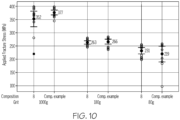
- Drop testing was carried out using a 180-grit silicon carbide sandpaper surface and an 80 grit silicon carbide sandpaper surface. The drop performance is reported in terms of the maximum drop height in cm before failure of the colored glass article.
- FSM surface stress meter
- FSM-6000 surface stress meter
- SOC stress optical coefficient
- ASTM standard C770-16 Standard Test Method for Measurement of Glass Stress-Optical Coefficient
- DOC depth of compression
- CIELAB color space refers to a color space defined by the International Commission on Illumination (CIE) in 1976. It expresses color as three values: L* for the lightness from black (0) to white (100), a* from green (-) to red (+), and B* from blue (-) to yellow (+).
- color gamut refers to the pallet of colors that may be achieved by the colored glass articles within the CIELAB color space.
- the dielectric constant of the colored glass articles may be measured using a split post dielectric resonator (SPDR), as is known in the art, at a frequency of 10 GHz.
- SPDR split post dielectric resonator
- the dielectric constant was measured on samples of the colored glass article having a length of 3 inches (76.2 mm), a width of 3 inches (76.2 mm), and a thickness of less than 0.9 mm.
- the dielectric constant of the colored glass articles may also be measured over a range of frequencies from 10 GHz to 60 GHz using a double concave reflecting mirror Fabry-Perot open resonator, as is known in the art.
- the dielectric constant can be measured at different frequencies by adjusting the mirror spacing in the open resonator.
- the dielectric constant may be measured on samples of the colored glass article having a length of 120 mm, a width of 120 mm, and a thickness of 2 mm or less. While not wishing to be bound by theory, it is believed that the dielectric constant of the colored glass articles measured at 10 GHz approximates the dielectric constant at each frequency in the range from 10 GHz to 60 GHz.
- Colorants have been added to conventional aluminosilicate glass compositions to achieve a colored glass article having a desired color and improved mechanical properties. For example, transition metal oxides and/or rare earth oxides may be added. However, simply including colorants in aluminosilicate glass compositions may not produce the desired color and/or result in in colored glass articles suitable for use in electronic devices transmitting and/or receiving high frequencies (e.g., frequencies of fifth generation (5G)).
- high frequencies e.g., frequencies of fifth generation (5G)
- the glass compositions disclosed herein include transition metal oxides and/or rare earth oxides to achieve a desired color.
- the glass compositions disclosed herein include a relatively low concentration (e.g., less than or equal to 25 mol%) of alkali oxides (e.g., LizO, NazO, and K 2 O) and alkaline earth oxides (i.e., CaO, MgO, and ZnO) to achieve a reduced dielectric constant (e.g., less than or equal to 6.90).
- alkali oxides e.g.., LizO, NazO, and K 2 O
- alkaline earth oxides i.e., CaO, MgO, and ZnO
- the glass compositions and colored glass articles described herein may be described as aluminoborosilicate glass compositions and colored glass articles and comprise SiOz, Al 2 O 3 , and B 2 O 3 .
- the glass compositions and colored glass articles described herein include transition metal oxides (e.g., NiO, Co 3 O 4 , Cr 2 O 3 , CuO, TiOz) and/or rare earth oxides (CeOz) to produce colored glass articles having the desired color.
- the glass compositions and colored glass articles disclosed herein include a relatively low sum (e.g., less than or equal to 25 mol%) of R 2 O (i.e., LizO, Na 2 O, and K 2 O) and R'O (i.e., CaO, MgO, and ZnO) to achieve a reduced dielectric constant (e.g., less than or equal to 6.8).
- R 2 O i.e., LizO, Na 2 O, and K 2 O
- R'O i.e., CaO, MgO, and ZnO
- the glass compositions and colored glass articles described herein also include alkali oxides, such as LizO, NazO, and KzO, to enable the ion-exchangeability of the colored glass articles.
- SiOz is the primary glass former in the glass compositions described herein and may function to stabilize the network structure of the colored glass articles.
- concentration of SiOz in the glass compositions and resultant colored glass articles should be sufficiently high (e.g., greater than or equal to 50 mol%) to enhance the chemical durability of the glass composition and, in particular, the resistance of the glass composition to degradation upon exposure to acidic solutions, basic solutions, and in water.
- the amount of SiOz may be limited (e.g., to less than or equal to 70 mol%) to control the melting point of the glass composition, as the melting point of pure SiOz or high SiOz glasses is undesirably high. Thus, limiting the concentration of SiOz may aid in improving the meltability and the formability of the resultant colored glass article.
- the glass composition and the resultant colored glass article may comprise greater than or equal to 50 mol% and less than or equal to 70 mol% SiOz.
- the concentration of SiO 2 in the glass composition and the resultant colored glass article may be greater than or equal to 50 mol%, greater than or equal to 53 mol%, greater than or equal to 55 mol%, or even greater than or equal to 57 mol%.
- the concentration of SiOz in the glass composition and the colored resultant glass article may be greater than or equal to 50 mol% and less than or equal to 70 mol%, greater than or equal to 50 mol% and less than or equal to 67 mol%, greater than or equal to 50 mol% and less than or equal to 65 mol% greater than or equal to 50 mol% and less than or equal to 63 mol%, greater than or equal to 53 mol% and less than or equal to 70 mol%, greater than or equal to 53 mol% and less than or equal to 67 mol%, greater than or equal to 53 mol% and less than or equal to 65 mol% greater than or equal to 53 mol% and less than or equal to 63 mol%, greater than or equal to 55 mol% and less than or equal to 70 mol%, greater than or equal to 55 mol% and less than or equal to 67 mol%, greater than or equal to 55 mol% and less than or equal to 65 mol% greater than or equal to 55 mol% and less than or
- Al 2 O 3 may also stabilize the glass network and additionally provides improved mechanical properties and chemical durability to the glass composition and the resultant colored glass article.
- the amount of Al 2 O 3 may also be tailored to control the viscosity of the glass composition.
- Al 2 O 3 may be included such that the resultant glass composition has the desired fracture toughness (e.g., greater than or equal to 0.7 MPa ⁇ m 1/2 ). However, if the amount of Al 2 O 3 is too high (e.g., greater than 20 mol%), the viscosity of the melt may increase, thereby diminishing the formability of the colored glass article.
- the solubility of one or more colorants in the glass melt may decrease, resulting in the formation of undesirable crystal phases in the glass.
- the solubility of Cr 2 O 3 in the glass melt may decrease with increasing Al 2 O 3 concentrations (e.g., concentrations greater than or equal to 17.5 mol%), leading to the precipitation of undesirable crystal phases.
- Al 2 O 3 concentrations e.g., concentrations greater than or equal to 17.5 mol%
- the glass composition and the resultant colored glass article may comprise greater than or equal to 10 mol% and less than or equal to 20 mol% Al 2 O 3 .
- the concentration of Al 2 O 3 in the glass composition and the resultant colored glass article may be greater than or equal to 10 mol%, greater than or equal to 12 mol%, greater than or equal to 12.5 mol%, greater than or equal to 13 mol%, greater than or equal to 13.5 mol%, or even greater than or equal to 14 mol%.
- the concentration of Al 2 O 3 in the glass composition and the resultant colored glass article may be less than or equal to 20 mol%, less than or equal to 18 mol%, less than or equal to 17.5 mol%, or even less than or equal to 17 mol%.
- the concentration of Al 2 O 3 in the glass composition and the resultant colored glass article may be greater than or equal to 10 mol% and less than or equal to 20 mol%, greater than or equal to 10 mol% and less than or equal to 18 mol% greater than or equal to 10 mol% and less than or equal to 17.5 mol%, greater than or equal to 10 mol% and less than or equal to 17 mol%, greater than or equal to 12 mol% and less than or equal to 20 mol%, greater than or equal to 12 mol% and less than or equal to 18 mol% greater than or equal to 12 mol% and less than or equal to 17.5 mol%, greater than or equal to 12 mol% and less than or equal to 17 mol%, greater than or equal to 12.5 mol% and less than or equal to 20 mol%, greater than or equal to 12.5 mol% and less than or equal to 18 mol% greater than or equal to 12.5 mol% and less than or equal to 17.5 mol%, greater than or equal to 12.5 mol% and
- B 2 O 3 decreases the melting point of the glass composition, which may improve the retention of certain colorants in the glass. B 2 O 3 may also improve the damage resistance of the resultant colored glass article.
- B 2 O 3 is added to reduce the formation of non-bridging oxygen, the presence of which may reduce fracture toughness.
- the concentration of B 2 O 3 should be sufficiently high (e.g., greater than or equal to 1 mol%) to reduce the melting point of the glass composition, improve the formability, and increase the fracture toughness of the colored glass article.
- B 2 O 3 is too high (e.g., greater than 10 mol%), the annealing point and strain point may decrease, which increases stress relaxation and reduces the overall strength of the colored glass article.
- the glass composition and the resultant colored glass article may comprise greater than or equal to 1 mol% and less than or equal to 10 mol% B 2 O 3 .
- the concentration of B 2 O 3 in the glass composition and the resultant colored glass article may be greater than or equal to 1 mol%, greater than or equal to 2 mol%, greater than or equal to 3 mol%, greater than or equal to 4 mol%, greater than or equal to 4.5 mol%, greater than or equal to 5 mol%, or even greater than or equal to 5.5 mol%.
- the concentration of B 2 O 3 in the glass composition and the resultant colored glass article may be less than or equal to 10 mol%, less than or equal to 9 mol%, less than or equal to 8 mol%, less than or equal to 7.5 mol%, less than or equal to 7 mol%, or even less than or equal to 6.5 mol%.
- the concentration of B 2 O 3 in the glass composition and the resultant colored glass article may be greater than or equal to 1 mol% and less than or equal to 10 mol%, greater than or equal to 1 mol% and less than or equal to 9 mol%, greater than or equal to 1 mol% and less than or equal to 8 mol%, greater than or equal to 1 mol% and less than or equal to 7.5 mol%, greater than or equal to 1 mol% and less than or equal to 7 mol%, greater than or equal to 1 mol% and less than or equal to 6.5 mol%, greater than or equal to 2 mol% and less than or equal to 10 mol%, greater than or equal to 2 mol% and less than or equal to 9 mol%, greater than or equal to 2 mol% and less than or equal to 8 mol%, greater than or equal to 2 mol% and less than or equal to 7.5 mol%, greater than or equal to 2 mol% and less than or equal to 7 mol%, greater than or equal to 2 mol
- the glass compositions and the resultant colored glass articles may contain alkali oxides, such as LizO, NazO, and KzO, to enable the ion-exchangeability of the colored glass articles.
- alkali oxides such as LizO, NazO, and KzO
- LizO aids in the ion-exchangeability of the colored glass article and also reduces the softening point of the glass composition, thereby increasing the formability of the colored glass articles.
- LizO decreases the melting point of the glass composition, which may help improve retention of colorants in the glass.
- the concentration of LizO in the glass compositions and resultant colored glass articles should be sufficiently high (e.g., greater than or equal to 7 mol%) to reduce the melting point of the glass composition and achieve the desired maximum central tension (e.g., greater than or equal to 40 MPa). However, if the amount of LizO is too high (e.g., greater than 14 mol%), the liquidus temperature may increase, thereby diminishing the manufacturability of the colored glass article.
- the glass composition and the resultant colored glass article may comprise greater than or equal to 7 mol% and less than or equal to 14 mol% LizO.
- the concentration of LizO in the glass composition and the resultant colored glass article may be greater than or equal to 7 mol%, greater than or equal to 7.5 mol%, greater than or equal to 8 mol%, or even greater than or equal to 8.5 mol%.
- the concentration of LizO in the glass composition and the resultant colored glass article may be less than or equal to 14 mol%, less than or equal to 13.5 mol%, less than or equal to 13 mol%, or even less than or equal to 12.5 mol%.
- the concentration of LizO in the glass composition and the resultant colored glass article may be greater than or equal to 7 mol% and less than or equal to 14 mol%, greater than or equal to 7 mol% and less than or equal to 13.5 mol%, greater than or equal to 7 mol% and less than or equal to 13 mol%, greater than or equal to 7 mol% and less than or equal to 12.5 mol%, greater than or equal to 7.5 mol% and less than or equal to 14 mol%, greater than or equal to 7.5 mol% and less than or equal to 13.5 mol%, greater than or equal to 7.5 mol% and less than or equal to 13 mol%, greater than or equal to 7.5 mol% and less than or equal to 12.5 mol%, greater than or equal to 8 mol% and less than or equal to 14 mol%, greater than or equal to 8 mol% and less than or equal to 13.5 mol%, greater than or equal to 8 mol% and less than or equal to 13 mol%, greater than or equal to 8
- NazO improves diffusivity of alkali ions in the glass and thereby reduces ion-exchange time and helps achieve the desired surface compressive stress (e.g., greater than or equal to 300 MPa).
- Na 2 O also improves formability of the colored glass article.
- NazO decreases the melting point of the glass composition, which may help improve colorant retention. However, if too much NazO is added to the glass composition, the melting point may be too low.
- the concentration of LizO present in the glass composition and the resultant colored glass article may be greater than the concentration of NazO present in the glass composition and the resultant colored glass article.
- the glass composition and the resultant colored glass article may comprise greater than 0 mol% and less than or equal to 8 mol% NazO.
- the concentration of Na 2 O in the glass composition and the resultant colored glass article may be greater than 0 mol%, greater than or equal to 0.1 mol%, greater than or equal to 0.5 mol%, or even greater than or equal to 1 mol%.
- the concentration of Na 2 O in the glass composition and the resultant colored glass article may be less than or equal to 8 mol%, less than or equal to 7 mol%, less than or equal to 6 mol%, less than or equal to 5 mol%, less than or equal to 4 mol%, or even less than or equal to 3 mol%, or any and all sub-ranges formed from any of these endpoints.
- the concentration of NazO in the glass composition and the resultant colored glass article may be greater than 0 mol% and less than or equal to 8 mol%, greater than 0 mol% and less than or equal to 7 mol%, greater than 0 mol% and less than or equal to 6 mol%, greater than 0 mol% and less than or equal to 5 mol%, greater than 0 mol% and less than or equal to 4 mol%, greater than 0 mol% and less than or equal to 3 mol%, greater than or equal to 0.1 mol% and less than or equal to 8 mol%, greater than or equal to 0.1 mol% and less than or equal to 7 mol%, greater than or equal to 0.1 mol% and less than or equal to 6 mol%, greater than or equal to 0.1 mol% and less than or equal to 5 mol%, greater than or equal to 0.1 mol% and less than or equal to 4 mol%, greater than or equal to 0.1 mol% and less than or equal to 3 mol
- K 2 O promotes ion-exchange and may increase the depth of compression and decrease the melting point to improve the formability of the colored glass article. However, adding too much K 2 O may cause the surface compressive stress and melting point to be too low. Accordingly, in embodiments, the amount of KzO added to the glass composition may be limited.
- the glass composition and the resultant colored glass article may optionally comprise greater than 0 mol% and less than or equal to 1 mol% KzO.
- the concentration of K 2 O in the glass composition and the resultant colored glass article may be greater than 0 mol%, greater than or equal to 0.1 mol%, or even greater than or equal to 0.2 mol%.
- the concentration of K 2 O in the glass composition and the resultant colored glass article may be less than or equal to 1 mol%, less than or equal to 0.7 mol%, or even less than or equal to 0.5 mol%.
- the concentration of K 2 O in the glass composition and the resultant colored glass article may be greater than 0 mol% and less than or equal to 1 mol%, greater than 0 mol% and less than or equal to 0.7 mol%, greater than 0 mol% and less than or equal to 0.5 mol%, greater than or equal to 0.1 mol% and less than or equal to 1 mol%, greater than or equal to 0.1 mol% and less than or equal to 0.7 mol%, greater than or equal to 0.1 mol% and less than or equal to 0.5 mol%, greater than or equal to 0.2 mol% and less than or equal to 1 mol%, greater than or equal to 0.2 mol% and less than or equal to 0.7 mol%, or even greater than or equal to 0.2 mol% and less than or equal to 0.5 mol%, or any and all sub-ranges formed from any of these endpoints.
- the alkali oxides aid in decreasing the softening point and molding temperature of the glass composition, thereby offsetting the increase in the softening point and molding temperature of the glass composition due to higher amounts of SiOz in the glass composition, for example.
- the softening point and molding temperature may be further reduced by including combinations of alkali oxides (e.g., two or more alkali oxides) in the glass composition, a phenomenon referred to as the "mixed alkali effect.”
- alkali oxides e.g., two or more alkali oxides
- the concentration of R 2 O in the glass composition and the resultant colored glass article may be greater than or equal to 7 mol%, greater than or equal to 8 mol%, greater than 9 mol%, or even greater than or equal to 10 mol%. In embodiments, the concentration of R 2 O in the glass composition and the resultant colored glass article may be less than or equal to 25 mol%, less than or equal to 23 mol%, or even less than or equal to 20 mol%.
- the concentration of R 2 O in the glass composition and the resultant colored glass article may be greater than or equal to 7 mol% and less than or equal to 25 mol%, greater than or equal to 7 mol% and less than or equal to 23 mol%, greater than or equal to 7 mol% and less than or equal to 20 mol%, greater than or equal to 8 mol% and less than or equal to 25 mol%, greater than or equal to 8 mol% and less than or equal to 23 mol%, greater than or equal to 8 mol% and less than or equal to 20 mol%, greater than or equal to 9 mol% and less than or equal to 25 mol%, greater than or equal to 9 mol% and less than or equal to 23 mol%, greater than or equal to 9 mol% and less than or equal to 20 mol%, greater than or equal to 10 mol% and less than or equal to 25 mol%, greater than or equal to 10 mol% and less than or equal to 23 mol%, or even greater than or equal to 10 mol% and
- the difference between R 2 O and Al 2 O 3 (i.e. R 2 O (mol%) - Al 2 O 3 (mol%)) in the glass composition may be adjusted to reduce the formation of non-bridging oxygen, the presence of which may reduce fracture toughness.
- R 2 O - Al 2 O 3 in the glass composition and the resultant colored glass article may be greater than or equal to -8 mol%, greater than or equal to -7, greater than or equal to -6, or even greater than or equal to -5.
- R 2 O - Al 2 O 3 in the glass composition and the resultant colored glass article may be less than or equal to 4 mol%, less than or equal to 3 mol%, less than or equal to 2 mol%, or even less than or equal to 1 mol%.
- R 2 O - Al 2 O 3 in the glass composition and the resultant colored glass article may be greater than or equal to -8 mol% and less than or equal to 4 mol%, greater than or equal to -8 mol% and less than or equal to 3 mol%, greater than or equal to -8 mol% and less than or equal to 2 mol%, greater than or equal to -8 mol% and less than or equal to 1 mol%, greater than or equal to -7 mol% and less than or equal to 4 mol%, greater than or equal to -7 mol% and less than or equal to 3 mol%, greater than or equal to -7 mol% and less than or equal to 2 mol%, greater than or equal to -7 mol% and less than or equal to 1 mol%, greater than or equal to -6 mol% and less than or equal to 4 mol%, greater than or equal to -6 mol% and less than or equal to 3 mol%, greater than or equal to -6 mol% and less than or equal to 2 mol
- the glass compositions and the resultant colored glass articles described herein may further comprise CaO.
- CaO lowers the viscosity of a glass composition, which enhances the formability, the strain point and the Young's modulus, and may improve the ion-exchangeability.
- the diffusivity of sodium and potassium ions in the glass composition decreases which, in turn, adversely impacts the ion-exchange performance (i.e., the ability to ion-exchange) of the resultant glass.
- the concentration of CaO in the glass composition and the resultant colored glass article may be greater than or equal to 0 mol%, greater than or equal to 0.25 mol%, greater than or equal to 0.5 mol%, or even greater than or equal to 0.75 mol%.
- the concentration of CaO in the glass composition and the resultant colored glass article may be less than or equal to 7 mol%, less than or equal to 6.5 mol%, less than or equal to 6 mol%, less than or equal to 5.5 mol%, less than or equal to 5 mol%, less than or equal to 4.5 mol%, less than or equal to 4 mol%, less than or equal to 3.5 mol%, less than or equal to 3 mol%, less than or equal to 2.5 mol%, less than or equal to 2 mol%, or even less than or equal to 1.75 mol%.
- the concentration of CaO in the glass composition and the resultant colored glass article may be greater than or equal to 0 mol% and less than or equal to 7 mol%, greater than or equal to 0 mol% and less than or equal to 6.5 mol%, greater than or equal to 0 mol% and less than or equal to 6 mol%, greater than or equal to 0 mol% and less than or equal to 5.5 mol%, greater than or equal to 0 mol% and less than or equal to 5 mol%, greater than or equal to 0 mol% and less than or equal to 4.5 mol%, greater than or equal to 0 mol% and less than or equal to 4 mol%, greater than or equal to 0 mol% and less than or equal to 3.5 mol%, greater than or equal to 0 mol% and less than or equal to 3 mol%, greater than or equal to 0 mol% and less than or equal to 2.5 mol%, greater than or equal to 0 mol% and less than or equal to 2 mol
- the glass compositions and the resultant colored glass articles described herein may further comprise MgO.
- MgO lowers the viscosity of the glass compositions, which enhances the formability, the strain point, and the Young's modulus, and may improve ion-exchangeability.
- MgO lowers the viscosity of the glass compositions, which enhances the formability, the strain point, and the Young's modulus, and may improve ion-exchangeability.
- MgO lowers the viscosity of the glass compositions, which enhances the formability, the strain point, and the Young's modulus, and may improve ion-exchangeability.
- MgO lowers the viscosity of the glass compositions, which enhances the formability, the strain point, and the Young's modulus, and may improve ion-exchangeability.
- the diffusivity of sodium and potassium ions in the glass composition decreases which, in turn, adversely impacts the ion-exchange performance (i.e., the
- the glass composition and the resultant colored glass article may comprise greater than or equal to 0 mol% and less than or equal to 8 mol% MgO.
- the concentration of MgO in the glass composition may be greater than or equal to 0 mol%, greater than or equal to 0.5 mol%, greater than or equal to 1 mol%, or even greater than or equal to 1.5 mol%.
- the concentration of MgO in the glass composition may be less than or equal to 8 mol%, less than or equal to 7 mol%, less than or equal to 6 mol%, less than or equal to 5.5 mol%, less than or equal to 5 mol%, less than or equal to 4.5 mol%, or even less than or equal to 4 mol%.
- the concentration of MgO in the glass composition may be greater than or equal to 0 mol% and less than or equal to 8 mol%, greater than or equal to 0 mol% and less than or equal to 7 mol%, greater than or equal to 0 mol% and less than or equal to 6 mol%, greater than or equal to 0 mol% and less than or equal to 5.5 mol%, greater than or equal to 0 mol% and less than or equal to 5 mol%, greater than or equal to 0 mol% and less than or equal to 4.5 mol%, greater than or equal to 0 mol% and less than or equal to 4 mol%, greater than or equal to 0.5 mol% and less than or equal to 8 mol%, greater than or equal to 0.5 mol% and less than or equal to 7 mol%, greater than or equal to 0.5 mol% and less than or equal to 6 mol%, greater than or equal to 0.5 mol% and less than or equal to 5.5 mol%, greater than or equal to
- the glass compositions and the resultant colored glass articles described herein may further comprise ZnO.
- ZnO lowers the viscosity of the glass compositions, which enhances the formability, the strain point, and the Young's modulus, and may improve ion-exchangeability.
- the diffusivity of sodium and potassium ions in the glass composition decreases which, in turn, adversely impacts the ion-exchange performance (i.e., the ability to ion-exchange) of the resultant colored glass article.
- the glass composition and the resultant colored glass article may comprise greater than or equal to 0 mol% and less than or equal to 8 mol% ZnO.
- the concentration of ZnO in the glass composition may be greater than or equal to 0 mol%, greater than or equal to 0.5 mol%, greater than or equal to 1 mol%, or even greater than or equal to 1.5 mol%.
- the concentration of ZnO in the glass composition may be less than or equal to 8 mol%, less than or equal to 7 mol%, less than or equal to 6 mol%, less than or equal to 5.5 mol%, less than or equal to 5 mol%, less than or equal to 4.5 mol%, or even less than or equal to 4 mol%.
- the concentration of ZnO in the glass composition may be greater than or equal to 0 mol% and less than or equal to 8 mol%, greater than or equal to 0 mol% and less than or equal to 7 mol%, greater than or equal to 0 mol% and less than or equal to 6 mol%, greater than or equal to 0 mol% and less than or equal to 5.5 mol%, greater than or equal to 0 mol% and less than or equal to 5 mol%, greater than or equal to 0 mol% and less than or equal to 4.5 mol%, greater than or equal to 0 mol% and less than or equal to 4 mol%, greater than or equal to 0.5 mol% and less than or equal to 8 mol%, greater than or equal to 0.5 mol% and less than or equal to 7 mol%, greater than or equal to 0.5 mol% and less than or equal to 6 mol%, greater than or equal to 0.5 mol% and less than or equal to 5.5 mol%, greater than or equal to
- the concentration of R'O in the glass composition and the resultant colored glass article may be greater than or equal 0 mol%, greater than or equal to 0.5 mol%, greater than or equal to 1 mol%, greater than or equal to 2 mol%, greater than or equal to 3 mol%, or even greater than or equal to 4 mol%.
- the concentration of R'O in the glass composition and the resultant colored glass article may be less than or equal to 12 mol%, less than or equal to 10 mol%, less than or equal to 8 mol%, or even less than or equal to 6 mol%.
- the concentration of R'O in the glass composition and the resultant colored glass article may be greater than or equal to 0 mol% and less than or equal to 12 mol%, greater than or equal to 0 mol% and less than or equal to 10 mol%, greater than or equal to 0 mol% and less than or equal to 8 mol%, greater than or equal to 0 mol% and less than or equal to 6 mol%, greater than or equal to 0.5 mol% and less than or equal to 12 mol%, greater than or equal to 0.5 mol% and less than or equal to 10 mol%, greater than or equal to 0.5 mol% and less than or equal to 8 mol%, greater than or equal to 0.5 mol% and less than or equal to 6 mol%, greater than or equal to 1 mol% and less than or equal to 12 mol%, greater than or equal to 1 mol% and less than or equal to 10 mol%, greater than or equal to 1 mol% and less than or equal to 8 mol%, greater than or equal to 0
- R 2 O and R'O may be relatively low (e.g., less than or equal to 25 mol%) to achieve a reduced dielectric constant (e.g., less than or equal to 6.8), thereby allowing for use of the colored glass article in high frequency applications.
- R 2 O + R'O in the glass composition and the resultant colored glass article may be greater than or equal to 7 mol%, greater than or equal to 9 mol%, greater than or equal to 11 mol%, greater than or equal to 13 mol%, or even greater than or equal to 15 mol%.
- R 2 O + R'O in the glass composition and the resultant colored glass article may be less than or equal to 25 mol%, less than or equal to 23 mol%, less than or equal to 20 mol%, or even less than or equal to 18 mol%.
- R 2 O + R'O in the glass composition and the resultant colored glass article may be greater than or equal to 7 mol% and less than or equal to 25 mol%, greater than or equal to 7 mol% and less than or equal to 23 mol%, greater than or equal to 7 mol% and less than or equal to 20 mol%, greater than or equal to 7 mol% and less than or equal to 18 mol%, greater than or equal to 9 mol% and less than or equal to 25 mol%, greater than or equal to 9 mol% and less than or equal to 23 mol%, greater than or equal to 9 mol% and less than or equal to 20 mol%, greater than or equal to 9 mol% and less than or equal to 18 mol%, greater than or equal to 11 mol% and less than or equal to 25 mol%, greater than or equal to 11 mol% and less than or equal to 23 mol%, greater than or equal to 11 mol% and less than or equal to 20 mol%, greater than or equal to 11 mol% and less less less than
- the glass compositions and the resultant colored glass articles described herein may further comprise Fe 2 O 3 , which may help improve colorant retention. Fe 2 O 3 may also act as a colorant, producing colored glass articles that may, for example, be pink in color.
- the concentration of Fe 2 O 3 in the glass composition and the resultant colored glass article may be greater than or equal to 0 mol% or even greater than or equal to 0.01 mol%. In embodiments, the concentration of Fe 2 O 3 in the glass composition and the resultant colored glass article may be less than or equal to 1 mol%, less than or equal to 0.75 mol%, or even less than or equal to 0.5 mol%.
- the concentration of Fe 2 O 3 in the glass composition and the resultant colored glass article may be greater than or equal to 0 mol% and less than or equal to 1 mol%, greater than or equal to 0 mol% and less than or equal to 0.75 mol%, greater than or equal to 0 mol% and less than or equal to 0.5 mol%, greater than or equal to 0.01 mol% and less than or equal to 1 mol%, greater than or equal to 0.01 mol% and less than or equal to 0.75 mol%, or even greater than or equal to 0.01 mol% and less than or equal to 0.5 mol%, or any and all sub-ranges formed from any of these endpoints.
- the glass composition and the resultant colored glass article may be substantially free or free of Fe 2 O 3 .
- the concentration of Fe 2 O 3 in the glass composition and the resultant colored glass article may be greater than or equal to 0 mol%, greater than or equal to 0.001 mol%, or even greater than or equal to 0.005 mol%. In embodiment, the concentration of Fe 2 O 3 in the glass composition and the resultant colored glass article may be less than or equal to 0.5 mol%, less than or equal to 0.1 mol%, less than or equal to 0.05 mol%, or even less than or equal to 0.01 mol%.
- the composition and the resultant colored glass article may be greater than or equal to 0 mol% and less than or equal to 0.5 mol%, greater than or equal to 0 mol% and less than or equal to 0.1 mol%, greater than or equal to 0 mol% and less than or equal to 0.05 mol%, greater than or equal to 0 mol% and less than or equal to 0.01 mol%, greater than or equal to 0.001 mol% and less than or equal to 0.5 mol%, greater than or equal to 0.001 mol% and less than or equal to 0.1 mol%, greater than or equal to 0.001 mol% and less than or equal to 0.05 mol%, greater than or equal to 0.001 mol% and less than or equal to 0.01 mol%, greater than or equal to 0.005 mol% and less than or equal to 0.5 mol%, greater than or equal to 0.005 mol% and less than or equal to 0.1 mol%, greater than or equal to 0.005 mol% and less than or equal to
- the glass compositions and the resultant colored glass articles described herein may further comprise SnOz.
- the concentration of SnOz in the glass composition and the resultant colored glass article may be greater than or equal to 0 mol% or even greater than or equal to 0.01 mol%.
- the concentration of SnOz in the glass composition and the resultant colored glass article may be less than or equal to 1 mol%, less than or equal to 0.75 mol%, less than or equal to 0.5 mol%, or even less than or equal to 0.25 mol%.
- the concentration of SnOz in the glass composition and the resultant colored glass article may be greater than or equal to 0 mol% and less than or equal to 1 mol%, greater than or equal to 0 mol% and less than or equal to 0.75 mol%, greater than or equal to 0 mol% and less than or equal to 0.5 mol%, greater than or equal to 0 mol% and less than or equal to 0.25 mol%, greater than or equal to 0.01 mol% and less than or equal to 1 mol%, greater than or equal to 0.01 mol% and less than or equal to 0.75 mol%, greater than or equal to 0.01 mol% and less than or equal to 0.5 mol%, or even greater than or equal to 0.01 mol% and less than or equal to 0.25 mol%, or any and all sub-ranges formed from any of these endpoints.
- the glass composition and the resultant colored glass article may be substantially free or free of SnOz.
- the glass compositions and the resultant colored glass articles may include a colorant that comprises or consists of transition metal oxides, rare earth oxides, or combinations thereof, to achieve a desired color.
- transition metal oxides and/or rare earth oxides may be included in the glass compositions as the sole colorant or in combination with other colorants.
- colorants based on transition metal oxides and/or rare earth oxides may include NiO, Co 3 O 4 , Cr 2 O 3 , CuO, CeO 2 , TiO 2 and/or combinations thereof.
- the glass composition and the resultant colored glass article may comprise greater than or equal to 0.001 mol%, such as greater than or equal to 0.001 mol% and less than or equal to 10 mol%, NiO + Co 3 O 4 + Cr 2 O 3 + CuO + CeO 2 + TiO 2 .
- the concentration of NiO + Co 3 O 4 + Cr 2 O 3 + CuO + CeO 2 + TiO 2 in the glass composition and the resultant colored glass article may be greater than or equal to 0.001 mol% and less than or equal to 5 mol%, greater than or equal to 0.001 mol% and less than or equal to 4 mol%, greater than or equal to 0.001 mol% and less than or equal to 3 mol%, greater than or equal to 0.001 mol% and less than or equal to 2.5 mol%, greater than or equal to 0.001 mol% and less than or equal to 2 mol%, greater than or equal to 0.001 mol% and less than or equal to 1.5 mol%, greater than or equal to 0.01 mol% and less than or equal to 5 mol%, greater than or equal to 0.01 mol% and less than or equal to 4 mol%, greater than or equal to 0.01 mol% and less than or equal to 3 mol%, greater than or equal to 0.01 mol% and less than or equal to 2.5
- the glass composition and the resultant colored glass article may comprise greater than or equal to 0.001 mol%, such as greater than or equal to 0.001 mol% and less than or equal to 3 mol%, NiO + Co 3 O 4 + Cr 2 O 3 + CuO.
- the concentration of NiO + Co 3 O 4 + Cr 2 O 3 + CuO in the glass composition and the resultant colored glass article may be greater than or equal to 0.001 mol% and less than or equal to 2.5 mol%, greater than or equal to 0.001 mol% and less than or equal to 2 mol%, greater than or equal to 0.001 mol% and less than or equal to 1.5 mol%, greater than or equal to 0.001 mol% and less than or equal to 1 mol%, greater than or equal to 0.001 mol% and less than or equal to 0.5 mol%, greater than or equal to 0.001 mol% and less than or equal to 0.4 mol%, greater than or equal to 0.01 mol% and less than or equal to 2.5 mol%, greater than or equal to 0.01 mol% and less than or equal to 2 mol%, greater than or equal to 0.01 mol% and less than or equal to 1.5 mol%, greater than or equal to 0.01 mol% and less than or equal to 1 mol%, greater than
- the glass composition and the resultant colored glass article may comprise greater than or equal to 0.1 mol%, such as greater than or equal to 0.1 mol% and less than or equal to 2 mol%, CeOz.
- the concentration of CeOz in the glass composition and the resultant colored glass article may be greater than or equal to 0.1 mol% and less than or equal to 1.5 mol%, greater than or equal to 0.1 mol% and less than or equal to 1 mol%, greater than or equal to 0.1 mol% and less than or equal to 0.75 mol%, greater than or equal to 0.1 mol% and less than or equal to 0.5 mol%, greater than or equal to 0.1 mol% and less than or equal to 0.4 mol%, greater than or equal to 0.2 mol% and less than or equal to 1.5 mol%, greater than or equal to 0.2 mol% and less than or equal to 1 mol%, greater than or equal to 0.2 mol% and less than or equal to 0.75 mol%, greater than or equal to or equal to
- the glass composition and the resultant colored glass article may comprise greater than or equal to 0.1 mol%, such as greater than or equal to 0.1 mol% and less than or equal to 2 mol%, TiOz.
- the concentration of TiOz in the glass composition and the resultant colored glass article may be greater than or equal to 0.1 mol% and less than or equal to 1.5 mol%, greater than or equal to 0.1 mol% and less than or equal to 1 mol%, greater than or equal to 0.1 mol% and less than or equal to 0.75 mol%, greater than or equal to 0.1 mol% and less than or equal to 0.5 mol%, greater than or equal to 0.1 mol% and less than or equal to 0.4 mol%, greater than or equal to 0.2 mol% and less than or equal to 1.5 mol%, greater than or equal to 0.2 mol% and less than or equal to 1 mol%, greater than or equal to 0.2 mol% and less than or equal to 0.75 mol%, greater than or equal to
- the glass composition and the resultant colored glass article may comprise greater than or equal to 0.1 mol%, such as greater than or equal to 0.1 mol% and less than or equal to 2 mol%, CeOz + TiOz.
- the concentration of CeOz + TiOz in the glass composition and the resultant colored glass article may be greater than or equal to 0.1 mol% and less than or equal to 1.5 mol%, greater than or equal to 0.1 mol% and less than or equal to 1 mol%, greater than or equal to 0.1 mol% and less than or equal to 0.75 mol%, greater than or equal to 0.1 mol% and less than or equal to 0.5 mol%, greater than or equal to 0.1 mol% and less than or equal to 0.4 mol%, greater than or equal to 0.2 mol% and less than or equal to 1.5 mol%, greater than or equal to 0.2 mol% and less than or equal to 1 mol%, greater than or equal to 0.2 mol% and less than or equal to 0.75 mol
- the glass composition and the resultant colored glass article may comprise greater than or equal to 0 mol%, such as greater than or equal to 0.01 mol% and less than or equal to 0.05 mol%, NiO.
- the concentration of NiO in the glass composition and the resultant colored glass article may be greater than or equal to 0 mol% and less than or equal to 0.05 mol%, greater than or equal to 0 mol% and less than or equal to 0.04 mol%, greater than or equal to 0 mol% and less than or equal to 0.035 mol%, greater than or equal to 0 mol% and less than or equal to 0.03 mol%, greater than or equal to 0 mol% and less than or equal to 0.025 mol%, greater than or equal to 0 mol% and less than or equal to 0.02 mol%, greater than or equal to 0 mol% and less than or equal to 0.015 mol%, greater than or equal to 0.01 mol% and less than or equal to 0.05 mol%,
- the glass composition and the resultant colored glass article may comprise greater than or equal to 0 mol%, such as greater than or equal to 0.1 mol% and less than or equal to 0.5 mol%, CuO.
- the concentration of CuO in the glass composition and the resultant colored glass article may be greater than or equal to 0.1 mol% and less than or equal to 0.5 mol%, greater than or equal to 0.1 mol% and less than or equal to 0.4 mol%, greater than or equal to 0.1 mol% and less than or equal to 0.35 mol%, greater than or equal to 0.1 mol% and less than or equal to 0.3 mol%, greater than or equal to 0.1 mol% and less than or equal to 0.25 mol%, greater than or equal to 0.1 mol% and less than or equal to 0.2 mol%, greater than or equal to 0.1 mol% and less than or equal to 0.15 mol%, greater than or equal to 0.15 mol% and less than or equal to 0.5 mol%, greater than or
- the glass composition and the resultant colored glass article may comprise greater than or equal to 0 mol%, such as greater than or equal to 0.0001 mol% and less than or equal to 0.01 mol%, Co 3 O 4 .
- the concentration of Co 3 O 4 in the glass composition and the resultant colored glass article may be greater than or equal to 0 mol% and less than or equal to 0.01 mol%, greater than or equal to 0 mol% and less than or equal to 0.0095 mol%, greater than or equal to 0 mol% and less than or equal to 0.009 mol%, greater than or equal to 0 mol% and less than or equal to 0.0085 mol%, greater than or equal to 0 mol% and less than or equal to 0.0075 mol%, greater than or equal to 0 mol% and less than or equal to 0.007 mol%, greater than or equal to 0 mol% and less than or equal to 0.0065 mol%, greater than or equal to 0 mol% and less than or equal to 0.00
- the glass composition and the resultant colored glass article may comprise greater than or equal to 0 mol%, such as greater than or equal to 0.01 mol% and less than or equal to 0.05 mol%, Cr 2 O 3 .
- the concentration of Cr 2 O 3 in the glass composition and the resultant colored glass article may be greater than or equal to 0 mol% and less than or equal to 0.05 mol%, greater than or equal to 0 mol% and less than or equal to 0.04 mol%, greater than or equal to 0 mol% and less than or equal to 0.035 mol%, greater than or equal to 0 mol% and less than or equal to 0.03 mol%, greater than or equal to 0 mol% and less than or equal to 0.025 mol%, greater than or equal to 0 mol% and less than or equal to 0.02 mol%, greater than or equal to 0 mol% and less than or equal to 0.015 mol%, greater than or equal to 0.01 mol% and less than or equal to
- the glass composition and the resultant colored glass article may comprise at least one of: greater than or equal to 0.001 mol% NiO + Co 3 O 4 + Cr 2 O 3 + CuO, such as greater than or equal to 0.001 mol% and less than or equal to 3 mol% NiO + Co 3 O 4 + Cr 2 O 3 + CuO (or any of the ranges of NiO + Co 3 O 4 + Cr 2 O 3 + CuO described herein); greater than or equal to 0.1 mol% CeOz, such as greater than or equal to 0.1 mol% and less than or equal to 1.5 mol% CeOz (or any of the ranges of CeO 2 described herein); and greater than or equal to 0.1 mol% TiOz, such as greater than or equal to 0.1 mol% and less than or equal to 2 mol% TiOz (or any of the ranges of TiOz described herein).
- the glass compositions and the resultant colored glass articles described herein may further include tramp materials such as MnO, MoOs, WO 3 , Y 2 O 3 , CdO, As 2 O 3 , sulfur-based compounds, such as sulfates, halogens, or combinations thereof.
- the glass composition and the resultant colored glass article may be substantially free or free of tramp materials such as MnO, MoOs, WO 3 , Y 2 O 3 , CdO, As 2 O 3 , sulfur-based compounds, such as sulfates, halogens, or combinations thereof.
- the process for making a glass article includes heat treating a glass composition described herein at one or more preselected temperatures for one or more preselected times to induce glass homogenization.
- the heat treatment for making a glass article may include heating a glass composition at a rate of 1-100 °C/min to glass homogenization temperature; (ii) maintaining the glass composition at the glass homogenization temperature for a time greater than or equal to 0.25 hour and less than or equal to 40 hours (such as 0.25 hours to 4 hours) to produce a glass article; and cooling the glass composition to room temperature to form the glass article to room temperature.
- the glass homogenization temperature may be greater than or equal to 300 °C and less than or equal to 700 °C.
- the formed glass article may be a colored glass article such that additional heat treatment is not necessary.
- the colored glass article may be produced when heating above a certain temperature (e.g., the glass homogenation temperature) such that the maintaining step is not required to produce the colored glass article.
- the sum of R 2 O and R'O may be relatively low (e.g., less than or equal to 25 mol%) to achieve a reduced dielectric constant (e.g., less than or equal to 6.8), thereby allowing for use of the colored glass article in high frequency applications.
- the colored glass articles described herein may have a dielectric constant Dk at 10 GHz less than or equal to 6.8, such as less than or equal to 6.8 and greater than or equal to 5.6.
- the dielectric constant of the colored glass article may be less than or equal to 6.8 and greater than or equal to 5.7, less than or equal to 6.8 and greater than or equal to 5.8, less than or equal to 6.8 and greater than or equal to 5.9, less than or equal to 6.8 and greater than or equal to 6.0, less than or equal to 6.8 and greater than or equal to 6.2, less than or equal to 6.6 and greater than or equal to 5.7, less than or equal to 6.6 and greater than or equal to 5.8, less than or equal to 6.6 and greater than or equal to 5.9, less than or equal to 6.6 and greater than or equal to 6.0, less than or equal to 6.6 and greater than or equal to 6.2, less than or equal to 6.4 and greater than or equal to 5.7, less than or equal to 6.4 and greater than or equal to 5.8, less than or equal to 6.4 and greater than or equal to 5.9, less than or equal to 6.4 and greater than or equal to 6.0, less than or equal to 6.4 and greater than or equal to 6.2, less than or equal to
- the dielectric constant of the colored glass articles measured at 10 GHz approximates the dielectric constant at each frequency in the range from 10 GHz to 60 GHz. Accordingly, a dielectric constant reported for a colored glass article at a frequency of 10 GHz approximates the dielectric constant of the colored glass article at each frequency over the frequency range of 10 GHz to 60 GHz, inclusive of endpoints.
- the dielectric electric constant Dk may be in the desired range (e.g., less than or equal to 6.8).
- the glass composition and the resultant colored glass articles may satisfy the relationship 3.802946 + 0.01747 ⁇ B 2 O 3 + 0.058769 ⁇ Al 2 O 3 + 0.080876 ⁇ Li 2 O + 0.148433 ⁇ Na 2 O + 0.153264 ⁇ K 2 O + 0.045179 ⁇ MgO + 0.080113 ⁇ CaO is less than or equal to 6.8 and greater than or equal to 5.7, less than or equal to 6.8 and greater than or equal to 5.8, less than or equal to 6.8 and greater than or equal to 5.9, less than or equal to 6.8 and greater than or equal to 6.0, less than or equal to 6.8 and greater than or equal to 6.2, less than or equal to 6.6 and greater than or equal to 5.7, less than or equal to 6.6 and greater than or equal to 5.8, less than or equal to 6.6 and greater than or equal to 5.9, less than or equal to 6.6 and greater than or equal to 6.0, less than or equal to 6.6 and greater than or equal to 6.2, less than or equal to 6.6
- the colored glass articles formed from the glass compositions described herein may be any suitable thickness, which may vary depending on the particular application of the colored glass article.
- the colored glass articles may have a thickness greater than or equal to 250 ⁇ m and less than or equal to 6 mm, greater than or equal to 250 ⁇ m and less than or equal to 4 mm, greater than or equal to 250 ⁇ m and less than or equal to 2 mm, greater than or equal to 250 ⁇ m and less than or equal to 1 mm, greater than or equal to 250 ⁇ m and less than or equal to 750 ⁇ m, greater than or equal to 250 ⁇ m and less than or equal to 500 ⁇ m, greater than or equal to 500 ⁇ m and less than or equal to 6 mm, greater than or equal to 500 ⁇ m and less than or equal to 4 mm, greater than or equal to 500 ⁇ m and less than or equal to 2 mm, greater than or equal to 500 ⁇ m and less than or equal to 1 mm, greater than or equal to 500 ⁇ m and less than or equal to
- colored glass articles formed from the glass compositions described herein may have an increased fracture toughness such that the colored glass articles are more resistant to damage.
- the colored glass article may have a K IC fracture toughness as measured by a chevron notch short bar method greater than or equal to 0.7 MPa m 1/2 , greater than or equal to 0.8 MPa ⁇ m 1/2 , greater than or equal to 0.9 MPa ⁇ m 1/2 , or even greater than or equal to 1.0 MPa ⁇ m 1/2 .
- the glass compositions described herein are ion-exchangeable to facilitate strengthening the colored glass article made from the glass compositions.
- smaller metal ions in the glass compositions are replaced or "exchanged" with larger metal ions of the same valence within a layer that is close to the outer surface of the colored glass article made from the glass composition.
- the replacement of smaller ions with larger ions creates a compressive stress within the layer of the colored glass article made from the glass composition.
- the metal ions are monovalent metal ions (e.g., Li + , Na + , K + , and the like), and ion-exchange is accomplished by immersing the glass article made from the glass composition in a bath comprising at least one molten salt of the larger metal ion that is to replace the smaller metal ion in the colored glass article.
- a bath comprising at least one molten salt of the larger metal ion that is to replace the smaller metal ion in the colored glass article.
- other monovalent ions such as Ag + , Tl + , Cu + , and the like may be exchanged for monovalent ions.
- the ion-exchange process or processes that are used to strengthen the colored glass article made from the glass composition may include contacting the colored glass article with an ion-exchange medium.
- the ion-exchange medium may be a molten salt bath.
- the ion-exchange process may include, but is not limited to, immersion in a single bath or multiple baths of like or different compositions with optional washing and/or annealing steps between immersions.
- the ion-exchange solution (e.g., KNO 3 and/or NaNO 3 molten salt bath) may, according to embodiments, be at a temperature greater than or equal to 350 °C and less than or equal to 500 °C, greater than or equal to 360 °C and less than or equal to 450 °C, greater than or equal to 370 °C and less than or equal to 440 °C, greater than or equal to 360 °C and less than or equal to 420 °C, greater than or equal to 370 °C and less than or equal to 400 °C, greater than or equal to 375 °C and less than or equal to 475 °C, greater than or equal to 400 °C and less than or equal to 500 °C, greater than or equal to 410 °C and less than or equal to 490 °C, greater than or equal to 420 °C and less than or equal to 480 °C, greater than or equal to 430 °C and less than or
- the colored glass article may be exposed to the ion-exchange solution for a duration greater than or equal to 2 hours and less than or equal to 24 hours, greater than or equal to 2 hours and less than or equal to 12 hours, greater than or equal to 2 hours and less than or equal to 6 hours, greater than or equal to 8 hours and less than or equal to 24 hours, greater than or equal to 6 hours and less than or equal to 24 hours, greater than or equal to 6 hours and less than or equal to 12 hours, greater than or equal to 8 hours and less than or equal to 24 hours, or even greater than or equal to 8 hours and less than or equal to 12 hours, or any and all sub-ranges formed from any of these endpoints.
- a colored glass article made from a glass composition may be ion-exchanged to achieve a depth of compression of 10 ⁇ m or greater, 20 ⁇ m or greater, 30 ⁇ m or greater, 40 ⁇ m or greater, 50 ⁇ m or greater, 60 ⁇ m or greater, 70 ⁇ m or greater, 80 ⁇ m or greater, 90 ⁇ m or greater, or 100 ⁇ m or greater.
- a colored glass article made from a glass composition may be ion-exchanged to achieve a depth of compression of 3 ⁇ m or greater or 5 ⁇ m or greater.
- the colored glass article made from the glass composition may have a thickness "t" and may be ion-exchanged to achieve a depth of compression greater than or equal to 0.15t, greater than or equal to 0.17t, or even greater than or equal to 0.2t. In embodiments, the colored glass article made from the glass composition may have a thickness "t" and may be ion-exchanged to achieve a depth of compression less than or equal to 0.3t, less than or equal to 0.27t, or even less than or equal to 0.25t.
- the colored glass article made from the glass composition described herein may have a thickness "t" and may be ion-exchanged to achieve a depth of compression greater than or equal to 0.15t and less than or equal to 0.3t, greater than or equal to 0.15t and less than or equal to 0.27t, greater than or equal to 0.15t and less than or equal to 0.25t, greater than or equal to 0.17t and less than or equal to 0.3t, greater than or equal to 0.17t and less than or equal to 0.27t, greater than or equal to 0.17t and less than or equal to 0.25t, greater than or equal to 0.2t and less than or equal to 0.3t, greater than or equal to 0.2t and less than or equal to 0.27t, or even greater than or equal to 0.2t and less than or equal to 0.25t, or any and all sub-ranges formed from any of these endpoints.
- the development of this surface compression layer is beneficial for achieving a better crack resistance and higher flexural strength compared to non-ion-exchanged materials.
- the surface compression layer has a higher concentration of the ions exchanged into the colored glass article in comparison to the concentration of the ions exchanged into the colored glass article for the body (i.e., the area not including the surface compression) of the colored glass article.
- the colored glass article made from the glass composition may have a surface compressive stress after ion-exchange strengthening greater than or equal to 300 MPa, greater than or equal to 400 MPa, greater than or equal to 500 MPa, or even greater than or equal to 600 MPa.
- the colored glass article made from the glass composition may have a surface compressive stress after ion-exchange strengthening less than or equal to 1 GPa, less than or equal to 900 MPa, or even less than or equal to 800 MPa.
- the colored glass article made from the glass composition may have a surface compressive stress after ion-exchange strengthening greater than or equal to 300 MPa and less than or equal to 1 GPa, greater than or equal to 300 MPa and less than or equal to 900 MPa, greater than or equal to 300 MPa and less than or equal to 800 MPa, greater than or equal to 400 MPa and less than or equal to 1 GPa, greater than or equal to 400 MPa and less than or equal to 900 MPa, greater than or equal to 400 MPa and less than or equal to 800 MPa, greater than or equal to 500 MPa and less than or equal to 1 GPa, greater than or equal to 500 MPa and less than or equal to 900 MPa, greater than or equal to 500 MPa and less than or equal to 800 MPa, greater than or
- the colored glass articles made from the glass composition may have a central tension after ion-exchange strengthening greater than or equal to 40 MPa, greater than or equal to 60 MPa, greater than or equal to 80 MPa, or even greater than or equal to 100 MPa. In embodiments, the colored glass article made from the glass composition may have a central tension after ion-exchange strengthening less than or equal to 250 MPa, less than or equal to 200 MPa, or even less than or equal to 150 MPa.
- the colored glass article made from the glass composition may have a central tension after ion-exchange strengthening greater than or equal to 40 MPa and less than or equal to 250 MPa, greater than or equal to 40 MPa and less than or equal to 200 MPa, greater than or equal to 40 MPa and less than or equal to 150 MPa, greater than or equal to 60 MPa and less than or equal to 250 MPa, greater than or equal to 60 MPa and less than or equal to 200 MPa, greater than or equal to 60 MPa and less than or equal to 150 MPa, greater than or equal to 80 MPa and less than or equal to 250 MPa, greater than or equal to 80 MPa and less than or equal to 200 MPa, greater than or equal to 80 MPa and less than or equal to 150 MPa, greater than or equal to 100 MPa and less than or equal to 250 MPa, greater than or equal to 100 MPa and less than or equal to 200 MPa, or even greater than or equal to 100 MPa and less than or equal to 150 MPa, or any and all sub-ranges formed from
- the glass compositions described herein include a colorant that comprises or consists of transition metal oxides, rare earth oxides, or combinations thereof, to achieve a desired color.
- a colored glass article may have a transmittance color coordinate in the CIELAB color space, as measured at an article thickness of 1.33 mm under F2 illumination and a 10° standard observer angle, of L* greater than or equal to 65 and less than or equal to 98, a* greater than or equal to -20 and less than or equal to 10, and b* greater than or equal to -15 and less than or equal to 15.
- a colored glass article may have a transmittance color coordinate in the CIELAB color space, as measured under F2 illumination and a 10° standard observer angle, of L* greater than or equal to 65 and less than or equal to 98, a* greater than or equal to -20 and less than or equal to 10, and b* greater than or equal to -15 and less than or equal to 15.
- a colored glass article may have a transmittance color coordinate in the CIELAB color space, as measured at an article thickness of 1.33 mm under F2 illumination and a 10° standard observer angle, of L* greater than or equal to 65 and less than or equal to 98, absolute value of a* (i.e.,
- FIGS. 3 and 4 show a consumer electronic device 100 including a housing 102 having front 104, back 106, and side surfaces 108; electrical components (not shown) that are at least partially inside or entirely within the housing and including at least a controller, a memory, and a display 110 at or adjacent to the front surface of the housing; and a cover substrate 112 at or over the front surface of the housing such that it is over the display.
- housing 102 such as the back 106, may include any of the colored glass articles disclosed herein.
- Table 1 shows batch compositions utilized to form example colored glass articles 1-32 (in terms of mol%).
- Table 2 shows the dielectric constant (calculated) and dielectric constant (as measured at 10 GHz) for select examples from Table 1 at the indicated thickness.
- the dielectric constant was calculated according to the following formula: 3.802946 + 0.01747 ⁇ B 2 O 3 + 0.058769 ⁇ Al 2 O 3 + 0.080876 ⁇ Li 2 O + 0.148433 ⁇ Na 2 O + 0.153264 ⁇ K 2 O + 0.045179 ⁇ MgO + 0.080113 ⁇ CaO.
- Table 2 also shows the CIELAB coordinates for select samples from Table 1.
- Table 3 shows the fracture toughness (K IC ) for select examples from Table 1 and a comparative example of a non-colored glass article comprising 58.5 mol% SiOz, 17.8 mol% Al 2 O 3 , 6.0 mol% B 2 O 3 , 10.7 mol% LizO, 1.7 mol% NazO, 0.2 mol% KzO, 4.5 mol% MgO, and 0.6 mol% CaO.
- the fracture toughness was measured using the chevron notch short bar (CNSB) method and the dual cantilever beam (DCB) method.
- CNSB chevron notch short bar
- DCB dual cantilever beam
- Table 4 shows the ion exchange characteristics (CS, DOC, and CT) for select colored glass articles from Table 1 at different thicknesses and ion exchange conditions (temperature, time, and ion exchange bath compositions).
- Table 4 Example Thickness (mm) Temp ( ° C) Time (hrs.) KNO 3 (wt%) NaNO 3 (wt%) LiNO 3 (wt%) CS (MPa) DOC ( ⁇ m) CT (MPa) 23 0.6 440 6.5 79.2 19.4 1.4 599 5.62 104.67 24 0.6 430 4 79 19.4 1.6 633 6.02 129.51 25 0.6 430 4 79 19.4 1.6 661 5.03 124.41 26 0.6 430 4 79 19.4 1.6 700 3.83 119.67 27 0.6 430 4 79 19.4 1.6 684 3.97 117.14 27 0.6 430 8 79 19.4 1.6 615 4.79 131.67 27 0.6 430 16 79 19.4 1.6 559 6.82 97.
- example colored glass article 8 having a thickness of 0.6 mm and strengthened in an ion-exchange bath of 89.3 wt% KNO 3 , 10 wt% NaNO 3 , and 0.7 wt% LiNO 3 at 400 °C for 9 hours, was subjected to Knoop Scratch Threshold testing with a load of 5N as shown in FIGS. 5 and 6 and a load of 8N as shown in FIGS. 7 and 8 .
- the Knoop Scratch Threshold testing was completed using a Bruker UMT (universal mechanical tester) with a knoop geometry diamond tip from Gilmore Diamonds.
- the tip was loaded into the material at a rate of 0.14 N/s to the desired load of 5N or 8N, at which point the tip was dragged laterally through the material at a rate of 9.34 mm/min. From there, the diamond tip was unloaded at a rate of 0.14 N/s.
- FIG. 9 the results of an incremental face drop on sandpaper (i.e., a "drop test") for two different sandpaper conditions (180 grit and 80 grit) are shown for Examples 8 and 31 and a comparative example of a non-colored glass article comprising 58.5 mol% SiO 2 , 17.8 mol% Al 2 O 3 , 6.0 mol% B 2 O 3 , 10.7 mol% LizO, 1.7 mol% Na 2 O, 0.2 mol% K 2 O, 4.5 mol% MgO, and 0.6 mol% CaO.
- Example 31 Prior to performing the drop test, Example 31 was ion exchanged in a molten salt batch comprising 89.3 wt% KNO 3 , 10 wt% NaNO 3 , and 0.7 wt% LiNO 3 at 440°C for 9 hours.
- Example 8 was ion exchanged in a molten salt batch comprising 79 wt% KNO 3 , 19.9 wt% NaNO 3 , and 1.6 wt% LiNO 3 at 400°C for 5 hours.
- the comparative example was ion exchanged in a molten salt batch comprising 90.3 wt% KNO 3 , 9 wt% NaNO 3 , and 0.7 wt% LiNO 3 at 450°C for 5 hours.
- FIG. 9 The circles in FIG. 9 indicate at what height the sample fractured.
- the diamonds represent samples that were dropped incrementally all the way to 220 cm and did not fracture.
- Examples 8 and 31 colored glass articles, exhibited similar drop performance as compared to a comparative example of a non-colored glass article.
- Example 8 the results of four point break testing after damage with sandpaper (i.e., a "slapper test") for three different sandpaper conditions (1000 grit, 180 grit, and 80 grit) are shown for Example 8 and a comparative example of a non-colored glass article comprising 58.5 mol% SiOz, 17.8 mol% Al 2 O 3 , 6.0 mol% B 2 O 3 , 10.7 mol% LizO, 1.7 mol% NazO, 0.2 mol% KzO, 4.5 mol% MgO, and 0.6 mol% CaO.
- Example 8 For the slapper test, samples of Example 8 and the comparative example were loaded onto a puck and slapped onto sandpaper having the identified grit using a particular force. The samples were not fractured, but were damaged after the sandpaper impact. The sample was then loaded into 4 point bending and the applied stress was incrementally increased until the sample broke. The applied stress at fracture is shown in FIG. 10 .
- Example 8 Prior to performing the slapper test, Example 8 was ion exchanged in a molten salt batch comprising 79 wt% KNO 3 , 19.9 wt% NaNO 3 , and 1.6 wt% LiNO 3 at 400°C for 5 hours.
- the comparative example was ion exchanged in a molten salt batch comprising 90.3 wt% KNO 3 , 9 wt% NaNO 3 , and 0.7 wt% LiNO 3 at 450°C for 5 hours.
- a colored glass article exhibited similar slapper test results as compared to a comparative example of a non-colored glass article.
Landscapes
- Chemical & Material Sciences (AREA)
- Life Sciences & Earth Sciences (AREA)
- Engineering & Computer Science (AREA)
- Chemical Kinetics & Catalysis (AREA)
- General Chemical & Material Sciences (AREA)
- Geochemistry & Mineralogy (AREA)
- Materials Engineering (AREA)
- Organic Chemistry (AREA)
- Glass Compositions (AREA)
- Surface Treatment Of Glass (AREA)
Abstract
Description
- This application claims the benefit of
U.S. Provisional Application Serial No. 63/318,553 filed on March 10, 2022 U.S. Provisional Application Serial No. 63/212,179 filed on June 18, 2021 U.S. Provisional Application Serial No. 63/347,095 filed on May 31, 2022 U.S. Provisional Application Serial No. 63/347,201 filed on May 31, 2022 - The present specification generally relates to glass compositions and glass articles and, in particular, to glass compositions and ion-exchangeable, colored glass articles formed therefrom.
- Aluminosilicate glass articles may exhibit superior ion-exchangeability and drop performance. Various industries, including the consumer electronics industry, desire colored materials with the same or similar strength and fracture toughness properties. However, simply including colorants in conventional aluminosilicate glass compositions may not produce the desired color and/or result in colored glass articles suitable for use in electronic devices transmitting and/or receiving high frequencies (e.g., frequencies of fifth generation (5G) wireless).
- Accordingly, a need exists for an alternative colored glass articles that minimize disruption of transmitting and/or receiving of high frequency while providing the high strength and fracture toughness necessary for use in electronic devices.
- According to a first aspect A1, a glass composition includes greater than or equal to 50 mol% and less than or equal to 70 mol% SiOz; greater than or equal to 10 mol% and less than or equal to 20 mol% Al2O3; greater than or equal to 1 mol% and less than or equal to 10 mol% B2O3; greater than or equal to 7 mol% and less than or equal to 14 mol% LizO; greater than 0 mol% and less than or equal to 8 mol% NazO; greater than 0 mol% and less than or equal to 1 mol% KzO; greater than or equal to 0 mol% and less than or equal to 7 mol% CaO; greater than or equal to 0 mol% and less than or equal to 8 mol% MgO; and greater than or equal to 0 mol% and less than or equal to 8 mol% ZnO. R2O + R'O is less than or equal to 25 mol%, wherein R2O is the sum of LizO, NazO, and K2O and R'O is the sum of CaO, MgO, and ZnO. The glass composition includes at least one of NiO + Co3O4 + Cr2O3 + CuO is greater than or equal to 0.001 mol%, CeOz is greater than or equal to 0.1 mol%, and TiOz is greater than or equal to 0.1 mol%.
- A second aspect A2 includes the glass composition according to the first aspect A1, wherein NiO + Co3O4 + Cr2O3 + CuO is greater than or equal to 0.001 mol% and less than or equal to 3 mol%.
- A third aspect A3 includes the glass composition according to the first aspect A1, wherein CeOz is greater than or equal to 0.1 mol% and less than or equal to 2 mol%.
- A fourth aspect A4 includes the glass composition according to the first aspect A1, wherein TiOz is greater than or equal to 0.1 mol% and less than or equal to 2 mol%.
- A fifth aspect A5 includes the glass composition according to the first aspect A1, wherein NiO + Co3O4 + Cr2O3 + CuO + CeO2 + TiO2 is greater than or equal to 0.001 mol% and less than or equal to 10 mol%.
- A sixth aspect A6 includes the glass composition according to any one of the first aspect A1 to the fifth aspect A5, wherein R2O + R'O is greater than or equal to 7 mol% and less than or equal to 25 mol%.
- A seventh aspect A7 includes the glass composition according to any one of the first aspect A1 to the sixth aspect A6, wherein R2O is greater than or equal to 7 mol% and less than or equal to 25 mol%.
- An eighth aspect A8 includes the glass composition according to any one of the first aspect A1 to the seventh aspect A7, wherein R'O is greater than or equal to 0 mol% and less than or equal to 12 mol%.
- A ninth aspect A9 includes the glass composition according to any one of the first aspect A1 to the eighth aspect A8, wherein 3.802946 + 0.01747∗B2O3 + 0.058769∗Al2O3 + 0.080876∗Li2O + 0.148433∗Na2O + 0.153264∗K2O + 0.045179∗MgO + 0.080113∗CaO is less than or equal to 6.8.
- A tenth aspect A10 includes the glass composition according to any one of the first aspect A1 to the ninth aspect A9, wherein R2O - Al2O3 is greater than or equal to -8 mol% and less than or equal to 4 mol%.
- An eleventh aspect A11 includes the glass composition according to any one of the first aspect A1 to the tenth aspect A10, wherein the glass composition comprises greater than or equal to 7.5 mol% and less than or equal to 13.5 mol% LizO.
- A twelfth aspect A12 includes the glass composition according to any one of the first aspect A1 to the eleventh aspect A11, wherein the glass composition comprises greater than or equal to 0.1 mol% and less than or equal to 7 mol% NazO.
- A thirteenth aspect A13 includes the glass composition according to any one of the first aspect A1 to the twelfth aspect A12, wherein the glass composition comprises greater than or equal to 0.1 mol% and less than or equal to 0.7 mol% KzO.
- A fourteenth aspect A14 includes the glass composition according to any one of the first aspect A1 to the thirteenth aspect A13, wherein the glass composition comprises greater than or equal to 0.25 mol% and less than or equal to 6.5 mol% CaO.
- A fifteenth aspect A15 includes the glass composition according to any one of the first aspect A1 to the fourteenth aspect A14, wherein the glass composition comprises greater than or equal to 0.25 mol% and less than or equal to 7 mol% MgO.
- A sixteenth aspect A16 includes the glass composition according to any one of the first aspect A1 to the fifteenth aspect A15, wherein the glass composition comprises greater than or equal to 0.5 mol% and less than or equal to 7 mol% ZnO.
- A seventeenth aspect A17 includes the glass composition according to any one of the first aspect A1 to the sixteenth aspect A16, wherein the glass composition comprises greater than or equal to 0.01 mol% and less than or equal to 1 mol% Fe2O3.
- An eighteenth aspect A18 includes the glass composition according to any one of the first aspect A1 to the sixteenth aspect A16, wherein the glass composition comprises greater than or equal to 0.001 mol% and less than or equal to 0.5 mol% Fe2O3.
- A nineteenth aspect A19 includes the glass composition according to any one of the first aspect A1 to the eighteenth aspect A18, wherein the glass composition comprises greater than or equal to greater than or equal to 0.01 mol% and less than or equal to 1 mol% SnOz.
- A twentieth aspect A20 includes the glass composition according to any one of the first aspect A1 to the nineteenth aspect A19, wherein the glass composition comprises greater than or equal to 12 mol% and less than or equal to 17.5 mol% Al2O3.
- A twenty-first aspect A21 includes the glass composition according to any one of the first aspect A1 to the twentieth aspect A20, wherein the glass composition comprises greater than or equal to 2 mol% and less than or equal to 9 mol% B2O3.
- A twenty-second aspect A22 includes the glass composition according to any one of the first aspect A1 to the twenty-first aspect A21, wherein the glass composition comprises greater than or equal to 12 mol% and less than or equal to 18 mol% Al2O3.
- A twenty-third aspect A23 includes the glass composition according to any one of the first aspect A1 to the twenty-second aspect A22, wherein the glass composition comprises greater than or equal to 50 mol% and less than or equal to 67 mol% SiOz.
- According to a twenty-fourth aspect A24, a colored glass article includes greater than or equal to 50 mol% and less than or equal to 70 mol% SiOz; greater than or equal to 10 mol% and less than or equal to 20 mol% Al2O3; greater than or equal to 1 mol% and less than or equal to 10 mol% B2O3; greater than or equal to 7 mol% and less than or equal to 14 mol% Li2O; greater than 0 mol% and less than or equal to 8 mol% NazO; greater than 0 mol% and less than or equal to 1 mol% KzO; greater than or equal to 0 mol% and less than or equal to 7 mol% CaO; greater than or equal to 0 mol% and less than or equal to 8 mol% MgO; and greater than or equal to 0 mol% and less than or equal to 8 mol% ZnO, wherein: R2O + R'O is less than or equal to 25 mol%, wherein R2O is the sum of LizO, Na2O, and K2O and R'O is the sum of CaO, MgO, and ZnO; and at least one of: NiO + Co3O4 + Cr2O3 + CuO is greater than or equal to 0.001 mol%; CeOz is greater than or equal to 0.1 mol%; and TiOz is greater than or equal to 0.1 mol%.
- A twenty-fifth aspect A25 includes the colored glass article according to the twenty-fourth aspect A24, wherein NiO + Co3O4 + Cr2O3 + CuO is greater than or equal to 0.001 mol% and less than or equal to 3 mol%.
- A twenty-sixth aspect A26 includes the colored glass article according to the twenty-fourth aspect A24, wherein CeOz is greater than or equal to 0.1 mol% and less than or equal to 2 mol%.
- A twenty-seventh aspect A27 includes the colored glass article according to the twenty-fourth aspect A24, wherein TiOz is greater than or equal to 0.1 mol% and less than or equal to 2 mol%.
- A twenty-eighth aspect A28 includes the colored glass article according to the twenty-fourth aspect A24, wherein NiO + Co3O4 + Cr2O3 + CuO + CeO2 + TiO2 is greater than or equal to 0.001 mol% and less than or equal to 10 mol%.
- A twenty-ninth aspect A29 includes the colored glass article according to any one of the twenty-fourth aspect A24 to the twenty-eighth aspect A28, wherein R2O + R'O is greater than or equal to 7 mol% and less than or equal to 25 mol%.
- A thirtieth aspect A30 includes the colored glass article according to any one of the twenty-fourth aspect A24 to the twenty-ninth aspect A29, wherein R2O is greater than or equal to 7 mol% and less than or equal to 25 mol%.
- A thirty-first aspect A31 includes the colored glass article according to any one of the twenty-fourth aspect A24 to the thirtieth aspect A30, wherein R'O is greater than or equal to 0 mol% and less than or equal to 12 mol%.
- A thirty-second aspect A32 includes the colored glass article according to any one of the twenty-fourth aspect A24 to the thirty-first aspect A31, wherein 3.802946 + 0.01747∗B2O3 + 0.058769∗Al2O3 + 0.080876∗Li2O + 0.148433∗Na2O + 0.153264∗K2O + 0.045179∗MgO + 0.080113∗CaO is less than or equal to 6.8.
- A thirty-third aspect A33 includes the colored glass article according to any one of the twenty-fourth aspect A24 to the thirty-second aspect A32, wherein R2O - Al2O3 is greater than or equal to -8 mol% and less than or equal to 4 mol%.
- A thirty-fourth aspect A34 includes the colored glass article according to any one of the twenty-fourth aspect A24 to the thirty-third aspect A33, wherein the colored glass article comprises greater than or equal to 7.5 mol% and less than or equal to 13.5 mol% LizO.
- A thirty-firth aspect A35 includes the colored glass article according to any one of the twenty-fourth aspect A24 to the thirty-fourth aspect A34, wherein the colored glass article comprises greater than or equal to 0.1 mol% and less than or equal to 7 mol% NazO.
- A thirty-sixth aspect A36 includes the colored glass article according to any one of the twenty-fourth aspect A24 to the thirty-fifth aspect A35, wherein the colored glass article comprises greater than or equal to 0.1 mol% and less than or equal to 0.7 mol% KzO.
- A thirty-seventh aspect A37 includes the colored glass article according to any one of the twenty-fourth aspect A24 to the thirty-sixth aspect A36, wherein the colored glass article comprises greater than or equal to 0.25 mol% and less than or equal to 6.5 mol% CaO.
- A thirty-eighth aspect A38 includes the colored glass article according to any one of the twenty-fourth aspect A24 to the thirty-seventh aspect A37, wherein the colored glass article comprises greater than or equal to 0.25 mol% and less than or equal to 7 mol% MgO.
- A thirty-ninth aspect A39 includes the colored glass article according to any one of the twenty-fourth aspect A24 to the thirty-eighth aspect A38, wherein the colored glass article comprises greater than or equal to 0.5 mol% and less than or equal to 7 mol% ZnO.
- A fortieth aspect A40 includes the colored glass article according to any one of the twenty-fourth aspect A24 to the thirty-ninth aspect A39, wherein the colored glass article comprises greater than or equal to 0.01 mol% and less than or equal to 1 mol% Fe2O3.
- A forty-first aspect A41 includes the colored glass article according to any one of the twenty-fourth aspect A24 to the thirty-ninth aspect A39, wherein the glass composition comprises greater than or equal to 0.001 mol% and less than or equal to 0.5 mol% Fe2O3.
- A forty-second aspect A42 includes the colored glass article according to any one of the twenty-fourth aspect A24 to the forty-first aspect A41, wherein the colored glass article comprises greater than or equal to greater than or equal to 0.01 mol% and less than or equal to 1 mol% SnOz.
- A forty-third aspect A43 includes the colored glass article according to any one of the twenty-fourth aspect A24 to the forty-second aspect A42, wherein the colored glass article comprises greater than or equal to 12 mol% and less than or equal to 17.5 mol% Al2O3.
- A forty-fourth aspect A44 includes the colored glass article according to any one of the twenty-fourth aspect A24 to the forty-third aspect A43, wherein the colored glass article comprises greater than or equal to 2 mol% and less than or equal to 9 mol% B2O3.
- A forty-fifth aspect A45 includes the colored glass article according to any one of the twenty-fourth aspect A24 to the forty-fourth aspect A44, wherein the colored glass article comprises greater than or equal to 12 mol% and less than or equal to 18 mol% Al2O3.
- A forty-sixth aspect A46 includes the colored glass article according to any one of the twenty-fourth aspect A24 to the forty-fifth aspect A45, wherein the colored glass article comprises greater than or equal to 50 mol% and less than or equal to 67 mol% SiOz.
- A forty-seventh aspect A47 includes the colored glass article according to any one of the twenty-fourth aspect A24 to f the orty-sixty aspect A46, wherein the colored glass article has a transmittance color coordinate in the CIELAB color space, as measured at an article thickness of 1.33 mm under F2 illumination and a 10° standard observer angle, of L* greater than or equal to 65 and less than or equal to 98, a* greater than or equal to -20 and less than or equal to 10, and b* greater than or equal to -15 and less than or equal to 15.
- A forty-eighth aspect A48 includes the colored glass article according to any one of the twenty-fourth aspect A24 to forty-seventh aspect A47, wherein the colored glass article has a dielectric constant Dk at 10 GHz less than or equal to 6.8.
- A forty-ninth aspect A49 includes the colored glass article according to any one of the twenty-fourth aspect A24 to the forty-eighth aspect A48, wherein the colored glass article has a thickness greater than or equal to 250 µm and less than or equal to 6 mm.
- A fiftieth aspect A50 includes the colored glass article according to any one of the twenty-fourth aspect A24 to the forty-ninth aspect A49, wherein the colored glass article has have a KIC fracture toughness as measured by a chevron notch short bar method greater than or equal to 0.7 MPa·m1/2.
- A fifty-first aspect A51 includes the colored glass article according to any one of the twenty-fourth aspect A24 to the fiftieth aspect A50, wherein the colored glass article is an ion-exchanged colored glass article.
- A fifty-second aspect A52 includes the colored glass article according to any one of the twenty-fourth aspect A24 to the fifty-first A51, wherein the ion-exchanged colored glass article has a depth of compression 3 µm or greater.
- A fifty-third aspect A53 includes the colored glass article according to any one of the twenty-fourth aspect A24 to the fifty-second aspect A52, wherein the ion-exchanged colored glass article has a thickness "t" and a depth of compression greater than or equal to 0.15t.
- A fifty-fourth aspect A54 includes the colored glass article according to any one of the twenty-fourth aspect A24 to the fifty-third aspect A53, wherein the ion-exchanged colored glass article has a surface compressive stress greater than or equal to 300 MPa.
- A fifty-fifth aspect A55 includes the colored glass article according to any one of the twenty-fourth aspect A24 to the fifty-fourth aspect A54, wherein the ion-exchanged colored glass article has a maximum central tension greater than or equal to 40 MPa.
- According to a fifty-sixth aspect A56, consumer electronic devices includes a housing having a front surface, a back surface, and side surfaces; and electrical components provided at least partially within the housing, the electrical components including at least a controller, a memory, and a display, the display being provided at or adjacent the front surface of the housing; wherein the housing comprises the colored glass article according to any one of the twenty-fourth aspect A24 to the fifty-fifth aspect A55.
- According to a fifty-seventh aspect A57, a method of forming a colored glass article includes heat treating a glass composition to form the colored glass article, the glass composition comprising: greater than or equal to 50 mol% and less than or equal to 70 mol% SiOz; greater than or equal to 10 mol% and less than or equal to 20 mol% Al2O3; greater than or equal to 1 mol% and less than or equal to 10 mol% B2O3; greater than or equal to 7 mol% and less than or equal to 14 mol% LizO; greater than 0 mol% and less than or equal to 8 mol% NazO; greater than 0 mol% and less than or equal to 1 mol% KzO; greater than or equal to 0 mol% and less than or equal to 7 mol% CaO; greater than or equal to 0 mol% and less than or equal to 8 mol% MgO; and greater than or equal to 0 mol% and less than or equal to 8 mol% ZnO, wherein: R2O + R'O is less than or equal to 25 mol%, wherein R2O is the sum of LizO, NazO, and K2O and R'O is the sum of CaO, MgO, and ZnO; and at least one of: NiO + Co3O4 + Cr2O3 + CuO is greater than or equal to 0.001 mol%; CeOz is greater than or equal to 0.1 mol%; and TiOz is greater than or equal to 0.1 mol%.
- A fifty-eighth aspect A58 includes the method according to the fifty-seventh aspect A57, the heat treating step may comprise: (i) heating the glass composition at a rate of 1-100 °C/min to glass homogenization temperature; (ii) maintaining the glass composition at the glass homogenization temperature for a time greater than or equal to 0.25 hour and less than or equal to 40 hours to produce the colored glass article; and (iii) cooling the formed colored glass article to room temperature.
- A fifty-ninth aspect A59 includes the method according to the fifty-seventh aspect A57 or fifty-eighth aspect A58, further comprising strengthening the colored glass article in an ion exchange bath at a temperature greater than or equal to 350 °C to less than or equal to 500 °C for a time period greater than or equal to 2 hours to less than or equal to 12 hours to form an ion exchanged glass-ceramic article.
- A sixtieth aspect A60 includes the method according to the fifty-ninth aspect A59, wherein the ion exchange bath comprises KNO3.
- A sixty-first aspect A61 includes the method according to the sixtieth aspect A60, wherein the ion exchange bath comprises NaNO3.
- Additional features and advantages of the colored glass articles described herein will be set forth in the detailed description which follows, and in part will be readily apparent to those skilled in the art from that description or recognized by practicing the embodiments described herein, including the detailed description which follows, the claims, as well as the appended drawings.
- It is to be understood that both the foregoing general description and the following detailed description describe various embodiments and are intended to provide an overview or framework for understanding the nature and character of the claimed subject matter. The accompanying drawings are included to provide a further understanding of the various embodiments, and are incorporated into and constitute a part of this specification. The drawings illustrate the various embodiments described herein, and together with the description serve to explain the principles and operations of the claimed subject matter.
-
-
FIG. 1 is a schematic representation of an example utilized in the double cantilever beam (DCB) procedure to determine the fracture toughness KIC and a cross-section thereof; -
FIG. 2 is a schematic representation of an example utilized in a drop test to determine drop performance; -
FIG. 3 is a plan view of an electronic device incorporating any of the colored glass articles according to one or more embodiments described herein; -
FIG. 4 is a perspective view of the electronic device ofFIG. 3 ; -
FIG. 5 shows resulting microductile cracking of Knoop Scratch Threshold testing for a select inventive example; -
FIG. 6 shows resulting lateral cracking of Knoop Scratch Threshold testing for a select inventive example; -
FIG. 7 shows resulting microductile cracking of Knoop Scratch Threshold testing for a select inventive example; -
FIG. 8 shows resulting lateral cracking of Knoop Scratch Threshold testing for a select inventive example; -
FIG. 9 graphically depicts the results of an incremental face drop on sandpaper (i.e., a "drop test") for select inventive examples and a comparative example; and -
FIG. 10 graphically depicts the results of four-point break testing after damage with sandpaper (i.e., a "slapper test") for a select inventive example and a comparative example. - Reference will now be made in detail to various embodiments of glass compositions and colored glass articles formed therefrom having a desired color and suitable for use in high frequency applications. According to embodiments, a glass composition includes greater than or equal to 50 mol% and less than or equal to 70 mol% SiOz; greater than or equal to 10 mol% and less than or equal to 20 mol% Al2O3; greater than or equal to 1 mol% and less than or equal to 10 mol% B2O3; greater than or equal to 7 mol% and less than or equal to 14 mol% Li2O; greater than 0 mol% and less than or equal to 8 mol% NazO; greater than 0 mol% and less than or equal to 1 mol% KzO; greater than or equal to 0 mol% and less than or equal to 7 mol% CaO; greater than or equal to 0 mol% and less than or equal to 8 mol% MgO; and greater than or equal to 0 mol% and less than or equal to 8 mol% ZnO. R2O + R'O is less than or equal to 25 mol%, wherein R2O is the sum of LizO, Na2O, and K2O and R'O is the sum of CaO, MgO, and ZnO. The glass composition includes at least one of NiO + Co3O4 + Cr2O3 + CuO is greater than or equal to 0.001 mol%, CeOz is greater than or equal to 0.1 mol%, and TiOz is greater than or equal to 0.1 mol%. Various embodiments of colored glass articles and methods of making the same will be described herein with specific reference to the appended drawings.
- Ranges may be expressed herein as from "about" one particular value, and/or to "about" another particular value. When such a range is expressed, another embodiment includes from the one particular value and/or to the other particular value. Similarly, when values are expressed as approximations, by use of the antecedent "about," it will be understood that the particular value forms another embodiment. It will be further understood that the endpoints of each of the ranges are significant both in relation to the other endpoint, and independently of the other endpoint.
- Directional terms as used herein - for example up, down, right, left, front, back, top, bottom - are made only with reference to the figures as drawn and are not intended to imply absolute orientation.
- Unless otherwise expressly stated, it is in no way intended that any method set forth herein be construed as requiring that its steps be performed in a specific order, nor that with any apparatus specific orientations be required. Accordingly, where a method claim does not actually recite an order to be followed by its steps, or that any apparatus claim does not actually recite an order or orientation to individual components, or it is not otherwise specifically stated in the claims or description that the steps are to be limited to a specific order, or that a specific order or orientation to components of an apparatus is not recited, it is in no way intended that an order or orientation be inferred, in any respect. This holds for any possible non-express basis for interpretation, including: matters of logic with respect to arrangement of steps, operational flow, order of components, or orientation of components; plain meaning derived from grammatical organization or punctuation, and; the number or type of embodiments described in the specification.
- As used herein, the singular forms "a," "an" and "the" include plural referents unless the context clearly dictates otherwise. Thus, for example, reference to "a" component includes aspects having two or more such components, unless the context clearly indicates otherwise.
- In the embodiments of the glass compositions and the resultant colored glass articles described herein, the concentrations of constituent components in oxide form (e.g., SiOz, Al2O3, and the like) are specified in mole percent (mol%) on an oxide basis, unless otherwise specified.
- The term "substantially free," when used to describe the concentration and/or absence of a particular constituent component in a glass composition and the resultant colored glass article, means that the constituent component is not intentionally added to the glass composition and the resultant colored glass article. However, the glass composition and the resultant colored glass article may contain traces of the constituent component as a contaminant or tramp in amounts of less than 0.01 mol%, unless specified otherwise herein. It is noted that the definition of "substantially free" is exclusive of NiO, Co3O4, Cr2O3, and CuO, which may be intentionally added to the glass composition in relatively small amounts such as, for example and without limitation, amounts less than 0.01 mol% to achieve a descried color in the resultant colored glass article.
- The terms "0 mol%" and "free," when used to describe the concentration and/or absence of a particular constituent component in a glass composition, means that the constituent component is not present in the glass composition.
- The term "fracture toughness," as used herein, refers to the KIC value, and is measured by the chevron notched short bar method and prior to any ion-exchange processing, unless otherwise indicated. The chevron notched short bar (CNSB) method is disclosed in Reddy, K.P.R. et al, "Fracture Toughness Measurement of Glass and Ceramic Materials Using Chevron-Notched Specimens," J. Am. Ceram. Soc., 71 [6], C-310-C-313 (1988) except that Y∗ m is calculated using equation 5 of Bubsey, R.T. et al., "Closed-Form Expressions for Crack-Mouth Displacement and Stress Intensity Factors for Chevron-Notched Short Bar and Short Rod Specimens Based on Experimental Compliance Measurements," NASA Technical Memorandum 83796, pp. 1-30 (October 1992).
- Alternative KIC fracture toughness measurements were performed on some samples with the double cantilever beam (DCB) procedure. The DCB specimen geometry is shown in
FIG. 1 with parameters being the crack length a, applied load P, cross-sectional dimensions w and 2h, and the thickness of the crack-guiding groove b. The samples were cut into rectangles ofwidth 2h = 1.25 cm and a thickness ranging from, w = 0.3 mm to 1 mm, with the overall length of the sample, which is not a critical dimension, varying from 5 cm to 10 cm. A hole was drilled on both ends with a diamond drill to provide a means of attaching the sample to a sample holder and to the load. A crack "guiding groove" was cut down the length of the sample on both flat faces using a wafer dicing saw with a diamond blade, leaving a "web" of material, approximately half the total plate thickness (dimension b in FIG. 49), with a height of 180 µm corresponding to the blade thickness. The high precision dimensional tolerances of the dicing saw allow for minimal sample-to-sample variation. The dicing saw was also used to cut an initial crack where a = 15 mm. As a consequence of this final operation a very thin wedge of material was created near the crack tip (due to the blade curvature) allowing for easier crack initiation in the sample. The samples were mounted in a metal sample holder with a steel wire in the bottom hole of the sample. The samples were also supported on the opposite end to keep the samples level under low loading conditions. A spring in series with a load cell (FUTEK, LSB200) was hooked to the upper hole which was then extended, to gradually apply load, using rope and a high precision slide. The crack was monitored using a microscope having a 5 µm resolution attached to a digital camera and a computer. The applied stress intensity, KP, was calculated using the following equation:
- A typical drop test is schematically shown in
FIG. 2 . Eachsample 1310 was affixed to astandard test vehicle 1320, which approximates the size, mass, and balance of a generic "smart" phone, and dropped from a drop height h onto a sheet ofsandpaper 1330 having anabrasive surface 1335. The drop height h ranged from about 0.2 meter to 2.2 meters in incremental heights of 0.1 meter. Drop testing was carried out using a 180-grit silicon carbide sandpaper surface and an 80 grit silicon carbide sandpaper surface. The drop performance is reported in terms of the maximum drop height in cm before failure of the colored glass article. - Surface compressive stress is measured with a surface stress meter (FSM) such as commercially available instruments such as the FSM-6000, manufactured by Orihara Industrial Co., Ltd. (Japan). Surface stress measurements rely upon the measurement of the stress optical coefficient (SOC), which is related to the birefringence of the glass article. SOC, in turn, is measured according to Procedure C (Glass Disc Method) described in ASTM standard C770-16, entitled "Standard Test Method for Measurement of Glass Stress-Optical Coefficient," the contents of which are incorporated herein by reference in their entirety. Depth of compression (DOC) is also measured with the FSM. The maximum central tension (CT) values are measured using a scattered light polariscope (SCALP) technique known in the art.
- The term "depth of compression" (DOC), as used herein, refers to the position in the article where compressive stress transitions to tensile stress.
- The term "CIELAB color space," as used herein, refers to a color space defined by the International Commission on Illumination (CIE) in 1976. It expresses color as three values: L* for the lightness from black (0) to white (100), a* from green (-) to red (+), and B* from blue (-) to yellow (+).
- The term "color gamut," as used herein, refers to the pallet of colors that may be achieved by the colored glass articles within the CIELAB color space.
- The dielectric constant of the colored glass articles may be measured using a split post dielectric resonator (SPDR), as is known in the art, at a frequency of 10 GHz. The dielectric constant was measured on samples of the colored glass article having a length of 3 inches (76.2 mm), a width of 3 inches (76.2 mm), and a thickness of less than 0.9 mm.
- The dielectric constant of the colored glass articles may also be measured over a range of frequencies from 10 GHz to 60 GHz using a double concave reflecting mirror Fabry-Perot open resonator, as is known in the art. The dielectric constant can be measured at different frequencies by adjusting the mirror spacing in the open resonator. The dielectric constant may be measured on samples of the colored glass article having a length of 120 mm, a width of 120 mm, and a thickness of 2 mm or less. While not wishing to be bound by theory, it is believed that the dielectric constant of the colored glass articles measured at 10 GHz approximates the dielectric constant at each frequency in the range from 10 GHz to 60 GHz.
- The dielectric constant Dk of the colored glass article may be calculated according to the equation:

- Colorants have been added to conventional aluminosilicate glass compositions to achieve a colored glass article having a desired color and improved mechanical properties. For example, transition metal oxides and/or rare earth oxides may be added. However, simply including colorants in aluminosilicate glass compositions may not produce the desired color and/or result in in colored glass articles suitable for use in electronic devices transmitting and/or receiving high frequencies (e.g., frequencies of fifth generation (5G)).
- Disclosed herein are glass compositions and colored glass articles formed therefrom that mitigate the aforementioned problems such that transition metal oxides and/or rare earth oxides may be added to produce colored articles having the desired color and a reduced dielectric constant for use in high frequency applications while retaining the superior ion-exchangeability and drop performance of the colored glass articles. Specifically, the glass compositions disclosed herein include transition metal oxides and/or rare earth oxides to achieve a desired color. Moreover, the glass compositions disclosed herein include a relatively low concentration (e.g., less than or equal to 25 mol%) of alkali oxides (e.g.., LizO, NazO, and K2O) and alkaline earth oxides (i.e., CaO, MgO, and ZnO) to achieve a reduced dielectric constant (e.g., less than or equal to 6.90).
- The glass compositions and colored glass articles described herein may be described as aluminoborosilicate glass compositions and colored glass articles and comprise SiOz, Al2O3, and B2O3. In addition to SiO2, Al2O3, and B2O3, the glass compositions and colored glass articles described herein include transition metal oxides (e.g., NiO, Co3O4, Cr2O3, CuO, TiOz) and/or rare earth oxides (CeOz) to produce colored glass articles having the desired color. Moreover, the glass compositions and colored glass articles disclosed herein include a relatively low sum (e.g., less than or equal to 25 mol%) of R2O (i.e., LizO, Na2O, and K2O) and R'O (i.e., CaO, MgO, and ZnO) to achieve a reduced dielectric constant (e.g., less than or equal to 6.8). The glass compositions and colored glass articles described herein also include alkali oxides, such as LizO, NazO, and KzO, to enable the ion-exchangeability of the colored glass articles.
- SiOz is the primary glass former in the glass compositions described herein and may function to stabilize the network structure of the colored glass articles. The concentration of SiOz in the glass compositions and resultant colored glass articles should be sufficiently high (e.g., greater than or equal to 50 mol%) to enhance the chemical durability of the glass composition and, in particular, the resistance of the glass composition to degradation upon exposure to acidic solutions, basic solutions, and in water. The amount of SiOz may be limited (e.g., to less than or equal to 70 mol%) to control the melting point of the glass composition, as the melting point of pure SiOz or high SiOz glasses is undesirably high. Thus, limiting the concentration of SiOz may aid in improving the meltability and the formability of the resultant colored glass article.
- In embodiments, the glass composition and the resultant colored glass article may comprise greater than or equal to 50 mol% and less than or equal to 70 mol% SiOz. In embodiments, the concentration of SiO2 in the glass composition and the resultant colored glass article may be greater than or equal to 50 mol%, greater than or equal to 53 mol%, greater than or equal to 55 mol%, or even greater than or equal to 57 mol%. In embodiments, the concentration of SiOz in the glass composition and the colored resultant glass article may be greater than or equal to 50 mol% and less than or equal to 70 mol%, greater than or equal to 50 mol% and less than or equal to 67 mol%, greater than or equal to 50 mol% and less than or equal to 65 mol% greater than or equal to 50 mol% and less than or equal to 63 mol%, greater than or equal to 53 mol% and less than or equal to 70 mol%, greater than or equal to 53 mol% and less than or equal to 67 mol%, greater than or equal to 53 mol% and less than or equal to 65 mol% greater than or equal to 53 mol% and less than or equal to 63 mol%, greater than or equal to 55 mol% and less than or equal to 70 mol%, greater than or equal to 55 mol% and less than or equal to 67 mol%, greater than or equal to 55 mol% and less than or equal to 65 mol% greater than or equal to 55 mol% and less than or equal to 63 mol%, greater than or equal to 57 mol% and less than or equal to 70 mol%, greater than or equal to 57 mol% and less than or equal to 67 mol%, greater than or equal to 57 mol% and less than or equal to 65 mol% greater than or equal to 57 mol% and less than or equal to 63 mol%, or any and all sub-ranges formed from any of these endpoints.
- Like SiO2, Al2O3 may also stabilize the glass network and additionally provides improved mechanical properties and chemical durability to the glass composition and the resultant colored glass article. The amount of Al2O3 may also be tailored to control the viscosity of the glass composition. Al2O3 may be included such that the resultant glass composition has the desired fracture toughness (e.g., greater than or equal to 0.7 MPa·m1/2). However, if the amount of Al2O3 is too high (e.g., greater than 20 mol%), the viscosity of the melt may increase, thereby diminishing the formability of the colored glass article. In embodiments, if the amount of Al2O3 is too high, the solubility of one or more colorants in the glass melt may decrease, resulting in the formation of undesirable crystal phases in the glass. For example and without limitation, when the colorant includes Cr2O3, the solubility of Cr2O3 in the glass melt may decrease with increasing Al2O3 concentrations (e.g., concentrations greater than or equal to 17.5 mol%), leading to the precipitation of undesirable crystal phases. Without wishing to be bound by theory, it is hypothesized that similar behavior may occur with colorants other than Cr2O3.
- Accordingly, in embodiments, the glass composition and the resultant colored glass article may comprise greater than or equal to 10 mol% and less than or equal to 20 mol% Al2O3. In embodiments, the concentration of Al2O3 in the glass composition and the resultant colored glass article may be greater than or equal to 10 mol%, greater than or equal to 12 mol%, greater than or equal to 12.5 mol%, greater than or equal to 13 mol%, greater than or equal to 13.5 mol%, or even greater than or equal to 14 mol%. In embodiments, the concentration of Al2O3 in the glass composition and the resultant colored glass article may be less than or equal to 20 mol%, less than or equal to 18 mol%, less than or equal to 17.5 mol%, or even less than or equal to 17 mol%. In embodiments, the concentration of Al2O3 in the glass composition and the resultant colored glass article may be greater than or equal to 10 mol% and less than or equal to 20 mol%, greater than or equal to 10 mol% and less than or equal to 18 mol% greater than or equal to 10 mol% and less than or equal to 17.5 mol%, greater than or equal to 10 mol% and less than or equal to 17 mol%, greater than or equal to 12 mol% and less than or equal to 20 mol%, greater than or equal to 12 mol% and less than or equal to 18 mol% greater than or equal to 12 mol% and less than or equal to 17.5 mol%, greater than or equal to 12 mol% and less than or equal to 17 mol%, greater than or equal to 12.5 mol% and less than or equal to 20 mol%, greater than or equal to 12.5 mol% and less than or equal to 18 mol% greater than or equal to 12.5 mol% and less than or equal to 17.5 mol%, greater than or equal to 12.5 mol% and less than or equal to 17 mol%, greater than or equal to 13 mol% and less than or equal to 20 mol%, greater than or equal to 13 mol% and less than or equal to 18 mol% greater than or equal to 13 mol% and less than or equal to 17.5 mol%, greater than or equal to 13 mol% and less than or equal to 17 mol%, greater than or equal to 13.5 mol% and less than or equal to 20 mol%, greater than or equal to 13.5 mol% and less than or equal to 18 mol% greater than or equal to 13.5 mol% and less than or equal to 17.5 mol%, greater than or equal to 13.5 mol% and less than or equal to 17 mol%, greater than or equal to 14 mol% and less than or equal to 20 mol%, greater than or equal to 14 mol% and less than or equal to 18 mol% greater than or equal to 14 mol% and less than or equal to 17.5 mol%, or even greater than or equal to 14 mol% and less than or equal to 17 mol%, or any and all sub-ranges formed from any of these endpoints.
- B2O3 decreases the melting point of the glass composition, which may improve the retention of certain colorants in the glass. B2O3 may also improve the damage resistance of the resultant colored glass article. In addition, B2O3 is added to reduce the formation of non-bridging oxygen, the presence of which may reduce fracture toughness. The concentration of B2O3 should be sufficiently high (e.g., greater than or equal to 1 mol%) to reduce the melting point of the glass composition, improve the formability, and increase the fracture toughness of the colored glass article. However, if B2O3 is too high (e.g., greater than 10 mol%), the annealing point and strain point may decrease, which increases stress relaxation and reduces the overall strength of the colored glass article.
- In embodiments, the glass composition and the resultant colored glass article may comprise greater than or equal to 1 mol% and less than or equal to 10 mol% B2O3. In embodiments, the concentration of B2O3 in the glass composition and the resultant colored glass article may be greater than or equal to 1 mol%, greater than or equal to 2 mol%, greater than or equal to 3 mol%, greater than or equal to 4 mol%, greater than or equal to 4.5 mol%, greater than or equal to 5 mol%, or even greater than or equal to 5.5 mol%. In embodiments, the concentration of B2O3 in the glass composition and the resultant colored glass article may be less than or equal to 10 mol%, less than or equal to 9 mol%, less than or equal to 8 mol%, less than or equal to 7.5 mol%, less than or equal to 7 mol%, or even less than or equal to 6.5 mol%. In embodiments, the concentration of B2O3 in the glass composition and the resultant colored glass article may be greater than or equal to 1 mol% and less than or equal to 10 mol%, greater than or equal to 1 mol% and less than or equal to 9 mol%, greater than or equal to 1 mol% and less than or equal to 8 mol%, greater than or equal to 1 mol% and less than or equal to 7.5 mol%, greater than or equal to 1 mol% and less than or equal to 7 mol%, greater than or equal to 1 mol% and less than or equal to 6.5 mol%, greater than or equal to 2 mol% and less than or equal to 10 mol%, greater than or equal to 2 mol% and less than or equal to 9 mol%, greater than or equal to 2 mol% and less than or equal to 8 mol%, greater than or equal to 2 mol% and less than or equal to 7.5 mol%, greater than or equal to 2 mol% and less than or equal to 7 mol%, greater than or equal to 2 mol% and less than or equal to 6.5 mol%, greater than or equal to 3 mol% and less than or equal to 10 mol%, greater than or equal to 3 mol% and less than or equal to 9 mol%, greater than or equal to 3 mol% and less than or equal to 8 mol%, greater than or equal to 3 mol% and less than or equal to 7.5 mol%, greater than or equal to 3 mol% and less than or equal to 7 mol%, greater than or equal to 3 mol% and less than or equal to 6.5 mol%, greater than or equal to 4 mol% and less than or equal to 10 mol%, greater than or equal to 4 mol% and less than or equal to 9 mol%, greater than or equal to 4 mol% and less than or equal to 8 mol%, greater than or equal to 4 mol% and less than or equal to 7.5 mol%, greater than or equal to 4 mol% and less than or equal to 7 mol%, greater than or equal to 4 mol% and less than or equal to 6.5 mol%, greater than or equal to 4.5 mol% and less than or equal to 10 mol%, greater than or equal to 4.5 mol% and less than or equal to 9 mol%, greater than or equal to 4.5 mol% and less than or equal to 8 mol%, greater than or equal to 4.5 mol% and less than or equal to 7.5 mol%, greater than or equal to 4.5 mol% and less than or equal to 7 mol%, greater than or equal to 4.5 mol% and less than or equal to 6.5 mol%, greater than or equal to 5 mol% and less than or equal to 10 mol%, greater than or equal to 5 mol% and less than or equal to 9 mol%, greater than or equal to 5 mol% and less than or equal to 8 mol%, greater than or equal to 5 mol% and less than or equal to 7.5 mol%, greater than or equal to 5 mol% and less than or equal to 7 mol%, greater than or equal to 5 mol% and less than or equal to 6.5 mol%, greater than or equal to 5.5 mol% and less than or equal to 10 mol%, greater than or equal to 5.5 mol% and less than or equal to 9 mol%, greater than or equal to 5.5 mol% and less than or equal to 8 mol%, greater than or equal to 5.5 mol% and less than or equal to 7.5 mol%, greater than or equal to 5.5 mol% and less than or equal to 7 mol%, or even greater than or equal to 5.5 mol% and less than or equal to 6.5 mol%, or any and all sub-ranges formed from any of these endpoints.
- As described hereinabove, the glass compositions and the resultant colored glass articles may contain alkali oxides, such as LizO, NazO, and KzO, to enable the ion-exchangeability of the colored glass articles.
- LizO aids in the ion-exchangeability of the colored glass article and also reduces the softening point of the glass composition, thereby increasing the formability of the colored glass articles. In addition, LizO decreases the melting point of the glass composition, which may help improve retention of colorants in the glass. The concentration of LizO in the glass compositions and resultant colored glass articles should be sufficiently high (e.g., greater than or equal to 7 mol%) to reduce the melting point of the glass composition and achieve the desired maximum central tension (e.g., greater than or equal to 40 MPa). However, if the amount of LizO is too high (e.g., greater than 14 mol%), the liquidus temperature may increase, thereby diminishing the manufacturability of the colored glass article.
- In embodiments, the glass composition and the resultant colored glass article may comprise greater than or equal to 7 mol% and less than or equal to 14 mol% LizO. In embodiments, the concentration of LizO in the glass composition and the resultant colored glass article may be greater than or equal to 7 mol%, greater than or equal to 7.5 mol%, greater than or equal to 8 mol%, or even greater than or equal to 8.5 mol%. In embodiments, the concentration of LizO in the glass composition and the resultant colored glass article may be less than or equal to 14 mol%, less than or equal to 13.5 mol%, less than or equal to 13 mol%, or even less than or equal to 12.5 mol%. In embodiments, the concentration of LizO in the glass composition and the resultant colored glass article may be greater than or equal to 7 mol% and less than or equal to 14 mol%, greater than or equal to 7 mol% and less than or equal to 13.5 mol%, greater than or equal to 7 mol% and less than or equal to 13 mol%, greater than or equal to 7 mol% and less than or equal to 12.5 mol%, greater than or equal to 7.5 mol% and less than or equal to 14 mol%, greater than or equal to 7.5 mol% and less than or equal to 13.5 mol%, greater than or equal to 7.5 mol% and less than or equal to 13 mol%, greater than or equal to 7.5 mol% and less than or equal to 12.5 mol%, greater than or equal to 8 mol% and less than or equal to 14 mol%, greater than or equal to 8 mol% and less than or equal to 13.5 mol%, greater than or equal to 8 mol% and less than or equal to 13 mol%, greater than or equal to 8 mol% and less than or equal to 12.5 mol%, greater than or equal to 8.5 mol% and less than or equal to 14 mol%, greater than or equal to 8.5 mol% and less than or equal to 13.5 mol%, greater than or equal to 8.5 mol% and less than or equal to 13 mol%, or even greater than or equal to 8.5 mol% and less than or equal to 12.5 mol%, or any and all sub-ranges formed from any of these endpoints.
- NazO improves diffusivity of alkali ions in the glass and thereby reduces ion-exchange time and helps achieve the desired surface compressive stress (e.g., greater than or equal to 300 MPa). Na2O also improves formability of the colored glass article. In addition, NazO decreases the melting point of the glass composition, which may help improve colorant retention. However, if too much NazO is added to the glass composition, the melting point may be too low. As such, in embodiments, the concentration of LizO present in the glass composition and the resultant colored glass article may be greater than the concentration of NazO present in the glass composition and the resultant colored glass article.
- In embodiments, the glass composition and the resultant colored glass article may comprise greater than 0 mol% and less than or equal to 8 mol% NazO. In embodiments, the concentration of Na2O in the glass composition and the resultant colored glass article may be greater than 0 mol%, greater than or equal to 0.1 mol%, greater than or equal to 0.5 mol%, or even greater than or equal to 1 mol%. In embodiments, the concentration of Na2O in the glass composition and the resultant colored glass article may be less than or equal to 8 mol%, less than or equal to 7 mol%, less than or equal to 6 mol%, less than or equal to 5 mol%, less than or equal to 4 mol%, or even less than or equal to 3 mol%, or any and all sub-ranges formed from any of these endpoints. In embodiments, the concentration of NazO in the glass composition and the resultant colored glass article may be greater than 0 mol% and less than or equal to 8 mol%, greater than 0 mol% and less than or equal to 7 mol%, greater than 0 mol% and less than or equal to 6 mol%, greater than 0 mol% and less than or equal to 5 mol%, greater than 0 mol% and less than or equal to 4 mol%, greater than 0 mol% and less than or equal to 3 mol%, greater than or equal to 0.1 mol% and less than or equal to 8 mol%, greater than or equal to 0.1 mol% and less than or equal to 7 mol%, greater than or equal to 0.1 mol% and less than or equal to 6 mol%, greater than or equal to 0.1 mol% and less than or equal to 5 mol%, greater than or equal to 0.1 mol% and less than or equal to 4 mol%, greater than or equal to 0.1 mol% and less than or equal to 3 mol%, greater than or equal to 0.5 mol% and less than or equal to 8 mol%, greater than or equal to 0.5 mol% and less than or equal to 7 mol%, greater than or equal to 0.5 mol% and less than or equal to 6 mol%, greater than or equal to 0.5 mol% and less than or equal to 5 mol%, greater than or equal to 0.5 mol% and less than or equal to 4 mol%, greater than or equal to 0.5 mol% and less than or equal to 3 mol%, greater than or equal to 1 mol% and less than or equal to 8 mol%, greater than or equal to 1 mol% and less than or equal to 7 mol%, greater than or equal to 1 mol% and less than or equal to 6 mol%, greater than or equal to 1 mol% and less than or equal to 5 mol%, greater than or equal to 1 mol% and less than or equal to 4 mol%, or even greater than or equal to 1 mol% and less than or equal to 3 mol%, or any and all sub-ranges formed from any of these endpoints.
- K2O promotes ion-exchange and may increase the depth of compression and decrease the melting point to improve the formability of the colored glass article. However, adding too much K2O may cause the surface compressive stress and melting point to be too low. Accordingly, in embodiments, the amount of KzO added to the glass composition may be limited.
- In embodiments, the glass composition and the resultant colored glass article may optionally comprise greater than 0 mol% and less than or equal to 1 mol% KzO. In embodiments, the concentration of K2O in the glass composition and the resultant colored glass article may be greater than 0 mol%, greater than or equal to 0.1 mol%, or even greater than or equal to 0.2 mol%. In embodiments, the concentration of K2O in the glass composition and the resultant colored glass article may be less than or equal to 1 mol%, less than or equal to 0.7 mol%, or even less than or equal to 0.5 mol%. In embodiments, the concentration of K2O in the glass composition and the resultant colored glass article may be greater than 0 mol% and less than or equal to 1 mol%, greater than 0 mol% and less than or equal to 0.7 mol%, greater than 0 mol% and less than or equal to 0.5 mol%, greater than or equal to 0.1 mol% and less than or equal to 1 mol%, greater than or equal to 0.1 mol% and less than or equal to 0.7 mol%, greater than or equal to 0.1 mol% and less than or equal to 0.5 mol%, greater than or equal to 0.2 mol% and less than or equal to 1 mol%, greater than or equal to 0.2 mol% and less than or equal to 0.7 mol%, or even greater than or equal to 0.2 mol% and less than or equal to 0.5 mol%, or any and all sub-ranges formed from any of these endpoints.
- R2O is the sum (in mol%) of LizO, Na2O, and K2O present in the glass composition and the resultant colored glass article (i.e., R2O = LizO (mol%) + NazO (mol%) + K2O (mol%). Like B2O3, the alkali oxides aid in decreasing the softening point and molding temperature of the glass composition, thereby offsetting the increase in the softening point and molding temperature of the glass composition due to higher amounts of SiOz in the glass composition, for example. The softening point and molding temperature may be further reduced by including combinations of alkali oxides (e.g., two or more alkali oxides) in the glass composition, a phenomenon referred to as the "mixed alkali effect." However, it has been found that if the amount of R2O is too high, the average coefficient of thermal expansion of the glass composition increases to greater than 100 × 10-7/°C, which may be undesirable.
- In embodiments, the concentration of R2O in the glass composition and the resultant colored glass article may be greater than or equal to 7 mol%, greater than or equal to 8 mol%, greater than 9 mol%, or even greater than or equal to 10 mol%. In embodiments, the concentration of R2O in the glass composition and the resultant colored glass article may be less than or equal to 25 mol%, less than or equal to 23 mol%, or even less than or equal to 20 mol%. In embodiments, the concentration of R2O in the glass composition and the resultant colored glass article may be greater than or equal to 7 mol% and less than or equal to 25 mol%, greater than or equal to 7 mol% and less than or equal to 23 mol%, greater than or equal to 7 mol% and less than or equal to 20 mol%, greater than or equal to 8 mol% and less than or equal to 25 mol%, greater than or equal to 8 mol% and less than or equal to 23 mol%, greater than or equal to 8 mol% and less than or equal to 20 mol%, greater than or equal to 9 mol% and less than or equal to 25 mol%, greater than or equal to 9 mol% and less than or equal to 23 mol%, greater than or equal to 9 mol% and less than or equal to 20 mol%, greater than or equal to 10 mol% and less than or equal to 25 mol%, greater than or equal to 10 mol% and less than or equal to 23 mol%, or even greater than or equal to 10 mol% and less than or equal to 20 mol%, or any and all sub-ranges formed from any of these endpoints.
- In embodiments, the difference between R2O and Al2O3 (i.e. R2O (mol%) - Al2O3 (mol%)) in the glass composition may be adjusted to reduce the formation of non-bridging oxygen, the presence of which may reduce fracture toughness. In embodiments, R2O - Al2O3 in the glass composition and the resultant colored glass article may be greater than or equal to -8 mol%, greater than or equal to -7, greater than or equal to -6, or even greater than or equal to -5. In embodiments, R2O - Al2O3 in the glass composition and the resultant colored glass article may be less than or equal to 4 mol%, less than or equal to 3 mol%, less than or equal to 2 mol%, or even less than or equal to 1 mol%. In embodiments, R2O - Al2O3 in the glass composition and the resultant colored glass article may be greater than or equal to -8 mol% and less than or equal to 4 mol%, greater than or equal to -8 mol% and less than or equal to 3 mol%, greater than or equal to -8 mol% and less than or equal to 2 mol%, greater than or equal to -8 mol% and less than or equal to 1 mol%, greater than or equal to -7 mol% and less than or equal to 4 mol%, greater than or equal to -7 mol% and less than or equal to 3 mol%, greater than or equal to -7 mol% and less than or equal to 2 mol%, greater than or equal to -7 mol% and less than or equal to 1 mol%, greater than or equal to -6 mol% and less than or equal to 4 mol%, greater than or equal to -6 mol% and less than or equal to 3 mol%, greater than or equal to -6 mol% and less than or equal to 2 mol%, greater than or equal to -6 mol% and less than or equal to 1 mol%, greater than or equal to -5 mol% and less than or equal to 4 mol%, greater than or equal to -5 mol% and less than or equal to 3 mol%, greater than or equal to -5 mol% and less than or equal to 2 mol%, or even greater than or equal to -5 mol% and less than or equal to 1 mol%, or any and all sub-ranges formed from any of these endpoints.
- In embodiments, the glass compositions and the resultant colored glass articles described herein may further comprise CaO. CaO lowers the viscosity of a glass composition, which enhances the formability, the strain point and the Young's modulus, and may improve the ion-exchangeability. However, when too much CaO is added to the glass composition, the diffusivity of sodium and potassium ions in the glass composition decreases which, in turn, adversely impacts the ion-exchange performance (i.e., the ability to ion-exchange) of the resultant glass.
- In embodiments, the concentration of CaO in the glass composition and the resultant colored glass article may be greater than or equal to 0 mol%, greater than or equal to 0.25 mol%, greater than or equal to 0.5 mol%, or even greater than or equal to 0.75 mol%. In embodiments, the concentration of CaO in the glass composition and the resultant colored glass article may be less than or equal to 7 mol%, less than or equal to 6.5 mol%, less than or equal to 6 mol%, less than or equal to 5.5 mol%, less than or equal to 5 mol%, less than or equal to 4.5 mol%, less than or equal to 4 mol%, less than or equal to 3.5 mol%, less than or equal to 3 mol%, less than or equal to 2.5 mol%, less than or equal to 2 mol%, or even less than or equal to 1.75 mol%. In embodiments, the concentration of CaO in the glass composition and the resultant colored glass article may be greater than or equal to 0 mol% and less than or equal to 7 mol%, greater than or equal to 0 mol% and less than or equal to 6.5 mol%, greater than or equal to 0 mol% and less than or equal to 6 mol%, greater than or equal to 0 mol% and less than or equal to 5.5 mol%, greater than or equal to 0 mol% and less than or equal to 5 mol%, greater than or equal to 0 mol% and less than or equal to 4.5 mol%, greater than or equal to 0 mol% and less than or equal to 4 mol%, greater than or equal to 0 mol% and less than or equal to 3.5 mol%, greater than or equal to 0 mol% and less than or equal to 3 mol%, greater than or equal to 0 mol% and less than or equal to 2.5 mol%, greater than or equal to 0 mol% and less than or equal to 2 mol%, greater than or equal to 0 mol% and less than or equal to 1.75 mol%, greater than or equal to 0.25 mol% and less than or equal to 7 mol%, greater than or equal to 0.25 mol% and less than or equal to 6.5 mol%, greater than or equal to 0.25 mol% and less than or equal to 6 mol%, greater than or equal to 0.25 mol% and less than or equal to 5.5 mol%, greater than or equal to 0.25 mol% and less than or equal to 5 mol%, greater than or equal to 0.25 mol% and less than or equal to 4.5 mol%, greater than or equal to 0.25 mol% and less than or equal to 4 mol%, greater than or equal to 0.25 mol% and less than or equal to 3.5 mol%, greater than or equal to 0.25 mol% and less than or equal to 3 mol%, greater than or equal to 0.25 mol% and less than or equal to 2.5 mol%, greater than or equal to 0.25 mol% and less than or equal to 2 mol%, greater than or equal to 0.25 mol% and less than or equal to 1.75 mol%, greater than or equal to 0.5 mol% and less than or equal to 7 mol%, greater than or equal to 0.5 mol% and less than or equal to 6.5 mol%, greater than or equal to 0.5 mol% and less than or equal to 6 mol%, greater than or equal to 0.5 mol% and less than or equal to 5.5 mol%, greater than or equal to 0.5 mol% and less than or equal to 5 mol%, greater than or equal to 0.5 mol% and less than or equal to 4.5 mol%, greater than or equal to 0.5 mol% and less than or equal to 4 mol%, greater than or equal to 0.5 mol% and less than or equal to 3.5 mol%, greater than or equal to 0.5 mol% and less than or equal to 3 mol%, greater than or equal to 0.5 mol% and less than or equal to 2.5 mol%, greater than or equal to 0.5 mol% and less than or equal to 2 mol%, greater than or equal to 0.5 mol% and less than or equal to 1.75 mol%, greater than or equal to 0.75 mol% and less than or equal to 7 mol%, greater than or equal to 0.75 mol% and less than or equal to 6.5 mol%, greater than or equal to 0.75 mol% and less than or equal to 6 mol%, greater than or equal to 0.75 mol% and less than or equal to 5.5 mol%, greater than or equal to 0.75 mol% and less than or equal to 5 mol%, greater than or equal to 0.75 mol% and less than or equal to 4.5 mol%, greater than or equal to 0.75 mol% and less than or equal to 4 mol%, greater than or equal to 0.75 mol% and less than or equal to 3.5 mol%, greater than or equal to 0.75 mol% and less than or equal to 3 mol%, greater than or equal to 0.75 mol% and less than or equal to 2.5 mol%, greater than or equal to 0.75 mol% and less than or equal to 2 mol%, or even greater than or equal to 0.75 mol% and less than or equal to 1.75 mol%, or any and all sub-ranges formed from any of these endpoints. In embodiments, the glass composition and the resultant colored glass article may be substantially free or free of CaO.
- In embodiments, the glass compositions and the resultant colored glass articles described herein may further comprise MgO. MgO lowers the viscosity of the glass compositions, which enhances the formability, the strain point, and the Young's modulus, and may improve ion-exchangeability. However, when too much MgO is added to the glass composition, the diffusivity of sodium and potassium ions in the glass composition decreases which, in turn, adversely impacts the ion-exchange performance (i.e., the ability to ion-exchange) of the resultant colored glass article.
- In embodiments, the glass composition and the resultant colored glass article may comprise greater than or equal to 0 mol% and less than or equal to 8 mol% MgO. In embodiments, the concentration of MgO in the glass composition may be greater than or equal to 0 mol%, greater than or equal to 0.5 mol%, greater than or equal to 1 mol%, or even greater than or equal to 1.5 mol%. In embodiments, the concentration of MgO in the glass composition may be less than or equal to 8 mol%, less than or equal to 7 mol%, less than or equal to 6 mol%, less than or equal to 5.5 mol%, less than or equal to 5 mol%, less than or equal to 4.5 mol%, or even less than or equal to 4 mol%. In embodiments, the concentration of MgO in the glass composition may be greater than or equal to 0 mol% and less than or equal to 8 mol%, greater than or equal to 0 mol% and less than or equal to 7 mol%, greater than or equal to 0 mol% and less than or equal to 6 mol%, greater than or equal to 0 mol% and less than or equal to 5.5 mol%, greater than or equal to 0 mol% and less than or equal to 5 mol%, greater than or equal to 0 mol% and less than or equal to 4.5 mol%, greater than or equal to 0 mol% and less than or equal to 4 mol%, greater than or equal to 0.5 mol% and less than or equal to 8 mol%, greater than or equal to 0.5 mol% and less than or equal to 7 mol%, greater than or equal to 0.5 mol% and less than or equal to 6 mol%, greater than or equal to 0.5 mol% and less than or equal to 5.5 mol%, greater than or equal to 0.5 mol% and less than or equal to 5 mol%, greater than or equal to 0.5 mol% and less than or equal to 4.5 mol%, greater than or equal to 0.5 mol% and less than or equal to 4 mol%, greater than or equal to 1 mol% and less than or equal to 8 mol%, greater than or equal to 1 mol% and less than or equal to 7 mol%, greater than or equal to 1 mol% and less than or equal to 6 mol%, greater than or equal to 1 mol% and less than or equal to 5.5 mol%, greater than or equal to 1 mol% and less than or equal to 5 mol%, greater than or equal to 1 mol% and less than or equal to 4.5 mol%, greater than or equal to 1 mol% and less than or equal to 4 mol%, greater than or equal to 1.5 mol% and less than or equal to 8 mol%, greater than or equal to 1.5 mol% and less than or equal to 7 mol%, greater than or equal to 1.5 mol% and less than or equal to 6 mol%, greater than or equal to 1.5 mol% and less than or equal to 5.5 mol%, greater than or equal to 1.5 mol% and less than or equal to 5 mol%, greater than or equal to 1.5 mol% and less than or equal to 4.5 mol%, or even greater than or equal to 1.5 mol% and less than or equal to 4 mol%, or any and all sub-ranges formed from any of these endpoints. In embodiments, the glass composition and the resultant colored glass article may be substantially free or free of MgO.
- In embodiments, the glass compositions and the resultant colored glass articles described herein may further comprise ZnO. ZnO lowers the viscosity of the glass compositions, which enhances the formability, the strain point, and the Young's modulus, and may improve ion-exchangeability. However, when too much ZnO is added to the glass composition, the diffusivity of sodium and potassium ions in the glass composition decreases which, in turn, adversely impacts the ion-exchange performance (i.e., the ability to ion-exchange) of the resultant colored glass article.
- In embodiments, the glass composition and the resultant colored glass article may comprise greater than or equal to 0 mol% and less than or equal to 8 mol% ZnO. In embodiments, the concentration of ZnO in the glass composition may be greater than or equal to 0 mol%, greater than or equal to 0.5 mol%, greater than or equal to 1 mol%, or even greater than or equal to 1.5 mol%. In embodiments, the concentration of ZnO in the glass composition may be less than or equal to 8 mol%, less than or equal to 7 mol%, less than or equal to 6 mol%, less than or equal to 5.5 mol%, less than or equal to 5 mol%, less than or equal to 4.5 mol%, or even less than or equal to 4 mol%. In embodiments, the concentration of ZnO in the glass composition may be greater than or equal to 0 mol% and less than or equal to 8 mol%, greater than or equal to 0 mol% and less than or equal to 7 mol%, greater than or equal to 0 mol% and less than or equal to 6 mol%, greater than or equal to 0 mol% and less than or equal to 5.5 mol%, greater than or equal to 0 mol% and less than or equal to 5 mol%, greater than or equal to 0 mol% and less than or equal to 4.5 mol%, greater than or equal to 0 mol% and less than or equal to 4 mol%, greater than or equal to 0.5 mol% and less than or equal to 8 mol%, greater than or equal to 0.5 mol% and less than or equal to 7 mol%, greater than or equal to 0.5 mol% and less than or equal to 6 mol%, greater than or equal to 0.5 mol% and less than or equal to 5.5 mol%, greater than or equal to 0.5 mol% and less than or equal to 5 mol%, greater than or equal to 0.5 mol% and less than or equal to 4.5 mol%, greater than or equal to 0.5 mol% and less than or equal to 4 mol%, greater than or equal to 1 mol% and less than or equal to 8 mol%, greater than or equal to 1 mol% and less than or equal to 7 mol%, greater than or equal to 1 mol% and less than or equal to 6 mol%, greater than or equal to 1 mol% and less than or equal to 5.5 mol%, greater than or equal to 1 mol% and less than or equal to 5 mol%, greater than or equal to 1 mol% and less than or equal to 4.5 mol%, greater than or equal to 1 mol% and less than or equal to 4 mol%, greater than or equal to 1.5 mol% and less than or equal to 8 mol%, greater than or equal to 1.5 mol% and less than or equal to 7 mol%, greater than or equal to 1.5 mol% and less than or equal to 6 mol%, greater than or equal to 1.5 mol% and less than or equal to 5.5 mol%, greater than or equal to 1.5 mol% and less than or equal to 5 mol%, greater than or equal to 1.5 mol% and less than or equal to 4.5 mol%, or even greater than or equal to 1.5 mol% and less than or equal to 4 mol%, or any and all sub-ranges formed from any of these endpoints. In embodiments, the glass composition and the resultant colored glass article may be substantially free or free of ZnO.
- R'O is the sum (in mol%) of CaO, MgO, and ZnO present in the glass composition and the resultant colored glass article (i.e., R'O = CaO (mol%) + MgO (mol%) + ZnO (mol%)). In embodiments, the concentration of R'O in the glass composition and the resultant colored glass article may be greater than or equal 0 mol%, greater than or equal to 0.5 mol%, greater than or equal to 1 mol%, greater than or equal to 2 mol%, greater than or equal to 3 mol%, or even greater than or equal to 4 mol%. In embodiments, the concentration of R'O in the glass composition and the resultant colored glass article may be less than or equal to 12 mol%, less than or equal to 10 mol%, less than or equal to 8 mol%, or even less than or equal to 6 mol%. In embodiments, the concentration of R'O in the glass composition and the resultant colored glass article may be greater than or equal to 0 mol% and less than or equal to 12 mol%, greater than or equal to 0 mol% and less than or equal to 10 mol%, greater than or equal to 0 mol% and less than or equal to 8 mol%, greater than or equal to 0 mol% and less than or equal to 6 mol%, greater than or equal to 0.5 mol% and less than or equal to 12 mol%, greater than or equal to 0.5 mol% and less than or equal to 10 mol%, greater than or equal to 0.5 mol% and less than or equal to 8 mol%, greater than or equal to 0.5 mol% and less than or equal to 6 mol%, greater than or equal to 1 mol% and less than or equal to 12 mol%, greater than or equal to 1 mol% and less than or equal to 10 mol%, greater than or equal to 1 mol% and less than or equal to 8 mol%, greater than or equal to 1 mol% and less than or equal to 6 mol%, greater than or equal to 2 mol% and less than or equal to 12 mol%, greater than or equal to 2 mol% and less than or equal to 10 mol%, greater than or equal to 2 mol% and less than or equal to 8 mol%, greater than or equal to 2 mol% and less than or equal to 6 mol%, greater than or equal to 3 mol% and less than or equal to 12 mol%, greater than or equal to 3 mol% and less than or equal to 10 mol%, greater than or equal to 3 mol% and less than or equal to 8 mol%, greater than or equal to 3 mol% and less than or equal to 6 mol%, greater than or equal to 4 mol% and less than or equal to 12 mol%, greater than or equal to 4 mol% and less than or equal to 10 mol%, greater than or equal to 4 mol% and less than or equal to 8 mol%, or even greater than or equal to 4 mol% and less than or equal to 6 mol%, or any and all sub-ranged formed from any of these endpoints.
- As described herein, the sum of R2O and R'O (i.e., R2O (mol%) + R'O (mol%)) may be relatively low (e.g., less than or equal to 25 mol%) to achieve a reduced dielectric constant (e.g., less than or equal to 6.8), thereby allowing for use of the colored glass article in high frequency applications. In embodiments, R2O + R'O in the glass composition and the resultant colored glass article may be greater than or equal to 7 mol%, greater than or equal to 9 mol%, greater than or equal to 11 mol%, greater than or equal to 13 mol%, or even greater than or equal to 15 mol%. In embodiments, R2O + R'O in the glass composition and the resultant colored glass article may be less than or equal to 25 mol%, less than or equal to 23 mol%, less than or equal to 20 mol%, or even less than or equal to 18 mol%. In embodiments, R2O + R'O in the glass composition and the resultant colored glass article may be greater than or equal to 7 mol% and less than or equal to 25 mol%, greater than or equal to 7 mol% and less than or equal to 23 mol%, greater than or equal to 7 mol% and less than or equal to 20 mol%, greater than or equal to 7 mol% and less than or equal to 18 mol%, greater than or equal to 9 mol% and less than or equal to 25 mol%, greater than or equal to 9 mol% and less than or equal to 23 mol%, greater than or equal to 9 mol% and less than or equal to 20 mol%, greater than or equal to 9 mol% and less than or equal to 18 mol%, greater than or equal to 11 mol% and less than or equal to 25 mol%, greater than or equal to 11 mol% and less than or equal to 23 mol%, greater than or equal to 11 mol% and less than or equal to 20 mol%, greater than or equal to 11 mol% and less than or equal to 18 mol%, greater than or equal to 13 mol% and less than or equal to 25 mol%, greater than or equal to 13 mol% and less than or equal to 23 mol%, greater than or equal to 13 mol% and less than or equal to 20 mol%, greater than or equal to 13 mol% and less than or equal to 18 mol%, greater than or equal to 15 mol% and less than or equal to 25 mol%, greater than or equal to 15 mol% and less than or equal to 23 mol%, greater than or equal to 15 mol% and less than or equal to 20 mol%, or even greater than or equal to 15 mol% and less than or equal to 18 mol%, or any and all sub-ranges formed from any of these endpoints.
- The glass compositions and the resultant colored glass articles described herein may further comprise Fe2O3, which may help improve colorant retention. Fe2O3 may also act as a colorant, producing colored glass articles that may, for example, be pink in color. In embodiments, the concentration of Fe2O3 in the glass composition and the resultant colored glass article may be greater than or equal to 0 mol% or even greater than or equal to 0.01 mol%. In embodiments, the concentration of Fe2O3 in the glass composition and the resultant colored glass article may be less than or equal to 1 mol%, less than or equal to 0.75 mol%, or even less than or equal to 0.5 mol%. In embodiments, the concentration of Fe2O3 in the glass composition and the resultant colored glass article may be greater than or equal to 0 mol% and less than or equal to 1 mol%, greater than or equal to 0 mol% and less than or equal to 0.75 mol%, greater than or equal to 0 mol% and less than or equal to 0.5 mol%, greater than or equal to 0.01 mol% and less than or equal to 1 mol%, greater than or equal to 0.01 mol% and less than or equal to 0.75 mol%, or even greater than or equal to 0.01 mol% and less than or equal to 0.5 mol%, or any and all sub-ranges formed from any of these endpoints. In embodiments, the glass composition and the resultant colored glass article may be substantially free or free of Fe2O3.
- In embodiments, the concentration of Fe2O3 in the glass composition and the resultant colored glass article may be greater than or equal to 0 mol%, greater than or equal to 0.001 mol%, or even greater than or equal to 0.005 mol%. In embodiment, the concentration of Fe2O3 in the glass composition and the resultant colored glass article may be less than or equal to 0.5 mol%, less than or equal to 0.1 mol%, less than or equal to 0.05 mol%, or even less than or equal to 0.01 mol%. In embodiments, the composition and the resultant colored glass article may be greater than or equal to 0 mol% and less than or equal to 0.5 mol%, greater than or equal to 0 mol% and less than or equal to 0.1 mol%, greater than or equal to 0 mol% and less than or equal to 0.05 mol%, greater than or equal to 0 mol% and less than or equal to 0.01 mol%, greater than or equal to 0.001 mol% and less than or equal to 0.5 mol%, greater than or equal to 0.001 mol% and less than or equal to 0.1 mol%, greater than or equal to 0.001 mol% and less than or equal to 0.05 mol%, greater than or equal to 0.001 mol% and less than or equal to 0.01 mol%, greater than or equal to 0.005 mol% and less than or equal to 0.5 mol%, greater than or equal to 0.005 mol% and less than or equal to 0.1 mol%, greater than or equal to 0.005 mol% and less than or equal to 0.05 mol%, or even greater than or equal to 0.005 mol% and less than or equal to 0.01 mol%, or any and all sub-ranges formed from any of these endpoints.
- The glass compositions and the resultant colored glass articles described herein may further comprise SnOz. In embodiments, the concentration of SnOz in the glass composition and the resultant colored glass article may be greater than or equal to 0 mol% or even greater than or equal to 0.01 mol%. In embodiments, the concentration of SnOz in the glass composition and the resultant colored glass article may be less than or equal to 1 mol%, less than or equal to 0.75 mol%, less than or equal to 0.5 mol%, or even less than or equal to 0.25 mol%. In embodiments, the concentration of SnOz in the glass composition and the resultant colored glass article may be greater than or equal to 0 mol% and less than or equal to 1 mol%, greater than or equal to 0 mol% and less than or equal to 0.75 mol%, greater than or equal to 0 mol% and less than or equal to 0.5 mol%, greater than or equal to 0 mol% and less than or equal to 0.25 mol%, greater than or equal to 0.01 mol% and less than or equal to 1 mol%, greater than or equal to 0.01 mol% and less than or equal to 0.75 mol%, greater than or equal to 0.01 mol% and less than or equal to 0.5 mol%, or even greater than or equal to 0.01 mol% and less than or equal to 0.25 mol%, or any and all sub-ranges formed from any of these endpoints. In embodiments, the glass composition and the resultant colored glass article may be substantially free or free of SnOz.
- In embodiments, the glass compositions and the resultant colored glass articles may include a colorant that comprises or consists of transition metal oxides, rare earth oxides, or combinations thereof, to achieve a desired color. In embodiments, transition metal oxides and/or rare earth oxides may be included in the glass compositions as the sole colorant or in combination with other colorants. In embodiments, colorants based on transition metal oxides and/or rare earth oxides may include NiO, Co3O4, Cr2O3, CuO, CeO2, TiO2 and/or combinations thereof.
- In embodiments, the glass composition and the resultant colored glass article may comprise greater than or equal to 0.001 mol%, such as greater than or equal to 0.001 mol% and less than or equal to 10 mol%, NiO + Co3O4 + Cr2O3 + CuO + CeO2 + TiO2. In embodiments, the concentration of NiO + Co3O4 + Cr2O3 + CuO + CeO2 + TiO2 in the glass composition and the resultant colored glass article may be greater than or equal to 0.001 mol% and less than or equal to 5 mol%, greater than or equal to 0.001 mol% and less than or equal to 4 mol%, greater than or equal to 0.001 mol% and less than or equal to 3 mol%, greater than or equal to 0.001 mol% and less than or equal to 2.5 mol%, greater than or equal to 0.001 mol% and less than or equal to 2 mol%, greater than or equal to 0.001 mol% and less than or equal to 1.5 mol%, greater than or equal to 0.01 mol% and less than or equal to 5 mol%, greater than or equal to 0.01 mol% and less than or equal to 4 mol%, greater than or equal to 0.01 mol% and less than or equal to 3 mol%, greater than or equal to 0.01 mol% and less than or equal to 2.5 mol%, greater than or equal to 0.01 mol% and less than or equal to 2 mol%, greater than or equal to 0.01 mol% and less than or equal to 1.5 mol%, greater than or equal to 0.02 mol% and less than or equal to 5 mol%, greater than or equal to 0.02 mol% and less than or equal to 4 mol%, greater than or equal to 0.02 mol% and less than or equal to 3 mol%, greater than or equal to 0.02 mol% and less than or equal to 2.5 mol%, greater than or equal to 0.02 mol% and less than or equal to 2 mol%, greater than or equal to 0.02 mol% and less than or equal to 1.5 mol%, greater than or equal to 0.1 mol% and less than or equal to 5 mol%, greater than or equal to 0.1 mol% and less than or equal to 4 mol%, greater than or equal to 0.1 mol% and less than or equal to 3 mol%, greater than or equal to 0.1 mol% and less than or equal to 2.5 mol%, greater than or equal to 0.1 mol% and less than or equal to 2 mol%, greater than or equal to 0.1 mol% and less than or equal to 1.5 mol%, greater than or equal to 0.5 mol% and less than or equal to 5 mol%, greater than or equal to 0.5 mol% and less than or equal to 4 mol%, greater than or equal to 0.5 mol% and less than or equal to 3 mol%, greater than or equal to 0.5 mol% and less than or equal to 2.5 mol%, greater than or equal to 0.5 mol% and less than or equal to 2 mol%, greater than or equal to 0.5 mol% and less than or equal to 1.5 mol%, greater than or equal to 0.7 mol% and less than or equal to 5 mol%, greater than or equal to 0.7 mol% and less than or equal to 4 mol%, greater than or equal to 0.7 mol% and less than or equal to 3 mol%, greater than or equal to 0.7 mol% and less than or equal to 2.5 mol%, greater than or equal to 0.7 mol% and less than or equal to 2 mol%, greater than or equal to 0.7 mol% and less than or equal to 1.5 mol%, greater than or equal to 0.9 mol% and less than or equal to 5 mol%, greater than or equal to 0.9 mol% and less than or equal to 4 mol%, greater than or equal to 0.9 mol% and less than or equal to 3 mol%, greater than or equal to 0.9 mol% and less than or equal to 2.5 mol%, greater than or equal to 0.9 mol% and less than or equal to 2 mol%, greater than or equal to 0.9 mol% and less than or equal to 1.5 mol%, or any and all sub-ranges formed from any of these endpoints. In embodiments, the glass composition and resultant glass article may comprise 0 mol% of one or more of NiO, Co3O4, Cr2O3, CuO, CeOz, and/or TiOz.
- In embodiments, the glass composition and the resultant colored glass article may comprise greater than or equal to 0.001 mol%, such as greater than or equal to 0.001 mol% and less than or equal to 3 mol%, NiO + Co3O4 + Cr2O3 + CuO. In embodiments, the concentration of NiO + Co3O4 + Cr2O3 + CuO in the glass composition and the resultant colored glass article may be greater than or equal to 0.001 mol% and less than or equal to 2.5 mol%, greater than or equal to 0.001 mol% and less than or equal to 2 mol%, greater than or equal to 0.001 mol% and less than or equal to 1.5 mol%, greater than or equal to 0.001 mol% and less than or equal to 1 mol%, greater than or equal to 0.001 mol% and less than or equal to 0.5 mol%, greater than or equal to 0.001 mol% and less than or equal to 0.4 mol%, greater than or equal to 0.01 mol% and less than or equal to 2.5 mol%, greater than or equal to 0.01 mol% and less than or equal to 2 mol%, greater than or equal to 0.01 mol% and less than or equal to 1.5 mol%, greater than or equal to 0.01 mol% and less than or equal to 1 mol%, greater than or equal to 0.01 mol% and less than or equal to 0.5 mol%, greater than or equal to 0.01 mol% and less than or equal to 0.4 mol%, greater than or equal to 0.02 mol% and less than or equal to 2.5 mol%, greater than or equal to 0.02 mol% and less than or equal to 2 mol%, greater than or equal to 0.02 mol% and less than or equal to 1.5 mol%, greater than or equal to 0.02 mol% and less than or equal to 1 mol%, greater than or equal to 0.02 mol% and less than or equal to 0.5 mol%, greater than or equal to 0.02 mol% and less than or equal to 0.4 mol%, greater than or equal to 0.1 mol% and less than or equal to 2.5 mol%, greater than or equal to 0.1 mol% and less than or equal to 2 mol%, greater than or equal to 0.1 mol% and less than or equal to 1.5 mol%, greater than or equal to 0.1 mol% and less than or equal to 1 mol%, greater than or equal to 0.1 mol% and less than or equal to 0.5 mol%, greater than or equal to 0.1 mol% and less than or equal to 0.4 mol%, greater than or equal to 0.2 mol% and less than or equal to 2.5 mol%, greater than or equal to 0.2 mol% and less than or equal to 2 mol%, greater than or equal to 0.2 mol% and less than or equal to 1.5 mol%, greater than or equal to 0.2 mol% and less than or equal to 1 mol%, greater than or equal to 0.2 mol% and less than or equal to 0.5 mol%, greater than or equal to 0.2 mol% and less than or equal to 0.4 mol%, or any and all sub-ranges formed from any of these endpoints. In embodiments, the glass composition and resultant glass article may comprise 0 mol% of one or more of NiO, Co3O4, Cr2O3, and/or CuO.
- In embodiments, the glass composition and the resultant colored glass article may comprise greater than or equal to 0.1 mol%, such as greater than or equal to 0.1 mol% and less than or equal to 2 mol%, CeOz. In embodiments, the concentration of CeOz in the glass composition and the resultant colored glass article may be greater than or equal to 0.1 mol% and less than or equal to 1.5 mol%, greater than or equal to 0.1 mol% and less than or equal to 1 mol%, greater than or equal to 0.1 mol% and less than or equal to 0.75 mol%, greater than or equal to 0.1 mol% and less than or equal to 0.5 mol%, greater than or equal to 0.1 mol% and less than or equal to 0.4 mol%, greater than or equal to 0.2 mol% and less than or equal to 1.5 mol%, greater than or equal to 0.2 mol% and less than or equal to 1 mol%, greater than or equal to 0.2 mol% and less than or equal to 0.75 mol%, greater than or equal to 0.2 mol% and less than or equal to 0.5 mol%, greater than or equal to 0.2 mol% and less than or equal to 0.4 mol%, greater than or equal to 0.3 mol% and less than or equal to 1.5 mol%, greater than or equal to 0.3 mol% and less than or equal to 1 mol%, greater than or equal to 0.3 mol% and less than or equal to 0.75 mol%, greater than or equal to 0.3 mol% and less than or equal to 0.5 mol%, greater than or equal to 0.3 mol% and less than or equal to 0.4 mol%, or any and all sub-ranges formed from any of these endpoints.
- In embodiments, the glass composition and the resultant colored glass article may comprise greater than or equal to 0.1 mol%, such as greater than or equal to 0.1 mol% and less than or equal to 2 mol%, TiOz. In embodiments, the concentration of TiOz in the glass composition and the resultant colored glass article may be greater than or equal to 0.1 mol% and less than or equal to 1.5 mol%, greater than or equal to 0.1 mol% and less than or equal to 1 mol%, greater than or equal to 0.1 mol% and less than or equal to 0.75 mol%, greater than or equal to 0.1 mol% and less than or equal to 0.5 mol%, greater than or equal to 0.1 mol% and less than or equal to 0.4 mol%, greater than or equal to 0.2 mol% and less than or equal to 1.5 mol%, greater than or equal to 0.2 mol% and less than or equal to 1 mol%, greater than or equal to 0.2 mol% and less than or equal to 0.75 mol%, greater than or equal to 0.2 mol% and less than or equal to 0.5 mol%, greater than or equal to 0.2 mol% and less than or equal to 0.4 mol%, greater than or equal to 0.3 mol% and less than or equal to 1.5 mol%, greater than or equal to 0.3 mol% and less than or equal to 1 mol%, greater than or equal to 0.3 mol% and less than or equal to 0.75 mol%, greater than or equal to 0.3 mol% and less than or equal to 0.5 mol%, greater than or equal to 0.3 mol% and less than or equal to 0.4 mol%, or any and all sub-ranges formed from any of these endpoints.
- In embodiments, the glass composition and the resultant colored glass article may comprise greater than or equal to 0.1 mol%, such as greater than or equal to 0.1 mol% and less than or equal to 2 mol%, CeOz + TiOz. In embodiments, the concentration of CeOz + TiOz in the glass composition and the resultant colored glass article may be greater than or equal to 0.1 mol% and less than or equal to 1.5 mol%, greater than or equal to 0.1 mol% and less than or equal to 1 mol%, greater than or equal to 0.1 mol% and less than or equal to 0.75 mol%, greater than or equal to 0.1 mol% and less than or equal to 0.5 mol%, greater than or equal to 0.1 mol% and less than or equal to 0.4 mol%, greater than or equal to 0.2 mol% and less than or equal to 1.5 mol%, greater than or equal to 0.2 mol% and less than or equal to 1 mol%, greater than or equal to 0.2 mol% and less than or equal to 0.75 mol%, greater than or equal to 0.2 mol% and less than or equal to 0.5 mol%, greater than or equal to 0.2 mol% and less than or equal to 0.4 mol%, greater than or equal to 0.3 mol% and less than or equal to 1.5 mol%, greater than or equal to 0.3 mol% and less than or equal to 1 mol%, greater than or equal to 0.3 mol% and less than or equal to 0.75 mol%, greater than or equal to 0.3 mol% and less than or equal to 0.5 mol%, greater than or equal to 0.3 mol% and less than or equal to 0.4 mol%, or any and all sub-ranges formed from any of these endpoints.
- In embodiments, the glass composition and the resultant colored glass article may comprise greater than or equal to 0 mol%, such as greater than or equal to 0.01 mol% and less than or equal to 0.05 mol%, NiO. In embodiments, the concentration of NiO in the glass composition and the resultant colored glass article may be greater than or equal to 0 mol% and less than or equal to 0.05 mol%, greater than or equal to 0 mol% and less than or equal to 0.04 mol%, greater than or equal to 0 mol% and less than or equal to 0.035 mol%, greater than or equal to 0 mol% and less than or equal to 0.03 mol%, greater than or equal to 0 mol% and less than or equal to 0.025 mol%, greater than or equal to 0 mol% and less than or equal to 0.02 mol%, greater than or equal to 0 mol% and less than or equal to 0.015 mol%, greater than or equal to 0.01 mol% and less than or equal to 0.05 mol%, greater than or equal to 0.01 mol% and less than or equal to 0.04 mol%, greater than or equal to 0.01 mol% and less than or equal to 0.035 mol%, greater than or equal to 0.01 mol% and less than or equal to 0.03 mol%, greater than or equal to 0.01 mol% and less than or equal to 0.025 mol%, greater than or equal to 0.01 mol% and less than or equal to 0.02 mol%, greater than or equal to 0.01 mol% and less than or equal to 0.015 mol%, greater than or equal to 0.015 mol% and less than or equal to 0.05 mol%, greater than or equal to 0.015 mol% and less than or equal to 0.04 mol%, greater than or equal to 0.015 mol% and less than or equal to 0.035 mol%, greater than or equal to 0.015 mol% and less than or equal to 0.03 mol%, greater than or equal to 0.015 mol% and less than or equal to 0.025 mol%, or even greater than or equal to 0.015 mol% and less than or equal to 0.02 mol%, and all sub-ranges formed from any of these endpoints.
- In embodiments, the glass composition and the resultant colored glass article may comprise greater than or equal to 0 mol%, such as greater than or equal to 0.1 mol% and less than or equal to 0.5 mol%, CuO. In embodiments, the concentration of CuO in the glass composition and the resultant colored glass article may be greater than or equal to 0.1 mol% and less than or equal to 0.5 mol%, greater than or equal to 0.1 mol% and less than or equal to 0.4 mol%, greater than or equal to 0.1 mol% and less than or equal to 0.35 mol%, greater than or equal to 0.1 mol% and less than or equal to 0.3 mol%, greater than or equal to 0.1 mol% and less than or equal to 0.25 mol%, greater than or equal to 0.1 mol% and less than or equal to 0.2 mol%, greater than or equal to 0.1 mol% and less than or equal to 0.15 mol%, greater than or equal to 0.15 mol% and less than or equal to 0.5 mol%, greater than or equal to 0.15 mol% and less than or equal to 0.4 mol%, greater than or equal to 0.15 mol% and less than or equal to 0.35 mol%, greater than or equal to 0.15 mol% and less than or equal to 0.3 mol%, greater than or equal to 0.15 mol% and less than or equal to 0.25 mol%, or even greater than or equal to 0.15 mol% and less than or equal to 0.2 mol%, and all sub-ranges formed from any of these endpoints.
- In embodiments, the glass composition and the resultant colored glass article may comprise greater than or equal to 0 mol%, such as greater than or equal to 0.0001 mol% and less than or equal to 0.01 mol%, Co3O4. In embodiments, the concentration of Co3O4 in the glass composition and the resultant colored glass article may be greater than or equal to 0 mol% and less than or equal to 0.01 mol%, greater than or equal to 0 mol% and less than or equal to 0.0095 mol%, greater than or equal to 0 mol% and less than or equal to 0.009 mol%, greater than or equal to 0 mol% and less than or equal to 0.0085 mol%, greater than or equal to 0 mol% and less than or equal to 0.0075 mol%, greater than or equal to 0 mol% and less than or equal to 0.007 mol%, greater than or equal to 0 mol% and less than or equal to 0.0065 mol%, greater than or equal to 0 mol% and less than or equal to 0.006 mol%, greater than or equal to 0 mol% and less than or equal to 0.0055 mol%, greater than or equal to 0 mol% and less than or equal to 0.005 mol%, greater than or equal to 0 mol% and less than or equal to 0.0045 mol%, greater than or equal to 0 mol% and less than or equal to 0.004 mol%, greater than or equal to 0 mol% and less than or equal to 0.0035 mol%, greater than or equal to 0 mol% and less than or equal to 0.003 mol%, greater than or equal to 0 mol% and less than or equal to 0.0025 mol%, greater than or equal to 0 mol% and less than or equal to 0.002 mol%, greater than or equal to 0.0001 mol% and less than or equal to 0.01 mol%, greater than or equal to 0.0001 mol% and less than or equal to 0.0095 mol%, greater than or equal to 0.0001 mol% and less than or equal to 0.009 mol%, greater than or equal to 0.0001 mol% and less than or equal to 0.0085 mol%, greater than or equal to 0.0001 mol% and less than or equal to 0.0075 mol%, greater than or equal to 0.0001 mol% and less than or equal to 0.007 mol%, greater than or equal to 0.0001 mol% and less than or equal to 0.0065 mol%, greater than or equal to 0.0001 mol% and less than or equal to 0.006 mol%, greater than or equal to 0.0001 mol% and less than or equal to 0.0055 mol%, greater than or equal to 0.0001 mol% and less than or equal to 0.005 mol%, greater than or equal to 0.0001 mol% and less than or equal to 0.0045 mol%, greater than or equal to 0.0001 mol% and less than or equal to 0.004 mol%, greater than or equal to 0.0001 mol% and less than or equal to 0.0035 mol%, greater than or equal to 0.0001 mol% and less than or equal to 0.003 mol%, greater than or equal to 0.0001 mol% and less than or equal to 0.0025 mol%, greater than or equal to 0.0001 mol% and less than or equal to 0.002 mol%, greater than or equal to 0.001 mol% and less than or equal to 0.01 mol%, greater than or equal to 0.001 mol% and less than or equal to 0.0095 mol%, greater than or equal to 0.001 mol% and less than or equal to 0.009 mol%, greater than or equal to 0.001 mol% and less than or equal to 0.0085 mol%, greater than or equal to 0.001 mol% and less than or equal to 0.0075 mol%, greater than or equal to 0.001 mol% and less than or equal to 0.007 mol%, greater than or equal to 0.001 mol% and less than or equal to 0.0065 mol%, greater than or equal to 0.001 mol% and less than or equal to 0.006 mol%, greater than or equal to 0.001 mol% and less than or equal to 0.0055 mol%, greater than or equal to 0.001 mol% and less than or equal to 0.005 mol%, greater than or equal to 0.001 mol% and less than or equal to 0.0045 mol%, greater than or equal to 0.001 mol% and less than or equal to 0.004 mol%, greater than or equal to 0.001 mol% and less than or equal to 0.0035 mol%, greater than or equal to 0.001 mol% and less than or equal to 0.003 mol%, greater than or equal to 0.001 mol% and less than or equal to 0.0025 mol%, greater than or equal to 0.001 mol% and less than or equal to 0.002 mol%, and all sub-ranges formed from any of these endpoints.
- In embodiments, the glass composition and the resultant colored glass article may comprise greater than or equal to 0 mol%, such as greater than or equal to 0.01 mol% and less than or equal to 0.05 mol%, Cr2O3. In embodiments, the concentration of Cr2O3 in the glass composition and the resultant colored glass article may be greater than or equal to 0 mol% and less than or equal to 0.05 mol%, greater than or equal to 0 mol% and less than or equal to 0.04 mol%, greater than or equal to 0 mol% and less than or equal to 0.035 mol%, greater than or equal to 0 mol% and less than or equal to 0.03 mol%, greater than or equal to 0 mol% and less than or equal to 0.025 mol%, greater than or equal to 0 mol% and less than or equal to 0.02 mol%, greater than or equal to 0 mol% and less than or equal to 0.015 mol%, greater than or equal to 0.01 mol% and less than or equal to 0.05 mol%, greater than or equal to 0.01 mol% and less than or equal to 0.04 mol%, greater than or equal to 0.01 mol% and less than or equal to 0.035 mol%, greater than or equal to 0.01 mol% and less than or equal to 0.03 mol%, greater than or equal to 0.01 mol% and less than or equal to 0.025 mol%, greater than or equal to 0.01 mol% and less than or equal to 0.02 mol%, greater than or equal to 0.01 mol% and less than or equal to 0.015 mol%, greater than or equal to 0.015 mol% and less than or equal to 0.05 mol%, greater than or equal to 0.015 mol% and less than or equal to 0.04 mol%, greater than or equal to 0.015 mol% and less than or equal to 0.035 mol%, greater than or equal to 0.015 mol% and less than or equal to 0.03 mol%, greater than or equal to 0.015 mol% and less than or equal to 0.025 mol%, or even greater than or equal to 0.015 mol% and less than or equal to 0.02 mol%, and all sub-ranges formed from any of these endpoints.
- In embodiments, the glass composition and the resultant colored glass article may comprise at least one of: greater than or equal to 0.001 mol% NiO + Co3O4 + Cr2O3 + CuO, such as greater than or equal to 0.001 mol% and less than or equal to 3 mol% NiO + Co3O4 + Cr2O3 + CuO (or any of the ranges of NiO + Co3O4 + Cr2O3 + CuO described herein); greater than or equal to 0.1 mol% CeOz, such as greater than or equal to 0.1 mol% and less than or equal to 1.5 mol% CeOz (or any of the ranges of CeO2 described herein); and greater than or equal to 0.1 mol% TiOz, such as greater than or equal to 0.1 mol% and less than or equal to 2 mol% TiOz (or any of the ranges of TiOz described herein).
- In embodiments, the glass compositions and the resultant colored glass articles described herein may further include tramp materials such as MnO, MoOs, WO3, Y2O3, CdO, As2O3, sulfur-based compounds, such as sulfates, halogens, or combinations thereof. In embodiments, the glass composition and the resultant colored glass article may be substantially free or free of tramp materials such as MnO, MoOs, WO3, Y2O3, CdO, As2O3, sulfur-based compounds, such as sulfates, halogens, or combinations thereof.
- In embodiments, the process for making a glass article includes heat treating a glass composition described herein at one or more preselected temperatures for one or more preselected times to induce glass homogenization. In embodiments, the heat treatment for making a glass article may include heating a glass composition at a rate of 1-100 °C/min to glass homogenization temperature; (ii) maintaining the glass composition at the glass homogenization temperature for a time greater than or equal to 0.25 hour and less than or equal to 40 hours (such as 0.25 hours to 4 hours) to produce a glass article; and cooling the glass composition to room temperature to form the glass article to room temperature. In embodiments, the glass homogenization temperature may be greater than or equal to 300 °C and less than or equal to 700 °C. In embodiments, the formed glass article may be a colored glass article such that additional heat treatment is not necessary. In embodiments, the colored glass article may be produced when heating above a certain temperature (e.g., the glass homogenation temperature) such that the maintaining step is not required to produce the colored glass article.
- As described herein, the sum of R2O and R'O (i.e., R2O (mol%) + R'O (mol%)) may be relatively low (e.g., less than or equal to 25 mol%) to achieve a reduced dielectric constant (e.g., less than or equal to 6.8), thereby allowing for use of the colored glass article in high frequency applications. In embodiments, the colored glass articles described herein may have a dielectric constant Dk at 10 GHz less than or equal to 6.8, such as less than or equal to 6.8 and greater than or equal to 5.6. In embodiments, the dielectric constant of the colored glass article may be less than or equal to 6.8 and greater than or equal to 5.7, less than or equal to 6.8 and greater than or equal to 5.8, less than or equal to 6.8 and greater than or equal to 5.9, less than or equal to 6.8 and greater than or equal to 6.0, less than or equal to 6.8 and greater than or equal to 6.2, less than or equal to 6.6 and greater than or equal to 5.7, less than or equal to 6.6 and greater than or equal to 5.8, less than or equal to 6.6 and greater than or equal to 5.9, less than or equal to 6.6 and greater than or equal to 6.0, less than or equal to 6.6 and greater than or equal to 6.2, less than or equal to 6.4 and greater than or equal to 5.7, less than or equal to 6.4 and greater than or equal to 5.8, less than or equal to 6.4 and greater than or equal to 5.9, less than or equal to 6.4 and greater than or equal to 6.0, less than or equal to 6.4 and greater than or equal to 6.2, less than or equal to 6.3 and greater than or equal to 5.6, less than or equal to 6.3 and greater than or equal to 5.7, less than or equal to 6.3 and greater than or equal to 5.8, less than or equal to 6.3 and greater than or equal to 5.9, less than or equal to 6.3 and greater than or equal to 6.0, less than or equal to 6.3 and greater than or equal to 6.2, less than or equal to 6.2 and greater than or equal to 5.7, less than or equal to 6.2 and greater than or equal to 5.8, less than or equal to 6.2 and greater than or equal to 5.9, less than or equal to 6.2 and greater than or equal to 6.0, or even less than or equal to 6.2 and greater than or equal to 6.1, or any and all sub-ranges formed from any of these endpoints. As noted herein, while not wishing to be bound by theory, it is believed that the dielectric constant of the colored glass articles measured at 10 GHz approximates the dielectric constant at each frequency in the range from 10 GHz to 60 GHz. Accordingly, a dielectric constant reported for a colored glass article at a frequency of 10 GHz approximates the dielectric constant of the colored glass article at each frequency over the frequency range of 10 GHz to 60 GHz, inclusive of endpoints.
- In embodiments, when the glass composition and the resultant colored glass articles satisfies the relationship 3.802946 + 0.01747∗B2O3 + 0.058769∗Al2O3 + 0.080876∗Li2O + 0.148433*Na2O + 0.153264*K2O + 0.045179*MgO + 0.080113*CaO is less than or equal to 6.8, the dielectric electric constant Dk may be in the desired range (e.g., less than or equal to 6.8). For example, in embodiments, the glass composition and the resultant colored glass articles may satisfy the relationship 3.802946 + 0.01747∗B2O3 + 0.058769∗Al2O3 + 0.080876∗Li2O + 0.148433∗Na2O + 0.153264∗K2O + 0.045179∗MgO + 0.080113∗CaO is less than or equal to 6.8 and greater than or equal to 5.7, less than or equal to 6.8 and greater than or equal to 5.8, less than or equal to 6.8 and greater than or equal to 5.9, less than or equal to 6.8 and greater than or equal to 6.0, less than or equal to 6.8 and greater than or equal to 6.2, less than or equal to 6.6 and greater than or equal to 5.7, less than or equal to 6.6 and greater than or equal to 5.8, less than or equal to 6.6 and greater than or equal to 5.9, less than or equal to 6.6 and greater than or equal to 6.0, less than or equal to 6.6 and greater than or equal to 6.2, less than or equal to 6.4 and greater than or equal to 5.7, less than or equal to 6.4 and greater than or equal to 5.8, less than or equal to 6.4 and greater than or equal to 5.9, less than or equal to 6.4 and greater than or equal to 6.0, less than or equal to 6.4 and greater than or equal to 6.2, less than or equal to 6.3 and greater than or equal to 5.6, less than or equal to 6.3 and greater than or equal to 5.7, less than or equal to 6.3 and greater than or equal to 5.8, less than or equal to 6.3 and greater than or equal to 5.9, less than or equal to 6.3 and greater than or equal to 6.0, less than or equal to 6.3 and greater than or equal to 6.2, less than or equal to 6.2 and greater than or equal to 5.7, less than or equal to 6.2 and greater than or equal to 5.8, less than or equal to 6.2 and greater than or equal to 5.9, less than or equal to 6.2 and greater than or equal to 6.0, or even less than or equal to 6.2 and greater than or equal to 6.1, or any and all sub-ranges formed from any of these endpoints.
- The colored glass articles formed from the glass compositions described herein may be any suitable thickness, which may vary depending on the particular application of the colored glass article. In embodiments, the colored glass articles may have a thickness greater than or equal to 250 µm and less than or equal to 6 mm, greater than or equal to 250 µm and less than or equal to 4 mm, greater than or equal to 250 µm and less than or equal to 2 mm, greater than or equal to 250 µm and less than or equal to 1 mm, greater than or equal to 250 µm and less than or equal to 750 µm, greater than or equal to 250 µm and less than or equal to 500 µm, greater than or equal to 500 µm and less than or equal to 6 mm, greater than or equal to 500 µm and less than or equal to 4 mm, greater than or equal to 500 µm and less than or equal to 2 mm, greater than or equal to 500 µm and less than or equal to 1 mm, greater than or equal to 500 µm and less than or equal to 750 µm, greater than or equal to 750 µm and less than or equal to 6 mm, greater than or equal to 750 µm and less than or equal to 4 mm, greater than or equal to 750 µm and less than or equal to 2 mm, greater than or equal to 750 µm and less than or equal to 1 mm, greater than or equal to 1 mm and less than or equal to 6 mm, greater than or equal to 1 mm and less than or equal to 4 mm, greater than or equal to 1 mm and less than or equal to 2 mm, greater than or equal to 2 mm and less than or equal to 6 mm, greater than or equal to 2 mm and less than or equal to 4 mm, or even greater than or equal to 4 mm and less than or equal to 6 mm, or any and all sub-ranges formed from any of these endpoints.
- As discussed hereinabove, colored glass articles formed from the glass compositions described herein may have an increased fracture toughness such that the colored glass articles are more resistant to damage. In embodiments, the colored glass article may have a KIC fracture toughness as measured by a chevron notch short bar method greater than or equal to 0.7 MPa m1/2, greater than or equal to 0.8 MPa·m1/2, greater than or equal to 0.9 MPa·m1/2, or even greater than or equal to 1.0 MPa·m1/2.
- In embodiments, the glass compositions described herein are ion-exchangeable to facilitate strengthening the colored glass article made from the glass compositions. In typical ion-exchange processes, smaller metal ions in the glass compositions are replaced or "exchanged" with larger metal ions of the same valence within a layer that is close to the outer surface of the colored glass article made from the glass composition. The replacement of smaller ions with larger ions creates a compressive stress within the layer of the colored glass article made from the glass composition. In embodiments, the metal ions are monovalent metal ions (e.g., Li+, Na+, K+, and the like), and ion-exchange is accomplished by immersing the glass article made from the glass composition in a bath comprising at least one molten salt of the larger metal ion that is to replace the smaller metal ion in the colored glass article. Alternatively, other monovalent ions such as Ag+, Tl+, Cu+, and the like may be exchanged for monovalent ions. The ion-exchange process or processes that are used to strengthen the colored glass article made from the glass composition may include contacting the colored glass article with an ion-exchange medium. In embodiments, the ion-exchange medium may be a molten salt bath. For example, the ion-exchange process may include, but is not limited to, immersion in a single bath or multiple baths of like or different compositions with optional washing and/or annealing steps between immersions.
- Upon exposure to the colored glass article, the ion-exchange solution (e.g., KNO3 and/or NaNO3 molten salt bath) may, according to embodiments, be at a temperature greater than or equal to 350 °C and less than or equal to 500 °C, greater than or equal to 360 °C and less than or equal to 450 °C, greater than or equal to 370 °C and less than or equal to 440 °C, greater than or equal to 360 °C and less than or equal to 420 °C, greater than or equal to 370 °C and less than or equal to 400 °C, greater than or equal to 375 °C and less than or equal to 475 °C, greater than or equal to 400 °C and less than or equal to 500 °C, greater than or equal to 410 °C and less than or equal to 490 °C, greater than or equal to 420 °C and less than or equal to 480 °C, greater than or equal to 430 °C and less than or equal to 470 °C, or even greater than or equal to 440 °C and less than or equal to 460 °C, or any and all sub-ranges between the foregoing values. In embodiments, the colored glass article may be exposed to the ion-exchange solution for a duration greater than or equal to 2 hours and less than or equal to 24 hours, greater than or equal to 2 hours and less than or equal to 12 hours, greater than or equal to 2 hours and less than or equal to 6 hours, greater than or equal to 8 hours and less than or equal to 24 hours, greater than or equal to 6 hours and less than or equal to 24 hours, greater than or equal to 6 hours and less than or equal to 12 hours, greater than or equal to 8 hours and less than or equal to 24 hours, or even greater than or equal to 8 hours and less than or equal to 12 hours, or any and all sub-ranges formed from any of these endpoints.
- In embodiments, a colored glass article made from a glass composition may be ion-exchanged to achieve a depth of compression of 10 µm or greater, 20 µm or greater, 30 µm or greater, 40 µm or greater, 50 µm or greater, 60 µm or greater, 70 µm or greater, 80 µm or greater, 90 µm or greater, or 100 µm or greater. In embodiments, a colored glass article made from a glass composition may be ion-exchanged to achieve a depth of compression of 3 µm or greater or 5 µm or greater. In embodiments, the colored glass article made from the glass composition may have a thickness "t" and may be ion-exchanged to achieve a depth of compression greater than or equal to 0.15t, greater than or equal to 0.17t, or even greater than or equal to 0.2t. In embodiments, the colored glass article made from the glass composition may have a thickness "t" and may be ion-exchanged to achieve a depth of compression less than or equal to 0.3t, less than or equal to 0.27t, or even less than or equal to 0.25t. In embodiments, the colored glass article made from the glass composition described herein may have a thickness "t" and may be ion-exchanged to achieve a depth of compression greater than or equal to 0.15t and less than or equal to 0.3t, greater than or equal to 0.15t and less than or equal to 0.27t, greater than or equal to 0.15t and less than or equal to 0.25t, greater than or equal to 0.17t and less than or equal to 0.3t, greater than or equal to 0.17t and less than or equal to 0.27t, greater than or equal to 0.17t and less than or equal to 0.25t, greater than or equal to 0.2t and less than or equal to 0.3t, greater than or equal to 0.2t and less than or equal to 0.27t, or even greater than or equal to 0.2t and less than or equal to 0.25t, or any and all sub-ranges formed from any of these endpoints.
- The development of this surface compression layer is beneficial for achieving a better crack resistance and higher flexural strength compared to non-ion-exchanged materials. The surface compression layer has a higher concentration of the ions exchanged into the colored glass article in comparison to the concentration of the ions exchanged into the colored glass article for the body (i.e., the area not including the surface compression) of the colored glass article. In embodiments, the colored glass article made from the glass composition may have a surface compressive stress after ion-exchange strengthening greater than or equal to 300 MPa, greater than or equal to 400 MPa, greater than or equal to 500 MPa, or even greater than or equal to 600 MPa. In embodiments, the colored glass article made from the glass composition may have a surface compressive stress after ion-exchange strengthening less than or equal to 1 GPa, less than or equal to 900 MPa, or even less than or equal to 800 MPa. In embodiments, the colored glass article made from the glass composition may have a surface compressive stress after ion-exchange strengthening greater than or equal to 300 MPa and less than or equal to 1 GPa, greater than or equal to 300 MPa and less than or equal to 900 MPa, greater than or equal to 300 MPa and less than or equal to 800 MPa, greater than or equal to 400 MPa and less than or equal to 1 GPa, greater than or equal to 400 MPa and less than or equal to 900 MPa, greater than or equal to 400 MPa and less than or equal to 800 MPa, greater than or equal to 500 MPa and less than or equal to 1 GPa, greater than or equal to 500 MPa and less than or equal to 900 MPa, greater than or equal to 500 MPa and less than or equal to 800 MPa, greater than or equal to 600 MPa and less than or equal to 1 GPa, greater than or equal to 600 MPa and less than or equal to 900 MPa, or even greater than or equal to 600 MPa and less than or equal to 800 MPa, or any and all sub-ranges formed from any of these endpoints.
- In embodiments, the colored glass articles made from the glass composition may have a central tension after ion-exchange strengthening greater than or equal to 40 MPa, greater than or equal to 60 MPa, greater than or equal to 80 MPa, or even greater than or equal to 100 MPa. In embodiments, the colored glass article made from the glass composition may have a central tension after ion-exchange strengthening less than or equal to 250 MPa, less than or equal to 200 MPa, or even less than or equal to 150 MPa. In embodiments, the colored glass article made from the glass composition may have a central tension after ion-exchange strengthening greater than or equal to 40 MPa and less than or equal to 250 MPa, greater than or equal to 40 MPa and less than or equal to 200 MPa, greater than or equal to 40 MPa and less than or equal to 150 MPa, greater than or equal to 60 MPa and less than or equal to 250 MPa, greater than or equal to 60 MPa and less than or equal to 200 MPa, greater than or equal to 60 MPa and less than or equal to 150 MPa, greater than or equal to 80 MPa and less than or equal to 250 MPa, greater than or equal to 80 MPa and less than or equal to 200 MPa, greater than or equal to 80 MPa and less than or equal to 150 MPa, greater than or equal to 100 MPa and less than or equal to 250 MPa, greater than or equal to 100 MPa and less than or equal to 200 MPa, or even greater than or equal to 100 MPa and less than or equal to 150 MPa, or any and all sub-ranges formed from any of these endpoints. As utilized herein, central tension refers to a maximum central tension value unless otherwise indicated.
- As described herein, the glass compositions described herein include a colorant that comprises or consists of transition metal oxides, rare earth oxides, or combinations thereof, to achieve a desired color. In embodiments, a colored glass article may have a transmittance color coordinate in the CIELAB color space, as measured at an article thickness of 1.33 mm under F2 illumination and a 10° standard observer angle, of L* greater than or equal to 65 and less than or equal to 98, a* greater than or equal to -20 and less than or equal to 10, and b* greater than or equal to -15 and less than or equal to 15. In embodiments, a colored glass article may have a transmittance color coordinate in the CIELAB color space, as measured under F2 illumination and a 10° standard observer angle, of L* greater than or equal to 65 and less than or equal to 98, a* greater than or equal to -20 and less than or equal to 10, and b* greater than or equal to -15 and less than or equal to 15. In embodiments, a colored glass article may have a transmittance color coordinate in the CIELAB color space, as measured at an article thickness of 1.33 mm under F2 illumination and a 10° standard observer angle, of L* greater than or equal to 65 and less than or equal to 98, absolute value of a* (i.e., |a*|) greater than or equal to 0.3; and absolute value of b* (i.e., |b∗|) greater than or equal to 0.5.
- The colored glass articles described herein may be used for a variety of applications including, for example, back cover applications in consumer or commercial electronic devices such as smartphones, tablet computers, personal computers, ultrabooks, televisions, and cameras. An exemplary article incorporating any of the colored glass articles disclosed herein is shown in
FIGS. 3 and 4 . Specifically,FIGS. 3 and 4 show a consumerelectronic device 100 including ahousing 102 havingfront 104, back 106, andside surfaces 108; electrical components (not shown) that are at least partially inside or entirely within the housing and including at least a controller, a memory, and adisplay 110 at or adjacent to the front surface of the housing; and acover substrate 112 at or over the front surface of the housing such that it is over the display. In embodiments, at least a portion ofhousing 102, such as the back 106, may include any of the colored glass articles disclosed herein. - In order that various embodiments be more readily understood, reference is made to the following examples, which illustrate various embodiments of the colored glass articles described herein.
- Table 1 shows batch compositions utilized to form example colored glass articles 1-32 (in terms of mol%).

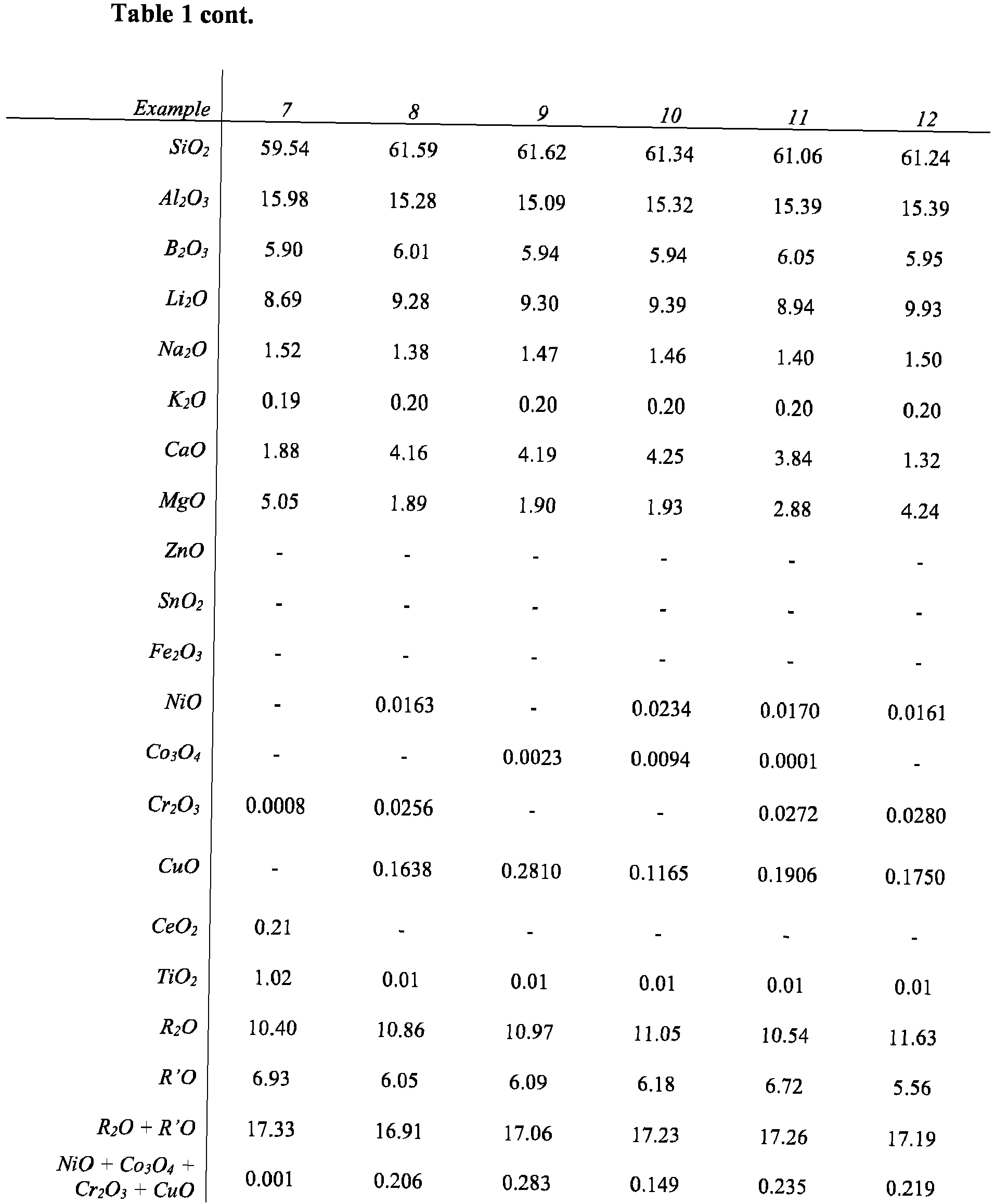


- Table 2 shows the dielectric constant (calculated) and dielectric constant (as measured at 10 GHz) for select examples from Table 1 at the indicated thickness. When calculated, the dielectric constant was calculated according to the following formula: 3.802946 + 0.01747∗B2O3 + 0.058769∗Al2O3 + 0.080876∗Li2O + 0.148433∗Na2O + 0.153264∗K2O + 0.045179∗MgO + 0.080113∗CaO. Table 2 also shows the CIELAB coordinates for select samples from Table 1.

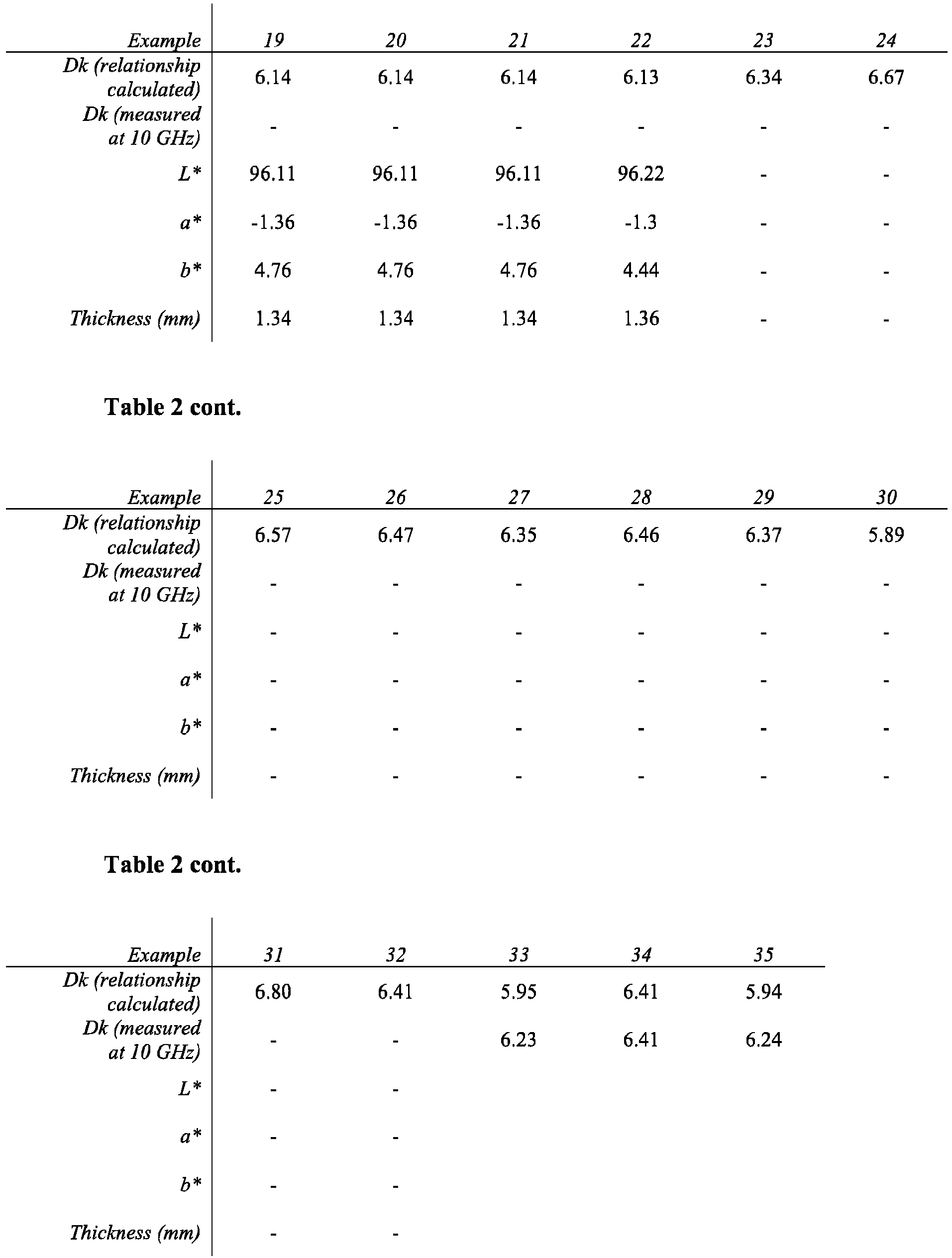
- Table 3 shows the fracture toughness (KIC) for select examples from Table 1 and a comparative example of a non-colored glass article comprising 58.5 mol% SiOz, 17.8 mol% Al2O3, 6.0 mol% B2O3, 10.7 mol% LizO, 1.7 mol% NazO, 0.2 mol% KzO, 4.5 mol% MgO, and 0.6 mol% CaO. The fracture toughness was measured using the chevron notch short bar (CNSB) method and the dual cantilever beam (DCB) method.
Table 3 Example KIC CNSB (MPa·m1l2) KIC DCB (MPa·m 1/ 2) 31 0.774 0.816 8 0.8 0.839 32 0.794 0.813 Comparative example 0.786 0.877 - Table 4 shows the ion exchange characteristics (CS, DOC, and CT) for select colored glass articles from Table 1 at different thicknesses and ion exchange conditions (temperature, time, and ion exchange bath compositions).
Table 4 Example Thickness (mm) Temp (°C) Time (hrs.) KNO3 (wt%) NaNO3 (wt%) LiNO3 (wt%) CS (MPa) DOC (µm) CT (MPa) 23 0.6 440 6.5 79.2 19.4 1.4 599 5.62 104.67 24 0.6 430 4 79 19.4 1.6 633 6.02 129.51 25 0.6 430 4 79 19.4 1.6 661 5.03 124.41 26 0.6 430 4 79 19.4 1.6 700 3.83 119.67 27 0.6 430 4 79 19.4 1.6 684 3.97 117.14 27 0.6 430 8 79 19.4 1.6 615 4.79 131.67 27 0.6 430 16 79 19.4 1.6 559 6.82 97.64 27 0.6 440 6 79 19.4 1.6 600 5.29 109.95 27 0.6 440 6 79.2 19.4 1.4 651 4.67 108.80 27 0.6 440 7 79.2 19.4 1.4 600 5.40 110.20 27 0.6 440 6.5 79.2 19.4 1.4 589 5.56 105.80 28 0.6 430 4 79 19.4 1.6 643 5.56 142.52 29 0.6 430 4 79 19.4 1.6 681 5.24 127.46 30 0.6 450 4 90 10 0 902 3.52 110 30 0.6 450 8 90 10 0 832 4.52 160 30 0.6 450 12 90 10 0 758 5.62 191 30 0.6 450 8 89 10 1 773 3.54 110 30 0.6 450 12 89 10 1 673 4.65 138 30 0.6 450 8 88.5 10 1.5 695 3.64 96 30 0.6 450 12 88.5 10 1.5 639 4.17 109 13 0.6 450 4 90 10 0 900 3.99 133 13 0.6 450 8 90 10 0 786 5.61 187 13 0.6 450 12 90 10 0 721 7.55 174 13 0.6 450 8 89 10 1 721 4.89 139 13 0.6 450 12 89 10 1 661 5.76 143 13 0.6 450 8 88.5 10 1.5 704 4.39 114 13 0.6 450 12 88.5 10 1.5 636 5.69 113 31 1.33 400 16 89 10 1 672 9.1 72 31 1.33 400 24 89 10 1 627 11.2 78 31 1.33 430 8 80 20 0 518 11.6 97 31 0.6 380 8 79 18.7 2.3 641 4.1 100 31 0.6 380 10 79 18.7 2.3 612 4.7 102 31 0.6 380 12 79 18.7 2.3 599 5.2 100 31 0.6 410 4 79 19.5 1.5 633 5.3 109 31 0.6 410 5 79 19.5 1.5 612 5.9 108 31 0.6 410 6 79 19.5 1.5 601 6.1 107 31 0.6 400 5 79 19.8 1.2 695 5.0 112 31 0.6 400 5 79 20.1 0.9 671 5.3 116 31 0.6 400 5 79 19.4 1.6 645 5.0 107 31 0.6 430 2.5 79 19.4 1.6 591 6.0 101 31 0.6 430 3 79 19.4 1.6 569 6.1 98 31 0.6 430 3.5 79 19.4 1.6 557 6.8 96 31 0.6 430 2.5 75.6 24 0.4 609 6.41 126 31 0.6 430 2.5 76 24 0 602 7.57 129 31 0.55 400 3 79 19.8 1.2 749 3.69 108 8 0.6 450 4 89.8 10 0.2 693 5.54 139 8 0.6 450 4 89.8 10 0.2 637 7.54 134 8 0.6 450 8 89.5 10 0.5 664 5.56 134 8 0.6 450 8 88.5 11 0.5 661 5.59 138 8 0.6 450 8 87.5 12 0.5 645 5.69 142 8 0.6 450 8 86.5 13 0.5 636 5.74 145 8 0.6 450 8 89.5 10 0.5 667 5.52 136 8 0.55 450 6.75 87.3 12.5 0.2 668 5.64 140 8 0.55 450 6.75 87.5 12.5 0 686 5.63 157 8 0.6 440 8 88 11 1 667 4.32 121 8 0.6 440 10 88 11 1 638 5.10 127 8 0.6 440 12 88 11 1 614 5.64 129 - Referring now to
FIGS. 5-8 , examplecolored glass article 8, having a thickness of 0.6 mm and strengthened in an ion-exchange bath of 89.3 wt% KNO3, 10 wt% NaNO3, and 0.7 wt% LiNO3 at 400 °C for 9 hours, was subjected to Knoop Scratch Threshold testing with a load of 5N as shown inFIGS. 5 and 6 and a load of 8N as shown inFIGS. 7 and 8 . The Knoop Scratch Threshold testing was completed using a Bruker UMT (universal mechanical tester) with a knoop geometry diamond tip from Gilmore Diamonds. The tip was loaded into the material at a rate of 0.14 N/s to the desired load of 5N or 8N, at which point the tip was dragged laterally through the material at a rate of 9.34 mm/min. From there, the diamond tip was unloaded at a rate of 0.14 N/s. - Referring now to
FIG. 9 , the results of an incremental face drop on sandpaper (i.e., a "drop test") for two different sandpaper conditions (180 grit and 80 grit) are shown for Examples 8 and 31 and a comparative example of a non-colored glass article comprising 58.5 mol% SiO2, 17.8 mol% Al2O3, 6.0 mol% B2O3, 10.7 mol% LizO, 1.7 mol% Na2O, 0.2 mol% K2O, 4.5 mol% MgO, and 0.6 mol% CaO. Prior to performing the drop test, Example 31 was ion exchanged in a molten salt batch comprising 89.3 wt% KNO3, 10 wt% NaNO3, and 0.7 wt% LiNO3 at 440°C for 9 hours. Example 8 was ion exchanged in a molten salt batch comprising 79 wt% KNO3, 19.9 wt% NaNO3, and 1.6 wt% LiNO3 at 400°C for 5 hours. The comparative example was ion exchanged in a molten salt batch comprising 90.3 wt% KNO3, 9 wt% NaNO3, and 0.7 wt% LiNO3 at 450°C for 5 hours. - The circles in
FIG. 9 indicate at what height the sample fractured. The diamonds represent samples that were dropped incrementally all the way to 220 cm and did not fracture. As exemplified byFIG. 9 , Examples 8 and 31, colored glass articles, exhibited similar drop performance as compared to a comparative example of a non-colored glass article. - Referring now to
FIG. 10 , the results of four point break testing after damage with sandpaper (i.e., a "slapper test") for three different sandpaper conditions (1000 grit, 180 grit, and 80 grit) are shown for Example 8 and a comparative example of a non-colored glass article comprising 58.5 mol% SiOz, 17.8 mol% Al2O3, 6.0 mol% B2O3, 10.7 mol% LizO, 1.7 mol% NazO, 0.2 mol% KzO, 4.5 mol% MgO, and 0.6 mol% CaO. For the slapper test, samples of Example 8 and the comparative example were loaded onto a puck and slapped onto sandpaper having the identified grit using a particular force. The samples were not fractured, but were damaged after the sandpaper impact. The sample was then loaded into 4 point bending and the applied stress was incrementally increased until the sample broke. The applied stress at fracture is shown inFIG. 10 . Prior to performing the slapper test, Example 8 was ion exchanged in a molten salt batch comprising 79 wt% KNO3, 19.9 wt% NaNO3, and 1.6 wt% LiNO3 at 400°C for 5 hours. The comparative example was ion exchanged in a molten salt batch comprising 90.3 wt% KNO3, 9 wt% NaNO3, and 0.7 wt% LiNO3 at 450°C for 5 hours. As exemplified byFIG. 10 , Example 8, a colored glass article, exhibited similar slapper test results as compared to a comparative example of a non-colored glass article. - It will be apparent to those skilled in the art that various modifications and variations may be made to the embodiments described herein without departing from the spirit and scope of the claimed subject matter. Thus, it is intended that the specification cover the modifications and variations of the various embodiments described herein provided such modification and variations come within the scope of the appended claims and their equivalents.
- Aspects of the invention will now be described by way of clauses:
- Clause 1. A glass composition comprising:
- greater than or equal to 50 mol% and less than or equal to 70 mol% SiOz;
- greater than or equal to 10 mol% and less than or equal to 20 mol% Al2O3;
- greater than or equal to 1 mol% and less than or equal to 10 mol% B2O3;
- greater than or equal to 7 mol% and less than or equal to 14 mol% LizO;
- greater than 0 mol% and less than or equal to 8 mol% NazO;
- greater than 0 mol% and less than or equal to 1 mol% KzO;
- greater than or equal to 0 mol% and less than or equal to 7 mol% CaO;
- greater than or equal to 0 mol% and less than or equal to 8 mol% MgO; and
- greater than or equal to 0 mol% and less than or equal to 8 mol% ZnO, wherein:
- R2O + R'O is less than or equal to 25 mol%, wherein R2O is the sum of Li2O, NazO, and K2O and R'O is the sum of CaO, MgO, and ZnO; and
- at least one of:
- NiO + Co3O4 + Cr2O3 + CuO is greater than or equal to 0.001 mol%;
- CeOz is greater than or equal to 0.1 mol%; and
- TiOz is greater than or equal to 0.1 mol%.
- Clause 2. The glass composition of clause 1, wherein NiO + Co3O4 + Cr2O3 + CuO is greater than or equal to 0.001 mol% and less than or equal to 3 mol%.
- Claues 3. The glass composition of clause 1, wherein CeOz is greater than or equal to 0.1 mol% and less than or equal to 2 mol%.
-
Clause 4. The glass composition of clause 1, wherein TiOz is greater than or equal to 0.1 mol% and less than or equal to 2 mol%. - Clause 5. The glass composition of clause 1, wherein NiO + Co3O4 + Cr2O3 + CuO + CeO2 + TiO2 is greater than or equal to 0.001 mol% and less than or equal to 10 mol%.
- Clause 6. The glass composition of any one of clauses 1-5, wherein R2O + R'O is greater than or equal to 7 mol% and less than or equal to 25 mol%.
- Clause 7. The glass composition of any one of clauses 1-6, wherein R2O is greater than or equal to 7 mol% and less than or equal to 25 mol%.
-
Clause 8. The glass composition of any one of clauses 1-7, wherein R'O is greater than or equal to 0 mol% and less than or equal to 12 mol%. - Clause 9. The glass composition of any one of clauses 1-8, wherein 3.802946 + 0.01747∗B2O3 + 0.058769∗Al2O3 + 0.080876∗Li2O + 0.148433∗Na2O + 0.153264∗K2O + 0.045179∗MgO + 0.080113∗CaO is less than or equal to 6.8.
- Clause 10. The glass composition of any one of clauses 1-9, wherein R2O - Al2O3 is greater than or equal to -8 mol% and less than or equal to 4 mol%.
- Clause 11. The glass composition of any one of clauses 1-10, wherein the glass composition comprises greater than or equal to 7.5 mol% and less than or equal to 13.5 mol% Li2O.
- Clause 12. The glass composition of any one of clauses 1-11, wherein the glass composition comprises greater than or equal to 0.1 mol% and less than or equal to 7 mol% NazO.
- Clause 13. The glass composition of any one of clauses 1-12, wherein the glass composition comprises greater than or equal to 0.1 mol% and less than or equal to 0.7 mol% KzO.
- Clause 14. The glass composition of any one of clauses 1-13, wherein the glass composition comprises greater than or equal to 0.25 mol% and less than or equal to 6.5 mol% CaO.
- Clause 15. The glass composition of any one of clauses 1-14, wherein the glass composition comprises greater than or equal to 0.25 mol% and less than or equal to 7 mol% MgO.
- Clause 16. The glass composition of any one of clauses 1-15, wherein the glass composition comprises greater than or equal to 0.5 mol% and less than or equal to 7 mol% ZnO.
- Clause 17. The glass composition of any one of clauses 1-16, wherein the glass composition comprises greater than or equal to 0.01 mol% and less than or equal to 1 mol% Fe2O3.
- Clause 18. The glass composition of any one of clauses 1-16, wherein the glass composition comprises greater than or equal to 0.001 mol% and less than or equal to 0.5 mol% Fe2O3.
- Clause 19. The glass composition of any one of clauses 1-18, wherein the glass composition comprises greater than or equal to greater than or equal to 0.01 mol% and less than or equal to 1 mol% SnOz.
- Clause 20. The glass composition of any one of clauses 1-19, wherein the glass composition comprises greater than or equal to 12 mol% and less than or equal to 17.5 mol% Al2O3.
- Clause 21. The glass composition of any one of clauses 1-20, wherein the glass composition comprises greater than or equal to 2 mol% and less than or equal to 9 mol% B2O3.
- Clause 22. The glass composition of any one of clauses 1-21, wherein the glass composition comprises greater than or equal to 12 mol% and less than or equal to 18 mol% Al2O3.
- Clause 23. The glass composition of any one of clauses 1-22, wherein the glass composition comprises greater than or equal to 50 mol% and less than or equal to 67 mol% SiOz.
- Clause 24. A colored glass article comprising:
- greater than or equal to 50 mol% and less than or equal to 70 mol% SiOz;
- greater than or equal to 10 mol% and less than or equal to 20 mol% Al2O3;
- greater than or equal to 1 mol% and less than or equal to 10 mol% B2O3;
- greater than or equal to 7 mol% and less than or equal to 14 mol% LizO;
- greater than 0 mol% and less than or equal to 8 mol% NazO;
- greater than 0 mol% and less than or equal to 1 mol% KzO;
- greater than or equal to 0 mol% and less than or equal to 7 mol% CaO;
- greater than or equal to 0 mol% and less than or equal to 8 mol% MgO; and
- greater than or equal to 0 mol% and less than or equal to 8 mol% ZnO, wherein:
- R2O + R'O is less than or equal to 25 mol%, wherein R2O is the sum of LizO, NazO, and K2O and R'O is the sum of CaO, MgO, and ZnO; and
- at least one of:
- NiO + Co3O4 + Cr2O3 + CuO is greater than or equal to 0.001 mol%;
- CeO2 is greater than or equal to 0.1 mol%; and
- TiOz is greater than or equal to 0.1 mol%.
- Clause 25. The colored glass article of clause 24, wherein NiO + Co3O4 + Cr2O3 + CuO is greater than or equal to 0.001 mol% and less than or equal to 3 mol%.
- Clause 26. The colored glass article of clause 24, wherein CeOz is greater than or equal to 0.1 mol% and less than or equal to 2 mol%.
- Clause 27. The colored glass article of clause 24, wherein TiOz is greater than or equal to 0.1 mol% and less than or equal to 2 mol%.
- Clause 28. The colored glass article of clause 24, wherein NiO + Co3O4 + Cr2O3 + CuO + CeOz + TiOz is greater than or equal to 0.001 mol% and less than or equal to 10 mol%.
- Clause 29. The colored glass article of any one of clauses 24-28, wherein R2O + R'O is greater than or equal to 7 mol% and less than or equal to 25 mol%.
- Clause 30. The colored glass article of any one of clauses 24-29, wherein R2O is greater than or equal to 7 mol% and less than or equal to 25 mol%.
-
Clause 31. The colored glass article of any one of clauses 24-30, wherein R'O is greater than or equal to 0 mol% and less than or equal to 12 mol%. - Clause 32. The colored glass article of any one of clauses 24-31, wherein 3.802946 + 0.01747∗B2O3 + 0.058769∗Al2O3 + 0.080876∗Li2O + 0.148433∗Na2O + 0.153264∗K2O + 0.045179∗MgO + 0.080113∗CaO is less than or equal to 6.8.
- Clause 33. The colored glass article of any one of clauses 24-32, wherein R2O - Al2O3 is greater than or equal to -8 mol% and less than or equal to 4 mol%.
- Clause 34. The colored glass article of any one of clauses 24-33, wherein the colored glass article comprises greater than or equal to 7.5 mol% and less than or equal to 13.5 mol% LizO.
- Clause 35. The colored glass article of any one of clauses 24-34, wherein the colored glass article comprises greater than or equal to 0.1 mol% and less than or equal to 7 mol% Na2O.
- Clause 36. The colored glass article of any one of clauses 24-35, wherein the colored glass article comprises greater than or equal to 0.1 mol% and less than or equal to 0.7 mol% KzO.
- Clause 37. The colored glass article of any one of clauses 24-36, wherein the colored glass article comprises greater than or equal to 0.25 mol% and less than or equal to 6.5 mol% CaO.
- Clause 38. The colored glass article of any one of clauses 24-37, wherein the colored glass article comprises greater than or equal to 0.25 mol% and less than or equal to 7 mol% MgO.
- Clause 39. The colored glass article of any one of clauses 24-38, wherein the colored glass article comprises greater than or equal to 0.5 mol% and less than or equal to 7 mol% ZnO.
- Clause 40. The colored glass article of any one of clauses 24-39, wherein the colored glass article comprises greater than or equal to 0.01 mol% and less than or equal to 1 mol% Fe2O3.
- Clause 41. The colored glass article of any one of clauses 24-39, wherein the glass composition comprises greater than or equal to 0.001 mol% and less than or equal to 0.5 mol% Fe2O3.
- Clause 42. The colored glass article of any one of clauses 24-41, wherein the colored glass article comprises greater than or equal to greater than or equal to 0.01 mol% and less than or equal to 1 mol% SnO2.
- Clause 43. The colored glass article of any one of clauses 24-42, wherein the colored glass article comprises greater than or equal to 12 mol% and less than or equal to 17.5 mol% Al2O3.
- Clause 44. The colored glass article of any one of clauses 24-43, wherein the colored glass article comprises greater than or equal to 2 mol% and less than or equal to 9 mol% B2O3.
- Clause 45. The colored glass article of any one of clauses 24-44, wherein the colored glass article comprises greater than or equal to 12 mol% and less than or equal to 18 mol% Al2O3.
- Clause 46. The colored glass article of any one of clauses 24-45, wherein the colored glass article comprises greater than or equal to 50 mol% and less than or equal to 67 mol% SiOz.
- Clause 47. The colored glass article of any one of clauses 24-46, wherein the colored glass article has a transmittance color coordinate in the CIELAB color space, as measured at an article thickness of 1.33 mm under F2 illumination and a 10° standard observer angle, of L* greater than or equal to 65 and less than or equal to 98, a* greater than or equal to -20 and less than or equal to 10, and b* greater than or equal to -15 and less than or equal to 15.
- Clause 48. The colored glass article of any one of clauses 24-47, wherein the colored glass article has a dielectric constant Dk at 10 GHz less than or equal to 6.8.
- Clause 49. The colored glass article of any one of clauses 24-48, wherein the colored glass article has a thickness greater than or equal to 250 µm and less than or equal to 6 mm.
-
Clause 50. The colored glass article of any one of clauses 24-49, wherein the colored glass article has have a KIC fracture toughness as measured by a chevron notch short bar method greater than or equal to 0.7 MPa·m1/2. - Clause 51. The colored glass article of any one of clauses 24-50, wherein the colored glass article is an ion-exchanged colored glass article.
- Clause 52. The colored glass article of any one of clauses 24-51, wherein the ion-exchanged colored glass article has a depth of compression 3 µm or greater.
- Clause 53. The colored glass article of any one of clauses 24-52, wherein the ion-exchanged colored glass article has a thickness "t" and a depth of compression greater than or equal to 0.15t.
- Clause 54. The colored glass article of any one of clauses 24-53, wherein the ion-exchanged colored glass article has a surface compressive stress greater than or equal to 300 MPa.
- Clause 55. The colored glass article of any one of clauses 24-54, wherein the ion-exchanged colored glass article has a maximum central tension greater than or equal to 40 MPa.
- Clause 56. A consumer electronic device, comprising:
- a housing having a front surface, a back surface, and side surfaces; and
- electrical components provided at least partially within the housing, the electrical components including at least a controller, a memory, and a display, the display being provided at or adjacent the front surface of the housing;
- wherein the housing comprises the colored glass article of any one of clauses 24-55.
- Clause 57. A method of forming a colored glass article, the method comprising:
heat treating a glass composition to form the colored glass article, the glass composition comprising:
greater than or equal to 50 mol% and less than or equal to 70 mol% SiOz;- greater than or equal to 10 mol% and less than or equal to 20 mol% Al2O3;
- greater than or equal to 1 mol% and less than or equal to 10 mol% B2O3;
- greater than or equal to 7 mol% and less than or equal to 14 mol% Li2O;
- greater than 0 mol% and less than or equal to 8 mol% NazO;
- greater than 0 mol% and less than or equal to 1 mol% KzO;
- greater than or equal to 0 mol% and less than or equal to 7 mol% CaO;
- greater than or equal to 0 mol% and less than or equal to 8 mol% MgO; and
- greater than or equal to 0 mol% and less than or equal to 8 mol% ZnO, wherein:
- R2O + R'O is less than or equal to 25 mol%, wherein R2O is the sum of LizO, NazO, and K2O and R'O is the sum of CaO, MgO, and ZnO; and
- at least one of:
- NiO + Co3O4 + Cr2O3 + CuO is greater than or equal to 0.001 mol%;
- CeOz is greater than or equal to 0.1 mol%; and
- TiOz is greater than or equal to 0.1 mol%.
- Clause 58. The method of clause 57, the heat treating step may comprise:
- (i) heating the glass composition at a rate of 1-100 °C/min to glass homogenization temperature;
- (ii) maintaining the glass composition at the glass homogenization temperature for a time greater than or equal to 0.25 hour and less than or equal to 40 hours to produce the colored glass article; and
- (iii) cooling the formed colored glass article to room temperature.
- Clause 59. The method of clause 57 or clause 58, further comprising strengthening the colored glass article in an ion exchange bath at a temperature greater than or equal to 350 °C to less than or equal to 500 °C for a time period greater than or equal to 2 hours to less than or equal to 12 hours to form an ion exchanged glass-ceramic article.
- Clause 60. The method of clause 59, wherein the ion exchange bath comprises KNO3.
- Clause 61. The method of clause 60, wherein the ion exchange bath comprises NaNO3.
Claims (15)
- A glass composition comprising:greater than or equal to 50 mol% and less than or equal to 70 mol% SiOz;greater than or equal to 10 mol% and less than or equal to 20 mol% Al2O3;greater than or equal to 1 mol% and less than or equal to 10 mol% B2O3;greater than or equal to 7 mol% and less than or equal to 14 mol% LizO;greater than 0 mol% and less than or equal to 8 mol% NazO;greater than 0 mol% and less than or equal to 1 mol% KzO;greater than or equal to 0 mol% and less than or equal to 7 mol% CaO;greater than or equal to 0 mol% and less than or equal to 8 mol% MgO; andgreater than or equal to 0 mol% and less than or equal to 8 mol% ZnO, wherein:R2O + R'O is less than or equal to 25 mol%, wherein R2O is the sum of LizO, NazO, and K2O and R'O is the sum of CaO, MgO, and ZnO; andat least one of:NiO + Co3O4 + Cr2O3 + CuO is greater than or equal to 0.001 mol%;CeOz is greater than or equal to 0.1 mol%; andTiOz is greater than or equal to 0.1 mol%.
- The glass composition of claim 1, wherein NiO + Co3O4 + Cr2O3 + CuO is greater than or equal to 0.001 mol% and less than or equal to 3 mol%;wherein CeOz is greater than or equal to 0.1 mol% and less than or equal to 2 mol%;wherein TiOz is greater than or equal to 0.1 mol% and less than or equal to 2 mol%; orwherein NiO + Co3O4 + Cr2O3 + CuO + CeOz + TiOz is greater than or equal to 0.001 mol% and less than or equal to 10 mol%.
- The glass composition of claims 1 or 2, wherein R2O + R'O is greater than or equal to 7 mol% and less than or equal to 25 mol%;wherein R2O is greater than or equal to 7 mol% and less than or equal to 25 mol%;wherein R'O is greater than or equal to 0 mol% and less than or equal to 12 mol%;wherein 3.802946 + 0.01747∗B2O3 + 0.058769∗Al2O3 + 0.080876∗Li2O + 0.148433∗Na2O + 0.153264∗K2O + 0.045179∗MgO + 0.080113∗CaO is less than or equal to 6.8; and/orwherein R2O - Al2O3 is greater than or equal to -8 mol% and less than or equal to 4 mol%.
- The glass composition of any one of claims 1-3,wherein the glass composition comprises greater than or equal to 7.5 mol% and less than or equal to 13.5 mol% LizO;wherein the glass composition comprises greater than or equal to 0.1 mol% and less than or equal to 7 mol% NazO;wherein the glass composition comprises greater than or equal to 0.1 mol% and less than or equal to 0.7 mol% KzO;wherein the glass composition comprises greater than or equal to 0.25 mol% and less than or equal to 6.5 mol% CaO;wherein the glass composition comprises greater than or equal to 0.25 mol% and less than or equal to 7 mol% MgO; and/orwherein the glass composition comprises greater than or equal to 0.5 mol% and less than or equal to 7 mol% ZnO.
- The glass composition of any one of claims 1-4,wherein the glass composition comprises greater than or equal to 0.01 mol% and less than or equal to 1 mol% Fe2O3 or wherein the glass composition comprises greater than or equal to 0.001 mol% and less than or equal to 0.5 mol% Fe2O3;wherein the glass composition comprises greater than or equal to greater than or equal to 0.01 mol% and less than or equal to 1 mol% SnOz;wherein the glass composition comprises greater than or equal to 12 mol% and less than or equal to 18 mol% or 17.5 mol% Al2O3;wherein the glass composition comprises greater than or equal to 2 mol% and less than or equal to 9 mol% B2O3; and/orwherein the glass composition comprises greater than or equal to 50 mol% and less than or equal to 67 mol% SiOz.
- A colored glass article comprising:greater than or equal to 50 mol% and less than or equal to 70 mol% SiOz;greater than or equal to 10 mol% and less than or equal to 20 mol% Al2O3;greater than or equal to 1 mol% and less than or equal to 10 mol% B2O3;greater than or equal to 7 mol% and less than or equal to 14 mol% LizO;greater than 0 mol% and less than or equal to 8 mol% NazO;greater than 0 mol% and less than or equal to 1 mol% KzO;greater than or equal to 0 mol% and less than or equal to 7 mol% CaO;greater than or equal to 0 mol% and less than or equal to 8 mol% MgO; andgreater than or equal to 0 mol% and less than or equal to 8 mol% ZnO, wherein:R2O + R'O is less than or equal to 25 mol%, wherein R2O is the sum of LizO, NazO, and K2O and R'O is the sum of CaO, MgO, and ZnO; andat least one of:NiO + Co3O4 + Cr2O3 + CuO is greater than or equal to 0.001 mol%;CeO2 is greater than or equal to 0.1 mol%; andTiO2 is greater than or equal to 0.1 mol%.
- The colored glass article of claim 6,wherein NiO + Co3O4 + Cr2O3 + CuO is greater than or equal to 0.001 mol% and less than or equal to 3 mol%;wherein CeOz is greater than or equal to 0.1 mol% and less than or equal to 2 mol%;wherein TiOz is greater than or equal to 0.1 mol% and less than or equal to 2 mol%; orwherein NiO + Co3O4 + Cr2O3 + CuO + CeOz + TiOz is greater than or equal to 0.001 mol% and less than or equal to 10 mol%.
- The colored glass article of claims 6 or 7,wherein R2O + R'O is greater than or equal to 7 mol% and less than or equal to 25 mol%;wherein R2O is greater than or equal to 7 mol% and less than or equal to 25 mol%;wherein R'O is greater than or equal to 0 mol% and less than or equal to 12 mol%;wherein 3.802946 + 0.01747∗B2O3 + 0.058769∗Al2O3 + 0.080876∗Li2O + 0.148433∗Na2O + 0.153264∗K2O + 0.045179∗MgO + 0.080113∗CaO is less than or equal to 6.8; and/orwherein R2O - Al2O3 is greater than or equal to -8 mol% and less than or equal to 4 mol%.
- The colored glass article of any one of claims 6-8,wherein the colored glass article comprises greater than or equal to 7.5 mol% and less than or equal to 13.5 mol% LizO;wherein the colored glass article comprises greater than or equal to 0.1 mol% and less than or equal to 7 mol% NazO;wherein the colored glass article comprises greater than or equal to 0.1 mol% and less than or equal to 0.7 mol% KzO;wherein the colored glass article comprises greater than or equal to 0.25 mol% and less than or equal to 6.5 mol% CaO;wherein the colored glass article comprises greater than or equal to 0.25 mol% and less than or equal to 7 mol% MgO; and/orwherein the colored glass article comprises greater than or equal to 0.5 mol% and less than or equal to 7 mol% ZnO.
- The colored glass article of any one of claims 6-9,wherein the colored glass article comprises greater than or equal to 0.01 mol% and less than or equal to 1 mol% Fe2O3, or wherein the glass composition comprises greater than or equal to 0.001 mol% and less than or equal to 0.5 mol% Fe2O3;wherein the colored glass article comprises greater than or equal to greater than or equal to 0.01 mol% and less than or equal to 1 mol% SnO2;wherein the colored glass article comprises greater than or equal to 12 mol% and less than or equal to 18 mol% or 17.5 mol% Al2O3;wherein the colored glass article comprises greater than or equal to 2 mol% and less than or equal to 9 mol% B2O3; and/orwherein the colored glass article comprises greater than or equal to 50 mol% and less than or equal to 67 mol% SiOz.
- The colored glass article of any one of claims 6-10,wherein the colored glass article has a transmittance color coordinate in the CIELAB color space, as measured at an article thickness of 1.33 mm under F2 illumination and a 10° standard observer angle, of L∗ greater than or equal to 65 and less than or equal to 98, a* greater than or equal to -20 and less than or equal to 10, and b* greater than or equal to -15 and less than or equal to 15;wherein the colored glass article has a dielectric constant Dk at 10 GHz less than or equal to 6.8;wherein the colored glass article has a thickness greater than or equal to 250 µm and less than or equal to 6 mm; and/orwherein the colored glass article has have a KIC fracture toughness as measured by a chevron notch short bar method greater than or equal to 0.7 MPa·m1/2.
- The colored glass article of any one of claims 6-11, wherein the colored glass article is an ion-exchanged colored glass article;wherein the ion-exchanged colored glass article has a depth of compression 3 µm or greater;wherein the ion-exchanged colored glass article has a thickness "t" and a depth of compression greater than or equal to 0.15t;wherein the ion-exchanged colored glass article has a surface compressive stress greater than or equal to 300 MPa; and/orwherein the ion-exchanged colored glass article has a maximum central tension greater than or equal to 40 MPa.
- A consumer electronic device, comprising:a housing having a front surface, a back surface, and side surfaces; andelectrical components provided at least partially within the housing, the electrical components including at least a controller, a memory, and a display, the display being provided at or adjacent the front surface of the housing;wherein the housing comprises the colored glass article of any one of claims 6-12.
- A method of forming a colored glass article, the method comprising:
heat treating a glass composition to form the colored glass article, the glass composition comprising:
greater than or equal to 50 mol% and less than or equal to 70 mol% SiOz;greater than or equal to 10 mol% and less than or equal to 20 mol% Al2O3;greater than or equal to 1 mol% and less than or equal to 10 mol% B2O3;greater than or equal to 7 mol% and less than or equal to 14 mol% Li2O;greater than 0 mol% and less than or equal to 8 mol% NazO;greater than 0 mol% and less than or equal to 1 mol% KzO;greater than or equal to 0 mol% and less than or equal to 7 mol% CaO;greater than or equal to 0 mol% and less than or equal to 8 mol% MgO; andgreater than or equal to 0 mol% and less than or equal to 8 mol% ZnO, wherein:R2O + R'O is less than or equal to 25 mol%, wherein R2O is the sum of LizO, NazO, and K2O and R'O is the sum of CaO, MgO, and ZnO; andat least one of:NiO + Co3O4 + Cr2O3 + CuO is greater than or equal to 0.001 mol%;CeOz is greater than or equal to 0.1 mol%; andTiO2 is greater than or equal to 0.1 mol%. - The method of claim 14,(A) wherein the heat treating step comprises:(i) heating the glass composition at a rate of 1-100 °C/min to glass homogenization temperature;(ii) maintaining the glass composition at the glass homogenization temperature for a time greater than or equal to 0.25 hour and less than or equal to 40 hours to produce the colored glass article; and(iii) cooling the formed colored glass article to room temperature, and/or(B) wherein the method further comprises strengthening the colored glass article in an ion exchange bath at a temperature greater than or equal to 350 °C to less than or equal to 500 °C for a time period greater than or equal to 2 hours to less than or equal to 12 hours to form an ion exchanged glass-ceramic article, optionally wherein the ion exchange bath comprises KNO3 and further optionally NaNO3.
Applications Claiming Priority (6)
| Application Number | Priority Date | Filing Date | Title |
|---|---|---|---|
| US202163212179P | 2021-06-18 | 2021-06-18 | |
| US202263318553P | 2022-03-10 | 2022-03-10 | |
| US202263347095P | 2022-05-31 | 2022-05-31 | |
| US202263347201P | 2022-05-31 | 2022-05-31 | |
| EP22741911.6A EP4164992B1 (en) | 2021-06-18 | 2022-06-17 | Colored glass articles having improved mechanical durability |
| PCT/US2022/033913 WO2022266404A1 (en) | 2021-06-18 | 2022-06-17 | Colored glass articles having improved mechanical durability |
Related Parent Applications (2)
| Application Number | Title | Priority Date | Filing Date |
|---|---|---|---|
| EP22741911.6A Division EP4164992B1 (en) | 2021-06-18 | 2022-06-17 | Colored glass articles having improved mechanical durability |
| EP22741911.6A Division-Into EP4164992B1 (en) | 2021-06-18 | 2022-06-17 | Colored glass articles having improved mechanical durability |
Publications (2)
| Publication Number | Publication Date |
|---|---|
| EP4230593A2 true EP4230593A2 (en) | 2023-08-23 |
| EP4230593A3 EP4230593A3 (en) | 2023-11-22 |
Family
ID=82557923
Family Applications (2)
| Application Number | Title | Priority Date | Filing Date |
|---|---|---|---|
| EP22741911.6A Active EP4164992B1 (en) | 2021-06-18 | 2022-06-17 | Colored glass articles having improved mechanical durability |
| EP23184758.3A Pending EP4230593A3 (en) | 2021-06-18 | 2022-06-17 | Colored glass articles having improved mechanical durability |
Family Applications Before (1)
| Application Number | Title | Priority Date | Filing Date |
|---|---|---|---|
| EP22741911.6A Active EP4164992B1 (en) | 2021-06-18 | 2022-06-17 | Colored glass articles having improved mechanical durability |
Country Status (7)
| Country | Link |
|---|---|
| US (4) | US11667562B2 (en) |
| EP (2) | EP4164992B1 (en) |
| JP (1) | JP7472326B2 (en) |
| KR (1) | KR20240023516A (en) |
| CN (2) | CN116249679A (en) |
| TW (1) | TW202337863A (en) |
| WO (1) | WO2022266404A1 (en) |
Cited By (1)
| Publication number | Priority date | Publication date | Assignee | Title |
|---|---|---|---|---|
| EP4541777A4 (en) * | 2022-06-15 | 2026-05-27 | Agc Inc | GLASS FOR CHEMICAL REINFORCEMENT AND GLASS |
Families Citing this family (8)
| Publication number | Priority date | Publication date | Assignee | Title |
|---|---|---|---|---|
| US12454479B2 (en) | 2021-06-18 | 2025-10-28 | Corning Incorporated | Gold containing silicate glass |
| US12054422B2 (en) | 2021-06-18 | 2024-08-06 | Corning Incorporated | Colored glass articles having improved mechanical durability |
| JP7472326B2 (en) * | 2021-06-18 | 2024-04-22 | コーニング インコーポレイテッド | Colored glass articles with improved mechanical durability |
| US12378152B2 (en) | 2021-06-18 | 2025-08-05 | Corning Incorporated | Colored glass articles having improved mechanical durability |
| CN117480136A (en) | 2021-06-18 | 2024-01-30 | 康宁公司 | Colored glass articles with improved mechanical durability |
| US12240782B2 (en) | 2022-05-31 | 2025-03-04 | Corning Incorporated | Ion exchangeable yellow glass articles |
| WO2024129481A1 (en) * | 2022-12-16 | 2024-06-20 | Corning Incorporated | Glass articles, natively colored glass housings, and methods of making the same |
| WO2025054051A1 (en) | 2023-09-08 | 2025-03-13 | Corning Incorporated | Glass articles, natively colored glass housings, and methods of making the same |
Family Cites Families (128)
| Publication number | Priority date | Publication date | Assignee | Title |
|---|---|---|---|---|
| US2418605A (en) | 1944-12-15 | 1947-04-08 | Polaroid Corp | Filter transparent to infrared radiation and opaque to visible light |
| NL6509945A (en) * | 1964-07-31 | 1966-02-01 | ||
| US3788865A (en) | 1964-07-31 | 1974-01-29 | C Babcock | Crystallized glass ceramics and process for forming same |
| US3524737A (en) | 1967-06-01 | 1970-08-18 | Corning Glass Works | Method for thermochemical strengthening of glass articles |
| US3751238A (en) | 1970-02-25 | 1973-08-07 | Corning Glass Works | Method of chemically strengthening a silicate article containing soda |
| US3902881A (en) | 1971-06-04 | 1975-09-02 | Owens Illinois Inc | Method of forming an opalescent article having a colored bulk and at least one surface strata of a different color than the bulk |
| US3778335A (en) | 1971-09-02 | 1973-12-11 | Corning Glass Works | Sodium aluminosilicate glass article strengthened by a surface compressive stress layer |
| US4086089A (en) | 1977-03-17 | 1978-04-25 | Corning Glass Works | Method for producing tri-color screens for television picture tubes |
| US4102664A (en) | 1977-05-18 | 1978-07-25 | Corning Glass Works | Method for making glass articles with defect-free surfaces |
| JPS5545501A (en) | 1978-09-25 | 1980-03-31 | Hitachi Ltd | Soldering tool |
| US4240836A (en) | 1979-11-19 | 1980-12-23 | Corning Glass Works | Colored photochromic glasses and method |
| US4251278A (en) | 1980-01-21 | 1981-02-17 | Corning Glass Works | Photochromic glasses which darken to a brown hue |
| US4298389A (en) | 1980-02-20 | 1981-11-03 | Corning Glass Works | High transmission glasses for solar applications |
| JPS60145930A (en) | 1984-01-09 | 1985-08-01 | Toshiba Glass Co Ltd | Glass filter and production thereof |
| JPS63166736A (en) | 1986-07-12 | 1988-07-09 | Sumita Kogaku Glass Seizosho:Kk | Low expansion photosensitive crystallized glass |
| US4814297A (en) | 1987-04-01 | 1989-03-21 | Corning Glass Works | Strengthened glass article and method |
| US4786305A (en) | 1987-08-03 | 1988-11-22 | Corning Glass Works | Heat treatment of flat photochromic sheet glass |
| FR2701020B1 (en) | 1993-02-01 | 1995-04-21 | Corning Inc | Photochromic lenses that darken to a pink tint. |
| WO1998058884A1 (en) | 1997-06-23 | 1998-12-30 | Corning Incorporated | Composition for optical waveguide article and method for making continuous clad filament |
| US6376403B1 (en) | 1998-04-17 | 2002-04-23 | Nippon Sheet Glass Co., Ltd. | Glass composition and process for producing the same |
| JPH11302032A (en) | 1998-04-17 | 1999-11-02 | Nippon Sheet Glass Co Ltd | Glass composition and substrate for information recording medium using same |
| JP4086210B2 (en) | 1998-04-17 | 2008-05-14 | Hoya株式会社 | Substrate for information recording medium |
| US6333286B1 (en) | 1998-09-11 | 2001-12-25 | Nippon Sheet Glass Co., Ltd. | Glass composition and substrate for information recording media comprising the same |
| JP4497591B2 (en) | 1998-09-11 | 2010-07-07 | Hoya株式会社 | Glass composition, substrate for information recording medium and information recording medium using the same |
| US6440531B1 (en) | 1999-05-13 | 2002-08-27 | Nippon Sheet Glass Co., Ltd | Hydrofluoric acid etched substrate for information recording medium |
| WO2001050464A1 (en) | 2000-01-05 | 2001-07-12 | Schott Glass Technologies, Inc. | Glass substrates for magnetic media and magnetic media based on such glass substrates |
| DE10141666A1 (en) | 2001-08-25 | 2003-03-13 | Schott Glas | Alkali aluminosilicate glass used in the pre-stressed substrate glass for storage media comprises oxides of silicon, aluminum, boron, lithium, sodium, potassium, zinc, magnesium, calcium, strontium, barium, titanium and zirconium |
| JP2003306348A (en) | 2002-04-16 | 2003-10-28 | Central Glass Co Ltd | Method for producing recyclable colored glass |
| US6905219B2 (en) | 2002-05-09 | 2005-06-14 | 3M Innovative Properties Company | Display device |
| JP2004002057A (en) | 2002-05-29 | 2004-01-08 | Central Glass Co Ltd | Glass coloring method |
| JP4192232B2 (en) | 2002-12-27 | 2008-12-10 | 独立行政法人産業技術総合研究所 | Manufacturing method of colored glass |
| JP4303999B2 (en) | 2003-05-15 | 2009-07-29 | 京セラ株式会社 | Method for producing glass having a color pattern therein and glass body |
| JP4726399B2 (en) | 2003-05-29 | 2011-07-20 | コニカミノルタオプト株式会社 | Glass substrate |
| DE102004022629B9 (en) | 2004-05-07 | 2008-09-04 | Schott Ag | Flooded lithium aluminosilicate flat glass with high temperature resistance, which can be preloaded chemically and thermally and its use |
| US20060211563A1 (en) | 2005-03-21 | 2006-09-21 | Mehran Arbab | Metal nanostructured colorants for high redox glass composition |
| DE102006029073B4 (en) | 2005-07-06 | 2009-07-16 | Schott Ag | Method for cutting a glass sheet using a laser cutting beam and alkali-free flat glass with particular suitability for this |
| ES2666646T3 (en) | 2006-03-28 | 2018-05-07 | Vitro, S.A.B. De C.V. | Blue glass with low solar absorption, blue glass coated with solar reflective and insulating unit that has a low solar thermal gain |
| ES2660410T3 (en) | 2006-10-27 | 2018-03-22 | Eurokera S.N.C. | Tuning procedure of a lithium aluminosilicate glass and glass ceramic obtained |
| US7666511B2 (en) | 2007-05-18 | 2010-02-23 | Corning Incorporated | Down-drawable, chemically strengthened glass for cover plate |
| US8232218B2 (en) | 2008-02-29 | 2012-07-31 | Corning Incorporated | Ion exchanged, fast cooled glasses |
| CN101977860B (en) | 2008-03-19 | 2013-08-21 | Hoya株式会社 | Glass for magnetic recording medium substrate, magnetic recording medium substrate, magnetic recording medium, and manufacturing method thereof |
| WO2010016928A2 (en) | 2008-08-08 | 2010-02-11 | Corning Incorporated | Strengthened glass articles and methods of making |
| JP2010168270A (en) | 2008-12-26 | 2010-08-05 | Hoya Corp | Glass substrate and method for manufacturing the same |
| JP5699434B2 (en) | 2009-04-02 | 2015-04-08 | 旭硝子株式会社 | Glass for information recording medium substrate, glass substrate for information recording medium and magnetic disk |
| WO2011037001A1 (en) | 2009-09-28 | 2011-03-31 | コニカミノルタオプト株式会社 | Glass substrate for information recording media and information recording medium |
| KR20120127578A (en) | 2010-01-26 | 2012-11-22 | 아사히 가라스 가부시키가이샤 | Colored glass plate |
| CN102167507B (en) | 2010-02-26 | 2016-03-16 | 肖特玻璃科技(苏州)有限公司 | For the thin lithium aluminosilicate glass of 3D tight mould pressing |
| DE102010009585B4 (en) * | 2010-02-26 | 2012-04-19 | Schott Ag | High modulus lithium aluminosilicate glass, process for its preparation and use |
| US9595960B2 (en) | 2010-05-04 | 2017-03-14 | Whirlpool Corporation | Dead-front user interface |
| US9120699B2 (en) | 2010-05-31 | 2015-09-01 | Nippon Electric Glass Co., Ltd. | Li2O-Al2O3-SiO2 based crystallized glass and production method for the same |
| JP6202775B2 (en) | 2010-08-11 | 2017-09-27 | 日本電気硝子株式会社 | Li2O-Al2O3-SiO2 based crystallized glass |
| DE102010050275A1 (en) | 2010-11-02 | 2012-05-03 | Degudent Gmbh | Lithium silicate glasses or glass-ceramics, process for their preparation and their use |
| US8883663B2 (en) | 2010-11-30 | 2014-11-11 | Corning Incorporated | Fusion formed and ion exchanged glass-ceramics |
| TW201245080A (en) | 2011-03-17 | 2012-11-16 | Asahi Glass Co Ltd | Glass for chemical strengthening |
| TW201242923A (en) | 2011-03-17 | 2012-11-01 | Asahi Glass Co Ltd | Colored glass casing |
| GB201117058D0 (en) | 2011-10-04 | 2011-11-16 | Qinetiq Ltd | Infrared transparent film |
| US20130136909A1 (en) | 2011-11-30 | 2013-05-30 | John Christopher Mauro | Colored alkali aluminosilicate glass articles |
| CN104024173A (en) | 2011-12-27 | 2014-09-03 | 旭硝子株式会社 | Surface Glass for Capacitive Touch Sensors |
| US8773848B2 (en) | 2012-01-25 | 2014-07-08 | Apple Inc. | Fused glass device housings |
| EP2819963A1 (en) | 2012-02-29 | 2015-01-07 | Corning Incorporated | High cte opal glass compositions and glass articles comprising the same |
| US9156725B2 (en) | 2012-05-30 | 2015-10-13 | Corning Incorporated | Down-drawable chemically strengthened glass for information storage devices |
| CN104936913B (en) | 2012-08-28 | 2018-01-16 | 康宁股份有限公司 | Tinted and opaque glass-ceramics, related tintable and ceramizable glasses, and related methods |
| JP6233312B2 (en) | 2012-09-14 | 2017-11-22 | 旭硝子株式会社 | Chemically strengthened glass, chemically strengthened glass, and method for producing chemically strengthened glass |
| WO2014042200A1 (en) | 2012-09-14 | 2014-03-20 | 旭硝子株式会社 | Glass and chemically strengthened glass |
| JP5234213B1 (en) | 2012-09-14 | 2013-07-10 | 旭硝子株式会社 | Chemically strengthened glass and method for producing the same, chemically strengthened glass and method for producing the same |
| US9403716B2 (en) | 2012-09-27 | 2016-08-02 | Corning Incorporated | Glass-ceramic(s); associated formable and/or color-tunable, crystallizable glass(es); and associated process(es) |
| FR2997391B1 (en) | 2012-10-30 | 2014-11-21 | Eurokera | GLASS PLATE FOR INDUCTION COOKING DEVICE |
| WO2014120641A2 (en) | 2013-01-31 | 2014-08-07 | Corning Incorporated | Transition metal-containing, ion exchangeable colored glasses |
| US9440878B2 (en) | 2013-02-28 | 2016-09-13 | Corning Incorporated | Fusion formable lithium aluminosilicate glass ceramic |
| WO2014136751A1 (en) | 2013-03-05 | 2014-09-12 | Hoya株式会社 | Glass substrate for information recording media, and information recording medium |
| CN111268912B (en) | 2013-08-30 | 2022-08-30 | 康宁股份有限公司 | Ion exchangeable glasses, glass-ceramics and methods of making the same |
| US9878940B2 (en) | 2014-02-21 | 2018-01-30 | Corning Incorporated | Low crystallinity glass-ceramics |
| US10656454B2 (en) | 2014-09-08 | 2020-05-19 | Corning Incorporated | Anti-glare substrates with low sparkle, DOI and transmission haze |
| CN107001113B (en) | 2014-09-25 | 2021-09-10 | 康宁股份有限公司 | UV blocking for glass with improved light transmission |
| JPWO2016060202A1 (en) | 2014-10-17 | 2017-08-31 | 旭硝子株式会社 | Cover member |
| EP3230221B1 (en) | 2014-12-11 | 2023-10-11 | Corning Incorporated | X-ray induced coloration in glass or glass-ceramic articles |
| US9944551B2 (en) | 2015-05-07 | 2018-04-17 | Ppg Industries Ohio, Inc. | Glass compositions, fiberizable glass compositions, and glass fibers made therefrom |
| TW201704175A (en) | 2015-06-02 | 2017-02-01 | 康寧公司 | Laminated glass article with tinted layer |
| US10626043B2 (en) | 2015-06-18 | 2020-04-21 | Agc Glass Europe | Glass sheet having high transmission of infrared radiation |
| KR20180019588A (en) | 2015-06-18 | 2018-02-26 | 에이쥐씨 글래스 유럽 | A glass sheet having a high infrared radiation transmittance |
| DK3386930T3 (en) * | 2015-12-11 | 2021-07-26 | Corning Inc | FUSION-MOLDABLE, GLASS-BASED ARTICLES INCLUDING A METAL OXIDE CONCENTRATION GRADIENT |
| FR3045596B1 (en) | 2015-12-17 | 2018-01-19 | Saint-Gobain Glass France | CHEMICALLY REINFORCED COLORED THIN GLASS |
| US9864116B2 (en) | 2015-12-28 | 2018-01-09 | Apple Inc. | Electronic devices having infrared-transparent window coatings |
| US10131567B2 (en) * | 2016-01-08 | 2018-11-20 | Corning Incorporated | Chemically strengthenable lithium aluminosilicate glasses with inherent damage resistance |
| KR102205919B1 (en) | 2016-01-21 | 2021-01-21 | 에이지씨 가부시키가이샤 | Chemically strengthened glass and method for manufacturing chemically strengthened glass |
| EP3904302A1 (en) * | 2016-04-08 | 2021-11-03 | Corning Incorporated | Glass-based articles including a metal oxide concentration gradient |
| US11453612B2 (en) * | 2016-04-20 | 2022-09-27 | Corning Incorporated | Glass-based articles including a metal oxide concentration gradient |
| CN115028356B (en) | 2016-04-29 | 2024-07-12 | 肖特玻璃科技(苏州)有限公司 | High strength ultra-thin glass and method for manufacturing same |
| US11198639B2 (en) | 2016-06-13 | 2021-12-14 | Corning Incorporated | Multicolored photosensitive glass-based parts and methods of manufacture |
| KR102544091B1 (en) | 2016-06-28 | 2023-06-16 | 코닝 인코포레이티드 | Laminating thin strengthened glass to curved molded plastic surface for decorative and display cover application |
| EP3272717A1 (en) | 2016-07-20 | 2018-01-24 | AGC Glass Europe | Glass sheet having a high ir and visible transmission with a pleasing slight color to neutral color |
| WO2018074335A1 (en) | 2016-10-18 | 2018-04-26 | 旭硝子株式会社 | Glass for chemical strengthening, chemically strengthened glass and method for manufacturing chemically strengthened glass |
| RU2645687C1 (en) | 2016-12-29 | 2018-02-27 | Федеральное государственное бюджетное образовательное учреждение высшего образования - Российский химико-технологический университет имени Д.И. Менделеева (РХТУ им. Д.И. Менделеева) | Transparent sitall and method of its receiving |
| FR3067346B1 (en) | 2017-06-07 | 2023-02-10 | Eurokera | HIGH ZINC QUARTZ-BETA GLASS CERAMICS |
| JP7136101B2 (en) | 2017-07-18 | 2022-09-13 | Agc株式会社 | tempered glass |
| JP7136100B2 (en) | 2017-07-18 | 2022-09-13 | Agc株式会社 | tempered glass |
| CO2017013094A1 (en) | 2017-09-30 | 2018-03-28 | Agp America Sa | Glass article with glass frit and glass frits formation method |
| CN113185129B (en) | 2017-10-23 | 2022-05-27 | 康宁股份有限公司 | Glass ceramics and glass |
| US10246371B1 (en) | 2017-12-13 | 2019-04-02 | Corning Incorporated | Articles including glass and/or glass-ceramics and methods of making the same |
| CN107935410A (en) | 2017-11-03 | 2018-04-20 | 廖仲明 | A kind of glass body color method |
| TW201925126A (en) * | 2017-11-30 | 2019-07-01 | 美商康寧公司 | Colored glasses with improved tempering capabilities |
| US11053159B2 (en) | 2017-12-13 | 2021-07-06 | Corning Incorporated | Polychromatic articles and methods of making the same |
| US10829408B2 (en) | 2017-12-13 | 2020-11-10 | Corning Incorporated | Glass-ceramics and methods of making the same |
| DE202018102534U1 (en) | 2017-12-22 | 2018-05-15 | Schott Ag | Transparent, colored lithium aluminum silicate glass-ceramic |
| DE202018102514U1 (en) | 2017-12-22 | 2018-05-22 | Schott Ag | Glass-ceramic with reduced lithium content |
| CN108147657B (en) | 2017-12-29 | 2020-11-03 | 重庆鑫景特种玻璃有限公司 | Plain glass, tempered glass and preparation method |
| WO2019191480A1 (en) | 2018-03-29 | 2019-10-03 | Corning Incorporated | Glasses having high fracture toughness |
| JP7248020B2 (en) * | 2018-04-04 | 2023-03-29 | Agc株式会社 | glass for chemical strengthening |
| CN108715510A (en) | 2018-06-06 | 2018-10-30 | 科立视材料科技有限公司 | A kind of ion-exchange coloring agent on the surface of glass products and its coloring method |
| WO2020123224A2 (en) * | 2018-12-12 | 2020-06-18 | Corning Incorporated | Ion-exchangeable lithium-containing aluminosilicate glasses |
| WO2020243123A1 (en) | 2019-05-29 | 2020-12-03 | Corning Incorporated | Colored glass-ceramics having petalite and lithium silicate structures |
| CN110255896A (en) | 2019-05-31 | 2019-09-20 | 彩虹集团(邵阳)特种玻璃有限公司 | Colorable chemcor glass of a kind of 3D molding and preparation method thereof |
| CN110216384A (en) | 2019-06-06 | 2019-09-10 | 重庆两江联创电子有限公司 | A kind of processing method of glass surface texture |
| KR102812606B1 (en) | 2019-07-17 | 2025-05-27 | 에이지씨 가부시키가이샤 | Glass, chemically strengthened glass and cover glass |
| CN110615610B (en) | 2019-10-10 | 2020-09-04 | 清远南玻节能新材料有限公司 | Lithium zirconium aluminosilicate glass, tempered glass and preparation method thereof and display device |
| US11584681B2 (en) * | 2019-11-26 | 2023-02-21 | Corning Incorporated | Ion exchangeable alkali aluminosilicate glass compositions having improved mechanical durability |
| CN114981224A (en) | 2019-11-27 | 2022-08-30 | 康宁股份有限公司 | High fracture toughness glass with high central tension |
| US11613497B2 (en) | 2019-11-27 | 2023-03-28 | Corning Incorporated | Y2O3-containing glass compositions, substrates, and articles |
| EP3845504A1 (en) | 2019-12-30 | 2021-07-07 | Ivoclar Vivadent AG | Method for producing a multicoloured dental restoration |
| US11597674B2 (en) | 2021-06-18 | 2023-03-07 | Corning Incorporated | Colored glass articles having improved mechanical durability |
| US11560329B1 (en) | 2021-10-04 | 2023-01-24 | Corning Incorporated | Colored glass articles having improved mechanical durability |
| JP7472326B2 (en) * | 2021-06-18 | 2024-04-22 | コーニング インコーポレイテッド | Colored glass articles with improved mechanical durability |
| US11802072B2 (en) | 2021-06-18 | 2023-10-31 | Corning Incorporated | Gold containing silicate glass |
| US11634354B2 (en) | 2021-06-18 | 2023-04-25 | Corning Incorporated | Colored glass articles having improved mechanical durability |
| CN113845302A (en) | 2021-08-05 | 2021-12-28 | 河北光兴半导体技术有限公司 | Composition for glass, aluminosilicate glass, preparation method and application of aluminosilicate glass, glass protection cover sheet and application of glass protection cover sheet |
| US12538437B2 (en) | 2021-08-23 | 2026-01-27 | Apple Inc. | Electronic devices including colored glass-based components |
| DE102021130331A1 (en) | 2021-11-19 | 2023-05-25 | Schott Ag | Sheet-shaped glass article, method for its production and its use |
| US20230174411A1 (en) | 2021-12-06 | 2023-06-08 | Corning Incorporated | Glass compositions for forming colored glass articles and glass articles formed therefrom |
-
2022
- 2022-06-17 JP JP2022580076A patent/JP7472326B2/en active Active
- 2022-06-17 WO PCT/US2022/033913 patent/WO2022266404A1/en not_active Ceased
- 2022-06-17 CN CN202280006102.7A patent/CN116249679A/en active Pending
- 2022-06-17 TW TW111122560A patent/TW202337863A/en unknown
- 2022-06-17 KR KR1020237043001A patent/KR20240023516A/en active Pending
- 2022-06-17 EP EP22741911.6A patent/EP4164992B1/en active Active
- 2022-06-17 US US17/843,096 patent/US11667562B2/en active Active
- 2022-06-17 EP EP23184758.3A patent/EP4230593A3/en active Pending
- 2022-06-17 CN CN202310783384.8A patent/CN116854366A/en active Pending
-
2023
- 2023-01-04 US US18/093,090 patent/US11834370B2/en active Active
- 2023-01-24 US US18/100,724 patent/US11655181B1/en active Active
- 2023-11-03 US US18/386,703 patent/US12134581B2/en active Active
Non-Patent Citations (2)
| Title |
|---|
| BUBSEY, R.T. ET AL.: "Closed-Form Expressions for Crack-Mouth Displacement and Stress Intensity Factors for Chevron-Notched Short Bar and Short Rod Specimens Based on Experimental Compliance Measurements", NASA TECHNICAL MEMORANDUM, vol. 83796, October 1992 (1992-10-01), pages 1 - 30 |
| REDDY, K.P.R ET AL.: "Fracture Toughness Measurement of Glass and Ceramic Materials Using Chevron-Notched Specimens", J. AM. CERAM. SOC., vol. 71, no. 6, 1988, pages 310 - 313 |
Cited By (1)
| Publication number | Priority date | Publication date | Assignee | Title |
|---|---|---|---|---|
| EP4541777A4 (en) * | 2022-06-15 | 2026-05-27 | Agc Inc | GLASS FOR CHEMICAL REINFORCEMENT AND GLASS |
Also Published As
| Publication number | Publication date |
|---|---|
| CN116249679A (en) | 2023-06-09 |
| US20220402808A1 (en) | 2022-12-22 |
| TW202337863A (en) | 2023-10-01 |
| US11655181B1 (en) | 2023-05-23 |
| US20240059604A1 (en) | 2024-02-22 |
| US12134581B2 (en) | 2024-11-05 |
| US20230159374A1 (en) | 2023-05-25 |
| KR20240023516A (en) | 2024-02-22 |
| US11667562B2 (en) | 2023-06-06 |
| EP4164992C0 (en) | 2023-08-23 |
| US20230192532A1 (en) | 2023-06-22 |
| JP7472326B2 (en) | 2024-04-22 |
| CN116854366A (en) | 2023-10-10 |
| EP4164992A1 (en) | 2023-04-19 |
| EP4164992B1 (en) | 2023-08-23 |
| EP4230593A3 (en) | 2023-11-22 |
| JP2023543103A (en) | 2023-10-13 |
| WO2022266404A1 (en) | 2022-12-22 |
| US11834370B2 (en) | 2023-12-05 |
Similar Documents
| Publication | Publication Date | Title |
|---|---|---|
| US11834370B2 (en) | Colored glass articles having improved mechanical durability | |
| US11584684B2 (en) | S-shaped stress profiles and methods of making | |
| US11613497B2 (en) | Y2O3-containing glass compositions, substrates, and articles | |
| US11891332B2 (en) | Colored glass articles having improved mechanical durability | |
| TWI699343B (en) | Glasses and glass ceramics including a metal oxide concentration gradient | |
| EP3774677B1 (en) | Glasses having high fracture toughness | |
| JP7690037B2 (en) | Colored glass articles having improved mechanical durability - Patents.com | |
| US20230357073A1 (en) | Colored glass articles having improved mechanical durability | |
| US20240116801A1 (en) | Colored glass articles having improved mechanical durability | |
| JP2024540112A (en) | Ion-exchangeable glass with high fracture toughness | |
| US12304858B2 (en) | Colored glass articles having improved mechanical durability | |
| JP2022548606A (en) | Fracture-resistant glass-based articles | |
| US20250051219A1 (en) | Ion exchangeable glass compositions having improved mechanical durability | |
| US20240383797A1 (en) | Lithium-free ion exchangeable glasses | |
| CN116854368B (en) | Tinted glass articles with improved mechanical durability | |
| US20240294419A1 (en) | Phase separable glass compositions having improved mechanical durability | |
| WO2025122368A1 (en) | Ion exchangeable glasses with high refractive index | |
| CN116670089A (en) | Tinted glass articles with improved mechanical durability |
Legal Events
| Date | Code | Title | Description |
|---|---|---|---|
| PUAI | Public reference made under article 153(3) epc to a published international application that has entered the european phase |
Free format text: ORIGINAL CODE: 0009012 |
|
| STAA | Information on the status of an ep patent application or granted ep patent |
Free format text: STATUS: THE APPLICATION HAS BEEN PUBLISHED |
|
| AC | Divisional application: reference to earlier application |
Ref document number: 4164992 Country of ref document: EP Kind code of ref document: P |
|
| AK | Designated contracting states |
Kind code of ref document: A2 Designated state(s): AL AT BE BG CH CY CZ DE DK EE ES FI FR GB GR HR HU IE IS IT LI LT LU LV MC MK MT NL NO PL PT RO RS SE SI SK SM TR |
|
| PUAL | Search report despatched |
Free format text: ORIGINAL CODE: 0009013 |
|
| AK | Designated contracting states |
Kind code of ref document: A3 Designated state(s): AL AT BE BG CH CY CZ DE DK EE ES FI FR GB GR HR HU IE IS IT LI LT LU LV MC MK MT NL NO PL PT RO RS SE SI SK SM TR |
|
| RIC1 | Information provided on ipc code assigned before grant |
Ipc: C03C 21/00 20060101ALI20231013BHEP Ipc: C03C 4/02 20060101ALI20231013BHEP Ipc: C03C 3/118 20060101ALI20231013BHEP Ipc: C03C 3/11 20060101ALI20231013BHEP Ipc: C03C 3/097 20060101ALI20231013BHEP Ipc: C03C 3/095 20060101ALI20231013BHEP Ipc: C03C 3/093 20060101ALI20231013BHEP Ipc: C03C 3/091 20060101AFI20231013BHEP |
|
| STAA | Information on the status of an ep patent application or granted ep patent |
Free format text: STATUS: REQUEST FOR EXAMINATION WAS MADE |
|
| 17P | Request for examination filed |
Effective date: 20240521 |
|
| RBV | Designated contracting states (corrected) |
Designated state(s): AL AT BE BG CH CY CZ DE DK EE ES FI FR GB GR HR HU IE IS IT LI LT LU LV MC MK MT NL NO PL PT RO RS SE SI SK SM TR |
|
| STAA | Information on the status of an ep patent application or granted ep patent |
Free format text: STATUS: EXAMINATION IS IN PROGRESS |
|
| 17Q | First examination report despatched |
Effective date: 20260325 |