EP4223288B1 - Neuer kit von pharmazeutischen präparaten zur behandlung von morbus parkinson - Google Patents
Neuer kit von pharmazeutischen präparaten zur behandlung von morbus parkinson Download PDFInfo
- Publication number
- EP4223288B1 EP4223288B1 EP22020035.6A EP22020035A EP4223288B1 EP 4223288 B1 EP4223288 B1 EP 4223288B1 EP 22020035 A EP22020035 A EP 22020035A EP 4223288 B1 EP4223288 B1 EP 4223288B1
- Authority
- EP
- European Patent Office
- Prior art keywords
- levodopa
- carbidopa
- inhibitor
- dose
- aadc
- Prior art date
- Legal status (The legal status is an assumption and is not a legal conclusion. Google has not performed a legal analysis and makes no representation as to the accuracy of the status listed.)
- Active
Links
Images





Classifications
-
- A—HUMAN NECESSITIES
- A61—MEDICAL OR VETERINARY SCIENCE; HYGIENE
- A61K—PREPARATIONS FOR MEDICAL, DENTAL OR TOILETRY PURPOSES
- A61K9/00—Medicinal preparations characterised by special physical form
- A61K9/14—Particulate form, e.g. powders, Processes for size reducing of pure drugs or the resulting products, Pure drug nanoparticles
- A61K9/16—Agglomerates; Granulates; Microbeadlets ; Microspheres; Pellets; Solid products obtained by spray drying, spray freeze drying, spray congealing,(multiple) emulsion solvent evaporation or extraction
- A61K9/1605—Excipients; Inactive ingredients
- A61K9/1629—Organic macromolecular compounds
- A61K9/1652—Polysaccharides, e.g. alginate, cellulose derivatives; Cyclodextrin
-
- A—HUMAN NECESSITIES
- A61—MEDICAL OR VETERINARY SCIENCE; HYGIENE
- A61K—PREPARATIONS FOR MEDICAL, DENTAL OR TOILETRY PURPOSES
- A61K31/00—Medicinal preparations containing organic active ingredients
- A61K31/16—Amides, e.g. hydroxamic acids
- A61K31/165—Amides, e.g. hydroxamic acids having aromatic rings, e.g. colchicine, atenolol, progabide
-
- A—HUMAN NECESSITIES
- A61—MEDICAL OR VETERINARY SCIENCE; HYGIENE
- A61K—PREPARATIONS FOR MEDICAL, DENTAL OR TOILETRY PURPOSES
- A61K31/00—Medicinal preparations containing organic active ingredients
- A61K31/185—Acids; Anhydrides, halides or salts thereof, e.g. sulfur acids, imidic, hydrazonic or hydroximic acids
- A61K31/19—Carboxylic acids, e.g. valproic acid
- A61K31/195—Carboxylic acids, e.g. valproic acid having an amino group
- A61K31/197—Carboxylic acids, e.g. valproic acid having an amino group the amino and the carboxyl groups being attached to the same acyclic carbon chain, e.g. gamma-aminobutyric acid [GABA], beta-alanine, epsilon-aminocaproic acid or pantothenic acid
- A61K31/198—Alpha-amino acids, e.g. alanine or edetic acid [EDTA]
-
- A—HUMAN NECESSITIES
- A61—MEDICAL OR VETERINARY SCIENCE; HYGIENE
- A61K—PREPARATIONS FOR MEDICAL, DENTAL OR TOILETRY PURPOSES
- A61K31/00—Medicinal preparations containing organic active ingredients
- A61K31/33—Heterocyclic compounds
- A61K31/395—Heterocyclic compounds having nitrogen as a ring hetero atom, e.g. guanethidine or rifamycins
- A61K31/435—Heterocyclic compounds having nitrogen as a ring hetero atom, e.g. guanethidine or rifamycins having six-membered rings with one nitrogen as the only ring hetero atom
- A61K31/44—Non condensed pyridines; Hydrogenated derivatives thereof
- A61K31/4427—Non condensed pyridines; Hydrogenated derivatives thereof containing further heterocyclic ring systems
- A61K31/4439—Non condensed pyridines; Hydrogenated derivatives thereof containing further heterocyclic ring systems containing a five-membered ring with nitrogen as a ring hetero atom, e.g. omeprazole
-
- A—HUMAN NECESSITIES
- A61—MEDICAL OR VETERINARY SCIENCE; HYGIENE
- A61K—PREPARATIONS FOR MEDICAL, DENTAL OR TOILETRY PURPOSES
- A61K45/00—Medicinal preparations containing active ingredients not provided for in groups A61K31/00 - A61K41/00
- A61K45/06—Mixtures of active ingredients without chemical characterisation, e.g. antiphlogistics and cardiaca
-
- A—HUMAN NECESSITIES
- A61—MEDICAL OR VETERINARY SCIENCE; HYGIENE
- A61K—PREPARATIONS FOR MEDICAL, DENTAL OR TOILETRY PURPOSES
- A61K47/00—Medicinal preparations characterised by the non-active ingredients used, e.g. carriers or inert additives; Targeting or modifying agents chemically bound to the active ingredient
- A61K47/06—Organic compounds, e.g. natural or synthetic hydrocarbons, polyolefins, mineral oil, petrolatum or ozokerite
- A61K47/16—Organic compounds, e.g. natural or synthetic hydrocarbons, polyolefins, mineral oil, petrolatum or ozokerite containing nitrogen, e.g. nitro-, nitroso-, azo-compounds, nitriles, cyanates
- A61K47/18—Amines; Amides; Ureas; Quaternary ammonium compounds; Amino acids; Oligopeptides having up to five amino acids
- A61K47/183—Amino acids, e.g. glycine, EDTA or aspartame
-
- A—HUMAN NECESSITIES
- A61—MEDICAL OR VETERINARY SCIENCE; HYGIENE
- A61K—PREPARATIONS FOR MEDICAL, DENTAL OR TOILETRY PURPOSES
- A61K9/00—Medicinal preparations characterised by special physical form
- A61K9/0012—Galenical forms characterised by the site of application
- A61K9/0019—Injectable compositions; Intramuscular, intravenous, arterial, subcutaneous administration; Compositions to be administered through the skin in an invasive manner
-
- A—HUMAN NECESSITIES
- A61—MEDICAL OR VETERINARY SCIENCE; HYGIENE
- A61K—PREPARATIONS FOR MEDICAL, DENTAL OR TOILETRY PURPOSES
- A61K9/00—Medicinal preparations characterised by special physical form
- A61K9/0012—Galenical forms characterised by the site of application
- A61K9/0053—Mouth and digestive tract, i.e. intraoral and peroral administration
- A61K9/0065—Forms with gastric retention, e.g. floating on gastric juice, adhering to gastric mucosa, expanding to prevent passage through the pylorus
-
- A—HUMAN NECESSITIES
- A61—MEDICAL OR VETERINARY SCIENCE; HYGIENE
- A61K—PREPARATIONS FOR MEDICAL, DENTAL OR TOILETRY PURPOSES
- A61K9/00—Medicinal preparations characterised by special physical form
- A61K9/14—Particulate form, e.g. powders, Processes for size reducing of pure drugs or the resulting products, Pure drug nanoparticles
- A61K9/19—Particulate form, e.g. powders, Processes for size reducing of pure drugs or the resulting products, Pure drug nanoparticles lyophilised, i.e. freeze-dried, solutions or dispersions
-
- A—HUMAN NECESSITIES
- A61—MEDICAL OR VETERINARY SCIENCE; HYGIENE
- A61K—PREPARATIONS FOR MEDICAL, DENTAL OR TOILETRY PURPOSES
- A61K9/00—Medicinal preparations characterised by special physical form
- A61K9/20—Pills, tablets, discs, rods
- A61K9/2004—Excipients; Inactive ingredients
- A61K9/2022—Organic macromolecular compounds
- A61K9/2031—Organic macromolecular compounds obtained otherwise than by reactions only involving carbon-to-carbon unsaturated bonds, e.g. polyethylene glycol, polyethylene oxide, poloxamers
-
- A—HUMAN NECESSITIES
- A61—MEDICAL OR VETERINARY SCIENCE; HYGIENE
- A61K—PREPARATIONS FOR MEDICAL, DENTAL OR TOILETRY PURPOSES
- A61K9/00—Medicinal preparations characterised by special physical form
- A61K9/20—Pills, tablets, discs, rods
- A61K9/2004—Excipients; Inactive ingredients
- A61K9/2022—Organic macromolecular compounds
- A61K9/205—Polysaccharides, e.g. alginate, gums; Cyclodextrin
- A61K9/2054—Cellulose; Cellulose derivatives, e.g. hydroxypropyl methylcellulose
-
- A—HUMAN NECESSITIES
- A61—MEDICAL OR VETERINARY SCIENCE; HYGIENE
- A61K—PREPARATIONS FOR MEDICAL, DENTAL OR TOILETRY PURPOSES
- A61K9/00—Medicinal preparations characterised by special physical form
- A61K9/48—Preparations in capsules, e.g. of gelatin, of chocolate
- A61K9/50—Microcapsules having a gas, liquid or semi-solid filling; Solid microparticles or pellets surrounded by a distinct coating layer, e.g. coated microspheres, coated drug crystals
- A61K9/5005—Wall or coating material
- A61K9/5021—Organic macromolecular compounds
- A61K9/5026—Organic macromolecular compounds obtained by reactions only involving carbon-to-carbon unsaturated bonds, e.g. polyvinyl pyrrolidone, poly(meth)acrylates
-
- A—HUMAN NECESSITIES
- A61—MEDICAL OR VETERINARY SCIENCE; HYGIENE
- A61P—SPECIFIC THERAPEUTIC ACTIVITY OF CHEMICAL COMPOUNDS OR MEDICINAL PREPARATIONS
- A61P25/00—Drugs for disorders of the nervous system
- A61P25/14—Drugs for disorders of the nervous system for treating abnormal movements, e.g. chorea, dyskinesia
- A61P25/16—Anti-Parkinson drugs
Definitions
- the present invention relates to a kit for the treatment of Parkinson patients with motor complications in need of Continuous Dopaminergic Stimulation.
- Levodopa LD is applied via continuous subcutaneous infusion combined with an almost complete inhibition of the peripheral levodopa metabolism to achieve Continuous Dopaminergic Stimulation.
- peripheral levodopa metabolism allows a marked reduction of the necessary levodopa (or equivalent of prodrug) doses to 300 - 600 mg/day, which is, however, sufficient to reach high levodopa plasma levels of 1500 to 3000 ng/ml.
- Parkinson's disease is characterized by the inability of the dopaminergic neurons in the substantia nigra of the brain to produce and store the neurotransmitter dopamine. Parkinson's disease impairs motor skills, cognitive processes and autonomic functions.
- dopaminergic neurons in the basal ganglia normally fire in a continuous manner, maintaining the striatal dopamine concentration at a relatively stable level. Striatal dopamine concentrations are relatively constant, and there is continuous activation of dopamine receptors. There is evidence that in Parkinson's disease, dopaminergic treatment with short-acting oral drugs produces a discontinuous stimulation, inducing an intermittent pulsatile activation of the striatal receptors. According to present understanding, it is likely that the drug-induced oscillations of the dopamine level in the striatum contribute to the development of complications, such as motor fluctuations and dyskinesias.
- Continuous Dopaminergic Stimulation is, therefore, the therapeutic aim for the management of Parkinson's disease proposing that Continuous Dopaminergic Stimulation - as opposed to discontinuous or pulsatile, stimulation of striatal dopamine receptors - will treat, delay or prevent levodopa-related motor complications.
- Oral levodopa treatment is still the gold standard of any pharmacologic anti-Parkinson therapy and has historically always been administered in a fixed combination with an AADC-inhibitor.
- This treatment paradigm does not allow an optimization of the AADC-inhibitor dose to attain stronger inhibition of peripheral DOPA decarboxylation.
- carbidopa the combination contains 4 or 10 parts of levodopa and 1 part of carbidopa.
- Intravenous infusions Numerous studies demonstrate that iv infusion of levodopa stabilizes its concentration in plasma and dramatically reduces or prevents development of motor complications (see, for example, Shoulson et al., Neurology 25:1144 (1975 ); Quinn et al., Lancet. 2:412 (1982 ) Nutt et al., N Engl J. Med. 310:483 (1984 )). Although these studies are the proof of concept that Continuous Dopaminergic Stimulation must be the final goal of a successful antiparkinsonian therapy, the i.v. approach is not feasible however due to the low solubility of levodopa (high daily iv infusion volumes of 100 ml/h and more are necessary), besides the difficulties and risks of a continuous intravenous infusion in an ambulant environment.
- Oral modified release formulations Various oral modified release formulations were developed and introduced to the clinic to compensate for the short elimination half-life of levodopa and to reduce its pulsatile trough and peak levels. However, despite tremendous efforts, the goal of Continuous Dopaminergic Stimulation has never been achieved by any kind of oral modified release formulations. The problem of fluctuating levodopa plasma levels (trough/peak ratio of about 30-40% of mean) is further aggravated by delayed gastric emptying which is common in Parkinson's disease patients and contributes to fluctuations in levodopa uptake from the bowel. As a result, this leads to largely unpredictable motor responses observed with orally applied levodopa (Statement from Nyholm et al, 2013).
- the treatment is a highly invasive, unpleasant and cumbersome therapeutic method and bears the risk of adverse effects mainly from the surgical procedure. Moreover, it is difficult for the patient to manage, so that most - even severely disabled - Parkinson patients shy away from this horrin treatment. In addition, it is becoming increasingly evident, that the risk of peripheral neuropathies rises with higher levodopa doses (Romagnolo et al. 2018).
- Subcutaneous infusions of levodopa/carbidopa preparations Therefore, in the last 10 years other strategies have evolved and are currently in clinical evaluation for their usefulness in the treatment of M. Parkinson.
- subcutaneous infusions of levodopa/carbidopa or levodopa/carbidopa esters are being tested concerning their suitability to reach sufficiently high and constant levodopa plasma levels to justify their clinical use.
- Caracao (2012) presented ND0612L (L low) as a novel liquid formulation of levodopa 60mg/ml made soluble in arginine ( US 4,409,233 ) plus carbidopa 14 mg/ml (recently reduced to 7 mg/ml), the infusion volume/day was around 5 ml, i.e., 300 mg/day levodopa were applied. With this dose, levodopa plasma levels of around 400-500 ng/ml were reached. The development of this formulation is meanwhile abandoned.
- both levodopa and carbidopa were made soluble by 1:1.8 molar arginine with a final pH of 9.1 to 9.8, no further adjuvants are mentioned in the patent.
- Table 1 shows that the molar load of the ND-0612 solution is around 1 mol/l which is above the maximally acceptable skin tolerability 2 for a 24h infusion and the high pH (around 9.5) of the formulation may further limit skin tolerability. 1 1.
- a pharmaceutically acceptable composition having a pH of about 9.1 to about 9.8 at 25°C comprising: active components comprising carbidopa and at least about 4% by weight levodopa; arginine and optionally meglumine.
- active components comprising carbidopa and at least about 4% by weight levodopa; arginine and optionally meglumine.
- the system consists of two separate skin infusion sites and injects 2 times 360 mg/day of levodopa. But even with this twin injection system (720 mg levodopa/day) plasma levels not higher than 800 -1000 ng/ml were reached. Borderline skin tolerability was reported - despite a daily change of infusion sites.
- ABBV-951 is a mixture of levodopa phosphate ester of 240 mg/ml and carbidopa phosphate ester, the latter was recently reduced to 12 mg/ml resulting in a drug/inhibitor mass ratio of 20:1. Additional excipients were not disclosed. With a maximum infusion volume of 4 ml/day (or 960 mg Levodopa-Phosphate equivalent to 680 mg levodopa), Rosebraugh reported levodopa plasma levels of around 800 ng/ml in volunteers. Higher daily infusion doses have never been reported and Table 1 shows, that ABBV-951 also reaches the critical molar load level for skin infusions of 1 mol/l.
- NCT04006210 A Clinical Trial Investigating the Efficacy, Safety and Tolerability of Continuous Subcutaneous ND0612 Infusion in Comparison to Oral IR-LD/CD in Subjects with Parkinson's Disease Experiencing Motor Fluctuations (BouNDless).
- Patent application WO 2013/184646 A2 discloses treatment of Parkinson's disease by administering a combination of levodopa ester and carbidopa or benserazide wherein levodopa is subcutaneously administered and carbidopa or benserazide are orally administered.
- references to the methods of treatment by therapy in this description are to be interpreted as references to compounds, pharmaceutical compositions, medicaments and kits of the present invention for use in those methods.
- Disclosed is furthermore a combination of (1.) a method to almost completely inhibit the peripheral levodopa metabolism by using an oral Modified Release formulation of an AADC-inhibitor (benserazide or carbidopa) plus a continuous COMT-inhibition with (2.) a method of a subcutaneous infusion of low levodopa or levodopa ester doses.
- the combination of both methods provides the generation of constant levodopa plasma levels up to 3000 ng/ml of levodopa.
- the height of steady-state plasma level is regulated by the dose/h and the individual metabolic clearance rate. Dose adjustment is triggered by clinical symptoms. Steady state is reached within 10-12 hours which can be considerably accelerated by an initial bolus infusion of individually adjustable dose.
- Parkinson's Disease or Restless Legs Syndrome (RLS) (only Parkinson's Disease and RLS are neurodegenerative diseases according to the invention) by administration to a patient
- the invention allows for convenient Continuous Dopaminergic Stimulation-therapy for Parkinson patients in all severity stages of the disease, and in particular in the more advanced stages.
- Modified Release used in this document means/relates to dosage forms where the rate and/or site of release of the active ingredient(s) are different from that of the immediate release dosage form administered by the same route.
- a modified release formulation may for example be a tablet or capsule from which the active ingredient is released slowly over several hours or it may be a liquid formulation which is applied slowly over several hour, e.g. applied by a minipump or patchpump.
- the extensive inhibition of the peripheral levodopa metabolism is basically achieved by:
- the Modified Release formulation In order to counteract any lower degrees of absorption in the more distal parts of the intestinal tract, the Modified Release formulation is designed to release the inhibitor drug for up to 6-8 hours, which means that the Modified Release formulation usually needs to be taken 2-3 times a day. Only in exceptional cases the Modified Release formulation needs to be taken more than 3 times a day (e.g. 4 times).
- floating tablet devices which remain in the stomach for a predetermined delivery time or a dental pump device releasing the inhibitor of choice continuously represent examples of a variety of possible modified release formulations.
- the inhibition of peripheral metabolism of levodopa is further strengthened by the application of a COMT-inhibitor, preferably by opicapone, since a once-a-day dose of e.g. 50mg/day provides optimal and continuously ongoing COMT-inhibition over 24 h.
- a COMT-inhibitor preferably by opicapone
- Example 2 the subcutaneous infusion of levodopa as an aqueous solution was used to investigate the effects of oral benserazide on metabolism and pharmacokinetics of levodopa. COMT-inhibition was also part of co-treatment.
- Example 3 the subcutaneous infusion of levodopa as an aqueous solution was used to investigate the effects of oral carbidopa on metabolism and pharmacokinetics of levodopa. COMT-inhibition was also part of co-treatment.
- the dose ratio known from daily oral PD treatment regime (4 dose parts levodopa to 1 dose part AADC-inhibitor) can be changed to 1 dose part sc levodopa to 1-2 dose parts oral benserazide.
- the dose ratio between levodopa to AADC-inhibitor should be between approximately 1 : 2 and approximately 1 : 1.
- This invention shows, that an effective inhibition of peripheral levodopa metabolism needs a dose of about 25 mg/h carbidopa or benserazide applied evenly over the chosen treatment time of the day. This dose is well above the previously recommended dose for carbidopa or benserazide.
- the AADC-inhibition needs to be accompanied by an optimized COMT-inhibition - at least for the treatment of severe PD cases.
- Levodopa esters may alternatively be used in the kit according to the invention. Levodopa esters and their properties and synthesis are described in EP3277660 B1 .
- a preferred embodiment of a Levodopa ester is Pentadopa which is the levodopa pentaerythritol monoester described in EP3277660 B1 .
- Pentadopa is a highly water-soluble derivative of levodopa suitable for subcutaneous infusion. The ester is incompletely cleaved (Example 1) and without any inhibition of levodopa metabolism, about 35% of levodopa is released from the pro-drug.
- Levodopa esters which may be used according to the present invention are the esters described in WO 2016/065019 A1 (assigned to Abbvie Inc.), in particular the mono- and diphosphate esters of levodopa
- AADC-inhibitor carbidopa or benserazide
- carbidopa or benserazide away from the subcutaneous formulation and administering the inhibitor by the oral route avoids irritation of subcutaneous tissue by the skin-irritating inhibitors.
- the doses of carbidopa in the sc formulations of NeuroDerm's ND0612H (3.75 mg/h) and Abbvie's ABBV-951 (1.4 mg/h), respectively are by far too low to achieve an effective inhibition of AADC, the most important pathway in levodopa-metabolism.
- the tolerability of a levodopa subcutaneous infusion can further be improved by using customary solubilizing technologies in the infusion solution: Dissolving levodopa at a concentration necessary for the inventive method disclosed bears the risk of re-crystallization when the infusion solution mingles with the subcutaneous tissue fluid during infusion. Levodopa may then precipitate and local adverse effects may result.
- Animal (pig) tests with the NeuroDerm formulation ND0612 showed black residues in skin specimens, suggesting local levodopa precipitations (Ramot et al. 2017)
- Example MM2 Production of a Modified Release multiparticle Formulation with 300 mg Carbidopa for oral application and slow dissolution in the intestine.
- Example MM3 Production of a Modified Release Matrix Formulation with 300 mg Benserazide (as Benserazide ⁇ HCl) for oral application
- test tablets show a mean dissolution rate (fraction dissolved) of 20-30 % dissolved of the label claim after 30 minutes of starting the dissolution test, 50-60% after 120 minutes and 80 - 90% after 300 minutes after starting the test procedure.
- Example MM4 Production of a Modified Release multiparticle Formulation with 300 mg Benserazide (as Benserazide ⁇ HCl) for oral application and slow dissolution in the intestine.
- Example MM5 Production of a gastro-retentive two-layer Matrix Formulation with 300 mg Benserazide (as Benserazide ⁇ HCl) for oral application and slow release in the Stomach
- the tablets tested show after a lag time of about 30 minutes a mostly linear mean dissolution rate (fraction dissolved) of 15 to 20 % per hour of the label claim.
- Example MM6 Production of a sterile ready to use solution with levodopa for sc infusion
- 7.5 g of Levodopa is suspended in a solution containing 3 g Acid ascorbicum and 30 g Arginine base dissolved in 450 ml water for injection. After stirring at room temperature for about 15 minutes levodopa is completely dissolved. The solution is adjusted to 500 ml with water for injection, showing finally a pH value of 9.1. The resulting slightly yellow clear solution is then filtered by a membrane filter and then by a sterile filter (0.2 ⁇ m) under aseptic conditions. The solution is filled to e.g. 20 mL into injection vials. The vials are stored protected from light at controlled temperatures between 2 - 25 °C (most preferable between 2 - 8 °C).
- Example MM7 Production of a sterile Lyophilisate with levodopa (15 mg/ml) for sc Infusion after Reconstitution before Use
- 1500 mg of levodopa is suspended in a solution containing 600 mg Acid ascorbicum, 3000 mg Arginine ⁇ HCl and 1500 mg Mannitol dissolved in 90 ml water for injection. After stirring at room temperature for about 15 minutes 1,5 to 2 ml of 5N NaOH is stepwise added to dissolve levodopa completely. The solution is adjusted to 100 ml total volume with water for injection, showing finally a pH value of 9.3. The resulting slightly yellow clear solution is then filtered by a sterile filter (0.2 ⁇ m) and then filled to 10 g each in suitable vials.
- the solution is frozen at minus 40 - 50 °C and then dried in a vacuum with use of a suitable freeze-dryer, whereby in a vial, a dry cake is produced from the formulation components. Then, the vials are sealed. In this way, a batch is produced with 10 vials (theoretical yield) with a single dose of 150 mg of levodopa.
- the lyophilisate thus obtained can be reconstituted with, e.g., water for injection (10 mL) in the vial and produces a solution that is appropriate for use for sc infusion for immediate use, whereby the composition of the solution with the selected adjuvants produces adequate stability under conditions of use of at least 36 hours
- Example MM8 Production of a gastro-retentive two-layer Matrix Formulation with 300 mg Carbidopa for oral application and slow release in the Stomach
- the tablets tested show after a lag time of about 30 minutes a mostly linear mean dissolution rate (fraction dissolved) of 15 to 20 % per hour of the label claim.
- Example MM9 Production of a sterile ready to use solution with levodopa for sc infusion
- levodopa 750 mg of levodopa is suspended in a solution containing 300 mg Acid ascorbicum and 3000 mg Arginine base dissolved in 45 ml water for injection. After stirring at room temperature for about 15 minutes levodopa is completely dissolved. The solution is adjusted to 50 ml with water for injection, showing finally a pH value of 9.1. The resulting slightly yellow clear solution is then filtered by a membrane filter and then by a sterile filter (0.2 ⁇ m) under aseptic conditions. The solution is filled to 10 mL into injection vials. The vials are stored protected from light at controlled temperatures between 2 - 25 °C (most preferable between 2 - 8 °C).
- Example MM10 Production of a sterile Lyophilisate with Levodopa (15 mg/ml) for sc Infusion after Reconstitution before Use
- 1500 mg of levodopa is suspended in a solution containing 600 mg Acid ascorbicum, 3000 mg Arginine ⁇ HCl and 1500 mg Mannitol dissolved in 90 ml water for injection. After stirring at room temperature for about 15 minutes 1,5 to 2 ml of 5N NaOH is stepwise added to dissolve levodopa completely. The solution is adjusted to 100 ml total volume with water for injection, showing finally a pH value of 9.3. The resulting slightly yellow clear solution is then filtered by a sterile filter (0.2 ⁇ m) and then filled to 10 g each in suitable vials.
- the solution is frozen at minus 40 - 50 °C and then dried in a vacuum with use of a suitable freeze-dryer, whereby in a vial, a dry cake is produced from the formulation components. Then, the vials are sealed. In this way, a batch is produced with 10 vials (theoretical yield) with a single dose of 150 mg of levodopa.
- the lyophilizate thus obtained can be reconstituted with, e.g. water for injection (10 mL) in the vial and produces a solution that is appropriate for use for sc infusion for immediate use, whereby the composition of the solution with the selected adjuvants produces adequate stability under conditions of use of at least 36 hours.
- Example 1 The primary objective of the study was to determine the absolute bioavailability of levodopa (LD) from the penta-erythritol ester of levodopa (Pentadopa), and to measure levodopa plasma levels during and after subcutaneous infusion of Pentadopa combined with an oral inhibition of levodopa metabolism
- LD levodopa
- BA absolute Bioavailability
- PK Pharmacokinetics
- COMT-I Catechol-O-Methyl-Transferase Inhibition
- Pentadopa Pentaerythritol ester of levodopa
- LD levodopa
- * dose of Pentadopa as HCl salt
- AADC-I Aromatic Amino Acid Decarboxylase Inhibition
- 3OMD 3-O-methyl levodopa
- BZ benserazide
- AS 1 aqueous solution 1: water containing 10% (W/W) of 2-hydroxypropyl- ⁇ -cyclo-dextrine
- AS 2 10mM phosphate buffer pH 4
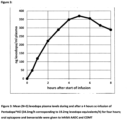
- Pentadopa was subcutaneously infused for 4 hours and levodopa plasma levels were determined. AADC and COMT were inhibited using benserazide (BZ) 25mg/h and 50mg opicapone, respectively. Table 3 gives the results and Figure 3 shows mean plasma levodopa levels. Throughout, 3OMD levels were low or undetectable.
- Table 4 Details of Clinical Phase I studies 5 to 7 with Benserazide as AADC-Inhibitor Study No 5 6 7 No of volunteers 3 3 3 No of study arms 2* 1 2 Aim of study LD pharmacokinetics LD pharmacokinetics LD pharmacokinetics Drug LD LD LD Route of Admin.
- opicapone (OC) 50mg was given every 6 hours starting at -26 and then at -20h, -14h, -8h, -2h, +4h, +10h. This treatment was chosen to mimic the clinical situation characterised by an accumulation of inhibitory potency over about 10 days of daily treatment with 50mg opicapone.
- Table 8 Details of clinical Phase I studies 9 and 10 Study No 9 10 No of volunteers 3 4 No of study arms 1 1 Aim of study LD pharmacokinetics 16h LD pharmacokinetics 30 hours Drug LD LD Route of Admin. sc sc Preparation AS 6 AS 6 Total Dose (mg) 300mg in 16 hours 300mg in 24 hours Dose mg/h 18.75 12.5 CD (mg)/h 25 25 Inhibition time -1 to +15 hours -1h to 24h COMT-Inhibition OC 50mg OC 50mg Inhibition times every 6 hours from -26h to+10h -24h, -2h, +22h
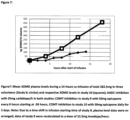
- the mean total AUC was 16287ng*h/ml corresponding to 54.3ng*h/ml/mg levodopa. This number is 2.1fold higher than for non-inhibited levodopa (see Example 1) and one third lower than was expected from 4-hours study 6 (Example 2). The reason clearly was the insufficient inhibition of COMT in study 10. This is also reflected by the higher clearance of 4ml/min/kg as compared to study 6. The half-life of levodopa disposition was calculated to 4.1 ⁇ 0.7 hours (Table 10).
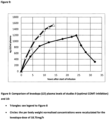
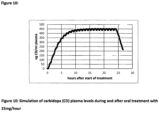
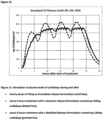
- Figure 9 was generated. Data from Figure 8 are combined for the mean levodopa profile of study 11, that was likewise normalised to a body weight of 70 kg. In addition, these data were re-calculated for the same infusion rate as in study 9: 18.75mg levodopa/h. The comparison clearly shows that in Parkinson's disease patients a steady state plasma level of 1200ng/ml will be achieved using an infusion rate of 18.75mg/h and a suboptimal COMT-inhibition. Under the same conditions but under an optimised COMT-inhibition the steady state plasma level will be around 1800 ng/ml.
- Hsu A et al. Comparison of the Pharmacokinetics of an Oral Extended-Release Capsule Formulation of carbidopa-levodopa (IPX066) With Immediate-Release carbidopa-levodopa (Sinemet1), Sustained-Release carbidopa-levodopa (Sinemet1 CR), and carbidopa-levodopa-entacapone (Stalevo1); The Journal of Clinical Pharmacology 2015, 55(9) 995-1003 ⁇ 2015 DOI: 10.1002/jcph.514 ).
Landscapes
- Health & Medical Sciences (AREA)
- Chemical & Material Sciences (AREA)
- Life Sciences & Earth Sciences (AREA)
- Medicinal Chemistry (AREA)
- Pharmacology & Pharmacy (AREA)
- Animal Behavior & Ethology (AREA)
- General Health & Medical Sciences (AREA)
- Public Health (AREA)
- Veterinary Medicine (AREA)
- Epidemiology (AREA)
- Engineering & Computer Science (AREA)
- Bioinformatics & Cheminformatics (AREA)
- Biomedical Technology (AREA)
- Neurosurgery (AREA)
- Neurology (AREA)
- General Chemical & Material Sciences (AREA)
- Chemical Kinetics & Catalysis (AREA)
- Organic Chemistry (AREA)
- Nuclear Medicine, Radiotherapy & Molecular Imaging (AREA)
- Psychology (AREA)
- Nutrition Science (AREA)
- Physiology (AREA)
- Dermatology (AREA)
- Proteomics, Peptides & Aminoacids (AREA)
- Oil, Petroleum & Natural Gas (AREA)
- Acyclic And Carbocyclic Compounds In Medicinal Compositions (AREA)
- Medicinal Preparation (AREA)
Claims (4)
- Kit von pharmazeutischen Zubereitungen zur Verwendung bei der Behandlung der Parkinson-Krankheit oder des Restless-Legs-Syndroms, enthaltenda) einen AADC-Inhibitor, ausgewählt aus Benserazid oder Carbidopa,wobei der AADC-Hemmer in einer Tagesdosis von 300-1200 mg verabreicht wird wobei der AADC-Inhibitor als orale Formulierung mit modifizierter Freisetzung bereitgestellt wird,wobei die orale Formulierung mit modifizierter Freisetzung des AADC-Inhibitors den AADC-Inhibitor im Gastrointestinaltrakt in einer Menge von 12,5-50 mg/h über mindestens 6 Stunden kontinuierlich freisetzt, undwobei die orale Formulierung mit modifizierter Freisetzung des AADC-Inhibitors 2-4 Mal pro Tag angewendet wirdb) eine Flüssigformulierung von Levodopa oder Levodopa-Ester,wobei die flüssige Formulierung Levodopa oder Levodopa-Ester in einer Molarität von 100-500 mmol/l enthältwobei die Flüssigformulierung subkutan infundiert wirdwobei die Tagesdosis an Levodopa oder Levodopa-Äquivalent 100-900 mg beträgtc) gegebenenfalls eine pharmazeutische Zubereitung eines COMT-Inhibitors, in der der COMT-Inhibitor 25-75 mg Opicapon ist.
- Kit zur Verwendung nach Anspruch 1, bei dem die orale modifizierte Freisetzungsformulierung des AADC-Inhibitors als Tablette oder Kapsel bereitgestellt wird, die jeweils 200-400 mg Benserazid oder Carbidopa enthält.
- Kit zur Verwendung nach Anspruch 1, in dem die orale modifizierte Freisetzungsformulierung eines AADC-Inhibitors als Tablette oder Kapsel bereitgestellt wird, die jeweils 200-400 mg Benserazid enthält.
- Kit zur Verwendung nach mindestens einem der Ansprüche 1 bis 3, wobei der Levodopa-Ester der Penta-Erythritol-Ester von Levodopa ist.
Priority Applications (4)
| Application Number | Priority Date | Filing Date | Title |
|---|---|---|---|
| EP22020035.6A EP4223288B1 (de) | 2022-02-07 | 2022-02-07 | Neuer kit von pharmazeutischen präparaten zur behandlung von morbus parkinson |
| US18/836,584 US20250170076A1 (en) | 2022-02-07 | 2023-02-07 | Novel kit of pharmaceutical preparations for the treatment of neurodegenerative diseases |
| PCT/EP2023/052983 WO2023148401A1 (en) | 2022-02-07 | 2023-02-07 | Novel kit of pharmaceutical preparations for the treatment of neurodegenerative diseases |
| EP23704121.5A EP4475830A1 (de) | 2022-02-07 | 2023-02-07 | Neuartiger kit aus pharmazeutischen zubereitungen zur behandlung neurodegenerativer erkrankungen |
Applications Claiming Priority (1)
| Application Number | Priority Date | Filing Date | Title |
|---|---|---|---|
| EP22020035.6A EP4223288B1 (de) | 2022-02-07 | 2022-02-07 | Neuer kit von pharmazeutischen präparaten zur behandlung von morbus parkinson |
Publications (2)
| Publication Number | Publication Date |
|---|---|
| EP4223288A1 EP4223288A1 (de) | 2023-08-09 |
| EP4223288B1 true EP4223288B1 (de) | 2024-03-06 |
Family
ID=80447596
Family Applications (2)
| Application Number | Title | Priority Date | Filing Date |
|---|---|---|---|
| EP22020035.6A Active EP4223288B1 (de) | 2022-02-07 | 2022-02-07 | Neuer kit von pharmazeutischen präparaten zur behandlung von morbus parkinson |
| EP23704121.5A Pending EP4475830A1 (de) | 2022-02-07 | 2023-02-07 | Neuartiger kit aus pharmazeutischen zubereitungen zur behandlung neurodegenerativer erkrankungen |
Family Applications After (1)
| Application Number | Title | Priority Date | Filing Date |
|---|---|---|---|
| EP23704121.5A Pending EP4475830A1 (de) | 2022-02-07 | 2023-02-07 | Neuartiger kit aus pharmazeutischen zubereitungen zur behandlung neurodegenerativer erkrankungen |
Country Status (3)
| Country | Link |
|---|---|
| US (1) | US20250170076A1 (de) |
| EP (2) | EP4223288B1 (de) |
| WO (1) | WO2023148401A1 (de) |
Families Citing this family (3)
| Publication number | Priority date | Publication date | Assignee | Title |
|---|---|---|---|---|
| WO2024214102A1 (en) * | 2023-04-14 | 2024-10-17 | Neuroderm, Ltd. | Methods and compositions for reducing symptoms of parkinson's disease |
| US12161612B2 (en) | 2023-04-14 | 2024-12-10 | Neuroderm, Ltd. | Methods and compositions for reducing symptoms of Parkinson's disease |
| CN119235833B (zh) * | 2024-08-30 | 2025-10-24 | 暨南大学 | N-酰基多巴胺家族脂质在防治药物诱导的帕金森病运动并发症中的应用 |
Family Cites Families (9)
| Publication number | Priority date | Publication date | Assignee | Title |
|---|---|---|---|---|
| JPS6021570B2 (ja) | 1978-07-04 | 1985-05-28 | 三共株式会社 | ド−パ類の高濃度製剤の製法 |
| US5607969A (en) * | 1992-12-24 | 1997-03-04 | Yissum Research Development Company Of The Hebrew University Of Jerusalem | L-DOPA ethyl ester to treat Parkinson's disease |
| JP5774610B2 (ja) | 2010-03-04 | 2015-09-09 | オリオン コーポレーション | パーキンソン病の治療方法 |
| US9421267B2 (en) | 2010-11-15 | 2016-08-23 | Neuroderm, Ltd. | Continuous administration of L-dopa, dopa decarboxylase inhibitors, catechol-O-methyl transferase inhibitors and compositions for same |
| CA2823642A1 (en) * | 2010-12-10 | 2012-06-14 | Synagile Corporation | Subcutaneously infusible levodopa prodrug compositions and methods of infusion |
| WO2013184646A2 (en) * | 2012-06-05 | 2013-12-12 | Synagile Corporation | Dosing regimens for subcutaneously infusible acidic compositions |
| SMT201900376T1 (it) | 2014-10-21 | 2019-09-09 | Abbvie Inc | Profarmaci di carbidopa e l-dopa e loro uso per trattare il morbo di parkinson |
| US11046640B2 (en) * | 2015-03-30 | 2021-06-29 | Berlirem Gmbh | Water-soluble L-DOPA esters |
| PL3634384T3 (pl) | 2017-06-05 | 2021-12-06 | Dizlin Pharmaceuticals Ab | Roztwór lewodopy do infuzji |
-
2022
- 2022-02-07 EP EP22020035.6A patent/EP4223288B1/de active Active
-
2023
- 2023-02-07 EP EP23704121.5A patent/EP4475830A1/de active Pending
- 2023-02-07 WO PCT/EP2023/052983 patent/WO2023148401A1/en not_active Ceased
- 2023-02-07 US US18/836,584 patent/US20250170076A1/en active Pending
Also Published As
| Publication number | Publication date |
|---|---|
| EP4223288A1 (de) | 2023-08-09 |
| WO2023148401A1 (en) | 2023-08-10 |
| EP4475830A1 (de) | 2024-12-18 |
| US20250170076A1 (en) | 2025-05-29 |
Similar Documents
| Publication | Publication Date | Title |
|---|---|---|
| US20250170076A1 (en) | Novel kit of pharmaceutical preparations for the treatment of neurodegenerative diseases | |
| Nyholm | Pharmacokinetic optimisation in the treatment of Parkinson’s disease: an update | |
| US4832957A (en) | Controlled release combination of carbidopa/levodopa | |
| US7674479B2 (en) | Sustained-release bupropion and bupropion/mecamylamine tablets | |
| CA2332790C (en) | Controlled release lipoic acid | |
| AU2023206140B2 (en) | Pulsatile drug delivery system for treating morning akinesia | |
| CN103889455B (zh) | 稳定化乙哌立松医药组成物及含有上述组成物的缓释制剂 | |
| HK56191A (en) | Controlled release combination of carbidopa/levodopa | |
| BRPI0610634A2 (pt) | combinação para a terapia de hiperplasia benigna da próstata | |
| JP2007509146A (ja) | レボドーパの持続効果のための組成物及び投与形 | |
| WO2007016679A2 (en) | Combination immediate release controlled release levodopa and carbidopa dosage forms | |
| ZA200700395B (en) | Novel formulation for L-tryptophane comprising carbidopa/benserazide | |
| MXPA04009906A (es) | Composiciones farmaceuticas de liberacion controlada de carbipoda y levopoda. | |
| Vo et al. | Guidelines for the Use of Parkinsonian Drugs (in USA) | |
| WO2023081612A1 (en) | Methods of treating patients having type 1 diabetes with eflornithine | |
| US20070122479A1 (en) | Threo-DOPS controlled release formulation | |
| KR20150137272A (ko) | 안정한 프레가발린 제어 방출성 서방형 제약 조성물 및 그 제조방법 | |
| TW201720442A (zh) | 用於控管噁心及嘔吐之組合物 |
Legal Events
| Date | Code | Title | Description |
|---|---|---|---|
| STAA | Information on the status of an ep patent application or granted ep patent |
Free format text: STATUS: EXAMINATION IS IN PROGRESS |
|
| PUAI | Public reference made under article 153(3) epc to a published international application that has entered the european phase |
Free format text: ORIGINAL CODE: 0009012 |
|
| 17P | Request for examination filed |
Effective date: 20221006 |
|
| AK | Designated contracting states |
Kind code of ref document: A1 Designated state(s): AL AT BE BG CH CY CZ DE DK EE ES FI FR GB GR HR HU IE IS IT LI LT LU LV MC MK MT NL NO PL PT RO RS SE SI SK SM TR |
|
| GRAP | Despatch of communication of intention to grant a patent |
Free format text: ORIGINAL CODE: EPIDOSNIGR1 |
|
| STAA | Information on the status of an ep patent application or granted ep patent |
Free format text: STATUS: GRANT OF PATENT IS INTENDED |
|
| INTG | Intention to grant announced |
Effective date: 20230926 |
|
| GRAS | Grant fee paid |
Free format text: ORIGINAL CODE: EPIDOSNIGR3 |
|
| GRAA | (expected) grant |
Free format text: ORIGINAL CODE: 0009210 |
|
| STAA | Information on the status of an ep patent application or granted ep patent |
Free format text: STATUS: THE PATENT HAS BEEN GRANTED |
|
| AK | Designated contracting states |
Kind code of ref document: B1 Designated state(s): AL AT BE BG CH CY CZ DE DK EE ES FI FR GB GR HR HU IE IS IT LI LT LU LV MC MK MT NL NO PL PT RO RS SE SI SK SM TR |
|
| RBV | Designated contracting states (corrected) |
Designated state(s): AL AT BE BG CH CY CZ DE DK EE ES FI FR GB GR HR HU IE IS IT LI LT LU LV MC MK MT NL NO PL PT RO RS SE SI SK SM TR |
|
| REG | Reference to a national code |
Ref country code: CH Ref legal event code: EP |
|
| REG | Reference to a national code |
Ref country code: IE Ref legal event code: FG4D |
|
| REG | Reference to a national code |
Ref country code: DE Ref legal event code: R096 Ref document number: 602022002162 Country of ref document: DE |
|
| REG | Reference to a national code |
Ref country code: DE Ref legal event code: R081 Ref document number: 602022002162 Country of ref document: DE Owner name: BERLIREM GMBH, DE Free format text: FORMER OWNER: ANMELDERANGABEN UNKLAR / UNVOLLSTAENDIG, 80297 MUENCHEN, DE |
|
| REG | Reference to a national code |
Ref country code: LT Ref legal event code: MG9D |
|
| PG25 | Lapsed in a contracting state [announced via postgrant information from national office to epo] |
Ref country code: LT Free format text: LAPSE BECAUSE OF FAILURE TO SUBMIT A TRANSLATION OF THE DESCRIPTION OR TO PAY THE FEE WITHIN THE PRESCRIBED TIME-LIMIT Effective date: 20240306 |
|
| REG | Reference to a national code |
Ref country code: NL Ref legal event code: MP Effective date: 20240306 |
|
| PG25 | Lapsed in a contracting state [announced via postgrant information from national office to epo] |
Ref country code: GR Free format text: LAPSE BECAUSE OF FAILURE TO SUBMIT A TRANSLATION OF THE DESCRIPTION OR TO PAY THE FEE WITHIN THE PRESCRIBED TIME-LIMIT Effective date: 20240607 |
|
| PG25 | Lapsed in a contracting state [announced via postgrant information from national office to epo] |
Ref country code: RS Free format text: LAPSE BECAUSE OF FAILURE TO SUBMIT A TRANSLATION OF THE DESCRIPTION OR TO PAY THE FEE WITHIN THE PRESCRIBED TIME-LIMIT Effective date: 20240606 Ref country code: HR Free format text: LAPSE BECAUSE OF FAILURE TO SUBMIT A TRANSLATION OF THE DESCRIPTION OR TO PAY THE FEE WITHIN THE PRESCRIBED TIME-LIMIT Effective date: 20240306 |
|
| PG25 | Lapsed in a contracting state [announced via postgrant information from national office to epo] |
Ref country code: ES Free format text: LAPSE BECAUSE OF FAILURE TO SUBMIT A TRANSLATION OF THE DESCRIPTION OR TO PAY THE FEE WITHIN THE PRESCRIBED TIME-LIMIT Effective date: 20240306 |
|
| PG25 | Lapsed in a contracting state [announced via postgrant information from national office to epo] |
Ref country code: RS Free format text: LAPSE BECAUSE OF FAILURE TO SUBMIT A TRANSLATION OF THE DESCRIPTION OR TO PAY THE FEE WITHIN THE PRESCRIBED TIME-LIMIT Effective date: 20240606 Ref country code: NO Free format text: LAPSE BECAUSE OF FAILURE TO SUBMIT A TRANSLATION OF THE DESCRIPTION OR TO PAY THE FEE WITHIN THE PRESCRIBED TIME-LIMIT Effective date: 20240606 Ref country code: LT Free format text: LAPSE BECAUSE OF FAILURE TO SUBMIT A TRANSLATION OF THE DESCRIPTION OR TO PAY THE FEE WITHIN THE PRESCRIBED TIME-LIMIT Effective date: 20240306 Ref country code: HR Free format text: LAPSE BECAUSE OF FAILURE TO SUBMIT A TRANSLATION OF THE DESCRIPTION OR TO PAY THE FEE WITHIN THE PRESCRIBED TIME-LIMIT Effective date: 20240306 Ref country code: GR Free format text: LAPSE BECAUSE OF FAILURE TO SUBMIT A TRANSLATION OF THE DESCRIPTION OR TO PAY THE FEE WITHIN THE PRESCRIBED TIME-LIMIT Effective date: 20240607 Ref country code: FI Free format text: LAPSE BECAUSE OF FAILURE TO SUBMIT A TRANSLATION OF THE DESCRIPTION OR TO PAY THE FEE WITHIN THE PRESCRIBED TIME-LIMIT Effective date: 20240306 Ref country code: ES Free format text: LAPSE BECAUSE OF FAILURE TO SUBMIT A TRANSLATION OF THE DESCRIPTION OR TO PAY THE FEE WITHIN THE PRESCRIBED TIME-LIMIT Effective date: 20240306 Ref country code: BG Free format text: LAPSE BECAUSE OF FAILURE TO SUBMIT A TRANSLATION OF THE DESCRIPTION OR TO PAY THE FEE WITHIN THE PRESCRIBED TIME-LIMIT Effective date: 20240306 |
|
| REG | Reference to a national code |
Ref country code: AT Ref legal event code: MK05 Ref document number: 1662799 Country of ref document: AT Kind code of ref document: T Effective date: 20240306 |
|
| PG25 | Lapsed in a contracting state [announced via postgrant information from national office to epo] |
Ref country code: SE Free format text: LAPSE BECAUSE OF FAILURE TO SUBMIT A TRANSLATION OF THE DESCRIPTION OR TO PAY THE FEE WITHIN THE PRESCRIBED TIME-LIMIT Effective date: 20240306 Ref country code: LV Free format text: LAPSE BECAUSE OF FAILURE TO SUBMIT A TRANSLATION OF THE DESCRIPTION OR TO PAY THE FEE WITHIN THE PRESCRIBED TIME-LIMIT Effective date: 20240306 |
|
| PG25 | Lapsed in a contracting state [announced via postgrant information from national office to epo] |
Ref country code: NL Free format text: LAPSE BECAUSE OF FAILURE TO SUBMIT A TRANSLATION OF THE DESCRIPTION OR TO PAY THE FEE WITHIN THE PRESCRIBED TIME-LIMIT Effective date: 20240306 |
|
| PG25 | Lapsed in a contracting state [announced via postgrant information from national office to epo] |
Ref country code: NL Free format text: LAPSE BECAUSE OF FAILURE TO SUBMIT A TRANSLATION OF THE DESCRIPTION OR TO PAY THE FEE WITHIN THE PRESCRIBED TIME-LIMIT Effective date: 20240306 |
|
| PG25 | Lapsed in a contracting state [announced via postgrant information from national office to epo] |
Ref country code: IS Free format text: LAPSE BECAUSE OF FAILURE TO SUBMIT A TRANSLATION OF THE DESCRIPTION OR TO PAY THE FEE WITHIN THE PRESCRIBED TIME-LIMIT Effective date: 20240706 |
|
| PG25 | Lapsed in a contracting state [announced via postgrant information from national office to epo] |
Ref country code: SM Free format text: LAPSE BECAUSE OF FAILURE TO SUBMIT A TRANSLATION OF THE DESCRIPTION OR TO PAY THE FEE WITHIN THE PRESCRIBED TIME-LIMIT Effective date: 20240306 Ref country code: PT Free format text: LAPSE BECAUSE OF FAILURE TO SUBMIT A TRANSLATION OF THE DESCRIPTION OR TO PAY THE FEE WITHIN THE PRESCRIBED TIME-LIMIT Effective date: 20240708 |
|
| PG25 | Lapsed in a contracting state [announced via postgrant information from national office to epo] |
Ref country code: CZ Free format text: LAPSE BECAUSE OF FAILURE TO SUBMIT A TRANSLATION OF THE DESCRIPTION OR TO PAY THE FEE WITHIN THE PRESCRIBED TIME-LIMIT Effective date: 20240306 Ref country code: EE Free format text: LAPSE BECAUSE OF FAILURE TO SUBMIT A TRANSLATION OF THE DESCRIPTION OR TO PAY THE FEE WITHIN THE PRESCRIBED TIME-LIMIT Effective date: 20240306 |
|
| PG25 | Lapsed in a contracting state [announced via postgrant information from national office to epo] |
Ref country code: AT Free format text: LAPSE BECAUSE OF FAILURE TO SUBMIT A TRANSLATION OF THE DESCRIPTION OR TO PAY THE FEE WITHIN THE PRESCRIBED TIME-LIMIT Effective date: 20240306 |
|
| PG25 | Lapsed in a contracting state [announced via postgrant information from national office to epo] |
Ref country code: PL Free format text: LAPSE BECAUSE OF FAILURE TO SUBMIT A TRANSLATION OF THE DESCRIPTION OR TO PAY THE FEE WITHIN THE PRESCRIBED TIME-LIMIT Effective date: 20240306 |
|
| PG25 | Lapsed in a contracting state [announced via postgrant information from national office to epo] |
Ref country code: SK Free format text: LAPSE BECAUSE OF FAILURE TO SUBMIT A TRANSLATION OF THE DESCRIPTION OR TO PAY THE FEE WITHIN THE PRESCRIBED TIME-LIMIT Effective date: 20240306 |
|
| PG25 | Lapsed in a contracting state [announced via postgrant information from national office to epo] |
Ref country code: SM Free format text: LAPSE BECAUSE OF FAILURE TO SUBMIT A TRANSLATION OF THE DESCRIPTION OR TO PAY THE FEE WITHIN THE PRESCRIBED TIME-LIMIT Effective date: 20240306 Ref country code: SK Free format text: LAPSE BECAUSE OF FAILURE TO SUBMIT A TRANSLATION OF THE DESCRIPTION OR TO PAY THE FEE WITHIN THE PRESCRIBED TIME-LIMIT Effective date: 20240306 Ref country code: RO Free format text: LAPSE BECAUSE OF FAILURE TO SUBMIT A TRANSLATION OF THE DESCRIPTION OR TO PAY THE FEE WITHIN THE PRESCRIBED TIME-LIMIT Effective date: 20240306 Ref country code: PT Free format text: LAPSE BECAUSE OF FAILURE TO SUBMIT A TRANSLATION OF THE DESCRIPTION OR TO PAY THE FEE WITHIN THE PRESCRIBED TIME-LIMIT Effective date: 20240708 Ref country code: PL Free format text: LAPSE BECAUSE OF FAILURE TO SUBMIT A TRANSLATION OF THE DESCRIPTION OR TO PAY THE FEE WITHIN THE PRESCRIBED TIME-LIMIT Effective date: 20240306 Ref country code: IS Free format text: LAPSE BECAUSE OF FAILURE TO SUBMIT A TRANSLATION OF THE DESCRIPTION OR TO PAY THE FEE WITHIN THE PRESCRIBED TIME-LIMIT Effective date: 20240706 Ref country code: EE Free format text: LAPSE BECAUSE OF FAILURE TO SUBMIT A TRANSLATION OF THE DESCRIPTION OR TO PAY THE FEE WITHIN THE PRESCRIBED TIME-LIMIT Effective date: 20240306 Ref country code: CZ Free format text: LAPSE BECAUSE OF FAILURE TO SUBMIT A TRANSLATION OF THE DESCRIPTION OR TO PAY THE FEE WITHIN THE PRESCRIBED TIME-LIMIT Effective date: 20240306 Ref country code: AT Free format text: LAPSE BECAUSE OF FAILURE TO SUBMIT A TRANSLATION OF THE DESCRIPTION OR TO PAY THE FEE WITHIN THE PRESCRIBED TIME-LIMIT Effective date: 20240306 |
|
| PG25 | Lapsed in a contracting state [announced via postgrant information from national office to epo] |
Ref country code: IT Free format text: LAPSE BECAUSE OF FAILURE TO SUBMIT A TRANSLATION OF THE DESCRIPTION OR TO PAY THE FEE WITHIN THE PRESCRIBED TIME-LIMIT Effective date: 20240306 |
|
| REG | Reference to a national code |
Ref country code: DE Ref legal event code: R097 Ref document number: 602022002162 Country of ref document: DE |
|
| PG25 | Lapsed in a contracting state [announced via postgrant information from national office to epo] |
Ref country code: IT Free format text: LAPSE BECAUSE OF FAILURE TO SUBMIT A TRANSLATION OF THE DESCRIPTION OR TO PAY THE FEE WITHIN THE PRESCRIBED TIME-LIMIT Effective date: 20240306 |
|
| PLBE | No opposition filed within time limit |
Free format text: ORIGINAL CODE: 0009261 |
|
| STAA | Information on the status of an ep patent application or granted ep patent |
Free format text: STATUS: NO OPPOSITION FILED WITHIN TIME LIMIT |
|
| PG25 | Lapsed in a contracting state [announced via postgrant information from national office to epo] |
Ref country code: DK Free format text: LAPSE BECAUSE OF FAILURE TO SUBMIT A TRANSLATION OF THE DESCRIPTION OR TO PAY THE FEE WITHIN THE PRESCRIBED TIME-LIMIT Effective date: 20240306 |
|
| PG25 | Lapsed in a contracting state [announced via postgrant information from national office to epo] |
Ref country code: DK Free format text: LAPSE BECAUSE OF FAILURE TO SUBMIT A TRANSLATION OF THE DESCRIPTION OR TO PAY THE FEE WITHIN THE PRESCRIBED TIME-LIMIT Effective date: 20240306 |
|
| 26N | No opposition filed |
Effective date: 20241209 |
|
| PGFP | Annual fee paid to national office [announced via postgrant information from national office to epo] |
Ref country code: DE Payment date: 20250220 Year of fee payment: 4 |
|
| PG25 | Lapsed in a contracting state [announced via postgrant information from national office to epo] |
Ref country code: SI Free format text: LAPSE BECAUSE OF FAILURE TO SUBMIT A TRANSLATION OF THE DESCRIPTION OR TO PAY THE FEE WITHIN THE PRESCRIBED TIME-LIMIT Effective date: 20240306 |
|
| PGFP | Annual fee paid to national office [announced via postgrant information from national office to epo] |
Ref country code: CH Payment date: 20250301 Year of fee payment: 4 |
|
| PGFP | Annual fee paid to national office [announced via postgrant information from national office to epo] |
Ref country code: FR Payment date: 20250220 Year of fee payment: 4 |
|
| PG25 | Lapsed in a contracting state [announced via postgrant information from national office to epo] |
Ref country code: MC Free format text: LAPSE BECAUSE OF FAILURE TO SUBMIT A TRANSLATION OF THE DESCRIPTION OR TO PAY THE FEE WITHIN THE PRESCRIBED TIME-LIMIT Effective date: 20240306 |
|
| PG25 | Lapsed in a contracting state [announced via postgrant information from national office to epo] |
Ref country code: LU Free format text: LAPSE BECAUSE OF NON-PAYMENT OF DUE FEES Effective date: 20250207 |
|
| REG | Reference to a national code |
Ref country code: BE Ref legal event code: MM Effective date: 20250228 |
|
| PG25 | Lapsed in a contracting state [announced via postgrant information from national office to epo] |
Ref country code: BE Free format text: LAPSE BECAUSE OF NON-PAYMENT OF DUE FEES Effective date: 20250228 |
|
| PG25 | Lapsed in a contracting state [announced via postgrant information from national office to epo] |
Ref country code: IE Free format text: LAPSE BECAUSE OF NON-PAYMENT OF DUE FEES Effective date: 20250207 |
|
| REG | Reference to a national code |
Ref country code: CH Ref legal event code: U11 Free format text: ST27 STATUS EVENT CODE: U-0-0-U10-U11 (AS PROVIDED BY THE NATIONAL OFFICE) Effective date: 20260301 |