EP4222630B1 - Effiziente deduplizierung mittels blockbasierter konvergenter verschlüsselung - Google Patents
Effiziente deduplizierung mittels blockbasierter konvergenter verschlüsselung Download PDFInfo
- Publication number
- EP4222630B1 EP4222630B1 EP21798872.4A EP21798872A EP4222630B1 EP 4222630 B1 EP4222630 B1 EP 4222630B1 EP 21798872 A EP21798872 A EP 21798872A EP 4222630 B1 EP4222630 B1 EP 4222630B1
- Authority
- EP
- European Patent Office
- Prior art keywords
- block
- objects
- level ciphertext
- fixed
- ciphertext
- Prior art date
- Legal status (The legal status is an assumption and is not a legal conclusion. Google has not performed a legal analysis and makes no representation as to the accuracy of the status listed.)
- Active
Links
Images


Classifications
-
- G—PHYSICS
- G06—COMPUTING OR CALCULATING; COUNTING
- G06F—ELECTRIC DIGITAL DATA PROCESSING
- G06F16/00—Information retrieval; Database structures therefor; File system structures therefor
- G06F16/10—File systems; File servers
- G06F16/17—Details of further file system functions
- G06F16/174—Redundancy elimination performed by the file system
- G06F16/1748—De-duplication implemented within the file system, e.g. based on file segments
- G06F16/1752—De-duplication implemented within the file system, e.g. based on file segments based on file chunks
-
- G—PHYSICS
- G06—COMPUTING OR CALCULATING; COUNTING
- G06F—ELECTRIC DIGITAL DATA PROCESSING
- G06F21/00—Security arrangements for protecting computers, components thereof, programs or data against unauthorised activity
- G06F21/60—Protecting data
- G06F21/62—Protecting access to data via a platform, e.g. using keys or access control rules
- G06F21/6218—Protecting access to data via a platform, e.g. using keys or access control rules to a system of files or objects, e.g. local or distributed file system or database
-
- H—ELECTRICITY
- H04—ELECTRIC COMMUNICATION TECHNIQUE
- H04L—TRANSMISSION OF DIGITAL INFORMATION, e.g. TELEGRAPHIC COMMUNICATION
- H04L9/00—Cryptographic mechanisms or cryptographic arrangements for secret or secure communications; Network security protocols
- H04L9/06—Cryptographic mechanisms or cryptographic arrangements for secret or secure communications; Network security protocols the encryption apparatus using shift registers or memories for block-wise or stream coding, e.g. DES systems or RC4; Hash functions; Pseudorandom sequence generators
- H04L9/0618—Block ciphers, i.e. encrypting groups of characters of a plain text message using fixed encryption transformation
- H04L9/0631—Substitution permutation network [SPN], i.e. cipher composed of a number of stages or rounds each involving linear and nonlinear transformations, e.g. AES algorithms
-
- H—ELECTRICITY
- H04—ELECTRIC COMMUNICATION TECHNIQUE
- H04L—TRANSMISSION OF DIGITAL INFORMATION, e.g. TELEGRAPHIC COMMUNICATION
- H04L9/00—Cryptographic mechanisms or cryptographic arrangements for secret or secure communications; Network security protocols
- H04L9/06—Cryptographic mechanisms or cryptographic arrangements for secret or secure communications; Network security protocols the encryption apparatus using shift registers or memories for block-wise or stream coding, e.g. DES systems or RC4; Hash functions; Pseudorandom sequence generators
- H04L9/0618—Block ciphers, i.e. encrypting groups of characters of a plain text message using fixed encryption transformation
- H04L9/0637—Modes of operation, e.g. cipher block chaining [CBC], electronic codebook [ECB] or Galois/counter mode [GCM]
-
- H—ELECTRICITY
- H04—ELECTRIC COMMUNICATION TECHNIQUE
- H04L—TRANSMISSION OF DIGITAL INFORMATION, e.g. TELEGRAPHIC COMMUNICATION
- H04L9/00—Cryptographic mechanisms or cryptographic arrangements for secret or secure communications; Network security protocols
- H04L9/06—Cryptographic mechanisms or cryptographic arrangements for secret or secure communications; Network security protocols the encryption apparatus using shift registers or memories for block-wise or stream coding, e.g. DES systems or RC4; Hash functions; Pseudorandom sequence generators
- H04L9/0643—Hash functions, e.g. MD5, SHA, HMAC or f9 MAC
-
- H—ELECTRICITY
- H04—ELECTRIC COMMUNICATION TECHNIQUE
- H04L—TRANSMISSION OF DIGITAL INFORMATION, e.g. TELEGRAPHIC COMMUNICATION
- H04L9/00—Cryptographic mechanisms or cryptographic arrangements for secret or secure communications; Network security protocols
- H04L9/06—Cryptographic mechanisms or cryptographic arrangements for secret or secure communications; Network security protocols the encryption apparatus using shift registers or memories for block-wise or stream coding, e.g. DES systems or RC4; Hash functions; Pseudorandom sequence generators
- H04L9/065—Encryption by serially and continuously modifying data stream elements, e.g. stream cipher systems, RC4, SEAL or A5/3
-
- H—ELECTRICITY
- H04—ELECTRIC COMMUNICATION TECHNIQUE
- H04L—TRANSMISSION OF DIGITAL INFORMATION, e.g. TELEGRAPHIC COMMUNICATION
- H04L9/00—Cryptographic mechanisms or cryptographic arrangements for secret or secure communications; Network security protocols
- H04L9/08—Key distribution or management, e.g. generation, sharing or updating, of cryptographic keys or passwords
- H04L9/0861—Generation of secret information including derivation or calculation of cryptographic keys or passwords
-
- H—ELECTRICITY
- H04—ELECTRIC COMMUNICATION TECHNIQUE
- H04L—TRANSMISSION OF DIGITAL INFORMATION, e.g. TELEGRAPHIC COMMUNICATION
- H04L9/00—Cryptographic mechanisms or cryptographic arrangements for secret or secure communications; Network security protocols
- H04L9/08—Key distribution or management, e.g. generation, sharing or updating, of cryptographic keys or passwords
- H04L9/0894—Escrow, recovery or storing of secret information, e.g. secret key escrow or cryptographic key storage
-
- H—ELECTRICITY
- H04—ELECTRIC COMMUNICATION TECHNIQUE
- H04L—TRANSMISSION OF DIGITAL INFORMATION, e.g. TELEGRAPHIC COMMUNICATION
- H04L9/00—Cryptographic mechanisms or cryptographic arrangements for secret or secure communications; Network security protocols
- H04L9/32—Cryptographic mechanisms or cryptographic arrangements for secret or secure communications; Network security protocols including means for verifying the identity or authority of a user of the system or for message authentication, e.g. authorization, entity authentication, data integrity or data verification, non-repudiation, key authentication or verification of credentials
- H04L9/3236—Cryptographic mechanisms or cryptographic arrangements for secret or secure communications; Network security protocols including means for verifying the identity or authority of a user of the system or for message authentication, e.g. authorization, entity authentication, data integrity or data verification, non-repudiation, key authentication or verification of credentials using cryptographic hash functions
- H04L9/3242—Cryptographic mechanisms or cryptographic arrangements for secret or secure communications; Network security protocols including means for verifying the identity or authority of a user of the system or for message authentication, e.g. authorization, entity authentication, data integrity or data verification, non-repudiation, key authentication or verification of credentials using cryptographic hash functions involving keyed hash functions, e.g. message authentication codes [MACs], CBC-MAC or HMAC
-
- G—PHYSICS
- G06—COMPUTING OR CALCULATING; COUNTING
- G06F—ELECTRIC DIGITAL DATA PROCESSING
- G06F3/00—Input arrangements for transferring data to be processed into a form capable of being handled by the computer; Output arrangements for transferring data from processing unit to output unit, e.g. interface arrangements
- G06F3/06—Digital input from, or digital output to, record carriers, e.g. RAID, emulated record carriers or networked record carriers
- G06F3/0601—Interfaces specially adapted for storage systems
- G06F3/0602—Interfaces specially adapted for storage systems specifically adapted to achieve a particular effect
- G06F3/062—Securing storage systems
- G06F3/0623—Securing storage systems in relation to content
-
- G—PHYSICS
- G06—COMPUTING OR CALCULATING; COUNTING
- G06F—ELECTRIC DIGITAL DATA PROCESSING
- G06F3/00—Input arrangements for transferring data to be processed into a form capable of being handled by the computer; Output arrangements for transferring data from processing unit to output unit, e.g. interface arrangements
- G06F3/06—Digital input from, or digital output to, record carriers, e.g. RAID, emulated record carriers or networked record carriers
- G06F3/0601—Interfaces specially adapted for storage systems
- G06F3/0628—Interfaces specially adapted for storage systems making use of a particular technique
- G06F3/0638—Organizing or formatting or addressing of data
- G06F3/064—Management of blocks
- G06F3/0641—De-duplication techniques
Definitions
- Computing devices can utilize communication networks to exchange data. Companies and organizations operate computer networks that interconnect a number of computing devices to support operations or to provide services to third parties.
- the computing systems can be located in a single geographic location or located in multiple, distinct geographic locations (e.g., interconnected via private or public communication networks).
- data centers or data processing centers herein generally referred to as a "data center,” may include a number of interconnected computing systems to provide computing resources to users of the data center.
- the data centers may be private data centers operated on behalf of an organization or public data centers operated on behalf, or for the benefit of, the general public.
- virtualization technologies allow a single physical computing device to host one or more instances of virtual machines that appear and operate as independent computing devices to users of a data center.
- the single physical computing device can create, maintain, delete, or otherwise manage virtual machines in a dynamic manner.
- users can request computer resources from a data center, including single computing devices or a configuration of networked computing devices, and be provided with varying numbers of virtual machine resources.
- Virtual machines are typically defined at least partly based on the data used to run the virtual machine, which is often packaged into a disk image.
- a disk image is data set, such as a file, that contains the contents and structure of a disk volume or data storage device.
- a disk image may contain an operating system, libraries, utilities, applications, configurations, and the like.
- US 8 401 185 B1 teaches using convergent encryption to facilitate deduplication of encrypted client data to be stored in a third-party storage system.
- the data to be stored are segmented, encrypted, and deduplicated by one or more clients, which submit corresponding hashes and encrypted data segments to the third-party storage system for storage.
- aspects of the present disclosure relate to facilitating secure storage and deduplication of data on a storage system by using convergent encryption.
- convergent encryption is a technique in which a data set (such as a file) is encrypted with a key that is deterministically derivable from plaintext (the unencrypted form of the data set) of the data set. Accordingly, under the known techniques of convergent encryption, two identical data sets encrypted using the same convergent encryption technique will result in identical ciphertext (the encrypted form of the data set).
- Convergent encryption is beneficial in storage technologies-and particularly multi-tenanted storage technologies, where data is stored on behalf of multiple parties-because it enables deduplication of data without requiring knowledge of the plaintext.
- the storage system can detect the identical ciphertext and store only one copy of that ciphertext, thus reducing storage requirements of the system without requiring that the system have knowledge of the plaintext. While beneficial, this basic convergent encryption technique is not without its drawbacks. For example, because convergent encryption is expected to produce identical ciphertext only given identical plaintext, any alterations to the underlying plaintext (even minor alterations) can result in different ciphertexts and thus prevent deduplication.
- one party with possession of a file can confirm that another party possesses the file, even if the other party stores only ciphertext of the file, simply by encrypting the plaintext of the file and comparing the result to the ciphertext of the other party.
- a "remaining information” attack one party may learn of confidential information of another party placed into an otherwise known data set. For example, where convergent encryption is used to store a form with confidential information added (e.g., including bank numbers), an attacker with knowledge of the generic form can attempt to generate and encrypt the form with all possible mutations of the confidential information, and then learn the confidential information by comparing the generated forms to ciphertext of the other party.
- Embodiments of the present disclosure address these shortcomings of basic convergent encryption, providing for increased deduplication of data even in the presence of small changes, and mitigating or eliminating the "confirmation of file” and "remaining information” attacks noted above. More specifically, embodiments of the present disclosure may utilize block-based convergent encryption, in which a data set (e.g., a file) is divided into fixed-length blocks prior to encryption, and each block is then encrypted according to a convergent encryption technique to produce block-level ciphertext. Deduplication can then occur according to the block-level ciphertext. Where two data sets are nearly (but not perfectly) identical, it is expected that a large number of the plaintext blocks of the two data sets would be perfect identical.
- a data set e.g., a file
- the present techniques can enable the use of convergent encryption to deduplicate nearly identical files as well as perfectly identical files.
- each manifest can generally identify both the block-level ciphertexts created for the data set and, for each block-level ciphertext, an encryption key by which the block-level ciphertext was encrypted.
- the manifest (or a portion thereof, such as the encryption keys for each ciphertext) may be encrypted according to another encryption key, such as a user-specific key. Thus, only a user who stored a given data set (or their authorized parties) would be expected to be able to access the data of the manifest.
- each block-level ciphertext is included within the manifest, only a user with a valid manifest would be expected to be able to decrypt the corresponding block-level ciphertexts, thus enabling access to the plaintext data set as a whole. If two users provided overlapping (e.g., identical or sharing some significant portion) data sets, each user can be provided with a distinct manifest. However, at least some of the block-level ciphertexts identified in the manifest would be expected to overlap, and a storage system provider would thus not be required to separately store such the block-level ciphertexts. Accordingly, deduplication within the storage system is improved while maintaining security within such a system.
- security of a storage system as disclosed herein is further improved by identifying block-level ciphertexts according to a message authentication code of the ciphertext.
- a message authentication code (or "MAC") is a short (relative to a data set itself) piece of information used to authenticate the data set, confirming data integrity and authenticity.
- MAC message authentication code
- deduplication can reduce excess resource usage in a storage system
- deduplication can concentrate the risk of failure.
- a failure in storing deduplicated data may destroy the data for all users of that data.
- Another potential difficulty may occur when conducting the above-techniques within a distributed computing system, and particularly a heavily utilized distributed computing system.
- such a system may have difficulty in accurately determining whether a particular ciphertext is still desired to be stored on a storage system. For example, where ciphertexts are stored in common storage and referenced within manifests, a system might attempt to count the number of manifests referencing a given ciphertext.
- embodiments of the present disclosure can utilize dynamic salt values when selecting keys for encryption of plaintext.
- Such salt values may be selected according to attributes of the plaintext, attributes of a request to store the plaintext, attributes of storage of ciphertext corresponding to the plaintext on a storage system, or the like.
- a salt value can be appended or prepended to plaintext prior to generating a key from that plaintext, such that the encrypted ciphertext (generated by encrypting the plaintext using the key) also varies according to the salt.
- These salt values can be varied according to different parameters, such as a user or group of users for which data is stored or a time of storage.
- salts may be altered on a weekly basis, such that data encrypted in a first week results in different ciphertext than data encrypted in a second week. This substantially reduces the difficulties in such reference counting since, for example, no new manifests would be expected to be created with ciphertext corresponding to a now-expired salt.
- salts are deterministic, such that all salts for a given attribute (e.g., for a given time period, user or group of users, etc.) are the same.
- salts may be probabilistic within a constrained number of possible permutations.
- the salt value may be probabilistic such that over a given time period, salts become more and more likely to reflect a future time period rather than a past time period.
- salts may be probabilistic selected such that they have a high chance of being a first salt (e.g., a "past week” salt) and a low chance of being a second salt (a "current week” salt).
- the probabilistic selection may be scaled to favor the second salt rather than the first. In this manner, a "smoothing" of salts-and therefore corresponding ciphertext-may be achieved.
- week-duration salts are described herein, any duration may be used for creation of time-varying salts.
- user or group varying salts may be used in conjunction with time-varying salts, providing a combination of the benefits noted above.
- the two varying salts may be concatenated to produce a combined salt used to create a key.
- the techniques described herein may be employed in a variety of storage systems storing a variety of data.
- One particular type of system that may benefit is an on-demand code execution system.
- Such a system can enable users to provide user-defined executable code, and to invoke such code on-demand.
- Such systems are sometimes referred to as "serverless" code execution systems, because they generally operate such that a user need not define, configure, or maintain a particular machine on which the code is executed.
- serverless code execution systems because they generally operate such that a user need not define, configure, or maintain a particular machine on which the code is executed.
- a user of a serverless system may avoid creating a machine (either virtual or physical), installing an operating system, configuring the machine, etc.
- serverless does not imply an actual lack of server in such a system, but rather implies that a user need not be concerned with the particular server on which code is executed. Instead, the serverless system may obtain a request to execute code, provision an appropriate environment for that code (which environment is typically isolated from others using virtualization technologies) and execute the code within the environment. The serverless system may further "tear down” or deconstruct the environment when it is no longer needed.
- serverless systems provide high ease-of-use compared to traditional server environments, while reducing computing resource usage relative to such environments due to the lack of requirement for dedicated resources and environments.
- Some serverless systems may enable users to relatively small amounts of code, such as a particular script to be run. However, this can place restrictions on such code, as it may be limited to functions provided by default within the generic environments of the serverless system (e.g., a default operating system of the serverless system). Often, users wish to execute code with additional functions, which may require for example a different operating system, different libraries, different runtimes, different utilities, etc.
- a serverless system can be configured to enable users to provide a more robust set of data supporting code execution, such as an entire disk image (e.g., containing user-defined code as well as an operating system, runtimes, etc., that are used by the code) or an entire machine image (e.g., containing a state of additional elements, such as memory, processor registers, etc.).
- code execution such as an entire disk image (e.g., containing user-defined code as well as an operating system, runtimes, etc., that are used by the code) or an entire machine image (e.g., containing a state of additional elements, such as memory, processor registers, etc.).
- These images may be used to create a virtual machine or container in which to execute the code.
- a disk image may be created in accordance with the Open Container Initiative Image Specification, which defines a format for creation of disk images used in OS-level virtualization systems.
- a user may define an environment containing any amount of data needed to support execution of code in that environment
- the disk images of two different users may share a common operating system, and thus have significant overlap.
- the images may vary in other respects, such as in the user-defined code to be executed on the serverless system.
- traditional deduplication using convergent encryption would view these two disk images as distinct.
- One potential technique to address this is to view images as "layered," with data being hierarchically divided into layers and each higher layer of data taken precedence over respective lower levels. For example, a first layer may define a generic operating system, while a second layer makes edits to that operating system.
- each layer of a disk image may enable some deduplication. For example, two images sharing identical operating system layers may be deduplicated with respect to that layer. However, any modification to a given layer causes deduplication with respect to that layer to fail. Thus, high levels of duplication remain with this technique.
- the block-level convergent encryption techniques discussed herein can enable finer granularity deduplication, even when one user modifies a given layer relative to other users. Moreover, the block-level convergent encryption techniques herein can reduce the amount of data stored at a given device of a serverless system.
- a host device hosting multiple execution environments may be required to store a full disk image for each such environment, and retrieval of such an image from a storage location can significantly impact the speed of operation of the device (which speed may be critical for operation of the serverless system, as it may directly impact the speed at which requests to execute code can complete).
- a host device is enabled to more extensively re-use data between different disk images, thus reducing the amount of data stored on the device, reducing the amount of data transferred over a network to the device, and increasing the speed of operation of the serverless system overall.
- the block-level convergent encryption techniques discussed herein may therefore be particularly well suited to use in serverless code execution systems.
- the embodiments disclosed herein improve the ability of computing systems, such as storage systems, to securely store information while providing deduplication for that information.
- the presently disclosed embodiments address technical problems inherent within computing systems; specifically, the limited nature of computing resources available to store information and the difficulty of deduplicating information while maintaining security of that information.
- the presently disclosed embodiments address technical problems in basic convergent encryption techniques, enabling deduplication even when data sets are not identical, and mitigating or eliminating attacks against such basic techniques.
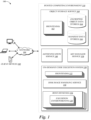
- FIG. 1 is a block diagram of an illustrative operating environment 100 in which client devices 102 may interact with a hosted computing environment 110 via a network 104.
- client devices 102 are shown in communication with the hosted computing environment 110, including a desktop computer, laptop, and a mobile phone.
- the client devices 102 can be any computing device such as a desktop, laptop or tablet computer, personal computer, wearable computer, server, personal digital assistant (PDA), hybrid PDA/mobile phone, mobile phone, electronic book reader, set-top box, voice command device, camera, digital media player, and the like.
- PDA personal digital assistant
- the hosted computing environment 110 may provide the client devices 102 with one or more user interfaces, command-line interfaces (CLIs), application programing interfaces (APIs), and/or other programmatic interfaces for utilizing services provided by the hosted computing environment 110, including an on-demand code execution system 130, an authentication service 140, a secrets manager service 150, and an object storage service 160.
- CLIs command-line interfaces
- APIs application programing interfaces
- other programmatic interfaces for utilizing services provided by the hosted computing environment 110, including an on-demand code execution system 130, an authentication service 140, a secrets manager service 150, and an object storage service 160.
- the client devices 102 and hosted computing environment 110 may communicate via a network 104, which may include any wired network, wireless network, or combination thereof.
- the network 104 may be a personal area network, local area network, wide area network, over-the-air broadcast network (e.g., for radio or television), cable network, satellite network, cellular telephone network, or combination thereof.
- the network 104 may be a publicly accessible network of linked networks, possibly operated by various distinct parties, such as the Internet.
- the network 104 may be a private or semi-private network, such as a corporate or university intranet.
- the network 104 may include one or more wireless networks, such as a Global System for Mobile Communications (GSM) network, a Code Division Multiple Access (CDMA) network, a Long Term Evolution (LTE) network, or any other type of wireless network.
- GSM Global System for Mobile Communications
- CDMA Code Division Multiple Access
- LTE Long Term Evolution
- the network 104 can use protocols and components for communicating via the Internet or any of the other aforementioned types of networks.
- the protocols used by the network 104 may include Hypertext Transfer Protocol (HTTP), HTTP Secure (HTTPS), Message Queue Telemetry Transport (MQTT), Constrained Application Protocol (CoAP), and the like. Protocols and components for communicating via the Internet or any of the other aforementioned types of communication networks are well known to those skilled in the art and, thus, are not described in more detail herein.
- the hosted computing environment 110 is depicted in FIG. 1 as operating in a distributed computing environment including several computer systems that are interconnected using one or more computer networks (not shown in FIG. 1 ), which systems operate to provide the on-demand code execution system 130, authentication service 140, secrets manager service 150, and object storage service 160.
- the environment 110 includes a number of rapidly provisioned and released computing resources configured to provide the on-demand code execution system 130, authentication service 140, secrets manager service 150, and object storage service 160.
- the hosted computing environment 110 may also be referred to as a "cloud computing environment.”
- Each of the on-demand code execution system 130, authentication service 140, secrets manager service 150, and object storage service 160 could also operate within a computing environment having a fewer or greater number of devices than are illustrated in FIG. 1 .
- the depiction of the on-demand code execution system 130, authentication service 140, secrets manager service 150, and object storage service 160 in FIG. 1 should be taken as illustrative and not limiting to the present disclosure.
- the elements of the environment 110 or various constituents thereof could implement various Web services components and/or peer to peer network configurations to implement at least a portion of the processes described herein.
- two or more of the on-demand code execution system 130, authentication service 140, secrets manager service 150, and object storage service 160 may be combined into a single service.
- Each of the on-demand code execution system 130, authentication service 140, secrets manager service 150, and object storage service 160 may be implemented directly in hardware or software executed by hardware devices and may, for instance, include one or more physical or virtual servers implemented on physical computer hardware configured to execute computer executable instructions for performing various features that will be described herein.
- the one or more servers may be geographically dispersed or geographically co-located, for instance, in one or more data centers.
- the object storage service 160 can operate to enable clients to read, write, modify, and delete data objects, each of which represents a set of data associated with an identifier (an "object identifier" or "resource identifier") that can be interacted with as an individual resource.
- an object may represent a single file submitted by a client device 102 (though the object storage service 160 may or may not store such an object as a single file).
- This object-level interaction can be contrasted with other types of storage services, such as virtualized disk storage (e.g., block-based storage services providing data manipulation at the level of individual blocks) or database storage services providing data manipulation at the level of tables (or parts thereof) or the like.
- the object storage service 160 illustratively includes one or more frontends 162, which provide an interface (a command-line interface (CLIs), application programing interface (APIs), or other programmatic interface) through which client devices 102 can interface with the service 160 to configure the service 160 on their behalf and to perform I/O operations on the service 160.
- a client device 102 may interact with a frontend 162 to create a collection of data objects on the service 160 (e.g., a "bucket" of objects) and to configure permissions for that collection.
- Client devices 102 may thereafter create, read, update, or delete objects within the collection based on the interfaces of the frontends 162.
- the frontend 162 provides a REST-compliant HTTP interface supporting a variety of request methods, each of which corresponds to a requested I/O operation on the service 160.
- request methods may include:
- the service 160 may provide a POST operation similar to a PUT operation but associated with a different upload mechanism (e.g., a browser-based HTML upload), or a HEAD operation enabling retrieval of metadata for an object without retrieving the object itself.
- the service 160 may enable operations that combine one or more of the above operations, or combining an operation with a native data manipulation.
- the service 160 may provide a COPY operation enabling copying of an object stored on the service 160 to another object, which operation combines a GET operation with a PUT operation.
- the service 160 may provide a SELECT operation enabling specification of an SQL query to be applied to an object prior to returning the contents of that object, which combines an application of an SQL query to a data object (a native data manipulation) with a GET operation.
- the service 160 may provide a "byte range" GET, which enables a GET operation on only a portion of a data object.
- the operation requested by a client device 102 on the service 160 may be transmitted to the service via an HTTP request, which itself may include an HTTP method.
- the HTTP method specified within the request may match the operation requested at the service 160.
- the HTTP method of a request may not match the operation requested at the service 160.
- a request may utilize an HTTP POST method to transmit a request to implement a SELECT operation at the service 160.
- frontends 162 may be configured to obtain a call to a request method, and apply that request method to input data for the method.
- a frontend 162 can respond to a request to PUT input data into the service 160 as an object by storing that input data as the object on the service 160.
- Objects may be stored, for example, on object data stores, which correspond to any persistent or substantially persistent storage (including hard disk drives (HDDs), solid state drives (SSDs), network accessible storage (NAS), storage area networks (SANs), non-volatile random access memory (NVRAM), or any of a variety of storage devices known in the art).
- the frontend 162 can respond to a request to GET an object from the service 160 by retrieving the object from the stores (the object representing input data to the GET resource request), and returning the object to a requesting client device 102.
- the service 160 may include one or more encrypted object data store 164 and one or more manifest data stores 166.
- Each of the data stores 164, 166 may for example represent logical portions of overall object data stores of the service 160. While only data stores 164, 166 are shown in FIG. 1 , the service 160 may include other logical data stores.
- the encrypted object data stores 164 of FIG. 1 are configured to store ciphertext corresponding to convergently-encrypted data sets.
- These ciphertexts may represent, for example, block-based ciphertexts generated by dividing a data set into fixed-size blocks of plaintext and convergently encrypted each such block.
- the block-based ciphertexts may be generated by generating a cryptographic hash of each fixed-size block, and then encrypting the block using a block cipher or stream cipher while using the hash as the cryptographic key.
- the cryptographic hash may be generated according to one of a number of known cryptographic hash functions, such as an algorithm in the Secure Hash Algorithm ("SHA") family, including the SHA-2 set (e.g., SHA-2 256 bit) and the SHA-3 set, and algorithms in the BLAKE family (e.g., BLAKE2 or BLAKE3), etc.
- SHA Secure Hash Algorithm
- BLAKE BLAKE2 or BLAKE3
- a salt may be added to the plaintext of the block prior to generating the hash.
- the block or stream cipher may be one of a number of known block or stream cipher algorithms, such as Advanced Encryption Standard (AES) or the ChaCha stream cipher (e.g., ChaCha20).
- AES Advanced Encryption Standard
- ChaCha20 ChaCha20
- the block cipher may be AES in counter mode ("AES-CTR") or in Galois/Counter Mode (GCM), known as “AES-GCM.”
- AES-CTR AES in counter mode
- GCM Galois/Counter Mode
- the block cipher may in some cases be modified (if needed) to ensure deterministic creation of ciphertext.
- the GCM algorithm typically includes selection of a random initial counter value
- embodiments of the present disclosure may set that value to zero. Such lack of randomness is not expected to reduce security of the algorithm, given that the key used to encrypt each different block is expected to be different, and thus issues of key-reuse for different plaintext do not arise.
- block cipher is intended to refer to a cipher that encrypts data according to fixed-size groups of bits, which fixed-size groups of bits are defined internally during a given implementation of the block cipher ("cipher-internal blocks").
- cipher-internal blocks a size of such cipher-internal blocks may differ from the fixed-size blocks of plaintext that are encrypted using the block cipher.
- the stores 164 may store ciphertexts of 512 KB
- the block cipher (as applied to each 512 KB-sized portion) may encrypt that portion in cipher-internal blocks of 128 bits, 192 bits, 256 bits, 512 bits, etc., during implementation of the block cipher.
- block is applied herein both to portions of a data set to be encrypted and to cipher-internal blocks (as both are a fixed-length group of bits), this should not be construed to imply that these two differing types of block are of the same size.
- blocks that are encrypted using a block cipher that is, the entire data portion encrypted according to a given application of the block cipher
- the cipher-internal blocks used during implementation of the block cipher that is, the internal division of a data set being encrypted during the application of the block cipher).
- block ciphers Because internal implementations of block ciphers are known in the art, and for avoidance of doubt, reference to the plain term "block” (e.g., without adjectives such as "cipher-internal") as used herein and unless otherwise stated to the contrary, will generally refer to a portion of data being encrypted according to an independent application of an encryption algorithm (e.g., a 512 KB block of a disk image).
- an encryption algorithm e.g., a 512 KB block of a disk image
- ciphertexts are identified within the store 164 according to a MAC of the ciphertext.
- the stores 164 may represent common storage, and each identifier of a ciphertext may be unique within the stores 164 among all ciphertexts within the stores164.
- the MAC may be generated according to any of a number of known MAC functions, including the Poly1305 MAC function, hash-based message authentication codes (HMACs) generated according to the cryptographic hash functions noted above, and Galois message authentication codes (GMAC) generated during implementation of AES-GCM encryption of the plaintext. The same cryptographic key used to encrypt plaintext may be used to generate the MAC from the ciphertext.
- ciphertexts are identified within the store 164 according to another identifier, such as a hash value of the ciphertext (e.g., as a result of applying a cryptographic hash algorithm to the ciphertext).
- the service 160 further includes a manifest data store 166 configured to store manifests, each corresponding to a data set stored on the service 160.
- a manifest may store a list of blocks that make up the data set (e.g., using block identifiers, which may be a ciphertext's hash value, MAC, etc.), and corresponding keys used to encrypt each block.
- the manifest for a disk image may identify a set of objects within the encrypted object data stores 164 and, for each object, a key used to encrypt that object.
- the on-demand code execution system 130 can enable users to submit data sets to be provisioned into execution environments 138 to facilitate execution of code.
- the data sets can include, by way of non-limiting example, one or more of the code, an operating system, runtimes, libraries, utilities, and the like.
- the data set may be a disk image to be provisioned as a disk drive of a virtual machine or container.
- data sets of different users may include substantial overlap, such as by including the same operating system, library, runtime, etc.
- the system 130 includes a disk image handling service 134.
- FIG. 2 depicts a general architecture of a computing system (a disk image handling server 200) implementing the disk image handing service 134 of FIG. 1 .
- the general architecture of the server 200 depicted in FIG. 2 includes an arrangement of computer hardware and software that may be used to implement aspects of the present disclosure. The hardware may be implemented on physical electronic devices, as discussed in greater detail below.
- the server 200 may include many more (or fewer) elements than those shown in FIG. 2 . It is not necessary, however, that all of these generally conventional elements be shown in order to provide an enabling disclosure. Additionally, the general architecture illustrated in FIG. 2 may be used to implement one or more of the other components illustrated in FIG. 2 .
- the primary memory 280 and/or secondary memory 298 may contain computer program instructions (grouped as units in some embodiments) that the processing unit 290 executes in order to implement one or more aspects of the present disclosure. These program instructions are shown in FIG. 2 as included within the primary memory 280, but may additionally or alternatively be stored within secondary memory 298.
- the primary memory 280 and secondary memory 298 correspond to one or more tiers of memory devices, including (but not limited to) RAM, 3D XPOINT memory, flash memory, magnetic storage, and the like.
- the primary memory 280 is assumed for the purposes of description to represent a main working memory of the server 200, with a higher speed but lower total capacity than secondary memory 298.
- the primary memory 280 may store an operating system 284 that provides computer program instructions for use by the processing unit 290 in the general administration and operation of the server 200.
- the memory 280 may further include computer program instructions and other information for implementing aspects of the present disclosure.
- the memory 280 includes a user interface unit 282 that generates user interfaces (and/or instructions therefor) for display upon a computing device, e.g., via a navigation and/or browsing interface such as a browser or application installed on the computing device.
- the memory 280 may include a deterministic file system generating unit 286, a cryptography unit 288, and an object storage interface unit 289, each of which represent code executable to implement functions of the disk image handling service 134. More specifically, the deterministic file system generation unit 286 represents code to generate a deterministic file system from a given disk image.
- some disk images may include multiple hierarchical layers, with higher-level layers taking precedence over lower-level layers. Use of such layers can increase the total among of data stored in an image, since layers may contain redundant data in the form of data of a lower-level that is later overwritten by a high-level layer.
- the disk image handling server 200 may utilize the unit 286 to convert a multi-layer image into a "flat" (e.g., non-layered) disk image, such as an image of an ext4 file system commonly used within Linux systems.
- a "flat" (e.g., non-layered) disk image such as an image of an ext4 file system commonly used within Linux systems.
- the unit 286 can be configured to conduct such conversion deterministically, without respect to dynamic data (such as timestamps) that may otherwise alter creation of a file system from a layered image format. By storing these converted disk images, rather than layered disk images, the unit 286 can reduce data redundancy and increase provisioning speed of the system 130.
- the memory 280 further includes a cryptography unit 288 configured to conduct cryptographic operations in accordance with the present disclosure, including one or more of division of a data set into fixed-size blocks, creation of a cryptographic key from plaintext of a block (e.g., as a hash of the plaintext, potentially with additional salt values), encryption of the block, and generation of a MAC or hash for the block.
- the server 200 may include specialized hardware to conduct cryptographic operations.
- the processing unit 290 may include a portion of application-specific hardware that rapidly conducts a given operation, or the server 200 may include a second processing unit (not shown in FIG. 2 ) to conduct such an operation.
- the unit 288 may include code to utilize that specialized hardware in conducting cryptographic operations.
- the memory 280 further includes an object storage interface unit 289 configured to interface with the object storage service 160 in accordance with embodiments of the present disclosure.
- the unit 289 may be executable to determine whether ciphertext is already stored within the service 160, to submit not-yet-stored ciphertext for storage, to generate manifests for data sets stored as such ciphertext, and to store such manifests on the service 160.
- the server 200 can implement aspects of the present disclosure.
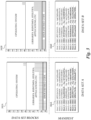
- the bits of each data set are illustrated as elements 302A and 302B. These elements may be representative, for example, of a bit map of a file system included within a disk image.
- the elements of FIG. 3 are for purposes of clarity greatly simplified, and such a bit map would in practice likely be significantly more complex than the depictions of FIG. 3 .
- shared bits between the two data sets are shown without shading, while differing bits are shown with shading. Accordingly, in FIG. 3 , both data sets share a majority of bits of their operating systems and supporting data, but include some variations among those portions of the data set.
- the user-defined code in FIG. 3 is unique to each data set and therefore includes no shared bits.
- the bits of each data set are further divided in FIG.
- blocks are generally intended to refer to a fixed-length portion of a data set to be encrypted according to an independent application of an encryption algorithm (e.g., separately from the encryption of other blocks, such that the ciphertext for a given block is independent of the ciphertext of other blocks).
- These blocks may or may not correspond to operating-system-level blocks (e.g., fixed-length portions of a disk that an operating system reads or writes as a single unit). Blocks may additionally or alternatively be referred to as "chunks,” “segments,” “portions,” etc.
- each block may correspond to a 512 kilobyte portion of a data set.
- the two data sets are identical with respect to blocks 0-3, 5, and 6, but differ with respect to blocks 4 and 7-9. While both data sets of FIG. 3 include the same number of blocks, in practice data sets may include differing numbers of blocks.
- the hosted environment 110 e.g., the disk image handling service 134) can be configured to divide the data sets into the blocks, encrypt each block according to a key derived from the plaintext of the block (potentially with additional information, such as a salt) to generate corresponding ciphertext of the block, and generate a MAC or hash for the block. Thereafter, the environment 110 can store the ciphertexts of each block, as identified within the MAC or hash for the block.
- a key derived from the plaintext of the block potentially with additional information, such as a salt
- a device with access to the manifest may retrieve and decrypt the respective data sets. For example, a device may progressively retrieve each block using the MAC identifier of the manifest, and then decrypt the block according to the key to result in plaintext of the block. The plaintexts of each block can then be combined to represent the data set. In some instances, the device may further verify that the ciphertexts have not been modified, by comparing the ciphertext to the MAC for that ciphertext.
- the manifest for each data set may be encrypted, such as by using a user-specific key. Accordingly, access to each data set is restricted to those that have access to the corresponding key for the manifest. Notably, this access restriction occurs despite the sharing of blocks between manifests, as a user with a given manifest cannot determine what other manifests may reference a given block. Thus, deduplication between blocks is achieved while ensuring security of each individual data set.
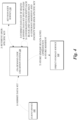
- FIG. 4 illustrative interactions will be described for submission, deduplication, and secure storage of a data set to a hosted computing environment 110 in accordance with embodiments of the present disclosure. More specifically, the interactions of FIG. 4 depict submission of a disk image to the on-demand code execution system 130, such as a disk image to be provisioned to an execution environment prior to execution of code within the disk image.
- the on-demand code execution system 130 such as a disk image to be provisioned to an execution environment prior to execution of code within the disk image.
- a client device 102 submits a data set to the on-demand code execution system 130.
- the data set may be submitted in connection with creation of a task on the system 130, such that the task can later be triggered to cause the system 130 to provision an environment with the data set and execute code within the environment.
- the data set may have significant overlap with data sets of other tasks (e.g., of other users or even the same user). It is therefore to the benefit of the system 130 to deduplicate the data set such that overall storage resources used to store the data set are reduced. Moreover, it is to the benefit of the system 130 to ensure security of the data set.
- the system 130 can convergently encrypt the data set according to embodiments of the present disclosure, and generate a manifest for the data set that allows the data set's re-creation at a later time (e.g., to execute the task).
- the system 130 obtains from the key manager service 150 a user-specific key to be used to store the data set.
- the system 130 may illustratively use authentication data (e.g., an authentication token) provided by the client device 102 to enable the system 130 to authenticate with the key manager service 150, such that a user-specific key can be obtained.
- the key manager service 150 may be configured to receive a request to create an encryption key associated with the user, and may return the key to the system 130.
- the created key may itself be encrypted using yet another key, which may be referred to as a "master key.”
- the master key may be retained by a user and used to "unlock" other keys, such that the master key need not be used outside of the key manager service 150.
- the key manager service 150 may return, at (2), ciphertext of the user-specific key.
- This ciphertext may illustratively be stored along-side data encrypted with the user-specific key (e.g., a manifest), such that a device can later pass the ciphertext of the user-specific key to the key manager service 150, along with the master key, to retrieve the plaintext of the user-specific key. In this manner, the security of the user-specific key and the master key can be ensured.
- the system 130 formats the data set for later storage, if required.
- the system 130 may convert the layered file system into a non-layered filesystem suitable for provisioning on a virtualized execution environment, such as a virtual machine instance or container.
- conversion may occur in a deterministic manner, such any future repetition of interaction (3) with respect to the same data set results in the same converted data set.
- the system 130 divides the data set into fixed-size blocks, such as 512 KB blocks.
- the system 130 then, at (5), convergently encrypts the plaintext of each block.
- the system 130 generates an encryption key for each block based on the plaintext of the block.
- Each key may represent a hash of the plaintext of a corresponding block, such as a SHA or BLAKE hash.
- each key may reflect processing of both the plaintext of a corresponding block and one or more salt values selected for the block according to a desired maximum replication level of the block on the system 130. Selection of such salts is described in more detail below with respect to FIG. 7 .
- the system 130 then encrypts each block with its corresponding key, to result in ciphertext of the block.
- the system 130 may encrypt each block using AES, potentially AES-CTR, AES-GCM, or ChaCha20.
- the algorithm may be modified to ensure that it proceeds deterministically (e.g., without random variance between implementations), such as by initializing seed values (e.g., initialization vectors, or "IVs") to a known fixed value, like zero.
- initializing seed values e.g., initialization vectors, or "IVs”
- the system 130 generates an identifier for each block.
- this idnetiifer may be a MAC, such as an HMAC (e.g., using the key for the block and an appropriate hashing algorithm, including those noted above) or a GMAC (e.g., generated during encryption of the plaintext using GCM of an appropriate cipher), a hash value of the ciphertext, or other unique identifier.
- a MAC such as an HMAC (e.g., using the key for the block and an appropriate hashing algorithm, including those noted above) or a GMAC (e.g., generated during encryption of the plaintext using GCM of an appropriate cipher), a hash value of the ciphertext, or other unique identifier.
- the system 130 generates a manifest for the data set, including a listing of block-level ciphertexts (e.g., using identifiers of those ciphertexts, such as their corresponding generated MACs or hash values) and the respective keys used to encrypt the plaintexts of the blocks into the block-level ciphertexts.
- Example manifests are shown above with respect to FIG. 3 .
- the system 130 further encrypts the manifest with the user-specific key, ensuring that only authorized parties can access the plaintext of the manifest.
- the system 130 stores unique block-level ciphertexts on the object storage service 160.
- the service 160 may provide an interface by which the system 130 can query whether a given block-level ciphertext is currently stored on the service 160, such as by using the MAC or hash of the ciphertext.
- the service 160 may allow a HEAD operation that provides metadata of an object when stored on the system, or "null" when such an object is not stored.
- the system 130 can store the ciphertext in the service 160. Otherwise, when a ciphertext is already stored, the system 130 can discard such blocks, avoiding use of storage resources on the service 160.
- the service 160 may disallow other operations, such as a listing of all objects stored, to increase security of the system.
- the system 130 stores the manifest on the service 160, thus ensuring that the data set can later be retrieved (in the form of block-level ciphertexts) and decrypted to result in plaintext of the data set. Accordingly, a data set can be efficiently stored on the service 160 in an encrypted manner while providing efficient deduplication.
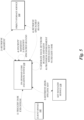
- FIG. 5 illustrative interactions will be described for utilizing a manifest created in accordance with embodiments of the present disclosure to recreate a data set stored as a set of encrypted blocks on the hosted computing environment 110 in accordance with embodiments of the present disclosure. More specifically, the interactions of FIG. 5 depict re-creation of a disk image stored on the hosted computing environment 110 and use of the disk image by the on-demand code execution system 130 to facilitate execution of a task.
- the interactions begin at (1), where a client device 102 triggers execution of a task on the system 130. While a client-device initiated trigger is shown in FIG. 1 , task triggering may occur via a variety of mechanisms, such as being initiated by a different computing device, being initiated by the system 130 in response to satisfaction of a trigger condition, etc.
- the triggered task is associated with a disk image containing data used during execution of code of the task.
- the system 130 may illustratively store metadata regarding the task that identifies that disk image and, for example, a manifest for the disk image and a key with which the manifest is encrypted. Accordingly, a (2) and (3), the system 130 retrieves the manifest and the user-specific key from the object storage service 160 and the key manager service 150, respectively. Thereafter, at (4), the system 130 decrypts the manifest using the user-specific key, to result in plaintext that identifies i) a set of block-level ciphertexts and ii) a key with which each block-level ciphertext was encrypted.
- the system 130 identifies any block-level ciphertexts, as identified in the manifest, that are not yet cached at the system 130, and retrieves those uncached blocks at (6).
- individual blocks of different data sets used by the system 130 may overlap. For that reason, and due to use of convergent encryption as described herein, it is also possible that individual block-level ciphertexts are shared among different data sets.
- the system 130 e.g., an individual host device within the system 130 that is operating to execute the present task
- the system 130 has recently executed another task, it is therefore possible that the system 130 has already obtained one or more of the block-level ciphertexts identified in the manifest for the present task.
- the system 130 need only retrieve uncached blocks, reducing the time and computing resources needed to obtain all blocks within the manifest.
- the system 130 generates the data set (e.g., the disk image) for the task using the manifest and the block-level ciphertexts. More specifically, the system 130 utilizes the block-level keys of the manifest to decrypt each block-level ciphertext, to result in plaintext of each block. These plaintexts can then be combined to reconstitute the data set.
- the data set e.g., the disk image
- the system 130 utilizes the block-level keys of the manifest to decrypt each block-level ciphertext, to result in plaintext of each block. These plaintexts can then be combined to reconstitute the data set.
- the system 130 provisions a virtualized execution environment, such as a virtual machine instance or container, with access to the data set. For example, the system 130 may "mount" the data set as a filesystem of the execution environment. The system 130 then, at (9), executes the task within the environment. Accordingly, via the interactions of FIG. 5 , the system 130 can efficiently execute tasks using data sets that are securely stored on the service 160, in a manner that enables efficient reuse of blocks between those data sets and thus reduces resource usage of the system 130.
- a virtualized execution environment such as a virtual machine instance or container
- routine 600 will be described for secure deduplicated storage of encrypted data.
- the routine 600 may be implemented, for example, by the on-demand code execution system 130, such as by the disk image handling service 134.
- the routine 600 begins at block 602, where the system 130 obtains a request to store a data set.
- the data set may represent, for example, a disk image to be provisioned to a virtualized environment of the system 130 to facilitate on-demand execution of user-specified code contained within the disk image.
- the system divides the data set into fixed-length plaintext block objects, such as 512 KB sections.
- object refers to a group or collection of data, generally without regard to how that group or collection is stored (e.g., in memory as a data structure, on disk as a file, in a database as an entry, etc.).
- the routine 600 enters loop 610, where blocks 612-616 occur for each plaintext block object created at block 604. While described as a loop, implementation of blocks 612-616 may be independent, and thus multiple iterations of loop 610 might occur in parallel. More specifically, at block 612, the system 130 selects a key for the plaintext block object, based at least partly on a deterministic analysis of the plaintext block object. For example, the system 130 may pass the plaintext of the block object through a hashing function, such as the cryptographic hashing functions noted above (e.g., a function within the SHA family, the BLAKE family, etc.), to result in a hash value used as the key. As discussed in more detail below with respect to FIG.
- a hashing function such as the cryptographic hashing functions noted above (e.g., a function within the SHA family, the BLAKE family, etc.), to result in a hash value used as the key.
- the system 130 may in some instances add a salt value to the plaintext prior to hashing, which salt may be selected according to desired deduplication properties of the resultant data (e.g., according to a user or group of users on behalf of which the resultant data is stored, according to a time of encryption, etc.).
- routine 600 then ends at block 622.
- other parts of the manifest such as a listing of block-level ciphertexts
- the routine 600 then ends at block 622.
- deduplication may be controlled according to time of a request to store the data set, enabling deduplication within a time window but not across time windows.
- time-differentiation of deduplication can be especially beneficial for some processes, such as garbage collection, which may otherwise incur race conditions when attempting to function (e.g., because a garbage collection process might be required to ensure that no user is using a stored data set, but compete in a race against users currently attempting to store the data set).
- salt values selected according to the above-noted techniques may be purely deterministic.
- salt values may be selected probabilistically, such as by selecting between n potential values for the salt in a probabilistic manner (e.g., with probabilities varying according to attributes that contribute to the salt).
- a time-based salt value may be selected based on a sliding probability scale, with the particular probability of a given salt being selected shifting along the scale over time.
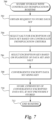
- routine 700 proceeds to block 706, where an encryption key is selected according to the plaintext of the data set and the salt.
- the salt may be appended or prepended to the plaintext, and the resulting aggregate data may be passed through a hash function (such as the cryptographic hash functions noted above) to result in a hash value used as a key for encryption.
- the system 130 convergently encrypts the plaintext block object using the selected key, to result in an encrypted ciphertext object.
- the system 130 may encrypt the plaintext block object using a block cipher, such as AES (potentially in CTR mode or GCM), or a stream cipher, such as ChaCha (e.g., ChaCha20).
- the system 130 stores the ciphertext of the encrypted data set, if that data set is not previously stored. For example, the system 130 may generate a MAC for the object using the ciphertext and the key (e.g., a Poly1305 MAC, GMAC, HMAC, etc.), and query a data store to determine whether an object with the MAC is already stored. Similarly, the system 130 may generate a hash value for the object by passing the ciphertext through a hash algorithm, and query the data store to determine whether an object with the hash value is already stored. If not, the system 130 may store the ciphertext. In some instances, the system 130 may attempt to store all ciphertext objects, and deduplication may occur on a corresponding storage system.
- the key e.g., a Poly1305 MAC, GMAC, HMAC, etc.
- the system 130 may generate a hash value for the object by passing the ciphertext through a hash algorithm, and query the data store to determine whether an object with the has
- the storage system may accept uploads of all ciphertext objects, but store only unique objects.
- the storage system may accept uploads of all ciphertext objects and later deduplicate those objects if duplicate copies exist on the system. In each instance, deduplication can be achieved on the storage system, thus reducing resource use of the system.
- the routine 700 then ends at block 712.
- routines 600 and 700 may be used independently or in conjunction.
- the routine 600 may be used to provide purely convergent encryption of blocks of a data set, or may modify convergent encryption to utilize salt values as discussed in the routine 700.
- the routine 700 may be used to encrypt data sets of various different sizes or properties, or may be used to encrypt blocks of a larger data set.
- the routines 600 and 700 may be utilized by other computing devices to store a variety of different types of data sets. In some embodiments, the routines 600 and 700 may be modified to include additional actions appropriate to a given data set.
- routine 600 or the routine 700 may be modified to include a formatting of the layered disk image into a non-layered image, such as a deterministically generated ext4 filesystem.
- a non-layered image such as a deterministically generated ext4 filesystem.
- All of the methods and processes described above may be embodied in, and fully automated via, software code modules executed by one or more computers or processors.
- the code modules may be stored in any type of non-transitory computer-readable medium or other computer storage device. Some or all of the methods may alternatively be embodied in specialized computer hardware.
- Disjunctive language such as the phrase "at least one of X, Y or Z," unless specifically stated otherwise, is otherwise understood with the context as used in general to present that an item, term, etc., may be either X, Y or Z, or any combination thereof (e.g., X, Y and/or Z). Thus, such disjunctive language is not generally intended to, and should not, imply that certain embodiments require at least one of X, at least one of Y or at least one of Z to each be present.
- a device configured to are intended to include one or more recited devices. Such one or more recited devices can also be collectively configured to carry out the stated recitations.
- a processor configured to carry out recitations A, B and C can include a first processor configured to carry out recitation A working in conjunction with a second processor configured to carry out recitations B and C.
Landscapes
- Engineering & Computer Science (AREA)
- Computer Security & Cryptography (AREA)
- Computer Networks & Wireless Communication (AREA)
- Signal Processing (AREA)
- Theoretical Computer Science (AREA)
- Power Engineering (AREA)
- General Engineering & Computer Science (AREA)
- Physics & Mathematics (AREA)
- General Physics & Mathematics (AREA)
- Databases & Information Systems (AREA)
- Bioethics (AREA)
- General Health & Medical Sciences (AREA)
- Computer Hardware Design (AREA)
- Software Systems (AREA)
- Health & Medical Sciences (AREA)
- Data Mining & Analysis (AREA)
- Information Retrieval, Db Structures And Fs Structures Therefor (AREA)
Claims (15)
- Verfahren, umfassend die folgenden Schritte, die von einer gehosteten Rechenumgebung durchgeführt werden:Erhalten (602, 702), von einem Computergerät eines Benutzers, einer Anforderung zum Speichern eines Datensatzes auf einem Speichersystem;Aufteilen (604) des Datensatzes in einen Satz von Klartextobjekten fester Länge;Erzeugen (612, 614, 704-708) eines Satzes von Chiffretextobjekten auf Blockebene, die den Satz von Klartextobjekten fester Länge in verschlüsselter Form darstellen, wobei das Erzeugen des Satzes von Chiffretextobjekten auf Blockebene, für jedes Klartextobjekt fester Länge des Satzes von Klartextobjekten fester Länge, ein konvergentes Verschlüsseln des Klartextobjekts fester Länge mit einem Verschlüsselungscode, der zumindest teilweise basierend auf dem Klartextobjekt fester Länge abgeleitet wird, umfasst, was zu einem Chiffretextobjekt auf Blockebene führt, das das Klartextobjekt fester Länge darstellt;Speichern (616, 710), innerhalb des Speichersystems, derjenigen Chiffretextobjekte auf Blockebene des Satzes von Chiffretextobjekten auf Blockebene, die kein Duplikat eines Chiffretextobjekts auf Blockebene, das bereits innerhalb des Speichersystems gespeichert ist, sind;Erzeugen (620) eines Manifests für den Datensatz, wobei das Manifest den Satz von Chiffretextobjekten auf Blockebene, die gemeinsam den Datensatz darstellen, und, für jedes Chiffretextobjekte auf Blockebene des Satzes von Chiffretextobjekten auf Blockebene, den Verschlüsselungscode, mit dem das Chiffretextobjekte auf Blockebene verschlüsselt ist, identifiziert; undSpeichern (620) des Manifests innerhalb des Speichersystems.
- Verfahren nach Anspruch 1, ferner umfassend ein Verschlüsseln, unter Verwendung eines zusätzlichen Schlüssels, eines Teils des Manifests, der die Verschlüsselungscodes für jedes Chiffretextobjekt auf Blockebene des Satzes von Chiffretextobjekten auf Blockebene enthält.
- Verfahren nach Anspruch 1, ferner umfassend ein Erzeugen einer Kennung für jedes Chiffretextobjekte auf Blockebene des Satzes von Chiffretextobjekten auf Blockebene, wobei die Kennung für jedes Chiffretextobjekte auf Blockebene zumindest eines von einem Nachrichtenauthentifizierungscode (MAC - Message Authentication Code) des Chiffretextobjekts auf Blockebene oder einem Hash-Wert des Chiffretextobjekts auf Blockebene ist.
- Verfahren nach Anspruch 3, wobei der MAC des Chiffretextobjekts auf Blockebene basierend auf dem Chiffretextobjekt auf Blockebene und dem Verschlüsselungscode erzeugt wird, mit dem das Chiffretextobjekt auf Blockebene verschlüsselt wird.
- Verfahren nach Anspruch 3, wobei der MAC zumindest eines von einem Hash-basierten MAC (HMAC), einem Galois/Counter-Mode-MAC (GMAC) oder einem Poly1305-MAC ist.
- Verfahren nach Anspruch 3, ferner umfassend ein Ermitteln derjenigen Chiffretextobjekte auf Blockebene des Satzes von Chiffretextobjekten auf Blockebene, die kein Duplikat sind, durch Vergleichen des MAC jedes Chiffretextobjekts auf Blockebene des Satzes von Chiffretextobjekten auf Blockebene mit MACs von Chiffretextobjekten auf Blockebene, die bereits innerhalb des Speichersystems gespeichert sind.
- Verfahren nach Anspruch 1, wobei das konvergente Verschlüsseln des Klartextobjekts fester Länge ein Verschlüsseln des Klartextobjekts fester Länge unter Verwendung mindestens einer von AES-(Advanced Encryption Standard-)Verschlüsselung oder ChaCha-Verschlüsselung umfasst.
- Verfahren nach Anspruch 1, wobei das konvergente Verschlüsseln des Klartextobjekts fester Länge ein Verschlüsseln des Klartextobjekts fester Länge unter Verwendung mindestens eines von einem Counter Mode oder einem Galois/Counter Mode (GMC) eines Verschlüsselungsalgorithmus umfasst.
- Verfahren nach Anspruch 1, wobei das konvergente Verschlüsseln des Klartextobjekts fester Länge Folgendes umfasst:Hinzufügen eines Salt-Werts zu dem Klartextobjekt fester Länge, der aus einer begrenzten Anzahl von Permutationen ausgewählt ist, die einer gewünschten Redundanz des Klartextobjekts fester Länge auf dem Speichersystem entsprechen;Hashen des Klartextobjekts fester Länge und des Salt-Werts gemäß einem kryptographischen Hashing-Algorithmus, was zu einem Hash-Wert führt; undVerwenden des Hash-Werts als den Verschlüsselungscode, durch den das Klartextobjekt fester Länge konvergent verschlüsselt werden soll.
- Verfahren nach Anspruch 9, wobei der Salt-Wert gemäß mindestens einem von einer Anforderung seitens eines Benutzers zum Speichern des Datensatzes, einer Zeit der Anforderung zum Speichern des Datensatzes, einem Ort auf dem Speichersystem, an dem die Speicherung des Datensatzes angefordert wird, oder einem Zustand der gegenwärtigen Speicherung des Datensatzes auf dem Speichersystem ausgewählt wird.
- System, das eine gehostete Rechenumgebung implementiert, das System umfassend:einen Datenspeicher, der computerausführbare Anweisungen beinhaltet;ein Speichersystem (160); undeinen Prozessor, der so konfiguriert ist, dass er die computerausführbaren Anweisungen ausführt, wobei eine Ausführung der computerausführbaren Anweisungen das System veranlasst zum:Erhalten, von einem Computergerät eines Benutzers (102), einer Anforderung zum Speichern eines Datensatzes auf dem Speichersystem (160);Aufteilen des Datensatzes in einen Satz von Klartextobjekten fester Länge;Erzeugen eines Satzes von Chiffretextobjekten auf Blockebene, die den Satz von Klartextobjekten fester Länge in verschlüsselter Form darstellen, wobei das Erzeugen des Satzes von Chiffretextobjekten auf Blockebene, für jedes Klartextobjekt fester Länge des Satzes von Klartextobjekten fester Länge, ein konvergentes Verschlüsseln des Klartextobjekts fester Länge mit einem Verschlüsselungscode, der zumindest teilweise basierend auf dem Klartextobjekt fester Länge abgeleitet wird, umfasst, was zu einem Chiffretextobjekt auf Blockebene führt, das das Klartextobjekt fester Länge darstellt;Speichern, innerhalb des Speichersystems (160), derjenigen Chiffretextobjekte auf Blockebene des Satzes von Chiffretextobjekten auf Blockebene, die kein Duplikat eines Chiffretextobjekts auf Blockebene, das bereits innerhalb des Speichersystems (160) gespeichert ist, sind;Erzeugen eines Manifests für den Datensatz, wobei das Manifest den Satz von Chiffretextobjekten auf Blockebene, die gemeinsam den Datensatz darstellen, und, für jedes Chiffretextobjekte auf Blockebene des Satzes von Chiffretextobjekten auf Blockebene, den Verschlüsselungscode, mit dem das Chiffretextobjekte auf Blockebene verschlüsselt ist, identifiziert; undSpeichern des Manifests.
- System nach Anspruch 11, wobei das Speichersystem (160) kein Abfragen, ob das Speichersystem (160) mehrere Chiffretextobjekte auf Blockebene gespeichert hat, innerhalb einer einzigen Operation zulässt, und wobei die computerausführbaren Anweisungen das Computersystem ferner veranlassen, diejenigen Chiffretextobjekte auf Blockebene des Satzes, die kein Duplikat sind, durch Absenden, für jedes Chiffretextobjekt auf Blockebene des Satzes von Chiffretextobjekten auf Blockebene, einer Operation zu identifizieren, die abfragt, ob das Chiffretextobjekt auf Blockebene auf dem Speichersystem (160) gespeichert ist.
- System nach Anspruch 12, wobei die Operation, die abfragt, ob das Chiffretextobjekt auf Blockebene auf dem Speichersystem (160) gespeichert ist, das Chiffretextobjekt auf Blockebene durch mindestens eines von einem MAC des Chiffretextobjekts auf Blockebene oder einem Hash-Wert des Chiffretextobjekts auf Blockebene identifiziert.
- System nach Anspruch 11,
wobei, zum konvergenten Verschlüsseln des Klartextobjekts fester Länge, eine Ausführung der computerausführbaren Anweisungen das System veranlasst zum:Hinzufügen eines Salt-Werts zu dem Klartextobjekt fester Länge, der aus einer begrenzten Anzahl von Permutationen ausgewählt ist, die einer gewünschten Redundanz des Klartextobjekts fester Länge auf dem Speichersystem entsprechen;Hashen des Klartextobjekts fester Länge und des Salt-Werts gemäß einem kryptographischen Hashing-Algorithmus, was zu einem Hash-Wert führt; undVerwenden des Hash-Werts als den Verschlüsselungscode, durch den das Klartextobjekt fester Länge konvergent verschlüsselt werden soll. - Ein oder mehrere nichtflüchtige computerlesbare Medien, die computerausführbare Anweisungen umfassen, die, wenn sie von einem Computersystem ausgeführt werden, das Computersystem veranlassen zum:Erhalten, von einem Computergerät eines Benutzers, einer Anforderung zum Speichern eines Datensatzes auf einem Speichersystem;Aufteilen des Datensatzes in einen Satz von Klartextobjekten fester Länge;Erzeugen eines Satzes von Chiffretextobjekten auf Blockebene, die den Satz von Klartextobjekten fester Länge in verschlüsselter Form darstellen, wobei das Erzeugen des Satzes von Chiffretextobjekten auf Blockebene, für jedes Klartextobjekt fester Länge des Satzes von Klartextobjekten fester Länge, ein konvergentes Verschlüsseln des Klartextobjekts fester Länge mit einem Verschlüsselungscode, der zumindest teilweise basierend auf dem Klartextobjekt fester Länge abgeleitet wird, umfasst, was zu einem Chiffretextobjekt auf Blockebene führt, das das Klartextobjekt fester Länge darstellt;Speichern, innerhalb des Speichersystems, derjenigen Chiffretextobjekte auf Blockebene des Satzes von Chiffretextobjekten auf Blockebene, die kein Duplikat eines Chiffretextobjekts auf Blockebene, das bereits innerhalb des Speichersystems gespeichert ist, sind;Erzeugen eines Manifests für den Datensatz, wobei das Manifest den Satz von Chiffretextobjekten auf Blockebene, die gemeinsam den Datensatz darstellen, und, für jedes Chiffretextobjekte auf Blockebene des Satzes von Chiffretextobjekten auf Blockebene, den Verschlüsselungscode, mit dem das Chiffretextobjekte auf Blockebene verschlüsselt ist, identifiziert; undSpeichern des Manifests.
Applications Claiming Priority (3)
| Application Number | Priority Date | Filing Date | Title |
|---|---|---|---|
| US17/037,427 US11329803B2 (en) | 2020-09-29 | 2020-09-29 | Redundancy controls in convergent encryption using dynamic salt values |
| US17/037,369 US11582025B2 (en) | 2020-09-29 | 2020-09-29 | Efficient deduplication using block-based convergent encryption |
| PCT/US2021/052227 WO2022072283A1 (en) | 2020-09-29 | 2021-09-27 | Efficient deduplication using block-based convergent encryption |
Publications (2)
| Publication Number | Publication Date |
|---|---|
| EP4222630A1 EP4222630A1 (de) | 2023-08-09 |
| EP4222630B1 true EP4222630B1 (de) | 2024-12-25 |
Family
ID=80821772
Family Applications (1)
| Application Number | Title | Priority Date | Filing Date |
|---|---|---|---|
| EP21798872.4A Active EP4222630B1 (de) | 2020-09-29 | 2021-09-27 | Effiziente deduplizierung mittels blockbasierter konvergenter verschlüsselung |
Country Status (3)
| Country | Link |
|---|---|
| US (1) | US11582025B2 (de) |
| EP (1) | EP4222630B1 (de) |
| WO (1) | WO2022072283A1 (de) |
Families Citing this family (17)
| Publication number | Priority date | Publication date | Assignee | Title |
|---|---|---|---|---|
| JP6971917B2 (ja) * | 2018-06-11 | 2021-11-24 | 三菱電機株式会社 | 復号装置、暗号化装置及び暗号システム |
| US11582025B2 (en) | 2020-09-29 | 2023-02-14 | Amazon Technologies, Inc. | Efficient deduplication using block-based convergent encryption |
| US11917072B2 (en) * | 2020-12-03 | 2024-02-27 | International Business Machines Corporation | Implementing opportunistic authentication of encrypted data |
| US11940984B2 (en) | 2021-12-13 | 2024-03-26 | Docusign, Inc. | Audit records monitoring using a blockchain structure |
| US20230185940A1 (en) * | 2021-12-13 | 2023-06-15 | Docusign, Inc. | Batch processing of audit records |
| JP7759508B2 (ja) * | 2022-05-12 | 2025-10-23 | ブルーボヤント エルエルシー | 分析的観察を要約する装置、システム、および方法 |
| US20240028234A1 (en) * | 2022-07-20 | 2024-01-25 | Dell Products L.P. | Multi-fingerprint deduplication processing |
| US12238211B2 (en) * | 2022-09-13 | 2025-02-25 | Red Hat, Inc. | Performing deduplication based on encrypted storage blocks generated using a secure enclave |
| CN115442162A (zh) * | 2022-11-08 | 2022-12-06 | 四川公众项目咨询管理有限公司 | 一种基于收敛加密技术的云安全去重方法 |
| US12309256B2 (en) | 2022-11-16 | 2025-05-20 | Silicon Laboratries Inc. | Apparatus for cryptographic operations on information and associated methods |
| US12675584B2 (en) * | 2022-11-16 | 2026-07-07 | Silicon Laboratories Inc. | Apparatus for cryptographic operations on information and associated methods |
| US12537680B2 (en) * | 2022-11-18 | 2026-01-27 | Dropbox, Inc. | Secure caching of namespace keys |
| US12210506B2 (en) * | 2022-12-07 | 2025-01-28 | Bentley Systems, Incorporated | Serverless code service |
| EP4649418A4 (de) * | 2023-01-13 | 2026-07-29 | Entrust Corp | Zentralisierte compliance-verwaltungsplattform für sicherheitsobjekte |
| US12321792B2 (en) | 2023-01-17 | 2025-06-03 | Bentley Systems, Incorporated | Serverless property store |
| US12277097B2 (en) | 2023-07-20 | 2025-04-15 | International Business Machines Corporation | Using ciphertext to deduplicate data using wide-block encryption |
| US12395323B2 (en) * | 2023-08-21 | 2025-08-19 | Hewlett Packard Enterprise Development Lp | Encryption of parameters in configuration files |
Citations (1)
| Publication number | Priority date | Publication date | Assignee | Title |
|---|---|---|---|---|
| US9323556B2 (en) * | 2014-09-30 | 2016-04-26 | Amazon Technologies, Inc. | Programmatic event detection and message generation for requests to execute program code |
Family Cites Families (39)
| Publication number | Priority date | Publication date | Assignee | Title |
|---|---|---|---|---|
| EP0117281B1 (de) | 1982-12-03 | 1989-07-26 | International Business Machines Corporation | Fortschreibung von Datenverarbeitungsdateien |
| JPS60140470A (ja) | 1983-12-28 | 1985-07-25 | Hitachi Ltd | 画像情報処理装置 |
| DE3532481A1 (de) | 1985-09-12 | 1987-03-19 | Philips Patentverwaltung | Datenverarbeitungsanordnung |
| US4780816A (en) | 1986-05-16 | 1988-10-25 | The United States Of America As Represented By The Secretary Of The Army | Key-to-address transformations |
| US5218685A (en) | 1987-01-02 | 1993-06-08 | General Electric Company | System for write once read many optical storage devices to appear rewritable |
| CA2045799C (en) | 1990-07-11 | 1999-03-23 | Kenneth L. Thompson | File system with read/write and read only storage |
| US5586281A (en) | 1992-10-27 | 1996-12-17 | Sharp Kabushiki Kaisha | Data driven type information processing apparatus |
| JP3336073B2 (ja) | 1993-06-11 | 2002-10-21 | 三菱電機株式会社 | メモリ、データ書き込み方法、データ読み出し方法 |
| US5990810A (en) * | 1995-02-17 | 1999-11-23 | Williams; Ross Neil | Method for partitioning a block of data into subblocks and for storing and communcating such subblocks |
| EP0826181A4 (de) | 1995-04-11 | 2005-02-09 | Kinetech Inc | Identifizierung von daten in einem datenverarbeitungssystem |
| US5754844A (en) | 1995-12-14 | 1998-05-19 | Sun Microsystems, Inc. | Method and system for accessing chunks of data using matching of an access tab and hashing code to generate a suggested storage location |
| US5832263A (en) | 1996-03-15 | 1998-11-03 | Digidox, Inc. | System and method for in-place modification of information recorded in read-only storage using modifiable non-volatile storage associated with an agent |
| US5745900A (en) | 1996-08-09 | 1998-04-28 | Digital Equipment Corporation | Method for indexing duplicate database records using a full-record fingerprint |
| JPH1153235A (ja) | 1997-08-08 | 1999-02-26 | Toshiba Corp | ディスク記憶装置のデータ更新方法、ならびにディスク記憶制御システム |
| GB9720395D0 (en) | 1997-09-24 | 1997-11-26 | British Telecomm | Data processing system |
| US6807632B1 (en) * | 1999-01-21 | 2004-10-19 | Emc Corporation | Content addressable information encapsulation, representation, and transfer |
| US6128623A (en) | 1998-04-15 | 2000-10-03 | Inktomi Corporation | High performance object cache |
| US6122754A (en) | 1998-05-22 | 2000-09-19 | International Business Machines Corporation | Method and system for data recovery using a distributed and scalable data structure |
| CN1166134C (zh) | 1999-05-12 | 2004-09-08 | 华为技术有限公司 | 用于atm交换结构中的流水线式共享存储器读写方法 |
| US6976165B1 (en) * | 1999-09-07 | 2005-12-13 | Emc Corporation | System and method for secure storage, transfer and retrieval of content addressable information |
| US20010049826A1 (en) | 2000-01-19 | 2001-12-06 | Itzhak Wilf | Method of searching video channels by content |
| US7412462B2 (en) * | 2000-02-18 | 2008-08-12 | Burnside Acquisition, Llc | Data repository and method for promoting network storage of data |
| US7506034B2 (en) | 2000-03-03 | 2009-03-17 | Intel Corporation | Methods and apparatus for off loading content servers through direct file transfer from a storage center to an end-user |
| US7051054B1 (en) | 2000-05-30 | 2006-05-23 | Dphi Acquisitions, Inc. | Method and apparatus for emulating read/write file system on a write-once storage disk |
| GB2363217B (en) | 2000-06-06 | 2002-05-08 | Oracle Corp | Data file processing |
| US6912645B2 (en) * | 2001-07-19 | 2005-06-28 | Lucent Technologies Inc. | Method and apparatus for archival data storage |
| US8401185B1 (en) * | 2010-02-01 | 2013-03-19 | Symantec Corporation | Systems and methods for securely deduplicating data owned by multiple entities |
| US9547774B2 (en) | 2012-07-18 | 2017-01-17 | Nexenta Systems, Inc. | System and method for distributed deduplication of encrypted chunks |
| US9390101B1 (en) * | 2012-12-11 | 2016-07-12 | Veritas Technologies Llc | Social deduplication using trust networks |
| US11036392B2 (en) * | 2013-02-26 | 2021-06-15 | Pure Storage, Inc. | Determining when to use convergent encryption |
| US10313311B2 (en) * | 2014-08-22 | 2019-06-04 | Nec Corporation | Method for storing of data within a cloud storage and a cloud storage system |
| US10318762B1 (en) * | 2015-03-06 | 2019-06-11 | United Services Automobile Association (Usaa) | Third-party platform for tokenization and detokenization of network packet data |
| CN104917609B (zh) | 2015-05-19 | 2017-11-10 | 华中科技大学 | 一种基于用户感知的高效安全数据去重方法及系统 |
| US10042782B2 (en) * | 2015-06-02 | 2018-08-07 | ALTR Solutions, Inc. | Immutable datastore for low-latency reading and writing of large data sets |
| WO2019101324A1 (en) * | 2017-11-23 | 2019-05-31 | Huawei Technologies Co., Ltd. | System and method for storing encrypted data |
| IL277974B2 (en) * | 2018-05-28 | 2025-03-01 | Royal Bank Of Canada | System and method for outlining secure electronic transactions |
| US11218296B2 (en) * | 2019-02-09 | 2022-01-04 | Druva Inc. | Data de-duplication among untrusted entities |
| US11582025B2 (en) | 2020-09-29 | 2023-02-14 | Amazon Technologies, Inc. | Efficient deduplication using block-based convergent encryption |
| US11329803B2 (en) | 2020-09-29 | 2022-05-10 | Amazon Technologies, Inc. | Redundancy controls in convergent encryption using dynamic salt values |
-
2020
- 2020-09-29 US US17/037,369 patent/US11582025B2/en active Active
-
2021
- 2021-09-27 WO PCT/US2021/052227 patent/WO2022072283A1/en not_active Ceased
- 2021-09-27 EP EP21798872.4A patent/EP4222630B1/de active Active
Patent Citations (1)
| Publication number | Priority date | Publication date | Assignee | Title |
|---|---|---|---|---|
| US9323556B2 (en) * | 2014-09-30 | 2016-04-26 | Amazon Technologies, Inc. | Programmatic event detection and message generation for requests to execute program code |
Non-Patent Citations (1)
| Title |
|---|
| CHUN-I FAN ET AL: "Hybrid data deduplication in cloud environment", INFORMATION SECURITY AND INTELLIGENCE CONTROL (ISIC), 2012 INTERNATIONAL CONFERENCE ON, IEEE, 14 August 2012 (2012-08-14), pages 174 - 177, XP032325695, ISBN: 978-1-4673-2587-5, DOI: 10.1109/ISIC.2012.6449734 * |
Also Published As
| Publication number | Publication date |
|---|---|
| US11582025B2 (en) | 2023-02-14 |
| US20220103338A1 (en) | 2022-03-31 |
| WO2022072283A1 (en) | 2022-04-07 |
| EP4222630A1 (de) | 2023-08-09 |
Similar Documents
| Publication | Publication Date | Title |
|---|---|---|
| US11582025B2 (en) | Efficient deduplication using block-based convergent encryption | |
| US11329803B2 (en) | Redundancy controls in convergent encryption using dynamic salt values | |
| EP3866041B1 (de) | Sicherer dateiaustausch für gruppen | |
| CN104331408B (zh) | 分级内容可寻址存储系统中的块级客户端侧加密 | |
| US10873450B2 (en) | Cryptographic key generation for logically sharded data stores | |
| Li et al. | A hybrid cloud approach for secure authorized deduplication | |
| US8621240B1 (en) | User-specific hash authentication | |
| US11263181B1 (en) | Searchable and secure decentralized P2P filesystem | |
| US20220209945A1 (en) | Method and device for storing encrypted data | |
| US20130290733A1 (en) | Systems and methods for caching security information | |
| CN103780607B (zh) | 基于不同权限的重复数据删除的方法 | |
| US20130290734A1 (en) | Systems and methods for caching security information | |
| CA3065767C (en) | Cryptographic key generation for logically sharded data stores | |
| US12518037B2 (en) | Protected storage for decryption data | |
| WO2023216987A1 (zh) | 容器镜像构建方法及装置 | |
| US10268832B1 (en) | Streaming authenticated encryption | |
| US11595190B2 (en) | Encrypted data storage system | |
| US12120097B2 (en) | Authenticating key-value data pairs for protecting node related data | |
| US11675739B1 (en) | Distributed data storage using hierarchically arranged metadata | |
| Thota et al. | Split key management framework for Open Stack Swift object storage cloud | |
| Messmer | CryFS: Design and implementation of a provably secure encrypted cloud filesyste | |
| Jia et al. | Efficient Deduplication over Encrypted Data Under Flexible Access Control | |
| CN120692085A (zh) | 基于Intel SGX技术实现的加密跨云数据同步方法及系统 | |
| Keerthiga et al. | A Hybrid Cloud Approach for Secure Authorized Deduplication | |
| Cristea et al. | DIPLOMA PROJECT |
Legal Events
| Date | Code | Title | Description |
|---|---|---|---|
| STAA | Information on the status of an ep patent application or granted ep patent |
Free format text: STATUS: UNKNOWN |
|
| STAA | Information on the status of an ep patent application or granted ep patent |
Free format text: STATUS: THE INTERNATIONAL PUBLICATION HAS BEEN MADE |
|
| PUAI | Public reference made under article 153(3) epc to a published international application that has entered the european phase |
Free format text: ORIGINAL CODE: 0009012 |
|
| STAA | Information on the status of an ep patent application or granted ep patent |
Free format text: STATUS: REQUEST FOR EXAMINATION WAS MADE |
|
| 17P | Request for examination filed |
Effective date: 20230427 |
|
| AK | Designated contracting states |
Kind code of ref document: A1 Designated state(s): AL AT BE BG CH CY CZ DE DK EE ES FI FR GB GR HR HU IE IS IT LI LT LU LV MC MK MT NL NO PL PT RO RS SE SI SK SM TR |
|
| DAV | Request for validation of the european patent (deleted) | ||
| DAX | Request for extension of the european patent (deleted) | ||
| GRAP | Despatch of communication of intention to grant a patent |
Free format text: ORIGINAL CODE: EPIDOSNIGR1 |
|
| STAA | Information on the status of an ep patent application or granted ep patent |
Free format text: STATUS: GRANT OF PATENT IS INTENDED |
|
| INTG | Intention to grant announced |
Effective date: 20240724 |
|
| GRAS | Grant fee paid |
Free format text: ORIGINAL CODE: EPIDOSNIGR3 |
|
| GRAA | (expected) grant |
Free format text: ORIGINAL CODE: 0009210 |
|
| STAA | Information on the status of an ep patent application or granted ep patent |
Free format text: STATUS: THE PATENT HAS BEEN GRANTED |
|
| P01 | Opt-out of the competence of the unified patent court (upc) registered |
Free format text: CASE NUMBER: APP_60302/2024 Effective date: 20241108 |
|
| AK | Designated contracting states |
Kind code of ref document: B1 Designated state(s): AL AT BE BG CH CY CZ DE DK EE ES FI FR GB GR HR HU IE IS IT LI LT LU LV MC MK MT NL NO PL PT RO RS SE SI SK SM TR |
|
| REG | Reference to a national code |
Ref country code: GB Ref legal event code: FG4D |
|
| REG | Reference to a national code |
Ref country code: CH Ref legal event code: EP |
|
| REG | Reference to a national code |
Ref country code: DE Ref legal event code: R096 Ref document number: 602021023977 Country of ref document: DE |
|
| REG | Reference to a national code |
Ref country code: IE Ref legal event code: FG4D |
|
| REG | Reference to a national code |
Ref country code: LT Ref legal event code: MG9D |
|
| PG25 | Lapsed in a contracting state [announced via postgrant information from national office to epo] |
Ref country code: HR Free format text: LAPSE BECAUSE OF FAILURE TO SUBMIT A TRANSLATION OF THE DESCRIPTION OR TO PAY THE FEE WITHIN THE PRESCRIBED TIME-LIMIT Effective date: 20241225 |
|
| PG25 | Lapsed in a contracting state [announced via postgrant information from national office to epo] |
Ref country code: FI Free format text: LAPSE BECAUSE OF FAILURE TO SUBMIT A TRANSLATION OF THE DESCRIPTION OR TO PAY THE FEE WITHIN THE PRESCRIBED TIME-LIMIT Effective date: 20241225 |
|
| PG25 | Lapsed in a contracting state [announced via postgrant information from national office to epo] |
Ref country code: BG Free format text: LAPSE BECAUSE OF FAILURE TO SUBMIT A TRANSLATION OF THE DESCRIPTION OR TO PAY THE FEE WITHIN THE PRESCRIBED TIME-LIMIT Effective date: 20241225 |
|
| PG25 | Lapsed in a contracting state [announced via postgrant information from national office to epo] |
Ref country code: NO Free format text: LAPSE BECAUSE OF FAILURE TO SUBMIT A TRANSLATION OF THE DESCRIPTION OR TO PAY THE FEE WITHIN THE PRESCRIBED TIME-LIMIT Effective date: 20250325 |
|
| PG25 | Lapsed in a contracting state [announced via postgrant information from national office to epo] |
Ref country code: GR Free format text: LAPSE BECAUSE OF FAILURE TO SUBMIT A TRANSLATION OF THE DESCRIPTION OR TO PAY THE FEE WITHIN THE PRESCRIBED TIME-LIMIT Effective date: 20250326 Ref country code: LV Free format text: LAPSE BECAUSE OF FAILURE TO SUBMIT A TRANSLATION OF THE DESCRIPTION OR TO PAY THE FEE WITHIN THE PRESCRIBED TIME-LIMIT Effective date: 20241225 |
|
| PG25 | Lapsed in a contracting state [announced via postgrant information from national office to epo] |
Ref country code: RS Free format text: LAPSE BECAUSE OF FAILURE TO SUBMIT A TRANSLATION OF THE DESCRIPTION OR TO PAY THE FEE WITHIN THE PRESCRIBED TIME-LIMIT Effective date: 20250325 |
|
| REG | Reference to a national code |
Ref country code: NL Ref legal event code: MP Effective date: 20241225 |
|
| PG25 | Lapsed in a contracting state [announced via postgrant information from national office to epo] |
Ref country code: NL Free format text: LAPSE BECAUSE OF FAILURE TO SUBMIT A TRANSLATION OF THE DESCRIPTION OR TO PAY THE FEE WITHIN THE PRESCRIBED TIME-LIMIT Effective date: 20241225 |
|
| REG | Reference to a national code |
Ref country code: AT Ref legal event code: MK05 Ref document number: 1754795 Country of ref document: AT Kind code of ref document: T Effective date: 20241225 |
|
| PG25 | Lapsed in a contracting state [announced via postgrant information from national office to epo] |
Ref country code: SM Free format text: LAPSE BECAUSE OF FAILURE TO SUBMIT A TRANSLATION OF THE DESCRIPTION OR TO PAY THE FEE WITHIN THE PRESCRIBED TIME-LIMIT Effective date: 20241225 |
|
| PG25 | Lapsed in a contracting state [announced via postgrant information from national office to epo] |
Ref country code: PL Free format text: LAPSE BECAUSE OF FAILURE TO SUBMIT A TRANSLATION OF THE DESCRIPTION OR TO PAY THE FEE WITHIN THE PRESCRIBED TIME-LIMIT Effective date: 20241225 |
|
| PG25 | Lapsed in a contracting state [announced via postgrant information from national office to epo] |
Ref country code: ES Free format text: LAPSE BECAUSE OF FAILURE TO SUBMIT A TRANSLATION OF THE DESCRIPTION OR TO PAY THE FEE WITHIN THE PRESCRIBED TIME-LIMIT Effective date: 20241225 |
|
| PG25 | Lapsed in a contracting state [announced via postgrant information from national office to epo] |
Ref country code: IS Free format text: LAPSE BECAUSE OF FAILURE TO SUBMIT A TRANSLATION OF THE DESCRIPTION OR TO PAY THE FEE WITHIN THE PRESCRIBED TIME-LIMIT Effective date: 20250425 |
|
| PG25 | Lapsed in a contracting state [announced via postgrant information from national office to epo] |
Ref country code: PT Free format text: LAPSE BECAUSE OF FAILURE TO SUBMIT A TRANSLATION OF THE DESCRIPTION OR TO PAY THE FEE WITHIN THE PRESCRIBED TIME-LIMIT Effective date: 20250428 |
|
| PG25 | Lapsed in a contracting state [announced via postgrant information from national office to epo] |
Ref country code: EE Free format text: LAPSE BECAUSE OF FAILURE TO SUBMIT A TRANSLATION OF THE DESCRIPTION OR TO PAY THE FEE WITHIN THE PRESCRIBED TIME-LIMIT Effective date: 20241225 |
|
| PG25 | Lapsed in a contracting state [announced via postgrant information from national office to epo] |
Ref country code: AT Free format text: LAPSE BECAUSE OF FAILURE TO SUBMIT A TRANSLATION OF THE DESCRIPTION OR TO PAY THE FEE WITHIN THE PRESCRIBED TIME-LIMIT Effective date: 20241225 Ref country code: RO Free format text: LAPSE BECAUSE OF FAILURE TO SUBMIT A TRANSLATION OF THE DESCRIPTION OR TO PAY THE FEE WITHIN THE PRESCRIBED TIME-LIMIT Effective date: 20241225 |
|
| PG25 | Lapsed in a contracting state [announced via postgrant information from national office to epo] |
Ref country code: SK Free format text: LAPSE BECAUSE OF FAILURE TO SUBMIT A TRANSLATION OF THE DESCRIPTION OR TO PAY THE FEE WITHIN THE PRESCRIBED TIME-LIMIT Effective date: 20241225 |
|
| PG25 | Lapsed in a contracting state [announced via postgrant information from national office to epo] |
Ref country code: CZ Free format text: LAPSE BECAUSE OF FAILURE TO SUBMIT A TRANSLATION OF THE DESCRIPTION OR TO PAY THE FEE WITHIN THE PRESCRIBED TIME-LIMIT Effective date: 20241225 |
|
| PG25 | Lapsed in a contracting state [announced via postgrant information from national office to epo] |
Ref country code: IT Free format text: LAPSE BECAUSE OF FAILURE TO SUBMIT A TRANSLATION OF THE DESCRIPTION OR TO PAY THE FEE WITHIN THE PRESCRIBED TIME-LIMIT Effective date: 20241225 |
|
| PG25 | Lapsed in a contracting state [announced via postgrant information from national office to epo] |
Ref country code: SE Free format text: LAPSE BECAUSE OF FAILURE TO SUBMIT A TRANSLATION OF THE DESCRIPTION OR TO PAY THE FEE WITHIN THE PRESCRIBED TIME-LIMIT Effective date: 20241225 |
|
| REG | Reference to a national code |
Ref country code: DE Ref legal event code: R097 Ref document number: 602021023977 Country of ref document: DE |
|
| PG25 | Lapsed in a contracting state [announced via postgrant information from national office to epo] |
Ref country code: DK Free format text: LAPSE BECAUSE OF FAILURE TO SUBMIT A TRANSLATION OF THE DESCRIPTION OR TO PAY THE FEE WITHIN THE PRESCRIBED TIME-LIMIT Effective date: 20241225 |
|
| PGFP | Annual fee paid to national office [announced via postgrant information from national office to epo] |
Ref country code: DE Payment date: 20250929 Year of fee payment: 5 |
|
| PGFP | Annual fee paid to national office [announced via postgrant information from national office to epo] |
Ref country code: GB Payment date: 20250929 Year of fee payment: 5 |
|
| PGFP | Annual fee paid to national office [announced via postgrant information from national office to epo] |
Ref country code: FR Payment date: 20250925 Year of fee payment: 5 |
|
| PLBE | No opposition filed within time limit |
Free format text: ORIGINAL CODE: 0009261 |
|
| STAA | Information on the status of an ep patent application or granted ep patent |
Free format text: STATUS: NO OPPOSITION FILED WITHIN TIME LIMIT |
|
| REG | Reference to a national code |
Ref country code: CH Ref legal event code: L10 Free format text: ST27 STATUS EVENT CODE: U-0-0-L10-L00 (AS PROVIDED BY THE NATIONAL OFFICE) Effective date: 20251105 |
|
| 26N | No opposition filed |
Effective date: 20250926 |
|
| REG | Reference to a national code |
Ref country code: CH Ref legal event code: H13 Free format text: ST27 STATUS EVENT CODE: U-0-0-H10-H13 (AS PROVIDED BY THE NATIONAL OFFICE) Effective date: 20260504 |
|
| PG25 | Lapsed in a contracting state [announced via postgrant information from national office to epo] |
Ref country code: LU Free format text: LAPSE BECAUSE OF NON-PAYMENT OF DUE FEES Effective date: 20250927 |
|
| REG | Reference to a national code |
Ref country code: BE Ref legal event code: MM Effective date: 20250930 |
|
| PG25 | Lapsed in a contracting state [announced via postgrant information from national office to epo] |
Ref country code: LT Free format text: LAPSE BECAUSE OF FAILURE TO SUBMIT A TRANSLATION OF THE DESCRIPTION OR TO PAY THE FEE WITHIN THE PRESCRIBED TIME-LIMIT Effective date: 20241225 |
|
| PG25 | Lapsed in a contracting state [announced via postgrant information from national office to epo] |
Ref country code: MC Free format text: LAPSE BECAUSE OF FAILURE TO SUBMIT A TRANSLATION OF THE DESCRIPTION OR TO PAY THE FEE WITHIN THE PRESCRIBED TIME-LIMIT Effective date: 20241225 |
|
| PG25 | Lapsed in a contracting state [announced via postgrant information from national office to epo] |
Ref country code: BE Free format text: LAPSE BECAUSE OF NON-PAYMENT OF DUE FEES Effective date: 20250930 Ref country code: CH Free format text: LAPSE BECAUSE OF NON-PAYMENT OF DUE FEES Effective date: 20250930 Ref country code: IE Free format text: LAPSE BECAUSE OF NON-PAYMENT OF DUE FEES Effective date: 20250927 |