EP4222367B1 - Fahrzeugantrieb mit vakuumsystem und ejektor - Google Patents
Fahrzeugantrieb mit vakuumsystem und ejektor Download PDFInfo
- Publication number
- EP4222367B1 EP4222367B1 EP21758083.6A EP21758083A EP4222367B1 EP 4222367 B1 EP4222367 B1 EP 4222367B1 EP 21758083 A EP21758083 A EP 21758083A EP 4222367 B1 EP4222367 B1 EP 4222367B1
- Authority
- EP
- European Patent Office
- Prior art keywords
- nozzle
- line
- opening
- vehicle drive
- air line
- Prior art date
- Legal status (The legal status is an assumption and is not a legal conclusion. Google has not performed a legal analysis and makes no representation as to the accuracy of the status listed.)
- Active
Links
Images



Classifications
-
- F—MECHANICAL ENGINEERING; LIGHTING; HEATING; WEAPONS; BLASTING
- F01—MACHINES OR ENGINES IN GENERAL; ENGINE PLANTS IN GENERAL; STEAM ENGINES
- F01M—LUBRICATING OF MACHINES OR ENGINES IN GENERAL; LUBRICATING INTERNAL COMBUSTION ENGINES; CRANKCASE VENTILATING
- F01M13/00—Crankcase ventilating or breathing
- F01M13/02—Crankcase ventilating or breathing by means of additional source of positive or negative pressure
-
- F—MECHANICAL ENGINEERING; LIGHTING; HEATING; WEAPONS; BLASTING
- F01—MACHINES OR ENGINES IN GENERAL; ENGINE PLANTS IN GENERAL; STEAM ENGINES
- F01M—LUBRICATING OF MACHINES OR ENGINES IN GENERAL; LUBRICATING INTERNAL COMBUSTION ENGINES; CRANKCASE VENTILATING
- F01M13/00—Crankcase ventilating or breathing
- F01M13/02—Crankcase ventilating or breathing by means of additional source of positive or negative pressure
- F01M13/021—Crankcase ventilating or breathing by means of additional source of positive or negative pressure of negative pressure
-
- F—MECHANICAL ENGINEERING; LIGHTING; HEATING; WEAPONS; BLASTING
- F02—COMBUSTION ENGINES; HOT-GAS OR COMBUSTION-PRODUCT ENGINE PLANTS
- F02M—SUPPLYING COMBUSTION ENGINES IN GENERAL WITH COMBUSTIBLE MIXTURES OR CONSTITUENTS THEREOF
- F02M25/00—Engine-pertinent apparatus for adding non-fuel substances or small quantities of secondary fuel to combustion-air, main fuel or fuel-air mixture
- F02M25/08—Engine-pertinent apparatus for adding non-fuel substances or small quantities of secondary fuel to combustion-air, main fuel or fuel-air mixture adding fuel vapours drawn from engine fuel reservoir
-
- F—MECHANICAL ENGINEERING; LIGHTING; HEATING; WEAPONS; BLASTING
- F04—POSITIVE - DISPLACEMENT MACHINES FOR LIQUIDS; PUMPS FOR LIQUIDS OR ELASTIC FLUIDS
- F04F—PUMPING OF FLUID BY DIRECT CONTACT OF ANOTHER FLUID OR BY USING INERTIA OF FLUID TO BE PUMPED; SIPHONS
- F04F5/00—Jet pumps, i.e. devices in which flow is induced by pressure drop caused by velocity of another fluid flow
- F04F5/14—Jet pumps, i.e. devices in which flow is induced by pressure drop caused by velocity of another fluid flow the inducing fluid being elastic fluid
- F04F5/16—Jet pumps, i.e. devices in which flow is induced by pressure drop caused by velocity of another fluid flow the inducing fluid being elastic fluid displacing elastic fluids
- F04F5/20—Jet pumps, i.e. devices in which flow is induced by pressure drop caused by velocity of another fluid flow the inducing fluid being elastic fluid displacing elastic fluids for evacuating
-
- F—MECHANICAL ENGINEERING; LIGHTING; HEATING; WEAPONS; BLASTING
- F04—POSITIVE - DISPLACEMENT MACHINES FOR LIQUIDS; PUMPS FOR LIQUIDS OR ELASTIC FLUIDS
- F04F—PUMPING OF FLUID BY DIRECT CONTACT OF ANOTHER FLUID OR BY USING INERTIA OF FLUID TO BE PUMPED; SIPHONS
- F04F5/00—Jet pumps, i.e. devices in which flow is induced by pressure drop caused by velocity of another fluid flow
- F04F5/44—Component parts, details, or accessories not provided for in, or of interest apart from, groups F04F5/02 - F04F5/42
- F04F5/46—Arrangements of nozzles
-
- F—MECHANICAL ENGINEERING; LIGHTING; HEATING; WEAPONS; BLASTING
- F01—MACHINES OR ENGINES IN GENERAL; ENGINE PLANTS IN GENERAL; STEAM ENGINES
- F01M—LUBRICATING OF MACHINES OR ENGINES IN GENERAL; LUBRICATING INTERNAL COMBUSTION ENGINES; CRANKCASE VENTILATING
- F01M13/00—Crankcase ventilating or breathing
- F01M13/02—Crankcase ventilating or breathing by means of additional source of positive or negative pressure
- F01M13/021—Crankcase ventilating or breathing by means of additional source of positive or negative pressure of negative pressure
- F01M2013/026—Crankcase ventilating or breathing by means of additional source of positive or negative pressure of negative pressure with pumps sucking air or blow-by gases from the crankcase
-
- Y—GENERAL TAGGING OF NEW TECHNOLOGICAL DEVELOPMENTS; GENERAL TAGGING OF CROSS-SECTIONAL TECHNOLOGIES SPANNING OVER SEVERAL SECTIONS OF THE IPC; TECHNICAL SUBJECTS COVERED BY FORMER USPC CROSS-REFERENCE ART COLLECTIONS [XRACs] AND DIGESTS
- Y02—TECHNOLOGIES OR APPLICATIONS FOR MITIGATION OR ADAPTATION AGAINST CLIMATE CHANGE
- Y02T—CLIMATE CHANGE MITIGATION TECHNOLOGIES RELATED TO TRANSPORTATION
- Y02T10/00—Road transport of goods or passengers
- Y02T10/10—Internal combustion engine [ICE] based vehicles
- Y02T10/12—Improving ICE efficiencies
Definitions
- the invention relates to a vehicle drive with a vacuum system for a vehicle with an internal combustion engine according to the preamble of claim 1.
- Cleaning devices can be filters, catalysts and the exhaust system, which is also finally cleaned by filters and catalysts.
- the venting can be done using a jet pump, in particular an ejector.
- This uses a primary gas flow, e.g. from a turbocharger, which uses a nozzle to suck in the venting gas from the engine housing, crankcase, transmission housing or fuel tank.
- An ejector is usually a jet pump that generates a vacuum, i.e. has a predominantly suction effect.
- negative pressure or a vacuum is also used as a driving force for other actuators in the vehicle.
- a negative pressure can be used to assist a driver in applying the vehicle brakes
- the actuators can use an engine intake manifold, a vacuum pump or an ejector as a vacuum source.
- An ejector provides vacuum by providing a low-pressure area in a flow path of an operating fluid, which may also contain fuel vapors or untreated engine emissions.
- Other ejectors are made of US 2019/048830 A1 and US 2007/256420 A1 known.
- the operating fluid exits a propellant nozzle into a mixing chamber at high speed.
- the propellant nozzle is often designed as a Laval nozzle to maximize the speed and the propellant jet exits at supersonic speed.
- the propellant jet of the operating fluid hits the suction medium located there. After exiting the nozzle, internal friction and turbulence create shear stresses in the boundary layer between the fast operating fluid and the much slower suction medium. This stress causes momentum to be transferred, so that the suction medium is accelerated and entrained. This means that the suction medium is subject to a pressure drop, the suction effect of which can be used to suck further suction medium into the mixing chamber via a suction nozzle.
- a diffuser can be connected downstream of the mixing chamber to increase the pressure further.
- the disadvantage of the current technology is that the turbulence between the operating fluid and the suction medium causes large pressure losses and is inefficient.
- a significant proportion of the turbo-compressed air is diverted to be used as the operating fluid of an ejector. This impairs the overall efficiency of the engine.
- Another disadvantage of the turbulence is the resulting high noise level.
- the object of the invention is therefore to provide a vehicle drive with a vacuum system for a vehicle that is highly efficient and generates little noise.
- the solution should function reliably and be cost-effective.
- the invention relates to a vehicle drive with a vacuum system for a vehicle, with an internal combustion engine that is connected to an air supply line and an exhaust air line.
- the vacuum system has an ejector, with a propellant gas line opening into a nozzle channel of a propellant nozzle of the ejector.
- the nozzle channel opens into a mixing chamber of the ejector through a nozzle opening.
- a suction line opens into the mixing chamber and the mixing chamber opens on the output side directly or indirectly, in particular indirectly via a diffuser, into a mixed gas line.
- the mixed gas line in turn opens into the air supply line.
- the suction line is connected to a vacuum consumer.
- the nozzle opening of the propellant nozzle is formed by a nozzle edge with serrations and/or waves.
- the advantage of this is that the spikes and/or waves reduce turbulence, whereby the separation edge between the propellant gas and the suction medium is longer than with a circular nozzle edge.
- This increases the efficiency of the ejector and, provided that the throughput of propellant gas is reduced to the level now required, also the efficiency of the vehicle drive.
- the spikes and/or waves also reduce the generation of noise by reducing turbulence. Measures for active and passive noise minimization are less necessary, which also increases the efficiency of the vehicle due to weight savings.
- the mixed gas line should open out of the mixing chamber in the flow direction of the nozzle channel, aligned with the nozzle opening.
- the nozzle channel is preferably designed with a circular inner cross-section, and more preferably the propellant nozzle also has a circular outer cross-section, at least in the area of the nozzle opening.
- Spikes should be understood to mean variants that have essentially linear flanks, e.g. triangular functions, sawtooth functions and rectangular functions. However, variants with radii on the corners should not be excluded from this. Waves are understood to mean geometries that have at least essentially continuous transitions, e.g. sine wave shapes.
- the spikes and/or waves of the nozzle edge are arranged on the inside and/or the outside of the drive nozzle. It is conceivable that the spikes and/or waves only point inwards, but the drive nozzle has a smooth surface on the outside. In the opposite optional case, the waves and/or spikes only point outwards and the inner surface of the drive nozzle is smooth.
- the spikes and/or waves can be designed like a fan, so that they point inwards and outwards. In addition, this more radial orientation of the spikes and/or waves can also point in the flow direction of the nozzle channel.
- the spikes and/or waves of the nozzle edge point at least substantially in the direction of flow of the nozzle channel. If the nozzle channel has a circular internal cross-section, the projection of the nozzle edge is also substantially circular. This design is not very complex and can be produced relatively inexpensively.
- the vacuum consumer is from the group of vacuum distributor, actuator, control element and vent cavity, in particular from the vent cavity group of engine housing, crankcase, transmission housing and fuel tank.
- the propellant gas line is branched off from the supply air line, the combustion engine or the exhaust air line in the direction of flow behind the mixed gas line. This makes it possible to provide the propellant gas flow without great effort.
- the nozzle channel can have an at least substantially cylindrical inner wall in the area of the nozzle opening.
- the spikes and/or waves extend, for example, at least substantially parallel to the flow direction.
- a design is suitable in which the teeth and/or waves of the nozzle edge are inclined towards the center of the nozzle opening, in particular between 0° and 35°. As a result, they comb easily through the outer area of the operating fluid flow, which improves the low-noise suction performance of the suction medium.
- a design is also possible in which the teeth and/or waves of the nozzle edge are inclined away from the center of the nozzle opening, preferably between 0° and 60°. This alternative can be combined particularly well with a drive nozzle designed as a Laval nozzle.
- the teeth and/or waves of the nozzle edge protrude into the mixing chamber, in particular freely. This allows the suction medium to flow efficiently to the nozzle edge without turbulence in the flow direction of the operating fluid on the outside of the teeth and/or waves.
- a design is particularly efficient in which the inflow direction of the suction line into the mixing chamber is aligned at least substantially parallel to the nozzle channel. The suction medium then does not have to change direction.
- the rectified individual streams result in less turbulence when they come together at the nozzle edge.
- the spikes and/or waves should be arranged regularly or evenly distributed around the circumference. This results in uniform turbulence around the circumference.
- the spikes and/or waves of the nozzle edge are sinusoidal or triangular in shape.
- the valleys of the spikes and/or waves are more blunt than the peaks of the spikes and/or waves.
- the spikes and/or waves of the nozzle edge are formed at least essentially two-dimensionally, preferably pointing at least essentially in the flow direction of the nozzle channel, so that the projection of the nozzle edge is at least essentially circular.
- Such a shape can be produced comparatively inexpensively, in particular by forming the spikes and/or waves as a two-dimensional cutting or shaping line.
- the spikes and/or waves of the nozzle edge are designed three-dimensionally, in particular pointing at least substantially in the flow direction of the nozzle channel and at least substantially transversely to the flow direction of the nozzle channel, so that the projection of the nozzle edge has a wavy or star-shaped circumference.
- the operating fluid is channeled linearly on the inside and the length of the nozzle edge is particularly long due to the three-dimensional shape.
- spikes and/or waves formed on the outside of the drive nozzle can channel the supply of the suction medium to the nozzle edge linearly.
- a nozzle tip can be arranged in the nozzle opening, in particular in such a way that an annular gap is formed between the nozzle opening and the nozzle tip. This can increase the ratio between the length of the nozzle edge and the volume flow of the operating fluid.
- the mixing and entrainment of the suction medium is achieved essentially at the outer circumference of the operating fluid jet.
- the Nozzle tip creates a kind of slipstream, which causes a suction behind the nozzle edge into the center of the operating fluid jet, which also captures the suction medium.
- the ejector can also be an object of the invention as such, i.e. isolated from the rest of the vehicle drive, and with its various optional configurations.
- the ejector can then include the respective obligatory or optional components according to the reference numbers 11 to 29, with a propellant gas line connection of the ejector taking the place of the propellant gas line and a mixed gas line connection of the ejector taking the place of the mixed gas line.
- a compressor in particular an (exhaust gas) turbocharger or compressor, is arranged in the supply air line, with the mixed gas line opening into the supply air line upstream of the compressor, and with the propellant gas line branching off from the supply air line, the combustion engine or the exhaust air line downstream of the compressor. Accordingly, the counterpressure from the supply air line is low, which results in high efficiency when sucking in the suction medium.
- the pressure gradient above the compressor is used directly to provide the operating medium.
- charge air cooler in the supply air line, with the mixed gas line flowing into the supply air line upstream of the charge air cooler, and with the propellant gas line branching off from the supply air line downstream of the mixed gas line flowing in and upstream of the charge air cooler.
- the charge air cooler can be designed to be smaller, as it does not have to cool the operating fluid, but only the remaining air that is fed to the combustion engine.
- Fig. 1 shows a schematic sketch of a vehicle drive 1 with a vacuum system 10 for a vehicle.
- This has an internal combustion engine 2 with an air supply line 3 and an exhaust air line 4.
- air supply line 3 in the direction of flow towards the engine 2, there is first an air filter 7, then a compressor 6, namely in this case an exhaust gas turbocharger, then an intercooler 8, and then a throttle valve 45.
- the vehicle drive 1 also has a tank 41 in which fuel 42 is stored and in which a ventilation cavity 5 is formed above the fuel 42.
- the internal combustion engine 2 also has a ventilation cavity 5, namely in the crankcase 40.
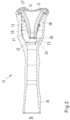
- the vacuum system 10 has an ejector 11. An enlargement of this can be seen as a longitudinal section in Fig. 2
- the core element of the ejector 11 is a propellant nozzle 20 which projects into a mixing chamber 23.
- a propellant gas line 12 opens into a nozzle channel 21 of the propellant nozzle 20.
- the tapering cross-section of the nozzle channel 21 accelerates the operating fluid flowing through the propellant gas line 12 and finally enters the mixing chamber 23 of the ejector 11 through a nozzle opening 22.
- a suction line 13 is connected to the mixing chamber 23.
- a mixed gas line 14 is connected indirectly to the mixing chamber 23 via a diffuser 24.
- the diffuser 24 can be designed as an individual component or as part of the ejector 11.
- the mixed gas line 14 is arranged in the flow direction of the nozzle channel 21 in alignment with the nozzle opening 22. This applies at least to the section adjacent to the mixing chamber 23 or the diffuser 24.
- the nozzle opening 22 of the driving nozzle 20 is formed by a nozzle edge 25 with teeth and/or waves 26, as shown in detail in Fig. 3b is shown.
- a variant without such spikes and/or waves 26 is shown.
- the spikes and/or waves 26 of the nozzle edge 25 are clearly sinusoidal, in particular they are regularly or evenly distributed over the circumference of the nozzle edge 25. In addition, they protrude freely into the mixing chamber 23 (see Fig. 2 ).
- the teeth and/or waves 26 of the nozzle edge 25 are arranged to a certain extent on the inner side 27 and the outer side 28 of the drive nozzle 20, since both the operating medium flows past them on the inner side 27 of the drive nozzle 20 and the suction fluid from the suction line 13 on the outer side 28.
- the teeth and/or waves 26 of the nozzle edge 25 point at least substantially in the flow direction of the nozzle channel 21. They are aligned in particular with the conical outer side in the front region of the drive nozzle 20. As a result, the teeth and/or waves 26 of the nozzle edge 25 are inclined towards the center of the nozzle opening 22.
- the spikes and/or waves 26 of the nozzle edge 25 are at least essentially two-dimensional, pointing at least essentially in the flow direction of the nozzle channel 21.
- a projection of the nozzle edge 25 is therefore at least essentially circular.
- the projection has a slight undulation on the circular path.
- the spikes and/or waves 26 of the nozzle edge 25 could also be designed three-dimensionally, in particular by pointing at least substantially in the flow direction of the nozzle channel 21 as in the previously described variant, and additionally pointing at least substantially transversely to the flow direction of the nozzle channel 21.
- the projection of the nozzle edge 25 thus has a clearly wavy or star-shaped circumference. This can be implemented technically by a spike or wave cut of the nozzle edge 25 and an additional mountain and valley structure in the wall of the drive nozzle 20, namely on its inner side 27 and/or outer side 28. Figuratively speaking, this would resemble a pleated filter, the opening of which is also cut with pinking shears.
- a nozzle tip 29 can be arranged in the nozzle opening 22 - not shown - in such a way that an annular gap is formed between the nozzle opening 22 or the nozzle edge 25 and the nozzle tip 29.
- the nozzle tip is then located in the center of the nozzle channel 21 and extends into the area of the nozzle opening 22, preferably even a little way out of it.
- Such a nozzle tip can be connected to the inside 27 of the drive nozzle 20, for example by means of webs.
- no such nozzle tip 29 can be arranged in the nozzle opening 22.
- the exit surface of the nozzle opening 22 is thus full-surface, instead of ring-shaped as with a nozzle tip.
- the ejector 10 is provided with a propulsion nozzle 20 in accordance with Fig. 3b or 4b now such that the mixed gas line 14 opens into the air supply line 3 of the combustion engine 5, namely between the air filter 7 and the compressor 6.
- the propellant gas line 12 is branched off from the air supply line 3 behind the mixed gas line 14 in the flow direction, namely between the compressor 6 and the charge air cooler 8.
- the suction line 13 is connected to a vacuum consumer, namely a vacuum distributor 50. From this, a first branch 13a of the suction line 13 leads to the vent cavity 5 in the crankcase 40. A second branch 13b of the suction line 13 leads from the vacuum distributor 50 to the vent cavity 5 of the fuel tank 41. In the second branch 13b, in the direction of flow, there is first an activated carbon filter 43 and then an electrically controlled valve 44, with which the vent cavity 44 is vented as required.
Landscapes
- Engineering & Computer Science (AREA)
- Mechanical Engineering (AREA)
- General Engineering & Computer Science (AREA)
- Physics & Mathematics (AREA)
- Fluid Mechanics (AREA)
- Chemical & Material Sciences (AREA)
- Combustion & Propulsion (AREA)
- Jet Pumps And Other Pumps (AREA)
- Supercharger (AREA)
- Lubrication Details And Ventilation Of Internal Combustion Engines (AREA)
- Exhaust-Gas Circulating Devices (AREA)
- Supplying Secondary Fuel Or The Like To Fuel, Air Or Fuel-Air Mixtures (AREA)
Description
- Die Erfindung betrifft einen Fahrzeugantrieb mit einem Vakuumsystem für ein Fahrzeug mit Verbrennungsmotor gemäß dem Oberbegriff von Anspruch 1.
- Zur Verbesserung von Emissionswerten ist es im Fahrzeugbau möglich, Motorgehäuse, Kurbelgehäuse, Getriebegehäuse und Kraftstofftanks aktiv zu entlüften und die Gase direkt oder indirekt einer Reinigungseinrichtung zuzuführen. Reinigungseinrichtungen können Filter, Katalysatoren und der Abgasstrang sein, der final ebenfalls durch Filter und Katalysatoren gereinigt wird. Dabei kann die Entlüftung mittels einer Strahlpumpe, insbesondere einem Ejektor, erfolgen. Diese nutzt einen Primärgasstrom, bspw. eines Turboladers, der mittels einer Düse das Entlüftungsgas aus dem Motorgehäuse, Kurbelgehäuse, Getriebegehäuse oder Kraftstofftank ansaugt. Als Ejektor wird üblicherweise eine Strahlpumpe bezeichnet, die einen Unterdruck erzeugt, also eine vorwiegend absaugende Wirkung hat.
- Wie beispielsweise
DE 20 2013 104 001 U1 weiter ausführt, wird Unterdruck bzw. ein Vakuum auch für andere Aktoren im Fahrzeug als Antriebskraft genutzt. Zum Beispiel kann ein Unterdruck zum Assistieren eines Fahrers beim Anwenden der Fahrzeugbremsen verwendet werden. GemäßDE 20 2013 104 001 U1 kann den Aktoren als Unterdruckquelle ein Motoreinlasskrümmer, eine Vakuumpumpe oder eben einen Ejektor dienen. Ein Ejektor liefert Vakuum durch Bereitstellen eines Niederdruckbereichs in einem Strömungsweg eines Betriebsfluids, das insbesondere auch Kraftstoffdämpfe oder unbehandelte Motoremissionen enthalten kann. Andere Ejektoren sind ausUS 2019/048830 A1 undUS 2007/256420 A1 bekannt. - Bei einem Ejektor tritt das Betriebsfluid mit hoher Geschwindigkeit aus einer Treibdüse in eine Mischkammer aus. Hierbei entsteht gemäß dem Gesetz von Bernoulli ein dynamischer Druckabfall. Aus diesem Grund ist der Druck in der Strömung geringer als der Normaldruck. Bei kompressiblen Treibmitteln, insbesondere Gasen oder Dämpfen ist die Treibdüse zur Maximierung der Geschwindigkeit häufig als Lavaldüse ausgebildet und der Treibstrahl tritt mit Überschall aus. In der Mischkammer trifft der Treibstrahl des Betriebsfluids auf das hier befindliche Saugmedium. Nach Austritt aus der Düse entstehen durch innere Reibung und Turbulenzen Scherspannungen in der Grenzschicht zwischen dem schnellen Betriebsfluid und dem wesentlich langsameren Saugmedium. Diese Spannung bewirkt eine Impulsübertragung, sodass das Saugmedium beschleunigt und mitgerissen wird. Dies bedingt, dass das Saugmedium einem Druckabfall unterliegt, dessen Saugwirkung dazu genutzt werden kann über einen Saugstutzen weiteres Saugmedium in die Mischkammer zu saugen. Für einen weiteren Druckanstieg lässt sich der Mischkammer ein Diffusor nachschalten.
- Diese den Ausgang der Erfindung bildenden Funktionen und Merkmale können auch jeweils der technisch weitergebildeten Erfindung dieser Anmeldung innewohnen.
- Nachteilhaft am Stand der Technik ist, dass die Turbulenzen zwischen dem Betriebsfluid und dem Saugmedium große Druckverluste verursachen und eine geringe Effizienz aufweisen. Bei turbogeladenen Motoren wird so ein signifikanter Anteil der turboverdichteten Druckluft abgezweigt, um als Betriebsfluid eines Ejektors genutzt zu werden. Damit ist die Effizienz des Motors in Summe beeinträchtigt. Ein weiterer Nachteil der Turbulenzen ist eine resultierende hohe Lautstärke.
- Aufgabe der Erfindung ist es daher, einen Fahrzeugantrieb mit einem Vakuumsystem für ein Fahrzeug bereitzustellen, der eine hohe Effizienz bei geringer Geräuschentwicklung aufweist. Die Lösung soll zuverlässig funktionieren und kostengünstig sein.
- Hauptmerkmale der Erfindung sind im kennzeichnenden Teil von Anspruch 1 angegeben. Ausgestaltungen sind Gegenstand der Ansprüche 2 bis 14.
- Die Erfindung betrifft einen Fahrzeugantrieb mit einem Vakuumsystem für ein Fahrzeug, mit einem Verbrennungsmotor, der mit einer Zuluftleitung und einer Abluftleitung verbunden ist. Das Vakuumsystem weist einen Ejektor auf, wobei eine Treibgasleitung in einen Düsenkanal einer Treibdüse des Ejektors einmündet. Der Düsenkanal mündet durch eine Düsenöffnung in eine Mischkammer des Ejektors ein. Zusätzlich mündet eine Saugleitung in die Mischkammer ein und die Mischkammer mündet ausgangsseitig unmittelbar oder mittelbar, insbesondere mittelbar über einen Diffusor, in eine Mischgasleitung. Die Mischgasleitung wiederum mündet in die Zuluftleitung. Dabei ist die Saugleitung an einen Unterdruckverbraucher angeschlossen. Erfindungsgemäß ist die Düsenöffnung der Treibdüse durch einen Düsenrand mit Zacken und/oder Wellen ausgebildet.
- Vorteilhaft hieran ist, dass die Zacken und/oder Wellen die Turbulenzen reduzieren, wobei die Abrisskante zwischen Treibgas und Saugmedium verlängert ist gegenüber einem kreisrunden Düsenrand. Dies erhöht die Effizienz des Ejektors und sofern der Durchsatz an Treibgas auf das nunmehr notwendige Maß reduziert wird auch die Effizienz des Fahrzeugantriebs. Außerdem reduzieren die Zacken und/oder Wellen durch Reduktion der Turbulenzen auch die Entstehung von Geräuschen. Maßnahmen zur aktiven und passiven Geräuschminimierung sind weniger erforderlich, was aufgrund von Gewichtsersparnissen zusätzlich die Effizienz des Fahrzeugs erhöht. Dabei sollte die Mischgasleitung in Strömungsrichtung des Düsenkanals fluchtend zur Düsenöffnung aus der Mischkammer ausmünden. Der Düsenkanal ist bevorzugt mit kreisförmigem Innenquerschnitt ausgebildet, weiter bevorzugt die Treibdüse zumindest im Bereich der Düsenöffnung ebenfalls mit kreisförmigem Außenquerschnitt. Als Zacken sollen insbesondere Varianten verstanden werden, die im Wesentlichen lineare Flanken aufweisen, bspw. Dreiecksfunktionen, Sägezahnfunktionen und Rechteckfunktionen. Varianten mit Radien auf den Ecken sollen hiervon jedoch nicht ausgeschlossen sein. Unter Wellen sind insbesondere solche Geometrien zu verstehen, die zumindest im Wesentlichen kontinuierliche Übergänge aufweisen, bspw. Sinuswellenformen.
- Gemäß einer besonderen Ausführungsform sind die Zacken und/oder Wellen des Düsenrandes auf der Innenseite und/oder der Außenseite der Treibdüse angeordnet. So ist denkbar, dass die Zacken und/oder Wellen nur nach innen weisen, die Treibdüse auf der Außenseite jedoch eine glatte Oberfläche aufweist. Im umgekehrten optionalen Fall weisen die Wellen und/oder Zacken nur nach außen und die Innenfläche der Treibdüse ist glatt. Als dritte Option können die Zacken und/oder Wellen fächerartig ausgestaltet sein, sodass sie nach innen und außen weisend ausgebildet sind. Zusätzlich kann diese eher radiale Ausrichtung der Zacken und/oder Wellen auch in Strömungsrichtung des Düsenkanals weisend ausgeprägt sein.
- Bei einem bevorzugten Design weisen die Zacken und/oder Wellen des Düsenrandes zumindest im Wesentlichen in Strömungsrichtung des Düsenkanals. Soweit der Düsenkanal einen kreisförmigen Innenquerschnitt hat, so ist auch die Projektion des Düsenrandes im Wesentlichen kreisförmig. Dieses Design ist wenig komplex und vergleichsweise kostengünstig herstellbar.
- Gemäß einer besonderen Ausführungsform des Fahrzeugantriebs ist der Unterdruckverbraucher aus der Gruppe Unterdruckverteiler, Aktor, Stellglied und Entlüftungshohlraum, insbesondere aus der Entlüftungshohlraumgruppe Motorgehäuse, Kurbelgehäuse, Getriebegehäuse und Kraftstofftank. Diese Unterdruckverbraucher werden nunmehr effizient mit Unterdruck versorgt.
- In einer näheren Ausgestaltung des Fahrzeugantriebs ist die Treibgasleitung in Strömungsrichtung hinter der Mischgasleitung von der Zuluftleitung, dem Verbrennungsmotor oder der Abluftleitung abgezweigt. Damit gelingt eine Bereitstellung des Treibgasstroms ohne großen Aufwand.
- Optional kann der Düsenkanal im Bereich der Düsenöffnung eine zumindest im Wesentlichen zylindrische Innenwandung aufweisen. Dabei erstrecken sich die Zacken und/oder Wellen beispielsweise zumindest im Wesentlichen parallel zur Strömungsrichtung.
- Im Speziellen bietet sich eine Ausgestaltung an, gemäß der die Zacken und/oder Wellen des Düsenrandes in Richtung des Zentrums der Düsenöffnung geneigt ausgerichtet sind, insbesondere zwischen 0°und 35°. Hierdurch kämmen sie gewissermaßen leicht durch den äußeren Bereich des Betriebsfluidstroms, was die geräuscharme Ansaugleistung des Saugmediums verbessert. Alternativ kommt auch eine Ausgestaltung in Betracht, gemäß der die Zacken und/oder Wellen des Düsenrandes in Richtung weg vom Zentrum der Düsenöffnung geneigt ausgerichtet sind, vorzugsweise zwischen 0° und 60°. Diese Alternative ist besonders gut mit einer als Laval-Düse ausgestalteten Treibdüse kombinierbar.
- In einer Variante ragen die Zacken und/oder Wellen des Düsenrandes in die Mischkammer, dies insbesondere frei. Damit kann das Saugmedium effizient ohne Verwirbelungen in Strömungsrichtung des Betriebsfluids auf der Außenseite der Zacken und/oder Wellen an den Düsenrand heran strömen.
- Weiterhin ist eine Ausgestaltung besonders effizient, bei der eine Einströmrichtung der Saugleitung in die Mischkammer zumindest im Wesentlichen parallel zum Düsenkanal ausgerichtet ist. Dann muss das Saugmedium keine Richtungsänderung vollziehen.
- Entsprechend resultieren aus den gleichgerichteten Einzelströmen weniger Verwirbelungen bei der Zusammenführung an dem Düsenrand.
- Die Zacken und/oder Wellen sollten insbesondere über den Umfang regelmäßig bzw. gleichmäßig verteilt angeordnet sein. Dies resultiert in einheitlichen Verwirbelungen über dem Umfang. In einer optionalen Ausführungsvariante sind die Zacken und/oder Wellen des Düsenrandes sinusförmig oder dreiecksfunktionsförmig ausgebildet.
- Im Speziellen ist es hinsichtlich der Turbulenzenreduktion vorteilhaft, wenn die Täler der Zacken und/oder Wellen stumpfer ausgebildet sind als die Spitzen der Zacken und/oder Wellen.
- Gemäß einer Variante sind die Zacken und/oder Wellen des Düsenrandes zumindest im Wesentlichen zweidimensional ausgebildet, vorzugsweise zumindest im Wesentlichen in Strömungsrichtung des Düsenkanals weisend, sodass die Projektion des Düsenrandes zumindest im Wesentlichen kreisförmig ist. Eine solche Form ist vergleichsweise kostengünstig herstellbar, insbesondere indem die Zacken und/oder Wellen als zweidimensionale Schnitt- oder Formlinie ausgebildet sind.
- In einer abweichenden Variante sind die Zacken und/oder Wellen des Düsenrandes dreidimensional ausgebildet, dies insbesondere zumindest im Wesentlichen in Strömungsrichtung des Düsenkanals weisend sowie zumindest im Wesentlichen quer zur Strömungsrichtung des Düsenkanals weisend, sodass die Projektion des Düsenrandes einen welligen oder sternförmigen Umfang aufweist. Hierdurch wird das Betriebsfluid auf der Innenseite linear kanalisiert und die Länge des Düsenrandes ist durch die dreidimensionale Gestalt besonders lang. Gleichsam können auf der Außenseite der Treibdüse ausgebildete Zacken und/oder Wellen die Zuleitung des Saugmediums an den Düsenrand linear kanalisieren.
- Grundsätzlich besteht die Option, dass in der Düsenöffnung keine Düsenspitze angeordnet ist. Dies ist konstruktiv einfach umsetzbar, insbesondere bei kleinen Ausführungsformen, wie sie in Fahrzeugen oft genügen.
- Alternativ kann in der Düsenöffnung eine Düsenspitze angeordnet sein, insbesondere derart, dass ein Ringspalt zwischen der Düsenöffnung und der Düsenspitze ausgebildet ist. Hierdurch kann das Verhältnis zwischen Länge des Düsenrandes zum Volumenstrom des Betriebsfluids erhöht werden. Die Vermengung und das Mitreißen des Saugmediums gelingt nämlich im Wesentlichen am äußeren Umfang des Betriebsfluidstrahls. Zusätzlich wird durch die Düsenspitze eine Art Windschatten erzeugt, der hinter dem Düsenrand einen Sog ins Zentrum des Betriebsfluidstrahls verursacht, der auch das Saugmedium erfasst.
- Der Ejektor kann auch als solches, also isoliert vom Rest des Fahrzeugantriebs, und mit seinen verschiedenen optionalen Ausgestaltungen ein erfindungsgemäßer Gegenstand sein. Zum Ejektor können dann die jeweils obligatorischen oder optionalen Bauteile gemäß den Bezugsziffern 11 bis 29 gehören, wobei an die Stelle der Treibgasleitung ein Treibgasleitungsanschluss des Ejektors und an die Stelle der Mischgasleitung ein Mischgasleitungsanschluss des Ejektors treten.
- Bei einer besonderen Ausgestaltung des Fahrzeugantriebs ist in der Zuluftleitung ein Verdichter, insbesondere ein (Abgas-)Turbolader oder Kompressor, angeordnet, wobei die Mischgasleitung in Strömungsrichtung vor dem Verdichter in die Zuluftleitung mündet, und wobei die Treibgasleitung in Strömungsrichtung hinter dem Verdichter von der Zuluftleitung, dem Verbrennungsmotor oder der Abluftleitung abgezweigt ist. Entsprechend ist der Gegendruck von der Zuluftleitung gering, was in einer hohen Effizienz bei dem Ansaugen des Saugmediums resultiert. Zusätzlich wird direkt das Druckgefälle über dem Verdichter zur Bereitstellung des Betriebsmediums genutzt.
- Des Weiteren besteht die Option, dass in der Zuluftleitung ein Luftfilter angeordnet ist, wobei die Mischgasleitung in Strömungsrichtung hinter dem Luftfilter in die Zuluftleitung mündet, und wobei die Treibgasleitung in Strömungsrichtung hinter der einmündenden Mischgasleitung von der Zuluftleitung, dem Verbrennungsmotor oder der Abluftleitung abgezweigt ist. Schädliche Gase und Aerosole werden so sicher im Kreislauf gehalten und können auch nicht den Luftfilter verschmutzen, bspw. durch Öle.
- Fernerhin besteht die Option, dass in der Zuluftleitung ein Ladeluftkühler angeordnet ist, wobei die Mischgasleitung in Strömungsrichtung vor dem Ladeluftkühler in die Zuluftleitung mündet, und wobei die Treibgasleitung in Strömungsrichtung hinter der einmündenden Mischgasleitung und vor dem Ladeluftkühler von der Zuluftleitung abgezweigt ist. Damit kann der Ladeluftkühler kleiner ausgestaltet sein, denn er muss das Betriebsfluid nicht mit kühlen, sondern nur die restliche Luft, die zum Verbrennungsmotor geleitet wird.
- Soweit vorhanden, bietet sich eine Ausgestaltung an, bei der in Strömungsrichtung der Zuluftleitung zunächst der Luftfilter, dann der Verdichter und hieran anschließend der Ladeluftkühler angeordnet sind.
- Weitere Merkmale, Einzelheiten und Vorteile der Erfindung ergeben sich aus dem Wortlaut der Ansprüche sowie aus der folgenden Beschreibung von Ausführungsbeispielen anhand der Zeichnungen. Es zeigen:
- Fig. 1
- zeigt eine Schemaskizze eines Fahrzeugantriebs mit Vakuumsystem;
- Fig. 2
- einen Längsschnitt durch einen Ejektor;
- Fig. 3a
- einen Längsschnitt durch einen ersten Typ eines Düsenrandes einer Treibdüse;
- Fig. 3b
- einen Längsschnitt durch einen zweiten Typ eines Düsenrandes einer Treibdüse;
- Fig. 4a
- eine Detailansicht eines ersten Typs eines Düsenrandes einer Treibdüse; und
- Fig. 4b
- eine Detailansicht eines zweiten Typs eines Düsenrandes einer Treibdüse.
-
Fig. 1 zeigt eine Schemaskizze eines Fahrzeugantriebs 1 mit Vakuumsystem 10 für ein Fahrzeug. Dieser verfügt über einen Verbrennungsmotor 2 mit einer Zuluftleitung 3 und einer Abluftleitung 4. In der Zuluftleitung 3 sitzen in Strömungsrichtung hin zum Motor 2 zunächst ein Luftfilter 7, dann ein Verdichter 6, nämlich vorliegend ein Abgasturbolader, dann ein Ladeluftkühler 8, und hiernach eine Drosselklappe 45. Außerdem verfügt der Fahrzeugantrieb 1 über einen Tank 41, indem Kraftstoff 42 gespeichert ist, und in dem oberhalb des Kraftstoffes 42 ein Entlüftungshohlraum 5 ausgebildet ist. Auch der Verbrennungsmotor 2 weist einen Entlüftungshohlraum 5 auf, nämlich im Kurbelgehäuse 40. - Das Vakuumsystem 10 weist einen Ejektor 11 auf. Eine Vergrößerung hiervon sieht man als Längsschnitt in
Fig. 2 . Kernelement von dem Ejektor 11 ist eine Treibdüse 20, die in eine Mischkammer 23 ragt. Eine Treibgasleitung 12 mündet in einen Düsenkanal 21 der Treibdüse 20. Durch den sich verjüngenden Querschnitt des Düsenkanals 21 wird das durch die Treibgasleitung 12 strömenden Betriebsfluid beschleunigt und tritt schließlich durch eine Düsenöffnung 22 in die Mischkammer 23 des Ejektors 11 ein. Zusätzlich ist eine Saugleitung 13 an die Mischkammer 23 angeschlossen. Ausgangsseitig schließt sich mittelbar über einen Diffusor 24 eine Mischgasleitung 14 an die Mischkammer 23 an. Der Diffusor 24 kann als Einzelbauteil oder als Teil des Ejektors 11 ausgebildet sein. Die Mischgasleitung 14 ist in Strömungsrichtung des Düsenkanals 21 fluchtend zur Düsenöffnung 22 angeordnet. Das gilt zumindest für den an die Mischkammer 23 bzw. den Diffusor 24 anschließenden Abschnitt. - Die Düsenöffnung 22 der Treibdüse 20 ist durch einen Düsenrand 25 mit Zacken und/oder Wellen 26 ausgebildet, wie es im Detail in
Fig. 3b dargestellt ist. InFig. 3a ist eine Variante ohne solche Zacken und/oder Wellen 26 gezeigt. Erkennbar sind die Zacken und/oder Wellen 26 des Düsenrandes 25 sinusförmig ausgebildet, im Besonderen sind sie regelmäßig bzw. gleichmäßig über dem Umfang des Düsenrands 25 verteilt angeordnet. Außerdem ragen sie frei in die Mischkammer 23 (sieheFig. 2 ). - Die Zacken und/oder Wellen 26 des Düsenrandes 25 sind gewissermaßen auf der Innenseite 27 und der Außenseite 28 der Treibdüse 20 angeordnet, denn sowohl das Betriebsmedium strömt auf der Innenseite 27 der Treibdüse 20 an diesen vorbei als auch das Saugfluid aus der Saugleitung 13 auf der Außenseite 28. Die Zacken und/oder Wellen 26 des Düsenrandes 25 weisen zumindest im Wesentlichen in Strömungsrichtung des Düsenkanals 21. Sie fluchten insbesondere mit der kegelförmigen Außenseite im vorderen Bereich der Treibdüse 20. Hierdurch sind die Zacken und/oder Wellen 26 des Düsenrandes 25 in Richtung des Zentrums der Düsenöffnung 22 geneigt ausgerichtet.
- Vorliegend sind die Zacken und/oder Wellen 26 des Düsenrandes 25 zumindest im Wesentlichen zweidimensional ausgebildet, wobei sie zumindest im Wesentlichen in Strömungsrichtung des Düsenkanals 21 weisen. Eine Projektion des Düsenrandes 25 ist hierdurch zumindest im Wesentlichen kreisförmig. Durch die Neigung der Zacken und/oder Wellen 26 in Richtung Zentrum der Düsenöffnung 22 weist die Projektion jedoch eine leichte Welligkeit auf der Kreisbahn auf.
- Optional könnten die Zacken und/oder Wellen 26 des Düsenrandes 25 auch dreidimensional ausgebildet sein, dies insbesondere indem sie zumindest im Wesentlichen in Strömungsrichtung des Düsenkanals 21 weisen wie in der zuvor beschriebenen Variante, und zusätzlich zumindest im Wesentlichen quer zur Strömungsrichtung des Düsenkanals 21 weisen. Die Projektion des Düsenrandes 25 hat hierdurch einen klar welligen oder sternförmigen Umfang. Technisch umsetzen lässt sich dies durch einen Zacken- bzw. Wellenschnitt des Düsenrandes 25 und einer zusätzlichen Berg- und Talstruktur in der Wandung der Treibdüse 20, nämlich auf deren Innenseite 27 und/oder Außenseite 28. Bildlich gesprochen würde dies einem Faltenfilter ähnelnd, dessen Öffnung zudem mit einer Zackenschere zugeschnitten ist.
- In einer ersten Variante kann in der Düsenöffnung 22 - nicht dargestellt - eine Düsenspitze 29 derart angeordnet sein, dass ein Ringspalt zwischen der Düsenöffnung 22 bzw. dem Düsenrand 25 und der Düsenspitze 29 ausgebildet ist. Die Düsenspitze sitzt dann im Zentrum des Düsenkanals 21 und erstreckt sich bis in den Bereich der Düsenöffnung 22, vorzugsweise sogar ein Stück weit aus dieser heraus. Solch eine Düsenspitze kann beispielsweise mittels Stegen mit der Innenseite 27 der Treibdüse 20 verbunden sein.
- In einer abweichenden und hier dargestellten Variante kann in der Düsenöffnung 22 jedoch auch keine solche Düsenspitze 29 angeordnet sein. Damit ist die Austrittsfläche der Düsenöffnung 22 vollflächig, anstatt wie mit einer Düsenspitze ringförmig.
- Den Längsschnitten durch je eine Treibdüse 20 der
Fig. 4a und 4b lässt sich nochmals der Unterschied zwischen einer Treibdüse 20 ohne (Fig. 4a ) und mit (Fig. 4b ) Zacken und/oder Wellen 26 am Düsenrand 25 erkennen. Im Unterschied zu der Düsenöffnung 22 derFig. 3a und 3b , die einem eher flachen kegelstumpfförmigen Spitzenabschnitt entmündet, ist die Variante nach denFig. 4a und 4b spitzer ausgeführt. Das gilt vor allem für die Außenwandung 28. Die Innenwandung bildet den kleinsten Querschnitt sogar kurz vor der Düsenöffnung 22 aus. Von diesem kleinsten Querschnitt weitet sich die der Düsenkanal 21 in Richtung Düsenöffnung 22 bereits wieder auf, wenngleich nur geringfügig. - Eingebunden in den Fahrzeugantrieb 1 gemäß
Fig. 1 ist der Ejektor 10 mit einer Treibdüse 20 gemäß denFig. 3b oder4b nunmehr derart, dass die Mischgasleitung 14 in die Zuluftleitung 3 des Verbrennungsmotors 5 mündet, nämlich zwischen dem Luftfilter 7 und dem Verdichter 6. Die Treibgasleitung 12 ist in Strömungsrichtung hinter der Mischgasleitung 14 von der Zuluftleitung 3 abgezweigt, nämlich zwischen dem Verdichter 6 und dem Ladeluftkühler 8. - Die Saugleitung 13 ist an einen Unterdruckverbraucher, nämlich einen Unterdruckverteiler 50 angeschlossen. Von diesem wiederum führt ein erster Zweig 13a der Saugleitung 13 zu dem Entlüftungshohlraum 5 im Kurbelgehäuse 40. Ein zweiter Zweig 13b der Saugleitung 13 führt vom Unterdruckverteiler 50 zum Entlüftungshohlraum 5 des Kraftstofftanks 41. In dem zweiten Zweig 13b sitzen in Strömungsrichtung zunächst ein Aktivkohlefilter 43 und dann ein elektrisch angesteuertes Ventil 44, mit dem der Entlüftungshohlraum 44 bedarfsgerecht entlüftet wird.
-
1 Fahrzeugantrieb 22 Düsenöffnung 2 Verbrennungsmotor 23 Mischkammer 3 Zuluftleitung 24 Diffusor 4 Abluftleitung 25 Düsenrand 5 Entlüftungshohlraum 26 Zacke oder Welle 6 Verdichter 27 Innenseite 7 Luftfilter 28 Außenseite 8 Ladeluftkühler 40 Kurbelgehäuse 10 Vakuumsystem 41 Kraftstofftank 11 Ejektor 42 Kraftstoff 12 Treibgasleitung 43 Aktivkohlefilter/Ölabscheider 13 Saugleitung 44 Ventil 13a Saugleitung zum Kurbelgehäuse 45 Drosselklappe 13b Saugleitung zum Tank 14 Mischgasleitung 50 Unterdruckverteiler 20 Treibdüse 21 Düsenkanal
Claims (13)
- Fahrzeugantrieb (1) mit einem Vakuumsystem (10) für ein Fahrzeug, mit einem Verbrennungsmotor (2), der mit einer Zuluftleitung (3) und einer Abluftleitung (4) verbunden ist,- wobei das Vakuumsystem (10) einen Ejektor (11) aufweist,- wobei eine Treibgasleitung (12) in einen Düsenkanal (21) einer Treibdüse (20) des Ejektors (11) einmündet,- wobei der Düsenkanal (21) durch eine Düsenöffnung (22) in eine Mischkammer (23) des Ejektors (11) einmündet,- wobei eine Saugleitung (13) in die Mischkammer (23) einmündet und die Mischkammer (23) ausgangsseitig unmittelbar oder mittelbar in eine Mischgasleitung (14) mündet, und- wobei die Mischgasleitung (14) in die Zuluftleitung (3) mündet,- wobei die Saugleitung (13) an einen Unterdruckverbraucher angeschlossen ist,dadurch gekennzeichnet, dass- die Düsenöffnung (22) der Treibdüse (20) durch einen Düsenrand (25) mit Zacken und/oder Wellen (26) ausgebildet ist.
- Fahrzeugantrieb (1) gemäß Anspruch 1, dadurch gekennzeichnet, dass die Zacken und/oder Wellen (26) des Düsenrandes (25) auf der Innenseite (27) und/oder der Außenseite (28) der Treibdüse (20) angeordnet sind.
- Fahrzeugantrieb (1) gemäß einem der Ansprüche 1 oder 2, dadurch gekennzeichnet, dass die Zacken und/oder Wellen (26) des Düsenrandes (25) zumindest im Wesentlichen in Strömungsrichtung des Düsenkanals (21) weisen.
- Fahrzeugantrieb (1) gemäß einem der vorhergehenden Ansprüche, dadurch gekennzeichnet, dass die Treibgasleitung (12) in Strömungsrichtung hinter der Mischgasleitung (14) von der Zuluftleitung (3), dem Verbrennungsmotor (2) oder der Abluftleitung (4) abgezweigt ist.
- Fahrzeugantrieb (1) gemäß einem der vorhergehenden Ansprüche, dadurch gekennzeichnet, dass der Unterdruckverbraucher aus der Gruppe Unterdruckverteiler, Aktor, Stellglied und Entlüftungshohlraum (5), insbesondere aus der Entlüftungshohlraumgruppe Motorgehäuse, Kurbelgehäuse, Getriebegehäuse und Kraftstofftank, ist.
- Fahrzeugantrieb (1) gemäß einem der vorhergehenden Ansprüche, dadurch gekennzeichnet, dass die Zacken und/oder Wellen (26) des Düsenrandes (25) in Richtung des Zentrums der Düsenöffnung (22) geneigt ausgerichtet sind.
- Fahrzeugantrieb (1) gemäß einem der vorhergehenden Ansprüche, dadurch gekennzeichnet, dass die Zacken und/oder Wellen (26) des Düsenrandes (25) in die Mischkammer (23) ragen.
- Fahrzeugantrieb (1) gemäß einem der vorhergehenden Ansprüche, dadurch gekennzeichnet, dass die Zacken und/oder Wellen (26) des Düsenrandes (25) sinusförmig oder dreiecksfunktionsförmig ausgebildet sind.
- Fahrzeugantrieb (1) gemäß einem der vorhergehenden Ansprüche, dadurch gekennzeichnet, dass die Zacken und/oder Wellen (26) des Düsenrandes (25) zumindest im Wesentlichen zweidimensional ausgebildet sind.
- Fahrzeugantrieb (1) gemäß einem der Ansprüche 1 bis 8, dadurch gekennzeichnet, dass die Zacken und/oder Wellen (26) des Düsenrandes (25) dreidimensional ausgebildet sind.
- Fahrzeugantrieb (1) gemäß einem der vorhergehenden Ansprüche, dadurch gekennzeichnet, dass in der Zuluftleitung (3) ein Verdichter (6) angeordnet ist,wobei die Mischgasleitung (14) in Strömungsrichtung vor dem Verdichter (6) in die Zuluftleitung (3) mündet, undwobei die Treibgasleitung (12) in Strömungsrichtung hinter dem Verdichter (6) von der Zuluftleitung (3), dem Verbrennungsmotor (2) oder der Abluftleitung (4) abgezweigt ist.
- Fahrzeugantrieb (1) gemäß einem der vorhergehenden Ansprüche, dadurch gekennzeichnet, dass in der Zuluftleitung (3) ein Luftfilter (7) angeordnet ist,wobei die Mischgasleitung (14) in Strömungsrichtung hinter dem Luftfilter (7) in die Zuluftleitung (3) mündet, undwobei die Treibgasleitung (12) in Strömungsrichtung hinter der einmündenden Mischgasleitung (14) von der Zuluftleitung (3), dem Verbrennungsmotor (2) oder der Abluftleitung (4) abgezweigt ist.
- Fahrzeugantrieb (1) gemäß einem der vorhergehenden Ansprüche, dadurch gekennzeichnet, dass in der Zuluftleitung (3) ein Ladeluftkühler (8) angeordnet ist,wobei die Mischgasleitung (14) in Strömungsrichtung vor dem Ladeluftkühler (8) in die Zuluftleitung (3) mündet, undwobei die Treibgasleitung (12) in Strömungsrichtung hinter der einmündenden Mischgasleitung (14) und vor dem Ladeluftkühler (8) von der Zuluftleitung (3) abgezweigt ist.
Applications Claiming Priority (2)
| Application Number | Priority Date | Filing Date | Title |
|---|---|---|---|
| DE102020125565.9A DE102020125565A1 (de) | 2020-09-30 | 2020-09-30 | Fahrzeugantrieb mit Vakuumsystem und Ejektor |
| PCT/EP2021/071799 WO2022069099A1 (de) | 2020-09-30 | 2021-08-04 | Fahrzeugantrieb mit vakuumsystem und ejektor |
Publications (2)
| Publication Number | Publication Date |
|---|---|
| EP4222367A1 EP4222367A1 (de) | 2023-08-09 |
| EP4222367B1 true EP4222367B1 (de) | 2024-10-02 |
Family
ID=77411703
Family Applications (1)
| Application Number | Title | Priority Date | Filing Date |
|---|---|---|---|
| EP21758083.6A Active EP4222367B1 (de) | 2020-09-30 | 2021-08-04 | Fahrzeugantrieb mit vakuumsystem und ejektor |
Country Status (7)
| Country | Link |
|---|---|
| US (1) | US12168965B2 (de) |
| EP (1) | EP4222367B1 (de) |
| JP (1) | JP7578798B2 (de) |
| KR (1) | KR102835053B1 (de) |
| CN (1) | CN116194676A (de) |
| DE (1) | DE102020125565A1 (de) |
| WO (1) | WO2022069099A1 (de) |
Family Cites Families (17)
| Publication number | Priority date | Publication date | Assignee | Title |
|---|---|---|---|---|
| US8136361B2 (en) * | 2006-05-04 | 2012-03-20 | General Electric Company | Methods and apparatus for assembling a low noise ejector motive nozzle |
| DE202008018127U1 (de) | 2008-03-28 | 2011-12-28 | Voith Patent Gmbh | Strahlpumpe zum Fördern von Arbeits- und/oder Kühlmedium in einem Arbeits- und/oder Kühlmediumkreislauf eines Fahrzeuges |
| US8083495B2 (en) | 2008-08-14 | 2011-12-27 | General Electric Company | Ejectors with separably secured nozzles, adjustable size nozzles, or adjustable size mixing tubes |
| US9239034B2 (en) | 2012-09-12 | 2016-01-19 | Ford Global Technologies, Llc | Ejector system for a vehicle |
| US9108607B2 (en) * | 2012-11-07 | 2015-08-18 | Ford Global Technologies, Llc | Method and system for vacuum generation |
| US9322289B2 (en) | 2012-11-16 | 2016-04-26 | Ford Global Technologies, Llc | Vacuum-actuated wastegate |
| EP3090159B1 (de) * | 2013-12-11 | 2019-05-22 | Dayco IP Holdings, LLC | Rückführungssystem für turboladerverdichter |
| JP6609626B2 (ja) * | 2014-05-30 | 2019-11-20 | デイコ アイピー ホールディングス,エルエルシー | エジェクタ、空圧式制御バルブ及び選択的なアスピレータを有する真空発生システム |
| WO2016007861A1 (en) * | 2014-07-10 | 2016-01-14 | Dayco Ip Holdings, Llc | Dual venturi device |
| US9657748B2 (en) * | 2014-08-06 | 2017-05-23 | Dayco Ip Holdings, Llc | Pneumatically actuated vacuum pump having multiple venturi gaps and check valves |
| JP2016125471A (ja) | 2015-01-08 | 2016-07-11 | 日立造船株式会社 | エジェクターおよびこれを備えた多重効用造水装置 |
| CN106064122B (zh) | 2015-04-24 | 2019-12-24 | 苏州中尧节能环保设备有限公司 | 锯齿喷射式抽空器 |
| JP6549011B2 (ja) * | 2015-10-01 | 2019-07-24 | 愛三工業株式会社 | 蒸発燃料処理装置 |
| DE102016110018A1 (de) | 2016-05-31 | 2017-11-30 | Jk-Holding Gmbh | Verwendung einer Fluiddüse in einem Fluid |
| DE102016209573A1 (de) | 2016-06-01 | 2017-12-07 | Mahle International Gmbh | Brennkraftmaschine mit Kurbelgehäuseentlüftung |
| US10815937B2 (en) * | 2017-10-06 | 2020-10-27 | Ford Global Technologies, Llc | Evaporative emissions system diagnostic for GTDI engines using an electronic booster |
| US11041452B2 (en) | 2018-06-04 | 2021-06-22 | Ford Global Technologies, Llc | Systems and methods for pressure-based diagnostics for two stage turbo engines |
-
2020
- 2020-09-30 DE DE102020125565.9A patent/DE102020125565A1/de not_active Ceased
-
2021
- 2021-08-04 WO PCT/EP2021/071799 patent/WO2022069099A1/de not_active Ceased
- 2021-08-04 KR KR1020237009442A patent/KR102835053B1/ko active Active
- 2021-08-04 US US18/029,456 patent/US12168965B2/en active Active
- 2021-08-04 EP EP21758083.6A patent/EP4222367B1/de active Active
- 2021-08-04 CN CN202180064704.3A patent/CN116194676A/zh active Pending
- 2021-08-04 JP JP2023513081A patent/JP7578798B2/ja active Active
Also Published As
| Publication number | Publication date |
|---|---|
| KR20230051291A (ko) | 2023-04-17 |
| JP2023538439A (ja) | 2023-09-07 |
| DE102020125565A1 (de) | 2022-03-31 |
| US12168965B2 (en) | 2024-12-17 |
| CN116194676A (zh) | 2023-05-30 |
| JP7578798B2 (ja) | 2024-11-06 |
| KR102835053B1 (ko) | 2025-07-16 |
| US20230374956A1 (en) | 2023-11-23 |
| EP4222367A1 (de) | 2023-08-09 |
| WO2022069099A1 (de) | 2022-04-07 |
Similar Documents
| Publication | Publication Date | Title |
|---|---|---|
| EP3303849B1 (de) | Verdichter, abgasturbolader und brennkraftmaschine | |
| DE102015109144B4 (de) | Turbinenauslassdiffusor | |
| DE102010051660B4 (de) | Kurbelgehäuseentlüftungssystem und Kurbelgehäuseentlüftungsdüse | |
| EP1203142B1 (de) | Brennkraftmaschine mit sekundärlufteinblassystem | |
| WO2008017567A1 (de) | Lufteinlass eines strahltriebwerks | |
| EP2488412A2 (de) | Strömungskörper insbesondere für luftfahrzeuge | |
| DE102014201549A1 (de) | Brennkraftmaschine mit Booster | |
| WO2006117073A1 (de) | Abgasturbolader für eine brennkraftmaschine | |
| DE102004029830A1 (de) | Turbinenrad in einer Abgasturbine eines Abgasturboladers | |
| DE102007053847A1 (de) | Abgasrückführungssystem für einen Verbrennungsmotor | |
| EP3234337A1 (de) | Luftleitung für einen ansaugtrakt einer verbrennungskraftmaschine, insbesondere eines kraftwagens | |
| DE102015208906A1 (de) | Saugstrahlpumpe mit variabler Düsengeometrie und Kurbelgehäuseentlüftungseinrichtung | |
| EP3329105B1 (de) | Abscheidevorrichtung, motorvorrichtung und abscheideverfahren | |
| EP4222367B1 (de) | Fahrzeugantrieb mit vakuumsystem und ejektor | |
| WO2017025235A1 (de) | Verdichter eines turboladers mit einem schubumluftventil sowie turbolader und kraftfahrzeug mit einem solchen verdichter | |
| DE102009014179B4 (de) | Abgassystem | |
| DE69028619T2 (de) | Turbolader-Antriebsvorrichtung | |
| DE102017202292B4 (de) | Entlüftungssystem für ein Kurbelgehäuse eines Verbrennungsmotors | |
| DE3719930C2 (de) | Turbofan-Gasturbinentriebwerk | |
| DE102009041123A1 (de) | Gasdynamische Druckwellenmaschine | |
| DE112017005019T5 (de) | Gas-zu-Gas-Sauggebläse mit verbessertem Mitreisswirkungsgrad | |
| DE10252474B4 (de) | Brennkraftmaschine mit Abgasturbolader | |
| DE102012005225A1 (de) | Vorrichtung zum zusätzlichen Verdichten der Ladeluft einer Brennkraftmaschine | |
| DE102016217688B4 (de) | Brennkraftmaschine mit Kurbelgehäuseentlüftungseinrichtung | |
| DE102017212861B4 (de) | Ölabscheidevorrichtung und Anordnung zur Ölabscheidung in einer Brennkraftmaschine |
Legal Events
| Date | Code | Title | Description |
|---|---|---|---|
| STAA | Information on the status of an ep patent application or granted ep patent |
Free format text: STATUS: UNKNOWN |
|
| STAA | Information on the status of an ep patent application or granted ep patent |
Free format text: STATUS: THE INTERNATIONAL PUBLICATION HAS BEEN MADE |
|
| PUAI | Public reference made under article 153(3) epc to a published international application that has entered the european phase |
Free format text: ORIGINAL CODE: 0009012 |
|
| STAA | Information on the status of an ep patent application or granted ep patent |
Free format text: STATUS: REQUEST FOR EXAMINATION WAS MADE |
|
| 17P | Request for examination filed |
Effective date: 20230131 |
|
| AK | Designated contracting states |
Kind code of ref document: A1 Designated state(s): AL AT BE BG CH CY CZ DE DK EE ES FI FR GB GR HR HU IE IS IT LI LT LU LV MC MK MT NL NO PL PT RO RS SE SI SK SM TR |
|
| DAV | Request for validation of the european patent (deleted) | ||
| DAX | Request for extension of the european patent (deleted) | ||
| GRAP | Despatch of communication of intention to grant a patent |
Free format text: ORIGINAL CODE: EPIDOSNIGR1 |
|
| STAA | Information on the status of an ep patent application or granted ep patent |
Free format text: STATUS: GRANT OF PATENT IS INTENDED |
|
| GRAS | Grant fee paid |
Free format text: ORIGINAL CODE: EPIDOSNIGR3 |
|
| INTG | Intention to grant announced |
Effective date: 20240726 |
|
| GRAA | (expected) grant |
Free format text: ORIGINAL CODE: 0009210 |
|
| STAA | Information on the status of an ep patent application or granted ep patent |
Free format text: STATUS: THE PATENT HAS BEEN GRANTED |
|
| AK | Designated contracting states |
Kind code of ref document: B1 Designated state(s): AL AT BE BG CH CY CZ DE DK EE ES FI FR GB GR HR HU IE IS IT LI LT LU LV MC MK MT NL NO PL PT RO RS SE SI SK SM TR |
|
| REG | Reference to a national code |
Ref country code: GB Ref legal event code: FG4D Free format text: NOT ENGLISH |
|
| REG | Reference to a national code |
Ref country code: CH Ref legal event code: EP |
|
| REG | Reference to a national code |
Ref country code: IE Ref legal event code: FG4D Free format text: LANGUAGE OF EP DOCUMENT: GERMAN |
|
| REG | Reference to a national code |
Ref country code: DE Ref legal event code: R096 Ref document number: 502021005332 Country of ref document: DE |
|
| REG | Reference to a national code |
Ref country code: LT Ref legal event code: MG9D |
|
| REG | Reference to a national code |
Ref country code: NL Ref legal event code: MP Effective date: 20241002 |
|
| PG25 | Lapsed in a contracting state [announced via postgrant information from national office to epo] |
Ref country code: NL Free format text: LAPSE BECAUSE OF FAILURE TO SUBMIT A TRANSLATION OF THE DESCRIPTION OR TO PAY THE FEE WITHIN THE PRESCRIBED TIME-LIMIT Effective date: 20241002 |
|
| PG25 | Lapsed in a contracting state [announced via postgrant information from national office to epo] |
Ref country code: NL Free format text: LAPSE BECAUSE OF FAILURE TO SUBMIT A TRANSLATION OF THE DESCRIPTION OR TO PAY THE FEE WITHIN THE PRESCRIBED TIME-LIMIT Effective date: 20241002 |
|
| PG25 | Lapsed in a contracting state [announced via postgrant information from national office to epo] |
Ref country code: IS Free format text: LAPSE BECAUSE OF FAILURE TO SUBMIT A TRANSLATION OF THE DESCRIPTION OR TO PAY THE FEE WITHIN THE PRESCRIBED TIME-LIMIT Effective date: 20250202 Ref country code: HR Free format text: LAPSE BECAUSE OF FAILURE TO SUBMIT A TRANSLATION OF THE DESCRIPTION OR TO PAY THE FEE WITHIN THE PRESCRIBED TIME-LIMIT Effective date: 20241002 Ref country code: PT Free format text: LAPSE BECAUSE OF FAILURE TO SUBMIT A TRANSLATION OF THE DESCRIPTION OR TO PAY THE FEE WITHIN THE PRESCRIBED TIME-LIMIT Effective date: 20250203 |
|
| PG25 | Lapsed in a contracting state [announced via postgrant information from national office to epo] |
Ref country code: FI Free format text: LAPSE BECAUSE OF FAILURE TO SUBMIT A TRANSLATION OF THE DESCRIPTION OR TO PAY THE FEE WITHIN THE PRESCRIBED TIME-LIMIT Effective date: 20241002 |
|
| PG25 | Lapsed in a contracting state [announced via postgrant information from national office to epo] |
Ref country code: BG Free format text: LAPSE BECAUSE OF FAILURE TO SUBMIT A TRANSLATION OF THE DESCRIPTION OR TO PAY THE FEE WITHIN THE PRESCRIBED TIME-LIMIT Effective date: 20241002 |
|
| PG25 | Lapsed in a contracting state [announced via postgrant information from national office to epo] |
Ref country code: ES Free format text: LAPSE BECAUSE OF FAILURE TO SUBMIT A TRANSLATION OF THE DESCRIPTION OR TO PAY THE FEE WITHIN THE PRESCRIBED TIME-LIMIT Effective date: 20241002 |
|
| PG25 | Lapsed in a contracting state [announced via postgrant information from national office to epo] |
Ref country code: NO Free format text: LAPSE BECAUSE OF FAILURE TO SUBMIT A TRANSLATION OF THE DESCRIPTION OR TO PAY THE FEE WITHIN THE PRESCRIBED TIME-LIMIT Effective date: 20250102 |
|
| PG25 | Lapsed in a contracting state [announced via postgrant information from national office to epo] |
Ref country code: GR Free format text: LAPSE BECAUSE OF FAILURE TO SUBMIT A TRANSLATION OF THE DESCRIPTION OR TO PAY THE FEE WITHIN THE PRESCRIBED TIME-LIMIT Effective date: 20250103 Ref country code: LV Free format text: LAPSE BECAUSE OF FAILURE TO SUBMIT A TRANSLATION OF THE DESCRIPTION OR TO PAY THE FEE WITHIN THE PRESCRIBED TIME-LIMIT Effective date: 20241002 |
|
| PG25 | Lapsed in a contracting state [announced via postgrant information from national office to epo] |
Ref country code: CZ Free format text: LAPSE BECAUSE OF FAILURE TO SUBMIT A TRANSLATION OF THE DESCRIPTION OR TO PAY THE FEE WITHIN THE PRESCRIBED TIME-LIMIT Effective date: 20241002 Ref country code: PL Free format text: LAPSE BECAUSE OF FAILURE TO SUBMIT A TRANSLATION OF THE DESCRIPTION OR TO PAY THE FEE WITHIN THE PRESCRIBED TIME-LIMIT Effective date: 20241002 |
|
| PG25 | Lapsed in a contracting state [announced via postgrant information from national office to epo] |
Ref country code: RS Free format text: LAPSE BECAUSE OF FAILURE TO SUBMIT A TRANSLATION OF THE DESCRIPTION OR TO PAY THE FEE WITHIN THE PRESCRIBED TIME-LIMIT Effective date: 20250102 |
|
| PG25 | Lapsed in a contracting state [announced via postgrant information from national office to epo] |
Ref country code: SM Free format text: LAPSE BECAUSE OF FAILURE TO SUBMIT A TRANSLATION OF THE DESCRIPTION OR TO PAY THE FEE WITHIN THE PRESCRIBED TIME-LIMIT Effective date: 20241002 |
|
| REG | Reference to a national code |
Ref country code: DE Ref legal event code: R097 Ref document number: 502021005332 Country of ref document: DE |
|
| PG25 | Lapsed in a contracting state [announced via postgrant information from national office to epo] |
Ref country code: DK Free format text: LAPSE BECAUSE OF FAILURE TO SUBMIT A TRANSLATION OF THE DESCRIPTION OR TO PAY THE FEE WITHIN THE PRESCRIBED TIME-LIMIT Effective date: 20241002 |
|
| PG25 | Lapsed in a contracting state [announced via postgrant information from national office to epo] |
Ref country code: EE Free format text: LAPSE BECAUSE OF FAILURE TO SUBMIT A TRANSLATION OF THE DESCRIPTION OR TO PAY THE FEE WITHIN THE PRESCRIBED TIME-LIMIT Effective date: 20241002 |
|
| PG25 | Lapsed in a contracting state [announced via postgrant information from national office to epo] |
Ref country code: RO Free format text: LAPSE BECAUSE OF FAILURE TO SUBMIT A TRANSLATION OF THE DESCRIPTION OR TO PAY THE FEE WITHIN THE PRESCRIBED TIME-LIMIT Effective date: 20241002 |
|
| PG25 | Lapsed in a contracting state [announced via postgrant information from national office to epo] |
Ref country code: SK Free format text: LAPSE BECAUSE OF FAILURE TO SUBMIT A TRANSLATION OF THE DESCRIPTION OR TO PAY THE FEE WITHIN THE PRESCRIBED TIME-LIMIT Effective date: 20241002 |
|
| PG25 | Lapsed in a contracting state [announced via postgrant information from national office to epo] |
Ref country code: IT Free format text: LAPSE BECAUSE OF FAILURE TO SUBMIT A TRANSLATION OF THE DESCRIPTION OR TO PAY THE FEE WITHIN THE PRESCRIBED TIME-LIMIT Effective date: 20241002 |
|
| PLBE | No opposition filed within time limit |
Free format text: ORIGINAL CODE: 0009261 |
|
| STAA | Information on the status of an ep patent application or granted ep patent |
Free format text: STATUS: NO OPPOSITION FILED WITHIN TIME LIMIT |
|
| PG25 | Lapsed in a contracting state [announced via postgrant information from national office to epo] |
Ref country code: SE Free format text: LAPSE BECAUSE OF FAILURE TO SUBMIT A TRANSLATION OF THE DESCRIPTION OR TO PAY THE FEE WITHIN THE PRESCRIBED TIME-LIMIT Effective date: 20241002 |
|
| 26N | No opposition filed |
Effective date: 20250703 |
|
| PGFP | Annual fee paid to national office [announced via postgrant information from national office to epo] |
Ref country code: DE Payment date: 20250827 Year of fee payment: 5 |
|
| PGFP | Annual fee paid to national office [announced via postgrant information from national office to epo] |
Ref country code: GB Payment date: 20250827 Year of fee payment: 5 |
|
| PGFP | Annual fee paid to national office [announced via postgrant information from national office to epo] |
Ref country code: AT Payment date: 20251020 Year of fee payment: 5 Ref country code: FR Payment date: 20250825 Year of fee payment: 5 |
|
| REG | Reference to a national code |
Ref country code: CH Ref legal event code: H13 Free format text: ST27 STATUS EVENT CODE: U-0-0-H10-H13 (AS PROVIDED BY THE NATIONAL OFFICE) Effective date: 20260324 |
|
| PG25 | Lapsed in a contracting state [announced via postgrant information from national office to epo] |
Ref country code: MC Free format text: LAPSE BECAUSE OF FAILURE TO SUBMIT A TRANSLATION OF THE DESCRIPTION OR TO PAY THE FEE WITHIN THE PRESCRIBED TIME-LIMIT Effective date: 20241002 |
|
| PG25 | Lapsed in a contracting state [announced via postgrant information from national office to epo] |
Ref country code: LU Free format text: LAPSE BECAUSE OF NON-PAYMENT OF DUE FEES Effective date: 20250804 |
|
| PG25 | Lapsed in a contracting state [announced via postgrant information from national office to epo] |
Ref country code: CH Free format text: LAPSE BECAUSE OF NON-PAYMENT OF DUE FEES Effective date: 20250831 |