EP4219398A1 - Aerogel blanket manufacturing apparatus and manufacturing method - Google Patents
Aerogel blanket manufacturing apparatus and manufacturing method Download PDFInfo
- Publication number
- EP4219398A1 EP4219398A1 EP22816383.8A EP22816383A EP4219398A1 EP 4219398 A1 EP4219398 A1 EP 4219398A1 EP 22816383 A EP22816383 A EP 22816383A EP 4219398 A1 EP4219398 A1 EP 4219398A1
- Authority
- EP
- European Patent Office
- Prior art keywords
- fiber
- conveyor belt
- sol
- producing
- aerogel blanket
- Prior art date
- Legal status (The legal status is an assumption and is not a legal conclusion. Google has not performed a legal analysis and makes no representation as to the accuracy of the status listed.)
- Pending
Links
Images

Classifications
-
- C—CHEMISTRY; METALLURGY
- C01—INORGANIC CHEMISTRY
- C01B—NON-METALLIC ELEMENTS; COMPOUNDS THEREOF; METALLOIDS OR COMPOUNDS THEREOF NOT COVERED BY SUBCLASS C01C
- C01B33/00—Silicon; Compounds thereof
- C01B33/113—Silicon oxides; Hydrates thereof
- C01B33/12—Silica; Hydrates thereof, e.g. lepidoic silicic acid
- C01B33/14—Colloidal silica, e.g. dispersions, gels, sols
- C01B33/157—After-treatment of gels
- C01B33/158—Purification; Drying; Dehydrating
- C01B33/1585—Dehydration into aerogels
-
- B—PERFORMING OPERATIONS; TRANSPORTING
- B01—PHYSICAL OR CHEMICAL PROCESSES OR APPARATUS IN GENERAL
- B01J—CHEMICAL OR PHYSICAL PROCESSES, e.g. CATALYSIS OR COLLOID CHEMISTRY; THEIR RELEVANT APPARATUS
- B01J13/00—Colloid chemistry, e.g. the production of colloidal materials or their solutions, not otherwise provided for; Making microcapsules or microballoons
- B01J13/0091—Preparation of aerogels, e.g. xerogels
-
- B—PERFORMING OPERATIONS; TRANSPORTING
- B05—SPRAYING OR ATOMISING IN GENERAL; APPLYING FLUENT MATERIALS TO SURFACES, IN GENERAL
- B05C—APPARATUS FOR APPLYING FLUENT MATERIALS TO SURFACES, IN GENERAL
- B05C5/00—Apparatus in which liquid or other fluent material is projected, poured or allowed to flow on to the surface of the work
- B05C5/02—Apparatus in which liquid or other fluent material is projected, poured or allowed to flow on to the surface of the work the liquid or other fluent material being discharged through an outlet orifice by pressure, e.g. from an outlet device in contact or almost in contact, with the work
- B05C5/0245—Apparatus in which liquid or other fluent material is projected, poured or allowed to flow on to the surface of the work the liquid or other fluent material being discharged through an outlet orifice by pressure, e.g. from an outlet device in contact or almost in contact, with the work for applying liquid or other fluent material to a moving work of indefinite length, e.g. to a moving web
-
- C—CHEMISTRY; METALLURGY
- C01—INORGANIC CHEMISTRY
- C01B—NON-METALLIC ELEMENTS; COMPOUNDS THEREOF; METALLOIDS OR COMPOUNDS THEREOF NOT COVERED BY SUBCLASS C01C
- C01B33/00—Silicon; Compounds thereof
- C01B33/113—Silicon oxides; Hydrates thereof
- C01B33/12—Silica; Hydrates thereof, e.g. lepidoic silicic acid
- C01B33/14—Colloidal silica, e.g. dispersions, gels, sols
- C01B33/146—After-treatment of sols
-
- C—CHEMISTRY; METALLURGY
- C01—INORGANIC CHEMISTRY
- C01B—NON-METALLIC ELEMENTS; COMPOUNDS THEREOF; METALLOIDS OR COMPOUNDS THEREOF NOT COVERED BY SUBCLASS C01C
- C01B33/00—Silicon; Compounds thereof
- C01B33/113—Silicon oxides; Hydrates thereof
- C01B33/12—Silica; Hydrates thereof, e.g. lepidoic silicic acid
- C01B33/14—Colloidal silica, e.g. dispersions, gels, sols
- C01B33/155—Preparation of hydroorganogels or organogels
-
- C—CHEMISTRY; METALLURGY
- C01—INORGANIC CHEMISTRY
- C01B—NON-METALLIC ELEMENTS; COMPOUNDS THEREOF; METALLOIDS OR COMPOUNDS THEREOF NOT COVERED BY SUBCLASS C01C
- C01B33/00—Silicon; Compounds thereof
- C01B33/113—Silicon oxides; Hydrates thereof
- C01B33/12—Silica; Hydrates thereof, e.g. lepidoic silicic acid
- C01B33/14—Colloidal silica, e.g. dispersions, gels, sols
- C01B33/157—After-treatment of gels
- C01B33/158—Purification; Drying; Dehydrating
-
- B—PERFORMING OPERATIONS; TRANSPORTING
- B29—WORKING OF PLASTICS; WORKING OF SUBSTANCES IN A PLASTIC STATE IN GENERAL
- B29C—SHAPING OR JOINING OF PLASTICS; SHAPING OF MATERIAL IN A PLASTIC STATE, NOT OTHERWISE PROVIDED FOR; AFTER-TREATMENT OF THE SHAPED PRODUCTS, e.g. REPAIRING
- B29C48/00—Extrusion moulding, i.e. expressing the moulding material through a die or nozzle which imparts the desired form; Apparatus therefor
- B29C48/001—Combinations of extrusion moulding with other shaping operations
- B29C48/0011—Combinations of extrusion moulding with other shaping operations combined with compression moulding
-
- B—PERFORMING OPERATIONS; TRANSPORTING
- B29—WORKING OF PLASTICS; WORKING OF SUBSTANCES IN A PLASTIC STATE IN GENERAL
- B29C—SHAPING OR JOINING OF PLASTICS; SHAPING OF MATERIAL IN A PLASTIC STATE, NOT OTHERWISE PROVIDED FOR; AFTER-TREATMENT OF THE SHAPED PRODUCTS, e.g. REPAIRING
- B29C48/00—Extrusion moulding, i.e. expressing the moulding material through a die or nozzle which imparts the desired form; Apparatus therefor
- B29C48/001—Combinations of extrusion moulding with other shaping operations
- B29C48/0022—Combinations of extrusion moulding with other shaping operations combined with cutting
-
- B—PERFORMING OPERATIONS; TRANSPORTING
- B29—WORKING OF PLASTICS; WORKING OF SUBSTANCES IN A PLASTIC STATE IN GENERAL
- B29C—SHAPING OR JOINING OF PLASTICS; SHAPING OF MATERIAL IN A PLASTIC STATE, NOT OTHERWISE PROVIDED FOR; AFTER-TREATMENT OF THE SHAPED PRODUCTS, e.g. REPAIRING
- B29C48/00—Extrusion moulding, i.e. expressing the moulding material through a die or nozzle which imparts the desired form; Apparatus therefor
- B29C48/25—Component parts, details or accessories; Auxiliary operations
- B29C48/355—Conveyors for extruded articles
-
- B—PERFORMING OPERATIONS; TRANSPORTING
- B29—WORKING OF PLASTICS; WORKING OF SUBSTANCES IN A PLASTIC STATE IN GENERAL
- B29C—SHAPING OR JOINING OF PLASTICS; SHAPING OF MATERIAL IN A PLASTIC STATE, NOT OTHERWISE PROVIDED FOR; AFTER-TREATMENT OF THE SHAPED PRODUCTS, e.g. REPAIRING
- B29C48/00—Extrusion moulding, i.e. expressing the moulding material through a die or nozzle which imparts the desired form; Apparatus therefor
- B29C48/25—Component parts, details or accessories; Auxiliary operations
- B29C48/88—Thermal treatment of the stream of extruded material, e.g. cooling
- B29C48/911—Cooling
Definitions
- Aerogels are highly porous materials composed of nanoparticles and have high porosity and specific surface area, and low thermal conductivity. Thus, attention has been paid to the aerogels for use in high-efficiency thermal insulation materials, soundproofing materials, etc. Such aerogels have very low mechanical strength due to porous structures thereof, and thus aerogel composites have been developed in which the aerogels are combined with fibrous blankets by impregnation of the aerogels in the fibrous blankets made from inorganic fibers, organic fibers, or the like, which are typical thermal insulation fibers.
- a silica aerogel-containing blanket in which a silica aerogel is used, is produced through a silica sol preparation process, a gelation process, an aging process, a surface modification process, and a drying process.
- sol having a low viscosity sinks toward a lower portion of the fiber impregnated with the sol before gelation.
- Patent document Korean Patent Publication No. 10-2011-0125773
- One aspect of the present invention is to provide a device and method for producing an aerogel blanket, in which sol is uniformly impregnated in a fiber.
- a device for producing an aerogel blanket according to an embodiment of the present invention is a device for producing an aerogel blanket, including a supply part, which supplies a fiber containing sol, and a conveyor belt which moves the fiber supplied from the supply part.
- the conveyor belt may be provided in multiple levels to move the fiber while reversing the fiber, and a start time at which the conveyor belt reverses the fiber may be before the fluidity of the sol is completely lost.
- a method for producing an aerogel blanket according to an embodiment of the present invention is a method for producing an aerogel blanket, including a supply process of supplying a fiber containing sol, and a moving process of moving, by a conveyor belt, the fiber supplied via the supply process.
- the conveyor belt may be provided in multiple levels to move the fiber while reversing the fiber, and a start time at which the fiber is reversed in the moving process may be before the fluidity of the sol is completely lost.
- the conveyor belt which moves the fiber may be disposed at the multiple levels to move the fiber while reversing the fiber, so that the sol may be uniformly impregnated in the fiber.
- the conveyor belt which moves the fiber may be disposed at the multiple levels in the vertical direction to reduce the horizontal space occupied by the conveyor belt.
- FIG. 1 is a front view illustrating an example of a device for producing an aerogel blanket according to an embodiment of the present invention.
- a device 100 for producing an aerogel blanket is a device 100 for producing an aerogel blanket, including a supply part S, which supplies a fiber 10 containing sol, and a conveyor belt 130 which moves the fiber 10 supplied from the supply part S.
- the conveyor belt 130 is provided in multiple levels to move the fiber 10 while reversing the fiber 10.
- the device 100 for producing an aerogel blanket according to an embodiment of the present invention may further include guide parts 141, 142, 143 and 144, a heater 150, and a heat-reserving cover part 160.
- the supply part S may supply the fiber containing the sol.
- the fiber 10 impregnated with the sol may be movably supplied to the conveyor belt 130 by the supply part S.
- the pair of moving rollers 110 may include a first roller 111 and a second roller 112.
- the pair of moving rollers 110 may rotate in opposite directions to face each other, and may move the fiber 10 while passing the fiber 10 between the rollers facing each other. That is, in a supply process, the fiber 10 may be moved while being passed between the first roller 111 and the second roller 112.
- the silica sol may be prepared by mixing, for example, tetraethyl orthosilicate (TEOS, ethyl silicate), ethanol, H 2 O, and hydrogen chloride (HCL).
- TEOS tetraethyl orthosilicate
- H 2 O ethanol
- HCL hydrogen chloride
- the sol may further include a base catalyst for inducing gelation of the sol impregnated in the fiber.
- the base catalyst may allow a gel time to be a predetermined time.
- the base catalyst may be used, for example, to make the sol to have a PH of about 6 to about 8.
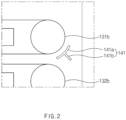
- FIG. 2 is an enlarged front view illustrating a portion in which a guide part is installed in the device for producing an aerogel blanket according to an embodiment of the present invention.
- the conveyor belt 130 may be provided in multiple levels to move the fiber 10 supplied from the supply part S while reversing the fiber 10.
- a start time at which the conveyor belt 130 reverses the fiber 10 may be before the fluidity of the sol is completely lost.
- the conveyor belt 130 may be disposed at two to five levels in the vertical direction.
- the conveyor belt 130 may be provided in two or more levels in the vertical direction to reverse the fiber 10, and may be provided in at most five levels to prevent the device from becoming unnecessarily complicated and prevent space efficiency from being reduced due to occupation of an excessive amount of space.
- the conveyor belt 130 may include a first conveyor belt 131 and a second conveyor belt 132.
- the conveyor belt 130 may include a first conveyor belt 131, a second conveyor belt 132, a third conveyor belt 133, a fourth conveyor belt 134, and a fifth conveyor belt 135.
- Each of the guide parts 141, 142, 143 and 144 may be disposed to be spaced a certain gap from a lower corner of the conveyor belt 130 to guide movement of the fiber 10.
- each of the guide parts 141, 142, 143 and 144 may allow the fiber 10 to re-absorb the sol, which falls down while being separated from the fiber 10 reversed on an end portion of the conveyor belt 130.
- each of the guide parts 141, 142, 143 and 144 may allow the sol, which is separated and falls down when the fiber 10 is reversed while passing through an end portion of the first conveyor belt 131 disposed on a top level in the multi-leveled conveyor belt 130, to flow on an upper portion of the second conveyor belt 132 disposed at a lower level, so that the sol may be re-absorbed by a portion of the fiber 10 passing through the second conveyor belt 132.
- each of the guide parts 141, 142, 143 and 144 may have a shape corresponding to the conveyor belt 130 and be in contact with a bottom surface of the fiber 10.
- Each of the guide parts 141, 142, 143 and 144 may include a contact part 141a in contact with the fiber 10, and a support part 141b which supports the contact part 141a.
- the contact part 141a may have a round shape.
- a lower portion of the contact part 141a may be provided toward an upper portion of the conveyor belt 130 disposed at a lower level.
- the heater 150 may be disposed above the conveyor belt 130 to apply heat to the fiber 10. Accordingly, the gelation of the sol impregnated in the fiber 10 may be promoted.
- the sol impregnated in the fiber 10 may gelate as time passes. Thereafter, the fiber 10 in which the gelation of the sol is completed may pass through the conveyor belt 130 to be wound on a winding roll.
- the conveyor belt 130 which moves the fiber 10 may be disposed at multiple levels to move the fiber 10 while reversing the fiber 10 and thus, there is an effect that both surfaces of the fiber 10 may be uniformly impregnated with the sol to improve product uniformity.
- the dust generation may be reduced by about 80%, and a surface moisture impregnation rate may be reduced to about 50% or less so that a surface water repellency degree is improved to maintain water repellency.
- the conveyor belt 130 which moves the fiber 10 may be disposed on multiple levels in the vertical direction and thus, there is an effect that the horizontal space occupied by the conveyor belt 130 may be reduced to increase the space efficiency.
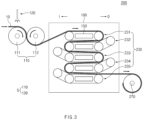
- a device 200 for producing an aerogel blanket is a device 200 for producing an aerogel blanket, including a supply part S, which supplies a fiber 10 impregnated with sol, and a conveyor belt 230 which moves the fiber 10 supplied from the supply part S.
- the conveyor belt 230 is provided in multiple levels to move the fiber 10 while reversing the fiber 10.
- the device 200 for producing an aerogel blanket according to another embodiment of the present invention may further include guide parts 141, 142, 143 and 144, a heater 150, and a heat-reserving cover part 160.
- the device 200 for producing an aerogel blanket according to another embodiment of the present invention has a difference in that both side portions of the conveyor belt 230 are provided in a bending shape.
- the other embodiment of this device 200 for producing an aerogel blanket will be described by omitting or simply describing the content in common with the embodiment described above and focusing on differences.
- the conveyor belt 230 may be provided in multiple levels to move the fiber 10 supplied from the supply part S while reversing the fiber 10.
- a start time at which the conveyor belt 230 reverses the fiber 10 may be before the fluidity of the sol is completely lost.
- the start time at which the conveyor belt 230 reverses the fiber 10 may be, for example, about a minute before the fluidity of the sol is completely lost.
- a time at which the fluidity of the sol is completely lost may be a time at which gelation of a liquid sol is completed.
- the start time at which the conveyor belt 230 reverses the fiber 10 may be, for example, before about nine minutes pass after the impregnation of the fiber 10 with the sol.
- the conveyor belt 230 may be disposed at two to five levels in the vertical direction.
- the conveyor belt 230 on each of the levels may include a plurality of rollers, and a belt mounted on the plurality of rollers.
- the one side portion and the other side portion which are bent upward in the multi-leveled conveyor belt 230, may be formed extending further than an end of the conveyor belt 230 disposed at an upper level. That is, the bending portion of the conveyor belt 230 may be formed extending.
- the sol which is separated from the fiber 10 reversed on an end portion of the conveyor belt 230 disposed at an upper side of the multi-leveled conveyor belt 230, may fall to a top surface of the conveyor belt 230 provided at a lower side to be re-absorbed by a portion of the fiber 10 passing through the conveyor belt 230 provided at the lower side.
- the conveyor belt 230 when provided in two levels, may include a first conveyor belt 231 and a second conveyor belt 232.
- the first conveyor belt 231 disposed at the uppermost level is horizontally disposed
- the second conveyor belt 232 disposed below the first conveyor belt 231 may be provided in a shape of which one side portion is bent upward.
- the conveyor belt 230 when provided in five levels, may include a first conveyor belt 231, a second conveyor belt 232, a third conveyor belt 233, a fourth conveyor belt 234, and a fifth conveyor belt 235.
- Each of the guide parts 141, 142, 143 and 144 may be disposed to be spaced a certain gap from a lower corner of the conveyor belt 230 to guide movement of the fiber 10.
- each of the guide parts 141, 142, 143 and 144 may allow the fiber 10 to re-absorb the sol, which falls down while being separated from the fiber 10 reversed on an end portion of the conveyor belt 230.
- the sol impregnated in the fiber 10 may gelate as time passes. Thereafter, the fiber 10 in which the gelation of the sol is completed may pass through the conveyor belt 230 to be wound on a winding roll 270.
- the method for producing an aerogel blanket according to an embodiment of the present invention is a method for producing an aerogel blanket through the device for producing an aerogel blanket according to an embodiment of the present invention described above.
- the embodiment of this method for producing an aerogel blanket will be described by omitting or simply describing the content in common with the embodiment of the device for producing an aerogel blanket described above, and focusing on differences.
- the fiber 10 containing the sol may be supplied.
- the fiber 10 impregnated with the sol may be movably supplied to the conveyor belt 130 through the supply part S.
- the supply part S may include a pair of moving rollers 110, which are engaged to move the fiber 10, and an impregnation part 120 which impregnates the fiber 10 with the sol.
- the pair of moving rollers 110 may include a first roller 111 and a second roller 112.
- the pair of moving rollers 110 may rotate in opposite directions to face each other, and may move the fiber 10 while passing the fiber 10 between the rollers facing each other. That is, in the supply process, the fiber 10 may be moved while being passed between the first roller 111 and the second roller 112.
- the sol may be formed as a precursor solution including, for example, silica sol and an additive.
- the silica sol may be prepared by mixing, for example, tetraethyl orthosilicate (TEOS, ethyl silicate), ethanol, H 2 O, and hydrogen chloride (HCL).
- TEOS tetraethyl orthosilicate
- H 2 O ethanol
- HCL hydrogen chloride
- the additive may include, for example, a flame retardant, an opacifying agent, and the like.
- the sol may further include a base catalyst for inducing gelation of the sol impregnated in the fiber.
- the base catalyst may allow a gel time to be a predetermined time.
- the base catalyst may be, for example, a sodium hydroxide (NaOH), but the type of the base catalyst, which is used in the device 100 for producing an aerogel blanket according to an embodiment of the present invention, is not necessarily limited to NaOH.
- NaOH sodium hydroxide
- the base catalyst may be used, for example, to make the sol to have a PH of about 7 to about 9.
- the fiber 10 supplied via the supply process may be moved through the conveyor belt 130.
- the start time at which the conveyor belt 130 reverses the fiber 10 in the moving process may be, for example, about 30 seconds to about a minute and a half before the fluidity of the sol is completely lost.
- the start time at which the fiber 10 is reversed in the moving process may be, for example, specifically about a minute before the fluidity of the sol is completely lost.
- a time when the fluidity of the sol is completely lost may be a time at which gelation of a liquid sol is completed.
- the start time at which the fiber 10 is reversed in the moving process may be about a minute before the fluidity of the sol is completely lost, so that both surfaces of the fiber 10 are uniformly impregnated with the sol.
- the last time at which the conveyor belt 130 reverses the fiber 10 in the moving process may be, for example, within a range of about 20 minutes to about 30 minutes.
- the conveyor belt 130 on each of the levels may include a plurality of rollers 131a, 131b and 132b, and a belt mounted on the plurality of rollers 131a, 131b and 132b.
- the conveyor belt 130 provided in multiple levels may be horizontally disposed at each of the levels.
- each of the guide parts 141, 142, 143 and 144 may allow the fiber 10 to re-absorb the sol, which falls down while being separated from the fiber 10 reversed on an end portion of the conveyor belt 130.
- the method for producing an aerogel blanket according to another embodiment of the present invention has a difference in that in the moving process, both side portions of the conveyor belt 230 are provided in a bending shape.
- the other embodiment of this method for producing an aerogel blanket will be described by omitting or simply describing the content in common with the embodiments described above and focusing on differences.
- the fiber 10 supplied via the supply process may be moved through the conveyor belt 230.
- a start time at which the conveyor belt 230 reverses the fiber 10 in the moving process may be before the fluidity of the sol is completely lost.
- a time at which the fluidity of the sol is completely lost may be a time at which gelation of a liquid sol is completed.
- the start time at which the conveyor belt 230 reverses the fiber 10 may be, for example, before minutes pass after the impregnation of the fiber 10 with the sol.
- the conveyor belt 230 may be disposed at two to five levels in the vertical direction.
- the conveyor belt 230 at at least one level may be provided in a shape of which one side portion or the other side portion is bent upward.
- the conveyor belt 230 provided in multiple levels may be provided in a shape of which one side portion and the other side portion are alternately bent upward with respect to a central portion.
- the one side portion and the other side portion, which are bent upward in the multi-leveled conveyor belt 230 may be formed extending further than an end of the conveyor belt 230 disposed at an upper level. That is, the bending portion of the conveyor belt 230 may be formed extending.
- the sol which is separated from the fiber 10 reversed on an end portion of the conveyor belt 230 disposed at an upper side of the multi-leveled conveyor belt 230, may fall to a top surface of the conveyor belt 230 provided at a lower side to be re-absorbed by a portion of the fiber 10 passing through the conveyor belt 230 provided at the lower side.
- a sol solution was prepared which is a precursor solution including silica sol and an additive.
- the silica sol was prepared by mixing tetraethyl orthosilicate (TEOS), ethanol, H 2 O, and HCL.
- TEOS tetraethyl orthosilicate
- H 2 O ethanol
- HCL hydroxybenzyl alcohol
- the additive such as a flame retardant and an opacifying agent, was added to the precursor solution.
- a catalyst was added to the precursor solution so that a gel time is about 10 minutes.
- an aerogel blanket was produced through an aging process, a hydrophobic surface modification process, and a supercritical drying process.
- the moisture impregnation rate was measured on the basis of ASTMC1511.
- the dust was measured from a change in weight of a specimen having a size of about 100 mm ⁇ about 100 mm after vibration at about 24 Hz, at a vertical amplitude of about 3 mm, for about 12 hrs.
- each of Embodiments 1 to 3 has the moisture impregnation rate of just about 5 wt% to about 7 wt%
- each of Comparative Examples 1 and 2 has the high moisture impregnation rate of about 11 wt% to about 12 wt%. That is, it may be seen that the aerogel blankets of Embodiments 1 to 3 are remarkably excellent in water repellency compared to those of Comparative Examples 1 and 2.
- the dust in each of Embodiments 1 to 3 is just about 0.17 wt% to about 0.22 wt%
- the dust in each of Comparative Examples 1 and 2 is about 1.1 wt% to about 1.3 wt% which is remarkably high.
- Embodiments 1 to 3 show the remarkably low dust generation compared to Comparative Examples 1 and 2.
- Comparative Example 1 shows the effects of improving physical properties hardly shown in Comparative Example 1, in which the fiber was not reversed, and Comparative Example 2 in which the initial time at which the fiber is reversed was after the gel time (a time at which the fluidity of the sol is completely lost).
Landscapes
- Chemical & Material Sciences (AREA)
- Dispersion Chemistry (AREA)
- Organic Chemistry (AREA)
- Inorganic Chemistry (AREA)
- Chemical Kinetics & Catalysis (AREA)
- Silicon Compounds (AREA)
Abstract
Description
- The present application claims the benefit of the priority of
Korean Patent Application No. 10-2021-0070447, filed on May 31, 2021 - The present invention relates to a device and method for producing an aerogel blanket.
- Aerogels are highly porous materials composed of nanoparticles and have high porosity and specific surface area, and low thermal conductivity. Thus, attention has been paid to the aerogels for use in high-efficiency thermal insulation materials, soundproofing materials, etc. Such aerogels have very low mechanical strength due to porous structures thereof, and thus aerogel composites have been developed in which the aerogels are combined with fibrous blankets by impregnation of the aerogels in the fibrous blankets made from inorganic fibers, organic fibers, or the like, which are typical thermal insulation fibers. For example, a silica aerogel-containing blanket, in which a silica aerogel is used, is produced through a silica sol preparation process, a gelation process, an aging process, a surface modification process, and a drying process.
- Here, when a fiber is impregnated with a sol liquid containing silica to be moved, sol having a low viscosity sinks toward a lower portion of the fiber impregnated with the sol before gelation.
- Accordingly, a difference in amount of impregnated sol occurs between top and bottom surfaces of the fiber, which leads to a problem that a non-uniform cross section is formed. Here, the top surface of the fiber is exposed to cause a decrease in surface water repellency.
- In particular, an additive heavy in weight sinks toward a sol bottom during the gelation to form a layer. Accordingly, there is a problem that dust generation is exacerbated.
- [Prior art document] (Patent document)
Korean Patent Publication No. 10-2011-0125773 - One aspect of the present invention is to provide a device and method for producing an aerogel blanket, in which sol is uniformly impregnated in a fiber.
- A device for producing an aerogel blanket according to an embodiment of the present invention is a device for producing an aerogel blanket, including a supply part, which supplies a fiber containing sol, and a conveyor belt which moves the fiber supplied from the supply part. The conveyor belt may be provided in multiple levels to move the fiber while reversing the fiber, and a start time at which the conveyor belt reverses the fiber may be before the fluidity of the sol is completely lost.
- A method for producing an aerogel blanket according to an embodiment of the present invention is a method for producing an aerogel blanket, including a supply process of supplying a fiber containing sol, and a moving process of moving, by a conveyor belt, the fiber supplied via the supply process. In the moving process, the conveyor belt may be provided in multiple levels to move the fiber while reversing the fiber, and a start time at which the fiber is reversed in the moving process may be before the fluidity of the sol is completely lost.
- According to the present invention, the conveyor belt which moves the fiber may be disposed at the multiple levels to move the fiber while reversing the fiber, so that the sol may be uniformly impregnated in the fiber.
- In addition, the conveyor belt which moves the fiber may be disposed at the multiple levels in the vertical direction to reduce the horizontal space occupied by the conveyor belt.
-
-
FIG. 1 is a front view illustrating an example of a device for producing an aerogel blanket according to an embodiment of the present invention. -
FIG. 2 is an enlarged front view illustrating a portion in which a guide part is installed in the device for producing an aerogel blanket according to an embodiment of the present invention. -
FIG. 3 is a front view illustrating an example of a device for producing an aerogel blanket according to another embodiment of the present invention. - Objects, advantages and features of the present invention will be clarified through following embodiments described with reference to the accompanying drawings. Note that like elements are designated by like reference numerals as far as possible even if they are shown in different drawings. The present invention may be embodied in different forms and should not be construed as limited to the embodiments set forth herein. Moreover, detailed descriptions related to well-known art will be ruled out in order not to unnecessarily obscure subject matters of the present invention.
-
FIG. 1 is a front view illustrating an example of a device for producing an aerogel blanket according to an embodiment of the present invention. - Referring to
FIG. 1 , adevice 100 for producing an aerogel blanket according to an embodiment of the present invention is adevice 100 for producing an aerogel blanket, including a supply part S, which supplies afiber 10 containing sol, and aconveyor belt 130 which moves thefiber 10 supplied from the supply part S. Theconveyor belt 130 is provided in multiple levels to move thefiber 10 while reversing thefiber 10. In addition, thedevice 100 for producing an aerogel blanket according to an embodiment of the present invention may further includeguide parts heater 150, and a heat-reserving cover part 160. - More specifically, the supply part S may supply the fiber containing the sol. Here, the
fiber 10 impregnated with the sol may be movably supplied to theconveyor belt 130 by the supply part S. - The supply part S may include a pair of moving
rollers 110, which are engaged to move thefiber 10, and animpregnation part 120 which impregnates thefiber 10 with the sol. - The pair of moving
rollers 110 may include afirst roller 111 and asecond roller 112. Here, the pair of movingrollers 110 may rotate in opposite directions to face each other, and may move thefiber 10 while passing thefiber 10 between the rollers facing each other. That is, in a supply process, thefiber 10 may be moved while being passed between thefirst roller 111 and thesecond roller 112. - The
impregnation part 120 may spray the sol onto thefiber 10 to impregnate thefiber 10 with the sol. Here, theimpregnation part 120 may be disposed above the pair of movingrollers 110 to spray the sol onto an upper portion of thefiber 10 introduced between the pair of movingrollers 110, so that the sol flows down to a space between the pair of movingrollers 110. - However, in the
device 100 for producing an aerogel blanket according to an embodiment of the present invention, the impregnation means is not necessarily limited to theimpregnation part 120 that sprays the sol to impregnate thefiber 10 with the sol, and various impregnation means may be used. For example, thefiber 10 may be impregnated with the sol while passing through an impregnation container in which the sol is accommodated. - The sol may be formed as a precursor solution including, for example, silica sol and an additive.
- The silica sol may be prepared by mixing, for example, tetraethyl orthosilicate (TEOS, ethyl silicate), ethanol, H2O, and hydrogen chloride (HCL).
- The additive may include, for example, a flame retardant, an opacifying agent, and the like.
- The sol may further include a base catalyst for inducing gelation of the sol impregnated in the fiber.
- Here, the base catalyst may allow a gel time to be a predetermined time.
- Here, the base catalyst may be, for example, a sodium hydroxide (NaOH), but the type of the base catalyst, which is used in the
device 100 for producing an aerogel blanket according to an embodiment of the present invention, is not necessarily limited to NaOH. - In addition, the base catalyst may be used, for example, to make the sol to have a PH of about 6 to about 8.
-
FIG. 2 is an enlarged front view illustrating a portion in which a guide part is installed in the device for producing an aerogel blanket according to an embodiment of the present invention. - Referring to
FIGS. 1 and2 , theconveyor belt 130 may be provided in multiple levels to move thefiber 10 supplied from the supply part S while reversing thefiber 10. - Here, a start time at which the
conveyor belt 130 reverses thefiber 10 may be before the fluidity of the sol is completely lost. - In addition, the start time at which the
conveyor belt 130 reverses thefiber 10 may be, for example, about a minute before the fluidity of the sol is completely lost. Here, a time at which the fluidity of the sol is completely lost may be a time at which gelation of a liquid sol is completed. Here, the start time at which theconveyor belt 130 reverses thefiber 10 may be, for example, before about nine minutes pass after the impregnation of thefiber 10 with the sol. - In the
conveyor belt 130 configured with multiple levels, theconveyor belt 130 on each of the levels may include a plurality ofrollers rollers - In addition, the
conveyor belt 130 provided in multiple levels may be horizontally disposed at each of the levels. - The
conveyor belt 130 may be disposed at two to five levels in the vertical direction. Here, theconveyor belt 130 may be provided in two or more levels in the vertical direction to reverse thefiber 10, and may be provided in at most five levels to prevent the device from becoming unnecessarily complicated and prevent space efficiency from being reduced due to occupation of an excessive amount of space. - In one example, when provided in two levels, the
conveyor belt 130 may include afirst conveyor belt 131 and asecond conveyor belt 132. - In another example, when provided in five levels, the
conveyor belt 130 may include afirst conveyor belt 131, asecond conveyor belt 132, athird conveyor belt 133, afourth conveyor belt 134, and afifth conveyor belt 135. - Each of the
guide parts conveyor belt 130 to guide movement of thefiber 10. Here, each of theguide parts fiber 10 to re-absorb the sol, which falls down while being separated from thefiber 10 reversed on an end portion of theconveyor belt 130. That is, for example, each of theguide parts fiber 10 is reversed while passing through an end portion of thefirst conveyor belt 131 disposed on a top level in themulti-leveled conveyor belt 130, to flow on an upper portion of thesecond conveyor belt 132 disposed at a lower level, so that the sol may be re-absorbed by a portion of thefiber 10 passing through thesecond conveyor belt 132. - In addition, each of the
guide parts conveyor belt 130 and be in contact with a bottom surface of thefiber 10. - Each of the
guide parts fiber 10, and a support part 141b which supports the contact part 141a. The contact part 141a may have a round shape. Here, a lower portion of the contact part 141a may be provided toward an upper portion of theconveyor belt 130 disposed at a lower level. - The
heater 150 may be disposed above theconveyor belt 130 to apply heat to thefiber 10. Accordingly, the gelation of the sol impregnated in thefiber 10 may be promoted. - The heat-reserving
cover part 160 may accommodate theconveyor belt 130 and thermally insulate thefiber 10 moved through theconveyor belt 130. Accordingly, loss of the heat, which is applied to thefiber 10 through theheater 150, may be prevented to uniformly apply the heat to thefiber 10. - While passing through the
conveyor belt 130, the sol impregnated in thefiber 10 may gelate as time passes. Thereafter, thefiber 10 in which the gelation of the sol is completed may pass through theconveyor belt 130 to be wound on a winding roll. - In the
device 100 for producing an aerogel blanket according to an embodiment of the present invention configured as above, theconveyor belt 130 which moves thefiber 10 may be disposed at multiple levels to move thefiber 10 while reversing thefiber 10 and thus, there is an effect that both surfaces of thefiber 10 may be uniformly impregnated with the sol to improve product uniformity. Moreover, the dust generation may be reduced by about 80%, and a surface moisture impregnation rate may be reduced to about 50% or less so that a surface water repellency degree is improved to maintain water repellency. - In addition, the
conveyor belt 130 which moves thefiber 10 may be disposed on multiple levels in the vertical direction and thus, there is an effect that the horizontal space occupied by theconveyor belt 130 may be reduced to increase the space efficiency. -
FIG. 3 is a front view illustrating an example of a device for producing an aerogel blanket according to another embodiment of the present invention. - Referring to
FIG. 3 , adevice 200 for producing an aerogel blanket according to another embodiment of the present invention is adevice 200 for producing an aerogel blanket, including a supply part S, which supplies afiber 10 impregnated with sol, and aconveyor belt 230 which moves thefiber 10 supplied from the supply part S. Theconveyor belt 230 is provided in multiple levels to move thefiber 10 while reversing thefiber 10. In addition, thedevice 200 for producing an aerogel blanket according to another embodiment of the present invention may further includeguide parts heater 150, and a heat-reservingcover part 160. - When compared to the device for producing an aerogel blanket according to an embodiment of the present invention described above, the
device 200 for producing an aerogel blanket according to another embodiment of the present invention has a difference in that both side portions of theconveyor belt 230 are provided in a bending shape. Thus, the other embodiment of thisdevice 200 for producing an aerogel blanket will be described by omitting or simply describing the content in common with the embodiment described above and focusing on differences. - More specifically, the
conveyor belt 230 may be provided in multiple levels to move thefiber 10 supplied from the supply part S while reversing thefiber 10. - Here, a start time at which the
conveyor belt 230 reverses thefiber 10 may be before the fluidity of the sol is completely lost. - In addition, the start time at which the
conveyor belt 230 reverses thefiber 10 may be, for example, about a minute before the fluidity of the sol is completely lost. Here, a time at which the fluidity of the sol is completely lost may be a time at which gelation of a liquid sol is completed. Here, the start time at which theconveyor belt 230 reverses thefiber 10 may be, for example, before about nine minutes pass after the impregnation of thefiber 10 with the sol. - The
conveyor belt 230 may be disposed at two to five levels in the vertical direction. - Here, in the
conveyor belt 230 configured with multiple levels, theconveyor belt 230 on each of the levels may include a plurality of rollers, and a belt mounted on the plurality of rollers. - In addition, in the
conveyor belt 230 provided in multiple levels, theconveyor belt 230 at at least one level may be provided in a shape of which one side portion or the other side portion is bent upward. Here, theconveyor belt 230 provided in multiple levels may be provided in a shape of which one side portion and the other side portion are alternately bent upward with respect to a central portion. Here, for example, the one side portion of theconveyor belt 230 may be an end portion in one direction O of theconveyor belt 230, and the other side portion may be an end portion in the other direction I of theconveyor belt 230. That is, referring toFIG. 3 , the one side portion or the other side portion of theconveyor belt 230 may be, for example, a right end portion and a left end portion. In addition, the one side portion and the other side portion, which are bent upward in themulti-leveled conveyor belt 230, may be formed extending further than an end of theconveyor belt 230 disposed at an upper level. That is, the bending portion of theconveyor belt 230 may be formed extending. - Accordingly, the sol, which is separated from the
fiber 10 reversed on an end portion of theconveyor belt 230 disposed at an upper side of themulti-leveled conveyor belt 230, may fall to a top surface of theconveyor belt 230 provided at a lower side to be re-absorbed by a portion of thefiber 10 passing through theconveyor belt 230 provided at the lower side. - In one example, when provided in two levels, the
conveyor belt 230 may include afirst conveyor belt 231 and asecond conveyor belt 232. Here, in theconveyor belt 230 provided in two levels, thefirst conveyor belt 231 disposed at the uppermost level is horizontally disposed, and thesecond conveyor belt 232 disposed below thefirst conveyor belt 231 may be provided in a shape of which one side portion is bent upward. In another example, when provided in five levels, theconveyor belt 230 may include afirst conveyor belt 231, asecond conveyor belt 232, athird conveyor belt 233, afourth conveyor belt 234, and afifth conveyor belt 235. Here, in theconveyor belt 230 provided in five levels, thefirst conveyor belt 231 disposed at the uppermost level is horizontally disposed, thesecond conveyor belt 232 disposed below thefirst conveyor belt 231 may be provided in a shape of which one side portion is bent upward, thethird conveyor belt 233 disposed below thesecond conveyor belt 232 may be provided in a shape of which the other side portion is bent upward, thefourth conveyor belt 234 disposed below thethird conveyor belt 233 may be provided in a shape of which one side portion is bent upward, and thefifth conveyor belt 235 disposed below thefourth conveyor belt 234 may be provided in a shape of which the other side portion is bent upward. - Each of the
guide parts conveyor belt 230 to guide movement of thefiber 10. Here, each of theguide parts fiber 10 to re-absorb the sol, which falls down while being separated from thefiber 10 reversed on an end portion of theconveyor belt 230. - While passing through the
conveyor belt 230, the sol impregnated in thefiber 10 may gelate as time passes. Thereafter, thefiber 10 in which the gelation of the sol is completed may pass through theconveyor belt 230 to be wound on a windingroll 270. - Hereinafter, a method for producing an aerogel blanket according to an embodiment of the present invention will be described.
- Referring to
FIG. 1 , the method for producing an aerogel blanket according to an embodiment of the present invention is a method for producing an aerogel blanket, including a supply process of supplying afiber 10 containing sol, and a moving process of moving, by aconveyor belt 130, thefiber 10 supplied via the supply process. In the moving process, theconveyor belt 130 may be provided in multiple levels to move thefiber 10 while reversing thefiber 10. In addition, in the method for producing an aerogel blanket according to an embodiment of the present invention, the moving process may include a guiding process and a heating process. - The method for producing an aerogel blanket according to an embodiment of the present invention is a method for producing an aerogel blanket through the device for producing an aerogel blanket according to an embodiment of the present invention described above. Thus, the embodiment of this method for producing an aerogel blanket will be described by omitting or simply describing the content in common with the embodiment of the device for producing an aerogel blanket described above, and focusing on differences.
- More specifically, in the supply process, the
fiber 10 containing the sol may be supplied. Here, in the supply process, thefiber 10 impregnated with the sol may be movably supplied to theconveyor belt 130 through the supply part S. - The supply part S may include a pair of moving
rollers 110, which are engaged to move thefiber 10, and animpregnation part 120 which impregnates thefiber 10 with the sol. - The pair of moving
rollers 110 may include afirst roller 111 and asecond roller 112. Here, the pair of movingrollers 110 may rotate in opposite directions to face each other, and may move thefiber 10 while passing thefiber 10 between the rollers facing each other. That is, in the supply process, thefiber 10 may be moved while being passed between thefirst roller 111 and thesecond roller 112. - In the supply process, the
fiber 10 may be impregnated with the sol, for example, by spraying the sol onto thefiber 10 through animpregnation part 120. Here, in the supply process, theimpregnation part 120 may be disposed above the pair of movingrollers 110 to spray the sol onto an upper portion of thefiber 10 introduced between the pair of movingrollers 110, so that the sol flows down to a space between the pair of movingrollers 110. However, in the method for producing an aerogel blanket according to an embodiment of the present invention, the impregnation method is not necessarily limited to the spraying of, by theimpregnation part 120, the sol to impregnate thefiber 10 with the sol, and various impregnation methods may be used. For example, thefiber 10 may be impregnated with the sol while passing through an impregnation container in which the sol is accommodated. - The sol may be formed as a precursor solution including, for example, silica sol and an additive.
- The silica sol may be prepared by mixing, for example, tetraethyl orthosilicate (TEOS, ethyl silicate), ethanol, H2O, and hydrogen chloride (HCL).
- The additive may include, for example, a flame retardant, an opacifying agent, and the like.
- The sol may further include a base catalyst for inducing gelation of the sol impregnated in the fiber.
- Here, the base catalyst may allow a gel time to be a predetermined time.
- Here, the base catalyst may be, for example, a sodium hydroxide (NaOH), but the type of the base catalyst, which is used in the
device 100 for producing an aerogel blanket according to an embodiment of the present invention, is not necessarily limited to NaOH. - In addition, the base catalyst may be used, for example, to make the sol to have a PH of about 7 to about 9.
- In the moving process, the
fiber 10 supplied via the supply process may be moved through theconveyor belt 130. - In addition, in the moving process, the
conveyor belt 130 may be provided in multiple levels to move thefiber 10 while reversing thefiber 10. - Here, a start time at which the
fiber 10 is reversed in the moving process may be before the fluidity of the sol is completely lost. - In addition, the start time at which the
conveyor belt 130 reverses thefiber 10 in the moving process may be, for example, about 30 seconds to about a minute and a half before the fluidity of the sol is completely lost. Here, the start time at which thefiber 10 is reversed in the moving process may be, for example, specifically about a minute before the fluidity of the sol is completely lost. Here, a time when the fluidity of the sol is completely lost may be a time at which gelation of a liquid sol is completed. Accordingly, the start time at which thefiber 10 is reversed in the moving process may be about a minute before the fluidity of the sol is completely lost, so that both surfaces of thefiber 10 are uniformly impregnated with the sol. - The start time at which the
conveyor belt 130 reverses thefiber 10 in the moving process may be, for example, before about nine minutes pass after the impregnation of thefiber 10 with the sol. Here, the start time at which theconveyor belt 130 reverses thefiber 10 in the moving process may be, for example, before about seven minutes pass after the impregnation of thefiber 10 with the sol. Here, the start time at which theconveyor belt 130 reverses thefiber 10 in the moving process may be, for example, before about four minutes pass after the impregnation of thefiber 10 with the sol. - The last time at which the
conveyor belt 130 reverses thefiber 10 in the moving process may be, for example, within a range of about 20 minutes to about 30 minutes. - In the
conveyor belt 130 configured with multiple levels, theconveyor belt 130 on each of the levels may include a plurality ofrollers rollers - In addition, the
conveyor belt 130 provided in multiple levels may be horizontally disposed at each of the levels. - The
conveyor belt 130 may be disposed at two to five levels in the vertical direction. - In the moving process, the
fiber 10 may be reversed one to four times. - The moving process may include the guiding process and the heating process.
- In the guiding process, each of
guide parts conveyor belt 130 to guide movement of thefiber 10. - Here, in the guiding process, each of the
guide parts fiber 10 to re-absorb the sol, which falls down while being separated from thefiber 10 reversed on an end portion of theconveyor belt 130. - In the heating process, a
heater 150 may be disposed above theconveyor belt 130 to apply heat to thefiber 10. Accordingly, the gelation of the sol impregnated in thefiber 10 may be promoted. - In the moving process, a heat-reserving
cover part 160 may be disposed to accommodate theconveyor belt 130 and thermally insulate thefiber 10 moved through theconveyor belt 130. Accordingly, in the heating process, loss of the heat, which is applied to thefiber 10 through theheater 150, may be prevented to uniformly apply the heat to thefiber 10. - In the moving process, the sol impregnated in the
fiber 10 may gelate as time passes, while passing through theconveyor belt 130. That is, the moving process may include a gelation process. - The method for producing an aerogel blanket according to an embodiment of the present invention may further include, after the moving process, a winding process in which the
fiber 10 in which the gelation of the sol is completed passes through theconveyor belt 130 to be wound on a winding roll. - Referring to
FIG. 3 , a method for producing an aerogel blanket according to another embodiment of the present invention is a method for producing an aerogel blanket, including a supply process of supplying afiber 10 containing sol, and a moving process of moving, by aconveyor belt 230, thefiber 10 supplied via the supply process. In the moving process, theconveyor belt 230 may be provided in multiple levels to move the fiber while reversing thefiber 10. In addition, in the method for producing an aerogel blanket according to another embodiment of the present invention, the moving process may include a guiding process and a heating process. - When compared to the method for producing an aerogel blanket according to an embodiment of the present invention described above, the method for producing an aerogel blanket according to another embodiment of the present invention has a difference in that in the moving process, both side portions of the
conveyor belt 230 are provided in a bending shape. Thus, the other embodiment of this method for producing an aerogel blanket will be described by omitting or simply describing the content in common with the embodiments described above and focusing on differences. - More specifically, in the moving process, the
fiber 10 supplied via the supply process may be moved through theconveyor belt 230. - In addition, in the moving process, the
conveyor belt 230 may be provided in multiple levels to move thefiber 10 supplied from a supply part S while reversing thefiber 10. - Here, a start time at which the
conveyor belt 230 reverses thefiber 10 in the moving process may be before the fluidity of the sol is completely lost. - In addition, the start time at which the
conveyor belt 230 reverses thefiber 10 in the moving process may be, for example, about 30 seconds to about a minute and a half before the fluidity of the sol is completely lost. Here, the start time at which theconveyor belt 230 reverses thefiber 10 in the moving process may be, for example, specifically about a minute before the fluidity of the sol is completely lost. - Here, a time at which the fluidity of the sol is completely lost may be a time at which gelation of a liquid sol is completed. Here, the start time at which the
conveyor belt 230 reverses thefiber 10 may be, for example, before minutes pass after the impregnation of thefiber 10 with the sol. - The
conveyor belt 230 may be disposed at two to five levels in the vertical direction. - Here, in the
conveyor belt 230 configured with multiple levels, theconveyor belt 230 on each of the levels may include a plurality of rollers, and a belt mounted on the plurality of rollers. - In addition, in the
conveyor belt 230 provided in multiple levels, theconveyor belt 230 at at least one level may be provided in a shape of which one side portion or the other side portion is bent upward. Here, theconveyor belt 230 provided in multiple levels may be provided in a shape of which one side portion and the other side portion are alternately bent upward with respect to a central portion. In addition, the one side portion and the other side portion, which are bent upward in themulti-leveled conveyor belt 230, may be formed extending further than an end of theconveyor belt 230 disposed at an upper level. That is, the bending portion of theconveyor belt 230 may be formed extending. Accordingly, in the moving process, the sol, which is separated from thefiber 10 reversed on an end portion of theconveyor belt 230 disposed at an upper side of themulti-leveled conveyor belt 230, may fall to a top surface of theconveyor belt 230 provided at a lower side to be re-absorbed by a portion of thefiber 10 passing through theconveyor belt 230 provided at the lower side. - A sol solution was prepared which is a precursor solution including silica sol and an additive. Here, the silica sol was prepared by mixing tetraethyl orthosilicate (TEOS), ethanol, H2O, and HCL. The additive, such as a flame retardant and an opacifying agent, was added to the precursor solution.
- A catalyst was added to the precursor solution so that a gel time is about 10 minutes.
- A fiber was reversed twice on a three-leveled conveyor belt about 7 minutes and about 14 minutes after impregnating the fiber with the sol on the assumption that the total residence time required for the fiber on the conveyor belt is about 20 minutes.
- Thereafter, an aerogel blanket was produced through an aging process, a hydrophobic surface modification process, and a supercritical drying process.
- The same process as in Embodiment 1 was performed, except that a fiber was reversed twice on a four-leveled conveyor belt about 5 minutes, about 10 minutes, and about 15 minutes after impregnating the fiber with a sol solution.
- The same process as in Embodiment 1 was performed, except that a fiber was reversed four times on a five-leveled conveyor belt about 4 minutes, about 8 minutes, about 12 minutes, and about 16 minutes after impregnating the fiber with a sol solution.
- The same process as in Embodiment 1 was performed, except that a fiber was not reversed on a conveyor belt after impregnating the fiber with a sol solution.
- The same process as in Embodiment 1 was performed, except that a fiber was reversed once on a two-leveled conveyor belt about 10 minutes after impregnating the fiber with a sol solution.
- Measured were the thermal conductivity, the moisture impregnation rate, and the dust of each of the aerogel blankets produced through Embodiments and Comparative Examples.
- The thermal conductivity was measured at a room temperature (about 25°C) by using HFM 436 (company Netzsch) equipment.
- The moisture impregnation rate was measured on the basis of ASTMC1511.
- The dust was measured from a change in weight of a specimen having a size of about 100 mm × about 100 mm after vibration at about 24 Hz, at a vertical amplitude of about 3 mm, for about 12 hrs.
- The thermal conductivity, the moisture impregnation rate, and the dust, which were measured through the tests of Experimental Example 1, are shown in Table 1 below.
[TABLE 1] The number of conveyor belt levels Reversing Thermal conductivity (mVV/mK) Moisture impregnation rate (wt$) Dust (wt%) Embodiment 1 3 levels 2 times (7 and 14 mins) 16.6 5 0.21 Embodiment 2 4 levels 3 times (5, 10, and 15 mins) 16.4 6 0.17 Embodiment 3 5 levels 4 times (4, 8, 12, and 16 mins) 16.5 7 0.22 Comparative Example 1 1 level 0 times 16.4 11 1.3 Comparative Example 2 2 levels One time (10 mins) 16.5 12 1.1 - Referring to Table 1, it may be seen that while each of Embodiments 1 to 3 has the moisture impregnation rate of just about 5 wt% to about 7 wt%, each of Comparative Examples 1 and 2 has the high moisture impregnation rate of about 11 wt% to about 12 wt%. That is, it may be seen that the aerogel blankets of Embodiments 1 to 3 are remarkably excellent in water repellency compared to those of Comparative Examples 1 and 2. In addition, it may be seen that while the dust in each of Embodiments 1 to 3 is just about 0.17 wt% to about 0.22 wt%, the dust in each of Comparative Examples 1 and 2 is about 1.1 wt% to about 1.3 wt% which is remarkably high. That is, it may be seen that Embodiments 1 to 3 show the remarkably low dust generation compared to Comparative Examples 1 and 2. As a result, it may be seen that the effects of improving physical properties are hardly shown in Comparative Example 1, in which the fiber was not reversed, and Comparative Example 2 in which the initial time at which the fiber is reversed was after the gel time (a time at which the fluidity of the sol is completely lost).
- Although the present invention has been described with reference to the limited embodiments and drawings, the present invention is not limited thereto and may be variously implemented by those of ordinary skill in the art to which the present invention pertains, within the technical idea of the present invention and an equivalent of the appended claims.
- Moreover, the specific protective scope of the present invention will be clarified by the accompanying claims.
-
- 10:
- Fiber
- 100, 200:
- Device for producing aerogel blanket
- 110:
- A pair of moving rollers
- 111:
- First roller
- 112:
- Second roller
- 120:
- Impregnation part
- 130:
- Conveyor belt
- 131a, 131b, 132b:
- Roller
- 141, 142, 143, 144:
- Guide part
- 141a:
- Contact part
- 141b:
- Support part
- 150:
- Heater
- 160:
- Heat-reserving cover part
- S:
- Supply part
Claims (14)
- A device for producing an aerogel blanket, the device comprising:a supply part configured to supply a fiber containing sol; anda conveyor belt configured to move the fiber supplied from the supply part,wherein the conveyor belt is provided in multiple levels to move the fiber while reversing the fiber, anda start time at which the conveyor belt reverses the fiber is before fluidity of the sol is completely lost.
- The device of claim 1, wherein the start time at which the conveyor belt reverses the fiber is about a minute before the fluidity of the sol is completely lost.
- The device of claim 1, wherein the conveyor belt is disposed at 2 to 5 levels in a vertical direction.
- The device of claim 1, wherein the conveyor belt provided in multiple levels is disposed in the vertical direction, wherein the conveyor belt on each of the levels is horizontally disposed.
- The device of claim 1, wherein, in the conveyor belt provided in multiple levels, the conveyor belt at at least one level is provided in a shape of which one side portion or the other side portion is bent upward.
- The device of claim 5, wherein the conveyor belt provided in multiple levels is provided in a shape of which the one side portion and the other side portion are alternately bent upward with respect to a central portion.
- The device of claim 1, further comprising a guide part disposed to be spaced a certain gap from a lower corner of the conveyor belt to guide movement of the fiber.
- The device of claim 7, wherein the guide part has a shape corresponding to the conveyor belt and is in contact with a bottom surface of the fiber.
- The device of claim 7, wherein the guide part comprises a contact part that is in contact with the fiber, and a support part configured to support the contact part,
wherein the contact part has a round shape. - The device of claim 1, further comprising a heater disposed above the conveyor belt to apply heat to the fiber.
- The device of claim 10, further comprising a heat-reserving cover part configured to accommodate the conveyer belt and thermally insulate the fiber moved through the conveyer belt.
- A method for producing an aerogel blanket, the method comprising:a supply process of supplying a fiber containing sol; anda moving process of moving, by a conveyor belt, the fiber supplied via the supply process,wherein, in the moving process, the conveyor belt is provided in multiple levels to move the fiber while reversing the fiber, anda start time at which the fiber is reversed in the moving process is before fluidity of the sol is completely lost.
- The method of claim 12, wherein the start time at which the fiber is reversed in the moving process is about a minute before the fluidity of the sol is completely lost.
- The method of claim 12, wherein, in the moving process, the fiber is reversed one to four times.
Applications Claiming Priority (2)
| Application Number | Priority Date | Filing Date | Title |
|---|---|---|---|
| KR1020210070447A KR102737602B1 (en) | 2021-05-31 | 2021-05-31 | Aerogel blanket manufacturing device and manufacturing method |
| PCT/KR2022/007468 WO2022255724A1 (en) | 2021-05-31 | 2022-05-26 | Aerogel blanket manufacturing apparatus and manufacturing method |
Publications (2)
| Publication Number | Publication Date |
|---|---|
| EP4219398A1 true EP4219398A1 (en) | 2023-08-02 |
| EP4219398A4 EP4219398A4 (en) | 2024-05-29 |
Family
ID=84323382
Family Applications (1)
| Application Number | Title | Priority Date | Filing Date |
|---|---|---|---|
| EP22816383.8A Pending EP4219398A4 (en) | 2021-05-31 | 2022-05-26 | APPARATUS AND METHOD FOR MANUFACTURING AIRGEL COVERS |
Country Status (6)
| Country | Link |
|---|---|
| US (1) | US12595181B2 (en) |
| EP (1) | EP4219398A4 (en) |
| JP (1) | JP7580854B2 (en) |
| KR (1) | KR102737602B1 (en) |
| CN (1) | CN116437999B (en) |
| WO (1) | WO2022255724A1 (en) |
Family Cites Families (35)
| Publication number | Priority date | Publication date | Assignee | Title |
|---|---|---|---|---|
| US2678676A (en) * | 1951-07-06 | 1954-05-18 | Us Rubber Co | Apparatus for forming ribbons composed of extruded rubber threads |
| CH601585A5 (en) * | 1976-03-29 | 1978-07-14 | Mittex Anstalt | |
| DE2951577A1 (en) * | 1979-12-21 | 1981-07-02 | Grünzweig + Hartmann und Glasfaser AG, 6700 Ludwigshafen | METHOD FOR PRODUCING HEAT-INSULATING BODIES AND DEVICE FOR IMPLEMENTING THE METHOD |
| JPH068204A (en) | 1992-06-25 | 1994-01-18 | Hashimoto Denki Co Ltd | Method and apparatus for laminating mechanism for plywood employing upper face applicator |
| US5810961A (en) * | 1993-11-19 | 1998-09-22 | E. Khashoggi Industries, Llc | Methods for manufacturing molded sheets having a high starch content |
| US5736209A (en) * | 1993-11-19 | 1998-04-07 | E. Kashoggi, Industries, Llc | Compositions having a high ungelatinized starch content and sheets molded therefrom |
| PT2422950E (en) * | 2003-06-24 | 2014-12-09 | Aspen Aerogels Inc | METHODS FOR PRODUCING GEL LEAVES |
| JP2011190551A (en) * | 2010-03-12 | 2011-09-29 | Asahi Kagaku Kk | Aerogel sheet production system |
| KR101147494B1 (en) | 2010-05-14 | 2012-05-21 | 주식회사 화인텍 | Manufacturing method of hydrophobic silica aerogel and hydrophobic silica aerogel manufactured therefrom |
| KR101147495B1 (en) | 2010-05-17 | 2012-05-21 | 주식회사 화인텍 | Manufacturing method for hydrophobic silica aerogel composites |
| KR101146778B1 (en) | 2012-01-09 | 2012-05-21 | 유인수 | Apparatus for pressing and drying molded pipe insulation product using aerogel |
| CN105209248B (en) | 2013-03-15 | 2018-02-27 | 卡博特公司 | Aerogel blanket and production method |
| KR101506096B1 (en) | 2013-11-08 | 2015-03-25 | 지오스 에어로겔 리미티드 | Device and method for producing insulation textile impregnated aerogel using layer by layer type |
| CN104801199A (en) | 2015-04-02 | 2015-07-29 | 昆山艾可芬能源科技有限公司 | Phase-inversion casting film solidification and drying device and phase-inversion casting film solidification and drying technology |
| JP6718101B2 (en) * | 2015-08-04 | 2020-07-08 | 福井県 | Method for manufacturing fiber-reinforced resin sheet material |
| KR101953371B1 (en) * | 2016-01-19 | 2019-02-28 | 주식회사 엘지화학 | Preparation method and apparatus of aerogel sheet |
| KR101748532B1 (en) * | 2016-01-19 | 2017-06-19 | 주식회사 엘지화학 | Preparation method and apparatus of aerogel sheet |
| KR101774140B1 (en) * | 2016-01-19 | 2017-09-01 | 주식회사 엘지화학 | Preparation method and apparatus of aerogel sheet |
| KR101654795B1 (en) * | 2016-02-05 | 2016-09-06 | 김현철 | Method for Preparing High-insulation Aerogel - Impregnated Mat |
| KR101966358B1 (en) * | 2016-02-16 | 2019-04-08 | 주식회사 엘지화학 | Preparation method and apparatus of aerogel sheet |
| KR101962207B1 (en) * | 2016-02-17 | 2019-03-27 | 주식회사 엘지화학 | Composite sheet preparation method and apparatus comprising aerogel sheet |
| KR101962206B1 (en) * | 2016-02-19 | 2019-03-27 | 주식회사 엘지화학 | Composite sheet preparation method and apparatus comprising aerogel sheet |
| KR101968648B1 (en) | 2016-02-19 | 2019-04-12 | 주식회사 엘지화학 | Preparation method and apparatus of aerogel sheet |
| KR101953349B1 (en) | 2016-02-22 | 2019-02-28 | 주식회사 엘지화학 | Preparation apparatus for aerogel sheet |
| CN106391426B (en) | 2016-09-05 | 2019-08-16 | 山东省科学院新材料研究所 | A kind of aerogel composite surfacing technique |
| CN107415083A (en) * | 2017-08-22 | 2017-12-01 | 胡忠义 | Two-stage air-cooled device is used in a kind of fiber Masterbatch production |
| KR102231590B1 (en) * | 2017-11-30 | 2021-03-23 | (주)엘지하우시스 | Method of manufacturing aerogel blanket and aerogel and produced aerogel blanket |
| CN207825672U (en) | 2018-01-08 | 2018-09-07 | 上海大音希声新型材料有限公司 | A kind of sandwich structure aeroge composite thermal insulation article production line |
| CN208558574U (en) | 2018-04-27 | 2019-03-01 | 天津中世恒业科技有限公司 | The Automatic Production System of aeroge thermal insulating coiled material |
| CN108905912B (en) * | 2018-08-01 | 2020-10-30 | 纳诺科技有限公司 | Preparation method of aerogel composite material |
| US11866324B2 (en) * | 2018-11-27 | 2024-01-09 | Lg Chem, Ltd. | Method for manufacturing aerogel blanket |
| JP7085647B2 (en) * | 2018-12-13 | 2022-06-16 | エルジー・ケム・リミテッド | How to make an airgel blanket |
| JP7293997B2 (en) | 2019-08-30 | 2023-06-20 | 日本ゼオン株式会社 | Synthetic rubber manufacturing method |
| WO2021045483A1 (en) | 2019-09-03 | 2021-03-11 | 주식회사 엘지화학 | Method for manufacturing aerogel blanket |
| KR102701498B1 (en) | 2019-09-18 | 2024-09-03 | 주식회사 엘지화학 | Aerogel blanket and method preparing thereof |
-
2021
- 2021-05-31 KR KR1020210070447A patent/KR102737602B1/en active Active
-
2022
- 2022-05-26 EP EP22816383.8A patent/EP4219398A4/en active Pending
- 2022-05-26 JP JP2023560165A patent/JP7580854B2/en active Active
- 2022-05-26 US US18/035,583 patent/US12595181B2/en active Active
- 2022-05-26 CN CN202280007291.XA patent/CN116437999B/en active Active
- 2022-05-26 WO PCT/KR2022/007468 patent/WO2022255724A1/en not_active Ceased
Also Published As
| Publication number | Publication date |
|---|---|
| CN116437999B (en) | 2025-01-24 |
| EP4219398A4 (en) | 2024-05-29 |
| KR20220161994A (en) | 2022-12-07 |
| US12595181B2 (en) | 2026-04-07 |
| WO2022255724A1 (en) | 2022-12-08 |
| KR102737602B1 (en) | 2024-12-04 |
| US20230391628A1 (en) | 2023-12-07 |
| JP2024512124A (en) | 2024-03-18 |
| JP7580854B2 (en) | 2024-11-12 |
| CN116437999A (en) | 2023-07-14 |
Similar Documents
| Publication | Publication Date | Title |
|---|---|---|
| JP6928131B2 (en) | Manufacturing method and manufacturing equipment for composite sheets including airgel sheets | |
| US6989123B2 (en) | Methods to produce gel sheets | |
| US10682839B2 (en) | Apparatus and method for manufacturing composite sheet comprising aerogel sheet | |
| EP3878812B1 (en) | Aerogel blanket and manufacturing method therefor | |
| KR20220049841A (en) | Method of preparing aerogel blanket and the same prepared therefrom | |
| CN108793943A (en) | The preparation method for the adjustable aerosil fibre of hydrophilic and hydrophobic that graphene oxide is modified | |
| KR20190056138A (en) | Silica aerogel blanket with low dust and method for preparing the same | |
| US12595181B2 (en) | Device and method for producing aerogel blanket | |
| US12552673B2 (en) | Device and method for producing aerogel blanket | |
| CN216107583U (en) | Gel composite device for aerogel coiled material | |
| KR200396515Y1 (en) | Incombustible styrofoam panel | |
| CN222665727U (en) | Glass fiber sizing device | |
| CN121760151A (en) | A heat insulation felt soaking device |
Legal Events
| Date | Code | Title | Description |
|---|---|---|---|
| STAA | Information on the status of an ep patent application or granted ep patent |
Free format text: STATUS: THE INTERNATIONAL PUBLICATION HAS BEEN MADE |
|
| PUAI | Public reference made under article 153(3) epc to a published international application that has entered the european phase |
Free format text: ORIGINAL CODE: 0009012 |
|
| STAA | Information on the status of an ep patent application or granted ep patent |
Free format text: STATUS: REQUEST FOR EXAMINATION WAS MADE |
|
| 17P | Request for examination filed |
Effective date: 20230425 |
|
| AK | Designated contracting states |
Kind code of ref document: A1 Designated state(s): AL AT BE BG CH CY CZ DE DK EE ES FI FR GB GR HR HU IE IS IT LI LT LU LV MC MK MT NL NO PL PT RO RS SE SI SK SM TR |
|
| A4 | Supplementary search report drawn up and despatched |
Effective date: 20240426 |
|
| RIC1 | Information provided on ipc code assigned before grant |
Ipc: B01J 13/00 20060101ALI20240422BHEP Ipc: C01B 33/158 20060101AFI20240422BHEP |
|
| DAV | Request for validation of the european patent (deleted) | ||
| DAX | Request for extension of the european patent (deleted) | ||
| GRAP | Despatch of communication of intention to grant a patent |
Free format text: ORIGINAL CODE: EPIDOSNIGR1 |
|
| STAA | Information on the status of an ep patent application or granted ep patent |
Free format text: STATUS: GRANT OF PATENT IS INTENDED |