EP4216640B1 - Zuweisung von ressourcen für kommunikations- und erfassungsdienste - Google Patents
Zuweisung von ressourcen für kommunikations- und erfassungsdienste Download PDFInfo
- Publication number
- EP4216640B1 EP4216640B1 EP23151258.3A EP23151258A EP4216640B1 EP 4216640 B1 EP4216640 B1 EP 4216640B1 EP 23151258 A EP23151258 A EP 23151258A EP 4216640 B1 EP4216640 B1 EP 4216640B1
- Authority
- EP
- European Patent Office
- Prior art keywords
- resources
- services
- allocated
- value
- sensing
- Prior art date
- Legal status (The legal status is an assumption and is not a legal conclusion. Google has not performed a legal analysis and makes no representation as to the accuracy of the status listed.)
- Active
Links
Images

Classifications
-
- H—ELECTRICITY
- H04—ELECTRIC COMMUNICATION TECHNIQUE
- H04W—WIRELESS COMMUNICATION NETWORKS
- H04W72/00—Local resource management
- H04W72/04—Wireless resource allocation
-
- H—ELECTRICITY
- H04—ELECTRIC COMMUNICATION TECHNIQUE
- H04W—WIRELESS COMMUNICATION NETWORKS
- H04W28/00—Network traffic management; Network resource management
- H04W28/02—Traffic management, e.g. flow control or congestion control
- H04W28/0268—Traffic management, e.g. flow control or congestion control using specific QoS parameters for wireless networks, e.g. QoS class identifier [QCI] or guaranteed bit rate [GBR]
-
- H—ELECTRICITY
- H04—ELECTRIC COMMUNICATION TECHNIQUE
- H04L—TRANSMISSION OF DIGITAL INFORMATION, e.g. TELEGRAPHIC COMMUNICATION
- H04L47/00—Traffic control in data switching networks
- H04L47/10—Flow control; Congestion control
- H04L47/24—Traffic characterised by specific attributes, e.g. priority or QoS
- H04L47/2408—Traffic characterised by specific attributes, e.g. priority or QoS for supporting different services, e.g. a differentiated services [DiffServ] type of service
-
- H—ELECTRICITY
- H04—ELECTRIC COMMUNICATION TECHNIQUE
- H04L—TRANSMISSION OF DIGITAL INFORMATION, e.g. TELEGRAPHIC COMMUNICATION
- H04L47/00—Traffic control in data switching networks
- H04L47/10—Flow control; Congestion control
- H04L47/24—Traffic characterised by specific attributes, e.g. priority or QoS
- H04L47/2425—Traffic characterised by specific attributes, e.g. priority or QoS for supporting services specification, e.g. SLA
- H04L47/2433—Allocation of priorities to traffic types
-
- H—ELECTRICITY
- H04—ELECTRIC COMMUNICATION TECHNIQUE
- H04L—TRANSMISSION OF DIGITAL INFORMATION, e.g. TELEGRAPHIC COMMUNICATION
- H04L47/00—Traffic control in data switching networks
- H04L47/70—Admission control; Resource allocation
- H04L47/80—Actions related to the user profile or the type of traffic
- H04L47/805—QOS or priority aware
-
- H—ELECTRICITY
- H04—ELECTRIC COMMUNICATION TECHNIQUE
- H04W—WIRELESS COMMUNICATION NETWORKS
- H04W28/00—Network traffic management; Network resource management
- H04W28/02—Traffic management, e.g. flow control or congestion control
- H04W28/08—Load balancing or load distribution
- H04W28/09—Management thereof
- H04W28/0925—Management thereof using policies
-
- H—ELECTRICITY
- H04—ELECTRIC COMMUNICATION TECHNIQUE
- H04W—WIRELESS COMMUNICATION NETWORKS
- H04W28/00—Network traffic management; Network resource management
- H04W28/02—Traffic management, e.g. flow control or congestion control
- H04W28/08—Load balancing or load distribution
- H04W28/09—Management thereof
- H04W28/0958—Management thereof based on metrics or performance parameters
- H04W28/0967—Quality of Service [QoS] parameters
-
- H—ELECTRICITY
- H04—ELECTRIC COMMUNICATION TECHNIQUE
- H04L—TRANSMISSION OF DIGITAL INFORMATION, e.g. TELEGRAPHIC COMMUNICATION
- H04L47/00—Traffic control in data switching networks
- H04L47/70—Admission control; Resource allocation
- H04L47/82—Miscellaneous aspects
- H04L47/824—Applicable to portable or mobile terminals
Definitions
- Various example embodiments described herein relate to the field of wireless communications.
- Wireless networks provide communication services that enable devices to connect to each other and receive and transmit data.
- the physical resources used for communication may also be utilized for sensing such as sensing the state and behaviour of various active devices and/or objects in the environment.
- JCAS joint communication and sensing
- an apparatus comprising at least one processor and at least one memory including computer program code, the at least one memory and the computer program code being configured to, with the at least one processor, cause the apparatus at least to perform: determining, per a communication service to which resources are to be allocated, a metric value using a first predefined set of rules, determining, per a sensing service to which resources are to be allocated, a metric value using a second predefined set of rules, sorting communication services to which resources are to be allocated and sensing services to which resources are to be allocated based on the metric values to a sorted order using a third rule, and allocating resources for the communication services and the sensing services based on the sorted order.
- the at least one memory and the computer program code are configured to, with the at least one processor, cause the apparatus further to perform: determining, per a sensing service, a weight value, calculating, per a sensing service, an instantaneous relevance value, calculating, per a sensing service, an average allocated resources value, and calculating a normalization value to the sensing services, wherein the second predefined set of rules comprises: calculating the metric value by multiplying the instantaneous relevance value calculated for the sensing service by the normalization value calculated and by the weight value determined for the sensing service, and dividing the result by the average allocated resources value calculated for the sensing service.
- the at least one memory and the computer program code are configured to, with the at least one processor, cause the apparatus further to perform calculating the instantaneous relevance value by: increasing the instantaneous relevance value for the sensing service when a time elapsed from a preceding time the sensing service was allocated resources increases.
- the at least one memory and the computer program code are configured to, with the at least one processor, cause the apparatus further to perform calculating the average allocated resources value, per a sensing service, by: calculating an instantaneous allocated resources value, and calculating the average allocated resources value as a linear combination of the previous average allocated resources value calculated for the service and the instantaneous allocated resources value calculated.
- the at least one memory and the computer program code are configured to, with the at least one processor, cause the apparatus further to perform: determining, per a communication service, a weight value, calculating, per a communication service, an achievable instantaneous rate, and calculating, per a communication service, an average previously experienced rate, wherein the first predefined set of rules comprises: calculating the metric value by multiplying the achievable instantaneous rate calculated for the communication service by the weight value determined for the communication service and dividing the result by the average previously experienced rate calculated for the communication service, and calculating, per a communication service that was allocated resources at a preceding time resources were allocated, the average allocated resources value, and calculating an instantaneous proportional fair opportunistic gain by multiplying, per a communication service that was allocated resources at the preceding time resources were allocated, the metric value calculated for the communication service by the average allocated resources value calculated for the communication service, dividing, per a communication service, the result by the weight value determined for the communication service, adding the results per communication services together
- the at least one memory and the computer program code are configured to, with the at least one processor, cause the apparatus further to perform calculating the normalization value by: calculating the instantaneous proportional fair opportunistic gain of communication services that were allocated resources at the preceding time resources were allocated, calculating an average proportional fair opportunistic gain as a linear combination of the calculated instantaneous proportional fair opportunistic gain and the average proportional fair opportunistic gain at the preceding time resources were allocated, and determining the normalization value as the calculated average proportional fair opportunistic gain.
- the at least one memory and the computer program code are configured to, with the at least one processor, cause the apparatus further to perform: determining, per a communication service, a weight value, and determining, per a sensing service, a weight value, wherein the first predefined set of rules and the second predefined set of rules comprise determining the metric value as equal to the weight value.
- allocating resources for the communication services and the sensing services based on the sorted order comprises: dividing the resources to resource portions, wherein sizes of the resource portions are proportional to the metric values determined, and allocating the resource portions to the services such that the size of a resource portion corresponds to the metric value of a service.
- the at least one memory and the computer program code are configured to, with the at least one processor, cause the apparatus further to perform: determining, prior to determining the metric values and sorting based on the metric values, for the services, per a service, a priority value, sorting, prior to determining the metric values and sorting based on the metric values, the services to a priority order based on the priority values, if the services are discriminated by the priority order to perform allocating resources, allocating resources to the services using the priority order, otherwise, performing determining the metric values and sorting the services based on the metric values and allocating resources to the services using the sorted order based on the metric values.
- the at least one memory and the computer program code are configured to, with the at least one processor, cause the apparatus further to perform, when resources to be allocated are provided on a plurality of beams: associating, per a communication service, a beam to be used by the communication service, associating, per a sensing service, a beam to be used by the sensing service, selecting at least one beam associated to a communication service or a sensing service based on the metric values using the third rule, setting communication services and sensing services that can be served by the at least one beam selected as a candidate set, sorting the communication services and the sensing services in the candidate set to a sorted order either based on the metric values, or determining, per a service in the candidate set, a weight value and sorting based on weight values, and allocating resources to the services in the candidate set based on the sorted order.
- the at least one memory and the computer program code are configured to, with the at least one processor, cause the apparatus further to perform: assessing an amount of resources needed by the services, if the assessed amount of resources needed exceeds an amount of available resources, performing determining the metric values, sorting the services based on the metric values, and allocating resources to the services using the sorted order, otherwise, allocating resources to the services.
- a method comprising: determining, per a communication service to which resources are to be allocated, a metric value using a first predefined set of rules, determining, per a sensing service to which resources are to be allocated, a metric value using a second predefined set of rules, sorting communication services to which resources are to be allocated and sensing services to which resources are to be allocated based on the metric values to a sorted order using a third rule, and allocating resources for the communication services and the sensing services based on the sorted order.
- a computer-readable medium comprising program instructions for causing an apparatus to perform at least the following: determining, per a communication service to which resources are to be allocated, a metric value using a first predefined set of rules, determining, per a sensing service to which resources are to be allocated, a metric value using a second predefined set of rules, sorting communication services to which resources are to be allocated and sensing services to which resources are to be allocated based on the metric values to a sorted order using a third rule, and allocating resources for the communication services and the sensing services based on the sorted order.
- the computer-readable medium is a non-transitory computer-readable medium.
- a computer program comprising instructions for causing an apparatus to perform at least the following: determining, per a communication service to which resources are to be allocated, a metric value using a first predefined set of rules, determining, per a sensing service to which resources are to be allocated, a metric value using a second predefined set of rules, sorting communication services to which resources are to be allocated and sensing services to which resources are to be allocated based on the metric values to a sorted order using a third rule, and allocating resources for the communication services and the sensing services based on the sorted order.
- UMTS universal mobile telecommunications system
- UTRAN radio access network
- LTE long term evolution
- WLAN wireless local area network
- WiFi worldwide interoperability for microwave access
- Bluetooth ® personal communications services
- PCS personal communications services
- WCDMA wideband code division multiple access
- UWB ultra-wideband
- IMS Internet Protocol multimedia subsystems
- FIG. 1 depicts examples of simplified system architectures only showing some elements and functional entities, all being logical units, whose implementation may differ from what is shown.
- the connections shown in FIG. 1 are logical connections; the actual physical connections may be different. It is apparent to a person skilled in the art that the system typically comprises also other functions and structures than those shown in FIG. 1 .
- FIG. 1 shows a part of an exemplifying radio access network.
- FIG. 1 shows user devices 101, 101' configured to be in a wireless connection on one or more communication channels with a node 102.
- the node 102 is further connected to a core network 105.
- the node 102 may be an access node such as (e/g)NodeB providing or serving devices in a cell.
- the node 102 may be a non-3GPP access node.
- the physical link from a device to a (e/g)NodeB is called uplink or reverse link and the physical link from the (e/g) NodeB to the device is called downlink or forward link.
- (e/g)NodeBs or their functionalities may be implemented by using any node, host, server or access point etc. entity suitable for such a usage.
- a communications system typically comprises more than one (e/g)NodeB in which case the (e/g)NodeBs may also be configured to communicate with one another over links, wired or wireless, designed for the purpose. These links may be used for signalling purposes.
- the (e/g)NodeB is a computing device configured to control the radio resources of communication system it is coupled to.
- the NodeB may also be referred to as a base station, an access point or any other type of interfacing device including a relay station capable of operating in a wireless environment.
- the (e/g)NodeB includes or is coupled to transceivers. From the transceivers of the (e/g)NodeB, a connection is provided to an antenna unit that establishes bi-directional radio links to devices.
- the antenna unit may comprise a plurality of antennas or antenna elements.
- the (e/g)NodeB is further connected to the core network 105 (CN or next generation core NGC).
- the counterpart on the CN side can be a serving gateway (S-GW, routing and forwarding user data packets), packet data network gateway (P-GW), for providing connectivity of user devices (UEs) to external packet data networks, or mobile management entity (MME), or access and mobility management function (AMF), etc.
- S-GW serving gateway
- P-GW packet data network gateway
- MME mobile management entity
- AMF access and mobility management function
- the user device also called UE, user equipment, user terminal, terminal device, etc.
- UE user equipment
- user terminal terminal device
- any feature described herein with a user device may be implemented with a corresponding apparatus, such as a relay node.
- a relay node is a layer 3 relay (self-backhauling relay) towards the base station.
- the user device typically refers to a device (e.g. a portable or non-portable computing device) that includes wireless mobile communication devices operating with or without a subscriber identification module (SIM), including, but not limited to, the following types of devices: a mobile station (mobile phone), smartphone, personal digital assistant (PDA), handset, device using a wireless modem (alarm or measurement device, etc.), laptop and/or touch screen computer, tablet, game console, notebook, and multimedia device.
- SIM subscriber identification module
- a device may also be a nearly exclusive uplink only device, of which an example is a camera or video camera loading images or video clips to a network.
- a device may also be a device having capability to operate in Internet of Things (IoT) network which is a scenario in which objects are provided with the ability to transfer data over a network without requiring human-to-human or human-to-computer interaction, e.g., to be used in smart power grids and connected vehicles.
- the user device may also utilise cloud.
- a user device may comprise a user portable device with radio parts (such as a watch, earphones, eyeglasses, other wearable accessories or wearables) and the computation is carried out in the cloud.
- the device (or in some embodiments a layer 3 relay node) is configured to perform one or more of user equipment functionalities.
- the user device may also be called a subscriber unit, mobile station, remote terminal, access terminal, user terminal or user equipment (UE) just to mention but a few names or apparatuses.
- CPS cyber-physical system
- ICT devices sensors, actuators, processors microcontrollers, etc.
- Mobile cyber physical systems in which the physical system in question has inherent mobility, are a subcategory of cyber-physical systems. Examples of mobile physical systems include mobile robotics and electronics transported by humans or animals.
- apparatuses have been depicted as single entities, different units, processors and/or memory units (not all shown in FIG. 1 ) may be implemented.
- 5G enables using multiple input - multiple output (MIMO) antennas, many more base stations or nodes than the LTE (a so-called small cell concept), including macro sites operating in co-operation with smaller stations and employing a variety of radio technologies depending on service needs, use cases and/or spectrum available.
- MIMO multiple input - multiple output
- 5G mobile communications supports a wide range of use cases and related applications including video streaming, augmented reality, different ways of data sharing and various forms of machine type applications (such as (massive) machine-type communications (mMTC), including vehicular safety, different sensors and real-time control.
- 5G is expected to have multiple radio interfaces, namely below 6GHz, cmWave and mmWave, and also being integrable with existing legacy radio access technologies, such as the LTE.
- Integration with the LTE may be implemented, at least in the early phase, as a system, where macro coverage is provided by the LTE and 5G radio interface access comes from small cells by aggregation to the LTE.
- 5G is planned to support both inter-RAT operability (such as LTE-5G) and inter-RI operability (inter-radio interface operability, such as below 6GHz - cmWave, below 6GHz - cmWave - mmWave).
- inter-RAT operability such as LTE-5G
- inter-RI operability inter-radio interface operability, such as below 6GHz - cmWave, below 6GHz - cmWave - mmWave.
- One of the concepts considered to be used in 5G networks is network slicing in which multiple independent and dedicated virtual sub-networks (network instances) may be created within the same infrastructure to run services that have different requirements on latency, reliability, throughput and mobility.
- the current architecture in LTE networks is fully distributed in the radio and fully centralized in the core network.
- the low latency applications and services in 5G require to bring the content close to the radio which leads to local break out and multi-access edge computing (MEC).
- MEC multi-access edge computing
- 5G enables analytics and knowledge generation to occur at the source of the data. This approach requires leveraging resources that may not be continuously connected to a network such as laptops, smartphones, tablets and sensors.
- MEC provides a distributed computing environment for application and service hosting. It also has the ability to store and process content in close proximity to cellular subscribers for faster response time.
- Edge computing covers a wide range of technologies such as wireless sensor networks, mobile data acquisition, mobile signature analysis, cooperative distributed peer-to-peer ad hoc networking and processing also classifiable as local cloud/fog computing and grid/mesh computing, dew computing, mobile edge computing, cloud-let, distributed data storage and retrieval, autonomic self-healing networks, remote cloud services, augmented and virtual reality, data caching, Internet of Things (massive connectivity and/or latency critical), critical communications (autonomous vehicles, traffic safety, real-time analytics, time-critical control, healthcare applications).
- technologies such as wireless sensor networks, mobile data acquisition, mobile signature analysis, cooperative distributed peer-to-peer ad hoc networking and processing also classifiable as local cloud/fog computing and grid/mesh computing, dew computing, mobile edge computing, cloud-let, distributed data storage and retrieval, autonomic self-healing networks, remote cloud services, augmented and virtual reality, data caching, Internet of Things (massive connectivity and/or latency critical), critical communications
- the communication system is also able to communicate with other networks, such as a public switched telephone network or the Internet 106, or utilise services provided by them.
- the communication network may also be able to support the usage of cloud services, for example at least part of core network operations may be carried out as a cloud service (this is depicted in FIG. 1 by "cloud" 107).
- the communication system may also comprise a central control entity, or a like, providing facilities for networks of different operators to cooperate for example in spectrum sharing.
- Edge cloud may be brought into a radio access network (RAN) by utilizing network function virtualization (NVF) and software defined networking (SDN).
- RAN radio access network
- NVF network function virtualization
- SDN software defined networking
- Using the technology of edge cloud may mean access node operations to be carried out, at least partly, in a server, host or node operationally coupled to a remote radio head or base station comprising radio parts. It is also possible that node operations will be distributed among a plurality of servers, nodes or hosts.
- Application of cloud RAN architecture enables RAN real time functions being carried out at the RAN side (in a distributed unit, DU 102) and non-real time functions being carried out in a centralized manner (in a centralized unit, CU 104).
- 5G may also utilize satellite communication to enhance or complement the coverage of 5G service, for example by providing backhauling.
- Possible use cases are providing service continuity for machine-to-machine (M2M) or Internet of Things (IoT) devices or for passengers on board of vehicles, or ensuring service availability for critical communications, and future railway/maritime/aeronautical communications.
- Satellite communication may utilise geostationary earth orbit (GEO) satellite systems, but also low earth orbit (LEO) satellite systems, in particular mega-constellations (systems in which hundreds of (nano)satellites are deployed).
- GEO geostationary earth orbit
- LEO low earth orbit
- mega-constellations systems in which hundreds of (nano)satellites are deployed.
- Each satellite 103 in the mega-constellation may cover several satellite-enabled network entities that create on-ground cells.
- the on-ground cells may be created through an on-ground relay node 102 or by a gNB located on-ground or in a satellite.
- the depicted system is only an example of a part of a radio access system and in practice, the system may comprise a plurality of (e/g)NodeBs, the user device may have an access to a plurality of radio cells and the system may comprise also other apparatuses, such as physical layer relay nodes or other network elements, etc. At least one of the (e/g)NodeBs or may be a Home(e/g)NodeB. Additionally, in a geographical area of a radio communication system a plurality of different kinds of radio cells as well as a plurality of radio cells may be provided.
- Radio cells may be macro cells (or umbrella cells) which are large cells, usually having a diameter of up to tens of kilometres, or smaller cells such as micro-, femto- or picocells.
- the (e/g)NodeBs of FIG. 1 may provide any kind of these cells.
- a cellular radio system may be implemented as a multilayer network including several kinds of cells. Typically, in multilayer networks, one access node provides one kind of a cell or cells, and thus a plurality of (e/g)NodeBs are required to provide such a network structure.
- a network which is able to use “plug-and-play" (e/g)NodeBs includes, in addition to Home (e/g)NodeBs (H(e/g)NodeBs), a home node B gateway, or HNB-GW (not shown in FIG. 1 ).
- HNB-GW HNB Gateway
- a HNB Gateway (HNB-GW) which is typically installed within an operator's network may aggregate traffic from a large number of HNBs back to a core network.
- communication networks are converted to joint physical-biological networks, where a controller is capable of sensing the state and behaviour of both active and passive nodes, devices, and objects within its environment.
- Sensing services may use the same physical resources as communication services.
- Sensing services may be understood as services performing sensing the state and behaviour of various active devices and/or objects in an environment, for example, availability of a channel prior to transmission of data.
- Communication services may be understood as services performing the transmission of data. Delivering sensing capabilities will benefit future generations of wireless networks. To enable allocating resources in a scalable and adaptive way, especially when there are not enough resources to be allocated to all services wanting resources, some selection criteria may be implemented.
- An apparatus configured to allocate resources may be configured to allocate resources from a common shared resource pool to communication services and sensing services.
- the apparatus may be configured to use metric values to allow flexible scheduling, that is, allocating resources amongst communication services and sensing services, for example as described below with FIG. 2 to 6 .
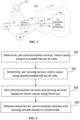
- FIG. 2 illustrates an example functionality of an apparatus configured to flexible allocation of resources from a common shared resource pool using soft prioritization based on metric values.
- a metric value is determined in block 201, per a communication service to which resources are to be allocated, using a first predefined set of rules.
- the metric value may be determined including calculating by multiplying a calculated achievable instantaneous rate by a determined weight value and dividing the result by a calculated average previously experienced rate.
- the weight value W i may be a predetermined or a preconfigured value, or it may be calculated.
- the weight value may depend on the residual tolerable delay and desired delay budgets of the communication service.
- the weight value may be an input from higher layers depending, for example, on the Quality of Service (QoS) profile of the service such as 5G QoS Indicator (SQI) in 5G standards.
- QoS Quality of Service
- SQI Quality of Service
- the achievable instantaneous rate A i ( ⁇ ) at time ⁇ represents the instantaneous rate that is achievable if the service i is scheduled for transmission.
- the achievable instantaneous rate may depend also on the resource j that is considered, and thus may be denoted as A i,j ( ⁇ ) .
- R i ′ ⁇ is the instantaneous allocated resources value of the communication service i at time ⁇ .
- the instantaneous experienced rate may depend also on the resource j that is considered, and thus may be denoted as r i , j ′ ⁇ .
- the metric value per a communication service may then be determined using proportional fair (PR) principles.
- Proportional fair scheduling provides weighted fairness and opportunistic gains for communication services, which may be understood as scheduling the communication services when their instantaneous achievable rate is higher compared to the average previously experienced rate.
- the metric value for communication services may be determined using weighted round robin (WRR) principles.
- Weighted round robin is a generalisation of round robin scheduling. In round robin scheduling resources are allocated to communication services in turn, and in weighted round robin scheduling resources are allocated to communication services in proportion to weights.
- the resource allocation may be implemented, for example, by dividing the available resources into packets and allocating to a service a number of resource packets equal to the weight of the service.
- WFQ weighted fair queueing
- the metric value may be determined to be a weight value.
- a weight value is determined per a communication service.
- the weight value W i may be a predetermined or a preconfigured value, or it may be calculated.
- a metric value is determined in block 202, per a sensing service to which resources are to be allocated, using a second predefined set of rules.
- the metric value determined using the second predefined set of rules may be a sensing metric value, which is a metric value that is comparable with metric values based on proportional fair principles for communication services.
- the sensing metric values for the sensing services may be calculated by, for example, multiplying a calculated instantaneous relevance value by a calculated normalization value and by a determined weight value and dividing the result by a calculated average allocated resources value.
- the weight value, the instantaneous relevance value, the normalization value, and the average allocated resources value are determined per a sensing service.
- the weight value W i may be a predetermined or a preconfigured value, or it may be calculated.
- the weight value may depend on the residual tolerable delay and desired delay budgets of the sensing service.
- the weight value may be an input from higher gNB layers depending, for example, on the Quality of Service (QoS) profile of the sensing service such as 5G QoS Indicator (5QI) in 5G standards.
- QoS Quality of Service
- 5QI 5G QoS Indicator
- the weight value may be assigned by location management function (LMF) or session management function (SMF).
- LMF location management function
- SMF session management function
- the instantaneous relevance value is calculated per a sensing service.
- the instantaneous relevance value N i ( ⁇ ) at time ⁇ represents how useful a sensing scan with the sensing service, that is, allocating resources to the sensing service, may be at the time resources are to be allocated.
- the instantaneous relevance value may increase when a time elapsed from a preceding time the sensing service was allocated resources increases, and it may decrease when a new scan is made, that is, the sensing service is allocated resources.
- the instantaneous relevance value may determine that the sensing service is not considered as a candidate for resource allocation if a predefined number of sensing scans have been performed.
- the instantaneous relevance value may be calculated, for example, as follows.
- An upper token bound value and a slot value are determined per a sensing service.
- the upper token bound value U i represents how much boosting value can be accumulated to the sensing service i.
- the slot value T i represents a number of slots/subframes corresponding to a desired sensing scan period.
- the slot value may be utilized to avoid unnecessary acquisitions or frequent scans, which may mean resource consumption and/or emitted interference and power. If the sensing service is not active, the instantaneous relevance term N i ( ⁇ ) may be set to zero. If the sensing service is active, it is then resolved whether the sensing service was scheduled, that is, allocated resources, at the preceding time that resources were allocated. If the sensing service was scheduled at time ⁇ - 1, an auxiliary term D i ( ⁇ - 1) may be set to one for the sensing service. If the sensing service was not scheduled at time ⁇ - 1, the auxiliary term D i ( ⁇ - 1) may be set to zero.
- the average allocated resources value may be calculated, for example, by calculating an instantaneous allocated resources value, and then calculating the average allocation resources value as a linear combination of the previous average allocated resources value calculated for the sensing service and the instantaneous allocated resources value calculated.
- the initialization value for the average allocated resources value may be set to an arbitrary value, for example, zero. Alternatively, the initialization value may be set to an average of the average allocated resources values of sensing services that are already active.
- the normalization value G c ( ⁇ ) at time ⁇ merges, that is, normalizes, the metric values for the sensing services to the same range as the metric values for the communication services that are competing for the same resources. This enables allocating resources in a manner that is proportional to the weight values W i determined, separately, for the sensing services and the communication services.
- the normalization value may be calculated by, for example, as follows based on the concept of proportional fair opportunistic gain.
- An instantaneous proportional fair opportunistic gain for communication services that were allocated resources at the preceding time resources were allocated may be calculated, for example, as follows.
- the average allocated resources value is calculated per a communication service that was allocated resources at the preceding time resources were allocated.
- the instantaneous proportional fair opportunistic gain is calculated by multiplying, per a communication service, the metric value calculated for the communication service by the average allocated resources value calculated for the communication service, dividing the result by the weight value determined for the communication service, and adding the results per communication services together for the communication services that were allocated resources at the preceding time resources were allocated.
- An average proportional fair opportunistic gain is calculated as a linear combination of the calculated instantaneous proportional fair opportunistic gain at the preceding time that resources were allocated and the average proportional fair opportunistic gain at the preceding time that resources were allocated.
- the initialization value of the average proportional fair opportunistic gain may be set to an arbitrary value, for example, one.
- the initialization value may be set to an average of the average proportional fair opportunistic gain values of communication services that are already active.
- the normalization value is determined as the average proportional fair opportunistic gain calculated.
- the normalization value G c ( ⁇ ) functions as enhancing the sensing metric values.
- a winning proportional fair metric value of a communication service i is higher than W i / R i , since the winning proportional fair metric values may have a higher channel realization than the average channel experienced by communication services.
- the normalization value G c ( ⁇ ) which may be understood as a correction term, enables that the sensing metric values can co-exist with the metric values for communication services based on proportional fair principles.
- the metric value for the sensing service is then calculated according to the second predefined set of rules.
- the metric value for sensing services may be determined using weighted round robin (WRR) principles.
- WRR weighted round robin
- the metric value may be determined to be a weight value or a multiple of a weight value.
- a weight value is determined per a sensing service.
- the weight value W i may be a predetermined or a preconfigured value, or it may be calculated.
- the weight value may depend on soft prioritization logics that may be preconfigured.
- a current service efficiency value could be mapped into sensing metric values.
- the service efficiency value E i ( ⁇ ) could be a function of a channel, a scenario situation, or some other feature. For example, if time or frequency information of interference for services is available, this information may be incorporated into the service efficiency value E i ( ⁇ ) that can be a function of a resulting expected signal-to-interference-plus-noise ratio (SINR).
- SINR signal-to-interference-plus-noise ratio
- the sensing metric value M i ( ⁇ ) may then be calculated, for example, by multiplying the calculated instantaneous relevance value by the calculated normalization value, by the determined weight value, and by the service efficiency value, and dividing the result by an average opportunistic sensing metric normalization value, and by an average previously allocated efficiency value ⁇ i ( ⁇ ).
- the normalization value G c ( ⁇ ) and the average opportunistic sensing metric normalization value G s ( ⁇ ) are updated if there is at least one active communication service or one active sensing service, respectively.
- the communication services and the sensing services are then sorted in block 203 based on the determined metric values using a third rule.
- the third rule may be a descending order of magnitude if the metric values are determined in such a way that a service associated with a larger metric value is prioritized over a service having a smaller metric value.
- the third rule could be an ascending order of magnitude.
- services may be allocated an amount resources proportional to the determined metric values. Resources are allocated in block 204 for the communication services and the sensing services based on the sorted order.
- services may be sorted and allocated resources one by one, or part by part.
- a service that has a highest metric value is searched for and resources are allocated to that service. Then, if there are more resources to be allocated, a service that has a second highest metric value is searched for and resources are allocated to that service. This is continued until there are no resources to be allocated.
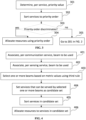
- FIG. 3 illustrates another example functionality of an apparatus configured to flexible allocation of resources from a common shared resource pool using hard prioritization as a primary and soft prioritization as a secondary resource allocation tool.
- a priority value is determined in block 301 for the communication and sensing services, per a service.
- the services are then sorted in block 302 to a priority order based on the priority values, prior to determining the metric values and sorting based on the metric values. It is then resolved in block 303, whether the services are discriminated by the priority order to perform allocating resources. If the services are discriminated by the priority order to perform allocating resources (block 303: yes), resources are allocated in block 304 to the services using the priority order. If the services are not discriminated by the priority order to perform allocating resources (block 303: no), the process continues in block 305 to block 201 in FIG.
- FIG. 4 illustrates another example functionality of an apparatus configured to flexible allocation of resources from a common shared resource pool with beam selection.
- an optimal beam to be used by a communication service is associated in block 401, per a communication service.
- the optimal beam may be understood as a beam that is estimated to be the best beam for the service based on, for example, measured quality of received signals.
- An optimal beam to be used by a sensing service is associated in block 402, per a sensing service.
- One or more beams associated to a communication service or a sensing service are selected in block 403 based on the metric values using the third rule.
- metric values have been determined for the communication services and the sensing services prior to the selection in block 403.
- the third rule may be a descending order of magnitude if the metric values are determined in such a way that a service associated with a larger metric value is prioritized over a service having a smaller metric value.
- Communication services and sensing services that can be served by the one or more beams selected are set in block 404 as a candidate set. Note that the communication services and sensing services may be selected to the candidate set even if the one or more selected beams do not comprise their associated optimal beam(s). This is due to that in addition to optimal beams, services may be served also by other, sub-optimal beams.
- the communication services and the sensing services in the candidate set are sorted in block 405 to a sorted order. The sorting may be based on the metric values.
- the sorting may include determining, per a service in the candidate set, a weight value and sorting based on the weight values. Resources are then allocated in block 406 to the services in the candidate set based on the sorted order.
- a metric-value-based competition amongst communication services and sensing services may enable implementing an apparatus with minimal impact on current deployed solutions.
- FIG. 5 illustrates another example functionality of an apparatus configured to flexible allocation of resources from a common shared resource pool using hard prioritization as a primary and soft prioritization as a secondary resource allocation tool for groups of services determined by hard prioritization.
- a priority value is determined in block 501 for the communication and sensing services, per a service.
- the services are then sorted in block 502 to priority order groups based on the priority values.
- the priority groups are numbered with integers 1, 2, 3 etc. wherein a smaller number means a higher priority.
- the index i for priority group number is set in block 503 to 1.
- An amount of resources needed by the services in the priority group i is assessed in block 504. It is then resolved in block 505 whether the assessed amount needed by the services having priority i exceeds an amount of available resources. If the assessed amount does not exceed the amount of available resources (block 505: no), resources are allocated in block 506 to the services.
- blocks 201-204 in FIG. 2 are performed to the subset of services having priority i. In another example the blocks 201-204 in FIG. 2 are performed to the subset of services having priority value equal to or greater than i.
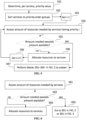
- FIG. 6 illustrates another example functionality of an apparatus configured to flexible allocation of resources from a common shared resource pool resolving a need for a metric-based resource allocation.
- an amount of resources needed by the services is assessed in block 601. It is then resolved in block 602 whether the assessed amount needed by the services exceeds an amount of available resources. If the assessed amount exceeds the amount of available resources (block 602: yes), the process continues, depending on implementation, in block 603 to block 201 in FIG. 2 to perform determining the metric values, sorting the services based on the metric values and allocating resources to the services using the sorted order based on the metric values, or to block 301 in FIG. 3 to first perform determining the priority values and sorting the services to the priority order. If the assessed amount does not exceed the amount of available resources (block 602: no), resources are allocated in block 604 to the services.
- solutions enabling joint scheduling and resource allocation of communication services and sensing services may set sensing services and communication services to equal ranks in resource allocation, and they may help avoiding bottlenecks in a limited pool of resources.
- the blocks, and related functions described above by means of FIG. 2 to 6 are in no absolute chronological order, and some of them may be performed simultaneously or in an order differing from the given one. Other functions can also be executed between them or within them, and/or other rules applied or selected. Some of the blocks or part of the blocks or one or more pieces of information can also be left out or replaced by a corresponding block or part of the block or one or more pieces of information.
- FIG. 7 illustrates an apparatus comprising a communication controller 710 such as at least one processor or processing circuitry, and at least one memory 720 including a computer program code (software, algorithm) ALG. 721, wherein the at least one memory and the computer program code (software, algorithm) are configured, with the at least one processor, to cause the respective apparatus to carry out any one of the embodiments, examples and implementations described above.
- the apparatus of FIG. 7 may be an electronic device, for example a transmitter for a user device, an access node/base station/gNB, a scheduler, or a scheduling apparatus.
- the memory MEM. 720 may be implemented using any suitable data storage technology, such as semiconductor based memory devices, flash memory, magnetic memory devices and systems, optical memory devices and systems, fixed memory, and removable memory.
- the memory may comprise a configuration storage CONF. 722, such as a configuration database, for at least storing one or more configurations and/or corresponding parameters/parameter values, for example the criteria to use for decision(s), or the counter value, or number of sensed consecutive idle slots.
- the memory 720 may further store a data buffer for uplink data waiting for transmission and/or downlink data waiting to be decoded.
- the memory 720 may further store a data buffer for scheduling data for determining scheduling prioritization order, for example, priority values, weight values, average opportunistic proportional gain values, average allocated resources values, and/or instantaneous relevance values.
- the apparatus 700 may further comprise a communication interface 730 comprising hardware and/or software for realizing communication connectivity according to one or more radio communication protocols.
- the communication interface 730 may provide the apparatus with radio communication capabilities with one or more base stations (access nodes) of a wireless network.
- the communication interface may comprise standard well-known components such as an amplifier, filter, frequency-converter, (de)modulator, and encoder/decoder circuitries and one or more antennas. Digital signal processing regarding transmission and/or reception of signals may be performed in a communication controller 710.
- the communication interface may comprise one or more antenna arrays providing the apparatus with capability of forming directive transmission radio beams and the reception radio beams.
- the communication controller 710 may comprise one or more joint communication and sensing (JCAS) schedulers 711 configured to perform the resource allocation according to any one of the embodiments/examples/implementations described above.
- Communication controller 710 may control information exchange relating to communication services and sensing services.
- the apparatus 700 may further comprise an application processor (not illustrated in FIG. 7 ) executing one or more computer program applications that generate a need to transmit and/or receive data.
- the application processor may execute computer programs forming the primary function of the apparatus. For example, if the apparatus is a sensor device, the application processor may execute one or more signal processing applications processing measurement data acquired from one or more sensor heads. If the apparatus is a computer system of a vehicle, the application processor may execute a media application and/or an autonomous driving and navigation application.
- circuitry refers to all of the following: (a) hardware-only circuit implementations, such as implementations in only analog and/or digital circuitry, and (b) combinations of circuits and soft-ware (and/or firmware), such as (as applicable): (i) a combination of processor(s) or (ii) portions of processor(s)/software including digital signal processor(s), software, and memory(ies) that work together to cause an apparatus to perform various functions, and (c) circuits, such as a microprocessor(s) or a portion of a microprocessor(s), that require software or firmware for operation, even if the software or firmware is not physically present.
- This definition of 'circuitry' applies to all uses of this term in this application.
- the term 'circuitry' would also cover an implementation of merely a processor (or multiple processors) or a portion of a processor and its (or their) accompanying soft-ware and/or firmware.
- the term 'circuitry' would also cover, for example and if applicable to the particular element, a baseband integrated circuit or applications processor integrated circuit for a mobile device or a similar integrated circuit in a sensor, a cellular network device, or another network device.
- At least some of the processes described in connection with FIG. 2 to 6 may be carried out by an apparatus comprising corresponding means for carrying out at least some of the described processes.
- the apparatus may comprise separate means for separate phases of a process, or means may perform several phases or the whole process.
- Some example means for carrying out the processes may include at least one of the following: detector, processor (including dual-core and multiple-core processors), digital signal processor, controller, receiver, transmitter, encoder, decoder, memory, RAM, ROM, software, firmware, display, user interface, display circuitry, user interface circuitry, user interface soft-ware, display software, circuit, antenna, antenna circuitry, and circuitry.
- the at least one processor, the memory, and the computer program code form processing means or comprises one or more computer program code portions for carrying out one or more operations according to any one of the embodiments/examples/implementations described herein.
- the apparatus carrying out any of the embodiments comprises a circuitry including at least one processor and at least one memory including computer program code.
- the circuitry When activated, the circuitry causes the apparatus to perform at least some of the functionalities according to any one of the embodiments/examples/implementations of FIG. 2 to 6 , or operations thereof.
- the techniques and methods described herein may be implemented by various means. For example, these techniques may be implemented in hardware (one or more devices), firmware (one or more devices), software (one or more modules), or combinations thereof.
- the apparatus(es) of embodiments may be implemented within one or more application-specific integrated circuits (ASICs), digital signal processors (DSPs), digital signal processing devices (DSPDs), programmable logic devices (PLDs), field programmable gate arrays (FPGAs), processors, controllers, micro-controllers, microprocessors, other electronic units designed to perform the functions described herein, or a combination thereof.
- ASICs application-specific integrated circuits
- DSPs digital signal processors
- DSPDs digital signal processing devices
- PLDs programmable logic devices
- FPGAs field programmable gate arrays
- processors controllers, micro-controllers, microprocessors, other electronic units designed to perform the functions described herein, or a combination thereof.
- the implementation can be carried out through modules of at least one chip set (e.g., procedures, functions, and so on) that perform the functions described herein.
- the software codes may be stored in a memory unit and executed by processors.
- the memory unit may be implemented within the processor or externally to the processor. In the latter case, it can be communicatively coupled to the processor via various means, as is known in the art.
- the components of the systems (apparatuses) described herein may be rearranged and/or complemented by additional components in order to facilitate the achievements of the various aspects, etc., described with regard thereto, and they are not limited to the precise configurations set forth in the given Figures, as will be appreciated by one skilled in the art.
- Embodiments/examples/implementations as described may also be carried out in the form of a computer process defined by a computer program or portions thereof. Embodiments of the methods described in connection with FIG. 2 to 6 may be carried out by executing at least one portion of a computer program comprising corresponding instructions.
- the computer program may be in source code form, object code form, or in some intermediate form, and it may be stored in some sort of carrier, which may be any entity or device capable of carrying the program.
- the computer program may be stored on a computer program distribution medium readable by a computer or a processor.
- the computer program medium may be, for example but not limited to, a record medium, computer memory, read-only memory, electrical carrier signal, telecommunications signal, and software distribution package, for example.
- the computer program medium may be a non-transitory medium, for example. Coding of software for carrying out the embodiments as shown and described is well within the scope of a person of ordinary skill in the art.
- a computer-readable medium comprises said computer program.
- the non-transitory medium may be a non-transitory computer readable medium comprising program instructions for causing an apparatus to perform at least the following: determining, per a communication service to which resources are to be allocated, a metric value using a first predefined set of rules, determining, per a sensing service to which resources are to be allocated, a metric value using a second predefined set of rules, sorting communication services to which resources are to be allocated and sensing services to which resources are to be allocated based on the metric values to a sorted order using a third rule, and allocating resources for the communication services and the sensing services based on the sorted order.
Landscapes
- Engineering & Computer Science (AREA)
- Computer Networks & Wireless Communication (AREA)
- Signal Processing (AREA)
- Quality & Reliability (AREA)
- Mobile Radio Communication Systems (AREA)
Claims (15)
- Vorrichtung, die Folgendes umfasst:mindestens einen Prozessor; undmindestens einen Speicher, der einen Computerprogrammcode beinhaltet;wobei der mindestens eine Speicher und der Computerprogrammcode dazu ausgelegt sind, die Vorrichtung mit dem mindestens einen Prozessor zu veranlassen, mindestens Folgendes durchzuführen:Bestimmen (201) eines Metrikwertes für einen Kommunikationsdienst, dem Ressourcen zuzuteilen sind, unter Verwendung eines ersten vordefinierten Satzes von Regeln;Bestimmen (202) eines Metrikwertes für einen Erfassungsdienst, dem Ressourcen zuzuteilen sind, unter Verwendung eines zweiten vordefinierten Satzes von Regeln;Sortieren (203) von Kommunikationsdiensten, denen Ressourcen zuzuteilen sind, und von Erfassungsdiensten, denen Ressourcen zuzuteilen sind, auf Basis der Metrikwerte in eine sortierte Reihenfolge unter Verwendung einer dritten Regel; undZuteilen (204) von Ressourcen für die Kommunikationsdienste und die Erfassungsdienste auf Basis der sortierten Reihenfolge.
- Vorrichtung nach Anspruch 1, wobei der mindestens eine Speicher und der Computerprogrammcode dazu ausgelegt sind, die Vorrichtung mit dem mindestens einen Prozessor zu veranlassen, ferner Folgendes durchzuführen:Bestimmen eines Gewichtungswertes für einen Erfassungsdienst;Berechnen eines momentanen Relevanzwertes für einen Erfassungsdienst;Berechnen eines durchschnittlichen zugeteilten Ressourcenwertes für einen Erfassungsdienst; undBerechnen eines Normalisierungswertes zu den Erfassungsdiensten; wobei der zweite vordefinierte Satz von Regeln Folgendes umfasst:
Berechnen des Metrikwertes durch Multiplizieren des für den Erfassungsdienst berechneten momentanen Relevanzwertes mit dem berechneten Normalisierungswert und mit dem für den Erfassungsdienst bestimmten Gewichtungswert und Teilen des Ergebnisses durch den für den Erfassungsdienst berechneten durchschnittlichen zugeteilten Ressourcenwert. - Vorrichtung nach Anspruch 2, wobei der mindestens eine Speicher und der Computerprogrammcode dazu ausgelegt sind, die Vorrichtung mit dem mindestens einen Prozessor zu veranlassen, ferner das Berechnen des momentanen Relevanzwertes durch Folgendes durchzuführen:
Erhöhen des momentanen Relevanzwertes für den Erfassungsdienst, wenn sich eine Zeit von einer vorherigen Zeit, zu der dem Erfassungsdienst Ressourcen zugeteilt wurden, erhöht. - Vorrichtung nach einem der Ansprüche 2 oder 3, wobei der mindestens eine Speicher und der Computerprogrammcode dazu ausgelegt sind, die Vorrichtung mit dem mindestens einen Prozessor zu veranlassen, ferner das Berechnen des durchschnittlichen zugeteilten Ressourcenwertes für einen Erfassungsdienst durch Folgendes durchzuführen:Berechnen eines momentanen zugeteilten Ressourcenwertes; undBerechnen des durchschnittlichen zugeteilten Ressourcenwertes als eine lineare Kombination des für den Dienst berechneten vorherigen durchschnittlichen zugeteilten Ressourcenwertes und des berechneten momentanen zugeteilten Ressourcenwertes.
- Vorrichtung nach einem der vorhergehenden Ansprüche, wobei der mindestens eine Speicher und der Computerprogrammcode dazu ausgelegt sind, die Vorrichtung mit dem mindestens einen Prozessor zu veranlassen, ferner Folgendes durchzuführen:Bestimmen eines Gewichtungswertes für einen Kommunikationsdienst;Berechnen einer erreichbaren momentanen Rate für einen Kommunikationsdienst; undBerechnen einer durchschnittlichen zuvor erfahrenen Rate für einen Kommunikationsdienst;wobei der erste vordefinierte Satz von Regeln Folgendes umfasst:Berechnen des Metrikwertes durch Multiplizieren der für den Kommunikationsdienst berechneten erreichbaren momentanen Rate mit dem für den Kommunikationsdienst bestimmten Gewichtungswert und Teilen des Ergebnisses durch die für den Kommunikationsdienst berechnete durchschnittliche zuvor erfahrene Rate; undBerechnen des durchschnittlichen zugeteilten Ressourcenwertes für einen Kommunikationsdienst, dem zu einer vorherigen Zeit, zu der Ressourcen zugeteilt wurden, Ressourcen zugeteilt wurden; undBerechnen einer momentanen proportionalen fairen opportunistischen Verstärkung durch Multiplizieren - für einen Kommunikationsdienst, dem zur vorherigen Zeit, zu der Ressourcen zugeteilt wurden, Ressourcen zugeteilt wurden - des für den Kommunikationsdienst berechneten Metrikwertes mit dem für den Kommunikationsdienst berechneten durchschnittlichen zugeteilten Ressourcenwert, Teilen des Ergebnisses durch den für den Kommunikationsdienst bestimmten Gewichtungswert, Addieren der Ergebnisse für Kommunikationsdienste zusammen für Ressourcen, die den Kommunikationsdiensten zugeteilt wurden, denen zur vorherigen Zeit, zu der Ressourcen zugeteilt wurden, Ressourcen zugeteilt wurden, und Teilen der Summe durch die Anzahl der zugeteilten Ressourcen.
- Vorrichtung nach Anspruch 5, sofern von einem der Ansprüche 2 bis 4 abhängig, wobei der mindestens eine Speicher und der Computerprogrammcode dazu ausgelegt sind, die Vorrichtung mit dem mindestens einen Prozessor zu veranlassen, das Berechnen des Normalisierungswertes durch Folgendes durchzuführen:Berechnen der momentanen proportionalen fairen opportunistischen Verstärkung von Kommunikationsdiensten, denen zur vorherigen Zeit, zu der Ressourcen zugeteilt wurden, Ressourcen zugeteilt wurden;Berechnen einer durchschnittlichen proportionalen fairen opportunistischen Verstärkung als eine lineare Kombination der berechneten momentanen proportionalen fairen opportunistischen Verstärkung und der durchschnittlichen proportionalen fairen opportunistischen Verstärkung zu der vorherigen Zeit, zu der Ressourcen zugeteilt wurden; undBestimmen des Normalisierungswertes als die berechnete durchschnittliche proportionale faire opportunistische Verstärkung.
- Vorrichtung nach Anspruch 1, wobei der mindestens eine Speicher und der Computerprogrammcode dazu ausgelegt sind, die Vorrichtung mit dem mindestens einen Prozessor zu veranlassen, ferner Folgendes durchzuführen:Bestimmen eines Gewichtungswertes für einen Kommunikationsdienst; undBestimmen eines Gewichtungswertes für einen Erfassungsdienst;wobei der erste vordefinierte Satz von Regeln und der zweite vordefinierte Satz von Regeln das Bestimmen des Metrikwertes als gleich dem Gewichtungswert umfassen.
- Vorrichtung nach Anspruch 7, wobei das Zuteilen von Ressourcen für die Kommunikationsdienste und die Erfassungsdienste auf Basis der sortierten Reihenfolge Folgendes umfasst:Teilen der Ressourcen in Ressourcenabschnitte, wobei sich Größen der Ressourcenabschnitte proportional zu den bestimmten Metrikwerten verhalten; undZuteilen der Ressourcenabschnitte zu den Diensten, derart, dass die Größe eines Ressourcenabschnitts dem Metrikwert eines Dienstes entspricht.
- Vorrichtung nach einem der vorhergehenden Ansprüche, wobei der mindestens eine Speicher und der Computerprogrammcode dazu ausgelegt sind, die Vorrichtung mit dem mindestens einen Prozessor zu veranlassen, ferner Folgendes durchzuführen:Bestimmen eines Prioritätswertes für einen Dienst vor dem Bestimmen der Metrikwerte und dem Sortieren auf Basis der Metrikwerte für die Dienste;Sortieren der Dienste auf Basis der Prioritätswerte in eine Prioritätsreihenfolge vor dem Bestimmen der Metrikwerte und dem Sortieren auf Basis der Metrikwerte;wenn sich die Dienste hinsichtlich der Prioritätsreihenfolge zum Durchführen des Zuteilens von Ressourcen unterscheiden, Zuteilen von Ressourcen zu den Diensten unter Verwendung der Prioritätsreihenfolge;andernfalls Durchführen des Bestimmens der Metrikwerte und des Sortierens der Dienste auf Basis der Metrikwerte und Zuteilen von Ressourcen zu den Diensten unter Verwendung der sortierten Reihenfolge auf Basis der Metrikwerte.
- Vorrichtung nach einem der vorhergehenden Ansprüche, wobei der mindestens eine Speicher und der Computerprogrammcode dazu ausgelegt sind, die Vorrichtung mit dem mindestens einen Prozessor zu veranlassen, ferner Folgendes durchzuführen, wenn Ressourcen, die zuzuteilen sind, auf einer Vielzahl von Strahlen bereitgestellt werden:Verknüpfen eines Strahls, der von einem Kommunikationsdienst zu verwenden ist, für den Kommunikationsdienst;Verknüpfen eines Strahls, der von einem Erfassungsdienst zu verwenden ist, für den Erfassungsdienst;Auswählen von mindestens einem Strahl, der mit einem Kommunikationsdienst oder einem Erfassungsdienst verknüpft ist, auf Basis der Metrikwerte unter Verwendung der dritten Regel;Einstellen von Kommunikationsdiensten und Erfassungsdiensten, die von dem mindestens einen Strahl bedient werden können und als ein Kandidatensatz ausgewählt wurden;Sortieren der Kommunikationsdienste und der Erfassungsdienste im Kandidatensatz in eine sortierte Reihenfolge entweder auf Basis der Metrikwerte oder Bestimmen eines Gewichtungswertes und Sortieren auf Basis von Gewichtungswerten für einen Dienst im Kandidatensatz; undZuteilen von Ressourcen zu den Diensten im Kandidatensatz auf Basis der sortierten Reihenfolge.
- Vorrichtung nach einem der vorhergehenden Ansprüche, wobei der mindestens eine Speicher und der Computerprogrammcode dazu ausgelegt sind, die Vorrichtung mit dem mindestens einen Prozessor zu veranlassen, ferner Folgendes durchzuführen:Beurteilen einer Menge von Ressourcen, die von den Diensten benötigt werden;wenn die beurteilte Menge von benötigten Ressourcen eine Menge von verfügbaren Ressourcen überschreitet, Durchführen des Bestimmens der Metrikwerte, des Sortierens der Dienste auf Basis der Metrikwerte und des Zuteilens von Ressourcen zu den Diensten unter Verwendung der sortierten Reihenfolge;andernfalls Zuteilen der Ressourcen zu den Diensten.
- Verfahren, das Folgendes umfasst:Bestimmen (201) eines Metrikwertes für einen Kommunikationsdienst, dem Ressourcen zuzuteilen sind, unter Verwendung eines ersten vordefinierten Satzes von Regeln;Bestimmen (202) eines Metrikwertes für einen Erfassungsdienst, dem Ressourcen zuzuteilen sind, unter Verwendung eines zweiten vordefinierten Satzes von Regeln;Sortieren (203) von Kommunikationsdiensten, denen Ressourcen zuzuteilen sind, und von Erfassungsdiensten, denen Ressourcen zuzuteilen sind, auf Basis der Metrikwerte in eine sortierte Reihenfolge unter Verwendung einer dritten Regel; undZuteilen (204) von Ressourcen für die Kommunikationsdienste und die Erfassungsdienste auf Basis der sortierten Reihenfolge.
- Computerlesbares Medium, das Programmanweisungen umfasst, die, wenn sie von einem Computer ausgeführt werden, den Computer veranlassen, mindestens Folgendes durchzuführen:Bestimmen (201) eines Metrikwertes für einen Kommunikationsdienst, dem Ressourcen zuzuteilen sind, unter Verwendung eines ersten vordefinierten Satzes von Regeln;Bestimmen (202) eines Metrikwertes für einen Erfassungsdienst, dem Ressourcen zuzuteilen sind, unter Verwendung eines zweiten vordefinierten Satzes von Regeln;Sortieren (203) von Kommunikationsdiensten, denen Ressourcen zuzuteilen sind, und von Erfassungsdiensten, denen Ressourcen zuzuteilen sind, auf Basis der Metrikwerte in eine sortierte Reihenfolge unter Verwendung einer dritten Regel; undZuteilen (204) von Ressourcen für die Kommunikationsdienste und die Erfassungsdienste auf Basis der sortierten Reihenfolge.
- Computerlesbares Medium nach Anspruch 13, wobei das computerlesbare Medium ein nichttransitorisches computerlesbares Medium ist.
- Computerprogramm, das Anweisungen umfasst, die, wenn sie von einem Computer ausgeführt werden, den Computer veranlassen, mindestens Folgendes durchzuführen:Bestimmen (201) eines Metrikwertes für einen Kommunikationsdienst, dem Ressourcen zuzuteilen sind, unter Verwendung eines ersten vordefinierten Satzes von Regeln;Bestimmen (202) eines Metrikwertes für einen Erfassungsdienst, dem Ressourcen zuzuteilen sind, unter Verwendung eines zweiten vordefinierten Satzes von Regeln;Sortieren (203) von Kommunikationsdiensten, denen Ressourcen zuzuteilen sind, und von Erfassungsdiensten, denen Ressourcen zuzuteilen sind, auf Basis der Metrikwerte in eine sortierte Reihenfolge unter Verwendung einer dritten Regel; undZuteilen (204) von Ressourcen für die Kommunikationsdienste und die Erfassungsdienste auf Basis der sortierten Reihenfolge.
Applications Claiming Priority (1)
| Application Number | Priority Date | Filing Date | Title |
|---|---|---|---|
| FI20225042 | 2022-01-19 |
Publications (2)
| Publication Number | Publication Date |
|---|---|
| EP4216640A1 EP4216640A1 (de) | 2023-07-26 |
| EP4216640B1 true EP4216640B1 (de) | 2024-10-02 |
Family
ID=84981384
Family Applications (1)
| Application Number | Title | Priority Date | Filing Date |
|---|---|---|---|
| EP23151258.3A Active EP4216640B1 (de) | 2022-01-19 | 2023-01-12 | Zuweisung von ressourcen für kommunikations- und erfassungsdienste |
Country Status (3)
| Country | Link |
|---|---|
| US (1) | US11729664B2 (de) |
| EP (1) | EP4216640B1 (de) |
| CN (1) | CN116471696B (de) |
Families Citing this family (3)
| Publication number | Priority date | Publication date | Assignee | Title |
|---|---|---|---|---|
| US12191964B2 (en) * | 2022-05-13 | 2025-01-07 | Qualcomm Incorporated | User receive beam measurement prioritization |
| US12052073B2 (en) * | 2022-06-22 | 2024-07-30 | Qualcomm Incorporated | Joint multiple-input multiple-output (MIMO) communications and MIMO sensing |
| WO2025081778A1 (en) * | 2023-10-16 | 2025-04-24 | Huawei Technologies Co., Ltd. | Methods, devices, and computer readable storage media for integrated sensing and communication |
Family Cites Families (12)
| Publication number | Priority date | Publication date | Assignee | Title |
|---|---|---|---|---|
| US6438135B1 (en) * | 1999-10-21 | 2002-08-20 | Advanced Micro Devices, Inc. | Dynamic weighted round robin queuing |
| US20160014812A1 (en) * | 2014-07-11 | 2016-01-14 | Electronics And Telecommunications Research Institute | Method and apparatus for transmitting control information in d2d network |
| CN109661833B (zh) * | 2017-08-10 | 2021-07-27 | 瑞典爱立信有限公司 | 用于副链路数据复制的方法和设备 |
| CN107733689A (zh) * | 2017-09-15 | 2018-02-23 | 西南电子技术研究所(中国电子科技集团公司第十研究所) | 基于优先级的动态加权轮询调度策略方法 |
| CN111527784B (zh) * | 2018-10-25 | 2024-10-18 | Lg电子株式会社 | 用于执行侧链路harq反馈的方法和装置 |
| CN110121213B (zh) * | 2019-03-22 | 2022-06-28 | 全球能源互联网研究院有限公司 | 一种多业务资源调度方法及装置 |
| US11304180B2 (en) * | 2019-03-28 | 2022-04-12 | Samsung Electronics Co., Ltd | Method and device of resource allocation for sidelink transmission in wireless communication system |
| US20220167355A1 (en) | 2019-04-15 | 2022-05-26 | Nokia Solutions And Networks Oy | Resource allocation in a network slice |
| EP4014349A1 (de) * | 2019-08-15 | 2022-06-22 | IDAC Holdings, Inc. | Gemeinsame kommunikation und sensorunterstütztes strahlmanagement für neuen funk |
| WO2022000227A1 (en) | 2020-06-30 | 2022-01-06 | Qualcomm Incorporated | Channel state information reports and channel state information interference measurement reports associated with joint sensing and communication services |
| CN113207128B (zh) * | 2021-05-07 | 2022-12-06 | 东南大学 | 强化学习下的无人机集群雷达通信一体化资源分配方法 |
| CN113784443B (zh) * | 2021-07-29 | 2025-11-25 | 中国信息通信研究院 | 一种通信感知信号处理方法和设备 |
-
2023
- 2023-01-12 EP EP23151258.3A patent/EP4216640B1/de active Active
- 2023-01-18 US US18/098,558 patent/US11729664B2/en active Active
- 2023-01-18 CN CN202310057021.6A patent/CN116471696B/zh active Active
Also Published As
| Publication number | Publication date |
|---|---|
| US20230232273A1 (en) | 2023-07-20 |
| EP4216640A1 (de) | 2023-07-26 |
| CN116471696A (zh) | 2023-07-21 |
| CN116471696B (zh) | 2025-12-09 |
| US11729664B2 (en) | 2023-08-15 |
Similar Documents
| Publication | Publication Date | Title |
|---|---|---|
| EP4216640A1 (de) | Zuweisung von ressourcen für kommunikations- und erfassungsdienste | |
| US11464013B2 (en) | Coordinated link adaptation and packet scheduling in dynamic spectrum sharing | |
| US11589244B2 (en) | Configuring wireless sensor network paths | |
| US11115271B1 (en) | Network slice configuration | |
| WO2020037675A1 (en) | Data priority indication for uplink grant | |
| US11870585B1 (en) | Adapting hybrid automatic repeat requests | |
| EP4104639A1 (de) | Verarbeitungsregeln für ressourcen-elemente | |
| US11825532B2 (en) | Control of multi-user multiple input multiple output connections | |
| US11310698B2 (en) | Overload control mechanism | |
| US11838876B2 (en) | Power spectral density aware uplink scheduling | |
| CN116614887B (zh) | 用于功率谱密度感知上行链路调度的装置、方法以及计算机程序产品 | |
| US12075368B2 (en) | Controlling radio frequency emissions in cellular system | |
| EP4346146A1 (de) | Bestimmung der wellenform für uplink-übertragung | |
| US20220311538A1 (en) | Allocating radio resources based on user mode | |
| US20230084811A1 (en) | Device positioning | |
| WO2025172749A1 (en) | Apparatus and method for controlling scheduling |
Legal Events
| Date | Code | Title | Description |
|---|---|---|---|
| PUAI | Public reference made under article 153(3) epc to a published international application that has entered the european phase |
Free format text: ORIGINAL CODE: 0009012 |
|
| STAA | Information on the status of an ep patent application or granted ep patent |
Free format text: STATUS: THE APPLICATION HAS BEEN PUBLISHED |
|
| AK | Designated contracting states |
Kind code of ref document: A1 Designated state(s): AL AT BE BG CH CY CZ DE DK EE ES FI FR GB GR HR HU IE IS IT LI LT LU LV MC ME MK MT NL NO PL PT RO RS SE SI SK SM TR |
|
| STAA | Information on the status of an ep patent application or granted ep patent |
Free format text: STATUS: REQUEST FOR EXAMINATION WAS MADE |
|
| 17P | Request for examination filed |
Effective date: 20240126 |
|
| RBV | Designated contracting states (corrected) |
Designated state(s): AL AT BE BG CH CY CZ DE DK EE ES FI FR GB GR HR HU IE IS IT LI LT LU LV MC ME MK MT NL NO PL PT RO RS SE SI SK SM TR |
|
| GRAP | Despatch of communication of intention to grant a patent |
Free format text: ORIGINAL CODE: EPIDOSNIGR1 |
|
| STAA | Information on the status of an ep patent application or granted ep patent |
Free format text: STATUS: GRANT OF PATENT IS INTENDED |
|
| RIC1 | Information provided on ipc code assigned before grant |
Ipc: H04L 47/70 20220101ALN20240419BHEP Ipc: H04L 47/80 20220101ALI20240419BHEP Ipc: H04L 47/2425 20220101ALI20240419BHEP Ipc: H04L 47/2408 20220101ALI20240419BHEP Ipc: H04W 72/04 20230101AFI20240419BHEP |
|
| INTG | Intention to grant announced |
Effective date: 20240510 |
|
| GRAS | Grant fee paid |
Free format text: ORIGINAL CODE: EPIDOSNIGR3 |
|
| GRAA | (expected) grant |
Free format text: ORIGINAL CODE: 0009210 |
|
| STAA | Information on the status of an ep patent application or granted ep patent |
Free format text: STATUS: THE PATENT HAS BEEN GRANTED |
|
| AK | Designated contracting states |
Kind code of ref document: B1 Designated state(s): AL AT BE BG CH CY CZ DE DK EE ES FI FR GB GR HR HU IE IS IT LI LT LU LV MC ME MK MT NL NO PL PT RO RS SE SI SK SM TR |
|
| REG | Reference to a national code |
Ref country code: GB Ref legal event code: FG4D |
|
| REG | Reference to a national code |
Ref country code: CH Ref legal event code: EP |
|
| REG | Reference to a national code |
Ref country code: IE Ref legal event code: FG4D |
|
| REG | Reference to a national code |
Ref country code: DE Ref legal event code: R096 Ref document number: 602023000622 Country of ref document: DE |
|
| REG | Reference to a national code |
Ref country code: LT Ref legal event code: MG9D |
|
| REG | Reference to a national code |
Ref country code: NL Ref legal event code: MP Effective date: 20241002 |
|
| REG | Reference to a national code |
Ref country code: AT Ref legal event code: MK05 Ref document number: 1729401 Country of ref document: AT Kind code of ref document: T Effective date: 20241002 |
|
| PG25 | Lapsed in a contracting state [announced via postgrant information from national office to epo] |
Ref country code: NL Free format text: LAPSE BECAUSE OF FAILURE TO SUBMIT A TRANSLATION OF THE DESCRIPTION OR TO PAY THE FEE WITHIN THE PRESCRIBED TIME-LIMIT Effective date: 20241002 |
|
| PG25 | Lapsed in a contracting state [announced via postgrant information from national office to epo] |
Ref country code: NL Free format text: LAPSE BECAUSE OF FAILURE TO SUBMIT A TRANSLATION OF THE DESCRIPTION OR TO PAY THE FEE WITHIN THE PRESCRIBED TIME-LIMIT Effective date: 20241002 |
|
| PG25 | Lapsed in a contracting state [announced via postgrant information from national office to epo] |
Ref country code: PT Free format text: LAPSE BECAUSE OF FAILURE TO SUBMIT A TRANSLATION OF THE DESCRIPTION OR TO PAY THE FEE WITHIN THE PRESCRIBED TIME-LIMIT Effective date: 20250203 Ref country code: HR Free format text: LAPSE BECAUSE OF FAILURE TO SUBMIT A TRANSLATION OF THE DESCRIPTION OR TO PAY THE FEE WITHIN THE PRESCRIBED TIME-LIMIT Effective date: 20241002 Ref country code: IS Free format text: LAPSE BECAUSE OF FAILURE TO SUBMIT A TRANSLATION OF THE DESCRIPTION OR TO PAY THE FEE WITHIN THE PRESCRIBED TIME-LIMIT Effective date: 20250202 |
|
| PG25 | Lapsed in a contracting state [announced via postgrant information from national office to epo] |
Ref country code: FI Free format text: LAPSE BECAUSE OF FAILURE TO SUBMIT A TRANSLATION OF THE DESCRIPTION OR TO PAY THE FEE WITHIN THE PRESCRIBED TIME-LIMIT Effective date: 20241002 |
|
| PG25 | Lapsed in a contracting state [announced via postgrant information from national office to epo] |
Ref country code: BG Free format text: LAPSE BECAUSE OF FAILURE TO SUBMIT A TRANSLATION OF THE DESCRIPTION OR TO PAY THE FEE WITHIN THE PRESCRIBED TIME-LIMIT Effective date: 20241002 |
|
| PG25 | Lapsed in a contracting state [announced via postgrant information from national office to epo] |
Ref country code: ES Free format text: LAPSE BECAUSE OF FAILURE TO SUBMIT A TRANSLATION OF THE DESCRIPTION OR TO PAY THE FEE WITHIN THE PRESCRIBED TIME-LIMIT Effective date: 20241002 |
|
| PG25 | Lapsed in a contracting state [announced via postgrant information from national office to epo] |
Ref country code: NO Free format text: LAPSE BECAUSE OF FAILURE TO SUBMIT A TRANSLATION OF THE DESCRIPTION OR TO PAY THE FEE WITHIN THE PRESCRIBED TIME-LIMIT Effective date: 20250102 |
|
| PG25 | Lapsed in a contracting state [announced via postgrant information from national office to epo] |
Ref country code: LV Free format text: LAPSE BECAUSE OF FAILURE TO SUBMIT A TRANSLATION OF THE DESCRIPTION OR TO PAY THE FEE WITHIN THE PRESCRIBED TIME-LIMIT Effective date: 20241002 Ref country code: AT Free format text: LAPSE BECAUSE OF FAILURE TO SUBMIT A TRANSLATION OF THE DESCRIPTION OR TO PAY THE FEE WITHIN THE PRESCRIBED TIME-LIMIT Effective date: 20241002 Ref country code: GR Free format text: LAPSE BECAUSE OF FAILURE TO SUBMIT A TRANSLATION OF THE DESCRIPTION OR TO PAY THE FEE WITHIN THE PRESCRIBED TIME-LIMIT Effective date: 20250103 |
|
| PG25 | Lapsed in a contracting state [announced via postgrant information from national office to epo] |
Ref country code: CZ Free format text: LAPSE BECAUSE OF FAILURE TO SUBMIT A TRANSLATION OF THE DESCRIPTION OR TO PAY THE FEE WITHIN THE PRESCRIBED TIME-LIMIT Effective date: 20241002 Ref country code: PL Free format text: LAPSE BECAUSE OF FAILURE TO SUBMIT A TRANSLATION OF THE DESCRIPTION OR TO PAY THE FEE WITHIN THE PRESCRIBED TIME-LIMIT Effective date: 20241002 |
|
| PG25 | Lapsed in a contracting state [announced via postgrant information from national office to epo] |
Ref country code: RS Free format text: LAPSE BECAUSE OF FAILURE TO SUBMIT A TRANSLATION OF THE DESCRIPTION OR TO PAY THE FEE WITHIN THE PRESCRIBED TIME-LIMIT Effective date: 20250102 |
|
| PG25 | Lapsed in a contracting state [announced via postgrant information from national office to epo] |
Ref country code: SM Free format text: LAPSE BECAUSE OF FAILURE TO SUBMIT A TRANSLATION OF THE DESCRIPTION OR TO PAY THE FEE WITHIN THE PRESCRIBED TIME-LIMIT Effective date: 20241002 |
|
| REG | Reference to a national code |
Ref country code: DE Ref legal event code: R097 Ref document number: 602023000622 Country of ref document: DE |
|
| PG25 | Lapsed in a contracting state [announced via postgrant information from national office to epo] |
Ref country code: DK Free format text: LAPSE BECAUSE OF FAILURE TO SUBMIT A TRANSLATION OF THE DESCRIPTION OR TO PAY THE FEE WITHIN THE PRESCRIBED TIME-LIMIT Effective date: 20241002 |
|
| PG25 | Lapsed in a contracting state [announced via postgrant information from national office to epo] |
Ref country code: EE Free format text: LAPSE BECAUSE OF FAILURE TO SUBMIT A TRANSLATION OF THE DESCRIPTION OR TO PAY THE FEE WITHIN THE PRESCRIBED TIME-LIMIT Effective date: 20241002 |
|
| PG25 | Lapsed in a contracting state [announced via postgrant information from national office to epo] |
Ref country code: RO Free format text: LAPSE BECAUSE OF FAILURE TO SUBMIT A TRANSLATION OF THE DESCRIPTION OR TO PAY THE FEE WITHIN THE PRESCRIBED TIME-LIMIT Effective date: 20241002 |
|
| PG25 | Lapsed in a contracting state [announced via postgrant information from national office to epo] |
Ref country code: SK Free format text: LAPSE BECAUSE OF FAILURE TO SUBMIT A TRANSLATION OF THE DESCRIPTION OR TO PAY THE FEE WITHIN THE PRESCRIBED TIME-LIMIT Effective date: 20241002 |
|
| PG25 | Lapsed in a contracting state [announced via postgrant information from national office to epo] |
Ref country code: IT Free format text: LAPSE BECAUSE OF FAILURE TO SUBMIT A TRANSLATION OF THE DESCRIPTION OR TO PAY THE FEE WITHIN THE PRESCRIBED TIME-LIMIT Effective date: 20241002 |
|
| PLBE | No opposition filed within time limit |
Free format text: ORIGINAL CODE: 0009261 |
|
| STAA | Information on the status of an ep patent application or granted ep patent |
Free format text: STATUS: NO OPPOSITION FILED WITHIN TIME LIMIT |
|
| PG25 | Lapsed in a contracting state [announced via postgrant information from national office to epo] |
Ref country code: SE Free format text: LAPSE BECAUSE OF FAILURE TO SUBMIT A TRANSLATION OF THE DESCRIPTION OR TO PAY THE FEE WITHIN THE PRESCRIBED TIME-LIMIT Effective date: 20241002 |
|
| 26N | No opposition filed |
Effective date: 20250703 |
|
| PG25 | Lapsed in a contracting state [announced via postgrant information from national office to epo] |
Ref country code: LU Free format text: LAPSE BECAUSE OF NON-PAYMENT OF DUE FEES Effective date: 20250112 Ref country code: MC Free format text: LAPSE BECAUSE OF FAILURE TO SUBMIT A TRANSLATION OF THE DESCRIPTION OR TO PAY THE FEE WITHIN THE PRESCRIBED TIME-LIMIT Effective date: 20241002 |
|
| PG25 | Lapsed in a contracting state [announced via postgrant information from national office to epo] |
Ref country code: BE Free format text: LAPSE BECAUSE OF NON-PAYMENT OF DUE FEES Effective date: 20250131 |
|
| PG25 | Lapsed in a contracting state [announced via postgrant information from national office to epo] |
Ref country code: FR Free format text: LAPSE BECAUSE OF NON-PAYMENT OF DUE FEES Effective date: 20250131 |
|
| REG | Reference to a national code |
Ref country code: BE Ref legal event code: MM Effective date: 20250131 |
|
| PG25 | Lapsed in a contracting state [announced via postgrant information from national office to epo] |
Ref country code: IE Free format text: LAPSE BECAUSE OF NON-PAYMENT OF DUE FEES Effective date: 20250112 |
|
| PGFP | Annual fee paid to national office [announced via postgrant information from national office to epo] |
Ref country code: DE Payment date: 20251203 Year of fee payment: 4 |
|
| PG25 | Lapsed in a contracting state [announced via postgrant information from national office to epo] |
Ref country code: CY Free format text: LAPSE BECAUSE OF FAILURE TO SUBMIT A TRANSLATION OF THE DESCRIPTION OR TO PAY THE FEE WITHIN THE PRESCRIBED TIME-LIMIT Effective date: 20241002 |
|
| PG25 | Lapsed in a contracting state [announced via postgrant information from national office to epo] |
Ref country code: TR Free format text: LAPSE BECAUSE OF FAILURE TO SUBMIT A TRANSLATION OF THE DESCRIPTION OR TO PAY THE FEE WITHIN THE PRESCRIBED TIME-LIMIT Effective date: 20241002 |
|
| PG25 | Lapsed in a contracting state [announced via postgrant information from national office to epo] |
Ref country code: LT Free format text: LAPSE BECAUSE OF FAILURE TO SUBMIT A TRANSLATION OF THE DESCRIPTION OR TO PAY THE FEE WITHIN THE PRESCRIBED TIME-LIMIT Effective date: 20241002 |