EP4215484A1 - Silicon monoxide gas generating material and silicon monoxide gas continuous generation method - Google Patents
Silicon monoxide gas generating material and silicon monoxide gas continuous generation method Download PDFInfo
- Publication number
- EP4215484A1 EP4215484A1 EP21869003.0A EP21869003A EP4215484A1 EP 4215484 A1 EP4215484 A1 EP 4215484A1 EP 21869003 A EP21869003 A EP 21869003A EP 4215484 A1 EP4215484 A1 EP 4215484A1
- Authority
- EP
- European Patent Office
- Prior art keywords
- silicon monoxide
- monoxide gas
- raw material
- gas generating
- silicon
- Prior art date
- Legal status (The legal status is an assumption and is not a legal conclusion. Google has not performed a legal analysis and makes no representation as to the accuracy of the status listed.)
- Pending
Links
Images

Classifications
-
- C—CHEMISTRY; METALLURGY
- C01—INORGANIC CHEMISTRY
- C01B—NON-METALLIC ELEMENTS; COMPOUNDS THEREOF; METALLOIDS OR COMPOUNDS THEREOF NOT COVERED BY SUBCLASS C01C
- C01B33/00—Silicon; Compounds thereof
- C01B33/113—Silicon oxides; Hydrates thereof
- C01B33/12—Silica; Hydrates thereof, e.g. lepidoic silicic acid
- C01B33/18—Preparation of finely divided silica neither in sol nor in gel form; After-treatment thereof
- C01B33/181—Preparation of finely divided silica neither in sol nor in gel form; After-treatment thereof by a dry process
- C01B33/182—Preparation of finely divided silica neither in sol nor in gel form; After-treatment thereof by a dry process by reduction of a siliceous material, e.g. with a carbonaceous reducing agent and subsequent oxidation of the silicon monoxide formed
-
- H—ELECTRICITY
- H01—ELECTRIC ELEMENTS
- H01M—PROCESSES OR MEANS, e.g. BATTERIES, FOR THE DIRECT CONVERSION OF CHEMICAL ENERGY INTO ELECTRICAL ENERGY
- H01M4/00—Electrodes
- H01M4/02—Electrodes composed of, or comprising, active material
- H01M4/36—Selection of substances as active materials, active masses, active liquids
- H01M4/48—Selection of substances as active materials, active masses, active liquids of inorganic oxides or hydroxides
- H01M4/483—Selection of substances as active materials, active masses, active liquids of inorganic oxides or hydroxides for non-aqueous cells
-
- Y—GENERAL TAGGING OF NEW TECHNOLOGICAL DEVELOPMENTS; GENERAL TAGGING OF CROSS-SECTIONAL TECHNOLOGIES SPANNING OVER SEVERAL SECTIONS OF THE IPC; TECHNICAL SUBJECTS COVERED BY FORMER USPC CROSS-REFERENCE ART COLLECTIONS [XRACs] AND DIGESTS
- Y02—TECHNOLOGIES OR APPLICATIONS FOR MITIGATION OR ADAPTATION AGAINST CLIMATE CHANGE
- Y02E—REDUCTION OF GREENHOUSE GAS [GHG] EMISSIONS, RELATED TO ENERGY GENERATION, TRANSMISSION OR DISTRIBUTION
- Y02E60/00—Enabling technologies; Technologies with a potential or indirect contribution to GHG emissions mitigation
- Y02E60/10—Energy storage using batteries
Definitions
- the present invention relates to a silicon monoxide (SiO) gas generating raw material.
- the invention also relates to a method for continuously generating silicon monoxide gas.
- PATENT DOCUMENT 1 Unexamined Japanese Patent Publication No. 2019-67644
- a mixed powder of silicon (Si) alone and silicon dioxide (SiO 2 ) or the like is heat-treated to generate silicon monoxide (SiO) gas, the generated silicon monoxide gas is cooled, and the deposited silicon oxide (SiO x ) is pulverized, whereby a silicon oxide powder as described in Patent Document 1 can be obtained.
- a mixed powder adsorbs water in the air when it is stored for a long time in a relatively high humidity environment or the like.
- An object of the present invention is to provide a silicon monoxide gas generating raw material in which a reaction that generates silicon monoxide gas is hardly inhibited.
- a silicon monoxide gas generating raw material according to a first aspect of the present invention has a water content of 0.6 wt % or less.
- the silicon monoxide gas generating raw material has a water content of 0.6 wt % or less. Therefore, when this silicon monoxide gas generating raw material is heat-treated to generate the silicon monoxide gas, the generation amounts of water vapor (H 2 0), hydrogen (H 2 ) gas, and the like can be suppressed. Therefore, by using the silicon monoxide gas generating raw material, it is possible to accelerate the reaction that generates the silicon monoxide (SiO) gas.
- the water content of the silicon monoxide gas generating raw material is preferably 0.6 wt % or less, more preferably 0.3 wt % or less, particularly preferably 0.1 wt % or less. Incidentally, the water content of the silicon monoxide gas generating raw material after being dry-treated may be measured.
- the silicon monoxide gas generating raw material according to a second aspect of the present invention is the silicon monoxide gas generating raw material according to the first aspect, and contains at least one of SiOz (silicon dioxide) and silicate, and silicon (Si).
- the silicon monoxide gas generating raw material containing "at least one of silicon dioxide and silicate” and “silicon” When the water content (wt %) of the silicon monoxide gas generating raw material containing "at least one of silicon dioxide and silicate” and “silicon” is high, a large amount of water vapor or the like is generated by heat-treatment, and silicon may oxidize.
- the silicon monoxide gas generating raw material according to the second aspect the generation amount of water vapor or the like due to the heat-treatment can be suppressed, so that the oxidation of silicon can be prevented. Therefore, by using the silicon monoxide gas generating raw material according to the second aspect, it is possible to prevent a decrease in yield of the silicon monoxide gas generating raw material.
- the silicon monoxide gas generating raw material according to a third aspect of the present invention is the silicon monoxide gas generating raw material according to the second aspect, and the silicate is lithium silicate.
- lithium silicate is a complex oxide of lithium oxide (Li 2 O) and silicon dioxide (SiO 2 ), and preferably has a molar ratio of Li 2 O/SiO 2 ⁇ 2, more preferably Li 2 O/SiO 2 ⁇ 1, particularly preferably Li 2 O/SiO 2 ⁇ 0.5.
- the silicon monoxide gas generating raw material according to any one of the first to third aspects is continuously charged into a reaction chamber for generating silicon monoxide gas.
- the silicon monoxide gas generating raw material As described above, in this method for continuously generating silicon monoxide gas, the silicon monoxide gas generating raw material according to any one of the first to third aspects is continuously charged into a reaction chamber for generating the silicon monoxide gas (that is, a reaction chamber for heat-treating the silicon monoxide gas generating raw material). Therefore, it is possible to suppress the generation amount of water vapor, hydrogen gas, and the like while the silicon monoxide gas is generated. Therefore, in this method for continuously generating silicon monoxide gas, the silicon monoxide gas can be continuously generated without inhibiting the reaction that generates the silicon monoxide gas.
- the silicon monoxide gas generating raw material Sr is used for generating the silicon monoxide (SiO) gas.
- the silicon monoxide gas generating raw material Sr for example, "a mixed powder of silicon (Si) and silicon dioxide (SiO 2 )” or “a mixed powder of silicon and silicate such as lithium silicate (Li 2 Si 2 O 5 or the like) or the like” is used.
- the “mixed powder of silicon and silicon dioxide” is used when manufacturing silicon oxide particles, and is heat-treated to generate the silicon monoxide gas.
- the "mixed powder of silicon and a silicate such as lithium silicate” is used when manufacturing metal element-containing silicon oxide particles, and is heat-treated to generate the silicon monoxide gas containing the metal element such as lithium (Li) or the like.
- the metal element may be an element capable of reducing silicon monoxide and stabilizing oxygen, such as an alkali metal such as sodium (Na) or the like in addition to lithium, an alkaline earth metal such as magnesium (Mg) and calcium (Ca) or the like.
- the silicon monoxide gas generating raw material Sr according to the embodiment of the present invention is dry-treated (described later) before being heat-treated.
- This dry-treatment is performed to reduce the amount of water in the silicon monoxide gas generating raw material Sr.
- Examples of the dry-treatment method include heat-drying, reduced pressure drying and the like.
- the active material particles are manufactured from the silicon monoxide gas generated by heat-treating the silicon monoxide gas generating raw material Sr after the dry-treatment to a predetermined temperature through a process to be described later.
- active material particles for example, silicon oxide particles or metal element-containing silicon oxide particles used as active materials of electrodes (particularly, negative electrodes) of a lithium ion secondary battery is used.
- a vapor-deposition apparatus 100 as shown in Fig. 1 .
- the vapor-deposition apparatus 100 is excellent from the viewpoint of suppression of manufacturing costs and the like.
- the vapor-deposition apparatus 100 will be described in detail.
- the vapor-deposition apparatus 100 mainly comprises a crucible 110, a heater 120, a vapor-deposition drum 130, a scraper 141, a particle guide 143, a chamber 150, a raw material supply hopper 160, a raw material introducing pipe 170, a collection container 180, a first valve VL1, and a second valve VL2.
- the crucible 110 is a heat resistant container having an opening in the central portion of the top wall, and is installed in the chamber 150. Further, a through hole (not shown) is formed in one portion around the top wall of the crucible 110, and the raw material introducing pipe 170 is inserted into the through hole. That is, the silicon monoxide gas generating raw material Sr after being dry-treated in the raw material supply hopper 160 is supplied to the crucible 110 through the raw material introducing pipe 170. Further, the gas guide Gg is disposed on the upper side of the top wall of the crucible 110.
- the gas guide Gg is a member for guiding the silicon monoxide gas generated in the crucible 110 to the vapor-deposition drum 130, and is installed on the upper surface of the top wall so as to surround the central portion of the top wall as shown in Fig. 1 .
- the heater 120 is for heating the crucible 110 at a high temperature, and is disposed so as to take in the outer periphery of the crucible 110.
- the vapor-deposition drum 130 is, for example, a cylindrical horizontal drum, and is disposed above the opening OP of the top wall of the crucible 110 as shown in Fig.1 , and the lower portion of the vapor-deposition drum 130 is surrounded by the gas guide Gg. Then, the vapor-deposition drum 130 is driven to rotate in one direction by a driving mechanism which is not shown.
- a temperature controller (not shown) for maintaining the outer peripheral surface at a constant temperature is provided on the vapor-deposition drum 130. The temperature controller cools the outer peripheral surface temperature of the vapor-deposition drum 130 to a temperature suitable for vapor-deposition of the vapor-deposition source gas by a cooling medium supplied from the outside.
- the outer peripheral surface temperature of the vapor-deposition drum 130 may affect the crystallinity of the deposit accumulated on the deposit remaining on the vapor-deposition drum. If this temperature is too low, the tissue structure of the deposit may become too sparse, and on the contrary, if this temperature is too high, crystal growth due to the disproportionation reaction may proceed.
- this temperature is preferably 900°C or less, more preferably within a range of 150°C or more and 800°C or less, particularly preferably within a range of 150°C or more and 700°C or less.
- the scraper 141 is a member that serves to scrape the thin film formed on the vapor-deposition drum from the vapor-deposition drum 130.
- the scraped-off thin film pieces (active material particles) fall into the particle guide 143.
- the material of the scraper 141 affects impurity contamination of the active material particles.
- the material of the scraper 141 is preferably stainless steel or ceramic, particularly preferably ceramic.
- the scraper 141 is preferably not in contact with the outer peripheral surface of the vapor-deposition drum 130. This is because the impurity contamination that may occur due to direct contact between the vapor-deposition drum 130 and the scraper 141 can be prevented from being mixed into the collected active material particles.
- the particle guide 143 is, for example, a vibrating conveying member and is disposed so as to be inclined downward from the vicinity of the vapor-deposition drum 130 toward the collection portion 152 of the chamber 150 as shown in Fig.1 , and receives thin film pieces scraped off by the scraper 141 disposed above to send the thin film pieces to the collection portion 152 of the chamber 150.
- the chamber 150 is mainly formed of a chamber body portion 151, a collection portion 152, and an exhaust pipe 153.
- the chamber body portion 151 is a box-shaped portion having a deposition chamber RM inside, and houses the crucible 110, the heater 120, the vapor-deposition drum 130, the scraper 141, and the particle guide 143.
- the collection portion 152 is a portion protruding outward from the side wall of the chamber body portion 151, and has a space communicating with the deposition chamber RM of the chamber body portion 151. As described above, the distal end portion of the particle guide 143 is located in the collection portion 152.
- the raw material supply hopper 160 is a supply source of the silicon monoxide gas generating raw material. As shown in Fig.1 , an outlet of the raw material supply hopper is connected to the raw material introducing pipe 170. That is, the silicon monoxide gas generating raw material Sr after being dry-treated charged into the raw material supply hopper 160 is continuously supplied to the crucible 110 via the raw material introducing pipe 170 at appropriate timing. Incidentally, the silicon monoxide gas generating raw material Sr after being dry-treated supplied to the crucible 110 becomes silicon monoxide gas.
- the raw material introducing pipe 170 is nozzle having a round hole shape for continuously charging the silicon monoxide gas generating raw material Sr after being dry-treated which is charged into the raw material supply hopper 160 into the crucible 110, and is disposed so that the outlet faces upward in the central portion of the top plate portion of the crucible 110.
- the collection container 180 is a container for collecting thin film pieces that have passed through the first valve VL1 and the second valve VL2.
- the first valve VL1 and the second valve VL2 adjust the collection amount of the thin film pieces into the collection container 180 by opening and closing, and are provided in a collection pipe 190 connecting the collection portion 152 of the chamber 150 and the collection container 180.
- silicon oxide particles or metal element-containing silicon oxide particles used for a negative electrode material for a lithium ion secondary battery is finally manufactured from the silicon monoxide gas generating raw material Sr by using the vapor-deposition apparatus 100 described above.
- the silicon monoxide gas generating raw material Sr is dry-treated (e.g., heat-drying, reduced pressure drying).
- the silicon monoxide gas generating raw material Sr is dry-treated by, for example, heat-drying
- the silicon monoxide gas generating raw material Sr is dry-treated by, for example, reduced pressure drying
- the silicon monoxide gas generating raw material is dry-treated under reduced pressure in which the pressure is controlled by a vacuum pump so as to be within a range of 10Pa or more and 100Pa or less for the period within a range of 12 hours or more and 120 hours or less and, and more preferable that the silicon monoxide gas generating raw material is dry-treated under reduced pressure in which the pressure is controlled by a vacuum pump so as to be within a range of 0.1Pa or more and 100Pa or less for the period within a range of 12 hours or more and 240 hours or less.
- the silicon monoxide gas generating raw material Sr When the silicon monoxide gas generating raw material Sr is dry-treated under these conditions, water in the silicon monoxide gas generating raw material Sr can be removed without generating the silicon monoxide gas as much as possible. Then, as described above, the water content of the silicon monoxide gas generating raw material Sr after being dry-treated is 0.6 wt % or less, preferably 0.3 wt % or less, more preferably 0.1 wt % or less. Further, the silicon monoxide gas generating raw material Sr after being dry-treated is preferably stored in a sealed container or under reduced pressure.
- the silicon monoxide gas generating raw material Sr after being dry-treated is charged into the raw material supply hopper 160. Then, the silicon monoxide gas generating raw material Sr after being dry-treated is continuously charged into the crucible 110 from the raw material supply hopper 160 via the raw material introducing pipe 170.
- the crucible 110 is heated by the heater 120 while the pressure in the deposition chamber RM is reduced.
- the water content (wt %) of the silicon monoxide gas generating raw material Sr is high, a large amount of water vapor, a large amount of hydrogen gas, and the like are generated by the heating of the heater 120.
- the pressure in the deposition chamber RM increases.
- the pressure in the deposition chamber RM is preferably 100Pa or less, more preferably 75Pa or less, particularly preferably 20Pa or less.
- the temperature in the deposition chamber RM affects the reaction rate of silicon monoxide. If the temperature is too low, the reaction rate becomes slow, and if the temperature is too high, there are concerns that side reaction due to the melting of the silicon monoxide gas generating raw material Sr after being dry-treated will proceed, energy efficiency will decrease and so on.
- the temperature in the deposition chamber RM is preferably within a range of 1000 °C or more and 1600 °C or less, more preferably within a range of 1100 °C or more and 1500 °C or less, particularly preferably within a range of 1100 °C or more and 1400 °C or less.
- the silicon monoxide gas is generated from the silicon monoxide gas generating raw material Sr after being dry-treated in the crucible 110.
- the silicon monoxide gas is supplied to the vapor-deposition drum 130 through the gas guide Gg.
- the vapor-deposition drum 130 is rotatably driven by a driving source.
- the temperature of the outer peripheral surface of the vapor-deposition drum 130 is set lower than the temperature in the deposition chamber RM. More specifically, the temperature is set lower than the condensation temperature of the silicon monoxide gas.
- the silicon monoxide gas generated from the crucible 110 is vapor-deposited, deposited and accumulated on the outer peripheral surface of the rotating vapor-deposition drum 130. Then, a thin film is formed on the vapor-deposition drum 130. Thereafter, the thin film on the vapor-deposition drum 130 comes into contact with the scraper 141, and the thin film is scraped off from the vapor-deposition drum 130. Incidentally, the scraped off pieces of the thin film (active material particles) fall along the outer peripheral surface of the vapor-deposition drum 130 to the particle guide 143.
- the silicon monoxide gas generating raw material Sr after being dry-treated is charged into the raw material supply hopper 160, it is preferable to prevent the silicon monoxide gas generating raw material Sr after being dry-treated from being exposed to the atmosphere. This is because water in the atmosphere may adsorb to the silicon monoxide gas generating raw material Sr after being dry-treated.
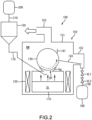
- the vapor-deposition apparatus 100 may comprise, for example, a drying mechanism 200 and a raw material introducing pipe 210 (see Fig.2 ) so that the silicon monoxide gas generating raw material Sr after being dry-treated is not exposed to the atmosphere.
- the silicon monoxide gas generating raw material Sr before being dry-treated is charged into the drying mechanism 200. Then, the silicon monoxide gas generating raw material Sr is dry-treated in the drying mechanism 200, and water vapor is discharged from a steam port (not shown) of the drying mechanism 200.
- the silicon monoxide gas generating raw material Sr when the silicon monoxide gas generating raw material Sr is dry-treated by, for example, heat-drying, it is preferable that the silicon monoxide gas generating raw material Sr is dry-treated within a range of 100°C or more and 400°C or less for the period within a range of 1 hour or more and 240 hours or less, more preferably within a range of 200°C or more and 350°C or less for the period within a range of 4 hours or more and 120 hours or less.
- the silicon monoxide gas generating raw material Sr is dry-treated by, for example, reduced pressure drying
- the silicon monoxide gas generating raw material is dry-treated under reduced pressure in which the pressure is controlled by a vacuum pump so as to be within a range of 10Pa or more and 100Pa or less for the period within a range of 12 hours or more and 120 hours or less
- the silicon monoxide gas generating raw material is dry-treated under reduced pressure in which the pressure is controlled by a vacuum pump so as to be within a range of 0.1Pa or more and 100Pa or less for the period within a range of 12 hours or more and 240 hours or less.
- the silicon monoxide gas generating raw material Sr after being dry-treated is charged into the raw material supply hopper 160 from the drying mechanism 200 via the raw material introducing pipe 210.
- the silicon monoxide gas generating raw material Sr after being dry-treated is charged into the raw material supply hopper 160 from the drying mechanism 200 via the raw material introducing pipe 210.
- the silicon monoxide (SiO) gas generating raw material Sr containing silicon dioxide (SiO 2 ) and silicon (Si) was dry-treated at 200°C for 4 hours.
- the weight of this silicon monoxide gas generating raw material Sr was 524g.
- the water content of this silicon monoxide gas generating raw material Sr was measured by a heat drying type water meter, the water content was 0.05 wt %. Then, using the vapor-deposition apparatus 100 shown in Fig.1 , this silicon monoxide gas generating raw material Sr was continuously charged into the crucible 110 in the deposition chamber RM (pressure: 10Pa, temperature: 1300°C.) for 2 hours.
- the silicon monoxide gas was generated, and the reactor was stopped 30 minutes after the completion of charging the silicon monoxide gas generating raw material Sr. After that, through the above described steps, the silicon oxide particles (weights: 487g) used for the negative electrode material for lithium ion secondary battery were finally manufactured. At this time, the pressure in the deposition chamber RM was increased to 15Pa, and the reaction rate (weight of the particles/amount of the charged raw material ⁇ 100) was 93%.
- the silicon monoxide gas generating raw material Sr containing silicon dioxide and silicon was dry-treated at 100°C for 1 hour.
- the weight of this silicon monoxide gas generating raw material Sr was 507g.
- the water content of the silicon monoxide gas generating raw material Sr was measured by a heat drying type water meter, the water content was 0.29 wt %.
- this silicon monoxide gas generating raw material Sr was continuously charged into the crucible 110 in the deposition chamber RM (pressure: 10Pa, temperature: 1300°C.) for 2 hours.
- the silicon monoxide gas was generated, and the reactor was stopped 30 minutes after the completion of charging the silicon monoxide gas generating raw material Sr. After that, through the above described steps, the silicon oxide particles (weights: 446g) used for the negative electrode material for lithium ion secondary battery were finally manufactured. At this time, the pressure in the deposition chamber RM increased to 38Pa, and the reaction rate was 88%.
- the silicon monoxide gas generating raw material Sr containing silicon dioxide and silicon was dry-treated under reduced pressure in 100Pa for 12 hours.
- the weight of this silicon monoxide gas generating raw material Sr was 520g.
- the water content of this silicon monoxide gas generating raw material Sr was measured by a heat drying type water meter, the water content was 0.33 wt %.
- this silicon monoxide gas generating raw material Sr was continuously charged into the crucible 110 in the deposition chamber RM (pressure: 10Pa, temperature: 1300°C.) for 2 hours.
- the silicon monoxide gas was generated, and the reactor was stopped 30 minutes after the completion of charging the silicon monoxide gas generating raw material Sr. After that, through the above described steps, the silicon oxide particles (weights: 447g) used for the negative electrode material for lithium ion secondary battery were finally manufactured. At this time, the pressure in the deposition chamber RM increased to 44Pa, and the reaction rate was 86%.
- the silicon monoxide gas generating raw material Sr containing lithium silicate (Li 2 Si 2 O 5 ) and silicon was dry-treated at 200°C for 4 hours.
- the weight of this silicon monoxide gas generating raw material Sr was 508g.
- the water content of this silicon monoxide gas generating raw material Sr was measured by a heat drying type water meter, the water content was 0.05 wt %. Then, using the vapor-deposition apparatus 100 shown in Fig.1 , this silicon monoxide gas generating raw material Sr was continuously charged into the crucible 110 in the deposition chamber RM (pressure: 10Pa, temperature: 1300°C.) for 2 hours.
- the silicon monoxide gas was generated, and the reactor was stopped 30 minutes after the completion of charging the silicon monoxide gas generating raw material Sr. After that, through the above described steps, the metal element-containing silicon oxide particles (weights: 477g) used for the negative electrode material for lithium ion secondary battery were finally manufactured. At this time, the pressure in the deposition chamber RM increased to 16Pa, and the reaction rate was 94%.
- the silicon oxide particles (weights: 360g) used for the negative electrode material for lithium ion secondary battery were finally manufactured.
- the pressure in the deposition chamber RM increased to 123Pa, and the reaction rate was 68%.
- the silicon monoxide gas generating raw material Sr containing silicon dioxide and silicon was dry-treated at 100°C for 1 hour.
- the weight of this silicon monoxide gas generating raw material Sr was 511g. Further, this silicon monoxide gas generating raw material Sr was exposed to the atmosphere for 24 hours. The weight of the silicon monoxide gas generating raw material Sr after being exposed to the atmosphere was 513g. Then, the water content of this silicon monoxide gas generating raw material Sr was measured by a heat drying type water meter, and the water content was 0.68 wt %.
- this silicon monoxide gas generating raw material Sr was continuously charged into the crucible 110 in the deposition chamber RM (pressure: 10Pa, temperature: 1300°C.) for 2 hours. Then, the silicon monoxide gas was generated, and the reactor was stopped 30 minutes after the completion of charging the silicon monoxide gas generating raw material Sr. After that, through the above described steps, the silicon oxide particles (weights: 393g) used for the negative electrode material for lithium ion secondary battery were finally manufactured. At this time, the pressure in the deposition chamber RM increased to 80Pa, and the reaction rate was 74%.
- the metal element-containing silicon oxide particles (weights: 312g) used for the negative electrode material for lithium ion secondary battery were finally manufactured.
- the pressure in the deposition chamber RM increased to 104Pa, and the reaction rate was 62%.
Landscapes
- Chemical & Material Sciences (AREA)
- Organic Chemistry (AREA)
- Inorganic Chemistry (AREA)
- Chemical Kinetics & Catalysis (AREA)
- Electrochemistry (AREA)
- General Chemical & Material Sciences (AREA)
- Silicon Compounds (AREA)
- Battery Electrode And Active Subsutance (AREA)
Abstract
Description
- The present invention relates to a silicon monoxide (SiO) gas generating raw material. The invention also relates to a method for continuously generating silicon monoxide gas.
- "A powder for a negative electrode material which is a silicon oxide powder having an average composition represented by SiOx (0.5<x<1.5), wherein when XRD measurement was performed, only one broad crystal peak having a half width of 2° or more is detected only at 10 to 40° in a diffractive angle 2θ=10 to 60°, and when the intensity of the broad crystal peak is P1, the intensity P2 of the other crystal peak satisfies P2/P1<0.1" has been proposed in the past (see, for example, Unexamined
Japanese Patent Publication No. 2019-67644 - PATENT DOCUMENT 1: Unexamined
Japanese Patent Publication No. 2019-67644 - By the way, a mixed powder of silicon (Si) alone and silicon dioxide (SiO2) or the like is heat-treated to generate silicon monoxide (SiO) gas, the generated silicon monoxide gas is cooled, and the deposited silicon oxide (SiOx) is pulverized, whereby a silicon oxide powder as described in Patent Document 1 can be obtained. Such a mixed powder adsorbs water in the air when it is stored for a long time in a relatively high humidity environment or the like. Then, when the mixed powder that adsorbs water (water content (wt %) is higher) is heat-treated to generate silicon monoxide gas, a large amount of water vapor (H20) and a large amount of hydrogen (H2) gas are also generated. When a large amount of water vapor, a large amount of hydrogen gas, or the like is generated, the internal pressure in the reaction chamber increases, and the reaction in which the silicon monoxide gas is generated is inhibited.
- An object of the present invention is to provide a silicon monoxide gas generating raw material in which a reaction that generates silicon monoxide gas is hardly inhibited.
- A silicon monoxide gas generating raw material according to a first aspect of the present invention has a water content of 0.6 wt % or less.
- As described above, the silicon monoxide gas generating raw material has a water content of 0.6 wt % or less. Therefore, when this silicon monoxide gas generating raw material is heat-treated to generate the silicon monoxide gas, the generation amounts of water vapor (H20), hydrogen (H2) gas, and the like can be suppressed. Therefore, by using the silicon monoxide gas generating raw material, it is possible to accelerate the reaction that generates the silicon monoxide (SiO) gas. Here, the water content of the silicon monoxide gas generating raw material is preferably 0.6 wt % or less, more preferably 0.3 wt % or less, particularly preferably 0.1 wt % or less. Incidentally, the water content of the silicon monoxide gas generating raw material after being dry-treated may be measured.
- The silicon monoxide gas generating raw material according to a second aspect of the present invention is the silicon monoxide gas generating raw material according to the first aspect, and contains at least one of SiOz (silicon dioxide) and silicate, and silicon (Si).
- When the water content (wt %) of the silicon monoxide gas generating raw material containing "at least one of silicon dioxide and silicate" and "silicon" is high, a large amount of water vapor or the like is generated by heat-treatment, and silicon may oxidize. On the other hand, in the silicon monoxide gas generating raw material according to the second aspect, the generation amount of water vapor or the like due to the heat-treatment can be suppressed, so that the oxidation of silicon can be prevented. Therefore, by using the silicon monoxide gas generating raw material according to the second aspect, it is possible to prevent a decrease in yield of the silicon monoxide gas generating raw material.
- The silicon monoxide gas generating raw material according to a third aspect of the present invention is the silicon monoxide gas generating raw material according to the second aspect, and the silicate is lithium silicate.
- As a result of intensive studies by the inventors, it was found that when a silicon monoxide gas generating raw material containing lithium silicate and silicon is mixed with water, molded, dried and granulated, lithium silicate and silicon are strongly bonded. Therefore, this silicon monoxide gas generating raw material has mechanical strength when it contains silicate (lithium silicate). Here, lithium silicate is a complex oxide of lithium oxide (Li2O) and silicon dioxide (SiO2), and preferably has a molar ratio of Li2O/SiO2<2, more preferably Li2O/SiO2≤1, particularly preferably Li2O/SiO2≤0.5.
- In a method for continuously generating silicon monoxide gas according to a fourth aspect of the present invention, the silicon monoxide gas generating raw material according to any one of the first to third aspects is continuously charged into a reaction chamber for generating silicon monoxide gas.
- As described above, in this method for continuously generating silicon monoxide gas, the silicon monoxide gas generating raw material according to any one of the first to third aspects is continuously charged into a reaction chamber for generating the silicon monoxide gas (that is, a reaction chamber for heat-treating the silicon monoxide gas generating raw material). Therefore, it is possible to suppress the generation amount of water vapor, hydrogen gas, and the like while the silicon monoxide gas is generated. Therefore, in this method for continuously generating silicon monoxide gas, the silicon monoxide gas can be continuously generated without inhibiting the reaction that generates the silicon monoxide gas.
-
- [
Fig. 1 ]It is a schematic view of a manufacturing apparatus of active material particles using a silicon monoxide gas generating raw material according to an embodiment of the present invention. - [
Fig. 2 ]It is a schematic view of adding a drying mechanism to the manufacturing apparatus shown inFig.1 . -
- 100
- Vapor-deposition apparatus
- 110
- Crucible
- 120
- Heater
- 130
- Vapor-deposition drum
- 141
- Scraper
- 143
- Particle guide
- 150
- Chamber
- 151
- Chamber body portion
- 152
- Collection portion
- 153
- Exhaust pipe
- 160
- Raw material supply hopper
- 170
- Raw material introducing pipe
- 180
- Collection container
- 190
- Collection pipe
- 200
- Drying mechanism
- 210
- Raw material introducing pipe
- Gg
- Gas guide
- OP
- Opening
- RM
- Deposition chamber
- Sr
- Silicon monoxide gas generating raw material
- VL1
- First valve
- VL2
- Second valve
- The silicon monoxide gas generating raw material Sr according to the embodiment of the present invention is used for generating the silicon monoxide (SiO) gas. As the silicon monoxide gas generating raw material Sr, for example, "a mixed powder of silicon (Si) and silicon dioxide (SiO2)" or "a mixed powder of silicon and silicate such as lithium silicate (Li2Si2O5 or the like) or the like" is used. The "mixed powder of silicon and silicon dioxide" is used when manufacturing silicon oxide particles, and is heat-treated to generate the silicon monoxide gas. The "mixed powder of silicon and a silicate such as lithium silicate" is used when manufacturing metal element-containing silicon oxide particles, and is heat-treated to generate the silicon monoxide gas containing the metal element such as lithium (Li) or the like. Incidentally, the metal element may be an element capable of reducing silicon monoxide and stabilizing oxygen, such as an alkali metal such as sodium (Na) or the like in addition to lithium, an alkaline earth metal such as magnesium (Mg) and calcium (Ca) or the like.
- Incidentally, the silicon monoxide gas generating raw material Sr according to the embodiment of the present invention is dry-treated (described later) before being heat-treated. This dry-treatment is performed to reduce the amount of water in the silicon monoxide gas generating raw material Sr. Examples of the dry-treatment method include heat-drying, reduced pressure drying and the like.
- Then, the active material particles are manufactured from the silicon monoxide gas generated by heat-treating the silicon monoxide gas generating raw material Sr after the dry-treatment to a predetermined temperature through a process to be described later. As such active material particles, for example, silicon oxide particles or metal element-containing silicon oxide particles used as active materials of electrodes (particularly, negative electrodes) of a lithium ion secondary battery is used.
- Incidentally, in order to finally manufacture the active material particles using the silicon monoxide gas generating raw material Sr according to the embodiment of the present invention, it is preferable to use a vapor-
deposition apparatus 100 as shown inFig. 1 . The vapor-deposition apparatus 100 is excellent from the viewpoint of suppression of manufacturing costs and the like. Hereinafter, the vapor-deposition apparatus 100 will be described in detail. - As shown in
Fig. 1 , the vapor-deposition apparatus 100 mainly comprises acrucible 110, aheater 120, a vapor-deposition drum 130, ascraper 141, aparticle guide 143, achamber 150, a rawmaterial supply hopper 160, a rawmaterial introducing pipe 170, acollection container 180, a first valve VL1, and a second valve VL2. - As shown in
Fig. 1 , thecrucible 110 is a heat resistant container having an opening in the central portion of the top wall, and is installed in thechamber 150. Further, a through hole (not shown) is formed in one portion around the top wall of thecrucible 110, and the rawmaterial introducing pipe 170 is inserted into the through hole. That is, the silicon monoxide gas generating raw material Sr after being dry-treated in the rawmaterial supply hopper 160 is supplied to thecrucible 110 through the rawmaterial introducing pipe 170. Further, the gas guide Gg is disposed on the upper side of the top wall of thecrucible 110. The gas guide Gg is a member for guiding the silicon monoxide gas generated in thecrucible 110 to the vapor-deposition drum 130, and is installed on the upper surface of the top wall so as to surround the central portion of the top wall as shown inFig. 1 . - The
heater 120 is for heating thecrucible 110 at a high temperature, and is disposed so as to take in the outer periphery of thecrucible 110. - The vapor-
deposition drum 130 is, for example, a cylindrical horizontal drum, and is disposed above the opening OP of the top wall of thecrucible 110 as shown inFig.1 , and the lower portion of the vapor-deposition drum 130 is surrounded by the gas guide Gg. Then, the vapor-deposition drum 130 is driven to rotate in one direction by a driving mechanism which is not shown. Incidentally, a temperature controller (not shown) for maintaining the outer peripheral surface at a constant temperature is provided on the vapor-deposition drum 130. The temperature controller cools the outer peripheral surface temperature of the vapor-deposition drum 130 to a temperature suitable for vapor-deposition of the vapor-deposition source gas by a cooling medium supplied from the outside. In addition, the outer peripheral surface temperature of the vapor-deposition drum 130 may affect the crystallinity of the deposit accumulated on the deposit remaining on the vapor-deposition drum. If this temperature is too low, the tissue structure of the deposit may become too sparse, and on the contrary, if this temperature is too high, crystal growth due to the disproportionation reaction may proceed. When the silicon monoxide gas is vapor-deposited, this temperature is preferably 900°C or less, more preferably within a range of 150°C or more and 800°C or less, particularly preferably within a range of 150°C or more and 700°C or less. - The
scraper 141 is a member that serves to scrape the thin film formed on the vapor-deposition drum from the vapor-deposition drum 130. The scraped-off thin film pieces (active material particles) fall into theparticle guide 143. Further, the material of thescraper 141 affects impurity contamination of the active material particles. From the viewpoint of suppressing the affect, the material of thescraper 141 is preferably stainless steel or ceramic, particularly preferably ceramic. In addition, thescraper 141 is preferably not in contact with the outer peripheral surface of the vapor-deposition drum 130. This is because the impurity contamination that may occur due to direct contact between the vapor-deposition drum 130 and thescraper 141 can be prevented from being mixed into the collected active material particles. - The
particle guide 143 is, for example, a vibrating conveying member and is disposed so as to be inclined downward from the vicinity of the vapor-deposition drum 130 toward thecollection portion 152 of thechamber 150 as shown inFig.1 , and receives thin film pieces scraped off by thescraper 141 disposed above to send the thin film pieces to thecollection portion 152 of thechamber 150. - As shown in
Fig.1 , thechamber 150 is mainly formed of achamber body portion 151, acollection portion 152, and anexhaust pipe 153. As shown inFig.1 , thechamber body portion 151 is a box-shaped portion having a deposition chamber RM inside, and houses thecrucible 110, theheater 120, the vapor-deposition drum 130, thescraper 141, and theparticle guide 143. As shown inFig.1 , thecollection portion 152 is a portion protruding outward from the side wall of thechamber body portion 151, and has a space communicating with the deposition chamber RM of thechamber body portion 151. As described above, the distal end portion of theparticle guide 143 is located in thecollection portion 152. - The raw
material supply hopper 160 is a supply source of the silicon monoxide gas generating raw material. As shown inFig.1 , an outlet of the raw material supply hopper is connected to the rawmaterial introducing pipe 170. That is, the silicon monoxide gas generating raw material Sr after being dry-treated charged into the rawmaterial supply hopper 160 is continuously supplied to thecrucible 110 via the rawmaterial introducing pipe 170 at appropriate timing. Incidentally, the silicon monoxide gas generating raw material Sr after being dry-treated supplied to thecrucible 110 becomes silicon monoxide gas. - The raw
material introducing pipe 170 is nozzle having a round hole shape for continuously charging the silicon monoxide gas generating raw material Sr after being dry-treated which is charged into the rawmaterial supply hopper 160 into thecrucible 110, and is disposed so that the outlet faces upward in the central portion of the top plate portion of thecrucible 110. - The
collection container 180 is a container for collecting thin film pieces that have passed through the first valve VL1 and the second valve VL2. - The first valve VL1 and the second valve VL2 adjust the collection amount of the thin film pieces into the
collection container 180 by opening and closing, and are provided in acollection pipe 190 connecting thecollection portion 152 of thechamber 150 and thecollection container 180. - Hereinafter, a description will be given of a case where silicon oxide particles or metal element-containing silicon oxide particles used for a negative electrode material for a lithium ion secondary battery is finally manufactured from the silicon monoxide gas generating raw material Sr by using the vapor-
deposition apparatus 100 described above. - First, the silicon monoxide gas generating raw material Sr is dry-treated (e.g., heat-drying, reduced pressure drying). Here, When the silicon monoxide gas generating raw material Sr is dry-treated by, for example, heat-drying, it is preferable that the silicon monoxide gas generating raw material Sr is dry-treated within a range of 100°C or more and 400°C or less for the period within a range of 1 hour or more and 240 hours or less, more preferably within a range of 200°C or more and 350°C or less for the period within a range of 4 hours or more and 120 hours or less. Further, when the silicon monoxide gas generating raw material Sr is dry-treated by, for example, reduced pressure drying, it is preferable that the silicon monoxide gas generating raw material is dry-treated under reduced pressure in which the pressure is controlled by a vacuum pump so as to be within a range of 10Pa or more and 100Pa or less for the period within a range of 12 hours or more and 120 hours or less and, and more preferable that the silicon monoxide gas generating raw material is dry-treated under reduced pressure in which the pressure is controlled by a vacuum pump so as to be within a range of 0.1Pa or more and 100Pa or less for the period within a range of 12 hours or more and 240 hours or less. When the silicon monoxide gas generating raw material Sr is dry-treated under these conditions, water in the silicon monoxide gas generating raw material Sr can be removed without generating the silicon monoxide gas as much as possible. Then, as described above, the water content of the silicon monoxide gas generating raw material Sr after being dry-treated is 0.6 wt % or less, preferably 0.3 wt % or less, more preferably 0.1 wt % or less. Further, the silicon monoxide gas generating raw material Sr after being dry-treated is preferably stored in a sealed container or under reduced pressure.
- Next, the silicon monoxide gas generating raw material Sr after being dry-treated is charged into the raw
material supply hopper 160. Then, the silicon monoxide gas generating raw material Sr after being dry-treated is continuously charged into thecrucible 110 from the rawmaterial supply hopper 160 via the rawmaterial introducing pipe 170. - Next, when the silicon monoxide gas generating raw material Sr after being dry-treated is charged into the
crucible 110, thecrucible 110 is heated by theheater 120 while the pressure in the deposition chamber RM is reduced. Incidentally, when the water content (wt %) of the silicon monoxide gas generating raw material Sr is high, a large amount of water vapor, a large amount of hydrogen gas, and the like are generated by the heating of theheater 120. When a large amount of water vapor, a large amount of hydrogen gas, or the like is generated, the pressure in the deposition chamber RM increases. Then, if the pressure in the deposition chamber RM is too high, the reaction that generates the silicon monoxide gas from the silicon monoxide gas generating raw material Sr after being dry-treated is less likely to occur. Here, the pressure in the deposition chamber RM is preferably 100Pa or less, more preferably 75Pa or less, particularly preferably 20Pa or less. Further, the temperature in the deposition chamber RM affects the reaction rate of silicon monoxide. If the temperature is too low, the reaction rate becomes slow, and if the temperature is too high, there are concerns that side reaction due to the melting of the silicon monoxide gas generating raw material Sr after being dry-treated will proceed, energy efficiency will decrease and so on. Also, there is a concern that thecrucible 110 may be damaged at the temperature. From this viewpoint, the temperature in the deposition chamber RM is preferably within a range of 1000 °C or more and 1600 °C or less, more preferably within a range of 1100 °C or more and 1500 °C or less, particularly preferably within a range of 1100 °C or more and 1400 °C or less. - As described above, by heat-treating under reduced pressure the silicon monoxide gas generating raw material Sr after being dry-treated, the silicon monoxide gas is generated from the silicon monoxide gas generating raw material Sr after being dry-treated in the
crucible 110. The silicon monoxide gas is supplied to the vapor-deposition drum 130 through the gas guide Gg. At this time, the vapor-deposition drum 130 is rotatably driven by a driving source. Incidentally, the temperature of the outer peripheral surface of the vapor-deposition drum 130 is set lower than the temperature in the deposition chamber RM. More specifically, the temperature is set lower than the condensation temperature of the silicon monoxide gas. With this setting, the silicon monoxide gas generated from thecrucible 110 is vapor-deposited, deposited and accumulated on the outer peripheral surface of the rotating vapor-deposition drum 130. Then, a thin film is formed on the vapor-deposition drum 130. Thereafter, the thin film on the vapor-deposition drum 130 comes into contact with thescraper 141, and the thin film is scraped off from the vapor-deposition drum 130. Incidentally, the scraped off pieces of the thin film (active material particles) fall along the outer peripheral surface of the vapor-deposition drum 130 to theparticle guide 143. - In the vapor-
deposition apparatus 100 of the present embodiment, as described above, high quality active material particles are finally manufactured from the silicon monoxide gas generating raw material Sr. - Incidentally, when the silicon monoxide gas generating raw material Sr after being dry-treated is charged into the raw
material supply hopper 160, it is preferable to prevent the silicon monoxide gas generating raw material Sr after being dry-treated from being exposed to the atmosphere. This is because water in the atmosphere may adsorb to the silicon monoxide gas generating raw material Sr after being dry-treated. The vapor-deposition apparatus 100 may comprise, for example, adrying mechanism 200 and a raw material introducing pipe 210 (seeFig.2 ) so that the silicon monoxide gas generating raw material Sr after being dry-treated is not exposed to the atmosphere. According to this configuration, first, as shown inFig.2 , the silicon monoxide gas generating raw material Sr before being dry-treated is charged into thedrying mechanism 200. Then, the silicon monoxide gas generating raw material Sr is dry-treated in thedrying mechanism 200, and water vapor is discharged from a steam port (not shown) of thedrying mechanism 200. Here, as described above, when the silicon monoxide gas generating raw material Sr is dry-treated by, for example, heat-drying, it is preferable that the silicon monoxide gas generating raw material Sr is dry-treated within a range of 100°C or more and 400°C or less for the period within a range of 1 hour or more and 240 hours or less, more preferably within a range of 200°C or more and 350°C or less for the period within a range of 4 hours or more and 120 hours or less. Further, when the silicon monoxide gas generating raw material Sr is dry-treated by, for example, reduced pressure drying, it is preferable that the silicon monoxide gas generating raw material is dry-treated under reduced pressure in which the pressure is controlled by a vacuum pump so as to be within a range of 10Pa or more and 100Pa or less for the period within a range of 12 hours or more and 120 hours or less, and more preferable that the silicon monoxide gas generating raw material is dry-treated under reduced pressure in which the pressure is controlled by a vacuum pump so as to be within a range of 0.1Pa or more and 100Pa or less for the period within a range of 12 hours or more and 240 hours or less. Then, the silicon monoxide gas generating raw material Sr after being dry-treated is charged into the rawmaterial supply hopper 160 from thedrying mechanism 200 via the rawmaterial introducing pipe 210. With this configuration, it is possible to prevent the silicon monoxide gas generating raw material Sr after being dry-treated from being exposed to the atmosphere. - Hereinafter, working examples and comparative examples are described in order to explain the present invention in more detail, but the present invention is not limited to these examples.
- The silicon monoxide (SiO) gas generating raw material Sr containing silicon dioxide (SiO2) and silicon (Si) was dry-treated at 200°C for 4 hours. The weight of this silicon monoxide gas generating raw material Sr was 524g. Further, when the water content of this silicon monoxide gas generating raw material Sr was measured by a heat drying type water meter, the water content was 0.05 wt %. Then, using the vapor-
deposition apparatus 100 shown inFig.1 , this silicon monoxide gas generating raw material Sr was continuously charged into thecrucible 110 in the deposition chamber RM (pressure: 10Pa, temperature: 1300°C.) for 2 hours. Then, the silicon monoxide gas was generated, and the reactor was stopped 30 minutes after the completion of charging the silicon monoxide gas generating raw material Sr. After that, through the above described steps, the silicon oxide particles (weights: 487g) used for the negative electrode material for lithium ion secondary battery were finally manufactured. At this time, the pressure in the deposition chamber RM was increased to 15Pa, and the reaction rate (weight of the particles/amount of the charged raw material×100) was 93%. - The silicon monoxide gas generating raw material Sr containing silicon dioxide and silicon was dry-treated at 100°C for 1 hour. The weight of this silicon monoxide gas generating raw material Sr was 507g. Further, when the water content of the silicon monoxide gas generating raw material Sr was measured by a heat drying type water meter, the water content was 0.29 wt %. Then, using the vapor-
deposition apparatus 100 shown inFig.1 , this silicon monoxide gas generating raw material Sr was continuously charged into thecrucible 110 in the deposition chamber RM (pressure: 10Pa, temperature: 1300°C.) for 2 hours. Then, the silicon monoxide gas was generated, and the reactor was stopped 30 minutes after the completion of charging the silicon monoxide gas generating raw material Sr. After that, through the above described steps, the silicon oxide particles (weights: 446g) used for the negative electrode material for lithium ion secondary battery were finally manufactured. At this time, the pressure in the deposition chamber RM increased to 38Pa, and the reaction rate was 88%. - The silicon monoxide gas generating raw material Sr containing silicon dioxide and silicon was dry-treated under reduced pressure in 100Pa for 12 hours. The weight of this silicon monoxide gas generating raw material Sr was 520g. Further, when the water content of this silicon monoxide gas generating raw material Sr was measured by a heat drying type water meter, the water content was 0.33 wt %. Then, using the vapor-
deposition apparatus 100 shown inFig.1 , this silicon monoxide gas generating raw material Sr was continuously charged into thecrucible 110 in the deposition chamber RM (pressure: 10Pa, temperature: 1300°C.) for 2 hours. Then, the silicon monoxide gas was generated, and the reactor was stopped 30 minutes after the completion of charging the silicon monoxide gas generating raw material Sr. After that, through the above described steps, the silicon oxide particles (weights: 447g) used for the negative electrode material for lithium ion secondary battery were finally manufactured. At this time, the pressure in the deposition chamber RM increased to 44Pa, and the reaction rate was 86%. - The silicon monoxide gas generating raw material Sr containing lithium silicate (Li2Si2O5) and silicon was dry-treated at 200°C for 4 hours. The weight of this silicon monoxide gas generating raw material Sr was 508g. Further, when the water content of this silicon monoxide gas generating raw material Sr was measured by a heat drying type water meter, the water content was 0.05 wt %. Then, using the vapor-
deposition apparatus 100 shown inFig.1 , this silicon monoxide gas generating raw material Sr was continuously charged into thecrucible 110 in the deposition chamber RM (pressure: 10Pa, temperature: 1300°C.) for 2 hours. Then, the silicon monoxide gas was generated, and the reactor was stopped 30 minutes after the completion of charging the silicon monoxide gas generating raw material Sr. After that, through the above described steps, the metal element-containing silicon oxide particles (weights: 477g) used for the negative electrode material for lithium ion secondary battery were finally manufactured. At this time, the pressure in the deposition chamber RM increased to 16Pa, and the reaction rate was 94%. - When the water content of the silicon monoxide gas generating raw material Sr (without drying treatment) (weight: 530g) containing silicon dioxide and silicon was measured by a heat drying type water meter, the water content was 0.96 wt %. Then, using the vapor-
deposition apparatus 100 shown inFig.1 , this silicon monoxide gas generating raw material Sr was continuously charged into thecrucible 110 in the deposition chamber RM (pressure: 10Pa, temperature: 1300°C.) for 2 hours. Then, the silicon monoxide gas was generated, and the reactor was stopped 30 minutes after the completion of charging the silicon monoxide gas generating raw material Sr. After that, through the above described steps, the silicon oxide particles (weights: 360g) used for the negative electrode material for lithium ion secondary battery were finally manufactured. At this time, the pressure in the deposition chamber RM increased to 123Pa, and the reaction rate was 68%. - The silicon monoxide gas generating raw material Sr containing silicon dioxide and silicon was dry-treated at 100°C for 1 hour. The weight of this silicon monoxide gas generating raw material Sr was 511g. Further, this silicon monoxide gas generating raw material Sr was exposed to the atmosphere for 24 hours. The weight of the silicon monoxide gas generating raw material Sr after being exposed to the atmosphere was 513g. Then, the water content of this silicon monoxide gas generating raw material Sr was measured by a heat drying type water meter, and the water content was 0.68 wt %. Then, using the vapor-
deposition apparatus 100 shown inFig.1 , this silicon monoxide gas generating raw material Sr was continuously charged into thecrucible 110 in the deposition chamber RM (pressure: 10Pa, temperature: 1300°C.) for 2 hours. Then, the silicon monoxide gas was generated, and the reactor was stopped 30 minutes after the completion of charging the silicon monoxide gas generating raw material Sr. After that, through the above described steps, the silicon oxide particles (weights: 393g) used for the negative electrode material for lithium ion secondary battery were finally manufactured. At this time, the pressure in the deposition chamber RM increased to 80Pa, and the reaction rate was 74%. - When the water content of the silicon monoxide gas generating raw material Sr (without drying treatment) (weight: 503g) containing lithium silicate (Li2Si2O5) and silicon was measured by a heat drying type water meter, the water content was 0.81 wt %. Then, using the vapor-
deposition apparatus 100 shown inFig.1 , this silicon monoxide gas generating raw material Sr was continuously charged into thecrucible 110 in the deposition chamber RM (pressure: 10Pa, temperature: 1300°C.) for 2 hours. Then, the silicon monoxide gas was generated, and the reactor was stopped 30 minutes after the completion of charging the silicon monoxide gas generating raw material Sr. After that, through the above described steps, the metal element-containing silicon oxide particles (weights: 312g) used for the negative electrode material for lithium ion secondary battery were finally manufactured. At this time, the pressure in the deposition chamber RM increased to 104Pa, and the reaction rate was 62%.
Claims (4)
- A silicon monoxide gas generating raw material having a water content of 0.6 wt % or less.
- The silicon monoxide gas generating raw material according to claim 1 containing at least one of silicon dioxide (SiO2) and silicate, and silicon (Si).
- The silicon monoxide gas generating raw material according to claim 2, wherein the silicate is lithium silicate.
- A method for continuously generating silicon monoxide gas, wherein the silicon monoxide gas generating raw material according to any one of claims 1 to 3 is continuously charged into a reaction chamber for generating silicon monoxide (SiO) gas.
Applications Claiming Priority (2)
| Application Number | Priority Date | Filing Date | Title |
|---|---|---|---|
| JP2020155272 | 2020-09-16 | ||
| PCT/JP2021/026236 WO2022059316A1 (en) | 2020-09-16 | 2021-07-13 | Silicon monoxide gas generating material and silicon monoxide gas continuous generation method |
Publications (2)
| Publication Number | Publication Date |
|---|---|
| EP4215484A1 true EP4215484A1 (en) | 2023-07-26 |
| EP4215484A4 EP4215484A4 (en) | 2024-10-16 |
Family
ID=80775780
Family Applications (1)
| Application Number | Title | Priority Date | Filing Date |
|---|---|---|---|
| EP21869003.0A Pending EP4215484A4 (en) | 2020-09-16 | 2021-07-13 | MATERIAL FOR PRODUCTION OF SILICON MONOXIDE GAS AND METHOD FOR CONTINUOUS PRODUCTION OF SILICON MONOXIDE GAS |
Country Status (4)
| Country | Link |
|---|---|
| US (1) | US20230202850A1 (en) |
| EP (1) | EP4215484A4 (en) |
| JP (1) | JP7564225B2 (en) |
| WO (1) | WO2022059316A1 (en) |
Family Cites Families (15)
| Publication number | Priority date | Publication date | Assignee | Title |
|---|---|---|---|---|
| JP3865033B2 (en) | 2000-02-04 | 2007-01-10 | 信越化学工業株式会社 | Continuous production method and continuous production apparatus for silicon oxide powder |
| JP3824047B2 (en) | 2000-02-04 | 2006-09-20 | 信越化学工業株式会社 | Method for producing amorphous silicon oxide powder |
| WO2006025194A1 (en) | 2004-09-01 | 2006-03-09 | Sumitomo Titanium Corporation | SiO DEPOSITION MATERIAL, Si POWDER FOR SiO RAW MATERIAL, AND METHOD FOR PRODUCING SiO |
| JP4900573B2 (en) | 2006-04-24 | 2012-03-21 | 信越化学工業株式会社 | Method for producing silicon oxide powder |
| JP2010150049A (en) | 2008-12-24 | 2010-07-08 | Shin-Etsu Chemical Co Ltd | Raw material for producing silicon oxide, method for producing the same, silicon oxide and method for producing the same |
| JP5508325B2 (en) * | 2011-03-23 | 2014-05-28 | 信越化学工業株式会社 | Method for producing silicon oxide powder |
| JP5942897B2 (en) * | 2012-03-22 | 2016-06-29 | 信越化学工業株式会社 | Continuous production method and production apparatus for silicon oxide precipitate |
| CN207680568U (en) * | 2017-09-26 | 2018-08-03 | 中天储能科技有限公司 | A kind of silicon monoxide quantity-produced apparatus |
| JP7251915B2 (en) | 2017-10-02 | 2023-04-04 | 株式会社大阪チタニウムテクノロジーズ | Powder for negative electrode material and method for producing negative electrode material |
| CN108199031B (en) * | 2018-01-16 | 2020-04-10 | 毛伟波 | High amorphous silicon monoxide material, preparation method and application thereof |
| KR20200009943A (en) * | 2018-07-20 | 2020-01-30 | 대주전자재료 주식회사 | Silicon-silicon dioxide-based sintered body, Method of manufacturing thereof and gas barrer film using the same |
| JP7058333B2 (en) * | 2018-08-27 | 2022-04-21 | 株式会社大阪チタニウムテクノロジーズ | SiO powder manufacturing method and spherical particulate SiO powder |
| CN109205631A (en) * | 2018-11-12 | 2019-01-15 | 杭州致德新材料有限公司 | Silicon monoxide nano material continuous production device and production technology |
| TWI741247B (en) * | 2019-01-03 | 2021-10-01 | 國立臺灣大學 | Method of manufacturing silicon monoxide deposit by use of silicon kerf waste |
| CN111072038B (en) * | 2019-12-27 | 2021-01-01 | 江西壹金新能源科技有限公司 | Modified silicon monoxide material for lithium ion battery cathode and preparation method thereof |
-
2021
- 2021-07-13 JP JP2022550373A patent/JP7564225B2/en active Active
- 2021-07-13 EP EP21869003.0A patent/EP4215484A4/en active Pending
- 2021-07-13 US US17/925,890 patent/US20230202850A1/en active Pending
- 2021-07-13 WO PCT/JP2021/026236 patent/WO2022059316A1/en not_active Ceased
Also Published As
| Publication number | Publication date |
|---|---|
| US20230202850A1 (en) | 2023-06-29 |
| EP4215484A4 (en) | 2024-10-16 |
| WO2022059316A1 (en) | 2022-03-24 |
| JP7564225B2 (en) | 2024-10-08 |
| JPWO2022059316A1 (en) | 2022-03-24 |
Similar Documents
| Publication | Publication Date | Title |
|---|---|---|
| US7431899B2 (en) | Apparatus for the continuous production of silicon oxide powder | |
| CN111052464B (en) | Manufacturing method and heat treatment device of positive electrode active material for lithium ion secondary battery | |
| JP5710788B2 (en) | Method of calcining electrode materials using a rotary kiln | |
| JP6369644B2 (en) | Method for producing positive electrode active material for lithium secondary battery | |
| WO2019189747A1 (en) | Method for producing silicon oxide powder and negative electrode material | |
| TW202500507A (en) | Silica to high purity silicon production apparatus and process | |
| CN108165768A (en) | The apparatus and method of lithium are produced in a kind of vacuum metal thermal reduction | |
| CN106744985A (en) | Silicon monoxide nano material and preparation method thereof | |
| EP4215484A1 (en) | Silicon monoxide gas generating material and silicon monoxide gas continuous generation method | |
| JP2021183550A (en) | Lithium disilicate-containing lithium-containing silicon oxide and method for producing the same | |
| KR20230119133A (en) | Methods for removing water from particulate matter | |
| KR102021930B1 (en) | MANUFACTURING METHOD OF SiOx NANO PARTICLE WITH EXCELLENT VOLATILITY AND SiOx NANO PARTICLE FOR LITHIUM ION BATTERY NEGATIVE ELECTRODE MATERIAL | |
| US12024437B2 (en) | Method for continuously generating silicon monoxide gas | |
| JP2022049185A (en) | Method for producing lithium silicate and silicon | |
| CN105420747A (en) | Method for preparing high-purity aluminum hydroxide uniform in particle size through discharging process of aluminum-air battery | |
| CN218710737U (en) | Light-burned magnesium oxide normal pressure reduction magnesium making device | |
| AU2024203522A1 (en) | Preparation method of iron phosphate precursor for batteries | |
| CN105261749A (en) | Method for preparation zirconium-doped lithium titanate through one-step reaction | |
| CN115298855A (en) | Silicon-based active material granules, silicon-based active material precursor granules, and method for producing same | |
| KR20260061444A (en) | Silicon-based composite containing metal elements | |
| JP5574295B2 (en) | High purity silicon fine powder production equipment | |
| Loomis | The production of metallic calcium by thermal reduction | |
| JP6749230B2 (en) | Method for producing silicon carbide | |
| JP2003192326A (en) | Porous silicon oxide powder and method for producing the same | |
| EP4613707A1 (en) | Silicon oxide and method for producing same |
Legal Events
| Date | Code | Title | Description |
|---|---|---|---|
| STAA | Information on the status of an ep patent application or granted ep patent |
Free format text: STATUS: THE INTERNATIONAL PUBLICATION HAS BEEN MADE |
|
| PUAI | Public reference made under article 153(3) epc to a published international application that has entered the european phase |
Free format text: ORIGINAL CODE: 0009012 |
|
| STAA | Information on the status of an ep patent application or granted ep patent |
Free format text: STATUS: REQUEST FOR EXAMINATION WAS MADE |
|
| 17P | Request for examination filed |
Effective date: 20221122 |
|
| AK | Designated contracting states |
Kind code of ref document: A1 Designated state(s): AL AT BE BG CH CY CZ DE DK EE ES FI FR GB GR HR HU IE IS IT LI LT LU LV MC MK MT NL NO PL PT RO RS SE SI SK SM TR |
|
| P01 | Opt-out of the competence of the unified patent court (upc) registered |
Effective date: 20230817 |
|
| DAV | Request for validation of the european patent (deleted) | ||
| DAX | Request for extension of the european patent (deleted) | ||
| REG | Reference to a national code |
Ref country code: DE Ref legal event code: R079 Free format text: PREVIOUS MAIN CLASS: C01B0033113000 Ipc: C01B0033180000 |
|
| A4 | Supplementary search report drawn up and despatched |
Effective date: 20240918 |
|
| RIC1 | Information provided on ipc code assigned before grant |
Ipc: H01M 4/48 20100101ALI20240912BHEP Ipc: C01B 33/18 20060101AFI20240912BHEP |
|
| STAA | Information on the status of an ep patent application or granted ep patent |
Free format text: STATUS: EXAMINATION IS IN PROGRESS |
|
| 17Q | First examination report despatched |
Effective date: 20250918 |