EP4213645B1 - System zur massenhochdruckverarbeitung und zugehöriges verfahren - Google Patents
System zur massenhochdruckverarbeitung und zugehöriges verfahren Download PDFInfo
- Publication number
- EP4213645B1 EP4213645B1 EP21789921.0A EP21789921A EP4213645B1 EP 4213645 B1 EP4213645 B1 EP 4213645B1 EP 21789921 A EP21789921 A EP 21789921A EP 4213645 B1 EP4213645 B1 EP 4213645B1
- Authority
- EP
- European Patent Office
- Prior art keywords
- bag
- carrier
- fitment
- product
- filling
- Prior art date
- Legal status (The legal status is an assumption and is not a legal conclusion. Google has not performed a legal analysis and makes no representation as to the accuracy of the status listed.)
- Active
Links
Images







Classifications
-
- A—HUMAN NECESSITIES
- A23—FOODS OR FOODSTUFFS; TREATMENT THEREOF, NOT COVERED BY OTHER CLASSES
- A23B—PRESERVATION OF FOODS, FOODSTUFFS OR NON-ALCOHOLIC BEVERAGES; CHEMICAL RIPENING OF FRUIT OR VEGETABLES
- A23B11/00—Preservation of milk or dairy products
- A23B11/10—Preservation of milk or milk preparations
-
- A—HUMAN NECESSITIES
- A23—FOODS OR FOODSTUFFS; TREATMENT THEREOF, NOT COVERED BY OTHER CLASSES
- A23B—PRESERVATION OF FOODS, FOODSTUFFS OR NON-ALCOHOLIC BEVERAGES; CHEMICAL RIPENING OF FRUIT OR VEGETABLES
- A23B2/00—Preservation of foods or foodstuffs, in general
- A23B2/10—Preservation of foods or foodstuffs, in general by treatment with pressure variation, shock, acceleration or shear stress
- A23B2/103—Preservation of foods or foodstuffs, in general by treatment with pressure variation, shock, acceleration or shear stress using sub- or super-atmospheric pressures, or pressure variations transmitted by a liquid or gas
-
- B—PERFORMING OPERATIONS; TRANSPORTING
- B65—CONVEYING; PACKING; STORING; HANDLING THIN OR FILAMENTARY MATERIAL
- B65B—MACHINES, APPARATUS OR DEVICES FOR, OR METHODS OF, PACKAGING ARTICLES OR MATERIALS; UNPACKING
- B65B25/00—Packaging other articles presenting special problems
- B65B25/001—Packaging other articles presenting special problems of foodstuffs, combined with their conservation
-
- B—PERFORMING OPERATIONS; TRANSPORTING
- B65—CONVEYING; PACKING; STORING; HANDLING THIN OR FILAMENTARY MATERIAL
- B65B—MACHINES, APPARATUS OR DEVICES FOR, OR METHODS OF, PACKAGING ARTICLES OR MATERIALS; UNPACKING
- B65B3/00—Packaging plastic material, semiliquids, liquids or mixed solids and liquids, in individual containers or receptacles, e.g. bags, sacks, boxes, cartons, cans, or jars
- B65B3/04—Methods of, or means for, filling the material into the containers or receptacles
- B65B3/045—Methods of, or means for, filling the material into the containers or receptacles for filling flexible containers having a filling and dispensing spout, e.g. containers of the "bag-in-box"-type
-
- B—PERFORMING OPERATIONS; TRANSPORTING
- B65—CONVEYING; PACKING; STORING; HANDLING THIN OR FILAMENTARY MATERIAL
- B65B—MACHINES, APPARATUS OR DEVICES FOR, OR METHODS OF, PACKAGING ARTICLES OR MATERIALS; UNPACKING
- B65B31/00—Packaging articles or materials under special atmospheric or gaseous conditions; Adding propellants to aerosol containers
- B65B31/02—Filling, closing, or filling and closing, containers or wrappers in chambers maintained under vacuum or superatmospheric pressure or containing a special atmosphere, e.g. of inert gas
- B65B31/024—Filling, closing, or filling and closing, containers or wrappers in chambers maintained under vacuum or superatmospheric pressure or containing a special atmosphere, e.g. of inert gas specially adapted for wrappers or bags
-
- B—PERFORMING OPERATIONS; TRANSPORTING
- B65—CONVEYING; PACKING; STORING; HANDLING THIN OR FILAMENTARY MATERIAL
- B65B—MACHINES, APPARATUS OR DEVICES FOR, OR METHODS OF, PACKAGING ARTICLES OR MATERIALS; UNPACKING
- B65B43/00—Forming, feeding, opening or setting-up containers or receptacles in association with packaging
- B65B43/42—Feeding or positioning bags, boxes, or cartons in the distended, opened, or set-up state; Feeding preformed rigid containers, e.g. tins, capsules, glass tubes, glasses, to the packaging position; Locating containers or receptacles at the filling position; Supporting containers or receptacles during the filling operation
- B65B43/54—Means for supporting containers or receptacles during the filling operation
-
- B—PERFORMING OPERATIONS; TRANSPORTING
- B65—CONVEYING; PACKING; STORING; HANDLING THIN OR FILAMENTARY MATERIAL
- B65B—MACHINES, APPARATUS OR DEVICES FOR, OR METHODS OF, PACKAGING ARTICLES OR MATERIALS; UNPACKING
- B65B57/00—Automatic control, checking, warning, or safety devices
-
- A—HUMAN NECESSITIES
- A23—FOODS OR FOODSTUFFS; TREATMENT THEREOF, NOT COVERED BY OTHER CLASSES
- A23C—DAIRY PRODUCTS, e.g. MILK, BUTTER OR CHEESE; MILK OR CHEESE SUBSTITUTES; MAKING OR TREATMENT THEREOF
- A23C2210/00—Physical treatment of dairy products
- A23C2210/15—High pressure treatment
Definitions
- High pressure processing is a batch processing method by which food products are subjected to very high pressure to inactivate food pathogens.
- Commercial HPP machines can achieve 5 log reductions in pathogens, similar to thermal pasteurization, but without the application of heat, thereby increasing the quality and taste of the food.
- the food to be processed must be in the final retail package, typically an enclosed flexible bottle or film. Hard packaging like glass bottles cannot be used. This requires that final food packages must be inserted into the machine at low packing density, reducing the throughput of the machine and increasing processing costs.
- HPP machines such as those made by JBT Avure and others, operate on batch cycles of 3 to 6 minutes.
- Plastic carriers or baskets are loaded by hand with food products already packaged into final retail form. See FIGURES 1 and 2 .
- Pack density of liquid bottles and similar liquid containers for these carriers can be typically no higher than 45%, meaning that only 45% of the volume of the carrier is filled with product.
- capacity of the machine can be increased and processing costs can be reduced by the difference in packing density, in this case 40%.
- the present disclosure seeks to increase the packing density of the carriers and in particular for bottles and similar containers in their final retail form.
- US 9 095 210 B discloses a rotating transport cart and a method of using such cart.
- US2010/012220 A1 discloses a receptacle for flexible bulk-material packing drums as well as a filling module for bulk material containing the receptacle.
- WO2020/039 106 A1 discloses systems for protecting and securing bags in bulk HPP equipment and an associated method.
- WO03/092 415 A1 discloses a method for durability treatment of a pumpable material as well as a device therefor.
- a system with the features of claim 1 for high pressure processing of a bulk, flowable product in a high-pressure processing chamber configured to receive the product in carriers.
- the system includes a flexible, disposable, collapsible product holding bag having a fitment for filling and emptying the bag with the flowable product, the bag sized to be receivable within the carrier with the fitment positioned to be accessible for filling and emptying the bag while in the carrier, a flow connector to connect with the fitment during filling and emptying of the bag, and the control system for controlling the filling of the bag through the flow connector and/or emptying the bag through the flow connector.
- the system is characterized in that the system further comprises a support for supporting the carrier in a tilted orientation during the filling and emptying the bag while disposed within the carrier.
- the fitment extends through an opening in the carrier for attachment to the flow connector.
- the fitment extends through an opening in an end of the carrier for attachment to the flow connector.
- control system tilts the support system at any angle from between -90 to +90 degrees from the horizontal when filling or emptying the bag.
- control system tilts the support system at any angle from between -45 to +45 degrees from the horizontal when filling or emptying the bag.
- control system alters the tilt of the bag as the bag is being filled and/or as the bag is being emptied.
- a method with the features of claim 8 is provided for the high-pressure processing of a flowable product.
- the method includes placing a disposable, collapsible, product receiving bag into a longitudinally extending, high pressure processing carrier, the bag having a fitment; attaching a flow connector to the fitment; filling the bag with the product through the flow connector; processing the product in the bag within a high-pressure processing chamber; and attaching the flow connector to the fitment; emptying the product from the bag through the flow connector; using a control system to control the flow of product through the flow connector.
- the method is characterized by the steps of longitudinally tilting the carrier in a first tilted position to raise the elevation of the fitment when filling the bag, and longitudinally tilting the carrier in a second tilted position to lower the elevation of the fitment when emptying the bag.
- the present application may include references to "directions,” such as “forward,” “rearward,” “front,” “back,” “ahead,” “behind,” “upward,” “downward,” “above,” “below,” “horizontal,” “vertical,” “top,” “bottom,” “right hand,” “left hand,” “in,” “out,” “extended,” “advanced,” “retracted,” “proximal,” and “distal.”
- directions such as “forward,” “rearward,” “front,” “back,” “ahead,” “behind,” “upward,” “downward,” “above,” “below,” “horizontal,” “vertical,” “top,” “bottom,” “right hand,” “left hand,” “in,” “out,” “extended,” “advanced,” “retracted,” “proximal,” and “distal.”
- the present application may include modifiers such as the words “generally,” “approximately,” “about,” or “substantially.” These terms are meant to serve as modifiers to indicate that the "dimension,” “shape,” “temperature,” “time,” or other physical parameter in question need not be exact, but may vary as long as the function that is required to be performed can be carried out. For example, in the phrase “generally circular in shape,” the shape need not be exactly circular as long as the required function of the structure in question can be carried out.
- processing medium used in the HPP system for applying high pressure to the product being processed.
- processing medium is also referred to in the application as processing fluid or processing water as well as referred to as pressurized/pressure medium, pressurized/pressure fluid or pressurized water. All of these terms are to be used interchangeably.
- the present application refers to the pressure vessel of an HPP apparatus.
- pressure vessel is also referred to as wire wound vessel or simply vessel. These terms are to be considered as synonymous.
- carrier shall generically refer to both “load basket” or “basket.”
- the present application refers to a "product” or “products” that are subjected to or treated by HPP using the bags and carriers of the present disclosure.
- product(s) may include all manner of foods, including flowable or pumpable foods or beverages, as well as non-food products, such as cosmetics, pharmaceuticals, and organic materials and substances, wherein the control of pathogens is desirable.
- the system and process of the present disclosure uses polymer based bags 20 (such as a common aseptic drum bag) to increase the amount of food product or other flowable product that can fit into a carrier 22.
- Each bag 20 has a filling fitment, such as fitment 24, to which a flow valve can be attached.
- the bag 20 is inserted into the existing standard carrier 22 and then the fitment is connected to a flow valve 26. Thereafter, the product is pumped into the bag 20 through a hose or pipe 30 which is attached to the flow valve. Thereafter, the flow valve 26 is removed and the fitment closed, and then carrier 22 together with the bag is inserted into the HPP press for high pressure processing of the product.
- Such high pressure press is filled with water which serves as the pressurizing medium. Once the press has been filled and closed, high capacity pumps introduce additional water into the pressure press so that the pressure therein is increased from about 4,000 to 10,000 bar. This pressure is maintained for a sufficient length of time, from a few seconds to several minutes, to reduce the microbial load on the product being treated. The particular pressure level and the time duration of such pressure are specific to the product being processed.
- the carrier 22 is removed from the HPP press and the flow valve 26, with an attached hose or pipe, is connected to the fitment 24 on the bag 20.
- the processed product is sucked out of the bag and pumped to a traditional filler as may be used for juices, milk, or other products.
- a control system is used to control the flow of product into and out of the bag 20. This may or may not be the same control system use to control the operation of the HPP press.
- the carrier 22 is supported by a tiltable support structure, for example, a tilting table 34 that is able to tilt the carrier to raise the elevation of the fitment, for example, when filling the bag with product, and to lower the elevation of the fitment, for example, when removing the processed product from the bag.
- a tiltable support structure for example, a tilting table 34 that is able to tilt the carrier to raise the elevation of the fitment, for example, when filling the bag with product, and to lower the elevation of the fitment, for example, when removing the processed product from the bag.
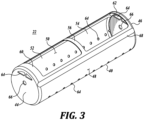
- a carrier 22 for high pressure processing includes a generally cylindrical body 40 having first and second ends 44, 46 and a curvilinear sidewall 48 extending therebetween.
- the cylindrical body 40 may be constructed of any material suitable for high pressure processing, whether a metal or a polymer. While the body 40 is illustrated with a generally cylindrical shape with a generally circular cross-section, the body could have different cross-sectional forms such as square, rectangular, triangular, hexagonal, or any other suitable polygonal shape. As shown, the cylindrical body 40 defines an interior volume 50 for receiving the thin walled, collapsible liner bag 20 for bulk processing.
- the carrier may include first and second top openings 52, 54 in the sidewall 48 of the cylindrical body 40, through which the bag 20 may be inserted into and removed from the carrier. As shown, the first and second top openings 52, 54 are separated by a middle bridging portion 56 of the sidewall 48, which may be used to provide a gripping point for lifting the carrier 22 or to add rigidity to the cylindrical shape of the carrier.
- the first and second top openings 32, 34 may terminate at or near the first and second ends 44, 46, respectively.
- first and second outer bridging portions 60, 62 of the sidewall 48 are provided adjacent the first and second top openings 52, 54, respectively, to assist in maintaining the generally cylindrical shape of the cylindrical body 40, and/or to also provide stiffness or rigidity to the cylindrical body.
- the widths of the first and second outer bridging portions 60, 62 may be different from each other.
- the bridging portions also may be used as a gripping point(s) for lifting or otherwise manipulating the cylindrical body 40.
- a plurality of fluid passage holes 64 may be provided through the sidewall 48 of the cylindrical body 40 to allow the pressure-transmitting medium of the high pressure processing chamber to fill the interior 50 with pressure media before the pressure increase initiates.
- the fluid passage holes 64 may allow the pressure-transmitting fluid to drain out of the interior volume 30 during and/or after processing. While the fluid passage holes 64 are shown as being positioned in a bottom portion of the cylindrical body 40, it will be appreciated that the fluid passage holes 64 may be positioned at any suitable location, and in any suitable quantity.
- auxiliary fluid passage holes 66 may be provided in at least one of the first or second ends 44, 46 of the cylindrical body 48.
- the bag is generally "pillow" shaped and composed of two planar panels 76 attached together along the perimeter to form a bag configuration.
- the panels 76 can be of multilayer or monolayer construction. Multilayer panels can include, for example, a polymer layer and a metal (foil) layer as well as one or more additional layers of various materials. Whether constructed of a single layer or of multiple layers, the panels 76 are of lightweight, flexible, collapsible construction, while being a sufficient structural integrity to securely retain the product in the bag during HPP processing.
- the construction of the bag is such that the bag is designed to be disposable.
- the bag may be used during a single workday or a single work shift and then disposed of. This can reduce or eliminate the need to sterilize or otherwise clean the bag so that the bag remains hygienic during use.
- the bag 20 is shown in a generally "pillow” shaped, the bag can be of other shapes, for example, cylindrical, with appropriate seams to form the specific shape.
- the bag 20 can be of various sizes, and in particular of a size to correspond to the size of the carrier 22.
- the bag 20 can have a volume capacity of from about 50 liters to at least 600 liters.
- the structural strength of the material to form the bag 20 is sufficient to accommodate the capacity of the bag and the loads imposed on the bag during use.
- the fitment 24 is positioned toward one end of the bag 20 at a location intermediate the sides of the bag.
- this bag construction and fitment location corresponds to off-the-shelf bags used in thermal processing of flowable materials and products.
- bags such as bags 20, may be sized to be placed within a standard size drama, for example, 189 liters (50 gallons), and then filled with product for transportation and storage of the product.
- the use of a standard bag facilitates the economies of the present bulk HPP processing system and method.
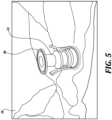
- FIGURE 5 illustrates the fitment 24 used in conjunction with bag 20.
- the fitment is of a "press-pull" construction whereby, when the fitment is pulled or extended to the position shown in FIGURE 5 , the fitment is in open position to allow product to flow in and out of the bag 20.
- a valve internal within the fitment closes the internal passageway of the fitment to prevent the flow product therethrough.
- a circular flange 80 is positioned at the distal end of the fitment to be graspable to pull the fitment into the extended position as shown in FIGURE 5 , and also to collapse and thereby close the fitment by pressing the flange toward the bag opening.
- the circular flange 80 can also serve as an attachment or interface with the flow valve 26 for secure attachment of the flow valve to the fitment 24.
- FIGURE 6 discloses another embodiment of the fitment 90 which is known as a "cap-style" fitment.
- the fitment 90 includes a body 92 and a sealing 94.
- the fitment body 92 may be molded from a suitable polymer material, such as high-density polyethylene.
- the fitment body 92 includes an upper clamping flange 96 and a lower clamping flange 98 to accommodate the clamping jaws of a flow valve or filling head.
- the fitment body 92 also includes a beveled clamping shoulder 100 for attachment to an opening formed in the bag 20.
- the sealing 94 includes an upper contact ring 102 and the lower contact ring 104 sealing with the fitment body 92. Prior to filling the bag, as shown in FIGURE 6 , for example, the sealing 94 has been partially pushed into the fitment body 92 so that the lower contact ring 104 is in sealing contact with a corresponding recess in the fitment body.
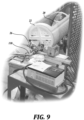
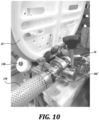
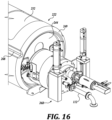
- FIGURES 7 , 8 , 10 and 16 illustrate various embodiments of flow valves 26A, 26B, 26C, 26 D connected to the fitments of bag 20.
- Each of the flow valves functions to connect to the fitment 24 to introduce product into the bag when filling the bag, and also connect to the fitment when emptying the product from the bag.
- Each of the flow valves functions as an automatic or manual control to open and close the flow valve to initiate flow to and from the bag and to terminate the flow of the product to and from the bag.
- Each of the flow control valves is connected to a hose 110 or tube 112 for directing product to the flow valve, and thus the bag, and for directing product from the flow valve, and thus the bag, during filling and emptying, respectively, the bag.
- the flow valves can be of various construction while performing the same function.
- each of the flow valves includes an interface appropriate for the configuration of the fitment 24.
- the bag 20 can be fitted with more than one fitment.
- the fitment can be attached to both panels 76 of the bag 20 or to both ends of the bag.
- one of the fitments will be disposed nominally upwardly and the other of the fitment's will be disposed nominally downwardly.
- the fitment disposed nominally upwardly could be used for filling the bag
- the fitment disposed nominally downwardly could be used for emptying the bag.
- Access to the nominally downwardly disclose fitment can be through an opening formed in the end for the lower portion of the carrier.
- the fitment is shown as positioned adjacent one end of the bag 20, the fitment could be located elsewhere on the bag.
- the fitment can be located in one corner of the bag, or centrally along a longitudinal side of the bag, or centrally relative to one of the panels 76 of the bag.
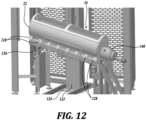
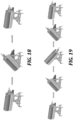
- FIGURES 11 and 12 illustrate the carrier 22, with the bag disposed therein, is mounted on a tilting table 34.
- the table 34 includes a pedestal 122 extending upwardly from the base 124.
- a longitudinal platform or top 126 is mounted to the top of the pedestal 122 so as to be tiltable relative to its length.
- a series of rollers 128 are mounted along each side of the platform 126 for bearing against the exterior side portion of the carrier 22 for conveniently loading and unloading the carrier from the table 34.
- the control system 70 functions to control the tilt of the table platform 126. In this regard, as shown in FIGURES 10 and 12 , the table is tilted so that the fitment is lowered relative to the bag, which facilitates emptying of the bag.
- the flow control valve is located within a housing 140 projecting from the end of the carrier 22.
- the sterilizing fluids can include steam and an inert gas to maintain a hygienic environment.
- the table platform 126 can be tilted in the opposite direction as shown in FIGURES 11 and 12 so that the fitment is at a higher elevation relative to its elevation when the carrier is in a horizontal position, which can facilitate the filling of the bag.
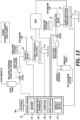
- FIGURE 13 illustrates an entire system for high pressure processing of the flowable product including storage tanks pumps in instrumentation.
- the carrier 22, flow control valve 26, and HPP press are shown as part of the overall system.
- the components of the system and the steps and system process are set forth in the text of FIGURE 13 .
- control system 70 is shown in FIGURE 13 .
- the control system 70 includes a computer or processor 148, an input device 150 (keyboard, mouse, touchscreen, etc.), and an output device 152 (touchscreen, monitored, printer, etc.).
- the control system 70 also includes a memory unit 154 and an input/output interface 156 for receiving and sending signals and information from and to the HPP press, the flow control valve 26, and the tilting table 120, among other components.
- the control system 70 may be connected to a network 160. Rather than employing the local control system 70, a network computing/control system can be used for this purpose.
- the bag 20 can be fitted with fitments at opposite ends thereof, with one fitment used for primarily filling the bag and the other fitment used primarily for emptying the bag.
- the fitment used to fill the bag can be located on the upper side of the bag, and the fitment used to empty the bag can be located on the underside of the bag. This configuration of bag can be used whether or not the bag is tilted to fill and empty.
- both fitments can be used for both filling and emptying the bag.
- both fitments can be on the same side (upper) of the bag or on opposite sides of the bag.
- one fitment can be used for drawing the product from the bag and the second fitment can be used to pump an inert gas into the bag to help facilitate the emptying of the bag.
- two fitments can be located on the bag, with one fitment mounted to one panel of the bag and the second fitment mounted to the second panel of the bag to facilitate filling the bag and emptying the bag using the upper and lower nominally positioned fitments, respectively.
- one or more fitments can be positioned either adjacent to each other on one panel of the bag or at multiple locations about the panel of the bag for use in filling and/or emptying the bag at a faster rate than possible via the use of a singular fitment.
- the bag is of the construction described above, which permits the bag to be disposed of rather than attempting to clean the bag so that the bag remains in hygienic condition.
- the carrier 22 is illustrated as being of "open" construction with relatively large top openings 52 and 54, the carrier can be of other constructions.
- the carrier can be constructed with fewer or smaller openings or can be substantially closed.
- one or both of the ends of the carrier may be removable to facilitate placement of the bag 22 within the carrier as well as removal of the bag from the carrier.
- the one or more fitments of the bag may be accessible through openings formed in the carrier.
- Carrier 222 is constructed similarly to carrier 22 shown in FIGURE 3 , as well as described above.
- the components of carrier 222 that are similar or the same as the components of carrier 22 are identified with the same part number but in the 200 series. Further, many of the similar or same components are not redescribed here so as to avoid redundancy. Rather, the description above regarding carrier 22 also applies to carrier 222.
- carrier 222 does include a generally cylindrical body 240 having first and second ends panels 244 and 246, as well as a curvilinear sidewall 248 extending there between.
- the cylindrical body 240 defines an interior volume 250 for receiving a collapsible, reusable liner bag, which may be similar to liner bag 20, suitable for bulk processing products.
- the carrier body 240 may include a top opening 252 through which the liner bag may be inserted into and removed from the interior 250 of the carrier. Although not essential, the opening may be located at or near end panel 244.
- Additional openings may be located in the carrier body 240, for example, transverse openings 254, which are shown as located intermediate the ends 244 and 246 of the carrier. These openings can facilitate processing medium from entering and exiting the interior of the carrier, provide visual access to the liner bag, and/or serve other purposes. Also, although two openings 254 are shown, a fewer number or a greater number of openings may be used.
- FIGURE 17 illustrates the carrier 222 is mounted on a tilting table structure 260.
- the table structure 260 includes a longitudinal platform 262 on which the carrier 222 is supported.
- a series of rollers can be mounted along each side of the platform 262, as well as elsewhere along the platform for bearing against the exterior side portion of the carrier 222 for assisting in the loading and unloading the carrier from the table structure 260.
- the platform 262 is pivotally mounted by bearings 264 about a transverse axis 265 to the upper ends of upright support posts 266 that extend upwardly from a base structure 268.
- Diagonal bars 270 extend from the corners of the base structure 268 to the upper ends of the support posts 266 for enhanced structural integrity of the table structure 260.
- a strap like structure 272 extends around the carrier 222 to interconnect the upper ends of the posts 266 also for the structural integrity of the table structure 260.
- a motor is provided to change the orientation of the platform 262 about axis 265.
- the control system 70 located in control housing 280, functions to control the operation of the motor and thus the tilt of the table platform 262 about axis 265.
- the table structure 260 can be tilted so that the fitment is raised relative to the bag when filling the bag.
- the table structure 260 can be tilted so that the fitment is raised relative to the bag to open the fitment and then lowered relative to the bag to empty the bag and the raised relative to the bag after emptying the bag to close the fitment.
- other sequences of the tilting of the table structure can be used when filling and/or un-filling the product bag.
Landscapes
- Engineering & Computer Science (AREA)
- Life Sciences & Earth Sciences (AREA)
- Mechanical Engineering (AREA)
- Chemical & Material Sciences (AREA)
- Wood Science & Technology (AREA)
- Zoology (AREA)
- Food Science & Technology (AREA)
- Polymers & Plastics (AREA)
- Dispersion Chemistry (AREA)
- Basic Packing Technique (AREA)
- Electrical Discharge Machining, Electrochemical Machining, And Combined Machining (AREA)
- General Preparation And Processing Of Foods (AREA)
Claims (13)
- System zur Hochdruckverarbeitung eines fließfähigen Massenprodukts in einer Hochdruckverarbeitungskammer, die zur Aufnahme des Produkts in Trägern (22; 222) konfiguriert ist, umfassend:einen flexiblen, zusammenfaltbaren Einwegbeutel zur Aufnahme des Produkts (20), der von der Größe her für die Massenverarbeitung eines fließfähigen Produkts bemessen ist, wobei der Beutel (20) ein Ausstattungselement (24; 90) zum Befüllen und Entleeren des Beutels (20) mit dem fließfähigen Produkt aufweist, wobei der Beutel (20) von der Größe her bemessen ist, dass er in den Träger (22; 222) aufgenommen werden zu kann, wobei das Ausstattungselement (24; 90) positioniert ist, um zum Befüllen und Entleeren des Beutels (20) zugänglich zu sein, während es sich in dem Träger (22; 222) befindet;einen Durchflussverbinder zum Verbinden mit dem Ausstattungselement (24; 90) während des Befüllens und Entleerens des Beutels (20);dadurch gekennzeichnet, dass das System ferner ein Steuerungssystem (70), das konfiguriert ist, um das Befüllen des Beutels (20) durch den Durchflussverbinder und/oder das Entleeren des Beutels (20) durch den Durchflussverbinder zu steuern, und einen Halter zum Halten des Trägers (22; 222) in einer geneigten Ausrichtung während des Befüllens und Entleeren des Beutels (20), während er innerhalb des Trägers (22; 222) angeordnet ist, umfasst.
- System nach Anspruch 1, wobei sich das Ausstattungselement (24; 90) zur Befestigung an dem Durchflussverbinder durch eine Öffnung (52, 54) in dem Träger (22; 222) erstreckt.
- System nach Anspruch 1 oder 2, wobei sich das Ausstattungselement (24; 90) an einem Ende des Beutels (20) befindet.
- System nach einem der Ansprüche 1 bis 3, wobei der Halter relativ zur Waagrechten neigbar ist.
- System nach einem der Ansprüche 1 bis 4, wobei das Steuerungssystem (70) konfiguriert ist, um eine Neigung des Haltersystems beim Befüllen oder Entleeren des Beutels (20) in einem beliebigen Winkel zwischen -90 und +90 Grad von der Waagrechten zu steuern.
- System nach einem der Ansprüche 1 bis 4, wobei das Steuerungssystem (70) konfiguriert ist, um eine Neigung des Haltersystems beim Befüllen oder Entleeren des Beutels (20) in einem beliebigen Winkel zwischen -45 und +45 Grad von der Waagrechten zu steuern.
- System nach Anspruch 5 oder 6, wobei das Steuerungssystem (70) konfiguriert ist, um die Neigung des Beutels (20) zu ändern, während der Beutel befüllt und/oder der Beutel entleert wird.
- Verfahren zur Hochdruckverarbeitung eines fließfähigen Produkts, umfassend:Platzieren eines zusammenfaltbaren Einwegbeutels zur Aufnahme des Produkts (20), der von der Größe her für die Massenverarbeitung eines fließfähigen Produkts bemessen ist, in einem sich in Längsrichtung erstreckenden Hochdruckverarbeitungsträger (22; 222), wobei der Beutel (20) ein Ausstattungselement (24; 90) aufweist;Befestigen eines Durchflussverbinders an dem Ausstattungselement (24; 90);Befüllen des Beutels (20) mit dem Massenprodukt durch den Durchflussverbinder;Verarbeiten des Massenprodukts in dem Beutel (20) in einer Hochdruckverarbeitungskammer;Befestigen des Durchflussverbinders an dem Ausstattungselement (24; 90);Entleeren des Massenprodukts aus dem Beutel (20) durch den Durchflussverbinder;wobei das Verfahren gekennzeichnet ist durch die Schritte des Verwendens eines Steuerungssystems (70) zum Steuern des Massenproduktflusses durch den Durchflussverbinder; und Neigen des Trägers (22; 222) in Längsrichtung in eine erste geneigte Position, um die Höhe des Ausstattungselements (24; 90) anzuheben, wenn der Beutel (20) befüllt wird, und Neigen des Trägers (22; 222) in Längsrichtung in eine zweite geneigte Position, um die Höhe des Ausstattungselements (24; 90) abzusenken, wenn der Beutel (20) entleert wird.
- Verfahren nach Anspruch 8, ferner umfassend das Herausziehen des Ausstattungselements (24; 90) durch den Träger (22; 222), wenn der Beutel (20) befüllt oder entleert wird.
- Verfahren nach Anspruch 8, ferner umfassend das Betreiben des Steuerungssystems (70) zum Neigen des Trägers (22; 222) in eine erste geneigte Position, wenn der Beutel (20) mit dem Produkt befüllt wird, und zum Neigen des Trägers (22; 222) in eine zweite geneigte Position, wenn das Produkt aus dem Beutel (20) entleert wird.
- Verfahren nach Anspruch 10, ferner umfassend das Betreiben des Steuerungssystems (70) zum Neigen des Trägers (22; 222) um bis zu 90 Grad in der ersten geneigten Position oder in der zweiten geneigten Position.
- Verfahren nach Anspruch 11, ferner umfassend das Betreiben des Steuerungssystems (70) zum Neigen eines Trägers (22; 222) um bis zu 45 Grad in der ersten geneigten Position oder in der zweiten geneigten Position.
- Verfahren nach einem der Ansprüche 10 bis 12, ferner umfassend das Betreiben des Steuerungssystems (70) zum Ändern der Neigung des Trägers (22; 222), während der Beutel (20) mit dem Produkt befüllt wird und/oder während das Produkt aus dem Beutel (20) entleert wird.
Applications Claiming Priority (2)
| Application Number | Priority Date | Filing Date | Title |
|---|---|---|---|
| US202063079221P | 2020-09-16 | 2020-09-16 | |
| PCT/US2021/050032 WO2022060663A1 (en) | 2020-09-16 | 2021-09-13 | System for bulk high pressure processing and related method |
Publications (3)
| Publication Number | Publication Date |
|---|---|
| EP4213645A1 EP4213645A1 (de) | 2023-07-26 |
| EP4213645B1 true EP4213645B1 (de) | 2025-04-16 |
| EP4213645C0 EP4213645C0 (de) | 2025-04-16 |
Family
ID=78086057
Family Applications (1)
| Application Number | Title | Priority Date | Filing Date |
|---|---|---|---|
| EP21789921.0A Active EP4213645B1 (de) | 2020-09-16 | 2021-09-13 | System zur massenhochdruckverarbeitung und zugehöriges verfahren |
Country Status (9)
| Country | Link |
|---|---|
| US (1) | US20230365282A1 (de) |
| EP (1) | EP4213645B1 (de) |
| KR (1) | KR20230074120A (de) |
| CN (1) | CN116648407A (de) |
| AU (1) | AU2021344846A1 (de) |
| CA (1) | CA3192522A1 (de) |
| ES (1) | ES3036168T3 (de) |
| MX (1) | MX2023003040A (de) |
| WO (1) | WO2022060663A1 (de) |
Families Citing this family (2)
| Publication number | Priority date | Publication date | Assignee | Title |
|---|---|---|---|---|
| US20250230030A1 (en) | 2022-07-15 | 2025-07-17 | Jbt Marel Corporation | Unloading high viscous fluid product from bag containers |
| US11926446B1 (en) | 2023-06-16 | 2024-03-12 | Good Foods Group, Llc | System and method for formulating compounds into personal care products |
Citations (1)
| Publication number | Priority date | Publication date | Assignee | Title |
|---|---|---|---|---|
| WO2003092415A1 (en) * | 2002-05-06 | 2003-11-13 | Flow Holding Sagl | Method for durability treatment of a pumpable material as well as a device therefore |
Family Cites Families (17)
| Publication number | Priority date | Publication date | Assignee | Title |
|---|---|---|---|---|
| US2930170A (en) * | 1954-03-29 | 1960-03-29 | Aseptic Food Fillers Inc | Means and method for aseptic packaging |
| US4182386A (en) * | 1977-11-30 | 1980-01-08 | Semi-Bulk Systems, Inc. | Closed system and container for dust free loading and unloading of powdered materials |
| JP2711083B2 (ja) * | 1995-06-14 | 1998-02-10 | 株式会社神戸製鋼所 | 高圧殺菌装置 |
| US6131766A (en) * | 1996-08-12 | 2000-10-17 | Restaurant Automation Development Inc. | System for dispensing controlled amounts of flowable material from a flexible container |
| US6070622A (en) * | 1998-05-07 | 2000-06-06 | Packaging Systems, L.L.C. | High speed aseptic filling machine |
| US6966741B2 (en) * | 2002-03-13 | 2005-11-22 | Transload Of North America, Inc. | Tipping apparatus for intermodal container |
| EP2130769A1 (de) * | 2008-06-06 | 2009-12-09 | GEA Niro GmbH | Aufnahmebehältnis für flexible Schüttgutgebinde sowie Verfahren zum Befüllen solcher Gebinden. |
| CN201726833U (zh) * | 2010-06-25 | 2011-02-02 | 于亮 | 新型流体超高压加工设备 |
| US8596308B2 (en) * | 2010-11-08 | 2013-12-03 | John Bean Technologies Corporation | Method and apparatus for aseptic filling of food product |
| DE102010055745A1 (de) * | 2010-12-22 | 2012-06-28 | Linde Aktiengesellschaft | Abgabevorrichtung |
| US9095210B1 (en) * | 2012-04-12 | 2015-08-04 | V.H. Cooper & Company Inc. | Rotating transport cart |
| US10059476B2 (en) * | 2013-05-21 | 2018-08-28 | John Bean Technologies S.P.A. | Aseptic filler for flowable products |
| CN106036348A (zh) * | 2016-06-03 | 2016-10-26 | 沈阳人和机电工程设备有限公司 | 一种酱制备中的灭菌方法 |
| AU2018437306B2 (en) * | 2018-08-24 | 2021-12-02 | Hiperbaric, S.A. | System for protecting and securing bags in bulk HPP equipment and associated method |
| US20230173122A1 (en) * | 2020-03-27 | 2023-06-08 | Avure Technologies Incorporated | Reusable container for bulk processing in high pressure applications |
| CN115335142A (zh) * | 2020-03-27 | 2022-11-11 | 阿维瑞技术股份有限公司 | 用于高压处理应用的热管理的容器及装载篮 |
| US11352244B1 (en) * | 2020-12-03 | 2022-06-07 | John Bean Technologies Corporation | Sanitary fill head |
-
2021
- 2021-09-13 CA CA3192522A patent/CA3192522A1/en active Pending
- 2021-09-13 AU AU2021344846A patent/AU2021344846A1/en active Pending
- 2021-09-13 ES ES21789921T patent/ES3036168T3/es active Active
- 2021-09-13 EP EP21789921.0A patent/EP4213645B1/de active Active
- 2021-09-13 CN CN202180062673.8A patent/CN116648407A/zh active Pending
- 2021-09-13 MX MX2023003040A patent/MX2023003040A/es unknown
- 2021-09-13 KR KR1020237007219A patent/KR20230074120A/ko active Pending
- 2021-09-13 WO PCT/US2021/050032 patent/WO2022060663A1/en not_active Ceased
- 2021-09-13 US US18/245,400 patent/US20230365282A1/en active Pending
Patent Citations (1)
| Publication number | Priority date | Publication date | Assignee | Title |
|---|---|---|---|---|
| WO2003092415A1 (en) * | 2002-05-06 | 2003-11-13 | Flow Holding Sagl | Method for durability treatment of a pumpable material as well as a device therefore |
Also Published As
| Publication number | Publication date |
|---|---|
| AU2021344846A2 (en) | 2023-06-08 |
| MX2023003040A (es) | 2023-04-05 |
| EP4213645A1 (de) | 2023-07-26 |
| AU2021344846A9 (en) | 2025-03-20 |
| CN116648407A (zh) | 2023-08-25 |
| KR20230074120A (ko) | 2023-05-26 |
| CA3192522A1 (en) | 2022-03-24 |
| EP4213645C0 (de) | 2025-04-16 |
| ES3036168T3 (en) | 2025-09-15 |
| AU2021344846A1 (en) | 2023-05-11 |
| US20230365282A1 (en) | 2023-11-16 |
| WO2022060663A1 (en) | 2022-03-24 |
Similar Documents
| Publication | Publication Date | Title |
|---|---|---|
| EP4213645B1 (de) | System zur massenhochdruckverarbeitung und zugehöriges verfahren | |
| US10532870B2 (en) | Device for conveying a bag comprising a biopharmaceutical fluid and systems and a method using same | |
| EP1237800A1 (de) | Behälter mit innenbeutel und verfahren | |
| US20230114240A1 (en) | Container and load basket for thermal management for processing in high pressure application | |
| US20120276262A1 (en) | Method and apparatus for handling sterilized food product | |
| EP1803657B1 (de) | Vorrichtung zur Flüssigkeitsabgabe, insbesondere Getränkeabgabe | |
| US20250230030A1 (en) | Unloading high viscous fluid product from bag containers | |
| US11401152B2 (en) | Apparatus, system, and method of transporting fluid products | |
| US20230173122A1 (en) | Reusable container for bulk processing in high pressure applications | |
| US20040226451A1 (en) | Wine tank and method of use | |
| EP1580125A1 (de) | Verfahren und Vorrichtung zum Füllen und Versiegeln von Beuteln | |
| JP3678958B2 (ja) | バッグインボックス及びこれを使用する液状又は流動状物の充填方法。 | |
| WO2013169226A1 (en) | Method and apparatus for handling sterilized food product | |
| Szemplenski | Aseptic bulk packaging | |
| US20150315010A1 (en) | Self draining chemical tote system stand | |
| WO2003092415A1 (en) | Method for durability treatment of a pumpable material as well as a device therefore | |
| WO2001062615A1 (en) | Bulk container | |
| US20040118868A1 (en) | Method for durability treatment of a pumpable material as well as a device therefor | |
| JPH02233331A (ja) | 無菌充填方法及び装置 | |
| JPH06286718A (ja) | 合成樹脂製容器の取扱い方法 |
Legal Events
| Date | Code | Title | Description |
|---|---|---|---|
| STAA | Information on the status of an ep patent application or granted ep patent |
Free format text: STATUS: UNKNOWN |
|
| STAA | Information on the status of an ep patent application or granted ep patent |
Free format text: STATUS: THE INTERNATIONAL PUBLICATION HAS BEEN MADE |
|
| TPAC | Observations filed by third parties |
Free format text: ORIGINAL CODE: EPIDOSNTIPA |
|
| PUAI | Public reference made under article 153(3) epc to a published international application that has entered the european phase |
Free format text: ORIGINAL CODE: 0009012 |
|
| STAA | Information on the status of an ep patent application or granted ep patent |
Free format text: STATUS: REQUEST FOR EXAMINATION WAS MADE |
|
| 17P | Request for examination filed |
Effective date: 20230221 |
|
| AK | Designated contracting states |
Kind code of ref document: A1 Designated state(s): AL AT BE BG CH CY CZ DE DK EE ES FI FR GB GR HR HU IE IS IT LI LT LU LV MC MK MT NL NO PL PT RO RS SE SI SK SM TR |
|
| STAA | Information on the status of an ep patent application or granted ep patent |
Free format text: STATUS: EXAMINATION IS IN PROGRESS |
|
| 17Q | First examination report despatched |
Effective date: 20240412 |
|
| GRAP | Despatch of communication of intention to grant a patent |
Free format text: ORIGINAL CODE: EPIDOSNIGR1 |
|
| STAA | Information on the status of an ep patent application or granted ep patent |
Free format text: STATUS: GRANT OF PATENT IS INTENDED |
|
| INTG | Intention to grant announced |
Effective date: 20241112 |
|
| GRAS | Grant fee paid |
Free format text: ORIGINAL CODE: EPIDOSNIGR3 |
|
| GRAA | (expected) grant |
Free format text: ORIGINAL CODE: 0009210 |
|
| STAA | Information on the status of an ep patent application or granted ep patent |
Free format text: STATUS: THE PATENT HAS BEEN GRANTED |
|
| AK | Designated contracting states |
Kind code of ref document: B1 Designated state(s): AL AT BE BG CH CY CZ DE DK EE ES FI FR GB GR HR HU IE IS IT LI LT LU LV MC MK MT NL NO PL PT RO RS SE SI SK SM TR |
|
| REG | Reference to a national code |
Ref country code: GB Ref legal event code: FG4D |
|
| REG | Reference to a national code |
Ref country code: DE Ref legal event code: R081 Ref document number: 602021029310 Country of ref document: DE Owner name: JBT MAREL CORP., CHICAGO, US Free format text: FORMER OWNER: AVURE TECHNOLOGIES INC., MIDDLETOWN, OH, US |
|
| REG | Reference to a national code |
Ref country code: IE Ref legal event code: FG4D |
|
| REG | Reference to a national code |
Ref country code: DE Ref legal event code: R096 Ref document number: 602021029310 Country of ref document: DE |
|
| RAP2 | Party data changed (patent owner data changed or rights of a patent transferred) |
Owner name: JBT MAREL CORPORATION |
|
| U01 | Request for unitary effect filed |
Effective date: 20250507 |
|
| U07 | Unitary effect registered |
Designated state(s): AT BE BG DE DK EE FI FR IT LT LU LV MT NL PT RO SE SI Effective date: 20250513 |
|
| U20 | Renewal fee for the european patent with unitary effect paid |
Year of fee payment: 5 Effective date: 20250807 |
|
| REG | Reference to a national code |
Ref country code: ES Ref legal event code: FG2A Ref document number: 3036168 Country of ref document: ES Kind code of ref document: T3 Effective date: 20250915 |
|
| PG25 | Lapsed in a contracting state [announced via postgrant information from national office to epo] |
Ref country code: GR Free format text: LAPSE BECAUSE OF FAILURE TO SUBMIT A TRANSLATION OF THE DESCRIPTION OR TO PAY THE FEE WITHIN THE PRESCRIBED TIME-LIMIT Effective date: 20250717 Ref country code: NO Free format text: LAPSE BECAUSE OF FAILURE TO SUBMIT A TRANSLATION OF THE DESCRIPTION OR TO PAY THE FEE WITHIN THE PRESCRIBED TIME-LIMIT Effective date: 20250716 |
|
| PG25 | Lapsed in a contracting state [announced via postgrant information from national office to epo] |
Ref country code: PL Free format text: LAPSE BECAUSE OF FAILURE TO SUBMIT A TRANSLATION OF THE DESCRIPTION OR TO PAY THE FEE WITHIN THE PRESCRIBED TIME-LIMIT Effective date: 20250416 |
|
| PGFP | Annual fee paid to national office [announced via postgrant information from national office to epo] |
Ref country code: GB Payment date: 20250724 Year of fee payment: 5 |
|
| PG25 | Lapsed in a contracting state [announced via postgrant information from national office to epo] |
Ref country code: HR Free format text: LAPSE BECAUSE OF FAILURE TO SUBMIT A TRANSLATION OF THE DESCRIPTION OR TO PAY THE FEE WITHIN THE PRESCRIBED TIME-LIMIT Effective date: 20250416 |
|
| PG25 | Lapsed in a contracting state [announced via postgrant information from national office to epo] |
Ref country code: RS Free format text: LAPSE BECAUSE OF FAILURE TO SUBMIT A TRANSLATION OF THE DESCRIPTION OR TO PAY THE FEE WITHIN THE PRESCRIBED TIME-LIMIT Effective date: 20250716 |
|
| PG25 | Lapsed in a contracting state [announced via postgrant information from national office to epo] |
Ref country code: IS Free format text: LAPSE BECAUSE OF FAILURE TO SUBMIT A TRANSLATION OF THE DESCRIPTION OR TO PAY THE FEE WITHIN THE PRESCRIBED TIME-LIMIT Effective date: 20250816 |