EP4213402A2 - Dispositif électronique pour émettre un signal de référence de sondage dans un système de communication sans fil et son procédé de fonctionnement - Google Patents
Dispositif électronique pour émettre un signal de référence de sondage dans un système de communication sans fil et son procédé de fonctionnement Download PDFInfo
- Publication number
- EP4213402A2 EP4213402A2 EP23152285.5A EP23152285A EP4213402A2 EP 4213402 A2 EP4213402 A2 EP 4213402A2 EP 23152285 A EP23152285 A EP 23152285A EP 4213402 A2 EP4213402 A2 EP 4213402A2
- Authority
- EP
- European Patent Office
- Prior art keywords
- srs
- signal
- base station
- precoding matrix
- interference
- Prior art date
- Legal status (The legal status is an assumption and is not a legal conclusion. Google has not performed a legal analysis and makes no representation as to the accuracy of the status listed.)
- Pending
Links
Images



Classifications
-
- H—ELECTRICITY
- H04—ELECTRIC COMMUNICATION TECHNIQUE
- H04L—TRANSMISSION OF DIGITAL INFORMATION, e.g. TELEGRAPHIC COMMUNICATION
- H04L5/00—Arrangements affording multiple use of the transmission path
- H04L5/003—Arrangements for allocating sub-channels of the transmission path
- H04L5/0048—Allocation of pilot signals, i.e. of signals known to the receiver
- H04L5/0051—Allocation of pilot signals, i.e. of signals known to the receiver of dedicated pilots, i.e. pilots destined for a single user or terminal
-
- H—ELECTRICITY
- H04—ELECTRIC COMMUNICATION TECHNIQUE
- H04B—TRANSMISSION
- H04B7/00—Radio transmission systems, i.e. using radiation field
- H04B7/02—Diversity systems; Multi-antenna system, i.e. transmission or reception using multiple antennas
- H04B7/04—Diversity systems; Multi-antenna system, i.e. transmission or reception using multiple antennas using two or more spaced independent antennas
- H04B7/0413—MIMO systems
- H04B7/0456—Selection of precoding matrices or codebooks, e.g. using matrices antenna weighting
-
- H—ELECTRICITY
- H04—ELECTRIC COMMUNICATION TECHNIQUE
- H04L—TRANSMISSION OF DIGITAL INFORMATION, e.g. TELEGRAPHIC COMMUNICATION
- H04L25/00—Baseband systems
- H04L25/02—Details ; arrangements for supplying electrical power along data transmission lines
- H04L25/03—Shaping networks in transmitter or receiver, e.g. adaptive shaping networks
- H04L25/03006—Arrangements for removing intersymbol interference
- H04L25/03343—Arrangements at the transmitter end
Definitions
- the disclosure relates to a method of transmitting a signal and an electronic device, and more particularly, to an electronic device for transmitting a sounding reference signal (SRS) in a wireless communication system and an operating method thereof.
- SRS sounding reference signal
- 5G or pre-5G communication systems are also called new radio (NR) systems in the 3rd Generation Partnership Project (3GPP) standard.
- mmWave millimeter wave
- MIMO massive multiple-input multiple-output
- FD-MIMO full dimension MIMO
- array antenna analog beamforming, hybrid beamforming, and large scale antenna techniques are being examined.
- an electronic device for generating a precoding matrix by using an interference estimation result of a terminal and transmitting a sounding reference signal (SRS), based on the precoding matrix, and an operating method thereof.
- SRS sounding reference signal
- an electronic device includes a communication circuit configured to receive a reception signal including an interference signal, and to transmit a sounding reference signal (SRS) to a base station; and a control circuit comprising an interference estimation circuit configured to detect the interference signal in the reception signal, and a precoding matrix calculation circuit configured to generate an SRS precoding matrix corresponding to the SRS, based on a detection result obtained by the interference estimation circuit, wherein the control circuit is configured to control the communication circuit to transmit the SRS to the base station, and wherein the SRS is generated by multiplying a transmission signal by the SRS precoding matrix.
- SRS sounding reference signal
- an operating method of an electronic device includes performing interference estimation based on a reception signal including an interference signal; generating a sounding reference signal (SRS) precoding matrix, based on a result of the interference estimation; and transmitting an SRS to a base station, wherein the SRS is generated by multiplying a transmission signal by the SRS precoding matrix.
- SRS sounding reference signal
- a wireless communication system includes a base station configured to estimate a downlink channel based on a sounding reference signal (SRS); and an electronic device including: a communication circuit configured to perform at least one from among transmitting the SRS to the base station and receiving a reception signal including an interference signal, and a control circuit comprising an interference estimation circuit configured to detect the interference signal in the reception signal, and a precoding matrix calculation circuit configured to generate an SRS precoding matrix corresponding to the SRS, based on a detection result obtained by the interference estimation circuit, wherein the control circuit is configured to control the communication circuit to transmit the SRS to the base station, and wherein the SRS is generated by multiplying a transmission signal by the SRS precoding matrix.
- SRS sounding reference signal
- an electronic device includes a communication circuit configured to communicate with a base station; and a control circuit configured to: control the communication circuit to obtain a reception signal from the base station, detect an interference signal in the reception signal, generate a sounding reference signal (SRS) precoding matrix based on the interference signal, generate a SRS by multiplying a transmission signal by the SRS precoding matrix, and control the communication circuit to transmit the SRS to the base station.
- SRS sounding reference signal
- circuits may be physically implemented by analog or digital circuits such as logic gates, integrated circuits, microprocessors, microcontrollers, memory circuits, passive electronic components, active electronic components, optical components, hardwired circuits, or the like, and may be driven by firmware and software.
- the circuits may, for example, be embodied in one or more semiconductor chips, or on substrate supports such as printed circuit boards and the like.
- Circuits included in a block may be implemented by dedicated hardware, or by a processor (e.g., one or more programmed microprocessors and associated circuitry), or by a combination of dedicated hardware to perform some functions of the block and a processor to perform other functions of the block.
- a processor e.g., one or more programmed microprocessors and associated circuitry
- Each block of the embodiments may be physically separated into two or more interacting and discrete blocks.
- the blocks of the embodiments may be physically combined into more complex blocks.
- FIG. 1 illustrates a wireless communication system according to an embodiment.
- a wireless communication system may include a base station 110, an electronic device 120, and neighboring base stations 130 and 140.
- the base station 110 may be a network infrastructure that provides wireless access to the electronic device 120.
- the base station 110 may have coverage that is determined by a certain geometrical area based on a distance, by which a signal may be transmitted.
- the base station 110 may be referred to as an access point (AP), an evolved-node B (eNodeB or eNB), a 5th generation (5G) node, a wireless point, or another term having a technical meaning equivalent thereto.
- AP access point
- eNodeB or eNB evolved-node B
- 5G 5th generation
- the base station 110 may be connected to at least one transmission/reception point (TRP).
- TRP transmission/reception point
- the base station 110 may transmit a downlink signal to the electronic device 120 or receive an uplink signal from the electronic device 120 through at least one TRP.
- the electronic device 120 may communicate with the base station 110 through a wireless channel.
- the electronic device 120 may be referred to as a terminal, a user equipment (UE), a mobile station, a subscriber station, a customer premises equipment (CPE), a remote terminal, a wireless terminal, a user device, or another term having a technical meaning equivalent thereto.
- UE user equipment
- CPE customer premises equipment
- the electronic device 120 may receive interference signals from the neighboring base stations 130 and 140.
- the electronic device 120 may receive a downlink signal from the base station 110, and simultaneously signals generated by the neighboring base stations 130 and 140 may respectively correspond to interference signals.
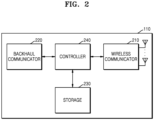
- FIG. 2 is a block diagram of the base station 110 according to embodiments.
- the base station 110 may include a wireless communicator 210, a backhaul communicator 220, a storage 230, and a controller 240.
- the wireless communicator 210 may perform functions for transmission and reception of signals through a wireless channel. According to an embodiment, the wireless communicator 210 may perform conversion between a baseband signal and a bitstream according to the physical layer standard of a system. For example, the wireless communicator 210 may generate complex symbols by encoding and modulating a transmitted bitstream during data transmission and reconstruct a received bitstream by demodulating and decoding a baseband signal during data reception. The wireless communicator 210 may up-convert a baseband signal into a radio frequency (RF) band signal and transmit the RF band signal through an antenna or may down-convert an RF band signal received through an antenna into a baseband signal.
- RF radio frequency
- the wireless communicator 210 may include a transmission filter, a reception filter, an amplifier, a mixer, an oscillator, a digital-to-analog converter (DAC), an analog-to-digital converter (ADC), and the like.
- DAC digital-to-analog converter
- ADC analog-to-digital converter
- the wireless communicator 210 may transmit and receive signals. For example, the wireless communicator 210 may transmit a synchronization signal, a reference signal, system information, a message, control information, data, or the like. The wireless communicator 210 may perform beamforming. To give an orientation to a signal to be transmitted or received, the wireless communicator 210 may apply a beamforming weight to the signal. The wireless communicator 210 may change a formed beam and repeatedly transmit a signal.
- the backhaul communicator 220 may provide an interface for communication with other nodes in a network.
- the backhaul communicator 220 may convert a bitstream, which is transmitted from the base station 110 to another node, e.g., another access node, another base station, an upper node, or a core network, into a physical signal and may convert a physical signal received from another node into a bitstream.
- another node e.g., another access node, another base station, an upper node, or a core network
- the storage 230 may store data, such as a basic program for the operation of the base station 110, an application program, configuration information, or the like.
- the storage 230 may include volatile memory, non-volatile memory, or a combination of volatile memory and non-volatile memory.
- the storage 230 may provide stored data at the request of the controller 240.
- the controller 240 may control operations of the base station 110.
- the controller 240 may transmit and receive signals through the wireless communicator 210 or the backhaul communicator 220.
- the controller 240 may write data to and read data from the storage 230.
- the controller 240 may include at least one processor.
- FIG. 3 is a block diagram of the electronic device 120 according to embodiments.
- the electronic device 120 may include a communicator 310, a storage 320, and a controller 330.
- the communicator 310 may perform functions for transmission and reception of signals through a wireless channel. For example, the communicator 310 may perform conversion between a baseband signal and a bitstream according to the physical layer standard of a system. For example, the communicator 310 may generate complex symbols by encoding and modulating a transmitted bitstream during data transmission and reconstruct a received bitstream by demodulating and decoding a baseband signal during data reception. The communicator 310 may up-convert a baseband signal into an RF band signal and transmit the RF band signal through an antenna or may down-convert an RF band signal received through an antenna into a baseband signal.
- the communicator 310 may include a transmission filter, a reception filter, an amplifier, a mixer, an oscillator, a DAC, an ADC, and the like.
- the communicator 310 may perform beamforming. To give an orientation to a signal to be transmitted or received, the communicator 310 may apply a beamforming weight to the signal.
- the communicator 310 may transmit and receive signals.
- the communicator 310 may receive a downlink signal.
- the downlink signal may include a synchronization signal, a reference signal, system information, a configuration message, control information, downlink data, or the like.
- the communicator 310 may transmit an uplink signal.
- the uplink signal may include a signal related to random access, a reference signal (e.g., a sounding reference signal (SRS) or demodulation reference signal (DM-RS)), or uplink data.
- a reference signal e.g., a sounding reference signal (SRS) or demodulation reference signal (DM-RS)
- the storage 320 may store data, such as a basic program for the operation of the electronic device 120, an application program, configuration information, or the like.
- the storage 320 may include volatile memory, non-volatile memory, or a combination of volatile memory and non-volatile memory.
- the storage 320 may provide stored data at the request of the controller 330.
- the controller 330 may generally control operations of the electronic device 120. For example, the controller 330 may transmit and receive signals through the communicator 310. The controller 330 may write data to and read data from the storage 320. For these operations, the controller 330 may include at least one processor or microprocessor or may be part of a processor. When the controller 330 is part of a processor, part of the communicator 310 and the controller 330 may be referred to as a communication processor.
- the controller 330 may further include an interference estimation circuit 331 and a precoding matrix calculation circuit 333.
- the interference estimation circuit 331 may detect an interference signal that is input to the electronic device 120.
- the interference signal may include both spatially correlated interference and frequency selective interference.
- the spatially correlated interference may refer to interference that occurs because of a signal mainly generated from the neighboring base station 130 or 140 or another neighboring wireless communication device (e.g., another terminal).
- the frequency selective interference may refer to interference that occurs because of distortion of an edge signal in a frequency band, which is caused by using an alternative filter (e.g., a function shaped analog baseband filter (SINC)) because of the design limit of an ideal frequency filter (e.g., a rectangular filter).
- SINC function shaped analog baseband filter
- the interference estimation circuit 331 may detect various interference signals including, for example, at least one of the spatially correlated interference and the frequency selective interference.
- the interference estimation circuit 331 may generate an interference covariance matrix corresponding to the detected interference signals and transmit the interference covariance matrix to the precoding matrix calculation circuit 333.
- the precoding matrix calculation circuit 333 may calculate a precoding matrix. According to an embodiment, the precoding matrix calculation circuit 333 may receive, from the interference estimation circuit 331, an interference covariance matrix corresponding to a result of detecting interference signals. The precoding matrix calculation circuit 333 may convert the interference covariance matrix into an SRS precoding matrix. The precoding matrix calculation circuit 333 may transmit the SRS precoding matrix to a precoder such that an SRS to be transmitted to the base station 110 may be multiplied by the SRS precoding matrix.
- FIG. 4A illustrates an example of a detailed configuration of the communicator 310 in FIG. 3 .
- FIG. 4A illustrates elements for performing hybrid beamforming when transmitting a radio signal.
- the communicator 310 may include an encoder and modulator 410, a digital beamformer 420, first to N-th transmission paths 430-1 to 430-N, and an analog beamformer 440.
- the encoder and modulator 410 may perform channel encoding. For channel encoding, at least one of a low density parity check (LDPC) code, a convolution code, and a polar code may be used.
- LDPC low density parity check
- the encoder and modulator 410 may generate modulated symbols by performing constellation mapping.
- the digital beamformer 420 may perform beamforming on digital signals (e.g., modulated symbols). For example, the digital beamformer 420 may multiply the modulated symbols by beamforming weights. In embodiments, the beamforming weights may be used to change the magnitude and phase of a signal and called a precoding matrix or a precoder. The digital beamformer 420 may output digitally beamformed modulated symbols respectively to the first to N-th transmission paths 430-1 to 430-N. In embodiments, according to a multiple-input multiple-output (MIMO) transmission scheme, the modulated symbols may be multiplexed, or the same modulated symbols may be provided to the first to N-th transmission paths 430-1 to 430-N.
- MIMO multiple-input multiple-output
- the first to N-th transmission paths 430-1 to 430-N may convert digitally beamformed digital signals into analog signals.
- each of the first to N-th transmission paths 430-1 to 430-N may include an inverse fast Fourier transform (IFFT) operator, a cyclic prefix (CP) inserter, a DAC, and an up-converter.
- the CP inserter may be used for an orthogonal frequency division multiplexing (OFDM) scheme, and may be omitted in embodiments in which a different physical layer scheme (e.g., a filter bank multi-carrier (FBMC) scheme) is used.
- OFDM orthogonal frequency division multiplexing
- FBMC filter bank multi-carrier
- the first to N-th transmission paths 430-1 to 430-N may provide independent signal processing for multiple streams generated through digital beamforming. However, in embodiments, some of the elements of the first to N-th transmission paths 430-1 to 430-N may be shared.
- the analog beamformer 440 may perform beamforming on analog signals. For example, the analog beamformer 440 may multiply the analog signals by beamforming weights. In embodiments, the beamforming weights may be used to change the magnitude and phase of a signal.
- FIG. 4B illustrates an example of a detailed configuration of the communicator 310 in FIG. 3 .
- FIG. 4B illustrates elements for performing hybrid beamforming when receiving a radio signal.
- the communicator 310 may include a decoder and demodulator 450, a digital beamformer 460, first to N-th reception paths 470-1 to 470-N, and an analog beamformer 480.
- the decoder and demodulator 450 may perform channel decoding.
- channel decoding at least one of an LDPC code, a convolution code, a polar code, and a turbo code may be used.
- the digital beamformer 460 and the analog beamformer 480 may respectively correspond to the digital beamformer 420 and the analog beamformer 440 in FIG. 4A .
- the first to N-th reception paths 470-1 to 470-N may convert beamformed analog signals into digital signals.
- each of the first to N-th reception paths 470-1 to 470-N may include a fast Fourier transform (FFT) operator, an ADC, a CP remover, a serial-to-parallel converter, and a down-converter.
- FFT fast Fourier transform
- each of the first to N-th reception paths 470-1 to 470-N may generate a serial time-domain baseband signal by down-converting a received signal into a baseband frequency and removing a CP from the received signal, convert the serial time-domain baseband signal into parallel time-domain signals, generate N parallel frequency-domain signals by performing an FFT algorithm on the parallel time-domain signals, and convert the N parallel frequency-domain signals into a sequence of modulated data symbols.
- the first to N-th reception paths 470-1 to 470-N may provide independent signal processing for multiple streams generated through analog beamforming. However, in embodiments, some of the elements of the first to N-th reception paths 470-1 to 470-N may be shared.
- FIG. 5 illustrates an antenna port according to embodiments.
- a base station 110 may communicate with an electronic device 120 by using MIMO.
- the base station 110 may include a plurality of antennas, e.g., first and second antennas Ant1_1 and Ant1_2, and the electronic device 120 may include a plurality of antennas, e.g., third and fourth antennas Ant2_1 and Ant2_2.
- each of the base station 110 and the electronic device 120 are illustrated in FIG. 5 as including two antennas (e.g., the first and second antennas Ant1_1 and Ant1_2 or the third and fourth antennas Ant2_1 and Ant2_2), embodiments are not limited thereto.
- each of the base station 110 and the electronic device 120 may include, for example, three or more antennas.
- the base station 110 may include a first transceiver 11, a second transceiver 12, the first antenna Ant1_1, and the second antenna Ant1_2. Each of the first transceiver 11 and the second transceiver 12 may be connected to a single antenna. For example, the first transceiver 11 may be connected to the first antenna Ant1_1, and the second transceiver 12 may be connected to the second antenna Ant1_2. When the base station 110 operates as a transmitting device, the first transceiver 11 and the second transceiver 12 may operate as transmitters. When the base station 110 operates as a receiving device, the first transceiver 11 and the second transceiver 12 may operate as receivers.
- the first transceiver 11 may generate a first signal Sig by merging a first component carrier C1 with a second component carrier C2, and output the first signal Sig to the electronic device 120.
- the first transceiver 11 may extract both the first component carrier C1 and the second component carrier C2 from the first signal Sig.
- each of the first transceiver 11 and the second transceiver 12 may not individually transmit a single component carrier, but may instead merge and transmit a plurality of component carriers.
- each of the first transceiver 11 and the second transceiver 12 may not extract only a single component carrier, but may instead extract a plurality of component carriers.
- the electronic device 120 may include a third transceiver 21, a fourth transceiver 22, the third antenna Ant2_1, and the fourth antenna Ant2_2.
- the electronic device 120 may be substantially the same as, or may be similar to, the base station 110, and thus, redundant descriptions thereof may be omitted.
- FIG. 6 is a flowchart of an operating method of the electronic device 120, according to embodiments.
- the electronic device 120 may obtain an interference covariance matrix by performing interference estimation in operation S110.
- the electronic device 120 may perform interference estimation using the interference estimation circuit 331 of the controller 330.
- An inter-cell signal may be a target of the interference estimation.
- the electronic device 120 may receive, as interference signals, signals transmitted from the neighboring base stations 130 and 140.
- the electronic device 120 may directly estimate an interference channel when the pattern of an interference signal is known. For example, when the electronic device 120 has established a radio resource control (RRC) connection with the neighboring base stations 130 and 140, the electronic device 120 may store information about the transmission pattern of reference signals of the neighboring base stations 130 and 140. In embodiments, the electronic device 120 may receive, from the base station 110, and store information about the transmission pattern of reference signals of the neighboring base stations 130 and 140. In this case, the electronic device 120 may directly estimate an interference channel, based on the transmission pattern of interference signals of the neighboring base stations 130 and 140.
- RRC radio resource control
- the electronic device 120 may perform interference estimation without knowing the pattern of interference signals. For example, when the electronic device 120 has not established an RRC connection with the neighboring base stations 130 and 140 or has not received, from the base station 110, information about the transmission pattern of reference signals of the neighboring base stations 130 and 140, the electronic device 120 may indirectly estimate an interference channel. For example, the electronic device 120 may obtain an interference covariance matrix by subtracting a term of a reference signal, which has been agreed to be exchanged with the base station 110, from received signals and averaging results of the subtraction.
- the electronic device 120 may calculate an SRS precoding matrix based on the interference covariance matrix in operation S120.
- the SRS precoding matrix may be multiplied by an SRS that the electronic device 120 transmits to the base station 110.
- K NI may represent the interference covariance matrix
- W SRS may represent the SRS precoding matrix
- y DL may represent a downlink reception signal
- H DL may represent a downlink channel matrix
- W DL may represent a downlink precoding matrix
- x DL may represent a downlink transmission signal
- H I may represent an interference channel matrix with respect to L interference signal streams
- X I may represent an interference signal
- n DL may represent a noise signal.
- a downlink channel capacity may be given by Equation 3.
- C DL log 2 det I N + K D K NI ⁇ 1 .
- C DL may represent the downlink channel capacity
- Equation 5 may be used to determine K D and K NI .
- I N may represent identity matrix.
- E may represent an operator for mean calculation
- superscript H may represent an operator for conjugate transpose (Hermitian transpose)
- K D may represent a covariance matrix with respect to the downlink transmission signal
- K NI may represent a covariance matrix with respect to interference and noise signals
- ⁇ 2 I N may represent AWGN(Additive White Gaussian Noise) power.
- Equation 6 K NI ⁇ 1 2
- H DL USV
- H W DL optimal P 1 2 V
- U, S, and V may be calculated by singular value decomposition of an effective channel matrix H DL , which may be whitened considering interference information.
- P may represent a diagonal matrix in which each diagonal element indicates electrical power assigned to a stream. Electrical power may be determined by a water-filing algorithm, by which a channel gain of a stream is calculated based on a diagonal element of S.
- an environment with no interference signal may be considered, and an SRS that the electronic device 120 transmits to the base station 110 may be determined according to Equation 8.
- y SRS H UL x SRS + n UL
- y SRS may represent an uplink signal received by the base station 110
- H UL may represent an uplink channel matrix transmitted by the electronic device 120
- x SRS may represent an uplink transmission signal transmitted by the electronic device 120
- n UL may represent a noise signal.
- the base station 110 may estimate a downlink channel toward the electronic device 120 using Equation 9.
- H DL H UL T
- the base station 110 may obtain a downlink precoding matrix by transposing an uplink channel matrix, based on the channel reciprocity.
- Equation 10 may be determined.
- y SRS H UL K NI ⁇ 1 / 2 x SRS + n UL
- a precoding matrix optimizing a downlink channel capacity may be determined according to Equation 11.
- a downlink precoding matrix calculated by the base station 110 may be identical to a precoding matrix optimizing a downlink channel capacity.
- the electronic device 120 may transmit an SRS to the base station 110, based on the SRS precoding matrix, in operation S130.
- the precoding matrix calculation circuit 333 may provide the SRS precoding matrix to a precoder.
- the precoder may generate a transmission signal by multiplying an SRS to be transmitted to the base station 110 by the SRS precoding matrix.
- FIG. 7 illustrates signal exchanges between a base station and an electronic device, according to embodiments.
- the electronic device 120 may perform interference estimation in operation S210.
- the electronic device 120 may perform the interference estimation using the interference estimation circuit 331.
- An inter-cell signal may be a target of the interference estimation.
- the electronic device 120 may obtain an interference covariance matrix by subtracting a term of a reference signal, which has been agreed to be exchanged with the base station 110, from received signals, and averaging results of the subtraction.
- the electronic device 120 may calculate a precoding matrix in operation S220.
- the precoding matrix may include the SRS precoding matrix in FIG. 6 .
- the electronic device 120 may calculate the SRS precoding matrix based on an interference covariance matrix.
- the interference covariance matrix may be obtained based on a result of the interference estimation in operation S210.
- the electronic device 120 may transmit an SRS to the base station 110 in operation S230.
- the electronic device 120 may generate the SRS by multiplying, using a precoder, the SRS precoding matrix by a signal to be transmitted to the base station 110.
- the SRS may include a reference signal that has been precoded reflecting interference information of the electronic device 120.
- the base station 110 may estimate a downlink channel in operation S240.
- the base station 110 may estimate the downlink channel based on the SRS received from the electronic device 120. For example, the base station 110 may not recognize whether the SRS is multiplied with an SRS precoding matrix reflecting the interference information of the electronic device 120.
- the downlink channel estimated by the base station 110 may be a channel on which interference signals experienced by the electronic device 120 is considered.
- the base station 110 may calculate a downlink precoding matrix for a downlink signal, based on the downlink channel, in operation S250.
- the downlink precoding matrix may be a matrix that maximizes a downlink channel capacity.
- the base station 110 may transmit a physical downlink shared channel (PDSCH) signal to the electronic device 120 in operation S260.
- PDSCH physical downlink shared channel
- the PDSCH signal may be generated by multiplying a transmission signal by the downlink precoding matrix calculated in operation S250.
- FIG. 8 is a graph showing an increase of downlink channel capacity when interference is considered, according to an embodiment.
- the electronic device 120 and the base station 110 may be based on 4 ⁇ 4 MIMO.
- the electronic device 120 may transmit and receive signals using four different antenna ports, and the base station 110 may also transmit and receive signals using four different antenna ports.
- the electronic device 120 may not receive an interference signal from the neighboring base stations 130 and 140.
- the number of interferers may be 1.
- the downlink channel capacity increases when the electronic device 120 generates an SRS precoding matrix by performing interference estimation and transmits an SRS based on the SRS precoding matrix. Even when there are no interference signals from the neighboring base stations 130 and 140, there may still be a self-interference signal of the electronic device 120 or an interference signal from another neighboring electronic device. Thus, the downlink channel capacity may be increased even though the number of interferers corresponds to 1.
- the downlink channel capacity may decrease. For example, when there are two interferers, the electronic device 120 may receive an interference signal from the neighboring base station 130. When there are four interferers, the electronic device 120 may receive interference signals from three neighboring base stations. As the number of neighboring base stations transmitting an interference signal increases, the strength of the interference signal increases. Accordingly, a channel state may degrade, and channel capacity may decrease. However, in the cases of two interferers and four interferers, the downlink channel capacity may increase when an SRS is transmitted based on an SRS precoding matrix, according to embodiments.
- FIG. 9 is a block diagram of a wireless communication device according to an embodiment.
- a wireless communication device 1000 may include a modem and a radio frequency integrated circuit (RFIC) 1060.
- the modem may include an application specific integrated circuit (ASIC) 1010, an application specific instruction set processor (ASIP) 1030, a memory 1050, a main processor 1070, and a main memory 1090.
- ASIC application specific integrated circuit
- ASIP application specific instruction set processor
- the wireless communication device 1000 of FIG. 9 may correspond to the electronic device 120, according to an embodiment.
- the RFIC 1060 may be connected to an antenna Ant and may receive a signal from or transmit a signal to the outside using a wireless communication network.
- the ASIP 1030 may be customized for a specific purpose and may support an instruction set dedicated to a specific application and execute an instruction included in the instruction set.
- the memory 1050 may communicate with the ASIP 1030 and may store a plurality of instructions, which are executed by the ASIP 1030, as a non-transitory storage device.
- the memory 1050 may include any type of memory, such as random access memory (RAM), read-only memory (ROM), tape, a magnetic disk, an optical disk, volatile memory, non-volatile memory, or a combination thereof, which is accessible by the ASIP 1030.
- the main processor 1070 may control the wireless communication device 1000 by executing instructions.
- the main processor 1070 may control the ASIC 1010 and the ASIP 1030 and process data received through a wireless communication network or a user input to the wireless communication device 1000.
- the main processor 1070 may perform interference estimation based on a signal received by the wireless communication device 1000, calculate an SRS precoding matrix based on a covariance matrix with respect to interference and noise signals, and generate and transmit an SRS based on the SRS precoding matrix such that interference experienced by the wireless communication device 1000 may be considered. Accordingly, a downlink channel capacity or a downlink data rate may be increased.
- the main memory 1090 may communicate with the main processor 1070 and may store a plurality of instructions, which are executed by the main processor 1070, as a non-transitory storage device.
- the main memory 1090 may include any type of memory, such as RAM, ROM, tape, a magnetic disk, an optical disk, volatile memory, non-volatile memory, or a combination thereof, which is accessible by the main processor 1070.
Landscapes
- Engineering & Computer Science (AREA)
- Signal Processing (AREA)
- Computer Networks & Wireless Communication (AREA)
- Power Engineering (AREA)
- Mobile Radio Communication Systems (AREA)
- Noise Elimination (AREA)
Applications Claiming Priority (2)
| Application Number | Priority Date | Filing Date | Title |
|---|---|---|---|
| KR20220007451 | 2022-01-18 | ||
| KR1020220077816A KR20230111565A (ko) | 2022-01-18 | 2022-06-24 | 무선 통신 시스템에서 사운딩 기준 신호를 전송하는 방법 및 전자 장치 |
Publications (2)
| Publication Number | Publication Date |
|---|---|
| EP4213402A2 true EP4213402A2 (fr) | 2023-07-19 |
| EP4213402A3 EP4213402A3 (fr) | 2023-08-16 |
Family
ID=84982510
Family Applications (1)
| Application Number | Title | Priority Date | Filing Date |
|---|---|---|---|
| EP23152285.5A Pending EP4213402A3 (fr) | 2022-01-18 | 2023-01-18 | Dispositif électronique pour émettre un signal de référence de sondage dans un système de communication sans fil et son procédé de fonctionnement |
Country Status (2)
| Country | Link |
|---|---|
| US (1) | US12500722B2 (fr) |
| EP (1) | EP4213402A3 (fr) |
Family Cites Families (13)
| Publication number | Priority date | Publication date | Assignee | Title |
|---|---|---|---|---|
| KR101639810B1 (ko) | 2009-01-13 | 2016-07-25 | 엘지전자 주식회사 | 무선통신 시스템에서 사운딩 참조신호의 전송방법 |
| US9531514B2 (en) | 2009-12-03 | 2016-12-27 | Qualcomm Incorporated | Sounding reference signal enhancements for wireless communication |
| US9350475B2 (en) * | 2010-07-26 | 2016-05-24 | Qualcomm Incorporated | Physical layer signaling to user equipment in a wireless communication system |
| KR101719002B1 (ko) | 2010-06-07 | 2017-03-23 | 엘지전자 주식회사 | 무선 통신 시스템에서 비주기적 사운딩 참조 신호 전송 방법 및 장치 |
| CN104067667A (zh) | 2012-01-23 | 2014-09-24 | 英特尔公司 | 用于集成的多rat异类网络的网络辅助的用户关联和卸载技术 |
| US9001780B2 (en) | 2012-01-27 | 2015-04-07 | Qualcomm Incorporated | Physical layer issues related to multi-TA group support |
| US9300451B2 (en) | 2013-03-13 | 2016-03-29 | Samsung Electronics Co., Ltd. | Transmission of sounding reference signals for adaptively configured TDD communication systems |
| US9813179B2 (en) | 2014-01-29 | 2017-11-07 | Mediatek Inc. | Method for cancelling a data transmission of a neighboring cell |
| KR102291457B1 (ko) | 2014-09-03 | 2021-08-19 | 삼성전자주식회사 | 셀룰러 시스템에서 간섭 제어 및 협력 통신을 고려한 채널 품질 추정 방법 및 장치 |
| KR102306885B1 (ko) | 2015-08-11 | 2021-09-30 | 삼성전자주식회사 | 다중 안테나를 사용하는 통신 시스템에서 간섭을 제어하는 방법 및 장치 |
| US10491279B2 (en) * | 2017-05-17 | 2019-11-26 | Qualcomm Incorporated | Precoded sounding reference signal transmission with asymmetric transmit and receive antennas |
| JP7351212B2 (ja) | 2019-12-19 | 2023-09-27 | 日本電気株式会社 | 基地局、及び無線通信システム |
| WO2023043578A1 (fr) * | 2021-09-15 | 2023-03-23 | Qualcomm Incorporated | Techniques de configuration de signal de commande pour précodage de signal de référence |
-
2023
- 2023-01-17 US US18/097,944 patent/US12500722B2/en active Active
- 2023-01-18 EP EP23152285.5A patent/EP4213402A3/fr active Pending
Also Published As
| Publication number | Publication date |
|---|---|
| US20230231684A1 (en) | 2023-07-20 |
| EP4213402A3 (fr) | 2023-08-16 |
| US12500722B2 (en) | 2025-12-16 |
Similar Documents
| Publication | Publication Date | Title |
|---|---|---|
| US20230155864A1 (en) | Systems and Methods for Enhancing Efficient Uplink MIMO Performance and Implementation for O-RAN-Based Radio Access Networks | |
| JP6673824B2 (ja) | 無線通信システムにおいて信号を送信する方法及び装置 | |
| US7792226B2 (en) | Method and apparatus for carrier power and interference-noise estimation in space division multiple access and multiple-input/multiple-output wireless communication systems | |
| US8995543B2 (en) | Method and device for channel estimation with colliding interference cancellation | |
| KR102543091B1 (ko) | 무선 통신 시스템에서 통합형 빔포밍을 위한 장치 및 방법 | |
| US10135508B2 (en) | Method and apparatus for generating common signal in multiple input multiple output system | |
| US8867655B2 (en) | Apparatus and method for transmitting data using multiple antennas and beamforming | |
| EP4009551A1 (fr) | Dispositif électronique permettant d'effectuer une annulation d'interférence et son procédé de fonctionnement | |
| US20130242896A1 (en) | Method and apparatus for receiving a signal in a wireless communication system that supports mu-mimo scheme | |
| US20140160968A1 (en) | Enhanced Use of Frequency Spectrum in a Wireless Communication Network | |
| US11356149B2 (en) | Apparatus and method for non-coherent joint detection in wireless communication systems | |
| EP4618439A1 (fr) | Dispositif électronique et procédé de traitement d'un signal reçu dans un système de communication sans fil | |
| US20250317329A1 (en) | Electronic device and method for receiving signal in wireless communication system | |
| KR20240094949A (ko) | 무선 통신 시스템에서 수신된 신호를 처리하기 위한 전자 장치 및 방법 | |
| EP3633873B1 (fr) | Procédé de transmission d'informations de rétroaction dans un système de communication sans fil et appareil associé | |
| CN116471000A (zh) | 电子装置及其操作方法、以及无线通信系统 | |
| US12500722B2 (en) | Electronic device for transmitting sounding reference signal in wireless communication system and operating method thereof | |
| US10917861B2 (en) | Radio device and radio cell with multiplexed data sequences with unequal power allocation | |
| US9277557B2 (en) | Radio base station and communication control method | |
| US20230300646A1 (en) | Method and device for preventing false pmi report in wireless communication system | |
| KR20230111565A (ko) | 무선 통신 시스템에서 사운딩 기준 신호를 전송하는 방법 및 전자 장치 | |
| CN116405168B (zh) | 跨分量载波波束管理方法及设备 | |
| KR20230137217A (ko) | 무선 통신 시스템에서 잘못된 pmi 보고를 방지하기 위한 방법 및 장치 | |
| Hirakawa et al. | Development of Adaptive Array Antenna for Mobile WiMAX Uplink | |
| WO2024132377A1 (fr) | Procédé et nœud de réseau pour la transmission de signaux à large bande vers un dispositif sans fil par formation de faisceau dans le domaine temporel |
Legal Events
| Date | Code | Title | Description |
|---|---|---|---|
| PUAI | Public reference made under article 153(3) epc to a published international application that has entered the european phase |
Free format text: ORIGINAL CODE: 0009012 |
|
| STAA | Information on the status of an ep patent application or granted ep patent |
Free format text: STATUS: REQUEST FOR EXAMINATION WAS MADE |
|
| PUAL | Search report despatched |
Free format text: ORIGINAL CODE: 0009013 |
|
| 17P | Request for examination filed |
Effective date: 20230118 |
|
| AK | Designated contracting states |
Kind code of ref document: A2 Designated state(s): AL AT BE BG CH CY CZ DE DK EE ES FI FR GB GR HR HU IE IS IT LI LT LU LV MC ME MK MT NL NO PL PT RO RS SE SI SK SM TR |
|
| AK | Designated contracting states |
Kind code of ref document: A3 Designated state(s): AL AT BE BG CH CY CZ DE DK EE ES FI FR GB GR HR HU IE IS IT LI LT LU LV MC ME MK MT NL NO PL PT RO RS SE SI SK SM TR |
|
| RIC1 | Information provided on ipc code assigned before grant |
Ipc: H04B 7/0456 20170101AFI20230711BHEP |
|
| P01 | Opt-out of the competence of the unified patent court (upc) registered |
Effective date: 20231212 |
|
| STAA | Information on the status of an ep patent application or granted ep patent |
Free format text: STATUS: EXAMINATION IS IN PROGRESS |
|
| 17Q | First examination report despatched |
Effective date: 20250624 |