EP4211261B1 - Methods of enriching a target sequence from a sequencing library using hairpin adaptors - Google Patents
Methods of enriching a target sequence from a sequencing library using hairpin adaptors Download PDFInfo
- Publication number
- EP4211261B1 EP4211261B1 EP21777265.6A EP21777265A EP4211261B1 EP 4211261 B1 EP4211261 B1 EP 4211261B1 EP 21777265 A EP21777265 A EP 21777265A EP 4211261 B1 EP4211261 B1 EP 4211261B1
- Authority
- EP
- European Patent Office
- Prior art keywords
- sequence
- adaptor
- primer
- nucleic acid
- double
- Prior art date
- Legal status (The legal status is an assumption and is not a legal conclusion. Google has not performed a legal analysis and makes no representation as to the accuracy of the status listed.)
- Active
Links
Images


Classifications
-
- C—CHEMISTRY; METALLURGY
- C12—BIOCHEMISTRY; BEER; SPIRITS; WINE; VINEGAR; MICROBIOLOGY; ENZYMOLOGY; MUTATION OR GENETIC ENGINEERING
- C12Q—MEASURING OR TESTING PROCESSES INVOLVING ENZYMES, NUCLEIC ACIDS OR MICROORGANISMS; COMPOSITIONS OR TEST PAPERS THEREFOR; PROCESSES OF PREPARING SUCH COMPOSITIONS; CONDITION-RESPONSIVE CONTROL IN MICROBIOLOGICAL OR ENZYMOLOGICAL PROCESSES
- C12Q1/00—Measuring or testing processes involving enzymes, nucleic acids or microorganisms; Compositions therefor; Processes of preparing such compositions
- C12Q1/68—Measuring or testing processes involving enzymes, nucleic acids or microorganisms; Compositions therefor; Processes of preparing such compositions involving nucleic acids
- C12Q1/6806—Preparing nucleic acids for analysis, e.g. for polymerase chain reaction [PCR] assay
-
- C—CHEMISTRY; METALLURGY
- C12—BIOCHEMISTRY; BEER; SPIRITS; WINE; VINEGAR; MICROBIOLOGY; ENZYMOLOGY; MUTATION OR GENETIC ENGINEERING
- C12N—MICROORGANISMS OR ENZYMES; COMPOSITIONS THEREOF; PROPAGATING, PRESERVING, OR MAINTAINING MICROORGANISMS; MUTATION OR GENETIC ENGINEERING; CULTURE MEDIA
- C12N15/00—Mutation or genetic engineering; DNA or RNA concerning genetic engineering, vectors, e.g. plasmids, or their isolation, preparation or purification; Use of hosts therefor
- C12N15/09—Recombinant DNA-technology
- C12N15/10—Processes for the isolation, preparation or purification of DNA or RNA
- C12N15/1034—Isolating an individual clone by screening libraries
- C12N15/1068—Template (nucleic acid) mediated chemical library synthesis, e.g. chemical and enzymatical DNA-templated organic molecule synthesis, libraries prepared by non ribosomal polypeptide synthesis [NRPS], DNA/RNA-polymerase mediated polypeptide synthesis
-
- C—CHEMISTRY; METALLURGY
- C12—BIOCHEMISTRY; BEER; SPIRITS; WINE; VINEGAR; MICROBIOLOGY; ENZYMOLOGY; MUTATION OR GENETIC ENGINEERING
- C12Q—MEASURING OR TESTING PROCESSES INVOLVING ENZYMES, NUCLEIC ACIDS OR MICROORGANISMS; COMPOSITIONS OR TEST PAPERS THEREFOR; PROCESSES OF PREPARING SUCH COMPOSITIONS; CONDITION-RESPONSIVE CONTROL IN MICROBIOLOGICAL OR ENZYMOLOGICAL PROCESSES
- C12Q2521/00—Reaction characterised by the enzymatic activity
- C12Q2521/30—Phosphoric diester hydrolysing, i.e. nuclease
- C12Q2521/301—Endonuclease
-
- C—CHEMISTRY; METALLURGY
- C12—BIOCHEMISTRY; BEER; SPIRITS; WINE; VINEGAR; MICROBIOLOGY; ENZYMOLOGY; MUTATION OR GENETIC ENGINEERING
- C12Q—MEASURING OR TESTING PROCESSES INVOLVING ENZYMES, NUCLEIC ACIDS OR MICROORGANISMS; COMPOSITIONS OR TEST PAPERS THEREFOR; PROCESSES OF PREPARING SUCH COMPOSITIONS; CONDITION-RESPONSIVE CONTROL IN MICROBIOLOGICAL OR ENZYMOLOGICAL PROCESSES
- C12Q2521/00—Reaction characterised by the enzymatic activity
- C12Q2521/30—Phosphoric diester hydrolysing, i.e. nuclease
- C12Q2521/319—Exonuclease
-
- C—CHEMISTRY; METALLURGY
- C12—BIOCHEMISTRY; BEER; SPIRITS; WINE; VINEGAR; MICROBIOLOGY; ENZYMOLOGY; MUTATION OR GENETIC ENGINEERING
- C12Q—MEASURING OR TESTING PROCESSES INVOLVING ENZYMES, NUCLEIC ACIDS OR MICROORGANISMS; COMPOSITIONS OR TEST PAPERS THEREFOR; PROCESSES OF PREPARING SUCH COMPOSITIONS; CONDITION-RESPONSIVE CONTROL IN MICROBIOLOGICAL OR ENZYMOLOGICAL PROCESSES
- C12Q2521/00—Reaction characterised by the enzymatic activity
- C12Q2521/50—Other enzymatic activities
- C12Q2521/531—Glycosylase
-
- C—CHEMISTRY; METALLURGY
- C12—BIOCHEMISTRY; BEER; SPIRITS; WINE; VINEGAR; MICROBIOLOGY; ENZYMOLOGY; MUTATION OR GENETIC ENGINEERING
- C12Q—MEASURING OR TESTING PROCESSES INVOLVING ENZYMES, NUCLEIC ACIDS OR MICROORGANISMS; COMPOSITIONS OR TEST PAPERS THEREFOR; PROCESSES OF PREPARING SUCH COMPOSITIONS; CONDITION-RESPONSIVE CONTROL IN MICROBIOLOGICAL OR ENZYMOLOGICAL PROCESSES
- C12Q2525/00—Reactions involving modified oligonucleotides, nucleic acids, or nucleotides
- C12Q2525/10—Modifications characterised by
- C12Q2525/155—Modifications characterised by incorporating/generating a new priming site
-
- C—CHEMISTRY; METALLURGY
- C12—BIOCHEMISTRY; BEER; SPIRITS; WINE; VINEGAR; MICROBIOLOGY; ENZYMOLOGY; MUTATION OR GENETIC ENGINEERING
- C12Q—MEASURING OR TESTING PROCESSES INVOLVING ENZYMES, NUCLEIC ACIDS OR MICROORGANISMS; COMPOSITIONS OR TEST PAPERS THEREFOR; PROCESSES OF PREPARING SUCH COMPOSITIONS; CONDITION-RESPONSIVE CONTROL IN MICROBIOLOGICAL OR ENZYMOLOGICAL PROCESSES
- C12Q2525/00—Reactions involving modified oligonucleotides, nucleic acids, or nucleotides
- C12Q2525/10—Modifications characterised by
- C12Q2525/191—Modifications characterised by incorporating an adaptor
-
- C—CHEMISTRY; METALLURGY
- C12—BIOCHEMISTRY; BEER; SPIRITS; WINE; VINEGAR; MICROBIOLOGY; ENZYMOLOGY; MUTATION OR GENETIC ENGINEERING
- C12Q—MEASURING OR TESTING PROCESSES INVOLVING ENZYMES, NUCLEIC ACIDS OR MICROORGANISMS; COMPOSITIONS OR TEST PAPERS THEREFOR; PROCESSES OF PREPARING SUCH COMPOSITIONS; CONDITION-RESPONSIVE CONTROL IN MICROBIOLOGICAL OR ENZYMOLOGICAL PROCESSES
- C12Q2525/00—Reactions involving modified oligonucleotides, nucleic acids, or nucleotides
- C12Q2525/30—Oligonucleotides characterised by their secondary structure
- C12Q2525/301—Hairpin oligonucleotides
-
- C—CHEMISTRY; METALLURGY
- C12—BIOCHEMISTRY; BEER; SPIRITS; WINE; VINEGAR; MICROBIOLOGY; ENZYMOLOGY; MUTATION OR GENETIC ENGINEERING
- C12Q—MEASURING OR TESTING PROCESSES INVOLVING ENZYMES, NUCLEIC ACIDS OR MICROORGANISMS; COMPOSITIONS OR TEST PAPERS THEREFOR; PROCESSES OF PREPARING SUCH COMPOSITIONS; CONDITION-RESPONSIVE CONTROL IN MICROBIOLOGICAL OR ENZYMOLOGICAL PROCESSES
- C12Q2525/00—Reactions involving modified oligonucleotides, nucleic acids, or nucleotides
- C12Q2525/30—Oligonucleotides characterised by their secondary structure
- C12Q2525/313—Branched oligonucleotides
-
- C—CHEMISTRY; METALLURGY
- C12—BIOCHEMISTRY; BEER; SPIRITS; WINE; VINEGAR; MICROBIOLOGY; ENZYMOLOGY; MUTATION OR GENETIC ENGINEERING
- C12Q—MEASURING OR TESTING PROCESSES INVOLVING ENZYMES, NUCLEIC ACIDS OR MICROORGANISMS; COMPOSITIONS OR TEST PAPERS THEREFOR; PROCESSES OF PREPARING SUCH COMPOSITIONS; CONDITION-RESPONSIVE CONTROL IN MICROBIOLOGICAL OR ENZYMOLOGICAL PROCESSES
- C12Q2535/00—Reactions characterised by the assay type for determining the identity of a nucleotide base or a sequence of oligonucleotides
- C12Q2535/122—Massive parallel sequencing
-
- C—CHEMISTRY; METALLURGY
- C12—BIOCHEMISTRY; BEER; SPIRITS; WINE; VINEGAR; MICROBIOLOGY; ENZYMOLOGY; MUTATION OR GENETIC ENGINEERING
- C12Q—MEASURING OR TESTING PROCESSES INVOLVING ENZYMES, NUCLEIC ACIDS OR MICROORGANISMS; COMPOSITIONS OR TEST PAPERS THEREFOR; PROCESSES OF PREPARING SUCH COMPOSITIONS; CONDITION-RESPONSIVE CONTROL IN MICROBIOLOGICAL OR ENZYMOLOGICAL PROCESSES
- C12Q2537/00—Reactions characterised by the reaction format or use of a specific feature
- C12Q2537/10—Reactions characterised by the reaction format or use of a specific feature the purpose or use of
- C12Q2537/159—Reduction of complexity, e.g. amplification of subsets, removing duplicated genomic regions
Definitions
- This disclosure relates to preparation of enriching a target sequence from a sequencing library using hairpin adaptors.
- Enriching a target sequence from a sequencing library can be hindered by slow and complex workflows.
- library enrichment using hybridization capture methods requires amplification of a whole library before the hybridization capture step.
- conventional approaches of enrichment with targeted amplification can lose fragment end information.
- the present methods use hairpin adaptors for enriching a target sequence from a sequencing library.
- a single amplification step can enrich of a target sequence from a sequencing library.
- WO 2017/203269 A1 relates to the use of transposase and Y adapters to fragment and tag DNA; and WO 2009/133466 A1 discloses methods and compositions for asymmetrically tagging a nucleic acid fragment using asymmetric adapters.
- the present invention provides an adaptor for use in preparing a nucleic acid sequencing library according to claims 1 to 7; a method of preparing a nucleic acid sequencing library according to claim 8 and 9; and a kit for preparing a nucleic acid sequencing library according to claim 10.
- an adaptor for use in preparing a nucleic acid sequencing library according to claims 1 to 7; a method of preparing a nucleic acid sequencing library according to claim 8 and 9; and a kit for preparing a nucleic acid sequencing library according to claim 10.
- described herein are methods of enriching a target sequence from a sequencing library using a hairpin adaptor at the 5' end of one or both strands of double-stranded library fragments.
- forked adaptors and methods and kits for generating sequencing libraries with forked adaptors are also described herein.
- an adaptor for use in preparing a nucleic acid sequencing library comprising a first sequence having a 5' end and a 3' end; a second sequence having a 5' end and a 3' end; wherein a portion of the 3' end of the first sequence and a portion of the 5' end of the second sequence are complementary and form a first double-stranded region; wherein a portion of the 5' end of the first sequence and a portion of the 3' end of the second sequence are non-complementary; wherein the portion of the 5' end of the first strand includes a second double-stranded region.
- the second double-stranded region is a hairpin structure. In some embodiments, the second double-stranded region comprises a non-nucleic acid portion. In some embodiments, the non-nucleic acid portion is a linker. In some embodiments, the 5' end of the first strand includes a portion that is not degradable by an exonuclease. In some embodiments, the first double-stranded region is at least 5 consecutive nucleotides. In some embodiments, the second double-stranded region is at least 5 consecutive nucleotides. In some embodiments, the 5' end of the second strand is phosphorylated. In some embodiments, all cytosine bases in the first strand and in the second strand are methylated. In some embodiments, the adaptor further comprises a capture moiety.
- Also described herein is a method of preparing a nucleic acid sequencing library comprising producing a plurality of double-stranded nucleic acid fragments; and attaching one or more forked adaptors to at least one end of the plurality of double-stranded nucleic acid fragments.
- the adaptors are attached via tagmentation. In some embodiments, the adaptors are attached via ligation.
- kits for preparing a nucleic acid sequencing library comprising a forked adaptor; at least one primer capable of hybridizing to a portion of the adaptor; at least one enzyme; and dNTPs.
- the at least one enzyme has exonuclease activity. In some embodiments, the at least one enzyme is a polymerase. In some embodiments, at least one component is in a lyophilized or dried form.
- a method for enriching a target sequence from a sequencing library of double -stranded fragments comprising preparing the sequencing library, wherein each fragment comprises an insert comprising double-stranded nucleic acid and a hairpin adaptor at the 5' end of one or both strands of the double-stranded fragments, wherein the hairpin adaptor comprises an amplification primer sequence and a sequence at least partially complementary to the amplification primer sequence; denaturing the double-stranded fragments to form single-stranded fragments; and, using a polymerase with 5'-3' exonuclease activity, producing a nucleic acid strand using an extension primer that binds to the target sequence comprised in at least one insert in the sequencing library; and removing all or part of the sequence at least partially complementary to the amplification primer sequence.
- the method further comprises amplifying fragments using an amplification primer that binds to the amplification primer sequence.
- the hairpin adaptor further comprises a linker between the amplification primer sequence and the sequence at least partially complementary to the amplification primer sequence.
- said linker is not degradable by an exonuclease.
- the polymerase with 5'-3' exonuclease activity is Taq.
- the extension primer and/or the polymerase used for producing a nucleic acid strand using an extension primer is removed after extension.
- removing the extension primer and/or the polymerase used for producing a nucleic acid strand using an extension primer occurs by solid-phase reversible immobilization (SPRI) beads and/or by denaturing a heat-sensitive polymerase.
- SPRI solid-phase reversible immobilization
- producing a nucleic acid strand using an extension primer is performed with a reaction mixture comprising uracil.
- the nucleic acid strand produced with a reaction mixture comprising uracil is cleaved by one or more uracil-specific excision reagent (USER).
- USER is uracil DNA glycosylase and endonuclease VIII.
- USER is a single enzyme with the activities of uracil DNA glycosylase and endonuclease VIII.
- a plurality of double-stranded fragments in the library do not comprise the target sequence.
- said hairpin adaptor is comprised in double-stranded fragments of the library wherein all or part of the sequence at least partially complementary to the adaptor sequence is present.
- a method further comprises, in a plurality of double-stranded fragments in the library that do not comprise the target sequence, cleaving the hairpin adaptor with a restriction endonuclease.
- the nucleic acid strand produced with a reaction mixture comprising uracil is resistant to restriction endonuclease digestion.
- incorporation of uracil into a nucleic acid strand changes the sequence that was previously a restriction endonuclease cleavage site, thereby protecting the strand and its complement from cleavage.
- the restriction endonuclease cleaves at a double-stranded nucleic acid formed by association of the amplification primer sequence with the sequence at least partially complementary to the amplification primer sequence.
- a method further comprises amplifying fragments using an amplification primer that binds to the amplification primer sequence.
- the complement of the amplification primer sequence and/or the linker between the sequence at least partially complementary to the adaptor sequence and the sequence at least partially complementary to the amplification primer sequence is not degradable by an exonuclease.
- the complement of the amplification primer sequence and/or the linker between the sequence at least partially complementary to the adaptor sequence and the sequence at least partially complementary to the amplification primer sequence comprises uracil.
- the hairpin adaptor further comprises a linker between the amplification primer sequence and a sequence at least partially complementary to the amplification primer sequence.
- the first and second extension primers bind to different sequences. In some embodiments, the first and second extension primers bind the same strand of the double-stranded nucleic acid.
- the polymerase with 5'-3' exonuclease activity is Taq. In some embodiments, the polymerase is removed before amplifying fragments.
- the second extension primer is removed after producing a nucleic acid strand using said primer.
- the polymerase and/or second extension primer are removed using SPRI beads and/or by denaturing a heat-sensitive polymerase.
- Also disclosed herein is a method for enriching a target sequence from a sequencing library of double-stranded fragments.
- the method includes preparing the sequencing library, wherein each fragment of the double-stranded fragments comprises an insert disposed between end adaptors, wherein each end adaptor comprises a first set of nucleotide sequences, wherein the first set of nucleotide sequences comprises an adaptor sequence and a sequence at least partially complementary to the adaptor sequence an amplification primer sequence extending away from a 3' terminus of the first set of nucleotide sequences.
- the method also includes denaturing the double-stranded fragments to form separated strands, each separated strand comprising a single-stranded portion of the insert; annealing sequence-specific extension primers to a complementary sequence in the single-stranded portion of the insert; extending a complementary strand from the annealed extension primers to form complementary strand and separated strand duplexes having double-stranded ends, the double-stranded ends comprising a 3' end of the complementary strand and a 5' end of the separated strand; ligating a double-stranded adaptor to each double-stranded end of the duplexes; denaturing the duplexes; and amplifying denatured strands of the duplexes to generate amplified products.
- the blocked second extension primer cannot produce a nucleic acid strand unless it is deblocked. In some embodiments, the blocked second extension primer binds a target sequence comprised in at least one insert and 5' of the sequence bound by the first extension primer. In some embodiments, the blocked second extension primer binds to the insert with a melting temperature of less than 60 °C. In some embodiments, producing a nucleic acid strand using the ligated first and second extension primers is performed at a temperature of 60 °C or greater. In some embodiments, the annealing and extension temperature of the ligated first and second extension primers is above the melting temperature of the second extension primer. In some embodiments, the second extension primer is removed before amplifying. In some embodiments, the second extension primer is removed using SPRI beads or an exonuclease.
- one or more extension primer is a gene-specific primer.
- the hairpin adaptor is at the 5' end of one strand of double-stranded fragments. In some embodiments, the hairpin adaptor is at the 5' end of both strands of double-stranded fragments. In some embodiments, the hairpin adaptor is incorporated by ligation or tagmentation. In some embodiments, the amplification primer sequence and the sequence at least partially complementary to the amplification primer sequence each comprise at least 14 nucleotides. In some embodiments, the amplification primer sequence and the sequence at least partially complementary to the amplification primer sequence each comprise 14-60 nucleotides. In some embodiments, the hairpin adaptor comprises one or more enhancement to increase stability.
- the hairpin adaptor comprises one or more modified or locked nucleic acids.
- a modified nucleic acid comprises 8-aza-7-deazaguanosine.
- the hairpin adaptor maintains association of the amplification primer sequence and the sequence at least partially complementary to the amplification primer sequence at temperatures of 60 °C or greater, 65 °C or greater, or 70 °C or greater.
- the amplification primer sequence comprises an A14, A14', B15, or B15' sequence. In some embodiments, the amplification primer cannot bind to the amplification primer sequence comprised in the hairpin adaptor when the amplification primer sequence is associated with the sequence at least partially complementary to the amplification primer sequence. In some embodiments, the sequence at least partially complementary to the amplification primer sequence comprises a sequence with 50% or greater, 60% or greater, 70% or greater, 80% or greater, 90% or greater, 95% or greater, or 99% or greater sequence identity with the complement of the amplification primer sequence. In some embodiments, the sequence at least partially complementary to the amplification primer sequence comprises the complement of the amplification primer sequence.
- amplifying fragments using an amplification primer cannot destroy the hairpin adaptor.
- the polymerase used for amplifying fragments using an amplification primer lacks 5'-3' exonuclease activity or wherein the polymerase used for amplifying fragments using an amplification primer is not a strand-displacing polymerase.
- the polymerase used for amplifying fragments is Q5.
- the amplification is bridge amplification.
- the method further comprises sequencing of amplified fragments. In some embodiments, the method allows sequencing of the full sequence of the insert.
- the double-stranded nucleic acid comprises DNA or RNA. In some embodiments, the double-stranded nucleic acid comprises cell-free DNA. In some embodiments, the method is used for fragment deduplication.
- Table 1 provides a listing of certain sequences referenced herein. Table 1: Description of the Sequences Description Sequences SEQ ID NO A14 TCGTCGGCAGCGTC 1 B15 GTCTCGTGGGCTCGG 2
- adaptors are used to prepare a nucleic acid sequencing library.
- these adaptors are forked adaptors.
- the term "forked adapter" means a double-stranded nucleic acid having a first end wherein the two strands are annealed to each other and a second end wherein the two strands are not annealed to each other. That is, forked adaptors include double-stranded and single-stranded regions. In an embodiment, an end of the forked adaptor is double-stranded. Examples of forked or Y-shaped adapters are described, for example, in US Pat. No. 7,741,463 , US Pat. No. 10253359 , and US Pat. No. 9,868,982 .
- the second double-stranded region is a hairpin structure. In some embodiments, the second double-stranded region comprises a non-nucleic acid portion. In some embodiments, the non-nucleic acid portion is a linker. In some embodiments, the 5' end of the first strand includes a portion that is not degradable by an exonuclease. In other words, the 5' end of the first strand may be exonuclease-resistant. In some embodiments, the first double-stranded region is at least 5 consecutive nucleotides. In some embodiments, the second double-stranded region is at least 5 consecutive nucleotides. In some embodiments, the 5' end of the second strand is phosphorylated. In some embodiments, all cytosine bases in the first strand and in the second strand are methylated. In some embodiments, the adaptor further comprises a capture moiety.
- a method of preparing a nucleic acid sequencing library comprises producing a plurality of double-stranded nucleic acid fragments; and attaching a forked adaptor to at least one end of the plurality of double-stranded nucleic acid fragments.
- the one or more adaptors are attached via tagmentation. In some embodiments, the one or more adaptors are attached via ligation.
- the library is prepared using tagmentation or ligation.
- tagmentation or ligation methods can be used to incorporate adaptors, e.g., hairpin adaptors, single-stranded adaptors, and/or double-stranded adaptors, at the ends of library fragments.
- tagmentation refers to the modification of DNA by a transposome complex comprising transposase enzyme complexed with adaptors comprising transposon end sequence. Tagmentation results in the simultaneous fragmentation of the DNA and ligation of the adaptors to the 5' ends of both strands of duplex fragments. Following a purification step to remove the transposase enzyme, additional sequences can be added to the ends of the adapted fragments, for example by PCR, ligation, or any other suitable methodology known to those of skill in the art.
- one strand of the transposon recognition sequence (or end sequence) is transferred into the double-stranded nucleic acid, resulting in a cleavage event.
- exemplary transposition procedures and systems that can be readily adapted for use with the transposases.
- Tagmentation may be performed with immobilized or solution-phase transposome complexes.
- a kit for preparing a nucleic acid sequencing library comprises a forked adaptor; at least one primer capable of hybridizing to a portion of the adaptor; at least one enzyme; and dNTPs.
- the at least one enzyme has exonuclease activity.
- the at least one enzyme is a polymerase.
- at least one component of a kit is in a lyophilized or dried form.
- the kit includes at least one extension primer specific for a sequence of interest or a set of extension primers, each extension primer specific for a different target sequence of interest.
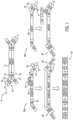
- an extension primer that binds to a target sequence and a polymerase with 5'-3' exonuclease activity can be used to specifically "unlock" hairpin adaptors and allow amplification of fragments comprising the target sequence ( See Figure 1 ).
- sequencing results are improved using the present methods because of the recovery of fragment ends during enriching, as compared to methods of enriching that may not recover fragment ends (such as direct targeted amplification using multiplex PCR).
- a method for enriching a target sequence from a sequencing library of double-stranded fragments comprises preparing the sequencing library, wherein each fragment comprises an insert comprising double-stranded nucleic acid and a hairpin adaptor at the 5' end of one or both strands of the double-stranded fragments, wherein the hairpin adaptor comprises an amplification primer sequence and a sequence at least partially complementary to the amplification primer sequence; denaturing the double-stranded fragments to form single-stranded fragments; and, using a polymerase with 5'-3' exonuclease activity, (1) producing a nucleic acid strand using an extension primer that binds to the target sequence comprised in at least one insert in the sequencing library; and (2) removing all or part of the sequence at least partially complementary to the amplification primer sequence.
- a hairpin adaptor comprises an amplification primer sequence and a sequence at least partially complementary to the amplification primer sequence.
- the present methods have a variety of uses, such as for generating full sequences of fragmented nucleic acids, such as cell-free DNA. Further, the present methods can be used for fragment deduplication.
- a target sequence refers to any sequence of interest.
- a target sequence may comprise a sequence comprised in a gene of interest, a specific mutation of interest, or any other sequence of interest to a user.
- a plurality of double-stranded fragments in the library do not comprise the target sequence before enriching. In some embodiments, a majority of double-stranded fragments in the library do not comprise the target sequence before enriching.
- enriching a target sequence from a sequencing library means that 2 or more-fold, 5 or more-fold, 10 or more-fold, 20 or more-fold, 50 or more-fold, 100 or more-fold, 1,000 or more-fold, 10,000 or more-fold, or 100,000 or more-fold more fragments comprising the target sequence are comprised in the library after enriching as compared to before enriching.
- the present methods may therefore be used to generate "enriched libraries.”
- the present methods allow high enrichment of small regions (i.e., few kilobase) of a double-stranded DNA comprised in a sample.
- the target sequence is comprised in a double-stranded nucleic used for library preparation.
- the double-stranded nucleic may be comprised in any type of sample requiring target enrichment or wherein target enrichment would be beneficial.
- the target sequence is comprised in cell-free DNA (cfDNA).
- the target sequence is comprised in an oncology sample, such as a liquid biopsy sample.
- the target sequence is comprised in an exome sample.
- the target sequence is comprised in a rare and undiagnosed disease (RUGD) exome sample.
- the target sequence is comprised in an RNA or cDNA library.
- the target sequence is comprised in a methylation library.
- a hairpin refers to a nucleic acid comprising a pair of nucleic acid sequences that are at least partially complementary to each other. These two nucleic acid sequences that are at least partially complementary can bind to each other and mediate folding of a nucleic acid. In some embodiments, the two nucleic acid sequences that are at least partially complementary generate a nucleic acid with a hairpin secondary structure.
- hairpin adaptor refers to an adaptor that comprises at least one pair of nucleic acid sequences that are at least partially complementary to each other.
- a hairpin adaptor has a folded secondary structure.
- Figure 1 shows a library fragment comprising a double-stranded insert (insert and insert' sequences) with a hairpin adaptor at the 5' end of each strand.
- each hairpin adaptor comprises one pair of nucleic acid sequences that are at least partially complementary to each other (A14/A14').
- base pairing between a pair nucleic acid sequences that are at least partially complementary to each other "locks" the adaptor into a hairpin secondary structure.
- the length of the extension primer used may be increased to improve specificity of the method to amplify fragments comprising the target sequence.
- a hairpin adaptor comprises more than one pair of nucleic acid sequences that are at least partially complementary to each other. In some embodiments, a hairpin adaptor comprises two pairs of nucleic acid sequences that are at least partially complementary to each other. In some embodiments, a hairpin adaptor comprises more than two pairs of nucleic acid sequences that are at least partially complementary to each other.
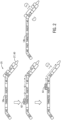
- Figure 2 shows a hairpin adaptor comprising two pairs of nucleic acid sequences that are at least partially complementary to each other (the A14/14' pair and the X/X' pair).
- a hairpin adaptor comprises an amplification primer sequence. In some embodiments, a hairpin adaptor comprises an amplification primer sequence and all or part a sequence at least partially complementary to the adaptor sequence.
- a hairpin adaptor is "locked" (via base pairing between a pair nucleic acid sequences that are at least partially complementary to each other) unless all part of the sequence at least partially complementary to the amplification primer sequence is removed. In some embodiments, a locked hairpin prevents the polymerase from extending and generating the complement of the amplification primer sequence.
- the present methods block amplification of fragments not attached to a hairpin adaptor, because the hairpin adaptor comprises an amplification primer sequence that can be used for a later amplification step.
- the present methods only allow amplification of library fragments that are attached to "unlocked" hairpin adaptors.
- Library fragments that were not attached to a hairpin adaptor and library fragments attached to "locked” hairpin adaptors would not be amplified.
- Such means of inhibiting amplification of undesired fragments can avoid costs and user time associated with downstream methods.
- the hairpin adaptor is at the 5' end of one strand of double-stranded fragments. In some embodiments, the hairpin adaptor is at the 5' end of both strands of double-stranded fragments. In some embodiments, the hairpin adaptor is incorporated by ligation or tagmentation. In some embodiments, the amplification primer sequence and the sequence at least partially complementary to the amplification primer sequence each comprise at least 14 nucleotides. In some embodiments, the amplification primer sequence and the sequence at least partially complementary to the amplification primer sequence each comprise 14-60 nucleotides. In some embodiments, the hairpin adaptor comprises one or more enhancement to increase stability.
- the hairpin adaptor comprises one or more modified or locked nucleic acids.
- a modified nucleic acid comprises 8-aza-7-deazaguanosine.
- the hairpin adaptor maintains association of the amplification primer sequence and the sequence at least partially complementary to the amplification primer sequence at temperatures of 60 °C or greater, 65 °C or greater, or 70 °C or greater.
- the amplification primer sequence comprises an A14 sequence (SEQ ID NO: 1) or B15 sequence (SEQ ID NO: 2), or their complements (A14' or B15', respectively).
- the sequence at least partially complementary to the amplification primer sequence comprises a sequence with 50% or greater, 60% or greater, 70% or greater, 80% or greater, 90% or greater, 95% or greater, or 99% or greater sequence identity with the complement of the amplification primer sequence. In some embodiments, the sequence at least partially complementary to the amplification primer sequence comprises the complement of the amplification primer sequence.
- library fragments comprise one or more adaptors in addition to or in alternative to the hairpin adaptors, such as a symmetrical single adaptor that is provided only on both 5' ends or only on both 3' ends of a double-stranded library fragment ( Figure 5 ).
- the symmetrical single adaptor creates a single-stranded end of a double-stranded library fragment.
- the symmetrical single adaptor is a B15 or B15' adaptor.
- the symmetrical single adaptor is a A14 or A14' adaptor.
- one or both strands of double-stranded fragments comprise one or more additional adaptors 3' of the hairpin adaptor. In some embodiments, double-stranded fragments comprise one or more adaptors at the 3' end of one or both strands.
- the adaptor sequence comprises a primer sequence, an index tag sequence, a capture sequence, a barcode sequence, a cleavage sequence, or a sequencing-related sequence, or a combination thereof.
- a sequencing-related sequence may be any sequence related to a later sequencing step.
- a sequencing-related sequence may work to simplify downstream sequencing steps.
- a sequencing-related sequence may be a sequence that would otherwise be incorporated via a step of ligating an adaptor to nucleic acid fragments.
- the adaptor sequence comprises a P5 or P7 sequence (or their complement) to facilitate binding to a flow cell in certain sequencing methods.
- the amplification primer sequence comprised in the hairpin is a universal primer sequence.
- a universal sequence is a region of nucleotide sequence that is common to, i.e., shared by, two or more nucleic acid molecules.
- the hairpin adaptor further comprises a linker between the amplification primer sequence and the sequence at least partially complementary to the amplification primer sequence.
- this linker is a nucleotide linker.
- this linker is a non-nucleotide linker.
- this linker is a synthetic linker.
- this linker is not degradable by an exonuclease (i.e., the linker is exonuclease-resistant) such that exonuclease activity terminates at the linker.
- double-stranded nucleic acids used to generate libraries are composed of DNA, RNA, or analogs thereof.
- the source of the acids is genomic DNA, messenger RNA, or other nucleic acids from native sources.
- the nucleic acids that are derived from such sources can be amplified prior to use in a method described herein.
- Exemplary biological samples from which double-stranded nucleic acids can be derived include, for example, those from a mammal such as a rodent, mouse, rat, rabbit, guinea pig, ungulate, horse, sheep, pig, goat, cow, cat, dog, primate, human or non-human primate; a plant such as Arabidopsis thaliana, corn, sorghum, oat, wheat, rice, canola, or soybean; an algae such as Chlamydomonas reinhardtii; a nematode such as Caenorhabditis elegans; an insect such as Drosophila melanogaster, mosquito, fruit fly, honey bee or spider; a fish such as zebrafish; a reptile; an amphibian such as a frog or Xenopus laevis; a dictyostelium discoideum; a fungi such as Pneumocystis carinii, Takifugu
- Double-stranded nucleic acids can also be derived from a prokaryote such as a bacterium, such as Escherichia coli, staphylococci, or mycoplasma pneumoniae; an archae; a virus such as Hepatitis C virus or human immunodeficiency virus; or a viroid.
- Double-stranded nucleic acids can be derived from a homogeneous culture or population of the above organisms or alternatively from a collection of several different organisms, for example, in a community or ecosystem.
- double-stranded nucleic acids can be obtained as fragments of one or more larger nucleic acids. Fragmentation can be carried out using any of a variety of techniques known in the art including, for example, nebulization, sonication, chemical cleavage, enzymatic cleavage, or physical shearing.
- a population of double-stranded nucleic acids, or amplicons thereof can have an average strand length that is desired or appropriate for a particular application of the methods or compositions set forth herein.
- the average strand length can be less than 100,000 nucleotides, 50,000 nucleotides, 10,000 nucleotides, 5,000 nucleotides, 1,000 nucleotides, 500 nucleotides, 100 nucleotides, or 50 nucleotides.
- the average strand length can be greater than 10 nucleotides, 50 nucleotides, 100 nucleotides, 500 nucleotides, 1,000 nucleotides, 5,000 nucleotides, 10,000 nucleotides, 50,000 nucleotides, or 100,000 nucleotides.
- the average strand length for population of double-stranded nucleic acids, or amplicons thereof can be in a range between a maximum and minimum value set forth above. It will be understood that amplicons generated at an amplification site (or otherwise made or used herein) can have an average strand length that is in a range between an upper and lower limit selected from those exemplified above.
- the double-stranded nucleic acids have a relatively short average strand length, such as less than 200 nucleotides, less than 150 nucleotides, less than 100 nucleotides, less than 75 nucleotides, less than 50 nucleotides, or less than 36 nucleotides.
- sample types with relatively short average strand length are cell-free DNA (cfDNA) and exome sequencing sample.
- the double-stranded nucleic acids are cell-free DNA (cfDNA) from a maternal blood sample.
- the cfDNA is extracted from a maternal plasma sample.
- the cfDNA is for noninvasive prenatal testing (NIPT).
- the double-stranded nucleic acids are exomes.
- the exomes are from a sample from a patient with a suspected rare and undiagnosed disease (RUGD).
- extension when used in reference to a primer is intended to include processes wherein one or more nucleotides are added to the primer (e.g. via polymerase activity) or wherein one or more oligonucleotides are added to the primer (e.g. via ligase activity).
- one or more extension primer is a gene-specific primer.
- an extension primer may bind to a target sequence in a cancer gene to allow enriching for this target sequence from the sequencing library.
- methods use a single extension primer. In some embodiments, methods use more than one extension primer.
- an extension primer has a melting temperature of 60 °C or greater. In some embodiments, an extension primer has a melting temperature of 60 °C or greater, 65 °C or greater, or 70 °C or greater. In some embodiments, an extension primer with a melting temperature of 60 °C or greater allows a "hot start" reaction to decrease non-specific binding. In some embodiments, the melting temperature of an extension primer is controlled by the length of the primer, the GC content, or other factors well-known to those in the art.
- more than one extension primer are used in a single step of, using a polymerase with 5'-3' exonuclease activity, producing a nucleic acid strand using an extension primer that binds to a target sequence comprised in at least one insert in the library of double-stranded fragments and removing all or part of the sequence at least partially complementary to the amplification primer sequence.
- multiple extension primers are used in a single step of the method.
- multiple extension primers may bind to different target sequences within a gene of interest or to different genes of interest. That is, embodiments include a set of different extension primers, whereby different extension primers of the set are complementary to respective different targets. This permits a multiplexed reaction to enrich different targets at the same time by contacting fragmented nucleic acids with the set of extension primers.
- multiple extension primers are linked via one or more linker (i.e., such as shown in Figure 4 ). In some embodiments, two extension primers are linked via a linker. In some embodiments, multiple extension primers linked via one or more linker have a higher melting temperature. In some embodiments, multiple extension primers linked via one or more linker one bind to inserts that comprise target sequences capable of binding each extension primer (for example, fwd1' and fwd2' as shown in Figure 4 ).
- two extension primers may be ligated together during the method, as described below.
- different extension primers are used in different steps of the method.
- the method comprises, using a polymerase with 5'-3' exonuclease activity, producing a nucleic acid strand using an extension primer that binds to a target sequence comprised in at least one insert in the library of double-stranded fragments and removing all or part of the sequence at least partially complementary to the amplification primer sequence.
- the 5'-3' exonuclease activity of the polymerase mediates removing all or part of the sequence at least partially complementary to the amplification primer sequence.
- the polymerase with 5'-3' exonuclease activity cleaves all or part of the sequence at least partially complementary to the amplification primer sequence.
- a locked hairpin prevents the polymerase from extending and generating the complement of the amplification primer sequence in the nucleic acid strand produced..
- the method further comprises amplifying fragments using an amplification primer that binds to the amplification primer sequence. In some embodiments, only fragments wherein all or part of the sequence at least partially complementary to the amplification primer sequence has been removed can be amplified. In some embodiments, a locked hairpin prevents the polymerase from extending and generating the complement of the amplification primer sequence.
- amplification primers may comprise index sequences (See, for example, i5 and i7 index sequences in Figure 1 ). These index sequences may be used to identify the sample and location in the array.
- an index sequence comprises a unique molecular identifier (UMI). UMIs are described in Patent Application Nos. WO 2016/176091 , WO 2018/197950 , WO 2018/197945 , WO 2018/200380 , and WO 2018/204423 .
- amplifying fragments using an amplification primer cannot destroy the hairpin adaptor.
- the polymerase used for amplifying fragments using an amplification primer lacks 5'-3' exonuclease activity or the polymerase used for amplifying fragments using an amplification primer is not a strand-displacing polymerase.
- the polymerase used for amplifying fragments is Q5.
- the amplification is bridge amplification.
- samples are amplified on a solid support.
- samples are amplified using cluster amplification methodologies as exemplified by the disclosures of US Patent Nos. 7,985,565 and 7,115,400 .
- US Patent Nos. 7,985,565 and 7,115,400 describe methods of solid-phase nucleic acid amplification which allow amplification products to be immobilized on a solid support in order to form arrays comprised of clusters or "colonies" of immobilized nucleic acid molecules.
- Each cluster or colony on such an array is formed from a plurality of identical immobilized polynucleotide strands and a plurality of identical immobilized complementary polynucleotide strands.
- the arrays so-formed are generally referred to herein as "clustered arrays".
- samples are amplified in solution.
- samples are cleaved or otherwise liberated from a solid support and amplification primers are then hybridized in solution to the liberated molecules.
- amplification primers are hybridized to desired samples for one or more initial amplification steps, followed by subsequent amplification steps in solution.
- an immobilized nucleic acid template can be used to produce solution-phase amplicons.
- amplification methodologies described herein or generally known in the art can be utilized with universal or target-specific primers to amplify desired samples.
- Suitable methods for amplification include, but are not limited to, the polymerase chain reaction (PCR), strand displacement amplification (SDA), transcription mediated amplification (TMA) and nucleic acid sequence based amplification (NASBA), as described in US Patent No. 8,003,354 .
- PCR polymerase chain reaction
- SDA strand displacement amplification
- TMA transcription mediated amplification
- NASBA nucleic acid sequence based amplification
- the above amplification methods can be employed to amplify one or more nucleic acids of interest.
- PCR including multiplex PCR, SDA, TMA, NASBA and the like can be utilized to amplify immobilized DNA fragments.
- primers directed specifically to the nucleic acid of interest are included in the amplification reaction.
- oligonucleotide extension and ligation can include oligonucleotide extension and ligation, rolling circle amplification (RCA) ( Lizardi et al., Nat. Genet. 19:225-232 (1998 )) and oligonucleotide ligation assay (OLA) (See generally US Pat. Nos. 7,582,420 , 5,185,243 , 5,679,524 and 5,573,907 ; EP 0 320 308 B1 ; EP 0 336 731 B1 ; EP 0 439 182 B1 ; WO 90/01069 ; WO 89/12696 ; and WO 89/09835 ) technologies.
- RCA rolling circle amplification
- OVA oligonucleotide ligation assay
- the amplification method can include ligation probe amplification or oligonucleotide ligation assay (OLA) reactions that contain primers directed specifically to the nucleic acid of interest.
- the amplification method can include a primer extension-ligation reaction that contains primers directed specifically to the nucleic acid of interest.
- primer extension and ligation primers that can be specifically designed to amplify a nucleic acid of interest, the amplification can include primers used for the GoldenGate assay (Illumina, Inc., San Diego, CA) as exemplified by US Pat. No. 7,582,420 and 7,611,869 .
- Exemplary isothermal amplification methods that can be used in a method of the present disclosure include, but are not limited to, Multiple Displacement Amplification (MDA) as exemplified by, for example Dean et al., Proc. Natl. Acad. Sci. USA 99:5261-66 (2002 ) or isothermal strand displacement nucleic acid amplification exemplified by, for example US Pat. No. 6,214,587 .
- MDA Multiple Displacement Amplification
- SDA strand displacement amplification
- the method further comprises sequencing of amplified fragments.
- the method allows sequencing of the full sequence of the insert. The ability to generate the full sequence of inserts is in contrast to methods with direct targeted amplification (such as multiplex PCR), as portions of inserts beyond where the primer binds can be lost with direct targeted amplification.
- SBS sequencing-by-synthesis
- extension of a nucleic acid primer along a nucleic acid template is monitored to determine the sequence of nucleotides in the template.
- the underlying chemical process can be polymerization (e.g. as catalyzed by a polymerase enzyme).
- fluorescently labeled nucleotides are added to a primer (thereby extending the primer) in a template dependent fashion such that detection of the order and type of nucleotides added to the primer can be used to determine the sequence of the template.
- Flow cells provide a convenient solid support for sequencing.
- one or more labeled nucleotides, DNA polymerase, etc. can be flowed into/through a flow cell that houses one or more amplified nucleic acid molecules. Those sites where primer extension causes a labeled nucleotide to be incorporated can be detected.
- the nucleotides can further include a reversible termination property that terminates further primer extension once a nucleotide has been added to a primer.
- a nucleotide analog having a reversible terminator moiety can be added to a primer such that subsequent extension cannot occur until a deblocking agent is delivered to remove the moiety.
- a deblocking reagent can be delivered to the flow cell (before or after detection occurs). Washes can be carried out between the various delivery steps. The cycle can then be repeated n times to extend the primer by n nucleotides, thereby detecting a sequence of length n.
- Pyrosequencing detects the release of inorganic pyrophosphate (PPi) as particular nucleotides are incorporated into a nascent nucleic acid strand ( Ronaghi, et al., Analytical Biochemistry 242(1), 84-9 (1996 ); Ronaghi, Genome Res. 11(1), 3-11 (2001 ); Ronaghi et al. Science 281(5375), 363 (1998 ); US 6,210,891 ; US 6,258,568 and US 6,274,320 ).
- PPi inorganic pyrophosphate
- Some embodiments can utilize methods involving the real-time monitoring of DNA polymerase activity.
- nucleotide incorporations can be detected through fluorescence resonance energy transfer (FRET) interactions between a fluorophore-bearing polymerase and ⁇ -phosphate-labeled nucleotides, or with zeromode waveguides (ZMWs).
- FRET fluorescence resonance energy transfer
- ZMWs zeromode waveguides
- an advantage of the methods set forth herein is that they provide for rapid and efficient detection of a plurality of nucleic acid in parallel. Accordingly, the present disclosure provides integrated systems capable of preparing and detecting nucleic acids using techniques known in the art such as those exemplified above.
- an integrated system of the present disclosure can include fluidic components capable of delivering amplification reagents and/or sequencing reagents to one or more immobilized DNA fragments, the system comprising components such as pumps, valves, reservoirs, fluidic lines, and the like.
- a flow cell can be configured and/or used in an integrated system for detection of nucleic acids. Exemplary flow cells are described, for example, in US 2010/0111768 A1 and US Pub. No. 2012/0270305 A1 .
- one or more of the fluidic components of an integrated system can be used for an amplification method and for a detection method.
- one or more of the fluidic components of an integrated system can be used for an amplification method set forth herein and for the delivery of sequencing reagents in a sequencing method such as those exemplified above.
- an integrated system can include separate fluidic systems to carry out amplification methods and to carry out detection methods. Examples of integrated sequencing systems that are capable of creating amplified nucleic acids and also determining the sequence of the nucleic acids include, without limitation, the MiSeq TM platform (Illumina, Inc., San Diego, CA) and devices described in US Pub. No. 2012/0270305 .
- Hairpin adaptors described herein can be used in a number of different workflows. For example, various different workflows can be used to increase the presence of fragments comprising the target sequence and/or reduce the presence of fragments not comprising the target sequence.
- a uracil in the nucleic acid strand comprising uracil replaces a thymine in a restriction endonuclease cleavage site.
- a nucleic acid strand comprising uracil comprises all or part of the sequence at least partially complementary to the amplification primer sequence, thereby making a double-stranded nucleic acid comprising the amplification primer sequence and the sequence at least partially complementary to it resistant to restriction endonuclease cleavage.
- a polymerase with 5'-3' exonuclease activity can incorporate uracil.
- a method comprises use of one or more uracil specific excision reagents (USER).
- a USER can cleave a nucleic acid strand comprising uracil.
- producing a nucleic acid strand using an extension primer is performed with a reaction mixture comprising uracil.
- the nucleic acid strand produced with a reaction mixture comprising uracil is cleaved by one or more USER.
- USER is uracil DNA glycosylase and endonuclease VIII.
- USER is a single enzyme with the activities of uracil DNA glycosylase and endonuclease VIII.
- the nucleic acid strand produced with a reaction mixture comprising uracil is resistant to restriction endonuclease digestion.
- a method further comprises, in a plurality of double-stranded fragments in the library that do not comprise the target sequence, cleaving the hairpin adaptor with a restriction endonuclease.
- the restriction endonuclease cleaves at a double-stranded nucleic acid formed by association of the amplification primer sequence with the sequence at least partially complementary to the amplification primer sequence.
- the restriction endonuclease cleaves at a double-stranded nucleic acid formed by association of an adaptor sequence with the sequence at least partially complementary to the adaptor sequence (See, for example, cleavage of A14/A14' in Figure 2 ).
- the efficiency of cleavage by a restriction endonuclease decreases with increasing amount of uracil comprised a double-stranded DNA sequence comprising the endonuclease's cleavage site.
- the restriction endonuclease cannot cleave one or more double-stranded nucleic acid comprising uracil.
- the cleavage site of the restriction endonuclease comprises a thymine.
- incorporation of uracil in a nucleic acid strand changes the sequence that was previously a restriction endonuclease cleavage site, thereby protecting the strand and its complement from cleavage.
- the restriction enzyme cleaves the hairpin adaptor and generates an overhang. In some embodiments, the restriction enzyme cleaves the hairpin adaptor and generates a blunt end.
- a method for enriching a target sequence from a sequencing library of double-stranded fragments comprises preparing the sequencing library, wherein each fragment comprises an insert comprising double-stranded nucleic acid and a hairpin adaptor at the 5' end of one or both strands of the double-stranded fragments, wherein the hairpin adaptor comprises a first set of nucleotide sequences, wherein the first set of nucleotide sequences comprises an adaptor sequence and a sequence at least partially complementary to the adaptor sequence; a second set of nucleotide sequences, wherein the second set of nucleotide sequences comprises an amplification primer sequence and a sequence at least partially complementary to the amplification primer sequence, wherein the first set of nucleotide sequences is closer to the insert than the second set of nucleotide sequences; and a linker between the sequence at least partially complementary to the adaptor sequence and the sequence at least partially complementary to the amplification primer sequence; denaturing the double-strande
- the complement of the amplification primer sequence and/or the linker between the sequence at least partially complementary to the adaptor sequence and the sequence at least partially complementary to the amplification primer sequence is exonuclease-resistant.
- the complement of the amplification primer sequence and/or the linker between the sequence at least partially complementary to the adaptor sequence and the sequence at least partially complementary to the amplification primer sequence comprises uracil.
- the method further comprises cleaving the hairpin adaptor with a restriction endonuclease after producing a nucleic acid strand using the first primer, wherein said hairpin adaptor is comprised in double-stranded fragments of the library wherein all or part of the sequence at least partially complementary to the adaptor sequence is present and does not comprise uracil.
- the nucleic acid strand produced using the first primer extension comprises uracil and is resistant to restriction endonuclease digestion.
- the hairpin adaptor further comprises a linker between the amplification primer sequence and a sequence at least partially complementary to the amplification primer sequence.
- this linker is not degradable by an exonuclease.
- this linker is synthetic.
- this linker comprises a uracil or otherwise acts to pause polymerase activity.
- USER cleaves the nucleic acid strand generated by first primer extension, the linker comprised in the hairpin adaptor, and/or the sequence at least partially complementary to the adaptor sequence.
- the nucleic acid strand generated by first primer extension, the linker comprised in the hairpin adaptor, and/or the sequence at least partially complementary to the adaptor sequence comprise one or more uracil.
- the first and second extension primers bind to different sequences. In some embodiments, the first and second extension primers bind the same strand of the double-stranded nucleic acid.
- the second extension primer is removed after producing a nucleic acid strand using said primer.
- the polymerase and/or second extension primer are removed using SPRI beads.
- the polymerase is a heat-sensitive polymerase that be removed by denaturing.
- the heat-sensitive polymerase is full-length Bst or DNA polymerase I.
- a method for enriching a target sequence from a sequencing library comprises preparing the sequencing library, wherein each fragment comprises an insert comprising double-stranded nucleic acid and a hairpin adaptor at the 5' end of one or both strands of the double-stranded fragments, wherein the hairpin adaptor comprises an amplification primer sequence and a sequence at least partially complementary to the amplification primer sequence; denaturing the double-stranded fragments to form single-stranded fragments; using a primer mix and an enzyme or enzymes with ligation activity and polymerase activity without 5'-3' exonuclease activity, producing a nucleic acid strand using a first extension primer of a primer mix, wherein the primer mix comprises a first extension primer and a blocked second extension primer, wherein the first extension primer and the blocked second extension primer bind to different sequences of interest comprised in the double-stranded nucleic acid; and ligating the nucleic acid strand produced using the first extension primer to the blocked second
- the blocked second extension primer cannot produce a nucleic acid strand unless it is deblocked.
- the blocked second extension primer comprises a block such that extension cannot occur unless the block is removed.
- the block is the presence of a 3' phosphate on the blocked second primer.
- the blocked second primer is deblocked by a kinase that cleaves the 3' phosphate.
- the deblocked second extension primer can produce a nucleic acid strand.
- the blocked second extension primer binds a target sequence comprised in at least one insert and 5' of the sequence bound by the first extension primer.
- the second extension primer binds to the insert with a melting temperature of less than 60 °C. In other words, the second extension primer may have relatively weak binding to the insert. In other words, the second extension primer may have relatively weak binding to the insert, whether or not the second extension primer is blocked or not. In some embodiments, the second extension primer dissociates from the insert at temperatures above 60 °C, above 65 °C, or above 70 °C.
- the second extension primer and a polymerase produce less nucleic acid strand when a "hot start" extension protocol is used, as compared to a standard extension protocol. In some embodiments, the second extension primer and a polymerase produce less nucleic acid strand when the temperatures is above 60 °C, above 65 °C, or above 70 °C. In some embodiments, the second extension primer and a polymerase cannot produce a nucleic acid strand at temperatures above 60 °C, above 65 °C, or above 70 °C.
- the ligated first and second extension primers bind to the insert with a melting temperature of 60 °C or greater. In other words, the ligated first and second extension primers may have relatively strong binding to the insert. In some embodiments, the ligated first and second extension primers remain associated with the insert at temperatures above 60 °C, above 65 °C, or above 70 °C. In some embodiments, producing a nucleic acid strand using the ligated first and second extension primers is performed at a temperature of 60 °C or greater. In some embodiments, producing a nucleic acid strand using the ligated first and second extension primers is performed at a temperature of 60 °C or greater, 65 °C or greater, or 70 °C or greater. In some embodiments, the annealing and extension temperature of the ligated first and second extension primers is above the melting temperature of the second extension primer.
- the second extension primer is removed before amplifying. In some embodiments, the second extension primer is removed using SPRI beads or an exonuclease.
- Example 1 Enriching a target sequence from a sequencing library using hairpin adaptors
- FIG. 1 shows an example double-stranded fragment 12 that is a representative fragment of a sequencing library formed from a plurality of fragments 12 with respective different inserts 14.
- Each fragment 12 includes an adaptor 18 at both ends.
- the adaptors 18 are the same.
- the adaptors are forked adaptors, with a first strand 22 and a second strand 23.
- the first strand 22 and that second strand 23 form a double-stranded region 24.
- the first strand also includes a hairpin region 25 having a hairpin double-stranded region 26 and a linker 27 that is disposed between the self-complementary portions of the double-stranded region 26.
- the linker 27 may be a synthetic linker or a stretch of nucleotide bases to create the hairpin. In an embodiment, the linker 27 is not hybridized and is single-stranded.
- the hairpin region 25 includes A14 and its complement A14'.
- Base pairing of A14/A14' within the double-stranded region 26 means that the A14 primer sequence is not available for binding to an amplification primer when the hairpin region 25 is intact.
- the double-stranded region 26 of the hairpin region 25 comprises an A14 primer sequence and its complement (A14').
- the workflow shown in Figure 1 includes a step of denaturing the fragments 12 to yield positive and negative strands.
- the negative strand 28 is shown.
- the workflow steps additionally or alternatively apply to the positive strand in embodiments. That is, the disclosed workflows, and associated extension primers, may be used with the positive strand, the negative strand, or both.
- the fragment 12 contains a targeted insert 14a of interest
- a strand 28a binds to an extension primer 29 that is complementary to a portion of the targeted insert 14a.
- the A14' sequence of the hairpin region 25 is removed using a polymerase 30 with 5'-3' exonuclease activity (such as Taq).
- the polymerase 30 causes the formerly double-stranded region 26 to be single-stranded, making the A14 sequence available.
- the polymerase 30 is then removed, destroyed, or inactivated. Full extension from a first amplification primer 36 is possible to copy the strand 28a, and a second amplification primer 38 is bound to the A14' in the generated nucleic acid strand to specifically exponentially amplify fragments comprising inserts comprising the target sequence. In this method, there is no amplification of fragments without hairpin adaptors (through failed fragment generation) or fragments or strands, such as strand 28b, wherein the hairpin adaptor and hairpin region 25 remains "locked" (i.e., the A14 and A14' sequences of the hairpin are associated with each other).
- the locked hairpin prevents the polymerase from extending over A14; therefore, fragments that comprise the hairpin cannot generate a nucleic acid strand comprising A14' and cannot therefore be amplified by the A14 primer.
- the length of the extension primer in this method may be increased to ensure specificity for binding to inserts comprising the insert' sequence.
- the i5 and i7 sequences represent index sequences, which may be used to identify the sample and location in the array.
- Amplification yields full length products 50 that include enriched targeted inserts 14 with different sequencing primers and indexes at respective ends.
- the amplification products 50 can be loaded onto a sequencer at this stage, and the sequencer can generate sequencing information from the products 50, which are enriched for the inserts of interest.
- extension primers i.e., target probes
- target probes bind to one or more target sequences in a double-stranded DNA.
- the hairpin-containing adaptor 18 can be added to one or both 5' end of the double-stranded fragments.
- the double-stranded fragments of the library can be denatured. Then, using a polymerase with 5'-3' exonuclease activity, (1) a nucleic acid strand can be produced using an extension primer that binds to the target sequence comprised in at least one insert in the library of double-stranded fragments and (2) all or part of the A14' sequence can be removed.
- an amplification primer can be then used to selectively amplify fragments with unlocked hairpin adaptors. Using this method, only fragments with unlocked hairpins will be amplified. Fragments comprising hairpins wherein all or part of the A14' sequence of the hairpin is intact would not be amplified.
- the A14 sequence in the hairpin adaptor is base paired with a complementary A14' sequence. When the hairpin adaptor is intact, an amplification primer cannot bind to the amplification primer sequence, because of the "locked" hairpin secondary structure. Thus, the non-target insert is not amplified.
- Example 2 Enriching a target sequence from a sequencing library using hairpin adaptors and USER reagents
- Enriching a target sequence from a sequencing library can be performed using a "double unlock” method ( Figure 2 ).
- the hairpin region 25 includes a linker 27 that is a synthetic linker 60, such as one comprising uracil, or a uracil in the X' sequence.
- Sequential use of two extension primers (fwdl 62 and fwd2 64) that bind target sequences in the targeted inserts 14a allows increased enrichment of a target sequence from a sequencing library by using "double unlock” (sequential removal of A14' and then removal of X').
- the first nucleic acid strand comprises uracil.
- a restriction endonuclease can be used to cleave the A14/A14' sequence in hairpin adaptors wherein the A14' sequence has not been removed and replaced with a sequence comprising uracil.
- the restriction endonuclease step can be used to remove inserts that do not comprise the target sequence (i.e., the fragments comprising "not targeted insert'").
- This method uses two extension primers (fwdl and fwd2), which can both bind to target sequences that may be comprised in a single insert.
- fwd1 and fwd2 may bind to target sequences that are spatially close in a double-stranded DNA sample.
- the hairpin adaptor in this method comprises 2 sets of complementary nucleic acids (A14/A14' and X/X' in Figure 2 ).
- A14 is an adaptor (and A14' is its complement) and X is an amplification primer sequence (and X' is its complement).
- X' and/or the linker between X' and A14' comprise a uracil or are otherwise exonuclease-resistant.
- nucleic acid strand produced comprises uracil and is resistant to restriction endonuclease cleavage.
- the fwd1 primers are removed (by exonuclease or SPRI beads).
- a restriction enzyme can cleave any hairpin adaptors wherein A14' was not removed and replaced with a nucleic acid strand comprising uracil.
- a nucleic acid strand comprising uracil can block the A14 sequence from cleavage by the restriction endonuclease.
- those hairpin adaptors on library fragments wherein no nucleic acid strand was produced comprising uracil are cleaved by the restriction endonuclease.
- USER can then be used to cleave the nucleic acid strand comprising uracil and/or the uracil in the synthetic linker (between A14' and X') or in X'.
- a fwd2 primer can then bind and, using a polymerase with 5'-3' exonuclease activity (such as Taq), (1) a nucleic acid strand is produced using fwd2 that binds to a target sequence, and (2) all or part of X' is removed. Now that X' is removed, an amplification primer can be used that binds to X can selectively amplify fragments comprising inserts that can bind both fwd1 and fwd2.
- This method has increased specificity, as it comprises separate unlocking steps mediated by fwd1 and fwd2 primers (to remove A14' and then X') and also comprises a restriction endonuclease cleavage of intact hairpin adaptors comprising A14/A14' without uracil.
- Example 3 Enriching a target sequence from a sequencing library using hairpin adaptors and ligation of two extension primers
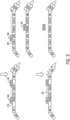
- extension primers 80, 82 are used (fwdl and fwd2) that both bind target sequences within inserts of interest. That is, as shown in Figure 3 , the fwd1 and fwd2 extension primers respectively bind to different, e.g., noncontiguous regions of an individual targeted insert sequence 14a.
- a polymerase without exonuclease activity and a ligase a ligated fwd1 and fwd2 structure 84 is generated.
- This ligated primer can be used for a hot start extension reaction after fwd2 is deblocked. That is, the fwd2 primer is blocked, such that it cannot mediate extension.
- initial extension is performed with an enzyme mix comprising a ligase and a polymerase without exonuclease activity.
- a mix of a polymerase without exonuclease activity and a ligase may be an ELM mix (such as that provided in Illumina DNA PCR-Free Library Prep kit #1000000086922).
- the ligated fwd1-fwd2 primer will bind with high affinity to the insert, based on the large number of paired nucleotides between the ligated primer and the insert.
- the block on fwd2 can then be removed.
- the fwd2 primer may be designed to have relatively low affinity for its target sequence, such that it has a melting temperature of less than 60 °C.
- a "hot start" extension reaction (starting at a temperature of 60 °C or greater than) would mean that the fwd2 primer would dissociate from the insert before producing a nucleic acid strand.
- the ligated fwd1-fwd2 deblocked primer would remain bound at higher temperature and mediate, using a polymerase with 5'-3' exonuclease activity, (1) producing a nucleic acid strand using the ligated first and second extension primers; and (2) removing all or part of A14'.
- this method uses this method to enriching a target sequence from a sequencing library is performed with both fwd1 and fwd2.
- this method has greater specificity for selectively amplifying fragments of interest that comprise a target sequence that binds fwd1 and a target sequence that binds fwd2.
- Example 4 Enriching a target sequence from a sequencing library using hairpin adaptors and linked extension primers
- two primers 90, 92 are linked via a linker 94 that, in an embodiment, is not complementary to the targeted insert sequence, to form a linked extension primer structure 96.
- the primers 90, 92 illustrated as fwd1 and fwd2 in Figure 4 , are complementary to two different noncontiguous regions of the targeted insert sequence.
- the melting temperature of the linked extension primer structure is governed by the melting temperature when hybridized to the complementary sequences to the fwd1' and fwd2' primers as shown in Figure 4 because the linker is not hybridized and, therefore, does not significantly contribute to the melting temperature.
- Annealing and extension can occur at a melting temperature greater than the melting temperature of the fwd1 or the fwd2 extension primer alone.
- the melting temperature is sufficiently high such that, when only one of the fwd1 or fwd2 primers has a complementary sequence, the linked extension primer structure cannot bind. If both primers can bind to the targeted insert sequence, the linked extension primer structure can remain bound for extension. Thus, the higher specificity requirement of two separate sequences being present is realized.
- the bound linked extension primer structure can be used in an extension reaction using a polymerase with exonuclease activity as generally discussed herein to remove the double-stranded portion of the hairpin adaptor to reveal or unlock the 5' A14 sequence as shown.
- the linker may be a universal sequence linking the two different primers.
- each different set of first and second primers can be specific to each respective target sequence of interest. Accordingly, each different target sequence can have a specific first primer and a specific second extension primer.
- the linking sequence for all of the sets may be the same sequence used to link each first primer with its corresponding second primer. This arrangement permits the relatively less expensive custom manufacture of shorter specific sequences that are linked by a common linker sequence.
- the linker can be designed such that the linker binds to no targeted insert sequences.
- Example 5 Enriching a target sequence from a sequencing library using ligated double-stranded adaptors
- Figure 5 shows a comparison between library fragments 12 with inserts 14, whereby some fragments 12 have a targeted insert sequence 14a and other fragments 12 do not have a targeted insert sequence 14b.
- the fragments 12 have end adaptors 100.
- Each end adaptor includes a first strand 101 and a second strand 102. Portions of the first strand 101 and the second strand 102 are complementary to form a double-stranded region 103. Another portion of the second strand 102 includes a single-stranded 3' terminal region 104 that extends away from a 3' terminus of the double-stranded region 103.
- the adaptors 100 in the illustrated example of Figure 5 do not include hairpins.
- Denaturation of the fragments to form separated strands permits binding of target-specific extension primers 110 that specifically hybridize to strands 112a containing targeted inserts 14a.
- the method may be used in conjunction with a plurality of target-specific extension primers 110 having different sequences for respective different target sequences.
- Extension of a complementary strand from the primer 110 generates a duplex of the complementary strand and the strand 112a having a double-stranded end 120 that is not present on the other strands 112b with non-target inserts 14b.
- the double-stranded end 120 can be extended to add an A-overhang to be subsequently ligated to a double-stranded adaptor 124.
- the ligation at the 5' end of the strand 112a adaptorizes the 5' end, which can then be amplified to yield full length products 130 with different end adaptors as provided herein that contain the targeted insert 14a.
- each strand of the full length product can have a first amplification primer sequence at a 5' end and a second amplification primer sequence at a 3' end.
- Amplification may be using indexed primers as discussed herein. While the illustrated example shows A-overhang ligation, the double-stranded end 120 can also be a blunt double-stranded nontemplated ligation to a blunt double-stranded adaptor.
- the strands 112b with non-target inserts 14b are not amplified. There is no binding event for the primer 110 and, therefore, no extension to create a double-stranded end. Accordingly, only a single primer 36 of a primer set can bind the non-target strands 112b, and there is no amplification of the non-target strands.
- a model 80mer oligonucleotide double-stranded DNA template was synthesized to include 3' single A-overhangs with phosphorylated 5' ends. This model template served as a simple model for a double-stranded DNA sample insert.
- two different adaptor types were ligated using Illumina LIG2 reagent at 30°C for 10 minutes. Control duplex oligo was at 1 uM and adaptors were at 9 uM.
- control adaptor type was used (see Figure 7 control adaptor) that contained duplex ME regions, an internal sequence CPH4' and B15' on one fork, and A14 on the other.
- the other adaptor type the hairpin adaptor, contained the same ME duplex regions, the same top strand as the control adaptor, but the bottom strand of the fork contained an additional inner sequence (CPH3) and a hairpin of A14.
- Adaptors were denatured at 95°C before being snap cooled on ice to form stocks at 50 uM in Tris-Hcl pH 8, 10 mM NaCl. Note that the hairpin sequence between A14 and A14' was 5 bases in length.
- Each adaptor was added to separate ligation reactions to create ligated duplexes with either the control adaptor at each end of the duplex, or the hairpin adaptor.
- PCR amplification of was carried out using either the inner primers (CPH4-ME and A14-i5-P5 for the control forked adaptor, and CPH4-ME and CPH3-ME for the hairpin adaptor) or outer primers (A14-i5-P5 and B15-i7-P7 for both adaptors).
- the ligated template was diluted 7.5x and mixed with PCR reagent in Illumina PCR mix (EPM).
- Amplification was carried out using an initial 3 minute denaturation at 95°C followed by 8 cycles of 95°C for 20s, 60C for 15s, with a temperature gradient for the extension temp (72°C-60°C). The was followed by a final extension of 72°C for 5m and then taken to 4°C. Amplification products were quantified using an Agilent D1000 HS Tapestation.
- Figure 6 shows four panels of extension temperature vs. peak molarity
- Figure 7 shows the control and hairpin adaptor structures used to generate the results in Figure 6 .
- Little effect is seen from the extension temperature gradient, but the lowest yielding amplification products are clearly seen with the hairpin adaptors when amplified with the outer primers (lower right panel).
- Control inner primers for the hairpin adaptors clearly show that product can be amplified from the ligated adaptor template with the inner primers, confirming hairpin adaptor ligation.
- For non-hairpin adaptor libraries similar yields are observed when PCR is used from inner and outer primer pairs.
- hairpin adaptor sequences inhibit PCR amplification when primer pairs are used that are contained in the hairpin (A14 in this case.). In other words, the locked configuration of the hairpin prevents amplification.
- the term about refers to a numeric value, including, for example, whole numbers, fractions, and percentages, whether or not explicitly indicated.
- the term about generally refers to a range of numerical values (e.g., +/-5-10% of the recited range) that one of ordinary skill in the art would consider equivalent to the recited value (e.g., having the same function or result).
- the terms modify all of the values or ranges provided in the list.
- the term about may include numerical values that are rounded to the nearest significant figure.
Landscapes
- Chemical & Material Sciences (AREA)
- Life Sciences & Earth Sciences (AREA)
- Organic Chemistry (AREA)
- Health & Medical Sciences (AREA)
- Engineering & Computer Science (AREA)
- Wood Science & Technology (AREA)
- Zoology (AREA)
- Genetics & Genomics (AREA)
- Biotechnology (AREA)
- Bioinformatics & Cheminformatics (AREA)
- General Engineering & Computer Science (AREA)
- Analytical Chemistry (AREA)
- Proteomics, Peptides & Aminoacids (AREA)
- Molecular Biology (AREA)
- Microbiology (AREA)
- Biophysics (AREA)
- Biochemistry (AREA)
- General Health & Medical Sciences (AREA)
- Physics & Mathematics (AREA)
- Biomedical Technology (AREA)
- Chemical Kinetics & Catalysis (AREA)
- Immunology (AREA)
- Plant Pathology (AREA)
- Crystallography & Structural Chemistry (AREA)
- Bioinformatics & Computational Biology (AREA)
- Measuring Or Testing Involving Enzymes Or Micro-Organisms (AREA)
Priority Applications (1)
| Application Number | Priority Date | Filing Date | Title |
|---|---|---|---|
| EP24206088.7A EP4471157B1 (en) | 2020-09-11 | 2021-09-10 | Methods of enriching a target sequence from a sequencing library using adaptors |
Applications Claiming Priority (2)
| Application Number | Priority Date | Filing Date | Title |
|---|---|---|---|
| US202063077271P | 2020-09-11 | 2020-09-11 | |
| PCT/EP2021/074931 WO2022053610A1 (en) | 2020-09-11 | 2021-09-10 | Methods of enriching a target sequence from a sequencing library using hairpin adaptors |
Related Child Applications (2)
| Application Number | Title | Priority Date | Filing Date |
|---|---|---|---|
| EP24206088.7A Division EP4471157B1 (en) | 2020-09-11 | 2021-09-10 | Methods of enriching a target sequence from a sequencing library using adaptors |
| EP24206088.7A Division-Into EP4471157B1 (en) | 2020-09-11 | 2021-09-10 | Methods of enriching a target sequence from a sequencing library using adaptors |
Publications (2)
| Publication Number | Publication Date |
|---|---|
| EP4211261A1 EP4211261A1 (en) | 2023-07-19 |
| EP4211261B1 true EP4211261B1 (en) | 2024-11-20 |
Family
ID=77910787
Family Applications (2)
| Application Number | Title | Priority Date | Filing Date |
|---|---|---|---|
| EP21777265.6A Active EP4211261B1 (en) | 2020-09-11 | 2021-09-10 | Methods of enriching a target sequence from a sequencing library using hairpin adaptors |
| EP24206088.7A Active EP4471157B1 (en) | 2020-09-11 | 2021-09-10 | Methods of enriching a target sequence from a sequencing library using adaptors |
Family Applications After (1)
| Application Number | Title | Priority Date | Filing Date |
|---|---|---|---|
| EP24206088.7A Active EP4471157B1 (en) | 2020-09-11 | 2021-09-10 | Methods of enriching a target sequence from a sequencing library using adaptors |
Country Status (11)
| Country | Link |
|---|---|
| US (1) | US12692535B2 (cg-RX-API-DMAC7.html) |
| EP (2) | EP4211261B1 (cg-RX-API-DMAC7.html) |
| JP (1) | JP7826289B2 (cg-RX-API-DMAC7.html) |
| KR (1) | KR20230069135A (cg-RX-API-DMAC7.html) |
| CN (1) | CN116323970A (cg-RX-API-DMAC7.html) |
| AU (1) | AU2021339945A1 (cg-RX-API-DMAC7.html) |
| CA (1) | CA3188197A1 (cg-RX-API-DMAC7.html) |
| ES (2) | ES3004943T3 (cg-RX-API-DMAC7.html) |
| IL (1) | IL300983A (cg-RX-API-DMAC7.html) |
| MX (1) | MX2023001400A (cg-RX-API-DMAC7.html) |
| WO (1) | WO2022053610A1 (cg-RX-API-DMAC7.html) |
Families Citing this family (5)
| Publication number | Priority date | Publication date | Assignee | Title |
|---|---|---|---|---|
| WO2022140793A1 (en) * | 2020-12-24 | 2022-06-30 | Life Technologies Corporation | Compositions and methods for highly sensitive detection of target sequences in multiplex reactions |
| GB202319353D0 (en) * | 2023-12-17 | 2024-01-31 | Fu Guoliang | Tail sequence guided addition of adaptor |
| CN117701679B (zh) | 2024-02-06 | 2024-06-14 | 中国医学科学院基础医学研究所 | 一种基于5’连接的单链dna特异的高通量测序方法 |
| WO2026006746A2 (en) * | 2024-06-28 | 2026-01-02 | Illumina, Inc. | Nucleic acid preparation and analysis techniques |
| WO2026093331A1 (en) * | 2024-10-28 | 2026-05-07 | F. Hoffmann-La Roche Ag | Hairpin adapter constructs and primers to generate next-generation sequencing library molecules |
Citations (10)
| Publication number | Priority date | Publication date | Assignee | Title |
|---|---|---|---|---|
| WO2016016452A1 (en) * | 2014-08-01 | 2016-02-04 | Olink Ab | Method for selecting a target nucleic acid sequence |
| WO2016156071A1 (en) * | 2015-03-30 | 2016-10-06 | F. Hoffmann-La Roche Ag | Methods to amplify highly uniform and less error prone nucleic acid libraries |
| WO2017162754A1 (en) * | 2016-03-22 | 2017-09-28 | Vib Vzw | Means and methods for amplifying nucleotide sequences |
| WO2017205540A1 (en) * | 2016-05-24 | 2017-11-30 | The Translational Genomics Research Institute | Molecular tagging methods and sequencing libraries |
| WO2018053362A1 (en) * | 2016-09-15 | 2018-03-22 | ArcherDX, Inc. | Methods of nucleic acid sample preparation |
| WO2018193233A1 (en) * | 2017-04-17 | 2018-10-25 | Genefirst Ltd | Methods, compositions, and kits for preparing nucleic acid libraries |
| WO2019140298A1 (en) * | 2018-01-12 | 2019-07-18 | Natera, Inc. | Novel primers and uses thereof |
| WO2020165180A1 (en) * | 2019-02-12 | 2020-08-20 | Biocartis Nv | Protocols and kits for multiplex amplification and ngs-specific tagging |
| WO2021028665A1 (en) * | 2019-08-09 | 2021-02-18 | Dnae Diagnostics Limited | Methods for the multiplexed isothermal amplification of nucleic acid sequences |
| WO2021078947A1 (en) * | 2019-10-25 | 2021-04-29 | Illumina Cambridge Limited | Methods for generating, and sequencing from, asymmetric adaptors on the ends of polynucleotide templates comprising hairpin loops |
Family Cites Families (64)
| Publication number | Priority date | Publication date | Assignee | Title |
|---|---|---|---|---|
| CA1323293C (en) | 1987-12-11 | 1993-10-19 | Keith C. Backman | Assay using template-dependent nucleic acid probe reorganization |
| CA1341584C (en) | 1988-04-06 | 2008-11-18 | Bruce Wallace | Method of amplifying and detecting nucleic acid sequences |
| AU3539089A (en) | 1988-04-08 | 1989-11-03 | Salk Institute For Biological Studies, The | Ligase-based amplification method |
| US5130238A (en) | 1988-06-24 | 1992-07-14 | Cangene Corporation | Enhanced nucleic acid amplification process |
| ATE144556T1 (de) | 1988-06-24 | 1996-11-15 | Amgen Inc | Verfahren und mittel zum nachweis von nukleinsäuresequenzen |
| ATE138106T1 (de) | 1988-07-20 | 1996-06-15 | David Segev | Verfahren zur amplifizierung und zum nachweis von nukleinsäuresequenzen |
| US5185243A (en) | 1988-08-25 | 1993-02-09 | Syntex (U.S.A.) Inc. | Method for detection of specific nucleic acid sequences |
| WO1991006678A1 (en) | 1989-10-26 | 1991-05-16 | Sri International | Dna sequencing |
| KR950013953B1 (ko) | 1990-01-26 | 1995-11-18 | 애보트 래보라토리즈 | 리가제 연쇄 반응에 적용가능한 표적 핵산의 증폭 방법 |
| US5573907A (en) | 1990-01-26 | 1996-11-12 | Abbott Laboratories | Detecting and amplifying target nucleic acids using exonucleolytic activity |
| US5455166A (en) | 1991-01-31 | 1995-10-03 | Becton, Dickinson And Company | Strand displacement amplification |
| WO1995021271A1 (en) | 1994-02-07 | 1995-08-10 | Molecular Tool, Inc. | Ligase/polymerase-mediated genetic bit analysistm of single nucleotide polymorphisms and its use in genetic analysis |
| CA2185239C (en) | 1994-03-16 | 2002-12-17 | Nanibhushan Dattagupta | Isothermal strand displacement nucleic acid amplification |
| GB9620209D0 (en) | 1996-09-27 | 1996-11-13 | Cemu Bioteknik Ab | Method of sequencing DNA |
| GB9626815D0 (en) | 1996-12-23 | 1997-02-12 | Cemu Bioteknik Ab | Method of sequencing DNA |
| EP2327797B1 (en) | 1997-04-01 | 2015-11-25 | Illumina Cambridge Limited | Method of nucleic acid sequencing |
| AR021833A1 (es) | 1998-09-30 | 2002-08-07 | Applied Research Systems | Metodos de amplificacion y secuenciacion de acido nucleico |
| US6355431B1 (en) | 1999-04-20 | 2002-03-12 | Illumina, Inc. | Detection of nucleic acid amplification reactions using bead arrays |
| US20060275782A1 (en) | 1999-04-20 | 2006-12-07 | Illumina, Inc. | Detection of nucleic acid reactions on bead arrays |
| US20050244870A1 (en) | 1999-04-20 | 2005-11-03 | Illumina, Inc. | Nucleic acid sequencing using microsphere arrays |
| US7244559B2 (en) | 1999-09-16 | 2007-07-17 | 454 Life Sciences Corporation | Method of sequencing a nucleic acid |
| US6274320B1 (en) | 1999-09-16 | 2001-08-14 | Curagen Corporation | Method of sequencing a nucleic acid |
| US6913884B2 (en) | 2001-08-16 | 2005-07-05 | Illumina, Inc. | Compositions and methods for repetitive use of genomic DNA |
| US7611869B2 (en) | 2000-02-07 | 2009-11-03 | Illumina, Inc. | Multiplexed methylation detection methods |
| US7582420B2 (en) | 2001-07-12 | 2009-09-01 | Illumina, Inc. | Multiplex nucleic acid reactions |
| JP2003521252A (ja) | 2000-02-07 | 2003-07-15 | イルミナ インコーポレイテッド | ユニバーサルプライミングを用いる核酸検出方法 |
| US7955794B2 (en) | 2000-09-21 | 2011-06-07 | Illumina, Inc. | Multiplex nucleic acid reactions |
| US7001792B2 (en) | 2000-04-24 | 2006-02-21 | Eagle Research & Development, Llc | Ultra-fast nucleic acid sequencing device and a method for making and using the same |
| EP2100971A3 (en) | 2000-07-07 | 2009-11-25 | Visigen Biotechnologies, Inc. | Real-time sequence determination |
| US7211414B2 (en) | 2000-12-01 | 2007-05-01 | Visigen Biotechnologies, Inc. | Enzymatic nucleic acid synthesis: compositions and methods for altering monomer incorporation fidelity |
| US7057026B2 (en) | 2001-12-04 | 2006-06-06 | Solexa Limited | Labelled nucleotides |
| AU2003259350A1 (en) | 2002-08-23 | 2004-03-11 | Solexa Limited | Modified nucleotides for polynucleotide sequencing |
| US7595883B1 (en) | 2002-09-16 | 2009-09-29 | The Board Of Trustees Of The Leland Stanford Junior University | Biological analysis arrangement and approach therefor |
| AU2004253882B2 (en) | 2003-06-20 | 2010-06-10 | Illumina, Inc. | Methods and compositions for whole genome amplification and genotyping |
| US7315019B2 (en) | 2004-09-17 | 2008-01-01 | Pacific Biosciences Of California, Inc. | Arrays of optical confinements and uses thereof |
| US7405281B2 (en) | 2005-09-29 | 2008-07-29 | Pacific Biosciences Of California, Inc. | Fluorescent nucleotide analogs and uses therefor |
| GB0522310D0 (en) | 2005-11-01 | 2005-12-07 | Solexa Ltd | Methods of preparing libraries of template polynucleotides |
| SG170802A1 (en) | 2006-03-31 | 2011-05-30 | Solexa Inc | Systems and devices for sequence by synthesis analysis |
| EP2089517A4 (en) | 2006-10-23 | 2010-10-20 | Pacific Biosciences California | POLYMERASEENZYME AND REAGENTS FOR ADVANCED NUCKIC ACID SEQUENCING |
| US8349167B2 (en) | 2006-12-14 | 2013-01-08 | Life Technologies Corporation | Methods and apparatus for detecting molecular interactions using FET arrays |
| EP2677309B9 (en) | 2006-12-14 | 2014-11-19 | Life Technologies Corporation | Methods for sequencing a nucleic acid using large scale FET arrays, configured to measure a limited pH range |
| US8262900B2 (en) | 2006-12-14 | 2012-09-11 | Life Technologies Corporation | Methods and apparatus for measuring analytes using large scale FET arrays |
| WO2008096146A1 (en) | 2007-02-07 | 2008-08-14 | Solexa Limited | Preparation of templates for methylation analysis |
| WO2009133466A2 (en) | 2008-04-30 | 2009-11-05 | Population Genetics Technologies Ltd. | Asymmetric adapter library construction |
| US20100137143A1 (en) | 2008-10-22 | 2010-06-03 | Ion Torrent Systems Incorporated | Methods and apparatus for measuring analytes |
| US9096899B2 (en) | 2010-10-27 | 2015-08-04 | Illumina, Inc. | Microdevices and biosensor cartridges for biological or chemical analysis and systems and methods for the same |
| US8951781B2 (en) | 2011-01-10 | 2015-02-10 | Illumina, Inc. | Systems, methods, and apparatuses to image a sample for biological or chemical analysis |
| DK3083994T3 (da) | 2013-12-20 | 2021-09-13 | Illumina Inc | Bevarelse af genomisk konnektivitetsinformation i fragmenterede genomiske DNA-prøver |
| RU2688485C2 (ru) | 2014-01-07 | 2019-05-21 | Фундасио Привада Институт Де Медисина Предиктива И Персоналицада Дель Кансер | Способы получения библиотек двухцепочечных днк и способы секвенирования для идентификации метилированных цитозинов |
| HUE058149T2 (hu) * | 2014-01-31 | 2022-07-28 | Swift Biosciences Inc | Javított eljárások DNS-szubsztrátok feldolgozására |
| WO2016025878A1 (en) * | 2014-08-14 | 2016-02-18 | Abbott Molecular Inc. | Multifunctional oligonucleotides |
| US10844428B2 (en) | 2015-04-28 | 2020-11-24 | Illumina, Inc. | Error suppression in sequenced DNA fragments using redundant reads with unique molecular indices (UMIS) |
| US20170283864A1 (en) * | 2016-03-31 | 2017-10-05 | Agilent Technologies, Inc. | Use of transposase and y adapters to fragment and tag dna |
| GB201609221D0 (en) * | 2016-05-25 | 2016-07-06 | Oxford Nanopore Tech Ltd | Method |
| WO2017209891A1 (en) | 2016-05-31 | 2017-12-07 | Quantapore, Inc. | Two-color nanopore sequencing |
| JP6889769B2 (ja) * | 2016-07-18 | 2021-06-18 | エフ.ホフマン−ラ ロシュ アーゲーF. Hoffmann−La Roche Aktiengesellschaft | 核酸配列決定の非対称な鋳型および非対称な方法 |
| EP3491147B1 (en) * | 2016-08-01 | 2020-06-17 | H. Hoffnabb-La Roche Ag | Methods for removal of adaptor dimers from nucleic acid sequencing preparations |
| CN110139931B (zh) * | 2016-08-30 | 2024-06-11 | 元素生物科学公司 | 用于定相测序的方法和组合物 |
| WO2018108328A1 (en) | 2016-12-16 | 2018-06-21 | F. Hoffmann-La Roche Ag | Method for increasing throughput of single molecule sequencing by concatenating short dna fragments |
| CN118638898A (zh) | 2017-03-23 | 2024-09-13 | 华盛顿大学 | 用于靶向核酸序列富集的方法及在错误纠正的核酸测序中的应用 |
| WO2018197945A1 (en) | 2017-04-23 | 2018-11-01 | Illumina Cambridge Limited | Compositions and methods for improving sample identification in indexed nucleic acid libraries |
| WO2018197950A1 (en) | 2017-04-23 | 2018-11-01 | Illumina Cambridge Limited | Compositions and methods for improving sample identification in indexed nucleic acid libraries |
| CN111094584B (zh) | 2017-04-23 | 2024-11-26 | 伊鲁米那股份有限公司 | 用于改进编索引的核酸文库中的样品鉴定的组合物和方法 |
| CN119824552A (zh) | 2017-05-01 | 2025-04-15 | 伊鲁米那股份有限公司 | 用于多重大规模平行测序的最佳索引序列 |
-
2021
- 2021-09-10 CA CA3188197A patent/CA3188197A1/en active Pending
- 2021-09-10 EP EP21777265.6A patent/EP4211261B1/en active Active
- 2021-09-10 ES ES21777265T patent/ES3004943T3/es active Active
- 2021-09-10 MX MX2023001400A patent/MX2023001400A/es unknown
- 2021-09-10 CN CN202180051665.3A patent/CN116323970A/zh active Pending
- 2021-09-10 AU AU2021339945A patent/AU2021339945A1/en active Pending
- 2021-09-10 IL IL300983A patent/IL300983A/en unknown
- 2021-09-10 US US18/025,794 patent/US12692535B2/en active Active
- 2021-09-10 ES ES24206088T patent/ES3075374T3/es active Active
- 2021-09-10 WO PCT/EP2021/074931 patent/WO2022053610A1/en not_active Ceased
- 2021-09-10 KR KR1020237011164A patent/KR20230069135A/ko active Pending
- 2021-09-10 JP JP2023511647A patent/JP7826289B2/ja active Active
- 2021-09-10 EP EP24206088.7A patent/EP4471157B1/en active Active
Patent Citations (10)
| Publication number | Priority date | Publication date | Assignee | Title |
|---|---|---|---|---|
| WO2016016452A1 (en) * | 2014-08-01 | 2016-02-04 | Olink Ab | Method for selecting a target nucleic acid sequence |
| WO2016156071A1 (en) * | 2015-03-30 | 2016-10-06 | F. Hoffmann-La Roche Ag | Methods to amplify highly uniform and less error prone nucleic acid libraries |
| WO2017162754A1 (en) * | 2016-03-22 | 2017-09-28 | Vib Vzw | Means and methods for amplifying nucleotide sequences |
| WO2017205540A1 (en) * | 2016-05-24 | 2017-11-30 | The Translational Genomics Research Institute | Molecular tagging methods and sequencing libraries |
| WO2018053362A1 (en) * | 2016-09-15 | 2018-03-22 | ArcherDX, Inc. | Methods of nucleic acid sample preparation |
| WO2018193233A1 (en) * | 2017-04-17 | 2018-10-25 | Genefirst Ltd | Methods, compositions, and kits for preparing nucleic acid libraries |
| WO2019140298A1 (en) * | 2018-01-12 | 2019-07-18 | Natera, Inc. | Novel primers and uses thereof |
| WO2020165180A1 (en) * | 2019-02-12 | 2020-08-20 | Biocartis Nv | Protocols and kits for multiplex amplification and ngs-specific tagging |
| WO2021028665A1 (en) * | 2019-08-09 | 2021-02-18 | Dnae Diagnostics Limited | Methods for the multiplexed isothermal amplification of nucleic acid sequences |
| WO2021078947A1 (en) * | 2019-10-25 | 2021-04-29 | Illumina Cambridge Limited | Methods for generating, and sequencing from, asymmetric adaptors on the ends of polynucleotide templates comprising hairpin loops |
Also Published As
| Publication number | Publication date |
|---|---|
| WO2022053610A1 (en) | 2022-03-17 |
| EP4211261A1 (en) | 2023-07-19 |
| EP4471157A2 (en) | 2024-12-04 |
| MX2023001400A (es) | 2023-04-25 |
| JP2023540177A (ja) | 2023-09-22 |
| EP4471157A3 (en) | 2024-12-18 |
| ES3075374T3 (en) | 2026-08-04 |
| CN116323970A (zh) | 2023-06-23 |
| IL300983A (en) | 2023-04-01 |
| CA3188197A1 (en) | 2022-03-17 |
| US12692535B2 (en) | 2026-07-28 |
| AU2021339945A1 (en) | 2023-03-02 |
| KR20230069135A (ko) | 2023-05-18 |
| JP7826289B2 (ja) | 2026-03-09 |
| ES3004943T3 (en) | 2025-03-13 |
| US20230416803A1 (en) | 2023-12-28 |
| EP4471157B1 (en) | 2026-06-17 |
| EP4471157C0 (en) | 2026-06-17 |
Similar Documents
| Publication | Publication Date | Title |
|---|---|---|
| US10876108B2 (en) | Compositions and methods for targeted nucleic acid sequence enrichment and high efficiency library generation | |
| US20230416803A1 (en) | Methods of enriching a target sequence from a sequencing library using hairpin adaptors | |
| AU2019411272B2 (en) | Methods and compositions for paired end sequencing using a single surface primer | |
| US9951384B2 (en) | Genotyping by next-generation sequencing | |
| US8034568B2 (en) | Isothermal nucleic acid amplification methods and compositions | |
| WO2018227025A1 (en) | Creation and use of guide nucleic acids | |
| CN103687961B (zh) | 用于等温全基因组扩增的方法和组合物 | |
| US20230295687A1 (en) | Methods and compositions for cluster generation by bridge amplification | |
| CN116323971A (zh) | 核酸的序列特异性靶向转座和选择以及分选 | |
| US11834657B2 (en) | Methods for sample preparation | |
| US20240271126A1 (en) | Oligo-modified nucleotide analogues for nucleic acid preparation | |
| HK40119102A (en) | Methods of enriching a target sequence from a sequencing library using adaptors | |
| HK40095946A (en) | Methods of enriching a target sequence from a sequencing library using hairpin adaptors | |
| HK40095946B (en) | Methods of enriching a target sequence from a sequencing library using hairpin adaptors |
Legal Events
| Date | Code | Title | Description |
|---|---|---|---|
| STAA | Information on the status of an ep patent application or granted ep patent |
Free format text: STATUS: UNKNOWN |
|
| STAA | Information on the status of an ep patent application or granted ep patent |
Free format text: STATUS: THE INTERNATIONAL PUBLICATION HAS BEEN MADE |
|
| PUAI | Public reference made under article 153(3) epc to a published international application that has entered the european phase |
Free format text: ORIGINAL CODE: 0009012 |
|
| STAA | Information on the status of an ep patent application or granted ep patent |
Free format text: STATUS: REQUEST FOR EXAMINATION WAS MADE |
|
| 17P | Request for examination filed |
Effective date: 20230321 |
|
| AK | Designated contracting states |
Kind code of ref document: A1 Designated state(s): AL AT BE BG CH CY CZ DE DK EE ES FI FR GB GR HR HU IE IS IT LI LT LU LV MC MK MT NL NO PL PT RO RS SE SI SK SM TR |
|
| DAV | Request for validation of the european patent (deleted) | ||
| DAX | Request for extension of the european patent (deleted) | ||
| STAA | Information on the status of an ep patent application or granted ep patent |
Free format text: STATUS: EXAMINATION IS IN PROGRESS |
|
| 17Q | First examination report despatched |
Effective date: 20231221 |
|
| REG | Reference to a national code |
Ref country code: HK Ref legal event code: DE Ref document number: 40095946 Country of ref document: HK |
|
| GRAP | Despatch of communication of intention to grant a patent |
Free format text: ORIGINAL CODE: EPIDOSNIGR1 |
|
| STAA | Information on the status of an ep patent application or granted ep patent |
Free format text: STATUS: GRANT OF PATENT IS INTENDED |
|
| INTG | Intention to grant announced |
Effective date: 20240611 |
|
| GRAS | Grant fee paid |
Free format text: ORIGINAL CODE: EPIDOSNIGR3 |
|
| GRAA | (expected) grant |
Free format text: ORIGINAL CODE: 0009210 |
|
| STAA | Information on the status of an ep patent application or granted ep patent |
Free format text: STATUS: THE PATENT HAS BEEN GRANTED |
|
| P01 | Opt-out of the competence of the unified patent court (upc) registered |
Free format text: CASE NUMBER: APP_53341/2024 Effective date: 20240925 |
|
| AK | Designated contracting states |
Kind code of ref document: B1 Designated state(s): AL AT BE BG CH CY CZ DE DK EE ES FI FR GB GR HR HU IE IS IT LI LT LU LV MC MK MT NL NO PL PT RO RS SE SI SK SM TR |
|
| REG | Reference to a national code |
Ref country code: GB Ref legal event code: FG4D |
|
| REG | Reference to a national code |
Ref country code: CH Ref legal event code: EP |
|
| REG | Reference to a national code |
Ref country code: DE Ref legal event code: R096 Ref document number: 602021022144 Country of ref document: DE |
|
| REG | Reference to a national code |
Ref country code: IE Ref legal event code: FG4D |
|
| REG | Reference to a national code |
Ref country code: ES Ref legal event code: FG2A Ref document number: 3004943 Country of ref document: ES Kind code of ref document: T3 Effective date: 20250313 |
|
| REG | Reference to a national code |
Ref country code: LT Ref legal event code: MG9D |
|
| REG | Reference to a national code |
Ref country code: NL Ref legal event code: MP Effective date: 20241120 |
|
| PG25 | Lapsed in a contracting state [announced via postgrant information from national office to epo] |
Ref country code: PT Free format text: LAPSE BECAUSE OF FAILURE TO SUBMIT A TRANSLATION OF THE DESCRIPTION OR TO PAY THE FEE WITHIN THE PRESCRIBED TIME-LIMIT Effective date: 20250320 Ref country code: HR Free format text: LAPSE BECAUSE OF FAILURE TO SUBMIT A TRANSLATION OF THE DESCRIPTION OR TO PAY THE FEE WITHIN THE PRESCRIBED TIME-LIMIT Effective date: 20241120 Ref country code: IS Free format text: LAPSE BECAUSE OF FAILURE TO SUBMIT A TRANSLATION OF THE DESCRIPTION OR TO PAY THE FEE WITHIN THE PRESCRIBED TIME-LIMIT Effective date: 20250320 |
|
| PG25 | Lapsed in a contracting state [announced via postgrant information from national office to epo] |
Ref country code: FI Free format text: LAPSE BECAUSE OF FAILURE TO SUBMIT A TRANSLATION OF THE DESCRIPTION OR TO PAY THE FEE WITHIN THE PRESCRIBED TIME-LIMIT Effective date: 20241120 Ref country code: NL Free format text: LAPSE BECAUSE OF FAILURE TO SUBMIT A TRANSLATION OF THE DESCRIPTION OR TO PAY THE FEE WITHIN THE PRESCRIBED TIME-LIMIT Effective date: 20241120 |
|
| REG | Reference to a national code |
Ref country code: AT Ref legal event code: MK05 Ref document number: 1743614 Country of ref document: AT Kind code of ref document: T Effective date: 20241120 |
|
| PG25 | Lapsed in a contracting state [announced via postgrant information from national office to epo] |
Ref country code: BG Free format text: LAPSE BECAUSE OF FAILURE TO SUBMIT A TRANSLATION OF THE DESCRIPTION OR TO PAY THE FEE WITHIN THE PRESCRIBED TIME-LIMIT Effective date: 20241120 |
|
| PG25 | Lapsed in a contracting state [announced via postgrant information from national office to epo] |
Ref country code: NO Free format text: LAPSE BECAUSE OF FAILURE TO SUBMIT A TRANSLATION OF THE DESCRIPTION OR TO PAY THE FEE WITHIN THE PRESCRIBED TIME-LIMIT Effective date: 20250220 |
|
| PG25 | Lapsed in a contracting state [announced via postgrant information from national office to epo] |
Ref country code: LV Free format text: LAPSE BECAUSE OF FAILURE TO SUBMIT A TRANSLATION OF THE DESCRIPTION OR TO PAY THE FEE WITHIN THE PRESCRIBED TIME-LIMIT Effective date: 20241120 Ref country code: GR Free format text: LAPSE BECAUSE OF FAILURE TO SUBMIT A TRANSLATION OF THE DESCRIPTION OR TO PAY THE FEE WITHIN THE PRESCRIBED TIME-LIMIT Effective date: 20250221 Ref country code: AT Free format text: LAPSE BECAUSE OF FAILURE TO SUBMIT A TRANSLATION OF THE DESCRIPTION OR TO PAY THE FEE WITHIN THE PRESCRIBED TIME-LIMIT Effective date: 20241120 |
|
| PG25 | Lapsed in a contracting state [announced via postgrant information from national office to epo] |
Ref country code: PL Free format text: LAPSE BECAUSE OF FAILURE TO SUBMIT A TRANSLATION OF THE DESCRIPTION OR TO PAY THE FEE WITHIN THE PRESCRIBED TIME-LIMIT Effective date: 20241120 |
|
| PG25 | Lapsed in a contracting state [announced via postgrant information from national office to epo] |
Ref country code: RS Free format text: LAPSE BECAUSE OF FAILURE TO SUBMIT A TRANSLATION OF THE DESCRIPTION OR TO PAY THE FEE WITHIN THE PRESCRIBED TIME-LIMIT Effective date: 20250220 |
|
| PG25 | Lapsed in a contracting state [announced via postgrant information from national office to epo] |
Ref country code: SM Free format text: LAPSE BECAUSE OF FAILURE TO SUBMIT A TRANSLATION OF THE DESCRIPTION OR TO PAY THE FEE WITHIN THE PRESCRIBED TIME-LIMIT Effective date: 20241120 |
|
| PG25 | Lapsed in a contracting state [announced via postgrant information from national office to epo] |
Ref country code: DK Free format text: LAPSE BECAUSE OF FAILURE TO SUBMIT A TRANSLATION OF THE DESCRIPTION OR TO PAY THE FEE WITHIN THE PRESCRIBED TIME-LIMIT Effective date: 20241120 |
|
| PG25 | Lapsed in a contracting state [announced via postgrant information from national office to epo] |
Ref country code: EE Free format text: LAPSE BECAUSE OF FAILURE TO SUBMIT A TRANSLATION OF THE DESCRIPTION OR TO PAY THE FEE WITHIN THE PRESCRIBED TIME-LIMIT Effective date: 20241120 |
|
| PG25 | Lapsed in a contracting state [announced via postgrant information from national office to epo] |
Ref country code: RO Free format text: LAPSE BECAUSE OF FAILURE TO SUBMIT A TRANSLATION OF THE DESCRIPTION OR TO PAY THE FEE WITHIN THE PRESCRIBED TIME-LIMIT Effective date: 20241120 |
|
| PG25 | Lapsed in a contracting state [announced via postgrant information from national office to epo] |
Ref country code: SK Free format text: LAPSE BECAUSE OF FAILURE TO SUBMIT A TRANSLATION OF THE DESCRIPTION OR TO PAY THE FEE WITHIN THE PRESCRIBED TIME-LIMIT Effective date: 20241120 |
|
| PG25 | Lapsed in a contracting state [announced via postgrant information from national office to epo] |
Ref country code: CZ Free format text: LAPSE BECAUSE OF FAILURE TO SUBMIT A TRANSLATION OF THE DESCRIPTION OR TO PAY THE FEE WITHIN THE PRESCRIBED TIME-LIMIT Effective date: 20241120 |
|
| REG | Reference to a national code |
Ref country code: DE Ref legal event code: R097 Ref document number: 602021022144 Country of ref document: DE |
|
| PG25 | Lapsed in a contracting state [announced via postgrant information from national office to epo] |
Ref country code: SE Free format text: LAPSE BECAUSE OF FAILURE TO SUBMIT A TRANSLATION OF THE DESCRIPTION OR TO PAY THE FEE WITHIN THE PRESCRIBED TIME-LIMIT Effective date: 20241120 |
|
| PLBE | No opposition filed within time limit |
Free format text: ORIGINAL CODE: 0009261 |
|
| STAA | Information on the status of an ep patent application or granted ep patent |
Free format text: STATUS: NO OPPOSITION FILED WITHIN TIME LIMIT |
|
| PGFP | Annual fee paid to national office [announced via postgrant information from national office to epo] |
Ref country code: DE Payment date: 20250919 Year of fee payment: 5 |
|
| PGFP | Annual fee paid to national office [announced via postgrant information from national office to epo] |
Ref country code: GB Payment date: 20250923 Year of fee payment: 5 |
|
| PGFP | Annual fee paid to national office [announced via postgrant information from national office to epo] |
Ref country code: FR Payment date: 20250926 Year of fee payment: 5 |
|
| 26N | No opposition filed |
Effective date: 20250821 |
|
| PGFP | Annual fee paid to national office [announced via postgrant information from national office to epo] |
Ref country code: IT Payment date: 20250930 Year of fee payment: 5 |
|
| PGFP | Annual fee paid to national office [announced via postgrant information from national office to epo] |
Ref country code: ES Payment date: 20251020 Year of fee payment: 5 |
|
| REG | Reference to a national code |
Ref country code: CH Ref legal event code: H13 Free format text: ST27 STATUS EVENT CODE: U-0-0-H10-H13 (AS PROVIDED BY THE NATIONAL OFFICE) Effective date: 20260425 |
|
| PG25 | Lapsed in a contracting state [announced via postgrant information from national office to epo] |
Ref country code: LU Free format text: LAPSE BECAUSE OF NON-PAYMENT OF DUE FEES Effective date: 20250910 |
|
| REG | Reference to a national code |
Ref country code: BE Ref legal event code: MM Effective date: 20250930 |
|
| PG25 | Lapsed in a contracting state [announced via postgrant information from national office to epo] |
Ref country code: LT Free format text: LAPSE BECAUSE OF FAILURE TO SUBMIT A TRANSLATION OF THE DESCRIPTION OR TO PAY THE FEE WITHIN THE PRESCRIBED TIME-LIMIT Effective date: 20241120 |
|
| PG25 | Lapsed in a contracting state [announced via postgrant information from national office to epo] |
Ref country code: MC Free format text: LAPSE BECAUSE OF FAILURE TO SUBMIT A TRANSLATION OF THE DESCRIPTION OR TO PAY THE FEE WITHIN THE PRESCRIBED TIME-LIMIT Effective date: 20241120 |
|
| PG25 | Lapsed in a contracting state [announced via postgrant information from national office to epo] |
Ref country code: BE Free format text: LAPSE BECAUSE OF NON-PAYMENT OF DUE FEES Effective date: 20250930 Ref country code: IE Free format text: LAPSE BECAUSE OF NON-PAYMENT OF DUE FEES Effective date: 20250910 Ref country code: CH Free format text: LAPSE BECAUSE OF NON-PAYMENT OF DUE FEES Effective date: 20250930 |