EP4201670B1 - Mehrlagig verblockter folienverbund - Google Patents
Mehrlagig verblockter folienverbund Download PDFInfo
- Publication number
- EP4201670B1 EP4201670B1 EP21216749.8A EP21216749A EP4201670B1 EP 4201670 B1 EP4201670 B1 EP 4201670B1 EP 21216749 A EP21216749 A EP 21216749A EP 4201670 B1 EP4201670 B1 EP 4201670B1
- Authority
- EP
- European Patent Office
- Prior art keywords
- film
- layer
- composite
- film composite
- layers
- Prior art date
- Legal status (The legal status is an assumption and is not a legal conclusion. Google has not performed a legal analysis and makes no representation as to the accuracy of the status listed.)
- Active
Links
Images
Classifications
-
- B—PERFORMING OPERATIONS; TRANSPORTING
- B32—LAYERED PRODUCTS
- B32B—LAYERED PRODUCTS, i.e. PRODUCTS BUILT-UP OF STRATA OF FLAT OR NON-FLAT, e.g. CELLULAR OR HONEYCOMB, FORM
- B32B27/00—Layered products comprising a layer of synthetic resin
- B32B27/06—Layered products comprising a layer of synthetic resin as the main or only constituent of a layer, which is next to another layer of the same or of a different material
- B32B27/08—Layered products comprising a layer of synthetic resin as the main or only constituent of a layer, which is next to another layer of the same or of a different material of synthetic resin
-
- B—PERFORMING OPERATIONS; TRANSPORTING
- B32—LAYERED PRODUCTS
- B32B—LAYERED PRODUCTS, i.e. PRODUCTS BUILT-UP OF STRATA OF FLAT OR NON-FLAT, e.g. CELLULAR OR HONEYCOMB, FORM
- B32B27/00—Layered products comprising a layer of synthetic resin
- B32B27/30—Layered products comprising a layer of synthetic resin comprising vinyl (co)polymers; comprising acrylic (co)polymers
- B32B27/306—Layered products comprising a layer of synthetic resin comprising vinyl (co)polymers; comprising acrylic (co)polymers comprising vinyl acetate or vinyl alcohol (co)polymers
-
- B—PERFORMING OPERATIONS; TRANSPORTING
- B32—LAYERED PRODUCTS
- B32B—LAYERED PRODUCTS, i.e. PRODUCTS BUILT-UP OF STRATA OF FLAT OR NON-FLAT, e.g. CELLULAR OR HONEYCOMB, FORM
- B32B27/00—Layered products comprising a layer of synthetic resin
- B32B27/32—Layered products comprising a layer of synthetic resin comprising polyolefins
-
- B—PERFORMING OPERATIONS; TRANSPORTING
- B32—LAYERED PRODUCTS
- B32B—LAYERED PRODUCTS, i.e. PRODUCTS BUILT-UP OF STRATA OF FLAT OR NON-FLAT, e.g. CELLULAR OR HONEYCOMB, FORM
- B32B27/00—Layered products comprising a layer of synthetic resin
- B32B27/32—Layered products comprising a layer of synthetic resin comprising polyolefins
- B32B27/327—Layered products comprising a layer of synthetic resin comprising polyolefins comprising polyolefins obtained by a metallocene or single-site catalyst
-
- B—PERFORMING OPERATIONS; TRANSPORTING
- B32—LAYERED PRODUCTS
- B32B—LAYERED PRODUCTS, i.e. PRODUCTS BUILT-UP OF STRATA OF FLAT OR NON-FLAT, e.g. CELLULAR OR HONEYCOMB, FORM
- B32B27/00—Layered products comprising a layer of synthetic resin
- B32B27/40—Layered products comprising a layer of synthetic resin comprising polyurethanes
-
- B—PERFORMING OPERATIONS; TRANSPORTING
- B32—LAYERED PRODUCTS
- B32B—LAYERED PRODUCTS, i.e. PRODUCTS BUILT-UP OF STRATA OF FLAT OR NON-FLAT, e.g. CELLULAR OR HONEYCOMB, FORM
- B32B7/00—Layered products characterised by the relation between layers; Layered products characterised by the relative orientation of features between layers, or by the relative values of a measurable parameter between layers, i.e. products comprising layers having different physical, chemical or physicochemical properties; Layered products characterised by the interconnection of layers
- B32B7/04—Interconnection of layers
- B32B7/12—Interconnection of layers using interposed adhesives or interposed materials with bonding properties
-
- B—PERFORMING OPERATIONS; TRANSPORTING
- B65—CONVEYING; PACKING; STORING; HANDLING THIN OR FILAMENTARY MATERIAL
- B65D—CONTAINERS FOR STORAGE OR TRANSPORT OF ARTICLES OR MATERIALS, e.g. BAGS, BARRELS, BOTTLES, BOXES, CANS, CARTONS, CRATES, DRUMS, JARS, TANKS, HOPPERS, FORWARDING CONTAINERS; ACCESSORIES, CLOSURES, OR FITTINGS THEREFOR; PACKAGING ELEMENTS; PACKAGES
- B65D65/00—Wrappers or flexible covers; Packaging materials of special type or form
- B65D65/38—Packaging materials of special type or form
- B65D65/40—Applications of laminates for particular packaging purposes
-
- B—PERFORMING OPERATIONS; TRANSPORTING
- B32—LAYERED PRODUCTS
- B32B—LAYERED PRODUCTS, i.e. PRODUCTS BUILT-UP OF STRATA OF FLAT OR NON-FLAT, e.g. CELLULAR OR HONEYCOMB, FORM
- B32B2250/00—Layers arrangement
- B32B2250/24—All layers being polymeric
-
- B—PERFORMING OPERATIONS; TRANSPORTING
- B32—LAYERED PRODUCTS
- B32B—LAYERED PRODUCTS, i.e. PRODUCTS BUILT-UP OF STRATA OF FLAT OR NON-FLAT, e.g. CELLULAR OR HONEYCOMB, FORM
- B32B2250/00—Layers arrangement
- B32B2250/24—All layers being polymeric
- B32B2250/246—All polymers belonging to those covered by groups B32B27/32 and B32B27/30
-
- B—PERFORMING OPERATIONS; TRANSPORTING
- B32—LAYERED PRODUCTS
- B32B—LAYERED PRODUCTS, i.e. PRODUCTS BUILT-UP OF STRATA OF FLAT OR NON-FLAT, e.g. CELLULAR OR HONEYCOMB, FORM
- B32B2270/00—Resin or rubber layer containing a blend of at least two different polymers
-
- B—PERFORMING OPERATIONS; TRANSPORTING
- B32—LAYERED PRODUCTS
- B32B—LAYERED PRODUCTS, i.e. PRODUCTS BUILT-UP OF STRATA OF FLAT OR NON-FLAT, e.g. CELLULAR OR HONEYCOMB, FORM
- B32B2307/00—Properties of the layers or laminate
- B32B2307/30—Properties of the layers or laminate having particular thermal properties
- B32B2307/31—Heat sealable
-
- B—PERFORMING OPERATIONS; TRANSPORTING
- B32—LAYERED PRODUCTS
- B32B—LAYERED PRODUCTS, i.e. PRODUCTS BUILT-UP OF STRATA OF FLAT OR NON-FLAT, e.g. CELLULAR OR HONEYCOMB, FORM
- B32B2307/00—Properties of the layers or laminate
- B32B2307/40—Properties of the layers or laminate having particular optical properties
- B32B2307/402—Coloured
- B32B2307/4023—Coloured on the layer surface, e.g. ink
-
- B—PERFORMING OPERATIONS; TRANSPORTING
- B32—LAYERED PRODUCTS
- B32B—LAYERED PRODUCTS, i.e. PRODUCTS BUILT-UP OF STRATA OF FLAT OR NON-FLAT, e.g. CELLULAR OR HONEYCOMB, FORM
- B32B2307/00—Properties of the layers or laminate
- B32B2307/50—Properties of the layers or laminate having particular mechanical properties
-
- B—PERFORMING OPERATIONS; TRANSPORTING
- B32—LAYERED PRODUCTS
- B32B—LAYERED PRODUCTS, i.e. PRODUCTS BUILT-UP OF STRATA OF FLAT OR NON-FLAT, e.g. CELLULAR OR HONEYCOMB, FORM
- B32B2307/00—Properties of the layers or laminate
- B32B2307/50—Properties of the layers or laminate having particular mechanical properties
- B32B2307/514—Oriented
- B32B2307/516—Oriented mono-axially
-
- B—PERFORMING OPERATIONS; TRANSPORTING
- B32—LAYERED PRODUCTS
- B32B—LAYERED PRODUCTS, i.e. PRODUCTS BUILT-UP OF STRATA OF FLAT OR NON-FLAT, e.g. CELLULAR OR HONEYCOMB, FORM
- B32B2307/00—Properties of the layers or laminate
- B32B2307/50—Properties of the layers or laminate having particular mechanical properties
- B32B2307/54—Yield strength; Tensile strength
-
- B—PERFORMING OPERATIONS; TRANSPORTING
- B32—LAYERED PRODUCTS
- B32B—LAYERED PRODUCTS, i.e. PRODUCTS BUILT-UP OF STRATA OF FLAT OR NON-FLAT, e.g. CELLULAR OR HONEYCOMB, FORM
- B32B2307/00—Properties of the layers or laminate
- B32B2307/50—Properties of the layers or laminate having particular mechanical properties
- B32B2307/58—Cuttability
- B32B2307/581—Resistant to cut
-
- B—PERFORMING OPERATIONS; TRANSPORTING
- B32—LAYERED PRODUCTS
- B32B—LAYERED PRODUCTS, i.e. PRODUCTS BUILT-UP OF STRATA OF FLAT OR NON-FLAT, e.g. CELLULAR OR HONEYCOMB, FORM
- B32B2307/00—Properties of the layers or laminate
- B32B2307/50—Properties of the layers or laminate having particular mechanical properties
- B32B2307/584—Scratch resistance
-
- B—PERFORMING OPERATIONS; TRANSPORTING
- B32—LAYERED PRODUCTS
- B32B—LAYERED PRODUCTS, i.e. PRODUCTS BUILT-UP OF STRATA OF FLAT OR NON-FLAT, e.g. CELLULAR OR HONEYCOMB, FORM
- B32B2307/00—Properties of the layers or laminate
- B32B2307/70—Other properties
- B32B2307/72—Density
-
- B—PERFORMING OPERATIONS; TRANSPORTING
- B32—LAYERED PRODUCTS
- B32B—LAYERED PRODUCTS, i.e. PRODUCTS BUILT-UP OF STRATA OF FLAT OR NON-FLAT, e.g. CELLULAR OR HONEYCOMB, FORM
- B32B2307/00—Properties of the layers or laminate
- B32B2307/70—Other properties
- B32B2307/724—Permeability to gases, adsorption
- B32B2307/7242—Non-permeable
- B32B2307/7244—Oxygen barrier
-
- B—PERFORMING OPERATIONS; TRANSPORTING
- B32—LAYERED PRODUCTS
- B32B—LAYERED PRODUCTS, i.e. PRODUCTS BUILT-UP OF STRATA OF FLAT OR NON-FLAT, e.g. CELLULAR OR HONEYCOMB, FORM
- B32B2307/00—Properties of the layers or laminate
- B32B2307/70—Other properties
- B32B2307/732—Dimensional properties
-
- B—PERFORMING OPERATIONS; TRANSPORTING
- B32—LAYERED PRODUCTS
- B32B—LAYERED PRODUCTS, i.e. PRODUCTS BUILT-UP OF STRATA OF FLAT OR NON-FLAT, e.g. CELLULAR OR HONEYCOMB, FORM
- B32B2439/00—Containers; Receptacles
- B32B2439/40—Closed containers
- B32B2439/46—Bags
Definitions
- the invention relates to a polyolefin-based film composite comprising a first monoaxially stretched film layer and a second film layer directly or indirectly bonded to the first film layer. Furthermore, the invention relates to a film packaging comprising a film composite material according to the invention.
- a film composite is a composite material composed of multiple film layers that combines the advantageous material properties of each layer.
- the film layers are formed from single- or multi-layer plastic films that are manufactured separately and then bonded together.
- a laminating adhesive can be used for this purpose.
- film composite materials are widely used as packaging materials, for example, in pouch packaging.
- film layers made of different materials For example, abrasion-resistant and durable film layers made of polyesters, such as polyethylene terephthalate (PET) or biaxially oriented polypropylene (BOPP), were often used as outer layers.
- PET polyethylene terephthalate
- BOPP biaxially oriented polypropylene
- layers of easily and viscously melting polyolefins such as polyethylene (PE) are often used as so-called “sealing layers.” These serve to bond the film laminate/film composite to sealable plastic surfaces, such as similar or dissimilar films and film laminates.
- PE polyethylene
- Additional barrier layers such as metal foils or metallized plastic films, are often used between the outer and sealing layers. These serve to reduce the permeability of the film composite, particularly to oxygen and/or water vapor.
- the invention is therefore based on a so-called "single-material" polymer material that is polyolefin-based.
- the film composite (or a single film layer) is made of one or more polymer materials that are predominantly (i.e., at least 50% by weight) composed of one or more polyolefins or their blends or copolymers.
- polyolefins have similar chemical properties and are therefore particularly well suited for recycling together.
- the invention relates to a film composite that is based either on polyethylene (PE) or polypropylene (PP). This enables virtually pure recycling.
- polyolefin-based film layers - particularly those made of PE and/or PP - do not yet exhibit equivalent properties to existing outer layers (particularly PET or BOPP) or metal-containing barrier layers.
- film layers made of PET, polyamide (PA), or biaxially oriented polypropylene film layers made of a polyolefin, particularly PE, exhibit lower rigidity and lower thermal dimensional stability.
- PA polyamide
- the film composites formed from these layers can develop waviness when exposed to heat - for example, during a sealing process - which is disadvantageous during further processing.
- the resulting end product - for example, a packaging bag - also exhibits increased waviness, which complicates handling and filling and also leads to an unsightly appearance.
- WO 2020/159 740 A1 discloses multilayer film composites and concerns the technological background of the invention.
- the invention is based on the object of further developing a polyolefin-based film composite such that it exhibits mechanical properties comparable to conventional multi-material composites.
- a polyolefin-based film composite such that it exhibits mechanical properties comparable to conventional multi-material composites.
- non-polyolefin-based plastics such as PET
- the recyclability of the composite material can be significantly increased.
- the CO2 balance is also improved because - in addition to potential material savings - less CO2 is released during the production of, for example, polyethylene than when a comparable amount of a plastic such as polyethylene terephthalate or polyamide is used.
- the invention is based on a polyolefin-based film composite with a first stretched film layer and a second film layer directly or indirectly bonded to the first film layer. Based on this, the invention provides that the second film layer is unstretched and has at least two interlocked film layers. By combining these two film layers, the mechanical properties of the film composite can be optimized within the scope of the invention. This makes it possible to achieve improved flexural rigidity of the film composite or film laminate, particularly in so-called single-material structures.
- Both the material webs of the film composite according to the invention and the film packaging produced therefrom (such as film bags) therefore exhibit less waviness and better flatness in practice.
- the particularly good stability of a monoaxially stretched first film layer, particularly in the machine direction (MD) is combined with the improved stiffness of a blocked second film layer.
- the stabilization of a blocked film layer is based on the fact that films (especially multilayer films) often exhibit intrinsic mechanical stresses as a result of solidification and cooling processes during production. These stresses create undesirable waviness in the cooled film web or in the product.
- this effect is compensated for by blocking two films together.
- two single- or multi-layer films are brought into surface contact—preferably in a heated state—with two facing film layers, so that they are permanently bonded together.
- first blocking layer coming into contact with a second blocked film layer (second blocking layer), which have an almost (at least 95 wt%) identical, preferably completely identical, polymer composition.
- second blocking layer which have an almost (at least 95 wt%) identical, preferably completely identical, polymer composition.
- the first blocking layer is part of a first partial film (first block film) and the second blocking layer is part of a second partial film (second block film), which are blocked together to form the second film layer.
- the first block film and the second block film particularly preferably have an identical structure with a reversed sequence of the individual film layers.
- an identical first block layer and an identical second block layer are in direct contact with one another on the inside to form the blocking.
- a particularly smooth and at the same time stable film layer can be produced because the stresses arising in the two block films during production are opposite to one another due to the reversed layer structure and are of similar magnitude, thus canceling one another out.
- the mechanical stress between the two blocked block films increases the rigidity of the film layer and thus of the entire film composite.
- the first film layer preferably has a printing layer. This can therefore also be referred to as a "printing layer.”
- the printing layer comprises pigments with which the external appearance of the film composite—and thus of a packaging bag made from it—can be influenced.
- the first film layer forms a first outer side of the film composite.
- the printing layer preferably also contains nitrocellulose (NC or cellulose nitrate), polyvinyl butyral (PVB), or polyurethane (PU) as a binder.
- the printing layer is arranged on an inner side of the first film layer facing the second film layer. This is also referred to as inner or interlayer printing or counter printing.
- the film composite comprises—in addition to the monoaxially stretched first film layer (in particular MDO-PE) and the interlocked, unstretched second film layer—at least one further film layer.
- a further function for example, as a barrier or sealing layer—in addition to the first film layer and the second film layer.
- the blocked, unstretched second film layer is preferably arranged on an outer side of the film composite and configured as a sealing layer.
- the sealing layer comprises at least one low-melting sealing layer, which has a lower melting temperature than the remaining layers, in particular a lower melting temperature than the outermost layer opposite the sealing layer. This can, in particular, be a first layer configured as a printing layer.
- the sealing layer serves to enable the film composite to be bonded together by what is known as heat sealing. Local heating melts, or at least partially melts, the sealing layer or plasticizes it. In this state, it can form a permanent bond—for example, with another film or another (preferably similar) film composite. After cooling again, a strong mechanical bond results.
- the polymer composition of the sealing layer is designed in particular such that when the entire film composite is heated to a specified sealing temperature, the sealing layer is rendered sealable, but the remaining film layers or film plies do not undergo irreversible changes. In particular, it must be ensured that the monoaxially stretched first film layer is not melted or the orientation of the material impaired.
- the temperature range below such a limit temperature and above the temperature at which the sealing layer becomes sealable is also referred to as the so-called "sealing window.” Its limit values are largely determined by the composition of the film composite.
- the sealing layer preferably contains at least 70 wt.% polyethylene with a density of not more than 0.92 g/cm 3 (LDPE, ULDPE, VLDPE, LLDPE, VLDPE-m and/or LLDPE-m).
- the sealing layer consists of at least 70 wt.% homopolymers and ⁇ -olefin copolymers. In a particularly preferred variant, the sealing layer contains less than 30 wt.% of vinyl or butyl copolymers with limited recyclability, such as EVA.
- the formulation of the sealing layer also contains a PE plastomer.
- the PE plastomer particularly preferably makes up at least 30 wt.%, in particular between 30 wt.% and 50 wt.% of the sealing layer.
- Ethylene- ⁇ -olefin copolymers with very Low-density thermoplastics (LDPEs) are thermoplastics that exhibit elastomer-like properties and excellent sealing characteristics. They combine the properties of an elastomer with those of a thermoplastic. These materials are available under the trade names Exact (Exxon Mobile), Engage (Dow), or Queo (Borealis).
- the invention relates to a film composite designed as a "single-material" system with a single dominant polymer type or a few dominant polymers.
- the film composite is thus particularly well suited for "single-material” recycling.
- the unstretched, blocked second film layer can be formed internally.
- it can be arranged directly adjacent to the first film layer and covered by one or more additional film layers on the side facing away from the first film layer.
- all film layers are based either on polyethylene (PE) or polypropylene (PP).
- PE polyethylene
- PP polypropylene
- the sum of the weight fractions of polyethylene or polypropylene and their variants is at least 50%, preferably at least 90%, very particularly preferably at least 95%. This ensures that recycling by melting produces a reasonably uniform plastic recyclate with technically usable properties.
- the individual film layers are each composed of one or more film layers, each with uniform material properties.
- each of these individual film layers is based on PE or PP according to the above-mentioned criteria.
- the film composite preferably all film layers, and most preferably all film layers, are based on polyethylene.
- this embodiment variant relates to a "single-material" combination in the strictest sense, which can be recycled by melting to form a virtually ready-to-use plastic recyclate made of multimodal polyethylene.
- mechanical properties can be achieved that were previously only possible with the combination of different polymer materials.
- the film composite is free of film layers containing oriented polypropylene (OPP) or biaxially oriented polypropylene (BOPP). It is also preferably provided within the scope of the invention that the film composite is free of polyethylene terephthalate (PET), in particular free of any polyester.
- PET polyethylene terephthalate
- the reduction or complete omission of these previously common materials can lead to a reduction in manufacturing costs and, in particular, to a reduction in the carbon dioxide ( CO2 ) generated during production. This is to be welcomed from both an economic and environmental point of view.
- application-appropriate mechanical parameters can be achieved within the scope of the layer and layer structure according to the invention.
- At least one further film layer is designed as a barrier layer.
- This has at least one film layer designed as a barrier layer.
- This can, in particular, contain ethylene-vinyl alcohol copolymer (EVOH).
- EVOH ethylene-vinyl alcohol copolymer
- the barrier layer is preferably formed predominantly, in particular 100%, from EVOH.
- the EVOH can preferably contain a weight fraction of between 24% and 48%, in particular approximately 32%, of ethylene.
- the barrier layer is formed from polyvinyl alcohol (PVOH).
- PVOH polyvinyl alcohol
- the barrier layer is predominantly composed of polyvinyl alcohol, i.e., at least 50 wt.%, particularly preferably at least 80 wt.%, and in particular at least 90 wt.%.
- a PVOH-based barrier layer is preferably formed on an outer side of one of the film layers or as a coating between two adjacent film layers.
- the barrier layer has a thickness between 1 ⁇ m and 10 ⁇ m, preferably between 3 ⁇ m and 5 ⁇ m, in particular approximately 4 ⁇ m.
- film layers of the film composite have at least two interlocked film layers.
- the advantage of increased stability and The lower tendency to wave formation becomes more apparent when a large number of blocked film layers are used.
- the sealing layer is preferably formed with two interlocked film layers.
- the outer print layer can also additionally comprise two interlocked film layers.
- the barrier layer comprises two interlocked layers.
- each of the print layer, the barrier layer, and the sealing layer each comprise at least two interlocked film layers.
- the thickness of the first layer (especially as a printing layer) is preferably between 20 ⁇ m and 50 ⁇ m, preferably approximately 30 ⁇ m.
- the second film layer (in particular as a sealing layer) has a thickness between 60 ⁇ m and 250 ⁇ m, in particular between 100 ⁇ m and 180 ⁇ m.
- a third further film layer (in particular as a barrier layer) arranged between the first film layer and the second film layer also preferably has a thickness between 20 ⁇ m and 80 ⁇ m, in particular between 20 ⁇ m and 50 ⁇ m.
- the film layers of the film composite can be bonded together in the usual way.
- they are bonded together over their entire surface by a laminating adhesive – in this case, one also speaks of a film laminate.
- the laminating adhesive is preferably PUR-based (polyurethane-based).
- film layers of the film composite can also be bonded together by thermal lamination or extrusion lamination.
- the invention also relates to the use of at least one unstretched and blocked film layer in a laminate or film composite in combination with an at least monoaxially stretched second film layer.
- the following film layer arrangements are particularly preferably provided: 1.) Unblocked first film layer with machine direction oriented polyethylene (MDO-PE), multi-layer unblocked middle film layer with film layers made of PE-EVOH-PE and a second film layer with blocked PE layers. 2.) Blocked first film layer with machine direction oriented polyethylene (MDO-PE), multi-layer unblocked middle film layer with film layers made of PE-EVOH-PE and a second film layer with blocked PE layers. 3.) Unblocked first film layer with machine direction oriented polyethylene (MDO-PE), multi-layer blocked middle film layer with film layers made of PE-EVOH-PE and a second film layer with blocked PE layers.
- MDO-PE machine direction oriented polyethylene
- MDO-PE machine direction oriented polyethylene
- MDO-PE machine direction oriented polyethylene
- middle film layer with film layers made of PE-EVOH-PE
- second film layer with blocked PE layers.
- the layer sequence of the middle film layers is not limited to a polyethylene layer, an EVOH layer and another PE layer, but can also include further surrounding and/or intermediate film layers.
- a further aspect of the invention relates to a film packaging, in particular a packaging bag with an interior which is formed by at least one
- the invention provides that the film section is formed from a film composite as described above.
- the three comparison films had a three-layer structure with an outer layer (printing layer), a middle barrier layer, and an inner sealing layer.
- the printing layer and the barrier layer of the comparison examples were identical:
- the polymer materials of the polyethylene (PE) group used in the tests are to be understood - according to the usual classification - in the following density classes, whereby the density (unless otherwise stated) is given in the unit of grams per cubic centimeter (g/cm 3 ) and the proportions are given as a percentage by weight (wt%):
- ordinary polyethylene is available in three density classes: LDPE (low density PE) between 0.915 and 0.927 g/cm 3 , MDPE (medium density PE) with a density between 0.928 and 0.940 g/cm 3 and HDPE (high density PE) with a density range between 0.941 and 0.963 g/cm 3 .
- linear polyethylenes In the area of linear polyethylenes, a distinction is usually made between ULDPE (ultra low density PE) between 0.860 and 0.899 g/cm 3 , VLDPE (very low density PE) between 0.900 and 0.917 g/cm 3 , LLDPE (linear low density PE) between 0.918 and 0.927 g/cm 3 , LMDPE (linear medium density PE) between 0.928 and 0.940 g/cm 3 and LHDPE (linear high density PE) between 0.941 and 0.963 g/cm 3 .
- Linear polyethylenes are ethylene- ⁇ -olefin copolymers that are fully miscible with the homopolymers LDPE, MDPE and HDPE and have very similar properties. Therefore, they do not limit recyclability and can be fully classified as polyethylenes in the sense of a single-material material.
- the metallocene-catalyzed material classes VLDPE-m and LLDPE-m typically have the same density range as their conventional linear counterparts (0.900 - 0.917 g/cm 3 and 0.918 - 0.927 g/cm 3 , respectively). Only the medium and heavy metallocene-catalyzed polyethylene classes have a comparatively higher density of 0.928 to 0.947 g/cm 3 for LMDPE-m and 0.948 to 0.963 g/cm 3 for LHDPE-m.
- copolymers of polyethylene EVA ethylene-vinyl acetate
- EMA ethylene-methyl acrylate
- EBA ethylene-butyl acrylate
- EAA ethylene-acrylic acid
- the outer layer of all samples was formed as a three-layer coextrusion film with a first layer (outer layer with a thickness of 7 ⁇ m) made of a blend of HDPE and LMDPE.
- the second core layer had a thickness of 11 ⁇ m and was made of a blend of HDPE, LLDPE, and MDPE.
- the third layer located inside the film composite and provided with a counterprint, was again made of a blend of HDPE and LMDPE with a thickness of 7 ⁇ m.
- the total density of the outer layer in the exemplary embodiment was 0.94 g/cm 3 .
- the outer layer was also monoaxially stretched in the machine direction and thus oriented.
- the barrier layer had a symmetrical five-layer structure with two outer layers (the outer layer and the sealing layer) made of 9 ⁇ m polyethylene. These were followed by two 4 ⁇ m adhesion promoter layers of a maleic anhydride-grafted polyethylene copolymer (PE-MAH). Between the two adhesion promoter layers, a 4 ⁇ m-thick layer of ethylene-vinyl alcohol copolymer (EVOH) with an ethylene content of approximately 32% was formed as an oxygen and grease barrier.
- PE-MAH maleic anhydride-grafted polyethylene copolymer
- the three comparison samples differed only in the structure of the sealing layer, which in all three cases had a thickness of 160 ⁇ m.
- the first prior art comparison sample had a sealing layer with a three-layer coextruded structure.
- the first sealing layer 40 ⁇ m thick, comprised a polymer blend of 70% LMDPE with a density of approximately 0.93 g/ cm3 and a melt flow index (MFI) of 0.5 g/10 min and 30% LLDPE with a density of 0.92 g/ cm3 and a melt flow index of 1.5 g/10 min.
- MFI melt flow index
- the subsequent second sealing layer had a thickness of 80 ⁇ m and was made from the same blend as the first sealing layer.
- the third layer of the sealing layer (the actual sealing layer for bonding to other films or film composites) consisted of 40 ⁇ m of a blend of 55% polyethylene plastomer with a density of 0.9 g/cm 3 and a melt flow index of 1.4 g/10 min, 40% ethylene vinyl acetate (EVA) with a vinyl acetate content of 2.5%, a density of 0.924 g/cm 3 and a melt flow index of 1.2 g/10 min, and 5% LDPE with a density of 0.91 g/cm 3 and a melt flow index of 2 g/10 min.
- EVA ethylene vinyl acetate
- LDPE ethylene vinyl acetate
- This formulation guarantees a low melting temperature, so that targeted melting of the innermost sealing layer can be ensured in the largest possible sealing window without affecting the outer layer of MDOPE.
- the sealing layer used in Sample 2 consisted of a three-layer coextrusion film with a first layer (facing the barrier layer) 40 ⁇ m thick. This layer was formed from a blend of 70% LMDPE with a density of 0.93 g/ cm3 and a melt flow index of 0.5 g/10 min and 30% LLDPE with a density of 0.92 g/ cm3 and a melt flow index of 1.5 g/10 min. This film layer contributed to the particularly high toughness of the sealing layer and thus of the film composite.
- the first layer was followed by a second 80 ⁇ m thick layer made of 100% HDPE with a density of 0.96 g/ cm3 and a melt flow index of 0.6 g/10 min.
- This core layer of the sealing layer particularly increased the strength and rigidity of the film composite.
- a third layer also 40 ⁇ m thick, was arranged on the inside.
- This layer consisted of 65% of a PE plastomer with a density of 0.9 g/cm 3 and a melt flow index of 1.4 g/10 min, 35% of an ethylene-vinyl acetate copolymer with a vinyl acetate content of 2.5 wt.%, a density of 0.924 g/cm 3 and a melt flow index of 1.2 g/10 min, and 5% of an LDPE with a density of 0.91 g/cm 3 and a melt flow index of 2 g/10 min.
- the sealing layer of the third embodiment according to the invention was formed from an 80 ⁇ m thick, three-layer coextrusion blown film, which was interlocked with itself to form a total layer with a thickness of 160 ⁇ m.
- the sealing layer according to the invention had a total six-layer structure:
- the first layer facing the barrier layer—which simultaneously also formed the sixth layer (sealing layer)— was 16 ⁇ m thick in the exemplary embodiment and comprised a blend of 65% of a metallocene-catalyzed LLDPE-m with a density of 0.916 g/cm 3 and a melt flow index of 1.0 g/10 min and 35% of a PE plastomer with a density of 0.9 g/cm 3 and a melt flow index of 1.4 g/10 min.
- This material composition also provided a low melting temperature for a particularly large sealing window (temperature range between the melting point of the sealing layer and the melting point of the MDOPE outer layer).
- the second and fifth layers were then applied as 52 ⁇ m-thick stabilizing layers, consisting of 60% HDPE with a density of 0.96 g/ cm3 and a melt flow index of 0.6 g/10 min, 25% bimodal LMDPE with a density of 0.93 g/ cm3 and a melt flow index of 0.5 g/10 min, and 15% LLDPE with a density of 0.92 g/ cm3 and a melt flow index of 1.2 g/10 min.
- the high HDPE content ensured the high strength and rigidity of the entire sealing layer. This effect was further enhanced by the fact that the two stabilizing layers (second and fifth layers) were spaced apart in the middle by the interlocking third and fourth layers. This created a so-called "plywood" effect, which further increased the flexural rigidity.
- the interlocked third and fourth layers were each 12 ⁇ m thick and made of 100% ethylene-vinyl acetate copolymer (EVA) with a vinyl acetate content of 18 wt.%.
- EVA ethylene-vinyl acetate copolymer
- This plastic layer had a density of 0.94 g/cm 3 and a melt flow index of 0.5 g/10 min.
- the high vinyl acetate content resulted in a particularly sticky Plastic melt. This was advantageous because the film bubble collapsed while still warm, causing the facing EVA layers to interlock. This created a particularly close bond between the two film layers, which—if at all—can only be distinguished from a single, continuous layer twice as thick under a microscope.
- the three comparison samples used had an overall identical film composite thickness and identical outer and barrier layers. This allowed for direct and quantitative comparison of the mechanical properties—which were largely determined by the sealing layer.
- Various standardized and non-standardized comparison tests were conducted for this purpose: During the comparative measurements, it was determined that the inventive film composite according to the third sample – with identical thickness – exhibited significantly improved flexural rigidity. At the same time, the other mechanical properties and internal quality tests produced consistently equivalent results.
- the flexural rigidity was first determined according to DIN 53121. At least five samples were measured separately for each of the different samples. The values determined for the flexural rigidity according to the invention are 50% higher than those from the state of the art. Technique taken from samples 1 and 2. This is shown in the following Table 1: Characteristic Test direction Measured value: minimum/ average / maximum Unit State of the art invention Pattern 1 Pattern 2 Pattern 3 Bending stiffness MD 440/ 453 /462 557/ 572 /617 738/ 749 /753 mNmm CD 467/ 496 /522 617/ 639 /673 713/ 741 /753
- the film composites were also subjected to a puncture resistance test according to DIN 14477. Ten individual measurements were performed on finished bags made from the various sample materials, from the inside to the outside—corresponding to a puncture direction from the sealing layer to the outer layer. In this test, the film laminate according to the invention also demonstrated equivalent resistance to the prior art samples.
- Table 3 Test direction Measured value: minimum/ average / maximum Unit State of the art invention Pattern 1 Pattern 2 Pattern 3 Puncture from inside of bag to outside 6.5/ 7.1 /7.6 7.3/ 7.6 /8.3 7.1/ 7.6 /8.1 N
- the applicant also conducted comparative tests in accordance with DIN 55529, with the seals produced in a bag-making system. In a further comparative test, the strength of the seals was compared.
- film bags were first produced from the composite materials to be compared.
- the tested transverse seal seam in the bottom area of the film bags was joined using permanently heated sealing jaws with a sealing time of 0.7 s.
- the upper sealing jaw had a temperature of 230 °C and the lower sealing jaw a temperature of 215 °C.
- the structural integrity of the bags manufactured from the various reference materials was verified in a practical test.
- the bags were filled with plastic granules. Due to the selected bag format and application, a specified fill volume of 15 kg of dry food was selected for the reference bags.
- the bags were each dropped to the ground from a height of 1 m in different orientations. The orientations were chosen so that the filled bags impacted the ground with their front, back, and bottom surfaces. None of the test bags used sustained any damage. In particular, no film parts of the bag were destroyed and no seals were broken.
- the reduced waviness and improved flatness of the material according to the invention were also demonstrated in a direct comparison of the samples.
- several film packaging bags made from the respective materials were stacked on top of each other.
- the comparative measurements of the exemplary embodiment demonstrate improved mechanical properties of the single-material film composite according to the invention. This can provide an adequate replacement for conventional film composites.
- a conventional multi-material film composite with a 20 ⁇ m thick outer layer made of oriented polypropylene (OPP), an intermediate layer of 12 ⁇ m made of metallized polyethylene terephthalate (PET-met) and a sealing layer made of polyethylene with a thickness of 140 ⁇ m can be used as a benchmark.
- OPP oriented polypropylene
- PET-met metallized polyethylene terephthalate
- sealing layer made of polyethylene with a thickness of 140 ⁇ m
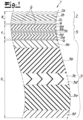
- the Fig. 1 shows a cross section through a polyolefin-based film composite 1 according to the invention. This comprises a first film layer 2 stretched monoaxially in the machine direction (x) and a second film layer 3 indirectly connected to the first film layer 2.
- the first film layer 2 is designed as a printing layer and has a printing layer 4 on the side facing the second film layer 3.
- This printing layer contains a mixture of a binder and printing pigments.
- the first film layer 2 is formed as a three-layer coextrusion film with a first outer layer 2a made of a blend containing PE-HD and PE-LMD, a core layer 2b made of a blend of PE-HD, LLD, and MD, and an inner layer 2c made of a 7 ⁇ m blend of PE-HD and LLD printed by the printing layer 4.
- the total thickness of the first film layer 2 is 25 ⁇ m with a total density of 0.94 g/cm 3 .
- a further film layer 5 is arranged in the form of a barrier layer.
- the barrier layer is designed as a symmetrical five-layer coextrusion film with a 9 ⁇ m thick first film layer 5a and fifth film layer 5e made of polyethylene. Adjacent to this are a 4 ⁇ m thick adhesion promoter layer as the second film layer 5b and fourth film layer 5d made of a polyethylene grafted with maleic anhydride.
- the core of the barrier layer 5 is formed by a 4 ⁇ m thick oxygen and grease barrier made of EVOH with an ethylene content of 32 wt.%.
- the first film layer 5a and the fifth film layer 5e are each fully laminated to the first layer 2 and the second layer 3 respectively using a polyurethane-based laminating adhesive layer 6.
- the second film layer 3 is arranged opposite the first film layer 2 on an outer side of the film composite 1 and is designed as a sealing layer. It is formed from a collapsed three-layer coextruded film bubble, resulting in a symmetrical six-layer structure:
- the first film layer 3a, facing the barrier layer 5, and the sixth film layer 3f of the second film layer 3 are formed from a blend of 65 wt.% PE-LLD-m and 35 wt.% of a PE plastomer with a thickness of 16 ⁇ m.
- the core layers of the sealing layer 3 are formed as the second layer 3b and the fifth layer 3e, 52 ⁇ m of a blend of 60 wt.% PE-HD, 25 wt.% of a bimodal PE-LMD, and 15 wt.% of a PE-LLD.
- the particularly high HDPE content improves the strength and rigidity of the sealing layer 3.
- the second film layer 3 comprises a third film layer 3c and a fourth film layer 3d, which are interlocked according to the invention.
- the third film layer 3c and the fourth film layer 3d are made of 100 wt.% EVA with a VA content of 18 wt.%. This high VA content improves the adhesive properties, particularly in the heated state at the time of interlocking.
- the two interlocked EVA layers 3c and 3d each have a thickness of 12 ⁇ m—i.e., a total thickness of 24 ⁇ m.
Landscapes
- Engineering & Computer Science (AREA)
- Mechanical Engineering (AREA)
- Chemical & Material Sciences (AREA)
- Chemical Kinetics & Catalysis (AREA)
- Laminated Bodies (AREA)
Priority Applications (7)
| Application Number | Priority Date | Filing Date | Title |
|---|---|---|---|
| PL21216749.8T PL4201670T3 (pl) | 2021-12-22 | 2021-12-22 | Wielowarstwowo zblokowany kompozyt folii |
| ES21216749T ES3031279T3 (en) | 2021-12-22 | 2021-12-22 | Multilayer interlocked film composite |
| HUE21216749A HUE072590T2 (hu) | 2021-12-22 | 2021-12-22 | Többrétegû blokkolt fólia kompozit |
| EP21216749.8A EP4201670B1 (de) | 2021-12-22 | 2021-12-22 | Mehrlagig verblockter folienverbund |
| MX2022016433A MX2022016433A (es) | 2021-12-22 | 2022-12-16 | Material compuesto de laminas adherido de multiples capas. |
| US18/084,259 US20230173797A1 (en) | 2021-02-21 | 2022-12-19 | Multilayer blocked film composite |
| CA3184463A CA3184463A1 (en) | 2021-12-22 | 2022-12-21 | Multilayer blocked film composite |
Applications Claiming Priority (1)
| Application Number | Priority Date | Filing Date | Title |
|---|---|---|---|
| EP21216749.8A EP4201670B1 (de) | 2021-12-22 | 2021-12-22 | Mehrlagig verblockter folienverbund |
Publications (3)
| Publication Number | Publication Date |
|---|---|
| EP4201670A1 EP4201670A1 (de) | 2023-06-28 |
| EP4201670C0 EP4201670C0 (de) | 2025-05-07 |
| EP4201670B1 true EP4201670B1 (de) | 2025-05-07 |
Family
ID=80118916
Family Applications (1)
| Application Number | Title | Priority Date | Filing Date |
|---|---|---|---|
| EP21216749.8A Active EP4201670B1 (de) | 2021-02-21 | 2021-12-22 | Mehrlagig verblockter folienverbund |
Country Status (7)
| Country | Link |
|---|---|
| US (1) | US20230173797A1 (pl) |
| EP (1) | EP4201670B1 (pl) |
| CA (1) | CA3184463A1 (pl) |
| ES (1) | ES3031279T3 (pl) |
| HU (1) | HUE072590T2 (pl) |
| MX (1) | MX2022016433A (pl) |
| PL (1) | PL4201670T3 (pl) |
Families Citing this family (1)
| Publication number | Priority date | Publication date | Assignee | Title |
|---|---|---|---|---|
| CN121340741A (zh) * | 2023-08-04 | 2026-01-16 | 江阴宝柏新型包装材料有限公司 | 高性能高适应性片材 |
Family Cites Families (2)
| Publication number | Priority date | Publication date | Assignee | Title |
|---|---|---|---|---|
| DE102018132333A1 (de) * | 2018-12-14 | 2020-06-18 | Mondi Ag | Kunststofffolienverbund, Folienverpackung und Verfahren zur Herstellung von Verpackungsgebinden |
| TWI841662B (zh) * | 2019-01-31 | 2024-05-11 | 美商陶氏全球科技有限責任公司 | 多層結構、用於製造多層結構之方法及相關製品 |
-
2021
- 2021-12-22 EP EP21216749.8A patent/EP4201670B1/de active Active
- 2021-12-22 PL PL21216749.8T patent/PL4201670T3/pl unknown
- 2021-12-22 HU HUE21216749A patent/HUE072590T2/hu unknown
- 2021-12-22 ES ES21216749T patent/ES3031279T3/es active Active
-
2022
- 2022-12-16 MX MX2022016433A patent/MX2022016433A/es unknown
- 2022-12-19 US US18/084,259 patent/US20230173797A1/en not_active Abandoned
- 2022-12-21 CA CA3184463A patent/CA3184463A1/en active Pending
Also Published As
| Publication number | Publication date |
|---|---|
| CA3184463A1 (en) | 2023-06-22 |
| MX2022016433A (es) | 2023-06-23 |
| ES3031279T3 (en) | 2025-07-07 |
| EP4201670C0 (de) | 2025-05-07 |
| HUE072590T2 (hu) | 2025-11-28 |
| US20230173797A1 (en) | 2023-06-08 |
| EP4201670A1 (de) | 2023-06-28 |
| PL4201670T3 (pl) | 2025-09-08 |
Similar Documents
| Publication | Publication Date | Title |
|---|---|---|
| AT519866B1 (de) | Recyclingfreundliches, einfach reißbares Verpackungslaminat mit guter Barrierewirkung und Verfahren zu dessen Herstellung | |
| EP0739713B2 (de) | Non-PVC-Mehrschichtfolie | |
| DE2339860C3 (de) | Laminierte coextrudierte Verbundfolien | |
| WO2018202479A1 (de) | Recyclingfreundliches, einfach reissbares verpackungslaminat mit guter barrierewirkung und verfahren zu dessen herstellung | |
| EP1885558B1 (de) | Coextrudierte mehrschichtige barrierefolie mit wenigstens einer folienlage aus ethylen-vinylalkohol-copolymerisat (evoh), verfahren zu ihrer herstellung und ihre verwendung | |
| EP3600889B1 (de) | Recycelfreundliches verpackungslaminat mit verbesserter wärmebeständigkeit beim siegeln | |
| DE102018132333A1 (de) | Kunststofffolienverbund, Folienverpackung und Verfahren zur Herstellung von Verpackungsgebinden | |
| EP1306209B1 (de) | Mehrschichtige, durch Coextrusion hergestellte Folie | |
| EP0171655B1 (de) | Schaumlaminatfolie oder -bahn | |
| EP2874811B1 (de) | Mehrschichtiges laminat für tuben mit eingebetteter barriereschicht sowie daraus hergestellte tube und verwendung eines solchen laminats | |
| EP3880473B1 (de) | Recyclingfreundliches verpackungslaminat mit guter barrierewirkung sowie niedriger dichte und verfahren zu dessen herstellung | |
| EP2094465B1 (de) | Verfahren zum herstellen eines mehrschichtigen laminats und mehrschichtiges laminat | |
| EP1258348B1 (de) | Polyolefinfolie mit peelfähiger Deckschicht | |
| EP3840951B1 (de) | Recyclingfreundliches, einfach reissbares verpackungslaminat mit guter barrierewirkung und verfahren zu dessen herstellung | |
| EP3995307A1 (de) | Polyethylenfilm | |
| EP4201670A1 (de) | Mehrlagig verblockter folienverbund | |
| DE102023104566A1 (de) | Hochbarriere-Verpackungslaminat mit verbesserter Maschinenverarbeitbarkeit | |
| DE102005029156B4 (de) | Laminat für Tuben- und Behälterkonstruktionen | |
| EP1365914B1 (de) | Etikettierfolie, verfahren zur herstellung derselben, sowie deren verwendung | |
| EP1213138B1 (de) | Verfahren zum Herstellen einer Verbundfolie | |
| DE102022131875A1 (de) | Laminat, insbesondere zur Herstellung von Verpackungen, Verwendung des Laminats zur Herstellung einer Verpackung sowie aus dem Laminat hergestellte Verpackung und Verfahren zur Herstellung des Laminats | |
| EP1132197A2 (de) | Längsgereckte im Vakuum bedampfte Verpackungsfolien | |
| DE3035474C2 (de) | Delaminierungsbeständiges, mehrschichtiges Gebilde sowie seine Verwendung zur Herstellung von Behältern | |
| DE102013214076A1 (de) | Mehrschichtige Kunststoff-Wirkstofffolie | |
| DE202025105940U1 (de) | Hochbarriere Verpackungslaminat |
Legal Events
| Date | Code | Title | Description |
|---|---|---|---|
| STAA | Information on the status of an ep patent application or granted ep patent |
Free format text: STATUS: EXAMINATION IS IN PROGRESS |
|
| PUAI | Public reference made under article 153(3) epc to a published international application that has entered the european phase |
Free format text: ORIGINAL CODE: 0009012 |
|
| 17P | Request for examination filed |
Effective date: 20220803 |
|
| AK | Designated contracting states |
Kind code of ref document: A1 Designated state(s): AL AT BE BG CH CY CZ DE DK EE ES FI FR GB GR HR HU IE IS IT LI LT LU LV MC MK MT NL NO PL PT RO RS SE SI SK SM TR |
|
| P01 | Opt-out of the competence of the unified patent court (upc) registered |
Effective date: 20230714 |
|
| GRAP | Despatch of communication of intention to grant a patent |
Free format text: ORIGINAL CODE: EPIDOSNIGR1 |
|
| STAA | Information on the status of an ep patent application or granted ep patent |
Free format text: STATUS: GRANT OF PATENT IS INTENDED |
|
| GRAS | Grant fee paid |
Free format text: ORIGINAL CODE: EPIDOSNIGR3 |
|
| INTG | Intention to grant announced |
Effective date: 20250210 |
|
| GRAA | (expected) grant |
Free format text: ORIGINAL CODE: 0009210 |
|
| STAA | Information on the status of an ep patent application or granted ep patent |
Free format text: STATUS: THE PATENT HAS BEEN GRANTED |
|
| AK | Designated contracting states |
Kind code of ref document: B1 Designated state(s): AL AT BE BG CH CY CZ DE DK EE ES FI FR GB GR HR HU IE IS IT LI LT LU LV MC MK MT NL NO PL PT RO RS SE SI SK SM TR |
|
| REG | Reference to a national code |
Ref country code: GB Ref legal event code: FG4D Free format text: NOT ENGLISH |
|
| REG | Reference to a national code |
Ref country code: CH Ref legal event code: EP |
|
| REG | Reference to a national code |
Ref country code: DE Ref legal event code: R096 Ref document number: 502021007397 Country of ref document: DE |
|
| REG | Reference to a national code |
Ref country code: IE Ref legal event code: FG4D Free format text: LANGUAGE OF EP DOCUMENT: GERMAN |
|
| U01 | Request for unitary effect filed |
Effective date: 20250521 |
|
| P04 | Withdrawal of opt-out of the competence of the unified patent court (upc) registered |
Free format text: CASE NUMBER: APP_24856/2025 Effective date: 20250524 |
|
| U07 | Unitary effect registered |
Designated state(s): AT BE BG DE DK EE FI FR IT LT LU LV MT NL PT RO SE SI Effective date: 20250528 |
|
| REG | Reference to a national code |
Ref country code: ES Ref legal event code: FG2A Ref document number: 3031279 Country of ref document: ES Kind code of ref document: T3 Effective date: 20250707 |
|
| PG25 | Lapsed in a contracting state [announced via postgrant information from national office to epo] |
Ref country code: GR Free format text: LAPSE BECAUSE OF FAILURE TO SUBMIT A TRANSLATION OF THE DESCRIPTION OR TO PAY THE FEE WITHIN THE PRESCRIBED TIME-LIMIT Effective date: 20250808 Ref country code: NO Free format text: LAPSE BECAUSE OF FAILURE TO SUBMIT A TRANSLATION OF THE DESCRIPTION OR TO PAY THE FEE WITHIN THE PRESCRIBED TIME-LIMIT Effective date: 20250807 |
|
| PG25 | Lapsed in a contracting state [announced via postgrant information from national office to epo] |
Ref country code: HR Free format text: LAPSE BECAUSE OF FAILURE TO SUBMIT A TRANSLATION OF THE DESCRIPTION OR TO PAY THE FEE WITHIN THE PRESCRIBED TIME-LIMIT Effective date: 20250507 |
|
| PG25 | Lapsed in a contracting state [announced via postgrant information from national office to epo] |
Ref country code: RS Free format text: LAPSE BECAUSE OF FAILURE TO SUBMIT A TRANSLATION OF THE DESCRIPTION OR TO PAY THE FEE WITHIN THE PRESCRIBED TIME-LIMIT Effective date: 20250807 |
|
| PG25 | Lapsed in a contracting state [announced via postgrant information from national office to epo] |
Ref country code: IS Free format text: LAPSE BECAUSE OF FAILURE TO SUBMIT A TRANSLATION OF THE DESCRIPTION OR TO PAY THE FEE WITHIN THE PRESCRIBED TIME-LIMIT Effective date: 20250907 |
|
| REG | Reference to a national code |
Ref country code: HU Ref legal event code: AG4A Ref document number: E072590 Country of ref document: HU |
|
| U20 | Renewal fee for the european patent with unitary effect paid |
Year of fee payment: 5 Effective date: 20251202 |
|
| PGFP | Annual fee paid to national office [announced via postgrant information from national office to epo] |
Ref country code: GB Payment date: 20251219 Year of fee payment: 5 |
|
| PG25 | Lapsed in a contracting state [announced via postgrant information from national office to epo] |
Ref country code: SM Free format text: LAPSE BECAUSE OF FAILURE TO SUBMIT A TRANSLATION OF THE DESCRIPTION OR TO PAY THE FEE WITHIN THE PRESCRIBED TIME-LIMIT Effective date: 20250507 |
|
| PGFP | Annual fee paid to national office [announced via postgrant information from national office to epo] |
Ref country code: HU Payment date: 20251223 Year of fee payment: 5 |
|
| PGFP | Annual fee paid to national office [announced via postgrant information from national office to epo] |
Ref country code: TR Payment date: 20251217 Year of fee payment: 5 |
|
| PG25 | Lapsed in a contracting state [announced via postgrant information from national office to epo] |
Ref country code: CZ Free format text: LAPSE BECAUSE OF FAILURE TO SUBMIT A TRANSLATION OF THE DESCRIPTION OR TO PAY THE FEE WITHIN THE PRESCRIBED TIME-LIMIT Effective date: 20250507 |
|
| PGFP | Annual fee paid to national office [announced via postgrant information from national office to epo] |
Ref country code: PL Payment date: 20251215 Year of fee payment: 5 |
|
| PG25 | Lapsed in a contracting state [announced via postgrant information from national office to epo] |
Ref country code: SK Free format text: LAPSE BECAUSE OF FAILURE TO SUBMIT A TRANSLATION OF THE DESCRIPTION OR TO PAY THE FEE WITHIN THE PRESCRIBED TIME-LIMIT Effective date: 20250507 |
|
| PLBE | No opposition filed within time limit |
Free format text: ORIGINAL CODE: 0009261 |
|
| STAA | Information on the status of an ep patent application or granted ep patent |
Free format text: STATUS: NO OPPOSITION FILED WITHIN TIME LIMIT |
|
| REG | Reference to a national code |
Ref country code: CH Ref legal event code: L10 Free format text: ST27 STATUS EVENT CODE: U-0-0-L10-L00 (AS PROVIDED BY THE NATIONAL OFFICE) Effective date: 20260318 |
|
| PGFP | Annual fee paid to national office [announced via postgrant information from national office to epo] |
Ref country code: ES Payment date: 20260130 Year of fee payment: 5 |
|
| 26N | No opposition filed |
Effective date: 20260210 |
|
| PG25 | Lapsed in a contracting state [announced via postgrant information from national office to epo] |
Ref country code: MC Free format text: LAPSE BECAUSE OF FAILURE TO SUBMIT A TRANSLATION OF THE DESCRIPTION OR TO PAY THE FEE WITHIN THE PRESCRIBED TIME-LIMIT Effective date: 20250507 |
|
| REG | Reference to a national code |
Ref country code: CH Ref legal event code: H13 Free format text: ST27 STATUS EVENT CODE: U-0-0-H10-H13 (AS PROVIDED BY THE NATIONAL OFFICE) Effective date: 20260723 |