EP4199149B1 - Wiederaufladbare batteriezelle - Google Patents
Wiederaufladbare batteriezelle Download PDFInfo
- Publication number
- EP4199149B1 EP4199149B1 EP21215533.7A EP21215533A EP4199149B1 EP 4199149 B1 EP4199149 B1 EP 4199149B1 EP 21215533 A EP21215533 A EP 21215533A EP 4199149 B1 EP4199149 B1 EP 4199149B1
- Authority
- EP
- European Patent Office
- Prior art keywords
- battery cell
- rechargeable battery
- sodium
- electrolyte
- group
- Prior art date
- Legal status (The legal status is an assumption and is not a legal conclusion. Google has not performed a legal analysis and makes no representation as to the accuracy of the status listed.)
- Active
Links
Images
Classifications
-
- H—ELECTRICITY
- H01—ELECTRIC ELEMENTS
- H01M—PROCESSES OR MEANS, e.g. BATTERIES, FOR THE DIRECT CONVERSION OF CHEMICAL ENERGY INTO ELECTRICAL ENERGY
- H01M10/00—Secondary cells; Manufacture thereof
- H01M10/05—Accumulators with non-aqueous electrolyte
- H01M10/056—Accumulators with non-aqueous electrolyte characterised by the materials used as electrolytes, e.g. mixed inorganic/organic electrolytes
- H01M10/0564—Accumulators with non-aqueous electrolyte characterised by the materials used as electrolytes, e.g. mixed inorganic/organic electrolytes the electrolyte being constituted of organic materials only
- H01M10/0566—Liquid materials
- H01M10/0567—Liquid materials characterised by the additives
-
- H—ELECTRICITY
- H01—ELECTRIC ELEMENTS
- H01M—PROCESSES OR MEANS, e.g. BATTERIES, FOR THE DIRECT CONVERSION OF CHEMICAL ENERGY INTO ELECTRICAL ENERGY
- H01M4/00—Electrodes
- H01M4/02—Electrodes composed of, or comprising, active material
- H01M4/36—Selection of substances as active materials, active masses, active liquids
- H01M4/38—Selection of substances as active materials, active masses, active liquids of elements or alloys
- H01M4/381—Alkaline or alkaline earth metals elements
-
- H—ELECTRICITY
- H01—ELECTRIC ELEMENTS
- H01M—PROCESSES OR MEANS, e.g. BATTERIES, FOR THE DIRECT CONVERSION OF CHEMICAL ENERGY INTO ELECTRICAL ENERGY
- H01M4/00—Electrodes
- H01M4/02—Electrodes composed of, or comprising, active material
- H01M4/36—Selection of substances as active materials, active masses, active liquids
- H01M4/38—Selection of substances as active materials, active masses, active liquids of elements or alloys
-
- H—ELECTRICITY
- H01—ELECTRIC ELEMENTS
- H01M—PROCESSES OR MEANS, e.g. BATTERIES, FOR THE DIRECT CONVERSION OF CHEMICAL ENERGY INTO ELECTRICAL ENERGY
- H01M10/00—Secondary cells; Manufacture thereof
- H01M10/05—Accumulators with non-aqueous electrolyte
- H01M10/054—Accumulators with insertion or intercalation of metals other than lithium, e.g. with magnesium or aluminium
-
- H—ELECTRICITY
- H01—ELECTRIC ELEMENTS
- H01M—PROCESSES OR MEANS, e.g. BATTERIES, FOR THE DIRECT CONVERSION OF CHEMICAL ENERGY INTO ELECTRICAL ENERGY
- H01M10/00—Secondary cells; Manufacture thereof
- H01M10/05—Accumulators with non-aqueous electrolyte
- H01M10/056—Accumulators with non-aqueous electrolyte characterised by the materials used as electrolytes, e.g. mixed inorganic/organic electrolytes
- H01M10/0561—Accumulators with non-aqueous electrolyte characterised by the materials used as electrolytes, e.g. mixed inorganic/organic electrolytes the electrolyte being constituted of inorganic materials only
- H01M10/0563—Liquid materials, e.g. for Li-SOCl2 cells
-
- H—ELECTRICITY
- H01—ELECTRIC ELEMENTS
- H01M—PROCESSES OR MEANS, e.g. BATTERIES, FOR THE DIRECT CONVERSION OF CHEMICAL ENERGY INTO ELECTRICAL ENERGY
- H01M10/00—Secondary cells; Manufacture thereof
- H01M10/05—Accumulators with non-aqueous electrolyte
- H01M10/056—Accumulators with non-aqueous electrolyte characterised by the materials used as electrolytes, e.g. mixed inorganic/organic electrolytes
- H01M10/0564—Accumulators with non-aqueous electrolyte characterised by the materials used as electrolytes, e.g. mixed inorganic/organic electrolytes the electrolyte being constituted of organic materials only
- H01M10/0566—Liquid materials
- H01M10/0568—Liquid materials characterised by the solutes
-
- H—ELECTRICITY
- H01—ELECTRIC ELEMENTS
- H01M—PROCESSES OR MEANS, e.g. BATTERIES, FOR THE DIRECT CONVERSION OF CHEMICAL ENERGY INTO ELECTRICAL ENERGY
- H01M4/00—Electrodes
- H01M4/02—Electrodes composed of, or comprising, active material
- H01M4/36—Selection of substances as active materials, active masses, active liquids
- H01M4/58—Selection of substances as active materials, active masses, active liquids of inorganic compounds other than oxides or hydroxides, e.g. sulfides, selenides, tellurides, halogenides or LiCoFy; of polyanionic structures, e.g. phosphates, silicates or borates
-
- H—ELECTRICITY
- H01—ELECTRIC ELEMENTS
- H01M—PROCESSES OR MEANS, e.g. BATTERIES, FOR THE DIRECT CONVERSION OF CHEMICAL ENERGY INTO ELECTRICAL ENERGY
- H01M4/00—Electrodes
- H01M4/02—Electrodes composed of, or comprising, active material
- H01M4/36—Selection of substances as active materials, active masses, active liquids
- H01M4/58—Selection of substances as active materials, active masses, active liquids of inorganic compounds other than oxides or hydroxides, e.g. sulfides, selenides, tellurides, halogenides or LiCoFy; of polyanionic structures, e.g. phosphates, silicates or borates
- H01M4/583—Carbonaceous material, e.g. graphite-intercalation compounds or CFx
-
- H—ELECTRICITY
- H01—ELECTRIC ELEMENTS
- H01M—PROCESSES OR MEANS, e.g. BATTERIES, FOR THE DIRECT CONVERSION OF CHEMICAL ENERGY INTO ELECTRICAL ENERGY
- H01M4/00—Electrodes
- H01M4/02—Electrodes composed of, or comprising, active material
- H01M4/62—Selection of inactive substances as ingredients for active masses, e.g. binders, fillers
- H01M4/624—Electric conductive fillers
- H01M4/626—Metals
-
- H—ELECTRICITY
- H01—ELECTRIC ELEMENTS
- H01M—PROCESSES OR MEANS, e.g. BATTERIES, FOR THE DIRECT CONVERSION OF CHEMICAL ENERGY INTO ELECTRICAL ENERGY
- H01M4/00—Electrodes
- H01M4/02—Electrodes composed of, or comprising, active material
- H01M4/64—Carriers or collectors
- H01M4/66—Selection of materials
- H01M4/661—Metal or alloys, e.g. alloy coatings
- H01M4/662—Alloys
-
- H—ELECTRICITY
- H01—ELECTRIC ELEMENTS
- H01M—PROCESSES OR MEANS, e.g. BATTERIES, FOR THE DIRECT CONVERSION OF CHEMICAL ENERGY INTO ELECTRICAL ENERGY
- H01M4/00—Electrodes
- H01M4/02—Electrodes composed of, or comprising, active material
- H01M4/64—Carriers or collectors
- H01M4/66—Selection of materials
- H01M4/665—Composites
-
- H—ELECTRICITY
- H01—ELECTRIC ELEMENTS
- H01M—PROCESSES OR MEANS, e.g. BATTERIES, FOR THE DIRECT CONVERSION OF CHEMICAL ENERGY INTO ELECTRICAL ENERGY
- H01M4/00—Electrodes
- H01M4/02—Electrodes composed of, or comprising, active material
- H01M2004/026—Electrodes composed of, or comprising, active material characterised by the polarity
- H01M2004/027—Negative electrodes
-
- H—ELECTRICITY
- H01—ELECTRIC ELEMENTS
- H01M—PROCESSES OR MEANS, e.g. BATTERIES, FOR THE DIRECT CONVERSION OF CHEMICAL ENERGY INTO ELECTRICAL ENERGY
- H01M4/00—Electrodes
- H01M4/02—Electrodes composed of, or comprising, active material
- H01M2004/026—Electrodes composed of, or comprising, active material characterised by the polarity
- H01M2004/028—Positive electrodes
-
- H—ELECTRICITY
- H01—ELECTRIC ELEMENTS
- H01M—PROCESSES OR MEANS, e.g. BATTERIES, FOR THE DIRECT CONVERSION OF CHEMICAL ENERGY INTO ELECTRICAL ENERGY
- H01M2300/00—Electrolytes
- H01M2300/0017—Non-aqueous electrolytes
- H01M2300/002—Inorganic electrolyte
-
- H—ELECTRICITY
- H01—ELECTRIC ELEMENTS
- H01M—PROCESSES OR MEANS, e.g. BATTERIES, FOR THE DIRECT CONVERSION OF CHEMICAL ENERGY INTO ELECTRICAL ENERGY
- H01M4/00—Electrodes
- H01M4/02—Electrodes composed of, or comprising, active material
- H01M4/36—Selection of substances as active materials, active masses, active liquids
- H01M4/48—Selection of substances as active materials, active masses, active liquids of inorganic oxides or hydroxides
- H01M4/483—Selection of substances as active materials, active masses, active liquids of inorganic oxides or hydroxides for non-aqueous cells
-
- H—ELECTRICITY
- H01—ELECTRIC ELEMENTS
- H01M—PROCESSES OR MEANS, e.g. BATTERIES, FOR THE DIRECT CONVERSION OF CHEMICAL ENERGY INTO ELECTRICAL ENERGY
- H01M4/00—Electrodes
- H01M4/02—Electrodes composed of, or comprising, active material
- H01M4/36—Selection of substances as active materials, active masses, active liquids
- H01M4/48—Selection of substances as active materials, active masses, active liquids of inorganic oxides or hydroxides
- H01M4/485—Selection of substances as active materials, active masses, active liquids of inorganic oxides or hydroxides of mixed oxides or hydroxides for inserting or intercalating light metals, e.g. LiTi2O4 or LiTi2OxFy
-
- H—ELECTRICITY
- H01—ELECTRIC ELEMENTS
- H01M—PROCESSES OR MEANS, e.g. BATTERIES, FOR THE DIRECT CONVERSION OF CHEMICAL ENERGY INTO ELECTRICAL ENERGY
- H01M4/00—Electrodes
- H01M4/02—Electrodes composed of, or comprising, active material
- H01M4/36—Selection of substances as active materials, active masses, active liquids
- H01M4/48—Selection of substances as active materials, active masses, active liquids of inorganic oxides or hydroxides
- H01M4/52—Selection of substances as active materials, active masses, active liquids of inorganic oxides or hydroxides of nickel, cobalt or iron
- H01M4/525—Selection of substances as active materials, active masses, active liquids of inorganic oxides or hydroxides of nickel, cobalt or iron of mixed oxides or hydroxides containing iron, cobalt or nickel for inserting or intercalating light metals, e.g. LiNiO2, LiCoO2 or LiCoOxFy
-
- H—ELECTRICITY
- H01—ELECTRIC ELEMENTS
- H01M—PROCESSES OR MEANS, e.g. BATTERIES, FOR THE DIRECT CONVERSION OF CHEMICAL ENERGY INTO ELECTRICAL ENERGY
- H01M4/00—Electrodes
- H01M4/02—Electrodes composed of, or comprising, active material
- H01M4/36—Selection of substances as active materials, active masses, active liquids
- H01M4/58—Selection of substances as active materials, active masses, active liquids of inorganic compounds other than oxides or hydroxides, e.g. sulfides, selenides, tellurides, halogenides or LiCoFy; of polyanionic structures, e.g. phosphates, silicates or borates
- H01M4/581—Chalcogenides or intercalation compounds thereof
- H01M4/5815—Sulfides
-
- H—ELECTRICITY
- H01—ELECTRIC ELEMENTS
- H01M—PROCESSES OR MEANS, e.g. BATTERIES, FOR THE DIRECT CONVERSION OF CHEMICAL ENERGY INTO ELECTRICAL ENERGY
- H01M4/00—Electrodes
- H01M4/02—Electrodes composed of, or comprising, active material
- H01M4/36—Selection of substances as active materials, active masses, active liquids
- H01M4/58—Selection of substances as active materials, active masses, active liquids of inorganic compounds other than oxides or hydroxides, e.g. sulfides, selenides, tellurides, halogenides or LiCoFy; of polyanionic structures, e.g. phosphates, silicates or borates
- H01M4/583—Carbonaceous material, e.g. graphite-intercalation compounds or CFx
- H01M4/587—Carbonaceous material, e.g. graphite-intercalation compounds or CFx for inserting or intercalating light metals
-
- H—ELECTRICITY
- H01—ELECTRIC ELEMENTS
- H01M—PROCESSES OR MEANS, e.g. BATTERIES, FOR THE DIRECT CONVERSION OF CHEMICAL ENERGY INTO ELECTRICAL ENERGY
- H01M4/00—Electrodes
- H01M4/02—Electrodes composed of, or comprising, active material
- H01M4/64—Carriers or collectors
- H01M4/66—Selection of materials
- H01M4/661—Metal or alloys, e.g. alloy coatings
-
- Y—GENERAL TAGGING OF NEW TECHNOLOGICAL DEVELOPMENTS; GENERAL TAGGING OF CROSS-SECTIONAL TECHNOLOGIES SPANNING OVER SEVERAL SECTIONS OF THE IPC; TECHNICAL SUBJECTS COVERED BY FORMER USPC CROSS-REFERENCE ART COLLECTIONS [XRACs] AND DIGESTS
- Y02—TECHNOLOGIES OR APPLICATIONS FOR MITIGATION OR ADAPTATION AGAINST CLIMATE CHANGE
- Y02E—REDUCTION OF GREENHOUSE GAS [GHG] EMISSIONS, RELATED TO ENERGY GENERATION, TRANSMISSION OR DISTRIBUTION
- Y02E60/00—Enabling technologies; Technologies with a potential or indirect contribution to GHG emissions mitigation
- Y02E60/10—Energy storage using batteries
Definitions
- the invention relates to a rechargeable battery cell comprising sodium as active metal.
- Rechargeable battery cells are of great importance in many technical fields. They are often used for applications where only small rechargeable battery cells with relatively low currents are required, such as for operating mobile phones. However, there is also a great need for larger rechargeable battery cells for high-energy applications, whereby mass storage of energy in the form of battery cells is of particular importance for the electric drive of vehicles.
- the active metal of a rechargeable battery cell is the metal whose ions migrate to the negative or positive electrode within the electrolyte when the cell is charged or discharged and participate in electrochemical processes there. These electrochemical processes lead directly or indirectly to the release of electrons into the external circuit or to the absorption of electrons from the external circuit.
- Active metals can be lithium or sodium, as mentioned above.
- Rechargeable battery cells that contain lithium or sodium as the active metal are also called lithium-ion cells or sodium-ion cells.
- Lithium-ion cells have been known for a long time and are described in detail in the state of the art.
- sodium-ion cells have only been the focus of research since 2010 and are described in more detail below. Most research activities have been devoted to the discovery of high-performance anodes to increase the energy density of sodium-ion batteries, since graphite, the main material used in lithium-ion cells, has a much lower storage capacity for sodium compared to lithium.
- the sodium ion cell has a housing in which at least one positive electrode with a discharge element, at least one negative electrode with a discharge element and an electrolyte are arranged.
- Both the positive and the negative electrode of the sodium ion cells known from the prior art are designed as insertion electrodes.
- the term "insertion electrode” in the sense of the present invention refers to electrodes which have a crystal structure into which ions of the active metal can be inserted and removed during operation of the sodium ion cell. This means that the electrode processes can take place not only on the surface of the electrodes, but also within the crystal structure.
- the electrolyte is also an important functional element of every rechargeable battery cell. It usually contains a solvent or solvent mixture and at least one conducting salt. Solid electrolytes or ionic liquids, for example, do not contain a solvent, but only a conducting salt.
- the electrolyte is in contact with the positive and negative electrodes of the battery cell. At least one ion of the conducting salt (anion or cation) is so mobile in the electrolyte that the charge transport required for the function of the rechargeable battery cell can take place between the electrodes through ion conduction.
- the electrolyte is oxidatively electrochemically decomposed above a certain upper cell voltage of the rechargeable battery cell.
- Reductive processes can also decompose the electrolyte above a certain lower cell voltage.
- the positive and negative electrodes are selected such that the cell voltage is below or above the decomposition voltage of the electrolyte. The electrolyte thus determines the voltage window within which a rechargeable battery cell can be operated reversibly, i.e. repeatedly charged and discharged.
- the organic sodium ion cells known from the prior art contain an electrolyte consisting of an organic solvent or solvent mixture and a conducting salt dissolved therein.
- the conducting salt is a sodium salt such as sodium perchlorate (NaClO 4 ) or sodium hexafluorophosphate (NaPF 6 ).
- the organic solvent mixture can be, for example, propylene carbonate (PC).
- Solvent mixtures can be ethylene carbonate (EC), diethyl carbonate (DEC) or dimethyl carbonate (DMC). For example, the following mixtures are used: EC:DEC, EC:PC or EC:DMC.
- organic sodium ion cells Due to the use of the organic solvent or solvent mixture, such sodium ion cells are also called organic sodium ion cells.
- a suitable negative electrode for organic sodium ion cells consists, for example, of carbon in the hard carbon modification.
- Hard carbon has a capacity of 300 mAh/g and a cycle efficiency in the first cycle of 80%.
- Positive electrodes of the organic sodium ion cell can consist of layered oxides such as NaMeO x or polyanionic compounds such as phosphates (NaMePO 4 ), pyrophosphates (Na 2 MeP 2 O 7 ) and fluorophosphates (Na 2 Me(PO) 4 F), where "Me” stands for a transition metal.
- Sodium is a very electronegative metal (-2.71 V vs. standard hydrogen electrode, SHE), which creates a very high cell voltage against a positive electrode.
- SHE standard hydrogen electrode
- the reduction of the organic electrolyte takes place.
- This reductive decomposition is irreversible.
- No organic solvents are thermodynamically stable towards sodium or towards sodium stored in carbon.
- many solvents form a passivation film on the electrode surface of the negative electrode. This film spatially separates the solvent from the electrode, but is ionically conductive, allowing the passage of sodium ions.
- the passivation film called the " S olid E lectrolyte I nterphase" (SEI) provides stability to the system, enabling the production of organic sodium-ion cells.
- SEI S olid E lectrolyte I nterphase
- organic sodium-ion cells If an organic sodium-ion cell catches fire or even explodes, the organic solvent of the electrolyte forms a flammable material.
- Another disadvantage of organic sodium-ion cells is the decomposition of the organic components of the SEI layer and the associated associated release of toxic gases. This also causes the cell to heat up further.
- additional measures must be taken. These measures include, in particular, very precise control of the charging and discharging processes of the organic sodium-ion cell.
- the additional measures are considered to be disadvantageous in the event of a possible marketing.
- a further development known from the state of the art provides for the use of an electrolyte based on sulfur dioxide (SO 2 ) instead of an organic electrolyte for rechargeable battery cells.
- Rechargeable battery cells which contain an electrolyte based on SO 2 have, among other things, a high ionic conductivity.
- SO 2 -based electrolyte refers to an electrolyte which not only contains SO 2 as an additive in a low concentration, but in which the mobility of the ions of the conductive salt contained in the electrolyte and which causes the charge transport is at least partially, largely or even completely ensured by SO 2.
- the SO 2 therefore serves as a solvent for the conductive salt.
- the conductive salt can form a liquid solvate complex with the gaseous SO 2 , whereby the SO 2 is bound and the vapor pressure is noticeably reduced compared to pure SO 2. Electrolytes with a low vapor pressure are created. Compared to the organic electrolytes described above, such SO 2 -based electrolytes have the advantage of being non-flammable. Safety risks that arise due to the flammability of the electrolyte can thus be excluded.
- the EP 3 772 129 A1 (referred to as [V4]) a new group of conducting salts for SO 2 -based electrolytes.
- These conducting salts consist of an anion with four substituted hydroxy groups grouped around the central atom boron or aluminum and a cation consisting of the active metal of the cell. All examples show experiments exclusively with lithium salts of this type.
- EP 3 794 666 A1 also discloses a rechargeable battery cell comprising an SO 2 -based electrolyte and an aluminate or borate salt as the first conductive salt. Lithium is used exclusively as the active metal.
- a problem with SO 2 -based electrolytes is that many conductive salts, especially those known for organic sodium ion cells, are not soluble in SO 2 and thus such conductive salts are unsuitable for use in rechargeable sodium ion cells with an SO 2 -based electrolyte.
- Such rechargeable battery cells should in particular also have very good electrical energy and performance data, high operational reliability and service life, in particular a high number of usable charging and discharging cycles, without the electrolyte decomposing during operation of the rechargeable battery cell.
- the formulation "chelate ligand which is formed jointly by at least two of the substituents R 1 , R 2 , R 3 and R 4 and is coordinated to Z" is to be understood in the sense of the present invention that at least two of the substituents R 1 , R 2 , R 3 and R 4 can be bridged to one another, this bridging of two substituents leading to the formation of a bidentate chelate ligand.
- the chelate ligand can be bidentate according to the formula -OR 5 -O-.
- the first substituent R 1 can preferably be an OR 5 group and the second substituent R 2 can preferably be a hydroxy group, which in their bridged state are connected to one another by forming a chemical bond. and therefore have the aforementioned formula -OR 5 -O-.
- Such chelate ligands can, for example, have the following structural formulas:
- the chelate ligand coordinates to the central atom Z to form a chelate complex.
- the two oxygen atoms coordinate to the central atom Z.
- Such chelate complexes can be prepared synthetically as in Example 1 described below.
- the term "chelate complex” refers to complex compounds in which a multidentate ligand (has more than one free electron pair) occupies at least two coordination sites (binding sites) of the central atom.
- the chelate ligand can also be multidentate if three or four of the substituents R 1 , R 2 , R 3 and R 4 are each bridged to one another.
- the SO 2 -based electrolyte used in the rechargeable battery cell according to the invention contains SO 2 not only as an additive in a low concentration, but in concentrations at which the mobility of the ions of the first conducting salt, which is contained in the electrolyte and effects the charge transport, is at least partially, largely or even completely ensured by the SO 2.
- the first conducting salt is dissolved in the electrolyte and shows very good solubility therein. It can form a liquid solvate complex with the gaseous SO 2 in which the SO 2 is bound. In this case, the vapor pressure of the liquid solvate complex drops significantly compared to pure SO 2 and electrolytes with a low vapor pressure are formed.
- the electrolyte can also contain several conductive salts of formula (I) which differ from one another in their chemical structure.
- the term "C 1 -C 10 alkyl" in the sense of the present invention includes linear or branched saturated hydrocarbon groups with one to ten carbon atoms.
- n-propyl examples include in particular methyl, ethyl, n-propyl, isopropyl, n-butyl, sec-butyl, iso-butyl, tert-butyl, n-pentyl, iso-pentyl, 2,2-dimethylpropyl, n-hexyl, iso-hexyl, 2-ethylhexyl, n-heptyl, iso-heptyl, n-octyl, iso-octyl, n-nonyl, n-decyl and the like.
- C 2 -C 10 alkenyl in the sense of the present invention includes unsaturated linear or branched hydrocarbon groups having two to ten carbon atoms, where the hydrocarbon groups have at least one CC double bond. These include in particular ethenyl, 1-propenyl, 2-propenyl, 1-n-butenyl, 2-n-butenyl, isobutenyl, 1-pentenyl, 1-hexenyl, 1-heptenyl, 1-octenyl, 1-nonenyl, 1-decenyl and the like.
- C 2 -C 10 alkynyl in the sense of the present invention includes unsaturated linear or branched hydrocarbon groups having two to ten carbon atoms, where the hydrocarbon groups have at least one CC triple bond.
- these include in particular ethynyl, 1-propynyl, 2-propynyl, 1-n-butynyl, 2-n-butynyl, isobutynyl, 1-pentynyl, 1-hexynyl, 1-heptynyl, 1-octynyl, 1-nonynyl, 1-decynyl and the like.
- C 3 -C 10 cycloalkyl in the sense of the present invention includes cyclic, saturated hydrocarbon groups having three to ten carbon atoms. These include in particular cyclopropyl, cyclobutyl, cyclopentyl, cyclohexyl, cycloheptyl, cyclohexyl, cyclononyl and cyclodecanyl.
- C 6 -C 14 aryl in the sense of the present invention includes aromatic hydrocarbon groups with six to fourteen ring carbon atoms. These include in particular phenyl (C 6 H 5 group), naphthyl (C 10 H 7 group) and anthracyl (C 14 H 9 group).
- C 5 - C 14 heteroaryl in the sense of the present invention includes aromatic hydrocarbon groups with five to fourteen ring-positioned hydrocarbon atoms in which at least one hydrocarbon atom is replaced or exchanged by a nitrogen, oxygen or sulfur atom.
- aromatic hydrocarbon groups with five to fourteen ring-positioned hydrocarbon atoms in which at least one hydrocarbon atom is replaced or exchanged by a nitrogen, oxygen or sulfur atom.
- hydrocarbon groups include in particular pyrrolyl, furanyl, thiophenyl, pyrridinyl, pyranyl, thiopyranyl and the like. All of the aforementioned hydrocarbon groups are each bonded to the central atom according to formula (I) via the oxygen atom.
- the aliphatic, cyclic, aromatic and heteroaromatic radicals/groups can be unsubstituted or substituted.
- substitution one or more hydrogen atoms of the aliphatic, cyclic, aromatic and heteroaromatic radicals/groups are replaced by an atom, such as fluorine or chlorine, or a chemical group, such as CF 3 .
- the rechargeable battery cell according to the invention uses inexpensive and readily available sodium as the active metal and thus has the first major advantage over the lithium-ion cells known from the prior art.
- the rechargeable battery cell according to the invention with such an electrolyte has the advantage over rechargeable battery cells with SO 2 -based electrolytes with sodium conducting salts known from the prior art that the first conducting salt of the formula (I) contained therein has a higher oxidation stability and consequently shows essentially no decomposition at higher cell voltages.
- This electrolyte is oxidation-stable preferably at least up to an upper potential of 3.6 volts, more preferably at least up to an upper potential of 3.8 volts, more preferably at least up to an upper potential of 4.0 volts, more preferably at least up to an upper potential of 4.2 volts, more preferably at least up to an upper potential of 4.4 volts and particularly preferably at least up to an upper potential of 4.6 volts.
- the service life of the rechargeable battery cell according to the invention is significantly extended compared to rechargeable battery cells that contain electrolytes known from the prior art.
- the rechargeable battery cell according to the invention with such an electrolyte is also resistant to low temperatures.
- the conductivity of the electrolyte at low temperatures is sufficient to operate a battery cell.
- the rechargeable battery cell according to the invention comprising the electrolyte outweigh the disadvantage that arises from the fact that the first conducting salt of formula (I) has a significantly larger anion size compared to the sodium conducting salts known from the prior art. This larger anion size leads to a lower conductivity of the first conducting salt according to formula (I) compared to the conductivity of NaAlCl 4 .
- an advantageous development of the rechargeable battery cell according to the invention provides that the active material of the negative electrode consists of metallic sodium and/or at least one sodium-storing material selected from the group consisting of insertion materials, adsorption materials, alloy-forming materials and conversion materials.
- the active material of the negative electrode is metallic sodium.
- the negative electrode also comprises a discharge element. This discharge element serves to enable the required electronically conductive connection of the active material of the negative electrode.
- the discharge element is in contact with the active material involved in the electrode reaction of the negative electrode.
- a further advantageous development of the rechargeable battery cell according to the invention with metallic sodium as the active material of the negative electrode provides that the electronically conductive discharge element of the negative electrode already comprises metallic sodium before the first charging of the rechargeable battery cell, which was applied to the discharge element before the battery cell was assembled and built into the battery cell together with it, or which was deposited on the discharge element of the negative electrode by a preceding initialization charging process before the battery cell was operated, i.e. before the first charging and discharging.
- a further advantageous development of the battery cell according to the invention with metallic sodium as the active material of the negative electrode provides that the discharge element of the negative electrode is at least partially made of a sodium-storing material.
- the active material of the negative electrode consists of at least a sodium-storing material selected from the group consisting of insertion materials, adsorption materials, alloy-forming materials and conversion materials.
- the term “insertion materials” refers to materials in which the ions of the active metal are stored during charging of the rechargeable battery cell and from which the ions of the active metal can be removed during discharging of the rechargeable battery cell. This means that the electrode processes can take place not only on the surface of the negative electrode, but also inside the negative electrode.
- the term “adsorption materials” refers to materials which, in contrast to insertion materials, which have a structure into which the ions of the active metal can be stored and removed during operation of the sodium ion cell, in the case of adsorption materials the ions are deposited on the surface. In many materials, insertion and adsorption also take place simultaneously.
- alloy-forming materials refers to materials which are generally metals and metal alloys as well as their oxides which form an alloy with the active metal, such as sodium, whereby this alloy formation takes place in or on the negative electrode and is essentially reversible.
- the active metal in the alloys is not incorporated into an already existing structure. Rather, the active metal is incorporated via phase transformation processes which, for example, when sodium is used as the active metal, can lead to a sodium-containing, binary end product. During alloy formation, the active material can expand.
- conversion materials refers to materials which undergo a chemical conversion or transformation during the electrode processes, which leads to the reversible formation of a chemical bond between the active metal and the active material.
- the sodium-storing material can preferably be the insertion material containing carbon.
- insertion materials made of carbon in the sense of the present invention refers to materials made of the element carbon that fall under the term "insertion materials” defined above.
- the insertion material containing carbon is selected from the group consisting of hard carbon, soft carbon, graphene or heteroatom-doped carbons. Hard carbon can be synthesized from the carbonization of a variety of precursors such as biomass, lignin, cellulose and many types of polymers.
- Carbonaceous materials from fossil fuels are generally considered soft (graphitizable) and describe the group of soft carbons.
- Heteroatom-doped carbons are carbons that contain additional atoms in their structure or on the surface in addition to the carbon atoms, for example nitrogen, oxygen, sulfur or phosphorus.
- a further advantageous development of the rechargeable battery cell according to the invention provides that the insertion material containing carbon is hard carbon.
- a further advantageous development of the rechargeable battery cell according to the invention provides that the insertion material containing carbon is soft carbon.
- a further advantageous development of the rechargeable battery cell according to the invention provides that the insertion material containing carbon is graphene.
- a further advantageous development of the rechargeable battery cell according to the invention provides that the insertion material containing carbon is heteroatom-doped carbon.
- a further advantageous development of the rechargeable battery cell according to the invention provides that the sodium ions can also be adsorbed on the surface.
- the sodium-storing material of the negative electrode consists of at least one carbon-free insertion material, such as sodium titanates, in particular Na 2 Ti 3 O 7 or NaTi 2 (PO 4 ) 3 .
- carbon-free insertion materials in the sense of the present invention means materials made of an element other than carbon, which fall under the term "insertion materials" defined above.
- the sodium-storing material of the negative electrode consists of at least one sodium alloy-forming material.
- the term "sodium alloy-forming material" in the sense of the present invention refers to alloy-forming materials as defined above that form an alloy with sodium.
- alloy-forming materials for example, sodium-storing metals and metal alloys (eg Sn, Sb) can be used.
- sulfides or oxides of the sodium-storing metals and metal alloys eg SnS x , SbS x , oxide glasses of Sn, Sb and the like) can be used as alloy-forming materials.
- a further advantageous development of the rechargeable battery cell according to the invention provides that the anode active materials that form alloys with sodium already contain sodium before use in a battery cell. This measure reduces the capacity losses, e.g. due to the formation of a covering layer in the first cycle.
- the sodium-storing material of the negative electrode consists of at least one sodium-storing material which is a conversion material as defined above.
- the conversion material can be selected from the group consisting of sulfides, oxides, selenides and fluorides of the metals Ti, V, Cr, Mn, Fe, Co, Ni, Cu and Zn, in particular iron sulfides (FeS x ), iron selenides (FeSe x ), iron fluorides (FeF x ), iron oxides (FeO x ), cobalt oxides (CoO x ), nickel oxides (NiO x ) and copper oxides (CuO x ).
- the negative electrode consists of a combination of the sodium-storing materials described above.
- a combination of tin (Sb) and/or tin sulfide (SnS x ) and hard carbon could be used.
- the negative electrode is porous, wherein the porosity is preferably at most 50%, more preferably at most 45%, more preferably at most 40%, more preferably at most 35%, more preferably at most 30%, more preferably at most 20% and particularly preferably at most 10%.
- the porosity represents the void volume to the total volume of the negative electrode, wherein the void volume is formed by so-called pores or cavities. This porosity leads to an increase in the inner surface of the negative electrode. Furthermore, the porosity reduces the density of the negative electrode and thus also its weight.
- the individual pores of the negative electrode can preferably be completely filled with the electrolyte during operation.
- the negative electrode has a discharge element.
- the negative electrode also comprises a discharge element in addition to the active material or insertion material.
- This discharge element serves to provide the required electronically conductive connection of the active material of the negative electrode.
- the discharge element is in contact with the active material involved in the electrode reaction of the negative electrode.
- This discharge element can be planar in the form of a thin metal sheet or a thin metal foil.
- the thin metal foil preferably has a perforated or net-like structure.
- the planar discharge element can also consist of a plastic film coated with metal. These metal coatings have a thickness in the range of 0.1 ⁇ m to 20 ⁇ m.
- the active material of the negative electrode is preferably applied to the surface of the thin metal sheet, the thin metal foil or the plastic film coated with metal.
- the active material can be applied to the front and/or the back of the planar discharge element.
- planar discharge elements have a thickness in the range of 5 ⁇ m to 50 ⁇ m.
- a thickness of the planar discharge element in the range of 10 ⁇ m to 30 ⁇ m is preferred.
- the negative electrode can have a total thickness of at least 20 ⁇ m, preferably at least 40 ⁇ m and particularly preferably at least 60 ⁇ m.
- the maximum thickness is at most 200 ⁇ m, preferably at most 150 ⁇ m and particularly preferably at most 100 ⁇ m.
- the area-specific capacity of the negative electrode based on the coating of one side is preferably at least 0.5 mAh/cm 2 , with the following values being more preferred in this order: 1 mAh/cm 2 , 3 mAh/cm 2 , 5 mAh/cm 2 , 10 mAh/cm 2 , 15 mAh/cm 2 , 20 mAh/cm 2 .
- the discharge element can be designed three-dimensionally in the form of a porous metal structure, in particular in the form of a metal foam.
- three-dimensional porous metal structure refers to any structure made of metal that not only extends over the length and width of the flat electrode like the thin metal sheet or metal foil, but also over its thickness.
- the three-dimensional porous metal structure is so porous that the active material of the negative electrode can be incorporated into the pores of the metal structure.
- the amount of incorporated or applied active material is the load of the negative electrode.
- the discharge element is designed three-dimensionally in the form of a porous metal structure, in particular in the form of a metal foam, then the negative electrode preferably has a thickness of at least 0.2 mm, preferably at least 0.3 mm, more preferably at least 0.4 mm, more preferably at least 0.5 mm and particularly preferably at least 0.6 mm.
- the thickness of the electrodes in this case is significantly greater compared to negative electrodes that are used in organic sodium ion cells.
- the area-specific capacity of the negative electrode at the use of a three-dimensional discharge element, in particular in the form of a metal foam is preferably at least 2.5 mAh/cm 2 , the following values being further preferred in this order: 5 mAh/cm 2 , 15 mAh/cm 2 , 25 mAh/cm 2 , 35 mAh/cm 2 , 45 mAh/cm 2 , 55 mAh/cm 2 , 65 mAh/cm 2 , 75 mAh/cm 2 .
- the amount of active material of the negative electrode ie the loading of the electrode, based on its area, is at least 10 mg/cm 2 , preferably at least 20 mg/cm 2 , more preferably at least 40 mg/cm 2 , more preferably at least 60 mg/cm 2 , more preferably at least 80 mg/cm 2 and particularly preferably at least 100 mg/cm 2 .
- This loading of the negative electrode has a positive effect on the charging process and the discharging process of the rechargeable battery cell.
- the discharge element of the negative electrode can be made of nickel or copper, for example.
- the potential of the active metal sodium is slightly higher than the potential of the active metal lithium, which is used in lithium-ion batteries, for example. This means that a discharge element made of aluminum can also be used for sodium cells without the sodium alloying with the aluminum, unlike lithium.
- the negative electrode has at least one binder.
- This binder is preferably a fluorinated binder, in particular a polyvinylidene fluoride and/or a terpolymer formed from tetrafluoroethylene, hexafluoropropylene and vinylidene fluoride.
- a binder which consists of a polymer which is made up of monomeric structural units of a conjugated carboxylic acid or of the alkali, alkaline earth or ammonium salt of this conjugated carboxylic acid or of a combination thereof.
- the binder can also consist of a polymer which is based on monomeric styrene and butadiene structural units.
- the binder can also be a binder from the group of carboxymethylcelluloses.
- the binder is preferably present in the negative electrode in a concentration of at most 20 wt%, more preferably at most 15 wt%, more preferably at most 10 wt%, more preferably at most 7 wt%, more preferably at most 5 wt% and particularly preferably at most 2 wt% based on the total weight of the negative electrode.
- the negative electrode has at least one conductivity additive.
- the conductivity additive should preferably have a low weight, a high chemical resistance and a high specific surface area.
- Examples of conductivity additives are particulate Carbon (carbon black, Super P, acetylene black), fibrous carbon (CarbonNanoTtubes CNT, carbon (nano)fibers), finely divided graphite and graphene (-Nanos-heets).
- a first advantageous development of the rechargeable battery cell according to the invention provides that the substituents R 1 , R 2 , R 3 and R 4 of the first conducting salt independently of one another have the structure of the chemical group -OR 5 , where R 5 is selected from the group consisting of C 1 -C 10 alkyl, C 2 -C 10 alkenyl, C 2 -C 10 alkynyl, C 3 -C 10 cycloalkyl, C 6 -C 14 aryl and C 5 - C 14 heteroaryl, where the aliphatic, cyclic, aromatic and heteroaromatic groups can be unsubstituted or substituted.
- C 1 -C 6 alkyl C 2 -C 6 alkenyl
- C 2 -C 6 alkynyl C 3 -C 6 cycloalkyl
- heteroaryl a heteroaryl
- a further advantageous development of the rechargeable battery cell according to the invention provides that, in order to improve the solubility of the first conductive salt in the SO 2 -based electrolyte, at least one individual atom or atom group of the substituent R 5 is substituted by a halogen atom, in particular a fluorine atom, or by a chemical group, wherein the chemical group is selected from the group consisting of Group consisting of C 1 -C 4 alkyl, C 2 -C 4 alkenyl, C 2 -C 4 alkynyl, phenyl, benzyl, and fully and partially halogenated, in particular fully and partially fluorinated, C 1 -C 4 alkyl, C 2 -C 4 alkenyl, C 2 -C 4 alkynyl, phenyl and benzyl.
- the chemical groups C 1 -C 4 alkyl, C 2 -C 4 alkenyl, C 2 -C 4 alkynyl, phenyl and
- a particularly high solubility of the first conducting salt in the SO 2 -based electrolyte can be achieved in that at least one atomic group of the substituent R 5 is preferably a CF 3 group or an OSO 2 CF 3 group.
- R 1 , R 2 , R 3 and R 4 are hydroxy groups (-OH).
- the hydrogen atom (H) of these hydroxy groups can be substituted by a chemical group selected from the group consisting of C 1 -C 4 alkyl, C 2 -C 4 alkenyl, C 2 -C 4 alkynyl, phenyl, benzyl, and fully and partially halogenated, in particular fully and partially fluorinated, C 1 -C 4 alkyl, C 2 -C 4 alkenyl, C 2 -C 4 alkynyl, phenyl and benzyl.
- the chemical groups C 1 -C 4 alkyl, C 2 -C 4 alkenyl, C 2 -C 4 alkynyl, phenyl and benzyl have the same properties or chemical structures as the hydrocarbon groups described above and fall under the definitions given above.
- the electrolyte has at least a second electrolyte, which The electrolyte has a conducting salt that differs from the first conducting salt according to formula (I).
- the electrolyte can contain one or more second conducting salts that differ from the first conducting salt in their chemical composition and structure.
- the second conducting salt is an alkali metal compound, in particular a sodium compound.
- the alkali metal compound or the sodium compound is selected from the group consisting of an aluminate, a halide, an oxalate, a borate, a phosphate, an arsenate and a gallate.
- the second conducting salt is preferably a sodium tetrahalogenoaluminate, in particular NaAlCl 4 .
- the electrolyte contains at least one additive.
- This additive is preferably selected from the group consisting of vinylene carbonate and its derivatives, vinylethylene carbonate and its derivatives, methylethylene carbonate and its derivatives, sodium (bisoxalato)borate, sodium difluoro(oxalato)borate, sodium tetrafluoro(oxalato)phosphate, sodium oxalate, 2-vinylpyridine, 4-vinylpyridine, cyclic exomethylene carbonates, sultones, cyclic and acyclic sulfonates, acyclic sulfites, cyclic and acyclic sulfinates, organic esters of inorganic acids, acyclic and cyclic alkanes, which acyclic and cyclic alkanes have a boiling point at 1 bar of at least 36 °C, aromatic compounds, halogenated cyclic and
- the electrolyte can contain not only a first conducting salt according to formula (I) and a second conducting salt, but also several first conducting salts according to formula (I) and several second conducting salts.
- the previously mentioned percentages In the latter case, they also include a plurality of first conducting salts and a plurality of second conducting salts.
- the molar concentration of the first conducting salt is in the range from 0.01 mol/l to 10 mol/l, preferably from 0.05 mol/l to 10 mol/l, more preferably from 0.1 mol/l to 6 mol/l and particularly preferably from 0.2 mol/l to 3.5 mol/l based on the total volume of the electrolyte.
- the electrolyte contains at least 0.1 mol SO 2 , preferably at least 1 mol SO 2 , more preferably at least 5 mol SO 2 , more preferably at least 10 mol SO 2 and particularly preferably at least 20 mol SO 2 per mol of conductive salt.
- the electrolyte can also contain very high molar proportions of SO 2 , whereby the preferred upper limit can be specified as 2600 mol SO 2 per mol of conductive salt and upper limits of 1500, 1000, 500 and 100 mol SO 2 per mol of conductive salt in this order are further preferred.
- the term "per mol of conductive salt” refers to all conductive salts contained in the electrolyte.
- SO 2 -based electrolytes with such a concentration ratio between SO 2 and the conducting salt have the advantage that they can dissolve a larger amount of conducting salt compared to the electrolytes known from the prior art, which are based, for example, on an organic solvent mixture.
- an electrolyte with a relatively low concentration of conducting salt is advantageous despite the associated higher vapor pressure, in particular with regard to its stability over many charging and discharging cycles of the rechargeable battery cell.
- the concentration of SO 2 in the electrolyte affects its conductivity.
- the conductivity of the electrolyte can be adapted to the planned use of a rechargeable battery cell operated with this electrolyte.
- the total content of SO 2 and the first conducting salt can be greater than 50 weight percent (wt%) of the weight of the electrolyte, preferably greater than 60 wt%, more preferably greater than 70 wt%, more preferably greater than 80 wt%, more preferably greater than 85 wt%, more preferably greater than 90 wt%, more preferably greater than 95 wt% or more preferably greater than 99 wt%.
- the electrolyte may contain at least 5 wt% SO 2 based on the total amount of electrolyte contained in the rechargeable battery cell, with values of 20 wt% SO 2 , 40 wt% SO 2 and 60 wt% SO 2 being more preferred.
- the electrolyte may also contain up to 95 wt% SO 2 , with maximum values of 80 wt% SO 2 and 90 wt% SO 2 in that order being preferred.
- the electrolyte preferably contains only a small or even no percentage of at least one organic solvent
- the proportion of organic solvents in the electrolyte which is present for example in the form of one or a mixture of several solvents, can be at most 50% by weight of the weight of the electrolyte.
- Particularly preferred are smaller proportions of at most 40% by weight, of at most 30% by weight, of at most 20% by weight, of at most 15% by weight, of at most 10% by weight, of at most 5% by weight or of at most 1% by weight of the weight of the electrolyte.
- the electrolyte is also preferably free of organic solvents. Due to the small proportion of organic solvents or even their complete absence, the electrolyte is either hardly or not at all flammable. This increases the operational reliability of a rechargeable battery cell operated with such an SO 2 -based electrolyte.
- a first advantageous development of the rechargeable battery cell according to the invention provides that the positive electrode can preferably be charged at least up to an upper potential of 3.6 volts, more preferably at least up to an upper potential of 3.8 volts, more preferably at least up to an upper potential of 4.0 volts, more preferably at least up to an upper potential of 4.2 volts, more preferably at least up to an upper potential of 4.4 volts and particularly preferably up to an upper potential of 4.6 volts.
- the positive electrode contains at least one active material. This can store ions of the active metal sodium and release and reabsorb the ions of the active metal sodium during operation of the battery cell.
- the positive electrode contains at least one intercalation compound.
- intercalation compound is to be understood as a subcategory of the previously described insertion materials.
- This intercalation compound acts as a host matrix, which has vacancies that are connected to one another. The ions of the active metal can diffuse into these vacancies during the discharge process of the rechargeable battery cell and be stored there. As part of this storage of the ions of the active metal, there are only minor or no structural changes in the host matrix.
- the positive electrode contains at least one conversion compound as active material.
- conversion compounds refers to materials that form other materials during electrochemical activity; i.e., chemical bonds are broken and re-formed during charging and discharging of the battery cell. During the absorption or release of the ions of the active metal, structural changes occur in the matrix of the conversion compound.
- the indices x, y, z and a must be chosen so that charge neutrality prevails within the composition.
- M" comprises two elements, a metal M" 1 and phosphorus as M" 2
- the indices x, y, z and a must be chosen so that charge neutrality prevails within the composition.
- M" may comprise two non-metals, for example fluorine as M" 1 and sulfur as M" 2 .
- fluorine as M" 1
- sulfur as M" 2 .
- a further advantageous development of the rechargeable battery cell according to the invention provides that the compounds Na x M' y M" z O a have the structures of layered oxides.
- M' or M" can be two or more metals M' 1 , M' 2 , M' 3 etc. or M" 1 , M" 2 , M" 3 etc.
- Examples of such compounds are NaNi 0.5 Mn 0.2 Ti 0.3 O 3 , Na 0.90 Cu 0.22 Fe 0.30 Mn 0.48 O 2 , Na 2/3 Ni 2/3 Te 1/3 O 2 , Na 2/3 Fe 1/2 Mn 1/2 O 2 , Na x MnO 2 , NaFe 1/2 Mn 1/2 O 2 , Na(Fe 1/3 Mn 1/3 Ni 1/3 )O 2 , and Na[Ni 0.4 Fe 0.2 Mn 0.2 Ti 0.2 ]O 2 .
- M' consists of the metals nickel and manganese and M" is cobalt, so that the compound has the formula Na x Ni y1 Mn y2 Co z O a , where y1 and y2 are independently numbers greater than 0.
- compositions of the formula Na x [Ni y1 Mn y2 Co z ]O 2 NMC
- ie sodium nickel manganese cobalt oxides which have the structure of layered oxides.
- active materials made of sodium nickel manganese cobalt oxide are Na[Ni 1/3 Mn 1/3 Co 1/3 ]O 2 and Na 0.6 [Ni 0.25 Mn 0.5 Co 0.25 ]O 2 .
- the composition has the formula Na x M' y M" z O 4 .
- These compounds are spinel structures.
- M' can be cobalt and M" can be manganese.
- the active material is sodium cobalt manganese oxide (NaCoMnO 4 ).
- the compound has the composition Na x M' y M" 1 z1 M" 2 z2 O a , where M" 1 and M" 2 are each at least one element selected from the group consisting of the elements of groups 2, 3, 4, 5, 6, 7, 8, 9, 10, 11, 12, 13, 14, 15 and 16 of the Periodic Table of the Elements and where M" 2 together with O a form at least one polyanion structural unit.
- the polyanion structural unit can, for example, be structures of the compositions (M" 2 O 4 ) n- , (M" 2 m O 3m+1 ) n- or (M" 2 O 3 ) n- , where m and n are independently numbers greater than 0.
- Examples of such anions are (SO 4 ) 2- , (PO 4 ) 3- , (SiO 4 ) 2- , (AsO 4 ) 3- , (MoO 4 ) 2- , (WO 4 ) 2- , (P 2 O 7 ) 4- , (CO 3 ) 2- and (BO 3 ) 3- .
- the compound with the composition Na x M' y M" z1 M" z2 O a is a so-called sodium metal phosphate.
- these compounds are Na 3 V 2 (PO 4 ) 3 , NaVPO 4 F, Na 2 CoP 2 O 7 , Na 4 Ni 3 (PO 4 ) 2 P 2 O 7 , Na 2 MnPO 4 F and Na 2 MnP 2 O 7 .
- M" 2 is the element sulfur
- the compound with the composition Na x M' y M" z1 M" z2 O a is a so-called sodium metal sulfate. Examples of these compounds are NaFeSO 4 F and NaFe 2 (PO 4 )(SO 4 ) 2 .
- the second compound is a compound with two polyanion structural units. If M" 2 is the element silicon, the compound with the composition Na x M' y M" z1 M" z2 O a is a so-called sodium metal silicate. An example of such a compound is Na 2 FeSiO 4 .
- the active material has the composition Na x M' y [Fe(CN) 6 ] a • nH 2 O, where M' is at least one metal selected from the group consisting of the elements Ti, V, Cr, Mn, Fe, Co, Ni, Cu and Zn.
- n is a number greater than or equal to zero.
- x, all indices y (y, y1, y2 etc.) and a are independently numbers greater than 0.
- This type of compound is a hexacyanoferrate, also known by the English names "Prussian blue” and "Prussian white”.
- Examples of such compounds are Na 2 NiFe(CN) 6 , FeFe(CN) 6 • 4H 2 O, Na 0.61 FeFe(CN) 6 , Na 1.89 Mn[Fe(CN) 6 ] 0.97 and NaNi 0.3 Mn 0.7 Fe(CN) 6 .
- the positive electrode contains at least one active material as an active material, which represents a conversion compound.
- Conversion compounds undergo a solid-state redox reaction during the absorption of the active metal, e.g. sodium, in which the crystal structure of the material changes. This occurs through the breaking and recombination of chemical bonds.
- Completely reversible reactions of conversion compounds can be as follows, for example: Type A: MX z + y Na ⁇ M + z Na (y/z) X Type B: X + y Na ⁇ Na y X
- the conversion compounds are selected from the group consisting of sulphides, oxides, selenides and fluorides of the metals Ti, V, Cr, Mn, Fe, Co, Ni, Cu and Zn, in particular of iron sulfides (FeS x ), iron selenides (FeSe x ), iron fluorides (FeF x ), iron oxides (FeO x ), cobalt oxides (CoO x ), nickel oxides (NiO x ) and copper oxides (CuO x ).
- iron sulfides FeS x
- FeSe x iron selenides
- FeF x iron fluorides
- FeO x iron oxides
- cobalt oxides CoO x
- NiO x nickel oxides
- CuO x copper oxides
- the positive electrode contains at least one metal compound.
- This metal compound is selected from the group consisting of a metal oxide, a metal halide and a metal phosphate.
- the metal of this metal compound is preferably a transition metal of atomic numbers 22 to 28 of the Periodic Table of the Elements, in particular cobalt, nickel, manganese or iron.
- the positive electrode contains at least one metal compound which has the chemical structure of a layered oxide, a spinel, a polyanionic compound or a conversion compound.
- the positive electrode contains at least one of the described compounds or a combination of the compounds as active material.
- a combination of the compounds is understood to mean a positive electrode that contains at least two of the described materials.
- the positive electrode has a discharge element.
- the positive electrode also comprises a discharge element in addition to the active material.
- This discharge element serves to enable the required electronically conductive connection of the active material of the positive electrode.
- the discharge element is in contact with the active material involved in the electrode reaction of the positive electrode.
- This discharge element can be planar in the form of a thin metal sheet or a thin metal foil.
- the thin metal foil preferably has a perforated or net-like structure.
- the planar discharge element can also consist of a plastic film coated with metal. These metal coatings have a thickness in the range of 0.1 ⁇ m to 20 ⁇ m.
- the active material of the positive electrode is preferably applied to the surface of the thin metal sheet, the thin metal foil or the plastic film coated with metal.
- the active material can be applied to the front and/or the back of the planar discharge element.
- planar discharge elements have a thickness in the range of 5 ⁇ m to 50 ⁇ m.
- a thickness of the planar discharge element in the range of 10 ⁇ m to 30 ⁇ m is preferred.
- the positive electrode can have a total thickness of at least 20 ⁇ m, preferably at least 40 ⁇ m and particularly preferably at least 60 ⁇ m.
- the maximum thickness is at most 200 ⁇ m, preferably at most 150 ⁇ m and particularly preferably at most 100 ⁇ m.
- the area-specific capacity of the positive Electrode based on the coating of one side preferably has at least 0.5 mAh/cm 2 when using a planar discharge element, the following values being further preferred in this order: 1 mAh/cm 2 , 3 mAh/cm 2 , 5 mAh/cm 2 , 10 mAh/cm 2 , 15 mAh/cm 2 , 20 mAh/cm 2 .
- the discharge element of the positive electrode is designed three-dimensionally in the form of a porous metal structure, in particular in the form of a metal foam.
- the three-dimensional porous metal structure is so porous that the active material of the positive electrode can be incorporated into the pores of the metal structure.
- the amount of incorporated or applied active material is the load of the positive electrode.
- the positive electrode preferably has a thickness of at least 0.2 mm, preferably at least 0.3 mm, more preferably at least 0.4 mm, more preferably at least 0.5 mm and particularly preferably at least 0.6 mm.
- a further advantageous embodiment provides that the area-specific capacity of the positive electrode when using a three-dimensional discharge element, in particular in the form of a metal foam, is preferably at least 2.5 mAh/cm 2 , the following values being further preferred in this order: 5 mAh/cm 2 , 15 mAh/cm 2 , 25 mAh/cm 2 , 35 mAh/cm 2 , 45 mAh/cm 2 , 55 mAh/cm 2 , 65 mAh/cm 2 , 75 mAh/cm 2 .
- the amount of active material of the positive electrode ie the loading of the electrode, based on its area, is at least 10 mg/cm 2 , preferably at least 20 mg/cm 2 , more preferably at least 40 mg/cm 2 , more preferably at least 60 mg/cm 2 , more preferably at least 80 mg/cm 2 and particularly preferably at least 100 mg/cm 2 .
- This loading of the positive electrode has a positive effect on the charging process and the discharging process of the rechargeable battery cell.
- the positive electrode has at least one binder.
- This binder is preferably a fluorinated binder, in particular a polyvinylidene fluoride and/or a terpolymer formed from tetrafluoroethylene, hexafluoropropylene and vinylidene fluoride.
- a binder which consists of a polymer which is made up of monomeric structural units of a conjugated carboxylic acid or of the alkali, alkaline earth or ammonium salt of this conjugated carboxylic acid or of a combination thereof.
- the binder can also consist of a polymer which is based on monomeric styrene and butadiene structural units.
- the binder can also be a binder from the group of carboxymethylcelluloses.
- the binder is preferably present in the positive electrode in a concentration of at most 20% by weight, more preferably at most 15% by weight, more preferably at most 10% by weight, more preferably at most 7% by weight, more preferably at most 5% by weight and particularly preferably at most 2% by weight, based on the total weight of the positive electrode.
- the rechargeable battery cell comprises several negative electrodes and several high-voltage electrodes, which are arranged alternately stacked in the housing.
- the positive electrodes and the negative electrodes are preferably electrically separated from one another by separators.
- the rechargeable battery cell can also be designed as a wound cell, in which the electrodes consist of thin layers that are wound together with a separator material.
- the separators separate the positive electrode and the negative electrode spatially and electrically and, on the other hand, are permeable to the ions of the active metal, among other things. In this way, large electrochemically active surfaces are created, which enable a correspondingly high current yield.
- the separator can be made of a fleece, a membrane, a fabric, a knitted fabric, an organic material, an inorganic material or a combination thereof.
- Organic separators can consist of unsubstituted polyolefins (e.g. polypropylene or polyethylene), partially to fully halogen-substituted polyolefins (e.g. partially to fully fluorine-substituted, in particular PVDF, ETFE, PTFE), polyesters, polyamides or polysulfones.
- Separators that contain a combination of organic and inorganic materials are, for example, glass fiber textile materials in which the glass fibers are provided with a suitable polymer coating.
- the coating preferably contains a fluorine-containing polymer such as polytetrafluoroethylene (PTFE), ethylene-tetrafluoroethylene (ETFE), perfluoroethylenepropylene (FEP), THV (terpolymer of tetrafluoroethylene, hexafluoroethylene and vinylidene fluoride), a perfluoroalkoxy polymer (PFA), aminosilane, polypropylene or polyethylene (PE).
- PTFE polytetrafluoroethylene
- ETFE ethylene-tetrafluoroethylene
- FEP perfluoroethylenepropylene
- THV terpolymer of tetrafluoroethylene, hexafluoroethylene and vinylidene fluoride
- PFA perfluoroalkoxy polymer
- aminosilane polypropylene or polyethylene (PE).
- PE polyethylene
- the separator can also be folded in the housing of the rechargeable battery cell, for example in the form of
- the separator can be designed as a casing, with each high-voltage electrode or each negative electrode being covered by the casing.
- the casing can be made of a fleece, a membrane, a woven fabric, a knitted fabric, an organic material, an inorganic material or a combination thereof.
- a coating of the positive electrode leads to a more uniform ion migration and ion distribution in the rechargeable battery cell.
- the more uniform the ion distribution, especially in the negative electrode the higher the possible loading of the negative electrode with active material and consequently the usable capacity of the rechargeable battery cell.
- risks that can be associated with uneven loading and the resulting deposition of the active metal are avoided.
- the surface dimensions of the electrodes and the sheath can preferably be coordinated in such a way that the external dimensions of the sheath of the electrodes and the external dimensions of the non-sheathed electrodes coincide in at least one dimension.
- the surface area of the coating can preferably be larger than the surface area of the electrode. In this case, the coating extends beyond a boundary of the electrode. Two layers of the coating covering the electrode on both sides can therefore be connected to one another at the edge of the positive electrode by an edge connection.
- the negative electrodes have a covering, while the positive electrodes have no covering.
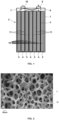
- FIG. 1 shows a first embodiment of a rechargeable battery cell 2 according to the invention in cross-sectional view.
- This rechargeable battery cell 2 is designed as a prismatic cell and has, among other things, a housing 1.
- This housing 1 encloses an electrode arrangement 3, which comprises three positive electrodes 4 and four negative electrodes 5.
- the positive electrodes 4 and the negative electrodes 5 are arranged alternately stacked in the electrode arrangement 3.
- the housing 1 can, however, also accommodate more positive electrodes 4 and/or negative electrodes 5.
- the number of negative electrodes 5 is one greater than the number of positive electrodes 4. This means that the outer end faces of the electrode stack are formed by the electrode surfaces of the negative electrodes 5.
- the electrodes 4, 5 are connected to corresponding connection contacts 9, 10 of the rechargeable battery cell 2 via electrode connections 6, 7.
- the rechargeable battery cell 2 is filled with an SO 2 -based electrolyte in such a way that the electrolyte penetrates as completely as possible into all pores or cavities, in particular within the electrodes 4, 5.
- the electrolyte is in Figure 1 not visible.
- the positive electrodes 4 contain an intercalation compound as active material. This intercalation compound is NaCoO 2 .
- the electrodes 4, 5 are flat, i.e. as layers with a smaller thickness in relation to their surface area. They are each separated from one another by separators 11.
- the housing 1 of the rechargeable battery cell 2 is essentially cuboid-shaped, with the electrodes 4, 5 and the walls of the housing 1 shown in the sectional view extending perpendicular to the plane of the drawing and being essentially straight and flat.
- the electrodes 4, 5 further comprise a discharge element which serves to enable the required electronically conductive connection of the active material of the respective electrode.
- This discharge element is in contact with the active material involved in the electrode reaction of the respective electrode 4, 5 (in Figure 1 not shown).
- the discharge element is in the form of a porous metal foam 18.
- the metal foam 18 extends over the thickness dimension of the electrodes 4, 5.
- the active material of the positive electrodes 4 and the negative electrodes 5 is incorporated into the pores of this metal foam 18 so that it fills its pores evenly over the entire thickness of the metal structure.
- the positive electrodes 4 contain a binder. This binder is a fluoropolymer.
- the negative electrodes 5 contain carbon as the active material in a form suitable as an insertion material for absorbing sodium ions.
- the structure of the negative electrode 5 is similar to that of the positive electrode 4.
- Figure 2 shows an electron micrograph of the three-dimensional porous structure of the metal foam 18 of the first embodiment of Figure 1 .
- the pores P have an average diameter of more than 100 ⁇ m, i.e. they are relatively large.
- This metal foam is a metal foam made of nickel.
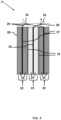
- FIG 3 shows a second embodiment of a rechargeable battery cell 20 according to the invention in cross-sectional view.
- the electrode arrangement comprises a positive electrode 23 and two negative electrodes 22. They are each separated from one another by separators 21 and surrounded by a housing 28.
- the positive electrode 23 has a discharge element 26 in the form of a planar metal foil, to which the active material 24 of the positive electrode 23 is applied on both sides.
- the negative electrodes 22 also comprise a discharge element 27 in the form of a planar metal foil, to which the active material 25 of the negative electrode 22 is applied on both sides.
- the planar discharge elements of the edge electrodes i.e. the electrodes that close off the electrode stack, can only be coated with active material on one side. The uncoated side faces the wall of the housing 28.
- the electrodes 22, 23 are connected via electrode connections 29, 30 to corresponding connection contacts 31, 32 of the rechargeable battery cell 20.
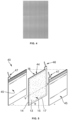
- Figure 4 shows the planar metal foil, which serves as a discharge element 26, 27 for the positive electrodes 23 and the negative electrodes 22 in the second embodiment from Figure 3.
- This metal foil has a perforated or net-like structure with a thickness of 20 ⁇ m.
- FIG. 5 shows a third embodiment of a rechargeable battery cell 40 according to the invention in an exploded view.
- This third embodiment differs from the two previously explained embodiments in that the positive electrode 44 is enclosed by a casing 13.
- a surface area of the casing 13 is larger than a surface area of the positive electrode 44, the boundary 14 of which in Figure 5 is shown as a dashed line.
- Two layers 15, 16 of the casing 13 covering the positive electrode 44 on both sides are connected to one another at the peripheral edge of the positive electrode 44 by an edge connection 17.
- the two negative electrodes 45 are not covered.
- the electrodes 44 and 45 can be contacted via the electrode connections 46 and 47.
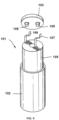
- FIG. 6 shows a third embodiment of a rechargeable battery cell 101 according to the invention in an exploded view.
- the essential construction elements are shown a battery cell 101 with a wound electrode arrangement.
- a cylindrical housing 102 with a cover part 103 there is an electrode arrangement 105 which is wound from a web-shaped starting material.
- the web consists of several layers, which include a positive electrode, a negative electrode and a separator running between the electrodes, which electrically and mechanically insulates the electrodes from one another, but is sufficiently porous or ion-conductive to enable the required ion exchange. In this way, large electrochemically active surfaces are created, which enable a correspondingly high current yield.
- the positive electrode has a discharge element in the form of a planar metal foil, to which a homogeneous mixture of the active material of the positive electrode is applied on both sides.
- the negative electrode also comprises a discharge element in the form of a planar metal foil, to which a homogeneous mixture of the active material of the negative electrode is applied on both sides.
- the cavity of the housing 102 is filled with an electrolyte (not shown) to the extent that it is not occupied by the electrode arrangement 105.
- the positive and negative electrodes of the electrode arrangement 105 are connected via corresponding connection lugs 106 for the positive electrode and 107 for the negative electrode to the connection contacts 108 for the positive electrode and 109 for the negative electrode, which enable the electrical connection of the rechargeable battery cell 101.
- the electrical connection of the negative electrode can also be made via the housing 102.
- this compound Li1 was dissolved in SO2 .
- the concentration of the conducting salt in the reference electrolyte was 0.6 mol/L.
- the compound Na1 shown below was first prepared as a conductive salt according to formula (I) according to a production process described in the following document [V6]: [V6] PJ Malinowski et al, Dalton Trans., 2020, 49, 7766-7773
- electrolyte was 0.6 mol/l (molar concentration based on 1 liter of electrolyte), unless otherwise stated in the experiment description.
- the experiments described below were carried out with the electrolyte Na1 and the reference electrolyte.
- the experiments were carried out in a test cell with a three-electrode arrangement (working electrode, counter electrode and reference electrode) with metallic sodium as counter and reference electrode.
- the working electrode was an electrode with an active material made of hard carbon.
- the composition of the electrode was 96 wt% hard carbon and a total of 4 wt% of the binders CMC and SBR.
- the discharge element was an aluminum foil.
- the half cells were filled with the electrolyte Na1.
- FIG. 7 shows the potentials of the charging curve and the discharging curve for the fifth cycle of the half-cell.
- the dashed curve corresponds to the potentials of the charging curve and the solid curve corresponds to the potentials of the discharging curve.
- the charging and discharging curves show typical battery behavior with a good cycle efficiency of over 95%.
- test cell with a three-electrode arrangement (working electrode, counter electrode and reference electrode) with metallic sodium as counter and reference electrode.
- the working electrode was an aluminum foil.
- the half cells were filled with the electrolyte Na1.
- test cell with a three-electrode arrangement (working electrode, counter electrode and reference electrode) was prepared in an experiment.
- the active material of the positive electrode (cathode) consisted of sodium cobalt oxide with the composition Na 0.7 CoO 2 .
- the composition of the entire positive electrode was 94 wt% Na 0.7 CoO 2 and 4 wt% of the binder PVDF and 2 wt% carbon black.
- the discharge element was a foil made of aluminum.
- the counter electrode and the reference electrode consisted of metallic sodium.
- the test cell was filled with the electrolyte Na1.
- test cell was charged at a charge rate of 0.1 C to an upper potential of 4.2 V. It was then discharged at a discharge rate of 0.1 C to a discharge potential of 2.0 volts.
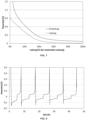
- Figure 9 shows the potential curve of the first two charge/discharge cycles in volts [V] as a function of the charge in % of the maximum charge.
- the potential curves show stable charging and discharging behavior.
- the curve shape is typical for this type of electrode material.
- the Na1 electrolyte was prepared with different concentrations of the compound Na1.
- the conductivity of the electrolyte was determined for each concentration of the compound using a conductive measuring method. After tempering, a four-electrode sensor was held in contact with the solution and measured in a measuring range of 0.02 - 500 mS/cm.
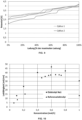
- Figure 10 shows the conductivity of the electrolyte Na1 as a function of the concentration of the compound Na1.
- the conductivity of the reference electrolyte is plotted as a function of the concentration of the corresponding Li compound (see [V4]).
- a maximum conductivity can be seen at a concentration of the compound Na1 of 0.6 mol/L with a high conductivity value of approx. 48 mS/cm.
- the reference electrolyte has a maximum conductivity at a concentration of the compound Li1 of 0.6 mol/L - 0.7 mol/L of approx. 38 mS/cm.
- the electrolyte Na1 with the conducting salt Na1 therefore has a better conductivity than the reference electrolyte with the corresponding lithium compound Li1.
- the sodium ion is larger than the lithium ion, so that better conductivity is also expected for lithium electrolytes.
- Table 1 show the surprising results in terms of conductivity.
- the organic electrolytes known from the state of the art such as LP30 (1 M LiPF6 / EC-DMC (1:1 wt.)) have a conductivity of only about 10 mS/cm.
Landscapes
- Chemical & Material Sciences (AREA)
- General Chemical & Material Sciences (AREA)
- Chemical Kinetics & Catalysis (AREA)
- Electrochemistry (AREA)
- Engineering & Computer Science (AREA)
- Inorganic Chemistry (AREA)
- Manufacturing & Machinery (AREA)
- Materials Engineering (AREA)
- Physics & Mathematics (AREA)
- Condensed Matter Physics & Semiconductors (AREA)
- General Physics & Mathematics (AREA)
- Composite Materials (AREA)
- Secondary Cells (AREA)
- Battery Electrode And Active Subsutance (AREA)
- Cell Electrode Carriers And Collectors (AREA)
Priority Applications (10)
| Application Number | Priority Date | Filing Date | Title |
|---|---|---|---|
| EP21215533.7A EP4199149B1 (de) | 2021-12-17 | 2021-12-17 | Wiederaufladbare batteriezelle |
| HUE21215533A HUE068747T2 (hu) | 2021-12-17 | 2021-12-17 | Újratölthetõ akkumulátorcella |
| ES21215533T ES2991388T3 (es) | 2021-12-17 | 2021-12-17 | Celda de batería recargable |
| PL21215533.7T PL4199149T3 (pl) | 2021-12-17 | 2021-12-17 | Ogniwo baterii wielokrotnego ładowania |
| PCT/EP2022/085941 WO2023111072A1 (de) | 2021-12-17 | 2022-12-14 | Wiederaufladbare batteriezelle |
| CA3241357A CA3241357A1 (en) | 2021-12-17 | 2022-12-14 | Rechargeable battery cell |
| JP2024536049A JP2025500908A (ja) | 2021-12-17 | 2022-12-14 | 充電式電池セル |
| CN202280083707.6A CN118414726A (zh) | 2021-12-17 | 2022-12-14 | 可再充电电池电芯 |
| KR1020247023893A KR20240122540A (ko) | 2021-12-17 | 2022-12-14 | 이차 전지 셀 |
| US18/743,951 US20240332516A1 (en) | 2021-12-17 | 2024-06-14 | Rechargeable battery cell |
Applications Claiming Priority (1)
| Application Number | Priority Date | Filing Date | Title |
|---|---|---|---|
| EP21215533.7A EP4199149B1 (de) | 2021-12-17 | 2021-12-17 | Wiederaufladbare batteriezelle |
Publications (2)
| Publication Number | Publication Date |
|---|---|
| EP4199149A1 EP4199149A1 (de) | 2023-06-21 |
| EP4199149B1 true EP4199149B1 (de) | 2024-07-17 |
Family
ID=78957304
Family Applications (1)
| Application Number | Title | Priority Date | Filing Date |
|---|---|---|---|
| EP21215533.7A Active EP4199149B1 (de) | 2021-12-17 | 2021-12-17 | Wiederaufladbare batteriezelle |
Country Status (10)
| Country | Link |
|---|---|
| US (1) | US20240332516A1 (pl) |
| EP (1) | EP4199149B1 (pl) |
| JP (1) | JP2025500908A (pl) |
| KR (1) | KR20240122540A (pl) |
| CN (1) | CN118414726A (pl) |
| CA (1) | CA3241357A1 (pl) |
| ES (1) | ES2991388T3 (pl) |
| HU (1) | HUE068747T2 (pl) |
| PL (1) | PL4199149T3 (pl) |
| WO (1) | WO2023111072A1 (pl) |
Families Citing this family (1)
| Publication number | Priority date | Publication date | Assignee | Title |
|---|---|---|---|---|
| CN117586294B (zh) * | 2024-01-18 | 2024-05-28 | 山东海化集团有限公司 | 一种四(六氟异丙氧基)硼酸钠的制备方法及其在钠电中的应用 |
Citations (1)
| Publication number | Priority date | Publication date | Assignee | Title |
|---|---|---|---|---|
| EP3794666B1 (de) * | 2019-07-31 | 2021-12-29 | Innolith Technology AG | Wiederaufladbare batteriezelle |
Family Cites Families (4)
| Publication number | Priority date | Publication date | Assignee | Title |
|---|---|---|---|---|
| US4891281A (en) | 1982-08-09 | 1990-01-02 | Duracell Inc. | Electrochemical cells having low vapor pressure complexed SO2 electrolytes |
| KR101520606B1 (ko) | 2013-10-08 | 2015-05-15 | 전자부품연구원 | 나트륨-이산화황계 이차 전지 및 이의 제조 방법 |
| KR101542880B1 (ko) | 2013-10-08 | 2015-08-07 | 전자부품연구원 | 나트륨-금속염화물계 이차 전지 및 그의 제조 방법 |
| US11264659B2 (en) * | 2019-08-20 | 2022-03-01 | Uchicago Argonne, Llc | Rechargeable lithium-hydroxide based non-aqueous lithium oxygen batteries |
-
2021
- 2021-12-17 ES ES21215533T patent/ES2991388T3/es active Active
- 2021-12-17 EP EP21215533.7A patent/EP4199149B1/de active Active
- 2021-12-17 PL PL21215533.7T patent/PL4199149T3/pl unknown
- 2021-12-17 HU HUE21215533A patent/HUE068747T2/hu unknown
-
2022
- 2022-12-14 CA CA3241357A patent/CA3241357A1/en active Pending
- 2022-12-14 WO PCT/EP2022/085941 patent/WO2023111072A1/de not_active Ceased
- 2022-12-14 CN CN202280083707.6A patent/CN118414726A/zh active Pending
- 2022-12-14 JP JP2024536049A patent/JP2025500908A/ja active Pending
- 2022-12-14 KR KR1020247023893A patent/KR20240122540A/ko active Pending
-
2024
- 2024-06-14 US US18/743,951 patent/US20240332516A1/en active Pending
Patent Citations (1)
| Publication number | Priority date | Publication date | Assignee | Title |
|---|---|---|---|---|
| EP3794666B1 (de) * | 2019-07-31 | 2021-12-29 | Innolith Technology AG | Wiederaufladbare batteriezelle |
Also Published As
| Publication number | Publication date |
|---|---|
| JP2025500908A (ja) | 2025-01-15 |
| ES2991388T3 (es) | 2024-12-03 |
| WO2023111072A1 (de) | 2023-06-22 |
| CA3241357A1 (en) | 2023-06-22 |
| US20240332516A1 (en) | 2024-10-03 |
| EP4199149A1 (de) | 2023-06-21 |
| PL4199149T3 (pl) | 2024-11-25 |
| CN118414726A (zh) | 2024-07-30 |
| HUE068747T2 (hu) | 2025-01-28 |
| KR20240122540A (ko) | 2024-08-12 |
Similar Documents
| Publication | Publication Date | Title |
|---|---|---|
| EP3794663B1 (de) | Wiederaufladbare batteriezelle | |
| DE102015111250B4 (de) | Sekundärbatterie mit nicht-wässrigem Elektrolyt, Verfahren zur Herstellung hierfür und nicht-wässrige Elektrolytlösung | |
| EP3734724B1 (de) | Wiederaufladbare batteriezelle | |
| EP4037056A1 (de) | Auf so2-basierender elektrolyt für eine wiederaufladbare batteriezelle und wiederaufladbare batteriezelle | |
| EP3703161A1 (de) | Wiederaufladbare batteriezelle mit einem aktiven elektrodendepolarisator | |
| EP3771011A2 (de) | Auf so2-basierender elektrolyt für eine wiederaufladbare batteriezelle und wiederaufladbare batteriezellen damit | |
| DE112016001116T5 (de) | Elektrolytlösung | |
| DE102019206133A1 (de) | Festkörperelektrolytschicht und Batteriezelle aufweisend eine Festkörperelektrolytschicht | |
| DE112021003738T5 (de) | Wiederaufladbare metallhalogenidbatterie mit interkalationsanode | |
| EP4199149B1 (de) | Wiederaufladbare batteriezelle | |
| WO2022161996A1 (de) | Wiederaufladbare batteriezelle | |
| WO2022162008A1 (de) | Wiederaufladbare batteriezelle | |
| WO2023111070A1 (de) | Wiederaufladbare batteriezelle | |
| DE102019133169A1 (de) | Elektrolyt für lithium-sekundärbatterie und diesen enthaltende lithium-sekundärbatterie | |
| DE102016217709A1 (de) | Hybridsuperkondensator mit SEI-Additiven | |
| DE102023107385B3 (de) | Natrium-Ionen-Sekundärbatterie, Verfahren zur Herstellung einer Natrium-Ionen-Sekundärbatterie und deren Verwendung | |
| EP3840091B1 (de) | Zelle mit metallischer lithiumanode und herstellungsverfahren | |
| WO2008110558A1 (de) | Elektrolyte für elektrochemische bauelemente | |
| DE102018221319A1 (de) | Slurryherstellung auf Wasserbasis mit Kathodenaktivmaterial, das mit einem Festelektrolyten beschichtet ist, Herstellung einer Elektrode daraus und Herstellung einer Lithium-Ionen-Batteriezelle | |
| DE102016217818A1 (de) | Hybridsuperkondensator mit einem Additiv zur Erhöhung der Viskosität |
Legal Events
| Date | Code | Title | Description |
|---|---|---|---|
| PUAI | Public reference made under article 153(3) epc to a published international application that has entered the european phase |
Free format text: ORIGINAL CODE: 0009012 |
|
| STAA | Information on the status of an ep patent application or granted ep patent |
Free format text: STATUS: REQUEST FOR EXAMINATION WAS MADE |
|
| 17P | Request for examination filed |
Effective date: 20220729 |
|
| AK | Designated contracting states |
Kind code of ref document: A1 Designated state(s): AL AT BE BG CH CY CZ DE DK EE ES FI FR GB GR HR HU IE IS IT LI LT LU LV MC MK MT NL NO PL PT RO RS SE SI SK SM TR |
|
| GRAP | Despatch of communication of intention to grant a patent |
Free format text: ORIGINAL CODE: EPIDOSNIGR1 |
|
| STAA | Information on the status of an ep patent application or granted ep patent |
Free format text: STATUS: GRANT OF PATENT IS INTENDED |
|
| RIC1 | Information provided on ipc code assigned before grant |
Ipc: H01M 4/66 20060101ALN20240228BHEP Ipc: H01M 4/587 20100101ALN20240228BHEP Ipc: H01M 4/58 20100101ALN20240228BHEP Ipc: H01M 4/525 20100101ALN20240228BHEP Ipc: H01M 4/485 20100101ALN20240228BHEP Ipc: H01M 4/48 20100101ALN20240228BHEP Ipc: H01M 10/0568 20100101ALI20240228BHEP Ipc: H01M 10/0563 20100101ALI20240228BHEP Ipc: H01M 10/054 20100101ALI20240228BHEP Ipc: H01M 4/38 20060101AFI20240228BHEP |
|
| RIC1 | Information provided on ipc code assigned before grant |
Ipc: H01M 4/66 20060101ALN20240306BHEP Ipc: H01M 4/587 20100101ALN20240306BHEP Ipc: H01M 4/58 20100101ALN20240306BHEP Ipc: H01M 4/525 20100101ALN20240306BHEP Ipc: H01M 4/485 20100101ALN20240306BHEP Ipc: H01M 4/48 20100101ALN20240306BHEP Ipc: H01M 10/0568 20100101ALI20240306BHEP Ipc: H01M 10/0563 20100101ALI20240306BHEP Ipc: H01M 10/054 20100101ALI20240306BHEP Ipc: H01M 4/38 20060101AFI20240306BHEP |
|
| INTG | Intention to grant announced |
Effective date: 20240319 |
|
| P01 | Opt-out of the competence of the unified patent court (upc) registered |
Effective date: 20240419 |
|
| GRAS | Grant fee paid |
Free format text: ORIGINAL CODE: EPIDOSNIGR3 |
|
| GRAA | (expected) grant |
Free format text: ORIGINAL CODE: 0009210 |
|
| STAA | Information on the status of an ep patent application or granted ep patent |
Free format text: STATUS: THE PATENT HAS BEEN GRANTED |
|
| AK | Designated contracting states |
Kind code of ref document: B1 Designated state(s): AL AT BE BG CH CY CZ DE DK EE ES FI FR GB GR HR HU IE IS IT LI LT LU LV MC MK MT NL NO PL PT RO RS SE SI SK SM TR |
|
| REG | Reference to a national code |
Ref country code: CH Ref legal event code: EP |
|
| REG | Reference to a national code |
Ref country code: DE Ref legal event code: R096 Ref document number: 502021004394 Country of ref document: DE |
|
| REG | Reference to a national code |
Ref country code: IE Ref legal event code: FG4D Free format text: LANGUAGE OF EP DOCUMENT: GERMAN |
|
| REG | Reference to a national code |
Ref country code: SE Ref legal event code: TRGR |
|
| REG | Reference to a national code |
Ref country code: LT Ref legal event code: MG9D |
|
| REG | Reference to a national code |
Ref country code: NL Ref legal event code: MP Effective date: 20240717 |
|
| REG | Reference to a national code |
Ref country code: ES Ref legal event code: FG2A Ref document number: 2991388 Country of ref document: ES Kind code of ref document: T3 Effective date: 20241203 |
|
| PG25 | Lapsed in a contracting state [announced via postgrant information from national office to epo] |
Ref country code: PT Free format text: LAPSE BECAUSE OF FAILURE TO SUBMIT A TRANSLATION OF THE DESCRIPTION OR TO PAY THE FEE WITHIN THE PRESCRIBED TIME-LIMIT Effective date: 20241118 |
|
| PG25 | Lapsed in a contracting state [announced via postgrant information from national office to epo] |
Ref country code: NL Free format text: LAPSE BECAUSE OF FAILURE TO SUBMIT A TRANSLATION OF THE DESCRIPTION OR TO PAY THE FEE WITHIN THE PRESCRIBED TIME-LIMIT Effective date: 20240717 |
|
| PG25 | Lapsed in a contracting state [announced via postgrant information from national office to epo] |
Ref country code: PT Free format text: LAPSE BECAUSE OF FAILURE TO SUBMIT A TRANSLATION OF THE DESCRIPTION OR TO PAY THE FEE WITHIN THE PRESCRIBED TIME-LIMIT Effective date: 20241118 Ref country code: NL Free format text: LAPSE BECAUSE OF FAILURE TO SUBMIT A TRANSLATION OF THE DESCRIPTION OR TO PAY THE FEE WITHIN THE PRESCRIBED TIME-LIMIT Effective date: 20240717 |
|
| PGFP | Annual fee paid to national office [announced via postgrant information from national office to epo] |
Ref country code: DE Payment date: 20241113 Year of fee payment: 4 |
|
| PG25 | Lapsed in a contracting state [announced via postgrant information from national office to epo] |
Ref country code: NO Free format text: LAPSE BECAUSE OF FAILURE TO SUBMIT A TRANSLATION OF THE DESCRIPTION OR TO PAY THE FEE WITHIN THE PRESCRIBED TIME-LIMIT Effective date: 20241017 |
|
| PG25 | Lapsed in a contracting state [announced via postgrant information from national office to epo] |
Ref country code: FI Free format text: LAPSE BECAUSE OF FAILURE TO SUBMIT A TRANSLATION OF THE DESCRIPTION OR TO PAY THE FEE WITHIN THE PRESCRIBED TIME-LIMIT Effective date: 20240717 Ref country code: GR Free format text: LAPSE BECAUSE OF FAILURE TO SUBMIT A TRANSLATION OF THE DESCRIPTION OR TO PAY THE FEE WITHIN THE PRESCRIBED TIME-LIMIT Effective date: 20241018 |
|
| PGFP | Annual fee paid to national office [announced via postgrant information from national office to epo] |
Ref country code: PL Payment date: 20241212 Year of fee payment: 4 |
|
| PG25 | Lapsed in a contracting state [announced via postgrant information from national office to epo] |
Ref country code: BG Free format text: LAPSE BECAUSE OF FAILURE TO SUBMIT A TRANSLATION OF THE DESCRIPTION OR TO PAY THE FEE WITHIN THE PRESCRIBED TIME-LIMIT Effective date: 20240717 |
|
| PGFP | Annual fee paid to national office [announced via postgrant information from national office to epo] |
Ref country code: FR Payment date: 20241219 Year of fee payment: 4 |
|
| PG25 | Lapsed in a contracting state [announced via postgrant information from national office to epo] |
Ref country code: LV Free format text: LAPSE BECAUSE OF FAILURE TO SUBMIT A TRANSLATION OF THE DESCRIPTION OR TO PAY THE FEE WITHIN THE PRESCRIBED TIME-LIMIT Effective date: 20240717 |
|
| PG25 | Lapsed in a contracting state [announced via postgrant information from national office to epo] |
Ref country code: IS Free format text: LAPSE BECAUSE OF FAILURE TO SUBMIT A TRANSLATION OF THE DESCRIPTION OR TO PAY THE FEE WITHIN THE PRESCRIBED TIME-LIMIT Effective date: 20241117 |
|
| PG25 | Lapsed in a contracting state [announced via postgrant information from national office to epo] |
Ref country code: HR Free format text: LAPSE BECAUSE OF FAILURE TO SUBMIT A TRANSLATION OF THE DESCRIPTION OR TO PAY THE FEE WITHIN THE PRESCRIBED TIME-LIMIT Effective date: 20240717 |
|
| PG25 | Lapsed in a contracting state [announced via postgrant information from national office to epo] |
Ref country code: RS Free format text: LAPSE BECAUSE OF FAILURE TO SUBMIT A TRANSLATION OF THE DESCRIPTION OR TO PAY THE FEE WITHIN THE PRESCRIBED TIME-LIMIT Effective date: 20241017 |
|
| REG | Reference to a national code |
Ref country code: HU Ref legal event code: AG4A Ref document number: E068747 Country of ref document: HU |
|
| PGFP | Annual fee paid to national office [announced via postgrant information from national office to epo] |
Ref country code: SE Payment date: 20241217 Year of fee payment: 4 |
|
| PG25 | Lapsed in a contracting state [announced via postgrant information from national office to epo] |
Ref country code: RS Free format text: LAPSE BECAUSE OF FAILURE TO SUBMIT A TRANSLATION OF THE DESCRIPTION OR TO PAY THE FEE WITHIN THE PRESCRIBED TIME-LIMIT Effective date: 20241017 Ref country code: NO Free format text: LAPSE BECAUSE OF FAILURE TO SUBMIT A TRANSLATION OF THE DESCRIPTION OR TO PAY THE FEE WITHIN THE PRESCRIBED TIME-LIMIT Effective date: 20241017 Ref country code: LV Free format text: LAPSE BECAUSE OF FAILURE TO SUBMIT A TRANSLATION OF THE DESCRIPTION OR TO PAY THE FEE WITHIN THE PRESCRIBED TIME-LIMIT Effective date: 20240717 Ref country code: IS Free format text: LAPSE BECAUSE OF FAILURE TO SUBMIT A TRANSLATION OF THE DESCRIPTION OR TO PAY THE FEE WITHIN THE PRESCRIBED TIME-LIMIT Effective date: 20241117 Ref country code: HR Free format text: LAPSE BECAUSE OF FAILURE TO SUBMIT A TRANSLATION OF THE DESCRIPTION OR TO PAY THE FEE WITHIN THE PRESCRIBED TIME-LIMIT Effective date: 20240717 Ref country code: GR Free format text: LAPSE BECAUSE OF FAILURE TO SUBMIT A TRANSLATION OF THE DESCRIPTION OR TO PAY THE FEE WITHIN THE PRESCRIBED TIME-LIMIT Effective date: 20241018 Ref country code: FI Free format text: LAPSE BECAUSE OF FAILURE TO SUBMIT A TRANSLATION OF THE DESCRIPTION OR TO PAY THE FEE WITHIN THE PRESCRIBED TIME-LIMIT Effective date: 20240717 Ref country code: BG Free format text: LAPSE BECAUSE OF FAILURE TO SUBMIT A TRANSLATION OF THE DESCRIPTION OR TO PAY THE FEE WITHIN THE PRESCRIBED TIME-LIMIT Effective date: 20240717 |
|
| PGFP | Annual fee paid to national office [announced via postgrant information from national office to epo] |
Ref country code: HU Payment date: 20241213 Year of fee payment: 4 |
|
| PG25 | Lapsed in a contracting state [announced via postgrant information from national office to epo] |
Ref country code: RO Free format text: LAPSE BECAUSE OF FAILURE TO SUBMIT A TRANSLATION OF THE DESCRIPTION OR TO PAY THE FEE WITHIN THE PRESCRIBED TIME-LIMIT Effective date: 20240717 Ref country code: DK Free format text: LAPSE BECAUSE OF FAILURE TO SUBMIT A TRANSLATION OF THE DESCRIPTION OR TO PAY THE FEE WITHIN THE PRESCRIBED TIME-LIMIT Effective date: 20240717 Ref country code: SM Free format text: LAPSE BECAUSE OF FAILURE TO SUBMIT A TRANSLATION OF THE DESCRIPTION OR TO PAY THE FEE WITHIN THE PRESCRIBED TIME-LIMIT Effective date: 20240717 |
|
| PGFP | Annual fee paid to national office [announced via postgrant information from national office to epo] |
Ref country code: ES Payment date: 20250117 Year of fee payment: 4 |
|
| REG | Reference to a national code |
Ref country code: DE Ref legal event code: R097 Ref document number: 502021004394 Country of ref document: DE |
|
| PG25 | Lapsed in a contracting state [announced via postgrant information from national office to epo] |
Ref country code: EE Free format text: LAPSE BECAUSE OF FAILURE TO SUBMIT A TRANSLATION OF THE DESCRIPTION OR TO PAY THE FEE WITHIN THE PRESCRIBED TIME-LIMIT Effective date: 20240717 |
|
| PG25 | Lapsed in a contracting state [announced via postgrant information from national office to epo] |
Ref country code: CZ Free format text: LAPSE BECAUSE OF FAILURE TO SUBMIT A TRANSLATION OF THE DESCRIPTION OR TO PAY THE FEE WITHIN THE PRESCRIBED TIME-LIMIT Effective date: 20240717 |
|
| PG25 | Lapsed in a contracting state [announced via postgrant information from national office to epo] |
Ref country code: SK Free format text: LAPSE BECAUSE OF FAILURE TO SUBMIT A TRANSLATION OF THE DESCRIPTION OR TO PAY THE FEE WITHIN THE PRESCRIBED TIME-LIMIT Effective date: 20240717 |
|
| PGFP | Annual fee paid to national office [announced via postgrant information from national office to epo] |
Ref country code: TR Payment date: 20241210 Year of fee payment: 4 |
|
| PLBE | No opposition filed within time limit |
Free format text: ORIGINAL CODE: 0009261 |
|
| STAA | Information on the status of an ep patent application or granted ep patent |
Free format text: STATUS: NO OPPOSITION FILED WITHIN TIME LIMIT |
|
| 26N | No opposition filed |
Effective date: 20250422 |
|
| PG25 | Lapsed in a contracting state [announced via postgrant information from national office to epo] |
Ref country code: MC Free format text: LAPSE BECAUSE OF FAILURE TO SUBMIT A TRANSLATION OF THE DESCRIPTION OR TO PAY THE FEE WITHIN THE PRESCRIBED TIME-LIMIT Effective date: 20240717 |
|
| REG | Reference to a national code |
Ref country code: CH Ref legal event code: PL |
|
| PG25 | Lapsed in a contracting state [announced via postgrant information from national office to epo] |
Ref country code: LU Free format text: LAPSE BECAUSE OF NON-PAYMENT OF DUE FEES Effective date: 20241217 |
|
| REG | Reference to a national code |
Ref country code: BE Ref legal event code: MM Effective date: 20241231 |
|
| PG25 | Lapsed in a contracting state [announced via postgrant information from national office to epo] |
Ref country code: BE Free format text: LAPSE BECAUSE OF NON-PAYMENT OF DUE FEES Effective date: 20241231 |
|
| PG25 | Lapsed in a contracting state [announced via postgrant information from national office to epo] |
Ref country code: CH Free format text: LAPSE BECAUSE OF NON-PAYMENT OF DUE FEES Effective date: 20241231 |
|
| PG25 | Lapsed in a contracting state [announced via postgrant information from national office to epo] |
Ref country code: IE Free format text: LAPSE BECAUSE OF NON-PAYMENT OF DUE FEES Effective date: 20241217 |